Out of the Blue

Out of the Blue

The Land of Pods

What’s old is new again

By Deborah Salomon

Until recently, I knew pods only from the English peas growing in Granddaddy’s garden . . . and tent-like enclosures E.T. might take camping.

In mankind’s insatiable quest for the new, the shiny, he-she-they occasionally turn up a relic that, when dusted off, can be recycled, then touted as le denier cri. I speak of podcasts which, in generations before Gens. X-Y-Z, were called radio: Sit down in front the wireless, the transistor, the boom box, and listen to people talking, music playing, ad jingles, news and weather, whatever.

Relax. Close your eyes. You could be listening to The Fat Man or The Jack Benny Show. More recently, on road trips, I enjoyed NPR’s Car Talk, international news, and a show where listeners challenged a chef to contrive a recipe from unlikely ingredients.

I understand why Gens. X-Y-Z prefer podcasts. Podcasts are chic, informative, entertaining. But thinking they invented the talkie genre, no way.

As for the name, Google informed me that it attaches iPod — the delivery hardware for the original product — to broadcast, an ancient verb turned noun. Though still confused, I stand better informed.

My first podcast experience was on TV. At the end of HBO’s mini-series The Gilded Age the audience is invited to stay tuned for a podcast exploring the show. What followed was a conversation between writers and producers. On the screen remained a still of the opulent set. Like when the picture freezes. My brain, accustomed to multi-stimulants, tuned out.

Better Google a definition before proceeding: “A digital medium consisting of an episodic series of audio, video, PDF subscribed to and downloaded through Web syndication or streamed online to a computer or mobile device.”

Discouraged but still intrigued, I booked an in-person conversation with Frank Daniels IV, The Pilot’s radio/podcast-meister who was still a teenager when podcasts came into being, circa 2004. His tutorial filled me with shock and awe, as would a neurosurgeon explaining how to cut open a brain. He explained platforms, monetizing a famous or ordinary name, how 60 percent of Americans have listened to at least one podcast, creating your own, accessing subject matter, even libel vs. slander dispensed by hothead podcasters like the infamous Joe Rogan. He spoke on lack of filtration (censorship), when and where people listen (forget the bathtub), the appeal for children who can don headphones and run around or fall asleep while listening to Grandma read a story.

Really, Daniels knows more about podcasting than I know about chicken soup. Always smiling, he convinced me podcasts were the modern-day World Book Encyclopedia.

Like baking bread and knitting, podcasts grew in popularity with better-educated housebound techies during the pandemic. Only disappointment: no loaf, no sweater.

Daniels concedes that the medium has gone in too many directions. Millions exist, some super-interesting and educational, others mere ego trips. “But it won’t burn out; podcasting is here to stay,” he says.

Not sure I am, however, despite Daniels’ patient and enthusiastic tutorial. Obviously, podcasting makes him happy while just making me anxious, same as artificial intelligence and deep-fake videos. Have you heard about the new program that writes an essay or report from inputted facts? There goes my job. Besides, not sure my Android cell is au courant, or compatible. No Sirius or laptop, either, just a rickety old PC, a non-smart TV and an AM-FM radio. Can’t grasp RSS feeds. Too much up and downloading. Too many choices, like looking for a good beach read at the Library of Congress. Besides, ear buds render me slightly dizzy.

So I’ll stick with my little portable radio, a go-to during power outages. NPR survives storms and, even Daniels concurs, nothing lifts the spirits like classic rock. Should that pale, I’ll dig up old-time podcasts of 20 Questions, The Jack Benny Show and Breakfast with Dorothy and Dick, the must-hear news and gossip hour consumed 1945-63.

At least until E.T. invites me for a weekend camping.  PS

Deborah Salomon is a contributing writer for PineStraw and The Pilot. She may be reached at debsalomon@nc.rr.com.

Sporting Life

Sporting Life

Remembering Wild Places

And finding a project for spring


By Tom Bryant

“So what a man has got to do is take a little time off as he grows older, and devote the waste space to remembering the things he did that he maybe won’t never do again.”

        — Robert Ruark, The Old Man and The Boy

It was one of those after the New Year, late winter, hoping for spring kind of days when the frosty wind was out of the northwest, blowing hard enough to keep most everyone, animals included, close to home. I had a pretty good case of cabin fever, so I decided to ride down to the little farm I lease, close to Drowning Creek, and check out the cold weather doings.

I’ve been using the farm to do some dove and turkey hunting, but mostly as just a getaway from civilization. I pulled the Cruiser into the pines and cut the engine near the fallow fields that the farmer was getting ready to plant. During a lull in the wind, I decided to get a little exercise and walk around the perimeter of the pine grove, a circle of about a mile. No game was moving, not even birds. Too cold. Everybody’s trying to stay warm.

I thought how fortunate I was to have had so many wonderful wild places to hunt, fish and camp, beginning with growing up in Pinebluff. Not saying that Pinebluff was wild, but a short bike ride could take you to the woods where wildlife was abundant. There was a sandpit area close to the railroad tracks where we used to camp, and farther south toward Addor were more undeveloped acres that were ideal for a young person with a vivid imagination to roam at will and imagine that he was deep in the African veldt searching for roaring lions or charging rhinos. As I grew older, I hunted the woods on either side of the tracks for squirrels, rabbits and doves.

My granddad had a fish camp on the Little Pee Dee River. It was nothing real fancy, a one-room shack with a tin roof. Inside there was a homemade double bunk bed with ropes holding thin mattresses. A small alcove off to one end was the makeshift kitchen where granddad kept a small gas cook stove. A shelf on one side held all the cast iron pots and skillets used to fry untold numbers of bream and redbreast fish. It was a wonderful place with smells of swamp and river.

One of my most cherished memories is of granddad swimming in the fast-moving river, a Mae West life preserver tied around the big girth of his shoulders and his ankle tethered to the dock with about a 15-foot rope. He floated in the river like a small whale, laughing and blowing like a geyser. It was, he said, his Saturday night bath. I had to do the same but in the shallow water where we docked his fishing skiff.

We were usually on the river for a week or 10 days. When granddad was ready to go fishing, he went for a while. He said to me many times, “It takes a day or two just to get the lay of the land and get used to the ways of the swamp.” Later, when I was a few years older, he built a first-class river house more like something you would find at the beach. I was 16 with a driver’s license, sports had entered my picture, and I had discovered girls. I put fishing on the Little Pee Dee River on the back burner.

Nothing stays the same, they say, except death and taxes. Time rolled on faster than anticipated and I was ready to head off to college. Not much chance to enjoy the great outdoors, as I was doing all I could to make the grades so I could play baseball. I was lucky, though. I was in the middle of the mountains right next to the Pisgah National Forest with miles of wild land to explore. As soon as I became acclimated to the rigors of actually studying, I began to explore Pisgah’s beautiful natural resources.

I was driving an old 1940 Chevrolet Deluxe that my dad gave me my senior year in high school, and I outfitted it to be my SUV long before some Detroit auto designer coined the phrase. If someone wanted to interpret my lifestyle, all they had to do was inventory the contents of that ancient conveyance. I kept a small backpack loaded with all the necessities required to survive a couple of nights in the woods. A good knife, a hatchet, candles, eating essentials, including a cook kit saved from my days in the Boy Scouts, and of course, waterproof matches. In another duffel bag were a pup tent half and two wool Army blankets suitable for sleeping.

During the seasons, the inventory would reflect what was happening. In the spring and summer, fishing gear would hold forth, and fall and winter would usher in hunting paraphernalia. Of course, the seasons would overlap, and from time to time, my collections of gear would have to be purged and started over again. This in itself was a monumental job.

Cold was settling in, and I decided to give it a little more time and then head home to build a fire. I had a shabby camouflage duck hunting coat in the back of the Cruiser, and I grabbed it and put it on to ward off some of the chill. I bought the coat many years ago from a good friend and hunting buddy who owned a sporting goods shop, and it has stayed with me and become part of my hunting wardrobe. It was with me while hunting Currituck, Mattamuskeet, the Haw River, Black Creek and other fields and swamps too numerous to remember. The old coat is like a good luck charm. I can put it on and it automatically brings back memories of special times and good friends.

The hazy late winter sun was beginning to settle in the west and promised a moonless dark night, so I started up the little Cruiser and drove out of the pines on the narrow sand road that passed by a miniature pond nestled back in the woods, almost out of sight. On a whim, I stopped the vehicle as silently as I could and sneaked quietly, using the pond bank alders as cover, to check out the waterhole for wildlife.

I peeked over the brush and saw that the little slough was empty, but just as I turned to leave, a pair of wood ducks, wings whistling right overhead, softly splashed down in the water under a towering cypress tree.

Wow, I thought, that made the day. I need to come down here in March and put up a couple of nesting wood duck boxes.

It’s good to have a new project, and I thought back to the not so distant past and the numerous boxes I had positioned around lakes and beaver ponds. I usually do this in March because that’s when the wood duck, in my mind nature’s most beautiful duck, begins nesting.

I silently eased up to the vehicle, cranked her and headed home to a warm fire, also maybe a little libation, and a search to find my plans for building wood duck boxes. It’s gonna be a good spring.  PS

Tom Bryant, a Southern Pines resident, is a lifelong outdoorsman and PineStraw’s Sporting Life columnist.

A Rude Awakening

A Rude Awakening

Bravery, blunders, and bloodshed at Monroe’s Crossroads

By Bill Case    

Art by  Martin Pate and the Fort Bragg Cultural Resource Management Program
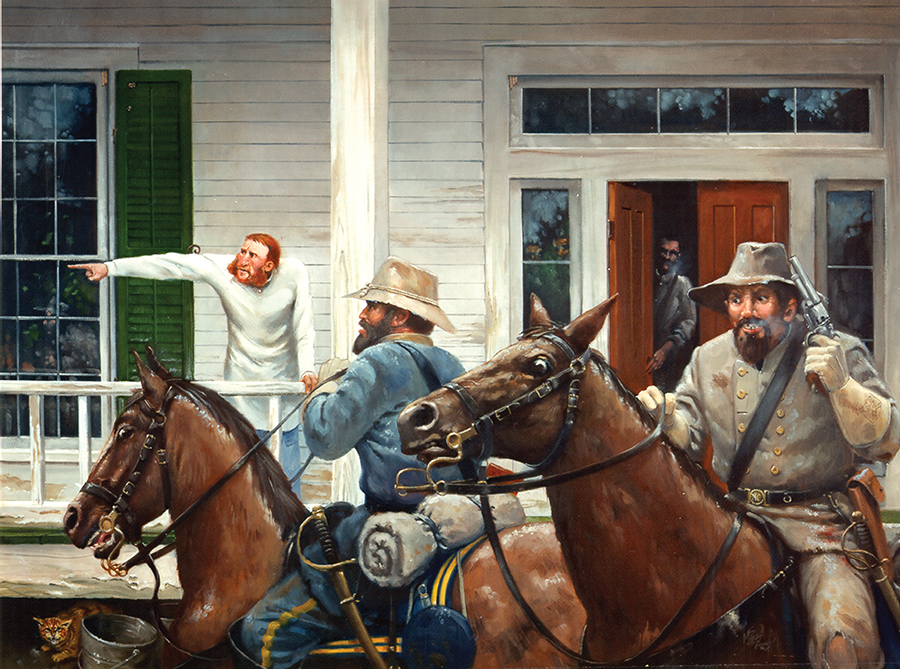
Gen. Kilpatrick misdirects Confederate cavalry.

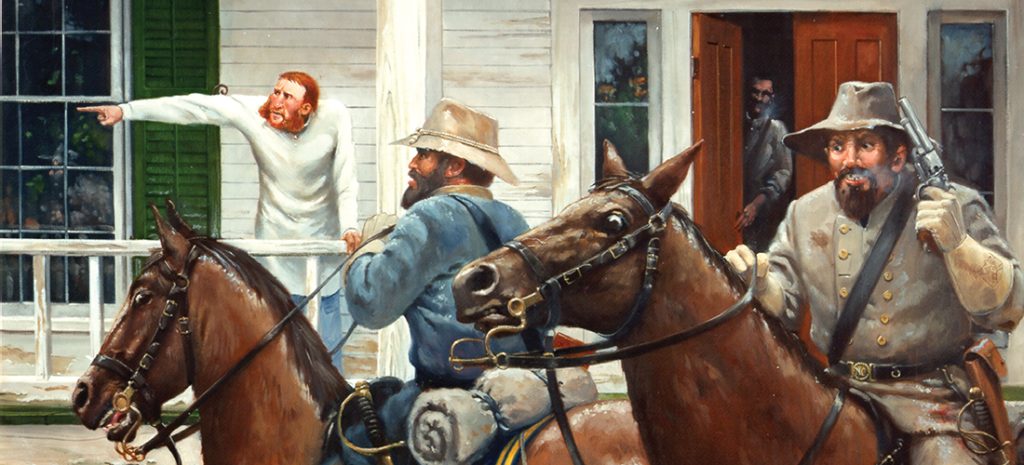
The arrival of dawn on March 10, 1865, became an unwelcome wake-up call for Lt. Gen. Judson Kilpatrick. Stirred from his bed by the sound of thundering hoofbeats, the Union cavalry leader, clad only in his nightshirt and drawers, rushed to the front porch of Charles Monroe’s farmhouse, 8 miles east of present-day Southern Pines on what is now the Fort Bragg — soon to be Fort Liberty — Army reservation. Having commandeered the house for his temporary headquarters, what Kilpatrick saw shocked him. Hordes of Confederate cavalry were swooping down on his sleeping encampment, slashing with sabers and firing point-blank at bleary-eyed Union troops. Thus began “The Battle of Monroe’s Crossroads.”

“In less than a minute,” Kilpatrick would later report, the Confederate horsemen “had driven back my people, and taken possession of my headquarters, captured the artillery (two cannons), and the whole command was flying before the most formidable cavalry charge I ever have witnessed.” The general’s immediate thought was, “Here is four years’ hard fighting for a major general’s commission gone up with an infernal surprise.”

Tagged with the scathing moniker “Kill-cavalry” because of a history of unnecessarily putting his troops in harm’s way, the general’s improvident failure to set pickets and safeguard his headquarters was an especially egregious omission and could well torpedo his military career. It enabled Confederate cavalry, led by Gen. Wade Hampton and subordinate generals Joseph Wheeler and Matthew Butler, to ride undetected and unopposed straight into the Union camp.

Kilpatrick’s attention may have been distracted by the presence of a woman. Depending on the historian consulted, the woman was either the beautiful Marie Boozer or a plain Yankee schoolmarm named Alice. In either case, the woman was believed to be sharing Kilpatrick’s bed at the farmhouse. The general, it seems, was caught with his pants down.

One objective of the Confederate attack was to capture Kilpatrick. A cadre of Georgia cavalry, finding a man still in his bedclothes standing on the porch of Monroe’s farmhouse, demanded to know where the Union general was. It was Kilpatrick, of course, and he quickly pointed to a figure riding off in the distance, “There he goes on that black horse!” exclaimed the general.

The Georgians turned and rode off in pursuit. Leaving either Alice or Marie behind, Kilpatrick scrambled off the porch, climbed aboard a stray horse — not his prized Arabian stallion “Spot” — and promptly hightailed it into the woods, where many of his cavalrymen had retreated. To this day, the general’s flight is disparagingly labeled “Kilpatrick’s Shirt-Tail Skedaddle.”

The Confederates had good reason to target Kilpatrick, whom they had come to despise for his part in the Union Army’s devastating blitz of the South. Six months earlier, on Sept. 2, 1864, Gen. William Tecumseh Sherman’s 60,000 Union soldiers had occupied and burned the city of Atlanta when depleted Confederate forces — commanded initially by Gen. Joseph Johnston, followed by Gen. John Bell Hood — were unable to halt the Union troops’ advance. In response, the president of the Confederacy, Jefferson Davis, installed Gen. P.G.T. Beauregard as the commander of the newly formed Department of the West, comprised of five Southern states that included Georgia, South Carolina and North Carolina.
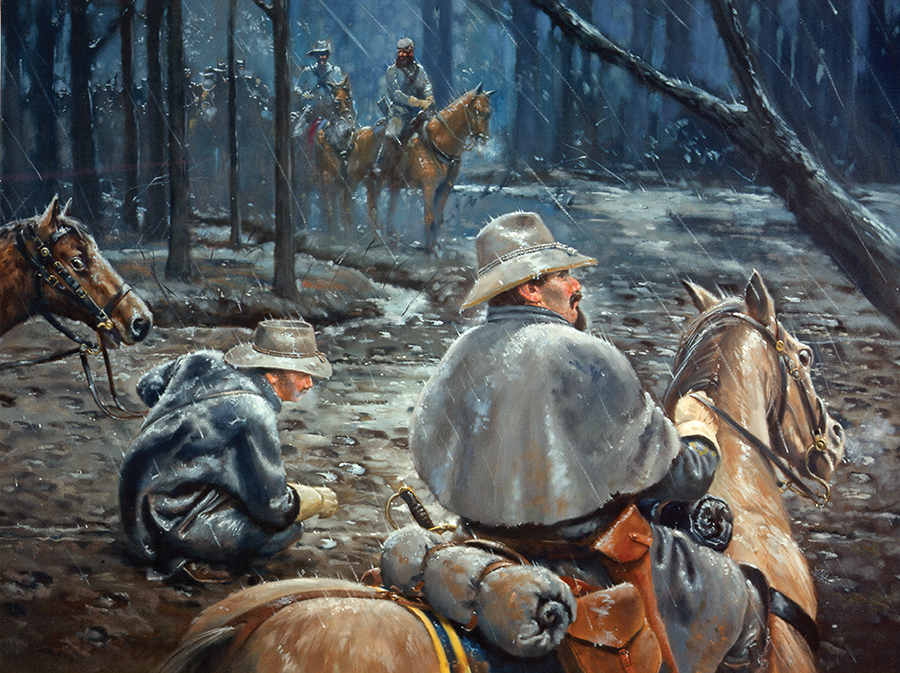
Hampton’s scouts discover tracks to Kilpatrick’s encampment.

But with fewer than 30,000 soldiers scattered over several states, Beauregard was equally powerless to prevent Sherman’s next move, his “March to the Sea,” made during November and December, 1864. During a five-week trek from Atlanta to Savannah, Union soldiers laid waste to military installations, factories and railroads in an effort to choke off the Confederacy’s economic lifeblood. Leading the Union cavalry was Kilpatrick, whose zeal for destroying enemy property made him, according to Sherman, “just that sort of man to command my cavalry on this expedition.” The general, aware of Kilpatrick’s faults, also referred to him as “a damn fool.”

After the Union troops reached Savannah on Dec. 21, 1864, commander-in-chief Gen. Ulysses S. Grant considered having Sherman move his army north by sea to Virginia, where the two generals would combine their forces to finish off Lee in Petersburg. But Sherman had a different plan in mind. He proposed marching his men north through the Carolinas to link up with Grant. Sherman persuaded his commanding general that the maneuver would devastate resistance in both states. Grant agreed, ordering him to “make your preparations to start on your expedition without delay . . . break up the railroads in South and North Carolina, and join the armies operating against Richmond as soon as you can.”

The bulk of Sherman’s army began exiting Savannah at the end of January 1865, soon entering South Carolina. Sherman was not inclined to treat the first state to secede gently. “The whole army is burning with an insatiable desire to wreck vengeance upon South Carolina,” he would write. “I almost tremble at her fate, but feel that she deserves all that seems in store for her.”

Sherman and other Union commanders have been criticized for rebuffing the pleas of numerous former slaves seeking the army’s protection during its Southern campaign. Hungry and fearful of being recaptured (or worse) by their former masters, the liberated, but nonetheless desperate, slaves attempted to attach themselves to the Union force. But the army mostly stiff-armed them on the grounds that the Blacks need for food and supplies would drain available resources and slow the march. In one measure of retribution against the slaveholders in the Deep South, Sherman issued an edict setting aside 400,000 acres of coastal areas in South Carolina, Georgia, and Florida for freed slaves, an order later reversed by Andrew Johnson. 

Gen. Wade Hampton, commanding the cavalry supporting Lee’s army in Virginia, could not bear the thought of being absent from the upcoming fight in his home state of South Carolina. Hampton, deemed by Confederate Gen. James Longstreet the “greatest cavalry leader of our or any age,” was granted leave by Lee to return to the state along with Gen. Matthew Butler and the latter’s cavalry division.

Hampton also convinced Lee to place him in command of the Confederate cavalry in the area. This created friction between Hampton and “Fighting Joe” Wheeler, who had days before led his men to victory over Kilpatrick’s cavalry at Aiken, South Carolina. Hampton and Wheeler managed to put aside any ill feelings and established an effective working relationship, later evidenced at Monroe’s Crossroads.
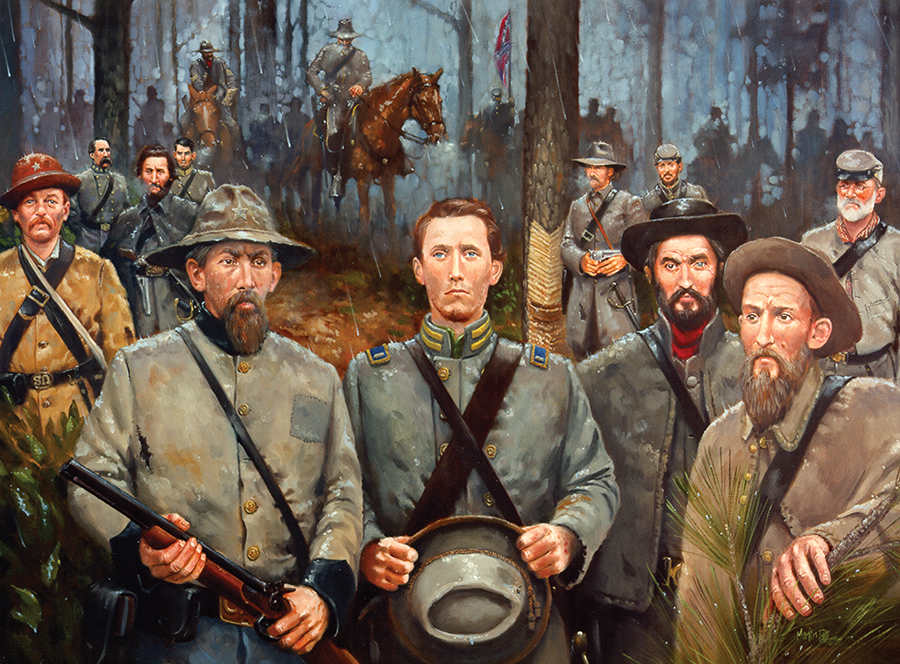
   

Readied for the dawn attack.

In the early stages of the Carolinas Campaign, Sherman kept Beauregard and Hampton guessing where his army was heading. To confuse them, he ordered the Union left wing westward toward Augusta, Georgia, while directing his right wing to feint in the direction of Charleston. Then Sherman brought the troops back together to make a beeline to Columbia, South Carolina. The state capital was lightly defended, and Hampton had no choice but to order his troops to evacuate. On Feb. 17, Sherman’s unopposed army occupied the city.

A massive fire broke out that consumed most of Columbia’s buildings. Arguments raged regarding who caused the conflagration. Did the responsibility lie with fleeing Confederates who allegedly set fire to a storehouse of cotton bales? Or was the fire ignited by vengeful Union soldiers? Sherman pointed the finger at Hampton, who pointed his own, presumably uplifted, digit back at “Uncle Billy.”

The two adversaries exchanged hostile messages regarding the fate of Union foragers, a number of whom Sherman claimed had been murdered by Confederate soldiers after capture. He notified Hampton of his intent to respond in kind by executing a like number of Confederate prisoners. Hampton emphatically denied Sherman’s charge and upped the ante, promising that “for every soldier of mine ‘murdered’ by you, I shall have executed at once two of yours, giving in all cases preference to any officers who may be in my hands.” Both generals got each other’s message, and no further executions of foragers or other captives occurred.

The Columbia debacle accentuated fears of Confederacy higher-ups that annihilation of their cause was at hand. On Feb. 22, a desperate Gen. Lee relieved the beleaguered Beauregard and brought Gen. Johnston back to command the Department of the West. Johnston was under no illusion he could reverse the course of the war. In his memoirs, the general acknowledged that his primary object was “to obtain fair terms of peace; for the southern cause must have appeared hopeless then to all intelligent and dispassionate southern men.”

Given the Confederate Army’s vanishing manpower, achieving any terms beyond the CSA’s unconditional surrender would be a daunting undertaking. At the time Sherman crossed into North Carolina (March 3, 1865), the only Confederate infantry in Sherman’s immediate vicinity was Gen. William Hardee’s corps of 6,000 soldiers. Outnumbered 10 to 1, the most Hardee could be expected to do was shadow Sherman’s advance.

A more workable short term option for Johnston was employing his Hampton-led cavalry to dog the Federals with hit-and-run raids. As author Eric J. Wittenberg explained in his book, The Battle of Monroe’s Crossroads, the 4,000 horse soldiers of Hampton, Wheeler and Butler resisted Sherman by “hovering around the edges of the Federal column like a swarm of angry hornets ready to exact a heavy toll whenever an opportunity presented itself.”

Another dilemma for Johnston was not knowing where the Union Army would head after sacking Columbia. Sherman’s actual next destination was Fayetteville. Once there, his army could obtain supplies transported by steamboats sailing up the Cape Fear River from the coastal port of Wilmington, the latter having fallen into Federal hands in February. After destroying the arsenal at Fayetteville, Sherman intended to cross the Cape Fear and move his army to Goldsboro, North Carolina, where it would link up with Gen. John Schofield’s corps of 30,000 soldiers. Their combined force of 90,000 soldiers would then join Grant in Virginia for the final push against Lee.
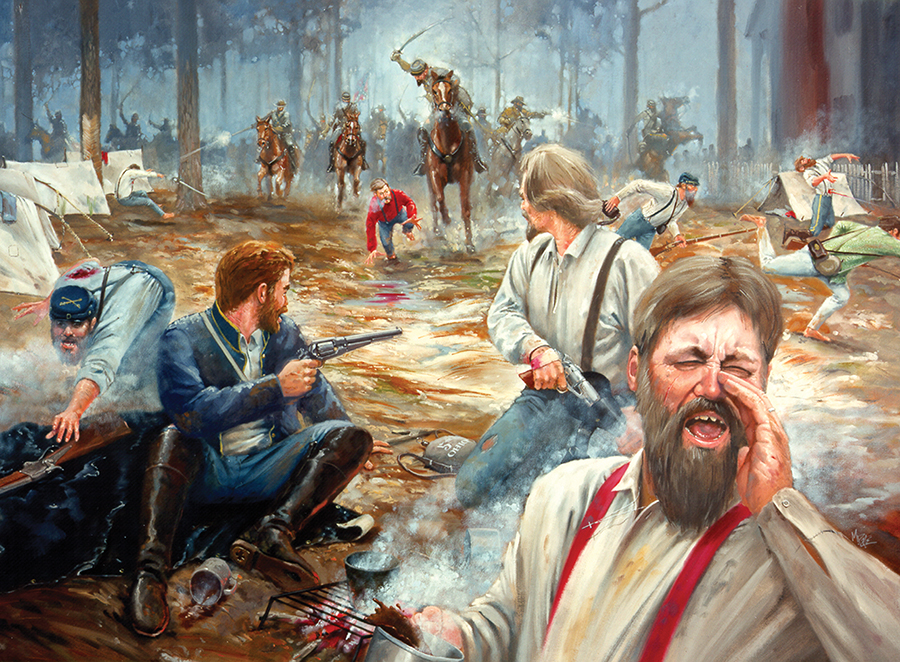
 

The confederate charge at Monroe’s Crossroads.

A critical element of Sherman’s strategy was getting to Fayetteville before Hardee. Doing so would enable him to block or destroy the bridges across the river. Either measure would prevent Hardee’s corps and Confederate cavalry units from joining up with Braxton Bragg’s corps and other remnants of Joe Johnston’s dwindling forces.

Johnston’s strategy was basically a mirror image of Sherman’s. If Hardee reached Fayetteville ahead of the Federals, he was directed to cross the river and blow up the bridges behind him. This would frustrate, or at least delay, Sherman’s own crossing. Meanwhile, Hampton’s cavalry would hound the Union Army, inhibiting its progress.

The race would entail both Federal and Confederate forces passing through Moore County. Exhausted forces on both sides shivered as incessant, near-freezing rains with accompanying spring floods hampered their movements. Moore County was a quagmire! Kilpatrick described the grueling conditions as “the most horrible roads, swamps, and swollen streams.”

When Kilpatrick entered the county on March 7, he was several miles ahead of Sherman, who sent a message directing his cavalry leader “to deal as moderately by the North Carolinians as possible.” The general also counseled Kilpatrick to “keep up the seeming appearance of pushing after Hardee, but really keep your command well in hand, and the horses and men in the best possible order as to food and forage.”

As Kilpatrick consumed a meal of boiled sweet potatoes at the farm of Evander McLeod (near present day Pinebluff) on the evening of March 8, it had become abundantly clear that the West Point grad would be hard-pressed to avoid hostilities with the Confederate cavalry buzzing around him. Wade Hampton’s men had left McLeod’s farmstead just hours before.

The impending danger was compounded by Kilpatrick’s decision to send out scouting parties in search of alternative routes to avoid his troops’ overtaxing of the roads. As Wittenberg writes, “The farther his (4,000) men spread out . . . the more the Federals risked attack by marauding Confederate cavalrymen hovering just beyond the fringes of Kilpatrick’s column.”

At times, Kilpatrick seemed oblivious to these concerns. During the following day’s march, a Confederate prisoner, while walking alongside the carriage of “Little Kil” —he stood 5 feet, 3 inches in height — observed the general laying his head in Alice’s (or Marie’s?) lap and dangling his feet out the carriage window.

Meanwhile, at about 2 p.m. on March 9, Kilpatrick’s Third Brigade, headed by Col. George Spencer, arrived at the small hamlet of Solemn Grove, comprised of Buchan’s post office, a store, a mill and a few houses, including that of Malcolm Blue. Spencer was followed by William Way’s dismounted Fourth Brigade accompanied by 150 Confederate prisoners. Little Kil’s first and second cavalry brigades, commanded by Col. Thomas Jordan and Brig. Gen. Smith Atkins, respectively, were farther behind.
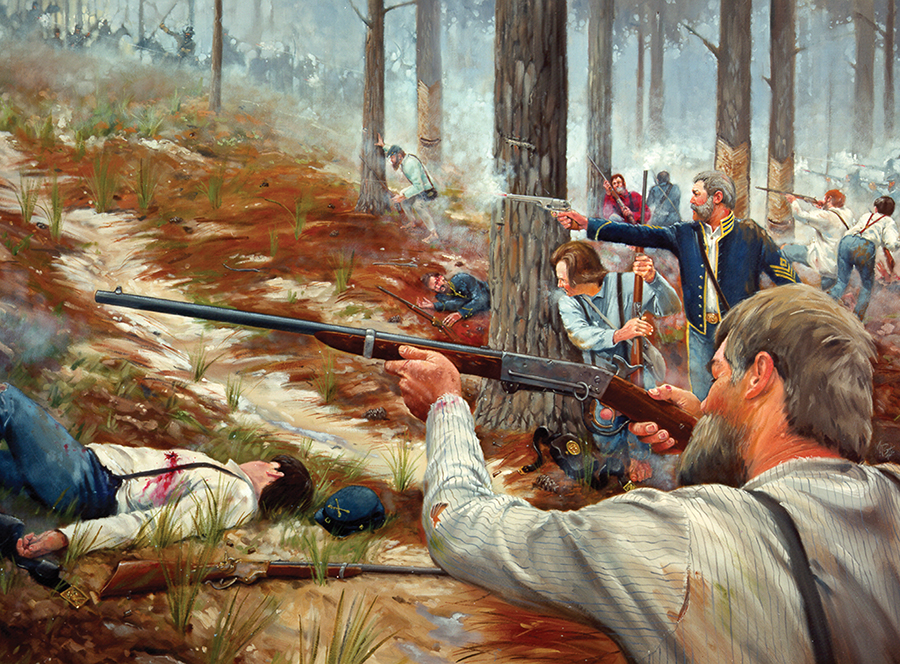
Kilpatrick’s men counterattack.

Upon receiving intelligence that Hampton’s cavalry was heading for Fayetteville, Kilpatrick concocted a scheme. He would seek to intercept the Confederate horsemen and prevent their planned rendezvous with Hardee, now certain to beat the Federals to the Cape Fear. The gambit meant blocking three different roads that Hampton and his subordinates, Wheeler and Butler, might potentially use: Morganton Road, Chicken Road to the south, and Yadkin Road to the north. Kilpatrick ordered Spencer to block the Yadkin Road. Another sortie was assigned to Way’s 400-man dismounted brigade. It marched farther east to block Morganton Road. Atkins, following behind as a rear guard, was urged to close up his brigade’s distance from Spencer and Way. The three brigades were ordered to establish camp at Monroe’s Crossroads, though circumstances would prevent Atkins from arriving there until well after hostilities commenced the following morning.

Way’s brigade reached Monroe’s Crossroads at 9 p.m. and set up camp adjacent to Charles Monroe’s farmhouse at the intersection of Morganton and Blue’s Rosin roads. Spencer’s brigade arrived soon thereafter, setting up its camp on a plateau that sloped toward a dismal swamp. Meanwhile, Jordan’s First Brigade, 3 miles distant, blocked Chicken Road. Kilpatrick’s separation of his brigades carried risk as each unit was rendered more vulnerable to attack. At the time Kilpatrick’s bugler sounded “taps” the night of March 9, there were around 1,400 Union soldiers at Monroe’s Crossroads, but had Kilpatrick played into the enemy’s hands by dividing his brigades?


Meanwhile, Confederate Gen. Butler had an unexpected prize fall into his lap. While patrolling with his division on the evening of March 9, he detected the sound of approaching hoofbeats. Butler called out, “Who goes there?”

“Fifth Kentucky,” came the response. Butler knew the 5th was a Federal unit.

He beckoned the soldiers to come forward and, without firing a shot, Butler promptly disarmed and took into custody 28 unsuspecting Kentuckians. The captives were all members of Kilpatrick’s headquarters escort company. It appeared Kilpatrick had been nearby and had narrowly avoided his own capture, hightailing it to Charles Monroe’s farmhouse. Sharing the residence with Little Kil and Alice (or Marie) were brigade leaders Spencer and Way, who bunked upstairs. Despite his close call and the distressing disappearance of the escort company, Kilpatrick inexplicably neglected to post any guards.

As a gleeful Butler regaled Hampton with the tale of his evening’s adventure, a scout rushed up to inform the generals that the tracking of hoofprints had led him to discover the union cavalry’s encampment at Monroe’s Crossroads. It appeared unguarded to the scout. Hampton, after conferring with Wheeler and Butler, sensed an opportunity to catch Kilpatrick napping (or otherwise occupied) and ordered a dawn attack.

Wheeler thought the attack would be more effective if made on foot. But Hampton overruled him. “General Wheeler,” said Hampton, “as a cavalryman I prefer making this capture mounted.” And so it was that at 5:20 a.m., the oft-wounded Hampton, astride his horse, led his cavalry’s ferocious charge into the Union camp. The 49-year-old master horseman reputedly dispatched three Union soldiers in the process.

It seemed certain Hampton was on the threshold of a glorious victory — one that could demonstrate to all that the war was not yet over. But the unforced errors were not the sole province of Kilpatrick. Several columns led by Wheeler were supposed to attack through an area that was marshy and full of thick vegetation. Wheeler thought the terrain would pose no hindrance, but he was wrong. Approximately half of Wheeler’s troops failed to make it through the muck and were late to the battlefield.

The attack caused the Union soldiers guarding the 120 Confederate prisoners to flee to the woods. Suddenly freed, the now ex-prisoners ran headlong and “frantic with joy” toward their liberators. At first, the cavalrymen thought the men sprinting toward them were retreating soldiers whose forward charge had been repulsed. The resulting confusion caused a temporary blunting of the Confederate assault. Furthermore, one of Butler’s brigades did not take part in the attack as it was ordered to escort the elated, but famished, former captives to the rear.

The newly liberated soldiers weren’t the only hungry ones. The Confederate cavalry soldiers also craved food. Many availed themselves of the opportunity to poke through the Union camp to find and consume whatever edibles they could lay their hands on. They looted belongings, scavenging shoes, blankets, saddles and mounts. The breakdown in discipline stemmed the momentum of Hampton’s onslaught and provided the Union cavalry breathing space to reform and rally. Local Civil War buff Jim Jones believes that the cavalrymen’s attention to the needs and whereabouts of their horses following the initial rush may also have added a distraction that would have been avoided had the charge occurred dismounted.

Hampton made another decision he would regret by not searching the farmhouse. Unknown to the general, Union brigade leaders Spencer and Way were still inside, hidden upstairs. Playacting by Kilpatrick’s paramour prevented the officers’ capture. Adopting the airs of a Southern belle, Alice (or Marie) greeted Hampton at the porch and assured him there were no Union officers inside her home. The chivalrous Hampton, not wanting to further trouble such a fine lady, posted a guard to keep rebel soldiers out of her hair, then bid the woman adieu. Spencer and Way remained grounded in the bedroom until the battle’s conclusion.
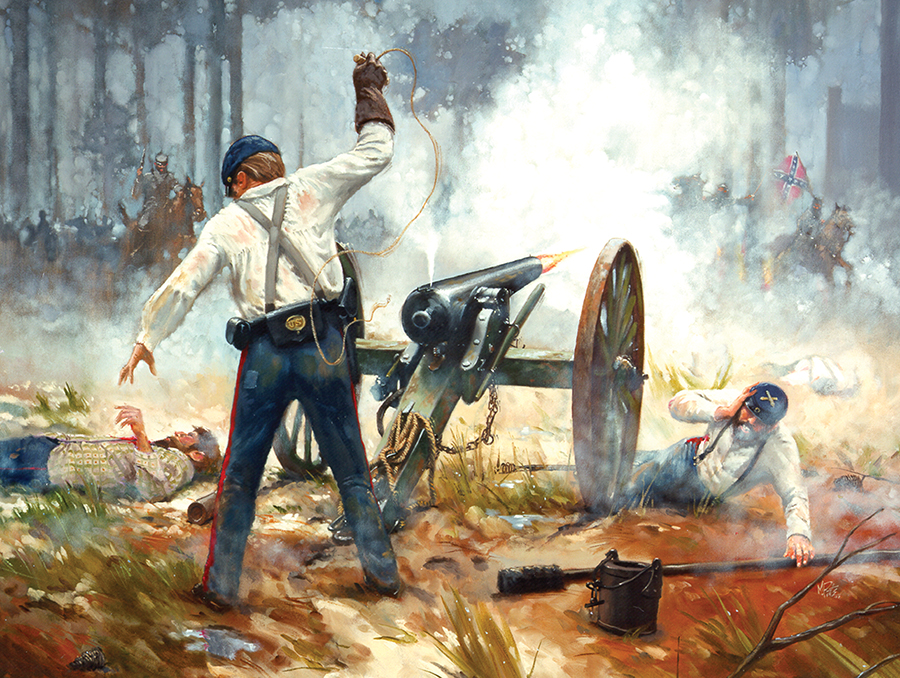
 

Lt. Stetson fires away.

Given the disarrayed and bedraggled appearance of Kilpatrick’s cavalry, it seemed next to impossible they could mount any sort of counterattack. Though they were chilled to the bone and nearly naked, most of Kilpatrick’s men had the presence of mind to grab their guns and ammo before fleeing from the camp. Jones points out that the veterans in Sherman’s army were as battletested as any in the war. “They bent at times but never broke,” says Jones.

According to Ohio horse soldier T.W. Fanning, Little Kil “cobbled together enough men to order an advance.” Then at his command, the horse soldiers “moved up the ridge, firing as they moved.” According to Fanning, the men “with one wild shout, swept down upon the rebels, who were swarming around the captured artillery and Kilpatrick’s former headquarters.” Adding impetus to Kilpatrick’s thrust were Capt. Theodore Northrup and his company of Union scouts. They had rushed to Monroe’s Crossroads upon learning of Kilpatrick’s plight.

Engaged as they were in premature celebration, it was Hampton’s cavalry now caught flatfooted. In the fog of the renewed gunfire, Lt. Ebenezer Stetson, who had been hiding from the Confederates under the farmhouse since the initial attack, surreptitiously crept to one of the cannons just 20 steps away. He loaded it with canister and fired away at the startled Confederates. Several of Hampton’s men were killed instantly. A second artillerist, believed to be Sgt. John Swartz, rushed to the second cannon and fired it to like effect. Together, they were able to inflict considerable damage until the guns were recaptured by Gen. Wheeler, largely through the ultimately fatal charge of Capt. Moses Humphrey. Swartz also died from wounds suffered in the battle.

Gen. Wheeler suddenly made his presence felt, charging into the camp and, according to a Georgian horseman, “killed several Yankees in close encounter.” He and Butler made repeated efforts to drive Kilpatrick’s men back toward the swamp, but they were met with withering gunfire courtesy of the Spencer seven-shot repeating carbines carried by an Ohio unit in the Union cavalry. Southern casualties were exacerbated because Wheeler’s and Butler’s men were packed close together due to the vagaries of the landscape. A disconsolate Butler reported that the carbines “made it so hot for the handful of us we had to retire. In fact, I lost 62 men (wounded and killed) there in about five minutes time.”

Coupled with his belief that Sherman’s infantry would soon be coming to Kilpatrick’s aid, Hampton ordered his cavalry to pull out and move on to Fayetteville. Both sides claimed victory at Monroe’s Crossroads. Kilpatrick boasted that he had driven the Confederate cavalry from the field. However, his negligent preparations would come under fire and Sherman never trusted him again. Hampton claimed his surprise attack freed prisoners and successfully stalled the Union cavalry, thus allowing Hardee to escape unscathed across the Cape Fear. But Hampton’s failure to capitalize on his initial advantage undercuts a claim of Confederate victory.

The precise number of battlefield deaths at Monroe’s Crossroads is unknown. The CSA wasn’t keeping records anymore, and Kilpatrick probably inflated the casualty figures. It would appear from accounts that a total of 150 dead is not far off. It was the last true cavalry engagement of the war.

As a result of Hardee’s escape, Joe Johnston was able to marshal 21,000 troops to battle Sherman at Bentonville on March 19. But Johnston was still outnumbered 3 to 1. As a result of heavy losses in this battle and the futility of further conflict, Johnston ultimately surrendered to Sherman. This followed Lee’s surrender to Grant at Appomattox Court House on April 9th.

Today the Monroe’s Crossroads battlefield can only be accessed by prior arrangement. Happily that’s not difficult. Jonathan Schleier, associated with Fort Bragg’s Cultural Resource Program, offered to provide a guided tour but because the penetrating boom of military munitions can still be felt there 157 years after Lt. Stetson fired a cannon at the site, Schleier had to find a date from Range Control when artillery operations would not be occurring in the area.

On a hot July morning, I met Schleier at Fort Bragg’s Ranger Station No. 2, located at the point where East Connecticut Avenue meets the post’s border. As the roadway continues into the reservation, it’s called Morganton Road, an unimproved pathway little changed since 1865. Riding in Schleier’s Ford F-150 we observed neither vehicles nor people en route to the remote battlefield. Schleier said that present day officers, as part of their training, walk the battlefield to study the tactics and maneuvers of the long-ago fight.

The Monroe farmhouse is gone, but an obelisk marks its location. The battlefield has a surprising number of monuments, all of them installed since 1990. There are combatants’ graves, including those specifically dedicated to unknown soldiers. One memorial is situated at the spot where Lt. Stetson unleashed his cannon. Schleier unfolded maps to aid in comprehending the movements of the antagonists. Walking the ridge-filled terrain and eyeing the steep incline down to the swamp it was possible to visualize the logistical challenges faced by both cavalries.

The old battlefield was eerily quiet. Not a sound to be heard. Just like it must have been before all hell broke loose at 5:20 a.m. on March 10, 1865.

To schedule a tour of the battlefield, call Jonathan Schleier at (910) 396-6680.  PS

Pinehurst resident Bill Case is PineStraw’s history man. He can be reached at Bill.Case@thompsonhine.com.

Poem March 2023

Poem March 2023

Ice Cream Parlor

The woman has a gold stud through her tongue,

her companion a snarling tiger tattooed on his neck.

They hover over cups of Crazy Vanilla and Chunky

Chocolate as she describes the final scene from an old

Tom Hanks movie in which a single white feather is

lifted on a breeze to float gently through the universe.

“It’s symbolic of death and rebirth,” she says,

and claims the movie’s protagonist is dying

as he sits on a bench pondering his young son’s

passage into tomorrow. The woman with the studded

tongue says the feather’s random motion is evocative

of fate and free will and that we are all reborn

with our final breath, our souls gently ascending.

The man with the tiger tattoo sees it differently:

“Sometimes,” he says, “you’re just full of it.”

And there, in the sumptuous clamor of the ice

cream parlor, you become aware of a cold certainty

that has nothing to do with feathers or movies

or tattoos or tasty confections or the clear blue sky

or the universe about which the stud-tongued woman

is so emphatic on this spring morning when you

are again reminded that for every bright romantic

notion there’s a spiteful truth that will crush it.

  Stephen Smith

Stephen Smith’s Beguiled by the Frailties of Those Who Precede Us will be published this spring by Kelsay Books.

Tea Leaf Astrologer

Tea Leaf Astrologer

Pisces

(February 19 – March 20)

Einstein was a Pisces. While it’s true the German physicist struggled to remember his own birthday — “It is a known fact that I was born, and that is all that is necessary,” he would say — he had that Piscean knack for thinking outside the box. Imagination is your superpower. Keep that in mind this month when Mars dips into your fourth house of home and family, and tries yanking up the rug. Tension, like time, is relative.

Tea leaf “fortunes” for the rest of you:

Aries (March 21 – April 19)    

The fast lane is overrated. 

Taurus (April 20 – May 20)

You can’t pull a rabbit from an empty hat.

Gemini (May 21 – June 20)

Best to leave yesterday behind you.

Cancer (June 21 – July 22)

Follow the breadcrumbs.

Leo (July 23 – August 22)

Try screaming into a pillow.

Virgo (August 23 – September 22) 

As you were. Or consider flying a kite.

Libra (September 23 – October 22)

It’s time to speak your piece.

Scorpio (October 23 – November 21)

Be sure to read the fine print.

Sagittarius (November 22 – December 21)

You’re smothering it again.

Capricorn (December 22 – January 19)

Wear your power color.

Aquarius (January 20 – February 18)

There’s a fine line between boundaries and dissociation.  PS

Zora Stellanova has been divining with tea leaves since Game of Thrones’ Starbucks cup mishap of 2019. While she’s not exactly a medium, she’s far from average. She lives in the N.C. foothills with her Sphynx cat, Lyla. 

Simple Life

Simple Life

A Little Stuffed Potato Wisdom

Lessons from full-grown tater tots

By Jim Dodson

Someone once said to me that it’s not happiness that makes one grateful, but gratitude that makes one happy.

Looking back, I may have seen this poetic syllogism scrawled on an ancient stone wall several years ago while hiking with my wife in Tuscany (where every graffiti artist is a philosopher-in-training). Or maybe I heard Oprah Winfrey say it in one of her SuperSoul Conversations that the aforementioned wife suggested that I listen to on long drives.

Whoever said it, I’m grateful for its pithy wisdom because I’ve suddenly reached an age where I know it to be true.

Back in February, I turned 70, a milestone that took me by surprise.

It’s not that I was unprepared. In truth, I’ve enjoyed getting older and slowing down a bit, giving me the chance to notice the evening sky.

Also, I am not alone in this epic journey into the great gray age and the unknown, as my late father — who lived a full and active life right up to a week before he died at 80 — used to joke. According to the U.S. Census Bureau, there are 69.2 million baby boomers alive and kicking today in America, the second-largest population group next to our children, the millennials (73.9 million born between 1981 and 1996 ). My particular group was born in 1953 ands falls somewhere in the lower middle of the boomer years between 1946 and 1964.

According to the latest actuarial projections used by our friends at the Social Security Administration to calculate how much longer the agency will have to give us back all the money we spent decades putting into the system, my age and gender group — males aged 70 — can expect to live another 14.5 years, while our female counterparts come in at a 16.75. Good for them, I say! Sell the house, dump the stocks, give away the dog and go sit on a beautiful beach in Tahiti for the rest of your days!

By the way, that’s exactly what my wise but cheeky and younger wife Wendy says she plans to do with her giddy 10 extra years after I check out of the Hotel California.

Meanwhile, according to the CDC’s Center for Health Statistics (NCHS), life expectancy at birth in the United States declined nearly a full year from 2020 to 2021, a worrying dip from 77.0 to 76.1 years that is the lowest level since 1996, probably due in part to a thing called COVID. The 0.9 year drop in life expectancy in 2021, along with a 1.8 year drop in 2020, was the biggest two-year decline since 1921–1923, years in which the Spanish flu wiped out millions worldwide, including my own maternal grandmother.

Actuarially speaking, it could be worse, of course. Afghanistan’s current life expectancy is just a hair over 56 years, considerably shorter if the Taliban’s Morality Police catch you whispering about the need to educate girls and women.

Singapore’s life expectancy, on the other hand, is a bonny 86.5 years. Perhaps this means that Dame Wendy — the future merry widow — should consider moving there instead of Tahiti (which has a mere life expectancy of 78.82 years) where she’s likely to make lots of older gal pals living the good life off the insurance money on a lovely Asian beach. As any veteran foreign traveler knows, however, Singaporeans are obsessed with public cleanliness and strict social order. Littering, chewing gum in public or failing to flush a public toilet can land you a whopping $1,000 fine, while showing your bare feet or skin of any sort can earn you three months in jail. That sensational black one-piece my 61-year-old lover debuted at the pool last summer probably won’t fly with Singapore’s own Morality Police. So on second thought, perhaps I won’t suggest Singapore and just leave well enough alone. That’s probably the wisest thing I’ve learned from being happily married for 20-plus years.

The point of all these dizzying numbers, as Oprah or any Tuscan street poet with spray paint can tell you, is to live the best life you can and be damned grateful for whatever time you have left.

That’s exactly what my fellow members of the Stuffed Potatoes Lunch & Philosophy Club try to do on a daily basis.

For the moment, there’s just three of us in the club. We meet every other week or so in the shadowy booth of a popular restaurant to discuss the current state of the world, the wonders of our grown children and the enduring mystery of our wives.

Remarkably, as this March dawns, all three of us will have turned 70 by the end of the month. Joe hit the mark in late January, I did so in early February, and Patrick achieves the milestone later this month.

I’m told none of us actually looks 70 years old, though wives, golf pals and fellow Stuffed Potatoes can scarcely be considered objective sources.

For that matter, we probably don’t even act like old men, save for when we complain about dodgy knees and idiots who run red lights. As a kid, I once asked my lively grandmother on her 84th birthday if she was afraid of dying. She grinned and patted my rosy little cheek. “Not a bit, sugar pie,” she said. “Just afraid of falling.” 

None of the Stuffed Potatoes, I can reliably report, are afraid of dying. We’re too busy for that.

January Joe is a professional forester helping set aside beautiful lands for future generations. Patrick, the marketing whiz — I fondly call him the “Irish Antichrist” — is keeping the national economy afloat. And I’m just a humble scribbler trying to finish three books this year alone.

Given that we collectively amount to 210 years of accumulated life experience, I put to my fellow Stuffed Potatoes a timely question the other day: What is the one thing you’ve learned in 70 years?

January Joe, our resident sage, didn’t hesitate. “There are wonders ahead. Don’t fight them — just surrender!” This from a lovely fellow who gets to walk in the woods for a living and surrenders most weekends to the joy of several beautiful grandbabies.

My old friend, Patrick, offered with a hearty laugh, “There’s no good news or bad news. It’s all information. Just keep doing what you do and don’t look back.” The Irish Antichrist means business.

As for me, I hope to finish half a dozen more books over the 15.5 years I may or may not have left. Only time will tell.

In the meantime, we have a joyous new puppy named Winnie and a garden that is springing gloriously back to life by the minute.

I’m deeply grateful for both, not to mention a fabulous wife who says she really has no interest in going to Singapore or Tahiti. And was probably only joking.

That makes me a really happy guy..  PS

Jim Dodson can be reached at jwdauthor@gmail.com.

Almanac

Almanac


March is a born artist, wide-eyed and unbridled, creating for the sake of life itself.

The genius begins with a single daffodil, warm and bright, nodding in a stream of honeyed light. Each petal is a world of yellow. Each leaf, a meditation on green.

The artist becomes obsessed.

One daffodil becomes a series, progressively abstract, until each flower is more essence than form.

Paintings expand into wild landscapes. Quick as the hand can move, a rolling sea of yellow starbursts stretches from one canvas to the next. The foreground softens. Thick and messy brushstrokes evoke a tender, playful light.

Crested irises and yellow violets now spill from the frenzied brush, followed by flowering clover, purple deadnettle, wild onions, chickweed and a downy flush of dandelions.

Robins begin to appear. Bluebirds, too. Tree swallows and towhees and red-winged blackbirds. The painting nearly sings out.

Leafless branches, stark among the luscious earth, are suddenly laden with clusters of crimson whirligigs. Redbuds are studded with bright fuchsia blossoms. Soft pink swirls adorn silver-limbed saucer magnolias.

The brush strokes quicken. A sweep of tulips colors the earth magnificent. As spring bursts forth, flower by brilliant, quivering flower, the artist surrenders to the muse.

On the Wild Side

Among the wild blossoms beginning to carpet the soft earth — fig buttercups and field mustard, blood root and Johnny jump-ups, dimpled trout lilies and Carolina jessamine — the common blue violet is one you’ll likely spot in damp woods and shady meadows. Also called the woolly blue violet, wood violet or common meadow violet, this short-stemmed perennial is known for its heart-shaped leaves (edible) and white-throated purple flowers (also edible).

But have you ever seen a bird’s foot violet? Named for the shape of its narrowly lobed leaves (they do, in fact, resemble bird feet), this viola species prefers dry, sandy soil and pine lands. The five-petaled flower, lilac or bicolored with bright orange anthers, is largely considered to be the most beautiful violet in the world. But what spring bloomer isn’t a bewitching vision to our winter-weary eyes?


Our life is March weather, savage and serene in one hour.             — Ralph Waldo Emerson


A Time to Sow

The cold earth is thawing. The Full Sap Moon rises on Tuesday, March 7. The maple sap is flowing once again.

The vernal equinox occurs on Monday, March 20 — along with a dark, balsamic moon. As a new season and cycle begin, we return to the garden.

In early March, sow carrot, spinach, radish, pea and turnip seeds directly into the softening earth. Mid-month, sow chives, parsley, onion and parsnips. At month’s end: beet and arugula seeds.   

Broccoli, cauliflower and cabbage seedlings can be transplanted outdoors mid- to late-month. Ditto kale, Swiss chard, lettuce and kohlrabi.

Growing season has commenced. As the days grow warmer still, behold the simple miracle of spring’s return. The miracle of life itself.  PS

Bookshelf

Bookshelf

March Books

FICTION

Hang the Moon, by Jeannette Walls

Sallie Kincaid is the daughter of the biggest man in a small town, the charismatic Duke Kincaid. Born at the turn of the 20th century into a life of comfort and privilege, Sallie remembers little about her mother, who died in a violent argument with the Duke. By the time she’s 8 years old, the Duke has remarried and had a son, Eddie. While Sallie is her father’s daughter, sharp-witted and resourceful, Eddie is his mother’s son, timid and cerebral. When Sallie tries to teach young Eddie to be more like their father, her daredevil coaching leads to an accident, and Sallie is cast out. Nine years later, she returns, determined to reclaim her place in the family. Sallie confronts the secrets and scandals that hide in the shadows of the Big House, navigates the factions in the family and town, and finally comes into her own as a bold, sometimes reckless bootlegger.

A Likely Story, by Leigh McMullan Abramson

The only child of an iconic American novelist discovers a shocking tangle of family secrets, upending everything she thought she knew about her parents, her gilded childhood and her own stalled writing career in this standout debut novel. Growing up in the ’90s in New York City as the only child of famous parents was both a blessing and a curse for Isabelle Manning. Her beautiful society hostess mother, Claire, and New York Times bestselling author father, Ward, were the city’s intellectual It couple. Ward’s glamorous obligations often took him away from Isabelle, but Claire made sure her childhood was filled with magic and love. Now an adult, all Isabelle wants is to be a successful writer like her father. After many false starts and the unexpected death of her mother, she faces her upcoming 35th birthday alone and on the verge of a breakdown. Her anxiety skyrockets when she uncovers some shocking truths about her parents and begins wondering if everything she knew about her family was all based on an elaborate lie.

Community Board, by Tara Conklin

Where does one go, you might ask, when the world falls apart? When the immutable facts of your life — the mundane, the trivial, the take-for-granted minutiae that once filled every second of every day — suddenly disappear? Where does one go in such dire and unexpected circumstances? Home, of course. Darcy Clipper, prodigal daughter, nearly 30, has returned home to Murbridge, Massachusetts, after her life takes an unwelcome left turn. Murbridge, Darcy is convinced, will welcome her home and provide a safe space in which she can nurse her wounds and harbor grudges, both real and imagined. But Murbridge, like so much else Darcy thought to be fixed and immutable, has changed. And while Darcy’s first instinct might be to hole herself up in her childhood bedroom, subsisting on Chef Boyardee and canned chickpeas, it is human nature to do two things: seek out meaningful human connection and respond to anonymous internet postings. As Murbridge begins to take shape around Darcy, both online and in person, she asks herself: What can she expect of her community? And what does she owe it in return?

The Gospel of Orla, by Eoghan Walls

In this stunning debut novel from the Northern Irish poet, The Gospel of Orla is the coming-of-age story of a young girl, Orla, and the man she meets who has an astonishing and unique ability. It is also a road novel that takes us across the north of England after the two flee Orla’s village together, and the mysteries of faith charge full bore into the vagaries of contemporary mores.


CHILDREN’S BOOKS

The Three Little Guinea Pigs, by Erica Perl

Oh, my, cuteness overload! This charming retelling of the classic tale will have every guinea pig lover squeaking for joy at the three piggies’ clever antics. The fun facts at the end really amp up the “awwww” factor. (Ages 3-8.)

When Sea Becomes Sky, by Gillian McDunn

When you live near a salt marsh, a boat, no matter how tiny, is a ticket to freedom. For Bex, her rowboat is where she feels closest to her brother, Davey, and where she begins to see how art and life and personal passion intersect. When Sea Becomes Sky is destined to join the canon of summer must-reads. (Ages 9-12.)

Heroes of Havensong : Dragonboy, by Megan Reyes

This debut novel follows four children — a boy turned dragon; his reluctant dragon rider; a runaway witch; and a young soldier — bound together by the fates themselves to save their world, and magic itself, from being destroyed. Perfect for Wings of Fire fans looking for a new series. (Ages 9-12.)

Outdoor School: Tree, Wildflower, and Mushroom Spotting, by Mary Kay Carson

How do you know if that weed growing in your backyard actually is common liverwort? Does stinging nettle really sting? How do you recognize poison ivy? Find out all this and more in the newest edition of outdoor school. (Ages 8-13.)  PS

Compiled by Kimberly Daniels Taws and Angie Tally.

Focus on Food

Focus on Food

The Best of Both Worlds

Poke takes the mainland

Story and Photograph by Rose Shewey

If you are on the periphery of pop culture, you will likely miss a number of trends, hypes and hashtags. I am fine with the general concept of it. In fact, I am quite comfortable in my state of pop-apathy, unruffled by much of the noise and excitement of mainstream culture. However, it also means I occasionally miss out on something of value. In terms of food, I wish I had paid attention about five years ago when poke bowls rose to fame and conquered the mainland.

Not only was I snoozing on this tasty development but, without giving it much thought, I assumed that poke bowls were of Japanese origin. In my defense, as a native to Central Europe, far removed from any island living, what was I to think of a dish served with sushi rice, raw fish, chopsticks and pickled ginger? (Unsurprisingly, the mainland rendition of poke differs significantly from authentic island poke, but I’ll get to that in a minute). If you, like myself, were off by about 4,000 miles and didn’t know poke is a traditional Hawaiian dish, you’re in good company. I have since learned that, unless you are greeted at the door by aloha signs and grass skirt-wearing waiters, not many people seem to know (or care) where poke comes from as long as it tastes good. And I can get on board with this.

A purist at heart, I’m torn when it comes to straying from tradition; talk about (con)fusion cooking. If the heart of the matter is preserved — which is highly subjective, of course — I’m generally in favor of mixing things up, but please make it an homage to the original, or call it something else. Original Hawaiian poke’s roots go back to when the first Polynesians came to the island. Supposedly, Captain James Cook was served poke during a visit to Hawaii in the late 18th century. Poke literally means “to slice, cut crosswise into pieces.” What is typically served as a simple snack on the island morphed into a wholesome meal on the continent.

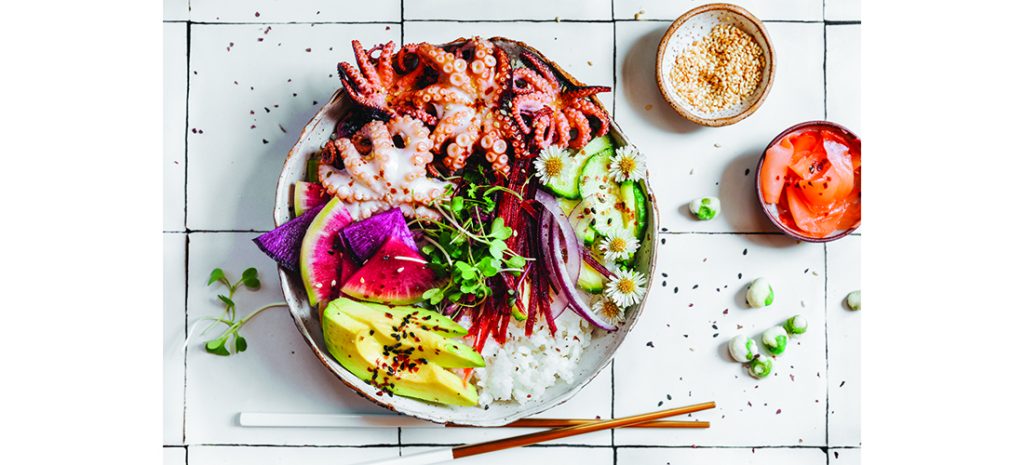
To honor tradition as well as to indulge in the playful bowl-culture of our time, making octopus “tako” poke gets you the best of both worlds, without too much of a compromise. Unless you drown your poke in spicy mayo, then you cannot be helped. Octopus, alongside tuna, is one of the classically used poke ingredients; you can do as the islanders do and eat it raw, without sides, or serve it hipsterville-style on a bed of rice with seaweed and avocado. Either way is scrumptious and definitely picture-worthy.


Tako Poke Bowl  (Serves 2)

For the bowl

12-16 ounces baby octopus, cooked

3 cups sushi rice, cooked

For the relish

1 medium-size tomato, diced

3 tablespoons shoyu (can substitute soy sauce or tamari)

1 tablespoon sesame oil

1 teaspoon grated ginger

1/2 teaspoon crushed red pepper flakes

1/4 cup chopped green onions

1 tablespoon rice vinegar

1 teaspoon honey

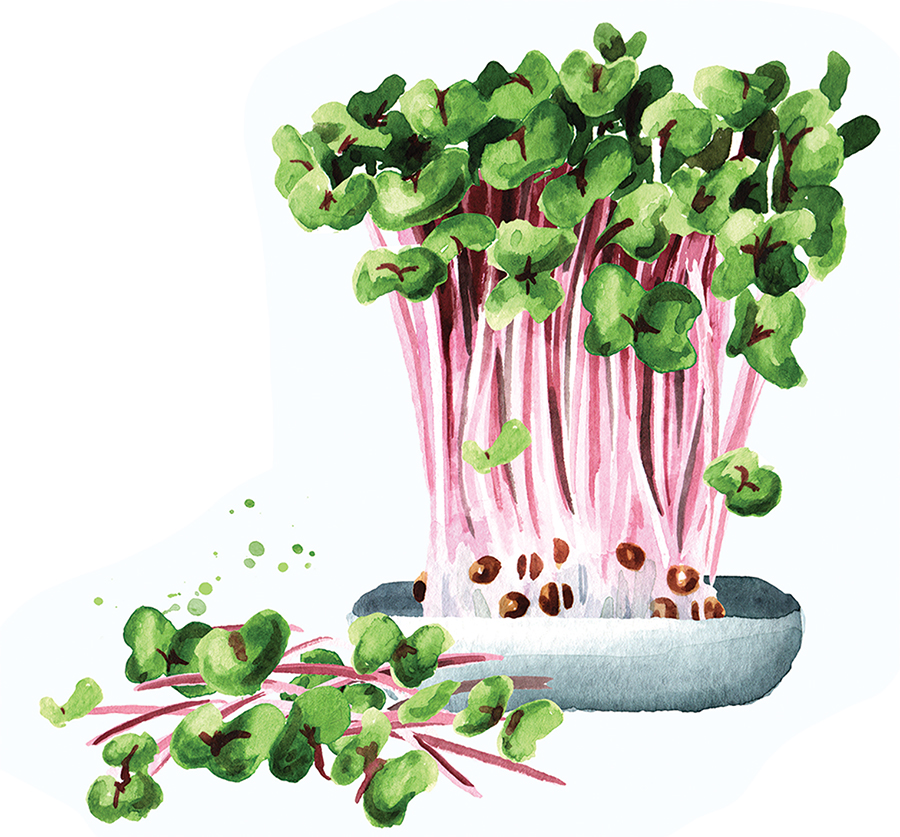
Additional optional toppings: sliced avocado, cucumbers and radishes, sprouts, toasted sesame seeds, julienned carrots, roe, pickled ginger, seaweed flakes or salad.

Cut octopus into bite-sized pieces. In a small bowl, combine ingredients for the relish and mix well. Add octopus, stir once more to combine, cover and chill before serving. To serve, add sushi rice to a bowl, top with tako (octopus) poke and add additional ingredients of your choice.  PS

German native Rose Shewey is a food stylist and food photographer. To see more of her work visit her website, suessholz.com.

In the Spirit

In the Spirit

Mind Your Vermouth

And reignite your passion

By Tony Cross

If you ask any of my friends or family about their knowledge of vermouth, their answers would more than likely fall into three categories.

The first group enjoys vermouth: They make their own cocktails at home on a weekly basis; they more than likely have their favorites when it comes to the subject of fortified wine; their vermouth is refrigerated and not spoiled.

The second group kind of knows about vermouth, and they might have a bottle of sweet vermouth in their kitchen, but it’s been collecting dust on their little liquor shelf ever since the pandemic lockdown when, on a whim, they wanted to make a Manhattan because they saw it on Mad Men.

In the third group — and this includes someone I personally know — when asked what they know about vermouth, they respond with a terrible French accent and talk like Inspector Clouseau.

Here are a few suggestions to elevate your game from bad first-period French to kick-ass martini. Just remember, once opened, these bottles must stay in your fridge, where they can last a couple of months. As the inspector would say, “Until we meet again and the case is sol-ved.”

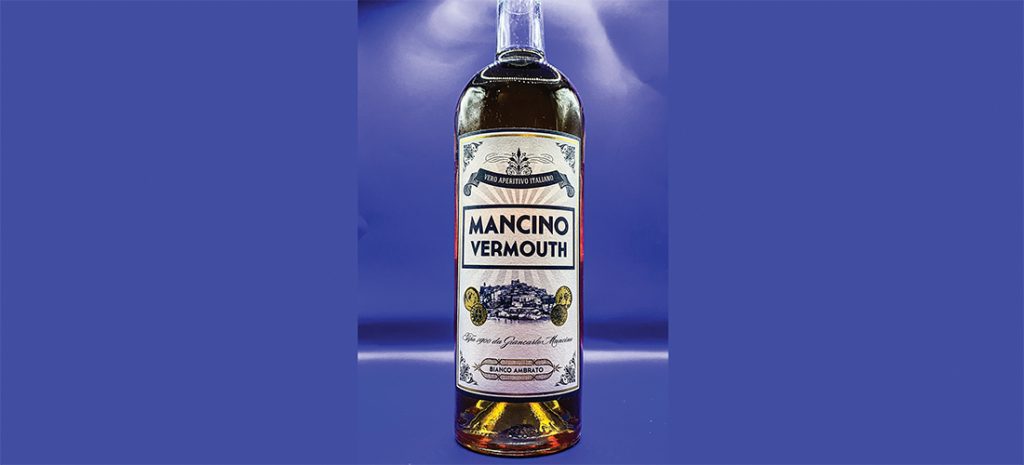
Mancino Vermouth (Bianco Ambrato)

This Italian vermouth has gained a lot of popularity in the past decade, and for good reason. I’ve had a few of their different styles and they’re all delicious — on their own and in cocktails. For those who are completely unfamiliar with vermouth, pour this over a glass of ice with an orange wedge and try to pick out what lands on your tastebuds. There are 37 aromatic herbs infused in this soft and dry Trebbiano di Romagna wine, including elderflower, chamomile, mint and orange.

Drink: Pour 3 1/2 ounces over ice in a rocks glass. Garnish with orange wedge. You may also add 1/2 to 1 ounce in your gin and tonic.

Carpano Antica Sweet Vermouth

This is one of my favorite sweet vermouths for making cocktails. It’s super approachable to drink with huge notes of orange and vanilla. It’s fantastic in a Manhattan, and it’s great on its own over crushed ice with an orange wedge. Grab a bottle and give it a try — just remember to put it in the fridge. If you love it as much as I do in a Manhattan, try the recipe I found in The Infused Cocktail Handbook, by Kurt Maitland.

Drink: Poughkeepsie (courtesy of Laura Bellucci and Belle Epoque)

2 ounces Angel’s Envy Bourbon

1 ounce chamomile-infused Carpano Antica

2 dashes Bitterman’s Boston Bittahs (that’s Boston for “bitters”)

Build ingredients in a mixing vessel, add ice, and stir until cocktail is cold and diluted properly. Strain over ice in an old-fashioned glass.

Chamomile-infused Carpano Antica

1 liter Carpano Antica Formula Vermouth

2 tablespoons loose-leaf chamomile tea

Place ingredients in a large mason jar and let the mixture steep at room temperature for 48 hours. Strain before using or storing in the fridge. For best results, use within two weeks. Please note that Carpano also makes smaller bottles (375 milliliters); it might be a good idea to start small. Just adjust the amount of chamomile tea to 1 tablespoon, instead of 2.

Dolin Blanc Vermouth de Chambéry

This is also one of my favorite vermouths, known for its clean, light, floral style. The Dolin Blanc — a style of bianco, like the Mancino above — is clear and has a touch of sweetness. It goes well with a variety of spirits, such as pisco, gin, blanco tequila and vodka. Infusing chamomile with this bianco makes a great spring drink! Not to be confused with the crisp and classic “dry” that Dolin produces (my favorite in a gin martini), the Dolin Blanc is more fun to play around with using fruits and herbal infusions. Strawberries with this vermouth in a highball cocktail with blanco tequila and sparkling water is easy sipping. I found the following recipe for banana-infused Dolin Blanc in the back of Death & Company’s newest book, Welcome Home. I’ll leave the rest of the drink to your creativity, but white rum is a good place to start.

Drink: Banana-Infused Dolin Blanc Vermouth

200 grams peeled, ripe (but not brown) banana

1 375 milliliter bottle Dolin Blanc vermouth (reserve the bottle)

Thinly slice the bananas. Combine them with the vermouth in a bowl. Cover and refrigerate for 12 hours. Strain through a paper coffee filter, Superbag or fine-mesh sieve lined with several layers of cheesecloth, then funnel back into the vermouth bottle and refrigerate until ready to use, up to three months.  PS

Tony Cross is a bartender (well, ex-bartender) who runs cocktail catering company Reverie Cocktails in Southern Pines.