The Kitchen Garden

Micro Biz

Delivering nutrition in a tray

By Jan Leitschuh

While the cutting February winds scour the Sandhills, a young Southern Pines entrepreneur putters amid a bright, humid sea of edible green.

His grandfather and great-grandfather were farmers; their tools were mules, harness and hand plows. His tools are scissors and plastic trays, LED lights and stainless steel shelves. 

But for Isaac Kundinger, 26, the occupational heritage is identical: growing stuff. His “stuff” is microgreens.

In 2017, Kundinger took his young savings and embarked on the adventure of starting his own business, The Conscious Cultivators LLC. From a building attached to his parents’ house, Kundinger sells boxes of microgreens to area chefs, Nature’s Own Market, the Pinehurst farmers market and elsewhere.

Microgreens are young vegetable greens, approximately 1–3 inches long, grown out from a tray of seeds. The pungent young greens fall somewhere between sprouts and baby leaf vegetables. They have an intense, aromatic flavor and concentrated nutrient content, and come in a variety of colors and textures. The tender greens are full of antioxidants and beneficial phytochemicals.

First introduced to the Californian restaurant scene in the 1980s, microgreens have steadily gained popularity, and can be found in most white-table restaurants these days, either in salads, as a garnish or integrated into various dishes.

Microgreens can be grown from a variety of seeds: lettuces, arugula, kale, sunflower and chards, herbs like chervil and basil, vegetables like broccoli or radish. As such, the rainbow hue of the various sprouted seeds leads some chefs to call it “vegetable confetti.” The rich flavor and concentrated nutrition of microgreens add a welcome splash of color and taste to a variety of soups, salads, eggs and other dishes, say local chefs.

“We use his microgreens in many dishes at the restaurant,” says Matthew Hannon, award-winning chef de cuisine at Ashten’s restaurant in Southern Pines. “It might be a specific herb tailored to a specific dish, or garnish for multiple dishes. We use his greens as salads, blended in soups and sauces, or anything else we can find a use for them. We truly cannot get enough.” 

One advantage for Ashten’s, says Hannon, is the hometown connection. “The main thing we like about his product is the quality and freshness,” he says. “His operation is literally blocks from the restaurant so the freshness is unmatched.”

Another local advantage is customization. For Chef Warren’s, for example, Kundinger grows a special mix of fennel, lemon balm and chervil for a specific seafood dish.

Hannon relishes the flexibility. “One thing we like so much is our working relationship,” he says. “Issac is always willing to try new microgreens for us. If there is something obscure we are looking for, he’s willing to give it a whirl. I think it keeps us both excited about new products “

In his operation, Kundinger uses only an organic compost mix in his trays. His lighting is a mixture of LEDs, fluorescents and blue light to ensure maximum health, growth and nutrition. He watches the trays of sprouted seed attentively as they form the first, thin seed leaves. He harvests in a short, carefully timed window, when the majority of the tray develops its first hearty set of true leaves. Fans for air movement ensure the proper humidity, so the greens are not packed wet.

With sterilized scissors and plastic gloves, he carefully snips the tender crops from the seeds in the tray, taking care not to crush fragile cell walls. The microgreens are then packed in special clear containers, weighed, labeled and delivered.

Kitchen gardeners wishing for a little February fresh-vegetable hit could grow ’n’ snip a tray of their own vegetable seeds in a windowsill. The most popular microgreen varieties use seeds from a number of plant families, including:

Brassicaceae: cauliflower, broccoli, kale, cabbage, radish, collards and arugula.

Asteraceae: lettuces, endive, chicory and radicchio.

Apiaceae: dill, carrot, fennel and celery.

Amaryllidaceae: garlic, onion and leek.

Amaranthaceae: amaranth, quinoa, Swiss chard, beet and spinach.

Cucurbitaceae: melon, cucumber and squash.

Pea shoots, curly tendrils and all, are another popular crop for Kundinger. He is experimenting with basil microgreens. Microgreens pack all the nutritional punch of their larger parents, but in concentrated form. According to microgreen aficionados, every salad could benefit.

The road to the microgreen business was convoluted for Kundinger. He’d taken some college classes for pre-dental, but found the work unfulfilling. He had friends out West with a medical marijuana business. “This piqued an interest in indoor farming with me,” he says.

He began researching the science of vertical gardening, making several trips to learn the growing process and techniques. “I began to see, especially in urban areas, that indoor farming is becoming a wave of the future,” he said. “The concept of growing microgreens indoors appealed to me through vertical farming, and it was evident to me that one can grow more nutritious food for more people in much less space. It’s become my passion.”

He started out in a 10×20-foot bay in his parents’ garage and turned it into a vertical grow room with 25 wooden shelves and 20 different varieties of microgreens. 

It was a steep learning curve. “There was no manual for me to follow on how to do this,” he says. “I’m learning all this from the ground up.” So to speak.

He experimented with the growing process, the lighting, temperature, airflow and ventilation, heating/air, water, sanitation and more until he developed a thriving environment for microgreens. 

“He’s had to learn a lot on his own,” says Eric Wind, Kundinger’s operations manager. “Lots of trial and error.”

Once he was able to consistently produce a top quality product, Kundinger began taking samples to local upscale restaurants, country clubs, health foods stores and farmers markets. “Working closely with the customer is how I have built my clientele over the past two years,” he says.

The walls for his grow room glow white, and the room smells strongly of springtime with a faint undernote of disinfectant. Everything looks clean, bright and fresh. The grow room walls are a special washable material, glossy and easy to sanitize. He uses fans for airflow, to prevent mildew. Watering routines are strict. The racks are stainless steel, replacing his original wooden racks — stainless steel the preferred surface for sterilization.

An eye on larger markets has prompted many of these changes. While the business is successful, Kundinger sometimes must work part-time to fund expansion and sanitation upgrades and boost his income.

To ensure a self-supporting business, he knows he has to grow his markets. “My vision for the future is to get GAP-certified (Good Agricultural Practices, a USDA audit program) so that I can expand to large distributors, catering companies, colleges and other large commercial outlets,” he says. He recently tripled his indoor vertical space. 

Building a business from the ground up has not been easy, but there have been rich, unexpected gifts. “Figuring this business out taught me discipline,” he says. “I just want this so bad.”

Another gift has been the ability to live his values. The name of his business, The Conscious Cultivators, suggests as much. “It reflects my passion for natural farm practices, and to highlight my core values,” he says.

“I can truly say that I am finding joy in the journey. I am deeply thankful to all of the chefs and businesses that have supported me and believed in me — they played a huge role in my success. Seeing my product used so creatively and artistically to create mouthwatering and nutritious dishes in our local restaurants — and knowing that I played a part in it — has been extremely rewarding.”

As for the chefs, they are effusive in their praise. 

“We’ve always known Issac was on to bigger and better things,” says Hannon. “His commitment to his craft definitely shines in the end result.”  PS

Jan Leitschuh is a local gardener, avid eater of fresh produce and co-founder of the Sandhills Farm to Table cooperative.

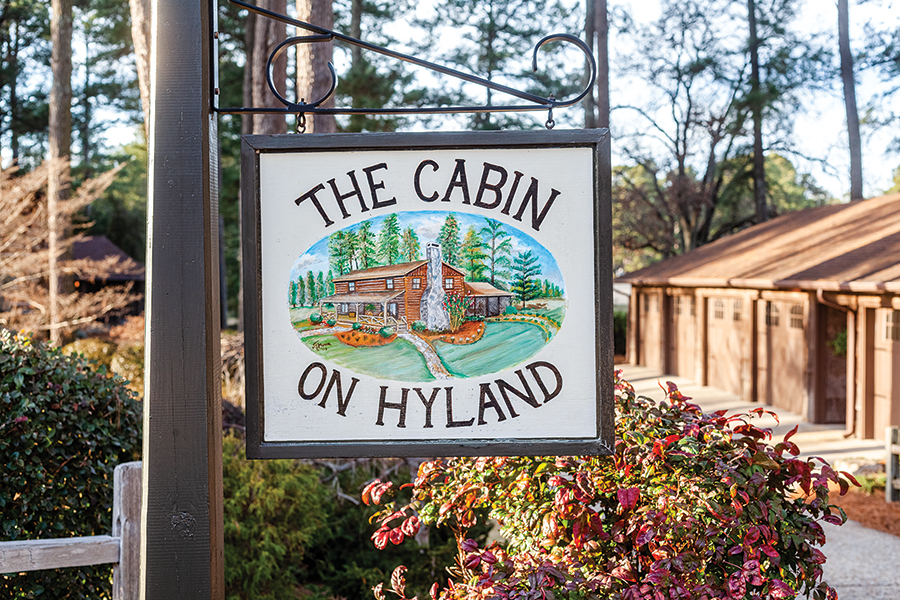
Cabin Fever

Living high on the log

By Deborah Salomon   •   Photography By John Koob Gessner

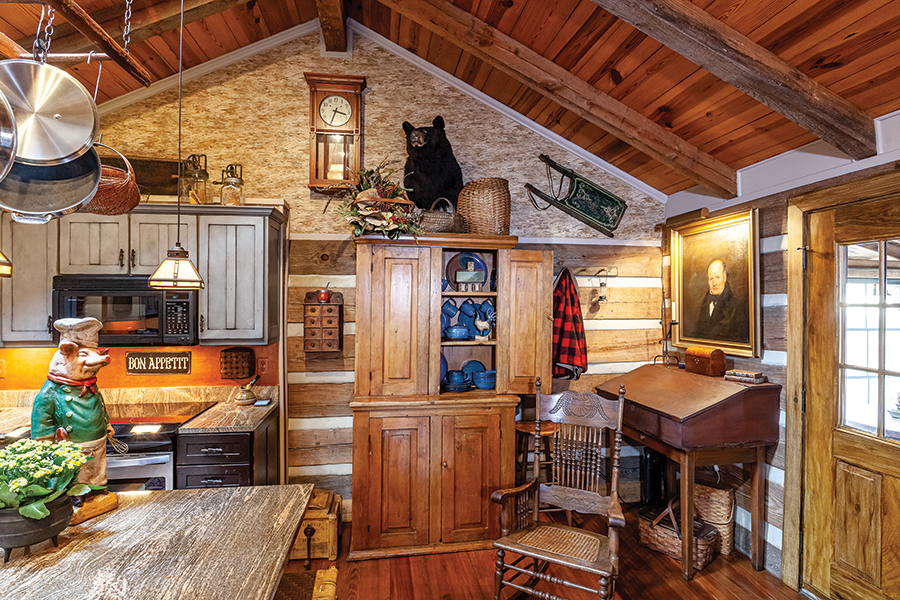
Abe Lincoln never slept here. More likely Ralph Lauren, Tom Cruise, Oprah, Clint Eastwood — all of whom own palatial log homes. Yet Les Holden’s modest but well-appointed cabin retains that rough-hewn aura conveyed by colors, surfaces and memorabilia.

Since it’s not a kit cabin, the layout can be unpredictable. Furthermore, manicured grass, tall hollies and a bubbling fountain overlooking Hyland Golf Club elevate this cabin over the Shaw House compound or anything attributed to Malcolm Blue.

Sealing the deal, the five-bay garage/workshop shelters five Brass Era (circa 1900) cars Holden has restored to drivable glory. Like King Tut’s sarcophagus, they are historic objects d’art enhanced by his knowledge of their provenance and mechanics.

Holden lovingly strokes the bumper of one, then gestures toward the cabin: “This (car) is more valuable than my whole property.”

Holden caught cabin fever growing up in frigid North Dakota, where his father was a ranch manager, then a feed salesman. He pulls out a black and white photo taken of his family, mid-1950s, in front of a hardscrabble log dwelling as unrelated to his own as Willie Nelson is to Perry Como. Before that, they lived in what Holden calls a “basement house on the poor side of the tracks.” The log cabin had been abandoned. Yet Holden remembers being happy there, especially at Christmas, when a freshly cut tree was illuminated by real candles.

Holden discovered Moore County in the 1970s while serving in the 82nd Airborne Division. “I married the ‘farmer’s daughter’ at Fort Bragg.”

After discharge he did well in real estate and mortgage lending, soon establishing his own company and bringing up a family in a large, formal residence. “We used to drive to Pinehurst often in the late ’80s. You could see the cabin clearly (from U.S. 1).” Intrigued by the elongated garage, he stopped.

“I’ve admired your cabin for a long time. Is it a kit?” he asked the owner. No. The pine logs cut from this very lot are joined with 3000 PSI (pressure per square inch) concrete. Interior/exterior wall maintenance is minimal, although retrofitting for wiring and ductwork, if necessary, can be challenging. The floorplan was tight but sufficient.

They spoke for a while; coincidentally, the owner was planning to sell. Holden had vowed to retire at 39. The modest size (just under 1,800 square feet) was perfect, since his daughters were grown.

He struck a deal with the owner in 1993. The Holdens would sell their fancy furniture, prowl for country antiques, landscape the grounds (including a tall privacy hedge), and adopt a more relaxed lifestyle.

On the day Holden retired, his wife was diagnosed with a brain tumor.

“I lost my ambition for making money. There were other things I wanted to do with my life, including taking care of my wife.”

She died soon after. Holden eventually married a family friend, who died of cancer in 2019.

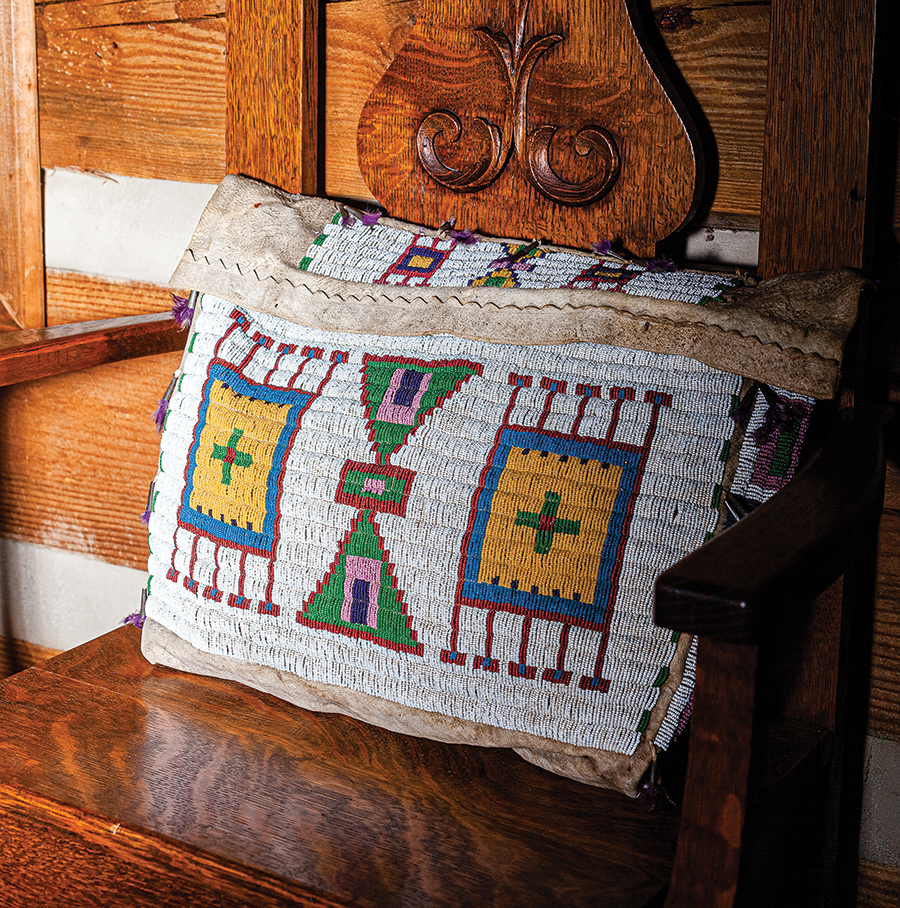
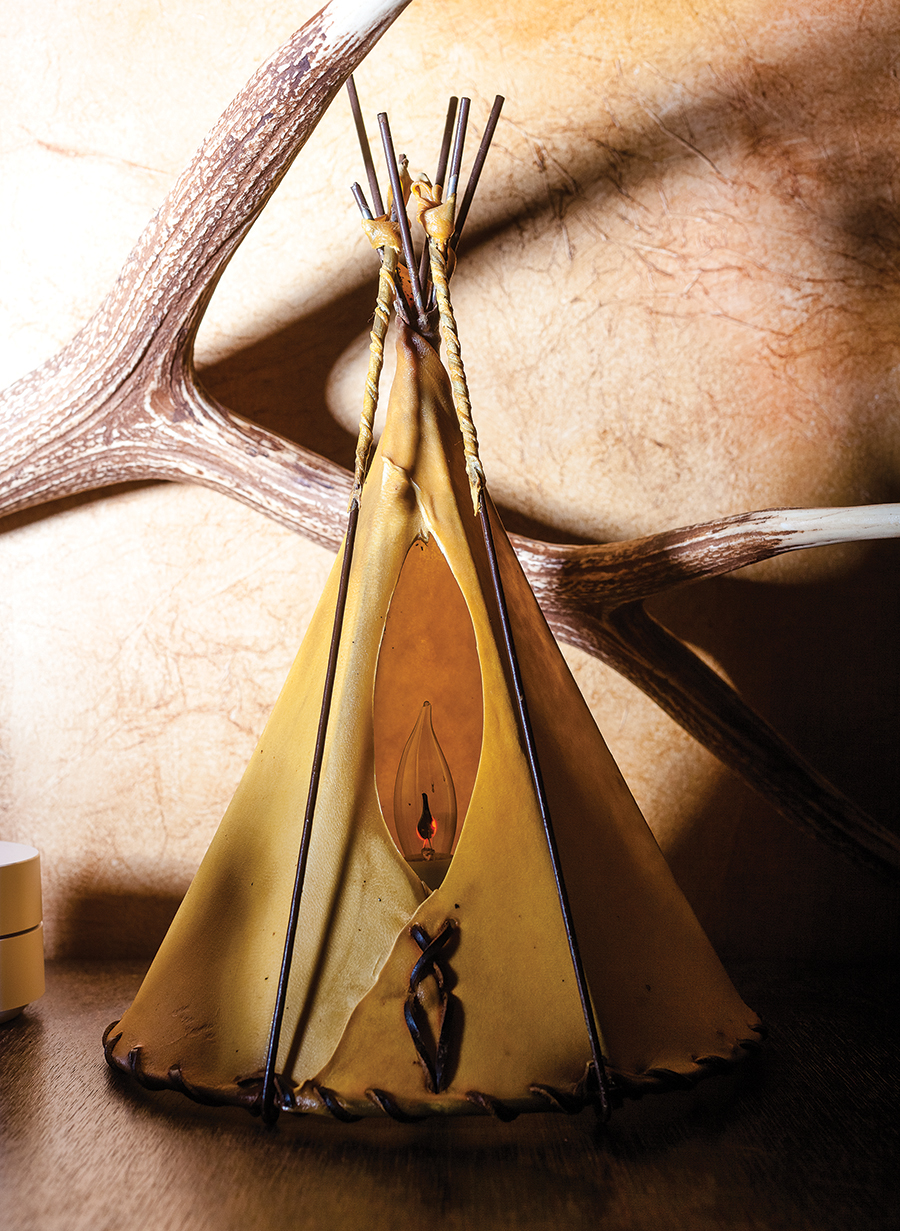
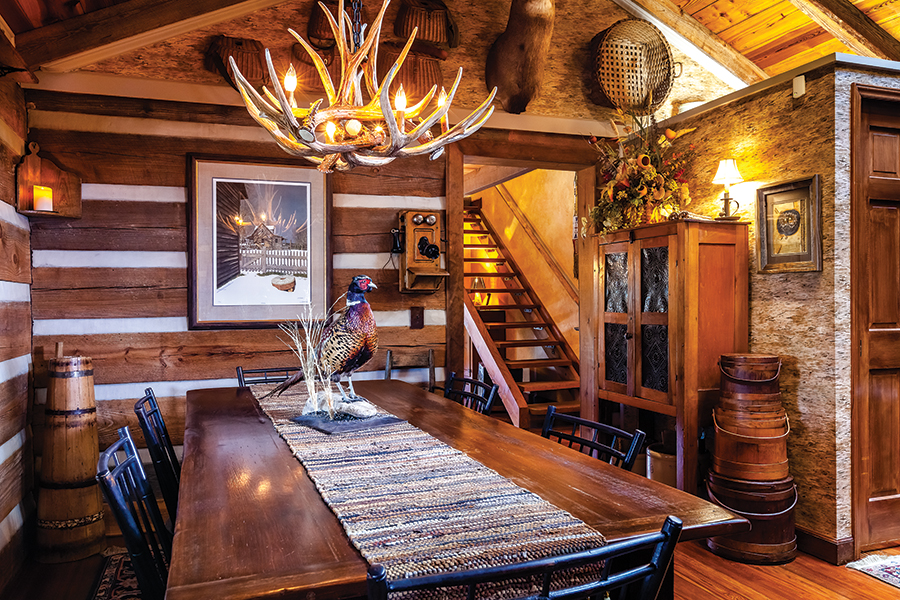
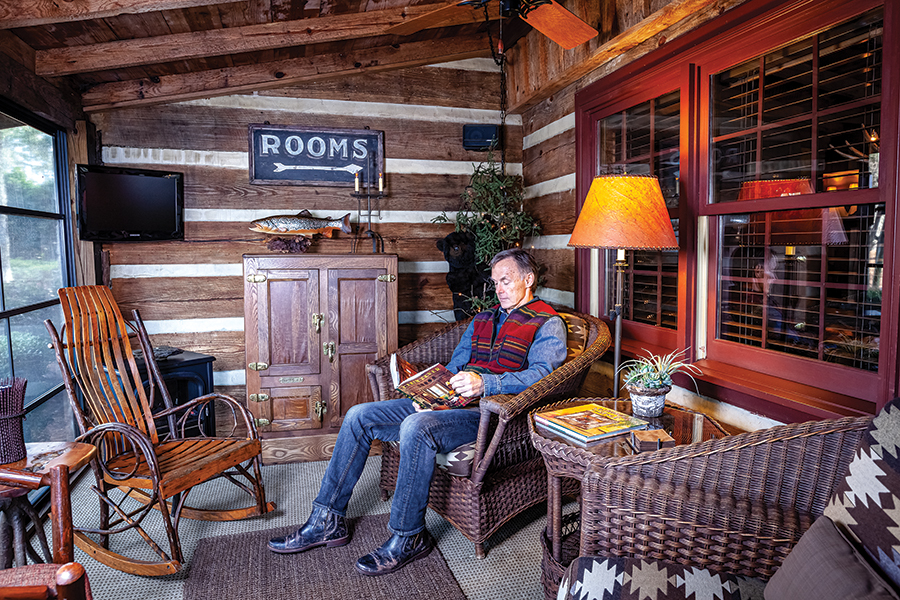
His log cabin houses memories of both — a showplace minus the glitter. Instead, his concept uses forest hues and materials: A brick fireplace was replaced by stone. Tree bark was cut, flattened and fitted as paneling and window valances. Faux-painted walls also resemble bark. An antler chandelier joins mounted bear and mule deer heads. Colors throughout blend browns with greens, an occasional deep red against leather upholstery.

Antique wooden ice boxes and kitchen “safes” arrived via grandparents. Patterned rugs brighten the knotty pine floorboards.

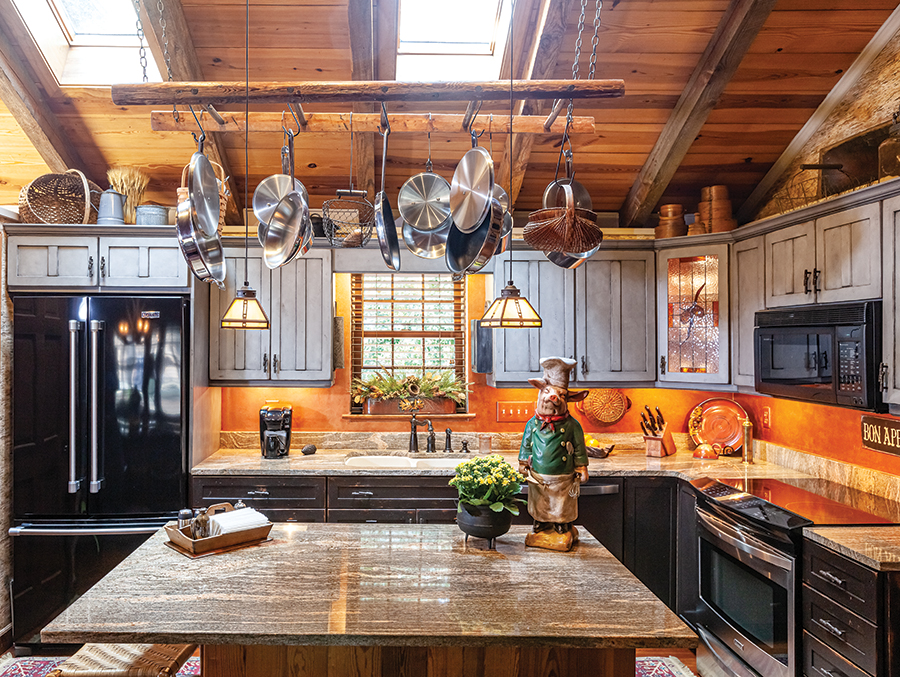
Except for the upstairs master suite with pale wall-to-wall carpet and unobstructed windows, the house is dark, a result of first-floor windows opening onto a covered porch across the front and a screened porch at the rear, both done in rocking chairs and Amish twig furnishings. Holden installed skylights in the kitchen’s vaulted ceiling, all the better to illuminate this unusual room, which combines distressed painted wood cabinetry with an electromagnetic cooktop that creates heat inside metal pots. The island is built from architectural salvage components. Italian granite countertops add an unusual wavy design in gray-green. A massive schoolmaster’s desk fills one corner. Holden is proud of finding matching antique Windsor stick-back chairs, painted black, for the long table within the kitchen dining area.

One risky departure from the cabin motif: a contemporary staircase installed against a wall, with no railing on the open side.

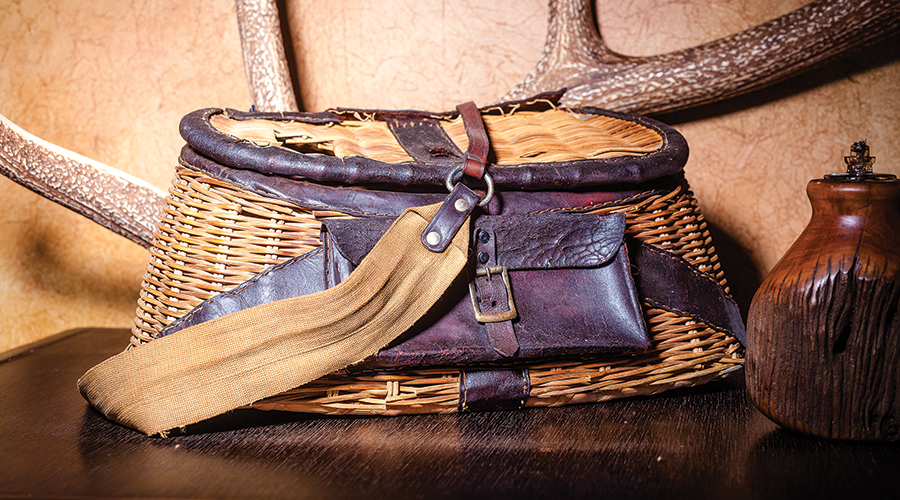
Holden seems most pleased with details, the small artifacts serving as wall decor, like a spice rack with tiny drawers. Or a child’s sleigh from Vermont. Or a portrait of somebody’s grumpy ancestor, whose eyes seem to follow the beholder. His high-tech  thermostat hides behind a weathered mailbox. A flintlock rifle circa 1820 hangs over a door, and a framed Confederate war bond occupies the stairwell.

What do you think this is?”

From the aubergine walls of his upstairs office hang framed documents dated 1773 concerning property deeds and mortgage transactions bearing X signatures, also a painting he purchased at Harrods, the London emporium catering to royalty.

Early American life is represented by “possibles” bags hanging from a hall tree — utility cross-body carry-alls used by hunters and frontiersmen, which could, possibly, contain anything.

“I tried to keep (the cabin) as authentic as I could.” Otherwise, Holden filled in with reproductions from North Carolina artist/designer Bob Timberlake’s furniture collection.

Nothing in this highly personal cabin even comes close to what awaits in the garage, which was a major selling point for Holden. He enlarged it to 1,900 square feet, larger than the cabin, installed heat and AC but, as yet, no plumbing. Obviously, the garage is his happy place — a spotless showroom, what the Louvre is to Mona Lisa.

Holden is a familiar name among this rarified group of collectors. His 1904 Cadillac touring car took first prize in the Brass Era (1895-1915) category at the 2013 Concours d’Elegance in Pinehurst. This and his other four open cars (one seats seven) defy description, particularly since he restored the motors and bodies himself. Occasionally, he’ll take one for a spin around Southern Pines. Imagine the reaction.

As for the cabin, after living there for 27 years, Holden still calls it a work in progress. “It’s like living in a vacation home,” he says, then relates this anecdote, with pride:

Some time ago, the cabin was on a home tour. Since homeowners must disappear for the day, Holden chose to peruse other participants. “I overheard two women discussing the elaborate houses they had already visited.”

“Just wait until you see the cabin!” one exclaimed.

The difference? It’s different.  PS

PinePitch

It’s for the Kids

The Authors in Moore Schools is conducting its second annual fundraiser in its effort to continue to provide author visits and signed copies of books at no cost to elementary and middle school students in Moore County. The event is on Saturday, Feb. 1, from 3-5 p.m., at the Triangle Wine Company, 144 Brucewood Road, in Southern Pines. For tickets go to www.ticketmesandhills.com.

Tar Heel Traveler in Town

The Sandhills Woman’s Exchange in conjunction with the Given Book Shop will host WRAL’s Scott Mason, the “Tar Heel Traveler,” who will talk about his new book on Tuesday, Feb. 11, at 5:30 p.m. at the Sandhills Woman’s Exchange, 15 Azalea Road, Pinehurst. The cost is $25. For more information call (910) 295-4677 or visit www.sandhillswe.org.

Expressão de Aplauso

The Fine Arts Department at Sandhills Community College will present Quaternaglia, a Brazilian guitar quartet, on Saturday, Feb. 8, at 7 p.m., at the Bradshaw Performing Arts Center, Owens Auditorium, Sandhills Community College, 3395 Airport Road, Southern Pines. Admission is free. For more information go to www.quarternaglia.com.

Ruth Pauley Lecture Series

Mark Anderson, the director of the conservation science team with the Nature Conservancy, will present “Conserving the Southeast’s Amazing Natural Resources in an Era of Climate Change,” on Thursday, Feb. 6, at 7:30 p.m., at the Bradshaw Performing Arts Center, Sandhills Community College, 3395 Airport Road, Southern Pines. For more information visit www.ruthpauley.org.

Get Your Steps in the Easy Way

Sample your way through the village of Pinehurst tasting candies, cakes and all things chocolate while sipping fine wines during the Chocolate and Wine Walk on Saturday, Feb. 8, from 4 – 8 p.m. Check in at Olde Town Realty. Tickets are $35 per person. For additional information call (910) 687-0377 or visit www.InsiderPinehurst.com.

Leave It to Beaver

Stalk North America’s largest rodent on a beaver habitat hike. on Sunday, Feb. 9, at 3 p.m., at Weymouth Woods. The 1.5-mile hike takes you off the beaten path to get up close to an active beaver dam. They are busy, no? Free and open to the public, at the Weymouth Woods-Sandhills Nature Preserve, 1024 Fort Bragg Road, Southern Pines. For more information go to www.ncparks.gov or call (910) 692-2167.

Author! Author!

On Wednesday, Feb. 12, at 5 p.m., The Country Bookshop will host Etaf Rum, author of the widely praised debut novel A Woman is No Man. Rum is a Palestinian-American who grew up in Brooklyn, New York, and is a graduate of North Carolina State University. The event will be at The Country Bookshop, 140 N.W. Broad St., Southern Pines. For more information visit www.thecountrybookshop.biz.

Live on Stage

Professional actors and community thespians will perform the play Almost, Maine on Feb. 8, 14 and 15 at 7:30 p.m.. and Feb. 9 and 16 at 2 p.m., at the Encore Center, 160 E. New Hampshire Ave., Southern Pines. For additional information call (910) 725-0603 or
go to www.encorecenter.net.

A Touch of New Orleans

Celebrate Mardi Gras and raise money for the Given Memorial Library and Tufts Archives at the same time in the annual Holly and Ivy Dinner at 6:30 p.m. Tuesday, Feb. 25, at the Holly Inn, 155 Cherokee Road, Pinehurst. Tickets are $125 and all proceeds benefit the library and archives. Tickets are available at www.ticketmesandhills.com.

Heart ‘N Soul of Jazz

The Grammy nominated jazz vocalist Jazzmeia Horn highlights the Heart ‘N Soul of Jazz 2020 in the Cardinal Ballroom of the Carolina Hotel, 80 Carolina Vista Drive, at 8 p.m. Saturday, Feb. 15. Tickets are $75 VIP reserved and $65 general reserved. Proceeds benefit the Arts Council of Moore County. For information go to www.mooreart.org. Tickets are available at www.ticketmesandhills.

Recreating the Journey

Storyteller Mitch Capel brings to life the journey of African-Americans through plantation life, the Civil War and the struggle for basic human rights on Sunday, Feb. 16, at 4 p.m. at the Sunrise Theater, 244 N.W. Broad St., Southern Pines. Tickets are $10 or $15 for VIP. For more information call (910) 692-3611 or go to www.sunrisetheater.com.

Young Musicians Festival

The finalist concert of the Young Musicians Festival will be Sunday, Feb. 23, at 2 p.m., at the Weymouth Center for Arts & Humanities, 555 E. Connecticut Ave., Southern Pines. For information call (910) 692-6261 or go to www.weymouthcenter.org.

Behind the Words and Music

Four singer-songwriters gather in Nashville’s “in the round” style to discuss the inspiration for their music in a show hosted by Momma Molasses on Saturday, Feb. 22, at 7 p.m. at the Sunrise Theater, 244 N.W. Broad St., Southern Pines. Tickets are $20 VIP or $15 reserved. For information go to www.sunrisetheater.com or call (910) 692-3611.

The Rooster’s Wife

Saturday, Feb. 1: The Kruger Brothers. Since their formal introduction to American audiences in 1997, The Kruger Brothers’ remarkable discipline, creativity and ability to infuse classical music into folk music has resulted in a unique sound that has made them a fixture in the world of acoustic music. Shows at 12:46 p.m. and 6:46 p.m. Cost: $35.

Sunday, Feb. 9: Hiroya Tsukamoto, Walter Parks. Tsukamoto is a one-of-a-kind composer, guitarist and singer-songwriter from Kyoto, Japan. Expect fluid mastery, pristine tone, and great warmth. Parks is an extraordinary singer whose songs can break your heart while they get you dancing. Cost: $20.

Thursday, Feb. 13: Open Mic.

Friday, Feb. 14: Valentine’s Dance with the Shakedown. Nothing beats the thrill of live music. Bring your sweetheart, or find your new one on the dance floor. Or just dance, dance, dance! Cost: $15.

Sunday, Feb. 16: Gessner and Murphy. The love light keeps shining with your favorite songs and your favorite people, Lisa Gessner and Paul Murphy, bringing standards and more of your heart’s desire. Cost: $15.

Thursday, Feb. 20: Barnes, Gordy and Walsh. In the world of bluegrass and folk, where the collaborative possibilities are endless, what draws some musicians together is hard to pinpoint. For Joe K. Walsh, Grant Gordy, and Danny Barnes, a newly formed bi-coastal trio, curiosity is the rule, and the tunes are just a starting point. Cost: $20.

Sunday, Feb. 23: Kamara Thomas. Her bewitching live performance incorporates elements of Native American shamanism, trance-inducing jams, and spellbinding stories of the fabled Old West. Cost: $15.

Saturday, Feb. 29: Seth Walker. A soulful singer, a skilled songwriter, and a guitarist with a sharp, clear tone brings his trio to celebrate leap year. Cost: $20.

Unless otherwise noted, doors open at 6 p.m. and music begins at 6:46 at the Poplar Knight Spot, 114 Knight St., Aberdeen. Prices above are for members. Annual memberships are $5 and available online or at the door. For more information call (910) 944-7502 or visit www.theroosterswife.org or ticketmesandhills.com.

Sporting Life

The Mist of Memories

Family never strays far from the home place

By Tom Bryant

“Tommy, I think I’m going to get a couple of cows. Tom, did you hear me?”

“Ma’am?”

“I said I’m going to buy two cows.”

“What?”

“Two cows. Buy. Put in yonder pasture.”

“Mama, that’s crazy. You know nothing about cows. That could be a
real disaster.”

“Son, I was milking cows when you were just a figment of my imagination.”

“Yeah, Mom, but you were a lot younger, and Grandaddy took care of the cows.”

“Makes no difference. Next time you come to visit, I’ll have two cows in the pasture beside the house, keeping me company.”

And that’s the way it was that early February so many years ago. Somehow, that month had snuck in a couple of spring-like days to lull us into thinking winter was about over. Two or three mild days and then BAM, winter slapped us in the jaw just to let us know that there was more to Mother Nature than was predicted on the Weather Channel.

Mom and I were enjoying the warmth on the front porch of the old house. I was in a rocker soaking up the rays, and Mom was in the swing, holding forth, talking nonstop about her plans for the home place and its surrounding fields, including pastures on both sides and behind the venerable, ancient plantation house.

The farm has been in our family for generations, going back to 1830. Built ostensibly as a wedding present for a young couple, it evolved into a working farm after the Civil War.

Mom had seven siblings, and after my grandparents passed away and during the hiatus while the lawyers figured out who would inherit what, the old house fell into disrepair. None of the children, except Mom, wanted to take on the responsibility and the expense of bringing the antiquated dwelling into the 20th century.

She took on the challenge. It was her history. Too many family occasions had taken place in the old house and the land surrounding it to, as she put it, let it rot away. It was a chore, but as she often did when facing a real difficult task, she made it work.

My dad passed away at a young age but not before he helped Mom pull together all the intricacies required to restore the farm. First came the general contractor, a gentleman builder who also wanted to see the historical house survive. It was a fact that he actually lost money on the project but was proud of the outcome, and often boasted to his friends that the job was a pleasure as he uncovered the amazing handiwork performed so many years ago.

The old house finally was comfortably livable, serving the family as it had so many years in the past. Mom reveled in family occasions and had as many events, which also included neighbors, as she possibly could; and most times it seemed as if I was in the middle of it all.

Family was more than important to her, it was almost a religion.

For example, there was the time when my cousin Faye had a series of small strokes and was recovering at home in Mt. Pleasant, South Carolina. Mom found out that I was going to be in Charleston on a business trip and gave me a call one evening right before I headed south.

“Tommy, when are you going to Charleston?”

“I’m leaving Monday. I’m gonna stop by the farm on the way home.”

“Make sure you see Faye while you’re there.”

“Mom, Faye’s sick. She can hardly talk. I don’t want to bother her.”

“You won’t bother her. She’s family. You can talk, she can listen.”

It turned out Faye and I had a good visit, and on the way home, I stopped by the farm and told Mom all about it.

“Now, didn’t it make you feel good to see your oldest cousin?” she said as I was walking out the door to head home.

“Actually, Mom, it did. Faye looked good and hopes to be up and around soon. She wants to make the family reunion in August.”

Family reunions! Mom lived for them. It seemed to me in those days as soon as a reunion was over, the plans for the next one would start. They were old-time events during the heat of summer. Relatives I hadn’t seen in years would arrive and feel right at home. Most of the time, my Uncle Tom would barbecue a hog all night before the day of the major event. Aunts, uncles, cousins and cousins twice removed would arrive full of stories about long-dead relatives. In my family, ghosts were always close. It’s said that a person never dies as long as there’s a memory. If that’s true, most of my family, as far back as I can think, is still around in the halls of the old house or hovering in the branches of the live oaks along with the Spanish moss. It’s a Southern thing. As my friend Lewis Grizzard said, “In a way, we’re a lot like the Japanese inasmuch as we revere our ancestors and eat a lot of rice.”

Mom’s two “cows” blossomed into about 20 great big black Angus beef cattle. The 1,000-pound bull would follow her around the pasture like a puppy dog. She talked a lot about the freezing late-March morning when a new calf was born behind the barn in brambles and briars close to the iced-over pond. It was still dark when Mom went down there in the middle of a sleet storm to make sure the calf and the bawling heifer were OK.

If there’s one thing I’ve learned in my many years as a Southerner, it’s that nothing stays the same, good things as well as bad. That was also true with Mom’s cattle and her ranching experience. The cows became too much to handle, and she had to sell them. She cried like a baby when the big cattle truck loaded the cows and took them away. The old farm seemed empty after they were gone.

Mom went to her glory a couple of years ago after a long, wonderful life. Her ghost, I’m sure, resides with the rest of the family’s long-departed spirits in the halls of the old house.

My sister, Bonnie, inherited the home place along with the surrounding properties, including the grasslands. Next time I’m down there, I’m gonna try to convince her she needs to put a few cows in the pastures. It would make the old farm look natural, and Mom would be proud.  PS

Tom Bryant, a Southern Pines resident, is a lifelong outdoorsman and PineStraw’s Sporting Life columnist.

True South

All Peopled Out

Introverts of the world unite — separately

By Susan S. Kelly

Not long ago I said to some pals, “Heavens, tell me about Duncan. I heard he had four shunts put in.”

“Where have you been?” someone replied with incredulity.

“You know I don’t go out,” was my lame, weak, but honest answer.

Well, there’s the rub. At the core, I’m an introvert. Pause, for clamor claiming otherwise. But as my children like to say in millennial shorthand: “Truth.”

I do not fit the old-school definition of introvert: retiring, withdrawn, uncomfortable in social situations. “She’s just shy” was the old expression — or, as my mother excuses people, “She’s just insecure.” I am not shy. I veer toward that other old expression: “She’s as strong as train smoke.”

Nowadays, anybody with a penny’s worth of psychiatry or Myers-Briggs familiarity knows that “introvert” means someone who gets their energy from being alone, and that extroverts get their energy from being with other people. The old definition of introvert is no longer relevant, has gone the way of Greta Garbo’s famous utterance, “I vant to be alone.”

Take my sister. She so needs to be with people that she can hardly go to the bathroom by herself. In her 20s, she developed polyps on her vocal cords, and had to communicate with a pad and pencil for weeks. When I join her on the beach, unfold my chair, sit down and take out my book, she says, “Oh no you don’t.” She wants to talk. When her children came home from boarding school, she always said, “Let’s have a cookout!” Meaning, invite people over! Yay! “Let’s have a cookout!” has become an oft used, eyeroll mantra in our households now.

We lived in Larchmont, New York, when I was a small child, and my mother says she could put me in a stroller, go to the city and spend all day — shopping, eating, going to museums — without a peep from me. On the other hand, she claims that she’d put my sister down for a nap, open the door an hour later, and the room looked like a bomb had gone off. This could be attributed to undiagnosed ADHD, but I suspect my sister was just rebelling at being left alone. I guarantee you she has never played a hand of solitaire.

Looking back, my childhood strategy of asking a playmate, “When do you have to go home?” instead of, “When are you going home?” was just another way of getting back to my self-entertaining self. Back to playing with Steiff stuffed animals, alone; back to singing along with musicals, alone. Back to reading, alone. All my early, handwritten stories with plotless plots about someone running away to live in the woods and eat squirrels were another symptom. The introvert indicators were all there — I just hadn’t realized it. (There was that one day when I called three or four people to see if they could come play, and when I called the fourth, I opened with, “Can you come over? I’ve called everyone else.” Could be that the fact that I had to call four people to come play and no one could — or would — was an indication of something, too. Hmm. At any rate, my mother made me call the friend back and apologize.)

During a trip, any trip — Europe, the beach, a long weekend somewhere — I unfailingly have a moment when I’m desperate to go home. “I want to be home,” I’ll say to my sister.

“Yep,” she replies, nonplussed. “Been waiting for that.”

“I want to be home,” I’ll say to my husband, who’s lying in bed, reading a guidebook.

“I know,” he mildly answers, and turns a page.

Once, when all my children were small, my husband asked, “Just how much time do you need alone every day?”

“Two hours,” I said.

“That’s too much,” he said.

Still, he knows me well. “What’s the matter?” he’ll ask me of a Sunday morning, “All cuted out?” This is shorthand for my extrovert quota having been depleted. Also, a hangover.

My husband is the reason, as a matter of fact, I know about the Myers-Briggs introvert definition in the first place. When he was senior warden at our church, all the officers and spouses were (gently) required to take the test. Trust me, I’d never have done it on my own. I ventured, once, into a Sunday school class, well aware that we might have to “break into small groups” — an introvert’s nightmare — but nevertheless interested in the topic. The minister caught sight of me (at the back of the room) and called out, “What are you doing here?”

I never went back. This, as opposed to my friend whose wife claims that the main reason he goes to church is that he’s such an extrovert he can’t miss a party.

Existential question: If I post on Instagram, does that negate being an introvert?

Often, introverts are mistaken for aloof snobs. They are not aloof snobs. They’re just all peopled out. I’m an expert at the so-called “Irish exit,” when you leave a gathering without telling anyone you’re going. To all those hosts and hostesses of parties past, I apologize. I had a wonderful time and appreciate having been invited. A friend of my mother’s eventually sold her beach cottage because she couldn’t bear to be away from her yard. Oh, sure. Right. A fellow introvert told me that she hates having her hair cut because she can’t stand all the chatter. So she goes to no-name salons and shows the operator a card she made that reads, “I am a deaf mute. Please take an inch off the bottom.” A friend on the board of Outward Bound offered me an Outward Bound trip at no cost. “You’re the perfect person,” he said. I suggested he find another adventurer for his freebie. Whatever I don’t know about myself by now, I don’t want to know, and I certainly don’t want to find out through shudder-inducing group collaboration and cooperation.

My worst introvert nightmare was the summer Friday I made plans to go see When Harry Met Sally on its opening day. By myself, of course. There, I sit in the quiet darkness, waiting for the movie, eating my popcorn, contentedly alone and anticipating, and . . . three dozen members of the neighborhood swim team troop in. Talking, laughing, jostling, scrabbling to see who sits beside whom . . . nightmare.

On the other hand, as I was all by myself waiting for another movie to begin, a little old lady shuffled in, took a seat, and proceeded to unwrap carrot sticks from a baggie as her movie snack. Was this an omen for a future nightmare? Because it’s common knowledge that whatever you are — punctual, talkative, forgetful — gets more pronounced with age.

I deliberately quit writing novels to go out and be with people again. Because I’m not an irredeemable recluse. Essentially I’m a high-functioning hermit with intermittent FOMO.

Let’s have a cookout!  PS

Susan S. Kelly is a blithe spirit, author of several novels, and a proud grandmother.

Good Natured

Power of Thought

We are what we think

By Karen Frye

A New Year is always looked upon as an opportunity to change things that can improve the quality of the life we live. Do you often wonder why certain people seem to consistently have the best outcomes, maintaining happiness and that easygoing spirit? Could there be a secret that only those folks know? The answer is . . . you get what you think about.

We are living in difficult times — stress and worry conflict with happiness, undermine our health, and create disharmony, mentally and physically. Your way of thinking can be a valuable weapon against anything that challenges your success and happiness.

In Hamlet Shakespeare wrote, “There is nothing either good or bad, but thinking makes it so.”

There are many quotes reminding us of the power of our thoughts, such as, “What we think about, we bring about.” The Book of Proverbs says, “As a man thinketh in his heart, so is he.” I’m sure you get the point.

Emmet Fox was an advocate for educating people about the power of their thoughts. Born in Ireland in 1886, he was an electrical engineer by profession, but he’s better know for a book he published in 1943 titled The Mental Equivalent based on two lectures he delivered in Kansas City, Missouri.

People think this is a material world but, in reality, it’s a mental world. Whatever you want in your life — good health, self-fulfilling work, the right friends, abundance in every form — you acquire the mental equivalent first. We are the creators of our destiny. The secret is to develop the thoughts of what you want, and rid yourself of the thoughts of what you do not want. Focus daily on the things that will improve every aspect of your life.

There are techniques for mastering the task. Build your mental equivalents by thinking quietly, constantly, and persistently. Form the mental equivalent of what you want for your life, think about it a great deal — with clarity and interest.

Fox’s The Mental Equivalent and his other books are more popular today than ever, as we yearn to know more about the power of the mind. Understanding simple techniques to control your thoughts can change your life in so many positive ways.

May this be the year that everything you desire is yours. PS

Karen Frye is the owner and founder of Nature’s Own and teaches yoga at the Bikram Yoga Studio.

Drinking with Writers

Songs of Home

The Steep Canyon Rangers celebrate the music of the Old North State

By Wiley Cash     Photographs by Mallory Cash

What do you do after spending several weeks playing sold-out shows across Australia, some of them with Steve Martin and Martin Short? If you are the Steep Canyon Rangers, you come back to North Carolina and play a lunchtime show inside a strip-mall record store in Raleigh. If you are the Steep Canyon Rangers you even carry your own equipment through the front door and snake your way through the crowd on the way to the stage.

There were no crowds when I arrived nearly an hour or so before the noon show on a chilly Wednesday in early December. The Steep Canyon Rangers had just released their latest album, North Carolina Songbook, which they had recorded live at MerleFest in April. The album is a celebration of North Carolina music, featuring the band’s renditions of the work of some of North Carolina’s most foundational voices, including Thelonious Monk, Doc Watson, Elizabeth Cotton and James Taylor. The album was released on the Friday after Thanksgiving, a day that many music lovers have come to revere as National Record Store Day Black Friday. In support of the album, the Rangers had decided to play record stores, starting with School Kids Records in Raleigh.

If you want to feel uncool, I invite you to visit an independent record store that sits a stone’s throw from a university campus.

“VIPs only down front,” says the record store manager from behind the bar. I call it a bar because while it is a counter where you can pay for records and merchandise, it is also a bar in that beer is served from behind it.

“I’m friends with the band,” I say. He knits his brows as if he has heard this hundreds of times over the years from lame dads like me. But it is the truth. I went to college with mandolin player Mike Guggino, and I have written about the band and gotten to know them over the years.

I decide to try another tack. “I’m with the media,” I say, which is also true. After all, you are right now reading the media story I wrote, but this was not enough for the manager.

“You have to purchase an album to be a VIP,” he says.

“That’s it?” I ask. “I was going to do that anyway.”

“Great,” he says, not smiling. “You can be a VIP.”

As the clock crawls closer to noon, the store begins to fill to capacity with a mixed crowd that ranges from college students to retirees. Someone has ordered pizza. Beers are being passed from the bar back through the crowd.

“Do a lot of bands play here?” a middle-aged woman asks the manager.

“A couple times a month,” he says. He looks around. “But nothing like this.”

I hear someone say my name, and I turn to find Graham Sharp, one of the band’s vocalists, carrying his guitar case and pushing through the crowd. I say hello to him and pray that the record store manager has seen us greet one another by name.

The rest of the band streams in behind Sharp, each of them carrying an assortment of instruments. The band takes the small stage, nearly filling it. The room is warm and pleasant; everyone clearly happy to be out of the office or skipping class in favor of live music from one of North Carolina’s most famous bands.

“Hey, y’all,” Sharp says to the audience. “These are songs we recorded at MerleFest.” The crowd cheers at the mention of the iconic festival. “But we haven’t played them since April.”

“We relearned them on the way here,” says lead vocalist Woody Platt to the audience’s laughter. And then the band is off into a rollicking version of Charlie Poole’s “Don’t Let Your Deal Go Down,” Platt’s rich baritone playing a wonderful historical opposite to Poole’s higher pitch.

The event soon takes on the feel of a college keg party, a feel that is intimately familiar to the Steep Canyon Rangers. The band was co-founded by Sharp and Platt at UNC-Chapel Hill in the late ’90s, when both were undergraduates. They released their first album in 2001, and they have released 13 albums since then, a few in collaboration with Steve Martin.

“This new album is a homecoming for us,” Platt later tells the audience. “We released our first record with Yep Roc Records, and that’s who’s just released North Carolina Songbook.”

And what a homecoming. The album is not only a celebration of famous North Carolina musicians and their music; it is also a testament to the Steep Canyon Rangers’ ability to blend and bend genres and styles while making a cover song seem like their own.

The band moves through gorgeous covers of Thelonious Monk’s “Blue Monk,” Tommy Jerrell’s “Drunkard’s Hiccups,” Ola Belle Reed’s “I’ve Endured,” Elizabeth Cotton’s “Shake Sugaree,” closing out the set with the state’s beloved James Taylor’s “Sweet Baby James,” sung by bassist Barrett Smith, a longtime friend of the band who is the newest addition.

At the close of the show, Platt sets down his guitar and tells the audience that the band will hang around for a little “shake and howdy,” but they have to get over to Chapel Hill for a mic check. They are singing the national anthem at the Dean Dome before tonight’s Tar Heels game against Ohio State. A homecoming indeed, but while so much has changed for the Steep Canyon Rangers, shows like the one at the record store prove that so little about them has.  PS

Wiley Cash lives in Wilmington with his wife and their two daughters. His latest novel, The Last Ballad, is available wherever books are sold.

Hometown

Period Pieces

Vintage cameras can yield vintage shots

By Bill Fields

I’ve decided I’m going to start a new decade with an old camera.

In fact, multiple vintage cameras. I’ve had them for a while as the only thing I really collect aside from a meager stash of old signature golf balls bearing the names of pros you probably haven’t heard of.

But, after a couple of false starts the last few years, I’ve made a commitment to use them regularly in 2020, the challenges of airport X-rays and film loading be damned. (I’m writing this with a view of some stray bits of film leader, the end game of a practice run with a bottom-loading screw-mount Leica.)

Still, it was great fun to take my 1937 Leica IId to the top of the Arc de Triomphe on a trip to Paris in late 2018, where it stood out in a sea of selfie sticks and smartphones. I’ve shot film sporadically over the last two decades, from an 85-year-old leatherette Kodak Brownie to a brand-new plastic Holga and any number of models in between.

An image I made with that Brownie about a decade ago on a beach not far from home is one my favorites. A handheld exposure at dusk, it includes two swimmers, one appearing as a sea serpentlike apparition, the mood enhanced by a bit of motion and the late hour of the day. My satisfaction with the photo is no doubt also influenced by the vagaries of the camera itself, a basic design that wasn’t foolproof in its heyday, much less now. I sure didn’t know what I had when I looked through the cloudy viewfinder and clicked the shutter that evening.

I thought about a one-camera/one-lens approach to 2020, a popular method for simplifying one’s photographic mission. One of my very old Leicas with a collapsible Elmar 50mm f/3.5 lens will likely see the most duty, but I’m going to mix things up by utilizing an Olympus OM-1n from the 1970s and probably the box camera as well. I noticed recently that a couple of places even still sell 110-format film, meaning that I could put my first camera, a Kodak Pocket Instamatic 20 model, in the rotation. What I’m sure of, though, is my vow to have a film camera with me.

I don’t know my way around a darkroom, so I won’t be souping my own film or making my own prints, yet I am energized by the prospects of the photographs I will be producing. Budget alone will force me to pick my spots and compose carefully. I may develop specific themes or it could turn out more random. It will be fun — I think — to experience the hopeful anxiety between shooting and having the film developed as I experienced in shooting golf professionally for more than a decade in the 1980s and 1990s.

One of the most vivid memories of my work life is picking up my slides at a New York City lab on the Monday after the 1987 Masters and quickly going through boxes to find the one containing Larry Mize’s winning shot and celebration. Dinner tasted a lot better once I realized I had the moment in focus and it was properly exposed, no gimme in a less-automated era.

My career won’t depend on what I shoot on film in 2020. In a way, it’s akin to playing golf with hickory shafts or persimmon clubheads — a different game than today’s way. Vintage cameras can be beautiful objects even if they’re just sitting on a shelf. Using them can be rewarding. To consider who before me might have shot with them — and where — is a fascination, and there is romance in film that isn’t in a memory card.

My friend Martin Axon has printed for many renowned photographers and is a master of the platinum process. In 2013, I did an essay about Hy Peskin’s famous image of Ben Hogan at the 1950 U.S. Open. Axon has printed the iconic shot.

“When you hold someone’s negative,” Axon told me then, “you go, ‘This was the actual moment,’ because you know the film was there at that moment in time.”

Here’s hoping negatives will be a positive in 2020.  PS

Southern Pines native Bill Fields, who writes about golf and other things, moved north in 1986 but hasn’t lost his accent.

The Kitchen Garden

Ode to the Veg

Or: Eat, drink and be merry, for tomorrow we diet

By Jan Leitschuh

It happens every January.

As penance for the rich feasting of the holidays, the unrestrained, celebratory consumption/imbibing of pecan pies, creamy dips, butter sauces, eggnog (and other tipsy spirits), gravies, mocha-mint lattes and, of course, peppermint ice cream, we find ourselves in January, contemplating our softening middles, spreading bottoms and muffin tops. A powerful craving for a Christmas cookie and fruitcake detox takes hold.

So we sign up for the gym and start a diet. We step away from the metaphorical sugarplums.

Can’t help with the gym, that’s on you.

Now, diet, here we can brainstorm. Kitchen gardeners may even have a leg up here. Isn’t your freezer full of produce picked at seasonal peak from the garden or local farmers markets? 

Think about it — so many diets out there to choose from. There are the old classics: Mediterranean, Atkins, South Beach, Weight Watchers, grapefruit, cabbage and more. There are the more recent diet entries such as Whole 30, TLC, DASH, the Zone, the Warrior, Paleo and ketogenic.

There is so much confusing info. Are eggs bad for you — or good? Is dairy a healthy food — or not? Legumes — hard-to-digest gut-disrupter or heart-healthy protein source? Wheat toast and whole grain pasta — dietary staples or ketosis-killing carbohydrates? And don’t even start on meat — blood sugar-stabilizing muscle-builder or cardiovascular scourge?

And yet, there is one simple category everyone can agree on. Virtually every diet and meal plan encourages their consumption.

Vegetables. Yep.

No matter one’s choice of diet, vegetables form the true backbone of a sensible eating plan and healthy weight management program. And let’s get real — it’s just plain hard to start a complicated “diet” in bleak, cold, gloomy, dark of January, but it’s not that complicated to drop the junk and fill that void with more veggies. It’s a simple plan, with health uppermost. Keep it simple and start subbing out the sugar, fat and alcohol for an extra helping of nutrition.

Start with advice from the USDA: “Five-to-Nine a Day For Better Health.” For many people, it may seem like a huge amount, especially if you aren’t a vegetable fan. But there are simple ways to up the veggie ante. More on that in a minute.

We’ll start with some sympathy. If you cling to the “I don’t like vegetables” mantra, it’s possible science has some support for you: It could be your genetics. Researchers with the University of Kentucky School of Medicine recently discovered that a particular gene might cause some people to be particularly sensitive to the taste of the brassicas — radishes, broccoli, Brussels sprouts, cabbage and other bitter-tasting veggies. 

That’s not a “get-out-of-diet” free card, more of an understanding of how one’s preferences might shape a search for produce one might like. There’s still folate-rich spinach, or fat-satisfying avocado, high vitamin-C red peppers, glutathione (the master antioxidant) rich asparagus, or the medium starchy indulgence of a sweet potato.  Zucchini, avocadoes, cucumber, mushrooms, celery, tomatoes, onion, eggplant, garlic, sprouts and microgreens, carrots, yellow squash, green beans, and onions will work too. For starters.

As we learn more about the human gut biome, we are learning how vital plant material is to its (and thus, our) health and diversity. Fiber, found only in plant foods, is one factor. A recent study found that those with the greatest weekly diversity of dietary plants had — surprise — the greatest diversity of beneficial gut bacteria. Eating 30 different plants a week can seem daunting, but this study included nuts, fruits, seeds, grains, spices and more. (Yes, spices are a type of health and taste-promoting plant food. Consider turmeric, basil, ginger, sage, black pepper, garlic and more.)

Fruits are sweet, healthy and tasty, but for some might be less than helpful if weight loss is a goal. The fructose, or fruit sugar, is one type of carbohydrate that can trigger blood sugar spikes in diabetics or those with metabolic syndrome, and may push keto dieters out of ketosis. Yet fruit in judicious quantities is healthy and delightful. During a January push, think low-sugar fruits such as a few blueberries in your almond-flour pancakes, a sprinkle of raspberries atop yogurt or mascarpone, or a squeeze of lemon or lime in dressings or tonic water. Save the bananas, figs, grapes, dried fruit and mangoes for celebratory treats down the line.

Non-starchy vegetables are naturally lower in calories, so if you are pushing for weight loss rather than health and maintenance, you might also want to give the potatoes a miss for a few weeks. Eat the foods on the DASH food plan: fish and lean protein, high-fiber starches, and deep orange and green-colored vegetables, berries and nuts. 

So, let’s huddle about sneaking a few more vegetables painlessly into our daily lives. The secret is simple. Start at breakfast. And then keep it up.

The simplest breakfast veg start is the classic veggie omelet. Sauté a few of your favorites, and whip up some eggs and pour. The sauté could include any combo of chopped onions, mushrooms, asparagus, spinach or other greens, tomatoes, broccoli and more. On the side, add a few slices of avocado or tomato. For a Mexican scramble, add a dash of salsa atop your eggs, and a small side of black beans. For a Greek, spinach and feta. And so on. Or go all Scandinavian and add slices of tomato and cucumber to your breakfast smorgasbord. The classic green smoothie is breakfast rocket fuel.

Lunch is easy. Many folks enjoy a lunch salad, and there are lots of ways to add more vegetable variety here. The advent of prepared veggies such as shaved carrots and beets, cucumber slices, etc., in the supermarket makes things easy. Or run through the market’s salad bar and pick out the items you wouldn’t buy or prepare at home, and add them to your own base of greens. Instead of sandwiches, use lettuce or collards for wraps. Serve an asparagus quiche. A bit of Sunday afternoon preparation in the kitchen could yield, say, a hearty white bean and kale soup or chili one could sup all week.

In fact, vegetable soup is a very good way to pack in both more veggie variety and quantity. Use an immersion blender and puree them all together if you don’t enjoy vegetable chunks.

Snack on your favorite finger veggies, adding a light smear of something enjoyable to, say, celery. Or mash up a batch of avocados and toss in a little onion and tomato.

As for supper, that’s the easiest. Fill the plate three-quarters full with vegetables. Your traditional side veggies will do. A small sweet potato microwaved is a quick side and a treat. Instead of pasta for your next Italian spaghetti, try spaghetti squash or spiralized zucchini strips, “zoodles,” as a vegetable-rich base. Use riced cauliflower instead of rice in a soup or dish — they are sneaking cauliflower into everything these days. Asian, Italian and Indian cuisines pack many veggies into one dish — think ratatouille, moo goo gai pan or stir-fries and curries. Any casserole can shelter extra vegs. 

Make spicy “chips” of kale, sweet potatoes and more. For lasagna, use strips of squashes instead of traditional lasagna noodles. Stuff some bell peppers. Grill some kebabs and use a whole lot of grape tomatoes, mushrooms, squash rounds, peppers and onion. Up the veggie ration in your fajitas, or pad out your meatloaf with your friends in the plant kingdom.

No matter your dietary goals, health or weight loss, you can’t go wrong working a few more veggies into your daily feeds.

Now, go forth and detox!  PS

Jan Leitschuh is a local gardener, avid eater of fresh produce and co-founder of the Sandhills Farm to Table cooperative.
Birdwatch

Keep Your Eye on the Sparrows

Dark-eyed Juncos return to these parts in cold weather

By Susan Campbell

“The snowbirds are back!” No, not the thin-blooded retirees — you won’t see them until spring. But you will see the little black-and-white, sparrowlike birds that appear under feeders when the mercury dips here in central North Carolina. They can be found in flocks, several dozen strong in places. And, in spite of what you might think, they are far from dependent on birdseed in winter.

Dark-eyed juncos are a diverse and widely distributed species, with six populations recognized across the United States, Canada and Mexico. Some have white wing bars, others sport reddish backs, and the birds in the high elevations of the Rockies are recognized by the extensive pinkish feathering on their flanks. Our eastern birds are known as “slate-colored juncos” for their dark-brown to gray feathering. As with most migrant songbirds, their migratory behavior is based on food availability, not weather. Flocks will fly southward, stopping where they find abundant grasses and forbs. They will continue  traveling once the food plants have been stripped of seed.

Dark-eyed juncos can be found throughout North America at different times of the year. During the breeding season, juncos are found at high elevation across the boreal forests nesting in thick evergreens. Our familiar slate-colored variety breeds as close as the high elevations of the Appalachians. You can find them easily around Blowing Rock and Boone year round. Watch for male juncos advertising their territories up high in fir or spruce trees. They will utter sharp chips and may string together a series of rapid call notes that sounds like the noise emitted by a “phaser” of Star Trek fame.

In winter, flocks congregate in open and brushy habitats. Juncos are distinguished from other sparrows by their clean markings: dark heads with small, pale, conical bills, pale bellies and white outer tail feathers. Females have a browner wash and less of a demarcation between belly and breast than males. They hop around and feed on small seeds close to ground level. Some individuals can be quite tame once they become familiar with a specific place and particular people. Juncos do communicate frequently, using sharp trills to keep the flock together. They will not hesitate to dive for deep cover when alarmed.

So the next time you come upon a flock along the roadside or notice juncos under your feeder, take a close look. These little birds will only be with us a few months, until day length begins to increase and they head back to the boreal forests from whence they came.  PS

Susan would love to hear from you.  Send wildlife sightings and photos to susan@ncaves.com.