Celebrate the work of J.K. Rowling at “Wizards of Weymouth” on Saturday, March 28 from 11 a.m. to 4 p.m. at the Weymouth Center for Arts and Humanities at 555 E. Connecticut Ave., Southern Pines. Enjoy the TriWizard Obstacle Course, Quidditch Toss, LEGO Wizards, Potion Crafting and Wand Wizardry. In addition, awards for the Moore County Writer’s Competition will be presented. Tickets are $10 per child. Adults accompanied by a child are free. For more information call (910) 692-6261 or visit www.weymouthcenter.org. Tickets available at ticketmesandhills.com.
Mothers and Strangers
Samia Serageldin and Lee Smith, editors of and contributors to the highly acclaimed anthology Mothers and Strangers, will appear at The Country Bookshop, 140 N.W. Broad St., Southern Pines, on Friday, March 6, at 2 p.m., to discuss the collection of essays by 18 different writers who challenge the stereotypes of Southern mothers. For information visit www.thecountrybookshop.biz.
Festival of Song
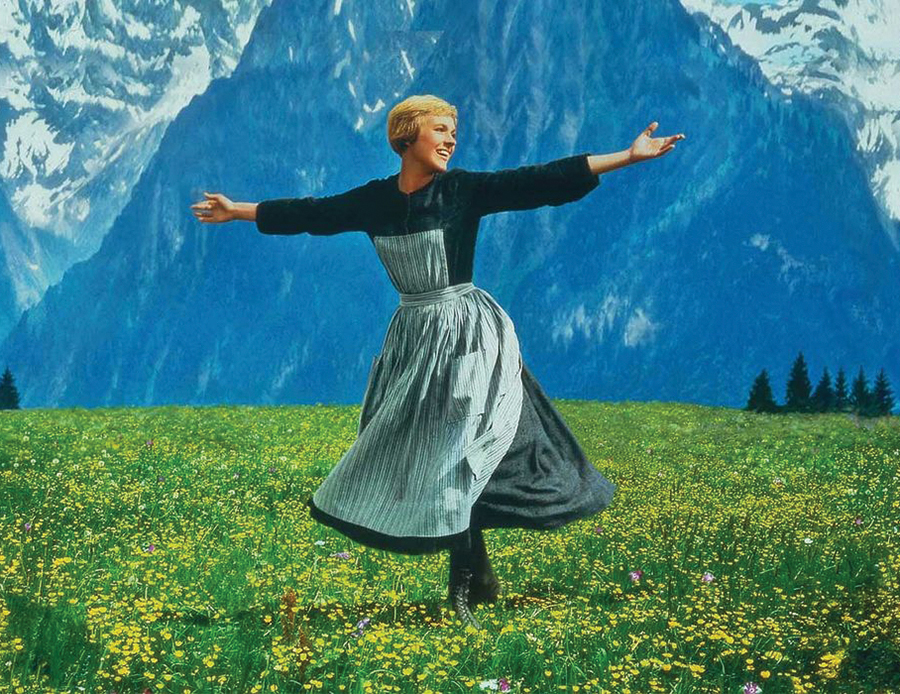
Enjoy the N.C. Symphony’s performance of “A Rodgers & Hammerstein Celebration,” featuring the timeless song collaborations of Richard Rodgers and Oscar Hammerstein II from musicals like South Pacific, The Sound of Music, State Fair, The King and I, Carousel and Oklahoma! The concert, hosted by Oscar Andy Hammerstein III, the grandson of the lyricist/dramatist, is at 8 p.m. on Thursday, March, 5 at Lee Auditorium, Pinecrest High School, 250 Voit Gilmore Lane, Southern Pines. For additional information call (877) 627-6724 or go to www.ncsymphony.org.
Bolshoi Ballet in Cinemas
The tragic fate of a pair of young lovers inspired Sergei Prokofiev’s cinematic score of Romeo and Juliet. Bolshoi stars Ekaterina Krysanova and Vladislav Lantratov embody the star-crossed lovers. The showing is Sunday, March 29, at 1 p.m., at the Sunrise Theater, 250 N.W. Broad St., Southern Pines. Tickets are $25. For more information call (910) 692-3611 or visit www.sunrisetheater.com.
Classical Concert Series
Concert pianist Nathan Lee will perform at the Sunrise Theater, 250 N.W. Broad St., Southern Pines, on Monday, March 9, at 9 p.m. At the age of 15 Lee won first prize in the 2016 Young Concert Artists International Auditions and debuted at the Kennedy Center in Washington, D.C. He has performed with the Cleveland Symphony, Buffalo Symphony, Seattle Symphony and Minnesota Orchestra. For additional information call (910) 692-2787 or visit www.mooreart.org.
Young at Art
Visit the Young People’s Fine Arts Festival, presented by the Arts Council of Moore County, at the Campbell House Galleries, 482 E. Connecticut Ave., Southern Pines, beginning on Friday, March 6, from 5 to 7 p.m. The exhibition of art by Moore County students in grades K-8 will run through March 25. For more information call (910) 692-2787 or go to www.mooreart.org.
Wit & Whimsy
The Uprising Theatre Company’s annual fundraiser to cover the costs of the “Shakespeare in the Pines” 2020 production of The Comedy of Errors will be Thursday, March 19, from 6:30 to 9 p.m., at the Fair Barn, 200 Beulah Hill Road S., Pinehurst. For information go to www.uprisingtheatre.com. Tickets are available at www.ticketmesandhills.com.
Art in Bloom
The Garden Club of the Sandhill’s sweetly-scented showcase of local floral designers, “Blooming Art” begins on Saturday, March 28 from 10 a.m. to 6 p.m. at the Campbell House Gallery, 482 E. Connecticut Ave., Southern Pines. The exhibit is also open on March 29 from noon to 4 p.m. For more information call (843) 992-1891. The tickets are $10 and available at ticketmesandhills.com.
Wagner at The Met
The Metropolitan Opera’s performance of Der Fliegende Hollander, an early masterwork by Richard Wagner, starring base-baritone Sir Bryn Terfel, will be shown at the Sunrise Theater 250 N.W. Broad St., Southern Pines, at 1 p.m. on Saturday, March 14. For information call (910) 692-3611 or visit www.sunrisetheater.com.
The Rooster’s Wife
Friday, March 6: Miss Tess and the Talkbacks. Tess has always been known for creating an eclectic array of vintage blues, country, and jazz sounds. However varied Tess’ music can be, her voice has been described as seductive and sexy, and a pure joy for listening. She’s celebrating her brand new record at the Spot. Cost: $20.
Sunday, March 8: George Jackson Band, Treya Lam. At the heart of all traditional music lie two important coordinates, the time and place of origin. Born in Christchurch, New Zealand, fiddler George Jackson spent the better part of his childhood living and touring in a house bus with his family band, eventually making his way to Nashville, Tennessee. His fiddle tunes reflect a deep understanding of American roots traditions while remaining entirely true to his own musical and personal identity. Cost: $20.
Sunday, March 15: The Blue Eyed Bettys. Weaving spellbinding stories with their exuberant performances, they turn boisterous bars into attentive listening rooms and sleepy pubs into raucous parties. Cost: $20.
Sunday, March 22: Steel City Rovers. This Celtic group from Ontario, Canada, performs dynamic and expressive music that is a unique composite of traditional Celtic music and North American styles including bluegrass, folk and roots. Performing on meticulously crafted replicas of historical instruments rarely seen on today’s musical landscape, they breathe life into newly discovered instrumental melodies from centuries ago. Cost: $20.
Thursday, March 26: Hargreaves and deGroot; Furtado and Price. This special evening will feature two pairs of renowned string players. Tatiana Hargreaves and Allison deGroot immerse themselves in the depths of a centuries-old art form — the interlocking propulsion of Appalachian fiddle and banjo duets — and emerge with a contemporary aesthetic and vision. Tony Furtado is a wide-ranging songwriter adept on banjo, cello-banjo, slide guitar and baritone ukulele, and Luke Price is known for his great balance of taste, rhythm and technical ability. Cost: $20.
Sunday, March 29: Eliza Neals. A Detroit blues-rock star on the rise, honors the gut-wrenching, soul-splitting intent the American roots of contemporary blues represents with inspired songwriting, live performances, and magic not seen in years. Cost: $20.
Unless otherwise noted, doors open at 6 p.m. and music begins at 6:46 at the Poplar Knight Spot, 114 Knight St., Aberdeen. Prices above are for members. Annual memberships are $5 and available online or at the door. For more information call (910) 944-7502 or visit www.theroosterswife.org or www.ticketmesandhills.com.
If I use a plastic drinking straw, I get grief from my family.
As I should. So I decided to stop using plastic straws and plastic razors — those disposable ones, usually orange or blue — and buy an electric razor.
My father, back in his day, used an implement that looked very much like a plastic razor, but his was metal, and when you twisted the handle about a quarter-turn, two little doors on the head of the razor opened toward the ceiling. He’d then drop in a thin, almost weightless Gillette razor blade. He’d twist the handle so that the little doors closed and the blade would be enclosed snugly, with its two sharp outside edges exposed.
He’d drip some warm water from the spigot into a mug that had a bit of soap in the bottom, then work up some lather with a soft round brush. He’d brush the white lather onto his face, and then carefully shave.
My grandfather did it the same way, except he used a straight razor, sharpened by sliding the blade along a leather strap, or “strop.” The strop looked like an extraordinarily wide leather belt.
Anyway, I realized I’d have to shop for a new electric razor.
For me, shopping often produces anxiety and indecision. I do it as rarely as possible. For example, I bought my newest sport coat before my very old cat was born. Cats don’t live that long. And I just found out that some blue jeans are black.
First stop: Target. I find the electric razor section. It’s as long as a gymnasium wall. My heart rate ticks up. I look closely and read packaging information: dryfoil, proskin, lithium ion, microcomb, flexible foil cutters, pivot head. I grab one in the mid-priced range: $69 — the going price of a sink, commode and bathtub when my father started shaving in about 1917. The brand is a Braun, and something extra is in the box. I’m not sure what, but I just want to get out of the store.
I take my Braun home and try to open the box with several kitchen implements. I finally open it with my chain saw, avoiding injury, get the razor out, and unpack the rest of the box. I find a thick booklet of instructions in English and many other languages, as well as a fairly large “recharging stand.” And inside the recharging stand is a small, clear plastic container. And . . . stay with me . . . inside that container is a container of some special liquid that every night will clean the shaver while the razor is being recharged and. . . no joke . . . oil it. I read that every few months I’ll need to buy more of that special liquid. A reasonable person might wonder if this thing will shave me like those vacuum cleaners that vacuum the house while you watch TV.
What happened next is I nervously decided to do a bit of research. What was I getting into? When I Googled “electric shavers” I got this many hits: 41,300,000. (Check it out.) And then because I Googled “electric shaver,” I now have a new electric shaver image pop-up on my speedometer screen when I start my car — the latest deal between Honda and Google.
Next stop: Target. I returned the electric razor. I bought a bag of disposable razors, the blue ones, and a can of shaving foam.
Soon, I’m going to visit my father’s grave as I sometimes do, and we will have a talk. I think I know what he’s going to suggest: mug, soap, soft round brush, and an old-timey metal razor.PS
Clyde Edgerton is the author of 10 novels, a memoir and most recently, Papadaddy’s Book for New Fathers. He is the Thomas S. Kenan III Distinguished Professor of Creative Writing at UNCW.
Members of elite unit gather to discuss Ashley’s War
By Jim Moriarty
Ashley White was a first lieutenant assigned to the 230th Brigade Support Battalion, 30th Heavy Brigade Combat Team attached to the Joint Special Operations Task Force when she was killed in action in 2011 in Kandahar Province, Afghanistan. She was a member of a Cultural Support Team, a very special unit composed of very special women.
The CSTs, as they are called, undertook night missions with elite Army Rangers. Their job was to interact with women and children in countries like Afghanistan where contact between women and men they’re not related to is socially unacceptable. When the Rangers entered a compound in search of insurgents, the CST officers would calm the women and children, search them for possible weapons or explosives (and to see if a man was hiding dressed as a woman) and, finally, obtain whatever intelligence they could. It was dangerous work in a dangerous part of the world.
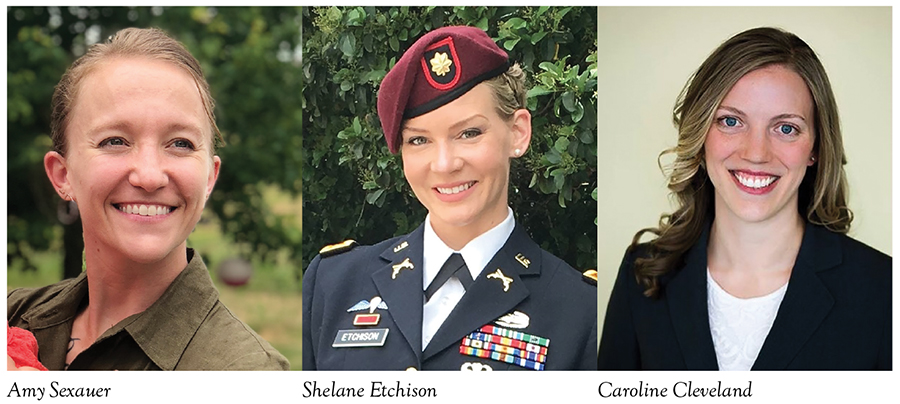
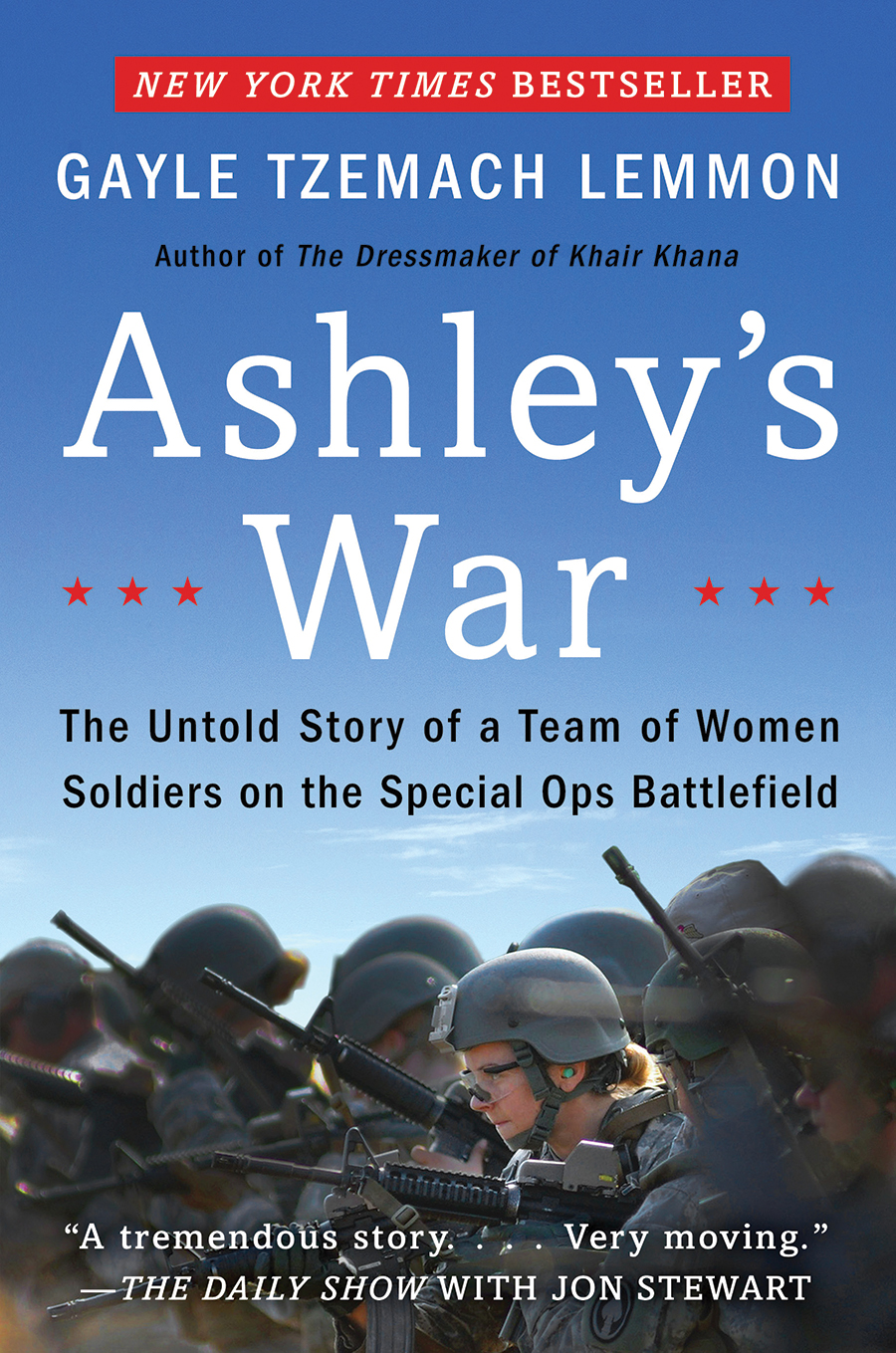
On Thursday, March 19, Amy Sexauer, Shelane Etchison and Caroline Cleveland, three women who trained and served with Ashley White, will lead a panel discussion of Ashley’s War, a New York Times best-seller by Gayle Tzemach Lemmon. All three appeared in the book under aliases. The event — “Ashley’s War: Bonds of Women in Combat” — will be held at the Country Club of North Carolina. Doors and a cash bar open at 6:30 p.m., and the program begins at 7 p.m. Tickets are $35 and available at ticketmesandhills.com. All proceeds benefit 2020 Women Build, a committee for Habitat for Humanity of the N.C. Sandhills. (Film rights for Ashley’s War were acquired by Fox 2000 and Reese Witherspoon, and the project is in development.)
“Stepping back and looking at things from a larger picture, Ashley’s War and the story of CST is the story of a collective group of women rising to a challenge and finding deep friendships along the way,” says Etchison, who is out of the Army pursuing dual advanced degrees at Harvard University, one in business and the other at the Kennedy School of Government. “You hear about the brotherhood all the time. You never really hear about the sisterhood.”
In 2013, 1st Lt. Jennifer Moreno became the second CST killed in combat. Trained originally as a nurse, Moreno was killed when she rushed to the aid of a fallen comrade. She was posthumously awarded the Bronze Star for bravery. “My first priority is to memorialize the legacy of Ashley White and Jenny Moreno, who are the first and hopefully only CSTs to be killed in action,” says Cleveland, who lives in Fayetteville and is a doctor of physical therapy at Cape Fear Hospital.
“A lot of people have given their life in the military, and not everybody has a book written about them,” says Sexauer, who lives in Southern Pines, as have many of the CSTs. “It’s an honor to be able to carry on Ashley’s legacy. It’s not always easy, it’s not always comfortable, to talk about the past and about the things we did in the military, but it’s an honor to keep Ashley’s legacy alive.”
The following is an excerpt from the preface of Ashley’s War, edited for space:
Second Lieutenant White entered the “ready room” and began preparing for the night of battle.
White felt the fear rising, but more seasoned soldiers had provided plenty of advice for the special brand of trepidation that accompanies a soldier on their first night mission. “It gets easier after the first time,” they assured the newbies during training. “Don’t indulge it, just pass through it.”
Ready now, White stepped into the briefing room and took in the scene. Dozens of battle-hardened men from one of the Army’s fittest and finest teams, the elite special operations 75th Ranger Regiment, crowded in to watch a PowerPoint presentation in a large conference room. Many had Purple Hearts and deployments that reached into the double digits. Around them was the staff that supports soldiers in the field with intelligence, communications, and explosives disposal capabilities. Everyone was studying a diagram of the target compound as the commanders ticked through the mission plan in their own vernacular, a mix of Army shorthand and abbreviations that, to the uninitiated, sounded like a foreign language.
White had the feeling of being in a Hollywood war movie. Standing nearby was a noncommissioned officer (NCO) and Iraq War veteran whom the second lieutenant had trained with.
“Are we supposed to say something?” White asked.
Staff Sergeant Mason, also out for the first time, scooted closer and whispered back. Neither new arrival wanted to stand out any more than they already did.
“No, I don’t think so, not tonight. The last group will speak for us.”
That was a relief. White had no desire to draw attention in a room filled with soldiers who clearly felt at home in combat. Like a cast of actors who had performed the same play for a decade, they knew each other’s lines and moves, and offstage they knew each other’s backstories. It was an unexpected revelation for White, gleaned during a fifteen-minute mission review in a makeshift conference room in the middle of one of Afghanistan’s most dangerous provinces: this was a family unit. A brotherhood.
The briefing ended, the commanding officer approached the front of the room and the soldiers suddenly shouted as one:
“Rangers Lead the Way!”
In one of the many Velcroed pockets of White’s uniform was information about the insurgent they were after and a list of crimes he was suspected of committing. In another pocket was a medal of St. Joseph and a prayer card. White stepped out of the barracks and worked to conceal any trace of the intense emotions this moment conjured up: pride in being part of a team hunting a terrorist who was killing American soldiers and his own countrymen; trepidation at the thought that after a short ride on the bird they would all end up in his living room. But it was exactly what White had wanted and trained for: to serve with fellow soldiers in this long war and do something that mattered.
The fighters lined up by last name and marched into the yawning darkness of the Kandahar night. Unlike the American cities they came from, whose skies were often clouded by the pollution of industry, traffic, and the millions of lights that power a modern, twenty-four-hour-a-day society, Kandahar’s blackness stretched on forever with constellations you only read about at home. But then a powerful stench yanked the young officer back into the moment. As heavenly as the skies were, just so earthly was the smell of human excrement that hovered over and seemed to surround the Kandahar camp. In a city whose sewage system had been all but destroyed by war, the smell of feces attacked with ferocity anytime a soldier was downwind.
But White was focused on something even more mundane: staying upright while marching along the unpaved, rock-strewn tarmac for the first time in total darkness. “Focus on the next step,” White silently commanded. “No mistakes. Do your job. Don’t mess up.”
White and Mason fell in alongside their fellow special operations “enablers,” a group that included the explosive ordnance disposal guys who became famous in the Hollywood blockbuster The Hurt Locker. Close behind was their interpreter, an Afghan-American now entering year four in Afghanistan. Language expertise notwithstanding, the interpreter’s gear looked like it came from the Eisenhower era. They all guessed some soldier had worn that helmet back in Vietnam; it barely held the clips for night-vision goggles and was seriously dinged.
Entering the cramped helicopter, White and Mason were determined not to make a beginner mistake by taking the wrong seat, so they fell in behind a first sergeant, who had taken the new arrivals under his wing. After he sat, they followed his example, snapping a bungee cord that hung from a metal hook on their belt into hooks beneath a narrow metal bench. In theory, these cords would keep them from flying across — or out of — the helicopter while it was airborne. The soldiers took root, and with a sudden whirr the bird was off.
Here we go, White thought. Outwardly the picture of calm, inside the young officer felt a rush of adrenaline and fear. Everything — the selection process, the training, the deployment — had happened so quickly. Now, suddenly, it was real. For the next nine months this is what every night would look like.
Over the booming engine noise the first sergeant barked out the time stamp in hand signals.
“Six minutes.”
“Three minutes.”
White turned to Mason and gave the thumbs-up with a smile that was full of unfelt confidence.
“One minute.”
Showtime.
The bird landed and the door flew open, like the maw of some huge, wild reptile that had descended from the sky. White followed the others and ran a short distance before taking a knee, managing to avoid the worst of the brownout, that swirling mix of dust, stones, and God-only-knows what else that flies upward in the wake of a departing helicopter.
With barely a word exchanged, the Rangers fell in line and began marching toward the target compound.
The ground crunched beneath their feet as they pressed forward through vineyards and wadis, southern Afghanistan’s ubiquitous ditches and dry riverbeds. They marched quickly, and even though the night goggles made depth perception a nearly impossible challenge, White managed not to trip over the many vines that snaked along and across the rutted landscape. No one made a sound. Even a muffled cough could ricochet across the silence and bring unwanted noise into the operation.
Fifteen minutes on they reached their objective, though to White it felt like only a minute had passed. An interpreter’s voice could be heard addressing the men of the house in Pashto, urging them to come outside. A few minutes later the American and Afghan soldiers entered the compound to search for the insurgent and any explosives or weapons he might have hidden inside.
And then Second Lieutenant Ashley White heard the summons that had led her from the warmth of her North Carolina home to one of the world’s most remote — and dangerous — pockets.
“CST, get up here,” called a voice on the radio.
The Rangers were ready for White and her team to get to work. The trio of female soldiers — White, Mason, and their civilian interpreter, Nadia — strode toward the compound that was bathed in the green haze of their goggles. It was dead in the middle of the night, but for White, the day was just beginning.
Her war story had just begun. It was time for the women to go to work.PS
March is the blushing maiden, bright-eyed and smiling, her wild locks softly brushing your skin as she frolics past.
You knew she was coming. The birds have been singing her name for weeks. And yet her arrival has taken you by surprise. You, too, are blushing.
March is the blossoming redbud, soft light, a tapestry of pine needles, bark and grasses.
The nuthatch has crafted her nest, and like the pregnant doe, belly swollen with late winter pansies, a new energy is alive inside of you — a new innocence.
Pale pink blossoms adorn the saucer magnolia, but a tiny yellow flower has caught your eye.
Dandelion.
Simple, immaculate, glorious dandelion.
You see it as if through the eyes of a child, pluck it from the tender earth, tuck it snug behind your ear.
The birds are singing louder now. Ballads of clover, crocus, daffodil. And in the garden, each tiny blossom smiles back.
March has arrived and, with it, spring — as much in your heart as the outside world.
Spring makes its own statement, so loud and clear that the gardener seems to be only one of the instruments, not the composer. — Geoffrey B. Charlesworth
Destination Dandelion
Sometimes, especially on dreamy March mornings, the gentle pull of adventure arrives.
On such mornings, you will wander for the sake of wandering, nectar-drunk as a hummingbird as the fragrance of spring blossoms swirls around you.
You might follow the warmth of the sun, or a sweet aroma, or the distant rapping of a woodpecker, any of which will guide you someplace new.
Then maybe, on some quiet woodland trail, you will discover a fluffy young dog.
He won’t look hungry. Or lost. And from the way he is looking at you, he seems to be inviting you farther down the path.
You’ll walk together, for a mile or so, before the path reveals a rolling field. This is when you’ll realize that, across the field, inside the cottage with the smoking chimney, someone might be wondering where their dog went.
And so you’ll walk him home.
Inside the cottage, which smells of rich and exotic spices, an elderly woman is cooking dal on the stovetop. Her husband thanks you for returning Houdini (he slipped the gate again), and invites you to stay for lunch.
“I’ve just gathered greens for the dandelion salad,” he tells you.
You can’t say no to that.
Dandelion Salad
All you need: dandelion greens, wild and tender. Wash thoroughly, then toss with whatever you’d like. Lemon juice, fresh dill, olive oil and pepper.
Glory of Spring
Goddess of Fertility Day is observed on Wednesday, March 18 — the day before official spring. Among the goddesses celebrated on this day, Aphrodite is by far the most widely known.
Born from the foam of the sea, it’s fitting that this goddess of love and blinding beauty be remembered at a time when tender green shoots and brilliant flowers seemingly appear out of nowhere.
Historically, those seeking to conceive would make offerings to Aphrodite on this day — flowers, greenery, dessert wine, and triangle-shaped honey cakes.
Or, grow a garden in her honor.
Dandelions don’t tell no lies. — Mick Jagger
Laugh in Flowers
The earth has softened. In the garden, sow seeds for spinach, radish, turnip and kale. Plant a Flower Day is celebrated on Thursday, March 12 — but why stop at just one? March is a good month for planting lilies, tulips and roses. And don’t forget landscaping beauties, like rock cress, sweet pea or — in celebration of Saint Patrick’s Day on March 17 — clover.
In the early stagesof my seventh decade of being called something, I know I am not “will.i.am.” And the singer William James Adams Jr. need not fear that I will encroach on his lower-case and punctuated stage moniker.
Beyond that, though, all bets are off as I deal with an identity crisis.
My name game was simple for a long time. As with many folks, there were family reasons my birth certificate says what it says. William was the first name of my father and of the man who, with his wife, adopted him. Henderson, my mother’s maiden name, was chosen for the middle of mine. Both sides had a stake in how I would turn out.
From as early as I can remember, people called me Bill, never the two-syllable variant of the nickname. This was obviously a choice, for whatever reason, by my parents. As a child, I had no reason to argue with them. Neither Billy the Kid nor Billy Graham had something I needed.
Once I started school, I began to see how the world’s male Williams — or at least those in my classroom — were divided into Bills and Billys. The Duncan boy was a Billy. The Perham boy, like me, was a Bill. Folks seemed as likely to switch up their nicknames as to mistake the Blue Knights for the Red Devils. I was Bill on my lesson papers and my report cards. I also was Bill on my Little League team, although if someone had labeled me Willie, same as one of my baseball heroes, Willie Mays, I would have taken it in a heartbeat.
This “rule” followed me to the barbershop, where I never heard anyone voice the first name of my favorite haircutter, Billie Joyce Hill, with fewer than two syllables. The same was true for a longtime teacher in Southern Pines, Billie Bowen, although in the hallways she received an alliterative addition, “Bat Cave” Billie Bowen, because of her roots in that tiny western North Carolina community.
I was a plain, boring Bill until encountering golf professionals at Mid Pines for whom I worked as a teen golf cart attendant. I was Billy to them just as sure as there were longleaf pines along the fairways.
As I got older, outside of passports, bank statements and driver licenses that utilized my legal name, I was Bill — to friends and family, in bylines and, most of the time, to co-workers. The difference between the nickname’s versions was as different as Billy Crystal and Bill Kristol.
The last couple of years, one of my freelance assignments finds me on the road a dozen times a year working long days with a great bunch of people, some of whom like to call me Billy. Although I still don’t see myself as a Billy, I answer to it and have come to see it as the term of endearment that it is. I am the same person, after all, with or without a “y.”
I wish a phone agent had been as understanding a year ago when I was attempting to close a cable television account for the service in my mother’s room in an assisted living facility.
“This is William Fields,” I said, identifying the account and explaining why I had called.”
The voice on the other end of the line was helpful at first, collecting salient information to allow him to retrieve the account from the virtual vault of cable TV land. Just when I thought we were close to finishing the conversation, a snag appeared.
“What did you say your name was?” he asked.
“William Fields,” I answered.
“This account was opened by Bill Fields.”
“Yeah, that’s me. Bill is short for William. It’s a nickname. It’s my name. That was me — it is me.”
“But the account was opened with a different name. I can’t do this over the phone. You’re going to have to go to an office.”
After a couple of more tries weren’t able to inject any common sense into the conversation, I gave up and hung up.
As the steam dissipated, Bill v. Billy seemed way down the list of the world’s woes.PS
Southern Pines native Bill Fields, who writes about golf and other things, moved north in 1986 but hasn’t lost his accent.Bill can be reached at williamhfields@gmail.com.
In past issues, I’ve mentioned how my first encounters with almost every spirit were terrible impressions: everything from Jose Cuervo to Aristocrat gin. Let me fill you in about my first dance with whiskey.
I was with a friend at the lake on a beautiful day in June. We were fishing and having a few beers while music was blasting from a little speaker. My friend brought some snacks with him that were in his book bag. One of those snacks was a bottle of Jack. He grabbed the bottle, unscrewed the top, and took a swig.
My turn. Acting like I was a seasoned vet, I snapped my head back, raising the bottle vertically to the sun, and took a decent-sized “swaller.” I screwed the cap back on, sat the bottle on the grass, and grinned. I couldn’t breathe. As my buddy was rambling on about something, I just nodded my head, and stood there as that you’re-about-to-throw-up saliva secreted from the glands in my mouth. Thirty seconds later, I dizzily walked away from our poles toward the woods, fell to my knees, and yakked. Man, last summer was crazy. Joking.
But, I’m still not fond of Jack Daniels. What I am a fan of is other types of whiskey (I see you, rye). Canadian whiskey was my puppy love stage, and bourbon whiskey was my first full-fledged relationship. Even though that sentence makes me sound like a full-fledged alcoholic, I am not (I see you, Mom). My first days of bartending were during the bourbon boom, if you will. And even though we have strict ABC laws in North Carolina, we were able to get great bottles on a regular basis. These days that is certainly not the case. Most ABC hubs have to have an auction-style drawing to see which bar or restaurant gets that one (yes, one) bottle of higher-end whiskey. I wish I were joking.
One of those bottles is Blanton’s bourbon. It’s a pity, too; Blanton’s is one of my favorite whiskies. Blanton’s was so popular last decade that their distillery, Buffalo Trace, put out a press release stating that demand was higher than their supply. Unfortunately, it still seems to be. Either that, or North Carolina is not allocated many bottles at all, compared to when I could order from my bar. I could wax poetic on how lovely Blanton’s is, and why I would marry her, but instead I’m going to share some facts about bourbon. However, if you ever see a bottle of Blanton’s anywhere, buy it. Even if you’re not a whiskey fan, I guarantee that you will have someone over one day, and when they find out you have a bottle, they just might faint.
Before I drop knowledge, please note that some of my info comes from whiskey sommelier Heather Greene. I purchased her book years back, Whisk(e)y Distilled — A Populist Guide to the Water of Life. I highly recommend it. I know that there are hundreds of books on whiskey, but Heather’s is as easy to read as it is informative.
• Bourbon is an American spirit.
• Bourbon can be distilled anywhere in America. Contrary to belief, it does not have to be produced in Kentucky.
• With that being said, Kentucky is the birthplace of bourbon. They craft 95 percent of the world’s bourbon.
• Kentucky has the perfect climate for bourbon: ideal soil for growing corn, iron-free water, access to rivers for transportation (when distillers first began making bourbon in the early 1800s), a multitude of trees for making casks, and hot summers/cold winters, which allow the casks to expand and contract.
• Bourbon can be called bourbon only if the mash bill is at least 51 percent corn. The other 49 percent can be any other grain. Bourbon can also be made from 100 percent corn.
• Bourbon must be aged in charred new oak. Time is not an issue; even if it’s only for 10 minutes, as long as it’s in the barrel, it’s bourbon.
• Bourbon must be distilled at no higher than 160 proof (80 percent ABV).
• Bourbon must be put into the barrel at no higher than 125 proof (62.5 percent ABV).
• Bourbon must be bottled at a minimum of 80 proof (40 percent ABV).
• As of 2018, Kentucky had 68 distilleries. That’s a 250 percent increase from the decade prior. There are 32 counties with at least one distillery, compared to only eight in 2009.
• “Kentucky is on pace for record growth (this year) — more than 24,000 people will owe their paychecks to the distilling industry for a total payroll of $1.2 billion annually and $10 billion in economic output.” (kybourbon.com)
I enjoy my Blanton’s neat, sometimes with a flick of water. If you’re looking for a recipe, here you go:
2 ounces of your favorite bourbon in a rocks glass. Ice or water optional.
Sláinte, ya’ll.PS
Tony Cross is a bartender (well, ex-bartender) who runs cocktail catering company Reverie Cocktails in Southern Pines.
You knew thatsooner or later, there’d be a column on dogs. March may seem a strange choice, but when it comes to my dog — a black Lab named Babe — it’s appropriate.March may be unpredictable, freezing one day, frying the next, but there is one thing about Babe that is a constant — she’s always outside, no matter the weather. Listen, you strollers and walkers and joggers and drive-bys: She is an outside dog.
My husband and I had a knockdown drag-out about this years ago, with a different Lab, named Sis; so much so that I called the vet to find out the facts. “A Lab is made for cold weather,” he said. “They can go down to 2 degrees.”
We’ve tried, I promise. We’ve had the wooden doghouse, with the cedar shavings inside. We’ve bought the expensive plastic “Igloo” house, outfitted it with towels and more cedar shavings, pitched bones and peanut butter-coated chew toys inside. We’ve put a fluffy bed inside the tool shed, next to the water heater, and left the door open so she can come and go. We’ve tried dragging her indoors by her collar.
But . . . no dice. Babe has extreme canine FOMO. Babe is like Ariel in The Little Mermaid: She wants to be where the people are. The mailman. The UPS guy. The garbage men. The yard armies. And especially the dog walkers. They know her by name. They bring treats. They let their dogs off leashes so they can rodeo around the front yard with Babe. One dog walker, whose name I’ve never known, moved from the neighborhood but still drives over weekly and brings her French bulldog specifically to hang out with Babe.
Babe has more friends than I do. I have to give them Christmas presents. My husband’s daily walk with her around a six-block radius is so regular, making Babe so familiar, that when he’s out of town, and I’m left with the walking task, people stop and ask me if my husband is sick. Babe doesn’t want to go to the dog Hilton if we go out of town. Besides, a legion of neighborhood kids have depended on Babe’s needs for adolescent income.
Of course, having an outside dog, especially if the dog is a will-eat-anything Lab, has its problems. Collateral damage, if you will. The French drains, chewed to plastic bits, piled in the monkey grass? Dog. The screen door whose lower half is brown from fur dirt? Dog. The terrace furniture cushions, whose corners are raveled and spilling upholstery guts? Dog. The dirt clods scattered all over the driveway/front walk from a recent dig? Dog. The Pieris japonica shrub in death throes with a hollowed-out cavity at its root base? Dog, seeking shade from the summer sun. The multitude of slobber-encrusted, thread-dangling knotted ropes and bristle-bones and otherwise unrecognizable pet toys in the natural area/driveway/patio? Dog. Never mind the ruined hoses, which look like 20 yards of bubblegum to an outside dog. Because you can have a decent yard, or you can have an outside dog, but not both.
Same applies to packages. A neighbor called to report that the front yard was dotted with scraps of blue fabric and bubble wrap. That was my Rent-the-Runway dress for a black tie party. (Despite a dangling cap sleeve, I wore it anyway.) The teeth marks all over the $2-per-card stationery. The borrowed-and-returned books with no covers left on them — hardback and paperback. I need a delivery drone that aims for chimneys instead of doors. And if you are delivering, watch where you place your feet, because . . . dog. Go, Dog, Go.And they do. Anywhere. Everywhere.
Through five decades of dogs, I’ve always wanted one that, like Lassie, would put its head on my lap and do that “I love you” whine. I’ve finally got one. Babe is such a people-person dog that I can no longer sit on the (raveled, ruined) terrace furniture with a (coverless, chewed) book because she’s got her head in my lap, doing the “I love you” whine and jiggling my arm, and therefore my glass, and I’ve got a half-dozen wine-stained shirts to prove it. It’s been said before in this column but bears repeating: Be careful what you wish for.
Still, she’s perfectly happy to gobble down all my boiled peanut shells. She’s perfectly happy to gobble ice cubes, for that matter. And I have a yard full of birds who feel perfectly safe raising their young in my pyracantha and wisteria vines because Babe in the yard means no cats or snakes in their nests.
You know those T-shirts that say my parents went to wherever and all I got was this lousy T-shirt? My Master of Fine Arts cost $20,000 and the only thing I really learned or remember is this advice from a Pulitzer Prize-winning professor: No one wants to read about dreams, dogs, or how you lost your virginity.
Well. Two out of three’s not bad.
By the way, did you accidentally drop your white, knitted toboggan in my yard? Here it is, resembling Swiss cheese. Because . . . (outside) dog.PS
Susan S. Kelly is a blithe spirit, author of several novels, and a proud grandmother.
They were two good-looking guys peddling Lincolns for Van Etta Motors in San Francisco in the mid-1950s. But to label Harvie Ward and Ken Venturi car salesmen would be like saying Elvis Presley was a soldier. In 1956, Ward, age 30, and Venturi, 24, were better known as the two finest amateur golfers in America.
Like many leading amateurs of the day, Ward and Venturi were disinclined to pursue the grueling life of a touring professional. The thought of driving bone-numbing distances to far-flung tournaments playing for paltry prize money offered little attraction. Far better to enter an occasional tournament while still earning $35,000 a year at the dealership, working mornings and playing afternoon matches at California Golf Club, Cypress Point or San Francisco Golf Club. According to Venturi, “If you weren’t going to buy a car from us by noon, you weren’t going to buy a car from us that day.”
The convergence of these two stars at the dealership was no coincidence. It was engineered by Van Etta Motors’ wealthy and flamboyant owner, Eddie Lowery, a noteworthy figure in golf for nearly half a century. It was pint-sized Eddie who, at age 10, caddied 20-year-old Francis Ouimet to a playoff victory over Harry Vardon and Ted Ray in the 1913 U.S. Open at The Country Club in Brookline, Massachusetts, kickstarting America’s love affair with golf.
The diminutive Lowery became a fine player in his own right, capturing the 1927 Massachusetts Amateur. After moving from the right coast to the left, he partnered with Byron Nelson to win the Bing Crosby National Pro-Am in 1955. Capitalizing on his associations with Ouimet and others in the USGA hierarchy, he was appointed to various golf administrative posts, including the powerful USGA Executive Committee.
Lowery was not merely a golf Brahmin, but a business mogul, too. He built Van Etta Motors into the largest Lincoln-Mercury dealership in the country. Lowery carried a soft spot for the Bay Area’s talented young players and, in 1952, he arranged for Venturi to play with Nelson, a five-time major champion. After Venturi graduated from college in 1953, Lowery hired him to join the dealership’s sales force. Months later, figuring the presence of two star golfers working the showroom would draw car-buying sports fans in droves, Lowery enticed Ward to quit his stockbroker position in Atlanta and come west with his wife, Suzanne.
The easygoing Ward possessed salesmanship skills that would have brought success if he had never picked up a club. He seemed to like everybody, and everybody liked him — male and female. With his sweet Eastern Carolina drawl, the preternaturally relaxed Harvie was the smoothest of smooth talkers, melting buyer resistance with gentle humor.
Lowery was justifiably proud of his two employees, and bragged they could beat any two players in the country — amateur or pro — in a four-ball match. His bet was called in February 1956 by oil and mining tycoon George Coleman at a Pebble Beach soiree prior to Bing Crosby’s annual “clambake.” Coleman and Lowery each ponied up $5,000. The slick oilman had persuaded a pair of Texans to oppose the two salesmen: Ben Hogan and Byron Nelson.
Arrangements were hastily made for the match to be played the following morning at Cypress Point. Ward and Venturi, both bleary-eyed, barely made it to the first tee to face their idols. The game featured a blizzard of birdies by all participants. Hogan, who purportedly muttered on the final green that he was “not about to be tied by a couple of damn amateurs,” holed his birdie putt to win the match 1 up. The Hogan-Nelson team shot a collective 57, besting Ward-Venturi by one shot. It was the only time the car guys ever lost.
Their great play in the historic encounter seemed to inspire both Ward and Venturi to greater heights in ’56. In August, Ward successfully defended the U.S. Amateur championship he had won in dominating fashion in ’55. His resume already included the NCAA individual title in ’49 when he was an undergrad at the University of North Carolina, the British Amateur in ’52, and the Canadian Amateur in ’54. Venturi, a Bay Area product who had twice won the prestigious California State Amateur, would finish runner-up in that April’s Masters and later beat Ward 5 and 4 in front of 10,000 spectators in the finals of the San Francisco City Championship. Ward was the defending champion, having assumed the title while Venturi (who previously had won the championship twice) was away fulfilling his military obligation. When they shook hands on the first tee Venturi said, “Harvie, I’ve come to take my City back.”
Venturi’s heartbreaking final round of 80 in the ’56 Masters dashed his golden opportunity to capture the green jacket as an amateur. He abruptly turned pro and left the dealership at the end of the ’56 season and enjoyed immediate success on the PGA tour, winning twice in his rookie year and three more times in ’58. Adamant about retaining his own amateur status, Ward remained with Van Etta Motors and looked forward to the ’57 season, hoping to become the first player to win three consecutive U.S. Amateur championships.
But first, Ward would make his April pilgrimage to Augusta to compete in the Masters. In his initial appearance in 1948, he had conspicuously pulled onto Magnolia Lane with a string of tin cans trailing his tan Ford convertible and a painted sign on its side reading “Masters or Bust.” Despite this prankish debut, the event would come to hold special significance for Ward. During his stockbrokering days in Atlanta, Ward forged a relationship with Augusta National’s chairman and founder Bobby Jones, whose law firm was located in the downtown building next door to the one where Ward read the stock ticker. Ward often stopped by to talk golf with the legendary Grand Slam champion and they became good friends.
Having never turned professional during his own playing days, it was Jones’ fondest wish that an amateur might win the Masters. During the mid ’50s, among those who stood a chance were Ward (who finished eighth in 1955), Venturi, and Billy Joe Patton, another North Carolina product who narrowly missed winning in 1954. Ward later told a friend that Jones, whose debilitating spinal disease claimed his life in 1971, once intended to appoint the first of those three to win the Masters to be his successor as Augusta National club chairman.
Ward had his best opportunity in the ’57 Masters. Through three rounds, he stood just one shot behind tournament leader Sam Snead, tied with Arnold Palmer. On Sunday he was paired with short game wizard Doug Ford, who went on a sensational run, vaulting to the lead. Ward was still near the lead with four holes to play. On the 15th, Ford, the former pool hustler, went for the green with his 4-wood second. The shot smashed into the bank of the fronting pond and popped onto the putting surface. Ward’s attempt to reach the green found the water, drowning his hopes. His fourth place finish, behind Ford, Sam Snead and Jimmy Demaret, further cemented his standing as one of the game’s premier players.
Ward anticipated more highlight reel achievements to come. He was frequently mentioned as one of the favorites in the upcoming U.S. Open at the Inverness Club in Toledo, Ohio. He stood a good chance of being named the U.S. Walker Cup captain for the ’57 matches — a rumor that USGA President (and Pinehurst friend) Richard Tufts did nothing to dispel. And he liked his chances for a three-peat in the U.S. Amateur in August at Lowery’s old stomping ground, The Country Club.
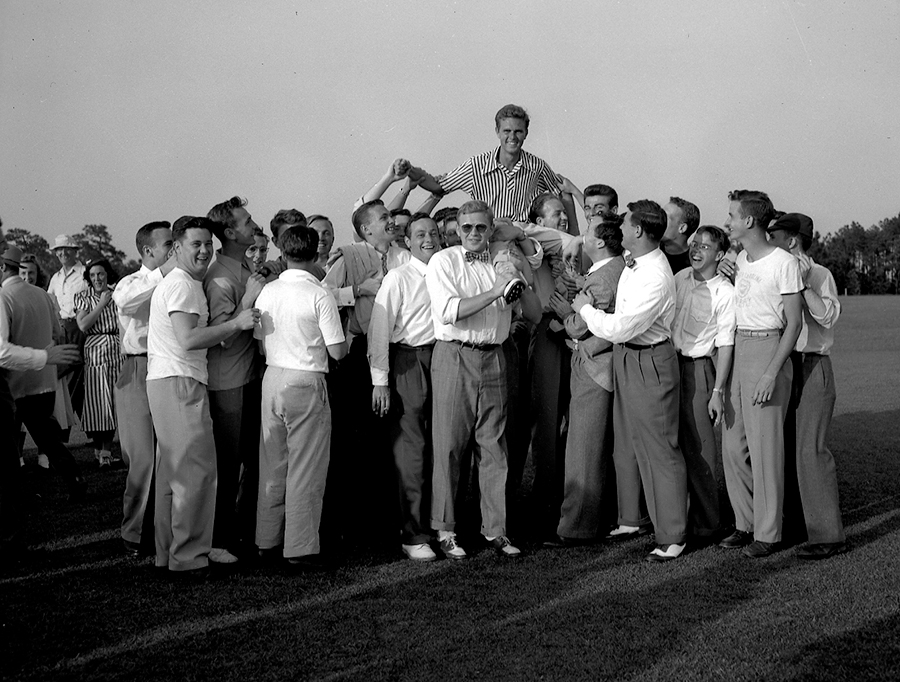
UNC students and Ward celebrate his victory in the ‘48 North and South
Arriving in San Francisco after visiting Hogan’s Fort Worth, Texas, clubmaking facility, Ward found himself surrounded by a pack of frenzied reporters. Someone showed him a newspaper headline, “Harvie Ward’s Amateur Status Questioned.” Blindsided, Ward struggled to make sense of it. Was he in trouble?
He was. And so was Lowery.
The state of California had indicted Lowery for tax evasion, and it had been established in grand jury testimony that the auto dealer had claimed business deductions for reimbursing Ward’s expenses at tournaments like the Masters and Canadian Amateur. The USGA’s rules of amateurism prohibited a player from accepting help with tournament expenses from anyone outside his own family. It was further alleged Lowery had funded Ward’s overseas excursion to the 1952 British Amateur, well before the latter had moved to San Francisco.
The rules did provide a potential safe harbor. If a player could demonstrate that his tournament play was coupled with a legitimate business trip, he could accept reimbursement of expenses provided those related to the golf part of the trip were borne personally.
Many amateurs drove through this loophole as if it were the size of the Holland Tunnel. For years, Frank Stranahan, son of the owner of Champion Spark Plugs, received reimbursement by Champion while competing in far-flung golf events by scheduling visits to local auto repair shops. Golfers holding licenses to sell insurance were particularly well positioned. A sales pitch or two to a fellow player or official could arguably merit reimbursement for a lengthy hotel stay and more than a few good meals.
Since the rule had been honored more in its breach than in its observance, Ward assumed nothing too serious was going to happen at the USGA board hearing set for June 7 in Golf, Illinois. Furthermore, he had conducted business at tournaments. “Wherever I went I met with businesspeople and usually sold them a few cars,” he later said. “That was, after all, my job.” In addition, Lowery, a USGA board member, had regularly assured Ward the reimbursements were proper. Even if a technical violation had occurred, how could Ward be blamed for trusting his employer — a revered member of golf’s establishment?
Ward’s friend and mentor Richard Tufts was rumored to be sympathetic and would preside at the hearing. When the proceedings got underway, Harvie sensed he was in for a rough ride when Tufts failed to look him in the eye. His premonition proved correct. The board categorically rejected Ward’s arguments and ruled that his receipt of Lowery’s payments violated the USGA rules governing amateur status.
Ward later acknowledged he was “numb with disbelief” that Tufts had failed “to speak up on my behalf.” But in retrospect, it was probably naïve for him to assume that Tufts would be lenient. As author of The Creed of the Amateur, Tufts supported an idealistic (and perhaps unrealistic) vision of how amateur golfers should conduct themselves. Though undoubtedly saddened by the whole affair, Tufts never wavered from wholehearted endorsement of the board’s finding.
Ward was suspended from USGA amateur competitions for one year. His quest for a third consecutive U.S. Amateur victory had, by fiat, met a premature end. The board did not vacate Ward’s previous victories in the championship, reasoning that his reliance on Lowery’s advice, while misplaced, mitigated his offense. Still, Ward felt singled out for punishment. “If I wasn’t the amateur champion at the time, it would have gone right by the boards,” he later said. “Nobody would have cared.” Had he followed Venturi’s path and joined the play-for-pay ranks, Ward would likely have circumvented the entire debacle. Why didn’t he turn pro? “To come anywhere near what I was making,” he said, “I would have had to finish in the top five money winners.”
Many observers thought the outcome unjust. Absent outside help, how could any top-ranked amateur — except the wealthiest — afford the travel and other costs attendant in playing prestigious events around the country? In an effort to douse the firestorm, USGA Executive Director Joe Dey authored an opinion piece in the USGA Journal that struck some as breathtakingly sanctimonious. “If a young man can’t afford to play tournament golf,” wrote Dey, “he is better off not living beyond his depth. Prominence in sports can be a false god.” Tufts’ effort to clean up the amateur game actually resulted in its diminishment. The best young players, golfers like Jack Nicklaus, began vacating the amateur ranks in droves immediately after college.
Ward’s amateur status was reinstated in 1958, but he clearly was not the same player. Though he managed to present his usual blithe front, his zest for the game had waned. The stigma of the suspension had taken its toll. In ’58, Ward played poorly in the Masters and got knocked out of the U.S. Amateur in the third round. He fared little better in ’59 but did manage to squeeze onto the U.S. Walker Cup team, which included Nicklaus. Competing over The Honourable Company of Edinburgh Golfers’ majestic Muirfield links, Ward prevailed in both of his matches against the home team. Those wins were the 33-year-old’s last hurrah on the big stage.
After 1962, Ward drifted away from competition altogether. He declined to enter the U.S. Amateur and rejected several Masters invitations. “Basically, I said, ‘To hell with it,’” he told Golf World’s Dick Taylor. “I sort of said that I’d show those guys by not playing anymore. Kind of silly, I guess. I took up tennis, played some social golf, and went about making a living.”
Following the suspension, Ward and Lowery (who was ultimately acquitted of the tax evasion charges) started an auto leasing company together. It lasted five years. “Lowery made me a partner, gave me shares in the company, did a lot of things to sort of make up for what happened,” recalled Ward. After Lowery and Ward’s partnership ended, Harvie formed another leasing company with Bob Varner, but that broke up as well. Ward’s golf decline and business misfortunes were accompanied with, and probably exacerbated by, heavy drinking and a roving eye. After he and Suzanne divorced, he blitzed through relationships, eventually marrying five times.
In 1972, when Ward was 47, friends from San Francisco G.C. persuaded him to, at long last, turn professional and try his hand on the minor league mini-tour in Arizona. “I couldn’t beat those kids,” he said. “I made some money . . . but I wasn’t going to beat anybody.” In 1973, Ward entered the PGA Tour’s qualifying school, but it was too late for a comeback. He came nowhere close to getting his card. Later competitive efforts on the Champions Tour were similarly unsuccessful.
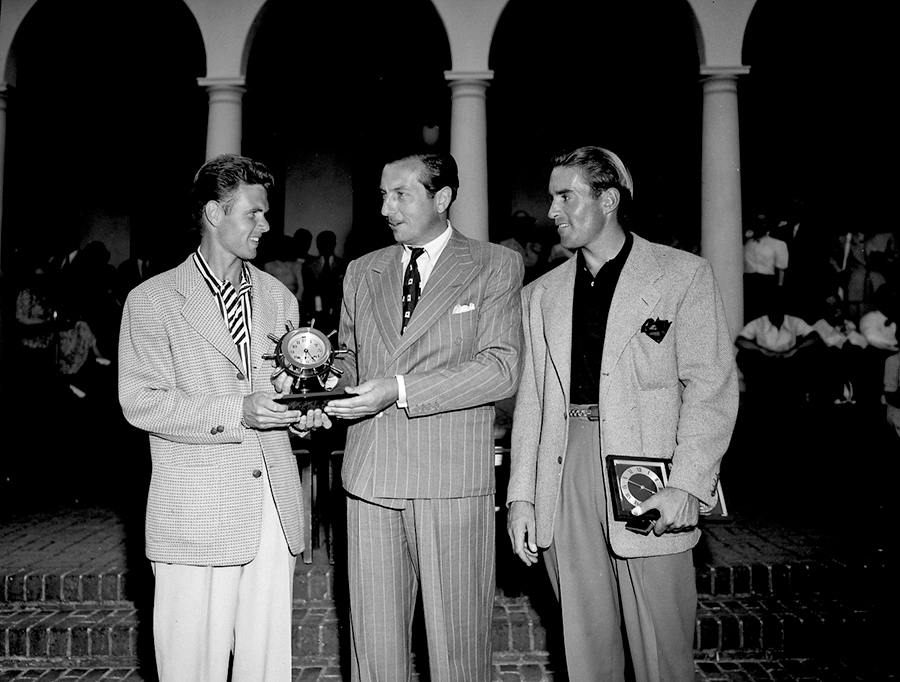
North and South champion Harvie (left) is congratulated by Henry Cotton. Runner-up Frank Stranahan (right) looks on
Ward was reduced to working in a San Francisco shipyard and teaching in a downtown sporting goods store. Mired in increasingly dire circumstances, he reached out to old UNC buddy Harvey Oliver for help. Oliver put Ward in touch with entrepreneur Dan Thomasson, one of the developers of the Foxfire Golf and Country Club near Pinehurst, who offered a lifeline by hiring Ward as Foxfire’s director of golf. The West Coast transplant, son of a Tarboro, North Carolina, pharmacist, returned to his native state.
The Pinehurst area held fond memories for Ward. He had played golf there frequently while a student at UNC and later, during his first post-graduation job selling insurance in Greensboro. Ward’s sensational performance in the 1948 North and South Amateur Championship, contested over Pinehurst No. 2, had brought the happy-go-lucky college senior his first dose of national attention. Entering the event on a whim, the unknown 22-year-old surprised himself by reaching the final, dispatching Wake Forest’s Arnold Palmer along the way.
Ward faced an uphill battle against the “Toledo Strongman” Frank Stranahan, who’d been runner-up in both the Masters and the British Open in ‘47. His secret weapon was the Zeta Psi fraternity, whose members scattered throughout the campus the night before the 36-hole final, spreading news of the match, urging students to head to Pinehurst to root for their fellow Tar Heel. Hordes of them showed up. An exuberant crowd of 2,000 overwhelmingly supported Ward. “Every time Frank would miss a shot or miss a chip, they’d cheer,” remembered Ward. “Anytime I’d get the ball airborne, they’d go nuts. You’d thought they were in Kenan Stadium at a football game.”
Ward’s stupefying avalanche of holed putts annoyed Stranahan more than the boisterous students. When he rammed home one final dagger on the 36th hole to close out his frustrated opponent, the elated Zetas celebrated by hoisting the winner to their shoulders and carrying him off the course.
Now, approaching middle age, Ward arrived at Foxfire to labor as a club teaching pro, instructing duffer and scratch player alike. His gentle manner and uncomplicated instructional method worked wonders for his pupils. When he wasn’t on the lesson tee, Ward kept his game sharp in afternoon money games with the area’s better players. The action honed his game to a semblance of its old form. At age 51, he won the North Carolina Open.
In Jim Dodson’s book A Son of the Game, Ward said that Foxfire was “where I began to finally discover what I may have been put on Earth to do. I was here to have fun playing golf with my buddies and teach others how to play this crazy game. I was here to pass the game along.”
Ward brought his charming rogue persona with him to Foxfire. Tony McKenzie, an occasional golf partner, recalls the time Ward — who was either between marriages or about to get out of one — showed up at McKenzie’s printing business asking that a batch of cards be made up reading something to the effect of, “Hello, I’m Harvie Ward. You look adorable. I’d like to get to know you better.”
After 10 years at Foxfire, Ward was hired by Nicklaus to be the director of golf at Jack’s Grand Cypress Resort, where he became Payne Stewart’s instructor. A couple of years later, Ward moved across town to Interlachen Country Club. It was in Florida where he met the woman destined to become his fifth (and final) wife, Joanne Dillon. After the couple married, they contemplated relocating. “Harvie suggested we go to either the West Coast or North Carolina,” remembers Joanne. “I said no to the West Coast. We’ll go to North Carolina.”
The couple moved to Pinehurst in 1989, settling in a spacious home on Blue Road in the village’s Old Town section. Peter Tufts (Richard’s son) constructed a par 3- hole on the property, where guests at Ward cocktail parties invariably gravitated with wedges in hand. Joanne bought her husband a 1967 Silver Shadow Rolls Royce, which he happily motored to his newest teaching gig at Pine Needles Lodge and Golf Club. He taught female attendees at Peggy Kirk Bell’s Golfaris and gave individual lessons, too. A young Webb Simpson was a pupil.
Ward’s growing reputation as a teaching pro culminated in the PGA of America naming him “Teacher of the Year” in 1990. Ward explained that the combination of Joanne and Pinehurst finally brought him peace. “That turned out to be the smartest decision I ever made,” he confided to Dodson. “Without Joanne, see, none of this would have happened. I would have been dead years ago.”
And Ward was having more fun playing golf than he had since his championship days, hooting and bantering with a disparate band of playing partners including local pros Andy Page, Bill Clement, Buck Adams and Waddy Stokes. Much of it was played at his new club, Forest Creek Golf Club. Usually, Ward took Page, the retired Southern Pines Country Club pro, as his partner. The duo would take on all comers provided that both men, sliding into their 70s, were allowed to play from the middle tees. With that advantage, they seemed as unbeatable as Hogan and Nelson. “We would make a birdie and were sure we had the hole won when either Harvie or Andy would chip in,” reflects Chris Israel, Forest Creek’s assistant pro at the time, shaking his head in disbelief. “They would drive to the next tee cackling and giggling with each other, and say loud enough for us to hear, ‘They really thought they had us. They should know better!’”
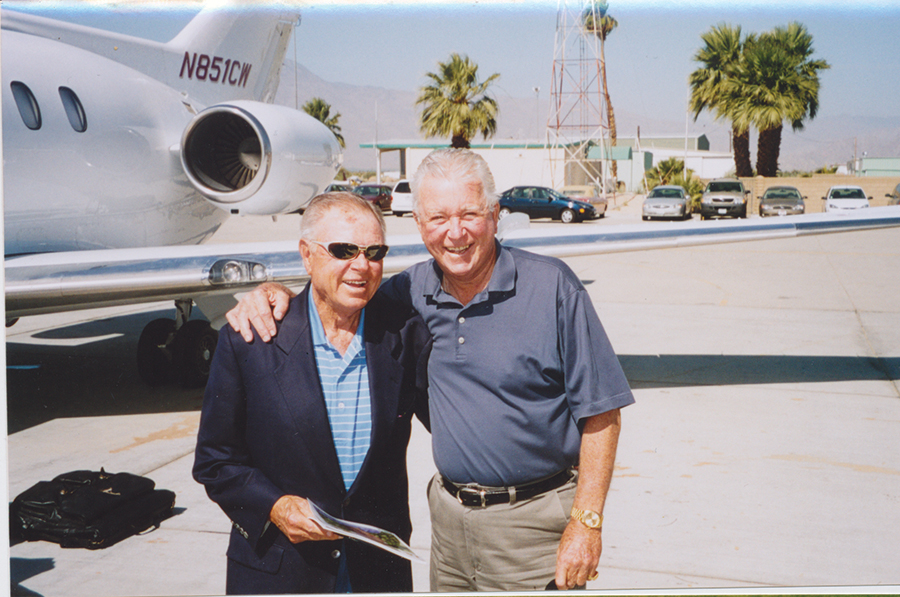
Old partners Harvie Ward and Ken Venturi
Notables from far and wide journeyed to Forest Creek to play golf with Ward. Dick LeBeau, one of pro football’s greatest defensive minds and a near-scratch player, was among them. The coach admired Ward’s ever-keen competitive nature. “He had that gleam in his eye. He knew he was going to beat you; you knew he was going to beat you; and it was fine because it was such a privilege to play with him,” reflects LeBeau. Watching ‘Ol’ Harv’ hit an iron shot was a mesmerizing experience. “It was the timing of his swing, and the sound,” marvels LeBeau. “So flush, and the ball never left the pin.”
By 2003 Ward’s freewheeling younger days had taken their toll. Diagnosed with cancer, his prognosis was not good. When asked by a friend how he was doing, Ward replied, “I’m on the back nine and I can see the clubhouse.” Several of his concerned golfing friends arranged for him to make a few sentimental journeys to golf meccas like Pine Valley and Seminole.
Jeff Dawson, a young Forest Creek member, escorted Ward to historic Merion Golf Club, where Ward’s friend Bob Jones had completed his Grand Slam. Ward was playing miserably and laboring in Philadelphia’s summer heat when the twosome reached Merion East’s 14th tee. A flock of members had come from the clubhouse to watch him play. Ward came alive, blasting a drive. That was followed by a laced 3-wood to the green and a holed birdie putt.
“What came over you?” asked Dawson.
The winking champion responded, “Those folks just wanted to see Harvie Ward.”
With just a few months to live, Ward and three friends (including Dawson and Ward’s personal physician) flew to the West Coast for a last golf trip. Tee times were scheduled at two of his favorites, San Francisco Golf Club and Cypress Point, where he and Venturi had carved out a portion of golfing lore 47 years earlier. On the way back East, the men stopped in Palm Springs to visit his old partner and friend, Venturi, in his desert home.
The 1964 U.S. Open champion’s den was loaded with trophies from his playing days. The one Venturi chose to place front and center was from the 1956 San Francisco City Championship, causing a flurry of good-natured teasing. Venturi took Dawson aside and said, “Do you know how good he was? I never saw him hit a 4-wood outside 10 feet!”
When it was time to leave, neither of the old running mates displayed out-of-the ordinary emotion as they hugged their goodbyes, but both realized they would not see one another again. Ward would pass away on Sept. 4, 2004. Furman Bisher, the dean of Atlanta sportswriters and a fellow UNC alumnus who covered the Masters 62 times, summed it up this way: “Harvie never lived an unpleasant day in his life or, if he did, he didn’t show it.”
Not long after returning from his final California trip, Ward played the last nine holes of his life with Dawson at Forest Creek. He shot 34 and called it a day.
“You can’t quit. You’re two under,” Dawson said.
“Yeah,” replied the rueful champion, “but nobody cares.”
His friends did.PS
Pinehurst resident Bill Case is PineStraw’s history man. He can be reached at Bill.Case@thompsonhine.com.
How Raleigh’s bold investment in sculptor Jim Gallucci’s art led to a revitalization of the city’s urban center
By Wiley Cash • Photographs by Mallory Cash
In 2007,just as the world was spiraling toward financial ruin, Greensboro sculptor Jim Gallucci received the largest commission of his career. The city of Raleigh selected him to construct four light towers to sit on either corner of downtown’s City Plaza in an attempt to redefine the empty space in front of the old Civic Center.
“It started out as a $65,000 project,” Gallucci says. “We kept saying, ‘You know, guys, we can do more with this,’ and they said, ‘Really? You got any ideas?’ These towers were going to be 65 feet tall. The next thing you knew it turned into a $2.5 million project.”
However, as the reality of the global financial crisis set in, Gallucci was certain the project would be pulled; but leaders in Raleigh decided to move ahead. In the fall of 2009, City Plaza, complete with Gallucci’s four 65-foot light towers bedecked in steel oak leaves, opened to the public. City officials hoped the plaza would serve as a “public living room” that would host concerts and events while attracting organizations from around the country that were searching for event and reception space. The plaza project was part of the now completely revitalized area of Raleigh’s Fayetteville Street, and towering above all the new businesses, concertgoers and tourists are Jim Gallucci’s glowing behemoths.
Raleigh proved that an investment in the arts could lead an economic revitalization. Gallucci was not surprised that the city’s bet paid off. “The arts are always the catalyst,” he says. “We’re the stick in the stream. Next thing you know there’s a leaf that’s caught by the stick, and before long the stick has gathered an entire island around it.”
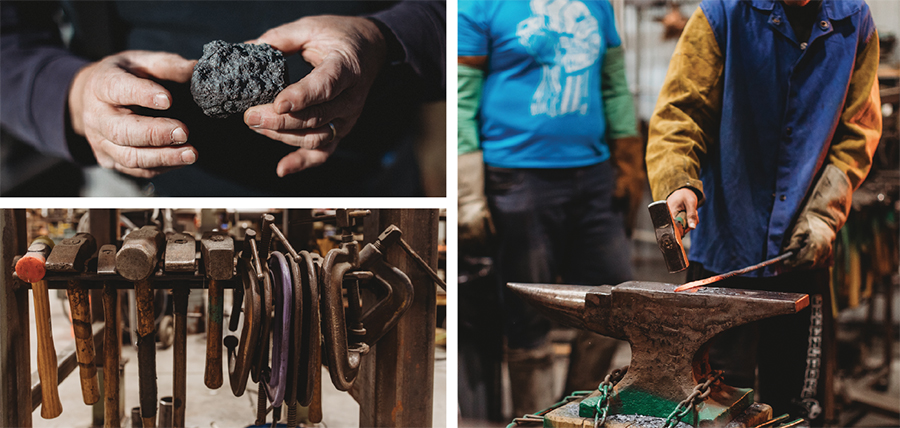
Jim Gallucci’s enormous studio — which he admits to thinking of less as a studio and more as a tool that assists in his art — sits just south of downtown Greensboro. Going off Gallucci’s own metaphor, his studio could be described as an island that has gathered things over the years: sculptures of dizzying heights and varying colors; scraps of metal from local salvage yards; beams from the World Trade Center; and people from around the state interested in anything from sculpture to metalworking to glassblowing to having a cup of coffee and chatting. This is exactly what Gallucci hoped this space would become after opening the studio in 2006, not only for him but for the collective community of local and statewide artists of which he is part.
***
Gallucci’s collective approach is quickly made apparent when you spend time discussing art with him; you will discover that he consistently speaks in the collective first person we.
“We’d been in the old Civil War rifle factory on East Washington in downtown Greensboro for 21 years,” he says. “There were holes in the ceiling. The floors weren’t strong enough to hold the sculptures we were making.” He smiles, takes a sip of his coffee. “We knew we needed four things from a studio: We needed plenty of space. We needed heat. We needed an office. And we needed a bridge crane.”
That checklist — especially plenty of space and the bridge crane — came in handy as the full lengths of the six-story Raleigh towers were being fabricated inside the studio. Gallucci had plenty of hands on deck as the towers were lifted by the bridge crane and prepared for transport.
You would not know it now, but there were times when Jim Gallucci felt more like that single stick in the stream than the island that would gather around it. As a working artist, he had spent years teaching at the college level, but that came to a halt in 1986, when the University of North Carolina Greensboro did not renew his teaching contract after nine years in the classroom. He had a decision to make: Should he and his family leave Greensboro in search of another teaching job, or should they stay in the community, where they had forged relationships for nearly a decade?
He and his wife made the conscious decision to stay. “We’d made a lot of friends,” he says. “We had a community. We knew a lot of people in the fabrication business, and we’d trade sculptures for steel. You don’t buy those relationships; you assemble them during your life.”
After leaving the classroom, Gallucci decided to put his faith in his local community, and he decided to keep his faith in his art. “I took unemployment for six months, and I called it my arts grant. I went in my studio every day like a worker at 8 a.m., and I’d work until 4 p.m. I worked every day in that studio, and we were able to trade for steel, and we made three good sculptures during that six months and tried to get into shows.
“Those three pieces we made? All of them were sold, and two of them ended up in Brisbane, Australia. I suddenly went from an unemployed art teacher to an international sculptor.”
***
Gallucci’s sculptures began to pop up around Greensboro, then around the state, then around the country. He is perhaps best known for his gates and arches, especially the Millennium Gate in Greensboro’s Government Plaza, a project that found 17 artisans creating 106 icons that represent major figures, moments and movements from American history. The icons are affixed to the enormous arch and comprise the gate at its center. Viewers are able to both witness history and pass through it, and that interaction is vital to Gallucci’s vision.
“With gates, it’s easy to get into the art,” he says, “literally and figuratively. I try to get people to enter the work, to engage with it.”
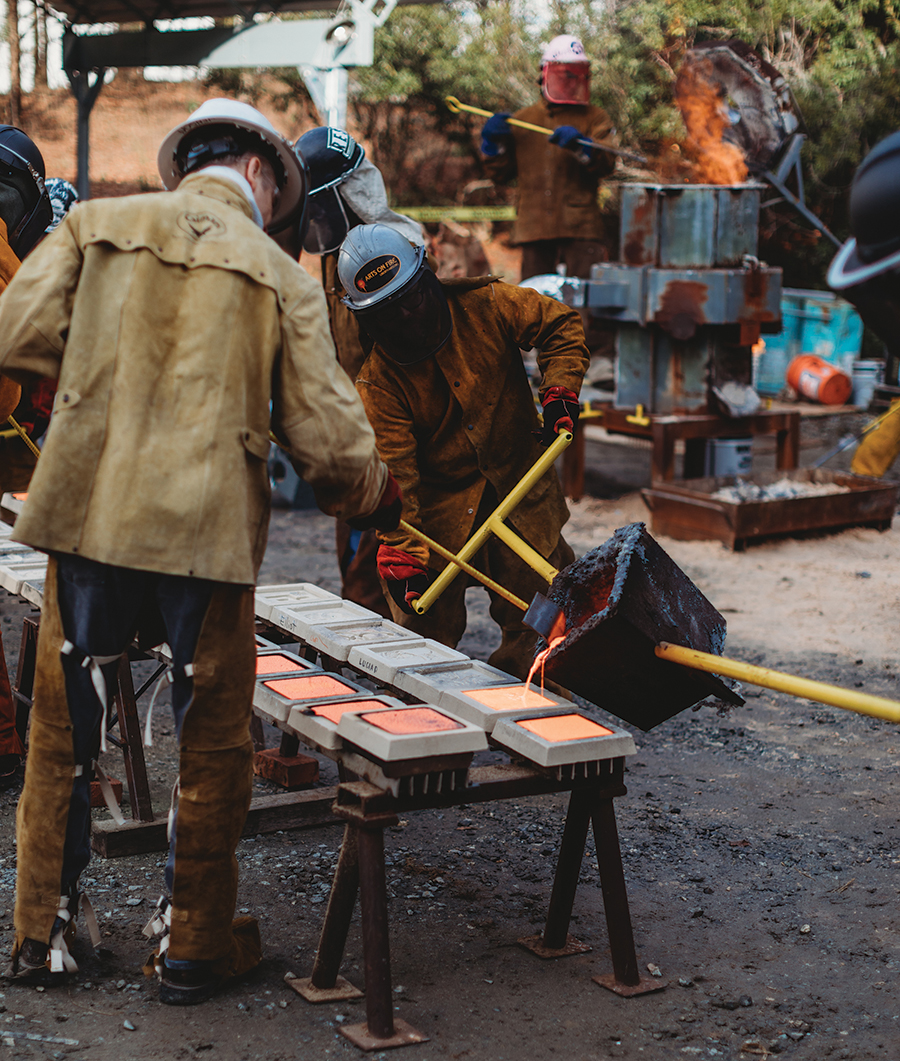
Gallucci also gives people the opportunity to engage with their own artwork several times a year when he opens his studio to host a public iron pour. Hundreds of people show up in the early afternoon, many of them with small sand casts on which they will use any number of tools to etch a symbol or a name or an image that will then be cast in iron later in the day.
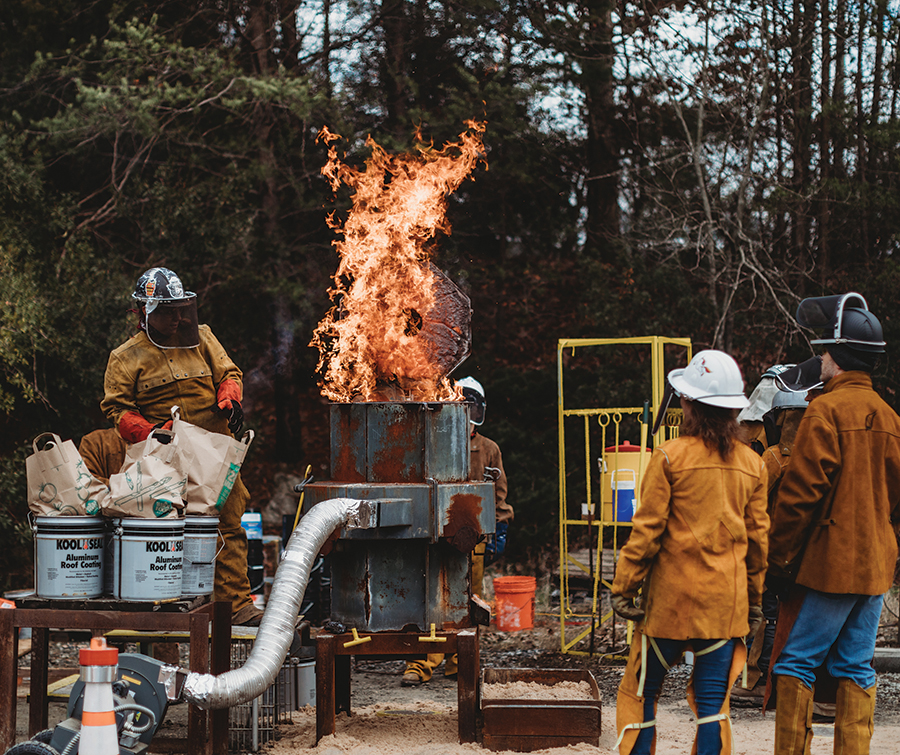
People come not only to pour iron, but to work with blacksmithing tools or to try their hand at glassblowing. Others come for the live music or the hot food that is served. The noise of the conversations and music and hammers rises into a pleasing din that fills the enormous studio space and pours outside, where men and women in masks and leather gloves and aprons are stoking the foundry and melting metal into what looks like bright orange lava. Jim Gallucci is there, talking to old friends, making new ones, offering words of encouragement to someone who is trying their hand at metal casting for the first time.
As the sky tips toward dusk, the scene is otherworldly. Sparks fly. Flames reach into the air. Metal is turned into liquid. The vague notions of creativity that people arrived with are slowly hardening into shape.
“Creativity happens when you experience something you’ve never experienced before,” Gallucci says. “The elements: the sand, the dirt, the heat; it’s almost primordial. People may not become iron casters after this, but that’s not the point. It’s igniting other things, inviting other ways to look at the world. That’s what art inspires.”
***
What does Jim Gallucci hope his art inspires? He thinks for a moment, the light from sparks and flames glinting in his safety glasses, which he wears casually, the way other people wear sunglasses or bifocals. “I hope I’m perpetuating ideas, goodwill, community, sense of purpose, reflection. If you’re doing that with a piece of art, you’re doing OK.”
No man is an island, right? Well, perhaps Jim Gallucci is.PS
Wiley Cash lives in Wilmington with his wife and their two daughters. His latest novel, The Last Ballad, is available wherever books are sold.
Used to determine whether a user is included in an A / B or Multivariate test.
18 months
_ga
ID used to identify users
2 years
_gali
Used by Google Analytics to determine which links on a page are being clicked
30 seconds
_ga_
ID used to identify users
2 years
_gid
ID used to identify users for 24 hours after last activity
24 hours
_gat
Used to monitor number of Google Analytics server requests when using Google Tag Manager
1 minute
_gac_
Contains information related to marketing campaigns of the user. These are shared with Google AdWords / Google Ads when the Google Ads and Google Analytics accounts are linked together.
90 days
__utma
ID used to identify users and sessions
2 years after last activity
__utmt
Used to monitor number of Google Analytics server requests
10 minutes
__utmb
Used to distinguish new sessions and visits. This cookie is set when the GA.js javascript library is loaded and there is no existing __utmb cookie. The cookie is updated every time data is sent to the Google Analytics server.
30 minutes after last activity
__utmc
Used only with old Urchin versions of Google Analytics and not with GA.js. Was used to distinguish between new sessions and visits at the end of a session.
End of session (browser)
__utmz
Contains information about the traffic source or campaign that directed user to the website. The cookie is set when the GA.js javascript is loaded and updated when data is sent to the Google Anaytics server
6 months after last activity
__utmv
Contains custom information set by the web developer via the _setCustomVar method in Google Analytics. This cookie is updated every time new data is sent to the Google Analytics server.
2 years after last activity
SourceBuster is used by WooCommerce for order attribution based on user source.
Name
Description
Duration
sbjs_current_add
Timestamp, referring URL, and entry page for your visitor’s current visit to your store
session
sbjs_migrations
Technical data to help with migrations between different versions of the tracking feature
session
sbjs_first
Traffic origin information for the visitor’s first visit to your store (only applicable if the visitor returns before the session expires)
session
sbjs_current
Traffic origin information for the visitor’s current visit to your store
session
sbjs_first_add
Timestamp, referring URL, and entry page for your visitor’s first visit to your store (only applicable if the visitor returns before the session expires)
session
sbjs_session
The number of page views in this session and the current page path
30 minutes
sbjs_udata
Information about the visitor’s user agent, such as IP, the browser, and the device type