Drinking with Writers

The Art of Civil Discourse

A little healthy organic juicing with Rachel Lewis Hilburn

By Wiley Cash     Photographs by Mallory Cash

Last year I attended a literary event with some of the best known writers in the country, but as soon as the event began it became clear that the crowd was more interested in seeing emcee Rachel Lewis Hilburn, a woman whose disembodied voice had been speaking to them for years from the studios of WHQR Public Media. She joined the station in 2011, and she was named news director in 2012. A year later she anchored the pilot episode of CoastLine, a show that focuses primarily on local and statewide issues and the people they affect. Over the past six years, Rachel and her guests have discussed issues as diverse as gun control, water quality, film incentives and Thanksgiving recipes. No matter what the topic, Rachel always finds a fascinating angle. I will admit that I once sat in my driveway for 15 minutes and listened as Rachel and a county official discussed recycling. Like her voice, Rachel’s questions are direct and smooth. Her interactions with people are civil and genuine, and she gives her guests an opportunity to tell their stories as well as the expectation that they will be held accountable for the stories they tell.

This is not to say that Rachel does not ask hard questions. I sat for a CoastLine interview when my last novel was released, and at one point Rachel read a quote from a terrible review I had received in a major newspaper. Then she asked, “How do you keep that dagger from staying inside you?” Ouch! No one had ever asked me how I recover from bad reviews, and that question forced me to be honest about the vulnerability of artists. I look back on that hour I spent on-air with Rachel as perhaps the best interview experience I have ever had.

I took an opportunity to ask Rachel a few questions of my own one chilly morning in late January. We met at Clean Juice in downtown Wilmington on the corner of Grace and North Front Street. I ordered the Immunity One, an organic blend of carrots, lemons, oranges, pineapples and turmeric. Rachel ordered the Glow One, a mix of organic apples, cucumbers, kale and spinach. We found seats by the huge windows that look out on Grace Street. While I serve on the board of directors at WHQR and have known Rachel for several years, there was one question I had never asked her.

“What was your path to public radio?”

“I started life thinking I would be an actor,” Rachel said. “And I went to the North Carolina School of the Arts, and then I moved to New York and L.A. and did some theater.”

“Acting?”

“Yes,” she said. “At one point, when I was in L.A., I decided I wanted to have a steady income and see what other things I could do.” She laughed and took a sip of her juice. “So I became a financial adviser, but only for about two years.”

“How did you get to Wilmington?”

“I knew people in Wilmington, and I loved the East Coast,” she said. “I was tired of the desert in Los Angeles, and I just loved the texture of the weather here. I came to Wilmington and embarked on a process of finding the next version of myself.” During that process Rachel wrote and produced television news broadcasts for WWAY; she wrote and produced a documentary about the 1898 Wilmington race massacre; and she served as the executive director of the homeowners association at Bald Head Island.

When you stack all these jobs together — financial adviser, news writer, producer, documentarian and executive director of a homeowners association — it becomes clear that Rachel has been perfectly prepared for a career in public radio. Over the course of her diverse work history she has managed personalities, produced content, sought facts, and listened closely to people’s concerns and this is exactly what she is doing with an exciting new serialized program called CoastLine: Beneath the Surface.

According to the description on the program’s website, the community members who will participate in Beneath the Surface are “thoughtful and engaged listeners who’ve agreed to be part of a yearlong conversation. They are black and white, youngish and older. Their politics cover the spectrum left, right and center.”

In this politically charged environment, what happens when you put a group of diverse strangers in a room? Rachel has the answer: She assembled the group for a meet and greet a few days before their first on-air discussion.

“I thought I would have to do some goofy icebreaker,” Rachel said. “But no icebreaker was needed. People freely went around the room introducing themselves. They seemed really enthusiastic about being there, and they didn’t want to leave!”

Rachel said that, at least initially, conversations on Beneath the Surface will focus on local issues because she believes that is the place where people who are sitting together in the same room can achieve some level of civil discourse. Hopefully, that civility will trickle up.

“I happen to think the political dynamic, that super division and vitriol on Capitol Hill, and even at the state level, isn’t going to change until regular folks change,” Rachel said. “Public radio can pull back the curtain and introduce you to a situation in its context. It can introduce these whole human beings, and it makes it hard to put them in a box.”

In keeping with Rachel’s history of discussing timely topics and asking hard questions, the first topic broached on Beneath the Surface was the issue of Wilmington’s Confederate monuments. I listened to the show, and I could hear the strain in people’s voices, their discomfort in defending positions that may not be popular. But I could also hear other things: the click of boxes opening as people grew comfortable with one another; the sound of voices speaking calmly while sharing ideas and experiences. These were the sounds of whole human beings coming together and being civil.  PS

Wiley Cash lives in Wilmington with his wife and their two daughters. His latest novel, The Last Ballad, is available wherever books are sold.

Southwords

PSD

Poor squirrel decision

By Beth MacDonald

My neighbor across the street is a pleasant woman, friendly, funny, the likeable sort you’d want to have as a neighbor. Her husband went away on a business trip, so she was going to take the kids to go see family for a few days. She asked me to grab her mail and packages while she was gone. My husband parked his truck in her driveway to make it look like someone was home. The day she got back, I didn’t expect to look out my kitchen window and see her storming, angrily, toward my house. I went outside to greet her, but before I could say anything, she screamed, “Something trashed my house!”

“Let me get my shoes.” Maybe some of those slip-on footies the Terminix man wears when he comes in the house. And, of course, my phone. For posterity.

It was a “squirrelapocalypse.” I stood there with my mouth open, taking in the destruction. Every single windowsill on the first floor was chewed up — not just a little, almost clean though. The teeth marks stretched edge-to-edge like it was eating corn on the cob. There were bloody paw prints and droppings from the terrified creature everywhere, windows, the sofa, the blinds. Table lamps were turned over, smashed on the floor. I felt like a detective in CSI-Woodland Creature Edition. This squirrel knew how to party.

We looked all over for the dear departed, but came up empty so we began to clean up. She ordered a pizza. I went home and a few minutes later got a videotext message with the words, “What the bleep do I do now?” In the video, a squirrel was trapped in her fireplace, caged by the screen.

Naturally, I sent my husband over. 

Mason was only too happy to help. His friend Win, who was over for dinner, eagerly begged to go, too. Hemingway didn’t fancy a bullfight this much. The two men took a large Tupperware storage container from the basement and proceeded across the street like giddy children. I hollered after them to take video. This reeked of viral potential. The pizza delivery lady met them in the driveway.

“There’s a squirrel in there,” they warned her.

“They love peanut butter,” she said. “Make it a sandwich.”

Mason and Win cocked their heads and thanked her. They knew good advice when they heard it.

As they prepared to enter the house, the pizza lady drove off screaming out her car window, “CRUNCHY, SQUIRRELS LOVE CRUNCHY!”

Armed with this knowledge, they entered my neighbor’s house. They put a peanut butter sandwich in the Tupperware bin and tried to lure the squirrel into it. The rodent took the bait, literally, and scooted back up the chimney.

Plan B.

Mason came back to our house to grab a wire dog crate and a Duraflame log. I didn’t want to know the new plan.

Back at ground zero, the men set a fire, and placed the crate so they would catch the fleeing rodent, no doubt coughing and wheezing. Smoking the culprit out worked too well. Rather than depriving it of air, they filled it with adrenaline. The squirrel shot into the crate, with the sandwich, out the back of the crate, and into the kitchen presumably on a quest for a crunchier variety of peanut butter.

Screams could be heard for miles.

My neighbor started tossing her kids out of the house like luggage, except for the one clapping. That one wanted to stay.

“Fine! You can get rabies. I’m saving the others.” She no longer cared. With three  children saved, she was in good shape. She could spare one.

The guys were now trying to trap the terrified squirrel raging through the kitchen. Now would be a good time to describe a small, well-appointed kitchen, with two men, both bodybuilders, one standing 6-feet-2-inches and one 6-feet-6-inches, knocking everything over, doing a great deal more damage than the squirrel, who stood 10 inches tall, tail not included, and never lifted anything heavier than a crunchy peanut butter sandwich.

Finally, the two managed to get the squirrel into the Tupperware container and close the lid. The plan was to bring it outside. My neighbor wanted it exiled.

They took it down the street to the yard of another neighbor, who appeared to have picked the wrong time to go to the grocery store. As soon as the lid opened the squirrel, shot out like it was in a potato cannon.

“He’s your problem now!” Win shouted to no one on the other side of the fence.

“Did you take video?” I asked.

“No. Even if we did it would look like the Blair Witch Project but with a squirrel.”

It would have killed at the Sundance.  PS

Beth MacDonald is a Southern Pines suburban misadventurer who likes to make words up. She loves to travel with her family and read everything she can.

To Thine Own Self Be True

Designer expresses her many loves in Pinehurst cottage

By Deborah Salomon   

Photographs by John Koob Gessner

A perfect and very personal renovation is a hard act to follow . . . unless motivated by the heart.

Residential perfection is what interior designer/tennis ace/gardener/artist/yoga practitioner Julie Sanford achieved a decade ago when she resurrected a modest Pinehurst cottage to reflect her background, her foreground, her tastes, philosophies and talents. This woman has sailed across the Atlantic in a 42-foot sloop; climbed partway up Machu Picchu; snorkeled black holes of the Caribbean. She has furnished Nantucket compounds and Manhattan condos for clients; a pied-à-terre in Paris and a Newport, Rhode Island, showplace. Julie’s achievements have reached The New York Times Magazine and Country Living. Her recent projects include collages crafted from leftover wallpaper, as well as further adapting her Pinehurst gem where the sign over the front door reads “Craven Cottage.” 

Julie’s approach: “I like the integrity of real. Edit out the junk. Keep the things that motivate you, that make you feel good,” which in her case would be living by the sea. Notice oceanscapes, beaches and ship art. She isn’t shy with color, either subtle or primary: bedroom walls suggest a pineapple daiquiri. A ripe-tomato red lamp jumps off its table. Her kitchen, void of Sub-Zero and Viking, glows pale apricot set off by cream cupboards and a khaki tile backsplash.  “People spend a fortune on the kitchen. It’s not my thing. I’m a good cook but I don’t need the (mega-appliances).” What she does need is open shelving stacked with blue English Transferware, which she uses daily.

Pervading all, aquamarine, the watery hue Julie used for vestibule floor tiles and living room upholstery. “My spiritual home is the Caribbean,” she admits.

Whimsy — of course. Who else covers a seat cushion with fabric picturing giant insects or runs a row of buttons down a dining room chair? That pink “thing” resembling Valentine lollipops standing at attention on a textured rose Parsons’ table in the otherwise classic living room is an antique balloon mold. Julie favors sculptures of hands which reach out, armless, from shelves and tables. To her, they represent “lending a hand” to someone in need.

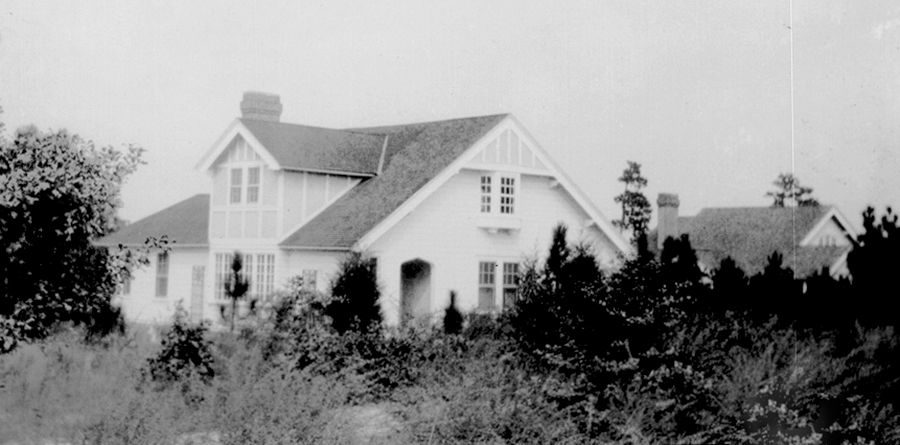
Craven and four sister cottages were built in 1921 and sold to Pinehurst resort as rental properties. According to records at the Tufts Archives, seasonal rental was $1,500. The façade is particularly notable, with a broad gable facing the street, an English country porch and Tudor-arched front door — a feature Julie repeated between the living and dining rooms, and the family room and kitchen. Alice Craven, proprietor of a village knitting shop, occupied the house in the 1930s, followed by John Thomas Craven in the 1950s. Post-Cravens, the cottage was renamed generic Longleaf, but Craven remains over the door.

Julie, raised in New England, found Pinehurst during a visit to Fayetteville, where her mother was being cared for. The village resembled familiar ones in Vermont and on Cape Cod but with a milder climate. Most important, a tennis community thrived here. The cottage she found, drowning in ’60s décor, mandated a major renovation, a welcome challenge for this experienced designer who appreciated the era it represented, especially the narrow-board floors, elaborate crossbeam door and window frames, and light streaming in on all sides — plus a rare full basement. Julie found its modest size (then barely 2,000 square feet) appealing. She believes people relate better in intimate settings.

“The house just sang to me from the get-go.”

And then, renovation and furnishing accomplished, part-time occupancy achieved, life shifted.

“I met a man, George Lynch, the love of my life.”

After living single for 25 years, Julie realized modifications would be necessary. Her low-ceilinged bedrooms were in the finished attic, accessed by a steep, narrow staircase. The large main floor room Julie had added as a yoga studio became a master bed-sitting room painted yellow, her “happy color.” Its bathroom has dizzying black polka-dot wallpaper punctuated with French Gien plates, each decorated with a cartoon. “A bit extreme, but it makes me laugh,” Julie says. She built a family room with cathedral ceiling off the kitchen because, “My husband is a big man. We have four dogs. There wasn’t room anywhere for me to sit.” Original wood floors, except in the dining room, have been pickled (whitewashed), rendering the rooms light and summery, reminiscent of Martha’s Vineyard.

Completing the enlargement is a deck, covered and open, overlooking the garden. A self-described passionate gardener, Julie recalls how caring for geraniums figured in meeting the love of her life.

An organic, zen-calm separates Julie’s space from houses bustling with décor trends. She has achieved a new, fresh feeling using antiques of different periods and provenance that hang together like old friends. The almost monastic absence of clutter gives each piece — whether a marble-topped side table or an inlaid bureau — room to shine. The same with paintings, some she did herself, mounted singly rather than in groups.  Themes and colors (especially green, representing nature) flow from room to room, as do objects like Staffordshire figurine lamps and animal art.

Perfect as this home is, Julie and George have another, equally unusual: a 19th century mobile chapel used by itinerant New England preachers. The 20-by-28-foot wheeled structure was pulled from town to town by oxen. Now, the couple has moored it in Jamestown, Rhode Island, within sight of the sea, from whence Julie came.

“My home is my sanctuary,” Julie says. And, in this case, a self-portrait.  PS

Bookshelf

March Books

FICTION

Daisy Jones and the Six, by Taylor Jenkins Reid

An impossible-to-put down story of fictional rock musicians and their path to new heights of musical creativity and mega stardom in the 1970s. Written in an interview format, each character tells the unvarnished side of the group’s tangled and talented rise. Juxtaposed to allow for multiple perspectives at the same time, the story comes alive in this riveting piece of writing. This is the most fun, must-read book of spring and summer.

A Woman Is No Man, by Etaf Rum

With tremendous empathy, insight and unflinching honesty, Rum gives voice to a silenced and powerless group of modern women living in a strict Arab world. The novel follows the lives of a family of Palestinian immigrant women over the span of a few decades in Brooklyn. The only options in their limited lives are to marry, to hopefully bear sons, to know their place, while withstanding abuse and the repetitive drudgery of work within the confines of the male world. A remarkable novel with a hauntingly unforgettable first line.

Queenie, by Candice Carty-Williams

She is frustrating, misunderstood, lonely, lovable, over-the-top dramatic, funny, filled with good and bad intentions, but above all, so very human. Queenie Jenkins is 25 years old and a journalist of Jamaican heritage in London trying to understand it all. Her white boyfriend wants to take a break and she attracts all the wrong sorts of men from online dating sites. Mistreatment, race and a troubled past can paralyze her, but somehow, she keeps going. Candice Carty-Williams has created an incredibly unforgettable character with an incredibly unforgettable cast of family and friends.

Tomorrow There Will Be Sun, by Dana Reinhardt

Two families, longtime friends and business partners, gather at one of Puerto Vallarta’s most luxurious villas to celebrate a 50th birthday. Meticulously planned and engineered well in advance by Jenna, the wife of the birthday boy, this is to be a seamlessly perfect vacation. Nothing is as it seems despite the best efforts to have a hand on all the controls. When it rains in paradise it pours, and the foundations upon which life is built can crack. Dana Reinhardt projects a smart, wry tone in this entertaining and engrossing novel.

Supermarket, by Bobby Hall

Flynn is stuck, depressed, recently dumped, and living at his mom’s house. The supermarket was supposed to change all that. An ordinary job and a steady check. Work isn’t work when it’s saving you from yourself, but things aren’t quite as they seem in these aisles. Arriving at work one day to a crime scene, Flynn’s world begins to crumble as the secrets of his tortured mind are revealed. Flynn doesn’t want to go looking for answers at the supermarket because something there seems to be looking for him. A darkly funny psychological thriller, Supermarket is a gripping exploration into madness and creativity. Who knew you could find sex, drugs and murder in aisle nine?

NONFICTION

Secret Wisdom of Nature, by Peter Wohlleben

The acclaimed author of the international best-sellers The Hidden Life of Trees and The Inner Life of Animals takes readers on a thought-provoking exploration of the vast natural systems that make life on Earth possible. Wohlleben describes the fascinating interplay between animals and plants and answers such questions as: Do life forms communicate across species boundaries, and what happens when this finely tuned system gets out of sync? By introducing us to the latest scientific discoveries and recounting insights from decades of observing nature, one of the world’s most famous foresters shows us how to recapture our sense of awe.

See You in the Piazza, by Frances Mayes

The Roman Forum, the Leaning Tower, the Piazza San Marco: These are the sights synonymous with Italy. But landmarks only scratch the surface of this magical country’s offerings. In See You in the Piazza, Mayes introduces us to the Italy only the locals know, as she and her husband, Ed, eat and drink their way through all 20 regions — from Friuli to Calabria. Along the way, she seeks out the cultural and historic gems not found in traditional guidebooks.

Madame Fourcade’s Secret War, by Lynne Olson

The best-selling author of Citizens of London tells the story of a 31-year-old Frenchwoman, a young mother born to privilege and known for her beauty and glamour, who became the leader of a vast resistance organization. Her group’s name was Alliance, but the Gestapo dubbed it Noah’s Ark because its agents used the names of animals as their aliases. The name Fourcade chose for herself was Hedgehog: unthreatening in appearance, yet a tough little animal, that, as she put it, “even a lion would hesitate to bite.” No other French spy network lasted as long or supplied as much crucial intelligence as Alliance.

An Elegant Defense: The Extraordinary New Science of the Immune System, by Matt Richtel

A groundbreaking exploration of the human immune system — the key to our health and longevity — from the Pulitzer Prize-winning New York Times journalist and acclaimed author of A Deadly Wandering. In this vivid narrative, Richtel builds on his acclaimed Times stories on immunotherapy, combining the latest science with interviews and engaging anecdotes from the world’s leading researchers to reveal how the body marshals its forces to fight bacteria, viruses, parasites and tumors. He also explains how, sometimes, this wondrous system can become a threat, attacking our organs and other systems.

Coders: The Making of a New Tribe and the Remaking of the World, by Clive Thompson

Thompson unpacks the surprising history of the coding field and introduces us to modern crypto-hackers; artificial intelligence engineers building eerie new forms of machine cognition; teenage girls losing sleep at “hackathons”; and unemployed Kentucky coal miners learning a new career. The book illustrates how programming has become a marvelous new art form — a source of delight and creativity, not merely danger. Coders ponders the morality and politics of the field, including its implications for civic life and the economy and how programmers shape our everyday behavior.

CHILDREN’S BOOKS

Backpack Explorer:  On the Nature Trail

With longer light and warmer days, kids and their special adults will soon be wandering outside to the trails in Weymouth Woods or the Southern Pines Greenway.  On the Nature Trail is the perfect guide to identifying birds, clouds, flowers and small critters seen along the way.  Super-interactive, outdoorsy fun. (Ages 6-10.)

The Perfect Horse, by Elizabeth Letts

A young readers adaptation of Letts’ New York Times best-seller, The Perfect Horse chronicles the bravery of American troops as they venture to save the lives of some of the world’s most precious horses during the final days of World War II. (Ages 10-14.)

Riding Lessons and Saddles & Secrets, by Jane Smiley

Two books in the delightful Ellen & Ned series about a young girl and the ex-racehorse who captures her heart.  From a Pulitzer Prize-winning author and perfect for that young rider. (Age 8-12.)

Because, by Mo Willems

The multi-talented author of such children’s classics as Don’t Let the Pigeon Drive the Bus and the Elephant and Piggie series offers his ode to artists, creators and music lovers everywhere.  “Because a man named Ludwig made beautiful music, a man named Franz was inspired to write his own.” And because of them, a young music lover is inspired to write and play and share her music.  A touching story that shows how a spark of kindness can awaken a passion in others and help them discover their own special gifts. (Ages 3-7.)  PS

Compiled by Kimberly Daniels Taws and Angie Tally

Sporting Life

Wisdom of the Porch

A rocking chair, fireflies and the future

Most of the world is covered by water. A fisherman’s job is simple: Pick out the best parts.  — Charles Waterman

By Tom Bryant

It was early summer and I was kicked back in the swing on the front porch enjoying the end of a Sandhills day. A whip-poor-will was calling in the woods behind our house, and I could hear the early sounds of a barred owl as he prepared for his evening hunt. A yapping dog barked from up the street. He sounded a little like Johnny Mill’s terrier, probably chasing a squirrel or maybe a rabbit. The moon was waxing and was half full, already beginning to light up the night as the sun set, and a welcome coolness seemed to settle over the pines.

I could hear Mother through the screen door. She was in the kitchen frosting a cake she had made to take to church on Sunday. There was to be a celebration of some sort; I didn’t hear what, or probably did and just wasn’t paying attention; but I did remember there was to be a covered dish lunch. Dad was working late at the ice plant. A train, on its way north and loaded with vegetables, came in early that afternoon, and the bunkers on the cars had to be iced and salted so the cargo wouldn’t spoil.

I was kinda at loose ends, having fished the headwaters of Pinebluff Lake most of the day, catching one little bream I threw back along with a lake turtle that ate my worm. I had to cut the line at the hook to let him go; and since I wasn’t really in the mood to fish, I put the rod and reel down, found a restful place against a leaning pine and took a little nap. You might say it was a laid-back kind of day.

Aberdeen High School class of 1959, of which I was a lucky member, had just celebrated its graduation. The whole year had been geared to that great day when we would be out of school; but after it actually happened and all the ceremonies were over came the reality. A special era was gone, and it was a different day.

My plan was that I would take three or four days off after graduation, maybe go to the beach like a lot of my friends, or just do nothing, which I decided was the best thing. Then I would go to work at the ice plant to build up my college fund. I was lucky enough to be accepted at Brevard College, a little private school located right next to the Pisgah National Forest. Pisgah was famous for being a great place to hike, camp and explore, and the mountains also had great trout fishing streams.

I was kind of numb with the end of high school and the beginning of the future and college. It was as if I was having a severe bout of nostalgia and wasn’t really ready for all the new challenges that waited in September when I headed off to school.

Mom came to the screen door, looked out and said, “It’s time for your dad to get home. Tell him his dinner is on the stove. I’m going to take a shower.”

In just a few minutes Dad’s car headlights illuminated the drive, and he parked by the porch rather than pull down to the garage. That meant he was going back to the plant after he ate supper.

“Hey, Buddyro,” he said as he walked up on the porch steps. “I thought you’d be out with some of your buddies still celebrating your graduation.”

“Nope, most of the crowd’s gone to the beach. I didn’t feel like going. Maybe I’ll join ’em this weekend. Don’t know yet. Mom’s taking a shower. She said your supper’s on the stove.”

Dad sat in the rocker close to the swing and lit a cigarette. He was quiet as he puffed a couple of times and then said, “Pretty night. The fireflies are beginning to light up.” We were both silent as we watched the evening lightning bugs show off and flicker in the blackjack oaks by the house. “Remember when you kids used to catch them in jars?”

“Yes sir, it seems like that was a hundred years ago.”

Dad laughed, ”Just wait, son. The older you get, the faster time goes.” He slowly rocked back and forth. “You got something on your mind, son? Wanna talk about it?”

“I don’t know, Dad. I kinda feel out of sorts, being out of school and college coming and friends going away and me going to a strange place without any friends. I don’t know if I can handle all that change.”

He chuckled as he put his cigarette out in the ashtray on the table next to his chair. “Son, that’s what life is all about. Somebody a lot smarter than me once said, ‘The only thing that doesn’t change is change itself.’ As far as your friends are concerned, I think you make friends quicker than anyone I know. You have a real talent for that, and it’ll take you far in life. And you’ve got your family, always a plus. I’m gonna grab a bite to eat and talk to your mom a bit, then I’ve got to go back to the plant and check on some things.”  He went inside, careful not to let the screen door slam.

I watched the fireflies and thought about my high school friends who were also getting ready for the future. When Dad said I have my family along with my friends, it brought to mind some of my good buddies at old AHS. A lot of us literally grew up together. This was before school consolidation and “bigger is better.” Our high school numbered about 300 students, and those times were before our society became so transient. Several of the students and I were together from the first grade through graduation. They were like a second family.

After a bit, Mother and Dad came back to the porch and relaxed in the two rockers. I could hear my brother and sisters inside laughing at a television show. “Tom,” Dad said, “why don’t you get up early in the morning and join your friends at the beach? You can take the station wagon, and I’ll drive your old clunker for a couple of days.” The station wagon was the family car, and my transportation was a 1940 Chevrolet Dad bought me when I became old enough to drive.

“I don’t like to see you so down,” Mom said. “It’s not like you. You’re getting ready to enter the most exciting time of your life. You’ll make hundreds of friends, establish your career, and if you’re lucky, start your own family with a beautiful girl.”

“Yeah,” Dad chuckled, “maybe a girl as pretty as your mom. And you know what? I bet you’ll be able to fish and hunt at all kinds of places. Places you only dream about now.”

We sat silently watching the shadows and the fireflies. “Well, Sport, I’ve got to go back to the plant. I’ll take your car so you can get the station wagon ready for the beach tomorrow. See you in the morning.”

Dad drove off in the old ’40, the name my friends gave my ancient ride. Mom didn’t say anything, just continued rocking. “I don’t like to see him working so hard,” she said. “He loves his family, and if you grow up to be as good a man as your daddy, you’ll be successful in life.” She sighed and stood and watched the taillights of my car disappear up the road.  “I’m going to make sure the laundry is done so you’ll have clean clothes for your trip.”

Mom went back inside and I heard the kids getting ready for bed. I continued to rest in the swing, listening to the night sounds and wondering about the future and what it held for me.

Turns out my mom and dad were right those many years ago when we enjoyed that beautiful early summer evening on the porch in Pinebluff. I’ve made friends, had a great career, married a beautiful girl, and we have a fantastic son. I’ve camped, fished and hunted all over the country. I’ve done every thing my folks predicted except maybe becoming as great a man as my daddy. I don’t think there’s a soul alive who could reach that lofty goal.  PS

Tom Bryant, a Southern Pines resident, is a lifelong outdoorsman and PineStraw’s Sporting Life columnist.

The Kitchen Garden

Be It Ever So Humble

The onion is right at home

By Jan Leitschuh

Is there a savory recipe on the planet that doesn’t begin with “sauté an onion . . . ?” If there is, I don’t want it.

Despite their eye-watering chopped nature, onions add a depth of flavor unique to their savory selves. It’s a familiar friend in vegetable form. The aroma of onions frying in a pan just spells home cooking — unless you’re a Jain monk forswearing root vegetables, including onions.

And the humble onion is a virtual health food superstar. Surprised? Abundant in quercetin, this powerful antioxidant acts like an antihistamine and an anti-inflammatory agent. Our friends the onions are prebiotics, which make our immune-system-supporting gut biome happy. Quercetin also helps lower blood pressure in hypertensive adults. Organosulfur compounds released when we chop and dice help reduce cancer risk. What are a few tears among friends?

And the common onion is thought to exceed the heart-protective properties of red wine. So, it would seem that onions might be a useful thing to grow in the kitchen garden.

Fun fact: Plant now.

Indeed, those cute little bunching onions and scallions are easy to grow, pull, rinse and chop up. Great for adding to a morning omelet or a casserole.

But who wanted easy? I wanted big! I wanted to grow humongous sweet onion bulbs like my friend in Texas. I wanted gorgeous, flavorful flattened globes like the delicious ones from our Southern neighbors in Vidalia, Georgia.

And I was failing, year after year. Weeds, small scallion-sized bulbs, chewed tops — any number of issues.

Well, cry me a river. Time to research. I turned to a favorite source, Mr. Encyclopedia, Taylor Williams, Moore County’s horticultural guru at the North Carolina Cooperative Extension.

“You’ve got three types,” explained Williams. “You’ve got short-day, long-day and intermediate-day onions. Intermediate and short-day we can grow. Long-day — absolutely not. They won’t make a bulb.”

There’s a clue. Onion bulb production is related to the length of the day. To successfully grow bulbing onions, use short-day varieties that form bulbs with 10-12 hours of daylight. Intermediate, or day-neutral, onions form bulbs with just a little more sunshine, 12-14 hours of daylight. Both, says Williams, produce decent bulbs here.

“Imagine . . . a line between San Francisco and Washington, D.C., which separates the country into regions for the sake of onion production and day length,” explained a Cooperative Extension pamphlet. “South of the line, you will want to grow short-day or day-neutral (sometimes called intermediate) varieties of onions for large bulb production. Short-day onions need a mild winter like we have in our U.S. Hardiness Zone 7 conditions.”

So, no more buying the little brown bulbs in packets from the home improvement store, as I did way back in my Wisconsin youth. Those are long-day onions, better suited for more northerly climes, says Williams.

“The size of the onion bulb is dependent upon the number and size of the green leaves or tops at the time of bulbing,” says Dixondale Farms, a specialty onion plant grower in Texas (“We know onions!”). “The triggering of this transfer, or bulbing, is dependent upon day-length and temperature and not the size or age of the plants.”

“Get the bundles of little plants with the green tops attached, 50-75 per bunch. Texas Granex 1015Y, or Texas Supersweet, will do well here,” says Williams. “For red onions, Red Creole and Red Candy Apple will work. They just don’t get as big.”

Georgia Sweet, Sweet Red, Texas Sweet White, Texas Early Grano and Texas Grano are similar varieties mentioned as doing well throughout the South. One other caution from Williams: “Don’t buy plants that have pink roots. There is a (fungal) disease called pink root, so avoid that.”

Once the proper varieties are located, I turn my attention to soil. After years of loving attention and compost, my soils are good and pH-balanced, with proper amounts of lime. But for onions, yearly applications of further rich compost is beneficial, especially in the hot Sandhills, where organic matter burns up quickly.

“Onions have a very small root system,” says Williams. “That means all the goodies, nutrients and water, must be nearby, or below the roots. So that means organic matter.”

Sulfur is also important for onions, says Taylor, usually supplied by organic matter. Sul-Po-Mag, a common and popular Sandhills soil enricher made from a naturally occurring mineral, also gently supplies sulfur.

One mineral that may be missing for premium onion growth? Boron. The solution is simple, and quite minimal, since the margin for boron is slim — too much can be toxic to peas, lettuce and most vine crops. “Some plants are sensitive to boron,” says Williams. “Just add a pinch of 20 Mule Team Borax in a gallon of water in your watering can. You don’t need much. Use care, it’s very easy to overdo.”

Once the soil is ready, plant now. “Ideally, you’d plant on either side of March 1,” says Williams. “You want the longest opportunity for the tops to grow. Once an onion hits its daylight requirement, it will grow its bulb, and you need leaves to do that.”

Remember that the farther north you are, the more hours of daylight you have during the summer (Alaska, Land of the Midnight Sun, anyone?); the farther south, the fewer the hours of summer sunlight. So getting an early start is another key to bigger bulbs. Bulbs take about 110 days to mature, so March onions get the maximum growing light before the summer solstice in June.

And don’t worry about planting early and getting a cold snap, says Williams: “I’ve never killed an onion due to cold.”

One might think: If I plant 75 little plants, that’s a lot of onions. No worries. After the tops start growing, harvest/sacrifice a few daily, as scallions and then later green onions. The young onions are delicious in salads, omelets, as garnish, in casseroles. Bulbs grown for scallions or green onions can be planted 1-2 inches deep and 1-2 inches apart in rows that are 18-inches or more apart. Bulbs grown for traditional onions are planted the same depth, but 5-6 inches apart in rows that are 1-2 feet apart.

Strong and vigorous onion tops are vital to size and flavor, since the green leaves manufacture the sugars that plump out the bulbs. “For each leaf, there will be a ring of onion,” says Dixondale’s website. “The larger the leaf, the larger the ring will be when the carbohydrates from the leaves are transferred to the rings of the bulb.”

How do you grow leaves? “Once you’ve got two or three leaves on it, you need nitrogen,” says Williams. “Use fish emulsion, blood meal, just tank ’em up. You’re eating the vegetative part of the plant, so nitrogen is what you need.” He suggests mixing a cup of an organic nitrogen source in a watering can, “ . . . and just baptize them. Do it weekly for best growth.”

Remember those short roots? “Don’t let onions stress in water or nitrogen,” says Williams. “Just be sure to start with plenty of compost, since our soils don’t hold water or fertilizer. Add on a few inches.”

Farmers growing field crops plant their onions through black plastic, with a drip tape beneath. No drip tape? “Mulch,” says Taylor. “Onions do not suppress weeds.” If you don’t plant through some sort of barrier (including newspaper or brown butcher paper), be prepared to weed like a fiend, especially after a rain.

And those chewed tops? “Thrips,” says Williams. “It will look like speckles on your tops. Neem oil is the material of choice as soon as you start to see decent-sized leaves. Starting early to mid-April, hit them several times a month. That ought to keep them off.”

Sometime in mid-to-late June, the onion tops will begin flopping down. Now is the time to pull and dry your onions for storage. “Just take care not to bruise the necks, as that damage will shorten your storage life,” says Williams.

Oh, and those burning tears we get from chopping onions? There is a solution. It’s all about chemistry. Onions contain aromatic chemicals called sulfoxides. Cut into them, damage the cell walls, and release the chemicals that convert to noxious, annoying, eye-watering gases. But peeling and sticking an onion in the freezer for 20-to-30 minutes before chopping really helps, by slowing down the chemical conversion. Others swear by holding a piece of bread in the mouth, but I suspect the spongy texture just blocks the gasses from the eyes.

Armed with new wisdom, this year will be my year for onions. Cue the (happy) tears of a clown.  PS

Jan Leitschuh is a local gardener, avid eater of fresh produce and co-founder of the Sandhills Farm to Table Cooperative.

Good Natured

Mushroom of Immortality

Promoting a natural body balance

By Karen Frye

Reishi, with its extensive health benefits, was highly revered by emperors and sages thousands of years ago. Some Far Eastern cultures associated the use of reishi with good health, good fortune and happiness, restoring youthful strength and balance, and adding years to a lifespan.

This King of Mushrooms§ is classified as an adaptogen, which promotes natural body balance; it helps the body cope with stress, tension and fatigue. The main compound in all of the medicinal mushrooms is a potent immune enhancer, beta-D glucans, which reishi possesses in high concentration. Unique to reishi is another compound, ganoderic acid, an antioxidant that protects cells from free radical damage. It supports liver function and reduces the release of histamines. The reduction of histamines in the body is important in the control of allergy-related symptoms — useful if you are someone who has seasonal allergies and are looking for a natural remedy.

Traditional Chinese medicine has a long history of using reishi to maintain a healthy immune system. You can find the actual mushrooms in the markets of Asian countries, where they can be part of a daily diet or even used in a tea. While you may find them in their natural form in some markets in the United States, usually we have to use them in a capsule or tincture.

Medicinal mushrooms have become the focus of a lot of attention, with studies using them in the treatment of cancer, heart health, and respiratory problems like asthma, bronchitis and allergies. Reishi is at the forefront with its ability to reduce inflammation and balance the immune system, making it useful for inflammatory autoimmune conditions like rheumatoid arthritis, psoriasis and ulcerative colitis.

Another reason to use this mushroom is what it can do for your mind. Many holistic health practitioners have recommended reishi to calm the mind and reduce tension. Its calming effect can bring good sleep, provide a sense of peaceful wellbeing, sharpen concentration and increase willpower.

Nature provides us with many incredible foods to restore or maintain good health, physical strength and a strong mind to have a fulfilling, joyful life, no matter our age. PS

Karen Frye is the owner and founder of Nature’s Own and teaches yoga at the Bikram Yoga Studio.

In the Spirit

Three Top o’ the Mornin’

New additions to the Jameson family

By Tony Cross

When I think of Saint Patrick’s Day, my mind immediately goes to green beer and Jameson. Let’s talk about the latter, and how you can still have a good time without compromising your body’s well-being the morning after.

A little over one year ago, I was asked if my company would like to participate in a Bartender’s Ball in Raleigh. The event was held at a nice craft cocktail bar, Watts & Ward, who would be the host to over 350 bartenders from across the surrounding counties. It was sponsored by Jameson, who used the party as an opportunity to showcase their ever-popular Irish whiskey, as well as three whiskies new to the Jameson family: Jameson Black Barrel, Caskmates IPA Edition, and the Caskmates Stout Edition. There were different stations at different bars that night. Our job was to integrate the Black Barrel Whiskey into one of our mixes. We blew through four kegs (that’s 400 cocktails) of our Black Barrel Strawberry Mules, in just over one hour. It was so much fun for a couple of reasons: 1) the look on everyone’s faces when they took their first sip; and 2) being able to keep a long line moving at a brisk pace showcases our product and means even more when they are all bartenders. Since that night, I’ve been able to team up with Jameson for other projects and balls. In January, we took our kegs to Raleigh Beer Garden and emptied six of them containing our Jameson Grapefruit Mules in two hours. Insane. So, I guess you can say that I’ve had a little experience with the new editions of Jameson. Here’s a rundown on all three (on sale this month at our local ABC), and why enjoying them at home or in your favorite establishment can change up your normal pickleback routine. 

Jameson Black Barrel Whiskey

As they tell it on their website (and rightly so), in big, bold print: “Triple distilled, flame charred, for a rich smooth taste.” It’s no secret in the bourbon whiskey — and now even craft beer — community that re-aging in charred barrels adds much more complexity and depth in the finished product. The same holds true for this Irish whiskey. This is the first of the three on this list that I was able to taste and tinker with over a year ago. I was impressed by how complex it is. Vanilla and a toasted nuttiness stuck out to me; it’s not over the top, but just enough to sit there on your palate, empowering you to want more. That’s right: Good spirit on my tongue makes me feel empowered. To each his/her own. Anywho, enjoy Black Barrel neat, or even with ginger beer. May I suggest our draught ginger beer? I mean, after all, 300 bartenders can’t be wrong . . .

Jameson Caskmates IPA Edition

Jameson took their signature Irish whiskey and added it to an undisclosed “craft” brewery’s IPA barrel. The result is a very clean, drinkable and interesting whiskey. Whatever notes you may pick up on your palate, try again by pairing with a mid-range hoppy IPA. How do the flavors change? You might taste notes of apple, spice and citrus; the hops should shine through a bit after that beer pairing, too. Drink this neat, as an IPA back, or even with sparkling water and grapefruit bitters.

Jameson Caskmates Stout Edition

So, the story is:

Shane Long, owner and brewer from Franciscan Well Brewery, sat down one day for a meeting with Dave Quinn, head of whiskey science, at Jameson. Shane wanted to swap barrels, because he believed that his stout and Jameson Irish whiskey would complement each other greatly. Turns out he was right. The Stout edition is definitely a sipping whiskey. I mean, it’s still Jameson, but it doesn’t make me want to make crazy cocktails with it. It’d work, but with the notes of chocolate and coffee, I just want it neat. Or in an Old-Fashioned. Close enough, right?

What’s great about all three of these additions is that there are no sugary additives, which will hopefully help out with that morning-after hangover.

Caskmates Stout Old-Fashioned

2 ounces Jameson Caskmates Stout

1/4 ounce rich demerara syrup

5 drops Crude Big Bear Coffee and Cocoa Bitters

1 dash Regan’s Orange Bitters

Combine all ingredients in a chilled mixing vessel. Add ice and stir enough to get it chilled and properly diluted. Strain over a rocks glass with large cube. Take an orange peel, expressing the oils over the drink, and rimming the glass before placing it in.   PS

Tony Cross is a bartender who runs cocktail catering company Reverie Cocktails in Southern Pines.

PinePitch

Classical Guitar Performance

Virtuoso French classical guitarist Gabriel Bianco will perform a solo concert presented by the Sandhills Community College Fine Arts Department on Tuesday, March 26. The free concert begins at 7 p.m. at the Dempsey Student Center, Sandhills Community College, 3395 Airport Road, Southern Pines. For information, call (910) 695-3828 or visit booka@sandhills.edu.

Anyone See Woody?

Take a 1.5-mile hike in the longleaf pines on Sunday, March 3, at 3 p.m., looking for the eight species of woodpeckers that call the Sandhills home. Bring binoculars if you have them. Free and open to the public at Weymouth Woods/Sandhills Nature Preserve, 1024 Fort Bragg Road, Southern Pines. For information, call (910) 692-2167 or visit
www.ncparks.gov.

Eyewitness to History

A decorated World War II veteran, Dr. Carver McGriff was 19 years old when he landed on Omaha Beach on the 6th of June, 1944. On Thursday, March 14, he’ll be the guest speaker commemorating the 75th anniversary of the D-Day Invasion in the Given Memorial Library and Tufts Archives Spring Colloquium. Cocktails at 5:30 p.m. and dinner at 6:30 p.m. in the Overlook Room, Pinehurst Country Club, 80 Carolina Vista Drive, Pinehurst. Cost is $100 and proceeds benefit the library and archives. For information and tickets, call (910) 295-3642 or visit www.giventufts.org.

Empty Bowls Fundraiser

Enjoy live music while sampling food from great Sandhills chefs on Sunday, March 3, from noon to 2 p.m. during the Empty Bowls fundraiser benefiting the Sandhills/Moore Coalition for Human Care, at the Country Club of Whispering Pines, 2 Clubhouse Blvd., Whispering Pines. For more information, call (910) 693-1600 or visit
www.sandhillscoalition.org.

A Gentleman in Pinehurst

Enjoy an evening with Amor Towles, author of the New York Times best-selling book A Gentleman in Moscow, the story of Count Alexander Rostov who lives out his days under house arrest in Moscow’s grand Metropol hotel. Presented by The Pilot and The Country Bookshop on Thursday, April 4 from 6 p.m. to 9:30 p.m. at the Pinehurst Resort, tickets include an autographed paperback copy of the book, a cash bar featuring a signature Russian cocktail and an introduction to the author, followed by his remarks and a book signing. Tickets are available at ticketmesandhills.com.

St. Paddy’s Parade

Irish pride will flow through the streets of Pinehurst from 11 a.m. to 1 p.m. during the 18th annual St. Patrick’s Day Parade. Enjoy music, dancing, Irish cheer and plenty of children’s activities,
395 Magnolia Road, Pinehurst. The rain date will be Sunday, March 17. For information, visit www.vopnc.org/events.

Dismal Swamp and the Underground Railroad

Eric Sheppard is the featured speaker for The Great Dismal Swamp, Part III: Arts & Humanities Lecture Series on Sunday, March 17, at the Weymouth Center for Arts and Humanities, 555 E. Connecticut Ave., Southern Pines. This last lecture in the series will focus on the Underground Railroad and Moses Grandy. Tickets are $10 for members; $15 for non-members. For information, call (910) 692-6261 or visit weymouthcenter.org or ticketmesandhills.com.

Back the PAC

The Pinecrest Athletic Club will hold its Third Annual Back the PAC fundraiser and auction on Saturday, March 16 from 6 p.m. to 11:00 p.m. at the Fair Barn. Monies raised support all Pinecrest High School sports teams. The evening includes silent and live auctions and will be catered by Elliott’s on Linden. Last year’s auction netted over $90,000. Tickets are $50 and include beer, wine, hors d’oeuvres and music by DJ King Curtis. Tickets are available at Pinecrest High School in the main office, at wwweventbrite.com or by contacting Lisa.A.Hees@gmail.com. For more information contact Christa Gilder at Christa.gilder@mzero.com.

The Rooster’s Wife

Sunday, March 3: Kaia Kater. A Montreal-born Grenadian-Canadian, Kater brings her trio and her old-time banjo skills, jazz-fueled voice and deft song craft to the Spot. Cost: $15. 

Friday, March 8: Mark Stuart, David Jacobs-Strain. This guitar-centric night features two virtuoso players and their extensive catalogs of original songs. Jacobs-Strain is a fierce slide guitar player, and a song poet from Oregon. Stuart draws from his deep rock, blues, country and folk roots. Cost: $20.

Sunday, March 10: Bruce Molsky’s Mountain Drifters. Renowned fiddler Molsky presents his new group and self-titled debut album featuring two of the best next generation traditional players — Allison de Groot on banjo, and guitarist Stash Wyslouch. Cost: $15.

Thursday, March 14: Open mic with the Parsons.

Sunday, March 17: James Maddock and The Black Feathers. It’s all-England night with rock ’n’ roll lifer Maddock and The Black Feathers sharing the bill. Expect a storyteller’s sense of narrative and the lines between folk, classic pop and rock magically blurred. Cost: $15.

Tuesday, March 19: Pumpkin Bread Band. Original acoustic music blending influences from traditional folk songs and fiddle tunes with modern sensibilities and intricate arrangements. Cost: Free to members.

Friday, March 22: Fireside Collective. This Asheville-based band plays original songs on stringed instruments, intended for modern ears. Memorable melodies, contemporary songwriting, interesting arrangements and colorful harmonies are in the offing from these festival favorites. Cost: $15.

Saturday, March 23: Sidecar Social Club. Pamela Partis is hosting this Vision 4 Moore benefit for the Moore County Veterans Support Fund of MOAA (Military Officers Association of America). From speakeasy jazz to Latin dance halls, soulful R&B to ’50s rock, a lively musical romp. Full bar available and One Nine Drive serving dinner. Cost: $35.

Sunday, March 24: Keith Ganz Trio. Jazz lovers, unite. Guitarist, composer, arranger and producer Ganz and friends deliver a splendid night of instrumental jazz. Cost: $15.

Sunday, March 31: New Reveille. String-band instruments and modal Appalachian melodies are at the core of New Reveille’s music, but there’s nothing old-fashioned about the perspective of its songs. Cost: $20.

Unless otherwise noted, doors open at 6 p.m. and music begins at 6:46 at the Poplar Knight Spot, 114 Knight St., Aberdeen. Prices above are for members. Annual memberships are $5 and available online or at the door. For more information call (910) 944-7502 or visit
www.theroosterswife.org or ticketmesandhills.com.