



And an unexpectedly quiet moment that shaped my life
By Tom Bryant
“The silence of snowy aisles of the forest, the whirring flight of partridges, the impudent bark of squirrels, the quavering voices of owls and coons, the music of the winds in the high trees — all these impressions unite in my mind like parts of a woodland symphony.” — Hamlin Garland
Late Tuesday evening I received an email from Mike Metcalf, the president of our Sandhills Rotary Club. “Tom, I hope you’re in town and not off on one of your travels. You’re scheduled to have the inspirational five minutes at our next meeting. Just a heads- up.”
Mike’s inspirational moment idea that the club is now doing is actually a spin-off of Lynn Thompson’s, our immediate past president’s, five-minute autobiographical presentation. It works like this: Every member is allotted five minutes right before the scheduled speaker to present to the club an inspirational personal occurrence that made an unforgettable lifetime memory. With Lynn, the five minutes were dedicated to the member’s autobiography. These talks, Lynn’s and Mike’s, provide great opportunities for members to get to know each other better.
Unfortunately, I was out of town and unable to make the club meeting to give my spiel on a memorable happening that made a real difference in my world, but I started thinking about the many wonderful experiences I’ve had in the great outdoors.
My life has been crammed full of memories that have influenced how I look at the world, and Mike’s request that I present one to the Sandhills Rotary Club wouldn’t be difficult. The big problem would be coming up with just the right one.
There was one day, though, that I always remember when I’m in a reflective mood. It was late fall, right before Thanksgiving, and I was on my traditional early season duck hunt.
It had been an unusually hot summer, even for North Carolina, but the week before my trek to the duck hole, a cold front blasted through, bringing with it much needed relief. It was almost as if we were skipping fall and moving right into winter. My favorite little piece of woods, known simply as the duck hole, is on a farm of about 400 acres only 45 minutes from my house and is one of the most prolific areas of wild habitat that it’s been my pleasure to visit. It’s as if wildlife of numerous species decided to make this place home.
During duck season I make many trips to this beautiful property, beginning with an early venture right before Thanksgiving, so I was excited about the coming hunt. My old Lab, Paddle, had passed on to her duck hunting reward during the summer, so I was on my own for this hunt, and it was a strange sensation. We had had many adventures in the wilds, and I would miss her.
The day before, I made all the preparations, hooking the duck boat to the old Bronco and loading decoys, paddles and all the other duck-hunting gear that would make a successful hunt. That evening I fried country ham to go in biscuits that Linda, my bride, had baked, filled the coffee maker ready for the morning, and prepared for an early bedtime. I always sleep in the guest room before duck hunts so as not to wake Linda; but on this, the first hunt of the season, she was up with me, packing the ham biscuits and filling the thermos with coffee.
“You be careful out there. You don’t have Paddle to look after you,” she admonished as I eased out the back door to load the shotgun and gunning bag into the Bronco.
“I’ll see you, Babe, be home around lunch. You go back to bed.”
Early morning, and I mean real early, right before night gives way to another day, has always been my favorite time. There was no moon, and the stars and Milky Way were clear and bright as I slowly drove out of town into the country. It took me about 30 minutes, and I was at the farm and through the pasture gate. Sleepy Black Angus cattle watched as I drove toward the tree line and to the little creek that opened out to the duck hole.
I backed the skiff down a small incline to the water and got my gunning bag and gun from the Bronco and put them in the covered bow of the boat. I unhooked, hid the vehicle up in the trees and went back to the water.
At the duck boat, I silently waded out and climbed into the stern. Geese were calling out on the big water, and there was a splash of a beaver’s tail as he alerted his friends that an interloper was about. The electric motor cranked without a problem, and in just a few minutes, I was where I needed to be for the early flight. It’s amazing how my old cork decoys ride the water just like ducks. In the darkness, the silhouettes were bound to draw in some of their real cousins. I was hunting out of the boat, so I anchored under alders growing out of the side of the bank, draped an old gray tarp, almost the color of creek water, over the bow and settled down to wait.
It was silent, the quiet before dawn. Another beaver surfaced close, slapped its tail in warning and submerged again. In the distance, I could still hear geese as they prepared to fly to their feeding grounds. The tree line on the east side of the creek was more discernible as a slow grayness ushered in another day. Little birds were flitting about in the alders above the boat, and a lonely hen mallard called from up the creek, looking for some company.
A squeaking noise, like the hinges on a rusty gate, came from upstream and seemed to be heading my way. A pair of eight-point deer that could have been twins tiptoed down a deer path right beside the boat. They suddenly realized something wasn’t right, leaped to the side and bounded up the hill, flat out, white tails flashing.
The little squeaking sound was getting closer and as I looked back, I saw eight turkeys fly, single file, across the creek to disappear into the darkness of the woods beyond. The weird noise sounded again, right beyond a close bend, and I sat still as the round head of a river otter emerged beside the bow of the boat, then its partner surfaced. They looked at me and made their squeaking noise. I swear I saw them grin, and then they were gone.
The geese decided it was time for breakfast and flew treetop high right over me. There were at least 50. Then ducks, mostly big ducks, mallards mixed with a few blacks, dropped out of the sky. They landed in a small pond that was fed by a branch from the creek.
I never even loaded my gun. That much wildlife in such a wilderness setting shouldn’t be disturbed with loud noises.
It didn’t occur to me then, but that day, that wonderful day, would be one of many inspirational moments that helped me become, for better or worse, who I am. PS
Tom Bryant, a Southern Pines resident, is a lifelong outdoorsman and PineStraw’s Sporting Life columnist.

Absence makes the heart grow hassled
By Deborah Salomon
Older Brits say “the lekkie.” We used to call it “electricity,” now “power.” Either way, when a storm knocks it out we are, at first, helpless.
Well, not entirely. Maybe just lazy and out of practice.
I am writing this with a pen, on a legal pad, on the Ides of September. Hurricane Florence holds sway (literally, according to the tall longleaf pines that threaten my roof) over the Sandhills. The power just ground to a halt, signaled by a click from the TV and the cessation of the AC’s hum I don’t even notice anymore.
Strange, when the absence of a sound is louder than the sound itself.
Oh, where is the manual typewriter that saw me through college? It could even address envelopes, something I’ve never mastered with computer/printer. My only storm-ready ace-in-the-hole is a portable DVD player (remember those?), which I charged up days ago. In desperation, I can watch a couple hours of Downton Abbey before the battery runs down.
People have been talking about the approaching storm for days . . . rain, wind, flooding. Most dreaded seems to be a power outage. Because those mid-20th century Brits lost only heat, lights and ice cubes. We lose everything. Panic! Wi-Fi’s down. TV, and the cable that powers land lines. Desktops, tablets, laptops go black screen. The hot water tank cools down and the refrigerator warms up. Stores can no longer process transactions. Hair can no longer be blown dry. So power is the correct word — the word that also describes political clout, usually negative, and the armed forces.
I am bent out of shape, cranky, a spoiled brat whose ice cream fell out of the cone.
Which reminds me, with the lights off, first thing I must do is finish that yummy Turkey Hill Colombian Coffee. Because ice cream is a terrible thing to waste.
Minus the electronic bombardment my mind feels strangely unsettled. What better time to clean out a few drawers, straighten the pantry, dust the bookshelves, wash the kitchen floor — manual tasks, all. I just can’t, without cable news in the background. My restlessness comes from waiting for the lights to go on, listening for the hum.
The lights don’t all come from bulbs. I forget how many signal lights twinkle in this living space: The router, the TV cable box, the printer, the phone cable box, tower, monitor, automatic night light, back-lit alarm clock, stove clock make my apartment glow like a Christmas tree even after all lamps are off. Streetlights shine through the window. Now, the rooms are pitch black, kinda scary. The cats seem confused.
Thank goodness Brit John Harrington invented the flush toilet long before Ben Franklin began playing with kites and keys.
Power also goes awry. I am on the record for razzing electronic devices with limited or highly specialized uses. You couldn’t give me Alexa. GPS would spoil the fun of plotting a trip. I don’t want to smell the coffee brewing when I wake up. And if you think electronic car keys are the cat’s meow, wait till you have to replace one.
But I’m not happy with pen and legal pad. A hot shower would be nice. So would the weekend ACC football games.
Therefore, to the brilliant young ITers who spend two months’ rent for the latest cell phone, I propose something practical: Work on built-in home generators or some other power source, maybe solar, that kicks in automatically when the lekkie fizzles. Surely, this isn’t any harder than zippers in the buttons age. Or the printing press, when calligraphy ruled. Hurricanes and thunderstorms pre-dated the dinosaurs. What can’t be controlled must be managed. Sticking batteries in flashlights and taking cold showers until the poles have been hoisted and wires reconnected won’t do.
Because absence makes the heart grow fonder, which confirms that nothing is more powerful than power. PS
Deborah Salomon is a staff writer for PineStraw and The Pilot. She may be reached at debsalomon@nc.rr.com.

For Carthage homesteaders Ken Riggsbee and Carolyne Davidson, environmentalism and sustainability set the standard
By Deborah Salomon • Photographs by John Gessner
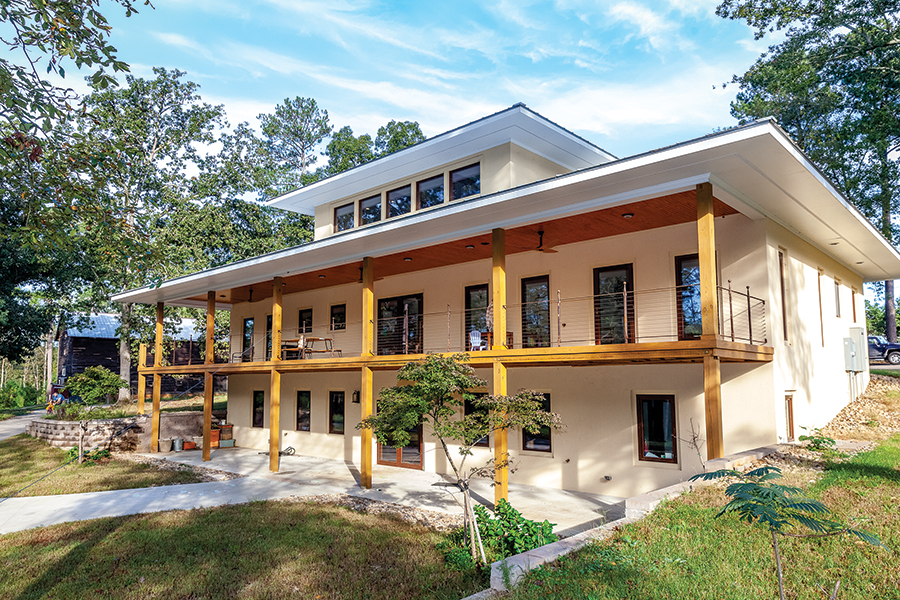
Huff and puff as he may, the Big Bad Wolf can’t blow down Ken Riggsbee and Carolyne Davidson’s house. Because it isn’t made of straw, or sticks, or even bricks. The exterior walls are massive slabs of poured-to-order concrete trucked from a factory and lifted into place by a crane, fastened together with steel. The above-ground basement is partially excavated, cave-like, into a slope. The concrete, recycled from coal ash and an insulation itself, is further insulated with foam.
“Completely air-tight,” Ken states proudly.
Premium efficiency windows come from Italy. A geothermal system draws heating/cooling from the ground; while expensive up front, it slashes energy costs. The house faces south for maximum solar gain and, in the summer, is shielded from direct sunlight by an overhang. Every detail of this dwelling illustrates durability and, most importantly, green standards.
Furnishings lean toward practical, indigenous rather than eclectic, heirloom, Victorian or post-modern. Carolyne’s kitchen channels Mother Earth, not Architectural Digest.
Both upper and lower floors have accessibility features. “Aging in place was my design,” Ken says.
Obviously, there’s a backstory.
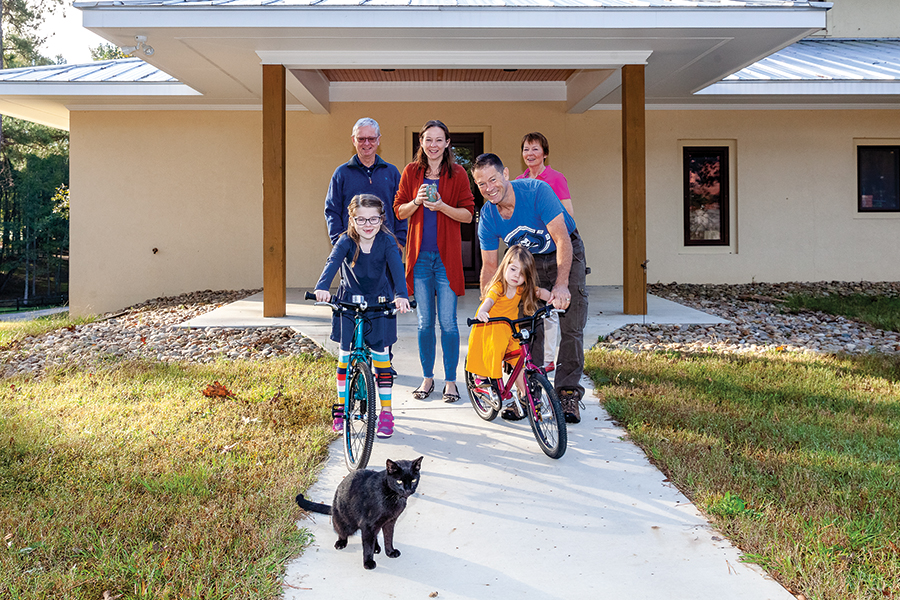
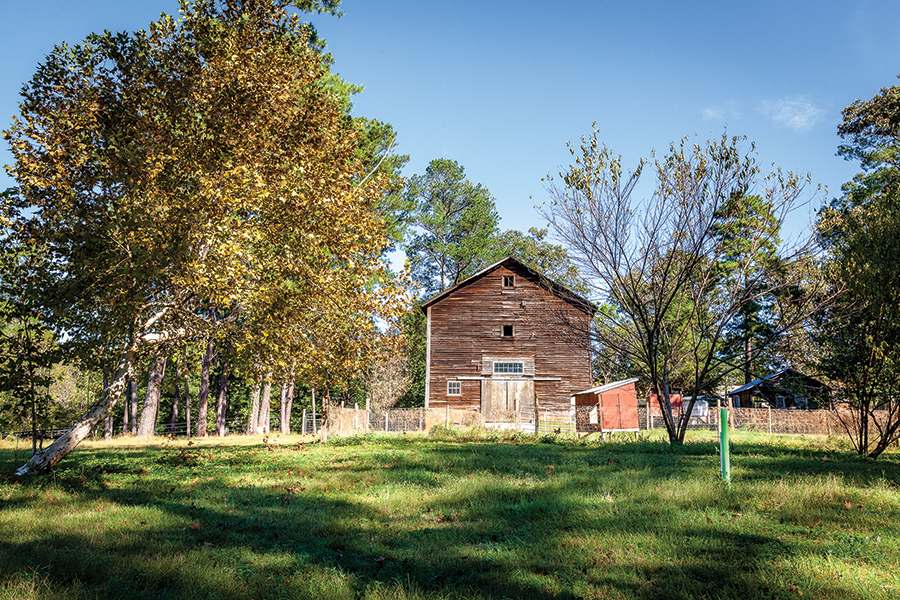
“I’m a city girl.” Carolyne grew up in a suburb of Edinburgh although her Scottish burr has almost disappeared. “Our house was stone, made to last.” She has a Ph.D. in strategic studies in history from Yale University, and now teaches at National Defense University at Fort Bragg. Ken grew up in what he calls a traditional two-story brick Southern Baptist house, in Carrboro. He worked construction (specialty: swimming pools) alongside his father, joining the Army after high school and eventually serving with Special Forces. Their first date, in D.C., happened on the day in 2003 when Ken’s offer on 47 acres in Carthage adjoining Farm Life School was accepted. With the land came a dilapidated house, formerly a hospital and then infirmary, when Farm Life had boarding students. The Riggsbees still find small tiles in the ground, probably broken off the surgery floor.
Carolyne knew Southern Pines from Army friends; her parents had golfed there. Ken, also conversant in civil engineering, knew the area from being stationed at Fort Bragg. They married, visited Carthage frequently, finally relocating permanently in 2009 into the falling-apart infirmary.
“I didn’t even have an American driver’s license,” Carolyne recalls. “I learned to drive on the right side of the road, on a tractor.”
Attempts to save the house failed. Newly pregnant Carolyne became a drywall expert, to no avail. Besides, Ken had a plan: “I bought it for the land. The house we built was the vision I had — wife, children, animals — my American dream come to fruition.”
They broke ground on Sept. 8, 2015, and completed the 4,600-square-foot house in 16 months.

Ken, who is a font — no, a geyser — of construction information, most hyper-technical, all impressive, found a green-leaning architect and subcontractors capable of implementing his vision. He and Carolyne set forth goals and conceived an unusual, elongated floor plan. One wing immediately left of the front door includes the master bedroom, bath and dressing rooms. A small hallway opens out into the two-story great room divided by use, not barriers, into a common space (with TV), eating area and kitchen. Light pours in from clerestory windows.
“I like elevation and light,” Carolyne says.
Ken prefers to be snug, close to the ground. But he does love the acoustics of a soaring space.
A loft with doors at each end overlooks the living room. Behind the doors — storage. In the opposite wing are bedrooms for the Riggsbee’s two daughters, Isla and Iona, named for Scottish islands. In the center, a kitchen with 5-star energy rated Bosch appliances, designed in Germany, made in New Bern, N.C., and cherry cabinets with paneled doors mounted inside out for an Arts and Crafts-style appearance. Black granite for the countertop was quarried locally. On it sits dinner in a box from organic Green Chef.
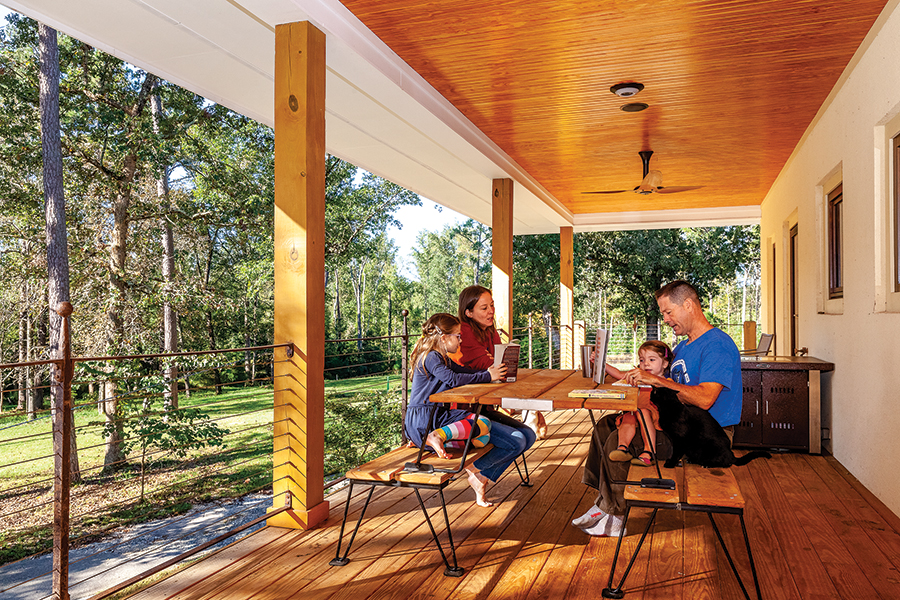
A covered gallery runs the entire length of the house, then wraps around the sides. Ken’s projection for this outdoor living space: “In 10 years, when Carolyne and I go away for a long weekend, we expect there will be 125 high-schoolers bouncing around on that deck.”
The walk-out basement stretches 32 feet encompassing a family room, offices for Ken and Carolyne, a bathroom and children’s toy-and-book enclave large enough to accommodate a kindergarten as well as a suite for Carolyne’s parents, who visit from Scotland twice a year.
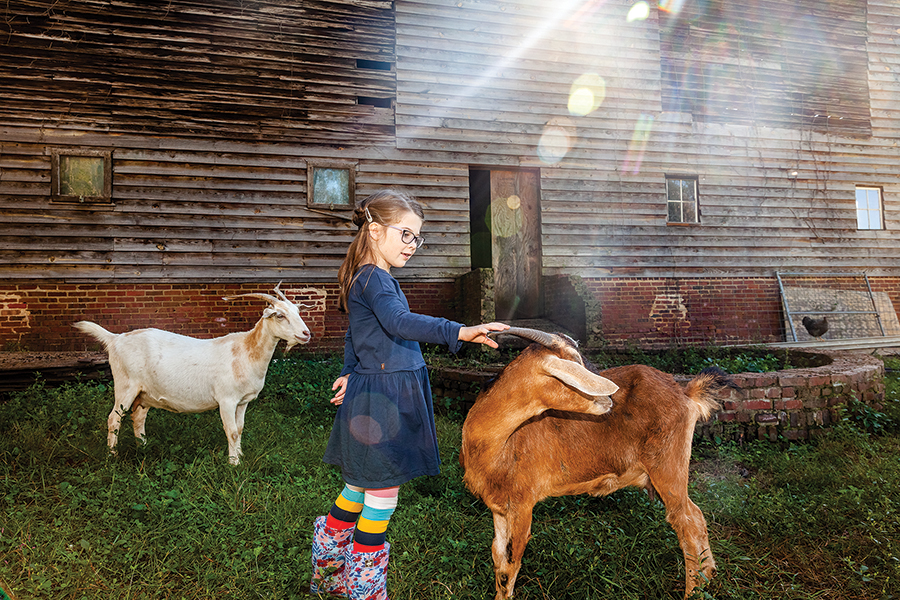
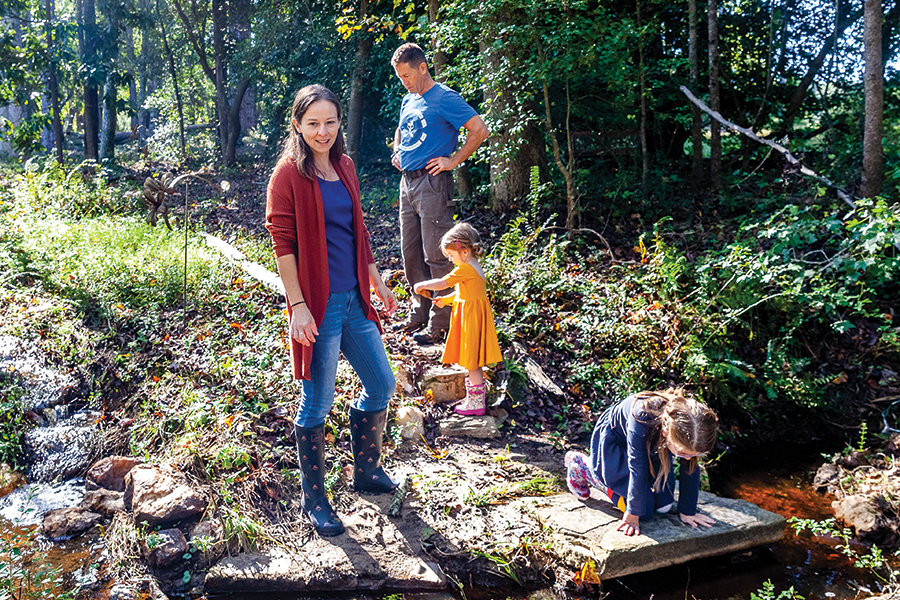
The entire two-story frontage overlooks a pond teeming with fish that jump to the surface at feeding time. Ken keeps honeybees to address pollination and sustainability issues. Goats, chickens, ducks and four cats roam free, attended by the city girl whose only pet growing up was a hamster.

Ken and Carolyne admit an affinity for Frank Lloyd Wright. However, a single word best describes the interior of this intensely personal home: wood. Dark wood floors and window frames, doors and built-ins, tables and cabinets. Ken warms to the history of each board. Beams across the 19-foot ceiling are decorative, not structural, he admits, “but they are 100 years old.” Lumber for plain baseboards and trim was harvested from pine growing within the footprint. The dining room tabletop comes from a black walnut tree that died on the property; its edge, rather than squared off, retains the natural curve.
“We don’t use table mats,” Carolyne explains. “The tabletop is a living thing we share.”
Walking room to room, Ken identifies the source of other woods their cabinetmaker turned into furniture. Ken built the girls’ bunk bed himself.
With the exception of lavender in Isla’s room, all walls (with rounded corners, for safety) are a creamy French vanilla. Wall décor is a work in progress, with art waiting to be framed. Until then, the views are enough, Carolyne says. Ken has hung some military mementoes and Carolyne, a stunning portrait of a Tibetan friend. Floors upstairs and down are mostly bare, with an occasional carpet Ken brought back from deployments in Pakistan and Afghanistan.
This home-building saga was not without risks and inconveniences. Ken had to fight for his specifications, based on the German “passivehaus” model. The Riggsbees are within reach of cable TV but the high-speed internet isn’t great, Carolyne discovered. “We moved here before there was the Food Lion (on N.C. 22). It took a while getting used to not walking to a restaurant.” She doesn’t feel isolated, however, since both she and Ken drive to work at Fort Bragg every day.
They seem satisfied and proud of their accomplishment but not complacent. The unfixable infirmary has been razed; Ken hopes to build a workshop on its site. An old swimming pool that came with the property needs work before they can fill it, hopefully in time for those high-schoolers partying on the gallery.
Not to worry. There’s plenty of time since, as Ken states, “I plan to live here for 150 years.” PS

A conversation with two small friends
By Clyde Edgerton
In a recent Star News letter to the editor, the writer suggested that the presence of a “Thank You, Jesus!” sign in a certain front yard was the reason that every tree in that yard stood tall after Hurricane Florence passed through — while many trees elsewhere had been blown down.
I was walking through my neighborhood with a couple of moles. They are blind of course, but they have smart phones that warn them if they are about to walk into something. Their names are Willy and Scottie. Smart moles — schooled in religion. They live under different yards in my neighborhood. They were talking about the issue.
Willy: What about somebody who wanted to buy a “Thank You, Jesus!” sign, but couldn’t find one because they were all sold out?
Scottie: Their trees would be saved because they thought about it in their mind.
Willy: Are you sure?
Scottie: Well . . . I don’t know for sure. Maybe the leaves would have just got blown off, but the trees would have stayed stood up, I’ll betcha. Or something like that.
Willy: Do you think the people over at your yard will get a “Thank you, Jesus!” sign?
Scottie: Oh, they already did — because they lost some trees, then read that letter to the editor. They got six signs. They put one in the trunk of their car, and one in their truck, one on their boat, and one in front of the dog house.
Willy: That’s just four.
Scottie: Oh, and one in the backyard. And one on top of the house.
Willy: On top of the house?
Scottie: Lightning.
Willy: And I’ll bet you if you take care of poor people and do unto others as you would have them do unto you, like Jesus said, then that means your trees won’t get blowed down, too.
Scottie: No. No. No. It just matters that they got that sign in your yard
. . . or in their car or back pocket. It don’t matter what you do. It’s like churches. No church trees got blowed down during the hurricane because of all those signs that churches put in their front yards.
Willy: Oh . . . you sure?
Scottie: Yep. God didn’t let any trees get blowed down in any church yards.
Willy: What if they did get blowed down?
Scottie: It’d be because they didn’t have the right sign up. The only thing that matters is if you got the right sign up. It’s all about signs. It’s like that in everything in the world. If you got the right sign and a fence around you, everything is okay. I even heard about a family who had a “Thank You, Jesus!” sign, and half of it was in their yard, and half was in their neighbor’s yard. One little prong thing was in one yard, and one little prong thing was in the yard next door. And the family next door had every one of their trees left standing after the storm — just like the family that owned the sign, and nobody could understand. You know why nobody could understand?
Willy: Why?
Scottie: Because that family next door drank wine and beer and were Democrats.
Willy: Whoa. But didn’t Jesus drink wine?
Scottie: No, no. He drank grape juice.
Willy: How do you know?
Scottie: It’s simple. He turned the water into wine but when him and all the others at that wedding started drinking it, it hadn’t had time to ferment.
Willy: Oh. That makes sense.
Scottie: It all make sense . . . if you know enough about religion. PS
Clyde Edgerton is the author of 10 novels, a memoir and most recently, Papadaddy’s Book for New Fathers. He is the Thomas S. Kenan III Distinguished Professor of Creative Writing at UNCW.

Upping the dessert drink game
By Tony Cross
We’ve all been there. The server walks over to your table, dropping off dessert menus after you and your friends have finished stuffing your faces. As your eyes peruse the yummy treats, they scroll down to study the coffee and dessert drink menu. Sometimes these two are juxtaposed, and sometimes they are interlaced. How many times have you seen a Nutty Irishman made with Frangelico, Bailey’s and coffee, or an Irish Coffee with Jameson’s Irish Whiskey, whipped cream, green crème de menthe and coffee? Even worse, a Chocolatini with (probably) a vanilla-flavored vodka, and an ungodly amount of Godiva dark chocolate liqueur. Not a fan of the dark chocolate liqueur? Don’t worry, they’ve got you covered — there’s white chocolate and milk chocolate, too.
The problem is these drinks are tired. Just like the myriad ’tini menus that were everywhere at the turn of the 21st century, dessert drinks needed a face-lift. Before I got my turn behind the stick, I was a server. And I delivered a ton of these badly concocted sugar rushes to more guests than I can ever remember. Almost every delivery had the exact same result: As soon as they saw me coming with that oversized martini glass filled with 8 ounces of corn syrup, their faces would light up, and a cacophony of “ahhhs!” would fill the dining room, causing surrounding tables to smile and nod their heads as if they should order one next. One time, at the advice of a friend, I fell victim to the sugary trap. I splurged, had two chocolate drinks, and felt terrible. I found out the next day that I almost gave myself diabetes.
Let’s fast-forward 15 years. Here are a few cocktails that I feel have been part of a revival when it comes to dessert cocktails.
A few years back, I was invited to a pop-up dinner. An extremely talented chef asked if I would like to do cocktail pairings with her four-course menu. We were going to serve around 30 local business owners. Everyone invited knew each other well, or were at least acquaintances. About two weeks before the event, the chef dropped over to my place to give me her menu. Everything looked fantastic. Immediately, I had ideas for the first three courses, but was at a loss for what to pair with her dessert. She was going to make a chocolate pot de crème, with homemade vanilla ice cream. Off the top of my head, I can’t remember the cream sauce that she garnished it with; all I know is that it was light, and the ingredients were sourced locally. Easy enough, right? I spent a couple of days going over in my head what to do. I had just about settled on a complicated chocolate-infused mezcal, with yogurt and strawberries. And then it hit me — keep it simple, stupid. I remembered watching a video clip on YouTube of one of my heroes, Jeffrey Morganthaler, explaining his Gin Alexander cocktail. Equal parts London Dry Gin, crème de cacao and heavy cream. I once featured it in a drink special and received accolades from our guests. One quick side note: This drink is a spin on the Brandy Alexander. If you’ve ever received a poorly made one, you’ll never forget it, i.e., huge martini glass with store-bought vanilla ice cream, cheap brandy, and very bad crème de cacao. Gross. Anyway, I riffed on Morganthaler’s recipe and came up with the Garam Alexander. Staying true to the original recipe, the only major change was substituting equal parts of Flor de Cana 7 Year rum and a delicious local gin out of Winson-Salem, Sutler’s Spirit Co. (a less juniper-forward gin with a heavier emphasis on citrus, cardamom and other botanicals). The cocktail was served up in a small, chilled coupe and garnished with a dusting of 100 percent organic cacao powder and garam masala. I remember watching an episode of Chopped, and the guy who played Christopher on the The Sopranos won the event because of his dessert dish — he dusted curry over his vanilla ice cream. Who knew?
Garam Alexander
1/2 ounce Sutler’s Spirit Co. gin
1/2 ounce Flor de Cana 7 Year
1 ounce Tempus Fugit Spirits Crème de Cacao
1 ounce organic heavy cream
Combine all ingredients in a shaking vessel, add ice, and shake hard for 10 seconds. Strain into a chilled coupe glass. Garnish with a pinch of masala mix evenly across the cocktail. (Masala mix: equal parts cacao and garam masala.)
Not too long ago, I was visiting a couple that’s very dear to me. (Not because every time I’m invited over I get to try rare rums and mezcal, but it never hurts.) While I was at Bo and Suze’s downstairs “Bo Zone” bar, Bo decided to cap the night off with a quick and easy recipe he found online. He whipped up three cocktails, strained them in vintage glass coupes, and smacked a handful of mint that he placed on top for a garnish. I was talking to Suze while Bo was creating and didn’t get a chance to see the ingredients. One sip, and I was hooked. “This is the Noisy Cricket,” Bo informed me. The cocktail came from bartender Jim Romdall, who worked at Vessel, a bar in Seattle. The order Romdall received was for a Fernet Grasshopper, but he substituted Fernet Branca Menta, a less bitter, more minty little brother, for the regular Fernet. The result is superb: The balance between sweet and bitter is right on the mark. You’ll notice that the Noisy Cricket and the Garam Alexander cocktails both use Tempus Fugit Spirits’ Crème de Cacao à la Vanille — this is the real deal when it comes to a quality cacao liqueur. It’s made with Venezuelan cacao and Mexican vanilla beans; there is nothing artificial inside this bottle.
The Noisy Cricket (Jim Romdall, Vessel, Seattle)
1 1/2 ounces Fernet Branca Menta
3/4 ounce Tempus Fugit Crème de Cacao
3/4 ounce cream
Combine all ingredients in a cocktail shaker with ice and shake like hell until properly diluted. Strain into a chilled glass, and garnish with fresh mint. PS
Tony Cross is a bartender who runs cocktail catering company Reverie Cocktails in Southern Pines.

What happens in the bathtub stays in the bathtub
By Beth MacDonald
Having been a military family for so long, we’ve often been away from our families at Thanksgiving. Apart from the obvious inconveniences, we were thus spared the torture of what should be a day of familial gratitude devolving into one of competition, tears and regrettable comments. That is, until my husband, Mason, now retired, suggested we schlep our blended, extended family to my parents’ home for a holiday feast. I initially said no. Mason was convinced this was a good idea as much as Arthur Carlson was convinced that turkeys could fly in WKRP in Cincinnati.
The great thing about Mason is that he is forgetful. I can throw away things that clutter up the house that he doesn’t even know he misses. Sometimes he’ll ask for them three years later. I’ll pretend they are around somewhere. This time he had conveniently forgotten my family is mostly made up of “well-meaning” people. You know the sort.
My sister lives as far north as she could stand to go without needing an Eskimo passport, while I chose to live in the loveliest part of the South. The epicenter of chaos is Pennsylvania, home of my mother, a generally clinical and, not to put too kind a face on it, harsh woman. When I was a senior in high school and told her I had been accepted into an Ivy League school, her response was, “You should probably just stick with community college.” I haven’t heard my father speak since 1972. He is capable, he just doesn’t. My brother is a bit of a genius, but he speaks like Napoleon Dynamite. I never hear what he’s actually saying. All I hear is what I think he would say, which is never what he does say.
My mother isn’t known for her culinary abilities. My sister, an excellent cook, thought it would be a great idea for us to brine an organic, ethically bred, farm fresh turkey and bring it with us. I was not about to drive 10 hours with a sloshing bird in my trunk, nor was I inclined to spend however long it would take to find a turkey with just the right CV. Thinking we were smarter than we are, we decided to make the trip up, stop at a hotel, and brine the bird there. We equipped ourselves with a 5-gallon bucket from the hardware store, a frozen grocery store turkey and the gourmet brine my sister sent that came with very specific directions, which we immediately threw out.
We filled the hotel bathtub with water and brine, dumped the turkey in, and let it sit overnight. The next day we looked at the scene we created like it was from a TV crime show drama and we’re standing over the deceased with the murder weapon in our hands. Oh, my God, what have we done? We left the housekeeper a note of apology and the kind of tip that would pay for her kid’s college textbooks. We put the bird in the bucket and left the hotel, going down in the elevator and through the lobby looking like we had three-day old bait fish in a covered pail. Our mission: convince the assembled dinner guests that a bathroom-brined Butterball was, in reality, a gourmet high-class fowl.
Two gin and tonics into dinner my eyes glazed over and a courageous indifference took hold. My mother was comparing my sister and brother. My sister was pointing out my mother’s faults, my in-laws looked extremely uncomfortable, and I finally noticed there were strangers at the table. Mason’s regret set in.
Everyone did agree on one thing. The turkey was amazing. Mason’s terror was palpable. Knowing that gin is the equivalent of truth serum, he squeezed my hand a bit too firmly as if to say, “Don’t!” I started laughing into my napkin. Mason grew more alarmed. My sister looked at me suspiciously.
“What have you done?”
You could see Mason’s mind doing complex calculations.
“We changed the brine,” he blurted.
“Well it worked! I love it.” It was my mute father, piling more turkey on his plate, his decades of silence broken by a bird. I looked at him, stunned.
That, however, didn’t faze my sister. Like Nancy Drew, she wanted answers. What was the secret ingredient?
Mason leaned over his plate, “I could tell you, but I’d have to take you to this hotel where I know a maid who can keep a secret.” PS
Beth MacDonald is a Southern Pines suburban misadventurer who likes to make words up. She loves to travel with her family and read everything she can.

Lessons from a stock car legend
By Bill Fields
I would be hard pressed to name five stock car drivers currently making left turns for a living, but this was not always the case.
Could someone who grew up in North Carolina in the 1960s and ’70s and loved sports not have been fascinated by NASCAR? Possible, yes, but not very likely.
My NASCAR love existed even though I wasn’t really a car nut. My dad had managed a gas station before I was born, but automobiles weren’t his passion later on. He never taught me how to change the oil. We bonded on Sunday afternoons sitting in one of our high-mileage sedans in our driveway. Doors open, AM radio on, the races came to us — Darlington, Charlotte, Richmond, Daytona.
As a spectator warning in a program of a race we attended at North Carolina Motor Speedway stated, “Stock car races are thrilling, dangerous and spectacular.”
That first trip to Rockingham, for the American 500 in late October of 1966, put a picture to the sounds coming out of our car’s Philco. Dad and I rode south on U.S. 1 with a friend of his who had a pickup and had gotten the tickets. I don’t remember his name, but he resembled Hank Kimball on Green Acres.
I was 7, in the second grade. It was a cool day, when a Coke didn’t get warm before you finished it. The sky was the shade of Larry Miller’s away jersey. Everything at the track seemed as if it had been drawn with the brightest crayons in a box of 64, whether Marlboro red or Union 76 orange and blue. The cars were freshly painted, like glistening, just-completed models.
They were all there — the brothers Allison, Bobby and Donnie, and Yarborough, Cale and Lee Roy. Junior Johnson. David Pearson. Buddy Baker. Curtis Turner. Pole-sitter Fred Lorenzen. Way back in Row 18 was local favorite J.D. McDuffie of Sanford. When I saw that he was driving a ’64 Ford, a car two years older than what the stars had, it made sense why he struggled to run with the leaders most weeks.
Most important to me was the presence of Car 43 driven by Richard Petty. I was already a fan of the man from Level Cross, and seeing his Plymouth streak by 40 yards below me was a thrill. Lorenzen held him off to win that afternoon, which was disappointing. As I was getting in bed that evening, the roar of the car engines was still in my ears. Besides colorful, the race was loud.
Three years later, on an August Friday night at the quarter-mile track of Bowman Gray Stadium in Winston-Salem, I got to see a Petty victory as he came from trailing Bobby Issac most of the 62.5-mile race to win.
I attended one other NASCAR race, the Carolina 500 at Rockingham, in the spring of 1972. Issac took the checkered flag that afternoon. For Christmas that year, I got Petty’s autobiography, relishing what I could learn about the slender, smiling man in sunglasses who seemed to win more than everybody else.
When I started covering sports, I asked a couple of writers who had covered Petty’s prime what made him so good other than having the best cars and top crew to keep them humming. One sportswriter, Harold Martin of Columbia, S.C., told me Petty’s car sounded different going into the corners, which I took to mean that The King was bolder and braver than the rest.
About a decade ago, while covering a PGA Tour Champions event in California, I was invited to a reception for kids from The First Tee who were playing in the tournament. Speakers had been invited to talk to the junior golfers about The First Tee’s nine core values.
I’m pretty certain the young people had no idea who the man talking about confidence was, but I was pleased to hear what Richard Petty had to say. And, at the end of evening, I made like No. 43 on the backstretch somewhere to make sure I could meet him and say hello.
Petty kindly indulged a childhood memory or two after I shook his hand and seemed amused that it was the tiny track in Winston-Salem where I’d seen him win. It was a quiet Pebble Beach night when I stepped outside, but in my mind I heard sounds of a big engine and bygone time. PS
Southern Pines native Bill Fields, who writes about golf and other things, moved north in 1986 but hasn’t lost his accent.

For the November-born, excitement is written in the stars
By Astrid Stellanova
Creative Ole Abe was an Aquarian, like four other notable U.S. Presidents. But then, you knew that, right Star Children? So when Abe Lincoln proclaimed a national Thanksgiving holiday in 1863, it was a good idea that nobody could resist, no matter which side of the Mason Dixon line they lived on.
But did you realize another holiday figures into the stars this month? Do the math — November-born are conceived around Valentine’s Day, which means they are the stuff of romance, recklessness, destiny, or a maybe a little bit of all. — Ad Astra, Astrid
Scorpio (October 23–November 21)
Star Child Scorpio, you see someone through a forgiving lens, who by even the most generous descriptions would be called weird. As weird as a mating fruit bat. You are virtuous and hold on tight when another might cut bait and leave that bat behind. Return the favor to yourself and forgive the things you are privately self-critical about. It’s a necessary liberation and will set you on your highest course.
Sagittarius (November 22–December 21)
Darlin’, let ole Astrid lay it on you straight: Don’t hang with the night crawlers. As tempted as you are to enjoy newfound popularity, a few of your new hangers-on are not exactly top-shelf stuff. And maybe be a little less generous about picking up the bar tab.
Capricorn (December. 22–January 19)
Shew, Sugar, you were right all along. And as much as that is true, revenge ain’t as sweet as you think. Don’t shove your Mama overboard. By the time you read this, I hope you will find it in your heart to let it go so you can face everybody over the turkey table and smile.
Aquarius (January. 20–February. 18)
Time’s a-wastin’. Get your house in order before the holidays so you won’t be high, dry, and too lonely in the run-up to Fa-La-La Season. The only relationship you haven’t lost lately is with your Chia Pet, Sugar. Setting things straight with You-Know-Who will require an apology and some soul-searching. All worth it.
Pisces (February 19–March 20)
In a parallel universe, you got your due credit. But in this one, you did not. You must chase the thing you deserve credit for, and be sure you get top billing the next time you invent a self-wringing mop electric toilet brush. Cause, really, Honey Bunny, most are not that creative.
Aries (March 21–April 19)
Stuff went down and nobody was happy. Like a honey badger, you just don’t care much either. Good thing, because you are already on to the next thing and you are leaving the drama behind. If anybody’s nose is still out of joint, hand ’em a splint and a smile.
Taurus (April 20–May 20)
You haven’t moped this much since Burt Reynolds died. Honey, it may not be about Burt, but it might be about your recent inclination to go all nostalgic. The next time Smokey and the Bandit is on TV, just change the channel for gawdssake.
Gemini (May 21–June 20)
You may think the party can’t start without you, but Sugar, get a grip. Are you a self-declared disaster area? Or are you just ticked off because a genuine chance to make a big entrance didn’t happen? Think about it: If you throw the party, you get to control the spotlight, too.
Cancer (June 21–July 22)
This isn’t the time to take a stand about small and petty. In the name of world peace, let the jerk who rains on your party slink off into the night. You are about to have a wonderful holiday and nobody can change that. Get ready to make merry, Darlin’.
Leo (July 23–August 22)
It hasn’t gone unnoticed that you have launched a self-improvement program. Points for that, Honey. If you keep this up, somebody is going to surprise you with a declaration of love that might take your breath away, but do keep your hand on your wallet, as they might take that too.
Virgo (August 23–September 22)
Someone near and not so dear makes you grit your teeth and suck in your temper. You try to set a good example before this feckless fool. While you’re at it, try dividing by zero. Same outcome. Give them an air kiss and lickety-split, moving on fast.
Libra (September 23–October 22)
Your best work happens when you let go and let loose your natural charms. You don’t have to be Jim Carrey funny, Honey, just rely upon your dry wit, and good times and best outcomes find you. By next month, you won’t be able to keep up with all the invites. PS
For years, Astrid Stellanova owned and operated Curl Up and Dye Beauty Salon in the boondocks of North Carolina until arthritic fingers and her popular astrological readings provoked a new career path.

Over cold ones at Flying Machine, writer Kevin Maurer remembers the impact of Hurricane Florence
By Wiley Cash • Photographs by Mallory Cash
When I moved to Wilmington in 2013, Kevin Maurer was one of the first friends I made. Over the years, I have gotten to know his family, and he has gotten to know mine. We have played on the same intramural basketball and football teams, and we have suffered losses and injuries, bonding over our bruised bodies and equally bruised egos. But what has informed our friendship more than anything else is the writing life. We regularly have dinner or drinks and talk about our decisions to become writers, and the effect our work has on our families and our friendships with people outside the publishing industry. A few months ago, I chronicled one of our conversations on Twitter, and it was retweeted over 1,200 times and responded to by writers as various as Neil Gaiman and Mary Alice Monroe, all of whom agreed that the writing life never gets easier, no matter who you are.
Kevin is one of the most successful writers I know — the New York Times best-selling co-author of No Easy Day: The First-Hand Account of the Mission That Killed Osama Bin Laden and American Radical: Inside the World of an Undercover Muslim FBI Agent; and a celebrated journalist who has written about the war in Afghanistan as an embedded reporter — but he is also one of the hardest working.
Our conversation once again turned toward the writing life when we met at the new Flying Machine Brewing Company in Wilmington a few days following my family’s return to town after evacuating in advance of Hurricane Florence. Kevin’s family had evacuated as well, but he had stayed behind to cover the storm and its aftermath for statewide and national news outlets.
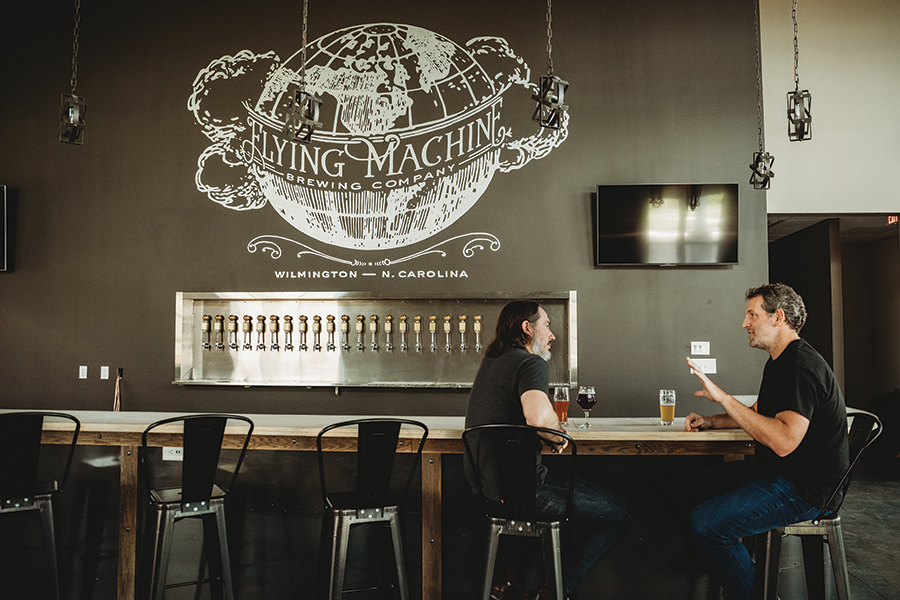
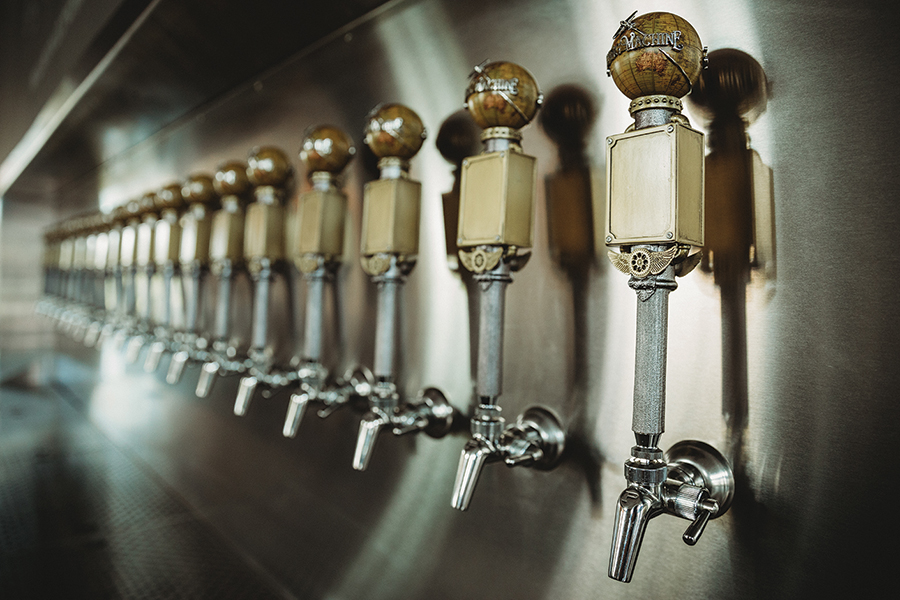
Flying Machine Brewing Company, which is set to open in early November, is on Randall Parkway, where it sits along the cross-city trail and has views of the lake at Anne McCrary Park from its two-story patio. The interior of the taproom feels both enormous and inviting, with clean lines and industrial seating that mirrors the sheen of the brewing equipment that brews all the beer on-site. Borrowing from the name, flying machines and parts of flying machines inform everything from lighting fixtures to wall art to the pulls on the taps behind the bar.
Although they were not open for business before Hurricane Florence hit, Flying Machine jumped into the community effort after the storm had passed by offering free purified water to anyone in need of it. There were plenty of people in need, and there still are. Because of this, Flying Machine has pledged to donate a portion of their proceeds from their grand opening to local nonprofits.
As Kevin and I settle in at the bar, we are delivered a round of beers by co-founder David Sweigart. He offers us the “Passarola” Brut Pilsner and the “Electric Smoke” Alt Bier, and he lets us know we are being served the first beers poured and sampled in the brewery’s history. Kevin and I agree that the honor of sampling Flying Machine’s first pours is made even sweeter by the fact that both beers are delicious.
I ask Kevin about what it was like to write about Wilmington before, during and after Hurricane Florence. As he takes a sip of his lager, I mention something he wrote in an article about the aftermath of the storm: Wilmington has become a city of lines, he wrote. Lines to get food. Lines for gas. Lines to get supplies.
“That was the hardest part of covering the storm,” Kevin says. “The waiting and watching people wait.” He stares at the wall across from us where a huge mural of a globe featuring the words “Wilmington N. Carolina” hovers above us. “I watched people sit in their driveways and wait for the water to rise, and I watched it get higher and higher by the hour until they decided they couldn’t wait any longer before they left and took whatever they could carry.”
My family and I evacuated to Asheville, and we waited there, desperate for knowledge about what was happening on the coast, in Wilmington, in our neighborhood. I told Kevin I could not imagine being among those who were waiting here in town.
“It’s interesting,” he says. “My whole career has been spent covering crises around the world: war, famine, insurrection. It’s been hard to see some of the things I’ve seen, but I always get to come back home. Covering Florence was different. This is my home.”
After we finish our beers, Kevin and I are invited into the production area, where gleaming stainless-steel tanks tower above us. Taproom manager Marthe Park Jones, who has spent years working in the Wilmington craft brewing community, and retail manager Grant DeSantos, recently arrived from Asheville, where he managed retail for a major brewery, give us a tour and introduce us to a group of brewers who have spent years working and studying at breweries around the world. When the tour is over we stand around talking about the storm, and the long road the community and region have ahead.
Later, on our way out to the parking lot, Kevin and I make plans to get our wives together for dinner that evening at a local restaurant that has recently reopened. The city is gathering itself and moving forward. Wilmington and its people — both the long residing and the recently arrived — are no longer waiting. PS
Wiley Cash lives in Wilmington with his wife and their two daughters. His latest novel, The Last Ballad, is available wherever books are sold.