Southwords

SOUTHWORDS

Summer Swarms

The worst kind of fan club

By Emilee Phillips

Illustration By Campbell Pringle

“Get them off me!” I yelled, sprinting for safety, flailing my arms like I was trying to take flight. I slapped at my legs, my arms, the back of my neck as I ran, the house looming ahead like a sanctuary. I burst inside with the urgency of someone being chased by bloodthirsty animals — which, in a way, I was.

This didn’t happen just once. To be honest, it’s less of an isolated incident and more of a seasonal tradition.

Don’t get me wrong, I love summer. I love the long, golden evenings that stretch on forever, the kind where the sun takes its sweet time setting and ice cream is accepted as a daily treat. I love the heat, the way it settles into your bones and relaxes you like a sauna. I love that you can wear a sundress almost daily. I’ve even made peace with the humidity — we have an understanding, a truce of sorts, where I tolerate it in exchange for everything else summer brings me.

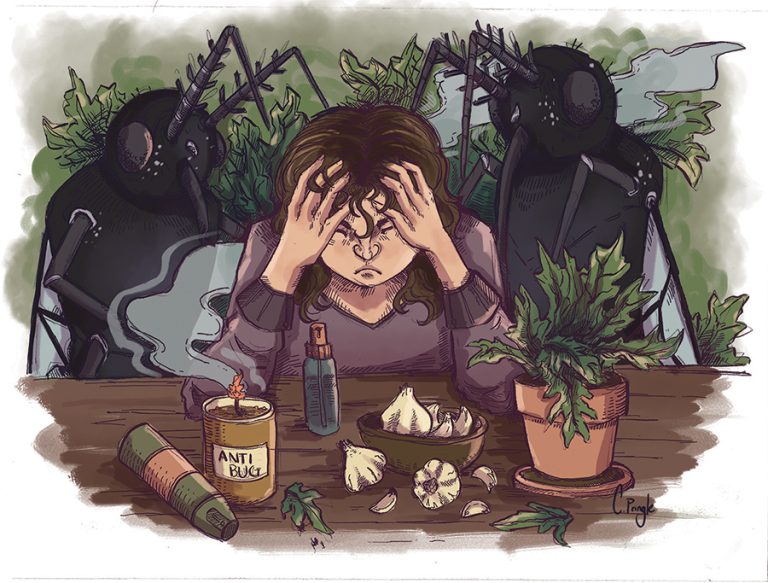
But the mosquitoes. Ugh! The pesky little insects may as well be my own personal groupies because they flock to me the second I step outside. They’re buzzing around as if they want to join my inner circle and clinging to me like I’m their ticket to fame and fortune. It’s not even flattering. If they’re my groupies, they’re the kind that show up uninvited, scream in my ear like banshees and take a piece of me home as a souvenir.

I can’t even vent about it properly because no one else in my family is part of the all-you-can-eat buffet the way I am. It’s like they’re behind some kind of a forcefield while I’m out there taking hits for the entire bloodline. You’re welcome, by the way. 

My mother used to say it’s because I’m sweet, but I doubt their microscopic brains are thinking logically. And even if they were, what would they say? “You have notes of jasmine and poor decision-making?” 

I’ve tried everything to get rid of them. I’ve tried eating copious amounts of garlic, which only seemed to work on other humans. I’ve kept citronella close by, which I’m convinced is just an old wives’ tale. It’s really aromatherapy in bug form. I’ve tried wearing long sleeves, which only made me sweatier and impaired my ability to scratch the itch. Even DEET, which should have acted as my personal security detail, has failed me on more than one occasion. 

I’ve tried tackling the source. I’ve ensured my yard is free of standing water. I’ve planted all the usual pest-repelling plants. At this point, I’m convinced pine straw is some kind of breeding ground for genetically-engineered super mosquitoes, which basically means as long as I live here, I’m screwed.

They say scratching makes it worse, but I don’t have the self-control to just sit there with the itch taunting me. Sometimes the bites swell up so big it looks like I’ve contracted an old-timey illness frontier doctors used to treat with a salve made out of lard and “healing leaves.”

Years of my life have been occupied by scratching. It adds up, you know. All I ask is a little peace out of doors without feeling like my fan club is sucking enough of my blood to make a clone. 

I love summer, I just wish it didn’t love me back quite so much.

The Great American Barbecue

THE GREAT AMERICAN BARBECUE

The Great American Barbecue

When the Coastal Plain meets the Piedmont

By Warren Lewis

Photographs by John Gessner

I was in trouble. Marianne, my better two-thirds, had invited friends over for a barbecue. Sounds easy enough — but the couples are from opposite sides of the state: vinegar-based barbecue vs. tomato-based barbecue. I’d rather discuss religion and politics. What’s a chef to do?

How about I begin at the beginning? Let’s talk location, culture and soil. 

The Sandhills of North Carolina occupy a band of ancient coastal sediment running through Moore, Richmond, Hoke and Scotland counties — about from Southern Pines and Carthage west toward Laurinburg and Rockingham. The soil is sandy and quick-draining, good for longleaf pine, wire grass and peaches. The heat and sun can be relentless.

Barbecue in the Sandhills sits in geographic and cultural tension. The Eastern North Carolina tradition — vinegar-only, whole hog, hardwood coals — comes from the Coastal Plain counties to the east. The Lexington tradition — tomato-touched dip, pork shoulder, hickory smoke — comes from the Piedmont to the north and west. Aah! The tension of being the middle child. (Did I mention that I’m in the middle of two sisters?)

So here’s my compromise: a local pork shoulder cooked over hickory or oak, pulled and chopped, finished with a sauce that is predominantly vinegar but carries just enough of the Sandhills character — a touch of sweetness and depth. It’s a pretty solid compromise.

Note: With all recipes, read ’em through thoroughly, paying attention to rest periods and timing.

The Meat

Buy a bone-in pork butt, 8 – 10 pounds. This is the upper shoulder — well-marbled and deliciously fatty. It is the right cut for a long, slow cook. Just the right size for a dozen folks or so. Source locally, as Moore County has a fair number of working farms. A pork butt from a hog raised in the Sandhills’ sandy soil pastures will have a cleaner, slightly sweeter flavor than a commodity shoulder. It is worth the effort to seek one out. Plus, it seems like the right thing to do.

The Rub

The Sandhills rub is slightly more seasoned than the near-naked salt-and-pepper of the pure Eastern N.C. tradition, but it does not reach for the spice-cabinet ambition of Western barbecue. The goal is to season the exterior, build a modest bark, and stay out of the way of the smoke and the sauce.

Ingredients

4 tablespoons kosher salt

2 tablespoons coarsely ground black pepper

2 tablespoons brown sugar

2 teaspoons paprika

2 teaspoons garlic powder

1 teaspoon cayenne pepper

1 teaspoon dry mustard

Mix all ingredients thoroughly. Apply generously to all surfaces — fat cap, meat side, bone side, all the sides. Pat it in. Do not rub hard; you want it to sit on the surface, not be worked into the meat.

Wrap loosely and refrigerate overnight. Pull the shoulder from the refrigerator 2 hours before it goes on the smoker.

The Sandhills Sauce

This is where the Sandhills parts ways with the strict Eastern tradition. The sauce begins with vinegar — cider vinegar as the primary acid, white vinegar for sharpness — but it carries a small amount of ketchup for body and color, a touch of brown sugar for the faint sweetness the region’s palate expects, and a measured hand with the pepper.

Ingredients

3 cups apple cider vinegar

1 cup white distilled vinegar

¼ cup ketchup

¼ cup local honey

2 tablespoons brown sugar

2 teaspoons crushed red pepper flakes

3 teaspoons coarsely ground black pepper

1 teaspoon cayenne pepper

1 teaspoon kosher salt

1 teaspoon dry mustard

Method

1. Combine all ingredients in a jar or bottle with a tight lid.

2. Double check that the lid is tight. (No, I don’t want to discuss it.) Shake it like a Polaroid ’til it’s all mixed nice.

3. Let the sauce rest at room temperature for at least 24 hours before using. The pepper blooms in the acid and the flavors knit together. Three days of rest is better. Maybe make a double batch.

4. Taste before using. The sauce should lead with vinegar sharpness, finish with gentle heat, and carry a faint background sweetness that does not announce itself. Adjust cayenne for heat, brown sugar for sweetness, or add a splash of cider vinegar if it needs more edge.

The Cook

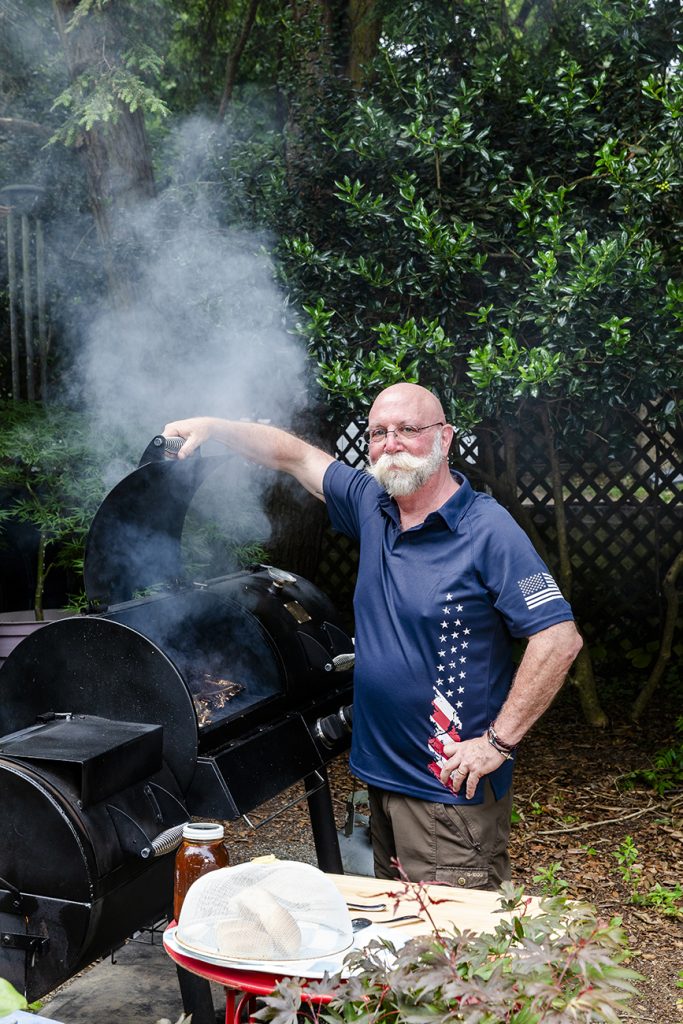
Cook this pork shoulder on an offset smoker, a kettle or any setup that allows you to maintain indirect heat and introduce real wood smoke. Use hickory — it is the wood of this region and this style. Oak is acceptable. No fruitwood. No mesquite. No Duraflame logs. (David, I’m talking to you.) Grab a book and settle into your favorite chair. This is gonna take a while. I like to do a barbecue when there is no moon, so I can stare at the stars all night. Barbecue is a real commitment.

Target temperature: 225 to 250 degrees Fahrenheit at the grate. Expected cook time for an 8 – 10 pound bone-in butt: 10 to 14 hours. Plan for the 14 hours.

1. Bring the smoker to a stable 225 to 250 degrees before the pork goes on, fat cap up. Place the shoulder with the thicker end toward the heat source if using an offset.

2. Manage the fire for clean, thin smoke. Hickory is an assertive wood — use it with a measured hand. Two or three fist-sized splits or large chunks at a time, added as needed to hold temperature. You want smoke, not a smudge.

3. At three hours, check the fire and note the color developing on the exterior. You can peek, but not too long as you’ll lose temperature. Take pictures. Let the bark form undisturbed.

4. At around 160 – 165 degrees internal temperature, the stall will set in. The temperature will plateau and hold — sometimes for two hours, occasionally longer in humid Sandhills summer heat. Hold your position. The collagen is converting to gelatin, and the exterior is doing important work. Take more pictures.

5. At the stall, wrap the shoulder in two layers of heavy-duty foil. Return it to the smoker and continue cooking at the same temperature. The foil pushes through the stall by trapping moisture — nothing worse than dry barbecue — while the interior completes its breakdown.

6. Continue cooking until the internal temperature reaches 200 – 205 degrees and the bone wiggles freely. The probe should slide into the thickest part of the flat with no resistance — easy, clean, like butter that has been sitting in a warm kitchen. Use the “bone test.” It’s more accurate than a thermometer.

7. Remove from the smoker. Keep in the foil. Wrap in a towel (Not a bath towel. Again, I don’t want to discuss it.) and rest in a dry cooler for a minimum of 1 hour. Two hours is better.

Pulling and Saucing

Sandhills pulled pork is pulled first, then chopped — somewhere between the long-strand pulled pork of Memphis and the fine chop of the Eastern N.C. tradition. You want medium pieces, roughly torn, with some variation in texture. The bark pieces, the fatty point of the shoulder, and the leaner flat should all be present in the finished pile.

1. Remove the bone. If cooked properly, the bone will have no meat on it. Pull the shoulder apart into large sections with two forks or your hands. Yes, it burns a little. Michelangelo didn’t complain while he spent four years on his back with his arms up painting.

2. Roughly chop the pulled pieces on a large cutting board — 8 – 10 passes with a heavy knife, turning the pile as you go. You want irregular chunks, not a fine mince.

3. While the meat is still hot, add the Sandhills sauce generously — start with a big splash — and toss to coat.

4. Taste. Add more sauce. The pork should be glossy, moist, and tangy with the faint sweetness of the sauce behind the vinegar. Let it rest in the pan for 5 minutes, then taste again. The meat will absorb a surprising amount of sauce while hot.

Serving

Serve on white bread or plain buns — the bread is not a vehicle, it is a participant. It absorbs the sauce that runs off the pork and becomes something you eat deliberately, not a wrapper you discard. A plain white hamburger bun is correct. A brioche bun is not.

Traditional Accompaniments

White bread or plain hamburger buns

Vinegar-dressed coleslaw — cabbage, cider vinegar, a little sugar, celery seed, no mayonnaise

Baked beans — cooked low and slow with a piece of the pork if you have it

Hush puppies or cornbread

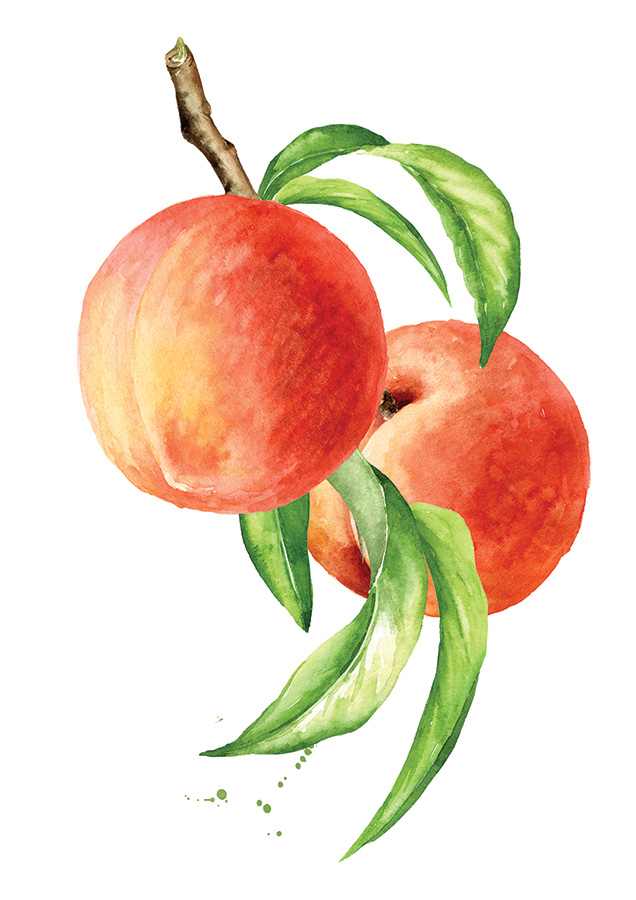
Sliced peaches in season — a Sandhills addition that needs no explanation. Maybe pop them on the grill for a moment.

Extra Sandhills sauce on the side

Sweet tea, cold and very sweet

Ice cream

Final Notes

Cook it for a Saturday. Start it Friday night. Let the neighbors smell it in the morning. Invite them over. Serve it at noon on paper plates under the pines with sweet tea and peaches and people who are not in any hurry to be anywhere else. 

Almanac July 2026

ALMANAC

Almanac

July 2026

By Ashley Walshe

July is a carnival of butterflies.

As sunlight saturates the riotous garden, yellow and black visions float from Joe-pye weed to purple coneflower, pausing at each blossom like boats anchoring at tiny, teetering berths. 

Seconds pass. Nectar passes through proboscis. Yet, time stands still. 

Imagine breaking out of chrysalis to emerge here, in the lushness of summer. Kissing each flower. Delighting in an endless banquet. Relishing a lifetime in 10 ambrosial days.

These wonders leave us awestruck.

In sweeping fields, where grass cicadas and katydids broadcast themselves, buckeyes startle wrens and warblers with their wild, wide-eyed wingspots.

Life drifts blissfully along. 

Silver-spotted skippers wish upon electric purple blazing star. Painted ladies worship cosmos flowers. Fritillaries flit among zinnia and thistle.

Walk through the forest, where summer azures appear as paper crafts, moonlit fairies, dainty apparitions. Dip your feet into the creek’s cool waters. Feel time slow when a winged one lights upon your salt-laced finger.

Embody the transmission. Move at the speed of summer. Taste the earth through your feet as you walk upon it. Let the flowers guide you.

Here, where milkweed and monarch embrace, sip the nectar of the ephemeral. Slower. Slower. Slower, still.

Anchor yourself in this moment. Delight in the banquet. Relish in the wonder of these timeless days, this fluttering carnival of a lifetime.

What’s Poppin’

The summer garden spills.

Tomatoes swell on the vine. The corn silks tell of peak sweetness. The berries grow fat in the life-giving sun. The peaches are popping, too.

The annual N.C. Peach Festival takes place in Candor (Peach Capital of N.C.) July 16–18.  Among the festivities: a hot wing competition, live music in the park, family fun and homemade peach ice cream. Get the sweet-and-juicy scoop at ncpeachfestival.com.

The butterfly counts not months but moments, and has time enough.

— Rabindranath Tagore

Folk Medicine

It wouldn’t be summer without fresh watermelon, the nasal cries of nighthawks and — oh, yes — poison ivy.

You know the rhyme: Leaves of three, let it be. But what of the antidote?

Enter jewelweed, the tall, native beauty thriving along stream banks and moist woodland edges. Also called orange balsam, orange jewelweed, spotted jewelweed and spotted touch-me-not, this self-seeding summer annual is known by its orange, trumpet-shaped blossoms, which dangle from the plant like fiery pendants.

Native Americans used jewelweed as medicine, applying sap from its stem and leaves to relieve skin irritations, including rashes from poison ivy and stinging nettle. 

Thanks to nature’s endless brilliance, it’s common to find jewelweed growing wherever poison ivy runs wild. And guess who adores hose tubular flowers? Hummingbirds love its sugary nectar, making them a primary pollinator for this summer-blooming plant ally. 

Simple Life

SIMPLE LIFE

My Miss American Pie

And our slice of heaven together

By Jim Dodson

Illustration by Gerry O’Neill

She has a birthday this month. It’s one of the biggies.

It’s not every day you reach an age when you’re permitted — even expected — to kick back and reflect on a long journey that has shaped so many lives for the better.

Her kindness is exemplary, guided by a heart that is as compassionate as it is brave. Over the years, I’ve seen her take on tasks that seemed almost hopeless, inspiring significant change in others around her. That’s just her nature. 

No wonder her birthday is a national holiday — at least in France.

It’s hard to believe that my wife, Wendy, born on Bastille Day, is 65. She’s never looked more youthful and beautiful. 

Yes, I know. America also has a big birthday this month. So, roll out the bunting, strike up the band, hand out the confetti poppers and light the fireworks. Even in times that try men’s souls, it’s good to pause and reflect on how our beloved nation got here — and where it may be headed, for better or worse.

My birthday gal, Wendy, is as all-American as apple pie and just gets better with age, an infectious optimist and embodiment of what it means to be a fully engaged citizen, a wise counselor and the most capable human being I’ve ever known. 

Because she’s also a gifted baker, I call her my Miss American Pie. 

I’ve said for years that she’d make a great president. But please don’t spread that notion around. I’d hate to give up her enlightened leadership skills to a struggling nation and lose her famous roasted apple-crumb pie in the deal.   

Meeting her almost 30 years ago was the luckiest day of my life — an encounter in retrospect that seems providential, if not presidential. It’s a story I’ve told only once in a book many years ago. This is as good a moment to share it with you as any.

On the heels of a wearying, month-long, national book tour for Final Rounds, I was invited to give the keynote speech during the American Lung Association of New York’s three-day golf event and fundraiser in Syracuse.

I’d been amicably divorced for a couple years and shared custody of our two goslings with my former wife. The last thing I wanted to do, however, was trek to Syracuse for yet another golf event and rubber-chicken speech. 

But my host was relentless. He not only talked me into coming but set me up with dinner “companions” for the three nights of the event. I don’t know why I said yes. 

But I’m glad I did.

The first night’s blind date met me, my host and his wife at the stately Onondaga Country Club where Walter Hagen once belonged. My date was a local poet who showed up late to the table and said nothing until I was asked by my host’s sunny wife if it was true that I received (and replied to) hundreds of letters from fans of my new book. I confirmed that I did. 

“That’s nothing,” piped up the poet. “I get pictures from prisoners. They send me photos of their [use your imagination].”

The formal dining room around us was full of elderly diners. Audible gasps and crashing crystal sounded throughout the room. As I walked her to her car, the poet laughed merrily and declared, “I love making rich Republicans uncomfortable!”

“Everybody needs a hobby,” I told her.

The next night’s match was worse. She was the town’s historian. I borrowed my host’s car to take her to a lovely restaurant in the Finger Lakes. She wasn’t planted on the seat beside me for two full seconds before she exclaimed, “I hear you wrote some beloved book about golf. I hate golf. It’s a fascist sport. Golfers are fascist doughboys.”

“So, I guess hitting a bucket of balls before dinner is out of the question,” I remarked.

“You’re &%$#@! right,” she declared. Please use your imagination again. Every other word was a charming expletive. I guess she hated history as well. I got her home in record time.

I asked my host for Number Three’s phone number to cancel the final date. He refused. I demanded her phone number. He wouldn’t budge.

“Her name is Wendy. She’s an incredible baker and mother of two young boys. Everyone in the neighborhood adores her. If you break this date, Sparky, I’ll be as lonely as you are and sleeping on the couch for a month.”

The final dinner was held at the home of our hosts with two additional couples. At the appointed hour, I forgot to go down the block to meet Wendy Ann Buynak at her house. She walked up by herself bearing a plate of homemade chocolate chip shortbread cookies in the shape of acorns. They looked too good to eat and tasted even better.

The minute I saw her standing in the open doorway with that plate of cookies, I realized there was a God (who probably played golf) after all. Third time was the charm. We sat at the end of the table talking only to each other for three solid hours. Then I walked her home.

The next afternoon, we went for a drive and wound up at a local golf course, where I kissed her. She smiled and kissed me back.

Two weeks later, I drove seven hours for our first date. She put me to work helping to box up 75 beautifully made miniature wedding cakes for a Syracuse bride. I got to eat the 76th cake. It was love at first bite. She also made me a roasted apple-crumb pie to take home to my kids.

Is this an All-American love story or what?  

Three months later, I introduced Wendy Ann to my two little ones, who instantly fell in love with her and her key lime pie. Two summers later, she and her two young boys joined our family, doubling our size in a lovely backyard marriage ceremony in Maine. I saw the spectacular cake she made but never got a taste. It vanished without a trace before I could get a piece.

This summer marks our 25th wedding anniversary. Miss American Pie and I plan to slip away to our favorite inn for a few days of golf, relaxation, and — use your imagination again.

Later this summer, we plan to renew our vows.

I’m reliably informed there will be pie.

Sporting Life

SPORTING LIFE

Down at the Pond

Not all those who wander are lost

By Tom Bryant

“Fishing gives a man some time to think. It gives him some time to collect his thoughts and rearrange them kind of neat, in an orderly fashion.”
—Robert Ruark, The Old Man and the Boy

It had been one of those days when all the good intentions go astray. I had planned to do a bunch of yard work that had been delayed by one thing, then another, but I was diverted to the little Airstream when I started thinking about an upcoming trip to the beach. We weren’t going to take the travel trailer, but I wanted to get it in shape to travel when we got home. After the winter, the small unit needed some real TLC. But just as I got the hose ready to mix soap to wash her with, Linda came to the arbor door with my phone.

“Hey, Hon, your phone has been ringing off the hook, if it had a hook.”

“Who is it?”

“I don’t know. Call ’em back. This is their third try.”

“OK. OK.”

I put the hose down and checked the number. Not recognizing it, I thought it was probably somebody wanting to sell me something.

“Cooter!” It was Bubba. “Where ya been? Why don’t you keep your phone with you?” He had bestowed the nickname Cooter on me when we first started hanging together, and it stuck.

“So I don’t have to talk to reprobates like you.”

Bubba and I go way back, having been hunting and fishing partners for years.

“I thought you were in Costa Rica fishing.”

“I was, but I caught some kind of bug and had to come home so the docs could fix it. The reason I’m calling, if you’ve got the time, I want you to ride up and check out the old store for me.”

Bubba had bought an ancient country store from a mutual friend, but it didn’t work out and now was closed. A farmhouse came with the deal and had been a fixture in the area for years.

“While you’re there, you can do some fishing in the pond behind the house. And if you catch a mess, bring ’em on over here and we’ll fry ’em up.”

“Bubba, I got tons to do around here and we’re getting ready to go to the beach. But I’ll try to get up there Wednesday. Your fishing idea sounds good.”

“Great, I owe you big time. Oh, by the way, I ran into Billy Flowers the other day and he was remembering when you guys started the newspaper. You remember him?”

“Nope, I sure don’t.”

“Never mind, we’ll talk about it when you get here.”

Wednesday came pretty fast, and I was on the road up to Bubba’s venerable old store early. I wanted to give the day enough time to catch some fish. It was a happy trip seeing a lot of things that I remembered from days past, and before I knew it, I pulled into the overgrown  parking lot of the store, parked and walked around.

It was a depressing kind of stroll. The wraparound porch had random holes in the floor where animals had found places to live. An old rocker, with the rockers missing, was situated close to the side door, and a board was missing high up on the wall. Peering through the front window, I could see where the rest of the rockers were stored. The ancient potbelly stove still perched royally in the center of the back part of the building. Considering everything, the timeworn structure had held up well, but it was disheartening to see the old place closed and in disrepair.

As I drove the dirt road back to Slim’s home, which was about a quarter-mile from the store, I noticed the new houses across the main road on what had been Johnson’s cattle farm. The farmstead had been developed into 5- and 10-acre mini-farms, yet another move toward paving every spare acre available in the move toward progress.

The house was in good shape but on the decline. Slim’s nephew, Leroy, had lived there after he inherited it and the store from Slim. Bubba bought the whole kit and kaboodle when Leroy couldn’t make it work.

What Bubba had in mind, I had no idea. But it required an impromptu visit to check things out.

About a hundred yards behind the house, the farm pond sat silent and lonely. Grass had grown high, and alders were beginning to encroach on the banks. I had brought just a few pieces of fishing gear, not planning on a heavy day of fishing, and gingerly walked to the water, watching for snakes along the way.

I baited with a couple of juicy worms I had acquired from our local fishing tackle shop the day before, then kicked back in the old folding chair I take everywhere and cast out about 40 yards.

I thought back to my conversation with Bubba, again thinking about what he had in mind for the store and house. And who was that guy he met who asked about the newspaper we started so many years ago?

Cumulus clouds began to stack up on the tree line on the far side of the pond, and I could hear the distant rumble of thunder. Gonna rain later, I thought.

I watched the red and white bobber I had on the line and remembered the days when fishing, pond fishing that is, was so simple. A cane pole, some fishing line, a hook and float and a few worms or crickets, and you were ready.

Several purple martins began diving about the pond catching bugs, and a pair of buzzards lazily circled and went on south away from the area hoping to chomp on some roadkill, I reckoned.

I reeled in to check my bait, and sure enough, something had stripped the hook. I added more bait and cast out to the same spot.

I wondered again, who was that guy bringing up the long-ago past of the newspaper and remembering those days?

It all began at a cocktail and social club party at the country club. Three of us were standing around talking, naturally close to the bar. We were discussing the latest local news shortfall of our monopoly daily newspaper.

Included in the discussion were my good friend and lawyer, John; another good friend, Jim, the special features editor at the Durham Morning Herald; and me, the ad director at our local daily newspaper, the paper we felt had lost its direction.

The daily had new leadership in the publisher’s role, and right off the bat things began to change, and we didn’t think for the better. So out of our impromptu conversation at that party came the idea of our own local weekly newspaper and the four advertising tabloid papers designed for outlet shoppers that came along later.

The Outlet Outlook was based in three states: North Carolina, South Carolina and Tennessee. Later, an art and features magazine was created, along with almost 20 years of hard work for yours truly. What a ride! Sometimes almost broke, wondering how I was going to make payroll, and then sometimes flush with a good cash flow, almost more money than Davy Crockett. Ups and downs, highs and lows. Those random thoughts of history long gone flowed through my mind and, like an early morning mist, were gone.

Coming out of a doze, I watched a red-tailed hawk wheel over the pond and then head south toward the nearby river. I caught a bunch of bream, several small bass that I released, and two huge catfish. I field-cleaned the bream and catfish at the side of the lake, washed them in the cool clear water and put them in the cooler I had iced before leaving home.

It took no time to load up the little Cruiser. I was in a hurry. I wanted to get to Bubba’s, give him my report, and find out what was on his mind about the old store, house and pond.

Bubba never ceases to amaze me. Wonder what that rascal is up to? I thought as I took one more look at the old store, eased out in the traffic and headed toward his house.

Blood in the Sand

BLOOD IN THE SAND

Blood in the Sand

Revolutionary War mayhem at Piney Bottom

By Bill Case

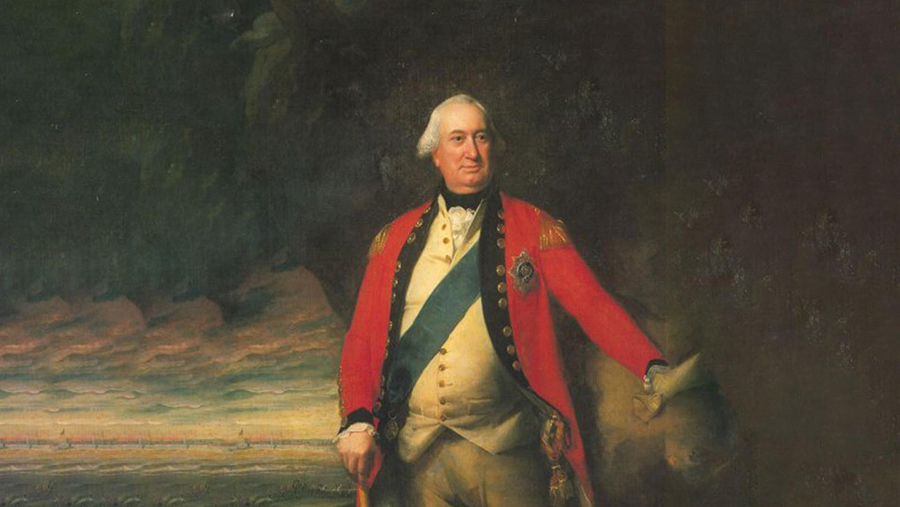
When Lord Gen. Charles Cornwallis, commander of the British Army in the South, invaded North Carolina in September 1780, it marked the end of nearly 4½ years of relative peace in the state. Patriots (also referred to as “Whigs”), whose control had been mostly unchallenged since the early days of the war, suddenly faced potential loss of their lives, property, and their Whig-led state government. Triggered by the theft of a young woman’s bolt of brown cloth, the hostilities would also come to the Sandhills, culminating in a series of attacks and counterattacks marked by grisly and unspeakable cruelty.

Anguished Tarheel Patriots initially feared Cornwallis’ army was unstoppable. The British had subdued Patriot opposition in neighboring South Carolina with relative ease. Lord Henry Clinton, overall commander of the British forces in America, had occupied Charles Town (Charleston) in May 1780 following a seven-week siege of the city. Clinton’s hostile seizure resulted in the capture of 5,000 Patriot soldiers, including many North Carolinians. Three months later, Cornwallis scored a major victory at the Battle of Camden (South Carolina), routing Continental troops mismanaged by Gen. Horatio Gates.

Flushed with confidence, Cornwallis thought it unlikely he would encounter significant Patriot resistance in North Carolina and, in fact, anticipated that thousands of Loyalists, mostly transplanted Scottish Highlanders, would be joining the British in the fight.

North Carolina’s Loyalists (also called Tories) had been laying low since February 1776. That was when a newly formed regiment of kilted Highlanders were crushed in a deadly encounter with Patriot militia at Moore’s Creek Bridge near Wilmington. In their ill-fated charge across the bridge, the Highlanders were greeted with devastating gunfire that nearly obliterated their regiment.

As a result, the Patriots ruled supreme in North Carolina for the ensuing 4½ years. British Royal Gov. Josiah Martin was forced to flee to a Royal Navy ship off the coast. The state’s chastened Loyalists were subjected to a plethora of reprisals: burning of homes, confiscation of property and imprisonment.

Traditionally, the Highlanders had been blood enemies of the Crown, particularly after their clans were annihilated by the English in the 1746 Battle of Culloden in Scotland. The aftermath of that debacle led to the Clearances, in which Highlander clans were unceremoniously uprooted from their ancestral homes.

Several factors were involved in the Highlanders about-face. Most had taken oaths of allegiance to the king as a condition of his permitting their emigration to America, and many of the transplants had received generous land grants in return. Remembering their devastating defeat at Culloden, the Highlanders were understandably reluctant to undertake a second, likely doomed, rebellion against what they perceived was the invincible British Army.

Financial considerations also played a role. The majority of Highlanders were entrepreneurs — farmers, millers, timber and turpentine harvesters, merchants — and loathe to disrupt the marketing of their products to England.

The British invasion got off to a promising start. Cornwallis’ advance guard stormed into Charlotte. After a skirmish, his troops drove the defending Patriot militia toward Salisbury. The Crown scored another major victory in early 1781 when British Maj. James Craig occupied Wilmington. Seizure of the seaport secured for the Redcoats a vital supply depot as well as control of the entrance to the Cape Fear River.

Emboldened by the presence of British troops, North Carolina’s Loyalists re-emerged as a fighting force. British Maj. Patrick Ferguson recruited over 1,000 of them. They joined a militia that protected Cornwallis’ left flank. Ferguson warned settlers west of the Blue Ridge not to resist his troops or else he would “march his army over the mountains, hang their leaders, and lay their country to waste with fire and sword.”

As Cornwallis had predicted, violent Loyalist uprisings started springing up in the state. A notable example occurred in Anson County, near present day Wadesboro, where the commandant of the Anson County Regiment, Col. Thomas Wade, and his brother-in-law Patrick Boggan were victimized by Tory retribution. Wade’s house was burned; the Tories confiscated his crops and personal property. 

Fearful for their lives, Wade, Boggan and other members of the Anson County Regiment packed their wagons and fled with their families to the Neuse River, near the Pamlico Sound, an area relatively free of Tories.

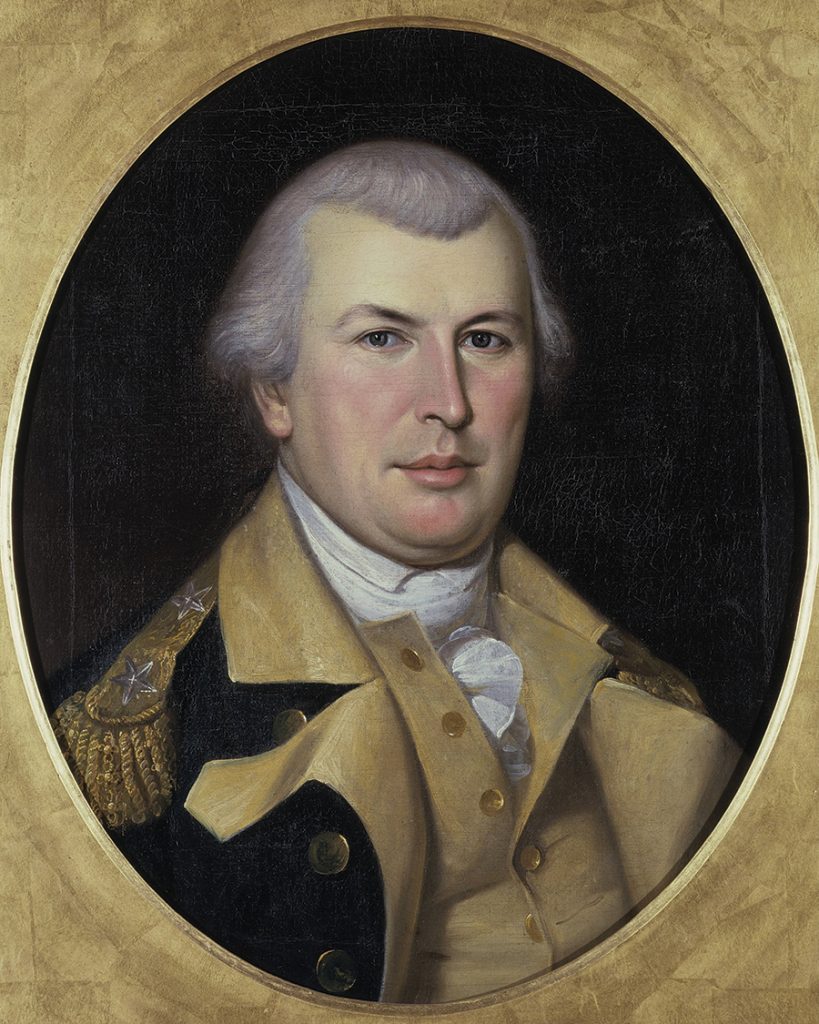
Gen. Nathanael Greene

The triumphant victory Cornwallis envisioned would stall due to unexpected setbacks elsewhere. Mountain frontiersmen (tagged the “Overmountain Men”), infuriated by Maj. Ferguson’s threats, teamed up with Patriot militia to rout Ferguson’s Loyalists in the Battle of Kings Mountain on Oct. 7, 1780. The major was killed in the clash.

Another blow to Cornwallis’ southern strategy occurred in December 1780, when George Washington appointed Gen. Nathanael Greene to replace Gates as southern commander of the Continental Army. Greene brought to the post new energy, resilience and resourcefulness, notably absent under Gates’ leadership. He adopted a strategy of frustrating the enemy, wearing it down by attrition, rather than risking all in a decisive battle. “We fight, get beat, rise, and fight again,” he wrote Washington.

Then on Jan. 17, 1781, a wing of Greene’s Continental Army, led by Brig. Gen. Daniel Morgan, and accompanied by Patriot militia, defeated British and Loyalist troops at the Battle of Cowpens in South Carolina. Morgan’s triumph resulted in the capture of over 500 enemy combatants. With prisoners in tow, Morgan headed north toward Salisbury, to link up with Greene.

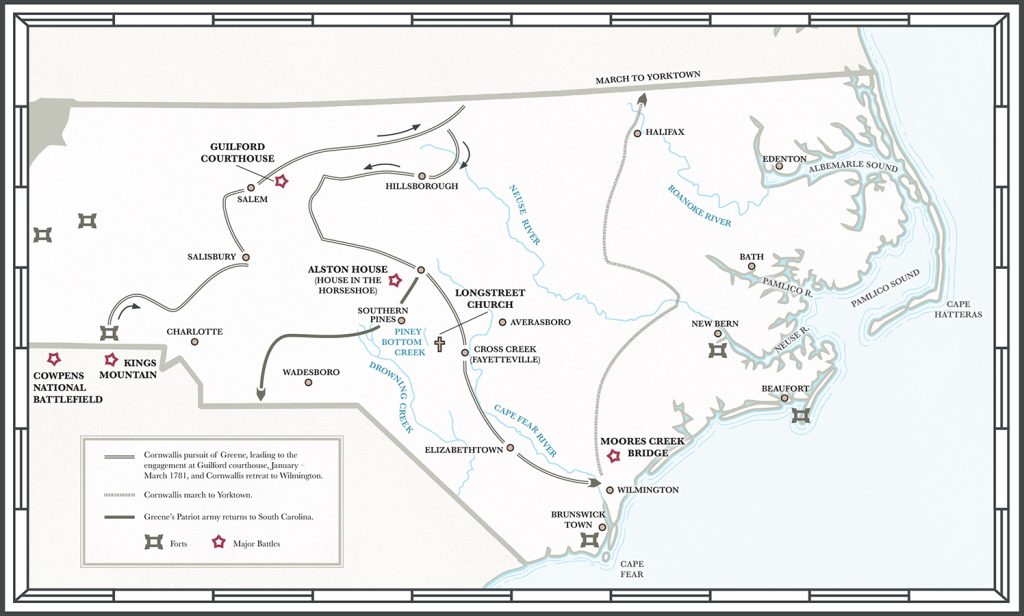
Given the unforeseen depletion of his army, Cornwallis deemed it critical to free Morgan’s prisoners and restore them to his own ranks. The general gave chase, hoping to destroy Morgan’s force before it could join Greene. To expedite his pursuit, he ordered the jettisoning of his army’s excess supplies, including, to the soldiers’ dismay, their rations of brandy. But the elusive Morgan escaped Redcoat clutches, successfully linking up with Greene in Salisbury.

Undaunted, Cornwallis continued to stalk Greene’s reunited army, looking to force a battle before it crossed the Dan River into Virginia. Again, Cornwallis came up short. Greene successfully eluded the British, winning the so-called “Race to the Dan.” When he crossed the river into Virginia, 600 Commonwealth militiamen joined his ranks.

Thus reinforced, Greene crossed back over the Dan into North Carolina. His combined forces now outnumbered those of Cornwallis 2-to-1. The savvy Greene was at last ready to meet the British in a pitched battle.

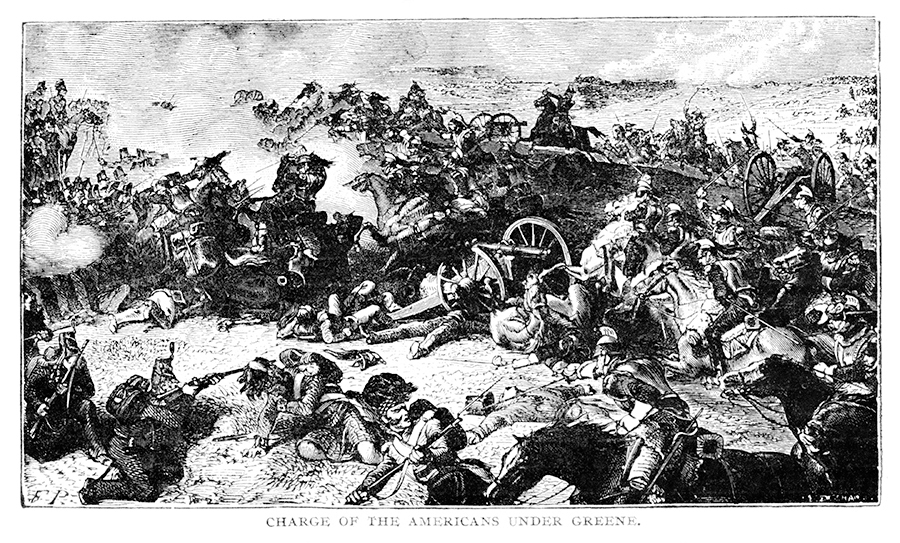
Cornwallis met Greene head-on. The Battle of Guilford Court House near Greensboro on March 15, 1781 was described by author Phillips Russell as the “grimmest ever fought on North Carolina soil.” In his book North Carolina in the Revolutionary War, Russell suggests that the Ides of March confrontation became “a determining factor in the outcome of the American war for independence. . . . It was critical in every aspect.”

While Greene’s soldiers were ultimately driven from the field, Guilford Court House was, at best, a Pyrrhic victory for Cornwallis. His men suffered heavy casualties: 500 killed and wounded — almost a quarter of his remaining army. Many of the general’s best officers were lost, and he himself was wounded. Furthermore, the remaining Redcoats were exhausted and famished, due in part to their commander’s questionable decision to ditch supplies.

To replenish his men, Cornwallis marched them toward Cross Creek (present day Fayetteville), a Loyalist stronghold that supposedly housed a storage facility laden with British supplies. En route the army trekked through Pittsboro and across the Little River. Cornwallis spent one night at a home located at what later became Fort Bragg. When he arrived at Cross Creek, the general found that Patriot supporters had emptied the warehouse. To feed his increasingly desperate soldiers, Cornwallis had no choice but to lead them on to Wilmington, still controlled by the Crown. The bedraggled Redcoats finally arrived at the port on April 7, 1781.

Cornwallis had had enough of the Carolinas. In a communication with Clinton, the general recommended the war be fought elsewhere. “Until Virgina is in a manner subdued,” he claimed, “our hold of the Carolinas must be difficult if not precarious. The rivers in Virginia are advantageous to an invading army. But North Carolina is, of all provinces in America, the most difficult to attack . . . ” 

After a two-week rest, Cornwallis marched his reinforced army north to Virginia. When he exited North Carolina, the British no longer posed a significant threat to Whigs in the state’s interior, though a residual force led by Maj. Craig still controlled Wilmington and the surrounding coastal areas.

Cornwallis’ departure was demoralizing to North Carolina Loyalists. They generally viewed his campaign in the state as a failure that had reinvigorated the Patriots’ quest for independence.

But one vengeful Tory leader was undeterred. During the summer of 1781, wily David Fanning led several spectacular raids. His militia captured 53 prisoners at the Chatham County Courthouse in Pittsboro and forced the surrender of Philip Alston’s Whig militia at the House in the Horseshoe in Moore County. He even kidnapped Whig Gov. Thomas Burke in Hillsborough.

With the British Army gone and Loyalist fervor somewhat cowed, Thomas Wade and Patrick Boggan figured it would be relatively safe for their families and militiamen to pack up their wagons and head home to Anson County, 150 miles from their Neuse River hideout. Yes, they would be passing through Tory-dominated areas, but with Cornwallis gone, weren’t Loyalists going to retreat into the shadows again? If Fanning’s militia remained a threat, the seemingly omnipresent Tory couldn’t be everywhere at once, could he?

As a precaution, Wade sent the women and children off first with just a couple of his militiamen to guard them, figuring the innocents wouldn’t be harmed by Loyalists. In addition, the Anson County men, along with Capt. Culp from South Carolina, started their own journey home, crossing the Cape Fear River at present day Averasboro  (Hartnett County), where they camped. That night, a few of Wade’s men, off on a personal frolic, raided the home of John McDaniel, a Loyalist who employed a young orphan girl, Marren McDaniel, as a servant. Marren had spun enough rough brown cloth to make a dress, but Wade’s men pilfered the coarse cloth from the loom while the shocked girl stood by. When McDaniel’s Highlander neighbors heard what had happened, their reaction was outrage. They deemed the militiaman’s callous treatment of the defenseless girl as a crime almost worse than house burning. Revenge was suddenly in the air. Wade’s militia would have to pay!

“Cunning John” McNeill stepped forward to play a key role in the Highlander’s response to the pillaging of the poor girl’s cloth. He was one of six sons of Jennie Bahn McNeill, a crafty businesswoman active in selling cattle. When Jennie saw the Revolution brewing, she hedged her bets, insisting that three of her sons (including John) support the Tories while her remaining sons aligned with the Patriots. The gambit enabled Jennie to market cattle to both camps.

However, John’s allegiance to the Tories was no ruse. After the raid of McDaniel’s home, he urged his neighbors to gather at midnight the following day at the Longstreet Church, a log cabin structure in Argyll — a small community of Scottish-born settlers that would ultimately vanish after being incorporated into Fort Bragg, 137 years later.

On the morning of the meeting, Cunning John rode his horse 25 miles to the eastern side of Fayetteville, where he visited Ebenezer Fulsome, a patriotic Whig. Fulsome would later confirm McNeill did not commence his ride back home until around sundown. Cunning John had established a plausible alibi (which later proved useful) regarding his whereabouts during the night.

According to Malcolm Fowler’s book, Valley of the Scots, McNeill, presumably galloping his mount to near exhaustion, did make it from Fayetteville to the meeting at Longstreet Church around 1 a.m. Those he had summoned, bearing Scottish surnames like McDougald, McKay, McLeod, Blue, Black, Monroe, Ferguson and Patterson, had waited anxiously to hear what McNeill had in mind.

The plan was simple: attack Colonel Wade’s sleeping camp an hour before daylight and kill as many members of his militia as possible. Cunning John knew where the Anson County men were likely to be bivouacked — the old campground at Piney Bottom Creek (located within Fort Bragg, 7 miles east of today’s Southern Pines).

Local historian and 20-year U.S. Army veteran Matt Mutarelli has diligently studied the events that unfolded at Piney Bottom and makes presentations locally regarding them. His military service includes a lengthy stint in Special Operations, and he speaks with authority when he commends Cunning John’s foresight in figuring out where Wade would be setting up camp.

“From a military perspective,” says Mutarelli, “McNeill executed a superb job of predictive and terrain analyses. He took into account Wade’s likely path home, his rate of travel, prevailing weather and available resources.” McNeill also proved himself an excellent networker. In the course of a single day, Cunning John assembled 200 to 300 Tories, many of them hailing from far corners of Moore County.

When the conclave at Longstreet Church was over, the assembled Highlanders faced a 10-mile nighttime ride through the woods to Piney Bottom. As they mounted their horses at the church, their scheduled attack was a mere five hours away.

Just before daybreak, the Highlanders came within earshot of Wade’s camp at Piney Bottom. A sentry hailed them, but the attackers remained silent. The lack of response prompted Wade’s sentry to fire. One of the Highlanders, Duncan McCallum, shot back. The attack was on.

There are varying accounts of what followed; the one closest in time to the incident was authored by Rev. E. W. Caruthers in 1854. In his book Revolutionary Incidents and Sketches of Character, he writes, “Then (the Highlanders) rushed upon the sleeping company just as they were roused by the fire of the sentinel’s gun, and shot down five or six of them but the rest (save one) escaped leaving  everything behind them.”

Unfortunately, a young boy accompanying Wade’s militia was slow to awaken and was trapped inside his wagon as the Highlanders approached. The youngster’s name is unknown, nor is it reported how he happened to be accompanying the Anson County militia. Caruthers describes the boy as “motherless” and a “protege” of Col. Wade, who had grown fond of him. The author describes what happened next in gruesome detail.

The lad, “before he was fully awake, cried out, ‘Parole me! Parole me!’ Duncan Ferguson, a renegade deserter from the American Army, told him to come out and he would parole him. He came out and dropped to his knees, begging for his life, but seeing Ferguson approaching him in a threatening manner, he jumped up and ran. Ferguson took after him and Col. McDougal after Ferguson, threatening him that if he touched the boy he would cut him down. Ferguson still ran on, however, until he overtook the boy, and then with his broadsword split his head wide open so that half of it fell on one shoulder and the other half on the other shoulder.”

Following the grisly murder, the assailants plundered the wagons, then proceeded to burn them. Had the Highlanders retained the wagons, there was a possibility observant Patriots would later recognize them as Wade’s, and thus link those who possessed them to the “Massacre at Piney Bottom.” The raiders did carry off the charred iron traces of the wagons, a fact one Sandhills man would come to regret.

On his way home, McNeill visited his friend, the aforementioned Loyalist John McDaniel, and bragged about what had occurred at Piney Bottom. In the course of regaling McDaniel, Cunning John brandished a trophy — the notorious piece of brown woven cloth. When Marren McDaniel, standing nearby, saw her cloth, she immediately claimed it. As Caruthers noted, “This was perhaps the only good which resulted from that tragical affair.”

It appears most of Wade’s militiamen were able to fetch their horses to assist their narrow escape. The following morning, Capt. Culp, riding his horse bareback, appeared at the home of an aged Tory named McLean, who lent the captain a saddle. Wade, Boggan, Culp and the remaining regiment members eventually made it back to Anson County, about 55 miles from Piney Bottom.

Continental Army General Nathanael Greene led critical Revolutionary War battles in the Carolinas.

If McNeill and his band assumed Col. Wade would not retaliate, they were wrong. Caruthers writes, “As soon as Wade and Culp reached home, they collected about one hundred dragoons, or mounted men, under Captain Bogan, and they all came down swearing never to return until they had avenged the death of that murdered boy, who seems to have been a favorite of Wade and, in fact, all that knew him.” The revenge-minded Anson County Patriots then headed to the Sandhills. 

Their first destination was the home of Daniel Patterson, an elderly gent known as “the Piper.” He resided adjacent to Drowning Creek near its west bank (thus in Richmond County — the creek would eventually serve as Richmond County’s border with Moore County). It is doubtful Patterson was at Piney Bottom, but Wade believed he would know who was. According to Caruthers, Wade’s militiamen “caught the old man and whipped him until he gave up the names of all who were at Piney Bottom.”

The Patriots crossed over Drowning Creek to the Moore County side, where they paid a visit to the home of Kenneth Clarke. There they found Alexander McLeod, whom they tied up, pinioning his arms behind his back. Alexander’s 11-year-old brother John was placed under guard.

The militiamen then came upon a small field where five men were making “potato hills.” According to Caruthers, two of them, Daniel McMillan and Duncan Currie, were known “accomplices in the massacre.” But the other three, John Clark, Allen McSweene and “an Irishman who was a British deserter and wore a red coat,” apparently had no involvement aside from knowing McMillan and Currie.

But by this time, Wade’s men were past the point of caring whether their captives had participated in the massacre personally or not. All five men were gathered up and taken to Kenneth Clarke’s home, where they were kept under guard.

Since they had not been immediately put to death, the Highlander captives had hopes of surviving their awful plight. Just before sunset, their chances took a turn for the worse when Capt. Patrick Boggan and his Light Horse Company appeared on the scene. They were all enraged, partly due, says Caruthers, to intoxication. Boggan had the prisoners removed from the house, then ordered they be put to death by sword in the same manner as Wade’s young protege at Piney Bottom.

The initial object of Boggan’s wrath was Alexander McLeod. Several of the militiamen, while on horseback, beat McLeod over the head with their swords. With his raised arms absorbing most of the blows, Alexander temporarily avoided fatal injury. When the other terrified prisoners observed Alexander’s plight, they ran. With his captors momentarily distracted, Alexander also tried to escape, only to be shot dead. John Clarke, Currie and McMillan were likewise mowed down by gunfire. 

Despite having both hands tied behind him, McSweene sought to make a getaway. “With a last, desperate, almost preternatural effort to save his life,” writes Caruthers, “he leaped a pretty high staked and ridered fence which was round the house.” Though bullet-ridden, McSweene somehow continued running for another quarter-mile before he fell. His tormenters finished him off by splitting open his head. Youngster John McLeod and elderly Kenneth Clarke were spared, though Clarke was told to bury all his compatriots’ corpses by the next morning or he too would be killed.

The Anson County Patriots’ bloodlust was far from sated. On the Sabbath, they arrived at the farm of David Buchan, located where Pinehurst’s half-mile harness racing track is today. Fortunately for Buchan, he was not at home. When the militiamen found charred harness chains at the farm, they viewed it as clear proof they were from Wade’s burned wagons at Piney Bottom. Buchan’s home was set afire as retaliation.

Next, the avengers rode to the farm of another Loyalist, Kenneth Black. It was located where the Morganton Park South shopping area in Southern Pines is today. The Black family cemetery still exists on the property. When Kenneth and his son saw the incensed Patriots approach, they hid a distance from the farmhouse, but Capt. Culp caught sight of them and forced the two men into the house. Culp and several of his men rode their horses inside and herded the Black family into the fireplace.

Female relatives of Scottish heroine Flora McDonald arrived at the Blacks’ home while Culp and his men ransacked the place. A quarter-century before, Flora had gained fame by aiding Bonnie Prince Charlie’s escape from British capture after he led Scottish clansmen to their crushing defeat at Culloden. Ironically, Flora was now allied with the Loyalists, having married a British officer with whom she moved to America. She resided at a home 4 miles away provided by Kenneth Black.

The visiting McDonald females were checking up on Black family members who had recently contracted smallpox. Culp and his men “took the gold rings from their fingers and the silk handkerchiefs from their necks,” says Caruthers. “Then, putting their swords into their bosom, split down their silk dresses and, taking them out into the yard, stripped them of all their outer clothing.”

Standing off to the side was a detached and melancholy Col. Wade. When Mrs. Black inquired why he was not joining in the plunder, he responded there was nothing he wanted except “my son, my son!” — presumably the motherless boy executed at Piney Bottom.

As the Patriots prepared to leave with blankets, clothing and other seized items, Mrs. Black observed, “Well, you have a bad companion with you — the smallpox!” The trespassers immediately threw everything down and fled on horseback.

Later that day, the Whig militia killed Alexander Black at his farm. Then they came to the house of Peter Blue, who was being visited by his friend Archibald McBride, a Whig. Both were shot; Blue survived, but McBride, guilty only by association, did not.

Though frustrated in his efforts to apprehend John McNeill, Wade and the other Whig militiamen finally left the Sandhills and headed home. Caruthers concludes that the Tories had been taught a brutal, cruel lesson that “would deter them from ever attempting such a thing (as Piney Bottom) again.” 

Meanwhile, the British military campaign in Virginia resulted in an unmitigated disaster. Cornwallis had currently foreseen that events in Virginia would decide the war, but not in the way he intended. In September 1781, an American force led by George Washington, in tandem with French soldiers commanded by Gen. Jean-Baptiste Donatien de Vemeur, comte de Rochambeau, trapped Cornwallis’ army at Yorktown. A French naval blockade precluded any attempt by the British to evacuate, obtain supplies or secure reinforcements. Outwitted and checkmated, Cornwallis surrendered his army on Oct. 19, 1781.

The outcome at Yorktown had rapid ripple effects for the Crown. Maj. Craig evacuated Wilmington the following month. A year later, the British sailed away from Charles Town, ending 2½ years of occupation. David Fanning was on-board ship. The Treaty of Paris, in which King George finally acknowledged American independence, was signed on Sept. 3, 1783.

The war was over, but Thomas Wade was not done with John McNeill, whom he had arrested for his role in the murders at Piney Bottom. But Cunning John’s long-planted alibi would save his skin. Ebenezer Fulsome’s testimony that McNeill was still visiting him in Cumberland County at sundown the evening before the bloodshed convinced the jury that given the distance of travel involved, it was not probable McNeill would have made it to Longstreet Church, let alone Piney Bottom, in time to take part in the massacre. 

It is noteworthy that neither Marren McDaniel nor the man to whom she was indentured, John McDaniel, took the stand. Both could have confirmed Cunning John’s flaunting of Marren’s woven brown cloth, as well as his boasting of how and where he got it. 

Only one small monument, well off the beaten path, deep in the confines of Fort Bragg, commemorates the brutality at Piney Bottom. The site of the massacre was determined by the gun flints unearted in the vicinity. The Revolutionary War was not just a conflict between the British and the Americans; it was also a civil war — especially in North Carolina — in which neighbors killed neighbors over their political differences. In their mutual bloodlust, both sides dispensed with the rule of law and due process. Innocent people were murdered. Violence begat further violence. The big engagements like Yorktown secured the promises of the Declaration of Independence, but it’s worth remembering on America’s 250th that war, at any scale, is gruesome and cruel.

A riveting tour of sites on the reservation that are relevant to the bloody episode can be arranged by contacting Fort Bragg. In addition to the monument, a visitor can view remnants of the original Longstreet Church, where the Tories planned their pre-dawn attack. Nearby is the still standing successor Longstreet Church, erected in 1845. The newer church is adjacent to an ancient Presbyterian graveyard, where many of the old Highlanders are buried. Fort Bragg’s Cultural Resource team has also unearthed evidence establishing the site of the home where Cornwallis lodged during his army’s April 1781 march to Wilmington.

To arrange a tour, call Fort Bragg’s Cultural Resources Management Program at (910) 396-6680.

Going to Extremes

GOING TO EXTREMES

Going to Extremes

Of moths and men and tobacco

Story and Photographs By Todd Pusser

“I remember my grandfather pretending to bite their heads off,” recounts lifelong Eagle Springs resident Tim Martin with a laugh. “In all actuality, he was just pinching their heads with his fingers. But he sure made it look realistic, especially when that green goo poured out.”

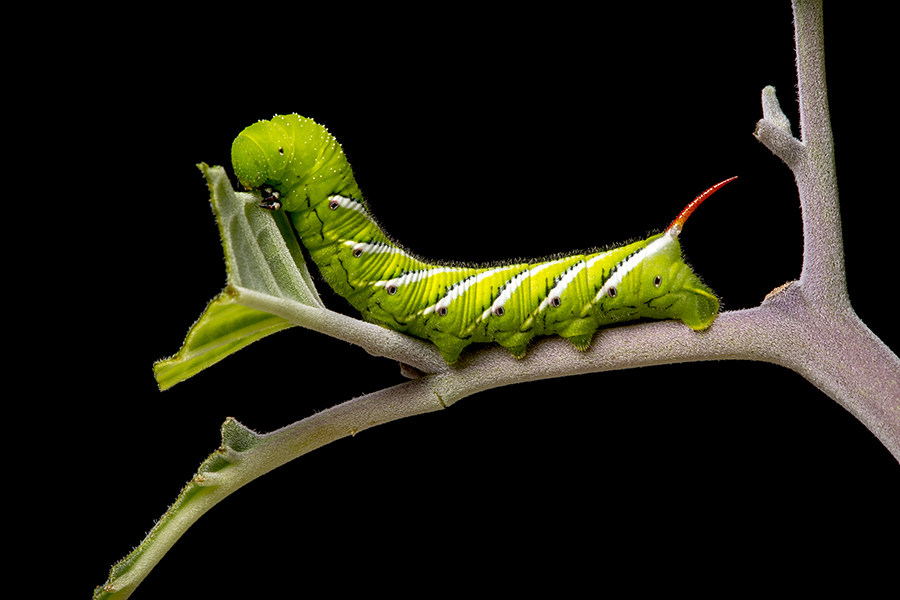
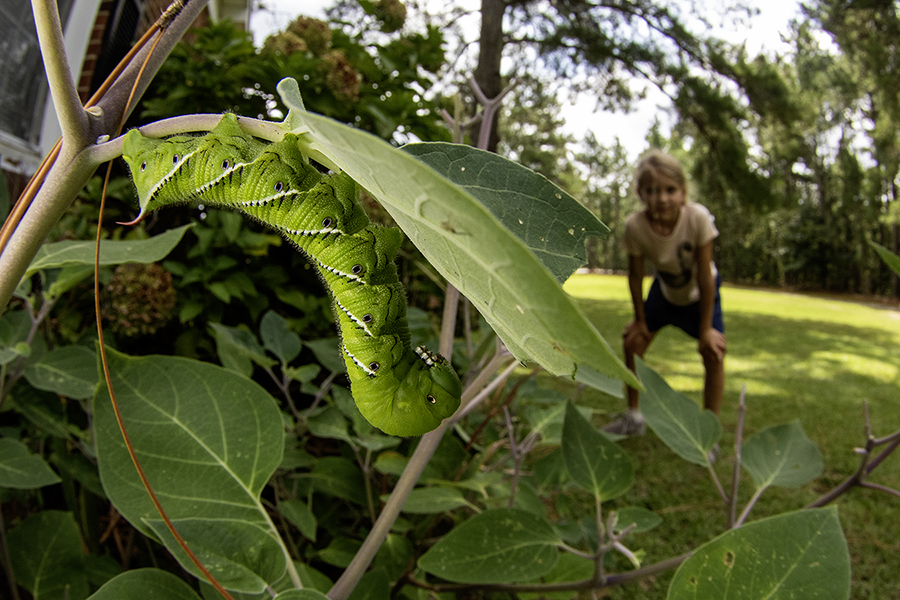
Martin is 65 years old and speaks with a soft, earnest drawl, as he reminisces with fond nostalgia and a strong sense of pride about his childhood working his grandfather’s 100-acre tobacco farm. Pulling hornworms off the broad-veined leaves of tobacco plants, in dusty fields during the heat of summer, was once a rite of passage for kids like Martin. The finger-length, bright green caterpillars, with race car-white stripes on their sides, and tall protuberances that stick up from their hind ends (giving them their name), are notorious pests of tobacco. With voracious appetites that would make Eric Carle — author of The Very Hungry Caterpillar — proud, a handful of hornworm caterpillars could decimate the valuable leaves of a tobacco plant in short order.

For decades, North Carolina led the world in the production of tobacco, its signature crop. In its heyday, the state produced as much as a billion pounds of the leaf per year. Talk to any old-timer born and raised in the Sandhills and chances are good they worked the local tobacco fields as a kid, either on a family farm or one that met the tobacco quota set by the U.S. government. The quota system, established by federal law in 1938, strictly controlled the amount of tobacco grown in order to keep prices high for farmers. It was illegal to grow and sell more tobacco than the quota.

Farming tobacco was very much a community affair. “Neighbors helped neighbors,” says Martin. Planting, pruning, priming, pulling and drying tobacco leaves instilled a deep love for the land as well as a strong work ethic. That work was frequently grueling and often started well before the crack of dawn. “My brother Mike was the only one of us four siblings old enough to drive,” remembers Martin. “We would get up and leave Eagle Springs in the dark in his 1960 Dodge Coronet and drive 100 mph down Hoffman Road to reach my grandfather’s farm by sunrise.”

Martin chuckles. “My mother would have had a fit.”

Walking the long rows of tobacco, back and forth, over and over, under the intense summer sun, with hands covered in sticky sap from pulling sucker shoots off the tall green stalks, was not for the faint of heart — nor was grappling with sausage-sized caterpillars. Throughout my childhood I heard stories about hornworms and tobacco from my father. He, too, had worked the local tobacco fields as a kid, as did my mom. So did their siblings. And their friends. It seemed everyone I knew of a certain age had worked in tobacco at some point in their youth, and all had a hornworm story. For a nature-obsessed kid, the thought of giant, squishy caterpillars devouring entire fields of tobacco sparked the imagination.

Hornworms are the caterpillars of sphinx moths, a family of mostly large moths that are well-known for rapidly flapping their wings back and forth while hovering in front of flowers. Approximately 1,400 species of sphinx moths are found across the globe, with 46 species having been recorded in North Carolina. Most species are nocturnal, but a few fly about during the day. Perhaps you’ve seen a hummingbird moth, hovering around a flower garden like its feathered namesake. Hummingbird moths are, in fact, a type of sphinx moth.

Catalpa worms, another type of sphinx moth caterpillar with a horn on its butt, feed on the wide green leaves of the catalpa tree. Native to the mountains of North Carolina, catalpa trees were planted throughout the Sandhills for the primary purpose of producing fish bait. My father swears that catalpa worms are the best bass bait around. Dad has no clue how to navigate Google Maps, but he still remembers to this very day, with vivid clarity, the directions to every catalpa tree — at least the ones still standing-around southern Moore County that he visited with his father on weekend fishing excursions over 75 years ago.

Anyone who has tried their hand at growing sun-ripened tomatoes is well acquainted with hornworms. As it turns out, tomatoes are in the nightshade family Solanaceae, just like tobacco. The seemingly vastly different plants attract two of the most notorious sphinx moth caterpillars, the tomato hornworm and the tobacco hornworm. The bane of backyard gardeners everywhere, these two caterpillars are lookalikes. It takes a trained eye to distinguish between the two. Tomato hornworms have eight L-shaped white stripes on their sides. Their characteristic horn is colored black. Tobacco hornworms, on the other hand, possess seven straight white stripes on their sides, each edged in black. Their horns are bright red, like embers in a fire. Despite their large size, hornworms can be surprisingly difficult to see on their host plants. Their green and white coloration acts as perfect camouflage against would-be predators.

Recently, I challenged my 7-year-old daughter, Ella, to a contest of who could spot the most hornworms on a Datura growing in Grandma’s flower garden. Known by many common names, such as Angel’s trumpet or moon flower, Datura is another member of the nightshade family, and is a magnet for both tomato and tobacco hornworms. One reason kids were tasked with worming tobacco back in the day was that they were closer to the ground than adults. Logic dictated that they could see up under the tobacco leaves more easily, and hence, were better at locating those pesky hornworms. With my daughter standing by my side, I decided to put that theory to the test.

One hot June afternoon, we took up positions on either side of the Datura. On a count of three, we stared intently at the plant to see who could find the most hornworms. After a few minutes of closely examining the bright white flowers and light green foliage, I managed to find just three tobacco hornworms. Ella found 10.

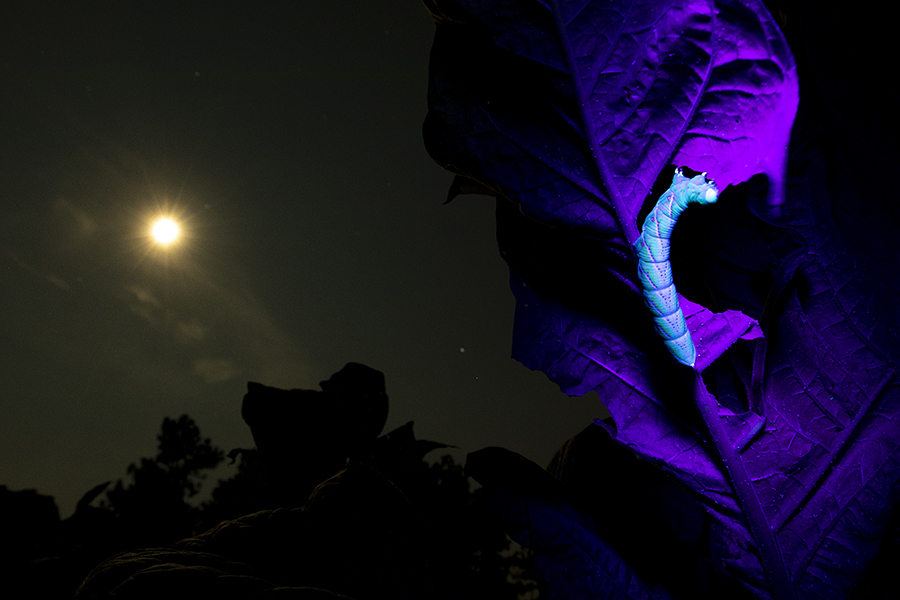
That night, after Ella had fallen asleep, I ventured back out into the flower garden with an ultraviolet flashlight in hand. Hornworms fluoresce brightly under ultraviolet light. Shining the flashlight onto the Datura, I counted nearly two dozen hornworms of various sizes, glowing like Christmas tree lights among the leaves — far more than Ella and I had observed earlier in the day. It was a testament to their superb camouflage. “For every bucket of hornworms pulled off tobacco there were probably five others still on the plants,” says Martin.

A 1964 groundbreaking study linking cigarette smoking to lung cancer and heart disease was the beginning of the end for many tobacco farmers across North Carolina. In the decades and lawsuits that followed, tobacco’s public image suffered. Then, in 2004, the government ended the tobacco quota system that had supported high tobacco prices, forcing many farmers to grow other crops or leave the industry altogether. Though North Carolina still leads the nation in tobacco production, it has now been surpassed on the global scale by China. Still, tobacco remains one of the state’s most important cash crops. Drive the backroads of the Sandhills this time of year and you will still see acres and acres of the broad-leaved plants standing tall in the sun.

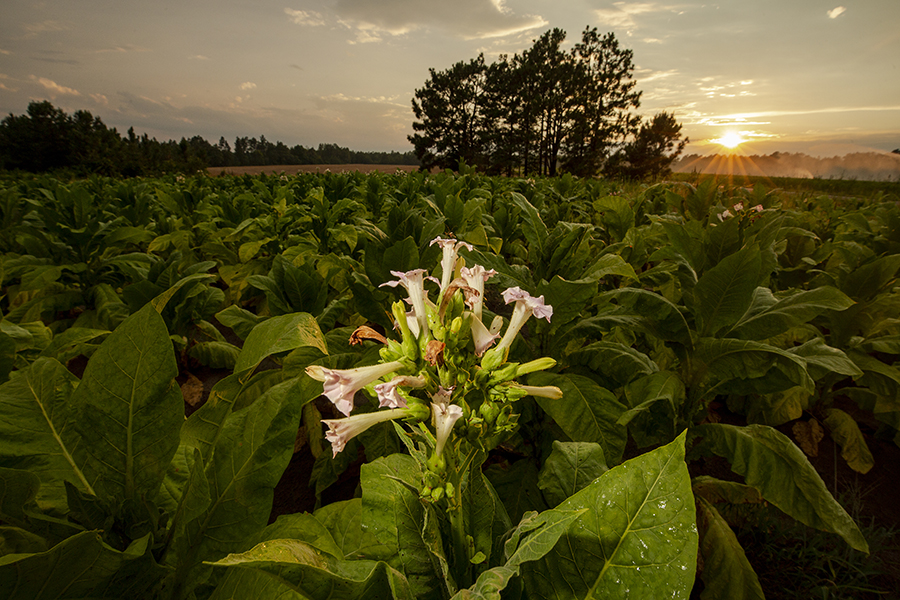
A couple of years back, while driving to visit my family in Eagle Springs, I found a vast field of tobacco that had yet to be topped, not far from my childhood home. Hundreds of white blossoms, sitting high atop the green stalks, swayed gently in the summer breeze. Topping tobacco is an agricultural technique that removes the crown of flowers from the top of the stalk so that the plant redirects its nutrients into producing larger and thicker leaves, thereby increasing its value for the farmer. Like blood in the water for sharks, I figured that all the nectar-rich flowers would attract sphinx moths, and I decided to stand out in the field that evening to try my hand at photographing them.

Despite all its controversies and poor public image, tobacco is one beautiful plant, with its wide, floppy green leaves and crown of pink and white blossoms. There are roughly 70 species of wild tobacco in the genus Nicotiana found across the globe. The species that is grown commercially in North Carolina, commonly called brightleaf tobacco, is known as Nicotiana tobacum. Native to the Neotropics, it was traded throughout the Americas by indigenous peoples. When the first European Colonists settled in Jamestown, they found the local Native American tribes cultivating and smoking the plant for medicinal and spiritual purposes. By the end of the 17th century, tobacco had become the economic staple of Virginia, making the region the wealthiest of the country’s original 13 Colonies at the time of the American Revolution.

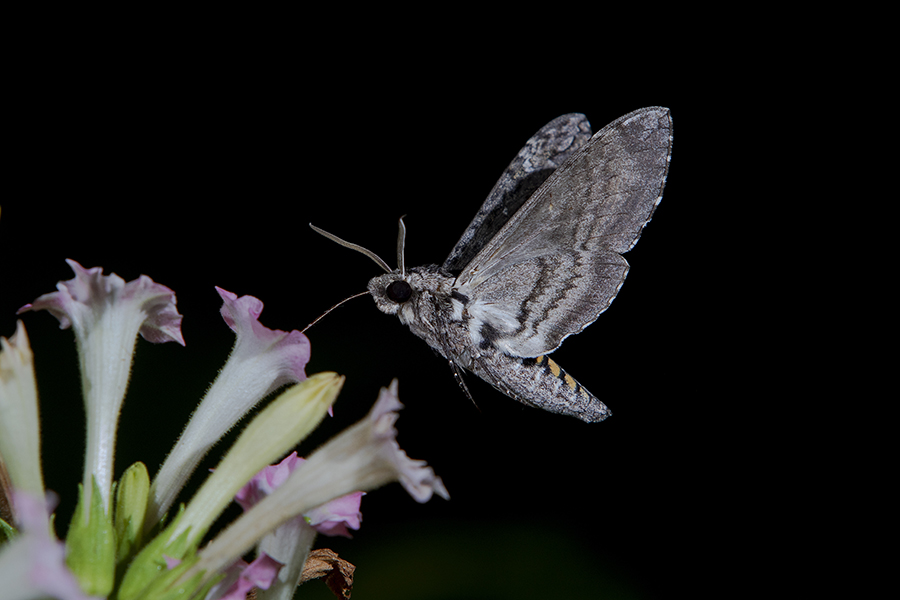
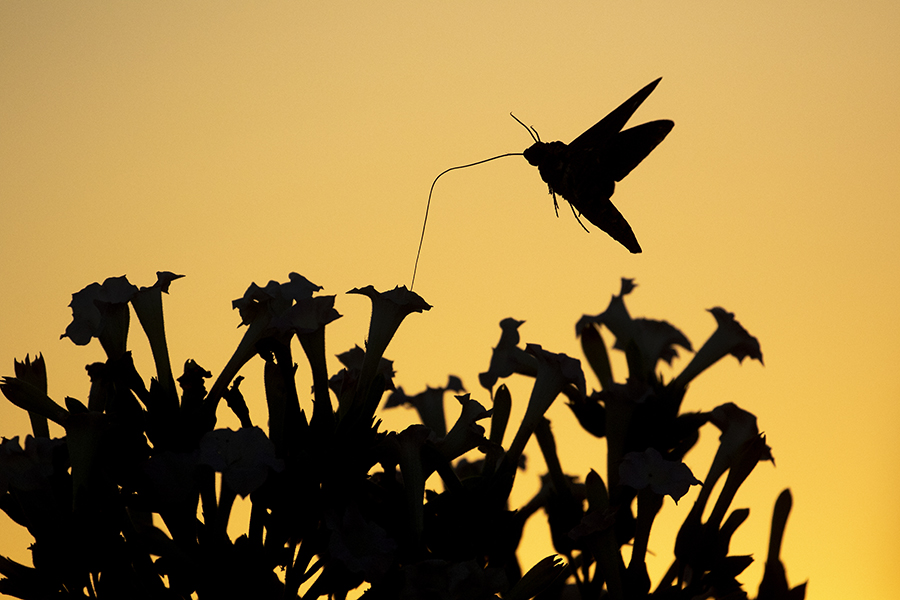
Arriving to the field a half hour before the sunset, I was immediately greeted by the sight of several dozen sphinx moths hovering around the tobacco blossoms like nocturnal hummingbirds. The scent of sweet perfume hung heavy in the air. Unlike the bitter acrid smell of cigarette smoke, tobacco flowers produce a pleasing aroma reminiscent of jasmine and gardenia. Up and down, side to side, forward and backward, the moths zipped about, unfurling their long tongues and inserting them, with surgical precision, into the tubular flowers to sample the nectar reserves nestled deep within. Beating their wings at over 70 times per second, I could actually hear the moths as they hovered over nearby blossoms.

As the sun dipped out of sight on the far side of the field, on the other side, a full moon rose above the horizon. Under the silvery moonlight, the tobacco flowers practically glowed. It was a magical sight.

Reviewing the images on my camera’s LCD, I identified the moths as Carolina sphinx moths.  With 4-inch wingspans and furry abdomens covered by six pairs of yellow-orange spots, Carolina sphinx moths seem more like small mammals than insects. On many of the photos, I could make out tiny granules of tobacco pollen stuck to their long tongues. Sphinx moths are important pollinators of plants, though they tend to be overlooked when compared with butterflies and bees. The next time you sip your morning brew be sure and thank sphinx moths. On tropical coffee plantations, sphinx moths supplement bee pollination of coffee flowers.

Another important tropical crop, the delicious papaya, is mainly pollinated by sphinx moths. Closer to home, many orchids, lilies, cacti, evening primroses, four o’clocks, petunias and morning glories are all pollinated by sphinx moths. The list goes on and on. As powerful flyers, sphinx moths disperse pollen over long distances, promoting plant outbreeding and genetic diversity. As I like to tell my daughter, they are the superheroes of the insect world.

After spending several hours among the flowering tobacco, I decided to call it a night. A quick scan of the field with my headlamp revealed numerous sphinx moths still frantically sipping nectar with their giant straw-like tongues, beneath the full moon.

I smiled at the wonders so close to home.

True to Its Tradition

TRUE TO ITS TRADITION

True to Its Tradition

Preserving a home’s heart and history

By Hazlette Huskins

Photographs by John Gessner

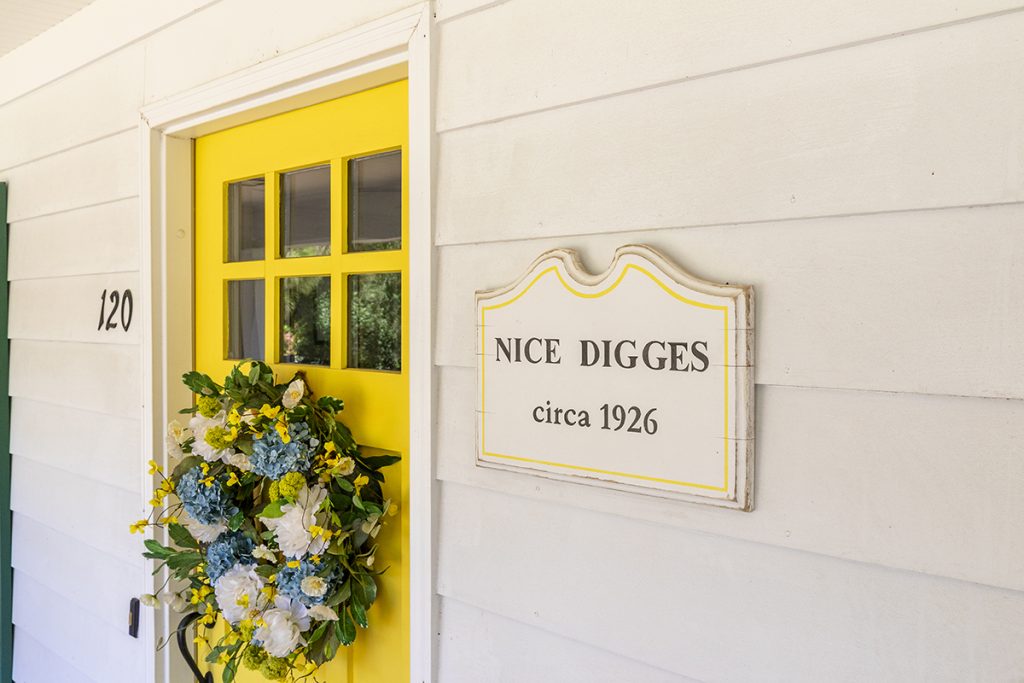
The “Nice Digges” cottage is exactly that. In an era of fast-paced living, retreating to this cottage is like going back to a time when your hometown was your whole world, and that was enough. Built in 1926 in the “community” section of Pinehurst, it was among the workers’ cottages where year-round residents lived, including postal employees, bank tellers, teachers, the Community Church minister and shop owners. Folks walked to work and school on streets named after local families like Everette, Fields, Kelly and Craig.

Van and Julie Mitchell were among the founding members of Forest Creek Golf Club when they purchased land there in 1994. After 10 years of staying in hotels on trips from their home in Southern Maryland, they decided to look for permanent accommodations that would be more comfortable while enjoying time at the club. They reached out to a Realtor friend who knew of a home that had been lightly renovated by a local family. Van came down to look at it the day after it went on the market, immediately made an offer, and the little white cottage on Short Road was theirs.

Once the couple got to know the neighbors and saw how special the block was, they decided to stay in the village full time. Julie credits the village’s National Historic Landmark designation with encouraging preservation through thoughtful restorations of the beloved workers’ cottages. Over the years, the neighborhood has evolved into an eclectic group of new and longtime residents, including folks from Germany, South Africa, Turkey and Australia, who attend the block’s warm weather happy hours they call “neighbor nights.”

Nothing says “welcome” better than the broad, covered front porch with a bespoke rocking chair. Sponsored by the Mitchells as part of the Rock the Village project during the 2024 U.S. Open, it was painted by local artist Vanessa Grebe and includes symbols of their home states of Maryland and North Carolina, along with a portrayal of our area’s most notable passions — golf and horses.

When the Mitchells decided to renovate their cottage in 2010, they felt it was important to keep the traditional Pinehurst look — white exterior, green roof and shutters — and applied for design approval from the Pinehurst Historic Preservation Committee. Van’s career in building supplies helped them clear hurdles along the way. When their builder suggested using easily available gray roof shingles, Van was able to track down the more elusive green ones. Dissatisfied with stock flooring options, he reached out to an old friend at a hardwood flooring manufacturer to get the lumber they knew would be perfect for creating a cohesive look between the old and new rooms downstairs. This attention to detail was carried up to the loft space, where they repurposed the living room’s original pine floorboards. At the top of the steep, winding staircase is a hideaway fit for Peter Pan, where the grandchildren cherish sleepovers in a space all their own.

Van chose a bright Pantone yellow for the front door — a color he had used in his building supply company branding — but it took some convincing to get it approved and included in the historic village color palette. Julie met with the committee and, armed with a folder of research featuring photos of historic homes graced with doors painted the same color in Annapolis, Maryland, and Alexandria, Virginia, the color was approved.

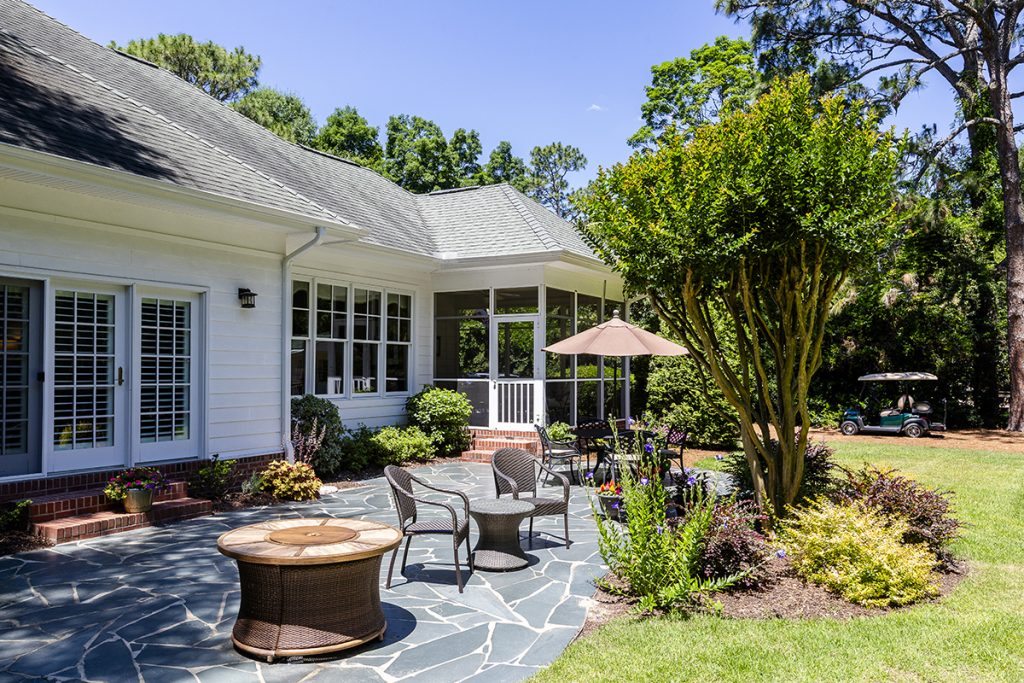
The seamless expansion of the cottage’s footprint belies the thought and care that went into its planning. When they learned the pin oak in the side yard was one of the oldest in the area, the Mitchells planned around it rather than remove it for an addition.

Maintaining the authenticity of the interior of the historic structure was just as important to Julie as the exterior. Subtle changes included extending the living room wall, adding space to the back of the house for a larger kitchen and primary bedroom, and adding a guest suite they call “the red room” to give the family more space for hosting friends and family.

Pinehurst was like a second home to Van long before he owned one there. A lifelong golfer, he has been a frequent visitor to the Sandhills since childhood. When he was 10, he and his father attended the 1974 opening of the World Golf Hall of Fame. He returned as a member of Campbell College’s golf team and later brought friends and colleagues to play Pinehurst No. 2.

On the way back to Maryland from the 1996 Summer Olympics in Atlanta with their two young daughters, Molly and Megan, the family stayed at the Pine Crest Inn. Even then, Van and Julie knew they would eventually retire in Pinehurst. It’s been their full-time home now for five years, and they feel blessed to have their children and grandchildren in North Carolina as well.

When they began thinking of a name for the cottage, one of their daughters suggested using a paternal family name that was the perfect play on words — Digges. Van’s ancestors emigrated in the 1630s from Scotland to Maryland, where his family has been planted for five generations. “Nice Digges” was a natural. Julie has stayed in touch with the former owners — one grew up in the house, and the other is coincidentally from Julie’s hometown of Cranford, New Jersey — and learned the cottage was previously named Welikit (We like it). True to her dedication to preserving the home’s history, she hung a second nameplate over the porch’s screen door to honor its past.

Sitting humbly under the expansive pin oak, Nice Digges proudly turns 100 this year, lovingly prepared for its future.

Poem July 2026

POEM

Fourth of July Night

The little boat at anchor in black water sat murmuring to the tall black sky.

A white sky bomb fizzed on a black line.

A rocket hissed it’s red signature into the west.

Now a shower of Chinese fire alphabets, 

A cry of flower pots broken in flames

A long curve to a purple spray, three violet balloons —

Drips of seaweed tangled in gold, shimmering symbols of mixed numbers,

Tremulous arrangements of cream gold folds of a bride’s wedding gown —

A few sky bombs spoke their pieces, then velvet dark.

The little boat at anchor in black water sat murmuring to the tall black sky. 


— Carl Sandburg


Drips of seaweed tangled in gold, shimmering symbols of mixed numbers,

Birdwatch

BIRDWATCH

Carolina Newcomer

A summer visitor from down south

By Susan Campbell

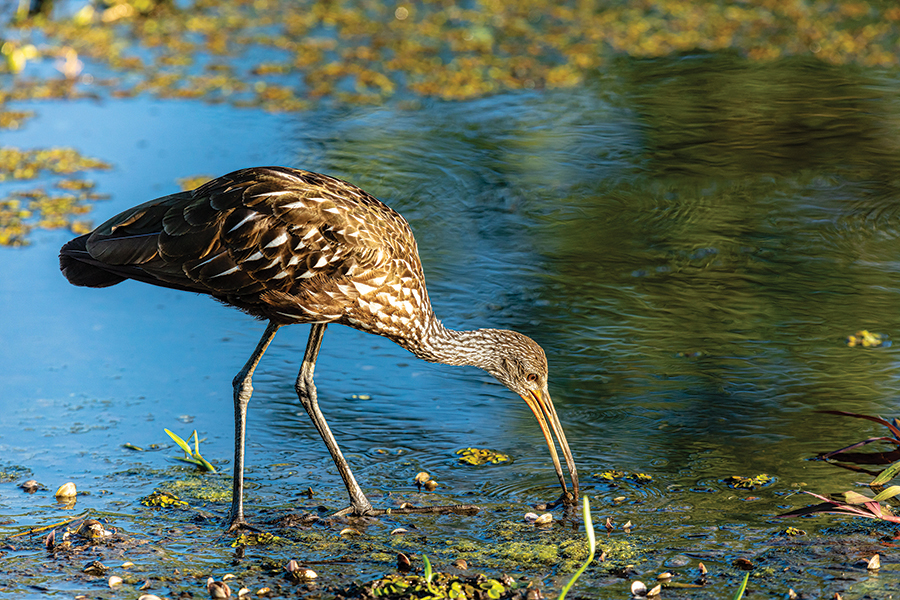
The limpkin is not a familiar bird to many in our area, but this good-sized wader isn’t a complete stranger to North Carolina. Over the years there have been plenty of sightings, and there is a good chance there will be plenty more — so much so that the species may be breeding here before much longer.

Although we hear a lot about birds that are in trouble — those disappearing from their usual haunts as a result of habitat loss, climate change, predation by invasive species, etc. — there are some that are actually becoming more widespread. Slowly but surely, the limpkin is one of these.

Limpkins, native to the subtropical region of the Americas, are wading birds that eat a variety of aquatic invertebrates. They are brown with white spangles and blotches, long legs and, most importantly, a relatively long decurved bill. Appearing a lot like a heron or ibis, they are actually more closely related to rails, those secretive smaller birds found lurking in marshy habitat. Their slightly offset bills are specialized for extracting the bodies of apple snails from their twisty shells, but they are equipped to get into a variety of mussels and clams as well. It is thought that the birds’ name originates from their halting gait as well as an odd running style when pursued.

Here in the U.S., limpkins were once confined to the wetter parts of Florida as well as the coastal marshes of the Gulf Coast states. Over the past few decades, however, they have been spotted farther north in Georgia and southern South Carolina. Given that they now even breed in a few locations “south of the border,” it’s no wonder that individuals have been spotted here in our state. The first was reported along the North Carolina coast (no surprise) in 1975, but in more recent years, they have been found in the Piedmont, too. There have also been a handful of sightings in our western counties. I saw my first N.C. limpkin during the summer of 1998 in a marshy water hazard at a golf course community close to New Bern.

The expansion of this species can be connected to multiple factors. First, invasive mollusks such as Asiatic clams and apple snails have become more abundant in freshwater systems across the Southeast in recent years. That spread of a ready food source, coupled with warmer winters, has provided additional habitat for limpkins. Furthermore, increasingly frequent and prolonged drought within their historic range has resulted in more birds roaming northward in search of the wet habitat they require.

With the summer of 2026 likely to be a dry one in the Southeast, it is very likely some limpkins will arrive here in the weeks ahead. A number of individuals showed up late in the summer of 2023 and persisted well into the fall. If you happen to be out at any of the larger reservoirs, or even along a creek or near a retention pond, keep an eye out — you just might spot one of these unusual creatures on the prowl for a meal or a new summer hangout.