
Going to Extremes
Of moths and men and tobacco
Story and Photographs By Todd Pusser
“I remember my grandfather pretending to bite their heads off,” recounts lifelong Eagle Springs resident Tim Martin with a laugh. “In all actuality, he was just pinching their heads with his fingers. But he sure made it look realistic, especially when that green goo poured out.”
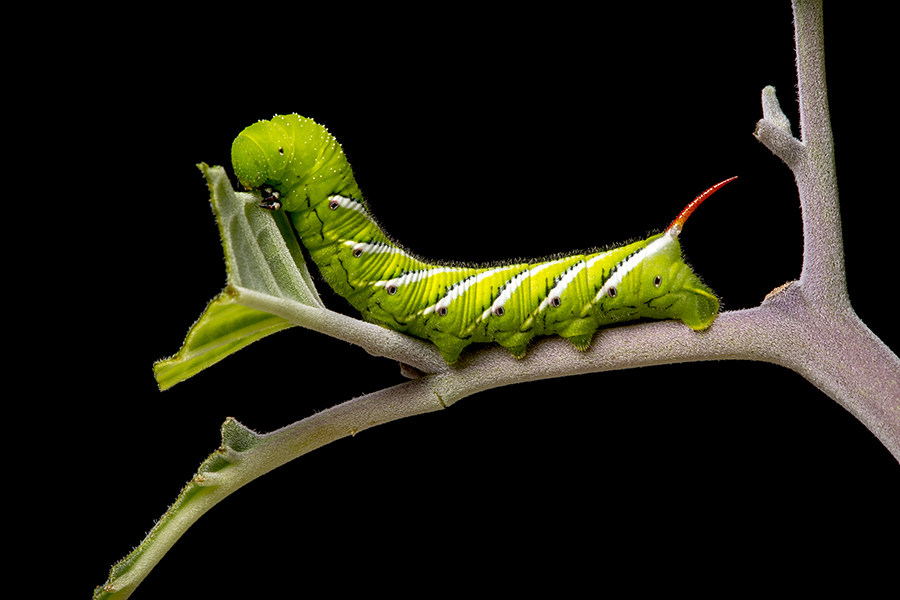
Martin is 65 years old and speaks with a soft, earnest drawl, as he reminisces with fond nostalgia and a strong sense of pride about his childhood working his grandfather’s 100-acre tobacco farm. Pulling hornworms off the broad-veined leaves of tobacco plants, in dusty fields during the heat of summer, was once a rite of passage for kids like Martin. The finger-length, bright green caterpillars, with race car-white stripes on their sides, and tall protuberances that stick up from their hind ends (giving them their name), are notorious pests of tobacco. With voracious appetites that would make Eric Carle — author of The Very Hungry Caterpillar — proud, a handful of hornworm caterpillars could decimate the valuable leaves of a tobacco plant in short order.
For decades, North Carolina led the world in the production of tobacco, its signature crop. In its heyday, the state produced as much as a billion pounds of the leaf per year. Talk to any old-timer born and raised in the Sandhills and chances are good they worked the local tobacco fields as a kid, either on a family farm or one that met the tobacco quota set by the U.S. government. The quota system, established by federal law in 1938, strictly controlled the amount of tobacco grown in order to keep prices high for farmers. It was illegal to grow and sell more tobacco than the quota.
Farming tobacco was very much a community affair. “Neighbors helped neighbors,” says Martin. Planting, pruning, priming, pulling and drying tobacco leaves instilled a deep love for the land as well as a strong work ethic. That work was frequently grueling and often started well before the crack of dawn. “My brother Mike was the only one of us four siblings old enough to drive,” remembers Martin. “We would get up and leave Eagle Springs in the dark in his 1960 Dodge Coronet and drive 100 mph down Hoffman Road to reach my grandfather’s farm by sunrise.”
Martin chuckles. “My mother would have had a fit.”
Walking the long rows of tobacco, back and forth, over and over, under the intense summer sun, with hands covered in sticky sap from pulling sucker shoots off the tall green stalks, was not for the faint of heart — nor was grappling with sausage-sized caterpillars. Throughout my childhood I heard stories about hornworms and tobacco from my father. He, too, had worked the local tobacco fields as a kid, as did my mom. So did their siblings. And their friends. It seemed everyone I knew of a certain age had worked in tobacco at some point in their youth, and all had a hornworm story. For a nature-obsessed kid, the thought of giant, squishy caterpillars devouring entire fields of tobacco sparked the imagination.
Hornworms are the caterpillars of sphinx moths, a family of mostly large moths that are well-known for rapidly flapping their wings back and forth while hovering in front of flowers. Approximately 1,400 species of sphinx moths are found across the globe, with 46 species having been recorded in North Carolina. Most species are nocturnal, but a few fly about during the day. Perhaps you’ve seen a hummingbird moth, hovering around a flower garden like its feathered namesake. Hummingbird moths are, in fact, a type of sphinx moth.
Catalpa worms, another type of sphinx moth caterpillar with a horn on its butt, feed on the wide green leaves of the catalpa tree. Native to the mountains of North Carolina, catalpa trees were planted throughout the Sandhills for the primary purpose of producing fish bait. My father swears that catalpa worms are the best bass bait around. Dad has no clue how to navigate Google Maps, but he still remembers to this very day, with vivid clarity, the directions to every catalpa tree — at least the ones still standing-around southern Moore County that he visited with his father on weekend fishing excursions over 75 years ago.
Anyone who has tried their hand at growing sun-ripened tomatoes is well acquainted with hornworms. As it turns out, tomatoes are in the nightshade family Solanaceae, just like tobacco. The seemingly vastly different plants attract two of the most notorious sphinx moth caterpillars, the tomato hornworm and the tobacco hornworm. The bane of backyard gardeners everywhere, these two caterpillars are lookalikes. It takes a trained eye to distinguish between the two. Tomato hornworms have eight L-shaped white stripes on their sides. Their characteristic horn is colored black. Tobacco hornworms, on the other hand, possess seven straight white stripes on their sides, each edged in black. Their horns are bright red, like embers in a fire. Despite their large size, hornworms can be surprisingly difficult to see on their host plants. Their green and white coloration acts as perfect camouflage against would-be predators.
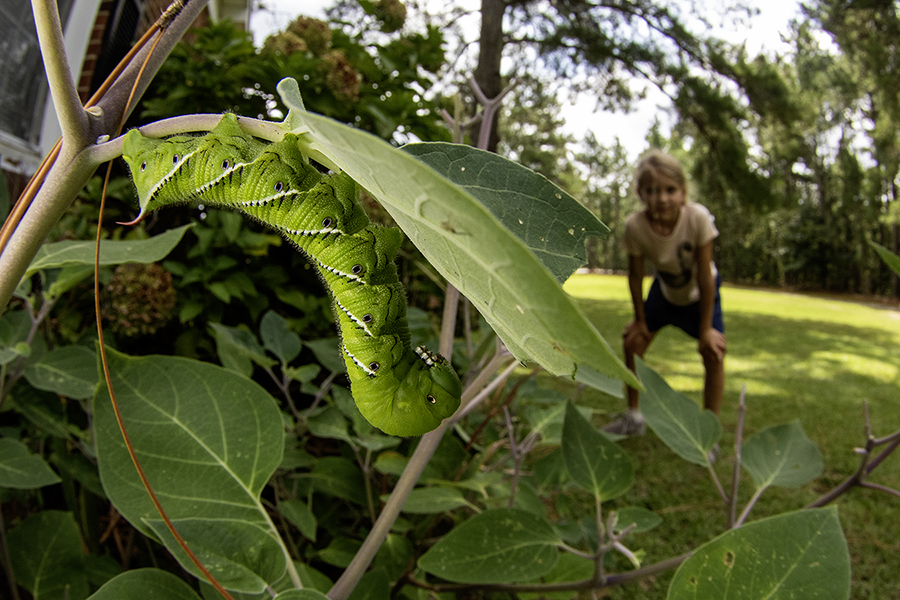
Recently, I challenged my 7-year-old daughter, Ella, to a contest of who could spot the most hornworms on a Datura growing in Grandma’s flower garden. Known by many common names, such as Angel’s trumpet or moon flower, Datura is another member of the nightshade family, and is a magnet for both tomato and tobacco hornworms. One reason kids were tasked with worming tobacco back in the day was that they were closer to the ground than adults. Logic dictated that they could see up under the tobacco leaves more easily, and hence, were better at locating those pesky hornworms. With my daughter standing by my side, I decided to put that theory to the test.
One hot June afternoon, we took up positions on either side of the Datura. On a count of three, we stared intently at the plant to see who could find the most hornworms. After a few minutes of closely examining the bright white flowers and light green foliage, I managed to find just three tobacco hornworms. Ella found 10.
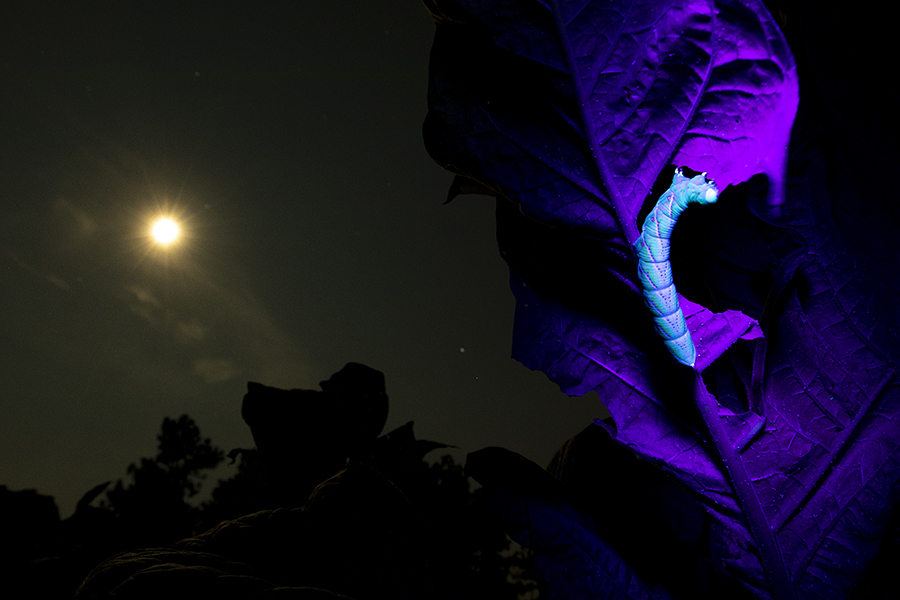
That night, after Ella had fallen asleep, I ventured back out into the flower garden with an ultraviolet flashlight in hand. Hornworms fluoresce brightly under ultraviolet light. Shining the flashlight onto the Datura, I counted nearly two dozen hornworms of various sizes, glowing like Christmas tree lights among the leaves — far more than Ella and I had observed earlier in the day. It was a testament to their superb camouflage. “For every bucket of hornworms pulled off tobacco there were probably five others still on the plants,” says Martin.

A 1964 groundbreaking study linking cigarette smoking to lung cancer and heart disease was the beginning of the end for many tobacco farmers across North Carolina. In the decades and lawsuits that followed, tobacco’s public image suffered. Then, in 2004, the government ended the tobacco quota system that had supported high tobacco prices, forcing many farmers to grow other crops or leave the industry altogether. Though North Carolina still leads the nation in tobacco production, it has now been surpassed on the global scale by China. Still, tobacco remains one of the state’s most important cash crops. Drive the backroads of the Sandhills this time of year and you will still see acres and acres of the broad-leaved plants standing tall in the sun.
A couple of years back, while driving to visit my family in Eagle Springs, I found a vast field of tobacco that had yet to be topped, not far from my childhood home. Hundreds of white blossoms, sitting high atop the green stalks, swayed gently in the summer breeze. Topping tobacco is an agricultural technique that removes the crown of flowers from the top of the stalk so that the plant redirects its nutrients into producing larger and thicker leaves, thereby increasing its value for the farmer. Like blood in the water for sharks, I figured that all the nectar-rich flowers would attract sphinx moths, and I decided to stand out in the field that evening to try my hand at photographing them.
Despite all its controversies and poor public image, tobacco is one beautiful plant, with its wide, floppy green leaves and crown of pink and white blossoms. There are roughly 70 species of wild tobacco in the genus Nicotiana found across the globe. The species that is grown commercially in North Carolina, commonly called brightleaf tobacco, is known as Nicotiana tobacum. Native to the Neotropics, it was traded throughout the Americas by indigenous peoples. When the first European Colonists settled in Jamestown, they found the local Native American tribes cultivating and smoking the plant for medicinal and spiritual purposes. By the end of the 17th century, tobacco had become the economic staple of Virginia, making the region the wealthiest of the country’s original 13 Colonies at the time of the American Revolution.
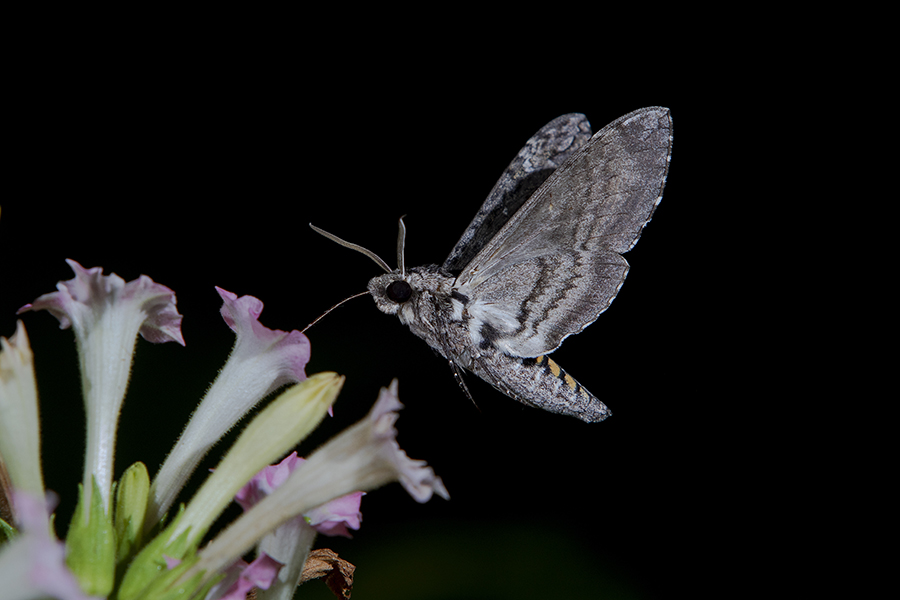
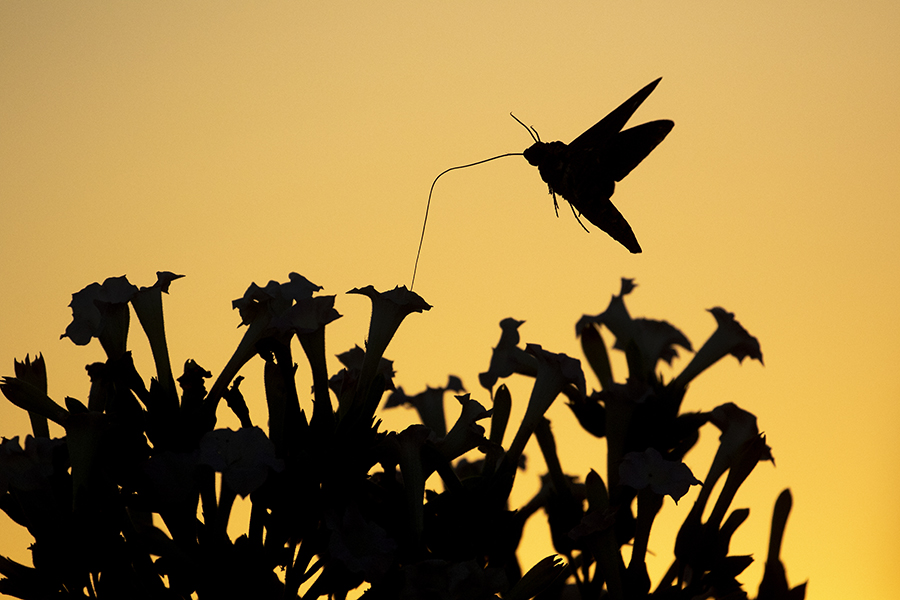
Arriving to the field a half hour before the sunset, I was immediately greeted by the sight of several dozen sphinx moths hovering around the tobacco blossoms like nocturnal hummingbirds. The scent of sweet perfume hung heavy in the air. Unlike the bitter acrid smell of cigarette smoke, tobacco flowers produce a pleasing aroma reminiscent of jasmine and gardenia. Up and down, side to side, forward and backward, the moths zipped about, unfurling their long tongues and inserting them, with surgical precision, into the tubular flowers to sample the nectar reserves nestled deep within. Beating their wings at over 70 times per second, I could actually hear the moths as they hovered over nearby blossoms.
As the sun dipped out of sight on the far side of the field, on the other side, a full moon rose above the horizon. Under the silvery moonlight, the tobacco flowers practically glowed. It was a magical sight.
Reviewing the images on my camera’s LCD, I identified the moths as Carolina sphinx moths. With 4-inch wingspans and furry abdomens covered by six pairs of yellow-orange spots, Carolina sphinx moths seem more like small mammals than insects. On many of the photos, I could make out tiny granules of tobacco pollen stuck to their long tongues. Sphinx moths are important pollinators of plants, though they tend to be overlooked when compared with butterflies and bees. The next time you sip your morning brew be sure and thank sphinx moths. On tropical coffee plantations, sphinx moths supplement bee pollination of coffee flowers.
Another important tropical crop, the delicious papaya, is mainly pollinated by sphinx moths. Closer to home, many orchids, lilies, cacti, evening primroses, four o’clocks, petunias and morning glories are all pollinated by sphinx moths. The list goes on and on. As powerful flyers, sphinx moths disperse pollen over long distances, promoting plant outbreeding and genetic diversity. As I like to tell my daughter, they are the superheroes of the insect world.
After spending several hours among the flowering tobacco, I decided to call it a night. A quick scan of the field with my headlamp revealed numerous sphinx moths still frantically sipping nectar with their giant straw-like tongues, beneath the full moon.
I smiled at the wonders so close to home.