House of Sweet Surprises

House of Sweet Surprises

Designer Mark Parson’s imaginative reworking of a humble bungalow creates something for everyone

By Deborah Salomon     Photographs by John Gessner

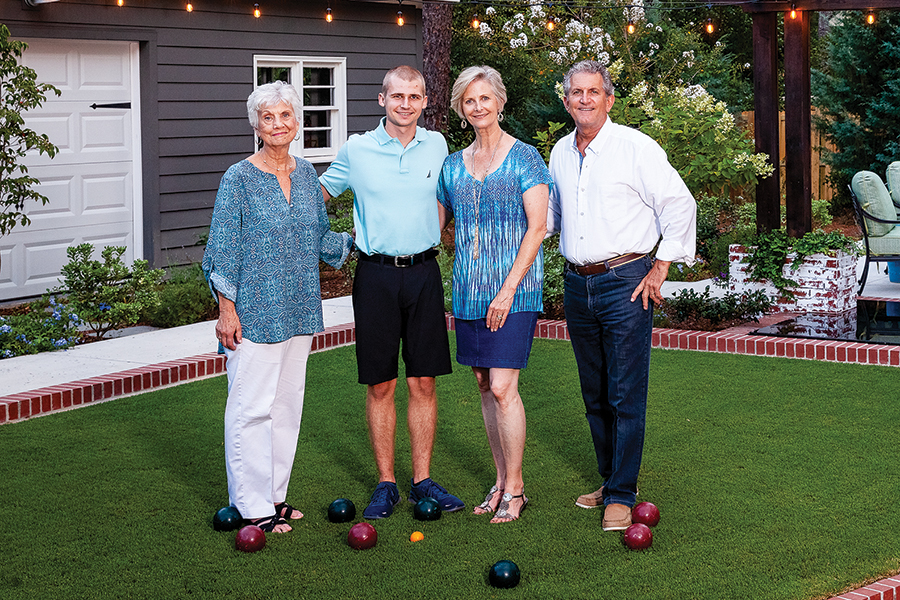
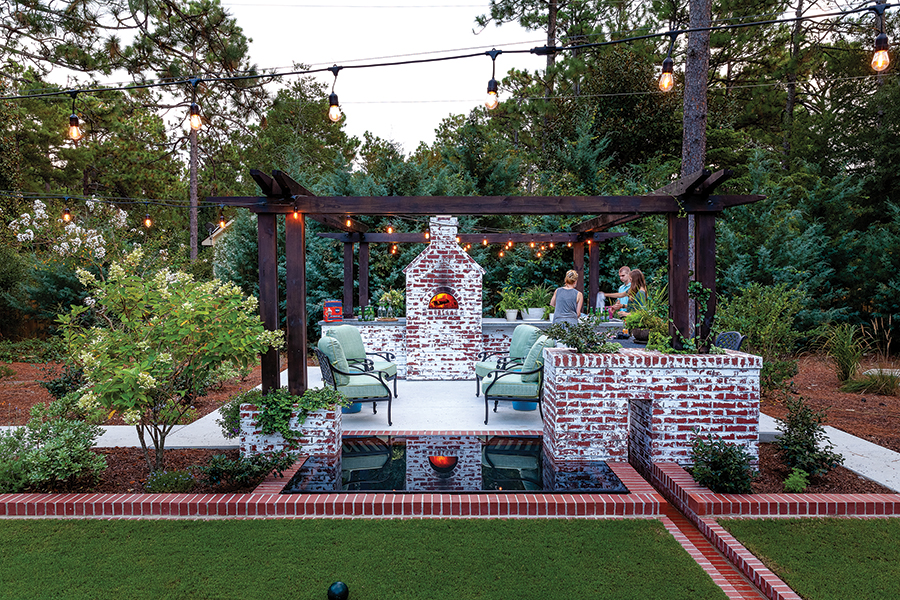
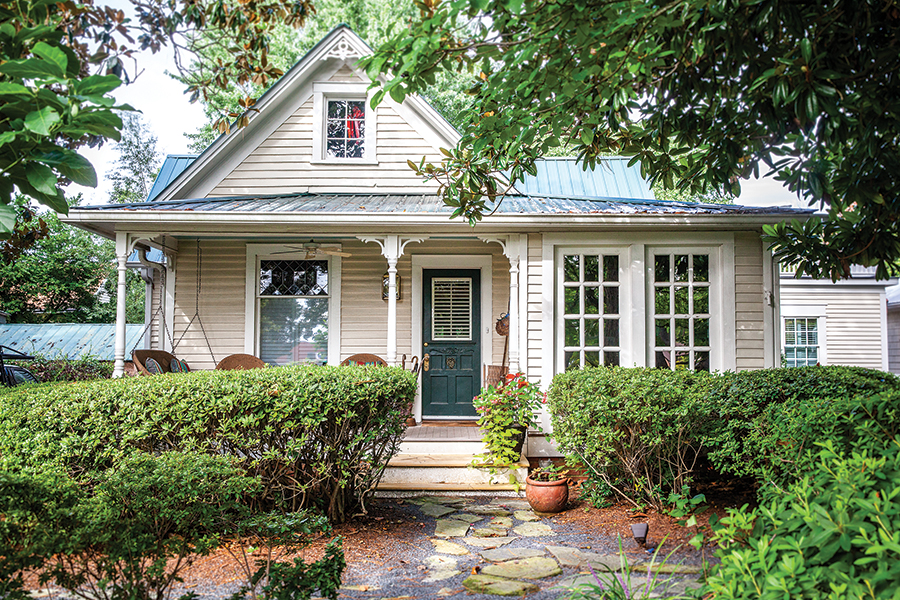
If the shoemaker’s children shouldn’t go barefoot, neither must an architectural designer’s family suffer an ordinary house. What Mark and Kathie Parson have done to a humble 1940s bungalow on the outskirts of the village of Pinehurst is the glass slipper on Cinderella’s sooty foot, the genie in the mayonnaise jar. Not only has Mark designed a compound housing three generations, he has paid homage to the St. Andrews Links in Scotland by reproducing narrow, curving canals through which flow gurgling water, set on putting-green grass, in a rear courtyard.

He also designed and installed the landscaping, including details like leaving a narrow band of soil between a brick walkway and low wall, allowing ficus vines to root and creep.

“Houses don’t have DNA,” he reasons. “We had to give it character.” Knocking the bungalow down would have been easier. “But then you wouldn’t have a good story.”

Mark Parson is full of surprising stories, starting with self-training. Then, his unlikely success, evidenced by hardscape and softscape designs for Sandals Caribbean resorts, Miami Beach mansions and a prize-winning Harley-Davidson dealership. Locally, besides residential projects, he transformed an unsightly garage on Broad Street into The Sly Fox gastropub.

To Kathie go accolades for the floorplan and décor, her taste honed as a designer/manager at Bloomingdale’s in Miami, where they met. Kathie is from Minnesota, Mark from (he wrinkles his nose) Ohio. She grew up in an apartment; he in “a shoebox.” His upward mobility could have been written by Twain, or O. Henry. In part: “My father was a union guy at Chrysler. I framed houses, worked in a sheet metal shop, welded, worked as an orthodontist’s assistant —all that hands on stuff.” But, despite dream jobs like being flown back and forth to Sandals Royal Bahamian Resort in Nassau, he and Kathie, new parents after many years of marriage, opted out of the glam lane and chose North Carolina — first Shelby, then Asheboro. While participating in a Richard Petty charity ride, Mark discovered Pinehurst. “I had heard of (Frederick Law) Olmsted. The real draw was sandy soil and people from everywhere.” People who appreciated and could afford imaginative renovations/new construction.

Kathie looked at the village of Pinehurst, drove over to Southern Pines and decided this was where she wanted to be a stay-home mom.

In 2003, they bought two houses on Everette Road, one for them, one for Kathie’s mother. The plan: Put both on the market and remodel the one that didn’t sell.

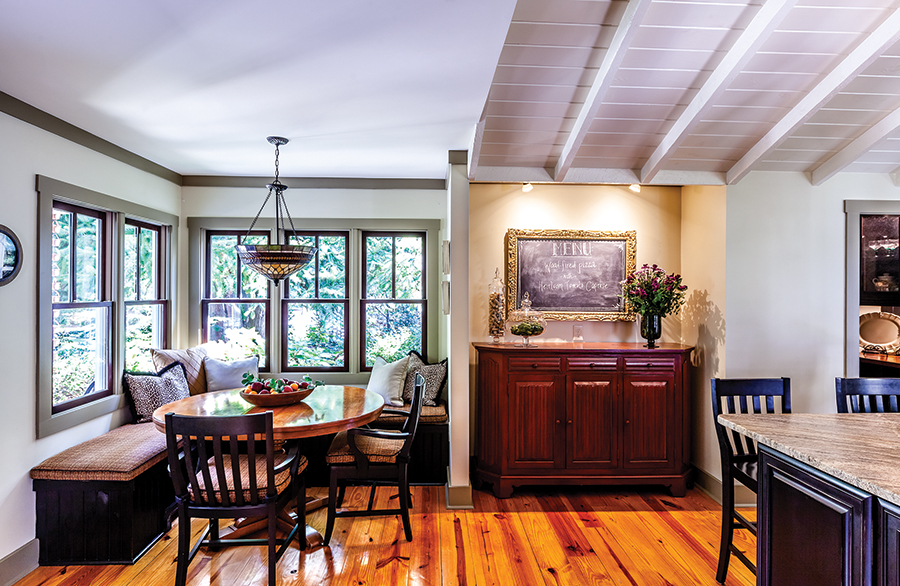
Remodel is hardly the word. Mark, as architect and general contractor, took the 1,100-square-foot house down to the studs and dirt floor. The phoenix that arose, double in size, had a new wing, a living room delineated by columns, a kitchen with corner banquette eating area but, strangely, no dining room.

“We eat everywhere,” Kathie says. Walkabout fajita parties inside and out are more likely than sit-down dinners. One Thanksgiving they served on the front patio, which has a fireplace, and beside it, a salad garden. Out back, beyond the reflecting pool, is another dining area with grill and wood-fired pizza oven.

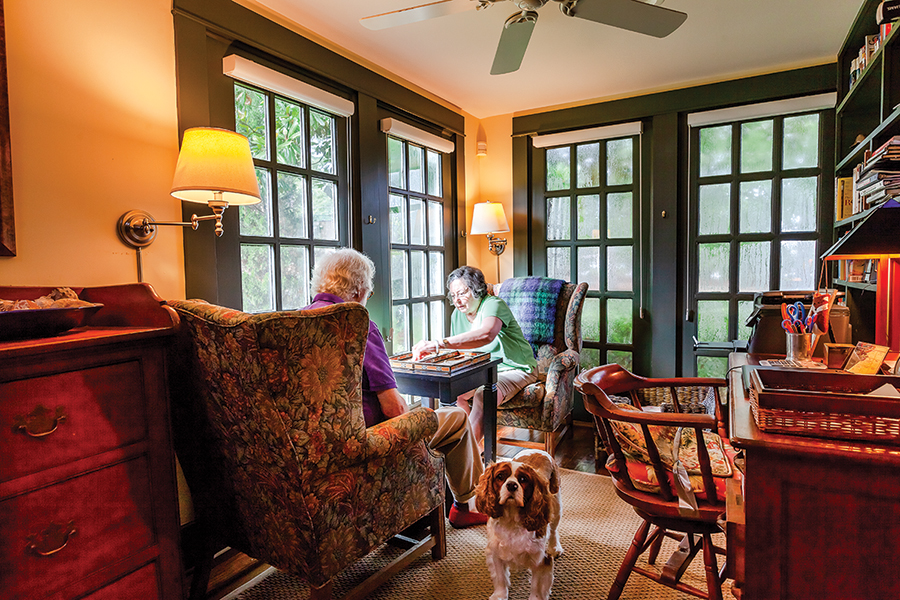
The reasoning goes deeper. In the dining room space stands a grand piano played by 18-year-old Wyatt, a serious musician who started on a keyboard and progressed to this magnificent instrument. Beyond it, windows and doors overlook the grassy courtyard. Entering the front door, a person’s eye is drawn forward by the piano and beyond, to the garden, which was Mark’s intention. A hallway to the right — previously two bedrooms and bath — has been reconfigured as a master suite with dressing room and Kathie’s office. In the bedroom, wide-board knotty pine floors used elsewhere yield to velvety-thick moss green carpet, the whole resembling a fine hotel.

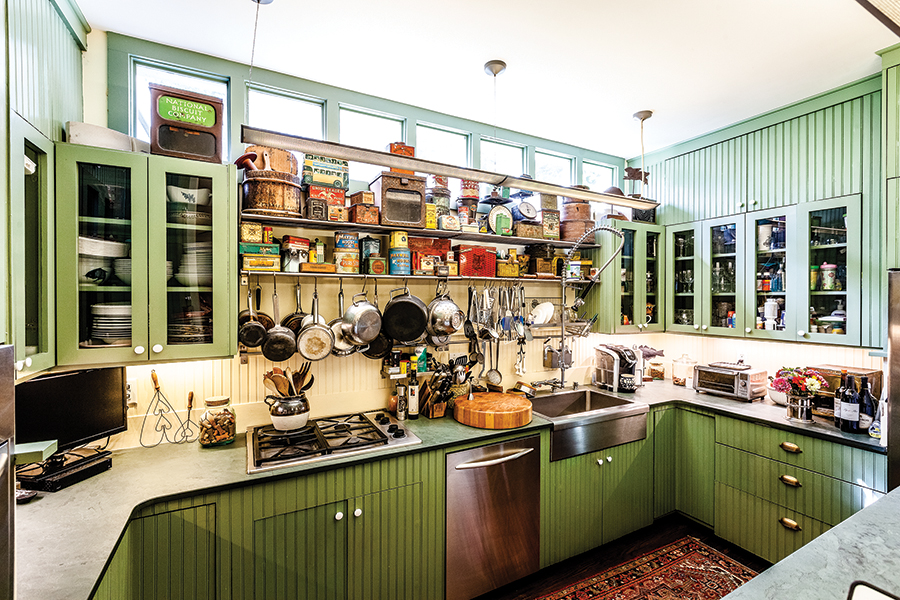
People gravitate to the kitchen,” Mark continues. With this in mind, he designed a beauty and elled a wing around it with two more bedrooms, a bath and moderately sized den.

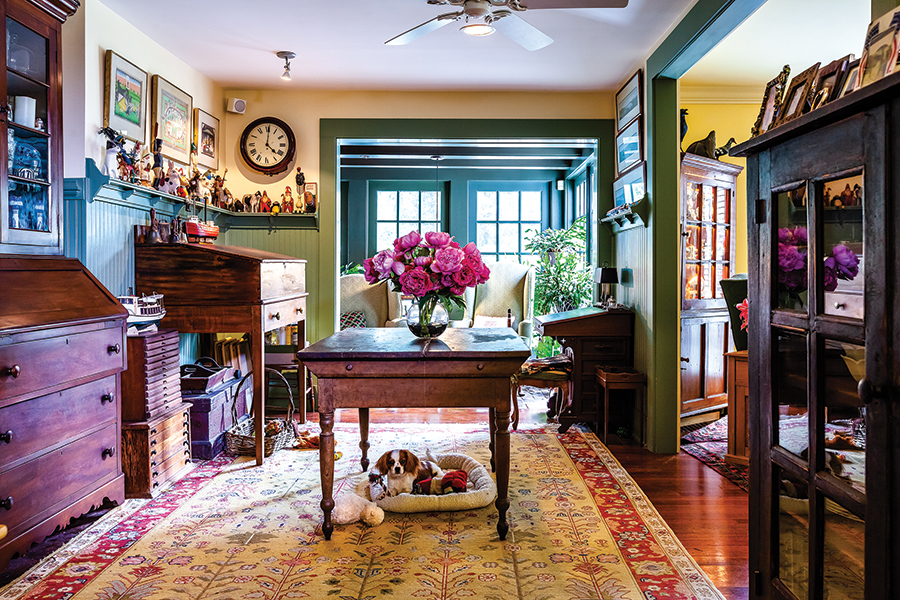
The moss green coloration that permeates each room has followed them from house to house. Kathie finds it soothing. She drew complementary forest tones from a printed fabric brought from Florida and used to upholster the breakfast room valance. Even the granite kitchen island has a green-gray tinge. Elsewhere, old leather couches, rather formal tables and chests, and heavy sateen drapes convey elegance. Kathie and Mark both prefer mahogany and other dark woods for their richness and antiquity which, Mark says, echoes Pinehurst. In contrast, rather than elaborate crown moldings and door frames, Mark chose simple flat stock painted a darker green, while several chairs upholstered in bold stripes speak contemporary Scandinavian. Art is mainly florals or landscapes, which blend with upholstery and rug patterns.

Although family heirlooms aren’t part of the scene, Kathie and Mark planned a kitchen alcove to accommodate a massive sideboard Mark’s mother painted. Above it, a blackboard framed in curlicue gold announces the dinner menu: wood-fired pizza.

Every designer has a signature that follows him or her from project to project. Mark is a ceiling guy. “I want people to look up. Why do you think churches have steeples?” Angles and vaults have become his trademark — in the family room, paneled in cedar, they suggest a dome. The living room gabled ceiling is accomplished with cottage-y painted tongue-and-groove boards. Mark indulged himself with the curving canals bisecting the courtyard, strewn with bocce balls, also a tiny waterfall on the front walkway, because he likes the sound. He tucked two butler’s pantries into the layout and, as the family cook, fine-tuned the kitchen.

The sweetest surprise stands beyond the back gallery: a free-standing storybook Nantucket cottage with flowers spilling from window boxes. Mark built it for his beautiful 82-year-old mother, Ila Parson.

“She raised me,” he says, reverently. “I can see her when I’m standing at the kitchen sink and she’s sitting in her living room. We wave every night before I go to bed.”

Family dynamics influenced the project. Ila Parson lives independently with a 17-year-old teacup poodle. She drives her own car, prepares most of her meals and walks miles every day. “We’re careful not to get in each other’s way,” Ila says. Kathie adds, “Mark had to think how to incorporate his mother’s lifestyle with ours, our son and his friends.”

Ila’s most frequent visitor is grandson Wyatt; proximity has fostered a close relationship.

Ila prepared for the move by getting rid of almost everything in her Village Acres house, then choosing simple new furnishings in refreshing blue, white and gray. The 740-square-foot cottage has one bedroom with, typically, a vaulted ceiling; a bathroom, kitchen with breakfast bar, sitting room and screened porch. Tucked behind the main house, this tiny domain is quiet and practically invisible from the street.

Barefoot? Hardly. A smart shoemaker’s children wear his best styles for all to see, to covet. Mark Parson’s home and grounds showcase his design capabilities for customers. Otherwise, Kathie says, “This house is everything we didn’t have.”

Remember, Mark’s goal was to create a story for a house that — unlike others in historic Pinehurst — had none.

Obviously, he succeeded.   PS

Coach

Coach

Remembering a man who made us better

By Bill Fields

John Wiley Williams, “Coach” to most, was a motion offense of a man, always on the move, as much shark as bulldog, although he certainly got the latter nickname for good reason. If he wasn’t jogging — at least 10 miles a day for a year when he was in his 40s, just to prove he could do it — he was cycling. If he wasn’t teaching someone the hook slide, he was demonstrating how to pole vault.

“It is better to wear out,” said one of the many slogans posted in Williams’ field house office at Pinecrest High School, “than to rust out.”

Coach, who seemed born with a whistle around his neck and a large ring of keys on his belt that jangled with every jumping jack, had bow legs and an odd gait. But few knew just how improbable it was that he could run and jump and make a drag bunt look like ballet.

Serving stateside in the U.S. Army during the Korean War, Williams was badly injured when a load of artillery shells fell on his legs. He spent a year in a Michigan hospital, had four knee operations and was informed by doctors upon his discharge from the service that he would never walk without crutches.

“They told Dad, ‘You’re never going to walk right again,’” says Dr. John Wiley Williams Jr., the oldest of John and Patricia Williams’ three sons. “But through rehab and work, he was able to recover.”

Star athletes who revered Williams, even as he ordered wind sprint upon wind sprint as the epilogue to a tough practice, didn’t know. Slacker boys in a Pinecrest physical education class, who would rather have been sneaking a cigarette than trailing Coach on a run through the woods to Midland Road and back, didn’t know. They didn’t know either — he didn’t know, until years after he boxed in the Golden Gloves and played high school football — he was born with one kidney.

“The only substitute for hard work is a miracle,” was another of Williams’ favorite aphorisms, and he came down squarely on the side of perspiration.

Williams was a fixture in the Sandhills for three decades — teacher, coach and athletic director — from his arrival in the summer of 1960 until his death at age 59 in a car-train accident the day before Thanksgiving in 1990.

“I don’t know how you judge things like this, but to me he was the most valuable citizen that we had in the county bar none,” says retired pediatrician Dr. David Bruton, 83, who became a close friend of Williams after opening his Southern Pines medical practice in 1966. “He was an extraordinary person, no doubt about that, devoted almost full time to others.”

Attending his 40th Pinecrest reunion two years ago, John Jr. encountered Tommy Grove, a fellow member of the Class of ’76 who had starred on the Patriot football and baseball teams. “Anyone who played for Dad, the typical response was how tough he was. They were bound by memories of how hard he worked them, that they survived Coach Williams,” John Jr. says. “Tommy came up and said, ‘I think of you as a brother, because your dad was like my father.’”

Plenty of Southern Pines residents saw Williams lining an athletic field, stripes as straight as the man pushing the chalk spreader. It was a smaller cadre of folks who knew he often lined up temporary shelter for young people who needed it.

“As a kid I had many, many roommates,” says Mike Williams, the middle son. “They might have an alcoholic parent, they might be getting beat up — they became my brother. It wasn’t an everyday occurrence, but when the need arose, my parents opened their home to anyone.”

And not just their home, as Joe Robinson, Pinecrest Class of ’71, discovered when he returned to the Sandhills to teach and coach after graduating from N.C. State.

“I was renting a little efficiency at the Pinehurst Motel down on the highway,” says Robinson. “Two beds and a kitchenette. One night about 10 o’clock, a kid knocked on the door and said, ‘Coach Williams told me I could stay with you for a little while.’ A ‘little while’ turned out to be three months. Everybody thought he was a hard man, but in a lot of ways he really wasn’t.”
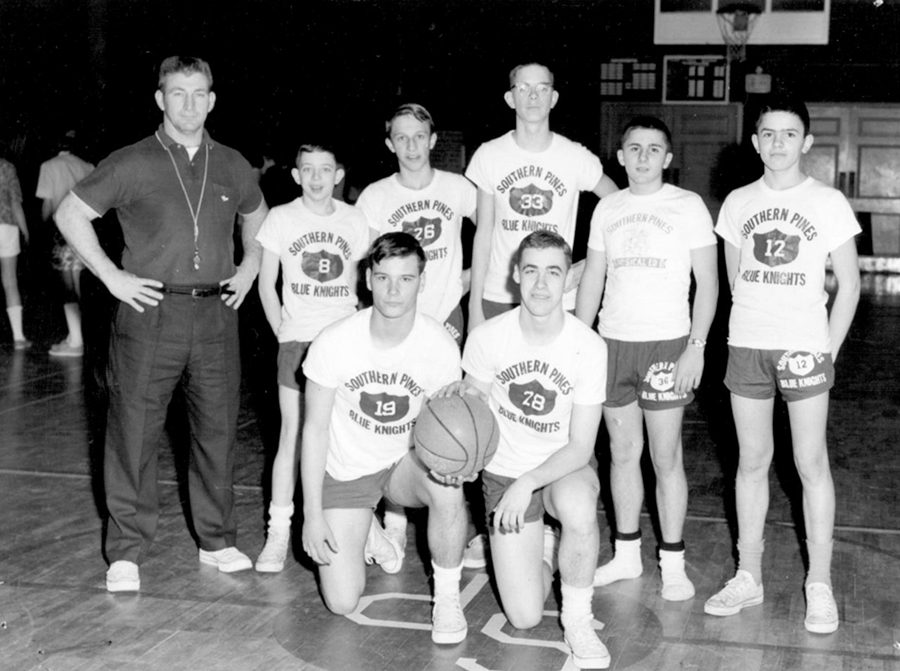
He was, in Bruton’s memory, a “consummate con man” that swept up other members of the community to lend a helping hand, whether for new bleachers at the ball field or a new beginning for boy who deserved it.

“He would farm out the kids to us and other families if he got more than he could handle,” Bruton says. “He’d tell you an awful story that you had to get up the money to take care of it. He sent a lot of kids to school, to camp, whose parents couldn’t afford it. It was probably the best money I’ve ever spent. He was an unusual fellow — he didn’t seem to care much about John Williams, but he sure cared about others.”

Coach was born on Jan. 29, 1931, in Lenoir County, the middle child of Walter Spencer Williams, a successful Kinston businessman, and Marjorie Earnhardt Williams. Marjorie died shortly after giving birth to her third child. Less than a month later Walter took Williams, not yet 2 years old, and his two sisters (Lib and Billie) across the state to Cabarrus County to be raised by Marjorie’s parents, John and Willie Irene Earnhardt, Lutheran farmers (and relatives of future stock-car legend Dale Earnhardt) trying to eke out an existence in hard times.

Walter Williams remarried quickly, to a friend of Marjorie’s, and had little contact with his three children. His son — born Jackie Arnie but renamed John Wiley by his grandparents when he was baptized — grew up loved but with few material possessions. “John slept in a crib until he was 6 years old,” Patricia Williams wrote in an unpublished memoir. “He told me he remembered his feet sticking out at the end of the crib before he got a real bed.”

By the time he was sleeping in that bed, Williams was already contributing to the family effort, “Pop” Earnhardt having fashioned a diminutive plow so his grandson could work the fields. “He’d be at the field at the crack of dawn from the time he was 5 or 6,” says John Jr., “and once he was in high school he worked on a loading platform, throwing heavy things on the train. That’s how he got strong, from working.”

At Mount Pleasant High School, Williams was a talented athlete but struggled in the classroom because reading was difficult. His wife, a longtime elementary school teacher, believes it was because he was dyslexic. High school might have been a miserable experience for Williams if not for the guiding hand of Mount Pleasant teacher/coach Luther Adams. Raised in an orphanage, Adams saw potential in the gritty student who, Patricia wrote, “had the heart and desire to excel in sports” but was growing up in a household whose priority was its crops.

Adams moved to Southern Pines as school superintendent in 1959. A year later, when a larger student body gave Adams the authority to expand the faculty, he hired the young man for whom he had been an instrumental mentor a decade earlier. After graduating from Atlantic Christian College, Williams had been at Pineland College in Sampson County for two years when he was hired as physical education teacher at East Southern Pines Elementary, becoming an assistant coach for several Blue Knight teams as well. Three years later he established a track and field team, the first in Moore County, and began to become an integral part of the town using sports to build community bonds.

“John saw the difference [Adams] made in his life,” Patricia wrote, “and he set out to pattern his life’s work after his role model. He wanted to coach, to help young people, to do special things for poor people, and to be a good father and husband. He did all that and more.”

A religious man who carried a Bible and could quote it, Williams wasn’t a saint. He was well known to local law enforcement for a habit of driving too fast. It was in his blood — after all, he was a cousin of the racing Earnhardts of stock car legend.

“He couldn’t not speed,” says Gary Barbee, Pinecrest Class of ’75, a four-year pitcher on Williams’ baseball squad. “Sometimes the police would let him go, but still he got a lot of tickets. His wife gave him a spool of thread to screw into the floorboard below the gas pedal on his old Studebaker so it wouldn’t go above 55 miles an hour. That was the only way to keep him from getting any more tickets and having their insurance go up any higher.”

“Might be true,” Mike Williams says. “He did not like to go slow. If we were going to the beach with a group of folks in several cars and we stopped to have a soda, it was very rare that somebody didn’t ask him to slow down because they couldn’t keep up.”

Driving to away track meets in Southern Pines’ aging and slow activity bus, the “Blue Goose,” Williams would navigate winding back roads to shave time and beat other schools to the venue. “Getting there first was an event to him,” Mike says. “That was pretty competitive.”

Keeping up with Williams when he wasn’t behind the wheel was difficult enough. As a young football coach, he liked to have players tackle him rather than dummy runners — breaking four watches in one season. “He lived up to his ‘Bulldog’ nickname fighting for rebounds or diving for a loose ball in a pickup basketball game,” says Robinson.

Mike Williams remembers trips when he and his older brother would be in the back seat, squabbling the way siblings do. “Mom would have had enough,” Mike says, “and he would just reach around with his right arm and the next thing you know we’re elevated off the seat while he continued to drive down the road. He was very calm as he asked if we were ready to settle our differences.”

Coach would roughhouse with his baseball players and always came out on top. “We’d jump on him, two or three of us, trying to wrestle him to the ground and you just couldn’t hold him,” Barbee says. “He’d bite, kick, whatever it took. Someone was adjusting our old pitching machine once. He was in the batter’s box and a ball hit him in the back of the head. It would have knocked you or me out. He just rubbed his head a little bit and kept going. He was a tough cookie, man.”

And he sought to make his players tough. Barbee’s lungs still burn recalling “Burma Road,” a practice drill. “You’d run to first and back, then to first and second and back, then to first, second and third and back. Finally, to first, second, third and home. Then the next time, you did each sprint twice. And after every game, home or away, win or lose, we ran 10-to-15 100-yard wind sprints. Opposing teams would say, ‘Y’all, we need to cut the lights off.’ It didn’t matter. We ran. We were in shape.”

Williams’ own running — he built up his muscles with leg lifts, but his limbs still ached constantly — became part of Coach lore. As a sentence for a speeding violation, a judge in Southern Pines offered an option of paying a fine or walking to Howard Johnson’s on U.S. 1 in Aberdeen, round trip of about 4 miles. That was easy pickings for Coach, who would run there and back in less time than it took to watch an episode of The Andy Griffith Show.

The feat that caused the most stir was a hot and humid day in the mid-1970s when Williams ran home to Southern Pines from Raeford, the best part of marathon distance. Mike watered him down with a garden hose in the backyard while his wife phoned David Bruton to ask him what she should do for her exhausted husband. “Quick,” Bruton said, laughing, “go grab him before he runs to Raleigh.”

One of the best runners to graduate from Pinecrest, Jef Moody, a middle-distance star who was poised to make the 1980 U.S. Olympic team before the Moscow boycott, spent more than a year of Saturday mornings as an eighth-grader logging miles with Coach. The experience normalized what had been a jarring move from Philadelphia to a still-segregated South as an African-American fifth-grader in the spring of 1968.

“He asked me if I wanted to come run with him on Saturdays at Mid Pines,” says Moody, 61, who now coaches the men’s and women’s track and cross country teams at Sandhills Community College. “We’d run the 18 holes, just the two of us, then I’d run home. It really meant a lot to me. I never had him for a P.E. teacher or a track coach, but he was my buddy.”

When Robinson was back in his hometown as fledgling teacher and coach, Williams gave him some advice about his new students. “You’ve got to love every one of them,” Coach told him.

Williams’ support for his athletes, present and past, was resolute.
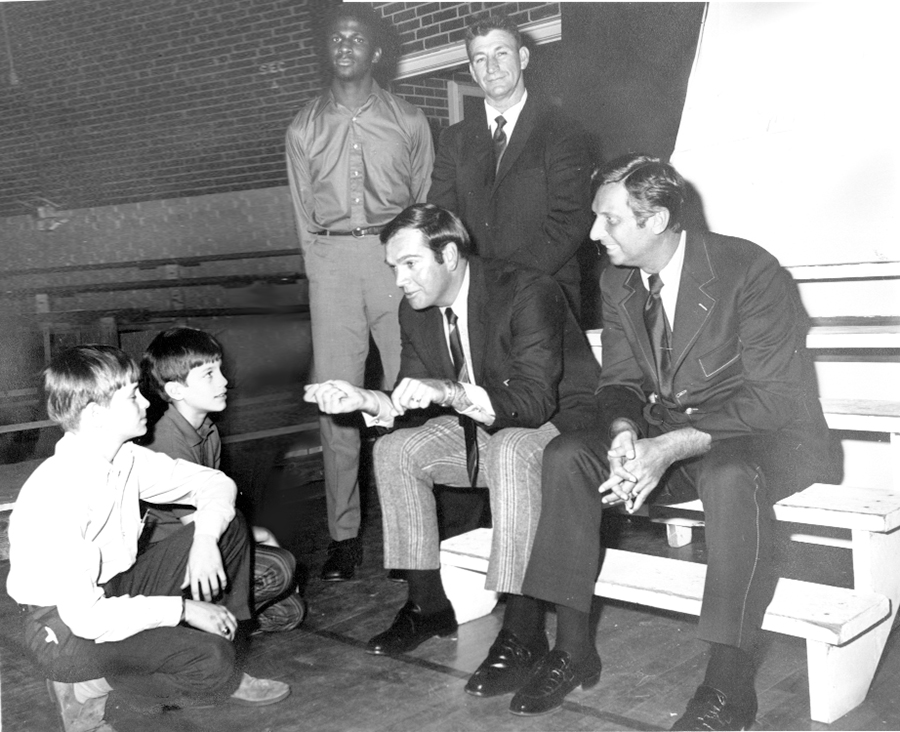
Coach finagled funds from Bruton and other townspeople so he could buy an early whirlpool bath — which looked like a metal washtub with a small boat propeller — so young pitchers could soak their throwing arms. “He could con me and others out of whatever he needed for his sports activities,” Bruton says. “That tub cost more than it was worth, of course. But he was very proud.”

Once I pulled a back muscle at a Little League practice that Coach was overseeing.

“We’ll go get you in the tub,” he said, “and get some Cream of Jesus on it.”

At least that’s what it sounded like he said. Sometimes Coach’s sentences, voiced in his husky Tar Heel accent, were like a hiking trail that didn’t quite make it to the summit. When we got to the high school field house, I noticed an industrial-size container of orange goo.

He had been talking about Cramergesic, a therapeutic muscle balm that made Vick’s vapor rub seem as mild as a peppermint. But it helped my back.

That was the side of Coach who would gently catch a wasp between thumb and index finger and deposit the insect out a car window instead of swatting it dead, perhaps the day after he’d set his watch back twice so a jayvee football practice would finish at “six bells” an hour after weary players had heard a half-dozen chimes waft to Memorial Field from the Episcopal church.

“I was always challenged getting rides,” says Tim Maples, a senior star pitcher on Williams’ 1979 state championship Pinecrest baseball squad. “It seemed that I was always spending time with him. ‘Where you going to be, Maples? I’ll pick you up.’ I’d be at home, or at the Elks Club pool, and he’d pick me up in the bus, and he’d take me home in the bus after practice.”

Coach — the generous spirit and the drill sergeant both — stuck with people long after they’d left his class or his gridiron. His boys carried the connection and attitudes to college campuses, pro ball and war.

“He walked the walk,” says Maples. “He’d talk a lot of times about intestinal fortitude, heart, 110 percent. It was like he had invented those terms.”

Those who became educators themselves brought Coach’s ethos to their lives. “The one big thing he did was mentor others to become leaders and grow community involvement,” says youngest son Mark Williams. “For me, it is this handing down of a sense of responsibility, ethics, knowledge, sportsmanship and values that continues and is so powerful.”

One of Williams’ disciples, Bill Strickland, took his lessons to the Vietnam War, where he was terribly injured. “He told me he could remember waking up, after several days, having gone through surgeries,” says Mike Williams. “He was in a bed, flipped upside down so he couldn’t move. He said, ‘Mike, I woke up and my doctor was laying underneath.’ He said, ‘Soldier, you should be dead. You should not be here. What force has kept you alive?’ And Billy said, ‘Coach Williams.’”

By the fall semester of 1990, Williams had passed on his coaching duties to others and was teaching and serving as athletic director at Pinecrest. On Nov. 21, the day before Thanksgiving, he had an early morning dental cleaning appointment, then ran an errand to McDonald Brothers Inc., a building and lumber supply company north of Southern Pines.

John and Patricia, who had moved to Whispering Pines, were looking forward to a family gathering — sons, daughters-in-law and grandchildren. He went to the store to buy chains to complete a swing set he was building for the youngest members of the family. As he drove across a railroad crossing, his sedan was hit on the passenger side by an Amtrak passenger train, the Silver Star, which had just left Southern Pines on its journey from Miami to New York.

“I don’t think anybody knows exactly what happened,” says John Jr. “My theory is that they had a new puppy and he had that new puppy with him. I bet either the puppy distracted him or it got down into the footwell where the pedals are, and he couldn’t make things work.”

The long holiday weekend was transformed into a period of grieving across the Sandhills. “It was such a shock,” says Nat Carter, 78, Williams’ longtime teaching and coaching colleague in Moore County. “It was hard to figure what happened with the train. We lost a great one when we lost him. You could learn a lot just watching Coach John and being in his presence.”

Pinecrest sports teams compete at the John W. Williams Athletic Complex, facilities that honor his longtime contributions. Those who knew Coach are in middle age or beyond, their memories aging but vivid.

“We always said the Lord’s Prayer before a game,” Maples says, remembering his Pinecrest baseball days. “We put in our hands, in the dugout. Coach’s hand was always down first, and I always tried to get my hand on top of his.”

When the Patriots were at bat, Williams jogged to the third base box. Everybody took the first pitch, sometimes two. Tug of the cap, touch of the face, swipe of the chest, rub of the arm. You didn’t want to be the player who blew a sign.

“I missed a suicide squeeze at Laurinburg and about killed a guy,” Barbee says. “He was running on the pitch and I took a cut. Coach would get right in your face and just chew you out. He wouldn’t put up with anything. But we all trusted him and believed in him.”

The feeling was mutual.  PS

Georgie Porgie, Oh My!

Georgie Porgie, Oh My!

The sometimes ghoulish roots of innocent nursery rhymes

By Michael Smith     Illustration by Romey Petite

Nursery rhymes are forever. Even the scary ones. They stick in your brain like bubble gum on hot pavement. Here’s proof: “ . . . and dried up all the rain. And the itsy bitsy spider went up the spout again.” Who among us doesn’t remember the opening lines?

Many nursery rhymes are played out in singsong fashion. With some, like Patty Cake, there is physical interaction while you both belt out the lyrics. Now that’s fun. But there’s more to it than fun. Nursery rhymes facilitate the development of a bond between Mom and baby or between siblings or friends. Fun and interaction work their magic, so that the next time Mom says, “Want to play patty cake?” Zap, your hands go up, palms out, ready to play. Your sense of competence subtly notches upward.

According to child development experts, nursery rhymes, especially those with music, significantly aid a child’s mental development and spatial reasoning. On NBC’s Today show, Seth Lerer, Dean of Arts and Humanities at the University of California-San Diego, said nursery rhymes both foster emotional connections and cultivate language ability.

So, the sweet words and lulling lyrics of today’s nursery rhymes cement relationships. Time was, though, that nursery rhyme words were not so sweet and nursery rhymes functioned more as transmitters of historical events. They were full of political satire, ribald jokes, religious disputes, violence and sexual innuendos — definitely not for young and innocent ears, not according to today’s standards.

So bad were they that British Victorians founded an association to clean the things up. As late as 1941 the British Society for Nursery Rhyme Reform was still culling X-rated content, excising accounts of animal torment, descriptions of violent human deaths — decapitations, hangings and the like, even cannibalism. Tales for the babies? Not.

Let’s take a closer look at several long-since sanitized nursery rhymes. The majority derive from England. Theories about their origins are numerous and varied, and are difficult, sometimes even impossible, to substantiate. Most have gone through a number of revisions over the years. All the same, the ghouls and goblins might find them interesting.

London Bridge Is Falling Down is as good a place as any to start. One account of its origin has it that a bridge would collapse unless a human sacrifice, particularly a child, was entombed within it. The child would be bricked into the bridge foundation while alive and slowly die from lack of food and water. Lore is that the child would eternally watch over the structure and ensure its stability.

Substantiation, complete with references, of such grisly immurement practices can be found in A Walled-Up Wife: A Casebook: “In 1615, Count Anthony Günter of Oldenburg, visiting a dyke under construction, is said to have found the workmen about to bury a child beneath it. He rescued the child and reprimanded the mother, who had sold it for the purpose.” Another passage suggests that, “When the castle of Liebenstein in Thuringia was being built, a child was purchased from the mother and walled in.” And so on. So much for the hod carriers union.

Children play a game that may have derived from that very goriness. Two children face each other and hold hands forming an arch. As other children run beneath, the arch is slowly lowered till one is “selected” while all chant “London bridge is falling down, falling down, falling down . . .” Macabre little game there.

Then there is Ring Around the Rosie. As with most, there are several claims regarding this nursery rhyme’s origin. One refers to the 1665 Great Plague of London. The “rosie” was a rash that appeared on those who contracted the plague. It gave off such a stench that the afflicted would attempt to suppress it with a pocket full of posies.

“Ashes! Ashes! We all fall down!” supposedly reflects the fear that all would eventually get, and die from, the plague. (Indeed, about 15 percent of the country did just that.) The “ashes” were the cremated remains of the deceased.

The daughter of Henry VIII and Katherine of Aragon, Mary I, is thought to be the subject of Mary, Mary, Quite Contrary after Henry got big on Protestantism and established the Anglican Church when the Catholic Church repeatedly denied him the right to a divorce. But Mary wasn’t having any of that business. She was hardcore Catholic and after she took the reins, though unsuccessful, she was quite contrary about returning the country to Catholicism.

Her reign was a scant five years, yet, during that time her garden grew — her “garden” being graveyards populated by Protestant martyrs. Not for nothing did they call her “Bloody Mary.”

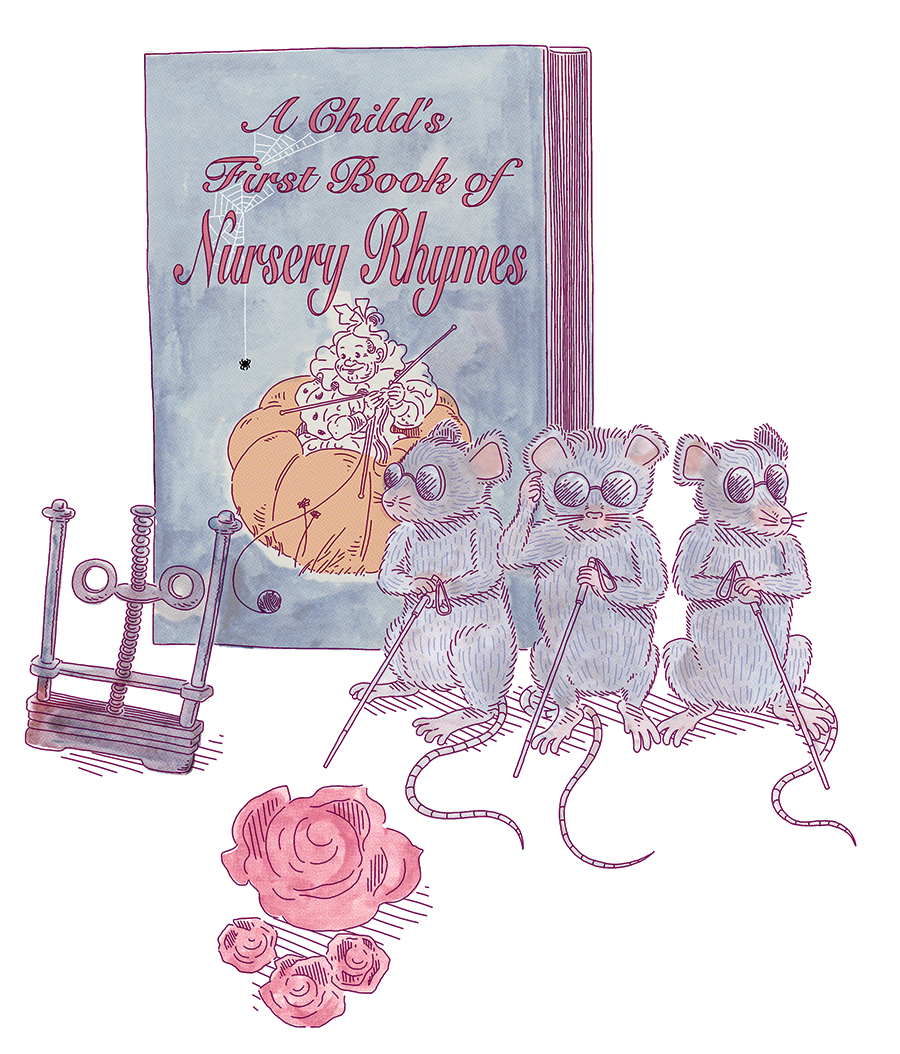
Mary was a busy beaver. She instituted a turn-or-burn policy and during her brief reign, had over 280 religious dissenters burned at the stake. To assist those having trouble deciding to convert, she employed little gadgets like “silver bells,” actually bone-crushing thumbscrews. She also was fond of “cockleshells,” torture devices that were attached to males’ nether reaches.

Fortunately for an English population quite satisfied with their Anglican Church, Mary’s stint as the first Catholic woman on the throne of England was limited. Weakened possibly from uterine cancer, she is thought to have died at the age of 42 from the flu.

One of the oldest nursery rhymes is Three Blind Mice. The earliest version, along with music, was published in 1609. (Incidentally, that was the year Thomas Thorpe published sonnets written by a dude dubbed the Bard of Avon. Hint: nothing to do with cosmetics.) Moving right along, Three Blind Mice, as we know it, is also said to be grounded in Bloody Mary’s reign. The three mice are thought to be two bishops and the Archbishop of Canterbury, who plotted to remove Mary from the throne. Big mistake. Mary uncovered the scheme and had each of them burned at the stake. You don’t mess with Mary.

Our final nursery rhyme is Georgie Porgie, the origin of which actually has been substantiated through court documents and diaries. Remember Georgie Porgie? “Georgie Porgie, pudding and pie; Kissed the girls and made them cry; When the boys came out to play; Georgie Porgie ran away.”

Certainly sounds innocent enough for tender ears. In fact, George was none other than George Villiers, bisexual nobleman and lover of King James I. George’s close friendship paid off nobly, too, when the King publicly proclaimed his love for George and named 31-year-old George Villiers the Duke of Buckingham.

George was equally fond of the ladies and had affairs with daughters and even the wives of powerful Englishmen. Ladies were warned against being alone with George, kind of an early Harvey Weinstein. Understandably, George’s randy nature and activities generated a certain amount of strain, but his relationship with King James also generated a certain amount of immunity.

And so it was that today’s delicate expurgated nursery rhymes evolved from backgrounds well suited to Poe or perhaps Steven King or maybe the Brothers Grimm.

“Itsy bitsy spider went up the water spout. Down came the rain and washed the spider out. Out came the sun . . . ” PS

Michael Smith lives in Talamore, Southern Pines, with his wife, Judee. They moved here in 2017 and wish they had moved here years earlier.

Poem

Crazy Bones

He’s been going to the same tavern for 30 years,

always sits on the same stool in the same spot.

The bartender has been working since the day

Clinton and Monica got caught. He remembers

watching the news on the bar’s TV. On her first

night, the bartender walked up behind him

and pinched the loose skin on his elbow between

her forefinger and thumb. “I like the way elbow skin

feels on old people,” she told him. “It’s so soft

and sometimes I can see a face in the wrinkles.”

She’s done this many times. Now she’s moving

to Sarasota. She married a black ops guy from Bragg.

The other barflies like telling the good one about

how her husband would have to kill you if he told you

what he did in the military. This is her last night.

The place is smoky. These people pay no attention

to state law. He orders a Fat Tire and she pours it in

a pilsner glass. He flattens his forearm on the bar

and she lays hers next to his, elbow to elbow,

crazy bone to crazy bone. He rolls the loose skin

on her elbow between his thumb and forefinger.

“Do you see a face?” she asks. “Yeah,” he says,

“mine.” And they laugh together like people

who’ll never see each other again.

Stephen E. Smith

Cottage Comforts

Respectful renovation with a story to tell

By Deborah Salomon   •   Photographs by John Gessner

What happens when a real-life Mad Men ad man jumps the rat wheel, takes up home restoration, moves to Nantucket, reconnects with an architect friend at his daughter’s wedding — and marries her?

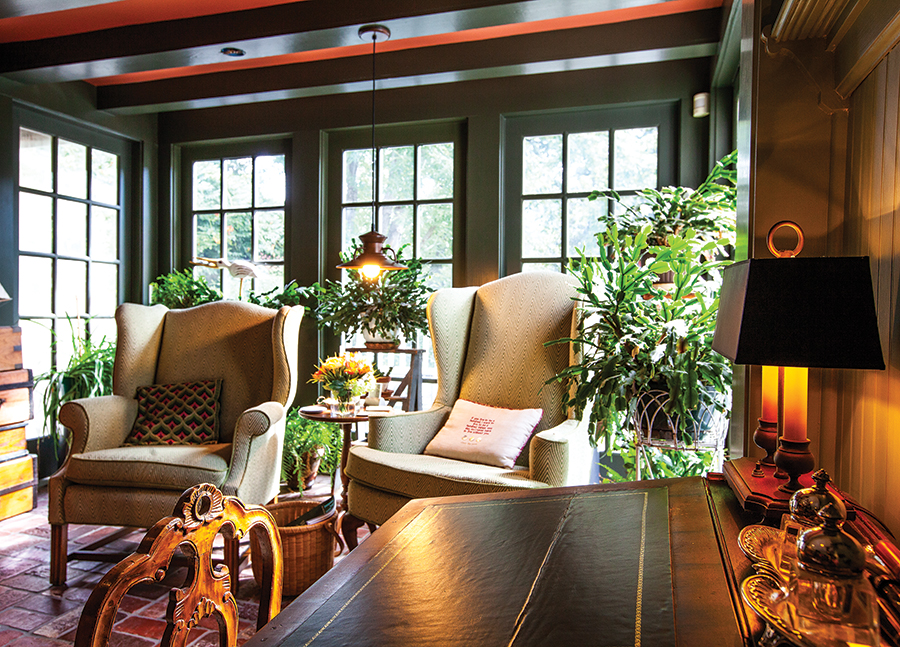
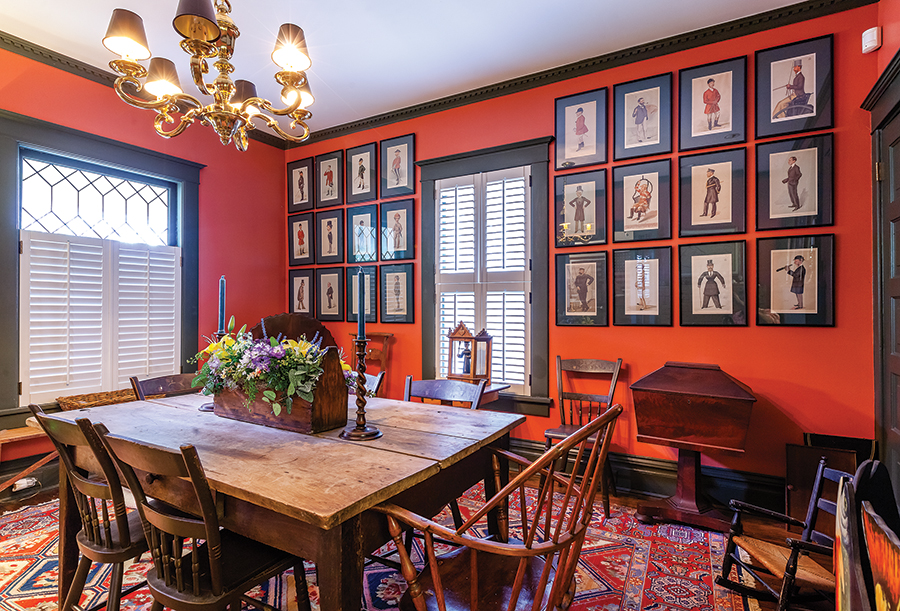
The obvious answer: They move to Southern Pines, buy a moldering cottage built in 1910, rip it apart and put it back together (she designs, he hammers) to resemble a period residence with tiny rooms, dark woods, deep green/barn-red/aubergine walls swallowed up by paintings, prints, memorabilia and collections. Modernity is limited to recessed lighting, radiant heat in the sunroom floor, Wi-Fi and AC. However, being practical, Scott and Francy Samuel rearranged space and added a sunken living room which, given its beams, wood-burning fireplace and antique furnishings (recliners notwithstanding) melts into the theme.

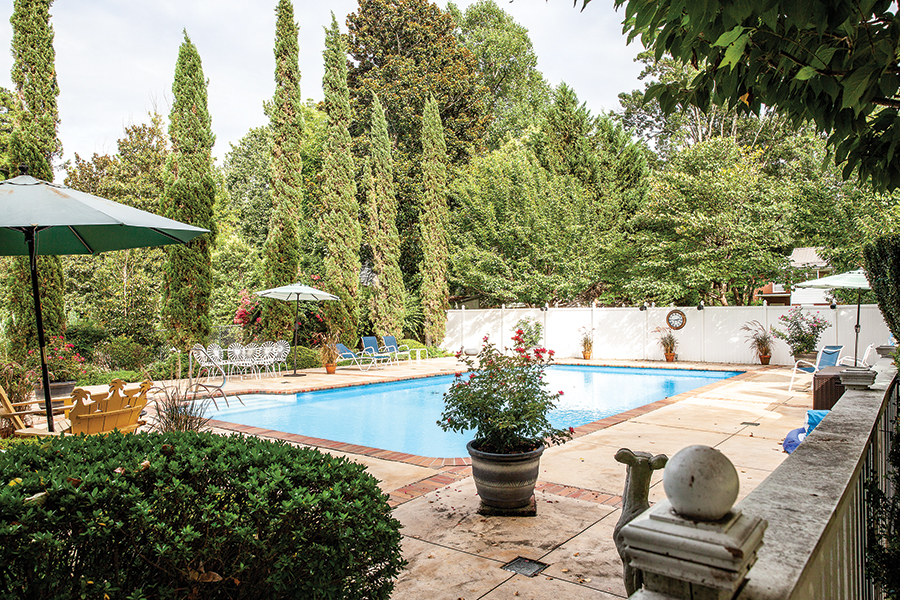
In contrast, a rear deck overlooks an acre of putting green grass bordered by 30-foot crape myrtles. Beyond that, a 20-by-40-foot pool. The contrast between recreated old and glamorous new . . . shocking, thrilling.

If ever a cottage required a docent — a catalog, at least — it is Cosmo, named for cosmopolitans, the Samuels’ favorite cocktail.

Francy, Scott and two Cavalier King Charles spaniels settle into chairs in the living room addition to relate their journey.

In the 1960s Scott pursued a career with top-drawer Madison Avenue ad agencies: expense accounts, martini lunches, other trappings of the trade as portrayed on Mad Men. He lived in a 20-room Tudor in Bronxville, a fashionable Manhattan suburb, and produced commercials for Mercedes, Nationwide and Maxwell House. Francy, who studied architecture after raising a family, designed high-end housing and residential projects for battered women, other special needs clients, in Boston. For each, the fast lane got too fast: “You get so embroiled in meetings, city permits,” Francy says. “I was relieved to come down here.” Scott: “Things started to change (in the ad world). Computers took over. Clients were merging. You could hear young footsteps closing in. The fun was gone.”

Scott discovered Southern Pines in the late 1990s, when he came down to help a friend convert a Knollwood mansion into a B&B. During a subsequent New England winter, Scott asked himself, “What am I doing here?” Francy had never been to North Carolina. “I expected to see lots of Taras.” Scott brought her down in June; they stayed at the renovated B&B. Late spring flowers bloomed everywhere. “People were so friendly,” she remembers. Taras were scarce, thank goodness.

They bought the cottage on Vermont Avenue in September 2001. After 9/11 small-town life seemed even more attractive. New construction wasn’t an option. Too many old houses in need of rescue, they decided.

Except this one was, Scott recalls, overrun with critters and falling apart; when a train roared by plaster fell off the walls. Architect Francy recognized good bones. “The house sat well on the property,” Scott noticed. Their hands-on reclamation took about a year.

Cottages built early in the 20th century between the tracks and the hotels housed support staff and merchants who served the affluent resort community. Little is known of Cosmo’s history except during World War II the owner’s wife made the second floor into an apartment with small kitchen, which Francy left intact, as part of her office. Surprisingly, the house had a basement — where Scott builds the Waldorf-Astoria of birdhouses — and a narrow garage, which they moved into the backyard, as a studio.

If the heart of a home really is the kitchen then the Samuels’ is well-placed in the middle, along an artery leading from front door to back wall. What a homey, cooked-in kitchen this is, since Scott and Francy share meal preparation. Light comes through transom windows placed ceiling-height. Scott constructed the beadboard cabinets painted a soft, archaic green. Washer and dryer are built into a divider separating the green slate counter from the pathway. Nearby, more beadboard conceals a fold-away ironing board common to homes of the era. Although smallish by contemporary standards, this carefully planned kitchen accommodates tandem cooking. When the meal is ready, Scott and Francy sit down at the dining room table, “like grown-ups,” Francy says, or eat on trays in the living/family room under the watchful portrait of an 18th century granny in bonnet peering down from the mantel. “Aunt Bertie” has become both friend and icon for their project, which had Francy coming down from Boston on weekends to draw plans for Scott to execute during the week.

The master bedroom tucked in a corner of the main floor barely holds a poster bed and antique case pieces. Francy converted a small second bedroom into dressing/closet space. The adjoining bathroom breaks from cottage classic with a wide-board floor splatter-painted by Scott, à la Jackson Pollock, against a black background.

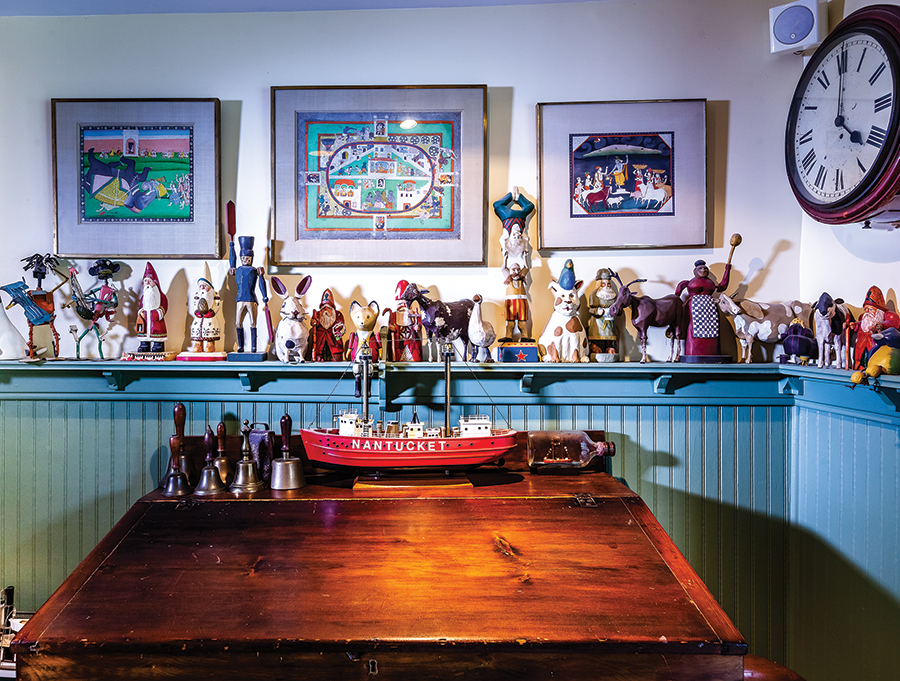
At Cosmo, one word demands a thousand pictures — that word being collections.

Examples: A dining room wall covered with 24 framed prints by a 19th century British aristocrat/caricaturist known as Spy. His exaggerated figures of notables, valued by collectors, were published in Vanity Fair.

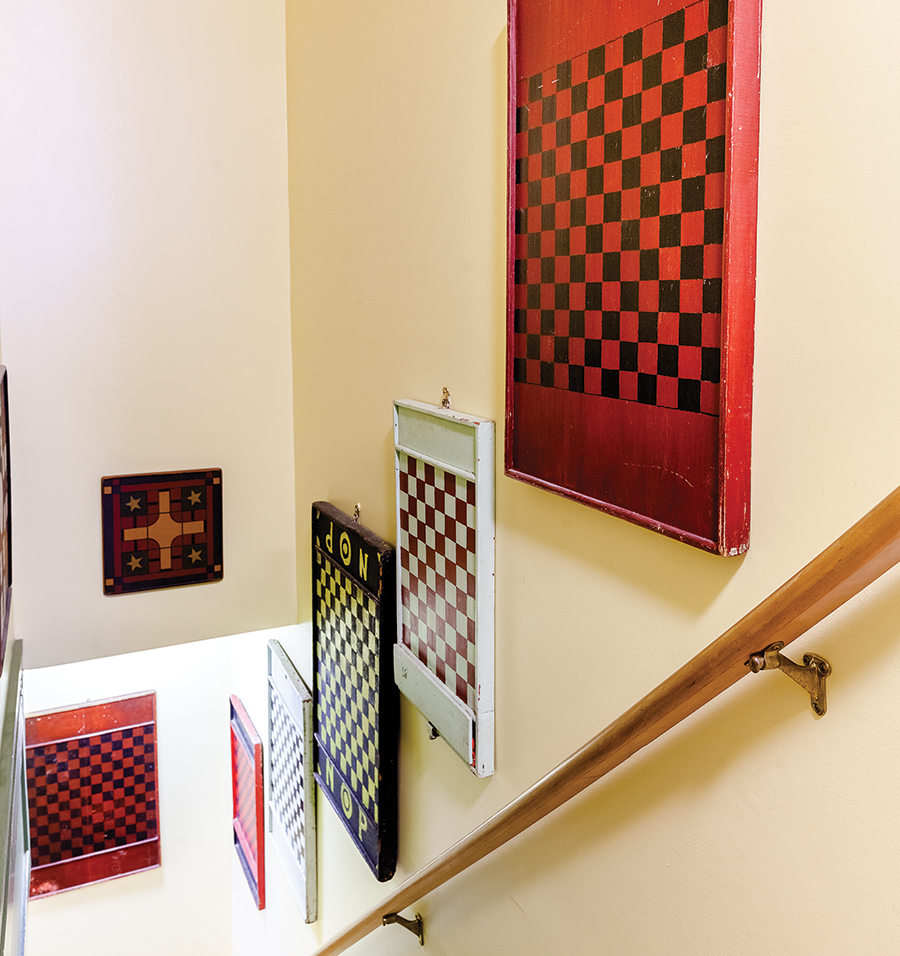
Old checkerboards hang in the basement stairwell.

Ships galore — paintings, drawings, postcards and models, including a table-top sized schooner made by a prison inmate; these remind Scott of sailing his own, off Nantucket, as does a framed map of the island, dated 1824.

Carved figurines include multi-national Santas and gyrating African forms, some brought back by Francy’s daughter, an anthropologist.

A huge assortment of rusty antique food tins crowd a kitchen shelf.

Family photos; between them, Francy and Scott have five daughters and four grandchildren.

Carpets, some shipped back after attending a wedding in Turkey, followed by a sailboat cruise through the Mediterranean and Aegean. One was woven in Russia, a century ago.

The crown jewel of collections would be Scott’s Victorian mercury glass, displayed in a corner cupboard. This technique practiced in Bohemia, Germany, England and Boston in the 1800s requires blowing double-walled goblets and other objects, then filling the space with a liquid silvering solution and sealing with a metal disk. Silvered and mercury glass became the first art glass forms meant for display, not table use.

Typical of second-time-around couples, Francy and Scott brought to their new home furnishings they couldn’t live without. Every piece has a story. A light fixture has propellers that spin like a fan. The rough-hewn coffee table was a kitchen table, in Nantucket, before legs were shortened. Many formal antiques descend from Francy’s Ohio lineage, where her father — according to the stately portrait in the dining room — was a bank chairman. Fold-down desks, electrified cranberry glass oil lamps, sea chests, display cabinets, a bentwood high chair and a few curiosities, like a post they found buried under the front porch, inscribed H.A. & E.E. Jackman, perhaps long-ago residents.

Despite gutting the house and rearranging space, the effect — excluding the glamorous grounds — seems as much preservation as renovation, with a nod to Williamsburg. Coincidentally, “They were my clients,” Scott says.

To protect the integrity of their own home, the Samuels carried out a “grand plan” to purchase and renovate the cottages flanking Cosmo, creating a pocket neighborhood which received a Spruce Up award from Southern Pines in 2014.

Now, the design-build team of Francy and Scott Samuel has “sort of retired.” Looking back, Scott’s only regret is not making the move sooner. “It didn’t feel strange or different,” he muses, with surprise. After 16 years the trains don’t bother any more. They enjoy walking to the library, farmers market, Sunrise Theater and restaurants. Scott continues, “Every time I pull out of the driveway I feel I never want to leave this house. I want to stay here forever.”

Spoken like a true ad man.  PS
The Beginning of the End of the World

The tournament that took a fortnight to finish

By Bill Case     Photographs from the Tufts Archives

The Diamondhead Corporation’s 1970 acquisition of the Pinehurst Resort complex, hotels and 6,700 undeveloped, mostly wooded acres from the Tufts family brought about a dramatic transformation of the entire community. To replace the Tufts family’s vision of Pinehurst as an idyllic and peaceful New England-style community where the elite from the North golfed and hobnobbed with one another for months at a time, Diamondhead instituted a new go-getter business model, which executives imported by the company from the West Coast fondly called “California brass.”

Diamondhead spent millions updating the venerable Carolina Hotel, rechristening it the Pinehurst Hotel. A hard push began to attract conventions, an approach the Tufts family had historically disfavored, fearing it would drive away valued longtime patrons. Huge chunks of forested acreage were subdivided for sale as residential lots and condominiums. Like spring dandelions, new homes bordering golf course fairways appeared overnight. The properties were marketed with such frenzy that a writer for The Pilot observed that Diamondhead’s sales force clustered on the prime lots “with the intensity of ants on a piece of picnic pie.” Pinehurst’s old guard residents, including the Tufts family, were mostly appalled. The perceived arrogance of cocksure Diamondhead executives, inclined to adorn themselves in California-cool gold chains and leisure suits, exacerbated the friction.

The man overseeing this metamorphosis of everything Pinehurst was Diamondhead’s president, Bill Maurer. The dour, hard-driving former golf pro had been selected as front man for the operation by Malcolm McLean, the mega-wealthy tycoon financing the Diamondhead purchase. Keenly aware that Pinehurst was America’s foremost golfing Mecca, Maurer believed dramatic steps were in order to ramp up the resort’s identification with the game.

Maurer could not be faulted for failing to aim high. He envisioned a modernized Pinehurst firmly branded in the public’s mind as the undisputed “Golf Capital of the World.” He convinced McLean to invest $2,500,000 for establishing a hall of fame for golf behind the fourth green of the No. 2 course. Explaining his thinking in an interview with Country Club Golfer, Maurer said, “I’ve read for 20 years about all these different plans to build one (a golf hall of fame). None of them has ever come to a hill of beans, and I don’t mean that unkindly. It’s just a lot of conversation and lip service. I think if we own and operate the World Golf Hall of Fame, it would not only be good for Diamondhead’s image and its place in the golf world, but also it would be a real good attraction for golf and Pinehurst.”

Pinehurst had not hosted any professional golf tournaments since 1951, when Richard Tufts became disenchanted by the behavior of the U.S. team in that year’s Ryder Cup matches played over Pinehurst No. 2. Tufts canceled the prestigious North and South Open. Maurer considered Richard’s banishment of the pros a tragic mistake and decided that, given the fast-growing popularity of the PGA Tour, pro golf should return to the resort. But Maurer had no interest in hosting just any tournament. As he put it, “If it is the golf capital of the world, let’s really make it that. Let’s have . . . the World Championship.”

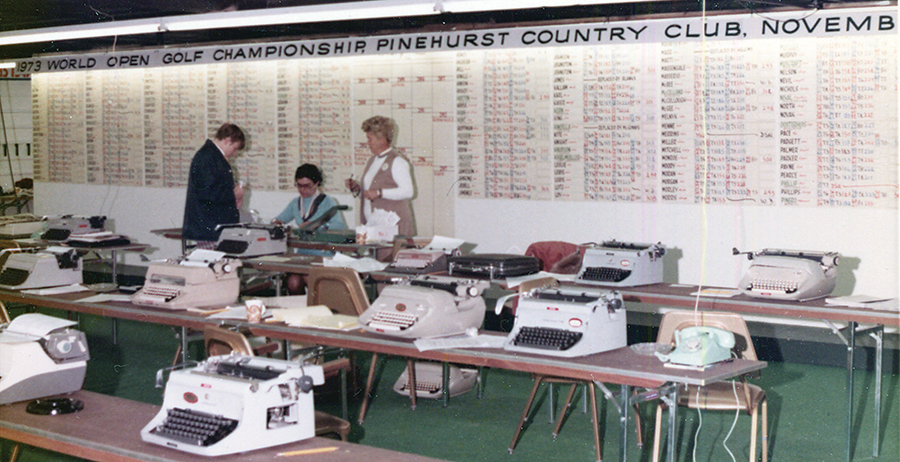
Maurer persuaded McLean that to hold a true world championship, prize money commensurate with that title should be part of the package. McLean agreed to bankroll the largest purse the game had yet seen — $100,000 to the winner and $500,000 total prize money. But Maurer needed to convince Joe Dey, executive director of the Tournament Players Division, that his audacious proposal was viable. Complicating matters was his desire that the World Open be contested over eight rounds, twice the customary number. Two weeks would be necessary. Maurer also sought the inclusion of numerous foreign players to underscore the tournament as a truly worldwide championship.

A year of sporadic discussions with Dey ensued before Diamondhead’s president finally made headway. In January 1973, it was announced that the World Open Championship would be played in Pinehurst, commencing Nov. 5 and ending the 17th. While concerned that Pinehurst’s late autumn weather could pose a problem, Maurer liked the idea of crowning the “world champion” at the tail end of the season.

Maurer contemplated a gigantic field of 240 players. After an 18-hole celebrity pro-am, the first four rounds of the tournament would be contested over No. 2 and No. 4 with competitors making two circuits of each. After completion of Sunday’s fourth round, the field would be trimmed to the low 70 players and ties. Contrary to usual tour practice, players falling short of the cut line would be paid $500. The survivors would take a two-day break before resuming play on Wednesday. Course No. 2 would serve as the exclusive venue for the final four rounds, culminating in an unusual Saturday finish.

Mindful that Pinehurst had not hosted a pro tournament in over two decades, Maurer assembled a new team for the task. Likeable and garrulous Tennessean Hubie Smith, 1969’s Club Professional of the Year, came on board as tournament director. Another club pro, Don Collett, was hired as president of Pinehurst, Inc. That post involved an imposing array of duties that included managing all operations of the Pinehurst Country Club and jumpstarting the embryonic Hall of Fame.

It was determined that Course No. 4 should be toughened to pose a challenge for the likes of Jack Nicklaus, Lee Trevino and other tour stars. Diamondhead retained famed architect Robert Trent Jones Sr. to perform an overhaul of the course. With Jones swiftly working in tandem with club superintendent Dick Silvar, the updating was completed in only 90 days. A pleased Jones expressed satisfaction with his handiwork, proclaiming that No. 4 would soon be recognized as “one of the great courses of the world.”

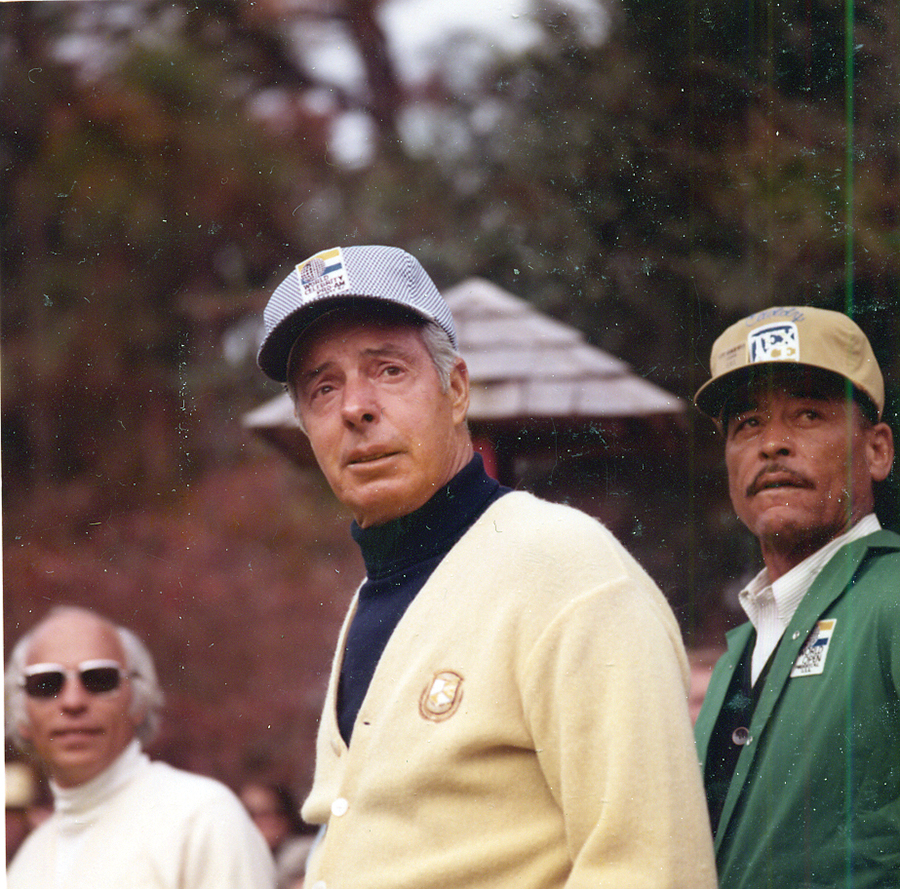
Diamondhead enticed baseball great Joe DiMaggio to serve as celebrity host for Wednesday’s “Joe DiMaggio World Celebrity Pro-Amateur.” Accepting invitations to join Joltin’ Joe on the tee were A-list celebrities like Bing Crosby, James Garner, Fred MacMurray and Stan Musial. Licking their respective chops at the opportunity to take down the tour’s largest-ever payday, the circuit’s rank-and-file sent in their entries faster than the deal at a Vegas blackjack table. As tour mainstay Miller Barber put it, “nearly everybody who can hit the ground with a golf club” was headed to Pinehurst. This included a number of players a decade or more past their primes who nonetheless looked for a last hurrah.

Assuming that the combination of record prize money, an impressive-sounding title and Pinehurst No. 2 would prove irresistible to the tour elite, Maurer failed to take into account that the players most likely to be unimpressed would be the upper crust champions whose winnings and endorsement income had already placed them in a position where they could afford to say no. Jack Nicklaus, winner of the ’73 PGA Championship, sent his regrets. He wanted to spend time with his family and rest up for the World Cup in Spain, where he would pair with Johnny Miller as the American team. Miller had planned to compete in Pinehurst, but ultimately withdrew. The ’73 British Open champion, Tom Weiskopf, begged off, opting to hunt for big game. England’s Tony Jacklin, a two-time major champion, couldn’t come because of a scheduling conflict in Japan. Trevino expressed a lack of interest for playing in a two-week tournament in chilly weather. Still, Arnold Palmer, Gary Player, Billy Casper, Hubie Green, the ageless and still competitive Sam Snead, Masters champion Tommy Aaron, and rising stars Tom Watson and Ben Crenshaw were all entered. But the absences of Nicklaus, Miller, Weiskopf, Jacklin and Trevino doomed hopes of a nationally televised World Open, a big blow to the Diamondhead execs.

Though Maurer couldn’t hide his disappointment, the absence of a few champions worked in favor of the remaining players who descended upon the area for their Monday and Tuesday practice rounds. The hotels and inns received plenty of patronage. Players with limited budgets sought more cost-effective arrangements. Tour newbies Don Padgett Jr. and Andy North arranged affordable lodgings outside Pinehurst, finding an inexpensive condominium adjacent to the Hyland Hills golf course, then nearing completion. The owner let the rookies practice on the range of the unopened course. Padgett and North shagged their own balls.

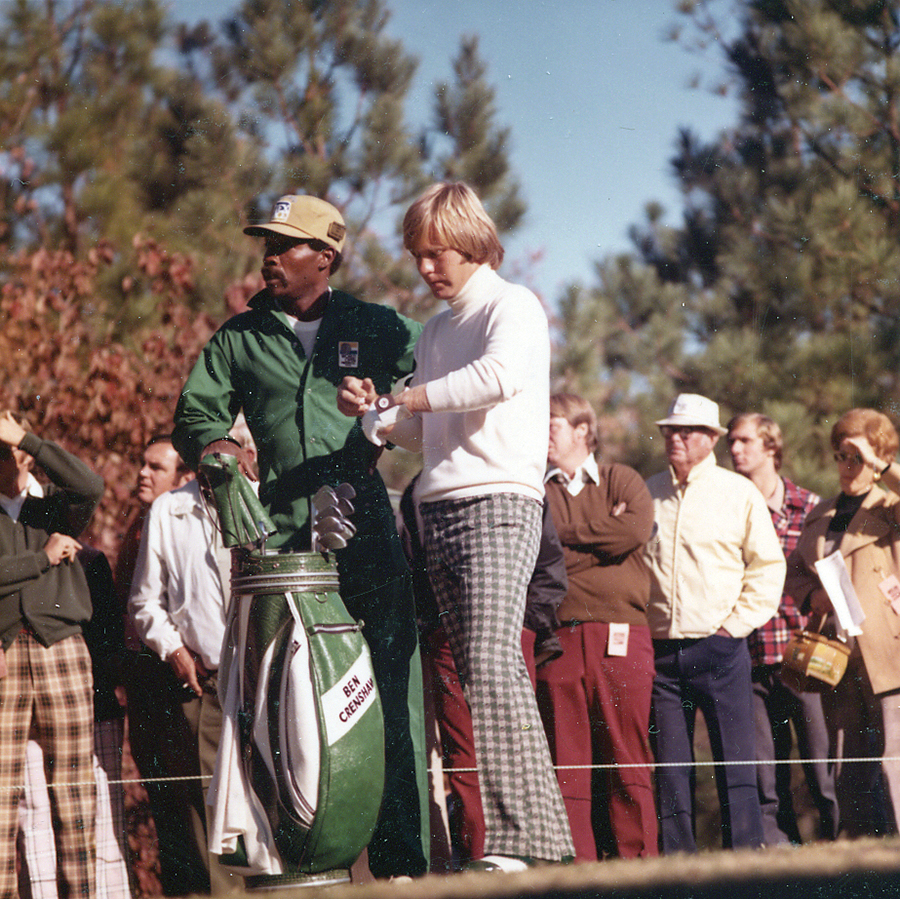
Some lucky young competitors benefited from free housing. Peter Tufts, Richard’s son, resided on Fields Road less than 200 yards from the second hole of No. 2. As the builder and course architect for the nearly completed Seven Lakes Country Club, Peter was a respected force in golf. He possessed a soft spot for young players trying to make their way, and opened up his home to four of them, none older than 25: John Mahaffey, who had won the Sahara Invitational the previous month and would five years hence become PGA champion; Pensacola’s Allen Miller, who would win once on tour; Eddie Pearce, predicted by many knowledgeable insiders to be the “next Nicklaus”; and 21-year-old Texan Ben Crenshaw, a three-time NCAA individual champion from the University of Texas who had turned pro shortly before the World Open and immediately made hurricane-force impact. He emerged from the grind of the PGA Tour’s qualifying school as its runaway winner by 12 shots, then captured his first tour event, the San-Antonio-Texas Open, shooting 14 under par. If Crenshaw won in Pinehurst, he would become the first player ever to win his first two tour events.

Peter Tufts’ wide-eyed 14-year-old son, Ricky, was excited these young golf stars were bunking at his home. They were funny, teased each other and laughed so loudly that Pete implored them to keep the noise down. Rick Tufts, now a retired firefighter, recalls that the young pros included him in their hijinks, considering the pros his big brothers for the fortnight.

One subject of their banter was Ricky’s predicament in obtaining transportation to his part-time job in Seven Lakes. The teenager wanted a motorbike, but Dad was unwilling to spring for its purchase. That brought about a chorus of guffaws from the houseguests who kiddingly razzed “Tightwad Pete.” Finally, Crenshaw promised that if he should win the World Open, he’d buy the motorbike for Ricky himself. Thus, Ben’s “little brother” became an avid cheerleader for a Crenshaw triumph.

A minor kerfuffle occurred when DiMaggio arrived. Thinking his name would be associated with the main tournament (something like the Joe DiMaggio World Open) instead of just the pro-am, Joltin’ Joe was quite put out after learning of this misunderstanding. The Yankee great could be glowering and sullen when angry, and that was the last thing Maurer needed to kick off the festivities. Concerns about DiMaggio’s reaction were heightened by the presence of the foreboding fellows accompanying him, both of whom could have been typecast as Corleone button men in The Godfather. But if Joe was upset, he managed to hide his displeasure interacting with Crosby, Garner and comedian Foster Brooks.

Frigid weather descended on Thursday’s first round with temperatures in the 30s and ice visible in the bunkers. Spectators stayed away in droves. Padgett, who years later served as Pinehurst Country Club’s president and chief operating officer, felt like a sled dog in the Iditarod. One of the early starters, when he reached his opening drive, he recalls, “There was so much ice on the ball, it looked like a snow cone.” Padgett implored a rules official for relief but was denied. Bob Goalby, then 44, still remembers the miserable weather. “It was thermal gloves off for your shot and then on again as quickly as possible — anything to stay warm,” recollects the 1968 Masters champion.

Starting off both nines of two different courses caused confusion for several players. Eddie Merrins never left the starting gate, having appeared for his tee time on the wrong course, he was disqualified, retreating to the warmth of the clubhouse. A few players seemed unaffected by the conditions, most notably Gibby Gilbert. Playing with Snead on the back nine of No. 2, the Chattanooga product birdied two holes and chipped in for eagle on 16 for an eye-popping 32. A remarkable string of five birdies on the front nine brought Gilbert in with a 62, shattering Ben Hogan’s course record of 65. The astounding round gave Gilbert a 5-shot lead over his closest pursuer (and one of Ricky Tufts’ buddies) Allen Miller, whose 67 came on No. 4.

Despite this stellar round, Miller leveled sharp criticism of the recently renovated No. 4. “The course scares me,” he confided to Golf World editor-in-chief Dick Taylor. “It’s harder than No. 2. I don’t cherish playing it. No. 4 is tougher in an unfair way.” Miller was not alone in this view. There was “almost unanimous chorus of dissent over Trent Jones’ remodeling,” wrote Taylor.

Meanwhile, two of Miller’s three housemates finished respectably with Mahaffey and Pearce carding 72s. Lagging was a frustrated Crenshaw, who opened with a desultory 75. One tour veteran — chilled to the bone and disgusted with his awful round — sought a way to pocket the $500 missed-cut stipend without completing the four rounds officials expected. He found a previously overlooked loophole in tournament rules that permitted an early escape. A player needed only to start the tournament to be entitled to the $500 for non-qualifiers. Once this information became common knowledge in the locker room, withdrawals by players off to poor starts flooded in. In all, 41 players said early goodbyes.

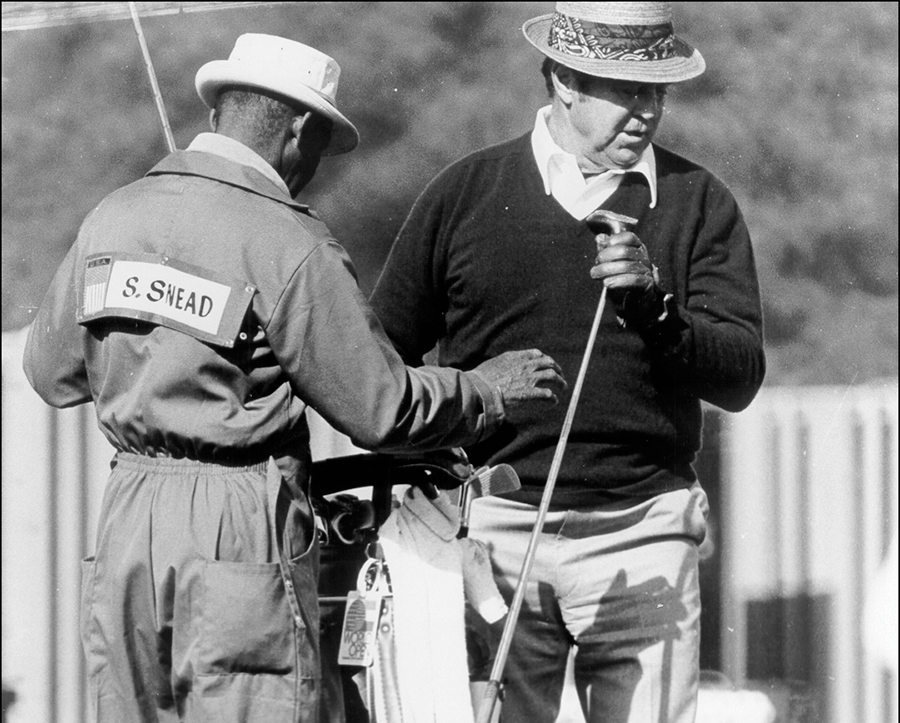
After an even chillier round two, Gilbert still led but had come back to the field some with a 74. Ron Cerrudo and Miller lurked two shots back. Crenshaw improved with a 71, but still trailed Gilbert by 10. Gilbert kept his nose out in front through Sunday’s fourth round. His 280 total at the endurance test’s mid-point led the field by 5. Al Geiberger and Tom Watson surfaced as the closest challengers, with Watson crafting a couple of rare sub-70 rounds of 69 and 68 over the weekend. Among those surviving to play week two were Palmer, Player, Goalby and the amazing Snead, guided by caddie Jimmy Steed, unfailingly employed by Snead whenever he was in Pinehurst. Miller’s housemates all made the cut, but were too far back to harbor realistic hopes of victory. Crenshaw’s 294 trailed by 14. Ricky Tufts’ hopes for his motorbike seemed irretrievably dashed.

No logistical reason existed for the World Open’s two-day layoff. Peter deYoung (then the assistant tournament director and still a Pinehurst resident active in organizing youth golf tournaments) remembers that the only thing the committee needed to do during the break was move a bank of port-o-potties and a lone concession stand from No. 4 to No. 2. The departure from the pros’ normal tournament routines perplexed some of them. Crenshaw says that the mid-tournament delay “was surreal. We weren’t sure what to do.” Crenshaw, Pearce and Mahaffey wound up playing Pine Needles with Golf World writers. The 61-year-old Snead, who liked nothing better than hitting golf balls, practiced both days. A few players visited the temporary home of the World Golf Hall of Fame on West Village Green Road, now occupied by a Bank of America branch. Miller remembers a nighttime visit to Pinehurst’s Dunes Club, which featured unauthorized drinking and gambling in the back room. Miller was among those forced to vacate when management was tipped off to an imminent raid.

As temperatures warmed for the fifth round, the tournament leader’s game plunged into a deep freeze. No. 2 exacted its revenge on Gilbert, who shot 82 — 20 strokes higher than his round one course record. Broadcaster and Pinehurst sage John Derr had predicted that Gilbert’s scintillating opening 62 “would never be duplicated” on No. 2, but just six days later, Watson proved him wrong. Canning lengthy putts from outrageous distances, Watson vaulted to a commanding lead with his own 62. Tied for second, but nine strokes back, were Bobby Mitchell and 42-year-old veteran Miller Barber. Allen Miller fell to 14 shots behind, but still led Crenshaw whose 71 kept him in the tournament’s backwater, a seemingly insurmountable 18 strokes behind Watson.

Despite high winds in round six, Crenshaw roared back from oblivion. Striking his irons so solidly that his shots never wavered in the gale, he carved out a 64 that some observers deemed superior to the 62s of Gilbert and Watson. Crenshaw, twice a Masters champion, still considers this one of his greatest rounds. News of the fantastic score rapidly circulated all over the course. Not only had he bypassed his fellow houseguests, he leapfrogged all but Watson, joining Jerry Heard and Barber in second. Watson delivered a wobbly 76 but remained six shots ahead. After another unsteady 76 by Watson in the seventh round, his challengers loomed closer with Barber and Mitchell poised only two back and the resurgent Crenshaw three.

It felt to players teeing off in the eighth and final round, that they had been competing in the World Open for months. According to Golf World’s Taylor, Al Geiberger kidded his playing partners on one hole, “If I remember correctly, I hit a 4-iron here in April during the 23rd round.” Exhausted tournament volunteers couldn’t wait to attend “End of the World” parties to celebrate Saturday’s finish.


Watson promised Pinehurst friends he would throw a party himself if he won, but a disappointing 77 would drop him into a fourth-place tie. It looked as though the winner would emerge from the Crenshaw/Barber pairing. Twice Crenshaw’s age, the balding, paunchy Miller outweighed his young rival by nearly 50 pounds. The svelte Crenshaw with his long blonde locks had already become a charismatic heartthrob. An odd couple then, Crenshaw recalls Barber, who died in 2013, with deep respect and affection. “I loved that man,” he says. “He was one of those guys who was funny without trying to be.” With his dark sunglasses, his steadfast refusal to reveal his nighttime whereabouts and his parabolic backswing, “The Mysterious Mr. X” acquired a colorful mystique that belied his unprepossessing personal appearance.

Barber and Crenshaw dueled back and forth exchanging birdies and bogeys until Mr. X birdied the 14th to take a one-shot lead. At the par-5 16th Crenshaw swung out of his shoes and pulled his tee shot far left into the woods. Unable to recover, he bogeyed the hole to fall two back. According to Crenshaw, golf writer and Pinehurst bon vivant Bob Drum later asked him, “What were you trying to do, drive the green?”

After Barber laced an iron into the heart of the green on the par-3 17th, he turned to rotund caddie Herman Mitchell (who would become better known in coming years as Trevino’s caddie) and exclaimed, “That’s it!” He parred that hole, and then put the icing on the cake by rolling in a closing birdie on 18 to defeat Crenshaw by three.

One would think Barber would pause at least for a moment to bask in triumphant glory. According to deYoung, however, he had another agenda. “Peter, come here,” commanded Barber. “I’m not going to the pressroom. Get me a bourbon and one writer and I’ll give him 20 minutes.” He needed to catch a plane to Dallas for a Cowboys game the next day. With the hasty interview concluded and desperate to flee the place he’d been for almost two weeks, Barber waited in the parking lot for his caddie. Ladened with golf equipment, a harried Mitchell lost control of the shag bag and the balls spilled out, running to the far corners of the parking lot like a pack of children playing hide-and-seek. “Forget them, Herman,” ordered Barber. “Let’s go!” So exited golf’s inaugural world champion.

Crenshaw’s disappointment was salved by his $44,175 second-place check. “All of a sudden I had some money,” he says. “And every bit of success helps a player searching for confidence.”

Forty years later Crenshaw would return, along with his partner, Bill Coore, to restore No. 2. His 1973 World Open experience “stimulated my love for Pinehurst,” which, as he sees it, “came full circle.” Rick Tufts may have been forced to finance his motorbike, but he gained a lifetime friend. He still exchanges Christmas cards with Crenshaw and enjoyed a sentimental reunion with him during the 1999 U.S. Open.

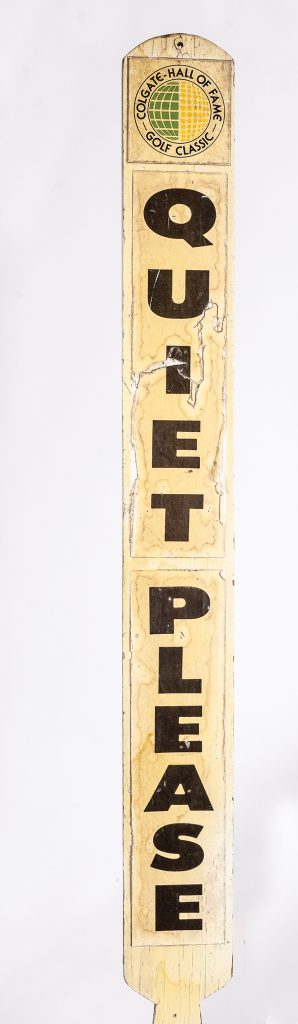
Downbeat over low attendance and the absence of stars, Maurer had nonetheless committed to host the World Open for two years. The tournament was shortened to 72 holes with a commensurate reduction in prize money. The PGA Tour granted Pinehurst a more hospitable week in September to coincide with the opening of the new World Golf Hall of Fame building and the Hall’s induction ceremony. September 11, 1974 marked one of the most memorable days in Pinehurst’s golfing history with Ben Hogan, Byron Nelson, Sam Snead, Gene Sarazen, Gary Player, Jack Nicklaus, Arnold Palmer and Patty Berg all on hand for their respective inductions and President Gerald Ford was in attendance as well. Johnny Miller won that year’s tournament. Nicklaus would capture the event in 1975. Diamondhead would sign Colgate as the corporate sponsor beginning in 1977 and the event was renamed the Colgate Hall of Fame Golf Classic. Colgate dropped its sponsorship after 1979. Pinehurst ended its 10-year run as an annual tour stop after the 1982 event. Born as a marathon, conceived as a curiosity, it became a 144-hole footnote to the history yet to come.  PS
Pinehurst resident Bill Case is PineStraw’s history man. He can be reached at Bill.Case@thompsonhine.com.

Rooted in Love

Sandhills Community College’s Landscape Gardening program, the ever-evolving classroom we all get to enjoy, celebrates 50 years

By Ashley Wahl     Photographs by John Gessner

In Japan, there’s an expression you might find brushed on a hanging scroll in any given tea room that speaks to the notion of holding each meeting as sacred:

Ichi-go ichi-e.

One time, one meeting.

This is the phrase that comes to mind when witnessing Sandhills Community College (SCC) Landscape Gardening professor and garden director Jim Westmen explore the Sandhills Horticultural Gardens.

On a sweltering summer afternoon, the air pregnant with the amalgam of fragrant ginger lilies and the electric hum of cicadas, Westmen takes a walk through the 32-acre gardens and reflects on the journey he started as an SCC Landscape Gardening student in 1978. Renowned for its hands-on approach to learning and its prestigious crop of alumni — two White House groundskeepers and the former director of gardens at Monticello among them — the Landscape Gardening program at SCC recently celebrated its 50th anniversary. As is the case for many who have been a part of the SCC program, Westmen’s story is deeply interwoven with its history. Imagine the wild tangle of azalea and rhododendron roots beneath the floor of the Hackley Woodland Garden, or that of the pine and tulip poplar along the Desmond Native Wetland Trail. The roots aren’t separate from the gardens. They’re one with it.

Westmen intimately recalls the installation of SCC’s first official garden — a sundry collection of hollies donated from Pinehurst resident Fred Ebersole when Westmen was a first-year student — and has had two dirt-laced hands in the beautification and development of the horticultural gardens since he was hired as faculty in 1988. But somehow, perhaps even mysteriously to him, Westmen continues to experience the campus grounds as if seeing them for the first time.

“I never get tired of being out here,” he says. And as the smiling professor winds along the garden paths, it’s obvious that this ever-evolving landscape serves as the fertile ground and classroom from which the program and its students continue to blossom.

Jim Westmen grew up in Fayetteville, North Carolina, mowing lawns for chump change and helping his dad install and tend to a backyard greenhouse where wandering Jew and spider plants spilled from hanging baskets, and flower and vegetable seeds were germinated for the home garden.

By 17, he knew what he loved (horticulture), but Sandhills wasn’t on his radar.

“I was looking at N.C. State,” says Westmen, when a friend who had gone through SCC’s Landscape Gardening program told him about a community college in Pinehurst that he might want to check out.

A trip to campus included a two-hour talk with the program’s then-coordinator, Fred Garrett, and the rest is part of SCC history.

“It was the hands-on learning that most excited me about this program,” said Westmen. “I wanted to do it, not just talk about it.”

The small class sizes were also appealing. Although numbers are lower now than in years past (less than 20 are currently enrolled; the program can accept up to 35 students), Westmen is hopeful for the next green movement. 

“Today’s society . . . when people walk by a beautiful landscape, maybe they can appreciate beauty, but many think it just happened. But somebody designed it, somebody grew it, somebody installed it.”

Prior to 1978, SCC’s Landscape Gardening students had to travel to the Boyd estate (Southern Pines) and local nurseries for in-the-field experience, but during Westmen’s freshman year, with the establishment of the Ebersole Holly Garden, the program as we know it really started to take shape. 

Flash forward 40 years and see the history of the Sandhills Horticultural Gardens meticulously displayed on the walls of the G. Victor and Margaret Ball Garden Visitors Center.  Open to the public year-round, this 32-acre classroom includes 14 themed gardens planned, designed, constructed and maintained by the college’s Landscape Gardening staff and students. This kind of application is what Fred Huette must have envisioned when he proposed a horticulture curriculum like that of the renowned European garden training schools. And this is what makes SCC’s program a national institute.

Just outside the visitor center, beyond the dwarf spruces and Chantilly lace hydrangea, a young woman is photographing a stunning display of Fantasia Hibiscus, whose cheerful pink faces resemble a scene from the Lollipop Guild. A short walk toward the main campus brings us to Steed Hall, where Westmen spent the balmy morning indoors teaching his Arboriculture Lab students how to safely operate a chainsaw.

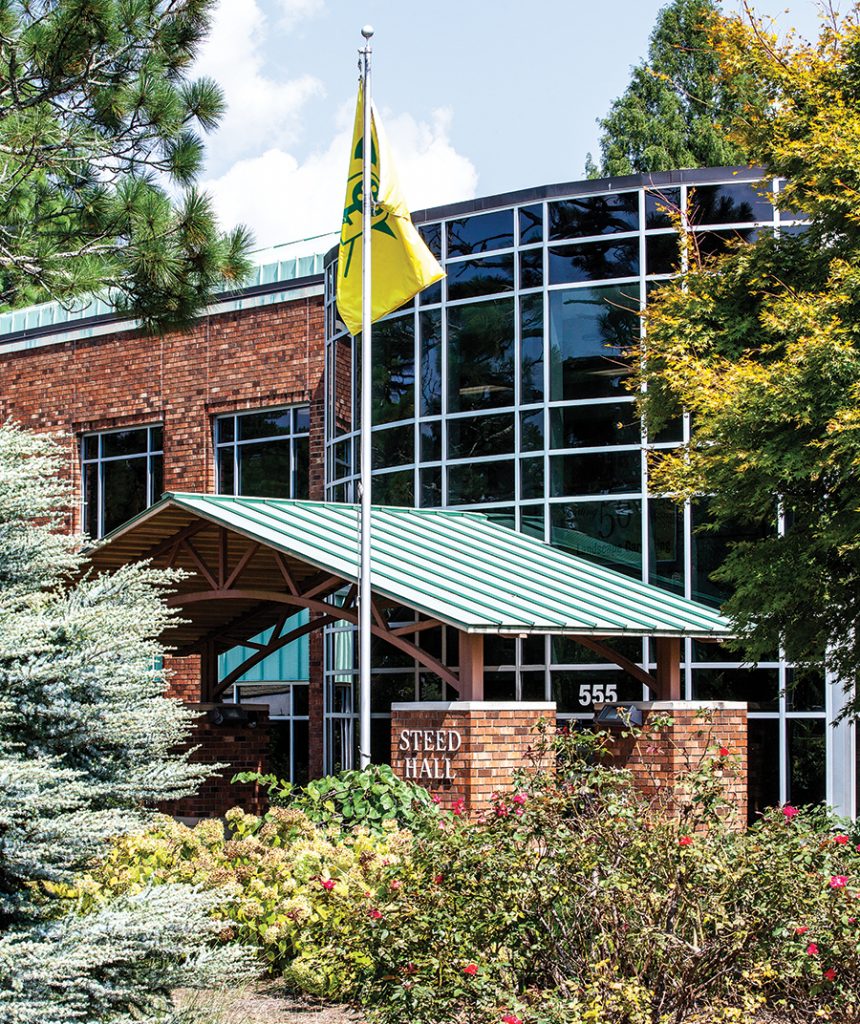
“First they learn how to turn it off,” he says, smiling yet completely serious. Same goes for mowers, blowers, tractors, weed-eaters, skid-steers, utility carts, and all other equipment the students might use to help manage the campus grounds during their Work-Based Learning residencies. Westmen gestures back toward Steed Hall from the Conifer Garden, a miniature evergreen forest made enchanted with its dwarf varieties and collection of rare weeping spruces. Named for the late Warren Steed, longtime benefactor of SCC’s Landscape Gardening program known for his excessively gracious nature and accidental discovery of the Little Gem magnolia — “You couldn’t leave his nursery without him gifting you a plant,” says Westmen — the building houses modern offices, classrooms and a small dormitory where students take turns living on-campus and applying their knowledge to the program’s greenhouses and the SCC gardens for two-week shifts.

“This puts them in the position of being responsible and practicing time management while they’re taking classes,” says Westmen. And it helps build their confidence.

Dee Johnson, who succeeded founding program coordinator Fred Garrett and served as such for the past 17 years, says that the students of SCC are among the most sought-after in the landscape gardening industry.

“I got calls every week from all over the country,” says Johnson, who, like Westmen, is a graduate of the two-year program. “We’re not typical of a community college system. Here, you’re learning how to drive a skid-steer and install irrigation. Most four-year degree programs don’t offer that kind of experience.”

When asked to share some of the highlights of the program’s history, Johnson is quick to mention Dr. Ebersole’s collection of hollies, which the students dug up from his property on Midland Road and transplanted. She’s not so quick to mention that, 40 years ago, like Westmen, she was one of those students.

“Do I have to show my age?” asks Johnson, whose subtle humor underlies her no-nonsense nature. 

“We had 383 species of holly,” she continues. “That was the beginning of the gardens.” 

At the program’s 50th anniversary celebration in June, Johnson was presented with a bronze “Dog Ate My Homework” statue in honor of her recent retirement.

“I’m a stickler about getting things done on time,” says Johnson. “My colleagues thought the statue was very appropriate.”

In August, following Johnson’s official retirement, former SCC Landscape Gardening graduate Hilarie Blevins took the reins as program coordinator.

Seeing a theme here?

Given the close-knit atmosphere of the program and its symbiotic relationship with the gardens, it’s no surprise that past graduates feel drawn to return as faculty.

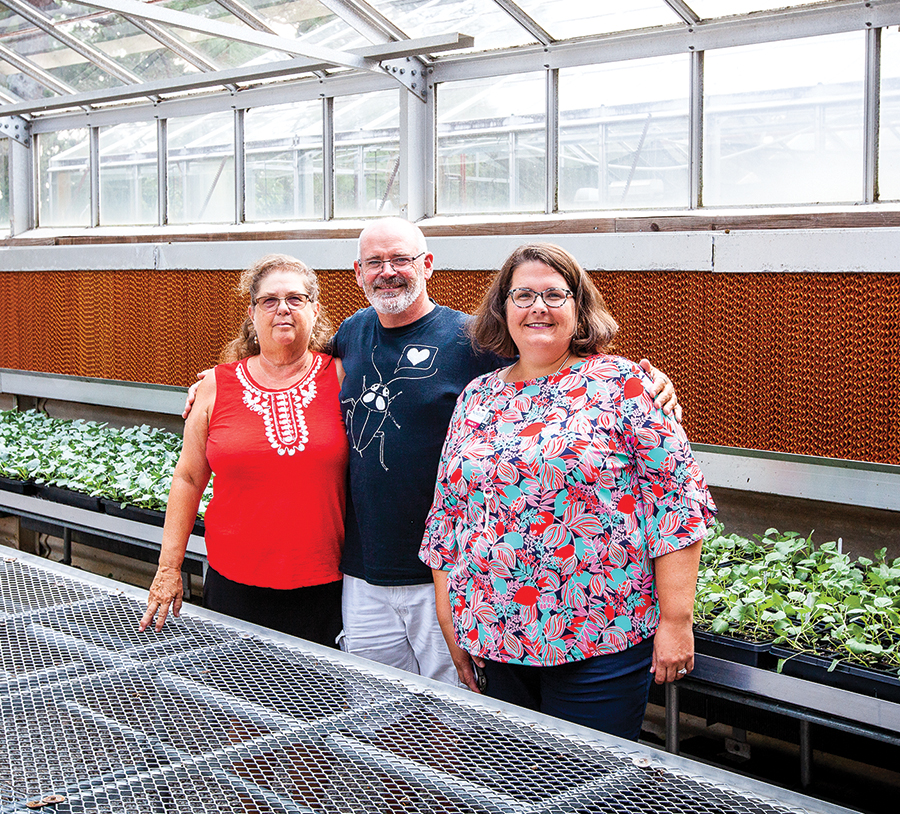
The same is true for instructor Johanna Westmen, who, yes, happens to be Jim Westmen’s wife.

While the mind is quick to imagine young Jim and Johanna sharing their first kiss beneath the lush canopy of what’s now the fringe of the romantic Atkins Hillside Garden, theirs is a fairytale of a different variety.

The Westmens didn’t meet here as students. They were already married and had started a local landscape business and nursery when Johanna decided to go through the program.

“It was interesting,” says Johanna of being her husband’s student. “But I could not have asked for a better teacher.” 

She graduated from the program, and when a teaching position opened up, Johanna joined the faculty.

“That’s one reason it’s such a joy to be here,” says professor Westmen of working with his wife. “We’re best friends.”

But ask either Westmen to tell you what they love most about the program and they will both say the same thing.

“Absolutely, hands down, it’s the students,” says Johanna. “Getting to be part of the lives of so many diverse and interesting people in the years I have been here is what keeps me going every day. The relationships you form with these students is everything.”

Westmen’s keys jingle against his hip as he makes his way toward the Sir Walter Raleigh Garden, a formal English-style garden where Bengal tiger cannas look like brilliant flames against a muted yet stunning backdrop of white-flowering crape myrtles trained into the form of single-trunk trees towering at 15 feet.

“They must have been about 6 feet tall when I started teaching here,” says Westmen, who paints the scene of students pruning them each February with four words: “Little birds in nests.”   

Beyond the Atkins Hillside Garden, where swallowtails light on flowering butterfly bushes and tiny frogs squeak from lily pads to water as visitors cross bridges over the winding rock-lined stream, Westmen guides his guest to one of his favorite places on campus: the Ambrose Japanese Garden. Here, his passion and appreciation for creating a sense of place comes alive.

“Japanese gardens have a particular look,” says Westmen. “You can’t just take those components, plop them on the ground, and call it a Japanese garden. It has to evolve from the location.”

Designed by one of the program’s former students, the garden feels completely natural in longleaf pine turf. 

Westmen points out the textures, the low-intensity colors, the various shades of green, the material used for the hardscape and meandering path, the wabi-sabi aesthetic of the moss-covered rocks, and the naturalistic features such as the arched bridge and azumaya.

“It’s more about the feeling you get as you move through this garden,” says Westmen, who pauses to admire the wavy pattern raked into the dry (Zen) garden. From the looks of it, the students in living quarters must have just completed it. 

Westmen has a naturally laid-back vibe, but he is noticeably more tranquil here. He studies the pattern in the crushed stone with the knowledge that he has never seen anything like it.     

Ichi-go ichi-e.

“The time it takes to rake a pattern like this in here is kind of what I want them to get out of it,” he says. “It’s somewhat of a meditation.” 

He then describes the effect this assignment continues to have on some of the “big-belt-buckle-kinda-boys” he sees come through the program.

“They get so excited about doing this. That excitement was the whole point . . . to see that change in them.”

After walking through the Fruit and Vegetable Garden, where a gray squirrel snags an under-ripe apple and a red-headed woodpecker raps on a nearby longleaf pine, Westmen heads for the Hoad Children’s Garden behind the Visitors Center, the newest addition to the gardens.

“Our current students worked their butts off to have the drip irrigation ready for the program’s 50th  anniversary celebration,” says Westmen. “They’re an incredible bunch.”

On June 9, upward of 300 guests attended the party. Among them were over 100 alumni, many of whom were amazed by the evolution of the gardens, and how the work and care they put into it so many years ago still lives and breathes with the landscape.

“There’s this dedication, this love for what the program created for us,” says Westmen. “We want to see that continue, hopefully for another 50 years at least.”

The professor playfully sniffles as if getting sentimental, but behind the joke is undeniable sincerity.

“I’m proud of the program and I’m proud of what the students have produced,” he says, eyes sparkling as he takes in the handiwork of his current students. “In a way, the program has offered me a career and a life.”  PS

Ashley Wahl is the former senior editor of Salt Magazine. She currently writes, sings, and plays among the trees in Asheville, North Carolina.

Almanac

September is the golden hour of summer.

Soon, the squash blossoms will disappear. Ditto fresh okra, watermelon, sweet corn and roadside stands. The crickets will grow silent, and the black walnut will stand naked against a crisp winter sky.

But right now, in this moment, everything feels soft, dreamy, light.

In the meadow, goldenrod glows brilliant among Joe-Pye and wild carrot.

In the garden, goldfinches light upon the feeder, swallowtails dance between milkweed and aster, and just beyond the woodland path, the hive hums heavy.

September is raw honey on the tongue.

I think of my Devon Park rental, retrieving the old push mower from the woodshed and discovering a colony of honeybees busy beneath the creaky floorboard. In the space between the floor joists: 40 pounds of liquid gold. Gratitude arrives with the scent of ginger lilies. I exhale thanks to the apiarist for transporting the bees to his own backyard — and for leaving just a taste of their honey for me.

September is master of subtly. Satiety following an electric kiss; anticipation for the next one. Delight in this golden hour, this taste of sweet nectar, this gentle reminder to be here now.

‘Tis the last rose of summer,

Left blooming alone;

All her lovely companions

Are faded and gone.

— Thomas Moore, The Last Rose of Summer, 1830 

Pecan Harvest

Yes, the time has come. If you’re lucky enough to have one or more pecan trees growing in your backyard, then you know that the earliest nuts fall in September. And those who are lucky enough to know the ecstasy of homemade pecan pie will tell you that the efforts of the harvest are worth it. Or just ask one of the neighborhood squirrels.

Here’s a trick. If you’re wondering whether a pecan is fit to crack, try shaking a couple of them in the palms of your hands first. Listen. Do they rattle? Likely no good. Full pecans sound solid, but the way to develop an ear is trial and error. You’ll catch on.

And in the spirit of Mabon, the pagan celebration of the autumnal equinox, consider offering libations to the mighty pecan tree. My bet is they’ll relish your homemade mead as much as any of us.

Sweet and Good

September is National Honey Month. According to the National Honey Board (exactly what it sounds like: a group dedicated to educating consumers about the benefits and uses of all things you-know-what), the average honeybee produces 1 1/2 teaspoons of honey over the course of its entire life. Here’s another nugget that might surprise you: A typical hive can produce between 30 to 100 pounds of honey a year. To produce just one pound, a colony must collect nectar from about 2 million flowers. Think about that the next time you hold in your hands a jar of this pure, raw blessing.

Wish to make mead? Honey, water, yeast and patience.

But if pudding sounds more like your bag, here’s a recipe from the National Honey Board:

Honey Chia Seed Pudding

Yield: 4 servings

Ingredients:

2 cups coconut milk

6 tablespoons chia seeds

1/2 teaspoon vanilla extract

2 tablespoons honey

Fresh berries

Granola

Directions:

Combine coconut milk, chia seeds, vanilla and honey in a medium bowl. Mix well until the honey has dissolved. Cover and refrigerate for at least 4 hours, but preferably overnight.

Stir well and divide the pudding into individual portions.

Serve with fresh berries. Add granola, if desired.

(I recommend adding a few organic cacao nibs too.)

As the Wheel Turns

The autumnal equinox occurs on Saturday, Sept. 22, just two days before the full Harvest Moon. Speaking of, if you’re gardening by the moon, plant annual flowers (pansies, violets, snapdragons and mums) and mustard greens during the waxing moon (Sept. 9–21). Onion, radish, turnip, and other vegetables that bear crops underground should be planted during the dark (aka waning) moon. According to the Old Farmer’s Almanac, old-time farmers swear this makes for a larger, tastier harvest.

The breezes taste

Of apple peel.

The air is full

Of smells to feel –

Ripe fruit, old footballs,

Burning brush,

New books, erasers,

Chalk, and such.

The bee, his hive,

Well-honeyed hum,

And Mother cuts

Chrysanthemums.

Like plates washed clean

With suds, the days

Are polished with

A morning haze.

— John Updike, September

Southern Pines in Bloom

An award-winning orchid honors the old hometown

By Amy Griggs 

At first blush, Jason Harpster’s greenhouse is unremarkable. It’s smallish, with opaque siding, exhaust fans whirring, and a door not visible streetside. Inside is another story.

Enter Harpster’s world.

His West Broad Street greenhouse is populated solely by orchids, well over 100 plants mostly being coy with their blossoms on a warm summer morning. Species native to nearly all continents of the world hang vertically from a series of parallel horizontal rods lining the walls of the greenhouse, remarkable in their mounts using materials that mimic their natural habitat, like bark, sphagnum moss and coconut matting.

Inconspicuously nestled against a hedgerow mere steps across the asphalt parking lot of his family’s business, Central Security Systems, the greenhouse is Harpster’s other office, designed and built by his father, Dick, and him. Sporting a ubiquitous resort-casual look in khaki shorts and, appropriately, an orchid polo shirt, sipping a late breakfast concoction of spinach, bananas and seasonal fruit in his favorite beer mug, the orchidist’s scientific bent takes over. Sounding professorial, he naturally uses the Latin-based language of orchid nomenclature, even after acknowledging layman’s terms would be easier for most to process.

This is the steamy place where Harpster makes pollination magic and begins the expectant watch for plants’ ovaries to swell, a bulge in the flower stem indicating that fertilization has taken place and seeds are on the way. Harpster snips and ships ovaries ready to burst forth to a lab that will harvest the tiny seeds. Given the life cycle of a typical orchid from seed to blooming plant, it will take five to seven years to see its first bloom.

This was the process, he explains, that resulted in a new hybrid orchid that honors the very town in which it was conceived, Catyclia Leaf Hopper “Southern Pines” HCC/AOS, which in June made its showy green and fuchsia debut, earning a highly commended certificate at Greensboro’s Carolinas Judging Center, sponsored by the prestigious American Orchid Society.

The inspiration for assigning the common name for his hybrid creation came on a trip he and his wife, Keely, a horticulturalist at Sandhills Community College, took to the International Lady-Slipper Symposium in Florida in 2012. “I met an idol there,” he says of symposium speaker and botanist Franz Glanz. Harpster learned why the name “Wössner” appeared in dozens of Glanz’s hybrid orchids, many of which Harpster counts among his favorites.

“I loved that he named the plants after the region that he came from (in Germany), rather than naming them after himself,” he says. By honoring his hometown of Southern Pines in his hybrid’s name, Harpster is acknowledging the support he has felt here since childhood. “Being part of the community and giving back is a big deal for me,” he says.

Harpster is active in the Southern Pines Business Association (past president), Rotary Club, and the Eagle Scout review board, the latter a position he was recruited for by mentor Don McKenzie, one of the leaders who facilitated the young Harpster’s earning his Eagle Scout award at age 17. “One of the things I love about Southern Pines is that the mentors who guided me are still here, literally across the street,” he says, pointing to McKenzie Photography just across Vermont Avenue.

“I do remember he was always very focused,” McKenzie says of Harpster. “Every rank in Scouting involves service to others, as a troop and as an individual.” The philosophy germinated along with Harpster’s interest in plant identification. He realized, “Hey, I’m good at this. I had a knack for it, and I enjoyed it more than almost anything else in Scouts. It got me outside and taught me a lot of passions.”

Harpster’s greenhouse treasures carry monetary value, but he has no interest in selling orchids, content with his avocation remaining just that. The greater value is his attachment to the plants, as passionate as if they were his pets. In fact, another of Harpster’s fascinations is breeding tropical fish.

In the lobby of Central Security, visitors are treated to a stunning 300-gallon aquarium full of dozens of African Cichlids, vibrant yellow fish and blue fish in various sizes swimming against a dark backdrop. The lighting is dramatic; the look theatrical. And like the orchids, they prove to be a science-begets-art exemplar.

Harpster points out matter-of-factly, “They are maternal mouthbrooders. The female scoops up her fertilized eggs in her mouth and then in about three weeks, out swim the babies.”

It’s an interest dating back to a childhood job cleaning the family aquarium. In college, he was once presented with the choice of purchasing an aquarium or a television for a new apartment — he came down squarely on the side of the fish. “It became the centerpiece of my apartment.”

While not disparaging anyone who does talk to their fish or plants, Harpster is clinical and scientific in all things flora and fauna, lightheartedly explaining, “I don’t talk to plants or fish. I don’t name the fish. They have proper taxonomic names that they should be called, darn it!” Never content to rest on his laurels, Harpster is engaged in the arduous accreditation process to become a judge within the American Orchid Society, a leader in the kingdom of orchids since 1924 — a process he likens to adding another degree to his MBA.

Some of Harpster’s orchids have found a summer home off Young’s Road in the horse farm setting of Jason and Keely’s backyard, where an awning diffuses light over a series of terra cotta plant holders, repurposed utility pipes where the plants thrive as though they were summering in the tropics.

But then, that’s Harpster’s world.  PS
Amy Griggs has worked as a community journalist and middle school teacher. She lives in Wake County and counts the Sandhills as her second home.

Almanac

By Ash Alder

Remember meeting that first giant? Being dazzled beyond words by its radiance and splendor, gasping as if you’d just entered a world alive with magic beans and singing harps and ornate birds with eggs of gold? 

Or perhaps you met a field of them? Smiling sun gazers. Stilt walkers among a carnival of phlox and zinnias and late summer bloomers. Nothing says August like a host of majestic sunflowers. As they follow our blazing sun across the wispy-clouded sky, these towering beauties remind us that we, too, become that which we give our attention.

Listen for the soft thuds of the earliest apples. Notice the silent dance of the spiraling damselfly, wild raspberries, the star-crossed romance between milkweed and goldenrod.

Queen Anne’s lace adorns roadside ditches and, in the kitchen, fresh mint and watermelon smoothies await sun-kissed children still dripping from the pool. 

“Can we grow our own?” they ask, eyes still aglow from the cheerful band of sunflowers they saw at a friend’s house days ago.

Come spring, as they work the magic seeds into the cool soil, all the world will sing.

Good Clean Fun

Given optimal growing conditions (plenty of sun and space), the sunflower can grow up to 13 feet tall in as few as six months. And once summer and her birds have harvested the last of its seeds, consider using the head as a biodegradable
scrubbing pad.

I almost wish we were butterflies and lived
but three summer days — three such days with you
I could fill with more delight than fifty common
years could ever contain.  
— John Keats

Cozy with the Crickets

Sure as the summer garden yields sweet corn and sugar snap peas, the Perseid meteor shower returns. Following the new Sturgeon moon on Aug. 11, the annual show will peak on the night of Sunday, Aug. 12, until the wee hours of Monday, Aug. 13. A thin crescent moon should make for excellent viewing conditions. Cozy up with the crickets. Believe in magic. Breathe in the intoxicating perfume of this summer night.

The luxury of all summer’s sweet sensation is to be
found when one lies at length in the warm,
fragrant grass, soaked with sunshine, aware of
regions of blossoming clover and of a high
heaven filled with the hum
of innumerous bees.

— Harriet E. Prescott, The Atlantic Monthly, August 1865

Food for Thought

The dog days are still here. According to the Old Farmer’s Almanac, the hottest days of summer coincide with the rising of Sirius, the Dog Star, beginning July 3 and ending Aug. 11.

Meantime, sit beneath the shade of a favorite tree.

Sink your teeth into a just-picked peach.

Lose yourself in a tangle of wild blackberries.

And as you watch the busy ants march along empty watermelon rinds and overripe berries, remember there is work to do.

Stake the vines.

Can or freeze excess of the harvest.

Prepare the soil for autumn plantings: purple top turnips and Chinese cabbages; Ebenezer onions and cherry belle radishes; spider lilies and autumn crocus and greens, greens, greens.

Allow yourself to enjoy it.

August creates as she slumbers, replete and satisfied.  — Joseph Wood Krutch