Story Of A House
Our House, Our Town
Finding serendipity on Massachusetts Avenue
By Deborah Salomon
Photographs by John Gessner
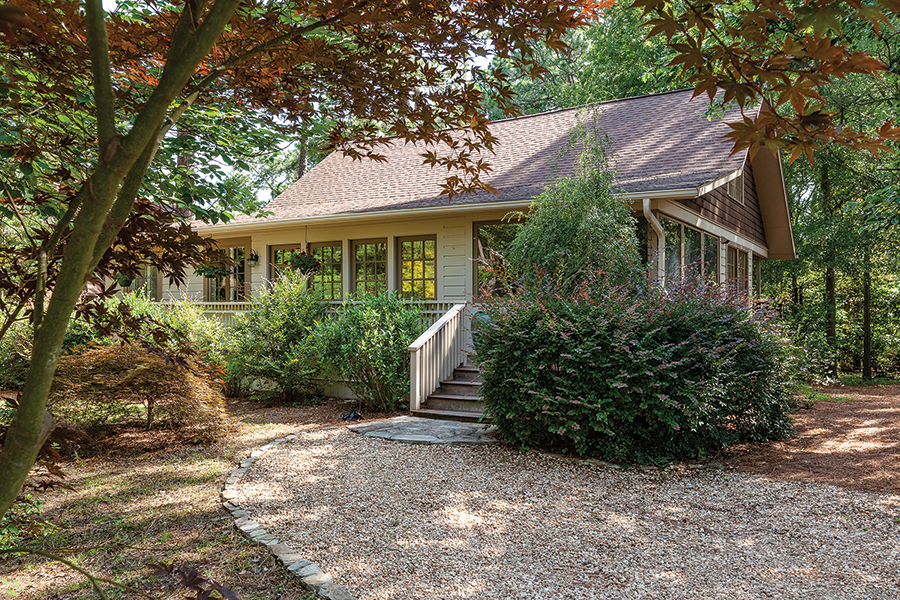
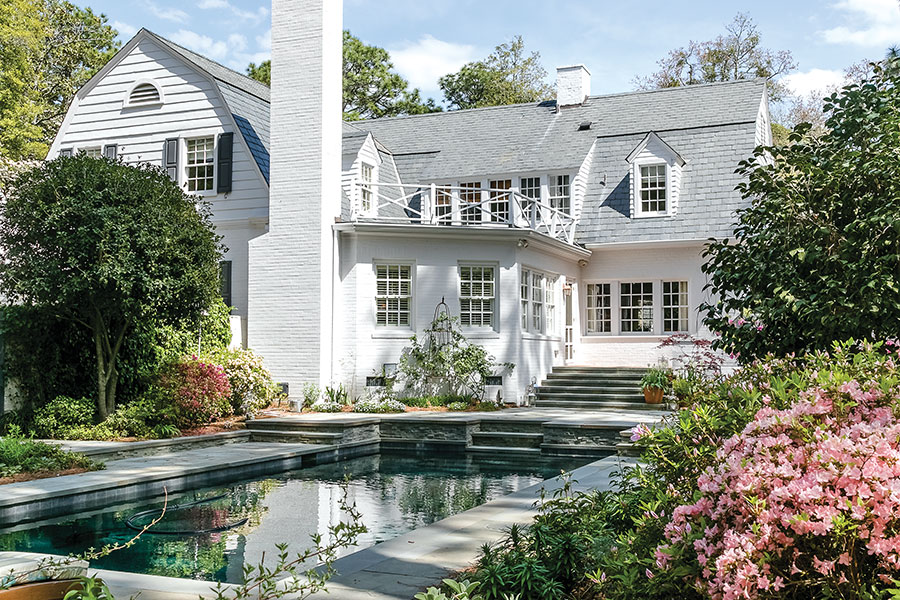
When the Roaring ’20s crashed in 1929, so did construction of luxurious winter residences in Southern Pines. One exception was a Dutch Colonial- style home designed by Alfred Yeomans in 1930 on prime Massachusetts Avenue acreage. Yeomans, a landscape designer and James Boyd’s cousin, had built the Highland Inn a few blocks away with Aymar Embury II. The new home on Massachusetts was owned by two daughters of Julia Anna “Annie” DePeyster of Ridgefield, Connecticut — Estelle Hosmer and Mary Justine Martin.

The DePeysters, mother and daughters, were typical of urban high society flocking to Southern Pines and Pinehurst for the mild winters. The family tree included two Colonial mayors of New York City. Another descendant, Frederick DePeyster, was a loyalist who fought on the side of the British in the Revolutionary War, was exiled to Canada, returned as a wealthy merchant, and rejoined New York’s social and economic elite. Annie DePeyster’s husband, Johnston Livingston de Peyster (a variant of DePeyster) enlisted in the Union Army at 18 and was credited with raising the first Union flag over the Capitol Building in Richmond, Virginia, after the city fell in 1865. He passed away in 1903. Why the sisters sold the fully furnished house in 1936 to the Catholic Diocese of Raleigh for half price remains a mystery, though Annie passed away a year later at the age of 90. William Hafey, the first Catholic bishop of Raleigh, kept his elderly father there; and Elizabeth Sutherland, a founding member of the Southern Pines Garden Club was a subsequent owner.
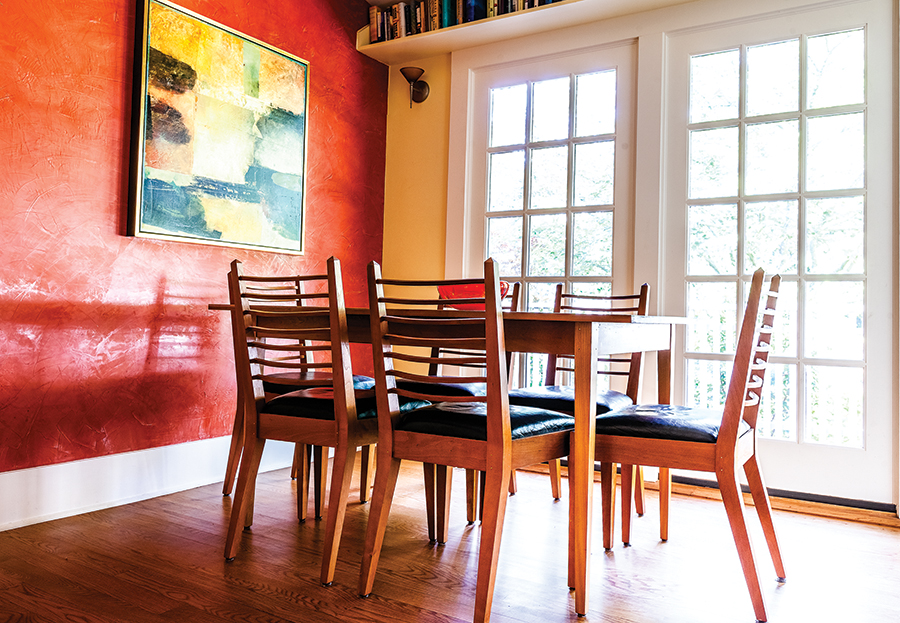
How very proud Yeomans, Embury (who built himself a cottage nearby) and the DePeysters would be of their accomplishment, now curated by Mary and Mike Saulnier. The flower, vegetable and herb gardens flourish, laid out and tended by novices who learned as they dug, moving and preserving decades-old plants. The house itself gains personality from irregularities and novelties — off-center dormer placement, angled walls, an exposed brick chimney rising two stories, a back stairway leading to the maid’s room (now a guest suite), a pair of interior windows, massive original bathroom fixtures and black-and-white tiled floors, a call bell system for the servants, and an under-the-stairway closet where hangs a clever fire extinguisher. Iron radiators, some covered with perforated screens, have been left in place as icons of the pre-forced air heating/AC era.

By way of introduction, in the foyer hang Yeomans’ architectural drawings, an homage to history beautifully framed by the Saulniers.
“I found them in the basement,” Mary says. That find inspired her to compile a scrapbook containing newspaper clippings about the house and its wealthy occupants, as well as other schematics. Because for Mary and retired Army Col. Mike Saulnier, this home represents another type of find.
“We were looking for a hometown,” Mike says.
Mary spent part of her childhood in Alaskan whaling villages, where her father taught in a one-room schoolhouse, later relocating his wife and eight children to Pennsylvania. Mike, from a military family, moved around. They met at Shippensburg University. Beginning in 1999, the military and NATO posted Mike, Mary and their children to The Netherlands, Belgium and Korea, sometimes for several years, with plenty of time to absorb the culture and acquire household goods.
The homesteading desire appeared in 2009, when they were stationed at Fort Bragg.

“We were sitting at the beach, trying to figure out where to live, since we didn’t have any connections,” Mary recalls. While browsing online she found a Weymouth listing that sounded attractive. They drove over and instantly fell in love with the area and, subsequently, the Dutch Colonial, which had been renovated and needed only painting (Mary and Mike did the interior themselves), window treatments, landscaping and minor adjustments.
“It felt right. We never looked anywhere else,” Mary says. Neither golf nor horses influenced their decision.
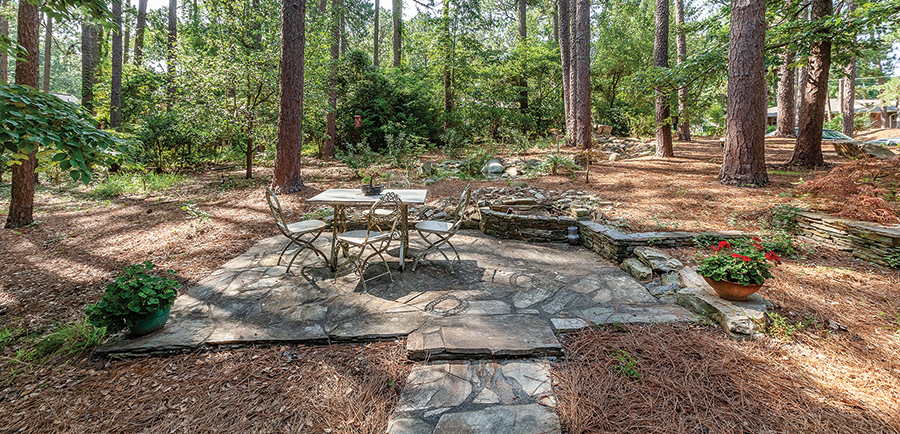
They moved in 2011 and began making the house their own. An unusual rectangular pool, for example. This came about when Mike discovered nothing would grow on that patch, also that a pool would cost less than a flagstone terrace. But nothing motel-style. He laid out the shape with ropes and hoses. “We wanted it to look like a water feature that had always been here.” The result, a safe 5-foot depth with a grayish pebble lining that makes the pool fade into the surroundings. An ozone purification system replaces chlorine. Add a few lilies and he’d have a pond.
Crumbling bricks on garden walls were made on premises by Yeomans, and a Dutch wooden gate replicates the one hung by the architect.
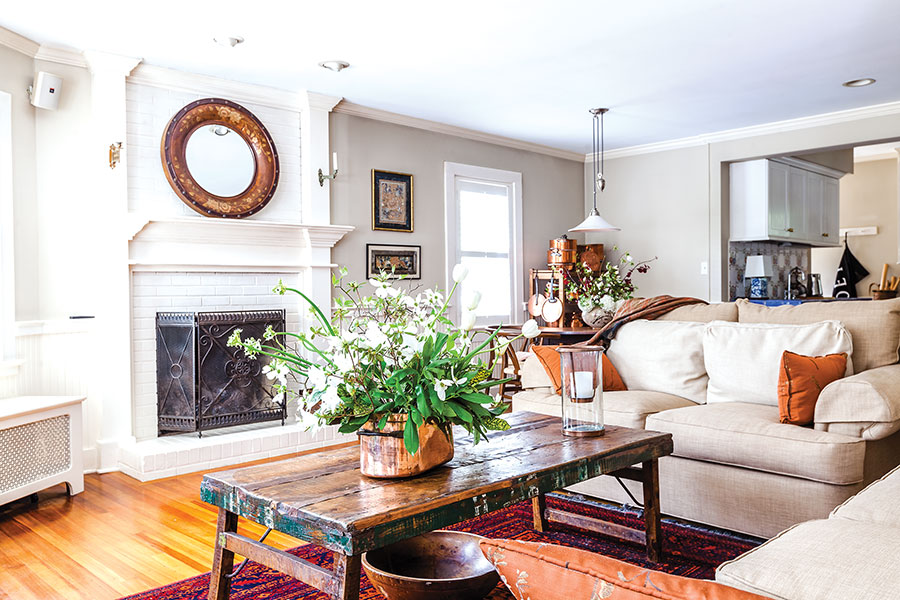
The main floor has a circular plan; turn right inside the front door, go through the dining room, kitchen and family room, windowless office and into the living room, which opens onto a screened porch. The only addition, by a previous owner, was the family room, which begs the question: Why are the walls angled in several directions?
Mary explains that the room was built not to disturb an ancient tree, perhaps a sugar maple like the huge one with dense canopy that shades and cools a portion of the yard.
That tree, a grassy lawn and boxwoods bring New England to the piney Sandhills.

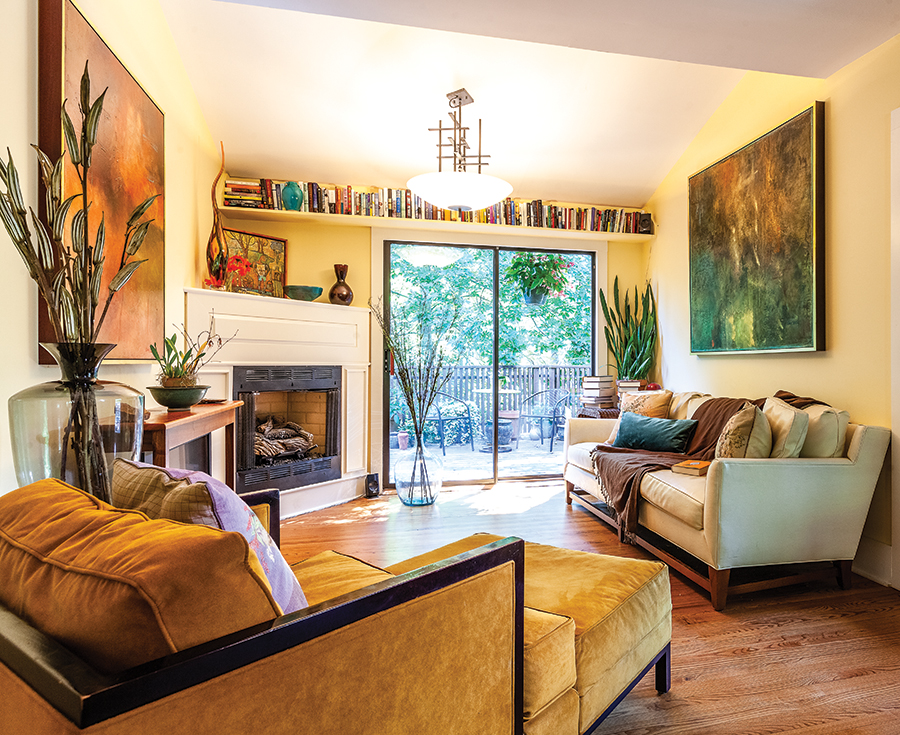
If only nations could live as harmoniously as the furnishings the Saulniers collected in Europe and Korea. An Asian aura prevails, serenely, without resorting to red lacquer. A set of calligraphy brushes on a runner printed with the Korean alphabet adorn the foyer table, hinting at what lies within. Folding screens serve as headboards. Bells line shelves. A step-down bedroom chest, Mary explains, is finished and operational on both sides making it suitable as a room divider. But for every Korean artifact there is a table, a dresser, a desk or bookshelf — some carved antiques, others plain and functional — acquired at auctions in Belgium and Holland.
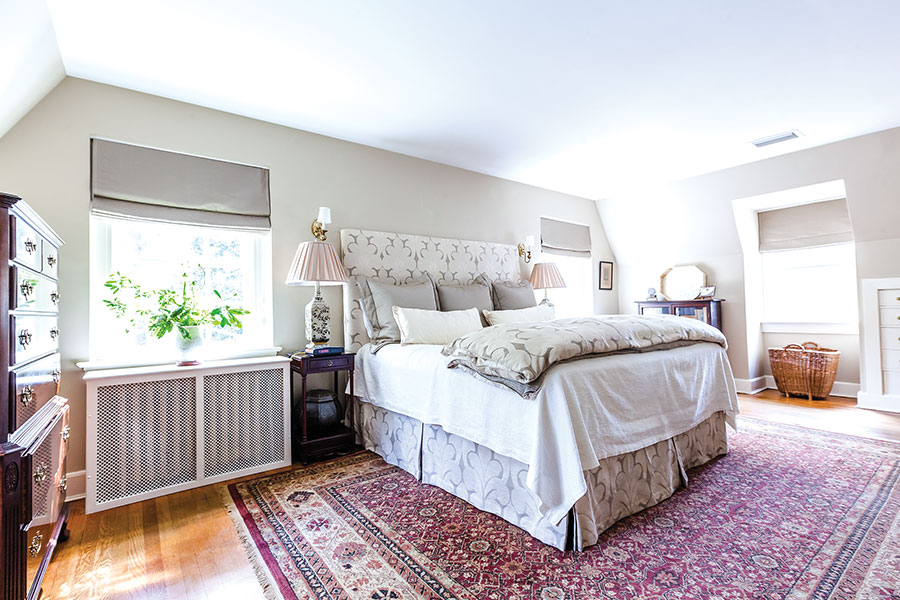
“I am naturally attracted to rustic and classic in muted tones,” Mary says. Her palette flows from moss greens and woodsy browns to oatmeal, linen beige, deep maroon and putty. Dusty turquoise appears briefly in the living room alongside an 18th century Flemish tapestry, with a few brightly colored Vietnamese bed coverings upstairs. Mary chose other fabrics with contemporary motifs. She and Mike upholstered bedroom headboards themselves using only plywood, padding, damask and a staple gun. In fact, “Everything we did is the first time we did it,” Mary says. Original oak and pine floorboards host carpets Mike brought back from Afghanistan. Beams cross the living room ceiling but this is not a house weighed down with crown moldings. Instead, objects like a colorful child’s kimono hung from a curtain rod practically jump off the slightly textured plastered walls.

In the DePeyster’s era a small galley kitchen was sufficient for the hired cook. Now, when houses sink or swim in the kitchen, the Saulniers’ bypasses glitz and gadgets for warmth and European country charm while providing every amenity. An L-shaped layout, beadboard cabinetry (except for a few original carpenter-mades), thick natural wood and Provençal blue ceramic countertops, a French Quimper tile backsplash, a small vegetable sink in addition to the oversize farmer model, make it a comfortable and convenient place to prepare meals. In a corner stands an antique baker’s rack holding Mary’s pride: a collection of polished copper pots and skillets without which a French chef wouldn’t attempt even a scrambled egg.
More than 3,000 square feet on 1 1/2 acres seems generous for two people and a cat. Yet no room (except for the family room adjoining the kitchen) is oversize. Mary thought ahead. “The kids are gone but we want them and the grandchildren (two, already) to come home and stay in the house for holidays and make noise.” Besides, she continues, the way the house is configured, when one area gets noisy other spaces, indoors and out, offer alternatives for quiet conversation.
Back to finding a hometown. As with the house, Mary and Mike Saulnier lucked out. “This area has a real blend of cultures and people and viewpoints,” Mary says. “You go to an art exhibit and every person you meet is from somewhere else — but it’s still a small town.” A small town graced with historic homes, preserved and furnished with fascinating memorabilia of lives well-lived, including theirs. PS
Paradox Farm
Going all-in out in the country
By Jim Moriarty • Photographs by Tim Sayer
Jimmy Stewart had one in Harvey. His pooka was a benign rabbit, unseen by most of humanity, that was precisely 6 feet 3 1/2 inches in height. Stewart’s character, Elwood P. Dowd, was a known and decidedly content tippler. “Well, I’ve wrestled with reality for 35 years,” says Dowd to the doctor who was passing judgment on his lucidity, “and I’m happy to state I finally won out over it.” While these creatures of folklore can take many forms, one wonders just how much wine would be necessary to make two otherwise sensible, urban-dwelling people, Sue Stovall and her late husband, Hunter, see goats.

“The story is well known that we had too much wine one night and decided to buy goats,” says Stovall. “Very good wine. There was a lot of it probably.” And so Paradox Farm was propelled down its dirt-road, cloven-hoofed path.
The farm began in 2007. “It was about the time the economy was changing,” says Stovall. “Hunter and I were both self-employed. He was an attorney, the kind who enjoyed more counseling than litigating. He would rather help you solve a problem than litigate a problem. I was in health care. We worked 3 miles from where we lived (in downtown Southern Pines). Let’s move out to the country. We bought this house. It was a horse farm. We were here for about a year trying to figure out what we wanted to do.”
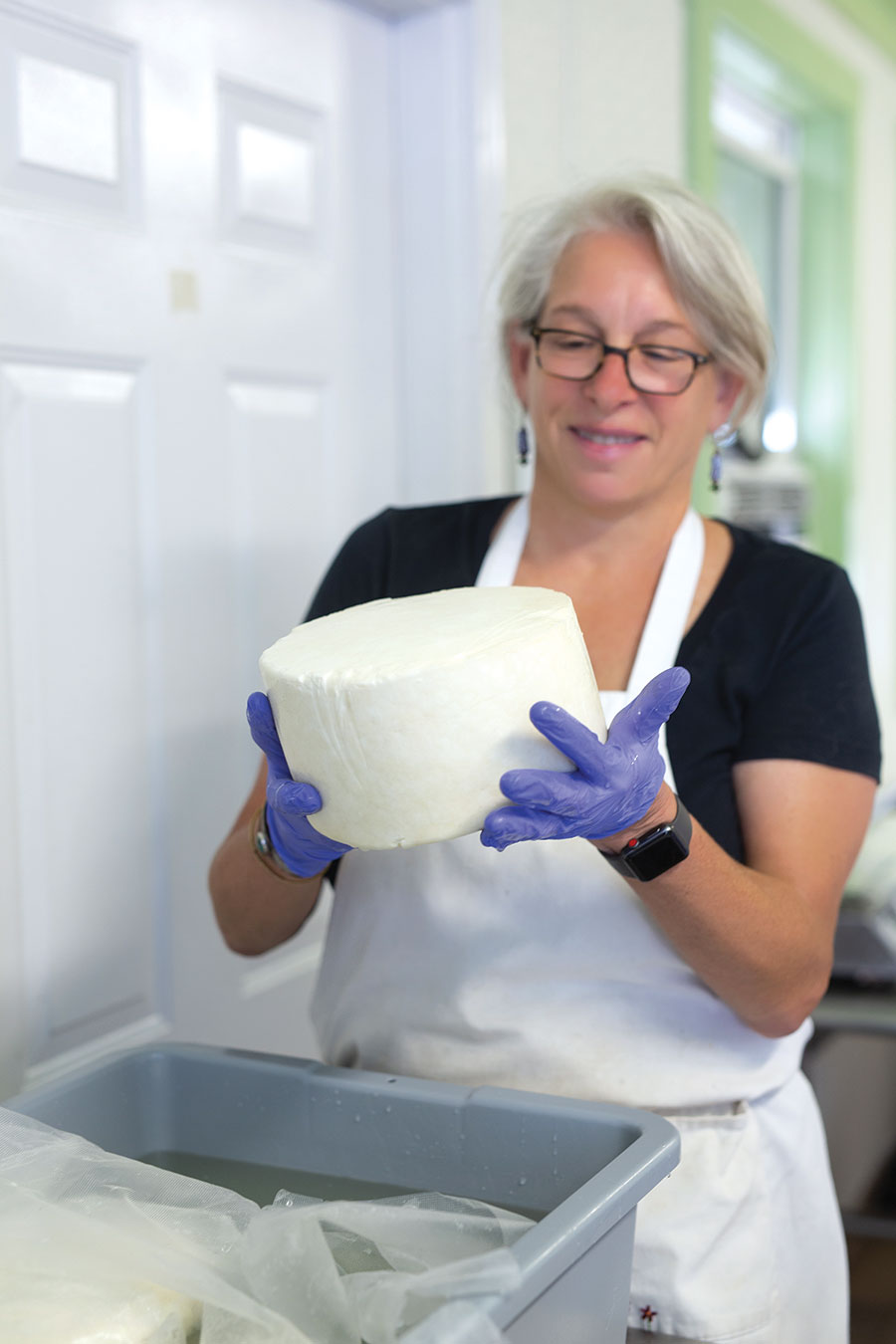
A few chickens, which are apparently the gateway species to serious livestock, showed up first. The hens were followed by an evening of red wine, a llama and three goats. The first two goats were named Thelma and Louise. “There was never, ‘Oh, I always wanted to be a farmer.’ Everything was like, ‘Hey, let’s try this,’” says Stovall. “I’m probably the most unplanned person you ever met. So, we got the goats and we had babies and started milking goats and started making cheese. We were sitting on the porch and drinking wine and eating our cheese and looking at this book about how to make your own creamery. It starts listing 10 things you should want to do if you want to do a dairy, because it’s really hard work. We looked at all of them and we’re, like, ‘None of those fit. Let’s do it!’”
By 2011, Paradox Farm was a licensed creamery. “Since then we’ve been growing the herd, making and selling cheese, and expanding our markets,” says Stovall. She hasn’t done it alone, but she has done much of it without Hunter. Sue grew up in Plainview, New York, in roughly the geographical middle of Long Island, near Bethpage State Park. She has three degrees in physical therapy, including a Ph.D. from Boston University. Hunter grew up in Virginia, went to the University of Virginia and Campbell University School of Law. Hence the “pair of docs.”
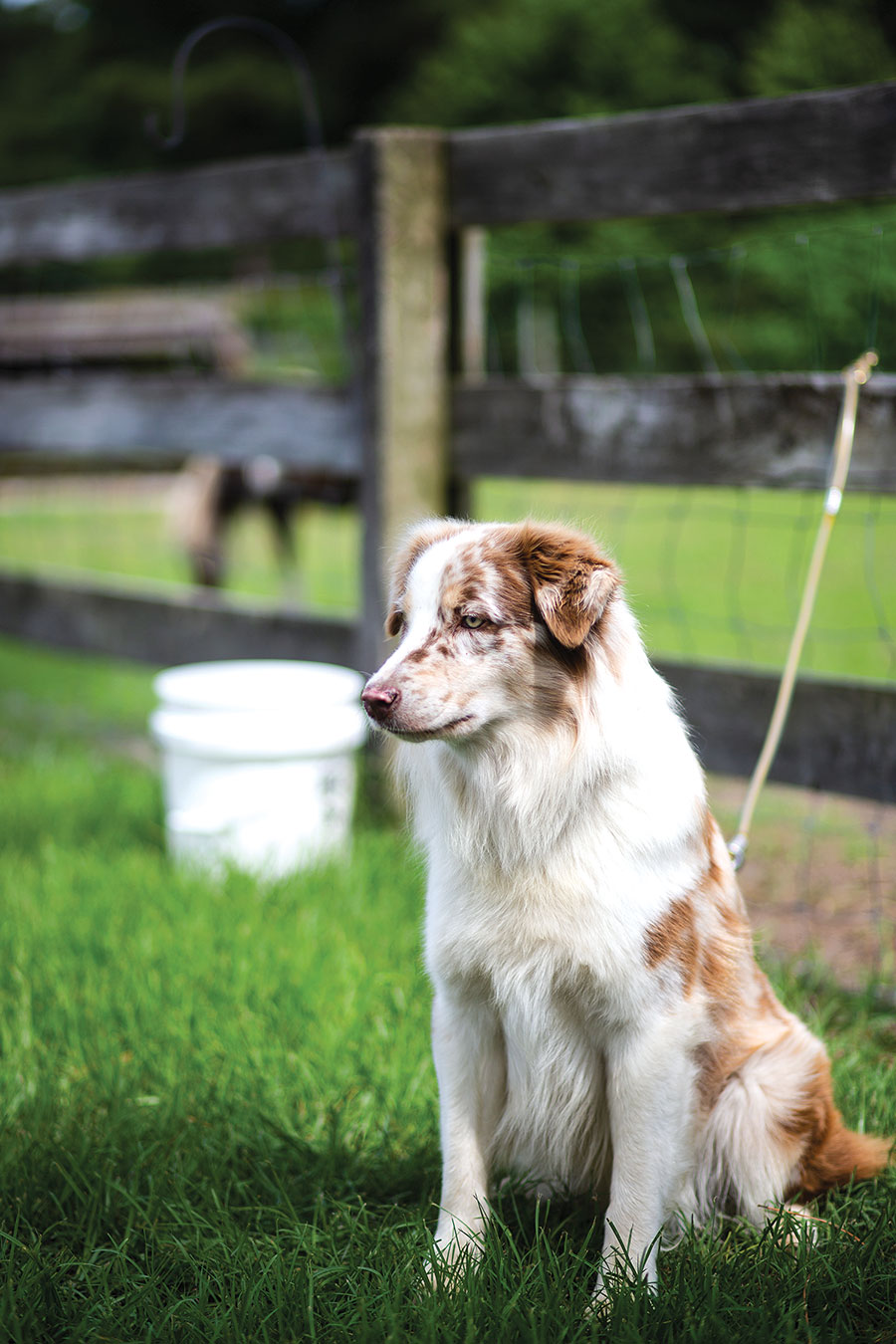
Just as their porch reading advertised, a dairy is hard work. “We would get up in the morning. He would feed and I would milk. We’d go in the house, take a shower, change our clothes and go to work. Come home, change our clothes, feed and milk and do whatever we needed to,” says Stovall. “On weekends we would go to markets. I was doing Southern Pines and he was doing Cary. We had both gone to market that morning, which means he had to leave about 6:15. He went to market, came home and lay down to take a break before evening activities, got up and had a heart attack.” That was four years ago this August.
Stovall has two daughters who are Moore County residents, Ariel Davenport, who owns Set in Stone/The Slab Warehouse, and Kassia Stubbs, who works for Moore County Schools. Her son, Mike Kowalick, lives in Seattle, Washington. “My girls are not farm kids at all but they support my efforts,” says Stovall. Her son helps with strategic plans — how to lower the power bill, marketing ideas, etc. It was Mike who suggested his mother engage interns from World Wide Opportunities on Organic Farms. “He was trying to figure out how I was going to survive without Hunter,” she says. Beri Sholk from Orlando is there now, the sixth WWOOF intern who’s worked at Paradox Farm, trading labor for knowledge, something that’s turned out to be a two-way street. The interns have been from California, Florida, even the Republic of Mali, West Africa. “It’s really expanded my world,” says Stovall.
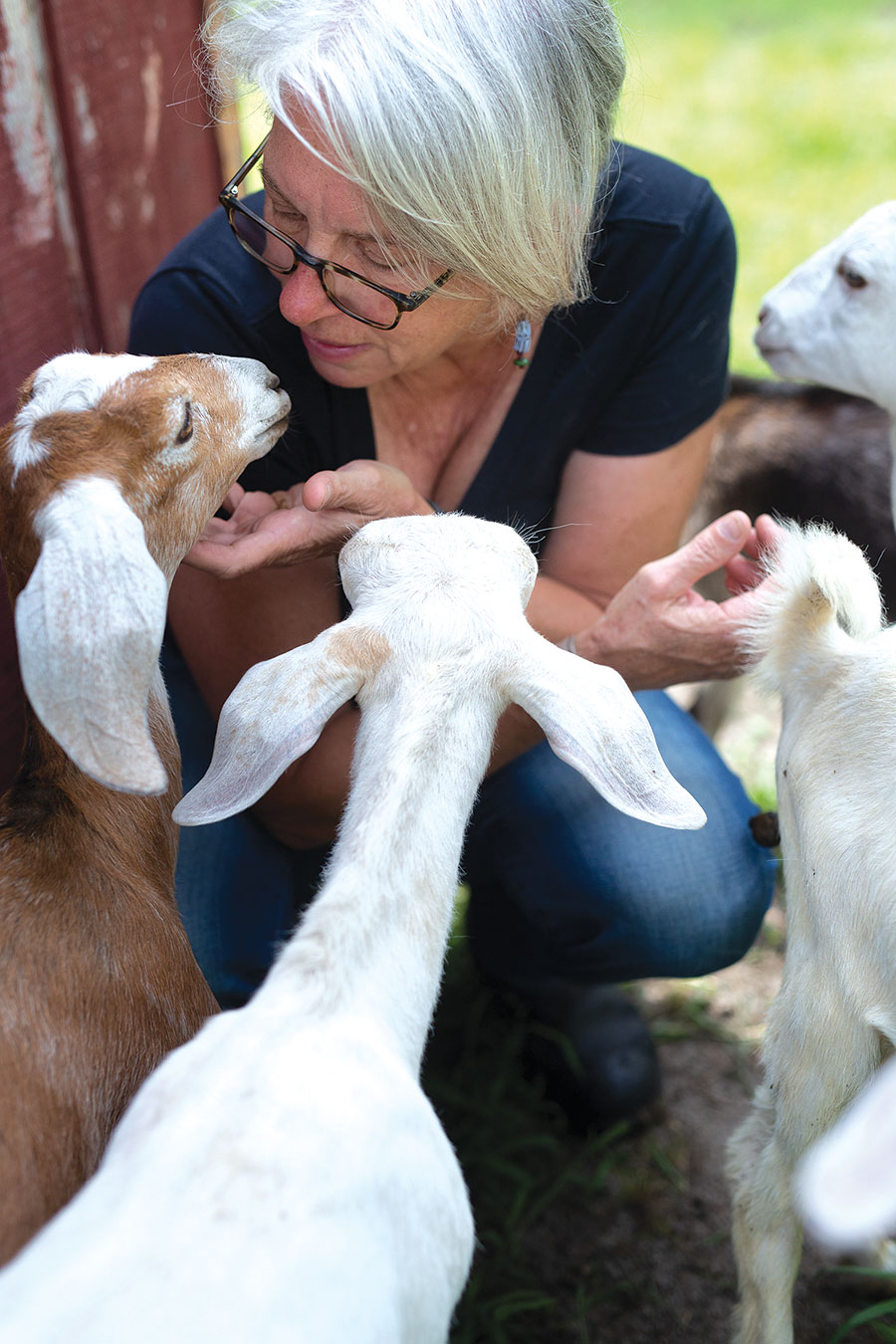
The goatherd at Paradox Farm stays roughly level at around 40, though the number jumps when the season’s kids are born and before they’re sold. “I started with Nigerian Dwarfs because they were cute and little and I thought I could handle them,” says Stovall. “Then I added Nubians. Then I needed to get more milk so I added some Alpines.” All the goats have names. The ones that look alike wear identification tags. And, no, they don’t say “Hello, My Name Is . . .”

They milk 22 goats a day, two at a time, using a pumping machine. In a large dairy the milk from 10 times the number of stanchions would travel through pipes to a bulk tank. “Because we’re small, we just pick up our buckets of milk and pour them in a tank,” says Stovall. “I think it really helps in the quality of our cheese because milk is a molecule, a living organism. The less you handle it the better it’s going to be. Our cheese tends to be sweeter and milder than most people think of goat cheese.”
The 61-year-old Stovall’s skills from her previous occupation can come in handy, getting the kinks out of a farm hand’s neck, fixing a goat’s broken leg, or putting a brace on Beri’s left arm after she was kicked — the goat version of negative feedback. “Farming is a full-contact sport,” says Stovall.

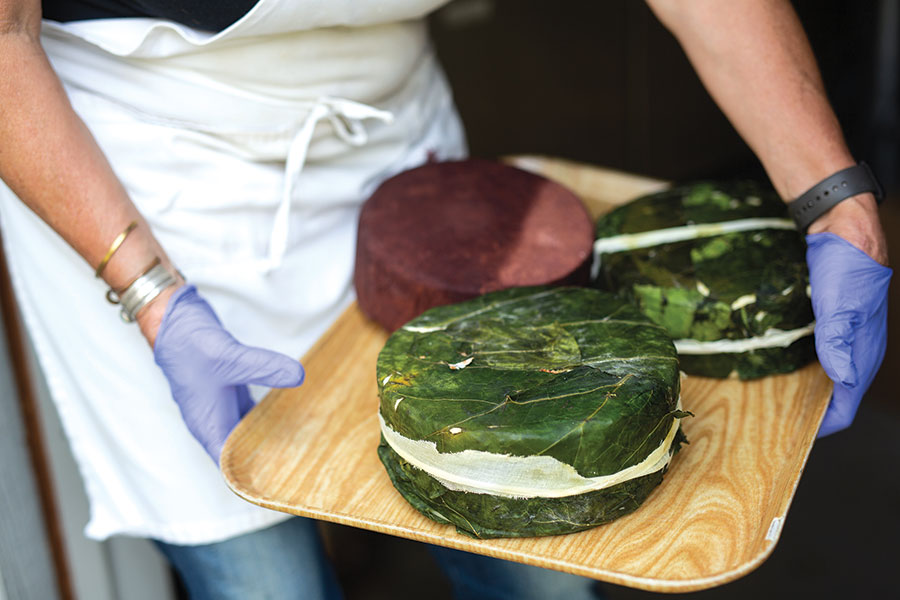
The Paradox Farm cheeses show up at places like Southern Whey and Nature’s Own in Southern Pines, the Corner Store in Pinehurst, Black Rock Winery and restaurant’s like Ashten’s and 195, just to name a few. Wrapped, infused, washed and aged, the flavors (and puns) are as wide-ranging as the names would suggest: Drunk N Collard; Sweet Hominy; Red Eye, Feta Complee, Paradox Paneer and Cheese Louise!
Making a small farm sustainable, however, is a value-added proposition. With the help of a grant from the University of Mount Olive, Stovall bought an old tobacco barn, broke it down and reassembled it on her farm. Half of the barn will be a cheese cave for aging. The other half will amount to a mini-storefront. “We do farm events. The last couple of years we’ve had hundreds of people come out on a Sunday afternoon, tour the dairy, see the goats. We do ‘Goat Yoga’ once a month. And we have pairing events where we pair cheese with something. Our first one was beer and cheese. We’re doing cheese, wine and desserts with Black Rock and the Wine Cellar. I’m determined to make this work,” says Stovall.

“One of the biggest challenges for me over the last couple of years is to learn to farm smarter. These are my babies. When they die I’m going to burn sage and say a little prayer when I bury them. I still have to be able to balance that need for myself with the business of running a farm. It’s a challenge to find that balance. Every day is filled with disaster and beauty.”
Paired, perhaps, with some Cheese Louise! and a petite shiraz. PS
Jim Moriarty is senior editor of PineStraw and can be reached at jjmpinestraw@gmail.com.
Poem
The Community of Food
It’s a business, an art and a science and it all eventually winds up on our tables. These are just a few of the folks who make dining in the Sandhills a fresh, friendly, delicious experience.
Dale Thompson
Hilltop Angus Farm
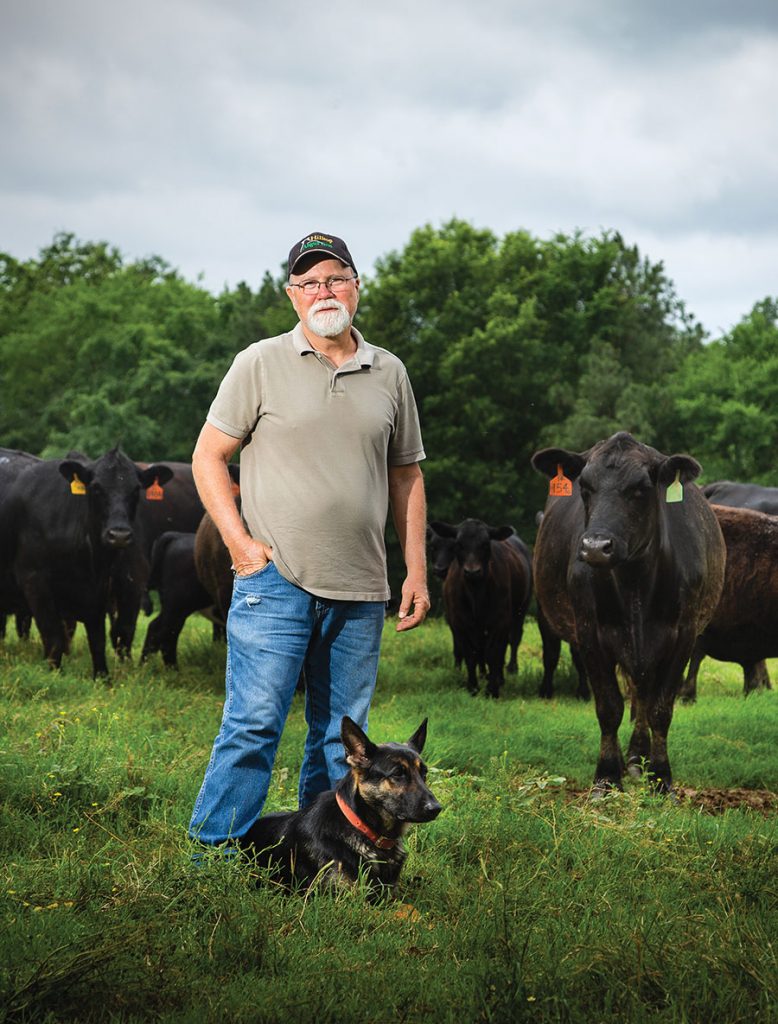
“I’ve been here all my life,” says Dale Thompson, looking out over the rolling hills near the Uwharrie National Forest from the second story of the green barn where he organizes the distribution of his grassfed beef. His parents were loggers, then dairy farmers. “Things change. We have a cattlemen’s meeting every month during the winter. We had a guy from N.C. State come and put on a program about direct marketing. My oldest son talked me into trying it.” They started with Earth Fare in Asheville in 2011. “I figured that if it was good enough for Earth Fare we could try a market. It’s a big step to go to a market. You’re afraid your product will be rejected. We started in Southern Pines and Pinehurst. It just grew and grew and grew. Now we sell all of our production. People like to have a clean food, know what’s in it, know where it comes from.” Hilltop adheres to the protocols of the American Grassfed Association. The cattle are never given growth hormones or antibiotics. The beef is processed and packaged by Mays Meats in Taylorsville. In addition to Hilltop’s beef, artisan salami and sausages, they offer lamb on a limited basis and heritage pork. They sell directly to Ashten’s, who has been with them since the beginning, and Sly Fox. Their reach extends as far as Wilmington. Thompson has roughly 300 customers there who place orders online. “We meet them in a parking lot on Sunday morning, the first Sunday of each month,” he says. “Anywhere from 50-70 people come in an hour and a half.” Thompson’s wife, Sharon, grew up on a farm 3 miles south of Mt. Gilead. “She was raised on a farm. I was raised on a farm,” Dale says. “I’m born on the land. The only way I can leave it is to sell it.” And that’s not about to happen.
Ben, Jane and Gary Priest
Gary Priest Farm
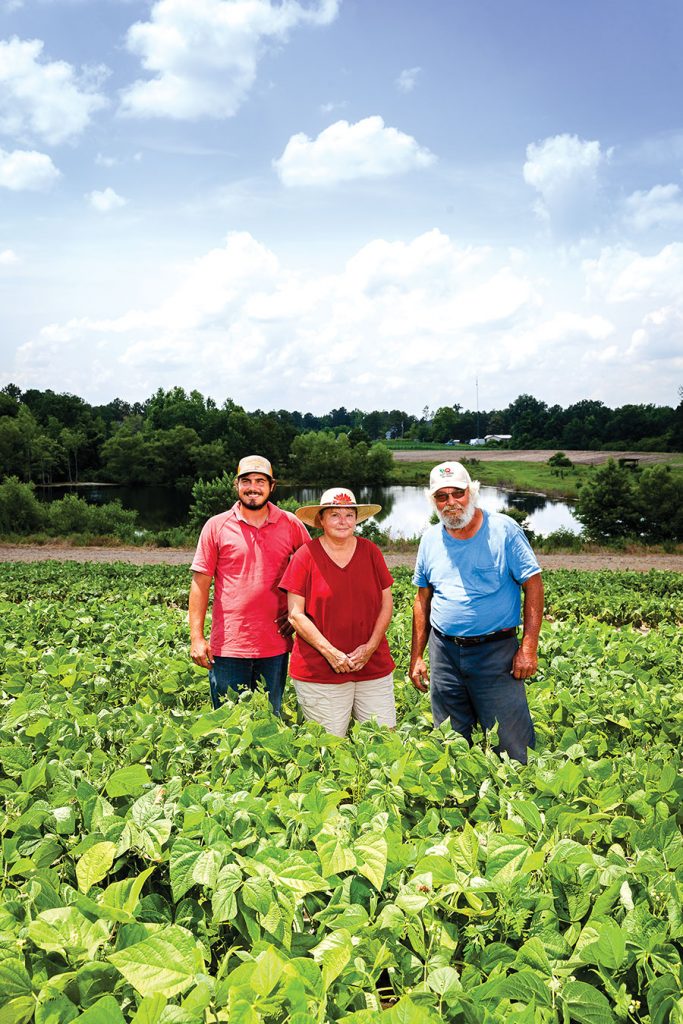
The transition started with asparagus. Where there once was a hillside full of tobacco, now the farm on Bibey Road in Carthage grows nothing but produce. “I started playing with asparagus,” says Gary Priest. “Somebody said I couldn’t grow it.” Besides, the farmhands needed something to keep them busy in the spring. “Now all the tobacco’s gone to a different farm,” says Gary’s son, Ben. “We should be growing more produce this year than we ever have. That field right there gets triple-cropped. Soon as those peas are done, I planted kale where the first pea patch was. Soon as the potatoes are gone, something else will be there. Collards or something. We have carrots, onions, garlic. Green beans on the hill where you drive up.” The Priest farm devotes somewhere between 1/4 and 1/2 acre to asparagus. “Then we had more than we could just sell to the restaurants and we started going to the farmers market and the Farm to Table got started,” says Ben. “We don’t plant on speculation. Half of it is sold when we plant it.” And they’re particular about what they deliver. Someone once approached Gary looking for advice on marketing a crop of strawberries. “You send them the very best you got because you’re not just selling strawberries,” he told them. “You’re selling your farm, your name, your reputation and they won’t forget it you dump something on them.” The Priests supply produce to nearly a dozen local restaurants, including Ashten’s, Chef Warren’s, Elliott’s on Linden, Restaurant 195, Sly Fox, Ironwood, Scott’s Table, Thyme and Place Café and The Bell Tree Tavern. “Stuff that’s grown under plastic is fine,” says Gary, “but it doesn’t taste like something grown in the bare ground.”
Ryan Olufs
Misty Morning Ranch
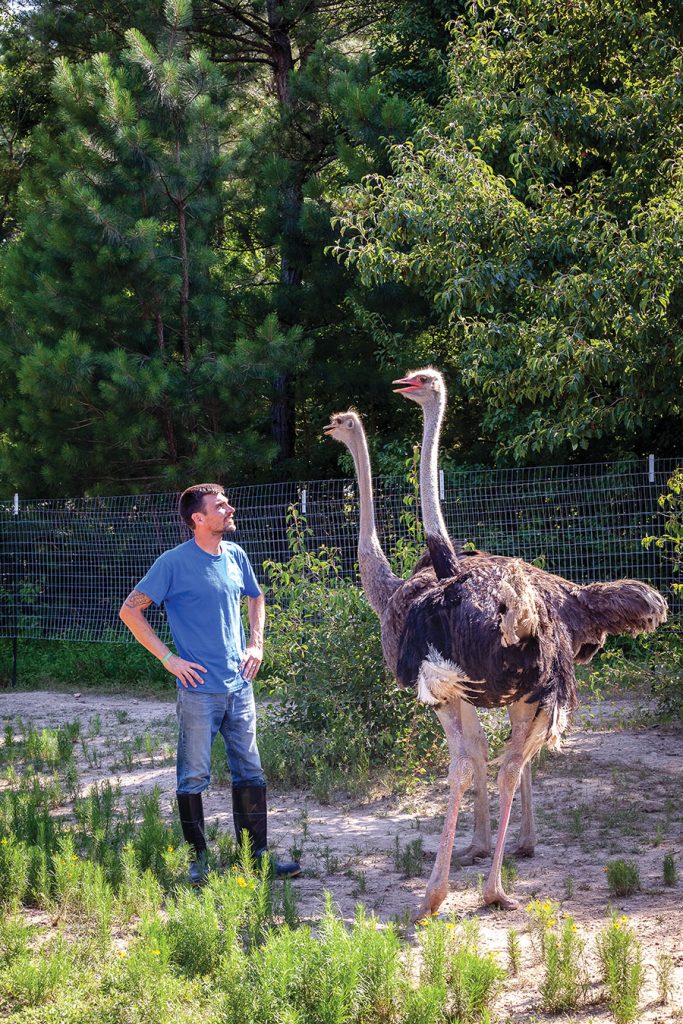
In September 2015, Ryan Olufs and his wife, Gabriela, crammed everything they didn’t sell or give away into their Dodge Challenger and moved from the San Fernando Valley in California, to Robbins, North Carolina, stopping along the way to see Yellowstone and Mount Rushmore. “We wanted to move to a more rural region, get away from the big city lifestyle,” says Ryan. They did it in a big way. After purchasing a farm in Robbins, they decided they needed to put something on it. “I came across ostrich, really for the feathers. Then we found out that the meat is the No. 1 product,” says Ryan. “Wow, you can eat an ostrich? The more we researched it more it appealed to us. Being first-time farmers, they don’t require as much husbandry as other animals. Ostriches have one of the strongest immune systems of any animal. They’re completely immune to avian flu. They require no vaccines. They lay eggs. And it’s just about the healthiest meat you can eat, either red or white.” So, with the help of Ryan’s brother, Robert, who is in the military, the Olufs planted their urban roots. They revitalized the pastures and put in fencing. They started with two birds, Ed and Bella, in 2016. Now they have 19 birds, 15 breeding stock and four juveniles for processing, done by Chaudhry’s in Siler City. “There’s exploding demand outside the United States,” says Ryan. “Right now ostrich sells for more than Kobe beef in Japan.” With production in its infancy, the Olufs sell locally at farmers markets in Southern Pines and Pinehurst and a butcher’s market in Raleigh. “Chef Warren’s has it on the menu,” says Ryan. “Sly Fox has done it before. Ashten’s buys the eggs from us and they make crème brûlée and ice cream out of them. People will actually come to the farmers market to tell us how good the ice cream is at Ashten’s.”
Martin Brunner
The Bakehouse
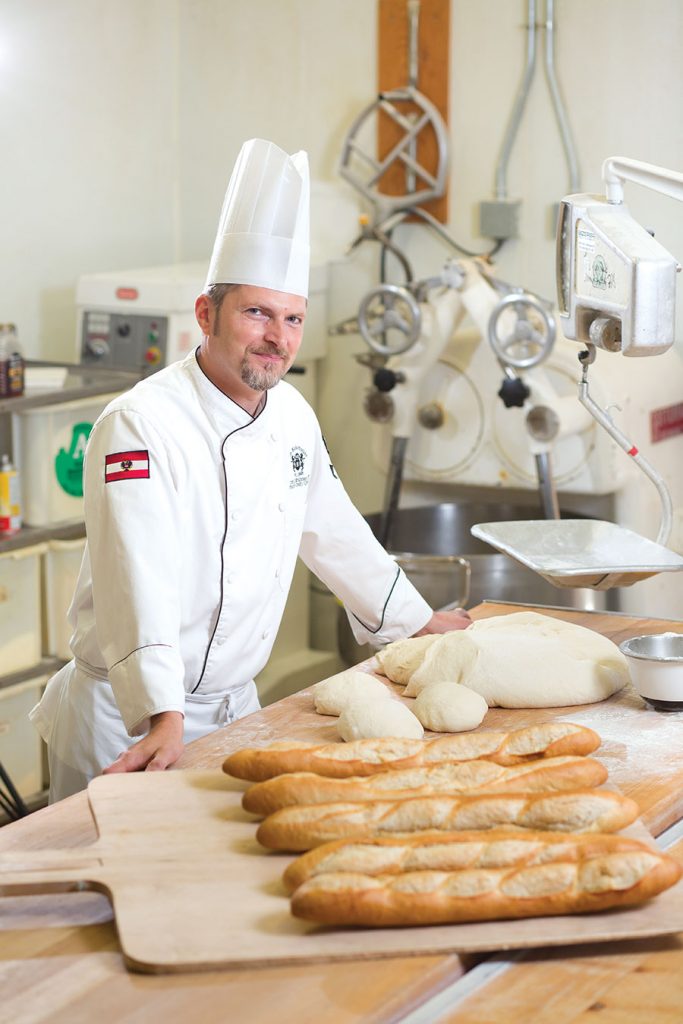
Martin Brunner’s father, Kurt, who started The Bakehouse, was a master baker. Martin’s grandfather was a master baker. His great-grandfather was one, too. And his great-great-grandfather before that. Five generations of experience floats out of the The Bakehouse kitchen on the scent of fresh bread. Martin, who emigrated from Austria in 1991, is also the baking and pastry coordinator at Sandhills Community College. The Bakehouse menu’s Spanish flair comes from Martin’s wife, Mireia, and her mother, Dolores. “A lot of the recipes here are my mom’s, my dad’s, my grandfather’s, my great-grandfather’s,” says Brunner. “Actually the recipe we use the most is my grandmother’s Black Forest cake. We’ve been in the United States 26 years and I was a little kid eating it, so for 34 years we’ve made the same cake.” In addition to the restaurant, they sell wholesale to the Pinehurst Resort, Pine Needles, Restaurant 195 and various retirement homes. “We do a lot of brioche and burger buns for food trucks. The biggest thing is that we — all the restaurants here in town — work really hard to be special,” says Brunner. “If I can add a burger bun that I only make for you and you’re going to put your signature burger on it, that’s what we’re all about. We don’t mass-produce.”
Ronnie and Denise Williams
Black Rock Vineyards
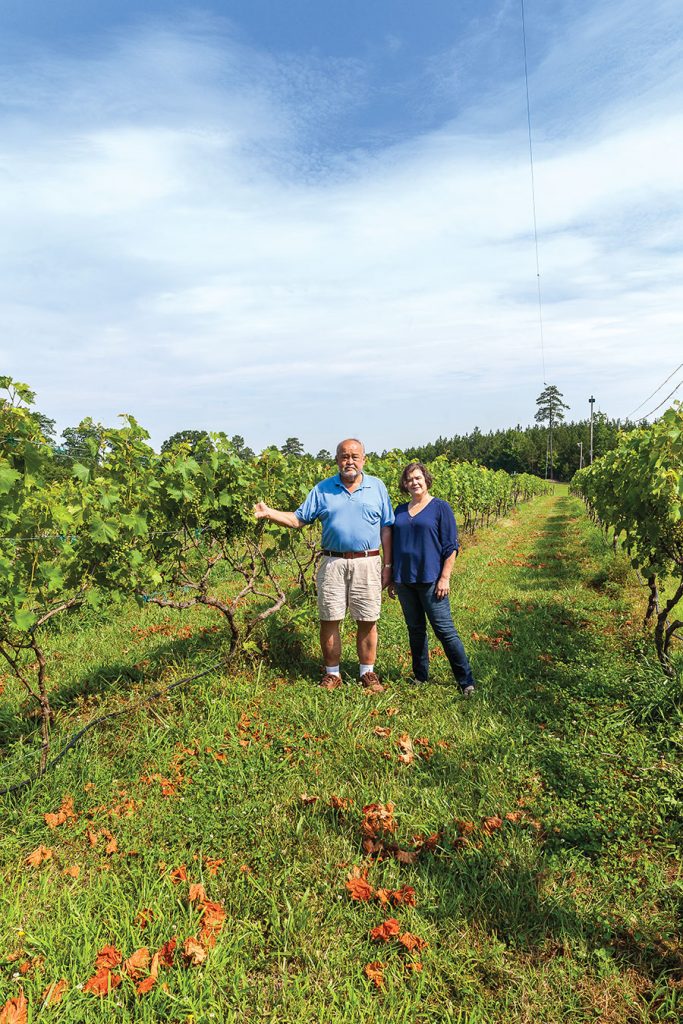
Full-time landscapers, Denise and Ronnie Williams branched out from dogwoods and maples to chambourcin and traminette. Grapes, that is. “We have a nursery farm with ball and burlap stock on it. Machine dug trees. We cleared a piece of our property to put in more of the same,” says Denise. “It was not suitable so we started researching what would grow. We kind of got into the grape-growing business. We were told it wouldn’t work here. We started ripping the soil and getting everything ready in 2004. We made our first wine in 2008. We weren’t even hobbyists. We took that first little crop and we sold 1,000 bottles. The next year we made about 3,600 bottles. In 2010 we had our best year, which was about 10,000 bottles.” Now they have 5 1/2 acres of viniferous grapes and sell wine at the Corner Store in Pinehurst and Nature’s Own, in addition to their winery on U.S. 15-501. “The last couple of years have been very challenging because of the weather conditions,” says Denise. “Twice now we’ve lost vines due to cold.” With Ronnie doing the planting and Denise the winemaking — she had a background in laboratory work from a 24-year career at the Pinehurst Surgical Clinic — they experienced some early hurdles and early successes. “We do have some wines that we pulled back,” says Denise. “But we’ve also got some wines that we’ve won medals with. We’ve won medals with our chambourcin. It’s probably our best-seller. It makes a really good medium-bodied wine. It goes really well with barbecue, with a steak. We try to use the minimalist approach to just about everything. We use the least amount of sulfites. We do it in a primitive way. We pick the grapes, bring them back to the warehouse. We have a ratchet press that’s manned by four people.” The winery doubles as an event venue. They’re in the livestock business, too. “We have lamb now,” says Denise. “In Australia they put sheep in the vineyards to mow. Filly and Colts has our racks of lamb on their menu.” The weather extremes of the last few years have cut precipitously into the harvest. “When you lose, it’s heartbreaking,” says Denise, “but it doesn’t keep us from wanting to go forward.”
Rich Angstreich
Java Bean Plantation & Roasting Companys
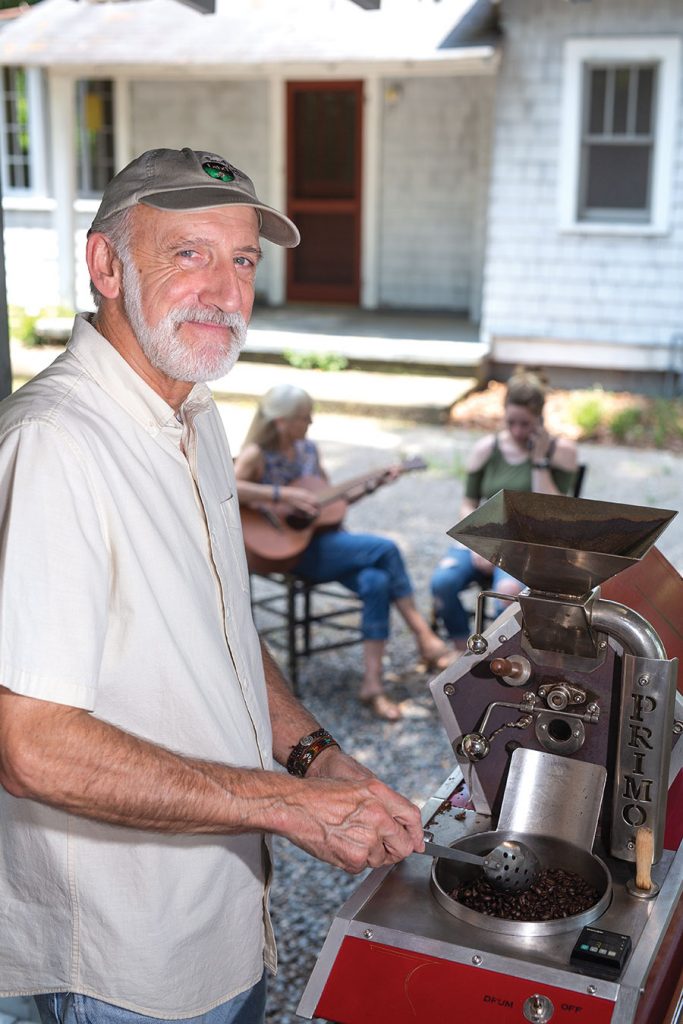
It’s kind of The Comedy Store of coffee shops. Rich Angstreich brings skill to coffee bean roasting and roasting to customer relations. “Friends of mine opened the shop and eventually I became a partner,” says Angstreich, who took over three years after it opened in 1996. At first blush, roasting the green beans was a craft in the making. “It was all trial and error in the beginning because it was just for fun. It took a while but we figured it out. A couple of visits from the fire department,” he says (comedic drum snare). Though the list of coffees fluctuates, beans currently on the docket include Colombian organic, Sumatra organic, Costa Rican, Mexican Chiapas, Honduran and a Sumatra decaf. “We’re definitely small batch, artisan roasting,” he says. Angstreich roasts for the Java Bean, The Bakehouse and Chef Warren’s. Most of his supply comes from a large importer, Royal Coffee, though he also purchases from a small company in Raleigh that deals directly with farmers. “It’s Honduran and they’re trying to expand and get a couple more coffees from Central America,” he says. “Each coffee roasts slightly differently. Some taste better when they’re dark roasted, some taste better when they’re a little lighter roast. We do everything by hand. There are no electronics to start or stop it. Everything is your eyes and your ears and your nose to figure out what to do.”
Heigh-Ho, Heigh-Ho
It’s off to work we go
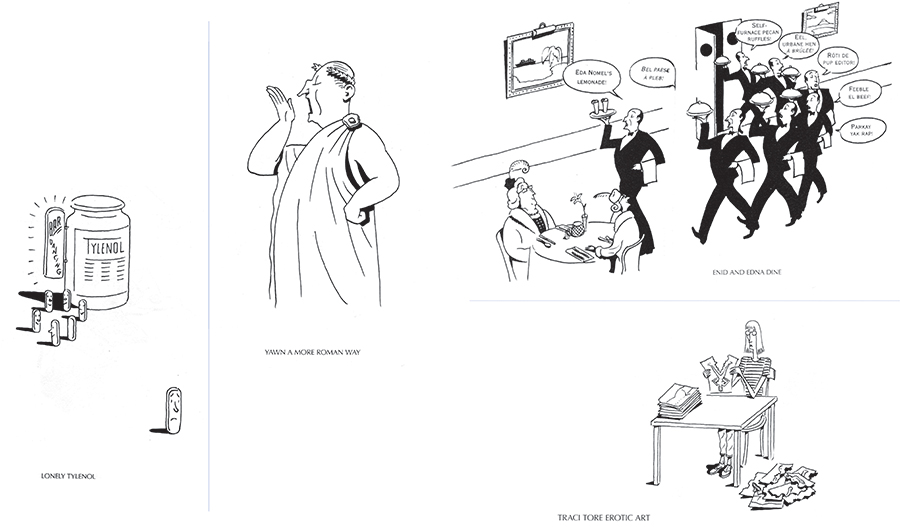
Illustrations by Laurel Holden
We’ve all had ’em, those odd jobs we’ve done along the way. Maybe it was behind a cash register or in front of a deep fat fryer. It could have been sweeping floors, pouring concrete or delivering pizza. The uniform might have featured a hairnet or a pair of work boots. It could have been weekends or evenings in high school or a long, hot summer waiting for college to begin. Maybe you already had a degree in your hand. The payoff could have been cash money (though not much of it) or nothing more than the experience. The memory of these jobs can bring a smile, a groan or a grimace. The money, if there was any, didn’t last long. The lesson that all work is noble lasts a lifetime.

Helen Buchholz is the mother of eight and grandmother of 25 who just celebrated her 95th birthday and once owned The Salem Shop, a women’s apparel store located on the corner of Pennsylvania Avenue and S.W. Broad Street. At home she has a photograph taken during War War II of her husband, John, who lost a leg in the Battle of Peleliu, meeting Bing Crosby at a golf club outside of Philadelphia, Pennsylvania. She was Crosby’s driver and, at the time, didn’t know the man who would become her husband.
“I was a driver for the Emergency Aid in Philadelphia. An organization of volunteers. I did it from 1941 to 1945. I was 18 in ’41. My husband got to do it because he was part of the incentive program. They went around to different plants that won the letter E — the flag that they hung on their building — for their work effort. I was the one that drove Bing Crosby. I used to meet them at the airport or the railroad station and take them to Convention Hall when it was a drive for bonds, selling bonds during the war. I drove a lot of them. They had bond drives all the time. Those people came in as guest speakers. They stayed at the Ritz Carlton when it was on Broad Street, if they stayed overnight. I was assigned as their driver the whole time they were there. Most of them were very nice. Some were bossy like they thought we were employees instead of volunteers. They would have somebody in the backseat with them and they’d be talking. Bing Crosby was very nice to us. We had Bob Hope. He was fun. He really was. He had a lot of cuss words in his vocabulary but not like two of the women. Lucille Ball had a very dirty mouth. Linda Darnell. She had a terrible dirty mouth, terrible. That’s what I remember most, I guess. It was all very interesting to me. We were all a bunch of volunteers. We had the USO in the basement of the Academy of Music off Broad Street. The USO was there all day and all night and it was all volunteers that did it. Sometimes there were five or six people down there; sometimes there were 100.”

J.J. Jackson, part owner of the Carolina Hurricanes, has served as a board member and/or chairman of several worldwide rare earths and rare metal mining and natural resources companies; invested in and was a board member of the largest mobile telephone provider in Lithuania; was the chief financial operator of a similar company in Romania; worked for a wireless telecommunications company in the Czech Republic and at a holding company specializing in high-growth, high-risk telecom ventures throughout Central Europe; and on and on. A native of Peterborough, Ontario, and a former hockey goalie who married the Zamboni driver, his wife, Nancy, Jackson and his boyhood friends from Adam Scott High School spent June, July and August with flashlights attached to their baseball caps and old soup or bean cans strapped to their legs with elastic bands wandering local golf courses in the middle of the night learning the ins and outs of business from the ground up.
“I would bicycle about a mile to this guy’s ramshackle house, then we’d pile into some beat-up old van about 10 o’clock at night and drive to a golf course. You’d have a big empty can strapped to each leg like in the old days when you played hockey and used Sears and Roebuck catalogs for shin pads. And then you’d walk the fairway. Your quota was 1,000 worms a night, 500 in each can. Nightcrawlers. You sold them to the bait stores in flats of 500. We’d finish up at 4 or 5 in the morning, get back in the beat-up old van, go back into town, get on my bicycle and pedal back home. One night we were swinging from the limb of a tree and broke it. The golf course was pretty mad about that. Otherwise it was pretty uneventful.”

Paul Murphy is the pastor at Trinity A.M.E. Zion Church and spent a couple of decades performing at the Pinehurst Resort and Country Club.
“Technically, my first real job, I worked for my father, Murphy’s Music Center down in Town and Country shopping center. I moved pianos. Right before going to Chapel Hill to college he sent me off to a piano technicians school in Elyria, Ohio, to learn to tune, rebuild and refinish, everything having to do with a piano. It was called Perkins School of Piano Tuning and Technology. I was there for six months. The guy who owned the place was a West Virginian. He had this little racket going where he would advertise: Junker piano in your basement? They would pay him to rid their basement of these monstrosities. We would get these pianos all the way up the stairs, up on to the truck, bring them to the school, where we would pay him to teach us to tune the pianos and rebuild the pianos. Once the pianos were done then we would deliver them to downtown Cleveland to his store, where he would sell them. For him it was a win-win-win. Once I got to Chapel Hill, I ate up my dinner ticket my first week. When I came to myself, I said, ‘Wait, I can go to the music department and let them know I can tune pianos.’ The first day they sent me down to the basement and I tuned, like, four pianos. I worked my way up to the concert stage. My very first job was down in Madison, Georgia, picking cotton. The next-door neighbors were migrant workers. I was 5. We’d get paid a nickel a week. End of the week, my mother said I could spend three pennies. Go down and get these big round cookies, two for a penny. When we moved to North Carolina in ’71, I was in fifth grade. I got in with the tobacco guys. They were waking up at 4 o’clock in the morning. I think it might have been the summer of my sixth grade year. I would jump on the 4 o’clock truck that would come slowly down the road. That truck was like treasure. You’d hop on the back of it. The guy would throw an old sheet over us because it was still cold, there was still dew in the air and he’d take us way up into the Carthage area and we’d start priming tobacco. I started making 12 bucks a day. Three summers. Oh, my Lord, for us it was fun. They’d give us free grape soda and a pack of Nabs.”

Walter S. Morris III is a doctor. But he wasn’t always.
“Between my junior and senior year at Carolina, I was taking summer classes, but I needed a job. So I went down to Fowler’s Food Store in Chapel Hill, down at the bottom of the hill on Franklin Street. ‘Can I get a job?’ They said, ‘Yeah, we’re looking for a butcher’s assistant.’ I said, ‘Sure, I know a lot about beef and meat.’ I was young and dumb. Fowler’s was great because that was where they had the walk-in beer fridge. That’s why I went down there to apply in the first place. I didn’t get any beer privileges though. It was just to make some money, put gas in the car. Stuff like that. I was driving a silver gray Toyota, one of these little hatchback cars. I had to put my golf clubs through the middle seat just to get them in. Anyway, my job was to slice the deli meats and to clean everything after the day was done. That was the assistant’s job, to clean all the blades and the blood and guts. I did cut my finger once. It was my first trip to the hospital. Actually my second trip to the UNC Hospital because I was born there. I sliced my finger cutting bologna and had this big ol’ drip running down my arm. You remember the bologna that came with the little olives in it? I’m pretty sure that was it. You can’t make that up. I thought, this doesn’t look that much different than the blood I’m cleaning up. I got about four or five stitches for that. I’d never had stitches before. I didn’t know then that I was going to go to medical school — I was sort of pre-med — but after I went to the emergency room I thought, you know, this is pretty cool.”

Pat Corso is the executive director of Moore County Partners in Progress and served as the president and CEO of Pinehurst Resort and County Club for 17 years.
“My wife’s sister and I were friends at Ball State University. We were in a group called the University Singers. She had gone to Northern Michigan the summer before and performed at Brownwood Acres, a family business on Torch Lake. The guy that ran it was moving over to a ski and golf resort called Schuss Mountain. She came to me and said, ‘My sisters and I are going to go up and we need a guy. Would you be interested?’ Hell, yes. I was painting fire hydrants in Logansport, Indiana, the summer before. This may be a step up. It was. That’s where I met my wife, Judy. Anyway, we stole music from what we did at Ball State. We’d wait tables. The mainstay entertainment was this guy who played electric accordion and a drummer in the upstairs loft of this ski building. They would play for 40 minutes and invite us up to perform for 20. We’d put our trays down and go up and sing for 20 minutes. The place held 300 and we’d have a line out the door because it was kids, working hard and performing. We did it for three summers. The second year we brought our band up from Ball State and got rid of the accordion player. We played from 9 o’clock at night until 1 o’clock in the morning. They moved me to the door so I was the guy who seated everybody. The girls were called the Schussy Cats. A black leotard, a little barrette with ears on it, hot pink shorts and high boots. I was the lounge lizard — remember shirts with collars that a good wind would pick you up and carry you away? The bottom line is, later on, we opened our own business doing the same thing in Traverse City. We didn’t have anything, didn’t have a nickel to rub together, running around in old beater automobiles, but when you look back at those years, don’t you think, boy, didn’t we have a good time?”

John Dempsey is president of Sandhills Community College. Heck, he’s got a building named for him.
“I got out of the Navy in March of 1971 and I went to graduate school to get a master’s degree at William and Mary. I was on the GI Bill and a little bit of assistantship and we had a little baby. The end of the year came and my GI Bill ran out. My fellowship ran out. So I had no money. I mean, no money. I saw this ad in the paper. Taxicab drivers wanted. What the hell? I went down there. This is early 1972 and I’d gotten out of the Navy in March of 1971 and I hadn’t had a haircut since. Hair was big in ’71. I went in for an interview with the guy and he had a crew cut. He was making a statement just like I was making a statement. ‘I’m here about the taxicab driver’s job,’ I said. He said, ‘We don’t hire girls.’ I was 22 years old, just back from Vietnam. I’ve got two choices. I can jump over the desk and strangle this guy or I can go get my hair cut. I swallowed all my stupid Irish pride and went and got a haircut, came back and got the job. I left the house in the morning looking like a graduate student and I came back that night with a little taxicab driver’s hat on and no hair. The next day was my first day on the job. The deal was, you kept half the proceeds and tips. I discovered very quickly that my customers were not rich. Poor people take taxis because they can’t afford cars. It was unusual to get even a dime tip. I kept all my money in a little sack. The very first night I made $60, so I’d get $30 of it. I had to go to the bathroom at the end of my shift and I went into the Holiday Inn in Williamsburg and I thought I better take this money with me. I left it in the bathroom. Oh, it was so humiliating. That supercilious so-and-so. ‘College student, huh? Can’t even remember . . .’ When you have no money and a little baby you do what you have to do. After that ignominious start, I actually grew to like it. I guess it’s what being a hairdresser must be like. People talk to you about the strangest things. Every once in a while I’d get a call, go to the Williamsburg Inn. You know there’s a tip involved there. I would just schmooze them unmercifully. It got me through the summer. I got my master’s thesis written. You know what it’s done to me? It’s made me a big tipper. I over-tip everywhere I go. I know what it was like.”

Joyce Reehling is an actor and writer, a contributor to both The Pilot and PineStraw and will be appearing in the fall in the Judson Theatre Company production of Love, Loss, and What I Wore.
“The first job I had right out of college was I was Santa’s helper at Sears. I took my Bachelor of Fine Arts and immediately got a job at Sears. The guy in major appliances was Santa, a very nice guy. We took children’s pictures with Polaroids. You took the picture, then you pulled out the thing, then you waved it to make it dry before you put the sealer on it. Then blow on it. This is Sears. There was nothing fancy. I had an elf hat and that’s all. He had kind of this thronie thing for Santa. And then every 30 minutes or so we’d turn the ‘Santa’s Gone to Feed the Reindeer’ sign. And every parent just looked at you like ‘I’m going to kill you now with my bare hands.’ Some kids love to be with Santa. Some kids don’t want to be with Santa at all, ever. I forget how many children peed on Santa. I did this for like 10 days or two weeks. If you can be Santa’s helper for two weeks and not kill either a child or a parent you’ve passed some sort of huge spiritual test. The first job I had in New York was working at a 50-plug switchboard. You take the wires out and push them in. They give you no training for this. Just a headset. The woman who sat next to me was absolutely wonderful. She was very fast, very efficient, you could read every note she ever wrote. She had this darling sweet voice, a Southern voice. She’d answer your phone and you’d think you were the only person in the world, meanwhile she’s doing this for 15 people at the same time. If I got in the weeds, she’d just whip over and pick up a call for me. ‘Oh, baby, I’ll help you.’ It was the Judson Exchange, I think it was called. Behind us was this strange carousel of people who handled almost all the jingle bookings in New York. In the middle of their circle they had like Cheetos and Camel cigarettes. It was a very healthy environment. This was 1970-something. They were always smoking and talking on the phone in these raspy voices. ‘Joe, I got a session. Is this Joe’s wife? Yeah, I got a bookin’ for him. It’s a session plus 20 at 2:30. What? Oh, I’m sorry to hear that. When’s the funeral over? Can he make the 2:30?’ That’s the kind of thing you’d hear behind you.”
The Wisdom of Work
Friends and neighbors recall the peculiar jobs and summer employment that made us who we are today
Baxter Clement, Musician — “I’d just finished college and I went to New York to make music and I had day jobs. For one of my day jobs I dressed up as The Cat in the Hat and read children’s stories in grocery stores in Staten Island. I worked for the Swiffer Corporation, those little mops. Kids would come and sit on my lap, and I was dressed funny and I had a Vanderbilt degree and I was a classical guitar player and I read them stories. I don’t know why they pegged me as The Cat In the Hat but it happened.”
David Carpenter, Accountant — “I was a lint head. I worked in the cotton mill and held the following jobs on any given day: sweeper, card hand, hopper feeder (cotton and polyester), opening cotton bales, comber hand, dye house floor hand, and noil sucker. Before you attached your tube to the vacuum system and flipped the ‘on’ switch, you had to call the waste house and announce what was coming — ‘Mill No. 6, white noils!’”
Sam Walker, Minister — “My first summer job was between high school and college at Phillips Esso just over a bridge off the main drag in Avalon, New Jersey. I can still see the place. Regular gas in those days was 28 cents a gallon. My job was to greet customers, pump gas, wash front and rear windshields, check the oil, the battery, fan belts, radiator fluid and the pressure in all the tires. That summer I learned how to clean restroom toilets, polish brass handles, change oil, lubricate a car, change a flat tire, drive a stick shift, manage a tow truck and that a VW engine was not in the front. I fell in love at least every other week and opened my first bank account. I learned the value of good service, the importance of showing up and doing your job and being part of a team.”
Kevin Drum, Restaurateur — “As a teenager, I was the relish girl at the Pine Crest Inn when the girls didn’t show up. My peers gave me a really hard time but I persevered and tried to be the best relish girl I could be.”
Rose Highland-Sharpe, Minister — “My first semester at UNC-Chapel Hill, I worked at the Carolina Inn. I served the vegetables. I was very nervous about it. I wasn’t much over 100 pounds. A tiny thing back in the day. The fellas referred to me as the ‘Vegetable Girl with the Million Dollar Smile.’ I was so thankful for that job.”
David McNeill, Mayor — “In the ’60s and ’70s the city of Rocky Mount’s largest park, Sunset Park, had a children’s museum, a miniature train, a merry-go-round — or hobby horses as some called them — swimming pool, ball fields, tennis, picnic areas and a concession stand all adjacent to the Tar River. My job at age 16 or 17 was to drive the train and occasionally operate the merry-go-round — with music on LP records. We opened at 2:00 each day and closed at 9:00 p.m., just about dark. I drove the train three times around the half-mile train track for each ticket purchaser — mostly kids. In 1999 the flood after Hurricane Floyd took out the park.”
Rick Dedmond, Lawyer — “I had just graduated from UNC and I needed a summer job. I went to work for my uncle, who was a commercial building contractor, churches, schools, things like that. The first day I was down digging footers to pour concrete. I came back to work the next day and he assigned me to Wallace. For the rest of the summer, I was Wallace’s assistant. Wallace was early 40s, about 6-2, 230 pounds. I’m about 5-6 and I probably weighed about 125 pounds. Wallace wore overalls and a straw hat. Chewed cigar butts after he smoked the cigars. He drove a truck with a dump bed so we mostly cleaned up construction sites. We filled up the truck with sand and bricks and hauled off sheet rock, that sort of thing. We would remove mounds of cardboard where new pews had just been installed in a the church and take it to the cardboard recycling and sell it for enough money to buy our lunch.”
Patrick O’Donnell, Pub Owner — “I took a gap year between Montclair State and Appalachian and I’m backpacking through Cairns, Australia. I was doing willing workers on organic farms. It’s called WWOOF. You call up and say, ‘Hey, do you need anybody?’ You’re working for room and board basically. I had to go clean out the chicken coops. The things were maybe 6-feet high. When you stepped in there it was like 4 1/2 feet. You had to shovel all the chicken shit out and move it to a compost. Oh, my God, this was the worst job ever. I did that for two days.”
Mark Hawkins, Jeweler — “I worked in a convenience store in Miami, Coconut Grove, for maybe six months. That was kind of weird down there at the time. It was probably more dangerous than I realized. I learned how to make jewelry in Coconut Grove. Dropped out of the University of Miami and never looked back.”
Caroline Eddy, Non-profit Director — “Remember the stores The Record Bar? They started in Durham and sold LP albums. I was the clerk that rang up the items we sold. I loved that job.”
Marsh Smith, Lawyer — “My neighbor, Donald Ray Schulte, who was a psychiatrist, lived right across from my dad’s house on Warrior Woods Lake. He had a Jaguar. The road on the north side of the lake was so rough it would knock the muffler off his Jaguar so he ran straight pipes. Every morning he would fire that XKE Jaguar at about 6:15 and have the choke set at fast idle for the motor to warm up. That rumble was my alarm clock. It sold me on the coolness of a Jaguar. A couple, three years later when I was in college I noticed a midnight blue XKE roadster sitting outside Five Points Garage. Carl Bradshaw had a farmhouse off of Highway 211. He had an airplane hangar that had formerly been at Skyline airstrip behind Dunrovin. Carl had a condition that made him allergic to petroleum products. He would sit in his lawn chair and tell us what wrench to choose and what bolt to turn. He agreed to let the Jaguar sit in his garage and I would come home from Duke University and work on it. Then I heard about a guy in Beckley, West Virginia, who rebuilt his Jaguar, so I dropped out of school to go up there and learn about how to restore Jaguars. That lasted a couple of months. I came back and went to work for Carl. I opened up a Jaguar restoration business behind what’s now Doug’s Auto. That building was rented by Lawrence Bachman. He worked on VWs in four of the stalls and rented me one and a half stalls. I lived at the Jefferson Inn, $35 a week for a room, with linens.”
Linda Pearson, Non-profit Director — “I was a cashier at Holly Farms Fried Chicken. It was where Taco Bell is now. I remember my boss’ name was Steve.”
Doug Gill, Lawyer — “The A&W root beer stand on Lincolnway in South Bend, Indiana, was in the form of a giant root beer barrel. I worked behind the counter. My primary job, in addition to climbing up into the attic of the barrel and mixing the root beer in big vats and cleaning the fryer at the end of the evening, was to draw mugs of root beer for the carhops to deliver. On busy nights I was able to draw 12 mugs at a time by holding six mugs in each hand and then rotating them under a running root beer tap. Had I tried to sing, it would have destroyed the business.”
Earl Phipps, Police Chief — “I used to dig ditches for a water and sewer line contractor as a young man working all through Lee, Harnett, Chatham and Moore counties. In college I worked as a vacuum attendant and car detailer at a car wash in Greenville. I used to hate those minivans with the red velvet interior. They always came with a white poodle and its white curly hair stuck in the fabric came along with it. One time I was vacuuming a car and my manager said, ‘Let me know when you are ready for me to pull the car up.’ I answered, ‘OK.’ And he pulled the car up right over my foot. While I was obtaining my Basic Law Enforcement Training I worked as a shoe salesman in the mall. I lived the life of Al Bundy trying to fit size 10 feet into size 7 shoes.”
Rich Angstreich, Proprietor — “In my mid-20s I was a chimney sweep on Long Island. I saw an ad in Mother Earth News. It was this system of cleaning chimneys. You could buy the whole set-up. Home and Hearth. Once you can’t work for other people you’re doomed for the rest of your career to work for yourself.”
Lindsay Rhodes, Shop Owner — “I would handle escalator distress calls and dispatch technicians for Montgomery Kone in Greensboro. Actually it was elevators and escalators. If somebody got their shoelaces stuck in the escalator or got a stroller stuck or if people were stuck in an elevator.”
Tom Stewart, Shop Owner — “Mrs. Mac’s Jelly Kitchen was right downtown in Petoskey, Michigan. Mrs. Mac was probably 75. She would give me a list and I would go to Crago’s Grocery Store and pick up a little thing of half-and-half, Archway molasses cookies and several other things. Before the golf season started she wanted me to weed the flowers. I did such a good job I eliminated every living thing in her plot. She actually used some of that stuff in her jam and her jelly. I don’t think she was real happy. Thank God caddying came along at the right time.”
Jarrett Deerwester, Proprietor — “In Cincinnati I worked for a guy who was a West German immigrant named Willy Brandt. It was a good life lesson. I was a mechanic. The repair shop had white linoleum tile floor. You had to mop it every night. You couldn’t have so much as a screwdriver on your workbench out of place. Complete OCD German. A good first boss. Taught you appearances and details matter. I did that for two years finishing up high school.”
Fenton Wilkinson, Lawyer — “I worked for the Norfolk Redevelopment Management Authority on a brush clearing crew for projects where stuff had overgrown or houses they were going to take down and redevelop.”
Adam Faw, Teacher — “While I was in college I spent two summers working in concrete construction. The first summer I worked at a pre-cast plant in Wall Township, New Jersey. Didn’t need to work out that summer. I got all the exercise I needed lugging things around the plant. The next summer I worked for a concrete company in Boone, North Carolina, mostly in the field on curbing and sidewalk pours. I actually did some steps and railing that are still around campus at Appalachian State.”
Skipper Creed, Judge — “In high school I worked at Goldston’s Beach at the Dairy Queen for one summer. I just wanted to pretty much take the job so my dad would not send me down to his hunting property to work driving a bulldozer or backhoe and getting paid five dollars a day. The great thing about Dairy Queen is you got to see every flavor of life that came by the window. I made thousands of Blizzards. Families would go to White Lake and someone would order for the entire family, including the extended family, because they’re all staying in the different little motels and hotels there. You think they just want one order and they look at you and want 30 banana splits.”
Mark Elliott, Chef — “My dad used to hang me off the side of buildings to fix things. I think I was 11 or 12 years old. We owned a hotel in Torquay. These buildings were huge Victorian summer homes a long time ago. We were repairing the roof, three stories up. It’s like a slate roof with a flat area. He actually had me on a rope wrapped around my feet lowering me down. That is a true story, right there. There was no health and safety back then. We dug out the patio and dug in a pool so it was probably 60 feet to the ground. I remember looking down. My dad would scream, “You’ll be all right, son. I’ve got ya.” I actually got paid 25 pence an hour. That’s about 35 cents. No danger money on that one.”
Kerry Andrews, Marketing — “My only odd job was working in the arcade at a water park in Fayetteville. My friend was a lifeguard but I didn’t quite make the lifeguard status so I got to work in the arcade. They would give me quarters and I would give them tokens. Smelly bunch of 10-year-olds and wet carpet. Back then it was Galaga and Ms. Pac-Man. It was a straight on 1980s arcade with all the ding-ding-ding-ding-ding. Four hour shifts of that.”
Ken Howell, Mason — “My first ever entrepreneurial job was when I was 8, 9, 10 years old and I would buy flower seeds for a nickel in a mail order catalog and sell them for a dime. I’d walk around the neighborhood and sell flower seeds and double my money. After I got in the masonry business I worked at Roses at Christmas putting bicycles together. I would get paid $5 for a regular bike and for a 10-speed I got $10. I would go in there after hours at night, work until midnight throwing those bicycles together. I had to make extra money at Christmas and that was a good way to do it. “
Tom Pashley, Resort Director — My high school job was scooping ice cream at Häagen Dazs. After my sophomore year at college I felt like I needed to branch out. I ended up working for a temporary services company called Kelly and I remember my family saying I was a “Kelly Girl.” Whether or not they were stilling calling themselves Kelly Girls in 1989 or ’90, I don’t know. The job the agency sourced for me was in the Lamar Building in downtown Augusta, Georgia. It’s probably a 25-story building. My job was to paint the stairwells and refinish the wooden banister. There’s nothing like using a paint gun in an enclosed space to teach you the value of education.
Warren Lewis, Chef — “My dad was in real estate and every summer I had to work for one of his contractors. One of the jobs was re-bricking furnaces for big apartment buildings in Manhattan. You got so dirty, your toenails got dirty. The room was the size of a good bathroom with a door that’s like a foot by two feet. You’d climb in. Once you got in the chamber, you didn’t leave it all day. It was relatively cold. You’d have to pull all the bricks out and start re-bricking them. Five bucks an hour. You remember the Moonies, the religious cult? We did their building. They were the coolest people. They would bring us down food and stuff and feed us. We did one in Brooklyn or the Bronx that was really sad. It was a very, very poor neighborhood. They hadn’t had hot water in a year or whatever it was. The landlord finally broke down and had to get it done. These people were angry and sad and happy all at the same time.” PS
Diamonds Are Forever
Living on the lake fulfills a fantasy
By Deborah Salomon • Photographs by John Gessner
Houses often represent milestones: a new baby, job promotion, retirement.
Once in a while, there’s a Cinderella factor, which better describes the desire and means to transform a ho-hum ranch into a lakefront cottage showplace filled with art and sunshine. Wielding the wand was Jayne Rhodes, who already had Prince Charming in husband Ed.
The story unfolds like this:
Jayne grew up gracefully Southern, in Lexington, North Carolina, home also to Artis Hardee, who developed Whispering Pines in the 1960s. Her friends, the Mashburns, had a summer cottage on Thagard Lake, where she spent idyllic vacations: “I loved the water, the sailboats . . . ” Sun sparkling off the wind-rippled surface reminded her of diamonds. “I carried that memory throughout my life,” she says. It’s a life that eventually brought Ed and Jayne to Moore County, where they raised a family in a Weymouth residence built in 1895, then at National Golf Club.
Jayne suspects Ed was suffering from golfing guilt when he surprised her with “I’ll do anything you want,” to which she replied, “Let’s drive out to Whispering Pines, see if a house is for sale.”
They spied one, with a lock box. Ed, being a Realtor, had a key.
“We walked in and that was it,” says Jayne, recalling a day 20 years ago. “I looked beyond the house and saw the view.”
The house, built in 1968 by a Navy admiral from California, had high ceilings and hardwood floors but not much zip after standing empty for years. “When we came back the amount of work made Ed sick. It was just old, but we’re good at remodeling,” Jayne rationalized. “Don’t worry, baby. It’ll be fine.”
Jayne’s vision of “fine” would challenge the most determined fairy godmother.
With the view as her lodestar and an eye for design, Jayne marshaled forces.

First, a layout adjustment. The small kitchen looked out onto a carport, which made it dark. That space became the formal dining room, while the elongated living room-dining area became all living room divided into two sections by furnishings and area rugs. At the end, a sun porch the depth of the house became the bright, sunny kitchen with many windows, vanilla cabinetry, cocoa granite countertops and — just imagine — a framed mirror over the range cooktop. “I can stand at the stove cooking, and see that painting (Jayne points to the end of the living room) reflected in the mirror.” Another novelty: The center island is L-shaped, with the sink positioned so Jayne can see beyond the breakfast room to her precious lake, while washing dishes.
That breakfast room represents a separate chapter. Ten years ago a squirrel found its way into the kitchen. While repairing the damage, Jayne and Ed decided to add this space, entirely surrounded by windows, as well as a deck, all facing that mesmerizing view.
Jayne isn’t sure why the main floor has only one bedroom, the master suite, with a ceiling vault that brings in even more light. Perhaps the admiral and his wife preferred privacy.
The staircase to the above-ground basement is open, making it as much a part of the foyer as one leading up would be. On this level, the family living room with raised fireplace and antique mantel, looks out onto gardens, a hammock, fire pit and dock through paned French doors which replaced Holiday Inn sliding glass. Two bedrooms and a bath accommodate the Rhodes’ three daughters and their families during frequent visits.
Miles of moldings, painted paneling, beadboard, columns and louvered windows lift this ordinary ranch to a higher architectural level. Its contents fuel another narrative.

“Sandhills Community College changed my life,” Jayne says. She always wanted to paint, realized an aptitude and finally enrolled at SCC, studying with Denise Baker. “In class I got the idea of a framing business.” As a result, Framer’s Cottage opened in 2001. The downtown Southern Pines gallery sold furnishings and décor accessories, as well as offering designer framing. Here, Jayne became acquainted with local artists while fine-tuning her passion for art. Her collection, including some of her own charcoals, dominates the house, from a picture rail near the living room ceiling, to a photo-quality painting of spring blossoms hanging over an antique ice box. “Ed gave me that on a date,” she smiles. “He said if you marry me, I’ll buy it for you.”
The ice box, a church altar piece/foyer table, her mother’s corner cupboard, a dry sink and a few more family antiques complement Jayne’s penchant for dark woods, leather upholstery (impervious to grandchildren) and outdoor hues — pale, mossy green, beiges and browns brightened with ivory and white present in every room. Primary colors are limited to the paintings, several reminiscent (along with terra cotta tile flooring) of Spain, where Jayne attended university, perfecting the language and absorbing the flair.
She adores the look of distressed painted pieces, which repeat throughout the house, even on ceramic and pottery lamps which, Jayne proudly confirms, are made in America.
Most unusual are wall treatments accomplished by “printing” a pattern directly onto the paint. In the dining room Jayne used a comb to achieve the modular block effect. Downstairs, she replicated a feathery design with . . . a feather duster.
Overall, Jayne describes her décor as transitional, a mix of traditional and contemporary falling just south of eclectic.

Like every fairy tale, this one has a scary part.
The Rhodes bought their lake house in October 1997. With renovations almost complete, moving was set for Dec. 9. The day before, Jayne went to buy more paint. Her car was hit at a stop light, causing serious injuries requiring surgery. Friends and her Sunday School classmates pitched in. By the time she came home from the hospital, almost everything was in place. “Our world had changed in a moment but the diamonds on the water helped me convalesce,” Jayne recalls. Then, when she could walk, she enrolled at Sandhills.
Ed experienced a scare, too. While carrying a refrigerator down the stairs on his back, he heard an ominous crack. Miraculously, he wasn’t injured. Later, a penny was found at the scene of the near mishap. Jayne called it Ed’s “lucky penny,” framed and hung it near the scene of the misadventure beside a lucky paper penny she brought from Spain.

Window boxes, creeping ivy, flower beds and bright green grass sloping toward the lake complete the transformation from ranch to cottage. The final details address the exterior: an antique front door and painted shingles covering plank siding. Jayne added rose trellises to that carport, which remains an homage to the decade when Whispering Pines was born.
So, in the end, Jayne’s fairy tale came true: a house on the lake of sparkling diamonds conjuring long-ago summers spent with a BFF. A house where grandkids can eat drippy popsicles on the sofa. A house with fine paintings and traditional furnishings from Drexel but no Sub-Zero, in a neighborhood newly invigorated by young families.
Most important, a husband whose doubts were put to rest by the finished product. “As long as Jayne’s happy . . . ” PS
Lining Up for Liberty
Southern Pines’ peaceful integration during the turbulent ’60s
By Bill Case
Though it seems like yesterday for those who lived through it, 50 years have elapsed since the assassination of the Rev. Martin Luther King Jr. in Memphis, Tennessee. While poignant newsreel footage of racial clashes in places like Montgomery, Selma and Little Rock are enduring images, the struggle to end discrimination extended throughout the South. In Greensboro, a seminal event took place in 1960 when four black students from North Carolina A&T (the Greensboro Four) protested Woolworth’s whites-only lunch counter by refusing to budge from their seats. The success of these sit-ins sparked further civil rights activism in the state, including the “Freedom Riders” bus trips. All of it — and more — gave North Carolina its own share of civil rights heroes. And a number of them hailed from Southern Pines.
While protests against Jim Crow laws and practices — and the reaction to those protests — engendered a degree of hard feelings, the Old North State was spared the racial violence that many areas of the Deep South experienced during the 1960s. The progressive leadership of Terry Sanford, the state’s governor from 1961 to 1965, did much to diffuse tensions. In January 1963, Sanford created the North Carolina Good Neighbor Council to “encourage the employment of qualified people without regard to race, and to encourage youth to become better trained and qualified for employment.” The governor appointed an equal number of whites and blacks to the 20-member council. Later that summer, he urged communities to form similar Good Neighbor Councils to achieve the same goals at the local level.
While not prescribing a specific method for forming those councils, Gov. Sanford’s announcement provided an example of how concerned citizens could get one started. His press release mentioned a unique approach used in Wilson “where a Negro civic club gained the support of the Chamber of Commerce and then the two jointly made a successful appeal to the County Commissioners.”
Rev. John W. Peek, then the African-American pastor of West Southern Pines’ Harrington Chapel Free Will Baptist Church, and the president of the West Southern Pines Civic Club, took notice. He thought it would be a good idea for his Civic Club to lead its own effort to end discrimination in Southern Pines. On June 18, 1963, Rev. Peek spoke at a meeting of the Town Council, imploring it to authorize the formation of the Southern Pines Good Neighbor Council “to peacefully meet the demands of the time and work toward the ending of discrimination of race in our community.” According to The Pilot, roughly 75 African-American residents of West Southern Pines, Mayor W. Morris Johnson and councilmen C.A. McLaughlin, Fred Pollard, Norris Hodgkins Jr. and Felton Capel listened intently to Rev. Peek’s presentation.
The pastor acknowledged that progress had been made locally but Southern Pines was still a place where African-American women were not permitted to try on clothing in the two dress shops, and blacks were denied entry to its restaurants. He said racial tension was “widespread” and, to avoid misunderstandings, a Good Neighbor Council would establish a more direct means of communication between the races. The minister summed up by saying, “What the Negro wants is to work at a job he likes, to decide where he wants to dine, to attend cultural, social, and recreation centers, to be admitted to hotels and motels, and to attend the church and school of his choice.”
Peek’s suggestion would have fallen on deaf ears in some communities. Southern Pines wasn’t one of them. The Town Council unanimously approved the formation of a Good Neighbor Council (GNC) with a membership to comprise an equal number of whites and blacks. The Town Council underscored its support for the new group by adopting a resolution confirming the town government’s own policy of non-discrimination, significant because there were no federal or state civil rights laws preventing racial discrimination in employment or access to public accommodations.

Rev. Peek assumed responsibility for appointing the five African-American members to the newly formed GNC. He selected Sally Lawhorne, Iris Moore, Edward Stubbs, Ciscero Carpenter Jr. and himself. Mayor Johnson appointed the following white members: Kathryn Gilmore (then wife of Southern Pines’ former Mayor Voit Gilmore), Harry Chatfield, Robert Cushman, James Hobbs and Rev. Dr. Julian Lake, the minister at Brownson Memorial Presbyterian Church. Though he’d only been in town a matter of months Lake was selected to chair the group and Peek became vice-chair. The appointees came from a variety of backgrounds. “One is an industrialist, two are insurance men, one is in the real estate business, one is a housewife, one a teacher, one a domestic servant, one works in a chain store, and two are ministers, ” said Dr. Lake.
The chain store worker was 22-year-old Ciscero Carpenter Jr., employed as a cashier at Southern Pines’ A&P supermarket, a job he got because a manager had been impressed by Carpenter’s rapid advancement during his three-year hitch in the Navy. At first, some shunned the register manned by the young vet. As it turned out there was a limit to how often white customers were willing to pick the slow line. Speed and efficiency won out, and folks gravitated to his aisle.
Carpenter had spent a significant portion of his formative years at Weymouth House where both parents worked for James and Katharine Boyd. Ciscero Carpenter Sr. saw to the horses and tended the Moore County hounds while his wife cooked and did housework inside the home. Ciscero Jr. was actually born in the space that today serves as the Weymouth Center’s visiting writers’ quarters. As a favorite of Mrs. Boyd, the lad had the run of the place, even attending functions in the home as a guest, not as a servant. He palled around with the Boyds’ son, Jimmy, and the other neighborhood white kids.
The GNC members quickly established collegial relations with one another. Carpenter, now the group’s last surviving member, remembers that “we all became friends.” An executive committee was formed consisting of Lake, Peek, Moore and Gilmore. Seven working committees were established, “job opportunities” and “public accommodations” among them. Carpenter was selected to head the “education” committee. Dr. Lake later recalled that the members emphatically committed themselves to refraining from violence or political pressure. The GNC’s selected motto was “persuasion and not pressure.” However, Dr. Lake acknowledged that many of his fellow GNC members felt like “Daniel felt entering the lions’ den” given what promised to be an uphill battle persuading local businesses to change their ways. Even owners sympathetic to the aims of the GNC were expressing concern that integrating their establishments could result in an adverse impact to their bottom lines.
The GNC members fanned out across Southern Pines, urging its business owners to eliminate racial discrimination in their enterprises. Strong support from white and black pastors comprising the Southern Pines Ministerial Association, coupled with the leadership of the two church leaders heading up the GNC, bolstered the group’s moral authority. In late August of ’63, Dr. Lake reported to the Town Council that all of the industries in town were accepting job applications from African-Americans and pledged that candidates would be considered for employment without regard to race. The times, they were a-changin’.
Progress was also taking place on the public accommodations front, albeit at a less rapid pace. A majority of the restaurants, motels and other public facilities were now willing to serve the general public regardless of race. Gilmore, owner of the local Howard Johnson’s motel and restaurant, had led the way earlier by welcoming blacks at his HoJos in 1960. But holdouts still remained.

In October of ’63, Dr. Lake issued a statement in the newspaper stressing the underlying righteousness of the GNC’s cause, citing the biblical commandment that “Thou shalt love thy neighbor as thyself.” He exhorted residents to “speak a good word to and for those stores, restaurants, hotels, motels, business houses, and industries who are now ready to employ and serve persons of both races.” The Pilot’s progressive editor Katharine Boyd offered unwavering support, observing in an editorial, “Negroes only want to be treated like everybody else.”
Despite Dr. Lake’s heartfelt appeal to their better angels, some business owners still resisted. Increasingly, the GNC turned to town councilman and former Civic Club President Felton Capel to assist it in finding a way forward. By then, the 38-year-old African-American resident of West Southern Pines and successful entrepreneur had gained the respect of nearly everyone in the community. In meetings at the Civic Club, Capel would counsel everyone to refrain from direct confrontation, and to continue following a policy of negotiation that often meant accepting piecemeal changes.
Capel described how this strategy worked in a 1987 interview. “I recall when we had a bowling alley in town and we would send them (blacks) in by couples. You know they had this thing about tokenism. They’d accept you if you didn’t send in but one or two or three.” Felton further reflected, “We’d get two white couples and two black couples and we went bowling. That’s how we started breaking that down.”
Gilmore and Capel often formed a tag team to break barriers. Once Gilmore called a public golf course that had excluded blacks and advised the pro that he desired a tee time for himself and Capel, “and that Felton was not going to be my caddie.” The two friends enjoyed their round.
Capel freely acknowledged that he leveraged his position as a councilman and Gilmore’s status in the community to wrangle entry where other blacks would have been barred. “It would be awkward (for recreational facilities owners) not to give the opportunity to play,” he would later say, “since I’ve got to sit up there (on Town Council) and appropriate monies and vote for them through travel promotions and get money to come in.” These groundbreaking entries provided significant inroads at a time when legal remedies for discriminatory practices simply didn’t exist. But the duo’s success did not always mean a permanent end to discrimination at an establishment. In 1962, Sunrise Theatre management permitted Gilmore and Capel to watch a movie together on the main floor despite the theater’s policy restricting blacks to seats in the balcony. But this proved to be a one-time exception, and segregated seating at the Sunrise continued thereafter unabated.
By March 1964, the GNC’s policy of friendly persuasion had resulted in remarkable and peaceful transformation. Dr. Lake reported that just two small restaurants still barred blacks altogether. Emulating the tactics of Capel and Gilmore, the GNC members volunteered to patronize the holdout restaurants for a week to demonstrate to the owners that the two races could dine together. One declined. The other agreed to the benefit of all — as Dr. Lake suggested.
Though blacks could now gain entry to nearly all Southern Pines’ service establishments, it did not sit well with the GNC that Charlotte’s Stewart & Everett Theatres, Inc., the owner of the Sunrise Theatre, still kept black and white customers apart once they purchased their tickets. Black patrons could only reach their assigned balcony area by ascending the exterior fire escape that now provides entry to a yoga studio. Stewart & Everett aggravated the situation by dividing the balcony with a partition so that white customers preferring to view a flick from a higher vantage point would do so without mingling with those of another race.

At the request of the Town Council, Stewart & Everett’s president, Charles Trexler, came to Southern Pines on April 23, 1964, for a meeting with the council and the GNC executive committee to address these grievances. New Mayor Norris Hodgkins Jr. mediated the discussions. At the session, Trexler announced three measures that Stewart & Everett would be taking: (1) the doors from the partition running down the middle of the balcony would be removed; (2) a concession stand would be installed in the balcony; and (3) the theater would integrate immediately if civil rights legislation was passed by Congress — or would resume negotiations with the Southern Pines GNC if it became apparent that such legislation would not pass. It was then uncertain whether President Lyndon B. Johnson’s pending civil rights legislation would be enacted. The bill was stalled in Congress due to intense filibustering by Southern senators, including Sam Ervin and B. Everett Jordan from North Carolina.
Trexler may have considered these steps meaningful, but the GNC attendees essentially viewed them as a dodge since the company was still unwilling to stop segregating theater patrons unless legally required to do so. The unappeased Dr. Lake and Rev. Peek informed Trexler and the Town Council that the Stewart & Everett proposal was unsatisfactory.
In its 10 months of existence, the GNC had refrained from conducting public protests and demonstrations since the group’s strategy of privately negotiating with the town’s business owners had paid dividends. This time, the GNC leadership concluded that the stiff-armed resistance by such a high profile business could not go unchallenged. Immediately after the meeting, the GNC began planning a demonstration at the Sunrise, scheduling it for April 26th prior to a 3 p.m. Sunday matinee showing of the forgettable Tony Randall vehicle, 7 Faces of Dr. Lao.
Working together, the GNC members developed a novel plan for the demonstration. A number of African-Americans, including several youngsters, would be chosen to stand in line at the Sunrise’s box office. Once at the head of the line, the would-be moviegoers would ask to be seated on the main floor. Expecting the request to be denied, the rejected individuals would cycle through the line repeatedly, each time renewing their seating requests. The demonstration didn’t involve any speeches or chants. The GNC calculated its low-key approach would make its case more effectively than any provocative strategy could.
The black members of the GNC set about rallying support from the various West Southern Pines churches and the Civic Club urging their members to be in attendance outside the theater once the line formed for the movie. Dr. Lake and the white contingent of the GNC were also on board. According to The Pilot, at the appointed hour the “Negro men and women, all well-dressed young people, lined up in front of the box office where Robert Dutton, local theater manager . . . refused to sell them tickets.” Three of the demonstrators contacted for this story believe a woman, and not Dutton, was working in the box office. In any event, each of the blacks in line — wearing a small, hand-printed card pinned to his or her clothing stating the reason for the demonstration — was turned away. As planned, this process would continually repeat itself. Rev. Peek and Capel did not stand in the line but kept an eye on things to make sure the demonstration proceeded without incident. Sgt. Charles Wilson provided a police presence across the street where 30 or so African-Americans and some whites looked on from the railroad platform.

White patrons lined up to see the movie, too, and most seemed unconcerned that they were caught in the middle of a civil rights demonstration. The Pilot noted that “(t)he addition of the white patrons, who all received tickets as they reached the box office, resulted in separation of the Negroes at some places along the line which at one time exceeded 100 feet or more.” The recurring discussions at the box office between the demonstrators and the ticket salesperson about why management would not admit the black patrons to the main floor slowed the movement of the line considerably, causing some impatience, even among the youngest of the demonstrators. Felton’s son Mitch Capel, then just 9 and now a professional storyteller appearing across the country as “Gran’daddy Junebug,” was cajoled into staying in the line by his mother’s promise of a treat from the bakery next door. Longtime West Southern Pines resident Clifton Bell, then a teenager, also recollects devouring tasty doughnuts from the bakery following his long stints in the line. Eventually, Dutton started a separate line so the white customers could proceed without further delay into the theater.
The account appearing in The Pilot said the demonstration was peaceful in all respects. But something happened to Ciscero Carpenter Jr. while waiting his place in line that, had he been less stoic, might have led to a more chaotic outcome. “I got shot with a pellet gun just above and between my eyes,” says the Navy veteran, showing the resulting bump on his forehead, still evident 54 years later. He was more stunned than hurt. “I saw the guy that did it. I remember Iris Moore (GNC member) comforted me. I did not react. Don’t know what would have happened if I had.”
According to The Pilot there came a time when Felton Capel pulled the youngest demonstrators (including Mitch) out of the line, perhaps feeling the need to protect the younger demonstrators after the incident with the pellet gun, though no one can say for sure. The demonstration continued for over half an hour with some of the participants cycling up to the box office as many as 10 times.
While Stewart & Everett still refused to change its policy, reaction to the conduct of the demonstration was generally favorable. Katharine Boyd’s editorial commended “the quality of the dignified demonstration conducted here
. . . Such a protest is deserving of as much or more response by theatre ownership as the response evoked by protests — some of which we are told, were not as orderly — at other theaters of the chain.”
Proponents of the Civil Rights Act finally broke through the Senate filibuster, and on July 2, Johnson signed the act into law. Shortly thereafter, Dutton admitted four young blacks into the Sunrise. They were allowed to patronize the concession stand and sit anywhere they liked, including the main floor. It was a watershed moment, and other breakthroughs followed. Later in the summer, the new West Southern Pines swimming pool was completed and opened to all races. At the dedication, Mayor Hodgkins paid tribute to the GNC and its unstinting efforts to foster good will and peaceful change.
There were still skirmishes to come. The consolidation and desegregation of the local schools brought new challenges that were not always dealt with smoothly. And equal opportunity of employment remained elusive for many, including Carpenter who, despite stellar qualifications, was continually stonewalled. Frustrated, he elected to re-enlist in the Navy in June of ’64 where he built on his admirable service record, even drafting a manual the Navy uses to this day. After retiring from the service in 1981, he returned to West Southern Pines, working long past normal retirement age.
Now, Carpenter prefers not to dwell on the discrimination he faced as a younger man. “It only made me stronger and work harder,” he says. But he is proud that Southern Pines was more “advanced” in addressing and remedying racial discrimination than some other parts of the state. And he takes special pride in the role he played.
Two leaders who played important roles in the civil rights movement in Southern Pines died recently: Felton Capel and Norris Hodgkins Jr. Peaceful change in a turbulent time is their legacy. But, one suspects, they would be the first to say, they didn’t march alone. PS
Pinehurst resident Bill Case is Pinestraw’s history man. He can be reached at Bill.Case@thompsonhine.com.
Almanac
By Ash Alder
June evening fades in such a way you wonder if it’s all a dream.
We let go of spring, our palms now cupped to receive the first blackberries, scuppernongs, Cherokee Purples warm from the sun.
Plump strawberries slowly vanish from the patch, and when the fireflies come out to dance, out, too, comes the homemade mead.
This year, summer solstice falls on Thursday, June 21. We celebrate the longest day of the year with bare feet, new intentions, sacred fire and dance. Now until Dec. 21, the days are getting shorter.
Savor the fragrant amalgam of honeysuckle and wild rose. Feel the hum of heavy hives, porch fans and crickets. And as cicadas serenade you into dreamy oblivion, sip slowly the sweetness of this golden season.

Whistling for More
I can’t see “Butter Beans” hand-painted on a roadside sign without hearing the Little Jimmy Dickens tune my grandpa used to sing or hum or whistle to himself on quiet Sunday drives:
Just a bowl of butter beans
Pass the cornbread if you please
I don’t want no collard greens
All I want is a bowl of butter beans.
Red-eye gravy is all right
Turnip sandwich a delight
But my children all still scream
For another bowl of butter beans.
When they lay my bones to rest
Place no roses upon my chest
Plant no blooming evergreens
All I want is a bowl of butter beans.
The Carolina Chocolate Drops sing a much sultrier song about this summer staple, but both tunes suggest that, in the South, the lima is the darling of beans.
Good for the heart (this sparks another ditty but we won’t go there), butter beans are rich in dietary fiber, protein, minerals and antioxidant compounds.
Slow cook them or toss them in a cold summer salad. Regardless of how you choose to eat them, best to get them fresh while you can.
On this June day, the buds in my garden are almost as enchanting as the open flowers. Things in bud bring, in the heat of a June noontide, the recollection of the loveliest days of the year — those days of May when all is suggested, nothing yet fulfilled. – Francis King

Magic, Mighty Oak
When the sun sets on Saturday, June 23, bonfires will crackle in the spirit of Saint John’s Eve. On this night, the ancient Celts would powder their eyelids with fern spores in hopes of seeing wee nature spirits dancing on the threshold between worlds.
The Celts sure loved their nature spirits. According to Celtic tree astrology, those born from June 10 — July 7 resonate with the sacred oak, a tree said to embody cosmic wisdom and regal power within its expansive roots, trunk and branches. Strong and nurturing, oak types radiate easy confidence. They’re most compatible with ash (Jan. 22 — Feb. 18) and reed (Oct. 28 — Nov. 24) and ivy (Sept. 30 — Oct. 27).
If you find yourself in the company of an ancient oak on a dreamy summer evening, do be on the lookout for playful flashes of light.
I wonder what it would be like to live in a world where it was always June. – L. M. Montgomery

Gifts for Papa
Father’s Day falls on Sunday, June 17. I think of my papa’s old fishing hat, how it would slide down my brow and, eventually, past my eyelids, then remember his hearty laugh. A few seeds of inspiration for the beloved patriarch in your life:
A new feather for the old cap.
Homemade bread for mater sandwiches.
Pickled okra — local and with a kick!
Homemade mead.
Seeds for the fall garden: lettuce, cabbage, cauliflower, collards, pumpkin.
Poem
A Thoughtful Response
Quick answers are not planned
Not as rich as one wants
But with the time needed
We give back so much more
One man asks his girl
Do you love me?
She reflects, breathes deeply, and raises an eyebrow
Then, exhaling, she responds with a smile
The air between them froze
Complicated relationships
Deserve more
But often we find answers in the curl of a lip
The angle of an eyebrow
The chisel of a chin
The finer movements in our face
Often speak without words
— Murray Dunlap