Residential Renaissance

Residential Renaissance

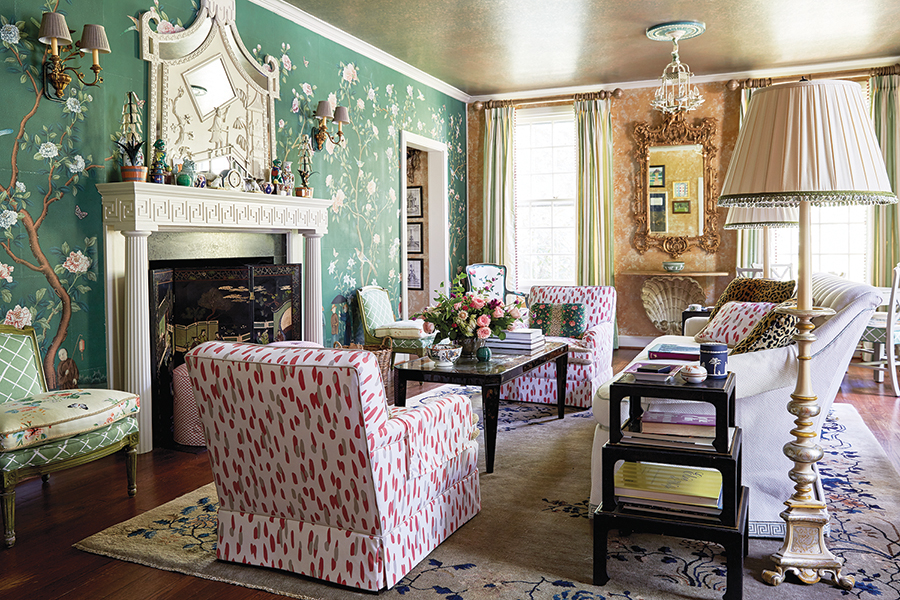
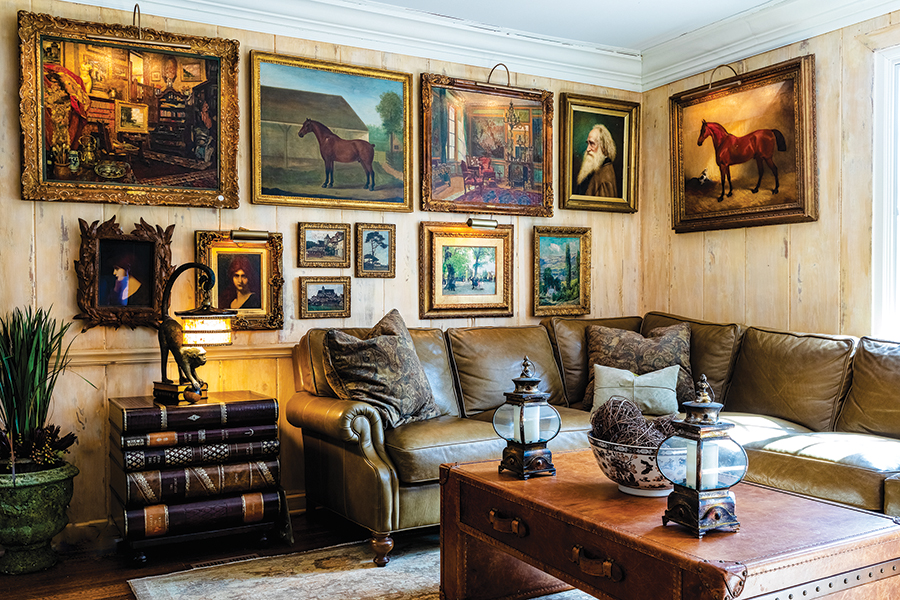
Art dominates Grandma Boyd’s “cottage”

By Deborah Salomon     Photographs by John Gessner

The Breakers. Downton Abbey. Monticello. Taliesin.

Fancy family estates — real and literary — set the tone with fancy names. What could be more dramatic than the opening line in Daphne du Maurier’s Rebecca:

“Last night I dreamt I went to Manderley again.”

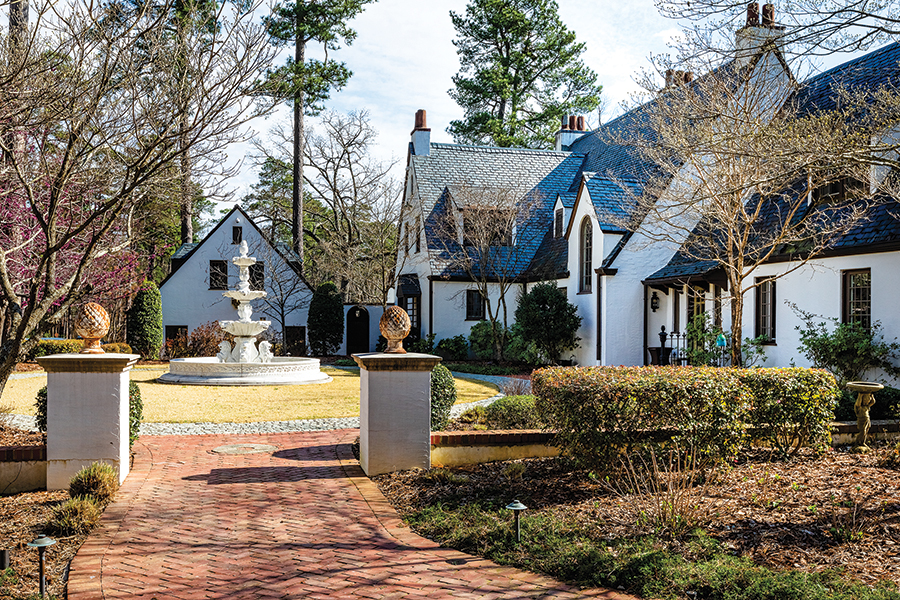
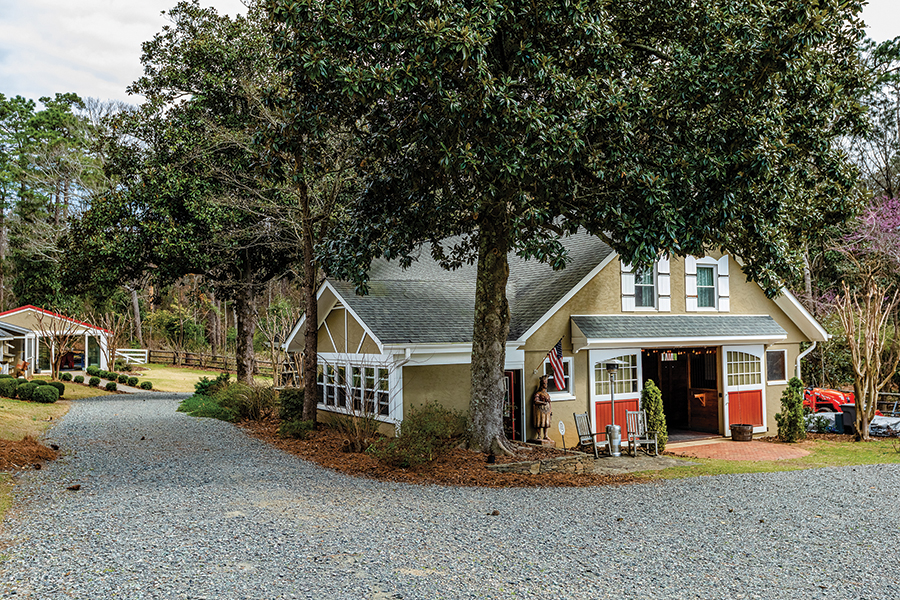
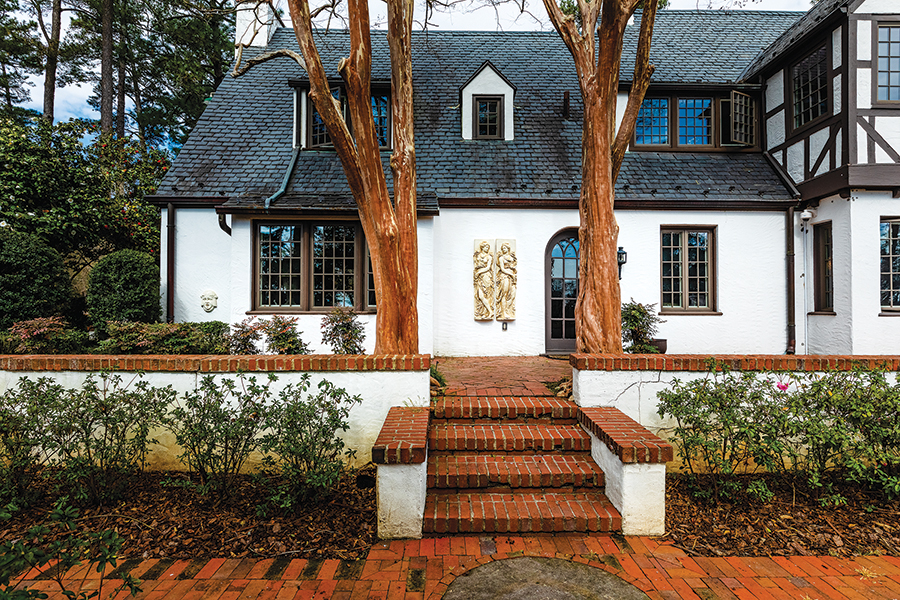
Locally, Weymouth — named for an English village — qualifies; and right next door, Inchalene, Celtic for “cottage at the edge of the woods,” adds its own mellifluous name to the list. The residence, designed by Alfred Yeomans, built in 1923 for James and Jackson Boyd’s widowed mother, Eleanor Herr Boyd, and now respectfully renovated, retains grandeur aplenty. During the Boyds’ heyday, Granny arrived from Pennsylvania in a private railroad car preceded by servants, supplies and silver. Once ensconced she kept tabs on her sons and grandchildren while hosting garden parties.

Eleanor Boyd died in 1929, son James in 1944. Inchalene declined until purchased in 2005 by a historic homes renovator and his sister, from Palm Beach. Their plan, similar to the Boyds’, was to create a family compound with their elderly mother nearby. But mother died and an unfortunate construction-related incident aborted Inchalene’s rebirth.

The grande dame of Connecticut Avenue was down . . . but not out.

In the spring of 2011, Inchalene once again bustled with activity, as workmen readied it for a designers’ showcase benefiting Weymouth Center for the Arts and Humanities.

The result: a double dose of classic opulence. Many furnishings from the showcase were still in place when the house was staged and listed for sale.

Eric and Nelsa Spackey had been looking for a year. “I passed by one Sunday at 6 a.m., hopped the fence and listened to the birds,” Eric recalls. “The house had a good feel, a welcoming flow, positive energy.”

“I fell in love with it,” Nelsa adds.

So impressed were they that in 2019 they bought the house and contents — lock, stock and Murano glass chandelier hanging over a hammered-copper dining table. What wasn’t included they tracked down at auctions, online and elsewhere. “We wanted (furnishings) related to when the house was built,” Eric says.

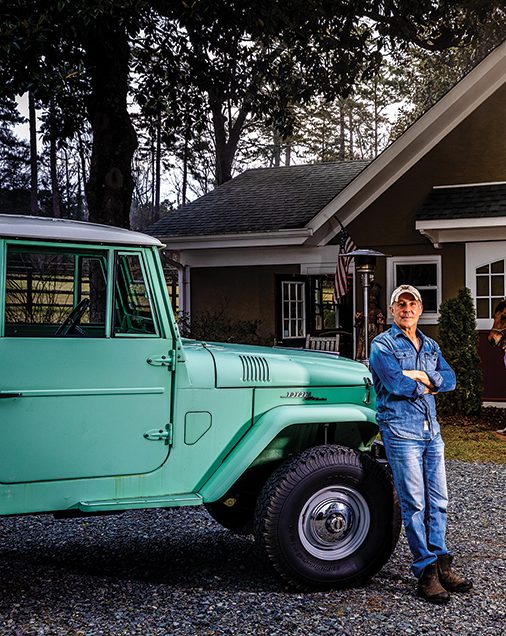
Turnkey sales of this magnitude seldom happen. Neither does an entrepreneur like Eric Spackey, who grew up in Michigan, trained in finance, set up a cellular network, manufactured uniforms for the military, and is now involved in developing a James Bond-worthy electronic communications device — among other pursuits.

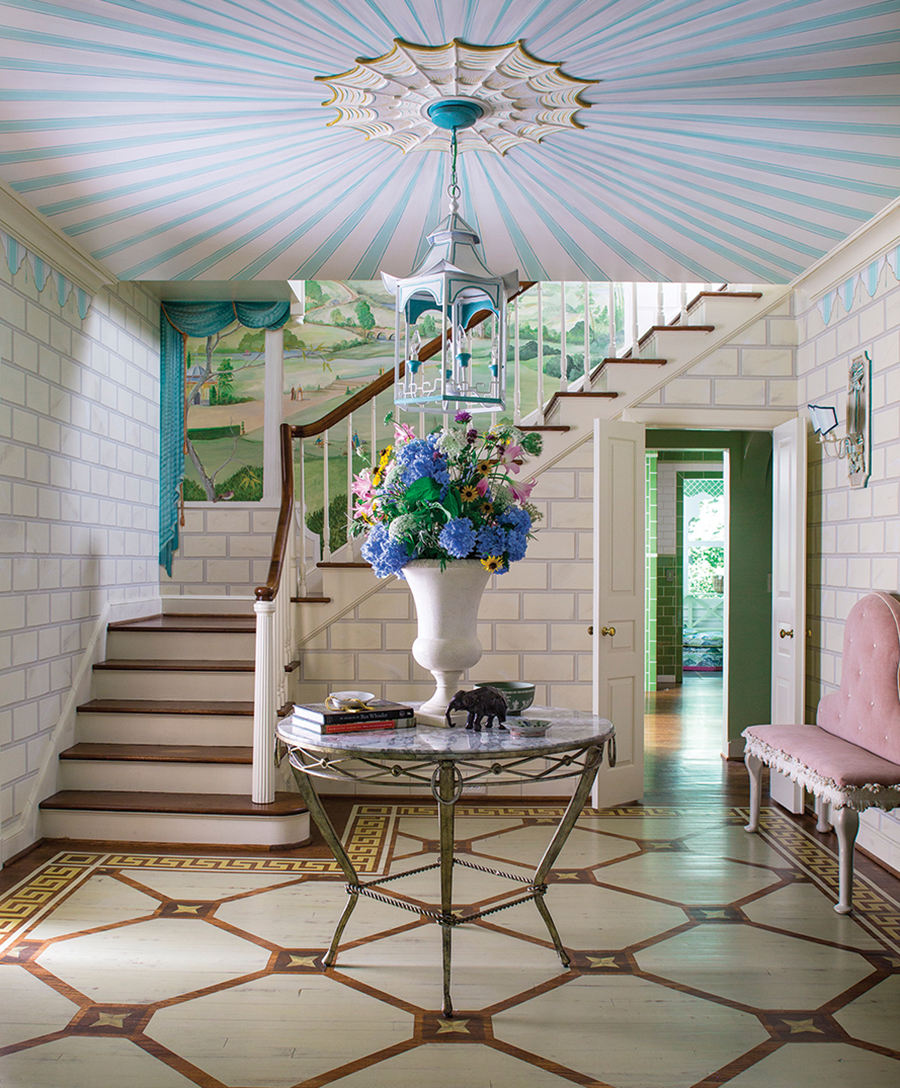
“Sort of like Forrest Gump,” Eric says, as he kneads sourdough on the kitchen island. Besides baking bread, he cooks, cares for the horses, tends a garden, orchard and chicken coop. He plays the guitar and collects art, enough to transform the mansion into a gallery begging a docent. The first image inside the front door is a mother and child with cherries by Gilbert Stuart, whose other works include the iconic portrait of George Washington.

Eric relates best to Fauvism, popularized by Henri Matisse. Upstairs hangs a dreamy likeness of Claude Monet’s daughter and granddaughter, by Monet’s son-in-law Theodore Butler.

The Spackeys’ have four daughters and three granddaughters; living among them made him appreciate the soft femininity of these paintings, and the house. But not all his art is “pretty.” Eric displays Depression-era WPA depictions of factory workers in stark, angular forms.

The Spackeys’ other residence is a waterfront villa in Puerto Rico, site of Eric’s businesses. After hurricane Maria hit the island in 2017, they looked for a safer home base. Eric considered Asheville, then discovered Moore County while working with a government official from Pinehurst.

“I wanted more than a house,” Eric says. “I wanted a working farm with horses — and this was close to the military.” Perfect! “I use the hayloft as a meeting place and the tack room as a bar.”

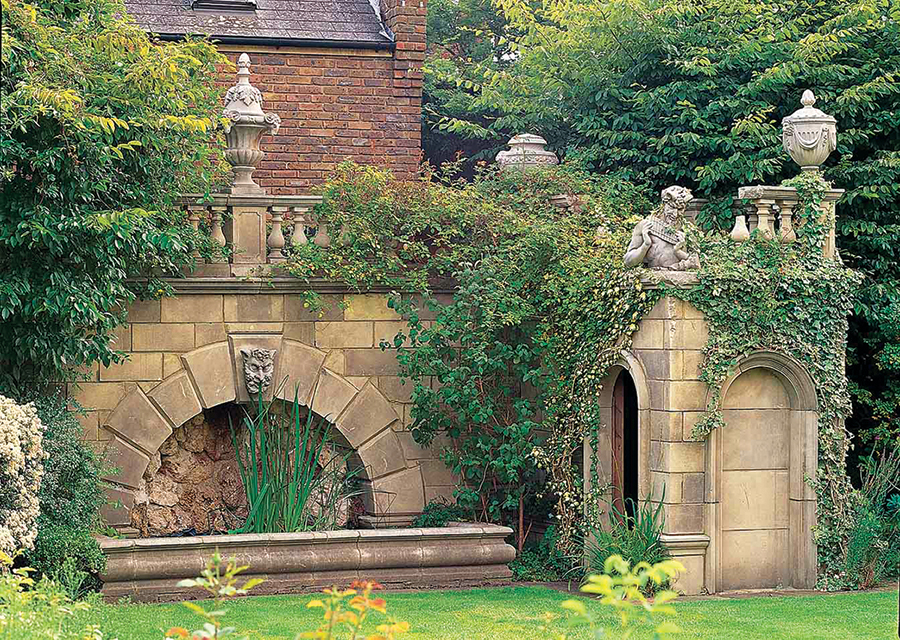
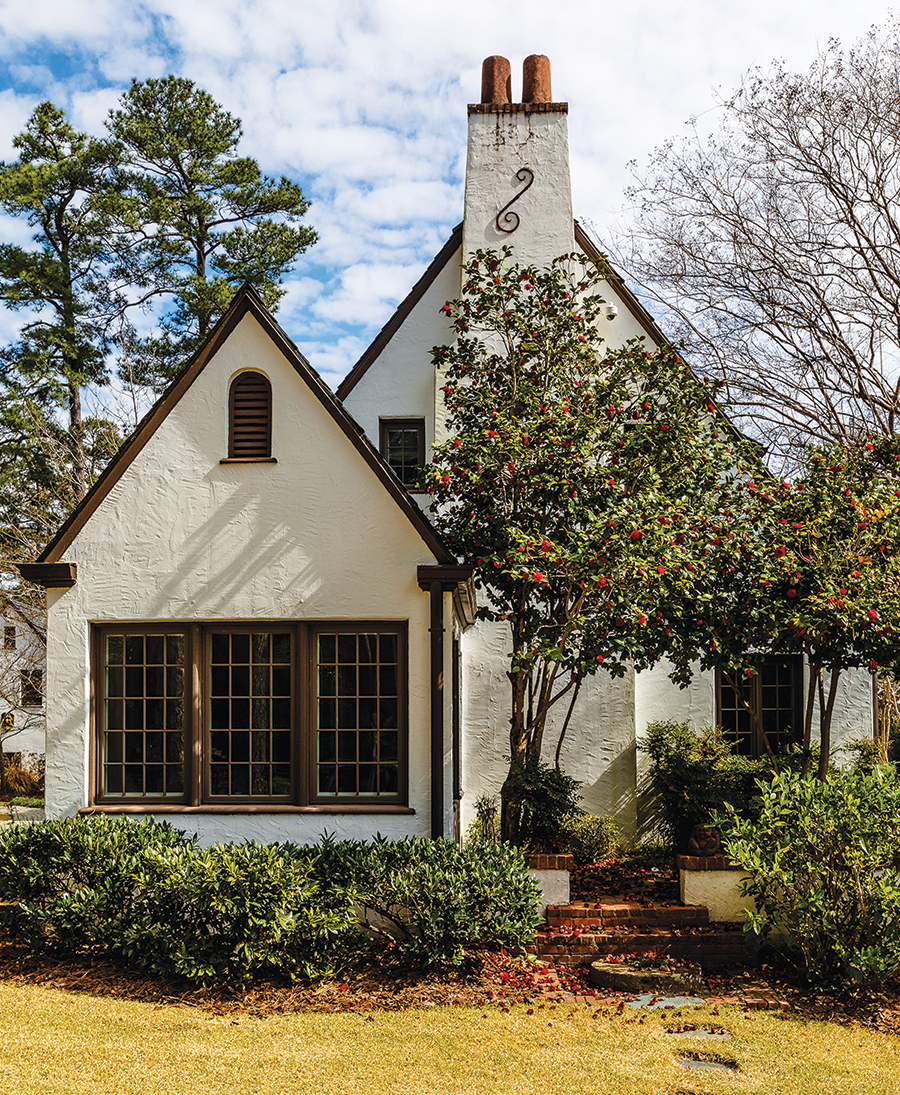
As for Granny Boyd’s white stucco English Tudor cottage with mullioned windows: “The house itself is a work of art,” Eric says. To preview the interior he installed a 12-foot marble fountain adorned with lions on the circular drive.

Inchalene’s footprint and layout remain virtually intact, except for a solarium added at one end and a second-floor master suite cobbled from several smaller bedrooms and a porch. The longitudinal layout, however, is both interesting and typical of estates unconstrained by lot size. A “shotgun” hallway bisects the main floor, allowing straightline vision from the solarium at one end to a small office at the other. Off it branch the kitchen, dining room, den, entrance hall, powder room and a curious bedroom with door leading outside. Often called a pastor’s room built to accommodate itinerant clergy, these front-facing bed/bath/sitting chambers also appear in homes with elders who could not climb stairs. Or, it might have doubled as an office where the chatelaine received tradesmen without allowing them into the house proper. To that use, the sparsely furnished room includes a desk and a floor lamp from the reading room of a New York City library.

The kitchen, displaying art on a wall rail and countertops, introduces a color appearing elsewhere: the pale green of extra-virgin olive oil. Step down into the family dining area where hangs Eric’s talisman: a 10-foot-long, 450-pound Byzantine mosaic believed to be 2,000 years old that just happened to fit the wall over the table. Beyond that, the glass solarium surrounded by flowering shrubs sparkles like a diamond.

In contrast, the den is dark, clubby, bookish, with oversized pieces upholstered in leather, a primordial man cave where gents gathered to solve world problems over cigars and bootleg brandy.

That long hall opens out into the bright living room, where white sofas hint contemporary in contrast to an ornate gilded case piece in the dining room — imagine it coming from a Versailles tag sale, where Eric might have also found his musical clock, circa 1780s.

The second floor master suite is a clutter of charming objects in hues to match antique Delft tiles surrounding this and other fireplaces. Here and elsewhere, wall-mounted TVs stream fine art when not in use. Down the hall, a “princess” bedroom is scaled and decorated for granddaughters, including a bathroom with a 3/4-sized tub and sink. Next to it, a rough-and-tumble boys’ room has bunk beds and a wall painted to resemble a barn door.

Faux finishes appear on other walls, some resembling wood paneling; others textured Venetian plaster mimicking damask. Touch to believe.

Completing Inchalene’s idyllic portrait are two horses joined by Frida (as in the Mexican painter Kahlo), an affectionate and intelligent German shepherd rescue, and Luna, a long-haired Himalayan kitty big as a watermelon.

Eric insists that maintaining Inchalene’s acreage makes him feel connected. “The chickens produce manure for compost for the garden, a tie back to nature. There’s no better therapy than getting on my tractor. It keeps me balanced.” He finishes with a sweeping, “This was meant to be.”

All things considered, maybe more Lorenzo de’ Medici than Forrest Gump. PS

Home & Garden Tour

Inchalene is just one of the homes on the Southern Pines Garden Club’s Home & Garden Tour on April 9 from 10 a.m. to 4 p.m. Buy tickets online at southernpinesgardenclub.com.

The Beauty in the Barrens

The Beauty in the Barrens

The triumph of Tufts,
Olmsted and Manning

By Claudia Watson
Photographs by John Gessner


Beneath the canopy of a brilliant blue June sky, the land lay battered. An abandoned tramway, used for hauling lumber and turpentine, stretched through a landscape marked by scraggly oaks and a few spindly pines. Wild hogs and sheep foraged the nearly barren sand.

On that day in 1895, James Walker Tufts, accompanied by surveyor Francis Deaton and two other men, inspected a 100-acre parcel of his new landholdings in southern Moore County — the site for his proposed town. The first task was to settle where to place the survey stake marking the land’s center point.

They made camp for the night in an old lumber shelter, boarded on two sides. The next day, Tufts walked to a broad, shallow, basin-like plot of ground. He had neither an ax nor the proper fatwood stake but succeeded in finding an old piece of timber, which he drove into the ground. Deaton marked the spot on his rough topographic map “Beginning Point.”

Characterized by its rolling terrain and deep, coarse sand, and predominately covered by tall longleaf pine, the land once had been part of a 90-million-acre wilderness stretching from southeastern Virginia in the north, to eastern Texas in the west, and as far south as the upper half of Florida. The longleaf pine (Pinus palustris) could live up to 500 years, grow to 3 feet in diameter and reach a height of 120 feet.

Soon, this region’s harsh but beautiful landscape was under pressure. The tall, straight, longleaf timber did not go unnoticed by the steady stream of European settlers. They followed the Cape Fear River and its tributaries to the pine barrens of Moore and Richmond counties to find land for intensive high-yield farming. But the sandy soil was unsuitable, so they turned to the pine forests for their livelihood.

The vital longleaf ecosystem was devastated, the target of exploitation: first for its lumber, to build homes, buildings and masts for ships. Later its resin was used to make tar and turpentine, essential naval store products that supported shipbuilding efforts. With the arrival of trains in the 1800s, the trees were felled to build railroad tracks. Ultimately, those railroads were essential to Moore County’s development and Tufts’ arrival.

James Walker Tufts, a successful and wealthy entrepreneur from Massachusetts, was captivated by the area’s warm climate and therapeutic pine-scented air. He used his considerable wealth to locate and purchase nearly 6,000 acres to build a winter retreat in an area laid waste by decades of timbering operations.

The project, seen as essentially benevolent, would provide respite and recreation for “the betterment of his fellow humans.” In particular, he focused on ailing individuals — including those with early stage tuberculosis who were mistakenly, and commonly, believed not to be contagious — seeking a warm, dry climate while recovering. Learning quickly that all stages of the disease were contagious, he rebranded his retreat into an outdoor sporting venue, with recreation as its primary business.

Tufts envisioned a charming New England-style village set in the 100-acre core of his land holdings. Armed with Deaton’s survey denoting the town’s center, and immediately after acquiring the land contracts, Tufts turned to the most prestigious landscape architecture and design firm in the country — Olmsted, Olmsted & Eliot — to design the town he imagined.

Olmsted’s plans were renowned for the role that landscape architecture played in improving quality of life. His concept was that nature not only lifts the human spirit, but strengthens and restores it. He also believed that every human being, regardless of social or economic status, had a right to that experience. Tufts’ principles and Olmsted’s were synchronized.

Olmsted, however, was in his 60s and affected by mounting health problems, including dementia, which soon sidelined him. During the summer of 1895, just as Tufts’ project was underway, Olmsted retired. That year, his stepson John Charles (“J.C.”) Olmsted and architect Charles Eliot carried the firm’s workload. Frederick Law Olmsted Jr. was busy with George W. Vanderbilt’s Biltmore estate project.

Olmsted’s catalog lists Pinehurst village, but it was small compared to other projects. A visit report dated June 20, 1895, provided by J.C. Olmsted, indicates that Tufts initially spoke by phone with another member of the firm’s staff and provided his conceptual overview for the village.

A general plan would cost $300, including supervision, planting that year, and time for a planting assistant. “Traveling expenses were extra. No visits were to be made by the firm, only by W.H. Manning that fall,” noted the proposal.

On July 3, 1895, Tufts met with Fredrick Law Olmsted Sr. and J.C. Olmsted at their offices in New York, and within days the firm provided a plan for the town drawn in ink on linen paper. Tufts quickly accepted it and then, eager to see his vision move ahead, ordered 200 water oaks.

The project’s 1895 promotional brochure said, “It is understood, of course, that the extensive plans that have been made for beautifying the village with greenery will require considerable time before they are carried out to completion. The wilderness cannot be made into a garden in a day, even with the most liberal expenditure of money, energy, and skill.”

Warren H. Manning had joined the Olmsted firm in 1888 as its planting supervisor, where his extensive horticultural knowledge quickly expanded his responsibilities. Mentored by Frederick Law Olmsted, Sr. in his early years with the firm, he oversaw over 100 projects, including planning the metropolitan park systems for Boston, Louisville and Milwaukee. In addition, he supervised the acquisition of thousands of acres for Vanderbilt’s Biltmore estate and, beginning in 1893, became involved in planning its arboretum.

Manning’s vocation had its roots in his New England childhood. He credited his father, an esteemed horticulturist and nurseryman, for his appreciation of nature. He absorbed his father’s fascination with plants of all types, particularly the newly fashionable American native plants. Though he did not have formal training in landscape design, he traveled extensively with his father to commercial greenhouses and gained experience as the manager of his father’s plant nursery.

When Manning was 27, he wrote Frederick Law Olmsted, Sr. seeking work and stressing his horticultural skills, particularly his success moving large trees. He wrote of his “knowledge of hardy trees, shrubs, and herbaceous plants & the treatment & the effects produced by them.” He underscored his literacy in common and botanical names and botanical relationships.

The Pinehurst village project progressed with J.C. Olmsted the lead partner. Designing the landscape without inspecting the site wasn’t feasible, so in September Manning was sent to meet Tufts and explore the property. He and Tufts traversed the 100-acre town site taking in the views from atop ridges and gaining knowledge of its topography as well as the natural scenery.

When he returned from his visit with Tufts, he described the area as “largely sand hills laid to waste” from timbering. But he added with enthusiasm that it also held “long valleys with springs, streams, and narrow wetlands” with small trees, shrubs and herbs.

The moist valley areas and wetlands were the most exciting and attractive for plants, birds and other wildlife. “The bottoms of the wet valleys are the natural winter and summer garden spots of the region and a constant source of delight to one who appreciates varied forms of plant life,” he wrote.

The dry upland was less appealing. Here, scrubby and stunted oaks and spindly pine trees, either dead or deeply gashed, littered the area marked by tufty grasses and bare sand. It is “a ghastly ruin of fallen trunks, blackened stumps, and decayed branches, all testifying to the devastating methods of the turpentine distiller and the lumberman,” Manning said in the Pinehurst Outlook in December of 1897.

“It became at once evident that an artificial means must be resorted to if an attractive evergreen landscape is to be provided during winter, and an abundance of flowers during early spring, the most active season of visiting guests and residents, most of whom being from the colder states expect very different and more attractive conditions than those prevailing at their northern homes, conditions which would not be presented by the original landscape,” he wrote.

Delivered Oct. 30, 1895, the landscape plan offered lushness in exchange for the dreary and monotonous landscape. “It will be replaced by a varied and interesting local scenery in which green foliage will form all the foregrounds, drape the buildings, afford shade on sunny days, and conceal the raw earth . . . with perennial verdure,” the plan noted. The comprehensive proposal recommended a heavy use of evergreen plants — preferably broad-leafed evergreens.

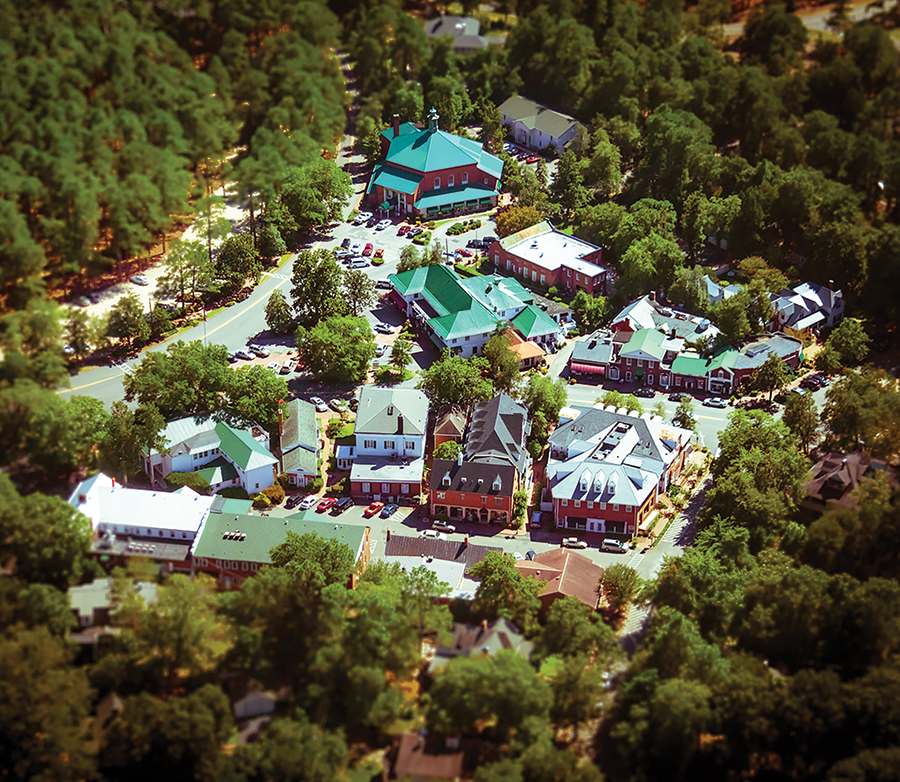
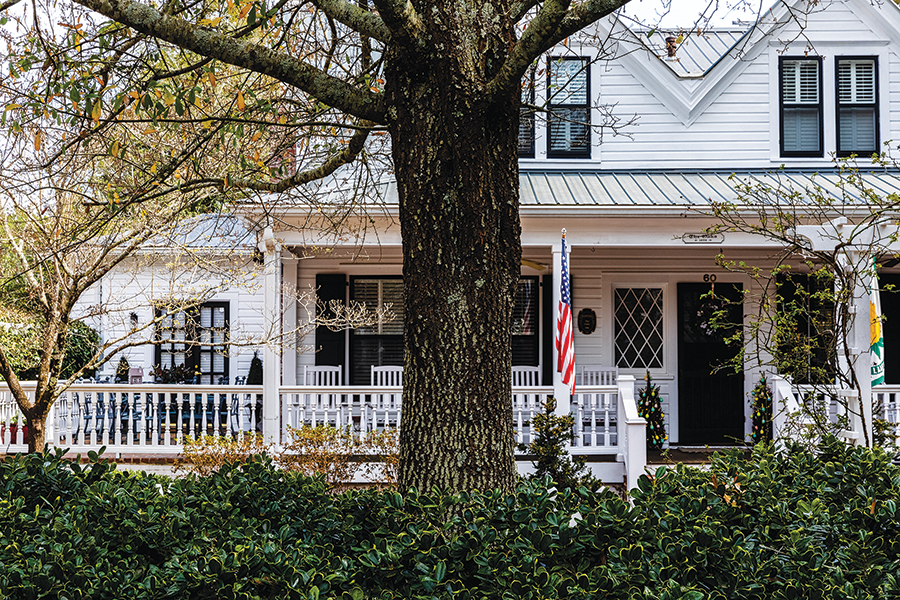
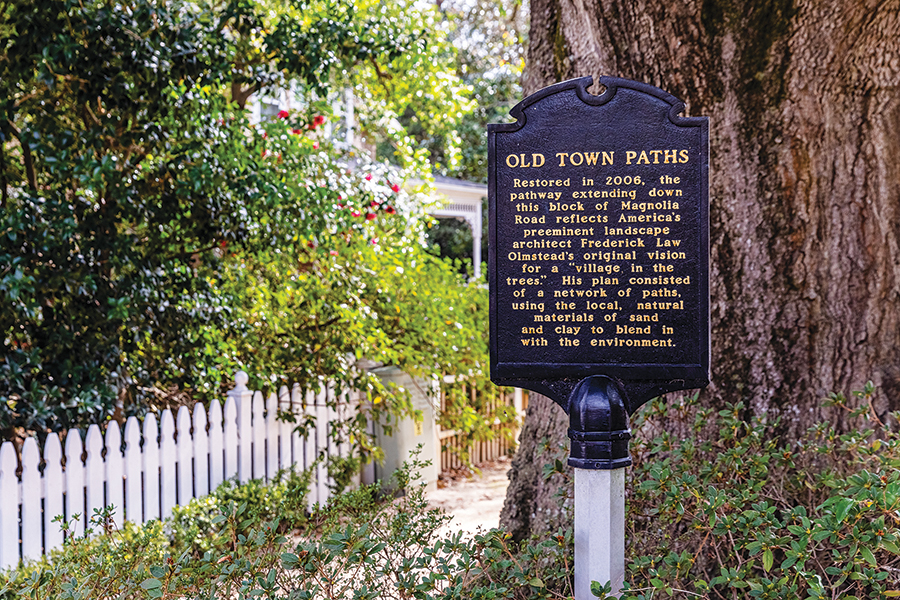
An oval-shaped “Village Green” meant for active use was the plan’s central feature. Located in a broad, shallow amphitheater-like valley, it was surrounded by winding roads that hugged the natural grades, radiating outward from the green. Charming New-England style cottages, most with porches, were sited on uniformly sized lots along roads often named for trees — Magnolia, Dogwood, Laurel, Maple, Orange and Palmetto. The town’s layout provided an enhanced sense of space with the boundaries opening to new views.

Near the railroad tracks, to the south, stood a dense grove of longleaf pines that offered a glimpse of the forest that once covered the land. The hotel, town office, a store and community casino were placed in the center of the village. Evenly spaced trees and dense plantings would offer a naturalized effect throughout all of this.

To achieve the lush setting for the town, Manning specified and located the trees, shrubs and ground covers based upon the location, carefully framing the views from cottage windows and the hotel to provide a verdant appearance in every season.

The planting scheme recommended 222,600 plants in nearly 90 varieties, importing 48,000 plants from France and 1,500 from nine American nurseries. The balance of the plants would be purchased, collected later, or propagated at a nursery in Pinehurst.

Realizing the initial cost would be great, the architects justified it by saying that the cost would be insignificant once the plants established themselves. “It is absolutely essential to making the vicinity of a village of the sort you are building agreeable and homelike in the winter,” the landscape plan argued.

Evergreen shrubbery was primarily local and native material. “It was recognized . . . that native plants must be depended upon chiefly for the results we wished to secure, for they only could be procured in sufficiently large quantities to do, at a reasonable cost, the immense amount of planting that was required in the town,” Manning wrote later in the Pinehurst Outlook. He preferred native material because it was fully adapted to the local soil and weather conditions, and needed less water, fertilizer and overall maintenance to thrive. As an added incentive, they remained balanced with nearby plants instead of overtaking the landscape like invasive species.

The plan included dozens of native plants collected from private property or the swamps within about 100 miles of Pinehurst, but the effort became costly.

“You better depend upon your greenhouse men to do your propagating from seed instead of attempting to root from cuttings, which would be very difficult if not impractical,” Manning suggested of the local native plants. “You will get more plants at less cost,” he added, offering an unconventional and less time-consuming method for preparing the seeds for germination.

To help implement his plan, Manning brought in Otto Katzenstein, a German seedman who worked for the Olmsted firm and was enamored with native plants. Katzenstein would develop and manage the town’s nursery and crews who gathered plant material to use in Pinehurst.

With the planting proposal approved, Manning shifted his attention to installation and began with the Village Green, which provided the central recreational setting for the community.

Planted with rich layers — groundcovers, shrubs, and trees above — the Village Green provided an area for restful recreation and the study of nature. Selected for their growth habit and the various tints of green and texture they offered to the foreground, the trees and shrubs provided an indistinct border.

Multiple “plantations” were set upon the Village Green and anchored by evergreen (not coniferous) native trees — Southern magnolia (Magnolia grandiflora), evergreen oaks and Carolina cherry laurels (Prunus caroliniana). Then, the smaller groups of single trees and shrubs would spill out from the larger tree groups and blend into the foreground, creating a constantly changing play of light and shadow.

The understory featured non-native camellia, boxwood, pyracantha, azaleas and cherry laurels (Prunus lauroceracus). These mingled in groupings with native sweet bay magnolia (Magnolia gluca), holly, gall-berry (Ilex glabra), wax myrtle (Morella cerifera), fetter bush (Lyonia lucida), and mountain laurel (Kalmia latifolia). Wisteria would festoon the tall pines with its drooping clusters of flowers. Osmanthus, nandina, wisteria, elaeagnus and privets, all non-natives, would adapt and naturalize.

The transition to the sunny central area of the Village Green required 40,000 groundcover plants. In that time, landscape architects commonly used non-native species for their visual appeal and ability to colonize, often filling a derelict space. Here, non-native Japanese evergreen honeysuckle, English ivy and periwinkle covered the trunks and branches of the deciduous trees, keeping the areas green with foliage, even in the winter. The unruly honeysuckle required regular shearing to keep it within borders and at ground cover height.

Many experimental plots of grasses were grown from seeds secured from various parts of the county, but most failed to tolerate the conditions. Only winter rye grown from seed made a good start in the Village Green, but it finally drew Tufts’ ire.

“Winter rye was bravely endeavoring to cover the whiteness of the sand. Patches of rye growing on the village green served only as a mockery of the word green and of the deep lush turf of the New England commons after which this area was patterned. On every hand, there was white, infertile soil,” Tufts wrote.

Manning adjusted the plan and removed the unsuitable ground cover creepers and turf. Next, he recommended covering the bare sand with fresh pine straw and later planted dozens of longleaf pines.

In the 1800s, lovely shade trees were becoming rarities, and lovers of arboriculture would travel miles to see them. An evergreen canopy was essential for Pinehurst village and would lend much-needed shade and character, not typically found in the South.

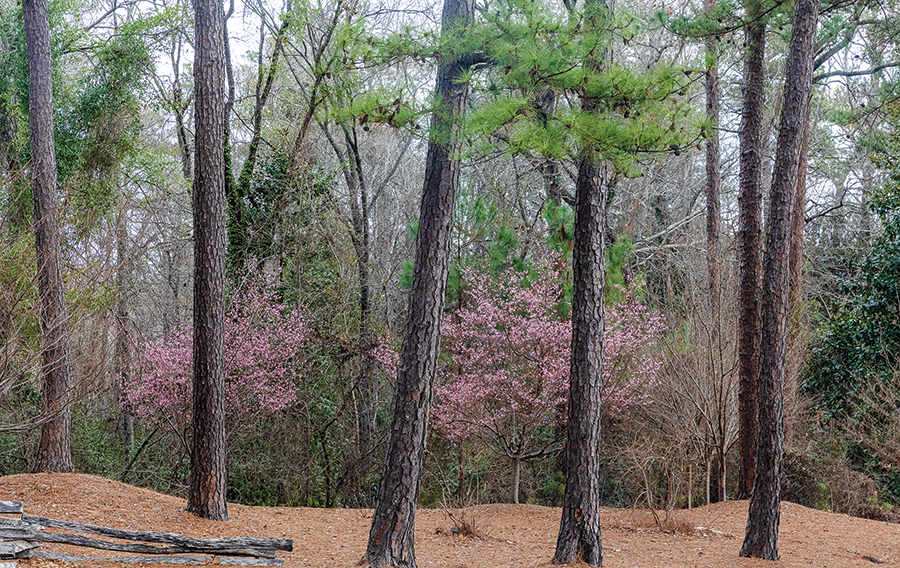
Village streetscapes received 1,500 trees, and the homesites, 500. Native trees used throughout the plan included longleaf pines, red cedar (Juniperus virginiana), dogwoods (Cornus florida), eastern redbud (Cercis canadensis) and sourwood (Oxydendrum arboretum).

Oaks, the most essential of all native trees and known to sustain a critical and complex web of wildlife, were among Manning’s favorites. Drawn by their lofty canopies and color shifts throughout the seasons, he used willow oak (Quercus phellos), live oak (Quercus virginiana), and swamp laurel oak (Quercus laurifolia) as specimens to edge village streets and grace homesites.

Today, the village’s landscape is full of the towering oaks, Southern magnolias and cedars planted between 1895-1898. Thirty-four of those trees on the village of Pinehurst property and bordering the Village Green are protected and designated heritage trees including several magnolias and hollies along the walkway near Given Memorial Library. In addition, dozens of other majestic trees at Pinehurst Resort and on private land continue to provide intrinsic value to the community. Most of the Village Green’s longleaf pines are at least 100 years old.

At Pinehurst’s founding, the only remaining dense stand of longleaf pines in the area, known as the Pine Grove, became a favorite attraction. There, a friendly herd of deer shared their domain with gorgeous peacocks, attracting visitors with children in tow who enjoyed the teeter-totters and swings.

Manning specified the addition of 50,000 trees, mostly longleaf pines, for the Pine Grove site and the borders of the village. He also included exotic conifers known for their shape, texture and color in the landscape. Adapted well in the South, the graceful deodara cedar (Cedrus deodara), Japanese cedar (Cryptomerias japonica) and cypress augmented the native growth.

The workforce completed the village center’s buildings, necessary infrastructure and 14 residences within about six months. With each area’s completion, Manning’s workers began installing the landscape.

The updated general plan drawn in November 1895 for Tuft’s promotional efforts reveals the enormous scope of work required to connect passages full of scenery for the village, its roads, walkways, and finally, the homesites — where visitors observed the details more closely. The initial homesites were small and set back 36 feet from the street. Manning wanted to ensure that “each home then appeared to be set in its own private forest.” So, 13,400 evergreen ornamental shrubs, in addition to 500 homesite-designated trees, provided generous coverage, plant diversity and individuality to each lot.

The early streets were 16 feet wide and built using sand and clay from a local pit. A sloped 16-foot shrubbery bed and 5 feet wide sand and clay sidewalks bordered each side of the road. The shrubbery beds absorbed stormwater runoff from the road and sidewalks, benefitting the ornamental trees, shrubs, and flowers planted there.

The streets and sidewalk areas received 1,500 trees and 17,000 plants. Many of the evergreens used on the Village Green would be repeated for these areas but softened by clusters of mahonia and winter jasmine (Jasminum nudiflorum). Low evergreen groundcovers, including St. John’s wort (Hypericum calcycinum), wintercreeper (Euonymus radicans) and many types of roses, covered the edges of the planting strips providing seasonal interest.

After working throughout 1895-96, Olmsted, Olmsted & Eliot ended their contract with Tufts. The firm recommended Manning to assume the project, which he did with vision and energy. He quickly established a farm with a large barn housing a herd of Holsteins and Jerseys cows, then in 1898, started Pinehurst Nurseries.

Otto Katzenstein, who tended the town’s nursery during its founding, became superintendent. He propagated and grew nearly 100 varieties of native trees, shrubs and herbs that succeeded under the challenging growing conditions of the longleaf pine region and offered them to a broader community through a catalog. 

The catalog also offered a variety of non-native “thrifty” plants, including pansies, pinks, roses and a hardy form of the English violet, discovered in an old Southern garden. Those plants adorned the landscape of the Carolina Hotel on its opening day, Jan. 1, 1901.

A winter resident wrote in the Pinehurst Outlook, “Looking out my window . . . I see planting spaces filled with native evergreen shrubbery — magnolias, holly, gall berry, bay flower, yucca, honeysuckle, ground roses, pansies and violets and the whole surrounded by a vast green lawn. Think of it — a pretty green lawn with violets in profusion right out in the open in January — as pretty as our own New England lawns in June.”

While the involvement of Frederick Law Olmstead, Sr., in the village plan has often been a matter of conjecture, in a 1922 letter to Leonard Tufts, Manning wrote, “I know Mr. Olmstead’s personal interest in Pinehurst was a keen one, because of his sympathy with your father’s desire to establish conditions that would make it possible for people who were not well to come to Pinehurst and live for moderate costs . . . and I remember very well his keen interest in my report on conditions that I found there.”

Over the next three decades, Manning continued to work with the Tufts family to extend their vision of the Sandhills. His national practice included more than 1,600 landscape projects throughout North America. One of the 11 founders of the American Society of Landscape Architects, he is considered one of the most significant landscape architects of the 20th century and its first environmental engineer.

Tufts’ vision and collaboration with the Olmsted firm and Manning’s ability to visualize the true nature of the place restored life to a land of nothingness — giving it, and us, a land of unexpected beauty.  PS

Claudia Watson is a frequent contributor to PineStraw and The Pilot and finds joy in each day, often in a garden.

Johnny Allen and the Aberdeen Nine

Johnny Allen and the Aberdeen Nine

When an all-time great wore an “A” on his chest

By Bill Case   

In 1956, at age 7, I fell madly in love with baseball. That summer, and several ensuing ones, I spent an untold number of daylight hours playing both organized and pick-up baseball, as well as the game’s myriad offshoots — pepper, home-run derby, monkey in the middle, etc. After hurrying through dinner, I would often spend another hour hurling a ball at a target painted on the basement wall and fielding the rebound. With an accompanying radio broadcast of a Cleveland Indians (aka the Guardians) game providing grist for my overactive imagination, I would visualize myself playing second base for Cleveland while backhanding countless caroms off the wall.

None of the Indians’ players resided in my hometown of Hudson, Ohio, 26 miles from Cleveland, but the team’s longtime trainer, Wally Bock, did. My parents, Bea and Weldon Case, knew Wally and his wife, and asked them over for dinner. I could not have been more excited if Cleveland’s Hall of Fame pitcher Bob Feller had been invited.

When the Bocks arrived at our home, Wally tossed me a ball (which I still have) autographed by all the ’56 Tribe players. But, too soon, Mom and Dad ordered me upstairs to my room. While lying restlessly in bed, I hatched what in retrospect was a ridiculous plan: Wouldn’t it be cool to finagle a rubdown from Wally like the ones he once administered to Feller and the other Indians I idolized? So, I yelled downstairs, “Mom, my back really hurts!”

My crying wolf fooled no one; nonetheless, the scheme worked. With my folks looking on and shaking their heads at my transparent ploy, Wally provided a brief backrub. All fixed. So, much like Bill Murray’s character Carl Spackler who was promised “total consciousness” by the Dalai Lama in Caddyshack, I got that going for me.

My baseball passion extended to the game’s vast array of statistics. Without attempting to, I committed to memory countless batting averages and home run totals. One mark that always stuck with me was pitcher Johnny Allen’s 1937 win-loss record of 15-1. His resulting winning percentage of .938 was, at the time, a major league record.

The mark was ultimately bettered by Elroy Face’s 18-1 for the National League’s Pittsburgh Pirates in 1959, but to this day, Allen holds the American League record. No pitcher in the 146 years of major league history has posted an undefeated season with at least 15 decisions — the minimum number required to qualify for the winning percentage title. More astonishing is the fact that Johnny was undefeated until the meaningless final game of his ’37 campaign. Risking the unblemished record, he took the mound against the Tigers with just two days of rest. Allen lost 1-0, the lone run scoring in the aftermath of an error by Indians’ third baseman Odell Hale. According to an online post by the Society for Baseball Research, an infuriated Allen “went ballistic after the game” and twice had to be restrained from assaulting his third baseman.

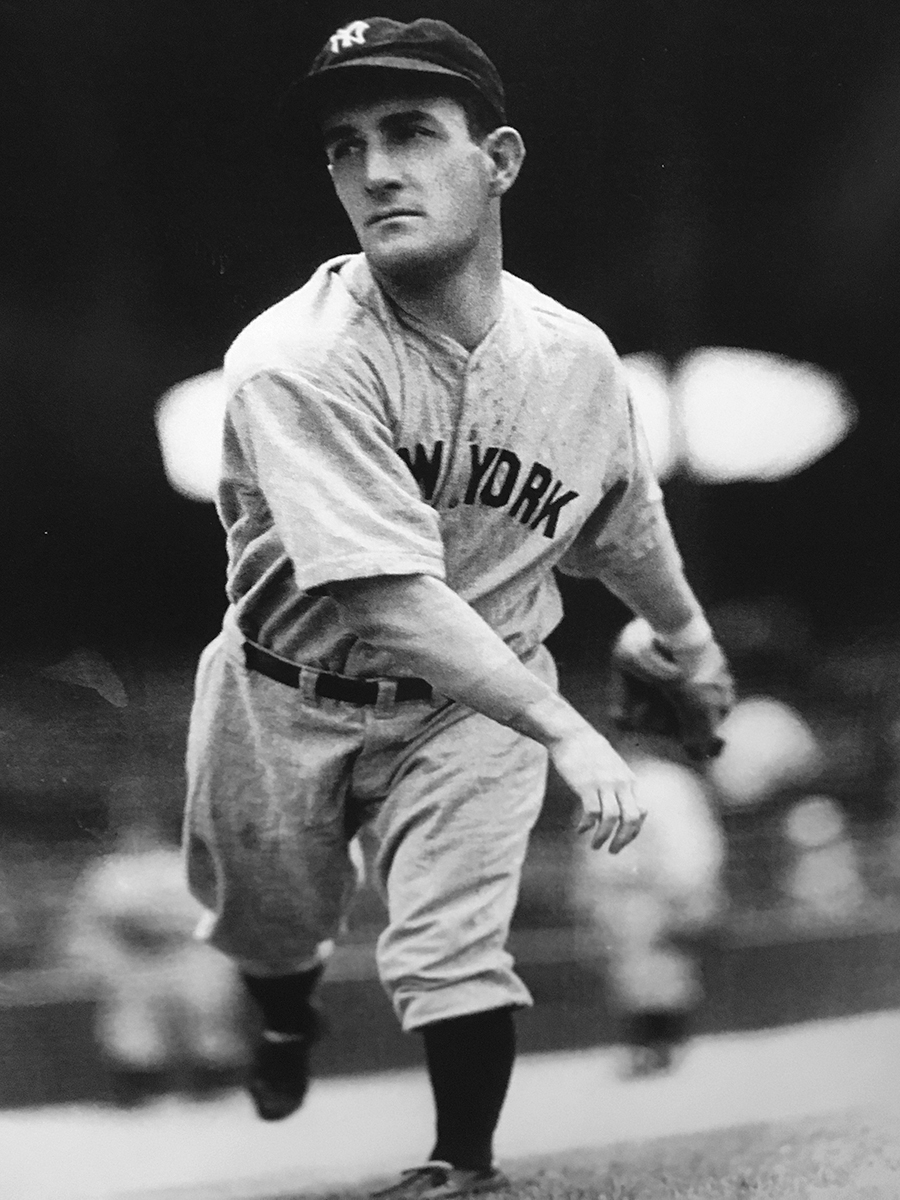
Such behavior was not out of the norm for the hyper-competitive hurler. His 13-year major league career (1932-1944) with the Yankees, Indians, St. Louis Browns, Brooklyn Dodgers and New York Giants was replete with similar incidents. He was known to throw furniture in the clubhouse, but his piques of wrath weren’t confined to the ballpark. After a tough loss to the Red Sox, an enraged Allen returned to the team’s hotel, upended stools in the bar, kicked over an ashtray of sand, and sprayed a corridor with a fire extinguisher. In 1943, it took several teammates to restrain Allen after he rushed an umpire “like a wild man” after the ump called a balk on him. When another unfortunate third baseman cost Allen a game by dropping a pop fly, the pitcher decked him in the clubhouse, then announced to his startled Yankee teammates, “If anybody else drops an easy fly on me, that’s what’s going to happen to you.”

In a notorious 1938 controversy, umpire Bill McGowan ordered Allen to remove the sweatshirt he wore underneath his jersey after the pitcher had cut strips out of the sleeves to “improve ventilation.” Distracted by the fluttering fabric, opposing hitters complained. Allen refused to change his shirt and huffily stalked into the clubhouse, defying Indians’ manager Oscar Vitt’s directive to return to the mound. Allen was fined but recouped his money by selling the sweatshirt to a downtown Cleveland department store, which proudly displayed it in its storefront window. Today, the garment is an exhibit at the National Baseball Hall of Fame in Cooperstown, New York.

While his competitive fire could land Allen in hot water, it no doubt contributed to his pitching greatness. His near undefeated season in ’37 merited his selection by The Sporting News as that year’s Major League Player of the Year. His career winning percentage of .654 (142-75), ranks 22nd best all-time. Hall of Fame catcher Bill Dickey described Allen’s sidearm fastball as “the meanest delivery in the league for a righthanded hitter. He’ll buzz it over the bat handle before you can see it.”

A second Hall of Famer, Al Simmons, picked Allen as the toughest pitcher to hit against in that slugger’s 20-year career. Allen’s record might have been even more impressive had he not been plagued by a sore arm his last six years in the majors.

My fascination with stats like Allen’s 15-1, and for baseball itself, cooled substantially at age 13 after I failed to crack the starting lineup and quit the local little league team, the Hudson Hornets. I stopped buying baseball cards and no longer paid rapt attention to the exploits of legends like Feller and Ted Williams, let alone those of less remembered stars like Johnny Allen. 

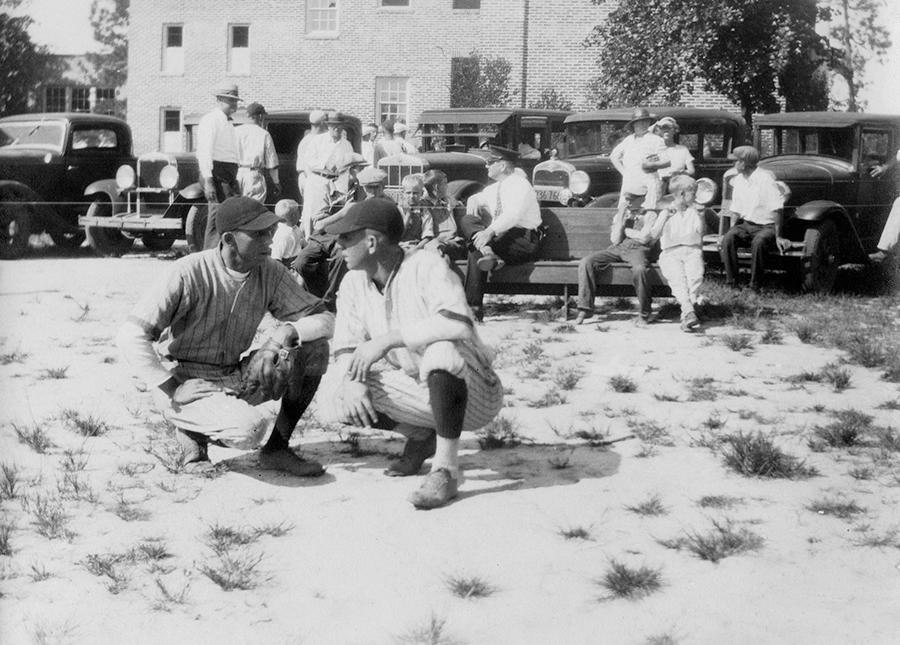
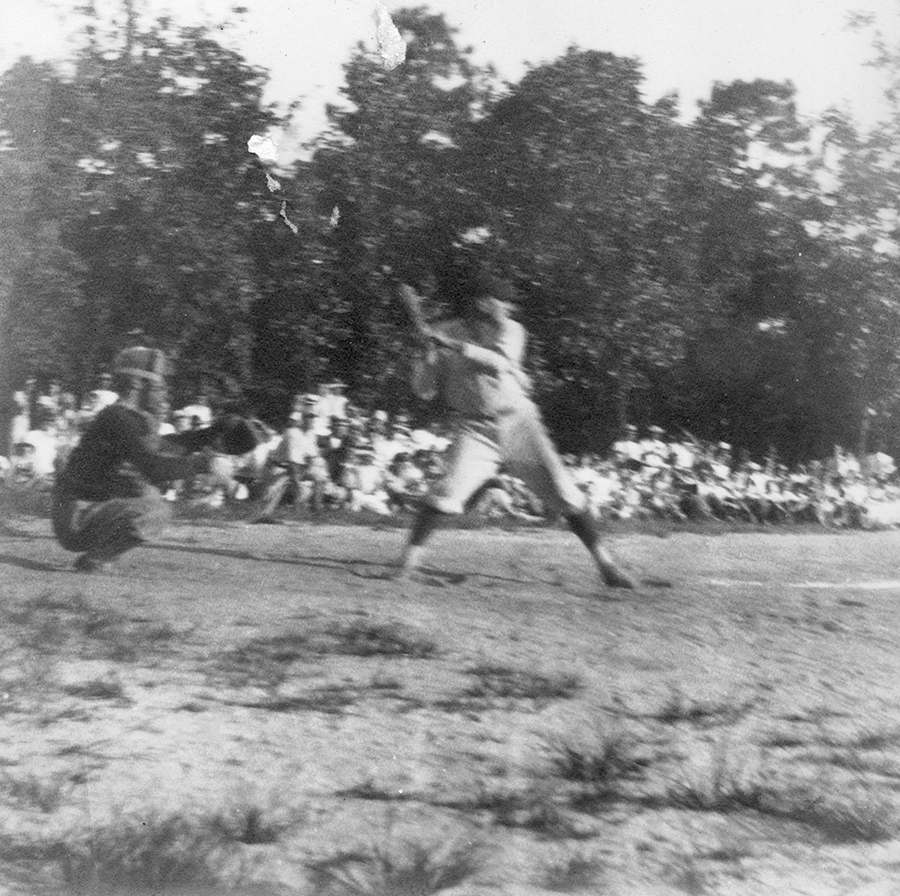
But two years ago, Allen came to mind again when I came across a short 1935 piece in The Pilot, reporting that Allen “who used to clerk in the Aberdeen Hotel, is going great guns for the New York Yankees” and that, during this employment, circa 1926-27, Allen pitched for the local Aberdeen team that competed in the Moore County Baseball League.

A search of the archives of The Pilot and the defunct Moore County News failed to unearth further references to Allen’s days here, but Wint Capel’s biography of Allen, Fiery Fast-Baller, published in 2001, provided some additional details about the pitcher’s pre-major league wanderings.

Born in Lenoir, North Carolina, in 1905, Allen, like his Yankee teammate Babe Ruth, spent the bulk of his youth in an orphanage, playing both infield and outfield positions for the Thomasville Baptist Orphanage baseball team. Capel writes that there “was no hint that he would become a sensational big league pitcher.”

While at the institution, Johnny suffered a self-inflicted gunshot wound. He was resting the muzzle of a 12-gauge shotgun on the toes of his shoe when the gun accidentally discharged, causing the loss of two toes on the teenager’s right foot. (Another great North Carolina pitcher, Jim “Catfish” Hunter, also suffered a shotgun injury to his right foot when he was a teenager, losing one toe.) Though he chafed at the orphanage’s strict regimen — making frequent attempts to run away — Allen did learn the basics of the bookkeeping trade there. It was expertise enough to secure a night clerk position at Greensboro’s O.Henry Hotel following his 1922 release from the orphanage.

According to Capel, Allen drifted from one hotel clerking job to another, “for a change of scenery as much as anything,” serving brief stints at the Monticello Hotel in Charlottesville, Virginia, the Sheraton in High Point, North Carolina, and the Wildrick Hotel in Sanford, North Carolina. While working at the latter establishment, he got back into baseball, playing on a local church league team.
In or around 1926, Allen pulled up stakes again, moving to the Sandhills for a clerking position at the Aberdeen Hotel, and soon joined the town’s semi-pro baseball team. 

The 23-year-old Allen left Aberdeen in 1928 to play “organized baseball” with the Greensboro Patriots of the Class B Piedmont League. During that season, he also pitched for teams in Fayetteville, Greenville and Raleigh. In 1929, he signed with the Asheville Tourists, where Johnny Nee, a scout for the New York Yankees, saw him and, impressed with his blazing fastball, signed the 24-year-old to a contract.

After two years of seasoning with Yankee minor league affiliates Allen joined the mighty Bronx Bombers in 1932. The manager was the great Joe McCarthy. His teammates included Lou Gehrig, Babe Ruth and Bill Dickey. In that rookie campaign, he logged a sparkling 17-4 record and pitched in the World Series where the Yanks defeated the Chicago Cubs in four games.

After three more seasons in New York and five in Cleveland, Allen was dealt to the St. Louis Browns, something that was dutifully noted in a 1940 issue of the Pinehurst Outlook. Jerry V. Healy’s story included a recounting of Allen’s initial appearance 14 years earlier for Aberdeen. Pitching against “the strong Mt. Gilead nine on the latter’s local grounds,” a disastrous outing “almost ruined Allen’s career.” As Healy put it, “the farmer boys up in that section loved nothing better than to hit a fast ball a country mile, and Johnny had a fast ball. The coming star (Allen) was retired in short order.”

After his catastrophic debut, Healy noted that Allen, “quiet and peaceful in those days,” eventually starred for Aberdeen. “Wild as a hawk, he won many games by the mere effort of scaring opposing batters away from the plate,” Healy wrote. Allen’s lone shortcoming was “his slow and stumbling baserunning,” no doubt caused by the injury to his foot. Allen made up for this deficiency by smashing home runs and extra-base hits.

The article also mentioned Allen’s link to Jack Meador, “the present manager of the Aberdeen Hotel,” which had previosly employed Johnny. Moreover, in 1928 the hotelman had moonlighted as the Fayetteville Highlanders’ secretary-treasurer during Allen’s brief time on that team. Several months after Healy’s article was published, a massive fire consumed the Aberdeen Hotel. A new hotel was constructed on the same site and renamed the Sandhills Hotel, with Jack Meador remaining in charge. The new structure burned down in February 1942, and Meador lost his life attempting to rescue guests from the blaze.

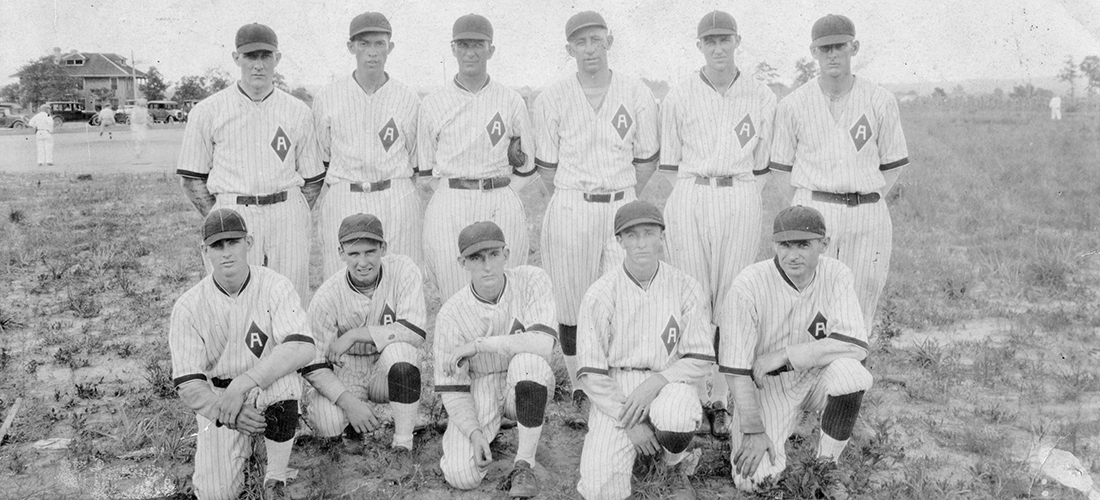
The Aberdeen team photo accompanying Healy’s article identified Allen and all his pinstriped teammates. According to longtime Aberdeen Mayor Robbie Farrell and his sister Betsy Farrell Ingraham, virtually all the Aberdeen players shown in the picture became men of prominence in the community. Gordon Keith owned the town’s dry-cleaning business and also won the 1939 golf championship of the Southern Pines Country Club. Gordon’s brother, Kenny Keith, was the town’s go-to carpenter. Billy Huntley owned substantial real estate in the area, including the local drive-in theater. Max Folley’s family ran the lumberyard. Bill Maurer was active in the tobacco markets and became co-owner of the Aberdeen Warehouse. Hughes Bradshaw operated a gas station. John Duncan McLean owned the local hardware store and served as Aberdeen’s mayor.

Kneeling L-R: Bill Huntley, Max Folley, Gordon Keith, Purvis Ferree, John D. McLean Standing L-R: Johnny Allen, Bill Maurer, Hughes Bradshaw, George Martin, Arnold Ferree, Kenneth Keith

Arnold “Bony” Ferree served as a health inspector, while his brother, Purvis Ferree, achieved fame in Winston-Salem as the longtime golf pro at Old Town Club. Purvis became the first person inducted into the North Carolina Golf Hall of Fame. His son, Jim Ferree, would continue the family’s golf legacy by winning a pro tour event (the 1958 Vancouver Open) and was the beknickered, silhouetted model for the PGA Champions Tour logo. Finally, George Martin owned Martin Motors, the town’s Buick dealership, on South Street, now a church. Martin installed a bank of showers inside the dealership so that his teammates would have a place to wash up after games.

Gordon Keith’s son, David Keith, now lives in Cameron. His irrigation contracting business is in the old family house on Keith Street in Aberdeen. Born after his father reached 50, David is only in his 60s. He remembers his father saying that Allen was a “ringer” — paid money, presumably raised by the passing of a hat at games, to pitch for Aberdeen — and that his father often served as Allen’s catcher. The games were on Wednesday afternoons, the day many area businesses closed at noon, and attracted sizable crowds. (The Aberdeen Supply Company closes on Wednesday afternoons to this day.)

David Keith still has an ancient, scuffed baseball with links to the old Aberdeen nine. It was given to him years ago by his best friend, Sam Buchan, a grandson of the aforementioned George Martin. Buchan got the ball from Martin’s teammate John Duncan McLean. Mayor McLean kept the ball, belted for a home run in a Moore County League championship game, as a piece of local memorabilia. Just a few years ago, the ball was among the possessions stolen from Keith’s house in a robbery. Fortunately, the perpetrator was caught and the treasured ball returned.

While The Pilot did little to cover the activities of the Moore County Baseball League, the 1932 season was a notable exception. That year, the Aberdeen team found itself in the thick of the race for the league title. Several of Allen’s old teammates from the ’20s were still mainstays on the squad, including Martin, Max Folley, Purvis Ferree, Bill Maurer and Billy Huntley. To reach a playoff series against Vass-Lakeview for the league championship, Aberdeen needed to beat Southern Pines in the last game of the regular season. The deciding contest was played the last day of August on Aberdeen’s home field, now the site of Cactus Creek Coffee.

The county was abuzz, the game looming larger than even the upcoming World Series in which Johnny Allen would appear. When game day arrived, the ballfield was packed. “Two thousand or more people from every corner of the county gathered around the Aberdeen diamond for Wednesday’s big game,” reported The Pilot. “It was the climax of a thrilling baseball season. Aberdeen and Southern Pines were deserted. Everybody was at the ballpark.”

As Aberdeen’s player-manager, George Martin sent himself to the mound for the pivotal game. Inspired by the massive crowd, he pitched brilliantly, shutting out Southern Pines, 6-0. But it wasn’t Martin’s fastball that had turned the trick; it was his out-of-the-past, good luck garb. “George had put on his 1921 uniform. Of course! That explained all,” wrote The Pilot reporter. “You remember George Martin back in 1921. Burning ’em in. Foe to every opposing batsman. Striking ’em out with his change of pace. George in his 1921 clothes! What chance had Southern Pines?”

Aberdeen went on to defeat Vass-Lakeview three straight in a best-of-five series, breezing to the league championship. Playing a nifty first base, Martin contributed multiple hits in each game, including a tide-turning homer in game two — likely the ball now in the hands of David Keith. The Pilot attributed much credit for the series victory to Martin. “He not only guided his men well, but proved an example in the field and at bat, playing errorless ball and hitting with the best of them.”

Five years later, Martin died suddenly while working at his desk. He was just 36. The Pilot described him as one of “Aberdeen’s most beloved citizens,” and that he would always be remembered for his baseball accomplishments — especially the memorable ’32 game he pitched and won in a 1921 uniform.

“You should talk to Kam Hurst, George Martin’s granddaughter,” David Keith said. “I think she has his uniform.”

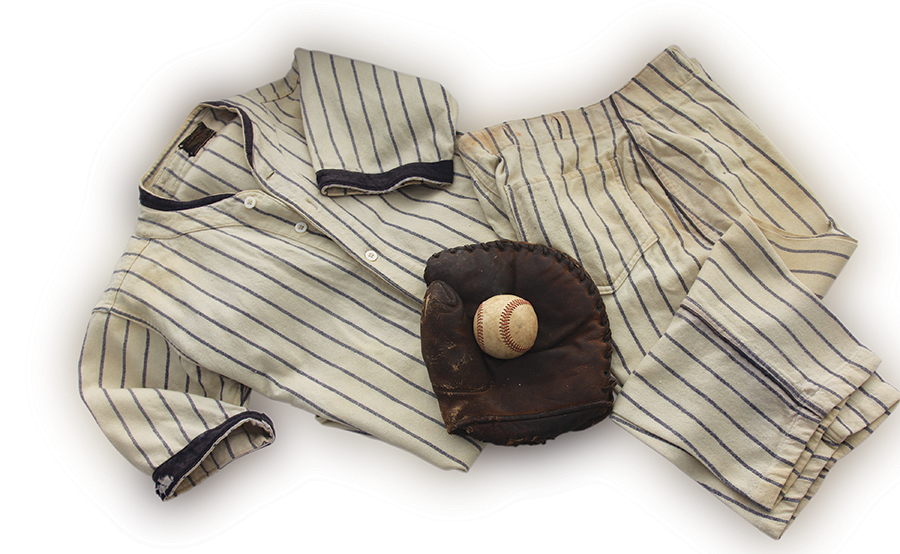
Hurst’s grandparents had lived on Pine Street in Aberdeen in a home Martin built in 1923. After he died in 1937, his widow continued to reside in the house for many decades. After Hurst’s grandmother’s death, the house remained in the Martin family. While making repairs in 2009, Kam and her husband, Ricky, spotted her grandfather’s long forgotten baseball gear in the attic, undisturbed since his death 72 years earlier.

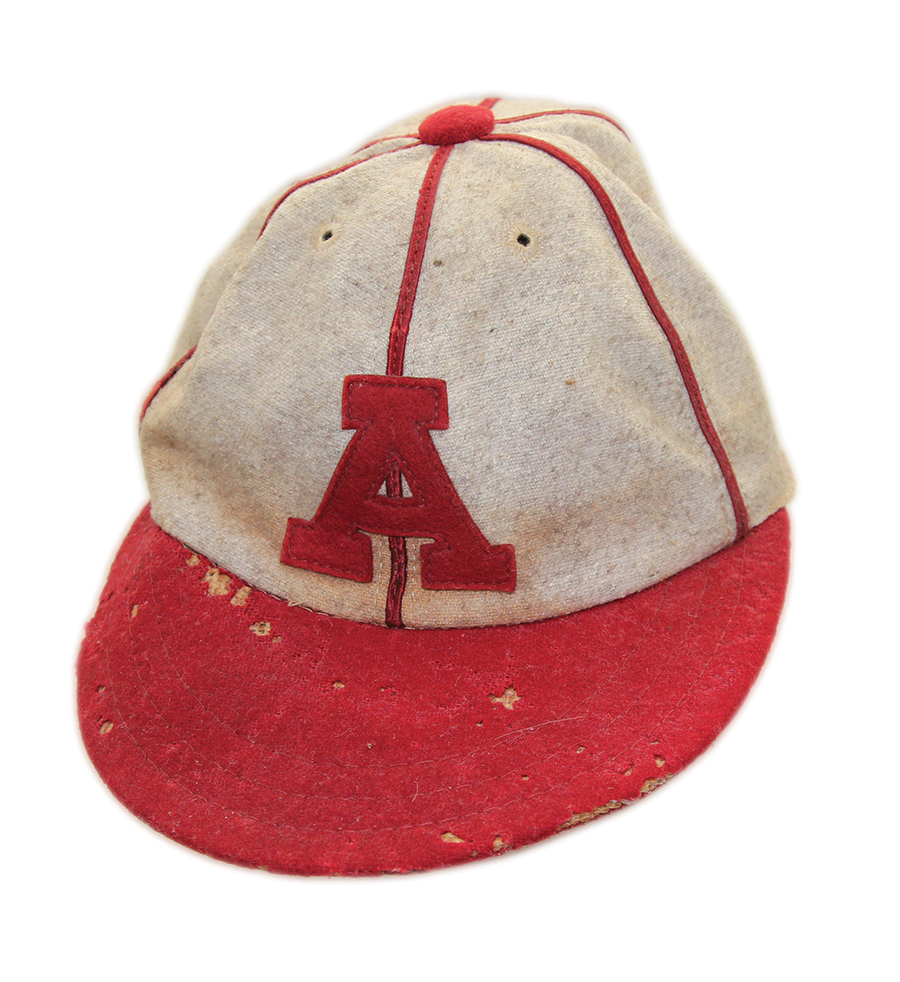
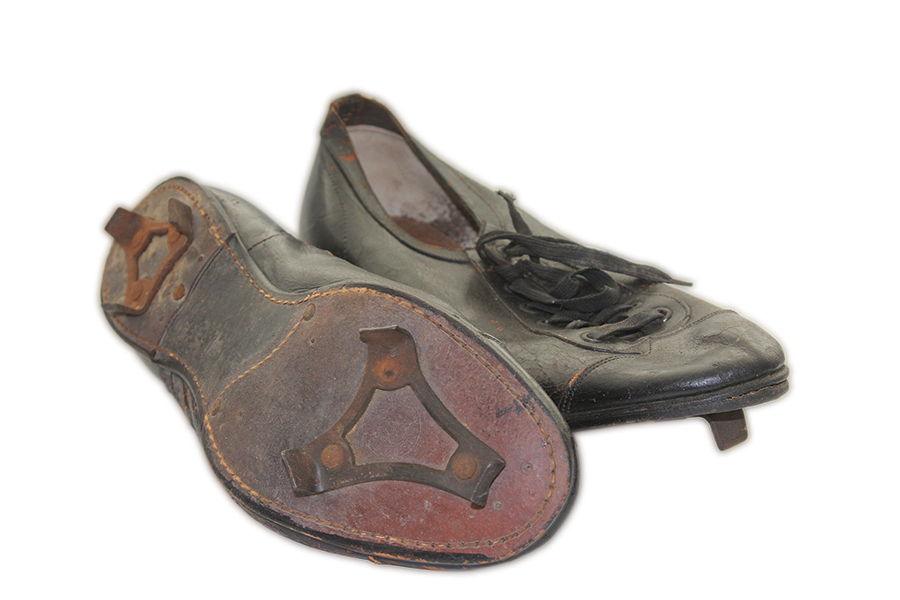
Inside a timeworn black duffle were Martin’s cleats, still sharp enough to dig into a basepath, his glove — little more than a primitive leather slab — and a cap bearing the red letter “A.” Separately, there was George’s wool uniform, still wearable. The pinstripes, however, didn’t have the “A” insignia affixed to the players’ jerseys in the ’26-’27 team photo. This had to be George Martin’s 1921 uniform.

While Martin’s heroics highlighted the rousing finish of the Moore County League’s 1932 season, the eight team league didn’t last much longer. It would disband in 1934. The four-team Sandhills Baseball League tried to fill the vacuum, but with the Great Depression raging, it was difficult to cajole financially struggling spectators to drop money into a passing hat. A Memorial Day All-Star game that attracted a crowd of 500-600 resulted in paltry receipts of $14. Semi-pro baseball in North Carolina was beginning a gradual fade-out.

Also on the wane was Johnny Allen’s playing career. His final major league season in 1944 was the only one in which he recorded a losing record. He stayed in the game, however, becoming a minor league umpire. Once the bane of the “men in blue,” Allen became the chief ump of the Carolina League. He gave up the job in 1952, thereafter buying and selling real estate in St. Petersburg, Florida.

When not on the mound, Johnny Allen was personable, a good husband and father, and a generous contributor to charities, including the orphanage of his youth. While he could be nasty to those who cost him victories, in the fullness of time he claimed he mostly got sore at himself “because I think of a million and one things I could have done in the situation and didn’t do.” There may have been a third baseman, or two, who would be less generous.

Allen died in 1959 at the age of 54. Enshrined in the North Carolina Sports Hall of Fame in 1977, he was later named one of the best 100 players in the history of the Cleveland Indians. A ranking of the best baseball players born in North Carolina places him fifth. The four in front of him are in the Hall of Fame.

John Allen III, who lives in St. Petersburg, Florida, believes his grandfather should be recognized among baseball’s all-time greats, but is not, “because he didn’t kowtow to the press. In fact, he went out of his way to tell them how little respect he had for them. Boy, do we need more of those type of men today.”

While Johnny Allen’s relative standing in the ranking of baseball greats may be subject to debate, it is undisputed that he is the greatest ballplayer ever on a Moore County team. His exploits here — and those of George Martin on long ago Wednesday afternoons — become less ephemeral after laying eyes on relics like Martin’s glove, uniform, spikes, and the ball he smashed for a home run.

As James Earl Jones’ character Terence Mann reflected in Field of Dreams, baseball appeals to our longings for the past. “The one constant through all the years has been baseball . . . It reminds us of all that once was good and it could be again.”

It reminds us of a target on a basement wall.  PS

Pinehurst resident Bill Case is PineStraw’s history man. He can be reached at Bill.Case@thompsonhine.com.

The Bard of Pinebluff

The Bard of Pinebluff

Manly Wade Wellman,
our forgotten man of letters

By Stephen E. Smith

On a September afternoon 53 years ago, I was one of eight creative writing students who had gathered for the first time in room 301 of the Carlton Building on the campus of little Elon College. We were awaiting the arrival of our instructor, an adjunct professor unknown to me. A fellow student who was repeating the course offered a concise appraisal: “This guy has published a truckload of books.” And at that moment an imposing figure appeared in the doorway.

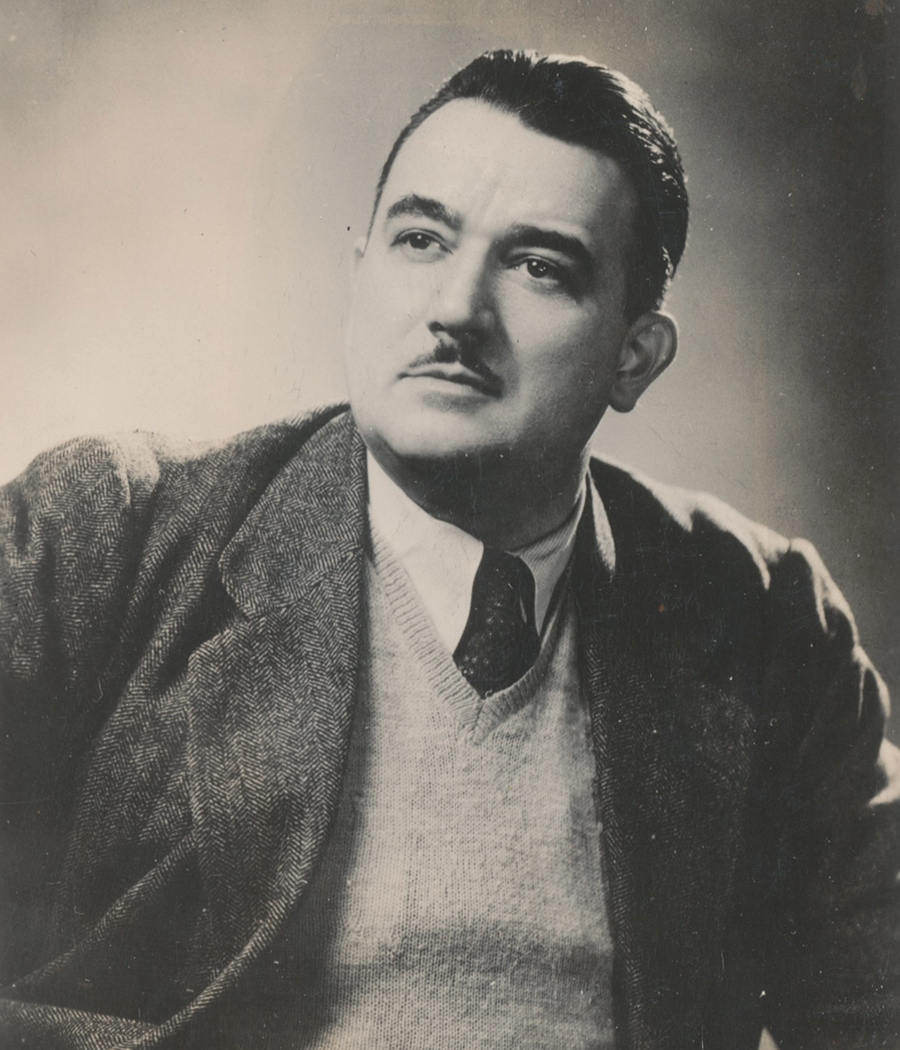
Manly Wade Wellman was 6 feet tall, barrel-chested and wide-shouldered. He appeared to be in his mid-60s, with graying hair combed neatly back from his broad forehead. His face was round, open, accentuated with heavy eyebrows and a prominent nose below which was cultivated a tweedy Clark Gable mustache. I noticed immediately the peculiar way in which his eyes reflected light. The very tops of his irises flickered, suggesting an authentic inner illumination. He was dressed neatly in a frayed sports jacket that matched his mustache. A glasses case was stuffed in the pocket of his shirt, the collar of which was pulled tight by a bolo tie clasped with a silver and turquoise medallion.

“I’m Manly Wade Wellman!” he announced, surveying the anxious faces staring up at him. Then he launched into a story that went something like this: When Manly’s father was a boy of 8, he was taken by his father to attend a lecture by Mark Twain. Father and son found seats in the front row of the auditorium, and when the lights came up, the illustrious raconteur stepped to the edge of the stage and removed a folded paper from the inside pocket of his white linen jacket.

“I would like to read a poem,” Twain announced. The audience, who had not gathered to hear America’s foremost humorist read a poem, was silent for a moment, then burst into laughter. Annoyed, Twain held up his hand. “No,” he said, “this is a serious poem.” Again, the audience laughed. Twain frowned, crumpled up the paper, and tossed it onto the stage, where it remained until he had concluded his lecture. According to Manly, his father spent the evening staring at the wadded-up poem, and at the conclusion of the lecture, he was taken by the hand and led from the hall, thus consigning to the dustbin what may have been a priceless scrap of American literature.

More than half a century later my initial impression of Manly and the story he told during that first class session remains with me, long after the yarns of other teachers, friends and fellow writers, accomplished storytellers all, have faded from memory. Manly no doubt intended the story to serve as an analogous revelation, but what I recall most vividly are the sensuously effective images: that long-ago evening when the romantic possibility of a white-haired Twain still existed in America, the irreverent audience, that small boy longing to rescue the Great Lost American Poem, all of it spun forth in Manly’s raspy baritone, rising and falling with modulations of passion, poignancy, and a lingering trace of regret. He grumbled his way through the description, exposition and complications, all elaborately embroidered, and when he arrived at the story’s obvious climax, his voice rose suddenly to a crescendo.

“What would I give to know what was written on that scrap of paper?” he roared. “If only my father had reached out to grab it!” — and Manly’s left hand, which I noticed was stunted, the ring finger and pinky withered, suddenly darted out to grab the metaphysical poem. And there it was: almost everything I’d need to know about structuring a narrative.

This was, of course, a well-worn tale, polished and perfected with many tellings — for Manly Wellman, was, first and foremost, a teller of tales, a believer in recreating the moment in words and images. He was also a genuine artist, and the effect was calculated. It was his purpose to communicate in a sequence of rich, concise images so vivid as to be indelible on the impressionable mind. And, in my case, he was successful. I recall at least two later occasions when Manly offered the same story in which he changed minor details to better suit the occasion. Each telling offered fresh particulars and new insights that served to enliven the narrative. Like all accomplished writers, Manly was always in the process of rehearsing and revising, and I took note of the most important lesson a writer can learn — revise, revise, revise.

When class was dismissed, I beelined it to the library and looked up Manly Wade Wellman in Books in Print. My fellow student had been correct — Manly’s books occupied a couple of pages of the reference work. From there I wandered into the stacks and ran my index finger along the spines of 10 or 15 glossy covers with “Wellman” printed in big letters. I selected Not at These Hands, a mainstream, slick-covered novel published by Putnam, a big-deal New York house, and checked it out. I read the bio information on the dust jackets of several other books, mostly science fiction and fantasy, and learned that Manly had been born in Portuguese West Africa in 1903, and that he had ancestry that reached back through the Civil War to Colonial Virginia. He’d lived in Utah, New York and three or four other states, but he’d never stayed in one place for long until he settled in North Carolina after World War II. One of the bios identified Pinebluff, N.C. — wherever that was — as his family home.

His books included biographies — he’d written Giant in Gray, the definitive work on Confederate General Wade Hampton — and there were regional histories, juveniles, mystery novels, science fiction and fantasy. He’d published hundreds of stories in pulps in the ’30s, including more than 50 stories in the legendary Weird Tales, and he’d bested Faulkner in the 1946 Ellery Queen Mystery Magazine Prize. When it came to writing, he was indeed a jack-of-all-trades. I was duly impressed. Who could ask for a more experienced teacher? Or as it turned out, a better one?

Manly Wellman was fiercely proud of his stature as a writer. “Outlaws,” he called us, generously including his students in the designation, and he had the rare ability, from the moment he stepped into the room, to instill in each student the strong belief in self that made him a successful writer and a charismatic presence.

Each Tuesday morning that semester, I’d drop a story in the campus mail, and Manly would critique and correct it and hand it back after reading it aloud to the class. I was no doubt an annoyingly eager student, and on a couple of occasions I submitted two stories in one week. “You’re like the tiger who’s tasted blood,” Manly laughed — and in fact, I was spending entirely too much study time writing fiction. Not all my stories were keepers, but one was good enough to win a state-wide short story contest that earned me $100 and a magazine publication. When I met with Manly after winning the magazine prize, he asked what my major was. I told him it was sociology. “Change your major to English!” he barked. “There’s no such thing as sociology!”

The class met in a tall-windowed seminar room tucked away in a forsaken corner of the campus. No other classes met on that hall, and we felt we were truly in hiding. We loved being Manly’s “outlaws,” and he lavished attention on each student, managing to be critical while encouraging the better writer within. Every story he returned included a personal note banged out on an old portable, ribbon-weary Royal Quiet Deluxe he toted with him everywhere.

Today, leafing through the yellowing pages of the crude stories I wrote that semester, I find Manly’s corrections, suggestions, rebukes and flattery everywhere scribbled in the margins and between the lines. One of his notes reads in part: “In its organization and the early stages of its writing, it (my story) strikes me as having a good degree of merit, with a particularly intriguing point-counterpoint of almost slapstick humor and gray sadness . . .”

While I was profiting from Manly literary expertise, I knew nothing of his sojourn in Moore County. It would be another nine years before I’d discover the charms of the Sandhills and move from the coast to Southern Pines. And 70 years after the Wellmans — Manly, Frances and son Wade — relocated from Pinebluff to Chapel Hill, longtime resident John Mills, who was a child when the Wellmans called Moore County home, is one of the few locals who remember the family well.

“Manly moved to Pinebluff shortly after the war in 1946 or ’47, and he grew to know and love Moore County during the four years in which he lived here,” Mills recalls. “Manly’s father was a doctor — we had a lot of doctors who used to spend their winters here — and Manly’s father built a log bungalow with a big fireplace that covered one wall. When Manly’s father moved to Raleigh, Manly and his family moved into his father’s bungalow. During his time in Pinebluff, whose population in those days was about 300, Manly served as town clerk and was a member of the Lions Club and the Boy Scout troop committee. During this period, he published The Sleuth Patrol (1947), Mystery of Lost Valley (1948), Raiders of Beaver Lake (1949), and Haunts of Drowning Creek (1951), which was dedicated to my father. Manly moved to Chapel Hill in June 1951 to be near the university library and so that his son Wade could get a better education.”

Manly completed The Wild Dogs of Drowning Creek (1952) while living in Chapel Hill, where he also wrote The County of Moore, 1847-1947 (1961) and The Story of Moore County (1974).

Mills has in his possession notes Manly made concerning an incident that took place in the northeastern corner of Moore County at a location known as Big Poplar. Reported in the October 1871 issue of Harper’s Monthly, the altercation involved members of the “White Brotherhood” who attempted to lynch Republican John Campbell. Federal agents got wind of the plot and arrested the perpetrators, marching them to Raleigh to stand trial. It is unclear whether Manly was researching Moore County history or if he intended to expand the Harper’s Weekly article into a book, but he noted that the story was accompanied by a woodcut “showing John Campbell kneeling with rope around his neck and surrounded by masked, hooded and robed figures.”

While living in Pinebluff, Manly became friends with children’s author Glen Rounds, who lived a few blocks away. The two professional writers maintained a congenial if competitive friendship. “There was a knock at my door,” Rounds once told me, “and when I opened it there was this guy who says, ‘I’m Manly Wade Wellman.’ And I said, ‘So what?’” 

Tit for tat, Manly would later tell me: “If Glen weren’t so busy trying to be a damn cowboy, he’d be an all-right guy.” Nevertheless, Manly requested that Glen speak on his behalf when he was honored at the North Carolina Writers Conference in 1982, and Glen was a frequent visitor at the Wellmans’ home in Dogwood Acres in Chapel Hill. “Glen stops by for a free drink when he’s in town,” Manly claimed. “He’s courting a lewd nurse who lives in Carrboro.” Glen was an irrepressible raconteur in his own right, and I count myself fortunate not to have been trapped in the same room with the two of them.

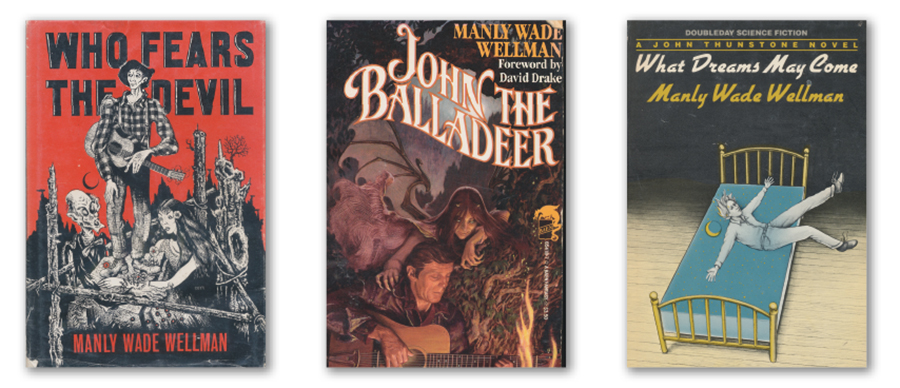
Manly’s generosity was boundless. He was my teacher, mentor and close friend. He encouraged me to apply to the Master of Fine Arts program in creative writing at UNC Greensboro and wrote an eloquently persuasive letter recommending my acceptance. When I began my college teaching career, he drove long distances to meet with my classes to instruct and inspire them as he had me, and he continued to critique my stories and give advice and guidance. I traveled to London with Manly and Frances when he received an Edgar Allen Poe Award, and I had a front-row seat at the premiere of a movie based on his story collection Who Fears the Devil? On several occasions he and Frances visited with me in Southern Pines.

Manly died in 1986. When he was inducted into the North Carolina Literary Hall of Fame, Frances asked me to speak on his behalf. I was proud to do it. I did the same for the late Glen Rounds a few years later. I can’t think of either man without recalling Sir Walter Scott’s lines “. . . When, musing on companion gone/We doubly feel ourselves alone.”

As for Manly Wade Wellman the writer, the author of over 90 books, I’ll leave the literary judgments to my betters. I believe, however, that he made an important contribution to the science fiction and fantasy genre. Writers as disparate as Stephen King and Fred Chappell have acknowledged Manly’s influence. Without a doubt, he was the teacher who appeared at the right moment in my life. There were literary luminaries in Chapel Hill and up Interstate 85 in Greensboro, but I would have been lost in such settings.

Whenever I think of Manly, I recall a cold January afternoon during the final days of that first creative writing class at Elon. It had begun to snow large, wet flakes that were fast piling up against the window glass in room 301. Manly had to drive back to Chapel Hill on a meandering Highway 54, so he dismissed class early and I walked with him to the faculty parking lot on Harrison Avenue. Before getting into his car, he paused a moment and recited a passage: “He watched sleepily the flakes, silver and dark, falling obliquely against the lamplight . . . It was falling on every part of the dark central plain, on the treeless hills, falling softly upon the Bog of Allen and, farther westward, softly falling into the dark mutinous Shannon waves . . .”

When he’d finished, I asked the source of the passage.

“It’s from James Joyce’s story ‘The Dead.’ You should read it,”
he said.

I watched his taillights disappear in the snowstorm before walking to the library, where I checked out Dubliners. That night I read it cover to cover.  PS

Almanac

March

By Ashley Walshe

In March winter is holding back and spring is pulling forward. Something holds and something pulls inside of us too.

— Jean Hersey

March is an age-old prophecy: a great thaw followed by a riot of life and color.

Some said it would start with a single daffodil. A field of crocus. The soft warble of a bluebird.

All the signs are here. And in the bare-branched trees, where wild tangles of dead leaves resemble papier-mâché globes, newborn squirrels wriggle in their dreys, eyes closed.

Weeks ago, winter felt eternal. The cold air stung your face and fingers. The world was bleak and colorless.

Now, the red maple is blooming. Saucer magnolia, too. You build the last fire, sweep the hearth, return to the garden and its wet, fragrant earth.

Frost glistens in the morning light, but you know it’s true — that spring is coming. You know because the birds know. They cannot help but blurt it out.

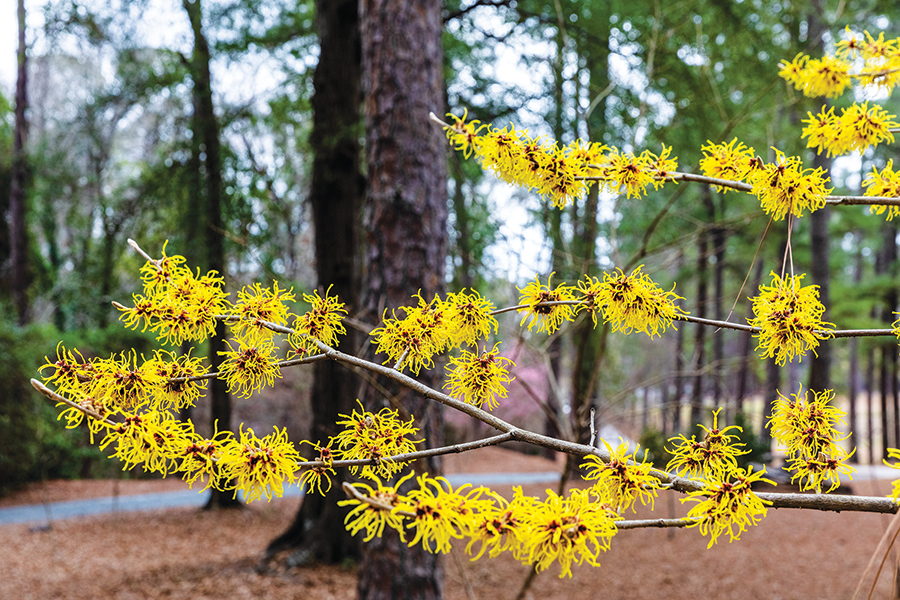
Beyond the flowering quince, a woodpecker drums on a towering pine.

A towhee gushes drink-your-tea.

A robin whistles cheerily, cheer up, cheer up, cheerily, cheer up.

Soon, spring peepers and chorus frogs will join the band. The first bee will drink from the first hyacinth flower. A young squirrel will open its eyes.

Sunlight kisses wild violets, purple dead nettle, tender young grasses. Everywhere you look, you notice a new warmth, a new softness, the gentle pulse of life. By some miracle, spring has arrived. A sweet mystery born from the icy womb of winter.

A Gardener’s Luck

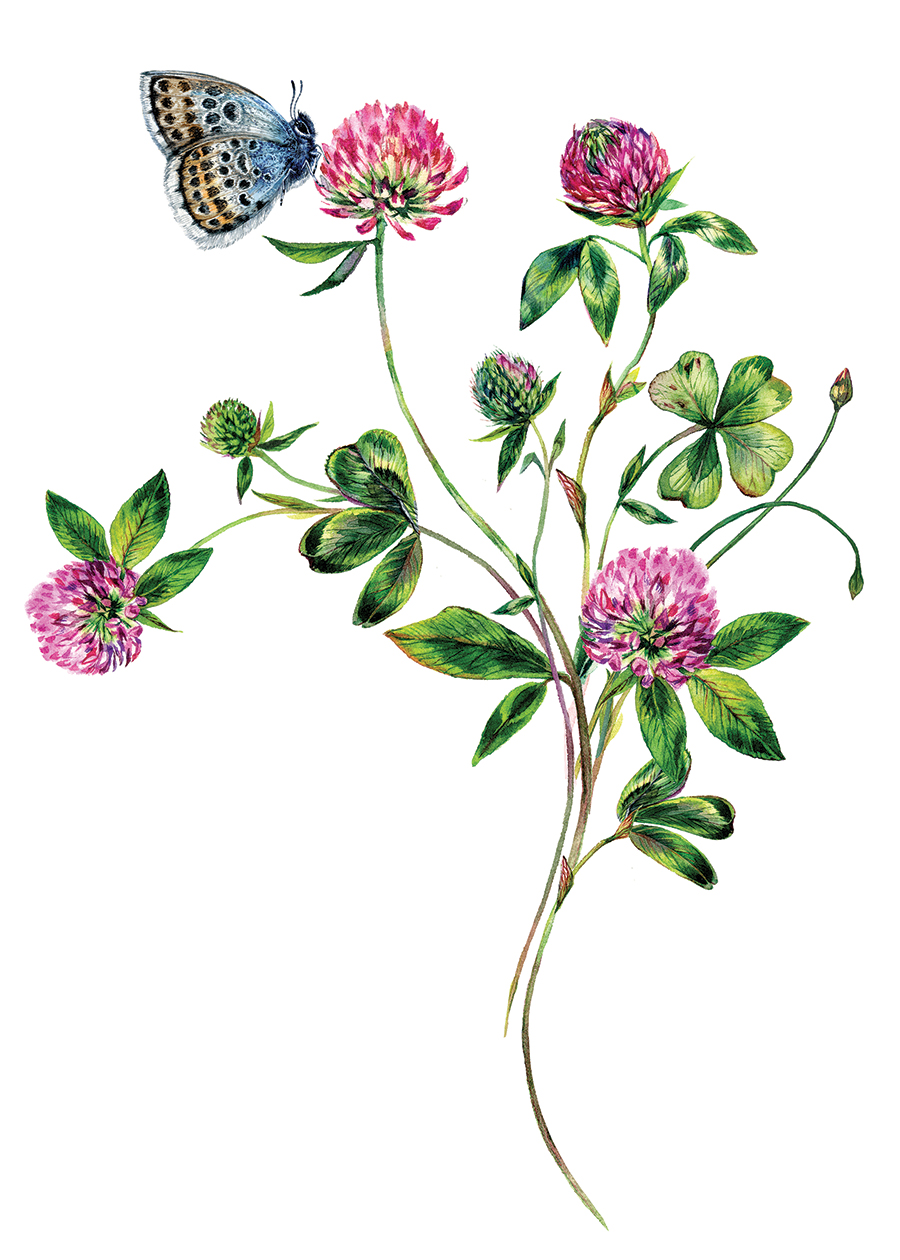
Let’s talk about three-leafed clover (genus Trifolium), a flowering herb in the legume family that just might be what your lawn or garden has been missing. Common as weeds — and often disregarded as such — clover can grow in most any climate, tolerate poor-quality soil and resist most pests and diseases. Here’s the best part: clover can “fix” spent patches of earth by restoring nitrogen levels. In other words, it’s a natural fertilizer and often is used as green manure crop.

Using clover as a ground cover between garden beds will also attract pollinators. Mix some clover with your grasses and your lawn will look greener. An added bonus: It’s impervious to dog urine. Even if you never find a four-leafer, that’s some good garden luck.

Spring Forward

Daylight saving time begins Sunday, March 13. Longer days inspire evening walks, birding, a quiet hour in the garden. Notice what’s flowering: breath-of-spring (winter honeysuckle), brilliant yellow forsythia, lemony scented star magnolia. Notice what needs to be pruned: ahem, the rose bush. Although the vernal equinox occurs Sunday, March 20, spring has been here for weeks, present in each glorious inhalation. Allergy season? Coming soon.  PS

Story of a House

Life on Blue Ribbon Lane

Where practicality and taste meet

By Deborah Salomon     Photographs by John Gessner & Laura L. Gingerich

Reading a house is like reading a palm. The footprint, as well as the décor, describe its occupants. This applies to Sapphire Farm, where two horses, a donkey, three dogs and a flock of chickens share a spectacular homestead with youthful retirees — an equestrienne and an environmentalist — deep in Southern Pines horse country.

This installation was conceived by Lynn and Buck McGugan to fulfill specific requirements. His, that the house be low maintenance. Hers, “I wanted to stand at the kitchen sink and look across at my horses in their stalls.”

Lynn is the sole caretaker of her animals, mostly rescues. Their bond is strong.

Buck doesn’t ride but he does play golf. Moore County offers both, at a high level.

Beauty may be in the eye of the beholder, but at Sapphire Farm — named for the birthstone of the McGugans’ son, Robert — practicality runs gut-deep. Buck, a financier with an architectural background, speaks with pride of the geothermal heating and cooling systems backed up by two generators. This includes the saltwater pool, with an unusual earth-hued liner. “The dark color holds the heat, giving us a longer swimming season,” Buck says.

The barn is sited for maximum breezes and minimum flies. Plantings attract birds and butterflies. Inside, tinted windows (no shades, blinds or drapes) reflect heat. Buck’s pride extends to building materials — no wood on the exterior, only Tennessee fieldstone, concrete shingles and stucco with embedded pigment that never needs painting. On the inside, locally sourced wide-board knotty pine covers floors and walls throughout, extending to a tray ceiling in the combo living-dining room.

Lynn and Buck met while employed by Xerox in the 1980s. Ten years ago, they were living in a Chicago suburb with Lynn’s horse, Butter, boarded off-site. Enough with severe winters already. “We were looking for a retirement place for horses and golf,” Lynn says. She accompanied Buck to a golf tournament in Pinehurst. “A friend had a place here. I rode with her on the (Walthour-Moss) foundation.”

Lynn did not expect the extent or beauty of the land or the depth of the equestrian community. “I cried the whole time.”

Finding open acreage adjacent to the foundation seemed beyond serendipity. “I saw the hunt leaving and said, ‘Where do I sign?’” Lynn remembers. They had built and renovated houses before, one dated 1889.

The couple worked with an architect for a year. The house would be U-shaped around a courtyard. One section (and the barn) with a tiny second-floor apartment was completed first. They lived there during construction of the remainder, total time three years, with Buck keeping a close watch.

Afterward, that apartment, plus another topping off the opposite end, serve as guest quarters for their son and others, since the core of this 5,000-square-foot residence has a master suite, but no other bedrooms.

Walk through the front door . . . and gasp. The foyer, rising nearly 30 feet, is a confluence of angles pointing upward to a glass-topped cupola, which allows sunbeams to stream through. Buck compares the foyer to the Pinehurst rotary, with branches going off in different directions. Except the rotary isn’t wood-paneled from ceiling to floor and furnished in farmhouse mode — a preview of what lies ahead, including fixtures that resemble gaslights and antiques of varied provenance.

“Everything has a story,” Lynn says, directing attention to photographs she has taken of tumbledown cabins, which comprise much of the wall décor. Even the frames are her handiwork, many found in unlikely places, attached to something else.

Gasp again at the living-dining room, for its scope. If the elongated medieval refectory table — a showpiece from Wright, an old and revered Carolina furniture company — and few upholstered pieces were removed, the space could double as a ballroom accommodating a dozen couples. Or hold 150 at Lynn’s famous brunch before and after the Blessing of the Hounds on Thanksgiving morning. Its walls beg touching. What could this material be?


Peter Dowd, the McGugans’ builder, was tearing tin roofing off an old cotton plantation. The long panels, mottled with rust, were destined for the scrapyard. In them, Lynn saw texture. “I washed every one and removed the rusty nails,” which were reused to attach panels to the walls, since new nails would scream anachronism.

Elsewhere, beams were contrived from carpet rolls found when the Gulistan plant was torn down. A weathered barn door is attached to a wall, while farm implements rest on a workbench. Across from it stands a battered feed bin. By coincidence, Lynn’s initials are carved into the top. Beside the wood-burning stone fireplace, a gigantic fiddle-leaf fig plant suits the room’s proportions. Seagrove pottery is represented throughout.

In the nearby powder room an old pie safe with tin top has been made into a vanity, with a worn metal baking pan as a bowl.

Colors, no surprise, reflect the earth and its foliage. Furnishings, although spare, are not confined to one period. In the master suite, an Italian blanket chest with woven wood detail might be 400 years old — a wedding gift to Lynn’s great-grandparents. But the bed is a contemporary four-poster. Buck’s forward thinking extends to this suite surrounded on three sides by windows. The bathroom shower is wheelchair-accessible, with the tiled floor sloping toward the drain.


Lynn required an office for her photo library, also a tack room for equipment, riding apparel and ribbons. The house has two laundry rooms, one for people clothes, the other for horse-related washables. Her kitchen reflects training at a Swiss culinary school. It is vast, encompassing a family dining space, a worktable-island with outlets and shelves. Countertops are soapstone, cupboards rise to the ceiling, and wide, deep drawers contain more implements than an upscale kitchen boutique. These carpenter-made maple cupboards have been “distressed” by pounding with a horse bit. Lynn personalized the custom-made copper range hood by splotching it with vinegar and acid. Her appliances, however, are standard KitchenAid, and she bakes with an inexpensive hand mixer.

.

Where are the ovens? “In the butler’s pantry, to keep the kitchen from heating up,” Lynn says. Here also is her pet appliance: a Scotsman brand under-the-counter maker of ice pellets, not cubes. “I built this kitchen around it.”

What’s missing? “We don’t watch TV,” Lynn says. “Too much bad news.” One is mounted in a screened porch; another in the guest apartment, none in the house proper.

The result: a home crafted as much for expression as shelter; spacious yet borderline bare, which makes each table, cabinet, painting and rug pop. A home that accommodates dogs and horses, welcomes guests who speak riding and putting — then cool off in a pool resembling a pond. An interior where Mother Nature plays drama queen with wood, stone and other natural materials. Nothing frilly or fluffy. No pastels or brights, except in the garden. Everything planned, engineered, durable, agreed upon by both parties, with no thought of norms or resale. 

“This is our last house,” pronounces its chatelaine. “I plan to die here . . . happy.”  PS

Poem

What The Moon Knows

She knows shadow, how to

slip behind clouds. She’s perfected

the art of disappearing. She knows

how to empty herself into the sky,

whisper light into darkness.

She knows the power of silence,

how to keep secrets, even as men

leave footprints in the dust, try to claim her.

Waxing and waning, she summons

the tides. Whole and holy symbol,

she remains perfect truth, tranquility.

Friend and muse, she knows the hearts

of lovers and lunatics. She knows 

she is not the only one that fills the sky,

but the sky is her only home.

  Pat Riviere-Seel

Pat Riviere-Seel is the author of When There Were Horses

Look Gnomeward, Angels

The secret life of Rassie Wicker Park

By Claudia Watson     Photographs by Laura L. Gingerich

It was dawn, the hour when the sun’s rays bloom golden through the forest treetops and the birds speak to an invisible world. The air was chilly and leaves crunched underfoot as I stopped to pick up a hawk’s feather tangled in wisteria along a trail in Rassie Wicker Park. Over the bridge and into the woods, I followed the tiny brook into a naturalist’s nirvana — an area to explore, lush with native ferns, fluorescent moss, inkberry, sweet pepperbush, laurels and hickory.

Minutes later, the woods fell silent when a jay’s squawking signaled alarm. I checked my surroundings and was drawn to a path the deer had shaped through a jumble of vines and briars. Working my way through, I found the massive upturned hollow base of an ancient hickory festooned in lichens. I placed my hands on a large burl to steady myself and peered into the dark cavity.

Staring back at me was a diminutive chap with a long white beard wearing a well-worn yellow cowboy hat. He had a slight hitch in his gait, presumably because he wore only one blue boot, on his left foot.

I pulled back, not sure of what I was seeing.

“No need to be fearful,” he said with a wink. “My name is M.T. Chamber and a hundred thousand welcomes.” He pointed to a nearby log. “Please, stay and sit for a while.”

I obliged, though I’m not sure why.

Without warning, the hollowed-out stump suddenly became a lively amphitheater. Dozens of colorfully capped tiny beings appeared out of nowhere, waving their hands, and welcoming me.

“We’re forest gnomes,” explained Chamber, charmed I believe by my wonder and confusion. “A subrace of the common gnome,” he clarified.

“What’s with the colorful hats?” I asked, believing as I did until that very moment that all gnomes wore only green or red.

“We forest gnomes prefer to take on the colors of our world — the pokeweed, the walnut hulls, and those pink, purple and yellow flowers at the Big Garden. They all make unusual dyes. Our friends, the foxes and squirrels, donate the fur we weave into our hats, where we keep our most prized possessions,” he said, giving a firm tug to the wrinkled brim.

“Some in our clan are 200 years old,” he boasted. “As a poet of some renown, I use my gnome de plume, M.T. Chamber, but in the community, I’m called Hop Along.” He pointed to his one bare foot.

Strum Stetson, alias Tex — a noted songwriter, I would learn — took center stage and sang his hit single “Gnome, Gnome on the Range.” It’s a ballad recalling a treacherous journey by ship over the Great Water and later by wagon to this woodland, Rassie Wicker Park, the land they’ve called home for eons. Curious and impulsive, these pocket-sized gnomes take up adventuring and jubilantly eke out a life wherever they land.

Now, nearly 100 forest gnomes inhabit the park, from the verdant valley edges of Board Branch brook and the magnolia garden to the upland zones of the longleaf pine savanna. Their primary purpose is to nurture and protect the Earth, including animals and humans.

Underground burrows and holes in old trees provide cozy homes. They share an elaborate tunnel system with their friends — moles, mice and rabbits — and use it for inconspicuous travel within the realm. Aside from their work as craftsmen and tending to the forest, they spend their days gathering mushrooms, nuts and berries for the long winters.

A voice hollers from the side. “Don’t mistake us for all work and no play. It’s dancing, singing, and telling jokes we love,” says Frobby, the ale-maker. “You missed the winter solstice celebration at the Great Moss Stump where we soaked up the last of the warm sunshine.” Maybe next year.

Then, Chamber told me, to celebrate the New Year and, in lighthearted recognition of their characteristic large noses, they held their annual snoring contest, aided by abundant ale consumption. This year’s award went to Tolkyn Snuddlemoor, the clan’s storyteller.

The gnomes go where their impulses lead them but remain respectful to others in the clan. They promote peace in the domain and are rarely ensnarled in disputes. However, on occasion, human activity may need to be addressed. That falls to the village elders, who meet irregularly up on The Hill. Since settling in the forest, most members of the gnome clan rarely make their presence known. But there’s always the exception.

“Some people carry an unusual energy,” Chamber explained. “We’ll observe them to determine if they’re a threat or if they’re peaceful. The elders decide if we should make contact, like today.”

Chamber pointed to a fellow in a broad-brimmed orange hat. “That’s Milkweed. He keeps watch at the Big Garden. There’s been a lot of digging activity there, which was of great concern. But they’ve cleared out the litter from the old landfill and planted an abundance of flowers and trees. They’re good stewards of all the living creatures — bees, birds, butterflies, dragonflies, spiders, little frogs, and, of course, gnomes.”

Chamber jumped from the tree to stand beside me. He removed his big yellow hat and pulled out a translucent rock that glowed like the sun.

“It’s come a long way,” he said, placing the rock in my hand. “It’s a treasure from our homeland to the guardians of the Big Garden and offers great protection. Keep it safe. Put it under your hat.”

With a boisterous toast to our meeting and a hoisting of ale, the gathering of gnomes was gone as suddenly as it appeared. Staring into the quiet dark of the hollowed stump, I knew the true magic that fills this realm.

Though the gnomes of Rassie Wicker Park are tiny, they have extraordinary power unique to the enchanted realm. Remember, they are shy. They will use their fade-away power and disappear if they are spotted, leaving only a figurine behind. Once you pass, their spirit will return. Enjoy the moment of discovery, and let it bring you joy. But please leave the figure behind so others can experience the same delight.

If you’re lucky, here are some members of the gnome clan you may see.

M.T. Chamber

Aliases: Hop Along, Boot

Height: 2 1/2 inches

Forest gnome, male, white hair and beard, yellow hat

Expertise: Cowboy lore

Special abilities: “Hop Along” has trouble walking, but he is good at herding caterpillars. He is a renowned poet who authors cowboy poems and enjoys reciting them in the Ale Hall.

Strum Stetson

Alias: Tex

Height 1 1/2 inches

Forest gnome, male, white hair and closely cropped beard, yellow Stetson-type hat, brown boots

Expertise: Songwriter

Special abilities: Writes and sings his own original country music ballads. Though Tex has never been to Texas, he hopes to make it as far as Nashville one day. His first ballad, “Gnome, Gnome on the Range,” remains popular today. He recently released “Country Roads, Take Me Gnome” on tiny streaming services.

Pollyanna and Dollyanna

Aliases: Sin Twisters

Height: 2 1/2 inches, each

Forest gnomes, female, flowing golden hair, coin and gem necklaces, red hats, blue dancing shoes

Expertise: Dancing, singing, teaching, joy

Special abilities: These twin sisters are affectionally called the Sin Twisters for their ability to turn bad into good. They embody the original spirit behind Rassie Wicker Park, transforming “Going to the Dump” into “A Walk in the Park.” Though once believed to be a sinful waste of energy, these active sisters prove that dancing is a terrific exercise for the body and uplifts the soul.

Frobs Dreazielbub

Aliases: Frobby, DZ

Height: 2 inches

Forest gnome, male with an ale gut, white hair and goatee, ruddy nose, droopy yellow hat, orange boots

Expertise: Ale maker extraordinaire

Special abilities: Frobby is often welcoming friends to his Ale Hall, located one street off the main trail. He’s known for his uncanny ability to identify any ale from smell alone. When he has a new batch, he holds raucous parties and invites the whole neighborhood.

Hagby Bukwert

Alias: Haggy, Mustachio

Height: 1 3/4 inches

Forest gnome, male, white hair and beard, red cap, brown-as-the-mud boots

Expertise: Nature Trail Inspector

Special Abilities: After a rainstorm, he enlarges minor trail washouts until they are repaired by park maintenance. Haggy perches in a tree hollow near the pavilion to observe morning dog walkers and Tai Chi participants. One member of the Tai Chi group has an identical beard, mustache, and cloak but no hat, so some gnome affiliation is suspected.

Forrest Fahrenheit

Alias: Sparkie

Height: 2 inches
Forest gnome, male, white hair and beard, a flushed purple nose, red Fire Chief hat, yellow boots

Expertise: firefighting, flame dousing, hot stuff

Special abilities: Forrest Fahrenheit is Rassie Wicker Park’s First Responder. He is on 24/7 alert to keep the forest safe from the dangers of fire. He shuts down out-of-season fireflies or the unexpected appearances of old flames. Young couples need to heed him if they let sparks fly, or he may show up to douse the flames.

Officer Krumpke

Alias: Occifer

Height: 1 3/4 inches

Forest gnome, male, shaped like a fire hydrant, white hair and beard, wide-brimmed green hat, navy blue boots

Expertise: law and order and policing the park

Special abilities: Officer Krumpke is punctual and begins his daily patrol outside the police station on the long brick trail. Though he seldom finds problems, when he walks the west side, he befriends youthful gnomes who gather around him, dance wildly and sing funny songs.

Chauncy St. Richland

Alias: Mayor

Height 2 1/2 inches

Forest gnome, male, white hair and beard, dark green pointy hat with a perforated brim, blue boots.

Expertise: Forest treasure preservation

Special abilities: Top elder of the forest gnome clan, he can be found perched in the central office up on The Hill where he works on the day’s essential business activities before mixing with the community to share his wisdom and advice, sometimes over a mug of ale. He inspires all to save and protect the forest’s treasures.

Gnomestradomus

Alias: Wiz

Height: 2 3/4 inches

Forest gnome, male, white hair and beard, orange pointy hat with an exciting twist, and green boots.

Expertise: fortune-telling, astrology

Special abilities: The Wiz is the Professor of Prophecy. A world-class astrologer and seer, he obtained his advanced education at Avignome University in France. While other soothsayers read tea leaves for guidance, the Wiz, being of the forest, prefers to read pinestraw for inspiration. “One day others will also consult the pinestraw,” he predicts.

Milkweed

Alias: Milkweed

Height: 1 1/2 inches

Forest gnome, male, white hair, beard, wide white mustache, orange sombrero, tightly laced black boots to keep the fire ants from biting his feet.

Expertise: Caterpillar farmer and butterfly identification

Special abilities: Milkweed spends most of his time in the Big Garden. He roams the area by foot (versus the tunnel system) to watch the native flora and fauna. Sometimes he works on his balance skills while standing atop the big rock. He enjoys visiting with the butterflies and shows the monarchs the freshest milkweed. He assists in their first training flights before migrating to Mexico.

Sir William

Alias: The Bard

Height: 2 1/4 inches

Forest gnome, male, white hair, pointy white beard and mustache, ruffled collar, black hat with a small white feather, black boots.

Expertise: Playwright and author

Special abilities: Sir William writes Elizabethan plays and organizes performances for the community, held at the Amphitheatre-in-the-Round at the old hickory stump. Nearly everyone in the forest gnome community has had a role in his plays. An early work, “Gnomio and Juliet,” received wide acclaim and, disturbingly, became an animated film. The attention caused him to be more careful with his manuscripts. He’s working on a new play about the inner conflict of a little piglet who ponders life’s choices as he matures into a Hamlet.

Pursey Moneypocket

Alias: Jingle

Height: 2 3/4 inches

Forest gnome, male, white hair and beard, tall yellow hat with its crown pulled forward, black boots.

Expertise: Treasure collection and preservation

Special abilities: As a coin collector and silversmith, Pursey descends from an ancient line of numismatists. A close friend of the mayor, they spend long hours talking about the treasures of the forest. Weather permitting, he sheds his clothes and frequents wishing wells and garden fountains, diving for coins that were offered in exchange for a wish.

Tolykn Snuddlemoor

Alias: Tall Tales

Height: 2 1/4 inches

Forest gnome, male, white hair and beard, green hat with a bulge at the top, yellow boots.

Expertise: Storyteller

Special abilities: At dusk, he travels between tree hollows to visit the children and read gnome adventure tales from the book that he hides under his cap. This calms the children as they snuggle for bed. He’s also been spotted at the Ale Hall where he rehearses his tall tales with his friends.

Bernie Family

Alias: Beanie’s Bunch

Height: 1 inch to 2 1/2 inches

Forest gnomes, male, female, animal

Expertise: Family business

Special abilities: Melanie is the milliner and Bernie is the haberdasher. They design and sell gnome hats, offering a variety of styles — plain, patterned, buckled, buttoned, pleated, or puckered. The hats are guaranteed not to frizz, fuzz, or fade. Buster Brown, the pig, and Tagg, the dog, welcome shoppers.

Claudia Watson is a regular contributor to PineStraw and The Pilot. A special thanks goes to M.T. Chamber, the poet and potter, who wishes to remain anonymous.  PS

If You Can Call It a Game

By Ed Southern

If you can call it a game, my buddies and I have begun to play: no points or score, no goals or winners, no final horn, no written rules.

Our field of play is a text thread. Our game time is whenever the spirit moves one of us, trusting each other not to be the guy who texts in the middle of the night.

How do we play? Simple: Name an Atlantic Coast Conference men’s basketball player who played between 1982 and 1998.

Why do we play? That might be simple, too.

Malcolm Mackey. John Crotty.
Elden Campbell. Tom Sheehey.

The player can’t be too obscure — no checking the internet for walk-ons and benchwarmers — but they can’t be too well-known, either. There’s no fun in naming the first players everyone thinks of when they think of that era of ACC basketball: Michael Jordan, Ralph Sampson, Len Bias, Christian Laettner, Tim Duncan, Vince Carter. Those guys entered the consciousness enough to stick around long after their last March Madness. Their highlights still show up on TV, whenever the ACC or their school or some other advertiser wants to weaponize nostalgia and the idea of tradition. Remember them? Remember that dunk, that shot, that One Shining Moment? Remember how long and how much you have enjoyed this sport, this product?

Our game’s goal is to trigger memories, too. Our point is to call up a name that spent three to four years at or near the forefront of our minds, and then left. To play our game, we name a player whose name and face and number and motion we once thought about a lot, and since haven’t thought of once.

Walt Williams. Kelsey Weems.
Pete Chilcutt. Bruce Dalrymple.

Why 1982 to 1998? Those aren’t strict limits, but for us they mark an era. In 1982, UNC won the national title, its first since 1957 and the ACC’s first since NC State’s in 1974, when some of us were toddlers and some of us weren’t yet born. By 1982, we were old enough to remember not just the championship game — Patrick Ewing’s goaltending, Michael Jordan’s jumper, poor Fred Brown’s errant pass to James Worthy — and where we were when we watched it, but that season. We were old enough to be aware of basketball as more than bright, fast colors; the carnival sounds of cheering fans and pep bands; and “Sail with the Pilot,” the ubiquitous jingle of the Jefferson Pilot Corporation, lead sponsor of regional ACC telecasts. We were old enough to know something about how to play basketball. We were old enough to be aware of ACC basketball as a thing unto itself, to begin to absorb something of its weight and meaning in the suburbanizing Sun-Belt North Carolina where we all were born and were growing up.

I was old enough to have had a friend come home with me from school on Quarterfinal Friday of the ACC Tournament, when the teachers fought over the big TV carts from the A/V room, so they and we could watch the games in class. As we waited in our kitchen for his mom to pick him up, he mentioned that his dad was at the Tournament, and had invited him to come, too, but he’d said he’d rather come hang out with me.

“You did!?” my mother, my father and I all exclaimed, shocked, even a little appalled.

Jeremy Hyatt. Timo Makkonen.
Olden Polynice. Anthony Teachey.

In 1998, the youngest among us graduated from college, from Wake Forest, from the ACC. UNC made the Final Four; Duke, the Elite Eight. By 1998, their rivalry had established its hegemony over the conference, in results but more so in media coverage. A new or casual fan could watch an entire season on ESPN, and be forgiven for failing to realize that Tobacco Road was far longer than the 10 miles of U.S. 15-501 between Chapel Hill and Durham. In 1998 Antawn Jamison, who years before had been a Charlotte summer league teammate of my brother’s, won the Naismith, Wooden, and practically every other Player of the Year award. Between Wake’s 1996 ACC title, and Florida State’s in 2012, either UNC or Duke won the Tournament every single year but one. Between 1982 and 2019, ACC teams won 13 national titles, but only 3 of those were won by a team other than the Tar Heels or the Blue Devils. Those famous miles between the Dean Dome and Cameron Indoor sucked all the oxygen out of ACC basketball.

In 1998, Wake Forest’s back-to-back Tournament titles were fresh in our minds, and the Heels/Devils dominance didn’t seem so assured. The ACC hadn’t expanded beyond nine teams, in a fairly cohesive regional spread between College Park and Tallahassee, and so every team still played every other team twice, home and away, each regular season. The Tournament was still only four days, Quarterfinal Friday still intact. Maryland hadn’t left for the Big Ten’s football-driven TV money. Our corner of college basketball still felt like a community, the season like a ritual, a reminder, an assurance through the winters, which still were cold.

Sam Ivy. Keith Gatlin. Mark West. Cal Boyd.

The goal is that spark of recognition, yes, and the quick trip down Memory Lane (which in this case is a spur off Tobacco Road). This little game of ours, though, also serves to strengthen bonds, sustain connections, and — sure — show off a bit. We started playing the week before the 2020-2021 college basketball season began, nine months after the pandemic had shut down the ACC Tournament and cancelled March Madness. We’d seen each other some, at a distance and outdoors, but for the first time in more than a decade none of us had tailgated together, sat in the stands together, watched any games together. We didn’t expect to do so again any time soon, certainly not that basketball season, a season that might not play out to the end, a season they might should not play at all.

We’re a homogenous group of seven, with two pairs of brothers who all went to Wake Forest, plus three Tar Heels. We all are North Carolinians, with roots going back generations. Four have known each other since their teens, when they were counselors together at a Baptist summer camp. Two of those roomed together during graduate school at Duke, and were looking for a third. One of them had a younger brother who knew my younger brother at Wake, and knew he was going to Duke for graduate school, and connected them. I’d hang out when I came to the Triangle for work, and crash on a sofa they still can’t believe I was brave or foolish enough to sleep on.

Four of us now live in Winston-Salem, one in Raleigh, one in Tryon, one outside Goldsboro. All of us are white, straight, cis, middle class, professional.

All of us are sports fans. We have other interests, even passions, and often have long and deep conversations about books, music, movies, whatever: Part of what I value about these friends is their taste, their intellect, their ability to talk about Walker Percy, Ron Rash, Rhiannon Giddens, Superchunk, Terrence Malick, and Mike Krzyzewski, over multiple beers in a single gathering, or over the miles of a day hike.

Most of us, in fact, hardly follow ACC basketball anymore. The four Deacons have suffered through a decade of dreadfulness, Wake fielding teams who played with so little balance or spacing that they looked like pickup players who’d ended up together at random, not even knowing one another’s names. Conference expansion has made college basketball feel reduced, ditched the home-and-away ritual of the season, made Tobacco Road feel like a cul-de-sac. The one-and-done rule has stolen any sense of connection to the biggest stars: I sometimes forget that Zion Williamson and Kyrie Irving spent a season at Duke.

The other five, in fact, follow European football, particularly the English Premier League, as avidly as any sport now, and spend the winter watching more NBA than ACC. (Four of us grew up playing soccer; one went to a Division II school on a soccer scholarship.)

Still and always, though, ACC basketball conjures up our childhoods, calls back to where we came from. We all still live in North Carolina, each an easy drive from the place where we grew up. Where we grew up, though, is as gone from us as if we had come from overseas.

Craig Neal. Alaa Abdelnaby. Delaney Rudd.

You probably think I’m thinking of where we cheered on The Dukes of Hazzard, tearing around the backroads in a souped-up Dodge they called the “General Lee,” the Confederate battle flag painted on the roof, the opening bars of “Dixie” blaring when they blew the horn. You might think I’m thinking of where Dad went to work while Mom stayed home and had dinner ready by 6.

But I, speaking only for myself, am thinking of the place where we cheered on The Dukes of Hazzard, each of them “just a good ol’ boy . . . fightin’ the system like a true modern-day Robin Hood.” I’m thinking of the woods and fields and creeks that that friend and I played in after school, in between games on Quarterfinal Friday, and how they’re long since cleared and leveled and culverted for McMansions.

I don’t blame you. Lots of people have confused the one for the other, the loss of the one for the loss of the other. Most of the North Carolina we grew up in should be gone — but it’s not. Some of that North Carolina we should have kept — but it’s gone.

Robert Brickey. Billy King.
Cozell McQueen. Tony Massenburg.

If we wanted to remember the highlights, the indelible moments, we’d text each other those: Lorenzo’s put-back, Laettner’s turnaround, Randolph’s crossover 3. If we wanted to remember the highlights, we’d text each other YouTube links.

We already remember the highlights — the thrills, the shocks — and will until our memories fail, which is why they’re highlights in the first place. We want to remember more. We want to remember the shag carpet we sat on in front of the console TVs. We want to remember the urgent squeak of those lumbering A/V carts when our teachers wheeled them into the room at a trot, triumphant and eager and a little worried someone might hijack the TV in the hall. We want to remember our whole families gathered around, hanging on every bounce. We want to remember when ACC basketball seemed wondrous, and vital, and ours, belonging to our own backyards.

Scholars and artists recognize and revere this capacity for transportation in other means, food and music and visual representation and rituals of culture and religion. We accept and respect that some media can take us beyond nostalgia and into deep memory, where our animating narratives reside and sometimes re-arrange.

Sports, too, perform this function, serve as a vessel for memory, a comfort for the present, a hope for the future. If W. H. Auden was right that “Every high C accurately struck demolishes the theory that we are the irresponsible puppets of fate or chance,” then what else does a game-winning free throw do? If art is the beautiful expression of human creativity, with the power to stir deep feelings and thoughts, then how can a 360 dunk, a step-back 3, a no-look assist in traffic not be art?

Art demands creativity but also discipline, inspiration and dogged practice, perseverance and courage. So do sports: the courage of a 6-foot-tall guard driving the lane against a 7-foot center, of a player setting his feet to take a charge, of a young person who steps to the line with the game on the line and the eyes of millions upon them.

Maya Angelou once wrote, “Courage is the most important of all the virtues, because without courage you can’t practice any other virtue consistently. You can practice any virtue erratically, but nothing consistently without courage.”

Dr. Angelou also lived the last 32 years of her life in Winston-Salem, teaching at Wake Forest, and in a 2012 letter described herself as “a Tar Heel (but not a Tar Heel).”

Take that, Carolina. You got trash-talked by Maya Angelou.

Tom Hammonds. Joe Smith.
Buck Williams. Marc Blucas.

Here, now, I’m supposed to tell you What It Means, tie up all these threads I’ve unwound, make my closing argument that this is more than a flimsy anecdote I’ve overloaded, and our texts are more than a silly game of nostalgia, if we can call them a game at all.

I’m supposed to, but I don’t know that I can. Or, rather, I could, but I don’t know that I want to.

Maybe we started playing this game — if you can call it a game — not just to keep present what we missed and were missing in that year of pandemic, but to remember and even celebrate the courage, the perseverance, the grind of those players who wouldn’t go on to NBA stardom, to shoe deals and sponsorships. Maybe we’re reflecting our privilege. Maybe we just want the smiles of warm nostalgia, like the mid-life men we are. Maybe we want a break from the here, now, and its demands. Maybe we just need the distraction.

Brian Oliver. Bryant Stith.
Robert Siler. Chucky Brown.

I don’t know how long we’ll keep it going, this silly game of ours, if you can call it a game. Our lineup, so to speak, is large but not limitless. At some point our memories or the team rosters will run out, nothing left but the all-timers and the internet.

We might stop when the pandemic does, when we can expect to go to games again, or gather together to watch. We might stop when my buddies read this, and give me a hard time for taking something fun and overthinking it.

“Dammit, Ed,” the text will read, “if we wanted to think, we’d send each other the names of professors.”

Steve Hale. Serge Zwikker.
Todd Fuller. Junior Burrough.

Or we might keep going for as long as we can. We’re as close now to retirement age as we are to college age, which seems both yesterday and lifetimes ago. Before we know it, then, we might be old men, with canes and Depends, fumbling with our now-unimaginable communications devices, using the names of other men to keep alive our friendships and our memories. I hope those other men will be old, then, too. I hope that we’ll all have the chance to be old.  PS

Ed Southern is the executive director of the North Carolina Writers’ Network, as well as is the author of Fight Songs: A Story of Love and Sports in a Complicated South. It’s available wherever good books are sold.

Boundless Beauty

Stephen Hayes and the African American experience

By Jim Moriarty

Photo: Stephen Hayes in front of his sculpture Flying W by Samantha Everette

We’re sitting in a mostly empty museum gallery, face to face, almost kneecap to kneecap. He has his mask on. I have my mask on. His words echo off the walls and high ceiling, but not with the plain thunder of his work surrounding us.

To my right, his left, is Cash Crop! He made it 12 years ago on his way to his Master of Fine Arts from the Savannah College of Art and Design in Atlanta. It’s wood and cement and steel. Fifteen naked figures, pockmarked, burnt in places, arranged in a triangle, standing against 15 wooden pallets. On the back of the pallets is the drawing of the infamous Brookes slave ship plan, its cruelty accentuated by its simplicity, a barbaric commoditization of kidnapped humans laid end to end, elbow to elbow, head to toe, row by row, to endure the inhumanity of the middle passage. The figures — casts of friends, family, even one of himself — are linked together by rusted steel chain all gathering at a square wooden block.

“It took me five months to create everything, start to finish. I did all the castings, the blacksmithing, the forging. Did all the carvings,” Stephen Hayes says of Cash Crop! “Five months, day and night, not thinking about anything but making.” He calls it his “machine mode.” The figures are upright so you can look them in the eye, then walk around and imagine them as a mark on a diagram, an entry in a ledger, given barely enough room to survive, sometimes not even that. Walking between the figures “you might hit a chain,” says Hayes. “Always stumbling over the past.”

The Stephen Hayes art at Cameron Art Museum. Photo by Alan Cradick, November 13, 2021.

Two weeks after he first showed Cash Crop! in Atlanta, Hayes was interviewed by CNN. “I didn’t know the weight of what I had created. I had an apartment but I didn’t have heat. I had electricity but I didn’t have cable. I couldn’t watch it,” says Hayes. He went to an AT&T store to see himself on the news.

Making sculpture is a pricey endeavor for a student, even a gifted one. “I knew how to penny-pinch,” he says. “My mom helped me out with money here and there.” Hayes grew up in Durham, where his mother, Lender, worked at the Durham County Department of Social Services on Duke Street. At night she cleaned the building as a second job. “She was everything,” he says.

You might think that the line from CNN to a commercially successful career as an artist would be a more or less straight one, but you would be wrong. Hayes knew how to create, but he didn’t know how to market. When he was an undergrad student at North Carolina Central University, one of his teachers, Isabel Chicquor, went to his house, took photos of all his ceramic work, built him a portfolio and got him his first residency at Alfred University in upstate New York. He knew art — though he didn’t call it that — he just didn’t know how to navigate the system. When someone suggested he apply to SCAD, he “stayed on the porch of my house and built a bunch of stuff and took photos of it.” To his own surprise, he was accepted, left New York and went to Atlanta. That got him on TV but it didn’t get him a living.

The Stephen Hayes art at Cameron Art Museum. Photo by Alan Cradick, November 13, 2021.

While Cash Crop! spent the next decade-plus touring museums from Montgomery, Alabama, to Philadelphia, Pennsylvania, Hayes got teaching gigs here and there. He returned to Durham and, at one point, worked in a shipping container yard. He was on the precipice of giving up on the business of art altogether the night he got a residency at the Halcyon Arts Lab in Washington, D.C., leading indirectly to another highly acclaimed work, Voices of Future’s Past, exhibited at the National Cathedral and currently on view at the North Carolina Museum of Art along with another of his works, 5 lbs. In Voices, Hayes recorded young Black men talking about their lives, their feelings, their experiences, and placed their words inside the busts of older African American men. “When you walk by you have to get up close and kind of lean in to hear what the kid inside him is saying,” says Hayes.

After D.C., Hayes, who now teaches at Duke University, was named the 2020 recipient of the 1858 Prize for Contemporary Southern Art.

The exhibition hall where we’re sitting is in the Cameron Art Museum in Wilmington, where Hayes has a one-man show closing March 20. The exhibition of his work coincided with the unveiling of Boundless, his sculpture honoring the United States Colored Troops who fought in the Battle of Forks Road. The remnants of the old road and the vestiges of eroding Confederate revetments are a few yards from the museum’s parking lot. On that day, a section of the sculpture was being reinstalled after it was removed to add a plaque engraved with the names of 1,820 Black soldiers who fought there. Since 2006, the Cameron has hosted a re-enactment of the battle that took place on its property on Feb. 20-21, 1865, when a brigade of over 2,000 USCT soldiers assaulted well-entrenched Confederate infantry and artillery through a narrow gap between swampy Carolina bays. Re-enactors representing the Ohio 5th, a USCT regiment that included two recipients of the Medal of Honor and was known to have fought in the 34-hour engagement, are annual participants.

In his book Glory at Wilmington, The Battle of Forks Road, historian Chris E. Fonvielle Jr. writes, “The headlong assault by the bravest of the brave African American soldiers and their comrades at Forks Road was a ‘brilliant little charge,’ reported one journalist. But the concentrated Confederate rifle-musket and light artillery fire along the narrow front doomed the attack . . . The 5th U.S. Colored Troops at the head of the attacking column, suffered far more casualties than any other unit. The regiment’s 39 dead and wounded soldiers accounted for 74 percent of the total Union losses in the battle.”

Photograph by Samantha Everette

In 2019, after the museum’s deputy director, Heather Wilson, successfully wrote a grant securing funding for the sculpture, the Cameron commissioned Hayes to create Boundless. The museum’s executive director, Anne Brennan, invited him to attend the re-enactment of the battle that February. “He was captivated by imagining the sound of their marching boots,” says Brennan of Hayes. “He’s hearing their boots coming up the road. They’re chanting. He’s a brilliant sculptor but it was the dimensionality of sound that first struck Stephen. Those boots. Those boots.”

The DNA of Boundless stretches in two directions, toward Cash Crop! inside the museum and toward Augustus Saint-Gaudens’ 19th century sculpture of Robert Gould Shaw and the Massachusetts 54th on the Boston Common, 800 miles away. The story of the 54th was most recently retold in the 1989 movie Glory.

“We took away the commanding general. Took away that beautiful horse and focused on the infantry,” says Brennan. “There had to be ranks marching. The drummer and the color bearer advancing in full three dimensions activates the work. It’s an homage. It’s an inspiration. Stephen brings that contemporaneity to it.”

For Boundless, Hayes did castings of the faces of seven USCT descendants and four USCT re-enactors for the 11 figures — a color bearer, a drummer and nine soldiers joined together in rows of three. “They’re moving forward. They’re in motion,” says Hayes. “Boundless is on the ground these soldiers actually marched on. I wanted it to be on the ground so people could walk through it and experience it — not be on a pedestal. They weren’t on horseback or anything. How did their footsteps sound? What did they sing? What’s going on in this man’s head?”

Photographs by Samantha Everette

Hayes’ sculpture has more contemporary artistic roots than Saint-Gaudens, linking to the tradition of Black sculpture of the 1960s and ’70s and, in particular, to the work of William Ellisworth Artis, who was born in Washington, North Carolina. “Hayes is following that tradition of humanizing the Black experience and really bringing it out in this figurative way,” says Maya Brooks, the Mellon Foundation assistant curator at the North Carolina Museum of Art. “He’s using symbols from across African American history to really think about the themes that he wants to present in terms of how an identity is created, how an identity is formed within a community.”
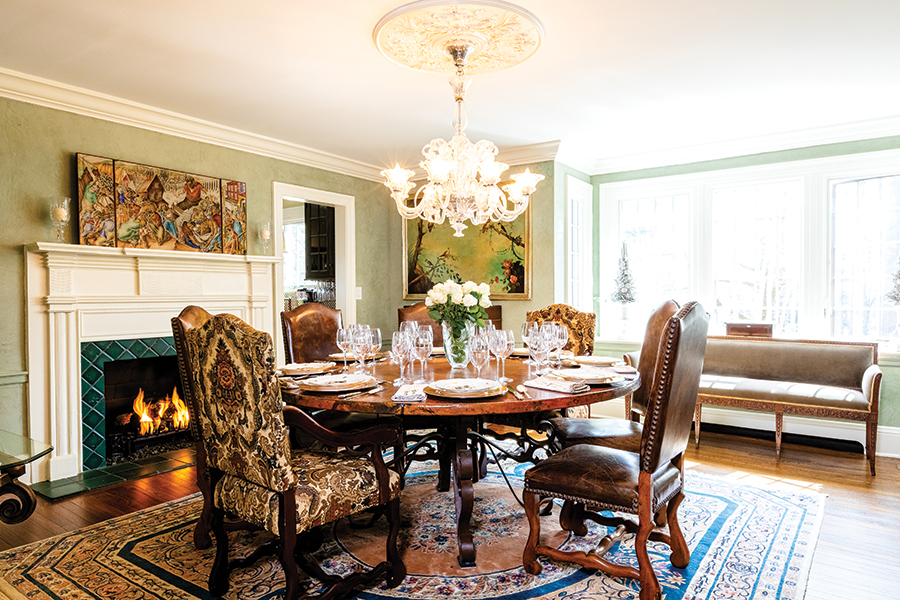
Hayes says, “Everything I’ve done is thematically joined. Cash Crop! is talking about the transporting of people, but if you take the roof off you can look at it like a sweat shop in a third world country with just enough room to produce as much goods as possible to ship to America. Boundless talks about freeing people of being slaves and talks about how we’re still fighting for that kind of freedom.” Fighting for the freedom proffered by the slave owner who wrote “We hold these truths to be self-evident, that all men are created equal …”
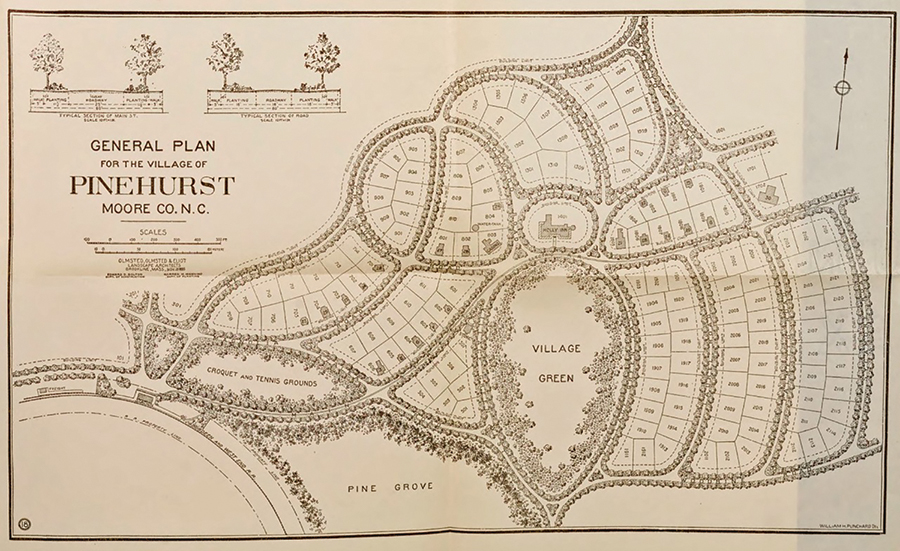
Boundless, unveiled on the grounds of Cameron Art Museum. Photo by Alan Cradick, November 17, 2021.
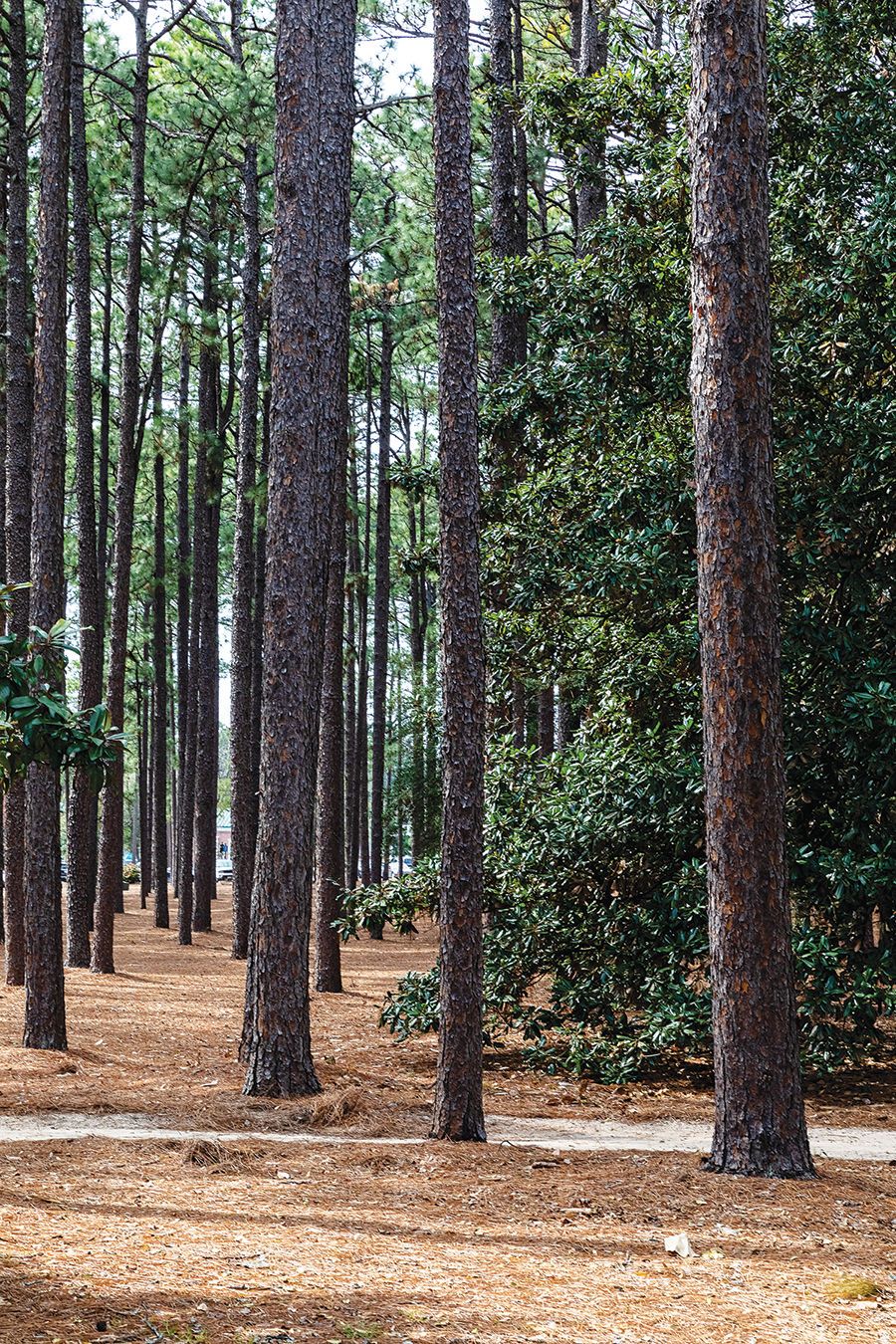
The sculpture highlights the effort of US Colored Troops in the Civil War. Includes casts made from the decedents of US Colored Troops who participated in the battle of Forks Road. Photo by Alan Cradick

The day after the Battle of Forks Road, the Confederate Army abandoned Wilmington, its last link to supplies from the outside world, and the Union troops marched into the city. “Come daybreak these men bury their dead and advance 3 miles to city hall,” says Brennan. “The USCT was on the front lines for Forks Road and then, come the victory march, they are in the back of the parade.”

Hayes’ next big commission is in Charleston, South Carolina, where he’ll help create a memorial for 36 bodies of the poor and enslaved found in a mass grave nine years ago. “Every project holds a place in my heart,” he says. “I’m still pushing along, trying to make a name for myself. I’ve got to move on to the next thing.”

Stumbling over the past, in machine mode.  PS

Jim Moriarty is the Editor of PineStraw and can be reached at jjmpinestraw@gmail.com.