* The PineStraw Redux *

A little cocktail that changed the course of history (well, my history)

By Tony Cross     Photograph by John Gessner


A little over seven years ago, I was working behind a restaurant bar and, as the evening was starting to wind down, PineStraw’s Andie Rose walked over to say goodnight. She and a large group of her friends had just finished celebrating a birthday. She thanked me for her old fashioned and mentioned that the magazine had a 10th anniversary issue coming out that May.

“Would you be interested in creating a cocktail for the occasion?” she asked.

Without hesitation I agreed and told her that I’d be in touch. “Cool,” I thought to myself. That was immediately followed by, “What the hell am I going to do?”

At the time, my twin obsessions were working out and thinking of cocktail ideas. Even though my creative juices were flowing, I was scared to death of coming up with a drink that would be published and read about — not to mention drunk — by half the county.

“It’s got to have pine straw as an ingredient,” I thought. That quickly morphed into, “That will never work, but pine needles might.” I went to the end of the internet searching for ideas and came up empty. Ultimately, I decided to go with a pine needle simple syrup and work everything else in the cocktail around that. I chose pisco (a brandy from Peru or Chile) as the base spirit. I’d recently received a special order from our state’s ABC, and just happened to be in the middle of a love affair with it. The other ingredients included chamomile-infused dry vermouth, lemon juice, and a muddled strawberry. In retrospect, maybe I was trying to do too much in my head but I felt like I had something to prove. In the end, the article accompanying “The PineStraw” was very kind.

By the end of the summer, I was no longer with the restaurant. The idea of opening my own spot scared me. I was juggling notions of what to do next when my brother suggested I would crush it with a cocktail catering business. Southern Pines was growing faster than Jabba the Hutt, but I knew that I couldn’t make a living just catering gigs. There had to be something else.

One night while I was talking to myself in the shower (I’ve been barred from karaoke bars in seven states), the soap in my ears whispered what that “something else” was. Bottled carbonated cocktails for delivery. And that’s all it took to get me going. I named my business Reverie Cocktails after my brother’s daughter. Reverie means “daydream,” but it also meant “drunkenness” in 16th century France. Quelle chance!

My idea sounded great in the shower, but I had no clue how to carbonate cocktails, bottle cocktails, or start a business. Details, details. I was still jonesing from being behind the bar and would do anything to create a cocktail for someone, which led to another crazy idea. Maybe I could write about it. After chatting with the PineStraw folks, my first column (on punch) came out in December 2015.

Reverie Cocktails launched the next year. I figured out how to carbonate those cocktails and deliver them. The logistics have changed some, but the mission has remained the same. Not only do we sell our cocktails locally, we deliver to Wilmington, Raleigh, Chapel Hill, as well as locations in Ohio and Indiana. Soon we’ll be in our fourth state, West Virginia. All the while, I’ve been allowed to write about spirits, cocktails, techniques, and things that I never would have dreamed anyone would want to read about.

It’s come full circle this month as Reverie Cocktails debuts our PineStraw cocktail on draught and growler delivery. We’ve switched the pisco to equal parts Absolut vodka and Beefeater’s gin, but the pine needles, chamomile, lemon and strawberry are still there. It’s an honor to recreate a drink that helped launch my business. And for that, I thank you. PS

Tony Cross is a bartender (now ex-bartender) who runs the cocktail catering company Reverie Cocktails in Southern Pines.

Home Again

The history of women’s golf is embedded in the Sandhills

By Ron Sirak

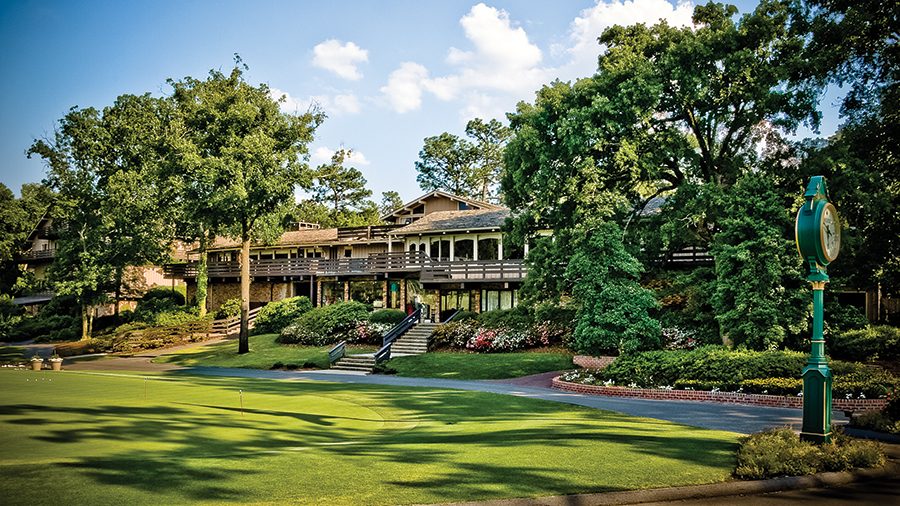
From its earliest days, the road for women’s professional golf has wound its way across the Sandhills of North Carolina, not as a regular stop but rather as a special place where special people commanded center stage. This year, for the fourth time, the Pine Needles Lodge and Golf Club in Southern Pines will be the site of the U.S. Women’s Open. And if the past is truly prelude, the Donald Ross masterpiece will have something special in store for 2022. The first three times the women’s championship of the USGA was at Pine Needles the winners were Annika Sorenstam, Karrie Webb and Cristie Kerr, a trio of LPGA royalty.

Sorenstam, with 72 wins, including 10 majors and three U.S. Women’s Open titles, and Webb, with 42 victories, seven majors including the U.S Women’s Open twice, are both in the World Golf Hall of Fame. They are also the last two who successfully defended the U.S. Women’s Open title, both sealing the double at Pine Needles. Kerr, with 20 victories and two majors, likely will join them in the Hall of Fame when she becomes age eligible.

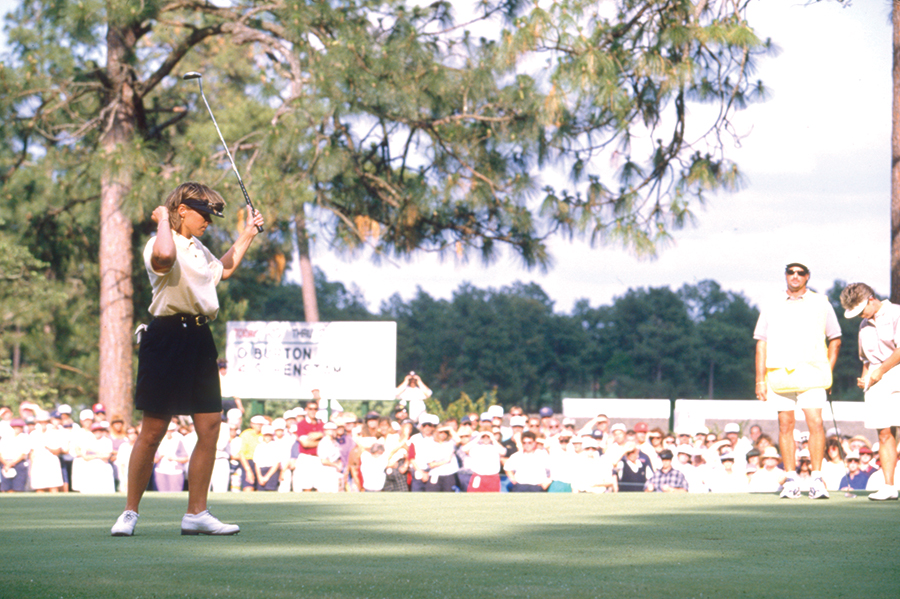
Annika Sorenstam during the final round of the 1996 U.S. Women’s Open Championship at Pine Needles Lodge and Golf Club, June 2, 1996.

Who will be part of that rich tradition this year? Nelly Korda or Jin Young Ko, whose battle for the 2021 LPGA Player of the Year went down to the last tournament? Lydia Ko, who won 14 times before her 20th birthday and after a lull of several years seems to have rediscovered that form at the age of 25? Americans Danielle Kang or Lexi Thompson? Seven-time major winner Inbee Park from South Korea? Or Nasa Hataoka of Japan, who might be the best in the women’s game without a major? Will Yuka Saso of the Philippines join Sorenstam and Webb and successfully defend the title she won last year at The Olympic Club?

While the special place the Sandhills holds in the game of golf was dug out in large part by the shovel of the architectural genius Donald Ross, the bold vision and sheer determination of the Bell family contributed greatly in solidifying that legacy. Also enshrined in the World Golf Hall of Fame is Peggy Kirk Bell, regarded by many as the 14th founder of the LPGA Tour.

pioneer as a player, an instructor and a businesswoman, Peggy and her husband, Warren “Bullet” Bell, purchased Pine Needles in 1954 and restored it to its former glory. She is as much a part of the history of Pine Needles as Ross and those who have won championships there.

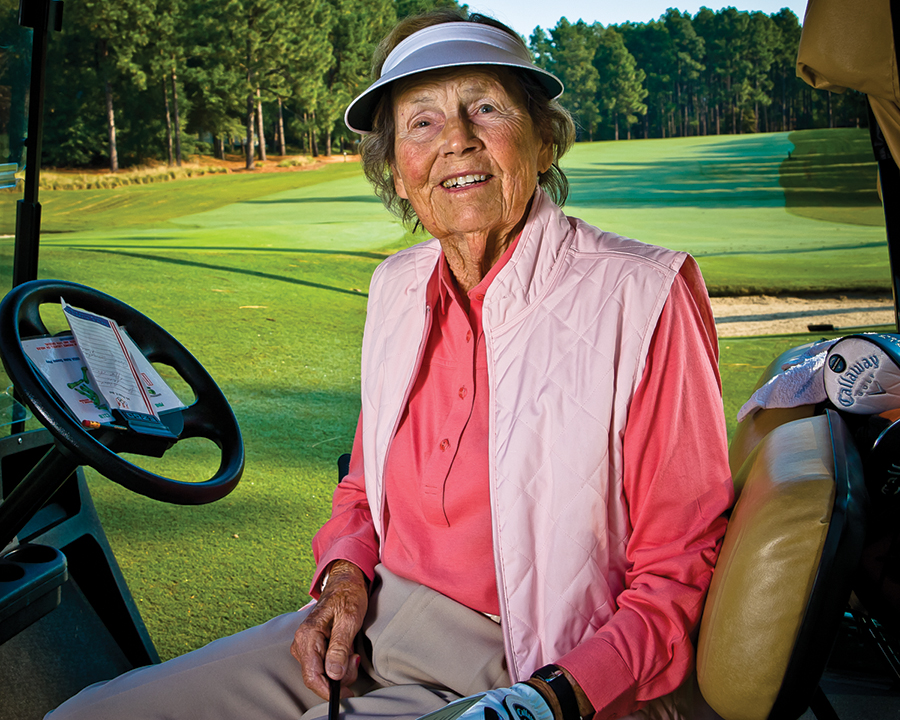
Peggy Kirk Bell, 2011
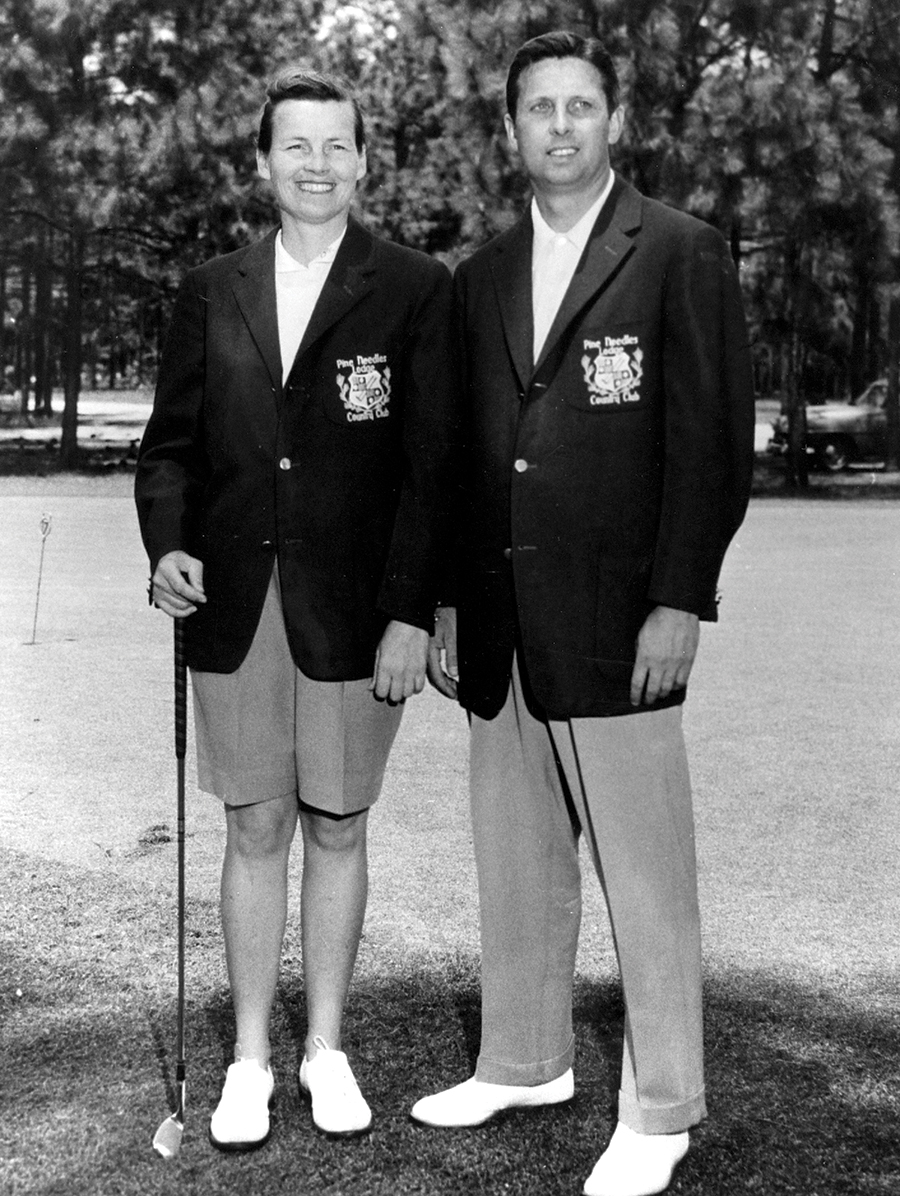
Peggy Kirk Bell and Warren “Bullet” Bell

Bell, who died in Southern Pines in 2016 at the age of 95, was not one of the 13 women to sign the original LPGA charter, but she was there from the beginning, finishing runner-up in the eighth LPGA Tour event ever played, losing in the finals of the 1950 Women’s Western Open 5 and 3 to Babe Zaharias at Cherry Hills Country Club in Colorado.

Born in Findlay, Ohio, Bell started playing golf at age 17 and quickly won a number of titles. She played college golf at Rollins College and won the Ohio Women’s Amateur three times, and in 1949 took the Titleholders Championship and the North and South Women’s Amateur. She was also a member of the 1950 U.S. Curtis Cup team.

When the U.S. Senior Women’s Open was played at Pine Needles in 2019, one of those in the field was Sally Austin, a former women’s golf coach at the University of North Carolina and an instructor at Pine Needles who was uniquely positioned to assess the impact of Bell on the women’s game.

“It is so special and I’ll get emotional thinking about this and how much she would’ve loved being here for this and seeing her friends playing and some of her students, of which I was one,” Austin said. “When they brought the first Open here, she was super excited. I know she’s looking down and smiling, so glad that it’s here. This is her legacy, and this golf course and all that her family has done to keep this alive.”

Bell’s early presence in the women’s professional game previewed the role Southern Pines was to play in women’s golf. The first time the LPGA Tour visited here was the 1951 Sandhills Women’s Open at Southern Pines Country Club. Patty Berg won and Zaharias was second. In 1959, Joyce Ziske won the Howard Johnson Invitational at Mid Pines Golf Club.

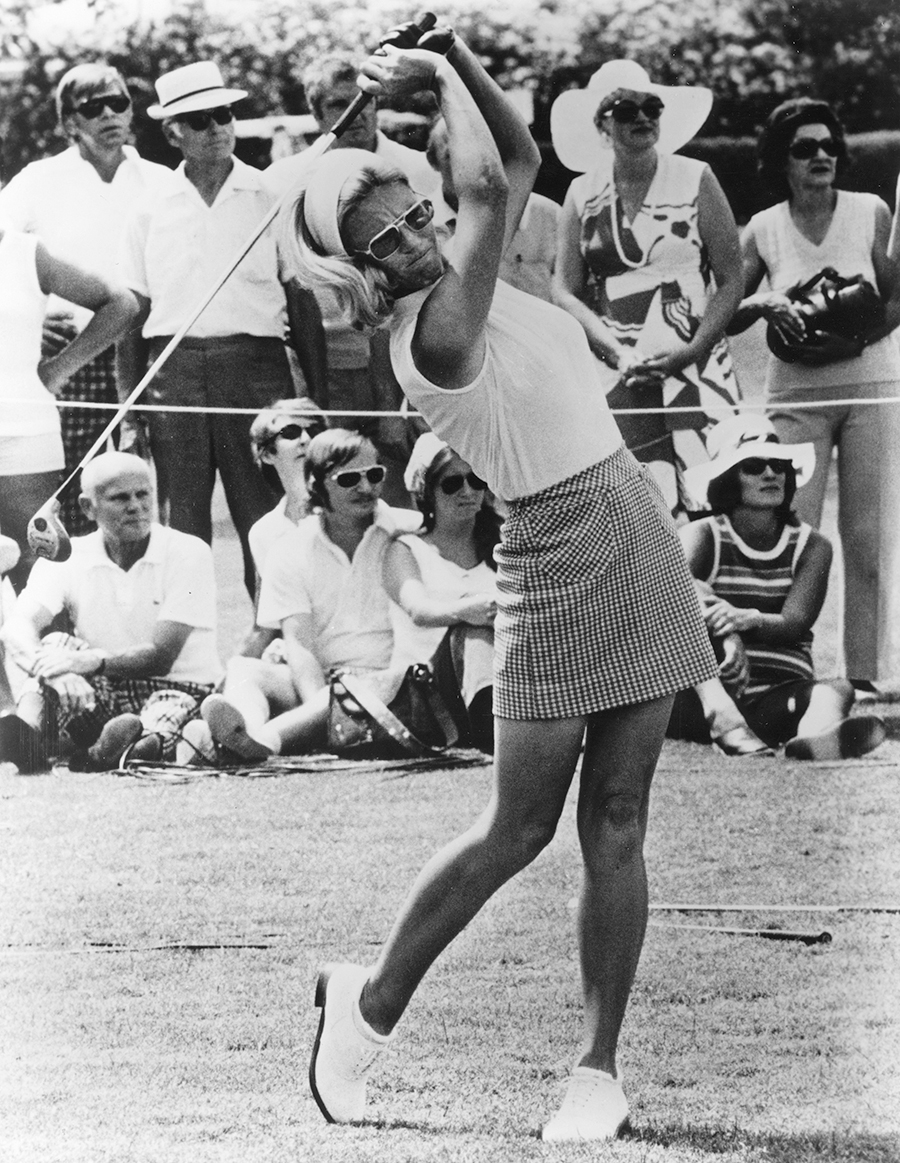
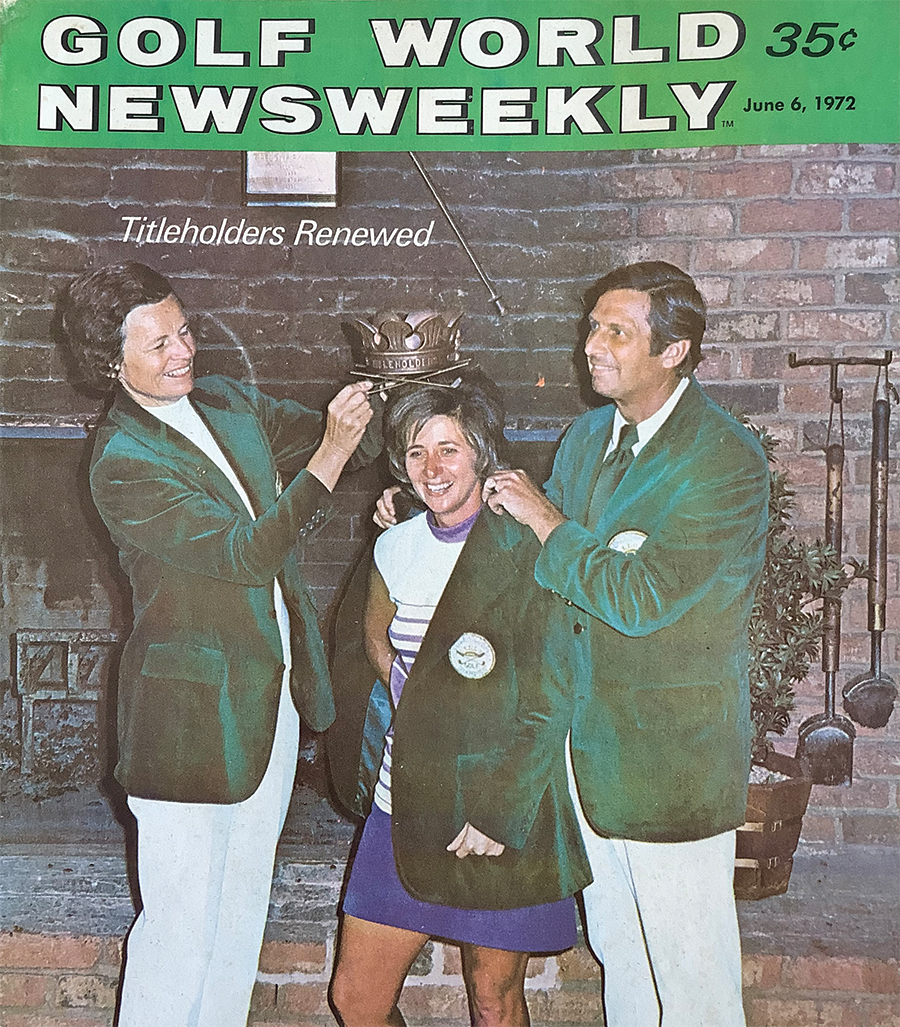
The first women’s major in Southern Pines was at Pine Needles in 1972, when Sandra Palmer won the last Titleholders Championship by 10 strokes over Mickey Wright and Judy Rankin. Palmer, who’s now 79, won 19 times on the LPGA, adding the 1975 U.S. Women’s Open to the Titleholders as her major championships.

“Pine Needles will certainly go down as one of my finest feats,” says Palmer, whose one-under-par 283 was the only score in red numbers that week. “No one really knows what remarkable golf I played that week except the Bells. Bullet had the course set up from the back tees. It was hard.”

Sandra Palmer, flanked by Peggy and Warren Bell

Dick Taylor, writing in Golf World magazine, gushed about both Palmer and Pine Needles, calling Palmer’s performance “one of the greatest showings seen on a genuine test of golf under valid conditions.” He likened the challenge of the Pine Needles set-up that week to that faced in a U.S. Open.


“If it is to be a major championship, a title bestowed by the thinking players and fans alike, then the course must be as dominant in the proceedings as the players,” Taylor wrote. “The 6,500-yard (and up) Donald Ross-designed Pine Needles Lodge and Golf Club in Southern Pines, N.C., superbly fit the bill to such a point you would have thought by the complaints it was the men’s U.S. Open.”

The LPGA returned to the Sandhills in 1995 when Rosie Jones edged Dottie Pepper in a playoff to win the Pinewild Women’s Championship at Pinewild Country Club of Pinehurst. Since then, major championship women’s professional golf has visited the area five times — and it has never disappointed.

In 1996, Sorenstam backed up her breakthrough triumph a year earlier at the Broadmoor Golf Club by successfully defending her U.S. Women’s Open title with a magnificent display of shotmaking, hitting 51 of 56 fairways at Pine Needles as she topped Kris Tschetter by six strokes. Sorenstam was on a mission that week to prove she was not a one-hit wonder.

“Majors are always full of pressure,” says Sorenstam, looking back more than a quarter-century. “Being the defending champion adds to the pressure. I wanted to make sure that winning at the Broadmoor was not a fluke and that I belonged in the major champion circle.”

Sorenstam not only proved she belonged, she established the foundation for her Hall of Fame career, attacking Pine Needles with the relentless consistency that became the Swede’s trademark. Her worst effort that week was an opening even-par 70, which she followed with rounds of 67, 69 and 66 to finish at eight-under-par 272.

“I was totally in the zone that week,” she says. “I was on autopilot. I had prepared very well, and I loved the course. Also, being a friend of Peggy Kirk Bell made it even more special. She has done so much for the game, especially for women. Peggy shouted ‘Heineken’ after my last putt dropped. That was her nickname for me since my amateur days.”

The next time the U.S. Women’s Open came to Pine Needles is the last time anyone has taken home the trophy in back-to-back years as Webb romped to an eight-stroke victory over another future Hall of Famer — Se Ri Pak. That 2001 U.S. Women’s Open was contested in the midst of an incredible run of dominance in the four major championships by four future Hall of Fame players.

From 1998 through 2003, 18 of the 24 majors were won by Sorenstam, Pak and Juli Inkster, who captured four majors each during that stretch, and Webb, who took a half-dozen of the grand slam titles in that six-year period.

In 2001 Sorenstam, Pak and Webb — who also won the LPGA Championship (now the KPMG Women’s PGA) — swept the four majors and the next year, those three plus Inkster each took home a major trophy. Webb, however, was simply overwhelming at Pine Needles in 2001, carving out rounds of 70, 65, 69 and 69 to finish at seven-under-par 273, eight strokes ahead of Pak.

“My first U.S. Women’s Open had been in ’96 at Pine Needles,” Webb says. “I loved the course then and knew coming into ’01 that it fit my game. That was possibly the only time in my major career that I came in playing well, and I went to the first tee on Thursday knowing and expecting to be there on Sunday with a chance to win. I’m not sure I’ve played a major from start to finish as well.”

Webb, who is among the most gifted ballstrikers in the history of the women’s game, loved the challenge presented by the course, which demands not only precise physical execution but also a disciplined and well thought out mental approach.

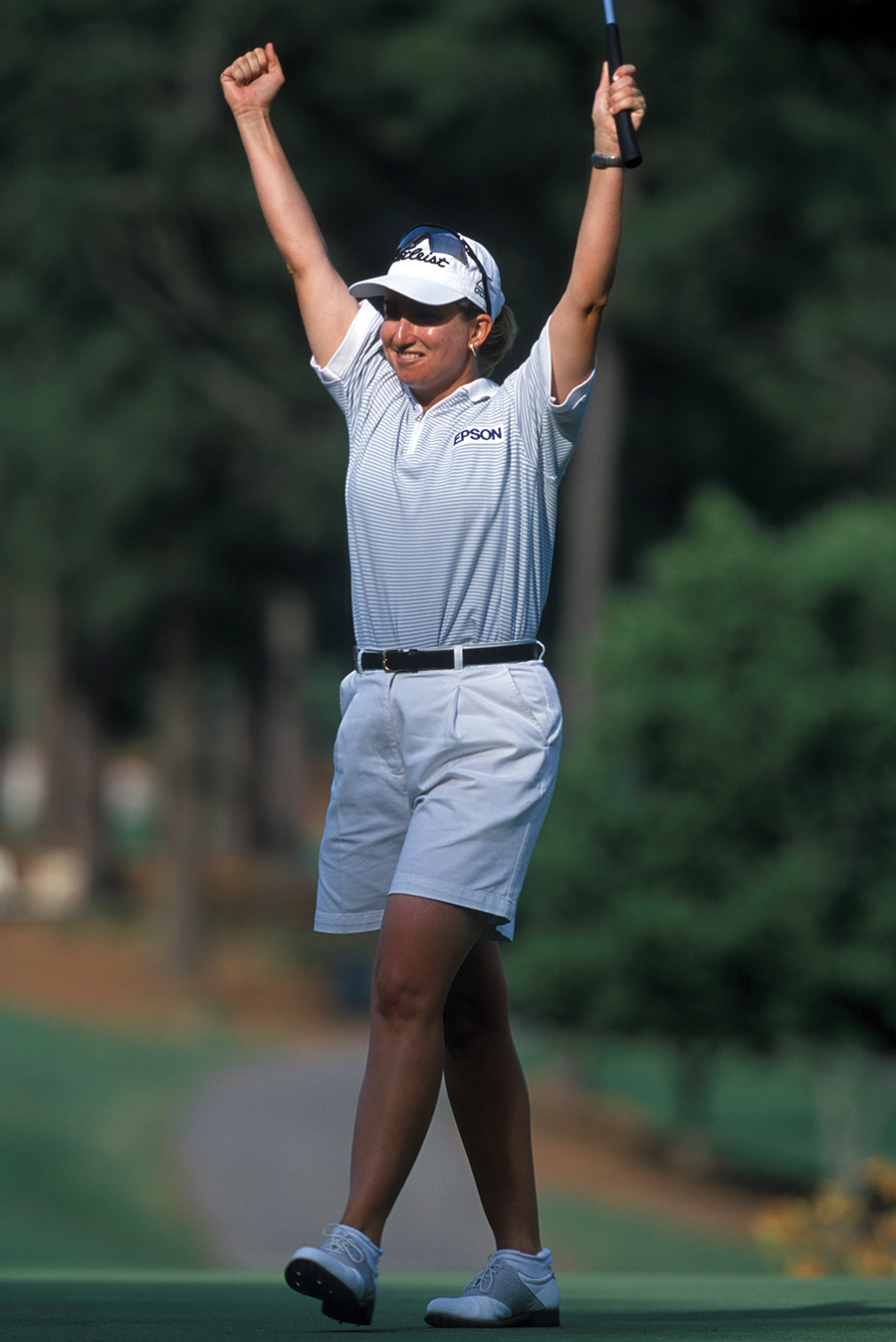
Karrie Webb during the 2001 U.S. Women’s Open at Pine Needles

“Pine Needles is very much a second shot golf course,” Webb says. “It’s a true Donald Ross test in that way. Understanding where to hit in on the greens and where the slopes are that could feed the ball away from the hole or off the green completely is a big key. Being able to hit irons with the precision and distance control to certain spots on the greens is the key to playing well around there.”

Cristie Kerr tied for fourth place in that 2001 U.S. Women’s Open, and when she returned to Pine Needles in 2007 it was with the burden of being known as the best player on the LPGA Tour without a major championship title. She had nine career victories and had won eight of them over the three previous seasons, emerging as a contender to challenge Lorena Ochoa to succeed Sorenstam as the best player in the women’s game.

Kerr began slowly, opening with rounds of 71 and 72 on a layout that now played to a par-71. Then she put the hammer down in the third round, taking the lead with a 66 that began on Saturday and ended Sunday morning because of a rain delay. She took the lead for good with a birdie on No. 14 in the final round, then closed with four consecutive pars to better Ochoa and Angela Park by two strokes.

“I had won a bunch of tournaments but I had never won a major championship,” Kerr says about her mindset coming into Pine Needles in 2007. “My intention was to play myself into contention, and that’s exactly what I did. I got a lot of chances (in the third round) and my putter was hot. I was a freight train and nothing was going to stop me that week. I made a lot of 30-foot par saves.”

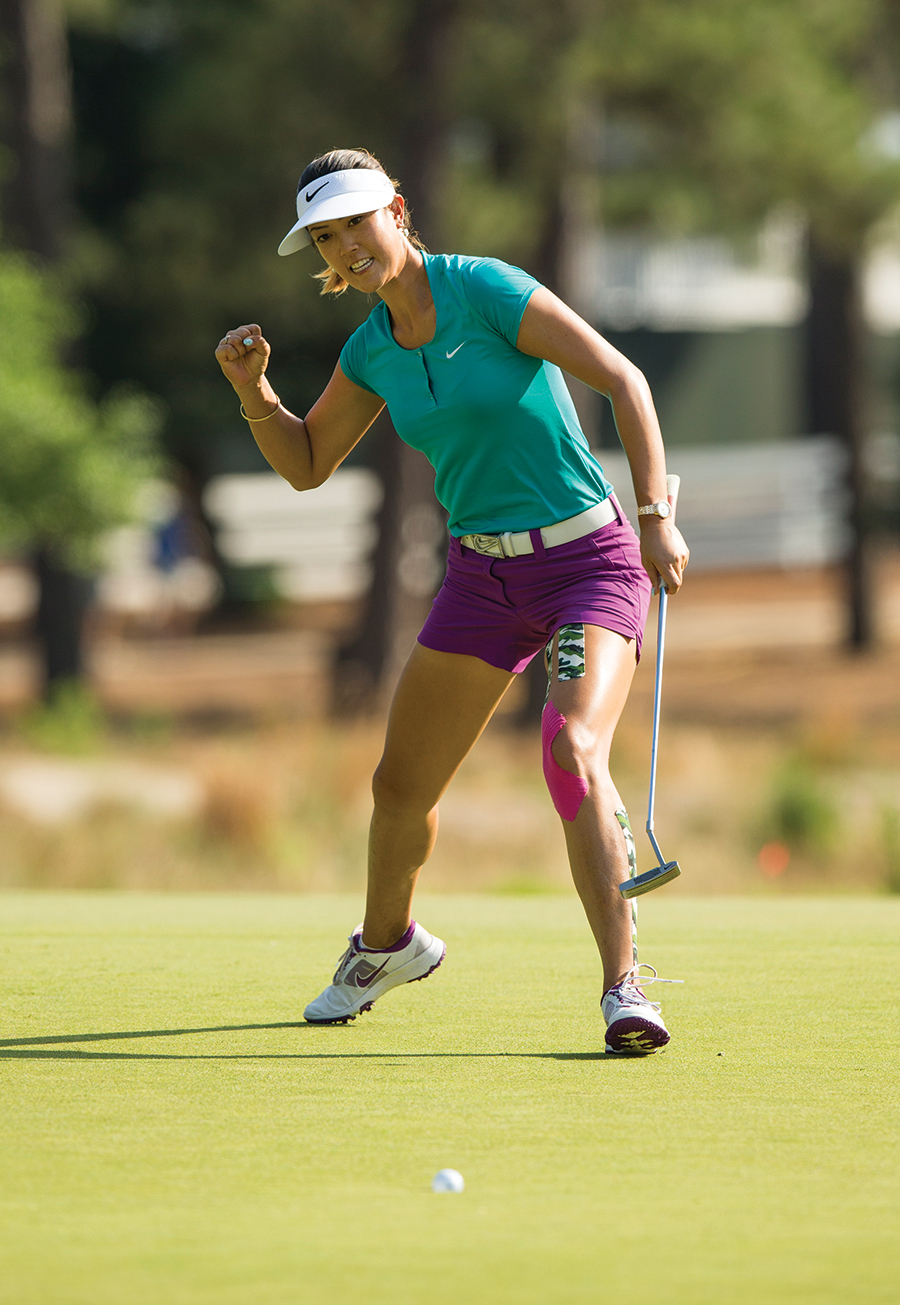
History was made in the Sandhills in 2014 when, for the first time, the U.S. Women’s Open and U.S. Open were held at the same venue in back-to-back weeks as Michelle Wie edged Stacy Lewis by two strokes at Pinehurst No. 2 for her only major championship a week after Martin Kaymer mastered No. 2 for an eight-stroke victory.

Michelle Wie 2014 U.S. Womens Open champion on Pinehurst’s No. 2 course

“One week changed my life,” Wie says. “That’s what the U.S. Women’s Open does. It creates opportunities for us to create life-changing moments. It’s not just one tournament. It’s a major that we look forward to, watching it when we were kids and playing on venues like we do. It means so much to me. That elevated visibility for our tour so much, and us being able to play on these top venues.” In 2029, the USGA will reprise the men’s and women’s back-to-back championships in Pinehurst.

And in 2019, the second-ever U.S. Senior Women’s Open was played at Pine Needles, following the event’s debut a year earlier at historic Chicago Golf Club, one of the five founding clubs of the USGA in 1894. Helen Alfredsson, who had her heart broken in the U.S. Women’s Open several times, won the U.S. Senior Women’s by two strokes over Inkster — yet another Hall of Fame member — and Trish Johnson.

Helen Alfredsson wins the 2019 U.S. Senior Women’s Open at Pine Needles

“I get goosebumps,” Alfredsson says about looking back on that victory. “The USGA events (are) the toughest events. It took everything and then some to win it. You had to have everything, all the ducks in a row, and you have to have putting, playing, ballstriking, and mentally because you know you’re going to make bogeys or even double bogeys, but you just have to keep going. I was very thrilled to also get it on a golf course like Pine Needles, which I thought was an amazing test.”

Just as the legacy of Donald Ross is burnished by the brilliance of Pine Needles, the enormous contributions of Peggy Kirk Bell and the Bell family to the game of golf are remembered each time a major championship returns to one of their properties. During the more than 60 years Peggy was the owner and head instructor at Pine Needles, she pioneered methods of teaching — especially to women — and infused students with her passion for the game.

Today, Pine Needles remains in the Bell family. Her daughters, Peggy Bell Miller and Bonnie Bell McGowan, are instructors, and her two sons-in-law, Kelly Miller and Pat McGowan, serve as Pine Needles’ president and director of instruction, respectively. Peggy has passed the torch to them.

When the 77th U.S. Women’s Open tees off on June 2, the quest will commence to see who takes the torch passed from Sorenstam to Webb to Kerr. The Sandhills of North Carolina serve as a cradle for golf in the United States. It is a place where the courses, as Dick Taylor said, are “as dominant as the players in the proceedings.”

Time and again, Pine Needles has shown that dominance. Now we find out which player is up to the challenge. Now we find out who will live up to the legacy of Ross and Bell as well as the standard of excellence established by Sorenstam, Webb and Kerr. Now it’s time to write the next page in the storied history of Sandhills golf.  PS

Ron Sirak worked for The Associated Press for 18 years, followed by 18 years with Golf World and Golf Digest magazines. He is past president of the Golf Writers Association of America and recipient of the PGA of America Lifetime Achievement in Journalism Award; the LPGA Media Excellence Award; and the Metropolitan Golf Writers Association Lincoln Werden Award.

Story of a House

Fit for a Queen

Historic Pinehurst home gets the royal treatment

By Deborah Salomon 
Photographs by John Gessner

What’s in a name?” Possibly, quite a bit, when applied to Red Brick Cottage.

This appellation, plus “1920,” appears on the shingle hanging outside this Pinehurst village showplace. Glenn Phillips, who with his wife, Pat, purchased the house in 2019, was intrigued. The retired luxury home-building executive, also a civil engineer, knew what to look for, like an original tile roof and copper gutters. He doubted the date, since brick was not common during the white clapboard teens when, in 1918 and 1919, Leonard Tufts sold two lots to H.B. Swoope, a Pennsylvania coal baron who snapped up the whole corner facing the Carolina Hotel. The superb construction suggested either a greater investment than its neighbors — or perhaps materials and workmanship bargain-priced during the Depression. Glenn searched village records for support.

“More likely (into the) ’30s,” he concluded, although one document on file at the Tufts Archives lists nothing more specific than the ’20s. Odd that no architect is mentioned, given its unusual quality and features, starting with ornamental brickwork around the front door.

In any event, Swoope died in 1927. His estate sold the property to A.C. Judd in 1929, who sold it to Sprigg Cameron in 1930, causing much confusion among family ghosts searching for their proper haunt.

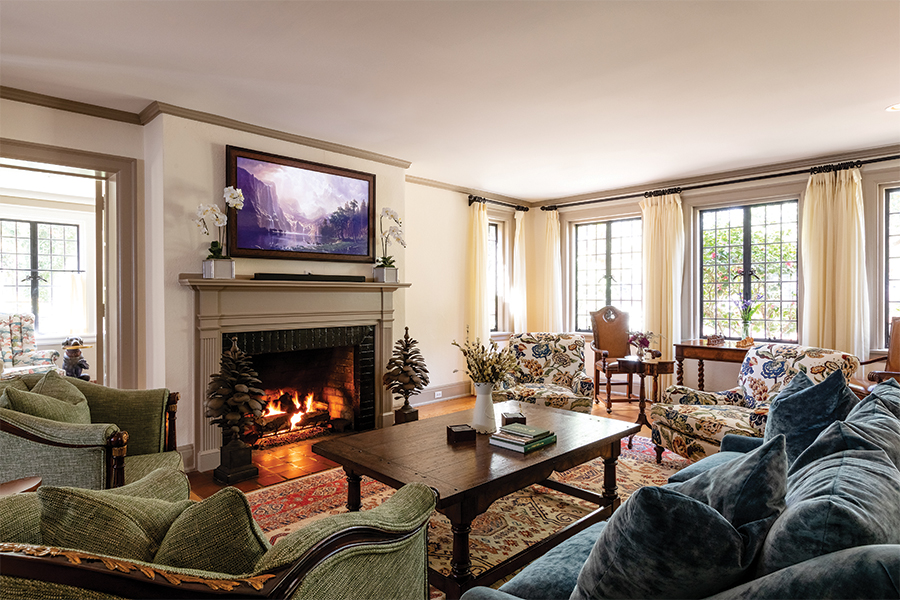
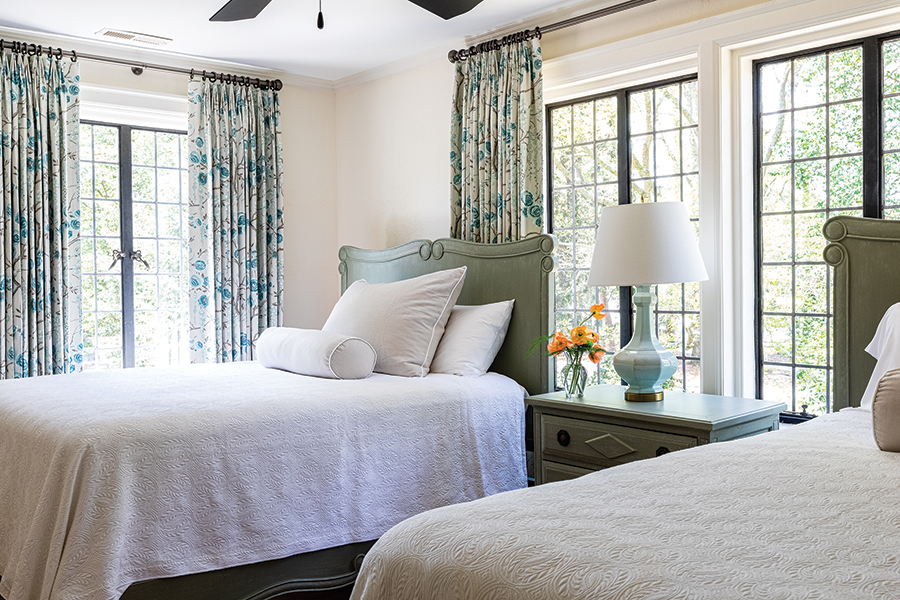
Set far back from the street on an almost double lot, the house appears smaller than its actual 5,000 square feet. This optical illusion is furthered by an L-wing not visible from the front. The wing contains a garage with servants’ quarters over it — accessed by a back staircase — which are now charming guest bedrooms in refreshing blue and white, each big enough to hold two queen-sized beds. 

As for “cottage” — hardly. Cottages are sweet little lakefront dwellings. Brick previews the formality of a settled family dwelling, perhaps even year-round, although before residential AC even the ghosts headed north in July.

Provenance aside, Red Brick Cottage has weathered well. The cross-hall plan, four spacious bedrooms, five bathrooms, large (for the era) kitchen and costly mullioned casement windows throughout support this idea.

And now, Red Brick Cottage has reclaimed its purpose. The Phillips family will use it as a seasonal gathering place for their adult children and two grandchildren, giving them more indoor space than their longtime primary residence: a 42-acre horse farm in Durham where they raised a son and three daughters in 2,400 square feet, with two bathrooms.

The Phillips family, originally from New Jersey, discovered Pinehurst while attending their children’s equestrian banquet at the Carolina Hotel. During subsequent visits they walked the village, liked what they saw. “This is a place where I thought I could live,” Glenn recalls. In addition, businesswoman Pat and daughter Veronica wanted to acquire a boutique. Monkee’s in Southern Pines was available.

How better could the stars align?

But real estate fulfilling the Phillips’ requirements (size, quality, proximity to shops and restaurants) is always scarce. Connections count.

They learned of Red Brick Cottage from Cathy Maready, an interior designer who had done their beach house on Figure Eight Island. Maready knew of its upcoming availability through the owner. The transaction was completed without the house ever hitting the market. It needed only minor upgrades, including a larger bathroom for the master bedroom, which Glenn and Pat moved to the main floor study adjoining the living room — unusual but practical as homeowners age. Luckily the new stall shower fit into an empty elevator shaft.

Since they would bring nothing from Durham, what the Phillips needed was an interior designer familiar with their tastes to interpret, locate, select and deliver.

“A dream client,” says Maready, who was given a budget and free rein.

The only mandate: Create décor that fit the pre-Depression era, as if rescued along with the house from a time capsule.

Furnishings that fit the description do exist but require legwork. Maready had a better idea: a package. None was more suitable than reproductions licensed by Princess Diana’s brother, Charles Spencer, the ninth Earl Spencer. Known as the Althorp Collection, these pieces duplicate chairs, tables, sofas, chests and accessories found at the 90-room ancestral manor the Spencers have occupied for 500 years in Northamptonshire. Diana is buried at Althorp.

Maready met the Earl when he launched the collection at the High Point furniture mart. From this finely crafted array she created a portfolio for the main floor living room, master bedroom, hallway, dining room and wherever appropriate.

“I look at (my clients’) faces,” Maready says. “I want them to feel pretty in that space.”

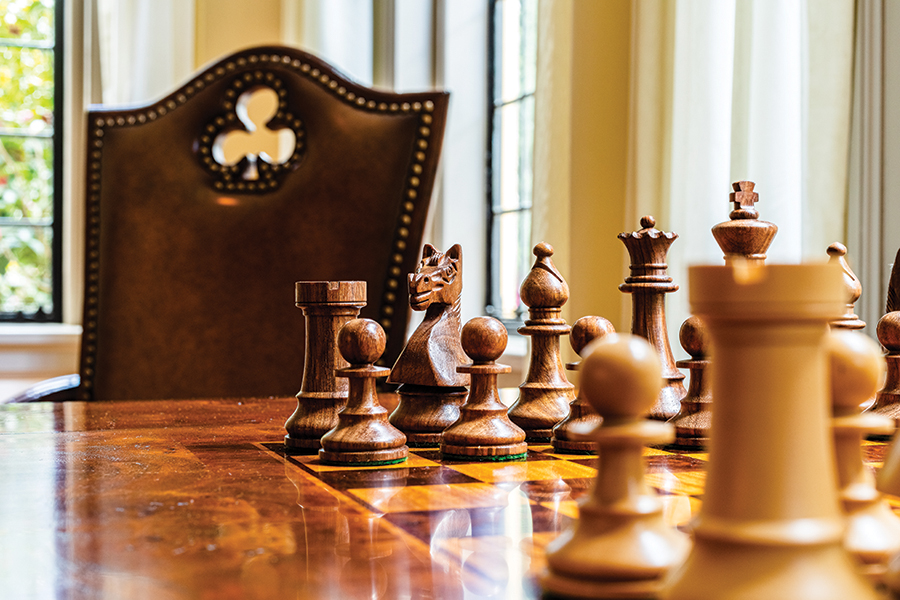
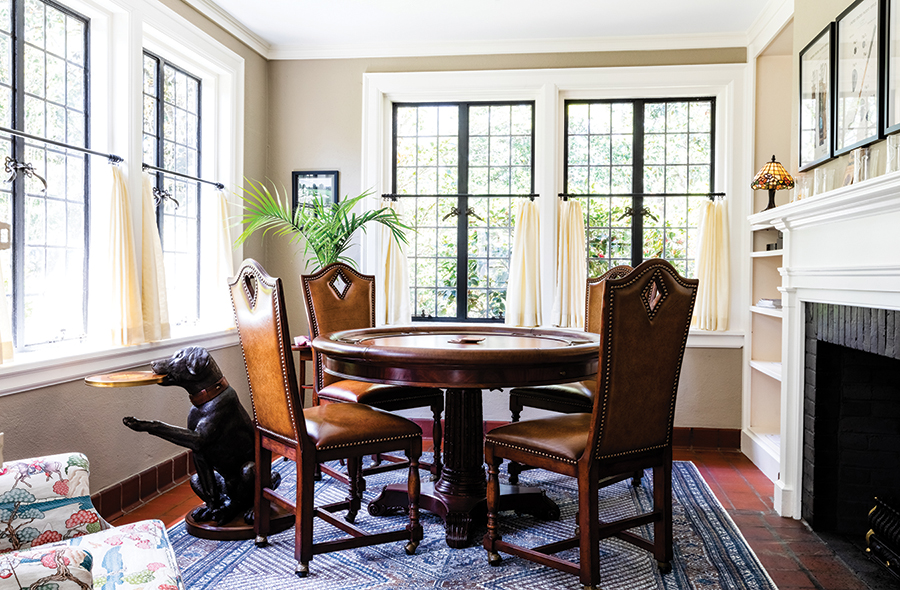
Almost all her selections were approved, some country English, others to the castle born, allowing for inlaid woods, a crushed blue velvet sofa, case pieces, a butterfly table, a needlepoint box on legs, imaginative prints against which guests might imagine Lady Di and her little brother playing hide-and-seek. Maready invested in vibrant jewel tones of blue, green and red merged in the carpets. The game room and sun porch are done in sunny shades and less formal designs. Glenn, a details person, points out the game room fireplace, converted to gas but with fake coal that glows instead of logs.

Formality satisfied, he wanted a “fun” place to live, as expressed in a Chinese hunt motif fabric on game room chairs.

Original floors throughout are an unusual combination of narrow and wide boards in both clear and knotty pine, probably sourced locally.

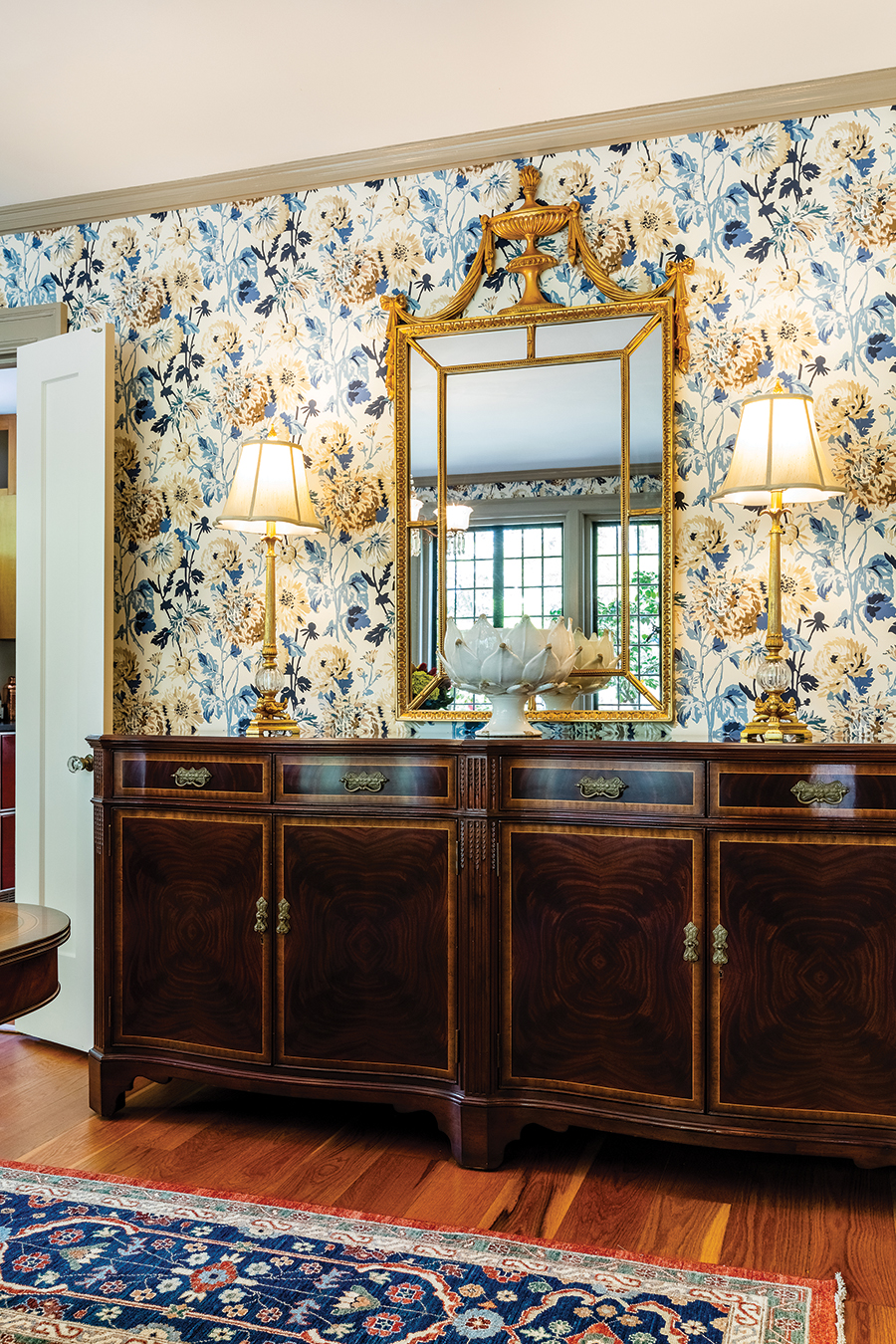
The kitchen — already remodeled when the Phillips purchased Red Brick Cottage — defies period or classification. Long and narrow, it has full-sized sinks, one farmer and one oval, on each side. Down the middle, instead of an island stands a table big enough to seat eight on three-legged stools, and tall enough to double as a work surface. This European kitchen staple is joined by cupboards that are free-hung rather than built-in, two ovens set into a column, a backsplash in black, and antique red ceramic tiles. The effect is vaguely Scandinavian.

A few family heirlooms, including a writing desk belonging to Glenn’s aunt, supplement the Althorp manor ensemble. Wall-mounted TV screens with hidden wires and picture frames display fine art when the game is over.

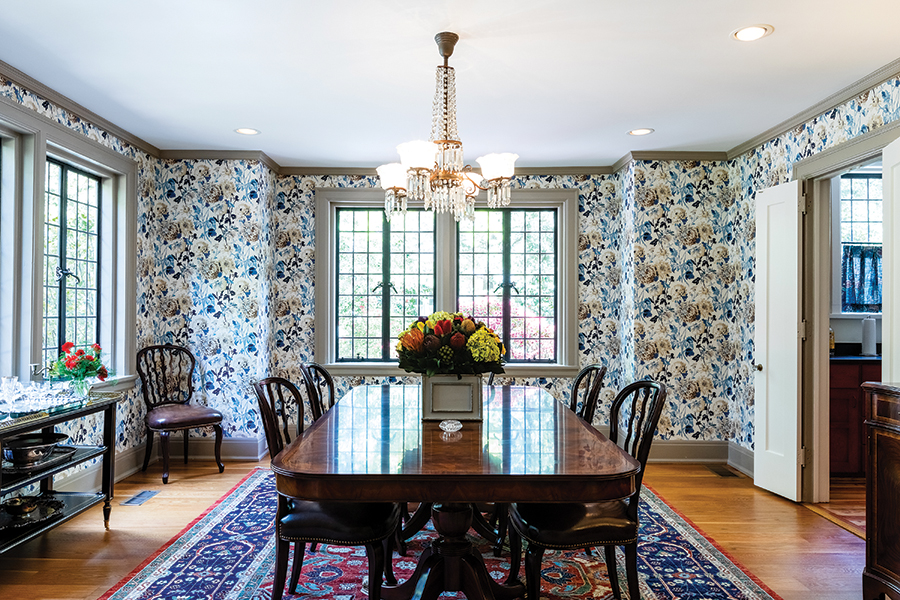
But the blue ribbon is the oversized dining room papered in a blue avian print so dense that diners seated at a table for 12 can almost hear the birds chirping, feel their wings fluttering.

A brick veranda across the back opens out onto a lawn big enough for croquet, should they wish. The house, the garden, the location, the furnishings and paintings, it has fulfilled the new residents’ desire for authenticity, bringing back a period seldom honored — when conversation was among friends, not with Siri; when books were printed on paper and music spun on black vinyl discs. “Everything here is so much more relaxed versus our horse farm,” Glenn says.

“We are a very close family,” Pat adds. “Now we have a house where we can all be together, a house where all the dots have been connected.”

After a deep breath: “I feel like a queen.”  PS

Great Scot

Dorothy Campbell Hurd — first international star of the women’s game

By  Bill Case     Photographs from the Tufts Archives

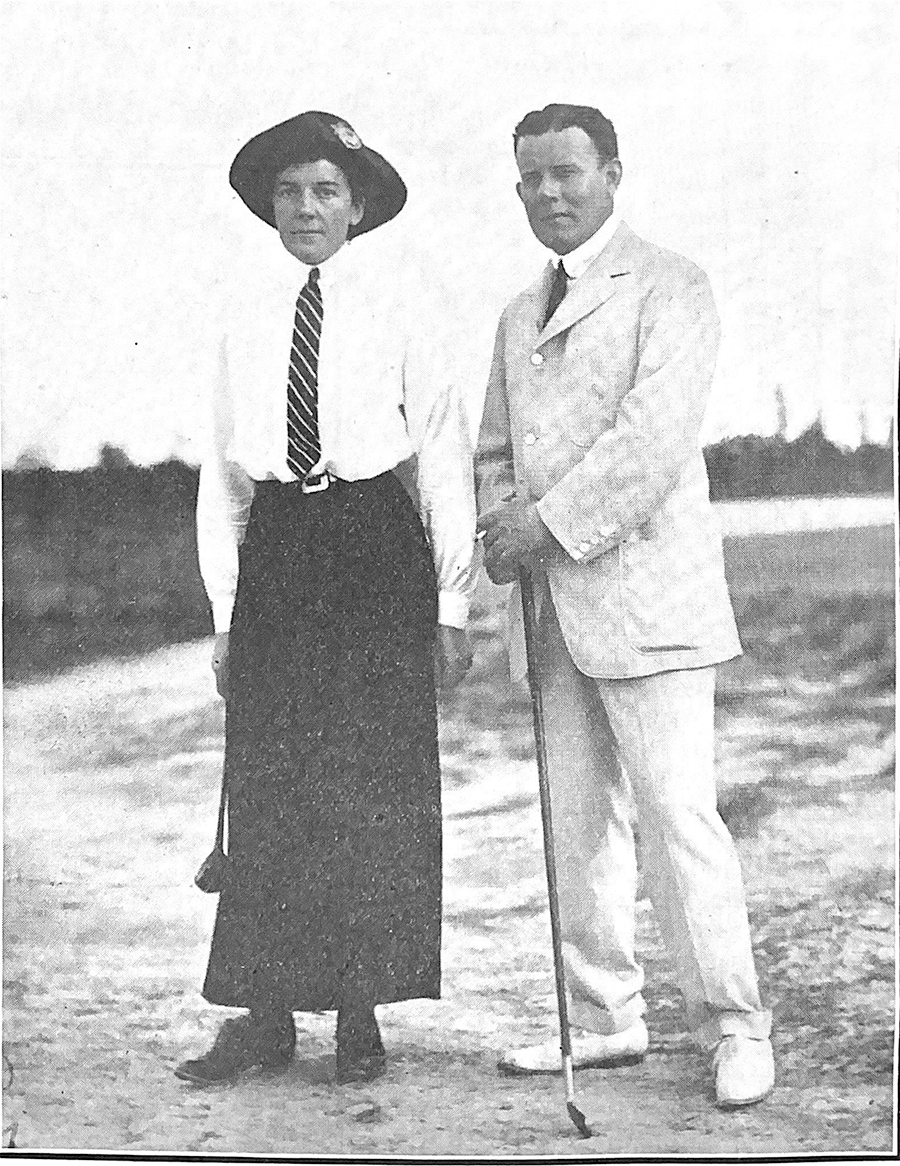
In March 1912, Miss Dorothy Campbell arrived in Pinehurst for a month-long stay at the home of Mr. and Mrs. W.C. Fownes. The 28-year-old Scot was no ordinary houseguest. Acclaimed as the greatest female golfer in the world, she had already won 10 national titles in an astounding run from 1905 to 1912.

It began modestly. To her genuine surprise, in 1903 at age 20, Campbell reached the semifinals of her native country’s most important title, the Scottish Ladies Championship. “I only possessed four clubs at the time, and I had no experience at match play,” she later wrote.

But she was just getting started. In 1905, she reached the semis of the British Ladies Amateur. Two weeks later, her breakthrough victory came in the Scottish Ladies, contested on her home course, North Berwick’s West Links. A throng of 4,000 cheered the hometown lass to a hard-won, 19-hole victory over Molly Graham in the final match. Miss Campbell would repeat as Scottish champion in 1906 and win the title a third time in 1908.

Campbell seemed poised to win her first British Ladies Championship in 1908 when she made the finals at St. Andrews’ Old Course. A massive crowd of 9,000 spectators, including Old Tom Morris, attended. Battling abysmal weather marked by hail and gale force winds, the drenched Campbell heartbreakingly lost the match to Maud Titterton on the 19th hole.

Her disappointment would be assuaged in 1909 when she finally won the British Ladies at Royal Birkdale. After the final match, an overbearing official blocked Campbell’s path to the awards ceremony.

“Are you a golfer?” the official demanded.

Campbell replied, “I don’t think so, but I believe they will want me inside to receive the championship cup!”

The victory resulted in an invitation from the United States Golf Association — itself only 15 years old — to play in the U.S. Women’s Amateur Championship that summer at Philadelphia’s Merion Cricket Club, now Merion Golf Club. Campbell accepted and made her first Atlantic crossing. She adapted quickly to Merion’s parkland layout and sailed through preliminary matches to the final, where she faced a tough challenge. Her opponent, Mrs. Nonna Barlow, was a Merion member. Barlow had Campbell one down after nine holes, but the unflappable Scot took control down the stretch, winning the match 3 and 2, making her the first foreign-born player to win the U.S. title and the first to take the British and U.S. championships in the same year.

Dorothy and Jack Hurd

She successfully defended her U.S. Women’s Championship in 1910 at Homewood Country Club in Illinois, the first to win back-to-back. Although it was match play, her “medal” score of 78 in the second round was the lowest ever posted by a woman on a course longer than 6,000 yards. Campbell crossed the border into Canada, too, to capture the first of three consecutive Canadian Ladies Championships, and even established a permanent residence in Hamilton, Ontario. She returned to Great Britain in 1911 to compete in the British Ladies at Portrush and won that title for the second time, rebounding from a 3-down deficit to win 3 and 2.

During her 1912 sojourn in Pinehurst with the Fownes family, Campbell set her sights on winning the prestigious United North and South Amateur Championship. She posted the best score in the qualifying round by four shots and was a heavy favorite to add the championship trophy to her burgeoning collection. She reached the final match but was upset by Kate Van Ostrand, who clinched victory when her pitch on the final hole hit the pin.

The Fowneses, Campbell’s Pinehurst hosts, were kindred spirits and golf royalty. W.C. (Bill) Fownes won the 1910 U.S. Amateur. Bill and his father, Henry Fownes, founded and ran Oakmont Country Club, considered America’s most exacting test of championship golf. Bill and his wife, Sarah, saw to it that Campbell’s Pinehurst golf calendar was filled with matches and club competitions. 

As esteemed members of the “Cottage Colony,” the Fowneses knew everybody in the village’s upper crust. Among their many friends was 35-year-old bachelor Jack Vandevort Hurd, who, like Bill and Henry Fownes, worked in the steel business in Pittsburgh and was a member at Oakmont.

The Fowneses introduced Jack and Dorothy, and a year later, on Feb. 11, 1913, they were married in Hamilton, Ontario, in front of relatives and a few close friends. Following the ceremony, handsome and dapper Jack whisked his bride back across the border to his home in the Steel City. For a champion golfer like Dorothy, with a husband who was a member at Oakmont, Pittsburgh was an ideal place to begin married life. Better yet, she and her husband would be making extended winter visits to Pinehurst. Dorothy would become an American citizen, though forever retaining “her delightful Scotch burr as well as the poise and graciousness of her kind,” according to another champion, Glenna Collett.

Before the end of 1912, Dorothy gave birth to a son, Sigourney Hurd, and golf began to play second fiddle. She supervised the building of a second home in Pinehurst that fronted on the town’s village green. The turreted house at 10 Village Green East, fashioned after an English hunting lodge, was part of a Hurd family compound since Jack’s parents and brother, Nat, owned homes just a niblick shot away. A woman of many talents, Dorothy authored frequent and lengthy instructional articles for Golf Illustrated and Golf Monthly, played the piano and composed songs. She even knitted socks for Allied soldiers during World War I.

While her collection of national championships slowed after her marriage, Hurd still dominated club play in both Pittsburgh and Pinehurst, where she played regularly during the winter as a member of the club’s female golfing society, the Silver Foils. “The Pinehurst courses are proverbial,” she remarked in an article, “for the way they can become dry in a few hours and the next day see play go gaily on.” 

During her 10 seasons in Pinehurst, Hurd won the prestigious North and South Women’s championships held in 1918, ’20, and ’21. The number of trophies collected by “Mrs. J.V. Hurd” in other Pinehurst tournaments is incalculable, but the Pinehurst Outlook provided a glimpse of her dominance in winning the St. Valentine’s Day tournament of 1918: “Mrs. Hurd was going (on) in her famous and invincible fashion — not long, but straight and inevitable.”

By 1922 the Hurds’ marriage was unraveling. One telltale sign was the terse paragraph in a March edition of the Outlook reporting that Mrs. J.V. Hurd would not be around to defend the North and South title she had won the previous two years. The couple divorced a year later and Dorothy steered clear of the Hurd family haunts in Pinehurst and Pittsburgh thereafter. Since the couple’s new Pinehurst winter home was completed not long before their separation, it seems unlikely that she spent much time there. She moved her primary residence to Philadelphia and joined the Merion Cricket Club, site of her first U.S. triumph.

With the divorce in the rearview mirror, Hurd dedicated herself to climbing back into golf’s top ranks. Never a long hitter, she’d managed to overcome that deficiency during her championship run with the deadly use of her vaunted goose-necked mashie — an adored weapon that eliminated a previous tendency to shank. She used the club, christened “Thomas,” for run-up shots near the green. It proved especially effective from around 40 yards. In the 1921 North and South, Hurd holed two such shots in the final match to clinch the championship. In emphasizing the importance of the mashie in a Golf Illustrated article, she flashed her dry wit, writing, “Bernard Shaw’s axiom that we should exercise great care in the selection of our parents can be applied with equal force to the choosing of a mashie.”

But several women in the newest wave of fine amateurs — most notably Marion Hollins, tennis star Mary K. Browne, and the powerful Glenna Collett — were driving the ball 50-70 yards past Hurd’s. It was too great an advantage for Dorothy and or “Thomas” to overcome. At 40, could any pro help an aging champion find enough driving distance to enable her to compete against the new wave?

The Merion pro who stepped forward to assist was a man Dorothy Campbell had known in North Berwick: George Sayers. “George was born and brought up in my hometown, and I have known him since he was a boy,” she later recalled. “He told me he could help me change my swing but it would entail inordinate practice.” She had nothing to lose by trying.

Sayers wasn’t the first member of his family to teach golf to Hurd. Thirty years previously, his father, Ben Sayers, taught young Dorothy Campbell back in North Berwick. Dorothy’s home, Inchgarry House, was located hard by the 18th tee of the West Links, and she absorbed the game almost from birth, taking her first swing with a “six-penny” club at 18 months. It became common for golfers mounting the West Links’ 18th tee to encounter the toddler swinging a miniature club outside Inchgarry’s garden gate. In a piece for Golf Illustrated, Hurd wrote “that the fates decreed that I should be fairly impregnated with a golfing atmosphere from the very beginning, even if the family fable that I cut my teeth on the head of a cleek be not true.”

George Sayers switched Hurd’s unorthodox grip (the right thumb under the shaft) to the more conventional Vardon grip. He convinced her to jettison her stiff-wristed sweeping style in favor of a more fluid and athletic move to the ball. A grip change is one of golf’s most daunting projects, and Hurd worked on her new swing and grip for eight months with the sort of single-mindedness that would later mark Ben Hogan’s unceasing practice. She hit balls until the joint on her index finger became a raw wound, but once the changes began taking hold, she unlocked more power. Encouraged, she set her sights on entering the 1924 U.S. Women’s Amateur, held that year at Rhode Island Country Club, the stomping grounds of pre-tournament favorite, Glenna Collett, then in the midst of the greatest year of her Hall of Fame career.

With her best days more than a decade behind her, it was going to be a steep climb for Hurd. The mental aspect of the game was a subject she frequently wrote about in Golf Illustrated. She stressed “absolute concentration on the matter at hand, determination not to let bad luck discourage us and the resolve never to give up hope until the match is over . . . If it can be instilled into a player’s mind he can do a thing, he will generally be able to do it.”
Hurd cautioned against fits of pique with her customary drollness. “A certain theologian whom I have met has more than once told me that he considers the game of golf to be a most dangerous and harmful one, confiding that it’s bad for a man’s character for the same reason that a Presbyterian sergeant in the Boer War objected to bayonet charges — because it makes the men swear so.”

But whether her mental strength would be enough to give Hurd a meaningful chance against the likes of Collett, Browne and Hollins was open for debate. Even with her newfound distance, she would still be hitting second shots from 30 yards or more behind the long knockers.

Having cut her teeth in North Berwick, Hurd was quite comfortable coping with the stiff breezes off Narragansett Bay at the championship site. Her drives were traveling respectable distances, and chips by her ever-reliable mashie were resulting in “gimme” putts. Hurd breezed through to the final, where the smart money had her facing Glenna Collett — once Collett took care of two-sport star Browne in the other semifinal, that is. Collett hadn’t lost a match all year, but Browne scored an upset when her off-line putt at the 19th hole caromed off Collett’s ball and into the cup for victory.

In the final, Hurd was slow getting off the mark and trailed early. Then her putter — nicknamed Stella — caught fire. After 27 holes, Hurd had a 7-up lead. Three holes later, the match was closed out 7 and 6. Hurd’s victory set two U.S. Women’s Amateur records that remain unequaled — oldest winner (41), and most years between titles in the championship (14).

Hurd continued to play well throughout the 1920s and ’30s, winning five Philadelphia district titles. Stella, her deadeye putter, brought her another record in 1926. Playing Augusta Country Club, she used just 19 putts in 18 holes, finishing that amazing round with a chip-in by Thomas on the 18th.

In 1937 Hurd married banker and non-golfer Edward Howe, but the marriage only lasted six years. At age 55, Hurd — then Howe — won the U.S. Women’s Senior Championship. By her own estimation, during her lifetime she won over 700 first prizes.

Tragedy befell Jack Hurd and his second wife, Caroline, when they both perished in an automobile accident in Wilmington, North Carolina, in May 1930. An accident would also end Dorothy’s life.

In 1945, after visiting friends in Beaufort, South Carolina, she was traveling by train to Pleasantville, New York, to visit her son’s wife, Ruth, while he was serving in the Army in the Philippines. As she was changing trains in Yemassee, South Carolina, Dorothy inexplicably lost her footing and fell into the path of an oncoming locomotive. She was 61 at the time of her death.

Dorothy Campbell Hurd Howe — with her mashie Thomas and her putter Stella — was inducted into the World Golf Hall of Fame in 1978. She wrote that the great shots she played so often with her favorite clubs were “almost second nature to me.” So was winning. PS

Pinehurst resident Bill Case is PineStraw’s history man. He can be reached at Bill.Case@thompsonhine.com.

Powerhouses of the Pacific

By Bill Fields

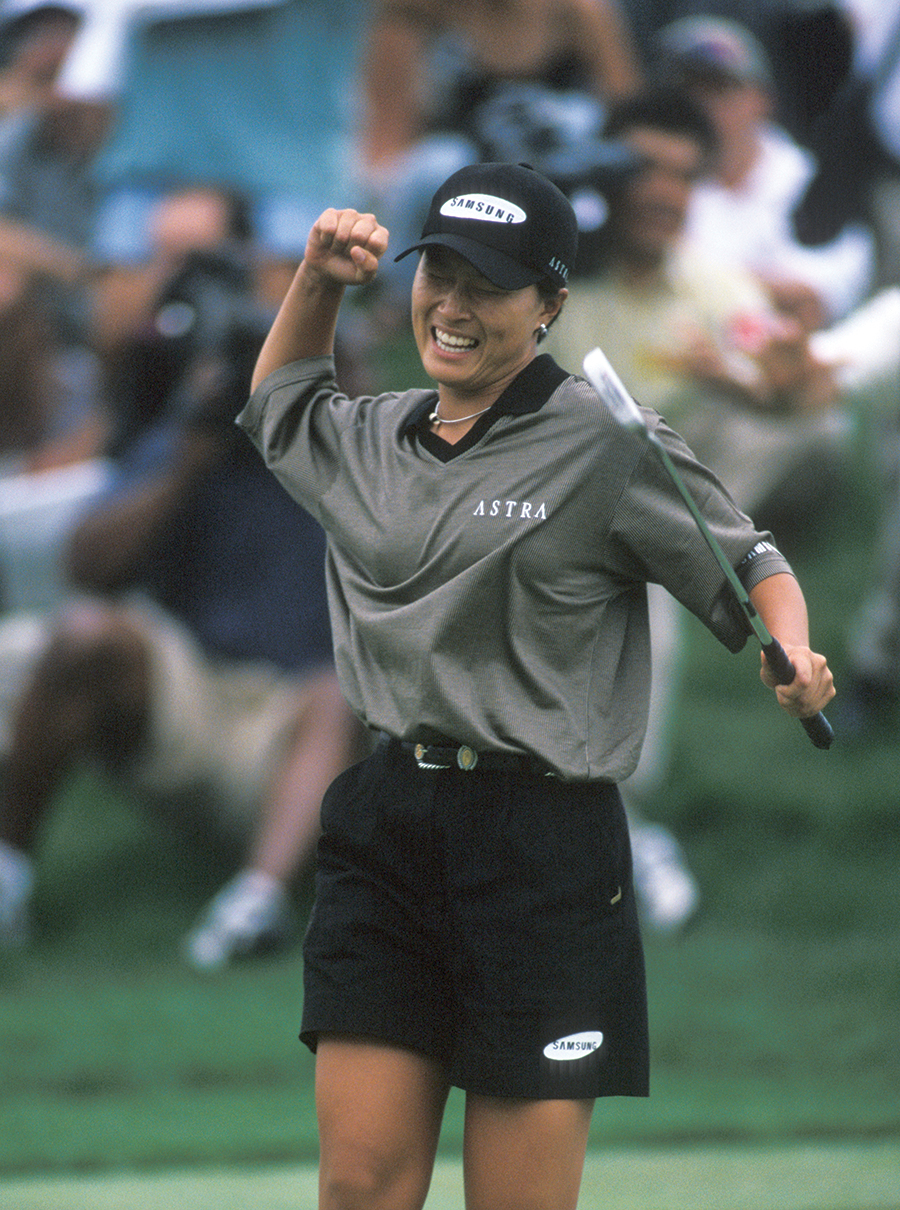
Se Ri Pak, who retired from a Hall of Fame career in 2016, didn’t compete in the 2021 U.S. Women’s Open, but as sure as there was drama during a topsy-turvy final round at The Olympic Club in San Francisco, her enduring influence on golf was clear.

Se Ri Pak celebrates during the 1998 U.S. Women’s Open Championship.

By winning the U.S. Women’s Open in 1998 — along with the LPGA Championship that same season — Pak ignited a golf revolution in the Republic of Korea. Many girls in Pak’s home nation were brought into the sport through the groundbreaking achievements of the 20-year-old major champion, with South Koreans soon becoming a force on the LPGA Tour. Nearly a quarter-century since Pak motivated her countrywomen to excel, women golfers from across Asia have made an astonishing impact in majors and beyond.

Chako Higuchi of Japan (1977 LPGA Championship) was the only Asian, female or male, to win a major title prior to Pak’s breakthrough. Starting in 1998, 25 women representing six Asian countries have won 45 of the 104 majors that have been played. Trophies have been lifted by athletes from South Korea, Taiwan, Thailand, Japan, China and the Philippines. (Two major victories by Korean-born Lydia Ko, who plays for New Zealand, where she grew up, aren’t counted in the total.)

Their success has been particularly striking at the U.S. Women’s Open, where Asian players have captured 11 of the last 14 editions of the oldest major in women’s golf — a championship that was won by only three international players in its first four decades: Faye Crocker, Uruguay, 1955; Catherine Lacoste, France, 1967; Jan Stephenson, Australia, 1983.

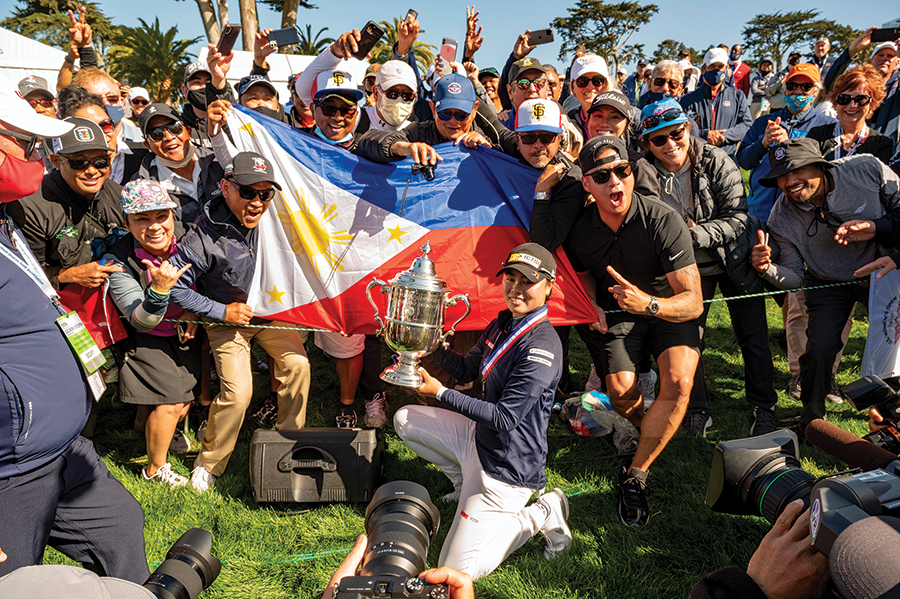
Yuka Saso wasn’t a familiar name to American golf fans until early last June. That changed when the 19-year-old representing the Philippines steadied herself from a rough start on Sunday at The Olympic Club. Saso capitalized when Lexi Thompson lost a large lead over the final eight holes, coming home in 41 strokes on a course notorious for being the place where Arnold Palmer blew a seven-shot advantage after 63 holes at the 1966 U.S. Open to fall into a tie with Billy Casper, who defeated him the following day in a playoff.

Yuka Saso poses with fans and the trophy after winning the 2021 U.S. Womens Open at The Olympic Club

With Thompson throwing away her hold on the championship, Saso, who trailed by six strokes through No. 10, closed with a 73 and tied Nasa Hataoka of Japan at 280. On the third playoff hole, Saso made a birdie to win the Harton S. Semple Trophy and the $1 million first prize. The daughter of a Filipina mother (Fritzie) and Japanese father (Masakazu), Saso matched Inbee Park of South Korea (2008, Interlachen Country Club) as youngest U.S. Women’s Open champion. Uncannily, Park, who has gone on to win seven major titles, and Saso were each 19 years, 11 months, 17 days old at the time of their victories.

“I was just looking at all the great players on (the trophy),” Saso said after winning. “I can’t believe my name is going to be here.”

Five other golfers from the Far East finished in the top 10 behind Saso and Hataoka at The Olympic Club, further proof of the region’s strength in the women’s game. A milestone was reached last fall when Jin Young Ko won the BMW Ladies Championship in her homeland. It was the 200th LPGA victory by South Koreans.

“This is a tremendous honor,” said Ko, No. 1 in the Rolex Rankings, the ninth Asian golfer to sit atop the list since its formation in 2006. “And I think it’s very fortunate that I am the player, the 200th-win player, and I actually think that it’s really fortunate that it was an event held in Korea as well. Obviously, being the player of the 200th win by Koreans was not a goal that I was working toward. It just happens that I was really focused, and I did my best and this came along.”

The trail of success for South Koreans that culminated with Ko’s landmark victory began with little fanfare in 1988. Ok-Hee Ku broke through that spring at the Standard Register Turquoise Classic in Arizona, defeating standouts Dottie Pepper and Ayako Okamoto, of Japan, a 17-time winner on the LPGA Tour. Because the 1988 Summer Olympics were being held in Seoul, the country’s attention was focused on that, and Ku’s victory got little attention — certainly compared to the fanfare that greeted Pak’s double-major success a decade later. It was a start, though, and brought to mind a Korean proverb: “If you collect pieces of dust, eventually you will have a mountain.”

Ku, who won 23 tournaments on the LPGA of Japan, never added to her lone LPGA victory. She died at age 56 in 2013, by which time Koreans had become a dominant force on the LPGA Tour.

“I can’t imagine that so many Korean women are playing and succeeding on the LPGA, even in my dreams,” Ku told Golf World two years before her death.

The timing for golf to bloom was better when Pak, a golfer who interspersed smiles between powerful and accurate shots, came along. When Pak returned to her native soil in late 1998 after triumphing in America, her hero’s welcome was complicated by the fact that she was worn out, hounded by paparazzi even as she was treated for exhaustion and a viral infection in a hospital.

Pak knew she would be a beacon for women golfers coming up behind her, but that so many talented players emerged surprised her. “To be the best, you have to put everything into it,” Pak said a decade ago. “But they shouldn’t have too much pressure, extra pressure. But I think they feel it. There is only one No. 1 spot.”

The battle in 2021 for first place at The Olympic Club’s Lake Course — hosting the women for the first time after being a five-time U.S. Open site for the men — was intriguing. Megha Ganne, a 17-year-old amateur from New Jersey, shared the first-round lead and remained in contention at three under par, tied for third place, through 54 holes. Ganne’s performance put her in the final grouping on Sunday with Thompson, whose Saturday 66 put her at 7 under, one stroke ahead of Saso.

It was just Saso’s third appearance in the U.S. Women’s Open. Although Thompson was only 26 years old, she was competing in her 15th national championship, having debuted at Pine Needles in 2007 when she was 12. The talented and popular Floridian arrived in San Francisco with 11 career LPGA victories, the most recent two years earlier. Despite her skills, Thompson had only one major title, the 2014 Kraft Nabisco Championship.

When Thompson played a steady front nine at Olympic and Saso carded double bogeys at the second and third holes, it looked as if her major drought would be coming to an end and Saso would be left with a learning experience. “I was actually a little upset,” Saso said of her shaky start. “But my caddie talked to me and said, ‘Just keep on going. There are many more holes to go.’ That’s what I did.”

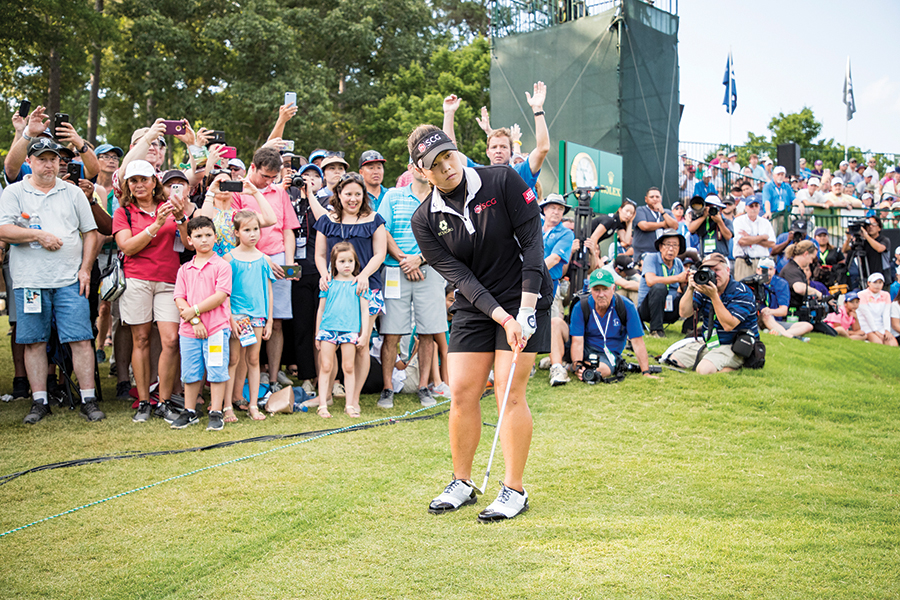
Strange things tend to happen at the famed Bay Area club — in addition to Palmer’s 1966 collapse, favored Ben Hogan (1955) and Tom Watson (1987) suffered U.S. Open disappointments there — and Thompson played a poor back nine, unable to close. A bogey on the final hole meant Thompson wasn’t even going to make the playoff and give herself a chance for redemption the way Ariya Jutanugarn did in the 2018 championship at Shoal Creek, where the Thai star lost a 7-shot lead with nine to play but won a playoff against Hyo-Joo Kim.

Ariya Jutanugarn won the 2018 U.S. Women’s Open in a playoff with Korea’s Kim Hyo-joo

In contrast to Thompson’s back-nine slide, Saso birdied Nos. 16 and 17 to tie Hataoka, whose 68 was one of only four closing scores under 70. After both players parred the two holes of an aggregate playoff, Saso’s birdie in sudden death made the difference as she became the 11th consecutive major champion from outside the United States, the longest American drought in women’s golf history, that Nelly Korda soon ended at the KPMG Women’s PGA Championship.

To see Saso swing — taut, complete turn going back, hips quickly and fully clearing on the way through — is to think of another world-class golfer. Saso modeled her action after that of four-time major winner Rory McIlroy, watching his swing for many hours on YouTube. The similarity of their movements is striking when viewed side-by-side on video. Two weeks after winning the Women’s Open, Saso got to meet her idol as he played a practice round at Torrey Pines Golf Course for the U.S. Open. His advice to Saso: Keep a swing journal. “Everyone’s got a blueprint of what their swing is,” McIlroy told reporters. “If they keep on top of it and they do the same things, do the same drills over time, you fast forward 20 years you’re probably going to have a really good career.”

The first major winner from the Philippines, a country of more than 100 million with just 100 or so golf courses, Saso isn’t the first talented Filipina to earn golf headlines. More than 80 years ago, Dominga Capati, a laundress on a Manila sugar estate that bordered a golf course, picked up the game and defeated visiting foreign women players in the Philippine Women’s Open. A couple of decades later, in 1964, Capati played for the Philippines in the inaugural Espírito Santo Trophy, an international women’s competition. The Dominga Capati Memorial Tournament is still played to honor her contributions to golf.

Saso had plenty of support as she made history at the Olympic Club. Nearby Daly City is known as “Little Manila” for its large number of Filipinos. “I don’t know what’s happening in the Philippines right now, but I’m just thankful that there’s so many people in the Philippines cheering for me,” Saso said. “I don’t know how to thank them. They gave me so much energy. I want to say thank you to everyone.”

When the defending champion tees off at Pine Needles, she will be playing under a different flag. Saso, who competed for the Philippines in the Tokyo Olympics last summer, is now representing Japan. Under Japan’s Nationality Law, a person must choose one nationality before turning 22 years old. Saso cited business reasons, particularly the ease of global travel with a Japanese passport, for making the switch.

“We are obviously saddened to see her go, but she will always be Japanese and Filipino to us,” Bones Floro, an executive with the National Golf Association of the Philippines, told the Philippine Daily Inquirer. “We hope that our countrymen understand and respect her decision. It’s sad that we lost her in terms of representation. But Yuka will always have a special place in our hearts as a Filipino, and we are happy for her.”

A golfer representing Japan has never won the U.S. Women’s Open. If Saso successfully defends her title — Australian Karrie Webb is the last to do so, at Pine Needles in 2001 — she would make history two years running. Given the Asian success of the last couple of decades, it wouldn’t be wise to bet against her.  PS

Almanac

May

A flower blossoms for its own joy.

— Oscar Wilde

May is the daughter of dandelions, queen of the daisies, the giggling maiden of spring.

In a sunny meadow, where the soft grass glitters with morning dew, she is gathering wild violets, singing the blue into each petal.

One handful for candy.

Two handfuls for syrup.

A heaping third for tea.

She moves like water, stirring swallowtails and skippers as she drifts from flower to quivering flower. Constellations of buttercups manifest before her. A choir of bluebirds twitters in her wake.

Her gaze is tender. Her presence full. Everything she touches seems to blush.

The Southern magnolia offers its first fragrant blossom.

The tulip poplar blooms in boundless rapture.

An oxeye daisy sings out: She loves me. She loves me lots. She loves me. She loves me lots.

No flower is forsaken.

A sweep of dandelion brightens beneath her feet, yellow blossoms plump as field mice. There is nothing to do but bask in the playful light of spring.

As the maiden lowers herself onto the lush and golden earth, one hundred songbirds pipe her name. The mockingbird repeats it.

May is here! May is here!

All hail the giggling maiden of spring.

Flowers for Mama

Mother’s Day is celebrated on Sunday, May 8. Not that the garden would let you forget. (Read: Bring her flowers.)

Sometimes simple is best. A sprig of dogwood. A vase of bearded iris. A single magnolia blossom.

Or get creative. Wildflower bouquets. Pressed flower notecards. Wild violet jelly. 

If she’s the “roses only” type, you know what to do.

But if your mama’s busy scratching and clawing around in her own garden, perhaps you can glove up and join her.

Prune the hedges if she’ll let you.

Since May is the month to plant summer annuals, plant them together.

In July, when her prismatic zinnias are the crowning glory of the block, she’ll surely be a happy mama still.

The Night Sky

According to Smithsonian magazine, two of this year’s most “dazzling celestial events” happen this month: a meteor shower and a lunar eclipse.

If you haven’t yet downloaded an astronomy app, consider doing so before the Eta Aquariids peak on May 5. Why? So you can locate Aquarius, the faint yet richly fabled constellation on the Eastern horizon. If conditions are favorable, and you are, in fact, gazing toward that water-like configuration of stars, then you may catch up to 20 meteors per hour beginning around 4 a.m. What you’re actually seeing? Debris from Halley’s Comet, of course.

A total lunar eclipse will paint the moon blood-red in the wee hours of Monday, May 16. The moon begins entering Earth’s shadow on Sunday, May 15, around 9:30 p.m. Totality occurs around midnight when, for 84 glorious minutes, the moon will appear to glow like a sunset. Dazzling indeed.  PS

Poem

Pigeons

As the day star rises over a frozen field,

kissing the roofs of houses, the barren

limbs of pin oak trees and the long arm

of the church spire reaching toward the

wintry sky, I can’t help but think of the

rock pigeons we saw huddled wing-to-

wing early last evening, on two ropes of

electrical wire. We passed by them so

quickly, I only glimpsed these dozens of

dozing birds, though long enough to note

their cozy coexistence, their companion-

able willingness to keep each other warm.

Heads tucked into their necks, their chests

puffed like rising pastries, most slept but

a few, perhaps keeping watch, remained

vigilant. Like twin strings of black pearls,

they enhanced the beauty of the bright

firmament that would soon fold them into

its purpling light — their little bird hearts

beating as one through the cold, dark night.

— Terri Kirby Erickson

Terri Kirby Erickson’s most recent book of poetry is
A
Sun Inside My Chest.

Hot Trends

Spring
Forward

By Jason Oliver Nixon
and John Loecke

Green Goddess

Gardening has had a massive resurgence since the pandemic began, so formerly forlorn front yards are displaying a newfound floral bounty. Trees have been trimmed, flowers are blooming blowzily, and stone masons have been busily crafting patios and terraces. But how to connect the interiors of your home with its glorious exterior? Bring the timeless, fresh charms of garden-plucked green hues within — whether in the form of paint, wallpaper, fabrics or rugs. As John says, “If it works in your yard, it will work in your home. And there’s no more cool, soothing neutral hue than green.” Think paint colors such as Soft Fern from Benjamin Moore and Dirty Martini from Clare, and fabrics such as Swans Island in Meadow Green from Madcap Cottage.

Leafy Luxe 

Palmy, balmy interiors — inspired by a mix of the Beverly Hills hotel paired with a jigger of The Greenbrier and Palm Beach’s Colony Hotel — are bursting into bloom. Think traveler palms reaching hither and yon upon wallpaper and lemon trees scampering across sofas. Says Liz Vaughn, a guiding force at Winston’s iconic Gazebo women’s retailer, “Gorgeous palm leaves march across the library at my home and have created a timeless vibe that is one part Dorothy Draper and another part classic escape. Stepping into this room is like taking a mini vacation, no plane tickets required. The color and scale of the grand palm print wallpaper absolutely dazzles our guests.”

Remarkable Rattan

Rattan is finally getting its moment in the sun after seemingly falling out of favor for a blip — but never at Madcap Cottage! And the woven furnishings are not just making star turns on covered porches but also in living rooms and other public spaces. Notes Morgan Cooper, the owner of the glamorous Hive, in Winston-Salem, “Our clients are loving reinterpreted rattan that boasts a dash of unexpected whimsy and wonder. This is definitely not your grandmother’s rattan. And it might be going into a master bedroom or bathroom — not just a sun porch.”

Prince of Chintz 

The pendulum always shifts, n’est-ce pas, so should you really have kept those clothes from the 1970s that made you look like Holly Hobbie to use as so-called “nap” dresses now? Rewind to the 1980s. That decade’s go-to textile, chintz, is having a big resurgence, too. “It’s not the highly polished chintz that we remember from Mario Buatta in 1987,” says John. “And we adored Mario. But today’s chintz is a bit more relaxed, less polished, and with more negative space. Perfect for a sofa or an armchair.”

Think Pink 

“Pink is such a wonderfully flattering hue,” says John. “A pink-hued room will literally take 10 years off your face. And pink can be both feminine and masculine, so the shade can really work in any room of our home — from a living room to master bedroom or bathroom.” Our go-to pink shades include Pink Ground from Farrow and Ball, Rachel Pink from Sherwin-Williams, and Dead Salmon, also from Farrow and Ball. P.S. Our most favorite escape of late is stunning, pink-toned Manor House Room 23 at the amazing Duncraig Manor and Gardens in Southern Pines. Is it the pink walls that leave us feeling so refreshed?

Heavy Metal 

We love using metallic finishes in home design schemes. But don’t think that we are referring to the old adage that “brass and glass equals class.” Think layered. Aged. Patina. Notes John, “Why not embrace metallics on a ceiling to bring light into a room that lacks luster? We often wallpaper ceilings with metallic finishes, and that gentle sparkle really brings a space to life.” A favorite is The Lost City of Silver from Phillip Jeffries — just heaven.

Tried and True 

Noted Winston-Salem landscape architect Jeff Allen turns to classic, timeless garden elements to craft his magical, cooling sanctuaries. Here’s his garden go-to cheat sheet:

1. Boxwoods: versatile, beautiful and sculptural. These classic bushes provide shape and style to any garden and pair well with everything. They can be structural or architectural or can be used as an accent. With regard to the blight, there are varieties that are disease resistant, and there are treatments available.

2. Hydrangeas: dynamic, colorful and dramatic. You can’t go wrong with large sweeps of hydrangeas for dramatic color. Underplant with bulbs to extend the bloom seasonally.

3. Pachysandra: my favorite groundcover. Used liberally in our landscape designs, pachysandra provides continuity with our planting compositions.

Fabulous Follies 

Ah, the great outdoors! But where to kick back and relax and sip a cool sauvignon blanc whilst shaded in splendor? Follies are all the rage in England, and these whimsical garden ornaments are quickly spilling across the pond. Think whimsical temples adorned with columns and plenty of space upon which to toss back on a daybed with book and hooch. Turn to Haddonstone, the England-based cast-stone manufacturer, for whimsical creations that range from temples to pavilions, pergolas and more. Plus, Haddonstone has a U.S.-based arm, so that makes the logistical bits all that much easier.

RUIN_1

Make an Entrance 

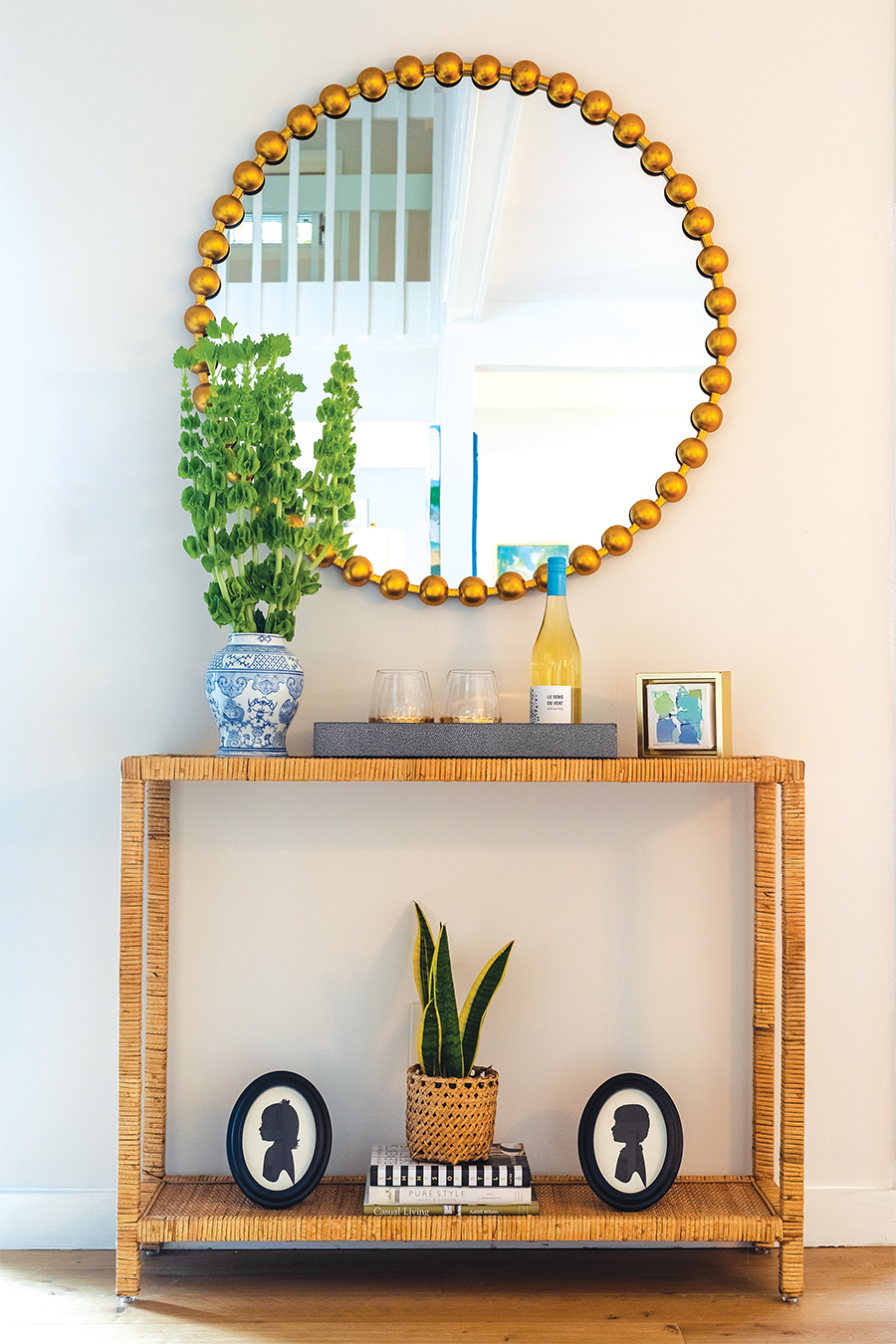
As we all paused over the past two, gulp, years, we turned our attention to fixing up our homes and addressed areas that had perhaps been long overlooked. One such space that has been a focal point for our clients has been the foyer. Says Anne Rainey Rokahr, the charismatic owner of Winston-Salem’s Trouvaille Home, “The feeling one creates in the foyer sets the tone for the entire house and should therefore never be an afterthought and definitely not a family drop zone. Even if the rest of the house looks a little messy the foyer should always be pristine. And the foyer is the spot to go grand. Pair a spectacular chandelier (always on a dimmer), a one-of-a-kind chest, and a large mirror with a couple of yards of a fine fabric, and you’re on your way!”  PS

Jason Oliver Nixon and John Loecke are the duo behind Thomasville-based Madcap Cottage.

Almanac

April

By Ashley Walshe

April hath put a spirit of youth in everything.

— William Shakespeare

April is a child of wonder, lord of the mud pies, the crown prince of play.

Yesterday it rained so hard the earthworms learned to swim. Today, the peepers are peeping. The sun is out. The prince of play gathers the essentials:

Large wooden spoon? Check.

Mixing bowl and pie tins? Check, check.

Measuring cups? Don’t need them.

There’s a watering can full of rain on the back porch. Or, there was. The boy squishes across the yard, settles onto the floor of his squashy kingdom.

Mud sings as sweet as any muse. But you must know how to listen.

The boy closes his eyes, readjusts his flower crown and scoops up a wet heap of earth. He dabs a little on his face. He squelches his fingers through it. He digs into the mire with his toes.

Eureka!

This is what the mud said:

In a large mixing bowl, combine two parts squish and one part rainwater. Wriggle your toes as you stir, mixing until the first hummingbird graces the first bearded iris.

When the cottontail rabbits multiply, fold in a dash of wet grass and a fat pinch of redbud before transferring to pie tins.

As the robins pluck their breakfast from the lawn, top with generous layer of dandelion leaves.

Garnish with snakeskin, snail shells and a
dollop of wisteria.

The sun will take care of the rest.


Fairy Rings

Spring is doing what spring does best. The earth is softening, once-barren landscapes now bubbling with tender buds and blossoms. In the garden, asparagus rises like birdsong. And after it rains? Enter Marasmius oreades, aka, the fairy ring mushroom.

If ever you’ve stumbled on a near-perfect circle of these buff-colored, wavy-capped fungi, perhaps you’ve smiled at the amusing “coincidence.” Or maybe it spooked you, particularly if one popped up on your own lawn. (Note: These boomers are known to kill turf.)

Myth and folklore refer to these circles as “fairy rings.” Can’t you almost see it? A wild band of wee folk dancing among these mushroom portals?

Tempting as it may be to step inside a fairy ring, myths warn against it. Long of the short of it, those who are lured inside become captives of an unseen realm where hundreds of years can pass in a blink.

On the subject of fair warnings: The fairy ring mushroom is actually a choice edible with a sweet quality that has made its dried caps the star ingredient of more than a few macaroon and cookie recipes. (Go on, look them up.) But this innocent wildling does have a toxic lookalike. Best not to harvest unless you know for sure. And, certainly, withhold from sautéing them.

Foxglove

How did the pretty foxglove get its name? Etymologists have spun many theories. In 1847, William Fox Talbot proposed that “foxglove” may have derived from “folks’ glove,” especially since the Welsh called the flower maneg ellyllon, aka, “fairies’ glove.”

This much we do know: They are bumblebee magnets.

If ingested, the common foxglove (Digitalis purpurea) is highly poisonous to people and animals. In this case, looks can’t kill. But one could see why the Scottish called them “witches’ thimbles.”  PS

The Zoo

Fiction by Daniel Wallace   

Illustrations by Harry Blair

We were listening to Vivaldi the night I died, the bed so soft, so warm, my wife of nearly half-a-century perched beside me with a cup of ice chips, there to wet my tongue, my lips. Even though I die at the end of it, this is not a sad story, really: I was very old, comfortable, cared for, weary, and loved, loved my whole life long, ready to fade into whatever night was waiting for me. And of all the moments I might have conjured to accompany me as I was leaving, it was our very first date that I recalled.

Clara and I were grad students in English, just classroom friends, weeks away from defending our dissertations — hers on lute music in Shakespeare’s early plays, mine on Mary Shelly’s Frankenstein and the birth of modern science. I’d always liked Clara, but I think everybody did. She was smart but didn’t seem to care that she was, and made the rest of us — who were battling with each other, always burnishing the myth of our own brilliance — seem dumb. She was also funny, and the kind of pretty I was drawn to. Her nose was just a little longer than one thought it might have been, her eyes too big. They were emerald green, though, and rested on her big cheeks like marbles. Her knees were oversized for her long thin legs, like two snakes that had just swallowed one rabbit each. The truth was she wasn’t really picture-pretty at all, but carried herself as if she were, or didn’t care that she wasn’t, and that made her more beautiful than anyone I’d ever seen. She seemed wild to me, beyond anything I could ever capture. I was 27 and looked like a young man overly acquainted with Mary Shelley’s Frankenstein, by which I mean bookish in a sun-starved sort of way, shy around actual humans, shiny brown hair, still waiting for the peach fuzz on my upper lip to turn to fur. Somehow she let me know that she was free — “I’ve been kind of seeing somebody, but now . . . ” And she shrugged.
And there we were.

So we decided to go out for a beer one night. I picked her up in the first car I’d ever owned, an old Dodge Dart I’d bought used five years before, beaten and bruised, 210,027 miles and counting. There was a hole in the passenger side floorboard a mouse could have slipped through, and the engine was seriously flatulent.

“Nice car,” she said, hopping in. She was wearing jeans and a T-shirt, variations on which seemed to encompass her entire wardrobe. “Is it new?”

“Very funny.”

“Kidding,” she said. “But seriously, it’s a real car, right?”

“Ha ha.”

“I’m just having fun with you.” She punched me in the shoulder. “But honestly, want me to give it a good push? Happy to.”

She went on like this for a little while and stopped just before it became tedious. Maybe just a beat after it became tedious. But I was laughing. “For someone who doesn’t even have a car, you have strong opinions about mine.”

“I kid you,” she said. “But seriously.”

Off we went to a place called Brother’s, famous for its jukebox and onion rings and frosty beer mugs. We slipped into a booth and talked about what graduate students talk about — dissertation directors, anxiety, our cohorts, and more anxiety. That was the thing: It was fine and fun and comfortable; we just got along so well. Even after a few minutes together it felt like we’d been coming to Brother’s forever and talking about nothing and laughing — when this guy appeared, an apparition materializing from the dark of the bar beyond us. Tall, wiry, a small face made angular by a well-trimmed goatee, and eyebrows like a mossy overhang. Our age. He was wearing a black jacket and a black T-shirt beneath it and black pants, and I’m assuming black socks and underwear as well. He sat down next to Clara — they clearly knew each other — and he smiled at me and shook my hand. A strong grip. Very strong.

Clara covered her face with her hands and moaned. “Jeremy,” she said, she sighed. “Jesus. Jesus Jesus Christ.”

Jeremy looked at me and rolled his eyes, like we were having so much fun and now Clara has to come and ruin it for us.

“I saw you and I had to say hello,” Jeremy said to her. Then to me, conspiratorially: “We were together, not too long ago. Clara and I.”

Clara nodded, but it was a grudging nod. I’m sorry, she mouthed to me.

Jeremy saw her. “You should be sorry,” he said.

“Please,” she said. “Jeremy. This is not the time or the place for this.”

Jeremy shook his head and shrugged. “I don’t know why. This used to be our place.”

“Our place?” She mocked him. “We came here twice.”

Someone put two quarters in the jukebox and “Raindrops Keep Fallin’ on My Head” began to play. Clara looked at me. “We should go, Richard. This isn’t going to get any more fun than it already is.”

“Richard,” Jeremy said. “What a great name. May I call you Dick, Dick? Great. So, Dick, about how long have you and Clara been an item . . . Dick.”
I didn’t answer. I was in a difficult position: Clara and I really weren’t an item, yet; I didn’t feel it was up to me — or in my wheelhouse — to step up and eject the interloper from our midst.

But then, slowly, Jeremy’s smile dimmed and died, and he looked at Clara as if she were a hideous thing.

“You’re a coward, you know,” he said to her. “How could you just
. . . disappear? No call back. Nothing. Not cool. Not how you break up with somebody.” He looked at me, back to her. “Just . . . not cool. In case you didn’t know.”
She closed her eyes and took a deep breath, as if she were about to plunge underwater.

Slowly, she exhaled.

“We didn’t ‘break up,’ Jeremy. We were never even really seeing each other, not like that. We were never even — .” She stopped, giving up the postmortem. “Listen. I’m sorry, okay? I should have called you or maybe written you back to say thanks and everything, it was great while it lasted but a talent-free hobo novelist who doesn’t know the difference between a semicolon and an ampersand is just not what I’m looking for in my life at this time. All the best, Clara.”

Jeremy tried to rally with a comeback, but he didn’t have one. “I’m not a hobo,” he said. “Just . . . between places.”
“For a year and a half,” Clara said.

Poor Jeremy. He had been defeated. “Raindrops” ended and began again. Jeremy shook his head, stared off into the faraway-somewhere. He looked like he was standing on the shore of a deserted island watching the ship that was supposed to save him sail on by. 

“Okay, well, I feel like it’s time for me to hitch a ride on the next prevailing wind! But before I go, I have a message for you, Richard. You’re going to be me one day. You’ll have the time of your life with this one. You’ll be so happy. It’ll be like the world went from black and white to color. Then everything will go to shit and you won’t be happy anymore because Clara will move on, and it will suck for you, just like it’s sucking for me now.”

By the look in his eyes he was taking a moment to relive some of the colorful times he’d shared with her, and he smiled. “But it will be worth it,” he said. “Because Clara . . . well, nobody is Clara.”
Then he stood, and just as quickly as he had come was gone, a shadow fading away into the darkness of the bar.

We paid up and left and walked to the car in the dusky quiet. We were a little unsettled.

A breeze ruffled the trees but fell short of the two of us, standing on either side of my car now in the gravel parking lot. No stars out yet but the moon was rising, low still and smoky white.

“Well, that sucked,” she said.

“Yeah. Yeah, but — ”

“But what?”

“You have to admire his pluck.”

“I love that word,” she said. “He’s not plucky, though. He’s . . . indecorous.”
“Unseemly.”

“Boorish.”

Looking down like there was something on the ground for her to see, her hair fell into her face and it was as if a big CLOSED sign went up. Even after she pushed it back behind her ears it was hard to really see her. “Jeremy,” she said. “Such a mistake. What if every mistake you ever made followed you around for the rest of your life? Like a parade of mistakes. The too-small shoes you bought, the undercooked chicken. Jeremy.”

“That would suck a lot.”

“I was mean to him.”

“He asked for it.”

“Really?”

I shrugged my shoulders. Maybe he did, maybe he didn’t, but I was on Clara’s side now. I looked back at Brother’s. I kept thinking Jeremy was going to follow us out here and stab me.

“I think we should make a mistake,” she said.

“Really?”

“We need to do something,” she said. “That or go home. And I don’t want to go home. Let’s do something stupid that will follow us around forever like undercooked chicken.”

“Sure,” I said, not really sounding like the devil-may-care-crazy guy she may have wanted just then. But what to do? I couldn’t think of anything: I’d always veered to the quiet, safe side of life. But she had an idea.

“You know what we should do?” she said. “Or what we shouldn’t do, I mean?”

She sat on the hood of the car and waited for me to join her. I did. This was as close as I’d ever been to her.

“What?”

“Go to the zoo.”

There was a small zoo in Bellingham, somewhere between a real zoo and a place where a bunch of animals had been collected from around the world and housed by a larger-than-life intrepid explorer in makeshift pens and a pit for lions and tigers, a skinny elephant, a fence for the giraffe, a cement island for the monkeys. The animals didn’t look abused, just disappointed.

“Great idea,” I said. “But it’s closed. It closes at dusk.”

“Who said anything about it being open?”

And she told me a story she’d heard, about an entryway at the bottom of the 12-foot-high metal fence, one you can slither through with ease, gaining access to the entire place. No alarms, no cameras. Just you and the animals in the dark.

“I know the way.”

“Sure,” I said, hoping to impress her with my newfound recklessness. I handed her the keys to the car.

“Really? Seriously?” she said, like a kid. “You’re up for this?”

Her face was so small I could cup it in one hand, and in the half-light of the parking lot outside of Brother’s she had the patina of a film from the ’40s. I think I was already in love with her. We got in the car and she looked at me, and it was as if she were saying, Are you ready? Because this is happening. If you’re going to wimp out this is your last chance. In just the few minutes we’d been outside night had fully fallen. A couple of frat boys came out of Brother’s braying at each other, and the tail end of a song comes out with them — “Raindrops.”

“Let’s do this,” I said.

She started the car and winked at me as she revved the engine. “Big mistake,” she said.

It was a terrifically muggy night but with the windows down I could feel a cool undercurrent to the air. I remember thinking that one day it would be fall, then winter, then spring and then summer again, and that whatever was about to happen will have happened a long time ago. The wind made Clara’s hair go wild, half of it flying out the window like streamers on a bicycle, the other half in her mouth and in her eyes, blindfolding her for seconds at a time. “I’ve got this,” she kept saying. “No problem.” Then she looked at me, mock-scared with a frightened smile, like the other part of her was saying, Don’t believe me! There is a problem! I don’t have this!

She took a sudden turn off of Greene Street, and then the road whipped around to the right, up and then down, the car beams breaking into what felt like a virgin dark. Just a pine tree forest, a forgotten road, nothing else.

She pulled over to the curb and cut the lights and we were under the cover of night.

“We’re here,” she said.

Gradually the world around me came into focus, and over the trees I could see the throbbing red light at the top of the WRDC radio tower. I positioned myself in the world and I realized we were in fact right behind the zoo, near a farm, an overgrown pasture. She put the car in reverse, pulled back, angled it, then turned the lights back on, spotlighting the secret entrance through the fence. She raised her arms into the air, fists clenched: victory.

“You’re pretty impressed with yourself.”

“I am,” she said, nodding. “As I should be.”

She turned off the car and threw the keys back to me.

“It’s go time,” she said.

The hole in the fence was big enough for a mandrill to crawl through. We got in on all fours. Neither of us said a word but communicated through hand signals and raised eyebrows and then suddenly — What’s that? Oh. It’s nothing. Continue . . . inching through the inky dark toward the animal quiet.

The woods ended, and we were on a path, dirt and gravel first and then lightly paved uneven asphalt. A yellow light spilled on the elephant cage, that fenced-in patch of hard dirt no bigger than a poor man’s front yard. There was no elephant there now — he or she was sleeping inside. I’d been here a couple of times, thrown a few peanuts over this wall. Clara looked at me. She was so excited she seemed to be vibrating. She leaned in close and stood on her tiptoes to whisper-yell in my ear: “We did it!” She held onto my elbow. “But it’s important to stay quiet,” she said. “That way they won’t know we’re not one of them. They’ll do things most people never get to see them do.”

It turned out that animals in the zoo at night do what most animals do. They sleep. It was absolutely still. The elephants, the giraffes, the monkeys, the spiral-horned antelope — they were all asleep. You could hear them; it was the humming sound of a living forest. Blue-black shadows everywhere. An ibis had a bad dream and shrieked, and a striped hyena answered (maybe it was an ibis, maybe a hyena), then it was silence again. What lights there were were kept low, and the moon was hidden behind a cloud. It turned out that sneaking around in a zoo full of sleeping animals was not unlike sneaking around in a zoo with not a single animal in it. Clara thought she saw something and gave a little involuntary gasp and turned and — it was a rabbit. She shrugged her shoulders, smiled, but I could tell she’d had high hopes for this adventure. It hadn’t lived up to its hype. “We can go now if you want,” she said.

I did want to go. I wanted to be back in the car talking about what had just happened, how great it was and can you believe that we actually did that? Clara had no idea how careful I normally was, how meticulous with my life, had no way of knowing that I was a man who folded his pants at the crease and arranged his shirts by kind and, within kind, color, whose life-plan was to be invisible on command, to follow directions, to go as far as a man with a Ph.D. in Frankenstein could go. So yes, I wanted to leave.

But she was just too defeated. 

If this were even our second date I would hug her, even kiss her until my kisses made her smile. A second date meant options. A first date, you couldn’t — I couldn’t — do more than take her hand. There was an old stone wall surrounding a duck pond, and I stepped up on it. It was only 2 feet high. Clara looked up at me and sort of laughed and said, “What are you — ?” but before she could finish the sentence I had my hand out and she took it and I pulled her up to stand beside me. “Listen,” I said. She listened and heard the same thing I did: almost nothing at all, just that humming sound. “Now listen,” and with my hands cupped around my mouth I shouted a quote from the book I had memorized: “Learn from me, if not by my precepts, at least by my example, how dangerous is the acquirement of knowledge, and how much happier that man is who believes his native town to be the world, than he who aspires to become greater than his nature will allow.”

That did the job: The night blew up. The animals rose. Plodding out of his concrete bunker pounded the elephant, the curious giraffes loped into the moonlight, and the island of monkeys began to wildly chatter. Every animal was baying and woofing and screeching. The animal world had awakened — just for us.

“Richard,” Clara said, still in whisper-mode. Wings flapped in the dark above us, water roiled somewhere nearby. Clara grabbed my arm and pulled me close. Our shoulders bumped. “This is just . . . so great!” Her big eyes were wide, the size of saucers for a miniature teacup. The moon, the stars, the sky, the animals of the Earth, this beautiful woman, all here, before me — and I felt as if I had created a moment that had never been created before, never in the history of the world. And I was sharing it with Clara.

But I woke up more than the animals. The zoo actually had a keeper. I saw him before I heard him, the beam of his super-powerful flashlight bouncing off of everything.

“Who’s there?” he called out, in a deep voice. “You’re trespassing, assholes. And yes, it’s a felony, and yes, I will prosecute. Do not think I won’t. Course I’ll let you spend some time in the hippo pond first, goddamn it.”

He sounded tired, and very serious. This had gone too far for me, and for Clara. She was frozen against my side, had stopped breathing I think, statue-still. I took her hand and we jumped down from the wall. I had no idea now where the hole in the fence was, but what choice did we have but to try and find it? We ran into the woods. I scratched my face on the lower branches of a pine tree and could feel the stripes of blood across my cheeks. But we didn’t stop running. The zookeeper could hear us, of course, and shined the light into the woods following our path. “Come out come out wherever you are, moron,” he said gleefully. He followed the sound of us, sweeping his light through the forest, coming closer. I had no idea where we were. But we came to a huge tree, and I pulled Clara behind it, wrapping my arms around her until we were as small as two people could be. The light of his flashlight fell all around us, but not on us. We were that close to being seen — inches away from being caught and caged. But we were not.

He gave up. “Damn it,” he said to himself now, thinking we were long gone.

Then he turned around and headed back the way he came.

Still pressed up against me she looked up at me and smiled.

“You did it,” she whispered. “You saved us.” She kissed me on the cheek, but her eyes did not leave mine. “Richard,” she said, “that was truly magical.”

And I thought, I actually remember thinking this as we huddled together behind that tree: in thirty, forty, fifty years — whenever she buried me — no matter what may have happened through the decades of our life together, this was what I’d remember, this night, the story she’d tell too many times to our children, our grandchildren, our oldest friends, the story of that night we broke into the zoo and woke everyone up. And not because it was the best thing that ever happened to us, but because it was the first. It set the tone, she’d say, for the rest of our lives. That night at the zoo we were in our own cocoon, arms encircled, closer than close. She burrowed into me, and we stayed that way for a while, longer than we needed to, until the night returned to its rhythms, until all the wild animals in the world went back to sleep.

So of course, out of all the moments of my life, this would be the one I chose to see me out.

I felt a chip of ice on my lips, a damp cloth on my forehead. I didn’t know if my eyes were open or closed, but it was all dark now, and getting darker. I found my wife’s hand and held it.

“Clara,” I said. “Oh, Clara!”

Yes, your name was my very last word, so sweet I said it twice.

“Clara?” Gwendolyn said, and she shuddered, seemed to freeze and harden as if she’d died herself. “Richard, who is Clara?”

And I might have told her, but it was a long story from a long time ago, and by then it was much, much too late. PS

Daniel Wallace is the author of six novels, including Big Fish and, most recently, Extraordinary Adventures. He lives in Chapel Hill, where he directs the Creative Writing Program at the University of North Carolina.