The month of August had turned into a griddle where the days just lay there and sizzled.
— Sue Monk Kidd, The Secret Life of Bees
August is equal parts ecstasy and agony.
At dawn, a shimmer of hummingbirds dips and weaves among cascades of morning glories and a sweeping sea of hibiscus. In one day, the nectar of one thousand flowers will have sweetened their bellies and tongues. In one month, when the blossoms fade, the tiny birds will disappear, taking summer with them.
The honeybees have multiplied. They drift in dizzying circles, supping joe-pye weed and purple coneflower as if the future of the hive depends on it. And it does. The bees know that the season is slipping with each precious sip. They know not to waste it.
Swallowtails orbit goldenrod and lemon balm, ring around the butterfly bush, float like dreams from blossom to fragrant blossom. Soon they, too, will vanish.
Yet — for now — all is lush and dreamy. All is warm and sticky-sweet. Never mind that each kiss between bee and flower could be the last. The golden season always dims to black.
And so, you savor the last glorious slice of it. Absorb it with your whole body like the water snake sunning on the rock. Cradle it like a sipping spirit; inhale deeply, drink slowly, let the textures and flavors roll around on your tongue.
Sprawl out across the summer grass. Float from flower to flower. Drink the nectar of one thousand blossoms.
Harvest the fruits of the garden. Sink your teeth into them. At night, dance among the fireflies, here for a glittering moment, and then gone.
The cicadas know. As they scream out in rapturous longing — ecstasy and agony and nothing in-between — you soak up the sweetness of summer as if the future depends on it. As if it will carry you through the darkest days of winter.
Sweet Morning Glory Late Summer Harvest
The morning glories have run wild. Twining vines with heart-shaped leaves and fragrant, tubular flowers, these late summer bloomers are hummingbird magnets. They thrive in full sun and, given a trellis or fence, will climb up to 20 feet.
Among the most common varieties are Heavenly Blue (sky-blue with white-and-yellow throats), Grandpa Ott (a royal purple heirloom from Germany), Fieldgrown (an amalgam of white, pink and purple blossoms) and Crimson Ramblers (a hummingbird favorite).
True to its name, the blossoms open in the morning, each lasting for just one glorious day.
Late Summer Harvest
The garden gives and gives. August offers eggplant, green beans and peppers. The last of the sweet corn. The earliest apples, pears and figs. And — oh, yes — an endless stream of plump tomatoes.
But what to do with them?
The ’Mater Sammich never fails (make mine with Cherokee Purple, balsamic glaze and pesto mayo — I’m no purist). Cook them down into sauces. Dice them for pico de gallo. Make bruschetta, pasta salad and summer quiche.
Better yet, pluck them straight off the vine, sprinkle with salt and enjoy.PS
William Faulkner invented Yoknapatawpha County as a place for his imagination to live, and every Southern writer knew where it was, even if it wasn’t on any map. Ernest Hemingway loaded his readers onto a double-decker bus and transported them to a fiesta in Pamplona, Spain, with its wine skins and dusty plaza de toros. Allan Gurganus created the fictional small town of Falls, North Carolina. In the hands of a fine craftsman, a sense of place in a piece of fiction can be so compelling it almost becomes its own character in the narrative. In our Summer Reading Issue three of North Carolina’s greatest writers deliver on this promise, taking us to West Virginia coal country, the Smoky Mountains of North Carolina, and the bottom of a freshly dug grave. Our guides for these adventures are Lee Smith, Ron Rash and Clyde Edgerton.
— Jim Moriarty
Lee Smith is the author of 14 novels, including Fair and Tender Ladies, Oral History, Saving Grace and Guests on Earth, as well as four collections of short stories.Her novel The Last Girls was a New York Times bestseller as well as co-winner of the Southern Book Critics Circle Award. A retired professor of English at North Carolina State University, she has received an Academy Award in Fiction from the American Academy of Arts and Letters, the North Carolina Award for Literature,and the Weatherford Award for Appalachian Literature. Her latest book, Silver Alert, will be available in the spring of 2023.
Ron Rashis the author of seven novels, seven collections of short stories and four volumes of poetry. He has been honored with The Sherwood Anderson Prize and was a finalist for the PEN/Faulkner Award for Fiction for his collection Chemistry and Other Stories, and for his New York Times bestselling novel Serena. His other novels include Saints at the River, Above the Waterfall and The Risen. He is the Parris Distinguished Professor in Appalachian Cultural Studies at Western Carolina University, where he teaches poetry and fiction writing.
Clyde Edgertonis the author of 10 novels and two books of non-fiction. His novels include Raney, Walking Across Egypt, The Floatplane Notebooks, Killer Diller and Lunch at the Piccadilly. Both Walking Across Egypt and Killer Diller were adapted for the screen. He has been the recipient of a Guggenheim Fellowship and has also received the North Carolina Award for Literature. He is the Thomas S. Kenan III Distinguished Professor of Creative Writing at the University of North Carolina Wilmington.
By Bill Case
Photographs by Ellsworth Eddy from the Tufts Archives
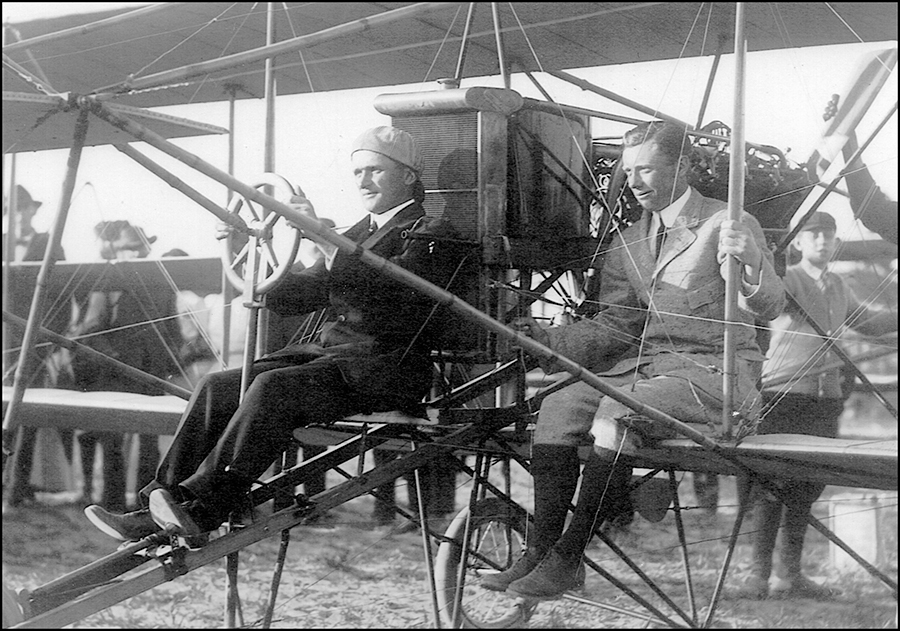
Lincoln Beachey, left, and Charles “Chick”Evans in Pinehurst
The Sandhills was abuzz with excitement after the Pinehurst Outlook reported on March 11, 1911, that within the week, an airplane would be aloft over the town. “Pinehurst,” declared the paper, “is soon to enjoy the novel sight of seeing man vie with the buzzard in its majestic journey through the clouds.”
The community had been chosen by the Curtiss Aeroplane and Motor Company (now Curtiss-Wright Corporation) to host a “school of aviation instruction” from March 18 to April 5. The acknowledged goal of the school was promotion of the company’s two-winged biplane, designed by aviation pioneer and company owner Glenn Curtiss.
In addition to providing lessons to would-be pilots, curious onlookers were going to be offered “the delights of a ‘fly’” in the biplane with the “daring aviator” in charge of the school, 24-year-old Lincoln Beachey. Though he had flown planes for just over a year, Beachey’s breathtaking aerial exploits were already gaining him cult-like status among flight enthusiasts.
The native San Franciscan broke into the flight game in September 1905 when Capt. Thomas Baldwin hired the mechanically inclined, but aeronautically inexperienced, teenager to fly a dirigible at the Lewis and Clark Centennial Exposition in Portland, Oregon. Beachey, piloting from a flimsy wooden undercarriage beneath the balloon, skillfully maneuvered the craft while thousands below marveled at the spectacle. According to Frank Marrero’s biography Lincoln Beachey — The Man Who Owned the Sky, Lincoln received “high-profile press coverage by landing, message in hand, on top of ‘The Oregonian’ newspaper company and City Hall, thus initiating air mail.”
Beachey revelled in this first taste of public acclaim. In pursuit of further headlines, he, along with brother Hillery, conjured up an outlandish scheme. On June 14, 1906, Lincoln ascended in a dirigible from a Washington, D.C., park, the first flight of any kind to occur in the nation’s capital. Gobsmacked by the sight of the airship as it floated high above the Mall and the Washington Monument, citizens were in an uproar. Then Beachey turned the lumbering airship in the direction of 1600 Pennsylvania Avenue. As he descended to the White House lawn, presidential guards sprinted toward the dirigible with mean intentions. But Beachey was in luck.
President Theodore Roosevelt’s wife also saw him arriving and chose to intervene. She restrained the guards and greeted the daring pilot.
“Congratulations, young man!” exclaimed Edith Roosevelt. “This is certainly the most novel call ever made on the White House.”
Beachey next paid a visit to a joint session of Congress, landing on the steps of the Capitol, then spending the following hour discussing the future of air travel with fascinated lawmakers. He would become an outspoken advocate for governmental investment in aviation.
Beachey’s airship histrionics brought him considerably more than his requisite 15 minutes of fame, but dirigibles became old news when public attention turned to winged aircraft and the daredevils who piloted them. Not wanting to be left behind, Beachey knocked on the door of the Wright Brothers, imploring them to train him to fly in their behalf. Orville and Wilbur, however, wanted Beachey to pay them $500 for the opportunity — a sum that was out of the question for the penurious Beachey. Hat in hand, he accepted a less desirable position as a mechanic with Glenn Curtiss’ outfit. Eventually, he cajoled Curtiss into letting him practice flying a biplane during off hours.
By his own admission, Beachey was inept at first. Though one might not think of flying as a skill best learned by trial and error, according to Marrero’s book, Beachey spent considerable time repairing gears damaged by hard landings. Months passed before his aerial proficiency improved.
When Curtiss’ top pilot, Charlie Hamilton, was seriously injured during a December 1910 flying exposition in Los Angeles, Curtiss reluctantly tapped Beachey to finish out the meet. Blustery conditions made flying difficult for the nervous Beachey, though he relaxed after discovering the plane’s natural stability tended to even out the rough ride.
That sense of stability didn’t last long. After climbing to 3,000 feet, the plane’s engine stalled out and an eerie silence ensued. In the early days of flight, this scenario rarely ended well for the pilot. Beachey began plummeting toward the Earth, his craft spiraling out of control. The natural, though often futile, reaction for pilots faced with this predicament was to try to wrestle the plane up and out of the spin, causing the plane to spin even faster. Beachey sensed he could avoid a crash by nosing the plane completely into the dive. This counterintuitive move provided sufficient power for Beachey to regain control. He landed with the exultant roars of the crowd ringing in his ears.
Afterward, Curtiss said to him, “Linc, that was as fine a demonstration of flying as I’ve ever seen. Thank God, you’re alive.”
The flight was something of an epiphany for the young pilot, too. “Mr. Curtiss,” he said, “in the silence I could finally feel the whole machine for the first time. I think I know how to fly now.”
On the heels of this sensational debut, Beachey entered a January 1911 air exhibition held in his hometown of San Francisco. The show featured competitions in racing, take-offs, altitude, landing and showmanship. Lincoln blew away all challengers, winning several contests including “shortest take-off,” for which he earned $1,000.
As he was emerging as an aviation rock star, more than 17 million people would witness his flying feats in over 100 cities during 1911. His derring-do, newfound fame and money brought him attention from admiring females. Though Beachey had married North Carolinian May (Minnie) Wyatt during his dirigible days, those vows didn’t seem to deter the flyer from accepting the company of other young women during his wanderings around the country. To persuade the objects of his affection to join him in a fling, he would offer them diamond engagement rings, which he purchased by the dozen. He made a practice of keeping one at the ready in his vest pocket and is said to have had fiancées awaiting nuptials in cities across the U.S.
The dalliances, however, did not distract Beachey from formulating new and more dangerous aerial maneuvers. Now widely referred to as the “Birdman,” or “The Man who Owns the Sky,” he practiced longer and steeper dives, producing breathtaking close calls. Beachey claimed he was no daredevil and that his extraordinary stunts simply underscored the fact that the normal flying of an airplane was a safe activity. His feats, however, had the opposite effect on public perception, since an alarming number of less-skilled aviators perished in attempts to emulate his maneuvers. The frequency of horrific accidents led to ghoulish betting activity at airshows regarding the likelihood of a fatality.
Notwithstanding this gladiators’ arena-like gruesomeness, aerial shows were beginning to emerge as a bona-fide American sport. The article in The Outlook trumpeting Beachey’s arrival said as much. “Several pupils and a big gallery of ‘fans’ come with Mr. Beachey to enjoy the sport, (for that is what it is rapidly developing into).” The paper offered the view that “as an entertainment novelty, the school promises to be the biggest feature in the history of the Village.” The Outlook even predicted that golf would, for the moment, be “back grounded by interest in the ‘Bird Man.’”
Beachey’s makeshift airfield
In 1911, no airfields existed in the Sandhills, so the Curtiss representatives needed to locate a Pinehurst property with dimensions sufficient to accommodate the taking off and landing of the biplane. They selected a large field on high ground west of the Aberdeen, Carolina and Western railroad track in the vicinity of what is now Linden Road.
Beachey and wife Minnie arrived in Pinehurst on March 18 and bunked at the Berkshire Hotel. The following morning, he made his way to the makeshift airfield and personally took charge of assembling the biplane. By noon, he had the engine whirring with (as The Outlook described it) a “resonant roar.” In short order, Beachey was soaring over Pinehurst, accompanied by the biplane’s mechanic.
Next, he treated R.B. Middleton to his maiden airplane ride. Middleton, a race car driver from New York, aspired to be an ace aviator under Beachey’s tutelage. Another noteworthy passenger was Commander (later vice-admiral) Shichigoro Saito of the Royal Japanese Navy. According to The Outlook, Saito “left bubbling over with enthusiasm, convinced of (an airplane’s) practicability for Army and Navy uses.”
Minnie also hitched a flight with her husband, though her presence in Pinehurst may not have entirely inhibited Lincoln’s roving eye. The Outlook reported that Miss E. Marie Sinclair, “an accomplished and daring sportswoman,” was “favored with a long and high flight.”
Another first-time passenger was acclaimed amateur golfer Chick Evans, in town for the United North and South Amateur, which he won. If Evans wasn’t the best American golfer in the era immediately prior to the emergence of Walter Hagen and Bobby Jones, he was close. He defeated all the top pros in the 1910 Western Open (then considered a major championship), and later won both the U.S. Open and U.S. Amateur in 1916.
Evans would confess to pre-flight jitters. “Before my ascent,” wrote the golfer, “I imagined the most acute feeling on leaving my old friend the Earth, would be fear; the shuddering, awesome, sort of fear which assails a boy when passing a cemetery on a dark night.” But Evans’ anxiety was allayed once above the pinewoods, where “a profound sensation of security came over me, and while the rush of air was tremendous and the revolutions of the high-power motor deafening, I felt as safe as if sitting upon a sheltered balcony.”
Evans’ observations of flight painted a vivid picture. “The world we were leaving became very small — a strange little boy world. The great Carolina Hotel was the Noah’s Ark of my childhood.” To Evans, the people gathered on the ground resembled “a regiment of toy soldiers.” He marveled at the sight of “the golf links, a beautiful stretch of soft green, with strange square inserts to mark the putting greens, and the winding roads, silver ribbons; with the surrounding landscape stretching on and on, like the ocean, to infinity.”
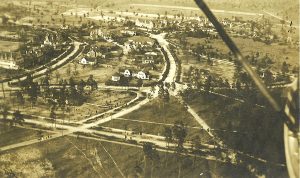
When the Pinehurst resort’s lead photographer, Edmund L. Merrow, got wind of the fact that the Curtiss team was offering rides to intrepid passengers, he inquired whether the team would permit a photographer to snap pictures of Pinehurst from the air. The taking of photographs from an airplane was a nearly unheard of activity. No passenger, let alone one schlepping a camera, boarded a plane until 1908. The first such picture-taking occurred in 1909 when a passenger on a plane flown in Italy by Wilbur Wright filmed a three-minute motion picture. It appears that the first aerial photos from a plane in American skies occurred above San Diego in January 1911, just two months before the Curtiss biplane’s flights over Pinehurst.
Merrow convinced the Curtiss team to allow someone to tag along as Beachey’s passenger and take aerial pictures, but the 51-year-old elected not to undertake the project himself, delegating it to his 29-year-old assistant, Ellsworth C. Eddy. The two men had been associated since around 1900, when Merrow hired the young Eddy to assist him at his photography shop in Bethlehem, New Hampshire. During the winter months, Merrow would migrate south to Pinehurst, where he photographed dances, sporting activities and various goings-on at the resort. In 1907, he persuaded Eddy to join him in the Sandhills. During the ensuing four years, the two men were a photographic team, rotating between New Hampshire and Pinehurst, depending on the season.
For Eddy, camera work in Pinehurst had been an enjoyable, though not especially profitable, gig. It allowed him an opportunity to hobnob with celebrities like bandleader John Philip Sousa and sharpshooter Annie Oakley, and now Beachey, Saito and Evans. Flying was not something Eddy was eager to experience, but his assignment required it. As he approached the biplane on March 25, 1911, Eddy presumably wondered whether his $17 per week paycheck was worth it. Would he ever see his wife and children again?
Eddy was greeted at the Curtiss tent on March 25 by the confident Beachey, garbed in coat, vest, white shirt and tie with hat turned backward. Eddy’s diary reveals his trepidation. “I was scared at first when the pilot said before he would take me up, I would have to sign a release absolving him of any liability.”
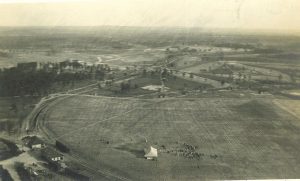
Despite misgivings, Eddy signed the exculpatory document, and after being outfitted “in a leather jacket, goggles and hat tied on,” he found himself aloft with Beachey over Pinehurst. Buffeted by the wind, his vision impaired by goggles, and struggling to maintain his balance sans seat belt while hoisting the camera, the picture-taking was cumbersome if not downright harrowing. But Eddy managed to snap six pictures of the town and airfield below.
The village of Pinehurst and the road leading to The Holly Inn
The images clearly depict early Pinehurst, then 16 years in existence, and still in the nascent stages of development. No longer a denuded pine barrens, hundreds of newly planted trees and other ornamental plantings created a boulevard affect along Carolina Vista, Magnolia and Ritter roads. In 1911, the latter road, unlike today, passed directly in front of the Carolina Hotel. The “Music Room,” shown at the right of the hotel, would later be razed and replaced by another structure that currently houses the hotel’s spa. While a substantial number of homes are visible, housing density is low. The tented Curtiss airfield is depicted with onlooking spectators.
His nerve-racking camerawork made young Eddy something of a trailblazer. He may have just missed being the first aerial photographer shooting from an airplane in the United States, but Steve Massengill’s book, Around Southern Pines, A Sandhills Album, confirms Ellsworth’s photos were the first such taken in North Carolina.
From their studio on the corner of Chinquapin and Magnolia roads, Merrow and Eddy immediately converted the unique images into postcards, and by early April they were on the market. According to local historian Larry Koster, “Pinehurst postcards were a cheap, easy way for the many tourists to convey both the beauty and attractions of this area to the folks back home.”They also provided wonderful advertising for the resort.
Koster, who authored the 2009 publication The Photographers of Moore County and Their Postcards, has been searching for and collecting vintage Pinehurst postcards for 25 years. He eventually acquired examples of all six postcards depicting the aerial images taken by Eddy and, in recognition of their historical significance, has donated them to the Tufts Archives.
On Thursday, April 7, 1911, Beachey, according to The Outlook, “took the big bird apart, packed it in its snug cage and left for Fayetteville, the first point of many which lie before him.” Waxing eloquently, the article noted that residents would miss the plane’s “weird notes at dawn, twilight or high noon, its presence in the sky, the grotesque, fleeting shadow.”
The writer compared the sight of Beachey’s jaw-dropping flights to “the grandeur of Niagara — the spectrum in the spray and the roar of the waters.” The reference proved a precursor to Beachey’s incredible exhibition at Niagara Falls less than three months later, on June 26, 1911. For the stupendous sum of $4,000, he dove his Curtiss Pusher straight for the center of Horseshoe Falls, his aircraft suddenly vanishing in the mist. Many spectators swooned at what they perceived was the pilot’s certain demise. With spray stinging the Birdman’s face, his plane suddenly shot out “like a cannonball” from the bottom of the mist, after plunging to within inches of the raging river. Having been offered an additional bonus of $1,000 for flying beneath the arch of Honeymoon Bridge, Beachey promptly tacked on that daunting stunt. One newspaper declared him “the eighth wonder of the world, and his dive into the Falls, the greatest aerial feat of all time.”
In August, Beachey performed more amazing exploits at a Chicago aerial competition. He shattered the world record for altitude, attaining 11,642 feet, but it was his crowd-pleasing stunts that would be remembered best. Eyeing a locomotive headed into the city, he dropped down to brush his wheels atop the train, then passed within spitting distance on both sides of the passenger cars while waving to those inside. Then, Beachey hopped his plane from one car to the next.
In a subsequent flight, dressed as a woman for dramatic effect, he frightened the spectators with a seemingly out of control dive directly at the grandstand. Beachey pulled the plane up just 8 feet from mayhem. He turned and headed toward the central city, where he ducked under power lines, bounced off tops of cars and buildings, then landed to a 10-minute standing ovation after pulling off his wig revealing his true identity. In a rather somber note, two pilots attempting similar dives crashed and died at the meet.
Over the next three years, Beachey’s aerial acrobatics would further cement his fame. Even Orville Wright acknowledged his aerial mastery. “Beachey is more magnificent than I had imagined,” proclaimed Wright. “I have watched him closely with my glasses and have never seen him make an error or falter. An aeroplane in the hands of Lincoln Beachey is poetry . . . He is the most wonderful flyer of all.” Thomas Edison paid similar tribute.
His numerous affairs ultimately undermined Beachey’s marriage. Minnie divorced him in 1913. In the court proceeding, she claimed her husband had conducted illicit affairs in 32 cities. One headline read, “Aviator’s Conquest Not of Air Alone.” He also received increasing press criticism because so many pilots perished in attempts to duplicate his various stunts. A San Diego Union editorial, noting his “wild performances,” opined that “there is serious doubt as to whether Beachey should be allowed to continue.” The barrage took its toll on the flier, who announced on May 13, 1913, “You could not make me enter an aeroplane at the point of a revolver. I am done.” In his statement, Beachey castigated the attendees at his exhibitions, saying they “paid to see me die.”
His retirement, however, was short-lived. Four months later, he was flying in exhibitions again. Instead of throttling back his theatrics, the Birdman presented an array of new tricks in his comeback: flying both upside down and backward, inside and through a San Francisco building. He raced his plane around a track against the country’s top race car driver, Barney Oldfield. At times during a race, Beachey would cause the front wheel of his plane to graze Oldfield’s head.
Then, in November 1913, Beachey debuted a maneuver which would become his signature stunt: the loop-the-loop, in which he would dive, pull back on the controls at 1,000 feet, then climb until the nose of the airplane would fall back beyond the vertical. Then he would repeat the stunt — again and again. He conceded he was pushing the limits. “I do not intend to let the margin of safety and disaster be any wider than I can help. Beachey never cheats the crowds, that is, excepting those who come to see me die.”
His acrobatics drew the attention of America’s top military brass, who were starting to realize that the maneuvers Beachey had mastered could have application in warfare. In September 1914, the secretaries of the Army and Navy invited him to Washington, D.C., for a demonstration. Beachey was intent on making an impactful splash. At one point, he aimed his biplane toward the Oval Office of the White House, where an aghast President Woodrow Wilson saw him coming. The Birdman pulled up and away at the last instant.
Similar acrobatics were directed at the Capitol Building. Congress was then in session, but promptly adjourned so that the members could view Beachey’s theatrics. If any legislator present harbored doubts regarding the usefulness of airplanes in wartime, Beachey’s performance erased them. When subsequently huddled with assembled Congressmen, he remarked, “If I had had a bomb, you would be dead. You were defenseless. It is time to put a force in the air.”
In March 1915, Beachey came home to San Francisco to perform at the Panama Pacific International Exhibition. As he strolled around the fairgrounds arm-in-arm with his new 23-year-old fiancée Merced Wallace, his star was at its zenith. In the four years since his Pinehurst visit, he had become an aviation legend and an A-list celebrity. To honor their hometown hero, the organizers had proclaimed March 14 “Beachey Day.”
There had also been significant changes in the life of Ellsworth Eddy since his flight with the Birdman. He had left Merrow’s employ in the fall of 1911 because his salary was insufficient to support a family. To make ends meet, he worked at the Carolina Hotel for a year, renting out horses to guests. In the spring of 1913, he opened his own photography studio on Pennsylvania Avenue in Southern Pines and became the town’s go-to photographer until he and his wife retired to Florida in 1946. He passed away in 1973, at age 91.
Lincoln Beachey was not destined to approach the photographer’s lifespan. His demise was especially ironic. It came after he said he would give the 50,000 Beachey Day spectators, “a show they’ll never forget.” While flying his new monoplane, Beachey launched into one of his patented dives. The right wing of the plane suddenly failed, breaking under the pressure. Then the left wing followed suit. As the enormous San Francisco crowd watched in horror, he crashed into the bay at 210 miles per hour. Though surviving the initial impact, he was unable to get free from his restraints and drowned. Lincoln Beachey was just 28.
Tributes to the “Man who Owned the Sky” came from all over the country. There were plans for a permanent memorial in San Francisco, and money was contributed for that purpose though the funds were subsequently repurposed toward America’s efforts in World War I.
As new aviation heroes like Eddie Rickenbacker and Charles Lindbergh took the national stage, memories of Beachey and his incredible early achievements faded into obscurity. He was elected to the Aviation Hall of Fame in 1966 and the International Acrobatics Hall of Fame in 1990. And a small band of aviation devotees still honor the flyer every March 14 — Beachey Day — by dropping pink roses into San Francisco Bay.
In Pinehurst, a town that venerates its storied history, the whirr of his biplane’s engine is a distant memory preserved only in a picture postcard captured by a reluctant cameraman.PS
Pinehurst resident Bill Case is PineStraw’s history man. He can be reached at william.case@thompsonhine.com.
Here’s something they don’t warn you about time travel: all the bubbles.
Big deal, you might think. You’re surrounded by floating orbs of ever-changing color and light. Yes, they can be pretty spectacular. But until you’ve lived through this kind of high magic — and a precious few have — you cannot know what a psychedelic trip these iridescent spheres are capable of inducing, especially when you’re off dipping through time and space.
And in the summer of 1892, that is precisely what The Tiger Sisters were doing. Time traveling. Or preparing for it, rather. Why? Because they’d pretty much mastered everything else.
The Tiger Sisters were perhaps the most legendary circus performers of their day. No, they weren’t slinking around in the cage with the exotic cats. They were acrobats, most famous for their high-wire and flying trapeze performances, although you should have seen them on horseback. They got their name because of their propensity for wearing matching stripes, which was part of their cutesy act. It worked. Most people had no clue that they were actually in their mid-30s — and spacetime pioneers to boot.
So why were these three brilliant explorers living the carnie life? The money was good, for one thing. They also really loved feeding the elephants. And do you know what kind of physical shape you’ve got to be in to do a forward flip on the back of a galloping horse? The circus arts kept them spry. If they were going to time travel — yes, the culmination of their life’s work — then they were going to need to stay pretty limber.
The Tiger Sisters made a pact on the summer evening of their maiden voyage: Wherever they landed, past or future, as long as it was summer, they would be OK. Because summer, as every seasoned circus artist knows, is the most magical time of the year. And where there is magic, all is well.
What happened next is a mystery to all but three. There were bubbles, sure. So many bubbles. They could never have prepared for so many.
Some say the sisters never returned — just, poof! — vanished without a trace, erasing themselves from the very fabric of existence. Think about it. Have you ever heard of The Tiger Sisters? Ever seen their likeness on a vintage circus poster? Only the elephants seemed to notice their absence.
Others say they’re still floating around out there in the dreamy light of an endless summer. Still in their matching striped outfits. Showing up in this century and that. Still a bit woozy from the riot of bubbles.PS
Ashley Walshe lives in Asheville and is dreaming up her next grand adventure.
Julianne Ziebell is a mother, a military spouse, an anthropologist by training, and a photographer by passion. You can find more of her work at www.julianneziebellphotography.com.
FORMER LIBRARIAN ARRESTED AS HE WAS WALKING TOWARD EADS BRIDGE
Horace Kephart, aged 42 years, residing at 1821 Kennett place, who was succeeded on February 1 last as librarian of the Mercantile library by William L. R. Gifford, after he had held the position for fourteen years, was arrested at 2 o’clock yesterday afternoon and placed in the observation ward at the city hospital, pending an investigation into his mental condition.
His arrest was brought about by his peculiar actions in Marre’s saloon, 518 Washington avenue. After buying a glass of beer there yesterday, it is said, he engaged the bartender, Edward Wasen, in conversation, during the course of which he placed in Wasen’s hands a lengthy letter, written in pencil on rough wrapping paper, in which he expressed an intention of committing suicide. Police Officer Mannion was at once notified. After following Kephart a block or so along Washington avenue toward Eads bridge the officer stopped him and called an ambulance.
Kephart is a well-known magazine writer. He is a graduate of both Yale and Cornell universities
In his insanity, he’d believed two of his closest friends were diabolical enemies. They had hired cutthroats from docks and dim alleys to come in the night and murder him. He heard them pry at his window sill, test the doorknob as they searched for a way inside. He stayed up until dawn, talking aloud, sometimes shouting so they knew he wasn’t sleeping. Only a policeman’s intervention prevented his ending the torment himself. An overwrought brain. That had been a doctor’s diagnosis. When he had finally been allowed to leave the hospital, all the promise he’d shown in college and graduate school, his time at the Yale library before coming to Saint Louis, were meaningless. He was forty-two years old, his life reduced to prurient fodder for newspapers.
♣
He had first visited wild places as a teenager, camping and hiking in the Adirondacks of upper New York state. When he’d taken a head librarian position in Saint Louis, there had been camping trips to nearby forests. He’d become proficient enough in woodcraft to write articles for outdoor magazines. He’d needed these respites from the library work, the rush and clamor of city life, a marriage that had begun to fall apart. But mere respites had finally not been enough.
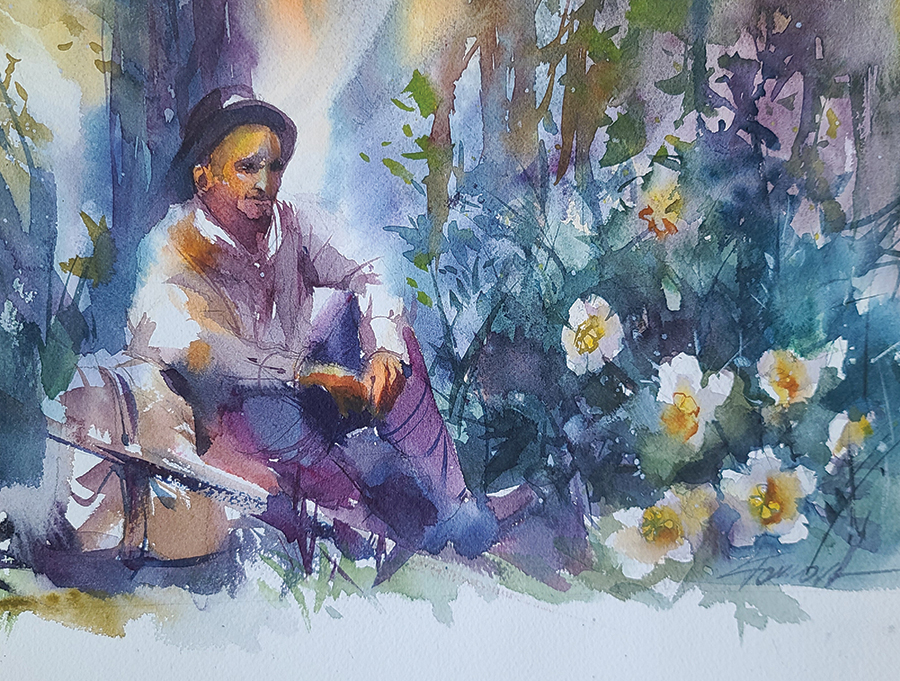
To find himself, he had to go where he could not be found. Later, when he led the fight to create the Smoky Mountains National Park, he’d write, I wanted to save these mountains because they saved me. But that would be later. When they let him out of the hospital, he sought the solitude of forests. He’d studied a topographical map of the eastern United States, searching for the blank spaces and contour lines that revealed the least inhabited region, the Smoky Mountains of western North Carolina and east Tennessee. He went by train to Dillsboro, North Carolina. Then onward, first by roads, then by trails, and finally following only a narrowing stream into deeper woods. All that he’d brought with him was his tent and an ox sled of supplies. He made a campsite beside the creek, pitched his tent.
For three months, he stayed there. Next to his campsite the stream slowed and deepened. He had never seen water so pure and clear. He’d read that in India those with afflicted minds were set beside rivers so that the sound of the water’s passage could restore their sanity. He fell asleep and waked to the rhythms of the water. The insomnia that had tormented him for years lessened. All the wilderness asked of him was to listen.
And to see. When he gazed into the pools, he could make out the individual pebbles in the sandy beds. When the midday sun shone on the water, flakes of mica made the white sand spark. The clarity of the water entered his mind. The hallucinations ceased; the melancholy began to lift. One early afternoon he saw his own face in the water. Not a reflection but instead a merging, becoming one with the stream, the forests, the mountains. Sometimes he would see speckled trout. They were the most beautiful of fish — their flanks spotted green, red, and gold, their orange fins wavering. They were small, fragile, unable to live anywhere except the purest water. He wondered what it felt like to live inside such weightlessness.
Days passed, then weeks. He grew stronger, both in body and mind. As he explored and observed, the woods became so familiar he no longer needed a compass. Instead of a watch, sunlight and shadows showed him when he needed to turn around, make his way back to his campsite before darkness fell. Unlike in the world he’d fled, seconds and minutes no longer mattered. Wasn’t the awareness of time so much a part of what he’d fled, the way it so often directed his mind to obsess on past regrets or future fears? Wasn’t the numbness he’d sought with alcohol an attempt to escape such awareness? In the daylight, he could believe he was shedding the past as a snake sheds its skin.
But some nights the old torments came. The sound of the water was not enough. The cold light of the moon, the hoot of an owl, became ominous. On such nights, he felt a deep loneliness; he could not completely rid himself of such a deep-rooted human need. Daylight would come and despair, like the dew, evaporated, but he found himself seeking the companionship of others. He came to know some of the scattered families who also lived in these mountains. He occasionally made his way to the village, even had visitors at his campsite. But only occasionally.
As the days passed, senses he had not known within himself awakened. One afternoon he was walking through the woods when a fallen tree lay in his path. He was about to step over it, had raised his foot to do so, when some atavistic impulse made him stop. For a few moments he’d simply stood there, unsure what had happened. What had halted him was nothing seen or heard. For a few moments longer he listened, heard nothing, saw nothing. He walked around, not over, the fallen tree to see what lay where his foot would have stepped. He saw it then, the coiled, satin-black body, the arrow-shaped head, the blunted tail that rattled once, stilled. The snake uncoiled itself and vanished into the underbrush.
Another afternoon while he passed beneath a rocky cliff, he felt he was being watched. As with the rattlesnake, he paused, saw and heard nothing. He’d walked on, but the sense of being observed would not leave him. Twice more he stopped and looked behind him. The third time he looked up, not back, and saw the mountain lion on a ledge. The cat swished its black-tipped tail three times, then turned away. How much had we lost, he’d wondered after such moments — not just knowledge but an expansiveness of being? What more might we discover within ourselves if fully attentive to the world?
After three months, colder weather came. He moved into an abandoned cabin even deeper into the wilderness. The cabin would be his home for three years. He left for days at a time, made the long journey down Hazel Creek to the nearby village. He wrote and published articles about the wilderness that surrounded him. Other times he shared his cabin with visitors. He had never thought of himself as a hermit, but most days and nights he was alone. The hallucinations did not return, but there were still periods of melancholy, and not always at night.
One autumn morning a soft rain fell; fog wreathed the trees. He had not been here long enough to find, as he later would, solace in such weather. The grayness had turned his mind inward, resurfacing the vexations he had come here to escape. Despite the weather, he left his cabin to walk along the stream, hoping movement might help ease his mind. Then the rain lessened, stopped. The fog unknit itself and the strands drifted away. He was passing through a stand of poplar trees when, like a lamp wick being turned up, the yellow leaves brightened and the world shimmered in a golden light. The air was charged, and he felt his heart lift, a sensation beyond words, awe the only word proximate. But that morning it had seemed any attempt to define the sensation with language was such a puny, human thing. Though he would eventually write a whole book about these mountains, describe the plant and animal life in detail, extol the landscape’s pristine beauty, there were moments like this that he would never put on paper.
His detractors, then and now, called him a romantic, which was true. He had read Petrarch, Wordsworth, and Thoreau, learned from and been inspired by them. But he did not believe himself a sentimentalist. A part of what had brought him here was to abide in a world without sham. Arrogance and bluster did not impress nature. It did not suffer fools. A heedless step above a waterfall would send the rich and poor, the powerful and the powerless, to their deaths. No bribe or petition would make it otherwise. Wilderness could not be corrupted by humans, but humans often destroyed what they could not corrupt.
One summer afternoon he followed the stream beside the cabin to its source, then went farther up the mountain until nothing rose above him but the sky. He looked out at the surrounding mountains and valleys, the virid green of the nearer ridges, the hazy blue of the farther mountains. But he also saw something else, smoke rising from a lumber camp. He knew what would come next, the sound of axes and saws, then the clamor of a train engine bringing more men and axes and saws — a wilderness chained to flat cars and hauled away. Whole mountains scalped, the stumps of felled trees like gravestones. Streams fouled, dead fish clotting the shallows.
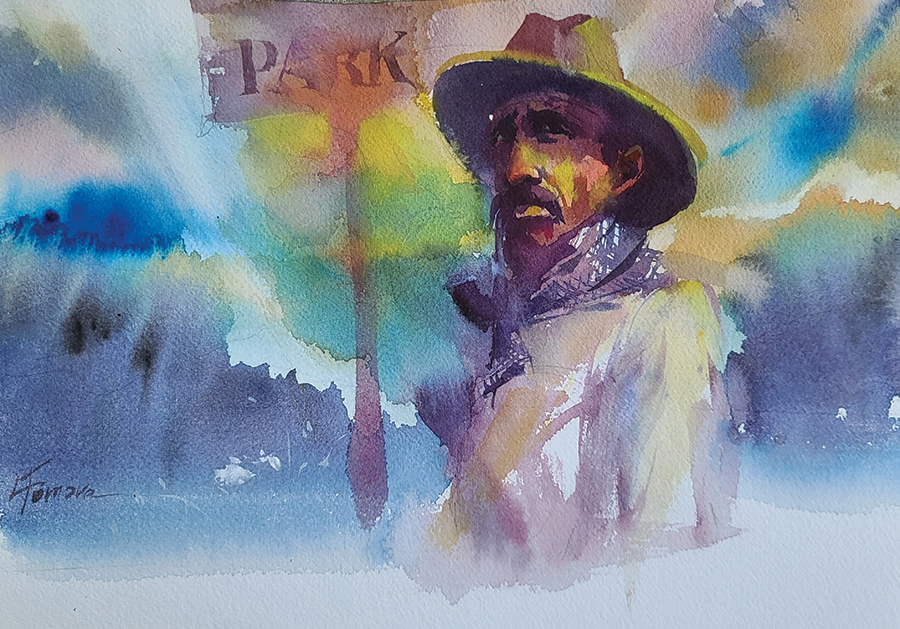
He had already witnessed such devastation in the nearby Black Mountains, nothing left but a wasteland of stumps and silt. It would soon happen here too if not stopped, was happening. When logging began on Hazel Creek, he was forced to abandon the cabin and move to a boardinghouse on the wilderness’s eastern flank. So he joined others who understood what was being lost. Following the example of John Muir, who’d garnered nationwide support to establish Yosemite National Park, the coalition sought allies both in and outside the Smokies.
For a quarter-century, he and his compatriots fought against the timber companies to create the Smoky Mountains National Park. Though he continued to disappear into the woods, sometimes camping for weeks, most of his energy was focused on helping save the East’s last great forest.
He wrote letters and articles, made trips to Washington. What he and others could not accomplish with words, his friend George Masa did with photographs depicting both the forests that had been destroyed and the ones that might soon be. Wilderness advocates across the nation joined the fight. Newspapers in North Carolina and Tennessee furthered the cause.
But the timber companies had their advocates too. The attacks against the park’s best-known supporters became personal. He found himself denounced publicly as a Bolshevik, an opium addict, a drunk, a man who’d been deserted by his own wife and family. Because of his Japanese ancestry, Masa was denounced as a foreigner. Attempts were made to deport him. The timber companies tried to bribe and threaten politicians who supported the park, and sometimes they succeeded. There were death threats too. Public meetings brimmed with potential violence. Again and again, it appeared the timber companies had won. By 1920, he wrote a friend that there was no hope. At such times the melancholy deepened. He feared the insanity might return.
But each time all had appeared lost, crucial support came. Children gave pennies at school. John D. Rockefeller donated five-million dollars. George Masa’s photographs convinced Grace Coolidge, the First Lady, to join the cause. The governors of Tennessee and North Carolina advocated for the park in their states and in Washington. Newspaper editors in Knoxville and Asheville wrote more editorials. Public opinion became solidly pro-park, even after the stock market crashed, plunging the country into depression.
Now it is April 2, 1931. Two months ago, he went to Washington with Governor Horton and Governor Gardner to hand over to the Secretary of the Interior the deeds to the purchased land. It was only 150,000 acres, three-hundred thousand short of officially being a national park, but enough to satisfy the National Park Service. It will happen, he believes, though it may take another year or two to complete the final deeds and sales.
♣
A light knock at his door breaks his reverie.
Mr. Kephart, his landlady says. Your friend is waiting in the parlor.
Tell Mr. Tarleton I’ll join him shortly, he replies.
Earlier today Tarleton congratulated him, believing the park now an inevitability. But the envelope in his hand, which came in the afternoon mail, makes clear not everyone agrees. Kephart, Go back to St. Louis and your asylum or you will be killed, the enclosed note threatens. A newspaper clipping accompanies the note, dated March 25, 1904. Horace Kephart Is Held for Observation, the headline proclaims. The timber companies and their minions have not yet given up. He places the clipping and the note back in the envelope. In Saint Louis, a diseased mind had convinced him of all sorts of plots to take his life; now sanity argues not to dismiss this threat. But advocating for the park has brought death threats before, to him and others.
In September he will be sixty-nine. He never imagined that he might live this long. Yet his wrinkles and gray hair confirm it. He feels the rheumatism in his knees and back, no doubt in part from decades of hiking and camping. Though still able to hike farther than many men half his age, he knows these ailments may soon force him to spend less time in the forests than he’d wish. But if the time comes when he is confined in this room, he will be able to look out his window and see the mountains, one of which has been named Mount Kephart.
He thinks of the cabin on Hazel Creek. Once the park is complete, neither he nor anyone will live there again. It pleases him to imagine the wilderness slowly reclaiming the cabin. There will come a time when the land itself will have forgotten the cabin’s once-presence. By then the scars left by the timber companies will have healed. Even the railroad tracks will rust away. The envelope with the newspaper clipping and threat is still in his hand. He tears it in half, drops it into the trash can.
I wanted to save these mountains because they saved me, he’d written. It was a grandiose statement. They had indeed saved him, but others had paid a cost, most of all his wife. As for his children, they are all but strangers. Altruism is invariably a means to conceal one’s personal failures. The spouse of a timber baron had told him that three years ago at a public meeting. The statement haunts him. And for all of his words about the healing aspects of nature, his desire for liquor has never been quelled. There continue to be times he drinks himself into unconsciousness.
Perhaps tonight as well. He takes out his pocket watch, checks it. It is almost time to meet his friend Tarleton. They have hired a driver to take them to a bootlegger. They will drink tonight. If, as is his wont, he will be no good in the morning, he will lie in bed most of the day to recover. But even so, by this weekend he will be revived enough to join George Masa for a hike. He has a surprise for George. Last spring as he was hiking alone, he discovered a patch of Oconee Bells. They are found nowhere else in the world except here and a few neighboring counties. Even here they are extremely rare. In all of his years wandering these mountains, he had never come upon them until last spring. Now it is their bloom time once more, the white flowers rising from the dark-green glabrous leaves. This late in life, what wonder to have finally seen them.
He rises from the chair, fetches the key he will lock his door with, and will never need again.PS
♣
Coda: Horace Kephart and his friend Fiswoode Tarleton died in a car wreck on the night of April 2, 1931. The driver survived but gave contradictory answers as to what happened. Kephart’s body was discovered forty feet from the car, the cause of death a broken neck. On September 2, 1940, Franklin D. Roosevelt dedicated The Great Smoky Mountains National Park “for the permanent enjoyment of the people.”
I like totroll thrift stores for books. It’s always an adventure, and at 50 cents apiece, you can hardly go wrong. If you do, you can simply re-donate. No harm. No foul.
Occasionally you reach for a book that looks interesting and find the joke’s on you, because when you open it, you discover it’s one you donated months ago. Standing there looking at your own name and the little stamp you mark your books with, you feel strangely proprietary and a little ashamed all at the same time. Worse, it’s just possible that the book is looking back at you with an accusatory stare, as if to say, “How could you give me away? Don’t you love me anymore?”
More interesting, however, are the times you find other people’s names and marks. Or an inscription that says: “To Glenn, May this first Christmas as part of our family bring you joy, George and Grace, Christmas, 1993”; or “M. A. Crichton from Mrs. Pyle, Christmas, 1938.”
Then, too, there are the stamps along the deckled edges or on the title pages that say Estes Valley Library — Withdrawn; Vermillion Public Library, Vermillion, South Dakota; Dowse Memorial Library, Sherborn, Massachusetts; Rivoli Township Library, New Windsor, Illinois; Fort Loramie Jr./Sr. High School Media Center; West Slope Community Library, Portland, Oregon; or most exotic of all, U.S. ARMY RVN SPEC SVC LIBRARIES APO 96243. That’s when you know the book has a life of its own, a story to tell. You hold it in your hands, leaf through the pages, trying to imagine exactly how it got here. What circuitous path did it follow to wind up on this shelf, perhaps thousands of miles from where it started?
Sometimes, there are even clues, relics of another reader’s life, hidden among the pages — a receipt from a bookstore in the Denver airport, a flier for “Buddhism and Meditation” from the Rameshori Buddhist Center in Atlanta, or a small ivory card printed in pale blue with a drawing of a young Chinese student at his desk and the words “If found please return to,” but with nothing filled in.
Best of all are the bookmarks — Decitre Librairie Papeterie in Lyon, France; Arcadia Books in Spring Green, Wisconsin; Golden Braid Books in Salt Lake City; Frenchmen Art and Books in New Orleans; Lunenburg Bound Books and Paper in Nova Scotia; Eighth Day Books in Wichita; the iconic City Lights Books in San Francisco; and much closer to home, Blue Ridge Books in Waynesville, North Carolina.
Of course, the stores they represent are indies and not thrift stores, but you love them all the same. You can just visualize the people who work there, how the books are arranged, the comfy sofas and chairs, the jingle of the bell as the regulars come in the door. You wonder if they’re still in business, and if so, whether some day you could — would — pack your bag and go there.
How you would walk in and say hello to the woman or man behind the counter; tell them you’ve come all these miles because of the bookmark you hold in your hand, a bookmark you found in Manhattan Transfer by John Dos Passos or The Red Notebook by Antoine Laurain, or The Buffalo Hunters by Mari Sandoz or Blondes, Brunettes and Bullets by Nils T. Granlund; or a thousand possible others.
And you are absolutely certain they will smile and be thrilled that you have come so far to visit their store. Then they will offer you a scone, show you around, pull volumes off shelves for you to admire. And you will buy something, new or used, not only because it’s the polite thing to do, but because you really do want that Penelope Lively or Kent Haruf or Philippe Claudel that’s sitting right there on the shelf. Besides, there’s always room in your luggage.PS
Patricia M. Walker is a retired teacher/purchasing manager/financial services administrator who was born and raised in Chattanooga,
Tennessee. She wrote her first novel when she was 9.
That rings a bell at a triple-dome Pinebluff structure resembling an albino caterpillar/spaceship — a real shocker in the cottage-y enclave adjacent to Pinebluff Lake.
“Oh yes, people stop and knock on the door,” says Candy Ruedeman, who bears no resemblance to an extraterrestrial. The undulating exterior of the domes is the antithesis of conventional stick construction with its straight lines and 90 degree angles. The shaded interior, resulting from limited windows, feels comforting and safe, enveloping its occupants. Inside, the air feels cool rather than AC-frosty. Each room is equipped with a ductless, wall-mounted AC/heating unit. Concrete blown over a foam core provides insulation. Poured concrete floors refresh bare feet.
Although above ground, construction surpasses FEMA’s guidelines for survivability. In 2016, Hurricane Matthew blew a dock off the nearby lake but swept over the domes without damage.
These monolithic dome homes — the semi-official title — are fire resistant, termite-and-rot-proof, energy efficient and, besides hurricanes, have survived tornadoes and earthquakes. Some are lavish multi-story residences with balconies and turrets. Others enable year-round swimming pools. A commercial dome housing offices or stores benefits from instant recognition. Ski resort domes, beach domes, mountain domes, office domes, school and studio domes exist. Still, not everybody could live in a house where hanging pictures can be a challenge, where straight-line furnishings don’t fit, where electric outlets can’t be added or moved, and where bumping into a textured concrete wall can skin a knee.
Skip and Candy Ruedeman weren’t “everybody.” He served in Vietnam as an Air Force fighter jet mechanic. She was a critical care nurse. Both grew up in Kentucky, in ordinary middle-America houses. Their only joint residential adventure: building a log home from a kit.
They were living in Colorado as retirement from the water-conditioning business approached. “We wanted to get back to the green, and be nearer the beach,” Candy says. Golf was a factor, but not primary. Skip had a cousin who lived in Moore County. They came for a look, liked the area but not the resort bustle of Pinehurst and Southern Pines.
“I can make a home anywhere,” Candy continues. “But we wanted a place where we couldn’t hear the neighbors.” The 1-acre heavily wooded lot in Pinebluff suited their needs.
Skip knew dome homes from helping a friend build one in California. The mechanics fascinated him. Explained simply, a ring foundation reinforced with rebar is laid for each dome. Vertical steel bars embedded in the ring attach at the overhead apex. A special fabric is placed on the base and inflated. Foam is applied to interior surfaces, which are then sprayed with a concrete mix that can be painted.
Because of zoning and planning requirements each window opening required a dormer-like configuration. The Ruedemans topped them with curved “eyebrows.” The division of interior space can be accomplished with straight walls, or curvy, suggesting niches. For their “Pine Dome,” Candy and Skip chose mostly curvy, creating the look of a modern art museum.
“Curiouser and curiouser,” Alice whispers from the rabbit hole.
The 1,700-square-foot space was sectioned into a living-kitchen-great room, three bedrooms, two baths and two eating areas, but no formal dining room. Closing off a corner of the kitchen created a pantry. Conventional glass doors open onto a deck overlooking a clearing where Candy feeds the forest creatures. At one end of this three-hump caterpillar stands a conventional shed/workshop for Skip’s tools; at the other, a fenced vegetable garden.
Construction by professionals, with the Ruedemans crewing in, took eight months. Lacking straight lines, the house presented measuring problems for building inspectors. In December 2014, they moved in.
The couple decided to ditch all their furnishings except one bed and start anew at Ikea, supplemented by tables, shelves, and other pieces, including an African violet stand designed and crafted by Skip. Since the master bedroom had no wall space for their dresser, they created a closet around it. A desk belonging to Candy’s dad became a bathroom vanity.
Other décor choices have a single purpose: showcasing mementos accumulated by a close, loving family. One hallway is virtually covered with photos of their two sons and five grandchildren plus framed documents from Skip’s Air Force career. An old printer’s tray holds miniatures. A photo shows Candy skydiving. In one bedroom Candy hung sections from a quilt made by her grandmother. On a kitchen wall, a holder displays painted eggs. A dulcimer made by her father hangs on another.
The top section of a lawyer’s bookcase with glass doors stands opposite the sofa. In it is a collection of dolls and teddy bears, each representing a person or event. “That one is from my first Christmas. This is the first Christmas present Skip gave me,” Candy says. “This is the first time I’ve had them on display.”
Skip loved trains. A toy track and cars are mounted over the deck doors. Candy’s best idea was asking friends and family to paint wooden pulls for the kitchen drawers and cabinets. Each is different, personalizing a galley kitchen separated from the living room by only a counter.
But what must the neighbors think? That a UFO landed on their quiet street? Don Woodfield lives across from Pine Dome. He watched the construction from clearing the land to blowing the concrete. His opinions have been positive from the get-go.
“Never a thought,” Woodfield says. “Just we’ve got new neighbors. Let’s go find out about them.” So over he went, beer and snacks in hand, soon discovering that, like himself, Skip was a Vietnam vet. Later on, they worked together on a Habitat for Humanity home build.
By now, the caterpillar has settled into the landscape. The coffee-colored plush sofa and upholstered headboards don’t seem stranded against curving walls. But this summer something is missing.
Skip passed away last August, suddenly, at 76. Candy is comforted living among his handiwork.
“This house was our legacy. This is what we chose to do, the house Skip wanted to build.”
There have been offers to buy Pine Dome. But for now Candy, with visits from her children and grandchildren, will stay close to him here, in a house far from ordinary but close to home.PS
Near the end of the baseball classic Bull Durham, strong-armed Nuke LaLoosh goes looking for his catcher, Crash Davis, to tell him he’s been called up to the majors. He finds Crash in a pool hall owned by Sandy Grimes, who’s sitting with his back to a wall and a cue stick in his hands.
“Let’s get out of this dump,” Nuke says.
“You callin’ my place a dump?” Grimes jumps to his feet.
“No. He’s not. He’s not. All right?” Crash smooths it over. He turns to the phenom he’s been nursemaiding through the minors and says, “Do you know who this is? This is Sandy Grimes. Sandy Grimes hit .371 in Louisville in 1965.”
Grimes is quick to correct him. “.376.”
“I’m sorry,” Crash says, genuinely apologetic. “He hit .376. That’s a career, man. In any league.”
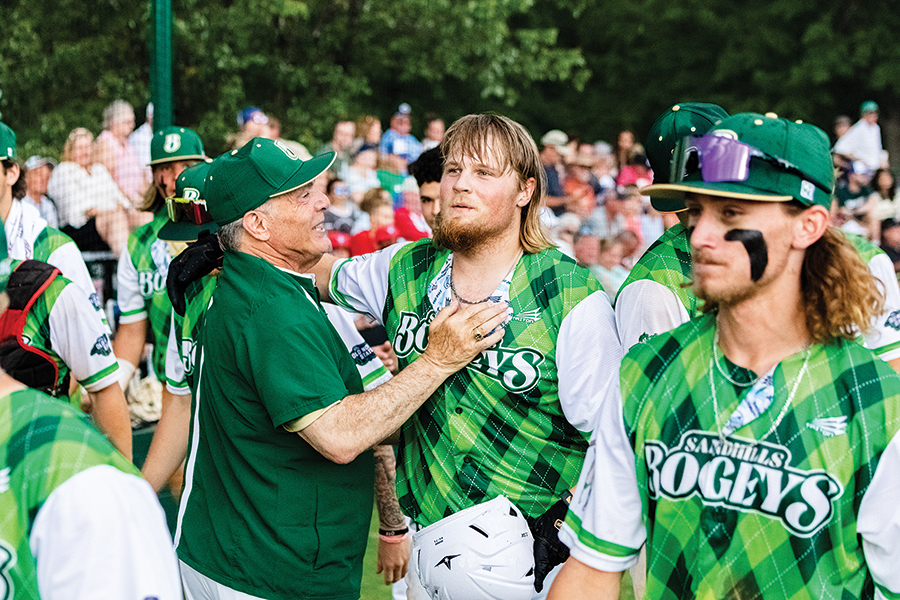
The chances are pretty good that, even when the full roster of the brand-new Sandhills Bogeys baseball team was introduced to their manager, Bernie Carbo, few if any of them knew who he was. And that’s OK, even if he was way, way better than Sandy Grimes.
The Bogeys are the newest “franchise” in the Old North State League, where 13 teams compete for a couple of months in the summer the old-fashioned way — with wooden bats — just like the pros. They’re playing in a park built especially for them on the campus of Sandhills Community College, and the only aluminum you’ll find won’t be in a bat, it’ll be in a soda can. The players on the Bogeys can be forgiven if they didn’t recognize Carbo’s name. They’re in their late teens and early 20s, guys playing in college or getting ready to, and the man they were being told was guiding their summer team is 74. Carbo played in the big leagues for 12 seasons with five different clubs in both the American and National Leagues. He moved to Southern Pines from Mobile, Alabama, about 18 months ago with his wife, Tammy, a retired educator. When they were first married, Bernie adopted Tammy’s son, who took the name Bernardo Christopher Carbo Jr., and is now a psychologist and an officer at Fort Bragg.
“Bernie’s a trip,” says Alec Allred, who started the Old North State League in 2018. “Anytime we can have a former big leaguer that is the manager of one of our teams, obviously you can’t say no to that. He’s an incredible baseball mind. I enjoy just sitting around listening to his stories. He’s a legend, truly. The players are going to enjoy playing for him. They get to be around it every day this summer.”
Sandy McIver, who was the pitching coach at Union Pines High School, and Tom Shaffer, who coached baseball at Georgetown University, will be doing most of the heavy lifting when it comes to coaching the team, but it would be a mistake to think of Carbo as little more than a conversation piece. If your goal is to get better and you have a chance to talk hitting with a guy who has been teammates with Frank Robinson, Pete Rose, Johnny Bench, Lou Brock, Carlton Fisk, Jim Rice, Carl Yastrzemski, Fred Lynn, Willie Stargell and Dave Parker; a guy who has run a few questions about the art of hitting past Ted Williams, Henry Aaron and Stan Musial; a guy who has stood in the batter’s box against Bob Gibson, Jim Palmer and Nolan Ryan; you might be able to learn a thing or two.
And, if not, the stories are worth the price of admission.
“First time I faced Nolan Ryan I heard the umpire go ‘Strike one’; ‘Strike two’; ‘Strike three.’ I turned around to the umpire and I said, ‘I didn’t see any of those pitches.’ And the umpire said, ‘Neither did I, but they sounded good.’”
Versions of that story have been told about every pitcher whose velocity creeps into triple digits — including Bob Feller and probably going all the way back to Walter Johnson — but it’s a helluva a story, and even if it’s not 100 percent original, it sounds good, just like Ryan’s pitches. “Walk in the clubhouse, you’d see all the guys in the training room. We all knew who was pitching,” Carbo says. “Nolan Ryan. Nobody wanted to play. He struck me out 19 times in a row. He threw me a change-up and I hit a home run.
“Jim Palmer gets me out for five years,” Carbo continues, the memories stirred together like cream in coffee. “I get a base hit off him and he comes to first base and says, ‘I want to shake your hand.’”
Palmer even autographed a baseball for him. It said Jim Palmer 0-for-5 Years.
Those are the stories Carbo tells on himself. But if you think he couldn’t hit because a couple of Hall of Famers gave him fits, you’d be mistaken. The first major league draft was in 1965. Rick Monday, Billy Conigliaro and Ray Fosse were in it. So was Bernie Carbo, picked 16th. Johnny Bench was taken 36th. Carbo’s first full year in the majors was 1970. He hit .310 with 21 home runs and 63 RBIs and was second in the Rookie of the Year voting. That’s a career, man. In any league.
And he just happened to have a starring role in one of the greatest baseball games ever played. You can look it up. Game six of the 1975 World Series between the Boston Red Sox and the Cincinnati Reds. Carbo was on the Red Sox, but he’d previously been a Red for four seasons. He knew both dugouts intimately. The Reds had Pete Rose, Tony Perez, Joe Morgan, Johnny Bench, Davey Concepcion and George Foster. The Red Sox had Carlton Fisk, Fred Lynn, Carl Yastrzemski and Jim Rice, who couldn’t play because he was injured. Altogether there were six Hall of Famers in the series, seven if you count Reds manager Sparky Anderson.
With Cincinnati ahead three games to two in the series and leading in game six, 6-3, Carbo was sent in to pinch hit in the bottom of the eighth against reliever Rawley Eastwick. In 2015 the National Baseball Hall of Fame brought Fisk and Eastwick together on stage to reminisce about the game. It was Fisk’s home run that hit the left field foul pole (now named in his honor) in the 12th inning that ultimately won it for the Red Sox. They lost the series the next day. The film clip of Fisk waving the ball fair as he hopped and leaped and clapped his way down the first base line is a classic. It’s more famous in Boston than Sam Adams. But it was Carbo’s three-run blast that gave him the chance.
With the count 2-2, Carbo fouled off a couple of pitches and looked overmatched doing it. “Carbo had one of the worst swings that a major league ballplayer could have ever had; he just barely fouled the ball off to stay alive, or he would have been out,” Fisk said at the Hall of Fame. “And then the next swing it’s the best swing you could ever see in a game.” The drive easily cleared the center field wall, traveling somewhere between 420 – 450 feet, setting up Fisk’s heroics. “The game started on October 21st and ended on October 22nd,” Fisk said.
In the top of the 10th Rose came up to hit, looked back at Fisk and said, “This is some kind of game, isn’t it?” Undoubtedly there are a few expletives omitted in that telling, but the sentiment was sincere enough. Later, Rose told his manager it was the greatest game he ever played in.
Hitting advice, however, isn’t the only way Bernie Carbo can help the Sandhills Bogeys. He can tell kids what not to do, too. Carbo’s self-published biography is titled Saving Bernie Carbo. It’s written with a psychologist, Dr. Peter Hantzis, using an unusual format. Hantzis does a brief introduction of each chapter; Carbo talks the reader through it; and, at the end, the doctor makes “educational comments” evaluating Carbo almost as if he were making notes about a patient. Hantzis still uses the book in the psychology classes he teaches at the University of Massachusetts Lowell. “For Bernie the most important thing was finding his faith. That’s what really saved his life. And I agree. I think that’s exactly what happened,” Hantzis says.
During his talk at the Hall of Fame, Fisk said that Carbo was more than offbeat, “he was just off.” Carbo’s autobiography explains some of the reasons why. His father was a cruel man, a fighter in a circus, and he beat both Bernie and his mother. He was a man with unrealized baseball ambitions of his own who simultaneously lived through his son while constantly berating him.
“I became a drug addict and an alcoholic,” Carbo says of his years in the majors. “When I got to the big leagues, I quit working. What happened to me? I got worse.” Carbo can be a powerful force when it comes to explaining to young men how to honor their God-given talent.
His mother tried to commit suicide when he was a boy. She succeeded when he was a grown man. “My mother commits suicide. My dad dies. I’m going to commit suicide,” Carbo says. He was saved by a couple of former teammates, pitchers Bill Lee and Ferguson Jenkins, and a Baptist minister he shared a Tampa hospital room with. “God put me with a preacher,” says Carbo. And it took.
“Bernie Carbo did not receive treatment for his mental health and substance abuse problems until he was in his mid-40s,” writes Hantzis in Saving Bernie Carbo. “Sadly, even if Bernie had as a child been identified as a victim of abuse and trauma, his treatment options would have been limited. In the 1950s child psychiatry, child psychology, social work and family therapy were in their early stages, and unavailable to many children.”
Clearly, when it comes to the art of hitting, Carbo can be a constructive influence for players who want instruction. Not everyone on the roster will, and he knows that. The Old North State League isn’t necessarily a steppingstone to anything other than a summer of fun. “They’re coming to this league to have fun, to enjoy it and play baseball,” says Carbo. “But you never know who’s watching. David Justice went to Thomas Moore University. They were playing a Division I school and the Atlanta Braves had two kids they wanted to see on the Division I team. David Justice hit two balls out of the park. The guy from Atlanta calls the Braves up. ‘Thomas Moore has this kid and he’s just unbelievable.’ Next thing you know he’s the No. 1 draft choice. Plays in the World Series.”
But if you do want a little help swinging the bat, there’s probably no one better in the Old North State. “These guys obviously understand the sport at a different level. You know his spring training coach was Ted Williams. Can you imagine?” says Hantzis. “Bernie has a great style of communicating. He looks you right in the eye. He’s so sincere and he’s so interested in you. Bernie is unique. This is a great man.”
Sometimes, you do know who’s watching. One of the catchers on the Bogeys is Riley Cameron, who graduated from Union Pines in 2017, played two seasons at Wheeling University and will transfer next year to Catawba College. “I play summer ball every summer and I haven’t gotten to play close to home since I’ve been in college,” Cameron says, “so I’m glad that I can play in front of my family and friends again.”
Allred, who is an associate scout for the Texas Rangers, sees opportunity in the Sandhills because of its strong high school baseball programs and thriving tourist economy. “It’s just a perfect market for a baseball team,” he says. “Our players are at the forefront of our thoughts in terms of how we try to do everything, but we have started focusing more and more on the fan experience. That’s why we’re so excited about having this team in the Sandhills. We really want to try to go to a different level and incorporate a lot of what minor league baseball does in terms of the between-inning promotions and stuff like that to really get the fans engaged. This is almost going to be a pilot team for how we’re going to operate in the future.”
Besides knowing when to look for the curve and when to call it a night, Carbo can offer at least one more piece of wisdom. The first time he was getting ready to hit against the Cardinals Hall of Famer Bob Gibson, Carbo was in the on-deck circle but began creeping closer and closer to home plate, taking practice swings, trying to time Gibson’s pitches. (Just for context, in 1968 Gibson’s stat sheet read like this: He was 22-9 with an ERA of 1.12 and pitched 28 complete games, including three in the World Series. And you simply did not mess with Bob Gibson.)
“The ball goes whoosh!” Carbo says, turning his head quickly. “I go back to the bench. ‘Sparky, that guy just threw at me.’ When I got traded to the Cardinals, I got to know Bob a little bit. ‘Bob, do you remember throwing at me in the on-deck circle? He says, ‘Yeah, I missed you.’ I ask him ‘Did you intend to hit me?’ He says, ‘Yes.’”
The upshot is, you need to find those places in life where you’re safe. It took Bernie Carbo more than 40 years to find his.PS
Jim Moriarty is the Editor of PineStraw and can be reached at
jjmpinestraw@gmail.com.
Contrary to popular belief, grilling is not just for meat lovers. Whether you grill a juicy burger or mushroom caps, the universal experience is much the same — hot glowing embers, sparks flitting about like fireflies, the bitter aroma of smoke wafting in your face, and the sheer joy of preparing a meal under the open skies. The symphony of sounds, smells and the visual excitement of grilling speaks right to our hearts as most of us recollect beautiful childhood memories of breezy, carefree summer days spent with friends and family.
To clear up one common misconception for my fellow expats and anybody from north of the Mason-Dixon line: Grilling and barbecuing are not the same in our neck of the woods, despite most of the English-speaking world using these terms interchangeably. Ask any native Southerner with a penchant for pork. Authentic Southern barbecue calls for low heat, a considerable amount of smoke, and plenty of patience, to name just a few ingredients, whereas grilling requires hot and dry heat, which will swiftly and effortlessly cook the food. So, this season, join us in celebrating traditional, mouth-watering, grilling fare with a bit of a Bohemian twist!
Strip Steak with Cherry Mint Chutney
Instead of preparing sophisticated and laborious marinades and brines, stick to the basics. Achieve bold and intensely rich flavor with a simple yet potent pre-rub: Brush steaks with olive oil; mix equal parts of ground cumin, paprika and coriander; and rub on the meat. Sprinkle generously with salt and freshly cracked pepper and grill for about 4–5 minutes per side. For an exotic twist, serve it with a cherry mint chutney — use your favorite, basic vinegar-based chutney recipe, replace the fruit with fresh, pitted cherries, and add fresh mint leaves to it.
Moroccan Grilled Shrimp with Harissa
Coated in ras el hanout, a unique spice blend abundant with aromas of cardamom, cinnamon, ginger and rose, these crustaceans are exceptionally zesty as shrimp effortlessly adapt flavor. With a little char from the grill, a dollop of smoky harissa and fragrant, crushed mint leaves, the Mediterranean doesn’t seem so far away anymore. Make your own harissa using a mixture of dried and fresh chilis combined with caraway and cumin seeds, fresh garlic, lemon juice and rosewater. Blend into a fine paste. Pair with an herby couscous salad and fresh mint tea, or push the boat out with a mojito — the choice is yours.
Greek Chicken with Toasted Almond Hummus
Undoubtedly, the thighs are among the most richly flavored parts of the chicken, next to the wings. With a respectable skin-to-meat ratio and a high fat content, chicken thighs carry and amplify any flavor or seasoning you might add. For a Mediterranean twist, combine yogurt, olive oil, lemon zest, fresh minced garlic, oregano, salt, pepper, and marinate for at least 30 minutes (or up to several hours) in the fridge. Cook chicken thighs, bone-in, for about 8–10 minutes on each side until cooked through. Serve with fresh, chopped veggies and toasted almond hummus — simply dry roast sliced almonds in a frying pan until fragrant and puree together with your hummus ingredients.
Balkan Burger with Ajvar and Blue Cheese
How to elevate the ubiquitous, humble, all-American sandwich into epicurean realms: Dress it up with artisanal cheese and Old World-style relishes and condiments. The latter, we’re borrowing from Balkan cuisine. Ajvar, also called “Balkan caviar,” is made from sweet peppers and eggplant slow-cooked for several hours. The result is a refined, opulent, richly flavored spread that can be teamed with many dishes but works especially well atop a juicy burger, together with a pungent, sharply flavored cheese.
Grilled Peach Crostini with Whipped Goat Cheese, Honey and Thyme
The quintessential North Carolina summer fare, as far as I am concerned, is grilled peaches, hands down. Peaches are seductive in their natural state but become even more enticing grilled. The fruit sugar caramelizes and flavors intensify, the char marks form and smoke imparts woodsy notes into the skin and flesh. Grill for 2-3 minutes on each side, serve atop silky smooth whipped goat cheese on grilled slices of bread, and drizzle with honey. To whip goat cheese, combine 2 parts goat cheese with 1 part cream cheese, a generous dash of olive oil, and pulse in a food processor. PS
German native Rose Shewey is a food stylist and food photographer. To see more of her work visit her website, suessholz.com.
Question: How much should a house reflect its occupant’s background/taste/lifestyle/beliefs?
Somewhat, with a few pertinent artifacts, mementos?
Definitely, with unity of theme or period, palette or furnishings?
Completely, for Le-Arne Morrissett of the lilting Aussie accent.
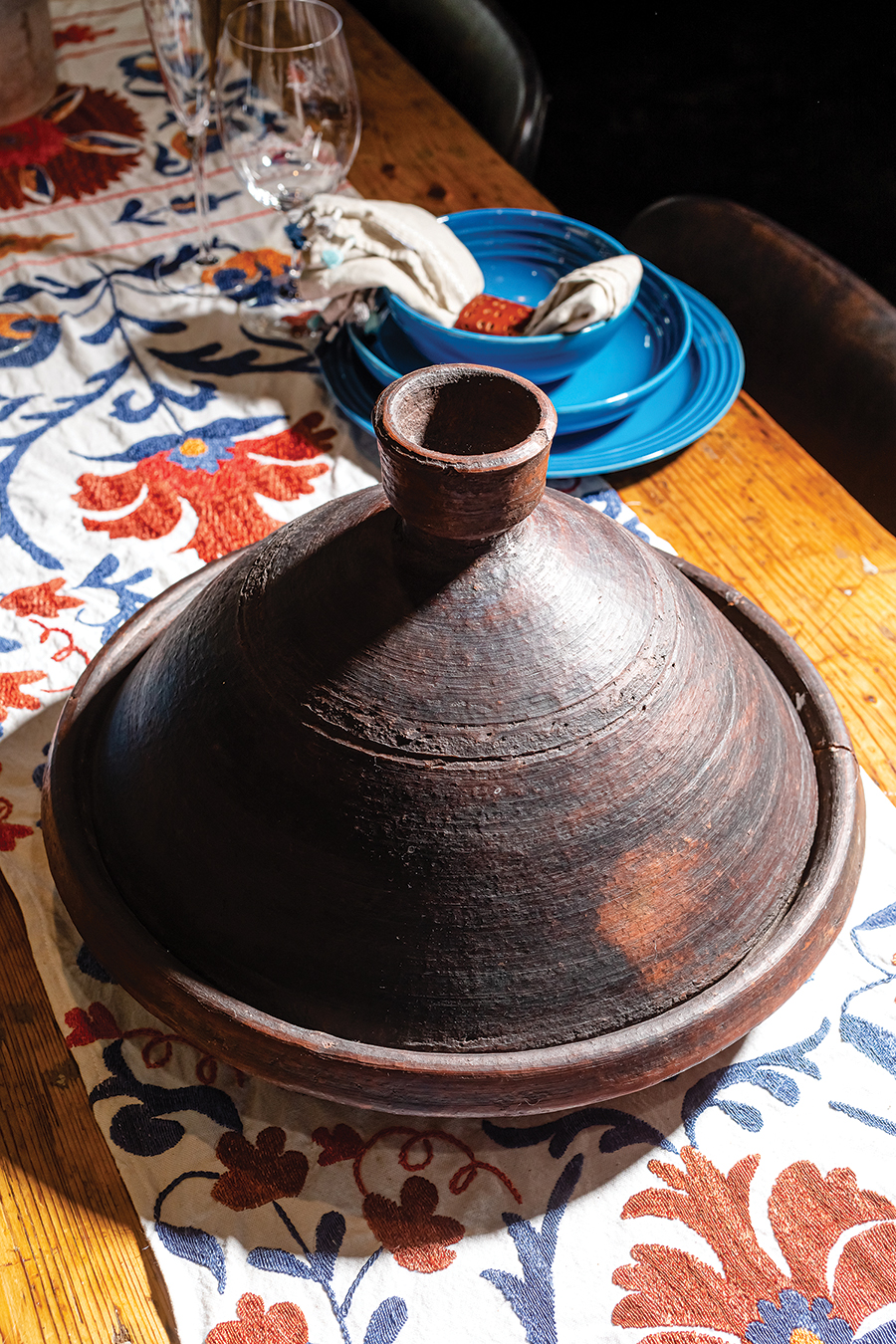
This requires formidable juxtaposition, since Morrissett’s house is cookie-cutter contemporary, located in a cluster of villas, circa 1980s, overlooking Lake Pinehurst. The interior, however, conjures distant continents: A paella pan hangs from the wall, and a tagine sits on a rough-hewn refectory table, in front of a vast counter assembled from reclaimed wood which, aided by a massive cedar beam, divides the open kitchen from the great room containing a cream-colored sectional and two chairs upholstered in orange velvet.
“Orange is a color that has an awareness to it, and makes people happy,” Morrissett believes.
From the tagine comes chicken tagine, a Moroccan specialty redolent of preserved lemons, apricots, olives and spices. The aroma — totally casbah. From the paella pan comes Thanksgiving dinner.
Beside her front door, Morrissett planted a Buddha garden, selecting a small statuette from her collection. On the walls hang century-old woven tapestries called suzani, once included in bridal dowries.
A single swath of Uzbekistani fabric drapes a sidewall window and cascades onto the floor.
While the effect might excite a Western eye, Morrissett — having experienced Asia, India, Pakistan, Turkey, Europe — describes it as “calm,” a favorite word.
Zen abides here.
It was a former husband’s golf quest that lured this distaff Marco Polo to Pinehurst.
“I’ve always lived by the water,” Morrissett explains, looking out over the sun-sparkled lake. “I love the calmness and quiet nature of the water, the ducks and geese.”
What she didn’t love was the predictable condo layout, which cut 2,000 square feet into cubicles. So she took most of the main floor down to the studs, opened it up, then closed off the loft (accessed by a free-standing winding staircase) to make a guest suite. This created a second-story wall — perfect for hanging abstracts, one by her daughter at age 5. Other oversized décor includes two weathered barn doors attached directly to a wall. A ceiling fixture was constructed from three massive glass jars resembling light bulbs suspended from the cathedral ceiling.
The floors: What could this material be, so cool to bare feet? Puddles of bright, navy-blue-against-gray concrete, sealed with a glaze, common in Australia, replaced vinyl floors and, surprisingly, kitchen countertops. Carpet wears out, wood needs refinishing, Formica stains. Concrete is forever.
Area rugs in blue and orange Middle Eastern designs soften footsteps in high-traffic areas.
Morrissett is an artist. Her medium, hair, which she styles at Beautopia, her salon in downtown Southern Pines. But she also indulges in shoes. Remember Imelda Marcos, first lady of the Philippines, infamous for her politics, famous for her 3,000 pairs of shoes? Morrissett’s collection numbers only 100, visible from a made-to-order cabinet in the master bedroom.
“Shoes make me happy,” she says. No surprise, hers are colorful, unusual, better for dancing than office wear. So why not display?
Obviously, this lady revels in the unconventional. The remodel of her bathroom puts a tub inside the glass shower enclosure, a nod to Turkish bath houses — surely a first in Moore County. In her son’s room and throughout the house, case pieces are painted in East Indian motifs and hues. Buddha makes several more appearances. Because Morrissett loves to cook exotic dishes, the major investment went into the kitchen, now quasi-industrial, with gray walls, stainless steel cabinets and appliances.
“I live in this kitchen,” she says
The view, as seen from a large deck, remains an ungilded lily and emblem for Morrissett’s philosophies. “The lake reminds you just to breathe, to be so grateful of what is around you, to be aware of its sustainability.”
Decorating against the grain requires confidence, self-awareness, whether the result is Scandinavian contemporary in Hong Kong or Jaipur in a Carolina golf community. Morrissett has embodied both traits in this highly personal and expressive residence. “At night when you can’t see the lake I sit outside and look into the house . . . just magic,” she says. “This house was my therapy. I bought it by myself, furnished it by myself.”
Finally: “How a house lives is so much more important than how it looks.”
Used to determine whether a user is included in an A / B or Multivariate test.
18 months
_ga
ID used to identify users
2 years
_gali
Used by Google Analytics to determine which links on a page are being clicked
30 seconds
_ga_
ID used to identify users
2 years
_gid
ID used to identify users for 24 hours after last activity
24 hours
_gat
Used to monitor number of Google Analytics server requests when using Google Tag Manager
1 minute
__utmb
Used to distinguish new sessions and visits. This cookie is set when the GA.js javascript library is loaded and there is no existing __utmb cookie. The cookie is updated every time data is sent to the Google Analytics server.
30 minutes after last activity
__utmc
Used only with old Urchin versions of Google Analytics and not with GA.js. Was used to distinguish between new sessions and visits at the end of a session.
End of session (browser)
__utmz
Contains information about the traffic source or campaign that directed user to the website. The cookie is set when the GA.js javascript is loaded and updated when data is sent to the Google Anaytics server
6 months after last activity
__utmv
Contains custom information set by the web developer via the _setCustomVar method in Google Analytics. This cookie is updated every time new data is sent to the Google Analytics server.
2 years after last activity
_gac_
Contains information related to marketing campaigns of the user. These are shared with Google AdWords / Google Ads when the Google Ads and Google Analytics accounts are linked together.
90 days
__utma
ID used to identify users and sessions
2 years after last activity
__utmt
Used to monitor number of Google Analytics server requests
10 minutes
SourceBuster is used by WooCommerce for order attribution based on user source.
Name
Description
Duration
sbjs_migrations
Technical data to help with migrations between different versions of the tracking feature
session
sbjs_current_add
Timestamp, referring URL, and entry page for your visitor’s current visit to your store
session
sbjs_session
The number of page views in this session and the current page path
30 minutes
sbjs_udata
Information about the visitor’s user agent, such as IP, the browser, and the device type
session
sbjs_first
Traffic origin information for the visitor’s first visit to your store (only applicable if the visitor returns before the session expires)
session
sbjs_current
Traffic origin information for the visitor’s current visit to your store
session
sbjs_first_add
Timestamp, referring URL, and entry page for your visitor’s first visit to your store (only applicable if the visitor returns before the session expires)