The Creators of N.C.

Moving On Up

History is brewing again in downtown Asheville

By Wiley and Mallory Cash

In 1994, Oscar Wong began brewing beer in the basement of Barley’s Taproom and Pizzeria in downtown Asheville. Wong, the son of Chinese immigrants, grew up in Jamaica and moved to the states to study civil engineering at the University Notre Dame. After forging a successful career in nuclear engineering, he would later create an innovative nuclear waste disposal company and then go on to found Highland Brewing Company, Asheville’s oldest independent brewery. As the first legal brewery in Western North Carolina following the repeal of prohibition, you can imagine its allure. Still, it took Wong eight years to break even. Why? Because he was determined to produce a high-quality product on a consistent basis. He invested in his vision. While that superior quality persists, little else remains from those early days in the basement.

In 2011, Wong’s daughter, Leah Wong Ashburn, officially joined the team at Highland Brewery. More than a decade earlier, Ashburn had applied for a position with her father’s company after graduating with a degree in journalism from UNC-Chapel Hill, but her father turned down her application. He wanted her to find her own way, he told her. And so she did.

Years later, after Ashburn built a thriving career in sales and marketing with a yearbook publisher in Charlotte, her father actually recruited her for a position at Highland, but in the intervening years, the tables had turned: He could no longer afford her.

But blood is thicker than water, and, apparently, so is beer.
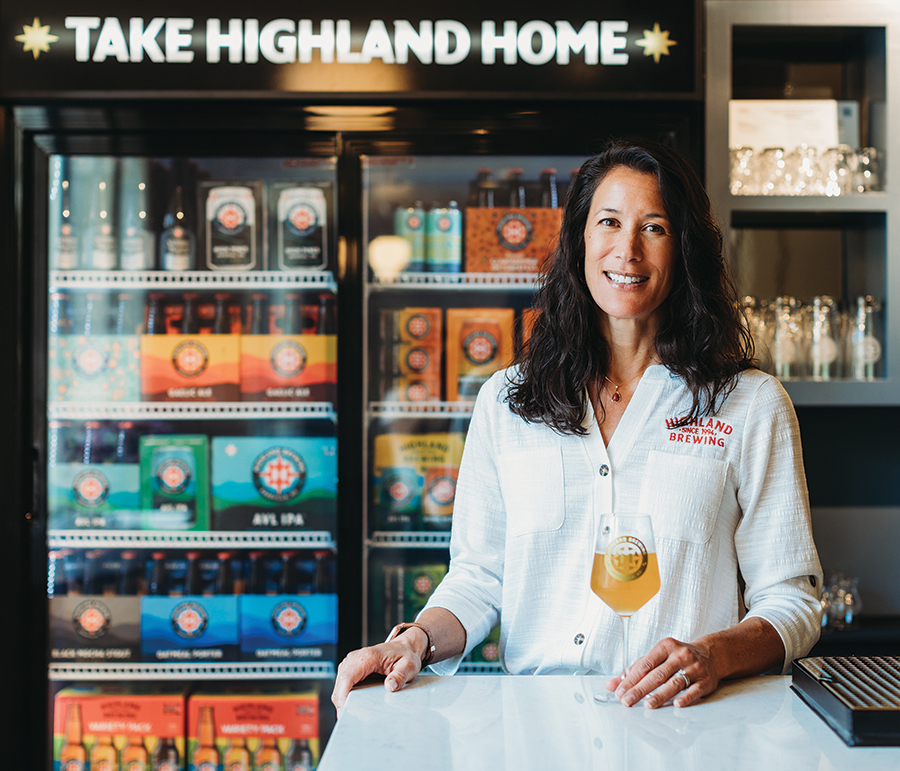
“Other things became more important and the brewery was one of those more important things,” Ashburn said in a 2018 interview with Business North Carolina. “It was about being part of the community. You can’t put a value on that.”

Leah Wong Ashburn is now Highland’s president and CEO, and her tenure has marked an era of rapid change, both for the company and the city of Asheville. In 2011, Highland opened a tasting room at their mountaintop manufacturing facility in east Asheville, which has now grown to 70,000 square feet and offers complimentary tours of their onsite brewery, a lively taproom with ample seating, a performance stage, a rooftop garden bar and an indoor event space. According to Brock Ashburn, Leah’s husband and the company’s vice president, “We built the taproom to accommodate the throngs of people who were showing up, part of an ever-increasing interested public who wanted to drink our beer where it was made.”

Over the past decade, a lot of people have — as Brock Ashburn puts it — “shown up” in Asheville, and the city is now an international destination for foodies, beer connoisseurs and outdoor enthusiasts. “There’s always been a soul and a spirit in Asheville,” Leah says, “and Highland got to join up with other people who believed in the potential for Asheville. Great beer is a complement to great food and quality of life.”

Community and regional pride are more than just branding tools; Highland is a company whose culture is built on stewardship and community responsibility, tenets made apparent in their practices of reducing or reusing waste, partnering with local nonprofits and embracing solar power. The company also collaborates with the Southern Appalachian Highlands Conservancy, naming seasonal beers after unique regional landscapes. Ashburn has always made clear that she intends to keep the company concentrated on regional endeavors and has no plans to ship beer across the country, choosing instead to focus the company’s efforts within the confines of the Southeast. This comes as no surprise for a brewery that has spent two and a half decades fostering a regional brand in a region that has quickly gained international attention. 
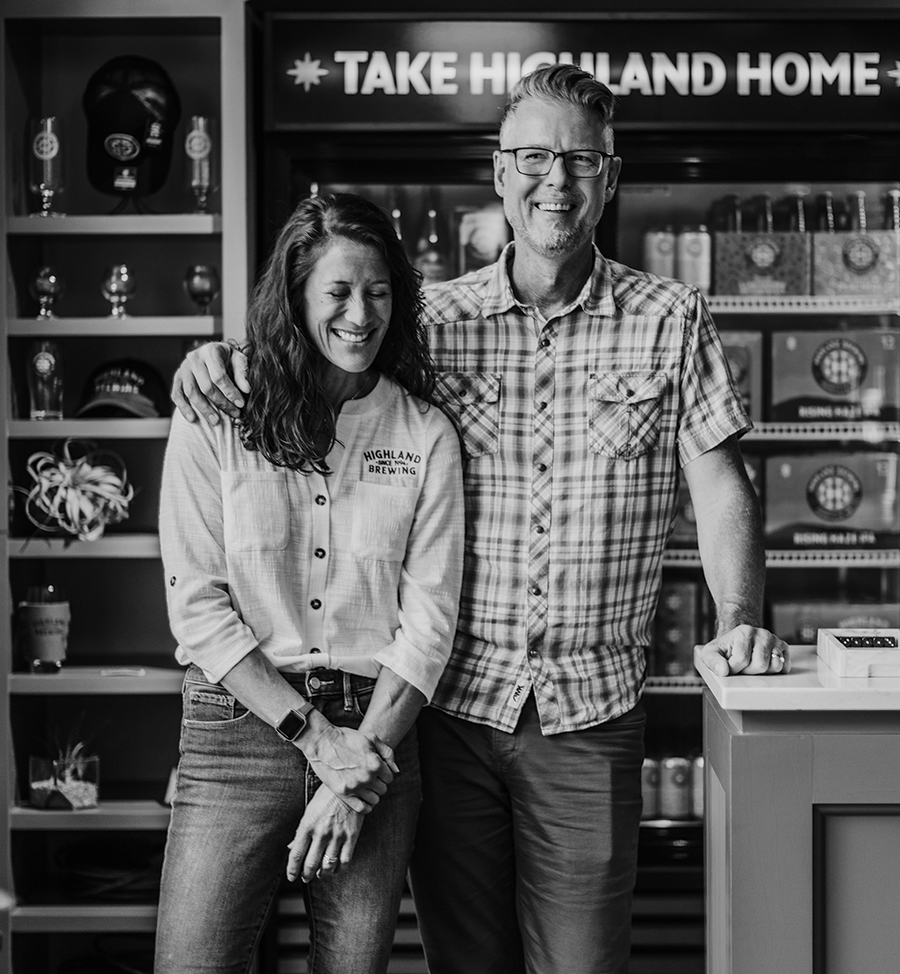
Today, Leah and Brock are sitting at the brewery’s new downtown taproom in the old S&W Building, a quintessential example of Asheville’s stunning 1920s Art-Deco architecture. Late morning sunlight pours through tall windows that look out on Pritchard Park, illuminating the gold-plated fixtures and ceiling tiles, the two-story marble columns and tiled floors in a glowing aura that sweeps visitors back into the roaring ’20s. You can almost sense what Asheville must have been like a century ago, when it was first known as a destination for Hollywood stars, politicians and titans of industry. Highland anchors the new S&W Market’s downstairs dining area with a taproom, along with several local restaurants that provide counter service. Upstairs, on the mezzanine level, Highland has opened a full bar and tasting room with ample space for guests to relax over a pint.

One can only imagine what it must mean to Leah for Highland to return to downtown, where it all started from such humble beginnings over a quarter century ago.

“As a second-generation owner, I was encouraged to make the brewery my own,” she says. “That did not feel safe to me at first because of the long history of Highland, but my father’s sentiment was honest, and he’s let us create our own vision.” That meant changing the beer portfolio and re-envisioning the brand. She says it also meant improving the property: “We started as a manufacturing company, but Brock’s an engineer and a builder, and I’m a marketer,” Leah says. Combining all of those interests and backgrounds led to a complementary hospitality component. “It appeals to tourists because it highlights some of the great things about Asheville in one location.”
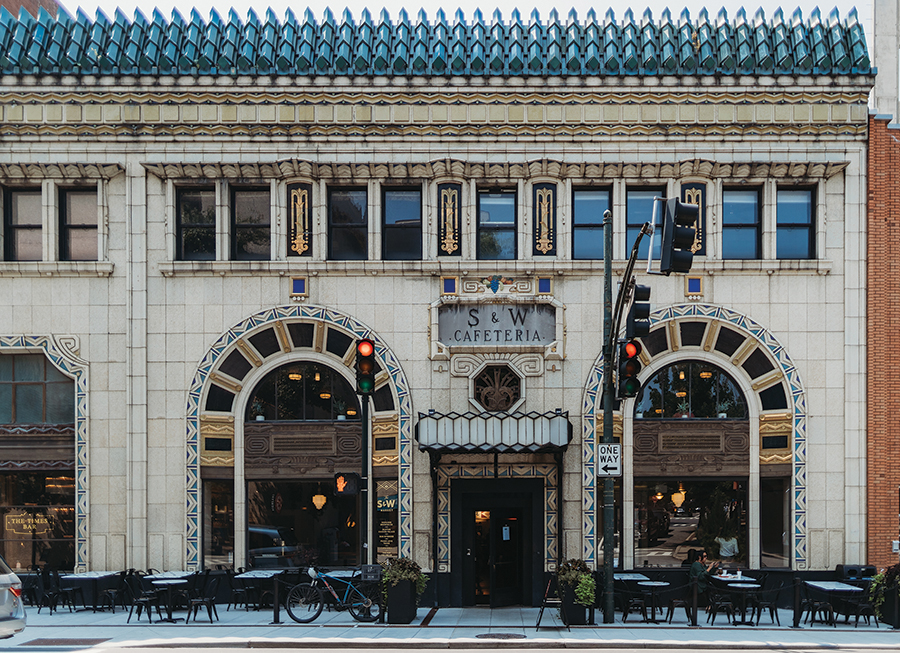
Outside, people are waiting for the S&W Market’s doors to be unlocked for the day’s business. A line of tourists and downtown office workers in business attire snakes down the sidewalk. Leah and Brock look out the window and pause for a moment, perhaps recalling the throngs of beer enthusiasts who showed up the minute the first taproom opened at Highland’s manufacturing site a decade earlier.

“This is an opportunity to tell our story downtown and also attract people to come out to East Asheville to visit our brewery,” Brock says. “It’s a great opportunity to get our brand out there and let people know where this all started.”

From a downtown basement to a mountaintop in East Asheville to the second floor of one of the city’s most iconic downtown buildings, Highland has come a long way. But whether it’s the quality of the beer or the family name, some things never change.   PS

Wiley Cash is the writer-in-residence at the University of North Carolina-Asheville. His new novel, When Ghosts Come Home, will be released this month. Mallory Cash is an editorial and portrait photographer.

PinePitch

Friday Night Rocks

The Asheville-based soul/funk/rock/jam band Travers Brothership will take the First Bank stage at Sunrise Square, 250 N.W. Broad St., Southern Pines, on Friday, Aug. 6, from 5 p.m. to 8 p.m. Their performance, described as a “wild block party,” supports the Sunrise Theater. Food trucks, refreshments and beer from Southern Pines Brewery will be available. No outside alcohol. No rolling, strolling or roving coolers allowed. Leave man’s best friend at home. For more information call (910) 692-3611 or go to www.sunrisethreater.com.

Links and Drinks

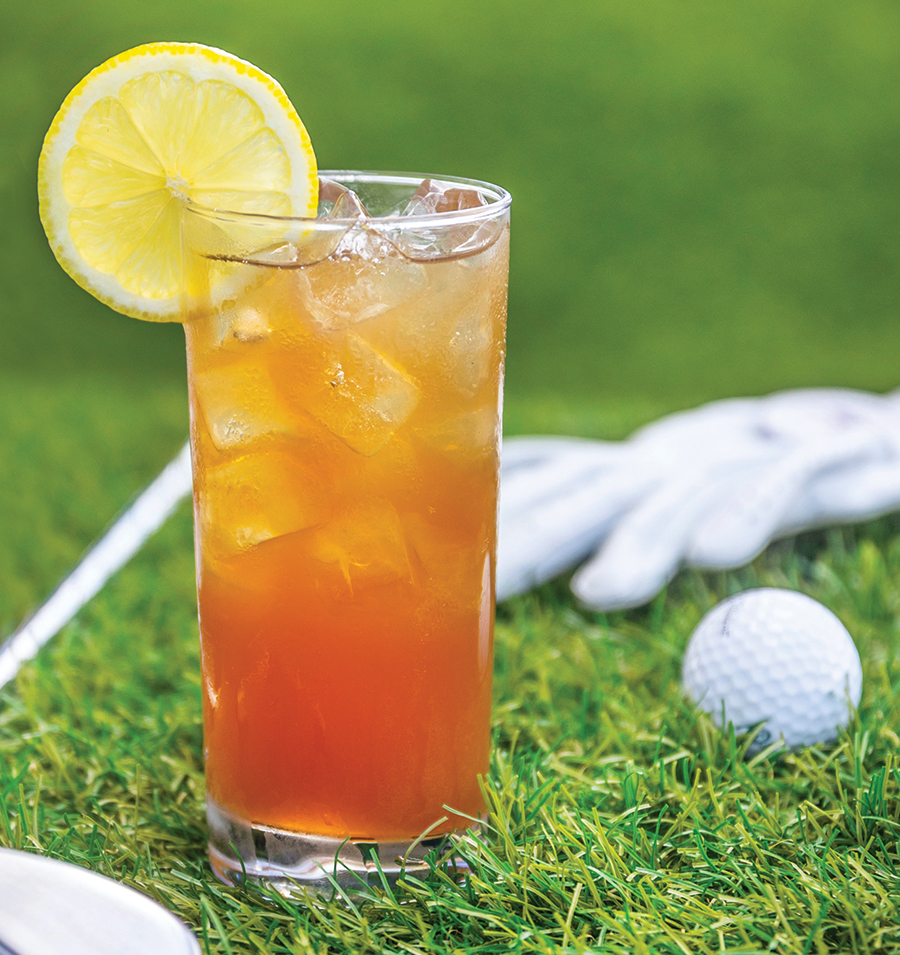
Join The Sway at the Pinehurst Country Club, 1 Carolina Vista Drive, for a women-only golf clinic combining happy hour and friendly instruction from a Pinehurst resort professional on Monday, Aug. 16, from 5:30 p.m. to 6:30 p.m. Perfect that swing and test your skills on The Cradle. Each session is limited to 20 players and the cost for the lesson, a cocktail and swag is $55. For more information go to www.ticketmesandhills.com.

Gathering on the Green

The Bradshaw Performing Art Center’s summer concert series continues Saturday, Aug. 14, from 6:30 p.m. to 9 p.m. with Mountain Heart and its special guest, Carly Burruss. Bring chairs and blankets — but no outside food or beverages — to BPAC’s McNeill-Woodward Green, 3395 Airport Road, Pinehurst. For information and tickets visit www.ticketmesandhills.com.

Lakeside Live!

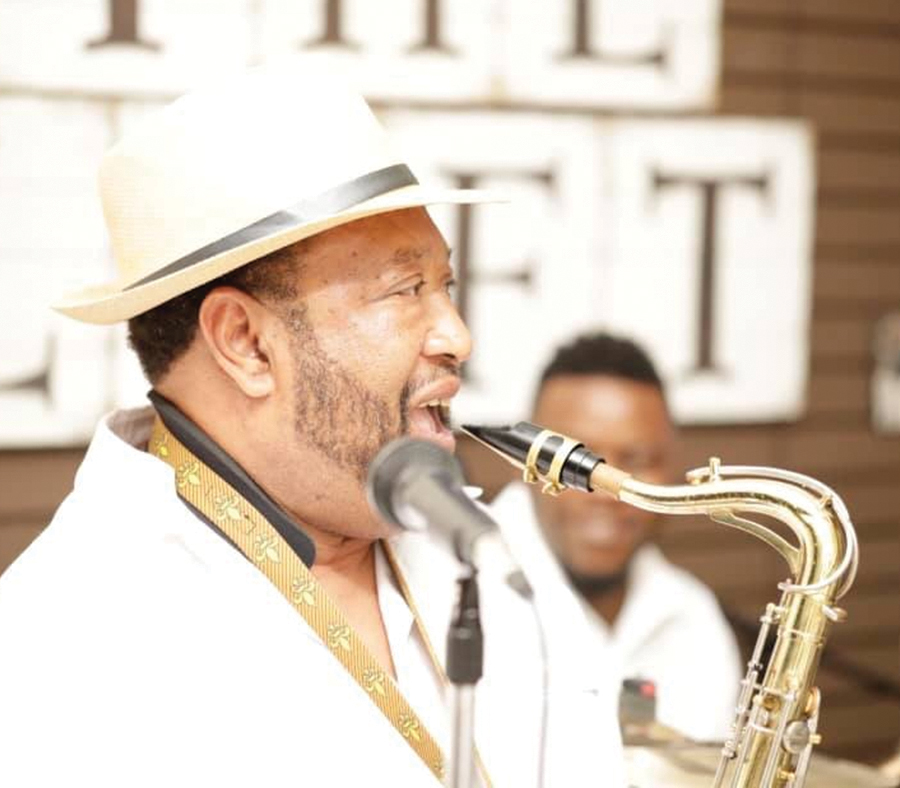
Saxophonist Dennis Hardison and A New Creation will be performing from 7 p.m. to 9 p.m. on Friday, August 13 at The Cardinal Park, 657 S. Walnut St., Pinebluff. Gates open at 6 p.m. and admission is $15. You must be 21 years old and above to enter. Dress is all-white, casual party attire. A DJ will pick up the show at 9 p.m. For more information visit www.thecardinalpark.com.

“Many a Good Hanging Prevents a Bad Marriage”

So says Twelfth Night. Shakespeare in the Pines and the Uprising Theatre Company return with one of the Bard’s famous comedies on The Village Green, Tufts Memorial Park, Friday, Aug. 20, from 7:30 p.m. to 10 p.m. There are additional performances on Aug. 21, 27 and 28. For information and tickets go to www.ticketmesandhills.com.

Bocce Bash

It’s back for a 14th annual! The Backyard Bocce Bash to benefit the Sandhills Children’s Center rolls on at the National Athletic Village, 201 Air Tool Drive, Southern Pines, from 9:30 a.m. to 3 p.m. or until the last ball is bowled on Saturday, Aug. 21. All proceeds help provide vital therapies to children with special developmental needs. Entry fee starts at $25 per player. Sponsorships are available. For information and registration call (910) 692-3323 or visit www.sandhillschildrenscenter.org.

25th Anniversary Celebration

A touch of Robbins comes to Pinehurst on Friday, Aug. 20, from 6 p.m. to 9 p.m. at the Fair Barn for the 25th Anniversary Celebration benefiting the Northern Moore Family Resource Center, home of the HOPE Academy Preschool. There will be mechanical bull riding, rubber pigeon skeet shooting, live music, food from Elliott’s Catering Company, live and silent auctions and beer, wine and high spirits. Tickets for the event at the Fair Barn, 200 Beulah Hill Road, Pinehurst, are $125 per person. For information go to www.moorefamilyresource.org.

Weymouth Puts the Moves On

Join MARO movement for a modern dance experience staged outdoors on the grounds of the Weymouth Center for the Arts and Humanities at 555 E. Connecticut Ave., Southern Pines, from 6:30 p.m. to 9 p.m. on Saturday, Aug. 21. The audience moves along a navigated path, experiencing site-specific dance works on their way to a mainstage show. Tickets are $40 and include two motion tours, the mainstage event, spirits and hors d’oeuvres. Food trucks will also be on site. For information call (910) 692-6261 or go to www.weymouthcenter.org.

Get Saucy

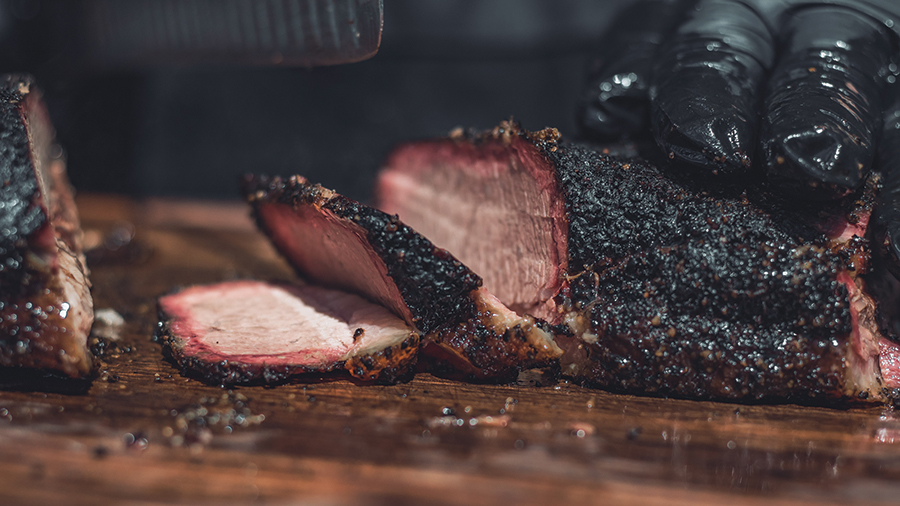
The three-day Pinehurst BBQ Festival celebrating “all things barbecue” begins Friday, Sept. 3, from 6 p.m. to 8 p.m. and continues throughout Labor Day weekend in the village of Pinehurst, 6 Chinquapin Road. Presented by Pinehurst Resort, US Foods and Business North Carolina magazine, the festival celebrates Carolina barbecuing tradition from the mountains to the coast and features award-winning pitmasters. For tickets and information go to www.ticketmesandhills.com.

The Naturalist

Legion of the Night

The beauty of moths

By Todd Pusser

Butterflies get all the love. All around the world, festivals are held in their honor. Entire gardens are planted specifically to attract them. Poems praise their beauty. Kids even dress up as butterflies for Halloween.

Moths, on the other hand, are frequently overlooked and ignored by most people. If noticed at all, moths generally get a bad rap. Gardeners despise hornworms, the large caterpillars of sphinx moths, feeding on tomato plants in the backyard. Gypsy moth caterpillars, capable of defoliating entire trees, are the bane of property owners throughout areas of the Northeast.

Even in popular culture, moths are frequently associated with superstition and death. The calling card of the serial killer from the popular 1990s movie Silence of the Lambs was the cocoon of a death’s-head hawkmoth (yes, there is such a thing) placed inside the mouths of his victims.

About the only time moths have received any positive press is when Mothra dragged Godzilla by the tail out of Tokyo.

Cecropia Moth

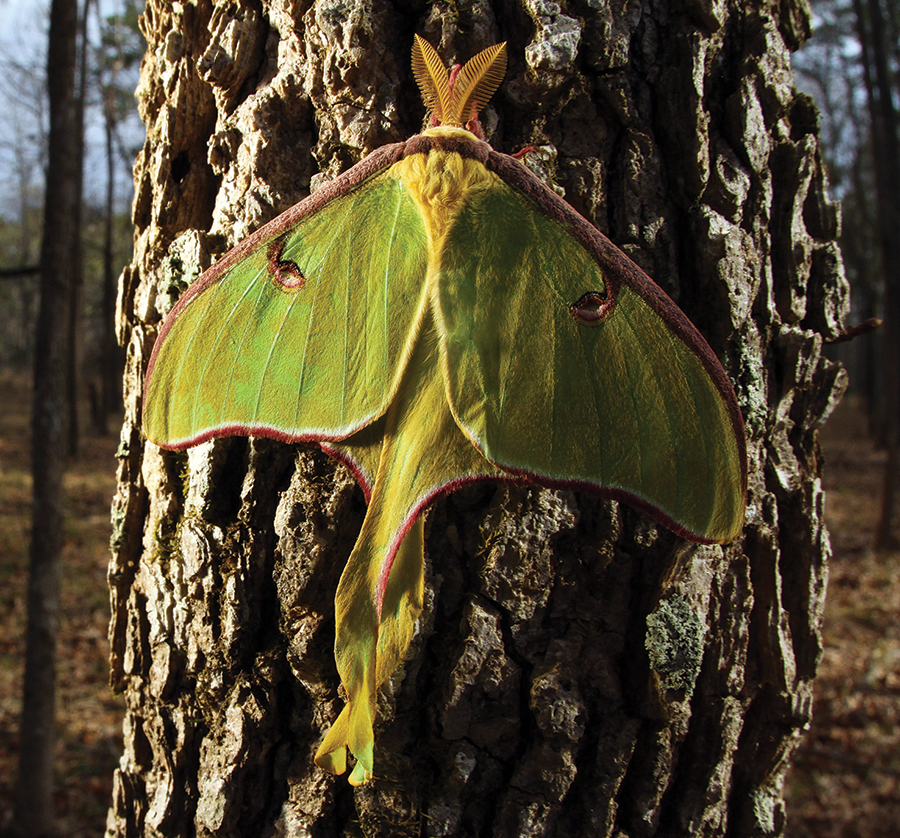
Last July, on a hot and humid night, I pulled into the parking lot of a brightly lit gas station along the edge of the Dismal Swamp in the northeastern corner of the state. It was during the height of the pandemic, and few other cars were around. In need of caffeine, I stepped out of my vehicle and walked along the side of the building toward the front door. Casually glancing up, I was stunned to see a large luna moth clinging to the side of the building, its striking lime-green wings contrasting sharply with the white paint.

The gentle luna moth is the teddy bear of the insect world, sporting a plump, furry body, feathery antennae, and a pair of 3-inch-long sweeping tail streamers. It is among North Carolina’s largest and most spectacular moths. I was so pleased to see one that I casually mentioned it to the station’s clerk while paying for my beverage. A blank stare was my only response. Finally, she asked quizzically, “You saw a what?”

I said again, “There’s a luna moth outside your front door.” Blank stare once more.

“Oh,” said the clerk with a nervous smile. “Have a nice night.”

Most people think of moths as drab and boring. It is true that many moths possess muted shades of brown or grey colors, but a surprising number are as colorful and intricately patterned as any butterfly. Take, for example, the giant leopard moth, common to many parts of North Carolina. Looking like a flying Dalmatian, it is a large, bright white moth covered in an array of black polka dots. An entire family of moths known as underwings sport drab tree-bark-patterned forewings and brightly colored hindwings, which they only flash when frightened by a predator.

Luna moth (Actias luna), freshly emerged from its cocoon in early spring in the Lowcountry of South Carolina

Speaking of underwing moths, many possess common English names reflecting a marital theme, a quirky tradition started by Carl Linnaeus, the father of modern taxonomy. Among the more descriptive ones are the tearful underwing, the betrothed underwing, the dejected underwing, the divorced underwing, and the oldwife underwing. Clearly, entomologists have a sense of humor (and perhaps one too many beers) when it comes to naming moths. Or perhaps they are just in need of a good marriage counselor.

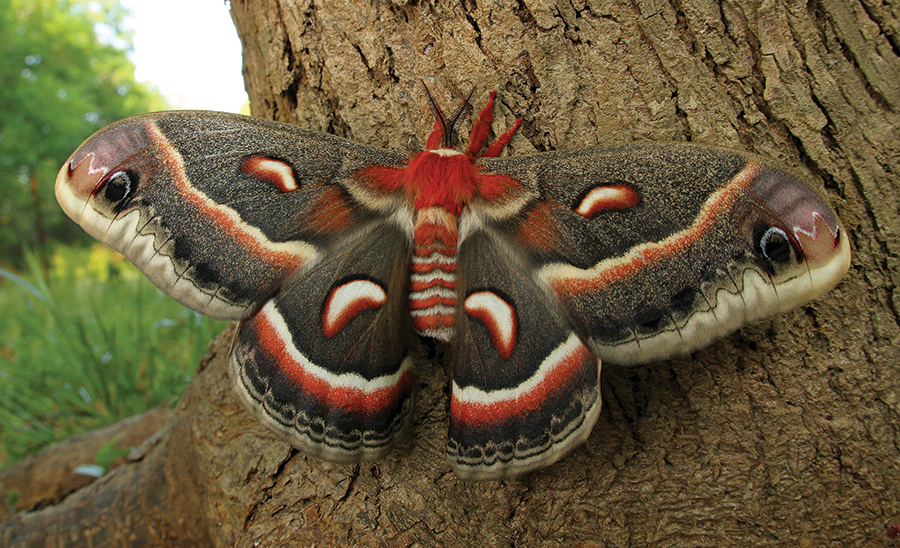
Moths are among the most diverse groups of animals on the planet (surpassed only by beetles), with over 200,000 species (and counting) found worldwide compared to just over 17,000 species of butterflies. They come in an infinite variety of shapes and sizes. Many of our state’s smallest species, known as micro moths, could easily fit onto the head of pin. The largest species in North America, the cecropia moth, possesses enormous wings that stretch 7 inches from tip to tip, making them larger than many species of bat. A member of the spectacular silk moth family, the cecropia (and the luna moth mentioned earlier) does not feed as an adult and relies on stored energy from its caterpillar stage. As such, the cecropia lives for only a few days, leaving it precious little time to find a mate and perpetuate the species.

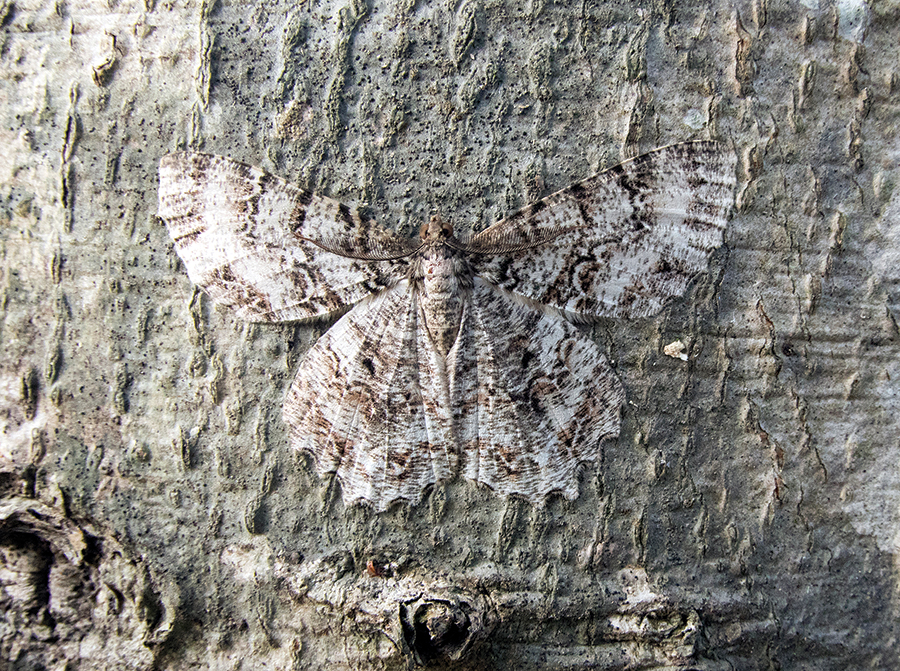
Unlike the showy silk moths, many night-flying moths are masters of disguise and closely resemble bark and leaves to help them blend into their surroundings during the day. Some even look like bird droppings.

Not all moths are nocturnal. Many fly during daylight hours. Those that do tend to mimic other insect or animal species, such as bees and wasps. One well-known day-flying moth is the hummingbird clearwing, which mimics the size, shape and flight pattern of the ruby-throated hummingbird. Like its namesake, it is frequently observed hovering over flowers in urban gardens.

Tulip tree beauty moth

Just this past April, I was admiring a cherry tree in full bloom in a friend’s yard when I did a double take. What I initially thought was a bumblebee hovering over a blossom above my head turned out to be a moth known as Nessus sphinx. With two bright yellow bands wrapping around a black abdomen, the moth was a perfect replica for the stinging insect. As I followed it from blossom to blossom, I realized the rapid wings of the moth even sounded like the buzz of a bumblebee.

Like bees, moths are important pollinators of many flowers and crops. Throughout all their life stages, from caterpillars to adults, moths serve as a critical food resource for many birds and other animals. Studies have shown that moth caterpillars are the preferred food for nesting birds, such as eastern bluebirds, as they are both easy to digest and full of protein.

Unfortunately, moths have suffered serious declines in their populations due to habitat loss, light pollution, and the extensive use of pesticides on the landscape. Their ecological importance and the impact that they have on the world around us is difficult to understate.  PS

Naturalist and photographer Todd Pusser works to document the extraordinary diversity of life both near and far. His images can be found at www.ToddPusser.com.

His favorite book is Where the Red Fern Grows by Wilson Rawls.

Southwords

What’s in a Name?

Sometimes it’s everything

By Kate Smith

My first nickname was Catfish. Dad pronounced it at my birth because I arrived “slippery and wide-eyed as one.”

When I was old enough to comprehend the likeness between me and the bottom-feeder I was not amused, and tried renaming myself. Buck was my first choice, after the wolf pack leader of Jack London’s Call of the Wild. It’s how I signed my name on presents and on a stocking one Christmas. Typical Leo. When that didn’t stick, I tried imitating my best friend’s nickname, Bobcat Brandi, with the closest wild feline alliteration, Cougar Kate. I didn’t understand why the adults thought this was hilarious.

And that gallant trail name I imagined I’d be given when I hiked the Appalachian Trail? Last fall, during a short 20-mile stretch, I was declared Peein’-on-the-trail-Kate. In hindsight, Catfish wasn’t so bad. Good thing, too, because it’s what Dad still calls me.

Dad picked up catfishing in his 20s when he moved to North Carolina to work at Cameron Boys Camp. Still, 35 years later, on summer weekends, he leaves home in the late afternoon with a camp chair, pole and box of chicken guts to meet a friend with a boat, and fish all night. When I told my Georgia crew leader about this while we built a trail together in Alaska, his eyes got big: “Awe, man, your Dad goes noodlin’?”

While Dad uses bait on a line rather than bare hands and a forearm thickened by scars from catfish teeth, I still think it’s pretty cool. Catfishing means Dad is out on the moonlit water when the fish bite best. He’ll come home at 5 a.m. with 80 pounds of wild game and solicit us five kids, most of us out of the house, back to the family kitchen. Although growing up we bought most of our food from the grocery store and Dad worked a normal day job, it’s these times that define him most to me. Awake in the middle of the quiet night, providing.

I grew up thinking that good dads are always awake: chasing away nightmares, driving the family halfway across the country for Christmas at Pop’s house, watching the fire smolder out safely during camping trips, up every hour to check the temperature of meat in the smoker the night before summer barbecues. Even now, if I have car trouble when driving late at night, I call Dad, and he always answers.

I’ve inherited a lot of traits from Dad. I’ve got his eyes, his tawny skin tone, his all-or-nothing impulses. We both headbang to AC/DC and cry during praise and worship at church. And somewhere in there, I’ve got Dad’s love of the night. Something about the quiet and stillness prompts my deepest thinking, feeling, and creating. There’s a thrill and a sacredness about it, when no one else is awake except the 18-wheelers, people on their way to the airport, the crickets and cicadas and bullfrogs, and always, when I need him, my dad.

August is my birthday month. Mom buys a card with an inspiring quote, and Dad signs it. I guarantee he’ll address his note to Catfish. And when I call to say I’m coming over, he’ll ask me what I want for my birthday lunch. At dawn the next morning, he’ll pull in the driveway from a night on the lake, ready to celebrate with a cooler full. PS

Kate Smith is the herbalist and holistic health coach of Made Whole Herbs in Southern Pines.

Her favorite book is whatever she is reading, though it’s doubtful any would top The Lord of the Rings.

Out of the Blue

Windsor Knots

These are the ties that bind

By Deborah Salomon

Back in the day, ancients believed their leaders descended from the gods, therefore possessed “divine right” to rule. Those chosen few — observing the lifestyle royalty affords — furthered their cause by concocting stories that reinforced the myth.

And so it went. Wars were waged between competing “royals.” Contenders (who perpetrated a similar myth) beheaded each other with frightening regularity. Kings solidified their positions by marrying only royal maidens who, failing to produce male heirs, were booted to a chorus of “Hit the road, Jack(ie), and don’t come back no more, no more . . . ”

Revolutions happened, monarchies tumbled in favor of republics, democracies, socialist states, yet even when they possessed only ceremonial power, kings and queens, princes and princesses survived, mainly to christen ships, open orphanages, attend Ascot and feed our fantasies. Their subjects still bow and curtsy. A sign of respect, I’m told, sometimes good for a giggle: The queen is not allowed to vote or express partisan opinions. But she’s allowed a lady-in-waiting to carry her hankie and bouquets, as well as to clear the loo before a royal visit.

Have you guessed where I’m heading? Down the solid gold brick road to Buckingham Palace. Windsor Castle. Balmoral. Sandringham. Clarence House.

Shocking that 2020-21 was both the Year of the Pandemic where millions suffered and died and the Year of the British Royal Family, who provided audiences with a mud-wrestling extravaganza. No wonder Mr. Trump feels deserted. Royal tribulations regularly shove him off Page One. The BBC put out a casting call for courtiers. Any news will do, from the tragic death of a consort to the tragic death of a puppy. A misstep President Biden makes in Her Majesty’s presence becomes a headline so imagine the kerfuffle over her eldest grandson (Princess Anne’s offspring) getting divorced. New babies keep popping up, Prince Andrew’s scandals keep going down.

And that’s in addition to Harry and Meghan’s carefully scripted Oprah-fest.

Don’t get me wrong; I think Queen Elizabeth is a fine old lady who performs her duties with grace and distinction. After all, it’s a pretty good job which includes room(s) and (a groaning) board, transportation (gilt carriages, maroon Bentley limo, a stable of Range Rovers and Thoroughbreds, private train and aircraft) plus health insurance, paid vacation, a generous pension and, most important, uniforms.

Who cares, if you can’t order Chinese at 10 p.m.?

The thing I’m not buying is royal “blood,” the “lineage” that sets them apart.

Sadly, recent events have suggested those veins need transfusing.

I also notice a dereliction of duty on behalf of the royal-watching media, who used to remain tight-lipped regarding improprieties. Now, like hawks and fishwives, they screech the latest scandal from towers and turrets. Do we need to know that granddaughter Zara Tindall gave birth on the bathroom floor? Or that Kate Middleton’s brother is suffering from depression? Some mean-spirited cartoonist has even dredged up those old separated-at-birth head shots of Prince Charles and MAD Magazine’s Alfred E. Neuman. To balance the negative — and spur competition — tabloid hacks jumped on the bandwagon driven by Prince Edward’s wife, Sophie, newly identified as the queen’s BFF, confidante and spokescountess who, obviously, prefers her crumpets buttered on both sides.

So it shall continue, because Americans are hooked, mostly on the clothes, those incredible outfits with flying-saucer hats and deadly stilettos worn by young royals, not to mention Her Majesty’s neon ensembles. I am hooked because I’d rather read and write (shamefully three times in 12 months) about soap operas played out across the pond than the political tragi-comedies underway on home turf.

Still, enough is enough. Diana and Philip are dead. William’s bald head is old news. Jeffrey Epstein’s buddy Prince Andrew has been benched. Harry’s changing diapers, eating corn dogs and drinking Coors while Charles, wearing (shudder) tartan kilts, weeds his organic garden. But the queen, God bless her, still sips a gin and Dubonnet with a twist before lunch, wears Mad Hatters and runs on Energizers.

I’m thinking she just might outlast us all.  PS

Deborah Salomon is a writer for PineStraw and The Pilot. She may be reached at debsalomon@nc.rr.com.

Her favorite book is Sophies Choice by William Styron

Good Natured

Forgive and Forget

You’ll be healthier because of it

By Karen Frye

We have all experienced some form of emotional or physical pain in our lives caused by another. Some are easy to overcome, but there are times when the pain is deep and it doesn’t seem to go away, and we endure the torment for too long. In most situations, the person who caused our pain moves on, completely forgetting about what happened — or is even unaware of the pain they’ve caused. It is the victim of the experience who must do the work and let go of the past, move on and forgive.

This can be challenging if we don’t, with all our heart, forgive the person who hurt us. Holding on to unresolved feelings of anger or resentment will keep you in a mental prison of torment. This emotional state of mind can affect our physical health in dangerous ways. A mind that is in a constantly negative and unforgiving state is unhealthy, creating a more acidic body where disease can thrive. Changing your diet to include more fresh fruits and vegetables will help counter the acidic imbalance.

True forgiveness, however, is a journey that heals the body, mind and soul. Some pain can take years to forgive, but it is the first and most important step in freedom from a troubled mind. Forgiveness brings peace. All the hurt and bitterness will disappear. Forgiveness doesn’t mean your memory banks are wiped clean — you just no longer feel the pain. It frees the heart. 

When we forgive, we heal ourselves. The natural flow of love dissolves all the pain. The more you practice this, the easier it becomes. Learning how to forgive is the greatest form of unconditional love. It is the love you feel from your parents, the love you give to your children. It is the love we all yearn for, the love that allows us to be who we are.

Embrace the power to forgive easily. It is not worth another day of bitterness. Free yourself and enjoy life with a happy heart.  PS

Karen Frye is the owner and founder of Nature’s Own and teaches yoga at the Bikram Yoga Studio.

Her favorite book is The Game of Life for Women and How to Play It by Florence Scovel-Shinn

Hometown

Neighborhood Gold

Clearing the bar in the backyard

By Bill Fields

A few years ago, not long after I began freelancing as a booth researcher at golf tournaments broadcast by NBC Sports, someone pointed out a slim, silver-haired man walking into a trailer in the television compound. This particular camera operator, my colleague told me, had a distinct background. It was Ken Walsh, a former American Olympic swimmer who won three medals (two gold, one silver) in 1968 in Mexico City.

I hadn’t seen Walsh since I was 9 years old. Or at least I imagine I probably watched him on ABC during the ’68 Summer Games, because as a fourth-grader obsessed with sports, those Olympics were a very big deal when they flickered on our living room Zenith. (Portions of the Olympics were shown in color for the first time, but we still had a black-and-white set.)

Decades later, some of the competitors’ names from that year — the Summer Games were held in October — jump to mind more easily than those of childhood friends even though the television coverage of that period was a fraction of the airtime today.

There was Bob Beamon, shattering the world record in the men’s long jump with a leap of 29 feet, 2 1/4 inches that wasn’t bettered for 23 years and remains the Olympic mark. Bill Toomey won gold in the decathalon, Randy Matson the shot put and Al Oerter the discus throw (for the fourth straight Olympics). Kip Keino of Kenya ruled in the 1,500 meters and Bob Seagren in the pole vault. Dick Fosbury shook up things by winning the high jump with his novel backward style.

Walsh? As I discovered, he was on the winning 4×100 freestyle relay and 4×100 medley relay teams and finished second in the 100-meter freestyle behind Australian Mike Wenden and ahead of fellow American Mark Spitz, who would win seven gold medals four years later in Munich.

My neighborhood buddies and I ran our sprints up and down East New Jersey Avenue — there was little traffic, and it was slightly downhill to the chalk-drawn finish line heading toward May Street — but come Olympics time in ’68 we really were more interested in the field events.

Chuck, my best friend, and I constructed a high jump behind his house out of stray 2x4s for supports with an old broom handle resting on two nails as the bar to jump over. We improvised a landing pit out of dirt, pine straw and leaves. The long jump didn’t require as much preparation — just a couple of baseballs to mark the take-off spot and a yardstick to measure where our Converse tennis shoes made a mark in the sand. We made a few feeble attempts at the triple jump but couldn’t quite figure out when to hop and when to skip.

The real backyard drama came in an event the younger kids only watched.

One of Chuck’s older brothers, Ricky, was up for most anything. When he wasn’t roaring around on his minibike or tackling opposing players like Dick Butkus, he liked to pole vault — and not just in the Southern Pines school gym or at Memorial Field. Ricky pole-vaulted in his yard, using bamboo stalks he got from a nearby thicket and taped up for a better grip to go up and over. A pile of saw dust and a couple of cheap, inflated beach rafts cushioned the landing.

Ricky’s friends would join him, and so would one of the men who lived on our block, Mr. McNeill, a good athlete who had played on the town’s semi-pro baseball team. He probably was only in his late 30s, but that seemed ancient to a little kid. Clad in his work clothes on those late afternoon jumps, Mr. McNeill gave no quarter to the teenagers. The way those bamboo poles bent after being planted in the homemade box, it seemed like only a matter of time before the rescue squad would have to be summoned for broken bones, although bruises and sprains are the worst injuries I can recall.

I’m slated to go to my first Olympics this summer, the Tokyo 2020 Games that were delayed a year because of the COVID-19 pandemic. I’ll be working on the golf production, a long way from where the vaulters will be headed skyward on space-age poles and a long time from the fun and games of 1968.  PS

Southern Pines native Bill Fields, who writes about golf and other things, moved north in 1986 but hasn’t lost his accent.

His favorite book is North Toward Home by Willie Morris

Tea Leaf Astrologer

Leo (July 23 – August 22)

Have you ever met a Leo with a show dog? I doubt it. Because if there’s one thing this fire sign hates more than sharing the spotlight, it’s feeling inferior to another being in any way. Who has the silkiest locks, the smoothest gait, the most charming disposition? Of course you do, Leo. But this month — and yes, everyone knows it’s your birth month — don’t be surprised if you’re not getting the undying affection you so desperately crave. Do yourself a favor: relax. Your fans still adore you. Especially your rescue mutt.

Tea leaf “fortunes” for the rest of you:

Virgo (August 23 – September 22) Brush up on your social skills this month. Interrogation and flirtation are inherently different.

Libra (September 23 – October 22) Love is in the air. But you won’t catch it with a butterfly net. Read that again. 

Scorpio (October 23 – November 21) Spin and you’ll win. It’s really that simple.

Sagittarius (November 22 – December 21) Don’t throw the crazy out with the bath water. You know you’d be lost without it. 

Capricorn (December 22 – January 19) Two words: Muscle through.

Aquarius (January 20 – February 18) Let’s not beat around the bush. You know what to do. Swallow your pride and ask for help. 

Pisces (February 19 – March 20) Too much of a good thing isn’t the case this month. Just don’t forget to say thanks.

Aries (March 21 – April 19) You’ve just moved mountains. Don’t think people haven’t noticed. And don’t let that go to your head.

Taurus (April 20 – May 20) Plant the seed. Then leave it be. Seriously. Walk away.

Gemini (May 21 – June 20) Pack your bags, sweetheart. Go someplace you’ve never been. It’s time for a little perspective.

Cancer (June 21 – July 22) Don’t spend it all in one place. But if you do, remember that abundance is a mindset.

Zora Stellanova has been divining with tea leaves since Game of Thrones’ Starbucks cup mishap of 2019. While she’s not exactly a medium, she’s far from average. She lives in the N.C. foothills with her Sphynx cat, Lyla.

Birdwatch

A Majestic Wader

Wood storks become a more common sight

By Susan Campbell

Believe it or not, although fall is still a way off, the summer solstice has passed, and for some of our birds, the breeding season is over. Many have begun wandering ahead of their southward migration. At this time of year, we have a few species that actually move in a northerly direction during mid-summer. The wood stork, one of North Carolina’s newer breeders, is one of these.

Wood storks are large, white wading birds, a bit smaller than great blue herons. They have heavy bills that curve at the tip. In flight, they are very distinctive. Not only do they fly with their head and neck outstretched, but their tails and flight feathers flash black. They are frequently spotted soaring high in the sky on thermals, not unlike hawks and vultures.

These birds forage not only for small fish, crustaceans and a variety of invertebrates, but also reptiles and amphibians, as well as occasional nestlings of other species. Wood storks are visual hunters that search for movement in the shallows. They also may sweep and probe with their bills in murky areas until they feel prey, and then they will snap their mandibles shut and swallow the food item whole. It is not unusual for them to shuffle with their feet and flick their wings to disturb potential meals in muddy water.

Unlike their European kin, storks here nest in trees — not on chimneys. Also, as opposed to legend, these birds do not mate for life but pair up on the breeding grounds each season. They can live a long time, however: The oldest known (banded) bird from Georgia was over 20 years old when it was re-sighted in South Carolina.

Stork nests are bulky stick-built affairs located over water, often in cypress trees. However, any sturdy wetland tree species may be utilized. Both parents are involved in construction. Grassy material will line the nest that is, quite uniquely, adhered together with guano. It will take almost two months for the one to five young to reach fledging. Not only will wood storks nest alongside others of their kind but they tend to be found in colonies with heron, ibis and egret neighbors.

The wood stork is becoming a more common site in the Carolinas, breeding locally in freshwater or brackish, forested habitat. They prefer locations with an open canopy, since they require a good bit of space in order to negotiate a landing. There are now two large nesting colonies of storks on private property: one at Lays Lake (Columbus County) and Warwick Mill Bay (Robeson County). These lakes have been home to nesting storks for less than a decade. I would not be surprised if pairs are using a few other remote sites in the southeastern corner of the state. Stork numbers have been growing rapidly as the bay lake habitat seems excellent for raising chicks. Following fledging, however, family groups may move away from the nesting area to wet habitat where food is plentiful. In dry summers, that movement may be significant — and in any direction.

In our state, the largest concentrations of individuals show up annually at Twin Lakes in Sunset Beach (Brunswick County) by mid-summer. They can reliably be found in and around the eastern pond. The birds seem to like probing the flats on the back side of the pond, away from the golfers on Oyster Bay Golf Links. Also look for them loitering in the stout trees along the shoreline into early fall. But do not be surprised if you happen on one, or perhaps a small group, in any wet area from marshes to farm ponds or golf course water hazards in the Piedmont or Sandhills. Wood storks are unique and majestic waders that deserve a special look!  PS

Susan Campbell would love to receive your wildlife sightings and photos. She can be contacted by email at susan@ncaves.com.

Her favorite book is the one she’s reading right now, How Iceland Changed the World: The Big History of a Small Island, by Egill Bjarnason.

In the Spirit

Frozen

Break the ice this summer

By Tony Cross

If you’ve ever experienced a Carolina summer, you’ll know that the heat and humidity are enough to beat you down to the point you’ll ask a bartender for a Zima. Almost. Instead of having 10 drinks on a menu that each have a hundred steps before the bartender can put that lifesaving, cool drink in front of you, I learned to integrate punches and bottle cocktails that could be served as quickly as pouring a glass of wine. Another batched elixir that’s perfect for taking the sweat out of summer is a frozen cocktail.

I remember going to the bowling alley with my family in the early ’90s and seeing a daiquiri machine. Daiquiri-schmackeri. All I knew was that it looked like something for kids but that I wasn’t allowed to drink it. Once I was of age, I finally got to have a frozen cocktail of my own in New Orleans. I honestly can’t tell you if those slushy hurricanes were nice and balanced. I was in my early 20s. It was the Big Easy. I wasn’t very balanced myself. Trends come and go, but luckily for cocktails, we’re blessed with creative men and women behind the bar who can make what was once unpalatable, desirable. So, I headed out to a few bars and restaurants in the Triangle to learn their tricks for getting frozen cocktails just right.

The restaurant scene in downtown Durham has exploded in the past decade. A town that once took a backseat in the culinary department to neighboring Raleigh isn’t in the shadows anymore. Dashi, a Japanese ramen shop and izakaya (the word for a Japanese pub that’s located above the restaurant), has only had its doors open for a few years, but the combination of yummy and speed keep their guests coming back for more.

All of the cocktails at Dashi are made in the izakaya. “So, when the staff downstairs are really busy, they push these,” says bar manager Gabe Turner, pointing to his slushy machine. “They’re delicious, too, so it’s not like we’re sacrificing quality for efficiency.”

Purchasing a slushy machine was a no-brainer for Turner. “When we started fooling around with recipes, we stumbled into a pretty good template,” says Turner. “We don’t like to use too much sugar. Using an oleo-saccharum (oil-sugar) helps us keep a nice balance in our drinks.”

And you won’t find Gabe and Co. doing frozen margaritas. “The style we’re doing is a Japanese cocktail called chuhai, which traditionally is sh¯oōch¯uū (a fermented Japanese liquor made from sweet potato, barley, rice and other ingredients with a relatively low alcohol proof) and fresh juice. In Japan, they call them sours. The idea was, ‘Let’s do frozen chuhais.’ We used sh¯oōch¯uū, fresh juice, and then sake to round it out. To get the alcohol level up, we’ll add a little bit of vodka, but not enough to change the flavor profiles.”

One of Dashi’s current chuhai slushies combines the classic ingredients along with a spicy ginger syrup, orange oils and juice. How popular are the frozen chuhais? “I’ll make a whole batch of our slushy cocktails every week,” says Turner. Each batch serves around 50 8-ounce drinks. “We use the Bunn slushy machines and have a second machine in the back, so they don’t get too burned out. They’re being used 24/7.” If it’s not slushy season — a rarity at Dashi — two weeks is the longest they’ll keep a batch before letting the staff dip into the leftovers. “Rarely does it not sell out,” Turner says. Too bad for the staff. Dashi carries two different slushy cocktails at a time — a quick and cool option for a bar otherwise known for its myriad sake and sh¯oōch¯uū bottles.

What if your establishment (or you) doesn’t want to invest, or can’t find room, for a slushy machine? Get creative. A block away from Dashi, the chic cocktail lounge Alley Twenty-Six has its own twist on frozen drinks. Longtime bartender Rob Mariani, formerly of Alley Twenty-Six, says, “While a slushy machine is on the wish list, we don’t have one. That doesn’t mean we couldn’t make frozen drinks. By using crushed ice and giving it a good shake, you can get a drink that mimics a slushy and has a similar dilution rate. One would think that smaller ice melts faster than larger ice, which would be true if we were looking at two cubes melting on their own, but when you pack a glass full of crushed ice, there is lots of surface area, and the dilution rate is quite slow.”

Mariani has mastered the technique and suggests adding a bit more sugar to your specs. “The ideal ABV (for a frozen cocktail) is about 10 percent and the max is around 18 percent. Anything above that will not result in a frozen texture. Bitterness and sweetness are suppressed by cold temperatures, so more sugar is needed to achieve a balanced, frozen drink,” he says. “Up your sweet by 50 percent. For example, instead of using 1/2 ounce of simple, use 3/4 of an ounce.” There are many ways to master a frozen cocktail — having a machine constantly rotating the perfect, temperature-controlled slushy is one — but there are multiple ways to skin an ice cube, at home or away. Mariani shares one of the frozen cocktail recipes he uses for his weekly Cap’n Rob’s Waikiki Wednesday.

Frozen Rum and Tonic

1 1/2 ounces aged rum

3/4 ounce tonic syrup (Mariani uses his own Alley Twenty-Six Tonic.)

3/4 ounce pineapple juice

1/2 ounce fresh lime juice

4 dashes Angostura bitters

Combine all ingredients (sans the bitters) with crushed ice in a cocktail shaker. Shake like hell or until you can’t feel your hands. Pour into a Pilsner glass. Top with crushed ice and four dashes of Angostura bitters. Garnish with a large sprig of mint and dehydrated lime wheel.  PS

Tony Cross is a bartender (well, ex-bartender) who runs cocktail catering company Reverie Cocktails in Southern Pines.

His favorite book is No Death, No Fear by Thich Nhat Hanh.