Birdwatch

BIRDWATCH

Long Trek North

Louisiana waterthrush leads the way

By Susan Campbell

In early spring, birdwatchers such as myself are eager to spot the first returning migrants of the season. These are northbound birds that have spent the cooler months far to our south, in Central or South America. There, the living is easy, with plentiful food and a mild climate. But as the days begin to lengthen, these birds begin their return flight to the breeding grounds. Many may fly both day and night as the urgency of their mission increases. Hormone levels drive them to make their way swiftly to their natal area. Some return to the exact patch of woods, marsh or lake where they themselves hatched.

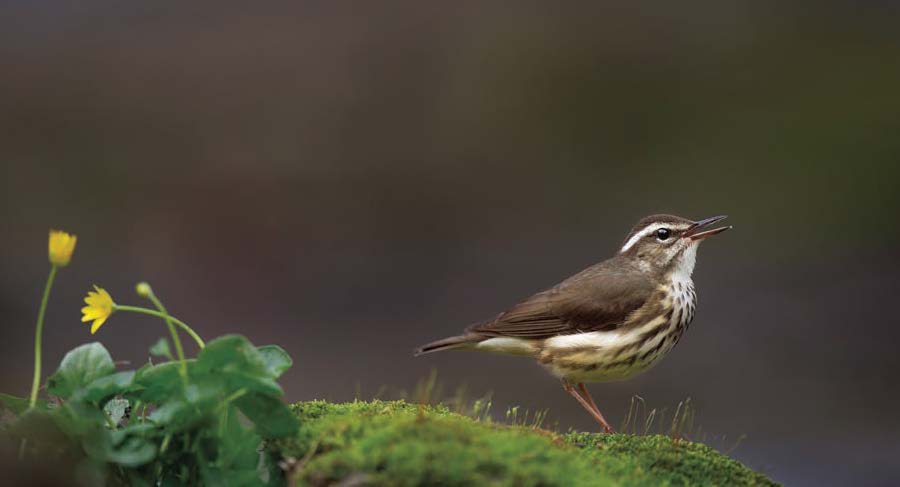
One of the earliest to return here in central North Carolina is the Louisiana waterthrush. A small, drab warbler, it is far more likely to be heard than seen at first. Its plumage is streaky brown and white. Birds can be recognized by their prominent broad white eyebrows and pink legs. As its name implies, the species prefers wet habitat, being at home along streams and rivers where it not only feeds in the trees, but along banks and around rocks at the water’s edge.

In the spring, Louisiana waterthrushes will call or sing as they move from place to place. As with so many species, the male’s vocalizing serves not only to attract a mate, but to establish territory. They have a loud, melodic song that carries well over the sound of moving water. The species’ call note, too, is a high volume “chip” that is easy to pick up in thick vegetation or above a gurgling stream.

Louisiana waterthrushes are insectivorous and so will consume any fly, midge or beetle that it sees. Also, waterthrushes will pick hatching aquatic insects such as mayflies or stoneflies out of the water. Individuals may wade in the shallows as they forage, making short jabs at potential prey items.

After pairs find one another and begin to raise the next generation of waterthrushes, they become virtually silent. This no doubt enables them to protect their nesting site and their young from would-be predators. Nests are built on or near the ground, making them relatively vulnerable to disturbance. Secretive behavior also reduces the chances that they will be parasitized by brown-headed cowbirds, which are known to seek out open cup nests such as those made by waterthrushes to deposit a single egg. The resulting nestling will be unwittingly cared for by waterthrush parents to the detriment of their own young.

Being one of the earliest warblers to return in the early spring, they are also likely to disperse in early summer after their young leave the nest. They may return to their Central American wintering grounds by the end of July. If you are fortunate enough to encounter a Louisiana waterthrush in the weeks to come, enjoy it because it is not likely to be around for very long.

Poem March 2025

POEM

March 2025

The Opal Ring

When I was thirteen, my grandmother gave me an opal ring.

I like to wear it when I dress up to go out.

It is so delicate most people never notice it.

My grandmother whispered, It’s from some old beau.

I wear the ring, her memory, to feel magical.

Three small iridescent stones, a gold band worn thin.

Only when I asked did she whisper her secret.

Did you ever look deeply at the displays of color,

opaque stones holding quiet fire? The band’s worn thin.

The last time you betrayed me I slipped on the ring.

Iridescent means plays of color. So few truly look deeply.

She called me to her room, opened a sacred drawer.

This is the last time you betray me. I slip on the ring,

its blue-green, pink lights so delicate. You never noticed.

In her room, she handed me a velvet-lined box.

My grandmother gave me her opal ring. I was only thirteen.

—Debra Kaufman

Golftown Journal

GOLFTOWN JOURNAL

Two for Pinehurst No. 2

Visionaries join Carolinas Golf Hall of Fame

Don Padgett II
David Eger

By Lee Pace

On the fourth Saturday in March, a banquet will be held in a room at the Pinehurst Resort to inaugurate two new members of the Carolinas Golf Hall of Fame: David Eger and Don Padgett II. The venue is appropriate to the honorees because it’s just a quick stroll down the weathered steps of the clubhouse to the first tee of the No. 2 course, where Eger won the Donald Ross Junior as a 17-year-old and the North & South Amateur as a 38-year-old, and where Padgett competed in the PGA Tour’s one-and-done 144-hole World Open in 1973.

It’s also a golf course on which both left an indelible administrative imprint — Eger in helping reintroduce No. 2 to the world of competitive golf in the 1990s, and Padgett for his vision to suggest and then oversee the Coore & Crenshaw renovation in 2010-11.

“David was a key voice in the USGA’s decision to take the 1999 U.S. Open to Pinehurst,” says David Fay, the USGA executive director from 1989-2010. “He is someone whose opinions on golf courses were taken most seriously by me and others at the USGA.”

“Don created the vision for restoring No. 2 to is original state, an incredibly gutsy undertaking for a course that had hosted two very successful U.S. Opens,” says Mac Everett, the chairman of the Presidents Council that led corporate sales efforts for the 2014 U.S. Open and U.S. Women’s Open at Pinehurst. “But his vision was only a start. There remained the planning, execution and completion of the project. This is where Don excelled.”

The Carolinas Golf Hall of Fame is an august body comprised of crack golfers from the South Carolina coast (Beth Daniel) to the North Carolina mountains (Billy Joe Patton) to the Sandhills (Peggy Kirk Bell). There are professionals (Raymond Floyd to Betsy Rawls), amateurs (Harvie Ward to Estelle Lawson Page), architects (from Donald Ross to Tom Fazio), club professionals (Dugan Aycock to Gary Schaal) and administrators (Richard Tufts to Hale Van Hoy). In general, two to three new honorees are recognized every other year.

It’s not at all by design but rather providential timing that two with such deep connections to Pinehurst should be recognized one year after Pinehurst staged its fourth U.S. Open, and its first with the sparkling new USGA Golf House Pinehurst and World Golf Hall of Fame buildings sitting in the backdrop.

When Pinehurst and its owner Bob Dedman Sr. were digging their way out of the Diamondhead bankruptcy messiness in the 1980s, Eger remembers the resort presenting itself to the PGA Tour, hat in hand. He was five years into his career with the tour, running tournaments and serving as a rules official, and two of his mentors had deep Pinehurst roots — P.J. Boatwright, who ran USGA competitions, and Clyde Mangum, who lived in Pinehurst in the mid-1900s while running the CGA as executive director.

One day in 1987, Eger got a call from Ron Coffman, the longtime managing editor of Golf World magazine (published in Southern Pines at the time) who was also friends with Don Padgett Sr., who had just been appointed director of golf at Pinehurst.

“Ron invited me to come up and play No. 2 with him and Padge,” Eger says. “I had always thought of Pinehurst as a wonderful, wonderful place, but obviously it fell on hard times for a while. We were playing the course and Padge assured me if the Tour was interested, they would bend over backward to do anything within reason to have another event. Lo and behold, we were looking down the road for a new spot for our Tour Championship. Pinehurst in late October, after it had cooled off and the bent was healthy and firmed up, would be a perfect spot.”

Eger was impressed with everything he saw and heard and reported back to PGA Tour Commissioner Deane Beman. That’s how the 1991 Tour Championship came to be, with Craig Stadler beating Russ Cochran in a playoff for the title. Eger looked at the leaderboard during the final round and noted that only Stadler and Cochran were in red numbers.

“Two players under par,” he mused. “That looks like a U.S. Open.”

A portend of things to come, no doubt.

Fay was in Pinehurst that week, closely inspecting the logistics, the course, the accommodations, the traffic, the galleries and the overall ambience. He came away with a thumbs-up. He believed a U.S. Open at Pinehurst could be “Tracy-and-Hepburnesque, a match made in heaven.” That week led to the announcement less than two years later that the USGA would stage the 1999 U.S. Open at Pinehurst.

“The players loved Pinehurst, but not all of them loved the golf course,” Eger says of that first Tour Championship. “So many didn’t understand this was a golf course where you did not necessarily shoot right at the pin to get the ball close. You had to play these undulations and angles. The sooner they understood that the better. If they refused to buy into that philosophy, they were not going to score well. It was a difficult thing for players accustomed to taking dead aim at a pin to have to aim 30 feet away.” 

Padgett II watched all of this from a distance as he was running the golf operation and later the entire resort at Firestone Country Club through the early 2000s. His father retired at Pinehurst in 2002, and two years later longtime CEO Pat Corso left to establish a club management firm. Padgett II became Pinehurst’s new CEO. He kept a low profile during the 2005 Open, all the prep work having been done before his arrival, but he watched and listened closely.

Padgett, a man who had played three years on the PGA Tour, shot a 66 in the third round of a U.S. Open and kept close ties with current players, had quite the sharp eye. He    was struck by how much the buzz about the golf course seemed to have quieted between Pinehurst’s first and second U.S. Opens.

“The difference between ’99 and ’05 was amazing,” Padgett says. “So much of what you read and heard in ’99 was how great the golf course was. But in ’05, you didn’t hear that.”

Over the next three years, Padgett came to believe that narrowing the fairways of No. 2 and allowing the rough to grow had stripped the course of the essence of the Sandhills and obscured the similarities in the landscape that architect Donald Ross had drawn to his homeland in Scotland. The final nail was playing No. 2 with Lanny Wadkins in June 2008 and Wadkins ripping the course as being a shell of what it was during its so-called “golden era” of the mid-1900s.

That gave Padgett the confidence to suggest to owner Bob Dedman Jr. they flip the palette from the lush green look everyone coveted in golf to a haphazard display of hardpan sand and wire grass, gnarly edged bunkers and fairways watered only with a single-row irrigation system. The work by Coore & Crenshaw began in February 2010 and was complete 13 months later.

Eger, who left golf administration in the late 1990s to play the PGA Champions Tour — collecting four tournament wins there — was among the first golfers to play No. 2 in March 2011 after the course had been closed all winter

“The distinction between grass and the sand is wonderful,” he said. “It’s the way golf courses from the golden age looked. Pinehurst had that distinctive look of the scrub rough areas and wire grass. Putting it back took a lot of courage, but ultimately it was the right thing to do.”

The modern age of Pinehurst No. 2 is 40 years in the making. The Carolinas Golf Hall of Fame is properly saluting two of its major protagonists.

Sporting Life

SPORTING LIFE

For the Record

A stack of journals and a chilly day

By Tom Bryant

It was one of those cold, gray, wet late winter days that reinforced the groundhog’s prediction of six more weeks of bad weather. I was up in the roost, the little apartment over our garage where I go to write or go through damp duck hunting gear in preparation for storing it until next season. It’s also a great place to make plans for hunting, fishing or camping trips. On this day, though, I was just sorting through some old journals that I began many years ago.

There was a little female cardinal huddled on a dogwood branch right outside the window next to my desk. If the window had been open, I could have reached out and touched the little bird. Her feathers were puffed up as if she had on a fluffy down vest. She looked in at me with one eye closed as if to say, “Man, it’s cold out here.” I watched for a couple of minutes until she flew away, and then I picked up one of my journals.

I started keeping hunting diaries, sometimes daily, sometimes weekly, back in the late ’70s. It was the same time I started a newspaper, and during the unpropitious years of the Carter recession, I was constantly trying to generate enough revenue in advertising to pay the folks working for me. One of the first journals I started was right in the middle of those tumultuous times when every work week was a struggle. One entry reads: “January 20, George came by and wanted to know how business was doing. I told him to keep his fingers crossed that I would have the bank payment next week.” George was my banker at Wachovia, before they were taken over by Wells Fargo during their own hard times. The loan was on money I had borrowed to help start the paper. Interest, 8 percent, floating. Before the loan was settled, I was paying 21 percent to my good friend George and Wachovia Bank.

I chuckled to myself. “Reminder, never borrow money to start a newspaper.” The newspaper remained viable, along with other ancillary businesses, for 17 years before it was sold and I escaped the responsibility of a weekly payroll.

The journals I started during that period mostly pertained to hunting, fishing and camping experiences, dates, weather and other observations. Brief and to the point.

The missives are stacked in the bookcase in no particular order, so I glanced briefly at the year and moved on. One thing I discovered was that my years always started in March, not January. The seasons for hunting, fishing and camping described my yearly doings. A good example: March was the planning month, a time to put away hunting gear and get ready for fishing. Spring would be turkey hunting and camping, hiking and more fishing. In the summer, July and August brought along more laid-back camping and fishing. September, October, November, December, January and February were for bird hunting, duck hunting and late fall surf fishing. Then comes March and the cycle starts again.

Some of the journals have more entries than others, and some are right eloquent in describing the events of the day, such as “Shot three Canada geese while Bryan was parking the truck.” Or, “Bryan stepped in over his waders in the marsh at Hester’s. As he was falling, he hollered, ‘I’m going in.’” Hester’s duck hunting club at Mattamuskeet is one of the finest in the country. We hunted there numerous times and got a lot of fun out of Bryan Pennington, a good hunting buddy.

Another entry was set in motion by my good friend and sidekick John Vernon. It read, “When we paddled up the river to the location of the Haw River blind, it was gone.” Off and on the summer before the fall duck season, John and I had built the finest duck blind on the lake. A major rainstorm, right before legal duck shooting, washed the blind downriver and we never saw it again. We still laugh about that, vowing never to waste time on a permanent blind again.

I continued to browse, and remembering the recent snow, pulled out the one from January 2000. That was the month of what became known as the great blizzard. According to the notes I made, over 28 inches of snow fell. And that led to the first ever bulldog edition of The Pilot.

Moore County was a disaster. The snow started early that afternoon, forecast to be only 4 to 5 inches. Publisher David Woronoff and I met at lunch when the snow first started falling, and he decided to let the employees go home early before it got too deep. Little did we know that the weather people had totally missed it. That night we were smothered in sleet, ice and snow.

The writing in the journal continued, “Pine trees down everywhere, had a hard time getting to the office.” I was the only one at the paper who had a four-wheel drive vehicle, and after trying different routes, I found one that wasn’t blocked by fallen trees. David also made it, along with a few other much-needed employees. He decided to put out a bulldog edition (old newspaper jargon meaning a rare and very infrequent publication, usually before the regular printing). It detailed the disastrous results of the storm.

Our carriers couldn’t deliver the paper, so we split up the county. Dennis, our circulation director, took the area toward Pinehurst. David, Southern Pines and nearby hotels and motels. I did the same toward Aberdeen, and we hand-delivered the four-page section. I ended that episode of the journal, “No power for 6 days.”

The journals rolled right along until last year. My grandfather always told me there were no bad times in life. It just depended on how you interpreted them. I believed that until 2024. For me, there is no redeeming factor in that annum.

One bad time after another followed me that year. First, a knee replacement. A good call in the end, but recovery time was longer than I anticipated. My brother passed away after a lingering deadly disease, then I was diagnosed in late summer with a debilitating aliment that would lay me low for several months and put a crimp in my lifestyle.

It turns out that my granddad was right, though. After I changed my attitude about my sickness and began looking at it like an adventure, things started to fall in place.

I met wonderful folks, health care professionals and patients. The health care industry deserves a feature all its own, and someday I plan to write that story. The patients, what can I say? Never before have I run across such optimism and value of life.

A great example was the afternoon we were leaving after an appointment. Linda was outside the hospital getting the car from valet parking, and I was sitting on a bench inside the lobby. A wheelchair rolled up beside me with a shrunken old man holding on with some apprehension. He and I talked. He was from New Zealand and was getting ready to head home on a morning plane. He had a wonderful smile, and after a short conversation, he and his caregiver headed for the sliding door. I wished him well.

“No worries,” he said. “Me and Jesus be mates.”

On the last page at the end of the empty journal I had designated for 2024, I added the caption. “To Be Continued.”

Birdwatch

BIRDWATCH

Heard But Not Seen

Eastern phoebes tuck their nests away

By Susan Campbell

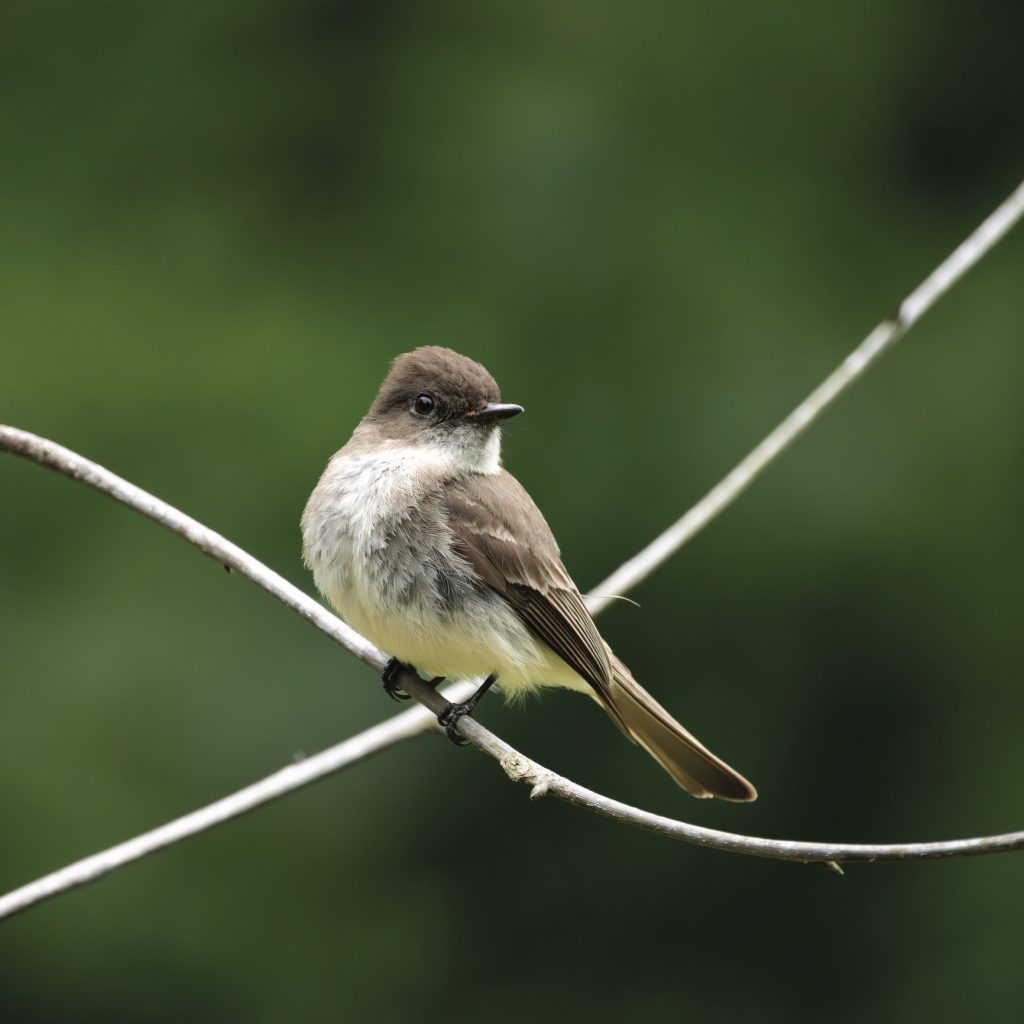
Eastern phoebes are small black and white birds that can be easily overlooked — if it wasn’t for their loud voices. Repeated “fee-bee, fee-bee” calls can be heard around wet areas all over our state. The farther west one travels through the Piedmont and into the foothills of North Carolina, calling males become more and more evident. From March through June, males declare their territory from elevated perches adjacent to ponds and streams. Even on warm winter days, these little birds can be heard loudly chirping or even singing a phrase or two.

Phoebes have an extensive range in the U.S., from the East Coast to the Rockies, and up and across central Canada. In the winter they can be found in Southern states from the Carolinas over to Texas down into Mexico and northern Central America. They are exclusively insectivorous, feeding on beetles, dragonflies, moths — any bugs that will fit down the hatch. Although they do not typically take advantage of feeders, I have seen one that did manage to negotiate a suet cage one winter. Because their feet are weak, they’re not capable of clinging, so this bird actually perfected a hovering technique as it fed in spurts.

Originally eastern phoebes utilized ledges on cliff faces for nesting. We do not know much about their habits in such locations since few are found breeding in those places now. Things have changed a lot for these birds as humans have altered their landscape.

While phoebes can be easy to locate as a result of their loud calls, in our area their nests may not be. Although they are good-sized open cup structures, they will be tucked into out-of-the-way locations. Typically, they will be on a ledge high up on a girder under a bridge or associated with a culvert. They may also be up in the corner of a porch or other protected flat spot. Grasses and thin branches are woven and glued together with mud to form the nest; therefore it’s critical that the location be close to water.

The affinity eastern phoebes have for nesting on man-made structures in our area may indicate that these are safer than more traditional locations. Climbing snakes are not uncommon in the Sandhills. Black rat snakes and corn snakes are not as active on buildings as they are on bridges and other water control structures. The phoebes may be adapting their behavior in response to these predators and others less likely to be found so close to human activity.

If you have, or have had, phoebes on your property in summer, I’d like to hear about it. I continue to record locations and details on nesting substrate for the species in the Sandhills. The variety of locations that these little birds choose has been very curious. Light boxes and fixtures, gazebos, porch support posts and more have been used, if they are covered by at least a slight overhang. Not only is water a necessity for phoebes in summer, but they require mature trees for perching and foraging as well. Keep an ear out and perhaps you will find one of these adaptable birds nearby — and be sure to let me know!

Out of the Blue

OUT OF THE BLUE

It’s in the Bag

The clutch that says it all

By Deborah Salomon

Back in the 1940s, radio personality Art Linkletter would go through women’s purses, creating profiles based on what he found.

He was usually spot-on. Sometimes embarrassing, always hilarious.

Not sure if the Smithsonian has a nook devoted to purse profiles. If not, maybe it oughta make room for this revealing artifact. But instead of a dive into contents, I’ll extrapolate information from the purse itself, notably what sets it apart from ancestors.

In a word . . . compartments.

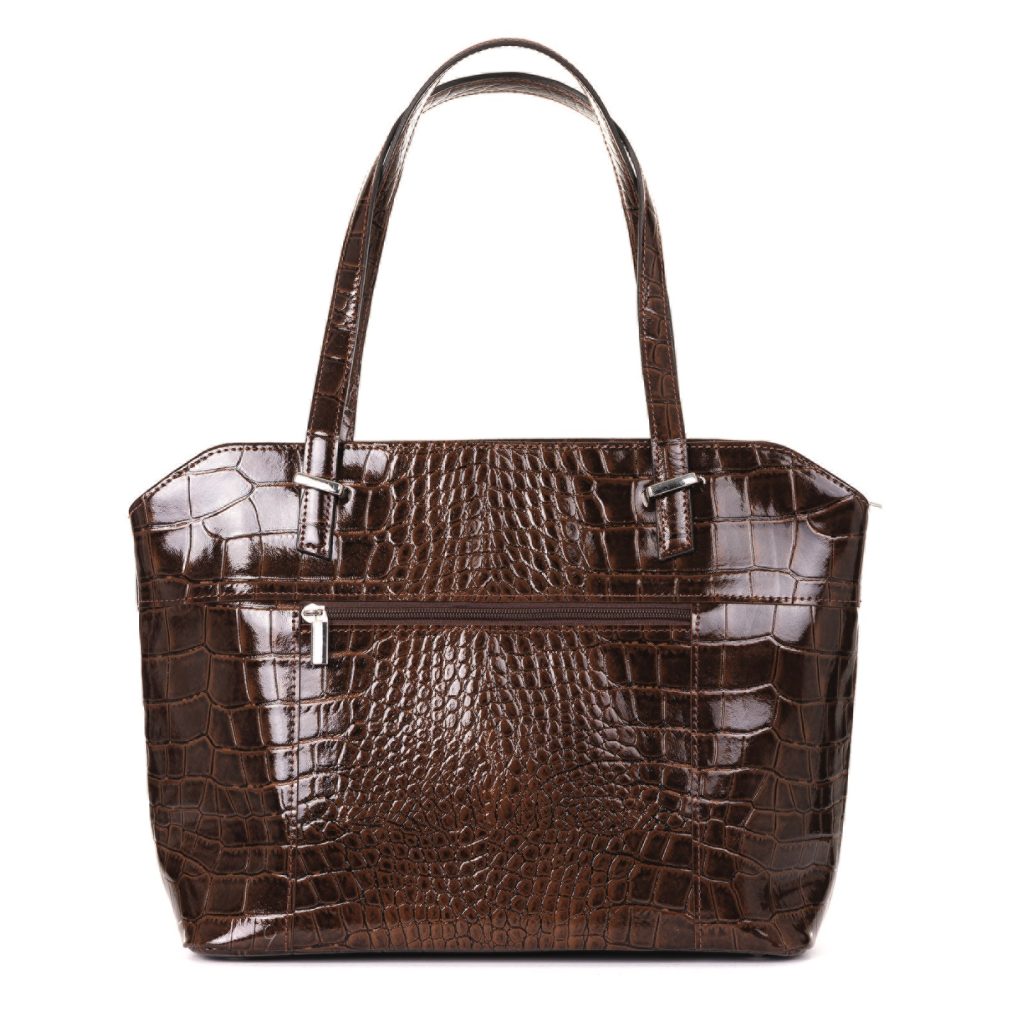
Some ladies like ’em inside, others prefer the exterior. Notice that both interior and exterior may or may not have zipper, snap or Velcro closures. Some side compartments are narrow with no closure, designed to stash eyeglasses but prone to losing them. Others, square and flat, accommodate a tablet.

No, not the kind with lined yellow pages.

Most women designate one compartment for lipstick and a comb. “Compacts” are so Art Deco, along with bright red lipstick and loose powder. Nothing dates a purse more than a skinny flip-phone compartment . . . except maybe the material it’s made from.

Back in the day, ladies’ winter handbags were hand-held leather of various grades, from coarse cowhide to fine calfskin. Queen Elizabeth II set the style. Call it grandmotherly. Spring meant shiny black patent leather. Come summer, you switched to straw or quilted cotton. The advent of vinyl/plastics resulted in stiff imitation leather adorned with brassy bling. They were big and heavy, even empty. A worse affront: designer knockoffs, an insult to YSL, Louis Vuitton and Chanel, sold on Manhattan street corners. But they did establish one rule: A brown YSL goes with any color outfit.

As for shape/size, shoulder bags took over when women ditched the bridge club for a business forum, a court hearing, surgery schedule or middle-school soccer game. Princess Diana put clutches on the map, primarily to hide her cleavage when emerging from a Rolls. A shoulder bag that left hands free to text Chinese take-out became roomy enough to stash leotards for a workout on the way home from the office. 

Contents, or the lack thereof, offer another readout. Here’s what you won’t find in the modern woman’s handbag: a checkbook; cigarettes and lighter; a wad of “emergency” cash; Chiclets; a single-function car key; an address book; a rain bonnet; movie ticket stubs; a Neil Diamond CD; a map; a pencil; bobby pins; stamps; a tiny metal aspirin container; a handkerchief; a safety pin for the dreaded bra strap malfunction.

How come only men carry handkerchiefs?

Speaking of men . . . remember the man bag, which made a splash in the 1990s? Before the invention of pockets, Renaissance noblemen carried coins in “girdle pouches” without incurring ridicule. And a 5,000-year-old mummy named Ötzi the Iceman was found in the Alps beside his purse. No such luck for 20th century gents when, as I recall, even a plain leather crossbody drew giggles.

These days, the most coveted clutch might be a little thing hardly big enough for an iPhone, designed by Judith Leiber, who isn’t above wrapping a snake around black sequins and charging a few thousand for it at Bergdorf’s.

Now if only I didn’t need four new tires . . .

Pleasures of Life

PLEASURES OF LIFE

By Ruth Moose

Acronyms these days are driving me OOMM. Out of my mind. There is a new one every day. Prolific as mosquitoes, they buzz around and are joined by others, both old and new, like some strange alphabetic mating ritual.

“BRB,” I heard someone say. “What?” I asked. “Be right back,” she repeated for my benefit, with just a hint of pity in her voice. They’ve cracked the seal on print and text and have invaded speech, turning it into a game of Hangman.

The acronyms of my youth came from postal letters: PS added after a signature meant “postscript” to signify an additional thought. Is this the granddaddy of them all? The AOA? The Australopithecus of acronyms? I remember notes and letters that ended with the acronym SWAK. “Sealed with a kiss.” Oh, how sweet. And even later still, letters signed TSTSA: “Too sweet to sleep alone.” Naughty, naughty.

Next thing I know it’s OMG everywhere I looked. Oh My God. I admit, I heard that one before I saw it. LOL. That one showed up in an email. Lots of love? Lots of luck? Oh, right. Laugh out loud.

Are we really so busy with texts and emails that the entire word has been rendered obsolete? Reader’s Digest (RD to you), a stalwart American institution of reasonably good taste, recently devoted a whole page to . . . acronyms, replacing the page usually devoted to vocabulary. Codes taken from everywhere, every day. Acronyms that most everyone would (or should) know: TBD (to be determined); ESL (English second language); GMO (genetically modified organism); ROM (range of motion); SPF (sun protection factor); TMI (too much information). I thought I was getting the hang of it until I got to SEP (someone else’s problem) and the last one on the page, JGI. JGI?

Just Google it.

It seems every profession has its own acronyms. Real estate ads have WICs — walk in closets. Book reviewers have ICPID — I couldn’t put it down. Wedding planners never know what to do with the MOG — mother of groom.

Lurking in our everyday, text-heavy world are ones like FWIW (for what it’s worth) or ICYMI (in case you missed it). There is even an online magazine by that five-letter name. Poor thing. Personally, I’d rather spell it out like National Geographic. And, oh, wouldn’t I love to go back in Time?

If an acronym has you totally stumped and you have to ask someone, you might as well paste the scarlet L (thumb and forefinger) on your own forehead — Loser. Face it, you’re hopelessly OOTL (out of the loop). Horrors. You may, from time to time, come across someone who will laugh kindly and decode the acronym for you. This is a WW (win-win). You get to go on your way with a brand new bit of alphabet slang to hang on your belt and then part company with the satisfaction of having behaved like the Good Samaritan.

Recently I sent an email responding to an upcoming event I planned to attend. At the end I added LW.

My recipient fired back, “What is LW?”

Lord Willing.

I thought everybody knew.

Focus on Food

FOCUS ON FOOD

Open Season

It’s strawberry o’clock somewhere

Photograph and Story by Rose Shewey

Eating seasonally makes for an interesting lifestyle. The practice of only buying and eating foods that are grown locally and harvested at peak flavor is a worthy undertaking but also a commitment I’m not ready to make just yet. I can easily enjoy locally harvested foods all summer long, especially in North Carolina, where we grow an abundance of exciting warm weather crops — but I don’t foresee myself mastering the art of exclusively eating root vegetables and canned goods for months on end during the winter.

I do have some principles, though. These past few months at the grocery store, I had to use all my power of persuasion to talk my 6-year-old out of bagging strawberries that were grown thousands of miles away and, frankly, a bit pale and sorry looking. So, that’s a “no” to buying imported berries, as well as “winter tomatoes,” the epitome of blandness. On the other hand, I have a hard time turning down avocados from south of the border, or especially plump and juicy-looking citrus from across the country, if the opportunity presents itself.

In the case of the strawberry, which is native to Northern America, it makes a lot of sense to wait for the local harvest. Not only will the berries look better, they’ll be their most nutritious and aromatic. But here again, I fall off the wagon by stretching the term “locally grown.” As soon as the first strawberries harvested anywhere in the Southeast hit the shelves, all bets are off.

So, come March — the month I typically start noticing Florida-grown strawberries in the markets — we’re in the strawberry business, just a few weeks before our (truly local) Sandhills strawberries are ready to be picked. To bridge the gap between the cold season and the tender beginnings of spring, I like to prepare a strawberry fruit salad and mix in wintry grapefruit. Make it into a meal and serve this fruit salad with waffles. A grain- and gluten-free almond and oat waffle is the ideal accompaniment to this fruity affair — and not just for breakfast.

Strawberry and Grapefruit Salad with Almond Oat Waffles

Fruit Salad

(Serves 4)

2 grapefruit, peeled

400 grams strawberries

2 tablespoons strawberry syrup or other liquid sweetener (optional)

Dice grapefruit (peel off the membrane, if desired) and slice the strawberries. Add cut fruit to a bowl and toss with strawberry syrup or sweetener of choice. Refrigerate until ready to use.

Almond Oat Waffles

(Makes 4-6 waffles)

1 cup oat flour

1 cup almond flour

3/4 teaspoon baking powder

Pinch of salt

3/4 cup milk (nut milk or whole milk)

2 tablespoons honey (softened) or granulated sugar

3 eggs

2 teaspoons vanilla extract

3 tablespoons butter (melted) or coconut oil

Preheat your waffle iron. Combine oat flour, almond flour, baking powder and salt in a bowl and whisk to combine. In a separate bowl, whisk together the milk, honey or sugar, eggs, vanilla extract and butter. Pour the dry ingredients into the wet ingredients and stir until well combined. Ladle batter into your waffle iron and cook until golden and slightly crisp.

Bookshelf

BOOKSHELF

March Books

Fiction

Count My Lies, by Sophie Stava

Sloane Caraway is a liar. Harmless lies, mostly, to make her self-proclaimed sad little life a bit more interesting. So when Sloane sees a young girl in tears in the park one afternoon, she can’t help herself — she tells the girl’s (very attractive) dad she’s a nurse and helps him pull a bee stinger from the girl’s foot. With this lie, and chance encounter, Sloane becomes the nanny for the wealthy and privileged Jay and Violet Lockhart — the perfect New York couple, with a brownstone, a daughter in private school, and summers on Block Island. But maybe Sloane isn’t the only one lying, and all that’s picture-perfect harbors a much more dangerous truth. The thing about lies is that they add up, form their own truth and a twisted prison of a world. Be careful what you lie for.

The River Has Roots, by Amal El-Mohtar

In the small town of Thistleford, on the edge of Faerie, dwells the mysterious Hawthorn family. There, they tend and harvest the enchanted willows and honor an ancient compact to sing to them in thanks for their magic. None are more devoted than the family’s daughters, Esther and Ysabel, who cherish each other as much as they cherish the ancient trees. But when Esther rejects a forceful suitor in favor of a lover from the land of Faerie, the sisters’ bond and their lives will be at risk.

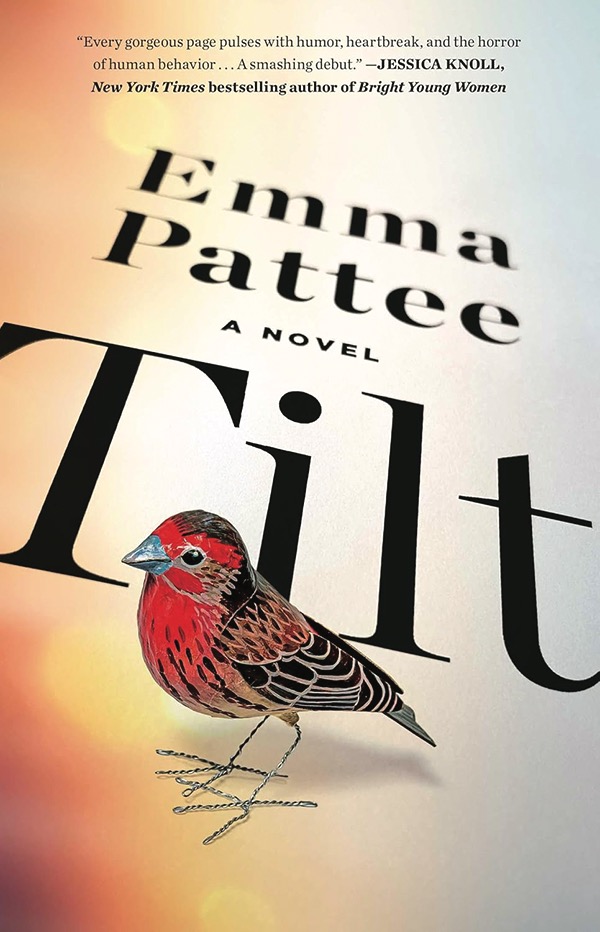
Tilt, by Emma Pattee

Annie is nine months pregnant and shopping for a crib at IKEA when a massive earthquake hits Portland, Oregon. With no way to reach her husband, no phone or money, and a city left in chaos, there’s nothing to do but walk. Making her way across the wreckage of Portland, Annie experiences human desperation and kindness: strangers offering help, a riot at a grocery store, and an unlikely friendship with a young mother. As she walks, Annie reflects on her struggling marriage, her disappointing career, and her anxiety about having a baby. If she can just make it home, she’s determined to change her life.

Wild Dark Shore, by Charlotte McConaghy

Dominic Salt and his three children are caretakers of Shearwater, a tiny island not far from Antarctica. Home to the world’s largest seed bank, Shearwater was once full of researchers, but the Salts are now its final inhabitants until a woman, Rowan, mysteriously washes ashore. Long accustomed to protecting herself, Rowan starts imagining a future where she could belong to someone again, but she isn’t telling the whole truth about why she set out for Shearwater. And when she discovers sabotaged radios and a freshly dug grave, she realizes Dominic is keeping his own secrets. They all must decide if they can trust each other enough to protect the precious seeds in their care and if they can finally put the tragedies of the past behind them to create something new, together.

Nonfiction

Raising Hare: A Memoir, by Chloe Dalton

In February 2021, in the English countryside far away from her usual London life, Chloe Dalton stumbled upon a newborn hare — a leveret — that had been chased by a dog. Fearing for its life, she brings it home, only to discover how impossible it is to rear a wild hare, most of whom perish in captivity from shock or starvation. Through trial and error, she learns to feed and care for the leveret with every intention of returning it to the wilderness. Instead, it becomes her constant companion, wandering the fields and woods at night and returning to Chloe’s house by day. Though Chloe feared that the hare would be preyed upon by foxes, stoats, feral cats, raptors and even people, she never tried to restrict it to the house. Each time the hare leaves, Chloe knows she may never see it again. Raising Hare chronicles their journey together, while taking a deep dive into the lives and nature of hares, and the way they have been viewed historically in art, literature and folklore.

Children's Books

Sunrise on the Reaping,
by Suzanne Collins

The long-awaited fifth book in the runaway bestselling “Hunger Games” series, Sunrise on the Reaping, arrives this month. As the day dawns on the 50th annual Hunger Games, fear grips the district of Panem. Twice as many tributes will be taken from their homes. When you’ve been set up to lose everything you love, what is there left to fight for? (Ages 14 and up.)

Over in the Garden, by Janna Matthies

There are fun books and cute books. Then there are books that will become part of the family canon. Over in the Garden has the makings of a family classic. Counting, color and compost are rounded out with a delightful repeatable rhyme. This one is perfect for Earth Day or any nature-loving family. (Ages 2-6.)

Little Freddie Two Pants, by Drew Daywalt

First it was crayons, and now its pants. Author of The Day the Crayons Quit takes the everyday and makes it ridiculous! Perfect as a read aloud, this picture book will have young readers dreaming up all the new ways of putting on pants. (Ages 2-6.)

The Cranky-Verse: Cranky Chicken Book 4, by Katherine Battersby

Cranky Chicken, a kid favorite in the early graphic novel section, is back for another adventure with three hilariously cranky stories about Cranky Chicken, Speedy the Worm and their new friend, a little turtle. Join them on a set of illustrated adventures as they learn how to take care of each other, navigate a cranky injury, and go on a camping adventure. (Ages 6-9.)

Hometown

HOMETOWN

Never Too Late

The career path of a classmate

By Bill Fields

Not long after Sara E. Johnson and I began a recent phone call, I couldn’t resist reminding my Pinecrest High School classmate what she had penned a long time ago in my senior yearbook.

“When you’re a rich and famous news man and I’m a rich and famous news lady,” she wrote on a back page in my Spectrum, “let’s get together and talk over old times.”

The words were the earnest well-wishes from one eager aspiring journalist to another. Sara LeFever and I were on the staff of The Courier, the student newspaper, for a couple of years, and officers in the Quill and Scroll club. We alternated weeks reporting high school news in The Pinehurst Outlook, with fresh-faced class pictures as our respective column sigs.

Neither of us fulfilled the futures mentioned in her message. I gravitated to sports, specializing in golf coverage. A stay-at-home mother of three until earning a master’s degree from UNC and becoming a reading specialist in her 40s, Johnson contributed articles on family and education to newspapers in Chapel Hill and Raleigh.

When we talked in January, the conversation didn’t revolve around our high school days (although we agreed it can be tough to review examples of our early, raw writing) but rather newer, exciting developments in Johnson’s life, which should be an example for anyone of a certain age. 

“I was 60 when my first novel came out in 2019,” she said. “People need to know it’s never too late.”

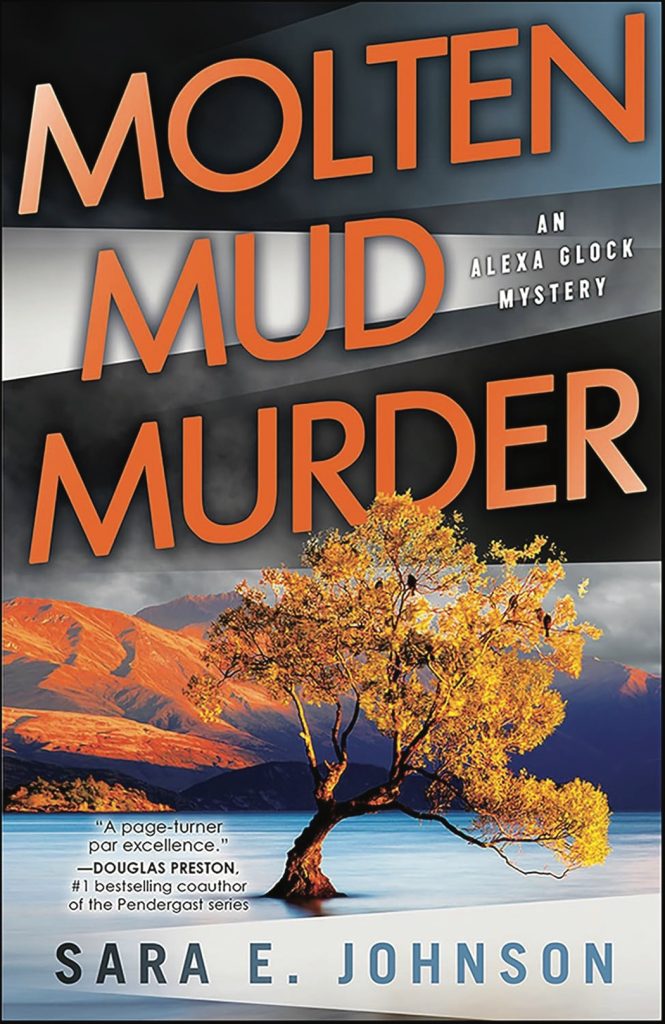
Johnson’s debut book, Molten Mud Murder, was the first installment in the “Alexa Glock Forensics Mystery Series.” The central character is a plucky and slightly geeky American investigator living in New Zealand, a traveling forensic who uses teeth to solve crimes. The debut has been followed by The Bones Remember, The Bone Track, The Bone Riddle and The Hungry Bones. The final book in the series, Bone Chilling, will be published this year.

The mysteries resulted from the nine months Johnson and her husband, Forrest, who live in Durham, spent exploring New Zealand in 2014. After returning home from a fascinating land that had intrigued her greatly, she pursued the notion of writing a book, something I had encouraged her to do in an email when we reconnected more than 20 years ago. “You said if you want to write a book, you can do it,” Johnson said. “Your message really stuck with me.”

Johnson has always been a wide reader, including mysteries. She has been enamored of the genre since she was 10 and read The Bungalow Mystery, a Nancy Drew book given to her mother in 1942. She spent a year writing Molten Mud Murder. Then came the hard part, which required much patience and persistence.

“I think I had 66 rejections from literary agents, but then the 67th came along,” Johnson said. “I don’t know where the cutoff would have been. Would I have contacted 75 or 100 agents? I don’t know. I was getting some positive rejections — people saying, ‘I like this and this, but don’t like that.’ What I call the positive rejections kept me going, and I kept honing the manuscript.”

Johnson informs her books with meticulous research provided by a cadre of professionals to ensure accuracy in her scenes. “I have wonderful experts who read over what I’ve written,” she said. “One forensic pathologist can spend two pages telling me how to flip a body on an autopsy table.”

At work on her seventh book, revolving around a coroner in northern Minnesota, Johnson will incorporate the forensics knowledge she gained producing the Alexa Glock series. She tries to write 1,000 words a day while relying on important assessments along the way from fellow writers.

“Hands down, the biggest help for me is being in a writers’ group,” Johnson said. “We meet weekly, not just mystery authors but folks in all kinds of genres. We bring 10 pages, read them, and people critique them. Reading your work aloud and getting good feedback is so valuable. I can’t thank them enough.”

As for others who might want to tap into their creative side later in life, Johnson believes it isn’t a mystery. “Sit down and do it,” she said. “If you have a dream to write a book, it’s possible.”