Hometown

Hometown

In the Swim

The summer of staying afloat

By Bill Fields

There was a lot going on in the summer of ’68, much of it heavy and consequential. But being only 9 years old during those tumultuous months, I was mostly oblivious to the real-world turmoil and focused on things that mattered to a rising fourth-grader.

Swimming — or more accurately, being at a pool — was near the top of the list.

We were not really a swimming family. Mom loved excursions to a lake or the ocean but was mostly an observer, content to take in the water from a dock or beach, and only occasionally getting in up to her thighs to cool off. She was a hawk-eyed sentry on shore, real or imagined rip currents a specialty. There is home movie footage of Mom in a suburban Atlanta hotel window waving me out of the pool’s deep end. Dad enjoyed floating on his back just beyond the breaking waves at Ocean Drive on annual vacations, a pleasure that guaranteed angst for my watchful mother.

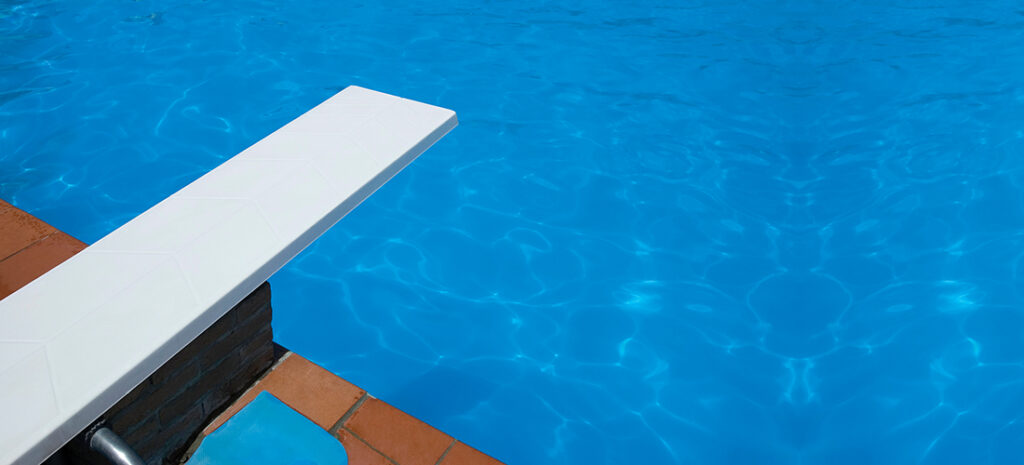
I can’t blame all my early swimming trepidation on my mother. Before I had started first grade, my older cousins were in town for a visit and lodging at the Charlton Motel. Getting to go over there for a dip with them in a real pool — instead of the modest Sears above-ground model in our yard whose plastic bottom always felt slimy and whose primary focus seemed to be attracting bugs of one sort or another — was a big deal. My cousin Bob, treading water near the diving board and wrongly believing I knew how to swim, urged me to jump in. I thought he was going to catch me. There were a few moments of panic before Bob realized what was going on and scooped me up and carried me to the shallow end.

I soon would learn how to dog paddle. Aberdeen Lake, Rec Department outings to the Southern Pines town pool, White Lake and the rare family road trip motel pools were my learning laboratories. Whether in murky or clear waters, though, I was still a novice.

That’s why 1968, which I call the Summer of Sore Toes, was important.

My sister Dianne and her husband, Bob, hosted me for a visit in Winston-Salem, where they had gone to Wake Forest. It was a memorable week. They showed me the college campus, treated me to cherry Slurpees at 7-Eleven, took me to an aquarium-fish store that featured a tank of piranhas. My sister baked lasagna and made tacos, exotic fare given the basic Southern food Mom and Dad served at home. They were living in a Winston-Salem apartment complex whose best feature was a pool, where I was determined to spend much of my time.

With Dianne patiently poolside with a good book or three keeping a loose eye on her little brother, I spent hours in the water. Bob, an excellent swimmer and former lifeguard, joined me in the pool when he got back from his graduate school classes and tried to help me get more comfortable and proficient in the water.

The dog paddle evolved into a reasonable freestyle stroke I could do a full lap with. I proudly learned how to do a dead man’s float. I still was too timid to go off the diving board, but I got bold enough to dive in from the pool’s edge — over and over and over. The rim had a rough concrete surface, and we helped Eckerd’s bottom line with the Band-Aids put into duty over those seven days, the week I became a swimmer.

About a decade later, when I was at Carolina, students had to pass a swim test to graduate — the requirement was staying afloat for five minutes in the manner of your choosing: swim, tread water, float. If you couldn’t pass, a physical education swimming class was in your future. I confidently signed up for the test, arrived at the appointed time, dove into the 10-foot-deep water, and had no problem lasting until the monitor’s whistle of success. If only calculus had been as easy.  PS

Southern Pines native Bill Fields, who writes about golf and other things, moved north in 1986 but hasn’t lost his accent.

Golftown Journal

Golftown Journal

Bryson’s Bunker

Another shot for the ages

By Lee Pace

Photograph by Matthew Harris Golf Collection

The thread from 1999 to 2024 is quite eerie indeed.

Payne Stewart and Bryson DeChambeau, each of them a former golfer from Southern Methodist University in Dallas.

Each of them with a youthful connection to Pinehurst and its esteemed No. 2 course, Stewart from having visited for a month in 1979 to play a local mini-tour rota, and DeChambeau coming annually with the Mustang golf team to play a fall match against a local school like Wake Forest or North Carolina at the behest of Bob Dedman Jr., the owner of the resort, and a graduate and benefactor of SMU.

Each of them maturing into gracious champions after hiccups as younger players with instances of churlish or snippy behavior with fellow competitors or tournament officials.

And each of them playing in the final group of the U.S. Open and arriving at the 18th tee with history in the balance. 

Stewart in 1999 needs a par to hold off playing partner Phil Mickelson, but his tee shot on the uphill, par-4 finishing hole misses the fairway to the right. He’s in 5 inches of suffocating rough, the grass wet on a cool, misty day. He punches out, has 78 yards to the hole, hits a three-quarter sand wedge to 20 feet short of the back-right hole location.

Stewart makes the putt, and his right-hand fist pump, right-leg extension celebratory pose will be immortalized on film and later in bronze for the ages.

“Perfect — a perfect way to win,” Stewart said. “I think everyone in the field will attest to how great No. 2 is, to what a special place Pinehurst is. To win here means a lot to me.”

DeChambeau in 2024 needs a par to hold off Rory McIlroy, who’s playing one group ahead. He yanks his tee shot left of the fairway, the ball traveling more than 300 yards uphill and coming to rest under a magnolia tree, up against a root and sitting on the native hardpan sand that was exposed during the 2010-11 Coore & Crenshaw course restoration. He has 147 yards to the hole, punches out, and the ball comes to rest in a bunker sitting front right of the green.

He has 54 yards to the traditional final day, back right pin. He uses his immense physical strength to explode out of the sand to 4 feet, then makes the putt. As the ball rolls into the cup, DeChambeau extends both arms, arches his back, looks to the heavens and sets off on several seconds of unabashed joy.

“That bunker shot was the shot of my life,” DeChambeau said. “I’ll forever be thankful that I’ve got longer wedges, so I can hit it farther, get up there next to the hole.”

So now Payne’s Putt has alongside it Bryson’s Bunker in the pantheon of all-time greatest shots — not only in 129 years of Pinehurst history, but also in major championship golf.

Jack Nicklaus’s 1-iron hitting the flag at Pebble Beach in 1972, Tom Watson’s chip-in at Pebble a decade later, Seve Ballesteros’s winning putt at St. Andrews in 1984, Bob Tway’s bunker dunk at Inverness to win the 1986 PGA Championship, Tiger Woods’ chip-in at Augusta in 2005 . . . all iconic monster shots in golf.

“Bryson’s shot has to be as good as any of them,” says 2021 Open champion Jon Rahm.

“There’s no question Bryson’s shot was one of the best shots in U.S. Open history,” says Curtis Strange, a two-time Open champion and former North & South Amateur winner at Pinehurst. “His shot was one of the toughest, if not the toughest, shots in golf. Magnify that with last hole, U.S. Open pressure on a world stage? It was an amazing shot.”

The week after the Open, Pinehurst officials, at the request of DeChambeau caddie Greg Bodine, sent via FedEx an urn of sand from that bunker to DeChambeau’s residence. The golf staffers and caddies have half-jokingly wondered if the windows in the clubhouse behind the 18th green are now in danger with retail golfers attempting that shot and hitting the dreaded skulled shot flying who knows where. The club’s social media staff even mused after the Open that the preponderance of balls landing on the roof might escalate.

All around the golf course, the village and the Sandhills, knowledgeable golf students looked on in awe.

“The long sand shot, that’s the hardest shot in golf,” says former PGA Tour player Pat McGowan, who watched his son Michael play the first two rounds. “Oh my gosh, what a shot. He could stand there and hit 100 shots and not get it any closer. He could have skulled that over the clubhouse and made a double. But Bryson is so strong he just muscled it out.”

“The stat of a PGA Tour player getting up and down from a bunker from that distance is 1.7 percent,” says Pinehurst teaching pro Kelly Mitchum. “To do it on the final hole of a U.S. Open is pretty remarkable.”

Gus Ulrich, the longtime teaching pro at Pinewild Country Club and golf coach at Sandhills Community College, was struck with the authority and resolve DeChambeau exhibited during the minute before the shot.

“What impressed me was Bryson did not overanalyze it,” Ulrich says. “He didn’t rush it by any means, but he didn’t grind over it and agonize like, ‘Oh, I gotta make this to win the U.S. Open.’ He made up his mind pretty quickly, walked in and hit the shot. I think that’s what you have to do in that situation. The more you agonize over it, the harder the shot becomes.”

DeChambeau reflected on that very mindset afterward. Asked what he would remember most about the final two hours of a drama-laden back nine, he said: “Probably my caddie telling me I can do it out of the bunker. G-Bo just said, ‘Bryson, just get it up-and-down. That’s all you have to do. You’ve done this plenty of times before. I’ve seen some crazy shots from you from 50 yards out of a bunker.’ I said, ‘You’re right. I need the 55-degree. Let’s do it.’”

Course superintendent John Jeffreys was standing behind the green in DeChambeau’s line and considered there were about a half-dozen layers of ground undulation between the golfer and the hole — a “false front” leading up to the putting surface; a narrow plateau in the front portion of the green; a downslope and swale in the middle of the green; and finally, an upslope leading to the back crest where the pin was set.

“There’s a lot more to that green than you would think approaching it on the angle he had,” Jeffreys says. “There were a lot of areas to contend with that can help you or hurt you. What made the shot so great was he landed it on the downslope behind that first little plateau. That propelled the ball forward and it ran up to 4 feet.”

And the rest, as they say . . .

No doubt they’re making room as we speak in the history-laden hallway of the resort clubhouse to celebrate Bryson’s Bunker.

“It’s like we caught lightning in a bottle,” Dedman says. “It was otherworldly. To me, it’s almost as if it was preordained. I think maybe Payne and my father were up in heaven and put their thumb on the scale to Bryson’s advantage.”  PS

Lee Pace has written about the Pinehurst experience for more than three decades from his home in Chapel Hill. Write him at leepace7@gmail.com and follow him on X @LeePaceTweet.


Southwords

Southwords

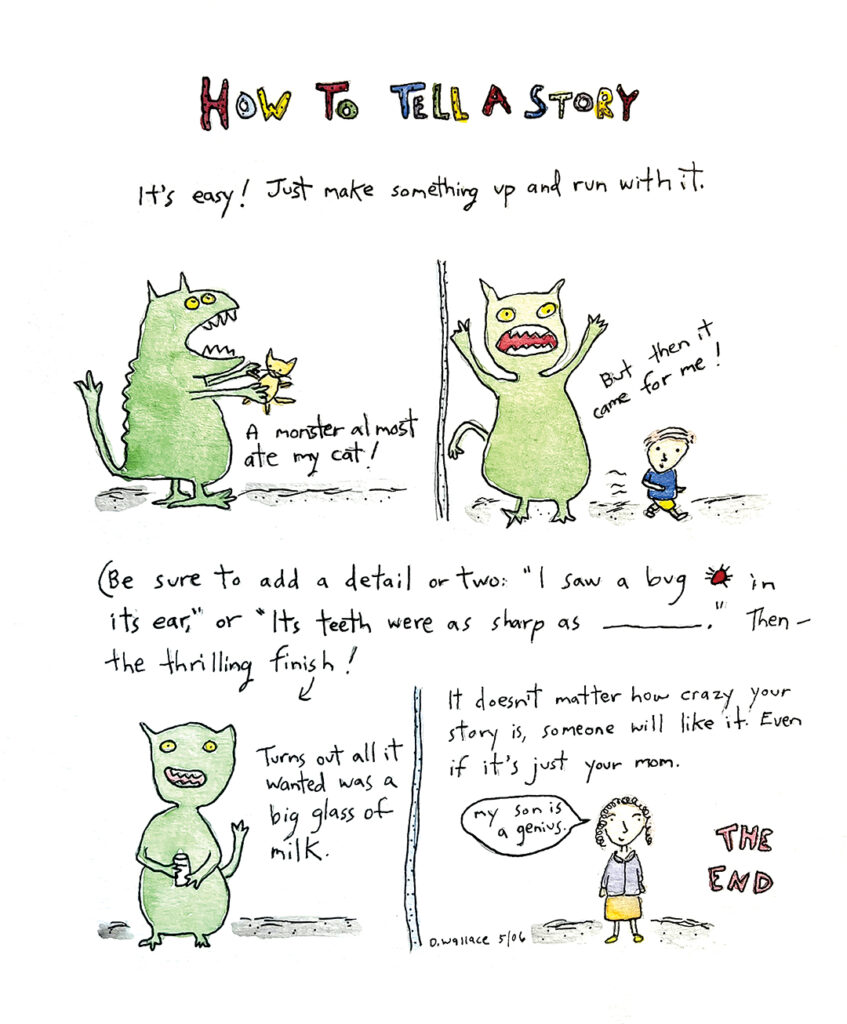
Daniel Wallace is the author of six novels. He is the J. Ross MacDonald Distinguished Professor of English at the University of North Carolina at Chapel Hill, his alma mater.

Naturalist

Naturalist

A Tornado of Butterflies

The marvel of swallowtails “puddling”

Story and Photographs by Todd Pusser

On a hot spring day in the North Carolina foothills, near the town of Morganton, I went looking for a fish. Not just any run-of-the-mill fish, mind you, but a greenhead shiner. Granted, the greenhead shiner is not much to look at most of the year and does indeed look like a run-of-the-mill minnow. But come late spring and early summer, when water temperatures warm up in the prelude to spawning season, the shiner turns into a tropical splendor. The coloration of its body magically morphs from a bland, silverish hue to radiant neon red, complete with brilliant white fins and a white head. A couple of hundred greenheads schooling in shallow water look like something straight out of the Great Barrier Reef.

Like many quests, sometimes you find something totally unexpected. On this day, I stumbled upon a cluster of intriguing critters equally as colorful and tropical-looking as the shiners. Rounding the bend of a tiny creek with a heavy underwater camera housing in tow, I flushed a swarm of eastern tiger swallowtail butterflies from off the ground. The sudden fluttering of dozens of dainty wings around my head took my breath away. A shaft of sunlight penetrating through the canopy above illuminated their bright yellow and black wings, causing the butterflies to positively glow in the shaded forest. The effect was enchanting.

I remained absolutely still as the butterfly tornado continued to swirl around my head. Eventually, one by one, the swallowtails settled back to the sandy ground near the edge of the water. I counted well over 40 of the winged wonders, easily the most butterflies I have seen in one spot in North Carolina.

I was completely unprepared for photographing a butterfly convention. The wide-angle fisheye lens, buried within the bowels of my underwater housing, was not the tool of choice for documenting this phenomenon. So, I did what I had to do. Forgetting about the fish for the moment, I took several steps back and carefully placed my underwater housing on the ground. Then, as fast as I could, I walked to my car several hundred yards away to retrieve another camera and a more appropriate telephoto lens, all the while hoping that the colorful mass would remain.
Twenty minutes later I returned and, to my relief, found the butterflies still there. Lying flat on the ground, I started to frame the action. Now with the aid of a 400mm lens, in my viewfinder I could clearly make out the long tongues of the butterflies probing the sand. The swallowtails were engaged in a behavior that entomologists term as “puddling.”

It works something like this: By sticking their long tongues into the damp mud, butterflies suck up minerals from the ground. Research has shown that most of these puddling aggregations involve males, who load up their spermatophores with essential salts, which they then present as “gifts” to receptive females during courtship. In a nutshell, puddling is a butterfly frat party.

Swallowtail butterflies are frequent puddlers, and do so around the world in large, densely packed groups. Globally, scientists recognize over 600 species of swallowtails. The family includes the remarkable and highly endangered Queen Alexandra’s birdwing of Papua New Guinea, the largest of all butterflies, whose wings can stretch more than 11 inches from wingtip to wingtip. Alfred Russel Wallace, the eminent British biologist (and co-describer of the Theory of Evolution with Charles Darwin), was so enamored with birdwing butterflies that when he caught his first in the Molucca Islands in 1859, he remarked, “I was nearer fainting with delight and excitement than I have ever been in my life; my heart beat violently, and the blood rushed to my head, leaving a headache for the rest of the day.”

Closer to home, swallowtails, with their large size, vibrant colors and propensity for visiting backyard gardens, are the quintessential butterflies for most people and attract legions of fans, even among those who despise insects. According to the recently published book Butterflies of North Carolina, South Carolina, Virginia, and Georgia, eight species of swallowtails are regularly found in the state.

Still belly-down in the mud, I continued to photograph the frenetic activity. Butterflies were constantly fluttering about, rising up into the air and settling back down on the bank. Unlike Wallace, my heart was not beating violently in my chest, and I had no headache. Still, after an hour observing the spectacle in the afternoon heat, I had worked up quite the sweat and was getting rather thirsty. Like the probing butterflies, I needed some essential sodium — not from the mud — but from a fruit punch Gatorade buried inside an icy cooler in the back of my car.

I squeezed off a few more frames highlighting the extended “tails” on the hindwing of one particularly handsome individual, a trait that gives the family its common name. Satisfied with the images, I got up from the ground, dusted myself off, and slowly walked back toward the car and much-needed sustenance.  PS

Naturalist and photographer Todd Pusser grew up in Eagle Springs. He works to document the extraordinary diversity of life both near and far. His images can be found at www.ToddPusser.com.

Birdwatch

Birdwatch

The Stately Little Blue

A summer visitor dressed in white

By Susan Campbell

Late summer can be an especially exciting time for birders. We need not travel far to find unexpected visitors. Weather events may cause individuals to be blown off track and show up in the neighborhood. These lost birds may stick around for mere hours. However, in other instances, it may be a more deliberate response to environmental conditions that brings them our way.

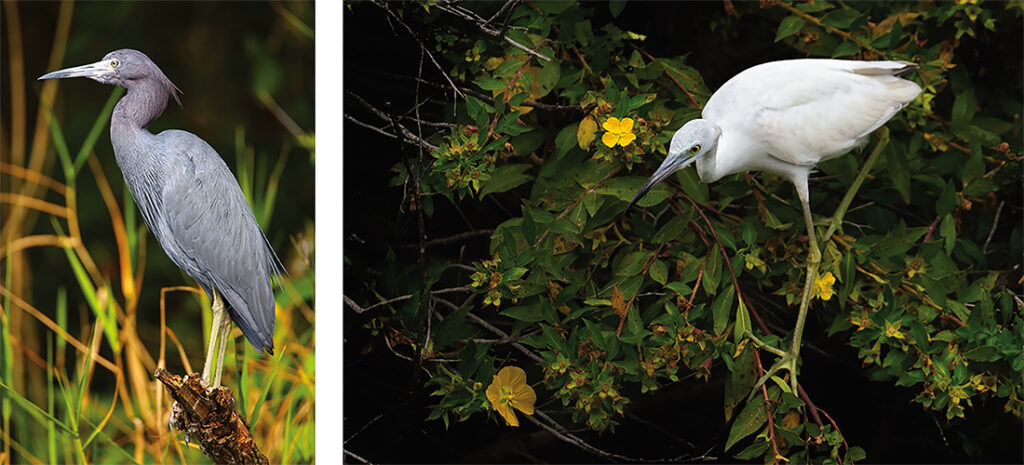
One bird that frequently appears in wet areas later in the summer is the little blue heron. And it may not be just one, but several of them, that show up. Furthermore, they are not usually blue. This is because young of the year (which these inland wanderers almost always are) are actually white. Except for the very tips of the wing feathers — usually a challenge to make out — these birds are covered with white feathers. Unlike the great or snowy egret, which also may turn up in the Piedmont or Sandhills at this time of year, the bill of these small herons is pinkish gray, and the legs are greenish.

All of these white waders may be spotted in shallow wet habitats — streams, small ponds, water hazards, retention areas, etc. Little blue herons may be by themselves, mixed with other white, long-legged waders, or even with the much larger great blue heron. Little blues can be identified by their more upright foraging posture, their slow, deliberate movements, and a downward angled bill as they stalk prey. Unlike other smaller waders, they will hunt in deeper water, often all the way up to their bellies.

Little blues watch for not only small fish but frogs and crayfish, as well as large aquatic insects. It is thought that their coloration allows them to blend in inconspicuously with similar white species. The association then provides protection from predators. Also, it has been found that little blues are significantly more successful predators when foraging alongside great egrets. These larger birds are likely to stir up the water as they move after underwater prey, which can then flush a meal in the direction of nearby little blues.

It takes these herons at least a year to develop adult plumage, not unlike white ibis — who sport dark plumage their first summer and fall — which also breed along our coast. They may have a pied appearance for a time in late winter or early spring. By April they will be a slatey blue-gray all over with a handsome bluish bill. Unlike our other wading birds, they lack showy head or neck plumes. They are also unique in having projections on their middle toes that form a comb, which is used as an aid when grooming.

Unfortunately this species has experienced an alarming drop in population numbers across North America over the past half-century. Loss of coastal wetland habitat, continued declines in water quality, and elimination as a nuisance in fish hatcheries all are thought to be contributing to the decline. So be sure to stop and appreciate these stately birds should you come across one — regardless of when or where you happen to be.  PS

Susan Campbell would love to receive your wildlife sightings and photos. She can be contacted by email at susan@ncaves.com, or by calling (910) 585-0574.

Omnivorous Reader

Omnivorous Reader

More Than a Mystery

Murder haunts a college town

By Anne Blythe

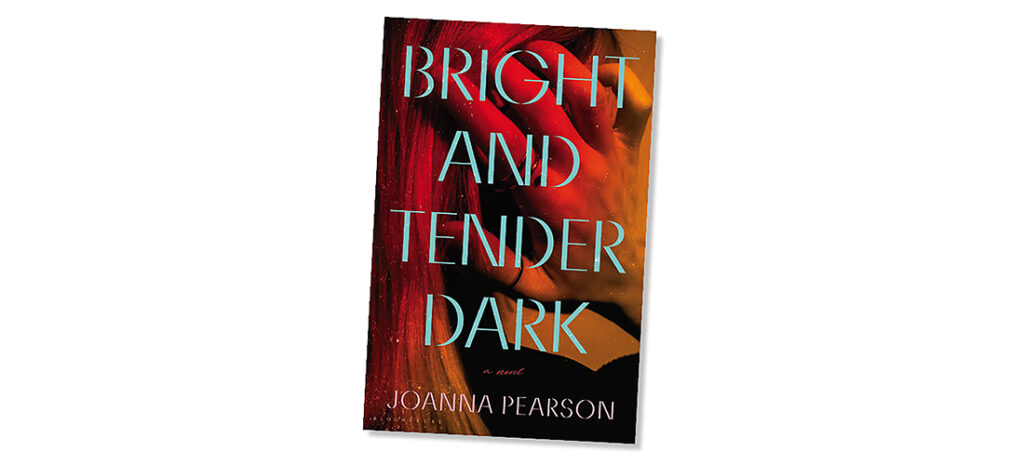
The makings for an ordinary crime thriller are present in Joanna Pearson’s first novel, but Bright and Tender Dark is anything but ordinary.

In the first few pages, Karlie, an alluring and enigmatic college student, is found dead in an off-campus apartment, brutally murdered, with no clear trail to the suspect. A former busboy with an eighth-grade education is in prison, conveniently convicted of her murder and serving time for a crime that shattered the tranquility of a college town.

The whodunnit aspect is there.

Joy, Karlie’s freshman year roommate and Pearson’s complicated protagonist, thinks the justice system got the wrong man. It is through Joy’s hunt for the real killer that we quickly realize Pearson’s book is a bit different from the traditional murder mystery. Layered on top is a retrospective investigation into the psychological ripple effects that Karlie’s dark death has had on the whole community, connecting seemingly unconnected people even two decades after it happened.

Pearson, a psychiatrist who lives in the Chapel Hill-Carrboro area, is also a poet and short story writer who now can add literary crime fiction to her compilation of writing genres. Just as her short story collections show that her poetic style spans literary genres, Bright and Tender Dark shows that her storytelling skills extend beyond short stories to novels. Many of the chapters could stand alone as stories within the larger story.

Pearson is masterful at character building. We meet Joy in the throes of middle age. She’s a mother of two finding a new footing after a painful divorce, assessing and reassessing her life. That evaluation creates the springboard for bouncing between two critical times in her life: the present, in which her ex is about to become a father again with his new wife; and the past, for which she has a new obsession, a decades-old murder.

Part of her compulsion comes from an unopened letter that Joy’s teenage son, Sean, finds in a book of John Donne poetry he has borrowed for English class.

It’s from Karlie.

“The letter has made a long and improbable voyage through time after being tucked away and forgotten, never even opened,” Pearson writes. “A miracle. An artifact of an old-fashioned epistolary era. Sean hands the letter to Joy with the solemnity of someone who has grown up on Snapchat. Joy’s hands tremble at the sight of the familiar handwriting. She dare not open it.”

Joy had been taking long walks alone at night, unable to sleep. Words and phrases reverberated through her mind as it raced. “Constitutionally unhappy.” That’s how her husband had described her as their marriage was blowing up. It had been “oppressive” for him, he said.

“He made the unhappiness sound like the core feature of her personality,” Pearson writes. “A suffocating force. The way that Joy looked at the world, pinched and vigilant, bracing for fire ants, falling branches, and tax deadlines, rather than celebrations. But her unhappiness allowed her to get things done!”

Joy eventually musters the courage to open that letter from Karlie. It was written in December 1999, shortly before her death, and is filled with exclamation points and underlined words — Karlie’s “characteristic arbitrary overuse of emphasis” on full display. But the letter holds a clue, one that Joy has not seen in any of the coverage of Karlie’s death, a mention of a BMW that had been pulling up outside her apartment. In the letter Karlie wonders whether it was Joy, but Joy didn’t have a BMW, nor had she been following Karlie to her apartment. Now, nearly two decades later, Joy is determined to find out who it was.

The search takes her back to old haunts in Chapel Hill, where Joy and Karlie went to college and where Joy still lives. She spirals into the depths of internet conspiracy theorists and true-crime Reddit platforms.

Pearson introduces an intriguing cast of characters: the predatory professor who woos his female students; the mother of the man doing time for the crime; the transgender night manager of the apartment building where Karlie was killed; the teenage son of a police chief on the high school soccer team with Joy’s son; people in cult-like religious groups; and more.

She takes her readers on a journey of discovery, giving them a glimpse of each character’s flaws and leaving open the possibility that they might be the killer, while also revealing clues that raise doubts about their potential guilt.

For anyone aware of high profile murders in Chapel Hill over the past couple of decades, there might seem to be some similarities with the 2012 killing of UNC sophomore Faith Hedgepeth and the 2008 death of UNC student body president Eve Carson. But at readings and in published interviews, Pearson has said the book is not based on a true crime. It’s fiction, although as a writer and engaged resident in the area, Pearson acknowledges that she cannot escape true events that continue to haunt the community. Writers write what they know.

Readers will appreciate Pearson’s adroit descriptions of Chapel Hill, places both real and imagined. She takes you onto campus, inside its buildings, and across its many grassy quads and wooded edges. Spots on Franklin Street and in downtown Carrboro are recognizable, as are near-campus neighborhoods.

As Pearson explores the mystery of an inexplicable crime in her novel, she also delves into the many mysteries of the mind. Her novel is a dark, yet tender and bright study of the void a death creates in a community, and the way people use that memory to make sense of themselves.  PS

Anne Blythe has been a reporter in North Carolina for more than three decades covering city halls, higher education, the courts, crime, hurricanes, ice storms, droughts, floods, college sports, health care and many wonderful characters who make this state such an interesting place.

Tea Leaf Astrologer

Tea Leaf Astrologer

Leo

(July 23 – August 22)

Impossible as it seems, someone dear forgets your birthday this month. Do you: a) attack them; b) discard them; or c) both? The new moon in Leo on August 4 spells reinvention and radical honesty. If there’s something — or someone — you’ve outgrown, there’s no need to make a production of it. That said, when Mercury enters your sign mid-month, your life becomes a bit of a Broadway musical. Take the stage and own it.

Tea leaf “fortunes” for the rest of you:

Virgo (August 23 – September 22)

Try a fresh coat of paint.

Libra (September 23 – October 22)

Trust your bones.

Scorpio (October 23 – November 21)

Dot your i’s and cross your fingers.

Sagittarius (November 22 – December 21)

The world will keep spinning.

Capricorn (December 22 – January 19)

Dream a little bigger.

Aquarius (January 20 – February 18)

Don’t skip the cooldown.

Pisces (February 19 – March 20)

Check the tread.

Aries (March 21 – April 19) 

Pack your toothbrush.

Taurus (April 20 – May 20)

It’s time to go off-script.

Gemini (May 21 – June 20)

Breathe between reps.

Cancer (June 21 – July 22)

Leave some space for the miracle.   PS

Zora Stellanova has been divining with tea leaves since Game of Thrones’ Starbucks cup mishap of 2019. While she’s not exactly a medium, she’s far from average. She lives in the N.C. foothills with her Sphynx cat, Lyla.

Out of the Blue

Out of the Blue

The Brain Game

Digesting dinner for $1,000, Ken

By Deborah Salomon

When Jeopardy! starts appearing in obits you know it has become part of Americana without being slapstick or offensive. Instead, the 30-minute TV show elevates erudition to entertainment on several levels. This isn’t just another quiz show. This one has heft.

Recently, a deceased fan was memorialized for shouting out loud when he scored an answer. Because it owns the 7 p.m. time slot, family members are still gathered for dinner, so competition gets keen. I’ve visited homes where a kitchen TV enables simultaneous eating and watching, normally forbidden but here allowed as “educational.”

I am a long-term addict as were my kitties Lucky and Missy, who — I kid you not — would appear for their nightly tussle to the opening music.

I’m convinced the mystique began and ended with Alex Trebek, the Canadian-born host, somewhat professorial, yet friendly, in impeccably tailored suits and clipped mustache. No rowdiness or slapstick screech as on Wheel of Fortune or (ugh) Family Feud, which I call “Family Lewd.”

Trebek died in 2020, at 80, having hosted his last show a few days before his death. In July the U.S. Postal Service issued a stamp in his honor. Fittingly, the stamp bears not a likeness, but a question. The answer: Alex Trebek.

Settling on a replacement was a rigorous task undertaken by producers who paraded out a series of pretty and not-so-pretty faces, including the NFL’s Aaron Rodgers. In my book they were all chocolate syrup on chopped liver, but none as bad as Mayim Bialik, of zero charisma, a wardrobe from hell and embarrassing flubs. Bialik proved so painful I stopped watching for a while.

Then came Ken Jennings, the $2.5 million-winning contestant with no hosting experience, only a sweet smile and endearing lisp. OMG, I thought, they’ve got Doogie Howser subbing for Sir Laurence Olivier.

But the little Munchkin in Ivy League uniform has grown on me, although I get the occasional vibe that he’d rather be answering the questions than asking them.

However, other changes — some during Trebek’s reign — don’t fare as well. Categories are esoteric, more specialized. Science, for example, demands professional credentials. I’m not bad at opera, art, food, lit, famous people, politics and vocabulary, but pre-Victorian English kings are just a bunch of Roman numerals. As for geography, I’m lost beyond the Balkans, especially Asia and the Middle East. Africa? Not a clue. But this backfires, comically — upping the difficulty causes contestants to bypass obvious but often correct answers. The result? More players are professionals with photographic memories, sharpening their skills at trivia contests.

I wasn’t familiar with trivia contests. How would you study given the breadth of material? What criteria, I wondered, do the question-writers employ?

Next detraction: spin-offs, almost as prolific as Oreo flavors. Several levels of “masters” tournaments are OK. But daytime Jeopardy!, college Jeopardy!, celebrity Jeopardy!, teen Jeopardy! the “second chance” tournament et al. dilute the appeal.

I learned that how you operate the buzzer is almost as important as knowing the answer. I’ve also observed that, generally speaking, men do better than women, and that a notable number of contestants are attorneys.

Other emotions color my enjoyment. A few champions have been obnoxious, even poor sports when faced with defeat. My heart goes out to those so nervous or under-prepared that they flame out before “Final Jeopardy.”

But Jennings’ ties never disappoint, even if my acuity does.

Whatever . . . watching Jeopardy! is like eating a healthy fudge sundae, even when my critiques hit closer to home than my answers.

Now, here’s one for ya: Whither the name? And why the exclamation mark? Jeopardy is a horse-racing term but the punctuation, forever an enigmatic Daily Double.  PS

Deborah Salomon is a contributing writer for PineStraw and The Pilot. She may be reached at debsalomon@nc.rr.com.

Focus on Food

Focus on Food

Simple and Savory

Crêpes are more than just breakfast

Story and Photograph by Rose Shewey

As an on-again, off-again student of the French language, I wince at how English speakers pronounce crêpes. Call me a stickler for detail, but the correct pronunciation is not craypes but, repeat after me, crehp, which rhymes with step — short “e” and silent “s.”

If the sound of crehp earns you blank stares or confused looks the next time you’re out for lunch, don’t fret; it’s a common reaction. Just stand your ground and bask in the glow of your linguistic excellence. Attempting the guttural “r” when saying crêpes helps tremendously but, regrettably, also makes you sound a tad pretentious, so keep that in mind. Or you could simply mumble the word in a noncommittal fashion and be done with it — a strategy my husband successfully uses to avoid attention on all counts.

Language intricacies aside, crêpes epitomize simplicity. As a lover of folkways, crêpes fit the bill for me, and not just as a culinary feature. You can make crêpes, as some people still do, with literally two ingredients: flour and water. That’s it. It doesn’t get any simpler than that.

The history of crêpes illustrates this well enough. They likely originated in the sea-swept northwest of France as a street food for laborers and townsfolk, though some claim the French pancake dates back to the 5th century when they were first offered to French Catholic pilgrims visiting Rome for Candlemas. Nevertheless, it’s a simple food with a thousand and one variations. You do not need a hot iron and rozelle to make beautiful crêpes — a simple skillet and spatula are perfectly adequate tools.

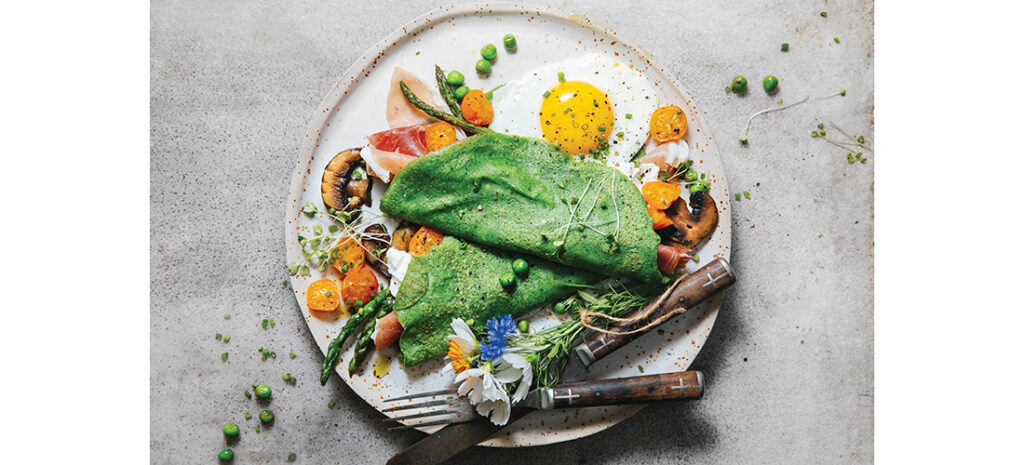
For a playful twist on hearty crêpes (also called galettes in some regions), mix fresh nettles, wild garlic or spinach into the batter. Not only will it enhance the flavor but add a little velvety texture to your crêpes. As for filling them, the sky’s the limit.

Spinach Crêpes

(Makes about 8)

Ingredients

3/4 cup fresh spinach

1 1/2 cups all-purpose flour

3 eggs

2 cups whole milk

Pinch freshly grated nutmeg

Pinch salt

Place spinach in a food processor and pulse. Add flour, eggs, milk, nutmeg and salt. Blend to make a smooth batter. Heat oil or butter in a skillet over medium/high heat. Add just enough batter to cover the base of the pan and cook until small bubbles appear on the surface, then flip and briefly cook on the other side. Fill crêpes with your favorite ingredients. We like ricotta cheese, fried egg, mushrooms and sautéed veggies, such as tomatoes, asparagus, onions and peas.  PS

German native Rose Shewey is a food stylist and food photographer. To see more of her work visit her website, suessholz.com.

Dissecting a Cocktail

Dissecting a Cocktail

Chartreuse Swizzle

Story and Photograph by Tony Cross

In 2003, San Francisco bartender Marcovaldo Dionysos entered his city’s cocktail competition for the fifth year in a row, pining for top honors. The contest was sponsored by the French herbal liqueur Green Chartreuse. According to cocktail historian Robert Simonson, Dionysos considered sitting out the year’s competition. “I didn’t have any great ideas,” Dionysos remembers. “I decided to make something fun and went in a tropical direction.” His idea nabbed first place that year and has since popped up in cocktail bars across the country and the world, becoming a modern classic.

Dionysos’ cocktail, the “Chartreuse Swizzle,” combined the herbal liqueur with pineapple and lime juices, Velvet Falernum (a low-ABV rum liqueur made with almonds, cloves and lime) and mint. Commonly made with rum, “swizzles” can be potent. They’re usually mixed with fruit juices and a sweetener, built and mixed in the drinking glass with a swizzle stick. Originally, these pronged sticks came from trees native to Bermuda, but the garden-variety lookalikes are made of metal, plastic or wood. One of my first introductions to Green Chartreuse was Dionysos’ Swizzle. For such a high proof (and pricy) spirit, it’s a little shocking how popular it became. What’s not surprising is how the four ingredients complement each other for a perfect tiki-themed sipper.

Specifications

1 1/2 ounces Green Chartreuse

1 ounce fresh pineapple juice

3/4 ounce fresh lime juice

1/2 ounce Velvet Falernum

Garnish: mint sprigs

Execution

Combine all ingredients into a Collins glass and add pebble (or crushed) ice. Insert a swizzle stick or barspoon into the mixture, rubbing your hands together to “swizzle” the stick until frost appears outside the glass. Add more ice and garnish with mint.  PS

Tony Cross owns and operates Reverie Cocktails, a cocktail delivery service that delivers kegged cocktails for businesses to pour on tap — but once a bartender, always a bartender.