Out of the Blue

Windsor Knots

These are the ties that bind

By Deborah Salomon

Back in the day, ancients believed their leaders descended from the gods, therefore possessed “divine right” to rule. Those chosen few — observing the lifestyle royalty affords — furthered their cause by concocting stories that reinforced the myth.

And so it went. Wars were waged between competing “royals.” Contenders (who perpetrated a similar myth) beheaded each other with frightening regularity. Kings solidified their positions by marrying only royal maidens who, failing to produce male heirs, were booted to a chorus of “Hit the road, Jack(ie), and don’t come back no more, no more . . . ”

Revolutions happened, monarchies tumbled in favor of republics, democracies, socialist states, yet even when they possessed only ceremonial power, kings and queens, princes and princesses survived, mainly to christen ships, open orphanages, attend Ascot and feed our fantasies. Their subjects still bow and curtsy. A sign of respect, I’m told, sometimes good for a giggle: The queen is not allowed to vote or express partisan opinions. But she’s allowed a lady-in-waiting to carry her hankie and bouquets, as well as to clear the loo before a royal visit.

Have you guessed where I’m heading? Down the solid gold brick road to Buckingham Palace. Windsor Castle. Balmoral. Sandringham. Clarence House.

Shocking that 2020-21 was both the Year of the Pandemic where millions suffered and died and the Year of the British Royal Family, who provided audiences with a mud-wrestling extravaganza. No wonder Mr. Trump feels deserted. Royal tribulations regularly shove him off Page One. The BBC put out a casting call for courtiers. Any news will do, from the tragic death of a consort to the tragic death of a puppy. A misstep President Biden makes in Her Majesty’s presence becomes a headline so imagine the kerfuffle over her eldest grandson (Princess Anne’s offspring) getting divorced. New babies keep popping up, Prince Andrew’s scandals keep going down.

And that’s in addition to Harry and Meghan’s carefully scripted Oprah-fest.

Don’t get me wrong; I think Queen Elizabeth is a fine old lady who performs her duties with grace and distinction. After all, it’s a pretty good job which includes room(s) and (a groaning) board, transportation (gilt carriages, maroon Bentley limo, a stable of Range Rovers and Thoroughbreds, private train and aircraft) plus health insurance, paid vacation, a generous pension and, most important, uniforms.

Who cares, if you can’t order Chinese at 10 p.m.?

The thing I’m not buying is royal “blood,” the “lineage” that sets them apart.

Sadly, recent events have suggested those veins need transfusing.

I also notice a dereliction of duty on behalf of the royal-watching media, who used to remain tight-lipped regarding improprieties. Now, like hawks and fishwives, they screech the latest scandal from towers and turrets. Do we need to know that granddaughter Zara Tindall gave birth on the bathroom floor? Or that Kate Middleton’s brother is suffering from depression? Some mean-spirited cartoonist has even dredged up those old separated-at-birth head shots of Prince Charles and MAD Magazine’s Alfred E. Neuman. To balance the negative — and spur competition — tabloid hacks jumped on the bandwagon driven by Prince Edward’s wife, Sophie, newly identified as the queen’s BFF, confidante and spokescountess who, obviously, prefers her crumpets buttered on both sides.

So it shall continue, because Americans are hooked, mostly on the clothes, those incredible outfits with flying-saucer hats and deadly stilettos worn by young royals, not to mention Her Majesty’s neon ensembles. I am hooked because I’d rather read and write (shamefully three times in 12 months) about soap operas played out across the pond than the political tragi-comedies underway on home turf.

Still, enough is enough. Diana and Philip are dead. William’s bald head is old news. Jeffrey Epstein’s buddy Prince Andrew has been benched. Harry’s changing diapers, eating corn dogs and drinking Coors while Charles, wearing (shudder) tartan kilts, weeds his organic garden. But the queen, God bless her, still sips a gin and Dubonnet with a twist before lunch, wears Mad Hatters and runs on Energizers.

I’m thinking she just might outlast us all.  PS

Deborah Salomon is a writer for PineStraw and The Pilot. She may be reached at debsalomon@nc.rr.com.

Her favorite book is Sophies Choice by William Styron

Hometown

Neighborhood Gold

Clearing the bar in the backyard

By Bill Fields

A few years ago, not long after I began freelancing as a booth researcher at golf tournaments broadcast by NBC Sports, someone pointed out a slim, silver-haired man walking into a trailer in the television compound. This particular camera operator, my colleague told me, had a distinct background. It was Ken Walsh, a former American Olympic swimmer who won three medals (two gold, one silver) in 1968 in Mexico City.

I hadn’t seen Walsh since I was 9 years old. Or at least I imagine I probably watched him on ABC during the ’68 Summer Games, because as a fourth-grader obsessed with sports, those Olympics were a very big deal when they flickered on our living room Zenith. (Portions of the Olympics were shown in color for the first time, but we still had a black-and-white set.)

Decades later, some of the competitors’ names from that year — the Summer Games were held in October — jump to mind more easily than those of childhood friends even though the television coverage of that period was a fraction of the airtime today.

There was Bob Beamon, shattering the world record in the men’s long jump with a leap of 29 feet, 2 1/4 inches that wasn’t bettered for 23 years and remains the Olympic mark. Bill Toomey won gold in the decathalon, Randy Matson the shot put and Al Oerter the discus throw (for the fourth straight Olympics). Kip Keino of Kenya ruled in the 1,500 meters and Bob Seagren in the pole vault. Dick Fosbury shook up things by winning the high jump with his novel backward style.

Walsh? As I discovered, he was on the winning 4×100 freestyle relay and 4×100 medley relay teams and finished second in the 100-meter freestyle behind Australian Mike Wenden and ahead of fellow American Mark Spitz, who would win seven gold medals four years later in Munich.

My neighborhood buddies and I ran our sprints up and down East New Jersey Avenue — there was little traffic, and it was slightly downhill to the chalk-drawn finish line heading toward May Street — but come Olympics time in ’68 we really were more interested in the field events.

Chuck, my best friend, and I constructed a high jump behind his house out of stray 2x4s for supports with an old broom handle resting on two nails as the bar to jump over. We improvised a landing pit out of dirt, pine straw and leaves. The long jump didn’t require as much preparation — just a couple of baseballs to mark the take-off spot and a yardstick to measure where our Converse tennis shoes made a mark in the sand. We made a few feeble attempts at the triple jump but couldn’t quite figure out when to hop and when to skip.

The real backyard drama came in an event the younger kids only watched.

One of Chuck’s older brothers, Ricky, was up for most anything. When he wasn’t roaring around on his minibike or tackling opposing players like Dick Butkus, he liked to pole vault — and not just in the Southern Pines school gym or at Memorial Field. Ricky pole-vaulted in his yard, using bamboo stalks he got from a nearby thicket and taped up for a better grip to go up and over. A pile of saw dust and a couple of cheap, inflated beach rafts cushioned the landing.

Ricky’s friends would join him, and so would one of the men who lived on our block, Mr. McNeill, a good athlete who had played on the town’s semi-pro baseball team. He probably was only in his late 30s, but that seemed ancient to a little kid. Clad in his work clothes on those late afternoon jumps, Mr. McNeill gave no quarter to the teenagers. The way those bamboo poles bent after being planted in the homemade box, it seemed like only a matter of time before the rescue squad would have to be summoned for broken bones, although bruises and sprains are the worst injuries I can recall.

I’m slated to go to my first Olympics this summer, the Tokyo 2020 Games that were delayed a year because of the COVID-19 pandemic. I’ll be working on the golf production, a long way from where the vaulters will be headed skyward on space-age poles and a long time from the fun and games of 1968.  PS

Southern Pines native Bill Fields, who writes about golf and other things, moved north in 1986 but hasn’t lost his accent.

His favorite book is North Toward Home by Willie Morris

Good Natured

Forgive and Forget

You’ll be healthier because of it

By Karen Frye

We have all experienced some form of emotional or physical pain in our lives caused by another. Some are easy to overcome, but there are times when the pain is deep and it doesn’t seem to go away, and we endure the torment for too long. In most situations, the person who caused our pain moves on, completely forgetting about what happened — or is even unaware of the pain they’ve caused. It is the victim of the experience who must do the work and let go of the past, move on and forgive.

This can be challenging if we don’t, with all our heart, forgive the person who hurt us. Holding on to unresolved feelings of anger or resentment will keep you in a mental prison of torment. This emotional state of mind can affect our physical health in dangerous ways. A mind that is in a constantly negative and unforgiving state is unhealthy, creating a more acidic body where disease can thrive. Changing your diet to include more fresh fruits and vegetables will help counter the acidic imbalance.

True forgiveness, however, is a journey that heals the body, mind and soul. Some pain can take years to forgive, but it is the first and most important step in freedom from a troubled mind. Forgiveness brings peace. All the hurt and bitterness will disappear. Forgiveness doesn’t mean your memory banks are wiped clean — you just no longer feel the pain. It frees the heart. 

When we forgive, we heal ourselves. The natural flow of love dissolves all the pain. The more you practice this, the easier it becomes. Learning how to forgive is the greatest form of unconditional love. It is the love you feel from your parents, the love you give to your children. It is the love we all yearn for, the love that allows us to be who we are.

Embrace the power to forgive easily. It is not worth another day of bitterness. Free yourself and enjoy life with a happy heart.  PS

Karen Frye is the owner and founder of Nature’s Own and teaches yoga at the Bikram Yoga Studio.

Her favorite book is The Game of Life for Women and How to Play It by Florence Scovel-Shinn

Birdwatch

A Majestic Wader

Wood storks become a more common sight

By Susan Campbell

Believe it or not, although fall is still a way off, the summer solstice has passed, and for some of our birds, the breeding season is over. Many have begun wandering ahead of their southward migration. At this time of year, we have a few species that actually move in a northerly direction during mid-summer. The wood stork, one of North Carolina’s newer breeders, is one of these.

Wood storks are large, white wading birds, a bit smaller than great blue herons. They have heavy bills that curve at the tip. In flight, they are very distinctive. Not only do they fly with their head and neck outstretched, but their tails and flight feathers flash black. They are frequently spotted soaring high in the sky on thermals, not unlike hawks and vultures.

These birds forage not only for small fish, crustaceans and a variety of invertebrates, but also reptiles and amphibians, as well as occasional nestlings of other species. Wood storks are visual hunters that search for movement in the shallows. They also may sweep and probe with their bills in murky areas until they feel prey, and then they will snap their mandibles shut and swallow the food item whole. It is not unusual for them to shuffle with their feet and flick their wings to disturb potential meals in muddy water.

Unlike their European kin, storks here nest in trees — not on chimneys. Also, as opposed to legend, these birds do not mate for life but pair up on the breeding grounds each season. They can live a long time, however: The oldest known (banded) bird from Georgia was over 20 years old when it was re-sighted in South Carolina.

Stork nests are bulky stick-built affairs located over water, often in cypress trees. However, any sturdy wetland tree species may be utilized. Both parents are involved in construction. Grassy material will line the nest that is, quite uniquely, adhered together with guano. It will take almost two months for the one to five young to reach fledging. Not only will wood storks nest alongside others of their kind but they tend to be found in colonies with heron, ibis and egret neighbors.

The wood stork is becoming a more common site in the Carolinas, breeding locally in freshwater or brackish, forested habitat. They prefer locations with an open canopy, since they require a good bit of space in order to negotiate a landing. There are now two large nesting colonies of storks on private property: one at Lays Lake (Columbus County) and Warwick Mill Bay (Robeson County). These lakes have been home to nesting storks for less than a decade. I would not be surprised if pairs are using a few other remote sites in the southeastern corner of the state. Stork numbers have been growing rapidly as the bay lake habitat seems excellent for raising chicks. Following fledging, however, family groups may move away from the nesting area to wet habitat where food is plentiful. In dry summers, that movement may be significant — and in any direction.

In our state, the largest concentrations of individuals show up annually at Twin Lakes in Sunset Beach (Brunswick County) by mid-summer. They can reliably be found in and around the eastern pond. The birds seem to like probing the flats on the back side of the pond, away from the golfers on Oyster Bay Golf Links. Also look for them loitering in the stout trees along the shoreline into early fall. But do not be surprised if you happen on one, or perhaps a small group, in any wet area from marshes to farm ponds or golf course water hazards in the Piedmont or Sandhills. Wood storks are unique and majestic waders that deserve a special look!  PS

Susan Campbell would love to receive your wildlife sightings and photos. She can be contacted by email at susan@ncaves.com.

Her favorite book is the one she’s reading right now, How Iceland Changed the World: The Big History of a Small Island, by Egill Bjarnason.

Tea Leaf Astrologer

Leo (July 23 – August 22)

Have you ever met a Leo with a show dog? I doubt it. Because if there’s one thing this fire sign hates more than sharing the spotlight, it’s feeling inferior to another being in any way. Who has the silkiest locks, the smoothest gait, the most charming disposition? Of course you do, Leo. But this month — and yes, everyone knows it’s your birth month — don’t be surprised if you’re not getting the undying affection you so desperately crave. Do yourself a favor: relax. Your fans still adore you. Especially your rescue mutt.

Tea leaf “fortunes” for the rest of you:

Virgo (August 23 – September 22) Brush up on your social skills this month. Interrogation and flirtation are inherently different.

Libra (September 23 – October 22) Love is in the air. But you won’t catch it with a butterfly net. Read that again. 

Scorpio (October 23 – November 21) Spin and you’ll win. It’s really that simple.

Sagittarius (November 22 – December 21) Don’t throw the crazy out with the bath water. You know you’d be lost without it. 

Capricorn (December 22 – January 19) Two words: Muscle through.

Aquarius (January 20 – February 18) Let’s not beat around the bush. You know what to do. Swallow your pride and ask for help. 

Pisces (February 19 – March 20) Too much of a good thing isn’t the case this month. Just don’t forget to say thanks.

Aries (March 21 – April 19) You’ve just moved mountains. Don’t think people haven’t noticed. And don’t let that go to your head.

Taurus (April 20 – May 20) Plant the seed. Then leave it be. Seriously. Walk away.

Gemini (May 21 – June 20) Pack your bags, sweetheart. Go someplace you’ve never been. It’s time for a little perspective.

Cancer (June 21 – July 22) Don’t spend it all in one place. But if you do, remember that abundance is a mindset.

Zora Stellanova has been divining with tea leaves since Game of Thrones’ Starbucks cup mishap of 2019. While she’s not exactly a medium, she’s far from average. She lives in the N.C. foothills with her Sphynx cat, Lyla.

In the Spirit

Frozen

Break the ice this summer

By Tony Cross

If you’ve ever experienced a Carolina summer, you’ll know that the heat and humidity are enough to beat you down to the point you’ll ask a bartender for a Zima. Almost. Instead of having 10 drinks on a menu that each have a hundred steps before the bartender can put that lifesaving, cool drink in front of you, I learned to integrate punches and bottle cocktails that could be served as quickly as pouring a glass of wine. Another batched elixir that’s perfect for taking the sweat out of summer is a frozen cocktail.

I remember going to the bowling alley with my family in the early ’90s and seeing a daiquiri machine. Daiquiri-schmackeri. All I knew was that it looked like something for kids but that I wasn’t allowed to drink it. Once I was of age, I finally got to have a frozen cocktail of my own in New Orleans. I honestly can’t tell you if those slushy hurricanes were nice and balanced. I was in my early 20s. It was the Big Easy. I wasn’t very balanced myself. Trends come and go, but luckily for cocktails, we’re blessed with creative men and women behind the bar who can make what was once unpalatable, desirable. So, I headed out to a few bars and restaurants in the Triangle to learn their tricks for getting frozen cocktails just right.

The restaurant scene in downtown Durham has exploded in the past decade. A town that once took a backseat in the culinary department to neighboring Raleigh isn’t in the shadows anymore. Dashi, a Japanese ramen shop and izakaya (the word for a Japanese pub that’s located above the restaurant), has only had its doors open for a few years, but the combination of yummy and speed keep their guests coming back for more.

All of the cocktails at Dashi are made in the izakaya. “So, when the staff downstairs are really busy, they push these,” says bar manager Gabe Turner, pointing to his slushy machine. “They’re delicious, too, so it’s not like we’re sacrificing quality for efficiency.”

Purchasing a slushy machine was a no-brainer for Turner. “When we started fooling around with recipes, we stumbled into a pretty good template,” says Turner. “We don’t like to use too much sugar. Using an oleo-saccharum (oil-sugar) helps us keep a nice balance in our drinks.”

And you won’t find Gabe and Co. doing frozen margaritas. “The style we’re doing is a Japanese cocktail called chuhai, which traditionally is sh¯oōch¯uū (a fermented Japanese liquor made from sweet potato, barley, rice and other ingredients with a relatively low alcohol proof) and fresh juice. In Japan, they call them sours. The idea was, ‘Let’s do frozen chuhais.’ We used sh¯oōch¯uū, fresh juice, and then sake to round it out. To get the alcohol level up, we’ll add a little bit of vodka, but not enough to change the flavor profiles.”

One of Dashi’s current chuhai slushies combines the classic ingredients along with a spicy ginger syrup, orange oils and juice. How popular are the frozen chuhais? “I’ll make a whole batch of our slushy cocktails every week,” says Turner. Each batch serves around 50 8-ounce drinks. “We use the Bunn slushy machines and have a second machine in the back, so they don’t get too burned out. They’re being used 24/7.” If it’s not slushy season — a rarity at Dashi — two weeks is the longest they’ll keep a batch before letting the staff dip into the leftovers. “Rarely does it not sell out,” Turner says. Too bad for the staff. Dashi carries two different slushy cocktails at a time — a quick and cool option for a bar otherwise known for its myriad sake and sh¯oōch¯uū bottles.

What if your establishment (or you) doesn’t want to invest, or can’t find room, for a slushy machine? Get creative. A block away from Dashi, the chic cocktail lounge Alley Twenty-Six has its own twist on frozen drinks. Longtime bartender Rob Mariani, formerly of Alley Twenty-Six, says, “While a slushy machine is on the wish list, we don’t have one. That doesn’t mean we couldn’t make frozen drinks. By using crushed ice and giving it a good shake, you can get a drink that mimics a slushy and has a similar dilution rate. One would think that smaller ice melts faster than larger ice, which would be true if we were looking at two cubes melting on their own, but when you pack a glass full of crushed ice, there is lots of surface area, and the dilution rate is quite slow.”

Mariani has mastered the technique and suggests adding a bit more sugar to your specs. “The ideal ABV (for a frozen cocktail) is about 10 percent and the max is around 18 percent. Anything above that will not result in a frozen texture. Bitterness and sweetness are suppressed by cold temperatures, so more sugar is needed to achieve a balanced, frozen drink,” he says. “Up your sweet by 50 percent. For example, instead of using 1/2 ounce of simple, use 3/4 of an ounce.” There are many ways to master a frozen cocktail — having a machine constantly rotating the perfect, temperature-controlled slushy is one — but there are multiple ways to skin an ice cube, at home or away. Mariani shares one of the frozen cocktail recipes he uses for his weekly Cap’n Rob’s Waikiki Wednesday.

Frozen Rum and Tonic

1 1/2 ounces aged rum

3/4 ounce tonic syrup (Mariani uses his own Alley Twenty-Six Tonic.)

3/4 ounce pineapple juice

1/2 ounce fresh lime juice

4 dashes Angostura bitters

Combine all ingredients (sans the bitters) with crushed ice in a cocktail shaker. Shake like hell or until you can’t feel your hands. Pour into a Pilsner glass. Top with crushed ice and four dashes of Angostura bitters. Garnish with a large sprig of mint and dehydrated lime wheel.  PS

Tony Cross is a bartender (well, ex-bartender) who runs cocktail catering company Reverie Cocktails in Southern Pines.

His favorite book is No Death, No Fear by Thich Nhat Hanh.

Poem

Snap the Whip

          Winslow Homer (1872)

You know the game: everybody

runs hard as they can, holding hands,

and then the boy on the near end

suddenly stops, sets his feet hard

against the ground, and the others

swing, like a gate made of children,

swinging faster the farther out,

fighting centrifugal force now

to keep from being flung away,

flung out of the sudden circle

this line of children has become

a radius of, and those farthest

out have to hang on for dear life.

What saves them is how tight they and

their friends can hold on, and for how

long. The farthest from the center

need the strongest friends.

— Millard Dunn

Millard Dunn is the author of
Places We Could Never Find Alone.

The Creators of N.C.

Totally Blawesome

A flower farm where miracles bloom year-round

By Wiley Cash   •   Photographs By Mallory Cash

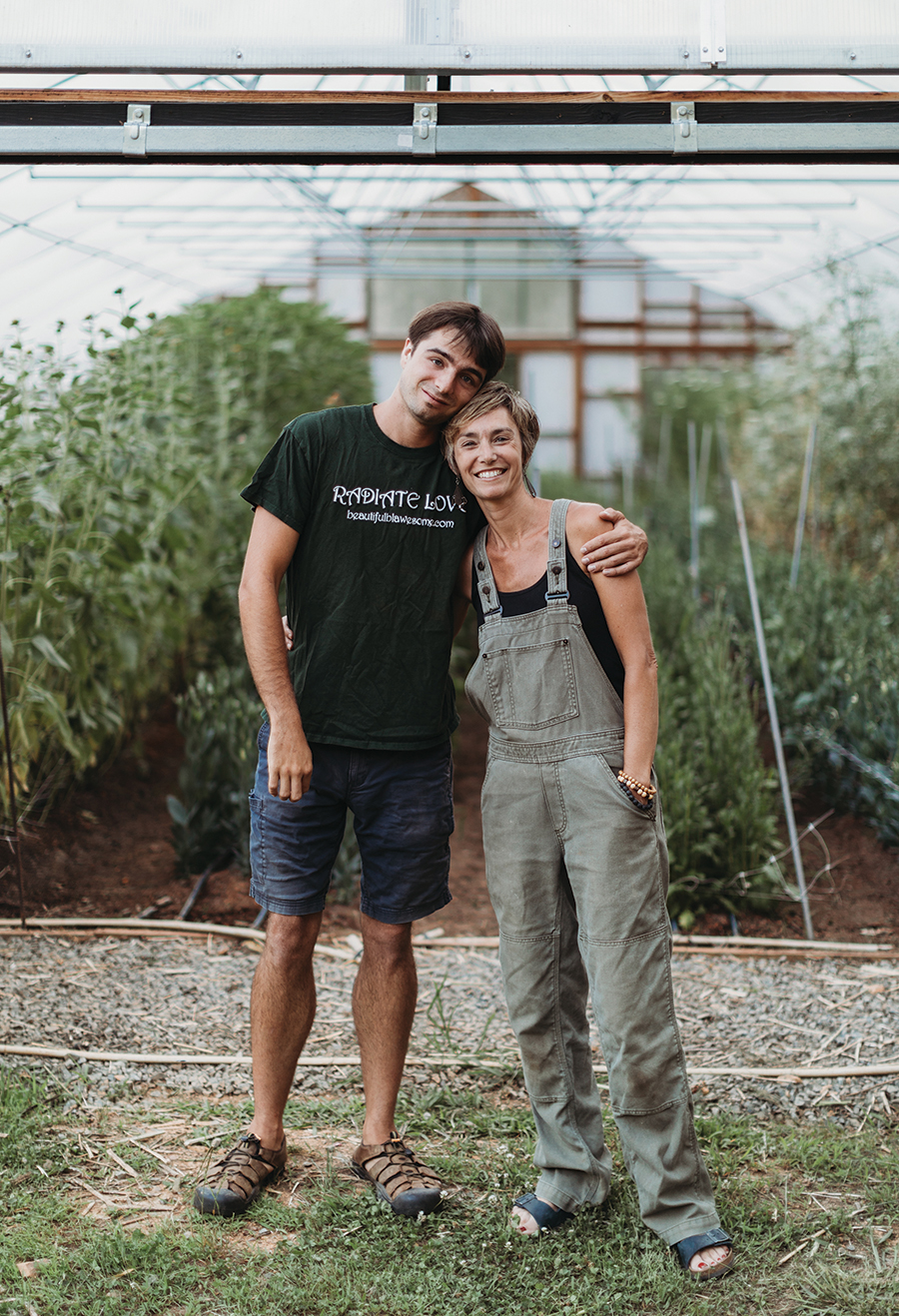
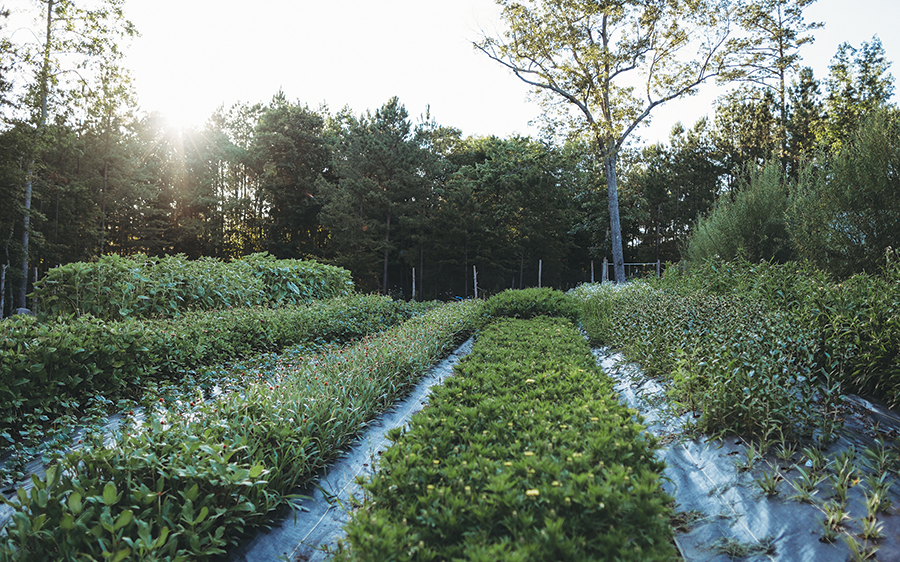
On a lush four acres of land nestled between Chapel Hill and the Haw River, 24-year-old Raimee Sorensen spends his days growing, harvesting, assembling and delivering stunning bouquets and custom flower arrangements. According to his mother, Rebecca, “He emanates joy.” The oldest of three siblings, Raimee works alongside Rebecca and a small, devoted team of farmers. It’s clear that everyone at Blawesome flower farm is dedicated to two things: delivering high-quality, organically grown flowers to the waiting hands of their customers and ensuring that everyone on the farm has the opportunity to live and work to their full potential, including Raimee, who has a diagnosis of autism and epilepsy.

“When given the opportunity to be amazing and successful,” says Rebecca, “folks with disabilities will rise to meet that challenge. If we are able to provide more opportunities for folks with disabilities to be successful, then I think we would see a moral shift in our communities.”

And farming is certainly challenging. “There are always opportunities to problem solve,” Rebecca says. “It’s very cerebral work.” In the morning, Raimee looks at his check list and gets to work, deciding how much preservative solution to add to which type of flower and what kind of tool is necessary to harvest each variety. “And when he takes his bouquets out into the world, he gets the confirmation of ‘You’re a wonderful farmer, and you grow amazing things,’” Rebecca adds. From season to season, Raimee’s knowledge and confidence have grown, and Rebecca has seen the skills he’s learned on the farm transfer to other areas of his life. For example, when they host tours and workshops on the farm, Raimee is able to share his knowledge about what’s going on in each production zone, and if someone asks a question, it’s Raimee, despite challenges with expressive and receptive language, who often chooses to answer it.

Before starting the farm, the Sorensens homeschooled Raimee for eight years, and during that time, they set up community internships where he could explore a number of opportunities while building varying sets of skills. He particularly excelled at a community farm where he volunteered for four years. He enjoyed being outdoors and working alongside others. Eventually, the Sorensens enrolled Raimee in a charter school specifically geared toward students with disabilities, but when the school abruptly shut down, they realized they needed to find an opportunity for him to achieve his greatest sense of independence. Better yet, they would create one.

Initially, the Sorensens’ decisions were practical. They had a 1/4-acre strip of land alongside their driveway, and based on how Raimee performed in his work at the community farm, they decided to cultivate the small area into a flower garden. After all, he was good at growing things, and he enjoyed connecting with the community. What better way to connect with others than by putting fresh flowers in their hands?

Raimee was not the only Sorensen with a background in farming and a love for flowers. Rebecca grew up in rural northeastern Pennsylvania with a father who was an avid gardener. In high school, she worked at and eventually managed a greenhouse, and later, on the other side of the country, she worked at an organic farm, growing peppers and houseplants in greenhouses in Oregon. She felt confident that she and Raimee could turn this small plot of land beside their house into a successful venture that would allow them to explore their interests and talents.

And then the four-acre lot next door went up for sale. Rebecca and Raimee’s vision for what they could do grew, and the family shifted again.

After purchasing the land, Rebecca applied for a micro-enterprise grant. The initial grant was for $5,000 but after completing the application, she learned that more money was available. She went back to the drawing board, carefully envisioning a project and wrote a proposal that eventually won a $50,000 state grant from the Division of Vocational Rehabilitation. The shift had happened. The Sorensens were now owners of land that would become a flower farm, and all they had to do was build it.

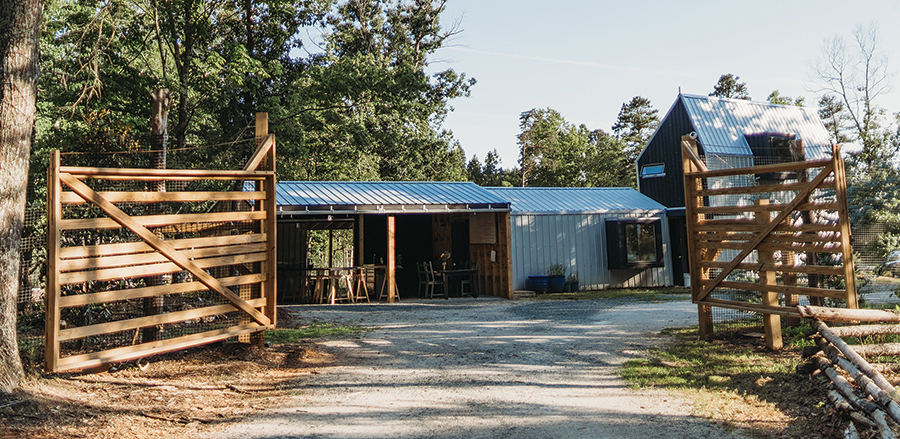
Working with a team of land specialists and local farmers, the Sorensens grew intimately familiar with their new land, working to create a plan that was realistic in terms of what they could grow and harvest with their small crew. At the same time, Rebecca, whose background is in social work, was traveling the state, leading workshops on affordable housing for adults with mental illnesses. She met an architect from Elon University whose son had a diagnosis, and he suggested that they work on a project together. He went on to design the barn on the Sorensens’ new property, and he brought out teams of university students to help construct it. He would later design the home where Raimee and a supported-living provider live.

Blawesome was born, and the flower farm that began on a small strip of land beside the family’s driveway grew into a working farm that provides fresh flowers for everything from weddings to businesses, plus events at UNC-Chapel Hill.

But no matter how much the Sorensens had been willing and able to shift over the years, COVID presented an incredible challenge. They lost national contracts with huge corporations. Weddings were cancelled, and the university moved nearly all of its business online. But people still wanted flowers, and Blawesome met that need. Individual orders soared, as did memberships in their CSA (Community Supported Agriculture), which provides seasonal flowers year-round to subscribers. “The community just came out and lifted us up in a way we could’ve never anticipated,” Rebecca says. “It was extraordinary.”

That says a lot coming from someone who has seen extraordinary things happen, both in her family and in her community. Raimee took medication for obsessive compulsive disorder for eight years, and then he was able to stop taking it one year after starting the farm. He has epilepsy, but according to Rebecca, he’s had only one seizure in the same time span. “You can pull Raimee’s Medicaid file for the past four years and see that he has not accessed any of the services he used to access since we started the farm, because he’s happier and healthier than he’s ever been,” she says. Both Raimee and the farm are thriving. “A lot of people in his situation don’t get told how special they are,” she adds.

But it is hard work, and the work never stops. “I don’t know if people understand how completely consuming farming is. It’s a lifestyle,” Rebecca says. “I like that for Raimee because it’s every part of his day. There’s not any time when he’s not thinking about it or planning for it or anticipating something, but it’s pretty miraculous to be part of something that is a living, breathing organism. I feel like I’m surrounded by miracles all the time.”  PS

Wiley Cash is the writer-in-residence at the University of North Carolina-Asheville. His new novel, When Ghosts Come Home, will be released this year.

His all-time favorite book? Song of Solomon by Toni Morrison.

The Stitch Around Her Mouth

Fiction by Etaf Rum

Illustration by Marie-Louise Bennett

The stitch was starting to come undone, shedding fine, thin threads at the corners of her mouth. For as long as she could remember, she had never seemed to notice it — a ribbon the color of dust woven tightly around her lips. It had been there ever since she was a child, ever since her mother taught her how to roll her first grape leaf, ever since her grandmother read the thick, musty grounds of Turkish coffee at the bottom of her first kahwa cup. By the time she did notice it, she was a mother herself, devoting her energy to her husband and children, her feet firm in the fabric her family had sewn. When she awakened one morning to find the stitch unraveling, a wild terror overcame her. She dared not tug at the loose ends of her stitch in fear her world would unspool.

She paused to think now as she hurried to complete her chores before her children returned from school. What was it that had snagged her stitch loose now, after all these years? She wondered if she had done something wrong. The worst thing a woman could do was question her condition. Her mother had told her that once. Only she’d barely been thinking lately. She knew such freedoms were the province of boys and men, not for women, whose delicate fibers were spun like webs on the kitchen curtains like a daily reminder. Not for a woman whose life was a tight pattern overlapping her mother’s. There was nothing to think about. Things have always been this way.

She closed her eyes to the image of her 7-year-old face as she waited in line at the fabric store. Mama had prepared her for the stitching tradition the way Mama’s own mother had done before, wrapping her unruly hair and staining her hands with rust-colored henna. While all the other young girls had locked their eyes on the brightest ribbons, her gaze fell quietly on a strand as pale as wheat. She snatched it, gripped it close to her chest. She thought if she must endure the numbing and needling, the pain that comes with saying words too full, the swallowing of thoughts, the stitch should at least blend in with her olive skin. Others should never know.

She stood over the stove now, her afternoon chores completed. The steam from an ibrik of mint chai prickled her stitch. She felt her mouth stiffening, a burning sensation around the edge of her lips. In the distance, she could hear the sound of a school bus, then her two children approaching — a boy of 8, a girl of 6. She tucked her thoughts away. She didn’t want them to notice her loose stitch, confusing them, or worse, igniting their curiosity. She had no answers to the questions they might ask. 

The oven clock read 7 p.m. by the time she finished helping the children with homework and cooking dinner. More than once she considered calling her husband to ask when he would be home. But each time she stopped herself. It would be unseemly to question him, to ask where he was or what he was doing as if he wasn’t working the way she was working. Only what if he wasn’t? She teased her loose stitch with the tip of her henna-stained finger before pulling it away. No, she shouldn’t question such things.
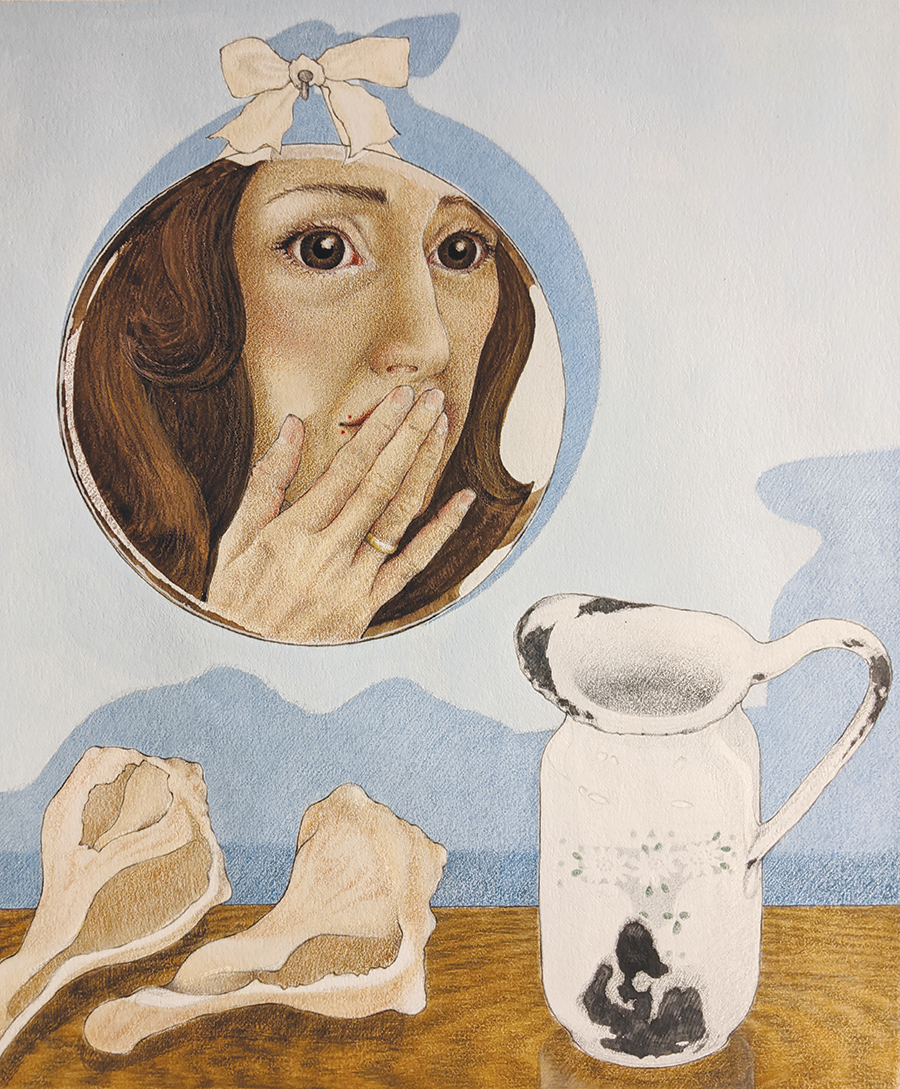
Growing up, Mama had said the stitch would make her more desirable, not only in the eyes of men, but also women, who were taught to see beauty in lips that were tightly sealed. Yet it was Mama who originally suggested that she choose a ribbon that would blend in. A plain ribbon will help you endure the pain, Mama had said, holding her hand at the fabric store, steering her down the fig-colored aisles. She could see other mothers in the aisles too, smiling as they helped their daughters select their ribbons. Some ribbons had the luster of pride and joy; others had a glow of satisfaction. But not hers. She had wondered why her mother steered her to a ribbon that was barely visible, and why she even needed to get a ribbon at all. What would happen if she decided not to get a ribbon, like some of the unstitched women she knew? She wondered what her world would be like without a stitch around her mouth. 

The next thing she knew, the thought escaped her lips. “What if I don’t want to get a stitch?” 

“Nonsense,” Mama said, shaking her head.

“But not every woman gets stitched,” she said, frozen in the center of the aisle. “The woman who reports the news doesn’t have one. Or the widow who opened up the pharmacy in town. Or even the girl who lives a few blocks away from us.”

Mama fixed her with a glare. “This is the way things are, daughter. It’s always been this way.” 

Soon after the stitching she began to feel a burning sensation in the corners of her mouth, the quiet ripping of flesh. She did what she could to dull the pain, swapping out words, shortening thoughts, sometimes even getting rid of ideas altogether. Some words, she realized, would never be hers to say. Maybe her mother was right. After all, women were woven with a fabric meant to endure the knots and coils of their lives, like carrying the bulbous world in their center. The stitch was just another natural difference, another law of womanhood.

Now there was a sound at the front door, then the twist of a lock, and quickly she turned off the faucet, dried her hands, tucked a strand of dry hair behind her ear. She felt the tip of the dusty wheat ribbon tickle her hands, like the touch of her grandmother’s finger when she read her palms as a child. What would her grandmother say if she knew her stitch was coming undone? What would Mama say? Surely they would tighten it. Her stitch was supposed to last a lifetime, a legacy passed along generations. A loosened stitch was the ultimate disgrace, a shame that would swallow her family whole. Wasn’t it her grandmother who said that no good can come from a wide-mouthed woman? And hadn’t Mama agreed, unquestioning, stitching her lips before she learned how to question? Well she was a mother now, to a daughter whose mouth would soon need stitching. She swallowed a lump in her throat. She didn’t like to think of it.

Her husband awaited her at the kitchen table, glancing at her with knitted brows. There was a silence between them, one which she had learned not to mind, and she hurried to pour the lentil soup into four bowls. A blanket of steam covered her face and she withstood the temptation to open her mouth, if only for a moment, and stretch the stitch loose. She could feel her children watching her and she didn’t want them to see her this way, opening her mouth in such an unnatural position, the contortions of her face the opposite of womanly. No — there are some moments a child will never forget, like the sound of a mother’s tears, roaring like rain against the roof. Her children shouldn’t have to feel what she felt now, a mountain of memories clung to her chest. She decided she would only stretch her stitch when no one was watching. 

Somehow at the dinner table, she could hear her grandmother in her ear, the same way she had heard her as a child. Sayings and lessons, like fortune cookies hanging from her ears. “A woman belongs at home,” her grandmother would say. “No good will ever come from a woman thinking.”
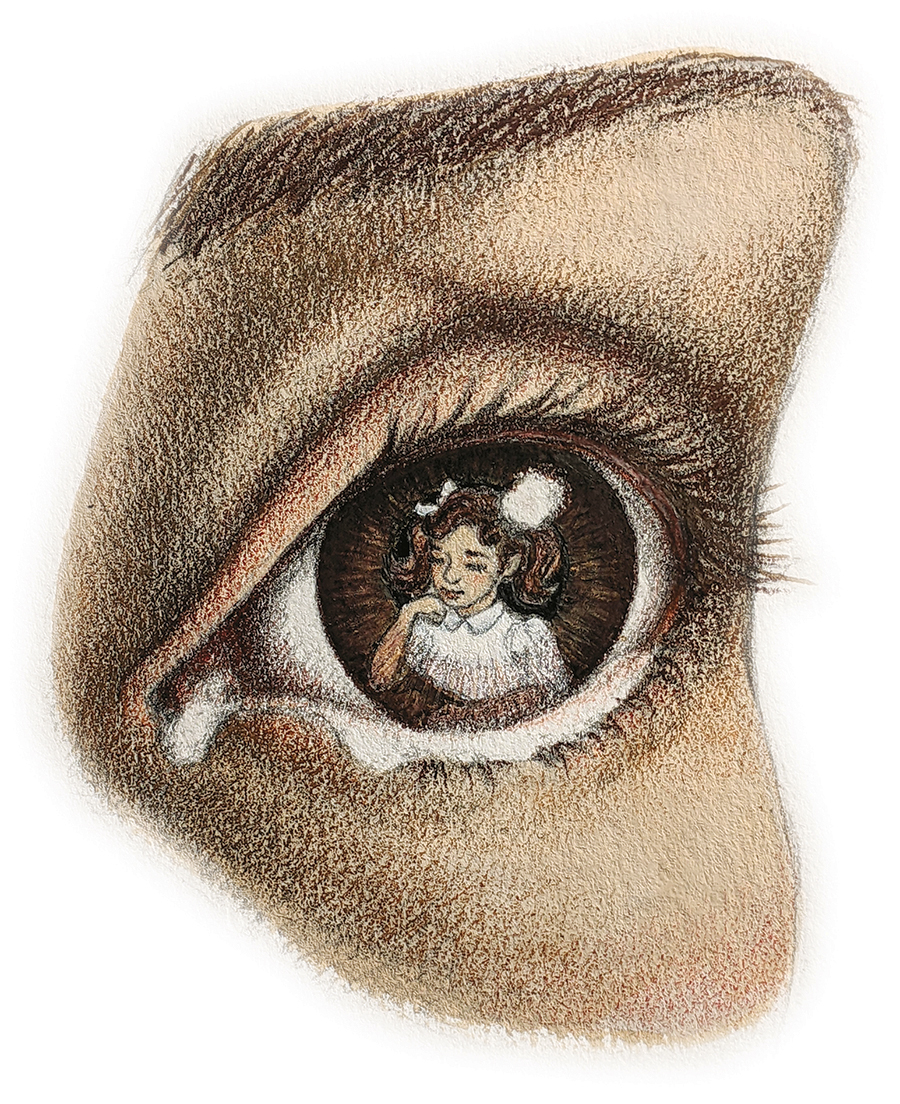
Her husband cleared his throat, bringing her back to the room. “I have to travel for work tomorrow,” he said.

“Where to?” She let the words leak through her stitch as if by accident so as not to make her mouth hurt. It was a trick her mother taught her.

“A conference in D.C.,” he said, shoving soup into his mouth as if to purposely end the conversation. 

She said nothing, having learned from a young age to find safety in silence. She placed a crumb of bread between her slightly parted lips and clenched hard.

Dinners were the same every night, with her husband sitting at the end of the table and all three of them curled around him like children. More often than not, one of them would signal her, and, as if wired to be true to her nature, she would drop her food and leap with eagerness, refilling cups and bowls, smiling to the rhythm of clinking spoons. Look how much they need me, her tender heart would whisper as she scurried around the table. Delighted, her husband would look at her and smile as if to say: Look at the family we’ve created, you and I. Look at what we’ve done.

Only tonight, huddled around the dinner table with her family, she could hear another whisper: What has she done?

The question grazed her stitch, bitterness on her tongue. She looked up at her daughter and felt a tide of guilt rolling in her chest. For a long time, she studied her daughter’s face, resting her eyes on the dull brown mole on her left cheek. All she could think of was the fine needle, slithering up and down her lips like a snake. Soon her daughter would be 7 years old, and what could she do then? She couldn’t stop it. Lately she had begun to think the stitch was the reason she only had two children. Her mother-in-law never missed an opportunity to remind her to get pregnant, as if she had somehow forgotten her duty. In fact, she closed her legs purposefully at night, feigning exhaustion or sleep, or when she was particularly distressed, a desperate sadness. On those nights she felt an ache swelter not only from her stitch but from a place buried inside her. But now, looking at her daughter’s mouth, thinking of what was soon to come, never had she felt a pain deeper than the shame of mothering another girl. She wondered if her son knew how lucky he was.

Her husband, noting the strain on her face, scrunched his eyebrows in a knot. “Is there something wrong?”

She met his eyes and instantly turned red. Had her face betrayed her? Had her thoughts escaped her stitch? “No, no,” she whispered. “Nothing’s wrong.”

He lowered his gaze to the bowl, stirred the soup fiercely before scooping a spoonful into his mouth. Swallowing at once, he said, “There’s something on the corners of your mouth.” He handed her a rag. “Here, wipe.”

Calmly she took the rag from his fingers and pressed it against her stitch. She looked at the stain: it was blood.

Her husband stared at her in silence before clearing his throat. “Careful now,” he said, reaching over to tighten her stitch. “The children and I need you around.”
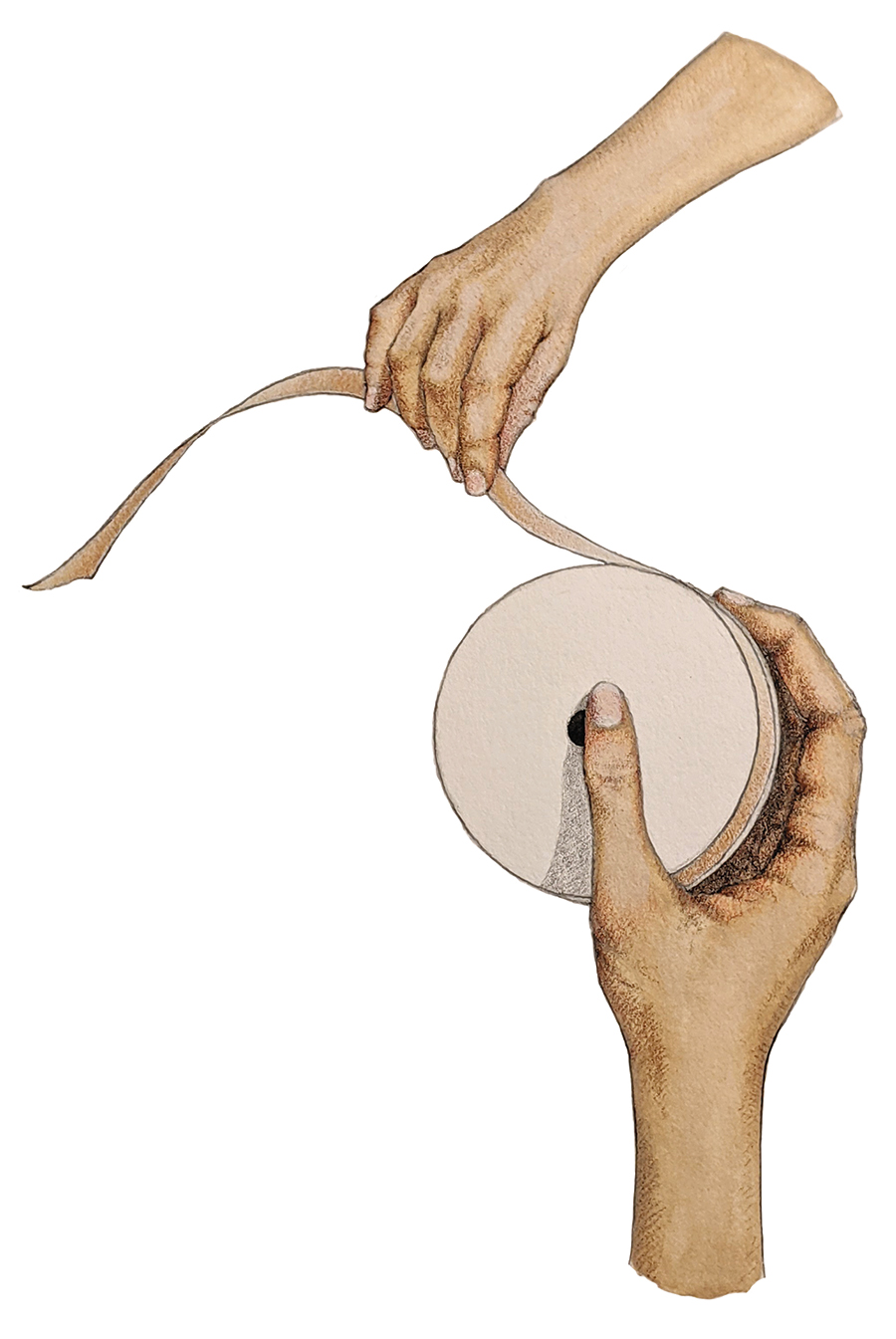
At that, her children looked at her in their usual way, their eyes glistening with the past and future as if always to remind her. It was as though they’d made a permanent mark upon her heart from which she could never escape. No, she would never escape. In awe of herself, she swept the thought away. Wasn’t she a believer of God, a believer in His will? If He wanted her this way, with this stitch around her mouth, then surely it was for the best. Besides, did she want to be like some of the unstitched girls she knew, still in their mother’s house, unmarried — or worse, divorced — an ocean of shame in their ribs? Of course she didn’t want that. Yet within herself, she didn’t understand why she couldn’t be happy. Inside she could hear all the women, and all the women she could hear were tired. She bit the inside of her lip, swallowing her thoughts. She could hear a whisper in her ear. Be thankful, or God will take it all away.

The days passed and her stitch kept bleeding: at the dinner table, during the day, whenever she stopped to think about it. Only when she wasn’t thinking did she seem to forget the uncomfortable grip around her mouth. But soon enough she would remember, feeling the heaviness in her mind sink into her lips whenever she spoke. Then the sound of a stitch unraveling, then the taste of blood. Sometimes it felt as if her mouth was only one stitch away from slitting all together, as if at any moment a thought would come and undo everything. Her life as she knew it. She became afraid. Then she began to wonder: Perhaps it’s all my fault. Perhaps I am being unreasonable. And even though there were no noticeable changes in her, all she could think of was what would become of her life if she let the stitch unravel. This fear had become an everlasting whisper in her chest which no amount of thinking could get rid of.

Four months passed. The day had finally come. Outside, the sky hung oppressively low, suffocating her. Quietly she reached for her daughter’s hand as they walked into the fabric store. The room was made of glass, with gold circles glistening across the walls. Between the brightly colored aisles, she thought she could hear, very faintly, the silent sounds of sorrow. She let go of her daughter’s hand. From a distance she watched her reach for a dusty pink ribbon, almost identical to her own. Her heart swelled in her chest. She could feel her stitch ripping open, blood leaking from her lips, desperate to spare her daughter. But she said nothing.

How she sewed the ribbon, how she stitched her daughter’s mouth — none of that could she remember later. Only one thought came to her now: the mild expression of submission painted on her daughter’s face as if it had been given to her since birth. Alone, she studied her own stitch in the mirror with shame. She ran her fingers along the edges of her lips, dug them into the corners as if to rip the ribbon out. Trembling, she tried to keep from screaming. She could taste her mother on her stitch and it made her weep.  PS

The daughter of Palestinian immigrants, Etaf Rum was born and raised in Brooklyn, New York. She has a Masters of Arts in American and British Literature as well as undergraduate degrees in Philosophy and English and has taught undergraduate courses in North Carolina, where she lives with her two children. Etaf is also the founder of @booksandbeans. A Woman Is No Man is her first novel.

All-time favorite book: The Bell Jar by Sylvia Plath

From the Ground Up

A sculpture grows in the Gardens

Photographs by Tim Sayer

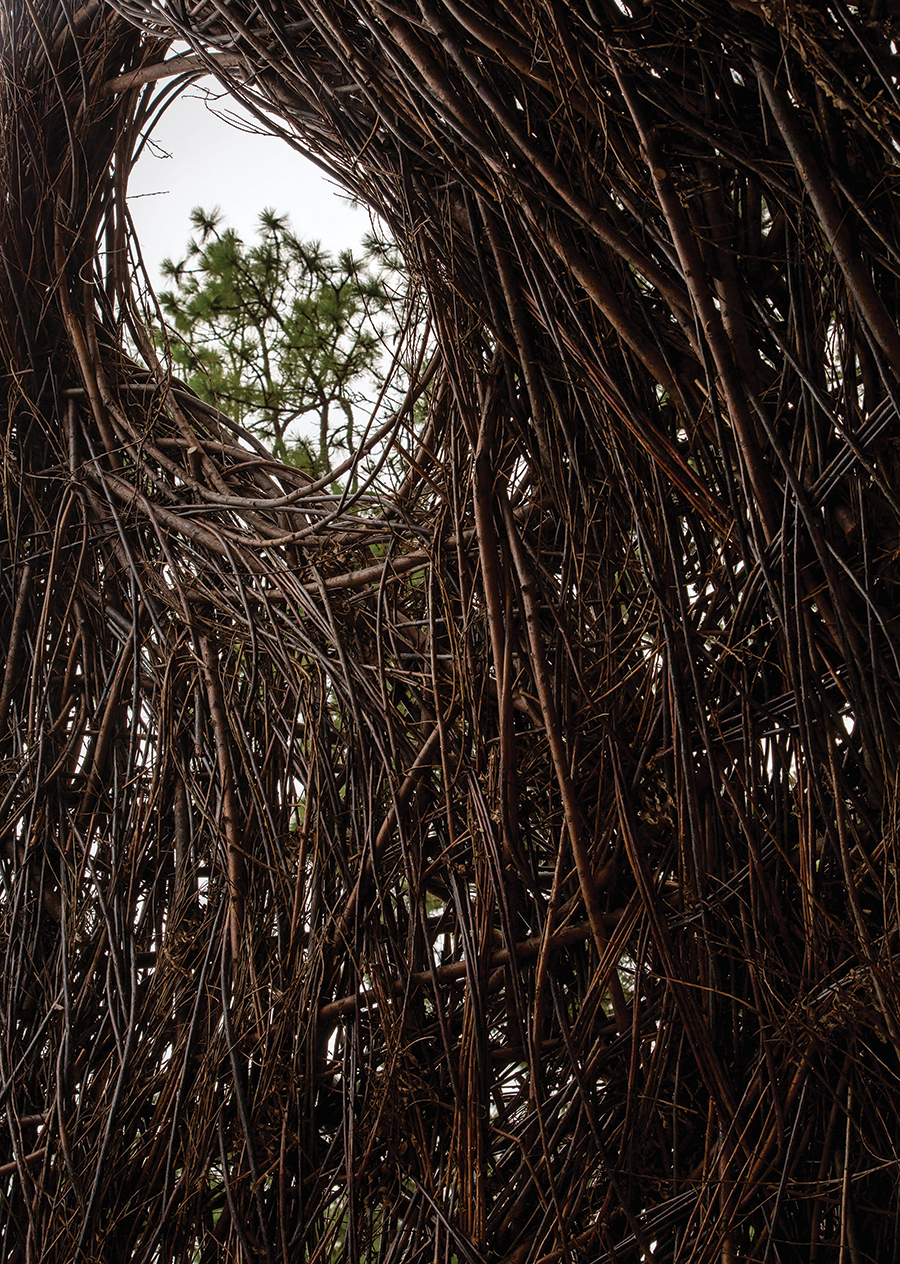
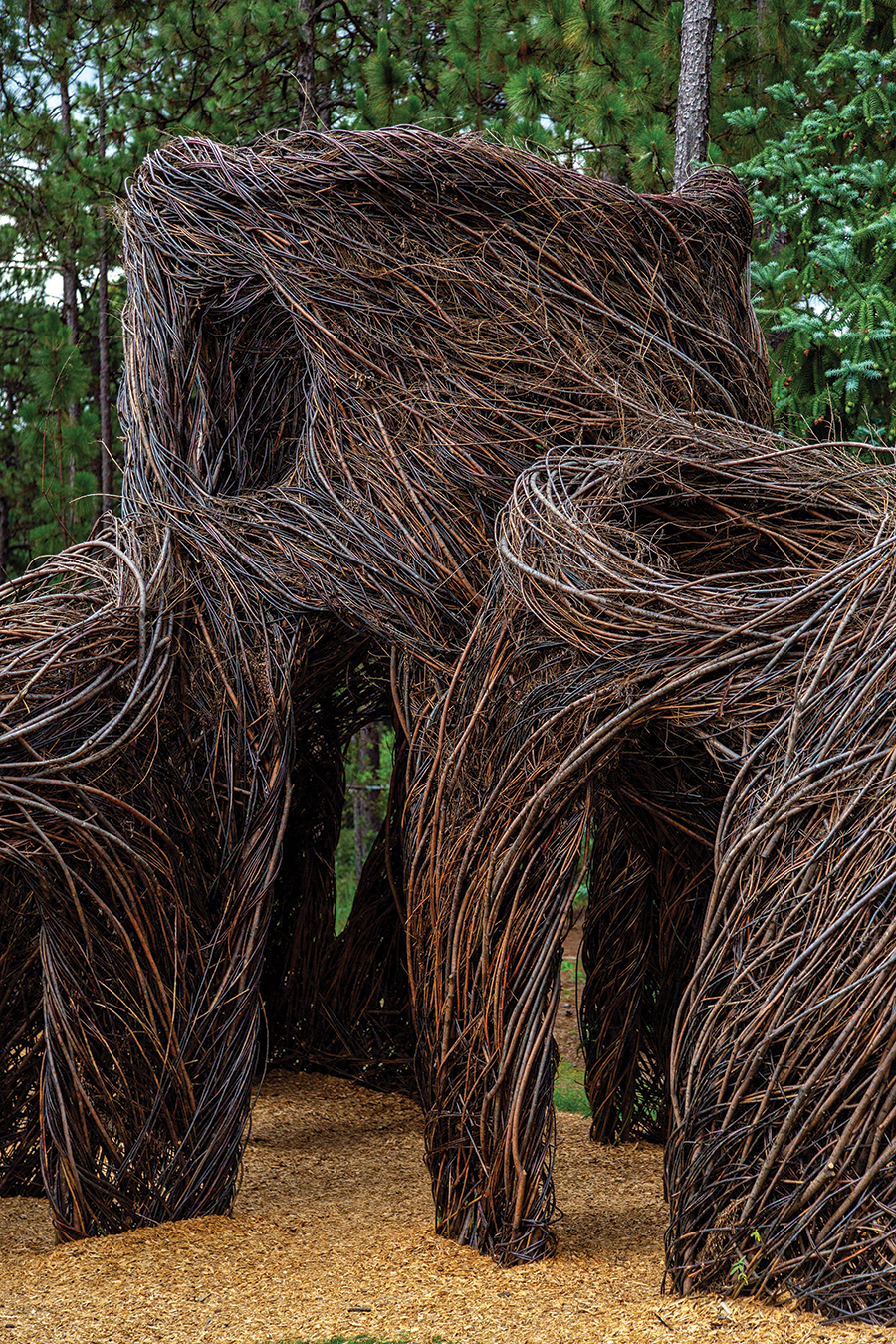
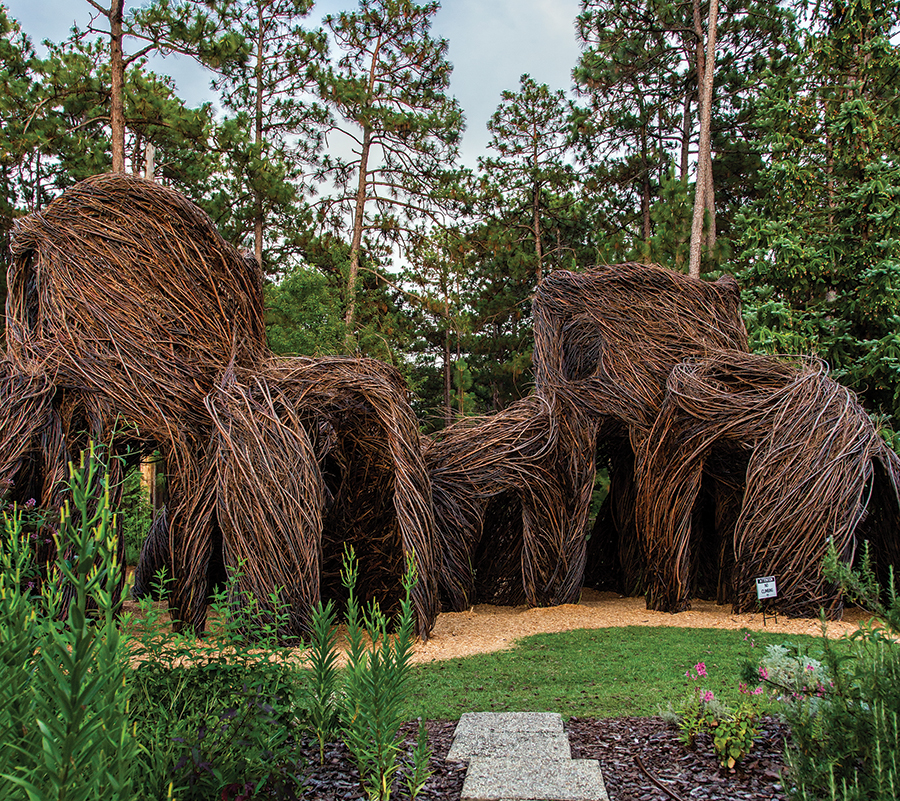
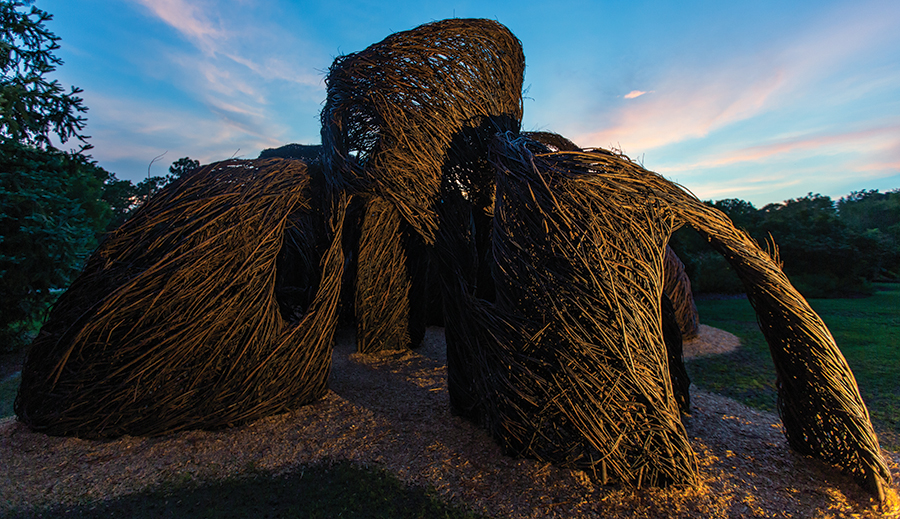
Patrick Dougherty’s most recent sculpture, What Goes Around, Comes Around, blossomed in three weeks from a dogwood flower. After laying a few petals on the ground, the internationally renowned artist, who grew up in Southern Pines, posed himself a question: “What could we do if these flower petals had walls and became something else?” What they became was the large stick sculpture that stands, for as long as Mother Nature will allow, behind the visitors’ center of the Sandhills Horticultural Gardens at Sandhills Community College.

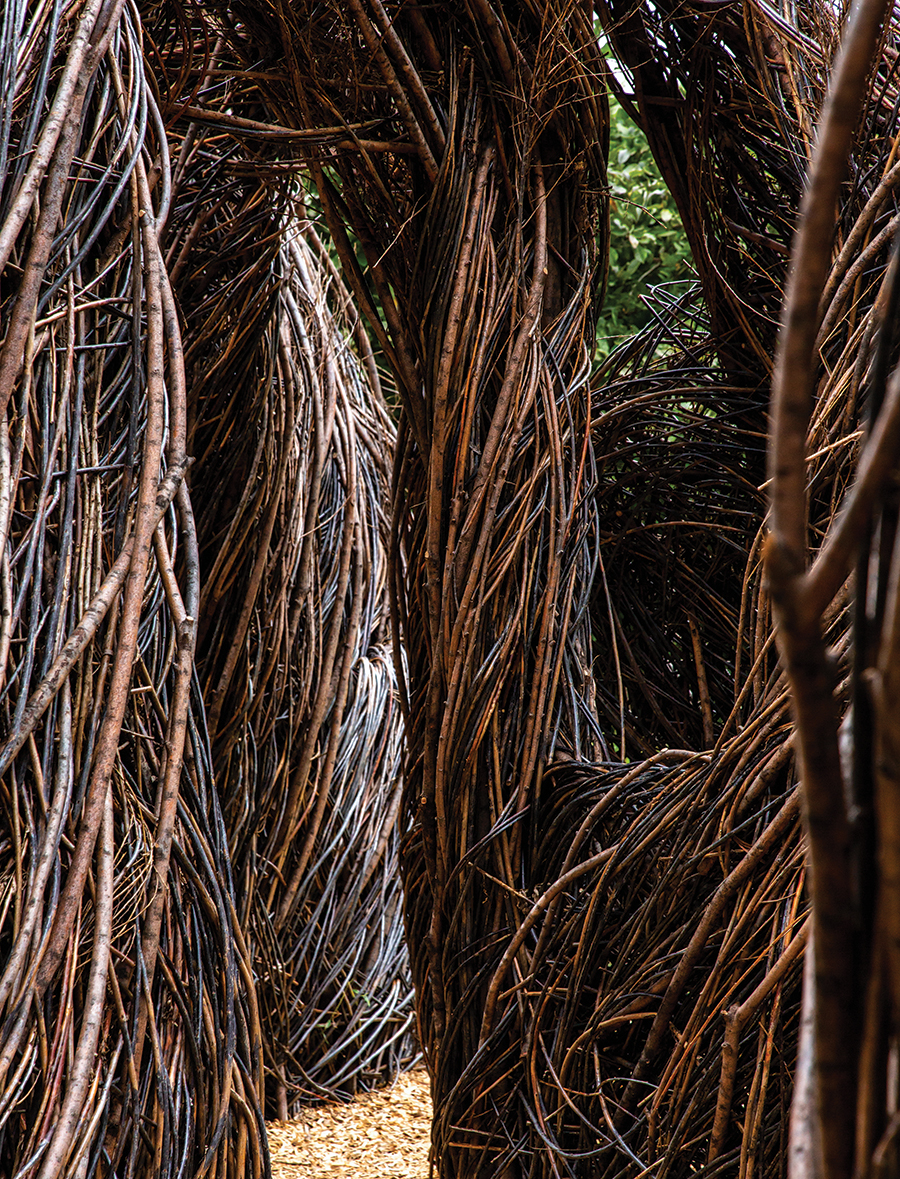
Dougherty and a cadre of volunteers worked for three weeks in June creating the piece. “We drilled a series of holes around the perimeter of our footprint, set scaffolding and bent those limbs over into the shapes you find out there,” he says. Like drawing on a canvas, Dougherty uses additional sticks to give the outer wall of the sculpture its flowing surface. He and his crew spent the last few days “really, erasing things we didn’t like” and sprucing (no pun intended) up the installation so people could walk through it and interact with it.

The commission was a chance for Dougherty, who graduated from the old Southern Pines High School on May Street, to reconnect with the community, and friends, of his youth. “Everybody that I knew in a previous lifetime ended up coming back and talking to me,” says Dougherty. “And I look at all the new friends I made. My volunteers. Each person brought their own story, their own expectations. They know about me, so I get to understand about them.” And leave a door to the imagination behind.

— Jim Moriarty