
Palm Beach Weekend!
Escape to the timeless, buzzy glamour of the Florida tropics for year-round summer sizzle
By Jason Oliver Nixon and John Loecke
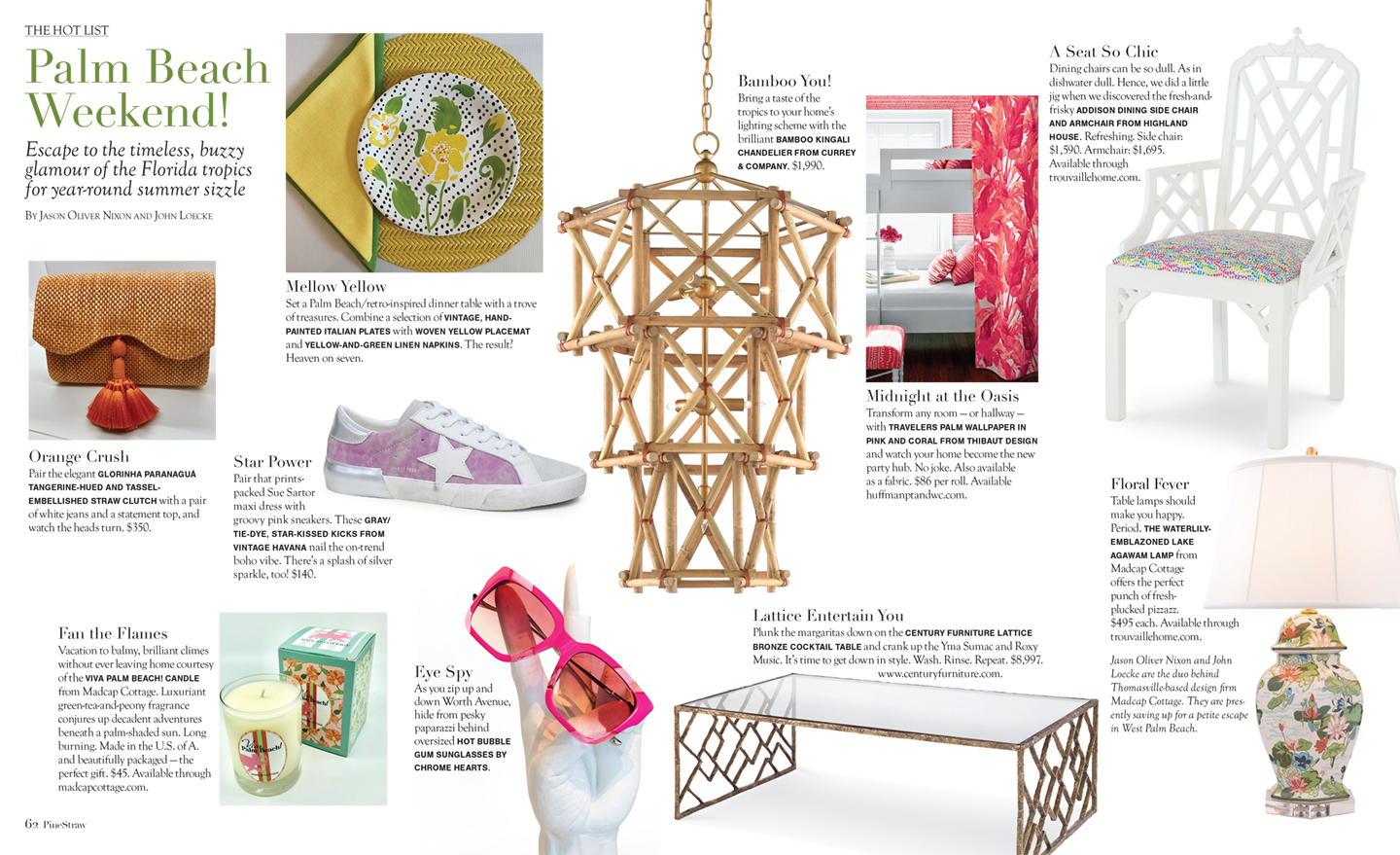

Escape to the timeless, buzzy glamour of the Florida tropics for year-round summer sizzle
By Jason Oliver Nixon and John Loecke

The Sandhills Photography Club meets the second Monday of each month at 7 p.m. in the theater of the Hannah Marie Bradshaw Activities Center at The O’Neal School at 3300 Airport Road in Pinehurst. Visit www.sandhillsphotoclub.org.


History is brewing again in downtown Asheville
By Wiley and Mallory Cash
In 1994, Oscar Wong began brewing beer in the basement of Barley’s Taproom and Pizzeria in downtown Asheville. Wong, the son of Chinese immigrants, grew up in Jamaica and moved to the states to study civil engineering at the University Notre Dame. After forging a successful career in nuclear engineering, he would later create an innovative nuclear waste disposal company and then go on to found Highland Brewing Company, Asheville’s oldest independent brewery. As the first legal brewery in Western North Carolina following the repeal of prohibition, you can imagine its allure. Still, it took Wong eight years to break even. Why? Because he was determined to produce a high-quality product on a consistent basis. He invested in his vision. While that superior quality persists, little else remains from those early days in the basement.
In 2011, Wong’s daughter, Leah Wong Ashburn, officially joined the team at Highland Brewery. More than a decade earlier, Ashburn had applied for a position with her father’s company after graduating with a degree in journalism from UNC-Chapel Hill, but her father turned down her application. He wanted her to find her own way, he told her. And so she did.
Years later, after Ashburn built a thriving career in sales and marketing with a yearbook publisher in Charlotte, her father actually recruited her for a position at Highland, but in the intervening years, the tables had turned: He could no longer afford her.
But blood is thicker than water, and, apparently, so is beer.
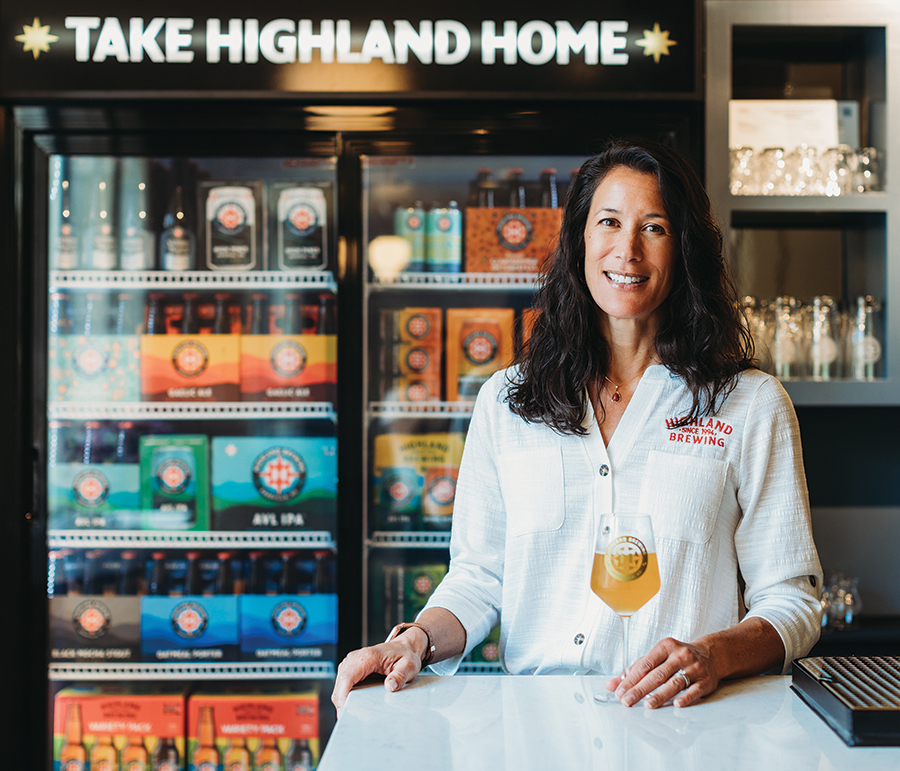
“Other things became more important and the brewery was one of those more important things,” Ashburn said in a 2018 interview with Business North Carolina. “It was about being part of the community. You can’t put a value on that.”
Leah Wong Ashburn is now Highland’s president and CEO, and her tenure has marked an era of rapid change, both for the company and the city of Asheville. In 2011, Highland opened a tasting room at their mountaintop manufacturing facility in east Asheville, which has now grown to 70,000 square feet and offers complimentary tours of their onsite brewery, a lively taproom with ample seating, a performance stage, a rooftop garden bar and an indoor event space. According to Brock Ashburn, Leah’s husband and the company’s vice president, “We built the taproom to accommodate the throngs of people who were showing up, part of an ever-increasing interested public who wanted to drink our beer where it was made.”
Over the past decade, a lot of people have — as Brock Ashburn puts it — “shown up” in Asheville, and the city is now an international destination for foodies, beer connoisseurs and outdoor enthusiasts. “There’s always been a soul and a spirit in Asheville,” Leah says, “and Highland got to join up with other people who believed in the potential for Asheville. Great beer is a complement to great food and quality of life.”
Community and regional pride are more than just branding tools; Highland is a company whose culture is built on stewardship and community responsibility, tenets made apparent in their practices of reducing or reusing waste, partnering with local nonprofits and embracing solar power. The company also collaborates with the Southern Appalachian Highlands Conservancy, naming seasonal beers after unique regional landscapes. Ashburn has always made clear that she intends to keep the company concentrated on regional endeavors and has no plans to ship beer across the country, choosing instead to focus the company’s efforts within the confines of the Southeast. This comes as no surprise for a brewery that has spent two and a half decades fostering a regional brand in a region that has quickly gained international attention.
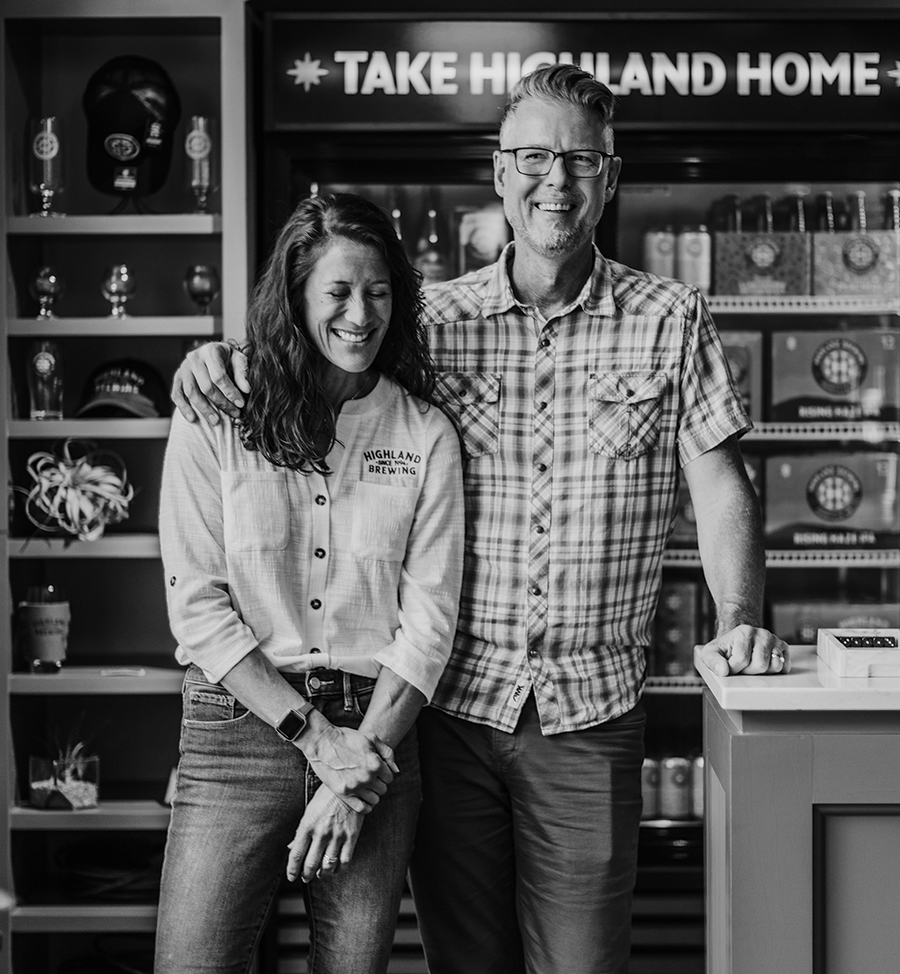
Today, Leah and Brock are sitting at the brewery’s new downtown taproom in the old S&W Building, a quintessential example of Asheville’s stunning 1920s Art-Deco architecture. Late morning sunlight pours through tall windows that look out on Pritchard Park, illuminating the gold-plated fixtures and ceiling tiles, the two-story marble columns and tiled floors in a glowing aura that sweeps visitors back into the roaring ’20s. You can almost sense what Asheville must have been like a century ago, when it was first known as a destination for Hollywood stars, politicians and titans of industry. Highland anchors the new S&W Market’s downstairs dining area with a taproom, along with several local restaurants that provide counter service. Upstairs, on the mezzanine level, Highland has opened a full bar and tasting room with ample space for guests to relax over a pint.
One can only imagine what it must mean to Leah for Highland to return to downtown, where it all started from such humble beginnings over a quarter century ago.
“As a second-generation owner, I was encouraged to make the brewery my own,” she says. “That did not feel safe to me at first because of the long history of Highland, but my father’s sentiment was honest, and he’s let us create our own vision.” That meant changing the beer portfolio and re-envisioning the brand. She says it also meant improving the property: “We started as a manufacturing company, but Brock’s an engineer and a builder, and I’m a marketer,” Leah says. Combining all of those interests and backgrounds led to a complementary hospitality component. “It appeals to tourists because it highlights some of the great things about Asheville in one location.”
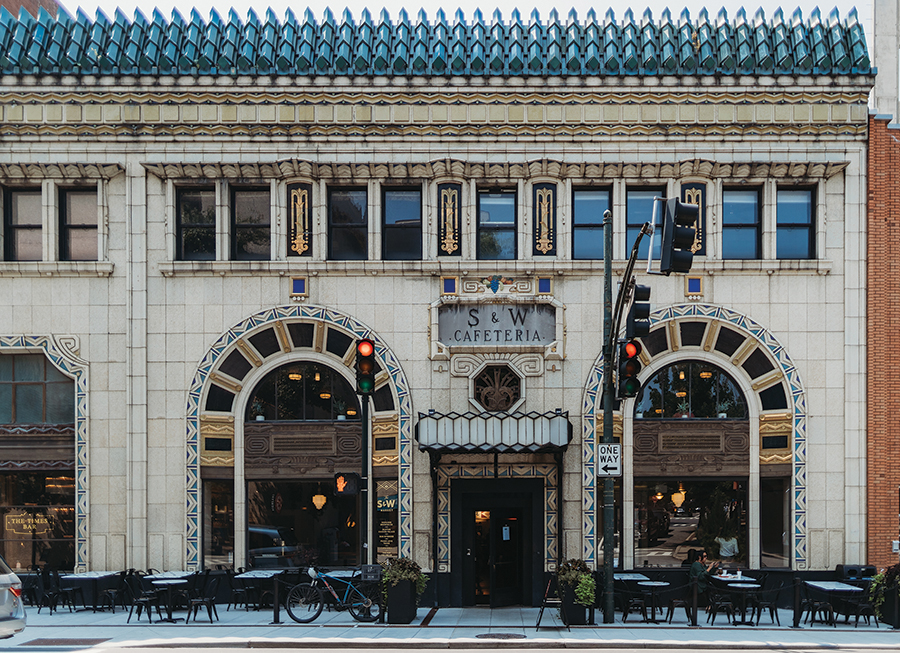
Outside, people are waiting for the S&W Market’s doors to be unlocked for the day’s business. A line of tourists and downtown office workers in business attire snakes down the sidewalk. Leah and Brock look out the window and pause for a moment, perhaps recalling the throngs of beer enthusiasts who showed up the minute the first taproom opened at Highland’s manufacturing site a decade earlier.
“This is an opportunity to tell our story downtown and also attract people to come out to East Asheville to visit our brewery,” Brock says. “It’s a great opportunity to get our brand out there and let people know where this all started.”
From a downtown basement to a mountaintop in East Asheville to the second floor of one of the city’s most iconic downtown buildings, Highland has come a long way. But whether it’s the quality of the beer or the family name, some things never change. PS
Wiley Cash is the writer-in-residence at the University of North Carolina-Asheville. His new novel, When Ghosts Come Home, will be released this month. Mallory Cash is an editorial and portrait photographer.


Photographer: Megan Morales Photography
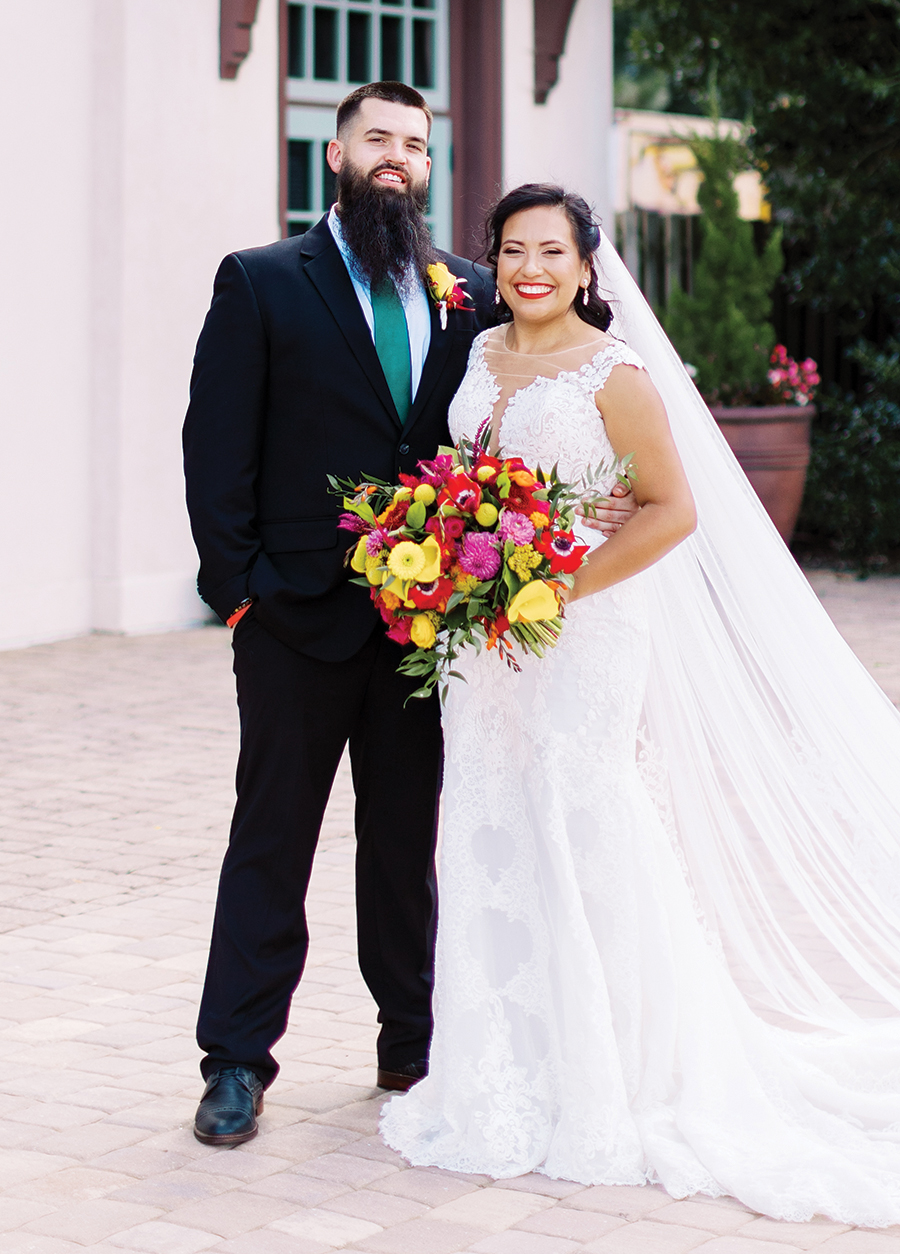
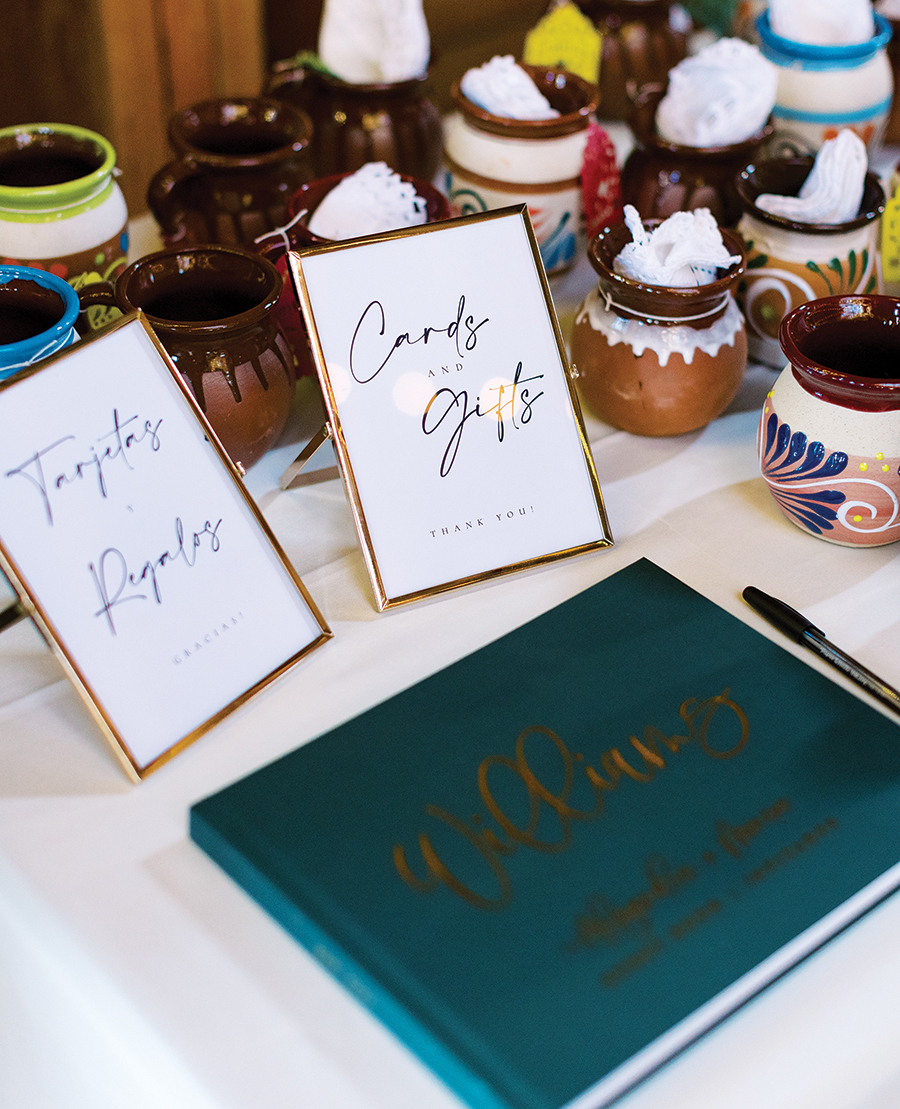
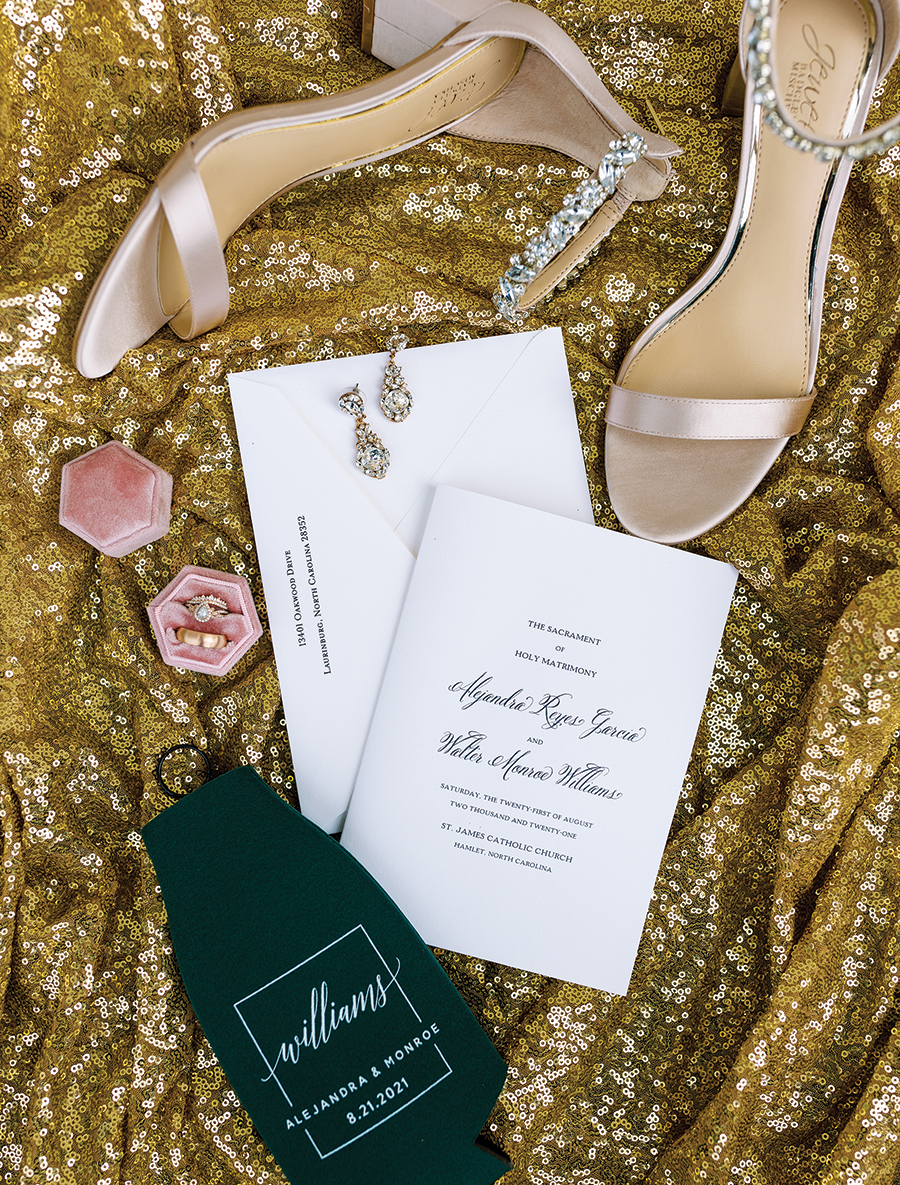
Alejandra and Walter grew up in Richmond County and knew of each other in high school — they had friends in common. But they were only “friends” on social media until nearly a decade after high school when they finally connected and went on a date. Alejandra’s final semester of graduate school briefly delayed their relationship, but, after graduation, the couple reconnected for date number two.
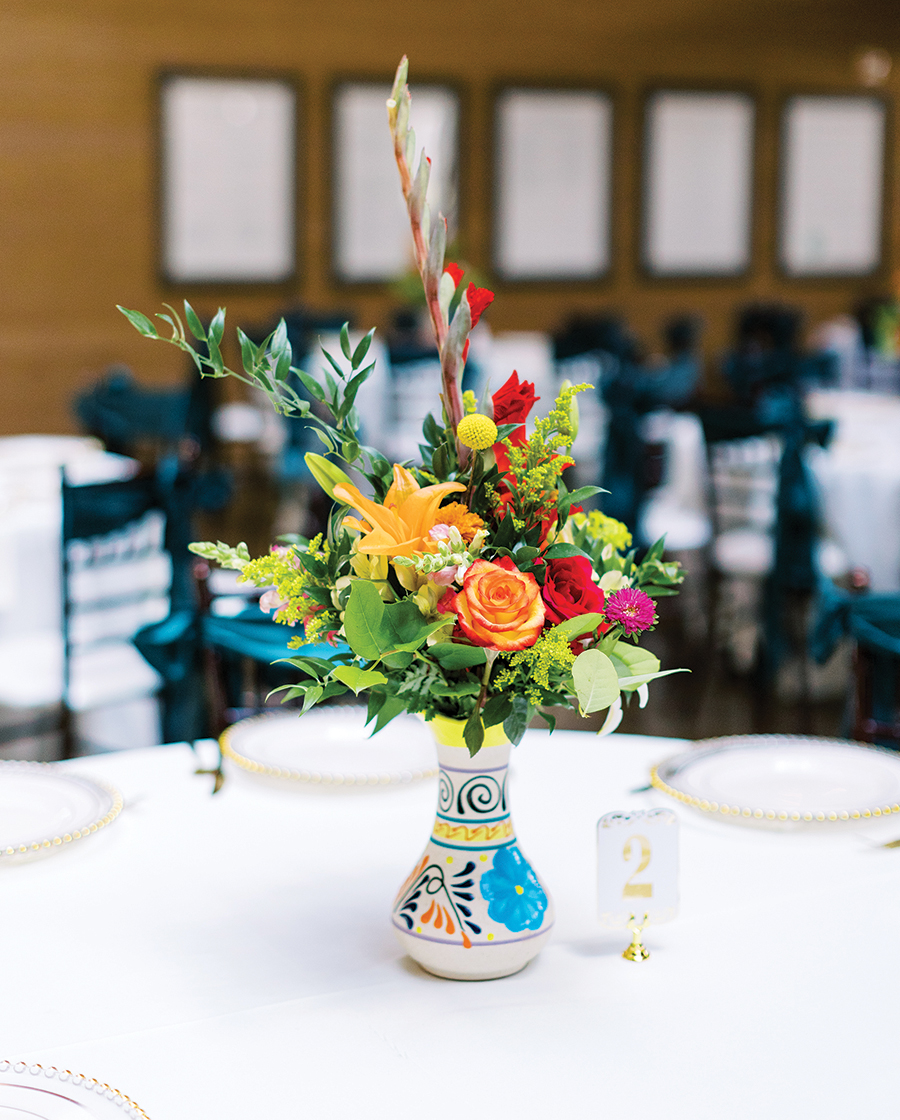
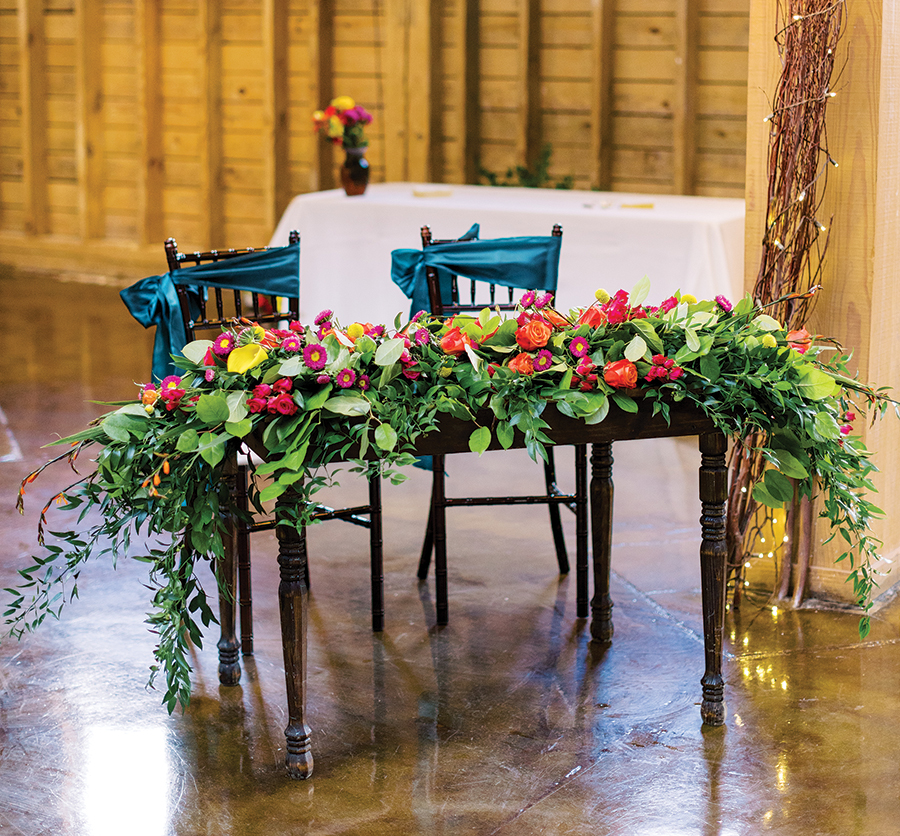
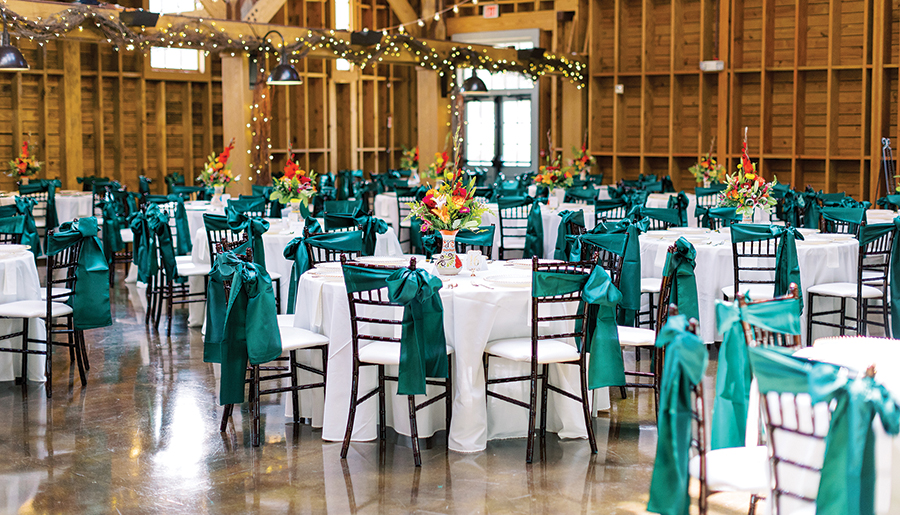
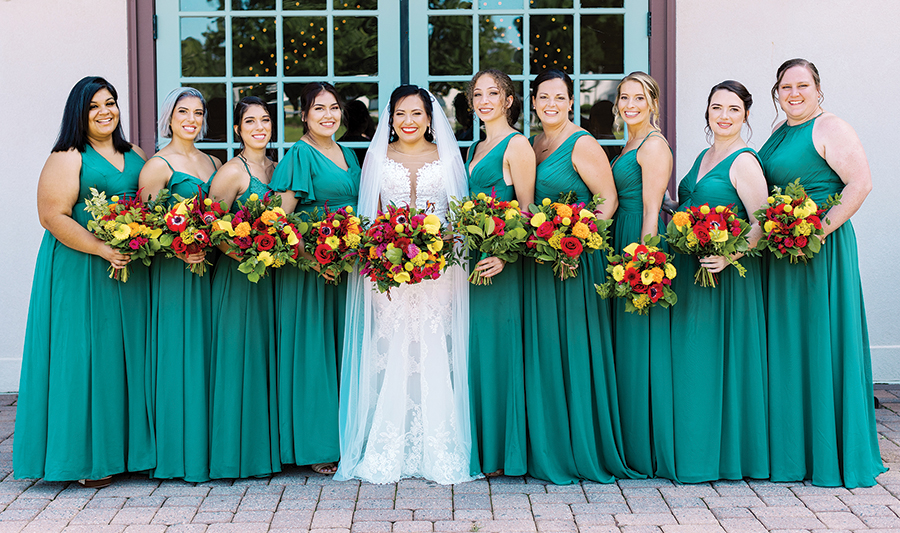
A month into the pandemic, Walter planned a low-key, intimate proposal. The pair had casual conversation over Mexican takeout and walked around Aberdeen City Lake before Walter popped the question. Honoring Alejandra’s Mexican heritage, the couple had a bilingual wedding filled with rich traditions and a vibrant palette of dark green with pops of red, yellow and pink.
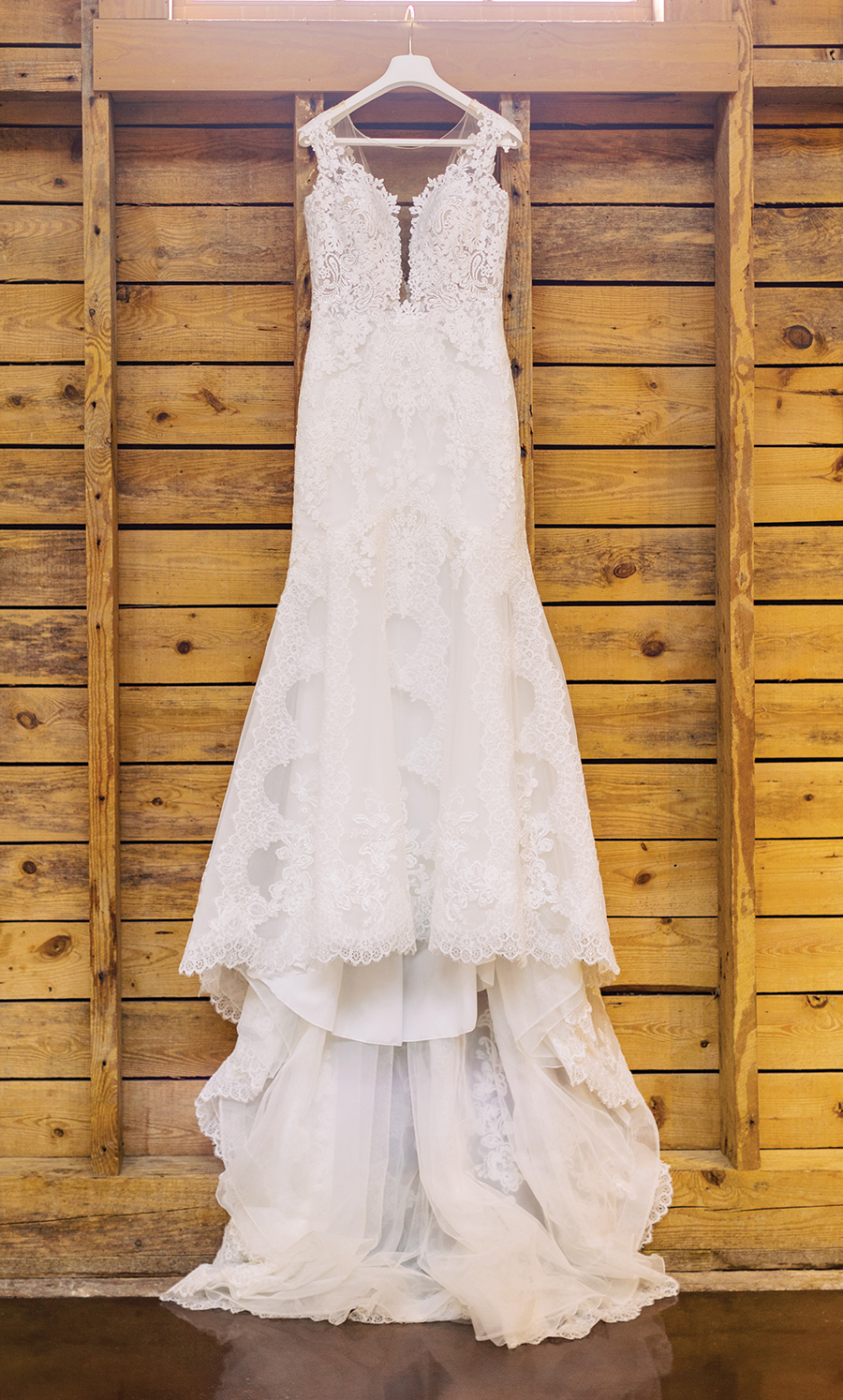
Ceremony: St. James Catholic Church, Hamlet | Reception: The Fair Barn | Dress: Pronovia from Elizabella’s Bridal Boutique | Hair: Monica Morales | Makeup: Anna Rowland | Bridesmaids: Azazie | Groomsmen: Belk | Flowers: Hillside Florist, Rockingham | Cake: A Place Called Bethany, Pembroke | Catering: Rick’s Catering, Laurinburg | Transportation: Kirk Tours & Limousines | Invites & Programs: Reaves Engraving, Laurinburg














By Ashley Wahl
August leaves you wanting.
In the afternoon, when the air is all milk-and-honey and the primal thrum of late summer has reached a crescendo, she will boldly take your hand.
“Close your eyes,” she will whisper, and as her golden light flickers across your face and shoulders, you all but dissolve into her dreamy essence.
“This way,” she will tease, giggling as she guides you someplace a little darker, a little cooler — a shadowy hideaway beneath the trees.
You’ll stop at the tangle of wild blackberries, where deer tracks resemble spirals of ancient text and a sparrow whistles sweetly in the distance.
“All for you,” she will promise, slowly feeding you the last of the dark, warm berries, and then she will guide you along.
You can tell by the sun on your skin that you’ve entered some clearing, and when you crack open your eyes, bees and butterflies light and stir in all directions.
“Keep them closed,” she warns, leading you through wildflowers and down to the dock of a swollen pond, where yellow-bellied sliders bask on the bank, largest to smallest, like a set of wooden stacking dolls.
Bare feet dangling in the water, she leans in close, perfume thick as honeysuckle, plants a soft kiss on your cheek. Because her voice is like nectar — slow and sweet and dripping with intrigue — it makes no difference what she says next:
“I’ll never leave you” or “Wait right here.”
Besides, you’re too enraptured to notice that the days are growing shorter, that the gray squirrel has been busy storing nuts.
As the summer light begins to fade, the fireflies blink Morse code. The cicadas, too, scream out. All the signs are here, but you can’t see them.
When you open your eyes, she is already gone.

Behold the earliest apples, the earliest figs, bushels of sweet corn and tomatoes ripening faster than you can say bruschetta.
When the Green Corn Moon rises on Sunday, August 22, take a lesson from the squirrels: Now’s the time to preserve your summer harvest.
Can the fresh tomatoes. Sun-dry the herbs and figs. Pickle okra, cukes and peppers. As for the rest? Cook now and freeze it for later.
Squash soup, anyone?

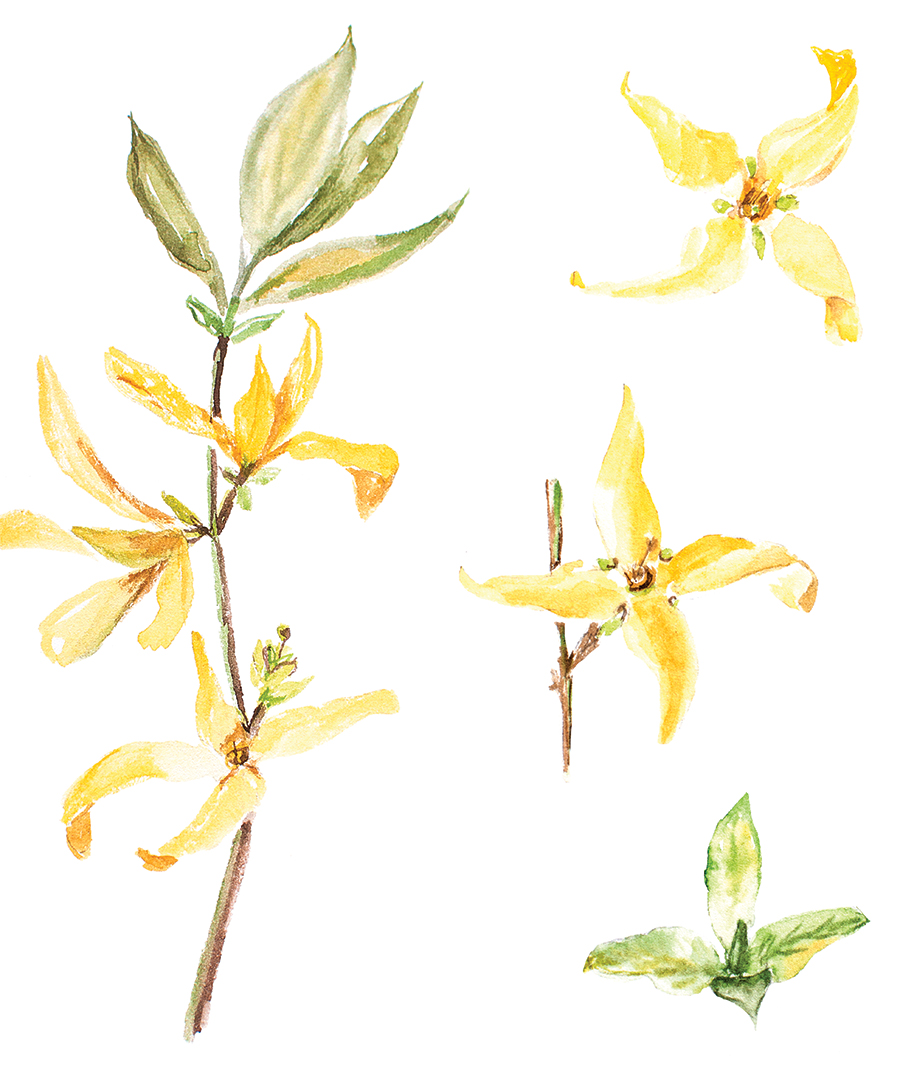
The bees and all who hum and buzz are, in a word, nectar-drunk. Among the late summer bloomers — crape myrtle, lantana, lobelia, ageratum and phlox — a favorite is butterfly weed, Asclepias tuberosa, caterpillar food for Monarchs. Drought tolerant, deer resistant and kin to milkweed, what’s not to love? And their orange-and-yellow clusters mirror the joy andwarmth of summer.


Artist’s home captures bygone America
By Deborah Salomon • Photographs by John Gessner
Monet painted from a studio adjacent to his country home in Giverny.
Van Gogh rented four Spartan rooms in Arles, which he immortalized on canvas.
Cézanne built a studio on farmland, in Provence. All painted fruit and flowers in the still life mode.
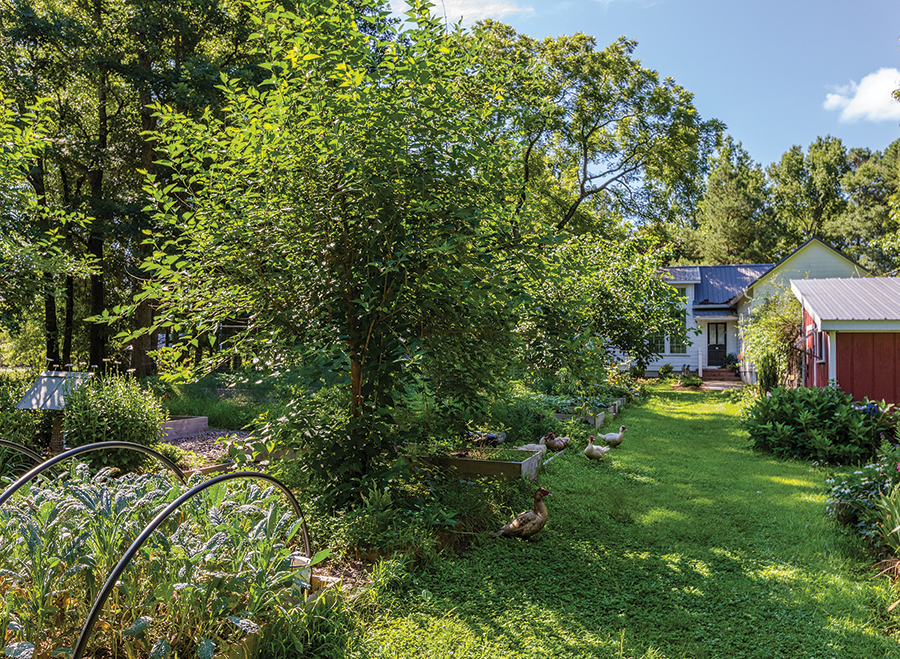
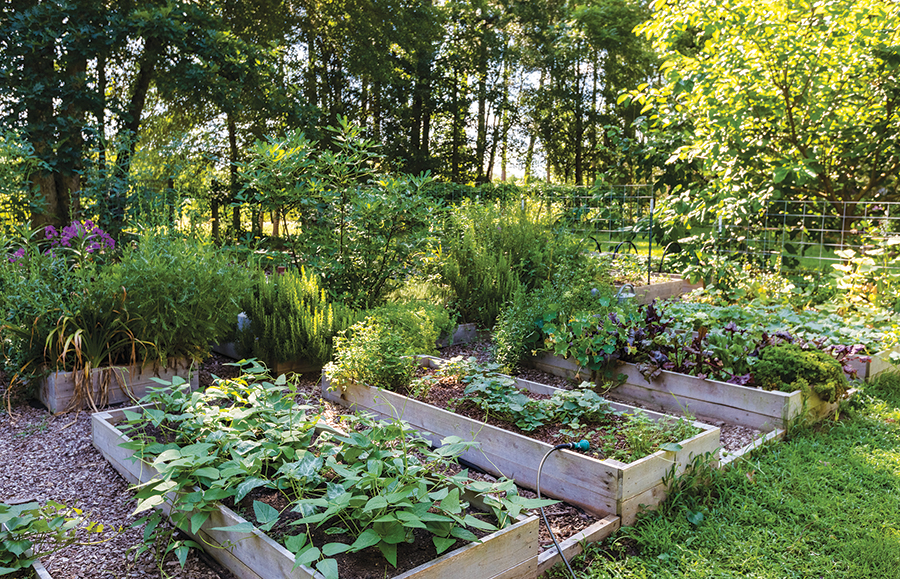
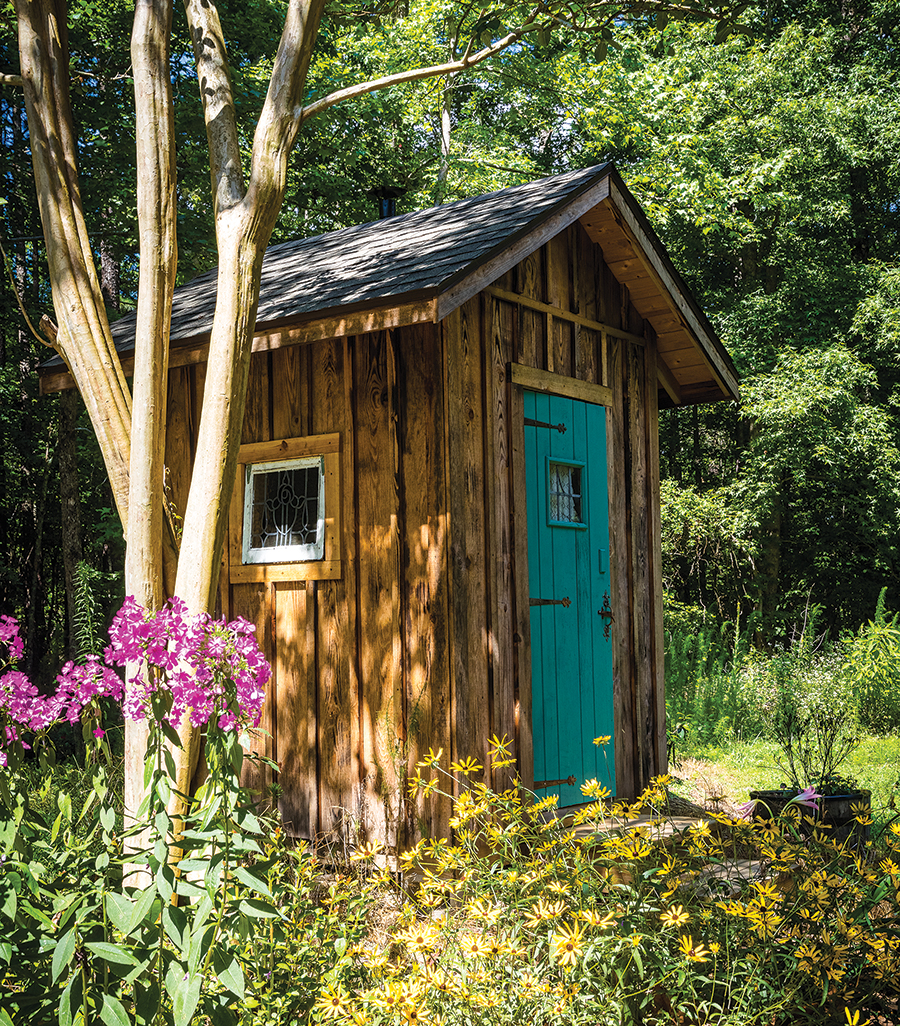
During the late 19th century, the ateliers of a hundred starving artists dotted the Left Bank. How they would covet Carmen Drake-Gordon’s set-up: a 100-year-old farmhouse converted as a studio with 14-foot windows facing north, for consistent light. Close by, a new house that appears 100 years old, with elongated porch, furnished in country antiques. Beyond the house, an idyllic pond, where Muscovy ducks swim and catfish jump for treats. A shady chicken coop; a fenced yard for three goats who earn their keep by clearing the wisteria. A red barn workshop where Carmen’s partner, Wade Owens, a multi-skilled retired Army officer from Iowa, builds, repairs and blacksmiths. Between the studio and farmhouse, raised beds yield kale, peppers, tomatoes, beans, eggplant, paw-paws and jujubes. Then, for whimsy, an adorable outhouse with running water built by Carmen’s children, instead of installing a septic system for her studio.
“I call it my Pee Palace,” she says and laughs.
All this surrounded by 15 acres of grass, woods and wildlife where she walks with Dean, a devoted mixed-breed dog she rescued minutes before euthanasia.
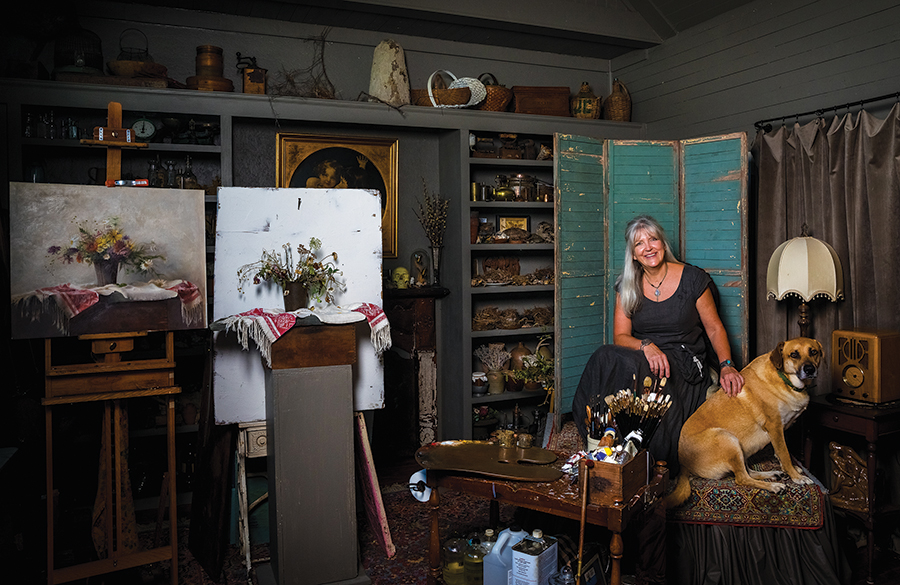
This homestead’s proper name is Oak Hollow Farm and Studio, and its tall, blonde, artfully dressed (“funky,” is her description) occupant, a grandma who is, in the best sense, a piece of work. From this studio Carmen — inspired by her surroundings — creates and sells paintings nationwide through virtual and other galleries. She hosts workshops that include lunches of garden produce served at her stretch table. But unlike Monet, Van Gogh and Cézanne, her portraits and still lifes follow classical realism as practiced by Dutch and Flemish masters — a technique that’s uber-photographic, three-dimensional, and eminently artistic.
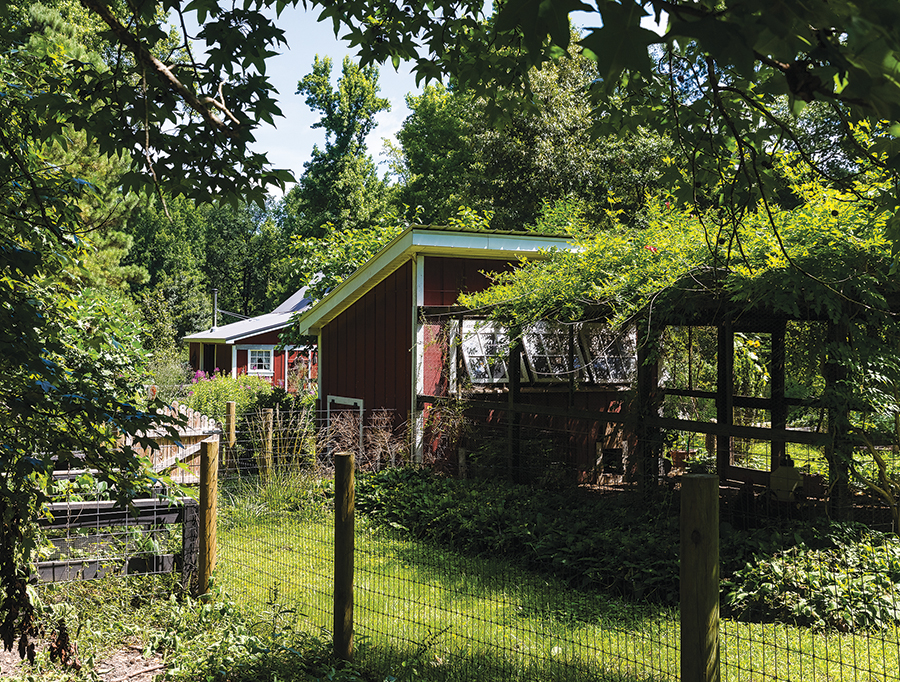
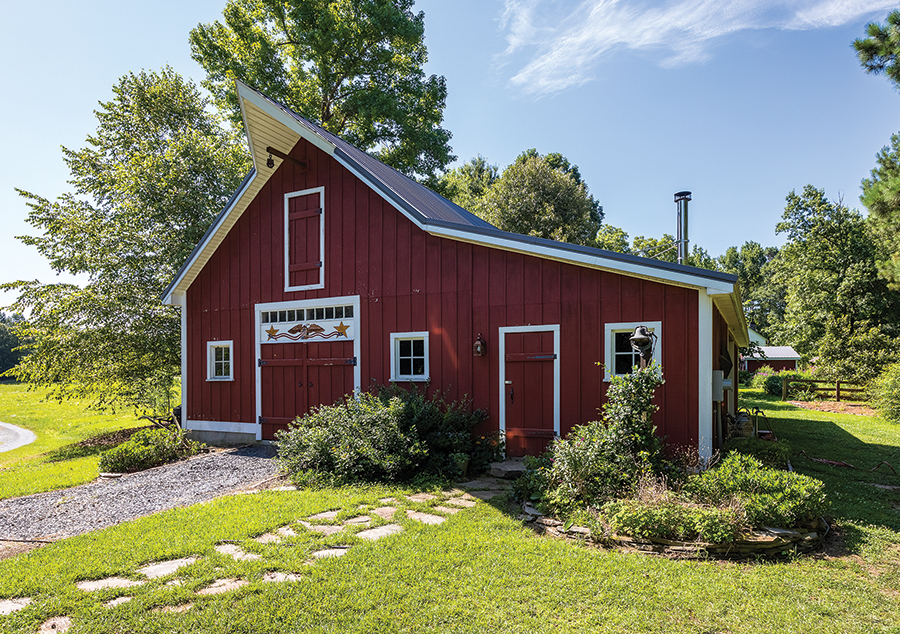
Carmen grew up in Maine and Connecticut. Her artist mother provided lessons for the early-bloomer. “I was oil painting by 12.”
Modernism? “I wasn’t into that.”
Carmen married young and “dabbled” while raising three children. The family settled in Southern Pines in 1986, when her husband was stationed at Fort Bragg. Carmen remained here after he was killed in Mogadishu, in 1993. “The military became my family.” She pursued a love for Italian religious art, also appreciating “things — especially utilitarian things. “I find beauty in them.” Studying with Jeffrey Mims at the Academy of Classical Design in Southern Pines, and later with local artist Paul Brown, channeled and refined her talent.
Every artist longs for a studio. “I like to surround myself with a peaceful, calm atmosphere where I feel a connection with what I create.” That includes whatever exists outside her studio door.
She and Wade looked for land. A waterscape would be nice. The parcel they found had potential.
This land, known as the Short family farm, came with a rickety farmhouse (once a used bookstore), and a double-wide, also in disrepair. They bought the acreage in 2001, cleaned up the double-wide and lived there until completing the house in 2004. The old farmhouse-bookshop, now with heat and AC but no running water, became Carmen’s studio in 2018.
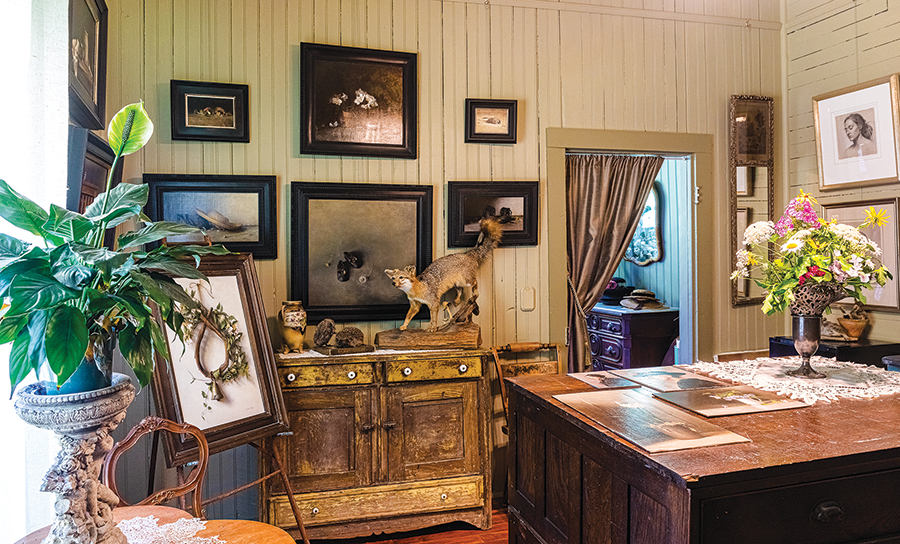
The main house — white clapboard, two stories with full basement, more than 3,000 square feet — spreads longitudinally across a knoll, with manicured grass sloping down to the pond, where Carmen and Wade have constructed a low stone wall and seating area. Their porch may appear Southern but the interior hums Yankee Doodle. Carmen found a set of plans that were adapted to include 10-foot ceilings and so much more. Construction took 18 months, but when it was finished, the house, with its unusual floor plan, won a Moore County Home builders Association Award.
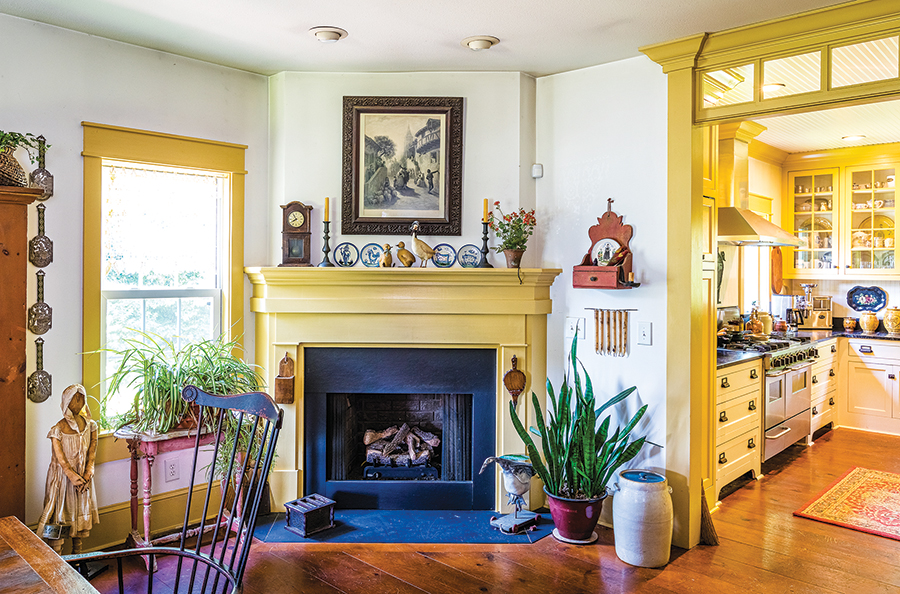
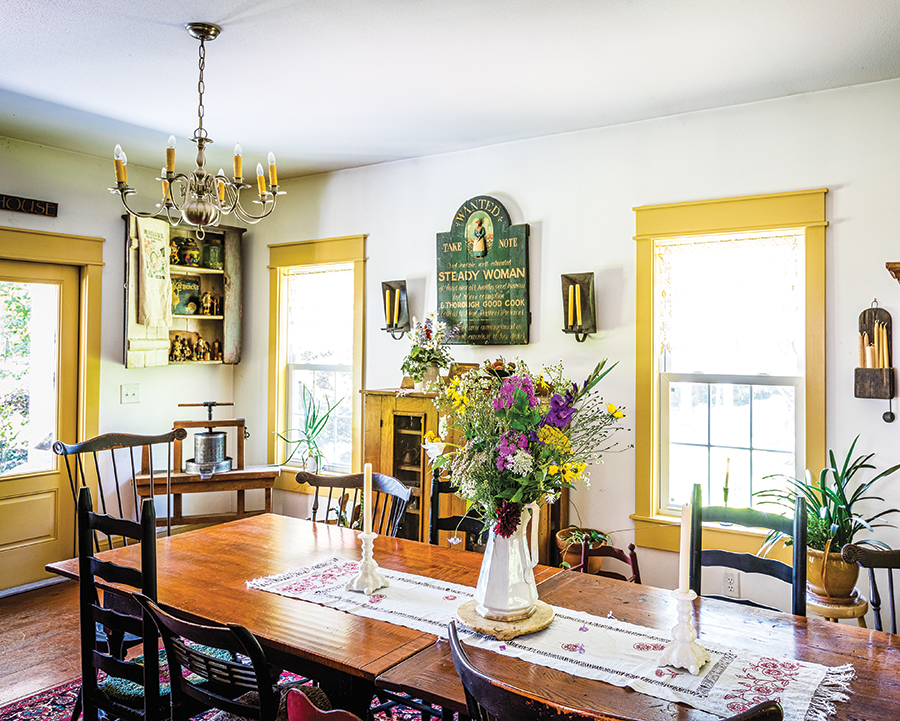
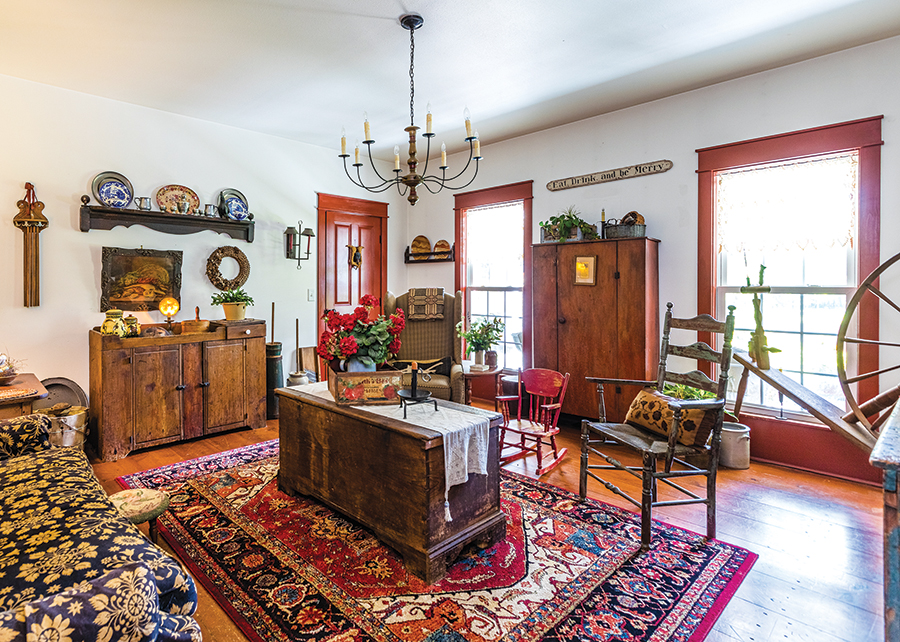
Just inside the front door stretches a dining table easily seating 10, made by Wade. The mismatched chairs include old-timey high chairs for Carmen’s two grandchildren. This long, narrow room with angled fireplace began as the sitting room, with a smaller dining room off to the right. Carmen had no trouble switching designations to accommodate their extended families for holidays. Both rooms contain multiple armoires, settees, candlesticks, lamps, shelves, tables, paintings and enough historical artifacts to warrant a catalog. Some are remnants of Carmen’s antique shop, C.R. Drake Mercantile in Cameron. Many pieces showcase her inventive touch, like a ladder repurposed as a quilt rack.
“I’m not comfortable without knick-knacks,” Carmen explains. Being surrounded by old things satisfies a need: “I imagine how many people touched them. I connect with that.”
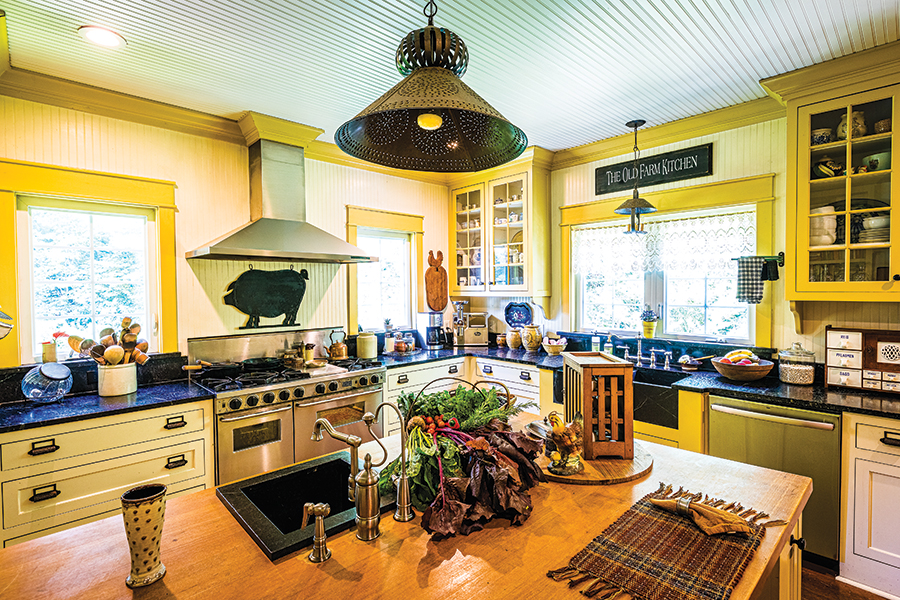
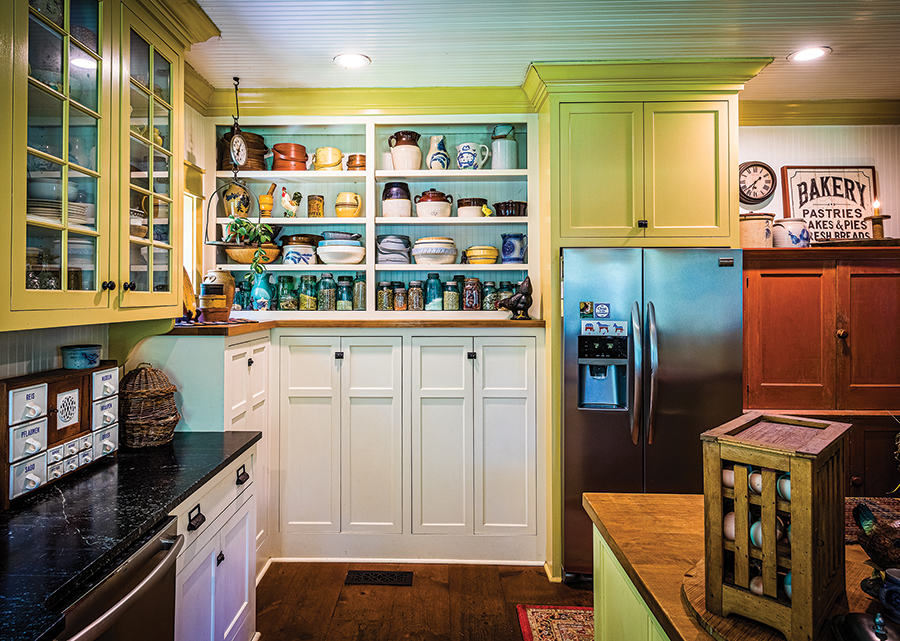
The elongated dining room ends at the kitchen, visible from the front door. Creating a century-old atmosphere around modern appliances can be tricky. Carmen chose a dusty yellow for the footed carpenter-made cupboards with black metal pulls to match the black soapstone countertops and protruding island, with breakfast bar. One wall is fitted with a combination of open shelves and tall cabinets. An antique spice jar rack with tiny drawers labeled in German says volumes about Carmen’s attention to detail. She didn’t stint on moldings, window frames and beadboard ceilings, either: “These little touches make a big difference,” as do square nails in the wide-board knotty pine floors. To make up for the splurges, “I painted the inside to save money.”
On the counter, a gallon of blueberries picked from nearby bushes speaks of the couple’s culinary requirements. Carmen and Wade both cook. Whatever they don’t grow comes from local farmers markets.
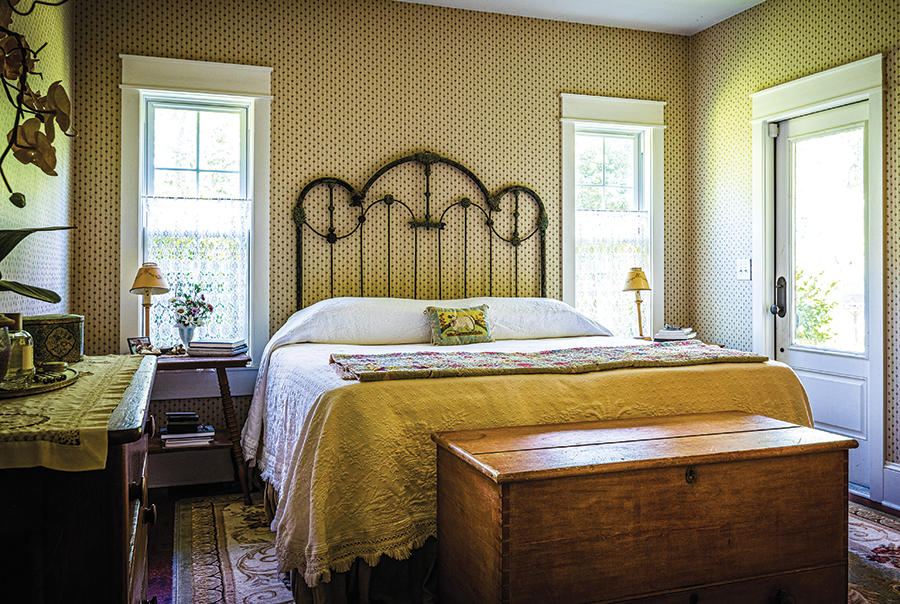
The main floor is bisected by a back hallway leading to the master bedroom, where Carmen has positioned a king-sized bed against a smaller wrought metal headboard, flanked by tall, narrow windows. The effect: airy, bright, comfy, simple. Each bathroom vanity originated as a bureau. One loo actually has a pull-chain toilet with high wall-mounted tank.
Upstairs, a guest bedroom with parallel twin beds is a Nantucket B&B look-alike. Wade uses a second upstairs bedroom as an office. For hall decor, Carmen hung a pioneer woman’s dress and coonskin hat like those worn in the Revolutionary War re-enactments she and Wade attend.
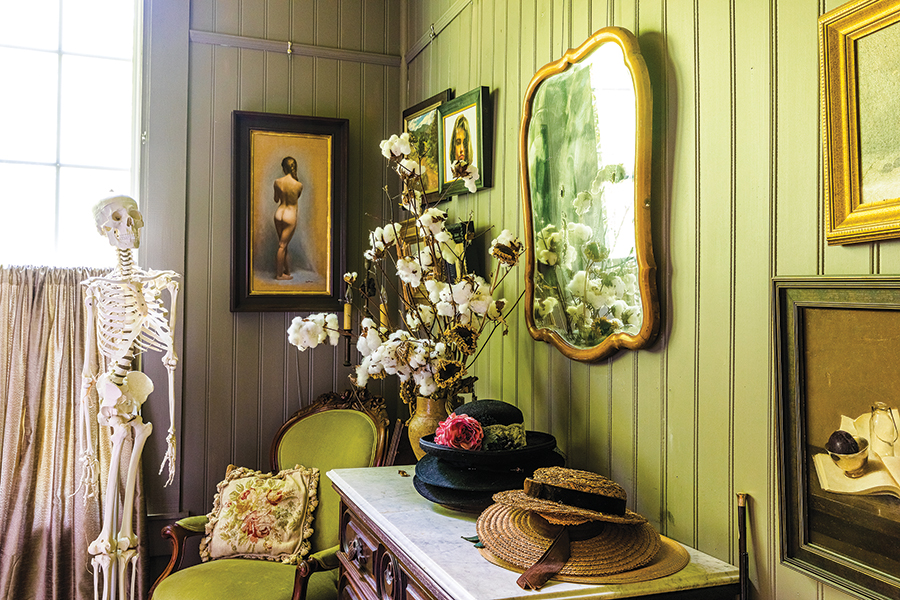
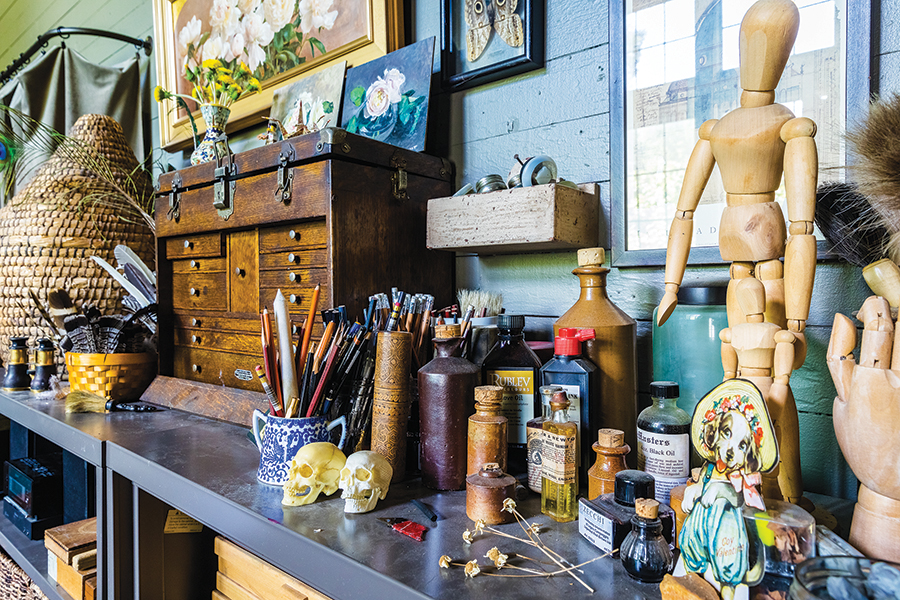
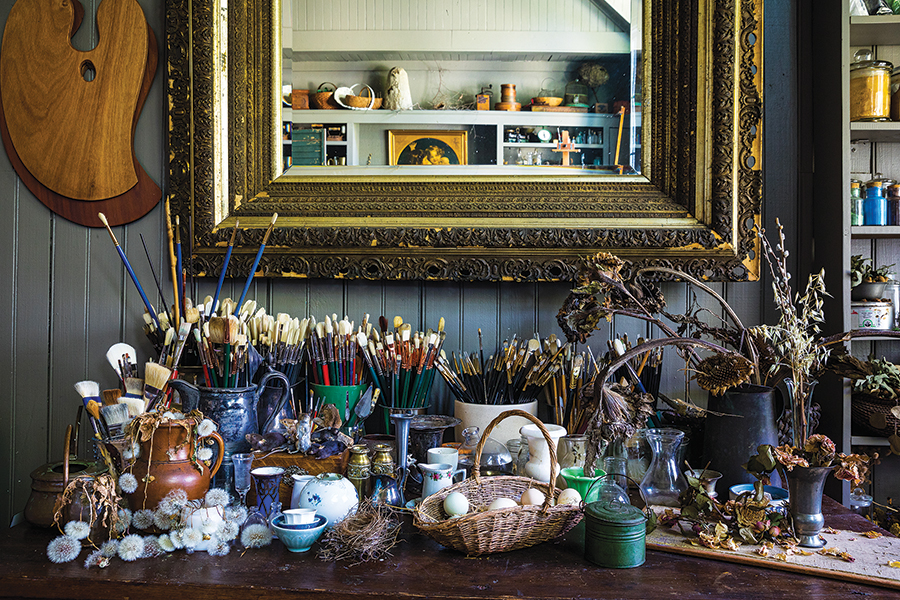
Carmen’s studio, a 50-yard stroll past the gardens, chickens and goats, represents another world: “It’s definitely my space. Everything in there speaks to me.” The interior walls made from horizontal boards painted green were left intact, but the ceiling came down to make space for windows soaring into the exposed attic, since, for an artist, proper light is crucial. Her workroom, cluttered with paints, brushes, props, paintings, a 1940s radio, a small pedestal on which stands a fancy chair, feels more decadent Parisian than rural Carthage.
As with Cézanne, no one enters this studio without an invitation.
Even more decadent, adjacent to the workroom, a parlor with floor-to-ceiling shelves spills over with art volumes, some stacked on coffee and side tables squeezed between fireplace and white sofa. Victorian was Carmen’s intent; however, the crystal chandelier reminds her of French chateaux. “This is my thinking room, my art cave, my girly space. I look through the books for inspiration, ideas.” She also teaches and entertains other artists here.
Beyond the parlor, a workroom for framing paintings and storing costumes is guarded by a skeleton, which helps plot articulation when painting the human body.
Carmen Drake-Gordon has achieved a rare confluence where art and life live peacefully, side by side. This artist paints the flowers she picks and birds’ nests she finds; she eats the produce she grows. She lives alongside friendly animals and soothing water. She is surrounded by things and people she loves, who love her back. She works hard, but on her own terms and in her own space, rewarded, fulfilled — a painting come to life. PS

The beauty of moths
By Todd Pusser
Butterflies get all the love. All around the world, festivals are held in their honor. Entire gardens are planted specifically to attract them. Poems praise their beauty. Kids even dress up as butterflies for Halloween.
Moths, on the other hand, are frequently overlooked and ignored by most people. If noticed at all, moths generally get a bad rap. Gardeners despise hornworms, the large caterpillars of sphinx moths, feeding on tomato plants in the backyard. Gypsy moth caterpillars, capable of defoliating entire trees, are the bane of property owners throughout areas of the Northeast.
Even in popular culture, moths are frequently associated with superstition and death. The calling card of the serial killer from the popular 1990s movie Silence of the Lambs was the cocoon of a death’s-head hawkmoth (yes, there is such a thing) placed inside the mouths of his victims.
About the only time moths have received any positive press is when Mothra dragged Godzilla by the tail out of Tokyo.

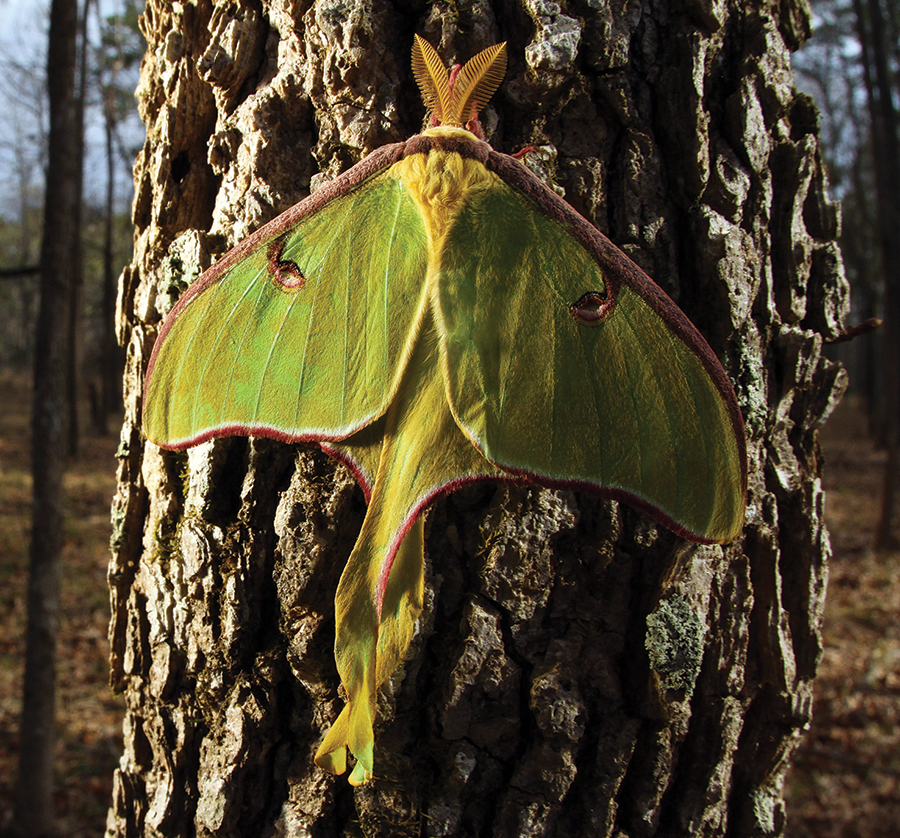
Last July, on a hot and humid night, I pulled into the parking lot of a brightly lit gas station along the edge of the Dismal Swamp in the northeastern corner of the state. It was during the height of the pandemic, and few other cars were around. In need of caffeine, I stepped out of my vehicle and walked along the side of the building toward the front door. Casually glancing up, I was stunned to see a large luna moth clinging to the side of the building, its striking lime-green wings contrasting sharply with the white paint.
The gentle luna moth is the teddy bear of the insect world, sporting a plump, furry body, feathery antennae, and a pair of 3-inch-long sweeping tail streamers. It is among North Carolina’s largest and most spectacular moths. I was so pleased to see one that I casually mentioned it to the station’s clerk while paying for my beverage. A blank stare was my only response. Finally, she asked quizzically, “You saw a what?”
I said again, “There’s a luna moth outside your front door.” Blank stare once more.
“Oh,” said the clerk with a nervous smile. “Have a nice night.”
Most people think of moths as drab and boring. It is true that many moths possess muted shades of brown or grey colors, but a surprising number are as colorful and intricately patterned as any butterfly. Take, for example, the giant leopard moth, common to many parts of North Carolina. Looking like a flying Dalmatian, it is a large, bright white moth covered in an array of black polka dots. An entire family of moths known as underwings sport drab tree-bark-patterned forewings and brightly colored hindwings, which they only flash when frightened by a predator.
Speaking of underwing moths, many possess common English names reflecting a marital theme, a quirky tradition started by Carl Linnaeus, the father of modern taxonomy. Among the more descriptive ones are the tearful underwing, the betrothed underwing, the dejected underwing, the divorced underwing, and the oldwife underwing. Clearly, entomologists have a sense of humor (and perhaps one too many beers) when it comes to naming moths. Or perhaps they are just in need of a good marriage counselor.
Moths are among the most diverse groups of animals on the planet (surpassed only by beetles), with over 200,000 species (and counting) found worldwide compared to just over 17,000 species of butterflies. They come in an infinite variety of shapes and sizes. Many of our state’s smallest species, known as micro moths, could easily fit onto the head of pin. The largest species in North America, the cecropia moth, possesses enormous wings that stretch 7 inches from tip to tip, making them larger than many species of bat. A member of the spectacular silk moth family, the cecropia (and the luna moth mentioned earlier) does not feed as an adult and relies on stored energy from its caterpillar stage. As such, the cecropia lives for only a few days, leaving it precious little time to find a mate and perpetuate the species.
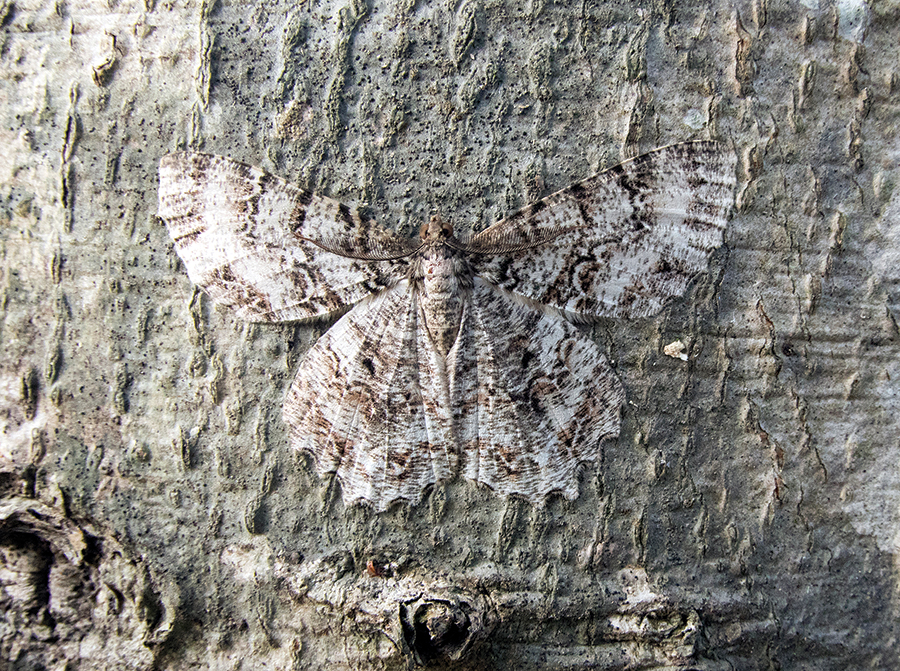
Unlike the showy silk moths, many night-flying moths are masters of disguise and closely resemble bark and leaves to help them blend into their surroundings during the day. Some even look like bird droppings.
Not all moths are nocturnal. Many fly during daylight hours. Those that do tend to mimic other insect or animal species, such as bees and wasps. One well-known day-flying moth is the hummingbird clearwing, which mimics the size, shape and flight pattern of the ruby-throated hummingbird. Like its namesake, it is frequently observed hovering over flowers in urban gardens.
Just this past April, I was admiring a cherry tree in full bloom in a friend’s yard when I did a double take. What I initially thought was a bumblebee hovering over a blossom above my head turned out to be a moth known as Nessus sphinx. With two bright yellow bands wrapping around a black abdomen, the moth was a perfect replica for the stinging insect. As I followed it from blossom to blossom, I realized the rapid wings of the moth even sounded like the buzz of a bumblebee.
Like bees, moths are important pollinators of many flowers and crops. Throughout all their life stages, from caterpillars to adults, moths serve as a critical food resource for many birds and other animals. Studies have shown that moth caterpillars are the preferred food for nesting birds, such as eastern bluebirds, as they are both easy to digest and full of protein.
Unfortunately, moths have suffered serious declines in their populations due to habitat loss, light pollution, and the extensive use of pesticides on the landscape. Their ecological importance and the impact that they have on the world around us is difficult to understate. PS
Naturalist and photographer Todd Pusser works to document the extraordinary diversity of life both near and far. His images can be found at www.ToddPusser.com.
His favorite book is Where the Red Fern Grows by Wilson Rawls.

The Asheville-based soul/funk/rock/jam band Travers Brothership will take the First Bank stage at Sunrise Square, 250 N.W. Broad St., Southern Pines, on Friday, Aug. 6, from 5 p.m. to 8 p.m. Their performance, described as a “wild block party,” supports the Sunrise Theater. Food trucks, refreshments and beer from Southern Pines Brewery will be available. No outside alcohol. No rolling, strolling or roving coolers allowed. Leave man’s best friend at home. For more information call (910) 692-3611 or go to www.sunrisethreater.com.

Join The Sway at the Pinehurst Country Club, 1 Carolina Vista Drive, for a women-only golf clinic combining happy hour and friendly instruction from a Pinehurst resort professional on Monday, Aug. 16, from 5:30 p.m. to 6:30 p.m. Perfect that swing and test your skills on The Cradle. Each session is limited to 20 players and the cost for the lesson, a cocktail and swag is $55. For more information go to www.ticketmesandhills.com.
The Bradshaw Performing Art Center’s summer concert series continues Saturday, Aug. 14, from 6:30 p.m. to 9 p.m. with Mountain Heart and its special guest, Carly Burruss. Bring chairs and blankets — but no outside food or beverages — to BPAC’s McNeill-Woodward Green, 3395 Airport Road, Pinehurst. For information and tickets visit www.ticketmesandhills.com.

Saxophonist Dennis Hardison and A New Creation will be performing from 7 p.m. to 9 p.m. on Friday, August 13 at The Cardinal Park, 657 S. Walnut St., Pinebluff. Gates open at 6 p.m. and admission is $15. You must be 21 years old and above to enter. Dress is all-white, casual party attire. A DJ will pick up the show at 9 p.m. For more information visit www.thecardinalpark.com.
So says Twelfth Night. Shakespeare in the Pines and the Uprising Theatre Company return with one of the Bard’s famous comedies on The Village Green, Tufts Memorial Park, Friday, Aug. 20, from 7:30 p.m. to 10 p.m. There are additional performances on Aug. 21, 27 and 28. For information and tickets go to www.ticketmesandhills.com.

It’s back for a 14th annual! The Backyard Bocce Bash to benefit the Sandhills Children’s Center rolls on at the National Athletic Village, 201 Air Tool Drive, Southern Pines, from 9:30 a.m. to 3 p.m. or until the last ball is bowled on Saturday, Aug. 21. All proceeds help provide vital therapies to children with special developmental needs. Entry fee starts at $25 per player. Sponsorships are available. For information and registration call (910) 692-3323 or visit www.sandhillschildrenscenter.org.
A touch of Robbins comes to Pinehurst on Friday, Aug. 20, from 6 p.m. to 9 p.m. at the Fair Barn for the 25th Anniversary Celebration benefiting the Northern Moore Family Resource Center, home of the HOPE Academy Preschool. There will be mechanical bull riding, rubber pigeon skeet shooting, live music, food from Elliott’s Catering Company, live and silent auctions and beer, wine and high spirits. Tickets for the event at the Fair Barn, 200 Beulah Hill Road, Pinehurst, are $125 per person. For information go to www.moorefamilyresource.org.
Join MARO movement for a modern dance experience staged outdoors on the grounds of the Weymouth Center for the Arts and Humanities at 555 E. Connecticut Ave., Southern Pines, from 6:30 p.m. to 9 p.m. on Saturday, Aug. 21. The audience moves along a navigated path, experiencing site-specific dance works on their way to a mainstage show. Tickets are $40 and include two motion tours, the mainstage event, spirits and hors d’oeuvres. Food trucks will also be on site. For information call (910) 692-6261 or go to www.weymouthcenter.org.
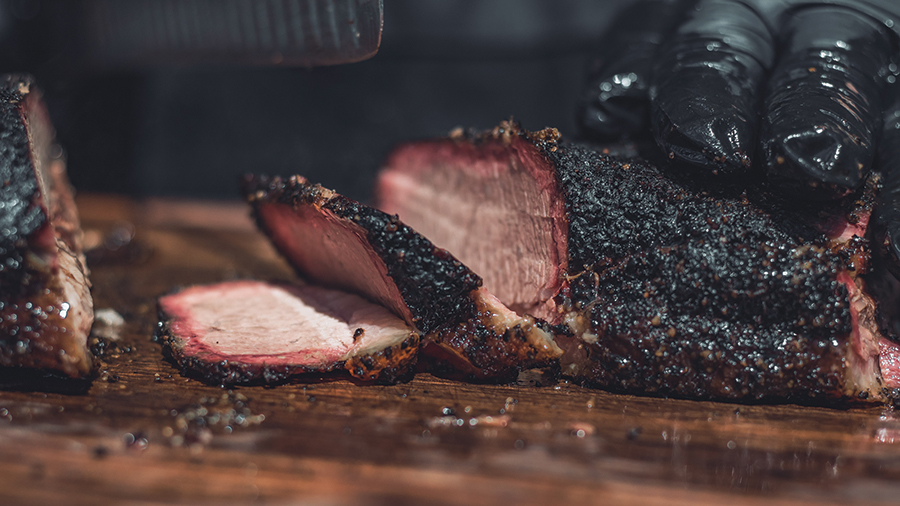
The three-day Pinehurst BBQ Festival celebrating “all things barbecue” begins Friday, Sept. 3, from 6 p.m. to 8 p.m. and continues throughout Labor Day weekend in the village of Pinehurst, 6 Chinquapin Road. Presented by Pinehurst Resort, US Foods and Business North Carolina magazine, the festival celebrates Carolina barbecuing tradition from the mountains to the coast and features award-winning pitmasters. For tickets and information go to www.ticketmesandhills.com.

Sometimes it’s everything
By Kate Smith
My first nickname was Catfish. Dad pronounced it at my birth because I arrived “slippery and wide-eyed as one.”
When I was old enough to comprehend the likeness between me and the bottom-feeder I was not amused, and tried renaming myself. Buck was my first choice, after the wolf pack leader of Jack London’s Call of the Wild. It’s how I signed my name on presents and on a stocking one Christmas. Typical Leo. When that didn’t stick, I tried imitating my best friend’s nickname, Bobcat Brandi, with the closest wild feline alliteration, Cougar Kate. I didn’t understand why the adults thought this was hilarious.
And that gallant trail name I imagined I’d be given when I hiked the Appalachian Trail? Last fall, during a short 20-mile stretch, I was declared Peein’-on-the-trail-Kate. In hindsight, Catfish wasn’t so bad. Good thing, too, because it’s what Dad still calls me.
Dad picked up catfishing in his 20s when he moved to North Carolina to work at Cameron Boys Camp. Still, 35 years later, on summer weekends, he leaves home in the late afternoon with a camp chair, pole and box of chicken guts to meet a friend with a boat, and fish all night. When I told my Georgia crew leader about this while we built a trail together in Alaska, his eyes got big: “Awe, man, your Dad goes noodlin’?”
While Dad uses bait on a line rather than bare hands and a forearm thickened by scars from catfish teeth, I still think it’s pretty cool. Catfishing means Dad is out on the moonlit water when the fish bite best. He’ll come home at 5 a.m. with 80 pounds of wild game and solicit us five kids, most of us out of the house, back to the family kitchen. Although growing up we bought most of our food from the grocery store and Dad worked a normal day job, it’s these times that define him most to me. Awake in the middle of the quiet night, providing.
I grew up thinking that good dads are always awake: chasing away nightmares, driving the family halfway across the country for Christmas at Pop’s house, watching the fire smolder out safely during camping trips, up every hour to check the temperature of meat in the smoker the night before summer barbecues. Even now, if I have car trouble when driving late at night, I call Dad, and he always answers.
I’ve inherited a lot of traits from Dad. I’ve got his eyes, his tawny skin tone, his all-or-nothing impulses. We both headbang to AC/DC and cry during praise and worship at church. And somewhere in there, I’ve got Dad’s love of the night. Something about the quiet and stillness prompts my deepest thinking, feeling, and creating. There’s a thrill and a sacredness about it, when no one else is awake except the 18-wheelers, people on their way to the airport, the crickets and cicadas and bullfrogs, and always, when I need him, my dad.
August is my birthday month. Mom buys a card with an inspiring quote, and Dad signs it. I guarantee he’ll address his note to Catfish. And when I call to say I’m coming over, he’ll ask me what I want for my birthday lunch. At dawn the next morning, he’ll pull in the driveway from a night on the lake, ready to celebrate with a cooler full. PS
Kate Smith is the herbalist and holistic health coach of Made Whole Herbs in Southern Pines.
Her favorite book is whatever she is reading, though it’s doubtful any would top The Lord of the Rings.