Simple Life

Miss Mully’s Garden

It may be unfinished, but what in life is not?

By Jim Dodson

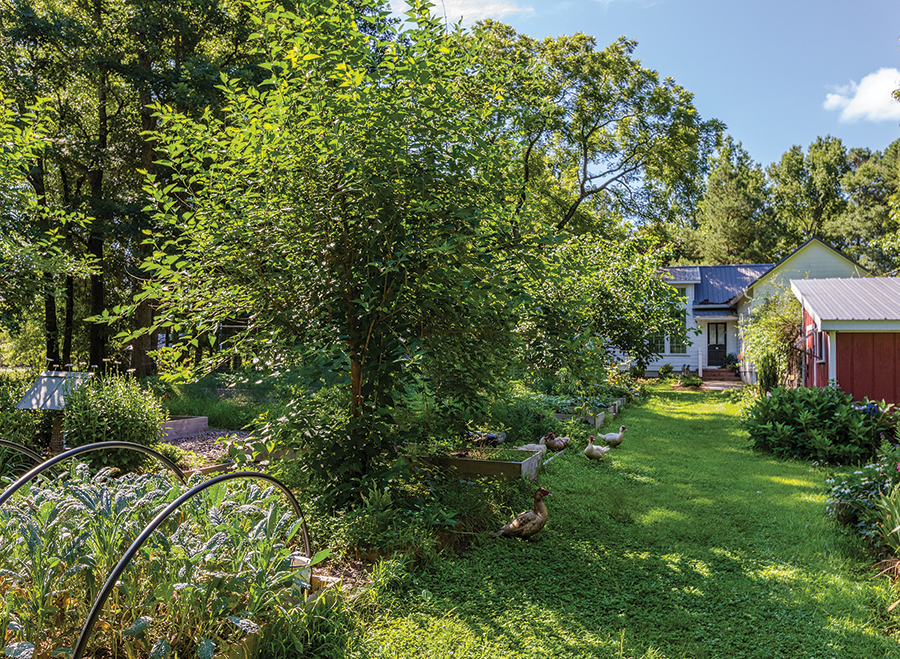
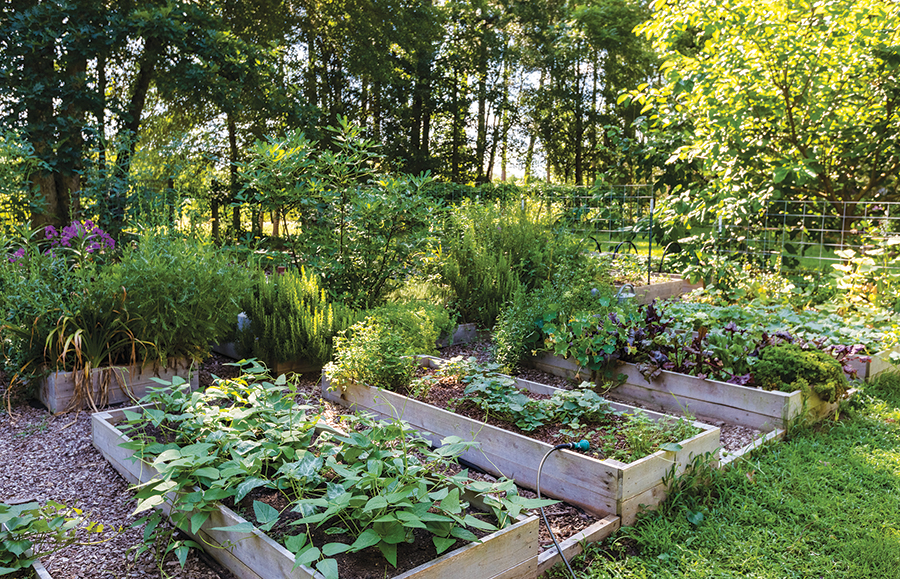
When COVID-19 shut down the world as we know it last year, I decided this was a sign from on high to finish building my backyard shade garden.

The cosmic joke, as any gardener worth his composted cow poop knows, is that, while no garden is ever really finished, it may well finish (off) the gardener.

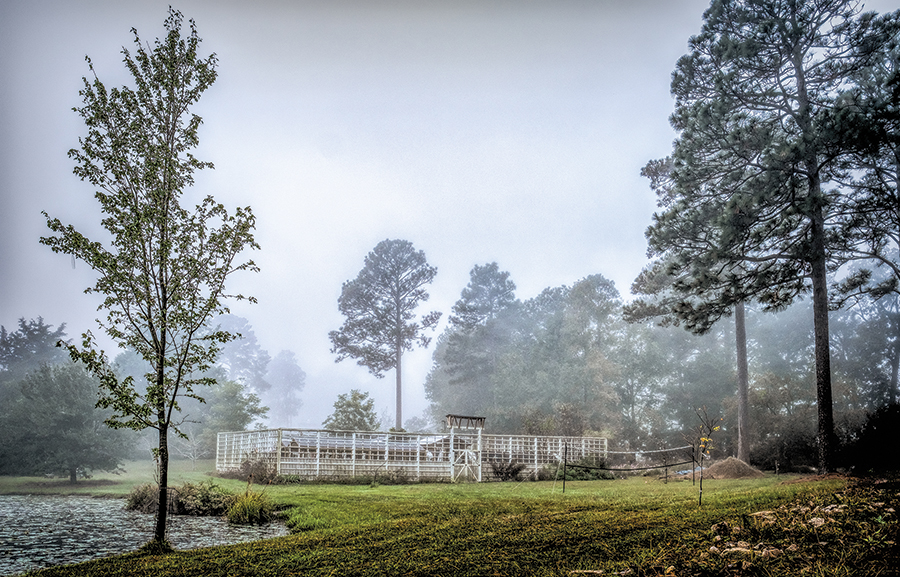
That said, I set myself a goal to have the garden fully laid out and growing by the time the dog days of August rolled around. Beneath ancient white oaks, I began to see elegant stone pathways winding through beds of cool ferns, colorful hostas and other shade-loving trees and plants — the ideal place to sit and read a book when the oppressive heat of late summer lays upon us.

You might say I worked like a dog — and with a dog — from February to July, hoping to get the job done. After clearing out the last of the weeds and some forlorn, overgrown shrubs of the property’s former owner, I drew up plans and constantly revised them, laying out pathways and building beds for young plants.

Alas, August is here, and while I toiled and toiled away, my ambitious shade garden is yet unfinished.

Still, my old dog, Mulligan, never missed a day of work. She’s 16, and either deaf or simply uninterested in whatever her owner has to say. We’ve been together since I found her running wild and free in a park where I’d just given a talk at a festival, a joyous black pup with the happiest eyes I’d ever seen.

Workers in the park told me she was a stray that nobody could catch, had been around for weeks, either a runaway or a pup someone simply dumped. She was living off garbage and small critters she chased down in the woods. The girl was a hunter.

To this day, I’m not sure whether I found her or she found me. She raced past me as I was preparing to leave, heading back for the woods across a busy highway where I’d seen her cross into the park an hour before, somehow just missing the wheels of a truck.

I simply called out, “Hey, you! Black streak! Come here.” Something remarkable happened. The pup stopped, looked back, then ran straight into my arms. I named her Mulligan, a second-chance dog. Mully, for short.

We’ve been together ever since.

Any time I’m working in the garden, she’s there. Every trip to the plant nursery, the grocery store, or any errand around town, she’s along for the ride.  It’s been like this for a decade and a half. She’s my constant travel pal — my best friend and the best dog ever — always ready to hit the road.

Four years ago, Miss Mully was along for the ride when I started down the Great Wagon Road for a book about the Colonial Era “highway” that a couple hundred thousand Scots-Irish, English and German immigrants, including all three wings of my family, took to this part of the world during the 18th century.

As I laid out this long-planned journey in my mind, Mully and I would simply breeze down the mythic road together from Philadelphia to Georgia over the span of three or four weeks, meeting colorful characters, diving into frontier history and gathering untold tales from America’s original immigrant highway. The book would almost write itself. I’d finish it in no time flat.

Evidently, God and wives both laugh when foolish men make plans, to paraphrase an old Yiddish proverb. From the beginning, my wife, Wendy, thought it would take me five years to complete my mighty road book.

She was right. Ditto God.

Like my backyard shade garden, my mighty road tale is not yet finished. The sweeping scope of its history and people, not to mention the motherlode of remarkable folks Miss Mully and I encountered along the road, argued for a much deeper dive and more thorough approach to my subject. An unplanned bit of plumbing surgery and a worldwide pandemic that shut down the globe for more than a year hardly helped to shrink the time horizon.

But that’s life.

We all have unfinished business. We are all works in progress.

With a little luck and continued work, I hope to complete both my book and my backyard garden around the same time, maybe by Thanksgiving.

Somewhere in the back of my mind, I understand that the day is growing late for my old dog and her master.

She still walks a mile with us every morning, and her dark eyes still shine with the happiest light.

Every afternoon, she takes a slow walk around the garden as if inspecting my work or memorizing the plants. I often catch her just sitting alone in the middle of the garden, thinking God knows what.

For the moment, our journey together is unfinished. But someday I hope to sit in the middle of Miss Mully’s Garden, reading a book and thinking God knows what, too.

Something tells me that won’t be the end of the journey. Maybe just the beginning.  PS

His all-time favorite book: James Salter’s Light Years.   

Jim Dodson can be reached at jim@thepilot.com.
The Kitchen Garden

All Strung Out

Try a special brand of squash

By Jan Leitschuh

Check any that apply:

— Looking to eat better, fewer carbs and processed foods, and shed those COVID pounds?

— Searching for ways to work more vegetables into your diet?

— Need to avoid gluten due to sensitivities or auto-immune issues?

— Want a simple, low-fuss, low-muss meal?

Spaghetti squash, coming onto markets this month, is the gourd for you.

You’ve probably seen these largish, lemon-colored winter squashes in local markets. This plain, oblong vegetable contains a surprise inside — an extraordinary texture, long strands of squash that, when cooked, make a useful substitute for pasta noodles.

I have grown it in my Sandhills vegetable garden. Local markets will start to feature it toward the end of the month, and it is readily available in supermarkets. Spaghetti squash stores fairly well, about two, even three, months in a cool place.

Once cooked, the flesh of spaghetti squash can be forked into fine strands resembling angel hair pasta. Its mild flavor offers a clear stage for a variety of tastes and treatments such as pestos, red sauces and curries.

The simplest dinner treatment is to halve a 2-3 pound squash lengthwise, scoop out the seeds from each half, brush with a little oil, season with salt and pepper, and roast in a baking dish at 375 degrees for 30-45 minutes, or until the flesh is fork-tender. Cool slightly, enough to handle.

If you don’t like wrestling large squashes with sharp objects, you can also bake yours whole. If whole, slice off the stem end, then pierce the rind with a fork before placing in an ovenproof baking dish with a little water. Sealing the dish with foil helps speed things up a bit. The baking may take longer, up to an hour and a half for a larger squash. Remove when skin is softened. An oven mitt is helpful to steady the hot rind. Open carefully — the steam can scald — and scoop out the seeds.

The fastest method for a quick supper is to microwave the whole squash. Pierce the rind several times to avoid a buildup of steam. Place on a plate and microwave until tender, 20 minutes or so, until softened.

The easiest dinner prep? Place each squash half on a plate and fill with your favorite jarred marinara. A sprinkle of Parmesan on top and . . . Voila! A healthy, easy meal for two. The eater does the work of pulling free the squash strands.

For a less-slack treatment, tease out the strands by drawing a fork gently down the flesh lengthwise. Toss the strands with some iteration of garlic, red sauce, Italian spices, grated cheese, mushrooms, peppers, ground sausage, etc., before returning the mix to the baked squash rind.

The scooped flesh can be used in casseroles in place of thin wheat pasta. The “noodles” can be given an Asian, Indian or Southwestern twist with a change in seasonings and flavors. Low-carbers even make a ketogenic pizza crust using the strand, eggs and cheese.

For a fancier plating, some folks have been known to take the scooped strands and form “nests” in muffin tins, to be filled with your favorite stuffing. The nests can also star at breakfast, baked with eggs.

Or cut your squash into horizontal “rings” instead of in half lengthwise. This fun baked presentation shortens the cooking time and can then be stuffed with goodies.

Speaking of goodness, spaghetti squash is nutrient dense but low in calories. It can deliver vitamins A and C, folic acid, niacin, manganese, potassium and other nutrients. A whole cup of the squash is only 10 carbs, much lower than wheat pasta — 28 percent, in fact — and only 42 calories.

If you haven’t explored spaghetti squash yet, give this interesting vegetable a try.  PS

Jan Leitschuh is a local gardener, avid eater of fresh produce and co-founder of Sandhills Farm to Table.

Her favorite book is Jayber Crow, by Wendell Berry.

The Omnivorous Reader

The Soong Saga

North Carolina’s link to the fall of The Last Emperor

By D.G. Martin

One of North Carolina’s most interesting stories takes us back to the 1880s when a young Chinese boy winds up in Wilmington, where he converts to Christianity and then returns to China as a missionary. He becomes wealthy, and his family becomes extremely powerful. How it all happened is a saga that is almost unbelievable.

In Wilmington there is a small granite monument on the grounds of the modest, lovely Fifth Avenue Methodist Church building. It reads: “Charlie Jones Soong, father of the famous Soong family of modern China, was converted to Christianity in the old Fifth Street Methodist Church, which stood on this site. He was baptized on Nov. 7, 1880, by the Rev. T. Page Ricaud, then pastor. One of his six children, Madam Chiang Kai-shek, whose Christian influence is world-wide, is the wife of China’s devout generalissimo and president. Erected in 1944.”

Here is the report from the November 7, 1880, Wilmington Star announcing an event that would ultimately have a profound impact on modern Chinese history: “Fifth Street Methodist Church: This morning the ordinance of Baptism will be administered at this church. A Chinese convert will be one of the subjects of the solemn right (sic), being probably the first ‘Celestial’ that has ever submitted to the ordinance of Baptism in North Carolina. The pastor, Rev. T. Page Ricaud, will officiate.”

That Celestial, as some Americans then referred to a Chinese person, was Charlie Soong, a teenager, whose North Carolina Methodist sponsors arranged for his education and subsequent return to China as a missionary.

A minister in Wilmington persuaded Durham tobacco and textile manufacturer Julian Carr to take an interest in Soong. Carr brought Soong to Durham and then arranged for him to enroll as the first foreign student at Trinity College in Randolph County.

Carr and Soong developed a “father-son” lifelong friendship, despite Charlie Soong’s serious flirtation with Carr’s niece, which resulted in Charlie’s exile to Vanderbilt University for more religious training. After being ordained as a Methodist minister, Soong went back to China as a missionary. Once there he drifted into business, developing the Bible printing operation that became a springboard to greater financial success, often with Carr’s backing.

When much of China’s limited manufacturing capacity was under the control of foreigners, Soong showed that the Chinese could do it for themselves. He helped construct a platform on which China’s modern manufacturing base is built. He printed Chinese Bibles so inexpensively that they drove the competition — mostly Europeans — out of business and, in the process, became one of the country’s wealthiest and most powerful business and political insiders.

It was the last days of the Qing Dynasty and “The Last Emperor,” and China was in revolutionary turmoil. Soong helped fund the activities of the major revolutionary leader, Sun Yat-sen, sometimes called the “founder of the Chinese Republic.”

Soong sent most of his children to the United States for education. When his three daughters came back to China, they married prominent Chinese. One daughter, Ching-ling, married Sun Yat-sen and, as Madame Sun Yat-sen, remained an important figure in Chinese government long after her husband’s death. She even served under Mao Zedong as a vice-chairman of the People’s Republic from 1949 to 1975.

The oldest daughter, Ai-ling, married banker H.H. Kung, who became finance minister in the Nationalist government.

Another daughter, May-ling, married Chiang Kai-shek, who led the Nationalist government until he was driven to Taiwan by Mao’s forces in 1949. Madame Chiang Kai-shek was well known to Americans and a favorite of many until her death in 2003 at the age of 105.

One son, T.V. Soong, represented China at the founding of the United Nations in San Francisco in 1945. After the Communist takeover of China, he moved to the U.S. and became a highly successful banker.

The Soong family was so important in China that it is sometimes referred to as The Soong Dynasty, the title of the most popular and detailed version of this story, written by Sterling Seagrave and published in 1985. It presented an unfriendly version of the family history, but a review in The New York Times saw it differently. “Indeed the charm of the man often outshines Mr. Seagrave’s attempts both to debunk him and make him sinister,” said the Times.

A more recent book by former Greensboro resident Ed Haag, Charlie Soong: North Carolina’s Link to the Fall of the Last Emperor of China, gives us a more balanced account. Although the Charlie Soong story is not new, Haag dug up previously unpublished material, much of it from the Soong papers housed at the Duke University library. Haag explains better than earlier authors how Charlie Soong became so wealthy. While others have written about Soong’s missionary work leading to a business printing Bibles, his association with a flour mill in Shanghai also contributed to his success. According to Haag, Soong’s greatest wealth came from his role as a “comprador,” a fixer and go-between who helped bridge the different customs and expectations of Western suppliers and traders and their Chinese counterparts. Those North Carolinians who already know about Charlie Soong will appreciate Haag’s refinements and additions. For those who never heard of Soong, Haag’s book is a great starting point.

But the Soong family’s connection to North Carolina doesn’t end there.

On Aug. 30, 2015, his great-grandson Michael Feng came to Wilmington to be baptized in the same church where his great-grandfather received the sacrament. Feng and his wife, Winnie, are longtime active participants at The Episcopal Church of the Heavenly Rest, a historic church in New York City, at Fifth Avenue and 90th Street.

“It was the church of my grandfather, T.V. Soong, where Winnie and I were married and raised our two children,” said Feng. “I had just never gotten around to being baptized. I guess my parents were too busy when I was young. Winnie had been after me for a long time to be baptized. And when we were planning a trip to North Carolina for a wedding, we decided this would be a wonderful time and place for my baptism.”

Feng explained to the congregation at Fifth Avenue Church that his family remained grateful to the North Carolinians who provided his great-grandfather the educational, spiritual and financial resources that made the difference for Charlie Soong. “He gave these resources to his children and our family,” said Feng of a Chinese dynasty announced in a note in the Wilmington Star 135 years before.

Almost seven years after his baptism in Wilmington, Michael and Winnie Feng remain active at the Church of Heavenly Rest, where there is another North Carolina connection. The leader of that church is its rector, the Rev. Matthew Heyd, who grew up in Charlotte and was a Morehead Scholar and student body president at UNC-Chapel Hill.

Surely, Charlie Soong would be pleased.  PS

D.G. Martin hosts North Carolina Bookwatch Sunday at 3:30 p.m. and Tuesday at 5 p.m. on UNC-TV.

His favorite book is Don Quixote by Miguel de Cervantes

Golftown Journal

All About Moe

Sandhills links to a legend

By Lee Pace

It was a 20-hour drive from the outskirts of Toronto to the Florida coast town of Titusville, and dead in the middle of the drive was Pinehurst. Just as the goldfinch, sparrows and blue jays made their annual migrations in fall and spring from north to south and vice versa, so too did a curious little golf professional named Moe Norman.

Each April headed north and each October going south, Moe drove his Cadillac stuffed with golf clubs, shoes and balls and most of his worldly possessions off I-95 and ventured into the Sandhills, where he found friends, smiles and comfort at Pinehurst, Knollwood Driving Range and Pine Needles, and dropped in on village shops like Gentlemen’s Corner and Old Sport & Gallery.

“Moe was a remarkable guy,” says Eric Alpenfels, director of instruction at Pinehurst Resort and a young intern in the golf shop when he first met Norman in 1983. “He was a big history buff. I think he appreciated Pinehurst for its history. I think people in town made him feel welcome and comfortable. So every fall and every spring, you expected to get a call from Moe or just see him show up to hit balls.”

Norman was a crack Canadian golfer from the Toronto suburb of Kitchener who won back-to-back Canadian Amateurs in the late 1950s, played in the Masters, and in 1966 won five of the 12 Canadian Tour events he entered. Over his career, he shot three 59s, made 17 aces and nine double-eagles, and counted his course records at 41. But he never made a mark on the PGA Tour because with his childlike persona and eccentric ways (he routinely drank two dozen Cokes a day), he was uncomfortable in the fishbowl of tournament golf and nervous around strangers. He never sought psychological treatment, but when the movie Rain Man came out in 1988 with Dustin Hoffman portraying a middle-aged autistic man, many who knew him said, “That’s Moe.”

But he was a mythical figure among golf pros and had an insatiable appetite for hitting balls. He was so straight and so consistent he had the nickname Pipeline Moe.

“I don’t know of any player, ever, who could strike a golf ball like Moe Norman,” Lee Trevino once said. “If he had just had some sort of handler, manager, someone to handle his affairs, everyone would know the name today.”

Moe was short at 5 feet, 6 inches, liked pastel colors, often mixed plaids with stripes, and wore turtlenecks in warm weather. He often said things twice and with a noted up-lilt on the final syllable. He gripped the club in his palms with a wide stance and took what looked to be a three-quarters swing on one plane, ending not with a picturesque follow-through of a limberback but with his hands and club gyrating above his head à la Arnold Palmer. He liked to say he and Ben Hogan were the only golfers who took the clubhead straight down the line exactly 22 inches. He once said he played the same wooden tee for seven years.

The stories of his ball-striking are legendary.

Moe was playing an exhibition with Sam Snead and Porky Oliver at Toronto when they came to a par-4 with a creek crossing the fairway 240 yards out. Snead advised Norman against hitting his driver, saying, “This is a lay-up hole.” 

“Not if you play for the bridge and run it across,” Moe said, and then did exactly that. 

He once hit more than 1,500 drives in a seven-hour exhibition, all landing within a 30-yard-wide landing zone. “I wish we played 30-yard fairways and out-of-bounds,” he once said. “I’d be the only guy hitting driver.”

At other times he’d fire off dozens of piercing 4-irons in succession, pause and chirp to anyone listening, “Never off-line. This swing can’t hit it crooked.”

Once Moe spent several days being filmed hitting balls and giving instructional tips on drivers, fairway woods, long irons and wedge shots. The third morning, the producers planned to ask him about long-distance putting.]

“Moe, we want you to talk about lag putts, how to manage a 50- or 60-footer.”

Norman blew them off. “I never had one. Why would you want to be 50 feet away?”

If someone told him a hole was a “driver-wedge hole,” Moe was liable to hit a wedge off the tee and a driver into the green and say, “You’re right. Driver-wedge.”

Pat McGowan, the head of instruction at Pine Needles, was playing the PGA Tour in the 1980s when he first saw Norman give an exhibition at the Canadian Open.

“Ben Crenshaw, Greg Norman, Nick Faldo, the whole golf world would stop practicing and walk over and watch Moe hit balls,” McGowan says. “I remember the first time I saw him. He hit 25 or 30 straight drives. Every one of them carried over 220 yards and stayed in a 25-yard fairway. Moe smiled at everyone and said, ‘You want me to hit 50? I’ll stay all night.’”

Alpenfels was working the counter at the Pinehurst golf shop in 1983 when someone nodded to a little man and said, “That’s Moe Norman.” Alpenfels remembered the name from conversations with Jim Hardy, his mentor in California. Alpenfels struck up a conversation, watched Norman hit balls and developed a friendship. He was invited to Norman’s winter headquarters at Royal Oak Country Club in Titusville that year to hang out.

“Moe was a brilliant ball-striker,” Alpenfels says. “He virtually could do what he said he could do. If he told you that he was going to hit five drives in a row and that all would land within a 5-foot radius, he’d pretty much do that. He was amazing. From a ball-striking standpoint, it was crazy how good he was.”

Chris Dalrymple, owner of the Gentlemen’s Corner clothing store in the village, remembers Moe would “just appear out of nowhere, sort of like a genie,” and would look around the shop, never buying anything.

“I remember he wore two watches, one on each wrist,” Dalrymple says. “I asked him why he did that. He said, ‘I just do.’”

From Pinehurst, Norman would drive down Midland Road and visit another friend, Greg Gulka, the head pro at Knollwood, and then on to Pine Needles to hit balls with Peggy Kirk Bell and Jim Suttie, the head instructor there in the 1990s.

“The first time I ever saw Moe, he was hitting drivers out of divots,” says Kelly Miller, Mrs. Bell’s son-in-law. “He was rifling golf balls down the range, one after another. They came out of that divot like a rocket.”

Moe had money problems for most of his adult life, saying he “had slept in bunkers all across Canada.” He never had a credit card or a checking account. He refused Miller’s offer for a bed at Pine Needles but would accept several hundred dollars Miller would slip in his pocket after entertaining guests at Pine Needles with an exhibition. Some thought Norman spent most of his nights in his car, but he usually had enough funds for a Motel 6 or Super 8. His finances were buttressed significantly when he met Titleist CEO Wally Uihlein at the 1995 PGA Show. Uihlein watched Norman hit balls and said Norman was a national golfing treasure and allowed that Titleist would pay him a $5,000-a-month stipend for the rest of his life. 

That lasted until September 2004, when Norman died of a heart attack.

“He had everything he needed. He had a good car, a place to stay and wonderful friends,” Alpenfels says. “He’d give you the shirt off his back if you needed it.”

A documentary film about Moe Norman’s life is in the works.

“It’s an underdog story. It’s a story about a guy who never should have succeeded, but did,” says Barry Morrow, the Oscar-winning screenwriter of Rain Man and a co-producer of the film. 

“I think he wanted to be the best at something. And hitting a golf ball was it,” adds Suttie.  PS

Lee Pace has written about golf in The Sandhills for three decades. His newest book, Good Walks — Rediscovering the Soul of Golf at 18 Top Carolinas Courses, will be available wherever you buy books.

His personal favorites include anything by P.G. Wodehouse. Tied for first are Heart of a Goof and Right Ho, Jeeves.

Bookshelf

August Books

FICTION

Damnation Spring, by Ash Davidson

For generations, Rich Gundersen’s family has chopped a livelihood out of the redwood forest along California’s rugged coast. Now, Rich and his wife, Colleen, are raising their own young son near Damnation Grove, a swath of ancient redwoods on which Rich’s employer, Sanderson Timber Co., plans to make a killing. For decades, the herbicides the logging company uses were considered harmless. But Colleen is no longer so sure. As mudslides take out clear-cut hillsides and salmon vanish from creeks, her search for answers threatens to divide a town that lives and dies on timber.

Once There Were Wolves, by Charlotte McConaghy

Inti Flynn arrives in Scotland with her twin sister, Aggie, to lead a team of biologists tasked with reintroducing 14 gray wolves into the remote Highlands. She hopes to heal not only the dying landscape but Aggie too, unmade by the terrible secrets that drove the sisters out of Alaska. Inti is not the woman she once was, either, changed by the harm she’s witnessed. As the wolves thrive, Inti begins to let her guard down, even opening herself up to the possibility of love. But, when a farmer is mauled to death, Inti knows where the town will lay blame. Unable to accept her wolves could be responsible, she makes a reckless decision to protect them. If the wolves didn’t make the kill, then is something more sinister at play?

Lightning Strike, by William Kent Krueger

Aurora is a small town nestled in the ancient forest alongside the shores of Minnesota’s Iron Lake. In the summer of 1963, it is the whole world to 12-year-old Cork O’Connor, its rhythms as familiar as his own heartbeat. When Cork stumbles upon the body of a man he revered hanging from a tree in an abandoned logging camp, it is the first in a series of events that cause him to question everything he took for granted about his hometown, his family and himself. Cork’s father, Liam O’Connor, is Aurora’s sheriff, and it is his job to confirm that the man’s death was the result of suicide. In the shadow of his father’s official investigation, Cork begins to look for answers on his own. Together, father and son face the ultimate test of choosing between what their heads tell them is true and what their hearts know is right.

Children of Dust, by Marlin Barton

In researching his family history in the year 2000, Seth Anderson discovers an unexpected story from the late 1800s. In 19th century rural Alabama, his relative, Melinda Anderson, struggles to give birth to her 10th child, tended by Annie Mae, a part-Choctaw midwife. When the infant dies just hours after birth, suspicion falls upon two women — Betsy, Annie Mae’s daughter and the mixed-race mistress of Melinda’s husband, Rafe; and Melinda herself, worn out by perpetual pregnancies and nurturing a dark anger toward her husband. Seeking to clear her own name, Melinda enlists the help of a conjure woman who dabbles in dark magic. Filled with haunts, new and old, Children of Dust is a novel about the relationship between two women allied against a violent man with secrets of his own.

NONFICTION

A Brief History of Motion: From the Wheel to the Car to What Comes Next, by Tom Standage

Beginning around 3500 BCE with the wheel — a device that didn’t catch on until a couple of thousand years after its invention — Standage zips through the eras of horsepower, trains and bicycles, revealing how each successive mode of transit embedded itself in the world we live in. Then, delving into the history of the automobile’s development, Standage explores the social resistance to cars and the upheaval that their widespread adoption required. Cars changed how the world was administered, laid out and policed, how it looked, sounded and smelled — and not always in the ways we might have preferred.

All In: An Autobiography, by Billie Jean King

An inspiring and intimate self-portrait of the champion of equality that encompasses her brilliant tennis career, unwavering activism, and an ongoing commitment to fairness and social justice. King recounts her groundbreaking tennis career — six years as the top-ranked woman in the world, 20 Wimbledon championships, 39 grand-slam titles, and her watershed defeat of Bobby Riggs in the famous Battle of the Sexes. She poignantly recalls the cultural backdrop of those years and the profound impact on her worldview from the women’s movement, the assassinations of Martin Luther King Jr. and Robert F. Kennedy, the anti-war protests of the 1960s, the civil rights movement, and, eventually, the LGBTQ+ rights movement. She describes the myriad challenges she’s faced — entrenched sexism, an eating disorder, near financial peril after being outed — and offers insights and advice on leadership, business, activism, sports, politics, marriage equality, parenting, sexuality and love.

YOUNG ADULT

Dog Island, by Jil Johnson

Willy stared out through the crisscross wires of his cage. He had figured out a few things. One, being born a spunky beagle wasn’t always cookies and naps. Two, there was no way he was staying in this barbed wire apartment. And three, as he listened to the rows of dogs barking and howling, he wasn’t going alone. (Ages 8 and up.)

CHILDREN’S BOOKS

Becoming Vanessa, by Vanessa Brantley-Newton

That first day of school can be hard on anyone, but especially if your name is looonnng and has more than one “s” and your style is a little more colorful than your new classmates. But, no matter what, it is important to be yourself. Stunning illustrations reminiscent of the brilliant Molly Bang bring this important first-day-of-school book to life. This one is a must-have for rising kindergartners. (Ages 4-6.)

T. Rexes Can’t Tie Their Shoes, by Anna Lazowski

Baby horses can stand up. Narwhals change color. And red sea urchins can live for 200 years! But nobody can do everything. Laugh out loud with the animals of the alphabet as they show what they can and cannot do in this super-cute ABC book that is perfect for story time, bedtime or anytime. (Ages 3-7.)

The Foodie Flamingo, by Vanessa Howl

At the Pink Flamingo restaurant, it’s shrimp, shrimp, shrimp, shrimp. But when Frankie the Flamingo gets a wild feather to sample something different, she becomes Foodie Flamingo. Soon everyone is sampling new things and the Pink Flamingo will never be the same! Fun with food for all ages. (Ages 3-6.)

How To Spot a Best Friend, by Bea Birdsong

It’s easy to spot a friend, but how do you know when you’ve discovered a best friend? This sweet story is the perfect read together for the night before back-to-school or any new situation. (Ages 4-7.)  PS

Compiled by Kimberly Daniels Taws and Angie Tally.

Angie’s favorite book is The Autobiography of Alice B. Tolkas by Gertrude Stein and Kimberly loves The Power of One by Bryce Courtenay.

Into the New

By Frances Mayes

Illustration by Gerry O’Neill

During the pandemic, I became enthralled with The New York Times word game, the Spelling Bee. I’d never been attracted to crossword puzzles, Mensa quizzes or those already-penciled-in Sudoku squares in airline magazines. I’d rather read a book. But there I was at midnight, spending good hours I should have used on my nascent novel, staring at seven letters that must be arranged into words. At least I could excel at finding the pangram — the word that uses all the letters.

What I couldn’t do at all was imagine what my fictional characters Charlotte, Lee and Annsley possibly could be up to in their imagined world, given that a plague was loose in the real world. Their concerns seemed of no concern.

But I was learning dozens of new words such as lambi, boba, libelee, doggo and ricin — words that proved useless outside of boosting me from “amazing” status to “genius.” Ah, genius. What an accomplishment, that is, until the next morning when the new puzzle appeared.

Many friends also had developed obsessive activities. My husband, Ed, seemed always to be mowing the grass, even measuring the height so it remained at 2 inches. My friend Susan tore through several Indian cookbooks, leaving containers of spicy food at our back door constantly, and an Amazon truck pulled up daily at our across-the-street neighbor’s driveway. She was shopping maniacally.

Those of us who were lucky survived that suspended and puzzling and frustrating siege. Remember wiping off grocery bags on the porch? Remember when fashion masks in silk prints appeared? Remember those annoying suggestions to keep a gratitude journal? For decades, we’ll be puzzling through this aftermath of grief, its effects on students, what refusal to believe the virus existed means, the incalculable, staggering losses, the global politics, on and on. Per ora, for now, as the Italians always caution, we are reassessing, realizing that we are lucky to do the things we so took for granted.

Are we in a Brave New World?

By metabolic nature, I’m a traveler. After having covered a lot of the globe and written many books about place, of course I knew that those journeys play a major part in my life. During confinement, I chafed. I started spending hours researching the history of Cyprus, the accommodations at Machu Picchu, a hike from Bratislava to Prague.

Working on the Spelling Bee one week about eight months into house arrest, I came to an impasse. Instead of forming the usual words, I saw that I was picking the letters for “London,” “Rome,” “Miami,” “Hawaii.” Not allowed, any place names, but my travel gene was taking over. I couldn’t get “bountiful,” “exciting,” “texting” but adamantly typed in “Paris,” “Kenya,” “Greece.”

Travel, it turns out, isn’t just what I like to do, it’s who I am. Did others find such truths?

I pushed my novel to the back of my desk — bye-bye Annsley, Lee, Charlotte — and began writing about home. Where’s home? Why leave home? What happens when you do leave home? Why do memories of various homes come back over and over in dreams? How do you make a home? The pull of this subject, so unlike my novel, took over my days.

I quit pouring that second, third glass of wine with dinner; I exercised; I lost twenty pounds. Despite all the activity, the desire to go, just go, became overwhelming.

Ed and I donned N95 masks and traveled to our home in Italy. I felt like we held our breaths the entire way. We were allowed in because we have residency cards. Everyone greeted us like returning Olympic stars.

We quarantined at our home, then lined up for entering the negozio di frutta e verdura for groceries, enjoyed our friends within the limits of our houses, harvested our olive crop, and, before returning to North Carolina, spent two days in Rome prior to departure.

Rome alone. I walk. All day. At night. Walking the soles off my shoes. In this slowed, surreal scape, here’s Rome washed clean, the city showing its beauty unalloyed. I revisit favorites of mine, even though many are closed — Bramante’s Tempietto on the Janiculum Hill, the Baroque extravaganza Palazzo Colonna, the chalk pastel palazzi on Piazza San Lorenzo in Lucina, kiosks of botanical prints and severe engravings of ruins at the Mercato delle Stampe, Gelateria del Teatro for sublime gelato of lavender and white peach, or cherry, or orange and mascarpone. Who can choose?

At Trevi fountain, Ed and I stand there alone. For the first time in decades, I toss a coin. In Piazza Navona, too, I can hear the musical splash of water from the Four Rivers fountain and walk around the lovely ellipse of the ancient stadium. The great Marcus Aurelius, copy of the second-century bronze rider, atop his prancing horse at Michelangelo’s Piazza del Campidoglio, gains in majesty as he surveys a vacant piazza. Totally real, Rome feels imagined, conjured as one of Italo Calvino’s invisible cities.

     Eerie. There’s a lone woman with red fright-wig hair wobbling along the sidewalk with a basket of oranges; the familiar aroma of dark coffee wafting out of a bar, where the barista stands polishing glasses for no customers. The sky is a color a watercolorist might mix, find it too milky pale, and decide to stir in another dollop of cerulean. Trajan’s Column seems to tilt against rushing clouds. The forum appears doubly ancient, columns white as bleached femurs. Church bells send out circles of silver sound. The sculptural pines, the vulgar magenta bougainvillea, the surprise of palms.

Because Rome was still “yellow,” low-risk but cautious, some restaurants are open for lunch outside. We order both the fried artichokes and the artichokes with tender homemade pasta. We’re talking about whether anything of this Rome can be carried forth into normal times. We remember the day we showed our grandson 18 fountains in one day. We remember that Keats rode a pony around the Piazza di Spagna in his last weeks. We remember an apartment we rented with a roof garden that looked down on a clothesline with flapping giant underpants. The waiter forgets our glasses of wine, apologizes, and brings over a whole bottle. (That’s Rome.) I’m thrilled to see Rome like this: an unforgettable, once in a lifetime experience for this traveler.

I hope never to see Rome like that again.

After a day, I missed the scramble to see what’s on at the Quirinale, new restaurants, friends toasting at wine bars, shopping for shoes, tracking down 10 things on my to-see list. All this amid a chaos of sirens, horns, weaving motorcycles, tsunamis of tourists, overflowing garbage bins, buses spilling out groups from all over the world, silly goofs trying to get in the fountains. Life. People, annoying, glorious people.

Back at home, the bleak holiday season arrived, then in January, hallelujah: the vaccine. A quasi-normal life recommenced.

Am I grateful for this period of solitude, introspection, focus? Not a bit. I’m grateful that no one I love died, that’s it. Let’s not whitewash: the period was relentlessly awful and a flash of panic washes over me when I wonder if it will happen again.

What remains? Is there no silver lining? Yes, the major takeaway: a heightened awareness of carpe diem, seize the day. I love so many people; have I said so enough? All the posts and emails showed friends making their level best of the situation. I saw anew their humor, resourcefulness, brilliance, thoughtfulness and determination. They signed off not with “ciao,” or “xoxo,” but now with “Love you,” “Miss you,” “Always and Forever.”

Don’t forget this, I told myself, when we’re back at Vin Rouge and JuJu, toasting and chatting and exchanging plans, feeling invincible. We are not invincible. The drastic happened. Don’t forget the lively crowds in Istanbul, the subway crush in New York, the swarms reveling in the extreme beauty of Cinque Terre. Living their lives. Keep the table set, keep the antenna alert for friends in need, keep working to know what’s really going on, keep the rosé chilled, write the check to someone running on ideals, say you are dear to me, order the flowers, the Georgia peaches, the book I just read that X might enjoy. Oh, I do this, but now, my effort doubles and cubes.

Brave New World — we know Aldous Huxley’s depressing novel and his title has been used and used, ironically and seriously. Maybe used up. He took the words from Shakespeare’s The Tempest and the whole quote is now somewhat lost. The last half of the sentence is best. Miranda speaks, “O brave new world, that has such people in it.” What mind-bending losses.

Memento vivere, remember to live. We go on now, together. You are dear to me.

I didn’t give up on the daily Spelling Bee but if I can’t be a quick genius, I click over to visit Annsley, Lee and Charlotte. They’ve been waiting a long time to resume their lives. When last seen they were arising from the table after a dinner party, about to make enormous changes. I think they are ready.  SP

Frances Mayes is a novelist, poet and essayist known for work including the New York Times bestseller Under the Tuscan Sun. She and her husband split their time between North Carolina and Italy.

Her favorite book is One Hundred Years of Solitude by Gabriel García Márquez.

The World is Still the World

Fiction by Daniel Wallace

Illustrations by Lyudmila Tomova

On our last day at the beach the sun came out, and the fog, which for that whole week had draped the shore in a veil of cotton, burned away: we discovered there was an ocean here, after all. It wasn’t blue, really, closer to black, but when the waves flattened out across the beach, the water was perfectly clear and full of minnows and tiny crabs.

The shells were just so-so, mostly shards of something that used to be beautiful, like ancient pottery washed up from the ocean floor, there to remind you the world was old.

I’d like to say that these discoveries inspired in us a recognition of our own mortality, but the truth was it just felt good to have the sun on our shoulders as my wife and I — so young, newlyweds in fact — walked across the warming sand, hand in hand. She was wearing a black two-piece, simple and very small, and so striking that even the women we passed couldn’t help but stare. Her hair (thick and chocolate brown) was in pigtails, and somehow this girlish maneuver heightened her brazen but effortless display of pure, glorious womanhood. I was invisible in the best possible way.

“I’m glad our honeymoon wasn’t ruined,” she said.

I stopped walking and looked at her. “I didn’t know it was even close to being ruined,” I said. “We’ve made love like a hundred times, read three novels and watched an entire season of The Walking Dead. That’s almost perfect.”

“Yeah,” she said. “I didn’t mean ruined. But you can’t go back and tell people that it was foggy and it rained the whole time and you read and watched TV. It sounds gloomy.”

“You skipped the part about making love.”

“Because you can’t tell people that.”

“No,” I said. “Let’s tell them it was sunny every day and we swam with the dolphins.”

“But that would be wrong,” she said, and we laughed. Somehow this had become a joke: saying but that would be wrong after every wrong thing we talked about doing. I have no idea why or how, but it was hilarious to us, just to us, the way that something that clearly isn’t funny becomes funny for reasons impossible to explain. “That being said, I’ll totally never forget that ride we took on the humpback whale.”

“Because it’s unforgettable. We’ll tell our kids about that.”

“Little Johnny and Marie.”

“I thought we’d settled on Zeus and Hera?”

“I just think that might put too much pressure on them, honey.”

I slapped my forehead, and a few grains of sand fell into my eyes. “Of course, you’re right. Why did I never think about that? Sometimes I feel like I knew nothing until we met.” Pause. “At least I know you’re a goddess.”

She squeezed my hand. “Keep ’em coming,” she said.

“Don’t worry. We’re good for the next ten years at least.”

“Whoa. You stockpile flatteries?”

“Flatteries are my specialty.”

“Oh no,” she said, in a husky whisper, knocking against me with her shoulder. “No, they’re not.”

How long had we been walking? I had no idea. I stopped and looked behind us: I couldn’t see our hotel or any landmark at all. Civilization had disappeared behind the curve of the shore. I could imagine that we were on a deserted island, looking toward the horizon for a rescue we knew would never come. I don’t know what she was thinking, but she had that faraway look in her eyes as well, and as I looked into them (her eyes were the color of ivy), the tail end of a wave chilled my toes. I almost gasped it was so cold.

She turned to me.

“I’m going in,” she said.

“No way.”

“I could never live with myself if I went to the beach and didn’t get in. I would be ashamed for the rest of my life. You’re coming in, too.”

“I don’t think so.”

“You’re my husband now,” she said. “You have to. It was in our vows.”

“Those vows were ambiguous.”

“On purpose, just for occasions such as this.”

She let go of my hand and took a deep breath, girding herself. I took a step toward the water myself, but with her hand on my stomach, she held me back.

“I’m first in,” she said. “I’m always first in. Ever since I was little. That’s what I want on my tombstone: First In, Last Out. Remember that.”

“I will.”

“I’m serious,” she said, and she studied my face. “You’ll remember?”

“I’ll remember. But I didn’t know that about you.”

“Well,” she said. “I guess there’s a lot you don’t know about me.”

“Oh yeah? Like what?”

But she was already gone. She ran into the water, whooping, and kept running as fast as she could, but slowed as the water got deeper. She pushed into it until she couldn’t walk at all, and then she dove under, disappearing completely for what seemed like a long time. Then she reappeared about five yards out, the bigger waves rolling against her back, lifting and releasing her, up and down, up and down. I think she was smiling.

We’d planned a big wedding, with friends and family coming in from all over. There was going to be a band and your choice of chicken or fish or veg, and a first dance and a sound system that could turn even my mousey 80-year-old Aunt Muriel’s voice into that of a roaring lion. But all that was postponed, of course. We’d talked about waiting, to do what we’d hoped to do just a little bit later. When things got back to normal. But we couldn’t wait a minute longer. We were married at the courthouse, with our two best friends, witnesses to our contract, safe behind a Plexiglas wall. Now here we were at the beach, in the days just before summer, the rest of our lives ahead of us. Six days of fog and rain, one day of sun, and then the rest of our lives.

She waved, I waved.

“Come and get me if you dare!” she yelled into the wind, my freckled goddess in the wine-dark sea, the woman who had already told me the words she wanted on her tombstone when death does us part. I wanted to tell her what I wanted on mine, too, but the water was cold, and she was already so far away.  PS

Daniel Wallace is the author of six novels, including Big Fish and, most recently, Extraordinary Adventures. He lives in Chapel Hill, where he directs the Creative Writing Program at the University of North Carolina.

My most recent favorite book is Bewilderness, by North Carolina writer Karen Tucker. It’s a rollercoaster, page-turning literary gem. 

The Lost Colony

America’s oldest mystery gets a new look, a new life and a new vision

By Gary Pearce     Photographs by Joshua Steadman

A drive that takes 30 minutes to an hour from the Outer Banks takes you back 434 years.

Back to America’s beginnings. Back to the earliest English settlers. Back to America’s oldest mystery: The Lost Colony.

You start the drive on North Carolina’s Outer Banks. You leave behind the beaches, the bars, the shops, the restaurants, the crowds and the traffic.

Cross over the causeway to Roanoke Island. Pass through the town of Manteo. Turn off the main road into the dark woods along the sound. Park and walk through the trees. It’s evening, nearly sunset. In the quiet, you hear only the wind and the water.

You’re standing where, in 1587, a band of English colonists abandoned a tenuous settlement they’d established less than a year before. They set off in search of a new home. And they disappeared.

You sit in an open-air theater where, on summer nights since 1937, the colonists’ story — and the mystery of their fate — have been brought to life by The Lost Colony, America’s oldest outdoor symphonic drama.

Last summer, COVID cancelled the production for the first time since World War II.

This summer, The Lost Colony is back — with new energy, new casting, new production techniques, a new script and musical score, and a new look at what might have happened when two cultures, English and Native American, came into contact and conflict.

This will be the 84th summer the drama is performed in Waterside Theatre, at the northern edge of Roanoke Island in Dare County. The theater is part of the Fort Raleigh National Historic Site, which preserves the location of Roanoke Colony. The colony was the first English settlement in the New World and the birthplace of Virginia Dare, the first English child born in America.

The play itself is a historic dramatization. It began as a federally funded Depression-era project. The theater was built by the Civilian Conservation Corps.

The Lost Colony was intended to be a one-year production. Then President Franklin D. Roosevelt attended the show with a good deal of media fanfare on August 18, 1937 — the 350th anniversary of Virginia Dare’s birth and a little more than a month after the July 4th premiere.

After FDR’s visit, the crowds came. The show was so popular that organizers decided to stage it every summer. They’ve been doing it for 83 years. World War II forced a four-year cancellation.

Last season’s cancellation in the pandemic was a financial blow to the Roanoke Island Historical Association, which produces the drama. The year-round staff had to be greatly reduced.

But Kevin Bradley, the association’s board chair, says, “The year off turned out to be a blessing. We had the time to reimagine the production, recharge our batteries and refresh how we tell this story.”

A new director/choreographer was recruited: Jeff Whiting, whose Broadway credits include Bullets Over Broadway (6 Tony Nominations), Big Fish, The Scottsboro Boys (12 Tony Nominations), Hair (Tony winner for Best Revival) and Wicked 5th Anniversary.

The New York Times called Whiting a “director with a joyous touch.”

Whiting says his goal is “to honor the history of what occurred here on Roanoke Island, and to honor the legacy of this important theatrical work. As the wind rolls off Roanoke Sound, it whispers the tale. It’s my job as director to listen to that breeze and bring to life what happened here so many years ago.”

Whiting has reduced the lengthy original script, written by North Carolina playwright Paul Green, allowing the scenes and story to move faster and providing more time for theatrical storytelling.

Additional theatrical devices will support the storytelling, including large-scale puppets, a military-style drum corps and a new symphonic score. The show will also feature traditional dances from both Native American and English historical cultures.

But Paul Green’s imprint remains.

Green was a Harnett County farm boy who became a professor at the University of North Carolina at Chapel Hill and a Pulitzer Prize-winning playwright. Green was the father of  “symphonic drama.” He saw it as the people’s theater, a way of telling Americans about their past.

Green had a deep concern about race relations. His vision of The Lost Colony reflects what can happen when different cultures and races come together.

In the past, the production didn’t always use Indigenous actors to portray the Native American roles in the play. Seeking authenticity, the association reached out to Chairman Harvey Godwin Jr. of the Lumbee Tribe of North Carolina. He now serves on the board of directors. 

With the tribe’s help, Native Americans were recruited as actors and dancers. Auditions were held in Robeson County, in the Lumbee tribal territory.

“We are appreciative of the Historical Association’s desire for accurate and historical representation,” Godwin says. “With North Carolina’s American Indian population numbering more than 100,000, it enriches the production to see and hear their voices on stage.”

Kaya Littleturtle, the Lumbee Tribe Cultural Enrichment Coordinator agrees, adding that the new choreography, regalia, language accuracy and orchestration help to insert “more of an authentic and cultural American Indian perspective into the play.”

But the real test is whether the new production will bring back audiences, says John Ancona, general manager: “We want to give our audience an exceptional evening’s experience in an outdoor setting — an experience you can’t get many places. We want to inspire interest in a part of history that remains a mystery today.”

Ancona hopes that visitors will leave the theater intrigued by the story. Perhaps they’ll dip into the ongoing, unending research and archeological exploration that still seek clues about The Lost Colony.

Where did they go? What happened to them? Did they drown at sea? Were they killed by natives, or by Spanish raiders? Or did they quietly go live with a friendly tribe?

We don’t know. But we do know the colonists dreamed of freedom. They dared a dangerous ocean voyage. They sought a new life in a new land.
Take the drive back to their world. Walk where they walked. See and feel what they saw and felt.

Hear their story. Listen to the wind, the water and the trees. Feel the mystery of The Lost Colony.

The Lost Colony’s 2021 season launched May 28 and continues through August 21. For tickets and more information: thelostcolony.org  PS

Gary Pearce is a member of the board of directors of the Roanoke Island Historical Association. He and his wife, Gwyn, divide their time between Raleigh and Nags Head.

The Omnivorous Reader

Breaking the Code

The scientific revolution that changed the world

By Stephen E. Smith

What in the world just happened?

As the pandemic wanes, that’s the question many of us are asking. But a more immediate question needs answering: What are we going to do to prepare for the next pandemic? The answer, insofar as it’s possible to predict the future, is suggested in The Code Breaker: Jennifer Doudna, Gene Editing, and the Future of the Human Race, by Walter Isaacson, a quasi-biography that raises questions about nothing less imperative than our genetic destiny.

Isaacson, a history professor at Tulane University who has written biographies of Leonardo da Vinci, Steve Jobs, Benjamin Franklin and Albert Einstein, has a gift for explicating difficult scientific concepts. His biography of Jennifer Doudna, a 57-year-old professor in the Department of Chemistry and the Department of Molecular and Cell Biology at the University of California, is the story of the development of CRISPR (clustered regularly interspaced short palindromic repeats) and the function of an enzyme (Cas9), a discovery that won Doudna and French microbiologist Emmanuelle Charpentier the 2020 Nobel Prize.

A Doudna biography could not be timelier. Her CRISPR-Cas9 genome editing technology has launched a scientific revolution that allows us to defeat viruses, cure genetic diseases and certain cancers (TV advertisements are already touting such treatments), and, perhaps, have healthier babies. She has changed our world, moving us from the digital age into a bio-life sciences revolution that will affect our lives to a greater extent than computers have or will.

Doudna was in the sixth grade when she read James Watson’s The Double Helix, initially mistaking it for a detective novel. Watson’s groundbreaking research into the human genome was a mystery so intense that it set her on a career path as a university researcher who would eventually develop an easy-to-use device to edit DNA. She helped discover a use for Cas9, a protein found in Streptococcus bacteria, which attacks the DNA of viruses and prevents the virus from infecting healthy bacterium and cells. She was quick to recognize the possibilities for controlling viruses that invade human cells by using Cas9. “These CRISPR-associated (Cas) enzymes enable the system to cut and paste new memories of viruses that attack the bacteria,” Isaacson writes. “They also create short segments of RNA, known as CRISPR RNA (crRNA), that can guide a scissors-like enzyme to a dangerous virus and cut up its genetic material. Presto! That’s how the wily bacteria create an adaptive immune system!” CRISPR allows us to create vaccines to defeat the ever-evolving structure of coronaviruses. (A new vaccine under development at Duke University has the potential to protect us from a broad variety of coronavirus infections that move, now and in the future, from animals to humans.)

Once she’d figured out the components of the CRISPR-Cas9 assembly, she knew she could program it on her own, adding a different crRNA to cut any different DNA sequence she chose. “In the history of science, there are few real eureka moments, but this came pretty close. ‘It wasn’t just some gradual process where it slowly dawned on us,’ Doudna says. ‘It was an oh-my-God moment.’”

As with most life-altering breakthroughs, ethical questions abound. Should we edit genes to make our children less susceptible to diseases such as HIV and coronavirus? Would it be morally wrong if we didn’t? Isaacson devotes a sizable portion of the biography to asking and answering the tough questions that go to the heart of the CRISPR quandary: “And what about gene edits for other fixes and enhancements that might be possible in the next few decades?” he asks. “If they turn out to be safe, should governments prevent us from using them? The issue is one of the most profound we humans have ever faced. For the first time in the evolution of life on this planet, a species has developed the capacity to edit its own genetic makeup.”

In November 2018, He Jiankui, a Chinese biophysics researcher, produced the world’s first CRISPR-altered children. His goal was to make babies immune to the virus that causes HIV, but his colleagues in China and the West termed his accomplishment “abhorrent and premature.” He was found guilty of conducting illegal medical practices, fined a hefty sum and sentenced to three years in prison. But in the wake of the 2020 coronavirus pandemic, the idea of editing our genes to make us immune to virus attacks seems a lot less shocking and a whole lot more enticing.

All of this is, of course, highly technical, but Isaacson explains much of what we need to know about CRISPR and its implications in terms that are apprehensible without dumbing down the science. Serious readers — and these days we all need to be serious readers — might peruse Doudna’s 2017 A Crack in Creation: Gene Editing and the Unthinkable Power to Control Evolution.

CRISPR will continue to change our lives — for the better, we can only hope. But science hackers are already employing CRISPR in unsupervised labs and neighborhood garages, and who knows what uses it will be put to. Will parents who have the financial resources enhance the health and IQ of their kids? Will we manufacture a class of humans whose superior strength and intellect allow them to dominate the majority? Given our history for employing new technologies, the possibilities are unsettling.  PS

Stephen E. Smith is a retired professor and the author of seven books of poetry and prose. He’s the recipient of the Poetry Northwest Young Poet’s Prize, the Zoe Kincaid Brockman Prize for poetry and four North Carolina Press Awards.

The Kitchen Garden

The Abundance Time

Get ready, here it comes

By Jan Leitschuh

This is the time for reaping. The farm stands, markets and well-diversified KGs (kitchen gardens) are brimming with vegetables, herbs, fruits and flowers.

Even the non-KG-ers may have a plethora of plump, ripe tomatoes on their pet potted plant. Or perhaps it’s sheaves of fresh basil from that small solo planting back in May.

Maybe the branches of that trio of landscaped rabbiteye blueberries are sagging to the ground with their sweet, nutritious payload. Or the farm stand sweet corn is so good you just want to save a batch for a Thanksgiving corn pudding or cornbread.

And then there’s the zucchini . . .

It’s the abundance time.

We’ve waited for it, tastebuds watering. Those first few pickings of garden-fresh produce were sublime. But the garden goods are coming thick and fast now. Soon, the kitchen counters will threaten to disappear under each day’s harvest.

What to do? What to do?

The focus right now is not on planting, with the possible exception of a later crop of bush beans, zucchini, fall tomatoes, cukes or summer squash. It’s best to pass on new plantings of sweet corn, eggplant, bell pepper or okra.

Instead, the wise kitchen gardener prepares for the overwhelming bounty of late July, when the plants pump out the produce faster than you can say “ratatouille.” So, how do you capture summer’s bounty to use on those chilly winter nights? Do you can, or are you apt to avoid steaming pots in July? Perhaps freezing, dehydration or oven-drying will be your go-to this year. Whatever method you choose, these days there are internet resources galore to help you do it right.

If you’ve never canned, it’s worth a venture into this time-honored method of food preservation. It’s a steamy summer process with its own set of paraphernalia, and one needs to set aside a morning to do it, but it offers a tangible and satisfactory result — and one that connects me, at least, to my mother, aunts and grandmothers. Sentiment and steam go hand-in-hand.

Basically, a heavy-duty canning jar is filled up with food, covered with a fitted lid and boiled for a specific time to kill potential pathogens. There’s nothing like dumping a jar of your homegrown stewed tomatoes into a batch of winter chili or opening up a quart of local July peaches for a holiday peach pie.

Jars and lids are in every supermarket this time of year. Canning kits are inexpensive and readily available and include a large pot, a jar rack, jar lifters, a wide-mouth funnel and a little magnet on a stick for picking up boiled lids and rims. My kit is over 20 years old.

If you plan to can low-acid tomatoes, beans, corn and other lower pH veggies, you need good resources and possibly a pressure cooker. Read up on how to prevent botulism spores and any other harmful organisms. Canning is not hard to do, but the process must be respected.

Jams and jellies are a good entree to canning. Jams make nice gifts, and allow for some creativity with added spices, liqueurs and flavorings. Think fig-habanero jam, blueberry Chambord or peach bourbon preserves.

How-to jam directions are very clear on the supermarket pectins that ensure the jam “sets” up. If making hot jams are not your thing on 90-plus degree days, some people freeze summer fruits to jam during cooler months when a warm kitchen is welcome. There are also easy, no-boil freezer jams. Recipes abound on the internet.

Freezing is perhaps the fastest and easiest way to preserve your harvest — if you have the space. You can also lock in nutrients from fresh produce by freezing at the peak of ripeness. Herbs, fruits and vegetables each have simple processes for preserving taste and texture when thawed.

Most fruits can be frozen raw. Blueberries and blackberries can be spread on a cookie sheet, frozen, then placed in labeled and dated heavy-duty freezer bags for winter snacking. (Spreading them out first for freezing prevents them from clumping.) Peaches can be frozen in a simple syrup, or puréed with some lemon juice to discourage discoloration, then frozen in ice cube trays for drinks or future smoothies. Don’t forget to make a few natural peach popsicles, while you’re at it.

Bell peppers and onions are easy — just chop, bag and freeze. Many vegetables freeze better if you blanch them first. Blanching involves a quick dip in boiling water to set the color and deactivate the natural enzymes that will further break down or discolor the food.

Transfer blanched veggies to an ice bath to stop the cooking. Drain and freeze in a single layer to prevent clumping, then bag, date and label. To prevent freezer burn, press out all the air, or use a straw to suck out extra air.

For sweet corn, you can freeze cobs whole but remove husk and silks first. Blanch cobs for four minutes then cool in an ice bath. Since bulky cobs take up space, you can slice the kernels off the cob when cool, then bag, date and label.

Blanch green and wax beans for three minutes. Zucchini and yellow squash slices are also three minutes. To remove the skins of peaches and tomatoes, blanch for 30 seconds or so, then put them into an ice bath. Tough tomato skins peel easier if you cut a small “x” at the bottom before plopping in hot water.

Cherry or grape tomatoes are easy to freeze. Pick out the green stem end and then freeze on trays like berries. Toss them atop winter casseroles.

Melons? Don’t keep them for long, but try a refreshing frozen granita or slushie of honeydew, lime and mint or one of cantaloupe, orange juice and Grand Marnier.

I’ve also dehydrated watermelon for hikes. Truly. You don’t end up with much but the chewy little slices are as sweet and flavorful as candy. Thin peach slices dehydrate well too. Purée with lemon and make fruit roll-ups for the kids.

Sun-dried plum tomatoes are my favorite. Slice in half, drizzle in olive oil and sprinkle with sea salt. Dry on a baking sheet in the oven at lowest heat until leathery. Freeze, or pack in oil and refrigerate. Use in pizzas, casseroles, salads, or eat as an intense, flavorful snack.

Herbs can be dried or frozen. Summer basil is probably the most popular herb to preserve for the winter. Whip up your favorite batch of pesto. I usually rinse off my basil then process it with a little good olive oil. Poured into ice cube trays, frozen, then bagged, I have a little burst of summer sunshine for any winter Italian dish, pasta or soup.

Drying is easy, just cut herbs before they flower. Strip the leaves from the stem and dry on a paper towel on a sunny table with good air circulation. Dump in a jar when absolutely crisp-dry. I dry catnip for the cat, fresh oregano and lemon thyme for seasoning, and my chocolate mint leaves for winter teas.

If you can’t eat and preserve it all, share your garden love with neighbors, friends or food banks. After all, it is the abundance time.  PS

Jan Leitschuh is a local gardener, avid eater of fresh produce and co-founder of Sandhills Farm to Table.