Good Natured

Return of the Dandelion

More than just a common weed

By Karen Frye

Our ancestors used their herb gardens as a medicine cabinet. There was an herb for most common maladies: catnip for the colicky baby; comfrey for healing skin and bones; mullein for coughs and colds; and many more. One of the most revered herbs in the garden was the dandelion, a perennial that comes back every spring and flourishes until the first frost.

Fast forward and the dandelion has become the enemy in the yards of modern society. Somehow, it is now a pesky “weed” that must be destroyed! But the dandelion’s usefulness hasn’t changed. The little yellow flowers that appear in spring are used to make dandelion wine. The young, tender leaves can be eaten raw in salads or juiced. You can also sauté the greens for a mixture that improves digestion. When roasted, the roots make a delicious, healthy coffee substitute, without the caffeine. It’s even available in teabag form so you don’t have to roast it yourself.

Each particular part of the plant has different medicinal value, but the root is perhaps the most helpful for many ailments. Dandelion root is revered as a tonic for the kidneys (it is a very effective diuretic). The root helps to stabilize blood sugar and prevent gallstones, cleanses the blood, lowers cholesterol, improves the functions of the spleen, stomach and pancreas. There are many reasons to keep this plant alive and thriving in our landscapes and gardens. Dandelion root is wonderful medicine for the liver, the organ that filters out toxins and manufactures several important hormones. In ancient times, doctors used dandelion to treat colds, bronchitis, pneumonia, ulcers, itching and hepatitis. Want to get rid of those age spots? Dandelion to the rescue!

This spring, if you have some growing around your yard or garden — and the area hasn’t been treated with herbicides — consider using some of the leaves in salads or juice. You can always purchase the capsules, tincture and tea if that is more convenient.

Here are two recipes to entice your taste buds.  PS

Karen Frye is the owner and founder of Nature’s Own and teaches yoga at the Bikram Yoga Studio.

Dandelion Dip

1/2 cup cottage cheese

1/4 cup yogurt

1 cup dandelion greens

garlic powder

salt

Mix cottage cheese and yogurt. Mince the greens well, and add the mixture. (Or you can use a blender). Season with garlic powder and salt to taste. Serve with veggies or crackers.

Sautéed Dandelion Greens

1 cup of washed dandelion greens per person, chopped coarsely. Sauté briefly (until wilted) in a little olive oil. You can add onions, peppers, garlic and a little ginger if you like. Sauté until slightly wilted. Add a splash of apple cider vinegar, salt and pepper to taste.

The Kitchen Garden

Sandhills CBD

The hemp landscape is moving fast

By Jan Leitschuh

The times they are a’changing. And swiftly.

You still can’t grow cannabis — that is, hemp, marijuana — in your kitchen garden, but thanks to a new December 2018 Farm Bill, it is now legal, with some tight restrictions, for farmers in the United States to grow hemp for food, clothing, products and fiber, as well as to transport their hemp-derived products across state lines, including cannabidiol (CBD) oil.

A press release from Cannetics, a South Carolina organic, industrial hemp seed and genetics company, says, “With the passage of the 2018 U.S. Farm Bill and burgeoning national hemp market, industrial hemp is primed to be an economic opportunity for new and existing farmers in the Carolinas.”

North Carolina has been ahead of the game with its special pilot program. The past several years, the state has licensed select producers to grow hemp, including at least two in Moore County last year — the McLeod Brothers Farm of Carthage and Carter Farms of Eagle Springs. This special program allowed small-scale hemp cultivation for limited purposes. Perhaps, ran the speculation, hemp could replace tobacco as a cash crop.

Thanks to North Carolina’s foresight and early start, our farmers now have a jump on the potentially lucrative and fast-moving hemp-growing train. Could hemp actually give N.C. tobacco a run for its money this year? 

“We are predicted to have the smallest tobacco crop here since the Civil War,” says Ben Priest, of Carthage, whose Priest Family Farm planted 30 acres of hemp this year under contract, with the company supplying the expensive plants. The Priests will be harvesting the buds for the company’s CBD oil products. “Five years ago we had about 135 acres of tobacco. This year we’ll have 25.”

And what of products like the medicinal CBD oil? 

“It’s all about CBD here,” says Billy Carter of Carter Farms. “Hemp here is not being grown for fiber or feed. Hemp for fiber and feed is lower value, like a grain crop. CBD is where it’s at in terms of being able to add to the farm income. And the general farm economy has been so depressed lately, if you say you’re going to have a hemp meeting, 200 guys show up.” 

One of hemp’s products, CBD oil, is currently all the rage as a non-addictive panacea for everything from arthritic aches and pains, insomnia, anxiety and migraines to epileptic seizures. CBD oil is said to give pain relief benefit without the high of marijuana. Manufacturers hope to profit from the intense public interest by adding the non-psychoactive CBD to salves, oils and edible products.

While a number of area growers are raising hemp acreage under contract for sale to outside extraction companies, one farmer, Martin McLeod, is making a value-added leap with his test crops — making extracts from high-CBD hemp grown right on his Carthage farm. 

“From seed to shelf,” says McLeod. He now produces “Farm Life Hemp,” branded CBD-infused products like salves and oils, right on the farm. “The ultimate value-added product.” 

CBD oil is a cannabis compound, but it does not contain the infamous THC, the psychoactive compound found in marijuana that gives users the “buzz,” or euphoric feeling. In fact, hemp grown for oil, food, fiber and feed must not exceed a trace (defined by law) of more than 0.3 percent of THC, the compound in the plant that gets a person stoned. In short, hemp products can’t get you high. Though legal in a number of states, high-THC products are illegal in North Carolina. 

Thanks to the 2018 Farm Bill, CBD oil is now legal in all 50 states. Proponents use it to treat glaucoma, epileptic seizures, arthritis, neurological disorders, PTSD, depression, pain and other ailments. The oil is reported to have anti-inflammatory, antioxidant and anti-nausea properties. CBD oil is sold in a number of locations locally, including McLeod Brothers’ farm store in Carthage.

The Farm Life Hemp products come in both tinctures and salves of various volumes. McLeod says his father uses it regularly: “My dad was at the point he could hardly walk due to rheumatoid arthritis, and he was on one of the strongest drugs for his condition. Now, since he’s been taking our CBD regularly, he’s off that medicine, 100 percent. He’s also got a lot more energy, more relaxed.”

Derived from industrial hemp, medicinal CBD oil is extracted from the flower bud of a high-CBD strain. McLeod’s process uses an alcohol extraction. The resulting oil is designed to be dropped under the tongue or, in some cases, rubbed directly on sore joints.  

Since ingesting CBD oil is a common way to administer it, the “edibles” industry has exploded, too — CBD-infused soft drinks, candies, gummies and chocolates are wildly popular, and growing in number — proving once again that a spoonful of sugar helps the medicine go down.

For decades, federal law didn’t distinguish hemp from other cannabis plants. All were made illegal in 1937 under the Marihuana Tax Act (with a few wartime exceptions to grow hemp for rope) and formally made illegal in 1970 under the Controlled Substances Act. That changed last December, unleashing a rush of hemp activity.

So, could hemp replace tobacco in the Sandhills? Some think it has a shot. Others believe once the dust settles, it will be just another high-value, high-input crop — like tobacco.

Public awareness of the health-damaging properties of tobacco — a major cash crop for North Carolina for generations — has led to a decline in sales and prices. This is of deep concern for farmers trying to hang on to family farms.

“My main worry was how bad the tobacco industry is getting around here,” says McLeod. “Every year the contracts get cut more, and it gets harder to sell it, and then after all that expense and work, they maybe turn down a whole truckload because its a shade different color than they want it.”

McLeod began looking for other viable cash crops, and hemp snagged his interest. “I noticed that Canada had been growing hemp since the 1990s for grain, protein and fiber,” he says. “Researching more, I started reading about the CDB side of things, and how it helped people with pain, inflammation and other ailments. The medicinal part really caught my eye.”

In early 2017, McLeod was talking with his cousin, Dr. Sandy Stewart, a former N.C. Cooperative Extension crop specialist in tobacco, who now serves as assistant commissioner for the North Carolina Department of Agriculture. He’s also a member of the N.C. Industrial Hemp Commission responsible for implementing the state’s tightly regulated pilot program for hemp. McLeod decided to jump on the hemp bandwagon and grew several of the first test plots on the family’s Carthage farm.

“We got in on the ground floor,” he says.  “A lot of people talked about it like a joke, but I knew they were growing it in other countries throughout the world. Now every farmer is trying to get in on it.”

It was a good fit. The expensive infrastructure that farmers, like the McLeods, need to grow tobacco is very similar to what’s needed for hemp. “You need greenhouses, planters and forced-air dryers . . . both crops use the same. That’s why all these investors are coming here to speak to farmers about growing hemp. We have the forced air-drying barns for the harvest. That’s probably why North Carolina has five times the acreage planted this year as last year.”

Since that infrastructure is the lure to out-of-state and Canadian contractors, the atmosphere is giddy on both sides right now. “Everything is moving so fast in this industry, or rather, endeavor,” says Carter. “It’s like being in the eye of a hurricane. It’s hard to see the big picture for the debris.”

The switch to hemp is not without its problems. Last year McLeod had some vandalism when his hemp crop was mistaken for illegal marijuana.

And then there is the steep learning curve for a new, high-value crop. “Most of last year’s crop was harvested way too early because we were trying to get it in before the hurricanes,” says Carter. “It was a difficult year. Everyone was told hemp was pest free; that it requires very little fertilizer; and to not worry about foliar (leaf) diseases — and none of that was true.”

Next hurdle is acquiring plants. “The genetics of hemp are really fascinating,” says Carter. “The genetics aren’t stable yet. You want females for the flower bud, and they have to be under that 0.3 percent THC. That’s why last year’s crop was grown mostly from clones or cuttings, and that makes it a costly production system. Clones get around the (unproductive) male problem, and unstable genetics. But for the endeavor to progress, we have to get where we can grow it for seed.” 

The giddy “gold rush” mentality on both sides — grower and contractor — could lead to overproduction. “It is a new and exciting opportunity,” says Carter, “and North Carolina is well positioned. Nevertheless, all 50 states can grow hemp now. The scarcity can’t last. Economics will not allow a void like that for long. I see it as another crop that will eventually fit into the mix. There is real upside right now, but also real risk.” 

Though the gold rush is on, the result is not necessarily pure bank. “We have all the infrastructure and equipment in hand, but hemp is still a high risk crop,” agrees McLeod. “There is no federal crop insurance for it right now, so the risk is all on you. And it’s the highest cost per acre crop in North Carolina, except maybe strawberries, and nobody grows 100 acres of strawberries.”

And then there are other unknowns: contractors from out of the area seeking hemp growers. Will they keep their commitments?

“Unlike tobacco, where we knew the reputations of buyers, we’re dealing with new players who we don’t know,” says Carter. “We’re starting to know them, but we really don’t know yet who has money to pay for product. It’s a little bit of a Wild West situation right now. And, unlike tobacco, you’re not going to get your money immediately. There is all this testing for THC content, for heavy metals, for pesticides and more, since it’s a product that’s going to be consumed orally. It’s not fast money.” And sometimes, as with a hemp cooperative startup Carter is involved with, the processing companies will work on shares of the biomass produced, so besides the testing lag, there is also a marketing lag before the money comes through.

Carter spent $15-16,000 per acre last year to grow hemp. “The crop went in the ground last May, and we don’t expect to see a return until this April,” he says. “Farmers aren’t used to waiting a year for a check. When someone enters the game who can test more quickly, and get you paid more quickly, they are really going to get the attention.”

Priest also has concerns about hemp flooding the market.  And while 2020 will bring federal crop insurance for hemp, “the government can still come onto your farm and destroy the crop if it goes hot,” he says of the potential of it reverting to a higher THC content because of wind cross-pollination due to rogue plants. “How much do you trust your neighbors?” Besides the fall hurricane risk, Priest wonders if hemp is as susceptible to the heartbreak of damaging fall freezes as tobacco has been.

“High risk,” says McLeod, “but also the possibility of high reward.”

Part of that high reward is converting the bud crop to a value-added product: CBD oil. Last year, Martin and his brother Chris went out to Oregon to learn from a hemp farmer with an on-farm extraction process. They learned to harvest the high-CBD buds in September — by hand. The buds are then set out to dry in the family’s tobacco barns. Finally, the CBD and other cannabinoids are extracted from the dried buds with ethanol (alcohol) and infused into oils.

While CBD oil is now legal to sell, some states are cracking down on the edibles made from it.  CBD edibles are seen as great alternatives to THC-based edibles, because they can offer relaxation, anti-nausea effects and pain relief without the intense high that is often felt with smoking marijuana or eating THC-based food. 

The hemp shift was so swift, laws are still being ironed out in some states. In early February, two stores in Cincinnati, Ohio, were forced to remove CBD-infused edibles from their shelves after they received visits from the Cincinnati Health Department. The Ohio Board of Pharmacy says the state’s new medical marijuana program only allows dispensaries to sell CBD products, but storeowners argue CBD and marijuana are not the same. Maine and New York have had similar crackdowns, and other states may follow suit.

“The FDA is trying to regulate more when someone is trying to make a food,” says McLeod.

In addition, CBD-infused products vary widely in quality and strength. Of course, one could simply go basic and put a dropper-full under the tongue, swishing around the mouth before swallowing. The taste is slightly grassy and mild. 

But if the regulation of retail CBD products is still being sorted out and one wanted to try to see a benefit from CBD itself, an individual could make their own edibles, for personal consumption. It’s perfectly legal, devoid of psychoactive experience and one can “dial their own dose.” The internet abounds with recipes for CBD-infused chocolates, butters and ganaches. For example, melt your favorite chocolate, remove from heat and fill individual silicone molds halfway. Add a dropper-full of your favorite CBD oil, stir with a toothpick and fill the remainder of the mold. Chill. 

“I’ve tried a few drops but I can’t say it cured all that ailed me,” says Priest. “But my mom used some hemp oil lotion on her knees and her feet when a tick-related illness made her joints ache, and thought it helped.”  PS

Jan Leitschuh is a local gardener, avid eater of fresh produce and co-founder of the Sandhills Farm to Table Cooperative.

The Pleasures of Life Dept.

Foraging for Fabergé

An Easter egg hunt worth a czar’s ransom

By Michael Smith

Here comes Peter Cottontail,

Hoppin’ down the bunny trail,

Hippity, hoppity, Easter’s on its way.

Five will get you 10 that you remember that little composition by Steve Nelson and Jack Rollins, the same guys who gave us “Frosty the Snowman.” It was popularized by cowboy crooner Gene Autry, who hippity hopped all the way into the ownership of Major League Baseball’s California Angels.

Many symbols attach to Easter — the holy holiday observed by Christians the world over on a spring Sunday between March 21 and April 25 — and “Peter Cottontail” mentions plenty of them, including but not limited to, jelly beans, rabbits and eggs. Sixteen billion (not a typo) jelly beans are made in this country for Easter. President Reagan ate ’em all year long. He got hooked on the things when he gave up smoking. He had jelly bean canisters on his desk and on Air Force One. He even sent jelly beans on the first successful Challenger space shuttle flight, to treat the crew. Raise your hand if you’d rather wash a cat than eat those things.

How did rabbits and eggs get into what is otherwise a deeply religious picture? Many historians think the Easter bunny might have more to do with paganism than Christianity. It may have been adopted from the pagan celebration of the festival of Eostre, goddess of fertility, who was symbolized by a bunny. Rabbits, notoriously fecund, are all about bringing new life. Legend, mainly from ancient Germany, is that the Easter bunny lays and hides colored eggs, which are, as much as rabbits, redolent of new life.

From there, it’s a short hop (please forgive that) to chocolate bunnies (of which the National Confectioners Association says 90 million pounds were sold in 2017); to Easter egg rolls (like those at the White House, started in 1878 by POTUS Rutherford B. Hayes and conducted almost continuously since); and to Easter egg hunts (like the largest ever in 2007 in Florida, where 501,000 eggs were searched for by 9,753 kids).

But forget jelly beans, chocolate bunnies and your everyday Easter eggs. Instead, let’s delve into an egg hunt that’s anything but everyday — a multi-million-dollar hunt for six (perhaps seven) Russian imperial Fabergé Easter eggs. The Las Vegas of Easter egg hunts.

This hunt can be said to have started the very moment the Russian royal family, the Romanovs, ended. It was July 17, 1918, when the Russian Bolshevik revolutionaries executed the entire family — all those rumors of Anastasia’s survival now discredited. Comrade Lenin had the family’s Fabergé eggs transported to Moscow. When Comrade Stalin appeared on the scene, he saw dollar signs, not eggs, and began selling the things to the West, particularly in America, probably through Lenin’s old acquaintance, Armand Hammer.

Fifty eggs had been presented to the royals. The whereabouts of 43 (and possibly 44) of the eggs are known. So the hunt is all about the ones that have gone missing.

The world’s largest collection of Peter Carl Fabergé’s jewelry artworks — including nine of the 50 imperial Fabergé Easter eggs — is in the Fabergé Museum, in the Shuvalov Palace in Saint Petersburg, Russia. The museum, privately owned by Russian Viktor Vekselberg, was established to restore to Russia as many of its lost cultural artifacts as possible.

Vekselberg, a Ukrainian-born, Russian-reared billionaire, bought the palace in 2004, restored it, furnished it with thousands of items, and opened it to the public in 2013. He purchased the museum’s nine imperial Fabergé eggs from heirs of American financial magazine magnate and news publisher Malcolm Forbes for something just north of $100 million. Vekselberg’s Fabergé museum, the Shuvalov Palace, presents a brief but interesting side trip.

The palace was built in the late 1700s, then in 1799 was purchased from its original owners by Maria Naryshkin. Maria lived there with her husband, Dmitry Naryshkin. She was a princess of Polish nobility, described in her day as impossibly beautiful. Maria and Dmitry unabashedly flaunted her status as mistress of Alexander I, who was, simultaneously, czar of Russia and king of Poland. Some say her affair with the czar lasted 13 years, some say 15, but none say why it abruptly ended. Nobody seems to know.

At any rate, Maria’s husband countenanced the affair, beginning-to-end. Whether the czar’s wife, Elizabeth, also agreed to the liaison is academic, as she, herself, is reported to have engaged in affairs with both women and men. All of these goings-on may appear a bit unseemly, but the truth is, Czar Alexander’s court was a hotbed of adulterous affairs, so no one ever raised an eyebrow.

But, back to the hunt — the whereabouts of both extant and lost multi-million-dollar Fabergé imperial Easter eggs.

Of the missing eggs, with no dispute, one was found in a scrap metal-type flea market in America, narrowly escaping a meltdown to retrieve its gold. That egg was sold and is now in a private collection, though there is no public record of its owner or where the egg is located. With considerable dispute, another of the missing eggs was found in 2015 and is located in a private collection in New York.

Russians have long been big on Easter, and exchanging gifts at that time of year is a long-standing tradition. So, a couple of Alexanders down the road we find Peter Carl Fabergé, the most renowned jewelry artist of his time (and perhaps of all time) crafting the first of the imperial Easter eggs for Czar Alexander III. The czar desired a unique gift for his wife, Empress Feodorovna, for Easter, 1885.

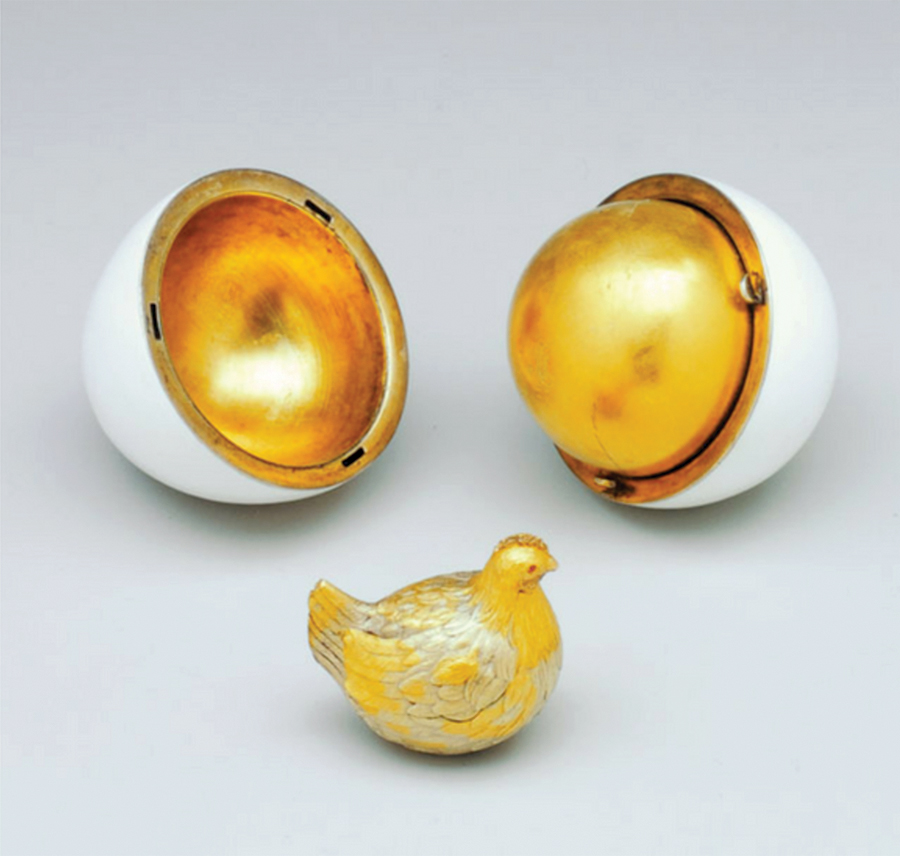
Fabergé’s creation was called “The Hen.” It was presented as a 2.5-inch high solid-white enamel egg shell, with a gold yolk inside the shell and a gold hen with ruby eyes inside the yolk, with a miniature gold and diamond royal crown plus a ruby pendant inside the hen. The czar’s own creation was the beginning of the tradition of turning Fabergé loose on a new egg for the empress each Easter.

It was a tradition that lasted through 10 eggs during Alexander III’s reign and through 40 more during the reign of his son, Nicholas II. Nicholas ordered two eggs annually, one for his wife and one for his mother. The eggs were increasingly ornate, opulent, intricate, and increasingly shrouded in secrecy. Most contained a surprise like The Hen’s treasures, which was known only to Fabergé. Not even the czar himself knew of an imperial egg’s surprise till Easter.

Following the Russian revolution, The Hen, together with the other eggs, was sent to Moscow. There, The Hen was sold and sold again, and though its surprise was lost (or is privately hoarded), the egg is now in the Fabergé Museum in the Shuvalov Palace in Saint Petersburg.

Not surprisingly, many of the surprises were lost or sold separately, as were many of the eggs. The times were a-changing, tumultuous and chaotic during the Russian Revolution and later during the Stalin years. As to the hungry revolutionaries, sadly, their tastes were pedestrian. So really, the surprise is that any of the imperial eggs and/or their surprises survived at all. But they did.

Here is where the 44 or 43 (depending on who’s counting) extant eggs are: Fabergé Museum, Shuvalov Palace — nine with one surprise; Kremlin Armoury, Moscow — 10; private collections in the U.S. with known owners — 15; private collection in the U.S. with anonymous owner(s) — 1; Royal Collection, London — 3; Monte Carlo, Monaco — 1; Switzerland — 2; Qatar — 1; anonymous collection where the country is also unknown — 2 (where one of these two, presented in 1902, has since 2015 been in a private collection in New York). Some experts dispute this egg’s provenance and regard it as still lost.

Now we come to the hunt for the seven (or six) still missing Russian imperial Easter eggs. Until 2014 Fabergé aficionados feared that eight of the eggs were lost. While it’s never too late to hunt for a Fabergé Easter egg, it actually is too late to hunt for egg No. 3. Some dude in America found it, his discovery underlining the utility of hunting for them.

When Fabergé presented the third imperial egg to the czar in 1887, he had aptly named it “Third Imperial.” Five years after Russian revolutionaries killed the Romanovs, the egg was sold to a dealer in London to help finance Russia’s “Treasures into Tractors” program. (How mundane does it get?)

No one knows how the egg arrived in America, but in 2011, Fabergé researchers dug up a 1964 catalog that showed the third egg and noted that it had been sold to a lady from the southern United States for $2,450. When the lady died her estate sold the egg for peanuts and it languished in roadside market venues till an anonymous American Midwest scrap metal dealer purchased it for $14,000.

The buyer’s thinking was that he could melt the thing down for its gold, then sell the gold for a small profit. Thankfully, nobody wanted to give him more for the gold than he had paid for the egg. Resigned to his “bad deal,” he sat the egg on a shelf in his kitchen. And there it sat till 2013 when, out of frustration, he Googled “egg” and the name inscribed on a timepiece inside the egg.

This bit of bird-dogging led him to an article in a British publication titled: “Is this £20 million nest-egg on your mantelpiece?” There it was! Our guy hotfooted to London, pictures of his egg in hand, to show the expert, Kieran McCarthy, mentioned in the article he found on Google.

McCarthy, a Wartski jewelry dealer, says, “He brought pictures of the egg and I knew instantaneously that was it. I was flabbergasted.”  McCarthy and the still anonymous buyer made the trip across the Atlantic to the buyer’s home, modest digs across the street from a Dunkin’ Donuts. Says McCarthy, “There was the egg, next to some cupcakes on the kitchen counter.”

McCarthy described the guy like this: “He’s from another world entirely. It’s a world of diners and pickup trucks, real blue-collar America.” Blue-collar no more.

There is no public record of the amount Wartski paid the Midwesterner on behalf of an anonymous buyer, but it easily could have been the $33 million mentioned in the 2011 article.

If you’re a bird dog, you need not be dissuaded by discovery of the “Third Imperial” egg; rather, take heart, as the following six and/or seven are still missing: second egg (1886 — “Egg with Hen in Basket”); fourth egg (1888 — “Cherub with Chariot”); fifth egg (1889 — “Necessaire Egg”); 16th egg (1897 — “Mauve Egg”); 26th egg (1902 — “Empire Nephrite Egg,” potentially already in a private collection in New York); 28th egg (1903 — “Royal Danish Egg”); and 36th egg (1909 — “Alexander Commemorative”).

Of those missing, the two that experts think are most likely to be found are the fourth and fifth, in that they have been seen more recently than the others. So get hopping. Who knows, old “Peter Cottontail” may just have something for your Easter basket.  PS

Michael Smith lives in Talamore, Southern Pines, with his wife, Judee. They moved here in 2017 and wish they had moved here years earlier.

The Accidental Astrologer

C’mon Baby, Light My Fire!

For Aries, the astrological arsonists, this month brings magic and stardust

By Astrid Stellanova

April brings us showers, sunshine and duckies, Star Children.

Some famous Aries creatives and legends like Maya Angelou, Booker T. Washington and Charlie Chaplin have transitioned to the great beyond. Others are still with us: Emma Watson, Alec Baldwin, Pharrell Williams, Francis Ford Coppola, Robin Wright.

Arians are like astrological arsonists, knowing how to make fire and stir it in others. Antagonists and protagonists. Blazing a trail, always leaving a fiery glow — even if you didn’t make it to the 1979 clogging championships with the Smoking Hot Feet of Lizard Lick — you sure know how to make a memorable exit.

Aries (March 21–April 19)

The sages all say this is a big year for you, starting now. You feel like you’ve been in a drought and are parched for a drink of water. Sugarbritches, get ready to guzzle. As much as the beginning of the year was not exactly epic in your opinion, this month is made of stardust and magic. Plain old well water will taste like sweet tea and a Saltine, like a mouthful of happiness.

Taurus (April 20–May 20)

You came out swinging, like somebody stole your buggy at the Piggly Wiggly. The wheels were wonky anyway, and sometimes karma takes over. Forget the little stuff and try and concentrate on the fact that the daisies are popping up and good things are coming.

Gemini (May 21–June 20)

Kindness is demanding that you learn to share, bless your heart, if it’s nothing more than the remote control with dead batteries, or a dried-up, day-old biscuit. You love your toys, but by your age, Darlin’, it’s time to share.

Cancer (June 21–July 22)

Measure twice and cut once. Shine your shoes. Don’t leave the house wearing ripped pantyhose or old sweat pants. You are going to have to figure and refigure to get ahead of a wily competitor. But it can happen.

Leo (July 23–August 22)

It is touching how much small things count with you. Nobody knows that. They think you are difficult to impress, but you love a dive as much as a gourmet bistro. Reveal who you really are, and take a pal to Waffle House.

Virgo (August 23–September 22)

How come you can’t make anyone who enters your door feel at home? Maybe because you really wish they were at their home instead. Expand your heart and open your arms to some very big happiness, Sugar.

Libra (September 23–October 22)

If you faked any more enthusiasm, you’d get sugar diabetes. It’s a good thing to be enthused, but your charm is turned one degree too high. A smile is your best accessory, Darling, but so is keeping it real.

Scorpio (October 23–November 21)

No selfies. No cries for attention, Honey. I don’t care how bored you get, the best thing for you right now is to focus on finishing something you started a long time ago and refuse to tie up. Finish. It.

Sagittarius (November 22–December 21)

You got caught talking with your mouth full of bull, Sugar. Sometimes, the best cure for lying is quiet contemplation. Stick to your knitting, bowling or fishing. Thank your friends for calling you out.

Capricorn (December 22–January 19)

It was mainly a symbolic dogfight, but there you were, right in the middle of it. They headed home looking like they got chewed up by the lawnmower. You walked away with a smile. Throw your shoulders back and show some humility in victory.

Aquarius (January 20–February 18)

You put all your business out there on the showroom floor. We see it. Everybody gets it. You are open for business, Sugar. There will surely be plenty who want what you are selling, but don’t give it away for free.

Pisces (February 19–March 20)

Honey, there is raw ambition, and then, sometimes, it is just a teensy bit undercooked. The cornbread ain’t quite done in the center. You are on the right track but your ideas need a little time and effort to succeed.  PS

For years, Astrid Stellanova owned and operated Curl Up and Dye Beauty Salon in the boondocks of North Carolina until arthritic fingers and her popular astrological readings provoked a new career path.

Grand Illusions

By Laura A. W. Phillips

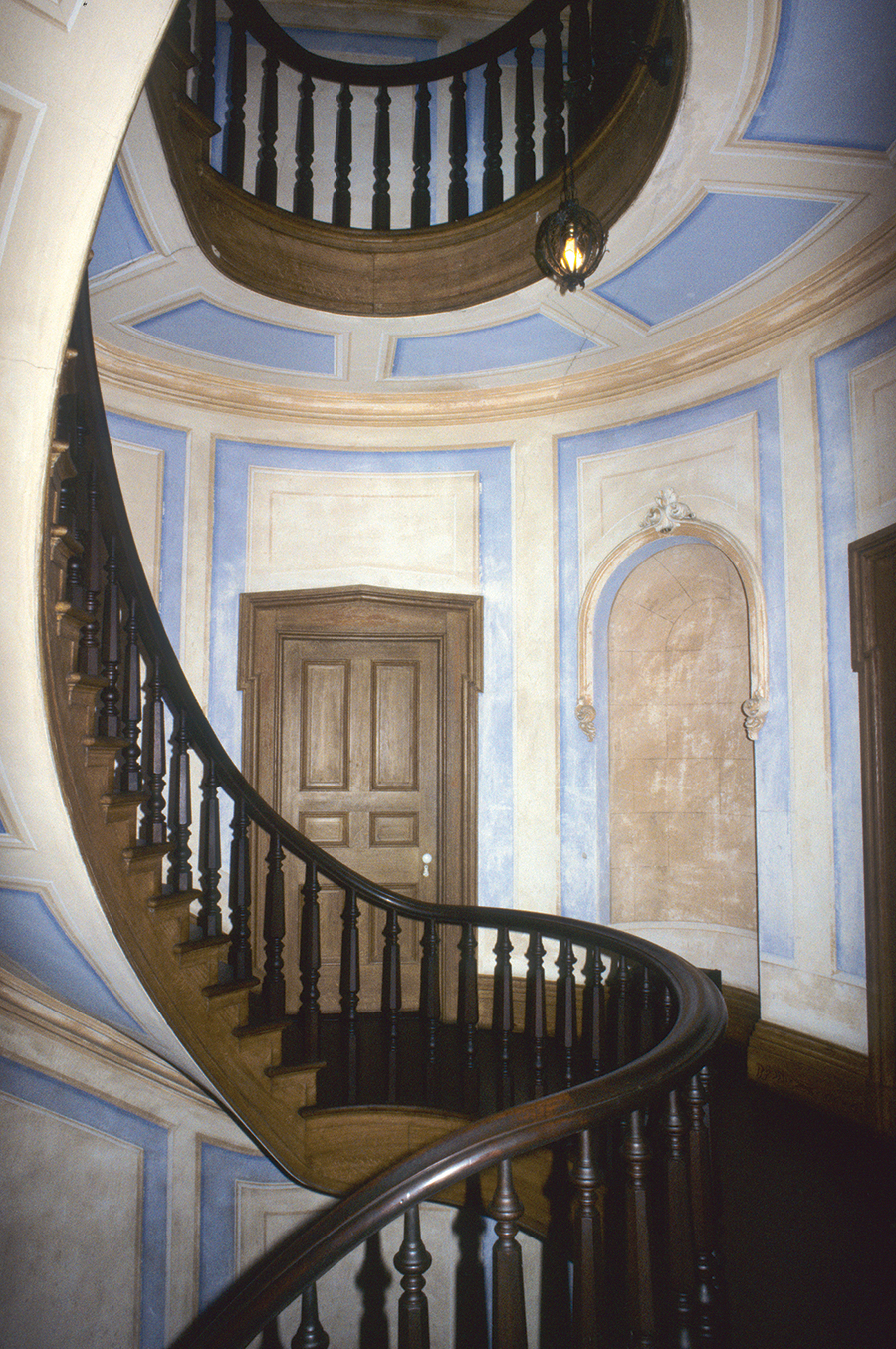
Decorative interior painting provided homeowners, especially during the 19th century, with a wide range of options for embellishing their houses. By employing an “ornamental painter”or perhaps giving free rein to a talented family member, a homeowner could endow a single room or an entire house with a lively and fashionable character. Decorative interior painting enlivens houses and other buildings throughout North Carolina, from the Coastal Plain through the Piedmont to the mountains. Hundreds of examples have been recorded, but these likely represent only a fraction of what once existed or, in some cases, still exists but remains undiscovered. The clientele for decorative painting spanned a broad range of economic levels. As might be expected, some clients were wealthy landowners and entrepreneurs who occupied large and impressive houses. At the same time, a surprising number were middling farmers who lived in modest vernacular dwellings. Thus, decorative painting was commissioned both by those who could afford fancy wallpapers and expensive woods and marbles and by those of lesser means who could acquire the services of a traveling painter in exchange for not much more than room and board. What all these clients had in common was that they found decorative painting to be a desirable way to adorn their homes.

North Carolina houses present a full range of decorative painting types, including freehand, wood-grained, marbled, smoked, stone-blocked, stenciled, tromp l-oeil, and scenic painting. Nearly half of the known houses with decorative painting display more than one type, as is true of the examples cited previously. In some, the painting program carries throughout the house, while in others, it is confined to a single, semi-public room, usually the parlor. A popular combination was to have doors wood-grained and mantels and baseboards marbled, which provided a luxurious though subtle and restrained character to the formal rooms. The most outstanding multiple types combined in a well-thought-out, comprehensive scheme. Painting often bore characteristics in common with architectural and furniture styles of the period in which it was created, including the Federal, Greek Revival, and late Victorian. And whatever the period, painters executed their work in a range of expressions, from the sophisticated academic work of highly trained painters to the sometimes bizarre examples of painting by artists with more limited technical skills and powerful imaginations.  PS

Excerpted from the new book Grand Illusions: Historic Decorative Interior Painting in North Carolina, by Laura A. W. Phillips. Distributed by the University of North Carolina Press

Almanac

April is a procession of wonder.

Flowering redbud. Rising asparagus. Row after row of tulips and daffodils.

When the earliest strawberries arrive, childhood memories of roadside stands and pick-your-own patches follow. The first time your grandma took you strawberry picking, you’d never seen berries so plump or vivid. Two, three, four buckets later, you’re back in the car, eyes twinkling, belly full of fruit made sweeter because you picked it.

Easter conjures memories of Sunday hats and wicker baskets, and a grade-school field trip to a house down the street from the church. There, a classmate’s yard is dotted with dozens of colorful eggs — some painted, some plastic, all filled with candy — but all hearts are set on the coveted silver one, a super-sized treasure found in the low branches of a climbing tree when the sun hits the foil just right.

Maybe next year.

Or perhaps the true magic is discovering what you aren’t trying to find, like the robin’s nest in one of the hanging baskets.

In my early 20s (read, coin laundry days), on a visit home for Easter, my folks planted a basketful of plastic eggs in the backyard, each one filled with quarters.

Sometimes the great surprise is the wonder that grows with age.

Scope It Out

According to National Geographic, one of the top sky-watching events of the year will occur on Tuesday, April 23. On this dreamy spring morning, at dawn, watch as the waning gibbous moon approaches brilliant Jupiter as if they were forbidden lovers. Use binoculars if you’ve got them.

The Last Frost 

The Old Farmer’s Almanac speculates that a full moon in April brings frost. Cue the Full Pink Moon on Good Friday, April 19.  While it’s not actually pink, Algonquin tribes likely named this month’s full moon for the wild ground phlox that blooms with the arrival of spring.

Consider it a signal that it’s time to plan your summer garden.

Plant now, and enjoy fresh tomatoes and cukes right off the vine.

Devilish Alternative

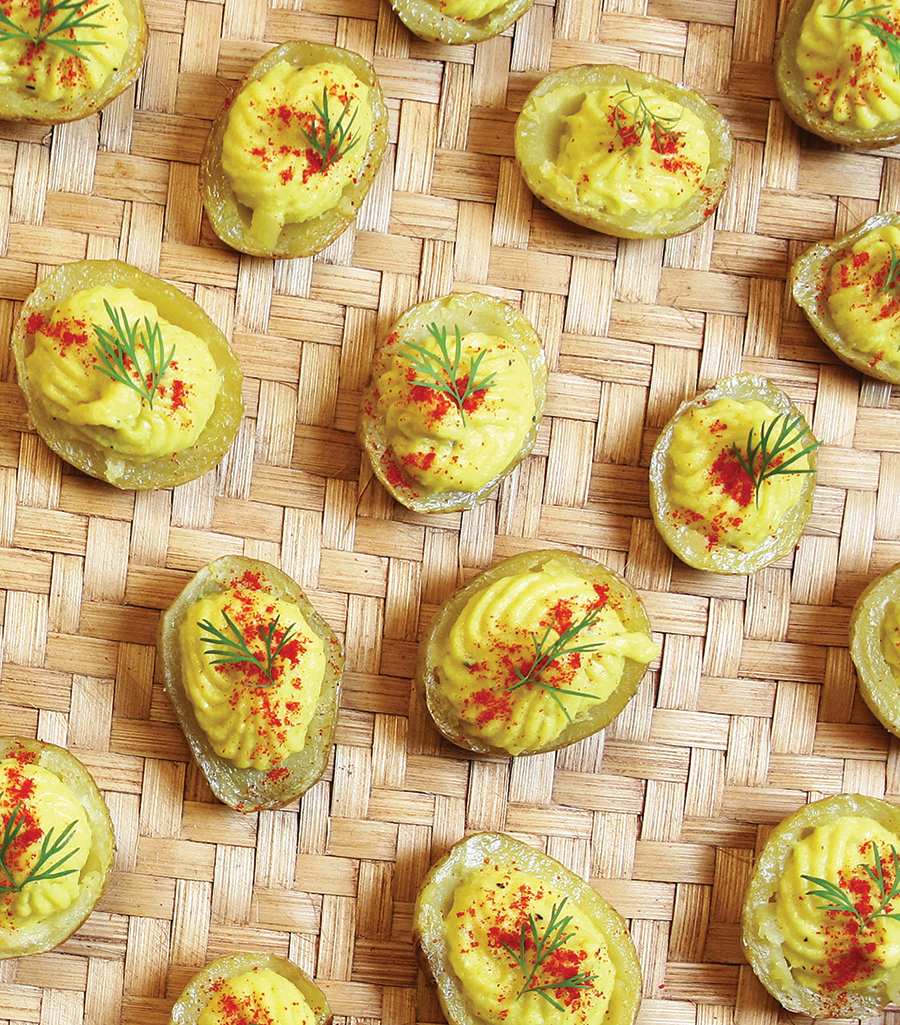
My younger brother has single-handedly cleared a tray of deviled eggs at more than one Easter supper. That’s why I was particularly stunned when he told me that he was adapting a vegan diet. No more deviled eggs? Well, not exactly. But when he told me about Thug Kitchen, a vegan cookbook peppered with language that would make our granny’s draw drop, I understood. Inside: a recipe for deviled chick-pea bites. Although we can’t print that here without heavy-handed edits, check out this equally scrumptious vegan recipe from Whole Foods Market: tender roasted baby potatoes topped with spicy yolk-free filling. Brother approved.

Deviled Potatoes

Ingredients:

12 baby potatoes (about 1 1/4 pounds)

2 teaspoons extra-virgin olive oil

1/2 cup vegan mayonnaise

1/3 cup drained silken tofu

1 tablespoon Dijon mustard

1 teaspoon sweet paprika

1 teaspoon turmeric

1/2 teaspoon coarse sea salt

1/4 teaspoon ground black pepper

Method:

Preheat the oven to 350°F. Line a baking sheet with parchment paper.

Cut each potato in half crosswise. In a large bowl, toss potatoes with oil and place cut-side down on the prepared baking sheet. Roast until tender when pierced with a knife, about 30 minutes. Let cool.

Using a melon baller, scoop out center of each potato half. Combine potato flesh, mayonnaise, tofu, mustard, paprika, turmeric, salt and pepper in a food processor and pulse just until smooth. Scoop filling into potato halves. Refrigerate for at least 30 minutes (and up to 2 days) before serving.

(Want to take this deviled egg alternative to the next level? Sprinkle with finely chopped fresh parsley before serving.)

If Spring came but once in a century, instead of once a year, or burst forth with the sound of an earthquake, and not in silence, what wonder and expectation there would be in all hearts to behold the miraculous change!  — Henry Wadsworth Longfellow

Hometown

Tasty Days

A sweet trip down cola lane

By Bill Fields

Like many people, I’m trying not to drink many soft drinks these days. I have an occasional Coke Zero at a Sunday matinee. Earlier this year, while on the mend from a stomach bug, I don’t think I’ve had any ginger ale that tasted better. On a recent business trip south of the border, I sampled a Mexican soda of the variety I’ve observed in coolers, but not consumed, from my favorite neighborhood haunt that has the world’s best breakfast burritos.

These are diversions from the water norm, tap or sparkling, but it wasn’t always that way.

I saw a social media post recently about “113 Things ’60s Kids Did That Would Horrify Us Now.” OK, it wasn’t quite that many, but you get the point: We’re basically lucky to have survived childhood because we played unsupervised, rode without being seat-belted or helmeted, and walked to school alone. 

Among the things we also did was drink soft drinks, and I was among the guilty. A pie chart of my childhood beverages would be sweet — and not only because of the iced tea and orange juice that augmented all the milk I drank at supper.

Certainly, drinks were smaller back then. It didn’t make much sense to guzzle a 6 1/2-ounce Coke, because it wouldn’t last very long. A 10-ounce bottle of Pepsi seemed big. Splurging for a 12-ounce fountain drink at the drug store was an event. When quart-size colas with resealable caps started appearing on the Big Star shelves, they marked a massive step in carbonation evolution, a hint of Big Gulps to come.

I was a cola kid raised without strong allegiance to either of the behemoth bottlers. It was as if Carolina and Duke are both good schools, and Democrats and Republicans are both good people. I occasionally joined the RC Cola camp, that flavor being a favorite on comic-book runs to the Ideal Market on May Street.

For a succession of beach vacations, to the justifiable annoyance of other family members, I was obsessed with a brand called Topp Cola sold at the grocery store on Ocean Drive that was not available in the Sandhills. There are pictures of me posing on the Strand with a Topp can looking as happy as if I’d just hit for the cycle in a Little League game.

I moved on from my Topp phase, with other tastes taking its place. If Dad was in the mood for something stronger than beer during the holidays and had stocked some Collins Mixer, I pestered him until he let me have some of the bubbly lemon-juice soda. Wink was like an explosion of grapefruit flavor, and when he kept that around as a mixer I’d sneak a sip of that too.

Yoo-hoo always seemed like a poor imitation of chocolate milk, but I’d get one from a drink machine on a gas station bathroom stop. I was equally indifferent about Cheerwine, despite its North Carolina roots. It tried its hardest as a cherry soda, but if I was going that flavor route, I preferred a fountain cherry Coke or a cherry Sno-Cone.

TruAde was the best, though. Trademarked 80 years ago, the orange soft drink stood out from everything else because it was pasteurized and non-carbonated. It tasted so smooth and so good because it contained orange juice concentrate, which was the reason for the special processing. The temptation was to chug a 7-ounce bottle. But I savored every sip when I got one when Dad took me fishing at a local pond or ordered me a TruAde when he stopped for a late-afternoon beer at a tavern downtown on Connecticut Avenue and let me tag along once in a while.

Five years ago, driving through Cheraw, South Carolina, en route to Southern Pines, I stopped at a convenience store for something to drink. In the beverage cooler was a name I hadn’t seen for decades — TruAde. It felt like coming upon a Topp Cola at the beach in 1968.

This TruAde was in a 20-ounce plastic bottle, and unfortunately the packaging wasn’t the only thing that had changed from the TruAde of my youth. I drank about a fourth of it and threw the rest away, realizing I would have to be content with a sweet memory.  PS

Southern Pines native Bill Fields, who writes about golf and other things, moved north in 1986 but hasn’t lost his accent.

Out of the Blue

Terminal Velocity

The greatest show on Earth

By Deborah Salomon

A friend asked recently, “Where do you get ideas for columns?”

I rolled my eyes and answered, “Stuff happens.”

And then more stuff happens — or stuff changes — all in plain sight, if you’re watching closely.

So, after 40-some years of column writing I watch closely, all the time: things, people, animals, weather, trends, politics, fashion, relationships and, in desperation, myself.

Certain places seethe ideas. The greenest pasture . . . airports. I am impoverished but fodder-enriched by four or five trips per year to see my grandsons, who live in Canada. A layover in New York, Detroit, Atlanta, Charlotte or Philly fills a notebook.

That’s right, paper and pen. No tablet, no laptop, no voice recorder. I get a perverse satisfaction from living unplugged for a few days, except a cell, for emergencies. And basketball scores.

That’s OK. Gadgets have changed, but not human nature, not since Egyptians painted on walls and Moses carved in stone.

I justify the airport backdrop by citing a popular 1940s radio show called “Grand Central Station,” which began, dramatically, “the crossroads of a million private lives, a gigantic stage on which are played a thousand dramas daily . . . ”

Upon entering a terminal, the first change Rip Van Winkle notices is everything. Young adults have traveled their whole lives without dressing up. No suits, no heels. They claim comfort, although the difference between sweats/tank tops/flip-flops and chinos/blazers/loafers on an hour flight escapes me. Then, particularly in big-city airports, note airline personnel who supervise boarding. They have a grand ol’ time laughing and interacting with each other, then turn a grim countenance to passengers. They read scripts explaining the boarding process so fast it sounds like Greek, which is fine by me, since the process offends by grouping passengers according to how many perks they added to the base ticket price. Do I want more leg room? Sure. Am I going to pay $25 for it? Don’t be ridiculous.

Then, since checking a bag (never say suitcase) adds another $25, most passengers make do with carry-ons, hoping for free gate check. If not, a stampede to the overhead bins dominated by, you guessed it, folks who paid $25 to board first. True, once the bins are full, airlines check a bag free to their destination, which causes major separation anxiety.

New airports are spectacular in design and amenities, reflecting contemporary demands, beginning with rest rooms. The need often originates during flight, where small, squished-together seats make getting up to use the lavatory positively gymnastic. Therefore, expect line-ups at terminal facilities, themselves a multiple choice: women, men, handicapped-accessible, family (politically correct), men with diaper changing stations, breast feeding nooks, even relief areas for service and support dogs.

About those support animals. Regulations have been abused to the point where an E*Trade TV commercial lampoons a support snake.

Snakes on a plane . . . get it?

I think passengers with bona fide support dogs (and old ladies with bad knees) should always be offered the roomy bulkhead seat at no surcharge. What great PR! Besides, think how confinement is stressing that poor comfort bunny.

Airport chapels are fading fast. Too bad — often the only oasis of quiet, perfect for a snooze.

Food. Eons ago, out of pity for the captive audience, fast-food franchises agreed not to jack up prices. That didn’t last long, although McD, Wendy’s, Burger King are still the cheapest. Others gouge: a slice of Sbarro pizza, $6.50. Pre-made sandwiches at Starbucks et al: $8-$12. Bottled water: $3. Worse yet, sit-down restaurants post menus minus prices at the entrance knowing that once seated, few customers bolt. On board, when snacks are offered, the choice will be pretzels or Biscoff cookies. Why a Belgian-made cookie that crumbles easily and oozes fat, leaving fingers slippery, I’ll never know.

Of course the biggest change is digital, electronic, whatever you call the addiction to constant communication/entertainment/information. Long ago I observed that denim and running shoes were the common denominator. Back then, passengers came to blows over the single electric outlet in a departure lounge. Now, seats are arranged around charging stations and at least 90 percent of boarding pass-holders are either earbudded, Kindling, playing a game, watching a game, sending an email, receiving a text, tweeting or conversing with someone just to look busy. I fly 2,000 miles without seeing a single discarded newspaper.

Because, in the aviation milieu, only nobodies are not glued to a screen.

One of those nobodies is me, watching the most fascinating screen of all. Real life.  PS

Deborah Salomon is a staff writer for PineStraw and The Pilot. She may be reached at debsalomon@nc.rr.com.

The House That Golf Built

The Dedman family transforms a historic home

By Deborah Salomon   •   Photographs by John Koob Gessner

Wow.

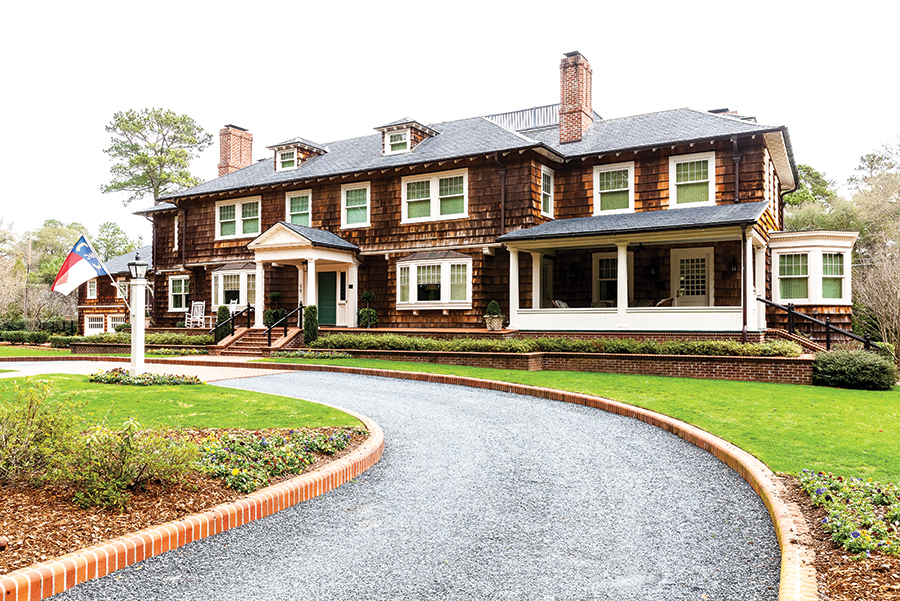
The adjective pool runs dry just inside the front door of Fownes Cottage, which, at 7,000-plus square feet on a triple lot, has been a Pinehurst village landmark since 1914.

At first, the exclamation is one of surprise, since the house presents an optical conundrum. Streetside, the windswept cedar shingles on the longitudinal frontage suggests the New England coast. Then, past a low brick wall, brilliant green manicured winter grass, shrubs and patio suggest more. Yet not even that hint prepares the visitor for a first look: comfortable formality expressed in misty turquoise, cloudy white, and blue shading from Wedgwood to royal and bright navy.

Blue, blue, blue, chosen for its soothing qualities, repeated in custom carpets, luxurious drapes and floral upholstery . . .
a surfeit of perfection.

Stand in the foyer, face the staircase and turn clockwise. The most unusual greeting area has a low table and tufted banquettes. Next, a living room that stretches a mile to the family-gaming-sun room with bar; a dining salon seating 12 with elbow room aplenty. Stop there to admire the wallpaper — a diorama of greenish blue foliage and oversized birds, from the historic Gracie Chinoiserie collection. This space earns the kind of massive chandelier often seen crammed into smaller rooms. Floorboards, some original, are stained and polished strips of pine and oak. The kitchen seems odd at first, well equipped but smallish — at least the part glimpsed from the dining room. However, behind closed doors are a preparation area and butler’s pantry used by the resort chefs who prepare fine cuisine for guests and business meetings.

Fownes Cottage is both a satellite home for the family of Bob Dedman Jr., owner of Pinehurst Resort, and lodging for his guests. Golf memorabilia is everywhere, yet integrated into the formal décor. Dedman’s favorite example lines an upstairs hallway: framed pastels of the 18 holes on No. 2 by noted artist Jane E. Hixon, a Pinehurst resident. Elsewhere, trophies, photos, autographs, a scorecard signed by Donald Ross — even a battered golf bag belonging to Fownes himself. Less formal, the attic has been transformed into a girly dorm with berth beds for the teenage Dedman daughters.

In truth, like a cream-filled French pastry, its richness is better appreciated in small bites, interspersed with history.

By 1914 word of Pinehurst had reached the right ears. What started as a health resort was becoming a wealth resort, thanks to the golf links James Walker Tufts provided for exercise. Rich merchants, bankers and industrialists from Pennsylvania and points north recognized its attributes (climate, rail transportation, accommodations) as a winter destination. The homes Tufts built for long-term guests were soon joined by larger “cottages,” a misnomer unless the occupant’s primary residence is Versailles. During Prohibition, alcoholic beverages were rumored to be available. But for Henry Clay Fownes of Pittsburgh, golf was the main event.

Heaven knows, he could afford it.

Born in Pittsburgh in 1856, Fownes, with his brother, William, made a fortune in iron and manufacturing furnaces. Carnegie Steel bought them out in 1896, leaving H.C. rich, with plenty of time for other pursuits. The Fownes family had frequented Pinehurst since the early 1900s when its streets were muddy and vegetation scruffy. Now, he could build a suitable retreat described in contemporaneous accounts as a “villa” with cove ceilings, a hipped roof and dormers, seven bedrooms, multiple bathrooms and, later, a four-bay garage with a three-bedroom apartment over it. The Pinehurst Outlook of 1915 called the cottage “the real thing, costing $25,000 — a lot of money.” The florid description continues: “…a vast, rambling house, livable and inviting of some 20 rooms, with sunshine, fresh air, God’s glorious open (sic) everywhere.”

Fownes became a hands-on homeowner. Despite his wealth, in 1926 he wrote a letter complaining about a plumbing bill for valves, and a water bill for keeping the garden alive during summer months when the house was unoccupied.

Fownes’ previous project, in 1903, was developing and presiding over the world-famous Oakmont Country Club in Pittsburgh, designated as a National Historic Landmark. Its longitudinal shingled clubhouse foreshadows his Pinehurst retreat.

H.C. and wife Mary had one child, William, (named for H.C.’s brother), who kept the house after his father’s death in 1935. Parts of the interior were destroyed by fire in the late 1920s. The Dedmans are only the third owners.

The Dedman family of Dallas is also legendary in the world of golf resorts (ClubCorp), philanthropy, education and other endeavors. As owner of Pinehurst Resort, with the 2014 U.S. Open Championship approaching, Dedman wanted a residence here. “It was the opportunity to have a historic house and a sense of place to entertain in a more intimate setting,” he says.  “I looked at land at No. 8 but wanted something closer to the campus, where I could walk to the village and get a coffee at The Roast Office.” He decided on Fownes Cottage in 2013, which meant only a year to renovate. “We wanted a gracious, historical house, more like a home than a hotel,” furnished in antiques, but with every bell, every whistle, every fireplace and background music selection controlled remotely. This meant rearranging seven bedrooms into four suites (and an office), each with a bathroom and sitting area, creating the attic dorm and adding niceties like an upstairs coffee kitchenette with paneled refrigerator, as well as replacing all the systems and enhancing the landscaping — a huge undertaking. Most visible, therefore of prime importance, were furnishings and décor implemented by Dallas interior designer Mark Clay, fresh off 20 years with Ralph Lauren in New York.

Clay had designed interiors for Dedman family homes in Vail and the Virginia mountains, as well as their new home in Dallas. “I know what they love,” he says.

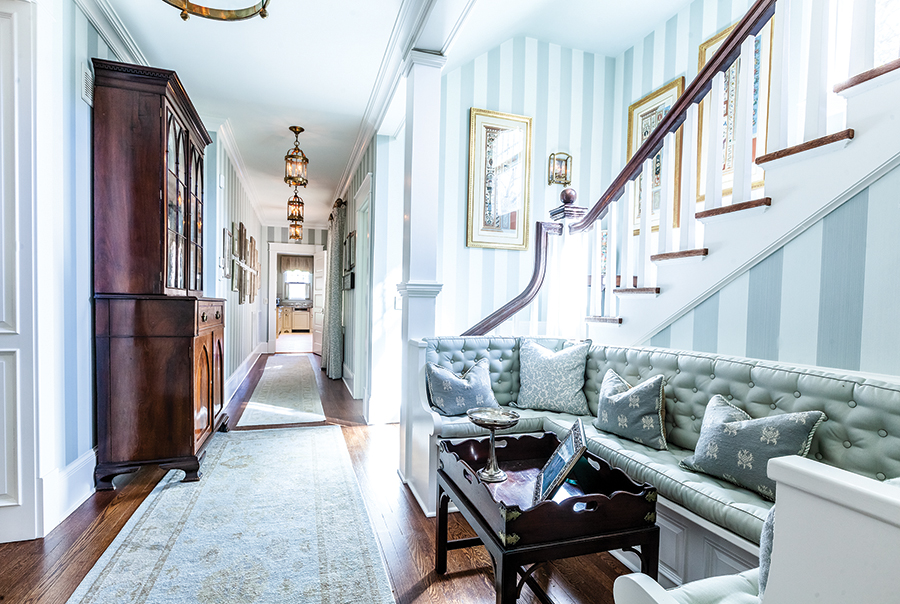
This time, Clay translated that love into an English manor rooted in local history. “It was important to Mr. Dedman that the house show respect for Pinehurst.”  At Dedman’s suggestion he scoured Moore County for photographs and magazine covers to surround with silvery frames, which complemented the pervading blue. Clay commissioned rugs in particular hues and patterns, including a wide 55-foot hallway runner, which were woven to order in Turkey. Seagrove pottery in a rainbow of blues was also created for the cottage.

“Mr. Dedman bought the dining room table,” but the antique Waterford crystal chandelier over it came from the couple’s first house, “something of sentimental value,” Clay adds.

Instead of hiding TVs in armoires, Clay found less massive antique linen press cupboards to retrofit, since the bedrooms, including the master suite, are moderately sized. Other case pieces, all in mahogany and dark woods, were shipped from the Dedman estate in Dallas or sourced in Raleigh.

Details complete this portrait of style and elegance.  Since some doors already had glass knobs, Clay replaced others with cut crystal — smooth and heavy to the touch.  Windows throughout are covered with shades fashioned from natural grass that, while admitting light, provide privacy without drawing the heavy drapes.

Clay was instructed to furnish the above-garage apartment with pieces of equal mode and quality as the cottage, lest overflow guests feel slighted.

Some of Clay’s decisions resulted from research. He insisted that the stairway arising from the foyer have natural wood handrails and painted balusters, because that’s how it was done. Besides, that staircase — perfect for a bride — may someday appear in family photos. This thought has not escaped Bob Dedman’s practical side:

“I told my daughters there’s a church across the street. We could have the reception here . . . a destination wedding. It would be so convenient.”

In the meantime, Fownes joins Mystic Cottage (village home of Fownes’ friend Leonard Tufts, built in 1899), Dornoch Cottage (built by Donald Ross in 1924) and half a dozen others representing an era when golf, and Pinehurst, were attracting, in James Walker Tufts’ words, “A refined and intelligent class of people.” People with the interest and means to build, and now renew these homes.

The circle is complete.  PS

The Collectors

Harry Houdini, Thomas Jefferson, George Lucas and Ernest Hemingway collected books. Nicole Kidman collects coins. Demi Moore favors porcelain dolls. Tom Hanks loves old typewriters. Passion comes in all shapes and sizes. It’s not about stuff. It’s about the chase

By Will Harris
Photograph by Tim Sayer

Tony Rothwell

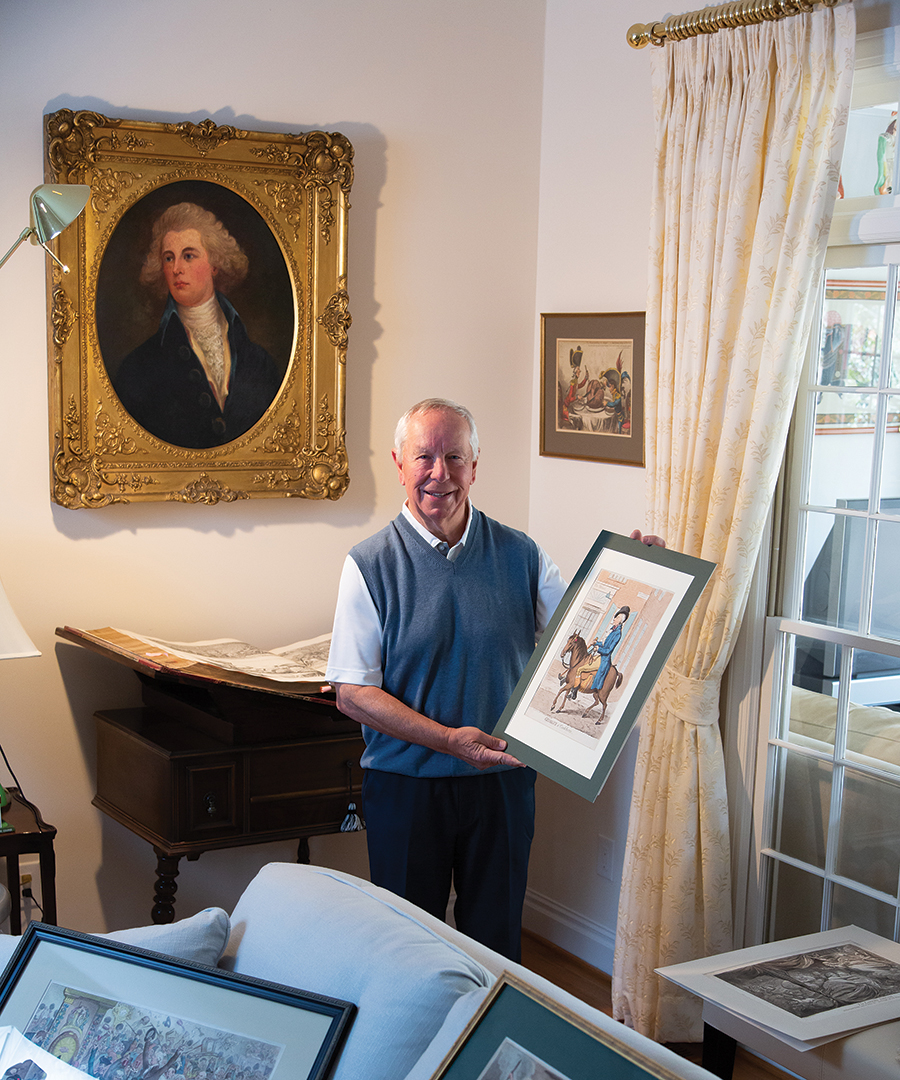
Tony Rothwell was 14 years old when he first encountered the work of British caricaturist James Gillray in the pages of a history textbook, and was captivated by the artistic talent and political depth of the work.

“I didn’t realize how interested I was in the graphic arts, but I thought this was so wonderfully graphic and so clever, I made my own copy of it,” Rothwell says.

The print Rothwell copied was Gillray’s “The Plumb-pudding in danger,” a caricature that still appears in history books. It’s an 1805 editorial cartoon of Napoleon Bonaparte and British Prime Minister William Pitt dividing a plumb-pudding globe into metaphorical spheres of influence — a comment on the world leaders’ appetite for dominance. “Fast forward and I’m now in London, 21 or 22 years old in my first job, and it was used as an advertisement for a show of Gillray prints,” Rothwell says. “I decided that I would turn London upside down and see how many would fall out, and they started falling. In those days, they weren’t that expensive. I was lucky I got in early before anybody was seriously collecting them.”

Gillray is credited with creating and popularizing the political cartoon as a genre, and the influence of his work was felt throughout Europe. He directed his sharp wit at both political parties (depending on who was commissioning him), but Napoleon, in particular, was a focus of his derision.

Rothwell has at least 150 Gillray prints and sketches. Although he has works by the caricaturist’s contemporaries as well, Rothwell is particularly impressed with Gillray’s political wit, breadth of knowledge and raw artistic talent.

“Gillray really was the first true political caricaturist. He invented it,” Rothwell says.

Gillray lived in a turbulent and exciting time, ripe for political discourse and caricature. Britain and France were competing for influence on the world stage. King George III and Napoleon Bonaparte lent themselves to the hyperbolized visual renderings that Gillray made so popular. It was also a time when the conventional methods of consuming news left something to be desired. Gillray saw an opportunity to put his artistic skills to commercial use, and opened a shop to sell his prints.

“Newspapers were all black and white and didn’t have any pictures at all, so this is how the wealthy could entertain themselves,” Rothwell says. “It was giving them news, and it was also giving them a laugh. At the same time, it was scaring pompous people, bringing them down a notch or two.”

Gillray’s influence extended to the upper reaches of the ruling political class. “He was being read by the House of Commons, by the royal family — people who had money and influence,” Rothwell says.

There’s no true modern equivalent to Gillray’s prints. They resemble today’s political cartoons but are packed with subtle cultural symbols, allusions to Greek and Roman mythology and detailed historical context. Because Gillray’s well-heeled audience was also well educated, he was able to elevate his imagery and symbolism.

“I’m in awe of the man really, still today. I think he’s incredible. He has set the table for so many caricaturists since,” says Rothwell. Expanding his collection has gotten easier with the advent of the internet. “In the early days it was all footwork but now, eBay walks a million miles for you every day. You make time for what you love”


Photograph by Tim Sayer

Rick Smith 

A self-described “pretty serious book collector,” Rick Smith has been afflicted with a passion for books since he was a child. “I fell in love with the tactile nature of books, how well they were bound and how colorful they were, the thickness and the weight,” Smith says.

This childhood curiosity gradually developed into a full-blown obsession. Today Smith’s library contains around 1,200 books with hundreds of signed copies. Three books in the collection are autographed by former U.S. presidents: George W. Bush, George H.W. Bush and Harry Truman.

Smith’s passion transformed his life in every respect, and his home is a testament to it. “My wife, Susie, said there’s room for two of us in this house but probably not for your books,’’ Smith says. He redesigned the garage of their lakeside cottage into a cozy personal library, complete with a rolling library ladder. A stained-glass lamp illuminates a massive worktable made from knotty alder wood.

Smith is particularly fond of his books related to his father’s (Richard H. Smith Sr.) service in the Navy during the Second World War. “One of the things I began to wonder about was how my father’s life was transformed by his, albeit brief, time in the service as a very young man,” Smith says. “I think he was inspired by that, and so I decided there are probably threads in this that need to come out.”

Smith’s father was a seaman first class on the aircraft carrier USS Bennington and the plane captain (crew chief) assigned to a one of the ship’s TBM Avengers — aircraft originally designed as torpedo bombers. His job was to ensure the bomber under his purview was combat ready.

In 2003 James Bradley published his best-seller Flyboys. It details the harrowing 1942 air raid of Chichi Jima by TBM Avengers. Among the pilots was 19-year-old George H.W. Bush.

Smith’s father felt a special connection to the former president through their shared experience with the TBM Avengers, so Smith bought a signed copy of Flyboys as a gift. Smith’s father brought the book to annual reunions for veterans who served on the USS Bennington, and began to collect signatures.

“They would sign them with their rank at the time, the raids they were on, and when they served,” Smith says. “And one day when he was 79, he said to me: ‘One of the signatures that I’d really like to have in this book is the president’s signature.’ And I thought, good luck with that.

“But I had a conversation with a friend and we got an entrée to send the book to Houston, and the president signed it,” Smith says. “And all of a sudden the whole notion of getting serious about collecting and deciding what to collect became important.”

Around the same time, Smith’s father gave him a diary he’d kept while aboard the carrier. “One of the threads I started to pull from this diary was first-person accounts,” Smith says. “First-person accounts for historians are gold.”

Smith refined his search to World War II and its leaders. “I’m sort of focused, but in a lot of ways it’s about the chase,” he says. “So, it’s a passion for the subject matter; it’s a passion for the physical book; it’s a passion for the search and the chase.” And there’s comfort to be found in the written histories of great world leaders.

“I think it’s so important to know our history; it helps a lot of stuff make sense, he says.” “That’s my homily for today: Read some history. It’ll help you be a better citizen, help you make better judgments, and help you sleep at night.”


Photograph by John Koob Gessner

Mitch Capel

Mitch Capel, the alter ego of Gran’daddy Junebug, has been an impactful presence in the Sandhills for decades. Capel’s unique delivery of stories and poems — some passed down through his family, others the recited works of his favorite poet, Paul Laurence Dunbar — has enabled him to touch the lives of countless young people.

A Moore County native, Capel immersed himself in North Carolina’s artistic community throughout his storytelling career and formed close relationships with several influential artists native to the state. He and his wife, Pat, have created a collection of paintings featuring artists like Ernie Barnes, Bill Pinkney and Willie Nash.

Capel is hard-pressed to pick a favorite. “They’re like children; I don’t know. If I had to pick one it’d be my wife’s work, of course. It’d be that one with the buttons,” Capel says, referring to a portrait hanging above the fireplace in his study. In it Capel is wearing his storytelling garb, an outfit smattered by colorful buttons he has collected over the years.

Hundreds of paintings adorn the walls of the Capels’ home, including several of Pat’s alongside others by Barnes and Pinkney. “My wife and I gravitate toward Ernie Barnes,” Capel says. “He’s an amazing artist. Grew up in what was called ‘The Bottom’ in Durham.”

Barnes attended North Carolina Central University, where he played football and majored in art. He played football professionally for five years before shifting his focus entirely to art. His 1970 painting The Sugar Shack was featured in the opening sequence of the Good Times television show, and was also used by Marvin Gaye as an album cover for his 1976 album, I Want You.

“I liked Ernie Barnes’ work in the beginning because of Marvin Gaye’s album cover,” Capel says. “Album covers were our artwork at the time.”

Pinkney is another artist featured prominently in the Capels’ collection. He discovered Pinkney while performing at an alternative school in Fayetteville. After seeing his work hanging in the principal’s office, he knew he had to meet him.

“I mean, he was so talented; what he did was amazing with the paintbrush, and it came so easy for him,” Capel says.

Pinkney is best known for his painting of Julian Abele, the architect who designed Duke University’s Chapel. The work currently hangs in the University’s Gothic Reading Room.

A Bill Pinkney piece titled Marbles is especially meaningful to Capel.

“I had just unpacked this board game Mancala, and I’m on the floor and I’ve got these in my hand, and I flashed back to when I was a kid playing marbles. And the phone rings and it’s Bill: ‘Mitch, I just finished this painting, you’re gonna love it, it’s called Marbles.’ I dropped everything I was doing and went over there and I bought that piece,” Capel says.

“Yeah, it’s been a wonderful journey for me.”


Photograph by Lisa Gessner

John Koob Gessner

“In this day and age, it’s like everyone wants everything right away,” says John Koob Gessner, who thinks his collection of vinyl records represents a simpler, more intentional period of musical enjoyment. “This kind of hearkens back to a time when it’s OK to slow down and enjoy something.”

Gessner grew up in a small town in New York, influenced by his parents’ musical tastes. “Oh, yes, there was a large hi-fi, not a stereo, right outside my room. At night they would play Harry Belafonte, the big bands, Glenn Miller, all that kind of stuff. And it would kind of boom through the house,” he says.

At first, acquiring records wasn’t about building a collection, it was simply the way music was enjoyed. “If you went to someone’s house, you’d bring a couple albums with you, because everyone had a hi-fi,” says Gessner. “Records were kind of how you shared music. If someone wanted to hear a song, you had to either hear it on the radio or buy the album.”

Despite MP3 downloads and music streaming, Gessner still prefers the old-school method. “People have this affinity for vinyl. It’s analog and there’s a process to it,” Gessner says. Soon enough the preferences of his parents were supplanted by his own taste. “I was listening since I was 5 or 6. As soon as I got a paper route all my money went to film and vinyl,” Gessner says of his twin pursuits of photography and records. “I’ve been collecting ever since.”

Gessner developed a close relationship with the owner of the local record store. “I would go in and they would put stuff away for me. When I had enough money, I’d go get it.” Sometimes it was as if they could read his mind, like the time he was anxious to get his hands on John Lennon’s Christmas song, pressed on a special green vinyl. “I remember coming off a bus and stading in front of the music store and looking on a rack and they were all gone, and Mr. Nagy said, ‘Ah, Mr. Gessner, I saved one out for ya.’ And I still have it.”

His collection has grown to an estimated 4,000 records, with about half on display in repurposed bookshelves in his living room. 

His musical interests created unique, career-altering opportunities. As a young photographer, Gessner shot album covers for many of the bands he listened to and saw in concert, and has kept in touch with many of them.

He continues to nourish his love for vinyl through what he calls the Vinyl Record Project. “I interview people about their experience with vinyl, and I take a portrait,” Gessner says. “They have these great wired-in memories about vinyl because you’re taking it off the rack and you’re putting it on the turntable — it’s a process.”


Photograph by John Koob Gessner

Jane and Jim Lewis

Jane and Jim Lewis are not collectors. They are self-described “accumulators.” Although they did not personally acquire the 280 unique mini liquor bottles on display in their home, they have nevertheless taken on the role as stewards of the collection.

“We’ve drug it around from place to place and displayed it, but we’ve never been collectors,” Jim says, “It’s not like we’ve been looking for them high and low for the last 50 years and we’ve worked hard and traveled the world to find them — it ain’t true.”

The mini bottles were collected by Jane’s aunt, Billie Cave, who began collecting the bottles in the late 1930s. Knowing she was passionate about collecting mini bottles, Aunt Billie’s friends acquired many of the liquor bottles as souvenirs while traveling.

“Now, back in those days her aunt didn’t travel all that much, but her friends knew about her collection and would bring her bottles,” Jim says. “People immediately assume they came off airplanes, but in fact, a lot of people got them off trains.”

While Jane and Jim shy away from the term collector, they are clearly very fond of the collection. After nearly 40 years and after each of 14 address changes, the Lewises have always unpacked the bottles for display. At their home in Pinehurst, the bottles sit on shallow shelves over a small built-in bar, a colorful centerpiece of the room, drawing the eye of visitors entering through a side door.

“The bar is here so it just made sense, and people always want to know about the bottles,” Jane says. “It’s the first thing they see.”
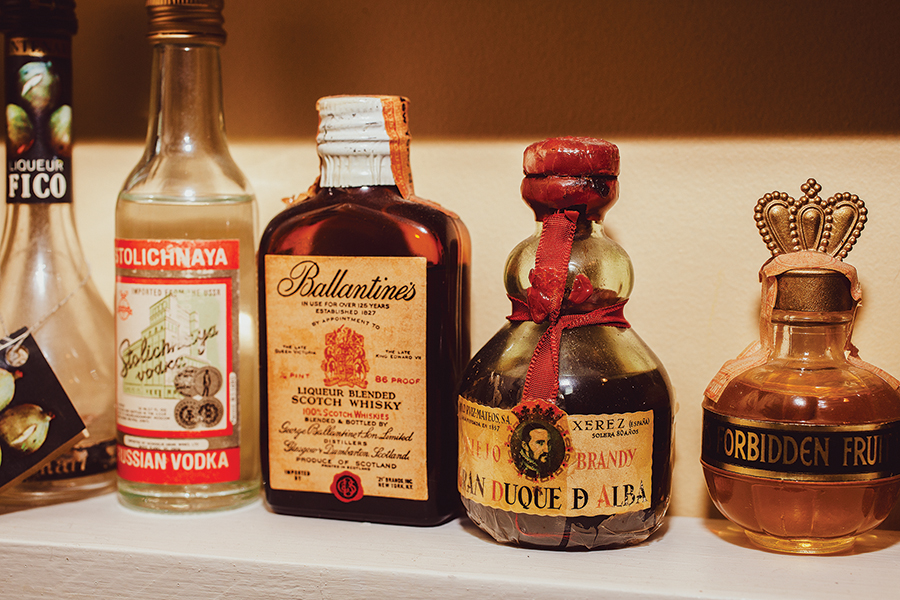
The bottles come in every shape and size imaginable, and the faded neon mosaic framed by the white wall is a striking mainstay of their home’s décor. A glance will not do. 

Some are easily recognizable as miniature versions of full-size liquor bottles. They tend to be more dignified and expensive Scotches, whiskeys and bourbons. Others are creative and delightfully original one-offs. Exotic liqueurs and rums seem to be the most outlandish, and the Portuguese Mobana Crème de Banana in the shape of a monkey is truly a work of art.

The bottles are all unopened, although the contents of the oldest bottles have almost completely evaporated through the ancient but intact seals. Keeping the bottles in their unopened state was no easy task in a house with two young boys. As any parent whose liquor cabinet has been raided will understand, Jane and Jim told their sons a white lie to ensure the bottles remained sealed.

“When our boys were old enough to realize what it was, we told them they were poison because they were so old,” Jane says.  “We told them: ‘Don’t you dare open one and drink it, because it will kill you!’ And you know they thought that up through college.”

The bottles have survived time, adolescent boys and a lifetime on the move. One day they’ll pass Aunt Billie’s bottles along to the next generation of stewards.

Photograph by Tim Sayer

Joe Vaughn

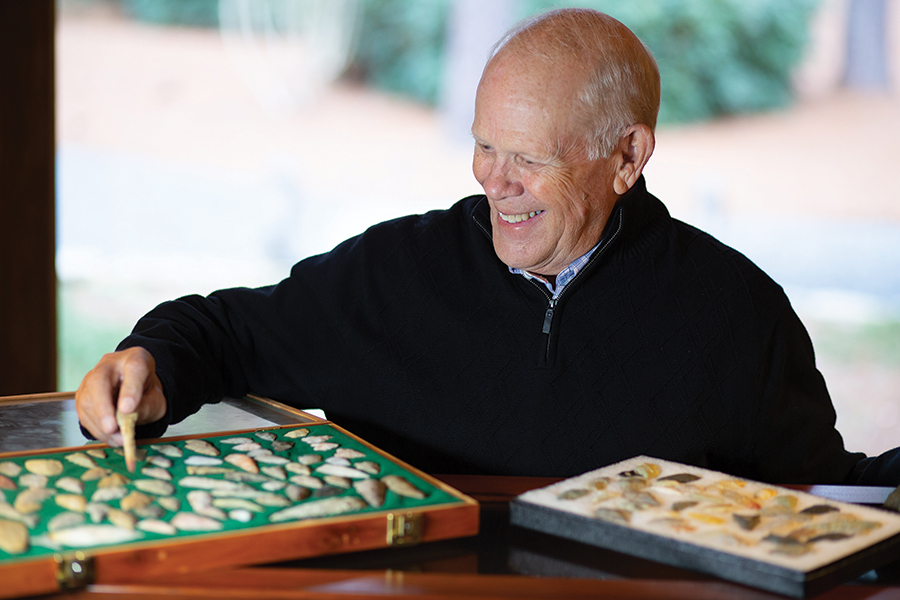
Joe Vaughn began collecting Native American arrowheads as a child and has indulged his passion ever since. Vaughn is the middle child in a family of five boys, and his upbringing in Northampton County, North Carolina, afforded him endless opportunities to search for the elusive artifacts.

“As kids we hunted and fished, and part of hunting and fishing is walking across fields,” Vaughn says. “We just developed an early interest in collecting a lot of old stuff, and one of the things we collected was arrowheads.”

Over the years he’s found hundreds of perfectly intact arrowheads, all from the northeastern part of North Carolina. The best examples are still sharp to the touch. Vaughn considers the most impressive item in his collection to be a Clovis point, a longer spear point with a groove running down the middle. It is one of the oldest styles found in North Carolina and dates back to around 12,000 B.C.

“It’s so rare to find these good ones, because there’s been so many plows and things stuck in the ground. It’s hard to find them anymore,” Vaughn says.

The first step in finding fertile ground for hunting arrowheads is thinking about what the landscape provided thousands of years ago. Native Americans were more likely to settle in a spot near water, animals and edible vegetation, so sandy and loamy soil and moving water are good indicators. 
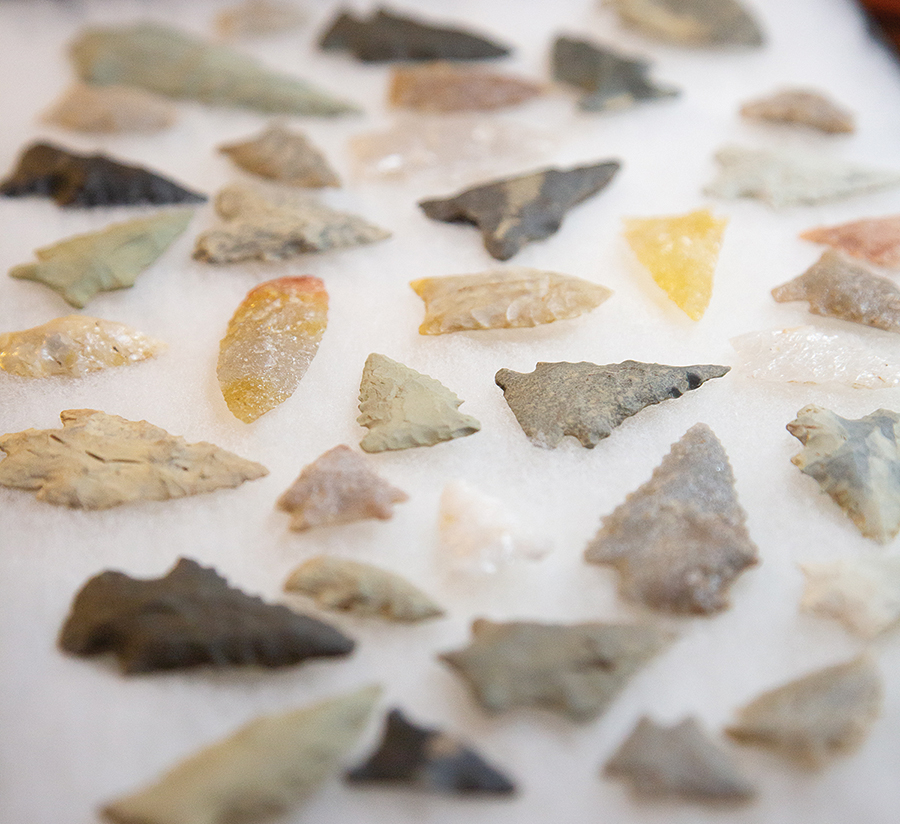
“We hunted mostly on sandy fields, close to water, close to a stream, where the game is, too,” Vaughn says. “We’ve walked in thousands of fields that didn’t have anything. But when you get to one that’s got something, you know right away.”

A fruitful field may have been recently plowed and then rained on. The plowing unearths buried artifacts and the rain washes away the final layer of dirt — a lucky combination made more difficult after modern farming techniques began planting seeds with a drill.

“Normally we hunted in fields that were under cultivation. Back in the day, farmers plowed fields more often. They don’t plow them much anymore,” Vaughn says. “So, a lot of the places that we used to find arrowheads as kids are not cultivated anymore. You’re lucky if you happen to get something. Today you might go five times and find one really nice one.”

Vaughn still hunts arrowheads with his older brother, Charlie, valuing the time spent outdoors with family more than anything he could hope to find. “It’s been fun collecting these, I’ll tell you that,” Vaughn says. “Especially in the spring when the weather gets permissive, you can go out and get some exercise, enjoy the fresh air and the camaraderie.”  PS

Will Harris is serving an internship at PineStraw to complete his Business Journalism undergraduate degree from the University of North Carolina at Chapel Hill. He works locally as a carpenter, enjoys playing tennis, sailing and spending time with his dog Bear.