After the Barns

The art of David Ellis

By Jim Moriarty
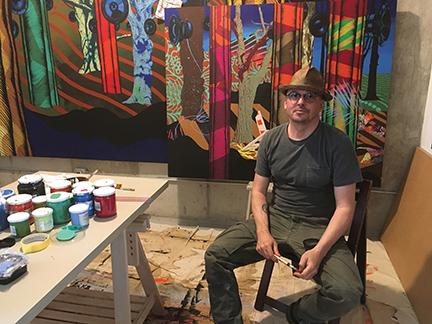
The painted barns of Cameron are mostly overgrown, tumbled-down boxes — tar paper and old boards defying gravity by the grace of a rusty nail. In some cases, it seems as though all that’s holding them up is the paint. Well, the paint and the idea that made them something more than old barns outside a tiny town that grew up over a century ago at the end of an ancient railroad. Twenty years have passed since David Ellis gathered up a bunch of his friends, artists from New York to Tokyo, to come to his hometown to do what they do, make art. Described in those days as a “street artist,” Ellis brought Brooklyn and the Bronx to the barns Earl and Juanita Harbour offered up as canvases.

“There were two massive trips with like 30 people each time, and then there were several trips when it would be me and a couple of people,” says Ellis of the group that became known as the Barnstormers. He’s sitting at the kitchen counter in his small Brooklyn apartment, having a toasted bagel for breakfast. Fresh paintings lean against the wall behind him. His architect wife, Kouki Mojadidi, tends to the plants on the porch. He’s working on his next one-man show, still two years over the horizon.

When Ellis talks, he looks off to the side, not because the answer’s out there, but because that’s where he sees all the questions. He’s interested in the questions.
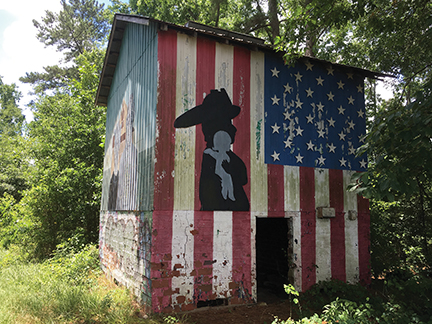
“A lot of those barns we kind of patched up a bit. The roofs were blowing off. There were vines covering them. Oftentimes, there’s a sweet spot. The vines start to overtake something. It fades, it peels. It’s like the patina of time itself. It may be faster on the exterior of a weathered barn, but the fact of the matter is all of this fades — every bit of it — even in the most climate-controlled space. The elements will take it all at some point. Might be a thousand years, might be a 100 years.”

Significant as it was in the moment, what Ellis left behind in Cameron turns out to be far less than what he took with him. “When I do return to Cameron, when I did paint those barns, there’s a cadence and a spirit in the people from Cameron that’s a big part of me,” says Ellis. “It’s who I am. It folds into everything I do and everywhere I go. Cameron people are special people. Real soulful people.”

Ellis and his younger brother, John, are the sons of a Presbyterian minister, Stewart, and his wife, Grace. Stewart nurtured the flock in a small town church. Grace nurtured the art. David has had solo exhibitions in places as far-flung as Texas, California, New York, New Zealand, Ohio, Japan. Two of his pieces have been on display in New York’s Museum of Modern Art. The main gallery representing him is Joshua Liner Gallery in New York, but his work can be found in London, Paris and L.A., too.
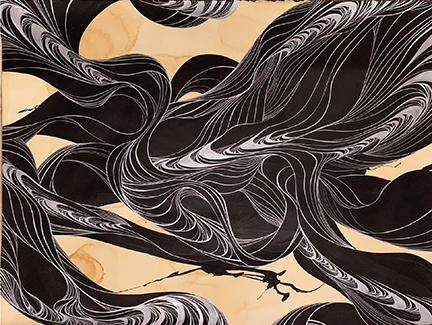
John is a musician who also lives in New York. His main instrument is the tenor saxophone, and he has appeared with Ellis Marsalis, Charlie Hunter, Dr. Lonnie Smith, Kendrick Scott Oracle, Helen Sung and Lionel Loueke, among others. With all due respect to N.C. 24/27, there are apparently two roads leading out of Cameron:  professional wrestling (Shannon Moore, the Prince of Punk; Trevor Lee, the 2017 Impact X Division Champion; and the Hardy Boyz, Matt and Jeff); and art.

In Cameron, a boy’s rite of passage included time in the tobacco fields. “I must have been like 12, 13, 14 — that age,” says David Ellis. “Two or three summers. It was tough but you really appreciated getting to the end of the row. I think the reward was a Pepsi and a little pack of Nabs. You’re just so drained and you’re covered in the resin that sort of seeps out of the little hairs on the leaves. It really cuts through your skin. You take Dramamine and that kind of helps with the sickness you get. I got so sick my last summer, I couldn’t do it anymore. But I love that smell. When it’s curing in the barns, when it turns that golden brown and they truck it through town, that smell that permeates the air is just one of my favorite smells in the world.”

Ellis incorporated more than the barns into his art. He took the tobacco with him, too, using it to prepare the paper he drew and painted on. “I brought back like a whole burlap sheet of tobacco from Cameron on one of those barn trips. I used that for years to stain the paper,” he says. “I’d lay a whole floor of paper out with as many sheets as I could fit in the footprint of the studio. I’d brush and pour the stain on and let it evaporate overnight, really soak in. These amazing pools and forms would show up the next day. They’re not so much backgrounds as they are foundations. I like having something to react to, to riff against. It activates different memories. Just the smell I remember growing up — that time period, 13, 14, when you really start to find the impulses you chase your whole life.”

When Ellis couldn’t stomach priming tobacco anymore, he turned to Earl Harbour’s car wash, where the hiss of soapy water and the flapping of soft brushes danced to hip hop tunes. He’d stay up late with the volume turned down to listen to DJ Gilbert Baez on D103 FM out of Fort Bragg. The whole notion of percussion, beat, rhythm, seeped into his work as deeply as a day in the fields. He talks about his love of music in a statement on his website, davidellisstudio.

“The first nine months of your development you were listening to one of the best bass drums in the world until yours kicked in with it and you heard the best polyrhythms ever . . . I think everybody’s got a lot of music in ’em. I think that’s why you find marching bands and percussion in every form in every corner of the planet.”

That music, those rhythms, melded with one of his earliest childhood memories to form another of Ellis’ expressions, his kinetic sculptures. “Maybe I was 3,” he says, just months before his family moved to Cameron. “I remember seeing this piano play by itself.” The player piano was at an uncle’s house in Raleigh, the home of another jazz enthusiast. “It really went back to trying to figure out how these things work. I went online and I found all these discussion boards for people who restore these things. I made all the machines and bellows and stuff from scratch.”

The sculptures are collections of everyday objects, paint cans, empty bottles, stuff. View them here. Using a scroll, almost identical to the one in a player piano, he pulls tones and rhythms from the sculpture. “A painting, essentially, is a drum. It’s a membrane stretched over a frame. We think of them for the visual resonance but when you’re preparing a panel you often tap it. The under layers of rabbit skin glue dries, it tightens up the pores of the canvas, and you get a drum sound. And I wanted to go more in the sonic direction.” Examples like The Message, True Value and Trash Talk — some done in collaboration with Roberto Lange — can be viewed on his website.

Not long after abandoning the car wash, at 16 Ellis was off to the North Carolina School of the Arts. “It was clear to me and to everyone around me at a very young age that I was totally absorbed in making things. I didn’t have a lot of patience for a lot of things, but making things, painting things, drawing things, sculpting things — I’d just spend days on them,” Ellis says.

“I think you would call him a prodigy,” John Ellis says of his older brother. “He might resist that characterization, but it’s certainly what it seems like to me.” John, in fact, followed David to the School of the Arts, where both brothers blossomed.

“In terms of formal education I’d say maybe that school added the most fuel to what I was already working with,” says David. “The dean of the art school was Clyde Fowler. He was the drawing teacher, but the drawing class was way more than just drawing. He was showing us film and painting techniques. He just blew everybody’s mind. If you wanted to have your mind blown, it was blown. He passed away not to long ago. He helped a lot of people with their dreams.”

With their boys at the School of Arts, the parents moved to Winston-Salem. Stewart, now retired, aligned with Trinity Presbyterian Church there, and Grace wrote poetry (Sam Ragan published some of her work in The Pilot in their Moore County days) and plays, something she’d begun doing in Cameron when she penned Through the Depot Door to celebrate Cameron’s centennial. She’s been a member of Greensboro’s Playwright’s Forum for more than 20 years and has started a group called the Triad Playwright’s Theater, which recently performed one of her works, Rhonda’s Rites of Passage. David Ellis finished his formal education in New York at the School of Visual Arts and then The Cooper Union.

Though the Barnstormers took on something of a life of their own, there aren’t any card-carrying members. It was never meant to be a “thing,” a traveling carnival of artists. There have been projects since Cameron, but they’ve been few. In 2004 a group of them came together to do a project for the Southeast Center for Contemporary Art in Winston-Salem.

“We took one of the Harbours barns apart piece by piece, put it on a flatbed, drove it to Winston, rebuilt it in the museum and we shot time lapse (video) of it coming down and coming back up,” says Ellis. “Over the course of two months we’d fly artists down from New York, Tokyo, some other places, to paint the barn. That was filmed. Then the next person would come in and paint over that thing. That was filmed. Then we took the barn apart and put it back up in Cameron and covered it with tar paper.”

There was one other Barnstormer family reunion, at the Joshua Linear Gallery — a Barnstormers version of The Band’s The Last Waltz. “It was never really meant to be all that formal,” says Ellis of the group. If an invitation for another collaborative project was to come down the road, Ellis isn’t even sure he’d want to call it Barnstormers “out of respect for what we’ve all done together.”

The kind of time-lapse painting he brought to Winston-Salem is another of his core expressions, what he calls his motion paintings. They can be viewed here. “It was a way for me to look back and be like, ‘Oh, man, I wish I’d stopped there,’ or ‘It’s interesting I changed that.’ And then it became this fluid, creation, destruction, creation, destruction sort of moment. It wasn’t, for me, about a start-to-finish thing. It was about this thing is constantly changing. I still return to that. I think it taps into the improvisational kind of music side of the brain. I go back to that Tibetan idea that no condition is permanent. Like the mandalas that are painted with sand, then the wind blows them away and you make it again.”

Walter Robinson, an editor of Artnet Magazine, wrote, “Whatever Ellis makes in one moment is erased in the next. What was just done is gone before you can even see what it is. The stop-action is mesmerizing and magical but at the same time it’s no mystery, anyone can see how it’s done, just pictures, pictures, pictures, painted one after the other step by step. But it adds up to a perfect art film . . . .” It was one of his motion paintings, this time of a moving van in Osaka, Japan, that found its way to MOMA. Some of his motion paintings, sometimes solo, sometimes in collaboration, can be viewed on his website, as well.

When the Barnstormers were in Cameron doing what they do best, Cameron did what it does best — it threw a pig pickin’. “You get one artist making something, there’s a lot of energy generated,” says Ellis. “You get like 20, 30 artists all working in a compressed amount of time with a community where it’s a little bit out of the ordinary for that to happen, the energy that was generated between the artists and the people of Cameron, that was amazing. The feedback we had, the sitting down and having a pig pickin’ covered in paint. . . it was electric.”

It was the sweet spot.  PS

Jim Moriarty is senior editor of PineStraw and can be reached at jjmpinestraw@gmail.com.

Art Here, Art There, Art Everywhere

A cozy family home doubles as a gallery for animal behaviorist

By Deborah Salomon     Photographs By John Koob Gessner

A sandy, rutted, quarter-mile driveway off Pee Dee Road ends at a white clapboard house with enough wings to take flight. Its front yard is a grass pasture sized for soccer, or football, or equestrian trials. Somewhere on the 150-acre estate are remnants of a tennis court. Yet the exterior suggests a family home, more comfy than pretentious, despite its 6,000-square-foot interior.

The sign by the front porch reads Whitehall — not for London’s government center, but because the man who built it during the development of Knollwood in the 1920s was named White, or Whitehouse.

One legend has this wealthy New Yorker losing his fortune in the 1929 stock market crash — and committing suicide.

Lacking a documented pedigree, Whitehall speaks for itself through Dr. Barbara Sherman — veterinarian, author, respected animal behavioral specialist, clinical professor at N.C. State College of Veterinary Medicine — who has occupied the house for 20 years.

From the outset, Sherman saw it as more than a sprawling residence offering both beauty and privacy. “The light, the bay windows and curved walls, the moldings, the space” suggested a gallery. She is a connoisseur and collector of sculpture,  pieces displayed on pedestals acquired during travels to galleries and showings, preferably where the artist is present.

“I am intrigued and often moved by artistic expression — not sure why, but some contemporary art speaks to me,” she says. “I feel pleasure living with it and by purchasing it, supporting the artists, learning how they found their way.”

Understandable, since “my parents collected sculpture.”

Her involvement, more likely passion, begins with the sculpture outside the front door, which she describes as an ocean stone rounded by the sand and inexorable movement of the sea, with contrasting sharp lines of the artist’s cut and the potent symbolism of the center circle, all mounted on a steel base.

“It almost seemed an altar to the miracle of nature.”

Once inside, Sherman lovingly strokes a ceramic elephant fossil displayed in the small sitting room off a foyer where a wall-mounted metal torso flanks the front door.

Now, first-time visitors know what lies beyond.

The house, purchased from the Drexel family, was once a hub for the six Drexel children and their friends. To accommodate the crowd, in addition to a huge living room, the Drexels added an even larger family room, where over the fireplace hangs a piece of geometric fiber art designed by Alexander Calder.

David Drexel was a popular Boy Scoutmaster who held events at Whitehall, recalled fondly by Scout Bob Ganis: “We would walk from Whitehall to a small pond in the woods to swim. That pond still exists as a water feature at Talamore golf course.”

Daughter Tina (Drexel) Adams remembers raising chickens and pigs: “I used to ride along in Dad’s truck delivering eggs.” She also recalls giving birth to her middle daughter there.

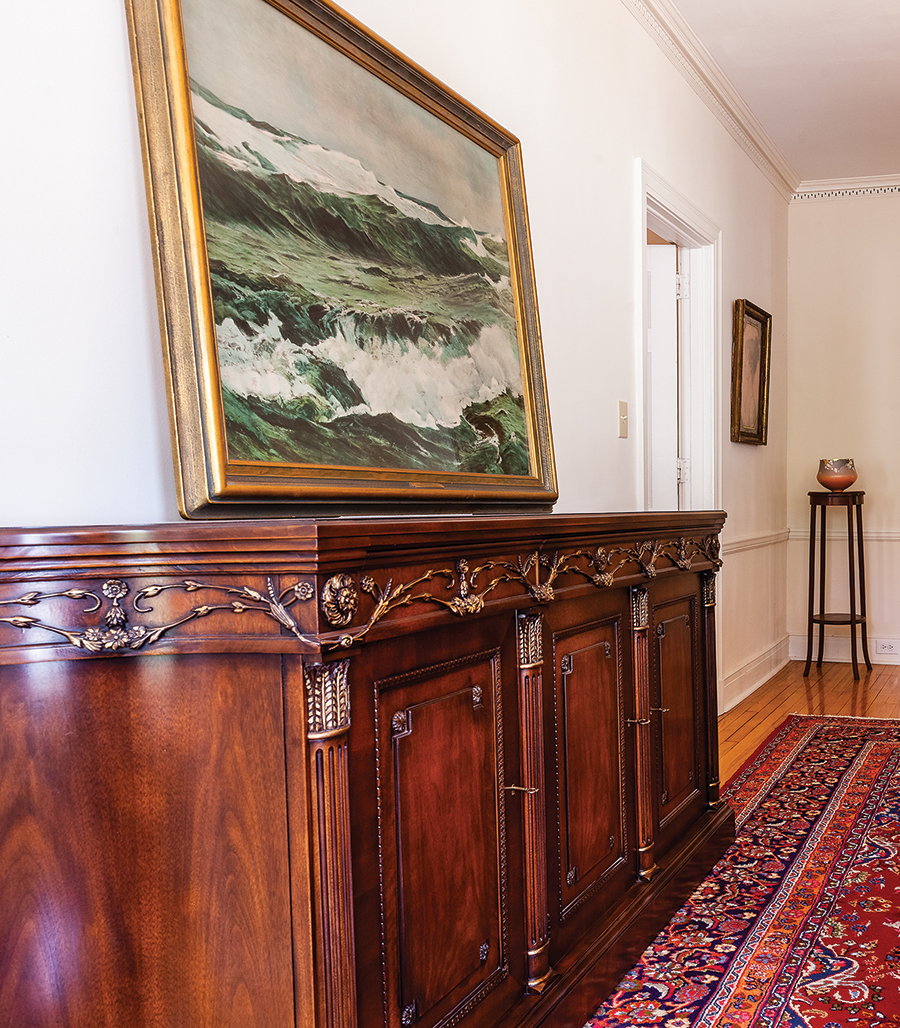
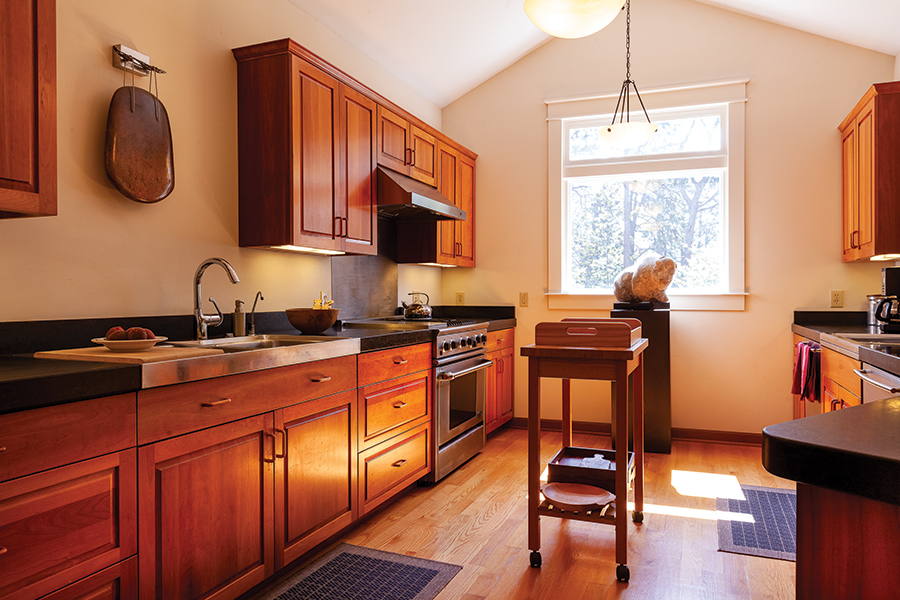
Sherman spent a year renovating without altering Whitehall’s character or floor plan. The rooms, like a maze, connect with each other rather than radiating from a hallway. A garage and screen porch were added, where Sherman sits and watches red-tailed hawks and deer. Original heart pine floors were refinished but not stained. Cherry cabinetry in the new kitchen channels the Arts and Crafts period. Even here a pedestal supporting a buffalo sculpture fronts a bare window, while another flat piece hangs over the sink. Large abstract paintings and landscapes, one by Evelyn Dempsey, decorate the passageway from kitchen to family dining room, delineated by an Oriental rug, one of dozens throughout the house.

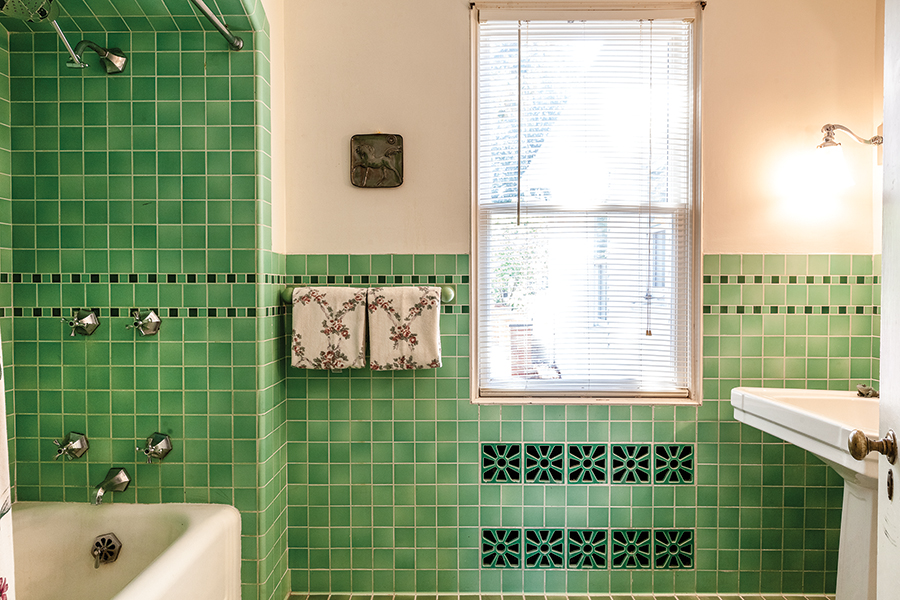
The renovation included skylights and all systems, but not bathrooms tiled in that 1950s froggy green rarely seen since. “Look at the tiles, the workmanship,” Sherman says. “Before they came (in sheets), each tile was laid individually.”

Of all Whitehall’s randomly situated rooms, one stands out. Located just beyond the small sitting room, this might have been a sunroom, with tall windows on three sides and the arched ceiling. Aside from several pedestals and a carpet, its only occupant is a jointed life-sized wooden block figure reclining on the floor, titled The Pine Man, which Sherman found in Cleveland.

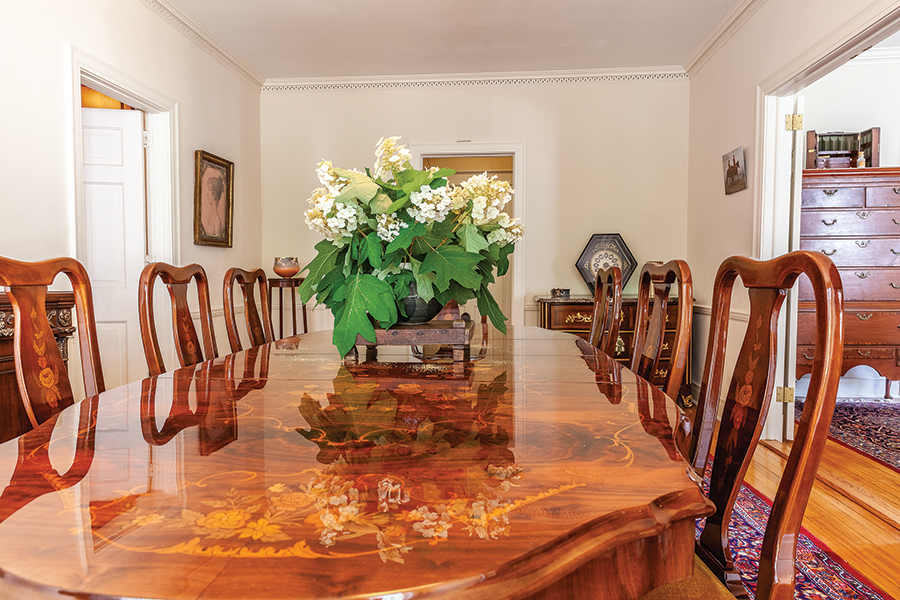
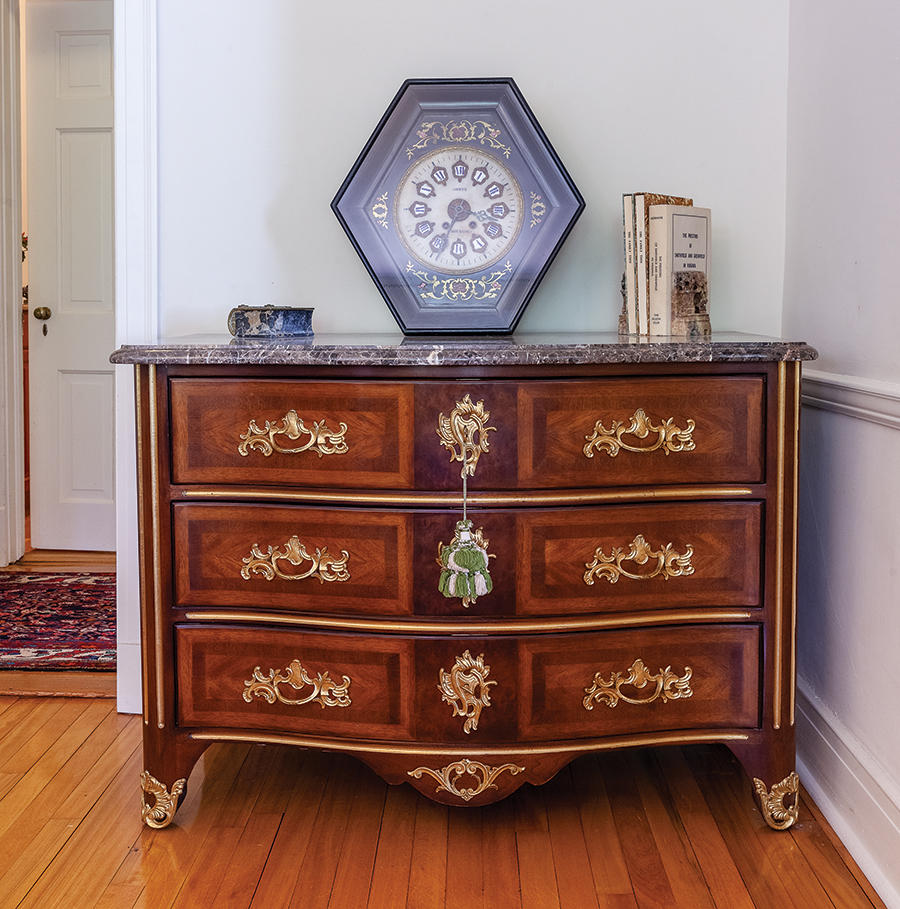
When art comes first, integrating furnishings can be tricky. Sherman respected no boundaries. “My mother was an interior designer” who contributed many exquisite European pieces, including an inlaid dining table, lovely enough to leave bare when in use. Just as impressive, several burled highboys and a glass-front cabinet displaying a collection of about 40 fine china demitasse cups, some rimmed in gold. They belonged to Sherman’s grandmother, who lived in Greensboro.

“Do I look like a demitasse person?” Sherman smiles, wryly.

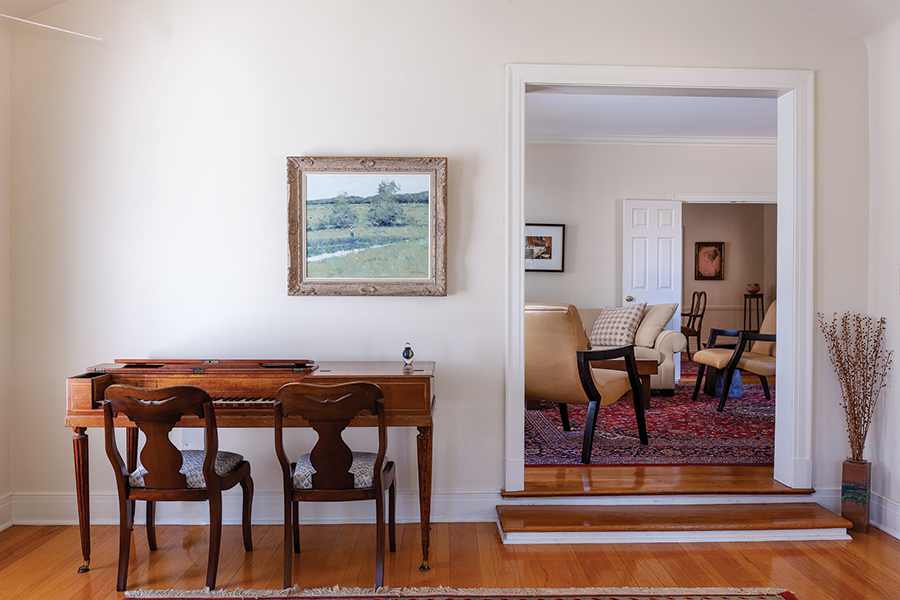
The showpiece, however, is a table piano dated 1791 made by Sebastien Erard, an 18th century French instrument crafter who received commissions from Louis XVI and Marie Antoinette. According to a music history, Beethoven, Chopin, Liszt, Verdi, Wagner and Mendelssohn also owned Erard pianos.

For the rest, Sherman chose plain, stocky tables, sandy-neutral leather chairs and upholstered sofas that do not draw attention away from the art and antiques. “Simple, handcrafted, esthetic” were her requirements.

For years Sherman drove almost daily to Raleigh. Once home, Whitehall fulfilled her need for nature. “I love being in the woods and observing the natural world around me.” This fulfillment has been shared with the public since David Drexel approached the newly formed Sandhills Area Land Trust (SALT) to establish a conservation easement. Therefore, the Whitehall Trail, a 2-mile loop and 57 acres surrounding it, will be reserved for public use forever. The rough, often leaf-covered trail is open to walkers (with or without dogs), joggers and cyclists, but not horses.

Sherman’s daughter is grown and gone. Since retirement, she and scruffy rescue terrier Jasper don’t need 6,000 square feet on 150 acres. They are moving closer to the horses she loves and understands, and a human community of the like-minded. Perhaps Whitehall will find new purpose as a proper gallery, or an organization’s performance/educational/arts space, she muses.

“Life has changed. I want to divest myself of so many material things, have less to be responsible for, live at a different rhythm.” This applies to mowing the pasture on a ride-on, but not to her collections.

“It is remarkable that people can create such things,” she says. “I will always want to be surrounded by art and nature.”  PS

2019 Summer Reading Issue

Well-Versed

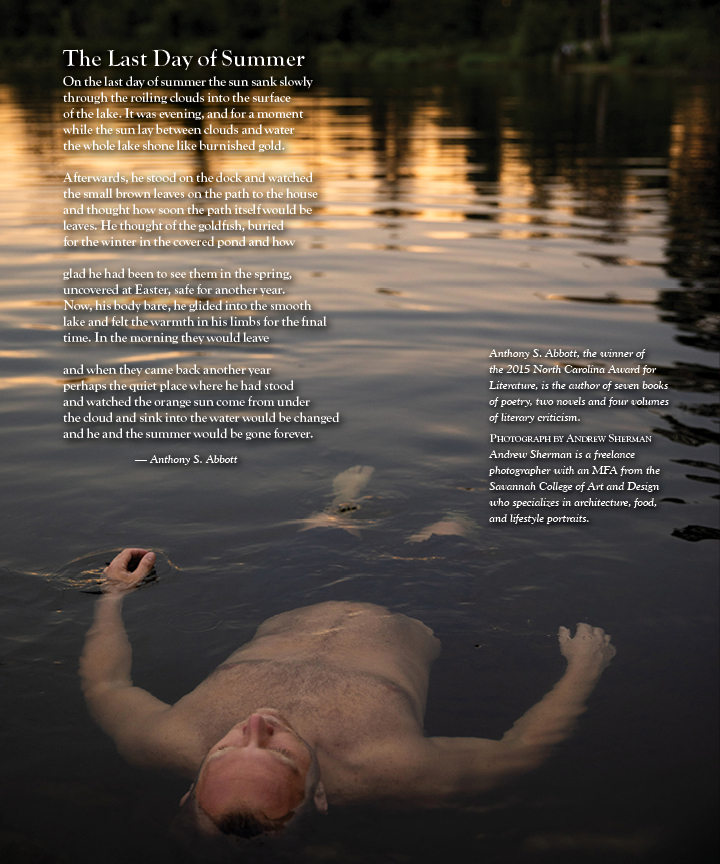
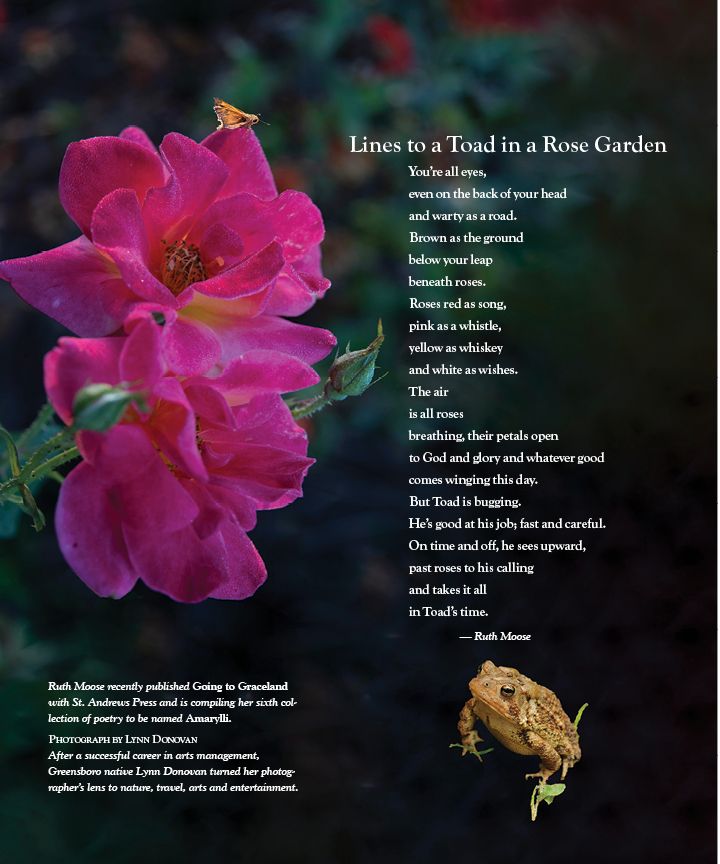
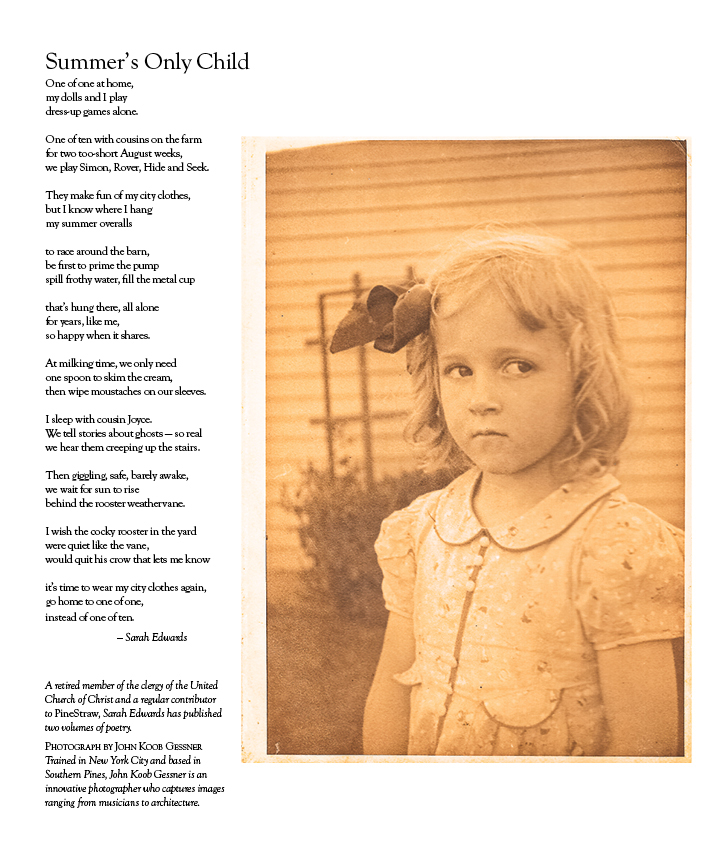
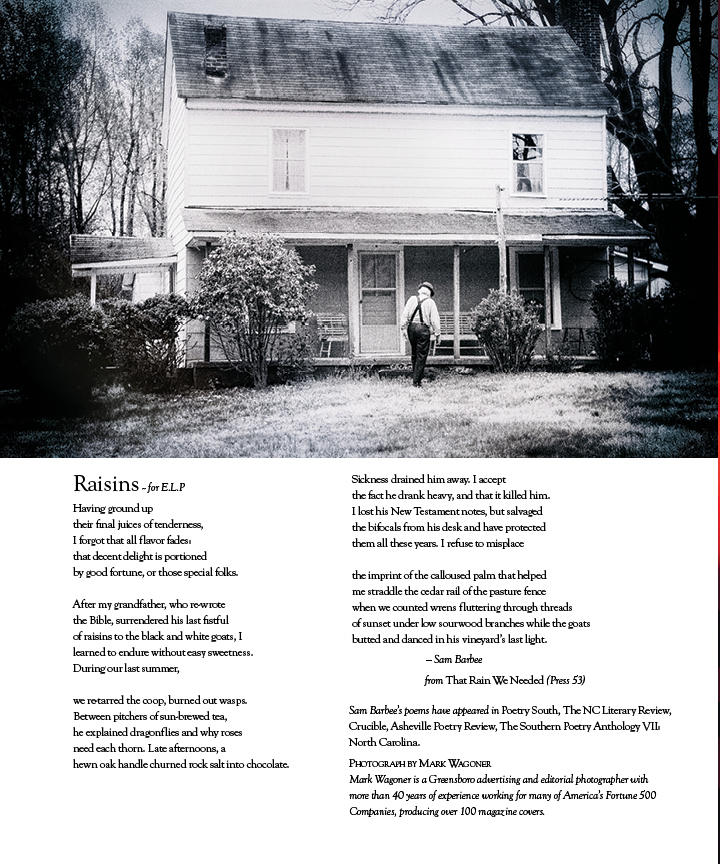
A pocketful of poets & photographers reflect on summer

Ask a poet to show you a glimpse of summer and they will not give you words on a page.

“OK,” they will tell you, tying a silk cloth over your eyes, and then they will take your hand, guide you to the end of the sidewalk, where you will leave your shoes.

The earth feels wet and cool beneath your feet, each step like a distant memory, and the more you trust the ground beneath you, the more you will notice that everything is alive. Whether or not you’ve been here before, or think you have, there is something foreign within the familiar, and the possibility of discovery ignites you.

Just beyond a swollen creek, where chorus frogs shriek in the wake of an August rain, something will demand your attention — a fragrance, perhaps. Or filtered light flickering across your face and skin. Or the sense of nearby movement. You will know when it arrives, and when it does, it will draw you closer to the source.

Before the cloth slips down below your eyes, you will feel a shift in the air. And then you will see it: a moss-laced grove, a golden field, the garden of a lover who still haunts you. The poet who led you here is gone, and in the midst of this enchanted dreamscape, you have unearthed something within yourself, a pain or a delight — an awakening that cannot be reversed.

This is the beauty of poetry. Sweet or bitter, subtle or Earth-shaking, whatever truth has been revealed reminds you of the exquisite cauldron of human emotions that you might stumble upon at any instant.

For our annual August Reading Issue, we invited a number of our favorite poets (including two Poet Laureates) to take us somewhere special with their words, matching them with a gifted photographer to illustrate their vision.

In this dreamy, golden season dripping with raw honey and memory, each moment is ripe with surprises. You’ll see. You can leave your shoes behind. You need only be open to discovery.  Ashley Wahl


A Simple Moment

Finding life through the lens

By Will Harris     Photograph By Laura Gingerich

Outside the entrance of the only amusement park in Havana, Cuba, a photographer assembled a pop-up studio to take pictures of visiting families. He developed the film and sold the prints to them as they left, the keepsakes of a special day. That enterprising photographer was Joaquin Ruiz, the patriarch of a family of three generations of photographers. His granddaughter, Neily Ruiz, has journeyed a long way to arrive, at least metaphorically, in the same place.

“I grew up seeing the darkroom and the photography and all of it,” Ruiz says. “I fell in love with it at an early age. It pays my bills, and this is what I do full-time. But it’s more the happiness and the joy I get when I have that camera. I would do it for free if I had to.”

Ruiz, who is opening a photography studio on Pennsylvania Avenue in Southern Pines, immigrated to the United States when she was 15 years old. When she was growing up, electricity and fresh water were unreliable resources. When the water was running — sometimes as infrequently as once a week — the family stored it in a large cistern. During shortages the children showered together outside using buckets. When the lights went out, they invented games to pass the time.

Food was rationed by the Cuban government, allotted to families according to a prescribed formula. Each family could only buy what their particular entry in a notebook specified they could buy, no more. A few bottles of milk, a couple of pounds of rice and beans, and several ounces of oil were typical monthly provisions.

“And if you have five kids, how are you going to do it? They don’t care how many kids you have, it’s your problem,” Ruiz says. Playing childhood games with dead-eye purpose, she and her cousins threw rocks to knock mangoes and coconuts out of the trees. She remembers it fondly. “My childhood was so perfect; there was a lot of happiness. How do you grow up so happy, with so little?” she says. “It’s fascinating. I learned to appreciate things. It was always a creative moment.

“Maybe that’s what made me a dreamer. That’s where my creativity was born, out of the hard times.”

Ruiz’s father, named Joaquin like his father, was disenchanted with Cuba’s lack of opportunity. When Ruiz was 14 years old, Joaquin decided to take his chances in America. The only question was whether the family, including Ruiz’s 3-year-old sister, Leiny, could make the dangerous journey, too. Ruiz’s mother, Xiomara, left the decision to her.

“And she said to me, ‘If you want to stay, your dad is going to have to go alone. But if you’re going, I’m going. We are all facing the same fate together,” Ruiz said.

They were only too aware of the danger. “I had neighbors who died on the ocean. I had neighbors who were eaten by sharks. They were all together in a boat and a shark ate two of them, and the rest are going to have to live with that for the rest of their lives. We go through these things in Cuba all the time,” Ruiz says.

She decided to go. Her father made the arrangements, but they had to wait for months. Ruiz was away at school studying to be a teacher, when she woke up feeling very sick. She asked her father to come get her and take her home. The call came when they got there. It was time to go.

“A Blank Space”

Had Ruiz not fallen ill, she would have been left behind, unable to get home in time by herself. All family members packed a small backpack and they left that night, telling no one — not even Ruiz’s grandmother.

The family traveled to a coastal town outside Havana where two smugglers would pick up their human cargo from the end of a jetty. A flashlight signal from a 31-foot boat meant the way was clear. The family signaled back. The smugglers turned off the engines, and the boat drifted to the jetty. Seventeen people got on board. Nine were children.

“I don’t think my brain ever understood how I left alive, to wake up in a different place and call it alive,” Ruiz says. “That has always been a mystery to me.” She calls it “a blank space.”

“It was six hours and a half on the ocean,” Ruiz says. “I had my sister on top of me. I was talking to her and telling her we were in a train, and the train was going to get there soon. And we got here, and we faced this reality. There are no neighbors that we know, there’s no grandmother anymore. There’s no cousins and friends. We’re alone.”

The family settled in Miami. Her father had a difficult time finding a job, and no one in the family spoke English. Ruiz had two pairs of pants, one dress and a single pair of red shoes to wear while she attended high school. She was bullied along with other non-American students, in part because of the sparingly few pieces of clothing she was able to bring with her.

“It was brutal,” Ruiz says. “I cried forever. I wanted to be with my grandmother; I wanted to go back. Adjusting here was so hard.”

Ruiz got a job at a McDonald’s. She recalls one particular businesswoman who came into the restaurant frequently. She spread out her papers and worked for hours. The woman, a lawyer, told Ruiz that she, too, had worked at that exact same McDonald’s, and she came back to remind herself of her past. She told Ruiz that if she wanted to, she could do great things, a message Ruiz passes on whenever she goes to a McDonald’s now.

Photography Beckons

After high school, Ruiz studied criminal justice, though she remained connected to the art of photography, even taking a job in an Eckerd’s photo lab. She had nearly completed her criminal justice degree when she saw banners for a private photography school’s new semester. She left the criminal justice program and began formally training to be a photographer. Then she got a job photographing newborn babies at Miami hospitals for a private company. Soon after, she rented a space for her own studio photographing newborns and their parents. By 2005 she had become a citizen of the United States.

Ruiz got involved in the Spanish-speaking photography community through social media, eventually starting her own networking group when she moved to North Carolina. Through her connections, she began teaching technical classes for photographing newborns throughout the United States, Peru and Mexico.

“This has brought me to some amazing places. I never imagined that I was going to teach photography,” Ruiz says. “If I had the opportunity to choose again, I would be a photographer. And I would have started even earlier.”

Ruiz will be teaching a class in Cuba this October. In her Southern Pines studio she’ll photograph newborns and expand into fine art photography, weddings, and quinceañeras — Catholic celebrations of a girl’s 15th birthday.

“I was always in love with photography. It’s just incredible; you can do so many things,” she says. “Out of one moment there are so many images, so many ways of seeing an image. So many feelings you can capture out of one simple moment.

“It’s just amazing. I will always love it.”  PS

Will Harris served an internship at PineStraw to complete his business journalism undergraduate degree at the University of North Carolina at Chapel Hill. He works locally as a carpenter, enjoys playing tennis, sailing, and spending time with his dog, Bear.

The Heat Is On

The U.S. Amateur returns to the Sandhills

By Jim Moriarty

When the United States Amateur Championship makes its fourth trip to the Sandhills of North Carolina this August, it brings with it the promise of great achievement and the baggage of great expectations. Whoever survives two rounds of stroke play qualifying followed by six matches will have reached the pinnacle of his amateur career and earned the scrutiny that just naturally accompanies winning a national championship. August will bring the heat, but the U.S. Amateur brings a little of its own.

It has been won by mortals and immortals. It’s been won by the greatest players who ever lived — Robert T. Jones Jr. (five times), Jack Nicklaus (twice) and Tiger Woods (three times in succession). It has been won by players who capture the odd major championship without scooping up double handfuls of them and still other players who have solid professional careers, winning tour events here and there along the way. It was won in back-to-back years by one of Pinehurst’s favorite sons, Harvie Ward. It’s been won by players who disappear almost entirely from the golf horizon and by others who become barons of the game, say, a president of the USGA (William C. Campbell) or the chairman of the Augusta National Golf Club (Fred Ridley).

Labron Harris Jr. won the title on Pinehurst’s No. 2 course in 1962 with Dwight Eisenhower in the gallery. Hal Sutton lifted the Havermeyer Trophy — named for the first president of the USGA, a Wall Street sugar tycoon — at the Country Club of North Carolina in 1980. And Danny Lee pushed aside Tiger Woods’ record to become the youngest winner of the championship when it returned to Pinehurst No. 2 in 2008. It was a record that would last for all of one year.

This year’s championship will be conducted on Pinehurst’s No. 2 and No. 4 courses, the latter recently revamped by Gil Hanse. The 312 entrants will play 36 holes, one round on each of the courses, to winnow the field to 64 for match play. The first five rounds of matches will be conducted on No. 2, and the 36-hole final will be played on No. 4 in the morning and No. 2 in the afternoon, a first for the 119-year-old championship.

Sutton’s victory in 1980 was, at the time, thought to be mere prelude. That summer he’d entered five tournaments, winning four — Pinehurst’s North and South, the Western Amateur, the Northeast Amateur and the U.S. Amateur. He was unbeaten in match play. The only title to elude him was the Southern Amateur, a stroke play event won by Bob Tway. Sutton’s father, Howard, owned an oil business in Shreveport, Louisiana, and there was talk of Hal becoming the next Bob Jones, someone who could afford to remain an amateur and who had enough game to compete with the professionals. He was, in fact, an amateur long enough to try, unsuccessfully, to defend his U.S. Amateur title — something that won’t happen this year, since the defending champion, Norway’s Viktor Hovland, has become a pro.

Photo shows Hal Sutton at the 1980 U.S. Amateur. (Copyright Unknown/Courtesy USGA Museum)

After winning the PGA Championship at Riviera Country Club three Augusts after he won the U.S. Amateur, instead of becoming the next Bob Jones, Sutton was in line to be “the next Nicklaus.” Neither happened. He did, however, win 14 times on the PGA Tour, including the ’83 PGA, where he led wire-to-wire, holding off a charging Nicklaus, the five-time PGA Champion, by a single shot. He also won the Tour Championship in 1998 and The Players Championship twice, once in ’83 and again in 2000, when he outdueled Woods, the man who truly was “the next Nicklaus,” also by a single stroke. A clip of Sutton’s approach to the 18th green at TPC Sawgrass can still be found on YouTube. “Be the right club today!” has become Sutton’s trademark.

Sutton won the U.S. Amateur on the 50th anniversary season of the Impregnable Quadrilateral when Jones won both the U.S. and British Amateurs and U.S. and British Opens in 1930. Unlike Jones, there was no ticker-tape parade for Sutton, just dinner at the old JFR Barn. Sutton would return to Pinehurst in October to play for the Eisenhower Trophy in the World Amateur Team Championship on the No. 2 course. He won that, too, taking the individual title by six shots. The U.S. team won by 27.

“I just loved No. 2,” Sutton says. “It favored a real good ball-striker, especially a good iron player. It kind of weeded out the weak. I think that’s what really makes great golf courses; they’re fair to people that hit the ball where they’re looking, and they’re much more difficult for people that can’t.”

Sutton is one of the players who felt the burden that can accompany a U.S. Amateur title. “At the time it was by far the largest thing I’d ever done,” he says. “It was a sense of great accomplishment, I remember that. I hoped it would be the beginning of big things.

“Everybody that wins the U.S. Amateur, it elevates the expectations for them. It causes people to watch to see what you are able to do. I think as you age you begin to realize that the only expectations that really matter are your own. I was the turtle instead of the rabbit most of the time.”

Big Easy Ranch, Sutton’s hunting, fishing and golf academy, is about 70 miles west of downtown Houston. He suffered a mild heart attack in 2014, the same year he had his second hip replacement. Now 61, Sutton was sufficiently inspired by Woods’ 2018 Tour Championship victory to give the Champions Tour one last go. He dropped 45 pounds but, even so, the body wouldn’t cooperate. He played a few events but was forced to withdraw from his last two by a left knee that needs replacing as much as the hips did.

In the final of the 1980 U.S. Amateur, Sutton beat Bob Lewis, 9 and 8. Lewis was 35 at the time, a professional who had regained his amateur status. Lewis was hobbled by blisters on the backs of his heels, giving him a painful, bowlegged gait. “He wasn’t as old as I am right now,” says Sutton, “but health issues do catch up with us. We’re certainly not what we once were.”

Labron Harris Jr., the son of the legendary Oklahoma State University golf coach Labron Harris Sr., won the first U.S. Amateur held on Pinehurst’s No. 2 course, coming back from a five-hole deficit to beat A. Downing Gray, an insurance salesman from Pensacola, Florida, 1 up. “I went there with the idea of not winning,” says Harris. “I’d check out of the hotel every day and I’d keep winning matches and I’d check back in. You don’t conceive of winning the U.S. Amateur. You shoot your 75 on the right day and you win if you play someone that shoots 77. That’s the beauty of match play and the fallacy of match play.”

One of Harris’ victims was Morganton’s Billy Joe Patton, the local favorite. “It was probably the least popular victory ever in North Carolina,” says Harris.

Gray held a 5-up lead through 21 holes of the final match. He set his afternoon’s cascading misfortunes in motion with a poor drive on the fourth, losing that hole, and then dropping the next four straight to two birdies and two pars, squaring the match after the eighth. On the 11th, Gray drove it against a formidable stand of love grass and Harris went 1-up.

Former President Eisenhower watched only four holes in the afternoon, taking his leave after the golfers hit their tee shots on the par-3 15th. The commander of D-Day was in a golf cart back in the 14th fairway when the two players were invited to meet him before he left. Harris went.

“A USGA man says, ‘Do you want to meet President Eisenhower?’ I said, ‘Sure.’ I’ve got a picture right here in my bedroom, a young man shaking hands with an ex-president.” Gray, his fortunes dwindling, wanted to concentrate on his golf. The next day the headlines read, “Gray Snubs Ike.” Ouch and ouch.

Harris played on the PGA Tour from 1964 to ’76 and won once, beating Bert Yancey in a playoff in the 1971 Robinson Open Golf Classic. “I played good for about half the years,” he says. After his playing career ended, he worked for the Tour for five years.

“I was the No. 2 man (to commissioner Deane Beman) but there were only 10 people in the office,” says Harris. “I did everything. I did the scheduling; the purse negotiations; ran the qualifying schools. I developed the senior tour. The money breakdown they play with now is my money breakdown. I came at the right time to be pretty effective. I was fortunate I worked with good people.”

After he left the Tour, he was the executive director of the Kemper Open for five years. Oh, and he won the Par 3 Contest at the Masters in 1964. There’s no golden trophy for that, but there is crystal.

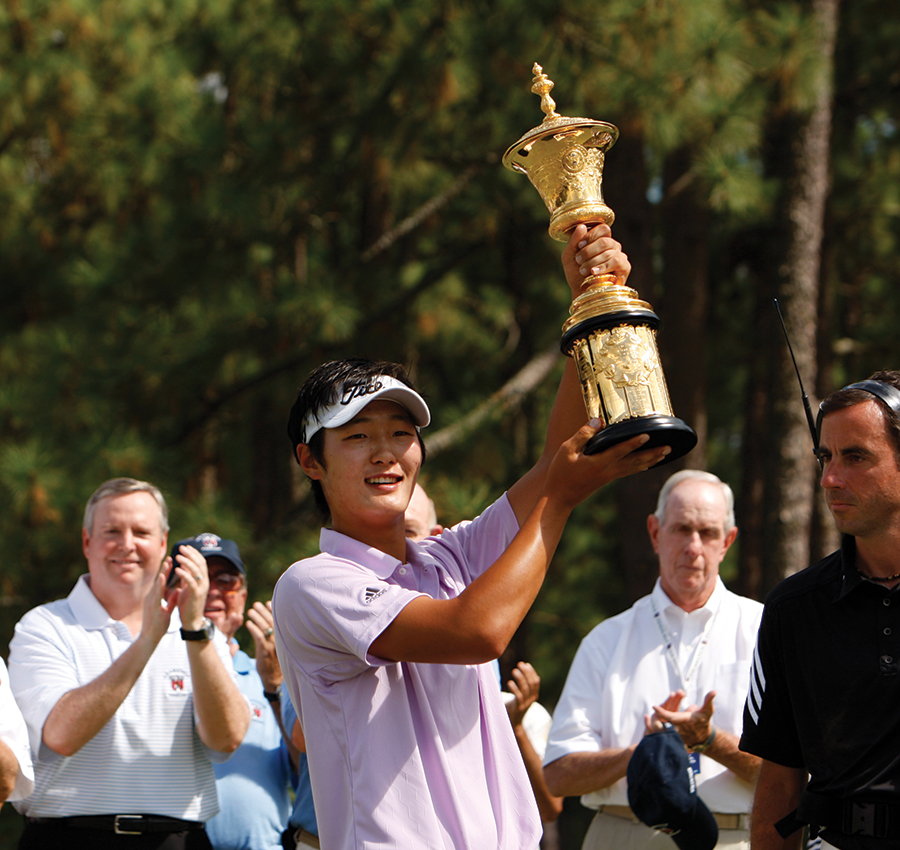
Danny Lee with the trophy after winning the 2008 U.S. Amateur at Pinehurst Resort and Country Club, course No. 2, in Pinehurst, N.C. on Sunday, August 24, 2008. (Copyright USGA/John Mummert)

When the Amateur last visited Pinehurst, it was won by an 18-year-old Korean-born New Zealander, Danny Lee, who beat Drew Kittleson, 5 and 4. Lee was six months younger than Woods was when he won the first of his three U.S. Amateurs in 1994. An Byeong-hun of South Korea blew that record out of the water the very next year, winning at age 17.

Lee’s professional career has been an up-and-down affair with an Official World Golf Ranking that’s gone as high as No. 34 (in 2016) and as low as 444 (in 2010). He won the Greenbrier Classic in 2015 and had seven other top-10s that year. He’s won once in Europe (when he was still an amateur) and once on the Web.com, now the Korn Ferry Tour. He shot an opening-round 64 at Bethpage Black in the PGA Championship in May to trail the eventual winner, Brooks Koepka, by a shot. On social media he’s best known for the practical jokes — traffic cones tied to cars; shaving cream in shoes; so forth and so on — he and Rickie Fowler seem to enjoy playing on one another.

In 2017, Lee suffered a torn ligament between L4 and L5 in his back. “I felt something and the only place I could go was lying on the ground,” he recalled during the PGA. “The next morning when I got up from my bed, I could not move my legs.” Since recovering, Lee has been working with California instructor George Gankas to get longer off the tee. “At first I wasn’t hitting it far enough to compete out here in a PGA Championship or U.S. Open.” Now he does.

That hasn’t altered the vagaries of Tour life much. “Some of the top 20 guys make it look easy, but it’s not always fairy tales and unicorns out here,” Lee said. “When you are fighting for your Tour card every year, it’s basically where you work. How would you feel when you lose your job tomorrow? And you put a lot of effort into it. You’ve tried your best and you did everything you could do and you don’t have a job tomorrow. That’s the same feeling we have. When the results are not there, it definitely gives you a little heartbreak and a little bit of terror, and some of the media is expecting me to do better than that.”

That’s a long way from 2008 when Lee, who had no intention of turning pro at the time, was reminded that the U.S. Amateur champion is traditionally paired with the defending champion at the Masters the following year. That just happened to be Woods. “Oh, my God,” he said. “That’s a special thing. Wow. I’m gong to beat him.”

Winning the U.S. Amateur is a great achievement, a long and arduous climb to the top of a grand hill — a vantage point where it’s possible to see just how heavy the mantle of potential can be.  PS

Jim Moriarty is senior editor of PineStraw and can be reached at jjmpinestraw@gmail.com.

Almanac

By Ash Alder

“Every apple orchard is haunted,” a friend recently offered. “Have you ever noticed? All of them. Day or night.”

I considered the statement, the labyrinths of gnarled trees echoing with distant thuds of falling fruit,
autumn’s electric whisper . . . 

“I could see that,” I replied.

And yet, having never experienced an orchard in August, when the skin of the earliest apples turns from yellow to green, green to red, the flesh inside from green to white, I wouldn’t know for sure. Could only speculate that the ripening of such autumnal offerings in the sweltering heat of late summer is some kind of omen.

Yes, summer is here. Yet the tangles of wild blackberries will vanish in an instant.

There is movement in the periphery. Always. Perhaps there is something haunting about that.

It is remarkable how closely the history of the apple tree is connected with that of man. — Henry David Thoreau

Flower Mandala

In August, when roadside ditches brim with late summer wildflowers — sweet pea and yarrow and swamp milkweed — pull over. 

If you travel with water and a makeshift vase for occasions such as this, handpick a small arrangement for an instant boost in spirit.

And if you’re feeling inspired, dream bigger.

Last year, an hour before sunset, a gardener friend and I met at a favorite climbing tree by a nearby lake to design a flower mandala for the simple joy of creation. I brought a modest handful of black-eyed Susans, some amethyst, a single sunflower. She brought a garden: purple clover, coleus, woolflower, Queen Anne’s lace, fern, walnut, sycamore leaves, and at least a handful of miscellaneous beauties rich in color and texture.

Ancient tools for meditation, mandalas are believed to represent the cosmos, radial designs that guide the creator toward a sense of inner harmony and the essence of his or her own soul.

Ours led us to a space of absolute wonder, and as the final fireflies of summer began dancing among the boughs of our beloved tree, we noticed a small group of passersby that had quietly gathered to enjoy our nature installation — two spirals joined by an unbroken thread of leaves and petals.

We are all so intricately connected. When you follow the simple callings of your heart, no telling how you will color the world.

Bring on the Magic

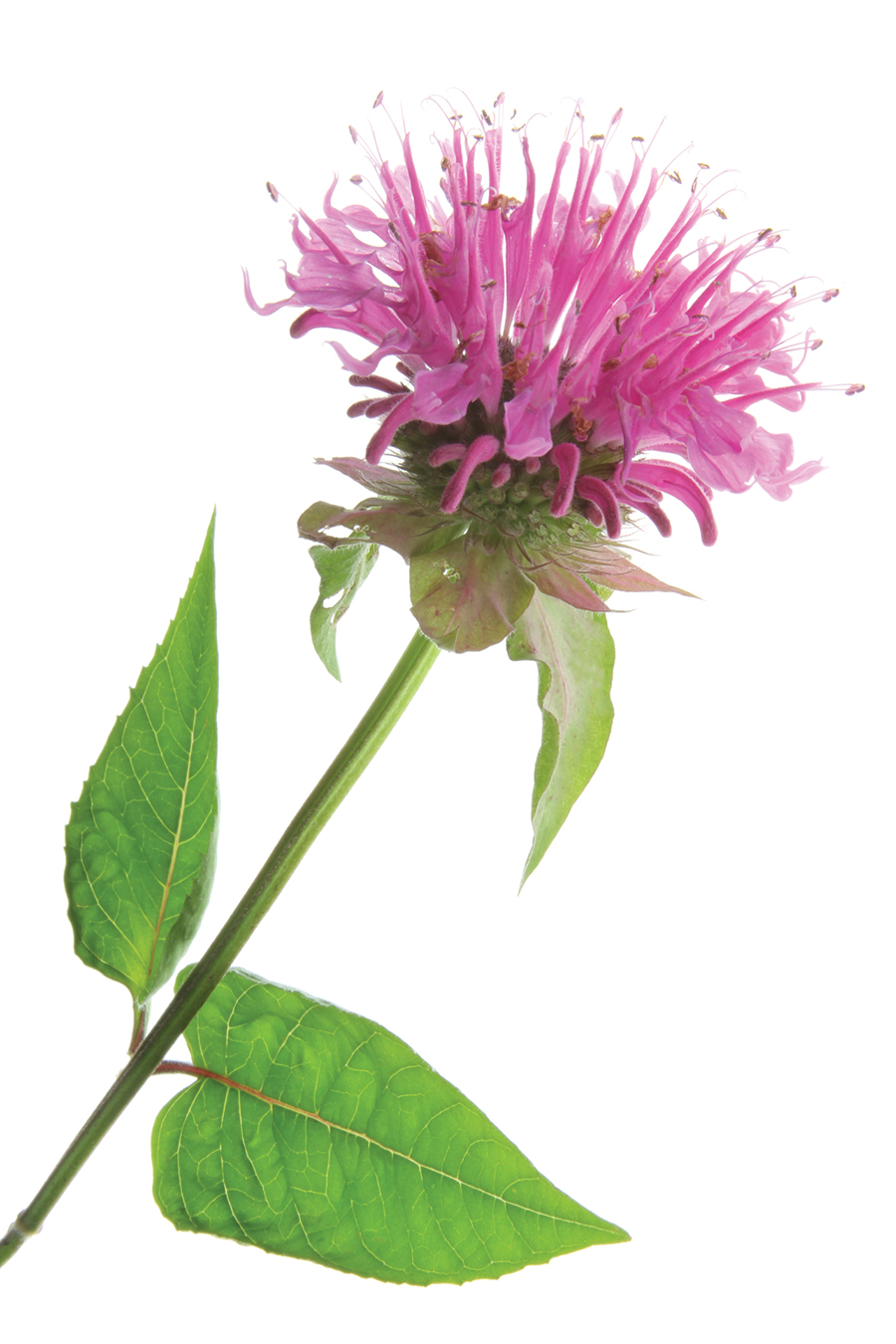
Among our late summer bloomers: bee balm, a showy yet rugged perennial that blossoms red, pink or lavender. Also called horsemint, Oswego tea and bergamot, its fragrant leaves add notes of citrus and spice to any garden. What’s best? Hummers, bees and butterflies find the flower simply irresistible.

A member of the mint family, bee balm grows best (and spreads!) in full sun. Add its colorful flowers to your summer salad, dry its leaves for tea, and above all, know that your balm is a sweet, tasty tonic for a band of local pollinators.

Spoonful of Sugar Water

A friend recently shared with me a Newsroom 24 article from 2018 that states that without bees, we wouldn’t be alive. “If bees were to disappear from the face of the Earth, says David Attenborough, voice of The Blue Planet and Planet Earth, humans would have just four years to live. He suggests leaving a teaspoon of sugar water in your garden to help energy-depleted bees make it back to the hive. “Simply mix two tablespoons of white, granulated sugar with one tablespoon of water, and place on a spoon for the bee to reach,” says Attenborough. In so many words: Save the bees, save humanity.

Deep summer is when laziness finds respectability. — Sam Keen

The Night Sky

This year, our beloved Perseid meteor shower occurs just two days before the full Sturgeon Moon, creating less than optimal viewing conditions for the annual display of up to 90 shooting stars per hour.

That said, just before dawn on Tuesday, Aug. 13, the moon will set, gifting us with an hour of darkness — a blessed chance to catch a glimpse of the magic.  PS

Poem

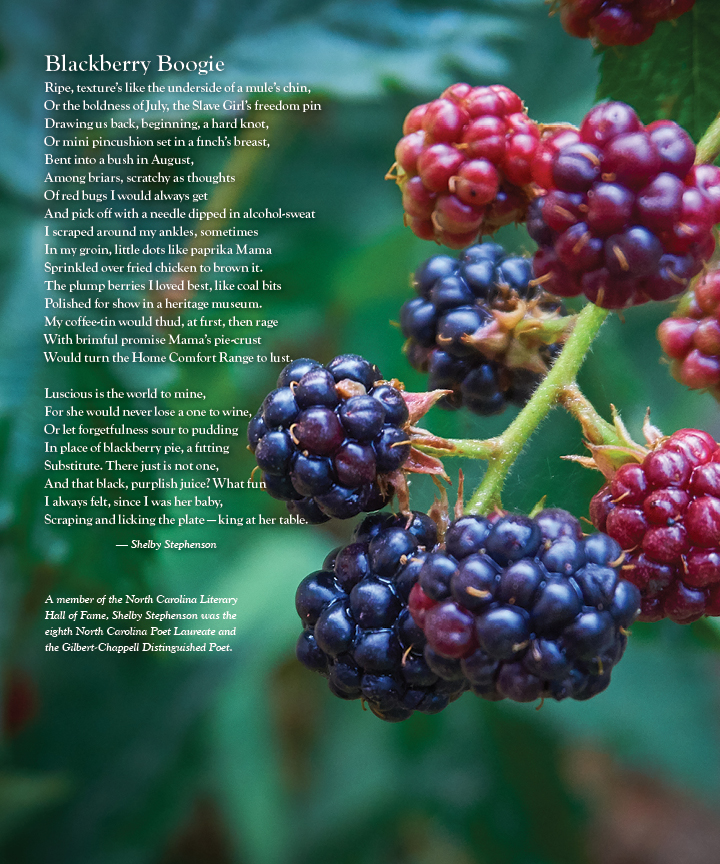
Pulling Up the Wild Blackberry Bushes

seems ungrateful but they’re too plentiful

crowding the precious patch of sun

meant for the Heritage Red Raspberry

that cost $16.

So it’s a matter of hubris that we jerk up

those lesser cousins before they bloom

drag them over nubile grass and

toss their torn briars into fire.

Yet when I get to the last bush, I stop

remember how in August I needed

more fruit to nestle around the scant

peaches in my cobbler.

The berries were small but their juice

tasted of mulled wine, piquant but

not too tart, the grace note of a last-minute

potluck, others cooed for the recipe.

So I lay aside the shovel, knowing that

this last bush, cane too tender for thorns,

might one day be our savior

if the raspberry turns to dust.

— Ashley Memory

Sweet Tea for the Soul

A sociable Southern greeting in a glass

By Gayvin Powers

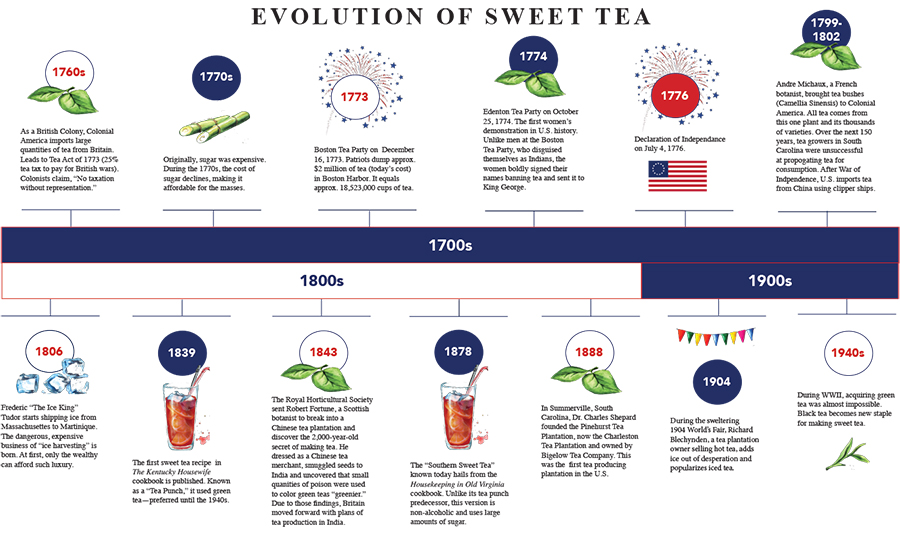
In the South, summer heat takes on a personality of its own, inspiring thoughts like, “I’m walking through soup,” or “If it gets any hotter, I’ll have to take off stuff I really ought to keep on.” One of the only things to do on a day like this is to crank up the AC and have a cold glass of iced tea. Not the iced tea Northerners refer to, the kind that’s missing that one, all-important, ingredient. No, the sweet kind, the kind that Grandma made fresh when she welcomed you every time you knocked on her screen door. Grandmas know tradition, and the sweet tea tradition in the South goes way back to 1839 and a recipe for “Tea Punch” in The Kentucky Housewife cookbook.

To understand the full story of how Southern sweet tea came to be, one needs to understand the building blocks of this cultural icon. It’s the coming together of a trifecta of luxuries in Colonial America: tea, ice, and sugar.

The first is tea. Prior to the 1800s, tea was served hot. As a colony of Great Britain, Americans enjoyed their lavish green tea, drinking more of it than coffee. In 1773, when Britain put a 25 percent tax on tea imported to the American Colonies, the Colonists saw themselves being priced out of one of their favorite refreshing pastimes. And they rebelled. Of course, the Founding Fathers may have had a few other grievances in mind, but it was tea that went into Boston Harbor. After the War of Independence the new nation’s clipper ships sailed directly to China, cutting out the British middlemen and providing the states with tea — and some of its first millionaires.

The second ingredient originated from the wild concept of “ice harvesting.” In the early 1800s, ice became year-round thanks to Frederic Tudor, a Boston businessman who masterminded the trading of ice, garnering him the title “Ice King.” Tudor hired workers for the dangerous job of chipping away frozen ponds in the North. Once gathered, the ice was stored and shipped to hotter locations, like the Caribbean, Europe and India. On blistering summer days, cold treats like ice cream and sorbets became available to patrons who could pay the high prices for it.

Sugar, the third luxury in sweet tea, was domesticated 10,000 years ago on the island of New Guinea, where it was used as ceremonial medicine. Erin Coyle, a North Carolina Humanities Council Road Scholar who specializes in tea, says, “Sugar was the oil of its day.” It was introduced to the New World by Christopher Columbus, who engaged in a month-long affair with the extraordinarily beautiful Beatriz de Bobadilla, governor of Gomera in the Canary Islands — the westernmost islands of what the Europeans considered the known world and a logical place to lay in supplies for an exploration into the unknown. With a reputation for extraordinary beauty, the “Lady of the Gallows,” as she was known, gave him cuttings of sugar cane that found their way to Hispaniola.

“The cost of sugar dropped by the 1700s. Everyone was consuming it,” Coyle says. “In the 1700s, the average Englishman ate 4 pounds of sugar per year. In the 1800s, it increased to 18 pounds. I can only imagine the average amount of sugar a person consumes today.”

One of Coyle’s favorite stories is about a popular establishment just to the southern side of the “tea line” dividing the North and the South — the unsweetened from the sweetened. A Northerner waited his turn behind an older Southern gentleman at the iced tea counter. When the Northerner filled up his cup, he took a deep swig, almost spit it out, and said, “I never tasted anything so terrible in my life.”

The Southern gentleman patted him on the back and said, “You’ve got to work up to it, son.”

Debates on how to make sweet tea are resolute and plentiful. Lipton or Luzianne? Crushed or cubed ice? Baking soda? Simple syrup, yes or no? And the amount of sugar in sweet tea is as complex as the DNA of its maker.

The original iced teas, called “tea punches,” had various blends of sugar, juice, alcohol, lemon, water, tea, spices and cream. In the beginning, these punches had loyalist names such as “George IV,” then made way for more patriotic drinks, called  “Charleston’s St. Cecilia Punch” and “Chatham Artillery Punch.” While these drinks may have had fancy names, none can take home the grand prize for being the original sweet tea. That honor stays with Mrs. Lettice Bryan, whose recipe for “Tea Punch” was published in The Kentucky Housewife cookbook in 1839, making it the first sweet iced tea.

The “Southern Sweet Tea” common today has its roots in the Housekeeping in Old Virginia cookbook, written by Marion Cabell Tyree and published in 1878. Unlike its tea punch predecessor, this version is non-alcoholic and uses large amounts of sugar.

Over time, the production of sugar, tea and ice cost less, and the once expensive refreshment reserved for tea parties and galas became commonplace. It wasn’t long before sweet tea took up residency in the South, where anyone from a neighbor to a mail carrier to one’s grandparents could be greeted with a glass of Southern hospitality.

“Sweet tea isn’t a drink, really. It’s culture in a glass,” wrote Allison Glock in Garden & Gun. It’s steeped in culture, cooled with tradition and sweetened with kindness. In the South, people take their tea recipes seriously.

“The important part about tea is that, no matter where one travels in the world, it’s known for welcoming guests,” says Coyle, who tells the story of one family reunion. “Every family brings their own iced tea, and they all pour it into one vessel. A communal pot, so to speak. Their uncle would doctor it. He usually used pineapple juice as one of the ingredients — that’s one of the popular juices from the original tea punches. That tea would be shared with the whole family. It’s very ritualistic.”

When it came to making sweet tea, green tea was the Bible until the 1900s. During World War II, when it was virtually impossible to get one’s hands on green tea, the United States imported black tea from British-controlled India.

In the South’s sticky summer weather, an icy batch of sweet tea hits you right as rain as you rock on the front porch, watching the fireflies come out. A glass of sweet tea can take you back to childhood — the humidity on your skin as the screen door swings open, the scent of gardenia on the breeze, Grandma smiling, handing you a cold glass and saying, “Come on in, darlin’.”

Tea Punch (The First Iced Tea)

The Kentucky Housewife cookbook, written by Mrs. Lettice Bryan, published in 1839

“Make a pint and a half of very strong tea in the usual manner; strain it, and pour it boiling (hot) on 1 pound and a quarter of loaf sugar. Add half a pint of rich sweet cream, and then stir in gradually a bottle of Claret or Champagne. You may heat it up to the boiling point and serve it so, or you may send it ‘round entirely cold in glass cups.”

Original Southern Sweet Tea

Housekeeping in Old Virginia cookbook, written by Marion Cabell Tyree, published in 1878

“Ice Tea – After scalding the teapot, put into it one quart of boiling water and two teaspoonfuls green tea. If wanted for supper, do this at breakfast. At dinner time, strain, without stirring, through a tea strainer into a pitcher. Let it stand till tea time and pour into decanters, leaving the sediment in the bottom of the pitcher. Fill the goblets with ice, put two teaspoonfuls granulated sugar in each, and pour the tea over the ice and sugar. A squeeze of lemon will make this delicious and healthful, as it will correct the astringent tendency.”

Arnold Palmer

Arnold Palmer left his mark on golf, the Sandhills and sweet tea. The winner of seven major championships who designed over 300 golf courses, including the Mid South Club, is described by Jim Dodson in A Golfer’s Life as “a king with a common touch.” The story behind the refreshing Arnold Palmer drink is a bit mythical. Tea punches with juices have been around for over a hundred years with everyone making their own variation, including Palmer in the mid-1950s. Since there wasn’t a name for his favorite drink, he spent years describing the mixture of iced tea and lemonade to wait staff.

In the 1960s, Palmer ordered his lemonade-tea concoction after a hot day designing a golf course in Palm Springs, California. A woman overheard Palmer order his drink, and said, “I’ll have that Palmer drink.”

During an interview with ESPN, Palmer said, “From that day on, it (the Arnold Palmer) spread like wildfire.”

The Original Arnold Palmer

3/4 parts tea

1/4 part lemonade (healthy splash)

Serve in a glass full of ice.

The Modern Arnold Palmer

1/2 part tea

1/2 part lemonade

Serve in a glass full of ice.

Southern Sweet Tea with a Twist

Since its inception, everyone has put his or her own spin on Southern sweet tea. Few have had the accolades for their iced tea mixology as Rachelle Jamerson-Holmes the founder of Rachelle’s Island Tea. In 2018, her famous tea won the People’s Choice Best Sweet Tea at the seventh annual Sweet Tea Festival in Summerville, South Carolina, and in May, 2019 the sweet tea was voted BEST Sweet Champion at the ninth annual Taste of Black Columbia, in South Carolina.

Jamerson-Holmes owns and runs Thee Matriarch Bed & Breakfast with her husband, chef Fred Hudson. They know that sweet tea is a welcoming necessity when guests visit — which is why people can enjoy a glass on-site or buy it by the gallon (or commemorative bottle) every day at their bed and breakfast.

“Sweet tea was and still is like water,” Jamerson-Holmes says, “always in the refrigerator waiting to quench someone’s thirst.”

Jamerson-Holmes’ tea story has an authentic Southern beginning that starts with family. She remembers joining her great-grandmothers and grandmothers, often drinking sweet iced tea from a Mason jar “on the front porch or under a shaded pecan tree for summer comfort and conversation.”

Currently, she is writing the Southern Sweet Tea Cocktails recipe book, and Thee Matriarch Spiked Island Tea is her signature drink. This recipe is a modern twist on the classic tea punch and Southern sweet tea.

“I love fruity drinks,” Jamerson-Holmes says. “This drink is me.” Sweet, refreshing, and full of tradition.

Thee Matriarch Spiked Island Tea

By Rachelle Jamerson-Holmes of World Famous Rachelle’s Island Tea, “Southern Sweet Tea Signature Cocktails”

1 quart Rachelle’s Island Tea

1/3 cup peach rum

1/3 cup coconut rum

1/3 cup mango-pineapple vodka

2 cups crushed ice

Pineapple spears to garnish

1. Mix tea, rums and vodka in a pitcher.

2. Add ice to glasses.

3. Pour cocktail in glasses.

4. Garnish with pineapple.  PS

Gayvin Powers is author of The Adventure of Iona Fay series and writing coach at Soul Sisters Write. She can be reached at hello@gayvinpowers.com.

Hog Heaven

A pig picking — down-home and dramatic all at the same time. Invite the neighborhood and ice down plenty of beer.

By Jane Lear

When my editor asked me to write about a pig picking — that is, a roasted whole hog and one of the world’s epic, roll-up-your-sleeves culinary projects — I realized I would be inviting the sort of controversy that sparks thoughts of witness protection or, at the very least, a pseudonym. As John Shelton Reed and Dale Volberg Reed point out in Holy Smoke: The Big Book of North Carolina Barbecue, the problem is that, when it comes to cooking a whole pig, “there are reputable, sometimes renowned, pitmasters who would tell you something different at each and every step. Literally, each and every one.” They are not kidding.
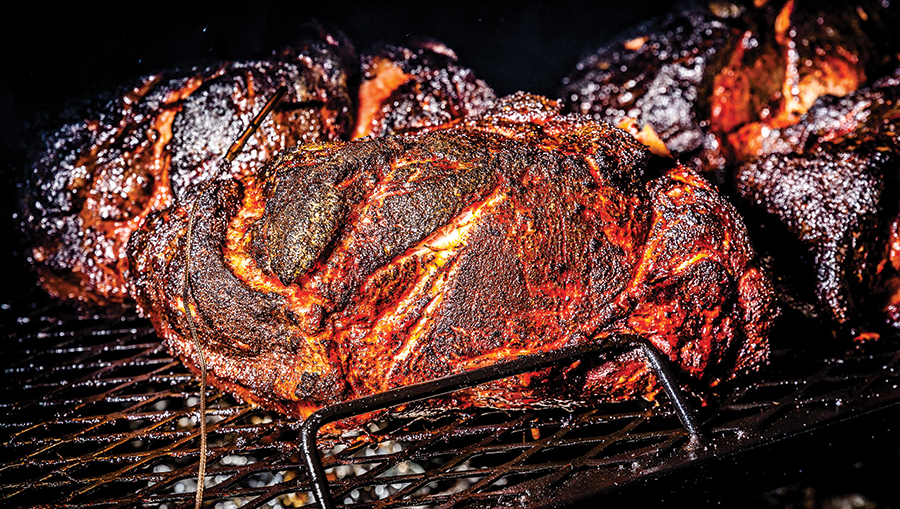
The Backstory

“The first pig roasts were occasions for families and communities to get together, and you’ll find various renditions all over the world,” wrote Jim Auchmutey in the “Foodways” volume of The New Encyclopedia of Southern Culture.  The barbecue tradition of the American South has its roots in the Caribbean, “where Spanish explorers of the early 1500s found islanders roasting fish and game on a framework of sticks they called (in translation) a barbacoa,” Auchmutey explained, adding that the first barbecuers were typically African slaves who combined their native methods of roasting meat with expertise picked up in the West Indies.

There are numerous knowledgeable websites (including those of the Southern Foodways Alliance and the North Carolina Barbecue Society) devoted to barbecue, and it’s the subject of some great books. Among the favorites in my library are the aforementioned Holy Smoke as well as Smokestack Lightning: Adventures in the Heart of Barbecue Country, by Lolis Eric Elie, and Barbecue Crossroads: Notes and Recipes From a Southern Odyssey, by Robb Walsh. What I’m trying to say is that in the space provided here, all I can do is drive slow and point out a few landmarks.

The Meat

In most of the South, barbecue means pork, and particularly in eastern North Carolina, it means the whole hog. You can order a conventionally raised whole hog from a butcher, but if you prefer eating meat that is raised with the welfare of the animals and the environment in mind (hog farming can be especially brutal to both), you may want to seek out a local sustainable farm, or order from one such as Cane Creek Farm, in Saxapahaw. It’s known far and wide as a producer of absolutely delicious pork from pastured heritage breeds: In other words, those pigs only have one bad day. Cane Creek sells whole hogs for pig pickings, and you’ll find all sorts of useful information on their website.

“Whole hog,” by the way, doesn’t actually mean the entire hog, but one that’s been “dressed” — that is, had the feet, tail, and innards removed and the bristles scraped off. Many people prefer to have the head removed as well. Be sure to get the hog with the skin on, though, and ask for it butterflied so you can spread it open on the cooker. Because you may still need to crack the ribs to open the carcass all the way, you may even want to order the pig split down the backbone into halves, which will make it easier to flip. On a practical note, a whole hog is too big for the refrigerator and most coolers, so the most common place to stash it is in the bathtub with lots of ice. Just saying.

The Fuel

In a perfect world, you’d start with half a cord of well-seasoned hardwood logs and burn them down, but about 70 pounds of hardwood lump charcoal is a good compromise. You’ll also want lots of water-soaked hardwood chunks to add to the burning coals for smoke. Avoid mesquite; although it’s great for Texas-style beef brisket, it’s too strong for pork. Instead, choose hickory, oak, a fruitwood such as apple, or a mix.

The Method

The easiest option is to rent a charcoal (not propane) cooker, which you can tow behind a car, or plunk down a chunk of change for a Cuban-style caja china (Chinese box), available at Williams-Sonoma and other online sources. A caja china is simple to use, but although it results in beautifully moist lechón pork, you won’t get much of a smoky whomp. A spit-roaster is yet another alternative, but again, you‘re not going to get the smokiness that aficionados crave.

If, however, you’re the sort of person who can build a raised garden bed, you may not think twice about knocking together a temporary cinderblock pit. It helps to have a truck-owning friend who owes you one, and a place nearby where you can buy supplies such as a sheet of expanded metal. (Avoid galvanized metal, which can give off toxic fumes.) It’s also helpful to have a kettle grill or fire pit to get additional coals working; that way, you can add them to the pit as needed.

“The coals go in a pit and the meat is put more or less directly above them, at some distance (to keep the cooking temperature low),” explain the Reeds. “The meat is kept moist by frequent mopping (basting), and most of the smoke comes from the meat drippings and basting sauce hitting the hot coals (coals produce very little smoke on their own). It’s hard to improve on this technique for cooking whole hogs.”

The Game Plan

Decide when you want to eat and work backward. Build the pit and lay in supplies a few days ahead. Think about delegating authority for the playlist, beer, snacks and the graveyard shift. As far as the cooking goes, give yourself plenty of leeway; depending on the size of the hog, the Reeds suggest at least 12 and up to 14 hours, start to finish.

The Equipment

One or two large chimney fire starters 

An oven thermometer (a remote-read type is nice but not necessary)

A meat thermometer

Heavy gloves (for you and a sidekick)

A squirt bottle of water to control flare-ups

An Eastern North Carolina style barbecue sauce (see below)

The Roasting

There are numerous how-to’s online, so I’m not going to take up space here with the nitty-gritty. But here are some handy tips from the Reeds and various other backyard pitmasters.

When shoveling hot coals into the pit, put more under where the thick, slow-cooking hams (hind legs) and shoulders of the hog will be. Check the oven thermometer; the temperature at grill level should reach 225–250 degrees Fahrenheit. Put a half-dozen water-soaked wood chunks where they’ll smolder, but not directly under the pig. Then put the pig, skin side up, on the grate and cover.

After a while, start another batch of charcoal. Every half hour, check the temperature of the pit. If it’s dropping off, put more hot coals under the shoulders and hams and a couple of hardwood chunks off to the side. Use a shovel to push the dying embers into the middle of the pit to cook the ribs and loin.

After six or seven hours, the hams and shoulders should be looking nicely browned and wrinkled. Stick a meat thermometer in those thick parts — don’t touch the bone — and see if the temperature has reached 165 degrees. Keep cooking until it reaches that temperature, even if it takes much longer.

When it reaches 165 degrees, you and a friend don those heavy gloves and gently turn the pig over. You may need a spatula or (clean) shovel to loosen it first. Don’t worry if the pig comes apart when you do this. Once the skin side is down, you’ll be looking at the ribs. Generously fill the cavity with sauce, and mop the shoulders and hams, too.

Let the meat cook another couple of hours, adding coals and wood as needed, until your meat thermometer reads at least 180 degrees in every part of the animal. The rib and shoulder bones should pull away with no resistance.

The Sauce

This “Old-Time Eastern North Carolina Barbecue Sauce,” which appears in the Reeds’ Holy Smoke, is staggeringly simple. Just mix together 1 gallon cider vinegar, 1 1⁄3 cups crushed red pepper, 2 tablespoons black pepper, and 1⁄4 cup coarse salt and let stand for at least 4 hours.

The Payoff

You can serve the cooked pig as is, pig-picking style, so that guests can choose what they like — moist, tender, pale “inside meat” or the dark, smoky, bark-like “outside meat.” Don’t be surprised if folks don’t stray far from the pit, but simply stand around the carcass, picking the meat right off the bones. Or you can chop or pull the meat for a luscious mix of the two, dress it with some remaining sauce, and add in some crunchy cracklings for yet another texture. The traditional way to eat pulled pork is to sandwich it, along with a generous dollop of coleslaw, in a hamburger bun.

The Sides

Pork is the star of any self-respecting pig picking, but you (or the kind souls who volunteered) will feel obligated to round out the feast with side dishes. And although there is absolutely nothing wrong with baked beans out of a can or jumbo bags of barbecue potato chips, upping the drama quotient, so to speak, can be part of the fun.

If you have a kettle grill going for those additional coals, for instance, it’s an easy matter to grill corn on the cob. Here’s how: Pull back the corn husks but leave them attached at the base of each ear. Remove the corn silk, then put the husks back around the ears. Grill over moderately hot heat, turning frequently, about 10 minutes. Let the corn cool a few minutes, then holding each ear with a kitchen towel, peel back the husk and discard. Serve with mayonnaise blended with a little of the Thai chile sauce called sriracha, the North African chile condiment called harissa, or minced canned chipotles in adobo (all available at supermarkets).

When it comes to potato salad, if you are lucky enough to find honest-to-goodness new (that is, freshly dug) small potatoes, with their thin, delicate skins, at the market or farm stand, there’s no reason to camouflage their earthy flavor with mayo and bits of hard-boiled egg. Simmer the spuds in well-salted water until tender, about 15 minutes or so, and cut into quarters when cool to the touch. Drizzle with extra-virgin olive oil and gently toss with finely chopped shallot, chopped fresh thyme leaves (include some thyme flowers if you’re harvesting out of the garden) and/or parsley. Add salt and freshly ground pepper to taste.

One of the things I learned during my tenure at Gourmet magazine is the wonderful affinity watermelon and tomatoes have for one another, and I love the combination to this day. Stir together chunks of seedless watermelon and juicy sun-ripened tomatoes. Add some crumbled feta, chopped cilantro, extra-virgin olive oil, white balsamic vinegar, and salt and pepper to taste. Serve on a bed of arugula or watercress or just as is.

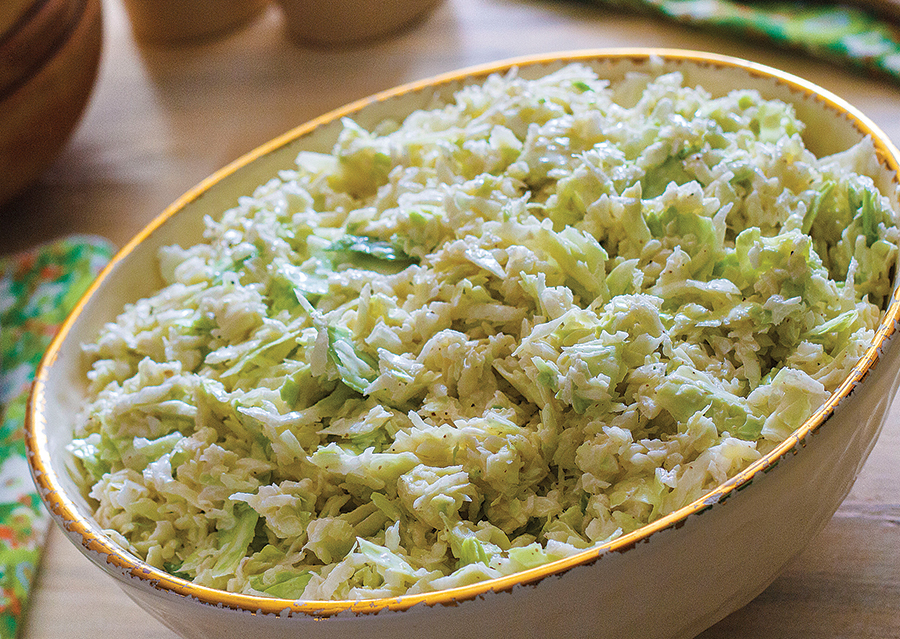
You were getting a little concerned that I was going to snub coleslaw, weren’t you? Not to worry. Coleslaw, with its coolness and snap, transcends the categories of salad, side, relish, and sandwich topping with confidence and ease. And as with other age-old dishes, variations abound. Craig Claiborne’s coleslaw (see box below) is an homage to the straightforward type you’ll find in Goldsboro, and it is hard to beat.

Reality Check

If roasting a whole hog sounds like more than you bargained for, take heart. Especially if you are new to outdoor cooking or can’t undertake the considerable investment of time and money, there’s no shame in starting with something smaller and more manageable, like a pork shoulder. Specifically, I’m talking about a Boston butt, the meaty upper part of the shoulder that’s also called pork butt or butt end of a pork shoulder roast. A bone-in Boston butt usually weighs a good 8 to 10 pounds, and it can be cooked on the grill.  Any which way, the result is hog heaven.

Goldsboro Coleslaw 

Adapted from Craig Claiborne’s Southern Cooking (Times Books, 1987)

Serves about 6

The last two ingredients in this recipe — a tiny amount of sugar and cayenne or smoked paprika — are my usual embellishments, but I sometimes include grated carrot as well and/or a drizzle of rice vinegar. For a tangier coleslaw, replace some of the mayo with a dollop of sour cream. When tinkering, don’t forget to taste as you go. You can always add more mayo, salt, or cayenne, for instance, but you can’t remove them once they’ve joined the party.

1 small cabbage (about 1 1/2 pounds)

1 1/2 cups mayonnaise

1 cup finely chopped onion

Coarse salt and freshly ground pepper

A scant 1/2 teaspoon sugar (optional)

A pinch of cayenne or Spanish smoked paprika 

1. Remove the core of the cabbage and the tough or blemished outer leaves. Cut the head in half and shred fine. There should be about 6 cups. Coarsely chop the shreds and put them into a mixing bowl.

2. Add the mayonnaise, onion, salt, and pepper and toss to blend well. Let the slaw sit about 30 minutes so the cabbage wilts a bit and the flavors have a chance to mingle.  PS

Jane Lear, formerly of Gourmet magazine and Martha Stewart Living, is the editor of Feed Me, a quarterly magazine for Long Island food lovers.