Botanicus

Goldenrod

Behold the flaming yellow glory of this native flowering plant

A native plant I love to see this time of year is Solidago, from the Latin solidare — “to make whole” — which suggests the medicinal powers sometimes attributed to the genus.

Commonly called “goldenrod,” it’s a perennial that bursts into magnificent yellow fireworks across the mountains, piedmont, sandhills and coastal plains of our Old North State. At least a dozen varieties are found regionally in the wild, according to the North Carolina Native Plant Society.

I’m not alone in my admiration for a goldenrod. My neighbor, Steve Windham, native plant specialist, tells me why he enjoys hiking the Appalachian Trail as summer turns toward fall.

“If you’ve ever walked out into a mountain meadow under a blue autumn sky with goldenrod in bloom,” Windham says, “you’ll know how truly spectacular it is.”

I remember just such a sight on the farm where I grew up, a fallow field resplendent with goldenrod, joe-pye weed, milkweed and ironweed. On that brilliant palette danced flights of butterflies — monarch, red admiral and tiger swallowtail — plus a host of skippers, cobalts and other beetles, bumblebees and metallic green flies. It was a sight wonderful to behold.

So why not replicate it in your home landscape?

Enterprising growers and nurseries have expanded the number of goldenrod varieties available for your yard or garden to more than 200.

“I use goldenrod in my garden and in my landscape designs because it’s so tough, so easy to grow and attracts so many pollinators,” Windham says. He tells me that, in his own backyard, he has a perennial border featuring a goldenrod cultivar called “Skyrocket,” which stands about three feet tall. Lower-growing dwarf cultivars can also be planted.

Windham, who helped install the ornamental grasses and pollinator meadow at the Greensboro Arboretum, recommends adding to your goldenrod native grasses such as little bluestem (Schizachyrium scoparium) or big bluestem (Andropogon gerardii), Joe-pye weed (Eupatorium fistulosum), ironweed (Vernonia glauca), phlox (Phlox carolina), asters (Aster paten) and bluestar (Amsonia tabernaemontana). Even after the flowers’ colors have faded, you’ll have a garden or border featuring interesting foliage that lasts into the winter months.

Those of you who suffer from fall allergies may think that Steve and I have lost our minds when we recommend goldenrod for your home garden.

Well, the goldenrod is not likely responsible for your runny nose and itchy eyeballs.

The culprit is another N.C. native perennial in the genus Ambrosia, from the Latin “food of the gods.”

Maybe the botanist responsible for giving this plant a name had a wicked sense of humor, but poor Ambrosia artemisiifolia is commonly called “ragweed.” It also bursts into bloom across the mountains, piedmont, sandhills and coastal plain of our Old North State in about the same habitats and at the same time of year as goldenrod.

Ragweed produces green, unremarkable blooms that release vast numbers of small, lightweight granules of airborne pollen that can be spread for miles by the wind. By contrast, goldenrod draws pollinators to its brilliant yellow flowers with nectar, relying on the pollinators to spread the relatively heavy pollen granules that glom onto their bodies and legs.

So plant beautiful Solidago. And forgive pesky Ambrosia.

If you were a plant and somebody called you “ragweed,” you’d probably have a vengeful attitude, too.  OH

Ross Howell Jr. is a freelance writer in Greensboro.

Home by Design

The Knife at Rest

It’s the little things — and sometimes the finer things

By Cynthia Adams

We were lunching in rare style. Good food, good company, a splendid table before us — and everyone was in excellent spirits. The table? It looked like a page torn from Architectural Digest: heirloom china, delicate crystal and antique French silverware on creamy linens. 

An artist and her close friend paused mid-sentence, suddenly noticing a set of what turned out to be silver knife rests.

The artist’s mouth opened, then closed.

What are those? She pointed to the elegant silver rectangles positioned above the antique table knife. 

Our host, an enthusiastic collector, explained: they were, quite simply, a resting place for a used knife, which kept linens safe from the greasy slurry on the plate.

The artist began to speculate about tired knives requiring rest. 

“Too weary to cut it!” 

“Lying down on the job!” 

“Stop me before I cut in again.”

She held a handsome knife up for inspection. “After they rest, then what?”

“They obviously move in for the kill,” she quipped.

We laughed ourselves silly, enjoying the word play.

The fun added to a good meal at a great table. As the conversation evolved, someone mentioned how we, after all, eat with our eyes. True, yet times have changed. 

There’s always fashion and history at work in our kitchens and dining rooms, as good ideas come and go from favor. A knife rest is straight out of an Edith Wharton setting: a classic remnant of fine dining.

What other objects are from tables past, things once used and now idling in the drawer? 

Those who love Wharton will reel from the pronouncements of Bob Vila, a former Sears’ pitchman who rose to fame with This Old House.

Despite This Old House, Vila has very modern opinions.

Here’s a short list on his outmoded and, therefore, verboten picks: fancy forks — including oyster forks, fish forks, salad forks, pickle forks and dessert forks. All out.

Other things deemed pointless by Vila: butter picks. (The butter pick is used for choosing/skewering single pats of butter.)

Napkin rings are also a thing of the past, Vila insists. I am glad my mother did not live to read this. If she were not dead already, this news would doubtless kill her.

Dedicated stemware is also outmoded, he claims. He says that it is completely modern to use a stemless glass for all wines. In fact, one multipurpose glass twill suffice. Even, dear God, a Mason jar.

To all my friends and family, I am sorry to convey this, not only because we are all stemware-struck, but because I personally own tons of outmoded glassware by Vila’s standards, including champagne coupes. 

I shudder to imagine the Queen being served her beloved Bollinger in a pickle jar. The mind reels.

Also, Vila says egg cups are déclassé. 

If you followed The Crown, you already know the Queen takes a morning egg in an egg cup and toast in a proper toast rack.

Jelly spoons are another fatality of Vila’s list, and so he would banish little Lilibet from taking her marmalade with a proper jelly spoon. (BTW, did you know that the British call congealed salads and gelatins like Jell-O “jelly”?)

Table runners, something many of us have clung to long after parting with other life niceties, are vile to Vila. Try telling that to Williams-Sonoma.

The shocker on Vila’s list may require sitting down (in the event you prefer to read standing):  wedding china. He deems it outmoded. Dated. Unnecessary. He asserts that we are a nation of casual diners who no longer eat off of fancy plates.

But any Southerner with a thimble full of sense knows there is no separating a Southern gal from her wedding china. His claim is a step too far.

Like our grandmother’s Blue Willow, we know and love it from the mists of time. We eat off our ancestral plates, even if chipped.

We stand in line to admire the White House china patterns.

When the late Julia Reed was promoting the entertaining guide, Julia Reed’s South, she talked about using antique wine rinsers for flowers and old silver ashtrays for salt cellars. “Use everything,” she said.  If it chips, it chips

And the unpretentious Reed added something worth noting:

“What I love about the South in general is that there is nothing too small to celebrate, and if you’re really lucky you learn about grace and small joys, which are, after all, what make up big lives.”

The clincher? “Keep the beautiful things alive.”

Long live the knife rest.  PS

Cynthia Adams, a contributing editor of O.Henry, is looking for a set of antique knife rests.

Hometown

Heroes and Helmets

Autumn’s guilty pleasure

By Bill Fields

I don’t usually get nervous before an interview, but a few years ago, when the subject was a childhood hero, I confess to having had the jitters.

A friend of Sonny Jurgensen kindly passed along his phone number so I could try to get him for a story I was writing about his youth in Wilmington years before he was a star quarterback in the National Football League. He was north of 80 by this point, the ginger hair long gone white; the golden arm that could zing passes to a receiver on a down-and-out better than anyone, alive only on NFL Films. Our call was brief and his answers perfunctory. Despite the disappointing substance of the conversation, I hung up pleased that I’d gotten to speak with Number 9 in burgundy, gold and white decades after his autographed photo hung on my bedroom wall.

He was why I drew plays in the dirt and threw passes at the trunk of a pine tree if no one was around. I wasn’t tough enough for football despite all the neighborhood prep; a year of Midget League was enough. But I care about football these days in part because — like many who grew up in pre-Panthers North Carolina — I cared so much about Sonny and his Washington teammates more than 50 years ago.

I still root for the team that Jurgensen led out of the huddle from 1964 to 1974. My alma mater, the University of North Carolina, is supposed to be strong this season. Maybe the Tar Heels will make it to the ACC title game and beat Clemson. My adopted college team, Ohio State, has enlivened my autumns since I became a fan thanks to my girlfriend, for whom Buckeye football is her only sporting interest. We went to a game in Columbus several years ago. Even though it was a cakewalk non-conference matchup, the stadium was filled on a beautiful Saturday afternoon, making it a day I won’t forget. The Saturday after Thanksgiving, thanks to the annual Michigan game, has become much more than another day in a long holiday weekend. What football fan doesn’t hope that the pandemic will have eased enough to allow the stands to look like they once did?

As another football season kicks off, though, the sport seems an increasingly guilty pleasure given the growing evidence of long-term damage from repeated hits to the head in a game in which the athletes seem bigger, stronger and faster every year. The NFL increasingly is in the same sentence with CTE, chronic traumatic encephalopathy, a progressive brain degeneration that can afflict those who play contact sports. Pro football players are handsomely paid in the current era — as opposed to the athletes competing long ago when many of us got hooked on watching them play — but the riches come with a potential cost much greater than arthritic joints in retirement.

It has always been a brutal game, but the CTE studies and evidence have quantified the brutality in ways impossible to ignore, and dementia hurried along by blows to the head is a much different outcome than seeing a man who used to sprint like a gazelle have trouble getting up a flight of stairs.

Like many others, I will still watch, grateful for the games in which nobody is seriously hurt. I hope the rules of the game continue to evolve so that they might lessen the potential for severe injury, that more athletes leave the game without suffering long-term effects from their careers.

This fall I will be thinking about another red-headed football player, my great-nephew, a senior at his North Carolina high school. He is an all-conference defensive end, a quick and strong teenager who loves his chosen sport despite the hand fractures he has sustained as a prep athlete. I hope he has a great season — and decides he’s had enough football.  PS

Southern Pines native Bill Fields, who writes about golf and other things, moved north in 1986 but hasn’t lost his accent.

Southwords

How We Wallpapered Fool’s Hill

Hint: One roll at a time

By Ruth Moose

What felt like a midlife crisis to my husband and myself, our friends and family called “going over Fool’s Hill.” They shook their heads as we sold our life in Charlotte to go live in the wild woods of the Uwharrie Mountains. And they were wild woods.

We bought three acres of the 900-acre Stony Mountain, an area known locally for its rocks and rattlesnakes. There was one other house a mile away that overlooked the Uwharrie River and Morrow Mountain. Our lot was graced by a mammoth beech tree and a tiny tumbling creek.

We planned to use the money from our city house to build a smaller home in our wild country, doing much of the work ourselves. Our sons, 11 and 16, agreed with friends and family: We’d lost our minds. Nonetheless, they rolled up their sleeves and pitched in.

My husband drew our house plans. As a DO (diversified occupations) student in high school, he took a drafting class that likely influenced his decision to pursue a degree in art rather than becoming a pharmacist.

We began by clearing, cutting, hauling and burning brush. Then we hired someone to cut only enough trees to allow a road, driveway and space for a house.   

We hired a contractor to frame the house, then we took over, opting to install paneling over dry wall so we wouldn’t end up having to spackle, sand and paint it. Paneling was a breeze: once it was up, you were done with it.

My husband liked paneling. And he liked wallpaper for the same reason. Once it was up, you were done.   

I not only like wallpaper. I love it.

I love everything about it: the patterns, the instant effect, the burst of color. And I had always said that if I ever built a house of my own, I’d wallpaper the closets.

It helped that I found a place where you could buy returned rolls of wallpaper for just one dollar a pop. Did you know that a standard closet requires just two rolls? One son’s closet got a western pattern, brown calico for the other. My husband’s closet was decked in faux denim while my walk-in was covered in blue birds and apple blossoms. Again, friends and family shook their heads. Fools.

We were doing great, the house was taking shape, then our money ran out. We needed a loan to finish. I went to a mortgage broker. OK, I went to four of them. One should have requested a loan before one began, I was told repeatedly. Not in the middle of building. Clearly it was a no deal.

Finally, a friend at church suggested that a small local bank might be able to help.

So I rolled up my husband’s drawings, made an appointment, dressed my best — heels and everything — and crossed my fingers.

The banker asked to see our blueprints. When I unrolled my husband’s drawings, he looked totally puzzled. “Who did these?” He asked.

“My husband,” I said.   

“OK,” the banker said, rolling them up before handing them back. He crossed his arms, leaned toward the wall in his chair. “Tell me about your house.”

I explained that the house was planned for low maintenance. It would have some solar features, triple paned windows — and we were wallpapering the closets.

He laughed, doodling figures on his desk pad.

“How much do you need?”

I said, “But you haven’t checked our credit.”

“I don’t need to,” he said.  “Anybody who wallpapers closets is a good credit risk.”

We got the loan, finished the house and lived there 17 years.  PS

After living in Stony Mountain, the Mooses moved to Fearrington Village when Ruth joined the creative writing faculty at UNC-Chapel Hill. Her husband, Talmadge, died in 2003. After Ruth retired from teaching, she shocked all who know her by moving back to Albemarle.

Good Natured

A Healing Herb

And it tastes like licorice

By Karen Frye

We have so many wonderful healing herbs that help restore and maintain good health. Many of them can be grown easily and used in tea, in recipes, or in tinctures to be used medicinally. One that grows well in the Sandhills is fennel.

Fennel is a 6-foot perennial with feathery leaves and clusters of little yellow flowers. The tiny oval-shaped seeds are ribbed and greenish-gray. All the parts of the plant have a licorice-like fragrance.

You can grow fennel from seeds. If you plant them in the fall, they’re ready in spring. You don’t have to give fennel a lot of attention, and the plant doesn’t require a lot of water to survive.

The fennel seed is an effective digestive aid, particularly dealing with bloating, gas, and diarrhea. If you like the taste of licorice, you can chew a handful of seeds after a meal to help relieve indigestion, or you can drink a cup of fennel tea. Fennel is also available in capsules.

While a previous study suggests fennel should not be used by people who have any type of liver disease, more recent studies have found it beneficial for the heart. Nitrites derived from the seeds promote vascular function. The nitrites are reduced into nitric oxide, a compound that protects the heart.

Along with improved digestion, fennel can suppress the appetite. It’s helpful in promoting good function of the kidneys, liver and spleen. Fennel clears the lungs and helps reduce stomach acid. And it can ease the effects of chemotherapy and radiation treatments.

If you aren’t a fan of the licorice flavor, try the capsules. Either way, fennel isn’t expensive, and if you choose to grow your own, it only costs pennies. There are many helpful herbs and, while most have no side effects, I always recommend that if you are on any medications, you should talk to your doctor before taking a supplement.  PS

Karen Frye is the owner and founder of Nature’s Own and teaches yoga at the Bikram Yoga Studio.

The Hot List

Palm Beach Weekend!

Escape to the timeless, buzzy glamour of the Florida tropics for year-round summer sizzle

By Jason Oliver Nixon and John Loecke

Sandhills Photography Club

Tools of the Trade

The Sandhills Photography Club meets the second Monday of each month at 7 p.m. in the theater of the Hannah Marie Bradshaw Activities Center at The O’Neal School at 3300 Airport Road in Pinehurst. Visit www.sandhillsphotoclub.org.

The Creators of N.C.

Moving On Up

History is brewing again in downtown Asheville

By Wiley and Mallory Cash

In 1994, Oscar Wong began brewing beer in the basement of Barley’s Taproom and Pizzeria in downtown Asheville. Wong, the son of Chinese immigrants, grew up in Jamaica and moved to the states to study civil engineering at the University Notre Dame. After forging a successful career in nuclear engineering, he would later create an innovative nuclear waste disposal company and then go on to found Highland Brewing Company, Asheville’s oldest independent brewery. As the first legal brewery in Western North Carolina following the repeal of prohibition, you can imagine its allure. Still, it took Wong eight years to break even. Why? Because he was determined to produce a high-quality product on a consistent basis. He invested in his vision. While that superior quality persists, little else remains from those early days in the basement.

In 2011, Wong’s daughter, Leah Wong Ashburn, officially joined the team at Highland Brewery. More than a decade earlier, Ashburn had applied for a position with her father’s company after graduating with a degree in journalism from UNC-Chapel Hill, but her father turned down her application. He wanted her to find her own way, he told her. And so she did.

Years later, after Ashburn built a thriving career in sales and marketing with a yearbook publisher in Charlotte, her father actually recruited her for a position at Highland, but in the intervening years, the tables had turned: He could no longer afford her.

But blood is thicker than water, and, apparently, so is beer.

“Other things became more important and the brewery was one of those more important things,” Ashburn said in a 2018 interview with Business North Carolina. “It was about being part of the community. You can’t put a value on that.”

Leah Wong Ashburn is now Highland’s president and CEO, and her tenure has marked an era of rapid change, both for the company and the city of Asheville. In 2011, Highland opened a tasting room at their mountaintop manufacturing facility in east Asheville, which has now grown to 70,000 square feet and offers complimentary tours of their onsite brewery, a lively taproom with ample seating, a performance stage, a rooftop garden bar and an indoor event space. According to Brock Ashburn, Leah’s husband and the company’s vice president, “We built the taproom to accommodate the throngs of people who were showing up, part of an ever-increasing interested public who wanted to drink our beer where it was made.”

Over the past decade, a lot of people have — as Brock Ashburn puts it — “shown up” in Asheville, and the city is now an international destination for foodies, beer connoisseurs and outdoor enthusiasts. “There’s always been a soul and a spirit in Asheville,” Leah says, “and Highland got to join up with other people who believed in the potential for Asheville. Great beer is a complement to great food and quality of life.”

Community and regional pride are more than just branding tools; Highland is a company whose culture is built on stewardship and community responsibility, tenets made apparent in their practices of reducing or reusing waste, partnering with local nonprofits and embracing solar power. The company also collaborates with the Southern Appalachian Highlands Conservancy, naming seasonal beers after unique regional landscapes. Ashburn has always made clear that she intends to keep the company concentrated on regional endeavors and has no plans to ship beer across the country, choosing instead to focus the company’s efforts within the confines of the Southeast. This comes as no surprise for a brewery that has spent two and a half decades fostering a regional brand in a region that has quickly gained international attention. 

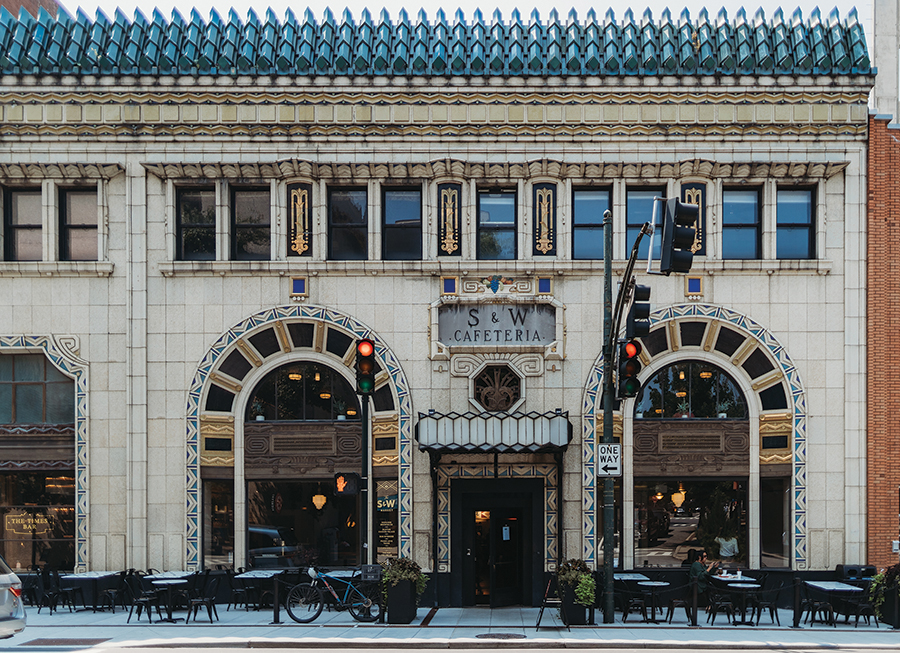
Today, Leah and Brock are sitting at the brewery’s new downtown taproom in the old S&W Building, a quintessential example of Asheville’s stunning 1920s Art-Deco architecture. Late morning sunlight pours through tall windows that look out on Pritchard Park, illuminating the gold-plated fixtures and ceiling tiles, the two-story marble columns and tiled floors in a glowing aura that sweeps visitors back into the roaring ’20s. You can almost sense what Asheville must have been like a century ago, when it was first known as a destination for Hollywood stars, politicians and titans of industry. Highland anchors the new S&W Market’s downstairs dining area with a taproom, along with several local restaurants that provide counter service. Upstairs, on the mezzanine level, Highland has opened a full bar and tasting room with ample space for guests to relax over a pint.

One can only imagine what it must mean to Leah for Highland to return to downtown, where it all started from such humble beginnings over a quarter century ago.

“As a second-generation owner, I was encouraged to make the brewery my own,” she says. “That did not feel safe to me at first because of the long history of Highland, but my father’s sentiment was honest, and he’s let us create our own vision.” That meant changing the beer portfolio and re-envisioning the brand. She says it also meant improving the property: “We started as a manufacturing company, but Brock’s an engineer and a builder, and I’m a marketer,” Leah says. Combining all of those interests and backgrounds led to a complementary hospitality component. “It appeals to tourists because it highlights some of the great things about Asheville in one location.”

Outside, people are waiting for the S&W Market’s doors to be unlocked for the day’s business. A line of tourists and downtown office workers in business attire snakes down the sidewalk. Leah and Brock look out the window and pause for a moment, perhaps recalling the throngs of beer enthusiasts who showed up the minute the first taproom opened at Highland’s manufacturing site a decade earlier.

“This is an opportunity to tell our story downtown and also attract people to come out to East Asheville to visit our brewery,” Brock says. “It’s a great opportunity to get our brand out there and let people know where this all started.”

From a downtown basement to a mountaintop in East Asheville to the second floor of one of the city’s most iconic downtown buildings, Highland has come a long way. But whether it’s the quality of the beer or the family name, some things never change.   PS

Wiley Cash is the writer-in-residence at the University of North Carolina-Asheville. His new novel, When Ghosts Come Home, will be released this month. Mallory Cash is an editorial and portrait photographer.

PinePitch

Friday Night Rocks

The Asheville-based soul/funk/rock/jam band Travers Brothership will take the First Bank stage at Sunrise Square, 250 N.W. Broad St., Southern Pines, on Friday, Aug. 6, from 5 p.m. to 8 p.m. Their performance, described as a “wild block party,” supports the Sunrise Theater. Food trucks, refreshments and beer from Southern Pines Brewery will be available. No outside alcohol. No rolling, strolling or roving coolers allowed. Leave man’s best friend at home. For more information call (910) 692-3611 or go to www.sunrisethreater.com.

Links and Drinks

Join The Sway at the Pinehurst Country Club, 1 Carolina Vista Drive, for a women-only golf clinic combining happy hour and friendly instruction from a Pinehurst resort professional on Monday, Aug. 16, from 5:30 p.m. to 6:30 p.m. Perfect that swing and test your skills on The Cradle. Each session is limited to 20 players and the cost for the lesson, a cocktail and swag is $55. For more information go to www.ticketmesandhills.com.

Gathering on the Green

The Bradshaw Performing Art Center’s summer concert series continues Saturday, Aug. 14, from 6:30 p.m. to 9 p.m. with Mountain Heart and its special guest, Carly Burruss. Bring chairs and blankets — but no outside food or beverages — to BPAC’s McNeill-Woodward Green, 3395 Airport Road, Pinehurst. For information and tickets visit www.ticketmesandhills.com.

Lakeside Live!

Saxophonist Dennis Hardison and A New Creation will be performing from 7 p.m. to 9 p.m. on Friday, August 13 at The Cardinal Park, 657 S. Walnut St., Pinebluff. Gates open at 6 p.m. and admission is $15. You must be 21 years old and above to enter. Dress is all-white, casual party attire. A DJ will pick up the show at 9 p.m. For more information visit www.thecardinalpark.com.

“Many a Good Hanging Prevents a Bad Marriage”

So says Twelfth Night. Shakespeare in the Pines and the Uprising Theatre Company return with one of the Bard’s famous comedies on The Village Green, Tufts Memorial Park, Friday, Aug. 20, from 7:30 p.m. to 10 p.m. There are additional performances on Aug. 21, 27 and 28. For information and tickets go to www.ticketmesandhills.com.

Bocce Bash

It’s back for a 14th annual! The Backyard Bocce Bash to benefit the Sandhills Children’s Center rolls on at the National Athletic Village, 201 Air Tool Drive, Southern Pines, from 9:30 a.m. to 3 p.m. or until the last ball is bowled on Saturday, Aug. 21. All proceeds help provide vital therapies to children with special developmental needs. Entry fee starts at $25 per player. Sponsorships are available. For information and registration call (910) 692-3323 or visit www.sandhillschildrenscenter.org.

25th Anniversary Celebration

A touch of Robbins comes to Pinehurst on Friday, Aug. 20, from 6 p.m. to 9 p.m. at the Fair Barn for the 25th Anniversary Celebration benefiting the Northern Moore Family Resource Center, home of the HOPE Academy Preschool. There will be mechanical bull riding, rubber pigeon skeet shooting, live music, food from Elliott’s Catering Company, live and silent auctions and beer, wine and high spirits. Tickets for the event at the Fair Barn, 200 Beulah Hill Road, Pinehurst, are $125 per person. For information go to www.moorefamilyresource.org.

Weymouth Puts the Moves On

Join MARO movement for a modern dance experience staged outdoors on the grounds of the Weymouth Center for the Arts and Humanities at 555 E. Connecticut Ave., Southern Pines, from 6:30 p.m. to 9 p.m. on Saturday, Aug. 21. The audience moves along a navigated path, experiencing site-specific dance works on their way to a mainstage show. Tickets are $40 and include two motion tours, the mainstage event, spirits and hors d’oeuvres. Food trucks will also be on site. For information call (910) 692-6261 or go to www.weymouthcenter.org.

Get Saucy

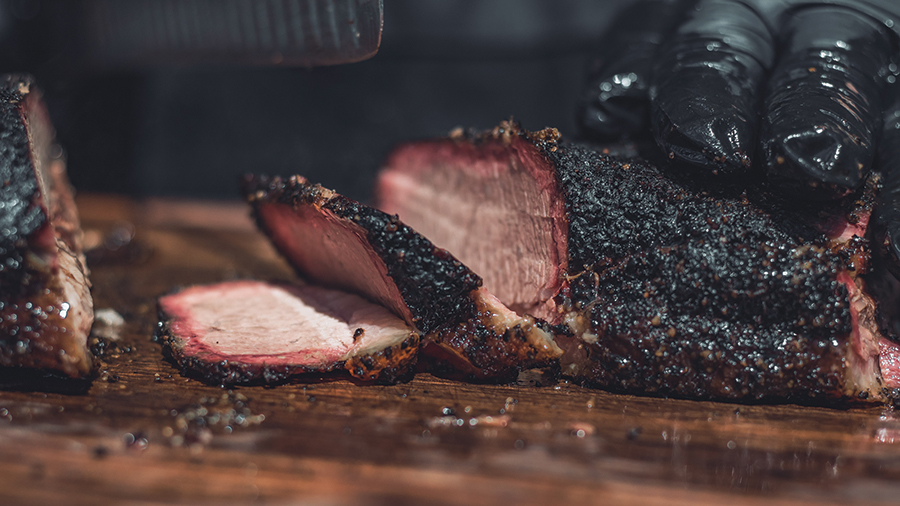
The three-day Pinehurst BBQ Festival celebrating “all things barbecue” begins Friday, Sept. 3, from 6 p.m. to 8 p.m. and continues throughout Labor Day weekend in the village of Pinehurst, 6 Chinquapin Road. Presented by Pinehurst Resort, US Foods and Business North Carolina magazine, the festival celebrates Carolina barbecuing tradition from the mountains to the coast and features award-winning pitmasters. For tickets and information go to www.ticketmesandhills.com.

The Naturalist

Legion of the Night

The beauty of moths

By Todd Pusser

Butterflies get all the love. All around the world, festivals are held in their honor. Entire gardens are planted specifically to attract them. Poems praise their beauty. Kids even dress up as butterflies for Halloween.

Moths, on the other hand, are frequently overlooked and ignored by most people. If noticed at all, moths generally get a bad rap. Gardeners despise hornworms, the large caterpillars of sphinx moths, feeding on tomato plants in the backyard. Gypsy moth caterpillars, capable of defoliating entire trees, are the bane of property owners throughout areas of the Northeast.

Even in popular culture, moths are frequently associated with superstition and death. The calling card of the serial killer from the popular 1990s movie Silence of the Lambs was the cocoon of a death’s-head hawkmoth (yes, there is such a thing) placed inside the mouths of his victims.

About the only time moths have received any positive press is when Mothra dragged Godzilla by the tail out of Tokyo.

Cecropia Moth

Last July, on a hot and humid night, I pulled into the parking lot of a brightly lit gas station along the edge of the Dismal Swamp in the northeastern corner of the state. It was during the height of the pandemic, and few other cars were around. In need of caffeine, I stepped out of my vehicle and walked along the side of the building toward the front door. Casually glancing up, I was stunned to see a large luna moth clinging to the side of the building, its striking lime-green wings contrasting sharply with the white paint.

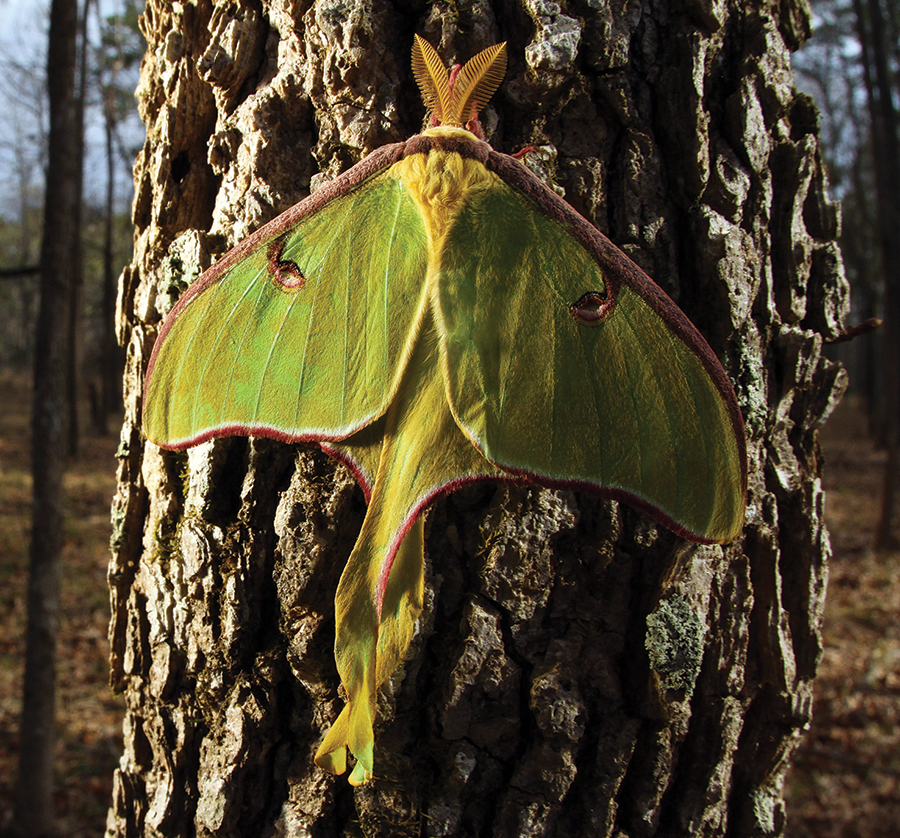
The gentle luna moth is the teddy bear of the insect world, sporting a plump, furry body, feathery antennae, and a pair of 3-inch-long sweeping tail streamers. It is among North Carolina’s largest and most spectacular moths. I was so pleased to see one that I casually mentioned it to the station’s clerk while paying for my beverage. A blank stare was my only response. Finally, she asked quizzically, “You saw a what?”

I said again, “There’s a luna moth outside your front door.” Blank stare once more.

“Oh,” said the clerk with a nervous smile. “Have a nice night.”

Most people think of moths as drab and boring. It is true that many moths possess muted shades of brown or grey colors, but a surprising number are as colorful and intricately patterned as any butterfly. Take, for example, the giant leopard moth, common to many parts of North Carolina. Looking like a flying Dalmatian, it is a large, bright white moth covered in an array of black polka dots. An entire family of moths known as underwings sport drab tree-bark-patterned forewings and brightly colored hindwings, which they only flash when frightened by a predator.

Luna moth (Actias luna), freshly emerged from its cocoon in early spring in the Lowcountry of South Carolina

Speaking of underwing moths, many possess common English names reflecting a marital theme, a quirky tradition started by Carl Linnaeus, the father of modern taxonomy. Among the more descriptive ones are the tearful underwing, the betrothed underwing, the dejected underwing, the divorced underwing, and the oldwife underwing. Clearly, entomologists have a sense of humor (and perhaps one too many beers) when it comes to naming moths. Or perhaps they are just in need of a good marriage counselor.

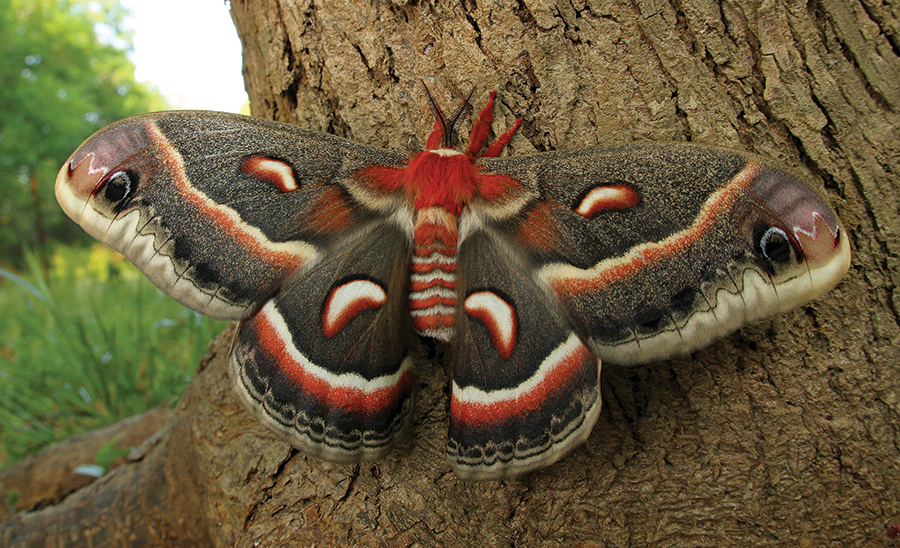
Moths are among the most diverse groups of animals on the planet (surpassed only by beetles), with over 200,000 species (and counting) found worldwide compared to just over 17,000 species of butterflies. They come in an infinite variety of shapes and sizes. Many of our state’s smallest species, known as micro moths, could easily fit onto the head of pin. The largest species in North America, the cecropia moth, possesses enormous wings that stretch 7 inches from tip to tip, making them larger than many species of bat. A member of the spectacular silk moth family, the cecropia (and the luna moth mentioned earlier) does not feed as an adult and relies on stored energy from its caterpillar stage. As such, the cecropia lives for only a few days, leaving it precious little time to find a mate and perpetuate the species.

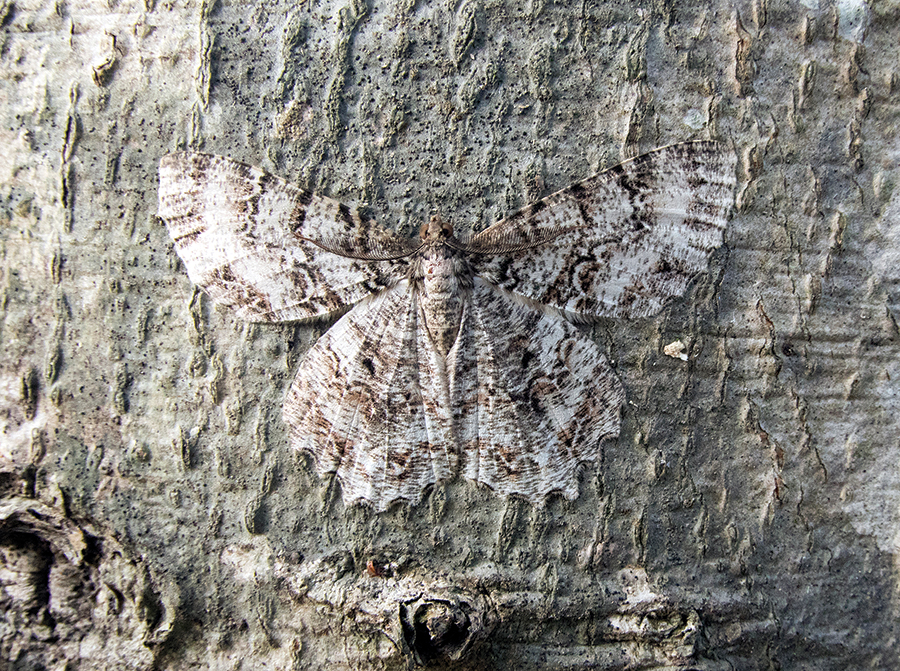
Unlike the showy silk moths, many night-flying moths are masters of disguise and closely resemble bark and leaves to help them blend into their surroundings during the day. Some even look like bird droppings.

Not all moths are nocturnal. Many fly during daylight hours. Those that do tend to mimic other insect or animal species, such as bees and wasps. One well-known day-flying moth is the hummingbird clearwing, which mimics the size, shape and flight pattern of the ruby-throated hummingbird. Like its namesake, it is frequently observed hovering over flowers in urban gardens.

Tulip tree beauty moth

Just this past April, I was admiring a cherry tree in full bloom in a friend’s yard when I did a double take. What I initially thought was a bumblebee hovering over a blossom above my head turned out to be a moth known as Nessus sphinx. With two bright yellow bands wrapping around a black abdomen, the moth was a perfect replica for the stinging insect. As I followed it from blossom to blossom, I realized the rapid wings of the moth even sounded like the buzz of a bumblebee.

Like bees, moths are important pollinators of many flowers and crops. Throughout all their life stages, from caterpillars to adults, moths serve as a critical food resource for many birds and other animals. Studies have shown that moth caterpillars are the preferred food for nesting birds, such as eastern bluebirds, as they are both easy to digest and full of protein.

Unfortunately, moths have suffered serious declines in their populations due to habitat loss, light pollution, and the extensive use of pesticides on the landscape. Their ecological importance and the impact that they have on the world around us is difficult to understate.  PS

Naturalist and photographer Todd Pusser works to document the extraordinary diversity of life both near and far. His images can be found at www.ToddPusser.com.

His favorite book is Where the Red Fern Grows by Wilson Rawls.