Simple Life

“A Story For These Times”

By Jim Dodson

On a lovely evening beneath the trees not long ago, as summer green gave way to autumn gold, my wife, Wendy, shared a charming little story a friend had recently passed along to her via email. She wondered if I’d ever heard it before.

In fact, I had. But it had been many years since I thought of it and the wise soul who first shared it with me decades ago.

Here’s the story.

The Bohemian novelist and short-story writer Franz Kafka was walking home through a park in Prague one afternoon when he passed a little girl who was crying because she’d lost her favorite doll.

The writer, known for stories that fused realism and fantasy, suggested that the two of them search for the missing doll, but the doll was nowhere to be found. Hoping to console her, he suggested that they meet the next day and continue the search.

Upon his return, he presented the girl with a letter he insisted was written by her missing doll. “Please do not mourn for me,” the doll wrote. “I have gone on a trip to see the world. I will write to you about my adventures.”

Over the days and weeks that followed, he presented a stream of “letters” that recounted the doll’s amazing encounters with interesting people she’d met on her journey through the world. The letters provided deep comfort to the little girl.

When their meetings finally came to an end, Kafka presented the girl with a new doll that didn’t look anything like the original. To ease her confusion, he read the girl a final letter from her doll explaining why she seemed so different. “I have been out in the world,” the doll wrote. “My travels have changed me.” The little girl hugged the new doll and carried her home.

Franz Kafka died a short time later from tuberculosis. He was just 40 years old. He never married.

His stories and novels, however, were destined to become some of the best-loved writings of the 20th century, exploring themes of loss, grief and existential anxiety in a rapidly changing world. His very name — Kafka — would become a synonym for a world turned upside down by surreal predicaments. The poet W.H. Auden called him the “Dante of the 20th Century” and novelist Vladimir Nabokov ranked him among the most influential voices of all time.

Many years after her meeting with Kafka in the Prague park, the little girl, now an old woman, found an unread letter secreted in her beloved childhood doll.

“Everything you love will probably be lost,” the letter said. “But in the end, love will return in a different form.”

Though at least one of his biographers later questioned whether the encounter in the park actually happened, it is reported that Kafka, a prodigious letter-writer, put as much time and care into the creation of the doll’s colorful adventures as he did crafting his own wildly imaginative tales.

Regardless, the story outlived its author and has provided comfort to untold numbers of people wrestling with grief and loss, a timeless “healing” story long used by grief therapists and spiritual advisors.

In a year that will be remembered for its incalculable losses of life and livelihood, its Kafkaesque politics and a historic pandemic that will change each of our lives, the doll’s message seems more relevant than ever.

Everything you love will probably be lost. But love will return in a different form.

Hearing the story again gave me a shot of much needed hope. It reminded me of the first person who told me the story over a bowl of soup, a dear old friend named Col. Bob.

During the last decade we lived in Maine, Col. Bob and I met every few weeks for lunch and conversation at a village cafe where the soup was homemade and the community chatter lively.

Bob Day was a decorated veteran of WWII who’d led one of the first Army units over the Rhine into Nazi Germany. After his service, he returned to West Point, where he taught logistics. He made his mark as the pioneering director of admissions who is credited with admitting women to America’s top military academy by convincing his superiors to adopt merit over patronage as a primary means of admission.

We first met one Christmas when Bob played the angel Gabriel in the annual Christmas play at our local Episcopal Church.

My two knee-high nippers had important roles in the pageant. One was playing a lamb, the other a baby cow in the climactic manger scene. As Col. Bob stood hovering over the blessed setting with his goofy, Gary Cooper smile, one of his plaster-of-Paris wings fell off and conked a baby cow on the head. The audience gasped with alarm but erupted with applause when the boy beneath the cow’s head turned out to be laughing. The boy was my son, Jack.

Col. Bob was a volunteer grief counselor with a local organization that worked with families suffering from the loss of a child. As he explained to me over soup one crisp autumn day, his main job was to listen and care and simply “be” with people wrestling with unimaginable grief and loss.

As I learned in time, Bob was uniquely qualified for such soulful service. One day during his early years at West Point, his wife phoned him at the office to report that their youngest son had run outside to play and been run over and killed. Not long after the funeral, Bob returned from work to discover that his grieving wife had packed up and moved out with their two other two boys. The weight of sorrow had become too much.

Bob understood. He set up his wife and kids in a nice house in a neighboring town. Though he and his wife were never fully reconciled, they remained best of friends for the balance of her life. A few years later, a second son set off to see the world before college, contracted a strange virus and died.

Once I learned of these tragedies and others in his life, I understood — and deeply admired — the source of Col. Bob’s easy grace in the midst of so much personal suffering, including his unsinkable sense of humor and belief in the healing power of love. Every year for almost a decade, he showed up at our annual winter solstice party. Guests were invited to perform for their supper — to sing a song or read a poem to lighten the darkest night of the year. Col. Bob read hilarious limericks he spent the year composing.

Bob’s thing was original limericks. Some were sweet, others were poignant. Some were devilishly blue. The solstice crowd loved them all.

Bob loved literature and life. As I said, it was he who first told me the story of Kafka and the little girl with the lost doll. This was not long after my own father died and I was going through a double dose of loss from his death and a divorce that seemed to come out of nowhere, leaving me more than a little discouraged about the future.

It was Bob — using this story — who reminded me that, given time and an open heart, love and laughter would come again in different form.

He was right. Both came in the form of an extraordinary woman who has been the joy of my life for more than two decades — the same woman, I might add, who reminded me of the story of Kafka and the doll as we sat beneath the autumn trees a few weeks back.

Hearing it again also reminded me of the last letter I received from Col. Bob a decade or so ago, inquiring about Wendy and our kids and our new life “back home in the South.” He informed us that he, too, had recently moved home to Connecticut to be close to his surviving son and grandchildren. He was volunteering as a docent at a history museum several days a week and still working with grieving families. The handwritten letter included several pages of his original limericks — the “greatest hits of an angel with a broken wing,” as I like to think of them.

Not long after the letter arrived, I learned that Bob had passed away and drove up to his memorial service at West Point. It was great to meet his son and several of Bob’s old friends, students and colleagues. We all had stories of his amazing grace and healing sense of humor to share.

Folks had a good laugh when I explained how a broken angel’s wing in a Christmas play introduced me to Col. Bob, a gift not unlike the one that Kafka gave the little girl in the Prague park.

It’s still the perfect message for a changing season and Kafkaesque days like these.

Everything you love will probably be lost. But love will return in a different form.  PS

Contact Editor Jim Dodson at jim@thepilot.com.

The Naturalist

The Natural History of Pumpkins

There’s more to the orange gourds then just pie and jack-o’-lanterns

Story and Photographs by Todd Pusser

Pumpkins have always evoked strong memories of childhood and my Moore County home. I vividly recall each fall season my parents taking me to view the giant pumpkin display at the county fair in Carthage. I would stand dumbfounded, staring at the enormous behemoths weighing hundreds of pounds, and wonder how on earth a vegetable could grow so freakishly large.

As October rolled around, pumpkin decorations plastered the halls of West End Elementary School. My class would gather in the library to watch Ichabod Crane dodge a flaming pumpkin tossed by the Headless Horseman in the old 1949 cartoon The Legend of Sleepy Hollow. Speaking of cartoons, I’m pretty sure I can repeat every line from Linus’ Halloween ritual of waiting through the night, in his most sincere of pumpkin patches, for treats from the mythical Great Pumpkin. Thank you, Charles Schulz. 

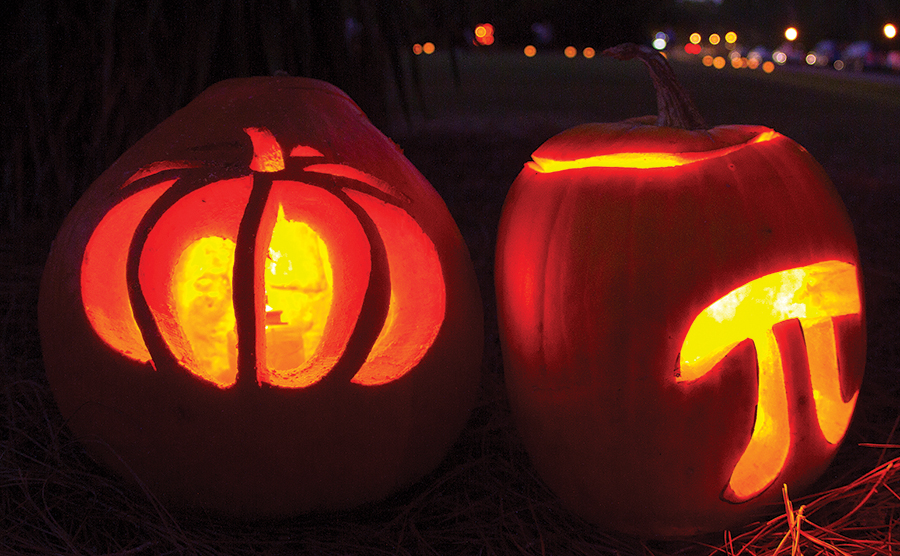
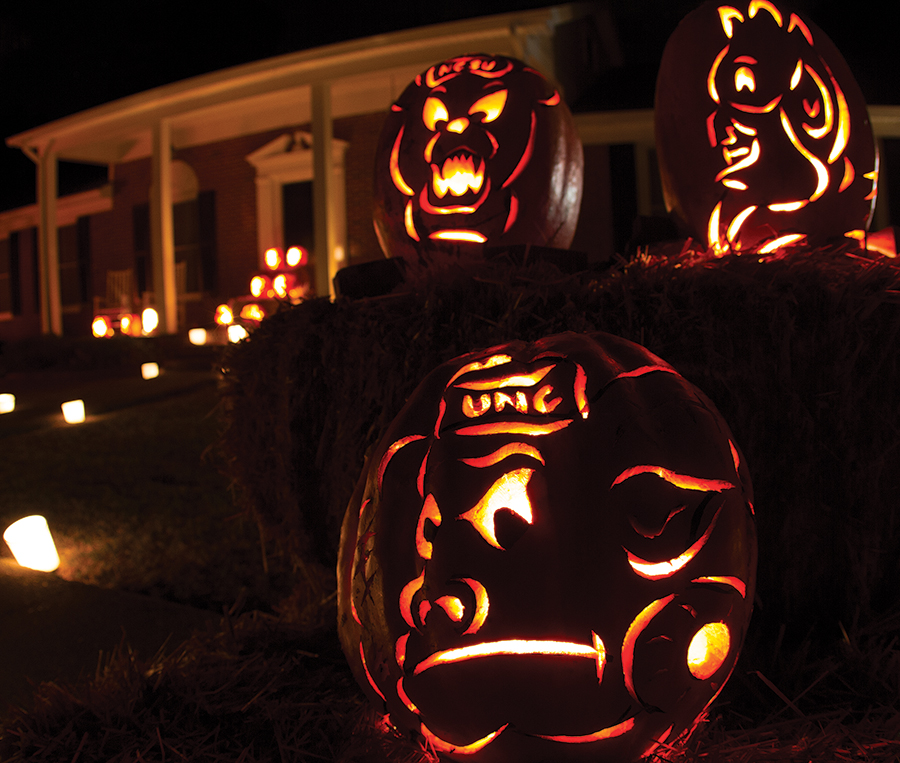
However, it was Otis Boroughs who really sparked my interest in pumpkins. Otis grew several acres of pumpkins, and throughout the 1980s, he, along with his wife, Nancy (who happened to be my kindergarten teacher), hosted an incredible jack-o’-lantern display each Halloween. People would travel from all over the state to their farm in Eagle Springs to see his artfully carved faces of famous cartoon characters, sports mascots and wild creatures. It was a magical feeling, standing beneath starry skies, staring at the flickering light dancing from the jagged cuts of dozens of pumpkins. Heat, given off by candles deep inside the large, orange orbs, created a scent of warm pumpkin pie that permeated the night air.

Realizing how much I liked the pumpkin display, Otis and Nancy invited me over one Saturday, to teach me how to carve jack-o’-lanterns. This was long before the days when you could buy mass-produced pumpkin carving kits at Walmart. For much of that afternoon, Otis, using a special handsaw, patiently taught me how to carve Mickey Mouse and the Demon Deacon mascot of Wake Forest University (my father, a fan, was dismayed when I later attended the University of North Carolina in Chapel Hill). Otis sent me home with a couple of large pumpkins to practice on, and from that day forward, I was hooked on carving jack-o’-lanterns.

When Otis and Nancy finally retired from showing their jack-o’-lanterns to the masses, I wanted to continue the tradition, so I took up the baton and started my own pumpkin show nearby. As well as traditional scary faces, I cut everything from Star Wars characters to rattlesnakes into the orange gourds, some years carving as many as 200 jack-o’-lanterns.

The simple act of placing a candle inside a carved pumpkin has long been a staple of Americana. According to Cindy Ott, author of Pumpkin, the Curious History of an American Icon, one of the first illustrations of a pumpkin jack-o’-lantern appeared in an 1867 edition of Harper’s Weekly. The image depicts a trio of young boys lifting up a carved pumpkin with triangle-shaped eyes, a triangle nose, and a jagged mouth, to the top of a fence post on a family farm. The candlelight emanating from the sinister face appears to frighten two young girls (perhaps their sisters) and a small dog walking down a dirt path.

Today, pumpkins are the quintessential symbols of the fall season, like conifer trees are to Christmas and rabbits are to Easter. Pumpkin pie is a prerequisite for a traditional Thanksgiving dinner. Images of pumpkins adorn horror movie posters and the covers of children’s books. In recent years, a pumpkin spice craze has swept the country, due in large part to the popularity of Starbucks lattes featuring the mix (typically a blend of clove, cinnamon, nutmeg, and ironically, very little, if any, pumpkin). One can find hundreds of pumpkin spice products, everything from beer to granola and doughnuts to potato chips, in the aisles of grocery stores come October. There is even such a thing as (blech) pumpkin spice toothpaste.

Yet, for all its cultural familiarity, have you ever stopped to think about exactly what a pumpkin is or where it comes from?

It is a common misconception to think of a pumpkin as a vegetable. (I even refer to pumpkin as a vegetable at the beginning of this piece, but hey, I was only a kid, so what did I know?) Pumpkins, by botanical definition, are a fruit, just like apples, bananas and berries. They are essentially a seed case covered in a wall of flesh (the plant’s ovaries), formed when the flower of the plant is fertilized through pollination. Vegetables, like lettuce and celery, are just the non-fruit part of plants, such as leaves, stems and roots.

Pumpkins are herbaceous vines of the gourd family found within Cucurbita, a genus of plants that contain well over a dozen species. The true ancestors of pumpkins looked nothing like the head-shaped, orange globes we all know and love today. Originating in Central America and Mexico, early pumpkins were small (just a few inches in diameter), thin, hard-shelled gourds. Archaeologists found 10,000-year-old domesticated pumpkin seeds in the Oaxaca Highlands of Mexico, making them among the first plants to be cultivated by humans in North America.


Since that time, Cucurbita have been selectively bred into many of our grocery store staples, such as zucchini, acorn squash, yellow squash, butternut squash, and, of course, pumpkins. The sheer number of pumpkins cultivated today is mind-blowing. With catchy names such as Ghost Rider, Casper, Sugar Baby, Big Mac, Jack Be Little, and Possum-nosed (a personal favorite), pumpkins come in an infinite variety of colors, shapes, and sizes. Some are even larger than small cars. Consider the current Guinness World Record Pumpkin, which, at a hefty weight of 2,624 pounds, is 600 pounds heavier than a Mitsubishi Mirage.

Of course, if it were not for pollinators, we would not have any pumpkins, or any of our food crops for that matter. The primary, natural pollinators of pumpkins are bees, especially squash bees of the genus Peponapis. Like most native bees, squash bees are solitary and nest in the ground. Typically, they forage for nectar and pollen at pumpkin plant flowers during early morning hours. To help increase yield, farmers often enlist the aid of honeybees, a species native to Europe, to help supplement pollination of pumpkin crops.

Unfortunately, in recent years, honeybees, as well as one-quarter of North America’s 4,000 species of native bees, have seen dramatic declines in their population numbers. As to why so many pollinators are being affected, scientists are not exactly sure. It is likely due to a combination of factors, including the increase use of pesticides, extensive loss of habitat, and a warming climate.

One thing is more certain. Pollinators keep this planet functioning, and without the services they provide, free of charge, crops would fail, ecosystems would falter, and Earth, in general, would be less habitable.

That is a thought more scary then even the most frightening of jack-o’-lanterns.  PS

Naturalist and photographer Todd Pusser works to document the extraordinary diversity of life both near and far. His images can be found at www.ToddPusser.com.

PinePitch

TRUST BUT VERIFY: As our communities deal with the challenges presented by the novel coronavirus, please be aware that events may have been postponed, rescheduled or existed only in our dreams. Check before attending.

Stir Crazy

The Arts Council of Moore County and Mrs. John Daughtridge will present “Art in Quarantine” beginning Friday, Oct. 2, and continuing through Oct. 30 at the Campbell House Galleries, 482 E. Connecticut Ave., Southern Pines. The exhibit includes paintings, sculpture, jewelry and face masks created during the COVID-19 lockup. For more information call (910) 692-2787 or go to www.mooreart.org.

Feeling a Little Dirty?

The Moore County Historical Association began peddling soap in 2008 at the suggestion of Pinehurst’s Richard Huntwork, the founder of Greenwich Bay Trading Company, and now they’re cleaning up. With vintage labels and zippy language — all of their own creation — they’ve slipped into a lucrative niche. From a few hundred bars a year, the soap now sells in over 400 stores and 27 states. All the work is done inside the bubble by staffers and volunteers, from designing and wrapping to shipping. Scrubbing is extra. The proceeds cover the expenses of maintaining the Historical Association’s five historic properties, a new museum, and the 259-year-old American Revolution cemetery in Southern Pines. Shower yourself with further information by visiting www.moorehistory.com.

They’re Baaaaack!

The North Carolina Museum of Art reopened to the public on Sept. 9. The David McCune International Art Gallery at Methodist University — and its exhibition “Rembrandt: The Sign and the Light” — opened to the public on Sept. 11. The Cameron Art Museum in Wilmington opened to the public on Sept. 15. The Reynolda House Museum of American Art in Winston-Salem with its current exhibition, “Tiffany Glass: Painting with Color and Light,” opens to the public on Oct. 6. All the museums will be functioning at a reduced capacity and most require advance ticketing with timed admission. The rules vary, so be sure to check their websites first. And welcome back. They need your support.

Live Sparks

Bestselling author Nicholas Sparks will stop in to sign books for — and have a picture taken with — customers at The Pilot, 145 W. Pennsylvania Ave., in Southern Pines, on Thursday, Oct. 1. Tickets can be purchased for a time slot to attend the socially distanced gathering. Masks will be required. For information and tickets, visit www.ticketmesandhills.com.

Cousin Culture

Susan Zurenda, the author of the Southern literary novel Bells for Eli, will talk about “cousin culture” and how it relates to the conflicts of her widely praised novel in a socially distanced event at The Country Bookshop, 140 N.W. Broad St., Southern Pines, at 5 p.m. on Tuesday, Oct. 6. It’s free and open to the public. For more information visit www.thecountrybookshop.biz or call (910) 692-3211.

100 Years — But Who’s Counting?

Join the Sandhills Woman’s Exchange for a lunch and talk by Faye Dasen, who will discuss “The 100 Year History of The Pilot Newspaper” on Thursday, Oct. 8, at 10 a.m. The cost is $25 and includes a box lunch. Bring a lawn chair for the outdoor event at Cav Peteron’s Garden, 15 Azalea Rd., Pinehurst. Should the weather prove uncooperative, the rain date is Oct. 15. For information call (910) 295-4677.

Pitch and Sway

Or jog, peddle, run, walk, canter, trot, jump. You pick. Complete 100 miles on horseback, on foot, on a bike, on a carriage, on your hands and knees, between Oct. 1 and March 31, 2021 (no more 2020!), log the mileage and receive the “100 Miles for Moss” commemorative medal. The $50 entry fee supports the Walthour-Moss Foundation. You can sign up at https://runsignup.com/Race/NC/SouthernPines/100MilesforMoss. Mileage updates will be posted. You can even include a selfie.

Old Abe

New York Times bestselling author John Cribb will discuss his new work of historical fiction, Old Abe, on Oct. 22 at 4 p.m. at The Country Bookshop, 140 N.W. Broad St., Southern Pines. The event is free and open to the public, and socially distanced. For more information go to www.thecountrybookshop.biz or call (910) 692-3211.

Real Live Musicians

Progressive bluegrass artists Hank, Pattie and the Current will perform outdoors beginning at 7 p.m. on Saturday, Oct. 24, on the McNeill-Woodward Green at Sandhills Community College’s Bradshaw Performing Arts Center, 3395 Airport Road, Pinehurst. Masks, social distancing, the whole nine yards. For information and tickets go to www.ticketmesandhills.com.

The Boiling Point

White Rabbit Catering will serve up a delicious Low Country boil dinner, either in person or as a pickup, to support the Given Memorial Library on Wednesday, Oct. 28. For cost and details visit www.giventufts.org or go to www.facebook.com/givenmemoriallibrary.

As Seen in the Sway:

Pine Pressed Flowers Brings Backyard Beauty Indoors

Katie Tischler has been drying and pressing flowers since her teenage years. Extra time gained from the pandemic allowed her to take her longtime love of all things floral to the next level with Pine Pressed Flowers. It helped that both resin and floral art are making a comeback.

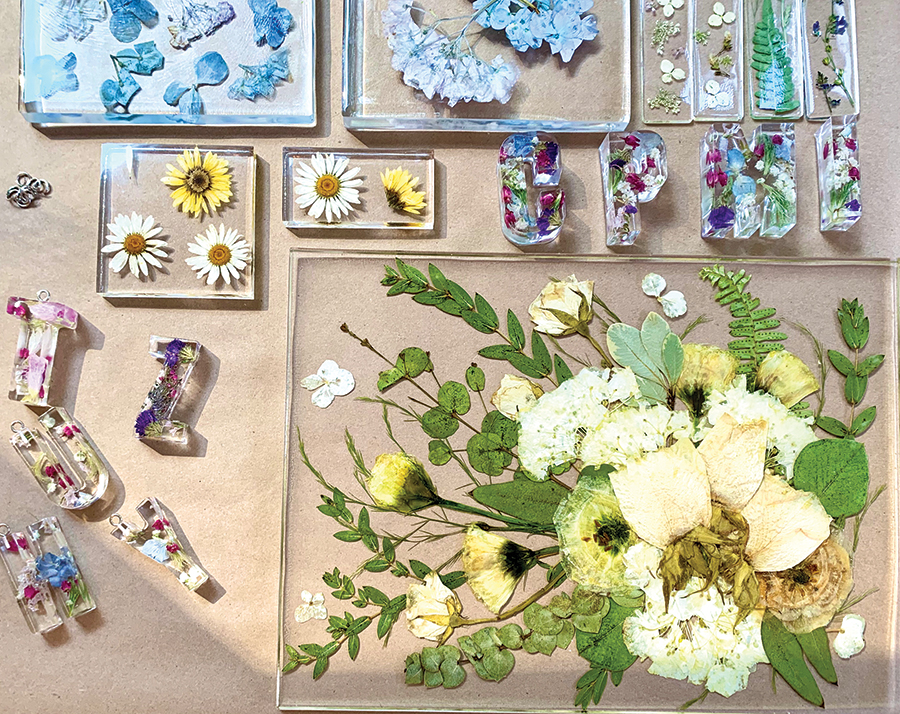
Through Pine Pressed Flowers, Katie preserves flowers by layering resin to make decorative wall hangings, keychains, bookmarks and more.

In the sunroom of her Whispering Pines home sits a desk, a wooden press and pages of dried flowers. According to Katie, the environment plays a big role in how the resin sets and dries.

“You have to have a clean space, free of dust or anything that could be drawn in by the resin. Humidity places a role, too, so the environment has to be just right,” Katie said.

And that’s just the beginning. A tedious process, resin preservation takes time and patience. She starts by drying out the flowers in a wooden press. She then mixes the resin and then, begins to layer it on.

“You have to know your end goal for the display and strategically plan out how many layers,” Katie said. “Bubbles will form, so you have to stick around and make sure to eliminate those. It’s not a project you can just walk away from.”

In addition to decorative work, Katie freezes memories through custom orders. Wedding bouquet preservation has become one of her most popular services. She also offers take-home flower pressing kits on her website that include everything you need to press and dry flowers or plants.

“This has been so fun for me so far. It’s work that I really do enjoy,” Katie said. “I just feel so lucky to be creating something that people love and want to buy right now.”

Find her work locally at Twigg & Co. and The Estate of Things, or check her out on Etsy and Instagram.


Home by Design

Kitchen Confidential

Damn this kitchen and its quarantineer demeanor

By Cynthia Adams

In 2020, we learned the new kitchen requisites: expansive, slick, lit like a Hollywood set for a Nancy Meyers flick, and/or the perfect set for your Zoom conference.

While most of us are scrounging around for whatever can be created with the random remains in the cupboards, writers at Fast Company breezily forecast the brave new world of future kitchens. Some boast smart fridges that sense what needs restocking — even possessing UPC barcode scanners that can transmit item info to your shopping list — and even order, if so desired. Extensive dry and wet food storage, cold storage that goes far beyond mere wine fridges, and specialized exhaust systems for both odor and virus removal, will be de rigueur.

But not for everyone.

We’re the fourth owners of a century-old house built by Ralph Lewis that has charm in spades. It also took an actual spade to chisel away four layers of kitchen flooring affixed with black tar, when we bought the place. An old photo shows me scraping madly with garden tools, including a weed claw.

We hauled away mismatched cabinets from a cheap reno.

Our vintage kitchen is still tiny. Most would have banged out more walls — at least two were previously removed in order to remove the butler’s pantry.

Allow that to sink in: a butler’s pantry. File that feature under “delusional thinking.”

There has never, ever, been a butler in residence. Sorry, Lord and Lady Carnarvon fans, to disappoint. (Although a Swedish chap at a Key West B&B offered to come be our “house man.” We had to decline, given the absence of downstairs quarters, no wages, not to mention our bewilderment concerning what a house man would even do.)

Ugliness slowly yielded to eccentric charm.

My brawny partner manhandled the stove from its dangerous location by a doorway. He installed tiles and created a cooking alcove, now one of the room’s best features.

Later I insisted upon industrial appliances. I envisioned a range like ones you see in celebrity kitchens, with names that sound like stealth weaponry: Viking, Vulcan, Wolf or Aga.

We wound up with what we could afford — a Frigidaire, unsuited to wartime maneuvers. “It looks pretty good,” I agreed, with indifference to actual performance.

We sold off stock to bankroll modest cabinetry and said appliances; the market value immediately skyrocketed.

“Enjoy your $100,000 kitchen,” Don groused. “Our retirement.”

But now clean, with the underlying wood floor refinished, it felt refreshed.

Just having a deep kitchen sink and a sexy range to twiddle with after months spent microwaving meals on the porch and washing dishes over the bathroom sink — positively made me want to get into that kitchen! And cook!

Mainly, we enjoyed having coffee in said improved kitchen. Also, pouring wine, and reading newspapers upon the retiled island.

And now?

“Now that people are in lockdown, there’s all this joy of cooking going on,” says designer Kim Colin. “People are rediscovering sourdough and learning how to grow useful kitchen herbs.”

What people? Those would not be my people.

A functional kitchen does not make me a cook, to paraphrase the joke, any more than standing in a garage makes me a mechanic. I have not, even once, produced a meal approaching ones enjoyed at (insert restaurant name here: ___________). 

Not at Print Works Bistro, Green Valley Grill, Pastabilities, Melt, Mythos, Osteria, 1618, Undercurrent, Fleming’s, Cugino Forno or even, God help me, Dunkin’ Donuts.

Miss Colin, it appears that I alone among quarantineers did not learn to bake sourdough. Nor master the art of martini-making, dehydrated snacks, or homemade dressings. But I did just coin a new word: quarantineer!

Oh, food pornographers. You are a fraudulent bunch.

I am talking to you, Giada De Laurentiis! Giada, of darling platform shoes, bohemian tops, cinched-waisted jeans, tooth veneers and dangly earrings. Star of Food Network’s Giada at Home 2.0.

“Worth the effort!” “So much better homemade!” “Easy as pie!”

Pie-making, for the record, is not easy. Who coined that phrase? Pie crust dough sticks to a rolling pin like dog poop sticks to white sneakers.

Also, I can spell the word umami but I have no idea how to deploy it. What is it, exactly? The “fifth sense?” Say what?

Food pornographers like Ms. De Laurentiis got me good: I’ve labored long, even risked Covid over chasing down odd-ball ingredients, only to find the outcome revolting. My fig jelly looked like pancake syrup. Thai Cooking for Dummies is not to be trusted. And don’t get me started on the inedible eggplant fiascos.

My partner became a studied liar.

Watching Don picking at the result disguised with cilantro (or basil; bigger camouflage and easier to keep alive in our quarantine herb garden) hiding the burned bits, he remains sturdily positive.

“Well, hey! It’s pretty good!”

I growl like a mean dog with range rage; a flour and grease splattered one. (A positive pandemic note: I don’t yet have Covid because I can taste and smell how revolting my concoctions are.)

When he commandeers the kitchen, wrecking every countertop and space, leaving the gas range (why, oh why, did I insist upon that?) blotched with more oil than the Exxon Valdez disaster — I survey the carnage from frying calamari in a too-small pot.

The calamari actually tastes good.

Grabbing the Windex and paper towel — there’s an upcoming Zoom wine tasting and this mess simply will not do — I disassemble the frigging oil-slicked range to scrub, blot and spray.

On second thought, just don’t Zoom me till the vaccine is ready.  PS

Cynthia Adams is a contributing editor to PineStraw and O.Henry.

Golftown Journal

Passion Fruit

The simple treasures of the game

By Lee Pace

“Collecting   I think it’s in your blood, or it’s not. Either you have it or you don’t.”

Mike Daniels certainly does. The native of Albany, New York, and avid, lifelong golfer started a business in the early 1990s selling premium golf tournament gifts beyond what he called the standard “bowling trophies.” That led him into the rich and deep world of golf collectibles — feathery balls, hickory-shafted clubs, paintings, books, pottery, scorecards and more.

“Golf has been my whole life. Really, I don’t know what I would have done without it,” he says. “The world of golf collecting reflects the depth of the game in my mind. In baseball, you collect a signed ball or bat, but that’s about it. There are so many categories within golf collecting. Some guys just collect pencils or scorecards from courses they’ve played. We all have this common interest in the history of the game.”

Bob Hansen shares that passion. He grew up in New Jersey playing at Manasquan River Golf Club and remembers at 6 years of age being captivated by the old Scottish golf artifacts displayed in the golf shop by the club’s early Scottish born pros, George Low and Jack Beckett. His father loved wooden ducks and hunting artifacts, and Hansen watched in wonder the artistry of the woodworkers. 

“It was fascinating seeing them hold a piece of wood in their hands and work a tool and shape this bird that is going to come to life,” he says. “I found the same appeal with the old clubmakers. I was a pretty good player as a kid and young man, but eventually a bad back killed my golf game. I really wanted to stay in golf. So I started collecting rare golf memorabilia and studying the history of golf — like a maniac, I might add.”

And Tom Stewart goes deep in the world of golf collecting as well. He grew up in Northern Michigan, caddying as a 10-year-old at Petoskey-Bayview Country Club and then working nights watering the course at Walloon Lake Country Club. Walter Hagen was the first golf pro at Walloon Lake, and the golf shop was decorated with photos of golfers like Hagen, Bobby Jones and Gene Sarazen playing there during the summer tourist season. Stewart was soon imbued with the history of the game, and later, as a professional at clubs such as the exclusive Adios Golf Club in Coconut Creek, Florida, began decorating his golf shop with hickory clubs and antique Sunday bags — long before it was fashionable to do so. 

“I spent $20 for an Alister MacKenzie architecture book in the 1970s; now it’s worth $1,500,” Stewart says. “I’m lucky I never sold it. I’ve got 3,500 books and thousands of old wooden clubs. I love this stuff. I’m not particularly eager to part with any of it. But there are lots of people who want these things as well.”

Daniels, Hansen and Stewart all are purveyors of fine golf art and memorabilia in two different shops in the village of Pinehurst. Daniels and Hansen are partners in The Old Golf Shop, which opened in June 2014, just days before the U.S. Open, and Stewart has owned and operated Old Sport & Gallery since 1997. 

And all three are longtime members of a group originally named the Golf Collectors Society that is now known as the Golf Heritage Society. The Society turns 50 this year, with Hansen and Stewart among the early members in the 1970s and Daniels following in the late 1980s. 

“They changed the name trying to be more inclusive and include people that play hickory golf, trying to broaden the scope of the organization,” Daniels says. “When it first got started, it was a handful of guys meeting in Dayton or Cincinnati or wherever, trading stuff out of the trunk of their cars.”

To mark and help celebrate its anniversary, the Golf Heritage Society is reducing its annual dues to $25 a year from its standard $50 as a means to attract more golfers to this fraternity built around the study of the game’s history, and trading and collecting memorabilia (simply visit its website, GolfHeritage.org, to find out more).

“The Golf Heritage Society has evolved so much over the years,” Hansen says. “I remember in the early days guys were trading stuff you can find at a flea market. What I’m really appreciating now is the Society has gotten to the point that the collectors want to know things and not just own stuff. The stuff is evidence of history. But if you don’t know the history, it’s just stuff. That’s what’s important — the history.”

The Society conducts an annual general meeting and trade show (though 2020’s event was canceled due to the COVID-19 pandemic), operates various tournaments through the Society of Hickory Golfers, and publishes The Golf, a quarterly journal. The GHS also operates a classified advertising board on its website where members can survey all manner of golf memorabilia available on any given day — perhaps a collection of 24 vintage Golfiana magazines or an antique solid maple clubmaker’s vise from the MacGregor Co., to cite a random day in September. 

But that experience pales in comparison to rummaging around either the Old Pro Shop or Old Sport & Gallery in Pinehurst. You can find original art or copies of famous paintings like Charles Lees’ The Golfers set on an Edinburgh course in 1849, rare books, prints and all manner of artifacts. 

“I never knew about the Golf Collectors until I saw an article in a magazine, made a phone call and started attending shows,” Daniels says. “It had been going 20 years before I got involved. It opened up a new world for me. I’ve made so many friends and had so many wonderful experiences.”

“Our collections had gotten so big individually, and we reached our 60s and said, ‘We’re too old to be schlepping this stuff around the country to trade shows. Why not put it under one roof?’” Hansen adds. 

The sport of golf has thrived during the COVID-19 pandemic (the National Golf Foundation reports the game lost 20 million rounds initially during the spring shutdown but has bounced back with 14 and 20 percent monthly year-over-year increases in rounds played in June and July). And the Pinehurst golf art and collectibles shops have ridden those coattails to brisk business as well. 

“This business is actually doing better right now than it’s done in two years,” Hansen says. “I’m amazed. It’s interesting to watch the attitude and the people coming back that haven’t been in here for years. I think there are people who are looking at the world very differently today and they’re saying, ‘You know what, I know I shouldn’t have it, but if I want something, I’m going to get it.’”

“It’s energizing. It keeps me engaged,” Stewart says of his dual vocation and avocation of golf collecting. “A lot of my buddies are retired, but I like what I do. Why quit?”

Why quit indeed for those with collecting and golf history in their blood? PS

Longtime PineStraw golf columnist Lee Pace admits to having his eye on the massive and beautiful Golf Through The Ages volume but will have to sell a lot of articles to pay for it. 

Birdwatch

Pine Dwellers

The familiar trill of these tiny warblers is never far

By Susan Campbell

When most folks think of warblers, what comes to mind are diminutive, colorful songsters flitting about in the treetops during the spring and summer months.  Most warblers subsist on a diet of insects and therefore head south as the first cooler breezes begin to blow, winging their way toward Central America and beyond. However, for the handsome pine warbler, things are a bit different!

Pine warblers can be found across North Carolina year round.  They are not choosy about the evergreen species that they inhabit, so you may find them in spruces and Virginia pines in the mountains, loblollies and longleaf in the Piedmont and Sandhills, as well as pond pines along the coast.  Develop an ear for their vocalizations, and you will find that these little birds are quite common — even in mid-winter. And it doesn’t take a whole lot of pines in an area to attract them.  Just a few mature trees in a mixed stand may produce a pair or two.

Pine warbler vocalizations are limited to a “chip,” uttered by both the male and the female, in addition to a musical trill coming only from the male.  His warble can be heard on warm days in the winter, and, during breeding season, a come-hither signal to potential mates.  These little males, about the size of a titmouse, have short, slender bills, yellow bodies and yellow-gray wings that sport two white wing bars. Females are similar but more greenish — definitely well camouflaged to protect them during their brood-rearing activities in early summer.

Flocks of pine warblers can number in the dozens come winter as individuals from up north mix in with our sedentary birds, no doubt finding safety in numbers.  Also, they may be seen associating with yellow-rumped warblers that are found in the Piedmont and Sandhills during the cooler months.  Both species may show up in your yard to take advantage of feeder offerings.  Suet is very attractive to these insect-loving birds.  Although yellow-rumpeds may also feed on fruit or sugar water, pines usually do not.  They, however, may take advantage of smaller seeds or, not uncommonly, sunflower hearts.  This species spends probably more time in search of seeds than any other warbler, foraging deep in the cones that are produced in late summer.

For whatever reason, these feisty little birds are not very bashful when they are particularly hungry.  On colder mornings, when I would go out to refill my homemade suet feeders when I lived in Whispering Pines, it was not unusual for a bird to land right next to me as if to say “Hurry up! Where have you been? It’s past my breakfast time!”  I do miss having them in the yard where I live now.  But it just takes a five-minute walk through the neighborhood to a ridge with a long line of loblollies for me to spot a flash of yellow high up in the branches and hear that familiar trill.  Fortunately, a few handsome pine warblers are never very far away!  PS

Susan would love to receive your wildlife observations and/or photos at susan@ncaves.com

Bookshelf

October Books

FICTION

The Invisible Life of Addie LaRue,
by V.E. Schwab

In France in 1714, during a moment of desperation, a young woman makes a Faustian bargain to live forever — and is cursed to be forgotten by everyone she meets. Thus begins the extraordinary life of Addie LaRue, and a dazzling adventure that will play out across centuries and continents, across history and art, as a young woman learns how far she will go to leave her mark on the world. Everything changes when, after nearly 300 years, Addie stumbles across a young man in a hidden bookstore and he remembers her name. It’s a story you will never forget about a life no one will remember, penned by a New York Times bestselling author.

Leave the World Behind, by Rumaan Alam

A magnetic novel about two families, strangers to each other, forced together on a long weekend gone terribly wrong. Amanda and Clay head out to a remote corner of Long Island expecting a vacation: a quiet reprieve from life in New York City, quality time with their teenage son and daughter, and a taste of the good life in the luxurious home they’ve rented for the week. But with a late-night knock on the door, the spell is broken. Ruth and G.H., an older couple who claim to own the home, have arrived there in a panic. A sudden blackout has swept New York and — with nowhere else to turn — they’ve come to the country in search of shelter. With the TV and internet down, and no cellphone service, the facts are unknowable. Should Amanda and Clay trust this intruding couple, and vice versa? Suspenseful and provocative, Alam’s third novel is keenly attuned to the complexities of parenthood, race and class. Leave the World Behind explores how our closest bonds are reshaped, and unexpected new ones forged, in moments of crisis.

Troubles in Paradise, by Elin Hilderbrand

Travel to the bright Caribbean one last time in this satisfying conclusion to the bestselling “Winter in Paradise” trilogy. After uprooting her life in the States, Irene Steele has just settled in at the villa on St. John, where her husband, Russ, had been living a double life. But a visit from the FBI shakes her foundation, and Irene once again learns just how little she knew about the man she loved. With help from their friends, Irene and her sons set up their lives while evidence mounts that the helicopter crash that killed Russ may not have been an accident. Meanwhile, the island watches this drama unfold — including the driver of a Jeep with tinted windows who seems to be shadowing the Steele family. As a storm gathers strength in the Atlantic and surprises are in store for the Steeles, all will be revealed about the secrets and lies that brought Irene and her sons to St. John .

Moonflower Murders, by Anthony Horowitz

Susan Ryeland, the retired publisher, is living the good life running a small hotel on a Greek island with her long-term boyfriend Andreas. Then the Trehearnes come to stay. The strange and mysterious story they tell, about an unfortunate murder that took place on the same day and in the same hotel in which their daughter was married — a picturesque inn on the Suffolk coast named Farlingaye Halle — fascinates Susan and piques her editor’s instincts. One of her former writers, the late Alan Conway, knew the murder victim. Conway based the third book in his detective series, Atticus Pund Takes the Cake, on that very crime. The Trehearne’s, daughter, Cecily, read Conway’s mystery and believed the book proves that the man convicted of that murder is innocent. When the Trehearnes reveal that Cecily is now missing, Susan knows that she must return to England and find out what really happened. Brilliantly clever and relentlessly suspenseful, Moonflower Murders is a deviously dark take on vintage English crime fiction from one of its greatest masterminds.

NONFICTION

Keep Moving: Notes on Loss, Creativity and Change, by Maggie Smith

Sometimes it seems, in the midst of a dark time, a deep rut or maybe just in the middle of a long boring stretch, the thing that keeps one from moving forward is simply the inability to move at all. In Keep Moving, Smith offers thoughts, suggestions, reflections and stories that encourage readers to keep going: to breathe, blink, sit, eat and to call that a successful day. This little gem is one to keep close at hand and revisit anytime the world gets a little too hard. When Smith, the award-winning author of the viral poem “Good Bones,” started writing inspirational daily Twitter posts in the wake of her divorce, they unexpectedly caught fire. It is all here. For fans of Anne Lamott and Cleo Wade, a collection of quotes and essays on facing life’s challenges with creativity, courage and resilience.

No Surrender: A Father, a Son, and an Extraordinary Act of Heroism that Continues
to Live on Today,
by Chris Edmunds and
Douglas Century

An unforgettable story of a father’s extraordinary acts of valor in World War II and a son’s thrilling journey to discover them — an epic narrative of bravery, compassion and faith. Like most members of the Greatest Generation, Roddie Edmonds, a humble American soldier from East Tennessee, rarely spoke about his experiences during World War II. Not even his son Chris knew the full details of Roddie’s capture at the Battle of the Bulge or his captivity at Stalag 9A, a Nazi POW camp. But when Chris’ daughter was assigned a family history project, Chris reread Roddie’s wartime diaries, which set in motion a series of life-changing events. Chris embarked on a years-long journey, interviewing surviving POWs under Roddie’s command, and retracing his father’s footsteps. Century, a New York Times bestselling author, and Edmonds take us to the front lines of this inspiring multigenerational story.

Is This Anything? by Jerry Seinfeld

In page after hilarious page, one brilliantly crafted observation after another, readers will witness the evolution of one of the great comedians of our time and gain new insights into the thrilling but unforgiving art of writing stand-up comedy. Since his first performance at the legendary New York nightclub Catch a Rising Star as a 21-year-old college student in the fall of 1975, Seinfeld has written his own material and saved everything. “Whenever I came up with a funny bit, whether it happened on a stage, in a conversation, or working it out on my preferred canvas, the big yellow legal pad, I kept it in one of those old school accordion folders,” he writes. “So I have everything I thought was worth saving from forty-five years of hacking away at this for all I was worth.”

Modern Comfort Food, by Ina Garten

In this collection of all-new soul-satisfying dishes from America’s favorite home cook, Garten shares 85 new recipes, many inspired by childhood favorites, but with the volume turned way up. There are few things more comforting than gathering for a meal with the ones you love, especially when dishes like “Cheesy Chicken Enchiladas” are at the center of the table. Old-fashioned crowd pleasers like “Roasted Sausages, Peppers, and Onions” are even more delicious and streamlined for quick cleanup. Home cooks can always count on Garten’s dependable, easy-to-follow instructions, with lots of side notes for cooking and entertaining. From cocktails to dessert, from special weekend breakfasts to quick weeknight dinners, you’ll find yourself making these cozy and delicious recipes over and over again.

CHILDREN’S BOOKS

If You Want a Friend in Washington: Wacky, Wild & Wonderful Presidential Pets, by Erin McGill

From Macaroni Kennedy (a horse) to Pauline Wayne Taft (a cow), there have been some outrageous presidential pets along with a veritable herd of dogs, cats and the occasional chicken. This fun, informative, cleverly illustrated picture book will have young readers laughing out loud and their adults cramming information sure to be useful for trivia nights. (Ages 4-8.)

I Promise, by LeBron James

Children believe what you tell them. This book of affirmations should be the go-to for anyone hoping to raise a child to be courageous, kind, helpful, questioning, hardworking, respectful, and curious. And in the end, isn’t that what we really want of them all? Proceeds from this motivational picture book will go to the LeBron James Foundation and the I Promise School. (Ages 3-5.)

Kenny and the Book of Beasts, by Tony DiTerlizzi

In this highly anticipated sequel to the much-loved Kenny and the Dragon by Caldecott Honor winner and N.C. Battle of the Books author DiTerlizzi, Kenny must cope with many changes in his life — including a litter of baby sisters, friends at different schools, and the fear that he’s losing his best friend. (Ages 8-12.)

The Complete DIY Cookbook for Young Chefs, Americas Test Kitchen Kids

Curious young foodies will enjoy this fun new cookbook that explores the secrets behind some commonly available foods (think: ketchup, applesauce, sprinkles, pancake mix, hummus, and fish-shaped cheddar crackers), and recipes to create their own healthy versions of these kid favorites. (Ages 8-12.)  PS

Compiled by Kimberly Daniels Taws and Angie Tally

The Omnivorous Reader

A McCorkle Couplet

Connecting tissue of two novels

By D.G. Martin

In 1984, a young North Carolina writer, Jill McCorkle, shocked the literary world by making her debut with two simultaneously released novels, The Cheer Leader and July 7th. The New York Times called her a born novelist. She went on to write three more novels, Tending to Virginia (1987), Ferris Beach (1990), and Carolina Moon (1996).

Then she paused to concentrate on short stories that won high praise. But in 2013 she was back with another novel, Life After Life, and then again in July 2020 with Hieroglyphics. Both books deal with the complications in older people as they face life’s end.

Life After Life focuses on residents of a retirement home and the people who work for and with them. Hieroglyphics deals with one couple’s efforts to adjust to retirement and aging. Into these settings McCorkle injects rich and disturbing stories that hold her readers’ attention throughout.

Life After Life is set in the fictional town of Fulton, North Carolina, a place not unlike Lumberton, where McCorkle grew up. In the Pine Haven Retirement Center, her characters come together as residents, staff, visitors and family.

One important character, Joanna, provides hospice-like counseling and comfort to dying residents and their loved ones. Her activities give the novel a gentle storyline and provide a persistent reminder that illness and death are an inescapable part of the experience at Pine Haven.

A mentor tells Joanna, “Make their exits as gentle and loving as possible. Tell them how good it will be, even if you don’t believe it yourself. You’re Southern, you know how to do that.”

McCorkle describes how family members embrace Joanna “like she is one of them. Lung. Brain. Breast. Uterus. Pancreas. Bone. The families discuss and explain their loved one’s symptoms and diagnoses for her as if they have never been heard of before, have never happened to anyone else, and she listens.”

Each of McCorkle’s characters has a different set of challenges, but the onset of fatal illness and death is a constant.

For instance, there is Stanley, a lawyer and widower. After Stanley’s wife died, his son moved into the family home, would not leave Stanley alone, slept beside him in his dead wife’s place in their bed, and began driving the grieving father crazy.

To get away from his son, Stanley decided to act as if he really was crazy and therefore needed to be in a retirement center. He constructed a new image for himself, a kind of senility combined with a loss of judgment that led to inappropriate remarks to women.  His crude descriptions of his desires and how he wants to fulfill them prove that his mental condition requires institutionalization. Stanley’s crazy conduct is an act to get him away from his son and into the retirement center. It worked.

Stanley is only one of the several characters whose situations evoke sympathy, pain and laughter.

Dealing with the presence of death is part of life’s experience. Reading Life After Life deepens a reader’s realization of its oncoming approach. It makes one wonder again why we are here, why we are still here, and whether there really is some life after life.

At the end of Life After Life, one of Pine Haven’s most popular service people, C. J. (for Carolina Jasmine), is found dead in her apartment. It looks like suicide, but there are hints that something is amiss. A single parent with a young son, C.J. had been secretly seeing a surgeon who had a wife and other love interests. The surgeon is an obvious suspect, but there is no closure to his fate.

Near the book’s ending another character remembers “a train wreck in this very county in 1943 where over 70 people died, most of them soldiers trying to get home for Christmas.” McCorkle says she recalls her dad talking about visiting the crash site near Lumberton and seeing all the scattered debris.

C. J.’s death and the train wreck provide connective links from Life After Life to Hieroglyphics. The father of a central character in Hieroglyphics died in the train wreck.

McCorkle also lived in Boston for a number of years, where she heard about a 1942 nightclub fire that took more than 492 lives, including the mother of another key character in Hieroglyphics.

When Lil, whose mother died in the fire, and Frank, whose father died in the train wreck, first met, they discovered their common bond, one that held them through 60 years of marriage.

The story begins with Frank and Lil, now in their 80s, retiring to Southern Pines. They live within driving distance of the train wreck’s site, which is near the modest home where Frank lived for several years after his dad’s death.

Frank and Lil have driven to the old house, now occupied by Shelley, a single mother, and her young son, Harvey. Shelley has seen Frank driving by before and is nervous. “It doesn’t help that that old man rides by so often now, his green Toyota slowing in front of the house and then circling the block.”

When Shelley meets Frank at the door, he explains, “I grew up here. I would love to see inside if convenient. My wife, too.”

Shelley resists, but at the end of the book Frank is in the backyard of the old house finding some closure.

In the 300 pages between its opening and closing at the old house, McCorkle takes us deep into the lives of the characters we meet on the first pages: Frank, Lil, Shelley and Harvey.

Frank carries the consequences of the train wreck throughout his life. Both his father and mother were on the train, coming from Florida to their home in Massachusetts, where Frank and his grandmother waited for them. Frank’s seriously injured mother remained in North Carolina to recuperate. She was sure she heard Frank’s father calling, “Don’t leave me.” So she stayed and ultimately married a local man.

Frank joined her and they lived in her new husband’s house. Ultimately, Frank went to college and graduate school, married Lil, and became a college professor specializing in ancient history and archeological relics. Along the railroad tracks he collected relics from the wreck, including a toy decoder that he imagined his parents were bringing him for Christmas.

Lil cannot get over the loss of her mother, a ballroom dance instructor, who had not told her husband or Lil that she was going to the nightclub. The questions of who her mother was with and why still haunt Lil. She is also a collector. McCorkle uses Lil’s collected newspaper clippings and copious notes to help tell a story that include her agonizing experience of Frank’s misadventures with a younger academic.

Shelley’s son, Harvey, collects horror stories about the Beast of Bladenboro, the Glencoe Munchkins, and other scary tales that keep him awake at night and that he uses to frighten his schoolmates and add complication to his mother’s life.

Shelley is a court reporter in a Robeson County courtroom during a high profile trial of the doctor accused of murdering one of his many girlfriends. The doctor’s victim was C.J., a major character in Life After Life.

Shelley’s troubles with Harvey and Frank intersect with her life’s other challenges to put her court reporter’s job at risk.

McCorkle brings these different characters together into a complex, layered and gripping novel, making Hieroglyphics, along with Life After Life, more proof of her storytelling genius.  PS

D.G. Martin hosts North Carolina Bookwatch Sunday at 3:30 p.m. and Tuesday at 5 p.m. on UNC-TV.

Weekend Away

Mountain Men

The Madcap gents head for the hills

By Jason Oliver Nixon

There’s a handful of rarefied American resorts that are spoken about in hushed terms. Among those are The Point in upstate New York, Vermont’s Twin Farms, and San Ysidro Ranch on the California coast south of Santa Barbara. Blackberry Farm, tucked into the rolling hills and mountains of eastern Tennessee, also appears on that coveted, in-the-know list with breathy nods to the estate’s culinary prowess, superlative spa treatments, impressive wine list, and themed escapes built around literary and fashion “activations.”

I have been lucky enough to visit “the Farm” and was impressed by the estate’s gastronomic glories and bucolic landscape, so I was excited to hear that the Blackberry team would be opening a new outpost up the road from the Farm and atop a nearby mountain named, predictably, Blackberry Mountain.

In a word, Blackberry Mountain is camp. High-end camp. Rooms start at about $1,500 per night. Just for the room. Envision a certain luxe rusticity paired with stunning vistas of the Great Smoky Mountains, interesting menus, endless activities, charismatic sommeliers, and private fire pits complete with dial-up s’mores. And lots of construction still taking place.

But let’s dive deep: As you follow the directions from the main highway through Walland, Tennessee — about a 4 1/2-hour drive from the Triad — you might ask, as I did, “Er, did we miss something?”

“Deliverance,” my partner, John, said. But then you turn onto a newly asphalted road, and that seems encouraging. We drove past the vaguely Druidic gatepost emblazoned with an artistic “M” twice before realizing that we had gone too far. Back on track, we rounded a corner to the property’s actual gates, where we announced ourselves via intercom and were buzzed in.

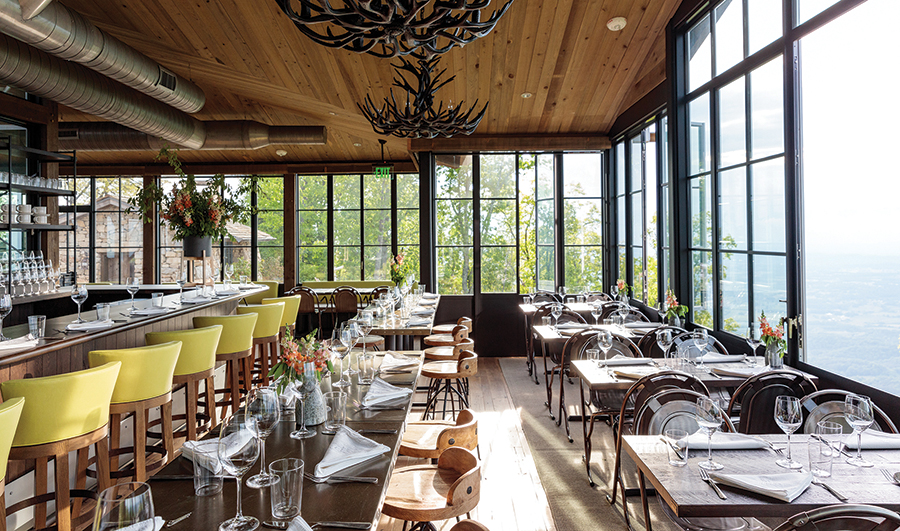
And then we got lost again at a junction as we traveled up and up the mountain. “Just like camp,” John observed. “We need a map.” A few turns past the many homes being constructed (the Mountain is mixed use in its focus — resort meets second, third and fourth residences), and we arrived at the 5,200-acre property’s lobby-cum-bar/dining room, aka The Lodge. The views out toward the endless pine-shaded Great Smoky Mountains and the heated pool and spa lawn were breathtaking, and we lapped up the very calm interiors of the public spaces with the fire crackling merrily away in the bar.

We were ferried by Lexus up from The Lodge to our stone-clad cottage complete with sprawling bedroom, spa-like bathroom, and private terrace with fireplace. A golf cart sat charging beside the villa’s entrance that would allow us to travel up the mountain to locations such as the fitness center, aka The Hub, and Firetower — and, yes, it’s a hike uphill, so the golf cart certainly came in handy.

Settled into our neutral-hued (aka, beige) pitched-roof guest room, John and I set out to explore. A stay at the Mountain — unlike the Farm, which gears itself more to relaxation — revolves around things to do. Or as the resort refers to the post-reveille run sheet, “active adventure.”

“We want the Mountain to inspire curiosity in our guests,” notes Blackberry Mountain proprietor Mary Celeste Beall.

“Have fun with that, I plan on sleeping,” commented John. “If I have to be curious, is there room service and a sauna and Turner Classics on the TV?”

And so I was left on my own to channel an inner “curiosity.” I skipped the Japanese pottery class — something called “raku” — but did try the Sound Bathing treatment, and that left me a bit perplexed. There were lots of musical instruments and singing, I think. Maybe a gong and a zither. I felt like I had attended a Sarah McLachlan concert, albeit supine. But then I didn’t like the bizarre “equine therapy” I tried at another retreat either, so maybe it’s me.

Would I care to do a spin class? Or any of the myriad exercise classes, yoga, spa treatments, workshops, painting classes, and hiking trails and so much more?

Er, no.

I do too much of too much in my daily life. Well, maybe not the gong playing. Or the raku.

Instead, I created my own version of “active adventure.” I luxuriated with a perfect martini in The Lodge surrounded by a heap of magazines beside the fire before enjoying the hot tub in a natty Orlebar Brown bathing costume depicting James Bond.

But maybe I wasn’t being a good sport.

I recalibrated and tried to fit in. I donned head-to-ankle organic Lululemon and generic Allbirds.

“You look like a trustafarian from Venice Beach,” John commented, whilst dialing up for bubble bath and ice. “Very Abbot Kinney.”

Still, I tried. In my own way.

“Where’s the spa?” I trilled. “A farm-to-table pedicure, perhaps?”

“And is there a mixology class at the bar? With complimentary nibbles . . . ”

“Is there archery?”

We lapped up two inspired dinners at the Three Sisters restaurant and hiked a bit and took the golf cart to lunch at the Firetower, where John and I savored the eye-popping views. I took part in a cooking demonstration and felt like Ina Garten for about an hour.

John slept in, and we ran amok with the golf cart and Instagram TV-ed the whole thing. Frankly, the golf cart was our favorite active adventure. Brilliant.

I considered a yoga class.

And thought about Pilates.

And I have no idea what happens in a “movement studio” and don’t want to know.

Happily, there were s’mores that evening by our fire.

What I realized was that my interest in camp-like activities ended at about age 14 in tandem with the demise of The Go-Go’s and my plaid Swatch. If I have to be active, I want to bike through Provence or hike Sicily. And if I am curious, it’s about art-house films, museums, and famous gardens. Although I do like a good lanyard.

Sigh. I guess I am the wrong demographic.

Get me to the Farm.

So this bad camper ordered another martini and sat back to enjoy the postcard-perfect vista and wait for the internal dinner bell.  PS

In their debut travel column, the Madcap Cottage gents, John Loecke and Jason Oliver Nixon, embrace the new reality of COVID-friendly travel — heaps of road trips. To kick off the festivities, the gents pile into their Subaru and set off for the recently opened Blackberry Mountain (see blackberrymountain.com), the adventure-geared sister to Tennessee’s fabled Blackberry Farm.