
Adam’s Garden of Eatin’

Adam’s Garden of Eatin’

The dark side of delicious

By Deborah Salomon

Photographs by John Gessner

     

Black coffee: Sophisticated.

Black beans: Ole!

Black-eyed peas: Happy New Year, y’all.

The little black dress may be a classic, but a kitchen with matte black cabinets, textured black granite countertops and black floormats? Stunning. Just what family chef Adam Wimberly wanted. His goal: “Something masculine.”

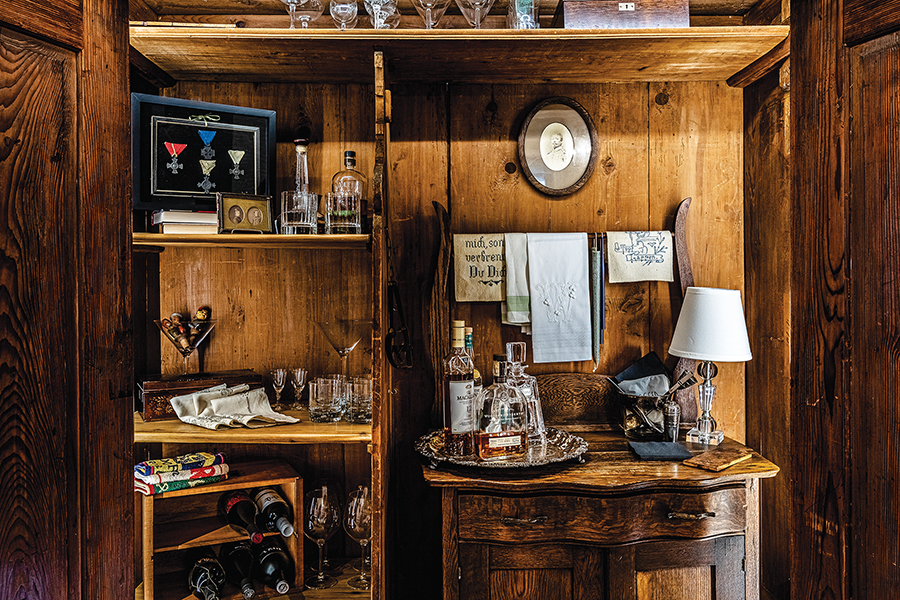
Black isn’t the only surprise at Adam and Jessica Wimberly’s home — a charming cottage in a gated golf community, its exterior belying the scope and originality within. Just inside the front door, Adam’s home office has navy blue walls and ceiling. The front hallway is sized to accommodate an ancestral European armoire, big as a British schooner, which houses a bar, Adam’s g-g-g-g-great grandfather’s sword and other military artifacts. The 280-year-old behemoth was a gift from Adam’s mother before she passed away.

In this house the master suite opens onto the living room, with 20-foot ceilings bisected by a second-story balcony. Then, the living room opens onto a terrace where water splashes from two fountains, the larger a COVID project.

      

Upstairs, a guest bedroom and a home gym are above-average size. And a big, comfy home theater, circa Tony Soprano, has a sectional sofa, blackout window curtain, wall-mounted screen and professional projector, plus posters from their favorite flicks.

Besides suiting the Wimberlys’ requirements and tastes, the house and its location represent a lifestyle adjustment for the vibrant family. “We were pioneers in Seven Lakes West, lived there for 20 years in a traditional two-story across from the lake where we had a pontoon boat,” Adam says. Eventually, the boat lost its thrill.

Events had them driving to town often. Son Asher would soon attend Pinecrest High School. Time for a change, not to be confused with still-distant retirement.

Adam, a corporate headhunter for the pulp and paper business, could locate his home office anywhere. Jessica no longer taught middle school. A visit to friends at National Golf Club sparked interest. “We could see ourselves enjoying this neighborhood,” Jessica says.

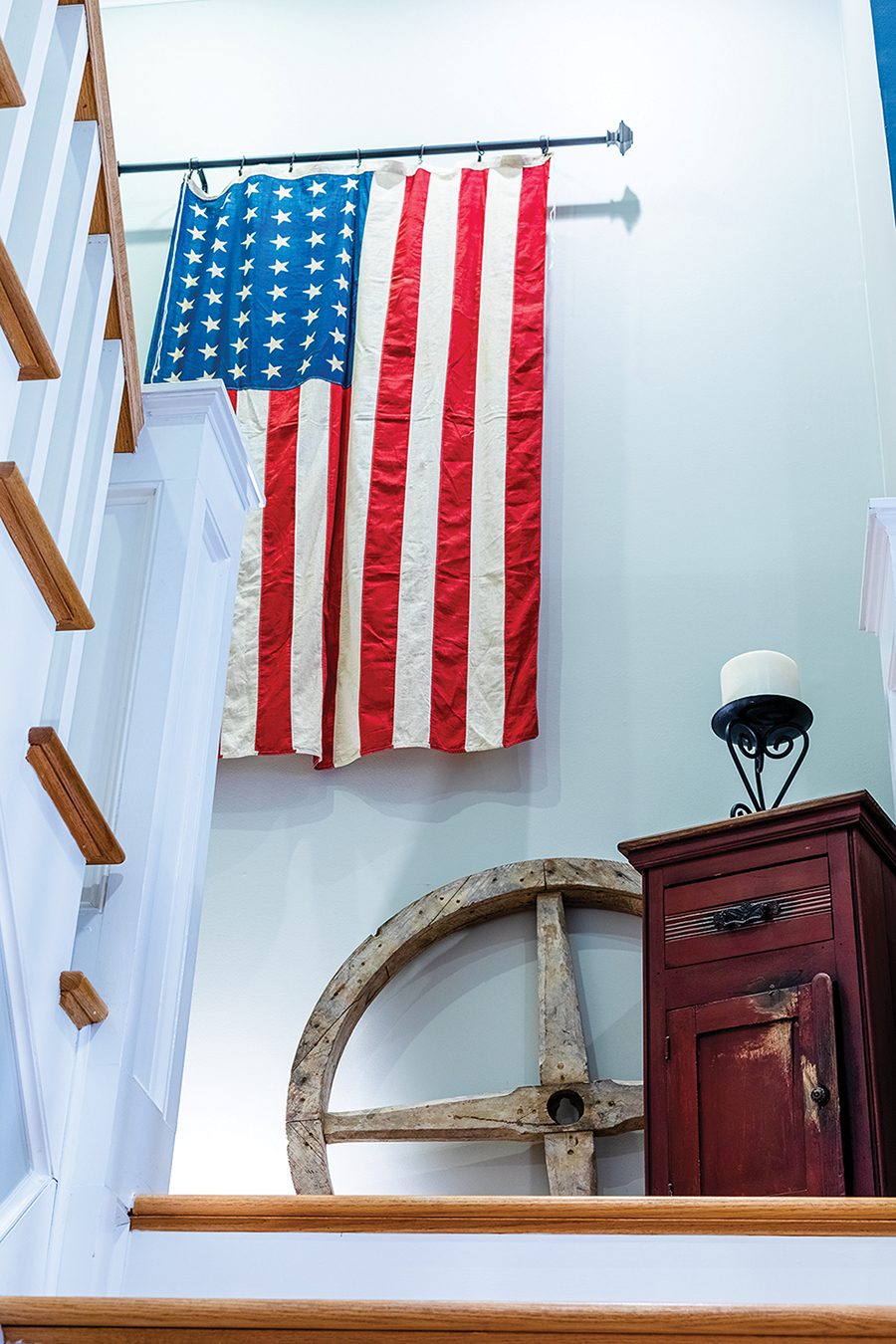
They found a house built in 2007, with yellow walls and a traditional kitchen. Jessica liked the central vacuum. Adam liked the small yard requiring minimal care. They both liked the movie room. A good omen: The house was occupied by the same family friends who had hosted their engagement party. And, its dimensions (4,000 square feet) and unusual layout provided options for displaying family artifacts with Jessica as docent, sharing the history of ancient oars and the 48-star American flag on the staircase landing.
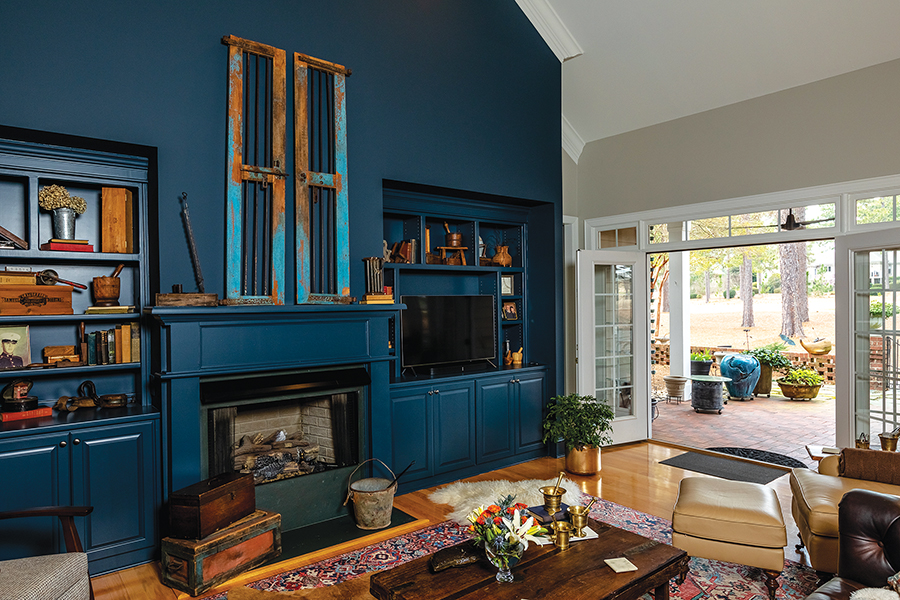

   

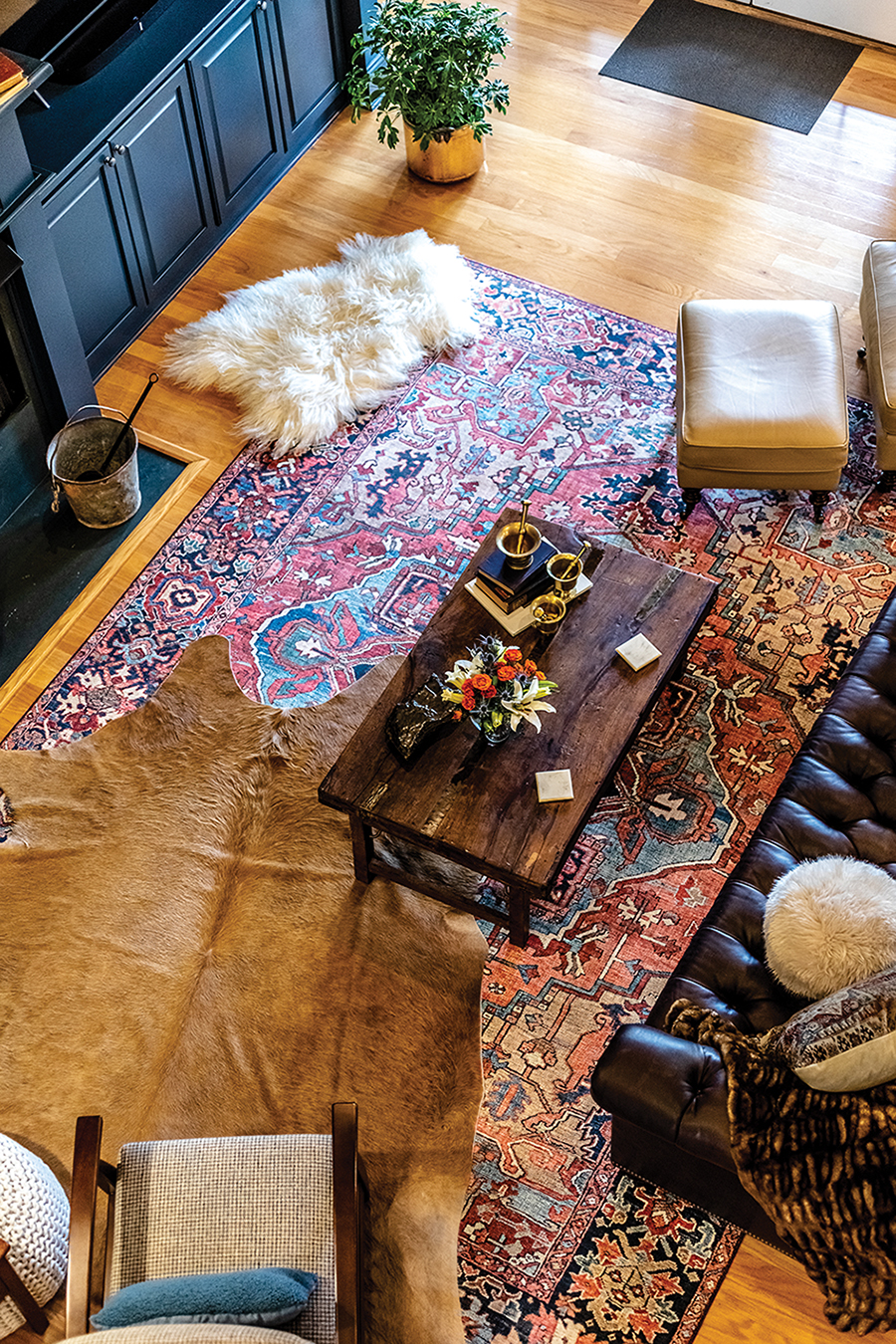
They took the plunge, trading lake view for a fairway in 2017. Out with pastels and broadloom, in with soothing (now trendy) shades of gray, sand and beige framed by vanilla crown moldings. Informal, comfy and contemporary characterizes most furnishings, with an emphasis on dark woods, leather and other textures, including a rug woven from cowhide. Lamps and ceiling fixtures double as conversation pieces, along with a battered barn door rising from the living room mantel, representing Jessica’s Moore County farm connections. She was born here and has lived here, or nearby, practically forever.

     

Certain pieces, however, steal the show. The bed dominating the master suite is fashioned from inlays employing centuries-old wood. This massive piece, made to order for the Wimberlys in Italy, took a year from inception to delivery.

A round dining room table commemorates their 25th wedding anniversary. Battlefield art and family crest speak to Adam’s heritage. A bowl received as a wedding gift, later serving as baptismal font for their son, holds chocolates. A cabinet that belonged to Jessica’s grandmother contains her written canning recipes. And a milk jug speaks to the dairy farm history.

Some spaces were repurposed to suit the family’s active lifestyle. “We like to entertain,’’ Jessica says. Not just cookouts and holiday banquets. The breakfast nook became what Jessica calls a friends’ corner, with chairs around a low table for drinks and hors d’oeuvres or a coffee break. A main-floor walk-in closet, where former owners stored their Christmas tree, is now a workshop.

Systems were sufficient except for the AC. “We keep the house like a refrigerator in the summer,” Adam says.

The only major construction took place in the kitchen. Adam’s avocation surfaced young. “I was my mother’s sous-chef,” he says, before graduating to cooking shows where best-quality ingredients demand superior implements. “Some guys buy boats. I bought a kitchen.”


       

Adam had a design in mind — quasi-industrial with a floating island — but the black came from something he saw online. The galley kitchen footprint suited the industrial mode, but the black cabinets, black countertops and black foam floor mats begged for illumination. At one end, a tall, undressed window rises over the sink, while along the brick sidewall, three small, paned windows at ceiling height provide both light and another design element. Open shelves hold antique or interesting hand tools. Weathered wooden boxes scattered throughout accommodate larger implements. The Sub-Zero is left metallic silver. Black panels might have been overkill.

On the counter, a planter growing half a dozen herbs speaks of Adam’s culinary requirements. Over it all hangs an old-timey butcher shop sign.

As expected, his ideas were met with resistance. “But I had no Plan B,” he confesses.

Adam, glowing with pride, demonstrates how one of eight burners on his Wolf range is retrofitted for delivering maximum heat to a wok. “I’m thrilled. I wouldn’t change a thing,” he says. “This is my happy place.”

Jessica concurs: “I feel everything we need or want is in this house.”

Enter Asher, home from school. Before heading for his second-floor domain between the movie room and gym the 17-year-old greets his parents with a familiar phrase:

“What’s for dinner, Dad?”  PS

Birdwatch

Birdwatch

The Early Bird

American robins usher in spring

By Susan Campbell

It is early spring in central North Carolina and few migrants are this far north, let alone back and ready to breed. Flocks of American robins have been evident all winter, feasting on dogwoods, hollies and other berry-laden shrubs. But now they are less interested in eating and ready to start a new family. They are, indeed, the “early birds.”

American robins are found throughout most of the United States and Canada. They are one of the most familiar birds on the continent. In winter, thousands from across Canada and the northern tier of states move southward, not as a response to the drop in temperatures but in search of food. Although robins are insectivorous during the warmer months, they become frugivorous in winter. Flocks of thousands are known to forage and roost together here in the Southeast.

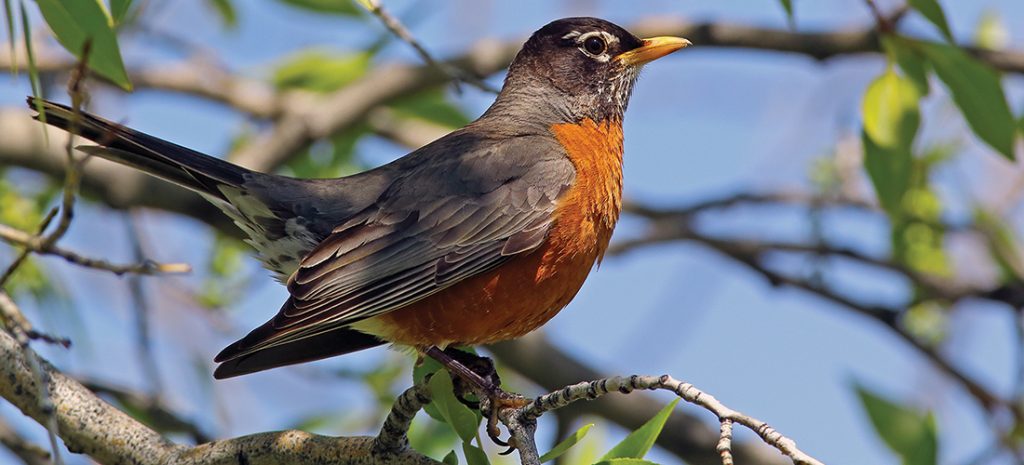
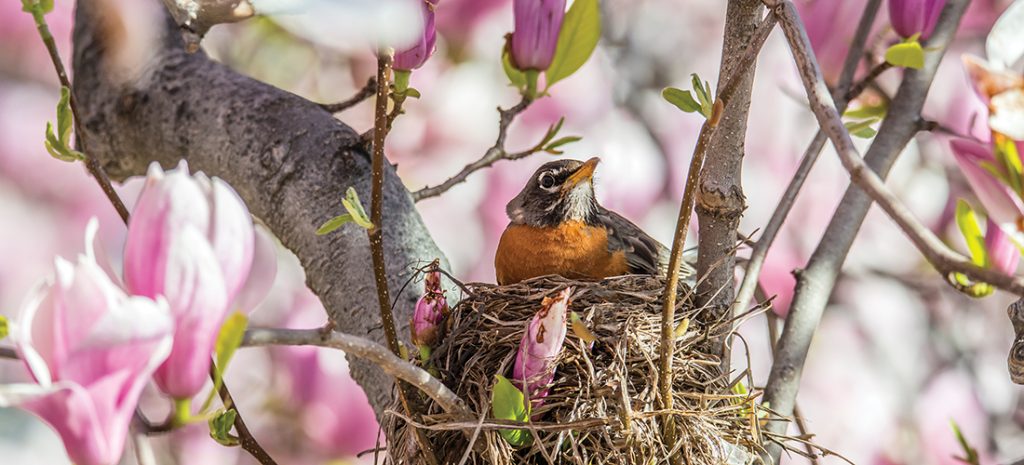
Both male and female robins have long black legs, orangey-red breasts and dark gray backs. Males, however, have a darker head and more colorful breasts. Robins use their thin, yellow bills to probe the vegetation and soft ground for invertebrates in the warmer months. Spiders and caterpillars are common prey as well. These birds use both sight and sound to locate prey. It is not unusual to see a robin standing still and then cocking its head as the bird zeroes in on a potential food item just under the soil surface.

Here in our area, come March, male robins return to the territories they have defended in past summers. In bright, fresh plumage, they will sing most of the day from the tops of trees and other elevated perches, attempting to attract a mate. Their repeated choruses of “cheer-ee-o, cheer-ee-up” echo from lowland mixed woodlands to high elevation evergreen forests as well as open parklands in between. Females will accept a male for the season, but once summer draws to a close, so does the pair bond.

Females are the ones who select a nest site and build the nest. Suitable locations are typically on a branch lower in the canopy and support a hefty, open cup nest. Twigs and rootlets are gathered and then reinforced with mud, often the soft castings of the very earthworms they love to eat. The nest will then be lined with fine grasses before the female robin lays three to five light blue eggs. Constant incubation by the mother robin takes about two weeks, followed by two more weeks of feeding by both parents before the young fledge. Robins can potentially raise four broods in a season — although rarely do all nestlings survive. And fewer yet (about 25 percent) will make it through their first year, to breeding age.

Surviving young of the year will wander, often with siblings or a parent, until late summer, when they will flock up with other local birds. Small groups in North Carolina may move farther south if winter food here is scarce or if competition with larger northern flocks is too great. But not long after the New Year dawns, the same birds will be on the way back. Increasing day length triggers their return journey. And thus, the cycle will begin anew.  PS

Susan Campbell would love to receive your wildlife sightings and photographs at susan@ncaves.com.

Golftown Journal

Golftown Journal

A Masterful Gift

The memories of Augusta in April

By Lee Pace

This month, for the 65th time, Lou Miller will enter the gates off Washington Road in Augusta, Georgia, buy a ham and cheese on rye sandwich for $3, and begin his annual treks up the hills and through the dogwoods of Augusta National Golf Club, sometimes clocking as many as 27,000 steps in a day. The grass will tweak his nostrils, the sun warm his face as he remembers jostling to watch Arnold Palmer back in the day, and seeing a limping Ben Hogan make birdie on his final hole in the 1967 Masters.

“There’s nothing like smelling Augusta National on Monday morning,” he says. “From there it’s a very special week. There’s nothing like it.”

The 79-year-old Miller attended his first Masters in 1958 at the age of 14 and has been to every one since (even wrangling access on the Saturday of the 2020 tournament held in November, when public attendance was suspended in wake of COVID-19). He grew up in Augusta, so to a golf-minded youngster the rite of spring known as the Masters was a big deal.

“I first played the golf course when I was still in high school,” Miller says. “The superintendent at Augusta National at the time was from our county, so he got us on. We played with no pins, but we still felt like we were playing in the Masters.”

What a first Masters experience that was, following a young Palmer around the course as he won the first of his four Masters, edging Doug Ford and Fred Hawkins by a shot.

“I like to say I was a ‘private’ in Arnie’s Army my first year,” Miller says. “By the time he won his second Masters in 1964, I was a ‘lieutenant colonel.’ I saw most every shot he hit those two weeks. Then you had Jack Nicklaus come along and challenge him. They fought it out for years, and Jack took the throne.”

Tickets weren’t difficult to come by in those days. He found various avenues into his early Masters and in 1965 started buying them himself — and he’s been on the list ever since.

“I had no money and couldn’t afford it, but I bought those Masters tickets anyway,” he says. “They were like $25 a ticket, and that was for the whole week. Shortly after, they announced they were oversubscribed and closed ticket sales. I was lucky.”

Miller in the early 1990s was moved by the awe and wonder on the faces of some guests he brought to their first Masters. He began a tradition of using his tickets on at least one tournament day to introduce first-timers to Augusta National. This month, he’ll escort two of his grandchildren onto the grounds. Over the years, he’s invited employees at clubs where he’s worked (today he’s president of Old Edwards Club in Cashiers, North Carolina), various friends and family members, and a few hard-luck stories of people whose lives would be brightened by a venture to the Masters.

“There’s nothing like taking somebody and seeing the awe and excitement and thrill of that person getting there the first time,” Miller says. “It’s seeing the excitement of the first thousand people on Monday morning. Every single time, it exceeds their expectations — whatever those were.

“I just love watching these first-timers smile. That thrill never grows old.”

By now some of you Pinehurst old-timers are going, “Lou Miller . . . where do I know that name?”

Miller was vice president and director of golf at Pinehurst from 1976-81. This was five years into the ill-fated Diamondhead era of Pinehurst’s history (the founding Tufts family sold the club and resort to Diamondhead on the last day of 1970), and one of Miller’s first jobs was figuring out why there were never enough tee times on Pinehurst No. 2 when the hotel was rarely at full capacity.

“The previous spring they were sending 150 people a day to other courses in the area,” Miller says. “The first people we fired were the starter on No. 2 and the guy working the starter tower over the clubhouse. We figured out they had direct phone lines and were selling tee times to golfers and pocketing the greens fees. We also had guests and members double-booking times. They would make one for first thing in the morning and another for later in the day. If they were too hung over, they’d show up for the second one.

“It was a mess.”

Miller was the first in an official capacity at Pinehurst to begin dreaming of a U.S. Open contested on No. 2 and actively courting USGA officials about the idea. He traveled to Baltusrol Golf Club for the 1980 U.S. Open to press flesh, and visited with USGA officers P.J. Boatwright and Frank Hannigan when the association conducted the World Amateur Team Championship on No. 2 and the U.S. Amateur at the Country Club of North Carolina later in the summer.

He even arranged a meal function with the USGA brass and Pinehurst’s new general manager.

“This guy was new to the job and said, ‘Oh, we don’t want outside events,’” Miller remembers. “‘We don’t need them.’ You talk about taking a nice warm shower and having cold water dumped on you. I wanted to throw him through the window.”

Miller left Pinehurst just as the banks were taking control of the distressed resort (later to be resurrected by the Dedman family and elevated gradually to its current status with three Opens already in the books, five more to come, and the USGA less than a year away from opening Golf House Pinehurst). Today he’s busy in Highlands overseeing a luxury inn and spa, a Tom Jackson-designed golf course, and a new 12-hole short course called The Saddle. He attended the Carolinas PGA annual meeting and trade show in Greensboro in February, then drove to Pinehurst the next day.

He played The Cradle short course, which was in part the impetus for building a similar venue at Old Edwards. “We wanted an amenity where three generations could play golf together, where you could be serious or play hit-and-giggle,” Miller says.

He sought out guys he’d hired nearly half a century ago, like Larry Goins at the resort clubhouse bag drop, and David Stancil downstairs working the carts and storage. He inspected the recently refurbished lobby and public area of the Carolina Hotel — quite the contrast from when Miller left in 1981 and the hotel was decorated with the greens and golds and shag carpet of the era.

“I love to hug the guys I know, smell the place, check everything out,” Miller says. “That hotel is gorgeous. They did an unbelievable job.”

Lou Miller’s a lucky man indeed. Seventy-nine and still going strong with memory banks full of Augusta and Pinehurst.   PS

Lee Pace’s first book on the history of golf in the Sandhills, Pinehurst Stories, was published in 1991. Follow him @LeePaceTweet and write him at leepace7@gmail.com.

What’s in a Name?

What’s in a Name?

Cattleya Penny Kuroda and Cattleya Hawaiian Fantasy: Two Splash-Petal Enigmas

By Jason Harpster

What if your birth certificate was wrong? Yikes! You need it to get married, register for school, obtain a driver’s license or a passport. It verifies your age and citizenship. If it’s not the most important document you have sitting in your safety deposit box, it’s in the top three. But if a flower has a mistaken “birth certificate” it’s no big deal, right? This isn’t Little Shop of Horrors. It’s not like you’re going see Audrey II in line behind you at the DMV.

Just as the DMV tracks names and addresses for drivers, Kew Royal Botanical Gardens maintains the Kew World Monocot Checklist, which tracks currently accepted names for over 30,000 orchid species in the wild. The Royal Horticultural Society is the international authority for orchid hybrids and maintains the International Orchid Register that lists over 100,000 orchid hybrids with their seed and pollen parents. Orchid hybrids must be registered to be eligible for shows and awards.

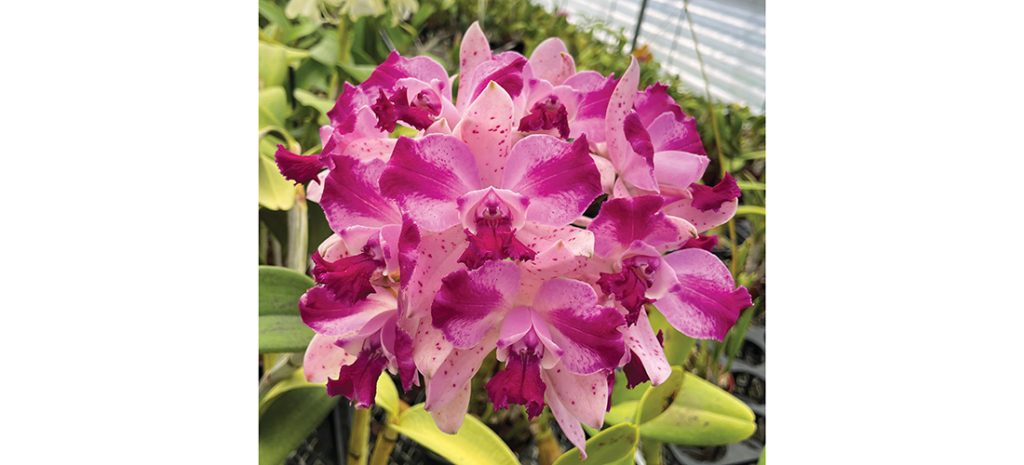
In her article “Cattleya Penny Kuroda By Any Other Name,” published in the April 2014 issue of Orchids, Laura Newton details how Cattleya (C.) Penny Kuroda was originally registered with the wrong parentage. When C. Penny Kuroda was registered in 1976 by Mary Hernlund, the parents were listed as C. Summer Snow x C. guttata. Given that virtually all splash-petal cattleyas have C. intermedia var. aquinii in their background, Newton rightfully questioned where the distinct, peloric, splashed petals of C. Penny Kuroda and its progeny originated. The Royal Horticultural Society found Newton’s argument convincing and subsequently updated the registration to C. Summer Stars x C. guttata that year.

Michael Blietz, an accomplished Hawaiian orchid grower, has uncovered new evidence that shows the registration change for C. Penny Kuroda is incorrect. In his letter to the American Orchid Society in February 2022, Blietz recounts how he recently received the cross book from the Mary Hernlund nursery which shows the parents of C. Penny Kuroda as C. Summer Snow x C. guttata var. alba. Interestingly, the alba form of C. guttata was not found until the early 2000s; only C. tigrina var. alba would have been available in 1976.

After reviewing the many progeny of C. Penny Kuroda and the inventory from Hernlund’s stud book, Blietz concluded that the color, splashing and spots exhibited could only come from C. Interglossa, not C. Summer Snow or C. Summer Stars as Newton espoused. It is not a coincidence that all of the selfings and original plants from the C. Penny Kuroda were bifoliate due to the influence of C. amethystoglossa, C. intermedia, and C. tigrina which are all bifoliate species. The size of the spots and lavender color on the tips of the side lobes of the lip are in line with C. amethystoglossa and its hybrids. The size and length of the splashes on C. Penny Kuroda also match C. Interglossa since the peloric petals are mirroring the color and pattern on the lip.

Prior to the registration change of C. Penny Kuroda in 2014, C. Summer Snow had five F1 offspring with C. Penny Kuroda, by far being the most prolific with 143 F1 offspring and 837 total progeny. A closer examination of C. Summer Snow’s offspring is warranted as it appears a registration error similar to that for C. Penny Kuroda has occurred with C. Hawaiian Fantasy, another prolific splash-petal hybrid with 25 F1 offspring and 114 total progeny as of this writing.

Cattleya Penny Kuroda was registered in 1976 by Hawaiian grower Mary Hernlund while C. Hawaiian Fantasy was registered by Benjamin Kodama of Waianae, Hawaii in 1982. The parents of C. Hawaiian Fantasy are listed as C. Summer Snow x C. Wayndora, though this registration is suspect as neither parent has C. intermedia in their background. Unfortunately, Kodama passed away in 2017, which makes determining the exact parentage of C. Hawaiian Fantasy exceedingly difficult. An attempt to obtain clarification from Kodama Orchids has not been successful.

Correspondence with Roy Tokunaga from H&R Orchids, another longtime orchid grower and breeder in Oahu, in December of 2021 was especially helpful. Tokunaga confirmed that he and other older Hawaiian growers knew C. Hawaiian Fantasy had C. intermedia var. aquinii in its background, though they were unsure of the exact parentage. These hybridizers understood that the peloric form of C. intermedia var. aquinii is dominant and passed on to its progeny.

In discussing Newton’s findings regarding the correct parentage of C. Penny Kuroda and how this would relate to the lineage of C. Hawaiian Fantasy with Tokunaga and Fred Clarke, both gentlemen agreed that the current registration for C. Hawaiian Fantasy is incorrect. The question then becomes what, if anything, should be done about the incorrect registration?

Reviewing Hernlund’s cross book reveals another curious surprise: C. Hawaiian Fantasy and its reciprocal cross were made by Hernlund. Despite being registered by Kodama in 1982, it appears Hernlund made, or at least attempted to create, C. Hawaiian Fantasy as detailed by crosses No. 1247 and 1257. Blietz reached out to Ben Kodama Jr. who confirmed that his father, Benjamin Kodama Sr., received the C. Hawaiian Fantasy flasks from a grower on the Big Island. Blietz agrees that these plants had to come from Hernlund.

Although it is impossible to prove with 100 percent certainty that C. Interglossa is the correct parent of C. Penny Kuroda and C. Hawaiian Fantasy, we can conclude that the registrations for both hybrids are incorrect as C. Summer Snow does not have C. intermedia in its genetic background. It is unlikely that C. Summer Stars is in the background of either of these crosses since Stewart Orchids used alba parents to create C. Summer Stars. Considering the state of hybridizing in Hawaii during the 1970s and ’80s and the push to bring new crosses to market before they were registered, it is easy to see how these errors occurred. Given the new evidence that has come to light since 2014 when the Royal Horticultural Society revised the parentage of C. Penny Kuroda from C. Summer Snow x C. guttata to C. Summer Stars x C. guttata, the registration should be updated to C. Interglossa x C. tigrina, or, alternatively, change the C. Summer Snow parentage to unknown. Moreover, the registration for C. Hawaiian Fantasy should also be updated accordingly since the same parent was used to make C. Penny Kuroda.

Correcting the record and establishing the proper lineage helps honor the numerous contributions of Hernlund, Kodama, Tokunaga and other Hawaiian growers. Thanks to the Hernlunds’ cross journal and Ben Kodama Jr., we know that Hernlund used C. Summer Snow to make both C. Penny Kuroda and C. Hawaiian Fantasy. Blietz agrees that Hernlund’s stud plant that was labeled C. Summer Snow was mislabeled and was actually C. Interglossa. Updating the registrations of C. Penny Kuroda and C. Hawaiian Fantasy would highlight the contributions of this Hawaiian community and ensure that the knowledge they shared is not lost. Mary Hernlund passed away on April 19, 2022 at the age of 103.  PS

Jason Harpster is an accredited American Orchid Society judge and works at his family’s business, Central Security Systems. He hopes to share his collection of 2,000-plus orchids by starting a botanical garden in Southern Pines. 

Poem April 2023

Poem April 2023

Farmlife

If I were a farmer now

I would name my hoe Samson

to move the dirt near my cow


that moos the meadow for nose

discharges worthy of respect,

some lows with lots of excesses


pouring like rain flattery cannot know

so thin and bare when we wag our tails

and say Nature’s cruel enough to please


any milker named Grace

or Paul or Brown.

May pings of milk stream


into the bucket between knees.

The cow chews her cud

with contentment of a Christian without honor


or the noise from the garden my mother tends.

Discretion is the council of remembrance.

Sometimes a tower is by itself a watch.


If needs be, grant mercy,

then climb to the top,

a mile from the dirt.

  Shelby Stephenson

Shelby Stephenson was North Carolina’s ninth poet laureate.

Out of the Blue

Out of the Blue

Forever, My Lucky

Elegy to a black cat

By Deborah Salomon

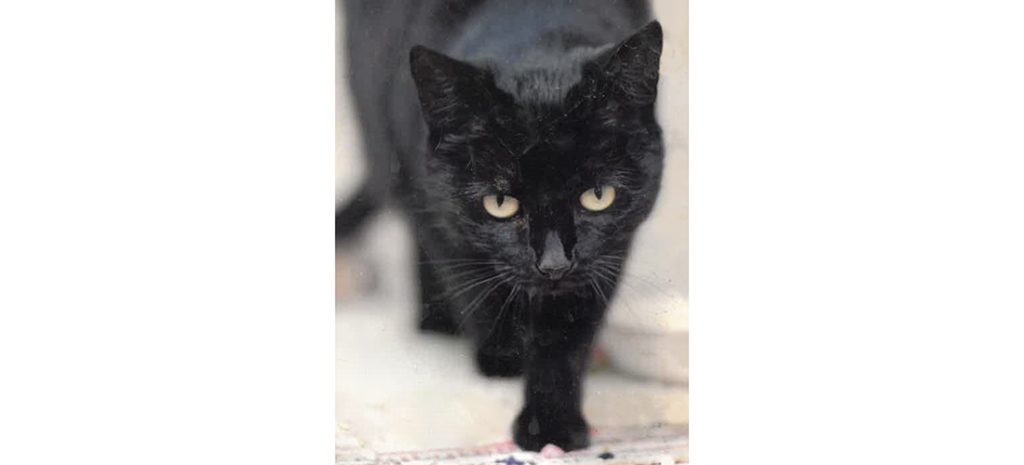
About eight years ago I began dedicating January columns to my two cats — their habits, antics, stuff like that. In each, I reprised our history: Lucky, a sleek all-black male with talking eyes and a brain borrowed from Einstein had been left behind when his family moved. Neutered, front claws removed . . . somehow he fended for himself until the day he peeked into my front door. Black cats are my weakness. I established a feeding station on the porch. He dug himself a nest under the bushes.

After an adulthood of befriending needy animals, I had retired, not anticipating the loneliness.

That was December 2011. On July 4th I invited him in. He strolled to the kitchen, sat down, waited for his supper, hopped onto the couch and fell asleep.

I named him Lucky, for obvious reasons.  He was calm, quiet, stoic, intuitive and totally affectionate.

A year later, a wide-bodied gal with a nasty temper and a clipped ear signaling a spayed feral tried the same trick. I learned she was a neighborhood kitty, fed by many, housed by none. I let her in, too. She repaid me by hissing for a week so I named her Hissy, modified to Missy when she came around. But she lacked Lucky’s intelligence, his communication skills. He tolerated her, more so after she became his handmaid. They formed a bond.

A cat’s age is hard to ascertain. The vet and I estimated that, as of 2022, they were both 12-14.

I suspected Lucky might have early-stage diabetes last fall, when he began drinking and peeing a lot, so I made an appointment. Then in October, I broke my wrist. Managing my large carrier was almost impossible. I put off the exam until my pain subsided. Lucky seemed fine — ate well, enjoyed a nightly tussle with his gal-pal.

The kitties had a routine. Lucky pawed me awake at about 4 a.m. I got up soon after, fed them, then weather permitting, they went out, rarely beyond the yard. On the morning of January 12 Lucky refused breakfast, ran directly to the door with an insistent cry. I let him out.

He never returned.

I called him all day. I put up signs, talked to the neighbors, inquired about predators, contacted the Humane Society. Lucky didn’t like rain or cold.

A friend put a notice and photo in the paper. About once a year Lucky would take a “vacation day” but always came home at dark. He would never go into another house.

I slept in a chair by the door for three nights.

I felt lost, panicky, then desperate. I missed seeing him in the many “nests” he had made throughout the house. I missed him leaning on my shoulder in bed, hopping onto my lap while I watched TV, sitting on the windowsill guarding the house until I came home. Missy followed me, clung to me, went in and out, in and out, looking for her buddy. She hardly ate for a week.

I have never had an animal companion disappear. They all led long, healthy, happy lives and went to that final sleep in my arms.

Missy is adjusting. I am not. My eye spots something black in a pile of sweatshirts, or on a porch chair. I imagine him licking my ear, another surefire wake-up tactic. But I accept, through my tears, that he is gone.

Perhaps he left to die, as some animals do. If so, something good died with him.

I pity people who cannot form a relationship with an animal. They are missing the unconditional love not always available elsewhere.

Missy will be my last kitty. I could not inflict what happens to pets when their human dies. But of all the dogs and cats I have rescued, placed in homes or adopted myself, Lucky stands out. We understood each other. He made me laugh. He needed me. I loved him.

Good-bye, my sleek, handsome friend. The hurt may fade, but you will live forever in my heart.  PS

Deborah Salomon is a contributing writer for PineStraw and The Pilot. She may be reached at debsalomon@nc.rr.com.

Birdwatch

Birdwatch

Nesting Season

There’s no place like home

By Susan Campbell

It is almost that time again for our feathered friends: nesting season. Pairs of birds will team up to bring forth the next generation. In some cases, they will even repeat the process once or twice before the days shorten and temperatures begin to drop.

As with so many behaviors, reproduction is triggered by hormonal changes, which are the result of changes in day length. Females will become responsive to the advances of males as daylight increases. And before long, the hunt for a spot to nest will begin. Interestingly, the strategies vary among the bird species we find in central North Carolina.

The investment in nest building for some species is minimal. Killdeer, for instance, only create a slight scrape in a sandy or pebbly surface. They are ground nesting birds whose splotched eggs blend in perfectly with the substrate. Furthermore, killdeer young are precocial, meaning that they are mobile as soon as they hatch and will instantly begin following their parents. There is no nestling phase, so protection of the young birds is unnecessary.

In the Sandhills it is not unusual for mourning doves to nest at ground level in a layer of grasses or small twigs. Even when doves nest in small trees or shrubs, their nest platform is minimal. It is amazing that the eggs or young do not fall through the nest. Then again, this species is known to raise young in virtually any month of the year, so losing an egg or youngster through the cracks is not problematic in the long run.

Cup nests are a very common strategy for nesting — especially among songbirds. Northern cardinals, blue jays, American robins all form a typical nest from small branches, twigs and grasses. Such nests can be visible through the leaves and are not infrequently depredated. As a result, some species, such as blue-gray gnatcatchers and ruby-throated hummingbirds, have evolved to use camouflage in the form of mosses or lichens on the outside of the cup so that the nest is not obvious to predators on a bare limb.

Hawks and eagles have taken nestbuilding to the next level and may create an enormous, cupped platform for their young. These huge stick nests, placed high in a live tree or snag, typically are enlarged with more material every year. They can be very noticeable given their bulk. However, given the size and ferocity of these birds, the strategy is not problematic. Furthermore, one of the adults typically guards the nest until the young are close to fledging.

And then there are the species that use holes: the cavity nesters. Woodpeckers and nuthatches can carve out a cavity in dead wood using their powerful bills with little trouble. Species such as chickadees, titmice, bluebirds or wood ducks will move right into these spaces when the architects move on. It is these birds that many of us have been giving a helping hand by erecting bird boxes. Box design varies by species, of course, given the different reproductive requirements of different birds. The height, the depth of the box and, most importantly, the size of the entrance hole will determine who will move in.

So, if you have not yet done so, this is the time to be cleaning out and repairing nest boxes for the breeding season. Old nests should be removed, and the boxes should be aired out for a day or two.  It would not hurt to give them a rinse with the hose as well — but do NOT use cleaning products. And then stand back: It will not be long before your first feathered tenants will be moving in!  PS

Susan Campbell would love to receive your wildlife sightings and photographs at susan@ncaves.com.

PinePitch

Birdwatch

We Know Great Writing When We See It

Since 1986, the Moore County Writers’ Competition has promoted and honored superior writing throughout our communities. Join the awards ceremony where certificates and cash prizes will be presented for poetry, fiction and nonfiction submitted by writers in five different age groups. Winners will read a selection of their entries from 2 p.m. to 4 p.m. on Sunday, March 12, at the Weymouth Center for the Arts & Humanities, 555 E. Connecticut Ave., Southern Pines. For information go to www.weymouthcenter.org. Admission is free but registration is required.


A Night with Kelli

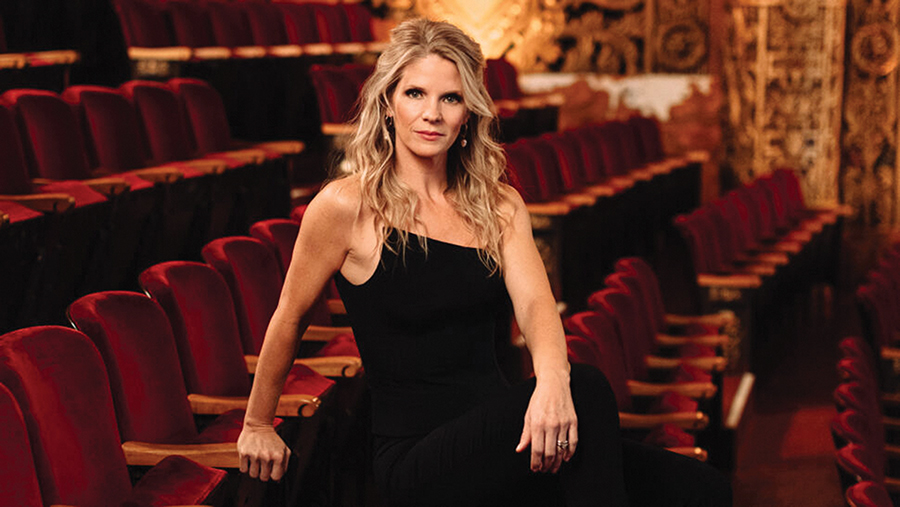
The Tony Award winning star of HBO’s The Gilded Age, Kelli O’Hara, will appear live at BPAC’s Owens Auditorium, 3395 Airport Road, Pinehurst, on Saturday, March 18, at 7 p.m. Among her many stage, film and television credits, O’Hara received a Tony Award for Best Leading Actress in a Musical in 2015 for her portrayal of Anna Leonowens in The King and I, and an Emmy nomination for her portrayal of Katie Bonner in the hit web series The Accidental Wolf. For tickets and information go to www.ticketmesandhills.com. 


A Southern Tale

The Country Bookshop and the Weymouth Center for the Arts & Humanities present Marjorie Hudson in conversation with Katrina Denza about Hudson’s debut novel, Indigo Field, on Wednesday, March 22, at 5:30 p.m. at the Weymouth Center for the Arts & Humanities, 555 E. Connecticut Ave., Southern Pines. For information and tickets go to www.ticketmesandhills.com.


Here Comes the Bride

Richard Wagner’s masterpiece Lohengrin returns to the Metropolitan Opera — and the screen at the Sunrise Theater, 250 N.W. Broad St., Southern Pines — on Saturday, March 18, at 12 p.m. Famed Polish tenor Piotr Beczala stars as the mysterious swan knight. The Bridal Chorus may ring a bell. For information call (910) 692-3611 or go to www.sunrisetheater.com.


Oscar and Steve

The Sandhills Repertory Theatre will present An Evening with Oscar and Steve: The Music and Lyrics of Oscar Hammerstein and Stephen Sondheim at the Sunrise Theater, 250 N.W. Broad St., Southern Pines, on Thursday, March 30, at 7 p.m. and again on Sunday April 2, at 3 p.m. For tickets and information got to www.sunrisetheater.com.


With a Little Help from Your Friends

Recommended for children from kindergarten to second grade, the heart-warming story A Sick Day for Amos McGee will be performed Saturday, March 4, from 5 p.m. to 6 p.m. at BPAC’s Owens Auditorium, 3395 Airport Road, Pinehurst. Zookeeper Amos McGee knows friends can come in all sizes and species, too. Amos runs races with the tortoise, cares for a particularly shy penguin, and reads stories to an owl. One day, Amos is too sick to visit his zoo friends, but, fortunately, the animals know just what to do. For information and tickets go to www.ticketmesandhills.com.


Three for the Ages

The Sandhills Repertory Theatre presents Judy, Joni and Joan: The Music of Judy Collins, Joni Mitchell and Joan Baez at the Sunrise Theater on March 18 at 7 p.m. and again in two shows on March 19 at 3 p.m. and 7 p.m. Three outstanding New York-based female musicians — Elizabeth Nestlerode, Samantha Sayah and Jane Bruce — will have you singing along in this tribute to three extraordinary friends and artists whose music transcends the generations. Tickets can be purchased at the Sunrise box office by calling (910) 692-3611 or online at either www.sunrisetheater.com or www.sandhillsrep.org.


Back in Bloom

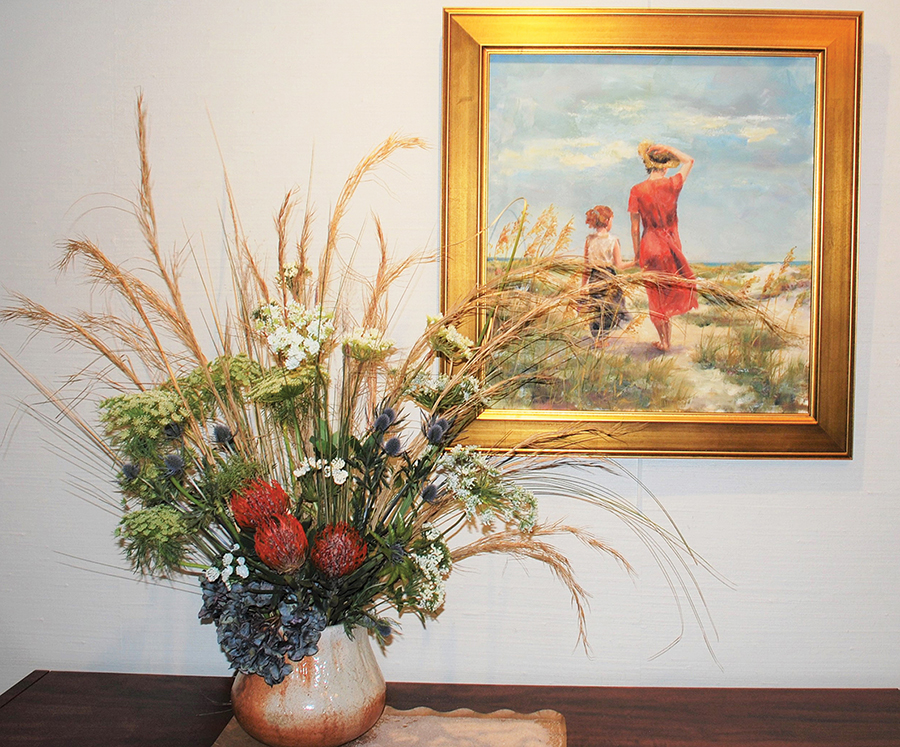
The Garden Club of the Sandhills ushers in springtime by hosting the 2023 edition of “Blooming Art” at the Campbell House Gallery, 482 E. Connecticut Ave., Southern Pines, on Saturday, April 1, from 10 a.m. to 5 p.m., and again on Sunday, April 2, from 1 p.m. to 4 p.m. The “Blooming Art” exhibit pairs local art with interpretive floral arrangements. Among the professional floral designers participating this year are Carol Dowd, Matt Hollyfield, Leslie Habets, Crystal Blue, Ellen Burke, Jeremy Bowden, Bill McPhail and Cynthia Ballantyne. Members of the Southern Pines, Olmsted, Pinehurst and Linden Garden Clubs, in addition to the Weymouth Dirt Gardeners and the Garden Club of the Sandhills, will also be represented. Advance tickets are $15 and are available at www.ticketmesandhills.com. Funds raised by “Blooming Art” support scholarships for students in the horticultural program at Sandhills Community College, projects by the Sandhills Horticulture Gardens, and horticultural programs for children.


Photograph By Melissa Schaub

Tee It High and Let It Fly — for Charity

The Carolina Philharmonic will host its 8th annual Maestro’s Cup at Pinewild Country Club, 85 Glasgow Drive, Pinehurst on Sunday, March 12. All proceeds benefit music education programs in the community. For information call (910) 687-0287 or go to www.carolinaphil.org. Then, on Monday, March 20, you can re-tee in The Kelly Cup Golf Championship at Forest Creek Golf Club, 200 Meyer Farm Drive, Pinehurst. Win a car for a hole-in-one on the designated par-3. All proceeds benefit the Sandhills Children’s Center. For information call (910) 692-3323 or go to www.sandhillschildrenscenter.org.

The Beat Goes On

The Beat Goes On

From the Mountains to the Sea

By David Menconi


Type design by Keith Borshak


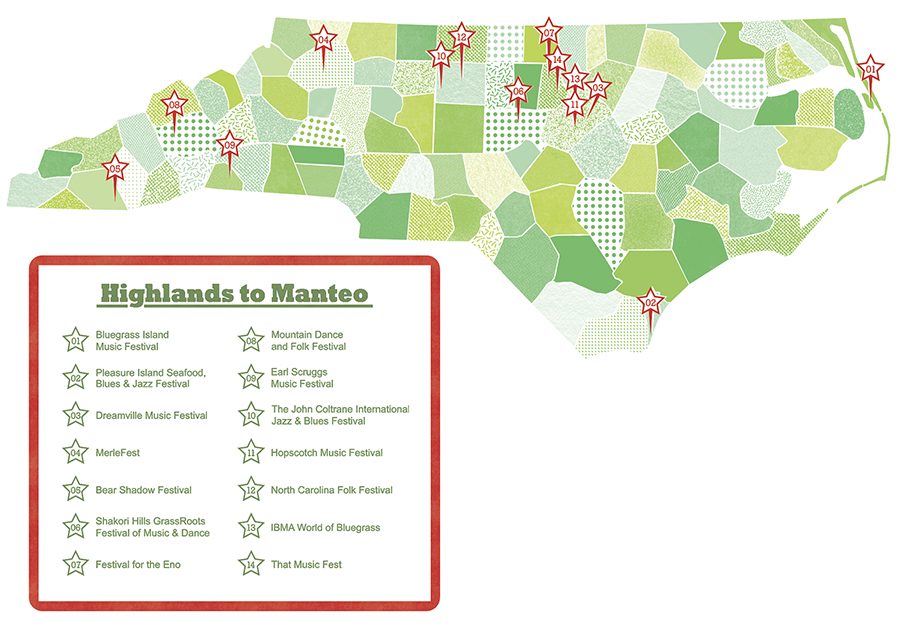
Map Illustration By Miranda Glyder


Springtime in North Carolina means college basketball madness, azaleas blooming — and the earliest days of outdoor music. Our state has a staggering array of A-list music festivals spanning numerous genres from now until fall. Here are some of what you should be making plans for.


Dreamville Festival 

Between apocalyptic weather and the coronavirus pandemic, rapper J. Cole’s Dreamville Festival has had a rocky existence in its short history. But in spite of multiple postponements, Dreamville has been a huge success, starting with 2019’s sold-out debut at downtown Raleigh’s Dorothea Dix Park that immediately established it as one of the nation’s top hip-hop festivals. Dreamville’s second edition in 2022 expanded from one day to two with an onstage lineup featuring the entire roster of Cole’s Dreamville Records label, and it also sold out. Round three returns to Dix Park the first weekend of April as another multi-day affair. It should be another big success, with Cole himself in the headline slot.

April 1 – 2, Raleigh; dreamvillefest.com


MerleFest 

Centered on the multi-style “traditional plus” music played and loved by its late, great founder, Doc Watson, MerleFest has been a tradition at Wilkes Community College since 1988. The venerable roots-music festival is a signpost event on the Americana circuit. And after the same pandemic problems that every other live-music event faced in recent years, it’s back with an impressive lineup featuring the Avett Brothers, Maren Morris, Little Feat, Tanya Tucker and more.

April 27 – 30, Wilkesboro; merlefest.org


Bear Shadow

The mountains of the far western corner of North Carolina are the setting for this springtime festival, which happens the same weekend as MerleFest. First conceived in 2021, this year’s model has a first-rate alternative-leaning lineup featuring Spoon, The Head and the Heart, Jason Isbell and Amythyst Kiah.

April 28 – 30, The Highlands Plateau; bearshadownc.com


Shakori Hills GrassRoots Festival of  Music & Dance 

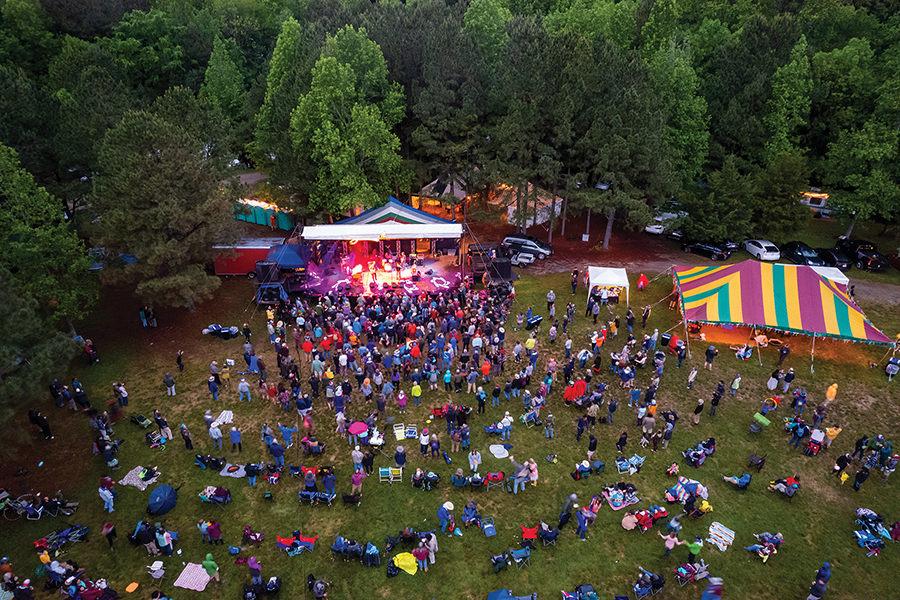
Started in 2003 as a nonprofit music and dance festival, Shakori Hills takes place on a bucolic 9,000-acre spread in rural Chatham County. It’s probably the top camping festival in the greater Triangle region, with solid Americana lineups. Marty Stuart & His Fabulous Superlatives, Malian singer/guitarist Vieux Farka Touré, beach legends Chairmen of the Board and festival regulars Donna the Buffalo. There’s also a fall version of Shakori Hills, which happens every October.

May 4 – 7, Pittsboro; shakorihillsgrassroots.org


Annual Carolina Beach Music Festival

Dance to beach music with your toes in the sand at the 37th Annual Carolina Beach Music Festival on Saturday, June 3 from 11:00 a.m. to 5:00 p.m. Billed as “the biggest and only beach music festival actually held on the beach on the North Carolina coast,” three bands will be performing. Shows are accessible from the Carolina Beach Boardwalk at Cape Fear Blvd. and Carolina Beach Ave. S. For information on tickets call (910) 458-8434.

June 3, Carolina Beach


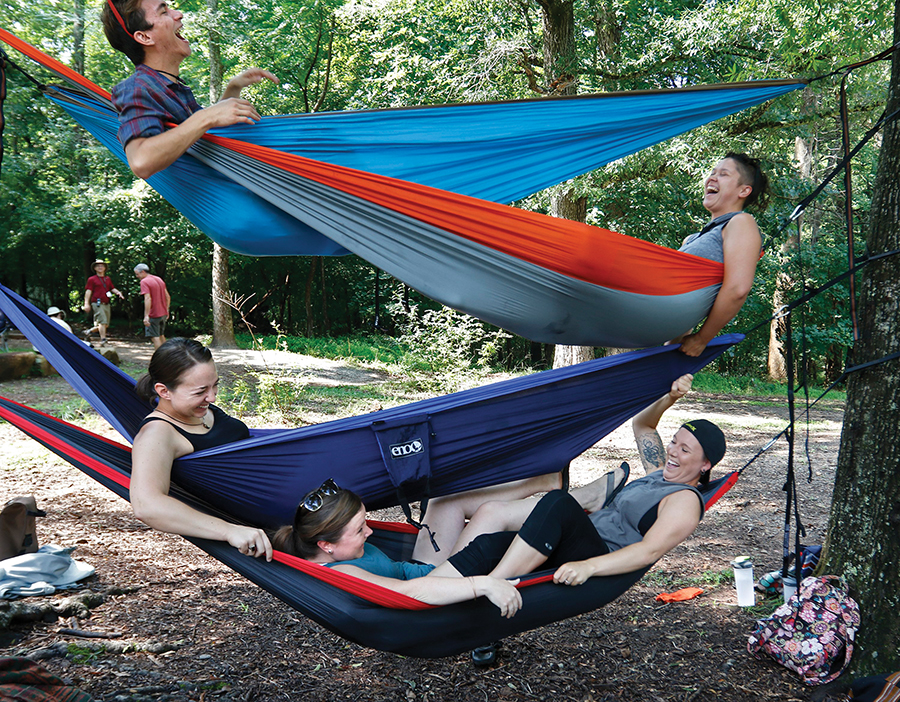
Festival for the Eno

The granddaddy of music festivals in the Triangle, Festival for the Eno dates back to 1980 and happens on the grounds of Durham’s West Point Park. Started as a fundraiser for the Eno River Association, the festival — which also offers a craft and food market — has hosted a who’s who of Americana-adjacent and roots artists including Emmylou Harris, Doc Watson and Loudon Wainwright III. Recent years have featured rising regional acts including Mipso, Rainbow Kitten Surprise and Indigo De Souza.

July 1 and 4, Durham; enofest.org


Mountain Dance and Folk Festival 

Reputedly the first event in America to be called a “folk festival,” Asheville’s Mountain Dance and Folk Festival was founded in 1928 by the folk music legend, Bascom Lamar Lunsford. It remains the longest continuously running folk festival in the country, and it’s as much about the folk dance traditions of Western North Carolina as the music.

Aug. 3 – 5, Asheville; folkheritage.org


Earl Scruggs Music Festival 

A newcomer to the North Carolina festival circuit, the Earl Scruggs Music Festival debuted last year at the Tryon International Equestrian Center in Mill Spring. As you’d expect for a festival named after the man who invented the three-finger style of bluegrass banjo, the lineup trends toward classic bluegrass and Americana.

Sept. 1-3, Mill Spring; earlscruggsmusicfest.com


John Coltrane International Jazz and Blues Festival 

Although he made his mark as an artist elsewhere, John Coltrane was born and raised in Hamlet, North Carolina. He was one of the towering figures of 20th century jazz, a key collaborator with Miles Davis, Duke Ellington and his fellow North Carolina native Thelonious Monk. The John Coltrane International Jazz and Blues Festival has been paying tribute to his legacy every Labor Day weekend since 2011 with solid lineups — 2022 featured trumpeter Chris Botti, singer Patti LaBelle and saxophonist Kirk Whalum, among others.

Sept. 2 – 3, High Point; coltranejazzfest.com


Hopscotch Music Festival

Downtown Raleigh has a well-earned reputation for doing music festivals right, and one of the events that helped pave the way is the alternative-slanted Hopscotch. Originally started in 2010 under the auspices of the Indy Week newspaper, it showed off Raleigh’s walkable grid of downtown nightclubs and outdoor stages to fantastic effect. Past headliners have included Flaming Lips, The Roots, Solange Knowles and St. Vincent. Hopscotch director Nathan Price reports that this year’s model should feature “an expanded lineup closer to pre-COVID size.” Here’s hoping.

Sept. 7 – 9, Raleigh; hopscotchmusicfest.com


North Carolina Folk Festival 

In 2015, the National Council for the Traditional Arts brought the long-running National Folk Festival (which has been around since 1934) to Greensboro for a three-year run. It was such a success that, after the national festival’s Greensboro run ended, the city opted to keep it going as the rebranded North Carolina Folk Festival. Last year’s lineup was typically eclectic, featuring everything from George Clinton’s P-Funk All-Stars to the Winston-Salem Symphony String Quartet. Expect more of the same in 2023.

Sept. 8 – 10, Greensboro; ncfolkfestival.com


World of Bluegrass 

The International Bluegrass Music Association moved its annual business convention and festival to Raleigh in 2013, where it has been a huge success. Between the convention, trade show, “Bluegrass Ramble” nightclub showcases, awards show and street festival, total attendance can top 200,000 when the weather’s good. Past headliners have included Steve Martin, Alison Krauss, Béla Fleck and just about every notable picker and singer in the genre. Year in and year out, it’s downtown Raleigh’s biggest music festival.

Sept. 26-30, Raleigh; worldofbluegrass.org


That Music Festival 

Sponsored by Raleigh’s Americana/roots radio station, That Station, 95.7-FM, That Music Festival made its debut in June 2022 at Durham Bulls Athletic Park with an all-North Carolina lineup featuring American Aquarium, Steep Canyon Rangers, Mountain Goats, Rissi Palmer and more. The sophomore edition is tentatively scheduled for October, most likely in Durham again.

October, Durham; thatstation.net/that-music-fest


Annual Bluegrass Island Music Festival 

Music lovers will be flocking to the Outer Banks, beach chairs in hand, for the 12th Annual Bluegrass Island Music Festival October 19-21 held at the Roanoke Island Festival Park overlooking miles of the pristine waters of Roanoke Sound. Buy your tickets and book your lodging well ahead of time. Acts this year include The Goodwin Brothers, Seth Mulder & Midnight Run, Rhonda Vincent & The Rage, Po’ Ramblin’ Boys, Leftover Salmon, The Kody Norris Show, Thunder & Rain, AJ Lee & Blue Summit, The Kitchen Dwellers, The Steeldrivers, Darin & Brooke Aldridge, Breaking Grass, Tim O’Brien and the incomparable Sam Bush. 

October 19-21, Manteo; bluegrassisland.com  PS

Omnivorous Reader

Omnivorous Reader

Courage and Candor

Daniel Wallace’s thought-provoking memoir

By Stephen E. Smith

If you read the promo material for Daniel Wallace’s new memoir, This Isn’t Going to End Well: The True Story of a Man I Thought I Knew, you’ll assume the message is straightforward: Hero worship is an exercise in disillusion. But the “hero” in Wallace’s memoir isn’t a hero in the accepted sense (the sociological definition for “significant other” is a more accurate term); and the message, although essential and timely, is predictably ambiguous.

Wallace is the author of the bestselling novel, Big Fish, and six other much-praised works of fiction, and the qualities evident in his earlier works are perfectly transferable to his first foray into nonfiction. He crafts a compelling narrative that pulls the reader headlong into a story whose energy never wanes. He’s thoughtful and thought-provoking. He makes sense of the past in order to free the reader to face the future, and he writes with courage and candor.

Wallace introduces his hero, his future brother-in-law, William Nealy, in a scene where he happens upon Nealy attempting a perilous leap from the rooftop of the family home into a swimming pool 25 feet below. Nealy takes flight, plunges into the water, climbs out and repeats the jump over and over. “It was pretty magnificent,” Wallace writes. “It wasn’t some unformed idea I had about masculinity or manliness in him that I was drawn to; I wasn’t into that, then or now. It was just the wildness, the derring-do, his willingness to take flight — literally — into the unknown, an openness to experience and chance that so far in my short life had not been previously modeled to me by anyone.” Wallace admits that he didn’t need to emulate Nealy’s behavior but that he learned “. . . how to become the me I wanted,” and that he would think of that day — he was 12 at the time — as the moment he was born again.

The first third of Wallace’s memoir is a biography of Nealy’s short life: his need for constant adrenalin highs, his success as a cartoonist and writer, his marriage to Wallace’s sister, their loving but troubled relationship, and how Nealy’s example encouraged Wallace to become something other than a cliché — not a writer, but someone “demonstrably unique, amusing,” someone living on the fringes.

Following Nealy’s example Wallace threw himself into several unsatisfying pursuits, eventually settling on the writing of fiction — the telling of quirky tales in which nothing is as it seems — that led to the success of Big Fish.

The Nealys settled near Chapel Hill, where they purchased a large tract of wooded land and William built a house, wrote books and produced cartoons and maps about the challenges of outdoor life. In the context of contemporary existence — the use of drugs and alcohol notwithstanding —  it all seemed idyllic, skewed perfection in a humdrum world that was constantly encroaching. But that encroachment became all-consuming when a close mutual friend, Edgar Hitchcock, a drug dealer whom Wallace characterizes as “the kindest man I have ever met,  so smart, funny and loving,” a dealer who confesses that “selling drugs is the final frontier,” is murdered.

The second part of the memoir centers on the mystery surrounding Hitchcock’s death. Nealy became obsessed with finding the man who murdered his friend, and the road led almost immediately to a likely suspect. Relying on simple intuition, Nealy was able to identify the culprit when he first shook his hand. “It was a notion that would be lodged into the marrow of his very being and would not be dislodged, not ever, not for as long as he lived.”

For purposes of the memoir, the suspect’s name is Stanley, a personable enough acquaintance whom Nealy “befriended” in an attempt to discover the truth surrounding Hitchcock’s murder. When Hitchcock’s body was discovered five months after his disappearance, Stanley began to subtly reveal his culpability.

It’s a long and tangled tale that leads to Stanley’s indictment and his eventual release because of convoluted legal circumstances that hindered prosecution. Nealy was powerless to avenge his friend’s murder, and his continuing obsession with the unpunished culprit damaged his marriage to Wallace’s sister. For one of the few times in his adult life, Nealy found himself powerless to influence events. His need to control the uncontrollable becomes apparent in a brief journal entry: “My whole life has been a struggle against the world to preserve my ‘being’ and it’s put me in dire conflict with the people I love . . . I MUST NOT LET THEM SEE WHO I REALLY AM!”

Nealy committed suicide in his early 40s, Wallace’s sister died in 2011, and Wallace inherited their ashes and Nealy’s journals, leaving him to piece together the events that led to his friend’s tragic end. The journal entries aren’t particularly revealing, but one laconic passage exposes the source of Nealy’s recklessness. Nealy’s hero, a Scoutmaster, sexually assaulted him while at summer camp. Nothing more is revealed about the encounter — and what more needs to be said? A physical dissociation from oneself is the inevitable outcome of such a traumatic event and might explain Nealy’s reckless behavior.

Wallace is left to manage his grief and grapple with the psychological pain suffered when the person upon whom he modeled his life proved himself fallible. He eventually comes to what he believes is a satisfactory understanding of William Nealy’s life and death, but that solution isn’t simple or straightforward. There are no easy answers — and the conundrum remains: What becomes of us when our significant other stumbles? “Can we ever know why we are who we are,” he writes, “the recipe that makes us the unique, bewildering, beautiful and sometimes insane creatures we end up becoming?”

Wallace doesn’t shy from the final truth: There are many ways to die — murder, suicide, illness — and he’s philosophical about the state in which we find ourselves: “. . .  there appear to be no safe places left in the world, on our streets or in our hearts.” How true are those simple words?

This Isn’t Going to End Well is not an easy or uplifting read, but it is a memoir borne of intense experience and introspection, which is the only available panacea for what troubles us. Suicide is a perilous subject for the writer and the reader, but Wallace acknowledges that contemplating the taking of one’s life is the most damaging secret a person can have. The “Author’s Note” lists The National Suicide Prevention Lifeline number.  PS

Stephen E. Smith is a retired professor and the author of seven books of poetry and prose. He’s the recipient of the Poetry Northwest Young Poet’s Prize, the Zoe Kincaid Brockman Prize for poetry and four North Carolina Press Awards.