Naturalist

In the Realm of Seadevils

Encountering wonders from the deep-sea

Story and Photographs by Todd Pusser

A crescent moon hung high in the sky over a sea as smooth as glass. The air was thick with humidity as our research vessel plowed slowly through the waters of the Gulf Stream 150 miles south of Cape Cod. Thousands of stars twinkled above while lightning danced across distant thunder clouds miles away. Below my feet, it was a mile and a half down to the ocean floor.

The steady sound of the massive winch suddenly stopped. The thick cable extending out from the stern, taut with tension, indicated that the deep water trawl net was close to the surface. Like a kid on Christmas morning, I could barely contain my excitement. You never know what you might catch when dropping a net far below the ocean’s surface. On this particular trawl, the net was towed around 1,500 feet deep. Chances are good you might catch something that has never been seen by human eyes.

The deep-sea is defined as waters below 660 feet, where sunlight no longer penetrates. At its most extreme point, the ocean is an astounding 36,201 feet deep — roughly 7 miles down. At those depths, the ocean is a pitch-black wilderness where temperatures hover just above freezing.
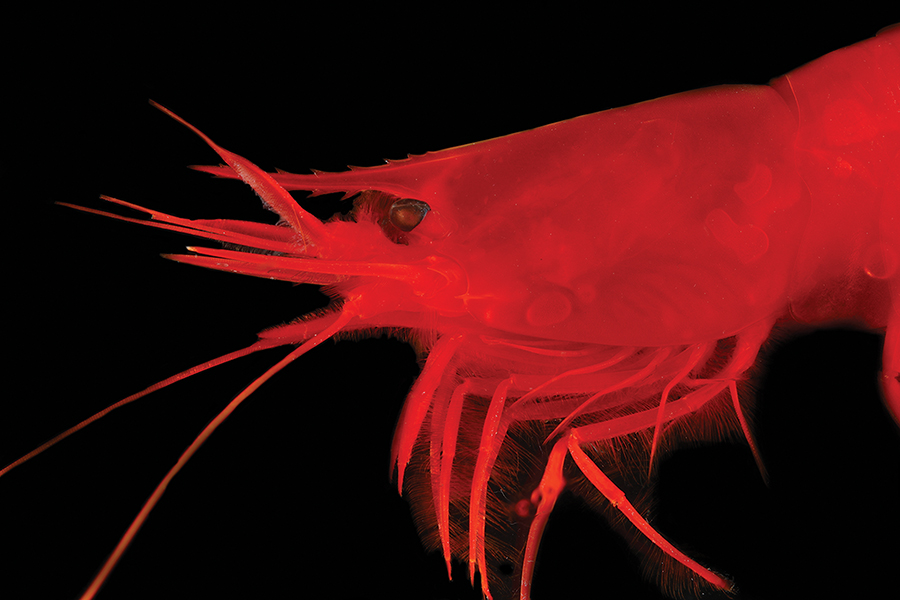
   

Left: Deepsea Shrimp.

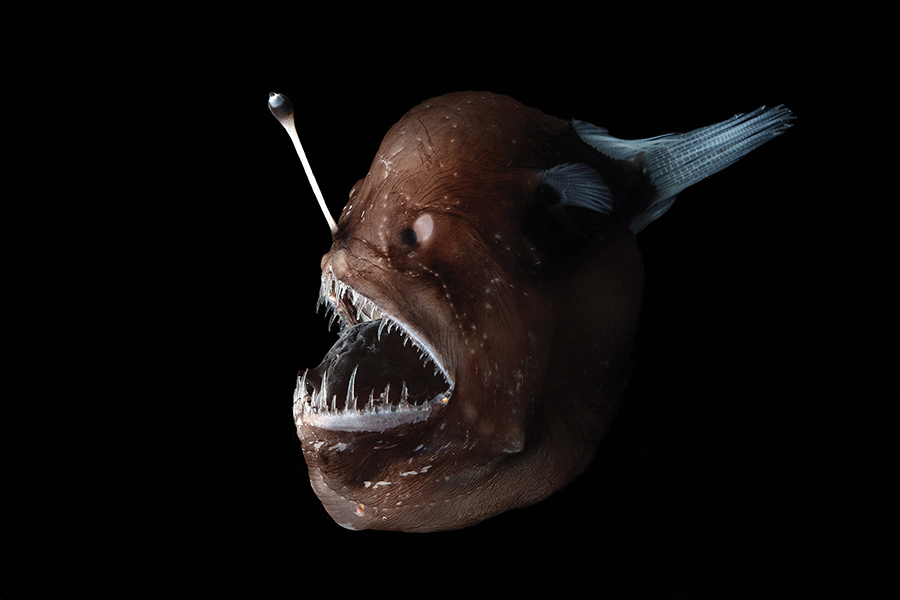
Right: Black Sea Devil-humpback anglerfish. 

It is not hyperbole to say that more is known about outer space than the deep-sea. The ocean covers 70 percent of this planet, and on average, is nearly 2 ½ miles deep. As pointed out by author Helen Scales in her recent book, The Brilliant Abyss, the entire surface of the moon has been mapped to a resolution of 23 feet, while the deep ocean floor that blankets the Earth has only been mapped to a resolution of 3 miles.

As a kid, on family vacations to Cherry Grove in North Myrtle Beach, I would often find myself standing on the sandy shore and staring out over the ocean, trying to look past the horizon line and wondering what treasures lay hidden beneath. In middle school, I daydreamed of being Captain Nemo, from Jules Verne’s classic Twenty Thousand Leagues Under the Sea, piloting the wondrous deep-sea submarine Nautilus in search of sea monsters. Later, in college, I discovered real-life explorer William Beebe, who in 1930 became the first man to descend into the dark depths of the ocean, below the reach of light, using a large steel sphere lowered from a stationary ship by thousands of feet of steel cable. Beebe introduced the wonders of the deep to people around the world in a series of articles for National Geographic and popular books such as Half Mile Down. I never imagined at the time that I would be able to see some of the wondrous creatures Beebe described in his writings.

With a few final turns of the winch, the net was hauled onto the deck of the ship. Grabbing a hard hat and life vest, I walked out onto the stern to assist the fishery biologists in sorting the catch. Down on one knee, I began to pick through a cornucopia of our planet’s strangest inhabitants — creatures that look like they evolved from the mind of Dr. Seuss. Even their names evoke a Spielbergian science fiction epic: dragonfishes, greeneyes, lanternfishes, whalemouths, hatchetfishes, bristlemouths, star-eaters, gulpers. Many were velvet black with mouths full of huge teeth and possessed strange, glowing bioluminescent lures sprouting from their heads. There were bright red shrimp, glowing squid, and skinny eels with bird-like beaks.

I reached into the twine of the net and gently untangled a saber-toothed viperfish, which possessed a series of needle-sharp fangs that extended up from its lower jaw to just above its eye. A series of bioluminescent dots ran along its flanks while an elongated glow-in-the-dark lure extending from its dorsal fin dangled in front of its fearsome maul. When viewed only in a photograph, a viperfish would appear to the be most fearsome critter in the sea. Thankfully it grows only to a foot in length, as do the vast majority of the monstrous looking fishes from the deep.

Farther down the side of the net, I find another unusual fish, the fangtooth. Sporting a face only a mother could love, the 5-inch-long predator comes equipped with a massive mouth full of oversized teeth that are capable of tackling prey nearly as large as itself.
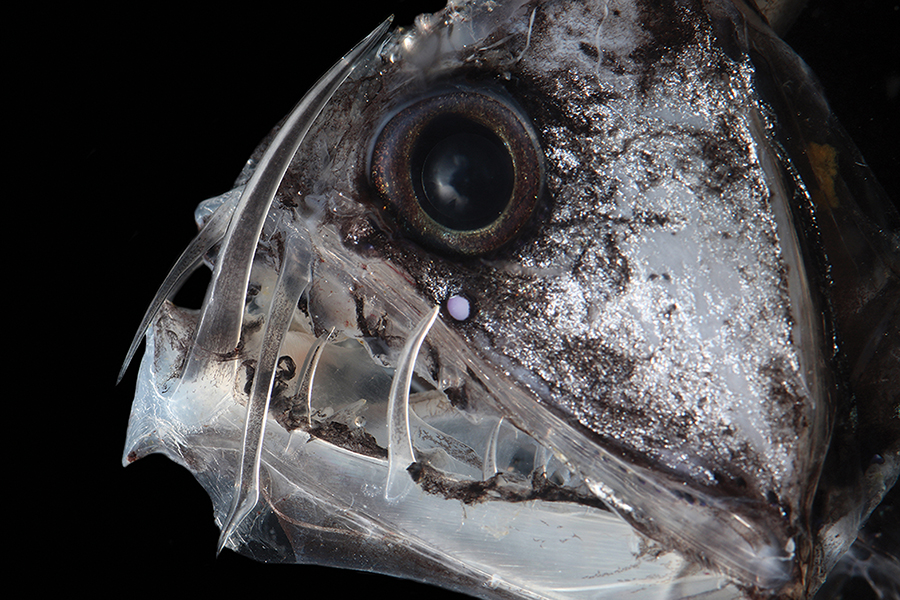
Viperfish

Suddenly, there is an exclamation of excitement from a biologist standing nearby. We all rush over to discover the ultimate prize in tonight’s haul: a small female humpback anglerfish commonly known as the black seadevil. Looking a bit like a demonic tadpole, she seemed to be all head with a rotund black body, huge mouth, big teeth, and a stout, rod-shaped lure that extended up from the top of the head, which was capped by a glowing, bacteria-filled light organ known as an esca. Scientists speculate the lure may be used to attract prey close to her vicious mouth — or perhaps to draw in a mate.

The deep-sea is vast, the largest livable space on the planet, and it may take years to find a mate. There are around 170 species of deep-sea anglerfish currently recognized by science, and many deploy a most remarkable reproductive strategy. Male anglerfish lack bioluminescent lures and are many times smaller than females. In several species, when a male finds a female, he literally latches onto her skin, like a tick. Once attached he never lets go for the rest of his life, taking “till death do us part” to a whole other level. Eventually, he fuses with her tissue and gains sustenance from her bloodstream. He is entirely dependent on the female for survival. In return, he provides her with a never-ending supply of sperm.

The abyss is unfathomable, a place beyond comprehension for us landlubber humans. Countless creatures that defy imagination still await discovery in its dark depths. I, for one, feel extremely privileged to have experienced some of its treasures firsthand.  PS

Naturalist and photographer Todd Pusser grew up in Eagle Springs. He works to document the extraordinary diversity of life both near and far. His images can be found at www.ToddPusser.com.

Golftown Journal

Porking Out

A tradition like no other

By Lee Pace

Among the much-revered culinary traditions in golf are the pimento cheese sandwiches at The Masters, the “burgerdog” at The Olympic Club (essentially an elongated hamburger served in a toasted hot dog bun), the snapper soup at Pine Valley (thick with nuggets of turtle and finished with a dollop of sherry), and the peanut butter and bacon sandwiches at the halfway house at Mountain Lake in Florida.

And then you have the pork chop at the Pine Crest Inn in the village of Pinehurst.

“The pork chop is as much a rite of passage of visiting Pinehurst as four-putting one of the greens on Pinehurst No. 2,” says Steven Lilly, an annual visitor along with up to 28 fellow Davidson College graduates.

“At the ’99 U.S. Open, we had 1,600 pork chops go through that kitchen. That’s a lot of pork,” adds Marie Hartsell, a longtime cook at Pine Crest, which opened in 1913.

The 22-ounce porterhouse pork chop is among the “classic entrees” listed on the menu of the Pine Crest, which was owned in the early days by golf architect Donald Ross and has been in the Barrett family for six decades.

“Fork-tender served with mashed potatoes, fresh vegetables and natural pan gravy. A Pine Crest Inn tradition for over 60 years!” the menu reads.

The pork chop was the creation of longtime chef Carl Jackson, who started in the kitchen as a boy in the 1930s, worked his way up to chef, and was an institution at the inn until his death in 1998 at the age of 77. Nephew Peter Jackson took over for Carl, and Carl’s grandson Kiyatta Jackson works in the Pine Crest kitchen today.

“The pork chop has been a leader on the menu all these years,” says Peter Barrett, son of Bob Barrett, the Ohio newspaperman who bought the inn in 1961. “Carl had a special pot, and he braised them in an old pizza oven big enough to hold the pan. He’d get about 24 in a pan.”

Lilly has ordered the pork chop three nights in a row for 30 years during his annual trip to Pinehurst. He estimates one-third of their group will order the pork chop every night at dinner.

“Over the years, we have noticed the presentation changes,” Lilly says.  “Sometimes a plate, sometimes a shallow bowl, perhaps differing ingredients in the au-jus vegetable medley. But the tender, slow-roasted chop, which seems to fall from the bone moments before the fork (never the knife!) even makes contact, remains a constant.” 

Pedro Martinez-Fonts is one of a dozen close friends originally from Cuba who migrated to the United States in the early 1960s to get away from the Castro communist regime. They have been meeting at the Pine Crest Inn every May for more than two decades.

“The pork chop reminds me of when we used to roast a pig, covered with banana leaves, on my grandfather’s farm in Cuba,” he says. “Not only is it a generous cut that can feed more than one Cuban, but it is also tender and full of flavor. Of all the times we have stayed at the Pine Crest, I have seen only one Cuban, the late Bobby Perkins, who could handle one of these pork chops by himself.”

Harman Switzer was part of a group of a dozen golfers based in Princeton Junction, New Jersey, who visited the Pine Crest annually from 1974 through 2019 until age got the better of them. “The people, the porch and the pork chop kept drawing us back,” he says. “And I haven’t missed a chop in that time. I must admit, at 78 years of age, one 22-ounce serving is sufficient for the week. But there was a time when one was not enough.”

On one occasion one of their members brought his wife to experience the pork chop.

“She was so rightfully impressed with chef Carl’s creation that she asked to speak with him, unashamedly in search of the recipe,” Switzer says. “Chef Carl immediately appeared from the kitchen and delightfully began to expound on the hours of marinade and slow cooking. Whereupon the lady politely inquired about the sauce ingredients. To which chef Carl also politely responded, ‘Oh sorry, that’s a secret sauce.’ Which, to my knowledge, remains a Jackson family secret today.”

Indeed it does, though snippets of the presentation have emerged over the years.

Jackson used to buy all his meat from a butcher shop in Boston, but now the chops come from an institutional distributor. They used to come with a layer of fat that’s now trimmed off. Barrett says Jackson cooked them at 225 degrees all day, but now they’re braised at 350 degrees for a slightly shorter period. The corn, okra, onions and carrots are visible dancing around the meat on the shallow serving bowl, but the broth is the finishing touch. Insiders will admit to there being salt, pepper and paprika, but no one is certain whether V8 Juice, tomato juice and/or Campbell’s tomato soup are part of the elixir.

In June 2022 I visited the Pine Crest for three nights with a group from Chapel Hill and mentioned to the guys as we sat down for dinner that the pork chop was the specialty of the house. All six of us ordered the pork chop, and an hour later were wheeled out to our beds, sated and happy. One in our group commandeered the meager leftovers (six bones with a little meat hanging about) to take home to his 75-pound dog, Ernie.

“Ernie was joyously grateful, especially to those who’d left a little meat on theirs,” Steve reported.

Kiyatta Jackson, known as “Yacht” and now a breakfast cook at the Pine Crest, says he’ll honor his grandfather’s wishes that his recipe remain a secret. But at least someone knows the ingredients and the process for generating the Pine Crest’s signature dish and, when a new chef comes through, they’re given chapter and verse about the most popular choice on the menu.

“We might have made our last visit as a group, but I’ve been back myself twice in the last year,” says Switzer, who lives on Callawassie Island near Hilton Head. “It’s always good for a special occasion — a birthday, anniversary, wedding. Or sometimes seeking sanctuary from a low country storm.

“There are lots of excuses for visiting the Pine Crest and enjoying a drink on the porch and savoring the pork chop — the latter being the celebratory culmination of the journey.”  PS

Lee Pace has written about the Pinehurst experience for more than three decades from his home in Chapel Hill. Write him at leepace7@gmail.com and follow him @LeePaceTweet.

Truth & Tales

A Fresh Take on Blackbeard the Pirate

By Addie Ladner & Reyna Crooms

Illustration by Miranda Glyder


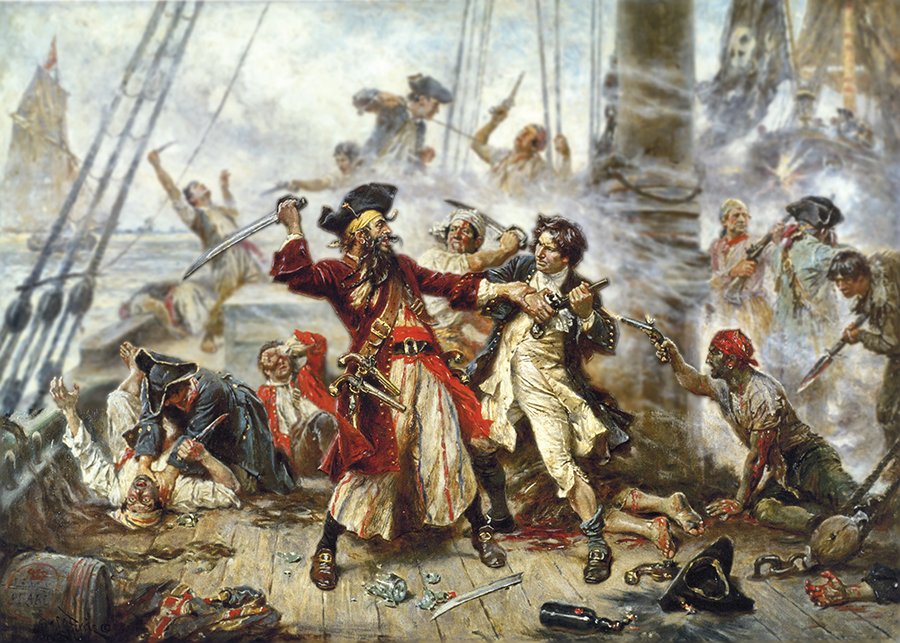
It’s 1715, just off the colonial North Carolina coast. A sloop flying a black flag decorated with a horned skull approaches. At its helm: Blackbeard the pirate, a gruesome sight with smoke streaming from his braided hair and a severed head in his hands. His crew swings onto the deck, swords in hand, ready to strike down any other ship in their bloodthirsty, unrelenting quest for treasure.

According to North Carolina research historian Kevin Duffus, very little of that is true. “Most everything you’ve ever read about Blackbeard is wrong,” Duffus claims. Read on for clues to sort between the truths and tales of this famed pirate — and for ideas to get out and do some exploring for yourself.


Revisiting History

An interview with a man who is on a mission to uncover the truth about Blackbeard.


Kevin Duffus first became fascinated by pirates as a young boy, when he watched the 1968 film Blackbeard’s Ghost. “At the time I didn’t understand that history can be fictionalized — I was just so interested in this Blackbeard,” says Duffus. Shortly after, Duffus’ father, who was in the Air Force, was posted in Greenville, North Carolina. Duffus started researching the area’s history and discovered that the infamous character he’d seen in the movies had died not far away, in Ocracoke.

So, at 17, Duffus and two friends hopped on their bikes to visit the barrier island and experience the history for themselves. “It took us over two days to get there. That was the beginning of my quest to find Blackbeard,” Duffus says. He explored the coast, looking for the landscapes he saw in the film, like the high cliff where, in the movie, Blackbeard had built himself an inn from salvaged timber. But when Duffus asked locals at a community store where to find that cliff, “they said, son, the highest point here is only about 8 feet,” Duffus says. “I began to realize you shouldn’t learn history by watching movies.”

Since then, Duffus, a longtime television producer who now owns a production company focused on history and tourism, has logged thousands of hours conducting primary research on pirates, and on Blackbeard in particular. He spent a week in England’s National Archives, going through log books and correspondence of Royal Navy ships stationed in Virginia in the early 1700s. He has also done research on foot: He once discovered a grave, covered in vegetation, along the banks of the Tar River. “Even trusted institutions like museums and park services have helped to perpetuate the historical fraud of the legendary pirate,” Duffus says. “I’ve been working to winnow out all of the unsupported claims, to weed out the three centuries of myth and legend.”

In 2008, he published The Last Days of Black Beard the Pirate, which is now in its fourth edition and one of six books he’s authored about maritime history. In 2014, Duffus was honored as North Carolina Historian of the Year by the North Carolina Society of Historians. We spoke to Duffus to learn why he believes that Blackbeard’s story is more complicated — and more important to North Carolina’s history — than the popular narrative suggests.

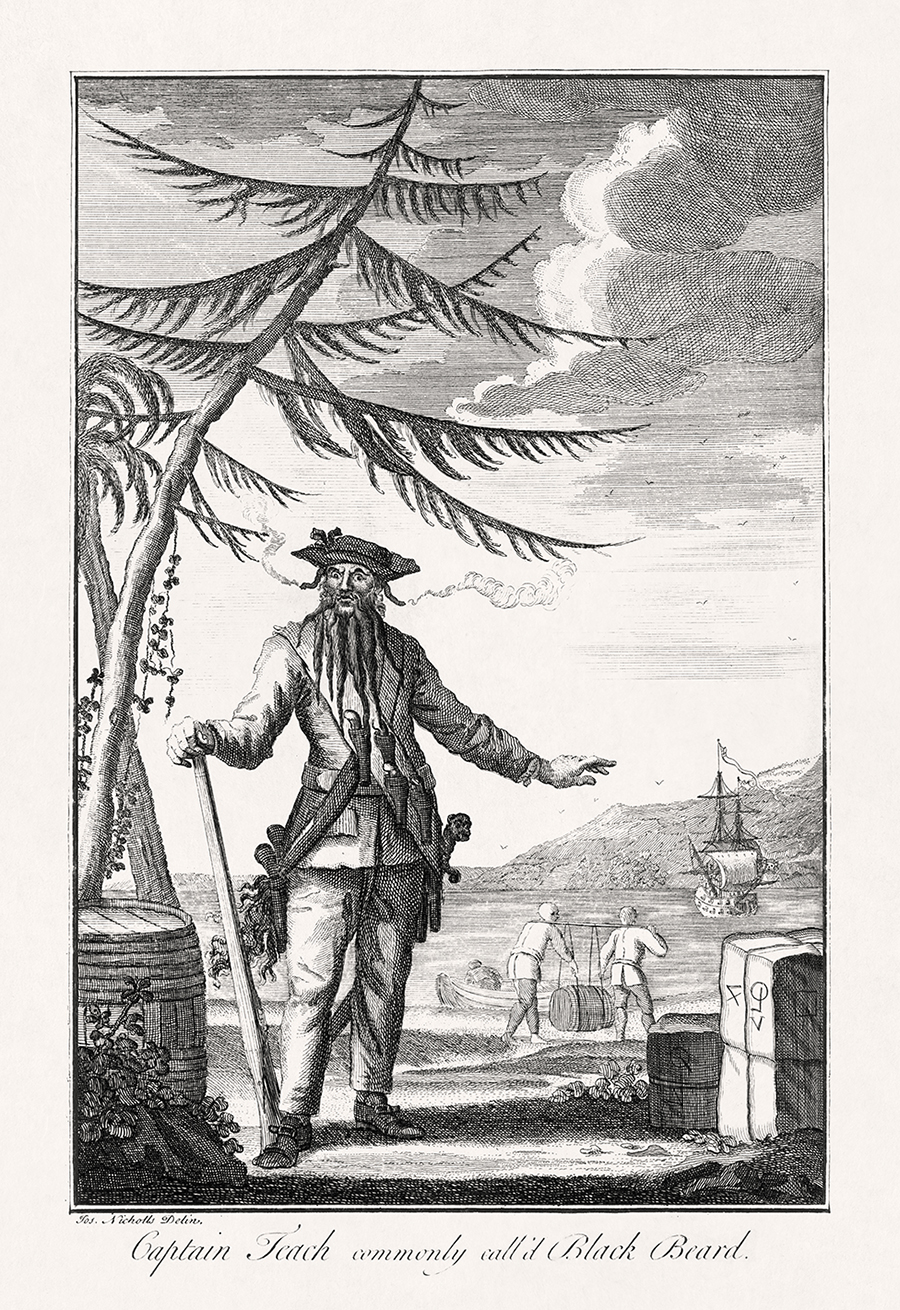
Blackbeard as depicted on an Allen & Ginter cigarette card.

You say pirates don’t match up with what many of us have in our heads — Why?

Pirates were indistinguishable from the rest of society. They dressed the same, they talked the same. There’s no such thing as pirate clothing, eye patches, earrings or tattoos — that’s been largely invented.

So often, popular culture portrays pirates as living in their own little world at sea, without the external events and forces that would have shaped real life. Blackbeard’s world was complicated. It involved wars between nations, economic distress, social stratification, legal irregularities and lost or destroyed official records. In Colonial America in the 1700s, the era considered the Great Age of Piracy, it was hard to establish a life. People who lived here would do whatever was necessary to survive.

Around the town of Bath, North Carolina, the years before Blackbeard became a pirate were marked by political discord, drought, famine and yellow fever. Often, a group of down-and-out sailors would set out by boat to raid a merchant’s vessel to quickly raise some funds. They’d fire a gun or cannon, then they’d raise the black flag signaling they were pirates; the merchant ship would typically be outnumbered and surrender. Battles and bloodshed were rare. Usually, these pirates would simply detain their victim’s vessel for an hour or two while they searched their cargo for valuables like food, wine and shoes.


So pirates were everyday people?

Yes, they were everyday mariners. It was a way to make some quick money, then return to your family and normal life. And there’s some gray area, too: Some professional mariners were privateers, which meant they were authorized to attack enemy ships. England was gearing up for war with Spain, so they’d enlist these mariners to do their work. There were no police, there was no one preventing this pirating from taking place, so there was no real danger of being caught. It became so popular that there are records of hundreds of men doing it.

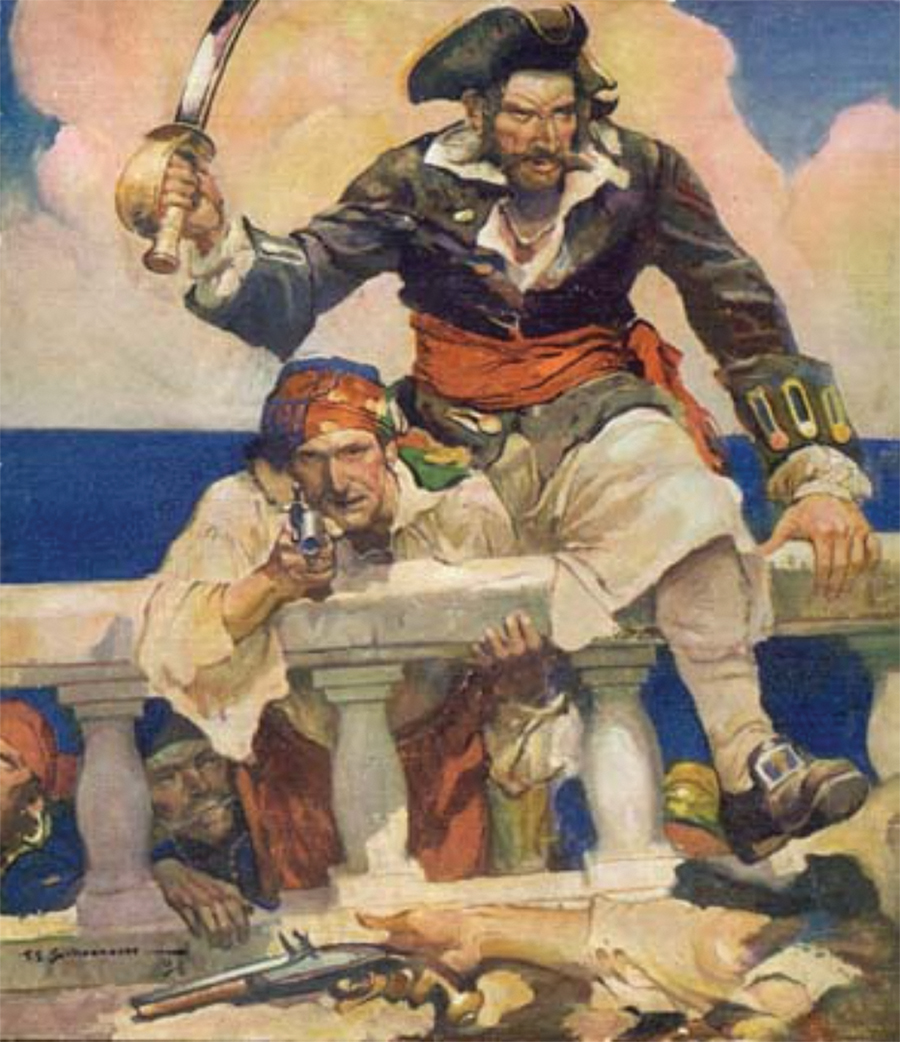
Blackbeard Buccaneer, a 1922 painting by Frank Schoonover.

When did the current version of a pirate become popular?

Only once people started making money off the legends. Around the late 1800s, there were a number of artists, like Howard Pyle, who began creating illustrations of pirates. Then came a number of films that romanticized the pirate life, starting in the mid-1900s. That’s when the distinctive pirate look and manner of speaking coalesced. No one said “Arrgh!” until Robert Newton played Long John Silver in the 1950 film Treasure Island.

What about the idea of buried treasure?

Buried treasure is also a ridiculous myth. If you took a small chest, let’s say 6 cubic feet, and filled it with gold, it would weigh 9,500 pounds! How would you move that, let alone bury it? The rumor probably came about because during that time, if you had valuables and didn’t have a safe, you’d bury them in your backyard.

What’s been your biggest revelation about Blackbeard?

A year or so into my research, some records showed that Blackbead had a sister, Susanna White, who lived on the banks of the Tar River near Washington where he’d visited. After searching this swampy area, I found the headstone of Susanna White near a bridge over the Tar River in Grimesland. When I read the tombstone, I realized she couldn’t have been his sister: She was born 37 years after Blackbeard died. For many years after that, I’ve been haunted by her identity and why folklore associated the two.

I finally proved her identity by poring over the deeds at the Pitt County Courthouse. It listed a transfer of property from a Salter family member to her “children and grandchildren,” including Susanna White. She was the granddaughter of barrelmaker Edward Salter, who plays a huge role in the narrative of that time. For a while, history told us Salter was a pirate with Blackbeard and was hanged. But after research in England’s National Archives and the North Carolina Archives, I discovered he wasn’t hanged. After he was pardoned and released from custody, Salter returned to Bath. He became a representative of Bath at the colonial legislature and a patron for the construction of St. Thomas Episcopal Church, and had a productive life and a family.

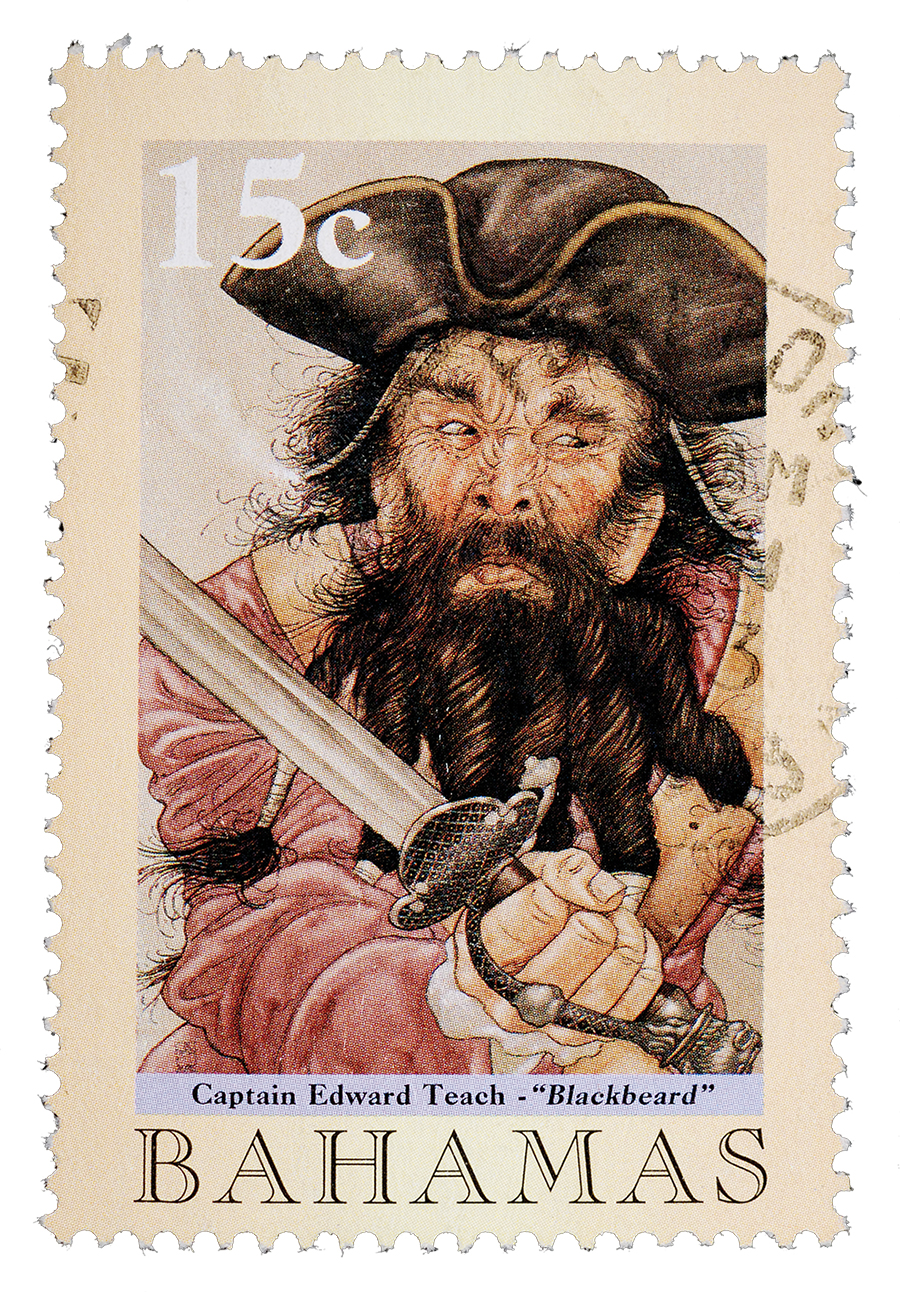
A Bahamian stamp featuring Blackbeard.

What have your findings led to?

The majority of Blackbeard’s inner circle of officers were from Bath and the Pamlico region of North Carolina. He had close relationships with the colony’s collector of customs, Tobias Knight, an enslaved Black man named Caesar and John Martin, the son of the town’s founder. This leads me to believe that Blackbeard himself was from this area or had strong ties to the town.

That contradicts a lot of the accepted history. People believe that Blackbeard’s real name was either Edward Thatch or Edward Teach, and that he was from Bristol, England or the Caribbean. But it never made sense to me that an out-of-towner could sail to Bath and tell people what to do, or that even someone from Jamaica would have strong, trusting relationships with locals. These people were willing to fight and die for him.


What do we know about Blackbeard’s last days?

It was a time of great uncertainty, danger and betrayal. A number of Blackbeard’s former pirates left him to return to honest lives. I believe that he would have done the same, but by the autumn of 1718, Blackbeard had become notorious throughout the colonies for some of his acts of piracy, one of which was a blockade of the port of Charleston. By this point, his ship, the Queen Anne’s Revenge, would have been crowded with as many as 400 pirates — he’d have had no choice but to continue committing acts of piracy to keep everyone fed and mildly intoxicated.

He tried to return to Bath, where colonial governor Charles Eden had given him a pardon. But it was worthless — he had violated its terms and everyone knew that, including Virginia’s lieutenant governor, Alexander Spotswood, who hoped to burnish his reputation as a vanquisher of pirates. About that same time, rumors were afloat that the King of England had issued a new pardon for pirates, with more generous terms, but no one knew when it would arrive.

So Blackbeard and his crew were laying low at Ocracoke, not sure of where to go or when or if they were being hunted.

They waited too long. They were surprised by Royal Navy Lieutenant Robert Maynard, who Spotswood had hired to capture Blackbeard, with a crew of 60. Maynard shouted that they were there to take Blackbeard dead or alive. Hoping to stand his ground, Blackbeard fired the first shots — an act of treason! And in fewer than six minutes of hand-to-hand combat, the king’s men bested the pirates. A highlander with a broadsword was said to have slashed Blackbeard from behind, cutting off his head. Yet, Spotswood’s invasion of his neighboring colony was illegal: He had no authority to arrest or kill pirates within the inland waters of North Carolina. Three weeks after Blackbeard’s death, the king’s new pardon arrived in Virginia.

I reconstructed this based on three sources. One was a letter I found in the British National Archives written by Royal Navy captain Ellis Brand, who supervised the expedition — it’s the most detailed and reliable. Maynard wrote a letter to a friend that added a few more details. The third source, based on hearsay but reasonably trustworthy, was a news report published in a Boston newspaper that recounts eyewitness testimony about the battle at Ocracoke.


What’s next in your research?

I’m searching in Charleston and Philadelphia for more that could help us complete his story. A great mystery I’d love to pursue is what happened to Blackbeard’s log book. On January 3 of 1719, Maynard returned to the James River in Virginia with Blackbeard’s head. Letters found in my research say he recovered Blackbeard’s “pocketbook,” which would have been a diary with a list of receipts and other papers. When Blackbeard was killed, the Royal Navy took the log book from his sloop to London, but from there, it disappeared.


Who was Blackbeard to you?

After years of research and analysis, I still don’t know Blackbeard’s true identity or origins with absolute certainty. Despite being a hugely popular historical figure, he remains a silhouette in the fabric of time.

That’s the ultimate Blackbeard treasure: his identity.  PS

This interview has been condensed and edited for clarity.

Out of the Blue

Meds on Parade

Art for the heart — and everything else

By Deborah Salomon

Illustration By Miranda Glyder

We call PineStraw magazine “The Art and Soul of the Sandhills.” There it is, written on the cover. Soul is amorphous. Art, however, wears many guises. It’s called the “art” of politics — at least in part — because if candidates can’t put on a good show they ain’t goin’ nowhere. They deliver artfully crafted scripts often, per Macbeth, “full of sound and fury, signifying nothing.” They choose well-tailored costumes in (except Nancy Pelosi) conservative colors. I almost fainted when she deplaned at midnight in Taiwan wearing a bubblegum-pink pantsuit.

But this art commentary doesn’t concern MAGA caps or power ties. Rather, the drama rampant in TV ads for prescription and OTC medications.

Now Pelosi’s pantsuit appears Pepto Bismol pink.

This dates from 1997 when the FDA relaxed rules governing direct advertising to consumers, as long as side effects receive prominent billing, along with “Consult a physician.” The U.S. and New Zealand are the only countries that allow direct ads.

Sounds like a win-win-win for patients, docs, ad agencies, drug manufacturers and “everyman” actors. Because, with a few exceptions, glamour-pusses don’t have eczema or hemorrhoids.

Truth be told, drug and health-related ads have taken over prime time TV once dominated by Tony the Tiger. To document this I sat down with pencil, paper and stopwatch. My findings indicate that a typical 2-minute ad break will have four or five commercials, at least three of them drug-related. No more white-coated “physician” or “pharmacist” dispensing advice. These are on-location productions with multiple actors, cartooning, music, special effects. Some are melancholy, offering cancer patients “more time” without suggesting a cure. Others push prevention or detection, hence the now familiar Cologuard logo. The toughest to watch are anti-smoking, where the spokesperson is missing a jawbone or larynx, followed by a black screen announcing “Joe Smith died in 2020.”

Pets help. A drug that renders HIV-AIDS “undetectable” avoids the click-off by showing a couple bathing a white dog. Most drug ads, however, feature healthy-looking folks at weddings and graduations, none experiencing the dire side effects listed by the voice-over.

Manipulative? Who cares? Big pharma’s goal is to have you clamoring for the drug by name — if you can pronounce and pay for it. Trade names lean on consonants, particularly X, Y, Z and Q minus the U. Pronounce Cibinqo for me, please. At least the trade name Rinvoq is easier than generic upadacitinib.

I finally found an MD willing to comment, albeit anonymously. Slick, unrealistic, exaggerated, providing false hope by innuendo was his verdict, although he chuckled at the one for a bone strengthener, where grannies narrowly avert accidents like tripping on a pine cone or falling off a ladder.

OK, so almost all’s fair in war and medications. I still draw a line below the belt.

Remember diving for the remote when Viagra burst onto the market? Now, usually around suppertime, the menu includes bent carrots, misshapen zucchini, wacky bananas and cukes simulating Peyronie’s Disease. Look it up. After that, a “stool softener” which compares the ailment to “passing a pineapple,” unpeeled, of course, seems tame. But I do laugh at the one where a woman opens the car door only to find a toilet replacing the driver’s seat, followed by the same substitution for her office chair.

At this rate, it’s only a matter of time until Mona Lisa’s smile will be co-opted to confirm a satisfactory, uh, outcome.

As the evening wears on, hucksters hawk a battery-operated ear wax cleaner called Wush and a dainty ladies’ shaver for “down there.” The men’s version for “groin grooming” is called Lawn Mower. Ugh.

But is this ad art? Or are we creating culture icons? Will the Charmin bears join Pooh and Paddington?

Possibly, considering Christie’s sold Andy Warhol’s painting of a Campbell’s condensed soup can, painted in 1961, for $11 million. Today’s artist might immortalize a fancy organic brand.

Literature has its Pulitzers, Broadway its Tonys, films their Oscars. Ads earn statuettes at the annual Clios, which recognize creativity/excellence in advertising. Health care has its own category.

Clio usually takes the high road, honoring foundations conducting medical research. My vote still supports the nerdy Preparation H spokesguy who insists, coyly, that my derriere “deserves expert care.”  PS

Deborah Salomon is a writer for PineStraw and The Pilot. She may be reached at debsalomon@nc.rr.com.

Crossroads

Good and Dead

And totally down-to-earth

Story and Photograph by Ashley Walshe

Our neighbors are the best. They’re very quiet, very private — I’ve never actually seen them. But I should mention that they’re also very dead.

Last spring, my husband and I moved into an RV near Lake James as a sort of romantic venture as newlyweds. We live at the end of a private drive shared with other RV-ers (mostly weekend warriors) and a few retirees with swanky prefabs and sweeping views of the Blue Ridge Mountains.

Our view is a little different. Just beyond the camper’s east-facing windows — and I do mean just beyond them — 11 white crosses are staggered among windswept pines, a sparse fringe of mountain laurel and a dusting of vibrant moss. Most of the crosses are wooden, one is broken; a handful are PVC replicas. Two weatherworn headstones blend with the rugged landscape.

The site is decidedly understated. No fencing; no benches; no fancy signage. Propped against the base of a lichen-laced pine, a wooden plank marks “Dobson Cemetery” in hand-painted lettering.

I make it a point to greet the Dobsons each day, same as I would any neighbors. There’s Alexander (d. 1876), who lived to be 83; and Cora J. (obviously dead but stone illegible); and at least 11 others. Lord knows how many bones rest 6 feet below. But I find comfort in the Dobsons’ quiet presence. So far as I can tell, they don’t seem to mind mine. 

My fascination with cemeteries began six years ago while visiting my great aunt in Eau Claire, Wisconsin. Shirley was dying of bone cancer, and I was there to help her sort through her worldly possessions. It was a tender time.

While Shirley was facing her mortality in a literal sense, I was navigating a different kind of loss. After supper, I’d venture down the street for a stroll through the city’s oldest cemetery. There, perhaps for obvious reasons, my heartache felt welcome. Yet so did my dreams of a full and happy life. As I wove among the ancient trees and motley gravestones — the living and the dead — my perspective shifted. We’re not here for long. What will we do with the time we’ve got?

Which brings me back to our camper with a view. 

We see our share of white-tailed deer. Birds come and go. But you can imagine we don’t get a ton of human foot traffic back here. We’d had none, in fact, until the other morning.

We were dining on the back deck when our neighbor — a live one from a few lots down — appeared like an apparition amid the wooden crosses. Our startled dog went ballistic.

“Sorry to disrupt your brunch,” Dave chimed as he tromped heavily through the lot. Despite having lived here for over two years, he’d never felt inclined to visit the cemetery until hearing that the Dobsons “may or may not” be related to Daniel Boone.

He came. He saw. He seemed utterly unimpressed. We returned to our peaceful graveside picnic.

That our dead neighbors might be kin to an American trailblazer certainly intrigued me, but after a bit of fruitless digging — online, mind you — I gladly surrendered the search. The way I see it, they’ve all crossed the veil into that good night. They’re all pioneers. Besides, it’s often the mystery that keeps life interesting. 

On that note, dear neighbors, I’m really glad you’re here. I hope you won’t mind if I keep saying hi. But it’s really OK if you don’t say it back.   PS

Ashley Walshe is a former editor of O.Henry magazine and a longtime contributor to PineStraw.

Mending Fences: the Movie

Fiction by Daniel Wallace

Illustration by Mariano Santillan

I bought a car from one of those grassy roadside lots, paid in cash that arguably wasn’t mine and disappeared into the night like the smoky tail of a dying match. I was in the next state by morning, at a Waffle Shoppe full of truckers and farmers and dropouts, all of them wearing baseball caps, none of them backwards. I turned mine around.

I found a booth in the back. Waitress caught my eye and winked. “Be right with you, hon,” she said, same as they always do, like it’s from the handbook. Tangerine lipstick and penciled-in eyebrows, thin tinsel gray hair in a ponytail. She was my age probably but looked twice that, weary but indestructible, like she’d been standing up her entire life and be buried that way too. She walked over to me with the pot, veins like river maps beneath her skin, face that had been through a lot, too much, but she smiled with a warmth that was so real I felt it in my heart. Nametag: Kate.

“Morning, baby. Coffee?”

I nodded, she poured. “What can I do you for, sweetie?” Like she might take me in her arms and rock me to sleep.

I kept my face low reading from the menu but when I looked up to order her eyes were fixed on me. She blinked once, kept staring. I could see her tongue resting against the top of her bottom teeth, her mouth hanging open just that much.

“Good lord.” She gave me the once over twice. “You’re — aren’t you — ?”

I turned away. There was a TV on the wall and I wondered if I’d been on it already, but nothing I’d done would make the news. That’s what I told myself. I thought I was faster than my past. But maybe nobody is that fast.

She pointed at me.

“You’re Dustin — Dustin — lord, my brain has gone to mush. I just saw you.”

Impossible. Never in my life. And I’m no Dustin. “Sorry?”

“Last night. The movie, your movie. Oh, you know — San Francisco Nights! With Julia Roberts!” An exclamation point, like she’d just won a prize. “Dustin Evers. You are Dustin Evers and I cannot freaking believe it. Oh good lord.”

Her smile made her makeup flake and her lipstick crack.

I shook my head. “I think you have me confused with somebody else.” Matter of fact, a little gruff, putting her off without pushing too hard.

But her eyes wouldn’t let me go.

Dustin Evers, I thought.

Dustin Evers, the actor.

Okay.

“You got me,” I said.

I’d seen that movie too. A pastry chef and a fireman fall in love when her bakery burns down. I shrugged and almost smiled and she shivered like a woman about to freeze. She motioned a cohort over, a girl who might have been her daughter, twins basically separated by 20 or 30 years.

“Lucy,” she said, in a whisper. “Get over here. Look at this.”

Lucy dragged herself over and looked at me with her dull dead sleepy eyes. “Hey, sugar,” she said. Then to Kate: “What am I looking at?”

“You’re looking at Dustin Evers,” Kate said. “San Francisco Nights?”

Lucy took a minute to fall into the magical world Kate made for her and then just like that she was all in. She opened her mouth but no words came out.

“Oh, oh, oh wow,” she said, finally. “Wow wow wow.” Then, blushing: “I’ve had a crush on you since I was 12.”

They laughed. I laughed. Like I’d heard it all before.

“Well, thank you, I guess,” I said. “The camera is kind to me.”

“God was kind to you,” Kate said. “That face of yours is a gift from God.” She looked at Lucy. “I can’t believe I’m saying this to Dustin Evers!”

“Dustin Freaking Evers.”

“What’s she like?” Lucy said. “Julia Roberts. They say she’s nice but I think, I don’t know, she might be full of herself.”

I sipped my coffee. “She’s an absolute angel,” I said.

“Is there a movie around here you’re making?”

“Yes,” I said. “There is. Right down the road.”

“Wow,” Lucy said. “Wow wow.”

“That how you hurt your hand?”

She was addressing the blood lines on my knuckles.

“Yes. I do my own stunts.”

“His own stunts.”

Lucy and Kate looked at each other, because did they ever have a story to tell now.

“What’s it about?” Kate said.

“Yeah,” Lucy said. “What’s it all about?”

“What it’s all about?” Philosophers now. “Well, I guess it’s about a man who did some things he wished he hadn’t done, tries to run away from it all, meets a woman on a farm who sees him for who he could be, deep down, then hires him on to mend fences, and they, well, you know.”

“Sounds like my kind of movie. What’s it called?”

“Mending Fences,” I said, and I saw it unfolding before me. The woman on the farm — tall, copper hair, a widow maybe, tough unyielding eyes at first but deep pools of goodness and almost spiritual power, me working the land for her, sleeping in the barn on a bale of old hay, her scraggly mutt my first best friend, that mutt follows me around everywhere, and I was milking cows, riding horses, saving her life from that snake — a rattler — that almost bit her, how we picnicked beneath that big old oak tree, the one her granddad planted 100 years before, and then how one thing led to another and I kissed her beneath a sickle moon, and finally I told her everything, everything I did leading up to the night I got that car from the roadside lot, all of it, I couldn’t live that lie a minute longer but figured when I told her she would leave me and she almost does, she almost leaves me but she doesn’t, and she says hon, sweetheart, sugar, baby, damn it if I don’t love you, but you gotta go back and make things right, have to before we can move into the next thing, into the rest of our lives, together. And so in the movie I do, I go back and I see the girl and I see the man and my mother and my father and I do what I can to make it right, and then I come back to her and she takes me in her arms and the music swells and finally I’m happy, we are happy, and that’s why it’s called Mending Fences. I told them the whole thing, and by the time I was done I was surrounded by all of them, the truckers, the farmers, the dropouts, and a short order cook to boot. They loved me so much. Someone even bought my breakfast. And then it was over: I told them I had to get back on set. But I want to thank the Academy and my great director and Julia for being the best costar a guy could ask for . . . but more than all of them put together I have to thank Kate and Lucy for that morning, for the greatest gift I ever got in my life, to be another man for just those few minutes, to be famous for not being me.   PS

Daniel Wallace’s memoir, This Isn’t Going to End Well, will be published by Algonquin Books in April, 2023.

Almanac

October is the wisdom weaver, spinning the invisible to light, capturing the ephemeral, then letting it all go — again and again.

On this crisp autumn morning, waves of yellow leaves release themselves to the damp earth, and golden light illuminates a silver orb. Glistening with beads of dew, the spider web is a work of wonder. A series of concentric whorls and radial lines resembles the helm of an ancient ghost ship; the thumbprint of an unseen giant; a chandelier turned sideways. Dripping like crystals from tidy spirals of silk, hundreds of water droplets hold within them tiny worlds of ever-shifting beauty and light. Until the dew dries, each leaf falls 1,000 times. Until the dew dries, a hidden world is manifest.

The garden spider knows three things: creation, destruction and the space in-between. In other words: Nothing will last. She isn’t afraid of starting over.

In the evening, when the shadows take life and the owls cackle like witches gone mad, the black and yellow spider will swallow her own web. The same wind that sends colored leaves swirling will carry a fresh line of silk from one swaying tree to another, the bridge from which the weaver spins anew.

Tomorrow, the air will be cooler; the light, softer; the leaves, a brighter shade of gold. The spider, silent at the navel of her orb, will wait for her next cue. It’s neither time to build nor devour. And yet, the leaves continue to spill. The crows are roosting by the hundred. An invisible force is stirring, whirling at the center of all living things.


Flickering Lights

Before the first winter squash was gutted and carved to resemble a ghoulish floating head, early Irish immigrants fashioned jack-o’-lanterns from turnips and mangelwurzels (root vegetables used as fodder). Why? Tradition. And to ward off evil spirits, of course.

Have you ever seen a face hacked into a hollowed-out turnip? By comparison, our pumpkin “jacks” appear quite jolly. If you’re really trying to spook your neighbors this year, consider whittling a bushel of root veggies for the front porch. Or not.

Pumpkin Craft

Sure, you can roast the seeds (toss with oil and sea salt, then bake for 20 minutes at 350 degrees). But what of all the pumpkin guts?

If you’re one to add pumpkin to everything but the compost pile — muffins, oatmeal, waffles, cookies, soup — try making a purée. It’s like pie filling, minus all the sugar and spices. And it’s pretty simple:

First, remove the seeds (you’re roasting them anyway, right?). Next, steam the pulp until it’s tender (about 30 minutes), let cool, then use a potato masher or food processor until pulp is smooth and creamy. Freeze the excess.

Yes, a sugar pumpkin will taste better. But a carvin’ pumpkin is more fun.  PS

Bookshelf

October Books

FICTION

Our Missing Hearts, by Celeste Ng

Twelve-year-old Bird Gardner lives a quiet existence with his loving but broken father, a former linguist who now shelves books in a university library. Bird knows to not ask too many questions, stand out too much, or stray too far. For a decade, their lives have been governed by laws written to preserve “American culture” in the wake of years of economic instability and violence. To keep the peace and restore prosperity, the authorities are now allowed to relocate children of dissidents, especially those of Asian origin, and libraries have been forced to remove books seen as unpatriotic — including the work of Bird’s mother, Margaret, a Chinese American poet who left the family when he was 9 years old. Bird has grown up disavowing his mother and her poems; he doesn’t know her work or what happened to her, and he knows he shouldn’t wonder. But when he receives a mysterious letter containing only a cryptic drawing, he is pulled into a quest to find her. His journey will take him back to the many folktales she poured into his head as a child, through the ranks of an underground network of librarians, into the lives of the children who have been taken, and finally to New York City, where a new act of defiance may be the beginning of much-needed change. From the bestselling author of Little Fires Everywhere, the highly anticipated Our Missing Hearts is a deeply suspenseful novel about the unbreakable love between a mother and child in a society consumed by fear.

Signal Fires, by Dani Shapiro

On a summer night in 1985, three teenagers have been drinking. One of them gets behind the wheel of a car and, in an instant, everything on Division Street changes. Each of their lives, and that of Ben Wilf, a young doctor who arrives on the scene, is shattered. For the Wilf family, the circumstances of that fatal accident will become the deepest kind of secret, one so dangerous it can never be spoken about. But, time moves on, even on Division Street. Years later a new family, the Shenkmans, arrive. When Waldo, the Shenkmans’ brilliant, lonely son, befriends Dr. Wilf — now retired and struggling with his wife’s decline — past events come hurtling back in ways no one could have foreseen.

Demon Copperhead, by Barbara Kingsolver

Charles Dickens wrote David Copperfield from his experience as a survivor of institutional poverty and its damages to children in his society. In transposing a Victorian epic novel to the contemporary American South, Kingsolver enlists Dickens’ anger and compassion, and above all, his faith in the transformative powers of a good story. Set in the mountains of southern Appalachia, Demon Copperhead is the story of a boy born to a teenage single mother, living in a trailer, with no assets beyond his dead father’s good looks and copper-colored hair, a caustic wit, and a fierce talent for survival. Relayed in his own unsparing voice, he braves the modern perils of foster care, child labor, derelict schools, athletic success, addiction, disastrous loves and crushing losses. Demon Copperhead speaks for a new generation of lost boys, and all those born into beautiful, cursed places they can’t imagine leaving behind.

NONFICTION

The Revolutionary: Samuel Adams, by Stacy Schiff

Thomas Jefferson asserted that if there was any leader of the American Revolution, “Samuel Adams was the man.” With high-minded ideals and bare-knuckle tactics, Adams led what could be called the greatest campaign of civil resistance in American history. Schiff, a Pulitzer Prize-winning biographer, returns Adams to his seat of glory, introducing us to the shrewd, eloquent, and intensely disciplined man who supplied the moral backbone of the American Revolution. A singular figure at a singular moment, Adams packaged and amplified the Boston Massacre. He helped to mastermind the Boston Tea Party. He employed every tool in an innovative arsenal to rally a town, a colony, and eventually a band of colonies behind him, creating the cause that created a country. For his efforts he became the most wanted man in America: When Paul Revere rode to Lexington in 1775, it was to warn Adams that he was about to be arrested for treason. Schiff brings her masterful skills to Adams’ improbable life, illuminating his transformation from aimless son of a well-off family to tireless, beguiling radical who mobilized the colonies. 

CHILDREN’S BOOKS

Farmhouse, by Sophie Blackall

Houses tell stories of important days and nothing-much days, of laughter and people and animals, of tiny important things once loved and now left behind. Farmhouse honors all of those things in loving collage and illustration. Kids will love it, but parents and grandparents may just find they have stories of their own to tell.  (Ages 4-8.)

Hey, Bruce!, by Ryan Higgins

You have laughed with him, flown south with him, and raised a flock of baby geese with him, and now you can interact with him. Bruce, the bear just grumpy enough to love, is back in this fun title that will send him flying through the air and have books tumbling off the shelves into the hands of delighted young readers. (Ages 2-5).

Set Sail for Pancakes!, by Tim Kleyn

Breakfast food books are the new hot(cake) item in the kid’s section. Sail the high seas with Margot and Grandpa as they try to find the perfect ingredients for a delicious breakfast, then make a batch of your own. (Ages 3-7.)

My Pet Feet, by Josh Funk

Awakening to a world with feet instead of ferrets, hoses instead of horses, and flocks of cows instead of crows, when the letter R goes missing an entire town goes upside down in this funny picture book packed with visual jokes. A must for story time, bedtime or anytime. (Ages 3-7.)  PS

Compiled by Kimberly Daniels Taws and Angie Tally.

simple life

Coach and The Bull

The road less traveled to authordom

By Jim Dodson

Not long ago, following a speech to a historical organization in Georgia, I was asked by a woman in the audience how I became a “successful author.”

Anyone fortunate enough to publish a best seller is likely to get some version of this question from time to time. That’s because almost everyone has a story to tell.

For years my response was, “Because I couldn’t make a living out of mowing lawns in the neighborhood forever,” or, “The Baltimore Orioles already had a decent shortstop.”

The truth is, writing books is a lonely enterprise, and the vast majority of folks who are good at it invariably find their way to the craft via some other pathway.

Before literary success arrived, Charles Dickens worked in a factory putting labels on tins of boot polish. Harper Lee was an airline ticket clerk. William Faulkner served as a postmaster. Nicholas Sparks, a dental equipment salesman.

We were all, in other words, something else before we became writers. But dreamers all. 

In a famous essay titled “Why I Write,” George Orwell, of Animal Farm and 1984 fame, said writers put pen to paper out of “sheer egoism, aesthetic enthusiasm, historical impulse, and political purpose.”

Joan Didion claimed she wrote simply to discover what she was thinking — and feared — at the moment.

“Everyone has a novel in them,” the late Christopher Hitchens sniffed, “and in most it should stay there.”

The truth is, writing anything is work that takes time, discipline, imagination, constant revision, false starts, new beginnings and plenty of patience. Hemingway called it the “loneliest, hardest art.”

One of my favorite writers, novelist Graham Greene, actually published a book called Why I Write in which he explained that good storytelling takes place in the unconscious before the first word is written on the page. “We remember the details of our story, we do not invent them,” he said — noting that ideas often come unbidden during unexpected moments of ordinary life — while dropping off your laundry, running errands, or (as in my case) mowing the lawn or working in the garden.

As the youngest son of a veteran newspaper man who hauled his family all over the 1950s South, I learned to read chapter books around age 4, in part because I never had time to make real playmates in the sleepy towns where we lived before moving again. From my parents’ bookshelf (both dedicated readers), I was drawn early to adventure storytelling, particularly the short stories of Rudyard Kipling, Greek myths, and any tale that involved animals and magical places. Absent a flying carpet, I often read books sitting in a large cardboard moving box on the porches of our old houses. And sometimes in the shady, cool dirt beneath the porch.

Inevitably, I grew up imagining someday becoming a journalist like my father, traveling all over the world to find such magical places. When he eventually introduced me to the essays of E.B. White — this was after reading Stuart Little and Charlotte’s Web — I even pictured myself someday living on a farm on the coast of Maine.

When I look back, I see a clear pattern of how I became a writer. Including an unlikely pair of school teachers who changed my life. 

In a faraway October of 1969, I was a junior underclassman who landed in the American literature class of an aging spinster named Elizabeth Smith and — to my dismay — a newby math class teacher named Larry Saunders. English lit and I were natural companions. But I detested algebra and was probably the slowest student in “Coach” Saunders’ class, a nickname we teenage geniuses were inspired to give him due his skinny, geeky frame and non-athletic orientation.

I don’t know what Miss Smith saw in me. She was short, round and half deaf. Her unflattering moniker was “Bull” Smith. This was her final year of a long teaching career that stretched back to the mid-1930s.

Out of the blue, Miss Smith pulled me aside one day to urge me to enter the Gate City’s annual O.Henry short story contest which had been running since the 1920s — so named in honor of hometown boy William Sydney Porter. So, on a lark, I did. My simple tale was about visiting my quiet grandfather on his farm for several weeks one summer, not long before he passed away. 

The story won first place, deeply shocking my sports pals. I dropped by Miss Smith’s classroom at the end of the term just to say thanks and wish her a happy retirement. She gave me a copy of Robert Frost’s Complete Poems, and, in return, wished me a long and happy career writing books. I think I laughed.

Larry Saunders was an even bigger surprise. Early on he realized that I would never a mathematician be — and proposed a remarkable compromise. If I never missed class, agreed to pay attention and try my best, he would agree to giving me a C-minus or better. I made the deal. Saunders was famous for writing daily inspirational quotes on the chalkboard. Once, the jokester in me managed to alter one of his quotes. “Familiarity breeds contempt” became “Familiarity breeds.” Even Coach had a chuckle.

During my senior year, good fortune found me in Larry Saunders’ class again for geometry — which, shockingly, I found to my liking. Geometry became very useful when, decades later, I became an amateur carpenter like my father and grandfather, and I built my post-and-beam house on the coast of Maine with my own hands. I couldn’t have done it without Coach Larry. About the same time, I published my first book, which turned out to be an international bestseller. I always meant to write Larry and thank him.

In 1983 on my way to a job interview at the Washington Post, I stopped by the Greensboro Public Library to do some research and spotted — of all people — Miss Smith paging through a dusty travel atlas in the reference room. 

“Miss Smith,” I quietly interrupted her work. “I don’t know if you remember me . . .”

She looked up and chortled. “Of course I do, Mr. Dodson. I have followed your career with great interest. I am very pleased that you are writing.” 

I was at a loss for words, but thanked her and wondered what she was up to these days. “I’m off to the dusts of ancient Egypt!” she trilled.

Before we parted, I also thanked her for seeing something in me — and for the volume of Robert Frost. Within weeks, I would withdraw from the Post offer in favor of a senior writer position at Yankee Magazine, a job that shaped my career and life.

Sadly, I never got to say thank you to Larry Saunders, who passed away in January 2021. “He loved teaching, playing the piano, and his nieces and nephews. He had a huge sense of humor,” notes his considerable obituary. He spent almost four decades teaching math and would inspire the creation of the annual Larry Saunders Excellence in Teaching Award in his honor.

A good coach — like a great teacher — recognizes a young person’s strengths and weaknesses, and strives to help them find the right path.

Larry Saunders was both. Thanks to his wisdom, I built a beautiful house, found my way to writing books and even fell in love with inspiring quotes.

Which is why I think of “The Bull” and “Coach” every October.  PS

Jim Dodson can be reached at jwauthor@gmail.com.