Weekend Away

Let’s Go to The Greenbrier!

The Madcap gents banish the beige at the legendary West Virginia resort

By Jason Oliver Nixon

The last few weeks of winter were drab, wet and all-around uninspiring. There was nefarious news on every front, and it felt like Groundhog Day on Elm Street. On eternal repeat.

John and I found ourselves ambling about in our pajamas at all hours of the day. We were lethargic. Our hair was tucked into baseball caps. My beard went untrimmed. And you can only watch Auntie Mame and Bridget Jones’s Diary so many times before you start quoting the lines in your sleep.

It was time for a prints-and-patterns intervention.

Hence, John and I booked an escape to the one place that always delivers a tip-top, terrific tonic — a balm to all things banal and beige.

The Greenbrier!

“Hello,” I trilled after ringing up the fabled West Virginia resort. “Any specials? Yes, yes, yes. AARP? Triple-A? Sure. Sign us up. Tout de suite! And patch me through to the spa.”

John and I have been lucky enough to visit The Greenbrier — “America’s Resort since 1778” — on various occasions. Each time, the hostelry has more than lived up to its legendary restorative prowess. And no, we don’t attribute the rejuvenation to the area’s mineral-rich waters that have made White Sulphur Springs a destination for generations.

It’s not the falconry or the gun clubs either. Although The Greenbrier has something for everyone — from escape rooms to bunker tours, spa treatments to off-roading excursions, golf and tennis to you-name-it — we aren’t really into what you might call “organized activities.” John and I go for The Greenbrier’s Dorothy Draper-designed décor, the riot of color, prints and pattern, and the pure theatricality that is the resort-styled version of The Wizard of Oz. There is nothing like it anywhere — especially since The Greenbrier’s closest twin, the Grand Hotel on Mackinac Island, has, tragically, been sold (its design future uncertain).

A little history . . .

Shortly after World War II, the legendary New York-based interiors superstar Dorothy Draper — sort of a midcentury Joanna Gaines but with verve — was commissioned to transform The Greenbrier into a showstopper. The resort had served as a 2,000-bed hospital during the war and needed, well, a bold new vision.

Draper, queen of theatrical, was known for design mantras such as “Banish the beige.” She took one look at The Greenbrier’s vaguely institutional architecture and white brick exterior, blinked, then lavished it with enough drama to attract the likes of the Duke and Duchess of Windsor to the grand unveiling.
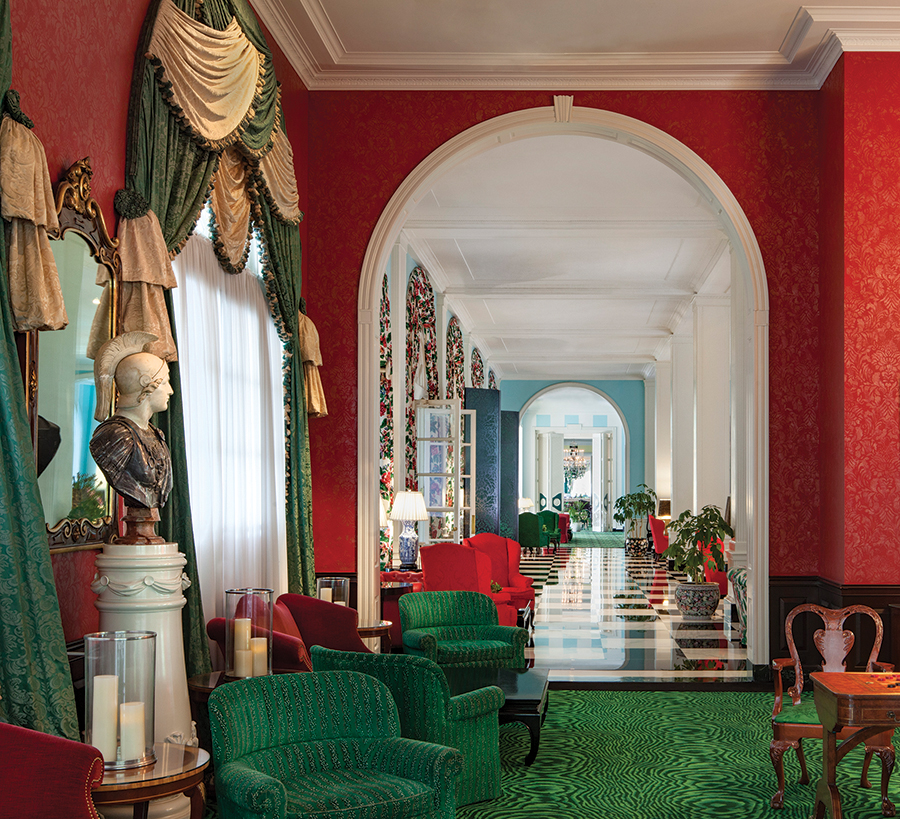
But back to the here and now and the warm embrace of the Greenbrier.

“Hello, hello. Bonjour! Yes, we are back. Yes, hello, hello,” I said to the lovely, slightly quizzical folks at check in. “Charge it, please. And which bar is open? Oh, it’s so good to be back.”

Our room was awash in cabbage roses, stripes and faux bamboo flourishes with “his” and “his” bathrooms. We couldn’t have been more content staying put, but seeing as we were finally someplace other than Instagram, we wanted to spend every waking moment soaking up all the design exuberance we could handle.

Happily, The Greenbrier was largely empty — AARP rates are more favorable mid-week, perhaps? (John handles the cash) — so we could scamper about like feral monkeys in a banana forest with eyes wide and mouths agape. We marveled at the inky green walls in the Victoria Writing Room; the rose-bloom upholstery and black-and-white tile floors in the Upper Lobby; a baroque plaster clock against blue-and-white striped walls; the coral-hued North Parlor; and busts of the presidents delightfully arranged next to the toilets. And that’s just scratching the sublime surface.

Dorothy Draper’s protégé, the equally iconic Carleton Varney, a longtime Madcap Cottage friend (he wrote the introduction to our latest book, Prints Charming: Create Absolutely Beautiful Interiors with Prints & Patterns), oversees the décor of The Greenbrier and constantly curates — and refreshes — the content.

Notes John, “The Greenbrier is always fresh. Never fussy. Never formal. That’s part of the magic. And there are families with kids. Older folks. New Yorkers. Southerners. And everyone in between.”

Our time at the Greenbrier was pure bliss. We dined on superlative Asian fare at In-Fusion (tucked into the glittering, Busby Berkeley-worthy casino). We washed away our cares with a 25-minute Sulphur Soak at the recently overhauled spa. We watched Aladdin in the resort’s movie theater (Hurrah! An open-for-business movie theater); we sipped cocktails in the Lobby Bar; we splashed about in a pool reminiscent of the Roman Empire; and we walked into White Sulphur Springs where the main drag is definitely on the move. (Think a slew of new restaurants popping up!)

But, really, John and I just lolled about with magazines and cocktails. And lapped up the luxe.

Then it was back to reality. Still, the hair is washed and the shirt’s tucked in. The beard is trimmed and the socks match. I’d say we are ready to tackle the world anew. At least for a few weeks.

Thank you, Greenbrier! Long may you reign.  OH

The Madcap gents, John Loecke and Jason Oliver Nixon, embrace the new reality of COVID-friendly travel — heaps of road trips. For more information, visit Greenbrier.com.


The Creators of N.C.

Every Moment is a Window

Through his art, Richard Wilson bridges the gap between then and now

By Wiley Cash
Photographs By Mallory Cash

Spend some time with visual artist Richard Wilson’s work, and you’ll quickly grasp the role historical connection plays in it.

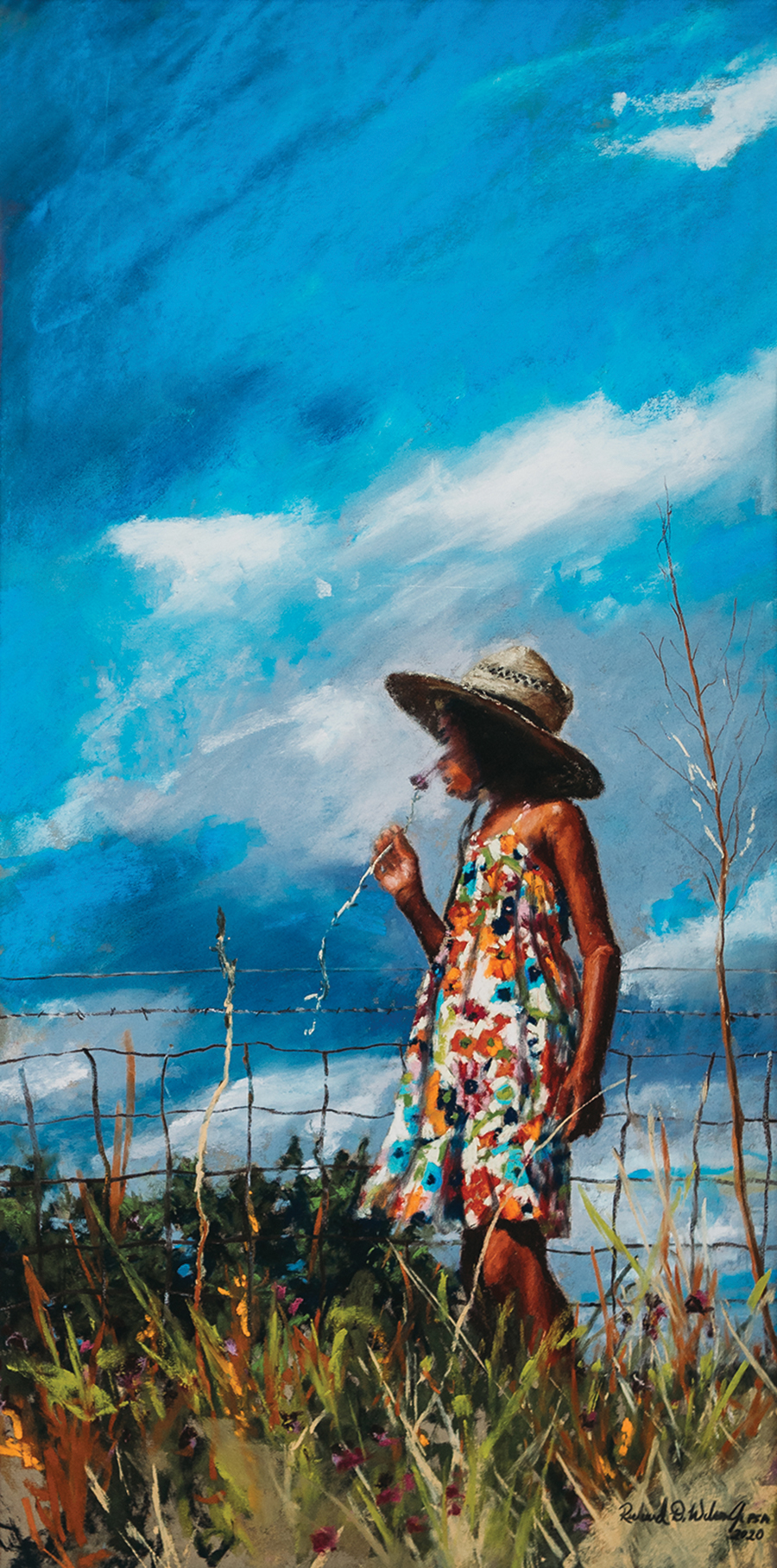
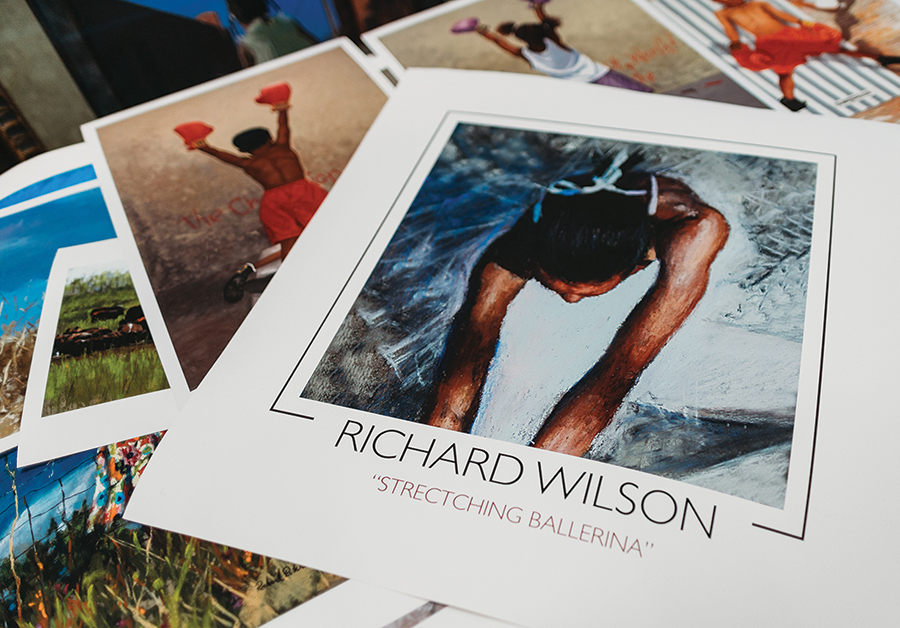
Take his Shadow Series, for example. In each painting, an African American boy or girl stands in the foreground, the background comprised of images of an African American trailblazer. In one piece, a girl in a leather bomber jacket blocks the sun from her eyes and stares toward the horizon, as if searching for a sign of what’s to come; behind her is an assemblage of newspaper stories and photographs of Bessie Coleman, the first African American woman to hold a pilot’s license. Another shows a young boy in oversized boxing gloves gazing up at a speed bag that’s just out of reach; behind him, a newspaper announces that Jack Johnson has defeated James Jeffries to become the 1910 heavyweight champion of the world, the first African American to win the title. Other luminaries such as Arthur Ashe, Serena Williams, Michael Jordan and Barack Obama are featured in the series, each a guiding light for the young dreamer standing “in the shadow.” To the viewer, it’s clear that ancestors and aspiration are powerfully present in Wilson’s artwork.

And if you spend any time with the artist himself, you’ll understand that ancestors and aspiration are powerfully present in his own life.

The oldest of three boys, Wilson was born in Robersonville (Martin County) and moved with his family to Conetoe (pronounced Kuh-nee-tuh), another rural town in Eastern North Carolina, when he was 8. He grew up surrounded by family — siblings, cousins, aunts and uncles. They were close-knit.

Today, Wilson is standing in the middle of his art studio in Greenville, N.C., where he and his wife have lived for just over 20 years. The walls around him are festooned with his original works and ribbons from national art shows; the floor cluttered with framed prints and works-in-progress. Wilson, a tall man who looks like a linebacker yet comports himself like a poet, admits that he has nearly outgrown the space that he built himself. On the wall opposite him is a framed original painting titled A Window Into the Past, in which an older African American man with a cane is picking his way across a field to a weathered two-story farmhouse. The man in the painting is Wilson’s uncle. The home, which has since been demolished, once belonged to Wilson’s paternal grandmother, Mary Battle.

“Every weekend we’d go to my grandmother’s house,” Wilson says, gesturing toward the painting. “All the children and grandchildren. That was the highlight of my week. My uncle, who was a sharecropper, would cook on the grill. We’d all play kickball and softball. I can still smell the rain on the dirt, the trees — pears and pecans. It was a beautiful life.” He sighs and his broad shoulders slump forward slightly. “But when my grandmother passed away, we all stopped going back there, and we just lost that connection.”

Although Wilson’s work is nothing if not realistic, each piece contains elements of symbolism that could be lost on the casual viewer. In the painting of Mary Battle’s house, the electrical service entrance — where the home had once been connected to a power line — is frayed and disconnected. That’s exactly how Richard Wilson felt in 2020, a year that saw a pandemic cripple the globe and political and cultural turmoil seize the heart and soul of the nation. Wilson used his art to reconnect with his family, his community and the landscape that once brought him so much joy.

Although he had featured his grandmother’s house in previous works, last year he found himself wanting to paint it again, and this time he wanted to include a family member. He called up his Uncle Bill and asked if he could come take some photographs of him. Uncle Bill happily obliged. It had been a while since they’d seen each other.

“We started talking about old times,” Wilson says, “and he started posing for me, and I started taking pictures of him. We had a great time.” But Wilson wanted to keep their reunion a secret. “I told him, ‘Don’t tell your children I’m doing this painting,’” says Wilson. “I wanted to put it on Facebook to see if they recognized the house and recognized that their father was in the painting.”

Imagine Wilson’s delight when, after posting the finished painting online, Uncle Bill’s youngest daughter wrote this: Hey, cuz, I really like this piece. It reminds me of back in the day, and the man in the picture reminds me of my pops.

Comments from other cousins followed, each expressing tender sentiments.

“And then they started buying prints,” Wilson says, supporting him at a time when art shows had been canceled due to COVID. “It brought us all back together.”

Wilson’s maternal grandmother, Francis Wilson Knight, lovingly known to everyone — family or otherwise — as Grandma Pigaboot, also bequeathed him a legacy that highlighted the importance of family, faith, land and self-reliance — all of which Wilson has made use of throughout his path to becoming a fulltime artist against incredible odds.

“My grandmother took us around and made sure that she introduced us to all of our family members,” Wilson says. “She was adamant about that, about knowing who your people are.” He stops speaking and smiles as if a memory is playing through his mind. “She also taught us how to be entrepreneurs. We used to turn in Coke bottles and get cash for them, and then we’d turn around and buy candy and sell it. Or we’d make Kool-Aid and turn it into freeze cups, and then we’d sell those.” She also taught Wilson and his siblings and cousins how to make use of the land by taking them fishing and teaching them how to sew gardens. And she instilled the importance of faith in their lives by ensuring that they accompanied her to church.

Richard Wilson has won countless awards for his art, which has been featured in television shows and films, showcased in public and private collections and purchased by the likes of the late Hank Aaron and Gladys Knight. Those early lessons from his grandmother have allowed him to turn a childhood spark of inspiration into the passionate flame that fuels his work. His Shadows Series makes that clear.

But Richard Wilson acknowledges that not everyone is as lucky to have had the family and influences he’s had. Yet that’s the great thing about forging a connection with people you love.

“If you didn’t have it then,” he says, “you can start it now.”

One could say the same about living your dream.  PS

Wiley Cash is the writer-in-residence at the University of North Carolina-Asheville. His new novel, When Ghosts Come Home, will be released this year.

Good Natured

Apricot Power

A little tart and a little sweet

By Karen Frye

An apricot-a-day may replace the apple-a-day theory. A little tart and a little sweet, they’re high in nutrients such as potassium and vitamins A and C. They’re also rich in fiber.

Apricots are loaded with antioxidant flavonoids. In fact, just a handful can neutralize the free radicals that damage cells in the body. Apricots contain the nutrients lutein and zeaxanthin — found in the retina, macula and lens of the eye — and help keep your eyes healthy. The apricot ranks low on the glycemic index, so they’re OK for most folks with sugar imbalances.

The vitamins A and E in the apricot build collagen, keeping your skin healthy, and protecting it against sun damage.

Fresh apricots are seasonal, and the best ones come from California. Dried apricots are easier to find year-round and have all the same benefits as the fresh ones — just make sure to get the ones without sulphur.

While fresh apricots are delicious, you can also make an apricot puree by cooking them in some boiling water for 10-15 minutes, then putting them in the food processor. You can add the puree to oatmeal, yogurt, or eat a few spoonfuls a day.

Before you throw away that pit in the center of the apricot, take a second to remove the seed and eat that, too. The apricot kernel contains a very nutritious substance called amygdalin, commonly known as B17. It’s naturally occurring in many fruits, vegetables, nuts, seeds and grains. Apricot kernels contain abundant amounts of amygdalin.

The apricot kernels themselves are slightly bitter, but I find them delicious. It is possible to find some sweeter seeds, but the B17 is greatest in the bitter ones. The California variety has the highest potency and are the bitterest.

There is a small endocrine gland, the pineal gland, located in the center of the brain at about eye level. It looks like an eye and even has tissues and fluids much like our eyes. René Descartes believed the pineal gland was the “principal seat of the soul.” It produces melatonin, the hormone that induces sleep. While apricots help keep the pineal gland healthy, it calcifies as we age. Some people find that taking a melatonin supplement about an hour before bedtime helps to induce sleep.

Eating apricots and their seeds may also lower blood pressure, reduce pain from inflammation, and aid the immune system. Maybe an apricot a day will keep the doctor away.  PS

Karen Frye is the owner and founder of Nature’s Own and teaches yoga at the Bikram Yoga Studio.

Bookshelf

April Bookshelf

FICTION

Astrid Sees All, by Natalie Standiford

Set in New York City in the 1980s, two young girls arrive after college. Carmen is a native New Yorker with connections, confidence and charisma, while Phoebe is from Baltimore, enamored with Carmen, and desperate to find her place in the city, its art scene and the underground. She lands a job at a club as Astrid, who reads fortunes from movie ticket stubs. All the while, a serial killer stalks the city, and girls are disappearing. Astrid Sees All has a fabulously seedy vibe: music, fashion, art, drugs, danger and sex.

The Girls in the Stilt House, by Kelly Mustian

The Natchez Trace in Mississippi is a place that is deep, verdant, and ripe with stories and secrets. It is also a place where, in the 1920s, many scratched out an existence through sharecropping, bootlegging, trapping, fishing and hard labor during a time of racism, segregation and social disparity. In Mustian’s magnificent novel, mostly written at Weymouth, a violent act inexorably binds the lives of two teenage girls of different races. They struggle to survive, harbor their secrets, and protect those dear to them as their individual stories unfold. Readers will be held in this novel’s grasp from start to finish, experiencing the power and sensitivity provided by a great new voice in literary fiction.

Gold Diggers, by Sanjena Sathian

In a marvelous marriage of coming of age, magical realism, immigration, ambition and history, Gold Diggers is a blazingly brilliant novel stretching from the East Coast to the West Coast. Neeraj is an awkward young Indian American teen. Anita is his neighbor and childhood friend. With the help of her mother’s family recipe of an alchemical solution derived from stolen gold, the two are given powers of achievement and abilities to reach their previously unattainable goals and the thought-provoking consequences that follow them for years to come.

The Last Bookshop in London, by Madeline Martin

August 1939: London prepares for war as Hitler’s forces sweep across Europe. Grace Bennett has always dreamed of moving to the city, but the bunkers and blackout curtains that she finds on her arrival were not what she expected. And she certainly never imagined she’d wind up working at Primrose Hill, a dusty old bookshop nestled in the heart of London. Through blackouts and air raids as the Blitz intensifies, Grace discovers the power of storytelling to unite her community in ways she never dreamed — a force that triumphs over the darkest nights of the war.

The Elephant of Belfast, by S. Kirk Walsh

Inspired by true events, this vivid and moving story of Hettie, a young woman zookeeper, and Violet, the elephant she’s compelled to protect through the German blitz of Belfast during WWII, speaks to not only the tragedy of the times, but also to the ongoing sectarian tensions that still exist in Northern Ireland. Dodging the debris and carnage of the Luftwaffe attack, Hettie runs to the zoo to make sure that Violet is unharmed. The harrowing ordeal and ensuing aftermath set the pair on a surprising path that highlights the indelible, singular bond that often brings mankind and animals together during terrifying times.

Good Company, by Cynthia D’Aprix Sweeney

In a follow-up of her bestselling debut novel The Nest, Sweeney explores the strains and deep bonds that mark longtime marriages and friendships. Flora Mancini is a voice actor; her husband, Julian, stars in a cop show. Margot, her best friend since college, is a longtime superstar on a hit TV show, married to a gentle doctor. The women and Julian came up together as students in New York City, scraping to find work in theater and participating in Julian’s small theater company, Good Company. Twenty years later, they all live in Los Angeles, and dote on Flora and Julian’s daughter, Ruby. When Margot stumbles across an envelope containing her husband’s wedding ring — the one he claims he lost one summer when Ruby was 5 — all of their lives are upended.

The Drowning Kind, by Jennifer McMahon

From the New York Times bestselling author of The Invited and The Winter People comes a chilling new novel about a woman who returns to the old family home after her sister mysteriously drowns in its swimming pool . . . but she’s not the pool’s only victim. A haunting, twisty and compulsively readable thrill ride from the author Chris Bohjalian has dubbed the “literary descendant of Shirley Jackson,” The Drowning Kind is a modern-day ghost story that illuminates how the past is never really far behind us.

NONFICTION

World Travel: An Irreverent Guide,
by Anthony Bourdain and Laurie Woolever

A guide to some of the world’s most interesting places, as seen and experienced by writer, television host and relentlessly curious traveler, the late Anthony Bourdain. In World Travel, a life of experience is collected into an entertaining, practical, fun and frank travel guide that gives readers an introduction to some of his favorite places — in his own words. It features his essential advice on how to get there, what to eat, where to stay and, in some cases, what to avoid. Supplementing Bourdain’s words are a handful of essays by friends, colleagues and family that tell even deeper stories about a place, including sardonic accounts of traveling with Bourdain by his brother, Chris, and a guide to Chicago’s best cheap eats by legendary music producer Steve Albini.

Broken Horses, by Brandi Carlile

The critically acclaimed singer-songwriter, producer and five-time Grammy winner opens up about a life shaped by music in this candid, heartfelt, intimate story. Though imperfect in every way, her dysfunctional childhood was as beautiful as it was strange, and as nurturing as it was difficult as her musically gifted but impoverished family moved 14 times in 14 years. Carlile takes readers through the events of her life that shaped her very raw art — from her start to her first break opening for the Dave Matthews Band, to sleepless tours over 15 years and six studio albums while raising two children with her wife and, ultimately, to the Grammy stage where she converted millions of viewers into instant fans.

CHILDREN’S BOOKS

More Than Fluff, by Madeline Valentine

Cute, adorable, fluffy Daisy duck just can’t take it anymore. Everyone wants to HUG her, and all she wants is for everyone to stay out of her personal bubble. When her subtle hints don’t quite do the trick, Daisy boldly asks her friends for wing bumps, pinky shakes and high-fives. The perfect choice for those kiddos with personal space issues or just someone needing a little “me” time, More Than Fluff gives young readers words to ask for what they need. (Ages 2-5.)

Beast in Show, by Anna Staniszewski

Of course, everyone thinks their pet is the best, but Julia is sure Huxley will win top prizes in the dog show. They arrive to find it’s not an ordinary dog show at all and the talent portion is really out of this world. A wonderful tale of giving your all and doing your best no matter what, Beast in Show is just perfect for anyone who loves someone furry. (Ages 3-6.)

G My Name is Girl: A Song of Celebration from Argentina to Zambia,
by Dawn Masi

A playful celebration of everything girl, G My Name is Girl is also a wonderful worldwide journey and a fun way to honor the characteristics that strong, confident young women possess. Clever parents and grandparents will recognize the format as that of a classic travel game and enjoy sharing the rhyme with a whole new generation. (Ages 3-8.)

Mars! Earthlings Welcome,
by Stacy McAnulty

Humor and fun facts bring nonfiction alive for the youngest readers in McAnulty’s Our Universe series. In the newest installment, Mars! Earthlings Welcome, budding scientists learn that Mars may have once had rivers and streams, is Earth’s closest neighbor, and has 37 whole minutes longer in its day than Earth. For classrooms and curious kids (and parents), this series is a great way to learn more about our great big universe. (Ages 4-8.)

Peter Easter Frog, by Erin Dealy

Who says bunnies should have all the fun? Hippity hoppity Peter the Easter . . . frog is here to help out Easter Bunny any way he can. A fun holiday story of kindness, sharing and friends with a few giggle-inducing surprises along the way. (Ages 3-5.)  PS

Compiled by Kimberly Daniels Taws and Angie Tally.

Out of the Blue

Let It Be Over

Enough is too much

By Deborah Salomon

Seldom have Richard III’s words rung so true: “Now is the winter of our discontent . . . ”

Carol-less Christmas because singing spreads the virus.

Party-less New Year’s Eve. Midnight hugs prohibited.

Thanksgiving and Super Bowl Sunday spent with live-in family, forget about chili and party platters. Romantic Valentine’s Day dinners were take-out, including the martinis.

No snow, only rain, rain, rain. Cold winter rain owns a special misery.

An epic storm brings the Lone Star State to its knees: No heat, no water, burst pipes, dwindling food — almost enough to make Texans forget COVID-19 which, as a result, will surge.

In late February, parts of an engine fell off a United Airlines Boeing 777 just after take-off from Denver, bound for Hawaii. The cellphone videos matched the pilot’s shaky voice as he declared, “Mayday, Mayday.” Yet he returned to Denver with all 240 passengers safe. Nothing that dramatic since Capt. “Sully” Sullenberger landed a Charlotte-bound USAirways flight with zero engine power on the Hudson River in 2009.

Except now, a new fear of flying — not that anybody much is.

Ah, yes, the virus itself, which has crept like mold through . . . everything.

The winter just ending was chill, dreary and definitely damp. Never in 12 years have I worn my down parka and cashmere socks as much.

My two kitties looked in vain for the sunny spot on the porch to warm their old bones. I remember a few nice days when golfers surfaced without mufflers and knitted caps but even more when the birds seemed especially thankful for their daily ration of shelled sunflower seeds, which in a month doubled in price.

Several prominent people died since autumn, notably Ruth Bader Ginsburg and Alex Trebek. Jeopardy! is now a Travesty! The older a person gets, the more he or she muses on passings. I turned 82 in January.

But, when push comes to pushover, the deepest discontent remains the November election, with an aftermath that festered, then exploded on Jan. 6, when the Capitol was ravaged by its own citizens. When the actions of a defeated president flabbergasted — there is no other word — and embarrassed Americans expecting at least a modicum of civility. Back to Shakespeare: “Something is rotten in the state of . . . ” not Denmark, as written. Maybe Florida. D.C., for sure.

The cherry on top has to be what the Brits are calling Megxit. I knew from her first curtsy that Miss Markle planned to bag her prince and drag him back across the pond. In February, they sealed the deal with a cheeky note to the Queen: Don’t call us, we’ll call you. Being the dressed-to-kill Duchess of Sussex wasn’t enough. What she wanted was to be Queen of Hollywood, living in a seaside mansion more opulent than any British castle — and not half as drafty. So, Harry sold out his granny, his brother and his mother’s legacy for a green card, a year-round tan, tacos on demand, Lipton Orange Pekoe and driving his Range Rover on the right side of the road.

But will it last?

However, this tragic winter provided one belly laugh: Ted Cruz, with long hair and beard looking the part of an aging matador in search of a bull, pretending to chaperone a bunch of girls to Cancún instead of handing out water to his constituents. If only Jackie Gleason was alive to recreate the part.

All things considered, this April I won’t complain about pine pollen, hay fever, awakening day for the ants or new cheek wrinkles the bright spring sun reveals. I’ll try not to dread the summer heat, which will loom large. Because to have survived this winter upright and lucid makes anything seem possible.   PS

Deborah Salomon is a contributing writer for PineStraw and The Pilot. She may be reached at debsalomon@nc.rr.com.

The Kitchen Garden

The Cutting Garden

Man does not live by vegetables alone

By Jan Leitschuh

What is a kitchen garden but food for the soul? No need to be a vegetable purist. We can add a few flowers to the mix, rendering the entire process far more soulful.

I’m not talking about interplanting a six-pack of bedding marigolds with your tomato plants for pest control. Although those are nice, the stems of bedding plants are too short for most vases.

No, we are dreaming of armloads of garden blossoms for cutting — a true cottage garden profusion.

With certain sown flowers, you’ll draw essential pollinators to your kitchen garden and the vases in your house will spill over with colorful blooms. Your yard will pop with floral eye candy and, since many thrive with regular cutting, you will have plenty of extra flowers to surprise and cheer up friends.

The quiet joy and pride of place is purely incidental.

It usually starts like this:

One chilled, sodden January, I stop before a local display of seeds and tubers. Instantly, the colorful reds, yellows, purples, pinks and oranges vanquish the gray day. In my mind, it becomes late June, and along with plucking ripe tomatoes, yellow squash and snap beans, I’m also gathering loads of cut flowers to bring into the house and share with friends. Bees buzz. The sky is blue, the morning breezes soft.

More than a few bucks later, I come home with many packets of zinnia, poppy, sweet William and cosmos seed, sacks of candy-colored dahlia, a peony tuber or two and several varieties of caladiums.

Come late February to early March, I’m sowing a few trays of my treasures, to get an early start. The remainder will be sown directly in the garden.

While some gardeners plant bulbs especially for cutting — early daffodils and Dutch irises and gladioli and lilies — why not keep it super simple? Let’s not over-complicate the process. A few packets of seed may be all you need to cultivate joy this summer.

You’ll need some sure-thing Sandhills winners.

The suggestions below can be planted directly into your garden. That couldn’t be easier — scratch out a shallow trench, seed lightly, then rake or cover with a sprinkle of soil and pat down for the critical seed-soil contact. Moisten with a gentle spray so that the tiny seeds aren’t disturbed, and water regularly through germination and early growth. Thin or transplant seedlings to the distances stated on the packet, so they have space to develop.

For diehard gardeners, a few trays seeded indoors in late February or early March can give you a jump on the season. I like to sow a six-pack of each variety, then seal the rest of the seeds in a plastic bag, for later direct sowing. This lengthens my growing season and spreads out the likelihood of good blooms.

Some of my favorites do very well here in the Sandhills, thriving with regular cutting, kicking out more blooms. Here are three can’t-miss flowers:

Glorioso Daisy: Practically foolproof. You may have to order these seeds or obtain from a friend. I haven’t seen them on seed racks yet this year, but they are well worth seeking out, and you can save the seed of your favorite blooms to replant next year.

This is a rugged, deer-resistant type of flower with great good cheer, sure to light up an informal summer bouquet. You may also find the seeds under the botanical name rudbeckia hirta.

These daisy-like, tetraploid cultivars are larger and showier than their wild cousins. As a sturdier, more eye-catching type of black-eyed Susan, rudbeckia hirta has blooms that may be golden yellow with dark chocolate centers, or a rich red-mahogany, or a bicolor golden with a mahogany base to each petal.

Another showy type of rudbeckia hirta is called Irish Eyes. This tall strain produces large, single golden-yellow daisies with a bright green eye and makes an outstanding cut flower.

Glorioso daisies also come in doubles. They will bloom through the fall, when their rich autumnal colors add to the season. Deadheading prolongs the bloom season, but gloriosa daisies will re-seed themselves readily.

Sow seeds directly in the ground sometime in April. Consider a second planting in May for longest bloom season. If you’ve planted too close for the optimum 12-inch spacing, the seedlings do transplant well when young, especially if moved on a cloudy day and watered in well.

Glorioso daisy is fairly drought resistant once established and will produce masses of cheerful blooms.

Zinnias: So easy. Again, as simple as seeds come. And the colors! The flower shapes! Possibly my favorite cut flower of all. There are three types of zinnias, so if cutting is your aim, choose well.

1. Short. Avoid these for a cutting garden. You can find potted zinnias at the garden stores in late spring, but most likely they will be these decorative dwarf types, running under 10 inches or so. You might enjoy these cuties at the front of a flower border, but their stems are too short for good cutting. Some of the common dwarf types are the Thumbelina, Magellan and Dreamland series. They are terrific, long-blooming bedding plants but, again, not very useful for vases and arrangements.

2. Medium. The next type are bushy, landscaping zinnias, up to 20 inches and best for bedding plantings. Look for names like Zahara and Profusion series.

3. Tall. The classic cutting garden zinnia eventually grows skyward, with long, strong stems for vases. You’ll have to start these from seed, most likely, but that is not difficult. Either direct seed into the garden when the soil has warmed — later April or May here — or start some seeds early indoors with plenty of light. By fall, your cutting garden zinnias can be 4-feet tall and will need support. I use a floral net, a kind of open, light string fishnet that steadies growing stems. Your garden center may carry them. You can also corral the patch with some twine and a few stakes.

Choosing your colors, shapes and varieties is the most fun, making for a delightful perusal of the catalogs and seed racks. There are spiky cactus types, full dahlia-looking blooms, newer bicolors, and every pastel shade or bold crayon color except blue. (Yes, even green, pale zinnias called Envy or Queen Lime.) Some of my favorites include the Benary Giants (be sure to order a good strong red, and perhaps an orange), Giant Cactus, California Giants, Uproar Rose, Queen Red Lime, Burpeeana Giants, and the 30-inch Cupcake series. A good strong white bloomer like Polar Bear adds a poignant accent to a colorful arrangement.

Or just buy a packet of mixed colors and be done with it.

Cosmos: You remember the movie The Color Purple, don’t you? Those stunning fields of airy, floral glory were cosmos. Another easy seed to sow directly, cosmos comes in purple, white, pinks, lavender, magentas, gold, orange and even a pale lemon.

Cosmos tolerates heat, drought (once established) and poor soil. Sounds like a Sandhills flower, yes?

Cosmos is a worker. Productive plants will produce masses of delicate, colorful beauty. The sizes range from the 18 to 26-inch dwarf, ruffly Apollo series to taller varieties. The Pop Socks series offers interesting shapes, singles and doubles. Both the Sonata and Sensation series are fairly easy to find and are lovely. The red-and-white striped Velouette is quite striking and can grow 26 to 34 inches. Cups and Saucers, with their fun shapes, can reach to 3 to 4 feet. Bright Lights and Ladybird are the salsa of the cosmos world, spouting hot orange, golden and yellow flowers.

Plants get very bushy. They’d appreciate a little extra room to spread out, so space plants 12 to 18 inches apart. Be sure to stake or corral them early, while they are still young. Cosmos also benefit from a technique called pinching, as this will encourage the already highly productive plants to branch even more vigorously.

There are many other flowers to include in a seeded cutting garden. Coreopsis, sunflowers, bachelor’s button, larkspur and sweet William are just a few that look lovely in vases and can be grown from seed. But you won’t go wrong in the Sandhills with the easy three above.

Don’t forget to water during dry spells, especially when plants are in bloom. Deadhead fading blooms. Carry a clean bucket with a little water out to the garden and cut in the mornings before the sun gets hot. Zinnias, in particular, benefit from a change of water every day or two. They can get a little stinky otherwise.

For an arrangement, use what you’ve already got. Slim stems of flowering trees or shrubs, shiny foliage like photinia, hellebore or camellia for filler, sprigs of purple basil. Perennials such as a sweet-smelling phlox, lilies, a peony, a few strands of ivy, perhaps the odd rose could also creep into the bouquet.

April showers can bring a little soul to your kitchen garden. May the fleurs be with you!  PS

Jan Leitschuh is a local gardener, avid eater of fresh produce and co-founder of Sandhills Farm to Table.

Out of the Blue

Matinee Idyll

A screen shot from the good ol’ days

By Deborah Salomon

I miss the movies. Not art films, or chick flicks, or computer-generated blockbusters. Certainly not superheroes or chatty corpses. Just an engrossing story played out over two hours.

Movies represented a simple but profound part of my childhood, teens, parenting, grandparenting and old age. Here’s how.

Growing up in a New York City apartment before TV and without siblings could, Mary Poppins notwithstanding, be boring. I pounced on Life magazine each week, hoping for a new Disney film ad. My mother objected but usually relented. Yet she exposed me, barely 10, to Laurence Olivier’s Hamlet. Amazing how easy Shakespeare goes down on screen. Sir Larry became my first movie-star crush (obligatory for little girls in the late ’40s), followed by Gregory Peck, after Gentleman’s Agreement. Redford, Cruise and Clooney melted down and reassembled as Brad Pitt couldn’t hold a candle to either.

The situation was different in Asheville. I was 12, plenty old enough to sit through Singin’ in the Rain and a parade of other silly musicals with friends at the lavish Art Deco Imperial Theater. Admission: 9 cents. One mother would drop us off, another pick us up. To my everlasting embarrassment, Mario Lanza — The Great Caruso — replaced Olivier and Peck.

The upside: By 13 I felt comfortable with Shakespeare and Verdi.

Soon, local fellas with hot-off-the-press driver’s licenses usurped Mario and the Bard. Movie dates were the thing. I can’t remember a single movie . . . maybe Sabrina and the original A Star is Born . . . only being panicked he’d try to hold my hand, now greasy from popcorn.

At least we were spared nudity and expletives.

I drew the line at Westerns, war and horror flicks which, compared to current offerings, look like Looney Tunes.

The early ’60s found me busy with three babies and James Bond — a new installment released almost every January, for my birthday. What better gift than a babysitter, steakhouse dinner and 007? When Sean Connery departed, so did I. Some things, like the scent of roses and fresh-squeezed orange juice, can’t be synthesized. Neither can “Bond . . . James Bond” in a low growl.

The babies grew up. I was the only mom on a block of 10 children that had a station wagon big as the Hindenburg plus the patience to herd/referee. Their pestering started as soon as a cartoon feature opened. Lessons learned: “Sugar high” is serious science. And no two kids ever have to pee at the same time.

Watching the first 3D (House of Wax) and IMAX reminded me of the “What have they done to my song?” lament. What have they done to plots and acting? Whither movie dates, Photoplay magazine, musicals, James Dean in Cinemascope and Marlon Brando in black-and-white?

Time passed. Films adapted. Rainy Saturday afternoons were spent with my grandsons at the multiplex, a phantasmagoria of arcade machines that swallowed dollars like Jujubes. The movies I endured there had no plots, no acting, only special effects. When the boys were pre-teens, out of desperation I took them to The Blind Side, where they sat, rapt and wide-eyed.

“That was a really good movie, Nanny,” the older one said. Now an attorney, he still remembers it.

During the pandemic some releases go straight to streaming, to be watched “in the comfort of your home,” where interruptions happen. The sound of the toilet flushing breaks the spell. Marie Osmond interrupting Daniel Day Lewis is blasphemy.

Therefore, I watch faves only on commercial-free channels.

So, which have survived?

The envelopes, please:

Best performance by an actor . . . ever: Philip Seymour Hoffman in Capote.

By an actress: Meryl Streep: Sophie’s Choice.

Best chick-flicks: Bridges of Madison County, (sob) and The American President (yay!).

Best musical: Timeless, happy-sad, plot-intensive Fiddler on the Roof.

Best feel-good: The King’s Speech, where in my scrapbook Colin Firth replaces Olivier, Lanza and Peck.

Best all-round movie; The Godfather, but only the first installment and the prequel from Part II. I know the script by heart. And I always add a little sugar and a splash of wine to my spaghetti sauce.

Runners-up: The Shawshank Redemption, One Flew Over the Cuckoo’s Nest, The Help, Philadelphia.

Most Overrated: Titanic, aka Gone with the Wind gone to sea.

Obviously, movies need some technology/methodology, which limits Citizen Kane, City Lights and Casablanca — all fine period pieces. But when the lights go down and the corn pops up I want to be transported, entranced, disturbed, inspired and even challenged. Crying is a good sign. Snoozing is not. Private Ryan — out. Oskar Schindler — in. Sean Connery, dead, never to be replaced by nice guy Tom Hanks.

The last satisfying movie I sat through was Doubt (2008) starring, no surprise, Meryl Streep and Philip Seymour Hoffman; Viola Davis copped Academy Award and Golden Globe nominations for 10 minutes onscreen.

So there’s hope, I hope.  PS

Deborah Salomon is a contributing writer for PineStraw and The Pilot. She may be reached at debsalomon@nc.rr.com.

Character Study

Of Palettes and Perps

From landscapes to wanted posters

By Jenna Biter

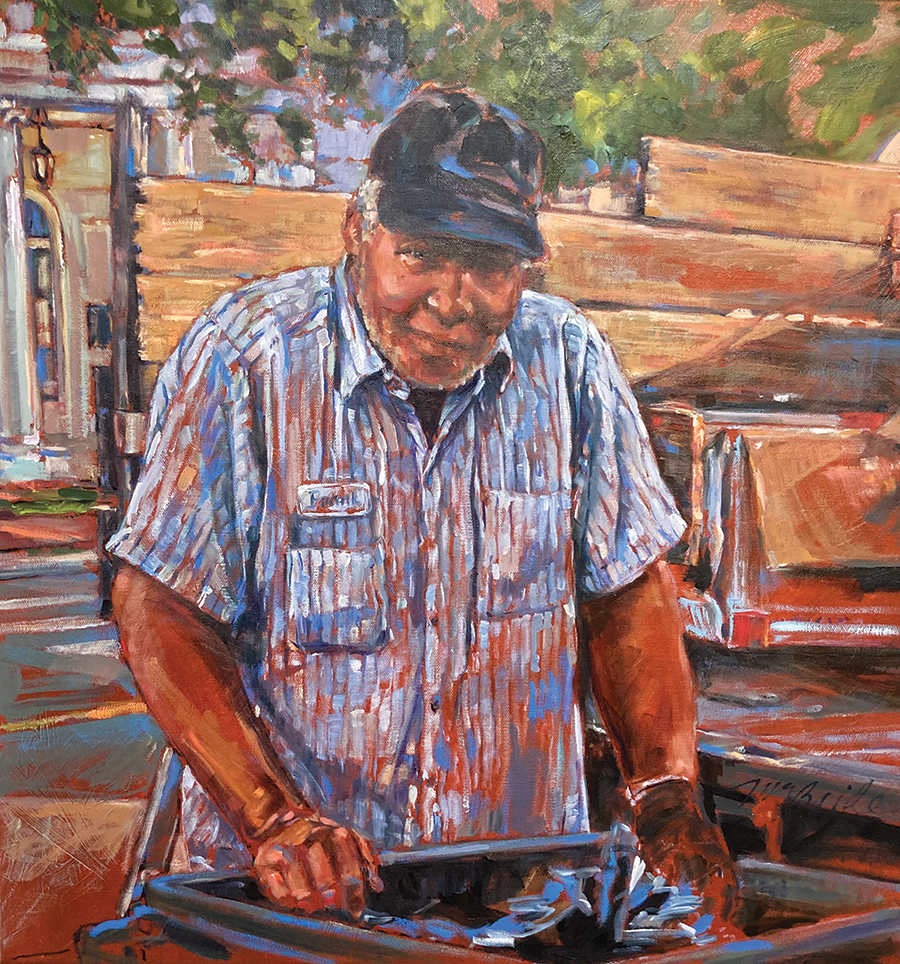
Walk up a narrow flight of stairs and hang a left into the corner studio above Eye Candy Gallery & Framing in downtown Southern Pines and you’ll find Pat McBride. Wearing a crisp white shirt that — if you know any artist — has obviously not yet seen the business end of a paint brush, she waves and introduces herself with an upbeat hello. She’s surrounded by a dozen paintings, ranging in size from a few inches to a few feet.

“I always liked art, but I hadn’t really thought of being an ‘artist-artist,’” she says. That was until she refused to take no for an answer in a class at Indiana University of Pennsylvania.

“I took art as one of my electives and, on the first day of class, the professor said, ‘OK, if there’s anybody in here with any other majors, this is a class for art majors. You just need to let me know and get out now.’”

She backtracks. “Well . . . first, he said to put up your hand. Of course, I, being ornery, did not, but everybody else did and politely marched out . . . you’re not kicking me out of this class.” She relives the memory, shrugs her shoulders, smiles. “Anyway, I took the class and ended up becoming an art major.” She got her undergraduate degree in fine art and has been at it ever since.

McBride points at her large painting of the Carolina Hotel. “Right now, I’m working in oils.” She used to work mostly in acrylics and pencils, detailing people. But a class in oil painting inspired her to take up the medium, and the historical architecture and unique sporting events of the Sandhills have captured her imagination. “Everything is kind of fun because everything is kind of . . . new,” she says, though she and her husband, Larry, moved to the area over three years ago. “When we moved here, our house needed so much work that we didn’t really get to do a lot.”

Before coming to the Sandhills, McBride and her family lived in Greensboro for 15 years and, before that, they lived in a half-dozen other places, including Buffalo, New York, and Annapolis, Maryland. Larry worked as a special agent for the FBI, so the family was packed up and moving every two years. At least, that’s how it was at the beginning.

McBride kept up with her art regardless of where they lived. “I was working in frame shops so that I could be around art and afford to get my stuff framed.” She showed her artwork in galleries and continues to do that in Eye Candy just below her studio and It’s Art for Art Sake in Pinehurst.

In the spring of 1984, however, McBride’s most prolific work hung not in a gallery but in post offices and malls across the United States. It was the wanted poster of Christopher Bernard Wilder, better known by the epithet the Beauty Queen Killer.

It was McBride’s husband who, in the early 1980s, recommended she apply for an opening as an illustrator in the special projects division of the FBI. She geared her portfolio toward the job and got the position. “There were craftsmen who were woodworkers; there were photographers; there were graphic artists,” she says. “The craftsmen would create, like, a golf club that had a microphone in it. Of course, the photographers were photographing different things and crime scenes — stuff for courtroom presentations. And the graphic artists were for in-house publications.

“I did illustration,” she continues, “and they also trained me to do photo retouching.” In the pre-Photoshop days, McBride retouched photos by hand with what looks like a single- or double-haired paint brush, opaque watercolors (gouache) and her imagination. She reworked photos of at-large criminals, imagining potential changes in their appearance for wanted posters.

“It was just what I thought they might look like,” she says. “There wasn’t really a lot of science to it.

“When they brought this one to me, it was going to be a standard poster . . . dah, dah, dah. But then, they’re bringing in photos of all these beautiful young girls. And every day they’re bringing them in, and they’re preparing for a press conference. They’d go marching past my desk with these giant photos.”

The Australian-born serial killer lived in Florida and had a dark past rife with sexual assault and rape allegations. But he was also a successful real estate investor who drove race cars and lived fast. Wilder would lure away unsuspecting teenage girls and young women by hanging around malls, pretending to be a photographer looking for young models. “For whatever reason, probably because he was successful, probably because he didn’t look the part of a monster, he got away with it,” she says.

In the spring of 1984 Wilder went on a cross-country killing spree and murdered at least eight women. He catapulted to the top of America’s most wanted list and, ultimately, shot and killed himself on April 13 when two police officers approached him at a gas station just miles from the Canadian border in New Hampshire.

“Apparently, he usually had a beard and a mustache,” McBride remembers, “but he was on this crazy spree, and they heard word he might have shaved — nobody had a photo of what he looked like prior to a beard.”

It was her task to overpaint the serial killer’s photo and reimagine him without a beard. “At the time, I thought, ‘Man, if I never do anything again, this was probably the most important thing I ever did,’” she says. “He actually was clean-shaven when he died, but I never saw pictures. I asked the agents afterward how close I came, but there’s no way I could really know.”

McBride Googled Wilder nearly 40 years post mortem and discovered an Australian TV special that flashed previously unseen photos of the killer clean-shaven. “I went ekkkkk!” she said, in a mixture of accomplishment and disgust, “because it came out looking correct.”  PS

Jenna Biter is a writer, entrepreneur and military wife in the Sandhills. She can be reached at jenna.biter@gmail.com.

Simple Life

In the Beginning

A grande dame, an old beech and other memory-keepers on the path to this gardener’s genesis

By Jim Dodson

Fifteen years ago, a grande dame of English gardening named Mirabel Osler smiled coyly over a goblet of merlot and said something I’ll never forget. “You know, dear,” she declared, “being a gardener is perhaps the closest thing you’ll ever get to playing God. Please don’t let on to the Almighty, however. He thinks He gets to have all the fun.”

The café in Ludlow, Osler’s Shropshire market town, claimed a Michelin star. But the real star that early spring afternoon in the flowering Midlands of England was Dame Mirabel herself. Spry and witty, the 80-year-old garden designer had reintroduced the classic English “cottage garden” to the mainstream with her winsome 1988 book, A Gentle Plea for Chaos.

The intimate tale of how she and her late husband transformed their working farm into a botanical paradise where nature was free to flourish became a surprise bestseller that fueled a worldwide renaissance in cottage gardening. It’s actually what inspired me to create my “faux English Southern Garden” on a forest hilltop in Maine.

My visit with Osler was one of several stops I was making across England in the spring as part of a year-long odyssey through the horticulture world while researching a book about human obsession with gardens – including my own.

When I asked Dame Mirabel why making a garden becomes so all-consuming and appealing, she had a ready answer.

“I think among the most valuable things a garden does for the human soul is make us feel connected to the past and therefore each other,” she said, sipping her wine.

“We’re all old souls, you know, people who love plants. Especially trees.”

She was delighted that I shared her enchantment with trees, mentioning a gorgeous old American beech that stood beside our house in Maine and how it became the centerpiece of my own wild garden.

When my children were still quite young, we carved our initials into the beech — as one must do with its smooth, gray bark — hoping our names and the tree might reside together forever, or at least a couple hundred years. Unfortunately, our great beech was visibly ailing, which sent me on an odyssey to try to save it. That quest ultimately became a book called Beautiful Madness.

“I think that’s the alchemy of a beautiful tree,” Dame Mirabel agreed. “They speak to us in a quiet language all their own. They watch over the days of our lives and will long outlive us. No wonder that everyone from Plato to the Druids of Celtic lore believed divinities resided in groves of trees. Trees are living memory-keepers.”

Mirabel Osler passed away in 2016, age 91. Not long after Beautiful Madness was published in 2006, however, she wrote me a charming note to say how much she enjoyed reading about our visit in Ludlow. True to form, as my wife, Wendy, and I discovered on that unforgettable spring day, Dame Osler’s final garden was a chaotic masterpiece, a backyard filled with beautiful small trees and flowering shrubs arching over a narrow stone pathway.

Not surprisingly, as this long, dark winter of 2021 approached its end, Dame Mirabel was on my mind anew as I began serious work and planning on what will be my fourth — and likely final — garden.

Five years ago, Wendy and I purchased a handsome old bungalow in the neighborhood where I grew up, allowing me to spend the next three years transforming its front and side yards into my version of a miniature enchanted forest — my tribute to Dame Mirabel’s Shropshire garden.

I nicknamed the long-neglected backyard dense with overgrown shrubs and half-dead trees “The Lost Kingdom.” Reclaiming just half of this space was another odyssey, but more than a year later — and thanks to the assistance of a younger back and a Bobcat — a promising shade garden of ferns, hostas, Japanese maples and a handsome Yashino Japanese cedar now flourishes there. It reminds me of the many Asian-themed botanical gardens I’ve visited.

That left only a final section of the “Lost Kingdom” to deal with, which I began clearing late last fall, resulting in a nice blank canvas half in shade, half in sun.

Since Christmas Day, I’ve spent hours just looking at this space the way the author in me stares at a blank white page before starting a new book.

Creating a new garden from scratch is both addictively fun and maddeningly elusive — a tale as old as Genesis. It’s neither for the faint of heart nor skint of wallet.

Gardens, like children, mature and change over time. At best, gardeners and parents must accept that we are, in the end, simply loving caretakers for these living and breathing works of art. Although the Good Lord may have finished His or Her garden in just six days, I fully expect my new final project — which, in truth, is relatively small — to provide years of work and revision before my soul and shovel can rest.

No complaint there, mind you. As the Secretary of the Interior (aka, my wife) can attest, her garden-mad husband enjoys few things more than getting strip-off-before-you-dare-come-into-this-house dirty in the great outdoors, possibly because his people were Orange and Alamance county dirt farmers stretching back to the Articles of Confederation. Their verdure seems to travel at will through his bloodstream like runaway wisteria.

After weeks of scheming and dreaming, sketching out elaborate bedding plans and chucking them, it finally came together when a dear old friend from Southern Pines named Max, renowned for his spectacular camellia gardens, gave me five of his original seedlings for the new garden. I planted them on the borders and remembered something Dame Mirabel said about old souls and trees being memory-keepers.

Surrounded by Max’s grandiflora camellias, this garden will be a tribute to the trees and people I associate them with.

A pair of pink flowering dogwoods already anchor a shady corner of the garden where a peony border will pay tribute to the plant-mad woman who taught me to love getting dirty in a garden, my mom.

Nearby will be a pair of flowering crab apple trees like the pair that bloomed every spring in Maine, surrounded by a trio of Japanese maples that I’ve grown from sprouts, linked by a winding path of stone.

A fine little American beech already stands at the heart of this raw new garden, a gift from friends that recalls the old beech tree that sent me around the world.

For now, this is a good start. There will be more to come. For a garden is never really finished, and I’ve only just begun.  PS

Jim Dodson can be reached at jim@thepilot.com.

Seeing Triple

Three options at one address

By Deborah Salomon     Photography by John Gessner

Houses can be 3-D textbooks chronicling history or sociology.

The first cottages built by the Tufts family were close to the hotel and without kitchens, since renters took their meals in the Casino building. Later on, people who stayed longer, perhaps for the winter “season,” brought children (who attended a schoolhouse built for this purpose), and needed cooking facilities and a maid’s room. Front porches, perhaps a screened one on the side, were obligatory for sitting and conversing with neighbors out for an evening stroll. Fireplaces got them through the winter. Before air conditioning, everybody left in May.

After nearly two decades of attracting wealthy urbanites, the cottages — now built on spec rather than commissioned — became smaller, plainer. Some were occupied by upper-level resort staff and village merchants, others by families drawn to Pinehurst’s rung on the social ladder. The best had enough land to expand.

Acadia Cottage, built in Old Town in 1917, conforms to some of these parameters but with a checkered history. Hugh McKenzie was the first owner, followed by another five by 1951. Only one — Mrs. W.H. Nearing — appears in the Pinehurst Outlook social listing of comings and goings. Records show that a fire burned off the wood-shingled roof, which was replaced by fireproof shingles for $300.

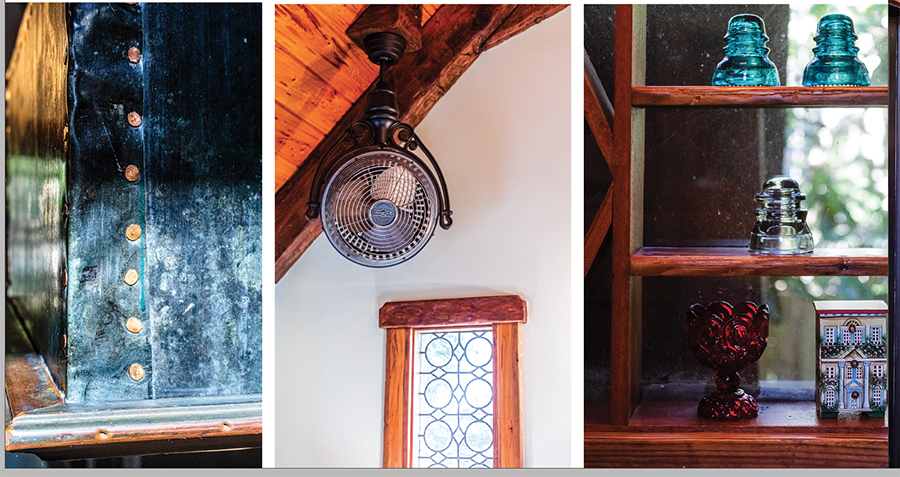
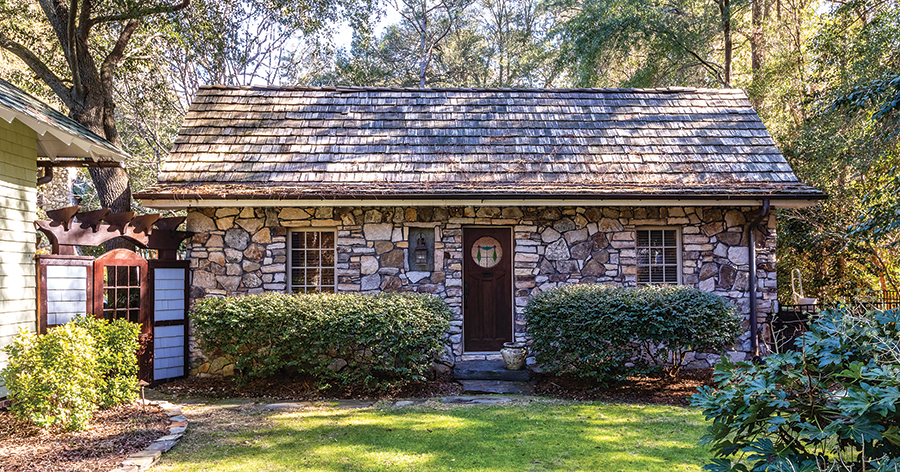
Now, beyond Acadia’s back door or through a side gate lies a magic kingdom — a mossy courtyard with a fire pit, a 50-foot-long and 11-foot-deep pool, massive stone benches for sitting and boulders for diving, a darling little pool house and a roomier guest house, both fully serviced with heat and AC, kitchenette, sitting room, a sleeping alcove and bathroom. No piece of this enclave appears strictly utilitarian. Each, whether it’s a cabinet or a conveyor-belt ceiling fan, offers an artistic, craft or historical component.

Antiques co-exist peacefully with reproductions and artifacts. Only living there affords enough time to notice, and appreciate, the array.

This enlargement and renovation was the brainchild of David Connelly, a Chicagoan with four athletic children, who wanted a vacation haven and found the overgrown back lot completely hidden from street view ideal. Connelly, a self-described wannabe architect, purchased the dull, dated but well-built “brownie house” on half an acre in 2000 and went to work. He and his contractor sourced stone for outbuilding walls from western North Carolina mountains, lumber from a demolished tobacco barn and the Reynolds estate in Southern Pines.

On a damp day, the boards still smell like tobacco.

They removed walls in the two-bedroom cottage, creating an open living/dining/den space, and installed a modern kitchen that, somehow, looks like it’s been there forever. A bath/laundry room with a half wall tile shower was added, as well as a Carolina room off the dining area. Details mattered; moldings aplenty, sometimes painted a color different from the walls, delineate the 10-foot ceiling. Over the front door, a transom pane. An old-timey wood screen door fit the timeline. Then, to frost this cake of many layers, a faux specialist painted wide pastel stripes from Marshall Field’s shopping bags on a powder room’s walls. Even more striking is the colored grid applied to the kitchen floorboards creating the look of scuffed linoleum, circa 1940s. 

The dull brownie house, called Acadia now, inside and out, glowed a pale green, neither mint nor avocado, froggy nor kiwi, but so organic to the setting that Jay and Kim Butler, who purchased the property in 2010, didn’t paint over it.

The story of their acquisition rings familiar:

The Butlers, from Virginia, with a second home at Nags Head, spent a weekend in Pinehurst. Kim had never been here. “We rode by the house on a Saturday and saw it was for sale. It had great curb appeal,” Jay recalls.

After 10 years, Connelly was ready for another project.

“I had to have a pool, so I loved that feature,” adds Kim, retired from the retail pool business, with an avocation for collecting mid-century modern furniture and unusual décor accents.

“We just liked the quaintness,” says Jay, an executive in a family recycling business. Golf was a draw, confirmed by memorabilia decorating walls in the TV den opposite the living room. Most of all, “It was in move-in condition, exactly the way we liked it.”

About a month later, they did exactly that.

Soon, their friends were lining up for invitations to test private guest and pool house accommodations which set this address apart from Pinehurst estates with designated guest quarters under one roof. Their verdict, Jay says: “Kinda cool.”

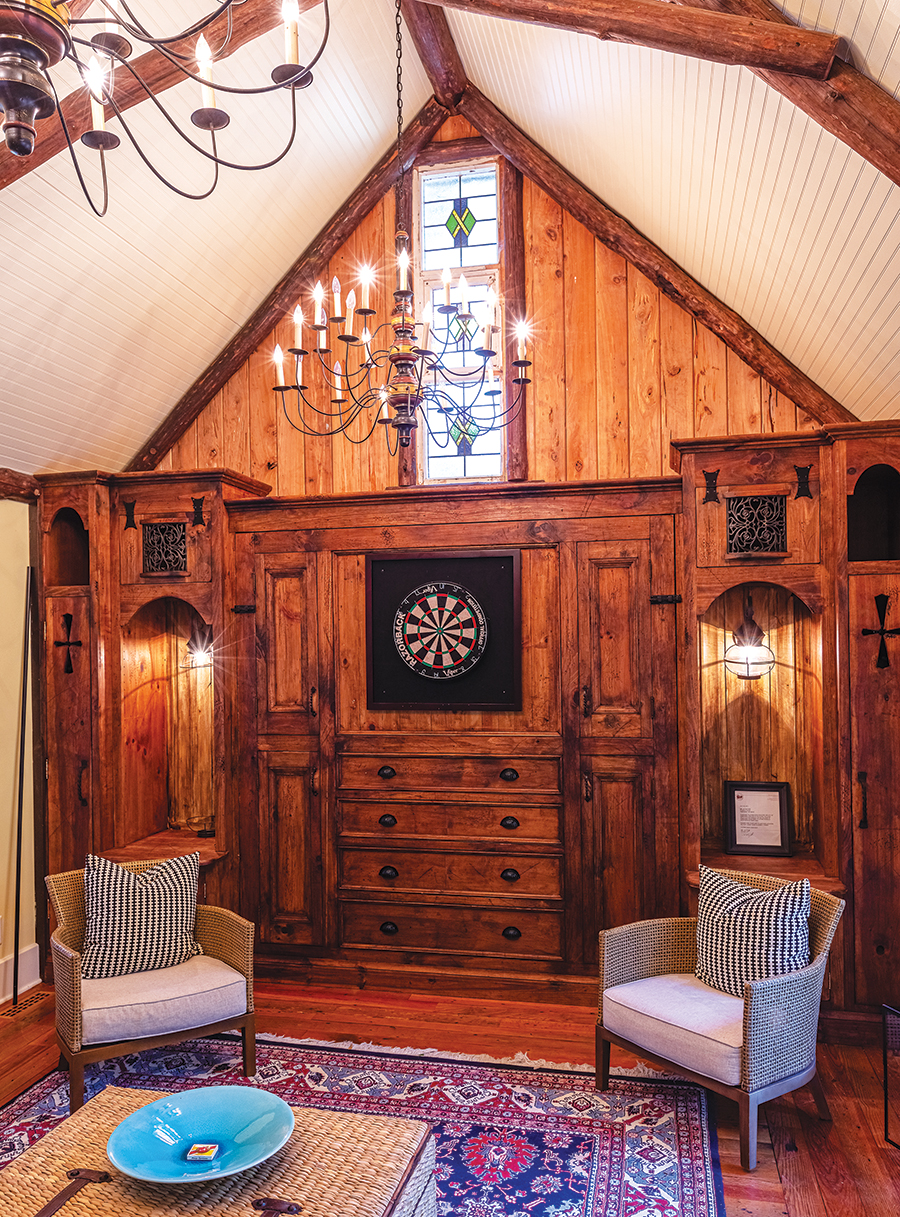
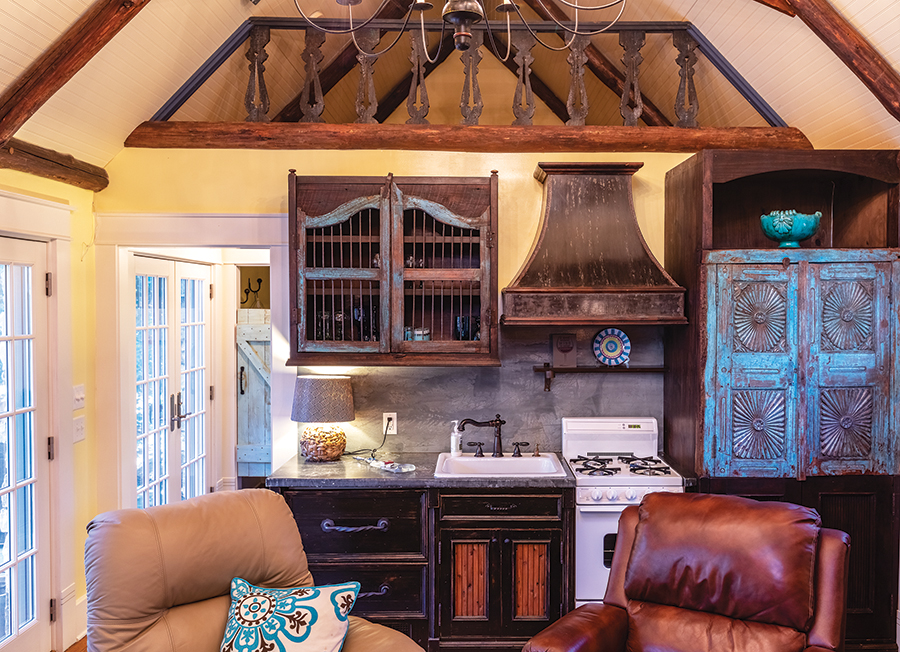
Each outbuilding has only one room — but enough features to fill a catalog, like a queen-sized Murphy bed hidden by wood paneling suggesting a library, or chapel. “Antiqued” cabinetry and metalwork, distressed painted pieces, leather chairs with half-moon ottomans, beadboard, an old porcelain sink, refrigerated drawers, vaulted wormy chestnut ceilings illuminated by stained glass inserts, a drop-leaf kitchen work surface that, with leaf raised, becomes a table. The guest house has a round-topped Dutch front door rescued from a wine cellar, and the pool house bathroom, with direct access to the yard, is split into shower, toilet and vanity sections along a narrow hallway.

Obviously, planning coupled with imagination were at work here.

However, fitting so much furniture into relatively small spaces can be challenging. Not for Kim Butler, who positions modern glass sculptures on a rustic table and adorns dressers with large, bare branches. Throughout, she uses traditional wide-slat wooden blinds.

Back in two-bedroom Acadia — compact but perfect with the living area opened up and furnished with Kim’s retro pieces — one standout is a small drop-leaf kitchen table made of aluminum tubing and Formica, with vinyl-upholstered chairs. “I thought about an island,” always convenient in a kitchen with limited counter space. Instead, Kim settled for what has become an emblem, a conversation piece.

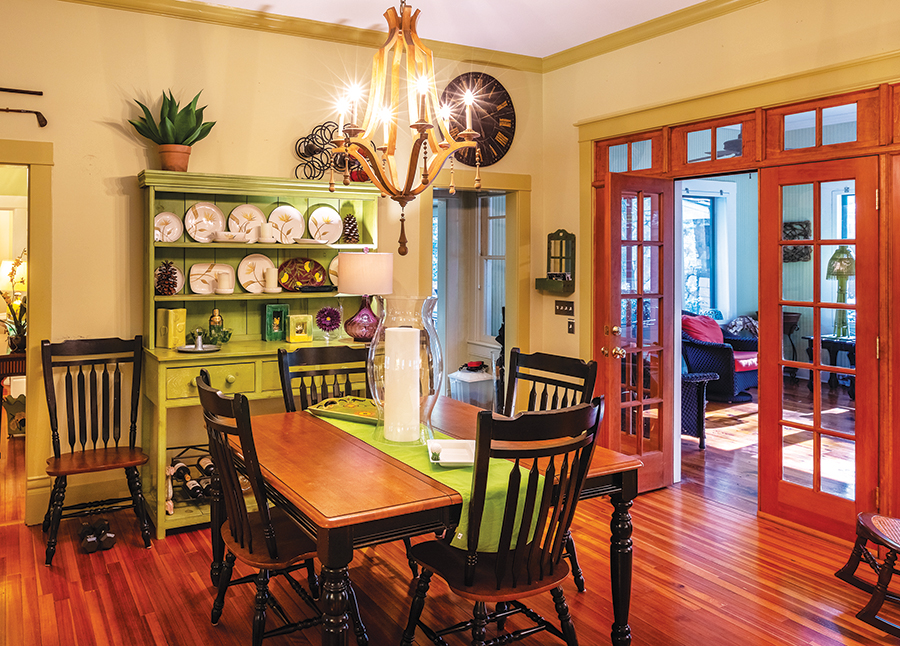
Kim’s collection of colored pottery pitchers brightens a bookcase flanking the shallow living room fireplace, converted to gas for safety; other pottery and glass pieces cover tabletops. Texture, texture everywhere. The chandelier over the dining table is made of wood, and the upholstered club chairs qualify as shabby-chic. No two lamps claim the same parentage.

Kim furnished the screened porch in Chinese red lacquer and black wicker, strong colors that pair with the darkened knotty pine floors milled from trees cut out back.

Room to room, comfort prevails.

Who would guess what’s inside from strolling by, as Annie Oakley might have done when she lived in an apartment across the street? The well-tended walkway, flower beds and porch provide no hint.

Acadia may lack the pedigree of homes built before and during the Roaring ’20s — the Mellons and Rockefellers never stopped here. The Fownes and Marshalls opted for bigger and fancier rather than livable and convenient.

But, after 10 years walking to the village for dinner after a relaxing float in the pool, then chasing the dogs around the fenced yard, Jay Butler concludes, “It’s just a good place to have a home.”  PS