Birdwatch

Quail Trail

In search of the elusive northern bobwhite

By Susan Campbell

For some of those fortunate enough to have lived near open piney woods or adjacent to large farm fields, the iconic call of a bobwhite quail was once a familiar sound. But, as with so many of our bird species, this once prolific songster has diminished across the Piedmont and Sandhills of North Carolina.

Bobwhites measure between 8 to 11 inches beak to tail and have very cryptic brown, black and white markings that make them almost impossible to see on the ground in the grassy habitats they call home. The male has a bright, white eye stripe and throat. It is he who constantly announces his territory through a repeated “bob-white” call. The female is smaller and a bit drab, with a buff eye throat and no crest. This stout bird is well equipped with a short sharp bill, strong legs and sharp claws that make it an ideal avian for foraging at ground level for insects, berries and soft vegetation.

Bobwhite males can be heard trying to attract a mate using their loud repetitive calls in the spring. The female will reply with a four-syllable whistle of her own. Following breeding, the pair creates a domed nest concealed in tall grasses, and the hen lays up to 20 pure white eggs. There is a period of approximately 25 days of incubation before the young hatch.  Hens will renest if the eggs are eaten or destroyed. Upon hatching, the chicks will immediately follow their parents; learning how to hunt bugs and determine which shoots are the most nutritious. As a group they are referred to as a covey. The family will stay together through the winter and may join with other families to form coveys of 30 or more birds. When alarmed at an early age, the young will scatter and freeze to avoid predators. Once they can fly, they explode into flight in a blur of wings, startling anyone or anything who comes upon them.

Quail were a very popular game bird throughout North Carolina until not that long ago. Since the 1980s, when their numbers began to decline, they have become very challenging to find, especially in the Piedmont, except on game preserves where they are stocked. A combination of factors is believed to be responsible. Not only have open woodlands and agricultural fields with hedgerows become scarcer but ground predators such as foxes, coyotes, raccoons and free roaming domestic and feral cats have increased. Also, the timing of rainfall can significantly affect breeding productivity. Too much rain too early may inundate nests and dry conditions when chicks hatch may result in insufficient food.

These days, hunters still occasionally find coveys in the wild in the forests and fields of the Sandhills Game Land or the vast acreage of longleaf pine on Fort Bragg. It requires a well-trained bird dog and a good deal of patience. However active quail management is occurring locally. Opening up forested habitat using prescribed burning as well as removing undesirable vegetation and replacing it with quality cover plants are two of the best strategies to help boost the population. Recent efforts by biologists with the N.C. Wildlife Resources Commission and at Fort Bragg along with assistance from local Quail Unlimited chapters are resulting in gradual increases in northern bobwhite in limited areas. We certainly hope this trend continues so that before much longer the springtime calls of the bobwhite will once again be heard throughout the region.  PS

Susan would love to hear from you. Send wildlife sightings and photos to susan@ncaves.com.

The Shimmering Art of Louis C. Tiffany

Classic lamps on display at Reynolda House

By Jim Moriarty

Due to health precautions related to COVID-19, the Reynolda House Museum of American Art closed temporarily in March and the opening of “Tiffany Glass: Painting with Color and Light” was delayed. For information regarding the reopening of the museum and its exhibits please visit www.reynoldahouse.org.

While on one hand it could seem as though Louis Comfort Tiffany was born with a silver glasscutter in his mouth, the son of the founder of Tiffany and Company created, over his lifetime, an entire genre of decorative art so ubiquitous, so singularly chic and stylistically distinctive that his name alone has come to represent the thing itself. It is the de rigueur description of any leaded glass shade. Say “Tiffany lamp” and you need say no more. All the rage one day, passé the next, fashion may be fickle, but the art endures.

The intimate gallery space at the Reynolda House Museum of American Art in Winston-Salem will house an exhibit of Tiffany’s finest work on loan from the Neustadt Collection at the Queens Museum in New York. The traveling exhibition was to open in late March and continue through June 21 before it was overtaken by events.

“The decorative arts are accessible to everybody,” says Phil Archer, Reynolda’s director of Program and Interpretation. “To have a gallery with the light actually shining through the works of art will be new for us and make it a very magical space. It just fits at Reynolda because of the natural setting of the gardens. We wanted the exhibition in the spring for that reason. Come and see all the flowers, then come inside and see all the flowers.”

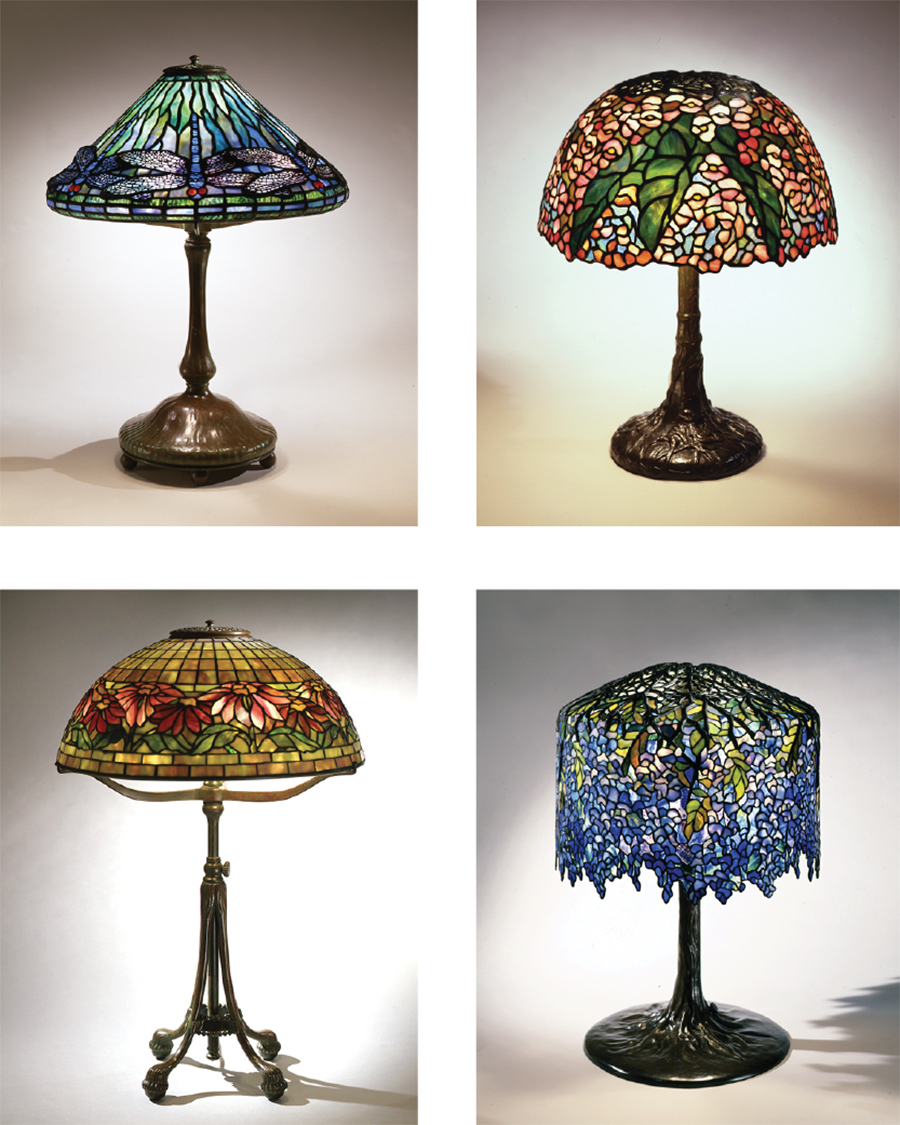
The show, when it’s able to open, will be comprised of 20 of the most celebrated examples of Tiffany’s lamps and, interestingly, three forgeries that serve to demonstrate the difference between faux Tiffany and authentic works. There will be a display demonstrating the steps in the creation of the lampshades and biographical information on the key personnel at Tiffany Studios — chemist Arthur J. Nash and designers Clara Driscoll, Agnes Northrop and Frederick Wilson — who all made meaningful contributions to the artistry of the lamps.

Also part of the exhibit are five Tiffany windows and, separate from the exhibit, a display of Tiffany vases purchased by Katharine Reynolds on view in the Reynolda House itself.

The role of Driscoll, née Clara Wolcott, who was in charge of the “Tiffany Girls” in the glass cutting department and is responsible for the design of two of Tiffany’s most remarkable lamps, Wisteria and Dragonfly, only came to light in the first decade of the 21st century when Martin Eidelberg, an art history professor from Rutgers University, discovered her letters archived at Kent State University.

“She was an Ohioan, so her papers ended up at Kent State,” says Archer of the letters Driscoll sent home from New York. “The family evidently had almost a chain letter system where Mom would send a letter to Clara, she would send it to her sister who would send it to the brother and they would all add to it. It was better than group texting.”

While Tiffany may not have been solely responsible for every design, “The concepts were Tiffany’s,” says Archer. “The aesthetic was Tiffany’s. The kind of color palette and the combination of colors and details and opacities were Tiffany’s. It’s almost like Mozart writing a piece and then conducting the orchestra. He’s not playing any of the instruments. Everybody else is making the music but the original concept is his. They bring a lot of creativity to how they play it — though that may not be an exact metaphor because some of the concepts, like the Wisteria lamp, were Driscoll’s.”

Born in 1848, the slight, delicate son of Charles Louis Tiffany could have slid seamlessly into the family business. “He had every opportunity to take over from his father and be the lead jeweler and luxury goods maker in New York,” says Archer. “The primrose path was laid out for him.”

When the younger Tiffany was enrolled at Eagleswood Military Academy in New Jersey, he met and studied under the painter George Inness. The effects would be profound. By the age of 19, he had become a founding member of the American Society of Painters in Water Colors and had begun to exhibit his work at the National Academy of Design. He traveled to Europe and North Africa and would be particularly influenced by what, at the time, was called the “Orientalist” style.

“When I first had a chance to travel in the East and to paint where the people and the buildings are clad in beautiful hues, the pre-eminence of color in the world was brought forcibly to my attention,” Tiffany said later. One of his better-known paintings, Snake Charmer at Tangier, Africa, expressed Tiffany’s interest in the play of light and color. It was exhibited at Snedecor’s Gallery in New York in 1872 and later at the 1876 Centennial Exhibition in Philadelphia. It remained in Tiffany’s personal collection until 1921, when he donated it to the Metropolitan Museum of Art.

While still painting, Tiffany drifted into design and decorating. At the same time, he had become enthralled by the possibilities of glass as an art form.

“Tiffany hated modern glass because it was too clean,” says Archer. “He wanted glass like archeologists were digging up in Syria and Lebanon. It was like opals. It had color and shimmer. He hired chemists to really develop all of these different colors and ranges. The beauty that he found in that glass and trying to replicate it becomes the story.”

Tiffany didn’t paint on glass — “staining” it only rarely, usually in faces — he painted with glass. The use of metallic oxides allowed for the development of the range of colors that distinguish his work.

“Standing by the glass workers, he had them fold the glass on itself and pinch in places to achieve the effect of magnolia blooms in a window of his library at the Tiffany Mansion,” writes Julia Tiffany Hoffman, a great-granddaughter. “A pulled rod of glass was slightly melted and scrolled on the glass to effect vines, stems and spiderwebs. Louis used just the right color combination of paper-thin glass bits to achieve a painterly quality . . . Molten glass was pressed thin and then stretched to effect the impression of light shining on snow. When working on a window, he would have his glass house make sheets of glass that had several colors running through them, then find the perfect area and orientation to express the petal of a tulip or the leaf.”

In addition to the inspired glassmaking, the creation of Tiffany’s lamps was aided by the innovative use of copper foil. “Instead of having heavy lead connectors,” says Archer, “they were able to use much, much finer connectors. There’s a lot of artistry in the creation of the glass, and there’s artistry in the cutting and piecing it together.”

Tiffany was also receiving commissions decorating American palaces for Gilded Age royalty like Cornelius Vanderbilt, and Henry and Louisine Havemeyer. He decorated Mark Twain’s house in Connecticut and the interior of the old Lyceum Theatre on Park Avenue South in New York. He collaborated with the famous — and infamous — architect Stanford White on a house for the Tiffany family. He did the Ponce de Léon Hotel in St. Augustine, Florida, and Chester A. Arthur’s White House.

“Tiffany would design from soup spoon to chandelier,” says Archer. “He was creating almost complete works of art in these houses. But upper middle-class people could afford the lamps. They ended up propelling Tiffany Studios financially. In his lectures, Tiffany almost never referred to his lamps. He would talk about these huge projects and the large windows. The lamps were sort of the bread and butter.”

Tiffany believed nature should be the primary source of design. “Every really great structure is simple in its lines — as in Nature — every great scheme of decoration thrusts no one note upon the eye,” he wrote. Having outlived two wives and three of his eight children, in his final years Tiffany’s ultimate project was his estate on Oyster Bay on Long Island — Laurelton Hall, 84 rooms on 600 acres. He designed every nook, cranny and garden.

Punctuality and orderliness were valued traits. He owned seven white linen suits, one for each day of the week. A tennis player and avid photographer who never saw a speed limit he wanted to obey, the giant of Art Nouveau attempted to stick his finger in the dike of modernism with the establishment of the Tiffany Foundation, devoted to helping aspiring artists.

“Paintings should not hurt the eyes,” he cautioned them. By the time Tiffany died in 1933, much of his wealth had evaporated in the crash of 1929 and the ensuing Great Depression. Laurelton was sold in 1945, and the land subdivided.

In 1957, the largely abandoned great house, containing some of Tiffany’s finest windows, burned to the ground. It took two days to melt the art of a lifetime.  PS

The Omnivorous Reader

Mountain Men

One exceptional life in politics, another in music

By D.G. Martin

In 58-5, two North Carolina mountain boys graduated from local high schools, made their ways to college, and then went on to very different high-profile careers.

Rufus Edmisten moved from Watauga High School in Boone to UNC-Chapel Hill, headed for a career in politics. Joseph Robinson left Lenoir High School for Davidson College on his way to musical performances at the highest level.

Coincidentally, both men recently published memoirs that show how the combination of hard work, high ambition, audacity and luck can lead to success.

Edmisten’s That’s Rufus: A Memoir of Tar Heel Politics, Watergate and Public Life describes how he grew up on a farm near Boone, tending cows and pigs, and working fields of cabbages and tobacco. After Chapel Hill and a round of teaching high school in Washington, Edmisten entered law school at The George Washington University and secured a low-level job on Sen. Sam Ervin’s staff. He soon became one of the senator’s full-time trusted assistants in the Watergate-Nixon impeachment matter.

His book’s opening pages take readers to July 23, 1973, when he served President Richard Nixon with a demand for Watergate-related records. This key moment ultimately led to Nixon’s resignation under the threat of impeachment and was a launch pad for Edmisten’s political career.

Edmisten returned to North Carolina in 1974 and mounted a successful campaign for attorney general. His triumph over a host of prominent Democrats gave notice he would run for governor someday.

That day came in 1984, when Gov. Jim Hunt ran for the U.S. Senate, and a host of Democrats lined up to run for the Democratic gubernatorial nomination. Edmisten won in a brutal primary runoff against former Charlotte Mayor Eddie Knox and then lost the general election to the then-Congressman Jim Martin.

Some believe he lost, in part at least, because he made disparaging remarks about barbecue. His version of that incident is, by itself, worth the price of the book. But Edmisten says it was Ronald Reagan’s “sticky coattails” that “swept both me and Jim Hunt away from our dreams. We were not alone, either. The sweep was broad and far reaching.”

After the loss, Edmisten felt crestfallen and abandoned. “The ache in the bottom of my stomach was so great nothing appealed to me except finding some dark place to crawl away and hide,” he writes. “I swear I saw people cross the street so they wouldn’t have to talk to me.”

However, he came back from that defeat and won election as secretary of state. How he then lost that position in disgrace and the lessons learned from that sad story make for the most poignant part of the book.

His situation came to a head in 1995. A report by the state auditor and articles in the Raleigh News & Observer alleged the misuse of employees and a state car, abuses by subordinates, and improper hiring practices.

In this deluge of criticism, Edmisten announced he would not run for re-election and, he writes, “I actually thanked God my daddy had died before this mess started.”

Why did it happen?

In a chapter titled “Hubris,” he confesses, “It was nobody’s fault but my own.”

Edmisten writes that it was the excessive pride that arose from his long years at the center of public attention that led to his troubles. He warns, “Once hubris gets a foothold it grows incrementally and accelerates until it is expanding exponentially, and in leaps and bounds takes over.”

This lesson about the dangers of hubris is not the end of the story. In inspiring chapters, Edmisten chronicles how his wife and friends led him back into the practice of law and other areas of service. His wife told him, “We are not going to whine.”

“At the age of fifty-five,” he writes, “I put aside all petty things and began a new life.”

In his new life, Edmisten lives in Raleigh practicing law and giving gardening advice on a weekly radio show. He gives us another lesson: It is never too late to turn an old life into a new one.

Robinson’s memoir, Long Winded: An Oboist’s Incredible Journey to the New York Philharmonic, asks: How did a small-town boy who never attended conservatory persuade one of the world’s greatest conductors, Zubin Mehta, to give him a chance at one of the world’s most coveted positions in the New York Philharmonic, one of the world’s greatest orchestras?

Growing up in a small North Carolina town like Lenoir might not seem to be the best background for an aspiring classical musician. But the mountain furniture community had the best high school band in the state. When Robinson was drafted to fill an empty oboe slot, his course was set.

He loved the oboe so much that his Davidson College classmates called him “Oboe Joe.” However, Davidson’s musical program lacked the professional music training that Robinson craved. Nevertheless, he stayed at Davidson, majoring in English, economics and the liberal arts. His focus on writing and expression gave him tools to win a music position at the highest level.

His success at Davidson led to a Fulbright grant to study in Europe and the opportunity to meet Marcel Tabuteau, who, Robinson says, was the greatest player and oboe pedagogue of the 20th century. When Tabuteau learned that Robinson was an English major and a good writer who could help write his book on oboe theory, he agreed to give him oboe instruction. Those five weeks with Tabuteau, Robinson says, “more than compensated for the conservatory training I did not receive.”

Years later, however, after moving through a series of journeyman teaching and performing positions at the Atlanta Symphony, the North Carolina School of the Arts, and the University of Maryland, Robinson still had not achieved his aspiration to land a first oboe chair in a major orchestra, but he did not give up.

When Harold Gomberg, the acclaimed lead oboe of the New York Philharmonic, retired, Robinson audaciously applied. When finally granted an audition, he prepared endlessly. He was ready for the hour and 20 minutes of paces the audition committee demanded. Afterward, he was confident that he had done very well.

But the Philharmonic’s personnel manager, James Chambers, after saying how well the audition went, reported that music director Zubin Mehta judged Robinson’s tone “too strong” for the Philharmonic. Robinson was not to be one of the two players who were finalists.

That should have been the end of it, but Robinson writes, “I knew that winning a once-in-a lifetime position like principal oboe of the New York Philharmonic was like winning the lottery.”

At 3 a.m. the next morning, using all his liberal arts writing and persuasive talents, he wrote Chambers explaining why his tone might have seemed too strong and, “You will not make a mistake by choosing Eric or Joe, but you might by excluding me if tone is really the issue.”

When Chambers read the letter to Mehta, they agreed that it could not have been “more persuasive or fortuitous.” Chambers reported that Mehta said, “If you believe in yourself that much, he will hear you again.”

Robinson’s final audition was successful. His “winning lottery ticket,” he writes, “had Davidson College written all over it.”

From 1978 until his retirement in 2005, he served as principle oboe for the New York Philharmonic. Living in Chapel Hill, he can still bring an audience to tears when he plays the beloved solo “Gabriel’s Oboe.”  PS

D.G. Martin hosts North Carolina Bookwatch Sunday at 3:30 p.m. and Tuesday at 5 p.m. on UNC-TV. The program also airs on the North Carolina Channel Tuesday at 8:00 p.m. and other times. To view prior programs: http://video.unctv.org/show/nc-bookwatch/episodes/

Hometown

Creature Discomfort

Not all pets are created equal

By Bill Fields

Among the sounds of a North Carolina childhood that linger many years later and hundreds of miles from where I heard them: sausage frying on a weekend morning; a lawnmower starting up and piercing the late afternoon quiet; a neighbor mom calling her daughters home at dark; the pop of ball in glove, over and over, once my arm got strong enough to make it happen.

But sometimes, out of nowhere, this one: Dad in the backyard at the end of the day, shaking a bag of cat chow like he was keeping rhythm in a swing band. It was the felines’ dinner bell, and they ran toward my father as if it had been a month since their last meal. That he diluted their milk with water from the hose mattered not.

Lucy and Linus arrived first, about the time I started school, kitten siblings from a litter belonging to one of Dad’s co-workers. Lucy was black and white; Linus was a gray tabby. It being the 1960s, and pet ethics not being what they are today, Lucy grew up to have a lot of kittens herself, her maternity ward usually a cardboard box from the ABC store. The stars of her offspring were Tuffy and Fluffy, each white with black accents. Fluffy’s fur was softer than a baby blanket, but she gave no quarter when wrestling Tuffy on my parents’ double bed, the cats’ favorite daytime playground.

Linus was a handsome boy, strong and athletic, until the big ice storm in the late 1960s, when he scaled a longleaf pine next door and was frightened to return to terra firma, choosing to howl a desperate howl overnight to the dismay of every house on the block. Once the sun was up Dad climbed a ladder, its rungs coated slick, to rescue him. Linus thawed out in front of a heat duct and thereafter seemed particularly grateful for the crunchy grub distributed daily at dusk.

If a boy didn’t have a pet dolphin in that era he surely had a dog, yet my canine experiences weren’t happy — certainly not like one nearby family who possessed an assembly line of dachshunds or another with a beloved beagle. We got Skippy, a midnight-black cocker spaniel, when I was in first grade but gave him away not long after we got the pet, when he kept nipping at passersby on Ridge Street.

I loved Peanuts, a Chihuahua puppy acquired when I was still in elementary school. Peanuts could well have been with me until I graduated from Pinecrest, if not for his early and unfortunate demise. My father created a flap in the little dog’s cardboard-box residence, but it got caught in the entryway one day while I was at school. I found Peanuts when I returned home from classes. He was trapped in the flap, his fate already clear.

Years later, as a grown man, I would have temporary co-guardianship of a couple of dogs, friendly cocker spaniels in one case and sweet but undisciplined Labradors in the other. The Labs were amazingly determined and creative when it came to anything involving food, to the point where they could even chew through a tin can. They forced us to tape shut the refrigerator door, lest we come home to a royal mess. With the bigger, stronger Lab on a leash one evening, it nearly dislocated my right shoulder when a squirrel suddenly appeared.

In the last couple of decades of my mother’s life — when she lived alone and could have, by any measure, used some company — I occasionally told her I had a cat or dog coming her way for a Christmas present. These teasings were not something that made her smile; her pet-managing days were long over.

I now wonder if mine aren’t, too. Occasionally my partner and I wish there were such as thing as Rent-a-Corgi, where one could enjoy a dog (the breed her family had when she was a child and that I have also liked from afar) for a couple of hours, then return it before any dog bites, bathroom accidents or vet bills.

If I were to ever own a cat, I am certain its cuisine would resemble that of my childhood felines rather than of the pets owned by a woman for whom a friend of mine cat-sat a decade ago. There were three dozen cats in a big house, and each got its individual can of wet food in its preferred flavor. The feeding stations were as long as the serving line at a K&W Cafeteria.

I helped with the horde one evening. I confess, without remorse, to not being worried if a cat that was supposed to receive tuna primavera instead dined on shredded wild salmon. And I walked out into the winter night thinking perhaps the only creatures in my house should be on Animal Planet.  PS

Southern Pines native Bill Fields, who writes about golf and other things, moved north in 1986 but hasn’t lost his accent. Bill can be reached at williamhfields@gmail.com.

Good Natured

Yoga to the Rescue

Helping yourself to age gracefully

By Karen Frye

The lights are soft, and the room is warm. Everyone is quietly lying on their yoga mat. The teacher enters the room and announces, “Lights are coming on.” On that note, everyone stands in the middle of their mat. Suddenly you realize that the room is surrounded by mirrors. Oh no! You have to look at yourself for 90 minutes. Painful!

The class begins with a breathing exercise to get more fresh oxygen into the lungs to circulate throughout the body during class. During this “Pranayama” breathing exercise, you notice that your busy mind is beginning to calm down, and a sense of focus and peace is now taking over. This is a form of meditation, an open-eye, moving meditation. You have to listen to the teacher carefully, and move your body correctly (as much as possible) to achieve the benefits from the yoga postures. This process does not include thinking, just looking at yourself and trying. Every class is a beginners class, no matter how long you have been practicing yoga.

Hatha Yoga began thousands of years ago. It is popular all around the world, but had its start in India. Everyone can do yoga. You are never too old, too stiff or too out of shape to start. The comment I hear most often from the people is how they’re “not flexible,” and my reply is, “That is exactly why you need yoga!”

The fascia in our body is like a web of fibers made of collagen and elastin. These fibers are strong and stretchy. The fascia goes from head to toe; it’s what holds us together and upright. As we age, our fascia becomes stiffer and tighter. Working out with weights, running, and just about every physical activity that builds muscle and makes us stronger also tightens the fascia. It can become like beef jerky. When you do yoga, you stretch your muscles and go deeper to stretch the fascia, too.

Keeping the fascia healthy is crucial to aging gracefully. You will also be stimulating and toning your body’s vital organs and glands.

Yoga is one of the best anti-aging things you can do for yourself. Some of the health benefits are: increased sense of well being; boosting the immune system; calming the mind; improving balance and flexibility of mind and body. There are cardio and strength benefits as well. If you choose to do hot yoga — which is my love — the heat promotes sweating, and sweat removes toxins from the body.

We are fortunate in this community to have a variety of yoga studios and wonderful teachers to guide you on this journey, if you choose. The hardest thing about a yoga class is getting yourself there. Give it a chance and you’ll fall in love with how your body and mind feel after you practice. It is a wise investment in your health and a lot of fun, too!  PS

Karen Frye is the owner and founder of Nature’s Own and teaches yoga at the Bikram Yoga Studio.

The Accidental Astrologer

Straight Talk

Finding fault in the stars is for April Fools

By Astrid Stellanova

Excuse me, Star Children, but not everyone has been behaving. Allow me to draw you a map of your thoughts, which are more confusing than Rand McNally ought to allow:  bat@#!t — as in going off road and heading straight for the state of chaos.

Yes, you have crossed that line.

Yes, you have used March madness for more than 30 days as your excuse. Nobody’s buying it. Besides, it’s April.

Don’t be a fool. Get. A. Grip.

Aries (March 21–April 19)

You have been sprinkling a little sarcasm on evah-thang. Sugar, it seems to be the main spice in your life. Since you’ve ignored my advice, maybe I can interest you in some freshly ground sarcasm: Just for kicks, play it straight. There’s a lot of serious drama to resolve, and you have got to get down to business.

Taurus (April 20–May 20)

There’s a Fred Mertz for every Ricky Ricardo, and a Thelma for every Louise. Seems you have figured out the friendship shtick that keeps some (including you) laughing, but you will have to find your true center.

Gemini (May 21–June 20)

Always hug your enemies, so you know how big to dig the hole in the backyard! In this case, you have got a conflict that doesn’t have to end in tragedy. But you knew that, and you just postponed the inevitable. Shovel not required.

Cancer (June 21–July 22)

Too glam to give a sweet patootie. You are that, and also secretly up against the realization that you do give a patootie. Your cool and contained image is very different from what you are feeling. Sync it up.

Leo (July 23–August 22)

They love you like biscuits love gravy. You love them back. But you feel taken for granted. Air this, get it out, get it over, and enjoy time with your inner circle. Make somebody else wash the dishes, Darlin.’

Virgo (August 23–September 22)

Criminal intent. That is what you have been nurturing since you found out that someone close to you hasn’t owned up to something. Don’t let this keep simmering. Vent, discuss, resolve. 

Libra (September 23-October 22)

Everything may happen for a reason, but WTF? Did you actually intend for others to view you as a total jackass? No, you thought that nobody but you knew what had gone down. They know. And they are waiting for apologies.

Scorpio (October 23–November 21

The dramatic lie you tell yourself goes like this: Goodbye, Cruel World!  But you aren’t going anywhere. And nothing is really so bad that you cannot sort it out. When you stop kvetching, Sweat Pea, you’ll see.

Sagittarius (November 22–December 21)

Run like your children are looking for you. A conniving acquaintance thinks they have got you in their control. If you cannot face them, then save yourself, Darlin’, because they always talk you into mistakes.

Capricorn (December 22–January 19)

Alexa, open the bottle of pinot. Alexa, take out the trash. When Alexa truly starts being useful, you can relax your control on the control panel. But until then, practice makes perfect. Maybe practice waiting this one out, Sweet Thing.

Aquarius (January 20–February 18)

Acting like a bunch of skeeters on crystal meth? Or minnows about to meet Jaws’ open mouth? But you didn’t see it, Honey Bun, and nobody did. Calm down, and consider that sometimes the biggest virtue is to wait.

Pisces (February 19–March 20)

Mama needs her juice, Honey. I take one look at your star chart and realize you just wanted to slurp down a little happiness and get some rest. Worship at the temple of the plump pillow, and let life settle.  PS

For years, Astrid Stellanova owned and operated Curl Up and Dye Beauty Salon in the boondocks of North Carolina until arthritic fingers and her popular astrological readings provoked a new career path.

Southwords

Delightful Din

Gathering of the Clan

By Eileen Phelps

Cleaning bathrooms, changing beds and vacuuming the dust bunnies — not to mention the clusters of spiders that adopt our Southern home every spring — were my tasks. Expecting guests? Not exactly. The preparations were for the children’s arrival.

Well, that is not accurate either. No longer were our four rambunctious offspring merely children. Somewhere along the way they had morphed into four college-educated, successful, gainfully employed adults. (My husband frequently reminds me that they don’t live in our basement.) They had also multiplied from four to 11. That math is as old as the human race.

Their arrival coincided with the celebration of our 40th wedding anniversary. Since my husband and I had not provided all with an invitation to an around-the-world cruise to celebrate the occasion — their request — our children decided to create a family party for which they would be chief cooks, sharing the workload equally. Of course, all of this camaraderie would require the “four plus” to move back home for a week to ensure the festivities would be worthy of our 40 years of marital bliss. Oh, and did I mention the dog? Yes, he joined us, anticipating some extra morsels on the floor from the throng of munchers. That makes a party of 13 . . . plus the dog . . . for seven days . . . in the same house.

The first two offspring, living locally, arrived bag and baggage a night early to claim the best beds. Their spouses would arrive two days later, however, because of previous commitments. Most of us know this as a job.

Next was the long-distance son whose 12-hour drive meant a midnight arrival with three excited young ones who were wide awake and ready to play as if it were dawn. The dog accompanied them. Daughter number three sauntered in rather early the following morning. (Did we even go to bed?) Hubby works remotely and needed to be situated at the computer and logged on by business hours. Good luck with that.

The day of the feast arrived with each daughter and our sole daughter-in-law prepping their assigned part of the meal. The men decided to take the grandchildren to the park, assuming five adult males could handle three young children. Consensus among the men was that the outdoors was considerably safer than the kitchen.

My job was to bathe in the glow of my four favorite girls giddily executing the steps toward a fabulous meal. The sum total of my participation was pointing out the location of this spoon or that dish. They chopped, baked, mixed, frosted, wrapped, poured and measured the ingredients to a four-course meal while howling at their own mistakes and cheering on each other’s success.

By the time the men and their charges ambled in, dinner was served. Sitting at the table, all 13 of us, I was speechless. As with most parents, it had never occurred to either my husband or myself that our kids would ever grow up. It was not a quiet, romantic meal. Placid is not a word to describe our family. There is always a smidgen of sarcasm, in addition to at least one sibling finishing the sentence of another, all while multiple conversations float in the air simultaneously. Somehow everyone knows the gist of all the other conversations and jumps in accordingly. Quiet is not in our family vocabulary.

Days flew by with visits to the playground, eating, swimming at the lake, snacking, tripping over toys, eating more, fishing at the pond, running laundry, eating. You get the picture. Between chasing the little ones during the day, and trying to stay up at night with the adults playing dominoes, I was exhausted. But I never stopped smiling. You see, that is what family is all about — sharing special occasions, listening to each other’s successes, sympathizing with our losses, laughing together. Our four children, grown now but still kids to us, all get along. Sure they argue and squabble like all siblings, but despite the separate lives they live, our kids always end up together. Sometimes at our house.

Cleaning bathrooms, changing beds, vacuuming the dust bunnies . . . the cleanup is complete. It’s pretty calm here now. I smile at the memories. Peace and quiet is overrated.  PS

Eileen Phelps is a retired Pinehurst Elementary fifth grade teacher who loves reading, gardening, and spending time with her grandchildren.

In The Spirit

Diff’rent Strokes

A new vodka tonic from Reverie

By Tony Cross

I may have mentioned before how I never really cared for tonic water. Back when my brain stopped developing, I believe. Schweppes, Canada Dry, store brands, no tonic product was pleasing to my taste buds.

Then the market changed. Fever Tree dropped their tonic water, and it was (and still is) damn good. I was more smitten about their ginger beer at the time, but there was no denying their tonic. And then I tried a small batch of tonic syrup from Seattle, called Bradley’s Kina Tonic. In love I was. The syrup was so good! A bit complex with flavors, and unlike any other tonic drink I had ever tasted. So, of course, I had to make my own.

After a few weeks of tinkering with a base recipe, I had made what I thought was a feeble attempt at a tonic syrup. It was bitter, had baking spices, but also that citrus glow. I used lemon and grapefruit, but also added orange in the mix — I totally stole that idea from the Kina Tonic. They incorporate orange oil into their tonic, and it’s just what mine was missing. Now I had this tonic that sort of tasted like you took the Fever Tree and Kina tonics and mixed them together. A bitter marriage, if you will. I took it to market, i.e., the restaurant I bartended in, and we took it out for a test drive. It sold. The syrup was well received, and everyone was happy. That is, until I ran out on a Saturday night, then some people were not so happy.

Fast forward a few years, and my tonic syrup, TONYC, is in the actual marketplace. Local supporters wanted their own, which gave me the idea to batch it up and see if it would sell in stores. Within six months, we were on the shelf in Southern Seasons and represented by a wine distribution company. This was fantastic, but I was just starting out with our kegged cocktails, and what I really wanted to do was gin and tonic on draught.

I remember the sadness I felt as the first sip of my draught gin and tonic hit my palate four years ago. Man, oh man. It was bad. Over-carbonated, metallic and bitter to the nines, that G&T is a prime example of how you can’t just “scale up” a cocktail and put it in a keg. Doesn’t work that way. If it did, Reverie Cocktails would have a massive portfolio of draught cocktails right now. It took me a year before I debuted our Strawberry-Lavender Gin and TONYC; semi-sweet, fragrant, and a touch of bitterness. That cocktail has been our spring and summer flagship ever since. We love that cocktail.

At the end of last year, I got it in my head to try again and make a gin and tonic, but without the supporting cast of other ingredients. Just a light, crisp and bitter tonic cocktail that enthusiasts couldn’t pick apart. For a good month or so I thought about the way I wanted to tackle this drink and decided to do a vodka tonic. Crazy (to me), considering I never drink them. I ended up approaching this cocktail the same way I did with our tonic syrup years back: Make it for tonic and non-tonic lovers. Kind of a silly juxtaposition, but it worked when I made the tonic syrup back when I was behind the stick — I had converted non-tonic fans, and had regular patrons give their nod of approval.

I’m thrilled to report that our vodka-tonic is yum. Biased? Of course, but do you really think I’m going to try to plug a sub-par drink? I am definitely not smart (I found out that “spinach” doesn’t have two “n’s” in my early 30s), but I’m confident enough that the reception will be positive once it’s debuted. So far, I’ve only had a small circle of people try it.

This is what we did. We kept it simple. Good quality (and tasting) water, our TONYC syrup, and clarified orange juice. Wait. What? That’s right. I realized one day while walking my pup that I needed to incorporate oranges into the equation somehow. Whenever making a tonic drink from scratch with our syrup, the flavors pop when you express oils from an orange peel over the drink; I had to do the same when mixing it on draught. Luckily for me, my first instinct was correct, and that is never, ever the case when trying to create a carbonated drink in keg form.

You see, I got myself a centrifuge from ol’ St. Nick, and it made this whole orange thing possible. Running fresh orange juice through my centrifuge allows me to clarify the orange juice. In a nutshell, that means the juice has the solids taken out of it, allowing for a clear juice. This, in turn, means it won’t separate in the keg. It will be shelf-stable (once mixed as a cordial) and better yet, it will allow for maximum carbonation.

I’ll stop right there with the nerd talk. Point being, clarified orange juice for the win! It brought the cocktail together, the way bitters can. It’s light, crisp, bitter, and slightly rounded from the citrus. I made the first correct batch back in January and let it sit for a month, just to make sure that there weren’t any nuances to the drink that soured or fell flat. I taste-tested it while watching the Deontay Wilder/Tyson Fury fight, and it’s spot-on. And, for some strange reason, so is my memory. I guess that’s a good thing, considering I had more than two, but fewer than seven.

I chose to pair the tonic water with vodka instead of gin so that it could shine. But don’t get it twisted; it’ll do the trick with gin or rum, too. We hope to have our vodka tonic available in the myriad businesses that support us. Oh, and we’ll have those things called growlers available for delivery, too. See you soon.  PS

Tony Cross is a bartender (well, ex-bartender) who runs cocktail catering company Reverie Cocktails in Southern Pines.

Bookshelf

April Books

FICTION

Braised Pork, by An Yu

This smashing debut is a dreamscape of a novel set in Beijing. Jia Jia discovers the body of her distant husband in the bath with an unusual drawing of a “fishman” beside him. Using the sketch as her guide, she begins a journey of self-discovery through the smog-choked streets of Beijing, to a village in Tibet, and a mysterious world of water. Exquisitely attuned to the complexities of human connection, and an atmospheric and cinematic evocation of middle-class urban China, Braised Pork explores the intimate strangeness of grief, the indelible mysteries of unseen worlds, and the energizing self-discovery of a newly empowered young woman.

Simon the Fiddler, by Paulette Jiles

In Jiles’ deeply satisfying work of historical fiction, Simon Boudlin has avoided conscription into the Confederate Army for the last time. The young fiddler had been making his way through the South playing his music until the fateful day when he was rounded up and sent to an encampment on the Rio Grande. There, at the war’s end, he sets his eyes on a beautiful Irish girl indentured to a Union colonel. She captures his heart and is gone. Thus begins Simon’s long and treacherous journey working and playing music across the postwar Texas landscape to find her. Hope and yearning rise off every page, along with characters and an unforgettable story crafted in exquisite detail.

Redhead by the Side of the Road, by Anne Tyler

Micah Mortimer is a middle-aged man living alone in Baltimore. Although his family is raucous, he lives a very regimented life alone in his basement apartment, where he is the building super. He is also the self-employed Tech Hermit, carefully driving to his appointments under the approving watch of the Traffic Gods. He is myopic, yet the appearance of a teenage boy claiming to be his son and the break-up with his comfortable girlfriend yield a clearer vision of his life. Tyler has produced yet another charming and absorbing read. 

Sin Eater, by Megan Campisi

Condemned to be a Sin Eater after stealing a loaf of bread, May must get used to a life of being shunned and feared. At first confused and distressed, she eventually grows into her role and uses it to her advantage. A twisted tale influenced by a not-so-ancient practice of absorbing one’s sins by eating from atop their coffin or deathbed, Campisi has cooked up a delightfully macabre novel that is sure to stick with you. The Handmaid’s Tale meets Alice in Wonderland in this gripping and imaginative historical novel about a shunned orphan girl in 16th century England who is ensnared in a deadly royal plot and must turn her subjugation into her power.

The Book of Lost Friends, by Lisa Wingate 

From the New York Times best-selling author of Before We Were Yours comes a new novel inspired by historical events: a dramatic story of three young women on a journey in search of family amid the destruction of the post-Civil War South, and of a modern-day teacher who rediscovers their story and its vital connection to her own students’ lives. In her distinctive voice, Wingate brings to life startling stories from actual “Lost Friends” advertisements that appeared in Southern newspapers after the Civil War, as freed slaves desperately searched for loved ones who had been sold off.

Afterlife, by Julia Alvarez

Antonia Vega, the immigrant writer at the center of Afterlife, has had the rug pulled out from under her. She has just retired from the college where she taught English when her beloved husband, Sam, suddenly dies. And then more jolts: Her big-hearted but unstable sister disappears, and Antonia returns home one evening to find a pregnant, undocumented teenager on her doorstep. Antonia has always sought direction in the literature she loves — lines from her favorite authors play in her head like a soundtrack — but now she finds that the world demands more of her than words.

The Southern Book Club’s Guide to Slaying Vampires, by Grady Hendrix

Patricia Campbell’s life has never felt smaller. Her husband is a workaholic, her teenage kids have their own lives, her senile mother-in-law needs constant care, and she’s always a step behind on her endless to-do list. The only thing keeping her sane is her book club, a close-knit group of Charleston women united by their love of true crime. One evening after book club, Patricia is viciously attacked by an elderly neighbor, bringing the neighbor’s handsome nephew, James Harris, into her life. James is well traveled and well read, and he makes Patricia feel things she hasn’t felt in years. But when children on the other side of town go missing, their deaths written off by local police, Patricia has reason to believe James Harris is more of a Bundy than a Brad Pitt. James is a monster of a different kind — and Patricia has already invited him in. Steel Magnolias meets Dracula.

NONFICTION

Navigate Your Stars, by Jesmyn Ward

Speaking about the value of hard work and the importance of respect for oneself and others at Tulane University’s 2018 commencement, Ward inspired everyone in the audience with her meditation on tenacity. Navigate Your Stars is a beautiful, inspiring book about striving to be the best you can be. Beautifully illustrated in full color by Gina Triplett, this gorgeous and profound book will charm a generation of students — and their parents. Ward’s voice shines through as she shares her experience as a Southern black woman, addressing the themes of grit, tenacity and the importance of family bonds. A perfect gift for anyone in need of inspiration from the author of Salvage the Bones, Men We Reaped, and Sing, Unburied, Sing.

American Harvest, by Marie Mutsuki Mockett

Having grown up in Carmel, California, when Mockett inherits a massive Nebraska wheat farm that had been in her father’s family for generations, this Japanese-American woman sets out to learn about the land in the middle of America, its people and culture. She travels with a group of evangelical Christian harvesters, led by Eric Wolgemuth, the man whose team cuts the family’s wheat. They follow the ripening from Texas to Idaho. Along the way, she thoughtfully explores the connotations of the divide: the politics, religion and science. There are lessons in history, the Bible, farming methodology, and a renewed appreciation of the vastness of this stretch of the American landscape.

The Heart: Frida Kahlo in Paris, by Marc Petitjean

In 1938, just as she was leaving Mexico for her first solo exhibition in New York, Frida Kahlo was devastated to learn from her husband, Diego Rivera, that he intended to divorce her. In early 1939, anxious and adrift, Kahlo traveled from the United States to France — her only trip to Europe, and the beginning of a unique period of her life when she was enjoying commercial success on her own. In The Heart, Petitjean delves into Kahlo’s time in Paris, her whirlwind relationship with the author’s father, and the darker corners of her personal narrative.

The House of Kennedy,
by James Patterson 

The Kennedys have always been a family of charismatic adventurers, raised to take risks and excel, living by the dual family mottos: “To whom much is given, much is expected” and “Win at all costs.” And they do — but at a price. Across decades and generations, the Kennedys have occupied a unique place in the American imagination: charmed, cursed, at once familiar and unknowable. The House of Kennedy is a revealing, fascinating account of one of America’s most storied families, as told by one of America’s most prolific storytellers.

CHILDREN’S BOOKS

A Book for Escargot,
by Dashka Slater

Oooh la la! Escargot, the adorable French gastropod, is back for another adventure. On a mission to try something new, Escargot ventures to the library and sets out to be the star of a magnifique book of his own. Silly, fun, and just a little French, Escargot is sure to become a story time favorite. (Ages 3-5.)

I Found a Kitty!, by Troy Cummings

Adorable, lovable Arfy from Can I Be Your Dog? has found a friend. Unfortunately Arfy’s humans are allergic so in the ultimate pay-it-forward move, Arfy sets out to find a place where Scamper can play, cuddle, get brushed and sing but most of all a place where he will be adored. (Ages 3-6.)

Roy Digs Dirt, by David Shannon

Some dogs dig bones, some dig big comfy couches and some dig fancy collars, but Roy? Roy digs dirt. Giggle-inducing and just plain fun, young readers will really dig reading about Roy’s adventures again and again. (Ages 3-5.)  PS

Compiled by Kimberly Daniels Taws and Angie Tally

Character Study

Songs of the Season

With faith of his father, Dixie Chapman made the journey from the course to the choir

By Jenna Biter

Dixie Chapman walks me through the open floor plan of his home to the sitting area: a plush-looking sofa across from twin armchairs. Paintings of a sun-drenched farm scene and a portrait of a bearded man I feel I know hang on the walls. The room itself is a warm conversation, if a room can be such a thing. I pick the plush-looking sofa, and he takes a chair opposite. I wonder if it’s his favorite and look him over: silver hair combed to the side, dark-rimmed glasses, a gray turtleneck, quarter-zip pullover, stone khaki pants, polka dot socks peeking out beneath pant legs, golf sneakers.

He wears the ensemble comfortably, like a faithful uniform. And, in a way, it is his uniform. He’s a golfer and has been his entire life. With famed amateur golfer Dick Chapman as his father, he almost has to be. But Dick Chapman is a story for another day.

Richard Davol Chapman Jr., better known as Dixie, is a golf lover like his dad. He plays four times a week, weather permitting, and resides with his wife, Pidgie, on the grounds of the Country Club of North Carolina in an elegant, easy home tucked away under trees on the bend of a road with a garden oasis for a backyard. “We’re very happy,” Chapman says. “It’s a great house as far as flow is concerned. You go here and there, and it’s not complicated at all.” Uncomplicated — that’s how he seems to live his life, rooted in his marriage and balanced by golf, his career as an investment manager and his expression of faith: hymn writing. “I’ve got a nice little triangle there,” he says.

Chapman was born into music almost as much as he was born into golf. “I’ve always liked to sing. We went to The Village Chapel when I was growing up. My father actually became the choirmaster, and he had a very good voice. I kind of grew up with music.”

He pauses. “I tried to learn the piano but that never worked; my fingers are too short.” Holding up his hands in a piano spread, he laughs. “They never flew . . . no, no, no.” Chapman shakes his head and smiles. “But we had an organ in the house, a small organ; my father played. And we had a piano; my mother played show tunes.”

Chapman studied English in college and has written poems throughout his life. A couple of decades ago, Johnny Bradburn, the music director of the church he was attending, read his poetry and liked what he read. He asked Chapman if he thought he could write a hymn.

“Well, I don’t know. I never tried to do that,” Chapman responded. “Lo and behold, the first one I wrote, the choir sang. And I was out of town.”

He and the music director began collaborating on hymns. “He had the unique ability to write,” says Chapman. “I would sing to him, and we would go over lines and over lines, and he’d get the melody, and write it down. Put it into musical notation. So then, when I sang a solo, he would play the music.

“I’ve written, I don’t know, 140 or so hymns since then,” he says. Adding with a laugh, “I’m not on the same level as Charles Wesley, who wrote 6,000.” While Chapman admires Wesley, an 18th century leader of the Methodist church, he doesn’t aspire to be as prolific. “I don’t want to write one every day.”

I ask if he finds writing hymns relaxing. He hesitates and says, “Well, it takes attention, and it’s exciting. I enjoy it thoroughly.” Then he tacks on, “It’s relaxing when I finish it.”

Sensing that he doesn’t want to turn his worship into a chore, recuperation between hymns seems necessary, even if it’s only a pause to enjoy a completed song. “Some take me longer to write than others, and I’m always revising. It’s never going to be right the first time you do it. You have to keep revising and improving the metrics, improving the words that you want to use,” he says. “It’s an interesting process. I’m just waiting to hear the next one.”

Chapman usually writes when he feels a nudge. “A line will stick with me. Sometimes it just comes out of the blue, and I hear something in my head, and the spirit guides me.” Sometimes Pidgie is the nudge. She often prints out familiar songs for her husband to mark up and transform. “I like to take a melody from a well-known song and incorporate it into a religious song,” Chapman says.

He’s got a hymn for Lent. It’s called “Vigilant.” He pauses, clears his throat and begins to sing. “Vi-gil-ant. Be viiiii-gilant,” he trills up and then down, holding onto the words. “The day of the Lord will soon begin,” he sings and then shifts back into speech to explain the accompaniment for this particular hymn. “It was all brass of course. And that song went so well with that.” Then he picks up where he left off. “Vig-il-ant. Bah, bah, bah, bah . . . ” He imitates blaring brass and trumpeting trumpets. “Ta, ta, ta, ta . . . you know?” He’s a musician lost in the song.

We run through a list of seasonal hymns. Chapman hums low, testing out melodies before belting into song. “No,” he mutters and adjusts his tone. He taps his foot for time, polka dot socks coming in and out of view. He sings through four or five songs. “Do you still have someone to write music for you now? Are they still performed?” I ask.

“No, I wish I did, but I don’t. It’s frustrating.” Chapman frowns. After leaving the church with the talented music director for a new spiritual home, he hasn’t had many opportunities to share his songs publicly. One day, though, he hopes to combine 10 or 20 of his favorites into a booklet and publish them.

“Vi-gil-ant. Be viiiii-gilant.”  PS

Jenna Biter is a fashion designer, entrepreneur and military wife in the Sandhills. She can be reached at jenna.biter@gmail.com.