Poem

Hickory Nut Falls

The wind says, Breathe into the sting,

but the mind anticipates the hive.

Each day bears a lesson.

In my room, where the dry leaves know the secret to eternal life

and the acorn shows me how to stand tall, I search for the gorge,

cool patches of earth like open mouth kisses.

There is no separation.

Papa used prayer, sat in his threadbare chair,

each labored breath a short infinity; each day a gift.

At the water’s edge, I see him as a young man,

feet bare, toes crooked like mine,

working a smooth stone between his fingers

like a talisman to a timeless space.

Ankles numb in the flowing river that connects us,

I stand there as he sends the stone dancing across the water’s surface,

feel the ripples expand within me, remember the calm of his voice:

I am always with you. We are always home.

—Ashley Wahl

Accidental Astrologer

Stars and Star-Makers

Dazzling, yet old-fashioned, Librans treasure their nearest and dearest

By Astrid Stellanova

Star Children, our October-born enjoy longer lives and a better chance of becoming President; they are more romantic and athletic than the rest of us average Joes. Famous October babies are either stars themselves or star-makers: Julie Andrews, Kim Kardashian and that acid-tongued Simon Cowell with the angelic grin.

Pumpkins, bonfires and harvest moons are enough to make anyone grin; if not, then you may be an alien child. Before sending your DNA off to Ancestry.com, consider that our ancestors celebrated the deep connection with Mother Earth in late fall and were grateful for this golden time. As the days grow shorter, enjoy hearth and home  — and chill, Baby. — Ad Astra, Astrid

Libra (September 23–October 22)

There’s no shame in your game, Sugar. You are old-fashioned, just as accused. But you know how to love what you have and to make your nest a welcoming and special place. When you take stock of all the things in your plus column, notice how many old friends and long relationships you have made. That, Birthday Child, is a fine gift.

Scorpio (October 23–November 21)

You’re tetchy, and more self-critical than normal. Don’t shave an eyebrow off trying to fix a tee-ninesy mistake. Nobody else sees you through the same harsh lens. In fact, those who know you feel they can’t live up to your standards. Relax, Honey, and realize you are no ordinary creature.

Sagittarius (November 22–December 21)

Somebody you trust seems to be goading you toward a step you don’t want to take. Don’t that just grind your gears? Are they friend or frenemy?  Buttercup, hitch up your britches and grin and bear it. They mean well, they just don’t speak your language.

Capricorn (December 22–January 19)

Hearing the truth is like drinking from a firehose. Hard to swallow. Hurts.  Yep. But here you are, swallowing another needed dose of reality. Now, Honey, it will require you to take another step and face one more test of your resolve and backbone.

Aquarius (January 20–February 18)

You’ve had to power through a challenge that tested your nerve — and sexy verve — on every level. But in the background, an ally has got your back like a wool sweater. They know you better than you know yourself, and don’t want to see you fail.

Pisces (February 19–March 20)

You took two steps forward and one backwards in a weird shuffle regarding health matters. Is Chick-fil-A your secret sponsor? Your devotion to habit and fast foods are at war with your best interests. Something has to give, Sugar. (And sugar and fried food are a good start.)

Aries (March 21–April 19)

False flattery is no reason to marry a prison pen pal. The power of a good line is indisputable, but Darling, you can’t trust your bedazzled self this month. Snap out of it and ask yourself why you need a yes man or woman so much.

Taurus (April 20–May 20)

Open mouth and exchange feet, Sugar. If you weren’t so charming, a lot of your best pals would not be so forgiving. If you can do one more crucial thing, Sugar Pie, share the credit for a project completed and don’t hog all the credit.  Baby steps.

Gemini (May 21–June 20)

Lordamercy! Take the next exit off the Ho Highway. Have you lost your grip? Think nobody has noticed? Well, Darling, they did. I’m not saying your standards are slipping, I’m saying they have conveniently disappeared.  Chin up, head high and don’t look back!

Cancer (June 21–July 22)

Sugar, time to learn how to mine gold from whatever you learned from whoever ticked you off. Actually, a few too many did. You’ve been unable to settle, get rest, find a comfy place with yourself lately and it’s taking a toll. Turn that crazy train around.

Leo (July 23–August 22)

Is Boss Hog your role model? If you watch TV, you begin to think that everybody has lost their ever-loving minds. Raised voices don’t make for stronger arguments, Honey. Somebody has to set a better example — and why not a natural leader like you?

Virgo (August 23–September 22)

Feeling duller than a plastic fast-food knife? By the end of the summer days, you’ve battled to get your game back. Mix and mingle with a friend you look up to, and energize yourself again. You are very affected by the company you keep.   OH

For years, Astrid Stellanova owned and operated Curl Up and Dye Beauty Salon in the boondocks of North Carolina until arthritic fingers and her popular astrological readings provoked a new career path.

The Pleasures of Life Dept.

Midlife Mulligan

One duffer considers pulling his sticks out of storage

By Tom Allen

“So you’re movin’ to the Sandhills? What’s your handicap?”

“Uh, eyesight’s not great.”

A golfer friend raised the question, when a job move brought the family to Moore County in 1998. He joked. I was serious. But perhaps a new job in a new town called for embracing the favorite pastime.  

I played that first 18 holes, 20 years ago, at the Southern Pines Golf Club. A gracious hacker from my new congregation invited me to join a church charity foursome.

“I’ve never played,” I warned.

“We’re awful. You’ll fit right in.”

“Let’s do it.”

One guy secured a set of clubs and provided tees and balls. Another loaned a pair of shoes. Wife, Beverly, recalled her college P.E. elective. “You’ll need a glove.”

“A glove? Why? For what hand?” Novice is an understatement.

My heart rate doubled on the first tee. Had I missed the club selection chapter of Golf for Dummies? At least I grabbed a driver. A par-4 loomed. The ghost of a weekend hacker whispered, “Hit it straight down the middle. Head down, knees bent, eyes on the ball. Grip, squeeze, swing.” I topped my first shot, then sliced a mulligan. On the green in four, or maybe six. Two-putt. Or was it three? I shot 118. Or was it 128? No matter. I had a blast. After 18 holes of whiffs, lost balls and unplayable lies, I was hooked. Maybe captivated is a better word.

My first set of sticks cost $120, at Sam’s Club. On to Walmart for gloves, tees and sleeves of Titleists. I owned plenty of khakis and short-sleeved polos. A church member left a couple of caps in my office cubbie. FootJoys completed the ensemble. At least this duffer looked the part.

My first par was memorable — the sixth hole of then Pinehurst No. 5, a par-3. I topped my tee shot. On in two. Inches from the hole. Tap, plop, sweet. I hollered. Friends shushed me, with something between a smile and a frown. Is exuberance bad etiquette or just not cool?

Over the years, I hit the driving range after work, even took a few lessons. I gradually lowered my score, nearly breaking 100 on a perfect spring day at Mid Pines. If you’ll allow a couple of mulligans and a gimme putt or two, my scorecard would read 95.

I shot a 46 on nine holes at Knollwood, once. Double that (which I’m sure would have happened had we played another round) for 92. A fudge, for sure, but I can dream.

With time, club selection and reading lies came easier. With help, I grasped the lingo. “It’s a bunker, not a sand trap,” a low-handicap friend once chided. I even had a “most incredible shot” story. The 18th hole, old Pinehurst No. 1, a par-3 that concluded the round. My tee shot was short of the green, second shot in the bunker and a really bad lie. I pulled out my sand wedge, a Christmas gift from Beverly (that cost more than my set of clubs). A perfect out, and into the hole. I yelled. My buddies yelled. Fist pumps and high fives. Yes, sweet.

My worst day? The summer of 2002, Pinehurst No. 6. I was playing the best ever. My friend trustingly pulled forward, anticipating another hit down the middle of the fairway. I shanked a shot off the sixth tee, popped my cart buddy above his left eye. Eight stitches and he was fine. Me? Sick the rest of the day. Just pull the pin and let me crawl into the hole.

The most fun round? When I turned 50. Three buddies and I played what was then National Golf Club. We were probably the only ones on the rain-drenched course. Talk about mulligans. By the 18th hole, we were putting with our drivers. Soaked and humbled, we laughed and made memories.

I haven’t played in five years, but three Pinehurst U.S. Opens, a trip to the Masters, up close with Tiger, Phil, Fred Couples and Davis Love III remain highlights. My clubs rest in a storage unit, next to my grandmother’s mahogany four-poster bed. Life intervenes — caring for parents at the end of their lives, raising two daughters, seeing them off to college, walking one down the aisle. Between work and marriage, family and friendships, golf’s allure faded. But who knows? Maybe I’ll take another swing this year, when I turn 60.

Because sometimes, on that perfect fall day, when the temps are cool and the fairways green, a voice whispers through the towering pines, “Head down, knees bent, eyes on the ball.” I grip my 3-wood, squeeze and swing. Straight down the middle. On in two. Tap, plop. Sweet. Very sweet.  PS

Tom Allen is minister of education at First Baptist Church, Southern Pines.

Birdwatch

Jay Day

There’s more to the ubiquitous blue jay than meets the eye

By Susan Campbell

The blue jay is one of those species most of us can instantly recognize. But how well do we really know this medium-sized raucous bird found at feeders or flying around in the treetops at any time of the year? Though their behavior may not seem particularly remarkable at first glance, they are complex and unique creatures.

Jays are closely related to crows, a highly evolved species. So it shouldn’t come as a surprise that they exhibit an advanced degree of intelligence and have complex social systems. Blue jays remain together as a family for a relatively long period and also mate for life. And here’s a species that communicates not only with their voices but also with body language. The telltale bristling of a jay’s crest is one of the most obvious ways they express themselves. Look for a raised crest whenever an individual is alarmed or intimidated.

Although the bird’s underparts are a dingy gray, the jay’s bright blue coloration and its distinctive blue crest give the bird a cocky, imperious air. A unique brindling pattern specific to individuals also makes each bird distinctive. (Interestingly the pigment found in jay feathers is produced by melanin, which is actually brown. It is the structures on the barbs of the bird’s feathers that cause light to reflect in the blue wavelength.)

In addition to their bright coloration, jays attract attention with their loud and piercing calls. They make a variety of unusual squawks and screams, often from a perch high in the canopy. Jays are well known for mimicking other birds’ calls: especially hawks. Whether this is an alarm tactic or whether they are trying to fool other species is not clear. The great early ornithologist John Audubon interpreted this behavior as a ploy that allowed blue jays to rob nests of smaller birds, such as warblers and vireos that instinctively scatter whenever they hear the terrifying sound of a hawk hunting for prey. But modern studies of blue jay diets have not found that eggs or nestlings are particularly common foods.

Another mystery is why, in some years, these birds migrate. Blue jays are particularly fond of acorns. It may be that in years when oaks here are not very productive, jays move southward in search of their favorite food. So the number of blue jays that remain in the Piedmont and Sandhills this winter will likely depend on the mast crop — especially the abundance of white oak acorns. These acorn-lovers have a specialized pouch in their throats for carrying acorns and other large edibles, which they stash in holes and crevices for later delectation.

Blue jays also have interesting nesting habits. While males collect most of the materials — live twigs, grasses and rootlets — females create a large cup, where they incubate and brood the young birds. All the while the male feeds the broodking female — and then forages for the tiny hatchlings. Once the young have developed a good layer of down, the female will join the search for food for the family. It is not unusual for young jays to wander away from the nest before actual fledging occurs. But the wise parents are not likely to feed the begging youngsters unless they return to the nest. It is during this period that some people are convinced they need to “rescue” the wayward youngsters.

Finally, reports of “bald” blue jays are not uncommon. Do not be surprised if you see an odd-looking individual at a feeder or bird bath with virtually no feathers on its head: just dark skin. At first this was thought to be caused by feather mites that can be found on all birds to varying degrees. But now it seems there are simply individuals that lose all of their head feathers at once instead of in the normal, staggered fashion. It appears this is more likely in adolescents who are undergoing their very first molt

The next time you notice one of these noisy, crested birds take a closer look. Blue jays are fascinating — and full of surprises!  PS

Susan would love to receive your wildlife sightings and photos. She can be contacted by email at susan@ncaves.com, or by calling (910) 585-0574.

House of Sweet Surprises

House of Sweet Surprises

Designer Mark Parson’s imaginative reworking of a humble bungalow creates something for everyone

By Deborah Salomon     Photographs by John Gessner

If the shoemaker’s children shouldn’t go barefoot, neither must an architectural designer’s family suffer an ordinary house. What Mark and Kathie Parson have done to a humble 1940s bungalow on the outskirts of the village of Pinehurst is the glass slipper on Cinderella’s sooty foot, the genie in the mayonnaise jar. Not only has Mark designed a compound housing three generations, he has paid homage to the St. Andrews Links in Scotland by reproducing narrow, curving canals through which flow gurgling water, set on putting-green grass, in a rear courtyard.

He also designed and installed the landscaping, including details like leaving a narrow band of soil between a brick walkway and low wall, allowing ficus vines to root and creep.

“Houses don’t have DNA,” he reasons. “We had to give it character.” Knocking the bungalow down would have been easier. “But then you wouldn’t have a good story.”

Mark Parson is full of surprising stories, starting with self-training. Then, his unlikely success, evidenced by hardscape and softscape designs for Sandals Caribbean resorts, Miami Beach mansions and a prize-winning Harley-Davidson dealership. Locally, besides residential projects, he transformed an unsightly garage on Broad Street into The Sly Fox gastropub.

To Kathie go accolades for the floorplan and décor, her taste honed as a designer/manager at Bloomingdale’s in Miami, where they met. Kathie is from Minnesota, Mark from (he wrinkles his nose) Ohio. She grew up in an apartment; he in “a shoebox.” His upward mobility could have been written by Twain, or O. Henry. In part: “My father was a union guy at Chrysler. I framed houses, worked in a sheet metal shop, welded, worked as an orthodontist’s assistant —all that hands on stuff.” But, despite dream jobs like being flown back and forth to Sandals Royal Bahamian Resort in Nassau, he and Kathie, new parents after many years of marriage, opted out of the glam lane and chose North Carolina — first Shelby, then Asheboro. While participating in a Richard Petty charity ride, Mark discovered Pinehurst. “I had heard of (Frederick Law) Olmsted. The real draw was sandy soil and people from everywhere.” People who appreciated and could afford imaginative renovations/new construction.

Kathie looked at the village of Pinehurst, drove over to Southern Pines and decided this was where she wanted to be a stay-home mom.

In 2003, they bought two houses on Everette Road, one for them, one for Kathie’s mother. The plan: Put both on the market and remodel the one that didn’t sell.

Remodel is hardly the word. Mark, as architect and general contractor, took the 1,100-square-foot house down to the studs and dirt floor. The phoenix that arose, double in size, had a new wing, a living room delineated by columns, a kitchen with corner banquette eating area but, strangely, no dining room.

“We eat everywhere,” Kathie says. Walkabout fajita parties inside and out are more likely than sit-down dinners. One Thanksgiving they served on the front patio, which has a fireplace, and beside it, a salad garden. Out back, beyond the reflecting pool, is another dining area with grill and wood-fired pizza oven.

The reasoning goes deeper. In the dining room space stands a grand piano played by 18-year-old Wyatt, a serious musician who started on a keyboard and progressed to this magnificent instrument. Beyond it, windows and doors overlook the grassy courtyard. Entering the front door, a person’s eye is drawn forward by the piano and beyond, to the garden, which was Mark’s intention. A hallway to the right — previously two bedrooms and bath — has been reconfigured as a master suite with dressing room and Kathie’s office. In the bedroom, wide-board knotty pine floors used elsewhere yield to velvety-thick moss green carpet, the whole resembling a fine hotel.

People gravitate to the kitchen,” Mark continues. With this in mind, he designed a beauty and elled a wing around it with two more bedrooms, a bath and moderately sized den.

The moss green coloration that permeates each room has followed them from house to house. Kathie finds it soothing. She drew complementary forest tones from a printed fabric brought from Florida and used to upholster the breakfast room valance. Even the granite kitchen island has a green-gray tinge. Elsewhere, old leather couches, rather formal tables and chests, and heavy sateen drapes convey elegance. Kathie and Mark both prefer mahogany and other dark woods for their richness and antiquity which, Mark says, echoes Pinehurst. In contrast, rather than elaborate crown moldings and door frames, Mark chose simple flat stock painted a darker green, while several chairs upholstered in bold stripes speak contemporary Scandinavian. Art is mainly florals or landscapes, which blend with upholstery and rug patterns.

Although family heirlooms aren’t part of the scene, Kathie and Mark planned a kitchen alcove to accommodate a massive sideboard Mark’s mother painted. Above it, a blackboard framed in curlicue gold announces the dinner menu: wood-fired pizza.

Every designer has a signature that follows him or her from project to project. Mark is a ceiling guy. “I want people to look up. Why do you think churches have steeples?” Angles and vaults have become his trademark — in the family room, paneled in cedar, they suggest a dome. The living room gabled ceiling is accomplished with cottage-y painted tongue-and-groove boards. Mark indulged himself with the curving canals bisecting the courtyard, strewn with bocce balls, also a tiny waterfall on the front walkway, because he likes the sound. He tucked two butler’s pantries into the layout and, as the family cook, fine-tuned the kitchen.

The sweetest surprise stands beyond the back gallery: a free-standing storybook Nantucket cottage with flowers spilling from window boxes. Mark built it for his beautiful 82-year-old mother, Ila Parson.

“She raised me,” he says, reverently. “I can see her when I’m standing at the kitchen sink and she’s sitting in her living room. We wave every night before I go to bed.”

Family dynamics influenced the project. Ila Parson lives independently with a 17-year-old teacup poodle. She drives her own car, prepares most of her meals and walks miles every day. “We’re careful not to get in each other’s way,” Ila says. Kathie adds, “Mark had to think how to incorporate his mother’s lifestyle with ours, our son and his friends.”

Ila’s most frequent visitor is grandson Wyatt; proximity has fostered a close relationship.

Ila prepared for the move by getting rid of almost everything in her Village Acres house, then choosing simple new furnishings in refreshing blue, white and gray. The 740-square-foot cottage has one bedroom with, typically, a vaulted ceiling; a bathroom, kitchen with breakfast bar, sitting room and screened porch. Tucked behind the main house, this tiny domain is quiet and practically invisible from the street.

Barefoot? Hardly. A smart shoemaker’s children wear his best styles for all to see, to covet. Mark Parson’s home and grounds showcase his design capabilities for customers. Otherwise, Kathie says, “This house is everything we didn’t have.”

Remember, Mark’s goal was to create a story for a house that — unlike others in historic Pinehurst — had none.

Obviously, he succeeded.   PS

Good Natured

The Great Pumpkin Seed

By Karen Frye

October is the month for the pumpkin harvest in the Sandhills, but by late summer, you begin to find them in the farmers markets and roadside stands. Some are ornamental pumpkins used to decorate for the fall season, and some are edible pumpkins for pies, breads and seeds. Pumpkin is a member of the squash family and while the flesh has many health benefits, the seeds are the real powerhouse of nutrients.

Pumpkin seeds, also known as “pepitas,” are flat, dark green and football shaped. They have a chewy texture, and a subtle, sweet, nutty flavor. The use of the seeds for the nutritional value and medicinal benefits dates back to the Native Americans. A few of the nutritional highlights are the minerals magnesium, iron, copper, manganese and zinc. The seeds are also rich in vitamins A, B1, B2, B3, protein, good fats and phytosterols, particularly beta-sitosterol.

Natural medicine has used pumpkin seeds in the treatment of prostate conditions. Zinc and beta-sistosterol are important nutrients that can help reduce BPH (benign prostatic hyperplasia). Beta-sistosterol is also highly beneficial in reducing cholesterol. Other ailments that improve with eating the seeds are nausea, motion sickness and parasites.

If you haven’t explored adding these nutritious seeds to your diet, now is the time. To ensure your seeds are as fresh as possible (and don’t contain any moisture), store them in an airtight container in the refrigerator. It’s best to eat them within two months but they will be OK for up to six. Always check for any musky smell, an indication the seeds have gone rancid. Of course, the freshest seeds are right out of the pumpkin. Clean the pumpkin flesh off the seeds, then let them dry by spreading them out for a few days exposed to the air.

The seeds are delicious raw or soaked overnight in a bit of water. One-third cup of seeds contains 90 calories, 4 grams of fat, 4 grams of protein, and 11 grams of carbohydrates. Roasting the seeds is easy and brings more depth of flavor, especially if you are using them in a salad or to top baked bread.

To roast them, spread the seeds on a baking sheet or cast iron skillet. Drizzle a little oil over them if you’d like. Bake in a 300-degree oven for about 30 minutes till golden brown. Shake the pan often to prevent burning. For spicy pumpkin seeds, add 1 teaspoon of ground cinnamon, 1/2 teaspoon of ground cloves and 1/2 teaspoon nutmeg to 3 cups of seeds. If you want them salty, add a little Celtic salt. If you want a little zing, add a pinch of cayenne pepper. Follow the baking instructions.

Other pumpkin seed ideas:

Add to sautéed carrots, broccoli and onions.

Sprinkle liberally over a salad for extra crunch.

Add crushed seeds to hot cereal.

Add to your meat or veggie burger for a delicious, nutritious treat.

Make a new habit of munching on pumpkin seeds instead of chips or pretzels. They are easy travel companions, too. Delicious, nutritious and good for the whole family, even your pets.  PS

Karen Frye is the owner and founder of Nature’s Own and teaches yoga at the Bikram Yoga Studio.

Simple Life

Ancient Roads

Wherever in the world they happen to be, all of them lead home

By Jim Dodson

Over a year ago I began traveling the route of the Great Philadelphia Wagon Road, said to be the most traveled road of Colonial America, the frontier highway that brought a quarter of a million
European immigrants to the Southern wilderness during the first two-thirds of the 18th century.

From 1700 to the outbreak of the Revolutionary War, successive waves of German, Scotch-Irish, English, Welsh and Swiss immigrants — many of them refugees fleeing their war-ravaged homelands — found their way to the Southern backcountry following an ancient trading path used by Native American tribes for millennia.

The Great Road, as I prefer to call it, stretched from Philadelphia’s Market Street to Augusta, Georgia, traversing the western portions of half a dozen colonies before crossing the Savannah River in Georgia.

Both wings of my family (and quite possibly yours) came down it — my father’s English and Scottish forebears who settled around Mebane and Hillsborough in the mid-1700s followed by my mother’s German ancestors, who hopped off the road in Hagerstown and migrated into the hills of what would later become West Virginia.

In one way or another, much of my life has been spent traveling major sections of this old road from the Carolinas to western Pennsylvania, for either work or pleasure or when I left my native South for two decades to live on the coast of Maine.

The route of the original road is buried beneath modern highways, towns and cities, suburbs and shopping centers, but it is still with us — a pathway fully determined by extensive research by scholars, state archivists, local historians and organizations that specialize in finding historic lost roads. As one leading old road researcher put it bluntly to me, “The Great Wagon Road is the granddaddy of America’s lost roads — the reason we’re all here.” 

I first heard about it on a winter day in 1966 when my father took my brother, Richard, and me to shoot mistletoe out of the oak forest that grew around our grandmother’s long abandoned home place off Buckhorn Road near Chapel Hill. On the way home, he showed us the site of his great-grandfather’s gristmill and furniture shop where I-40/85 now crosses the historic Haw River. That man’s name was George Washington Tate. A street in Greensboro is named for this rural polymath who helped establish Methodist churches toward the foothills and made such beautiful cabinetry. Surviving pieces are displayed in important decorative art museums across the South.

From that day forward, I’ll admit, I was quietly obsessed with the Great Road, germinating a plan to someday travel the road of my ancestors just to see what they had seen of early America’s landscape.

It only took me a half-century to finally get around to making the journey.

My original thought — silly me — was to drive the full 800-plus miles of the Great Road over several unhurried weeks beginning in late summer of 2017, stopping to investigate the historic towns and villages along the way, checking out the important battlefields and burying grounds, equal parts listening tour and journalistic inquiry, learning whatever I could about the most important road of early America. After years of preparation — reading everything from colonial histories to the biographies of Founding Fathers, academic monographs to personal journals, and building a network of experts and contacts along the way — my larger hope was to meet people for whom the Great Road is a living passion and see how the culture of the Great Road had shaped their lives — and mine.

In theory, it was a nice approach. With the exception of one problem.

By my fifth day out, I’d only reached Amish country east of Lancaster, Pennsylvania, just 60 or so miles from the start of my journey in Philadelphia, when I realized something. There was so much unique history and culture arrayed along this pioneer pathway — to say nothing of colorful characters, great local food, quirky hometown events and tacky roadside attractions that appealed to my inner coonskin-capped kid — there was simply no way three weeks could possibly do the old road justice.

No less than seven American presidents, after all, were either born on or near the Great Road and at least a dozen key military engagements from our country’s two primary wars happened on it — Kings Mountain and Guilford Courthouse during the American Revolution, Antietam and Gettysburg during the Civil War.

After 10 days out in my own vintage “wagon” — a 1996 Buick Roadmaster Grand Estate, the last true station wagon built by Detroit — I rolled home with a full notebook and a revised plan to travel and research the road in segments of three or four days at a time.

If this realistic approach did little to benefit my (neglected) garden, the people I met and stories I heard along the way were nothing shy of eye-opening and even healing at a moment when America at large was bitterly divided over the presidency of Donald J. Trump. For what it’s worth, the Great Wagon Road bisected the heart of Trump Country from Pennsylvania to Georgia.

As this October dawns, I’ve clocked more than 1,200 miles researching the past and present of this great American road and plan to settle in to write my interaction with it over the coming winter months. I just hope I can keep the book under 900 or so pages.

Ironically, this has been a year of dramatic travels along other notable historic and ancient pathways.

In late June, my son Jack married a fellow journalist and beautiful Palestinian gal named Henriette that he met during graduate school at Columbia University. Their wedding was a charming five-day affair in Old Jaffa on the coast of Israel. On the morning of the wedding at an ancient church where legend held that St. Peter received the vision to take Christianity to the wider world, I was tasked with calling upon the Chacar family’s 84-year-old patriarch to ask permission for my son to marry his granddaughter.

Tennuce Chacar smiled, grasped my hands and kissed my cheeks. We shared a glass of very fine whiskey over the matter. The party lasted way after midnight.

On our last day in the Middle East, we followed an Israeli archeologist through the crowded streets of old Jerusalem, following the path Christ took, carrying the cross. We also stood at the Wailing Wall and walked the outer walls of the most besieged and contested city in human history. Soldiers and pilgrims were everywhere, armed, respectively, with Uzis and icons. Between us, I felt little in the way of peace in the old city of Jerusalem, a place that seems captive to blood and tears.

Finally, as summer ended, my wife and I joined 60 souls from our Episcopal church for an 80-mile pilgrimage along an ancient road called the Via Francigena, the medieval pathway that connected Canterbury to Rome.

For a week we trekked through the glorious Tuscan countryside, through breathtaking hills of ripening vineyards and olive orchards, through dense forests and sleepy villages, exploring hill towns and ancient abbeys, sharing good wine and great pasta, thunderstorms and theology, sore feet and simple meals and a few unexpected thin moments between earth and sky.

For this sore-footed pilgrim, exploring walled Lucca (where we honeymooned 17 years ago) and Siena with its proud family flags and bustling central piazza was a deeply rewarding experiences. Farther along the pilgrim’s path in teeming Roma, I loved seeing the statue of my hero Marcus Aurelius and poking around the ruins of the Pantheon and Cicero’s Forum, places I’ve hungered to see since I was a knee-high to toga.

But on the opposite end of town, quite unexpectedly, I found myself spiritually suffocated by the over-the-top art and power of Vatican City with its soaring heights and monumental treasures, a gilded city on a hill full of tourists, pilgrims, polizia and pickpockets. Thus, I skipped the Sistine Chapel altogether in favor of a quiet compline service at a Greek Orthodox church on a neighboring hill.

In the nick of time, the message seemed to be that it was high time to end my year of traveling ancient roads and turn for home — arriving just as a historic hurricane swept ashore to wreak death and devastation on the Old North State and finish off whatever was left of my unfinished garden.

Looking back, what a curious and unforgettable year it has been. The beauty of any road, ancient or otherwise, is that it takes you somewhere you’ve never been and provides a useful new perspective.

Old Roads tell fascinating stories, I’ve been reminded anew.

But being home for a quiet October is a story I never get weary of hearing.   PS

Contact Editor Jim Dodson at jim@thepilot.com.

Coach

Coach

Remembering a man who made us better

By Bill Fields

John Wiley Williams, “Coach” to most, was a motion offense of a man, always on the move, as much shark as bulldog, although he certainly got the latter nickname for good reason. If he wasn’t jogging — at least 10 miles a day for a year when he was in his 40s, just to prove he could do it — he was cycling. If he wasn’t teaching someone the hook slide, he was demonstrating how to pole vault.

“It is better to wear out,” said one of the many slogans posted in Williams’ field house office at Pinecrest High School, “than to rust out.”

Coach, who seemed born with a whistle around his neck and a large ring of keys on his belt that jangled with every jumping jack, had bow legs and an odd gait. But few knew just how improbable it was that he could run and jump and make a drag bunt look like ballet.

Serving stateside in the U.S. Army during the Korean War, Williams was badly injured when a load of artillery shells fell on his legs. He spent a year in a Michigan hospital, had four knee operations and was informed by doctors upon his discharge from the service that he would never walk without crutches.

“They told Dad, ‘You’re never going to walk right again,’” says Dr. John Wiley Williams Jr., the oldest of John and Patricia Williams’ three sons. “But through rehab and work, he was able to recover.”

Star athletes who revered Williams, even as he ordered wind sprint upon wind sprint as the epilogue to a tough practice, didn’t know. Slacker boys in a Pinecrest physical education class, who would rather have been sneaking a cigarette than trailing Coach on a run through the woods to Midland Road and back, didn’t know. They didn’t know either — he didn’t know, until years after he boxed in the Golden Gloves and played high school football — he was born with one kidney.

“The only substitute for hard work is a miracle,” was another of Williams’ favorite aphorisms, and he came down squarely on the side of perspiration.

Williams was a fixture in the Sandhills for three decades — teacher, coach and athletic director — from his arrival in the summer of 1960 until his death at age 59 in a car-train accident the day before Thanksgiving in 1990.

“I don’t know how you judge things like this, but to me he was the most valuable citizen that we had in the county bar none,” says retired pediatrician Dr. David Bruton, 83, who became a close friend of Williams after opening his Southern Pines medical practice in 1966. “He was an extraordinary person, no doubt about that, devoted almost full time to others.”

Attending his 40th Pinecrest reunion two years ago, John Jr. encountered Tommy Grove, a fellow member of the Class of ’76 who had starred on the Patriot football and baseball teams. “Anyone who played for Dad, the typical response was how tough he was. They were bound by memories of how hard he worked them, that they survived Coach Williams,” John Jr. says. “Tommy came up and said, ‘I think of you as a brother, because your dad was like my father.’”

Plenty of Southern Pines residents saw Williams lining an athletic field, stripes as straight as the man pushing the chalk spreader. It was a smaller cadre of folks who knew he often lined up temporary shelter for young people who needed it.

“As a kid I had many, many roommates,” says Mike Williams, the middle son. “They might have an alcoholic parent, they might be getting beat up — they became my brother. It wasn’t an everyday occurrence, but when the need arose, my parents opened their home to anyone.”

And not just their home, as Joe Robinson, Pinecrest Class of ’71, discovered when he returned to the Sandhills to teach and coach after graduating from N.C. State.

“I was renting a little efficiency at the Pinehurst Motel down on the highway,” says Robinson. “Two beds and a kitchenette. One night about 10 o’clock, a kid knocked on the door and said, ‘Coach Williams told me I could stay with you for a little while.’ A ‘little while’ turned out to be three months. Everybody thought he was a hard man, but in a lot of ways he really wasn’t.”
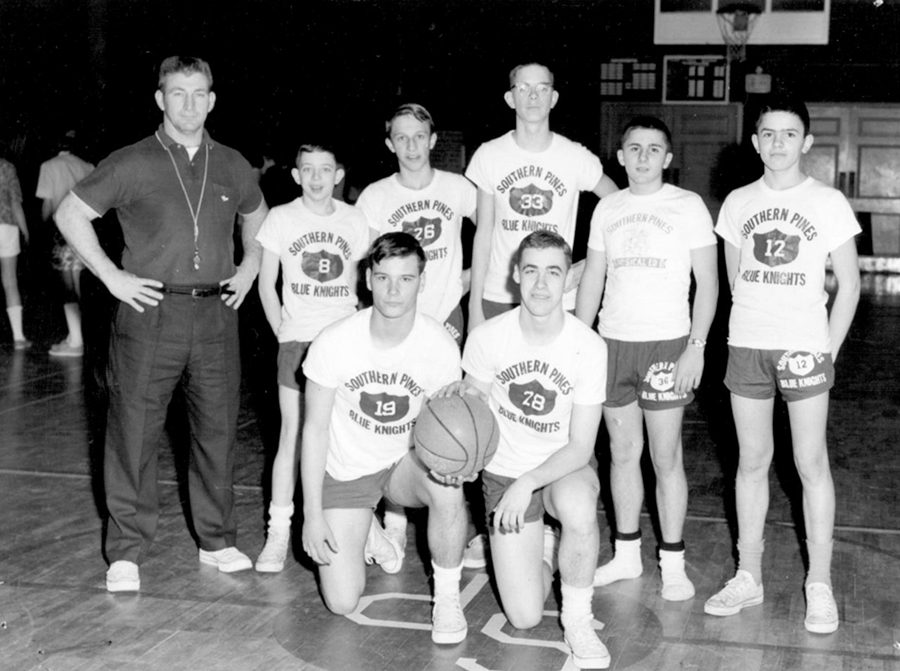
He was, in Bruton’s memory, a “consummate con man” that swept up other members of the community to lend a helping hand, whether for new bleachers at the ball field or a new beginning for boy who deserved it.

“He would farm out the kids to us and other families if he got more than he could handle,” Bruton says. “He’d tell you an awful story that you had to get up the money to take care of it. He sent a lot of kids to school, to camp, whose parents couldn’t afford it. It was probably the best money I’ve ever spent. He was an unusual fellow — he didn’t seem to care much about John Williams, but he sure cared about others.”

Coach was born on Jan. 29, 1931, in Lenoir County, the middle child of Walter Spencer Williams, a successful Kinston businessman, and Marjorie Earnhardt Williams. Marjorie died shortly after giving birth to her third child. Less than a month later Walter took Williams, not yet 2 years old, and his two sisters (Lib and Billie) across the state to Cabarrus County to be raised by Marjorie’s parents, John and Willie Irene Earnhardt, Lutheran farmers (and relatives of future stock-car legend Dale Earnhardt) trying to eke out an existence in hard times.

Walter Williams remarried quickly, to a friend of Marjorie’s, and had little contact with his three children. His son — born Jackie Arnie but renamed John Wiley by his grandparents when he was baptized — grew up loved but with few material possessions. “John slept in a crib until he was 6 years old,” Patricia Williams wrote in an unpublished memoir. “He told me he remembered his feet sticking out at the end of the crib before he got a real bed.”

By the time he was sleeping in that bed, Williams was already contributing to the family effort, “Pop” Earnhardt having fashioned a diminutive plow so his grandson could work the fields. “He’d be at the field at the crack of dawn from the time he was 5 or 6,” says John Jr., “and once he was in high school he worked on a loading platform, throwing heavy things on the train. That’s how he got strong, from working.”

At Mount Pleasant High School, Williams was a talented athlete but struggled in the classroom because reading was difficult. His wife, a longtime elementary school teacher, believes it was because he was dyslexic. High school might have been a miserable experience for Williams if not for the guiding hand of Mount Pleasant teacher/coach Luther Adams. Raised in an orphanage, Adams saw potential in the gritty student who, Patricia wrote, “had the heart and desire to excel in sports” but was growing up in a household whose priority was its crops.

Adams moved to Southern Pines as school superintendent in 1959. A year later, when a larger student body gave Adams the authority to expand the faculty, he hired the young man for whom he had been an instrumental mentor a decade earlier. After graduating from Atlantic Christian College, Williams had been at Pineland College in Sampson County for two years when he was hired as physical education teacher at East Southern Pines Elementary, becoming an assistant coach for several Blue Knight teams as well. Three years later he established a track and field team, the first in Moore County, and began to become an integral part of the town using sports to build community bonds.

“John saw the difference [Adams] made in his life,” Patricia wrote, “and he set out to pattern his life’s work after his role model. He wanted to coach, to help young people, to do special things for poor people, and to be a good father and husband. He did all that and more.”

A religious man who carried a Bible and could quote it, Williams wasn’t a saint. He was well known to local law enforcement for a habit of driving too fast. It was in his blood — after all, he was a cousin of the racing Earnhardts of stock car legend.

“He couldn’t not speed,” says Gary Barbee, Pinecrest Class of ’75, a four-year pitcher on Williams’ baseball squad. “Sometimes the police would let him go, but still he got a lot of tickets. His wife gave him a spool of thread to screw into the floorboard below the gas pedal on his old Studebaker so it wouldn’t go above 55 miles an hour. That was the only way to keep him from getting any more tickets and having their insurance go up any higher.”

“Might be true,” Mike Williams says. “He did not like to go slow. If we were going to the beach with a group of folks in several cars and we stopped to have a soda, it was very rare that somebody didn’t ask him to slow down because they couldn’t keep up.”

Driving to away track meets in Southern Pines’ aging and slow activity bus, the “Blue Goose,” Williams would navigate winding back roads to shave time and beat other schools to the venue. “Getting there first was an event to him,” Mike says. “That was pretty competitive.”

Keeping up with Williams when he wasn’t behind the wheel was difficult enough. As a young football coach, he liked to have players tackle him rather than dummy runners — breaking four watches in one season. “He lived up to his ‘Bulldog’ nickname fighting for rebounds or diving for a loose ball in a pickup basketball game,” says Robinson.

Mike Williams remembers trips when he and his older brother would be in the back seat, squabbling the way siblings do. “Mom would have had enough,” Mike says, “and he would just reach around with his right arm and the next thing you know we’re elevated off the seat while he continued to drive down the road. He was very calm as he asked if we were ready to settle our differences.”

Coach would roughhouse with his baseball players and always came out on top. “We’d jump on him, two or three of us, trying to wrestle him to the ground and you just couldn’t hold him,” Barbee says. “He’d bite, kick, whatever it took. Someone was adjusting our old pitching machine once. He was in the batter’s box and a ball hit him in the back of the head. It would have knocked you or me out. He just rubbed his head a little bit and kept going. He was a tough cookie, man.”

And he sought to make his players tough. Barbee’s lungs still burn recalling “Burma Road,” a practice drill. “You’d run to first and back, then to first and second and back, then to first, second and third and back. Finally, to first, second, third and home. Then the next time, you did each sprint twice. And after every game, home or away, win or lose, we ran 10-to-15 100-yard wind sprints. Opposing teams would say, ‘Y’all, we need to cut the lights off.’ It didn’t matter. We ran. We were in shape.”

Williams’ own running — he built up his muscles with leg lifts, but his limbs still ached constantly — became part of Coach lore. As a sentence for a speeding violation, a judge in Southern Pines offered an option of paying a fine or walking to Howard Johnson’s on U.S. 1 in Aberdeen, round trip of about 4 miles. That was easy pickings for Coach, who would run there and back in less time than it took to watch an episode of The Andy Griffith Show.

The feat that caused the most stir was a hot and humid day in the mid-1970s when Williams ran home to Southern Pines from Raeford, the best part of marathon distance. Mike watered him down with a garden hose in the backyard while his wife phoned David Bruton to ask him what she should do for her exhausted husband. “Quick,” Bruton said, laughing, “go grab him before he runs to Raleigh.”

One of the best runners to graduate from Pinecrest, Jef Moody, a middle-distance star who was poised to make the 1980 U.S. Olympic team before the Moscow boycott, spent more than a year of Saturday mornings as an eighth-grader logging miles with Coach. The experience normalized what had been a jarring move from Philadelphia to a still-segregated South as an African-American fifth-grader in the spring of 1968.

“He asked me if I wanted to come run with him on Saturdays at Mid Pines,” says Moody, 61, who now coaches the men’s and women’s track and cross country teams at Sandhills Community College. “We’d run the 18 holes, just the two of us, then I’d run home. It really meant a lot to me. I never had him for a P.E. teacher or a track coach, but he was my buddy.”

When Robinson was back in his hometown as fledgling teacher and coach, Williams gave him some advice about his new students. “You’ve got to love every one of them,” Coach told him.

Williams’ support for his athletes, present and past, was resolute.
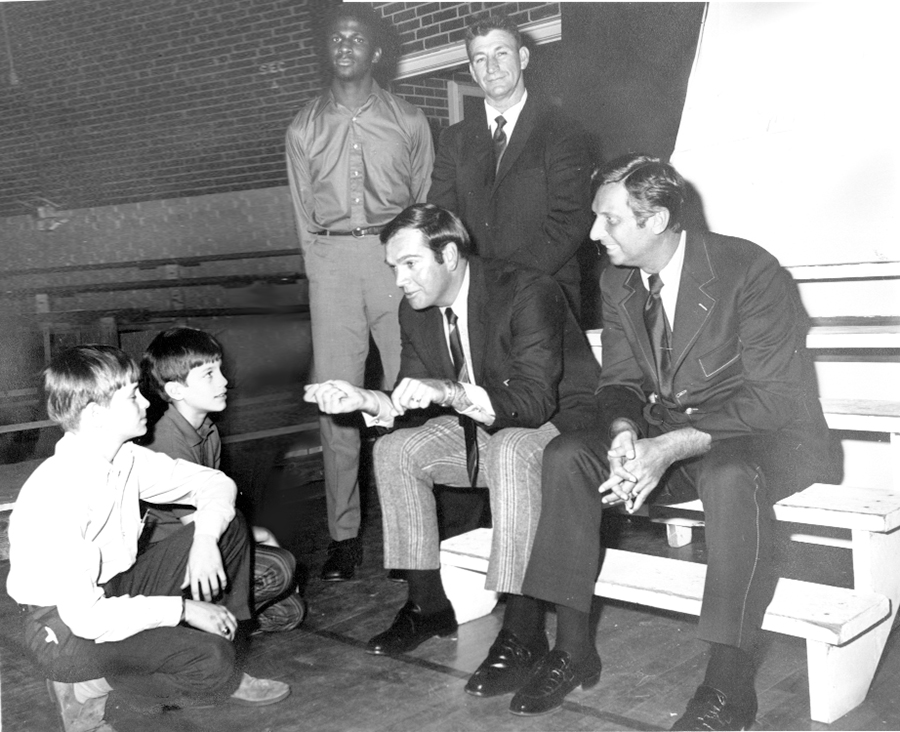
Coach finagled funds from Bruton and other townspeople so he could buy an early whirlpool bath — which looked like a metal washtub with a small boat propeller — so young pitchers could soak their throwing arms. “He could con me and others out of whatever he needed for his sports activities,” Bruton says. “That tub cost more than it was worth, of course. But he was very proud.”

Once I pulled a back muscle at a Little League practice that Coach was overseeing.

“We’ll go get you in the tub,” he said, “and get some Cream of Jesus on it.”

At least that’s what it sounded like he said. Sometimes Coach’s sentences, voiced in his husky Tar Heel accent, were like a hiking trail that didn’t quite make it to the summit. When we got to the high school field house, I noticed an industrial-size container of orange goo.

He had been talking about Cramergesic, a therapeutic muscle balm that made Vick’s vapor rub seem as mild as a peppermint. But it helped my back.

That was the side of Coach who would gently catch a wasp between thumb and index finger and deposit the insect out a car window instead of swatting it dead, perhaps the day after he’d set his watch back twice so a jayvee football practice would finish at “six bells” an hour after weary players had heard a half-dozen chimes waft to Memorial Field from the Episcopal church.

“I was always challenged getting rides,” says Tim Maples, a senior star pitcher on Williams’ 1979 state championship Pinecrest baseball squad. “It seemed that I was always spending time with him. ‘Where you going to be, Maples? I’ll pick you up.’ I’d be at home, or at the Elks Club pool, and he’d pick me up in the bus, and he’d take me home in the bus after practice.”

Coach — the generous spirit and the drill sergeant both — stuck with people long after they’d left his class or his gridiron. His boys carried the connection and attitudes to college campuses, pro ball and war.

“He walked the walk,” says Maples. “He’d talk a lot of times about intestinal fortitude, heart, 110 percent. It was like he had invented those terms.”

Those who became educators themselves brought Coach’s ethos to their lives. “The one big thing he did was mentor others to become leaders and grow community involvement,” says youngest son Mark Williams. “For me, it is this handing down of a sense of responsibility, ethics, knowledge, sportsmanship and values that continues and is so powerful.”

One of Williams’ disciples, Bill Strickland, took his lessons to the Vietnam War, where he was terribly injured. “He told me he could remember waking up, after several days, having gone through surgeries,” says Mike Williams. “He was in a bed, flipped upside down so he couldn’t move. He said, ‘Mike, I woke up and my doctor was laying underneath.’ He said, ‘Soldier, you should be dead. You should not be here. What force has kept you alive?’ And Billy said, ‘Coach Williams.’”

By the fall semester of 1990, Williams had passed on his coaching duties to others and was teaching and serving as athletic director at Pinecrest. On Nov. 21, the day before Thanksgiving, he had an early morning dental cleaning appointment, then ran an errand to McDonald Brothers Inc., a building and lumber supply company north of Southern Pines.

John and Patricia, who had moved to Whispering Pines, were looking forward to a family gathering — sons, daughters-in-law and grandchildren. He went to the store to buy chains to complete a swing set he was building for the youngest members of the family. As he drove across a railroad crossing, his sedan was hit on the passenger side by an Amtrak passenger train, the Silver Star, which had just left Southern Pines on its journey from Miami to New York.

“I don’t think anybody knows exactly what happened,” says John Jr. “My theory is that they had a new puppy and he had that new puppy with him. I bet either the puppy distracted him or it got down into the footwell where the pedals are, and he couldn’t make things work.”

The long holiday weekend was transformed into a period of grieving across the Sandhills. “It was such a shock,” says Nat Carter, 78, Williams’ longtime teaching and coaching colleague in Moore County. “It was hard to figure what happened with the train. We lost a great one when we lost him. You could learn a lot just watching Coach John and being in his presence.”

Pinecrest sports teams compete at the John W. Williams Athletic Complex, facilities that honor his longtime contributions. Those who knew Coach are in middle age or beyond, their memories aging but vivid.

“We always said the Lord’s Prayer before a game,” Maples says, remembering his Pinecrest baseball days. “We put in our hands, in the dugout. Coach’s hand was always down first, and I always tried to get my hand on top of his.”

When the Patriots were at bat, Williams jogged to the third base box. Everybody took the first pitch, sometimes two. Tug of the cap, touch of the face, swipe of the chest, rub of the arm. You didn’t want to be the player who blew a sign.

“I missed a suicide squeeze at Laurinburg and about killed a guy,” Barbee says. “He was running on the pitch and I took a cut. Coach would get right in your face and just chew you out. He wouldn’t put up with anything. But we all trusted him and believed in him.”

The feeling was mutual.  PS

Georgie Porgie, Oh My!

Georgie Porgie, Oh My!

The sometimes ghoulish roots of innocent nursery rhymes

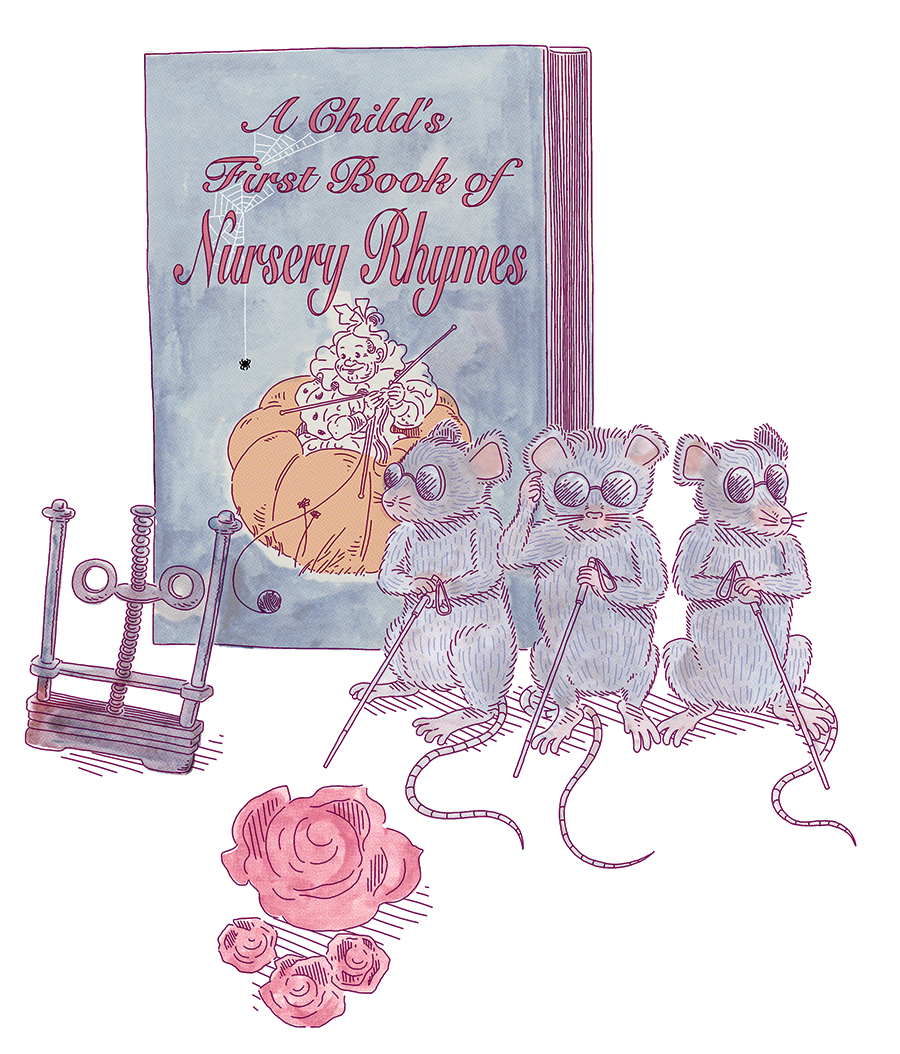
By Michael Smith     Illustration by Romey Petite

Nursery rhymes are forever. Even the scary ones. They stick in your brain like bubble gum on hot pavement. Here’s proof: “ . . . and dried up all the rain. And the itsy bitsy spider went up the spout again.” Who among us doesn’t remember the opening lines?

Many nursery rhymes are played out in singsong fashion. With some, like Patty Cake, there is physical interaction while you both belt out the lyrics. Now that’s fun. But there’s more to it than fun. Nursery rhymes facilitate the development of a bond between Mom and baby or between siblings or friends. Fun and interaction work their magic, so that the next time Mom says, “Want to play patty cake?” Zap, your hands go up, palms out, ready to play. Your sense of competence subtly notches upward.

According to child development experts, nursery rhymes, especially those with music, significantly aid a child’s mental development and spatial reasoning. On NBC’s Today show, Seth Lerer, Dean of Arts and Humanities at the University of California-San Diego, said nursery rhymes both foster emotional connections and cultivate language ability.

So, the sweet words and lulling lyrics of today’s nursery rhymes cement relationships. Time was, though, that nursery rhyme words were not so sweet and nursery rhymes functioned more as transmitters of historical events. They were full of political satire, ribald jokes, religious disputes, violence and sexual innuendos — definitely not for young and innocent ears, not according to today’s standards.

So bad were they that British Victorians founded an association to clean the things up. As late as 1941 the British Society for Nursery Rhyme Reform was still culling X-rated content, excising accounts of animal torment, descriptions of violent human deaths — decapitations, hangings and the like, even cannibalism. Tales for the babies? Not.

Let’s take a closer look at several long-since sanitized nursery rhymes. The majority derive from England. Theories about their origins are numerous and varied, and are difficult, sometimes even impossible, to substantiate. Most have gone through a number of revisions over the years. All the same, the ghouls and goblins might find them interesting.

London Bridge Is Falling Down is as good a place as any to start. One account of its origin has it that a bridge would collapse unless a human sacrifice, particularly a child, was entombed within it. The child would be bricked into the bridge foundation while alive and slowly die from lack of food and water. Lore is that the child would eternally watch over the structure and ensure its stability.

Substantiation, complete with references, of such grisly immurement practices can be found in A Walled-Up Wife: A Casebook: “In 1615, Count Anthony Günter of Oldenburg, visiting a dyke under construction, is said to have found the workmen about to bury a child beneath it. He rescued the child and reprimanded the mother, who had sold it for the purpose.” Another passage suggests that, “When the castle of Liebenstein in Thuringia was being built, a child was purchased from the mother and walled in.” And so on. So much for the hod carriers union.

Children play a game that may have derived from that very goriness. Two children face each other and hold hands forming an arch. As other children run beneath, the arch is slowly lowered till one is “selected” while all chant “London bridge is falling down, falling down, falling down . . .” Macabre little game there.

Then there is Ring Around the Rosie. As with most, there are several claims regarding this nursery rhyme’s origin. One refers to the 1665 Great Plague of London. The “rosie” was a rash that appeared on those who contracted the plague. It gave off such a stench that the afflicted would attempt to suppress it with a pocket full of posies.

“Ashes! Ashes! We all fall down!” supposedly reflects the fear that all would eventually get, and die from, the plague. (Indeed, about 15 percent of the country did just that.) The “ashes” were the cremated remains of the deceased.

The daughter of Henry VIII and Katherine of Aragon, Mary I, is thought to be the subject of Mary, Mary, Quite Contrary after Henry got big on Protestantism and established the Anglican Church when the Catholic Church repeatedly denied him the right to a divorce. But Mary wasn’t having any of that business. She was hardcore Catholic and after she took the reins, though unsuccessful, she was quite contrary about returning the country to Catholicism.

Her reign was a scant five years, yet, during that time her garden grew — her “garden” being graveyards populated by Protestant martyrs. Not for nothing did they call her “Bloody Mary.”

Mary was a busy beaver. She instituted a turn-or-burn policy and during her brief reign, had over 280 religious dissenters burned at the stake. To assist those having trouble deciding to convert, she employed little gadgets like “silver bells,” actually bone-crushing thumbscrews. She also was fond of “cockleshells,” torture devices that were attached to males’ nether reaches.

Fortunately for an English population quite satisfied with their Anglican Church, Mary’s stint as the first Catholic woman on the throne of England was limited. Weakened possibly from uterine cancer, she is thought to have died at the age of 42 from the flu.

One of the oldest nursery rhymes is Three Blind Mice. The earliest version, along with music, was published in 1609. (Incidentally, that was the year Thomas Thorpe published sonnets written by a dude dubbed the Bard of Avon. Hint: nothing to do with cosmetics.) Moving right along, Three Blind Mice, as we know it, is also said to be grounded in Bloody Mary’s reign. The three mice are thought to be two bishops and the Archbishop of Canterbury, who plotted to remove Mary from the throne. Big mistake. Mary uncovered the scheme and had each of them burned at the stake. You don’t mess with Mary.

Our final nursery rhyme is Georgie Porgie, the origin of which actually has been substantiated through court documents and diaries. Remember Georgie Porgie? “Georgie Porgie, pudding and pie; Kissed the girls and made them cry; When the boys came out to play; Georgie Porgie ran away.”

Certainly sounds innocent enough for tender ears. In fact, George was none other than George Villiers, bisexual nobleman and lover of King James I. George’s close friendship paid off nobly, too, when the King publicly proclaimed his love for George and named 31-year-old George Villiers the Duke of Buckingham.

George was equally fond of the ladies and had affairs with daughters and even the wives of powerful Englishmen. Ladies were warned against being alone with George, kind of an early Harvey Weinstein. Understandably, George’s randy nature and activities generated a certain amount of strain, but his relationship with King James also generated a certain amount of immunity.

And so it was that today’s delicate expurgated nursery rhymes evolved from backgrounds well suited to Poe or perhaps Steven King or maybe the Brothers Grimm.

“Itsy bitsy spider went up the water spout. Down came the rain and washed the spider out. Out came the sun . . . ” PS

Michael Smith lives in Talamore, Southern Pines, with his wife, Judee. They moved here in 2017 and wish they had moved here years earlier.

True South

Closet Conundrums

When it’s time for the big switch

By Susan S. Kelly

Now approacheth the dreaded biannual chore, at least for the females of the species: The Closet Changeover.

The way I understand it, and if the pictures in People magazine can be believed, people in LA never have to do this. Los Angeles is seasonless. Celebrities: They’re not just like us, actually, as People would have you believe.

And for Wisconsinites, Vermonters, Floridians and even some Texans, whatever seasonal change they have is so short that barely a hanger or a shelf needs disturbing. Ten-month winters, two-month summers, and vice-versa. But for those of us who live with real seasons, it’s time to get to it.

Now, normal people, sane people, probably schedule this task; take a Saturday and tackle it all at once, chop-chop. Then there are the folks who wake up one chilly morning and say, “Where is that sweater?” And tackle it all at once. And then there’s me — and I suspect a lot of others — who begin with good intentions and get sidetracked not by the internet, but by decisions, so that the task takes six weeks, on and off. You can’t tell, but I do have a system.

Throw everything on the floor and bed. (Hope it’s a king-size.) First, separate into categories of Too Tight, Too Short, Too Bare, and Just Because You Can Doesn’t Mean You Should. Likely, there will be a tall pile of Not Sures. And, like that old saw that warns if you have to ask the price of something, you can’t afford it, it follows that if you have to take a selfie wearing the garment in question and send it to your sisters and ask if you should keep it, the answer is probably no.

(Speaking of not affording, now’s a good time to get out the Goof Off and scrub away the tell-tale Marshalls and TJ Maxx stickers on your shoes.)

During this process, you’ll experience acute apparel anxiety. One of my sisters has said, “I’m living in separates hell.” (Remember that term, “separates”?) To escape, she’s decided to convert nearly her entire “’drobe,” as she calls her wardrobe, to dresses, and tech clothes. The other sister is such a shopper that she began putting clothes on layaway when she was in seventh grade. (Remember that term, “layaway”?) I ask you, what kind of 12-year-old knows what layaway is? A born consummate clotheshorse, that’s who, and that sister hangs tags on her clothes to remind herself what event she last wore it to — a dinner, a cookout, a meeting. I kid you not. She’s the sister who coined two of my favorite ’drobe terms: The Punishment Dress (or shirt, or whatever) that you’re sorry you bought but you have to wear to punish yourself for buying it. And The Whistle Dress, for the dress that’s so easy, and is ideal for so many situations, that you just whistle and it jumps out of the closet. Often, it must be admitted, Whistle Dresses don’t touch your body anywhere but the shoulders.

“Is this out?” I text the clotheshorse sibling, attaching a picture. “Houndstooth is never out. Neither is leopard print,” she messages back. OK, that’s settled. Onward.

Here are the clothes you’ve simply turned against, have developed an inexplicable and unreasonable hatred toward. Pitch. Here are the ones to downgrade, meaning that you “saved” it for in-law dinners, a charity speaking event, etc., but this year, it gets demoted to church. In-laws judge in-style. God does not.

I know it looks great on you, but if it itched last year, it’s going to itch this year. Pitch.

It’s also OK to toss something just because you’re tired of it. But, a warning: When photographs of you wearing it come up later in some post, or in the photo drawer that’s never been properly organized, you might find yourself saying, “Dang, that looked good. Why did I get rid of it?” Too late for regrets.

Now, here comes the poundage pile, the five-fewer-pounds-and-this-will-fit-fine-again layer, I mean pile. The clothes that my mother calls “tailored,” I call “tight,” and my daughter calls “body con” (for “conscious”). Here’s how you’re gonna deal with that. If you’ll still need Spanx with it even after the five pounds magically evaporate, pitch.

A moment, now, of self-congratulation for all the stuff I don’t have to pitch, the trends I managed to live through and do without: poufs; shrugs; tracksuits; Crocs; boiled wool jackets. The trend I wish I’d bowed to: jean jackets. The trend I fell victim to, but only once: Ultrasuede. What I will never, ever give up: clogs and cardigans. What I am, thank you Jesus, too old for: bralettes.

My final advice, born of experience, is to always buy something at the end of a season, when it’s on sale, and then, facing that shelf or rack of been-there-worn-that duds the next closet changeover (April), you’ll spot something fresh, unworn, and new-to-you, which makes the chore the faintest bit more bearable.

In Los Angeles, everybody from bums to billionaires just wears T-shirts. In New York City, everybody but Hoda and Kathie Lee just wears black. But you’re Southern. What’s in your closet?  PS

Susan Kelly is a blithe spirit, author of several novels, and proud grandmother.