Hometown

Up and Away

Revisiting the first rung of a long climb

By Bill Fields

Someone asked me not long ago the number of states I had visited, and my answer got me thinking.

For work or pleasure, I have at least set foot in 48 of the 50. Alaska and North Dakota are the places I haven’t gone, my travels having been much broader than I could have imagined growing up as the youngest child of parents who had stayed put in their home county.

But well before I ventured out of state — before I ever consulted one of those road maps that seemed impossible to fold up neatly once you had opened it — I went up to get away.

It was a dogwood located within a boy’s best forward pass from our house, yet climbing up to sit on its lowest branch was my first adventure.

I was back at that tree recently, during a season of change that had me thinking. The limb still looks like an arm bending toward the sky, its distinctively textured bark peeling from age. My old perch is at eye level now, still only 6 feet or so from the ground, a height that allowed me to touch it without strain.

Decades ago, when I was close to 6 instead of 60, it took real effort to reach. But it sure was worth it. 

That crook was sanctuary and observatory, but mostly it was mine. It was a place to think, laugh or pout, a vantage point from which I could look down upon our cats, the occasional passing car, neighbors raking leaves. It gave me a different perspective on our horseshoe pit, basketball goal and swimming pool, which sat upon the yard like a large yellow can that had been sawed in half.

My getaway place was neither secret nor far away, although it felt as if it was both of those things, particularly the latter the one time I chickened out on my descent and summoned help to get down. Hattie, who cared for me while my parents were at work, could only laugh as she came to my rescue but kindly coaxed me back to Earth.

That day notwithstanding, I came to feel quite comfortable in that dogwood, my tree house without walls. Traveling to that space, even though a very short journey, made me feel like I was part of a larger world that, with effort, might be within reach.

I never explored the heights of another tree. About the time I had gotten old enough to consider climbing higher, a friend and neighbor much more adventuresome than I was took an awful tumble from a large sycamore and broke her leg. It was a severe injury that had her in a cast and on crutches for a long time. But given how far she fell, the outcome might well have been much worse. Even so, her mishap was a cautionary tale.

When I studied my old climbing tree recently, I considered who I had been when I sat in that spot — how much I didn’t know and how many places I hadn’t been, that the borders of my world then were school, church, the grocery store and my grandmother’s house on Sunday afternoons.

In those hot summer days when I retreated to my space in that tree, my world wasn’t much bigger than the globe on my desk. I hadn’t yet ridden on a train or flown in a jet.

I stood by that dogwood this August and touched the limb that used to be my summit and wondered how many times I have been tens of thousands of feet in the air on the way to somewhere and, as we all have, taken it for granted. I thought of the paper airplanes I tossed from that branch all those years ago, their journeys as uncertain as my own.   PS

Southern Pines native Bill Fields, who writes about golf and other things, moved north in 1986 but hasn’t lost his accent.

In The Spirit

Syrup, Salt and Jigger

Keeping it simple and delicious

By Tony Cross

Last month I touched on a few drinks that can be made with only three ingredients. I’m carrying the theme over into October with three tips that can help improve your cocktail game. A lot of people have a fantastic collection of spirits and are super creative with their drinks. Others love trying new drinks, but when it comes to making them, would rather keep the ingredient list short and simple. Here’s something for both groups.

Your Simple Syrup

I don’t know how many times I’ve harped on this and I’m too lazy to check. Let’s just say this definitely isn’t my first rodeo when it comes to explaining why I think a 2-to-1 ratio with simple syrups is the way to go. When I first got into making everything from scratch behind the bar, simple syrup was first in line. Equal parts sugar and water. Easy enough. I’d take a measuring cup of baker’s sugar and then use the same cup to add water, throw them both in a pot over medium heat and stir the combo until the sugar disappeared. But then one night I saw a video clip of bartender Jaime Boudreau explaining how he makes a rich syrup for his cocktails. Rich syrup consists of two parts sugar and one part water. Boudreau explained that a richer syrup gives a cocktail more body. I’ll explain. If you’re using a 1:1 ratio, you have to use more of that syrup in each cocktail. Because the syrup is equal parts, and you’re using more, that means you’re adding more water to the drink as well. You’re over-diluting the cocktail. More so if you don’t weigh your sugar. If you use a measuring cup, it’s not going to be exactly one cup — it’s going to be under. In reality, your syrup ratio is 1-to-.80. I can’t stress the importance of weighing out the sugar (and water too).  It’s going to make a huge difference in your next sour cocktail. Finally, please don’t think that having a richer syrup is going to mean your end product will be sweeter. If measured correctly (see below), you’ll have a more velvety feel on your palate from your perfectly balanced drink. Try this:

Whiskey Sour

2 ounces Rittenhouse Rye

3/4 ounce lemon juice

1/2 ounce rich simple syrup

Add ingredients in a shaker with ice. Shake hard until proper dilution has occurred. Strain into a rocks glass over ice. Garnish with oils from a lemon peel. Taste the difference.

Salt + Citrus = Damn!

I can’t remember when I first heard about adding salt to sour-style cocktails. I believe there was a cocktail competition out West, and the guy who won added saline to all of his drinks. It was definitely a duh! moment. Here’s the thing, though — you don’t have to just add them to shaken drinks. A small pinch of salt can go a long way in stirred drinks as well. Mess around with it to get the right balance. I’ve done a pinch of salt in drinks before. I’ve also made a saline solution. My preference? Saline. I like knowing that I’m going to get the same result when measuring out the drops. In the past when I’m busy, I know I’ve pinched a bit too much salt at times. So, what I’ll normally do now is make a solution of 3 parts salt to 1 part water. I’ve always used Himalayan pink salt, so I’d recommend starting there. I will say, I don’t think it’s necessary to use salt for every citrus cocktail, but it definitely helps, especially when your fresh pressed juice has been sitting for half a day. Lemon and lime juice start losing their pop in around five hours, so a dash of salt could bring it back to life. Another way it helps is with consistency. The juice from one case of lemons may differ in taste from the next. The same goes for limes and grapefruit.

Daiquiri

2 ounces Flor de Caña dry rum

3/4 ounce lime juice

1/2 ounce rich simple syrup

3 drops saline (3:1)

Combine all ingredients into a shaker with ice. Shake hard until your vessel is frosty cold. Double strain into a chilled cocktail coupe. No garnish.

Measure, Measure, Measure

This is another one that I’m sure I’ve beaten to death, but it’s so important — more so than the first two tips above. When I first got into bartending, I was obsessed with a bar in New York City that was one of the first bars in the new millennium’s surging cocktail trend. These guys made (and sold to other bars) their own syrups, bitters and cordials. Their drinks looked amazing, their uniforms were cool, and the bar itself was gorgeous. They did not measure. They eyed all of their cocktails. The risk factor in throwing a drink off balance made it even cooler in my eyes. So, that’s what I started doing. I would eye all of my drinks. I got decent at it, but do you know how hard it is to eye 1/8 an ounce for a cocktail when you’re slammed? It can be done . . . if you’re a bartending guru, which I was not and am not. I’m not sure why I got back into measuring. It was probably some David Wondrich article I read that stressed the importance of it. If so, he was right. Understatement. Consistency is key. I do remember that the month I got back on the jigger train, more compliments were directed at our waitstaff about the drinks. It means a lot when your guests return for another cocktail because they know it’s going to be just like it was the last 30-something times they imbibed there.

Put your pride aside and pick up a jigger. That is, unless you’re a guru. And if you are, please show me your ways.   PS

Tony Cross is a bartender who runs cocktail catering company Reverie Cocktails in Southern Pines.

Drinking with Writers

Well-Behaved Women

Zelda with a twist

By Wiley Cash     Photographs by Mallory Cash

For anyone who knows Therese Anne Fowler, it is no surprise that she writes about women like Zelda Fitzgerald and Alva Vanderbilt, women who were artistic, brilliant, and outspoken. Therese’s friends would describe her much the same way. I first met Therese at the South Carolina Book Festival, where we spoke on the same panel in the spring of 2012. We made fast friends, telling stories about book tours and life in North Carolina, where she and her husband, novelist John Kessel, live in Raleigh. I saw Therese several times over the next few months at various conferences and festivals. I knew she had a new book coming out, but she never said much about it. And then Z: A Novel of Zelda Fitzgerald was published in March 2013. It blew the doors off every preconceived notion readers had about the woman who had always been known simply as Mrs. F. Scott Fitzgerald. A few months after the novel came out, I saw Therese again at the Southern Festival of Books in Nashville. By that time both Z and Therese had experienced incredible success: The novel had appeared on The New York Times best-seller list, and a television show based on the novel and starring Christina Ricci as Zelda Fitzgerald was in production at Amazon. I told Therese how thrilled I was for her, and I asked her how it felt. She smiled, turned her head, and revealed the tiny “Z” she had tattooed behind her left ear. She planned to keep Zelda with her forever, and people who have read the novel and have seen the series understand why.

With her new novel, A Well-Behaved Woman: A Novel of the Vanderbilts — which tells the story of Alva Vanderbilt, a woman who went from being a member of the fallen Southern aristocracy to a Gilded Age socialite and, eventually, a leader in the women’s suffrage movement — Therese has once again given life to a heroine that readers will not soon forget. It seems that critics feel the same way. Publishers Weekly and Kirkus Reviews both gave the novel starred reviews, and People magazine named it a Best Book of the Fall. Sony Pictures believed in Therese’s take on Vanderbilt’s life so much that they optioned the novel for a television series before she had even finished writing it.

Over Labor Day weekend I met Therese at The Haymaker in downtown Raleigh to talk about writing about historical women, the thrill of seeing her work on the screen, and how she is feeling about her new book, which is scheduled for release on Oct. 16.

“I’m excited,” she says. “But I’m cautious. You can’t predict the book business.”

We are sitting at a small table by the huge windows where the late-day light barely reaches the high ceiling. On my right, a gorgeous flower mural spans an entire wall. The bar behind Therese features leather-covered stools and industrial lighting. To my left is a sitting area where a comfortable Victorian-styled sofa and leather armchairs invite patrons to sip cocktails and chat. The interior of The Haymaker is the perfect combination of clean lines and lush decadence. When our drinks are delivered, I offer a toast to well-behaved women. Therese laughs and lifts her cocktail, the cachaca/Campari-based Agua-Benta, which is infused with jalapeno and features hints of lime and pineapple, and clinks it against my pint of Peacemaker Pale Ale. She takes a sip and looks around.

“Alva would have been very comfortable in a place like this,” she says. “Zelda would have been, too.”

“What was it like to see Zelda come to life on the screen?” I ask.

“Wonderful,” Therese says. “I loved it, and I think Christina Ricci was perfect. My only regret is that Amazon didn’t renew it for a second season. Viewers learned all about the beginning of Zelda’s life and her relationship with Scott Fitzgerald, but we never saw them get to Paris, where the writers of the Lost Generation all come together. It would have been fascinating to see that.”

“Were you surprised when Hollywood came calling a second time when Sony optioned A Well-Behaved Woman?

“Very surprised,” she says. “I was in New York with my agent, pitching the novel to editors and sending the book to auction. We were standing on the subway platform when my agent got a call that Sony wanted to option it. The book was still at auction and hadn’t even been purchased yet.”

I have a feeling that many people will be hearing about Alva Vanderbilt when A Well-Behaved Woman is published, some perhaps for the first time. After a life that spanned the Civil War, World War I, the Gilded Age and the Great Depression, Alva Vanderbilt would die in Paris in 1933. Perhaps, if Therese and Sony have their way, both readers and viewers will make it to Paris even though Amazon did not get us there with Zelda. And who knows? The next time I see Therese she might show me a fresh “A” that has been tattooed behind her other ear. You never know what a well-behaved woman is going to do next.  PS

Wiley Cash lives in Wilmington with his wife and their two daughters. His latest novel, The Last Ballad, is available wherever books are sold.

The Gift of Personality

The Gift of Personality

Finding the soul in a role

By Jim Moriarty     Photograph by Tim Sayer

saw Joyce Reehling at around 3 a.m. She was dressed in white.

Her role in this particular episode of Law and Order was modest. She was a naval officer. All business. But there was something in her eyes, as if, for reasons known only to her, she wasn’t entirely on board with what was happening in that office. She’d had a life before that moment sitting in that chair across that desk from whatever the hell that district attorney’s name is. There was stuff. Maybe stuff she didn’t talk about because, if you’re a female officer in the Navy, maybe you don’t talk about stuff like that, especially if the investigation involves another female naval officer.

And I wondered what it was. And I rearranged the pillow behind my head so I could have a better look.

Reehling doesn’t deliver a line. She pulls back the curtain just a touch to give you a peek through the windowpane, inside the house. Maybe it’s funny. Maybe it’s not. But the one thing it always is, is honest.

Born in Baltimore, Reehling grew up in Laytonsville, once a tiny Montgomery County town that’s gone from the middle of nowhere to a gridlocked prisoner of urban sprawl. “Our huge claim to fame was that the Laytonsville volunteer fire department building burned down once,” says Reehling, who knew she wanted to be an actress from the time she was in kindergarten. “I was in this rhythm band, and I was playing the blocks with sandpaper on them,” she says. “Somebody’s playing the triangle, and we all seemed so happy and I thought, ‘I bet you can do this for a living.’ And I have the musical ability of a dinner plate.”

Reehling’s father, Stanley, who passed away almost two decades ago, was a traveling salesman — insert jokes at your peril — selling institutional food. Her mother, Jean, took care of the home and children. Joyce has a twin sister, Karen, and two younger sisters, Jenny and Mandy, who came along nine and 10 years after the twins. “It was like living in a sorority house interrupted by a father showing up,” she says. “My father was a Marine in the Second World War, God bless him. He spent a part of his life in the South Pacific and China and was a drill sergeant for a while. This is not the building block of great empathy. He wasn’t in the first wave to go into Guadalcanal, but he was there. I’d have to check to find all the places he was, but there was not one that was fun. He was in terrible places doing terrible things, that I know.”

Reehling got her first big break in acting from a wrestling coach. It sounds more violent than it was. She was at Gaithersburg High School and “my guidance counselor, Adam Zetts, was mainly the wrestling coach. Big guy. He didn’t quite know what to make of me. He came to school one day and he saw me in the hall and said, ‘I found it. I found it.’ He’d read a story in the Christian Science Monitor about the North Carolina School of the Arts and he said, ‘I think this is what you need.’”

It was.

“My year was the first full graduating class,” she says. “The school was so new it was like puppies in a box. Now it’s just really together.”

After a fifth year at the School of the Arts as part student, part graduate assistant, it was off to New York. “I still didn’t feel ready,” she says. “The foundation there now is so thorough you should know what you’re doing. Of course, that doesn’t mean you’re not going to be scared. I left the School of the Arts terrified. When I went, you went up on your own. Good luck getting a job. You’re the flotsam and jetsam. It’s very unsettling at first. I think I went to New York with $1,000. I got in the Rehearsal Club, two brownstones up from the Museum of Modern Art. The play and movie Stage Door are based on this place. Carol Burnett had lived there. A whole bunch of women. A lot of Rockettes. Men were not allowed above the first floor. I think we were paying $35 a week. That included breakfast and dinner and linens. I remember a bunch of us having the ubiquitous meeting in a coffee shop where you could have unlimited coffee and everyone got a bagel. That’s a meal. One guy said how fun this phase of life is. I said, ‘I’m OK with it now but at 30 this is going to be really old.’ You were nickel and diming your way through everything.”

Commercials and voice-overs, particularly Reehling’s Robitussin role of Dr. Mom, supported her theater habit. “I always said my job was auditioning, interrupted by work. You were lucky if you had auditions. If you got a play for five or six weeks, whatever it was, you could just about relax into it — but not for long. Oh, this is great. I’m in rehearsal. We opened. It’s going well. What’s my next job? I don’t have one . . . . In the summer I was almost always in a show. I didn’t get to my grandmothers’ funerals because I didn’t have a standby. I had no one to take over so I couldn’t go. Those kinds of things happen. This is what you agreed to when you joined the tribe.”

But the dream job did come along. It was in the Circle Repertory Company, co-founded by a Pulitzer Prize-winning playwright, the late Lanford Wilson, and director Marshall W. Mason, a member of the Theater Hall of Fame and a recipient of a Tony Award for Lifetime Achievement. Reehling got their attention when she was acting in Wilson’s The Hot l Baltimore on the West Coast.

“Lanford had the ability of creating eight people on stage at one time, and Marshall had the ability to direct eight people on stage at one time. And both of those things are very difficult,” says Reehling. “What Circle Rep did for me was something I really didn’t know I wanted. It put me in a company where there were playwrights who wrote for actors. We had the joy of starting with (a play) from the minute it hit the page.”

Mason, an emeritus professor at Arizona State University, now spends half his year in Mazatlan, Mexico, and the other half in Manhattan. “Lanford wrote Fifth of July with Joyce in mind to play June. I have to say, when we talk about actors at Circle Repertory, the first thing that you’re talking about is a deep honesty. You don’t see acting, the actors become the characters so much. That was the secret of our success. It was true of all our actors. It was certainly true of Joyce. Having said that, what made Lanford especially happy was she knew how to land a line just as the playwright wanted it and score a big laugh. In Fifth of July she brought the house down.”

A couple of years ago Mason called Reehling just to talk about her portrayal of June. “I never discussed this,” says Reehling. “I said to myself in rehearsal, ‘I can’t keep sounding like a shrew.’ I’m always saying something about ‘Let’s get this done. Let’s sprinkle Uncle Matt.’” Her character, June, was intent on scattering Uncle Matt’s ashes. “I came up with a memory. I wore a necklace that nobody saw, little tiny pearls I got in an estate sale or something. I decided that when Uncle Matt was really sick, I came to visit — they more or less raised my daughter. I came to see Matt and he asked to talk to me alone and he was funny like he always was, but he grabbed my arm and he said, ‘Don’t let her keep these ashes too long. Promise me.’ And I promised him. So it wasn’t that I was pushy the way it might appear. Whenever I was on stage, my hand would go here . . . .”

Reehling leans back in her chair and places her hand on an imaginary necklace, as genuine as a recurring dream.
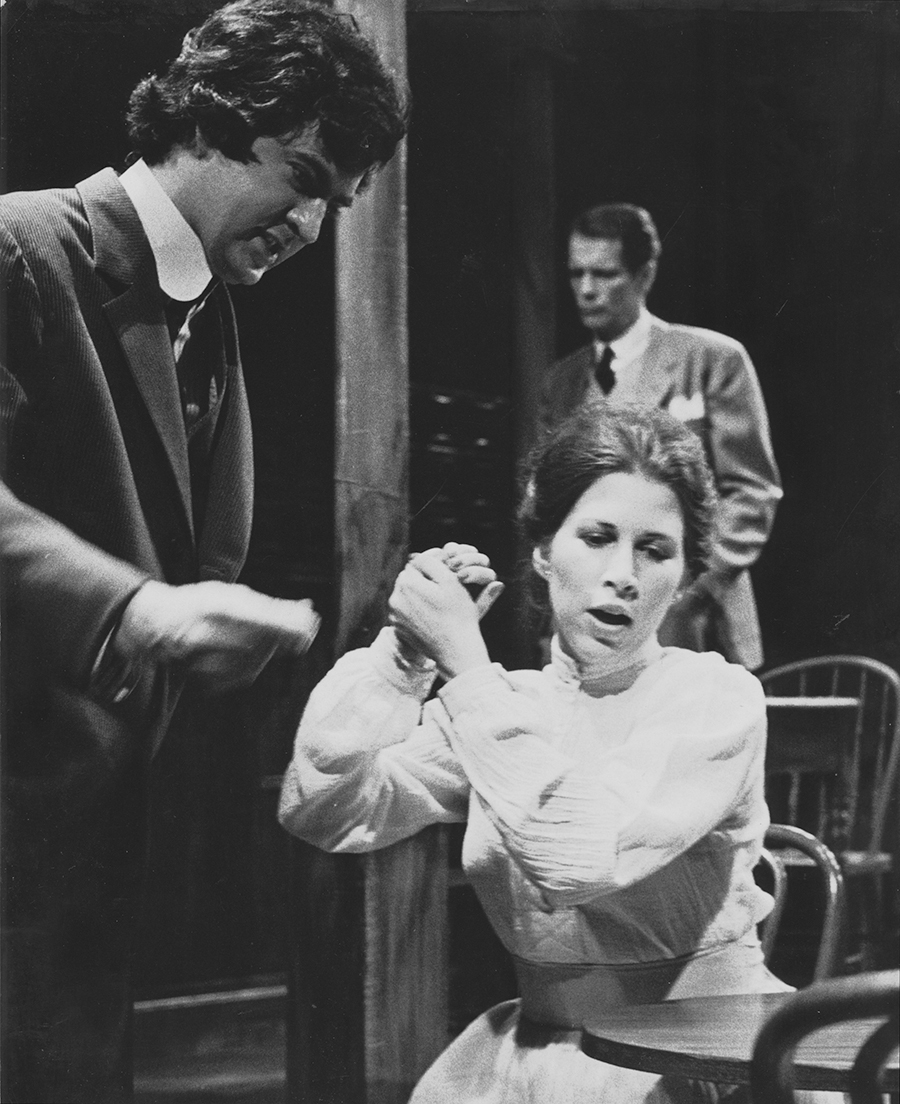
“Oh, it brings tears to my eyes. It’s so real for me. And Marshall didn’t know a thing about that and Lanford didn’t either. Marshall said to me once, ‘What are you using in this moment?’ I said, ‘Do you like it or do you not like it?’ He said, ‘I like it.’ I said, ‘Then I can’t tell you because once I speak it to you, it’s gone.’ I love the secret life. I think every character, every person, we all have secrets all the time, things we don’t say, things we know about ourselves and never want to share. You’ve got to find those things, you must find those things with each person.”

Of course, like an honored houseguest, an actor — even one desperate to work — can overstay his or her welcome inside a character. “The hardest thing in a long run is to know what you know when you know it,” says Reehling, adding a cautionary tale about Carrie Nye from Mary, Mary. “She has a scene where she comes storming in the door, takes off her gloves, throws them down, walks over and says blah, blah, blah, blah, blah and then walks in the bedroom, off stage. She came in one day, took off her gloves, threw them down and said blah, blah, blah, blah, blah, went into the bedroom off stage and walked straight over to the stage manager’s booth and said, ‘I’m giving
notice.’ At intermission she tells the stage manager, ‘Did you realize I wasn’t wearing the gloves?’ She came in, took off gloves she wasn’t wearing, threw them down and didn’t even know she wasn’t wearing them. Time to go.”

Ted Sluberski is an acting instructor in New York City. “I was a very young casting director in the late ’80s, early ’90s. The best thing that could happen to a young casting director was, at one point, Joyce said something to the effect, ‘I think you might be in this for the long run, so I’m going to show you how to talk to an actor.’ And she did. We hit it off like a house on fire. In my now 36 years in the business, the best way to describe Joyce was she did her job to the fullest extent, always. Whether it was a Broadway show, whether it was guest star, whether it was commercials — which are a craft aspect of the business — her commitment to the basic core of acting was consummate. The people who survive in this business are the people who do their job to the hilt. I’ve seen her do some dramatic things. I’ve seen her do some brilliantly comedic things. She always built a person. She didn’t build the idea of someone.”

Reehling and her husband, Tony Elms, the person she refers to as “the most precious man in the world,” have lived in Pinehurst for nearly 10 years. This month she’ll join Sally Struthers (All in the Family, Gilmore Girls) and Kim Coles (Living Single, In Living Color) in the Judson Theatre Company’s October 18-21 production of Love, Loss and What I Wore, by Nora and Dehlia Ephron. It will be the second time Reehling has appeared in one of Judson’s productions, this time with a tad more advance notice.

“Joyce has been like a guardian angel to Judson Theatre Company,” says its founder, Morgan Sills. “I’m not sure everybody realized she had this major past life in New York on television and on the screen working with all these legendary people” (Richard Thomas, Bill Hurt, Swoozie Kurtz, Jeff Daniels, Christopher Reeve, Gig Young, Holly Hunter, Alec Baldwin, Mary Louise Parker, Timothy Hutton, to name a few). Reehling’s first appearance for Judson, however, came straight out of the bullpen. Dawn Wells of Gilligan’s Island fame was cast as Weezer in Steel Magnolias but wound up in the hospital, if just temporarily, instead of on the stage.

“Someone alerted me to Joyce,” says Sills. “She understood the situation. We walked her through it a couple of times and she went on. And she was wonderful.”

Sills thinks the Ephrons’ play is a perfect fit for Reehling. “It’s basically five extraordinary women across the generations, telling the stories, the defining moments, of their lives, via the clothing they had on at the time. So, it’s a piece that shows her tremendous range. Make you laugh; bring a tear to your eye. It’s heartwarming and human and I think it will resonate with everyone. The track of roles Joyce is doing I’ve seen performed by a lot of prodigiously gifted New York actresses, and Joyce is very much in that mold.”

The Reehling/Elms house off Linden Road is filled with art, each piece seemingly with its own secret life. “I love this,” Reehling says, pointing to a painting by James Feehan of figures and poles and shaky equilibrium. “It’s called ‘Tenuous Balance’ and I said, ‘Boy, that feels like my career.’ I wish it had gone on longer. I was never an ingénue, I was always a character girl, and that shortens your life, but women in general have short lives in the theater and film. I can honestly say I can see myself standing in a field near our little red house outside of Baltimore — my father had volunteered us for the job of picking up stones for 25 cents an hour — and I can remember in the back of my head going, ‘How am I going to get from here to where I want to go?’ I didn’t know how I was going to do it, but I did it, one foot in front of the other.” One secret life at a time.  PS

The Kitchen Garden

Indian Corn

More than just an autumn decoration

By Jan Leitschuh

Frost on the pumpkin? Maybe in a few weeks. Maybe.

Collards? Next month they will be sweeter.

Fall decor? Check. Change of seasons? Yes, please!

After surviving the sultry swelter that is a Sandhills summer, we can get giddy with the first bite of crispness in the air. It might be but a faint promise — just a mere coolness at night and a whole lot of dew in the morning — that drives us to decorate our households and doorsteps with the earthy items of fall in anticipation of cooler weather. We love our orange, white and blue pumpkins, rainbow assortments of mums, gourds, leaves, hay bales — and colorful Indian corn, America’s native grain.

You can see Indian corn gracing Sandhills doors and tables, with an autumnal color display to excite heat-dulled senses. It’s a fall decoration that can take us from mid-September through Halloween, then right into the harvest cornucopias of Thanksgiving. The lovely October palette of rusts, purples, golds, reds, steely blues, pinks and browns in nature finds an echo in Indian corn.

It’s not hard to grow, if you are so inclined. If not, grocery stores, Co-op boxes and farmers markets also offer a selection of parti-colored ears with wonderful names like Painted Mountain, Indian Fingers, Calico and Bloody Butcher.

There are many colors and kinds of Indian corn. We are familiar, of course, with modern sweet corn with yellow or white kernels. The sweet corn we devour in summer is wholly different from Indian corn. We took the hard, dry native strains and over time, selectively bred for a tender, modern, juicy ear with an abundance of natural sugars. Sweet corn is also harvested at a juicy point in its life, called the “milk” stage.

Unlike sweet corn, Indian corn, or “flint” corn, has a low water content that, when dried, makes it easy to preserve and store — and display. Some ears of Indian corn are pastel multi-colored, or yellow and rust-red, or grey, white and gold.  Other types are one solid color like a deep mahogany or an eye-catching grey-blue.

The common treatment is to shuck three to five ears to expose the colored kernels, then bind together with wire to make a door hanging. A bright fall-colored bow tops off the display. Others affix their ears to a fall wreath. One can actually make an eye-catching wreath of the cobs, attaching them to a wire frame with the shucks aimed outward in a papery flair. Google “Indian Corn Wreath DIY.” Another wreath alternates 10 ears with the shucks. I’ve also seen baskets of cobs mixed in with gourds and miniature pumpkins as table decorations, or cobs used in florist displays.

The kernel colors are based on genetics. Like puppies, each kernel can have a different “father.”

A single grain of pollen from the tassels at the top of the corn stalk drops onto a “silk,” an elongated stigma on the cob. Many tassels in a field, and many silks, contribute to the genetics of a kernel. Indian corn has widely varied genetics for color, so the eye-catching, multi-colored cobs can result.

As a species, corn — or maize, Zea mays — was domesticated by the indigenous peoples of Mesoamerica, then grown for thousands of years. The plants adapted to unique local conditions, spreading widely throughout the Americas and were often traded. When early explorers carried this new grain back to Europe, it spread rapidly there, too, as a new cereal grain that could thrive in varied climates.

There are many types of what we call Indian corn. The colors and genetics are as diverse as the tribes that grew and saved the seeds. These so-called “land races” are important reservoirs now for unique genetic material for future plant breeding, a veritable gene bank of potentially useful traits. 

Recently in the news we learned of the discovery of an older corn strain with a gene for fixing nitrogen in the soil, as soybeans do, that grows well in poor soil. This is promising, since corn is a nitrogen-hungry crop and nitrogen production is expensive, energy intensive, and its runoff can pollute ground waters. Marry that gene to higher-producing strains, and a revolution in grain production could possibly result.

Can you eat your Indian corn display? That depends.

You can but . . . please . . . not if it has been sprayed with shellac by crafters to preserve the ears — an unlikely prospect if you purchased your corn still in its protective sheath, or corn shuck. It’s possible to grind unsprayed ears, and the resulting flour can be used for masa, tamales or polenta. The Thanksgiving dish “Indian Pudding,” rich with cornmeal, milk, molasses and maple syrup, is another use.

The corn seeds first need to be “popped” from the cob, usually over a bowl or bag. Then the kernels are ground in a coffee grinder or Magic Bullet (guessing here that the stone mortar and pestle doesn’t appeal). A coarse setting on your grinder can give you the makings of fresh grits.

If you do decide to grow some Indian corn at the back of your garden next fall, you don’t have to buy special seeds; you can just shuck some kernels from your favorite ears of Indian corn (again, assuming it’s shellac-free). Store seeds out of the reach of rodents in an airtight bag in a cool, dry area for the winter. The freezer is a good idea.

When the soil warms strongly next spring, plant in rich soil — as a type of grass, corn is nitrogen-hungry. Plant in a block or multiple rows so the corn is easily pollinated by the wind. Single rows give you poor pollination, and the ears will not fill with kernels. Water well, and offer a little fertilizer when the sprouts emerge.

Don’t plant your Indian corn near your sweet corn, because the two will happily cross-pollinate, and your sweet corn will not be very sweet. Keep the plots a minimum of 250 feet apart, or else separate your plantings by two weeks so they don’t tassel at the same time. Allow corn to dry somewhat on the stalk, then harvest in mid-September or so. Bundle the cornstalks for a further fall display.

If you can rodent-proof your Indian corn wreath or display, and you can keep it dry, you can use it again next year. But I tend to complete the seasonal cycle, sharing our pretty bounty at Thanksgiving with the local squirrels, and moving on to Christmas.  PS

Jan Leitschuh is a local gardener, avid eater of fresh produce and co-founder of the Sandhills Farm to Table Cooperative.

The Evolving Species

Stairway to Heaven

A resting place in life’s long journey

By Claudia Watson

This morning I made a point of waking before sunrise and padding off in a pair of old boot socks to the little deck at my place in Seven Devils, up in the high country. I grabbed a nubby sweater against the air of a late October morning and stepped into the day with my hands wrapped around a cup of hot tea. 

A veil of fog clings to the valley at the base of Grandfather Mountain. The distant mountain ridge surrenders to the sunrise, unleashing a canvas of color. This early on a Sunday morning there won’t be many leaf gawkers, and it’s perfect for my journey down a road to a spot that’s become, over 20 years, a pilgrimage.

My husband, Roger, and I would bike a narrow, practically flat paved road that hugs the South Fork of the New River. We’d travel along Railroad Grade Road, a 20-mile trip from the general store in Todd to the tiny community of Fleetwood and back. Our first ride down this road was 23 years ago on an early June morning, riding new cross-country bikes — his, black; mine, green — wedding gifts to each other that spring. 

With our lunches and water bottles tucked into our backpacks, we idly explored the winding river valley, protected by steep slopes covered with Christmas tree farms and dotted with old homesteads and lush meadows. A fox looked up, startled from his morning kill. A small herd of whitetail deer dashed from a roadside thicket to the river, nearly knocking me from my bike. We teamed up to shoo a wandering cow back into her pasture, closing the gate behind her.

About midway in our ride, Roger yelled back to me, “Hey babe, look at that,” pointing to a cast concrete stairway leaning against one of two towering tulip poplars. The steps were an invitation to stop and sit a spell in the shade and enjoy the long view of the clear river rambling 30 feet below. 

But it was the trees and the placement of the stairs that offered more fascination as they held onto a narrow spit of earth. The one-lane road, which was originally the rail track for the Virginia Creeper, barely squeezed between the river and a rocky outcrop. The only sign of neighbors was a sprawling farmstead at the river’s broad bend, and a tidy brick home tucked into the hillside farther down the road that was guarded by a frisky border collie.

That tiny grass outcropping above the New River became a favorite way station whenever we returned to the high country. Often, after fly-fishing the river or streams nearby, we’d return to the spot, settle into our camp chairs, and enjoy lunch or a late afternoon beer and the constant chatter of life — the hopes, the dreams, the blessings. Even during our winter trips, we’d make time to huddle together on the cold concrete steps, if only for minutes.

It was on a summer’s day while sitting on the steps looking up through the tulip poplar’s canopies — a mosaic of green hues against the blue sky — that I dubbed the location, without much thought, Stairway to Heaven, marking it with a pencil in our dog-eared map book where we cataloged favorite fishing spots and trails.

Though we couldn’t figure out how the steps arrived where they were, we sensed the specialness of the place. Over the course of 20 years or so, the steps became part of our journey. When we arrived at the spot four years ago in October, we saw one of the two tulip poplars was gone, only the stump remaining. Thankfully, the old moss-covered stairway was still there leaning against the solitary tree dressed in its bright yellow glory. We took out our camp chairs to enjoy the sun-kissed day as the leaves danced in the air.

The border collie at the nearby house, less frisky in time, began barking but finally gave up and went to rest with its owner, a silver-haired woman sitting on the porch. I wanted to walk down the road and ask her about the steps, but Roger felt it was intrusive. He preferred our creative musings. With our belongings packed into the car, I gathered a handful of jewel-colored leaves. Roger paused, looking at me, “Hey babe,” he said, motioning me to join him on the steps.

He sat on the top step, and I sat on the one below leaning into him as he wrapped his arms around me. I felt him suck in a deep breath as if to hold back tears, and he buried his head into my neck and whispered, “Babe, you’ve made me so happy. I don’t know how I’d ever go on without you. I love you so much.” We stayed a few minutes, wiped our tears and moved on, waving at the old woman and her dog as we drove off.

On a pretty spring morning the following May, I approached the familiar turn in the road and winced when I saw the stairway and pulled off to the grassy spot. For the first time, I was alone. That past October was our last together. My beloved died the day after Christmas. I pulled the camp chair from the car and sat looking at the river valley bursting with life and hesitated, wondering how I’d ever go on as the tulip poplar’s soft yellow blossoms fell around me.

Then, with a quiet prayer, I opened my hand and let some of him catch the wind and become one with this place — as much as the tulip poplar, the birdsong, and the ancient river. Soon, the little dog down the road began barking. I saw the silver-haired woman on her porch and, without a thought, walked to the edge of her property and asked, “Can you tell me about that spot?” pointing to the tree and the steps. “We’ve been coming here for over 20 years and wondering about those steps.”

Patting her leg, she laughed “Oh, lots of people wonder ’bout them. They came from the house over there,” pointing up the road. “My brother lives there, and he took off a porch and steps, just rested ’em up against the tree years ago.”

It was such an ordinary story. 

“Folks come here all the time and take photos sittin’ on the steps,” she added. I told her about our contrived story of a great storm and flood that deposited them in such an unlikely place. “No,” she said with a shake of her head, “the river’s never been that high, honey.”

“We named them the Stairway to Heaven,” I offered.

Her lips broke into a smile, “Well, that’s right nice. I like that.”

I told her that I had lost my husband. “I understand, dear, I lost my husband just five years ago,” she sighed. “Honey, life’s not easy, but this here, it’s a peaceful place until we get up there to see ’em again.”

On an October morning nearly four years later, I am out the door. Navigating the narrow, pothole-strewn road, my heart racing until I turn the last bend and see the tulip poplar and the steps and find my spot under the tree. With nary a breeze, it unleashes a cascade of golden leaves upon me.  PS

Claudia Watson is a Pinehurst resident and a longtime contributor to PineStraw and The Pilot

Mom, Inc.

Not Picture Perfect

A night at Camp Alternative Universe

By Renee Phile

The four of us pulled into the campground, welcomed by an eerie feeling. The accommodating pictures on the website — the luscious green woods and the thriving campfires — seemed to have been replaced by broken down 1940s campers, scattered trash, clotheslines sagging under the weight of laundry from the Cretaceous Period, a meteor shower of stray cats darting from site to site and, of course, No Trespassing signs.

“This can’t be right,” I said to Jesse, who nodded.

“Should we check in? Or just leave?” he asked.

“I don’t know.”

“This place is weird,” David, 14, piped up from the back seat. “What’s up with all the cats?”

“Let’s just drive around and see if it gets any better,” Jesse, the optimist, said.

As we drove deeper into Camp Backwater, we saw travel trailers, pop-ups, and live-in year-round campers scattered about. Paint peeled from the small houses sitting between them. A cat streaked in front of our car and disappeared.

“This is nothing, and I mean nothing, like the website said it was,” I said. “And it’s not cheap either.”

Though the primitive amenities of the state park down the road now seemed like Shangri-La compared to Camp Irregular Heartbeat, we decided to check in and make an adventure of it. Maybe I could jumpstart a murder mystery.

The lady at the desk, with grey eyes peeking out behind wiry glasses, seemed nice enough until she delivered the worst news David, and his 10-year-old brother, Kevin, could ever possibly hear, “No Wi-Fi for your devices.”

As we cleaned up the trash left from the previous occupants of our campsite, a large, yurt-shaped man shuffled over, shoeless, dressed only in his boxer shorts and what looked like the T-shirt Sonny Corleone was wearing at the tollbooth.

“Hi! I’m Chris! Welcome to the suburbs! Don’t mind the cats. They’re mine. I’ve lived here for over a year. If you need anything, let me know.” Like what? A bell?

A teenager, who seemed to have already dipped heavily into the catnip, sped by on a bike and exclaimed, “I’m too blessed to be stressed! What about you?”

“Might want to stay away from him,” Jesse muttered to the boys as he put a spike in the ground to pitch the tent.

A couple with a small child and a baby pulled their SUV into the site next to us. The baby crawled around in the dirt, while the dad burned through gigabytes of data on his smartphone, Googling “campgrounds near me.” They left in seven minutes.

I decided to walk to the bathhouse. The sanitation grade was “C” for cruddy, and a blue leatherette front seat from a car sat in the middle of the floor, seatbelts dangling. A cat was curled up on top. As I was in the bathroom stall, the cat came in and nuzzled my legs. “Oh, this isn’t weird at all,” I said to the cat which meowed loudly.

That night our fire wouldn’t start. Jesse could make cement blocks burn, so if he can’t get a fire to start, there’s a problem. He dumped an entire bottle of lighter fluid onto the wood. It would flare for a few seconds, then go straight to tiny puffs of smoke. He marched down to the camp store and asked for a refund on the $10 pile of wood. That didn’t burn, either.

Our “neighbors,” led by Chris, drank late into the night, singing the lyrics they could remember to the country songs they thought they knew while the cats meowed in harmony. Shadows passed by our tent every few minutes and Kevin said, “Mom, can I sleep with you?”

In the morning I said a thank you prayer that we all survived. Then we went to a Walmart across the road and bought a board game called “Stuff Happens.” In it each player rates cards from 1-100 on tragic things that might happen to you. It could be as simple as “Lose a Toenail” or as serious as “Lose an Eye.” The other players guess the rating of each card and if you are close, you get the card. The person with the most cards at the end is the winner.  I looked through the cards to see if “Stay at a Creepy Campground Infested with Cats” was one of the options.

It was 87.  PS

Renee Phile loves being a teacher, even if it doesn’t show at certain moments.

The Omnivorous Reader

Linking Different Worlds

Orr and Sparks connect North Carolina and Africa

By D.G. Martin

Two important new novels are set in North Carolina and in Africa. It is an amazing coincidence because the books’ authors live in two different literary worlds.

The first new, Africa-connected book is N.C. State professor Elaine Neil Orr’s Swimming Between Worlds.  She is a highly praised author of literary fiction.

The second is New Bern — based Nicholas Sparks’ latest, Every Breath, which is being released this month. Sparks’ 20 novels have been regulars on The New York Times best-seller lists, often at No. 1, making him one of the world’s most successful writers of what some call commercial fiction.

What is the difference between literary and commercial fiction? According to Writer’s Digest, “There aren’t any hard and fast definitions for one or the other, but there are some basic differences, and those differences affect how the book is read, packaged, and marketed. Literary fiction is usually more concerned with style and characterization than commercial fiction. Literary fiction is also usually paced more slowly than commercial fiction. Literary fiction usually centers around a timeless, complex theme, and rarely has a pat (or happy) ending. Commercial fiction, on the other hand, is faster paced, with a stronger plot line (more events, higher stakes, more dangerous situations).”

Although both Orr and Sparks would argue that their work cannot be neatly packaged in either genre, the literary/commercial distinction helps prepare readers for the authors’ different styles.

In these two books, both authors tell compelling stories and feature interesting and complex characters.

Orr’s Swimming Between Worlds raises the question of whether there is a connection between the 1950s Nigerian movement for independence and the civil rights movement in Winston-Salem.

Orr grew up as the child of American missionaries in Nigeria. Her experiences gave a beautiful and true spirit to her first novel, A Different Sun, about pre-Civil War Southern missionaries going to black Africa to save souls.

Instead of slaveholding Southerners preaching to Nigerian blacks, the new book contrasts the cultural segregation of 1950s Winston-Salem with the situation in Nigeria. Although Nigerians at that time were coming to a successful end of their struggle for independence from Great Britain, they were still mired in the vestiges of colonial oppression.

Set in these circumstances is a coming-of-age story and a love story. These themes are complicated, and enriched, by the overlay of Nigerian struggles and the civil rights protests in Winston-Salem.

The main male character, Tacker Hart, had been a star high school football player who earned an architectural degree at N.C. State. He was selected for a plum assignment to work in Nigeria on prototype designs for new schools.

Working in Nigeria, this typical Southern white male becomes so captivated by Nigerian culture, religion and ambience that his white supervisors fire him for being “too native” and send him home. Back in Winston-Salem the discouraged and depressed Tacker takes a job in his father’s grocery.

The female lead character, Kate Monroe, is the daughter of a Salem College history professor. Her parents are dead, and after graduating from Agnes Scott College, she leaves Atlanta and her longtime boyfriend, James, to return to Winston-Salem and live in the family home where she grew up. She still, however, has feelings for James, an ambitious young doctor.

How Tacker wins Kate from James is the love story that forms the core of this book. But there are complications created by a young African-American college student who is taking time off to help with family in Winston-Salem. Tacker and Kate first meet Gaines on the same day. After Gaines buys a bottle of milk at the Hart grocery store, white thugs attack him for being in the wrong place (a white neighborhood) at the wrong time. Later on the same day, Kate spots an African-American man holding a bottle of milk, walking by her home in an upper-class white neighborhood. She thinks he probably stole the milk. She is terrified, and immediately locks her doors and windows. She shakes with worry about the danger of this young black man walking through her neighborhood. The young man is, of course, Gaines.

It turns out that Gaines is the nephew of Tacker’s beloved family maid. Tacker and his father hire Gaines to work in the grocery store, and he becomes a model employee.

But Gaines has a secret agenda. He is working with the group of outsiders to organize protest movements at lunch counters in downtown retail stores.

Gaines sets out to entice Tacker to help with the protests, first, only to allow the store to be used at night for a meeting place. Then, over time, Tacker is led to participate in the sit-ins.

In Nigeria, Tacker had found his black colleagues and friends to be just as smart, interesting, and as talented as he was. He found them to be his equals.

Back in Winston-Salem, he has at first slipped back into a comfort level with the segregated and oppressive culture in which he grew up. His protest activities with Gaines put his relationships with his family, Kate and possible employment at an architectural firm at risk.

Tacker’s effort to accommodate his growing participation in the civil rights movement with his heritage of segregation leads to the book’s dramatic, tragic and totally surprising ending.

The African connection in Nicholas Sparks’ new book is Tru Walls, a white safari guide from Zimbabwe, formerly Rhodesia. In 1990, the 42-year-old Tru comes to Sunset Beach to meet his biological father. It is his first visit to the United States. On the beach he meets Hope Anderson, a 36-year-old nurse from Raleigh. She is in a long-term relationship with Josh, a self-centered orthopedic surgeon. Nevertheless, she and Tru immediately fall into a deeply passionate love affair.

How Hope resolves her competing feelings for Tru and Josh is the thread that guides the book to a poignant conclusion 24 years later at another North Carolina beach.

In the meantime readers learn from Tru’s experiences about the lives of white farm families and the competing claims of the overwhelming black majority in Zimbabwe. Sparks’ descriptions of wildlife and the safari experience evoke memories of Ernest Hemingway’s African short stories.

Sparks’ publishers say that Every Breath is in the spirit of The Notebook. In both books, the lovers’ early encounters involve fiery and youthful passion. Sparks brings them together again years later as older, even infirm, people still deeply in love.

PBS’s Great American Read has named The Notebook one of America’s 100 best-loved novels. It’s the only book set in North Carolina to make the list. On Oct. 23, PBS will announce the one book selected as America’s best-loved novel.

Voting will be open until Oct. 18. You may register your votes for The Notebook and for other books on the list. Go to www.pbs.org/the-great-american-read/vote/. For a list of all 100 books, go to www.pbs.org/the-great-american-read/books/#/.

As part of its participation in The Great American Read during the first two weeks in October, UNC-TV will air special “North Carolina Bookwatch” interviews with Sparks about The Notebook and Every Breath. PS

D.G. Martin hosts “North Carolina Bookwatch,” which airs Sundays at noon and Thursdays at 5 p.m. on UNC-TV.

Wine Country

The Chardonnay Way

Finding the right fit for fall

By Angela Sanchez

There are as many reasons why so many people, in so many places, love chardonnay as there are, well, chardonnays. It’s highly adaptable and easily grown in many soil types and climates. It’s easily influenced by where it’s grown and by the winemaker’s hands, with as many styles and price points as its broad range of appeal would suggest. But does anyone really know what chardonnay should taste like? If we compare chardonnay-to-chardonnay (like apples-to-apples), there are styles ranging from Golden Delicious to Pink Lady to Granny Smith. If you like big, rich, round and citrus; or bold, oaky and tropical; or lean, mineral lemon-lime characters (my favorite), there is a chardonnay for you. Oak bomb, butter bomb, or classically elegant and restrained, chardonnays in all these forms, and more, are out there.

Chardonnay’s origin is in the Burgundy region of France, where I believe it’s at its very best. Burgundy is where you find chardonnay based on true terroir. In Chablis, a cool climate with limestone soil, the chardonnay is crisp, lean and clean. Minimal oak aging is used. Those who like Domaine Dauvissat use it as a complement to the natural flavors of chardonnay and to round out its natural acidity, pronounced by Chablis’ cool climate. Others, like Domaine Louis Michel & Fils, use no oak on any of their chardonnays, leaving them in their pure form, racy and mineral driven. A mix of soil types and elevation in Burgundy make the malleable chardonnay grape show different characteristics from one growing region to the next. In Meursault, chardonnay is rich, buttery with some honeyed notes, while in the neighboring region of Puligny-Montrachet, hazelnut, lemongrass and green apples are the primary characteristics. North of Burgundy in Champagne, we find chardonnay used as a blending grape in styles like brut and sec. Or it can stand alone in its yeasty, nutty, racy beauty in blanc de blanc, a 100 percent chardonnay. In regions with cooler climates and limestone-driven soils, chardonnay lends structure and backbone to the blends and bright, focused acidity to the blanc de blancs.

Chardonnay is grown all over the world, in warm climates, cool climates and those that have heavy coastal influences. Each country and region produces a chardonnay of a different flavor. Add the light or heavy hand of a winemaker and chardonnay becomes something else altogether. California chardonnay is a great example. Cooler climates in Northern California, like Carneros, produce chardonnay with higher acid and more structure than those from warmer climates in the south around Santa Barbara and Santa Lucia Highlands. Whether naturally higher in acid or more round and lush (depending on the growing region), the winemaker can greatly influence the wine as well. For many years winemakers in the New World were heavy-handed with oak “treatments,” or aging in barrels and manipulating the fermentation process, creating wines that were overly weighty, with buttery notes and vanilla, or predominantly oaky. Big, mostly over-the-top California chardonnay became the norm. Nowadays winemakers show more restraint with their influence on the wines, resulting in cleaner styles that allow consumers to taste a difference from region to region based on elevation, climate and soil — the terroir. The trend is due both to consumers’ move to a fresher, lighter style of chardonnay and to their consumption of imported chardonnay from areas like France and Italy. Winemakers are also keen to let their region, vineyard and their own house style show through rather than producing and manipulating chardonnay to be oaky, buttery and slightly sweeter.

Something about chardonnay has always reminded me of fall; maybe it’s the golden-hued color, like the turning leaves and afternoon autumn sun. With cooler weather, I still like to drink white wines, maybe just not as crisp and light as in late spring and summer — something with a bit more weight and viscosity. Enter chardonnay. As a personal preference I choose to drink Burgundy. If I’m going big on spending and style, I’ll choose a Chablis or Puligny Montrachet or, for something more budget-friendly and offering a lot of wine for the money, a selection from the Mâconnais or Côte Chalonnaise. As always, I add a cheese to snack on with the wine. Stick to the old saying “if it grows together it goes together.” Triple cream Brie, with fresh cream added during the production process, produces a spreadable butter-like cheese that matches nicely. Brillat-Savarin cheese made in the Burgundy region is a classic example of the triple cream style. Small wheels, about one pound in weight, made from cow’s milk with a bloomy white rind, resemble perfect little cakes when whole and fresh. Cut into them and you’ll find a delicate soft cheese with sweet butter and slightly nutty notes. A little stronger cheese, but still with the same elegance and beauty, is Delice de Bourgogne. The addition of cream fraiche to the cheese makes it even more decadent and luscious with added notes of mushrooms and earth. Not to mention it is a dream companion with Champagne.

As you ponder the rows and rows of chardonnay at your local wine shop, or the wine list at your favorite restaurant, be bold and try something new. If you always drink California chardonnay, try Burgundy. Or vice versa. Grab some triple cream Brie and you just might find a chardonnay style that’s right for you.   PS

Angela Sanchez owns Southern Whey, a cheese-centric specialty food store in Southern Pines, with her husband, Chris Abbey. She was in the wine industry for 20 years and was lucky enough to travel the world drinking wine and eating cheese.