Almanac

Spring violets follow snow; the daffodils push through it.

Whoever grumbles curses at this cold month need only witness an explosion of February Gold, the early bloomer that utterly beams with exaltation.

We thaw from the inside out.

In the garden, wren and titmouse sing out from bare branches, and something within you stirs. You put on the kettle, light a candle, phone a friend you didn’t know could use the extra warmth.

Come over, you say, reaching for an extra mug. 

Some days, just as the daffodils push through snow, your kindness is the February Gold that lights up the world.

Say It in Flowers (or Spoons)

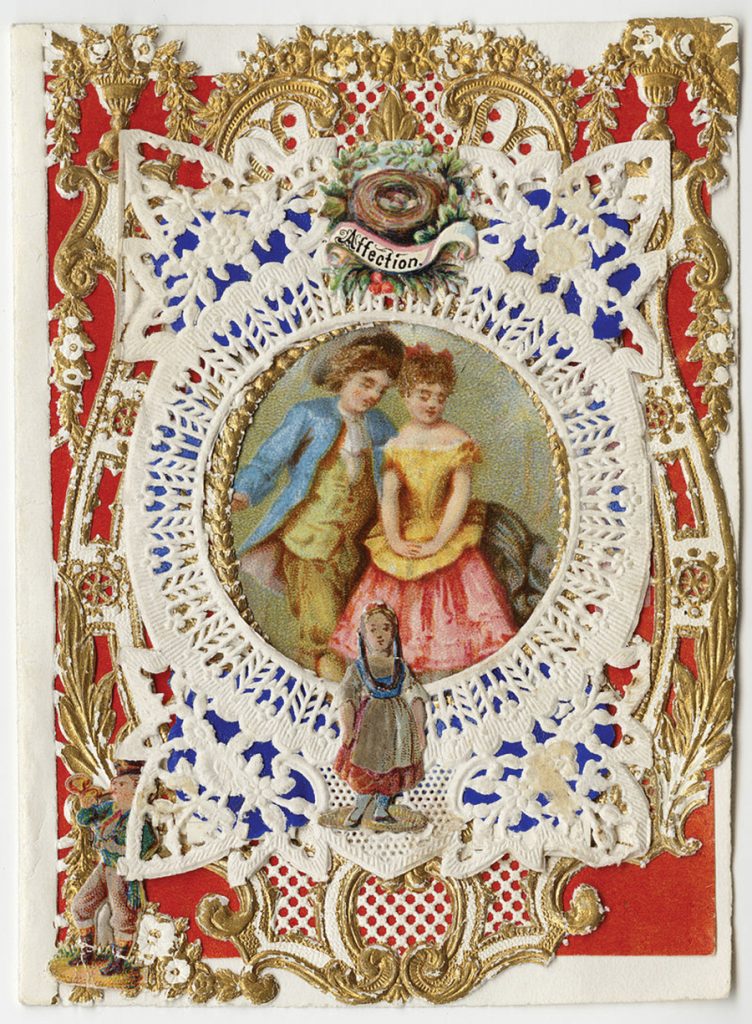
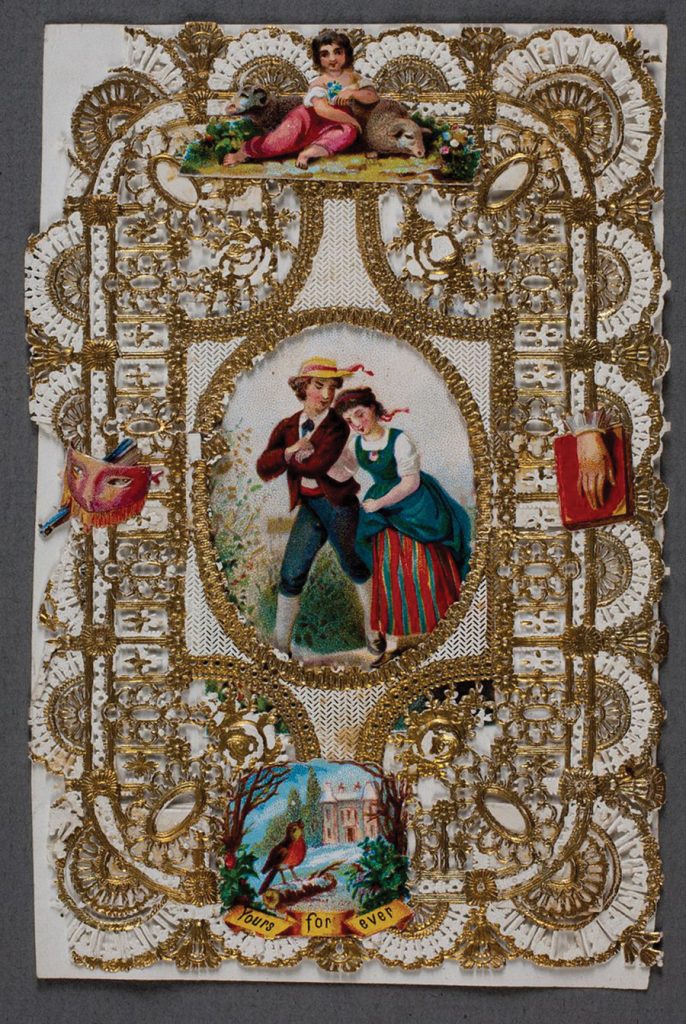
This and every month, red roses say I love you. But if you’re looking to dazzle your sweetheart with something different this Valentine’s Day, here are a few customs from around the world:

Exchange pressed snowdrops (Denmark).

Pin the name of your one true love on your shirtsleeve (South Africa).

Offer carved melons and fruit (China).

Although the Welsh celebrate their patron saint of lovers on Jan. 25, this gift might take the cake: the love spoon. Carved with intricate patterns and symbols, these wooden spoons have been given as tokens of affection for centuries.

Let us love winter, for it is the spring of genius. — Pietro Aretino

This Little Piggy

Tuesday, Feb. 5, marks the celebration of the Chinese New Year. Cue the paper lanterns for the Year of the Pig, a year of wealth and good fortune. Also called the Spring Festival, this lunar New Year is considered a fine time to “sweep away” ill fortune and create space for your abundance to arrive. It’s also a fine time for dumplings.

Because they resemble ancient gold ingots, Chinese dumplings are made by families on New Year’s Eve for the same reasons we slow-cook black-eyed-peas and collards.

In honor of the Year of the Pig, consider trying your hand at homemade dumplings. Or, in case you missed out last month, here’s a Hoppin’ John recipe adapted from The Traveling Spoon Chef on Instagram:

Ingredients:

1 pound dried black-eyed peas

10 cups water

1 medium onion, diced

1/4 cup butter

1 ham steak, diced

1 teaspoon liquid smoke

1 teaspoon salt

1 teaspoon pepper

1 bunch chopped kale (optional)

1-2 cups cooked rice (optional)

Directions:

Soak black-eyed peas overnight in 6 cups of salted water. Rinse and drain well. In a large pot, sauté onion in butter until tender. Next, add one diced ham steak (optional), 4 cups water, liquid smoke, salt and pepper. Add drained black-eyed peas to the pot, cover, and let simmer for 4 hours, stirring occasionally. If desired, stir in kale and rice just before serving. And a pinch of extra luck.

“Save some leftovers for the following day,” says the chef, and call it “Skippin’ Jenny.”

The Garden To-Do

This month, plant your greens, Brussels, peas and beets. Turnips and radishes. Broccoli and carrots. Asparagus. And Irish potatoes, three inches deep.

There is a privacy about winter which no other season gives you . . . Only in winter can you have longer, quiet stretches when you can savor belonging to yourself.
Ruth Stout, How to Have a Green Thumb without an Aching Back

The Natural

Golfing, shooting or selling Sandhills real estate, Glenna Collett Vare was a star

By Bill Case     Photographs from the Tufts Archives

From her vantage point on the veranda, the lithe 14-year-old girl watched with interest as her father prepared to hit his drive from the first tee. In his younger days, George Collett won international bicycle racing championships but he could steer his way around a golf course, too. The memory of that shot in the summer of 1917, overlooking what Glenna Collett described as the “magic carpet” of the Metacomet Country Club in Providence, Rhode Island, became permanently imprinted in her mind. “I watched Dad send a long, raking tee shot through the air. It dropped far down the fairway, ” she recalled in Ladies in the Rough, a book she would author a mere 11 years later.

The ball’s soaring flight so captivated the teenager that she rushed to her father’s side with the enthusiasm of a child half her age flying down the staircase on Christmas morning. Despite never having swung a club, she saw no reason why she couldn’t smash a golf ball just like her dad and begged him to let her try. Collett’s self-confidence was grounded in her own athletic prowess. An accomplished swimmer, diver and tennis player, she could hold her own playing baseball with the neighborhood boys, too. Dad agreed to let her give it a go.

Brandishing her father’s hickory-shafted driver, Collett swung away. “With beginner’s luck my first shot off the tee went straight down the fairway,” she recalled. “The length and accuracy of my initial drive stirred the enthusiasm of my father and several spectators.” Elated and intrigued, George encouraged his daughter to play along. It became obvious that her first drive was no fluke. She struck one flush shot after another. It would be her golfing epiphany, writing later that her “head was bursting with the soaring dreams that only the very young and ambitious live and know. As I came off the course after the first game, my destiny was settled. I would become a golfer.”

Collett quickly learned that the naturalness of her swing did not automatically translate into stellar golf. On her next visit to the course, her shots boomeranged in all directions, and a floundering Glenna carded a horrifying and humbling 150. Though she drove it farther than other women at the club, Glenna’s subsequent rounds resulted in scores mostly north of 100. She confessed to being “terribly depressed at my slow progress.”

To lift his daughter out of her funk, George Collett retained two-time United States Open champion Alex Smith, who tutored his daughter twice a week for three years. As proficient a teacher as he was a player, the Scottish-born Smith’s whimsical instruction galvanized the young girl’s game. “Alex gave me a happy philosophy as well as an improved way of handling the putter and mashie,” she wrote. “He strengthened my driving to such an extent that . . . standing five feet six inches and weighing hundred and twenty-eight pounds, I drove a ball off a tee a measured distance 307 yards . . . the longest drive ever made by a woman golfer.”

By the age of 16 Collett acquitted herself with a measure of distinction (but no victories) in Eastern tournaments during the summer of 1919. Fearful that enduring the winter months in snowy Providence would stall her improvement, George and his wife, Adah, pulled their child out of school at Christmas break. While her father stayed behind to manage his insurance business, Glenna and her mother headed south to golf-mad Pinehurst, where they spent the first quarter of 1920 at the Carolina Hotel. While Glenna acknowledged that her chance of passing French back in Providence “went a glimmering,” playing in events like the North and South Amateur proved beneficial to her game. Extended annual visits to the Sandhills would become a happy staple of her life for the next 15 years.

By the time Collett arrived in Pinehurst for the 1922 winter season, she was recognized as an emerging force in amateur golf, the highest level of the women’s game at the time. In March, she captured her first major tournament on course No. 2 in the Women’s North and South, defeating an outgunned Edith Cummings in the final match 4 and 2. The Pinehurst Outlook observed that Miss Collett, as the players of the day were described, was “sure to win many important championships and to be one of the prominent figures in the game for years to come.” Later that season, she won the U.S. Women’s Amateur at the Greenbrier, consistently outdriving her opponents by 50 yards. The new champion revealed something of a superstitious streak. Having consumed lamb chops, stringed beans and cream potatoes the evening before a practice round in which she carded an excellent 75, Collett confessed to “eating the same thing every night as long as the tournament lasted.” She also “wore the same skirt, sweater, and hat.”

Her victory at the Greenbrier was a breathtaking achievement. No other golfer, before or since, ever won a major championship within five years after taking up the game. Public interest in all things Glenna rose to a fever pitch. The fact that the 19-year-old had become a stylish and attractive woman accentuated that attention. Collett acknowledged in Ladies in the Rough that the demands of new-found celebrity presented a wearing Catch 22: “Sooner or later the champion begins to realize that she is supposed to do this and that, either from a desire to be agreeable or an honest wish to live up to the sweet things said about her in sports columns. Most difficult of all is trying to be a ‘good sport.’ As such you are compelled to do many things you don’t give two hoots about, to go to parties when you just long to be in bed, to be nice to people, who ask all sorts of favors . . . but the champion, unless she has the skill of a diplomat, has no way of expressing her gratitude and at the same time refusing.”

Collett relinquished her U.S. Amateur crown in 1923 but successfully defended the North and South title. She also earned trophies at two Florida tournaments and the Canadian Women’s Amateur. Those successes would be dwarfed by Glenna’s monster 1924 campaign. Dubbed the “female Bobby Jones,” she won 11 of the 12 tournaments she entered (including her third straight North and South championship), prevailing in 59 of 60 matches. Her only defeat came at the hands of Mary K. Browne in the semifinal of the U.S. Amateur when, putting from 20-feet on the 19th hole, Browne unintentionally caromed her ball off Collett’s into the hole to close out the match.

Regaining her U.S. Amateur title in 1925 at St. Louis Country Club, Collett capped the championship with a 9 and 8 blowout of the veteran Alexa Stirling. Having retaken America’s most important title, she sailed across the Atlantic in an attempt to win a historic double at the British Women’s Amateur. For once, she found herself overmatched, facing England’s Joyce Wethered in the third round at rugged Troon. When the match ended after 15 holes, the brilliant Wethered stood five under par, leaving her American opponent in the dust. It was the first of several near misses for Collett in that championship. “More than once I have visualized myself, gray-haired and stooped, wearily trudging over the windswept fairways of an English course seeking that elusive title,” she wrote.

The disappointment did little to detract from Collett’s victory parade in America. With each triumph, her star glowed brighter. The legendary Donald Ross considered Glenna’s presence at the resort to be “good advertising,” and her amiability attracted a growing coterie of Pinehurst friends and admirers. Since the queen of American golf had chosen Pinehurst for winter lodgings, a glittering array of eager challengers followed suit. Virginia Van Wie, Helen Hicks and Maureen Orcutt, all championship-caliber players, visited frequently. Collett welcomed her fellow competitors, squaring off against them in tournaments, exhibitions and friendly one-on-one matches.

The 1920s were a golden time in Pinehurst. In addition to the female stars, legends like Walter Hagen, Tommy Armour, Bobby Jones and Jock Hutchison habitually visited, displaying their expertise on the resort’s courses. Golf aficionados flocked to the area in droves, not just to play but also to mingle with their heroes — both male and female.

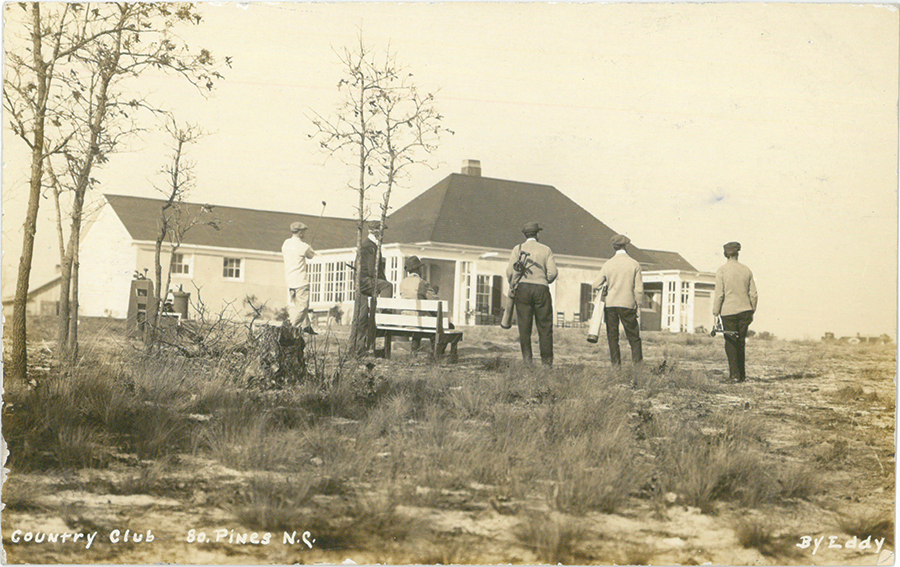
In 1920, Leonard Tufts sought to capitalize on the good times by launching a real estate venture on 5,000 acres adjacent to the pathway of the old Yadkin Trail (now Midland Road) between Southern Pines and Pinehurst, forming Knollwood, Inc., whose stockholders included himself, Ross, New York steamship lines magnate James Barber, H.A. Page, Pinehurst, Inc., and Waldorf-Astoria, Inc. The first phase of that development was completed in 1924 with the opening of the Mid Pines Country Club, and its 118 room hotel, imposingly situated just behind the 18th green of the Ross-designed course.

In January 1927, Leonard and the other shareholders embarked on a more ambitious phase of the development involving the subdivision and selling of hundreds of residential lots, many adjacent to the new Ross-designed Pine Needles golf course. A key aspect of the plan was the erection of the Pine Needles Inn (now Pine Knoll at St. Joseph of the Pines), a towering Jacobean structure that wowed all who saw it. The normally conservative Tufts reckoned that the booming economy and the imminent widening of Midland Road would result in brisk sales of lots and concluded the risk of borrowing money to finance the project would be minimal. Leonard’s own company, Pinehurst, Inc., was among the entities loaning substantial sums to the venture.

Construction of the golf course and inn proceeded apace. Casting about for a big name who would entice guests to the Pine Needles Inn after its scheduled opening of January 28, 1928, the Knollwood brass thought of Collett, adored by just about everyone. In The Story of American Golf, Herbert Warren Wind likened Collett to his favorite actress, Ingrid Bergman, since both women gave “majestic performance[s] when at work” but “generally scorned the queenly manner.” The admiring Wind praised Collett’s “fine sense of humor at her own expense; she added verve to a party with her high-spirited playfulness; and she was that very rare thing, a good winner.”

In exchange for room, board, free golf and some unknown stipend for herself and her mother, Collett accepted Knollwood’s proposal that she assist in promoting Pine Needles. She and Adah would relocate from the Carolina Hotel to the Pine Needles Inn on its opening day. The Pilot’s Bion Butler heralded Glenna’s arrival in his December 9, 1927 editorial: “She will be a feature of Sandhills outdoor life and probably her admirers will see that she is a central figure in much social contact in the house [Pine Needles Inn].”

Another marketing idea occurred to Leonard Tufts shortly after the New Year. Wouldn’t it be great for Pine Needles to host a women’s tournament coinciding with the opening of the hotel with Collett as the main attraction? Ross had doubts whether the event could be staged with only 30 days’ notice. “I don’t know how much Miss Collett’s say-so would help,” the famed course designer wrote Leonard, “but it might because of the fact she knows them personally.” But Collett’s say-so did have clout, and she successfully recruited a strong field of 54 players for the Mid-South Open, contested a few days after the inn opened for business.

While promotion of Pine Needles and its facilities was important, the Knollwood investors were primarily concerned with generating cash flow from the sales of lots. The Pilot collaborated with Knollwood, running articles above the fold unabashedly highlighting each lot sale, and generally serving as the project’s enthusiastic booster. In one editorial, Butler opined that Knollwood’s success was of paramount importance to “the whole united interest of the whole Sandhills community, for we all advance or stand still or go back together.”

To augment The Pilot’s unwavering support, Knollwood manager J. Talbot Johnson and real estate agent Samuel B. Richardson (both of whom were Knollwood shareholders) embarked on a hard-sell advertising campaign to market the lots. After Ross bought two lots, an ad informed potential buyers that, “Donald Ross is the best authority in this country on values of real estate in the golf belts . . . He puts his money on Knollwood Heights.” Another gambit stressed the fine neighbors one would have by purchasing in Knollwood — most of them wealthy. “Mr. Sylvester,” says one Richardson ad, “is one of the big men in American finance as NCB has resources of around a billion dollars and heads everything else in the continent.” Richardson also stressed that “lots were going quickly” in the “buying whirlwind” and hesitant buyers should pull the trigger while there was still time. “Look at the maps in Richardson’s office,” (located at the Arcade Building  — currently Morgan Miller and Framers Cottage —  in Southern Pines), “and see how these lots are melting away.”

Well, lots were not “melting away” quite as fast as the Knollwood men intimated, but assistance in marketing them would come early in 1928 from an unexpected source — Glenna Collett. It’s not clear what led to her role in arranging and closing the sale of a lot to Wisconsin real estate operator Robert Whittaker in early February, 1928, but whatever it was, Sam Richardson began touting her as a saleswoman extraordinaire. Richardson’s ad in the February 12 Pilot suggested that potential buyers visit Miss Collett at Pine Needles and “get her to drift about Knollwood Heights with you and talk golf and home sites. She will be glad to as she is an enthusiast about Pine Needles and she says she will be glad to sell more Knollwood Heights lots.”

The Pinehurst Outlook also talked up Collett’s sales acumen, saying she was “as hard boiled in procuring a down payment as she is driving off the tee.” For her part, Collett insisted to the Outlook’s columnist “there is no reason why a woman should not be as good a salesman as a man.” She added that participation in sports “especially golf, should be a great help to a woman in business.” Glenna was not the only great amateur golfer selling golf course real estate. The star with whom she was often compared, Bobby Jones, was similarly employed in Sarasota, Florida.

The Whittaker deal jump-started an impressive sales streak by Collett that continued until her return North in April 1928. Richardson’s ads in The Pilot reported them all. The February 17 edition proclaimed “Glenna Collett in action again” after she engineered the sale of lot 456 to Connecticut state Senator Wallace Pierson. On March 9, The Pilot disclosed that Collett had sold three lots to Messrs. Sylvester and Brasleton. On April 13, her biggest real estate score yet made the headlines of the paper when she convinced Michael Meehan to purchase an entire block of seven lots, then talked him into buying five more for his daughter Betty Elizabeth. On a roll, she arranged George Van Kueren’s purchase of three more lots.

Her sales pitch was low-key. Richardson advertised that “Miss Collett has none of the hurrah, boys, style, but she simply interests her friends in discovering what they are anxious to find — the best spot on earth for a winter vacation, and she is a big influence in gathering the golf army together in the Sandhills.”

Collett won her third U.S. Amateur title at The Homestead in the summer of 1928, annihilating her friend Van Wie in the 36-hole final 13 and 12. Talbot Johnson recognized that her status as current national champion rendered her even more valuable to Knollwood. Notwithstanding Johnson’s concern that “selling lots is so secondary to [Collett’s] golf that even the best land prospect would have to wait,” he urged Richard Tufts (Leonard’s son) to arrange for her return for the 1928-29 winter season. “I imagine Glenna is going to be more popular than ever this year on account of having again won the championship,” Johnson wrote. “I am convinced that her name is quite an asset to both Pinehurst and Knollwood and she is a good drawing card for both.”

According to Johnson, Collett’s mother was keenly aware of her daughter’s marketability. Skillfully playing the role of unofficial agent, Adah never passed up an opportunity to remind Talbot that she and Glenna were constantly receiving “propositions from hotels offering not only to give them free board, but to pay railroad transportation.”

Collett and her mother eventually came to terms with Knollwood for a second year. They would bivouac at the Carolina in December, and then stay at the Pine Needles Inn after that house opened mid-January. Both The Pilot and Knollwood stepped up the marketing campaign in anticipation of their arrival. “With Glenna Collett and Mrs. Collett advocating the delights of Knollwood Heights as a place for a home in the North Carolina golf and vacation belt,” trumpeted one editorial, “the additions to Knollwood’s group this winter will be large.” Glenna herself penned a lengthy article on February 29, 1929, extolling the virtues of the Pine Needles course and Knollwood’s atmosphere. “I have come to prefer the new Pine Needles course to any of the others in the Sandhills,” she enthused, “because of its beauty and the associations that make it seem like home to me.”

Despite the hullabaloo, real estate sales activity slowed to a trickle that winter. Few were buying. Even Collett’s star power was insufficient to reverse the trend, and events in her life contributed to her sales slump. Still mourning her father’s untimely death in 1928, the presence of a handsome blueblood Philadelphian vacationing in Pinehurst provided a further distraction. The name of Edwin H. Vare, Jr. began popping up in The Pilot, linked with Glenna’s. The March 1st Pilot reported that Collett had fired a magnificent 73 at Pine Needles and Vare, her playing partner, carded 85. Vare attended a dinner dance in Glenna’s honor at Lovejoy’s log cabin restaurant in Southern Pines (once located near the present Methodist Church). A romance blossomed. Though not selling many lots, Collett kept busy promoting and playing in the second Mid-South Open at Pine Needles. It was the first tournament in women’s golf where amateurs competed against female professionals. The Chamber of Commerce raised a whopping $50 in prize money.

By the start of the Sandhills’ 1929-30 winter golf season, the shock of the stock market collapse and the looming Great Depression brought prosperity to a screeching halt. Even the wealthy shied away from building “winter homes.” Knollwood could not afford to keep Collett on the payroll despite her repeat victory in the U.S. Amateur championship. However, that did not stop her from continuing her brilliant play while in the Sandhills. She won her record sixth North and South title in March, and participated in an exhibition at Southern Pines Country Club that drew 2,000 spectators. In the summer of 1930, Collett carried home her fifth U.S. Amateur trophy (and third in succession), defeating old rival Van Wie at Los Angeles Country Club. That year, she organized a team competition between the best amateur female players of America and Great Britain that presaged the first Curtis Cup played two years later. Her sole golf disappointment was another defeat by her old nemesis Wethered in the British Amateur final at St. Andrews. Despite the result, Collett viewed the nip-and-tuck match as the most exciting of her career.

Vare and Collett married in June 1931, and she joined him in Philadelphia. The newlyweds would weather the Depression, but the fortunes of Knollwood and Pine Needles plummeted. The inn would shut its doors in 1931 and remain closed until new ownership reopened it in 1935. Creditors forced the liquidation of Knollwood’s assets. Fortunately, the Tufts’ lenders allowed the family members to retain their holdings in Pinehurst.

Glenna Vare dropped out of competitive golf in 1933 after giving birth to son Ned, then daughter Glennie, but she would author a memorable comeback in the 1935 national amateur at Interlachen Country Club in Minneapolis. Smashing her drives far past her finals opponent, the 32-year-old sentimental favorite bested 17-year-old Patty Berg 3 and 2 to record her never equaled sixth national amateur championship. ”I wanted to put ‘Vare’ on that trophy,” the always-competitive Glenna confided to a friend.

After her resounding triumph, Vare gradually faded away from golf on the national stage, though she continued to play in area events on and near her home course, the Philadelphia Country Club. She discovered new areas of sport to her liking. She trained sporting dogs for field competitions and found her excellent hand-eye coordination translated nicely to rifle shooting. The Vares would visit Pinehurst intermittently over the succeeding years, but sometimes without touching a club. Recounting her achievements during a visit to the Sandhills in 1947, The Pilot marveled that “the versatile Mrs. Vare was the top hand among the women at the skeet range. She has won many titles in her Philadelphia district for her skeet shooting, and she fires from scratch against men and women. She is a crack shot in the field also, and trains her gun dogs for field trials. She rides, swims, dances, and plays bridge just a little better than most anybody else.” While vacationing in the Sandhills in 1956, Glenna pulled off an unusual triple, claiming the medal in a pairs golf tournament, shooting 49 out of 50 targets in skeet, and winning a field trial with her dogs.

As the decades passed, accolades came Mrs. Vare’s way. She was inducted as a member of the inaugural class of the Women’s Golf Hall of Fame in 1950. Though never turning professional, the LPGA honored her by establishing the Vare Trophy, awarded annually since 1953 to the pro with the lowest scoring average. She received the United States Golf Association’s Bob Jones award for sportsmanship in 1965. She would be elected to Pinehurst’s World Golf Hall of Fame in 1975.

As she aged, Glenna devoted much of her time to her family. She reveled in son Ned’s accomplishments on Yale’s golf team, and doted on her grandchildren. She enjoyed summers back in her native Rhode Island, golfing at Narragansett’s Point Judith Country Club with family and friends. According to golf writer Bill Fields, who devoted a chapter to her in his book, Arnie, Seve, and a Fleck of Golf History, she competed in the club’s Point Judith Invitational for more than 60 years, invariably hosting a lobster dinner for her visiting friends.

In 1986 PineStraw editor and best-selling author Jim Dodson interviewed Vare in Narragansett for a story in Yankee Magazine. Then 83, widowed, and still proudly sporting a 15 handicap, Vare bossed him about, ordering Dodson to make himself useful chopping vegetables for soup. At first she stiff-armed any discussion of her golfing career, believing she’d been largely forgotten. Dodson’s Yankee story was subsequently republished in the USGA’s Golf Journal, helping to bring Vare’s exploits to the attention of a generation of golfers unaware of her accomplishments. She passed away three years later in Gulf Stream, Florida. Her daughter Glennie Kalen still lives in her mother’s old haunt of Narragansett and remembers her mom as “reserved, funny, and lucky.”

The latter must have been transferable. While captaining the U.S. side in the Curtis Cup, Vare found a four-leaf clover that she immediately picked and handed to Peggy Kirk, who was struggling mightily in her singles match. The woman who would eventually own Pine Needles with her husband, Warren Bell, rallied to win. If luck be a lady Glenna Collett Vare was her name. PS

Pinehurst resident Bill Case is PineStraw’s history man. He can be reached at Bill.Case@thompsonhine.com.

World Golf Hall of Fame member JoAnne Carner, a five-time winner of the Ladies Professional Golf Association’s Vare Trophy, shot her age last year in the inaugural U.S. Women’s Senior Open Championship won by fellow Hall of Famer Laura Davies at the Chicago Golf Club. The 2nd U.S. Women’s Senior Open Championship will be conducted at Pine Needles Lodge and Golf Club May 16-19. Entries open Feb. 20. Championship tickets and packages can be purchased at USGA.org. 

Out of Africa

An unforgettable game drive

Story & Photographs by John Earp

Wake-up comes at 6 a.m. with the room attendant lightly knocking at the tent entrance and whispering just loud enough, “Good morning.”

Groggily we dress and assemble the camera gear, binoculars and warm-weather clothes we’ll need for the all-day drive. At the Olonana Lodge we take a moment to watch the sunrise, then move to the Land Cruiser following Joseph, our guide, who has treated us to the scenes of the Masai Mara — the giraffes, zebras, water buffalo, hippos and rhinos — for the previous two days.

Joseph Koyie is a prince among guides and a Maasai warrior. Like all of the Maasai we encounter, Joseph is confident, but not arrogant, and treats us as guests in his home, being neither obsequious nor condescending. He is the recipient of the 2015 Eco-Warrior Guide award, the 2015 Born Free Foundation Guide of the Year and an occasional instructor at the school now required for all Masai Mara guides. He established Under the Acacia Tree Foundation, a nonprofit organization to provide schools and water systems for his community, and has lectured internationally on the Masai Mara and its people, the Maasai tribe.

The Maasai are warriors who live a simple life true to their ancestors. There is no electricity. They share a common compound circled by upright tree branches often reinforced by thatch to keep predatory animals out. Inside the compound is a secondary circle made of the same tree branches as a pen for the Maasai cattle, sheep and goats. Cattle are the Maasai currency. They use it for trade and most importantly as the dowry from the groom to the bride’s family.

As we head out the Olonana Lodge gate we turn right, heading north to begin an elongated circle through the greater Masai Mara, eventually winding our way south toward the Tanzanian border, then north again. The sky is exceptionally clear, bright blue and without a cloud, endless and unbroken.  After 3 kilometers we turn right and cross the Mara River, a modest waterway about 10 meters across that, in the rainy season, will be a raging current, double in width and impassable.

We head along a rocky, uneven, bone-jarring road and pass a small commercial area reminiscent of an Old West frontier town. It looks rough and no doubt is. There are general stores, specialty outlets, churches and bars but not many inhabitants. Soon we turn south, back into the Masai Mara Reserve. The landscape is savannah with tall grass occasionally broken by the umbrella-like African acacia tree. Mara means “spotted” and Masai “earth,” the image you get as the sun casts shadows of the lone trees. It’s still early and the most likely opportunity to spot cats. Joseph is methodical about hunting out sites where we might find a lion pride as we move across the grassy plain. There is no pattern to spotting wildlife. It simply happens.

Along the Mara River near the Kichwa airstrip — little more than a dirt road carved into the earth where we first landed — we spot two lionesses with five cubs in a scrum constantly lagging behind their mothers, who haphazardly stalk a small herd of impala. It’s a harem, a single buck with a number of females. The buck stands forward of the females, grunting. All face the lions with the intensity of the shared danger. Distance is the best defense. As the lions come close the impala retreat, then again make a stand. The pattern is repeated until the lions tire of the ritual and move on.

Joseph navigates east to the Topi Plains, a grassy land of rolling hills known for its large herd of topi, a close relative to wildebeest. They have generally reddish brown skins except for the black patch that covers the front of the face and sides of their legs. We see thousands, speckling the hills far into the distance with several lone topis standing atop mounds in a stoic pose, like Centurions.

Farther east is the area known as the Double Crossing for the two small streams that converge across the road. Joseph fords two deep river beds in a matter of minutes, spots something and goes off-road. He turns toward a dry river with a grassy island and a lone tree. As we get close, a lion raises up. It’s clear there is more than one, and we stop at a safe distance to count. Ten, all lionesses and cubs, lying on this small patch separating the two riverbanks. Most are sleeping. Lions are lazy. A large monitor lizard insinuates itself among the lions, who pay it no mind. After several minutes of still life with lions, we move on.

Soon we see three jeeps stopped beyond a patch of bush. Three cheetahs are tearing into a freshly killed Grant’s gazelle. Observing from a distance, dozens of buzzards are joined by dozens more who parachute in to join the dance of anticipation, sitting on the sidelines waiting for the cheetahs to reach their fill and give up their prize. As the cheetahs feast, a single buzzard hops closer to test the cheetahs’ resolve, but they quickly stare him down. Finally sated, two cheetahs move back to the bush to lie in the shade. A single cat remains, and the buzzards feel their opportunity is near. More and more, they inch closer to the gazelle, and the remaining cheetah becomes increasingly assertive, defending its kill until it, too, tires of the game, exhausted and full. As the cheetah begins to walk away, the buzzards descend on the dead animal. The cheetah feints toward them a couple of times but eventually cedes them their meal. The buzzards mass over the carcass. Like flying piranhas they tear apart the animal’s remains. In a matter of 10 minutes there is little left but bones. The hyenas will soon come and devour the remaining meat, then the bones themselves.

With the Land Cruiser bucking and shifting on the uneven terrain as we drive, we see an almost endless rolling plain swarming with small brown dots. Joseph explains that the massive herds of wildebeest that migrated to Tanzania’s Serengeti Plain are making an unusual reverse migration. A lack of rain in the Serengeti, in combination with an extended rainy season in the Masai Mara, has inspired the wildebeest to return to the greener grasses on the Kenyan side. Hundreds of thousands of wildebeests spread out across the rolling savannah. As we drive through, they move aside like Moses parting the Red Sea.

Joseph stops near an acacia tree, where we break for lunch. He brings out the hardware — tables, chairs, plates, utensils. Eating in the bush is a bit surreal, as if you’ve gone back in time. The wildebeest file around us as we drink Kenya’s most popular beer, fittingly named Tusker. In the distance we can see the long lines of wildebeest marching in single file as they move up from the Serengeti. We speak about the day, finish lunch, load the Land Cruiser and climb back in, taking a dirt road southwest toward the Tanzanian border.

After a short drive we come on a tall mound called Lookout Hill offering a grand vista. We look back and see the fields of wildebeest, then head south, moving closer to the border, where we see a bat-eared fox. We stop and Joseph pulls out his binoculars. He stares intently through the glasses and then throws the truck into gear. Off-road again we jostle along and then stop. To our left, 10 feet away, is a serval with a beautiful spotted fur coat, a rare sighting in the daylight. This cat would normally rush into hiding, but not this time. It walks alongside the Land Cruiser at a paced gait, seemingly undisturbed. After a flurry of pictures we move on.

Passing over the Mara River again, we arrive at the Tanzanian border. Joseph moves on to an improved road and we pick up the pace, then come to an abrupt stop. Behind us walking calmly aside the road is a large male lion. We watch as he passes our vehicle, indifferent to our presence. Slowly, methodically, he moves on, keenly aware of his place in the hierarchy of the Masai Mara.

Joseph keeps a quick pace, aware we must be out of the reserve by 6:30 p.m. After a long drive north we move off the smooth surface to an unimproved road, turn back to the Mara River, then continue parallel to it. We are getting close to the Olonana gate, the exit from the reserve, when someone points out several elephants. Joseph turns toward them. We come to a stop. It’s a huge matriarch and a few followers. The matriarch looks us over and moves forward, only a few yards from our vehicle. Then from a deep, wooded area come more elephants. Then more and then more. Parked along the side of the road, the great, gray mass begins coming in our direction. They walk toward us one by one, slowly. As they come close they veer off in front of the truck. More elephants come out of the bush and continue their walk past the truck. One, two, three . . . 82, in all sizes and ages. No one says a word. Pure silence except for the jostling sound of the elephants stepping through the high grass as they sway by.

In the wake of the elephants, we move toward the gate with a sense of urgency. Joseph responds to a call on the radio. He turns toward the Mara River and drives to a handful of safari vehicles. We pull up beside them and in front of us is a leopard. Many a dedicated wildlife enthusiast will go years without seeing one. Nocturnal by nature, here, in the late afternoon, is a mature male.  Beautifully spotted. Lying upright. Face forward. Keen of its surroundings, indifferent to the vehicles, eyes focused ahead on the open savannah. It stands up and begins to pace forward. Toned and muscular, it represents everything majestic the creatures of the Masai Mara epitomize: confidence, self-awareness, elegance, focus and the indomitable need to survive. As more vehicles pull up, we pull away.

Joseph heads to the Olonana gate and we make it with a few minutes to spare. Dusk is settling around us. Darkness is not far away. The road back to the lodge is rough with large rocks and an uneven surface. No one complains. We’re all exhausted. The drive has lasted 10 hours and covered almost 200 kilometers. We turn into the Olonana gate and stop in front of the main lodge. A handful of attendants pass out hot towels scented in eucalyptus. The smell clears the sinuses and draws out the day’s dust. We gather our gear, thank Joseph, and walk back to our tents to await the next morning’s knock.  PS

During his career with the Ford Motor Company, John Earp visited every major country in Africa and, with his wife Catherine, had the good fortune to live in South Africa.


Reflections of Africa

The Arts Council of Moore County, in collaboration with the English-Speaking Union, Ruth Pauley Lecture Series, Sunrise Theater and Penick Village, offers a weeklong and multi-venue program exploring the unique diversity of African culture and wildlife through a series of lectures, films and art exhibitions.

Sunday, Jan. 27 — Out of Africa, 2:30 p.m. Sunrise Theater, 250 N.W. Broad St., Southern Pines, free and open to the public.

Tuesday, Jan. 29 — Joseph Koyie: “Maasai Culture,” 9:00 a.m., Penick Village, 500 E. Rhode Island Ave., free and open to the public.

Wednesday, Jan. 30 — The Forgotten Kingdom, 7:30 p.m., Sunrise Theater, 250 N.W. Broad St., Southern Pines, free and open to the public.

Thursday, Jan. 31 — Ruth Pauley Lecture Series, Joseph Koyie on “Masai Mara Wildlife,” “Maasai Culture and Becoming a Maasai Adult,” 4:00 p.m., Sunrise Theater, 250 N.W. Broad St., Southern Pines, free and open to the public.

Friday, Feb. 1 — Reflections of Africa Art Exhibition, Garth Swift, Jessie Mackay and Patricia Thomas, 6:00 p.m., Campbell House Galleries, 482 E. Connecticut Ave., Southern Pines, free and open to the public.

For additional information, call (910) 692-2787 or visit MooreArt.org.

Joseph Koyie — Naturalist

Joseph Ole Koyie was born in the Loita Hills, at the Eastern corridors of the Masai Mara Reserve in Kenya.  He has a professional diploma in wildlife management from Ron and John Feldman College. He joined Sanctuary Olonana in 2010 as the head naturalist.  Joseph is passionate about his Maasai culture and the Masai Mara eco-system.  His knowledge and reputation as a guide and environmentalist has earned him prestigious recognitions, including of Eco-Warrior Guide of the Year by Eco-Tourism Kenya and The Best Guide in the Masai Mara by the Born Free Foundation.  He established Under the Acacia Tree Foundation, a non profit, that helps build schools and water resources in rural villages.

Garth Swift — Artist

Growing up on a farm in Zimbabwe through the ’60s and ’70s, Swift was exposed to wildlife in its natural habitat from an early age. He attended the Natal Technikon in Durban, South Africa, where he studied fine art, majoring in graphic art and printmaking and began experimenting in watercolor, his first love. “I love the feel of it, the way the water washes over the paper, leaving a faint residue of color, and then dries and fixes itself in an unplanned and accidental way,” he says. In response to collectors in the U.S. market, Garth began using acrylics on canvas for some of his larger works. “Visitors’ memories of the African bush, are of sweeping panoramas and big skies; that’s what I try to convey,” says Swift.

Jessie Stuart Mackay — Artist

Mackay’s work has been exhibited nationally in galleries across the country. Her paintings were in Architectural Digest on the walls of Mary Matalin and James Carville’s home in Alexandria, Virginia, and have been featured on “The Little Green Notebook — Adventures in Design” website by Jenny Komenda. “Color is what inspires me,” says Mackay. “When I look at a subject, the feeling I have is what determines the colors I use, not just what I see before me.” A resident of Pinehurst, Jessie received her degree from Oglethorpe University in psychology and is a self-taught artist. She’s involved in her non-profit, KARIMU, which focuses on Women’s Empowerment in Tanzania.

Patricia Fay Thomas — Artist

A Moore County native, art has been an integral part of Thomas’ life since childhood, when she received private instruction under N.C. artist Anita Jones Stanton, and later attended the Governor’s School. She received a bachelor of arts from UNC-Chapel Hill, where she studied a variety of mediums, with a concentration in painting. Just before graduation, a chance encounter with a U.S. Peace Corps recruiter resulted in her move to Burkina Faso, West Africa, where she lived and worked for five years. Afterward she settled in Quebec City, Canada, completing a master’s degree in sociology from Université Laval. She has worked for over 25 years in international development, both as a private consultant and at United Nations headquarters in New York City. Patricia now divides her time between Quebec City and Chapel Hill. Her solo exhibit, titled “Mapping the Moment,” was presented by the Galerie de l’Articho in Quebec in June of 2018. Her work can also be seen at Caffé Driade, in Chapel Hill.  PS

More Than a Moment

Sculptor Zenos Frudakis and golf’s most famous statue

By Jim Moriarty

Absent the massive grandstands, the thousands upon thousands of people and the sound of the carillon bells from The Village Chapel, it was a day not unlike the one when Payne Stewart won the U.S. Open Championship almost 20 years ago. It was cool for the time of year, with an occasional spritz of rain. Larger than life in the moment, Stewart remains so, cast in bronze, facing the opposite direction than he did that day in June, still punching forward and kicking back. A man — approximately the age Stewart would be had he lived — with a belly making a jailbreak from the top of his khaki shorts and his left knee pinched in a black brace, stands next to what is arguably the most iconic golf sculpture ever created, and tries to strike “the pose” without falling over and injuring himself as his partners capture the moment on their cellphones. It is an occurrence behind the 18th green more common than all the pine trees on No. 2.

On October 25, 1999, a group of Pinehurst Resort and Country Club executives were returning from a trip to Scotland, decompressing after the massive undertaking of staging Pinehurst’s first U.S. Open. The night before at the Turnberry Hotel, owned now by Donald Trump, in a conversation that rose to the what-if stage, they bandied about the idea of a Stewart tribute. The next day, “we were paged at the Newark airport because Payne’s airplane had just gone down,” says Pat Corso, at the time the resort’s CEO. “At that moment, in the airport at Newark, it was decided we were going to do a statue.”

The sculptor commissioned for the job was Zenos Frudakis. The piece was unveiled roughly two years and two weeks after Stewart and five other people perished when their private jet suffered a catastrophic decompression after taking off from Orlando, Florida, and flew porpoise-like halfway across the country until it ran out of fuel and crashed into the most remote acres of a farmer’s field outside Mina, South Dakota.

Stewart’s widow, Tracey, and their children, Chelsea and Aaron, came to the dedication. The night before they ate at the Pine Crest Inn, Stewart’s favorite haunt. Dick Coop, Stewart’s sports psychologist, was there. So was Mike Hicks, his caddie, and Dixie Fraley, the widow of Robert, one of Stewart’s agents, who also died in the crash. They told stories that made them laugh. They told stories that made them cry.

“The morning was kind of misty and cloudy. There was a fog bank,” Corso recalls. “The fife and drum corps from St. Andrews University started down on the 18th tee. You couldn’t see them but you could hear them. Almost at the same time that they came out of the mist, the sun shines through. It made your hair stand up on the back of your neck.”

Frudakis was there, too. “Tracey, she was still so shaken. You could see,” he says. “I was next to her but I didn’t want to bother her. I felt like I would be trespassing on her emotions. Her daughter was very quiet. There was a kind of remoteness they both seemed to have.” Earlier in the morning Frudakis’ wife, Rosalie, went into the pro shop and saw Aaron sitting on the floor inside a circular clothing rack, hiding. “He was obviously very sad, very depressed,” says Zenos. After the statue was unveiled, Aaron was asked to recreate the 15-foot putt Stewart holed to win the Open. It took him one try more than his father.

Frudakis didn’t go looking for golf, it came looking for him. In ’96, an art dealer in Atlanta helped secure his services creating a statue of Arnold Palmer, destined for Augusta’s Riverwalk, for the Georgia Golf Hall of Fame. Since then, in addition to Stewart and Palmer, his golf resume includes Jack Nicklaus, the Bob Jones sculpture for the eponymous award the USGA bestows, and another piece for East Lake Country Club, where Jones grew up.

The studio where Frudakis works is in a carriage house tucked behind a modest home behind a wrought iron fence in a modest Philadelphia suburb. The two-story house, where he lives alone, would be a fixer-upper if he was interested in that sort of thing. He’s not. Four cats, Mr. Gray, Zane Grey, Evie and Bing Clawsby, have the run of the place. Though divorced now, Rosalie manages the art business from her office off the kitchen. He works until one, two, three in the morning, then decompresses by walking on a treadmill or playing the guitar plugged into a speaker the size of a Crock-Pot in a tiny room off his upstairs bedroom until the work recedes sufficiently into the night and he can sleep. The guitar was a gift from his friend Don McLean. The “American Pie” one. “Sometimes I think I’ve lived my art instead of my life,” says Frudakis.

The studio is crammed with heads and torsos; modeling tools passed down from artist to artist; a 10,000-year-old skull; photos everywhere, some as work, some as memories; clay with a pedigree and a whiff of immortality; sculpting stands, armatures, books and rolls of duct tape. Details are paramount. When he was working on Stewart, the family loaned him some of Payne’s plus fours and a pair of his shoes. Tracey saw her husband as a younger man than the one who passed away at 42, and Stewart’s bronze face is forever 10 years more youthful than the man who made the putt. Frudakis uses an oil-based clay that is nearly immortal itself; it doesn’t dry. He has clay once molded by Augustus Saint-Gaudens. “I don’t use it very much because it’s too small an amount,” he says. “I had more of D.C. (Daniel Chester) French. I just mixed that in with all my clay. It wasn’t enough to do a big figure so I thought if I just put a little bit in each of mine, then I’ll know it’s in there.” He has clay from James Earle Fraser, creator of The End of the Trail.

There is no shelf, no corner of the studio, to look at that doesn’t look back at you. Benjamin Franklin. Ulysses S. Grant. Martin Luther King. Bernard Darwin. The boxer James J. Braddock — Cinderella Man. Clarence Darrow. Enrico Fermi. Philadelphia Phillies Mike Schmidt and Robin Roberts. Albert Einstein. Alexis de Tocqueville. And, of course, Stewart.

Here, by the stairs, are diplomas and citations — the Pennsylvania Academy of Fine Arts; an honorary doctorate in Italy. Over by the door is a wall of photos. “I like to interview people, so I get to know them,” he says. “You try to find some common ground, a bridge, so you’re not two isolated islands.” There’s Nicklaus posing. “What do we have in common? The hard work. Nicklaus told me that he practiced until his hands bled when he was young. He asked me, ‘Do you golf?’ I said, ‘No. Do you sculpt?’” There’s Palmer sitting. “See how he’s depressed? Someone came over and whispered. He just had a friend die,” says Frudakis. “Later we’re having dinner and I noticed people want his attention. He let his dinner go cold and he went to talk to people. And that’s who he was, I think.”

Here are the photos from evenings at the Lotos Club on 66th Street in New York, a literary club founded in 1870. Frudakis did a bust of Mark Twain for them and has been a member for over 20 years. Carol Burnett. Tony Bennett. Dick Cavett. Ken Burns. Yoko Ono. Harry Connick Jr. Tom Wolfe. His friend McLean, of course. And Gen. David Petraeus. “Don and Petraeus talked because Don, when he was a young man, played at West Point and Petraeus said, ‘You don’t know this but I was in the audience and I remember you saying you were going to take all the money you made for the show and give it to Veterans Against the War. And I thought, that young man has a lot of courage.’”

The Lotos Club is a distant commute from Gary, Indiana, where Frudakis grew up. “My father came from Crete. He was born in the 1800s,” says Frudakis. A bust of his father, Vasilis (he was called Bill), is the first piece Frudakis sculpted. “He came over and worked in the mines. Wyoming or someplace. Lost his eye on the right side. That side of his mouth was damaged, too. Dynamite blew up in his face. The person next to him got killed,” he says. Bill left his first wife and family to marry a woman 30 years younger than himself, Zenos’ mother, Kassiani, who was born in Somerville, Massachusetts, but grew up in Greece. “My father was 60, probably, when I was born.”

The second Frudakis family settled in Gary, with a three-year stopover in Wheeling, West Virginia. Zenos’ father owned bars and restaurants in both places but gambling was his real vocation. “Which was not good for us,” says Frudakis. “Everything else came in second. My father always carried a pistol. It was a little Wild West. He was a little bit fractured, a little maybe bipolar, a little manic-depressive. Maybe a lot.” Frudakis says one winter night in Gary, his father chased him out of the house at gunpoint. Hours later his mother opened a window to let him crawl back in. He says when they lived in Wheeling, his father decided to win an argument with his mother by stopping their car on a bridge, taking young Zenos out of the back seat, and dangling him over the railing.

Frudakis graduated from Horace Mann High School in Gary. Other alums of the illustrious school include Tom Harmon, the football star, and Frank Borman, the astronaut. He ran track. “You want to work hard enough so you don’t finish the race and have something left,” Frudakis says. “I used to run in high school, if I hit a finish line and I had anything left, if I wasn’t really collapsed, I knew I could have done better. I was frustrated. You got to be empty when you get there.” He worked at U.S. Steel as a cinder snapper, among the dirtiest jobs in the mills, using a wide-nosed shovel to throw cinder and coke into a 3,000-degree furnace, then covering your face with the blade to shield it from the heat.

Frudakis did, however, have someone to look up to. His half-brother from his father’s first family, EvAngelos Frudakis, was a successful artist in New York. “I remember when I was like 10, my father would show me pictures of Angelo’s work. He was a star at his art school. He got the Prix de Rome. He’d go to Europe. My father would say, ‘Look, he’s got these awards. Look at the sculpture he did. What are you doing?’”

He was finding his own art. “I knew about my brother and I could draw. All through school I had kids behind me, teachers, looking at what I was doing, so I knew I had something that I did that was special and it made me feel important,” he says. “I studied every day when I was in second, third, fourth grade, in Wheeling and then in Gary. I would draw from art books. I was training myself. I was 21 before I went to art school, before I got any serious instruction.” First it was the Pennsylvania Academy of Fine Arts, then the University of Pennsylvania. His brother became his mentor. One of EvAngelo’s sculptures, The Signer, is on the corner of 5th and Chestnut in downtown Philadelphia. He let Zenos do the feather. “He probably redid it,” says Frudakis, laughing. EvAngelo, who also lives in Philadelphia, is in his 90s and still sculpting.

Frudakis’ first big commission, no pun intended, was an elephant for a mall. His body of work has grown larger than life-size to include public figures, sports figures, The Workers’ Memorial in Bethlehem, Pennsylvania, The Honor Guard at the Air Force Academy, figure sculptures Flying at the Capital Center in Indianapolis and Dream to Fly, three figures in Cherry Hill, New Jersey. In North Carolina he’s memorialized the singer Nina Simone in her hometown of Tryon, welding a heart inside the chest of the sculpture to entomb her ashes. He did a bust of General William Pelham Yarborough that’s at the Airborne and Special Operations Museum in Fayetteville and a statue of Frederick Law Olmsted holding a stylized blueprint at the North Carolina Arboretum in Asheville. “It’s basically the design of where he’s standing,” says Frudakis. “I wanted to see him as a thinker, a creator. It’s unique to him.” Near the Stewart statue is Frudakis’ sculpture of Bob Dedman Sr. “I’ll never forget one day when my girls were like 4 and 2, we took them to Pinehurst,” says the resort’s owner, Bob Dedman Jr. “My littlest daughter went up and started knocking on my father’s statue thinking he might be inside.”

His golf works notwithstanding, Frudakis is probably best known for Freedom, his sculpture at 16th and Vine Streets in Philadelphia. The Rodin Museum, housing one of the many versions of August Rodin’s Gates of Hell, is nearby on Benjamin Franklin Parkway. “My brother studied with somebody who studied with Rodin. Rodin studied with people who knew Jean-Baptiste Carpeaux. It goes back to the Renaissance, to the ancients. It keeps getting passed down,” he says.

In Freedom there are four figures in various stages of liberation from a 20-by-8-foot wall of bronze. As the figure struggles to break free, it becomes more developed. “I can’t just show a free figure. You don’t just get free. You have to have the opposite. To know dark, you have to know light. To know cold you have to know hot,” he says. The wall, like Rodin’s Gates, includes many smaller pieces within the larger sculpture. “In nature if you see a tree from a distance, it has a big design. But as you get closer, it’s got more things to see, right down to the veins in the leaves. We’re part of a larger whole. My favorite poem is T.S. Eliot’s The Four Quartets. He had a lot of personal references in there.”

The same is true of Freedom. His father’s bust is included, but it’s fractured, broken like the man. Frudakis’ sculpture tools are in the wall, as is his hand. Coins add up to his birthday. A pet cat, Kitia, that passed away is memorialized. And on and on. “As close up as you get or as far back as you get, there’s something to see. So, when people are walking by — as opposed to driving by and getting the big picture — if they get up close it’s going to take years for them to find all the stuff that’s in it. The world works that way. Everybody wants to be free of something.”

When Pinehurst’s executives commissioned Frudakis to do the Stewart statue — a minor engineering project given the figure is balancing on one leg, requiring internal steel support — they knew in the Newark airport what they wanted the pose to be. After all, what other choice was there? It’s their One Moment in Time. But nothing stands still for Frudakis, even in bronze. “People tend to see the moment before, the moment of and the moment after. They kind of put it together,” he says. “Rodin’s John the Baptist Walking, has the front part of the figure in one moment, the back part is in another moment, so there’s a little bit of flow. It’s not stiff. I tried to do that.” And succeeded.

“Even now when people think of Pinehurst, they think back to the fist pump and him talking to Phil Mickelson,” says Dedman. “It’s something I think the golf world will never forget. It’s interesting to see people just want to kind of touch that, share that.”

They put it all together, before, during and after, with a little help from their friends. PS

Jim Moriarty is the senior editor at PineStraw and can be reached at jjmpinestraw@gmail.com for anything except gambling advice.

Poem

Warmth

The moon was particularly beautiful tonight

standing there looking almost spellbound

the artist in me     creative juices starting to rise.

I thought about getting my camera set up

to capture the narrow, slivermoon

just over the mountaintop ridge,

treetops shimmering with the steady wind . . .

just enough light left

to make a great shot.

Then the 24º windchill reminded me

of how beautiful it is to be warm.

Now the creative juices are cooling down

my socksfeet warming     beside the fire.

That moon will have to reside in my memory

as well as all those stars.

— Raymond Whitaker

The Way We Were

Century-old apartment house gets a new lease on life

By Deborah Salomon     Photographs by John Gessner

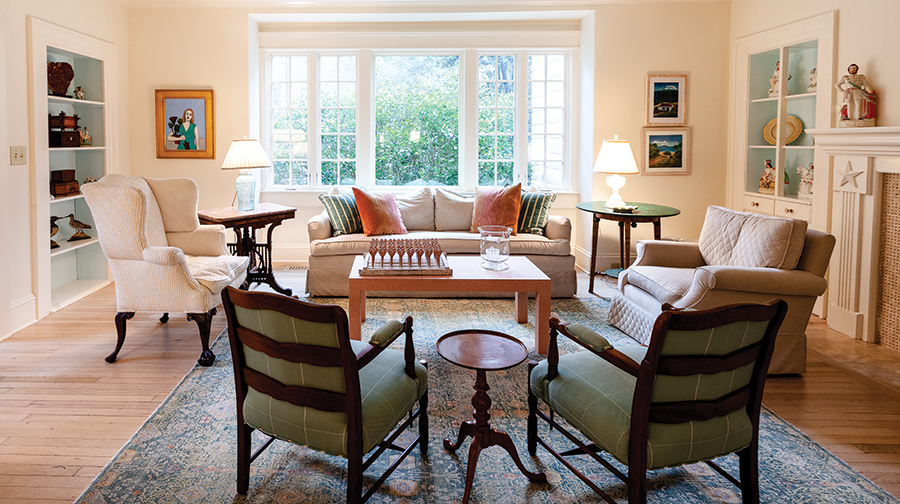
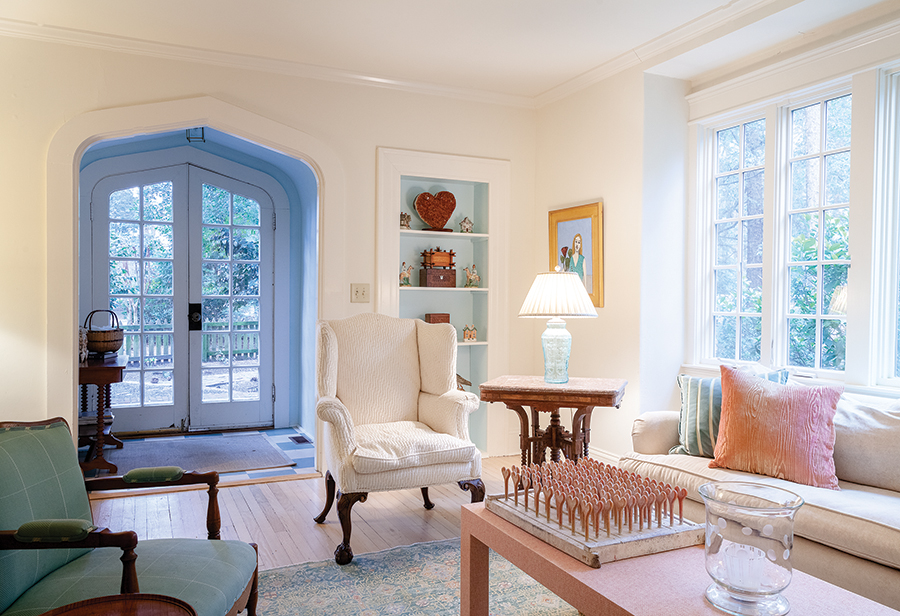
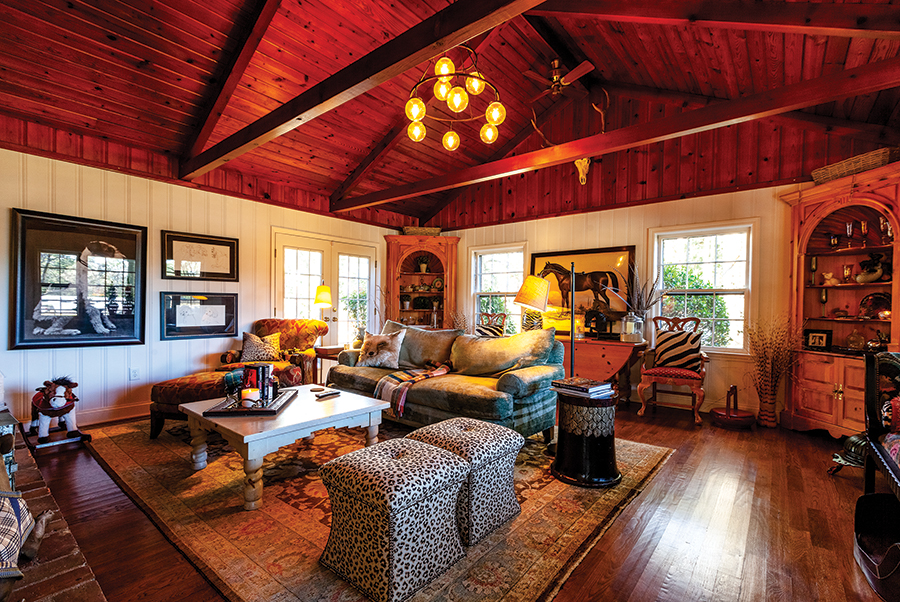
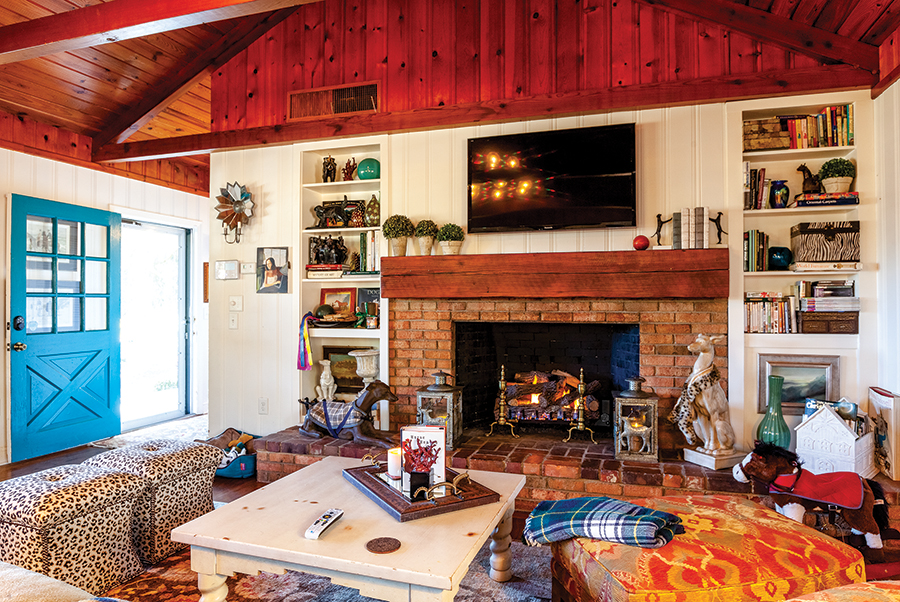
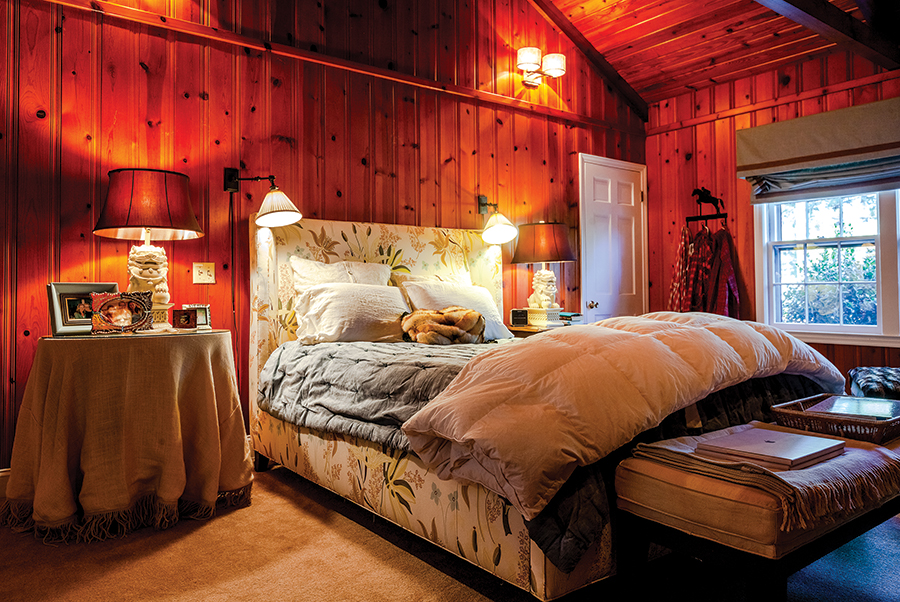
Soft green, rose and plaid upholstery. A what-not shelf filled with elephant miniatures. Floral duvet, matching bedside table skirt and drapes. Dark woods and polished silver. A baby grand in the parlor. Bedrooms sized like bedrooms, not basketball courts. Antiques with family connections.

Genteel, pretty, Southern.

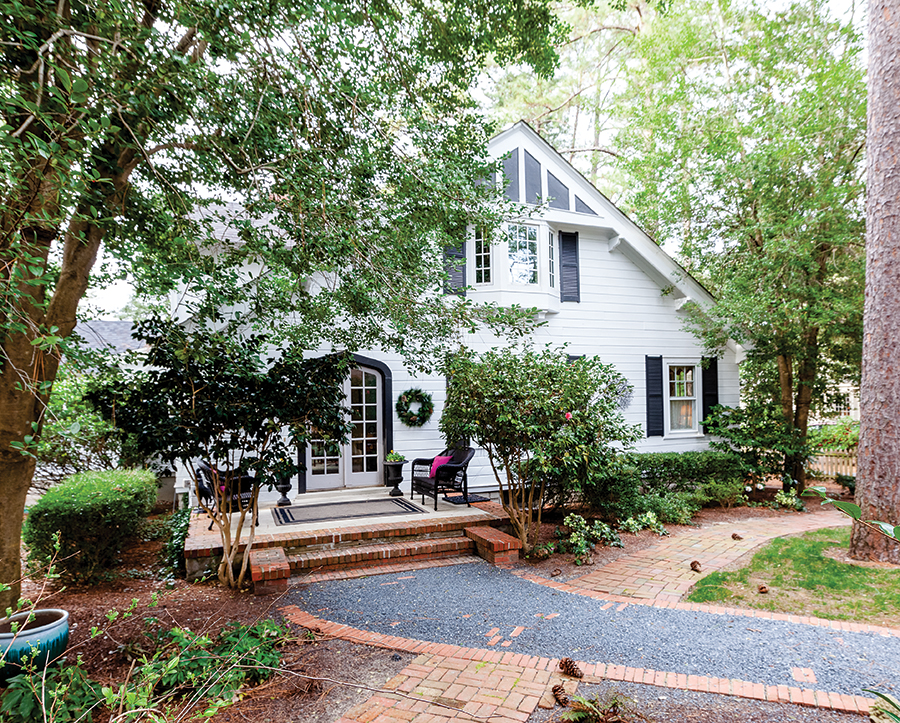
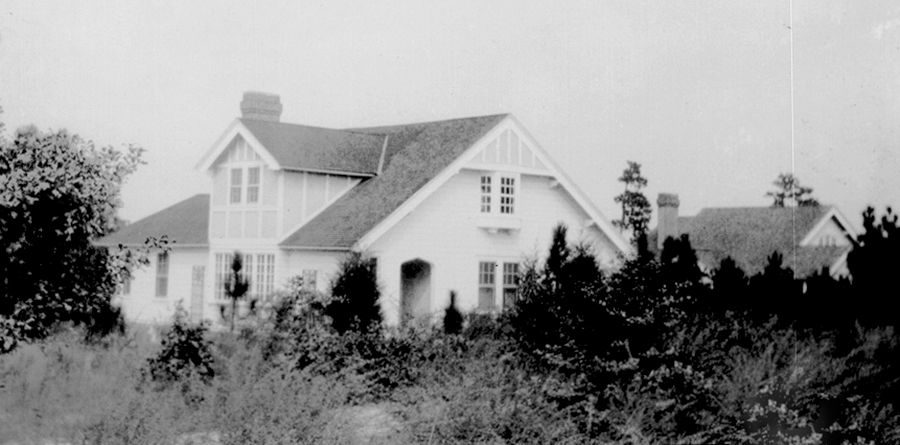
So goes Thistle Cottage, built on the edge of Pinehurst village by the Tufts family in 1916 as four apartments with separate entrances and separate furnaces to accommodate senior resort staff. Legendary Carolina Hotel doorman Sam Lacks and headwaiter George Ashe lived there. Subsequently, Annie Oakley and her husband, Henry Butler, occupied a first-floor apartment while she entertained guests during the winter season.

The apartment idea caught on. In 1918 the Pinehurst Outlook reported “the number of applications has surpassed expectations.” The building was renovated and minimally landscaped in 1922. Apartments got not only fresh paint but “modern” furniture, justifying $750 rent from October to May. Henry Page Sr. lived there in 1932, Roy Kelly from 1938 to 1962. In the 1980s Page and Hayley Dettor reconfigured the house as a longitudinal 3,200-square-foot two-story single-family dwelling with an unusual (for the Sandhills) full finished basement.

Yet something was missing.

No longer. In Jane and Jim Lewis’ 20-year tenure, scruffy grounds have become magnolia bowers with a carpet of English ivy.

“We didn’t want any newfangled vegetation,” Jane says.

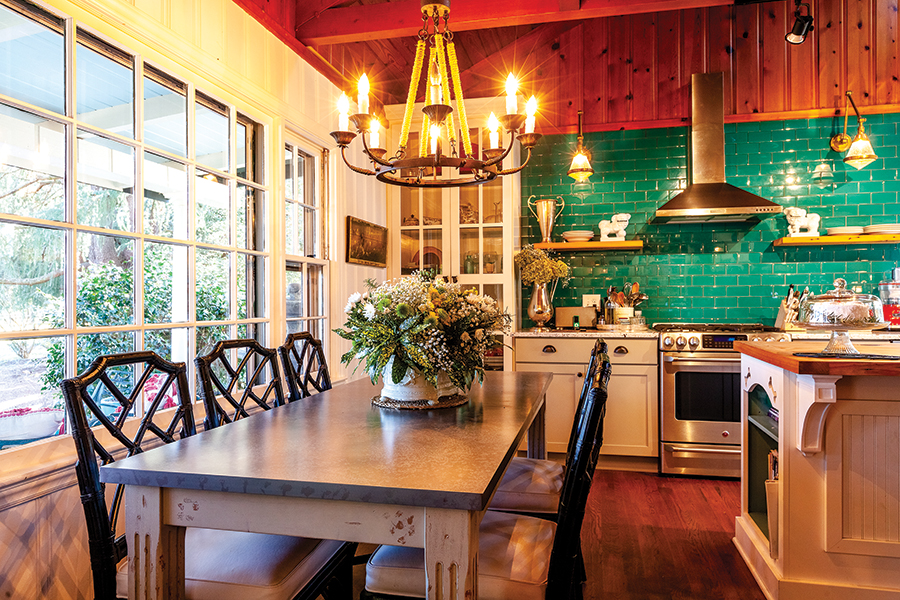
Now three mini-porches and a secret garden exude a rocking-chair charm never out of style. Just inside the front door a 1990 version of a glamour kitchen suits the classic American cuisine Jim prefers when they eat in, which is most of the time.

“Meatloaf,” he nods. “I don’t go for fancy seasonings.”

Instead, Jim (from a South Carolina tobacco town) and Jane (family roots deep in antebellum Virginia) relish surrounding themselves with history.

“You can tell a lot about a man by looking at his books,” Jim believes. An entire wall of bookshelves in the TV room reveals his love of baseball and American history, while Jane falls into the gardening/interior design category, having worked with the fabric company Brunschwig & Fils Inc., whose installations at the White House and Palace of Versailles join the dining room, living room and bedrooms of Thistle Cottage — its name, bestowed by the Tuftses, emblematic of Scotland.

“I’m sentimental,” Jane says. “I like to mix in old family books . . . look inside them and see which great-great (relative) it was given to.”

How Jane and Jim Lewis found Thistle Cottage begs the beginning  “. . . once upon a time.”

They both have fond memories of Southern living. Jim moved around a lot — 14 times since his marriage alone. Jane, from a Navy family, lived mostly in Charlotte, with her grandmother and “old maid aunts who didn’t have any other place to go.” He graduated from Davidson, she from Queens College. As a communications executive at Southern Bell, then Lucent Technologies, Jim was sent to Savannah and Richmond, which they loved, finally Denver. As Jim neared retirement, he requested relocation to Charlotte, now a big, busy city — less than ideal for retirement, they discovered. Pinehurst was a frequent golf destination. “I tried to persuade Jane that this was the place (to live),” Jim says. They struck a deal. “We’ll practice living here for a year and if Jane doesn’t like it, we’ll go back to the empty-nester in Charlotte.” To this end, Jim looked around and found Thistle. “I liked it the minute I walked in . . . the open space (kitchen, breakfast room, family-TV room). I called Jane to come down and take a look.”

They bought Thistle in 1997 as a weekend retreat. “We subscribed to the newspaper, pretended we lived here,” Jim recalls. By 1999 the transition was complete. They sold the empty nest and took up permanent residence in a house with plenty of history for Jim to explore, plenty of land for Jane to garden and plenty of room for their sons and, later, grandchildren, to spread out.

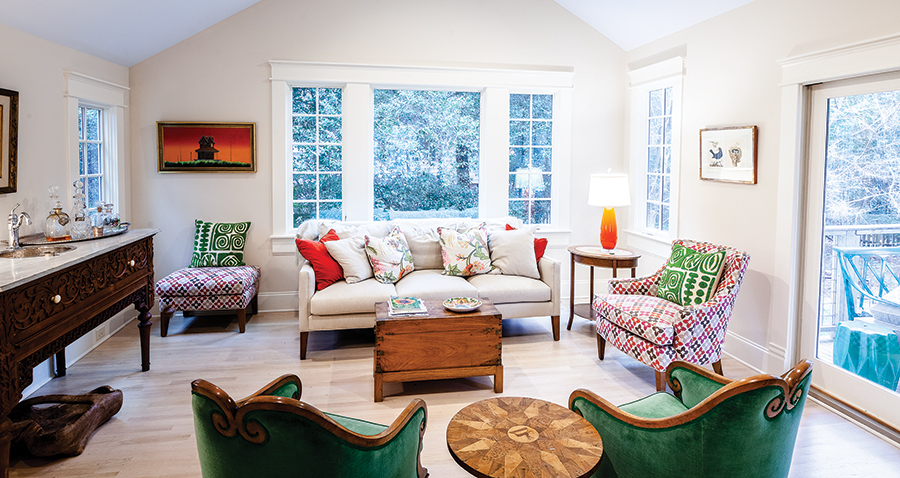
At first glance, except for the grounds, Thistle looked “finished” to Jim. He admired the thriftiness of a previous owner, who took down paneled doors and laid them horizontally as wainscoting. Still, they found plenty to do. Removing a wall between smallish dining and living rooms made both appear larger. They created an upstairs spa bathroom and dressing room with washer-dryer, installed crown moldings, replaced crumbling exterior wooden shutters with hard-to-find replicas, lighted and brightened everything.

“I like happy colors,” Jane declares. No contemporary grays and neutrals. From three previous houses she brought forward the same stunning crimson wallpaper in the dining and living rooms. The kitchen and family rooms are a pale yellow. Oriental rugs feature primary rather than shaded colors. The master bedroom is done in red toile and the living room, a masterful mix of Brunschwig & Fils fabrics in bold hues — mostly florals, one geometric. Jim’s study is painted a forest green, to match his favorite sweater.

Jane’s antiques — tables, rush-bottomed chairs, sideboards, case pieces — are crowned by a grandfather clock crafted in the early 1800s by John Weidemeyer of Fredericksburg, Va. This “case” clock, long in Jane’s family, has a false front where coin silver spoons were hidden from Union Gen. Philip Sheridan, who charged down the Shenandoah Valley in 1864. Jane owns several of the spoons. Her collection of China export porcelain plates in the butterfly pattern hang on dining room walls.

She is especially fond of etchings by Hungarian artist Luigi Kasimir, picturing European churches, which she found bargain-priced in a second-hand shop. They set a classic tone in the foyer and upstairs hallway. Portraits of Gen. Robert E. Lee and Gen. Thomas “Stonewall” Jackson hang over a bedroom mantel, stripped to its original pine.

A painting of the Pine Crest Inn by local artist Jessie Mackay underlines Jim’s opinion that this landmark, although not luxurious, is as steeped in tradition as Pinehurst No. 2. “Everybody who’s anybody in the game of golf has been there.”

But the conversation starter in Jane and Jim’s Thistle has to be a bar nook built by a previous owner, with shelves displaying 280 mini liquor bottles, no duplications, the kind available on planes and trains in the good old days. They belonged to an aunt who began collecting them in the 1930s. Many, although unopened, are empty, the contents evaporated through the seal. Jim put up the narrow shelf and cataloged the bottles. Dusting them is a delicate chore, performed by Jane.

Historian Jim enjoys the Annie Oakley connection. Photos, memorabilia, even a gun of the era (“It came with the house”) form a small shrine in the family room. He’s ready with lore and dates, books and posters — proud of living where she did even if the walls are now crimson.

Jim and Jane Lewis have succeeded in providing Thistle Cottage an atmosphere both elegant and comfy, respectful of an era in the South — the ’50s and ’60s — which has yet to gain status with millennials busy simplifying and modernizing. An era when elders still recounted the history of their possessions.

“I love the lived-in feeling,” Jim says.

“Oh yes, we’ve been happy here,” Jane adds.

The upscaling of Thistle Cottage, particularly the landscaping, helped this outlying street where modest houses are being rejuvenated or replaced for a new generation of residents. “Now we have mothers with jogging strollers come by,” Jane notices. “It’s a real pleasure.”  PS

Almanac

January is a masterpiece unfurling.

In the garden, everything feels like a tiny miracle. Each ice crystal. Each smiling pansy. Each tender bud on the heirloom camellia.

Notice how the curling bark of the river birch looks like downy feathers.

Even the sunlight looks softer than you’ve ever seen it.

Folk singer Cat Stevens made popular the Christian hymn that says as much:

Morning has broken, like the first morning

Blackbird has spoken, like the first bird

Praise for the singing, praise for the morning

Praise for them springing fresh from the world . . .

In January, the sweetness of infinite possibility appears in many forms, and in every direction.

You clean the birdbath, add fresh water, return to the kitchen for the whistling kettle. As your sachet of tea pirouettes in hot water, the aroma of citrus, clove and cinnamon permeates the air, and there is movement in the periphery. Flashes of red. Through the window, you watch a pair of cardinals splash round in the clean water, preening each feather — each tiny miracle.

January is a threshold to wonders yet unknown. You enter bright-eyed, as if your very breath brings to life each miracle. As if you can taste the sweetness of the first morning with every cell.

The New Year, like an Infant Heir to the whole world, was waited for, with welcomes, presents, and rejoicings. — Charles Dickens, The Chimes

Royal Mayhem

What’s a Twelfth Night Feast without the possibility of being crowned king or queen for the evening? In ancient Roman times, a single bean was baked into a fruit-laden pastry, the recipient of which appointed “Lord of Misrule” for the night. Also called “King of the Bean,” whoever received the loaded slice of cake was decked in full regalia. And don’t forget to celebrate the “Queen of the Pea.”

Twelfth Night falls on January 5, Eve of Epiphany and the new moon, a good time to set intentions (and drink wassail).

What magic are you calling in this new year? Crown yourself King or Queen for the night, fill your chalice, and dream bigger.

Sweet Herbal Magic

While the soil is cool, plant spring bulbs and fruit trees, harvest edible weeds and winter greens, and when the work is done, create sacred space to enjoy this winter season . . . and tea.

January is National Hot Tea Month.

Loose leaf is best.

Indulge.

Add honey, lemon, spices, sticks of cinnamon.

Cook with it.

Chai and matcha shortbread cookies. Roasted oolong ice cream. Tea-smoked quail, turkey or duck.

Detoxing? Dandelion root has long been used to help cleanse the liver and gallbladder.

Sore throat? Try peppermint, echinacea, ginger root or slippery elm.

And if you’re dreaming of summer: sweet rose.

Time has no divisions to mark its passage, there is never a thunder-storm or blare of trumpets to announce the beginning of a new month or year. Even when a new century begins it is only we mortals who ring bells and fire off pistols. — Thomas Mann, The Magic Mountain

Happy New Year

Although the ancient Roman farmers’ almanac dubs Juno the tutelary of the month, conventional wisdom claims that January is named for Janus, two-headed god of beginnings, endings, and everything in between: gates, transitions, passages, and doorways.

Speaking of doors . . .

Know how Denmark celebrates New Year’s Eve? Breaking dishes on the doorsteps of those nearest and dearest, a strange yet endearing way of expressing love and best wishes. The bigger the pile of shattered dishes you discover at your front door on January 1, the bigger the fortune you will receive in the coming year.

You might try an alternate gesture of kindness here: a gift from the garden; a letter; sachets of spicy loose-leaf tea.  PS

Little Big Man

Little Big Man

How mighty mite Alfred Moore became our county’s namesake

By Bill Case

By 1781, the Revolutionary War had raged in America for five years. North Carolina had mostly escaped armed conflict since the spring of 1776 when early Patriot successes caused Loyalist militia to disperse and British soldiers to vacate the Cape Fear area. Wilmington was a hotbed of independence, controlled by Patriots devoted to their cause. But in the first month of 1781, British general Lord Charles Cornwallis, seeking to restore hegemony in North Carolina, ordered a contingent of 300 redcoats commanded by Maj. James H. Craig to sail from Charleston to Wilmington and occupy the city.

Immediately after stepping onshore at the city’s wharf on January 28, 1781, the ruthless Craig ordered Wilmington citizens to declare their allegiance to King George III or face the plundering of their possessions and a possible death sentence. As historian James Sprunt put it, Craig mercilessly employed “fire and sword” in his dealings with leading Patriots, burning their homes and jailing the most prominent while imploring Loyalist sympathizers to join militia units and assist in his scorched earth campaign to destroy “every Whig (Patriot) plantation.” Many Cape Fear Tories who supported English rule but had been laying low since 1776 became emboldened to take up arms against their fellow citizens.

This turn of events alarmed 25-year-old Alfred Moore, who lived with wife Susannah at “Buchoi,” their rice plantation 7 miles from Wilmington. He reckoned himself a target for Major Craig’s wrath since several Moore family members, including Alfred himself, had played key roles in the Patriot victories of 1776. Now, after a five-year hiatus, they again confronted the prospect of fighting forces antagonistic to independence.

Indeed, Alfred’s family had been a dominating presence in the Carolinas almost since colonization began. In the late 1600s, his great-grandfather of Irish ancestry, James Moore, acquired by dint of marriage vast amounts of land in the Carolinas. From 1700 to 1703, James served in Charles Town (today’s Charleston) as royal governor of Carolina — the colony would not be split into two until 1712. One of James’ six sons, James Jr., a noted Indian fighter, would later serve briefly as provisional governor of South Carolina. With further land acquisitions by James Sr.’s sons, the combined Moore families amassed ownership of 83,000 acres by 1731. One of those sons, Maurice, chose to settle not far from Wilmington, founding the now defunct town of Brunswick on the Cape Fear River. Maurice’s son, Maurice Jr. (Alfred’s father), would become a well-known attorney, and one of three royal judges in North Carolina.

In 1766, Maurice Jr. authored an inflammatory pamphlet denouncing the hated Stamp Act, imposed by the British Parliament on the colonies. His provocative writing so angered the royal governor that Maurice Jr. was briefly stripped of his judgeship. Despite his disapproval of English policy, Maurice Jr. tended to vacillate on the issue of whether the colonies should make a total break from the mother country. His son Alfred held no such reservations. After the opening shots of the Revolutionary War were fired on the outskirts of Boston, at Lexington and Concord in April 1775, Alfred, recently admitted to the bar, postponed his legal career and joined the newly formed Continental Army.

Boston was where Alfred had been sent for schooling after his mother died when he was 9 years old. While there, he rubbed elbows with soldiers from the British garrison, impressing the commander sufficiently that he saw fit to offer the by then 13-year-old an ensign’s commission. Moore was now eager to fight the foe that had attempted to recruit him as a boy.

Moore was appointed a captain in the North Carolina First Regiment, led by his uncle Colonel James Moore — a canny leader the nephew held in high esteem. The regiment became a true family affair when Alfred’s brother Maurice III and brother-in-law Francis Nash signed up, too. The regiment’s most memorable encounter came the following February against 1,600 Tory militia, mainly Scottish Highlander immigrants. The militia was on the march from Cross Creek (subsequently Fayetteville) to Wilmington, intending to link up with Sir Henry Clinton’s redcoat army en route from the north. The Tories never reached Wilmington. Led by Colonel Moore, the Tories were routed at the Battle of Moore’s Creek Bridge. Those not killed or wounded scattered into the woods. Captain Alfred Moore and his regiment distinguished themselves by cutting off the Tories’ retreat and rounding them up. The Patriots’ smashing victory meant that North Carolina would be effectively rid of active Loyalist militia for the time being.

The two most important men in Alfred’s life, his father, Maurice Jr., and uncle James (who had been promoted to brigadier general by General George Washington), died in the same house on the same day — January 15, 1777 — victims of a plague. Compounding the family tragedies were the deaths in battle of Maurice III and Nash. The resulting turbulence in family affairs necessitated Alfred’s attention at home, so he resigned his commission and stayed behind in North Carolina after Washington ordered the First Regiment to New Jersey in March 1777. Moore remained involved in the independence cause as the leader of his local militia. With hostilities ebbing for the moment in the Carolinas, he was able to devote time to his legal career and resume his role as the master of Buchoi.

So, when Major Craig stormed into Wilmington four years later, issuing an ultimatum that those of Patriotic leanings must pledge unswerving loyalty to King George — or else — Alfred Moore faced a dilemma. If he swore, he would betray his cause. If he refused he faced the loss of all material possessions, a life on the run and perhaps his own death. Some Patriot supporters submitted to Craig’s demands, but Moore would not bend. Instead, he and his band of militiamen became guerrillas, making themselves a “thorn in the side” of the British. The exasperated Craig softened his stance a bit, indicating that if Moore would simply agree to take no further part in the war, he and his property would be left undisturbed, but Alfred rejected this entreaty. In retaliation, Craig dispatched a raiding party to Buchoi. The plantation’s buildings and crops were burned, Moore’s livestock removed, his family’s personal possessions plundered, and his slaves freed.

Meanwhile, British Gen. Lord Cornwallis had been active in the interior of the Carolinas fighting engagements against Gen. Nathaniel Greene’s army, including the Battle of Guilford Courthouse near Greensboro, on March 15, 1781. Though the British were deemed the victors of that encounter, Cornwallis’ provisions and troops were greatly depleted. When he and his soldiers marched southeast to Wilmington for resupplies, Moore’s militiamen made life miserable for them. Disappointed with the lack of his campaign’s progress in the Carolinas, Cornwallis moved north into Virginia, where his troops were trapped at Yorktown, ultimately surrendering to Washington on October 19, 1781. The despised Craig would hang on in Wilmington until November 18, when he, his remaining troops and any Loyalists who wanted to accompany them evacuated the city. The war was over.

Moore’s defiance of the British left him “ruined in fortune and estate,” wrote one observer, “his family almost destitute of food and clothing.” On the plus side, he still possessed his law license, and the admiration of his fellow citizens. That would prove to be enough to begin a career that would carry him all the way to the United States Supreme Court.

In January 1782, while traveling in the company of Judge John Williams and fellow attorney William Davie, on a stopover in Hillsborough, the three men learned that seven Loyalist militiamen were languishing in custody at the local jail awaiting trial for treason and other grave misdeeds during the war. Annoyed that the trials of the seven defendants had yet to occur, authorities in Hillsborough implored Judge Williams to hold an immediate special session to try the captives. Williams was agreeable, but Attorney General James Iredell, who normally would bear responsibility for prosecuting, was elsewhere. Williams persuaded the 26-year-old Moore to stand in for Iredell. Davie agreed to undertake the Loyalists’ defense. According to Robert Mason’s biography of Alfred Moore, Namesake, Davie pithily summarized the trials this way: “Moore prosecuted all, I defended all and Williams convicted all.”

While previously recognized as a patriot and war hero, Alfred’s successes in Hillsborough brought recognition as a highly capable lawyer. The combination of his military accomplishments and legal victories provided an ideal stepping-stone for a political career and Moore took advantage. After his bravura legal triumphs, he became a Federalist Party state senator in North Carolina’s General Assembly. In 1783, when Iredell resigned as attorney general, Moore expressed interest in the post, and the General Assembly unhesitatingly confirmed him.

During his eight-year tenure in that position, Moore’s friend, Davie, often served as opposing counsel. Their legal tussles provided entertaining theater for the onlookers who regularly packed courtrooms to observe the talented lawyers engage in forceful forensic battles. Their oral argument styles differed — Davie adopted a lofty, florid, flowing style, while Moore spoke with “plainness and precision.” Moore was described in an 1899 speech by Junius Davis as having “a dark singularly penetrating eye, a clear sonorous voice . . . a keen sense of humor, a brilliant wit, a biting tongue [and] a masterful logic [that] made him an adversary at the bar to be feared.” Moore and Davie along with James Iredell (who would in 1790 join the United States Supreme Court) constituted a brilliant legal triumvirate, unquestionably the giants of the early North Carolina bar.

It should be noted that the term “giant” cannot be applied in any literal sense to Alfred Moore. He was a man of the slightest stature. Accounts vary as to whether he stood 4-feet-5-inches or 5-feet-4-inches. Perhaps a dyslexic historian mistakenly transposed the 5 and 4 somewhere along the way. But the late William Rehnquist, former chief justice of the Supreme Court of the United States and a fastidious researcher, says in his book, The Supreme Court, that Moore “apparently looked much like a child, being only four and a half feet tall, and weighing between eighty and ninety pounds.”

Though he endured suffering inflicted by Tories during the war, Moore declined to pursue a path of vengeance against them in post-war prosecutions. In an article written for the North Carolina History Project, Willis P. Whichard says that Moore “was realistic about the prospect of jury nullification in these largely political prosecutions; he accordingly often pursued lesser charges and by doing so achieved a higher conviction rate than Iredell’s.”

In the aftermath of the war, many Tories fled North Carolina. Their land was seized by the government and sold to bidders at “confiscation sales.” To aid these purchasers, the General Assembly passed a law in 1785 denying courts the authority to hear cases involving challenges to titles granted by the sales. Nonetheless, Mrs. Elizabeth Bayard, a British subject and the daughter of a deceased Tory whose property had been confiscated and sold over her objection, filed suit claiming that the seizure and sale were unlawful and that, by virtue of inheritance from her father, she should be acknowledged the rightful owner of the property. Mrs. Bayard further asserted that the aforementioned 1785 law was in conflict with her rights under the North Carolina Constitution, which guaranteed to her the right of trial by jury in matters pertaining to the recovery of property. Essentially, Mrs. Bayard was requesting that the court declare the 1785 legislation unconstitutional — something that had never happened before in America. Alfred Moore represented North Carolina. His friendly rivals William Davie and James Iredell appeared on behalf of Mrs. Bayard in the case styled Bayard v. Singleton. Ultimately, the judges hearing the case agreed with Mrs. Bayard that she was entitled to a jury trial, declaring the 1785 legislation “unconstitutional and void.” Though she won this battle, Mrs. Bayard lost the war. At the trial, the jury found against her claim because, as a British subject and enemy alien, Mrs. Bayard possessed no rights to hold property in the state. Thus, Moore’s advocacy upheld the legality of the confiscation sales. Of more lasting import was the fact that the Bayard case represented the first time an American court declared a legislative act unconstitutional due to its conflict with a written constitution.

It was during Moore’s time as attorney general that the General Assembly named a county in his honor. Realizing in April 1784 that the western part of Cumberland County was too remote from that county’s political hub — present day Fayetteville — the General Assembly carved out that portion for a separate governmental entity, naming it Moore County just prior to Alfred’s 29th birthday. It is unknown whether he ever actually set foot there. Other counties were likewise named for his legal cohorts, Davie and Iredell.

Both Moore and Davie urged the General Assembly to give birth to a public university in North Carolina. After an unsuccessful legislative attempt to do so in 1784, the two lawyers continued the drumbeat for founding one. Finally, in 1789, the University of North Carolina was chartered with Moore and Davie named to its first board of trustees. According to Mason’s namesake, Moore “helped to select the university’s site at New Hope Chapel, seat of an Anglican parish, which became Chapel Hill. Also, he was on the committee that chose a seal, and one of the three trustees who drafted a regulation disallowing the sale of intoxicants within two miles of the campus.” In addition, Moore was a benefactor to the school, gifting it $200 along with two globes to be employed as teaching aids.

The middle 1780s were a time of passionate dispute over how much power the states should delegate to the new federal government. Federalists like Moore fervently believed his state should ratify a new constitution that would greatly enhance the weak powers provided to the United States government by the Articles of Confederation. But many North Carolinians, mindful of their former colony’s oppression by King George III and Parliament, feared the concept of a remote centralized government controlling their lives. Following an initial rejection, North Carolina approved a revised constitution after it was amended to include a Bill of Rights, and Moore’s unstinting support of the ratification effort contributed to its ultimate success.

Miffed that the General Assembly had created a new office of solicitor general that essentially duplicated the powers and duties of the attorney general, Moore resigned from the latter post in January 1791. By this time, Moore’s Buchoi rice plantation was thriving once more. A man of his time, he acquired more slaves. He also purchased 1,200 acres in Hillsborough, residing in a second home there called “Moorefields,” which stands today. Alfred and his family relished summer interludes at Moorefields, invigorated by the area’s cooler air, a particularly welcome relief to wife Susannah, an asthma sufferer.

Moore couldn’t resist governmental service for long. By 1792, he was seated again in the General Assembly. Later, he would accept President (and fellow Federalist) John Adams’ nomination to serve as one of the United States commissioners entrusted “to conclude a treaty with the Cherokee Nation of Indians.” But Moore yearned for a more prestigious position and set his sights on becoming a United States senator. In the early days of statehood, North Carolina’s General Assembly selected the senators. Alfred twice stood for election by the Assembly. In 1794, he was edged by a one-vote margin favoring Jeffersonian candidate Timothy Bloodworth. His 1798 run for the Senate sputtered after his friendly rival, Davie, withdrew his support of Moore’s candidacy as part of a strategy to secure his own election as governor.

Moore’s wounds were salved by his appointment to a state court judgeship. The appointment made possible his following in the judicial footsteps of his father, Maurice Jr. There is a split of opinion regarding Alfred’s performance during his short-lived tenure as a state court judge. Historian Samuel A.C. Ashe faulted him for habitually disregarding precedents, but North Carolina Supreme Court Chief Justice John Louis Taylor praised Moore’s service, saying that “the acuteness of his intellect and his experience in business enabled him to decide very complicated cases with great promptitude and general satisfaction.”

When the 48-year-old Iredell, who was among President Washington’s first appointees to the United States Supreme Court, died suddenly in Edenton on October 20, 1799, it was anticipated that the resulting vacancy would be filled by a lawyer from the Carolinas, given that Supreme Court justices of the era doubled as circuit riders, presiding over federal criminal trials and lower court appeals emanating from their particular geographic area. Iredell’s circuit responsibilities had required backbreaking horseback rides to distant towns in the Carolinas and Georgia as well as the nation’s capital — exhausting rigors that contributed to his early demise.

Given his steadfast support of the Federalist Party and his negotiation of a treaty with the Cherokees, Moore stood in good graces with John Adams. Still, it seemed improbable that the president would consider him to fill the high court vacancy. Moore had been a judge less than two years, and there were many able Federalist jurists in the Carolinas who possessed experience far exceeding his own. According to Whichard, Moore and Davie were the only candidates seriously considered by Adams. The president, while undoubtedly appreciating both men’s loyalty to the Federalist Party and status as war heroes, had recently appointed Davie as special envoy to France. Moore emerged as the choice to join what was then a six-member Supreme Court and became just the 12th justice to be confirmed by the Senate on April 21, 1800. To Moore’s relief, the Federalists passed legislation that eliminated the justices’ circuit-riding duties shortly after he joined the court.

After Moore’s ascension to the high court, John Marshall became its chief justice. Marshall, still considered the greatest and most influential justice in the long history of the court, dominated it, overshadowing Moore and the other justices. He assigned to himself most of the court’s written opinions, which were relatively few because, according to Rehnquist’s book, “the principal source of its appeals — the lower federal courts — had not been in existence long enough to decide any cases that could be appealed to the Supreme Court.”

All of this explains why Moore authored only a single written opinion during his time on the court. In that case, Bas v. Tingy, a privately owned American ship, the “Eliza,” had been captured by the French (who were then engaging in hostile activities toward America), and then subsequently recaptured by an armed American ship. The amount to be paid by the owner to the salvager increased exponentially if the recapture was of a ship that had been seized by an “enemy.” Because no formal state of war existed between the United States and France, the owner maintained that he was not required to pay the higher fee to the Eliza’s salvager. Justice Moore disagreed with this contention, finding that the owner needed to pay the higher salvage fee because a state of “limited, partial war” existed between the United States and France.

Perhaps the most important case in Supreme Court history was decided during Moore’s tenure. In Marbury v. Madison, Justice Marshall, speaking for the court, held that the Supreme Court possessed authority to void an Act of Congress because of unconstitutionality. This momentous decision marked the second time any American court had claimed authority to void legislation for that reason. The first was the Bayard decision in which Moore had played a starring litigation role. Ironically, Moore was the lone justice not to participate in Marbury v. Madison. It is unknown why.


It appears Moore did not particularly enjoy his time on the United States Supreme Court, serving less than four years. Events occurring in 1802 had much to do with his dissatisfaction. First, the United States Treasurer failed to pay his modest salary in a timely manner. Second, the Jeffersonians who had come to power in both Congress and the presidency enacted legislation reviving the grueling circuit riding by the justices. Moore was appalled. “Can it be believed,” he would write a friend, “I can ride 2,840 miles a year with any regularity to attend to business on the seat of justice — the number of cases to be determined is by no means so disturbing as getting to them?” Moore told his friend that for the short term he would endure the hardships, not wanting an “uncharitable conclusion” to be drawn from an abrupt departure. But after what he considered a suitable wait, he announced his departure and left the court on January 26, 1804. He and his friend Iredell remain the only North Carolinians to have served as justices on the Supreme Court of the United States.

The circuit riding had already taken its toll on Moore’s frail body. He retired to the Bladen County plantation of his daughter, Anne, and her husband, Hugh Waddell, where Moore’s health continued to decline. He died at age 55 in his daughter’s home on October 15, 1810. His public service legacy was carried on by son Alfred, who was a member of the General Assembly and served as mayor of Wilmington.

It is noteworthy that Moore directly followed Iredell into the two most important positions of his illustrious life: as North Carolina’s attorney general and as a Supreme Court justice. It was said about them in one testimonial that “[a]t the bar they ever disdained the small arts of the pettifogger, and upon the bench blindfolded, they ever held the scales of justice with an even hand, treating with equal impartiality the rich and the poor, the guilty and the innocent.” Though slight of build, for a man who may never have walked in the county named for him, Moore left a large footprint.  PS

Pinehurst resident Bill Case is PineStraw’s history man. He can be reached at Bill.Case@thompsonhine.com.

Poem

Christmas Poem

I cannot write a Christmas

poem for you,

not with all those slick verses

oozing through the mail,

the schmaltzy music whining

on the radio.

But what I can do

is tell you of a December

afternoon in 1957

when I sat in Miss Cohee’s

fourth grade class

listening to the radiators clank

and staring at my scarred desktop

and how Eddie Morgan,

hunched in the seat beside me,

looked up suddenly and whispered,

“It’s snowing!”

I looked up too,

along with the rest of the class,

out the tall warped windows,

across the empty playground,

to Idlewild Avenue,

and saw that it was true:

the first gray-white dust just drifting

the blue cedars.

If you are an old believer,

even on this bluest of December days,

I would give you that pale afternoon,

the chalkdust scuffle of shoes

on the worn floor,

those children’s faces

eager as light.

— Stephen E. Smith

(From A Short Report on the Fire at Woolworths.)

Story of a House December 2018

Same Time, Last Year

A Tudor manor steeped in Yule for a special occasion

By Deborah Salomon     Photographs by John Gessner

Never again will Le Berceau be as lavishly adorned for Christmas as in 2017: dozens of poinsettias, two fresh Carolina-grown trees, nutcracker guardsman, heirloom ornaments and the piece de resistance, a wreath of white orchids cascading from the dining room chandelier. Thus embellished, Lucille and Jim Buck’s home bearing the French name for cradle — arguably Pinehurst’s most elegant residence — provided the setting for an event Neil Simon could have scripted for Broadway: 10 couples, married to each other for at least 50 years, celebrate with a dinner party near the host’s anniversary date.

Jim and Lucille were married on Dec. 26, 1960, surrounded by poinsettias. Logical, then, they should go lavish, albeit with a Scottish theme arising from Lucille’s heritage not discovered until moving to North Carolina. She wore her Clan Morrison tartan sash to the black tie dinner. Thistles, the Scottish national flower, appeared in floral arrangements. A bagpiper played during cocktails. Unicorns, the official Scottish beastie, decorated the dining table. The menu, served on Spode Christmas china, debunked the notion that UK food is mostly forgettable: smoked Scottish salmon, roasted quail with Scotch eggs, tenderloin of beef with whiskey sauce, neeps (a root vegetable) and rumbledethumps (cabbage and mashed potatoes), frisée with Scotch vinaigrette and, for dessert, a wedding cake topped with bride and groom, he in kilt, she with an arm reaching around to lift it.

Single malt flowed like beer at Oktoberfest

As Lucille put it: “This was a big deal.”

Guest and “club” member Mary Gozzi elaborated: “OMG awesome, spectacular, so festive I was speechless. I’ve never seen so many orchids in one place. Lucille is a party giver who’s got it down to the jelly beans!”

But a dress is only a dress until draped on a stunning model. Even bare-naked Le Berceau seems Christmas-y, with multiple nooks, seating and dining areas, sun porches, mantels, paned windows, staircases, a tiny telephone cubby begging decoration. The tone is classic with red dominating since, Lucille says, “For Jim it’s either red or ugly.” The elevator bears a touch of Yule, as does the carousel horse prancing on the landing.  Jim’s office, arranged around a desk belonging to movie star Loretta Young, doesn’t escape the red wave. Here resides memorabilia from his career as an attorney, senior vice-president of the New York Stock Exchange and author of its definitive history. Lucille has her “pouting” room hung with accolades from a career in education at fine New York schools.

“I had an absolutely unqualified dream that I would live in a house like this,” Jim decided, as a boy growing up in Ohio.

In 2000, while living in a soigné Manhattan apartment with a house in the Hamptons, they contemplated retirement. But where? Let’s drive over to Pinehurst, they decided, while visiting a daughter who lived in Charlotte.

Lucille fell in love. “I felt at home,” among the longleaf pines, azaleas and gardenias that grew in East Texas, her childhood home. The Tudor-style manse with swimming pool and a servants’ wing suited for guests satisfied Jim’s goal. Imagine that, within sight of the Carolina Hotel.

This central location mattered to its first occupant. James Tufts lured Bostonian Dr. Myron Marr to Pinehurst, as resort physician. The house, designed by a Boston architect and built in 1921, probably sweetened the deal for the Marr family, who remained there until the 1950s. The Bucks are only the fourth owners.

Their imprint on the house, however, is indelible, starting with the walls, wallpapered throughout. Not just commonplace florals and geometrics. In the kitchen, giant Delft-blue platters against a red background reflect the blue Viking range. Fashion drawings for a granddaughter’s bedroom, English teacups for Lucille’s dressing room, birds in the laundry room, a rubber ducky bathroom, toile and Asian motifs in the master and other bedrooms. In the salon, especially for Jim, a solid red textured paper provides a backdrop for sofas covered in a red, cream and green Brunschwig et Fils fabric chosen by Jackie Kennedy’s White House interior designer for Brooke Astor’s library.

“I’ve had my eye on that fabric for years,” Lucille says, but only now found a suitable setting.

The Bucks’ Christmas ornaments and decorations form a family scrapbook of places and events. Into the hand of a tall nutcracker (a window decoration purchased from a store going out of business) Lucille would tuck tickets to the ballet at Lincoln Center for their daughters, who eventually danced in the Christmas production. A grandson later danced the part of Fritz, garnering a glowing review in The New York Times, which Lucille proudly reads aloud.

Then, the prank concerning green balls on the tree — Lucille’s choice — which the Bucks’ son said didn’t show up well enough. Through a complicated long-distance adventure that included snitching a giant green ball from the trunk of his parents’ car and hanging it from the top of the house on the Fourth of July, Lucille was proven wrong. Now, Moravian stars, pine cones and cardinals represent their relocation to North Carolina.

“In every house we’ve lived in, I always wanted a bigger Christmas tree — to touch the ceiling,” Jim says. Lucille decorates the tall living room tree and a smaller one in the bedroom, needing help only with attaching the angel on top. She commemorates Jim’s Swedish background with a Santa Lucia doll wearing a crown of candles — but marinated herring isn’t for Christmas dinner.

Christmas holds one poignant memory for Lucille:
“My mother and father took me into the woods to cut a tree . . . it was a great outing. One time we even chose a holly (bush).” Lucille’s father died when she was 12. “The year after that our minister went with us, so I wouldn’t miss it.”

Their decorations remain in place until Feast of the Epiphany, Jan. 6.

But last year, overriding all memorabilia and decor, was that wreath of anniversary orchids — a veritable canopy over the dining room table — designed and implemented by Carol Dowd of Botanicals. “We started planning in July,” Dowd says, inspired by a hanging orchid arrangement Lucille remembered from a dinner party in New York. Surprisingly, the two dozen white orchids, FedExed from Miami, proved long-lasting with only water tubes. The wreath hung for more than two weeks. More important, rather than obstructing guests’ sightline, the wreath, suspended over a low centerpiece, created a bower effect.

What a Christmas. What memories. “My Scottish heritage found me,” Lucille says. Sharing it with close friends was a blessing. “We’re the same generation. We’ve lived this long and have been successful, career-wise and in marriage. The party was a big job but I didn’t mind. In fact, it invigorated me.” PS