The Last Amateur

The rise, fall and redemption of Harvie Ward

By Bill Case

They were two good-looking guys peddling Lincolns for Van Etta Motors in San Francisco in the mid-1950s. But to label Harvie Ward and Ken Venturi car salesmen would be like saying Elvis Presley was a soldier. In 1956, Ward, age 30, and Venturi, 24, were better known as the two finest amateur golfers in America.

Like many leading amateurs of the day, Ward and Venturi were disinclined to pursue the grueling life of a touring professional. The thought of driving bone-numbing distances to far-flung tournaments playing for paltry prize money offered little attraction. Far better to enter an occasional tournament while still earning $35,000 a year at the dealership, working mornings and playing afternoon matches at California Golf Club, Cypress Point or San Francisco Golf Club. According to Venturi, “If you weren’t going to buy a car from us by noon, you weren’t going to buy a car from us that day.”

The convergence of these two stars at the dealership was no coincidence. It was engineered by Van Etta Motors’ wealthy and flamboyant owner, Eddie Lowery, a noteworthy figure in golf for nearly half a century. It was pint-sized Eddie who, at age 10, caddied 20-year-old Francis Ouimet to a playoff victory over Harry Vardon and Ted Ray in the 1913 U.S. Open at The Country Club in Brookline, Massachusetts, kickstarting America’s love affair with golf.

The diminutive Lowery became a fine player in his own right, capturing the 1927 Massachusetts Amateur. After moving from the right coast to the left, he partnered with Byron Nelson to win the Bing Crosby National Pro-Am in 1955. Capitalizing on his associations with Ouimet and others in the USGA hierarchy, he was appointed to various golf administrative posts, including the powerful USGA Executive Committee.

Lowery was not merely a golf Brahmin, but a business mogul, too. He built Van Etta Motors into the largest Lincoln-Mercury dealership in the country. Lowery carried a soft spot for the Bay Area’s talented young players and, in 1952, he arranged for Venturi to play with Nelson, a five-time major champion. After Venturi graduated from college in 1953, Lowery hired him to join the dealership’s sales force. Months later, figuring the presence of two star golfers working the showroom would draw car-buying sports fans in droves, Lowery enticed Ward to quit his stockbroker position in Atlanta and come west with his wife, Suzanne.

The easygoing Ward possessed salesmanship skills that would have brought success if he had never picked up a club. He seemed to like everybody, and everybody liked him — male and female. With his sweet Eastern Carolina drawl, the preternaturally relaxed Harvie was the smoothest of smooth talkers, melting buyer resistance with gentle humor.

Lowery was justifiably proud of his two employees, and bragged they could beat any two players in the country — amateur or pro — in a four-ball match. His bet was called in February 1956 by oil and mining tycoon George Coleman at a Pebble Beach soiree prior to Bing Crosby’s annual “clambake.” Coleman and Lowery each ponied up $5,000. The slick oilman had persuaded a pair of Texans to oppose the two salesmen: Ben Hogan and Byron Nelson.

Arrangements were hastily made for the match to be played the following morning at Cypress Point. Ward and Venturi, both bleary-eyed, barely made it to the first tee to face their idols. The game featured a blizzard of birdies by all participants. Hogan, who purportedly muttered on the final green that he was “not about to be tied by a couple of damn amateurs,” holed his birdie putt to win the match 1 up. The Hogan-Nelson team shot a collective 57, besting Ward-Venturi by one shot. It was the only time the car guys ever lost.

Their great play in the historic encounter seemed to inspire both Ward and Venturi to greater heights in ’56. In August, Ward successfully defended the U.S. Amateur championship he had won in dominating fashion in ’55. His resume already included the NCAA individual title in ’49 when he was an undergrad at the University of North Carolina, the British Amateur in ’52, and the Canadian Amateur in ’54. Venturi, a Bay Area product who had twice won the prestigious California State Amateur, would finish runner-up in that April’s Masters and later beat Ward 5 and 4 in front of 10,000 spectators in the finals of the San Francisco City Championship. Ward was the defending champion, having assumed the title while Venturi (who previously had won the championship twice) was away fulfilling his military obligation. When they shook hands on the first tee Venturi said, “Harvie, I’ve come to take my City back.”

Venturi’s heartbreaking final round of 80 in the ’56 Masters dashed his golden opportunity to capture the green jacket as an amateur. He abruptly turned pro and left the dealership at the end of the ’56 season and enjoyed immediate success on the PGA tour, winning twice in his rookie year and three more times in ’58. Adamant about retaining his own amateur status, Ward remained with Van Etta Motors and looked forward to the ’57 season, hoping to become the first player to win three consecutive U.S. Amateur championships.

But first, Ward would make his April pilgrimage to Augusta to compete in the Masters. In his initial appearance in 1948, he had conspicuously pulled onto Magnolia Lane with a string of tin cans trailing his tan Ford convertible and a painted sign on its side reading “Masters or Bust.” Despite this prankish debut, the event would come to hold special significance for Ward. During his stockbrokering days in Atlanta, Ward forged a relationship with Augusta National’s chairman and founder Bobby Jones, whose law firm was located in the downtown building next door to the one where Ward read the stock ticker. Ward often stopped by to talk golf with the legendary Grand Slam champion and they became good friends.

Having never turned professional during his own playing days, it was Jones’ fondest wish that an amateur might win the Masters. During the mid ’50s, among those who stood a chance were Ward (who finished eighth in 1955), Venturi, and Billy Joe Patton, another North Carolina product who narrowly missed winning in 1954. Ward later told a friend that Jones, whose debilitating spinal disease claimed his life in 1971, once intended to appoint the first of those three to win the Masters to be his successor as Augusta National club chairman.

Ward had his best opportunity in the ’57 Masters. Through three rounds, he stood just one shot behind tournament leader Sam Snead, tied with Arnold Palmer. On Sunday he was paired with short game wizard Doug Ford, who went on a sensational run, vaulting to the lead. Ward was still near the lead with four holes to play. On the 15th, Ford, the former pool hustler, went for the green with his 4-wood second. The shot smashed into the bank of the fronting pond and popped onto the putting surface. Ward’s attempt to reach the green found the water, drowning his hopes. His fourth place finish, behind Ford, Sam Snead and Jimmy Demaret, further cemented his standing as one of the game’s premier players.

Ward anticipated more highlight reel achievements to come. He was frequently mentioned as one of the favorites in the upcoming U.S. Open at the Inverness Club in Toledo, Ohio. He stood a good chance of being named the U.S. Walker Cup captain for the ’57 matches — a rumor that USGA President (and Pinehurst friend) Richard Tufts did nothing to dispel. And he liked his chances for a three-peat in the U.S. Amateur in August at Lowery’s old stomping ground, The Country Club.
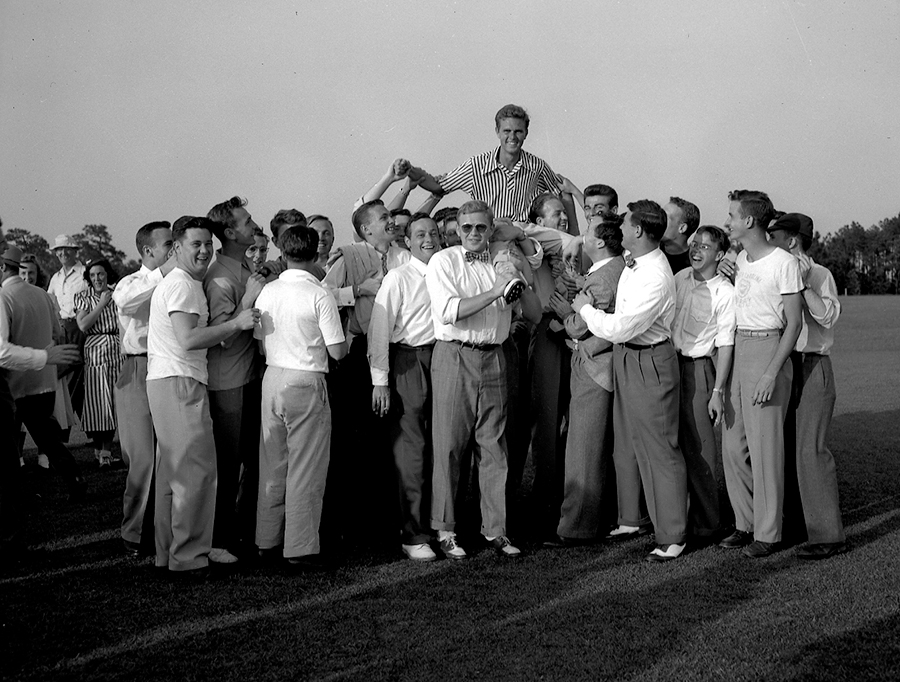
UNC students and Ward celebrate his victory in the ‘48 North and South

Arriving in San Francisco after visiting Hogan’s Fort Worth, Texas, clubmaking facility, Ward found himself surrounded by a pack of frenzied reporters. Someone showed him a newspaper headline, “Harvie Ward’s Amateur Status Questioned.” Blindsided, Ward struggled to make sense of it. Was he in trouble?

He was. And so was Lowery.

The state of California had indicted Lowery for tax evasion, and it had been established in grand jury testimony that the auto dealer had claimed business deductions for reimbursing Ward’s expenses at tournaments like the Masters and Canadian Amateur. The USGA’s rules of amateurism prohibited a player from accepting help with tournament expenses from anyone outside his own family. It was further alleged Lowery had funded Ward’s overseas excursion to the 1952 British Amateur, well before the latter had moved to San Francisco.

The rules did provide a potential safe harbor. If a player could demonstrate that his tournament play was coupled with a legitimate business trip, he could accept reimbursement of expenses provided those related to the golf part of the trip were borne personally.

Many amateurs drove through this loophole as if it were the size of the Holland Tunnel. For years, Frank Stranahan, son of the owner of Champion Spark Plugs, received reimbursement by Champion while competing in far-flung golf events by scheduling visits to local auto repair shops. Golfers holding licenses to sell insurance were particularly well positioned. A sales pitch or two to a fellow player or official could arguably merit reimbursement for a lengthy hotel stay and more than a few good meals.

Since the rule had been honored more in its breach than in its observance, Ward assumed nothing too serious was going to happen at the USGA board hearing set for June 7 in Golf, Illinois. Furthermore, he had conducted business at tournaments. “Wherever I went I met with businesspeople and usually sold them a few cars,” he later said. “That was, after all, my job.” In addition, Lowery, a USGA board member, had regularly assured Ward the reimbursements were proper. Even if a technical violation had occurred, how could Ward be blamed for trusting his employer — a revered member of golf’s establishment?

Ward’s friend and mentor Richard Tufts was rumored to be sympathetic and would preside at the hearing. When the proceedings got underway, Harvie sensed he was in for a rough ride when Tufts failed to look him in the eye. His premonition proved correct. The board categorically rejected Ward’s arguments and ruled that his receipt of Lowery’s payments violated the USGA rules governing amateur status.

Ward later acknowledged he was “numb with disbelief” that Tufts had failed “to speak up on my behalf.” But in retrospect, it was probably naïve for him to assume that Tufts would be lenient. As author of The Creed of the Amateur, Tufts supported an idealistic (and perhaps unrealistic) vision of how amateur golfers should conduct themselves. Though undoubtedly saddened by the whole affair, Tufts never wavered from wholehearted endorsement of the board’s finding.

Ward was suspended from USGA amateur competitions for one year. His quest for a third consecutive U.S. Amateur victory had, by fiat, met a premature end. The board did not vacate Ward’s previous victories in the championship, reasoning that his reliance on Lowery’s advice, while misplaced, mitigated his offense. Still, Ward felt singled out for punishment. “If I wasn’t the amateur champion at the time, it would have gone right by the boards,” he later said. “Nobody would have cared.” Had he followed Venturi’s path and joined the play-for-pay ranks, Ward would likely have circumvented the entire debacle. Why didn’t he turn pro? “To come anywhere near what I was making,” he said, “I would have had to finish in the top five money winners.”

Many observers thought the outcome unjust. Absent outside help, how could any top-ranked amateur — except the wealthiest — afford the travel and other costs attendant in playing prestigious events around the country? In an effort to douse the firestorm, USGA Executive Director Joe Dey authored an opinion piece in the USGA Journal that struck some as breathtakingly sanctimonious. “If a young man can’t afford to play tournament golf,” wrote Dey, “he is better off not living beyond his depth. Prominence in sports can be a false god.” Tufts’ effort to clean up the amateur game actually resulted in its diminishment. The best young players, golfers like Jack Nicklaus, began vacating the amateur ranks in droves immediately after college.

Ward’s amateur status was reinstated in 1958, but he clearly was not the same player. Though he managed to present his usual blithe front, his zest for the game had waned. The stigma of the suspension had taken its toll. In ’58, Ward played poorly in the Masters and got knocked out of the U.S. Amateur in the third round. He fared little better in ’59 but did manage to squeeze onto the U.S. Walker Cup team, which included Nicklaus. Competing over The Honourable Company of Edinburgh Golfers’ majestic Muirfield links, Ward prevailed in both of his matches against the home team. Those wins were the 33-year-old’s last hurrah on the big stage.

After 1962, Ward drifted away from competition altogether. He declined to enter the U.S. Amateur and rejected several Masters invitations. “Basically, I said, ‘To hell with it,’” he told Golf World’s Dick Taylor. “I sort of said that I’d show those guys by not playing anymore. Kind of silly, I guess. I took up tennis, played some social golf, and went about making a living.”

Following the suspension, Ward and Lowery (who was ultimately acquitted of the tax evasion charges) started an auto leasing company together. It lasted five years. “Lowery made me a partner, gave me shares in the company, did a lot of things to sort of make up for what happened,” recalled Ward. After Lowery and Ward’s partnership ended, Harvie formed another leasing company with Bob Varner, but that broke up as well. Ward’s golf decline and business misfortunes were accompanied with, and probably exacerbated by, heavy drinking and a roving eye. After he and Suzanne divorced, he blitzed through relationships, eventually marrying five times.

In 1972, when Ward was 47, friends from San Francisco G.C. persuaded him to, at long last, turn professional and try his hand on the minor league mini-tour in Arizona. “I couldn’t beat those kids,” he said. “I made some money . . . but I wasn’t going to beat anybody.” In 1973, Ward entered the PGA Tour’s qualifying school, but it was too late for a comeback. He came nowhere close to getting his card. Later competitive efforts on the Champions Tour were similarly unsuccessful.
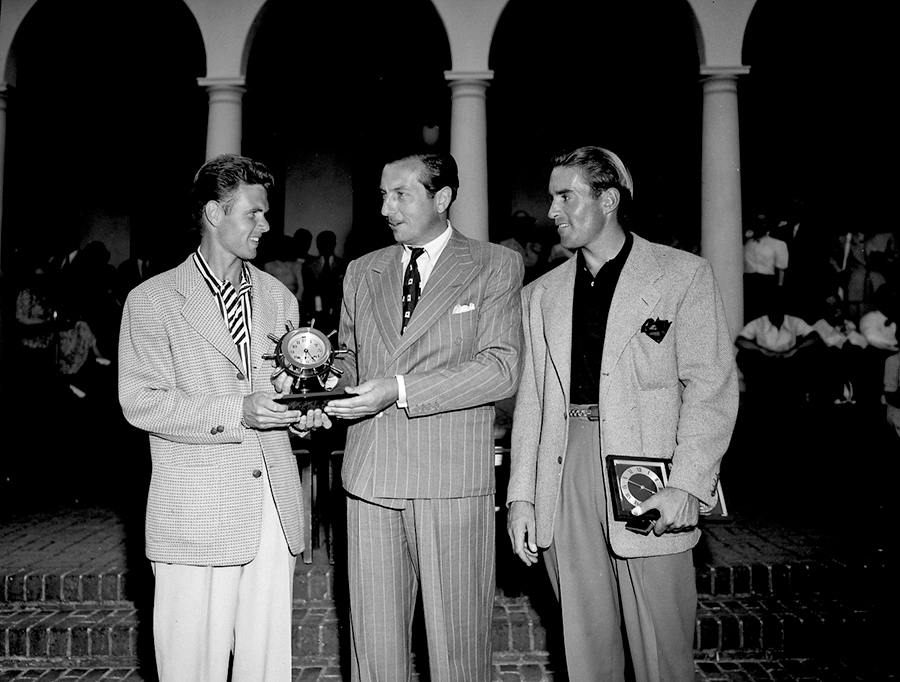
North and South champion Harvie (left) is congratulated by Henry Cotton. Runner-up Frank Stranahan (right) looks on

Ward was reduced to working in a San Francisco shipyard and teaching in a downtown sporting goods store. Mired in increasingly dire circumstances, he reached out to old UNC buddy Harvey Oliver for help. Oliver put Ward in touch with entrepreneur Dan Thomasson, one of the developers of the Foxfire Golf and Country Club near Pinehurst, who offered a lifeline by hiring Ward as Foxfire’s director of golf. The West Coast transplant, son of a Tarboro, North Carolina, pharmacist, returned to his native state.

The Pinehurst area held fond memories for Ward. He had played golf there frequently while a student at UNC and later, during his first post-graduation job selling insurance in Greensboro. Ward’s sensational performance in the 1948 North and South Amateur Championship, contested over Pinehurst No. 2, had brought the happy-go-lucky college senior his first dose of national attention. Entering the event on a whim, the unknown 22-year-old surprised himself by reaching the final, dispatching Wake Forest’s Arnold Palmer along the way.

Ward faced an uphill battle against the “Toledo Strongman” Frank Stranahan, who’d been runner-up in both the Masters and the British Open in ‘47. His secret weapon was the Zeta Psi fraternity, whose members scattered throughout the campus the night before the 36-hole final, spreading news of the match, urging students to head to Pinehurst to root for their fellow Tar Heel. Hordes of them showed up. An exuberant crowd of 2,000 overwhelmingly supported Ward. “Every time Frank would miss a shot or miss a chip, they’d cheer,” remembered Ward. “Anytime I’d get the ball airborne, they’d go nuts. You’d thought they were in Kenan Stadium at a football game.”

Ward’s stupefying avalanche of holed putts annoyed Stranahan more than the boisterous students. When he rammed home one final dagger on the 36th hole to close out his frustrated opponent, the elated Zetas celebrated by hoisting the winner to their shoulders and carrying him off the course.

Now, approaching middle age, Ward arrived at Foxfire to labor as a club teaching pro, instructing duffer and scratch player alike. His gentle manner and uncomplicated instructional method worked wonders for his pupils. When he wasn’t on the lesson tee, Ward kept his game sharp in afternoon money games with the area’s better players. The action honed his game to a semblance of its old form. At age 51, he won the North Carolina Open.

In Jim Dodson’s book A Son of the Game, Ward said that Foxfire was “where I began to finally discover what I may have been put on Earth to do. I was here to have fun playing golf with my buddies and teach others how to play this crazy game. I was here to pass the game along.”

Ward brought his charming rogue persona with him to Foxfire. Tony McKenzie, an occasional golf partner, recalls the time Ward — who was either between marriages or about to get out of one — showed up at McKenzie’s printing business asking that a batch of cards be made up reading something to the effect of, “Hello, I’m Harvie Ward. You look adorable. I’d like to get to know you better.”

After 10 years at Foxfire, Ward was hired by Nicklaus to be the director of golf at Jack’s Grand Cypress Resort, where he became Payne Stewart’s instructor. A couple of years later, Ward moved across town to Interlachen Country Club. It was in Florida where he met the woman destined to become his fifth (and final) wife, Joanne Dillon. After the couple married, they contemplated relocating. “Harvie suggested we go to either the West Coast or North Carolina,” remembers Joanne. “I said no to the West Coast. We’ll go to North Carolina.”

The couple moved to Pinehurst in 1989, settling in a spacious home on Blue Road in the village’s Old Town section. Peter Tufts (Richard’s son) constructed a par 3- hole on the property, where guests at Ward cocktail parties invariably gravitated with wedges in hand. Joanne bought her husband a 1967 Silver Shadow Rolls Royce, which he happily motored to his newest teaching gig at Pine Needles Lodge and Golf Club. He taught female attendees at Peggy Kirk Bell’s Golfaris and gave individual lessons, too. A young Webb Simpson was a pupil.

Ward’s growing reputation as a teaching pro culminated in the PGA of America naming him “Teacher of the Year” in 1990. Ward explained that the combination of Joanne and Pinehurst finally brought him peace. “That turned out to be the smartest decision I ever made,” he confided to Dodson. “Without Joanne, see, none of this would have happened. I would have been dead years ago.”

And Ward was having more fun playing golf than he had since his championship days, hooting and bantering with a disparate band of playing partners including local pros Andy Page, Bill Clement, Buck Adams and Waddy Stokes. Much of it was played at his new club, Forest Creek Golf Club. Usually, Ward took Page, the retired Southern Pines Country Club pro, as his partner. The duo would take on all comers provided that both men, sliding into their 70s, were allowed to play from the middle tees. With that advantage, they seemed as unbeatable as Hogan and Nelson. “We would make a birdie and were sure we had the hole won when either Harvie or Andy would chip in,” reflects Chris Israel, Forest Creek’s assistant pro at the time, shaking his head in disbelief. “They would drive to the next tee cackling and giggling with each other, and say loud enough for us to hear, ‘They really thought they had us. They should know better!’”
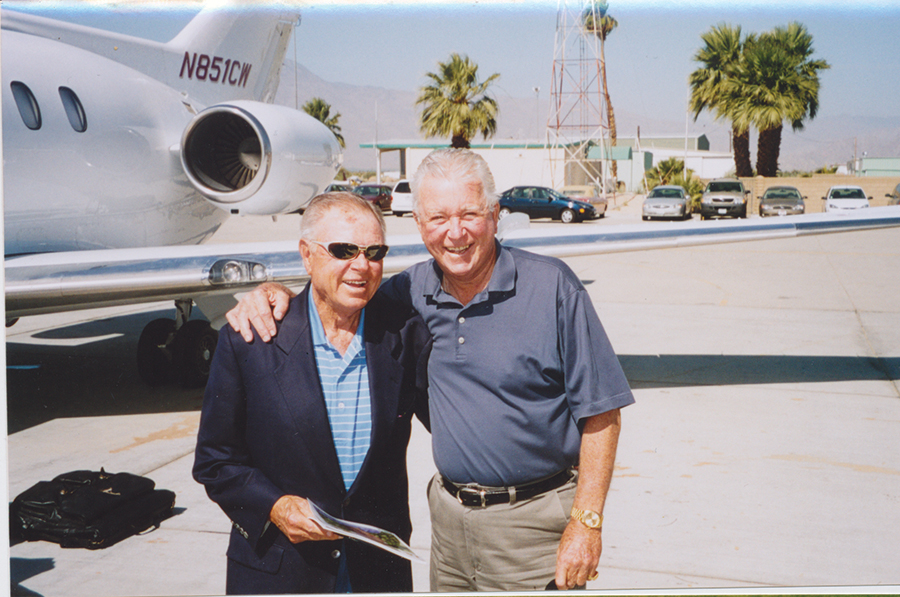
Old partners Harvie Ward and Ken Venturi

Notables from far and wide journeyed to Forest Creek to play golf with Ward. Dick LeBeau, one of pro football’s greatest defensive minds and a near-scratch player, was among them. The coach admired Ward’s ever-keen competitive nature. “He had that gleam in his eye. He knew he was going to beat you; you knew he was going to beat you; and it was fine because it was such a privilege to play with him,” reflects LeBeau. Watching ‘Ol’ Harv’ hit an iron shot was a mesmerizing experience. “It was the timing of his swing, and the sound,” marvels LeBeau. “So flush, and the ball never left the pin.”

By 2003 Ward’s freewheeling younger days had taken their toll. Diagnosed with cancer, his prognosis was not good. When asked by a friend how he was doing, Ward replied, “I’m on the back nine and I can see the clubhouse.” Several of his concerned golfing friends arranged for him to make a few sentimental journeys to golf meccas like Pine Valley and Seminole.

Jeff Dawson, a young Forest Creek member, escorted Ward to historic Merion Golf Club, where Ward’s friend Bob Jones had completed his Grand Slam. Ward was playing miserably and laboring in Philadelphia’s summer heat when the twosome reached Merion East’s 14th tee. A flock of members had come from the clubhouse to watch him play. Ward came alive, blasting a drive. That was followed by a laced 3-wood to the green and a holed birdie putt.

“What came over you?” asked Dawson.

The winking champion responded, “Those folks just wanted to see Harvie Ward.”

With just a few months to live, Ward and three friends (including Dawson and Ward’s personal physician) flew to the West Coast for a last golf trip. Tee times were scheduled at two of his favorites, San Francisco Golf Club and Cypress Point, where he and Venturi had carved out a portion of golfing lore 47 years earlier. On the way back East, the men stopped in Palm Springs to visit his old partner and friend, Venturi, in his desert home.

The 1964 U.S. Open champion’s den was loaded with trophies from his playing days. The one Venturi chose to place front and center was from the 1956 San Francisco City Championship, causing a flurry of good-natured teasing. Venturi took Dawson aside and said, “Do you know how good he was? I never saw him hit a 4-wood outside 10 feet!”

When it was time to leave, neither of the old running mates displayed out-of-the ordinary emotion as they hugged their goodbyes, but both realized they would not see one another again. Ward would pass away on Sept. 4, 2004. Furman Bisher, the dean of Atlanta sportswriters and a fellow UNC alumnus who covered the Masters 62 times, summed it up this way: “Harvie never lived an unpleasant day in his life or, if he did, he didn’t show it.”

Not long after returning from his final California trip, Ward played the last nine holes of his life with Dawson at Forest Creek. He shot 34 and called it a day.

“You can’t quit. You’re two under,” Dawson said.

“Yeah,” replied the rueful champion, “but nobody cares.”

His friends did.  PS

Pinehurst resident Bill Case is PineStraw’s history man. He can be reached at Bill.Case@thompsonhine.com.

Poem

Awoken

The moon awoke me

howling for attention

the stars were distant, aloof

a few gregarious, Gregorian twinkles

made celesta accompaniment

lunar fugue

a chorus of seas

echo of my cathedrals

trumpets and choirs

the organist’s foot pedals

faster than tap

Did the moon not wake you?

No tom toms, no Tchaikovsky cannons?

Oh your serene dreams of a

more melodious siren

That is why I love you

listening to the moon in your eyes

Ry Southard

Me, Jake and the Lake

Building a dream in Whispering Pines

By Deborah Salomon    Photographs by John Koob Gessner

Lac Enfin.

The sign over the door echoes Leigh Morgan’s sentiment about her new waterfront home:

Finally, the lake

What she might add is c’est moi — meaning inside and out, floorplan, colors and furnishings, this house is me: designed to be lived in by me and Jake, my dog.

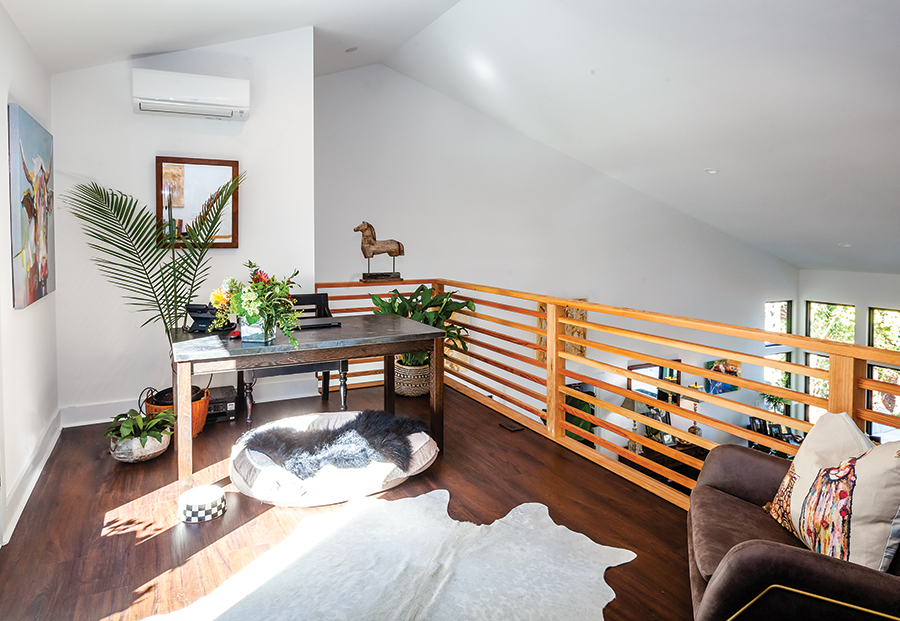
The 1,800-square foot cottage in modern farmhouse style, an architectural dernier cri, has only one bedroom, although the loft (now her office) soaring over the living area could be converted.

For sure, with its stark white exterior, black accents and Juliet balcony, Morgan’s lake villa stands apart from its neighbors, built in Whispering Pines ranch-style, circa 1970s.

People walk by, wave and shout, “Nice house!”

Vive la difference.

Now try this one, in English: A change is as good as a rest.

For 30 years Morgan lived quite happily in a charming renovated cottage in the downtown Southern Pines historic district. Her décor: charming renovated cottage-style. Then one morning she woke up and said something like . . . I’m outta here.

“I made an announcement to my family that I was going to sell my house.”

Ah, but why . . . and where would she relocate, they wondered?

“I love the water. I’ve always wanted to live on the water.”

Morgan was familiar with lakeside properties in gated golf communities. No. She wasn’t familiar with Whispering Pines until a business errand took her there. Imagine . . . water, water everywhere. Not only water, but a perfect little building lot on Shadow Lake opposite protected wetlands, assuring forever greenery. She bought the lot a week later, in September 2018. Because a proper “me” house, like a good chocolate cake, must be scratch-made.

Morgan’s business is screen printing logos on T-shirts and promotional material, not drawing plans for a house. Luckily her stepfather, Larry Best, is a retired landscape architect with adjunct skills.

“We had a hurricane that September.” So she, her family and their iPads holed up for two days and designed the shell.

“I picked out everything myself,” Morgan says, beaming with pride. “I read a lot of magazines. So many choices.” Her criteria: “Something I won’t get tired of in five years.”

Once a builder was found, the work went fast. They broke ground in January, moved in by July. “Everything went right. It was a great process,” she says. Even the stark white wide-board exterior doesn’t compete with surrounding nature.

Of course Morgan drove out almost every day, with Jake, to monitor progress.

“He got to know the place gradually,” so the move wasn’t upsetting. Now, Jake has commandeered the Juliet balcony as a snooze spot/lookout.

Inside the black front door, one word says it all.

Magnifique! A 40-foot-long wall of soaring windows, which round the corners at each end, maximizes views of that coveted water. No blinds, no shades, no obstructions. Just a concrete terrace furnished for year-round outdoor cooking and living. Closer to the lake itself, another table for dining.

But what’s that faint whooshing sound?

Immediately inside the front door Morgan positioned an unusual wall-mounted fountain, with a sheet of water falling over a sheet of slate into a narrow trough, where it is sucked upward to fall again. To Morgan, the sound represents serenity.

“When you walk past the fountain it takes negative energy away,” she says. “It’s the first thing I turn to in the morning.”

Except for the bedroom, dressing room and bath, the entire main floor with its 30-foot ceilings is one space with white walls and dark-stained floors, divided only by furnishings. A contemporary sectional sofa the color of beach sand sprawls in front of the fireplace; a more formal settee with carved wood frame, also vanilla, faces the lake. The dining room table, vaguely Parsons, is darkly speckled metal — something she found abandoned in an office. Around it, black-lacquered Windsor chairs, others rawhide-covered; along one side, a bench. Tall bird of paradise and fiddle leaf fig plants help delineate areas.

Abstracts and animal art dominate the walls, splashes of color in this black-and-gray-and-white environment. Morgan is a lifelong horsewoman. Her parents have homes in Southern Pines Horse Country, also in Montana. Animal skin rugs and throws (a steely-eyed badger, perhaps?) come from a veterinarian-pathologist friend who practices taxidermy.

The kitchen borders the great room, suggesting the epithet: Know a woman by her kitchen.

“I’m a minimalist,” Morgan states. Every utensil, every appliance has its place, mostly out of sight. A microwave is not among them. “No, never had one, never liked them,” she says. “I boil water in a kettle.” She chose cabinetry with care to match the living space it is part of: deep charcoal, matte finish instead of hard-edged glossy. Practical white ceramic tile forms the backsplash

A sliding black barn door separates the only bedroom from the great room. On display here, her boldest acquisition: the headboard, a massive, mottled gray metallic panel mounted on a charcoal wall. She found it in a warehouse. “It’s from a tin ceiling,” Morgan explains, with glee. Yet she integrated this and a hulking 9-foot armoire, painted black, with several traditional chests from her grandmother’s house.

The en suite oversized bathroom is splashed with sun beaming through high windows. Half walls protect an integrated shower fitted out with a teak bench, for a Scandinavian effect. Instead of a multi-sink vanity, Morgan chose to place two free-standing ones at opposite sides of the room.

The loft satisfies Whispering Pines’ minimum square footage requirement. Building up was cheaper than building out. Climbing the steep steps is a workout, but once up, the view through the window wall and across the lake is spectacular, even at night, with twinkling lights strung over the veranda. Another requirement, an attached garage, gave her the idea for connecting the two with a mud room.

First-time homebuilders travel a rocky road even when assisted by architects and interior designers. Leigh Morgan, Jake trotting close behind, seems to have avoided the potholes. The only glitch, she laughs, was having the right refrigerator delivered: a stainless steel two-door model (one over one, not side by side) with no exterior ice maker or water dispenser. On the fourth attempt she got what she wanted.

“The whole idea behind this house was to bring the outside in,” Morgan says. “I’m pretty content with life, but this was the icing on the cake, a healing place, calming and peaceful.

“Sometimes I want to pinch myself.”

Jake, an equally mellow fellow, concurs, as he begs a biscuit, then settles down into a faux fur dog blanket spread over the sectional and falls asleep.  PS

A Legacy Imperiled

Time and weather take their toll on Addor’s Rosenwald School

By Jim Moriarty

You have to step carefully. There’s a massive hole in the roof directly over what was once the kitchen, just inside the back door. The floor still supports your weight. At least for now. An old sign on the wall left over from when it was the community center says “Welcome Addor Friends” but lays down the rules to a vacant building: No Alcohol or Drugs; No Arguing; No Gambling; No Fighting; No Profanity; No Weapons of Any Kind; No Smoking.

Over one door it says “Library/Classroom.” There are still books on the shelves, an Encyclopedia Britannica and a set of World Books so old the Soviet Union still exists. Chairs small enough that a child’s toes can brush the floor are stacked on equally tiny desks built three abreast.

In the “Auditorium,” a glass case shields old photos and scrapbooks of newspaper articles. There’s a dusty ping-pong table and a piano with notes that clunk off the walls of the empty room if you happen to plunk the right key, leaving little behind but the echo.

The Lincoln Park School was built in 1922 on South Currant Street in Addor, the African-American town on the southern edge of Pinebluff where lumber and turpentine workers scratched out an existence in the late 19th and early 20th centuries. In 1890 it was the second largest town in Moore County, with a population of 295. Once called Keyser, a phonetically unpopular name in America in the midst of a world war, the town was renamed in October 1918 in honor of Felix Addor, a local man who died on the troopship SS Leviathan — formerly the German passenger liner Vaterland, itself renamed by Woodrow Wilson — during its second Atlantic crossing delivering doughboys to the trenches.

The school was one of 16 Rosenwald schools built in Moore County. The only other documented school remaining is Southern Pines Primary. “The Rosenwald school building effort, structured as a matching grant program, began with a $25,000 gift of Julius Rosenwald [part owner of Sears, Roebuck and Company] made in 1912 to Tuskegee in support of teacher training. At the behest of Booker T. Washington and Clinton J. Calloway, Rosenwald allowed $2,800 of that money to be used in a pilot program to help communities build small rural schools,” writes Claudia Stack, a filmmaker and educator in the New Hanover Schools.

Her documentary about Rosenwald schools, Under the Kudzu, a project nine years in the making, was released in 2012. During the 20 years of the program’s existence, 4,977 schools were built in rural areas across the South and “constitute the most numerous and easily recognizable type of school built by African-American communities during the segregation era,” Stack writes. Until recently the Lincoln Park school had one of the original portraits of Rosenwald himself — a rarity in what remains of the schoolhouses. It has since been removed for safekeeping.

The building is on the National Register of Historic Places, a designation that comes with a firm handshake and hearty pat on the back — but not a penny to keep a 98-year-old wooden structure from collapsing in on itself. “After its construction in 1922 through the cooperative efforts of parents, the Moore County School Board, and the Julius Rosenwald Fund, the Lincoln Park School rapidly became the center of the African-American community located in the Keyser area,” says the registration form of the National Register of Historic Places.

Local involvement was particularly crucial. “Without a local drive to build a school, the project did not move forward,” writes Stack. “This self-help aspect of the school building projects, which bound communities tightly to their new schools, was part of the extraordinary vision shared by Rosenwald, Washington and Calloway.”

After Albert S. Gaston became the school’s first principal in 1921, “he and his wife began to raise funds for the new Lincoln Park School. They visited towns on Friday nights with a program by the school children. Their success was profound: they raised $26 at the first meeting, and at subsequent ones raised $100 dollars in 10 minutes. In total they raised a sum of $1,000,” says the National Register filing.

“I think there is something to be said for them architecturally,” says Stack of the schools. “They represent a progressive architecture. Some of the early buildings were designed by Robert Rochon Taylor, the first African-American architect to graduate MIT. He worked out of Tuskegee. Regardless, in the landscape, they’re a testament to the determination of African-American families to obtain education for their children.”

Lorine McCants, having edged into her 90s, lives a block or so away from the old wooden building where she attended school. “I went there from the first grade to the sixth grade,” says McCants. “It was wonderful. Wonderful. The only thing I didn’t like, we lived up that railroad track, and when it got cold we had to walk from up there. The teachers took care of us, and tried to warm us up the best they could. I remember one teacher. We called him Professor Gray. And Lillian Harris, she was one of the teachers. It was very important. That was the only livelihood we had. The school would have programs, different kinds of activities. It was the center of Addor.”

The Lincoln School was decommissioned in 1949 and became the Addor Community Center in 1952. By 2006, at the end of a series of renovations spanning decades, the building was a fully functional center with computers, a library and a kitchen. It was rental space for family reunions or worship services if one of the local churches couldn’t get its doors open.

McCants did stints at different times as both the president and the treasurer of the community center. “I worked there for I don’t know how long,” she says. “It was just my passion to help the community. I loved it.”

John Bright, who grew up in Addor and lives in Aberdeen, is the current treasurer of the Community Center Board. “It kind of came into disarray in 2008,” says Bright of the building, “and 2010 is when the center began to decline. There was no board then. It had a leak and it started to decay. In 2015 we had the community come together, and a new board was formed. Once we took it on, we saw we were facing something that was very challenging. We haven’t given up. Any way we can have an opportunity to try to sustain something for the Addor community, that’s what we want to do. I still believe there’s hope.”

By Bright’s calculations, roughly 60 percent of the homes in Addor don’t have access to city water or sewer. “The Southern Pines water facility is right there adjacent to Addor, right across U.S. 1. On the other end by the Poplar Springs Church is the Moore County sewer facility,” says Bright. “Why can’t we finish Addor out? The word says what you have done unto the least of my brothers you have done unto me, and Addor has been the least of these for a long time. We’re just trying to find a way, by the grace of God.”

Maybe that old wooden building, its cornices out of square, with the fireplaces for warmth and huge windows for light, “set with the points of the compass,” will somehow, almost miraculously, survive as an intact example of a Rosenwald Four Teacher Community School Floor Plan No. 400. “It would be wonderful if we could get it restored,” says Bright. “But the issue is, what can we do for the children and youth who are there now? Do they have 10 or 15 years to wait on the restoration of a building? What are you going to do for them in the meantime? Addor has a rich history and proud people, but the current state of Addor is not what its citizens want.”

There were 813 Rosenwald schools built in North Carolina, more than in any other state. “The way the educators and the families worked together to really push the students to a higher level of excellence, even though the schools were under-resourced, made a huge impact on North Carolina,” says Stack. “That motto of Winston-Salem State University — Enter to Learn, Depart to Serve — I’ve heard that with slight variations many times from people who attended the schools. That was really the ethic. They bettered their communities because of their experience in those small schools of that era built in black communities.”

It’s a melancholy thing when a bit of history falls into ruin, sadder yet when all that rises in its place is the faintest glimmer of hope.  PS

Jim Moriarty is the senior editor of PineStraw and can be reached at jjmpinestraw@gmail.com.
Almanac

February blossoms make the cold hard to shake.

Crocus burst open like paper fortune tellers, hellebores whisper prophesies of spring, and in the backyard, where a speckled bird is kicking up fresh mulch, winter Daphne blushes like bright-eyed maidens in faded terra-cotta planters.

All of this, yet winter feels deep-rooted, endless. As if her flowers were cruel illusion. As if your bones could be forever yoked to this chill. 

Then one day, out of nowhere, a new warmth arrives with the daffodils, a new softness beckoning you outdoors.

Beneath the bare-branched sycamore, where the picnic table has all but forgotten its name, February sunshine feels like a warm bath. You’ve brought lunch — a thermos of soup — and as the sunbeams dance across your face and skin, you feel, for the first time in months, as open as the crocus. As if winter might release you. As if hellebores were true harbingers of spring. 

Beside your thermos, a feathery caterpillar edges toward you. Did it fall from the sky? You look up toward bare branches, wonder where he came from, where he’s going, whether he’ll be the speckled bird’s lunch. He’s closer now, gliding across your idle spoon, and as you observe his wispy yellow coat, you see yourself in this tiny being and in what he might become:

Enamored by each fragrant blossom; wide open; ever-seeking the simple grace of light.

February sunshine has transformed us, encoding within us the promise of spring. We can feel it now.

The Lenten Rose

When a plant blooms in the dead of winter, it is neither ordinary nor meek. That plant is a pioneer.

Also called the “Lenten rose”, the hellebore is a beloved and shade-tolerant herbaceous or evergreen perennial — not a rose — that so happens to thrive here. Some species more than others.

Take, for example, the bear claw hellebore, which is named for its deeply cut “weeping” leaves. February through April, this herbaceous perennial displays chartreuse green flowers that the deer won’t touch, and you shouldn’t either (read: toxic when ingested). As the flowers mature, the petal edges blush a soft, pale ruby. Talk about subtle beauty, but more for the eyes than for the nose (its crushed leaves are what give it the nickname “stinking hellebore”).

On behalf of every flower-loving soul aching in their bones for the coming spring, thank you, hellebore. You’re a true queen.

I know him, February’s thrush,

And loud at eve he valentines

On sprays that paw the naked bush

Where soon will sprout the thorns and bines.

— George Meredith, “The Thrush in February,” 1885

Full Snow Moon

The Full Snow Moon will rise at night on Feb. 8, peaking in the earliest hour of the morning on Feb. 9. Also called the Bone Moon, this supermoon (the closest the moon can come to Earth in its orbit) marks a time of heavy snowfall and, in earlier times, little food. If you’re warm and full-bellied, this moon is a good one to share the wealth.

Warm Your Bones

This month in the garden, sow beet, mustard and turnip seeds. Plant your spring salad (loose leaf lettuce, arugula, spinach, carrots, radish, cilantro). But while it’s cold out, soup!

The following recipe from DamnDelicious.net is a quickie — all the better for soaking up more February sunshine while the spring garden grows.

Spinach and White Bean Soup

Ingredients:

1 tablespoon olive oil

3 cloves garlic, minced

1 onion, diced

1/2 teaspoon dried thyme

1/2 teaspoon dried basil

4 cups vegetable stock

2 bay leaves

1 cup uncooked orzo pasta

2 cups baby spinach

1 (15-ounce) can cannellini beans, drained and rinsed

Juice of 1 lemon

2 tablespoons chopped fresh parsley leaves

Kosher salt and freshly ground black pepper, to taste

Directions:

Heat olive oil in a large stockpot or Dutch oven over medium heat. Add garlic and onion, and cook, stirring frequently, until onion is translucent, about 2-3 minutes. Stir in thyme and basil until fragrant, about 1 minute.

Stir in vegetable stock, bay leaves and 1 cup water; bring to a boil. Stir in orzo; reduce heat and simmer until orzo is tender, about 10–12 minutes.

Stir in spinach and cannellini beans until the spinach has wilted, about 2 minutes. Stir in lemon juice and parsley; season with salt and pepper, to taste.

Serve immediately.  PS

Every gardener knows that under the cloak of winter lies a miracle . . . a seed waiting to sprout, a bulb opening to the light, a bud straining to unfurl. And the anticipation nurtures our dream. — Barbara Winkler

Desserts We Love

By Jenna Biter   •   Photography By John Koob Gessner

Somehow, the riotous and violent Roman festival of Lupercalia, meant to dispel evil spirits and bring fertility and purity to the city, commingled with the beheading of one or more St. Valentines and evolved into our modern celebration of romance – Valentine’s Day. The English poet Geoffrey Chaucer mentions birds mating in February one time, and, voilà, a celebration of affection and adoration is born. Or something like that.

Regardless of its possibly disturbing and definitely mysterious origins, the lovey-dovey holiday’s current state is as crystal clear as the Swarovski necklace she probably wants. It’s all about reds and pinks, flowers and dinner dates, friendship and romance, and, of course, chocolates, desserts — and chocolate desserts. Lucky for you, we’ve compiled a drool-worthy list of Valentine’s Day-approved confections from restaurants and bakeries in the Sandhills. Whether you’re a two-weeks-in-advance reservation maker or a last-minute “oh-damn” shopper, we have sweets for you and your other half. Or just you.

Ashten’s Restaurant

Pastry Chef: Zarah Wetmore

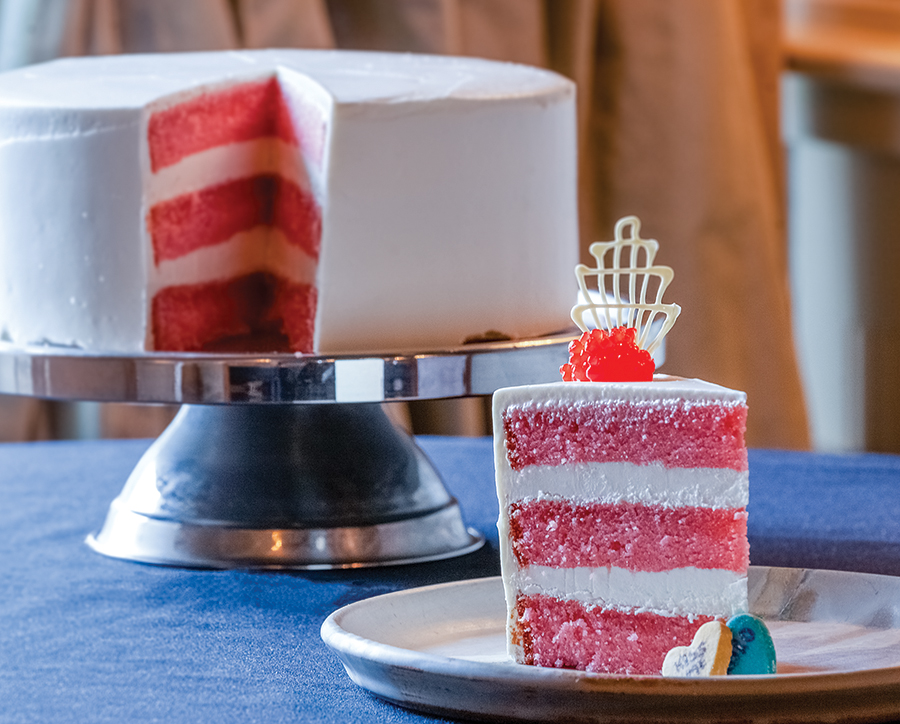
“I was the kid that wanted the Easy Bake Oven, but my mom and dad said, ‘No, use the real oven,’” says Zarah Wetmore of her baking roots. “I never got a light bulb oven.” And that might be why Wetmore is baking desserts as the pastry chef at Ashten’s Restaurant, and we’re not. Her Valentine’s Day dessert is a sophisticated and romantic take — a pink Champagne and St. Germain (an elderflower liqueur) cake finished in Swiss meringue buttercream that’s flavored with the floral liqueur, as well. It’s a lovely pink color inside, and the cake is garnished with a bit of molecular gastronomy — strawberry caviar. Fun fact: Fruit caviar has nothing to do with fish roe, but it is made with agar-agar, a gelatinous substance that comes from red seaweed. Boil fruit juice with agar-agar, then eye-drop the mixture into oil, where it beads into “caviar.” Who knew Valentine’s Day can be romantic and a learning experience? And, most importantly, delectable.

C.Cups Cupcakery

Owner and Baker: Janell Canino

“I feel like for Valentine’s Day people do a lot of chocolate, and chocolate-covered strawberries are popular,” says owner and baker of C.Cup’s Cupcakery Janell Canino on the inspiration for her celebratory dessert. Allegedly making their debut in 1960s Chicago, chocolate-covered strawberries definitely are a Valentine’s Day favorite, and the combination of chocolate and strawberries makes sense for a romantic holiday — both foods are thought to be aphrodisiacs — even if the scientific community isn’t sold on their efficacy. Lucky for us, we can enjoy this festive combination (amorous powers or not) at C.Cups atop its cheesecake cupcake. “Our cheesecakes are extremely popular, so I figured I’d do a little twist on the cheesecake and do a chocolate truffle,” Canino explains. Her ultimate creation for the lover’s holiday is a chocolate truffle cheesecake cupcake finished with a chocolate whipped topping, chocolate shavings and a chocolate-covered strawberry. It’s a chocolate lover’s dream.

The Ice Cream Parlor

Confectioner: Dixie Parks

The story of the cherry cordial, a confection with a liquid cherry center and chocolate shell, starts with medicinal tonics in the 1400s and continues today with the candy’s popularity during winter holidays and, of course, Valentine’s Day. “My grandfather loved them, and he would hide them in a box when he got them and stow them away, so he wouldn’t have to share,” says Dixie Parks of The Ice Cream Parlor. The mass-manufacture of the cherry candy began in the late 1800s and, by the 20th century, it sparked a fondness for “stashing away” the sweet not unlike Parks’ grandfather. Nostalgia for the candy remains today, and we’re happy it does, because Parks highlights the confection in her spectacular holiday ice cream — chocolate cherry cordial. It’s a chocolate and cherry cordial base with chunks of chocolate-covered cherries and chocolate shavings mixed in. “We tried to do a more sophisticated blend,” says Parks of her Valentine’s Day treat. We think she hit the mark, and, no, you don’t have to share.

Meat and Greek Eatery

Owners: Oresti and Brittany Arsi

Baklava, popular in the historic Levant, is a staple of Greek cuisine. “We do it a little bit different than a traditional Greek baklava,” says owner of Meat and Greek Eatery Oresti Arsi. The local restaurant’s recipe for the classic is layered with phyllo dough, brown sugar, a syrup with a complex formula, and a nut mixture of walnut, pistachio and thyme honey that’s imported from Greece. Then, it’s cut into a heart shape and served with a syrup drizzle for romantic flair. Order it to taste Arsi’s twist on this classic, or just to enjoy good baklava. More of a chocolate fan? Opt for Meat and Greek’s other celebratory dessert instead (page 72). It’s a dome layered with cake and chocolate mousse, and covered in a shimmery golden shell, courtesy of Arsi’s cousin, who runs Yia Yia’s Bakery in Baltimore. “We love how it’s sparkly,” says Oresti. And so will she.

The Carolina Dining Room at The Carolina Hotel

Executive Pastry Chef: Shelly Taylor

The Carolina Dining Room’s Shelly Taylor began her pastry career in Scottsdale, Arizona, before it took her to the kitchens of Pebble Beach, California, and Maui, Hawaii. The next stop on her baking trajectory brought her back to the continental U.S. to our very own Pinehurst, and that’s great news for your Valentine’s Day plans. Taylor is showcasing a milk chocolate mousse dipped in a chocolate hazelnut crunch, and it’s accompanied by a flourless chocolate cake, salted caramel, fresh raspberries, vanilla Chantilly whipped cream and a beautiful chocolate curl. It’s everything you want in a date-night dessert — sophisticated flavors, chocolate and more chocolate all served to you in the crystal-chandeliered dining room of The Carolina Hotel. “We’ve been here for five-and-a-half years, and I love it,” Taylor said of her time in the area. “I don’t think we plan on moving anytime soon.” With desserts like this, we hope not.

Lynette’s Bakery and Café

Owner and Baker: Lynette Bofill

If you love, hate or don’t care about Valentine’s Day, Lynette Bofill of her eponymous bakery and café has you covered. Her smorgasbord of festive treats is sure to satisfy everyone from love and friendship fanatics to holiday curmudgeons. Heart-shaped sugar cookies finished with vanilla icing and buttercream writing boast traditional mushy gush like “XOXO” or “I Love You,” and anti-holiday wit like “I Tolerate You” or “Stupid Cupid.” Bofill laughs. “I have some friends who hate Valentine’s.” Well, these satirical cookies will certainly please them. She also has M&M brownies with multicolor candies for friends, red and pink candies for lovers, and plain brownies for people who just want a brownie. And her 6-box of cupcakes? It’s for anyone who likes delicious. The sextuplet features strawberry champagne, dark chocolate raspberry injected with jam, honey graham, red and pink confetti, triple chocolate, and red velvet with cream cheese frosting. Yes, please.

Thyme and Place Café

Dessert Chef: Jari Miller

“We come from an area with a large Italian influence,” says Thyme and Place Café’s Jari Miller of her time in Syracuse, New York. But she doesn’t notice that influence much in the Sandhills, and she’s trying to establish it here via Italian desserts. “At Christmastime we did Italian cookies, which were a huge thing for us when we were in Syracuse,” Miller gushes. “We shipped 3,000 pounds all over America every Christmas.” Fast-forward to the present, and Miller’s Valentine’s Day confection for Thyme and Place is, you guessed it, Italian. It’s a cannoli cake iced in buttercream and topped with traditional pistachio and chocolate chip cannoli, maraschino cherries, a chocolate ganache drizzle and red heart decorations to set the mood. The inside is equally as mouthwatering — two layers of moist vanilla cake with the bottom layer hollowed out and filled with cannoli cream. Yum. If Italian desserts are all this good, we’re on board.  PS

Jenna Biter is a fashion designer, entrepreneur and military wife in the Sandhills. She can be reached at jenna.l.knouse@gmail.com.
Poem

The Arrow

I tried to explain Cupid to a 4-year-old today. 

He was making a Valentine for his grandmother, 

festooning a pink paper heart with stamps and stickers, 

writing ‘I love you’ across it in big, shaky letters. 

Then he asked about one of the stickers: 

Why does that heart have an arrow through it? How sad.

Even after I told him that it was more like being ‘struck by love,’ 

he held his hand over his chest. 

I don’t want Cupid to shoot me, he said. 

That would hurt.

I couldn’t disagree.

— Ashley Wahl

Cabin Fever

Living high on the log

By Deborah Salomon   •   Photography By John Koob Gessner

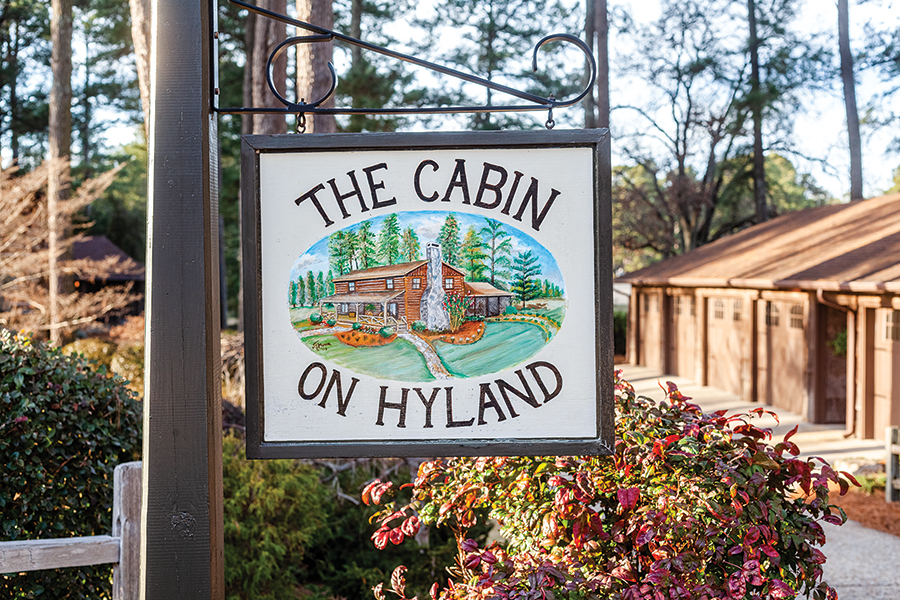
Abe Lincoln never slept here. More likely Ralph Lauren, Tom Cruise, Oprah, Clint Eastwood — all of whom own palatial log homes. Yet Les Holden’s modest but well-appointed cabin retains that rough-hewn aura conveyed by colors, surfaces and memorabilia.

Since it’s not a kit cabin, the layout can be unpredictable. Furthermore, manicured grass, tall hollies and a bubbling fountain overlooking Hyland Golf Club elevate this cabin over the Shaw House compound or anything attributed to Malcolm Blue.

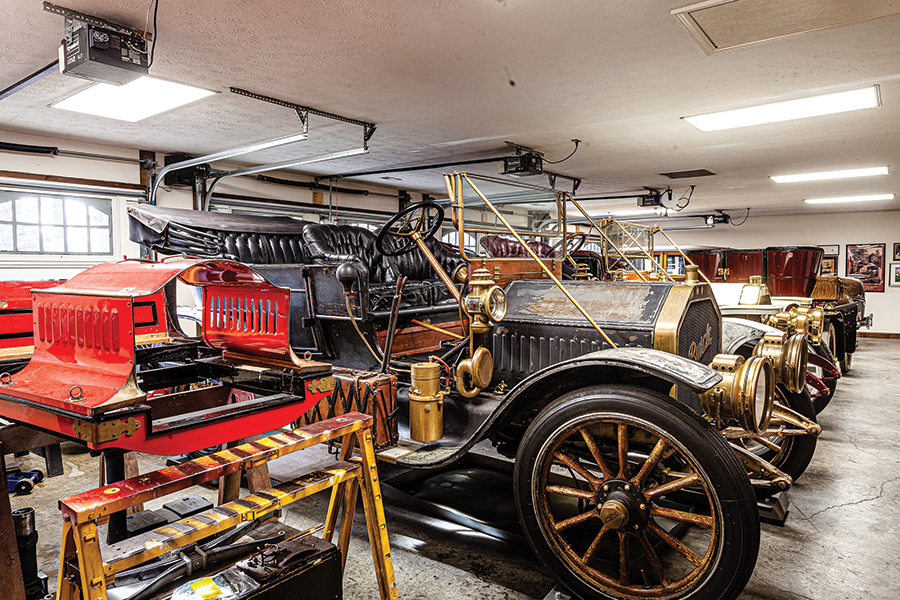
Sealing the deal, the five-bay garage/workshop shelters five Brass Era (circa 1900) cars Holden has restored to drivable glory. Like King Tut’s sarcophagus, they are historic objects d’art enhanced by his knowledge of their provenance and mechanics.

Holden lovingly strokes the bumper of one, then gestures toward the cabin: “This (car) is more valuable than my whole property.”

Holden caught cabin fever growing up in frigid North Dakota, where his father was a ranch manager, then a feed salesman. He pulls out a black and white photo taken of his family, mid-1950s, in front of a hardscrabble log dwelling as unrelated to his own as Willie Nelson is to Perry Como. Before that, they lived in what Holden calls a “basement house on the poor side of the tracks.” The log cabin had been abandoned. Yet Holden remembers being happy there, especially at Christmas, when a freshly cut tree was illuminated by real candles.

Holden discovered Moore County in the 1970s while serving in the 82nd Airborne Division. “I married the ‘farmer’s daughter’ at Fort Bragg.”

After discharge he did well in real estate and mortgage lending, soon establishing his own company and bringing up a family in a large, formal residence. “We used to drive to Pinehurst often in the late ’80s. You could see the cabin clearly (from U.S. 1).” Intrigued by the elongated garage, he stopped.

“I’ve admired your cabin for a long time. Is it a kit?” he asked the owner. No. The pine logs cut from this very lot are joined with 3000 PSI (pressure per square inch) concrete. Interior/exterior wall maintenance is minimal, although retrofitting for wiring and ductwork, if necessary, can be challenging. The floorplan was tight but sufficient.

They spoke for a while; coincidentally, the owner was planning to sell. Holden had vowed to retire at 39. The modest size (just under 1,800 square feet) was perfect, since his daughters were grown.

He struck a deal with the owner in 1993. The Holdens would sell their fancy furniture, prowl for country antiques, landscape the grounds (including a tall privacy hedge), and adopt a more relaxed lifestyle.

On the day Holden retired, his wife was diagnosed with a brain tumor.

“I lost my ambition for making money. There were other things I wanted to do with my life, including taking care of my wife.”

She died soon after. Holden eventually married a family friend, who died of cancer in 2019.

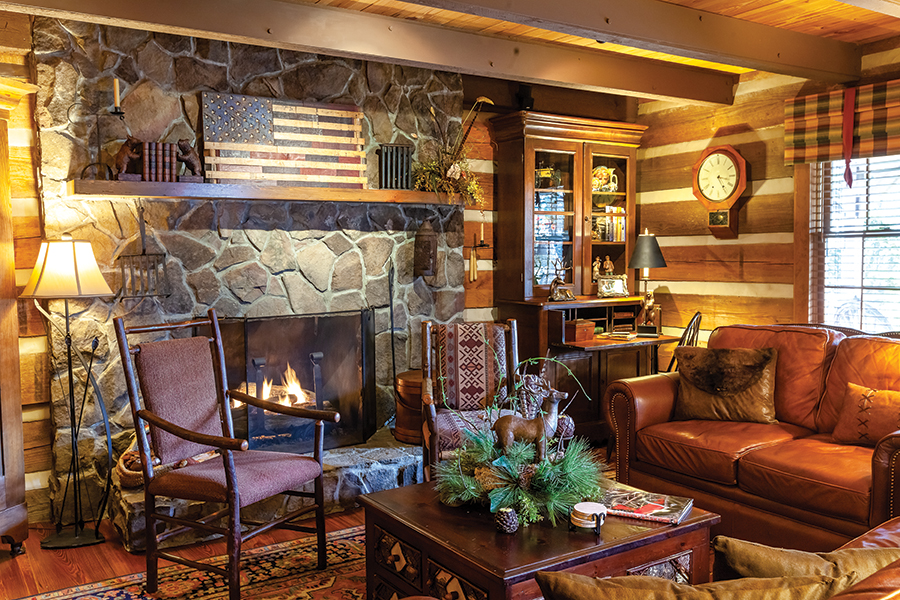
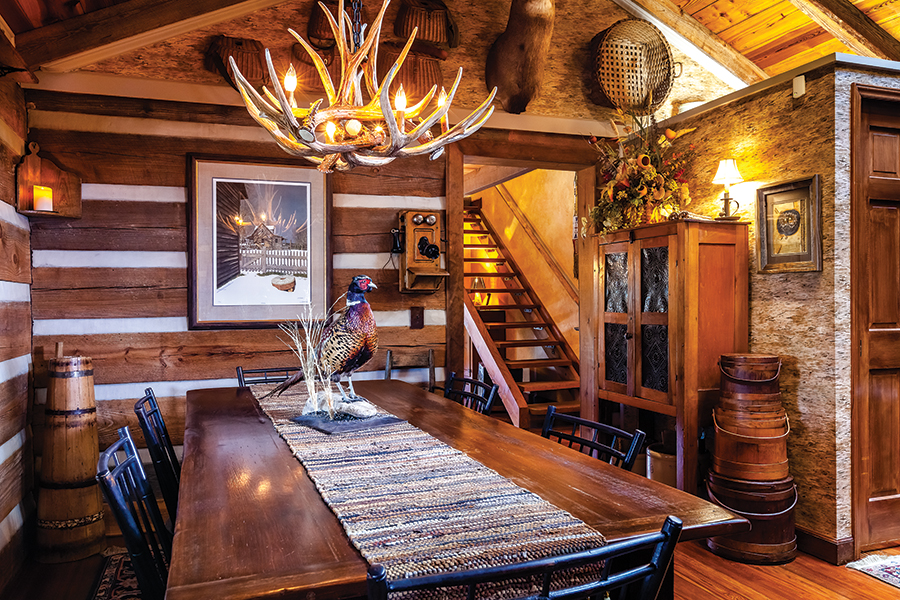
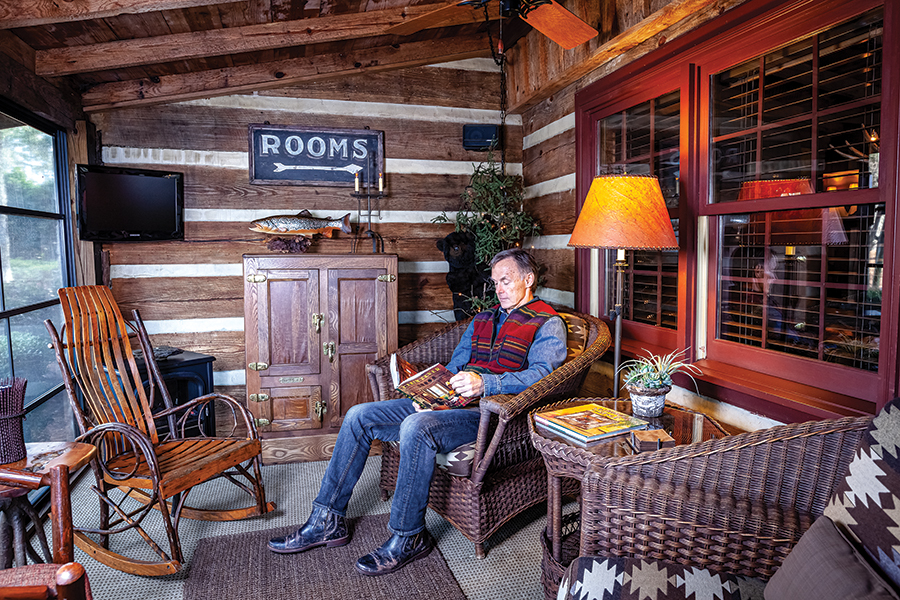
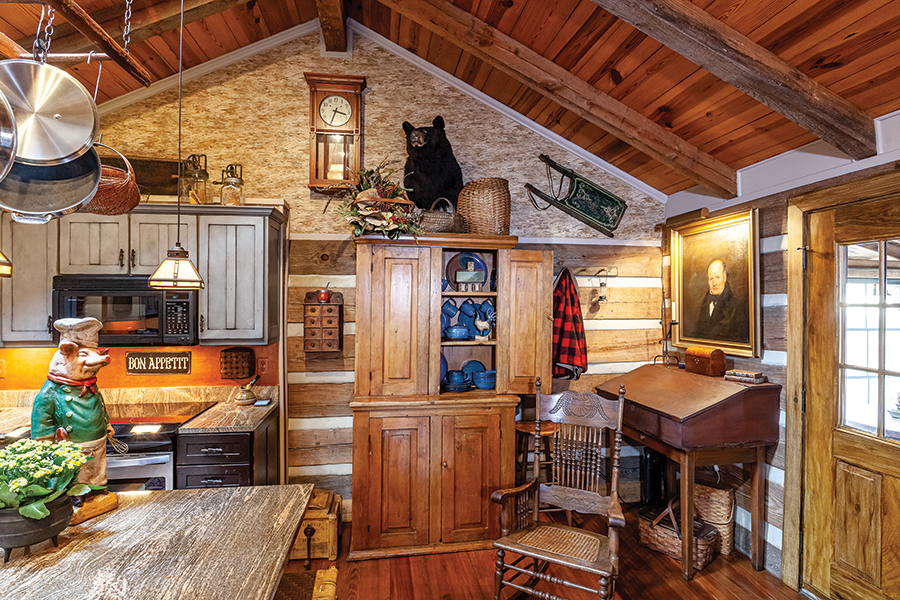
His log cabin houses memories of both — a showplace minus the glitter. Instead, his concept uses forest hues and materials: A brick fireplace was replaced by stone. Tree bark was cut, flattened and fitted as paneling and window valances. Faux-painted walls also resemble bark. An antler chandelier joins mounted bear and mule deer heads. Colors throughout blend browns with greens, an occasional deep red against leather upholstery.

Antique wooden ice boxes and kitchen “safes” arrived via grandparents. Patterned rugs brighten the knotty pine floorboards.

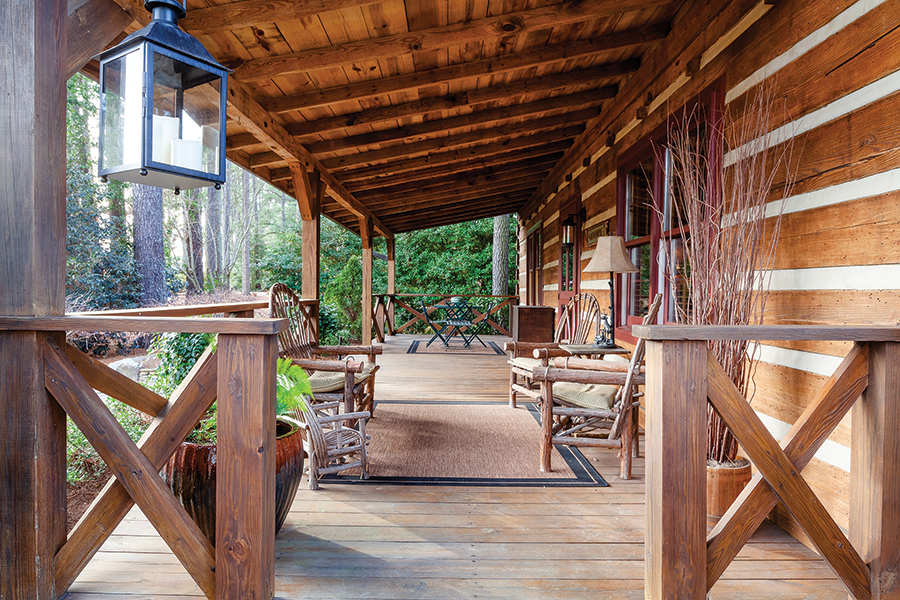
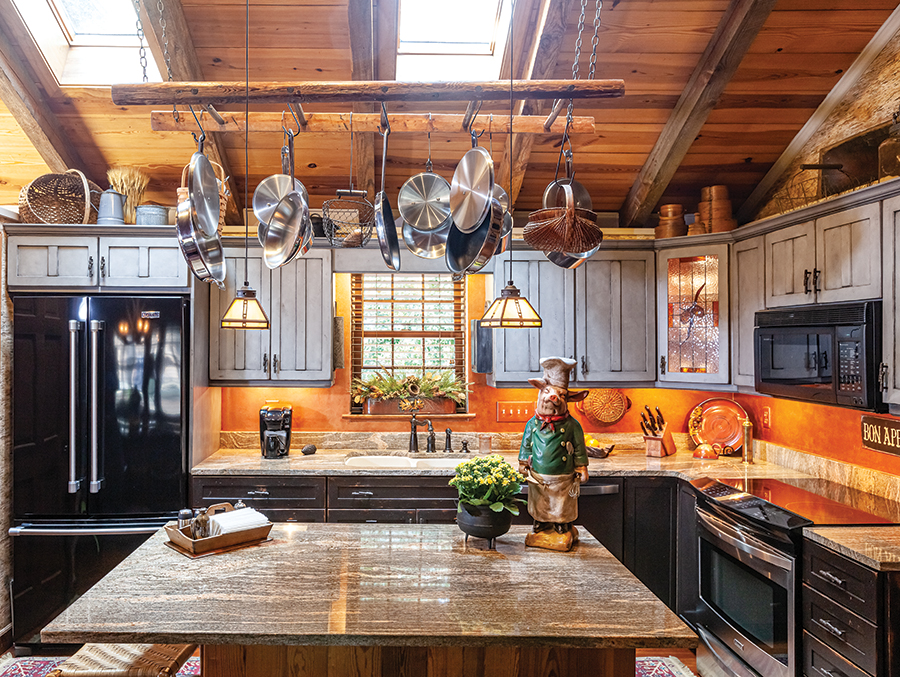
Except for the upstairs master suite with pale wall-to-wall carpet and unobstructed windows, the house is dark, a result of first-floor windows opening onto a covered porch across the front and a screened porch at the rear, both done in rocking chairs and Amish twig furnishings. Holden installed skylights in the kitchen’s vaulted ceiling, all the better to illuminate this unusual room, which combines distressed painted wood cabinetry with an electromagnetic cooktop that creates heat inside metal pots. The island is built from architectural salvage components. Italian granite countertops add an unusual wavy design in gray-green. A massive schoolmaster’s desk fills one corner. Holden is proud of finding matching antique Windsor stick-back chairs, painted black, for the long table within the kitchen dining area.

One risky departure from the cabin motif: a contemporary staircase installed against a wall, with no railing on the open side.

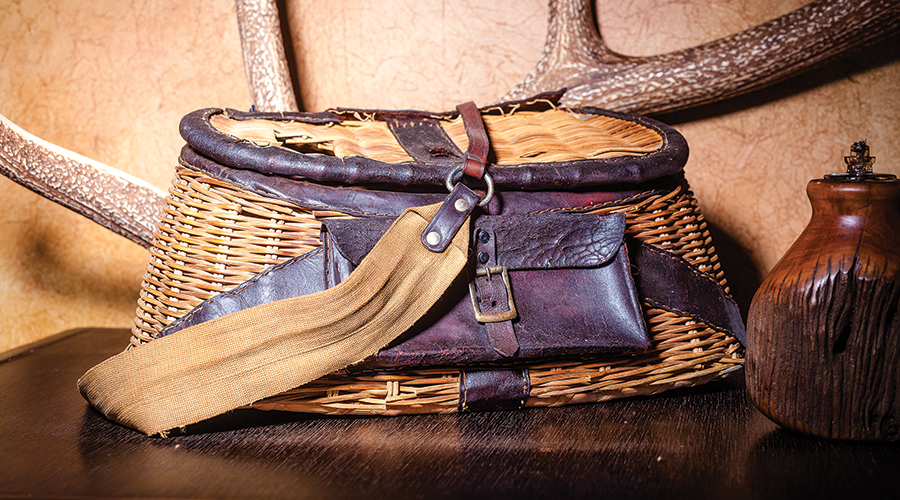
Holden seems most pleased with details, the small artifacts serving as wall decor, like a spice rack with tiny drawers. Or a child’s sleigh from Vermont. Or a portrait of somebody’s grumpy ancestor, whose eyes seem to follow the beholder. His high-tech  thermostat hides behind a weathered mailbox. A flintlock rifle circa 1820 hangs over a door, and a framed Confederate war bond occupies the stairwell.

What do you think this is?”

From the aubergine walls of his upstairs office hang framed documents dated 1773 concerning property deeds and mortgage transactions bearing X signatures, also a painting he purchased at Harrods, the London emporium catering to royalty.

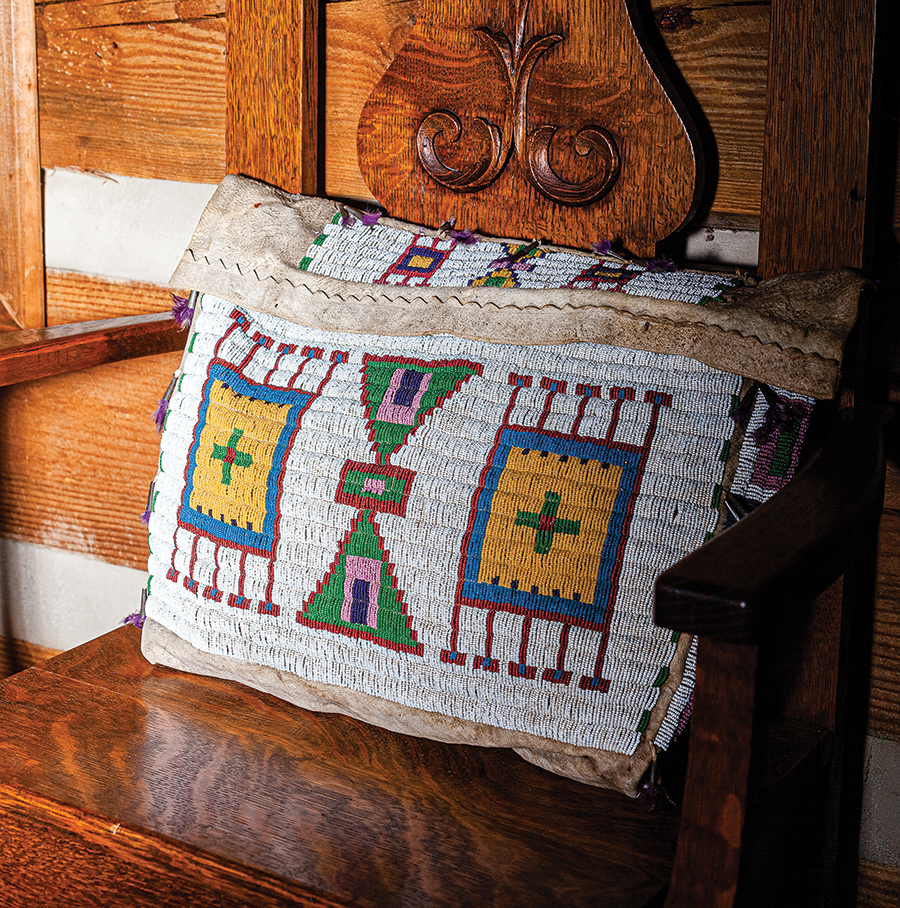
Early American life is represented by “possibles” bags hanging from a hall tree — utility cross-body carry-alls used by hunters and frontiersmen, which could, possibly, contain anything.

“I tried to keep (the cabin) as authentic as I could.” Otherwise, Holden filled in with reproductions from North Carolina artist/designer Bob Timberlake’s furniture collection.

Nothing in this highly personal cabin even comes close to what awaits in the garage, which was a major selling point for Holden. He enlarged it to 1,900 square feet, larger than the cabin, installed heat and AC but, as yet, no plumbing. Obviously, the garage is his happy place — a spotless showroom, what the Louvre is to Mona Lisa.

Holden is a familiar name among this rarified group of collectors. His 1904 Cadillac touring car took first prize in the Brass Era (1895-1915) category at the 2013 Concours d’Elegance in Pinehurst. This and his other four open cars (one seats seven) defy description, particularly since he restored the motors and bodies himself. Occasionally, he’ll take one for a spin around Southern Pines. Imagine the reaction.

As for the cabin, after living there for 27 years, Holden still calls it a work in progress. “It’s like living in a vacation home,” he says, then relates this anecdote, with pride:

Some time ago, the cabin was on a home tour. Since homeowners must disappear for the day, Holden chose to peruse other participants. “I overheard two women discussing the elaborate houses they had already visited.”

“Just wait until you see the cabin!” one exclaimed.

The difference? It’s different.  PS

Poem

Musings on Fitness

Do I dare to eat a peach?

  – T.S. Eliot

Calculating carbs and calories,

logging laps in the pool, miles on the bike,

my walks in the woods.

Examining family photos,

genetic code for metabolism that screwed up

our capacity to eat ice cream with impunity.

Questioning the processing of wheat,

golden staff of life,

meant to sustain, not kill us.

Thinking about endless revolutions

on a stationary bike, or the treadmill,

going nowhere but into looser pants, if I’m lucky.

Thousands of folks doing the same, spinning

away, all over the nation. What if we spent

that same energy raking leaves for those

too old to scratch the dirt themselves?

Or building something — a giant calorie-burning

skyscraper, or tap-dancing or waltzing

to make ourselves smile?

Sometimes I am jealous, of my grandparents,

never thin, never fat, farmers

who ate eggs, bacon, and biscuits with molasses,

and never once logged their work in the fields.

I miss their apple pie, MaMa’s light yellow pound cake.

Most of all, I miss not fretting about it.

  Laura Lomax

Second Act

How socialist politician Robert Hunter made the jump to celebrated golf course architect

By Bill Case

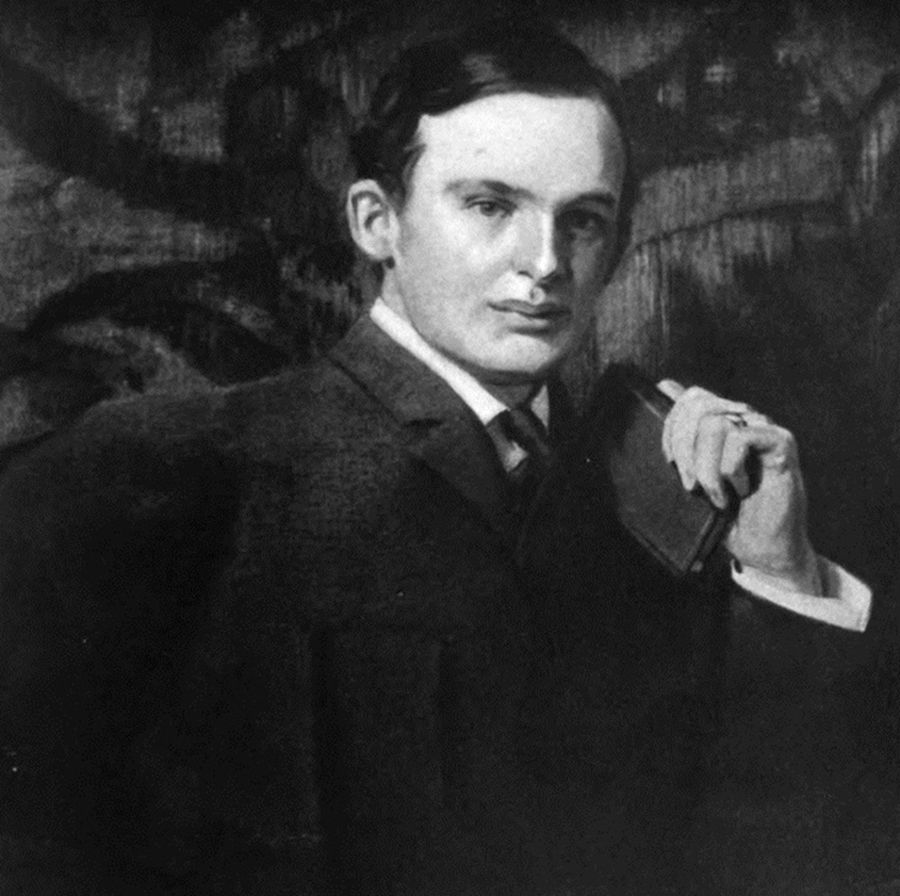
In April 1909, Robert Hunter was still a fairly new golfer, having played the game just five years. Yet the 35-year-old had already established himself as a player to be reckoned with at Wee Burn Country Club near his Connecticut home. Seeking further improvement, Hunter along with wife Caroline and family, decided to spend that April lodged at the Carolina Hotel, testing his mettle in competitive events as a new Pinehurst Country Club member.

Like so many early 20th century Pinehurst visitors, Hunter had the financial wherewithal to spend a month, if not a full season, in the Sandhills. He’d grown up in Terre Haute, Indiana, where his father operated a successful business building horse-drawn carriages. His wife, however, came from even grander opulence. This wasn’t Midwestern riches; it was New York money. Her father, Anson Phelps Stokes, had amassed a vast fortune from an array of enterprises ranging from railroads, copper mining and real estate to banking. It was Stokes who donated the trophy for the Americas Cup yacht race.

But politics set the Hunters apart from the other wealthy bluebloods — in Pinehurst and elsewhere. They joined the American Socialist Party in 1905, and Robert Hunter gained notoriety as a driving force in the party, serving on its executive committee. While the Socialist Party would have been anathema to an overwhelming majority of the well-heeled PCC members, it appears most of them welcomed the Hunters’ participation in various social activities at the club. When the couple returned to the village in January 1910 for a prolonged four month stay in Plymouth Cottage, the most important man in town, Pinehurst kingpin Leonard Tufts, made it a point to host them for dinner at The Carolina.

Hunter’s advancement into the village’s in-crowd was capped by his December 1910 admission into the Tin Whistles, Pinehurst’s pre-eminent “golfing fellowship.” While there may have been some Tin Whistles who gritted their teeth a bit before voting him in, Hunter’s engaging sense of humor — along with his rise toward the top of PCC golf ranks — tipped the scales in his favor.

It’s fair to say that, notwithstanding his party affiliation, Hunter was no radical, wild-eyed flamethrower. Born at the back end of the laissez-faire Gilded Age when ultra-capitalist “robber barons” took advantage of the lack of legal protections for workers, Hunter’s core belief that America’s working poor were being horribly treated wasn’t a heavy lift. He urged that such economic injustices could be rectified by the legislative regulation of business. The specific proposals Hunter had in mind — considered revolutionary in early 20th century America — are now codified in every jurisdiction: minimum wages, workers’ compensation, old-age pensions, limitation of the hours of work, regulations governing a safe working environment, and child labor laws. Hunter was of the firm view that the only way to obtain progressive legislation was through the political process. He and Caroline emphatically rejected the arguments of Marxists, anarchists, and others on the far left who believed democratic processes, controlled by the capitalists, were of limited usefulness, and that only confrontational actions ranging from labor strikes to outright violence could bring about meaningful change.

In 1904 Hunter’s book Poverty became a best-seller and brought national attention to the plight of workers and their families laboring under the specter of the poorhouse and starvation. To refute a commonly held perception of the well-off that the working poor were personally responsible for their desperate circumstances, Hunter produced data demonstrating that precisely the opposite was true — it was next to impossible for undernourished, overworked employees to claw their way out of the depths. “A sanitary dwelling, a sufficient supply of food and clothing, all having to do with physical well-being, is the very minimum which the laboring classes can demand,” he wrote. “The more fortunate of the laborers are but a few weeks from actual distress when the machines are stopped. Upon the unskilled masses, want is constantly pressing. As soon as employment ceases, suffering stares them in the face.”

According to Edward Brawley’s biography on Hunter, Speaking Out for America’s Poor, Hunter’s book “opened America’s eyes to the magnitude of poverty in the midst of plenty.” Poverty, wrote Brawley, made a convincing argument that “causing people, especially children, to suffer preventable poverty and ill health was not only shameful for a wealthy society but also a waste of the nation’s most valuable resources.” When Poverty failed to spur the Democratic and Republican parties to promote legislation, the Hunters cast their lot with the socialists. His writing brought Hunter significant street cred with socialist higher-ups who arranged for the author’s appointment to the party’s executive committee.

Hunter’s advocacy on behalf of the less fortunate grew out of his Indiana roots. Through his father, a charitable man in his own regard, Hunter met Eugene Debs, another Terre Haute native and the most famous socialist and influential labor leader of the late 19th century. Robert’s first encounter with Debs left an everlasting impression. “An old railroad workman joined us,” Hunter recalled. “I heard him explain to Debs that he could get a job if he could raise enough money to buy a good time-piece. Knowing that a watch was essential to a worker on the railroad, Debs immediately took out a handsome gold watch . . . unhooked it from its chain, handed it over to the man, saying ‘I care a lot about this watch . . . Keep it until you can afford to get another.’”

Though his own family’s finances were sufficient to withstand a downturn in the economy, Hunter was witness to the massive distress caused by the Panic of 1893 when falling prices resulted in countless bankruptcies. An empathetic Hunter distributed food to the hungry and went so far as to put himself on a strict diet of oatmeal. His growing concern for the poor was also influenced by the Russian author Leo Tolstoy, who believed that obedient Christians should follow Jesus’ instruction to “Sell everything you have and give it to the poor (Mark 10:21).” A young Hunter considered it his Christian duty to share with those in need everything he possessed.

Hunter’s father expected him to enter the family buggy business or embark on a legal career, but the son harbored other ideas. A light bulb went off for Robert after a chance meeting with Dr. Phillip Ayers, the secretary of the Cincinnati Board of Charities. Hunter recalled that Ayers “made my heart leap with joy by pointing out that with adequate preparation I could expect to obtain employment as a social worker.” After visiting Ayers in Cincinnati, Hunter was taken aback by the appalling conditions of the area’s slums and wanted to assist relief efforts there. When Ayers advised him to attend college first Hunter enrolled at Indiana University, graduating in 1896. By then, Ayers had moved to Chicago and was heading up the city’s Charitable Organization Society. He arranged a job for Hunter as the organizing secretary.

After observing that the teeth of children in the slums were frequently in poor condition, Hunter convinced city dentists to donate their services to those unable to pay. He also organized the first-ever municipal facility dedicated to short-term housing for vagrants, and published a study, “Tenement Conditions in Chicago,” the first of his sociological writings.

While in Chicago, Hunter resided in settlement houses, a reform phenomenon of the late 1800s where people from all segments of society came together in urban locations to find ways to alleviate area poverty. Settlement houses also became cultural destinations where famous speakers, writers, poets, public figures and educators appeared. During his stint in Chicago, Hunter lived at Hull House, operated by one of America’s pioneer social workers, Jane Addams. While in residence, he broke bread with celebrities like Clarence Darrow, Frank Lloyd Wright and John Dewey. He also spent a summer at another settlement house in London, where he met Bernard Shaw and H.G. Wells.

In 1902, Hunter moved to New York and became the head resident of the University Settlement. He led the group largely responsible for passage of the first New York state law prohibiting child labor. “It was in New York that Hunter met Graham Phelps Stokes, who like Robert, was destined to become that rarest of birds, a millionaire socialist,” wrote Brawley. The younger Stokes introduced Hunter to his sister Caroline, who was also active in social work. The two hit it off immediately and in April 1903, became engaged on the elder Stokes’ yacht, marrying a month later in Noroton, Connecticut, the Stokes’ hometown.

During the couple’s European honeymoon, Hunter visited one of his idols, Count Leo Tolstoy. The Russian confided that his attempt to give his possessions to the poor had been thwarted. The great writer’s wife refused to cooperate, maintaining that his benevolence would condemn the couple’s children to lives of ceaseless poverty. In appeasement, the author of War and Peace turned his property over to his spouse and was residing in the house as her guest. The count lamented to Hunter that this attempt at compromise had undermined his principles. Hunter described Tolstoy as “downcast, tearful and, I should say, morally wounded by his failure.”

Returning to New York, Hunter redoubled his efforts to assist the poor and live a simpler life. One frigid morning, he gave his overcoat to a shivering beggar, and then stoically did not don another throughout the winter. Rather than live in luxury, the newlyweds moved into modest quarters on Grove Street in the city’s Lower West Side (later Greenwich Village) with hopes of lending a hand toward revitalization there.

A New York newspaper reported that the Hunters had moved into “one of the vilest slums.” When it was whispered that the couple intended to give away “millions of dollars” to the poor, the rumor went viral. Hundreds formed outside their home seeking a piece of the pie — and more kept coming. For three weeks, Hunter was unable to leave the house, and it eventually forced the couple to retreat to the Stokes family enclave in Noroton.

It was during this frantic time that Hunter researched and wrote Poverty, a Herculean effort that brought him to the brink of a breakdown. His physician recommended outdoor exercise to provide a distraction, and Hunter embarked on a regimen of daily golf, despite awareness that many in his circle considered participation in the sport to be “effeminate.”

Hunter continued his deep involvement in socialist politics, writing books and lecturing. Twice he mounted runs for Connecticut political office under the socialist banner, losing both races. He sailed to Europe and attended international congresses of socialists, where he encountered Vladimir Lenin, Friedrich Engels and Benito Mussolini. President Theodore Roosevelt took notice of Poverty, and invited Hunter to a one-on-one discussion at the White House. Hunter even befriended Mark Twain.

But the amount of time Hunter was devoting to golf was beginning to rival that spent on social reform. In March, 1911, he reached the PCC club championship semifinals and then entered April’s prestigious United North and South Amateur Championship, a move specifically addressed in a tongue-in-cheek Tin Whistle bylaw that explained it was “the duty of each member to suppress the incipient conceit of any fellow member who thinks he is in line for the United North and South Amateur Championship.” Hunter surprised everyone by qualifying for match play and winning his way to the 36-hole final against the legendary Chick Evans — then at the peak of his Hall of Fame career. Hunter kept the match close during the morning round, but Evans pulled away in the afternoon to win 6 and 5. Still, it was an extraordinary feat to have reached the final given that he had only played golf for seven years.

Over the next five years, “Hunter of Wee Burn” won numerous Pinehurst events. In December 1912, he carted off the Holiday Golf Tournament’s President’s Cup, defeating former U.S. and British Amateur champion Walter Travis in the final match. He beat the great Travis again in a scintillating extra-hole match to win Pinehurst’s Mid-April Tournament in 1914, and successfully defended that championship the next two years. Hunter fashioned a second excellent performance in the 1915 North and South championship by reaching the semifinals, and he won the 54-hole medal play Tin Whistles championships of 1914 and ’15.

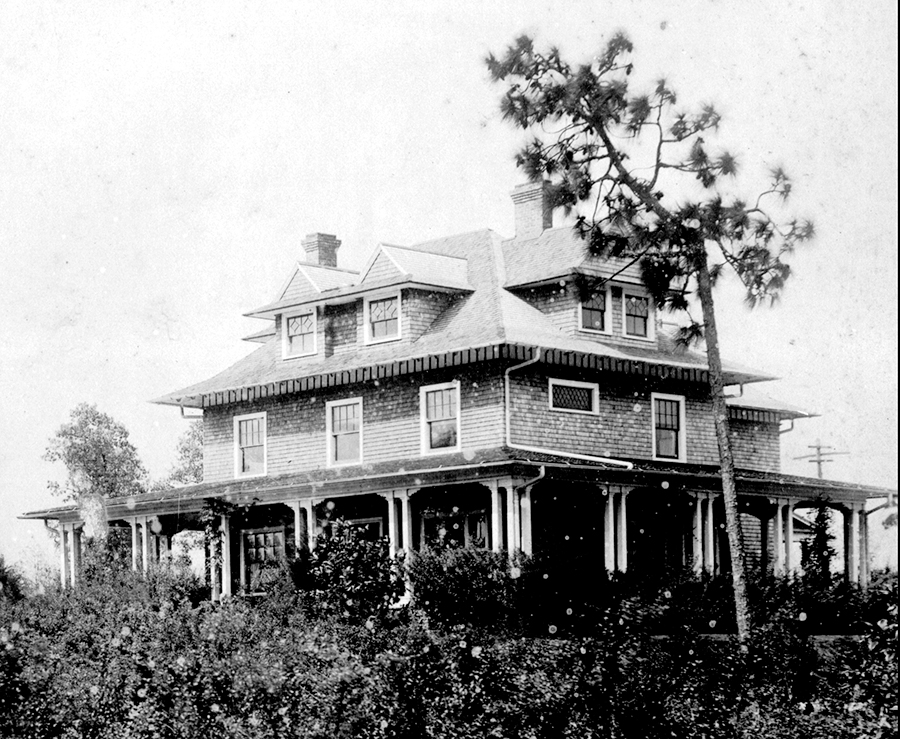
In January 1913, the Hunters purchased Mystic Cottage, which, according to the Pinehurst Outlook, was “the largest and most attractive of the winter homes here.” The couple hosted dinners in their spacious home with distinguished guests like Leonard Tufts and Donald Ross. It did not go unnoticed that the millionaire socialist, having once craved a Spartan existence, was increasingly living a life of opulence. Some thought the man a hypocrite, a charge Hunter never satisfactorily rebutted. His encounter with Tolstoy (recounted in his 1919 book Why We Fail as Christians) and the adverse public reaction to his own attempt to live modestly in New York may have persuaded him that self-denial was not all it was cracked up to be.

In any event, his disenchantment with his fellow socialists was growing. A majority of party leaders advocated labor strikes and other confrontational actions that moderate socialists like Hunter thought wrongheaded. This disagreement over tactics became intractable and led to his resignation from the Executive Committee in 1912. His disaffection was further exacerbated when the party refused to support America’s 1917 entry into World War I.

Hunter approved of the war declaration, reasoning that the conduct of a militaristic and conquest-driven Germany threatened the rights of working people in all democratic countries. In protest, the Hunters and thousands of former party supporters who likewise favored the war fled socialist ranks in droves. The party nearly disintegrated and was never again a major factor on the American political scene.

Increasingly regarded by many colleagues on the left as a pariah, Hunter began pursuing another outlet for his considerable energies — golf architecture. He wrote that his interest in the subject led him “abroad in the summer of 1912 for a six months’ study of the structure and upkeep of the championship courses of Great Britain.” The courses he visited included the Old Course at St. Andrews, Prestwick, Muirfield and Hoylake, all “by the sea in links-land.” As the demand for new golf courses in America was rapidly escalating, a self-taught crash course in golf architecture at the game’s birthplace could provide enough bona fides to start a course design business.

But it was not going to happen in Pinehurst, where Donald Ross monopolized commissions for golf courses up and down the Eastern Seaboard. In 1917, the Hunters pulled up stakes from their Connecticut and Pinehurst homes and relocated to Berkeley, California, where he filled a teaching position at the University of California until 1922. While relishing his new environment, Hunter admitted missing Pinehurst’s golf courses, bemoaning in a letter to a friend, “There is absolutely none where I am now living — unless I am to consider the local country club, which resembles one of the sand clay roads of Moore County.”

However, Northern California’s lack of courses also provided an opportunity. When Berkeley locals decided to build a new course in 1920, Hunter was named chairman of the fledgling club’s greens committee. Soon, he had drawn up a set of complete plans for the course. Berkeley Country Club had already hired the well-established Willie Watson as course architect, but Hunter’s routing left little for Watson to do. He basically rubber-stamped Hunter’s design work. Hunter also oversaw the course’s construction and today, the club acknowledges he deserves the lion’s share of credit for the design.

After a fire destroyed his Berkeley home, Hunter moved to Pebble Beach, hoping his work at Berkeley CC would create sufficient splash on the Monterey Peninsula to result in further design commissions. It did not. How could he broadcast his course design chops and simultaneously prove he was no dilettante in the field? The same way he had cemented his reputation for reform advocacy — by writing a book. Published in 1926, The Links became an authoritative reference bible for every phase of golf course design and construction. It’s chock-full of the author’s philosophy regarding everything from hiring a designer and acquiring land to the placement, shape and contours of hazards, bunkers, and greens. Noted designer Bill Coore still consults Hunter’s book and says that it “became a cornerstone in my personal golf architecture education and a bond in my partnership with Ben Crenshaw, who I learned had begun studying The Links at approximately the same time I did.”

The book came to the attention of the renowned British golf architect Alister MacKenzie, who was wowed by Hunter’s grasp of the innumerable details of course design, calling “it by far the best book on golf architecture ever written.” So, when Hunter proposed that he and MacKenzie build courses together in California, the Yorkshireman, who had never been to the West Coast, listened and agreed. Hunter expected the two would find themselves deluged with commissions. He was correct. Requests for work to be performed by the firm of MacKenzie and Hunter poured in.

In August 1926, the new partners entered into a contract to design a course for the Meadow Club in the San Francisco Bay area. This was followed by projects for the California Golf Club of San Francisco; Woodside Country Club near Stanford University; Green Hills Country Club; Northwood Golf Club; Pasatiempo Golf Club; and the Valley Club at Montecito. MacKenzie and Hunter updated the Pebble Beach links in preparation for the club’s hosting of the 1929 U.S. Amateur. To some extent, Hunter’s working relationship with MacKenzie mirrored the one he had established with Willie Watson at Berkeley. The more flamboyant MacKenzie was always the name architect while Hunter promoted him and managed the details on the ground. He seemed content to play the role of second banana in the relationship, though MacKenzie fully recognized Hunter’s ingenuous contributions. Regarding their work at the Valley Club at Montecito, an appreciative MacKenzie lauded his partner for introducing “a new machine, a Caterpillar tractor with bulldozer equipment, to remove the large rocks and boulders. He thus saved thousands of dollars in explosives and manual labor.”

But the partnership’s tour de force was its work in 1928 designing and building the incomparable Cypress Point Club, an oceanside course so beautiful it’s often referred to as golf’s Sistine Chapel. Golf historian and architect Geoff Shackleford calls the course “the most stunning creation in the history of golf course architecture.” Hunter, a local, was again the man responsible for overseeing the progress of daily construction. Also involved was son Robert Jr., who headed up the American Golf Course Construction Company.

It is too late to unravel the individual contributions Hunter and MacKenzie each made that resulted in the finished product at Cypress Point. Nonetheless, it is clear that Hunter was no mere sidekick and deserves far greater credit than he ever received for Cypress and the partners’ other wonderful California courses. Their association lasted until 1929, when the Great Depression tanked most all golf construction projects.

With the advent of President Franklin Roosevelt’s New Deal in the early 1930s, Hunter ping-ponged back into the analysis of the nation’s affairs. This time he had a far different spin on things. Despite the fact that the president’s leadership resulted in the enactment of progressive legislation, which he would have undoubtedly supported in his socialist days, Hunter was alarmed at what he perceived to be Roosevelt’s dictatorial tendencies. He viewed the president as a profligate spender whose economic policies were destined to result in an inflationary upheaval that would ultimately culminate in revolution.

Hunter pointed out that Lenin had hijacked Russia’s progressive movement and imposed a brutal dictatorship under similar economic circumstances. In 1940, he encapsulated his dire warnings (which, of course, proved to be greatly overblown) with another book, Revolution: Why, How, and When?, that was favorably received by those Republicans who despised Roosevelt, then running for his third term. The former socialist also served as an adviser to Republican candidate Wendell Willkie during the latter’s unsuccessful campaign for the presidency against Roosevelt in 1940.

Hunter would pass away two years later.

Most biographers tend to discount Hunter’s rants against the New Deal and Roosevelt, focusing instead on his earlier social reform efforts and authorship of Poverty. Of course the world of golf remembers another Hunter book, The Links. But the ripple effects of his contributions to the game reach beyond his writings. If he had not induced Alister MacKenzie to come to California, Cypress Point might never have been built in the glorious manner it was. And if there was no Cypress Point, Bobby Jones would never have chanced to play the course in 1929, nor would he have engaged MacKenzie in the design of Augusta National Golf Club.

Pinehurst had its role to play. It’s where Hunter’s interest in golf course architecture was first cultivated, and his acquaintance with fellow Tin Whistle Donald Ross (whose layouts Hunter revered) undoubtedly gave him meaningful exposure to the art and science of design. While his impact may have been easy to overlook, his legacy is astonishing in its scope.  PS