Bookshelf

Bookshelf

FICTION

Villa E, by Jane Alison 

Along the glittering coast of southern France, a white villa sits atop an earthen terrace — a site of artistic genius, now subject to bitter dispute. Eileen Gray, a new architect known for her elegant chair designs, poured the concrete herself; she built it as a haven for her and her lover, and called it E-1027. When the famed Swiss architect Le Corbusier, a founder of modernist architecture, laid eyes on the house in 1929, he could see his influence in the sleek lines. Impassioned, he took a paintbrush to the clean white walls. Thirty years later, Eileen has not returned to Villa E and Le Corbusier has never left — his summers spent aging in a cabin just feet away. Mining the psyches of two brilliant, complex artists and the extraordinary place that bound them, Alison turns a now-legendary act of vandalism into a lushly poetic and mesmerizing novel of power, predation and obsession.

A Sorceress Comes to Call,
by T. Kingfisher 

In a dark reimagining of “The Goose Girl” fairytale, Cordelia knows her mother is . . . unusual. Their house doesn’t have any doors between rooms — there are no secrets in this house — and her mother doesn’t allow Cordelia to have a single friend, unless you count Falada, her mother’s beautiful white horse. The only time Cordelia feels truly free is on her daily rides with him. But more than simple eccentricity sets her mother apart. Other mothers don’t force their daughters to be silent and motionless for hours, sometimes days, on end. Other mothers aren’t evil sorcerers. When her mother unexpectedly moves them into the manor home of a wealthy older squire and his kind but keen-eyed sister, Hester, Cordelia knows this welcoming pair are to be her mother’s next victims. But Cordelia feels at home for the very first time among these people, and as her mother’s plans darken, she must decide how to face the woman who raised her to save the people who have become like family.

NONFICTION

Dinosaurs at the Dinner Party: How an Eccentric Group of Victorians Discovered Prehistoric Creatures and Accidentally Upended the World,
by Edward Dolnick

In the early 1800s a 12-year-old farm boy in Massachusetts stumbled on a row of fossilized three-toed footprints the size of dinner plates — the first dinosaur tracks ever found. Soon, in England, Victorians unearthed enormous bones that reached as high as a man’s head. No one had ever imagined that creatures like three-toed giants had once lumbered across the land. And, even if someone had somehow conjured up such a scene, they would never have imagined that all those animals could have vanished hundreds of millions of years ago. The thought of sudden, arbitrary disappearance from life was unnerving and forced the Victorians to rethink everything they knew about the world. In Dinosaurs at the Dinner Party, Dolnick leads us through a compelling true adventure as the paleontologists of the first half of the 19th century puzzled their way through the fossil record to create the story of dinosaurs we know today.

Billionaire, Nerd, Savior, King: Bill Gates and His Quest to Shape Our World, by Anupreeta Das

Few billionaires have been in the public eye for as long, and in as many guises, as Bill Gates. At first heralded as a tech visionary, the Microsoft co-founder next morphed into a ruthless capitalist, only to change yet again when he fashioned himself into a global do-gooder. Along the way, Gates forever influenced how we think about tech founders, as the products they make and the ideas they sell continue to dominate our lives. Through the Bill and Melinda Gates Foundation, he also set a new standard for high profile, billionaire philanthropy. But there is more to Gates’ story, and here, Das’ revelatory reporting shows us that billionaires have secrets, and philanthropy can have a dark side. Drawing upon hundreds of interviews with current and former employees of the Gates Foundation, Microsoft, academics, nonprofits and those with insight into the Gates universe, Das delves into Gates’ relationships with Warren Buffett, Jeffrey Epstein, Melinda French Gates and others, to uncover the truths behind the public persona.

I Heard There Was a Secret Chord: Music as Medicine, by Daniel Levitin

Music is one of humanity’s oldest medicines. From the Far East to the Ottoman Empire, Europe to Africa and the pre-Colonial Americas, many cultures have developed their own rich traditions for using sound and rhythm to ease suffering, promote healing and calm the mind. In his latest work, Levitin explores the curative powers of music, showing us how and why it is one of the most potent therapies today. He brings together the results of numerous studies on music and the brain, demonstrating how music can contribute to the treatment of a host of ailments, from neurodegenerative diseases such as Parkinson’s and Alzheimer’s, to cognitive injury, depression and pain.


CHILDREN’S BOOKS

Tiny Jenny, by Briony May Smith

In one of the great opening lines in a picture book, Tiny Jenny begins: “Mr. and Mrs. Wren were very surprised when a baby fairy hatched from one of their eggs.” Just as readers fell in love with Smith’s Margaret’s Unicorn, they’ll fall equally in love with this quirky, wise, clever baby fairy, Tiny Jenny. (Ages 2-7.)

The Quacken, by Justin Colón

Every summer camp has legendary creepy campfire tales, but this tale just might quack you up in addition to creeping you out just a little bit. Read the book, tell the story, but whatever you do, don’t feed the ducks. Silly scariness for fans of the Creepy Carrots! series. (Ages 4-7.)

Prunella, by Beth Ferry

Instead of ferns, she grew fungi. This alone should have alerted Prunella’s green-thumbed parents to the idea that their girl was different in a wonderful way. Both a celebration of amazing children and unusual plants, Prunella is the perfect book for woods wanderers and summer celebrations. (Ages 3-7.)

The Yellow Bus, by Loren Long

Trucks, tractors, yellow buses, they all have jobs to do and they just might have stories to tell. In the hands of the amazing creator of the beloved Otis the Tractor series, those stories just might surprise you. Perfect for back-to-school tables and for an anytime read-together, The Yellow Bus might just leave readers wondering what other vehicles have surprising stories to share. (Ages 4-7.)   PS

Compiled by Kimberly Daniels Taws and Angie Tally.

Naturalist

Naturalist

A Tornado of Butterflies

The marvel of swallowtails “puddling”

Story and Photographs by Todd Pusser

On a hot spring day in the North Carolina foothills, near the town of Morganton, I went looking for a fish. Not just any run-of-the-mill fish, mind you, but a greenhead shiner. Granted, the greenhead shiner is not much to look at most of the year and does indeed look like a run-of-the-mill minnow. But come late spring and early summer, when water temperatures warm up in the prelude to spawning season, the shiner turns into a tropical splendor. The coloration of its body magically morphs from a bland, silverish hue to radiant neon red, complete with brilliant white fins and a white head. A couple of hundred greenheads schooling in shallow water look like something straight out of the Great Barrier Reef.

Like many quests, sometimes you find something totally unexpected. On this day, I stumbled upon a cluster of intriguing critters equally as colorful and tropical-looking as the shiners. Rounding the bend of a tiny creek with a heavy underwater camera housing in tow, I flushed a swarm of eastern tiger swallowtail butterflies from off the ground. The sudden fluttering of dozens of dainty wings around my head took my breath away. A shaft of sunlight penetrating through the canopy above illuminated their bright yellow and black wings, causing the butterflies to positively glow in the shaded forest. The effect was enchanting.

I remained absolutely still as the butterfly tornado continued to swirl around my head. Eventually, one by one, the swallowtails settled back to the sandy ground near the edge of the water. I counted well over 40 of the winged wonders, easily the most butterflies I have seen in one spot in North Carolina.

I was completely unprepared for photographing a butterfly convention. The wide-angle fisheye lens, buried within the bowels of my underwater housing, was not the tool of choice for documenting this phenomenon. So, I did what I had to do. Forgetting about the fish for the moment, I took several steps back and carefully placed my underwater housing on the ground. Then, as fast as I could, I walked to my car several hundred yards away to retrieve another camera and a more appropriate telephoto lens, all the while hoping that the colorful mass would remain.
Twenty minutes later I returned and, to my relief, found the butterflies still there. Lying flat on the ground, I started to frame the action. Now with the aid of a 400mm lens, in my viewfinder I could clearly make out the long tongues of the butterflies probing the sand. The swallowtails were engaged in a behavior that entomologists term as “puddling.”

It works something like this: By sticking their long tongues into the damp mud, butterflies suck up minerals from the ground. Research has shown that most of these puddling aggregations involve males, who load up their spermatophores with essential salts, which they then present as “gifts” to receptive females during courtship. In a nutshell, puddling is a butterfly frat party.

Swallowtail butterflies are frequent puddlers, and do so around the world in large, densely packed groups. Globally, scientists recognize over 600 species of swallowtails. The family includes the remarkable and highly endangered Queen Alexandra’s birdwing of Papua New Guinea, the largest of all butterflies, whose wings can stretch more than 11 inches from wingtip to wingtip. Alfred Russel Wallace, the eminent British biologist (and co-describer of the Theory of Evolution with Charles Darwin), was so enamored with birdwing butterflies that when he caught his first in the Molucca Islands in 1859, he remarked, “I was nearer fainting with delight and excitement than I have ever been in my life; my heart beat violently, and the blood rushed to my head, leaving a headache for the rest of the day.”

Closer to home, swallowtails, with their large size, vibrant colors and propensity for visiting backyard gardens, are the quintessential butterflies for most people and attract legions of fans, even among those who despise insects. According to the recently published book Butterflies of North Carolina, South Carolina, Virginia, and Georgia, eight species of swallowtails are regularly found in the state.

Still belly-down in the mud, I continued to photograph the frenetic activity. Butterflies were constantly fluttering about, rising up into the air and settling back down on the bank. Unlike Wallace, my heart was not beating violently in my chest, and I had no headache. Still, after an hour observing the spectacle in the afternoon heat, I had worked up quite the sweat and was getting rather thirsty. Like the probing butterflies, I needed some essential sodium — not from the mud — but from a fruit punch Gatorade buried inside an icy cooler in the back of my car.

I squeezed off a few more frames highlighting the extended “tails” on the hindwing of one particularly handsome individual, a trait that gives the family its common name. Satisfied with the images, I got up from the ground, dusted myself off, and slowly walked back toward the car and much-needed sustenance.  PS

Naturalist and photographer Todd Pusser grew up in Eagle Springs. He works to document the extraordinary diversity of life both near and far. His images can be found at www.ToddPusser.com.

Birdwatch

Birdwatch

The Stately Little Blue

A summer visitor dressed in white

By Susan Campbell

Late summer can be an especially exciting time for birders. We need not travel far to find unexpected visitors. Weather events may cause individuals to be blown off track and show up in the neighborhood. These lost birds may stick around for mere hours. However, in other instances, it may be a more deliberate response to environmental conditions that brings them our way.

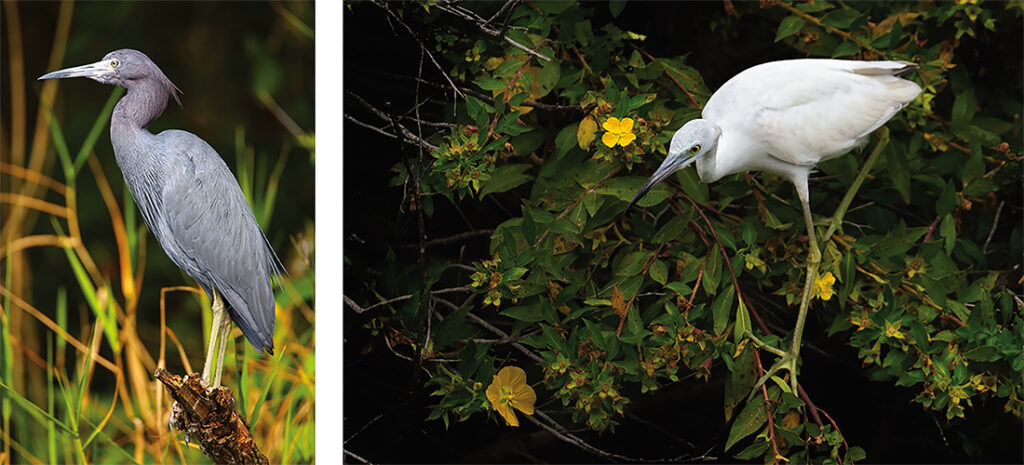
One bird that frequently appears in wet areas later in the summer is the little blue heron. And it may not be just one, but several of them, that show up. Furthermore, they are not usually blue. This is because young of the year (which these inland wanderers almost always are) are actually white. Except for the very tips of the wing feathers — usually a challenge to make out — these birds are covered with white feathers. Unlike the great or snowy egret, which also may turn up in the Piedmont or Sandhills at this time of year, the bill of these small herons is pinkish gray, and the legs are greenish.

All of these white waders may be spotted in shallow wet habitats — streams, small ponds, water hazards, retention areas, etc. Little blue herons may be by themselves, mixed with other white, long-legged waders, or even with the much larger great blue heron. Little blues can be identified by their more upright foraging posture, their slow, deliberate movements, and a downward angled bill as they stalk prey. Unlike other smaller waders, they will hunt in deeper water, often all the way up to their bellies.

Little blues watch for not only small fish but frogs and crayfish, as well as large aquatic insects. It is thought that their coloration allows them to blend in inconspicuously with similar white species. The association then provides protection from predators. Also, it has been found that little blues are significantly more successful predators when foraging alongside great egrets. These larger birds are likely to stir up the water as they move after underwater prey, which can then flush a meal in the direction of nearby little blues.

It takes these herons at least a year to develop adult plumage, not unlike white ibis — who sport dark plumage their first summer and fall — which also breed along our coast. They may have a pied appearance for a time in late winter or early spring. By April they will be a slatey blue-gray all over with a handsome bluish bill. Unlike our other wading birds, they lack showy head or neck plumes. They are also unique in having projections on their middle toes that form a comb, which is used as an aid when grooming.

Unfortunately this species has experienced an alarming drop in population numbers across North America over the past half-century. Loss of coastal wetland habitat, continued declines in water quality, and elimination as a nuisance in fish hatcheries all are thought to be contributing to the decline. So be sure to stop and appreciate these stately birds should you come across one — regardless of when or where you happen to be.  PS

Susan Campbell would love to receive your wildlife sightings and photos. She can be contacted by email at susan@ncaves.com, or by calling (910) 585-0574.

Omnivorous Reader

Omnivorous Reader

More Than a Mystery

Murder haunts a college town

By Anne Blythe

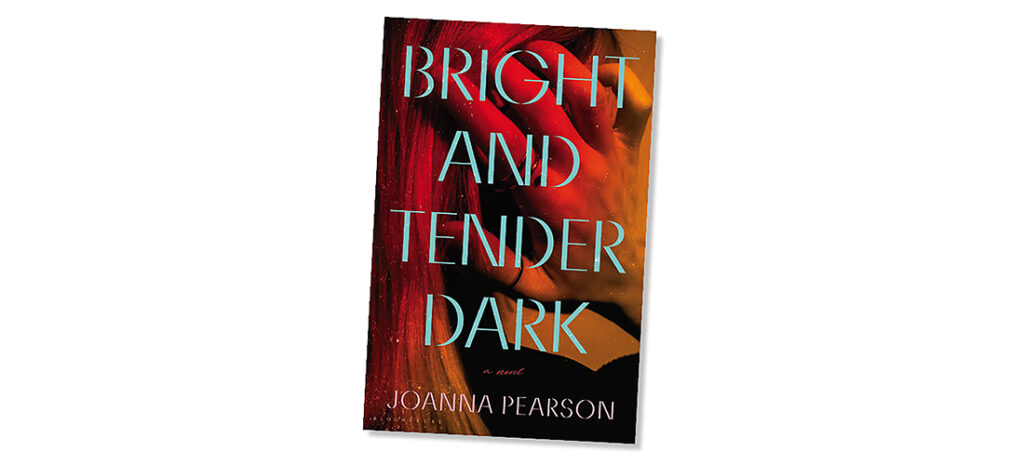
The makings for an ordinary crime thriller are present in Joanna Pearson’s first novel, but Bright and Tender Dark is anything but ordinary.

In the first few pages, Karlie, an alluring and enigmatic college student, is found dead in an off-campus apartment, brutally murdered, with no clear trail to the suspect. A former busboy with an eighth-grade education is in prison, conveniently convicted of her murder and serving time for a crime that shattered the tranquility of a college town.

The whodunnit aspect is there.

Joy, Karlie’s freshman year roommate and Pearson’s complicated protagonist, thinks the justice system got the wrong man. It is through Joy’s hunt for the real killer that we quickly realize Pearson’s book is a bit different from the traditional murder mystery. Layered on top is a retrospective investigation into the psychological ripple effects that Karlie’s dark death has had on the whole community, connecting seemingly unconnected people even two decades after it happened.

Pearson, a psychiatrist who lives in the Chapel Hill-Carrboro area, is also a poet and short story writer who now can add literary crime fiction to her compilation of writing genres. Just as her short story collections show that her poetic style spans literary genres, Bright and Tender Dark shows that her storytelling skills extend beyond short stories to novels. Many of the chapters could stand alone as stories within the larger story.

Pearson is masterful at character building. We meet Joy in the throes of middle age. She’s a mother of two finding a new footing after a painful divorce, assessing and reassessing her life. That evaluation creates the springboard for bouncing between two critical times in her life: the present, in which her ex is about to become a father again with his new wife; and the past, for which she has a new obsession, a decades-old murder.

Part of her compulsion comes from an unopened letter that Joy’s teenage son, Sean, finds in a book of John Donne poetry he has borrowed for English class.

It’s from Karlie.

“The letter has made a long and improbable voyage through time after being tucked away and forgotten, never even opened,” Pearson writes. “A miracle. An artifact of an old-fashioned epistolary era. Sean hands the letter to Joy with the solemnity of someone who has grown up on Snapchat. Joy’s hands tremble at the sight of the familiar handwriting. She dare not open it.”

Joy had been taking long walks alone at night, unable to sleep. Words and phrases reverberated through her mind as it raced. “Constitutionally unhappy.” That’s how her husband had described her as their marriage was blowing up. It had been “oppressive” for him, he said.

“He made the unhappiness sound like the core feature of her personality,” Pearson writes. “A suffocating force. The way that Joy looked at the world, pinched and vigilant, bracing for fire ants, falling branches, and tax deadlines, rather than celebrations. But her unhappiness allowed her to get things done!”

Joy eventually musters the courage to open that letter from Karlie. It was written in December 1999, shortly before her death, and is filled with exclamation points and underlined words — Karlie’s “characteristic arbitrary overuse of emphasis” on full display. But the letter holds a clue, one that Joy has not seen in any of the coverage of Karlie’s death, a mention of a BMW that had been pulling up outside her apartment. In the letter Karlie wonders whether it was Joy, but Joy didn’t have a BMW, nor had she been following Karlie to her apartment. Now, nearly two decades later, Joy is determined to find out who it was.

The search takes her back to old haunts in Chapel Hill, where Joy and Karlie went to college and where Joy still lives. She spirals into the depths of internet conspiracy theorists and true-crime Reddit platforms.

Pearson introduces an intriguing cast of characters: the predatory professor who woos his female students; the mother of the man doing time for the crime; the transgender night manager of the apartment building where Karlie was killed; the teenage son of a police chief on the high school soccer team with Joy’s son; people in cult-like religious groups; and more.

She takes her readers on a journey of discovery, giving them a glimpse of each character’s flaws and leaving open the possibility that they might be the killer, while also revealing clues that raise doubts about their potential guilt.

For anyone aware of high profile murders in Chapel Hill over the past couple of decades, there might seem to be some similarities with the 2012 killing of UNC sophomore Faith Hedgepeth and the 2008 death of UNC student body president Eve Carson. But at readings and in published interviews, Pearson has said the book is not based on a true crime. It’s fiction, although as a writer and engaged resident in the area, Pearson acknowledges that she cannot escape true events that continue to haunt the community. Writers write what they know.

Readers will appreciate Pearson’s adroit descriptions of Chapel Hill, places both real and imagined. She takes you onto campus, inside its buildings, and across its many grassy quads and wooded edges. Spots on Franklin Street and in downtown Carrboro are recognizable, as are near-campus neighborhoods.

As Pearson explores the mystery of an inexplicable crime in her novel, she also delves into the many mysteries of the mind. Her novel is a dark, yet tender and bright study of the void a death creates in a community, and the way people use that memory to make sense of themselves.  PS

Anne Blythe has been a reporter in North Carolina for more than three decades covering city halls, higher education, the courts, crime, hurricanes, ice storms, droughts, floods, college sports, health care and many wonderful characters who make this state such an interesting place.

Tea Leaf Astrologer

Tea Leaf Astrologer

Leo

(July 23 – August 22)

Impossible as it seems, someone dear forgets your birthday this month. Do you: a) attack them; b) discard them; or c) both? The new moon in Leo on August 4 spells reinvention and radical honesty. If there’s something — or someone — you’ve outgrown, there’s no need to make a production of it. That said, when Mercury enters your sign mid-month, your life becomes a bit of a Broadway musical. Take the stage and own it.

Tea leaf “fortunes” for the rest of you:

Virgo (August 23 – September 22)

Try a fresh coat of paint.

Libra (September 23 – October 22)

Trust your bones.

Scorpio (October 23 – November 21)

Dot your i’s and cross your fingers.

Sagittarius (November 22 – December 21)

The world will keep spinning.

Capricorn (December 22 – January 19)

Dream a little bigger.

Aquarius (January 20 – February 18)

Don’t skip the cooldown.

Pisces (February 19 – March 20)

Check the tread.

Aries (March 21 – April 19) 

Pack your toothbrush.

Taurus (April 20 – May 20)

It’s time to go off-script.

Gemini (May 21 – June 20)

Breathe between reps.

Cancer (June 21 – July 22)

Leave some space for the miracle.   PS

Zora Stellanova has been divining with tea leaves since Game of Thrones’ Starbucks cup mishap of 2019. While she’s not exactly a medium, she’s far from average. She lives in the N.C. foothills with her Sphynx cat, Lyla.

Out of the Blue

Out of the Blue

The Brain Game

Digesting dinner for $1,000, Ken

By Deborah Salomon

When Jeopardy! starts appearing in obits you know it has become part of Americana without being slapstick or offensive. Instead, the 30-minute TV show elevates erudition to entertainment on several levels. This isn’t just another quiz show. This one has heft.

Recently, a deceased fan was memorialized for shouting out loud when he scored an answer. Because it owns the 7 p.m. time slot, family members are still gathered for dinner, so competition gets keen. I’ve visited homes where a kitchen TV enables simultaneous eating and watching, normally forbidden but here allowed as “educational.”

I am a long-term addict as were my kitties Lucky and Missy, who — I kid you not — would appear for their nightly tussle to the opening music.

I’m convinced the mystique began and ended with Alex Trebek, the Canadian-born host, somewhat professorial, yet friendly, in impeccably tailored suits and clipped mustache. No rowdiness or slapstick screech as on Wheel of Fortune or (ugh) Family Feud, which I call “Family Lewd.”

Trebek died in 2020, at 80, having hosted his last show a few days before his death. In July the U.S. Postal Service issued a stamp in his honor. Fittingly, the stamp bears not a likeness, but a question. The answer: Alex Trebek.

Settling on a replacement was a rigorous task undertaken by producers who paraded out a series of pretty and not-so-pretty faces, including the NFL’s Aaron Rodgers. In my book they were all chocolate syrup on chopped liver, but none as bad as Mayim Bialik, of zero charisma, a wardrobe from hell and embarrassing flubs. Bialik proved so painful I stopped watching for a while.

Then came Ken Jennings, the $2.5 million-winning contestant with no hosting experience, only a sweet smile and endearing lisp. OMG, I thought, they’ve got Doogie Howser subbing for Sir Laurence Olivier.

But the little Munchkin in Ivy League uniform has grown on me, although I get the occasional vibe that he’d rather be answering the questions than asking them.

However, other changes — some during Trebek’s reign — don’t fare as well. Categories are esoteric, more specialized. Science, for example, demands professional credentials. I’m not bad at opera, art, food, lit, famous people, politics and vocabulary, but pre-Victorian English kings are just a bunch of Roman numerals. As for geography, I’m lost beyond the Balkans, especially Asia and the Middle East. Africa? Not a clue. But this backfires, comically — upping the difficulty causes contestants to bypass obvious but often correct answers. The result? More players are professionals with photographic memories, sharpening their skills at trivia contests.

I wasn’t familiar with trivia contests. How would you study given the breadth of material? What criteria, I wondered, do the question-writers employ?

Next detraction: spin-offs, almost as prolific as Oreo flavors. Several levels of “masters” tournaments are OK. But daytime Jeopardy!, college Jeopardy!, celebrity Jeopardy!, teen Jeopardy! the “second chance” tournament et al. dilute the appeal.

I learned that how you operate the buzzer is almost as important as knowing the answer. I’ve also observed that, generally speaking, men do better than women, and that a notable number of contestants are attorneys.

Other emotions color my enjoyment. A few champions have been obnoxious, even poor sports when faced with defeat. My heart goes out to those so nervous or under-prepared that they flame out before “Final Jeopardy.”

But Jennings’ ties never disappoint, even if my acuity does.

Whatever . . . watching Jeopardy! is like eating a healthy fudge sundae, even when my critiques hit closer to home than my answers.

Now, here’s one for ya: Whither the name? And why the exclamation mark? Jeopardy is a horse-racing term but the punctuation, forever an enigmatic Daily Double.  PS

Deborah Salomon is a contributing writer for PineStraw and The Pilot. She may be reached at debsalomon@nc.rr.com.

Focus on Food

Focus on Food

Simple and Savory

Crêpes are more than just breakfast

Story and Photograph by Rose Shewey

As an on-again, off-again student of the French language, I wince at how English speakers pronounce crêpes. Call me a stickler for detail, but the correct pronunciation is not craypes but, repeat after me, crehp, which rhymes with step — short “e” and silent “s.”

If the sound of crehp earns you blank stares or confused looks the next time you’re out for lunch, don’t fret; it’s a common reaction. Just stand your ground and bask in the glow of your linguistic excellence. Attempting the guttural “r” when saying crêpes helps tremendously but, regrettably, also makes you sound a tad pretentious, so keep that in mind. Or you could simply mumble the word in a noncommittal fashion and be done with it — a strategy my husband successfully uses to avoid attention on all counts.

Language intricacies aside, crêpes epitomize simplicity. As a lover of folkways, crêpes fit the bill for me, and not just as a culinary feature. You can make crêpes, as some people still do, with literally two ingredients: flour and water. That’s it. It doesn’t get any simpler than that.

The history of crêpes illustrates this well enough. They likely originated in the sea-swept northwest of France as a street food for laborers and townsfolk, though some claim the French pancake dates back to the 5th century when they were first offered to French Catholic pilgrims visiting Rome for Candlemas. Nevertheless, it’s a simple food with a thousand and one variations. You do not need a hot iron and rozelle to make beautiful crêpes — a simple skillet and spatula are perfectly adequate tools.

For a playful twist on hearty crêpes (also called galettes in some regions), mix fresh nettles, wild garlic or spinach into the batter. Not only will it enhance the flavor but add a little velvety texture to your crêpes. As for filling them, the sky’s the limit.

Spinach Crêpes

(Makes about 8)

Ingredients

3/4 cup fresh spinach

1 1/2 cups all-purpose flour

3 eggs

2 cups whole milk

Pinch freshly grated nutmeg

Pinch salt

Place spinach in a food processor and pulse. Add flour, eggs, milk, nutmeg and salt. Blend to make a smooth batter. Heat oil or butter in a skillet over medium/high heat. Add just enough batter to cover the base of the pan and cook until small bubbles appear on the surface, then flip and briefly cook on the other side. Fill crêpes with your favorite ingredients. We like ricotta cheese, fried egg, mushrooms and sautéed veggies, such as tomatoes, asparagus, onions and peas.  PS

German native Rose Shewey is a food stylist and food photographer. To see more of her work visit her website, suessholz.com.

PinePitches August 2024

PinePitches August 2024

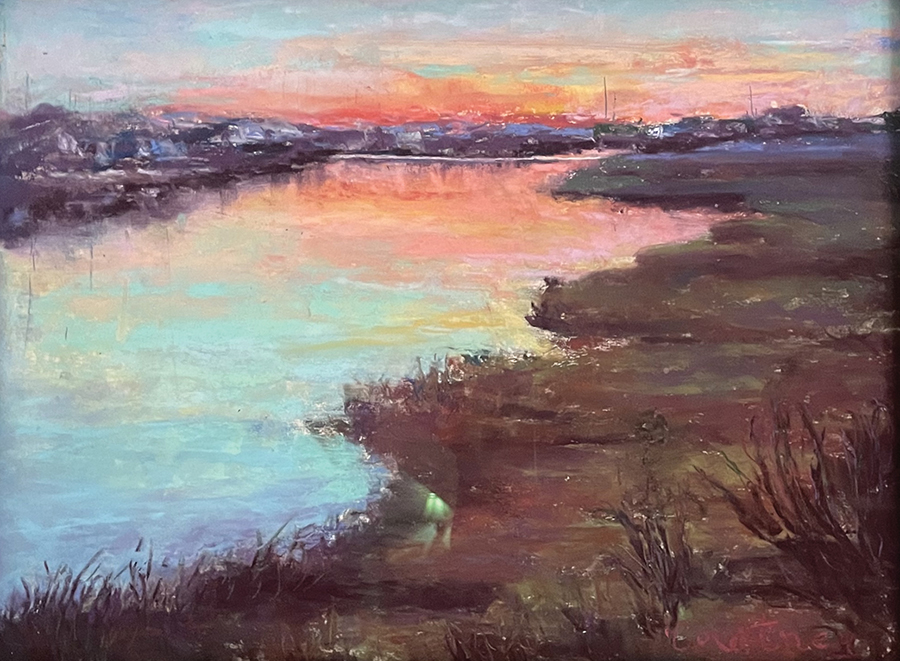
Right: Warm Lighting, by Courtney Herndon. 2023, Best in Show winner

Art Is All Around Us

Channel your inner art critic at the opening reception for the Arts Council of Moore County’s Fine Arts Festival from 6 p.m. to 8 p.m. on Friday, Aug. 2, at the Campbell House, 482 E. Connecticut Ave., Southern Pines. In its 44th year, the festival provides a major platform for artists from all over the country to display their work. See which entries won cash prizes and ribbons, and gossip with your friends over whether or not you agree with the rulings. Go to mooreart.org for additional information. If your art appreciation runneth over you can attend the opening of “More Than Miniatures — Small Art” on the same day, from 5 p.m. to 7 p.m., at the Artists League of the Sandhills, 129 Exchange St., Aberdeen. For information go to www.artistleague.org. Either way, your eyeballs get a workout.

Start Counting

Become a citizen scientist for a day on Saturday, Aug. 24, when North Carolina joins forces with Georgia, South Carolina and Florida in the Great Southeast Pollinator Census. The Williamson Pollinator Garden at the Ball Visitor’s Center at the Sandhills Horticultural Gardens at Sandhills Community College, 3395 Airport Road, Pinehurst, will be the site for the census from 9 a.m. to 11 a.m. Prior to the 24th, those wishing to participate should register for a 15-minute interval to count pollinator interactions on a designated plant. For more information and to register go to www.sandhills.edu/horticultural-gardens/upcoming-events.html.

Double Your Pleasure

The Sunrise Theater, 250 N.W. Broad St., Southern Pines, offers two operas from The Met this month. The first, La Cenerentola (Cinderella), by Gioachino Rossini, is the story of Angelina, the stepsister who serves as the family maid who sings her favorite song about a king who marries a common girl. Destiny, anyone? It shows at 1 p.m. on Aug. 3. The second opera, Turandot, by Giacomo Puccini, tells the tale of Prince Calaf, who must solve three riddles to win the hand of the cold Princess Turandot. It will be screened at 1 p.m. on Saturday, Aug. 24. For additional information visit
www.sunrisetheater.com.

On the Right

The James E. Holshouser Jr. Speaker Series presents L. Brent Bozell III, the founder and president of Media Research Center on Wednesday, Aug. 14, at 5 p.m. at BPAC’s Owens Auditorium, 3395 Airport Rd., Pinehurst. A lecturer, syndicated columnist, television commentator, author and activist, Bozell is one of the most outspoken leaders in the conservative movement. He has been a guest on numerous television programs, including the O’Reilly Factor, Nightline, The Today Show and Good Morning America. He appeared weekly on the “Media Mash” segment of Hannity, on Fox News. Bozell received his B.A. in history from the University of Dallas.

Funny Days

Take a riotous musical journey back to 1967 with Jeffrey Hatcher’s side-splitting comedy Mrs. Mannerly starring Linda Purl (The Office, Happy Days, Matlock) and Jordan Ahnquist (Shear Madness), beginning Friday, Aug. 2, at 8 p.m., in the intimate McPherson Theater at the Bradshaw Performing Arts Center, Sandhills Community College, 3395 Airport Road, Pinehurst. Set in Steubenville, Ohio, this uproarious play follows the ambitious and mischievous young Jeffrey as he enrolls in an etiquette class taught by the formidable Mrs. Mannerly, a teacher with a mysterious past and a zero-tolerance policy for rudeness. The show continues with performances on Aug. 3, 4, 8, 9, 10 and 11. For tickets and information go to www.ticketmeshandhills.com or judsontheatre.com.

Farce in the Park

The Uprising Theatre Company will present William Shakespeare’s dang near slapstick saga of mistaken identity, The Comedy of Errors, beginning Friday, Aug. 16, from 7:30 p.m. to 9 p.m. in the annual outdoor Shakespeare in the Pines production in Tufts Memorial Park, 1 Village Green Road, Pinehurst. There will be additional performances on Aug. 17, 18, 23, 24 and 25. For more information go to www.vopnc.org or www.ticketmesandhills.com.

Live After 5

Dance part of the night away with the Raleigh band Punch, whose song list stretches from ’70s and ’80s funk and retro to Motown, beach, country and jazz, at the Village Arboretum, 375 Magnolia Road, Pinehurst, on Friday, Aug. 9, beginning at 5:15 p.m. Whiskey Pines will take the stage as the opening act. As always, there will be kids’ activities, food trucks, beer, wine and low-octane beverages. For more information go to www.vopnc.org.

Jazz on the Green

The Sandhills Community College Jazz Band will feature the music of Henry Mancini and Stevie Wonder in its third and final concert of the 2024 Summer Concert Series on Monday, Aug. 12, from 6:30 p.m. to 7:30 p.m. on the library green of the SCC campus, 3395 Airport Road, Pinehurst. Max’s Millstone BBQ will serve food beginning at 5 p.m. The concert is free and, in the event of rain, it will move inside to Owens Auditorium.

Authors in the House

The Country Bookshop brings bestselling writer Frances Mayes, author of Under the Tuscan Sun, to the stage of the Sunrise Theater at 6 p.m. on Tuesday, Aug. 20, to discuss her latest novel, A Great Marriage. Then, on Thursday, Aug. 22, at 7 p.m., the bookshop, at 140 N.W. Broad St., Southern Pines, will host Wall Street Journal reporter Valerie Bauerlein, who will discuss her much anticipated book, The Devil at his Elbow: Alex Murdaugh and Fall of a Southern Dynasty. For information and tickets to both events go to www.ticketmesandhills.com.

Dissecting a Cocktail

Dissecting a Cocktail

Chartreuse Swizzle

Story and Photograph by Tony Cross

In 2003, San Francisco bartender Marcovaldo Dionysos entered his city’s cocktail competition for the fifth year in a row, pining for top honors. The contest was sponsored by the French herbal liqueur Green Chartreuse. According to cocktail historian Robert Simonson, Dionysos considered sitting out the year’s competition. “I didn’t have any great ideas,” Dionysos remembers. “I decided to make something fun and went in a tropical direction.” His idea nabbed first place that year and has since popped up in cocktail bars across the country and the world, becoming a modern classic.

Dionysos’ cocktail, the “Chartreuse Swizzle,” combined the herbal liqueur with pineapple and lime juices, Velvet Falernum (a low-ABV rum liqueur made with almonds, cloves and lime) and mint. Commonly made with rum, “swizzles” can be potent. They’re usually mixed with fruit juices and a sweetener, built and mixed in the drinking glass with a swizzle stick. Originally, these pronged sticks came from trees native to Bermuda, but the garden-variety lookalikes are made of metal, plastic or wood. One of my first introductions to Green Chartreuse was Dionysos’ Swizzle. For such a high proof (and pricy) spirit, it’s a little shocking how popular it became. What’s not surprising is how the four ingredients complement each other for a perfect tiki-themed sipper.

Specifications

1 1/2 ounces Green Chartreuse

1 ounce fresh pineapple juice

3/4 ounce fresh lime juice

1/2 ounce Velvet Falernum

Garnish: mint sprigs

Execution

Combine all ingredients into a Collins glass and add pebble (or crushed) ice. Insert a swizzle stick or barspoon into the mixture, rubbing your hands together to “swizzle” the stick until frost appears outside the glass. Add more ice and garnish with mint.  PS

Tony Cross owns and operates Reverie Cocktails, a cocktail delivery service that delivers kegged cocktails for businesses to pour on tap — but once a bartender, always a bartender.

Simple Life

Simple Life

The Quiet of Nature

In an increasingly loud world, maybe we should be still and listen to nature

By Jim Dodson

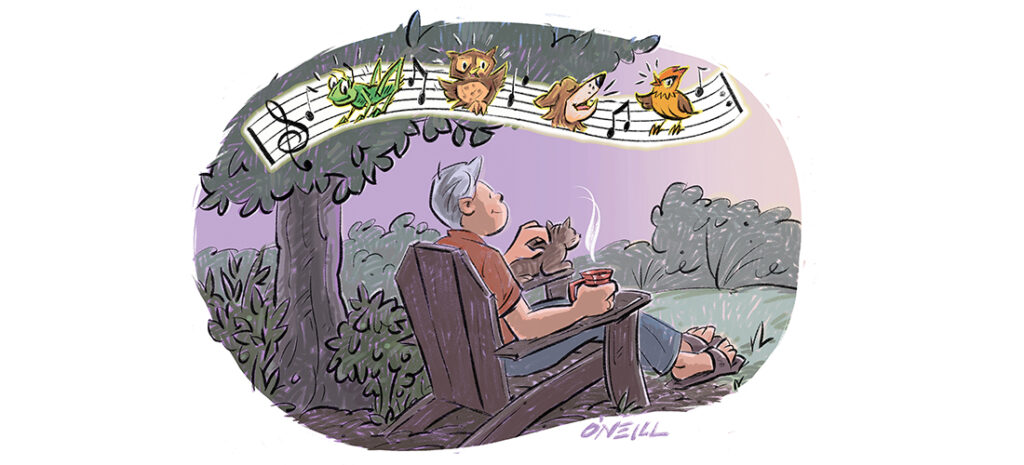
It’s two hours before sunrise and, per my daily morning ritual, I’m sitting with my old cat, Boo Radley, in a wooden chair beneath the stars and a shining quarter-moon.

Today’s forecast calls for another summer scorcher.

For the moment, however, the world around me is cool and amazingly quiet.

It’s the perfect moment to think, pray or simply listen to nature waking up.

In an hour or so, the world will begin to stir as folks rise and go about their daily lives. Nature will be drowned out by the white noise of commuter traffic, tooting horns and sirens.

But, for now, all I hear is the peaceful hoot of an owl somewhere off in the neighborhood trees, the fading chirr of crickets and the lonely bark of a dog a mile or two away. Amazing how sound carries in such a peaceful, quiet world. 

Ah, there it is, right on cue! The first birdsong of the new day. I recognize the tune from a certain gray catbird that seems to enjoy starting the morning chorus. Soon, the trees around us will be alive with the morning melodies of Carolina warblers, eastern bluebirds and the northern cardinals. What a perfect way to lift a summer night’s curtain and herald the dawn!

Unfortunately, it’s a sound that Earth scientists fear may be vanishing before our very ears.

On a planet where many are concerned about the impacts of global warming, declining natural resources and vanishing species, it seems to me that noise pollution and the disappearing sounds of the natural world might be among the most worrying impacts of all. 

A recent article in The Guardian alarmingly warns of a “deathly silence” they claim results from the accelerating loss of natural habitats around the globe.

The authors note that sound has become an important measurement in understanding the health and biodiversity of our planet’s ecosystems. “Our forests, soils and oceans all produce their own acoustic signatures,” they write, noting that the quiet falling across thousands of habitats can be measured using ecoacoustics. They cite “extraordinary losses in the density and variety of species. Disappearing or losing volume along with them are many familiar sounds: the morning calls of birds, rustle of mammals through undergrowth and summer hum of insects.”

A veteran soundscape recordist named Bernie Krause, who has devoted more than 5,000 hours to recording nature from seven continents over the past 55 years, estimates that “70 percent of his archive is from habitats that no longer exist.”

As quiet natural places are drowned out by the sounds of freeways, cellphones and the daily grind of modern life, fortunately, a nonprofit group called Quiet Parks International is working to identify and preserve sacred quiet places in cities, wilderness areas and national parks, where all one hears — for the moment at least — is the beat of nature, the pulse of life in the wild.

“Quiet, I think, holds space for things we can’t verbalize as humans,” the group’s executive director, Matthew Mikkelsen, recently told CBS News. “We use silence as a way to honor things.” Quiet, he notes, is becoming harder and harder to find these days, even in the most remote wilderness or within the depths of the national parks. “Every year we see more and more data to reaffirm what we’ve known for a long time — that quiet is becoming extinct.”

Perhaps because I grew up in a series of sleepy small towns across the lower South, places where I spent most of my days wandering at will in nature, I’ve been groomed to be a seeker of natural silence and quiet places in my life.

The first decade of my journalism career was spent in major cities, embedded in the cacophony of busy streets, which explains why I bolted for the forests and rivers of northern New England the moment I had the chance to escape honking horns, blasting radios, screaming sirens and even background music in restaurants, a personal annoyance I’ve never quite fathomed.

Perhaps I’ve been spoiled by traveling in France and Italy and other ancient places. There, cafes and bistros are generally meant to foster a relaxed, slower pace of life through the auspices of good food, lingering conversations and woolgathering as one watches the harried world pass by.

It is no accident that I built my first house on a hilltop near the coast of Maine, surrounded by 200 pristine wooded acres of beech and hemlock trees. On summer evenings, my young children and I could hear the forest coming alive with sounds and often saw and heard wildlife — whitetail deer, pheasants and hawks, a large lady porcupine and even (once) a young male moose — gathering at the edges of our vast lawn where I created feeding areas of edible native plants for our wild neighbors. On frigid winter nights, I put on my Elmer Fudd jacket and toted 50-pound bags of sorghum out to that feeding spot by the edge of the woods, where deer and other critters could be seen dining in a moonlit night. The eerie late-night sound of coyotes calling deep in the forest reminded us that we were the newcomers to their quiet keep.

One reason I love the game of golf is because golf is a two- or three-hour adventure in nature where the simple elements of wind, rain, sand and water provide an existential challenge to mind and body. As a kid, I learned to play golf alone, walking my father’s golf course in the late afternoon, when most of the older golfers had gone home. I came to love “solo golf” at a time of day when the shadows lengthened and the sounds of nature began to reawaken creatures great and small.

Golf courses, like libraries, are meant to be quiet places — which makes the recent trend of golf carts equipped with digital music systems particularly bothersome to a lover of nature’s quiet sounds.

Pause for a moment and just think what one can do in the quiet:

Read a good book.

Admire a sunset.

Rest and recover.

Take an afternoon nap.

Watch birds feed.

Write a letter.

Talk to the universe.

Say a prayer.

Grieve — or feel gratitude.

Think through a problem.

“In quietness,” says the book A Course in Miracles, “are all things answered.”

My heart aches when I hear that the world’s natural places may be going silent.

A world without nature’s quiet sounds would be a very lonely place.

Hopefully, we’ll learn to listen before it’s too late. PS

Jim Dodson can be reached at jwdauthor@gmail.com.