Tumbleweed

Tumbleweed

Fiction by Shelia Moses  
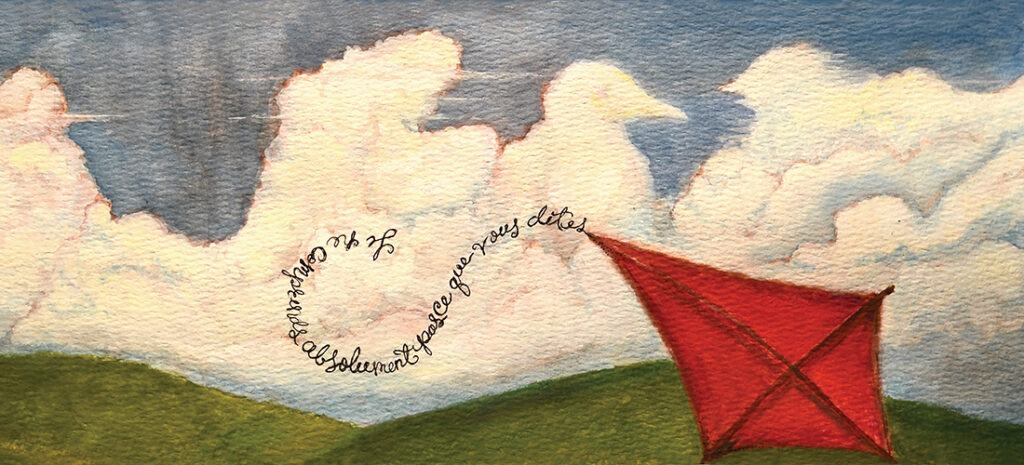
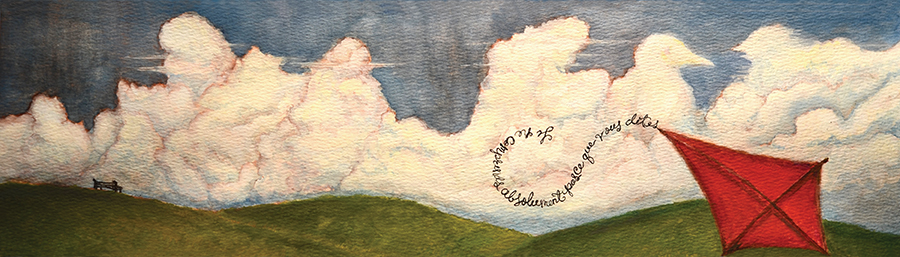
Illustration by Raman Bhardwaj
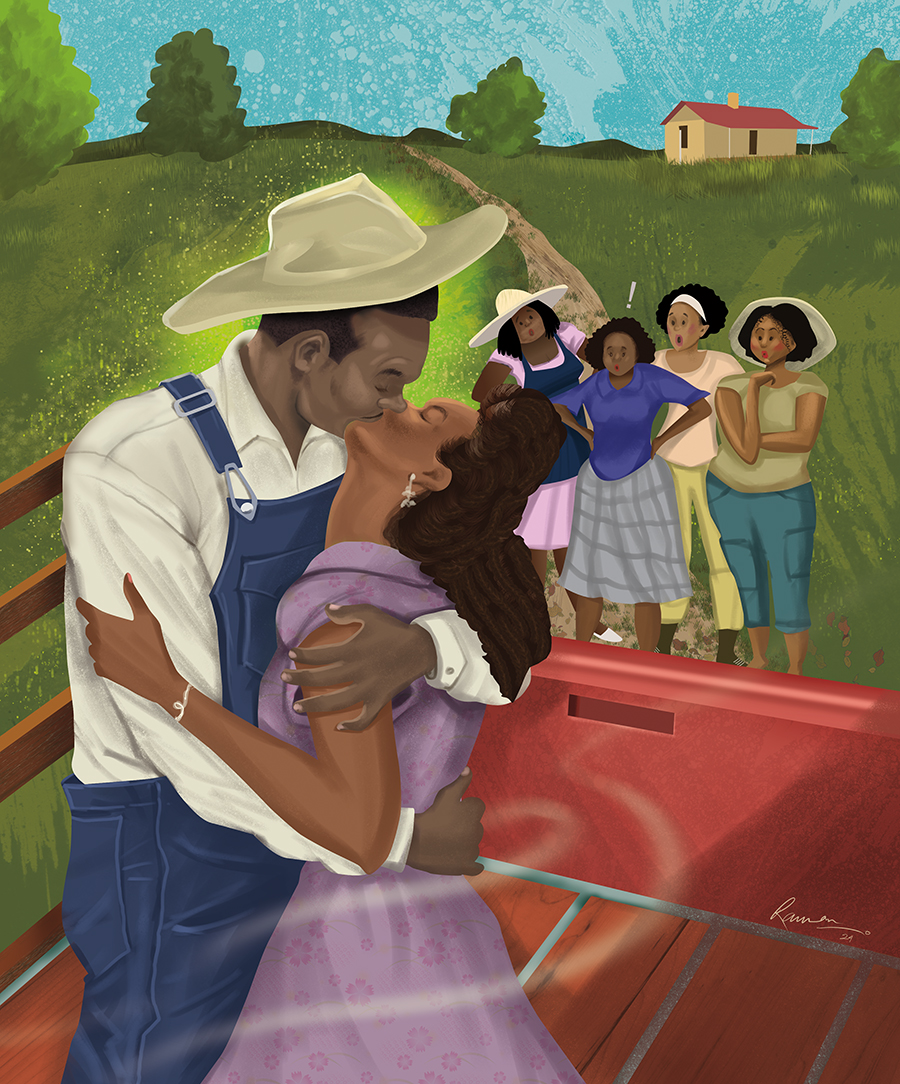
My man is like a tumbleweed. He just rolls around and catches everything that crosses his path — every woman that is. I am telling you he’s just like a tumbleweed. That is the reason I did not want to come to this one-horse town to live. But Hogwood, North Carolina, is my Tumbleweed’s home, and he wanted to come back to be near his dying daddy. That was four years ago. His daddy, Mr. Pop, is still alive. So why are we still here?

I knew Tumbleweed would start rolling with the gals that used to love him as soon as the train stopped in Weldon to let us off in 1952. We was only here one day before we ran into one of his old gals, Missy, in the grocery store. That was the beginning of Tumbleweed going back to his old ways. First he told me that Missy was his cousin. Then I looked at that boy of hers, Boone, and I knew Tumbleweed was lying. I knew he was the daddy. Look more like Tumbleweed than Tumbleweed look like himself.

“Come on Sweet Ida,” he said to me.

“Come on nothing, Tumbleweed. You lied to me again. You know good and well Missy ain’t your cousin. You know that boy is your boy.”

“Na’ll Ida, Boonie ain’t no boy of mine. I only got six boys and two girls. You know that.” He say that mess like he proud that he left a baby in every town between Wildwood, New Jersey, and Hogwood. He ain’t never had no wife, so what he bragging for?

Missy ain’t saying a word. She just smiling and turning from side to side like she can’t stand still around my Tumbleweed. That boy Boonie ain’t got good sense. He don’t even know what we talking about. Guess we better leave before he eat up all the candy in the grocery store that Missy ain’t even offered to pay for. He definitely Tumbleweed’s boy because he always want something for nothing.

Can’t be too crazy, now can he?

“Oh stop looking for reasons not to love me gal.” Then Tumbleweed pulled me in his arms in the store that was filled with people. The store always filled with people from Rich Square, Jackson, and Hogwood on a Friday evening. It’s payday, even for the field hands. The womenfolks was looking when Tumbleweed pulled me closer. I forgot all about that boy that looked just like my man. I remembered all the reasons I love myself some Tumbleweed.

I love him for the same reason all these North Carolina womenfolks love him.

He a man! A real man! My man!

He ain’t all fine or nothing. He just a man that you gots to have.

Come that Monday morning we was back working in the ’bacco field. I was hanging ’bacco in the hot barn loft while Tumbleweed drove the truck for Mr. Willie who own all this land and ’bacco. Right now he ain’t driving. Tumbleweed just sitting and waiting to take us home. I think Mr. Willie had extra folks in the field that day. Extra women to prime this ’bacco. Extra women to look at my Tumbleweed.

They can’t fool me. That old Bessie was there shaking her big behind all over the place. She the only woman I know that wear tight skirts in the ’bacco barn. I can’t believe I left my job waiting tables at that rich country club in Wildwood to come here to prime ’bacco. Tumbleweed claimed it is a good way to make a living.

Look at him sitting over there looking at me up here in the loft and all the other women that love him out in the field.

“You want some water?” Bessie yelled to my Tumbleweed when it was time for us to knock off for lunch.

He did not answer her.

He better not!

“Anything Tumbleweed want, I can get for him,” I said, climbing down the hot barn loft for lunch.

“Fine,” Bessie said as she laughed like she knew something that I did not know. “I can get Tumbleweed some water later tonight,” she whispered and walked over to the tree to eat her pork and beans and crackers.

“Say it again,” I said as I ran up behind her. Bessie turned around in slow motion. She must have eyes in the back of her head.

I did not get far when them sisters of hers all jumped up from the ground at the same time.

“Where you going city girl?” her oldest sister Pennie Ann asked as she rolled up the sleeves on her shirt while kicking her can of beans out of the way.

I will fight anybody, anywhere for my Tumbleweed, I thought to myself.

I tried to roll up my sleeves too.

That is all I remember. The next thing I know I am lying in the back of Tumbleweed’s truck and he’s looking down at me.

“How many fights you going to have girl?” he said like he was almost sad.

“How many women you gonna love Tumbleweed?” I said as I reached for my head that was really hurting now. The knot on it felt mighty big.

Tumbleweed leaned over me and kissed me real hard with his big black lips.

All the womenfolks looked at us. They wished they was me.  PS

An Afternoon, No Wind

An Afternoon, No Wind

Fiction by David Rowell

Illustration by Keith Borshak

A striking, big-boned woman runs back and forth trying to fly a kite. She is surprisingly eager, considering there is no wind today. There is not enough of a breeze to sail the gum wrapper off the bench I’m sitting on. She darts tirelessly across the park as the kite drags behind her like a little dog. Every so often the kite lifts off the ground, though no higher than her head, and that’s only because she is a fast runner. This goes on for an hour.

I’m supposed to be helping my ex-girlfriend move her tanning bed into the spare room. But when the woman with the kite throws her arms up in an almost vaudevillian show of disgust, I get up, stiff from the wooden slats, and walk over to her. She isn’t aware of me until I am close enough to touch her.

“Tough day for kites,” I say.

We look at each other, and for a few seconds neither of us seems sure what to do. I back up a step or two. I am suddenly confused and can’t remember if I have spoken yet or just thought about what I might say. Tough day for kites?

“Je ne comprends absolument pas ce que vous dites.” I know it’s French, but I don’t speak a word of it. Watching her earlier, it didn’t occur to me that she wasn’t American, but up close I can see the faint olive glow of her skin, the slightly pouty curl of her lips. I consider turning around, leaving her alone, but there is something helpless about her and her shiny but now damaged triangular kite. I point to the kite, then to the sky. I blow a deep breath and shake my head no.

“No wind,” I say slowly, so slowly that I am keenly aware of how my lips feel when they move. “There is no wind.”

We stand another moment in silence, as the strangled cry of taxi horns and someone’s high-pitched laughter and the rusty churn of a nearby bicycle chain play off each other like jazz musicians. Behind the woman a mass of clouds forms a penguin, then a penguin on skates. She says something — something abrupt, like an order — and points to the kite. She points at me, then to the kite again. I reach down to pick it up.

“Oui,” she says.

I raise the kite slowly over my head, arching my brow to say, Is this OK? Is this what you want? She doesn’t indicate one way or another. Out of the corner of my eye I notice that two older women who are dressed for the tundra have stopped to watch.

She backs up and lets some string out, all the while staring into my eyes so intensely that I am afraid to look away. She nods her head once, the way mob bosses in movies indicate their willingness to listen first, before killing. Then she turns and starts sprinting, divots of grass spraying from her heels. The kite jerks out of my hand and immediately sinks, not quite hitting the ground because, as I say, she’s fast. Her ponytail thrashes behind her like a fish pulled into a boat.

She goes probably thirty yards before she looks up at the speckled sky, where she expects the kite to be. Her sturdy legs slow to a gallop, which causes the kite to touch down with feathery impact. The sad sight provokes her to grunt from the diaphragm and kick at the ground with such force that she nearly falls over. Her large frame heaves in and out. She yells something at either me or the kite (the literal translation might be, “What a piece of crap are you!”). I point up at the sky again and shake my head.

When she finishes winding up the string, she puts the kite back in my hands. I notice two small but distinct moles above her right eye. She catches me looking and balls up her face like a fist. She gives me an earful about something, to which I shrug and smile, though not with my teeth.

All afternoon we do this. And every time we try, I can tell that she expects it to go differently. Sometimes I shake my head in mock disbelief. Other times I grab a handful of grass and launch it into the air, as if that might tell us something. Once I try to hand the kite back to her and reach for the string, thinking she might appreciate the break. But she shakes her head in a frenzy, the way monkeys do in TV commercials, and holds the string behind her back. She tries running harder and for longer. If I hold the kite up with my arms even slightly bent, she refuses to start running. When yet another attempt fails, she violently reels the kite in. As we get ready again, she sucks some air into her locomotive lungs, then gives me the signal to release.

By now the sun has melted to the bottom of the sky, leaving behind a fiery red glaze. People walk by with their necks turned at awkward angles, their mouths agape with wonder. My French companion is still for the first time all day. We stand there awhile, just a few feet apart, but it’s hard to believe we’ve spent the entire afternoon together. If I ran over the hill and brought back two sno-cones, I wonder if she would even recognize me.

The man at the pretzel cart is folding down his umbrella. I imagine a big wind suddenly sweeping through the park and lifting the umbrella up over the trees, the man kicking wildly in the air as he tries to hang on. When I look over again at my partner in aeronautics, it takes me a moment to realize that she is tearing up the kite. She grips it in her muscular arms and splits it down the middle. She yanks out the sticks of the frame, fumbling with them until she snaps them over her knee. Then, with lips moving but making no sound, she grabs the tail with both hands and tries to twist it off, but she loses patience with it and is content to leave it a thin, raggedy string. Her hands are a frenzied blur of methodical destruction, though her face has an even, almost serene expression. When she is finally satisfied, she bundles up the remains and hands them to me. Instinctively I reach out to cradle the wreckage.

She lumbers toward the wrought iron entrance of the park, past the statue of George Washington on his horse, past a little boy trying to step on his balloon, which keeps darting out from under his foot. She steps directly in front of a stretch limousine so that it has to slam on brakes; still, the driver senses enough not to honk. She mows through the streets with an elephantine grace and does not fade from view until well after the darkness settles in.

I COULD GO OVER THIS AGAIN, say at what point this, then that, but it would more or less come out the same. And yet there is something that I can’t account for, even now: In my arms the kite felt like a bouquet of flowers.   PS

The Music Lover

The Music Lover

Fiction by Katherine Min
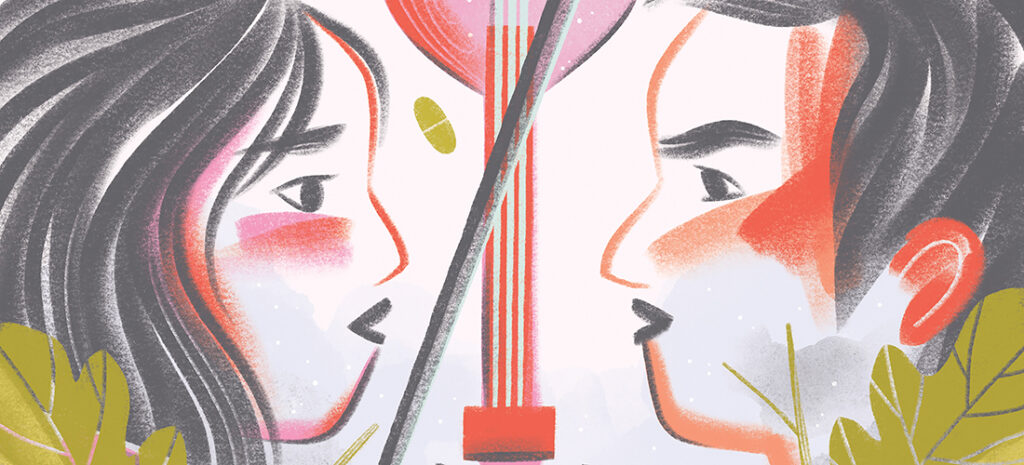
Illustration by Jesse White

Gordon Spires lived across the courtyard from Leonard Hillman, concert master of the M         Symphony, and his lover, Kyoung Wha Jun, the second violinist. Leonard and Kyoung Wha often practiced together outside in the courtyard, under the brim of a large oak tree. The neighbors would hear them playing Debussy or Brahms and sometimes something contemporary that they wouldn’t recognize.

Gordon liked to listen to them. He was in love with Kyoung Wha, who was slender and lovely, and he believed that she secretly returned his affection but could only reveal it through her music. So when she played Mozart, it was because he was Gordon’s favorite, and when she played Bach, it meant that she was biding her time, and when she played Tchaikovsky, it was surely a sign that she was ready to run off. For it was well known that Leonard beat Kyoung Wha when he was drunk, that he cheated on her with the first violist, and that he had not quit smoking like he told Kyoung Wha he would, but snuck cigarettes after matinee performances. At least these things were well known to Gordon, who was sickly and often home during the day.

One Sunday afternoon in late autumn, Kyoung Wha and Leonard played Beethoven. From his bedroom window, Gordon could see them, Kyoung Wha in a pleated blue skirt with prim white blouse, her long bangs swinging in her face as she swept her bow across the strings of her violin; Leonard, his narrow face impassive, eyes closed, chin tilted up at an unpleasant angle. Gordon could distinguish the rich, vibrant tones of Kyoung Wha’s playing from the darker, ruminative vibrations of Leonard’s, and he attributed the mistakes — rushed tempo, inconsistent meter, mawkish drawing out of notes — to Leonard, who was, in Gordon’s opinion, the inferior of the two musicians.

Taking careful aim, Gordon threw a Monopoly piece — a silver top hat — at the rounded, balding place at the back of Leonard’s head. Leonard did not stop. Gordon threw the wheelbarrow, the thimble, and the Scottish terrier. He used more force.

“What the — ?”

Beethoven came to a halt. Gordon peeked to see Leonard rubbing his bald patch, looking up at the oak tree, then down to the ground. Leonard shrugged at Kyoung Wha, who shrugged back. They resumed playing.

The next day, Gordon lobbed a satsuma, just grazing Leonard’s left temple. Leonard leapt from his chair. Kyoung Wha seemed to look straight at Gordon then, smiling sadly. Even crouched below his bedroom window, he could feel her smile penetrate his heart like the most tender of arrows.

A few days passed before they played outside again, Leonard setting up in what had formerly been Kyoung Wha’s spot, farthest from Gordon’s window, Kyoung Wha moving farther from Leonard, into a sunny patch that did not get much shade. Her face in sunlight looked faded to Gordon, wan, and when she played — Mendelssohn this time — he heard the silent suffering as separate notes from the ones that overlapped with Leonard’s, inhabiting the spaces between. She was even more beautiful in her despair, black hair against pale complexion, in an autumnal ensemble of mauves and rusts.

Gordon heaved a bottle of multivitamins, but it overshot its mark, landing, with a muffled plop, in a giant hosta.

It rained for several days after that, the afternoons overhung with mist. Gordon saw Kyoung Wha come into the courtyard in a yellow rain slicker. He thought her green rain boots splendid, as were the orange bill and bubble eyes on her hood, which were meant to make her look like a duck.

On the first clear day, Leonard appeared without Kyoung Wha. He began to play Mahler, his feet planted like andirons before a hearth. Gordon disliked the implication that music could simply go on without her. He wondered where she was, what Leonard had done to her. The lights were off in their apartment. He could see the white fringe of an afghan against the window, resting on the back of a blood red sofa.

Gordon palmed a large rock shaped like a dinosaur egg, with a rough, pock-marked surface. He raised the window and hurled it. The rock rainbowed up and out, hitting Leonard squarely on top of the head and bouncing off. The strings of the violin made a distressed, bleating sound as Leonard slumped sideways out of his chair, then fell face first against the brick walkway.

Time passed. The lights went on. Gordon saw Kyoung Wha come out, heard her call Leonard’s name. Approaching his body, she kneeled, bent to retrieve his violin by its broken neck, got up, and stumbled back inside. The lights went out.

Gordon listened, but all he heard was the sound of distant traffic.

Softly, he closed the window.  PS

Where She Sits

Where She Sits

Fiction by Randall Kenan
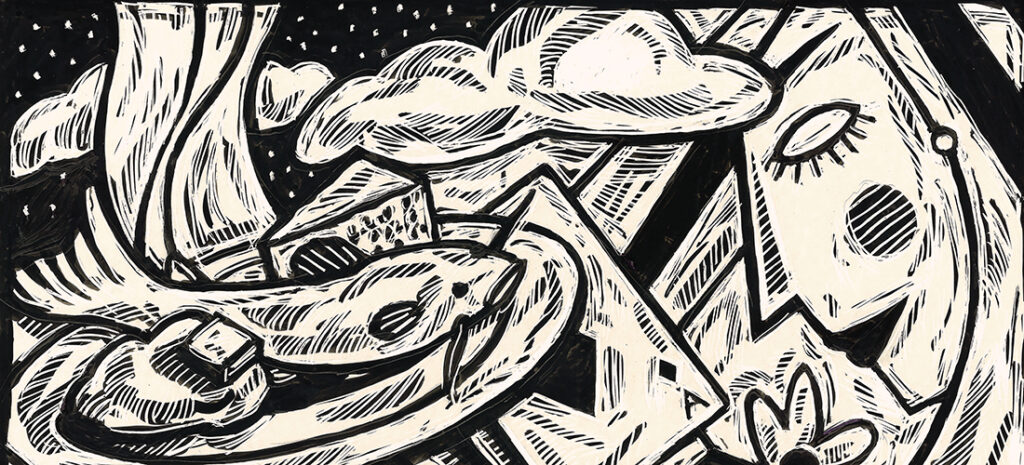
Illustration by Gary Palmer

They were in the little dining room off the kitchen when he finally told her. He paced about, motioning with his hands.
She just sat there, staring down. Feeling nothing. Maybe. Or just plain tired.

“I can’t do it anymore, Sandra,” he said.

Sandra said nothing. Slowly, she moved her hand over the oilcloth, steadying herself.

“I don’t care what your family says about me,” he said. “I don’t care. I can’t . . . I’m not . . . I’ve got to . . .”

She might have asked Dean about the children. But the idea that he would come up with some sleazy nonsense only made her feel a wave of nausea. Sandra put her head down.

Dean stopped behind her. She could feel the tension in the air; without seeing him, she knew he was clenching and unclenching and clenching his fists. He did that when he was angry. “Did you hear me? I’m leaving.”

Sandra raised her head. “Then go.”

He stood there for the amount of time it takes a frying egg to turn white and walked from the room.

Sandra reached out and caressed the table, and remembered. Not so much remembered as allowed a flood of images, past scents, past sights, to overtake her, fill the void she was now harboring. Each image evoked something like a feeling. So much took place in this room, upon this very surface. Not merely the food served, or the homework fretted over, or the cards played, or the beer spilled, or the puzzles arranged. Moments occurred right here. And now, in this instance of illusions shattered, of dreams wrecked and a heart frozen, these moments seemed to simmer before her, behind her eyes, and she could only hold on to them, to find some strength.

She had inherited this very table from her great-grandmother. Made of pine, by whom she did not know, it had been oiled, dented, dusted, polished, chipped, varnished, battered, peed upon, burned, broken, mended, hammered, nailed, or some such for decades. If it could feel, she knew she’d feel the way it felt now . . .

“Sandra? Damn it! . . . Where is my . . .”

The first true memory of her grandmother had been watching her across this expanse, on the other end, smiling and slicing with pride a piping hot blueberry pie. No, child, wait for it to cool. And so many mornings, days, nights, her mother at that same end: What you doing out so late? Sandra! An A in math! Now that’s good. Girl, don’t you ever raise your voice at me. I’ll knock the taste out your mouth! You heard about Uncle William, didn’t you? . . .

“Sandra, can’t find my . . .”

As if he actually expected her to come in there and help him to pack, to leave; as if any of this fault rested on her shoulders; as if she was expected to go along to get along; as if she would be unreasonable to go into the kitchen, get a butcher’s knife, and chop him into seventeen billion little pieces.

She ran her hand out against it again, against its smooth flatness, as if to absorb some of its stolid solidity.

Here, she served him his first taste of her cooking: catfish, greens, mashed potatoes, corn bread; here, she told her mother she was to wed the man who made her legs feel like overcooked spaghetti and her heart feel like butter. Here, where she tended him, listened to his tales of boring sales meetings and petty office feuds, and where he entertained his buddies (when not in front of the TV); here, where she fed and consoled and interrogated first one, then two daughters; here, where she slowly watched the shoals of her marriage erode, grain by grain.

Oh, if it could talk . . .

“Sandra.” He stood in the door. She didn’t want to look up at him. She had nothing to say.

“Good-bye.”

She did not look up, as he turned, wordless, and walked down the hall. As the door clicked behind him, she held fast. He may go, but some things would remain. A part, a piece, a fixture, a witness. Even now.   PS

The Playhouse

The Playhouse

Fiction by Max Steele
Illustration by Mariano Santillan

The professor was standing now before the doors of the American Embassy. He was early for an appointment with an old frat brother, a legal attaché who would help him procure a fast Mexican divorce. There was no urgency really in getting a divorce. It was simply that he could not concentrate on a permanent separation. When he tried he would end up in a hot soapy shower thinking about putting on freshly starched cotton clothes. Someone should have warned him in Raleigh not to drink on the plane. Here he was in Mexico City, a mile high, still a bit dazed.

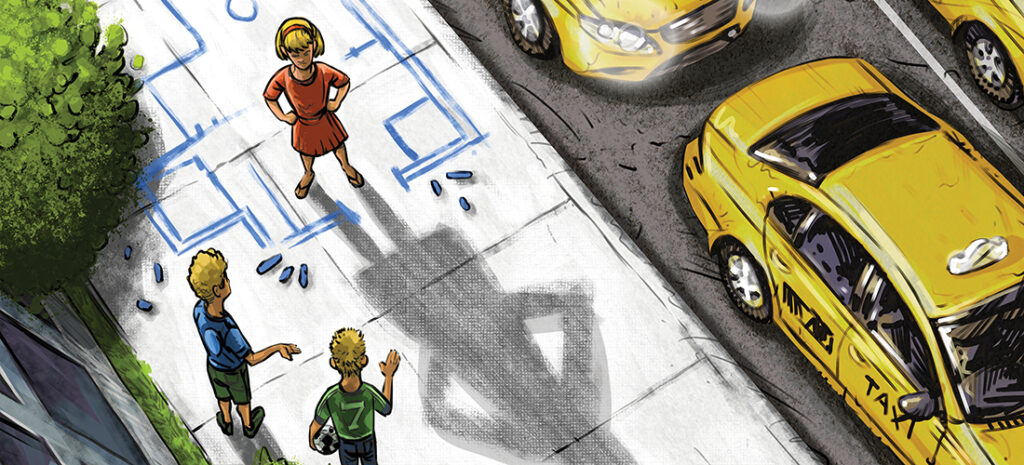
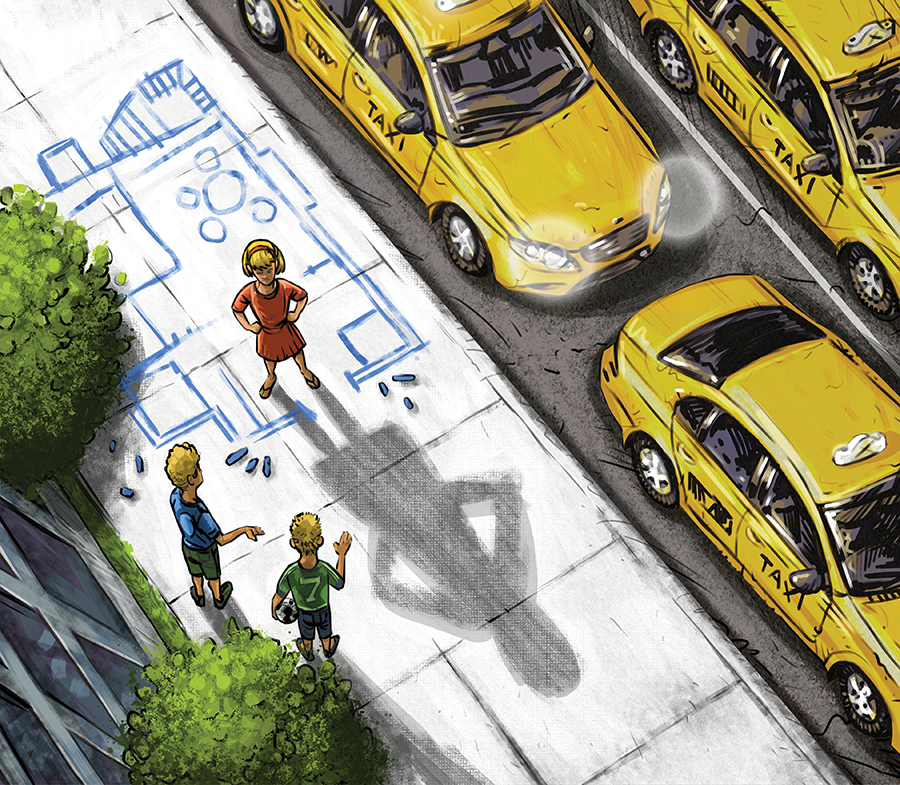
Three blond children, not more than five or six years old, obviously embassy kids, a little girl and two little boys, were playing house in and around a sort of blueprint design of squares and rectangles drawn with green chalk on the sidewalk. A solid block of taxicabs, more than the professor had ever seen, was passing on the Paseo de la Reforma.

Something about the broad boulevards and the taxi horns reminded him strongly of Paris, where twenty years ago he had spent his one sabbatical. The next year he had met his wife, who often reminded him that he had never taken her to Paris as he had promised. Or done any fun things. There was never enough money on his salary, she accused him, to do any fun things. In the late autumn air the feeling of déjà vu was so strong that he felt it was a dream, or a forgotten passage from a novel he was living through.

The two boys were now standing near him whispering, and the little girl was in the chalk-line house, busily sweeping, putting things on shelves, getting pots out of a stove only she could see, and washing dishes in the silent sink.

At a signal he did not notice, the small boys, giggling and full of themselves, marched slowly to the front of the house and knocked on the door. “Knock. Knock.”

The little girl seemed genuinely surprised. She came through the house, untying her apron and opened the door, drying her hands on the apron.

“Oh, there you are!” She was quite annoyed. “Late again, as usual. And furthermore you have brought a perfect stranger home to dinner.” Oh, she was vexed. “Without even asking. Without even calling!”

“Yes, my dear,” the little husband said proudly, full of his secret. “I would like for you to meet the man who owns the merry-go-round.”

As the boys entered the house, the professor glanced at his watch. He was still five minutes early. Enough time to walk to the far corner.

As he strolled up the dark gusty boulevard, he could still hear the high laughter of the children, and at the sound of their thin, excited voices his heart almost broke. After all, how were they to know (for they were still children), how could he have known she would run off with the man who owned the merry-go-round?  PS

Summer Shorts

Summer Shorts

Summer Shorts

August is more than sweet tea, watermelon and air conditioning. At PineStraw, it’s our Summer Reading Issue. This year’s selections are drawn from the collection of stories  entitled “Long Story Short” published in 2009 by the  University of North Carolina Press. The volume showcases the writing of 65 well-known North Carolina authors working in the genre called “flash fiction.” In Japan these short-shorts are called  “palm-of-the-hand” stories. Here are five easy pieces to enjoy on a hot day under a beach umbrella.

Our Writers

RANDALL KENAN (1963-2020) was a professor of English at the University of North Carolina at Chapel Hill and the recipient of a Guggenheim Fellowship, a Whiting Award, and the John Dos Passos Prize.

Katherine Min (1959-2019) received an NEA grant, a Pushcart Prize, a Sherwood Anderson Foundation Fiction Award, two New Hampshire State Council on the Arts Fellowships, and a North Carolina Arts Council Artist Fellowship.

SHELIA MOSES was raised in Rich Square, N.C., the ninth of 10 children. She is a writer, director, producer, poet and playwright. She has been nominated for the National Book Award and named a Coretta Scott King Honoree.

DAVID ROWELL was born and raised in Fayetteville, North Carolina, and graduated from the University of North Carolina at Chapel Hill. He was the deputy editor at the Washington Post Magazine for nearly 25 years.

MAX STEELE (1922–2005) directed the University of North Carolina at Chapel Hill Creative Writing Program for 20 years before he retired in 1988. He was an editor at Paris Review and Story Magazine and the recipient of two O.Henry Awards.


and Illustrators

RAMAN BHARDWAJ  is an international muralist, illustrator, fine artist, and graphic designer. Born in Chandigarh, India, he has had solo exhibitions in India, Norway and the USA, has painted more than 50 murals in North Carolina and illustrated 16 books.

KEITH BORSHAK has worked in advertising and design as a graphic designer, art director and creative director, receiving dozens of Addy Awards over his 30-year career. His illustration and design work has been recognized by Communication Arts Advertising Annual, The One Show, and the Graphis Design Annual.

GARY PALMER graduated from Ringling College of Art and Design. His work has been published in Wildlife in North Carolina, Ducks Unlimited, Shooting Sportsman, Better Homes and Gardens and Texas Monthly in addition to commissions for The North Carolina Museum of Natural Science, The Nature Conservancy and the National Park Service.

MARIANO SANTILLAN is a contractor for the U.S. Army Special Operations Command where he works as a web developer and illustrator. His “other” clients include Ohio State University, Fayetteville State University, The Washington Post, Cricket Magazine, and The Atlanta Journal- Constitution.

JESSE WHITE is an illustrator, author, and muralist. She graduated with a BFA in studio art from the University of North Carolina at Chapel Hill and earned her master’s in art education from Virginia Commonwealth University.

Poem August 2024

Poem August 2024

Steadfast

A lone tree fell in my woods

But it didn’t hit the ground

Or make that debated sound

It fell into the steadfast embrace

of another tree

With its outstretched branches free

They lean into each other

The broken and the strong

The living and the gone

It’s only with a passing breeze

And a creaking, crying bough

That they make sure we hear them now

    — Kayla Stuhr

Kayla Stuhr is a Scottish visual artist, writer, and award-winning filmmaker.

Southwords

Southwords

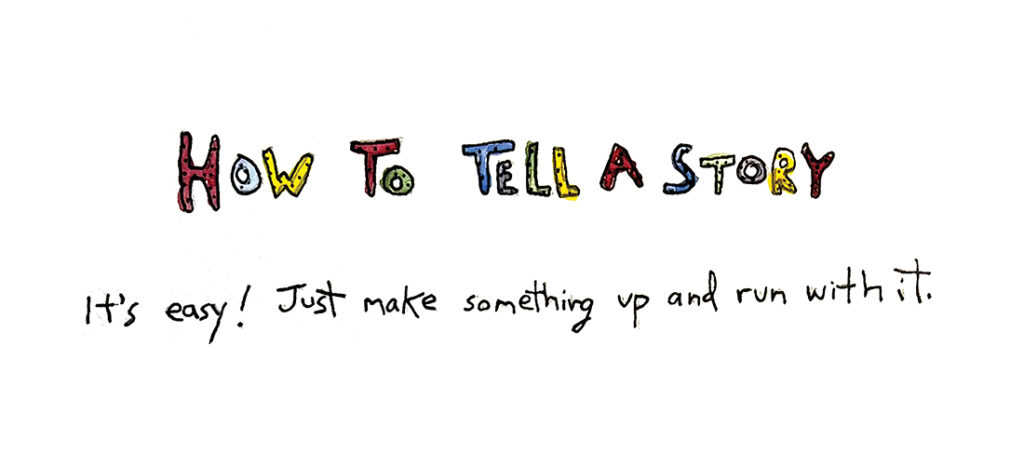
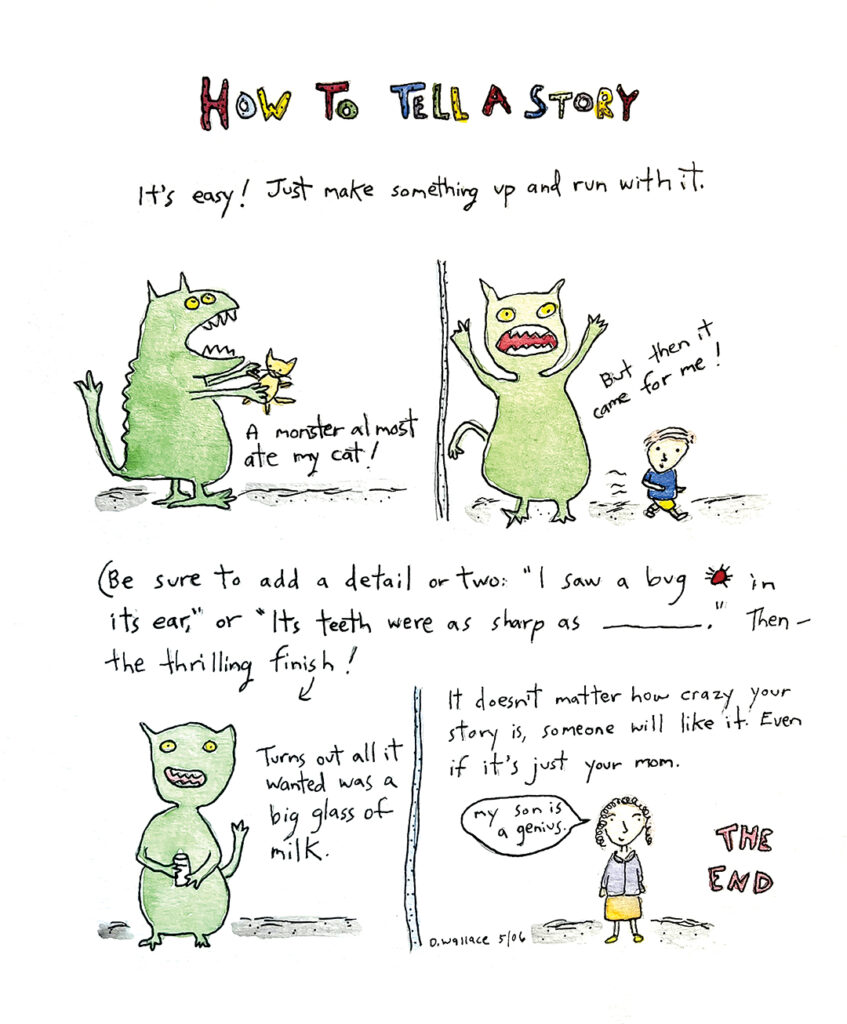
Daniel Wallace is the author of six novels. He is the J. Ross MacDonald Distinguished Professor of English at the University of North Carolina at Chapel Hill, his alma mater.

Hometown

Hometown

In the Swim

The summer of staying afloat

By Bill Fields

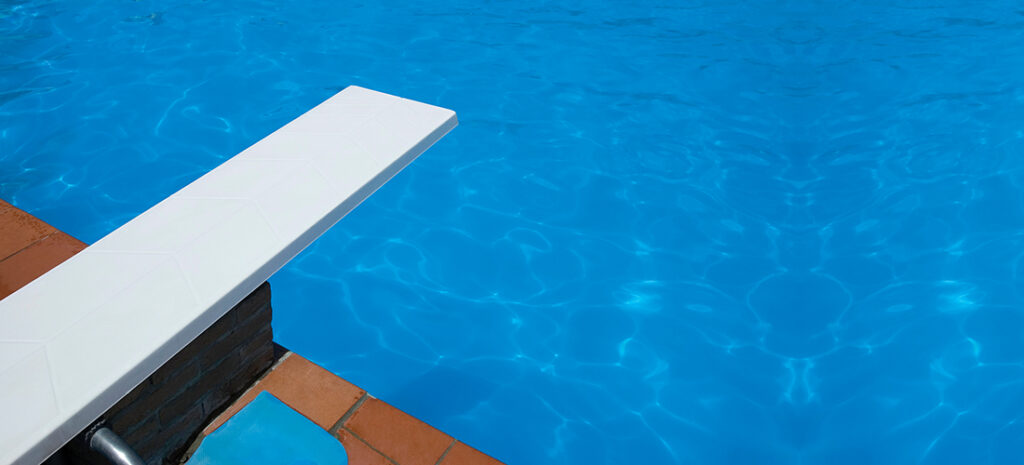
There was a lot going on in the summer of ’68, much of it heavy and consequential. But being only 9 years old during those tumultuous months, I was mostly oblivious to the real-world turmoil and focused on things that mattered to a rising fourth-grader.

Swimming — or more accurately, being at a pool — was near the top of the list.

We were not really a swimming family. Mom loved excursions to a lake or the ocean but was mostly an observer, content to take in the water from a dock or beach, and only occasionally getting in up to her thighs to cool off. She was a hawk-eyed sentry on shore, real or imagined rip currents a specialty. There is home movie footage of Mom in a suburban Atlanta hotel window waving me out of the pool’s deep end. Dad enjoyed floating on his back just beyond the breaking waves at Ocean Drive on annual vacations, a pleasure that guaranteed angst for my watchful mother.

I can’t blame all my early swimming trepidation on my mother. Before I had started first grade, my older cousins were in town for a visit and lodging at the Charlton Motel. Getting to go over there for a dip with them in a real pool — instead of the modest Sears above-ground model in our yard whose plastic bottom always felt slimy and whose primary focus seemed to be attracting bugs of one sort or another — was a big deal. My cousin Bob, treading water near the diving board and wrongly believing I knew how to swim, urged me to jump in. I thought he was going to catch me. There were a few moments of panic before Bob realized what was going on and scooped me up and carried me to the shallow end.

I soon would learn how to dog paddle. Aberdeen Lake, Rec Department outings to the Southern Pines town pool, White Lake and the rare family road trip motel pools were my learning laboratories. Whether in murky or clear waters, though, I was still a novice.

That’s why 1968, which I call the Summer of Sore Toes, was important.

My sister Dianne and her husband, Bob, hosted me for a visit in Winston-Salem, where they had gone to Wake Forest. It was a memorable week. They showed me the college campus, treated me to cherry Slurpees at 7-Eleven, took me to an aquarium-fish store that featured a tank of piranhas. My sister baked lasagna and made tacos, exotic fare given the basic Southern food Mom and Dad served at home. They were living in a Winston-Salem apartment complex whose best feature was a pool, where I was determined to spend much of my time.

With Dianne patiently poolside with a good book or three keeping a loose eye on her little brother, I spent hours in the water. Bob, an excellent swimmer and former lifeguard, joined me in the pool when he got back from his graduate school classes and tried to help me get more comfortable and proficient in the water.

The dog paddle evolved into a reasonable freestyle stroke I could do a full lap with. I proudly learned how to do a dead man’s float. I still was too timid to go off the diving board, but I got bold enough to dive in from the pool’s edge — over and over and over. The rim had a rough concrete surface, and we helped Eckerd’s bottom line with the Band-Aids put into duty over those seven days, the week I became a swimmer.

About a decade later, when I was at Carolina, students had to pass a swim test to graduate — the requirement was staying afloat for five minutes in the manner of your choosing: swim, tread water, float. If you couldn’t pass, a physical education swimming class was in your future. I confidently signed up for the test, arrived at the appointed time, dove into the 10-foot-deep water, and had no problem lasting until the monitor’s whistle of success. If only calculus had been as easy.  PS

Southern Pines native Bill Fields, who writes about golf and other things, moved north in 1986 but hasn’t lost his accent.

Golftown Journal

Golftown Journal

Bryson’s Bunker

Another shot for the ages

By Lee Pace

Photograph by Matthew Harris Golf Collection

The thread from 1999 to 2024 is quite eerie indeed.

Payne Stewart and Bryson DeChambeau, each of them a former golfer from Southern Methodist University in Dallas.

Each of them with a youthful connection to Pinehurst and its esteemed No. 2 course, Stewart from having visited for a month in 1979 to play a local mini-tour rota, and DeChambeau coming annually with the Mustang golf team to play a fall match against a local school like Wake Forest or North Carolina at the behest of Bob Dedman Jr., the owner of the resort, and a graduate and benefactor of SMU.

Each of them maturing into gracious champions after hiccups as younger players with instances of churlish or snippy behavior with fellow competitors or tournament officials.

And each of them playing in the final group of the U.S. Open and arriving at the 18th tee with history in the balance. 

Stewart in 1999 needs a par to hold off playing partner Phil Mickelson, but his tee shot on the uphill, par-4 finishing hole misses the fairway to the right. He’s in 5 inches of suffocating rough, the grass wet on a cool, misty day. He punches out, has 78 yards to the hole, hits a three-quarter sand wedge to 20 feet short of the back-right hole location.

Stewart makes the putt, and his right-hand fist pump, right-leg extension celebratory pose will be immortalized on film and later in bronze for the ages.

“Perfect — a perfect way to win,” Stewart said. “I think everyone in the field will attest to how great No. 2 is, to what a special place Pinehurst is. To win here means a lot to me.”

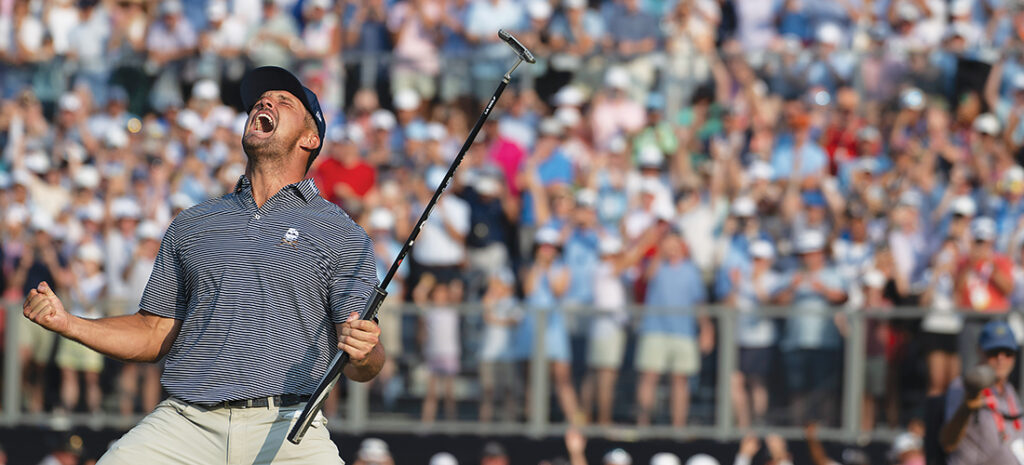
DeChambeau in 2024 needs a par to hold off Rory McIlroy, who’s playing one group ahead. He yanks his tee shot left of the fairway, the ball traveling more than 300 yards uphill and coming to rest under a magnolia tree, up against a root and sitting on the native hardpan sand that was exposed during the 2010-11 Coore & Crenshaw course restoration. He has 147 yards to the hole, punches out, and the ball comes to rest in a bunker sitting front right of the green.

He has 54 yards to the traditional final day, back right pin. He uses his immense physical strength to explode out of the sand to 4 feet, then makes the putt. As the ball rolls into the cup, DeChambeau extends both arms, arches his back, looks to the heavens and sets off on several seconds of unabashed joy.

“That bunker shot was the shot of my life,” DeChambeau said. “I’ll forever be thankful that I’ve got longer wedges, so I can hit it farther, get up there next to the hole.”

So now Payne’s Putt has alongside it Bryson’s Bunker in the pantheon of all-time greatest shots — not only in 129 years of Pinehurst history, but also in major championship golf.

Jack Nicklaus’s 1-iron hitting the flag at Pebble Beach in 1972, Tom Watson’s chip-in at Pebble a decade later, Seve Ballesteros’s winning putt at St. Andrews in 1984, Bob Tway’s bunker dunk at Inverness to win the 1986 PGA Championship, Tiger Woods’ chip-in at Augusta in 2005 . . . all iconic monster shots in golf.

“Bryson’s shot has to be as good as any of them,” says 2021 Open champion Jon Rahm.

“There’s no question Bryson’s shot was one of the best shots in U.S. Open history,” says Curtis Strange, a two-time Open champion and former North & South Amateur winner at Pinehurst. “His shot was one of the toughest, if not the toughest, shots in golf. Magnify that with last hole, U.S. Open pressure on a world stage? It was an amazing shot.”

The week after the Open, Pinehurst officials, at the request of DeChambeau caddie Greg Bodine, sent via FedEx an urn of sand from that bunker to DeChambeau’s residence. The golf staffers and caddies have half-jokingly wondered if the windows in the clubhouse behind the 18th green are now in danger with retail golfers attempting that shot and hitting the dreaded skulled shot flying who knows where. The club’s social media staff even mused after the Open that the preponderance of balls landing on the roof might escalate.

All around the golf course, the village and the Sandhills, knowledgeable golf students looked on in awe.

“The long sand shot, that’s the hardest shot in golf,” says former PGA Tour player Pat McGowan, who watched his son Michael play the first two rounds. “Oh my gosh, what a shot. He could stand there and hit 100 shots and not get it any closer. He could have skulled that over the clubhouse and made a double. But Bryson is so strong he just muscled it out.”

“The stat of a PGA Tour player getting up and down from a bunker from that distance is 1.7 percent,” says Pinehurst teaching pro Kelly Mitchum. “To do it on the final hole of a U.S. Open is pretty remarkable.”

Gus Ulrich, the longtime teaching pro at Pinewild Country Club and golf coach at Sandhills Community College, was struck with the authority and resolve DeChambeau exhibited during the minute before the shot.

“What impressed me was Bryson did not overanalyze it,” Ulrich says. “He didn’t rush it by any means, but he didn’t grind over it and agonize like, ‘Oh, I gotta make this to win the U.S. Open.’ He made up his mind pretty quickly, walked in and hit the shot. I think that’s what you have to do in that situation. The more you agonize over it, the harder the shot becomes.”

DeChambeau reflected on that very mindset afterward. Asked what he would remember most about the final two hours of a drama-laden back nine, he said: “Probably my caddie telling me I can do it out of the bunker. G-Bo just said, ‘Bryson, just get it up-and-down. That’s all you have to do. You’ve done this plenty of times before. I’ve seen some crazy shots from you from 50 yards out of a bunker.’ I said, ‘You’re right. I need the 55-degree. Let’s do it.’”

Course superintendent John Jeffreys was standing behind the green in DeChambeau’s line and considered there were about a half-dozen layers of ground undulation between the golfer and the hole — a “false front” leading up to the putting surface; a narrow plateau in the front portion of the green; a downslope and swale in the middle of the green; and finally, an upslope leading to the back crest where the pin was set.

“There’s a lot more to that green than you would think approaching it on the angle he had,” Jeffreys says. “There were a lot of areas to contend with that can help you or hurt you. What made the shot so great was he landed it on the downslope behind that first little plateau. That propelled the ball forward and it ran up to 4 feet.”

And the rest, as they say . . .

No doubt they’re making room as we speak in the history-laden hallway of the resort clubhouse to celebrate Bryson’s Bunker.

“It’s like we caught lightning in a bottle,” Dedman says. “It was otherworldly. To me, it’s almost as if it was preordained. I think maybe Payne and my father were up in heaven and put their thumb on the scale to Bryson’s advantage.”  PS

Lee Pace has written about the Pinehurst experience for more than three decades from his home in Chapel Hill. Write him at leepace7@gmail.com and follow him on X @LeePaceTweet.