The Omnivorous Reader

Mystery of the Hunley

What killed the Confederacy’s submariners?

By Stephen E. Smith

With an estimated 60,000 to 100,000 Civil War—related titles published in the last 155 years, you might wonder if there’s anything left to write about. But science and technology have offered new methods of verifying the previously unverifiable, no matter how esoteric or insignificant the subject might be.

An April entry into the Civil War marketplace is Rachel Lance’s In the Waves: My Quest to Solve the Mystery of a Civil War Submarine. This 315-page semi-technical analysis of a single black-powder detonation that changed naval warfare forever should be of interest to anyone living in the Carolinas, taking place, by and large, at Duke University, and concerning an artifact that has, in recent years, attracted thousands of tourists to the city of Charleston.

Lance is a biomedical engineer and blast-injury researcher at Duke. She spent several years as an engineer developing specialized underwater equipment for the Navy and was working toward her Ph.D. when she took on, at the insistence of her dissertation advisor, the mysterious demise of the H.L. Hunley’s crew.

Any Civil War enthusiast (let’s dispense with the pejorative term “buff”; many Civil War readers are serious historians) will be happy to tell you that the Hunley was an experimental submarine developed by the Confederacy in hopes that it would break the Union blockade, and that it might have succeeded except that it disappeared along with the USS Housatonic, the first warship sunk by a submersible craft, and remained cloaked in mystery until 1995, when it was located 4 miles offshore in 30 feet of water. The sub was raised from the bottom in 2000 and has since become Charleston’s most popular attraction.

For those unfamiliar with the details of the Hunley’s story, Lance supplies a history of early submersibles and details the little sub’s short life, including the circumstances surrounding the first two Hunley crews, who perished when mechanical problems arose during testing. Even H.L. Hunley, the sub’s inventor, died when he accidently depressed the bow planes when surfacing following a test dive. After each sinking, the sub was raised and put back into service, even when it required that the bloated bodies of the dead be dismembered to facilitate removal, a decidedly unpleasant task relegated to slave labor.

For many years, it was assumed the Hunley had survived its attack on the Housatonic — it was reported that the crew signaled success by flashing a blue light — but there was no satisfactory explanation as to why the boat did not return to fight another day. Survivors of the Housatonic testified to seeing the Hunley shortly after the explosion, but no further evidence as to the fate of the sub and its crew was offered at the time.

Lance’s study focuses on the crew’s cause of death. Archaeologists found all eight men slumped at their stations in the submarine. Seven men were seated at the propeller crank, and the remains of the boat’s captain, Lt. George Dixon, were discovered in the forward conning tower. None showed signs of skeletal trauma, and there was no indication that the crew had attempted to escape the sinking craft. A careful examination of the boat’s skin revealed that the explosion had not breached its hull.

Since Lance is a blast-injury expert, readers might assume that she was seeking confirmation that the crew was killed by the shock wave from detonation of the Hunley’s torpedo, and not from suffocation or drowning. In fact, Southern newspapers speculated shortly after the sub’s disappearance that such a wave had sunk the little boat, and knowledgeable observers at the time of the sub’s testing warned that the Hunley would likely fall victim to its own torpedo, which was suspended on the end of a spar extending from the bow of the boat.

Lance’s objective was to prove beyond all doubt that a blast wave killed the Hunley’s crew, and In the Waves is a narrative history of her quest to gather evidence to that effect and to procure, in the process, her Ph.D. To do this she constructed a miniature Hunley-like craft (the CSS Tiny), procured black powder of the sort available during the Civil War, constructed a miniature facsimile of the torpedo, and conducted extensive testing in an appropriate body of water. Instruments to measure the true force of the blast had to be obtained from the Navy and made to function correctly under circumstances that were anything but ideal.

The development of testing criteria consumes most of Lance’s book, at times growing a trifle tedious and dauntingly technical. Failed test follows failed test, subjecting the reader to the same level of frustration suffered by Lance and her team of researchers. But she wisely couches much of the technical information in understandable terms and refers more punctilious readers to the open-access journal PLOs One. “This is a descriptive version of the math and physics,” she writes in a footnote, “and was written to be understandable for the general reader. It does not, therefore, go into all the complex details necessary to justify and complete the scientific analysis.”

While working to replicate the explosive force of the Hunley’s torpedo, Lance reveals the intriguing story of George Washington Rains. Born in Craven County, North Carolina, Rains almost singlehandedly supplied the Confederacy with black powder and torpedo technology. Southern soldiers may have run short of food and clothing, but they were never without powder and shot, a fact that no doubt prolonged the slaughter and destruction occasioned by the war.

In the Waves’ entertainment value is mostly a matter of scientific revelation. As a narrative it is made less successful by the inclusion of unnecessary details regarding the author’s personal life, and the occasional irrelevant sidebar and annoying digression. Is it worth reading? Certainly. If you have an abiding interest in Civil War history, you’ll no doubt find a place for In the Waves in your already overburdened bookshelves.  PS

Stephen E. Smith is a retired professor and the author of seven books of poetry and prose. He’s the recipient of the Poetry Northwest Young Poet’s Prize, the Zoe Kincaid Brockman Prize for poetry and four North Carolina Press awards.

The Art Beat

Very Odd Indeed

Judson Theatre produces Neil Simon classic

By Jim Moriarty

What happens when two divorced women move in together? You could go to Netflix and watch Jack Lemmon and Walter Matthau to get an inkling or, if you want to really know, you can go to the Judson Theatre Company’s production of Neil Simon’s female version of The Odd Couple March 26-29 at the Bradshaw Performing Arts Center at Sandhills Community College.

Simon’s female version of his timeless comedy debuted on Broadway in 1985 with the lead characters transformed into Olive Madison and Florence Unger. When Florence is unceremoniously ditched by her husband, she shows up at Olive’s rather untidy apartment, where the girls are engaged in a rousing game of Trivial Pursuit. Concerned that Florence might be suicidal, Olive takes her in. But these are two women with very, very different personalities. The rest is classic Neil Simon, not recycled but reimagined.

Olive is being played by Amanda Bearse, best known for her portrayal of Marcy D’Arcy in over 250 episodes of Married . . . with Children. Bearse was most recently the director of an off-Broadway play, Party Face, produced by Judson’s founder, Morgan Sills. “We had Hayley Mills dedicated to this final week when we lost not only our standby, which is the word for understudy now, but one of the actresses, too,” Bearse says. “Long story short, I ended up on stage. I hadn’t been on stage in decades. I quit acting after Married . . . with Children in order to be taken seriously in Hollywood as a director. I got this little opportunity with six or seven performances. I had a blast and was reminded how much fun it is. So, I kind of put the energy out there to Morgan. ‘When are you going to ask me to come down there?’ You have to be careful what you ask for. So, I guess I have to get new headshots. I’m an actor again.”

Bearse, who is back in Southern California, had been teaching at the Seattle Film Institute. “The female version of Odd Couple is something that I came to just in the last few years. So, when Morgan brought it up, I said I’m familiar with that play,” she says. “Florence is wound up pretty tight, a lot like the character I did on Married . . . with Children. That might be the most expected way to see me. I like to shake things up a little bit, and I said I would love to play Olive.”

Teresa Ganzel, who has appeared with actors like Jackie Gleason, Richard Pryor, Lynn Redgrave, Carol Burnett, Jean Smart, Jim Carrey, Bob Newhart and on and on, performed previously in Pinehurst as Truvy in Judson Theatre’s production of Steel Magnolias. “I was doing Viagra Falls — yes, it’s a comedy — and Morgan told me he’d seen the show and that he was doing Steel Magnolias, and he thought I’d be great in the Dolly Parton part,” she says. “I said, ‘Are you kidding? I’d love to do that part.’ So, that’s how it happened. I loved Pinehurst, too, so that whole experience, I just really enjoyed it. Now, here it is, six years later and he asked if I’d like to do the female Odd Couple and I said, of course. The weird thing, too, is I’d never seen a production of the Odd Couple, male or female. I see a lot of theater and it’s such a classic play, you would have thought I would have. I’m loving the fact that it’s sort of new to me.”

Sills, the executive producer, is joined once again by artistic director Daniel Haley. “We had done so well with Plaza Suite with Eve Plumb and Rex Smith, and with The Sunshine Boys with Robert Wuhl and Don Most, that we wanted to do another Neil Simon. Our audiences love it,” says Sills. “The female Odd Couple seemed to be the next logical progression because Love, Loss and What I Wore by Nora Ephron had done so well.

“Also, we knew we could cast it really well. To have Teresa come back and have Amanda come down to North Carolina, they’re both friends. They’re wonderful on stage and off. I knew it would be an unbeatable combination, that they’ll be hysterically funny in this show. No laughs get by these two.”

Performances at BPAC are Thursday, March 26, at 7 p.m.; Friday, March 27, at 8 p.m.; Saturday, March 28, at 2 p.m. and 8 p.m.; and a final matinee on Sunday, March 29, at 3 p.m. Tickets are $38 in advance or $45 at the door ($25 for military or students) and are available online at Judsontheatre.com. All seating is general admission.  PS

Jim Moriarty is the senior editor of PineStraw and can be reached at jjmpinestraw@gmail.com.

Sporting Life

A Hitchhiker’s Guide

Finding the universe in bluebirds

By Tom Bryant

“I went to the woods because I wished to live deliberately, to front only the essential facts of life and to see if I could not learn what it had to teach, and not, when I came to die, to discover that I had not lived.”  — Henry David Thoreau

I haven’t met that many people who marched to Thoreau’s drummer. My father for sure, my grandfather without a doubt, and there was a gentleman I had the opportunity to meet for only about an hour, but that fellow was a walking example of what Thoreau had in mind when he penciled his famous Walden.

I’ve talked about it some and have written about the unusual experience I had that hot August afternoon when I met “Hank,” as he said he liked his friends to call him.

It was the week before dove season, and I was as busy as the proverbial one-armed paperhanger trying to get everything done on my newly leased little farm to be ready for opening day. I had invited several friends to help usher in the season, and was running back and forth from our home in Southern Pines to the field located close to Drowning Creek.

It was just before lunch, and the sun was really bearing down when I noticed a hitchhiker right outside of Aberdeen on U.S. 1. He had a sign made from a piece of cardboard with the message:

HEADING SOUTH . . . NO HURRY

The little cardboard sign got my attention, because back in my early days, I used to move around the country hitchhiking, using the same method, a hand-lettered sign with my destination scribbled across the cardboard. It worked.

Those were different days when I used my thumb to get back and forth to college. They were simpler, more peaceful times, and a lot of youngsters got about by hitching rides. But this guy had no destination listed, just south, and he said he was in no hurry. Unheard of, I thought, as I rode by the gentleman standing on the side of the road. Everybody is supposed to be in a hurry.

On my second trip to the farm, the hitchhiker was still in about the same location, walking toward Pinebluff. What the heck, I thought. It’s too hot for the old guy. I decided to pick him up and pulled over to the side.

He hurried up to the Bronco, looked in and said, “Thanks for stopping, mister. It’s getting dang hot out here.” The gentleman looked to be anywhere between 60 and 70. He was dressed neatly in well worn but clean clothes. He had a small backpack, and I could tell he wasn’t your run-of-the-mill loafer. He climbed in the Bronco, and I drove on south.

“Hot day to be out here, fellow,” I said. “Where you headed?”

“You know, I haven’t made my mind up yet. I might visit my sister in Florida or travel to Texas. Texas is supposed to be pretty this time of year.”

And so I met Hank. In our short conversation, I learned that, at one time, he had his own very successful business as a financial consultant and evidently had retired with a bucket full of money. Just when he and his wife were getting ready to enjoy the good life, she came down with a debilitating illness and passed away.

“I started drinking too much,” he said. “Things were on the downhill slide. Nothing meant much to me anymore until one morning I looked out the kitchen window and saw the most beautiful sunrise, and my life turned around. I sold the house, gave everything to the kids, and decided to see the world from the ground up, as it were. I realized I’d never be able to spend all the money I had acquired, and it’s amazing how simply a person can live.

“You know what I did this spring? Watched a pair of bluebirds build a nest and have babies. That’s all I did. I had a part-time job on a horse farm in Virginia, and when I wasn’t cleaning stables, I watched those two little birds. It was wonderful.”

I dropped Hank off a short way from Rockingham, where he said he was going to spend a couple days in a motel, resting and escaping the current heat wave.

I never saw this truly contented man again.

My grandfather, a farmer, spent his life in and made his livelihood from his fields in the low country of South Carolina. He was dedicated to the outdoors, not just for the esoteric aspect but because that’s where he made his living and supported a family of eight children. I spent many days as a youngster following him through freshly planted fields and riding in his pickup as he checked on how his crops were growing. Those drives usually occurred on Sunday, when my grandmother would be at the little Baptist country church located close to the farm. She played the piano for the choir and was a huge supporter of the small house of worship. Me? I stuck close to Granddaddy’s side.

One Sunday as we were checking crops down close to the creek, I asked him, “Granddad, you don’t go to church with Grandma. Why is that?”

He pulled the pickup under a giant live oak and said, “Come on, son, I want to show you something.”

We walked down toward the creek, and he said, “Now, what do you see?”

I was kind of mystified as to where the conversation was going. “Well, I see the creek and the swamp and those giant cypress trees. That’s about it.”

“What do you hear? Listen good. Close your eyes and listen.”

“Crows. Sounds like they’re down the creek around the bend. And the creek water current is burbling, sort of like a whispering noise. And, oh yeah, a blue jay calling from across the creek, and a woodpecker is pecking somewhere close.”

I opened my eyes and we stood there silently on the bank of the little fast moving stream. “Son, this is my church. I figure the outdoors, this creek, our fields, anywhere I am in the woods is about as close to the good Lord as I’m gonna get, until He calls me and wants to talk on a more personal basis. No time soon, I hope,” he said, laughing.

The other person in my litany of outdoor champions is my dad, the finest man I’ve known. An orphan whose parents died in the 1918 flu epidemic, he was placed in the local boys’ home, and that’s where he lived until graduating from high school. A fantastic high school athlete, he won numerous scholarships to several colleges but decided on Clemson. He met Mother, and as they say, the rest is history.

My dad always lived close to the natural world. Growing up in the boys’ home, he was responsible for the garden that helped feed the residents, and that everyday closeness to nature as a boy never went away. He had a morning habit that was a real mystery to me until one morning I asked Mother what he was he doing.

My siblings and I would be around the breakfast table, chowing down, getting ready for school, and Dad would make a cup of coffee and go outside. He would stand there under an ancient longleaf pine, drinking coffee, looking toward the woods that led down to the lake. He followed that same routine every day.

“Tommy,” my mom said, “I believe that’s how your dad communicates with the Almighty.” Dad was outside standing in about the same spot drinking his coffee and looking toward the woodland.

“I think it’s as simple as he’s planning his day and praying for good things for his family.”

Thoreau, if he had had the opportunity to meet my dad, my granddad and Hank, would have been proud to include them in his small circle of friends.  PS

Tom Bryant, a Southern Pines resident, is a lifelong outdoorsman and PineStraw’s Sporting Life columnist.

Southwords

Chicken Delight

You can’t stop them. You can only hope to contain them

By Beth MacDonald

Sometimes my husband
and I will bird watch from our porch while we enjoy our coffee. We let the dogs run around their self-made Tough Mudder obstacle course — the remnants of what used to be the lawn.

One particularly fine morning I sighed contentedly. “Ah, I hear the cardinals.” I looked around to see if I could spot them on the blooming camellia bush.

“Wait . . . shhh!” Mason sputtered. I heard it, too. It was a clucking sound. “That’s a chicken!” Spinning around so fast the G-forces almost threw him out of his chair, Mason’s bewilderment made me laugh. “Why is there a chicken in our yard?” He wanted answers, damn it.

“Because it’s our yard. I don’t know why you’re surprised.”

Snapping a picture, I sent my neighbor a text asking if she’d lost something. About yay high. Four toes. Skinny legs. She quickly replied that she wasn’t home and if I simply walk toward it, the beast should return to her yard. Mystery solved.

If and should are words that automatically mean to me that things are about to go the exact opposite of how they should go — especially since I was in my mismatched Spaceman Spiff pajamas.

I pulled my boots on and walked to the side yard with Mason. He is always dressed. He was born dressed. He knows that bad things always happen before coffee. I should have learned as much by now.

When I walked toward the chicken, it chose to exercise its free will prerogative as one of God’s creatures and went in the direction opposite of where it was supposed to go. It walked in circles. As I kept trying to herd the bird home, Mason stood there, arms crossed, advising me on the proper technique for catching a chicken. I didn’t realize he was Chicken Dundee.

Squatting low and assuming the stance of a Sumo wrestler — because in my mind these creatures must surely understand the Japanese sport — I stared at the ground, pounded my feet and followed the fowl straight into a prickly holly bush. Chicken Dundee stood there glaring at me.

“You’re doing it wrong.”

“We’ll I’ve never hunted chickens before!”

“What you need to do is blah blah blah,” he preached from the sidelines.

Mimicking the walk of a chicken and chasing it seemed like a much better idea than whatever it was Mason was saying. So, that was my new plan.

Untangling myself from the holly bush, I made a “bawk bawk” noise and, wearing Spaceman Spiff instead of a Sumo belt, I charged. It ran toward my husband for safety. He calmly wrapped his hands around its wings and gently placed it over our neighbor’s fence. Poultry crisis averted. Temporarily.

The problem is that we recently adopted another dog. She’s a 2-year-old Cane Corso, obedience trained and raised for breeding. That didn’t work out for her. Unwanted, she joined our ragtag bunch of misfits. Before we got her, however, her diet had consisted mainly of raw chicken. Exactly.

Two days after we adopted New Dog, on another bucolic, porch-sitting morning we settled in with a lovely light roast. Before we could get the first sip down, we heard the wild jungle screams of Jumanji from the backyard. A slow-motion scene of chaos played out in front of us.

There were seven chickens running, squawking in panic, three dogs barking, galloping with delight toward the disarray, and a hawk swooping down, screaming toward pretty much anything with the potential of transitioning into carrion. Mason lurched forward, his coffee a still frame of liquid suspended in air, yelling in deep-throated slow-mo, “Nooooooooo!”

It was my turn to advise from the sidelines. My inner monologue said, “Why are there shenanigans before coffee?”

Then it hit me. New Dog eats chicken. Raw chicken. I called her and yelled, “Stop!” My inner monologue scoffed. The dog did not stop. I started calling for all the dogs to stop. Like any good mother, none of their names came to mind. I started spewing out random bits and pieces of names, including the names of my children, followed by, “Whatever your name is, SIT!” while clapping like a schoolmarm.

My neighbor scared the hawk off with a pellet gun. It flew away like someone leaving the McDonald’s drive-thru with the wrong order. As quickly as this old-fashioned melee started it was over.

I met my neighbor at the absolutely useless fence line, both of us breathless. I asked her if she needed help rounding up her chickens. I am a pro now. She declined but wondered out loud, “Why did all of this happen before coffee?” Because, well, us. PS

Beth MacDonald is a Southern Pines suburban misadventurer who likes to make words up. She loves to travel with her family, read everything she can, and shop locally for her socks.

Golftown Journal

Whip It

Discovering tempo at the end of a stick

By Lee Pace

Jim Hackenburg punches a few keys into his cellphone and waits for a video clip on YouTube to pop up. Seconds later, he’s showing John Candy in the movie The Blues Brothers sitting down in a bar with two prison guards and ordering drinks. He points at his two companions and asks: “Orange Whip? Orange Whip?” Then he looks at the waiter: “Three Orange Whips.”

Hackenburg smiles.

“That very instant, I knew I had the name,” he says. “Orange is a vibrant color. There was a whipping motion to the device. It was perfect.”

That was in 2007, when Hackenberg, a former collegiate golfer, mini-tour player, PGA Tour caddie and at the time a club pro and swing coach, was trying to generate some momentum for a new golf training aid he was launching — a rubber ball on the end of a flexible shaft that was designed to help golfers feel the proper motion, sequence and tempo of the golf swing.

Hackenberg looks around him at the massive PGA Merchandise Show in Orlando in late January 2020 and reflects back to the beginning.

“My first show 12 years ago, it was just me in a 5- by 10-foot booth, 10 hours a day for three straight days,” he says. “It was tough.”

A dozen years later, the Easley, South Carolina-based company brought a dozen people to Orlando and rented six times the exhibit space over his initial foray into the trade show business. The Golf Channel dropped by and did a spot with anchor personality Kira Dixon demonstrating an Orange Whip device. And in addition to peddling and promoting the original Orange Whip trainer and knock-offs developed for putting and wedge play, Hackenberg has partnered with golf fitness specialist Brian Newman of Elk River Club in Banner Elk, North Carolina, on a new product line and streaming training service for golf fitness. There is a shorter, heavier version of the Orange Whip called the LightSpeed, designed for “speed training”; and a series of resistance bands and a concave hitting platform that addresses the basic swing skills of posture, rotation, weight shift and balance and swing plane.

“The Orange Whip has always been about tempo and feel with a small physical component to it,” Hackenberg says. “But I never really had a fitness program. There are certain parts of the swing that can’t be taught unless you have flexibility, balance and mobility. Brian has brought those puzzle pieces to complete the Orange Whip.”

Hackenberg grew up in North Dakota, played college golf at Arizona State and Oregon State, and by the 2003-05 era was spending his winters and springs caddying on the PGA Tour and his summers teaching at a club on Martha’s Vineyard. The contrasts struck him between the fluid, athletic swings of players like Geoff Ogilvy and Ernie Els, and the lunging and jabbing motions of many middle-aged club golfers.

“I was attracted to the pros’ balance and rhythm,” says Hackenberg, a PGA Class A pro since 2003. “These guys made it look almost too easy, like they can do it in their sleep. Their motion was so effortless. It was like they’d been holding the club their whole life.

“Then I’d be giving a lesson, and people were so tense and their only goal was to hit the ball, and when you try to hit at something it’s much different than swinging through it. I had a difficult time conveying that message. I couldn’t get them to feel the motion that came so naturally to the tour guys. I got tired of watching people chop at the ball.”

It occurred to Hackenberg that the proper visual was to swing a ball on the end of a rope or a chain. Any motion at all herky-jerky was doomed to failure.

“The concept that slowly evolved to me was that the golf club was no longer a golf club, but it was a ball on the end of a chain,” he says. “If you hold that chain and move the ball slowly back and forth on the end of the chain, your hands and arms and body would develop a more fluid motion, an athletic motion.”

Hackenberg dusted off his club-making skills in 2006 and concocted a crude apparatus out of a fiberglass rod with a metal weight at the end.

“There was a lot of trial-and-error and trips to Home Depot,” he says. He soon refined it with an orange rubber ball at one end and a golf club grip at the other. The key element is a patented steel weight at the grip end that “counterbalances” the device and works in tandem with the ball at the opposite end to promote good rhythm. Hackenberg took the device to the lesson tee on Martha’s Vineyard and demonstrated the motion to a golfer named Burke Ross, and then put the device in Ross’ hands.

“Within five minutes, you could see the light bulb go off in his head,” Hackenberg says. “He wanted to buy my prototype. Sadly, it was the only one I had. He had to wait another month until I made another quality one. That was my ‘ah-ha’ moment that maybe I can start a business around this idea.”

Hackenberg figured that since the device helped one golfer, maybe it would work magic for others. Within two years the idea had morphed from his garage on Martha’s Vineyard to a manufacturing facility near Greenville, South Carolina. Hackenberg’s brother lived in Greenville, so he hoped that cheap labor from nieces and nephews might come in handy, but more important was the location — within a half-day’s drive from Greenville you can find a lot of golfers.

“I knew the job would involve going around in my Toyota 4Runner carrying Orange Whips as a traveling salesman,” he says. “Within a 300-mile radius of Greenville, there are a ton of golfers. I can get to the coast easily, up to Virginia, Georgia, north Florida, to Pinehurst. Greenville gave me good proximity to a lot of golfers.”

The company sold 4,000 Orange Whips in 2008, quadrupled that to 16,000 in 2010, and had more than doubled that by 2014 with 36,000 devices sold. That growth continued with more than 60,000 units sold in 2019. Orange Whip has moved twice into bigger manufacturing and fulfillment facilities and now has 16 full-time employees.

You can see the orange ball protruding from the bags of hundreds of touring pros if you count the PGA Tour, Champions Tour and LPGA Tour. Hackenberg remembers one early seminal moment when TV cameras showed Retief Goosen getting a ruling and multiple camera shots showing that orange orb protruding from his bag. Graeme McDowell is a big fan, and Greg Norman insisted on paying for his Orange Whip despite Hackenberg’s efforts to give him one, saying the Whip was the “best thing for timing and release” he’d ever seen.

Hackenberg also touts the Whip’s value in improving flexibility and strength, and serving as an anchor for off-season practice.

“I grew up in North Dakota and had to re-learn my golf swing every year,” he says. “If you swing this club regularly through the winter, this athletic motion will become second nature, and you’ll be in playing shape for spring.”

By sheer coincidence, Hackenberg was paired with Newman in a Carolinas PGA competition at Hilton Head in 2018. Newman is director of golf and fitness at Elk River, and over the course of 18 holes the two men found common ground with Newman’s ability to teach golf fitness and Hackenberg’s manufacturing and technology expertise.

Over the next 18 months, they developed an online workout/drill program, teaching pro certification and physical tools to help golfers develop their strength, flexibility, balance and swing skills. They were heartened at the PGA Show not only from the response from rank-and-file attendees, but by the fact some of the top instructors in golf sought them out to see what they were doing.

“Golf fitness is now mainstream,” says Newman. “PGA Tour players look super-buffed. Guys today are pure athletes. They work really hard on their bodies, not only to hit the ball farther and swing harder, but for longevity and overall well-being.”

“I think this is going to be a big hit,” Hackenberg says. “It’s the next step in the evolution of the Orange Whip. And to think, this all came about because I was tired of watching people chop at the ball and was desperate to find a way to help them.”  PS

PineStraw golf columnist Lee Pace acknowledged having to move up a set of tees in the October 2014 issue (“Travails of a Short-Knocker”) and welcomes any life preserver from The Orange Whip.


Simple Life

The Stuffed Potatoes

Sustaining power of wise friends — and a good lunch

By Jim Dodson

Two or three times a month, we meet for lunch at a quiet bar of a local restaurant.

We catch up on news and work, talk about books we are reading and swap tales about the adventurous lives of our wives, grown children and grandbabies. Sometimes it’s history and politics that dominate the conversation. More often than not we share thoughts on life, love and matters philosophical. In a nutshell, we attempt to solve most of the world’s problems in the span of time it approximately takes to consume a couple of stuffed baked potatoes.

That seems about right since the three of us always order the same items off the bar menu. Joe and I routinely order fully loaded stuffed baked potatoes while our worldly friend Pat — who prefers to be called Patrick — gets a fancy club sandwich. There’s always one in every crowd.

Some time ago, I began calling our gathering The Stuffed Potatoes Lunch and Philosophy Club.

Spud Buds for short.

You see, we’ve known each other for more than half a century. Pat (as I call him) is my oldest pal; we grew up a block from each other and have spent years chasing golf balls and trout in each other’s company. Pat and Joe grew up attending the same Catholic church. But I got to know and like Joe in high school.

To look at us, you might think we’re just three old geezers telling war stories in a booth.

Technically speaking, I suppose we are “old” guys, though none of us thinks of ourselves that way in the slightest.

We were born weeks apart in 1953 — Joe in January, me in February, Pat in March.

What a banner year it was: Dwight Eisenhower became president and the Korean War ended. Hillary — the mountaineer — reached the summit of Everest. Elizabeth II was crowned Queen of England. Gas cost 20 cents per gallon. The first Corvette went on sale. Albert Schweitzer won the Nobel Prize. From Here to Eternity was the top Hollywood movie. Ian Fleming published his first James Bond novel, Casino Royale. Mickey Spillane was the king of crime fiction.

Our mothers, bless their hearts — suburban housewives of the 1950s — knew what they were doing giving us simple 1950s names like Joe, Pat and Jimmy, names that fit us like a pair of Buster Brown shoes, names from a Mickey Spillane novel or a Burt Lancaster movie.

I’m guessing nobody these days names their kid Joe, Pat or Jimmy. Not when you’ve got so many exotic choices like Brendan, Rupert or Hamish floating around in the Millennial baby pool. Just to be sure what I’m talking about, I looked up the most popular male names for millennial babies in 2020.

Michael, Christopher, Matthew and Joshua are actually the top Millennial male names for 2020. Daniel comes in fifth.

That’s four Biblical names shy of a Christian baseball team. With a starting lineup like that, you could almost write your own New Testament — if Millennials bothered to go to church anymore.

Joe’s the only one of us who has achieved exalted granddad stature. He and wife Liz have two, in fact. One’s in Durham, the other, Asheville. They go see them all the time and who can blame them for that? If I had grandbabies somewhere within shouting distance I’d burn up the highway just to make a proud and happy fool of myself every dang weekend.

As of this month, we’ve all turned 67 years old. No applause necessary.

Truthfully, it’s rather amazing how quickly this happened. Once upon a time, 67 sounded positively ancient to our youthful ears — one bus stop shy of the boneyard, as Mickey Spillane might say.

The funny thing is, none of us feels at all ancient or even looks terribly old, according to our thoughtful wives and daughters. Then again, they might need new glasses.

With age, however, comes a number of often unadvertised benefits.

We’ve each buried family and friends, suffered setbacks and experienced comebacks, seen enough of life and sudden death — not to mention the drama of our own aging bodies — to know that bittersweet impermanence is what makes living fully so important and precious. To laugh is to gain a taste of immortality.

Failed projects and busted business deals have taught us that there’s really no failure in this life — only reasons to get up, dust off our britches and try a different path. A new summit always awaits.

Our faith has been tested and found to be alive and kicking, after all these years.

We’ve learned that joy and optimism are spiritual rocket fuel, that divine mystery is real and the unseen world holds much more intriguing possibilities than anything we read about in the news, or watch on Netflix, Hulu or Amazon.

Ditto the natural world of woods and fields and streams.

It’s no coincidence that we share a profound love of nature, drawing comfort and wisdom from its many lessons.

Joe, a forester by training, spends his days helping clients find and set aside wild lands for future generations to enjoy. He and Liz are dedicated wilderness hikers, walking encyclopedias of botany and flora, forever in search of new trails and unspoiled vistas when they’re not slipping off to see those beautiful grandbabies of theirs.

Pat is a top businessman whose real love is the spiritual solitude of remote trout streams and the joy of chasing a golf ball around the highlands of Scotland with his oldest pal. He’s also a skilled bird-hunter but these days shoots only clays with Joe some Wednesday afternoons.

Several years ago, Pat and Joe built a cabin on Pat’s land up in Meadows of Dan, Virginia. They set up cameras just to film any wildlife that happened by, cleared roads and got to know the locals. Since both are still working and have no plans to retire, that cabin became a way, as Joe puts it, “to reset our clocks — inside and out.” We take from nature, said Theodore Roethke, what we cannot see.

As for me — a veteran journalist and writer who is busier than ever and shares their view of the dreaded R-word — I’m an “old” Eagle Scout, fly-fishing nut, bird-watcher and gardener who once spent six glorious weeks in the remote bush of South Africa with a trio of crazed plant hunters dodging black mambas and spitting cobras just to see the world’s smallest hyacinth and other exotic plants in the ancestral birthplace of the world’s flowers. The baboons, birds, springboks and elephants weren’t bad, either. I felt like a kid in a Rudyard Kipling tale.

At that time, I also lived in a house I built with my own hands, on a forested hill near the coast of Maine. I also rebuilt the stone walls of a long abandoned 18th-century farmstead and created a vast English garden in the woods that nobody but family, friends, the FedEx guy and local wildlife ever saw. My late Scots mother-in-law, cheeky women, suggested I name my woodland retreat “Slightly Off in the Woods.”

I called it my Holy Hill, my little piece of Heaven.

My two children grew up there watching the seasons come and go, learning to look and listen to the quiet voices of nature. Today, one is a documentary journalist living and working in the Middle East, the other a top copywriter and screenwriter in New York City. Both claim they carry the peace of that Holy Hill with them in their hearts, and I believe them. I do, too.

Maybe that’s what I love most about lunches with the Stuffed Potatoes.

At a time of life when a lot of men our age lose their curiosity and zest for living, spending their days grumbling about sports, politics or the weather, we take genuine pleasure in each other’s company, swapping tales of life’s natural ups and downs while sharing wisdom for the road ahead.

Joe has stories galore and the most infectious laugh you’ve ever heard. He was the fifth of nine kids, has 53 cousins and an uncle who became the voice of the American environmental movement. He’s always coming out with pearls of wisdom that I promptly write down. We call them “Joeisms.”

Everybody has to be somewhere, he once observed about an a certain disagreeable fellow. I just don’t have to be there with him.

Patrick is gifted with what the Irish call the craic — an ancient Irish word that means he can talk to anyone and entertain them royally while he’s doing it. He’s a master at solving complex problems and has quietly done more things that help teenagers and homeless folks than anyone I know. He’s also the only guy I know who’s probably read more books than me, which is really saying something. At least he hasn’t started writing them — yet.

So we are three for lunch — the forester, the fisherman and the gardener.

A fictional Forrest Gump got famous for saying that his mother once said that life is like a box of chocolates because you never know what you’ll get. I beg to disagree, believing a happy life is actually more like a gloriously stuffed baked potato because, the more you put in, the better it tastes.

My Spud Buds, I suspect, would agree — even if one of them prefers the club sandwich.

There’s always one in every crowd.  PS

Contact Editor Jim Dodson at jim@thepilot.com.

Crossroads

Up

The wonder that’s above

By Jenna Biter

I haven’t studied Latin, so I often have to consult the internet gods when it comes to etymology. When I thought about the word equinox and contemplated its roots, I looked to Google, and it told me that the word derives from the Latin for equal and night, which makes sense because the equinox occurs biannually when the sun crosses the celestial equator, and day and night are nearly equal in length. In the spring this happens around March 20 and, in the fall, Sept. 22.

This year the vernal equinox takes place on the eve of March 20 at 11:50 p.m. I did not know that off the top of my head; I only started researching the equinox when I couldn’t recall why it’s cold in the winter and hot in the summer. I looked that up, things spiraled and, four hours later, I’m onto the equinox, Lagrange points and protoplanetary disks. Most of what I learned I’ve now forgotten, but, forgive my tangential nature — it’s March, and the spring equinox is near. What a good reason to pause and look up.

I’ve long been fascinated by the cosmos but, until recently, only in a passive way. (I’ve mistaken Orion’s lower half for the Little Dipper my entire life, so I couldn’t have been that interested.) Still, my husband, Drew, and I drove 56 miles through the towering cacti of Saguaro National Park and the open ranges of the Tohono O’odham Reservation up 6,880 feet to participate in the dark sky discovery program at Kitt Peak National Observatory last December.

When we arrived at the peak, it was a little after 4 p.m. and only 30 degrees outside. We parked our Toyota rental and trotted toward the visitor’s center with beanies, neck warmers and an assortment of sweatshirts and coats piled high in our arms. After an hour of check-ins, tour guide introductions, an average turkey sandwich and a documentary I don’t quite remember, it was time to watch the sunset.

Escorted by one of the guides — a shorter woman with dark hair and fuchsia ski pants, Tanya, I think her name was — we weaved through the observatories that dotted the mountain, including one flanked by a garden flamingo. The mascot was a nod to the subtropical universities from which its scientists hailed. Not that the astronomers were physically in the dome. Professional astronomers watch the skies from the comfort of heated offices far away . . . unlike us.

A gap appeared between observatories, and we stopped. The sun, massive on the horizon, was about to dip out of sight and take with it the day. Meanwhile, Tanya explained the nature of light waves and why sunsets are mostly red. An audience member volunteered for a demonstration, and Tanya’s voice reached high and then low as she over enthused about the topic. She was like a lone actress playing all of the characters in a children’s puppet show.

The sun vanished, and we hurried down the hill toward a quieter guide, a middle-aged man of taller stature. He handed us and our six companions red flashlights to navigate the darkened slopes that led to our designated observatory. “No headlights, no phones, no white light of any kind,” he lectured. “It pollutes the viewing experience and scientific results.” (Of course, I was confused when he later shot a commercial grade laser pointer thousands of feet into the sky to circle constellations and planets. When asked about it, he said, “No one has complained.”)

After a five-minute walk, we arrived at our two-story observatory. The top floor housed the telescope and sat directly under the metal dome with a section that rolled back to reveal the night sky; it was unheated. Like white light, heat waves interfere with viewing. The bottom floor was unimpressive (I can’t remember exactly how it looked), but it was lit with red café lights and had a space heater for those who needed to escape the chill of the upper level. Drew and I refused to seek reprieve downstairs — partly because we’re competitive and, in unspoken agreement, wanted to “beat” the other viewers by withstanding the cold but, mostly, because we were mesmerized. I stole Drew’s neck warmer, wrapped it around my right foot and shoved it back into my sneaker. I wouldn’t leave the view from the dome.

Wide and untainted by manmade light, the weight of the heavens pressed down on us with all of its vastness. The stars were a net of twinkling lights cast into the black sea of deep space with the silvery mist of the Milky Way a swordfish tangled in its strands. I tilted my head back, and my lips parted in awe. The telescope purred on and located the first celestial object our guide wanted us to see, Venus. Then, it swung to Cygnus the Swan and binary stars that orbit one another and the Pleiades, an open cluster of stars that are gravitationally bound in Taurus the Bull.

At times, I struggled with the eyepiece — it was more difficult to use than I thought it would be — but Drew had a knack for it, and he helped me reposition so I wouldn’t miss a single sight. We saw the Andromeda galaxy, the farthest celestial body that can be seen without a telescope, Cassiopeia and 10 or 15 other objects before our tour of the universe neared its end.

With only time enough left for one more object, we studied Orion the Hunter. His right shoulder was flickering and warm, a dying star named Betelgeuse. It resembled a candle about to burn out, only it burns trillions of light years away. Finally, we shifted our eyes to Orion’s Nebula, a stellar nursery, in the middle of his sword. Stars being born into the universe with existences to unfold. I felt so small, so wonderfully small, staring up at the lives of titans. The birth and death of the cosmos, I thought, what a good reason to pause and look up.  PS

Jenna Biter is a fashion designer, entrepreneur and military wife in the Sandhills. She can be reached at jenna.l.knouse@gmail.com.

A Legacy Imperiled

Time and weather take their toll on Addor’s Rosenwald School

By Jim Moriarty

You have to step carefully. There’s a massive hole in the roof directly over what was once the kitchen, just inside the back door. The floor still supports your weight. At least for now. An old sign on the wall left over from when it was the community center says “Welcome Addor Friends” but lays down the rules to a vacant building: No Alcohol or Drugs; No Arguing; No Gambling; No Fighting; No Profanity; No Weapons of Any Kind; No Smoking.

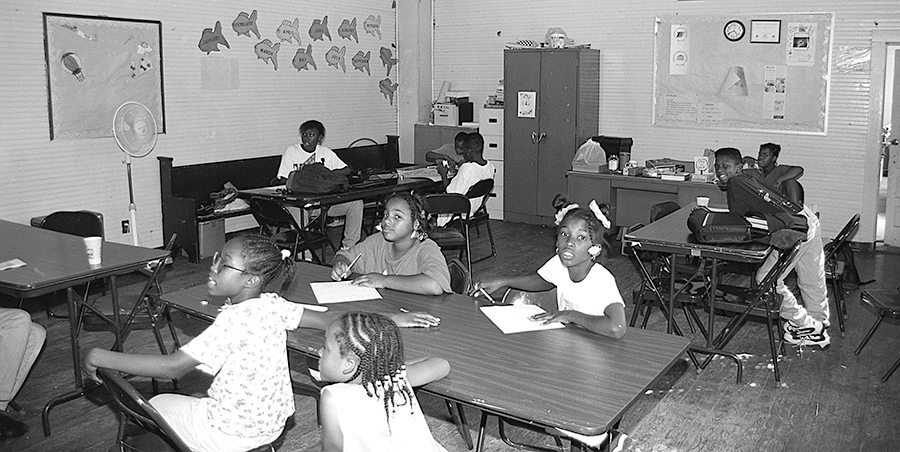
Over one door it says “Library/Classroom.” There are still books on the shelves, an Encyclopedia Britannica and a set of World Books so old the Soviet Union still exists. Chairs small enough that a child’s toes can brush the floor are stacked on equally tiny desks built three abreast.

In the “Auditorium,” a glass case shields old photos and scrapbooks of newspaper articles. There’s a dusty ping-pong table and a piano with notes that clunk off the walls of the empty room if you happen to plunk the right key, leaving little behind but the echo.

The Lincoln Park School was built in 1922 on South Currant Street in Addor, the African-American town on the southern edge of Pinebluff where lumber and turpentine workers scratched out an existence in the late 19th and early 20th centuries. In 1890 it was the second largest town in Moore County, with a population of 295. Once called Keyser, a phonetically unpopular name in America in the midst of a world war, the town was renamed in October 1918 in honor of Felix Addor, a local man who died on the troopship SS Leviathan — formerly the German passenger liner Vaterland, itself renamed by Woodrow Wilson — during its second Atlantic crossing delivering doughboys to the trenches.

The school was one of 16 Rosenwald schools built in Moore County. The only other documented school remaining is Southern Pines Primary. “The Rosenwald school building effort, structured as a matching grant program, began with a $25,000 gift of Julius Rosenwald [part owner of Sears, Roebuck and Company] made in 1912 to Tuskegee in support of teacher training. At the behest of Booker T. Washington and Clinton J. Calloway, Rosenwald allowed $2,800 of that money to be used in a pilot program to help communities build small rural schools,” writes Claudia Stack, a filmmaker and educator in the New Hanover Schools.

Her documentary about Rosenwald schools, Under the Kudzu, a project nine years in the making, was released in 2012. During the 20 years of the program’s existence, 4,977 schools were built in rural areas across the South and “constitute the most numerous and easily recognizable type of school built by African-American communities during the segregation era,” Stack writes. Until recently the Lincoln Park school had one of the original portraits of Rosenwald himself — a rarity in what remains of the schoolhouses. It has since been removed for safekeeping.

The building is on the National Register of Historic Places, a designation that comes with a firm handshake and hearty pat on the back — but not a penny to keep a 98-year-old wooden structure from collapsing in on itself. “After its construction in 1922 through the cooperative efforts of parents, the Moore County School Board, and the Julius Rosenwald Fund, the Lincoln Park School rapidly became the center of the African-American community located in the Keyser area,” says the registration form of the National Register of Historic Places.

Local involvement was particularly crucial. “Without a local drive to build a school, the project did not move forward,” writes Stack. “This self-help aspect of the school building projects, which bound communities tightly to their new schools, was part of the extraordinary vision shared by Rosenwald, Washington and Calloway.”

After Albert S. Gaston became the school’s first principal in 1921, “he and his wife began to raise funds for the new Lincoln Park School. They visited towns on Friday nights with a program by the school children. Their success was profound: they raised $26 at the first meeting, and at subsequent ones raised $100 dollars in 10 minutes. In total they raised a sum of $1,000,” says the National Register filing.

“I think there is something to be said for them architecturally,” says Stack of the schools. “They represent a progressive architecture. Some of the early buildings were designed by Robert Rochon Taylor, the first African-American architect to graduate MIT. He worked out of Tuskegee. Regardless, in the landscape, they’re a testament to the determination of African-American families to obtain education for their children.”

Lorine McCants, having edged into her 90s, lives a block or so away from the old wooden building where she attended school. “I went there from the first grade to the sixth grade,” says McCants. “It was wonderful. Wonderful. The only thing I didn’t like, we lived up that railroad track, and when it got cold we had to walk from up there. The teachers took care of us, and tried to warm us up the best they could. I remember one teacher. We called him Professor Gray. And Lillian Harris, she was one of the teachers. It was very important. That was the only livelihood we had. The school would have programs, different kinds of activities. It was the center of Addor.”

The Lincoln School was decommissioned in 1949 and became the Addor Community Center in 1952. By 2006, at the end of a series of renovations spanning decades, the building was a fully functional center with computers, a library and a kitchen. It was rental space for family reunions or worship services if one of the local churches couldn’t get its doors open.

McCants did stints at different times as both the president and the treasurer of the community center. “I worked there for I don’t know how long,” she says. “It was just my passion to help the community. I loved it.”

John Bright, who grew up in Addor and lives in Aberdeen, is the current treasurer of the Community Center Board. “It kind of came into disarray in 2008,” says Bright of the building, “and 2010 is when the center began to decline. There was no board then. It had a leak and it started to decay. In 2015 we had the community come together, and a new board was formed. Once we took it on, we saw we were facing something that was very challenging. We haven’t given up. Any way we can have an opportunity to try to sustain something for the Addor community, that’s what we want to do. I still believe there’s hope.”

By Bright’s calculations, roughly 60 percent of the homes in Addor don’t have access to city water or sewer. “The Southern Pines water facility is right there adjacent to Addor, right across U.S. 1. On the other end by the Poplar Springs Church is the Moore County sewer facility,” says Bright. “Why can’t we finish Addor out? The word says what you have done unto the least of my brothers you have done unto me, and Addor has been the least of these for a long time. We’re just trying to find a way, by the grace of God.”

Maybe that old wooden building, its cornices out of square, with the fireplaces for warmth and huge windows for light, “set with the points of the compass,” will somehow, almost miraculously, survive as an intact example of a Rosenwald Four Teacher Community School Floor Plan No. 400. “It would be wonderful if we could get it restored,” says Bright. “But the issue is, what can we do for the children and youth who are there now? Do they have 10 or 15 years to wait on the restoration of a building? What are you going to do for them in the meantime? Addor has a rich history and proud people, but the current state of Addor is not what its citizens want.”

There were 813 Rosenwald schools built in North Carolina, more than in any other state. “The way the educators and the families worked together to really push the students to a higher level of excellence, even though the schools were under-resourced, made a huge impact on North Carolina,” says Stack. “That motto of Winston-Salem State University — Enter to Learn, Depart to Serve — I’ve heard that with slight variations many times from people who attended the schools. That was really the ethic. They bettered their communities because of their experience in those small schools of that era built in black communities.”

It’s a melancholy thing when a bit of history falls into ruin, sadder yet when all that rises in its place is the faintest glimmer of hope.  PS

Jim Moriarty is the senior editor of PineStraw and can be reached at jjmpinestraw@gmail.com.

In the Spirit

Rum Discovery

Straight up sugar cane

By Tony Cross

In the spring of 2018, I was able to get into the five-year anniversary party at the mezcal bar Gallo Pelon in Raleigh. It was a fun night shared with close friends at one of my favorite bars. What made the evening even more special was my introduction to Oaxacan Agricole rum.

Near the end of every year, I place my order online for different spirits that aren’t available through our state’s ABC system (which would be many). It’s basically my Christmas present to myself. Copious amounts. It never dawned on me to search for rums from the Oaxacan region until that night. So I did, and grabbed a bottle from Haiti while I was at it. I drank both bottles bone-dry, and couldn’t remember my name or how to do times-tables for three days.

I’m lying. I was the first kid in my third-grade class to remember their multiplication tables; that will never fade from my memory.

Paranubes Oaxacan Agricole Rum

“Made in the northern highlands of Oaxaca, where a sparsely inhabited sub-tropical climate produces some of the best sugar cane on Earth. Third-generation distiller Jose Luis Carrera works with several local varieties of cane grown organically and minimally processed during distillation, using only the fresh, lightly pressed cane juice.”

That’s the first thing I read about Paranubes rum. The next thing I noticed is the whopping 54 percent alcohol by volume. Yeah, I had to give this one a go. When it arrived (along with the other types of spirits I purchased), it was the first bottle I opened. On the nose, I could definitely smell sugar cane as soon as I popped the cork. But once in the glass, there was a peppery smell to it that I couldn’t quite nail down.

The next day, my buddy Carter gave it a go, and before his first sip, he said, “Hmm . . . smells like ketchup.” That’s it! I should’ve gotten that; I eat ketchup on almost everything. We both agreed it was a beautiful rum, from the nose, to the back of the palate. Just straight-up sugar cane. No additives. I read on their website that Jose Luis Carrera is able to produce 85 liters a day — the bottle is one liter. He could distill more for a faster production time, but doesn’t want to compromise the balance of his rum. Talk about quality.

The first drink I made with this was the classic Ti’ Punch: just a touch of organic cane sugar, lime, and Paranubes rum made my holiday week a little less stressful. I’ll give a recipe below.

Clairin Sajous Haitian Rhum Agricole

What struck my curiosity with this bottle were two things: One, it’s only been on the market for a couple of years; and two, I’ve never tasted clairin before. It was introduced to me as an eau de vie, similar to white Agricole rhums. So, what exactly is clairin? In a nutshell, it’s a distilled spirit made from sugar cane juice that is produced in Haiti. It gets its name (kleren in Haitian Creole) from its clear color. This clairin comes from an independent distillery that sits in the northern high-altitude village of Saint Michel de L’Attalaye and is run by Michel Sajous.

Just like the distillery of Paranubes, the Sajous Clairin is organically cultivated. Sajous uses the cristalline variety of sugar cane. This type of sugar cane doesn’t yield as much juice when pressed compared to larger production rum companies, but the juice that it does hold has a ton of character. In fact, this type of cane comes from small villages that use machinery without electricity. The sugar cane is also cut by hand and transported by ox carts or donkeys to the distilleries.

Wild beasts and sugar cane. That’s it, folks. It smells stronger than it tastes: grassy, slightly fruity, and very clean. Don’t let the 107 proof on the label scare you — indeed, this is high-octane, but there is so much flavor to decipher, and the clean finish makes this a new staple in my bar. I’m ordering three bottles next time. I recommend the Clairin Sajous definitely in a daiquiri, or on the rocks.

Are you a fan of rum? I feel like there are two groups: Those that like common, molasses-based rum (Molasses is made by boiling sugar cane juice, and then skimming off the top while it’s boiling. After this process is repeated many times, the end result is a thick and sweet liquid.) and those who like Agricole rhums that are made from sugar cane juice. I say that the first group likes “common rum” because that rum is everywhere and is always sweeter. Agricole rum can be more effluvious or funky, and that’s the rum I prefer.

Ti’ Punch

1 teaspoon organic cane sugar

1 fat lime wedge (not that half-moon, sliver-of-a-lime nonsense)

2 ounces rhum agricole (I use Paranubes)

Place sugar and lime into a rocks glass. Gently muddle lime into the sugar. Release the oils of the lime into the juice without pulverizing it. Add rum and ice. Give it a quick stir. Take your time and enjoy. PS

Tony Cross is a bartender (well, ex-bartender) who runs cocktail catering company Reverie Cocktails in Southern Pines.

Almanac

February blossoms make the cold hard to shake.

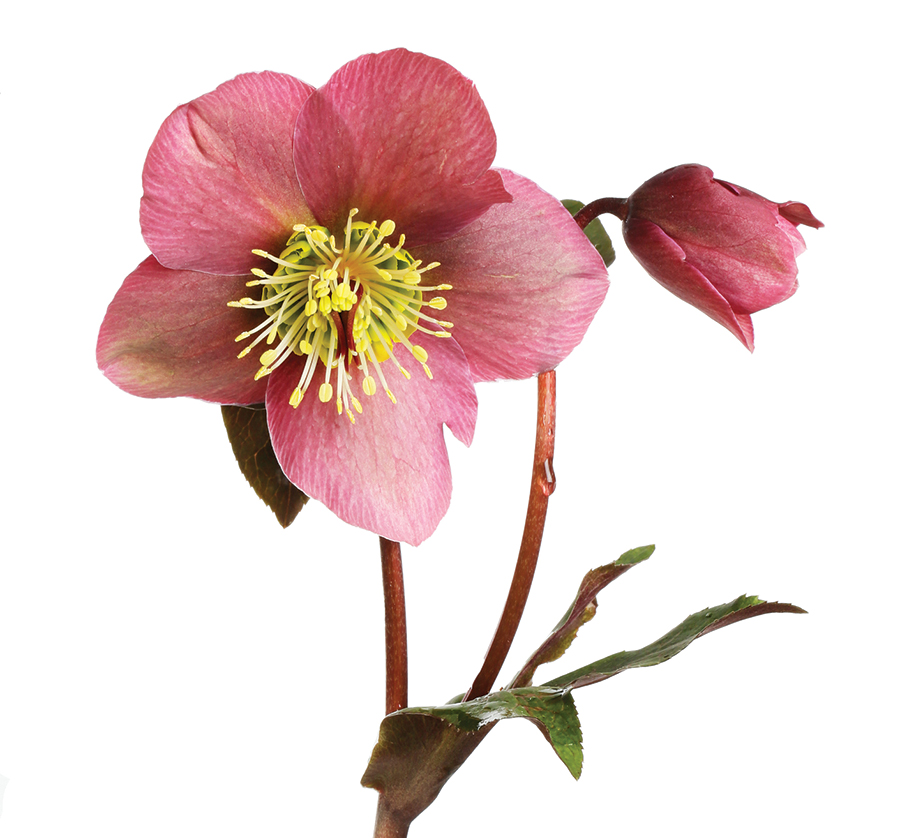
Crocus burst open like paper fortune tellers, hellebores whisper prophesies of spring, and in the backyard, where a speckled bird is kicking up fresh mulch, winter Daphne blushes like bright-eyed maidens in faded terra-cotta planters.

All of this, yet winter feels deep-rooted, endless. As if her flowers were cruel illusion. As if your bones could be forever yoked to this chill. 

Then one day, out of nowhere, a new warmth arrives with the daffodils, a new softness beckoning you outdoors.

Beneath the bare-branched sycamore, where the picnic table has all but forgotten its name, February sunshine feels like a warm bath. You’ve brought lunch — a thermos of soup — and as the sunbeams dance across your face and skin, you feel, for the first time in months, as open as the crocus. As if winter might release you. As if hellebores were true harbingers of spring. 

Beside your thermos, a feathery caterpillar edges toward you. Did it fall from the sky? You look up toward bare branches, wonder where he came from, where he’s going, whether he’ll be the speckled bird’s lunch. He’s closer now, gliding across your idle spoon, and as you observe his wispy yellow coat, you see yourself in this tiny being and in what he might become:

Enamored by each fragrant blossom; wide open; ever-seeking the simple grace of light.

February sunshine has transformed us, encoding within us the promise of spring. We can feel it now.

The Lenten Rose

When a plant blooms in the dead of winter, it is neither ordinary nor meek. That plant is a pioneer.

Also called the “Lenten rose”, the hellebore is a beloved and shade-tolerant herbaceous or evergreen perennial — not a rose — that so happens to thrive here. Some species more than others.

Take, for example, the bear claw hellebore, which is named for its deeply cut “weeping” leaves. February through April, this herbaceous perennial displays chartreuse green flowers that the deer won’t touch, and you shouldn’t either (read: toxic when ingested). As the flowers mature, the petal edges blush a soft, pale ruby. Talk about subtle beauty, but more for the eyes than for the nose (its crushed leaves are what give it the nickname “stinking hellebore”).

On behalf of every flower-loving soul aching in their bones for the coming spring, thank you, hellebore. You’re a true queen.

I know him, February’s thrush,

And loud at eve he valentines

On sprays that paw the naked bush

Where soon will sprout the thorns and bines.

— George Meredith, “The Thrush in February,” 1885

Full Snow Moon

The Full Snow Moon will rise at night on Feb. 8, peaking in the earliest hour of the morning on Feb. 9. Also called the Bone Moon, this supermoon (the closest the moon can come to Earth in its orbit) marks a time of heavy snowfall and, in earlier times, little food. If you’re warm and full-bellied, this moon is a good one to share the wealth.

Warm Your Bones

This month in the garden, sow beet, mustard and turnip seeds. Plant your spring salad (loose leaf lettuce, arugula, spinach, carrots, radish, cilantro). But while it’s cold out, soup!

The following recipe from DamnDelicious.net is a quickie — all the better for soaking up more February sunshine while the spring garden grows.

Spinach and White Bean Soup

Ingredients:

1 tablespoon olive oil

3 cloves garlic, minced

1 onion, diced

1/2 teaspoon dried thyme

1/2 teaspoon dried basil

4 cups vegetable stock

2 bay leaves

1 cup uncooked orzo pasta

2 cups baby spinach

1 (15-ounce) can cannellini beans, drained and rinsed

Juice of 1 lemon

2 tablespoons chopped fresh parsley leaves

Kosher salt and freshly ground black pepper, to taste

Directions:

Heat olive oil in a large stockpot or Dutch oven over medium heat. Add garlic and onion, and cook, stirring frequently, until onion is translucent, about 2-3 minutes. Stir in thyme and basil until fragrant, about 1 minute.

Stir in vegetable stock, bay leaves and 1 cup water; bring to a boil. Stir in orzo; reduce heat and simmer until orzo is tender, about 10–12 minutes.

Stir in spinach and cannellini beans until the spinach has wilted, about 2 minutes. Stir in lemon juice and parsley; season with salt and pepper, to taste.

Serve immediately.  PS

Every gardener knows that under the cloak of winter lies a miracle . . . a seed waiting to sprout, a bulb opening to the light, a bud straining to unfurl. And the anticipation nurtures our dream. — Barbara Winkler