Out of the Blue

New Year (of the Cat)

Cameos for Lucky and Missy

By Deborah Salomon

Seven years just flew by since I first designated January as Cat Column Month. This was necessary because otherwise, my companions Lucky and Missy (formerly Hissy) would creep in regularly. Mustn’t let that happen; I realize some people don’t appreciate cats, or even animals.

As the French say, à chacun son goût. To each his own (taste).

My affection traces back to a lonely, only-child childhood in a New York City apartment. My parents finally relented to a puppy. I was too young to walk him alone. That lasted about six weeks. Next came Dinky, a quite manageable stream turtle who lived to 10. When we moved into a house elsewhere, I was allowed a cat named Horowitz, for pianist Vladimir, because he walked across the keyboard on the piano I hated to practice. Sadly, when I returned from a month at sleep-away camp, Horowitz was gone.

Thank goodness my grandparents had an ever-pregnant kitty and a sweet dog.

I made sure my children had pets — big, friendly dogs. Then, after they were grown with big, friendly dogs of their own, a youngish calico showed up at my door. Since then, I have been home sweet home to a parade of kitties, usually two at a time, who just showed up, usually in dire need.

I decided to retire in 2008, when the last one crossed the Rainbow Bridge.

Then, one December, a hungry black kitty with fur as sleek as a seal peered in the window. Black cats are my weakness — especially their forlorn eyes. Lucky made himself a bed under the bushes. I fed him outside until July 4th. Then, in a moment of weakness, I opened the door. He has rewarded me with 10 years of affection, intelligence and antics.

A year later, “Everybody’s,” the wide-body gal fed by many, spayed by one, got wind of my open door policy. At first she rewarded my kindness with hisses and growls. That lasted about a month. Now Hissy, renamed Missy, drips sugar.

I discovered that Lucky — neutered and declawed — had been abandoned by his family when they moved. He gave Missy a long, hard stare which, I surmised, established the ground rules. They have been best buddies since, rather like an old married couple: she, a fussbudget; he the head of the household.

Wish I’d named them Archie and Edith.

Just because cats can’t speak doesn’t mean they can’t communicate. My Lucky’s eyes plead, smile, show surprise, fear, displeasure. He is a man of dignity, of routine, governed by a solar clock. He asks to go out just as the warm winter sun hits his chair on the porch. After sunset, he begins leading me to the bedroom because I keep kitty treats in the bedside table. I dole out three morsels. Upon hearing “That’s all,” he retreats to the down comforter folded at the foot, where he sleeps until 3 a.m.

During this ritual, Missy sits at a respectful distance, knowing her time will come. A feminist, she’s not.

Speaking of time, every night at 7 p.m. I watch Jeopardy! The kitties have chosen this moment for their daily aerobic workout, triggered by the Jeopardy! theme music, which triggers some angry-sounding music of their own. They pounce, roll around. Then, like a summer thunderstorm, it’s over. He lowers his head and she licks it clean before they trot off together.

Cats, especially elderly ones, sleep upward of 20 hours a day. Mine have nests, some self-styled, others mom-made like a fuzzy blanket in a box.

Lucky prefers a dark corner of my closet. Missy sleeps around. The first chilly days I position two heating pads on the bed. I started with one, since Lucky has an arthritic hip. Missy claimed half. Now, mesmerized by heat, they nap there for hours. I barely cop a corner for my arthritic shoulder.

Another behavioral oddity concerns the water bowl. I feed them in the kitchen — two feeding dishes, one water bowl. In the winter, they spend so much time on the heating pads that I put a water bowl beside the bed, a wide soup bowl decorated with flowers. Lucky will walk from the kitchen into the bedroom for a drink. Same water, changed twice a day.

Cats . . . aloof? I can’t sit down to watch Wolf Blitzer without a lapful. A pause in rubbing and scratching nets a paw. OK with Lucky, but Missy has claws.

Food is usually an issue with cats. I mix best-quality kibble with best-quality canned, or something I’ve cooked for them, like chicken, liver or fish. I once had a kitty who accepted only cod and pork liver — wouldn’t touch tilapia or chicken liver. People tuna costs half as much as Fancy Feast, so sometimes they get a spoonful. Of course they have favorites off my plate. Missy goes berserk if I’m eating slivers of smoked salmon on a bagel. Lucky loves to lick the cover of a Greek vanilla yogurt container. The best is watching him lick the salt off a potato chip, leaving it limp. Spaghetti with plain tomato sauce is another winner . . .  just a strand, because I wouldn’t want to spoil them.

No, cats can’t talk. They fascinate with wordless actions, instincts, habits. Connecting with an animal is a proven therapeutic. I can feel the tension flee my shoulders as I stroke Lucky’s satiny fur. Missy makes me laugh on the grimmest day. Best of all, a trust once established endures.

Too bad the same cannot be guaranteed with humans.  PS

Deborah Salomon is a contributing writer for PineStraw and The Pilot. She may be reached at debsalomon@nc.rr.com.

Bookshelf

January Books

FICTION

Nick, by Michael Farris Smith

Before Nick Carraway moved to West Egg and into The Great Gatsby, he was at the center of a very different story — one taking place along the trenches and deep within the tunnels of World War I. A romantic story of self-discovery, this rich and imaginative novel breathes new life into a character that many know but few have pondered deeply. Nick reveals the man behind the narrator who has captivated readers for decades.

The Fortunate Ones, by Ed Tarkington

A teenage boy being raised in a low-income area of Nashville by a single mom receives a mysterious scholarship offer to attend an elite private school for boys. Charlie Boykin is thrust into the midst of the children of billionaires and socialites, and the trajectory of his life is altered forever. But was it all worth it? This is a character-driven novel with a storyline as opulent as the mansions within it.

The Good Doctor of Warsaw, by Elisabeth Gifford

Janusz Korczak ran an orphanage for Jewish children in Warsaw, where conditions became increasingly harsh during World War II. Gifford tells his story with moving details of daily life — struggling to find food and to avoid being killed by the Nazis. Over 95 percent of the 350,000 Jews in Warsaw did not survive the war. A story the world must never forget.

The Prophets, by Robert Jones Jr.

A singular and stunning debut novel about the forbidden union between two enslaved young men on a Deep South plantation, the comfort they find in each other, and a betrayal that threatens their existence. In the barn they tended to the animals, but also to each other, transforming the hollowed-out shed into a place of human refuge, a source of intimacy and hope in a world ruled by vicious masters. With a lyricism reminiscent of Toni Morrison, The Prophets masterfully reveals the pain and suffering of inheritance, but is also shot through with hope, beauty and truth, portraying the enormous, heroic power of love.

The Last Garden in England, by Julia Kelly

This is a sweeping novel of five women across three generations whose lives are connected by one very special garden — the Highbury House estate — designed in 1907, cared for during World War II and restored in the present day by Emma Lovett, who begins to uncover secrets that have long been hidden.

The Divines, by Ellie Eaton

Moving between present-day Los Angeles and 1990s Britain, The Divines is a scorching examination of the power of adolescent sexuality, female identity and the destructive class divide. Josephine inexplicably finds herself returning to her old stomping grounds of St. John the Divine, an elite English boarding school. The visit provokes blurry recollections of those doomed final weeks that rocked the community. Josephine becomes obsessed with her teenage identity and the forgotten girls of her one-time orbit. But the more she recalls, the further her life unravels, derailing not just her marriage and career, but her entire sense of self.

A Mother’s Promise, by K.D. Alden

In Virginia in 1927, Ruth Ann Riley was poor and unwed when she became pregnant. She was sent to an institution and her child given up for adoption. All the rich and fancy folks may have called her feebleminded, but Ruth Ann was smarter than any of them knew. No matter the odds stacked against her, she was going to overcome the scandals of her past and get her child back. She just never expected her battle to go to the United States Supreme Court, or that she’d find unexpected friendships, even love, along the way. 

The Narrowboat Summer, by Anne Youngson

Eve and Sally are at a crisis in their lives when they each happen upon a narrowboat on a canal owned by Anastasia. Before they realize what they’ve done, Sally and Eve agree to drive Anastasia’s narrowboat on a journey through the canals of England, as she awaits a life-saving operation. The eccentricities and challenges of narrowboat life draw them inexorably together, and a tender and unforgettable story unfolds. At summer’s end, all three women must decide whether to return to the lives they left behind or forge a new path forward.

NONFICTION

Let Me Tell You What I Mean, by Joan Didion

Twelve early pieces never before collected offer an illuminating glimpse into the mind and creative process of Didion. Drawn mostly from the earliest part of her astonishing five-decade career, these are subjects Didion has written about often: the press, politics, California robber barons, women, the act of writing, and her own self-doubt. Each piece is classic Didion: incisive and stunningly prescient.

CHILDREN’S BOOKS

Winter is Here, by Kevin Henkes and Laura Dronzek

When winter comes, it comes soft like snowfall and hard like leaves frozen in ice. Winter comes white and gray and deep, deep blue. From the husband and wife team of Henkes and Dronzek, Winter is Here is the companion to the lovely When Spring Comes and is the perfect introduction to the seasons for young readers. (Ages 1-3.)

A Busy Year,
by Leo Lionni

Winnie and Willie and Woody are friends. First, as January snow falls on Woody’s branches, later as her branches bloom and even later as her leaves begin to fall, the friends experience all a year has to offer. A fun way to learn about the seasons while also zeroing in on the qualities of a good friend, A Busy Year is a classic that deserves a spot on every child’s bookshelf. Arriving Jan. 12. (Ages 2-3.)

Looking for Smile, by Ellen Tarlow

Once in a while, when you least expect it, life gets you down, and you just lose your smile. But sometimes the quiet song of a good friend can make the world bright again. A great story of friendship and of dealing with the downs. (Ages 3-6.)

Just Our Luck, by Julia Walton

In this moving and absolutely hilarious tale, Leo is a high school boy caught up in his own anxiety. He normally keeps his head down, but a fight with another boy at school starts a chain reaction, entangling Leo in something he never would have been part of by choice. This amazing, touching masterpiece is perfect to the very last page. (Ages 13 and up.) — Review by Kaitlyn Rothlisberger.  PS

Compiled by Kimberly Daniels Taws and Angie Tally.

Sporting Life

Slim’s Place

Guided by a star

By Tom Bryant

The note arrived on a Tuesday. Mail delivery had been sporadic at best, ostensibly due to the pandemic and delivery of voting ballots during the recent elections. The note was brief and to the point. It was a typical Bubba transcript and read, “We’re having a get-together at Slim’s next Saturday. Why don’t you come to the house on Friday. I have some fresh makings of Ritter’s apple brandy. We’ll test it, and I’ll grill a couple of steaks. Judith’s at the beach with some girlfriends, so we’ll have the place to ourselves. We’ll catch up and talk old times. Hope you can make it, Bubba.”

Bubba and I have spent many days afield, hunting, fishing and camping, and we have become great friends. Our paths went in different directions when Linda, my bride, and I moved to Southern Pines. Plus, Bubba started taking more exotic hunting and fishing trips across the world. To be honest, he has deeper pockets than I do. Our friendship remained, though, and we stayed in touch and met from time to time at cocktail parties, friends’ gatherings and such.

Slim’s Place, referred to in Bubba’s note, is an ancient country store, actually begun and operated by Slim’s grandfather. When the grandfather died, the store fell into disrepair and almost rotted away until Slim, after making a fortune out West in the real estate business, restored it to its former glory. For years, he ran the store more as a hobby than a business, often exclaiming, “The only reason I keep this obsolete old store open is so all you reprobates will have a place to go.”

We did go. It was a place, like the theme song played in the TV show Cheers, “where everyone knows your name.” We did know the names and the families and the dogs and the history, good and bad, of all the good old boys who took advantage of Slim’s hospitality. The patrons of the ancient establishment were a diverse collection, from mill owners to mill workers. Every visitor to Slim’s store was on equal footing, except maybe lawyers. They were jokingly treated differently.

We were in between the holiday seasons, Thanksgiving roaring toward Christmas, and it seemed as if everyone wanted the weird year 2020 to be over. The country was still divided, more so than I’d ever seen due to the acrimonious presidential election and the political differences in how to handle the coronavirus. There didn’t seem to be an end to the rancorous conflict throughout the country, and 2021 would soon be upon us. I hoped that a visit to Bubba’s and Slim’s Country Store and a meeting with a group of good old boys would put everything into perspective.

Bubba built his home back in the mid-’80s, and it’s quite a showcase. Pretty much energy-efficient, the home sits on a little rise overlooking a small lake that is consistently teeming with wildlife. Ducks, geese and even at times a pair of otters use the carefully constructed habitat.

I arrived there in the late afternoon, looking forward to a great visit with an old friend. After an appropriate time of good-natured insults to one another, we went through the house to the deck off his study to watch a beautiful evening sunset.

True to his word, as we settled back in chairs overlooking the pond, he said, “OK there, Cooter, let me pour you a little shot of Ritter’s finest.” (He bestowed on me the nickname Cooter years before and it stuck.) On the table between the two chairs was a decanter full of an amber liquid, and as he poured us a little libation into heavy cut glass tumblers, he added, “Ritter wanted you to have a couple quarts. Don’t let me forget to give ’em to you. He told me to tell you Merry Christmas.”

We both sat in comfortable silence and watched the sun slowly sink behind the tree line on the west end of the pond. Several wood ducks soared close over the water, did a hard turn and skidded to rest near the far bank.

“Watch, Tom, those ducks do the same thing every evening. They’ll swim around for a few minutes then fly up to those oak trees and roost for the night. Pretty to see, almost like they have a watch. They come in every sundown at the same time.”

“I love to watch wood ducks,” I responded. “Speaking of ducks, I thought you’d be down in Louisiana duck hunting about now.”

“Nope, this dadgum virus has everything screwed. I’ve canceled two trips already. One fishing and one hunting. I think I’m gonna just stay home until after the first of the year. Things have got to change. The country can’t continue like this. How about you? Y’all still heading to Florida on your annual winter fishing adventure?”

“The plan is still there. We probably won’t go back to Chokoloskee this time, opting for a closer fishing hole, maybe Cedar Key just above Tampa. Last year we were way down South when this virus thing broke and had to hustle back with the snow bird migration. It wasn’t a pleasant trip. How are things at Slim’s? Things at the store getting by in this crazy year?”

“That’s one reason I wanted this get-together, with you especially, and also some of the old crowd.”

After Slim passed away, Bubba had purchased the old country business from Leroy, Slim’s nephew, who had inherited the place. Bubba bought the store on a whim, and as he often said, so he’d have a place to go. Plus he liked the coffee.

“The venture is getting to be more trouble than it’s worth,” he continued. “We closed the first two months of the pandemic and gave all the perishables to local churches. Now we’re open only three days a week. I would have already closed the place, but I’m keeping it open because Leroy has to have a job, and more than that, in memory of Slim. Like I said, it’s more trouble than it’s worth.”

The sun had fully set but there was still a soft glow on the western horizon. In contrast, early stars began to twinkle in the eastern night sky.

We sat quietly, sipping Ritter’s brandy.

“I don’t know what to say, Bubba. No one would really blame you if you shut it down. I mean thousands of businesses are closing during this virus mess. Slim would probably have already closed the store. And yet I keep remembering that Christmas season years ago when you and Slim and I were sitting on the porch of the old building, also enjoying some of Ritter’s apple brandy, when that bright star showed up in the eastern sky.”

“Yep,” Bubba paused. “Those were good times, good days, Tom. I recollect that night every Christmas, especially about Slim quoting a verse from the Bible, you know, about the star and the birth of Jesus.”

He stood, stretched, and looked to the eastern sky that was sprinkled with stars. “I think I’ve made up my mind, Cooter, I’m gonna keep the decrepit old place open. I believe we need a bright star now more than ever. This Christmas, why don’t you come up here one evening and we’ll sit on the porch, drink some more brandy and watch for it. Maybe the visit and our search will bring good tidings in 2021. But right now, what say we grill a couple of steaks?”

I did visit Slim’s venerable old country setting one frosty evening a few days before this past Christmas. Bubba and I pulled up a pair of rockers on the wraparound porch with Slim’s favorite rocker on one side. We looked to the east and waited. The bright star was still there.  PS

Tom Bryant, a Southern Pines resident, is a lifelong outdoorsman and PineStraw’s Sporting Life columnist.

Home by Design

In the Hotseat at Aunt Ruth’s

I served my time and, frankly, would have preferred the aliens

By Cynthia Adams

Truvy’s Beauty Spot in Steel Magnolias equipped its Natchitoches, La., patrons to meet life with sky-high hair. But the Franklin Beauty Shop in Monroe, N.C., where my aunt delivered hard truths and even harder hair, was a very different place.

My Aunt Ruth’s shop, which opened in the 1950s, was an assault upon all the senses. It possessed the stark ambiance of a morgue. And it taught me this: Beauty is in the eyes, ears and nose of the beholder.

It was as utilitarian as my father’s barber shop: stark, fluorescent lights, pea green walls, Army green vinyl floor, three mirrors, three stations, three chairs outfitted with massive dryers and two manicure tables.

Large windows with open metal Venetian blinds (Why was something so hideous called Venetian?) overlooked Franklin Street. Passersby could peer directly into her place, which, unlike the barber shop, emanated noxious chemical smells.

Incredulously, my aunt made a decent income and won devoted friends. It was ideally situated near the Oasis Sandwich Shop, which served fab sodas, floats, fries and burgers. There, I would idle while my mother got her “do.”

Even as a child, I understood that my mother was not improved by the ministrations of my aunt. Her hairdos might just as well have been created with tongs and barbecue tools.

Any fool could see she looked better going into the Franklin, as we called it, than she did leaving it. The drive home was confirmation as my mother dusted ditches raking a brush through her shellacked hair, “trying to fix this before we get home,” she’d scoff, as the green Olds swayed across lanes.

Mama was never, ever pleased by her sister’s work.

Ruth, a natural beauty, loved the natural world and could have been a botanist. But her school principal father stubbornly steered her into cosmetology, where she studied the darker arts of beauty.

Why oh why? 

He died before I was born or I would have asked.

Her customers’ hair was more often than not dyed or bleached an unnatural shade of blue-black, red or yellow, curled tight, then baked into place beneath oversized dryers suitable for flood recovery operations.

Clients emerged pink faced from the blasting heat of the silvery green stationary dryers and then submitted to the next step: a comb out. This involved teasing with a rat-tail comb before the requisite (lethal) final step: Spray Net.

Hair sprays of this era contained vinyl chloride, a propellant later proven to be carcinogenic. Hard fact.

Another hard fact: My aunt’s clients looked uniformly alike once they climbed out of the sturdy swivel chair.

By Ruth’s hands, my grandmother’s hair became a blue-black hue I rarely observed in nature, apart from a rare beetle specimen at the Natural Science Center.

It puzzled me why anyone paid Aunt Ruth at all.

Speaking of payment, I privately yearned to operate the large green cash register that stood at the entry with the appointments book, watching as customers wrote out checks and waved goodbye “till the next time.”  Instead, I thumbed through worn Photoplay and McCall’s magazines in the waiting area. 

At age 10, when many of my friends were getting a Toni perm in their kitchen, it was decreed: my straight ponytail was inadequate. Aunt Ruth would give me a professional do before my new school year.

She washed my long straight hair, then mixed toxic chemicals in a glass bowl. As they stewed, she clipped and chopped. 

Once the carnage was over, the remaining hair was tightly wound around bright pink perm “rods,” a term co-opted from nuclear physicists. Perm rods are to perms what uranium rods are to nuclear reactors. Either way, they’re volatile.

She applied chemicals to the perm rods. A black hair net held it in lock down.

I was walked to a dryer where this tragic concoction was to “set.”

Under the dryer, my eyes stung from the putrid reaction. When my scalp and ears began burning from the blasting heat, I jumped out. But Aunt Ruth ordered me back, lowering the dryer temp to nearly tolerable.

The timer pinged and I sprang free. As the rods were removed and my head cooled, I studied the clock: it was now half past my childhood.

Ruth swiveled the chair toward the mirror.

The shock caused me to bite my lip so hard it bled. 

I looked precisely like my grandmother.

My mother was tense as she swung onto the highway. A stifling ammonia cloud filled the car. I cracked the window to cool my face, still hot and now overwhelmed with the enormity of my strangeness. “Don’t worry. My hair can’t move,” I said.

Once home, my father took one look and moaned. “Dear Lord. The child’s ruined.”

Devastated, I shuffled out of the house to the barn in search of Trigger, a gentle pony who cocked his head quizzically before accepting a hug. I climbed into the loft, where I did my best thinking, cried a little, then concocted a story owing much to Rod Serling and The Twilight Zone

I was playing outside when a space ship landed in the pasture. Aliens zapped me. A lot of my hair burned off right there! I’m just lucky to be alive.

It wasn’t exactly original or believable, but an improvement on the story I invented about how I needed a life-saving operation after peeing myself on the playground.

Bus #15 swung down our road the next morning, where I waited in a plaid skirt and white blouse, holding a new book satchel, bracing myself. Johnny swung the bus door open; there it was — his open-mouthed surprise. But I turned away and searched the aisle for Martha or Kenneth.   

They would totally buy my story about my hair-today, gone-tomorrow alien abduction.  PS

Cynthia Adams is a contributing editor to PineStraw and O.Henry.

Return of a Classic

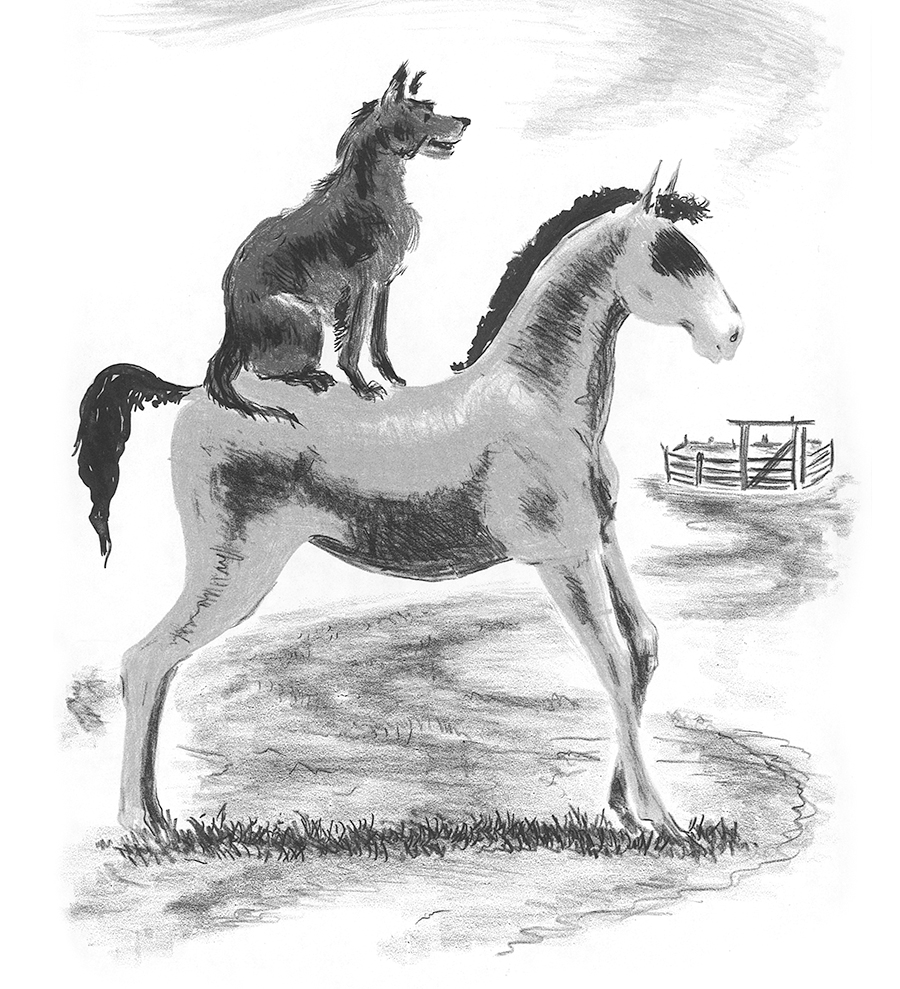
The Blind Colt celebrates its 80th anniversary with a new edition

You can’t hurry a Glen Rounds book. You are asked to find a rock and sit for a spell. Listen to the tumbleweed rattle by. Smell the sagebrush. Let the wind chill your hide. If you’re patient, the critters will let you see them, going about the business of living. These are wild animals, so they won’t come when you call. They would not do well in a petting zoo, or in most children’s books. They don’t talk or wear cute outfits. Sometimes they are playful, but never sweet. The Blind Colt is not only hunted by wolves, but gets bitten and kicked in the ribs by other horses. Yet because Rounds shows us the harsher side of life, we are all the more tickled to watch the young colt buck and run for the “pure fun” of it. In the books of Glen Rounds, wild danger always comes with wild fun.

From “Glen Rounds: An Appreciation,” copyright © 2021 by Matt Myers. Reproduced by permission from Holiday House Publishing, Inc.

Glen Rounds Illustrations courtesy Holiday House publishing inc.

Illustration by Matt Myers

Poem

What It Was about that First Marriage

The floors were fine. Gorgeous,

in fact. Blond as sunshine, clean,

polished, alive with the kind of promise

we had dreamed. But oh those two

mismatched tables. Same height,

so we kept trying to line them up

as if they were a unit. One was maple,

right out of somebody’s 1950s Nebraska kitchen, with a scalloped leaf that folded down,

though it was years before we saw it

for what it was. The other, streamlined,

sleek. Once we tried pushing them together

and covering both with a patterned cloth, though dinner guests kept banging their knees. When I look back, I’m amazed

we didn’t toss it, haul it to the curb.

But, no, we struggled for years

to make it work, painting,

and painting again, turning it sideways.

— Dannye Romine Powell

Golftown Journal

Nifty 50

The bare essentials of golf

By Lee Pace

Photo: Teddy Leinbach, Jack Leinbach,  Hayden Swanson, Colin Wilkin

Donald Ross was the son of a Scottish carpenter who began his career in golf wearing overalls and hunched on his hands and knees caring for the turf and bunkers at the course in his hometown of Dornoch. No silver spoons here, which is why Ross, despite the wealth and fame he achieved as an adult designing golf courses in America, always believed, “There is no good reason why the label ‘rich man’s game’ should be hung on golf.”

That yin and yang of the elite vs. the masses, private vs. public, upstairs vs. downstairs has hovered around the sport for more than a century. But the essence of the game remains the same: club, ball, hole, lowest strokes wins.

“I have always believed being able to play golf is not necessarily a right and not necessarily a privilege,” says Karl Kimball, head pro and owner-partner at Hillandale Golf Course in Durham. “It is more of an honor because of all the history the game has wrapped itself around.

“Whether it’s a private club or a daily-fee facility, the common thread is the game of golf. That’s what ties everyone together. Unfortunately, we can get wound up on some of the idiosyncrasies of our clubs, almost like religion.”

Which is why Kimball was delighted to see a young man who grew up playing golf at Hillandale, a public course that dates in its original form to Durham Country Club in 1910, embark on an ambitious project to travel the United States and peer under the hood of golf at a grassroots level.

The idea was simple, yet ambitious: 50 states, 50 rounds of golf, 50 days.

The resulting journey organized by Teddy Leinbach that included his brother, Jack, and friends Colin Wilkins and Hayden Swanson is the subject of a film released in November titled, “50 Over.” The one hour and 20 minutes of run time explores, as Leinbach says, “the tattered fairways and diverse personalities of public courses. We wanted to strip golf of its elitist image and find out what it really means to play golf.”

Leinbach was a self-proclaimed “sports nut” as a kid growing up in Durham, where his father practices internal medicine and psychiatry, and Leinbach played baseball, basketball, soccer and golf, among other sports. He attended Virginia Commonwealth University to study painting and illustration, then pivoted to filmmaking his sophomore year. After graduating in 2016, he created Airball Films to tell stories of things that interested him.

Among them, golf.

“We have a lot of young stars playing golf, but I don’t think they embody enough of the counter-culture movement in golf that is going to get people outside of the golf world interested in playing,” Leinbach says.

All four golfers were in their early 20s in the summer of 2017 when they made their odyssey. The Leinbach brothers had played lots of golf growing up at Hillandale and had single-digit handicaps; the others were essentially beginners.

The only requirement in planning the trip was that every course be open to the public. They started in Westbrook, Maine, at a course called Sunset Ridge, and used the condensed geography of New England to knock out 10 courses in five days. From there they ventured down the Mid-Atlantic into the South, then wound their way across the country. The last leg of the trip had them flying from Seattle to Alaska and then hopping another plane to Hawaii.

The young golfers at various times ate canned tuna on crackers, beef jerky and bagels and stopped at Huddle Houses along the way. “I’m still waiting on that Huddle House sponsorship,” Leinbach says with a laugh. Sometimes their attire stretched to gym shorts, tank tops and Converse sneakers; at times they played golf barefoot. (Management at one course asked them to leave, since they didn’t all have collared shirts.) They stopped to play pickup basketball and film the turtles and bison they saw along the way. They slept in the van or in tents pitched along the road.

They pooled their money and bought a 1991 Dodge camper van for the trip, but the vehicle was a lemon and finally caught on fire alongside an interstate in Illinois. The flames engulfed some of their clothes and golf clubs and destroyed Leinbach’s and brother Jack’s driver’s licenses, so Swanson flew back to Durham, picked up another vehicle and drove back to Illinois to resume the trip.

“We were lucky we had banked some days early in the trip,” Leinbach says. “We were on a tight schedule the rest of the way but made the 50th course on the 50th day.”

The themes running through the film are the fresh air, the great out-of-doors, the thrill of that well-struck shot, and the interesting people they meet along the way.

“What’s not to like about golf?” muses one player they found in the Midwest. “It’s the ultimate test of patience and a game that tortures you, but for some reason you keep going.”

Adds another, “No matter where you are in the world, you can generally find a golf course, and it’s the most serene place you can be.”

In Weed, California, they found a man who used to work for ClubCorp managing its portfolio of hundreds of high-end clubs. Now he’s up with the roosters to mow the greens.

“I found this semi-chill job, I live here, work here, have fun here,” he said as he fired up the Toro greens mower. “There is a Volkswagen version of golf, where you can get a great golf experience. It’s a cool message you guys are putting out. Anyone can golf across the country and you don’t have to have a $30,000 club membership.”

They split one day surfing and golfing on the California coast and were joined by a local who compared the two sports: “You can get a dopamine rush in both,” the man said. “Surfing is like that; golf is like that. Out of nowhere, you can hit the best shot of your life, you can catch the best wave of your life, and in both you get that flood of feel-good stuff.”

Leinbach says his foursome set out to explore golf away from the country club and strip the game of its elitist stereotype. While those boilerplates do, of course, exist, it’s wrong to paint the game with that brushstroke alone.

“We saw how a love for a game can bring people together, regardless of background, how golf can inspire, create change and form relationships,” Leinbach says. “We found that money, class, race, gender and other arbitrary distinctions that keep us divided can be broken down with an easy swing of the club.”

The film certainly resonated with Kimball, who’s been at Hillandale since 2007 and grew up playing golf on a nine-hole public facility in New Lexington, Ohio.

“I could play when I was 8 years old and could prove to the owner of the course I could get around in a decent amount of time,” he says. “I watched this film and a lot of it was staring me in the face when I grew up.”

In his next breath, Kimball marvels at how healthy golf is at his facility as 2020 winds down. COVID-19 has been hell; but golf courses have been a socially distanced refuge. His driving range business is beating all records, and more than 40 percent of Hillandale’s rounds are by folks walking the course.

“It’s incredible what’s happening with the game,” he says. “If anything good has come out of COVID, it’s that golf has gotten a shot in the arm. If you play the game and get a little hankering for it, it doesn’t let you go.”

Teddy Leinbach’s foursome has proof of that in all 50 states.  PS

Lee Pace has written about the Sandhills golf scene for more than 30 years. Contact him at leepace7@gmail.com. The film 50 Over is available for viewing at www.fiftyoverfilm.com at a cost of $10.

Hometown

How Southern Am I?

The latitude changes, the attitude doesn’t

By Bill Fields

I can hear traffic on Interstate 95 from where I live. The cars and trucks are far enough away that the noise usually doesn’t annoy — you hear it, but you don’t. I became part of the automotive Muzak not long ago, heading down South, as I’ve done many times over decades, 620 miles from home to home, even if the latter doesn’t have four walls and a roof.

Thanks to cataract surgery I was seeing great — I would have been a formidable foe in the license plate game if there had been someone in the passenger seat — but my vision of who I am felt clouded.

After almost 35 years in New England, how Southern am I?

I’ve asked myself this question before, yet it seemed more acute during this journey. Near the tail end of a year when so many considered so much, it was natural to ponder the reach of one’s roots. Spending nearly two weeks in the South without having a bite of barbecue made it essential.

I sound no different than childhood friends who stayed put. Syllables can still glide together as if there is WD-40 between them, same as when a college roommate from New Jersey made me the front man when we were subletting our apartment in Chapel Hill one summer. Yet I never called my parents “Momma and Daddy,” nor a store a “bidness.”

A work colleague said I was driving “soft” two years ago in downtown Atlanta when I was less than aggressive making a left turn. That critique notwithstanding, I contend anyone who negotiated the toll area of the George Washington Bridge at rush hour in the days when you had to give money to a person is forever hardened behind the wheel.

Commuting up North was no picnic either, in particular those days when a lot of drivers seemed angry at the world not just their boss. Sometimes they were. In the mid-1980s, the first time my mother rode in a New York City taxi, not far from Penn Station after getting off Amtrak’s Silver Star, the cabbie jumped out and ran after a driver who had cut him off.

I associate the South with good manners while acknowledging they sometimes are like one coat applied to an old house that needs more. Others can judge whether I’ve grown more blunt as I’ve grayed, but I’d like to think being nice endures. And I know, after many years as a transplant above the Mason-Dixon Line, that the South has no monopoly on kindness or treating others the right way.

I’m proud of where I’m from, but during a time when there is heightened awareness about racial injustice, it’s jarring to be less than an hour from my hometown and drive past several Confederate flags flying in front yards a couple of curves down the road from the former North Carolina Motor Speedway. The symbols used to be plentiful at the track on race days; they wouldn’t be allowed were it still a NASCAR venue.

I know folks who, for one reason or another, don’t ever go back, don’t long for a taste of the familiar, don’t enjoy a reunion with a place or its people. There are often good reasons for such judgments, but I don’t think I will ever feel that way.

There was a distinct pace where I grew up, and that speed, or more to the point, lack of it, was related to the room we had. Much of what I recall — relish — as Southern simply was small-town. Much has changed, a point reinforced when I visited the Southern Pines cemetery where my parents are buried. It was a warm, clear morning in early November, and Boy Scouts were placing small American flags on the graves of veterans such as my father. As the teenagers did their service, I was alone with my thoughts and the sound of cars on Morganton Road, a noise not of memory but of now, that I heard but didn’t hear.  PS

Southern Pines native Bill Fields, who writes about golf and other things, moved north in 1986 but hasn’t lost his accent. Bill can be reached at williamhfields@gmail.com.

In The Spirit

So Appalled

A duck walks into a bar and orders a diluted drink

By Tony Cross

Last year my company launched a little promotion on social media letting folks know about our bottled cocktails. Previously, we dealt in and delivered growlers of carbonated cocktails, but now we’re offering stirred cocktails such as old fashioneds, Sazeracs and Manhattans, in addition to a few signature drinks of our own.

We’ve done a couple of different promotions, but the very first one got the most buzz in the comment sections. Everyone was kind and excited, tagging their friends and loved ones. A month after the first promo, I received a notification on my phone that we had a new comment. I pulled it up, and it read like this: “Why diluted? Never go into a bar and order diluted drinks.”

This is interesting on a few levels, but first I need to explain this in context. In the promo, we listed the ingredients of the cocktails we were bottling and added that “Each bottle yields nine cocktails and is diluted with distilled water.”

Dilute? What? Yes. Dilute. Why? Easy. When you order a cocktail — let’s say an old fashioned — the bartender will most likely create it with the following steps: She or he will take an aromatic bitters and add a few dashes to a chilled mixing vessel (perhaps with a dash or so of an orange or other bitters); then take sugar, in the form of either syrup or cube, muddle for a moment to break the sugar down to mix with the bitters (if it’s cubed) or use a spoon to mix (if it’s a syrup); then add a couple of ounces of whiskey (bourbon, rye or whatever is on the menu/house whiskey). Finally, the bartender will add ice and stir.

Now, this is important. Why? Because ice is just as much an ingredient as the others. Some might argue it’s even a more crucial ingredient than the others. When the bartender feels that the cocktail is ready, he or she will stop stirring, possibly taste a small thimble of the drink to ensure it’s right, and then strain the old fashioned over a large cube of ice in a rocks glass. Next comes the garnish, and it’s done.

How does the bartender know when the drink is ready to strain and serve? Temperature and dilution. Oh, snap! The bartender stirs the cocktail to make sure that it gets cold, but at the same time, the ice that’s spinning round and round like a carousel has another job: to melt. That’s right, water is an ingredient in the old fashioned. If the bartender simply mixed all of the ingredients together (without ice) and put it in the freezer for a couple of minutes, the cocktail would be cold, but it would also be unbalanced. Without the dilution, the old fashioned would taste hot, or too boozy. 

The very first cocktail book I read started off explaining that ice is as much an ingredient, if not the most important ingredient, as all the others in a cocktail. Admittedly, I was unsure if what I was reading was overly dramatic. It wasn’t. It was spot on. You want your ice made with water that you would enjoy drinking. Sulphur-rich town water ain’t it. Ice that’s been in your freezer with that half-opened box of frozen shrimp ain’t it either. Clean ice. You can have a great rye whiskey, a nice organic cane sugar syrup, and the perfect pairing of bitters, but once you add that old, cloudy ice to stir it with, none of those other ingredients hold as much weight.

I mentioned earlier that the bartender might extract a touch of the old fashioned from the stirring vessel to taste. Many bartenders do this to make sure the cocktail is diluted enough. If it’s not, they’ll stir until it is.

Now, in defense of the person that posed the question, we should agree that an over-diluted cocktail isn’t acceptable. I have never bellied up to any bar and ordered a diluted drink and, to my knowledge, I have never imbibed with any friend or date that has. It would not be a good thing if the bartender stirred your old fashioned for five minutes straight. No thanks. We add distilled water to our bottled cocktails so they’re ready to go — properly diluted with no stirring required. Pour it over ice (or neat), stay calm, carry on, and cheers.  PS

Tony Cross is a bartender (well, ex-bartender) who runs cocktail catering company Reverie Cocktails in Southern Pines.

Almanac

By Ashley Wahl

January cold guides us inward. You find yourself studying your hands, quietly tracing the lines of your palms when, suddenly, there is movement in the periphery. A flash — and then nothing.

The mouse is back. How he gets inside you’ll never know. And yet, the mystery keeps you smiling, keeps you guessing. You catch and release him into the yard again, and as he scurries off, heart pounding like a tiny hammer, you wait for him to turn around, maybe wink his beady eye as if to say see you ’round.

Here we are again, January. By some miracle we’ve made it. And just like the mouse, we carry with us new stories, new wisdom from our journey.

This is a time for planning and dreaming.

You order seeds.

Next month, when the first of the daffodils burst through the soil in rapturous glory, you’ll sow sugar snaps and snow peas, carrots and parsnips, lettuce and spinach, maybe mustard seeds. But for now, you’re back to quiet contemplation, thoughtfully observing the lines on the back of your hands. The etchings and wrinkles begin to resemble the rings of a tree. There are stories here, you think. Lessons in each tiny groove.

And out of the blue, Aesop’s Fables pops into
your mind.

“The Ants & the Grasshopper”: There’s a time for work and a time for play.

“The Crow & the Pitcher”: In a pinch a good use of our wits may help us out.

“The Lion & the Mouse”: A kindness is never wasted.

You think of that crafty house mouse, smiling at his persistence and how you’re not so different from him. Your needs are the same: food, shelter and warmth. No doubt you both dream of the tender kiss of spring. And like the mouse, you, too, rely on a kindly universe to smile upon you, to gently guide you along your journey, granting you stories and wisdom for your future travels.

January is a year of lessons in the making. Notice the creatures, great and small, that remind us how to live. And remember: you are one of them.

Winter Blooms

Nature always gives us what we need. And in the dead of winter, when the bleakness of the landscape nearly becomes too much to bear, she gives us flowers.

Prunus mume, commonly known as flowering apricot, blooms in January. Its delicate, fragrant flowers — pink, red or white — ornament naked branches much like the cherry blossoms of official spring. Amazingly, this small, ornamental fruit tree was virtually unknown in the United States prior to the spirited efforts of the late Dr. J.C. Raulston, beloved horticulturist and founder of the nationally acclaimed arboretum at N.C.S.U. Raulston devoted his life to growing and sharing rare and spectacular plants, P. mume among them. This month, when its vibrant flowers offer their spicy aroma and the promise of spring, surely, whisper, thank you.

Hope smiles from the threshold of the year to come, whispering ‘it will be happier’ . . . — Alfred Lord Tennyson 

Looking Out, Looking Up

How will your garden grow? Per Aesop’s “Ants & the Grasshopper” fable, now’s a good time to plan ahead. This month, order quality seeds and map out a planting calendar for year-round harvest. Sure, it will take a bit of work. The ants know something about that. But educating yourself on what to plant and when is a game changer. And when you’re harvesting fresh veggies from your backyard spring through winter, no doubt you’ll be singing like a grasshopper in June. 

But while you’re planning, don’t forget to look up. Although a waning gibbous moon will try to outshine it, the Quadrantid meteor shower will peak on Sunday, January 3, from 2 a.m. until dawn. The first new moon of the New Year lands on Wednesday, January 13. Consider this cosmic reset a good time to set intentions and launch into a new project. Through darkness comes light.