The Accidental Astrologer

Heavens Above

Action-packed planets rule the July Sky

By Astrid Stellanova

Mother Nature provides far more reasons than fireworks on the Fourth to look skyward, Star Children! Come July 15, a crescent moon meets Venus in a swoon-worthy event. That will be followed by a total lunar eclipse on July 27. And then, on the same date, Mars will be ready for its close-up when Earth passes between the Sun and Mars. This will be our biggest, closest and best encounter with Mars — an event that won’t happen again for 17 years.

Should you miss this, optimists and health nuts can mark their Daytimers for July 2035. Ad Astra — Astrid

Cancer (June 21–July 22)

Birthday Child, you’ll be sopping up praise like King’s Syrup on a biscuit this month. There will be plenty of cake, candles, razzle, dazzle and enough sizzle to make this one of your best celebrations ever. In the fullness of time, another side of your life came to life, and it was a beautiful secret modestly kept from many. Your selfless acts have been revealed, and people are wowed by your big ole generous heart.

Leo (July 23–August 22)

Maybe the best thing you can do is to launch a charm offensive, because being defensive just ain’t working for you, Honey. One thing you keep forgetting is how your long trust in an old acquaintance just isn’t working for you as well as it is for them. Speak your truth and let the cards fall slap on the table.

Virgo (August 23–September 22)

Sugar, as irresistible as you are, nobody’s liable to want to steal your blood and sell it. It’s true your sweat tastes like nectar but the skeeters are the only ones that know it. Mix and mingle. Stop being afraid of stranger danger, because you are safe and loved, and attractive to the single and solvent.

Libra (September 23–October 22)

You might as well live in the moment ’cause you might not get into the next one given how badly you’ve been navigating. Your emotional GPS has gone kerflooey and needs resetting. And despite your photographic memory, you seem a tee-ninesy off in your ability to remember where you put your keys or glasses.

Scorpio (October 23–November 21)

A friend will help you move; but a real friend will help move and hide the body. Was there ever a friend who was there no matter what? You know who’s been there for you, and they need you now in their worst hour. Call them, thank them, and show up. If you’re lucky, there won’t be any corpses involved.

Sagittarius (November 22–December 21)

You might be surprised just how far you can stretch one good yarn. The ability to turn everything into a great story is one of your super powers. Work it, Baby! It turns out that everything is useful in this big ole schoolhouse of life, even in the darkest hours. Reuse, recycle, reframe the past and share it.

Capricorn (December 22–January 19)

In the past, you didn’t exactly reach for the stars, Sugar. Some of your extra special powers included Jolly Rancher Jell-O shots, quick quips and sarcasm. It’s your fallback under pressure, and you have sure felt the pressure. Use new muscles. Sarcasm can be inverted into a form of sharp insight — not a bite.

Aquarius (January 20–February 18)

You really tried to fit in, but left others wondering if you are a Southern belle or a dumbbell. The truth is you’re neither. Your good mind and instincts are going to be needed in the latter part of the month when someone near and dear is challenged. Don’t be demure, and don’t play dumb. Step up!

Pisces (February 19–March 20)

If you only knew how long I looked for Mr. Wrong, you might not expect I ever found Beau. For ages I wanted a bad boy, becoming an expert bad girl to match, specializing in seeking rebels without a cause. Being bad never felt as good as the day I woke up and recognized my true love was hiding in plain sight.

Aries (March 21–April 19)

You may have to declare your wild self a disaster area. You are close to qualifying for federal assistance given the way you cut a path of destruction last month. Sugar, your idea of escape since that fiasco has involved a gravy bowl and comfort food. Don’t fall prey to one more ramen noodle or wild whim.

Taurus (April 20–May 20)

Sugar, you got good ammo but bad aim. Your intended target didn’t take a hit, but an innocent did. They are the forgiving type, so if you own and iron things out you won’t feel like such a dip wad. Meanwhile, a dream you pushed aside could happen for you and deserves to be re-examined.

Gemini (May 21–June 20)

That hurt, Sugar. You swallowed your pride and tried to reconnect with an old pal. You felt about as welcome as a yellow jacket in an outhouse or a skeeter in a pup tent. They know they behaved badly; just step back and resolution will come. Meanwhile, a very welcome surprise is on its way. PS

For years, Astrid Stellanova owned and operated Curl Up and Dye Beauty Salon in the boondocks of North Carolina until arthritic fingers and her popular astrological readings provoked a new career path.

Wine Country

Wine Uncorked

It can be simple, easy and eco-friendly

By Angela Sanchez

Why not drink wine out of a can? Why not drink wine from a bottle with a screw cap or Stelvin closure? Maybe, even a keg? Before all of you confirmed cork devotees get too upset, I’m not talking about grand cru Burgundy or first growth Bordeaux or single vineyard California cabernet from Screaming Eagle. I’m talking about wine that is made to be consumed young — what some people refer to as table wine — without oak or bottle aging. It’s the stuff we everyday folk consume on a regular basis. It’s what we take on boats and road trips and keep chilled for the backyard barbecue and camping in the summer. It’s the wine we have in the fridge and on the rack in the kitchen for when a friend drops by and needs a friendly ear. Nothing serious, just a good bottle we enjoy.

Like a lot of people these days, I want convenience that’s also eco-friendly, but my primary reason for exploring alternative closures and vessels for wine is the cork itself. Harvested from cork trees grown in Portugal and then crafted into fitted closures for wine bottles, the cork contains living organisms that can go bad and “taint” the wine. It can happen as often as one in every 12 bottles. According to thekitchn.com, fungi which naturally reside in cork can come into contact with bleaches and other sterilization products found in wine cellars, tainting the wine and rendering it “corked.” Have you ever opened a bottle of wine that smelled and/or tasted like wet cardboard or gym socks? At home you might suffer through it and never purchase that wine again. At a restaurant you paid double, sometimes triple, the actual cost of the bottle and probably just decided you didn’t like the wine or simply chose the wrong bottle. But, no cork, no taint.

This, of course, doesn’t apply to high-end premium wines, single-sourced or from small, highly acclaimed biodynamic vineyards. I’m talking about that bottle you pick up for under $15. If you’re headed to the beach, boat or backyard this month, you want something that tastes good, fits in a cooler, chills quickly, stays that way, and is easily disposed of and recycled. And since you can’t ask the waiter to bring you another bottle, it helps if it’s not tainted. Convenience, taste and an eco-friendly container can all be achieved from wine with a screw cap, in a can, keg or even a box. Studies show, and I have confirmed through years as a wine professional, that screw caps and Stelvin closures keep wine fresher longer, creating less waste. You might even want to avoid the bottle altogether. No glass on the beach or by the pool, and who wants to dig around for a wine tool? One can of wine is equivalent to a half bottle. Coolers are made for cans and, at the end of the day, cans are recycled at an 80 percent rate compared to 20 percent for glass.

Let’s face it, wine can be snobby. A lot of people don’t even like to drink beer out of a can. To each his own. If nothing but a bottle with a cork will do, fine. But it is summer, so don’t be afraid to try something for fun that’s also convenient and friendly to the environment.

Keep your snacks simple too. Easy wine and summer outdoor activities require cheese with great flavor but not too serious aging or washing. Snacking cheese, not thinking cheese. Try a great aged cheddar like Tickler from England with a bit of crunch from whey protein or a Southern classic like pimento cheese. All Southern cooks have their own recipe, usually a blend of cheddars, pimentos, Duke’s mayonnaise and maybe pickled jalapeños or olives. Easily shared and great with simple crackers or used as a dip with celery, pimento cheese is the perfect summer snack. Whatever you choose, it’s July, summer is here, keep it simple and easy.  PS

Angela Sanchez owns Southern Whey, a cheese-centric specialty food store in Southern Pines, with her husband, Chris Abbey. She was in the wine industry for 20 years and was lucky enough to travel the world drinking wine and eating cheese.

Story Of A House

Our House, Our Town

Finding serendipity on Massachusetts Avenue

By Deborah Salomon 
Photographs by John Gessner

When the Roaring ’20s crashed in 1929, so did construction of luxurious winter residences in Southern Pines. One exception was a Dutch Colonial- style home designed by Alfred Yeomans in 1930 on prime Massachusetts Avenue acreage. Yeomans, a landscape designer and James Boyd’s cousin, had built the Highland Inn a few blocks away with Aymar Embury II. The new home on Massachusetts was owned by two daughters of Julia Anna “Annie” DePeyster of Ridgefield, Connecticut — Estelle Hosmer and Mary Justine Martin.

The DePeysters, mother and daughters,  were typical of urban high society flocking to Southern Pines and Pinehurst for the mild winters. The family tree included two Colonial mayors of New York City. Another descendant, Frederick DePeyster, was a loyalist who fought on the side of the British in the Revolutionary War, was exiled to Canada, returned as a wealthy merchant, and rejoined New York’s social and economic elite. Annie DePeyster’s husband, Johnston Livingston de Peyster (a variant of DePeyster)  enlisted in the Union Army at 18 and was credited with raising the first Union flag over the Capitol Building in Richmond, Virginia, after the city fell in 1865. He passed away in 1903. Why the sisters sold the fully furnished house in 1936  to the Catholic Diocese of Raleigh for half price remains a mystery, though Annie passed away a year later at the age of 90. William Hafey, the first Catholic bishop of Raleigh, kept his elderly father there; and Elizabeth Sutherland, a founding member of the Southern Pines Garden Club was a subsequent owner.

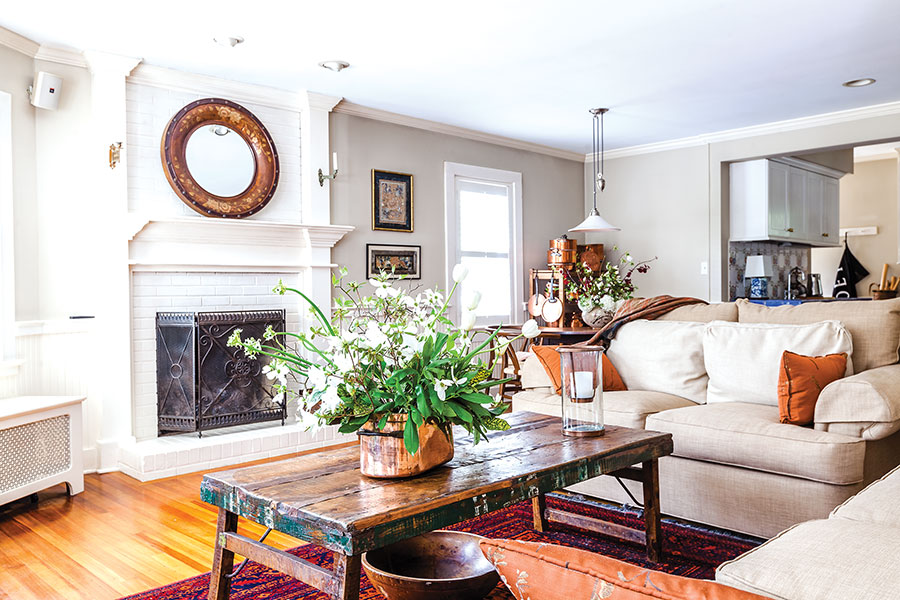
How very proud Yeomans, Embury (who built himself a cottage nearby) and the DePeysters would be of their accomplishment, now curated by Mary and Mike Saulnier. The flower, vegetable and herb gardens flourish, laid out and tended by novices who learned as they dug, moving and preserving decades-old plants. The house itself gains personality from irregularities and novelties — off-center dormer placement, angled walls, an exposed brick chimney rising two stories, a back stairway leading to the maid’s room (now a guest suite), a pair of interior windows, massive original bathroom fixtures and black-and-white tiled floors, a call bell system for the servants, and an under-the-stairway closet where hangs a clever fire extinguisher. Iron radiators, some covered with perforated screens, have been left in place as icons of the pre-forced air heating/AC era.

By way of introduction, in the foyer hang Yeomans’ architectural drawings, an homage to history beautifully framed by the Saulniers.

“I found them in the basement,” Mary says.  That find inspired her to compile a scrapbook containing newspaper clippings about the house and its wealthy occupants, as well as other schematics.  Because for Mary and retired Army Col. Mike Saulnier, this home represents another type of find.

“We were looking for a hometown,” Mike says.

Mary spent part of her childhood in Alaskan whaling villages, where her father taught in a one-room schoolhouse, later relocating his wife and eight children to Pennsylvania. Mike, from a military family, moved around.  They met at Shippensburg University.  Beginning in 1999, the military and NATO posted Mike, Mary and their children to The Netherlands, Belgium and Korea, sometimes for several years, with plenty of time to absorb the culture and acquire household goods.

The homesteading desire appeared in 2009, when they were stationed at Fort Bragg.

“We were sitting at the beach, trying to figure out where to live, since we didn’t have any connections,” Mary recalls. While browsing online she found a Weymouth listing that sounded attractive. They drove over and instantly fell in love with the area and, subsequently, the Dutch Colonial, which had been renovated and needed only painting (Mary and Mike did the interior themselves), window treatments, landscaping and minor adjustments.

“It felt right. We never looked anywhere else,” Mary says. Neither golf nor horses influenced their decision.

They moved in 2011 and began making the house their own. An unusual rectangular pool, for example. This came about when Mike discovered nothing would grow on that patch, also that a pool would cost less than a flagstone terrace. But nothing motel-style. He laid out the shape with ropes and hoses. “We wanted it to look like a water feature that had always been here.” The result, a safe 5-foot depth with a grayish pebble lining that makes the pool fade into the surroundings. An ozone purification system replaces chlorine. Add a few lilies and he’d have a pond.

Crumbling bricks on garden walls were made on premises by Yeomans, and a Dutch wooden gate replicates the one hung by the architect.

The main floor has a circular plan; turn right inside the front door, go through the dining room, kitchen and family room, windowless office and into the living room, which opens onto a screened porch. The only addition, by a previous owner, was the family room, which begs the question: Why are the walls angled in several directions?

Mary explains that the room was built not to disturb an ancient tree, perhaps a sugar maple like the huge one with dense canopy that shades and cools a portion of the yard.

That tree, a grassy lawn and boxwoods bring New England to the piney Sandhills.

If only nations could live as harmoniously as the furnishings the Saulniers collected in Europe and Korea. An Asian aura prevails, serenely, without resorting to red lacquer. A set of calligraphy brushes on a runner printed with the Korean alphabet adorn the foyer table, hinting at what lies within. Folding screens serve as headboards. Bells line shelves. A step-down bedroom chest, Mary explains, is finished and operational on both sides making it suitable as a room divider. But for every Korean artifact there is a table, a dresser, a desk or bookshelf — some carved antiques, others plain and functional —  acquired at auctions in Belgium and Holland.

I am naturally attracted to rustic and classic in muted tones,” Mary says. Her palette flows from moss greens and woodsy browns to oatmeal, linen beige, deep maroon and putty. Dusty turquoise appears briefly in the living room alongside an 18th century Flemish tapestry, with a few brightly colored Vietnamese bed coverings upstairs. Mary chose other fabrics with contemporary motifs. She and Mike upholstered bedroom headboards themselves using only plywood, padding, damask and a staple gun. In fact, “Everything we did is the first time we did it,” Mary says.  Original oak and pine floorboards host carpets Mike brought back from Afghanistan. Beams cross the living room ceiling but this is not a house weighed down with crown moldings. Instead, objects like a colorful child’s kimono hung from a curtain rod practically jump off the slightly textured plastered walls.

In the DePeyster’s era a small galley kitchen was sufficient for the hired cook. Now, when houses sink or swim in the kitchen, the Saulniers’ bypasses glitz and gadgets for warmth and European country charm while providing every amenity. An L-shaped layout, beadboard cabinetry (except for a few original carpenter-mades), thick natural wood and Provençal blue ceramic countertops, a French Quimper tile backsplash, a small vegetable sink in addition to the oversize farmer model, make it a comfortable and convenient place to prepare meals. In a corner stands an antique baker’s rack holding Mary’s pride: a collection of polished copper pots and skillets without which a French chef wouldn’t attempt even a scrambled egg.

More than 3,000 square feet on 1 1/2 acres seems generous for two people and a cat. Yet no room (except for the family room adjoining the kitchen) is oversize. Mary thought ahead. “The kids are gone but we want them and the grandchildren (two, already) to come home and stay in the house for holidays and make noise.” Besides, she continues, the way the house is configured, when one area gets noisy other spaces, indoors and out, offer alternatives for quiet conversation.

Back to finding a hometown. As with the house, Mary and Mike Saulnier lucked out. “This area has a real blend of cultures and people and viewpoints,” Mary says. “You go to an art exhibit and every person you meet is from somewhere else — but it’s still a small town.” A small town graced with historic homes, preserved and furnished with fascinating memorabilia of lives well-lived, including theirs.  PS

Paradox Farm

Going all-in out in the country

By Jim Moriarty     Photographs by Tim Sayer

Jimmy Stewart had one in Harvey. His pooka was a benign rabbit, unseen by most of humanity, that was precisely 6 feet 3 1/2 inches in height. Stewart’s character, Elwood P. Dowd, was a known and decidedly content tippler. “Well, I’ve wrestled with reality for 35 years,” says Dowd to the doctor who was passing judgment on his lucidity, “and I’m happy to state I finally won out over it.” While these creatures of folklore can take many forms, one wonders just how much wine would be necessary to make two otherwise sensible, urban-dwelling people, Sue Stovall and her late husband, Hunter, see goats.

“The story is well known that we had too much wine one night and decided to buy goats,” says Stovall. “Very good wine. There was a lot of it probably.” And so Paradox Farm was propelled down its dirt-road, cloven-hoofed path.

The farm began in 2007. “It was about the time the economy was changing,” says Stovall. “Hunter and I were both self-employed. He was an attorney, the kind who enjoyed more counseling than litigating. He would rather help you solve a problem than litigate a problem. I was in health care. We worked 3 miles from where we lived (in downtown Southern Pines). Let’s move out to the country. We bought this house. It was a horse farm. We were here for about a year trying to figure out what we wanted to do.”

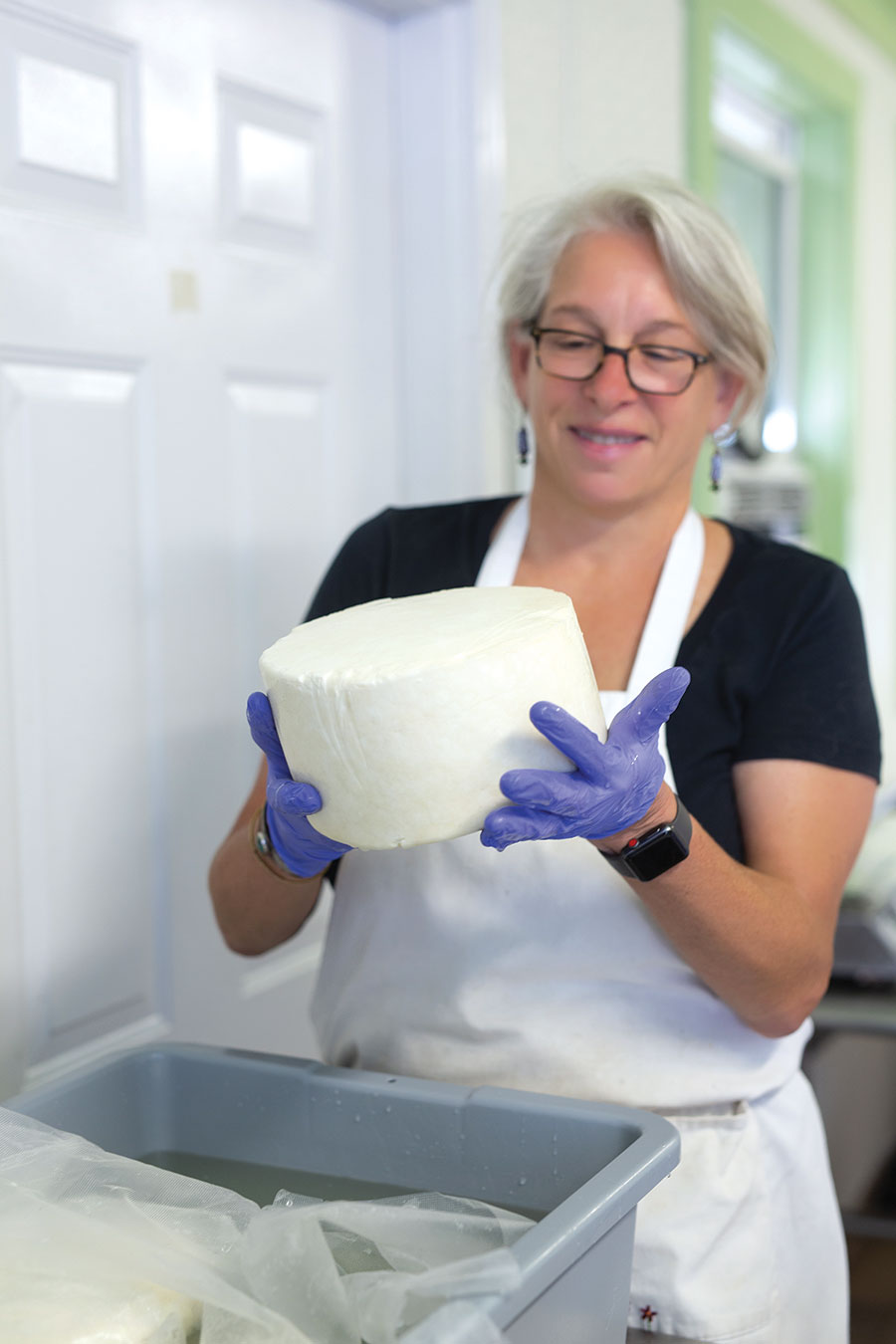
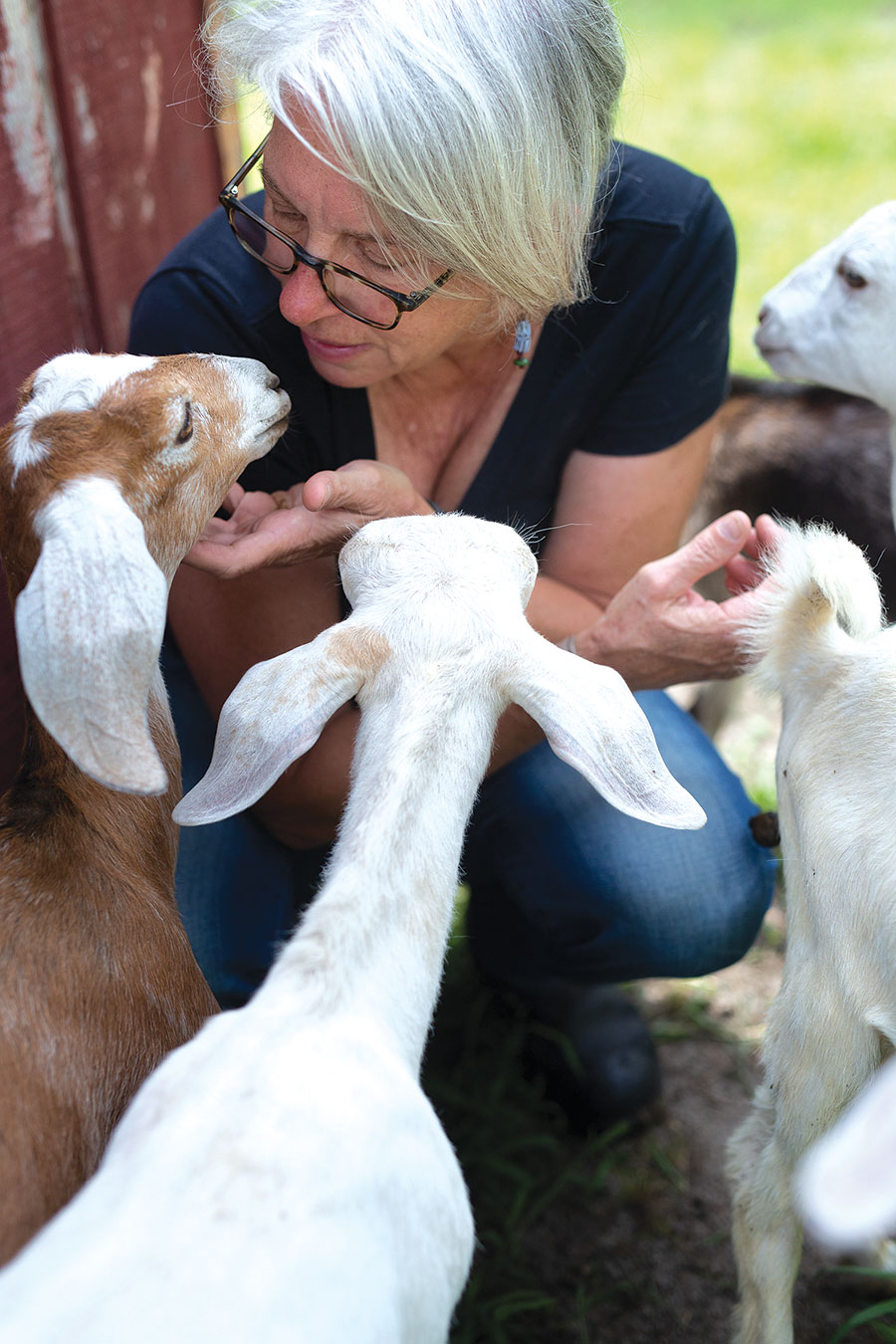
A few chickens, which are apparently the gateway species to serious livestock, showed up first. The hens were followed by an evening of red wine, a llama and three goats. The first two goats were named Thelma and Louise. “There was never, ‘Oh, I always wanted to be a farmer.’ Everything was like, ‘Hey, let’s try this,’” says Stovall. “I’m probably the most unplanned person you ever met. So, we got the goats and we had babies and started milking goats and started making cheese. We were sitting on the porch and drinking wine and eating our cheese and looking at this book about how to make your own creamery. It starts listing 10 things you should want to do if you want to do a dairy, because it’s really hard work. We looked at all of them and we’re, like, ‘None of those fit. Let’s do it!’”

By 2011, Paradox Farm was a licensed creamery. “Since then we’ve been growing the herd, making and selling cheese, and expanding our markets,” says Stovall. She hasn’t done it alone, but she has done much of it without Hunter. Sue grew up in Plainview, New York, in roughly the geographical middle of Long Island, near Bethpage State Park. She has three degrees in physical therapy, including a Ph.D. from Boston University. Hunter grew up in Virginia, went to the University of Virginia and Campbell University School of Law. Hence the “pair of docs.”
Just as their porch reading advertised, a dairy is hard work. “We would get up in the morning. He would feed and I would milk. We’d go in the house, take a shower, change our clothes and go to work. Come home, change our clothes, feed and milk and do whatever we needed to,” says Stovall. “On weekends we would go to markets. I was doing Southern Pines and he was doing Cary. We had both gone to market that morning, which means he had to leave about 6:15. He went to market, came home and lay down to take a break before evening activities, got up and had a heart attack.” That was four years ago this August.

Stovall has two daughters who are Moore County residents, Ariel Davenport, who owns Set in Stone/The Slab Warehouse, and Kassia Stubbs, who works for Moore County Schools. Her son, Mike Kowalick, lives in Seattle, Washington. “My girls are not farm kids at all but they support my efforts,” says Stovall. Her son helps with strategic plans — how to lower the power bill, marketing ideas, etc. It was Mike who suggested his mother engage interns from World Wide Opportunities on Organic Farms. “He was trying to figure out how I was going to survive without Hunter,” she says. Beri Sholk from Orlando is there now, the sixth WWOOF intern who’s worked at Paradox Farm, trading labor for knowledge, something that’s turned out to be a two-way street. The interns have been from California, Florida, even the Republic of Mali, West Africa. “It’s really expanded my world,” says Stovall.

The goatherd at Paradox Farm stays roughly level at around 40, though the number jumps when the season’s kids are born and before they’re sold. “I started with Nigerian Dwarfs because they were cute and little and I thought I could handle them,” says Stovall. “Then I added Nubians. Then I needed to get more milk so I added some Alpines.” All the goats have names. The ones that look alike wear identification tags. And, no, they don’t say “Hello, My Name Is . . .”

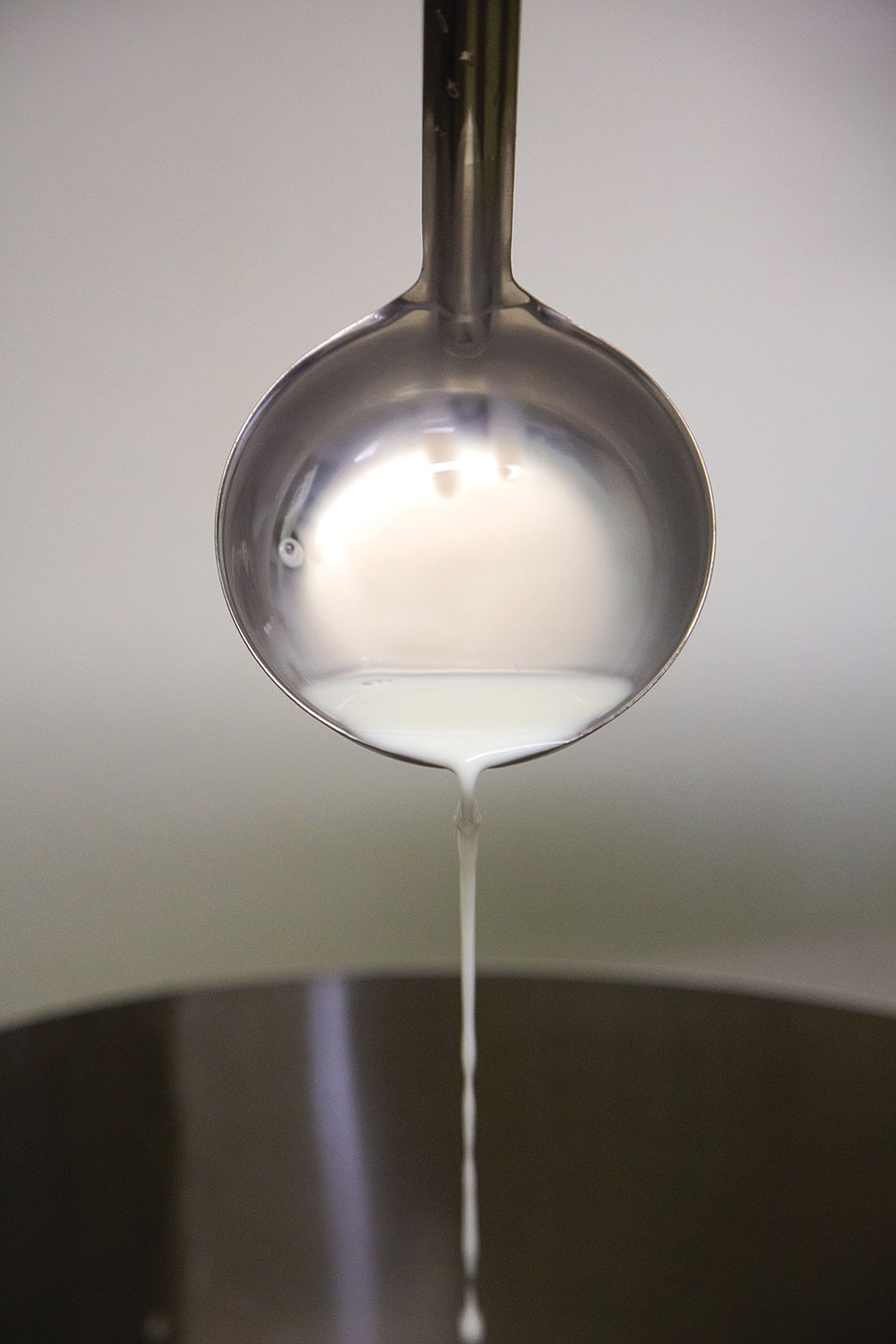
They milk 22 goats a day, two at a time, using a pumping machine. In a large dairy the milk from 10 times the number of stanchions would travel through pipes to a bulk tank. “Because we’re small, we just pick up our buckets of milk and pour them in a tank,” says Stovall. “I think it really helps in the quality of our cheese because milk is a molecule, a living organism. The less you handle it the better it’s going to be. Our cheese tends to be sweeter and milder than most people think of goat cheese.”

The 61-year-old Stovall’s skills from her previous occupation can come in handy, getting the kinks out of a farm hand’s neck, fixing a goat’s broken leg, or putting a brace on Beri’s left arm after she was kicked — the goat version of negative feedback. “Farming is a full-contact sport,” says Stovall.

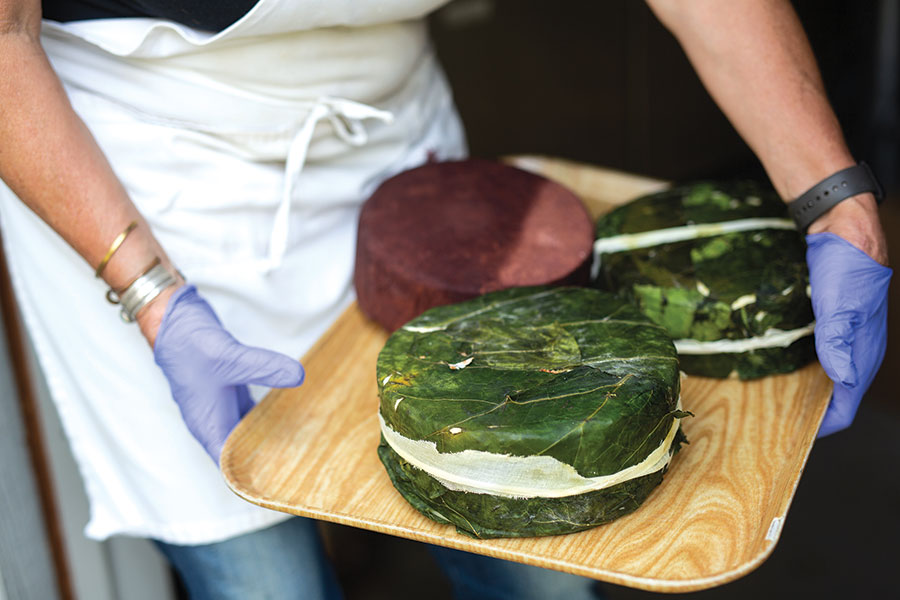
The Paradox Farm cheeses show up at places like Southern Whey and Nature’s Own in Southern Pines, the Corner Store in Pinehurst, Black Rock Winery and restaurant’s like Ashten’s and 195, just to name a few. Wrapped, infused, washed and aged, the flavors (and puns) are as wide-ranging as the names would suggest: Drunk N Collard; Sweet Hominy; Red Eye, Feta Complee, Paradox Paneer and Cheese Louise!

Making a small farm sustainable, however, is a value-added proposition. With the help of a grant from the University of Mount Olive, Stovall bought an old tobacco barn, broke it down and reassembled it on her farm. Half of the barn will be a cheese cave for aging. The other half will amount to a mini-storefront. “We do farm events. The last couple of years we’ve had hundreds of people come out on a Sunday afternoon, tour the dairy, see the goats. We do ‘Goat Yoga’ once a month. And we have pairing events where we pair cheese with something. Our first one was beer and cheese. We’re doing cheese, wine and desserts with Black Rock and the Wine Cellar. I’m determined to make this work,” says Stovall.

“One of the biggest challenges for me over the last couple of years is to learn to farm smarter. These are my babies. When they die I’m going to burn sage and say a little prayer when I bury them. I still have to be able to balance that need for myself with the business of running a farm. It’s a challenge to find that balance. Every day is filled with disaster and beauty.”

Paired, perhaps, with some Cheese Louise! and a petite shiraz.  PS

Jim Moriarty is senior editor of PineStraw and can be reached at jjmpinestraw@gmail.com.

Sporting Life

Beach Music

Grand memories buried in the sand

By Tom Bryant

When the July sun is almost directly overhead and the dogs are digging in the shrubbery looking for some cool and the humidity is thick enough to cut with a kitchen knife and the air conditioner is working overtime, relief is two words away . . . THE BEACH!

We always called it that, simply the beach. Other people from around the country refer to it in different ways. Some folks call it the shore or the coast; but down South, it is always known as the beach. And in South Carolina, the beach means Ocean Drive or Cherry Grove or Windy Hill or Crescent or Myrtle or Pawleys or Litchfield, but always it’s the beach.

The tradition of going to the beach began early in our family. My grandfather, a tobacco farmer in the low country, would load my grandmother and all eight kids, along with Shep, a farm hand and cook when needed, in one of his 2 1/2-ton farm trucks and tote them to the beach. The old farm vehicle would be loaded with a crate of live chickens, dozens of eggs, country ham, watermelons, cantaloupes and bushel baskets of Grandma’s garden vegetables. Enough food to feed an army, and with eight hungry kids, it almost was.

There they would remain for a month, glowing brown from the summer sun and almost growing gills, they were in the water so much. Mom often said that the good Lord looked after them because they survived swimming out so far in the ocean that the beach house back on land looked like a miniature reproduction, and in those days lifeguards were nonexistent.

My grandfather disliked the beach and thought it was a serious waste of energy. He often said the family could spend their time more wisely working in the crops that were in full summer bloom. Jokingly, he would threaten to cancel the coastal expedition; but secretly, he really did enjoy the fishing and laid-back times spent in the porch swing. He would carry the family and the cook to the beach and drop them off, and then he would return on weekends or when the farm crops would let him.

There is an old family story about him and the beach, and if it’s true, what a story. It seems that a land salesman from Myrtle Beach made an appointment to see Granddad on the farm right before the family’s summer outing. Grandma always rented the same beach house, a big rambling two-story affair right on the oceanfront. The old house, made of heart pine, had been there for years and had survived storms and hurricanes and seemed to grow stronger every summer. Mom remembers that the ancient beach house had two screened porches, one on each floor, and was the only house for several miles.

The beach salesman showed up at the farm early one evening just as Granddad was coming in from the fields. Granddad, who was a big landowner, didn’t suffer fools lightly; and unfortunately, sales people, according to him, fit that category. However, he begrudgingly agreed to listen to the gentleman’s spiel.

The story goes that Granddad sat in the big front porch swing and the real-estate expert sat opposite in a rocker. The salesman opened his briefcase, drew out maps and charts of the beach and the house where the family always spent summer vacations. Now Granddad was a gentleman. He was tired from his day in the fields, but he let the salesman go through his material, pointing out the maps and extolling the potential of the beach house and surrounding area. He said that the whole plot was for sale at a depressed price because the banks were going to foreclose. The original owner had passed away, and the heirs didn’t want to keep the place and would let it go at the tax value, which in those days was next to nothing.

Granddad listened politely, and Grandma went inside to the kitchen to get some iced tea. When she came back, Granddad stood up, walked over to the wide steps of the porch and said, “Come here, mister, I want to show you something.” He pointed to the cotton field across the road.

“See that? That’s 200 acres of the finest cotton I’ve ever grown. And look over there.”

He pointed to the field across the fence adjacent to the ancient plantation house. “That’s about a hundred acres, give or take an acre or two, of good corn, excellent corn if we get rain at the right time. Behind the house and over toward Black Creek is some of the prettiest tobacco I’ve ever raised. And last week, I closed the deal on land down toward the creek that has some outstanding second-growth timber. So, mister, you can see I’m pretty well occupied, and like everybody else in this country, I’m waiting out this blame Depression with my fingers crossed.”

They both sat back down and my grandfather continued, “I appreciate your effort and sorry you drove here from the beach, but I’ve looked at your maps and prices, and the family dearly loves visiting the old house and our summers there, but my major problem with what you’re offering,” and here he paused for effect, “I don’t know of a thing I can grow in all that sand.”

The story continued that the salesman was invited for supper and did stay and enjoyed my grandmother’s good cooking and the restful time on the porch afterward. He later left for home and the beach, and I don’t think he made any more overtures to Granddad to buy beach property. The beach outings went on for a few more years until the children got older and times changed.

Years later, my dad and mother continued the tradition, and our family spent time every summer at the beach. After Linda and I were married, we joined them, and my sisters and brother and their children did the same. We would all gather at Ocean Drive, Garden City, Pawleys Island or Litchfield, and we did this until the families got so large that one house couldn’t handle us and we had to rent two. Finally, the logistics and other distractions interfered, and our summer family gathering fell by the wayside.

Linda and I and sometimes our son, Tommy, still make summer excursions to the beach with our little Airstream trailer. We camp at Huntington Beach State Park, famous for its 3 miles of pristine oceanfront. The park and surrounding area remind me a lot of the descriptions my mother remembers of the early outings with Granddad and the family. We love it there and try to go as often as we can.

The other evening I was looking at some old photos of the family when everyone gathered and had fun at the beach. They were grand times, and if I have one regret, it’s this — I sure wish Granddad could have figured out something he could have grown in all that sand.  PS

Tom Bryant, a Southern Pines resident, is a lifelong outdoorsman and PineStraw’s Sporting Life columnist.

In The Spirit

The Perfect Martini

How to create — or botch — a great one

By Tony Cross

After closing, I rent out the kitchen at Nature’s Own to work on prepping and batching kegged cocktails. I get ideas just walking around the store grabbing ingredients. One night as I passed the shelf of vermouths, I thought to myself, “Self, I probably need to re-up on some Dolin. Why have people been telling me about their terrible martinis lately?” Let’s talk about what you (or your bartender) are doing wrong.

The martini is the international symbol for cocktails. I just made that up. Or maybe not. What other shape — whether it’s a neon sign, printed on oven towels, or painted on a canvas at Bed, Bath & Beyond — represents an alcoholic drink that’s recognized everywhere? Everyone over 21 knows about the martini. This doesn’t mean that everyone has tried one, much less enjoyed this quintessential classic. I can certainly tell you that I did not fall in love my first go-round. Quite the opposite, actually. If memory serves, I believe all I was drinking was cold, lousy gin, in a martini glass. What a moment.

From talking to my bar guests in the past, to chatting with friends and clients, here are some tips:

Just because it’s in a martini glass doesn’t make it a martini.

I’m getting this one out of the way, because you’d think it should be self-explanatory, but . . .

What recipe?

OK, this one should be pretty obvious, but just like with other cocktails out there, a lot of bartenders (home or away) just throw it all in there and don’t look back. Unless you’re quite skilled, stick to measuring. You might think you look cool behind the bar free-pouring that loooonnnngg stream of gin (probably vodka), but you don’t. If it doesn’t taste good, your guests are ordering something else. Plus, you just poured 4 ounces of gin in an oversized martini glass, and made your server spill it all over his/her hand. Good job. Do this instead: Order some jiggers from a reputable online store (I love the Japanese style) and measure. Consistency is key, and you want your guests coming back every evening because they know that your martini is the best every single time.

What vermouth?

A majority of bars across this county (and country) have rancid vermouth on the shelf. I was recently at a local spot that I wouldn’t have guessed would do such a thing. I didn’t have the heart to say anything, but luckily my buddy did. Vermouth is fortified wine, so you have to treat it like a wine, and refrigerate it. It’ll last for months (if you’re doing it right, you’ll be running out before that’s even an issue). You can also opt for smaller bottles if you’re not making many on average. When it comes to which kind, Dolin Dry has my heart. This French vermouth has been in production since 1821 and been in my belly since I was 21. Just kidding, I was drinking Jägerbombs at 21.

Gin.

To the gin martini drinkers: Just any old gin won’t do. It’s true that we have lots of local distilleries popping up, and they’re making some fantastic stuff, but for a martini, for me, it’s got to be Plymouth Gin. It’s so soft, with slight earthy-like undertones. I’ve never been great at describing spirits on my own, so there you go. Soft and earthy. But really, some other gins have a ton of different botanicals going on, and it’s just too much for me. Plymouth really mingles well with the vermouth. It allows both products to let each other shine. If Plymouth is not available, a London Dry will do. May I suggest Tanqueray 10?

Execution.

In the 1971 copy of Playboy’s Host & Bar Book (I am a loud and proud owner — Mom, I only read the recipes) it says, “A martini must be piercingly cold; at its best, both gin and vermouth are pre-chilled in the refrigerator, well stirred with ice and poured into a pre-chilled glass. Energetic stirring with the ice is all-important; the dilution makes the drink both smooth and palatable.” (Mario, 1971) Yes! Especially that “energetic stirring” part. I’m stealing that. The martini needs to be silky smooth and ice-freaking-cold! Just cold is not going to cut it. If you are (as the same book calls its reader) a martini man, you should always keep your gin in the fridge. Having both your gin and vermouth cold from the start is going to help propel your martini to the next level.

We already know not to use bad ice, but let’s refresh our memory really quick. Rubbish in, rubbish out. If your house water is great on its own, you shouldn’t really worry. Chances are, that’s not the case. So, get your own molds, and fill them with distilled water. Make sure that all of your ingredients go into an ice-cold mixing vessel. I prefer a mixing glass. If you’ve never used one, give it a shot. You can also try (after adding your gin and vermouth; see proportions in “Recipe”, below) to completely fill up the vessel with crushed ice. You can’t get much colder than that. You will be stirring, not shaking. If you’re having a hard time stirring correctly, there are a couple of great videos on YouTube that can guide you. I’m not ashamed to tell you that’s how I taught myself.

Recipe.

These vary slightly, but this is what I make for myself:

2 1/2 ounces Plymouth Gin

3/4 ounce Dolin Dry Vermouth

Strain into a chilled martini or coupe glass. Garnish with olive(s) or lemon peel.

Scroll up and repeat. I should note that some folks like to use a dash of orange bitters. If I do, it’s with a blend that I’ve mixed from a few different companies. Not really a game changer.  PS

Tony Cross is a bartender who runs cocktail catering company Reverie Cocktails in Southern Pines.

Papadaddy’s Mindfield

Changing Customs, Fading Manners

Who is minding what?

By Clyde Edgerton

“Mind your manners” is a phrase that is probably less heard today than it was 60 years ago. Back then (I was a teenager), I would have no more worn a hat inside a house or building than I would have peed in the street. (I would have peed in the backyard, down toward the woods, and that would not have been considered bad manners where I’m from in rural North Carolina.)

Are we sometimes talking about changing customs, or changing norms, rather than changing manners? Shades of difference move between those three terms: customs, norms, manners. Your mama, or another trusted relative, probably never said to you, “Mind your customs,” or “Mind your norms.” Customs and norms describe habitual stuff out there in a society — descriptive. Manners are more about what happens in smaller group settings — prescriptive, connected to right and wrong.

And sometimes I think (like other older folks) that manners haven’t changed; they have simply disappeared. Well, almost. Perhaps disappeared in other parts of the country, and are hanging by a thin thread in my home section of the country, the South, where people do not have accents unless they are from elsewhere.

Let’s take family reunions — and “eating order.” Family reunions in my childhood were like Christmases. The family planned ahead for, and looked forward to, each family reunion. It was a big deal. We had five of them each year. (It’s down to two now.) When it was time to eat from the big long table with covered dishes (you were likely out of doors), the older folks served themselves first. Had I, as a child, started for the food right after the blessing, my mother would have said, “Mind your manners, Son,” and I would have remembered that children served themselves last, not first. It was a matter of right and wrong, good and bad. Simple good manners.

There were only good and bad manners, no debatable manners, or, for that matter, “politically incorrect” manners. “Politically correct” — for better and/or worse — hadn’t been invented.

My first brush (that I know about) with my own politically incorrect manners happened at a dinner party (among academics) in about 2000. Each of us stood behind our own chair before being seated. When it was time to sit, I reached for the chair beside mine because standing behind that chair was a woman. As I started to pull back her chair for her to sit, she quietly held the chair in its place.

I didn’t get it. I assumed she was looking the other way. I tried again, and then looked into her eyes. The message was clear. She did not like what I was doing. She remained silent. I turned loose of her chair and tended to my own. I was confused, but there was no doubt that she did not like me messing with her chair.

I have since figured out what was perhaps going on. (I have two daughters, and would like to consider myself an intersectional feminist who believes rational feminism can lead to men’s liberation.) I think back on that occasion, on the matter of customs, norms, manners; on the woman beside me at the dinner party; on my mother (not an academic by a long shot) and how she behaved in social situations. I’m pretty sure my mother, had she been a modern-day feminist, would have said, “I’d prefer to pull out my own  chair, but thank you.” She would have said that because she had good manners — innate good manners.  OH

Clyde Edgerton is the author of 10 novels, a memoir and most recently, Papadaddy’s Book for New Fathers. He is the Thomas S. Kenan III Distinguished Professor of Creative Writing at UNCW.

Simple Life

Lulu and The Mull

By Jim Dodson

This is a story about two beautiful dogs, one that I’ve known for a decade, the other for less than an hour.

One is my canine soul mate — my God Dog, as I think of her.

The other briefly touched my soul.

So here’s the tale: It was rush hour and I was running late for an afternoon speaking event. On the horizon, the sky was black,  the first fierce thunderstorm of the season was breaking.

The traffic was heavy. Everyone was hurrying home before the tumult broke.

That’s when I saw the dog.

Approaching one of the busiest intersections in the city, traffic zooming in all four directions, a dog bolted across the road two cars ahead of me. Both cars swerved and the driver directly in front slammed on brakes, allowing the dog to barely make the landscaped traffic island.  As I watched, the animal started to cross the oncoming lane, causing a blast of horns and automotive mayhem. One car just missed her, another swerved. the dog jumped back onto the island.

Some things are pretty simple. I stopped my car in traffic and got out, opening a back door, hoping the terrified dog would jump in. She didn’t. She merely stared at me, frightened, panting and exhausted.

Over the decades, traveling hundreds of roads large and small, including in at least two foreign countries, I’ve pulled off busy highways to try and help dogs in distress, not to mention at least one chicken and probably half a dozen snapping turtles.

In almost every case, a good outcome resulted. 

That was certainly the case 10 years ago when I pulled into a park to give a talk at a festival  and saw a skinny black dog  bolt across busy US Highway 1 in Aberdeen, narrowly avoiding the wheels of a FedEx truck. 

Moments later,  as I parked the car, the same skinny dog — a black pup with a white star on her chest — streaked past me, headed for some kids playing near the woods. An hour later, as I was leaving the park, the same black streak passed again, heading straight back to the busy highway.

I squatted and called out, “Hey, black dog! Stop! Come here.”

To this day, I don’t know why the dog stopped. But she did, whipped around and looked directly at me. We were maybe half a football field apart. 

Then she did something amazing. It may have even changed my life. It certainly improved it.

The dog ran straight to me and jumped into my arms, like she’d known me forever. She was filthy, a wiggly pup with liquid brown eyes, a runaway or a stray, the happiest dog I’d ever seen.

I asked some park maintenance men if they knew where she came from or who she might belong to. There was no collar.   

“That dog don’t belong to nobody. She’s been around here a week or more,” one of the workmen said. “I think she lives in the woods and eats from the garbage cans. We can’t catch her. How did you?”

“She just came to me when I called.”

He laughed. “Guess that means she’s your dog now.”

I asked the kids by the woods, too. “She lives in the woods,” one told me. “You should see her run. She catches squirrels and birds and stuff. Fast as lightning.”

So I took her to three different shelters in the county. Two were full occupancy. By the time we reached the no-kill shelter in a neighboring county, the dusty pup was sitting on the center console between the front leather seats of my new car, making herself at home. She was actually leaning against me.

The women who ran the shelter gave her a shot of worming medication, a small biscuit and said to me with a smile,  “That dog really seems to like you.”

So I took her home to my cottage and phoned my wife in Maine to let her know I’d found a pup running wild and might need to keep her until I could find her owner.

My wife laughed.  We already had two dogs, a pair of aging golden retrievers.

“Of course you will.”

“Just until I find her owner.”

“Sure. If you say so.”

I bathed the pup.  She hated it but came out shiny as a baby sea lion.

Next I fed her a can of Alpo. She ate the food in three gulps and threw it up with several small animal bones. The girl was obviously a hunter.  I thought of calling her Diana, Greek goddess of the hunt.

That night I heard snoring and rolled over to find the pup lying on her back next to me in bed, head on the pillow, snoring to beat the band. When I spoke to her, she looked at me with the most soulful brown eyes I’d ever seen and thumped her tail.

I ran an ad in the newspaper but never found an owner.

Looking back, I’m certain the universe never intended me to find an owner. The pup had found me.

I named her Mulligan, a second chance dog, or “The Mull” or “Mully” for short. Some people have a God Parent or God Child. I have a God Dog, an animal divinely sent to keep an eye on me.  Dog, after all, is simply God spelled backwards.

She and I have been together over a decade now, traveling pals through life, best friends who have gone down many roads in each other’s company. Wherever I go, she goes – to the garden, to the store, ever watchful, always waiting, ready to ride. The Mull sleeps beside my side of the bed. And when I leave bed well before dawn, my God Dog follows me and my cup of coffee outside to sit beneath the morning stars to reconnect with the universe.

When Ajax, our big retriever that I call “Junior,” finally lumbers out for our morning walk around the neighborhood, The Mull is ready to lead the pack.  Junior is young, spoiled, far too good looking for his own good. He knows four or five good words like “walk” and “Cookie.” But the The Mull hasn’t given up on him, thinks there’s hope for him yet. Mully has the vocabulary of a gifted middle-schooler – or at least telepathic powers. 

In any case, she roams ahead off the lead, scouting the world where she once ran wild, seeing everything that moves around us, smiling the entire time. Junior lumbers behind, basically oblivious save for the grazing rabbits in yards, carrying his own lead, impressed with himself, following the family alpha dog.

Ironically, I didn’t have the God Dog with me the afternoon I stopped rush-hour traffic in two directions for half a dozen blocks while trying to coax the terrified dog on the island into my car. Fortunately a woman driving the other way stopped traffic on her side of the island and got out to lend a hand. And a second driver appeared with a cup of water, hoping the dog would pause to drink so we could grab her.

For several minutes — a small eternity it seemed rather hopeless. She ran circles around my car, was visibly tempted to jump in, but eluded our efforts. Finally,  as she rounded the corner for the umpteenth time, I dove and grabbed her by the back leg.

People applauded and tooted their horns supportively.

I thanked the two guardian angels who stopped to help but only caught their first names – Laura and Sean

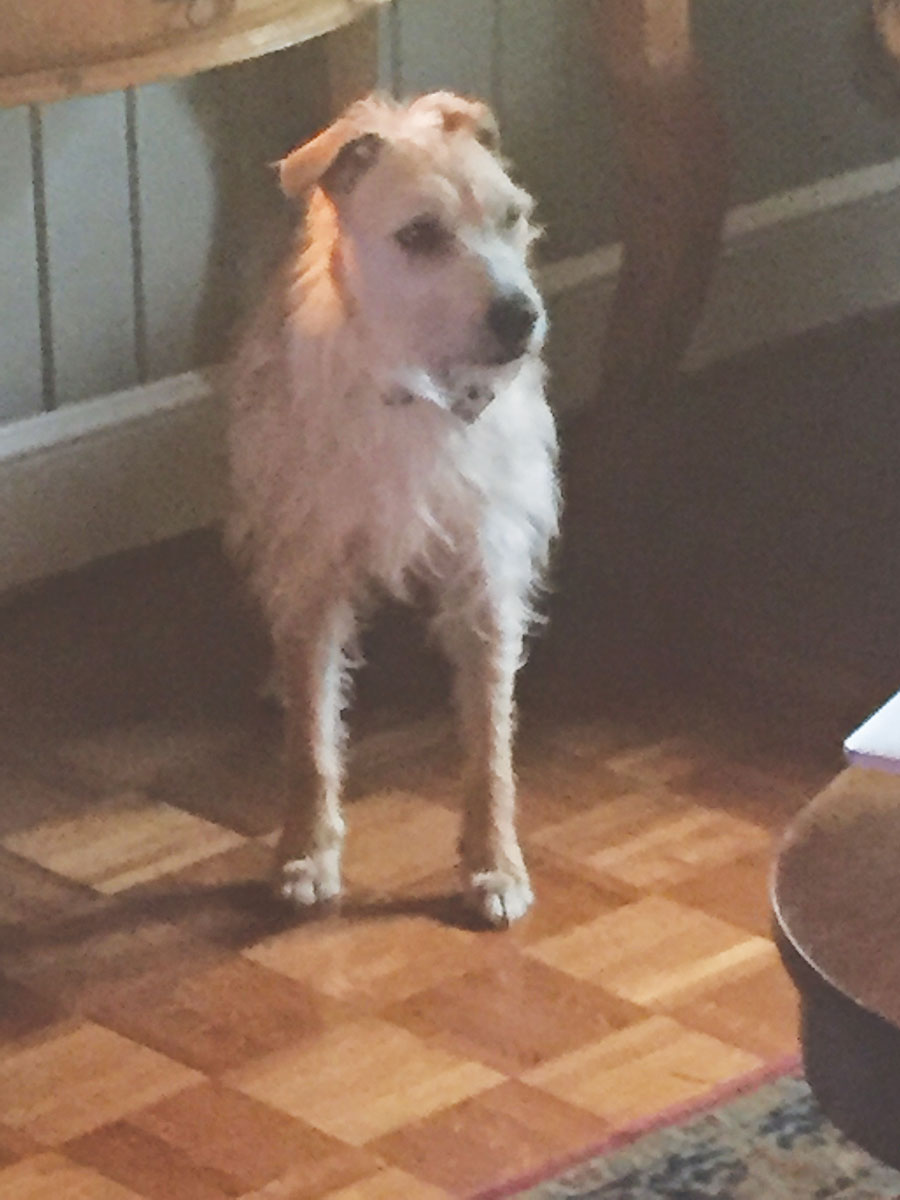
I took the dog straight home.  Mulligan and Ajax warmly welcomed her. But the newcomer was so skittish, she raced behind my den chair and refused to move until The Mull, my wise old foundling, went and sat with her for a spell. It was like watching a family counselor at work, the God Dog doing her thing.

The dog eventually calmed down enough to come out from behind the chair to drink some water and take a biscuit from my hand. I saw a faded tag with a phone number on her narrow collar. Her name was Lulu. The phone number was a Los Angeles number. I called it anyway.

After several rings a woman answered. “Do you have a dog named Lulu?” I asked.

“I sure do,” she said. “You found her? I’ve been so worried. She ran away a when the thunderstorm broke. Lightning struck and she was gone.”

Lulu lived more than 4 miles away. She’d had never stopped running until she’d reached the traffic island.

“Well, she’s safe now at our house.” I gave her our address.

She pulled up 20 minutes later, expressed deep gratitude and informed me that she and Lulu were about to relocate to France.

“I can’t believe she let you get near her. She’s terrified of lightning and people. It’s a miracle you could catch her.”

“I had some help.” I mentioned the two angels on the road and the help of Junior and The Mull.

She scratched Mulligan’s head.  The God Dog smiled, As always, her brown eyes shined, her tail wagged.

“What a sweet dog. How long have you had her?” she asked.

“Not long enough. Just 10 years.” I told her about saving Mully from a busy highway, joking how it was she who really saved me.  PS

Contact Editor Jim Dodson at jim@thepilot.com.

The Omnivorous Reader

To Boston and Back

A history of the psychedelic ’60s

By Stephen E. Smith

The stoner who said “If you remember the ’60s, you weren’t really there” got it wrong. Most of us who lived through those times recall what went down, even if we did inhale. But if your memory is less than eidetic, Ryan H. Walsh’s Astral Weeks: A Secret History of 1968 is an engrossing aide-mémoire, a jumbled catchall of social upheavals and artistic convergences that occurred in Boston half a century ago.

Walsh focuses on two narrative threads, one societal and the other musical, that evolved in parallel. The first is the founding of Mel Lyman’s Fort Hill Community, variously identified as a commune, cult or family; and the other is Van Morrison’s mystic stream-of-consciousness song cycle Astral Weeks recorded while the Irish blues rocker was hiding out in Beantown. Both events, although unrelated, had a transmutative effect on a flower-power generation searching for “peace and love” and alternative lifestyles.

Walsh begins with the not-so-secret culture-shifting decision by Bob Dylan to electrify his backup band and crank out a high-decibel version of “Like a Rolling Stone” at the 1965 Newport Folk Festival. Members of the audience still debate whether Dylan was greeted with widespread booing, but Walsh maintains the crowd was exiting in a funk when harmonica player Mel Lyman took the stage and intoned a 20-minute dirge-like rendition of “Rock of Ages.” Lyman was a member of Jim Kweskin’s Jug Band, a Boston group that had achieved modest national success. By 1966, he’d emerged as the charismatic leader of a community that squatted in abandoned houses in the Fort Hill section of Roxbury.

Lyman had drifted from California to North Carolina (he learned to play banjo from Asheville’s Obray Ramsey) and settled in Boston, attracting a coterie of subservient followers. His Fort Hill Community was no run-of-the-mill hippie commune. Daria Halprin and Mark Frechette, the stars of Michelangelo Antonioni’s film Zabriskie Point; Paul Williams, the publisher of Crawdaddy magazine; musician Jim Kweskin; Jessie Benton, the daughter of Thomas Hart Benton; two children of the novelist Kay Boyle; and Owen DeLong, a speechwriter for Robert Kennedy, were all active members of the Fort Hill family.

Lyman asserted complete control over community members and employed LSD trips, astrological readings and physical intimidation to maintain discipline. Members remodeled dilapidated dwellings and distributed the counterculture biweekly newspaper Avatar to support themselves. The cult’s sole purpose was to serve Mel Lyman and his creative enterprises, and in 1973, Frechette and two other members of the family attempted, ostensibly at Lyman’s bidding, to rob a Roxbury bank to fund a film project. One member was killed by police, and Frechette was sentenced to prison, where he died under suspicious circumstances. Walsh delves into the cult’s internal disputes, most of which concerned the content and publication of Avatar, and he details the less seemly workings of the Fort Hill Community, branches of which are still active in Boston, Los Angeles and Kansas. What became of Mel Lyman is a mystery. It was reported that he died in 1978, but no death certificate is known to exist.

The second thread of Walsh’s secret history traces singer-songwriter Van Morrison’s gradual rise to national prominence via his recording of Astral Weeks, a 1968 Warner Brothers release that went unnoticed at the time but has since achieved cult status. Morrison had first emerged on the music scene as the lead singer of the Belfast band Them, who charted with “Gloria” and “Here Comes the Night.” Morrison had a 1967 solo hit with “Brown-Eyed Girl,” but he’d made a bad business decision, signing with Bang Records, a company with mob connections. Warner Brothers had to buy out Morrison’s contract, and the singer moved from New York to Boston with his girlfriend Janet Rigsbee (aka Janet Planet), where he began composing the songs for Astral Weeks and playing rock clubs, high school gyms, roller rinks and amusement parks across New England with a group of local musicians known collectively as the Van Morrison Controversy. 

To record Astral Weeks, Morrison traveled from Boston to New York and laid down the tracks backed by jazz pros who’d never heard of the 22-year-old singer-songwriter wailing away in the vocal booth. Morrison never spoke to the studio musicians, but guitarist Jay Berliner, drummer Connie Kay, vibraphonist Warren Smith and bassist Richard Davis (the name of the flutist is lost to history) provided the backing that helped bring Morrison’s lyrics to life. The songs are about childhood, death and rebirth, and in “Madame George,” “Cyprus Avenue,” “Astral Weeks,” “Slim Slow Slider,” “Sweet Thing” and “Beside You,” Morrison’s craggy voice rings with a coarse authenticity. Astral Weeks has survived and sweetened over the years, and Walsh’s thorough investigation of the recording process reveals the inner workings of the musical experience without diminishing the album’s subtle ability to mesmerize listeners.

A slew of pop culture luminaries make brief appearances in Walsh’s history: Lou Reed of the Velvet Underground; Peter Wolf, future front man of the J. Geils Band; bluesman Howlin’ Wolf; singer-songwriter Jonathan Richman; Tufts University Shakespeare scholar David Silver; LSD guru Timothy Leary; and others. Since video and audio recordings of most of the principals exist, readers can access images of the characters and hear the crazy ideas they espoused. Dick Cavett’s painfully uncommunicative interview with Daria Halprin and Mark Frechette can be viewed on YouTube, and the album Astral Weeks is streamable on internet devices, as are numerous recordings of Mel Lyman, including his Newport Folk Festival “Rock of Ages” performance and eerie album cuts featuring Lyman and the Fort Hill Community. Jim Kweskin’s America Co-Starring Mel Lyman and the Lyman Family is available on CD. Fifty years out, a replay of these historic recordings in conjunction with a reading of Walsh’s detailed history will remind readers that the Grateful Dead had it right all along: “What a long strange trip it’s been.”  PS

Stephen E. Smith is a retired professor and the author of seven books of poetry and prose. He’s the recipient of the Poetry Northwest Young Poet’s Prize, the Zoe Kincaid Brockman Prize for poetry and four North Carolina Press awards.