Story of a House December 2018

Same Time, Last Year

A Tudor manor steeped in Yule for a special occasion

By Deborah Salomon     Photographs by John Gessner

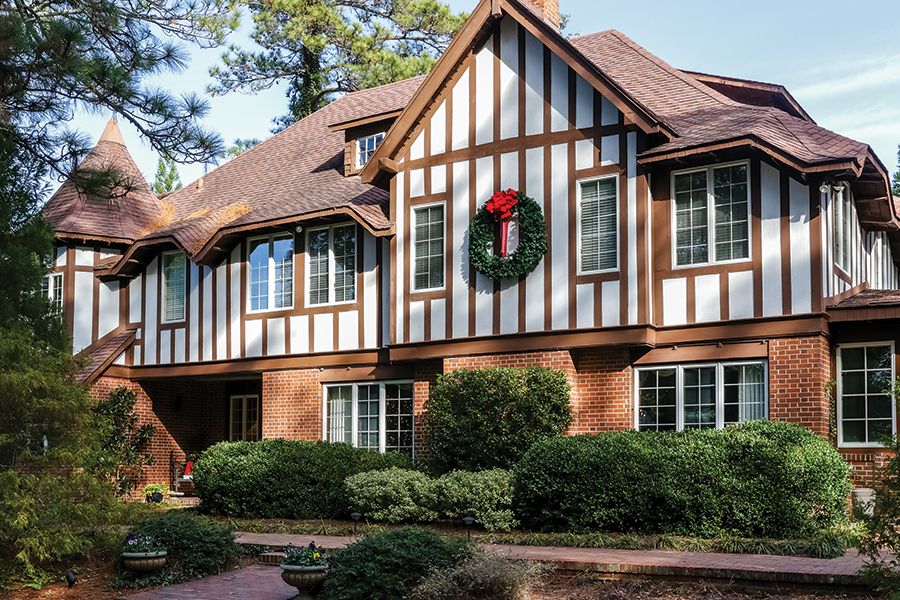
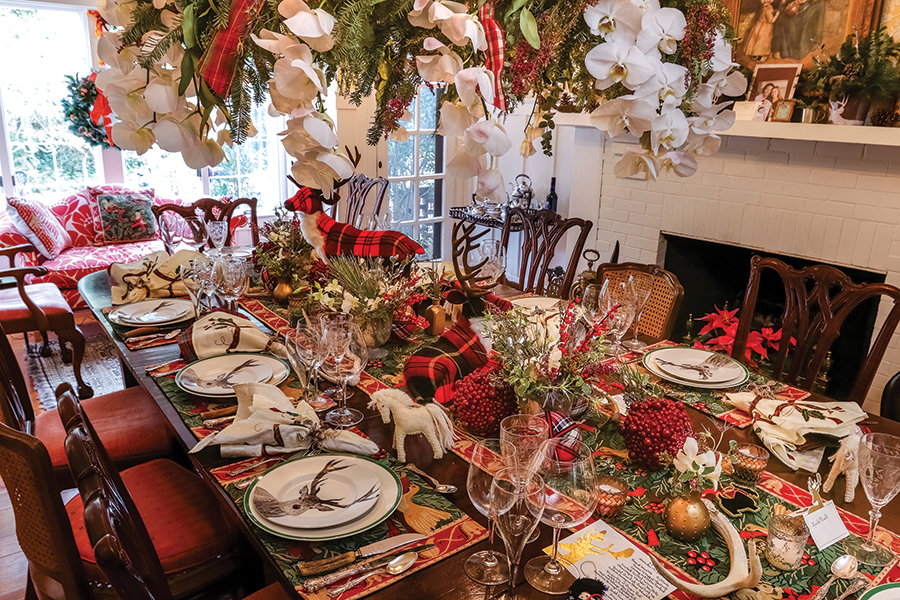
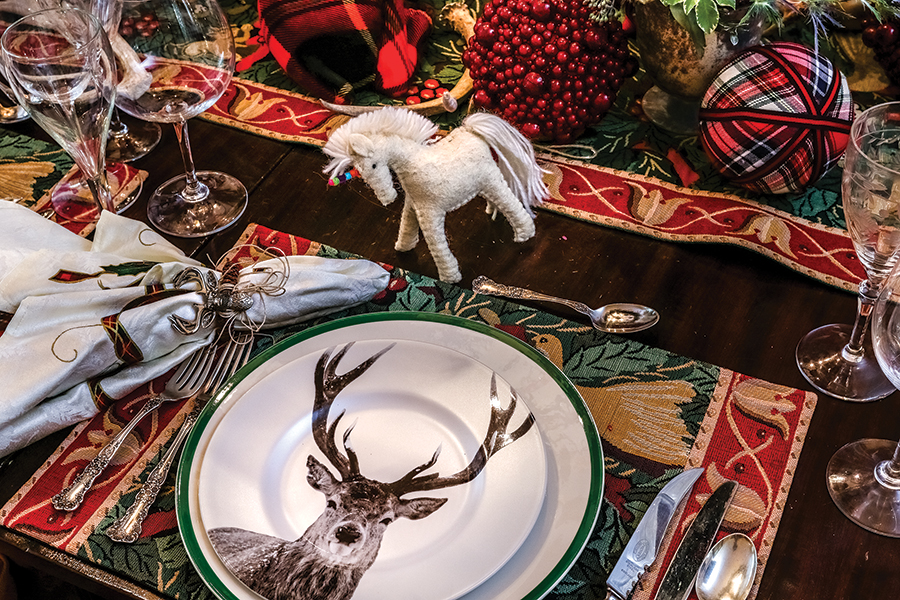
Never again will Le Berceau be as lavishly adorned for Christmas as in 2017: dozens of poinsettias, two fresh Carolina-grown trees, nutcracker guardsman, heirloom ornaments and the piece de resistance, a wreath of white orchids cascading from the dining room chandelier. Thus embellished, Lucille and Jim Buck’s home bearing the French name for cradle — arguably Pinehurst’s most elegant residence — provided the setting for an event Neil Simon could have scripted for Broadway: 10 couples, married to each other for at least 50 years, celebrate with a dinner party near the host’s anniversary date.

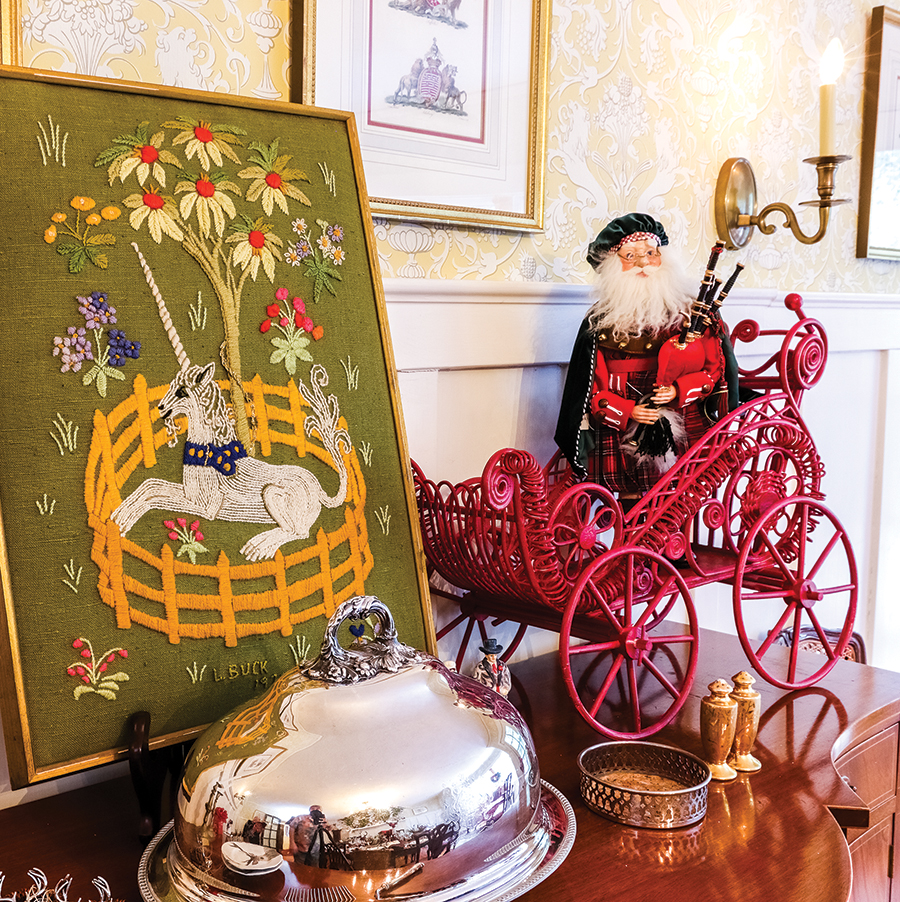
Jim and Lucille were married on Dec. 26, 1960, surrounded by poinsettias. Logical, then, they should go lavish, albeit with a Scottish theme arising from Lucille’s heritage not discovered until moving to North Carolina. She wore her Clan Morrison tartan sash to the black tie dinner. Thistles, the Scottish national flower, appeared in floral arrangements. A bagpiper played during cocktails. Unicorns, the official Scottish beastie, decorated the dining table. The menu, served on Spode Christmas china, debunked the notion that UK food is mostly forgettable: smoked Scottish salmon, roasted quail with Scotch eggs, tenderloin of beef with whiskey sauce, neeps (a root vegetable) and rumbledethumps (cabbage and mashed potatoes), frisée with Scotch vinaigrette and, for dessert, a wedding cake topped with bride and groom, he in kilt, she with an arm reaching around to lift it.

Single malt flowed like beer at Oktoberfest

As Lucille put it: “This was a big deal.”

Guest and “club” member Mary Gozzi elaborated: “OMG awesome, spectacular, so festive I was speechless. I’ve never seen so many orchids in one place. Lucille is a party giver who’s got it down to the jelly beans!”

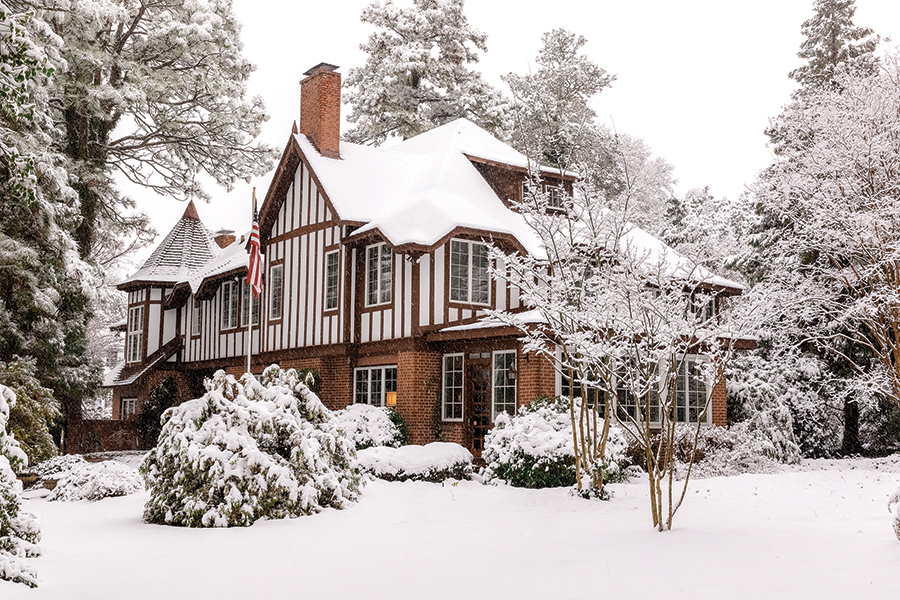
But a dress is only a dress until draped on a stunning model. Even bare-naked Le Berceau seems Christmas-y, with multiple nooks, seating and dining areas, sun porches, mantels, paned windows, staircases, a tiny telephone cubby begging decoration. The tone is classic with red dominating since, Lucille says, “For Jim it’s either red or ugly.” The elevator bears a touch of Yule, as does the carousel horse prancing on the landing.  Jim’s office, arranged around a desk belonging to movie star Loretta Young, doesn’t escape the red wave. Here resides memorabilia from his career as an attorney, senior vice-president of the New York Stock Exchange and author of its definitive history. Lucille has her “pouting” room hung with accolades from a career in education at fine New York schools.

“I had an absolutely unqualified dream that I would live in a house like this,” Jim decided, as a boy growing up in Ohio.

In 2000, while living in a soigné Manhattan apartment with a house in the Hamptons, they contemplated retirement. But where? Let’s drive over to Pinehurst, they decided, while visiting a daughter who lived in Charlotte.

Lucille fell in love. “I felt at home,” among the longleaf pines, azaleas and gardenias that grew in East Texas, her childhood home. The Tudor-style manse with swimming pool and a servants’ wing suited for guests satisfied Jim’s goal. Imagine that, within sight of the Carolina Hotel.

This central location mattered to its first occupant. James Tufts lured Bostonian Dr. Myron Marr to Pinehurst, as resort physician. The house, designed by a Boston architect and built in 1921, probably sweetened the deal for the Marr family, who remained there until the 1950s. The Bucks are only the fourth owners.

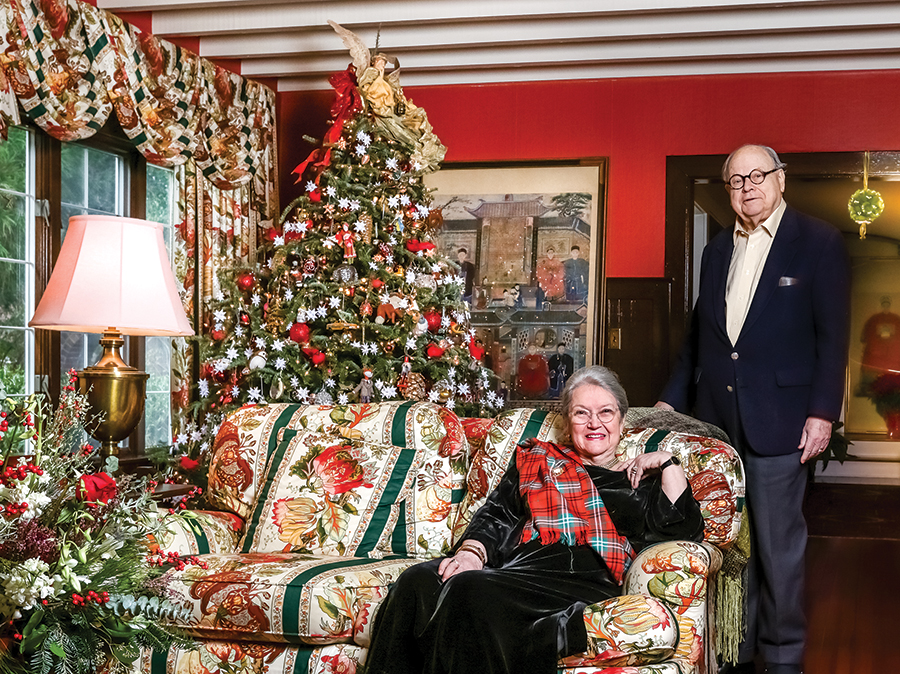
Their imprint on the house, however, is indelible, starting with the walls, wallpapered throughout. Not just commonplace florals and geometrics. In the kitchen, giant Delft-blue platters against a red background reflect the blue Viking range. Fashion drawings for a granddaughter’s bedroom, English teacups for Lucille’s dressing room, birds in the laundry room, a rubber ducky bathroom, toile and Asian motifs in the master and other bedrooms. In the salon, especially for Jim, a solid red textured paper provides a backdrop for sofas covered in a red, cream and green Brunschwig et Fils fabric chosen by Jackie Kennedy’s White House interior designer for Brooke Astor’s library.

“I’ve had my eye on that fabric for years,” Lucille says, but only now found a suitable setting.

The Bucks’ Christmas ornaments and decorations form a family scrapbook of places and events. Into the hand of a tall nutcracker (a window decoration purchased from a store going out of business) Lucille would tuck tickets to the ballet at Lincoln Center for their daughters, who eventually danced in the Christmas production. A grandson later danced the part of Fritz, garnering a glowing review in The New York Times, which Lucille proudly reads aloud.

Then, the prank concerning green balls on the tree — Lucille’s choice — which the Bucks’ son said didn’t show up well enough. Through a complicated long-distance adventure that included snitching a giant green ball from the trunk of his parents’ car and hanging it from the top of the house on the Fourth of July, Lucille was proven wrong. Now, Moravian stars, pine cones and cardinals represent their relocation to North Carolina.

“In every house we’ve lived in, I always wanted a bigger Christmas tree — to touch the ceiling,” Jim says. Lucille decorates the tall living room tree and a smaller one in the bedroom, needing help only with attaching the angel on top. She commemorates Jim’s Swedish background with a Santa Lucia doll wearing a crown of candles — but marinated herring isn’t for Christmas dinner.

Christmas holds one poignant memory for Lucille:
“My mother and father took me into the woods to cut a tree . . . it was a great outing. One time we even chose a holly (bush).” Lucille’s father died when she was 12. “The year after that our minister went with us, so I wouldn’t miss it.”

Their decorations remain in place until Feast of the Epiphany, Jan. 6.

But last year, overriding all memorabilia and decor, was that wreath of anniversary orchids — a veritable canopy over the dining room table — designed and implemented by Carol Dowd of Botanicals. “We started planning in July,” Dowd says, inspired by a hanging orchid arrangement Lucille remembered from a dinner party in New York. Surprisingly, the two dozen white orchids, FedExed from Miami, proved long-lasting with only water tubes. The wreath hung for more than two weeks. More important, rather than obstructing guests’ sightline, the wreath, suspended over a low centerpiece, created a bower effect.

What a Christmas. What memories. “My Scottish heritage found me,” Lucille says. Sharing it with close friends was a blessing. “We’re the same generation. We’ve lived this long and have been successful, career-wise and in marriage. The party was a big job but I didn’t mind. In fact, it invigorated me.” PS

Our Christmas Sing

Our Christmas Sing

A tradition that measures the years

By Margaret Maron     Illustrations by Laurel Holden

John thought it was probably the Christmas of 1978.

Scott said, “No, I think it was earlier.”

“Maybe 1976?” asked Celeste.

Carlette thought that sounded about right.

After hearing them puzzle over when it all began, I finally went through some of my old journals and found this entry: “First time all five Honeycutts here for dinner since the summer. By candlelight, firelight, and tree lights, we sang carols till midnight.”

It was December 23, 1977.

As farm girls growing up amid the tobacco fields of Johnston County, Sue Honeycutt and I had sung in our church choir. I can carry a tune as long as it is pitched no higher than B♭, but Sue’s voice soared like an angel’s. 

After school and marriage, we were separated first by an ocean and then hundreds of land miles, yet we kept in touch; and once my husband and I moved down to the family farm where I grew up, the friendship became even stronger.

There were eight of us that first Christmas: Sue and her husband, Carl, had two nearly-grown daughters and a teenage son; my husband and I had a 13-year-old boy. That evening together had been so much fun that we did it again the following December.

Do something twice in the South and it immediately becomes a tradition. The first three or four years, our ritual was to sing every seasonal song we could remember, from “Silent Night” to “Silver Bells” to “I Saw Mommy Kissing Santa Claus,” followed by a sit-down dinner, and ending in an exchange of gifts. We eventually scrapped the gift exchange — boring and too time-consuming. Instead, everyone is now encouraged to perform a party piece.

This might be a dramatic scene from a school play, an original comic skit with hand puppets, an operatic aria by a granddaughter who has inherited Sue’s voice, or a Christmas poem. (I have to be restrained from reading A.A. Milne’s “King John’s Christmas” every year.) Early on, our sons made us laugh with their take on the classic “Who’s On First?” routine. This past year, Sue’s 6-year-old great-granddaughter donned a blue shawl and shyly mimed “Mary, Did You Know?” When her father was that age, he came with a stash of Christmas riddles: “What do snowmen eat for breakfast? Frosted Flakes, of course.”

Getting measured soon became another part of the tradition. One end of our kitchen wall is thick with dated lines that mark the years. Off come the shoes and everyone who’s still growing stands up straight, heels against the baseboard. A granddaughter will proudly announce that she’s grown two full inches since last year, while her cousin is delighted to see that he’s almost as tall as his uncle was when that uncle was 10 years old. Sue and Carl’s newest great-grandchild went on the wall this past Christmas. She was only six weeks old and her daddy had to straighten out her little frog legs to get an approximate measure.

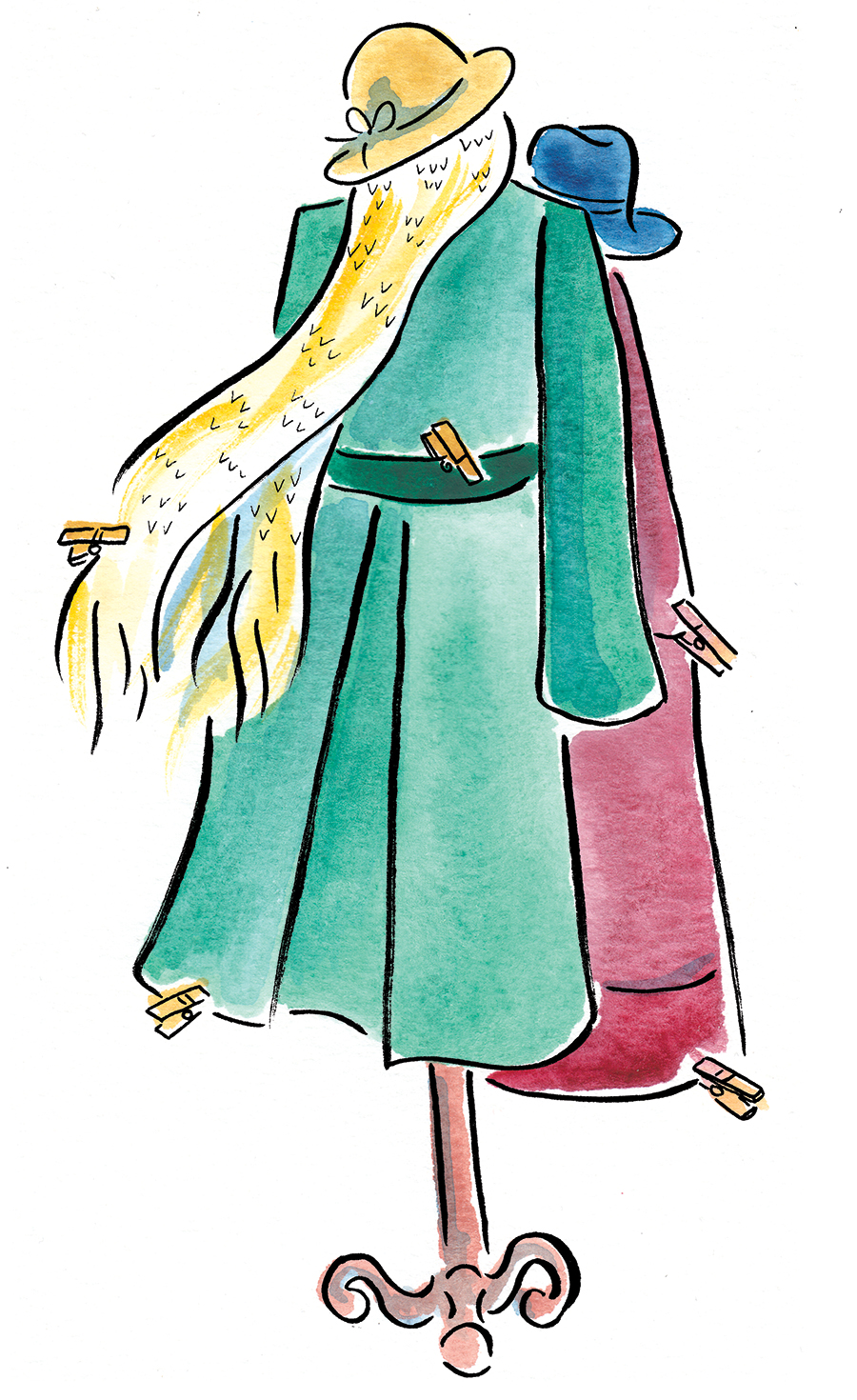
For several years, as people began to put on coats and hats and look for their car keys, the evening would wind down with a child’s whisper, “Is it time to get silly yet?” I would nod and slip her a handful of clothespins, which she quickly shared with equally mischievous cousins. Looking like innocent angels, they maneuvered among their elders, surreptitiously clipping a clothespin on the back of an uncle’s shirt, a grandparent’s sleeve, the hem of an aunt’s skirt. Soon everyone would be laughing and slapping their clothes to find the clothespin, which they immediately transferred to someone else’s scarf or hat. More than one clothespin went home on the coattail of an unsuspecting victim.

There are 26 of us now and our sit-down dinner has devolved into little plates of finger foods. The meal still ends with coffee and a Yule log elaborately decorated with meringue mushrooms, but I’ve passed the recipe on to our older granddaughter.

Some songs are dropped as new ones are added, but we’ll never drop “The Twelve Days of Christmas.” Everyone joins in on all the words except for the “gift” itself, which becomes a solo or duet, depending on how many people are here. Early on, Carl croaked out “two turtledoves” in a distinctly tone-deaf baritone, which so cracked us up that he was awarded permanent possession of the second day. With her beautiful voice, Sue was a natural for “five golden rings.” The rest of us split up the remaining days in no particular order, although my husband is rather fond of “three French hens.”

Carl left us last year and his pitch-perfect son inherited those two turtledoves. It breaks our hearts to know that this year someone else will have to sing Sue’s five golden rings. It will be a bittersweet continuation and more than one pair of eyes will glisten in the candlelight.

But laughter has always been a huge part of our tradition, too. As the first generation of grandchildren matured, their slapstick silliness faded away, but two of Sue and Carl’s great-grandchildren are now 10 and 7.

I think it’s time to slip them some clothespins.  PS

A native Tar Heel, Margaret Maron has written more than 30 novels and dozens of short stories. She was inducted into the North Carolina Literary Hall of Fame in 2016.

Almanac

The simplicity of winter has a deep moral.
The return of Nature, after such a career of splendor and prodigality, to habits so simple and austere, is not lost either upon the head or the heart. It is the philosopher coming back from the banquet and the wine to a cup of water and a crust of bread.

– John Burroughs, The Snow-Walkers, 1866

It’s been a while since you’ve come to visit, and when you see her, you gasp.

She looks different. And not just the kind of different one looks from the passing of an ordinary spring, summer and fall.

She has stories.

In the sweeping meadow, the weeping cherry is the axis about which all of life revolves. It’s always been this way, at least for as long as you have known her. Which is why you’re so shaken to discover the woodpecker drillings along her trunk and branches.

Signs of decay.

As you sit beneath her trunk, comforted by her silhouette in purple twilight, three, four, five white-tailed deer slip through the longleaf veil in the distance. Either they do not see you, or they recognize you as one of their own.

Six deer.

Seven.

You watch them graze in the meadow — just feet away now — and as the last doe brushes past, you exhale a silent prayer.

Grace is here.

You place your hands on the weeping cherry’s trunk, honoring this perfect moment, this bare-branched season, the vibrancy among decay. 

It’s time to go home now. It won’t be the same. But there are stories to share. And grace.

Spirit of the Deer

As a child, Christmas Eves were spent at my grandparents’ house, where all the cousins hoped to be the first to spot the shiny pickle ornament Papa had hidden in the tree. After evening Mass, then dinner, where soft butter rolls, pumpkin bars and scalloped potatoes were first to vanish from the spread, gifts were exchanged. Whoever found the pickle got theirs first.

And then, the hour drive home.

“Watch for deer,” Papa would say before we left.

We always saw them, frozen in the headlights on the roadside.

Three, four, five . . . six deer, seven.

I counted until drifting off to sleep.

Many ancient cultures believe that when an animal crosses your path, its spirit has a special “medicine” for you. The deer is a messenger of gentleness and serenity.

If you happen to see one in the thicket of holiday hustle and bustle, even if it’s the one you recall snacking on your hosta and pansies last spring, consider the ways you can bring more grace and kindness to yourself and the world.

Comet and Cupid

According to National Geographic’s Top 8 Must-See Sky Events for 2018, the comet eloquently named 46P/Wirtanen will travel past the luminous Pleiades and Hyades star clusters as it makes its closest approach to the Earth on Sunday, December 16 — the comet’s brightest-ever predicted passage.

Whether or not you catch the celestial show, don’t miss the chance to celebrate the “rebirth of the Sun” on Friday, December 21 — the day before the full cold moon. Call it winter solstice, Yule or midwinter, the longest night of the year is a time for gathering . . . and ritual.

In Japan, it’s tradition to take a dip in the yuzu tub, a hot bath filled with floating yellow yuzu fruit, to ward off the common cold.

Not a bad way to welcome winter.

Or around a fire with dearest friends, sharing stories and cider beneath the near-full moon.

In the Garden this Month

Rake fallen leaves for compost.

Plant hardy annuals (snapdragon, petunia, viola).

Take root cuttings from cold-sensitive perennials and plant them indoors.

Order fruit trees and grape vines for late-winter planting.

Dream up, then plan for your spring garden. 

The Return of the Light

The Return of the Light

A celebration of food and faith at Pinehurst’s Temple Beth Shalom

By Jim Dodson

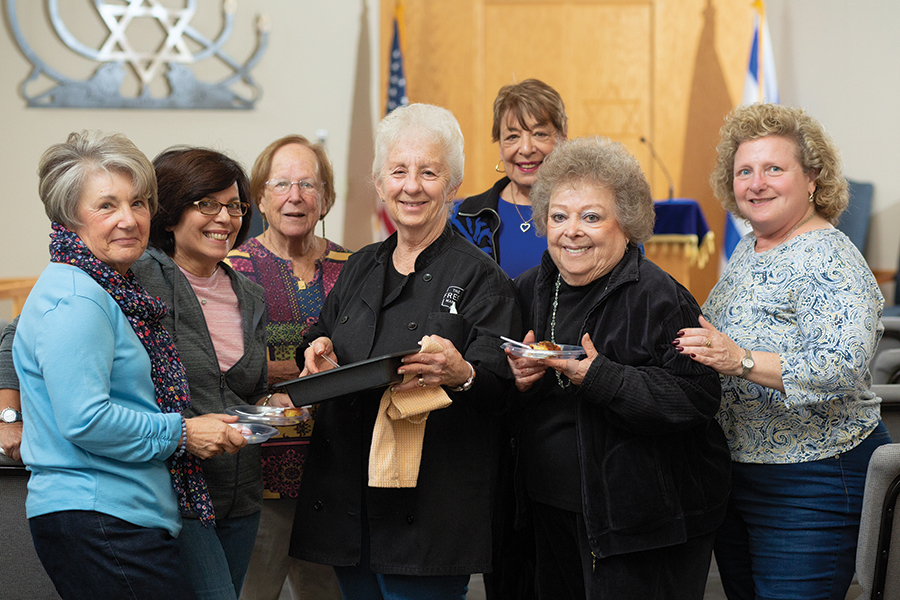
One morning not long ago, as shorter days and darker nights began to settle over the Sandhills, we dropped by Pinehurst’s Temple Beth Shalom to visit with the women of Carol Pierce’s cooking class.

In the aftermath of the tragic attack on the Tree of Life Synagogue in Pittsburgh during which 11 worshippers were murdered as they prayed on a Saturday morning — the worst recorded attack on Jewish people in American history — Beth Shalom’s congregation held a prayer and healing service that filled its sanctuary with people of all faiths from across the Sandhills. On the Sunday before Thanksgiving, the Temple also hosted the 13th annual interfaith service with half a dozen Christian churches from the area. As one member of the Temple family put it, “This was exactly the spiritual lift we needed, an outpouring of fellowship from our neighbors and friends — a way to bring back the light.”

Indeed, with the lights of Christmas shining brightly everywhere these days, we couldn’t think of a better moment to grow that light and celebrate the timeless messages of Hanukkah, the beloved Jewish Festival of Lights that begins on Dec. 2 and ends Dec. 10, a family-centered holiday observed by the sharing of traditional foods, ritual lighting of a special nine-candle menorah and reciting of prayers, playing games and offering gifts over eight nights and days to commemorate the restoration of the Second Jerusalem Temple in 167 BCE.

At that time, the Holy Land was ruled by the Hellenistic Seleucid Empire of Syria that forced the people of Israel to accept Syrian Greek culture and spiritual beliefs in place of their own Hebrew God. Against all odds, a small band of faithful Jews, led by a freedom fighter named Judah the Maccabee, defeated one of the mightiest armies on Earth, drove the Syrian Greeks from their land and reclaimed the Holy Temple in Jerusalem, rededicating it to the divine light of God.

When the victors sought to relight the temple’s menorah in celebration (the seven-branched candelabrum), they found only a single cruse of olive oil that had escaped contamination by the Syrian occupiers. Miraculously, they lit the menorah with a one-day supply of oil that somehow lasted for eight days until new holy oil could be prepared under conditions of ritual purity. To commemorate this miracle, Jewish sages instituted the festival of Hanukkah.

At the heart of the festival is the nightly lighting of a special nine-candle menorah called the Hanukkiah, using the shamash (“attendant”) candle to light one candle each night until all nine candles are ablaze. Special blessings and traditional prayers accompany the lightings, and songs of praise are sung after the candles are lit. Families also exchange “gelt” (everything from jelly beans to coins made of chocolate) and play “dreidel” (a game of chance played with a four-sided top), exchange small gifts and share special holiday foods cooked in oil to symbolize the endurance of the Jewish people. In observant households, lighted menorahs are placed in windows to bring light to the darkness.

“The thing that really brings people together and best symbolizes Hanukkah is the traditional foods,” Carol Pierce explained as her students – Elaine, Nancy, Harriet, Sheila, Bonnie and Audrey — filtered into Beth Shalom’s cozy kitchen area, chatting away about the sudden turn in the weather and their own holiday preparations. “The foods of Hanukkah are fried, symbolic of the miracle of the oil that lit the lamp in the temple.”

“In other words,” someone quipped, “a heart attack on a plate.”

“Hanukkah brings back the best memories,” Elaine Schwartz was moved to say. “Everyone tends to have their own recipes for these foods, but my late mother made the best potato latkes ever. She served them warm from the oven with homemade applesauce and sour cream, and we always played the dreidel game for M&Ms. Unfortunately, she never wrote down her latke recipe and I’ve never quite found one to match it.”

These days, Schwartz added, she observes the holiday by sending her two grandchildren in Colorado gelt-filled dreidels and a nice gift for one of the nights of Hanukkah. “The holiday has changed in some respects. When I was young, my mother would give my sister and me coloring books and crayons for each night and a larger gift on the last night. But kids these days are competing with Christmas, in a way. Hanukkah has been somewhat Americanized,” she reflected. “That’s OK. The holidays share things in common — gifts, food and lights. It’s really about family time.”

Holiday traditions mean everything. As Sheila Rappaport placed her pre-made potato latkes on a cookie sheet to heat up (“You can make them well in advance and freeze them wrapped in paper towels — they keep wonderfully!”), her daughter, Audrey Shalikar, mused how her own children are now in their 30s, but she has kept her Hanukkah decorations at the ready for the expected birth of her first grandchild that is due soon. “So someday when they come to visit,” she says, “I’ll be ready with my mother’s latkes and dreidel games and the full experience of Hanukkah.”

Nancy Jacobs has a lovely story about the ecumenical appeal of a well-made latke. “My late husband, Bob, loved to make latkes,” she remembers. “Every year he spent an entire Saturday making two to three hundred latkes for the open house we always held after the Christmas tree lighting in the village of Pinehurst. Bob sang in the village chorus. He loved both holidays and the people who came to our house — always a hundred or so folks. They loved Bob’s latkes. It was a special evening.”

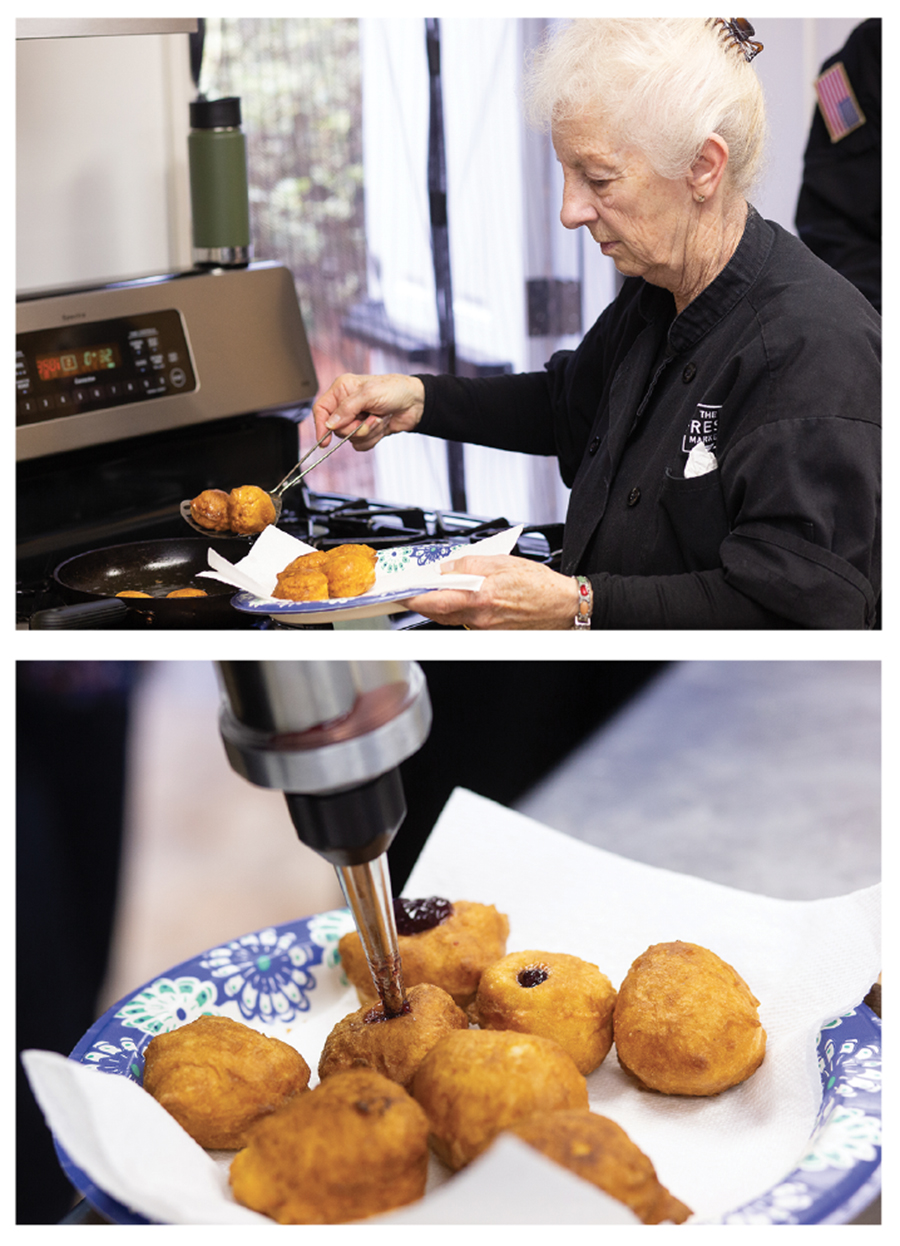
Over the next full and lively hour, the women of Beth Shalom traded laughs and sweet memories of their own Hanukkahs past as they learned an easy technique from Carol Pierce for making jelly doughnuts, latkes and a special panettone pudding from Fresh Market. There was talk of classic brisket recipes and chicken and matzo ball soup; homemade applesauce and Hanukkah cookies.

At one point Barbara Rothbeind, Beth Shalom’s energetic vice president, stuck her head in to see how the cooking group was faring. “It’s been a difficult year for Jewish people,” she reflected, “but the outpouring from people of faith across this community has been such a blessing. It shows how we stand together in a darkened time — letting our light shine. Hanukkah is all about that —food and family and fellowship.”

As we sampled a second warm and delicious jelly doughnut fresh from the kitchen’s oven, we couldn’t have agreed more.

Fresh Market Panettone Bread Pudding

1 box of Fresh Market Panettone Bread

1 cup heavy cream

1 cup whole milk

2 whole eggs

2 egg yolks

1/4 cup sugar

1 teaspoon grated orange zest

1 teaspoon vanilla extract

Preheat oven to 350 degrees. Cut panettone into 1-inch cubes and place in a 9-by-9-inch greased pan. In a large bowl whisk together remaining ingredients. Pour liquid mixture onto panettone cubes. Press cubes gently until all are saturated. Soak for five minutes. Bake for 60 minutes. Allow bread pudding to cool for 5 minutes before serving. Drizzle with caramel sauce or top with fresh whipped cream. 

Easy Potato Latkes

2 cups raw grated potatoes

1/2 cup grated onion

Pinch of baking powder

1 1/2 teaspoons salt

1 tablespoon of flour or matzo meal

2 Eggs

Peel potatoes and soak in cold water for several hours, then grate and drain. Beat eggs well and mix with other ingredients, add a little pepper if desired. Drop spoonfuls on hot greased skillet and cook until golden brown, both sides.

Keep warm in oven until ready to serve with warm applesauce

Easy 10-minute Applesauce

3 Golden Delicious apples, peeled, cored and quartered

3 Fuji apples peeled, cored and quartered

1 cup apple juice

2 tablespoons cognac or brandy (optional)

2 tablespoons butter

3 tablespoons honey

½ 1 teaspoon cinnamon

Combine apples and all other ingredients in microwave-safe container. Microwave uncovered for 10 minutes.

Use blender or potato masher to blend to desired consistency.

Serve warm or chill for later use.

Amazing Brisket

1 4–5 pound first cut brisket

1 cup dark brown sugar, lightly packed

1 package Lipton Onion Soup Mix

1 bottle Heinz Chili Sauce

Potatoes and carrots

Heat oven to 350 degrees

Place brisket in deep roasting pan. Combine sugar, soup mix and chili sauce; spoon over meat and cover pan. Cook for 2 1/2  hours, remove and cool for one hour.

Slice meat against grain, cover and cook brisket for another 2 hours, or until brisket is tender.

Add quartered red bliss or Yukon Gold potatoes (unpeeled) plus a small bag of baby carrots and cover with sauce, for the last hour.

Kugel

12 ounces noodles

1 cup cottage cheese

1 cup sour cream

3 eggs, beaten

1 stick butter, softened

Salt and pepper to taste.

Cook and drain noodles according to package directions. While still hot, add the other ingredients and stir well. Pour mixture in greased casserole and bake in preheated 350-degree oven 35 to 40 minutes.

For variety (and to make it sweet), you can add 1/2 cup sugar, 1/4 teaspoon cinnamon and a handful of raisins,

To make it savory, add only 1/2 stick of butter. Then sautée one medium chopped onion, 1/2 cup chopped mushrooms and 1/4 cup chopped celery  When veggies are browned, add to noodle mixture and bake as above. 

Pour mixture in greased casserole and bake in preheated 350-degree oven 35 to 40 minutes.

Can be frozen — defrost completely before warming in a 350-degree oven 10 minutes.

Matzo Balls

1 cup water

1 stick butter

1 cup matzo meal

Parsley, sugar, salt, paprika, ginger, nutmeg and grated onions to taste

3 eggs, separated

In a medium sauce pan combine water and butter. Heat until butter dissolves. Add matzo meal and stir until water is absorbed. Season to taste with parsley, sugar, salt, paprika, ginger, nutmeg and grated onions. Mix well.

Beat egg yolks until lemony and add to matzo mixture. In a clean bowl, with clean beater, beat egg whites until stiff; fold into matzo mixture. Chill well in covered container for at least 4 hours

To make the matzo balls, dip fingers in warm water and roll chilled mixture into balls.

If you wish to freeze, place on a cookie sheet and freeze. The frozen balls can be placed in a plastic bag until you need them. When ready to use them, drop them in boiling chicken broth and cook for 30 minutes on medium heat.

Add to your favorite soup! Yield: 27 medium/small matzo balls

Simple Chicken Soup

3 chicken breasts

4 carrots, halved

4 stalks celery, halved

1 large onion, halved

Water to cover

Salt and pepper to taste

1 teaspoon chicken bouillon granules (optional)

Put the chicken, carrots, celery and onion in a large stock pot and cover with cold water. Heat and simmer, uncovered, until the chicken meat falls off of the bones (skim off foam every so often).

Take everything out of the pot. Strain the broth. Pick the meat off the bones and chop the carrots, celery and onion. Season the broth with salt, pepper and chicken bouillon to taste, if desired. Return the chicken, carrots, celery and onion to the pot, stir together, and serve. 

Mandelbrot

(A sweet bread similar to biscotti)

3 eggs

1 cup sugar

1/3 cup vegetable oil

1 teaspoon vanilla

2 3/4 cups flour

2 teaspoons baking powder

1/2 teaspoon cinnamon

1/4  teaspoon salt

1/2  cup walnuts

Optional: chocolate chips, dried cranberries.

Beat the eggs and sugar until light and fluffy. Add the oil and vanilla and mix thoroughly.

Sift the flour, baking powder, salt and cinnamon together and add to the sugar mixture. Mix until blended, adding the nuts as the dough starts to come together.

Briefly knead the dough on a floured surface. Divide into 2 pieces and shape each into a log about 3 inches wide. (Add chocolate or cranberries at this point.)

Place logs on greased cookie sheet. Bake at 350 degrees for 30–35 minutes, until golden.

Remove from oven and let stand until cool enough to handle. Slice logs diagonally into 1/2-inch slices. Lay them on the cookie sheet cut side up and return to oven.

Bake on the top shelf for 10 minutes and then on the bottom shelf for 10 minutes until toasted and brown.

Sweet Sufganiyot

(Traditional jelly doughnuts) 

3 cups flour

2 teaspooons baking powder

2 tablespoons sugar

1/2  teaspoon vanilla

1/2  teaspoon nutmeg (optional)

2 eggs

2 cups sour cream

Oil for frying

Jelly (any preferred flavor — black raspberry a favorite)

Powdered sugar

In a bowl, blend together the flour, baking soda, sugar, vanilla, nutmeg, eggs and sour cream.

In a skillet, heat the oil, and when very hot, drop tablespoons of batter into it. When the batter puffs up and turns light brown, turn it over and cook the other side.

Set doughnuts on paper towel to cool.

Make a small hole and fill with jelly. A cooking syringe can make this easy. Sprinkle with powdered sugar and serve immediately.  PS

A Tar Heel Thanksgiving

Over the river and through the woods . . . from mountains to the coast we go for a feast rich in the tastes and traditions of North Carolina

By Jane Lear     Photographs by James Stefiuk

Southern Thanksgiving typically occurs around a table so crowded with platters and serving bowls there is barely enough room for glasses and flatware. A sausage and cornbread dressing may jostle for space with oyster casserole and hot, lighter-than-air biscuits; rice and cream gravy may vie with braised turnip greens dotted with crisp bacon. And then there’s the roast turkey, with its burnished, crackling skin, taking center stage. It’s a wonder anyone has room for dessert.

It wasn’t always so — many Southerners considered Thanksgiving a New England (that is, abolitionist) holiday well into the 20th century — but now we happily, gratefully come together on the fourth Thursday in November to honor and sustain ties to family, friends and, of course, place.

Generally speaking, the South is a cornucopia of numerous cuisines, and when it comes to North Carolina in particular, the variation is remarkable, sweeping as it does from the hills and hollows of Appalachia to the lush Piedmont — with its low, rolling hills, it’s as rumpled as a collard leaf — and on down a broad swath of Coastal Plain to the Atlantic. And while it’s true that a simple, almost austere bowl of soup beans and cornbread seems a world away from a lavish platter of deviled crab, they are both products of an abundant region.

They are products, too, of the complex, bittersweet melting pot that was the antebellum South. European explorers and settlers brought, among other provisions, pigs, cattle, chickens, wheat, apples and turnips. Along with the slave trade came rice, okra, collard greens, black-eyed peas, peanuts, sorghum and watermelon. And all the newcomers relied greatly on Native American foodstuffs, including seafood, corn, beans, squash, sweet potatoes, chestnuts and low-bush cranberries, once common to the wetlands of Pamlico Sound.

And so when I was asked to come up with three side dishes that exemplified, respectively, the mountains, Piedmont, and coast of North Carolina, there was an astonishing array to choose from. At the end of the day, though, I realized that at Thanksgiving, none of us is really interested in complicated food, with lots of bells and whistles. What we crave is food that is sumptuous yet straightforward, rich yet not cloying. The flavors that speak to us are profound and nourish us on several different levels.

Take, for instance, sorghum mashed sweet potatoes. North Carolina, which grows almost half the country’s supply of sweets, designated the tuber the state vegetable in 1995. Most of the production is in the sandy soils of the Coastal Plain, but sweets are grown all over the state, including the mountains. What really gives this recipe its Southern Appalachian cred, however, is the sweetener used: sorghum syrup, which is the cooked-down juices of the tall canelike sorghum plant. It’s not as assertive as molasses (a byproduct of refined-sugar manufacturing), but its depth charge of flavor really resonates.

In addition to having a great affinity for sweet potatoes, sorghum is wonderful swirled into butter. “I can’t tell you why sorghum syrup blended at the table with soft butter tastes better on a hot biscuit than putting the two on separately,” wrote Ronni Lundy in her instant classic, Victuals: An Appalachian Journey, with Recipes. “I can just tell you it does, unequivocally. And that’s why generations of mountain mamas have taught their babies how to do this.”

Sweet potatoes, by the way, are not yams. A true yam (the word comes from the West African inhame, pronounced “eenyam”) is a starchy, unsweet tuber that originated in the tropics, and although you’ll find it in African, Caribbean, Philippine and Latin groceries, odds are it isn’t piled in a big heap at your local Harris Teeter or Food Lion.

Not only are sweet potatoes not yams, they’re not real potatoes, either, but a member of the morning glory family. Given its Latin name, Ipomoea batatas, it’s not a huge linguistic stretch from batata to patata and potato. To further confuse the issue, back in the 1930s, promotors of Louisiana-grown sweets used the word yam to distinguish their crop from those grown in other states, and the misnomer became the basis for an enduring culinary myth.

When it comes to a green vegetable at Thanksgiving, lots of folks are happy with Brussels sprouts or broccoli embellished with crisp bacon or toasted nuts. There is nothing wrong with these delicious options, but I am always eager for the first frost-kissed pot greens of the season. Many people consider them sweeter than they are at other times of year, and their opinion has its basis in fact. In response to cold temperatures, the greens break down some of their energy stores into sugars, and so are at their peak flavorwise.

Southerners tend to simmer a variety of greens together, and each has its own character: Collards are mellow and meaty; turnip greens are sharp and spicy; and kale provides a sturdy underpinning and plays well with the others. In the recipe below, a satiny béchamel sauce rounds out the natural bitterness of the greens and lifts them into the realm of the extraordinary, especially with a little help from glossy, rich chestnuts.

Like most home cooks, I don’t have the time or inclination to roast and peel chestnuts at home. That job, not nearly as romantic as it sounds (your fingers burn, bleed, or both), falls squarely in my “Not No, but Hell, No” category. The pre-roasted chestnuts in a vacuum-packed jar — available almost everywhere this time of year — are excellent, a true convenience food, and do the job beautifully.

They are, however, from Italian, not American chestnut trees, and therein lies a tale. The vast majority of American chestnuts — an estimated 4 billion trees — succumbed during the mid-20th century to chestnut blight, a fungus that thumbed a ride on imported Asian trees. This great American tragedy has all but been forgotten, except by many in rural communities — from the North Carolina Piedmont to the Ohio Valley, from Maine to Florida — whose economy depended upon the “redwood of the east.” It grew tall (often 100 feet or more), fast, and as straight as a column, providing rot-resistant hardwood for houses, fences, and furniture — from cradle to coffin, as it were.

A single mature chestnut could reliably produce 6,000 nuts every year. High in fiber, vitamin C, protein and carbohydrates, they were a boon to both settlers and their livestock, as well as an intricate web of wildlife, from pollinators to birds and bears. These days, dedicated plant scientists and volunteers are breeding and planting blight-resistant trees to repopulate our eastern woodlands. The widespread effort is led by the Asheville-based American Chestnut Foundation, and you can find out more at acf.org.

One of the things I’ve long found interesting about Thanksgiving is the widespread presumption that all Americans eat exactly the same food, the sort conjured by Norman Rockwell’s sentimental 1943 painting Freedom from Want (a.k.a. “the Thanksgiving Picture”). But in my experience, plenty of families happily veer far from this ideal based on their heritage and local bounty, and they don’t give it a second thought.

Dressing is an excellent example of what I mean. (Yes, most Americans call it stuffing, even those who prefer to bake it separately instead of inside the bird, but “dressing” is still widely used in Southern circles.) It never occurred to me until I was almost grown that different families have different takes on this traditional accompaniment. While at college, I went home with a Midwestern roommate for the holiday, and the hearty caraway-spiked rye bread, sauerkraut and apple rendition her mom served was worlds away from my mother’s cornbread dressing with sage and onion. I was stunned and amazed.

Since then, I’ve broadened my outlook and, emboldened by an 18-year tenure at Gourmet magazine, I’m not shy about trying something new. Homemade cornbread or a mix of cornbread and a store-bought country loaf is my usual base, but then I roll up my sleeves and have fun. For years, I made a sausage and fennel dressing, sometimes enlivened with cranberries or dried cherries. Prosciutto, pancetta or bacon is always good in a dressing — all are lighter than sausage — and pecans provide a nutty, irresistible crunch. The combination of chestnuts, apples and leeks is a serendipitous one, as is chard, golden raisins and pine nuts.

And on this most inclusive of holidays, dressing is extremely versatile. Chorizo and fresh green chiles push it in a Southwestern direction; andouille and dirty rice (instead of bread) give it New Orleans flair. One Chinese-American friend in Winston-Salem makes a heavenly concoction that involves dried Chinese sausage, shiitake mushrooms and bok choy, for crunch. You get the picture.

This year, however, in the wake of Hurricane Florence, my thoughts are with friends and family in Wilmington and elsewhere in the Old North State. We all love our oysters, and even though I’ll probably kick off my Thanksgiving Day celebration with a few dozen on the half shell, incorporating them into my dressing doesn’t seem like overkill. Chopped, they won’t come across as a disparate seafood component, but will add richness and a deep savoriness to a simple herb and onion dressing. We’d miss them if they aren’t there.

Happy Thanksgiving! Here’s hoping you find room for just one more bite.
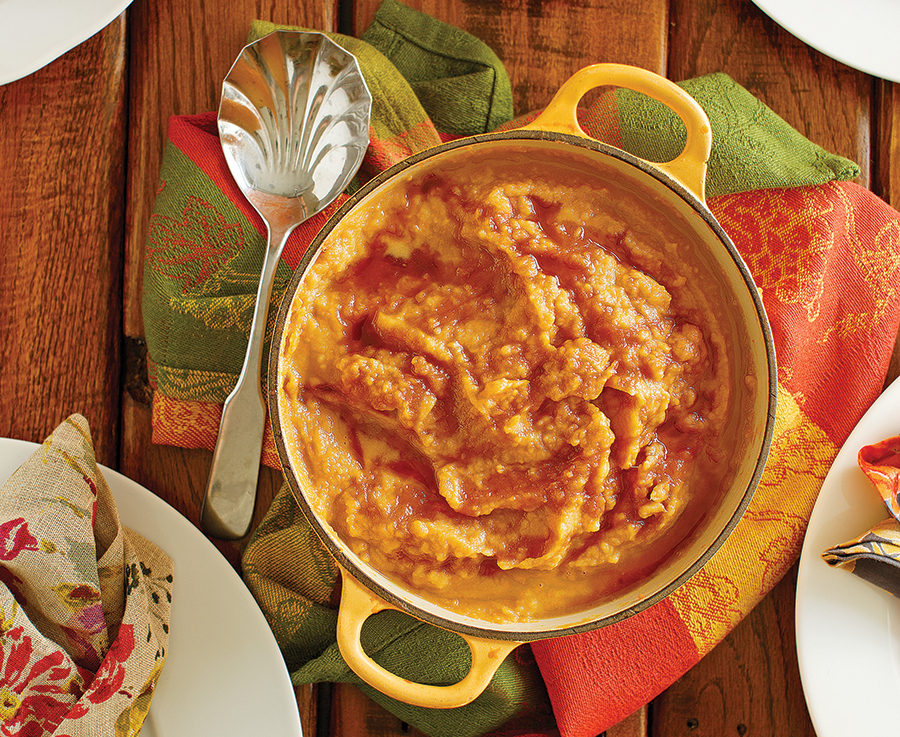
Sorghum Mashed Sweets

Serves 8

You’ll find a number of different sweet potato varieties at supermarkets, especially this time of year. In general, the deeper the flesh color, the moister and sweeter they are when cooked. Sorghum syrup is available at many supermarkets and online sources. Because some brands are cut with corn syrup, make sure the label reads “100 percent sorghum.”

6 pounds sweet potatoes, scrubbed and pricked with a fork

1 stick unsalted butter, melted

1/2 cup half and half or heavy cream, warmed through

2 tablespoons sorghum syrup, or to taste

Coarse salt and freshly ground pepper

1. Preheat the oven to 400°. Put the sweet potatoes on a foil-lined baking sheet and bake until extremely tender, at least an hour or more. Let cool, then halve and spoon the flesh into a bowl, discarding skins.

2. Mash the sweets with a potato masher until smooth, then stir in butter, half and half, and sorghum. Season with salt and pepper to taste.
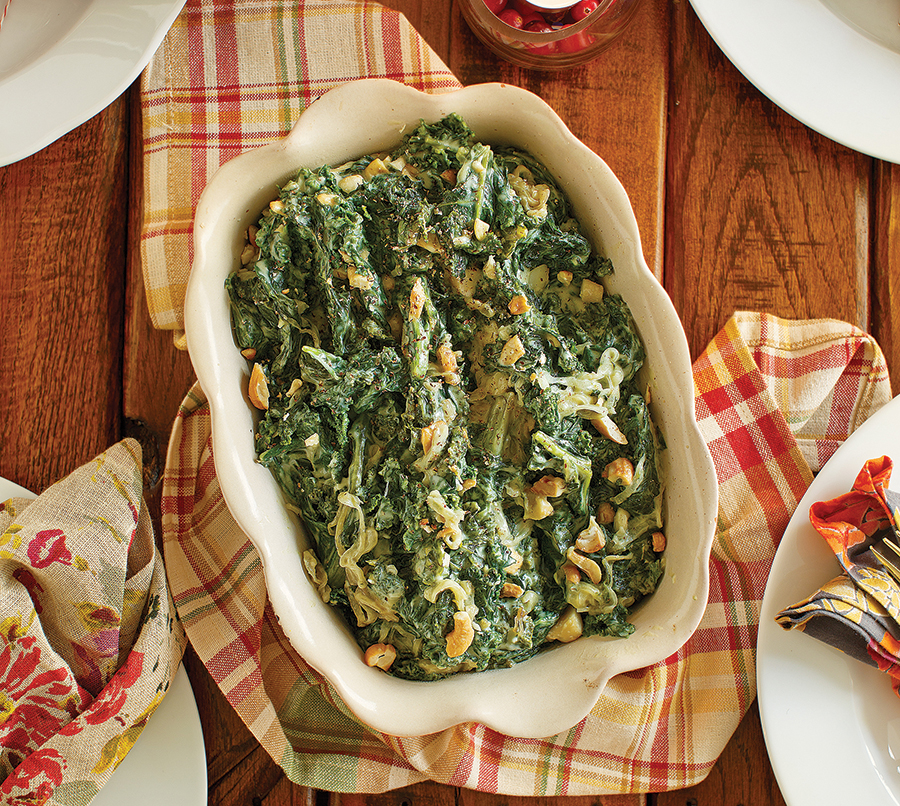
Creamed Greens with Chestnuts

Serves 8

Keep the turnip greens separate after chopping — they’re added to the pan after the thicker-leaved collards and kale have cooked for a while. No turnip greens? No problem. You could substitute mustard greens, with their radishy hotness, or chard, which turns especially silky when cooked.

1 large bunch each collards, kale and turnip greens, tough stems discarded and leaves coarsely chopped (about 20 cups total; see above note)

Coarse salt

3/4 cup dry white wine

6 tablespoons unsalted butter, divided

2 large shallots, thinly sliced

1 bay leaf

1 cup jarred vacuum-packed chestnuts, coarsely chopped

2 tablespoons all-purpose flour

1 1/2 cups whole milk

1 1/2 cups heavy cream

Pinch of freshly grated nutmeg

1. Wash the greens well; shake off the excess water but don’t dry completely. In a large sauté pan, cook the collards and kale with salt and wine over moderately high heat, covered and turning with tongs occasionally, until wilted. Reduce heat to moderate and cook, turning occasionally, until almost tender, about 15 minutes. Add turnip greens and cook, uncovered, until wilted. Transfer greens to a bowl.

2. Melt 4 tablespoons butter in the sauté pan over high heat. Add the shallots and bay leaf and cook, stirring, until shallots are softened, 2 to 3 minutes. Stir in chestnuts and cook about a minute more. Discard bay leaf, then stir in greens to incorporate and set aside.

3. Melt remaining 2 tablespoons butter in a saucepan over moderately high heat. Whisk in the flour, then gradually whisk in the milk and cream. Bring to a simmer, then simmer, whisking constantly, until sauce thickens slightly and just coats the back of a spoon, about 2 minutes or so. Whisk in nutmeg and 1 teaspoon salt to taste. Stir sauce into greens and cook over moderate heat until all is heated through.

The greens can be chopped a day ahead and refrigerated in a resealable plastic bag. The sauce can be made a day ahead and refrigerated, its surface covered with parchment paper; reheat before using. (If necessary, thin with a little milk while reheating.)
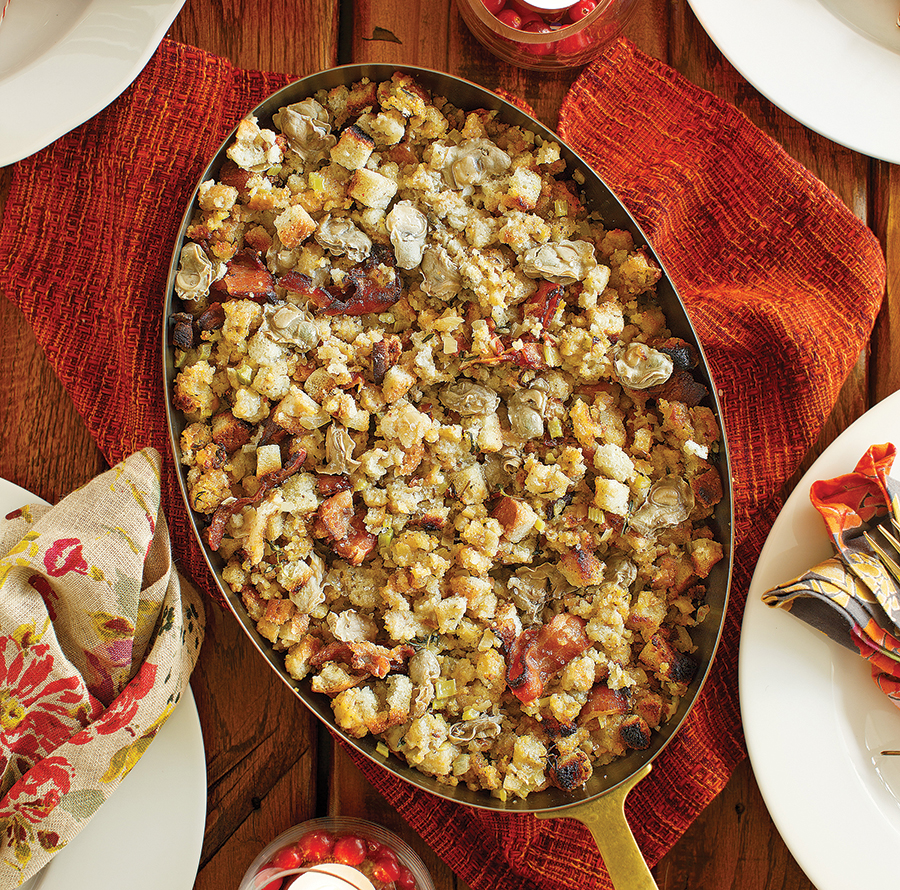
Oyster Dressing à la Gourmet

Serves 8

You can assemble this dressing, without the oysters, up to 2 days ahead, then refrigerate it, covered. Before baking, bring the dressing to room temperature and stir in the oysters.

About 2 loaves country-style white bread (not sourdough), torn into 3/4-inch pieces (about 12 cups), or a mix of white bread and your favorite cornbread, broken into 3/4-inch pieces

8 slices bacon, cut crosswise into 1/2-inch pieces

Extra-virgin olive oil (if necessary)

2 medium onions, finely chopped

1 1/2 cups chopped celery

1 tablespoon minced garlic

3 tablespoons chopped fresh thyme or 1 tablespoon dried thyme, crumbled

1 tablespoon finely chopped fresh sage or 2 teaspoons dried sage, crumbled

Coarse salt and freshly ground pepper

2/3 cup finely chopped fresh parsley

1 stick unsalted butter, melted

18 oysters, shucked, drained and chopped

2 1/4 cups turkey or chicken stock (or store-bought low-sodium
chicken broth)

1. Preheat oven to 325° with the racks in upper and lower thirds of oven. Butter a 3- to 3 1/2-quart baking dish.

2. Spread the bread pieces on 2 baking sheets and bake, switching position of sheets halfway through baking, until golden, 25 to 30 minutes. Let bread cool, then transfer to a large bowl. Leave oven on and put 1 rack in the middle of oven.

3. Cook the bacon in a large heavy skillet over moderate heat, stirring occasionally, until crisp, about 10 minutes. Let drain on paper towels, reserving fat in skillet.

4. If bacon rendered less than 1/4 cup fat, add enough olive oil to skillet to measure 1/4 cup. Add the onions, celery, garlic, thyme, sage, 1/2 teaspoon salt, and 1/4 teaspoon pepper to skillet and cook over moderate heat, stirring occasionally, until vegetables are softened, about 10 minutes. Transfer to bowl of bread, then stir in bacon, parsley, butter, and oysters. Drizzle with stock, season with salt and pepper, and toss well to combine.

5. Transfer dressing to the baking dish. Bake, covered, for 30 minutes. Uncover and bake until browned on top, about 30 minutes more.  PS

Jane Lear was the senior articles editor at Gourmet and features director at Martha Stewart Living.

Claiming the Lion’s Share

A Pinecrest star shines on Broadway

By Deborah Salomon

Numbers don’t lie.

The first movie Bradley Gibson saw in a theater was The Lion King. He was 8, give or take. At 17, with a Pinecrest High School group, he watched the New York production, enthralled. On July 2, Bradley, now 27, roared into the lead role of Simba in the show that has captivated Broadway for 20 years and won six Tony Awards.

“He doesn’t just put on the mask; he tells the story with his entire body,” says Bradley’s first dance instructor, Gary Taylor, of Gary Taylor Performing Arts. That roar you hear is one of joy for overcoming the odds, for leaping from Aberdeen to Pride Rock in a steady upward trajectory. After Pinecrest, Bradley pursued a degree in musical theater at the Boston Conservatory and, with fellow graduates, headed straight for New York. In just a month, the 22-year-old landed a part in the musical Rocky, which meant learning to box. After touring with the Broadway production of Chicago, Bradley created the role of Tyrone in the musical version of A Bronx Tale. A year and a half into the run his agent called with the news that Jelani Remy, who had played Simba in Las Vegas and then New York, was leaving The Lion King. Bradley’s gut reaction: Go for it. After days of tense auditions and callbacks, the email arrived during a matinee.

“I felt like wow, they appreciated my work.”

_

Luck? Miracle? Fluke? More likely planning, discipline and a positive attitude. Expressive eyes, a fab smile and a lithe, muscular dancer’s body helped. But the theater world is full of qualified hopefuls waiting tables between casting calls. Bradley’s “it” factor, Taylor continues, is an amazing voice and stage presence. “He makes everybody else on stage look good.”

Despite a grueling schedule — eight performances a week — Bradley sounds relaxed. “My first exposure to musical theater was watching movies like Grease, The Sound of Music, My Fair Lady. When I saw people singing and dancing it seemed so natural, like something I should be doing.”

His acting debut was as a wise old dog in the Christmas play at Aberdeen Elementary. By high school he had already participated in community theater, danced at Terpsichore and sung in a choir.

Adam Faw, Pinecrest Players Theater Arts director, remembers Brad at 14: “He was fresh in the theater arts class. I had seen him in middle school — he was different, he stood out. Many of my students were talented but not of that caliber.”

The impressive numbers march on.

By 16 Bradley was performing in productions of Crazy for You and A Chorus Line.

“He was a triple threat — singing, dancing, acting,” Faw continues. Most important: “He had a positive work ethic.”

His solos often brought down the house.

The Boston Conservatory was a whole new ball game. “It was the shock of my life. For the first time I was around nothing but artists,” says Gibson. The historic Boston Theater District is where Broadway shows open and sometimes close — a suitable environment to polish his craft. The once-shy young man from a small Southern town blossomed, made friends. After graduation his group moved to New York, where they found a supportive community.

Playing Tyrone in A Bronx Tale gave the relative newbie more leeway than he would find taking on Simba as part of an established cast. The latter meant rehearsing alone with The Lion King’s director and also with its choreographer, allowing just enough interpretation without upsetting routines. “It was the first show I had seen where all the cast members were people of color — Asian, Hispanic, African-American. This was encouraging,” he says. As was the plot, chronicling a voyage of self-discovery not unlike Bradley’s own. “It was a perfect fit.”

_

For now, the Sandhills wonderchild is too consumed by work for much introspection. The role of adult Simba is extremely physical. Imagine the energy expended six days a week, twice on Wednesdays and Saturdays. “It’s like running a corporation,” Bradley says. “I have to take care of myself.” His routine includes strengthening workouts, singing lessons and dance classes, a healthy diet, meditation, yoga, plenty of sleep. An injury could be devastating. So would going stale in the role, though there’s little chance of that. “The freedom of performing is to play someone else, to put yourself in the back seat,” he says.

Bradley arrives at 6:15 for a 7 p.m. curtain; the adult Simba doesn’t appear until an hour into the three-hour show. His makeup is complicated. Getting used to moving about in the leonine headdress and beaded corset took practice. The production elicits gasps for its reverse anthropomorphic costumes, as African “animals” lope down the aisles.

_

A favorable alignment of stars is not lost on the young performer. “I look in the mirror and know how lucky I am, but I also know luck is where preparation meets opportunity.” Self-confidence kept him afloat through callbacks that didn’t happen, parts that slipped away. “My life is so overwhelmed with blessings. I keep climbing because that’s all there is to do.”

Gibson’s success doesn’t surprise Southern Pines yoga instructor Brady Gallagher, a childhood friend and co-performer in West Side Story at Pinecrest. “He’s no different today than in high school. He was born for this — he didn’t have a backup plan.”

Beyond good fortune and natural ability, Bradley credits advice from his great-grandmother, Ruby Floyd, who raised him: Work hard! Do the best you can! It doesn’t matter if it’s on the Robert E. Lee Auditorium stage or the Minskoff Theater bordering Times Square. “He was always dancing in front of the TV,” Floyd recalls. “He wouldn’t stop watching that Lion King cartoon movie. And it paid off.”

Great-granny Floyd has seen all of Bradley’s Broadway roles. In July she watched him become Simba, tears streaming down her face. “When it was all over I stood up with my cane and applauded.”

As do his friends, admirers and mentors, 570 miles south.

“His spirit is his heart,” Gallagher observes.

“Bradley fought against odds in a world that’s already tough,” Taylor says. “When I first saw him, I said that’s a star.”

“I am beyond proud of Bradley,” adds Faw.

And the list of accolades goes on — a good sign — because numbers still count, even when, at 27, you’re batting a thousand.  PS

Sandhills Repertory Theatre and Michael Pizzi present “Bradley Gibson: The Homecoming Concert” at 7 p.m. on Nov. 26 at the Robert E. Lee Auditorium, Pinecrest High School, Southern Pines. Gibson will sing and talk about his career, which blossomed on this very stage. Part of the proceeds will benefit the Sandhills Theatre Arts in the Schools fund and other community organizations. Tickets are available at www.sandhillsrep.org. Students 18 and under with ID are $15; general admission advance purchase is $40; seniors and military with ID, $35; VIP (includes photo op with Gibson) $75. All adults at door: $50. For more information email sandhillsbroadway@gmail.com.

Rising From the Ashes

From its brutal beginning as a reformatory for “wayward” girls, Samarcand Manor’s transformation into a state-of-the-art law enforcement training center strives to live down its checkered 100-year history

By Bill Case

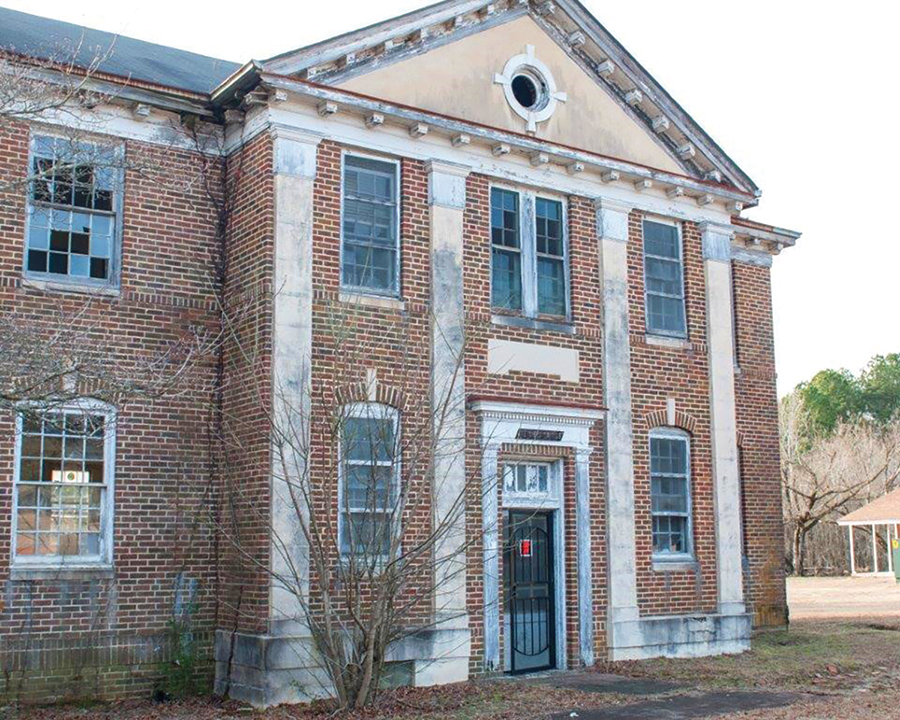
The dorm rooms are decorated with ancient mattresses and discarded clothing, occupied only by a ghostly albino cat that brushes my pants leg. You could almost hear the paint peeling from the walls. “If ever a place is haunted, it’s this one,” I muttered while traipsing through the derelict corridors of Gardner Hall, slated for the wrecking ball, at Samarcand Manor, North Carolina’s now closed reformatory for delinquent girls. More than a generation ago the dormitory housed “wayward” teenagers in Eagle Springs at what was once known as the Home and Industrial School for Girls — referred to throughout its century-old history simply as Samarcand Manor. My guide, Richard Jordan, the head man at Samarcand Training Academy (the state’s occupant of the campus since 2015), pointed to a large chamber of the eerie building. “They used this as the infirmary for girls recovering from the surgeries,” he confided. Over a decade ago the North Carolina General Assembly admitted that the surgeries Jordan referred to should never have occurred.

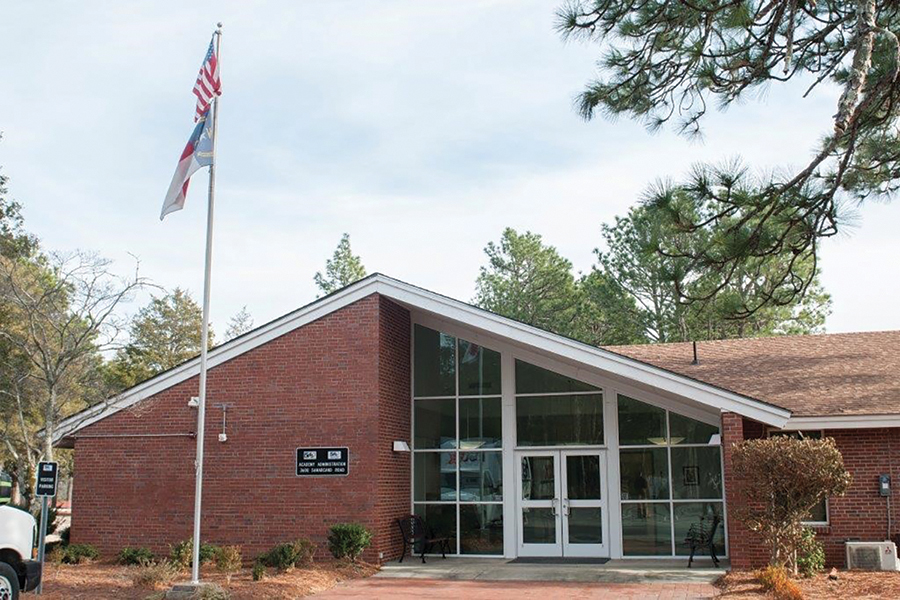
Gardner Hall’s forsaken appearance stands in stark contrast to the current spic-and-span look of most of the campus buildings, all geared toward providing the ideal environment for instructing and training North Carolina’s law enforcement and corrections personnel. Tucked away in the pinewoods, Samarcand Training Academy is state-of-the-art. But even a century after its founding in 1918, Samarcand Manor remains a subject of controversy, little of which is gleanable from the historic marker alongside N.C. 211, 3 miles north of what is now the academy. It is not the simplest of histories to unravel. State law protecting the identity of juvenile offenders hinders obtaining first-hand accounts, and it wasn’t exactly the kind of institution to have a thriving alumni association. Old newspaper articles raved about the place, but two recent books, Bad Girls at Samarcand, by Karen L. Zipf, and The Wayward Girls of Samarcand, by Melton McLaurin and Anne Russell, paint a far less flattering picture.

The use of the 230-acre main campus for educational purposes predates even Samarcand Manor’s existence. In 1914, noted educator Charles Henderson opened the Marienfield Open-Air School for Boys on the property. In the early 20th century, a near plague of tuberculosis had swept the country. Educators like Henderson believed that exposure to fresh air could ward off the disease, so his school held classes outdoors. The advent of World War I resulted in such a significant loss of manpower that Marienfield was forced to shut its nonexistent doors.

It was a Presbyterian minister from Charlotte and a North Carolina women’s club leader who lit the fuse that led to Samarcand Manor. In 1914, Rev. A.A. McGeachy began receiving statewide attention for his powerful sermons urging parishioners to perform “good works” in service of the Lord. Focusing his exhortations on the plight of those he referred to as “fallen women, seduced by the streets into lives led in sin,” McGeachy preached that good Christians should be concerned about the rehabilitation of female prostitutes and other young women of loose morals — the victims of sexual debasement at the hands of devious male ne’er-do-wells. McGeachy suggested they could be redeemed in a “reformatory for fallen women” and forcefully advocated that the state establish one.

In 1917, a print of McGeachy’s sermon found its way to Hope Summerell Chamberlain, a tireless advocate for the North Carolina Federation of Women’s Clubs. Galvanized by McGeachy’s missionary message, Chamberlain and NCFWC’s president, Kate Burr Johnson, began beating the drum at the legislature in Raleigh for a bill to create the “State Home and Industrial School for Girls and Women.” The vacated and secluded Marienfield campus emerged as the ideal location.

Some lawmakers expressed reservations. Were both young girls and adult prostitutes to be housed at the same facility? Apparently so, at least at first. Would female felons be mixing with girls who had committed minor violations? The proponents of the bill thought not, but there was nothing to prevent this. Wouldn’t it be better to attend to these females, particularly younger ones, in or near their home counties? The advocates argued that the state could more uniformly deal with the girls and women in a single institution. How long could the “State Home” keep girls in custody? The length of a girl’s incarceration, up to three years, would be left to the sole discretion of the reformatory’s Board of Managers. So much for due process.

The collective pressure from the NCFWC’s member clubs and other civic groups successfully strong-armed the bill through the legislature, eventually passing it with nary a dissenting vote. Samarcand Manor would house only white women and girls. The legislature gave no thought to funding a reformatory dedicated to the rehabilitation of “wayward” black girls until 1925.

In short order, dormitories, school and administration buildings, a chapel and a home for the new superintendent were under construction. The five-person board of managers hired Agnes MacNaughton as Samarcand’s first superintendent. Before long, close to 200 young females inhabited the campus. According to Zipf’s Bad Girls, the young inhabitants weren’t all charged with sexual offenses or serious crimes. Girls also came to Samarcand because they were socially maladjusted or had committed minor misdemeanors, like vagrancy or public drunkenness. Many had no record at all, having been banished to Samarcand by parents who deemed their daughters uncontrollable. Most came from broken homes. Others had been sexually abused in their homes, and somehow received the blame. Zipf says, “They were cotton mill workers, girls from the streets, and sometimes both.” A lot of girls were either poorly educated or thought to lack intelligence. Regardless of whether these deficiencies were innate or stemmed from a lack of educational opportunities, Samarcand tended to identify them as “feebleminded.” It was this labeling that was employed when the state Eugenics Board authorized the regrettable surgeries.

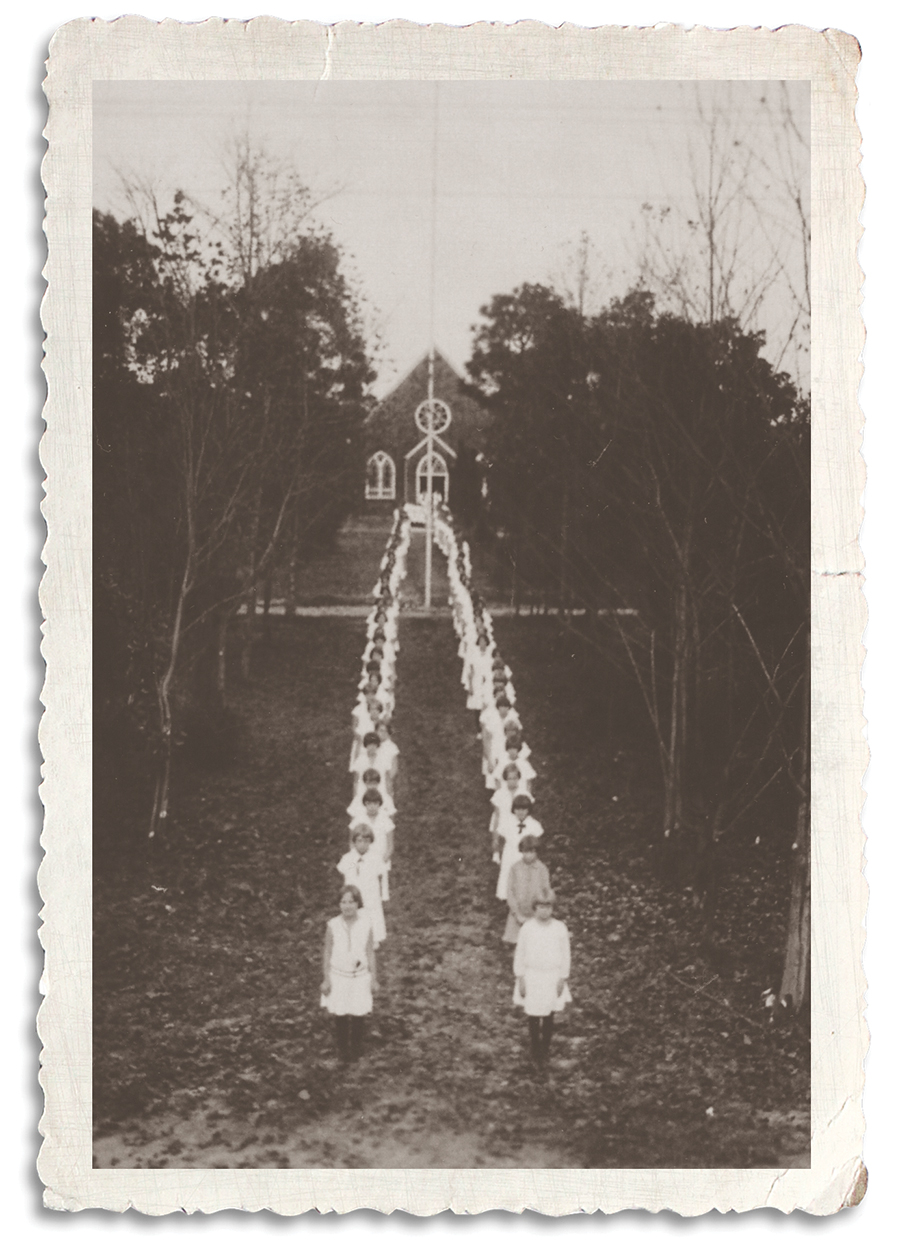
MacNaughton established a relentlessly busy routine of schooling, vocational training, religious instruction and exercise for the girls in hopes of providing each a “useful trade or profession and improving her mental and moral condition.” Several women’s clubs provided financial support for the superintendent’s program. One of them, the King’s Daughters, financed the construction of the Chapel of the Cross, still standing on the campus. The girls made their own uniforms, assisted in meal preparation, and tended to the livestock of Samarcand’s farming operation. The farm boasted an excellent herd of dairy cattle, courtesy of Pinehurst kingpin Leonard Tufts, who served on the Board of Managers. There were no fences around the campus, but girls whose misbehavior incurred MacNaughton’s wrath were subject to being locked in their room at Chamberlain Hall — the dormitory for the most difficult girls. They were further stigmatized by having to wear blue bloomers while “honor girls” wore khaki. Moreover, corporal punishment was administered, sometimes brutally. A girl’s unruliness also resulted in exclusion from Samarcand’s occasional fun stuff. According to Zipf, only the better behaved “enjoyed picnics in the woods, wading parties, hikes, attending church and movies, and planned weekend camping parties in the summer.”

While North Carolina’s legislators enthusiastically created Samarcand, they were reluctant to fund it. From its inception, the reformatory experienced severe financial woes. The federal government offered a prospective avenue for assistance. During World War I, military leaders and members of Congress viewed with alarm the increasing number of American soldiers infected with venereal diseases. To secure the health of military manpower, those leaders urged the states to step up efforts to restrain prostitution. As incentive for doing so, Congress would help finance state efforts to keep prostitutes and promiscuous “camp girls” far away from military bases. The potential infection of soldiers stationed in North Carolina became a subject of increased attention after Fort Bragg opened.

To convince officials that federal funding of Samarcand was required in order to avoid the prospect of females preying on unsuspecting soldiers, MacNaughton’s 1920 application for federal assistance highlighted the high percentage of Samarcand girls suffering from venereal diseases. Assistance was promptly granted, on the condition that Samarcand confine adult prostitutes in addition to its juvenile inmates. Thus, females ranging in ages of 10 to 30 served time at Samarcand in the reformatory’s early years. Zipf notes that Samarcand’s acceptance of federal funding resulted in its having two conflicting missions. “It housed adolescent white girls in need of redemption as Southern ladies,” she points out, “and also adult prostitutes in need of punishment, treatment, and control.” Years would elapse before the adult prostitutes were sent elsewhere.

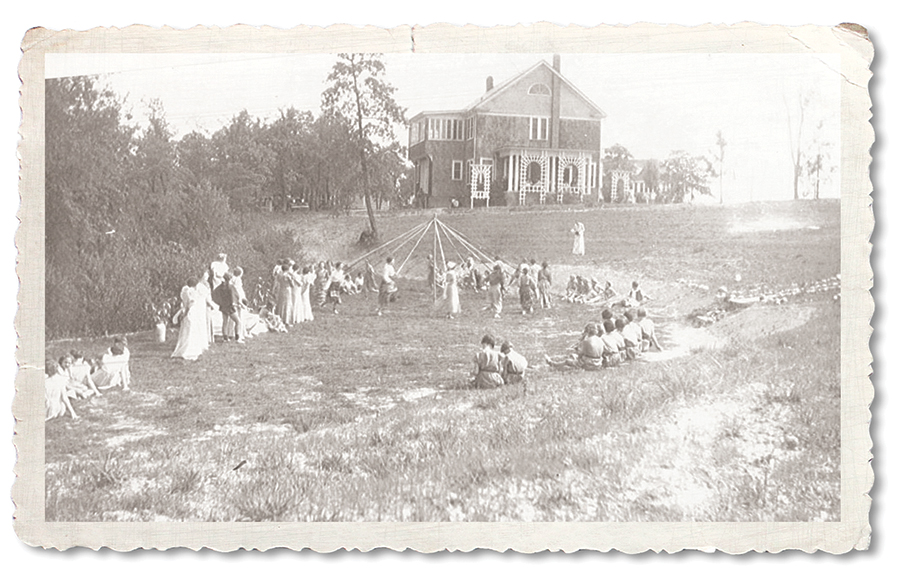
During MacNaughton’s 16-year tenure as Samarcand’s superintendent, the reformatory was periodically inspected by the State Board of Charities and Public Welfare and generally passed these reviews with flying colors. MacNaughton would also invite members of the press and public to attend Samarcand’s Field Day and May Day festivities, which showed the campus off at its best. Visitors usually came away impressed, rarely observing any inmates other than smiling, rosy-cheeked, well-mannered honor girls. A typical example was the Washington, D.C., policewoman who, in 1924, gushed, “I did not think it was possible to have such a splendid school for delinquents as was shown me. It has not the atmosphere of a correctional institution but rather that of a boarding school.” In fact, MacNaughton did try to inject something of a prep school atmosphere, convincing state education administrators to grant high school accreditation status for the reformatory’s classroom curriculum in 1930.

In the ’20s, Raleigh News & Observer columnist Nell Battle Lewis was among those writing highly complimentary pieces about Samarcand Manor and Agnes MacNaughton. Admitted to the North Carolina Bar in 1929, it was shortly after Nell hung her attorney’s shingle that shocking events at Samarcand would necessitate a backtracking of her effusive praise.

While most honor girls coped with day-to-day existence at the reformatory, many of the girls housed at Chamberlain Hall — the punishment dorm — seethed with resentment at the bedbugs in the blankets, the harsh discipline, and what they perceived as bogus reasons for their being trapped at Samarcand in the first place. Margaret “Peg” Abernethy was one of the latter, a victim of incest at age 10 by her own father. Her stepmother sent the blameless Peg to Samarcand. She revolted against MacNaughton’s strict discipline and twice tried to run away. Whipped on both occasions with a hickory switch for as long as three minutes, Peg required treatment for her bruises. Samarcand’s disciplinary officer shaved Peg’s head.

On March 12, 1931, Peg learned that one of the girls planned to start a fire at neighboring Bickett Hall. The sight of Bickett burning inspired Peg and fellow inmates Margaret Pridgen and Marian Mercer to plot another arson at Chamberlain. They torched stockings stuffed in the dorm’s attic, but staff quickly discovered the smoldering hose and snuffed out the fire before serious damage was done. Undaunted, Pridgen started a second fire in her room, probably with Peg’s help. The fire went undetected until it was too late. Bickett and Chamberlain Halls, both wooden structures, were engulfed by flames.

MacNaughton obtained confessions from a number of girls, including Abernethy and Pridgen. Those admitting their guilt seemed oblivious to the fact that they were implicating themselves in a crime, which potentially carried the death penalty. Both Abernethy and Pridgen (and others) almost welcomed the prospect of the penitentiary, assuming it would be more bearable than what they perceived to be the hellhole of Samarcand Manor.

Sixteen girls were eventually charged with involvement in the arsons and held for trial at county jails in Carthage and Lumberton. The girls apparently regarded setting fires to be a can’t miss attention-getter, since they ignited new ones in both county jails, each extinguished without much damage. Aghast at the pyromania, press accounts like the one in the Moore County News described the girls in animalistic terms, “distorted with rage,” and “eyes gleaming.”

It was against this ominous backdrop that Nell Battle Lewis agreed to serve as co-counsel with Carthage lawyer George McNeill for all 16 defendants. Having never tried a case of any kind, it seemed in one sense preposterous for the fledgling lawyer to become involved with a major criminal matter — particularly one where the death penalty was potentially involved. The high-profile nature of the case meant there would be intense newspaper coverage. Due to her work as a columnist for the News & Observer, Nell was friendly with the reporters covering the trial. While not initially sympathetic to the girls, the writers liked Nell and were open to hearing her version of the story.

Given the confessions of several of her clients, Lewis had little choice but to claim that conditions at Samarcand had driven the girls to their actions. Putting Samarcand itself on trial, she introduced evidence of squalid conditions, beatings, and the questionable incarcerations claimed by the girls. As Lewis hoped, the newspaper stories began emphasizing the brutal whippings rather than the firebugs’ actions. It did not help the reformatory’s image that several Chamberlain girls had been locked in their rooms for disciplinary reasons at the time of the final fire, and were fortunate to have escaped just ahead of the flames.

Though Lewis realized some girls had little hope of avoiding punishment, her spirited defense resulted in charges being dismissed against two of the girls for lack of evidence. The other 14 were found guilty of the reduced charge of attempted arson. Peg Abernethy and 11 others were sentenced to terms in the penitentiary of 18 months to five years. Pridgen and another girl received suspended sentences — curious leniency in Pridgen’s case, since she admitted setting both Chamberlain fires. McLaurin and Russell’s Wayward Girls, by way of historical fiction, delivers a fast-moving account of the fires and their aftermath.

The offenders were punished, but the trial’s revelations had struck a severe blow against Samarcand Manor. Nelson Hyde’s editorial in The Pilot pilloried the girls’ parents, the reformatory, and a North Carolina child welfare system that had driven girls with no previous criminal records to arson. “Weren’t we all on trial for permitting conditions to exist which culminate in sixteen youthful members of society, our neighbors’ children if not our own, facing charges for committing a capital offense,” Hyde wrote. ”And what are we going to do about it? “

The state launched an investigation that resulted in the end of corporal punishment at Samarcand, and a new policy in which only girls convicted of offenses would be admitted. Girls under the age of 10 would no longer be accepted. The events exacted a huge toll on MacNaughton, who took a leave of absence in 1933 and retired a year later.

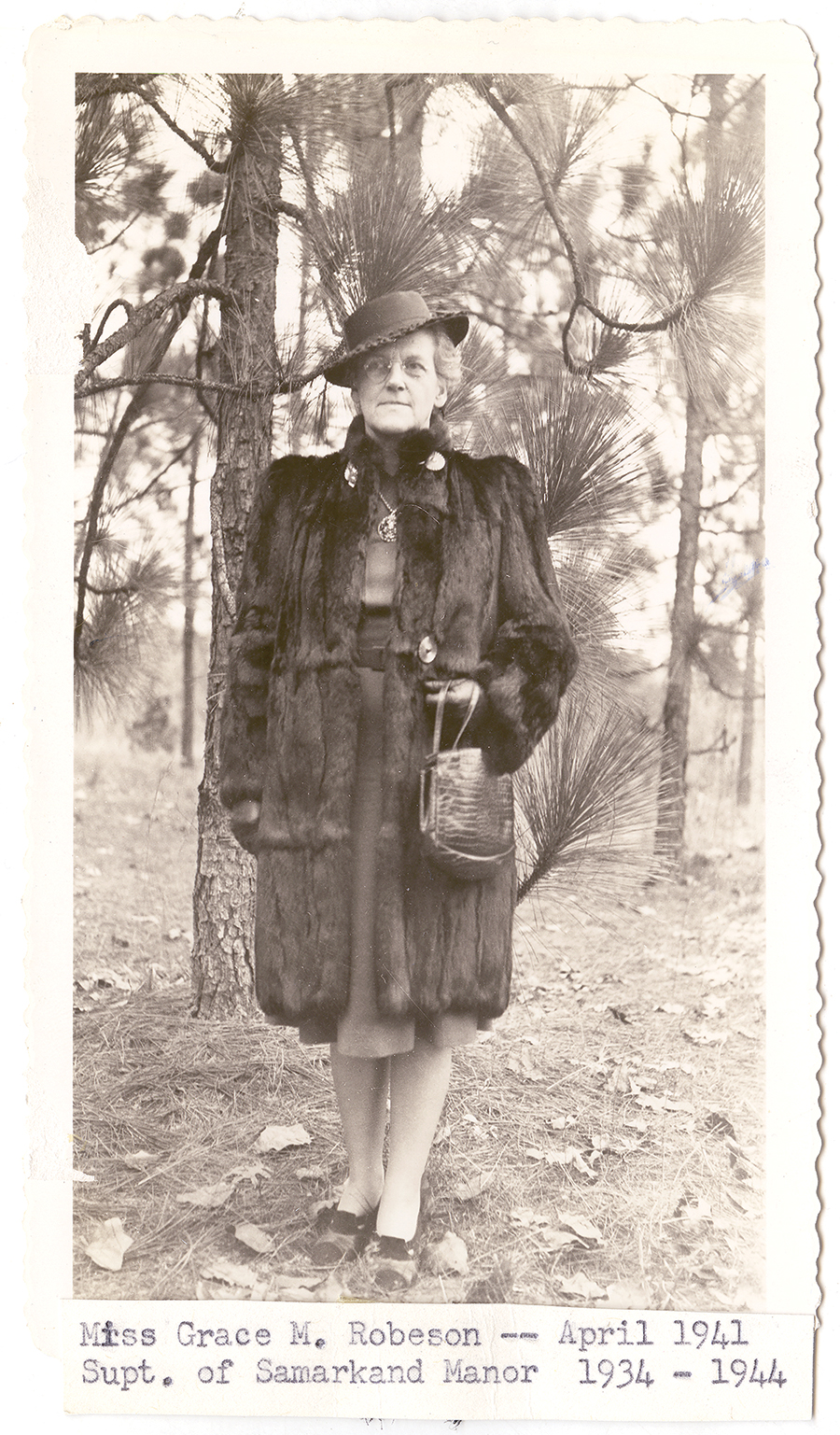
Grace Robson was named to succeed MacNaughton. According to Zipf’s Bad Girls, Robson’s hiring heralded for Samarcand inmates a new era of psychological testing, and classification. Her program sought “to separate the fit from the unfit and to determine a recommendation on sterilization.” Today, we consider forced sterilizations (eugenics) to be an inhumane practice right out of Nazi Germany’s playbook. But such surgeries were legally sanctioned for decades by North Carolina’s General Assembly. The law allowed sterilization of “any mentally diseased, feebleminded (typically an individual with an IQ below 65) or epileptic inmate or patient,” or where social workers believed that an individual would procreate a child “with a tendency toward serious or mental deficiency.” The state established a Eugenics Board in 1933 to provide some semblance of due process for helpless girls before their ability to bear children was surgically removed. But that board served primarily as a rubber stamp for the recommendations of Robson and like-minded administrators at other institutions. Sterilizations of Samarcand’s girls were performed at Moore County Hospital, and the girls recuperated at Gardner Hall.

From 1929 to 1950, 2,538 forced sterilizations were performed in North Carolina, the majority on white females. At least 293 Samarcand girls were sterilized. The last recorded Samarcand sterilization was in 1947. North Carolina was hardly alone in promoting eugenics — 32 states allowed it in one form or another. Justice Oliver Wendell Holmes wrote that “three generations of imbeciles are enough,” in a 1927 U.S. Supreme Court decision rejecting a challenge to Virginia’s eugenics law. North Carolina, however, is generally recognized to have been the most aggressive of the states in promoting the practice.

Post World War II, support for forced sterilizations waned, but in North Carolina the program actually gained steam by targeting female recipients of Aid to Dependent Children (ADC), at least half of whom were African-Americans. The Eugenics Board was finally abolished by the state in 1977, but laws permitting forced sterilizations were not actually repealed until 2003. North Carolina Governor Mike Easley issued an apology to the victims and, in 2013, the General Assembly passed an appropriations bill authorizing up to $50,000 per person to compensate those sterilized pursuant to the order of the Eugenics Board.

Certainly the fact that Samarcand was perpetually underfunded made it difficult for Robson to operate the place efficiently. World War II caused even greater budget trimming and a significant loss of personnel. Samarcand barely survived the war. Robson’s tenure as Samarcand’s superintendent ended in 1944. She was succeeded by Reva Mitchell, who served in the post for nearly 30 years.

After the war, conditions and funding markedly improved. By 1955, the campus sported an entirely new look with 11 new buildings. Four more were erected in the following decade along with a recreational park and lakeside theater, pool and numerous plantings. In the ’60s the institution started receiving African-American girls.

In 1974 juvenile boys were admitted to Samarcand for the first time. The percentage of boys in the Samarcand population gradually increased over time. Andy Auman was appointed as Samarcand’s director (a title change from superintendent) in 1986. He stayed until 2002. Auman’s tenure coincided with the reformatory’s transition from focusing on detention to emphasizing individualized therapy, counseling, education and rehabilitation. The facility was formally renamed the “Samarcand Youth Development Center.” Today, Auman credits the shift with enhancing the ability of many Samarcand juveniles to make better lives for themselves. Now retired and living in Aberdeen, Auman expressed pride in the many dedicated Samarcand teachers and staff while acknowledging it could sometimes be a difficult place.

During Auman’s time at Samarcand its population steadily dwindled as juvenile offenders were housed in smaller group facilities closer to their homes rather than in large centralized, and expensive, reformatories. Finally, the General Assembly opted to close the facility, and on June 30, 2011, the last 26 teenagers vacated the campus.

Led by state Representative Jamie Boles, the General Assembly transformed the old reformatory into the Samarcand Training Academy, which opened in 2015. Fourteen of Samarcand Manor’s buildings have already undergone (or soon will) substantial renovations for dormitory and classroom use. The facility is equipped with every type of interactive training currently available in the law enforcement field. There is a five-panel simulator that can place a trainee in virtual reality scenarios, like school shootings, and confront the trainee with up to 230 variations of visual images from a 300-degree range. The simulator can be programmed to replicate the real-life facilities the trainees will be protecting. The Firearms Training Center, completed in June 2017, is the finest in the state, testing all aspects of marksmanship from short-range handguns to long distance sniping. A new dining hall is under construction. When completed in full, Samarcand Training Academy will total 168 bedrooms and 11 classrooms funded by expenditures exceeding $23 million.

Members of over 20 state law enforcement agencies have taken advantage of Samarcand Training Academy’s facilities, including the State Bureau of Investigation, Department of Corrections, and the Alcohol Law Enforcement Agency. Local police forces of Moore County and school resource officers committed to ensuring student safety have received training since the facility opened. In 2017, 955 students attended Samarcand Training Academy; many of them engaged in intense four week courses of study.

“For over a century, whether the property was occupied by Marienfield, Samarcand Manor and now the academy, it has always been used for educational and training purposes,” says the academy’s director, Jordan.

The State Home and Industrial School for Girls opened on Sept. 17, 1918. Eddie Russell, an alum from Andy Auman’s teaching staff who taught at Samarcand from 1985-94, considers those nine years one of his most gratifying experiences. While acknowledging the negativity in Samarcand’s past, he points out that successful rehabilitation of many young men and women also occurred there and that achievement should not be overlooked. “You claim it for both the fame and the shame,” he says.  PS

Pinehurst resident Bill Case is PineStraw’s history man. He can be reached at Bill.Case@thompsonhine.com.

Fortress Green

For Carthage homesteaders Ken Riggsbee and Carolyne Davidson, environmentalism and sustainability set the standard

By Deborah Salomon     Photographs by John Gessner

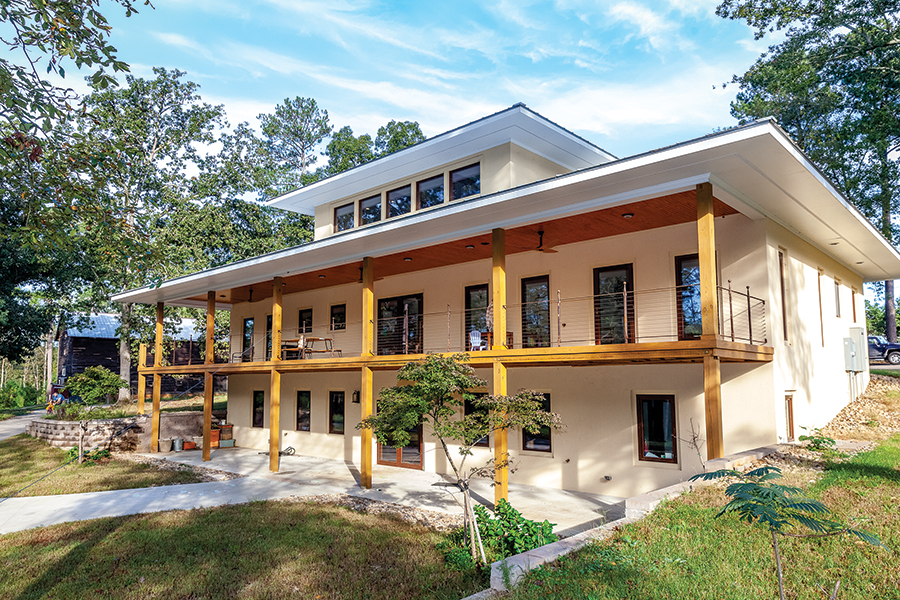
Huff and puff as he may, the Big Bad Wolf can’t blow down Ken Riggsbee and Carolyne Davidson’s house. Because it isn’t made of straw, or sticks, or even bricks. The exterior walls are massive slabs of poured-to-order concrete trucked from a factory and lifted into place by a crane, fastened together with steel. The above-ground basement is partially excavated, cave-like, into a slope. The concrete, recycled from coal ash and an insulation itself, is further insulated with foam.

“Completely air-tight,” Ken states proudly.

Premium efficiency windows come from Italy. A geothermal system draws heating/cooling from the ground; while expensive up front, it slashes energy costs. The house faces south for maximum solar gain and, in the summer, is shielded from direct sunlight by an overhang. Every detail of this dwelling illustrates durability and, most importantly, green standards.

Furnishings lean toward practical, indigenous rather than eclectic, heirloom, Victorian or post-modern. Carolyne’s kitchen channels Mother Earth, not Architectural Digest.

Both upper and lower floors have accessibility features. “Aging in place was my design,” Ken says.

Obviously, there’s a backstory.

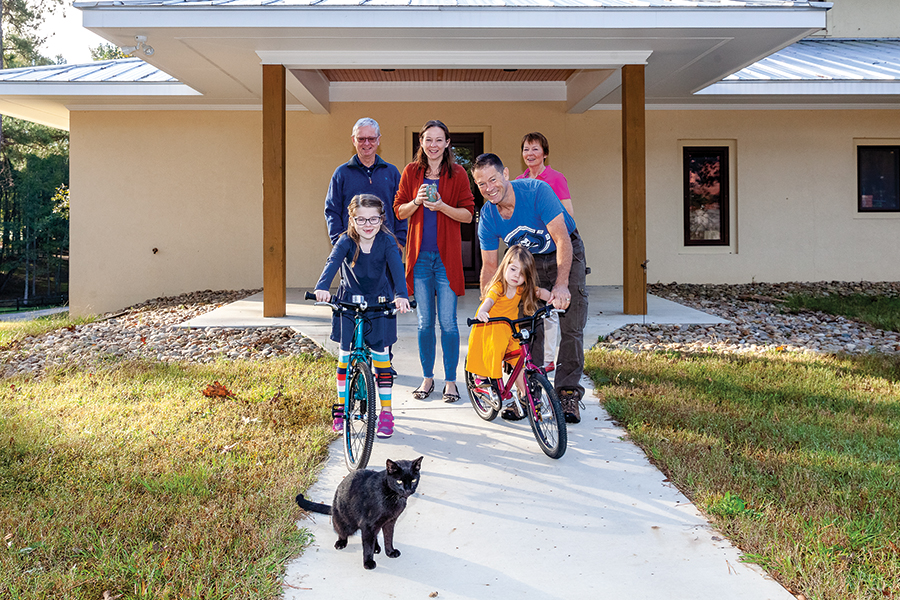
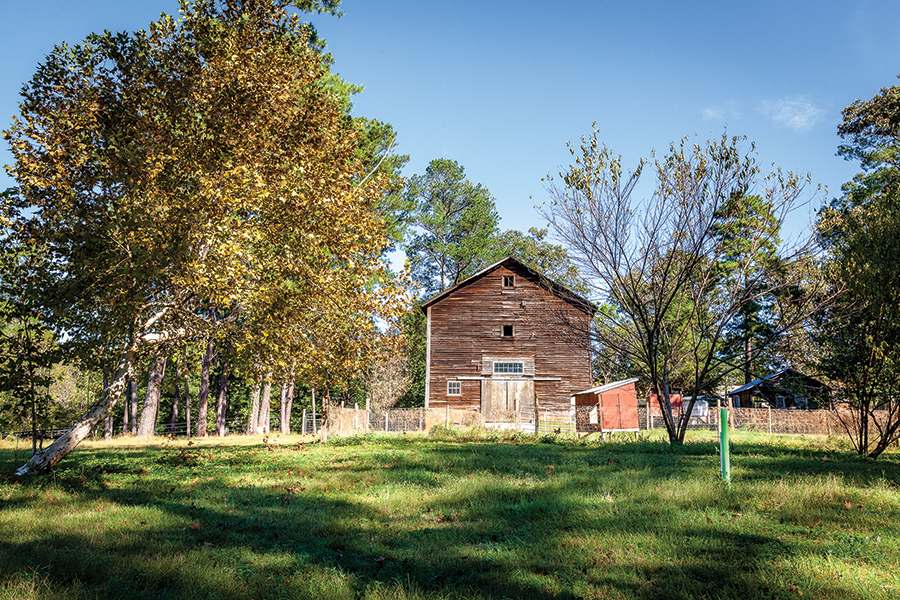
“I’m a city girl.” Carolyne grew up in a suburb of Edinburgh although her Scottish burr has almost disappeared. “Our house was stone, made to last.” She has a Ph.D. in strategic studies in history from Yale University, and now teaches at National Defense University at Fort Bragg. Ken grew up in what he calls a traditional two-story brick Southern Baptist house, in Carrboro. He worked construction (specialty: swimming pools) alongside his father, joining the Army after high school and eventually serving with Special Forces. Their first date, in D.C., happened on the day in 2003 when Ken’s offer on 47 acres in Carthage adjoining Farm Life School was accepted. With the land came a dilapidated house, formerly a hospital and then infirmary, when Farm Life had boarding students. The Riggsbees still find small tiles in the ground, probably broken off the surgery floor.

Carolyne knew Southern Pines from Army friends; her parents had golfed there. Ken, also conversant in civil engineering, knew the area from being stationed at Fort Bragg. They married, visited Carthage frequently, finally relocating permanently in 2009 into the falling-apart infirmary.

“I didn’t even have an American driver’s license,” Carolyne recalls. “I learned to drive on the right side of the road, on a tractor.”

Attempts to save the house failed. Newly pregnant Carolyne became a drywall expert, to no avail. Besides, Ken had a plan: “I bought it for the land. The house we built was the vision I had — wife, children, animals — my American dream come to fruition.”

They broke ground on Sept. 8, 2015, and completed the 4,600-square-foot house in 16 months.

Ken, who is a font — no, a geyser — of construction information, most hyper-technical, all impressive, found a green-leaning architect and subcontractors capable of implementing his vision. He and Carolyne set forth goals and conceived an unusual, elongated floor plan. One wing immediately left of the front door includes the master bedroom, bath and dressing rooms. A small hallway opens out into the two-story great room divided by use, not barriers, into a common space (with TV), eating area and kitchen. Light pours in from clerestory windows.

“I like elevation and light,” Carolyne says.

Ken prefers to be snug, close to the ground. But he does love the acoustics of a soaring space.

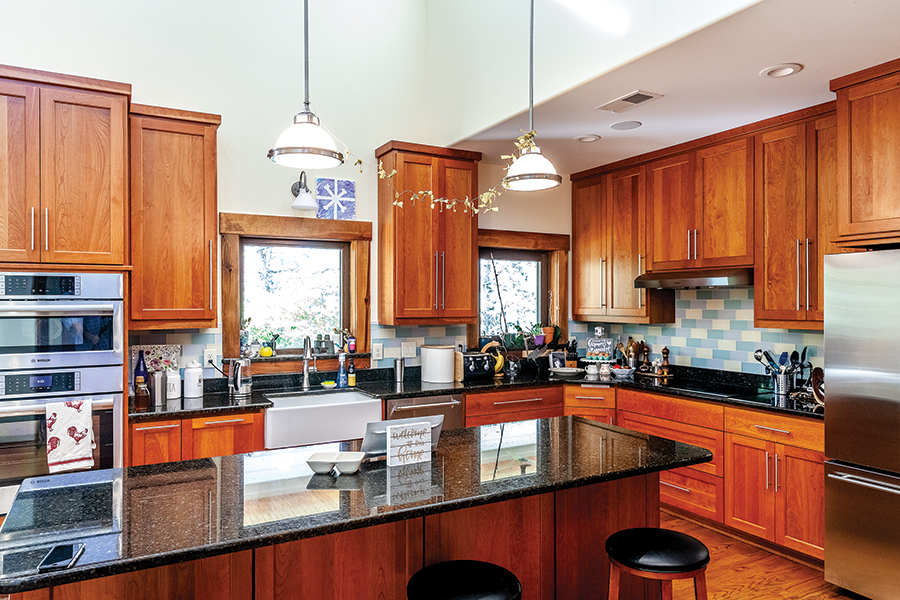
A loft with doors at each end overlooks the living room. Behind the doors — storage. In the opposite wing are bedrooms for the Riggsbee’s two daughters, Isla and Iona, named for Scottish islands. In the center, a kitchen with 5-star energy rated Bosch appliances, designed in Germany, made in New Bern, N.C., and cherry cabinets with paneled doors mounted inside out for an Arts and Crafts-style appearance. Black granite for the countertop was quarried locally. On it sits dinner in a box from organic Green Chef.

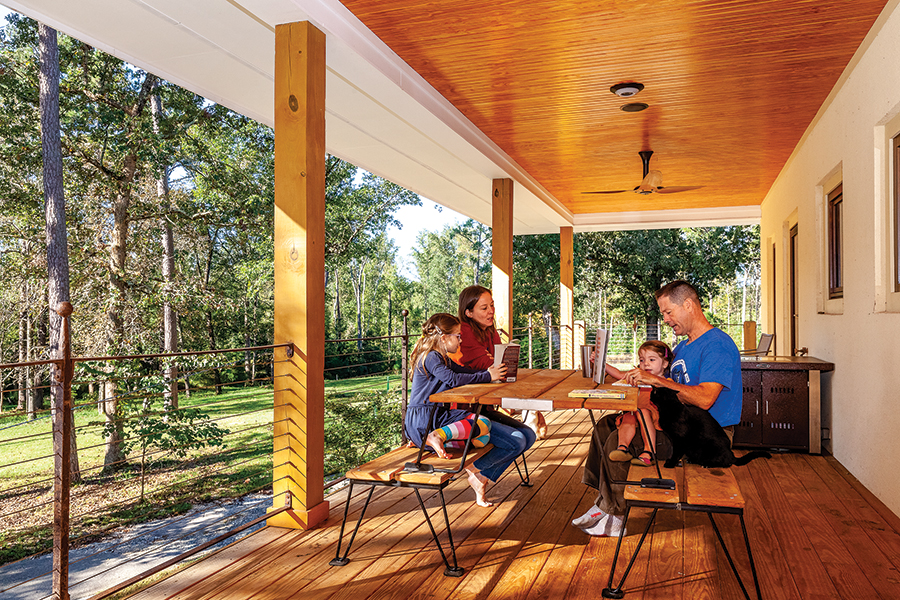
A covered gallery runs the entire length of the house, then wraps around the sides. Ken’s projection for this outdoor living space: “In 10 years, when Carolyne and I go away for a long weekend, we expect there will be 125 high-schoolers bouncing around on that deck.”

The walk-out basement stretches 32 feet encompassing a family room, offices for Ken and Carolyne, a bathroom and children’s toy-and-book enclave large enough to accommodate a kindergarten as well as a suite for Carolyne’s parents, who visit from Scotland twice a year.

The entire two-story frontage overlooks a pond teeming with fish that jump to the surface at feeding time. Ken keeps honeybees to address pollination and sustainability issues. Goats, chickens, ducks and four cats roam free, attended by the city girl whose only pet growing up was a hamster.

Ken and Carolyne admit an affinity for Frank Lloyd Wright. However, a single word best describes the interior of this intensely personal home: wood. Dark wood floors and window frames, doors and built-ins, tables and cabinets. Ken warms to the history of each board. Beams across the 19-foot ceiling are decorative, not structural, he admits, “but they are 100 years old.” Lumber for plain baseboards and trim was harvested from pine growing within the footprint. The dining room tabletop comes from a black walnut tree that died on the property; its edge, rather than squared off, retains the natural curve.

“We don’t use table mats,” Carolyne explains. “The tabletop is a living thing we share.”

Walking room to room, Ken identifies the source of other woods their cabinetmaker turned into furniture. Ken built the girls’ bunk bed himself.

With the exception of lavender in Isla’s room, all walls (with rounded corners, for safety) are a creamy French vanilla. Wall décor is a work in progress, with art waiting to be framed. Until then, the views are enough, Carolyne says. Ken has hung some military mementoes and Carolyne, a stunning portrait of a Tibetan friend. Floors upstairs and down are mostly bare, with an occasional carpet Ken brought back from deployments in Pakistan and Afghanistan.

This home-building saga was not without risks and inconveniences. Ken had to fight for his specifications, based on the German “passivehaus” model. The Riggsbees are within reach of cable TV but the high-speed internet isn’t great, Carolyne discovered. “We moved here before there was the Food Lion (on N.C. 22). It took a while getting used to not walking to a restaurant.” She doesn’t feel isolated, however, since both she and Ken drive to work at Fort Bragg every day.

They seem satisfied and proud of their accomplishment but not complacent. The unfixable infirmary has been razed; Ken hopes to build a workshop on its site. An old swimming pool that came with the property needs work before they can fill it, hopefully in time for those high-schoolers partying on the gallery.

Not to worry. There’s plenty of time since, as Ken states, “I plan to live here for 150 years.”  PS

Foxhunting 101

Tradition and pageantry on Thanksgiving morn

By Maureen Clark

Photographs by John Gessner and Ted Fitzgerald

On Thanksgiving morning, the Moore County Hounds will invite the public to attend their opening meet, as they have for over 100 years. Hounds, riders, and more than 1,000 spectators will gather around the robed figure of Reverend John Talk in Buchan Field on North May Street for a ritual that dates back to the Middle Ages. Those assembled will hear a blessing of the hounds that launches the formal foxhunting season. The blessing from St. Hubert, the patron saint of hunting, a son of the Duke of Aquitaine who lived in the seventh century, asks that rider, horse and hound be shielded from danger to life and limb.

Established in Southern Pines in 1914, the first hounds hunted from the kennels of novelist James Boyd on his 500-acres, known now as the Weymouth Woods-Sandhills Nature Preserve. In 1929, a separate 2,300-acre parcel was purchased by a small group of foxhunters and, along with the Boyd’s land, it became the nucleus of the foundation later established by W.O. “Pappy” Moss and his wife Virginia “Ginnie” Walthour Moss. The hounds moved to the kennels they now occupy at Mile-A-Way Farm in 1942. Ginnie Moss’s great nieces, Cameron Sadler and Ginny Thomasson, joint master and secretary of the Moore County Hounds, will represent their aunt on Thanksgiving. “I will carry Aunt Ginnie’s whip,” Cameron said. “It’s sentimental and I like to have it with me.”
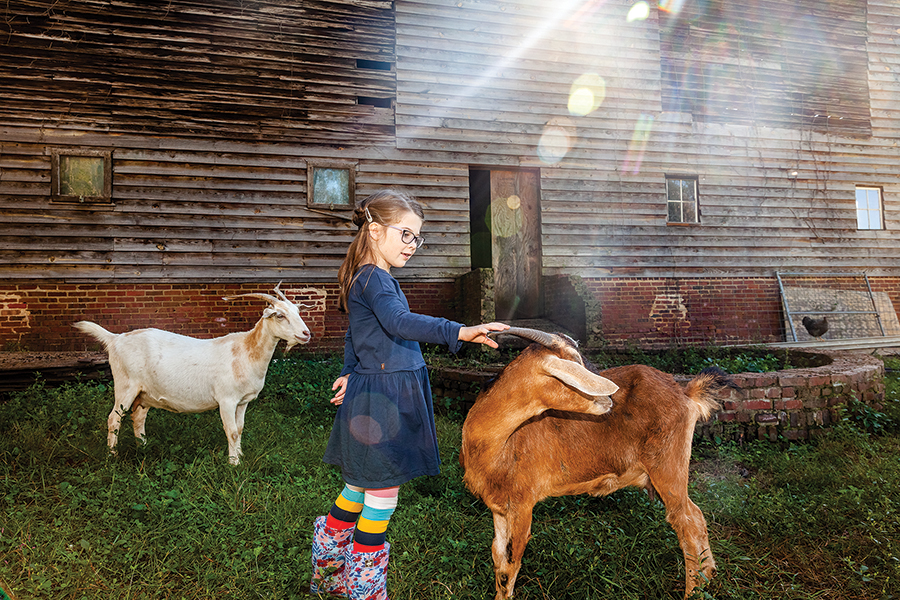
The first to arrive at Buchan Field are the riders, at roughly 10 a.m. on Thanksgiving Day. There is a defined structure to the assembled group. They can be sorted by jacket color. The leadership group of men and women, joint masters and the hunt staff, wear scarlet colored jackets. The rest of the riders make up what is known collectively as the field.

Women and junior riders in the field wear black coats with colors on their collars; navy with red trim for women, red with navy trim for juniors. Men wear scarlet. Colors other than these standards represent riders invited from other hunts. Simple black jackets are worn by foxhunters who have not yet earned their colors.

The Moore County Hounds have five joint masters, Richard Webb, Cameron Sadler, Mike Russell, David Carter, Jock Tate and secretary Ginny Thomasson, who manage the business of the hunt and are leaders in the field at opening meet. Traditional courtesy suggests that all foxhunters greet the masters when arriving at the meet, often lifting a cap.

Horses in the field represent a variety of breeds, from quarter horse to Welsh pony, each matching the rider’s particular size, ability and preference. Cameron Sadler and Russell prefer thoroughbreds, joining many fellow horsemen in giving retired racehorses a new life in the hunt field.

While the crowd is congregating, kennel man Bill Logan, riding a four-wheeler, will drag a prepared scent of animal waste and other matter through the woods. The path, according to Russell, mimics a gray fox with circles, turns and back tracking. Coyote, the usual prey in a live hunt, run faster and straight away. (The evolution in the past 20 years has gone from hunting primarily gray fox to hunting coyote 85 percent of the time.) There will be two checks during the run, breathers for the field to stop, letting horses and hounds catch their breath. The stops, however, will be out of sight of the crowd on Buchan Field.
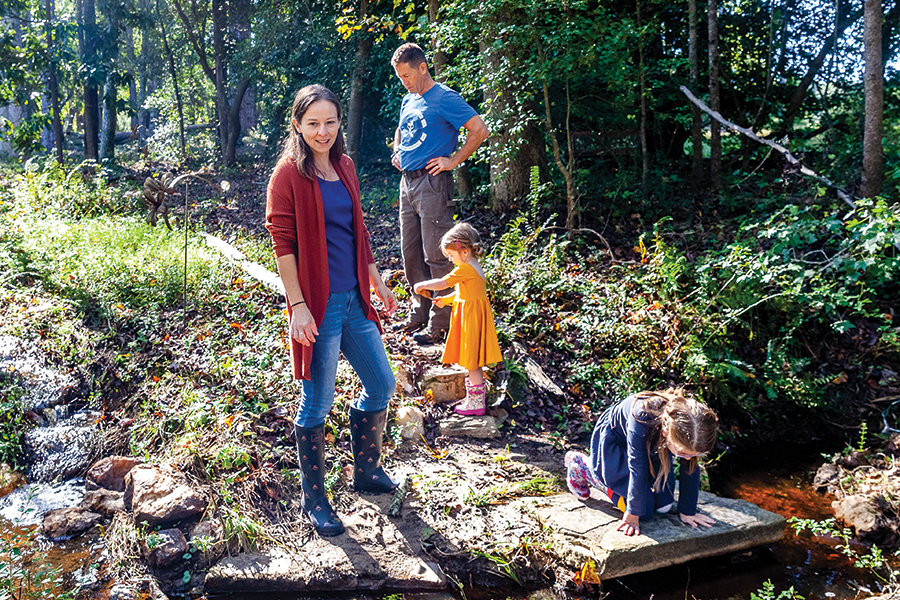
Soon spectators will see the hounds, tails wagging, coming down the sandy lane from their kennels gathered around their huntsman, Lincoln Sadler. The hounds are never called dogs unless referring to the sex of a male. Sadler manages the pack assisted by five whippers-in, his volunteer staff, working as additional sets of eyes and ears. During the hunt, only the staff is allowed to interact with the hounds.

Cameron Sadler explains that drag scenting for a live pack (one used to chasing coyote or fox) can be challenging. A few will run a drag line but many live hounds, Cameron observed, will not run a made up scent. In their 100-year history, different masters and huntsmen of the Moore County Hounds have hunted various breeds. The current pack, started in 2007, is an American breed called Penn-Marydels. Lincoln Sadler said the pack looks at things like crushed vegetation for tracks. When faced with a different task, the huntsman said they look at him and ask, “What do you want from me?” Last year, at opening meet, Lincoln Sadler tweaked the traditional prepared scent with his own secret concoction and the hounds ran strong. The crowd will be able to judge this year by the strength of the hounds’ voice when they run the line.

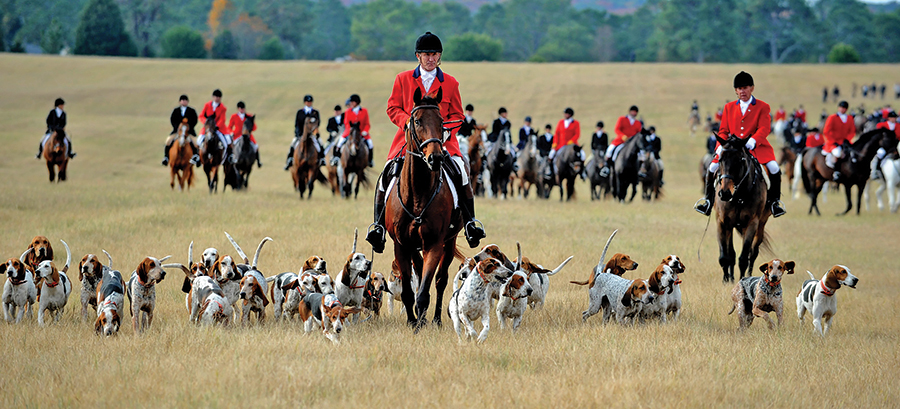
Two of the many important tasks of a whipper-in are to help in turning hounds away from roads or off the scent of a second coyote. The whips, working in the field at a distance from the huntsman, give the cry “tally ho” when they “view” a fox or coyote.  Tally ho is a blood-chilling yell meant to be heard by all. Two veteran whips with Moore County, Liz Rose and Mel Wyatt, who have won competitions with their yells, will be on hand to call the hounds.

Lincoln Sadler, as huntsman, is the central figure in the hunt with all actions of the masters, staff and field, following his lead. He can be identified by the 9-inch brass hunting horn tucked between the buttons of his jacket. The Moore County Hounds, members of the Masters of Foxhounds of America, are bound by their traditions and rules. All hunts use the 9-inch horn. “It’s the one element that ties it all together,” Sadler explains. “I could hunt another pack and negotiate them through the woods. “

Hounds are not counted as a total number but as couples. Sadler will bring roughly 30 couples this year. The MCH breed two to three litters each year. Litters born in the same season all share the same first letter of their names working through the alphabet like naming hurricanes. This year, all puppies have names that start with the letter Z. On a recent morning at the kennels, Sadler was overheard training puppies he called Zinnia, Zepco, Zesty, Zoloft and Zoe. Two older hounds answered to an age-specific Yaupon and U-Turn. On off days, Sadler works with his puppies, walking them out. Never shouting or raising his voice, a firm command of “hold up together” brings the hounds to Sadler. The walks take them over smells of squirrels and deer, which he teaches them to ignore.

After Reverend Talk bestows the blessing there are several signals the crowd should note. The field of approximately 150 riders will begin dividing into three groups, each behind a joint field master. Cameron Sadler takes the first flight of riders, who can manage the speed and difficulty of jumps following 10 to 12 strides behind the pack. A second flight follows moderately, selecting jumps with good footing. Russell brings the last group, the hill toppers, who prefer not to jump. His distance from the pack, on live hunts, often affords the best views of foxes, coyotes and hound work.

The crowd should also notice when the huntsman, Lincoln Sadler, begins to gather hounds to him. Foxhunting has everything to do with sound, the call of the horn and the voice of the hounds. Sadler gives a very short toot on the horn to bring the hounds to him. People should be moving away from hounds and riders and the huntsman will be “moving off.” In addition to the horn, Sadler whistles, calls and talks to the hounds. The next sound of the horn will be a longer, monotone note saying, “I’m here, keep hunting, keep working.” He will move toward the call of the tally ho.

In the hunt field, some hounds talk a little while they search for scent. Others work quietly. The hounds work together and know when a single hound has hit the scent by the authority and intensity of the initial cry.  Sadler said they pay attention when a respected hound named Shrek speaks up. “The hounds honor him,” he explained, going to the lead voice, and joining the cry.

At this point, Lincoln Sadler will blow the horn with an urgency that says to the hounds spread out in the woods or field, “Let’s go, let’s go, let’s get over there and help him. Double up.” When the full pack is on the line and all speaking, or in full cry, it is the cherished sound in foxhunting. Lincoln Sadler will then blow “gone away.” Cameron Sadler praises Penn-Marydels for their strong voice, touching on a needed trait.  Alexander Mackay-Smith, the legendary authority on foxhunting, writes that “a good cry in a pack is essential not only for the hunt staff and field, but also so hounds can hear each other and cooperate accordingly.” Hounds that run silent have no value in the hunt field.

When the hounds and riders have gone from Buchan Field into the piney woods, they will be on the Walthour-Moss Foundation. The 4,000-acre tract of long leaf pine, sandy hills divided by fire lanes and streams, is land the Moore County Hounds hunt by cooperative agreement. The crowd should hear the hounds at the end of the drag before they see them spilling over the fence at Buchan Field. The hounds should be followed first by the huntsman, Lincoln Sadler, and his whippers-in. The three fields should follow with the first groups jumping the split-rail fence back to the meet.

The staff, who know the hounds by name, will count heads to be sure all are accounted for with none left behind. The last call blown on the horn and the end of a hunting day is “going home.” Sadler hesitates to blow the strains because they are the same melancholy notes played at the funerals of beloved members of the Moore County Hounds.  PS

Maureen Clark is a Southern Pines native who grew up foxhunting.

A Dream Creation

Heritage Flag Company barrels toward success

By Amy Griggs     Photographs by Tim Sayer

Shoppers meander through rooms of the 118-year-old Bennett Street house-turned-retail shop of The Heritage Flag Company.

The faint, sweet scent of bourbon accompanies a visual feast of rough, charred and blond barrel staves crafted to stir the blood in the form of rustic American flags, works of art, no two exactly alike, varying in size from mounts on desktop easels to those three feet high and larger. Visitors express surprise: Website photos do not do the product justice.

“We hear that a lot,” says owner Heath Trigg. One customer review from the company website reads, “We purchased this flag for my father-in-law as a birthday present. I loved the look of it in the pictures on the website, but those pictures in no way do the craftsmanship justice. These flags are works of art.”

The story of The Heritage Flag Company is an American one of can-do spirit, hard work and self-determination, of Old South embraces the digital age. It is a Southern Pines micro-industry bred and born four short years ago, propelled by people’s thirst for the company’s now-signature product, a rustic American flag fashioned from whiskey barrel staves. Trigg set out to satisfy that thirst once he realized the number of potential customers for, by his estimation, “the most recognizable symbol in the world.”

His phone buzzes and his computer screen stands at the ready on his desk in what used to be his living room. Heath and his wife, Ginny, had their home and business offices occupying neighboring floors of their house until Heritage Flag’s need for space exploded. The couple moved, and now the entire house is dedicated to business and retail operations. The woodworking shop is in the back, repurposed from Trigg’s cabinetmaking business.

Though he speaks confidently about his business, his employees and products, Trigg remains somewhat mystified by the meteoric success of the company he founded, foregoing his original home building and cabinetmaking businesses.

“I could never have fathomed that I would own an e-commerce business that sells millions of dollars worth of wooden American flags,” he says.

The company narrative — noticed by statewide media and beyond — begins with his contracted job at Southern Pines Brewing Company, where in 2014 he and his cabinet crafters built its unique taproom bar and tables using whiskey barrel staves, a Trigg innovation. The owners loved it. Trigg so respected the three brewers’ knowledge and background as Special Forces veterans that he wanted to surprise them with a gift at their opening celebration.

A flag was born.

“I had two other businesses,” he says. “We were building houses, we were making cabinets, and we were kicking butt doing it. We dreamed up this flag as a thank you gift at the end of a project and jeez — I mean, it’s just unbelievable where these flags are today.”

The “dreamed up” part is literal, by now a well-circulated plot point in the story, the moment when Luke the Weimaraner woke Trigg in the night as his master dreamed of a rustic American flag fashioned from those whiskey barrels. His wife’s kitchen notepad played a role. “In the middle of the night I walked out, got the Sharpies out, and drew a picture of it on that pink high heel shoe,” he says of the handy notepad, however unlikely a shape or color for the design of his dream. “The next morning, I literally came into the shop with that pink high heel shoe and showed it to the craftsmen.”

His team created the flag, varying the dark stripes using the charred inside of the barrel, and light stripes from the outside, and adding a bank of 50 carved stars. “We still constantly get questions about it,” says one of the brewery owners, Jason Ginos. “It’s the first or second thing customers ask about when they come in.” From that one gift grew ideas for several others, until the demand for the unique flags took on a life of its own.

Today there are Heritage Flags in the White House, the Pentagon and One World Trade Center. “We’ve presented flags to amputees, Gold Star widows, people who truly know what it is to sacrifice,” he notes, awed still. Donated flags have raised more than $1million for non-profit organizations. Nonmilitary customers abound as well.

At an age where expounding on one’s history might be a short story, Trigg, 35, is keen on crediting his upbringing and the other influences that have shaped him and, by extension, The Heritage Flag Company. Unwavering attention to quality and customer service “play an immense role,” he says, attempting to explain the company’s phenomenal success. But, he refines the point. “When you think about it, it’s values. Family values.”

From early childhood growing up in Charlotte, Trigg looked forward to visiting his grandparents in Moore County. His mother, Laurin Williams Trigg, is one of seven children of Ruby and the late Winford Williams. Winford was one of 11 children who grew up here, many of whom remained, operating lumber mills, farms and related businesses.

“Any time I had a day off of school,” Trigg recalls, “I was kicking and screaming and moaning and groaning to come here and get on that tractor or work with Pop, ride dirt bikes or be in the woods or whatever.” Enamored of the Moore County country life, he knew he would settle here and start building after completing his business degree at Appalachian State.

On his father’s side, his dad and granddad served in the Navy. His dad was also one of seven, entrepreneurs in businesses from construction to fast-food operations. And Trigg took notes.

He counts his wife’s family, owners of a textile business, and the Brewery guys, as important influences. Ginos speaks of their symbiotic relationship. “His uncommon vision, his work ethic and the process. He does everything within the company,” Ginos says. “He’s an inspiration for me, my family and company.”

“We’ve got tons of incredible plans for moving ahead,” Trigg says. “I think that the biggest one, the most impactful plan we have, is to help Americans understand the values it takes to be successful. To understand the values it has taken to make this country what it is.”

Inundated with requests from nonprofits, Trigg became somewhat disillusioned. “Hey, this is a problem,” he says. “The more we give, the more people will show up with their hand out. It’s insane. And really and truly we’re not helping them in doing that. We’re not.”

His solution was to ensure that at least some of those recipients invest “sweat equity.” A flag donation for children of the military’s Special Operations men and women might require the kids and families to show up on a Saturday, roll up their sleeves, sweat, sweep and otherwise pitch in.

Trigg finds the process rewarding. He gets positive feedback from parents who might have been leery at first, and the kids appreciate it. “You teach these kids these things,” he says. “You put them to work and you make them sweat, and they see it. They get it.”

He tosses out other tenets: Life isn’t fair; you should listen more than you speak; it’s not OK for somebody to feel sorry for you.

In a country he sees as divided, reclaiming American pride has become a sort of company motto. “That is what I think is the coolest thing that this company can do. A lot of people say, and I myself say, this country’s huge. Do you think your little butt here in Southern Pines with this teenie tiny business can . . . well, I don’t know. I have no earthly idea whether we can do something like that. I know if we don’t try, we’ve failed.”

Earlier this year, an 18-year-old who had been involved in a serious motorcycle accident was struggling with his recovery, relearning how to eat, talk and walk. “He is a miracle. Three weeks ago he, his mother and father came into our shop on a Saturday and helped us make, physically helped us, make flags,” says Trigg.

“He and his family came in to make four flags to give to the four doctors that saved his life. And . . . I got to go.”

Emotion wells up, the silence unexpected but welcome.

Trigg loves sharing these stories, but is guarded — like a true entrepreneur — not divulging company profits, sales figures, or detailed 5-year or 10-year plans. Looking far ahead, plans do include handing over The Heritage Flag Company one day to Charlie, the couple’s 1-year-old son.

So, whatever happened to that sketch, the very first one scribbled in the wee hours on the pink high heel notepad?

“It’s in my safe downstairs,” Trigg says. “It’s crazy. It’s cool. We have it insured. It all started with a dream.” And a passion.  PS

Amy Griggs has worked as a community journalist and middle school teacher. She lives in Wake County and counts the Sandhills as her second home.