Sporting Life

Traveling the Blue Ridge

A solemn stop on a road trip

By Tom Bryant

It was early fall, summer was gone and I was at loose ends. It always seems to happen to me during the change of seasons. It’s still too hot to do any serious fishing, hunting season is in — dove season, that is — but after the opening-day hunt there’s not much to do here in my neck of the woods. The local doves have moved on, and the migratory ones aren’t here yet. The same with ducks. With the mild weather, they’re still lounging around somewhere up north.

Linda, my bride, and I finished our last trip to the beach in the little Airstream. Nothing to do now but winterize and park it until February, when we head to Florida for winter fishing. But right now, like I said, I’m at loose ends.

Trying to write a little on my never-finished novel, I was up in the roost, what we call the small apartment over our garage, waiting on the muse to arrive. While plundering through some papers in an unused drawer of my desk, I ran across a brochure I’d saved about the Blue Ridge Parkway. It’s amazing how things come together, I thought. Next step, convincing Linda we needed a road trip.

The parkway has always been one of my favorite destinations, I guess because it’s beautiful and seems never-ending. It’s the longest linear national park in the country and runs 469 miles through Virginia and North Carolina. I’ve never driven from one end to the other, but someday I hope to.

Actually, there’s another reason for my interest in this monumental project constructed during the Great Depression. I closed out my newspaper career working for the descendants of Josephus Daniels, the early owner and publisher of The News & Observer in Raleigh. Without Josephus, the parkway probably would not have come through North Carolina at all.

My mind went back to early American history classes that I waded through while pursuing an education. If I remember correctly, back around 1917 during the World War I, the president of the United States, Woodrow Wilson, offered the job of secretary of the Navy to a loyal Democrat, Josephus Daniels, owner and publisher of The News & Observer, which was, at that time, the largest newspaper in the state of North Carolina. Daniels, in turn and needing help, offered the job of assistant to the secretary to another up-and-coming Democrat, Franklin Delano Roosevelt. Over time they became good friends.

When the idea of the parkway came up years later as a way to alleviate some of the unemployment during the Great Depression, Roosevelt was president. Tennessee was first in line to get the important revenue-producing project. Their idea was that the parkway was to run along the spine of the Great Smoky Mountains National Park. Naturally, the folks in the know in North Carolina wanted the parkway to run along the ridge of the Blue Ridge Mountains, and they had one great ally in Josephus Daniels, friend of the president. Josephus and his group of state promoters made several overtures to FDR, and he agreed to let the parkway come through Virginia and North Carolina. The Blue Ridge Parkway was born.

It’s ironic that I ended my newspaper career working for David Woronoff and Frank Daniels Jr., direct descendants of Josephus, the man who helped bring one of my favorite national parks to our state.

I explained to Linda that it was my duty to honor the legacy of my boss of several generations ago and visit the parkway. She laughed and said, “Any excuse for a road trip.” We planned to venture out the following week.

We were sitting around the kitchen table. “I say we head up to Virginia and hit the parkway there. We haven’t done any of the Virginia stretches yet,” I said. Linda had her atlas and I was scrolling through my iPad.

“How about the Peaks of Otter?” she said.

“The who of what?” I replied.

“The Peaks of Otter. I read somewhere that’s the Cherokee word for high places or maybe the area is just named after the nearby headwaters of the Otter River, whatever. It sounds beautiful.”

“And,” I replied showing Linda pictures on my iPad, “here is where we can stay, the Peaks of Otter Lodge.”

The following Monday found us on the road heading north, up through Greensboro on Highway 29. After an uneventful three-hour trip, we entered the picturesque little town of Bedford, Virginia, only about 20 miles from our destination right on the Blue Ridge Parkway.

The Peaks of Otter Lodge stretches out over 56 rooms with incredible views of Lake Abbott and the peaks beyond. There are several hiking trails geared to the expertise of the hiker, or you can do what I did most of the time we were not out exploring, and that’s kick back with a good book while relaxing in an Adirondack chair right next to the lake.

One thing on our must-do list was to visit the National D-Day Memorial in Bedford. The next morning we were up and at ’em early.

The memorial sits majestically right outside town at the base of the Blue Ridge and encompasses more than 50 acres. When we drove up to the entrance — a 44-foot-tall arch embellished by the code name “Overlord” — a feeling came over me, sort of like the one you get in church when a special hymn touches your heart. That day it did the same to us as we walked around the site. We were silent, hushed as if at a funeral.

These 50 acres in the small town of Bedford, Virginia, serve as a remembrance of over 2,500 young men and the dedication of a nation that owes everything to the heroes who would never see past that day, June 6, 1944, on the French shore.

Why Bedford? Given the population of the town, they lost the most. By the day’s end, 19 of their young men had died. I found the following quote in a brochure: “Recognizing Bedford as emblematic of all communities, large and small, whose citizen-soldiers served on D-Day, Congress warranted the establishment of the National D-Day Memorial here.”

That war, the second war to end all wars, is long gone. Without movies like Saving Private Ryan, there would likely be folks who don’t know what D-Day means or what happened or the sacrifices that took place on that amazing day. It seems that every generation has its own particular war. For me, it was Vietnam, for others the Gulf War, and others, Afghanistan. The list grows, seemingly interminable.

But looking back, I think about those true citizen-soldiers who fought in World War II: my dad in the Navy, my uncle Tommy in the Marines, and my uncle Hubert in the Army. They volunteered, knowing that they were in for the duration and this was the only way to help save the greatest nation, and perhaps the world, for the generations to come. The boys who gave all on D-Day were part of that group. It was indeed, I believe, the Greatest Generation.

The drive back up the mountain was subdued. Neither of us wanted to break the spell the D-Day Memorial had on us, but when we got back to the lodge we decided to celebrate our last day at the Peaks with dinner and a bottle of wine at the lodge restaurant.

The next morning we drove south on the parkway heading to Boone, pulling over at every overlook. The views were remarkable. The morning sun reflected off the russet-colored leaves of hickory and oak trees down in the valley.

At one overlook, Linda said, “This is really the greatest country in the world. Just look at this remarkable view. And think of all the people who made the parkway happen.”

“Yep,” I replied. “We have a lot of folks to thank for that.”

We loaded up and headed on south to Boone for a visit with our son, Tommy.  PS

Tom Bryant, a Southern Pines resident, is a lifelong outdoorsman and PineStraw’s Sporting Life columnist.

The Creators of N.C.

Renaissance Bartender

Joel Finsel mixes books and bourbon

By Wiley Cash

Photographs By Mallory Cash

When you sidle up to the bar before ordering a beer or cocktail, you probably don’t expect your bartender to have authored two books and numerous articles, have a graduate degree in liberal studies, or to be a leading advocate in the movement for historical justice. But if you know Joel Finsel and he is the one behind the bar, then that’s exactly what you would expect. You would also expect a very, very good drink.

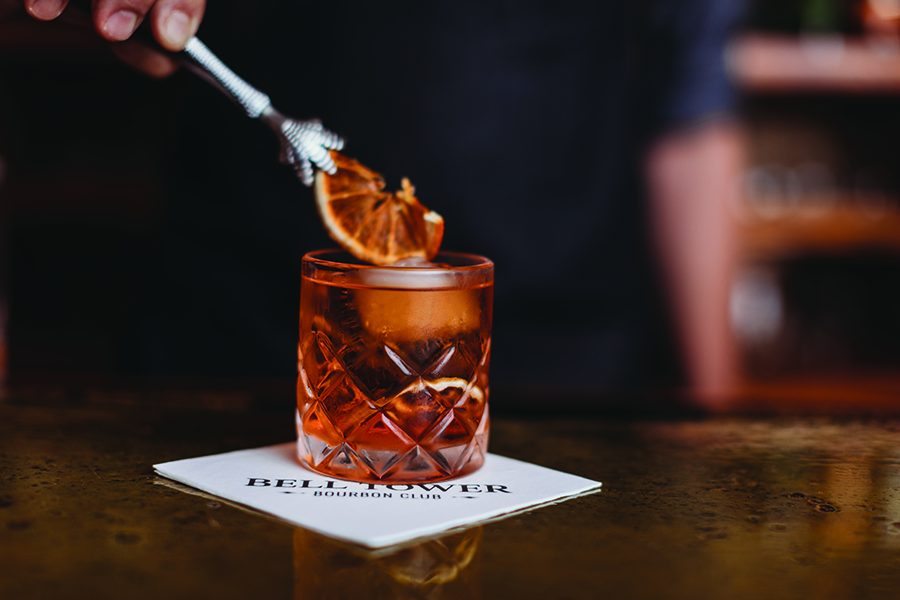
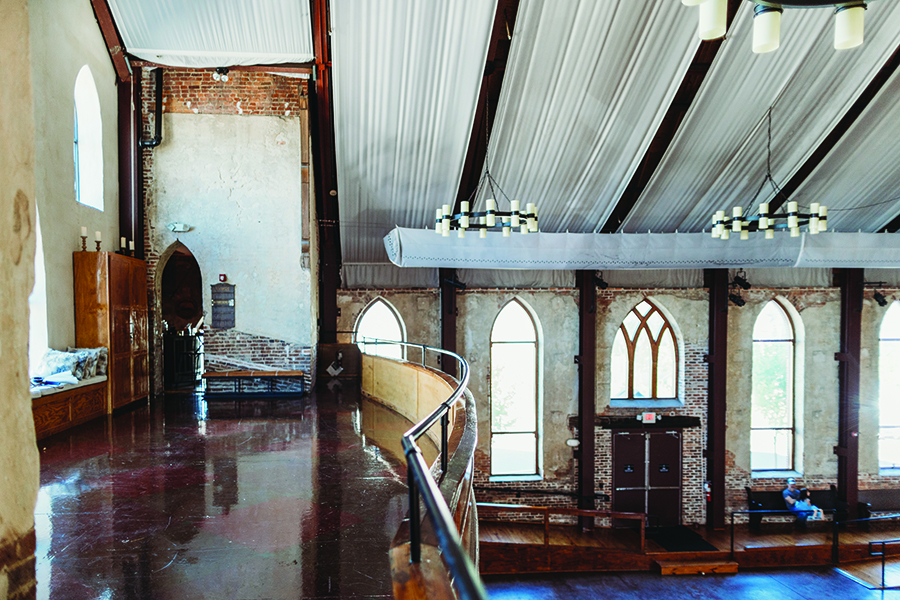
One crisp day in early fall I spent an hour or so with Joel in downtown Wilmington at the Brooklyn Arts Center, a gorgeous, deconsecrated church that was built in 1888 and passed through the hands of numerous congregations before falling into disrepair and being saved by a public and private partnership in the late 1990s. Over the past decade, the Brooklyn Arts Center has hosted countless weddings, community events and concerts by musicians like Art Garfunkel, Brandi Carlile and Old Crow Medicine Show. The sprawling complex, which features the event space, a bridal suite, an annex that once served as an old schoolhouse, a courtyard and the Bell Tower Tasting Room, is now a busy hub of art, culture and celebration. It was in the Bell Tower Tasting Room where I found Joel, ready and waiting to mix up a few cocktails that are perfect for the upcoming holiday season.

As Joel mixes our first cocktail — a mulled apple cider — I ask him how he’s been able to build a career as a bartender with one foot in the literary world, another in modern art and another (apparently Joel has three feet) in bartending. He smiles. “I think I’ve always been attracted to chaos,” he says, which surprises me. Joel is one of the most measured people I’ve ever met, and to watch him work behind the bar is to witness a seemingly effortless precision.

The steaming hot apple cider is poured with bourbon and garnished with star anise, lemon and a cinnamon stick stirrer. It tastes like a winter evening, presents wrapped under the tree and the kids blessedly asleep before the chaos of Christmas morning.

I ask Joel about his childhood growing up in Lehighton, Pennsylvania, a small blue collar town on the banks of the Lehigh River about an hour and a half northwest of Philadelphia.

“Until I was 5, my family lived in a trailer on a dirt road, 2 miles up along the side of a mountain. It was awesome because there were bears and deer, and you could just pick up rocks and there were orange salamanders everywhere,” he says. “And then my great-grandmother passed away and we moved into her house in town, which changed everything for me. I was suddenly in the middle of a small town and I could walk to high school and there were girls there. And there was a basketball court nearby, which I pretty much lived at.”


The abstract expressionist painter Franz Kline also moved to Lehighton in his youth in the second decade of the 20th century. Joel’s mother had grown up in the area hearing stories about Kline and his work, and her interest led her to become one of the country’s pre-eminent specialists on everything from Kline’s paintings to his career and biography. When Joel was young, his mother began working on a biography of Kline, but it wasn’t until Joel graduated from college and was teaching school in Philadelphia that he asked for a look at the manuscript.

“I was home for Christmas, and I said, ‘Mom, what’s up with that book?’ I asked her if I could take a look at it. And then I realized what she had was a huge document of notes, but no structure.” Mother and son began working on the project together, and they would do so for over 20 years before Franz Kline in Coal Country was published in 2019, the first biography to examine this major American artist’s formative years in Pennsylvania, Boston and London before he became one of the founding members of the New York School.

The next cocktail Joel prepares is called the Cat’s Whiskers, a tipple of rye whiskey, honey syrup, fresh lemon juice and Angostura bitters that tastes like a party thrown by Jay Gatsby. If I were to turn and look over the balcony here at the Brooklyn Arts Center, I would almost expect to see a jazz band taking the stage, the audience filled with men in smart suits and women in flapper dresses, snow pounding against the stained glass windows as the hour tips past midnight.

The book on Kline was not the first Joel had published. During a long career as a bartender — one that began in college and would lead to reviews and spots in publications like Bartender Magazine, Cosmopolitan and a profile in Playboy as one of the country’s Top 10 Mixologists — Joel had accumulated countless stories from co-workers and patrons, many of which he recounted in his 2009 book Cocktails & Conversations, which expertly mixes barroom lore with the histories of mixology and cocktail recipes.

One bar customer who had an enormous influence on Joel’s life was the abstract expressionist Edward Meneeley, a contemporary and friend of artists like Willem de Kooning and Andy Warhol. Joel and Meneeley met while Joel was in college at Kutztown University and working at a bar across the street from Meneeley’s art studio.

“Ed introduced me to mixing things like Campari and soda back in the day when everyone drank Captain and Coke, circa 1998,” Joel says. “Ed would come into the bar and throw his old copies of The New Yorker at me and tell me I needed to educate myself out of this town, so I got to know the work of the magazine’s art critic Peter Schjeldahl pretty well. I wasn’t even 21 yet. I started tending bar at 18, which was legal.”

The next cocktail Joel makes is called Lavender 75, and while it doesn’t include Campari, the West Indian orange bitters combine with gin, fresh lemon, lavender syrup and a splash of dry Champagne to give the drink an incredibly complex and layered taste, both dry and deeply flavorful.

When Joel and his wife, Jess James (who owns a vintage clothing boutique in Wilmington that is a habitual stop for Hollywood actors when they’re in town filming movies), moved to town in 2005, Joel brought his two main interests south with him: mixology and contemporary art. He took a job as the bartender of Café Phoenix in downtown Wilmington and designed one of the first craft cocktail menus in the city. He also curated the art on the restaurant’s walls, hosting artists like his friend Meneeley and Leon Schenker. Suddenly work by internationally known artists valued at tens of thousands of dollars was hanging where local art had once dominated the walls.

It was after a few years in Wilmington, where he eventually earned an MA in liberal studies from UNC Wilmington, that Joel first learned about the 1898 race massacre, the only successful coup in American history that saw white supremacists murder untold numbers of Black citizens while overthrowing the duly elected local government. He was shocked to learn that something so horrible had happened in a city he had quickly grown to love.

After researching the events surrounding 1898, Joel co-founded the nonprofit Third Person Project, which is dedicated to uncovering and preserving history. One of the group’s first projects was gathering and digitizing copies of The Daily Record, which was the only daily Black newspaper in North Carolina before it was destroyed by a mob during the events of 1898. Since then, the organization has gone on to host musicians like Rhiannon Giddens, who came to Wilmington to perform the “Songs of 1898” at a 2018 event with Joel’s Third Person co-founder, writer John Jeremiah Sullivan. Third Person has gone on to lead Wilmington in efforts to save historic buildings, mark burial places, and uncover lost histories, often by partnering with local institutions like UNC Wilmington’s Equity Institute.

On a smaller scale, Joel is also contributing to local history with the impact he’s had on its cocktail scene. The final drink he mixes — the True Blue — is a good example. He created it years ago when he designed the cocktail menu for the Wilmington restaurant True Blue Butcher and Table. The cocktail remains a fixture and, with its mix of pear-infused vodka, elderflower liqueur, lemon and a splash of dry Champagne, I understand why.

Our interview is over and, as Joel cleans up behind the bar, he tells me he plans to spend the rest of the afternoon working on an essay about 1898. Cocktails, conversation, curating art, correcting history. It’s all in a day’s work.

True Blue

Fresh, clean, bright. Designed after research into ancient Greek formulas for the “nectar of the gods.”

1 ounce Grey Goose La Poire vodka

1 ounce St. Elder elderflower liqueur

1/2 ounce fresh lemon (or about half a lemon)

Splash dry Champagne

Splash sparkling mineral water

Pre-chill cocktail coupe and set aside. Mix vodka, elderflower liqueur and fresh lemon over ice in a mixing glass. Shake hard for at least 12 seconds. Discard ice from pre-chilled coupe back into ice bin. Strain mixture into coupe. Float Champagne and soda. Garnish by dropping in 3 blueberries or thin slice of pear.


The Cat’s Whiskers

Substitute gin and it becomes The Bees Knees. Both are Roaring ’20s slang for the height of excellence.

1 3/4 ounces favorite bourbon or rye whisky

1 ounce honey syrup (1:1 ratio of hot water to honey)

3-4 fresh mint leaves

1/2 ounce fresh lemon

2 dashes Angostura bitters (optional)

Splash sparkling water 

Pre-chill cocktail coupe and set aside. Combine all of the ingredients over ice and shake for 12 seconds. Discard ice from pre-chilled coupe back into ice bin. Double strain into coupe (make sure no green flecks of mint end up in anyone’s teeth). Garnish with fresh mint top.


Lavender 75

The classic French 75 cocktail was named after a cannon. This places a flower in the barrel.

1 1/2  ounces Botany Gin

1/2 ounce fresh lemon

1 ounce lavender syrup (steep dried lavender flowers like a tea in hot water, then add sugar, 1:1 ratio)

3 dashes West Indies Orange Bitters

Splash dry Champagne

Splash sparkling mineral water

Pre-chill a cocktail coupe and set aside. Combine all of the ingredients over ice and shake for at least 12 seconds. Discard ice from pre-chilled coupe back into ice bin. Strain the chilled mixture into the coupe. Garnish with 3-4 dried lavender buds.  PS

Wiley Cash is the Alumni Author-in-Residence at the University of North Carolina at Asheville. His new novel, When Ghosts Come Home, is available wherever books are sold.

Omnivorous Reader

Watergate Revisited

A thorough look at the end of our political innocence

By Stephen E. Smith

If you don’t believe history can turn on insignificant details, consider this: The political firestorm known as Watergate was precipitated by a piece of cheap tape. In his Watergate: A New History, Garrett M. Graff, a former editor of Politico Magazine, has gathered the particulars of America’s most infamous political scandal into an 800-page history that thoroughly examines the minutiae that brought down the 37th president.

If you’re among the millions of Americans born after the Watergate scandal, here’s what you need to know. In the early hours of Saturday, June 17, 1972, a security guard at the Watergate Complex in Washington, D.C., discovered that duct tape had been used to ensure that a couple of doors remained unlocked. The guard called the cops, and five officers disguised as hippies apprehended five men in suits and charged them with attempted burglary. It was the beginning of the end of Richard Nixon’s presidency and America’s political naivete.

If you suffered through those troubled times — June 1972 to August 1974 — you’re probably wondering if another Watergate history is necessary. Given the number of books, articles, documentaries and movies that have investigated every possible facet of the Watergate debacle, it’s difficult to imagine the need for a retelling, but once you’ve begun your retrospective journey in Graff’s “new” history, there’s no turning back. You may think you know all there is to know about Watergate but you don’t.

Graff is a proficient storyteller and an able prose stylist, and he excels at breathing new life into characters who have dimmed with time — E. Howard Hunt, G. Gordon Liddy, Chuck Colson, Donald Segretti, John Ehrlichman, H.R. Haldeman, John Mitchell, John Dean, Jeb Magruder, et al. — and the journalists, senators, congressmen, wives and government employees whose lives were altered by the scandal that sent 25 of Nixon’s cronies to prison. To do this, Graff plowed through the published accounts, oral histories, the Oval Office tape transcripts, as well as FBI, court and congressional records. His objective was to “re-investigate.”

“I believed from the start,” he writes, “that the full story of this scandal didn’t lie in the umpteenth interview, fifty years after the fact, with a key player who had already spent decades telling, refining, and positioning his story.”

Graff is particularly adept at reintroducing readers to lesser-known Watergaters. L. Patrick Gray, acting director of the FBI from May 3, 1972 to April 27, 1973, is a case in point. For most Americans, he remains an insignificant figure in the scandal, but Graff fully explores Gray’s character — especially his overriding desire to become director of the FBI — and his failings, including his admission that he’d destroyed documents taken from Hunt’s safe. “Under questioning, Gray admitted he had regularly sent investigative reports to the White House via Dean,” Graff writes, “allowing the president’s staff access to files that (J. Edgar) Hoover had previously guarded.”

Likewise, Margaret Mitchell, the brash, outspoken, way-too-Southern wife of Attorney General John Mitchell, provided comic relief during the scandal, but Graff details her political insights and how she was ruthlessly attacked by members of the administration and her former husband. He recasts her as a perceptive and outspoken critic who was harassed and demeaned by Nixon’s henchmen.

Al Haig, famous for having blurted “I’m in control here” after the attempted assassination of President Ronald Reagan, became Nixon’s chief of staff when Haldeman was fired. He had, in fact, taken control of the White House prior to the attempt on Reagan’s life: “. . . as Nixon retreated deeper mentally and physically while Watergate consumed his presidency, some would joke that Haig became the nation’s ‘37 1/2th’ president.”

Another minor player was Alexander Butterfield, the soft-spoken former Navy pilot who was the House committee’s first witness in its impeachment hearings. He testified for 10 hours, revealing the secret Oval Office taping system and reinforcing the notion that Nixon was too much of a control freak not to have known what was going on with his subordinates. Even Nixon’s secretary Rose Mary Woods (remember the “the Rose Mary stretch”?) doesn’t escape scrutiny. She was certainly a player in the coverup, and there was speculation that she was a CIA informant.

Mark Felt, the FBI’s No. 2 official at the beginning of the scandal, is the frequent subject of Graff’s reporting. When writing their investigative stories in the Washington Post, Bob Woodward and Carl Bernstein identified their primary source as “Deep Throat,” but Felt wasn’t publicly outed until 2005, at age 91, when he revealed to Vanity Fair that he was Woodward and Bernstein’s informant. Ironically, Felt’s identity as an FBI mole was known to the Nixon administration as soon as Woodward and Bernstein began to write about the white-collar criminals who facilitated Nixon’s cover-up operation.

The questions that don’t get answered are the most obvious: Why did a serving president who was a shoo-in for a second term employ widespread illegality to secure an election he was certain to win? Did the Democrats have dirt on Nixon? Was any advantage to be gained by eavesdropping on Democratic headquarters? Were the Watergate burglars — “the Plumbers,” as they were known in the administration — set up for failure? Since the break-in at Daniel Ellsberg’s psychiatrist’s office yielded no useful information and the confusing circumstances of the ITT merger certainly went unnoticed by the electorate, why had Nixon and his minions continued their illegal activity? And there remains this overriding question: Why had Nixon insisted on recording Oval Office conversations when he knew he was speaking words that would eventually incriminate him?

Richard Nixon remains a shadowy figure in American history, and “gate” has become a convenient suffix for other scandals — most of them overblown or imaginary — but there’s no denying that Nixon’s political shenanigans changed us forever. Unfortunately, the lesson to be drawn from Watergate continues to elude most politicians. Any neighborhood gossip could tell them that in political life there are no secrets, finally or ever.  PS

Stephen E. Smith is a retired professor and the author of seven books of poetry and prose. He’s the recipient of the Poetry Northwest Young Poet’s Prize, the Zoe Kincaid Brockman Prize for poetry and four North Carolina Press Awards.

Simple Life

My November Song

A prayer of gratitude for the lives that touch us and those that await beyond

By Jim Dodson

On one of the last warm mornings of summer, I was watering shrubs when I heard a heavy thump behind me in the garden. Turning around, I saw only half a dozen birds feeding at the three feeders that hang from our aged maple’s outstretched limbs. I walked over to investigate.

I found a large squirrel crawling desperately on the ground toward one of the young azaleas planted back in the spring. The critter had evidently fallen from one of the high branches and was either dazed or severely injured. As I approached, the big squirrel curled up at the base of the plant and burrowed its nose under the shrub’s branches.

My first impulse was to fetch a garden tool and end the poor animal’s suffering. But long ago I made a pact with the universe to cause as little harm as possible to creatures large and small, probably the result of reading too many transcendental poets and Eastern sages early in life, and covering a great deal of murder and social mayhem during the first decade of my journalism career.

Not counting the untold number of innocent garden plants I’ve inadvertently offed due to general ignorance or untimely negligence, I’ve generally abided by the naturalist maxim that it’s best to let nature take care of her own. So for this reason I went back to watering the shrubs for a spell, hoping the big fallen fellow was merely stunned.

Our little patch of paradise is a remarkably peaceful kingdom. Dozens of birds feed daily from the feeders that hang from the old maple’s mighty limbs. Over the years, the squirrels that inhabit the forest of trees around us have displayed impressive acrobatic skills and inventive ways to get at those feeders, prompting me to constantly come up with strategies to thwart their efforts. It’s kind of a fun game we play.

When I walked back to check on the fallen squirrel, however, he was lying right where I left him, perfectly still. He was dead.

I picked him up to look him over. He was an older fella bearing scars, nicked-up by life. It seemed only fitting to bury him on the spot where he lived out his final moments on this Earth — underneath the young azalea.

It was my second death of the week.

Two days before, on a beautiful morning when the rains I’d been waiting and praying for all summer finally arrived, we decided to put my beloved dog, Mulligan, to sleep.

Mully, as I call her, found me 17 years ago, a wild black pup running free just above the South Carolina state line, literally jumping into my arms as if she’d been waiting for me to come along. She was my faithful traveling companion for almost two decades.

Three days before we lost her, Mully made the daily mile-long early morning walk we’ve strolled together for over a decade. Never sick a day in her life, it was the rear legs of this gentle, soulful, brown-eyed border collie I called my “God Dog” that finally gave out. She hobbled painfully on three legs around the Asian garden she watched me complete this summer, and settled at my feet where we sat together on a bench most evenings just watching the world. Her upward gaze told me it was time for her to go.

It was the hardest — but right — thing to do.

The idea of the afterlife for all God’s creatures — especially dogs — has fascinated me since I was a little kid. One of my first memories of life comes from a late autumn evening in 1958 when my mother and I were walking the empty beach at low tide near our cottage in Gulfport, Mississippi, looking for interesting seashells washed up from the Gulf of Mexico.

Our dog, Amber, had just died of old age. I was sad to think I would never see her again, and wondered what happens when dogs and people died.

My mom picked up a perfect scalloped shell, pure alabaster white, and handed it to me.

“Tell me what you see in that shell,” she said.

“Nothing. It’s empty.”

She explained it had once been the beautiful home of a living creature that no longer needed it, leaving its protective shell behind for us to find.

“Where did it go?” I demanded.

“Wherever sea creatures go after this life.”

“Do you mean heaven?”

She nodded and smiled. I’ve never forgotten her words.

“That’s where your dreams come true, buddy.”

“Same with Amber?”

“Same with Amber.”

A few years later, a marvelous Black woman named Miss Jesse came to help heal my mom after a terrible late-term miscarriage that nearly killed her. I often pestered Miss Jesse in the kitchen or when she took me along to the Piggly Wiggly. One evening I asked her why all living things had to die. She was rolling out dough and making biscuits at the time.

Her rolling pin kept working. “Let me ask you something, child,” she said matter-of-factly. “Do you remember a time when you weren’t alive?”

I could not.

“That’s because you ain’t never not been alive, baby. Nothin’ you love dies. It just passes on to a new life — just like the trees in spring.”

Half a century later, I heard the voices of both my mother and Miss Jesse in a powerful song called “Take It with Me” by bluesman extraordinaire Tom Waits.

I played it the day Mully left me. I’ll play it again when I spread her ashes in the garden she helped me create.

I play it, in fact, every year when the leaves begin to fall. It’s my November song.

  The children are playing at the end of the day

Strangers are singing on our lawn

There’s got to be more than flesh and bone

All that you’ve loved is all you own . . .

Ain’t no good thing ever dies

I’m gonna take it with me when I go

The leaves fell early this year. By the time we give thanks for tender mercies, missing friends, beloved traveling companions and even fallen squirrels that have graced our lives with their presence, they may all be safely gathered up to wait for us.

Somewhere where dreams come true. PS

Jim Dodson can be reached at jwdauthor@gmail.com.

The Omnivorous Reader

Of Race and Justice

Two books with common cause

By Anne Blythe

Sometimes two books can sit far apart on the bookshelf and seem to have little in common. Then you read them and discover the themes they share.

Wastelands: The True Story of Farm Country on Trial is novelist and lawyer Corban Addison’s first work of nonfiction, a fast-paced legal thriller that reads like a novel about — wait for it — hog feces.

Addison tells the saga of Elsie Herring and hundreds of other residents in eastern North Carolina so disgusted by the stench and waste disposal practices of the industrial-style hog farms among their rural, mostly Black communities that they waged a legal battle against a pork industry giant. Through deft description of courtroom drama and artful portraits of the characters in this classic good-versus-evil narrative, Addison exposes the longstanding injustices of institutional environmental racism.

In Beyond Innocence: The Life Sentence of Darryl Hunt, Phoebe Zerwick, head of the Wake Forest University journalism program who used to work at the Winston-Salem Journal, delivers a thorough journalistic exploration of the life, wrongful conviction, exoneration and death by the suicide of Darryl Hunt. Zerwick shines a harsh light on a fundamentally flawed justice system and the institutional racism embedded in it.

Addison opens his book inside the federal courtroom in Raleigh where U.S. District Judge W. Earl Britt has just been alerted that a jury has reached a verdict in one of a series of nuisance cases that hog farm neighbors brought against Smithfield Foods Inc., the world’s largest pork producer.

The decision came quickly.

“The word spread like sparks from a brushfire,” Addison writes. “Smartphones emerge from pockets and handbags, thumbs fly across screens, and messages are cast across the digital wind, lighting up other phones with chimes and beeps miles away.”

Britt, Addison writes, is “a charming octogenarian with the oracular eyes of a barn owl,” who waits for the assembly of the necessary attorneys, paralegals, plaintiffs and others to take their places in the courtroom. Peering over his glasses at the lawyers, he motions to the bailiff to bring in the jury.

A quiet settles over the courtroom. The foreman, holding an envelope with the verdict sealed inside, tells the judge that he and his fellow jurors have come to a unanimous decision. “As the envelope makes its short trip to the bench, the plaintiffs in the gallery take a breath and hold it,” Addison writes.

His prose is poetic though, at times, a bit overwrought. “The pain and sorrow of memory, together with the labor of years and dreams of days yet to come, are at the altar before them. Contrary to the tale of greed and opportunism being spun by politicians and poohbahs across town, they aren’t thinking about a million dollar payday as they wait for the judgment to be delivered. Instead, they are whispering a simple prayer, the prayer of verdict day, of verdictum. Please, Lord, let them believe us. Let them believe that we told the truth.”

In the ensuing scenes he gives readers a sense of history about land in the coastal plain that has been passed down from generation to generation among Black families who are standing up against the nemesis they say is responsible for them being unable to enjoy the life they, and their ancestors, once had.

This thoroughly researched and reported narrative ends with a visit to Joyce Messick, one of the plaintiffs in the nuisance cases who saw the hog farm near her family’s property shutter.

While Messick told him she finally felt as if she could breathe clean air, others have not gotten to that point. “Most have yet to see the change, to fill their lungs with liberated air, to stand upon emancipated ground,” Addison writes. “The dollar is still the lodestar of Smithfield Foods, and the legislature is still its domain.” Nonetheless, Addison concludes, there are people who will be relentless until commitments by the pork industry are realized.

To open her book about Hunt, Zerwick explains why she felt compelled to revisit a case she had chronicled in a series for the Winston-Salem Journal, one that led to new court proceedings that resulted in his exoneration.

Beyond Innocence is my attempt to finish a story I began long ago,” she writes. “In 2003, when I wrote about the wrongful conviction of Darryl Hunt for the Winston-Salem Journal, Hunt was in prison then for the 1984 murder of a newspaper editor who had been raped and stabbed to death, not far from the newsroom where I worked.”

Hunt, who maintained his innocence throughout, was exonerated after 19 years of legal battles and the help of tireless advocates who refused to let the wrongful conviction stand.

“To the outside world, Hunt was the man who walked out of prison without rancor or regret,” Zerwick writes. “But the past haunted him, and the heroic narrative of a man who fought for justice masked a deep despair.” Zerwick decided to revisit Hunt’s story after he was found dead in the driver’s seat of a pickup truck that had been parked by a busy road with what appeared to be a self-inflicted gunshot wound.

She was grief-stricken, as were many others. Then she went into reporter mode.

“I wasn’t done with the story after all,” Zerwick writes. “I started looking into his death soon after the funeral. Rather than tackle the big question about the failure of the justice system, I focused first on the facts.” Answers began to arrive as she interviewed the people around him, studied photographs and Facebooks posts, and pored over correspondence Hunt had with his lawyers.

“Hunt’s death taught me a great deal about the limits of journalism and forced me to question my motives,” Zerwick writes. “Does the public’s right to know, that righteous principle we journalists invoke, justify exposing the secrets I hoped to find? Does shining a light in the dark places really help, as we claim it does? Who am I to tell a story Hunt had not told himself?”

In the end, though, Zerwick brings new layers to the saga of Darryl Hunt, the heroic advocate for reform, and the often-told recounting of his wrongful conviction.

“Long before politicians began campaigning against mass incarceration, Hunt saw the system he had left behind for what it is, a trap that condemns millions of men and women, and their children, to living on the fringes, barred from jobs, housing, bank loans, food assistance and more, barred, in short, from a reasonable chance at a decent life,” Zerwick concludes, and she wishes Hunt was here to be a part of the reforms.

Both Zerwick and Addison have crafted new, nonfiction accounts of old cases that tested the justice of the justice system. They should be read from cover to cover. PS

Anne Blythe has been a reporter in North Carolina for more than three decades.

PinePitch

Charity on the Hoof

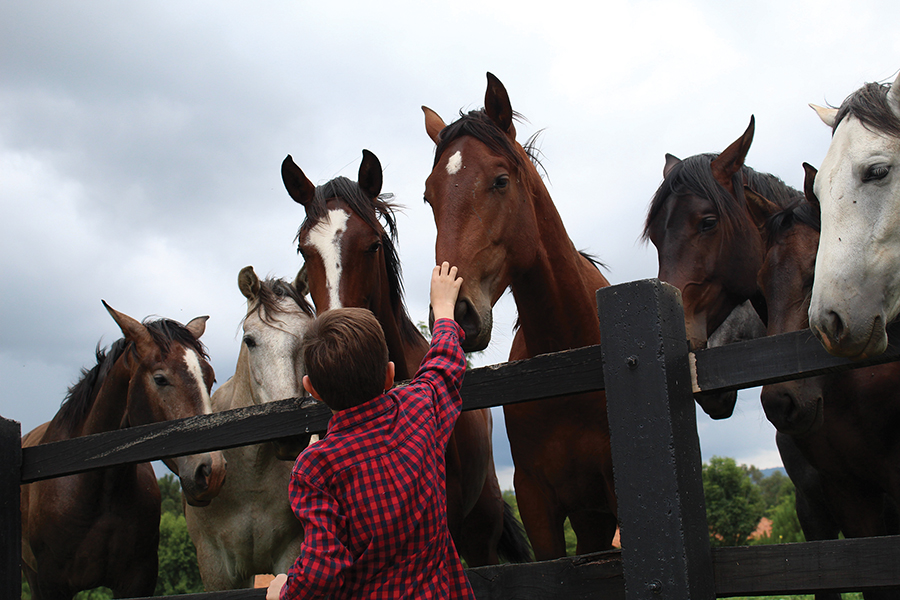
Take your horse-loving herd on a self-guided tour of six exquisite horse farms from 11 a.m. to 4 p.m. on Sunday, Oct. 16. All proceeds benefit the Prancing Horse Center for Therapeutic Horsemanship. Tickets are $25 in advance or $30 the day of. Children 12 and under are free. Prancing Horse Center, 6100 Hoffman Road, Hoffman. Trot off to www.prancing-horse.org for information and tickets.

Photograph By Ted Fitzgeralds

Live After 5

Don’t miss the last concert of the 2022 Live After 5 concert series  on Friday, Oct. 14 from 5:15 p.m. to 9 p.m. with entertainment experts Bantum Rooster. Wildfire Pizza, Jaya’s Indian Cuisine, and Sunset Slush will be on-site with a wide selection of food for all to enjoy. Beer, wine and additional beverages will be available for purchase. Bring your picnic baskets but leave the outside alcohol at home. Kids’ crafts ensure a good time will be had by all. Tufts Memorial Park, 1 Village Green Road, Pinehurst. Info: www.vopnc.org.

Cabin Cool

Catch up on some upscale cabin coziness on Saturday, Oct. 22, from 10 a.m. to 4 p.m. with a tour of eight historic cabins in Pinehurst, Southern Pines and Carthage, taking them all the way from flannel to flawless. One of the cabins is featured in this edition of PineStraw beginning on page 90. Drop into the Woman’s Exchange before or after the tour for a complimentary dessert and drink the day of the event. Tickets are $25 and proceeds support the Sandhills Woman’s Exchange, 15 Azalea Road, Pinehurst. Info: (910) 295-4677 or www.sandhillswe.org.

Photograph By Ted Fitzgeralds

Handmade for the Holidays

There’s something for everyone at the 43rd annual Holly Arts and Crafts Festival on Saturday, Oct. 15 beginning at 10 a.m. and boasting the talents of over 100 crafters — from woodworking to glass, stitched art to lawn ornaments, jewelry to metal sculpture. Your favorite downtown shops and restaurants will be offering sales and specials, with food trucks on hand to ensure you shop but don’t drop while you cross names off that holiday gift list. Tufts Memorial Park, 1 Village Green Road, Pinehurst. Info: www.vopnc.org.

Celebrating Iconic Female Leaders

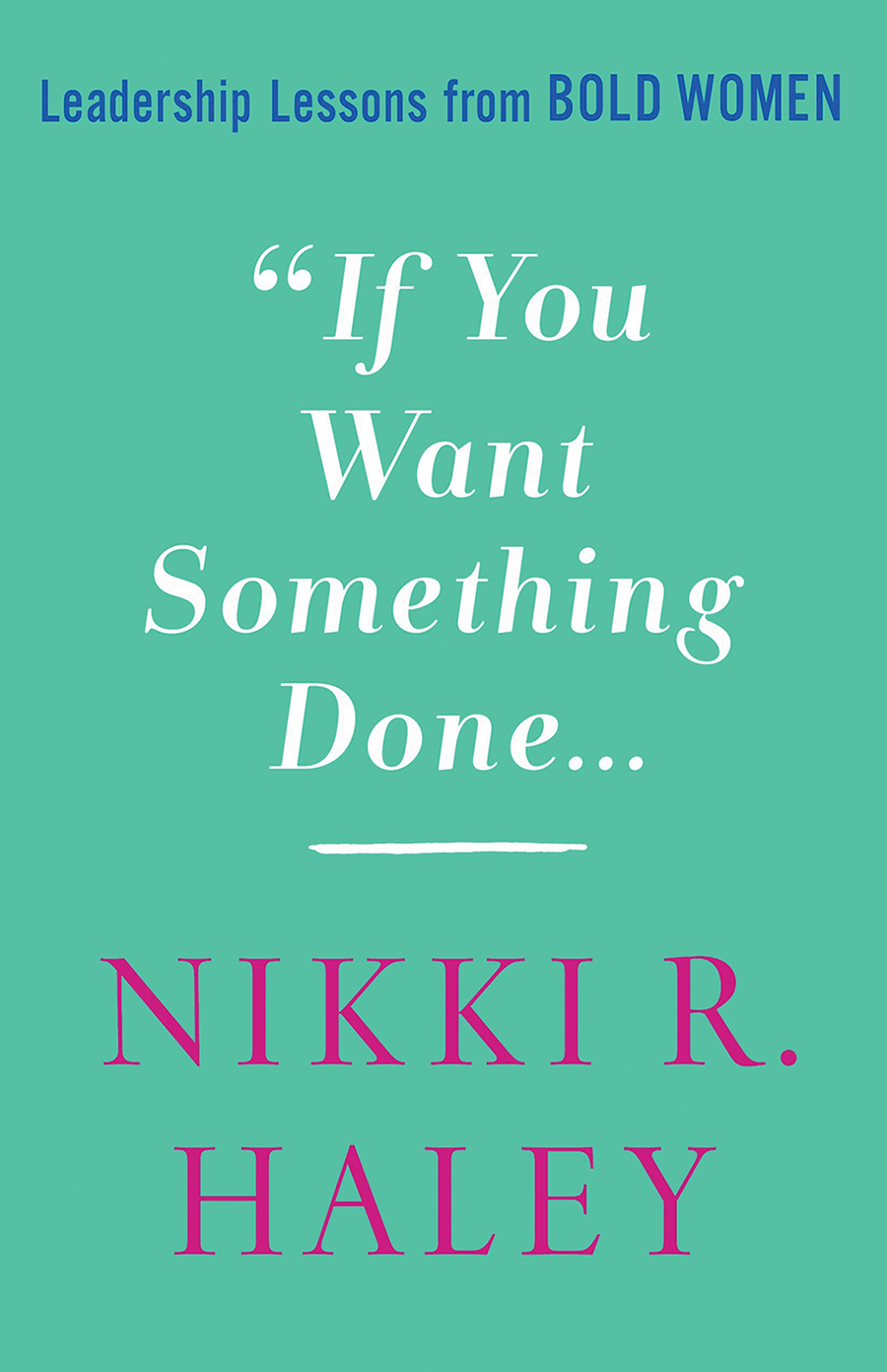
Spend your Saturday with former governor of South Carolina and U.S. Ambassador to the United Nations Nikki Haley as she discusses her book If You Want Something Done: Leadership Lessons From Bold Women. She joins The Country Bookshop’s Kimberly Daniels Taws in an intimate and inspirational conversation on Saturday , Oct. 8 from 2:30  p.m. to 3:30 p.m. at the Bradshaw Performing Arts Center, Owens Auditorium, 3395 Airport Road, Pinehurst. For information and tickets visit www.ticketmesandhills.com.

Photograph By Ted Fitzgeralds

Moore Heritage, More Fun

Blend treasure hunting with history and fall fun for the whole family at the 14th annual Shaw House Heritage Fair and Moore Treasures Sale from 9 a.m. to 4 p.m. on Saturday, Oct. 8, rain or shine. The Heritage Fair offers unique vendors, baked goods, live music, demonstrations of old-time crafts, treasure sales and farm animals for petting. The Shaw House, Sanders Cabin and Garner House will be open for tours. The tobacco barn and museum highlight historic agriculture of the Sandhills. The Moore Treasures Sale features collectibles, pottery, jewelry, art, antiques, vintage books, toys, glassware and much more. All proceeds benefit the ongoing efforts of the Moore County Historical Association. Admission is free. The Shaw House, 110 W. Morganton Road, Southern Pines. Info: (910) 692-2051 or www.moorehistory.com.

Have Hydrangeas, Send Help

Give your hydrangeas a fighting chance at survival by attending an hour-long presentation on the care and keeping of the colorful plants at the Sandhills Horticultural Lecture Series on Friday, Oct. 14 at 1 p.m. In addition to hearing from expert Wake County gardeners, attendees will also see a video of the Cape Cod Hydrangea Festival. Registration is not required, but seats are limited, so arrive early at the Sandhills Horticultural Gardens, Ball Visitors’ Center, 3245 Airport Road, Pinehurst.

The Big Easy

Join the New Orleans Masquerade Band for a Jambalaya and Jazz Fundraiser, featuring jazz and blues of the 1920s and ’30s, on Sunday, Oct. 16, from 5 p.m. to 9 p.m. at The Fair Barn. There will be small bites by Southern Whey, delicious jambalaya and dessert served by White Rabbit Catering, and cider tastings compliments of James Creek Cider House. Hosted by the Given Tufts Foundation, all proceeds benefit the Given Memorial Library and Tufts Archives. Pinehurst Fair Barn, 200 Beulah Hill Road S., Pinehurst. Info and tickets: www.ticketmesandhills.com.  

Charo in Class and Concert

Music and pop culture icon Charo may be best known for her signature “cuchi cuchi” phrase, but she’s also been voted “Best Flamenco Guitarist” twice by Guitar Magazine. Her bubbly personality and trademark 1970s expression have endeared her to millions of fans around the world. On Friday, Oct. 21, from noon to 1:30 p.m., Charo will host a master class on guitar and performance, a special opportunity for a small group to learn from a world class artist at BPAC’s intimate McPherson Theater. If you miss her master class, there’s still time to catch her on stage. She’ll be performing that evening from 7 p.m. to 9 p.m. at BPAC’s Owens Auditorium. Both locations are at 3395 Airport Road Pinehurst. Additional information and tickets are at: www.ticketmesandhills.com.

The British Are Coming!

Make your way to downtown Southern Pines for the penultimate First Friday of the season with The English Beat, a UK band that fuses Latin, pop, soul, reggae and rock — all in support of your local theater. As always, leave the dogs and outside alcohol at home but enjoy the food trucks, along with some Southern Pines Brewery brews, from 5 p.m. to 7 p.m. on Friday, Oct. 7. On the square at the Sunrise Theater, 250 N.W. Broad St., Southern Pines. Info: www.sunrisetheater.com.

Tea Leaf Astrologer

Libra

(September 23 – October 22)

It’s hard to find balance in a world so positively askew. Even for you, Libra. And yet, you make it look easy. Contorting yourself with such subtle mastery that no one seems to notice you’re bent out of shape. Let the plates fall. Draw yourself a bath. The Earth will keep spinning while you recharge. And with the blustery energy of the new moon and partial solar eclipse sweeping in on October 25 — a breath of fresh air — it may be time to unearth a hidden passion.

Tea leaf “fortunes” for the rest of you:

Scorpio (October 23 – November 21)

In through your nose, out through your mouth.

Sagittarius (November 22 – December 21)

Slow down and proceed with caution.

Capricorn (December 22 – January 19)

It’s time to clear the cobwebs, darling.

Aquarius (January 20 – February 18)

The door was never locked.

Pisces (February 19 – March 20)

Two words: system reboot.

Aries (March 21 – April 19)

Butter won’t save the stale bread.

Taurus (April 20 – May 20)

Try sweetening the pot.

Gemini (May 21 – June 20)

There’s an app for that.

Cancer (June 21 – July 22)

Don’t leave yourself at the altar.

Leo (July 23 – August 22)

Opening a window might help.

Virgo (August 23 – September 22)

Concentrate and ask again.  PS

Zora Stellanova has been divining with tea leaves since Game of Thrones’ Starbucks cup mishap of 2019. While she’s not exactly a medium, she’s far from average. She lives in the N.C. foothills with her Sphynx cat, Lyla. 

The Creators of N.C.

A Purpose-Driven Art

Scott Avett follows the mystery

By Wiley Cash

Photographs By Mallory Cash

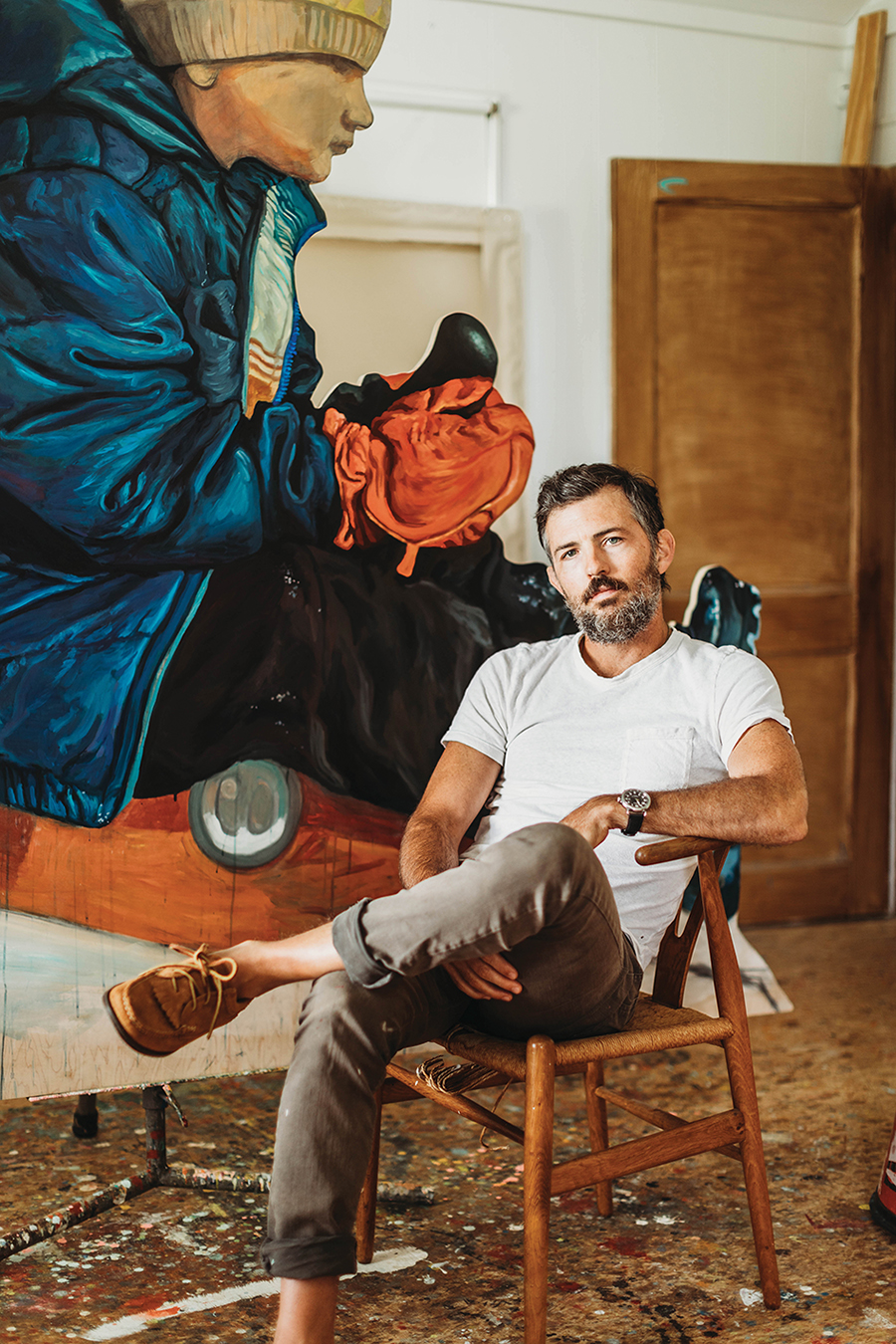
For a man whose music I’ve been listening to for almost two decades and whose face I’ve seen everywhere from the Grammy Awards to the Today show to the 2017 documentary May It Last: A Portrait of the Avett Brothers by Judd Apatow, Scott Avett was surprisingly easy to reach. After a couple of calls and texts to mutual friends, my wife, Mallory, and I arrived to interview him one day in early August. He met us in the driveway of the small house he’d converted into an art studio in the country about 15 minutes outside of downtown Concord, North Carolina.

Most North Carolinians, as well as music lovers around the world, know Scott as the other half of the Avett Brothers, who, along with his younger brother Seth, bassist Bob Crawford and cellist Joe Kwon, have sold millions of records and whose career has carried the band from small stages in college towns to the Grand Ole Opry to Madison Square Garden and beyond. But Scott knows himself best as a man whose purpose is to create, and painting is as much a part of his creative life as songwriting.

While his visual art has rarely been exhibited publicly aside from a 2019 show at the North Carolina Museum of Art, Scott has been a working artist since graduating from East Carolina University in 2000 with a Bachelor of Fine Arts in studio art. His paintings and drawings most often speak to family life and the natural world in rural North Carolina, but his work is in conversation with the many cultural and artistic influences he encounters on the road and in his reading life.

In our time together, Scott will rattle off quotes from French Impressionist Edgar Degas and the Trappist monk and mystic poet Thomas Merton the way some of us might casually discuss Monday Night Football or the day’s headlines. It’s clear to me that while his work portrays what one could see and hear if one were to spend time shadowing him during his daily life on the land in Concord, there is a deeper spiritual mystery residing in the work that speaks to the same unseen hand that guides emotions and ideas like love, duty, purpose and one’s role in them all.

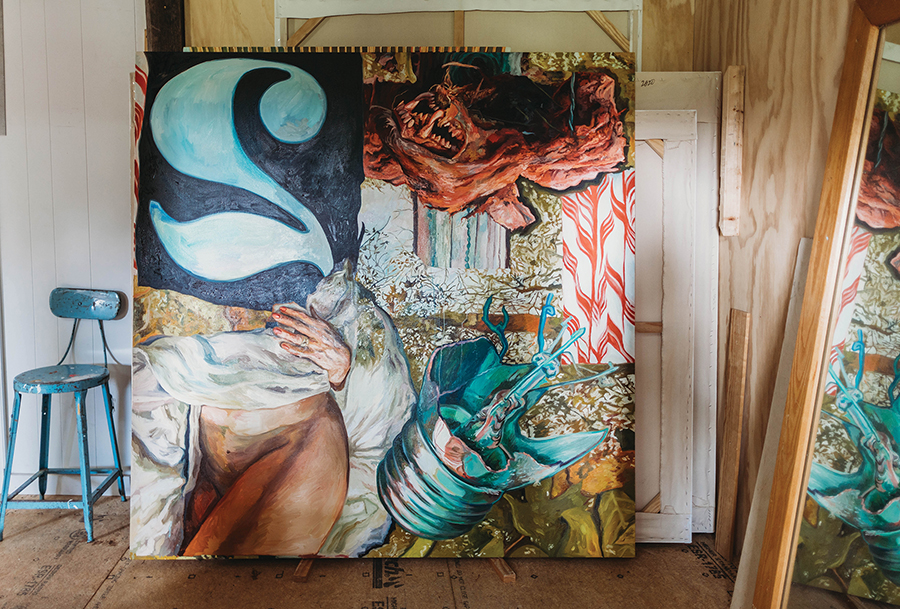
This mystery is perhaps what Scott refers to as “the revelation of meaning beyond the physical act of making” that informs his exhibition, “After the Fact,” which is running through October at the Greenville Museum of Art in Greenville, North Carolina. This exhibit will run concurrently with “Purpose at Random,” Scott’s show at the SOCO Gallery in Charlotte, which began in September and will run through November 2. The show in Charlotte features new oil paintings that Scott began working on in the early months of 2020, which means the work was created during the pandemic when he would have otherwise been on the road with the band. In a press release for the show, Scott says, “I’m not sure that it was easier to paint during the pandemic but it was certainly more available than playing concerts. Painting is a solitary activity. The more time alone the better, I think. The pandemic provided space.”

On the day we meet him, the only calendar space Scott has is a two-week break from touring, and so he’s at work completing a painting that will be featured in one of the upcoming shows. Inside, his studio reveals itself to be a place in creative flux. Paintings either hang on the walls or lean against them, some in various stages of completion. Hiding amongst them — and he will show it to us just before we leave in a few hours — is an early draft of a painting of singer/songwriter Brandi Carlile, the final draft of which appeared on the cover of her 2018 multi-Grammy Award-winning album, By the Way, I Forgive You.

We follow Scott into an open space, past a low counter where his kids’ works-in-progress are waiting for their return. The studio is bright and airy. Morning light pours through the windows on the east side of the house. Scott stands in the middle of the room with a cup of coffee brewed by the Concord coffeehouse, Verb, in hand.

As Mallory unpacks her camera gear, I tell Scott that I grew up in Gastonia, which is on the west side of Charlotte, while Concord sits on its east. We talk about what it was like to be raised so close to Charlotte in the 1980s and ’90s without much awareness of what went on in what seemed to us to be “the big city.” We joked that the only time we went into Charlotte was to go Christmas shopping at SouthPark.

“That was the fancy mall,” Scott says, smiling. I tell him that once, when I was young, I spotted NASCAR legend Jeff Gordon with his first wife at SouthPark, and that leads us to a conversation about race car drivers as Sunday races served as the backdrop of our North Carolina childhoods, especially for Scott, given that Charlotte Motor Speedway sits just a few miles away from the place where he was raised. I ask Scott how he and his family ended up on this expanse of land where he has remained despite his world travels, his parents still living just a few miles down the road, and his own family’s home tucked into the woods behind his studio.

Scott’s father was born in North Carolina and grew up the son of a Methodist minister whose calling took the family around the state. Scott’s mother was an Army kid born on a base in Germany before being raised in Kansas and Virginia. Just before Scott was born, his parents and older sister moved to Alaska, where his father hoped to get work as a pipeline welder, but the job fell through, and on the way back south the family lived in Cheyenne, Wyoming, for about a year. That’s where Scott was born. But they eventually found their way back to North Carolina and to the landscape where Scott’s grandfather had touched so many lives. When the family decided to settle down outside Concord — his father traveled as a welder and his mother taught school — they were gifted 2 acres and an old house by an elderly couple who had long admired Scott’s grandfather. His father renovated the home, and Scott’s parents lived there until the house burned down last year. But fire can’t burn roots, and Scott’s parents rebuilt, and they continue to reside just down the road from him.

When Scott and his two siblings were growing up, his parents made certain that education was available to them, especially if the kids were hungry for it. “They were intent on that,” he says. “They said, ‘We will see to it that you have an opportunity to go to school. If we’re broke, we’ll rob a bank to pay for it. If you are interested in education, you will get the opportunity.’” All three children went to college.

It’s clear that Scott values his children’s education as well, especially in the arts. Aside from the makeshift studio set up for them alongside his own work, his daughter regularly participates in after-school tutoring sessions in creative writing led by the owner of the local bookstore, Goldberry Books, in downtown Concord. It’s easy to imagine a holistic education in art and outdoor experiences unfolding for children in a landscape like this. If I sound wistful when imagining such a childhood it’s because I am.

But our conversation turns toward what could be considered the more practical matters of being a creator, namely, what happens when your hobby — whether it’s painting or songwriting or writing novels — becomes your job. Is the mystery of creation compromised?

“As soon as you’re doing something to pay bills, I don’t know that you’re really following your heart,” Scott says. “We’re called to have a purpose, but you can slip off that purpose really quickly, and all of a sudden the purpose becomes to pay the bills more easily. I want to avoid that. There’s a mystery in creating. I want to follow the mystery and get as close to it as I can. But when I’m caught up in success or anything else it has nothing to do with getting close to the mystery. It just distracts from it.”

Jeff Gordon and NASCAR are still lingering in the corners of my mind, and I mention that Gordon retired from driving at the age of 44, and both Scott and I are now in our mid-40s. I tell him that I doubt Gordon’s physical skills were diminished at that age, but perhaps his awareness of the risks he was taking became more apparent the older and wiser he got. I ask Scott if he’s more aware of the choices he’s making at this stage of his career and if his skills are continuing to sharpen. 

“I feel like I’m in the sweet spot, ability-wise,” he says about both performing music and painting. “Physically, I can do it, and, mentally, my tools have accumulated quite a bit. I see evidence of that when I can make plans about what project I am going to execute. Ten years ago, I might say, ‘I hope I can do this. I hope I don’t flub it and get stuck on something.’” He pauses for a moment. “I think I hold it all a little looser than I ever did, and I’m not going to be blown away by whether it hits or doesn’t hit. I don’t know why, but there’s now a barometer, and sometimes it says, ‘Hey, enough, you have enough. Now, with enough, can you lean into your purpose?’”

I ask him how it feels to let go of a painting after someone buys it. After all, when he writes a song he can always perform it whether or not it’s on a record or in front of a live audience. “It rips pretty hard,” he says. “It really does. I see painting as me telling my life story, and as I do that, it’s kind of tough to imagine that some of it’s in Colorado, some of it’s in New York, some of it’s in Texas. But I haven’t gotten too attached to any of them so far. There are only three I won’t let go of. One of my wife and two of our kids that I painted in bathing suits. They’re just portraits of them, but I’ve said those aren’t for sale.”

I ask him if his art is a result of his being anchored to this land given his family’s history on it. He pauses as if painting an answer in his mind.

“We’re all bigger than our place,” he finally says. “I am in North Carolina, and I am making the things I’m meant to make. When you can settle that and not think that New York is better than North Carolina, then you can start getting to your work.

“You have to find a corner of the world,” he says. “I truly believe that on these 80 acres there is more to explore than I can do in a lifetime. There is so much work to be done here, and by work I mean purpose. To me, my purpose is realized here. My purpose is to create. There are a lot of leaves to peel back here, and there are a lot of experiences happening.”

He pulls his phone from his pocket and flips through his photos, landing on a picture he took the night before of his 7-year-old son just after he’d fallen asleep. “There’s nothing not timeless about this,” he says. “If my purpose is to recognize relationships and see things, this is a good place to be.” He laughs and puts his phone away. “But where’s not?”  PS

Wiley Cash is the Alumni Author-in-Residence at the University of North Carolina at Asheville. His new novel, When Ghosts Come Home, is available wherever books are sold.

Naturalist

In the Realm of Seadevils

Encountering wonders from the deep-sea

Story and Photographs by Todd Pusser

A crescent moon hung high in the sky over a sea as smooth as glass. The air was thick with humidity as our research vessel plowed slowly through the waters of the Gulf Stream 150 miles south of Cape Cod. Thousands of stars twinkled above while lightning danced across distant thunder clouds miles away. Below my feet, it was a mile and a half down to the ocean floor.

The steady sound of the massive winch suddenly stopped. The thick cable extending out from the stern, taut with tension, indicated that the deep water trawl net was close to the surface. Like a kid on Christmas morning, I could barely contain my excitement. You never know what you might catch when dropping a net far below the ocean’s surface. On this particular trawl, the net was towed around 1,500 feet deep. Chances are good you might catch something that has never been seen by human eyes.

The deep-sea is defined as waters below 660 feet, where sunlight no longer penetrates. At its most extreme point, the ocean is an astounding 36,201 feet deep — roughly 7 miles down. At those depths, the ocean is a pitch-black wilderness where temperatures hover just above freezing.


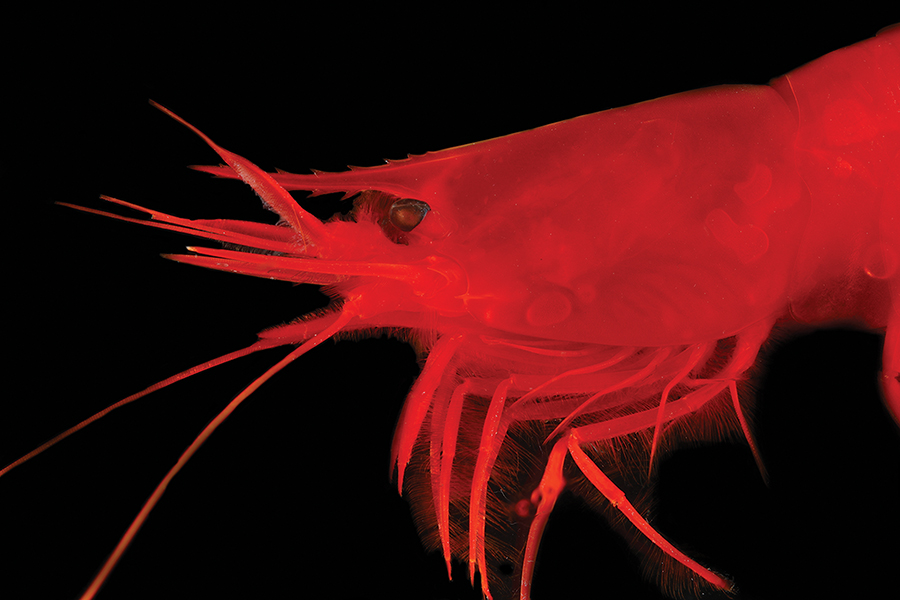
Left: Deepsea Shrimp.

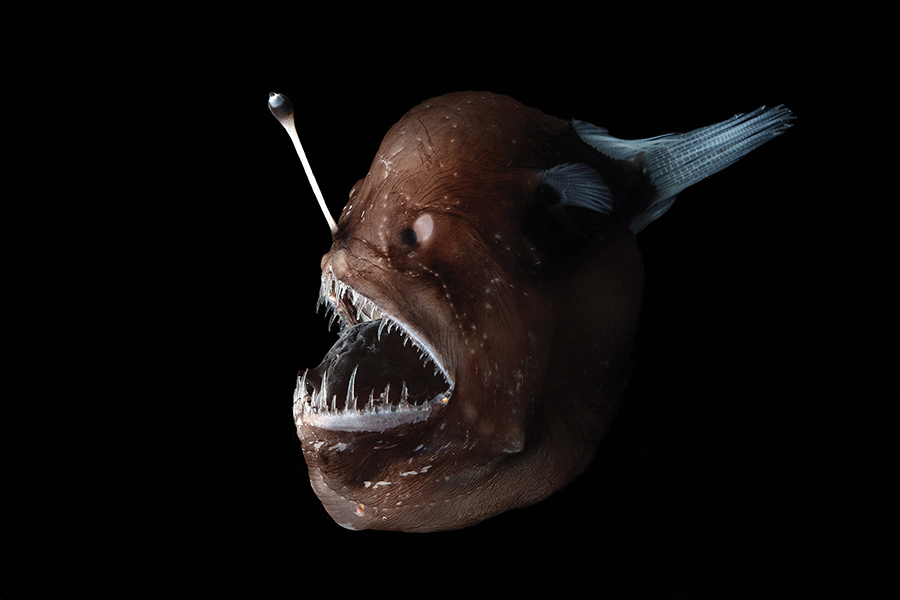
Right: Black Sea Devil-humpback anglerfish. 

It is not hyperbole to say that more is known about outer space than the deep-sea. The ocean covers 70 percent of this planet, and on average, is nearly 2 ½ miles deep. As pointed out by author Helen Scales in her recent book, The Brilliant Abyss, the entire surface of the moon has been mapped to a resolution of 23 feet, while the deep ocean floor that blankets the Earth has only been mapped to a resolution of 3 miles.

As a kid, on family vacations to Cherry Grove in North Myrtle Beach, I would often find myself standing on the sandy shore and staring out over the ocean, trying to look past the horizon line and wondering what treasures lay hidden beneath. In middle school, I daydreamed of being Captain Nemo, from Jules Verne’s classic Twenty Thousand Leagues Under the Sea, piloting the wondrous deep-sea submarine Nautilus in search of sea monsters. Later, in college, I discovered real-life explorer William Beebe, who in 1930 became the first man to descend into the dark depths of the ocean, below the reach of light, using a large steel sphere lowered from a stationary ship by thousands of feet of steel cable. Beebe introduced the wonders of the deep to people around the world in a series of articles for National Geographic and popular books such as Half Mile Down. I never imagined at the time that I would be able to see some of the wondrous creatures Beebe described in his writings.

With a few final turns of the winch, the net was hauled onto the deck of the ship. Grabbing a hard hat and life vest, I walked out onto the stern to assist the fishery biologists in sorting the catch. Down on one knee, I began to pick through a cornucopia of our planet’s strangest inhabitants — creatures that look like they evolved from the mind of Dr. Seuss. Even their names evoke a Spielbergian science fiction epic: dragonfishes, greeneyes, lanternfishes, whalemouths, hatchetfishes, bristlemouths, star-eaters, gulpers. Many were velvet black with mouths full of huge teeth and possessed strange, glowing bioluminescent lures sprouting from their heads. There were bright red shrimp, glowing squid, and skinny eels with bird-like beaks.

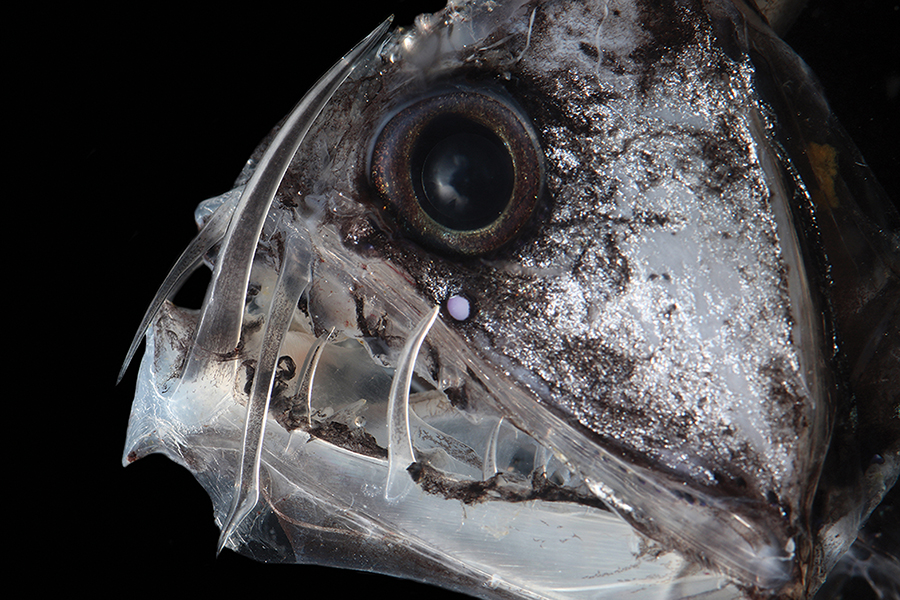
I reached into the twine of the net and gently untangled a saber-toothed viperfish, which possessed a series of needle-sharp fangs that extended up from its lower jaw to just above its eye. A series of bioluminescent dots ran along its flanks while an elongated glow-in-the-dark lure extending from its dorsal fin dangled in front of its fearsome maul. When viewed only in a photograph, a viperfish would appear to the be most fearsome critter in the sea. Thankfully it grows only to a foot in length, as do the vast majority of the monstrous looking fishes from the deep.

Farther down the side of the net, I find another unusual fish, the fangtooth. Sporting a face only a mother could love, the 5-inch-long predator comes equipped with a massive mouth full of oversized teeth that are capable of tackling prey nearly as large as itself.

Viperfish

Suddenly, there is an exclamation of excitement from a biologist standing nearby. We all rush over to discover the ultimate prize in tonight’s haul: a small female humpback anglerfish commonly known as the black seadevil. Looking a bit like a demonic tadpole, she seemed to be all head with a rotund black body, huge mouth, big teeth, and a stout, rod-shaped lure that extended up from the top of the head, which was capped by a glowing, bacteria-filled light organ known as an esca. Scientists speculate the lure may be used to attract prey close to her vicious mouth — or perhaps to draw in a mate.

The deep-sea is vast, the largest livable space on the planet, and it may take years to find a mate. There are around 170 species of deep-sea anglerfish currently recognized by science, and many deploy a most remarkable reproductive strategy. Male anglerfish lack bioluminescent lures and are many times smaller than females. In several species, when a male finds a female, he literally latches onto her skin, like a tick. Once attached he never lets go for the rest of his life, taking “till death do us part” to a whole other level. Eventually, he fuses with her tissue and gains sustenance from her bloodstream. He is entirely dependent on the female for survival. In return, he provides her with a never-ending supply of sperm.

The abyss is unfathomable, a place beyond comprehension for us landlubber humans. Countless creatures that defy imagination still await discovery in its dark depths. I, for one, feel extremely privileged to have experienced some of its treasures firsthand.  PS

Naturalist and photographer Todd Pusser grew up in Eagle Springs. He works to document the extraordinary diversity of life both near and far. His images can be found at www.ToddPusser.com.

Golftown Journal

Porking Out

A tradition like no other

By Lee Pace

Among the much-revered culinary traditions in golf are the pimento cheese sandwiches at The Masters, the “burgerdog” at The Olympic Club (essentially an elongated hamburger served in a toasted hot dog bun), the snapper soup at Pine Valley (thick with nuggets of turtle and finished with a dollop of sherry), and the peanut butter and bacon sandwiches at the halfway house at Mountain Lake in Florida.

And then you have the pork chop at the Pine Crest Inn in the village of Pinehurst.

“The pork chop is as much a rite of passage of visiting Pinehurst as four-putting one of the greens on Pinehurst No. 2,” says Steven Lilly, an annual visitor along with up to 28 fellow Davidson College graduates.

“At the ’99 U.S. Open, we had 1,600 pork chops go through that kitchen. That’s a lot of pork,” adds Marie Hartsell, a longtime cook at Pine Crest, which opened in 1913.

The 22-ounce porterhouse pork chop is among the “classic entrees” listed on the menu of the Pine Crest, which was owned in the early days by golf architect Donald Ross and has been in the Barrett family for six decades.

“Fork-tender served with mashed potatoes, fresh vegetables and natural pan gravy. A Pine Crest Inn tradition for over 60 years!” the menu reads.

The pork chop was the creation of longtime chef Carl Jackson, who started in the kitchen as a boy in the 1930s, worked his way up to chef, and was an institution at the inn until his death in 1998 at the age of 77. Nephew Peter Jackson took over for Carl, and Carl’s grandson Kiyatta Jackson works in the Pine Crest kitchen today.

“The pork chop has been a leader on the menu all these years,” says Peter Barrett, son of Bob Barrett, the Ohio newspaperman who bought the inn in 1961. “Carl had a special pot, and he braised them in an old pizza oven big enough to hold the pan. He’d get about 24 in a pan.”

Lilly has ordered the pork chop three nights in a row for 30 years during his annual trip to Pinehurst. He estimates one-third of their group will order the pork chop every night at dinner.

“Over the years, we have noticed the presentation changes,” Lilly says.  “Sometimes a plate, sometimes a shallow bowl, perhaps differing ingredients in the au-jus vegetable medley. But the tender, slow-roasted chop, which seems to fall from the bone moments before the fork (never the knife!) even makes contact, remains a constant.” 

Pedro Martinez-Fonts is one of a dozen close friends originally from Cuba who migrated to the United States in the early 1960s to get away from the Castro communist regime. They have been meeting at the Pine Crest Inn every May for more than two decades.

“The pork chop reminds me of when we used to roast a pig, covered with banana leaves, on my grandfather’s farm in Cuba,” he says. “Not only is it a generous cut that can feed more than one Cuban, but it is also tender and full of flavor. Of all the times we have stayed at the Pine Crest, I have seen only one Cuban, the late Bobby Perkins, who could handle one of these pork chops by himself.”

Harman Switzer was part of a group of a dozen golfers based in Princeton Junction, New Jersey, who visited the Pine Crest annually from 1974 through 2019 until age got the better of them. “The people, the porch and the pork chop kept drawing us back,” he says. “And I haven’t missed a chop in that time. I must admit, at 78 years of age, one 22-ounce serving is sufficient for the week. But there was a time when one was not enough.”

On one occasion one of their members brought his wife to experience the pork chop.

“She was so rightfully impressed with chef Carl’s creation that she asked to speak with him, unashamedly in search of the recipe,” Switzer says. “Chef Carl immediately appeared from the kitchen and delightfully began to expound on the hours of marinade and slow cooking. Whereupon the lady politely inquired about the sauce ingredients. To which chef Carl also politely responded, ‘Oh sorry, that’s a secret sauce.’ Which, to my knowledge, remains a Jackson family secret today.”

Indeed it does, though snippets of the presentation have emerged over the years.

Jackson used to buy all his meat from a butcher shop in Boston, but now the chops come from an institutional distributor. They used to come with a layer of fat that’s now trimmed off. Barrett says Jackson cooked them at 225 degrees all day, but now they’re braised at 350 degrees for a slightly shorter period. The corn, okra, onions and carrots are visible dancing around the meat on the shallow serving bowl, but the broth is the finishing touch. Insiders will admit to there being salt, pepper and paprika, but no one is certain whether V8 Juice, tomato juice and/or Campbell’s tomato soup are part of the elixir.

In June 2022 I visited the Pine Crest for three nights with a group from Chapel Hill and mentioned to the guys as we sat down for dinner that the pork chop was the specialty of the house. All six of us ordered the pork chop, and an hour later were wheeled out to our beds, sated and happy. One in our group commandeered the meager leftovers (six bones with a little meat hanging about) to take home to his 75-pound dog, Ernie.

“Ernie was joyously grateful, especially to those who’d left a little meat on theirs,” Steve reported.

Kiyatta Jackson, known as “Yacht” and now a breakfast cook at the Pine Crest, says he’ll honor his grandfather’s wishes that his recipe remain a secret. But at least someone knows the ingredients and the process for generating the Pine Crest’s signature dish and, when a new chef comes through, they’re given chapter and verse about the most popular choice on the menu.

“We might have made our last visit as a group, but I’ve been back myself twice in the last year,” says Switzer, who lives on Callawassie Island near Hilton Head. “It’s always good for a special occasion — a birthday, anniversary, wedding. Or sometimes seeking sanctuary from a low country storm.

“There are lots of excuses for visiting the Pine Crest and enjoying a drink on the porch and savoring the pork chop — the latter being the celebratory culmination of the journey.”  PS

Lee Pace has written about the Pinehurst experience for more than three decades from his home in Chapel Hill. Write him at leepace7@gmail.com and follow him @LeePaceTweet.