Almanac March 2026

ALMANAC

Almanac

March 2026

By Ashley Walshe

March is a procession of tiny wonders.

In the wakening woods, where trout lily and spring beauty appear and disappear at the speed of life, red fox trots toward the forest’s edge, silent as a spring ephemeral.

Weaving between woods and meadow, bluebird combs the softening earth, harvesting grass and pine needles to craft its tidy, cup-shaped nest.

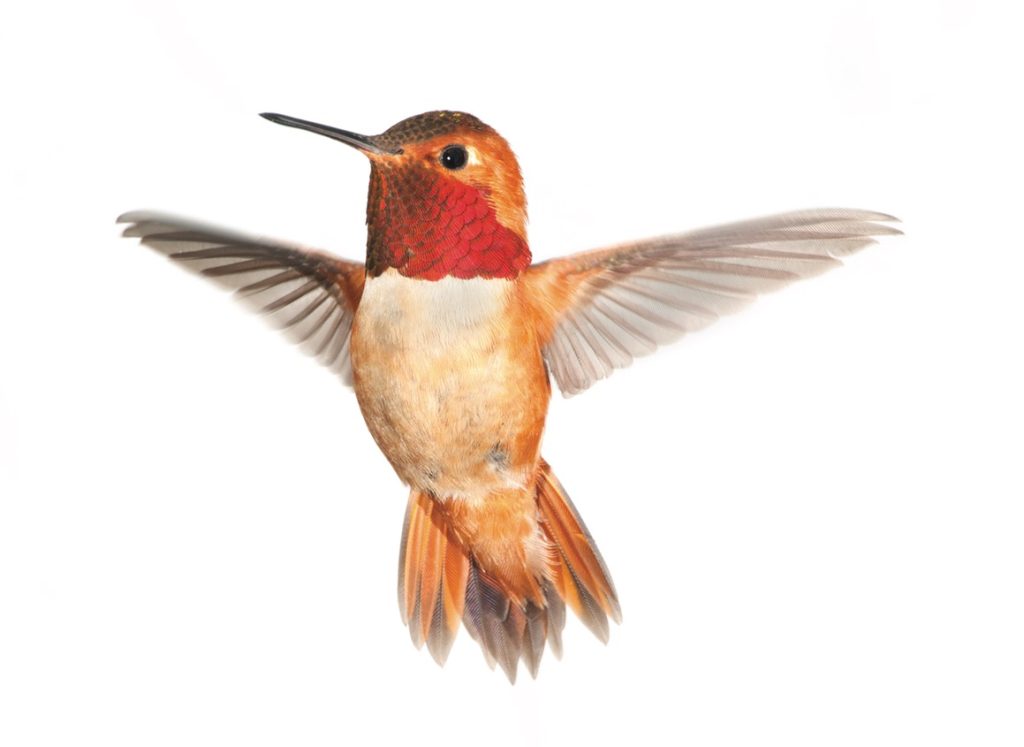
Behold the purple martin. A charm of hummingbirds, shimmering like flying prisms. Sprinkles of color in all directions.

Scarlet maple seeds cascade from naked branches. Fiddleheads brighten creeksides with a riot of luminous spirals. Electric redbuds dazzle.

Yellow transcends itself. Daffodils spill across rolling hills like a sun-kissed sea of trumpets. Spicebush quivers at the tender kiss of swallowtail. Dandelions present as wild, impassioned brushstrokes.

Earthworms animate the loamy soil. Black snakes dance across the warm earth like ribbons.

The humans emerge, too. Gardeners dawdle in dirt and sun. Lovers listen for warblers, sparrows, spring peepers. Children comb the earth as the bluebird does.

“Violets!” they squeal, gathering tiny purple flowers by the tiny precious palmful.

“Can we use them to make cookies?” they ask. “Pink jelly? Lemonade?”

Bare feet in feather-soft grass, they feel the wonder many have forgotten. The wonder of warm earth blossoming with new life. The taste of wild violet.

As the procession of spring continues, slip off your shoes. Let the tiny wonders revive and delight you. Awaken the purity of your own vernal spirit.

Red Clover, Red Clover

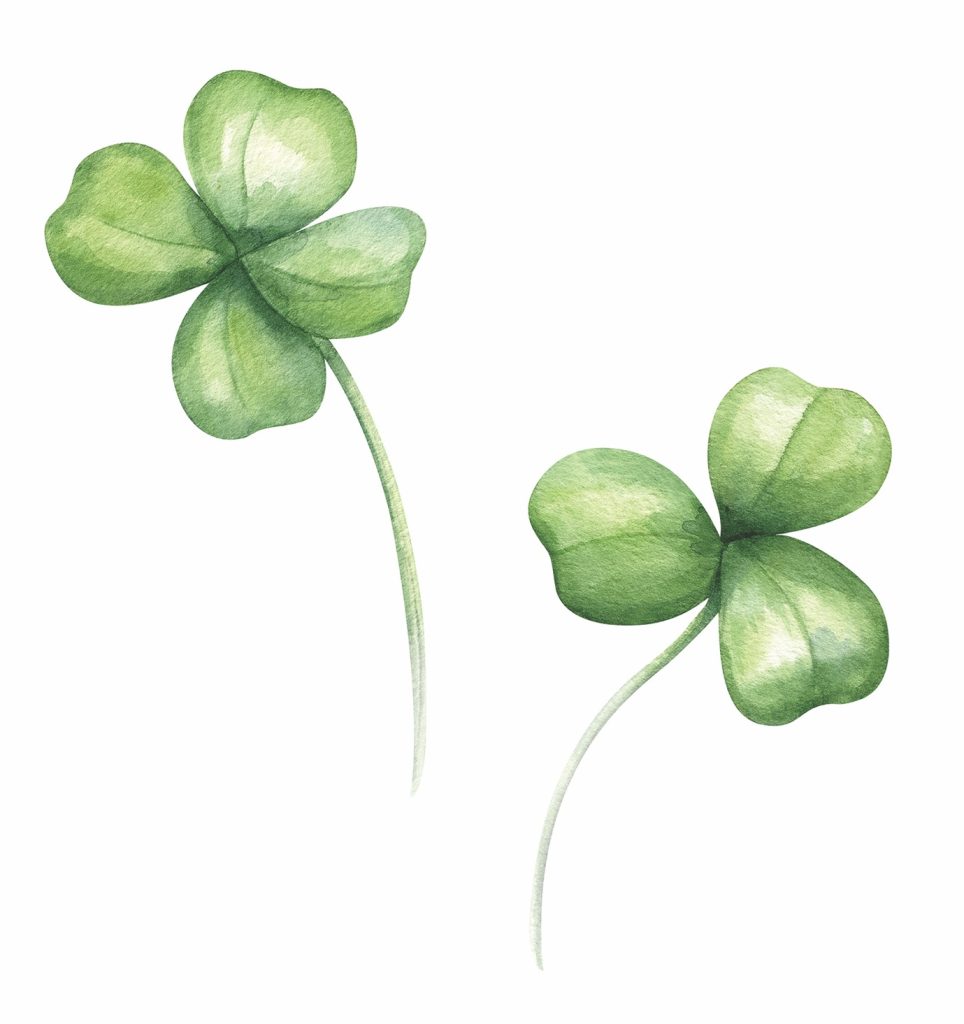
Should you happen upon a patch of tender clover, allow yourself to stay a while. Get quiet. Attune to the frequency of these sprightly, three-leaved sprigs. Some say you can hear them singing.

A symbol of the Emerald Isles, the seamróg (Gaelic for “young clover”) is a robust ground cover, building soil and, come spring, inviting a wealth of pollinators.

But did you know that their leaves and flowers are edible? If ever you’ve tried clover blossom jelly, delicate and sweet, then you know the ecstasy of butterfly and bumblebee. Nibbled a leaflet? Just a day in the life of a cottontail rabbit.

And if ever you’ve found a four-leaf clover, well, the luck of the Irish be with you. 

Sun, Moon and Stars

Behold a blood moon just before sunrise on March 3 — a total lunar eclipse that, indeed, will give the moon a rusty hue.

On Friday, March 20, the sun crosses the celestial equator at 10:46 a.m., marking the official arrival of spring (although the birds have suggested it for weeks).

As for the stars? It’s Pisces season until March 21, when fiery Aries turns up the heat. In other words: in like two fishes, out like a ram.

One swallow does not make a summer, but one skein of geese, cleaving the murk of March thaw, is the spring.

                    — Aldo Leopold

Bookshelf

BOOKSHELF

March Books

FICTION

Now I Surrender, by Álvaro Enrigue 

In the contested borderlands between Mexico and the United States, a woman flees into the desert after a devastating raid on her dead husband’s ranch. A lieutenant colonel in service to the fledgling Republica, sent in pursuit of cattle rustlers, discovers he’s on the trail of a more dramatic abduction. Decades later, with political ambitions on the line, the American and Mexican militaries try to maneuver Geronimo, the most legendary of Apache warriors, into surrender. In our own day, a family travels through the region in search of a truer version of the past. Part epic, part alt-Western, Now I Surrender weaves past and present, myth and history, into a searing elegy for a way of life that was an incarnation of true liberty.

The Creek, the Crone, and the Crow, by Leah Weiss

Summer, 1980. Kate Shaw has lived in Baines Creek for 10 years, teaching in a one-room schoolhouse on the brink of closure. A skeptic by heart, she rejects superstition and the belief in Appalachian folklore, much to the chagrin of Birdie Rocas, a lively and reclusive witch with a trove of secrets. Yet when Birdie dies and leaves Kate her Book of Truths and a trunk of illuminated manuscripts and journals, Kate is thrown into a mystery, overwhelmed by a collection that spans centuries back to Scotland. Enter Lydia Brown, a psychic with a curious birthmark whose visions stopped the day her parents died. Grief-stricken, without her gift, and in need of spiritual guidance, she travels to Appalachia in search of Birdie. From there, the two women’s stories intertwine, as they investigate the questions surrounding Birdie’s death and legacy, through secret rooms, underground tunnels and back-country graveyards.

NONFICTION

Judy Blume: A Life, by Mark Oppenheimer 

To know the name Judy Blume is to know and love literature. Her influential novels turned classics — including Are You There God? It’s Me, MargaretTales of a Fourth Grade NothingDeenie; and Summer Sisters — touched the lives of tens of millions of readers. For more than 55 years her work has done something revolutionary: It rewired the world’s expectations of what literature for young people can be — frank, candid, earthy, and unafraid to show the messier sides of humanity. Oppenheimer pens a beautiful, multidimensional portrait of the acclaimed author through extensive interviews with Blume herself, invaluable access to her papers and correspondence, and thoughtful analysis of Blume’s beloved novels. Oppenheimer peels back the curtain to reveal the woman behind the literary empire in all her complex, multifaceted glory.

The Best Dog in the World: Essays on Love,
edited by Alice Hoffman

Fourteen beloved authors celebrate the life-changing bond with their canine companions in this heartwarming essay collection. Anyone who has ever been fortunate enough to share their life with a dog knows the experience is both profound and transformative. Here, in this charming collection of essays, celebrated authors share unforgettable tales of the dogs who left their pawprints on their hearts. With contributions from Isabel Allende, Chris Bohjalian, Bonnie Garmus, Roxane Gay, Emily Henry, Ann Leary, Tova Mirvis, Jodi Picoult, Elizabeth Strout, Amy Tan, Adriana Trigiani, Nick Trout, Paul Yoon and Laura Zigman, The Best Dog in the World captures the full range of the canine-human connection, from the joy of welcoming a new puppy to the heartache of saying goodbye to a beloved friend.

CHILDREN'S BOOKS

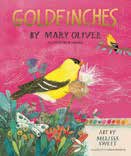
Goldfinches, by Mary Oliver

Mary Oliver, winner of the National Book Award and the Pulitzer Prize, is one of America’s most beloved poets. Introducing her unforgettable words to children for the very first time, her poem “Goldfinches” joyfully observes the power of the natural world as only Oliver can. Illuminated by the exquisite mixed-media artwork of Caldecott Honoree Melissa Sweet, Goldfinches fills the reader with wonder for the beauty around them and gratitude for the ability to bear witness to it. (Ages 4-8.)
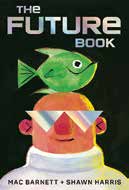
The Future Book, by Mac Barnett

Every other book was written in the past. But this book? This book was written in the future. Do you want to know what the future is like? Turn the pages to get a glimpse at the world of tomorrow and its unexpected words, strange social customs, and mind-blowing colors! From the award-winning duo Mac Barnett and Shawn Harris comes a funny, visionary picture book that kids will want to read again and again. (Ages 4-8.)

Wings of Fire, The Hybrid Prince, by Tui Sutherland

Umber was never supposed to be a hero. As the youngest sibling of his MudWing hatching, Umber doesn’t have the responsibilities of his bigwings, Reed, nor the heroic destiny prophesied for his brother, Clay. He’s always been content with his role as the cheerful, goofy little brother. But when his sister, Sora, causes a tragedy at Jade Mountain Academy, Umber finds himself on the run and thrown into a whole new role — protector. Umber and Sora fly south in search of a place where they can live far away from other dragons . . . until a kind, hybrid dragon named Mulberry saves him from a kraken attack, and Umber realizes they don’t have to survive alone after all. There’s an entire community living on a forgotten island, full of dragons hiding from their own dark pasts. As the two MudWings settle into the Court of Refuge, they start to realize that nothing in this place is quite what it seems, and the protection it offers comes with a price. In Wings of Fire, Book 16 Umber learns he must find a way to unlock the past of this mysterious island to ensure he and Sora have a future. (Ages 8-adult.)

Out of the Blue

OUT OF THE BLUE

Strong to the Finish

’Cause I eats my spinach

By Deborah Salomon

Life is a highway, full of bumps and potholes. Signs, too, that mark the journey. A recurring billboard on mine shouts “Spinach.”

Weird. I know.

Spinach has grown into a nutritional superpower, in formats unrecognizable to pre-baby boomers who hated it with a passion reserved for liver.

Who could blame them? We knew it only as tough stringy leaves caked in sand, cooked to slime or, more likely, a ready-to-heat slime from a can touted by Popeye.

Popeye or not, my mother had me convinced the grim reaper would retaliate against non-consumers. So I learned to eat around it, then beg a tummyache, accompanied by retching sounds.

When that failed I insisted that spinach gave me a rash.

Where? Show me, Mommy demanded.

“But you told me never to . . . ”

I was a clever child, inventive even.

I have a faint memory of liking spinach at the Automat, that famous chain of Manhattan cafeterias, after swirling it into their fabulous mashed potatoes. But I celebrated my 10th birthday without ever choking down a plain, stringy, sandy leaf.

Our move to Asheville introduced co-ed junior high and a new breed of spinach called Birds Eye frozen into bricks, either whole leaf or chopped, which my mother cooked to death. She served the mish-mash sans salt, swimming in cooking water. With no divine mashed potatoes. I had to swallow a few spoonfuls — not bad, especially the creamed kind at the S&W cafeteria where we ate supper Wednesday evenings, same time as my first boyfriend and his widowed mother.

My own mother never guessed from whence came this sudden preference. So she stocked the pantry with Popeye. Yuck.

I can’t remember spinach making an appearance at the Duke dining halls, but — and I may be wrong — Anna Maria’s famous bootleg pizzeria in her Durham kitchen lavished leaves on an incredible crust.

Those were the good days, the happy days.

The ’70s and ’80s brought on the glorious California veggie revolution, where color, freshness, nutrition ruled. Some smart grower developed a baby spinach with velvety leaves, short stems and mild flavor. As a food writer I was all over the movement. Spinach was so cool, even chic. It was everywhere: in omelets, smoothies, stir-fries, salads, soups. When in Florence I ordered the famous veal Florentine, smothered in spinach. When my vegetarian daughter came home from Duke, where Anna Maria had become a legend, I invented a baby spinach, sliced strawberry and mushroom salad.

Fresh spinach is now available year-round. A handful cooks down to a spoonful in seconds, so spinach-haters needn’t suffer longer than one swallow. I still add ribbons to my turkey stuffing and, for color, homemade chicken soup.

Life’s highway now approaches an off ramp, but not without a final nod to the Sailor Man. For decades I have lobbied against frozen main and side dishes: too much salt, too many preservatives, too expensive. But Stouffer’s Spinach Souffle makes a tasty meal either as pictured on the box or microwaved and mixed into angel hair pasta.

Thanks for the ride, Popeye. For a guy pushing 100 you’re lookin’ pretty good. Must be the spinach. 

The Inn Place

THE INN PLACE

The Inn Place

Return of the Magnolia

By Deborah Salomon     Photographs by John Gessner

In a mere 130 years the Magnolia Inn has gone from overflow to intimate, a destination within a destination. Completed in 1896, just one year after the Holly Inn, the Magnolia began as a boarding house — its rooms referred to as chambers — needed to comfortably house the servants, doctors, even some family members of people attracted to James Walker Tufts’ new health resort for consumptives built on 6,000 acres in the Sandhills of North Carolina.

Closer than Florida and located on a north/south rail line, with an adorable village layout designed by the firm of Olmsted, Olmsted & Eliot — fresh from the completion of its work at Biltmore House in 1895 — and implemented by his right-hand man, Warren Manning, Pinehurst was positioned to attract those in need of a little R&R in the pine-scented outdoors. There was just one problem: The disease, as it turned out, was communicable. Hanging around in groups was contraindicated. Just two years after its founding, the resort’s raison d’etre had been undermined. Pinehurst needed to find another path.

As luck would have it, the timing more or less coincided with the arrival in 1901 (the year the Carolina Hotel, the “Queen of the South,” opened) of a Scottish golf professional named Donald Ross. There were already 18 holes to be tended, built by Dr. Leroy Culver and John Dunn Tucker, Pinehurst’s first golf pro. The game, growing exponentially in the United States at the dawn of the 20th century, would become the backbone of Tufts’ resort. The Magnolia, designed by architect Lyman Sise (the brother of Gertrude Sise Tufts and the man who also designed the Holly Inn), morphed into an annex, handling the overflow from the Harvard, Berkshire and Holly inns, ultimately adding the Carolina to the mix.

With deep Boston roots, Tufts knew how to attract talent from New England. He snared J.L. Pottle from the Highland House in Jefferson, New Hampshire, to be the first manager of Magnolia Inn. Pottle arrived with a complete staff of maids, janitors, cooks, handymen and other staff. An 1898 advertisement for the Magnolia in the Pinehurst Outlook touted “the finest Northern cooks.” Another boasted of amenities like steam heat, electric lights, bathrooms with hot water and “perfect sanitary arrangements’’ all for $8 to $12 per week.

In the 1920s the Magnolia was sold to Mr. E.J. Fitzgerald, manager at the Carolina, who used it as an annex to the main hotel. Fitzgerald’s wife continued to run the Magnolia after his death. Pottle’s son also remained in the area. During that period Dr. Francis Owens, who would become one of the founders of Moore Memorial Hospital, maintained his office in the Magnolia, even performing some minor surgeries and child deliveries on the premises.

If its occupants changed over time, so did its footprint. The lovely Queen Anne-style building with 14 bedrooms was originally five stories rising between the village and the Carolina. Porches, verandas and rocking chairs hugged the structure. Not long after the completion of the Carolina, the Magnolia underwent its most drastic alteration. The building was making it difficult to see the village from the grand, new Carolina — and vice versa — so the top two floors were lopped off. The Magnolia still contains an interior stairway that now leads, well, absolutely nowhere.

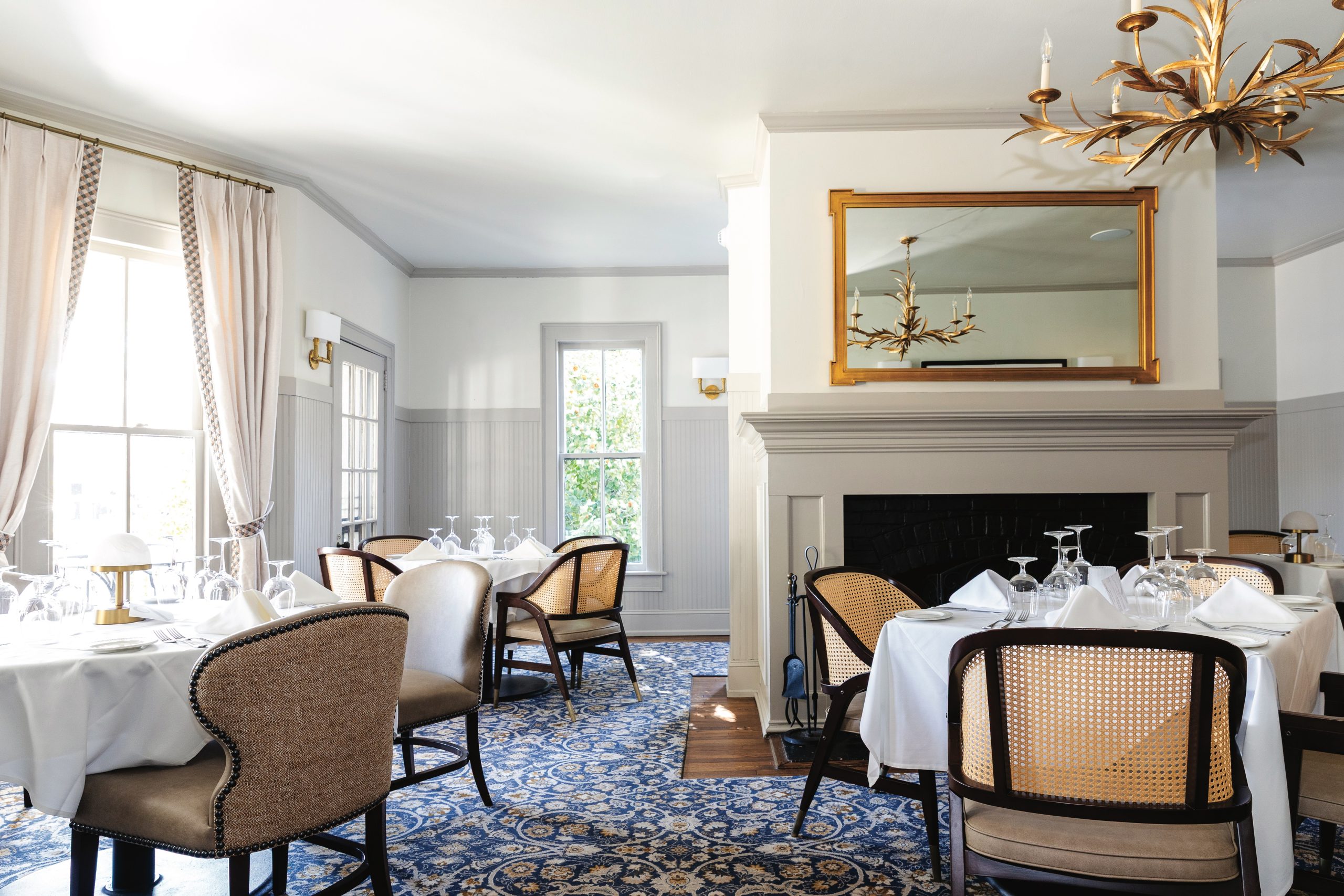
After a half dozen or so changes of ownership through the latter half of the 20th century and the beginning of the 21st, the Magnolia was reacquired by the resort in 2023. It no longer answers to the name boarding house and instead is a stately presence overlooking village streets where well-dressed vacationers browse the shops and relax from days on the golf course. Inside, eight posh bed/sitting rooms, called spaces, each identified with a brass plate bearing the name of a village street, showcase period and early-modern furnishings. Colors are soft grays and pastels. Padded headboards, pull-across drapes, bay windows and angular upholstered chairs suggest the ’50s.

The enticing aroma comes from fine Italian dining at the in-house Villagio Ristorante & Bar, and the only surgery performed in the Magnolia Inn these days is stress removal.

Focus on Food

FOCUS ON FOOD

Faux Favorite

A plant-based attraction worth trying

Story and Photograph by Rose Shewey

Vegans come up with some bizarre ideas. They will slice up cauliflower, fry it like a piece of meat and serve it as “steak,” insisting it tastes just like the real deal, or better. Or they use the liquid from canned chickpeas to make whipped cream and appear completely unfazed by the lingering bean flavor. Maybe jackfruit passes as pulled pork in a BBQ sandwich to some, but from where I am standing it looks a lot like the emperor is naked.

No doubt, there are some strange meal creations in the plant-based kitchen, but despite it all, I’m rather fond of it. I dabbled with veganism for a few years and loved the creativity of it. Composing balanced, satisfying and — not least of all — healthy vegan dishes requires skill, some knowledge of food chemistry and a passion for experimenting.

Every now and then, clever vegan chefs strike gold. I have happy recollections of the first black bean burgers we made, which were — to everyone’s surprise — bursting with flavor. Or that time we discovered vegan cheesecake, which is still in the rotation for us today. As a graduate from a plant-based cooking course, where I was able to try my hand on a potpourri of “veganized” dishes, I was most impressed with a fish-less tuna salad made from chickpeas.

What sets this “tuna” salad apart from regular ol’ chickpea salad is the seaweed. It lends it the salty sea flavor which, combined with the tuna-esque texture and the addition of mayo, is so close to the original that most people do not notice a difference. I know this because I have had friends and family try this no-tuna salad, and across the board, nobody could initially tell it was, in fact, tuna-less.

Now, why would someone who does not subscribe to a vegan diet make this faux tuna salad? Aside from the sustainability issues surrounding tuna (and shady harvesting practices), tuna contains higher levels of mercury, which is a health concern to some of us. Others like the idea of tuna salad but not the fishy aroma — seaweed for the win! Also, making this salad is a tasty way to handle leftover chickpeas and sneak more fiber into your diet. Above all, this tuna-less salad is just too scrumptious not to try. 

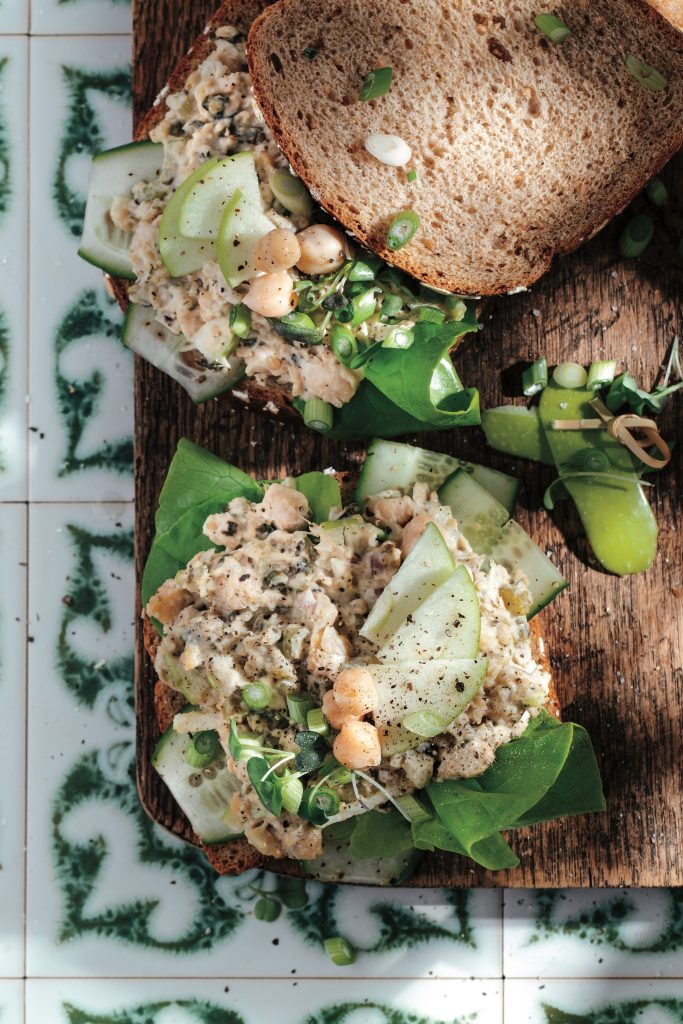
Chickpea “Tuna” Salad Sandwich

(Serves 4)

3 cups cooked chickpeas

2-3 tablespoons finely diced red onion

1-2 celery stalks, finely diced

2-3 pickles, finely diced

2-3 tablespoons nori seaweed flakes (or nori sheets, chopped)

1/2 cup mayonnaise, traditional or plant-based

Salt and pepper, to taste

For Serving

8 slices bread

Green apples, thinly sliced

Lettuce

English cucumber, sliced

Spring onions, sliced

Directions

If using chickpeas from a can, drain and add them to a medium or large bowl. With a fork or potato masher, mash the chickpeas to break them up; optionally, leave some whole for a more interesting texture. Add onion, celery, pickles and nori seaweed flakes to the bowl and stir to combine. Mix in mayonnaise, salt and pepper. Taste and adjust seasonings as needed and keep refrigerated until ready to serve. Toast bread, if desired, then scoop a generous portion of the chickpea salad onto a slice of bread, add toppings of your choice and another slice of the bread on top.

Hometown

HOMETOWN

Wearin’ o’ the Green

A little luck goes a long way

By Bill Fields

I’m going to wear something green on St. Patrick’s Day.

I’ve never been fully committed to doing so, but upon reviewing my ethnic origins for the first time in a while, I’ve decided that this March 17 I ought to get dressed with more purpose.

An updated DNA report shows there is more Irish in my background that I had thought, with single-digit percentages of my roots linked to each of three areas in Ireland: Connacht, Munster and Donegal. Some 18 percent of my heritage comes from the ancestral region of “Central Scotland and Northern Ireland.” Ancestry doesn’t break down that number; I hope the latter locale is well-represented.

Last summer, for the second time in a decade, I spent an enjoyable week working at The Open Championship in Portrush, Northern Ireland, where the commute from hotel to NBC Sports television compound consisted of a 15-minute walk through town or along the beach. The twice-daily stroll, including stops at friendly establishments for coffee in the morning and Guinness in the evening, was a pleasant antidote to many long drives in snarled traffic to major golf events over the years, trips sometimes punctuated by a parking lot attendant on a power trip.

It felt like luck was on my side in Portrush, including the day that a bat flew around the TV tower while we were on the air, causing analyst Kevin Kisner to duck and cover as it darted right over his head. Having had to receive a series of rabies shots after a close encounter with a bat while I was taking out the trash at dusk on a summer day in 1997, I was grateful our visitor stayed clear of my workspace. Someone purchased a large, long-handled net that we had at the ready the rest of the week, but to the relief of everyone in the tower, the bat never reappeared.

Luck is an apt topic in March, regardless of how one feels about the origins of “Luck of the Irish.” Rather than considering the idiom as ironic or derisive (as was the case when used about the success of Irish miners in the American West during the late 1800s), this seems the right time to simply place it in the context of extremely good fortune.

The enduring Irish symbol of luck and prosperity, the shamrock, is a three-leafed clover. Come March — which not only includes St. Patrick’s Day but marks the start of spring and the arrival of golf season in many places — I think of the much rarer four-leaf variety, believed to be a truly lucky plant. 

Years ago, while I was researching a story for Golf World about the legendary golfer Glenna Collett Vare, one of the things people remembered about the record six-time U.S. Women’s Amateur champion, a trailblazing athlete of the 1920s and ’30s, was her uncanny knack for finding four-leaf clovers.

One such instance occurred at the 1950 Curtis Cup at the Country Club of Buffalo when Vare captained the American team that included a young Ohioan, Peggy Kirk, later known as Peggy Kirk Bell, the matriarch of Pine Needles. Kirk trailed late in her singles match when Vare approached to ask her how she stood. Learning of Kirk’s deficit, Vare stepped away for a few minutes, then returned with a four-leaf clover and a message — “Go get her” — for Peggy. Kirk won the match, 1 up.

Given how finely groomed golf courses have become since Collett Vare’s era, it’s harder to find clover of any kind these days, not that modern players haven’t gotten some very good breaks. Less than a month prior to St. Patrick’s Day last year, in a playoff at the Mexico Open, Brian Campbell badly sliced a drive that was surely headed out-of-bounds until it struck a tree and caromed back in play, setting up his subsequent victory.

Campbell’s was as lucky a moment seen on the PGA Tour since 1992 when Fred Couples’ ball defied the odds and clung to the steep bank of Rae’s Creek on Augusta National’s 12th hole; or perhaps The Crosby in 1984 when Hale Irwin’s tee shot, headed toward the ocean left of Pebble Beach’s 18th hole, bounced off the rocks and onto the fairway, the ball appearing as if a seal had headed it to safety. Irwin birdied, then defeated Jim Nelford in a playoff.

From personal experience, I can report those rocks aren’t usually so kind.

Poem March 2026

POEM

Poem

Julian

In christening gown and bonnet,

he is white and stoic as the moon,

unflinching as the sun burns

through yellow puffs of pine

pollen gathered at his crown

while I pour onto his forehead

from a tiny blue Chinese rice cup

holy water blessed

by John Paul II himself

and say, “I baptize you, Julian Joseph,

in the name of the Father, and of the Son,

and of the Holy Spirit.”

Nor does he stir when the monarchs

and swallowtails,

in ecclesiastical vestments,

lift from the purple brushes

of the butterfly bush

and light upon him.

  — Joseph Bathanti

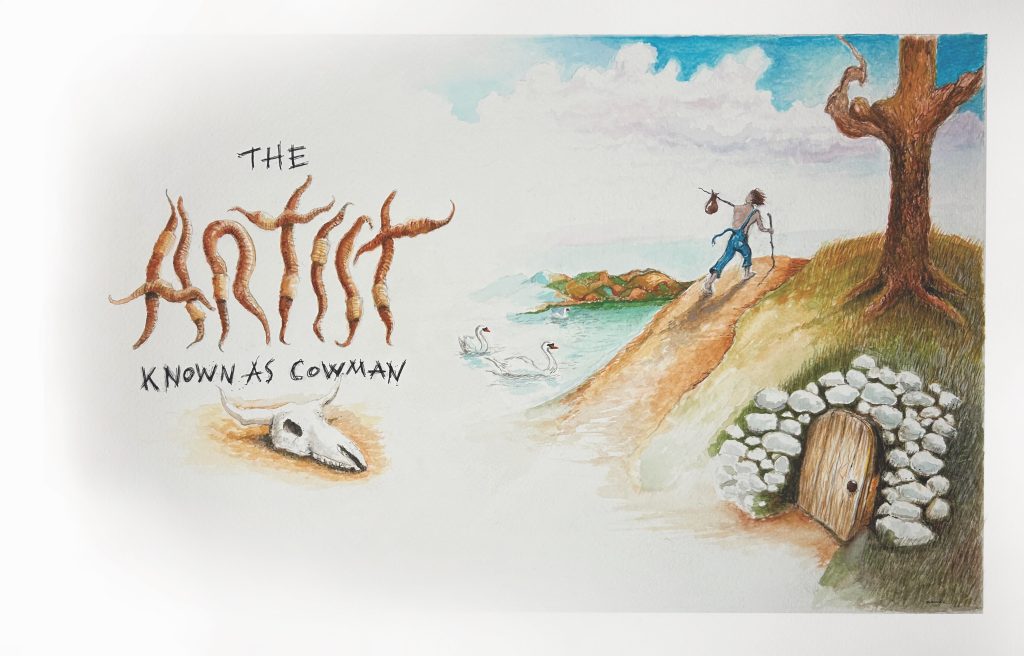
The Artist Known as Cowman

THE ARTIST KNOWN AS COWMAN

The Artist Known as Cowman

b. 1949? — d. not long ago now

Fiction by Daniel Wallace

Illustrations by Keith Borshak

He wasn’t always Cowman. Before he was Cowman he was just a boy, and like a boy he played in the fields, in the river and the woods, near the lake, and down the road. He worked with his family planting things. In the summertime he didn’t wear shoes or a shirt, just a pair of cut-off jeans passed down from brother to brother, the blue worn nearly white, and sometimes he wore a hat, when the sun bore down so hot he could feel it boiling his brains. This is the way it was from May to the middle of September, and by then he looked less a boy than he looked like something that was once a boy, or that could become a boy, under the proper supervision and a bath.

Near the end of a long afternoon sometimes beneath the spindly towering pine trees that were everywhere, he cleared the pine needles away until he made an open patch of dirt. With the palms of both of his hands he would smooth it out, harder and faster, until the dirt pressed so hard into his skin that no bath would ever get it out completely. His hands would always be a little bit darker than the rest of him and that makes for an interesting biographical detail.

Then he would take a stick and carve a picture into the ground, and maybe some words. In the beginning, he always said, he drew nothing but cows.

This is how it started, becoming what he later became: Cowman.

Now of course he’s known the world over.

But before. Before all this, where was he?

A valley where there was a river — small at times, then bigger, frothy and white, then . . . not. Mountains this way, that. A hill, a dale. No place anyone has ever been, however, nor a place they would want to go, and for precisely this reason it remained undiscovered by the likes of you or us for centuries probably. It had no name, this place. For generations the people there weren’t aware there were other places, so isolated was this little town, quiet and dark in the hills and in the dales, the mountainous extremes of their lives. Why name it? Why name something there is no more of than one?

Home is what he called it. He hasn’t been home in such a long time and knows now he will never see that forgotten patch of soil ever again. But the day he left he knew he never would. All of his work is influenced by what he no longer has.

Dug into the side of a hill was his house. Two-sided wooden walls, the front stone, the back wall a dense red clay, which, true, he grew up eating. Not for the main meals. Just a little something in-between. When a new baby came they just dug deeper into the mountain for room.

Worms were a problem. When it rained the wall dripped. But it mostly did the job it had to do.

The wall in his room had a streak of lime running through it. The pale white against the dull orange was like a late summer sunset, he said. The artist transforms the world with his eyes, even when his world is no more than an ambitious hole.

The fifth of seven, Cowman was. The first three were girls, the second three were boys, and the last was some odd combination of the two but less than either. They called it Tarp. While the others were passing fine in almost every respect — the boys big and strong, the girls industrious, pleasant — all of Tarp’s parts were either bigger or smaller than they were supposed to be, and inside his head was probably not something anyone could actually think with, no better than a peach pit, really, or gravel. Truth be told he never did amount to much and had he amounted to anything no one would have been more surprised than he. Everything surprised him, though. Even chairs and rocks.

The others were named, in order of their birth, Estem, Maudry, Ebee, Root and Mold. The Cowman’s real name is not included in the list, as it has been carefully lost to time. It has variously been suggested to be Remly, Tirk, Lebby, Crop, Moses or Pisky. No one can say. Cowman has thus become Cowman, now and forever, and can avoid the embarrassing parenthetical approximations which attach themselves to the nomenclature of famous geniuses.

Estem, Maudry and Ebee, his sisters, were beyond beautiful. They all had thick auburn hair and perfect freckles. It was said no man could look at any one of them without falling in love, and thus the daughters were never in the same place at the same time. Except once, one time, and a man fell in love with all three of them and courted each on a revolving basis. Finally, they all said no, and his heart was broken once a day for three days running by each of them in turn, repeated on a loop for months, and he did not live long thereafter.

Mold and Root were large — Mold largely fat, and Root like one big muscle. Root’s strength was legendary. He once threw a wild bobcat high into the air using naught but his little finger — and caught it with his face. Before this legendary event he was a handsome man, too. Or handsome enough.

Mold’s girth impressed as well. He was one of those constant growers — ever expanding, like a balloon blown up by God. One morning he overslept and could not leave the room through the same door he entered it and stayed there for several months. He eventually became so big that he filled the room from side to side, floor to ceiling. Root dug him out. He remained an outdoor child after that, and for as long as he lived was never allowed within the dwelling of another human being again. Sad.

Cowman, being the seventh child and the third boy, spent most of his childhood either lost or forgotten. The seeds of art are born within the desolate souls of the suffering. Wagon trips across the wide valley to visit relatives who lived in a holler never failed to exclude him — not out of cruelty, or dislike, but out of pure absentmindedness. His family had a sense of him, but they could never be sure — like something glimpsed quickly out of the corner of your eye — was there a – ? did we have a – ? He was more of an idea, a vague one at that. Maybe he was a dream — a communal dream? Communal dreams were common in that time and place. Hard to conceive of nowadays, that people were too poor to have dreams of their own, but had to share them with their family, sometimes the entire village. But it was true. Dreams were crowded places. Cowman did not help his cause by being quiet in an exceptional way. He was neither small, nor large. He rarely complained, by nature content. When he would wake up and find his entire family had gone he tried to pitch in by cleaning up around the house and doing worm duty on the back wall. Then he might go fishing.

And then, of course, it goes without saying, sometimes he would make his art. He would use a stick, or a piece of charcoal, or pieces of bark crumbled almost into dust, making the line he wanted across the plank wooden floors of the front room. The famous Cowman line, a line that came from his bones and from the rest of him, from all his parts, and flowed into his hand and through whatever he was holding. He knew who he was before anyone else did, but he kept himself to himself. When he came of age he packed a small tote and left the red clay enclosure to parts unknown even to him and was never missed because no one was really sure he had ever been there at all. He did miss the old life, though, from time to time. He was a cave dweller at heart.

Why did he leave that place? No one left, ever, there being no known place to leave to. But he saw a light no one else could see, heard a song sung for him alone, and he smelled something sweet over yonder, something that could not be found in the red-clay, lime-striped box he called home.

He sought it out.

He seeks it still.

II

Cowman crossed many hills, many dales, and over the last of both came to the first town. So many people, dozens upon dozens, all of them arrayed in colorful garb and shoes made of shiny leather. Some wore hats that looked like clouds and hair that curled and bounced like a small animal living on their heads. Not the sort of people he was used to, and he not theirs. They gave him the side eye and hustled past, as if they were afraid he might bite them, for he looked like someone who lived at the bottom of a swamp, wearing clothes made of mud and dead leaves. A nice woman took him home with her, a young widow named Mary. She gave him a bath and a haircut. He was so handsome then. No one could ever believe he was the same boy who had scared the dogs with his face. She showed him the ways of the world, too — Mary, to whom all thanks are given by him for everything always.

Oh, Mary.

He left at the end of the year, fluent in the ways of human beings, breaking Mary’s heart into so many pieces that no one was able to put it back together again. The first of many broken hearts left in his wake — but what could be done? Not a single thing. He had his work and that was all that mattered. No heart could pine for him more than he pined for the making of great things.

He is most in love with that which has yet to exist.

That’s what mattered to him, and that’s what matters to him still.

(His poor children, though. The less said about them the better.)

III

An old man now, crumbling, silent, possibly happy as a clam, but who can say, waiting for death with his trademark wrinkly grin and nursed by his 7th wife, the lovely Sophia, who is 63 years his junior. All Cowman makes now are dreams, dreams made of bits and pieces of clay and leaves, caves and pine trees, rivers, hills and dales and of Mary, of course, to whom all thanks are given by him for everything always. He has regrets, to be sure, but none that really matter. He can’t remember much of what he’s done, the good things or the bad. He can’t remember his friends or his enemies or his children or any of his many wives, including the one at his bedside now. She is quite beautiful, though, this woman. Her skin is smooth and brown and her golden hair shines like sun on water. She reminds him of nothing because there is nothing in his mind. But he could look at her face forever, and so this is what he does. 

Simple Life

SIMPLE LIFE

My March Awakening

Finding the Kingdom of God in my own backyard

By Jim Dodson

Every year as March returns and my garden springs to life, I think of the remarkable woman who changed my life.

Her name was Celetta Randolph Jones, “Randy” for short, a beloved figure in the city of Atlanta’s business, arts and philanthropic circles. Five years my senior and leagues ahead of me in terms of spiritual growth, Randy was introduced to me by my editor, Andrew Sparks, during my first week on the Atlanta Journal-Constitution Sunday Magazine staff.

At that time in the spring of 1977, Randy was running The Georgia Trust for Historic Preservation and had stopped by the magazine to introduce herself and plumb my interest in historic preservation.

“Something tells me you two are bound to become best friends,” Andy wryly observed, a prophetic remark if there ever was one. 

In short order, Randy became my best friend and confidant, the one person I felt comfortable with discussing matters of life and death, heart and soul. Our love affair was a case of what the ancients called agape, transcending romance and superficial attraction. Besides, Randy was secretly dating an Episcopal priest, which I kidded her about relentlessly. She loved to give the needle back about the young women I went out with in those seven years of our deepening friendship.

Though she never married, “Aunt Randy” was the godmother of half a dozen of her nieces and nephews and, eventually, my own daughter, Maggie.

During my first few years in the so-called “city too busy to hate,” I frequently wrote about the darker side of the booming New South — race violence, corrupt politicians, unrepentant Klansmen, the missing and murdered, and young people who flocked to the city seeking fame and fortune only to lose their way and sometimes their lives.

A life-changing moment came one Saturday night when I was waiting for a squad from the city morgue to pick me up for a story I was working on about Atlanta’s famed medical examiner. As I stood in my darkened backyard waiting for my dog, McGee, to do her business, I witnessed my next-door neighbor, an Emory University med student, being gunned down in an alleged drug hit. He died as we waited for the ambulance to arrive.

Not surprisingly it was Randy who helped me make sense of this. The morning after my neighbor’s murder, I’d opened my Bible to the Book of Matthew for the first time in years and was struck by a reference that Jesus repeatedly makes about the “Kingdom of Heaven.”  That evening at dinner, I grumbled, “So where the hell on Earth is the so-called Kingdom of Heaven?”

Randy simply smiled. “It’s already here, my love. Inside us. You just have to see it.”

I was a wee bit annoyed by her calm assurance.

Randy was a classy and calm Presbyterian with an unshakable faith in God’s grace. I was a backslid Episcopalian who hadn’t darkened a church doorway since the murder of my girlfriend during our college days.

Purely because of Randy, however, I attended services the next Sunday at historic All Saints’ Episcopal in downtown Atlanta — a place where the doors were always open to the homeless. I soon took a job writing about the suffering of the Third World for the Presiding Bishop’s Fund for World Relief, and even made a vow that, going forward, I would only write about subjects and people who had a positive impact on life. Randy Jones was my inspiration.

I lived up to that vow, and even briefly entertained taking myself off to the Episcopal Seminary until a crusty old bishop from Alabama suggested that I could “probably serve the Lord much better by writing than preaching.”

My pal Randy gave her famous, sultry laugh when I mentioned his somewhat frank comment — and she agreed with him.

During my final years in Atlanta, Randy and I met at least once a week for lunch or dinner to talk about the events of the day and the mysteries of this world. She also spent several Christmases with my family in North Carolina, attended both of my marriages, visited my young brood in Maine and joined us for a joyous spring vacation at our favorite Georgia beach.

In many ways, she became the Dodson family godmother and probably the closest I’ll ever come to knowing a living saint — though she would respond with her sultry laugh at such a silly notion.

Over the decades, as Southern springtime returned, wherever I happened to be in the world, Randy would track me down by phone. She’d finish our talk with a couple meaningful questions: So, Jim, are we any closer to the Kingdom of Heaven? And . . . How is your beautiful garden growing?

She and I had visited public gardens together many times. Randy hailed from Thomasville, a small South Georgia town known as “City of Roses,” and knew that once I’d swapped big-city life for small-town living, I’d become a committed man of the Earth like my rural kin before me. There was no going back, she knew, on gardening or faith.

As my spiritual life grew and deepened across the years, I’d come to believe the Kingdom of Heaven might indeed be nearby. It’s no coincidence that Jesus mentions it 32 times in the Book of Matthew. His partner, Luke, simply calls it the “Kingdom of God” and makes clear — as Randy did — that it “lies within” everyone.

My favorite reference comes from the Gospel of Thomas, when Jesus’ followers pester him to explain where the “Kingdom” exists:

Jesus said, “If those who lead you say to you, ‘See, the kingdom is in the sky,’ then the birds of the sky will precede you. If they say to you, ‘It is in the sea,’ then the fish will precede you. Rather, the kingdom is inside of you, and it is outside of you.

Wherever it exists, I have my late friend, Randy Jones, to thank for putting me on a winding path to the Kingdom within. 

And I’m not alone.

Randy Jones passed away peacefully in October 2022. Her funeral service at Atlanta’s First Presbyterian Church was packed with people whose lives Randy had touched, from business leaders to artists, from church members to childhood friends, including a half a dozen godchildren and yours truly. The sanctuary overflowed with stories of her generosity and quiet wisdom, each person recalling how Randy’s kindness had shaped their own journeys. The service was a testament to the wide effect she had not only in Atlanta but in the hearts of everyone fortunate enough to know her.

Including a former backslid Episcopalian.