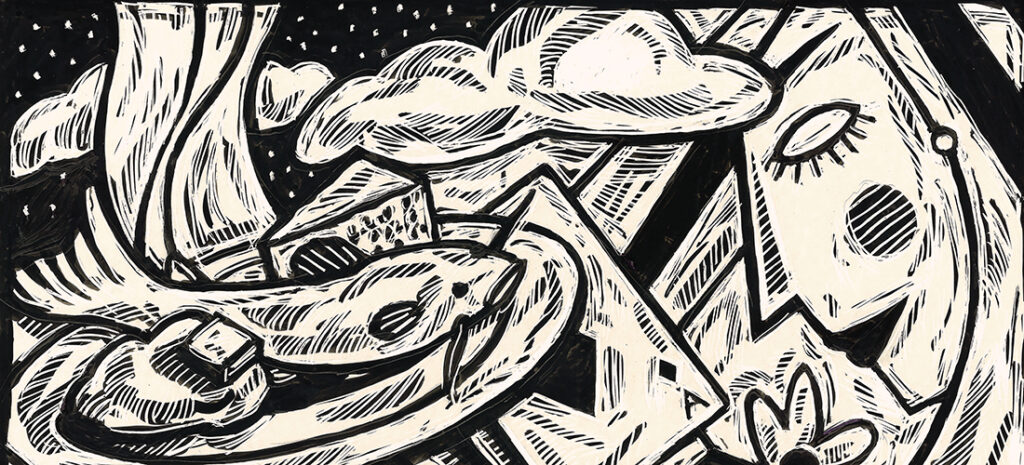
Where She Sits

Where She Sits

Fiction by Randall Kenan
Illustration by Gary Palmer

They were in the little dining room off the kitchen when he finally told her. He paced about, motioning with his hands.

She just sat there, staring down. Feeling nothing. Maybe. Or just plain tired.

“I can’t do it anymore, Sandra,” he said.

Sandra said nothing. Slowly, she moved her hand over the oilcloth, steadying herself.

“I don’t care what your family says about me,” he said. “I don’t care. I can’t . . . I’m not . . . I’ve got to . . .”

She might have asked Dean about the children. But the idea that he would come up with some sleazy nonsense only made her feel a wave of nausea. Sandra put her head down.

Dean stopped behind her. She could feel the tension in the air; without seeing him, she knew he was clenching and unclenching and clenching his fists. He did that when he was angry. “Did you hear me? I’m leaving.”

Sandra raised her head. “Then go.”

He stood there for the amount of time it takes a frying egg to turn white and walked from the room.

Sandra reached out and caressed the table, and remembered. Not so much remembered as allowed a flood of images, past scents, past sights, to overtake her, fill the void she was now harboring. Each image evoked something like a feeling. So much took place in this room, upon this very surface. Not merely the food served, or the homework fretted over, or the cards played, or the beer spilled, or the puzzles arranged. Moments occurred right here. And now, in this instance of illusions shattered, of dreams wrecked and a heart frozen, these moments seemed to simmer before her, behind her eyes, and she could only hold on to them, to find some strength.

She had inherited this very table from her great-grandmother. Made of pine, by whom she did not know, it had been oiled, dented, dusted, polished, chipped, varnished, battered, peed upon, burned, broken, mended, hammered, nailed, or some such for decades. If it could feel, she knew she’d feel the way it felt now . . .

“Sandra? Damn it! . . . Where is my . . .”

The first true memory of her grandmother had been watching her across this expanse, on the other end, smiling and slicing with pride a piping hot blueberry pie. No, child, wait for it to cool. And so many mornings, days, nights, her mother at that same end: What you doing out so late? Sandra! An A in math! Now that’s good. Girl, don’t you ever raise your voice at me. I’ll knock the taste out your mouth! You heard about Uncle William, didn’t you? . . .

“Sandra, can’t find my . . .”

As if he actually expected her to come in there and help him to pack, to leave; as if any of this fault rested on her shoulders; as if she was expected to go along to get along; as if she would be unreasonable to go into the kitchen, get a butcher’s knife, and chop him into seventeen billion little pieces.

She ran her hand out against it again, against its smooth flatness, as if to absorb some of its stolid solidity.

Here, she served him his first taste of her cooking: catfish, greens, mashed potatoes, corn bread; here, she told her mother she was to wed the man who made her legs feel like overcooked spaghetti and her heart feel like butter. Here, where she tended him, listened to his tales of boring sales meetings and petty office feuds, and where he entertained his buddies (when not in front of the TV); here, where she fed and consoled and interrogated first one, then two daughters; here, where she slowly watched the shoals of her marriage erode, grain by grain.

Oh, if it could talk . . .

“Sandra.” He stood in the door. She didn’t want to look up at him. She had nothing to say.

“Good-bye.”

She did not look up, as he turned, wordless, and walked down the hall. As the door clicked behind him, she held fast. He may go, but some things would remain. A part, a piece, a fixture, a witness. Even now.   PS

The Playhouse

The Playhouse

Fiction by Max Steele
Illustration by Mariano Santillan

The professor was standing now before the doors of the American Embassy. He was early for an appointment with an old frat brother, a legal attaché who would help him procure a fast Mexican divorce. There was no urgency really in getting a divorce. It was simply that he could not concentrate on a permanent separation. When he tried he would end up in a hot soapy shower thinking about putting on freshly starched cotton clothes. Someone should have warned him in Raleigh not to drink on the plane. Here he was in Mexico City, a mile high, still a bit dazed.

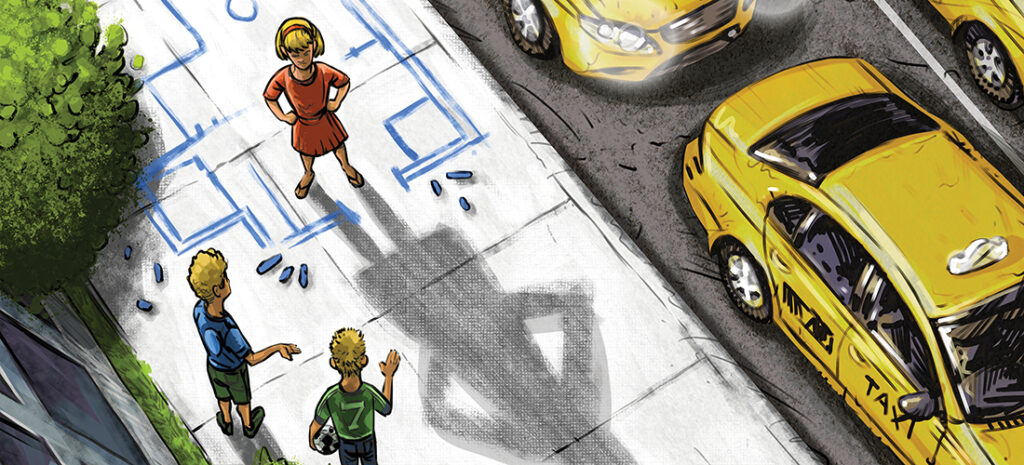
Three blond children, not more than five or six years old, obviously embassy kids, a little girl and two little boys, were playing house in and around a sort of blueprint design of squares and rectangles drawn with green chalk on the sidewalk. A solid block of taxicabs, more than the professor had ever seen, was passing on the Paseo de la Reforma.

Something about the broad boulevards and the taxi horns reminded him strongly of Paris, where twenty years ago he had spent his one sabbatical. The next year he had met his wife, who often reminded him that he had never taken her to Paris as he had promised. Or done any fun things. There was never enough money on his salary, she accused him, to do any fun things. In the late autumn air the feeling of déjà vu was so strong that he felt it was a dream, or a forgotten passage from a novel he was living through.

The two boys were now standing near him whispering, and the little girl was in the chalk-line house, busily sweeping, putting things on shelves, getting pots out of a stove only she could see, and washing dishes in the silent sink.

At a signal he did not notice, the small boys, giggling and full of themselves, marched slowly to the front of the house and knocked on the door. “Knock. Knock.”

The little girl seemed genuinely surprised. She came through the house, untying her apron and opened the door, drying her hands on the apron.

“Oh, there you are!” She was quite annoyed. “Late again, as usual. And furthermore you have brought a perfect stranger home to dinner.” Oh, she was vexed. “Without even asking. Without even calling!”

“Yes, my dear,” the little husband said proudly, full of his secret. “I would like for you to meet the man who owns the merry-go-round.”

As the boys entered the house, the professor glanced at his watch. He was still five minutes early. Enough time to walk to the far corner.

As he strolled up the dark gusty boulevard, he could still hear the high laughter of the children, and at the sound of their thin, excited voices his heart almost broke. After all, how were they to know (for they were still children), how could he have known she would run off with the man who owned the merry-go-round?  PS

Summer Shorts

Summer Shorts

Summer Shorts

August is more than sweet tea, watermelon and air conditioning. At PineStraw, it’s our Summer Reading Issue. This year’s selections are drawn from the collection of stories  entitled “Long Story Short” published in 2009 by the  University of North Carolina Press. The volume showcases the writing of 65 well-known North Carolina authors working in the genre called “flash fiction.” In Japan these short-shorts are called  “palm-of-the-hand” stories. Here are five easy pieces to enjoy on a hot day under a beach umbrella.

Our Writers

RANDALL KENAN (1963-2020) was a professor of English at the University of North Carolina at Chapel Hill and the recipient of a Guggenheim Fellowship, a Whiting Award, and the John Dos Passos Prize.

Katherine Min (1959-2019) received an NEA grant, a Pushcart Prize, a Sherwood Anderson Foundation Fiction Award, two New Hampshire State Council on the Arts Fellowships, and a North Carolina Arts Council Artist Fellowship.

SHELIA MOSES was raised in Rich Square, N.C., the ninth of 10 children. She is a writer, director, producer, poet and playwright. She has been nominated for the National Book Award and named a Coretta Scott King Honoree.

DAVID ROWELL was born and raised in Fayetteville, North Carolina, and graduated from the University of North Carolina at Chapel Hill. He was the deputy editor at the Washington Post Magazine for nearly 25 years.

MAX STEELE (1922–2005) directed the University of North Carolina at Chapel Hill Creative Writing Program for 20 years before he retired in 1988. He was an editor at Paris Review and Story Magazine and the recipient of two O.Henry Awards.


and Illustrators

RAMAN BHARDWAJ  is an international muralist, illustrator, fine artist, and graphic designer. Born in Chandigarh, India, he has had solo exhibitions in India, Norway and the USA, has painted more than 50 murals in North Carolina and illustrated 16 books.

KEITH BORSHAK has worked in advertising and design as a graphic designer, art director and creative director, receiving dozens of Addy Awards over his 30-year career. His illustration and design work has been recognized by Communication Arts Advertising Annual, The One Show, and the Graphis Design Annual.

GARY PALMER graduated from Ringling College of Art and Design. His work has been published in Wildlife in North Carolina, Ducks Unlimited, Shooting Sportsman, Better Homes and Gardens and Texas Monthly in addition to commissions for The North Carolina Museum of Natural Science, The Nature Conservancy and the National Park Service.

MARIANO SANTILLAN is a contractor for the U.S. Army Special Operations Command where he works as a web developer and illustrator. His “other” clients include Ohio State University, Fayetteville State University, The Washington Post, Cricket Magazine, and The Atlanta Journal- Constitution.

JESSE WHITE is an illustrator, author, and muralist. She graduated with a BFA in studio art from the University of North Carolina at Chapel Hill and earned her master’s in art education from Virginia Commonwealth University.

Poem August 2024

Poem August 2024

Steadfast

A lone tree fell in my woods

But it didn’t hit the ground

Or make that debated sound

It fell into the steadfast embrace

of another tree

With its outstretched branches free

They lean into each other

The broken and the strong

The living and the gone

It’s only with a passing breeze

And a creaking, crying bough

That they make sure we hear them now

    — Kayla Stuhr

Kayla Stuhr is a Scottish visual artist, writer, and award-winning filmmaker.

Hometown

Hometown

In the Swim

The summer of staying afloat

By Bill Fields

There was a lot going on in the summer of ’68, much of it heavy and consequential. But being only 9 years old during those tumultuous months, I was mostly oblivious to the real-world turmoil and focused on things that mattered to a rising fourth-grader.

Swimming — or more accurately, being at a pool — was near the top of the list.

We were not really a swimming family. Mom loved excursions to a lake or the ocean but was mostly an observer, content to take in the water from a dock or beach, and only occasionally getting in up to her thighs to cool off. She was a hawk-eyed sentry on shore, real or imagined rip currents a specialty. There is home movie footage of Mom in a suburban Atlanta hotel window waving me out of the pool’s deep end. Dad enjoyed floating on his back just beyond the breaking waves at Ocean Drive on annual vacations, a pleasure that guaranteed angst for my watchful mother.

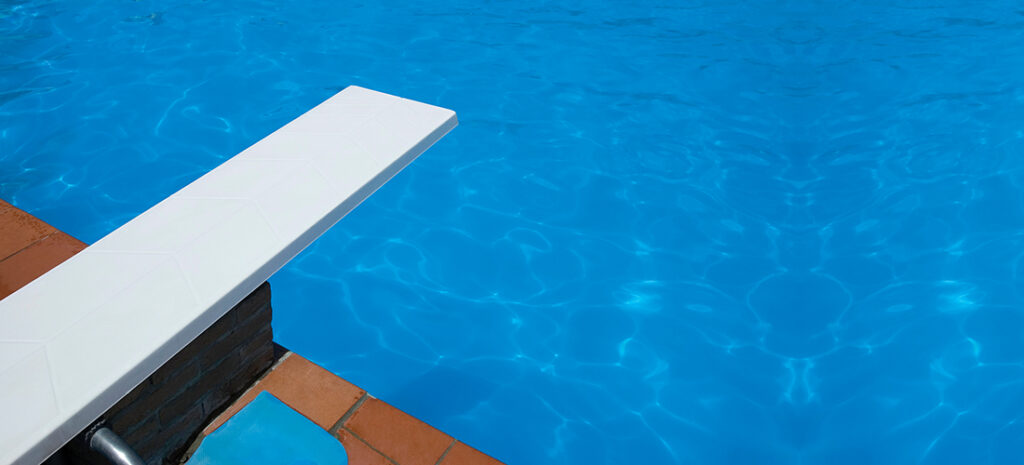
I can’t blame all my early swimming trepidation on my mother. Before I had started first grade, my older cousins were in town for a visit and lodging at the Charlton Motel. Getting to go over there for a dip with them in a real pool — instead of the modest Sears above-ground model in our yard whose plastic bottom always felt slimy and whose primary focus seemed to be attracting bugs of one sort or another — was a big deal. My cousin Bob, treading water near the diving board and wrongly believing I knew how to swim, urged me to jump in. I thought he was going to catch me. There were a few moments of panic before Bob realized what was going on and scooped me up and carried me to the shallow end.

I soon would learn how to dog paddle. Aberdeen Lake, Rec Department outings to the Southern Pines town pool, White Lake and the rare family road trip motel pools were my learning laboratories. Whether in murky or clear waters, though, I was still a novice.

That’s why 1968, which I call the Summer of Sore Toes, was important.

My sister Dianne and her husband, Bob, hosted me for a visit in Winston-Salem, where they had gone to Wake Forest. It was a memorable week. They showed me the college campus, treated me to cherry Slurpees at 7-Eleven, took me to an aquarium-fish store that featured a tank of piranhas. My sister baked lasagna and made tacos, exotic fare given the basic Southern food Mom and Dad served at home. They were living in a Winston-Salem apartment complex whose best feature was a pool, where I was determined to spend much of my time.

With Dianne patiently poolside with a good book or three keeping a loose eye on her little brother, I spent hours in the water. Bob, an excellent swimmer and former lifeguard, joined me in the pool when he got back from his graduate school classes and tried to help me get more comfortable and proficient in the water.

The dog paddle evolved into a reasonable freestyle stroke I could do a full lap with. I proudly learned how to do a dead man’s float. I still was too timid to go off the diving board, but I got bold enough to dive in from the pool’s edge — over and over and over. The rim had a rough concrete surface, and we helped Eckerd’s bottom line with the Band-Aids put into duty over those seven days, the week I became a swimmer.

About a decade later, when I was at Carolina, students had to pass a swim test to graduate — the requirement was staying afloat for five minutes in the manner of your choosing: swim, tread water, float. If you couldn’t pass, a physical education swimming class was in your future. I confidently signed up for the test, arrived at the appointed time, dove into the 10-foot-deep water, and had no problem lasting until the monitor’s whistle of success. If only calculus had been as easy.  PS

Southern Pines native Bill Fields, who writes about golf and other things, moved north in 1986 but hasn’t lost his accent.

Golftown Journal

Golftown Journal

Bryson’s Bunker

Another shot for the ages

By Lee Pace

Photograph by Matthew Harris Golf Collection

The thread from 1999 to 2024 is quite eerie indeed.

Payne Stewart and Bryson DeChambeau, each of them a former golfer from Southern Methodist University in Dallas.

Each of them with a youthful connection to Pinehurst and its esteemed No. 2 course, Stewart from having visited for a month in 1979 to play a local mini-tour rota, and DeChambeau coming annually with the Mustang golf team to play a fall match against a local school like Wake Forest or North Carolina at the behest of Bob Dedman Jr., the owner of the resort, and a graduate and benefactor of SMU.

Each of them maturing into gracious champions after hiccups as younger players with instances of churlish or snippy behavior with fellow competitors or tournament officials.

And each of them playing in the final group of the U.S. Open and arriving at the 18th tee with history in the balance. 

Stewart in 1999 needs a par to hold off playing partner Phil Mickelson, but his tee shot on the uphill, par-4 finishing hole misses the fairway to the right. He’s in 5 inches of suffocating rough, the grass wet on a cool, misty day. He punches out, has 78 yards to the hole, hits a three-quarter sand wedge to 20 feet short of the back-right hole location.

Stewart makes the putt, and his right-hand fist pump, right-leg extension celebratory pose will be immortalized on film and later in bronze for the ages.

“Perfect — a perfect way to win,” Stewart said. “I think everyone in the field will attest to how great No. 2 is, to what a special place Pinehurst is. To win here means a lot to me.”

DeChambeau in 2024 needs a par to hold off Rory McIlroy, who’s playing one group ahead. He yanks his tee shot left of the fairway, the ball traveling more than 300 yards uphill and coming to rest under a magnolia tree, up against a root and sitting on the native hardpan sand that was exposed during the 2010-11 Coore & Crenshaw course restoration. He has 147 yards to the hole, punches out, and the ball comes to rest in a bunker sitting front right of the green.

He has 54 yards to the traditional final day, back right pin. He uses his immense physical strength to explode out of the sand to 4 feet, then makes the putt. As the ball rolls into the cup, DeChambeau extends both arms, arches his back, looks to the heavens and sets off on several seconds of unabashed joy.

“That bunker shot was the shot of my life,” DeChambeau said. “I’ll forever be thankful that I’ve got longer wedges, so I can hit it farther, get up there next to the hole.”

So now Payne’s Putt has alongside it Bryson’s Bunker in the pantheon of all-time greatest shots — not only in 129 years of Pinehurst history, but also in major championship golf.

Jack Nicklaus’s 1-iron hitting the flag at Pebble Beach in 1972, Tom Watson’s chip-in at Pebble a decade later, Seve Ballesteros’s winning putt at St. Andrews in 1984, Bob Tway’s bunker dunk at Inverness to win the 1986 PGA Championship, Tiger Woods’ chip-in at Augusta in 2005 . . . all iconic monster shots in golf.

“Bryson’s shot has to be as good as any of them,” says 2021 Open champion Jon Rahm.

“There’s no question Bryson’s shot was one of the best shots in U.S. Open history,” says Curtis Strange, a two-time Open champion and former North & South Amateur winner at Pinehurst. “His shot was one of the toughest, if not the toughest, shots in golf. Magnify that with last hole, U.S. Open pressure on a world stage? It was an amazing shot.”

The week after the Open, Pinehurst officials, at the request of DeChambeau caddie Greg Bodine, sent via FedEx an urn of sand from that bunker to DeChambeau’s residence. The golf staffers and caddies have half-jokingly wondered if the windows in the clubhouse behind the 18th green are now in danger with retail golfers attempting that shot and hitting the dreaded skulled shot flying who knows where. The club’s social media staff even mused after the Open that the preponderance of balls landing on the roof might escalate.

All around the golf course, the village and the Sandhills, knowledgeable golf students looked on in awe.

“The long sand shot, that’s the hardest shot in golf,” says former PGA Tour player Pat McGowan, who watched his son Michael play the first two rounds. “Oh my gosh, what a shot. He could stand there and hit 100 shots and not get it any closer. He could have skulled that over the clubhouse and made a double. But Bryson is so strong he just muscled it out.”

“The stat of a PGA Tour player getting up and down from a bunker from that distance is 1.7 percent,” says Pinehurst teaching pro Kelly Mitchum. “To do it on the final hole of a U.S. Open is pretty remarkable.”

Gus Ulrich, the longtime teaching pro at Pinewild Country Club and golf coach at Sandhills Community College, was struck with the authority and resolve DeChambeau exhibited during the minute before the shot.

“What impressed me was Bryson did not overanalyze it,” Ulrich says. “He didn’t rush it by any means, but he didn’t grind over it and agonize like, ‘Oh, I gotta make this to win the U.S. Open.’ He made up his mind pretty quickly, walked in and hit the shot. I think that’s what you have to do in that situation. The more you agonize over it, the harder the shot becomes.”

DeChambeau reflected on that very mindset afterward. Asked what he would remember most about the final two hours of a drama-laden back nine, he said: “Probably my caddie telling me I can do it out of the bunker. G-Bo just said, ‘Bryson, just get it up-and-down. That’s all you have to do. You’ve done this plenty of times before. I’ve seen some crazy shots from you from 50 yards out of a bunker.’ I said, ‘You’re right. I need the 55-degree. Let’s do it.’”

Course superintendent John Jeffreys was standing behind the green in DeChambeau’s line and considered there were about a half-dozen layers of ground undulation between the golfer and the hole — a “false front” leading up to the putting surface; a narrow plateau in the front portion of the green; a downslope and swale in the middle of the green; and finally, an upslope leading to the back crest where the pin was set.

“There’s a lot more to that green than you would think approaching it on the angle he had,” Jeffreys says. “There were a lot of areas to contend with that can help you or hurt you. What made the shot so great was he landed it on the downslope behind that first little plateau. That propelled the ball forward and it ran up to 4 feet.”

And the rest, as they say . . .

No doubt they’re making room as we speak in the history-laden hallway of the resort clubhouse to celebrate Bryson’s Bunker.

“It’s like we caught lightning in a bottle,” Dedman says. “It was otherworldly. To me, it’s almost as if it was preordained. I think maybe Payne and my father were up in heaven and put their thumb on the scale to Bryson’s advantage.”  PS

Lee Pace has written about the Pinehurst experience for more than three decades from his home in Chapel Hill. Write him at leepace7@gmail.com and follow him on X @LeePaceTweet.

Southwords

Southwords

Daniel Wallace is the author of six novels. He is the J. Ross MacDonald Distinguished Professor of English at the University of North Carolina at Chapel Hill, his alma mater.

Bookshelf

Bookshelf

FICTION

Villa E, by Jane Alison 

Along the glittering coast of southern France, a white villa sits atop an earthen terrace — a site of artistic genius, now subject to bitter dispute. Eileen Gray, a new architect known for her elegant chair designs, poured the concrete herself; she built it as a haven for her and her lover, and called it E-1027. When the famed Swiss architect Le Corbusier, a founder of modernist architecture, laid eyes on the house in 1929, he could see his influence in the sleek lines. Impassioned, he took a paintbrush to the clean white walls. Thirty years later, Eileen has not returned to Villa E and Le Corbusier has never left — his summers spent aging in a cabin just feet away. Mining the psyches of two brilliant, complex artists and the extraordinary place that bound them, Alison turns a now-legendary act of vandalism into a lushly poetic and mesmerizing novel of power, predation and obsession.

A Sorceress Comes to Call,
by T. Kingfisher 

In a dark reimagining of “The Goose Girl” fairytale, Cordelia knows her mother is . . . unusual. Their house doesn’t have any doors between rooms — there are no secrets in this house — and her mother doesn’t allow Cordelia to have a single friend, unless you count Falada, her mother’s beautiful white horse. The only time Cordelia feels truly free is on her daily rides with him. But more than simple eccentricity sets her mother apart. Other mothers don’t force their daughters to be silent and motionless for hours, sometimes days, on end. Other mothers aren’t evil sorcerers. When her mother unexpectedly moves them into the manor home of a wealthy older squire and his kind but keen-eyed sister, Hester, Cordelia knows this welcoming pair are to be her mother’s next victims. But Cordelia feels at home for the very first time among these people, and as her mother’s plans darken, she must decide how to face the woman who raised her to save the people who have become like family.

NONFICTION

Dinosaurs at the Dinner Party: How an Eccentric Group of Victorians Discovered Prehistoric Creatures and Accidentally Upended the World,
by Edward Dolnick

In the early 1800s a 12-year-old farm boy in Massachusetts stumbled on a row of fossilized three-toed footprints the size of dinner plates — the first dinosaur tracks ever found. Soon, in England, Victorians unearthed enormous bones that reached as high as a man’s head. No one had ever imagined that creatures like three-toed giants had once lumbered across the land. And, even if someone had somehow conjured up such a scene, they would never have imagined that all those animals could have vanished hundreds of millions of years ago. The thought of sudden, arbitrary disappearance from life was unnerving and forced the Victorians to rethink everything they knew about the world. In Dinosaurs at the Dinner Party, Dolnick leads us through a compelling true adventure as the paleontologists of the first half of the 19th century puzzled their way through the fossil record to create the story of dinosaurs we know today.

Billionaire, Nerd, Savior, King: Bill Gates and His Quest to Shape Our World, by Anupreeta Das

Few billionaires have been in the public eye for as long, and in as many guises, as Bill Gates. At first heralded as a tech visionary, the Microsoft co-founder next morphed into a ruthless capitalist, only to change yet again when he fashioned himself into a global do-gooder. Along the way, Gates forever influenced how we think about tech founders, as the products they make and the ideas they sell continue to dominate our lives. Through the Bill and Melinda Gates Foundation, he also set a new standard for high profile, billionaire philanthropy. But there is more to Gates’ story, and here, Das’ revelatory reporting shows us that billionaires have secrets, and philanthropy can have a dark side. Drawing upon hundreds of interviews with current and former employees of the Gates Foundation, Microsoft, academics, nonprofits and those with insight into the Gates universe, Das delves into Gates’ relationships with Warren Buffett, Jeffrey Epstein, Melinda French Gates and others, to uncover the truths behind the public persona.

I Heard There Was a Secret Chord: Music as Medicine, by Daniel Levitin

Music is one of humanity’s oldest medicines. From the Far East to the Ottoman Empire, Europe to Africa and the pre-Colonial Americas, many cultures have developed their own rich traditions for using sound and rhythm to ease suffering, promote healing and calm the mind. In his latest work, Levitin explores the curative powers of music, showing us how and why it is one of the most potent therapies today. He brings together the results of numerous studies on music and the brain, demonstrating how music can contribute to the treatment of a host of ailments, from neurodegenerative diseases such as Parkinson’s and Alzheimer’s, to cognitive injury, depression and pain.


CHILDREN’S BOOKS

Tiny Jenny, by Briony May Smith

In one of the great opening lines in a picture book, Tiny Jenny begins: “Mr. and Mrs. Wren were very surprised when a baby fairy hatched from one of their eggs.” Just as readers fell in love with Smith’s Margaret’s Unicorn, they’ll fall equally in love with this quirky, wise, clever baby fairy, Tiny Jenny. (Ages 2-7.)

The Quacken, by Justin Colón

Every summer camp has legendary creepy campfire tales, but this tale just might quack you up in addition to creeping you out just a little bit. Read the book, tell the story, but whatever you do, don’t feed the ducks. Silly scariness for fans of the Creepy Carrots! series. (Ages 4-7.)

Prunella, by Beth Ferry

Instead of ferns, she grew fungi. This alone should have alerted Prunella’s green-thumbed parents to the idea that their girl was different in a wonderful way. Both a celebration of amazing children and unusual plants, Prunella is the perfect book for woods wanderers and summer celebrations. (Ages 3-7.)

The Yellow Bus, by Loren Long

Trucks, tractors, yellow buses, they all have jobs to do and they just might have stories to tell. In the hands of the amazing creator of the beloved Otis the Tractor series, those stories just might surprise you. Perfect for back-to-school tables and for an anytime read-together, The Yellow Bus might just leave readers wondering what other vehicles have surprising stories to share. (Ages 4-7.)   PS

Compiled by Kimberly Daniels Taws and Angie Tally.

Naturalist

Naturalist

A Tornado of Butterflies

The marvel of swallowtails “puddling”

Story and Photographs by Todd Pusser

On a hot spring day in the North Carolina foothills, near the town of Morganton, I went looking for a fish. Not just any run-of-the-mill fish, mind you, but a greenhead shiner. Granted, the greenhead shiner is not much to look at most of the year and does indeed look like a run-of-the-mill minnow. But come late spring and early summer, when water temperatures warm up in the prelude to spawning season, the shiner turns into a tropical splendor. The coloration of its body magically morphs from a bland, silverish hue to radiant neon red, complete with brilliant white fins and a white head. A couple of hundred greenheads schooling in shallow water look like something straight out of the Great Barrier Reef.

Like many quests, sometimes you find something totally unexpected. On this day, I stumbled upon a cluster of intriguing critters equally as colorful and tropical-looking as the shiners. Rounding the bend of a tiny creek with a heavy underwater camera housing in tow, I flushed a swarm of eastern tiger swallowtail butterflies from off the ground. The sudden fluttering of dozens of dainty wings around my head took my breath away. A shaft of sunlight penetrating through the canopy above illuminated their bright yellow and black wings, causing the butterflies to positively glow in the shaded forest. The effect was enchanting.

I remained absolutely still as the butterfly tornado continued to swirl around my head. Eventually, one by one, the swallowtails settled back to the sandy ground near the edge of the water. I counted well over 40 of the winged wonders, easily the most butterflies I have seen in one spot in North Carolina.

I was completely unprepared for photographing a butterfly convention. The wide-angle fisheye lens, buried within the bowels of my underwater housing, was not the tool of choice for documenting this phenomenon. So, I did what I had to do. Forgetting about the fish for the moment, I took several steps back and carefully placed my underwater housing on the ground. Then, as fast as I could, I walked to my car several hundred yards away to retrieve another camera and a more appropriate telephoto lens, all the while hoping that the colorful mass would remain.
Twenty minutes later I returned and, to my relief, found the butterflies still there. Lying flat on the ground, I started to frame the action. Now with the aid of a 400mm lens, in my viewfinder I could clearly make out the long tongues of the butterflies probing the sand. The swallowtails were engaged in a behavior that entomologists term as “puddling.”

It works something like this: By sticking their long tongues into the damp mud, butterflies suck up minerals from the ground. Research has shown that most of these puddling aggregations involve males, who load up their spermatophores with essential salts, which they then present as “gifts” to receptive females during courtship. In a nutshell, puddling is a butterfly frat party.

Swallowtail butterflies are frequent puddlers, and do so around the world in large, densely packed groups. Globally, scientists recognize over 600 species of swallowtails. The family includes the remarkable and highly endangered Queen Alexandra’s birdwing of Papua New Guinea, the largest of all butterflies, whose wings can stretch more than 11 inches from wingtip to wingtip. Alfred Russel Wallace, the eminent British biologist (and co-describer of the Theory of Evolution with Charles Darwin), was so enamored with birdwing butterflies that when he caught his first in the Molucca Islands in 1859, he remarked, “I was nearer fainting with delight and excitement than I have ever been in my life; my heart beat violently, and the blood rushed to my head, leaving a headache for the rest of the day.”

Closer to home, swallowtails, with their large size, vibrant colors and propensity for visiting backyard gardens, are the quintessential butterflies for most people and attract legions of fans, even among those who despise insects. According to the recently published book Butterflies of North Carolina, South Carolina, Virginia, and Georgia, eight species of swallowtails are regularly found in the state.

Still belly-down in the mud, I continued to photograph the frenetic activity. Butterflies were constantly fluttering about, rising up into the air and settling back down on the bank. Unlike Wallace, my heart was not beating violently in my chest, and I had no headache. Still, after an hour observing the spectacle in the afternoon heat, I had worked up quite the sweat and was getting rather thirsty. Like the probing butterflies, I needed some essential sodium — not from the mud — but from a fruit punch Gatorade buried inside an icy cooler in the back of my car.

I squeezed off a few more frames highlighting the extended “tails” on the hindwing of one particularly handsome individual, a trait that gives the family its common name. Satisfied with the images, I got up from the ground, dusted myself off, and slowly walked back toward the car and much-needed sustenance.  PS

Naturalist and photographer Todd Pusser grew up in Eagle Springs. He works to document the extraordinary diversity of life both near and far. His images can be found at www.ToddPusser.com.

Birdwatch

Birdwatch

The Stately Little Blue

A summer visitor dressed in white

By Susan Campbell

Late summer can be an especially exciting time for birders. We need not travel far to find unexpected visitors. Weather events may cause individuals to be blown off track and show up in the neighborhood. These lost birds may stick around for mere hours. However, in other instances, it may be a more deliberate response to environmental conditions that brings them our way.

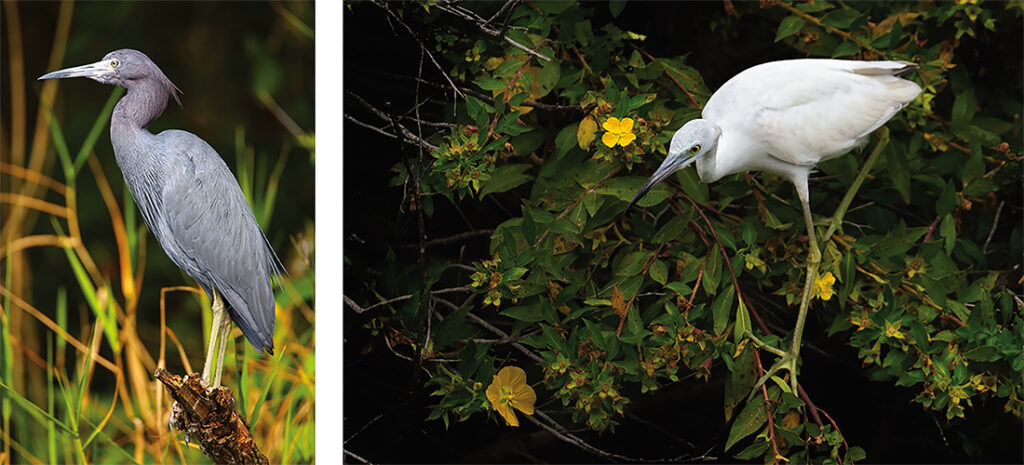
One bird that frequently appears in wet areas later in the summer is the little blue heron. And it may not be just one, but several of them, that show up. Furthermore, they are not usually blue. This is because young of the year (which these inland wanderers almost always are) are actually white. Except for the very tips of the wing feathers — usually a challenge to make out — these birds are covered with white feathers. Unlike the great or snowy egret, which also may turn up in the Piedmont or Sandhills at this time of year, the bill of these small herons is pinkish gray, and the legs are greenish.

All of these white waders may be spotted in shallow wet habitats — streams, small ponds, water hazards, retention areas, etc. Little blue herons may be by themselves, mixed with other white, long-legged waders, or even with the much larger great blue heron. Little blues can be identified by their more upright foraging posture, their slow, deliberate movements, and a downward angled bill as they stalk prey. Unlike other smaller waders, they will hunt in deeper water, often all the way up to their bellies.

Little blues watch for not only small fish but frogs and crayfish, as well as large aquatic insects. It is thought that their coloration allows them to blend in inconspicuously with similar white species. The association then provides protection from predators. Also, it has been found that little blues are significantly more successful predators when foraging alongside great egrets. These larger birds are likely to stir up the water as they move after underwater prey, which can then flush a meal in the direction of nearby little blues.

It takes these herons at least a year to develop adult plumage, not unlike white ibis — who sport dark plumage their first summer and fall — which also breed along our coast. They may have a pied appearance for a time in late winter or early spring. By April they will be a slatey blue-gray all over with a handsome bluish bill. Unlike our other wading birds, they lack showy head or neck plumes. They are also unique in having projections on their middle toes that form a comb, which is used as an aid when grooming.

Unfortunately this species has experienced an alarming drop in population numbers across North America over the past half-century. Loss of coastal wetland habitat, continued declines in water quality, and elimination as a nuisance in fish hatcheries all are thought to be contributing to the decline. So be sure to stop and appreciate these stately birds should you come across one — regardless of when or where you happen to be.  PS

Susan Campbell would love to receive your wildlife sightings and photos. She can be contacted by email at susan@ncaves.com, or by calling (910) 585-0574.