Southwords

Southwords

Eau d’Adventure

A little spritz goes a long way

By: Emilee Phillips

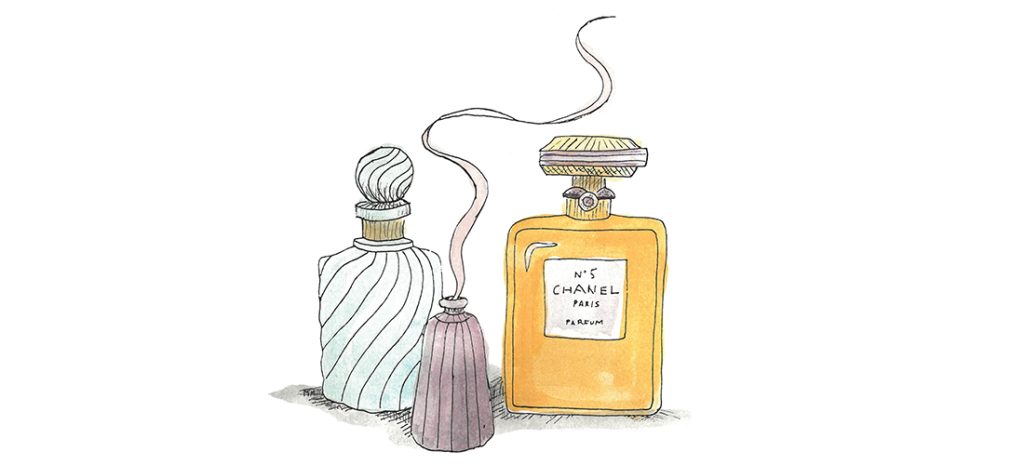
They say smells are the strongest links to memory. A whiff of something can transport you instantly through the years. Perfumes are like people, each complex and unique. One may sing a melancholy song but you can’t help but love her voice. Another might wrap you up in a big hug and hold you there no matter how long it’s been. A third can pull you into a hallway you haven’t dared walk down in years.

A new year is a chance to try on new versions of yourself as simply as changing your scent. You can have a signature perfume, or you can have the world at your door with the touch of an atomizer. I could smell like a girl who spends her days arranging flowers, drinking afternoon tea and wearing a pearl necklace. Or I could have a sultry scent and create mystery in the air as if, just walking past, it is possible to imagine being inside a luxurious yacht.

And I adore fragrance bottles. While many may be ornate, uniquely shaped vessels with ridiculous names on their labels, they’re my prized little possessions.

I have a round glass bottle of Chanel I got my senior year of high school. I use it sparingly, mostly on special occasions. Every pink spritz takes me back to seeing the world as an adult for the first time. Back to prom, my cap and gown, and first dates.

I have a bottle that’s yellow and cylindrical and reminds me of a trip I took to Ohio one winter, my white boots in the snow and my cousin, Maddy. We walked all around Cleveland, shivering with coffees in hand, finding unique storefronts and taking dramatic photos we dubbed “album covers.” A whiff brings us back together again.

People associate red roses with Valentine’s Day, as do I, though I prefer the look of peonies or carnations. Still, I opt for rose-scented spray on the 14th. Once, on my way out for dinner, I sprayed so much of it my coat held onto the scent deep into spring. My date rolled the car windows down, terrified, I suppose, that no automobile air freshener could ever put it right.

I secretly love walking through department stores with beauty bars and fragrance counters. The haze that hangs between the door and the shoe department is a fog bank I welcome. Even though most perfumes are overpriced and overly pungent, I enjoy over-sampling them all, sniffing test papers until my nose can no longer distinguish patchouli from pine.

I even keep a small gold metal bottle my mother bought in Paris back in the ’80s. It’s never been opened. She wanted to save it for a special occasion. Maybe one day I’ll test it out and cross my fingers that it doesn’t smell terrible. Maybe we’ll even wear it out together to create an aromatic memory all our own.  PS

Emilee Phillips is PineStraw’s director of social media and digital content.

To the Manor Reborn

To the Manor Reborn

A historic hotel transformed

By Deborah Salomon

Photographs by John Gessner

Historical Photographs from The Tufts Archives


To be memorable, a Christmas pudding needs soaking in brandy. Likewise, a sojourn at Pinehurst’s famed golf courses benefits from après golf immersion: lodgings, décor, potables, camaraderie with fellow-sojourners ready to rehash the day’s round from deeply upholstered chairs at inns where history comes alive via photographs and memorabilia.

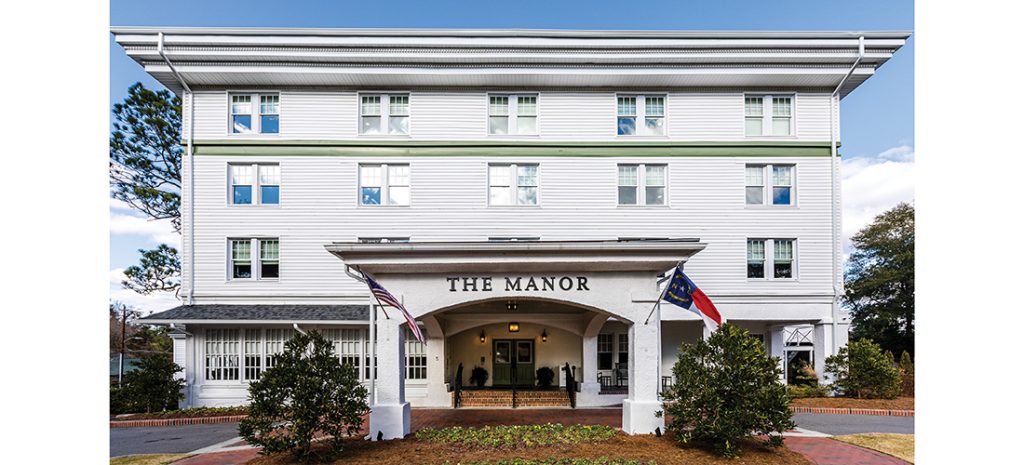
The Manor — a luxury lodge, clubby without being uber-masculine, with a staff imbued with Southern hospitality — is part of this culture. It’s fair to say that, before its massive redo, The Manor had aged to the point it was considered little more than “overflow” lodging for the larger resort. Now it’s an attraction all its own.


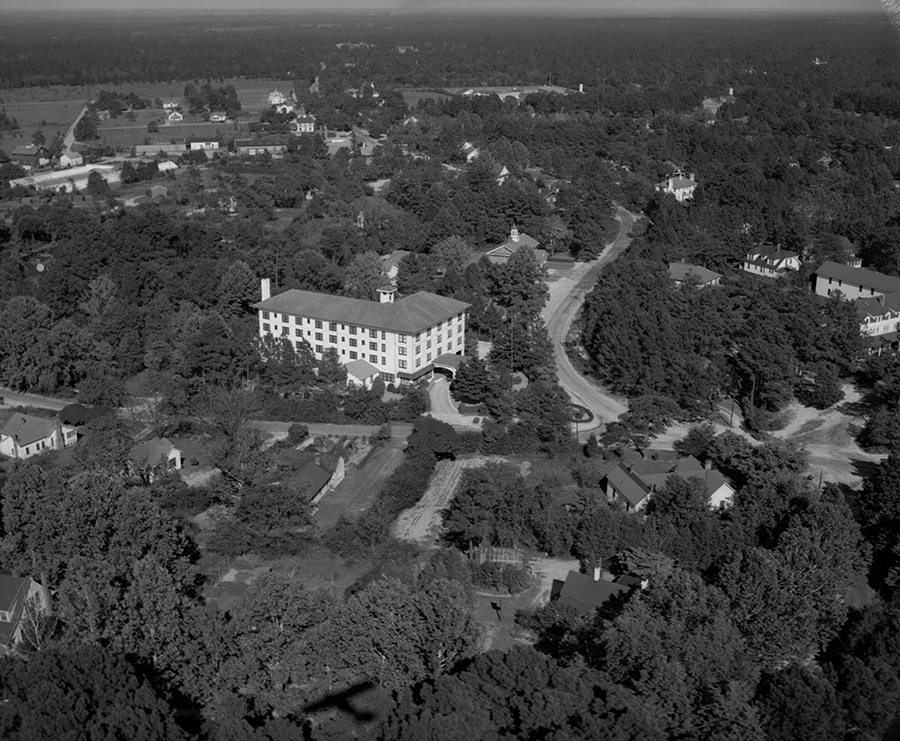
Tucked behind The Pine Crest Inn and almost completely reimaged, The Manor suits groups who require gathering space as well as couples and weekend golfers in search of a game. It’s just far enough from the village center to claim quiet yet close enough to walk to virtually everything, including the wildly successful Pinehurst Brewery just down the hill. It’s intimate enough — 43 rooms — to feel homey yet part of the Pinehurst Resort family giving guests access to pool, spa and all hotel amenities.

And, like her cousin inns Magnolia and Holly, The Manor is steeped in history.


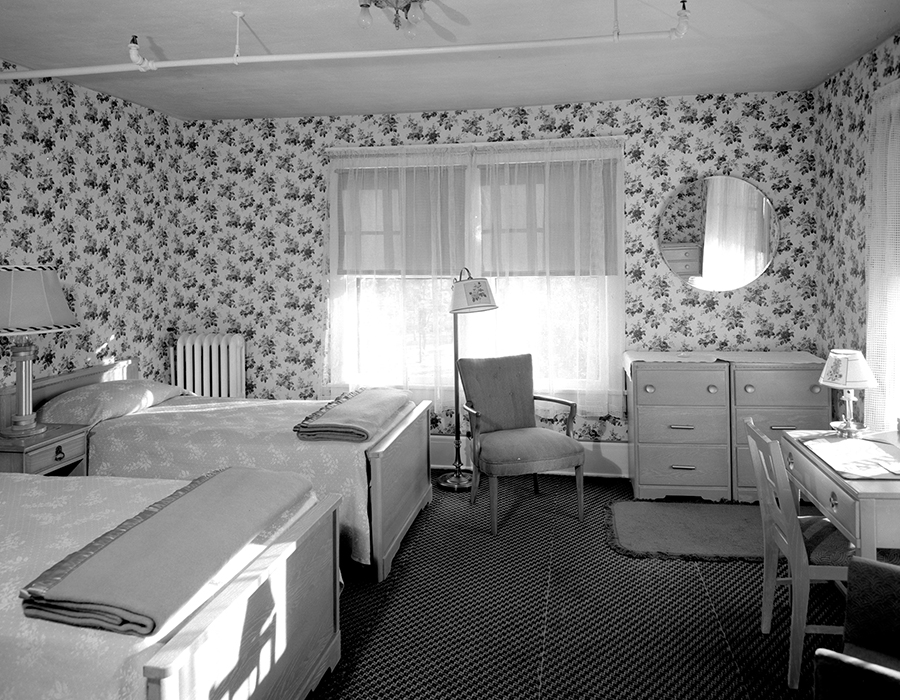
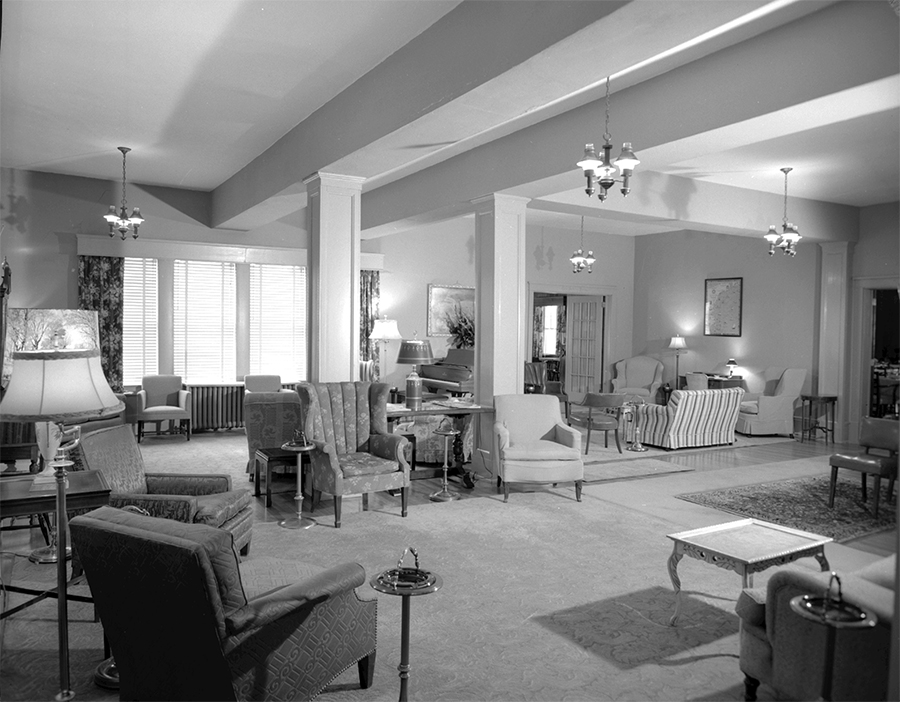
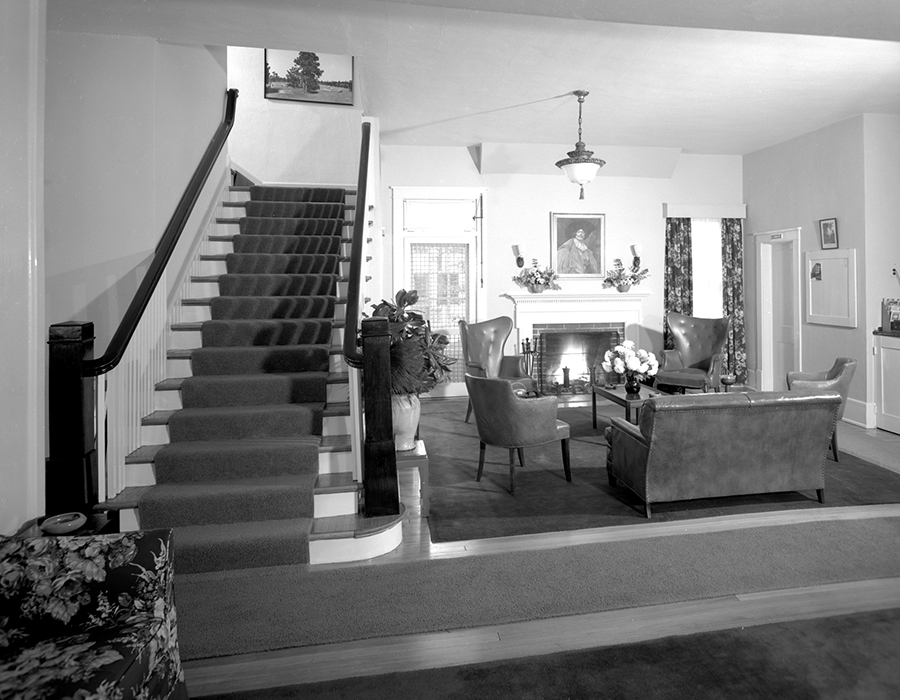
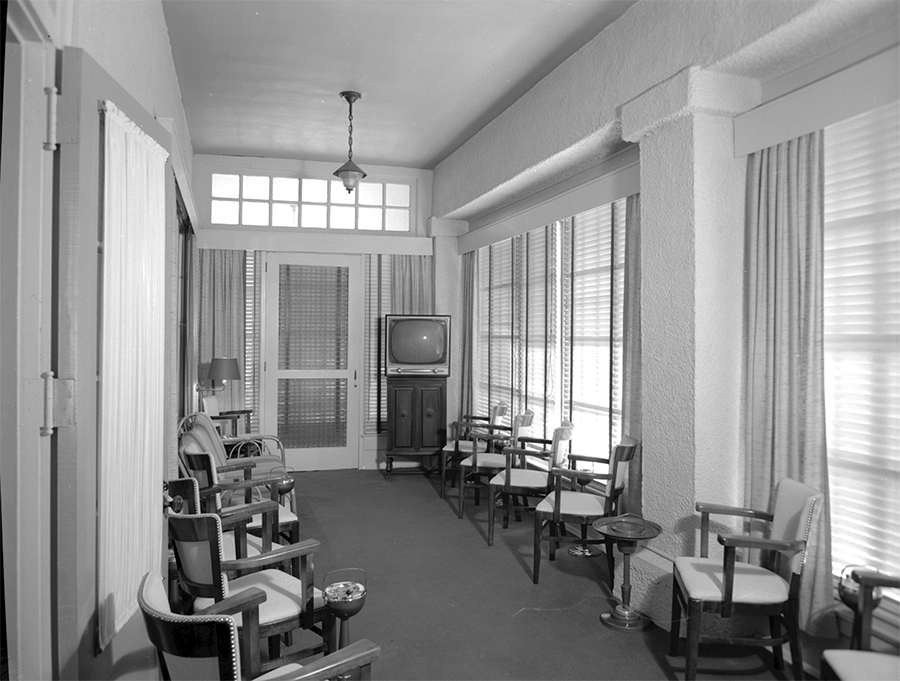
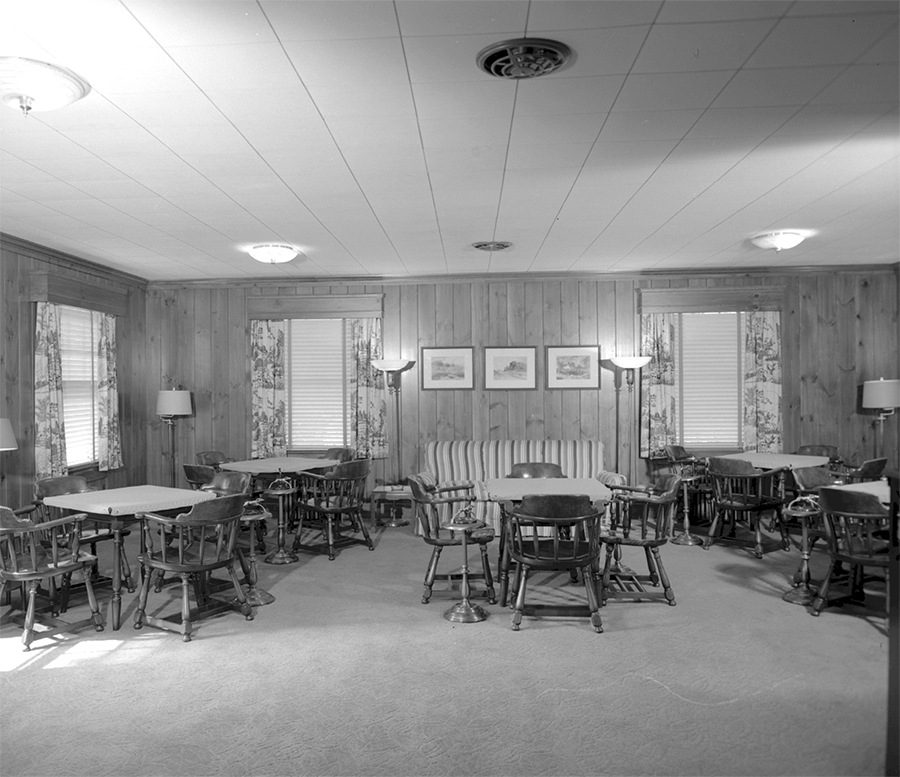
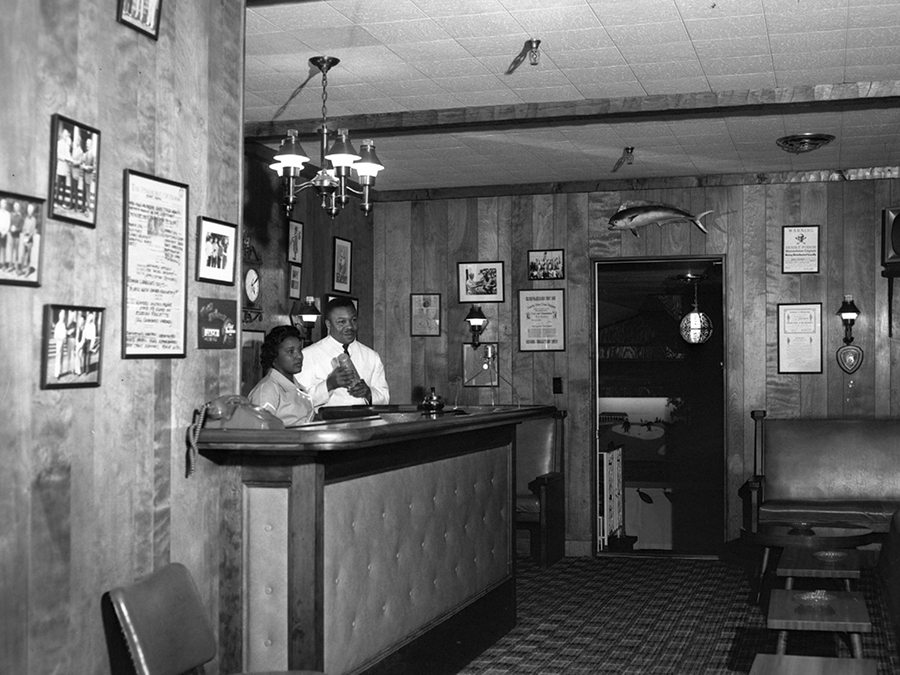
By the early 1900s Pinehurst was gaining popularity as a winter resort, accessible by rail, boasting mild temperatures and upper-crust guests who rented cottages for “the season” or stopped at a hotel. These facilities required staff, and staff required affordable lodgings. In 1899 the Tufts family announced, “A fine new hotel, The Lexington, for employees of the village is being erected.” Here, a single room in the four-story walk-up cost from $17 to $28 monthly; a double, some with bath, $32 to $40. Tufts hired New England hotelier Emma Bliss — also the force behind The Pine Crest Inn — to manage the project. Emma, who is often compared to the Unsinkable Molly Brown, had loftier ideas. In 1922 she applied for a loan to raze, rebuild and gentrify The Lexington. Bankers, aghast at this cheeky woman, finally relented. The Manor opened in 1923 with a sprinkler system, private bathrooms and steam heat. The Pinehurst Outlook described it as “luxuriously furnished, catering to an exclusive clientele with an elevator, also a phone in each room.”

Build it and they will come. “Mrs. H. Guggenheim of New York City has arrived for a week,” the Outlook society page announced.


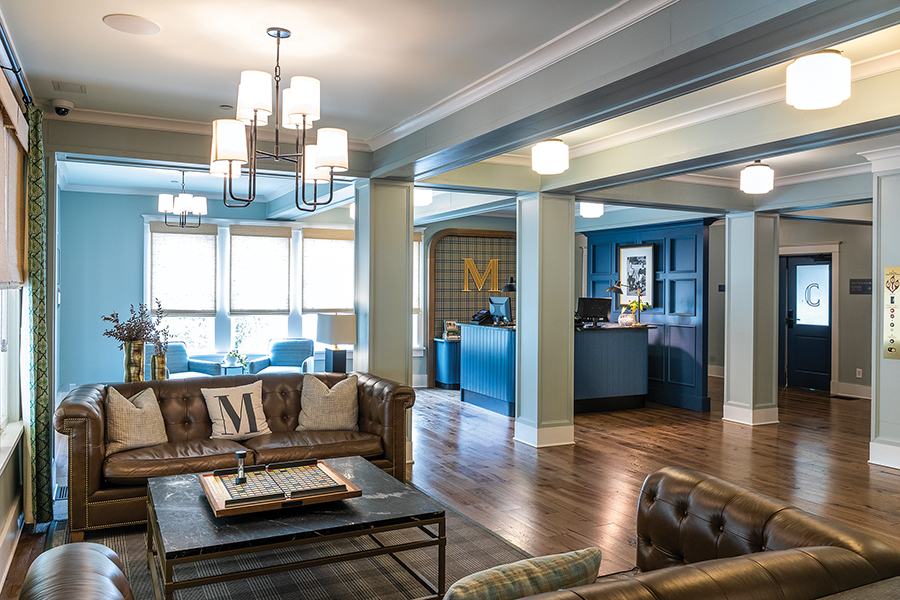
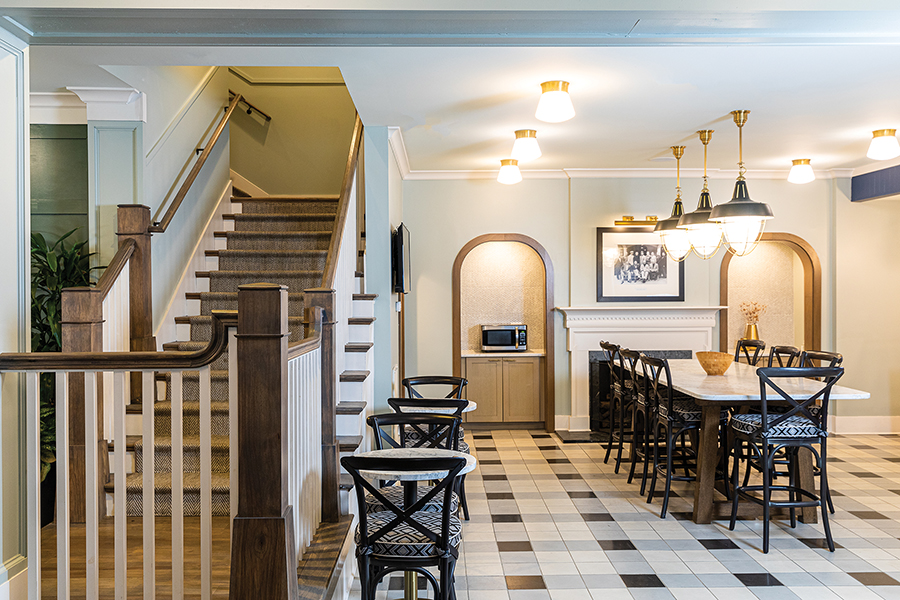
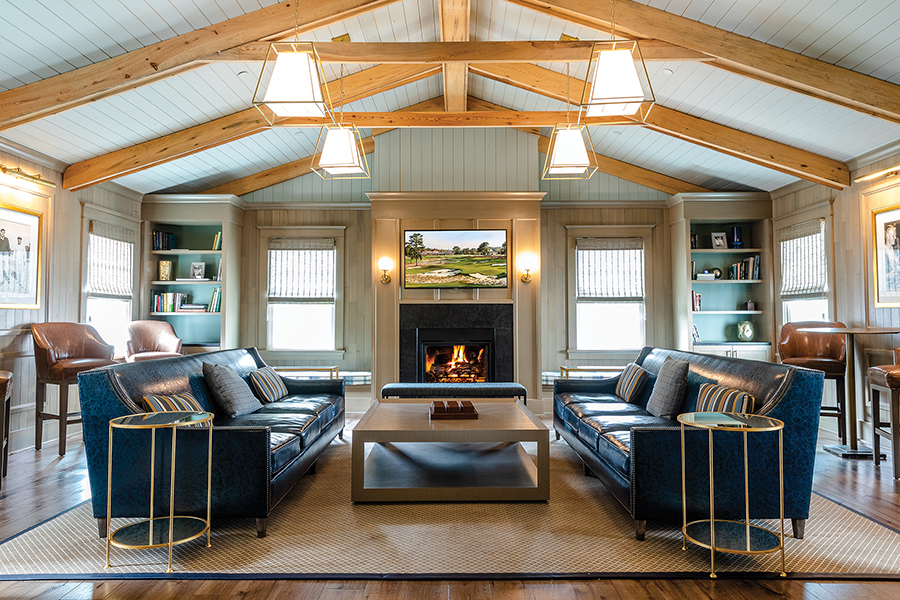
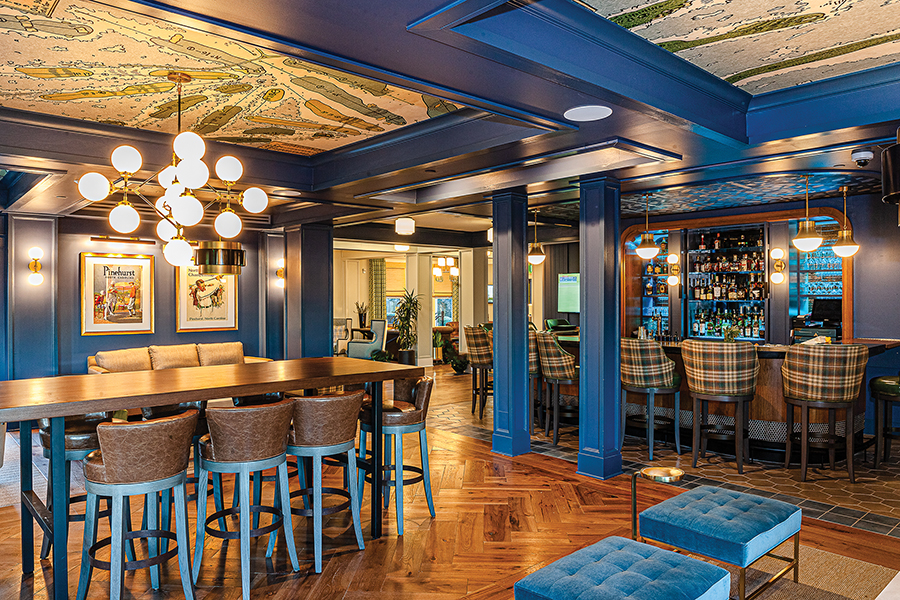
Over the years, The Manor has changed ownership and undergone several renovations. Nothing compares to the last one, begun in 2019, when the building was stripped down to its studs, space reallocated, spa bathrooms installed along with décor based, surprisingly, on blue — a soothing smoky shade midway between UNC Tar Heel pastel and Duke Blue Devil electric. Playing off the blue is a sandy-beige plaid fabric, hereafter dubbed Manor tartan, that appears in both public and guest rooms. Miles of moldings, tray ceilings, multiple columns and a graceful staircase divide the lobby into conversation areas, one with a built-in Scrabble board. Another, The Marketplace, stocks breakfast sandwiches sent over from the hotel kitchen, snacks and beverages.

The frontal exterior, however, remains mostly intact with its circular drive, porte-cochère, and foundation trimmed with Kellarstone, a rough surfaced-material touted for endurance.

The North & South bar anchors the lobby, boasting more than 100 bourbons, whiskeys, craft cocktails plus beer from neighboring Pinehurst Brewing Co., with charcuterie boards to temper absorption. Look up and you’ll see an illustration (circa 1920) of Donald Ross’ first four courses. Look out and you’ll find decks outfitted with fire pits for chilly evenings.


COVID interrupted its introduction, but by mid-January The Manor opened, drop-dead gorgeous, still informal enough to raise Mrs. Guggenheim’s eyebrows.

No matter how comfy the sofas are or how many oversized TVs tuned to sports channels hang from the walls, nothing makes a better first impression than the enthusiastic welcome of Kathy Capel, front desk manager, problem solver, sympathizer, advice giver. Her knowledge of the area becomes crucial during junior competitions, when families arrive from around the globe. After 36 years, first at The Carolina Hotel, then The Manor, Capel’s laugh and twinkle have made her popular with locals and repeat guests alike.

Oh, the tales Capel could tell were she not so discreet. The hands she’s shaken include Sidney Poitier (“He was so handsome.”), Dean Smith, Bobby Knight, Oprah Winfrey, Roy Williams and her buddy Arnold Palmer, whose photograph, with father Deacon Palmer, hangs over the front desk.

Palmer could have stayed anywhere, but The King chose The Manor. “He always had suite 401. He would sit on the porch for hours and sign autographs,” Capel recalls. When Palmer passed away in 2016, “I cried like a baby,” says Capel. “But his daughter came down last year to see our pictures of him.”

In the 1980s central air conditioning, then warmer winters extended the “season,” attracting a clientele seeking a more contemporary setting. In April 2020, the resort’s owner, Bob Dedman Jr., told Business North Carolina magazine: “We’ve always gone back, tried to be more authentic, restore the character of Pinehurst but at the same time, contemporize so that its legacy will last. Part of it is looking backward but another part is always looking forward.”

It means rocking chairs on the porch, craft beers on tap, Wi-Fi, and Kathy Capel calling out “Welcome to The Manor” from her forever position at the front desk.  PS

Almanac

Almanac

February knows you’re weary.

She can tell by the longing in your eyes, the ache in your chest and shoulders, how you carry the cold like a burden.

On these frost-cloaked mornings, you dream of soft earth and tender blossoms, spring peepers and swallowtails, songbirds and sunny afternoons.

February knows. She cannot give you what she does not have. And yet, she offers hope.

At dawn, the frigid air nips your face and lungs, stuns you with its jarring presence. It’s hard, at first, to see beyond the dense clouds of your own breath. This is where you start: Breathe into the mystery. Let the formless take form. Watch your own warmth shape the world around you.

As the pink sky slowly brightens, two silhouettes appear in the glittering distance.

A pair of rabbits.

Something about their gentle presence softens the very landscape, softens your edges and your gaze. Weeks from now, their quiet stirrings will have conjured the first of many quivering litters. Something deep within you stirs.

February offers contrast.

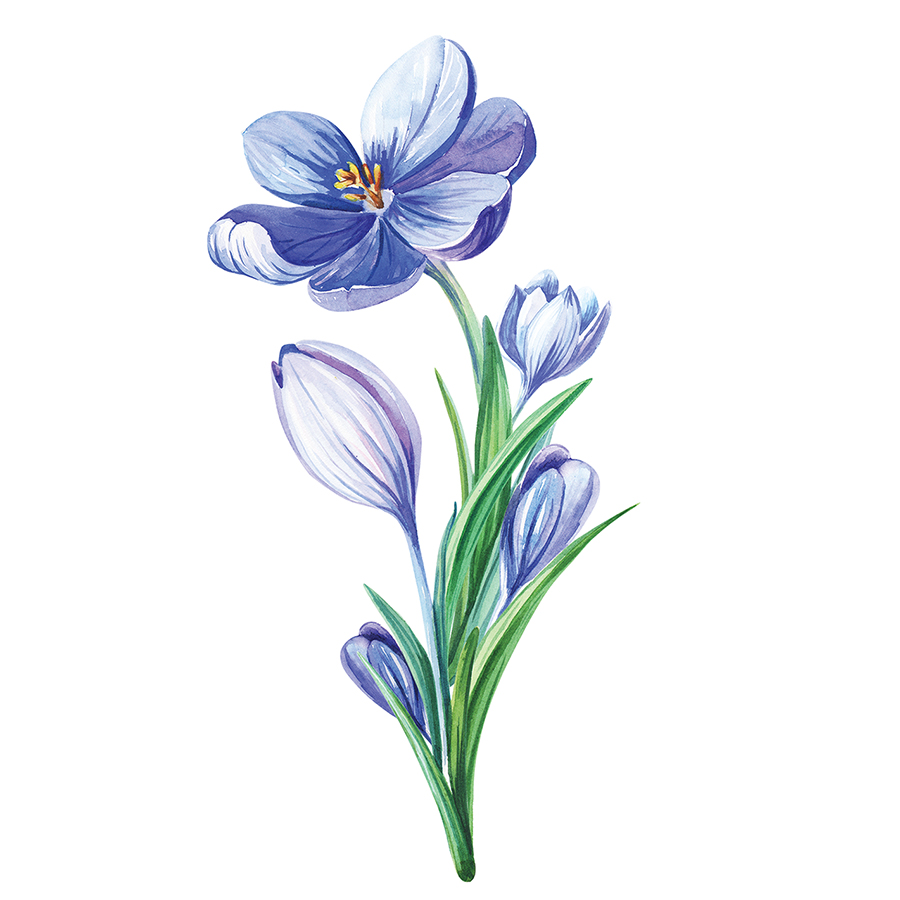
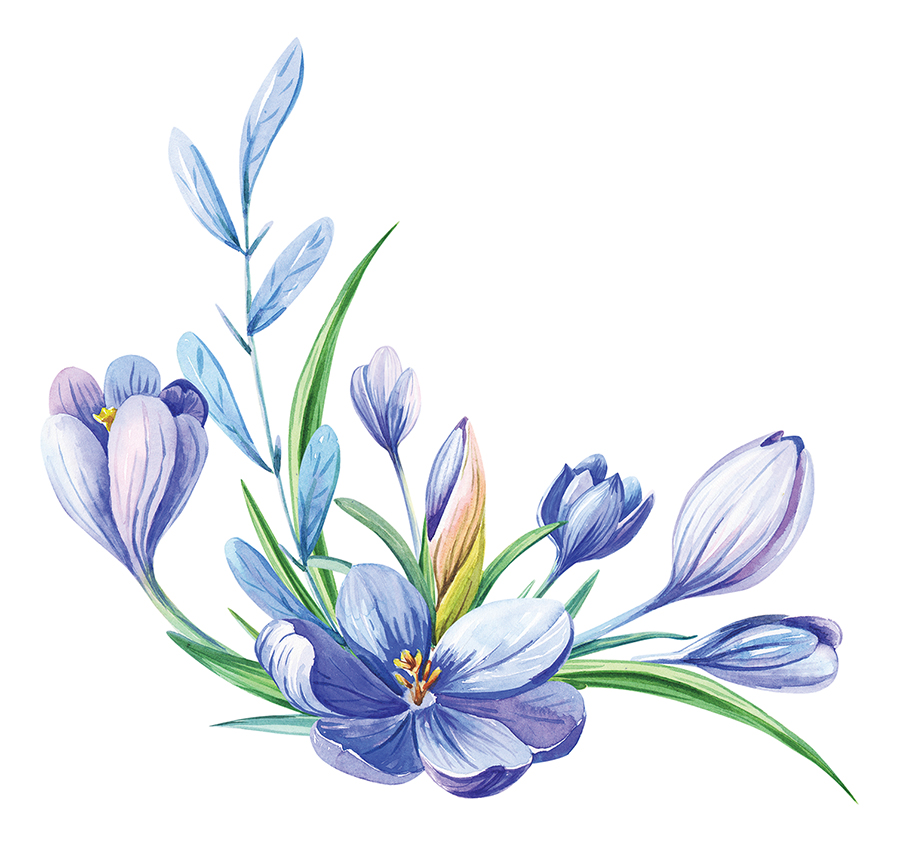
Suddenly, you notice early crocus, jewel-like petals drenched with more color than you’ve seen in months. For now, this luscious purple is enough.

But there’s more.

When the first golden daffodil emerges from the frozen earth, a sunbeam lights upon your face. You close your eyes, basking in this subtle warmth, this fleeting glimpse of what’s to come.

The cold becomes quiet. As you walk the icy bridge between the harsh clutch of winter and the tender kiss of spring, you carry yourself differently. Hope is gleaming in your eyes, glittering on the horizon, tucked inside your chest like a sacred gift.


Bridge Between Seasons

The ancient Celts looked to the Wheel of the Year to celebrate and honor nature’s cycles, drawing wisdom from the turning of each season. Imbolc (observed on Feb. 1) marks the midpoint between the winter solstice (Yule) and the spring equinox (Ostara). In other words: Imbolc is a bridge between death and rebirth. Also known as Candlemas or Brigid’s (pronounced Breed’s) Day, this festival honors the return of the sun and celebrates the Celtic fertility goddess Brigid.

The days are growing longer. The sun, stronger. The earth opens to a quickening rhythm.

Soon, the seeds from last year’s harvest will be sown. As spring awakens within and around us, the great wheel turns and turns.


While it is February one can taste the full joys of anticipation. Spring stands at the gate with her finger on the latch.   — Patience Strong


Crocus Pocus

Perhaps you know that saffron, the complex and costly spice, comes from the red stigmas of the autumn-blooming saffron crocus (C. sativus), not the snow crocuses you see now, bursting through the frozen earth. And yet, these winter-blooming beauties offer something of even greater value: the ineffable promise of spring.

Plant your own corms this fall. They’ll need full sun, moist but well-drained soil and a quiet winter to unlock their incomparable magic.  PS

Monarchs of the Forest

Almanac

The wonder of champion trees

Story and Photographs by Todd Pusser

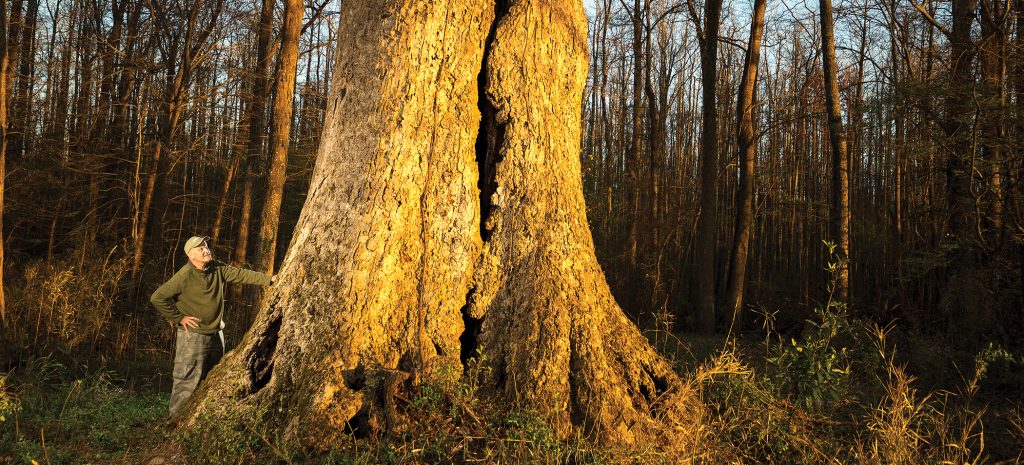
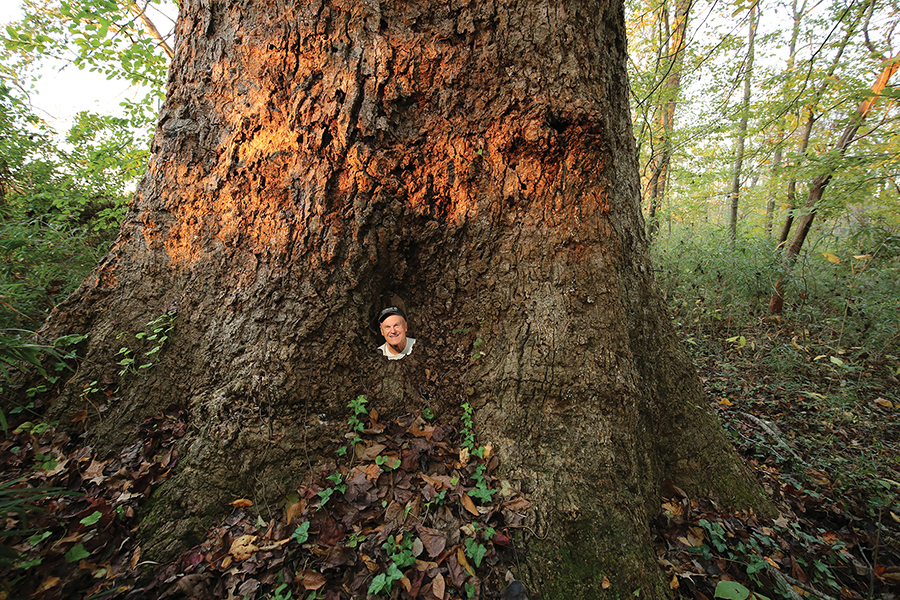
This and above photograph: Gary Williamson and National Champion Tulip Poplar in Chesapeake, VA


It was a tip from a local hunter that first alerted Gary Williamson to the presence of the tree. Standing near the edge of a plowed field, just across the North Carolina line in Chesapeake, Virginia, the tulip poplar dwarfs all other trees nearby. Well over 100 feet tall and 32 feet in circumference, it is the largest of its kind anywhere in the United States.

The tree, while alive and healthy, is hollow on the inside, making it impossible to accurately age. Tulip poplars can live for several hundred years, and it is likely this giant was alive long before the United States declared its independence from Great Britain. Once, while leading a field trip of big tree enthusiasts, Williamson managed to crowd 15 people inside the tree at one time with room to spare. The tree is a survivor, having lived through droughts, wars, hurricanes, and the unrelenting pressure of the saw blade.

Mankind has long been fascinated by trees, especially large trees. The fascination reached a fever pitch in the early 1800s when explorers, searching for gold in California, reported the first encounters with coastal redwoods and giant sequoias, those blue whales of the plant kingdom. Reaching heights of over 350 feet, with diameters well north of 19 feet, these gargantuan trees are the largest living organisms on Earth. It has been estimated that one particular giant sequoia, appropriately nicknamed “The President,” holds over 2 billion leaves among its branches.

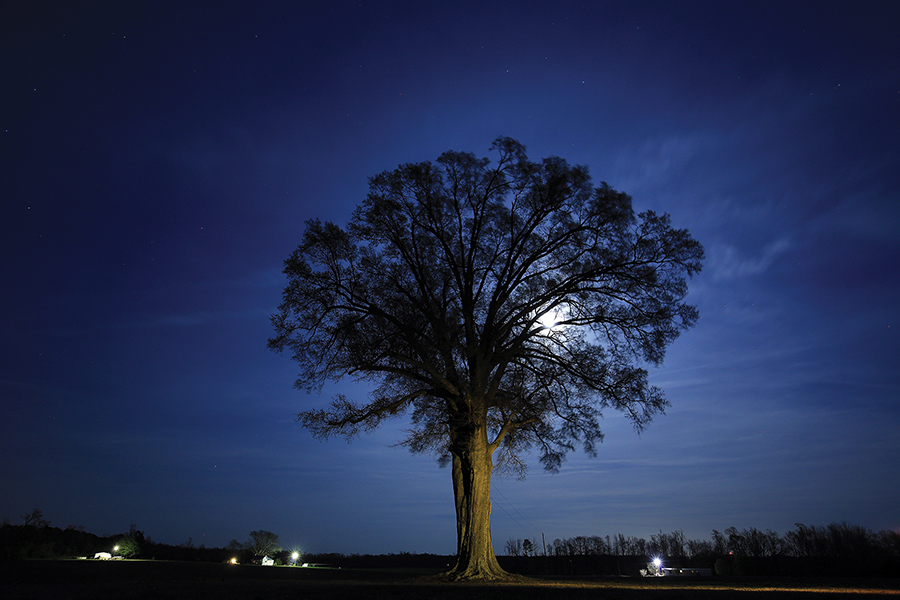
National Champion Darlington Oak Tree in Edgecomb County, NC


When Europeans first colonized America, they set about the task of felling the continent’s vast virgin forests with axes and handsaws, using the wood to make houses, barns, ship hulls and railroad ties. The advent of steam-powered logging machinery, followed later by gas-powered chainsaws, served to increase the efficiency of logging, and by the mid-20th century, virtually no acre of forest in the United States remained untouched by the saw blade.

Around this time, in the early 1940s, the American Forestry Association (now called American Forests) created The National Register of Champion Trees to encourage members of the general public to find, document and preserve the largest remaining specimens of this continent’s (approximately) 750 species of trees.  The program (www.americanforests.org) created a unique scoring system to help determine if a tree qualifies as a champion.

The formula is straightforward: Take the circumference of the tree (in inches) at breast height, add the height of the tree (in feet), and then add one-quarter of the average crown spread (in feet) for a total point score. The program is active in all 50 states as well as American territories like Puerto Rico. Each state maintains its own list of the largest trees found within its borders, crowning them state champions. If a state champion tree proves exceptionally large, it may qualify for the Register as a national champion.

Anyone can nominate a tree for the National Register. There is no need to be a botanist, forester or professional arborist. All it takes is a keen eye and a sense of curiosity for the natural world. 

Few people have nominated as many champion trees to the National Register as Virginia natives Gary Williamson and Byron Carmean. For the past four decades, both men (each in their mid-70s) have traversed the backwoods of North Carolina and Virginia, searching for superlative trees. Most weekends will find them kayaking rivers, walking floodplain forests, driving remote backroads, and searching old cemeteries and estates for the next champion.

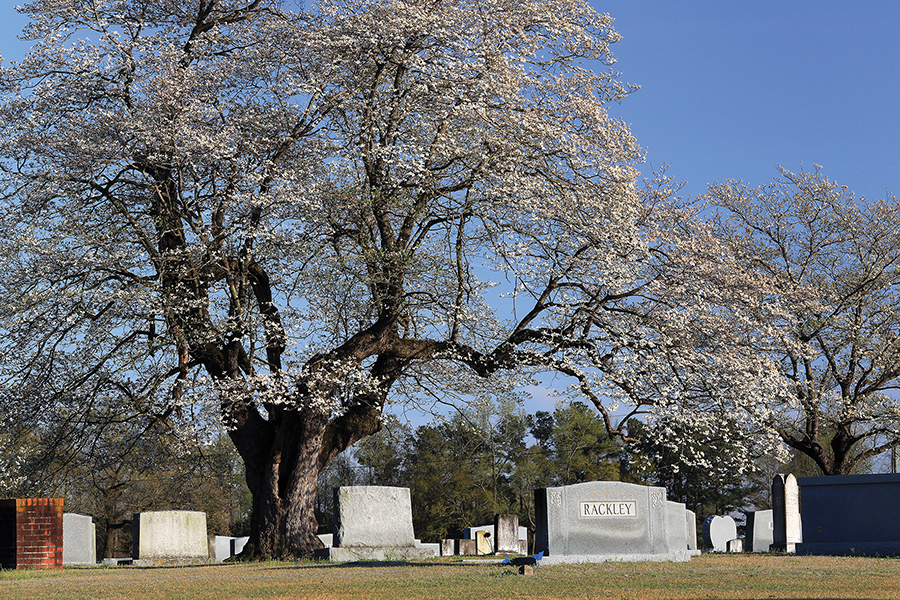
State Champion Flowering Dogwood in cemetary in Clinton, NC


In that time, the pair have nominated some truly extraordinary trees. Among them are North Carolina’s largest tree, a rotund bald cypress (with a total score of 558 points) growing along the Roanoke River in Martin County; the national champion Darlington oak tree (which stands alone in a farmer’s field near Rocky Mount); the national champion silky camellia, whose broad, fragrant flowers brighten up the springtime forest in Merchants Millpond State Park; a state champion Hercules club (an unusual looking tree covered in large thorns) in the town of Duck in the Outer Banks, and a state champ Shumard Oak growing along the nutrient rich soils of the Deep River. Over 142 feet tall, with an average crown spread of 110 feet, the oak can easily be seen on Google Earth.

I recently joined Williamson on a cool winter’s day to see and photograph the national champ tulip poplar growing in Chesapeake. Bearing similarities to European poplars and having white, tulip-shaped flowers gives the tree its common name. However, the tulip poplar is in no way related to poplars or tulips. Instead, it’s a member of the magnolia family and is the tallest hardwood tree in North America.

Taking pictures of a champion tree is inherently difficult. There is simply no way to sufficiently capture the essence of “bigness,” that wow factor, within a two-dimensional frame. No matter what lens is used or at which angle you shoot, the resulting image will inevitably diminish the size of the tree. Nevertheless, I persisted for well over an hour, posing Williamson at various positions around its trunk and even inside the tree. 

Finally, as the sun was sinking below the horizon, I stopped taking photos and simply stood at the base of the living monarch, staring up toward its immense crown. Running my hands over its furrowed bark, I thought of what the forests looked like at the time my ancestors first set foot on this continent. Here, standing before me, was a shining example of that bygone era and one of the true wonders of the natural world.  PS

Naturalist and photographer Todd Pusser grew up in Eagle Springs. He works to document the extraordinary diversity of life both near and far. His images can be found at www.ToddPusser.com.

Simple Life

Simple Life

One Journey Ends, Another Begins

Lessons from the road long ago taken, but not forgotten

By Jim Dodson

In ancient Roman religion, the god Janus was a two-faced chap revered as the deity of doorways and transitions, endings and new beginnings — hence the origin of this month’s name, signaling a moment when we wisely take time to reflect on where we’ve come from and what may lie ahead.

This year, this notion has fresh relevance to me.

Sometime this spring, assuming the good Lord is willing and the creek don’t rise, as my Southern granny liked to say, I hope to finish writing a book that means the world to me.

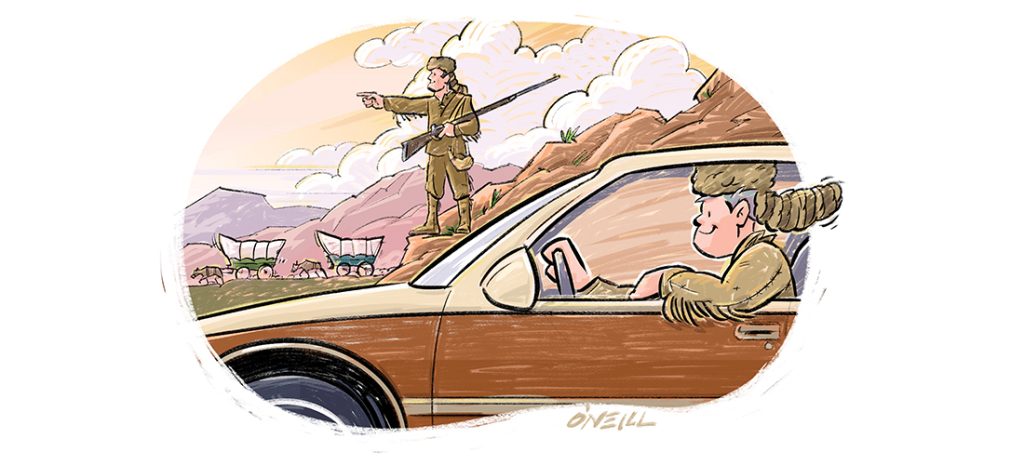
It’s about the legendary Great Wagon Road, described by historians as the most traveled road of colonial America, the country’s first immigrant “highway” that passed through the Appalachian backcountry from Philadelphia to Georgia, bringing tens of thousands of Scots-Irish, German and other European settlers to the American South, including my ancestors and quite possibly yours.

Joe Wilson, the great historian of American roots music, once estimated that “a quarter of Americans today have an ancestor who traveled the Great Wagon Road. You can still see traces of it, a track across high ridges, a trough through piney woods, guarded by wild turkey and chipmunks, a road that was in use for a century — the most important road in American history.”

Six years ago, an idea nurtured since I was knee-high to a historic roadside marker was born anew. With some encouraging research in hand, I paid a visit to a former Navy engineer named Tom Magnuson who heads up the Trading Path Association, based in Hillsborough, where my own Scottish ancestors arrived in the mid-1700s. Magnuson’s marvelous organization researches and documents America’s historic lost roads in order to preserve and expand public appreciation of them. I figured if anyone could tell me if it was feasible or pure folly to try to find the original roadway and follow it from Philly to Georgia 250 years after the fact, that fellow was Tom Magnuson.

My timing couldn’t have been better. He pointed out that recent scholarship by an army of historians, state archivists, archeologists and ordinary history nerds like me had actually determined the original path of the Great Wagon Road and even posted an exquisitely detailed description of its route through some of the most hallowed places in America.

“The Great Wagon Road,” Tom said, when I mentioned my objective, “is the grandaddy of America’s frontier highways — our creation myth, if you like — one that explains the origins of our national story better than any other. The people and ideas that came down that road shaped the character of this nation, both good and bad. That defines who we are today.”

This was all the encouragement I needed. Not long afterwards, I plotted my route and even purchased my very own “Great Wagon” for the journey — a 1996 Buick Roadmaster Grand Estate station wagon, said to be the last “true” American station wagon before Detroit switched to making SUVs.

I envisioned a pleasant three-week cruise along the winding 845-mile road in which I would encounter all sorts of interesting characters, local experts and fellow Wagon Road flamekeepers who shared my passion for this once lost frontier highway and its unique role in shaping America.

God laughs, as the ancient proverb goes, when grown men make plans.

In fact, the journey took five years and 2,100 miles to complete, in part due to the incredible amount of history, marvelous people and stories I found along the way, but also because a worldwide pandemic struck in the middle stages of my research, knocking me off the road for almost two years.

Certain moments stand out, including meeting descendants of Founding Fathers and Daniel Boone; sitting with a fabled Lincoln historian during the annual reading of the Gettysburg Address; walking Antietam with the National Park Service’s first female battlefield guide; and playing guitar with an Appalachian bluegrass legend.

All told,  I visited with — and interviewed — more than 100 extraordinary and ordinary folks from every walk of life who had their own love affair with the old road.

I cherish their diverse voices on my iPhone recorder because they belong to a wonderfully democratic mix of experts and colorful characters, activists and local historians, thoughtful museum curators, gifted poets and preachers, artists and war re-enactors, history nuts of every political persuasion and kind strangers whose names I simply forgot to write down.

In the end, listening to their stories about an old road that has gripped my imagination since I was a kid standing in front of a huge covered wagon in a museum brought me even closer to the country I love.

It taught me how amazingly far we’ve come — and have yet to go.

Somehow, I think the god Janus would approve.  PS

Jim Dodson can be reached at jwdauthor@gmail.com.

Bookshelf

Bookshelf

January Books

FICTION

Moonrise Over New Jessup, by Jamila Minnicks

It’s 1957, and after leaving the only home she has ever known, Alice Young steps off the bus into the all-Black town of New Jessup, Alabama, where residents have largely rejected integration as the means for Black social advancement. Instead, they seek to maintain, and fortify, the community they cherish on their “side of the woods.” Alice falls in love with Raymond Campbell, whose clandestine organizing activities challenge New Jessup’s longstanding status quo and could lead to the young couple’s expulsion — or worse — from the home they both hold dear. But as Raymond continues to push alternatives for enhancing New Jessup’s political power, Alice must find a way to balance her undying support for his underground work with her desire to protect New Jessup from the rising pressure of upheaval from inside, and outside, their side of town. Minnicks’ debut novel is both a celebration of Black joy and an examination of the opposing viewpoints that attended desegregation in America.

Just the Nicest Couple, by Mary Kubica

Jake Hayes is missing. This much is certain. At first his wife, Nina, thinks he is blowing off steam at a friend’s house after their heated fight the night before. But then a day goes by. Two days. Five. And Jake is still nowhere to be found. Lily Scott, Nina’s friend and co-worker, thinks she may have been the last to see Jake before he went missing. After Lily confesses everything to her husband, Christian, the two decide that nobody can find out what happened leading up to Jake’s disappearance, especially not Nina. But Nina is out there looking for her husband, and she won’t stop until the truth is discovered in this high-octane, edge-of-your-seat thriller.

The Mitford Affair, by Marie Benedict

Between the World Wars, the six Mitford sisters — each more beautiful, brilliant and eccentric than the next — dominate the English scene. Though they’ve weathered scandals before, the family falls into disarray when Diana divorces her wealthy husband to marry a fascist leader, and Unity follows her sister’s lead all the way to Munich, inciting rumors that she has become Hitler’s mistress. As the Nazis rise to power, Nancy Mitford grows suspicious of her sisters’ constant visits to Germany and the high-ranking fascist company they keep. When she overhears alarming conversations and uncovers disquieting documents, Nancy must make excruciating choices as Great Britain goes to war with Germany.

The Faraway World, by Patricia Engel

Two Colombian expats meet as strangers on the rainy streets of New York City, both burdened with traumatic pasts. In Cuba, a woman discovers her deceased brother’s bones have been stolen, and the love of her life returns from Ecuador for a one-night visit. A cash-strapped couple hustle in Miami, to life-altering ends. The Faraway World is a collection of arresting stories from the New York Times bestselling author of Infinite Country. The Washington Post calls Engel “a gifted storyteller whose writing shines even in the darkest corners.” Intimate and panoramic, these stories bring to life the vibrancy of community, and the epic deeds and quiet moments of love.

Exiles, by Jane Harper

At a busy festival site on a warm spring night, a baby lies alone in her pram, her mother vanishing into the crowd. A year on, Kim Gillespie’s absence casts a long shadow as her friends and loved ones gather deep in the heart of South Australian wine country to welcome a new addition to the family. Joining the celebrations is federal investigator Aaron Falk. But as he soaks up life in the lush valley, he begins to suspect this tight-knit group may be more fractured than it seems. Between Falk’s closest friend, a missing mother, and a woman he’s drawn to, dark questions linger as long-ago truths begin to emerge.


NONFICTION

The Creative Act: A Way of Being, by Rick Rubin

Many famed music producers are known for a particular sound. Rubin is known for something else: creating a space where artists of all different genres and traditions can hone in on who they really are and what they really offer. He has made a practice of helping people transcend their self-imposed expectations in order to reconnect with a state of innocence from which the surprising becomes inevitable. Over the years, as he has thought deeply about where creativity comes from and where it doesn’t, he has learned that being an artist isn’t about your specific output, it’s about your relationship to the world. Creativity has a place in everyone’s life, and everyone can make that place larger. The Creative Act is a beautiful and generous course of study that illuminates the path of the artist as a road we all can follow.


CHILDREN’S BOOKS

Ice! Poems about Polar Life, by Douglas Florian

Brrrrfect poetry for the winter months. Ice! will warm the hearts of young readers with funny frozen antics of penguins, caribou, narwhals and other cold climate critters. (Ages 3-7.)

The Year of the Cat, by Richard Ho

Rat, pig, dog, sheep, monkey, rooster, horse, snake, dragon, tiger, rabbit and ox — all are stars of the zodiac. But whatever happened to Cat? Find out the rest of the story in this fun tale that’s the perfect way to honor the Chinese New Year. (Ages 5-7.)

Groundhog Gets it Wrong, by Jessica Townes

Predicting the weather is a big job, so when Groundhog takes over as the spring seer, and things don’t go exactly as planned, he has to get creative to make meteorological magic happen. Not your normal Groundhog Day title, this humorous take on the celebration also includes a few historical facts to make the day even more fun. (Ages 3-6.)

Moon Rising: A Graphic Novel, by Tui Sutherland

The Wings of Fire series is the hottest property on the market for voracious readers in grades 3-6 and with a scheduled print run of 500,000 this sixth graphic novel adaptation is sure to be the book in every backpack when it lands on Dec 27. (Ages 8-12.)  PS

Compiled by Kimberly Daniels Taws and Angie Tally.

Creators of N.C.

Creators of N.C.

The Buddy System

Old friends lend a Haand

By Wiley Cash

Photographs By Mallory Cash
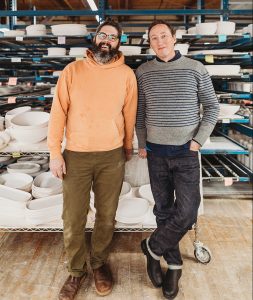
   

If my best friends from high school and I were able to live our youthful artistic dreams we’d still be playing in a garage band called The Subterraneans. Luckily, ceramicists Mark Warren and Chris Pence, who met in high school in the late 90s in northern Florida, had a business plan. In 2012 they founded a ceramics and glassware company called Haand, which is named after the archaic Norwegian word for “hand,” and where everything is made by, you guessed it, hand. Since founding their company, Mark and Chris have partnered with restaurants around the world, including Beard Award winners and local culinary royalty like Ashley Christensen and Vivian Howard, with whom they’ve launched a special collection.

There’s an old saying that goes, “If you show me your friends I can show you your future.” If only we all had friends like Mark and Chris during high school. The best businesses, like the best friendships, grow organically from shared interest and vision, and while Mark’s and Chris’ professional paths briefly diverged after college — Mark pursued the arts while Chris worked as an accountant — they came back together over a decade later in rural North Carolina as roommates and business partners in a crumbling old mansion. (How crumbling? Let’s just say that the same bucket that caught water from the kitchen drain was used to flush the toilet.) In this auspicious setting, Haand was born.

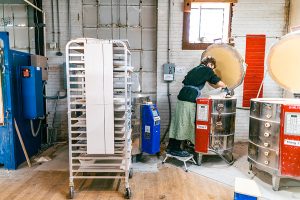
On a warm fall morning in late November, I parked in the grassy lot outside the Haand showroom and production studio in Burlington. The 13,000-square-foot brick building was once a hosiery mill, and it still retains its industrial feel, despite the gorgeous colors and earthy appearance of the countless handmade ceramic pieces that greet you as soon as you step inside.
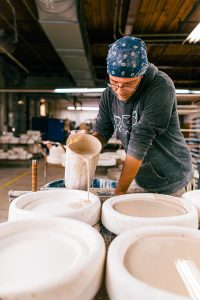
   

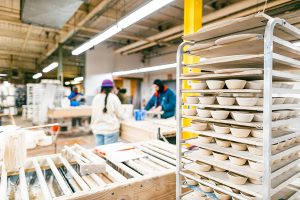
I found Mark, Haand’s creative director and co-founder, as he passed through the showroom on his way out the door. He stopped and greeted me warmly with a broad smile that was nearly hidden by a thick beard. Mark very much looks the part of a potter, and he very much looks the part of someone who might enjoy living in a house where a single bucket serves as both a kitchen and a bathroom appliance. I hadn’t let anyone at Haand know I was coming, and I felt bad about dropping in during the middle of the day, but Mark didn’t seem to mind. He casually showed me around the production studio where a couple of dozen people were at work at various stations, each one marking an integral step in the process of achieving the distinct look and feel that Haand is known for.

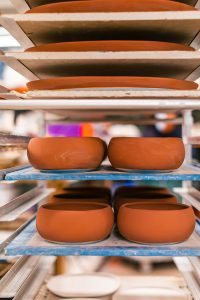
As we walk through the space, Mark explains the process, beginning after he completes each design, whether it be for a vase, a coffee cup or a serving dish. A mold is built from each design, and into the mold is poured liquid porcelain slip. Once the piece dries inside the mold, it is removed, cleaned, smoothed with a sponge, and hand-inspected before being stamped with Haand’s logo and the phrase “Made in NC, USA.” The piece is then bisque fired and heated to 1,800 degrees, and this is where each piece gets interesting and distinct.

“Our clay body itself is what’s called vitreous,” Mark says, “so it melts at a really high temperature, and then it will become kind of liquid during a period of the firing. The clay kind of remembers things that have happened to it. So if you bump it with your thumb or kind of move it, it might look strange going in, and then it comes out and it has melted and softened and completely shifted its form. You can’t really fight that unless you’re doing what they do in industrial kilns, which is not what we do here. There’s a deeper truthfulness that can come out of not trying to fight the process and just letting it be what it is. It’s a beautiful thing.”
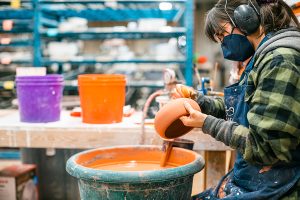
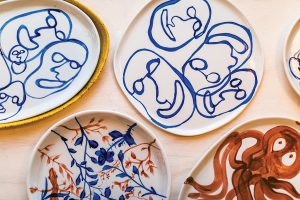
There is no doubt that each piece made by the folks at Haand is beautiful not only in its design, but also in its color. After the pieces are fired they are glazed with a liquid coating of minerals that bonds to the clay, and brings a glassy and distinct color finish and texture to each piece, whether it be fern green or matte grey or one of the stunning Cloudware finishes that looks just like its namesake.

After the glazing, each piece goes into the gas kiln, where it’s fired at 2,300 degrees so that the clay and the glaze thoroughly bond. Afterward, each piece is polished and inspected before either being shipped out or stocked in the showroom.

All told, countless hands touch the pieces during the process, and every step reflects the hand of the maker who’s worked on it, which ensures that each piece, even if it’s part of a set, bears its own distinctions. Roughly 90 percent of Haand’s employees were novices before walking in the door, but each of them receives extensive training in the production process in order to maintain Mark’s vision for every individual piece.

“It’s exciting,” Mark says, still seeming struck by the beauty of the process of designing, forming and firing even after all these years. “It’s right on the edge of chaos.”

But to the layperson’s eye, nothing about the scene at the production studio seems chaotic. People of all ethnicities, ages and backgrounds work quietly, whether they’re sponging or firing, many of them with earbuds popped in so they can listen to music, audiobooks or podcasts. Their work is accompanied by glances, smiles, nods of the head. The whole scene feels peaceful, thoughtful and grounded.

But it didn’t always feel that way to Chris, company president and co-founder, who I found after he stepped out of the office and gave me a tour around the showroom, where I immediately picked out two 10-ounce tapered mugs to take home. Chris had worked with clay since high school before forging a career as a corporate tax accountant in Jacksonville, Florida, where he often worked 80-hour weeks. It was on a trip to visit Mark in the dilapidated farmhouse that Chris truly considered reconnecting with his early passion for pottery. Mark pitched the idea of the two of them starting a business together; it ended up being an easy decision for Chris.

But those early days, rooming at the farmhouse with Mark while working in an outdoor studio took their toll on Chris, who quickly realized the differences between plowing through a 16-hour day behind a desk and the physicality of clearing brush to create more outdoor space, moving boxes of finished pieces, making phone calls and filling purchase orders.

“Moving into that house in the woods was a totally transformative experience for me,” Chris says. “I imagine that people were having thoughts like, ‘Has Chris lost it a little bit? Is he going a little crazy? He left a job he worked so hard for.’ I really looked up to Mark and relied on him to kind of show me what this new life was like.

“But I definitely remember being in the studio by myself one day and the lights were off, and it was dark. I had a real big moment of existential dread, and I thought, have I made a terrible mistake?”

For Chris, after both the success of the company and his continued friendship with Mark, those moments of uncertainty are fewer and farther between. “I’m so passionate about what we’re making,” he says.

While Mark and Chris’ primitive way of living has changed since their days on the farm, the way they make their pottery has not.

“We haven’t changed the production method at all,” Chris says. “We’ve certainly refined it and gotten better at doing things, but if you were to have been there with us at the farmhouse and walked through how we made a pot, and then you were to walk through the way we do it now, you would see there are no fundamental changes. We can make things more efficiently, but it’s still a handmade mold, we pour the clay in, we pour the clay out, we finish it, we fire it, we glaze it, fire it again, and it’s done. The process is the same.”
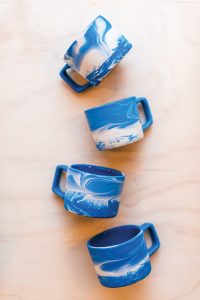

   

Their friendship is the same too.

“Mark has just always been an incredibly fun person to be friends with,” Chris says. “I think it’s a blessing for both of us to have been such good friends before the business because having a business is hard, and it can really, really be difficult on every level, whether it’s financially, physically, emotionally or spiritually. Mark has always had my back, always been there for me, and always supported me.”

It’s clear that Mark has felt the same about Chris for years. “When you meet someone like Chris, you just kind of know them in totality. Chris is one of those people that if you know him it would be inconceivable not to want to be friends with him afterward.”

“And Mark was hilarious in high school,” Chris says, laughing. “I remember him showing up to a prom party at my house. He was a sophomore, so he wasn’t even invited to the prom.”

“Please tell me he showed up in a tuxedo,” I said.

“I think it was one of those T-shirts that has a tuxedo printed on it,” Chris says.

“It was,” Mark adds, the sudden recollection causing them both to break into laughter. “And I brought a beer bong that I’d bought on a German Club trip to Daytona Beach. It had never been used before, and I was like, ‘Let’s see how this works.’”

“That’ll be the next thing that Haand manufactures,” I say. “Ceramic beer bongs.”

“There’s a lot of demand for that,” Chris adds, and we all laugh again.

When you visit Haand or order any of their pieces online to be delivered to you, you will immediately recognize the care and attention that Mark and Chris have put into their craft. And when you spend any amount of time around Haand’s co-founders, you will say the same for their friendship.

Come for the kiln-fired pottery. Stay for the warmth.  PS

Wiley Cash is the Alumni Author-in-Residence at the University of North Carolina at Asheville. His new novel, When Ghosts Come Home, is available wherever books are sold.

Southwords

Southwords

The Missing Consonant

An extra letter can speak volumes

By Amberly Glitz Weber

Growing up in a military family, frequent moves ensured I never felt quite comfortable with the question “Where are you from?” But I could always tell you where my mother’s people lived. Every other winter, we traveled from wherever we were living up North to find my grandparents’ North Carolina ranch bursting into bloom, a front porch heavy with camellias as the longleaf pines stretched up into the blue.

The adventure started as soon as we touched down at the airport in Greensboro. Bringing with us an eau de oddity, my twin sister and I were both delighted and impressed that the shuttle bus played country music on the speakers, as we peeled off sweaters and coats in what, to us, was balmy summer weather.

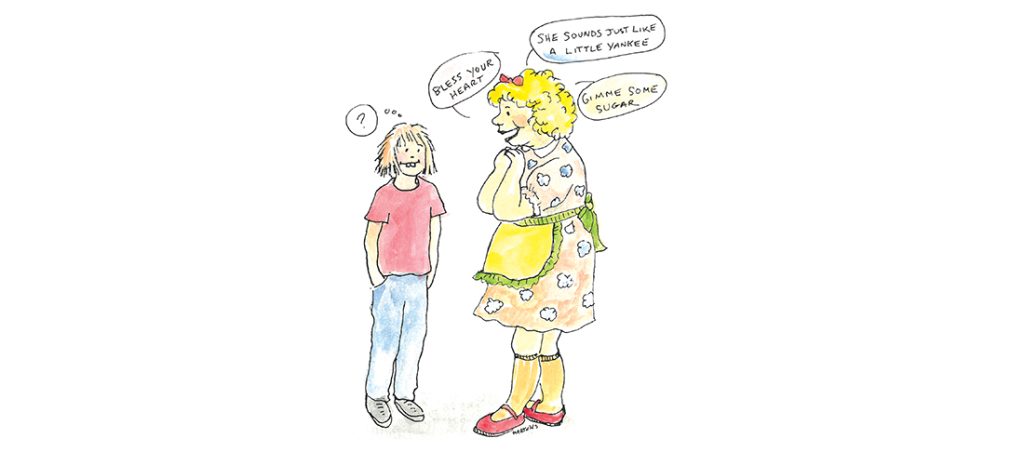
I always felt a little foreign in this vacation land. “Bless their hearts,” my aunt once said, “they sound just like little Yankees.” I remember conspiring with my sister to fake an accent in the Goody’s checkout line, just to see if we could pass. We were sure our mangled, mostly Chicagoan syllables made us stick out, blatant as — in those days — Wingate’s solo stoplight. I pity any cashier who had to endure the performance.

Our speech marked us even more than our shorts in January, so different from the magic and strange mystery of the voices we heard in Rockingham and Hamlet. Not voices with the refined husk of Tara, but a warm, earthy accent that found space for an extra “R” in water — right after the “A” — turning the syllables round and deep in my grandfather’s mouth.

Today, I’m a proud Aberdeen homeowner, and my first daughter’s birth at UNC-Chapel Hill earns her Tarheel status. Already my husband and I detect a hint of the South in her speech. Sometimes it’s so strong we think she must be putting us on — or is she? I doubt it will ever reach the height of my granddad’s drawl, his gravelly voice ever saying in my memory, “Come here an’ gimme some sugar.” It was a voice grown in Carolina, on a farm of many children and countless passing farm hands working the land.

We won’t be moving again, not for a long while. How strange to think that as they grow, my babies’ answer to the question that plagued my childhood will be “from here.” Now, on my daily commute or a mundane dash for groceries, pine trees piercing the Carolina blue sky give me a sense of holiday adventure, no matter the calendar. Here, the camellias burst into bloom in weeks where other ZIP codes are buried in snow. And, though I love this busy life and my once-little town — I find myself missing that extra “R” in water.  PS

Aberdeen resident Amberly Glitz Weber is an Army veteran and freelance writer. She’s grateful for every minute among the murmuring pines of North Carolina.

Out of the Blue

Creators of N.C.

Kittyspeak 101

When a look says it all

By Deborah Salomon

Welcome, once again, to the annual January kitty column — the ninth, I believe.

I am a lifelong animal lover/advocate. All are welcome except foxes and coyotes. Once I kept a caged snake in the garage for my son’s friend while he was at summer camp. I cannot count how many forlorn, destitute kitties have come to my door, instinctively knowing they would be fed, adopted, cared for, loved.

The all-black ones with kind, intelligent eyes are my weakness.

Like Lucky, who showed up in 2011. He had been neutered, declawed and abandoned when his family moved. After feeding him outside for weeks I opened the door. He strolled into my house, my heart. A year later a pudgy half-tabby with a clipped ear signaling a spayed feral began hanging around for handouts. She rewarded me with hisses. I couldn’t ignore her limp so I opened the door. Lucky — who doesn’t have an aggressive bone in his panther-esque body — just stared, stoically. The half-tabby hissed at us both for about a week, then turned on the charm. Now Hissy Missy anchors my lap as I write, leans against my leg when I sleep, and treats Lucky like Meghan Markle does Prince Harry.

In public, at least.

Though intelligence-wise, she’s a dozen Rorschach ink blots beneath him — I should have named him Mensa — they each communicate, ask, answer, demand, complain in subtle, non-verbal, kittyspeak.

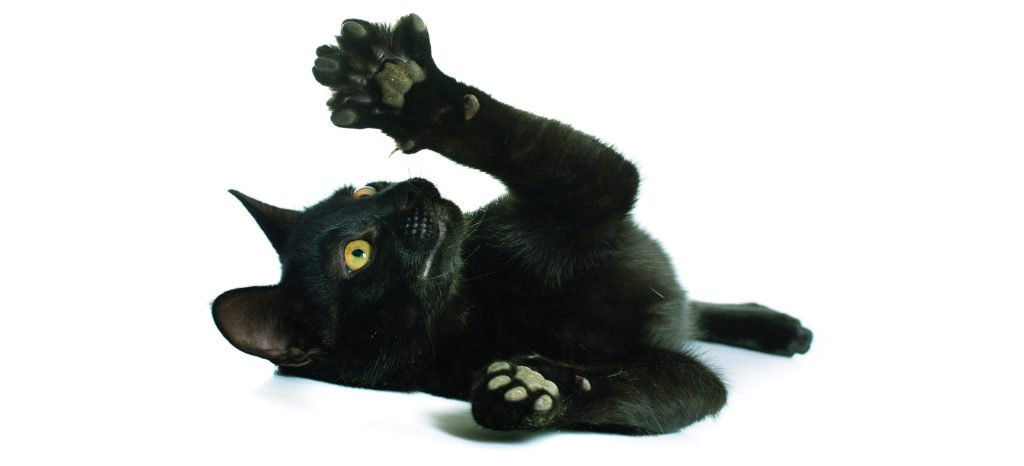
I remember seeing an interview of Academy Award actress Kate Winslet, who spoke of a director who criticized how she delivered a line. “Don’t worry, I can say it with my eyes,” Winslet snapped. My Lucky’s huge yellow eyes speak reams, convey a range of emotions: contentment, questioning, fear, acquiescence, warning and, rarely, displeasure. He lacks a loud purr, but stretched out across my lap, his dreamy eyes convey love. If I’m gone for too long I sense reprimand. As feeding time approaches his stare becomes an urgent frown. When the doorbell rings, his eyes warn.

But sometimes eye-talk isn’t enough.

A paw reinforces his query. I feel black velvet stroke my foot as I work on the computer. Pause. Repeat. If no response, a slight mew. I rise, he turns and leads me to his bowl, the back or front doors. Impossible to ignore the polite but insistent paw at 3 a.m. Lucky knows I keep treats in the bedside table.

So does Missy, but she wouldn’t dare.

Lucky also displays a heightened awareness of his surroundings. I broke my wrist recently. When I appeared wearing a cast Lucky was all over it, licking. Did he feel my pain? Was he expressing sympathy or just curiosity?

Missy is more self-absorbed. In fine weather (her definition of temp/humidity) she likes to sit on the back porch table and watch the birds and squirrels nibble peanut butter sandwiches. While Lucky dozes on a chair she remains alert for danger. Like blue jays.

Missy’s maddening method of getting my attention is circling my feet, often resulting in a stepped-on tail. She never learns.

The best is watching them communicate with each other via long, penetrating stares. At least once a day she washes his face. Play may be beneath Lucky’s solemn countenance, but she occasionally shadowboxes — tabby vs. the sphinx. Other than that, Missy defers to him in all matters.

A glass ceiling-smashing bra-burner this gal is not.

I need an animal relationship. Through the years this has been fulfilled by dogs, cats and my children’s pets who knew my home as their own. As for folks who brand kitties cold, aloof and mean, let me remind you that an animal companion often reflects its master’s personality/behavior.

True, I’m neither dignified nor stoic like Lucky. Not a Missy flibbertigibbet either. But at least, day in, day out, through thick and thin, rain or shine, we speak the same language.  PS

Deborah Salomon is a contributing writer for PineStraw and The Pilot. She may be reached at debsalomon@nc.rr.com.

Golftown Journal

Golftown Journal

Strange Magic

Doubling your Sandhills pleasure

By Lee Pace

Photograph: Curtis (left) & Allan (right)

Whether it was Curtis in the 1970s winning the North & South Amateur or Allan today tootling around the village of Pinehurst, for nearly half a century the Sandhills have been close to the hearts of the Strange brothers.

“Pinehurst was just a place you fell in love with,” says Curtis Strange, the two-time U.S. Open champion. “Some of my proudest moments were some of the scores I shot on Pinehurst No. 2 back in college.”

“It’s just a great place to get away to,” adds identical twin Allan, a financial adviser living in Richmond, Virginia. “At first I knew Pinehurst just for the golf. But the more I got to know the village and the people, the stronger the draw became.”

Curtis and Allan were born in 1955 in Virginia Beach and were introduced to golf at 7 years of age by their father, Tom, a club professional and owner of White Sands Country Club. Tom also found time to play in six U.S. Opens, his best finish a tie for 48th in 1967 at Baltusrol.

“In our house, the U.S. Open always meant a great deal,” Curtis says. “Arnold Palmer told me a long time ago the Open is the hardest test in golf, and it should be, because it’s our national championship.”

Curtis joined coach Jesse Haddock’s juggernaut program at Wake Forest University, and Allan played at East Tennessee State. Curtis was a three-time All-American from 1973-75, won the 1974 NCAA individual title, and teamed with Jay Haas to lead the Deacons to team titles in 1974 and ’75.

With legendary caddie Fletcher Gaines at his side, Strange won the 1975 North & South Amateur by shaving defending champion George Burns, then followed with the 1976 crown by handily ousting Fred Ridley, now the chairman of Augusta National Golf Club.

“Fletcher and I had a lot of fun,” Strange says. “He was a great help. I really got to know No. 2 with Fletcher. Playing those greens requires a lot of local knowledge. Back then, I was just kind of booming it. I didn’t have much management or strategy on the golf course. I would hit it long and go chase it. Fletcher tried to condense that strength and manage me around. He did a great job. He read all my putts.

“I shot some really good scores and hit a lot of good shots there. When you go to a place like Pinehurst and do well, it means so much more than winning on a golf course no one’s ever heard of. My name will be on that plaque in the clubhouse for a long time.”

Strange exploded on the PGA Tour in the mid-to-late 1980s, winning back-to-back U.S. Opens in 1988-89 and eight events total from 1987-89, and his $1.1 million prize winnings in 1988 marked the first time a pro golfer had topped the $1 million mark for a single season. He played on five Ryder Cup teams and captained the 2002 United States team. In the twilight of his career, he has worked as a TV commentator and now spends considerable time fishing from his homes in Morehead City, North Carolina, and Naples, Florida, and pursuing various philanthropic endeavors. 

He’s made periodic trips to Pinehurst over the years, and in August 2022 he got a look at the construction site for the USGA’s new Golf House Pinehurst between the club and Carolina Hotel. On the second floor of that facility, the USGA is designating space for the World Golf Hall of Fame — Curtis was inducted in 2007 — which will move from St. Augustine, Florida.

“I’m so happy and thrilled with what the USGA is doing, building kind of a home away from home in Pinehurst,” Curtis says. “Add to that, the Hall of Fame is coming back to where it started. Everyone has their golf mecca. Ours is Pinehurst. The USGA . . . the Hall of Fame . . . Pinehurst No. 2 . . . it seems like a perfect fit.”

Allan, meanwhile, has taken a more circuitous route to find his own golf nirvana in the Sandhills.

He, too, played in the North & South in the 1970s, in the Pinehurst Intercollegiate with East Tennessee State, and then in the Hall of Fame Classic on the PGA Tour in the early 1980s. Then he entered private business in wealth management and eventually got his amateur status back. Throughout his working career in Richmond, he’d visit Pinehurst every half-dozen years or so.

“My wife and I had a place at Smith Mountain Lake, and after 10 or 12 years, that was kind of getting old,” he says. “We started looking at places within easy driving distance. I said, ‘Let’s go visit Pinehurst.’ She just loved the small town look and feel of the village. So did I. We came a second time. And third. The pull was pretty strong.”

Allan was also a friend of Ziggy Zalzneck, a longtime member at the Country Club of North Carolina and former club president. Over frequent visits to the Zalzneck residence at CCNC, he seriously considered joining the club. It came together about a decade ago with the Stranges buying the Liscombe Lodge on Linden Road, the winter home years ago for Gen. George Marshall, the U.S. Army’s chief of staff during World War II and later the secretary of defense and secretary of state.

“So it just kind of evolved — a home in the village and a membership at CCNC,” Allan says. “I have loved being here. The glue, of course, is the golf, but if I got old enough where I couldn’t play anymore, I’d still enjoy the village.”

Allan is a regular at CCNC and various restaurants around town, and often draws a double take, just as he did around airports in the 1980s and early ’90s when Curtis was at the height of his popularity. The twins have long shared similar body compositions, salt-and-pepper hair and facial features.

“More than a few times I’ve been asked, ‘That’s Curtis Strange, isn’t it?’” longtime CCNC Director of Golf Jeff Dotson says of Allan’s visits to the club.

“I’ve signed plenty of autographs when it’s a kid who might be disappointed if I told him I wasn’t actually the U.S. Open champion,” Allan says. “It was probably more than you could imagine. But I was fine with it. It meant Curtis was playing well and winning.”

The Strange brothers talk by phone almost daily and participated in the Patriot Foundation Pro-Am at CCNC in August 2022. They played golf with veterans and service personnel, drank a few beers and raised money for scholarships for children of parents who had lost their lives in service. Allan came away impressed with his brother’s demeanor and station in life.

“We spent two days together and I saw firsthand that Curtis was more relaxed than he’s ever been,” Allan says. “He’s enjoying life as much as he ever did, but in a totally different way. The enjoyment he had in the ’80s was pressure packed, it was climbing the mountain. Now it’s totally different, now he’s coming down the other side. I didn’t really know what this side would be like for him. He enjoys his family; he enjoys getting on the water every day that he can. He’s philanthropic in a private, quiet way. And he still pays very close attention to what is going on in golf.

“I wasn’t sure if he could enjoy this as much as he does. It makes me feel good.”

The Strange brothers will turn 68 in late January 2023. Look for them in body and spirit around the village — Curtis in name among the champions displayed in Heritage Hall at Pinehurst and perhaps even in person visiting his brother.

“I’ve seen Curtis more now because I’ve had a place in Pinehurst for eight or nine years, which is a nice unintended consequence,” Allan says. “It’s interesting how it all fell into place, starting with Curtis’ love of Pinehurst and success here. “I don’t think I’ll ever not have a second home in Pinehurst.”  PS

Lee Pace is a Chapel Hill-based golf writer and a long-time contributor to PineStraw magazine. His latest book is Good Walks—Rediscovering the Soul of Golf at 18 Top Carolinas Courses, published by UNC Press.