Sporting Life

A Hunt to Remember

One of life’s seasons

“To everything there is a season and a time to every purpose under the heaven.” — Ecclesiastes 3, King James Version

By Tom Bryant

The first time I ran across this quote from the Bible, I thought some guy had stolen the words from my mother. It was one of her favorites.

A good example: When I was able to squeak by, grade-wise, and graduate from high school and was complaining one night at the supper table about not being able to play baseball or football for good old AHS, Mom said, “Son, there is a season for all things, and that season at Aberdeen High School has ended. But a completely new season is beginning for you at Brevard College. Remember what the dean said? If you make the grades and survive probation, maybe you can play baseball for them.”

The favorite quote from Mom came back to me the other evening as I was up in the Roost, a small apartment over our garage. I usually hang out there when I need to write a column or work on my novel. On this particular evening, I was sorting through some dove hunting equipment. I mean, after all, the season is upon us, and that’s the kind of season I like. Dove hunting season is never over or at least will never be over in my lifetime. What’s beyond that is anyone’s guess.

I ran across a small box in the corner of the closet where I store most of my hunting clothes. It was full of a bunch of Ducks Unlimited paraphernalia. At one time I was into that conservation club in a big way because, in the early days, if you were a duck hunter and worth your salt, you were a member of DU. For years I was a sponsor, not particularly because I was such a conservationist, although in reality I am, but primarily because of all the perks that went with the title.

In the beginning years of DU, the cost to be a sponsor in the Alamance County Chapter was two or three hundred dollars, not a trivial amount in those days. My partner and I had just started a small weekly newspaper and were working hard to make ends meet, but we had enough money to sponsor what we considered a noble cause. Also, we figured we would find some good stories by being part of the local chapter. And we surely did.

There was a huge competition between chapters across the state to raise the most money supporting habitat for waterfowl. Jim, my business partner, and I got caught in the middle. But we weren’t alone. Numerous hunters in our area spent countless hours, and some of the members spent big bucks, to make the Alamance Chapter fly.

They were a varied group. Richard Cockman, a furniture company representative, headed the local chapter DU board, along with Dick Coleman, a haberdasher and specialty clothing store owner. Other board members included Ronald and Jim Copland, owners and executive officers of Copland fabrics; Don and Steve Scott, owners and officers of their long-standing family textile company; and Nat Harris, an insurance executive with clients from all over the country. Nat still serves on the board of the North Carolina Wildlife Resources Commission. Also on the board was Bennett Sapp, a clothing broker with one of the first outlets in the Burlington area; and last but not least, Ernie Koury, whose family was into a little of everything, from textiles to real estate holdings. The Ducks Unlimited leaders during those early days carried financial weight as well as a ton of business influence.

The banquets put together for the area sponsors were top of the line. Held at the Alamance Country Club, the event would begin with a cocktail hour. Koury, whose family members were big supporters of UNC-Chapel Hill, would recruit cheerleaders from the university to sell raffle tickets during the libation hour. And they sold a bunch. Items raffled during the banquet were acquired throughout the year from local merchants and were first class. Auction items were even better. Prizes included an oceanfront cottage for a week at Hilton Head Island, South Carolina; a goose hunt in Easton, Maryland; the DU gun of the year; and numerous quality art objects from paintings to sculptures to decoys. The top prize, though, was a puppy, either a bird dog or a Labrador retriever with champion lineage. These pups brought a lot of attention and dollars to the event.

Auction items generated “big bucks for the ducks,” but Jim and I usually stood back and watched. We did buy several raffle tickets and won items too numerous for me to remember.

Sponsors looked forward to the Ducks Unlimited banquet every year, but the greatest perk for me was the opening day dove hunt. I went on several DU dove hunts in those early years, but there is one that was an almost perfect weekend of sport shooting and camaraderie. All hunters have a particular hunt or experience that deserves a gold star in the hunting journal, and this weekend was one of those.

This was before the Weather Channel made a living by reporting one disaster after another and blaming it all on global warming. Growing up in the South, we expected hot weather at the beginning of dove season and looked forward to more of the same on this specific hunt. The Friday before opening day dawned with a hint of coolness in the air. I was up early that morning letting my puppy, Paddle, out of her kennel. The air was still and dry, with low humidity and only a smidgen of a breeze from the northwest. Dogwood leaves in the backyard, already turning a burnt orange color, also added to the false image of an early fall.

Paddle romped around the backyard, did her business and came charging back to me as if to say, “Come on, boss. Let’s go do something, like hunt birds.”

She was a small, young, yellow Lab and had added so much to my hunting experiences that every time I looked at her, I couldn’t help but smile. “No, girl,” I said to her, “we’ve got some doings to take care of before we can head to the fields.”

The doings I referred to was a cocktail party and pig picking that evening at the pool area of the country club. The pig picking had become a tradition for the DU folks the evening before the opening day shoot. It was put on by none other than the famous and popular Junior Teague, a farmer and county commissioner from the southern end of the county.

The next morning, though, all that was just a pleasant memory as I loaded up the old Bronco with guns, my 10-year-old son, Tommy, Paddle, and a cooler filled with plenty of water. We were ready to roll.

Our weather luck was still holding, low humidity with the same soft breeze from the northwest. The jumping off point was a local bank at the shopping center. We would meet the group there, then caravan to the cut cornfield where we would spend the afternoon dove hunting.

In those days, we were hunting the fields of then-Gov. Bob Scott, and what a hunt it was. Suffice it to say, the gold star in the hunting journal had another added to it. As I read the entry I made so many years ago, I recalled Mother and her seasons reflection. I added a thought of my own as a postscript to the note in the journal:

“Mom was right when she emphasized the quote from the Bible, ‘There is a season for all things.’ It’s been my fantastic luck during my lifetime that when one season ended for me, another began.” PS

Tom Bryant, a Southern Pines resident, is a lifelong outdoorsman and PineStraw’s Sporting Life columnist.

Botanicus

Goldenrod

Behold the flaming yellow glory of this native flowering plant

A native plant I love to see this time of year is Solidago, from the Latin solidare — “to make whole” — which suggests the medicinal powers sometimes attributed to the genus.

Commonly called “goldenrod,” it’s a perennial that bursts into magnificent yellow fireworks across the mountains, piedmont, sandhills and coastal plains of our Old North State. At least a dozen varieties are found regionally in the wild, according to the North Carolina Native Plant Society.

I’m not alone in my admiration for a goldenrod. My neighbor, Steve Windham, native plant specialist, tells me why he enjoys hiking the Appalachian Trail as summer turns toward fall.

“If you’ve ever walked out into a mountain meadow under a blue autumn sky with goldenrod in bloom,” Windham says, “you’ll know how truly spectacular it is.”

I remember just such a sight on the farm where I grew up, a fallow field resplendent with goldenrod, joe-pye weed, milkweed and ironweed. On that brilliant palette danced flights of butterflies — monarch, red admiral and tiger swallowtail — plus a host of skippers, cobalts and other beetles, bumblebees and metallic green flies. It was a sight wonderful to behold.

So why not replicate it in your home landscape?

Enterprising growers and nurseries have expanded the number of goldenrod varieties available for your yard or garden to more than 200.

“I use goldenrod in my garden and in my landscape designs because it’s so tough, so easy to grow and attracts so many pollinators,” Windham says. He tells me that, in his own backyard, he has a perennial border featuring a goldenrod cultivar called “Skyrocket,” which stands about three feet tall. Lower-growing dwarf cultivars can also be planted.

Windham, who helped install the ornamental grasses and pollinator meadow at the Greensboro Arboretum, recommends adding to your goldenrod native grasses such as little bluestem (Schizachyrium scoparium) or big bluestem (Andropogon gerardii), Joe-pye weed (Eupatorium fistulosum), ironweed (Vernonia glauca), phlox (Phlox carolina), asters (Aster paten) and bluestar (Amsonia tabernaemontana). Even after the flowers’ colors have faded, you’ll have a garden or border featuring interesting foliage that lasts into the winter months.

Those of you who suffer from fall allergies may think that Steve and I have lost our minds when we recommend goldenrod for your home garden.

Well, the goldenrod is not likely responsible for your runny nose and itchy eyeballs.

The culprit is another N.C. native perennial in the genus Ambrosia, from the Latin “food of the gods.”

Maybe the botanist responsible for giving this plant a name had a wicked sense of humor, but poor Ambrosia artemisiifolia is commonly called “ragweed.” It also bursts into bloom across the mountains, piedmont, sandhills and coastal plain of our Old North State in about the same habitats and at the same time of year as goldenrod.

Ragweed produces green, unremarkable blooms that release vast numbers of small, lightweight granules of airborne pollen that can be spread for miles by the wind. By contrast, goldenrod draws pollinators to its brilliant yellow flowers with nectar, relying on the pollinators to spread the relatively heavy pollen granules that glom onto their bodies and legs.

So plant beautiful Solidago. And forgive pesky Ambrosia.

If you were a plant and somebody called you “ragweed,” you’d probably have a vengeful attitude, too.  OH

Ross Howell Jr. is a freelance writer in Greensboro.

Home by Design

The Knife at Rest

It’s the little things — and sometimes the finer things

By Cynthia Adams

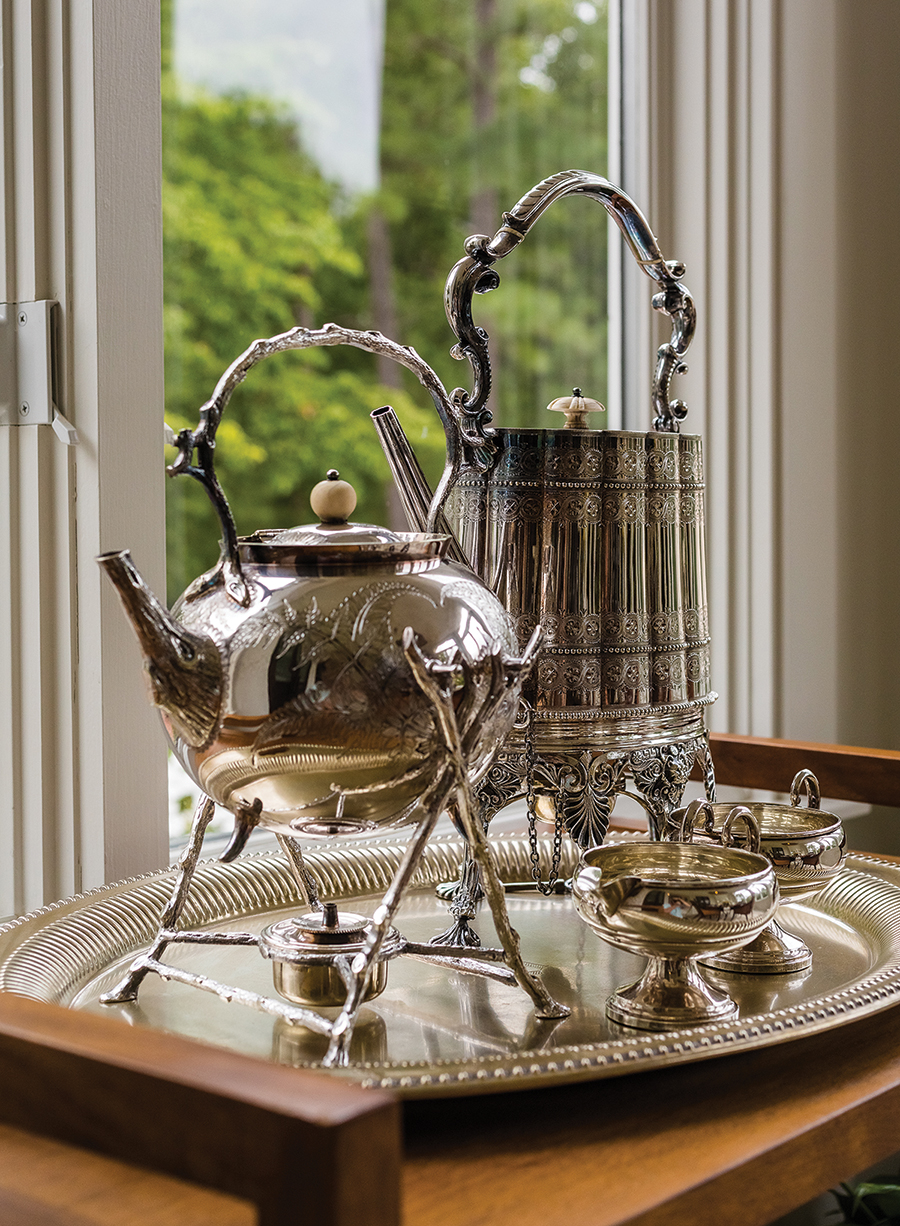
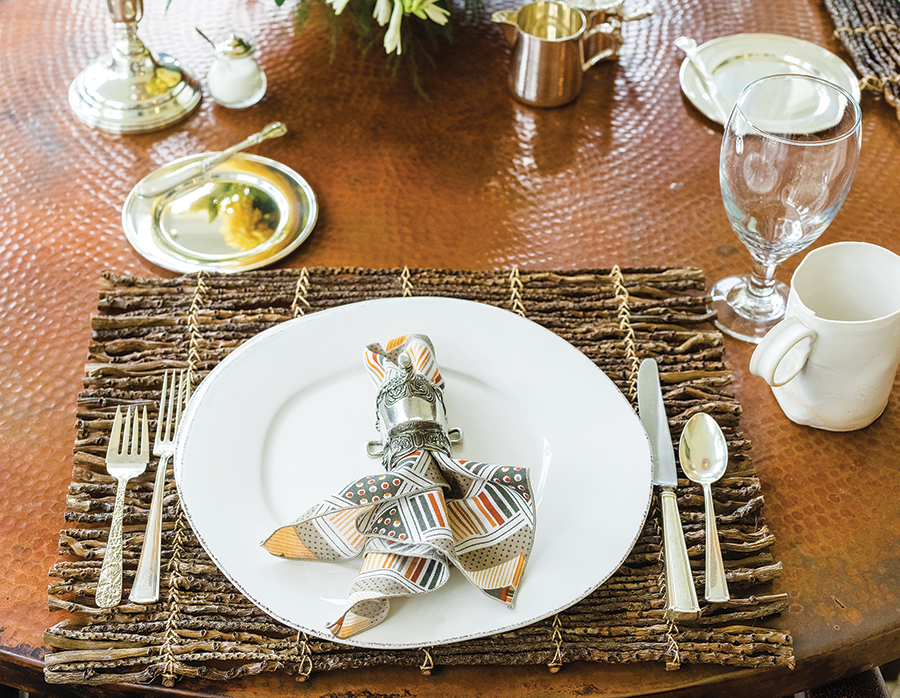
We were lunching in rare style. Good food, good company, a splendid table before us — and everyone was in excellent spirits. The table? It looked like a page torn from Architectural Digest: heirloom china, delicate crystal and antique French silverware on creamy linens. 

An artist and her close friend paused mid-sentence, suddenly noticing a set of what turned out to be silver knife rests.

The artist’s mouth opened, then closed.

What are those? She pointed to the elegant silver rectangles positioned above the antique table knife. 

Our host, an enthusiastic collector, explained: they were, quite simply, a resting place for a used knife, which kept linens safe from the greasy slurry on the plate.

The artist began to speculate about tired knives requiring rest. 

“Too weary to cut it!” 

“Lying down on the job!” 

“Stop me before I cut in again.”

She held a handsome knife up for inspection. “After they rest, then what?”

“They obviously move in for the kill,” she quipped.

We laughed ourselves silly, enjoying the word play.

The fun added to a good meal at a great table. As the conversation evolved, someone mentioned how we, after all, eat with our eyes. True, yet times have changed. 

There’s always fashion and history at work in our kitchens and dining rooms, as good ideas come and go from favor. A knife rest is straight out of an Edith Wharton setting: a classic remnant of fine dining.

What other objects are from tables past, things once used and now idling in the drawer? 

Those who love Wharton will reel from the pronouncements of Bob Vila, a former Sears’ pitchman who rose to fame with This Old House.

Despite This Old House, Vila has very modern opinions.

Here’s a short list on his outmoded and, therefore, verboten picks: fancy forks — including oyster forks, fish forks, salad forks, pickle forks and dessert forks. All out.

Other things deemed pointless by Vila: butter picks. (The butter pick is used for choosing/skewering single pats of butter.)

Napkin rings are also a thing of the past, Vila insists. I am glad my mother did not live to read this. If she were not dead already, this news would doubtless kill her.

Dedicated stemware is also outmoded, he claims. He says that it is completely modern to use a stemless glass for all wines. In fact, one multipurpose glass twill suffice. Even, dear God, a Mason jar.

To all my friends and family, I am sorry to convey this, not only because we are all stemware-struck, but because I personally own tons of outmoded glassware by Vila’s standards, including champagne coupes. 

I shudder to imagine the Queen being served her beloved Bollinger in a pickle jar. The mind reels.

Also, Vila says egg cups are déclassé. 

If you followed The Crown, you already know the Queen takes a morning egg in an egg cup and toast in a proper toast rack.

Jelly spoons are another fatality of Vila’s list, and so he would banish little Lilibet from taking her marmalade with a proper jelly spoon. (BTW, did you know that the British call congealed salads and gelatins like Jell-O “jelly”?)

Table runners, something many of us have clung to long after parting with other life niceties, are vile to Vila. Try telling that to Williams-Sonoma.

The shocker on Vila’s list may require sitting down (in the event you prefer to read standing):  wedding china. He deems it outmoded. Dated. Unnecessary. He asserts that we are a nation of casual diners who no longer eat off of fancy plates.

But any Southerner with a thimble full of sense knows there is no separating a Southern gal from her wedding china. His claim is a step too far.

Like our grandmother’s Blue Willow, we know and love it from the mists of time. We eat off our ancestral plates, even if chipped.

We stand in line to admire the White House china patterns.

When the late Julia Reed was promoting the entertaining guide, Julia Reed’s South, she talked about using antique wine rinsers for flowers and old silver ashtrays for salt cellars. “Use everything,” she said.  If it chips, it chips

And the unpretentious Reed added something worth noting:

“What I love about the South in general is that there is nothing too small to celebrate, and if you’re really lucky you learn about grace and small joys, which are, after all, what make up big lives.”

The clincher? “Keep the beautiful things alive.”

Long live the knife rest.  PS

Cynthia Adams, a contributing editor of O.Henry, is looking for a set of antique knife rests.

Georgia O’Keeffe and Friends

A new exhibit welcomes a modernist master

By Jim Moriarty

Beginning on the 10th of September the Reynolda House Museum of American Art will be throwing a welcoming party for a particularly interesting work by Georgia O’Keeffe, the renowned 20th century American modernist. The celebration, housed in two rooms, continues until March 6. As if to make the iconic painter of flowers and skulls feel at home in her new home, she’ll be accompanied by old friends, the artists she appeared alongside in famed photographer Alfred Stieglitz’s series of Manhattan galleries — 291, An Intimate Gallery and An American Place — and the ones she chose to surround herself with during the rest of her life in an exhibition titled “The O’Keeffe Circle: Artist as Gallerist and Collector.”

“We wanted to welcome the painting to Reynolda with a splash,” says Phil Archer, the museum’s deputy director.

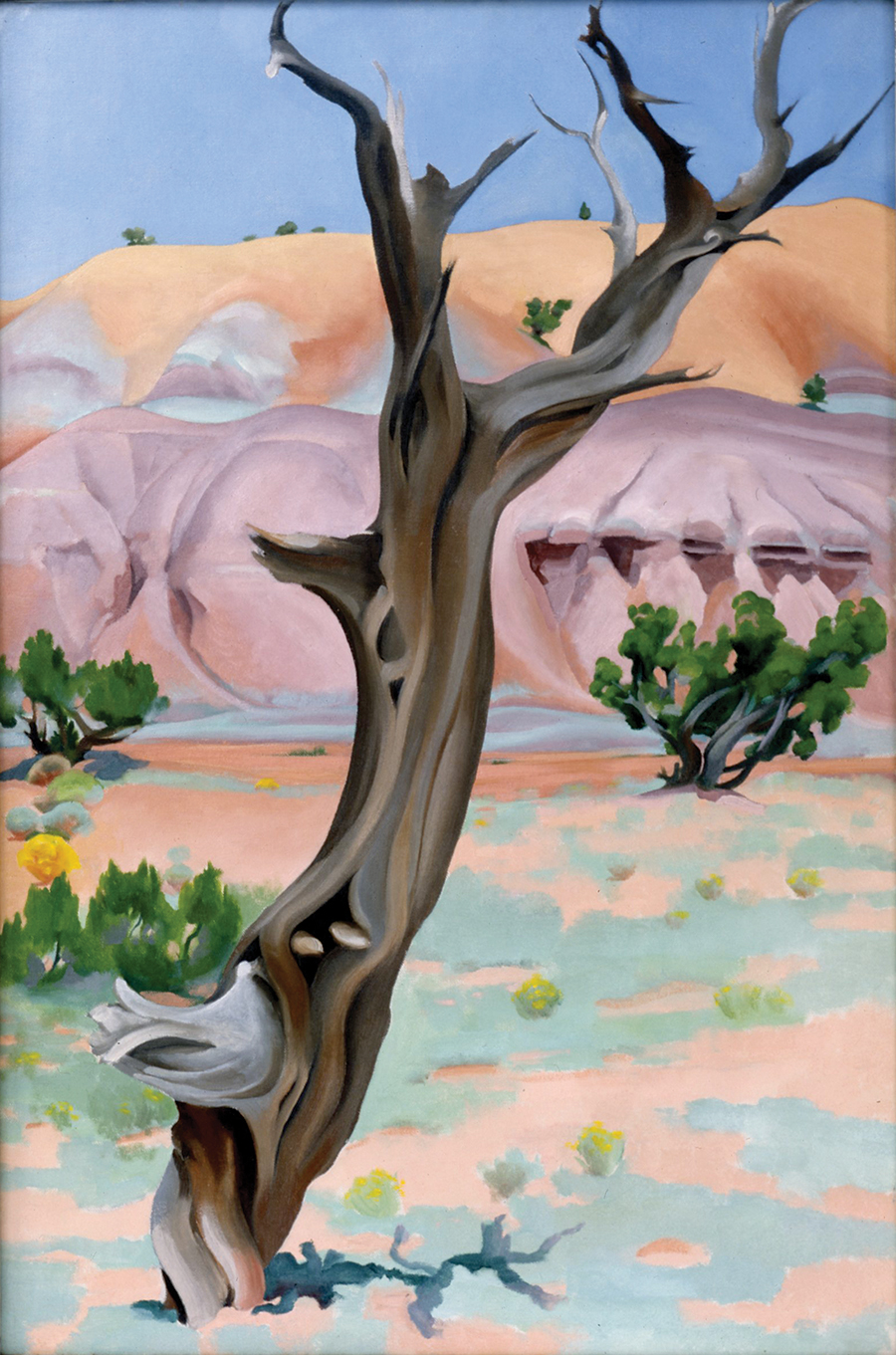
The work, a promised gift from Barbara Babcock Millhouse, the founding president of the museum and its primary donor, is Cedar Tree with Lavender Hills, one of O’Keeffe’s works depicting her beloved New Mexico landscape, first exhibited at An American Place in 1937 and purchased by Millhouse 40 years later. “I have O’Keeffe’s letter to her husband, Alfred Stieglitz, about doing that painting,” says Archer. “She says, ‘I can set it by the window and when I look at the painting and I look out the window, I have actually captured the way my world looks.’”

The painting will appear alongside another O’Keeffe work already in the museum’s collection, Pond in the Woods, Lake George. “It’s great for Reynolda because we’ll now have a painting from each of O’Keeffe’s main loci of inspiration,” says Archer.

Georgia O’Keeffe, Cedar Tree with Lavender Hills (1937), promised gift of Barbara B. Millhouse. © 2021 Georgia O’Keeffe Museum/ Artists Rights Society (ARS), New York

Joining O’Keeffe will be a brace of her contemporaries, including John Marin, Arthur Dove, Alfred Maurer, Marsden Hartley, Max Weber, Abraham Walkowitz and Charles Demuth, a flock of artists more often described as the Stieglitz Circle but who are recognized here for their effect on, friendships with and passion for O’Keeffe. “Stieglitz was always declaiming who was the next artist and why people should appreciate them,” says Archer. “The exhibit is kind of a pocket-sized pantheon of the great, early moderns. They’ve all drunk from the well of French modernism. They’ve all read Kandinsky about the spiritual potential of art and abstraction. There’s this kind of reckoning. What will Americans make of the new artistic world in the teens and twenties? That’s what Stieglitz was calling for — what will modernism mean for us?” And, in Stieglitz’s mind, the abstract movement went hand-in-glove with the elevation of photography as an art form all its own.

Demuth was not originally in the Stieglitz stable, but in 1921, when he became “one of us,” as O’Keeffe described him, she enjoyed his company immensely. A friend of the poet William Carlos Williams, he was elegant and urbane, a gay artist with a lively sense of humor but frail health. Though he turned to oils later in his life, he was best known as a lively watercolorist. As a mark of his friendship with O’Keeffe, when he passed away in 1935, he left all his oil paintings to her.

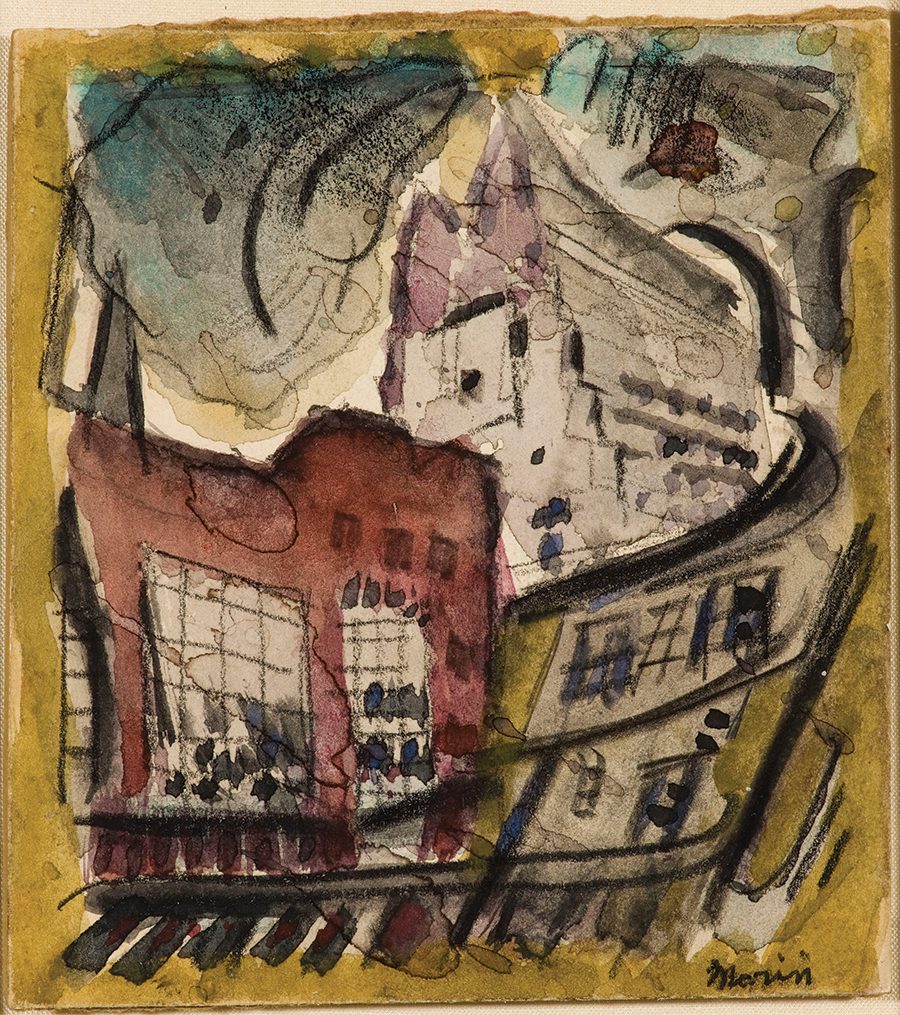
Marin was introduced to Stieglitz by his friend and fellow photographer Edward Steichen and became enough of a commercial success to buy his own small island in Maine, where he lived during the summer. O’Keeffe admired his work, including a blue crayon abstract drawing. In Georgia O’Keeffe: A Life, Roxana Robinson writes, “Its intimate scale and its clear aesthetic independence made it suddenly accessible to O’Keeffe: conceptually, this was very close to her own work. It occurred to her that if Marin could make a living selling this eccentric expression of a private aesthetic vision, then she might be able to do the same.” He was close enough to both Stieglitz and O’Keeffe to be a witness at their 1924 wedding.

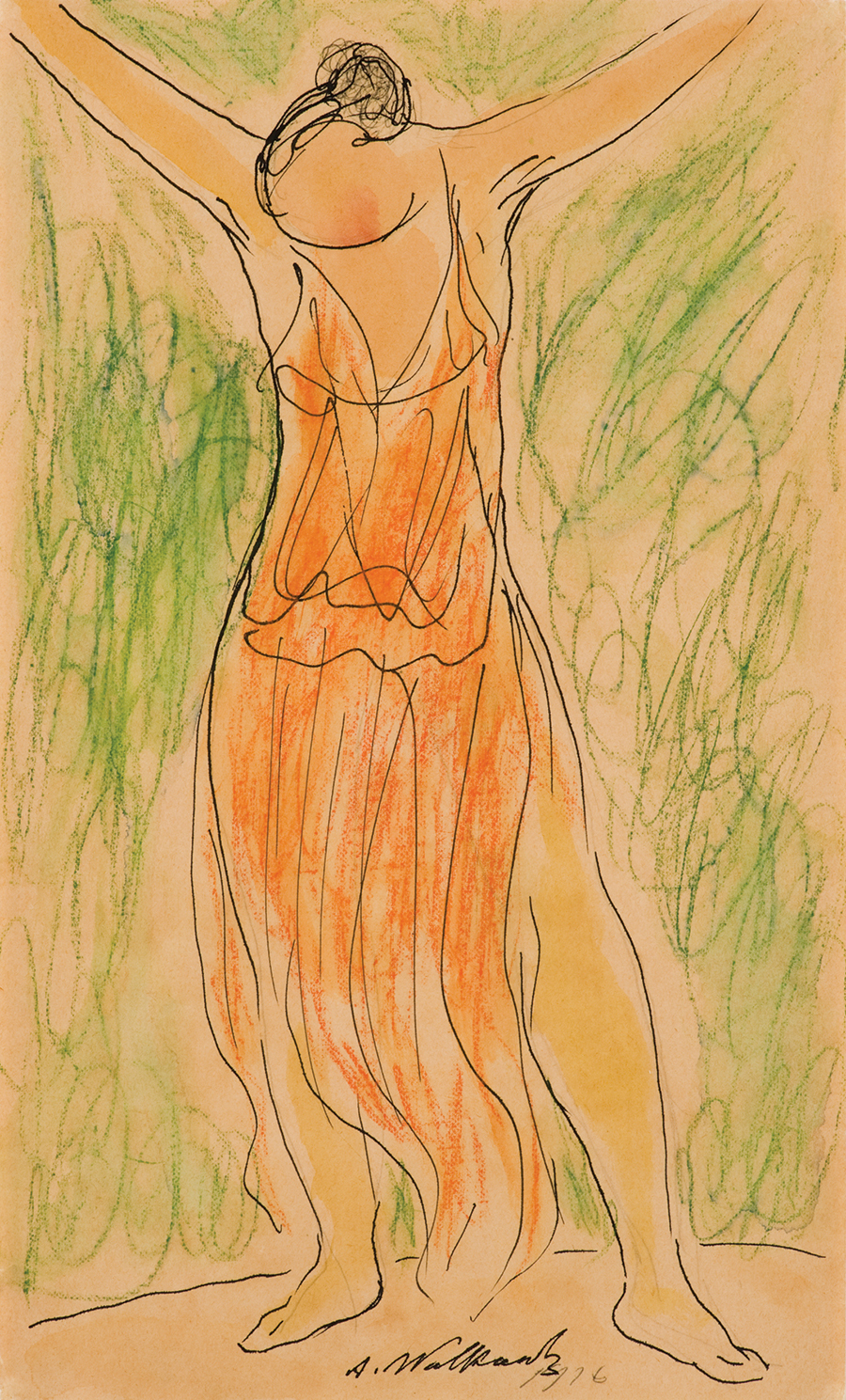
Abraham Walkowitz, Isadora Duncan (1916), colored crayon, watercolor, ink and graphite on paper, Gift of Mr. and Mrs. Joseph Hirshhorn in honor of Nancy Susan Reynolds

O’Keeffe’s first exposure to Dove at 291 was his painting Leaf Forms. After returning from Europe in 1909, Dove spent weeks camping alone in the woods. His abstract paintings “found a strong echo in Georgia’s developing aesthetic philosophy,” writes Robinson. “Dove’s work validated her own inclinations . . . she sensed the deep affinity between them.”

Dove was equally enamored. “That girl is doing without effort what all we moderns have been trying to do,” he said to the poet Jean Toomer.

Walkowitz worked so closely with Stieglitz at 291 that in 1912 and again in 1914 Stieglitz exhibited the work of the children Walkowitz was teaching in a Lower East Side settlement house. In this exhibit, Walkowitz is represented by one of his 5000-plus drawings of Isadora Duncan. “She had no laws. She did not dance according to the rules. She created,” Walkowitz said — words that he could have applied to O’Keeffe just as readily.

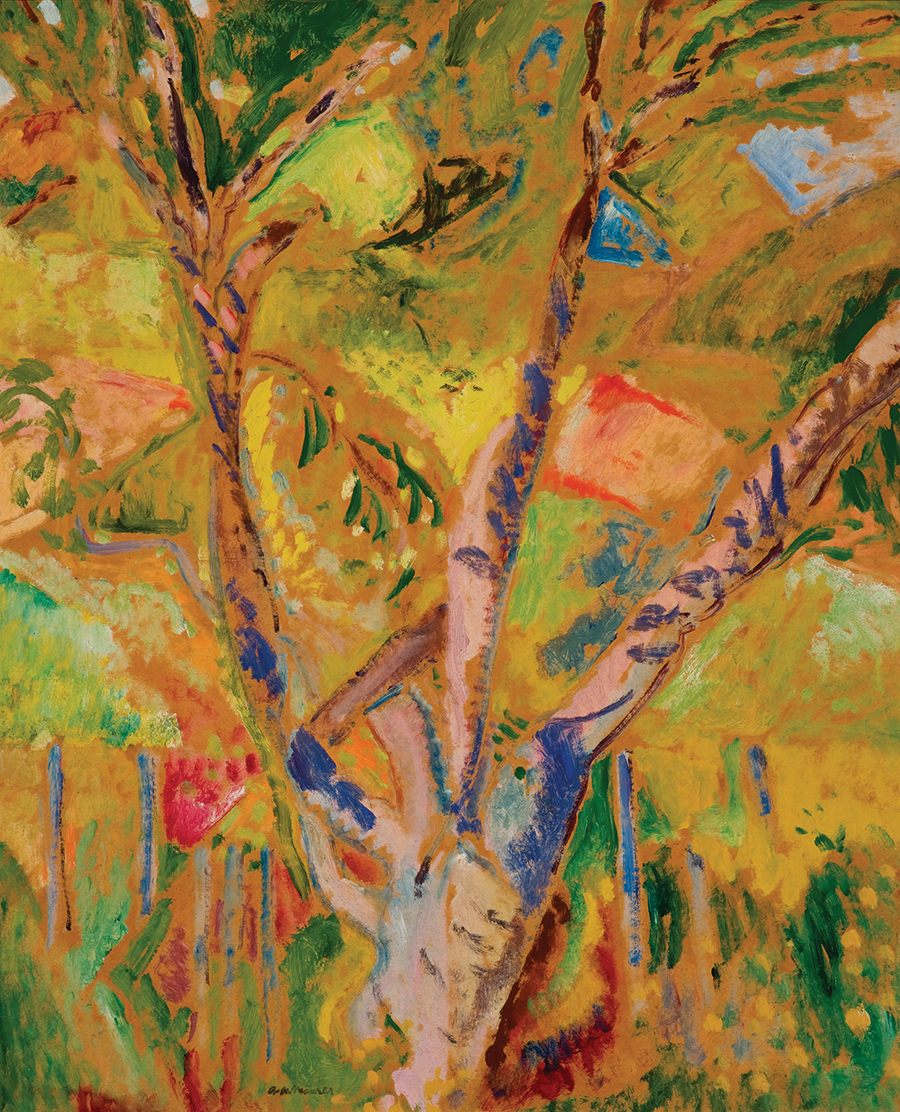
Paintings by Pablo Picasso, Henri Matisse and Paul Cézanne, and Auguste Rodin’s drawings were first shown in America at 291. Marin and Maurer appeared on their heels. Maurer, like O’Keeffe, had studied with William Merritt Chase. Maurer’s father created Currier and Ives lithographs and never approved of his son’s modernist leanings. Shortly after his father passed away at the age of 100, Maurer committed suicide. The mercurial Weber was responsible for Henri Rousseau’s first U.S. exhibit, and he helped introduce cubism to America, a thankless task in 1911. According to the art historian Milton Brown, he was rewarded with “one of the most merciless critical whippings that any artist has received in America.” And it was an exhibition of Hartley’s work that first brought O’Keeffe to the 291 gallery where she met Stieglitz. Soon they would be lovers.

John Marin, Downtown, New York, c. 1925, watercolor and graphite on paper mounted to board, Gift of Betsy Main Babcock, 1966.2.1 © 2021 Estate of John Marin / Artists Rights Society (ARS), New York
Max Weber, The Dancers (1948), oil on canvas, Gift of Dorothy F. and Maynard J. Weber, Reynolda House Museum of American Art

Though the works linked to O’Keeffe as a collector, or perhaps appreciator, in the exhibit are not the precise pieces she held in her collection, they are representative of those that were and of the relationships she enjoyed. Among the latter is her abiding friendship with Ansel Adams, who is represented by one of his prints of Yosemite Valley, a place O’Keeffe and Adams visited together. In a letter to Stieglitz, Adams wrote, “O’Keeffe is supremely happy and painting, as usual, supremely swell things. When she goes out riding with a blue shirt, black vest and black hat, she scampers around against the thunder clouds — I tell you, it’s something.”

The exhibit includes a photograph of Adams and O’Keeffe taken by Adams’ assistant, Alan Ross. “Ansel Adams was the first professional photographer to capture her on camera and then in 1981, close to both of their deaths, she went back to Carmel, California, and, as she’s setting up, she’s sort of smiling, his assistant took a quick snapshot,” says Archer.

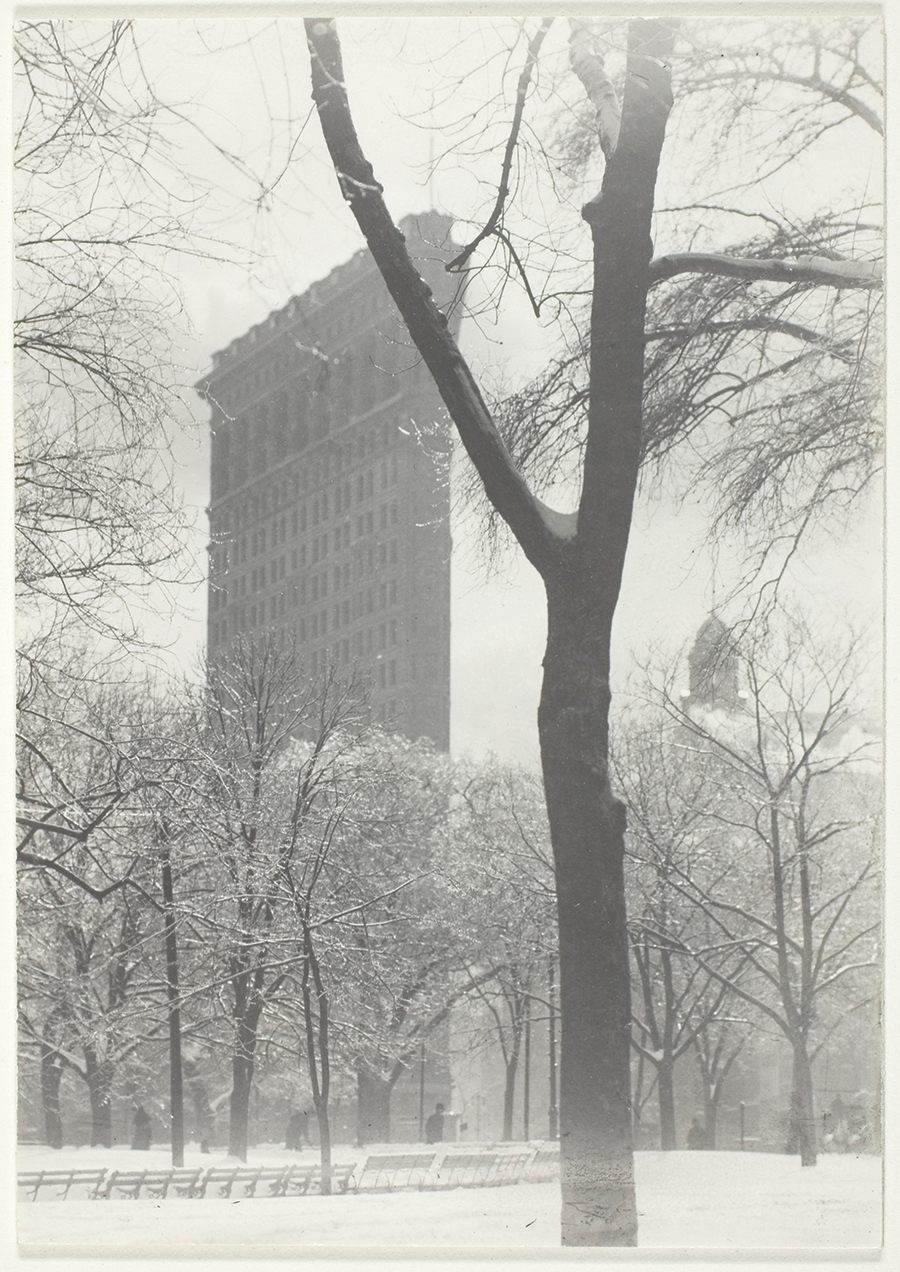
Also included in this section of the exhibit is an Akari paper lantern by Isamu Noguchi similar to the one O’Keeffe alternately hung over her dining room table or her bed in her house in Abiquiu, New Mexico. There is a mobile by Alexander Calder — who designed the OK pin O’Keeffe wears in countless photos — that is analogous to the one O’Keeffe hung in her New Mexico home. A triptych of snow scenes done in the 1850s by Utagawa Hiroshige is also included as an homage to a similar threesome of Hiroshige woodblock prints from the same period that lived on the wall in O’Keeffe’s New Mexico home and are now at the Metropolitan Museum of Art. And, naturally, there is a Stieglitz print, one of his most famous, also a snow scene. “I suddenly saw the Flat-Iron Building as I had never seen it before,” Stieglitz said. “It looked, from where I stood, as if it were moving toward me like the bow of a monster ocean steamer, a picture of the new America which was in the making.”

Alfred Henry Maurer, Landscape: Provence (circa 1916), oil on paper, mounted on board, Reynolda House Museum of American Art, Gift of Emily and Milton Rose

This intimate exhibition does not pretend to be, nor was it intended to be, an O’Keeffe retrospective. It does not deal with her complicated relationship with Stieglitz — who never ceased to promote O’Keeffe’s work — their lengthy affair before his divorce, their subsequent marriage and, later, his affair with his gallery director, Dorothy Norman. It doesn’t delve into her mental and physical breakdowns in the ’30s nor does it touch on the sexuality, male and female, that is often ascribed to O’Keeffe’s work and which she steadfastly refused to acknowledge.

Like Stieglitz’s photo of the Flat Iron Building, O’Keeffe saw grandeur in her subjects. “She wanted the small things in nature that she loved to be just as impressive as the new trains and new planes,” says Archer, “to stop you in your tracks like you were looking at a skyscraper.”

The tightly knit exhibit, like the Ross photo, is a snapshot of the artist. “I hope people will leave with a fuller image of O’Keeffe’s engagement with the art of her time,” says Archer. “She developed a persona — helped by Stieglitz — of the remote, contemplative, detached doyenne of the desert. But she was keenly interested in her contemporaries’ work and unstinting with both praise and criticism.”  PS

Jim Moriarty is the Editor of PineStraw and can be reached at jjmpinestraw@gmail.com.

Alfred Steglitz, The Flatiron (1903), photogravure on tissue, courtesy of a private collection

Hometown

Heroes and Helmets

Autumn’s guilty pleasure

By Bill Fields

I don’t usually get nervous before an interview, but a few years ago, when the subject was a childhood hero, I confess to having had the jitters.

A friend of Sonny Jurgensen kindly passed along his phone number so I could try to get him for a story I was writing about his youth in Wilmington years before he was a star quarterback in the National Football League. He was north of 80 by this point, the ginger hair long gone white; the golden arm that could zing passes to a receiver on a down-and-out better than anyone, alive only on NFL Films. Our call was brief and his answers perfunctory. Despite the disappointing substance of the conversation, I hung up pleased that I’d gotten to speak with Number 9 in burgundy, gold and white decades after his autographed photo hung on my bedroom wall.

He was why I drew plays in the dirt and threw passes at the trunk of a pine tree if no one was around. I wasn’t tough enough for football despite all the neighborhood prep; a year of Midget League was enough. But I care about football these days in part because — like many who grew up in pre-Panthers North Carolina — I cared so much about Sonny and his Washington teammates more than 50 years ago.

I still root for the team that Jurgensen led out of the huddle from 1964 to 1974. My alma mater, the University of North Carolina, is supposed to be strong this season. Maybe the Tar Heels will make it to the ACC title game and beat Clemson. My adopted college team, Ohio State, has enlivened my autumns since I became a fan thanks to my girlfriend, for whom Buckeye football is her only sporting interest. We went to a game in Columbus several years ago. Even though it was a cakewalk non-conference matchup, the stadium was filled on a beautiful Saturday afternoon, making it a day I won’t forget. The Saturday after Thanksgiving, thanks to the annual Michigan game, has become much more than another day in a long holiday weekend. What football fan doesn’t hope that the pandemic will have eased enough to allow the stands to look like they once did?

As another football season kicks off, though, the sport seems an increasingly guilty pleasure given the growing evidence of long-term damage from repeated hits to the head in a game in which the athletes seem bigger, stronger and faster every year. The NFL increasingly is in the same sentence with CTE, chronic traumatic encephalopathy, a progressive brain degeneration that can afflict those who play contact sports. Pro football players are handsomely paid in the current era — as opposed to the athletes competing long ago when many of us got hooked on watching them play — but the riches come with a potential cost much greater than arthritic joints in retirement.

It has always been a brutal game, but the CTE studies and evidence have quantified the brutality in ways impossible to ignore, and dementia hurried along by blows to the head is a much different outcome than seeing a man who used to sprint like a gazelle have trouble getting up a flight of stairs.

Like many others, I will still watch, grateful for the games in which nobody is seriously hurt. I hope the rules of the game continue to evolve so that they might lessen the potential for severe injury, that more athletes leave the game without suffering long-term effects from their careers.

This fall I will be thinking about another red-headed football player, my great-nephew, a senior at his North Carolina high school. He is an all-conference defensive end, a quick and strong teenager who loves his chosen sport despite the hand fractures he has sustained as a prep athlete. I hope he has a great season — and decides he’s had enough football.  PS

Southern Pines native Bill Fields, who writes about golf and other things, moved north in 1986 but hasn’t lost his accent.

Story of a House

The Other White House

Retirement leaps out of the rocking chair, into the barn

By Deborah Salomon     Photographs by John Gessner

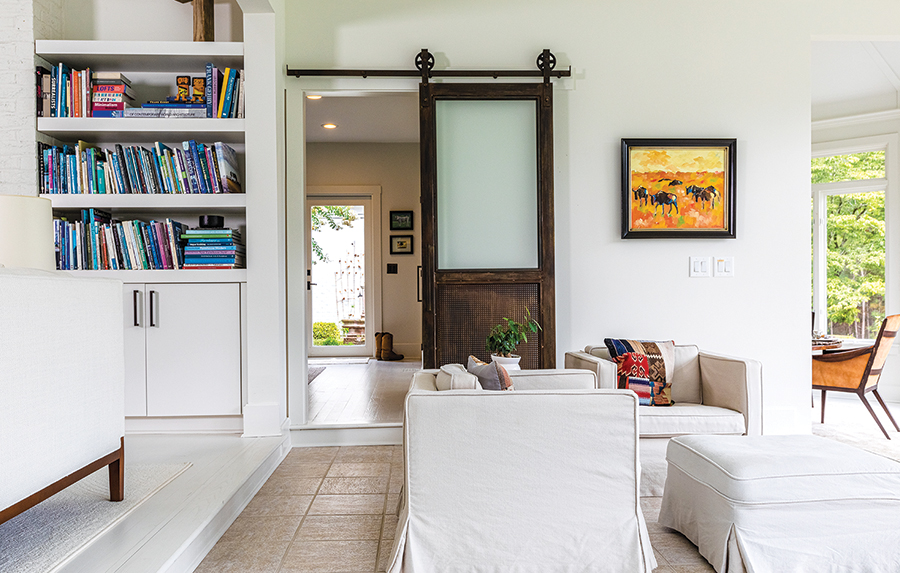
Their go-to color is a non-color, white. For Elizabeth “Boo” DeVane and her husband, Ron Gibson, this preference starts at home, where a white wooden porch swing hangs from an ancient pin oak centering the circular driveway, flanked by white gateposts.

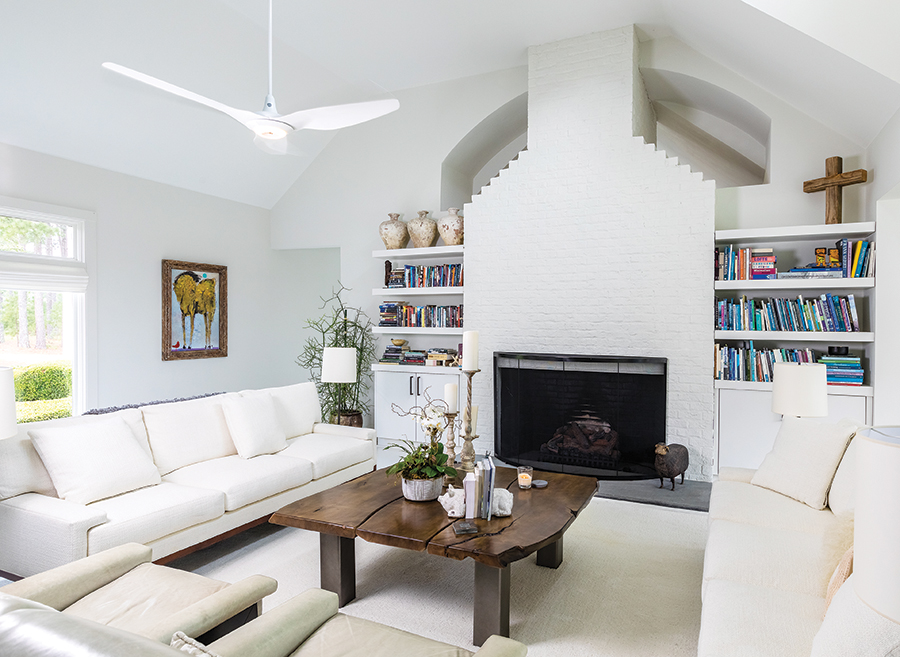
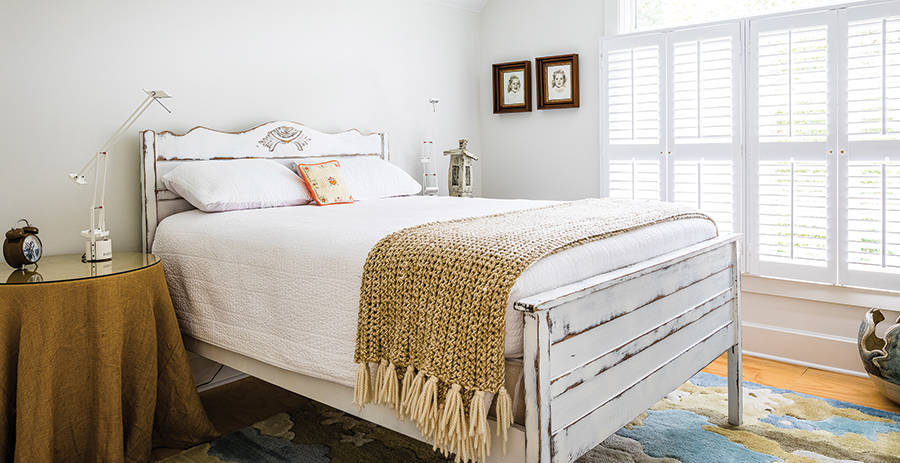
Their white brick house on a sculpted five acres near the Pinehurst-Aberdeen line explores other possibilities: white, barely touched with green for most interior walls; hardwood floors painted glossy white; white area rugs and white upholstery. Gradually, in rooms off a “spine” hallway that runs the width of the house, pure (but never stark) white melts into vanilla, cloud, sand, latte, putty, ash and, finally, cocoa.

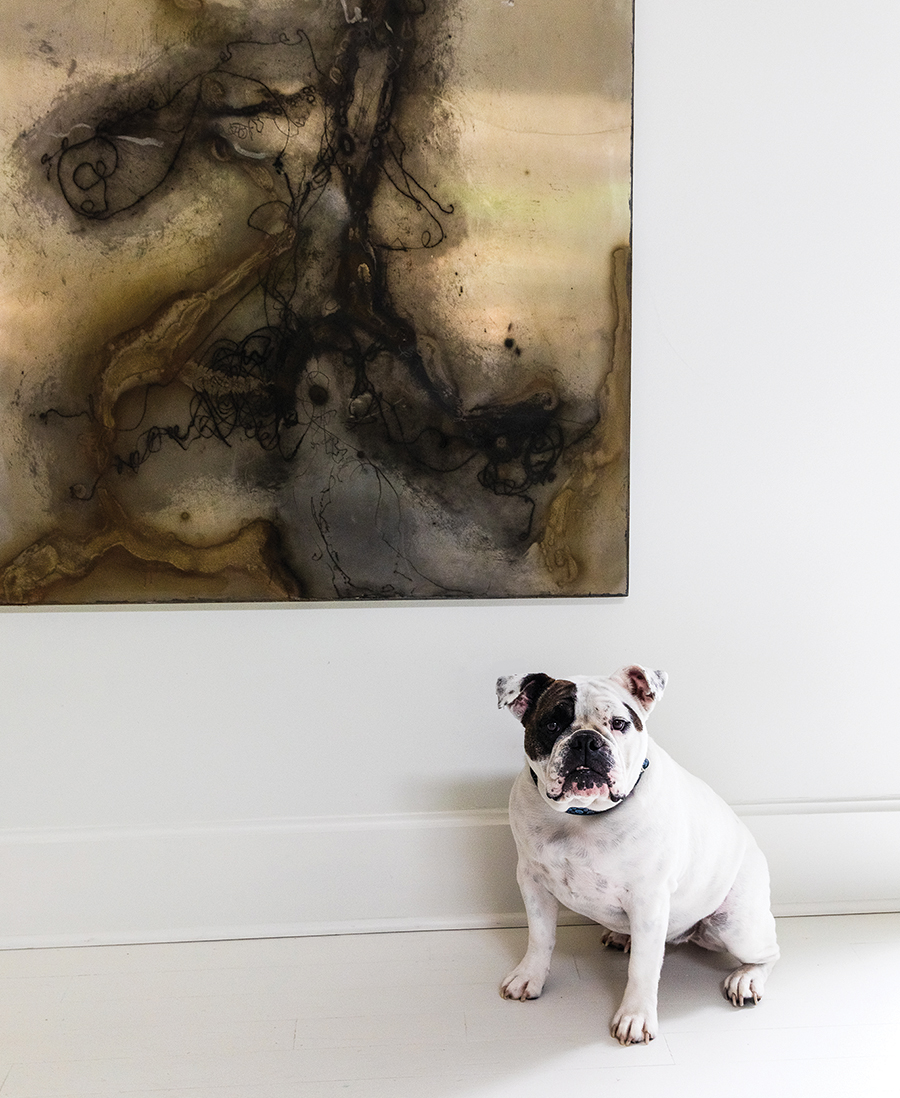
Even the English bulldog, Bella, continues the palette.

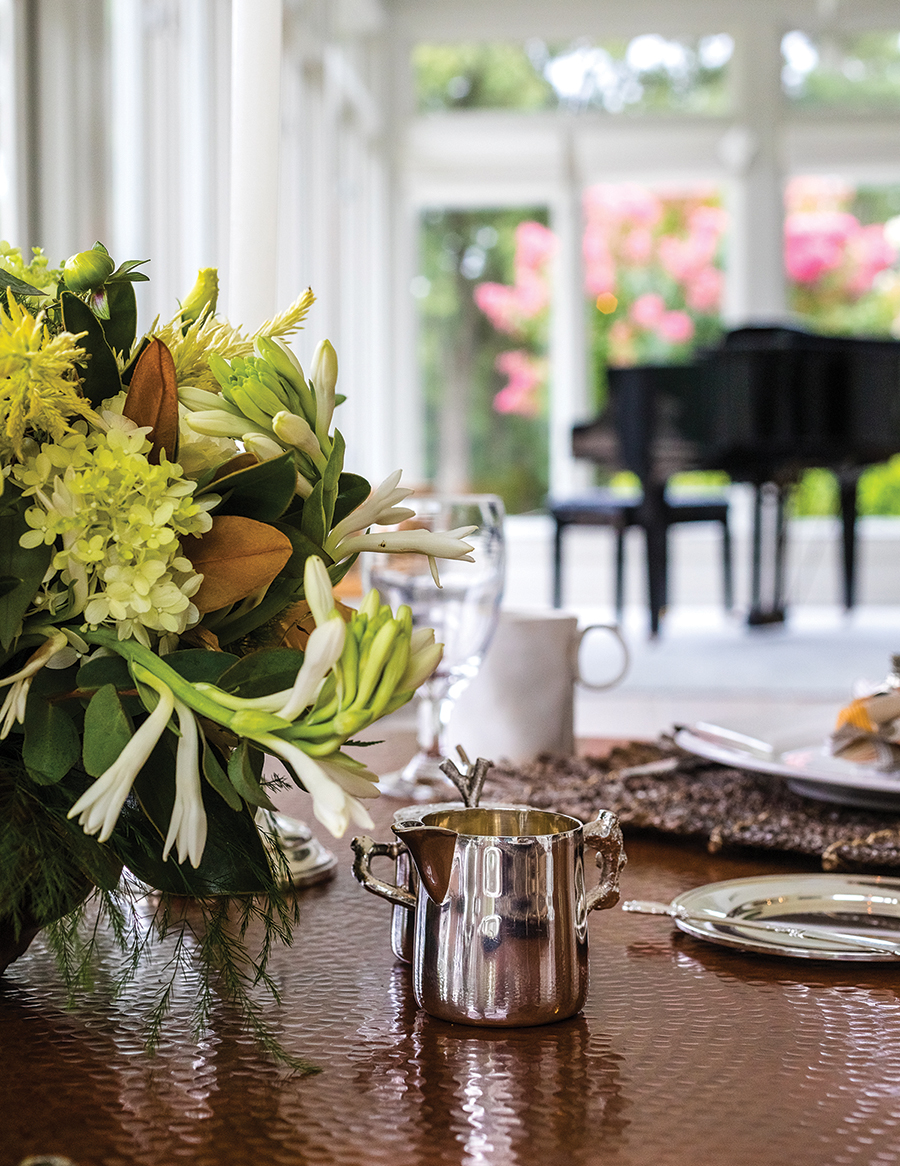
Beyond the white-out, in the sunroom bay stands a gleaming black baby grand, which Ron plays. Off the living room, a darkened alcove holds two 180-gallon tanks, one run by a computer, both protected from power outages by a designated generator, containing an aquarium-worthy array of tropical fish and live coral. Their plumage and movements — calming, mesmerizing.

They are Ron’s babies.

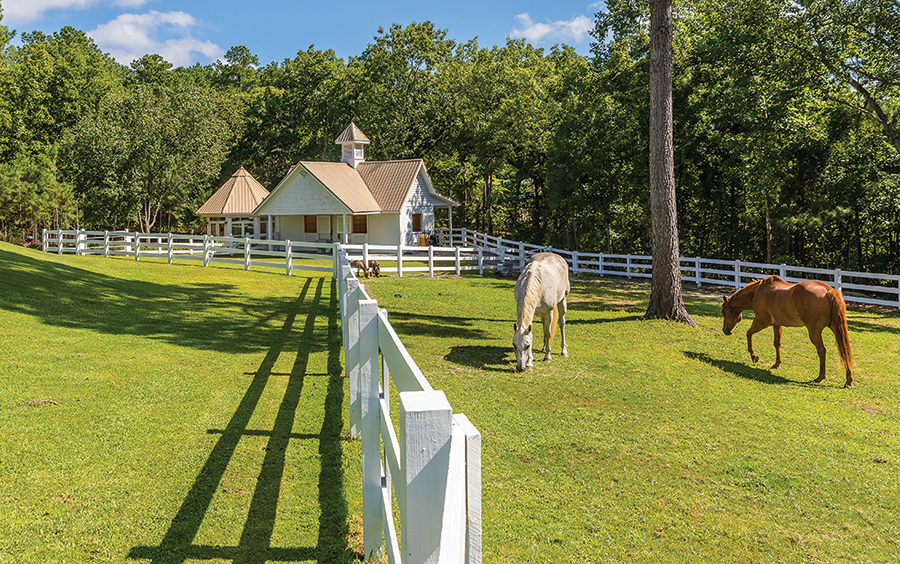
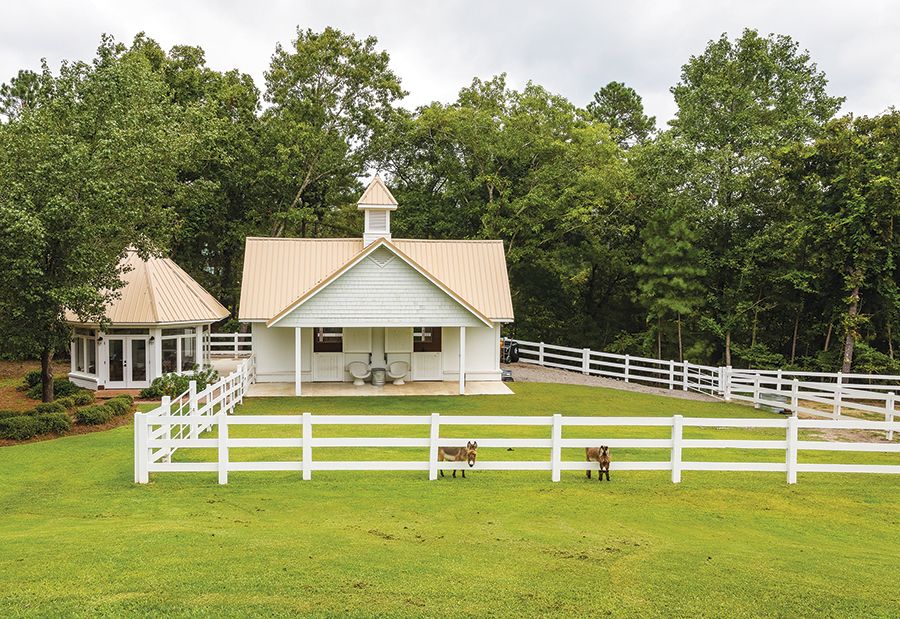
Boo’s babies decorate the landscape visible through arched, elaborately framed oversized windows — two quarter horses (one white, one tan) and young donkey twin sisters (grayish-beige and very friendly) who live in a white barn adjoining the pasture. Bella has her own grassy enclosure surrounded by a white picket fence.

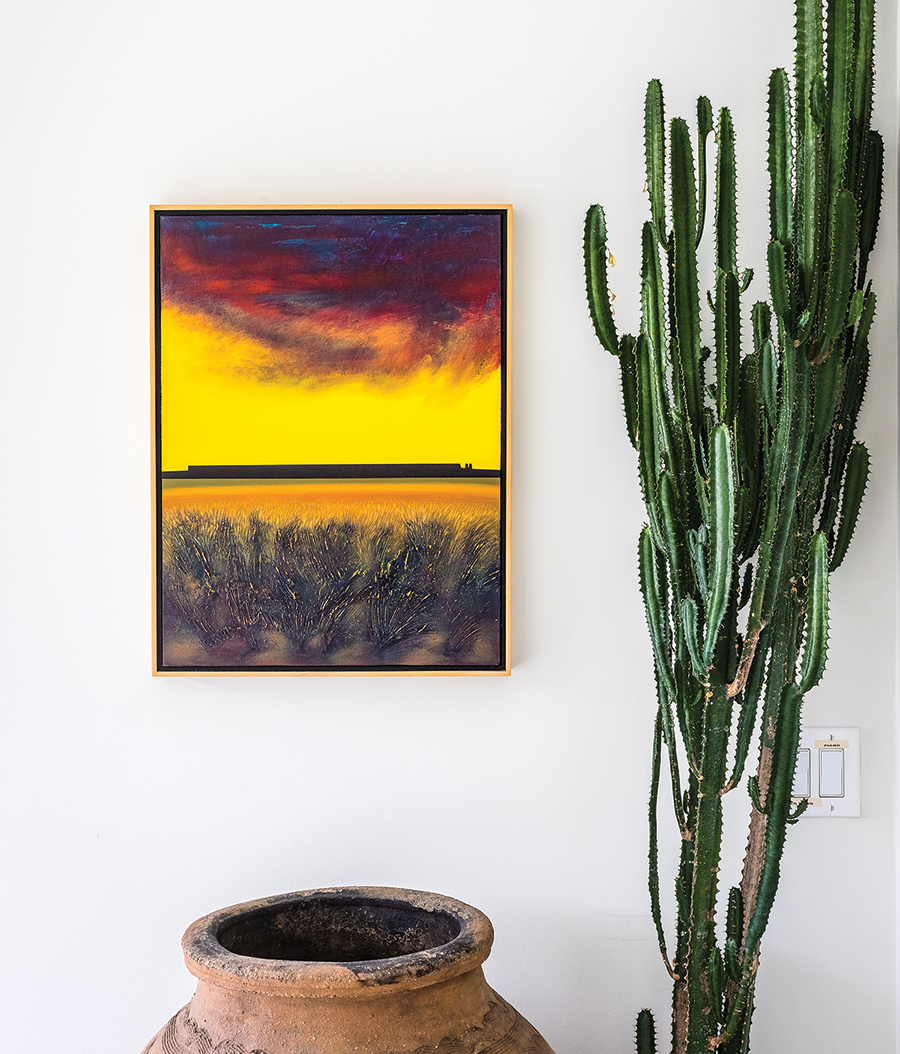
However, Boo — born on Halloween, nicknamed by her brother — and Ron have not forsaken all color. They collect art . . . bold, exciting canvases in primary hues selected by Boo’s educated eye. A room at the Fayetteville Museum of Art was dedicated to her parents, collectors Jim and Betty DeVane.

Ron and Boo, handsome retirees oozing energy, lived previously in Fayetteville and Topsail Beach. He was a school psychologist and military consultant specializing in autism. Boo left North Carolina at 18, attended New York University and worked in Manhattan managing arts-related nonprofits before returning to the family business. Along the way she accumulated interior design experience implemented by friend, designer and fellow horsewoman Cathy Maready.

In retirement, Ron’s tan comes from gardening, not golf. Boo works with rescued horses. How they met and accidentally eloped to Costa Rica after a 12-week courtship resembles a 1990s date flick starring Meg Ryan and Tom Hanks.

The equestrian community drew them to Moore County, first on an isolated farm, then a too-small house in Pinehurst.

Let’s reverse the retirement trend and upsize, they decided.

“While Ron was away, I checked around to see what was out there,” Boo recalls. Tinker Bell couldn’t have found anything more perfect.

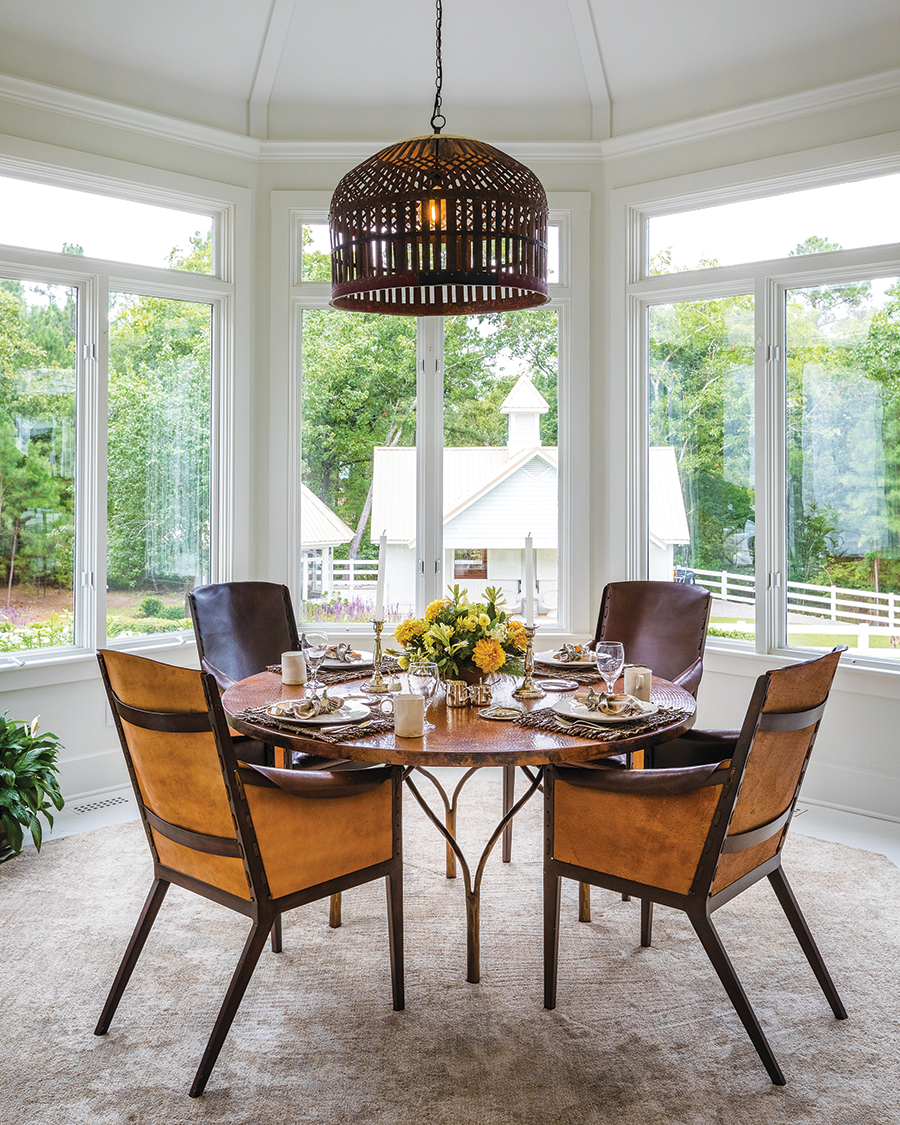
Twin Oaks Farm, as they named it, was built in 1997 by Robert Clarke, a California “architect to the stars,” for his own family. This usually bodes well for materials and originality. Clarke’s home, however, presented a mixed bag, with those top-dollar windows sited for maximum natural light but Pergo laminate floors and a small unimaginative kitchen. Fixable, Boo decided. The five overgrown acres beckoned gardener Ron. Boo envisioned two pastures and a barn, which they built after moving in. Both were fascinated with the ceilings: vaulted, angled, slanted, mansard, one with a clerestory which draws light into the white living room, another supported by a trapezoidal beam — anything but flat.

They grabbed the house in 2019 and went to work.

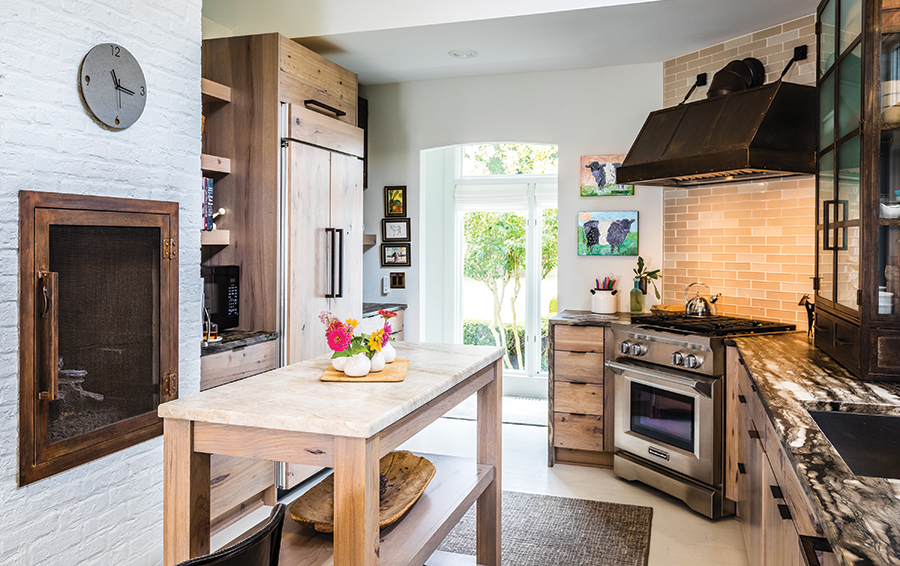
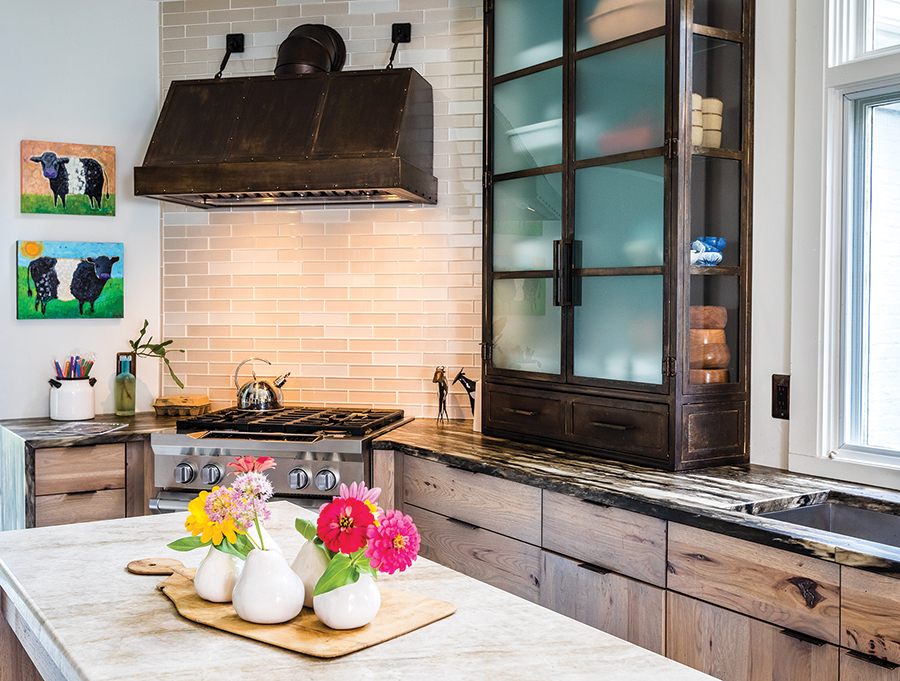
Up came the Pergo, down went hardwood covered with layers of glossy white paint. The story-and-a-half floorplan remained intact except for the kitchen, which Boo gutted and replaced with something from a magazine. The result, definitely not white, stands apart from Pinehurst glamour kitchens. It’s a moderately-sized galley with a worktable, no island, earth tones, clean lines and natural materials that impart an Asian aura. Countertops are marble but not tombstone white. Instead, they have a brown-grey toned leather finish, the same coloration appearing on wood cabinetry, dishwasher and refrigerator fronts. Cupboards are textured metal and frosted glass. A small coffee bar faces a smaller wine rack. No faux-farm sink, no visible breakfast bar until Ron, with a wicked smile, draws a folded flat surface from beneath the countertop, opens it out and pulls up two chairs. Just as original is a small gas fireplace sealed waist-high into a brick column — instant comfort on a chilly morning.

There’s no formal dining room, either, just a large sunroom adjacent to the kitchen, with a round hammered copper table seating eight.

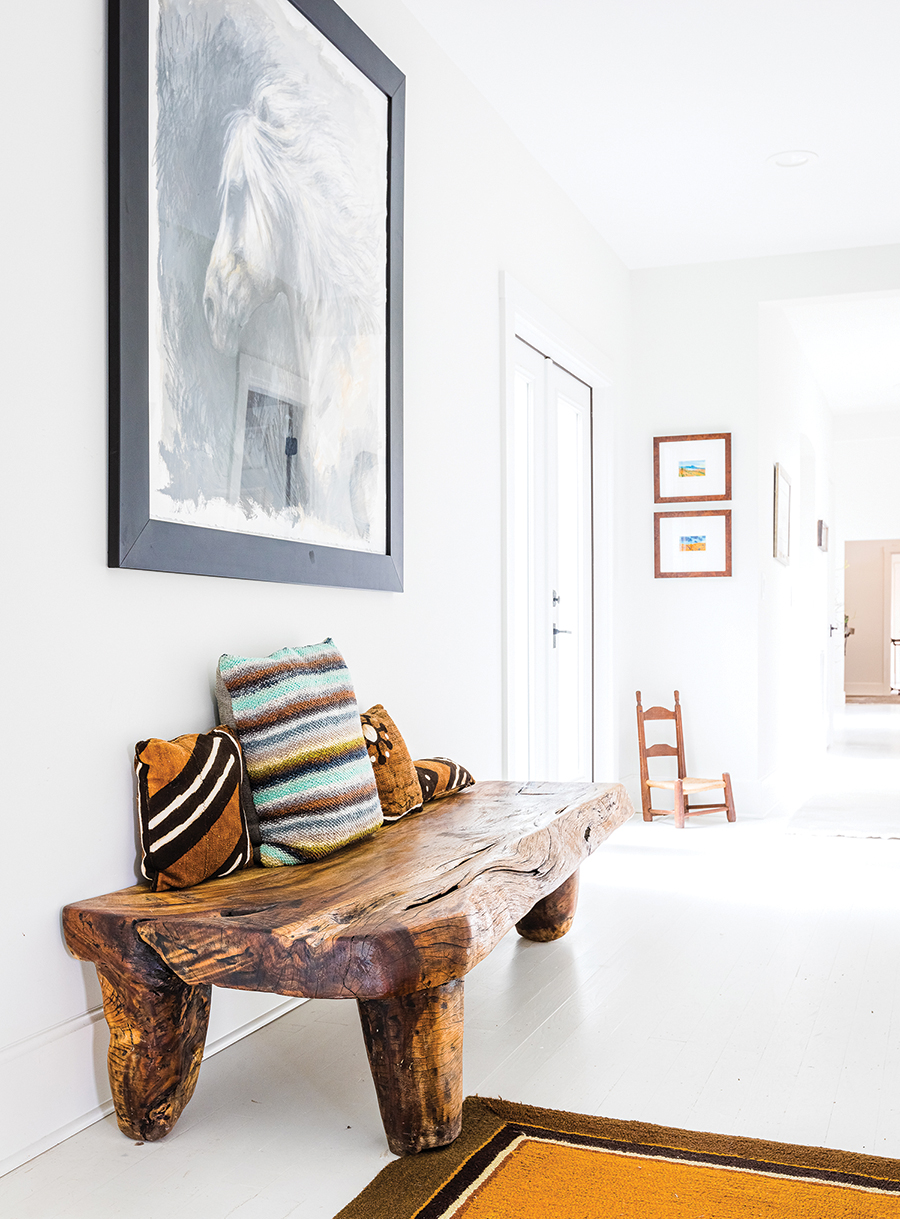
Woven area rugs, upholstery and linens in the main floor master suite and guest bedroom combine pale earth tones with tiny geometrics. Several family antiques — including a secretary and drop-leaf table Boo grew up with and a guitar from Ron’s father — blend nicely with metal headboards and a reupholstered slipper chair from Ron’s mother. Fearlessly, in the hallway and master bedroom Boo added massive tables and benches fashioned from tree-trunks. Their heavily glossed knots and grains contrast to more delicate patterns and colors used throughout, including shimmering drapes in the guest bedroom, the only window with a fabric covering.

Stairs to the second floor rise from near the end of that spine hallway. Here, Boo has an office-sitting room furnished with less white and more brown, although her desk is assembled from a distressed white antique door, its frame serving as legs. She repeats the wall-enclosed gas fireplace for thermal and decorative purposes.

The upstairs bedroom, prettier than a coastal B&B, accommodates Boo’s adult children when they visit.

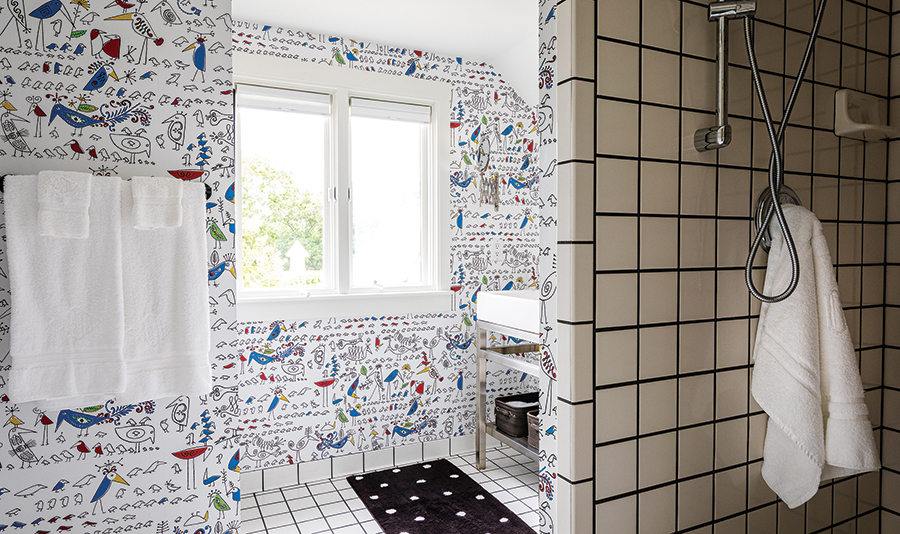
Boo really lets loose in the bathrooms, perhaps to compensate for original white tiles outlined in black, which she disliked. However, instead of ripping them out, she let the geometrics set a tone. One wallpaper is made from shredded newspaper while another is black curls splashed against a white background. Whimsy rules the upstairs bathroom, where black stick figures in colorful garb imitate the drawings of Paul Klee or, perhaps, Wassily Kandinsky.

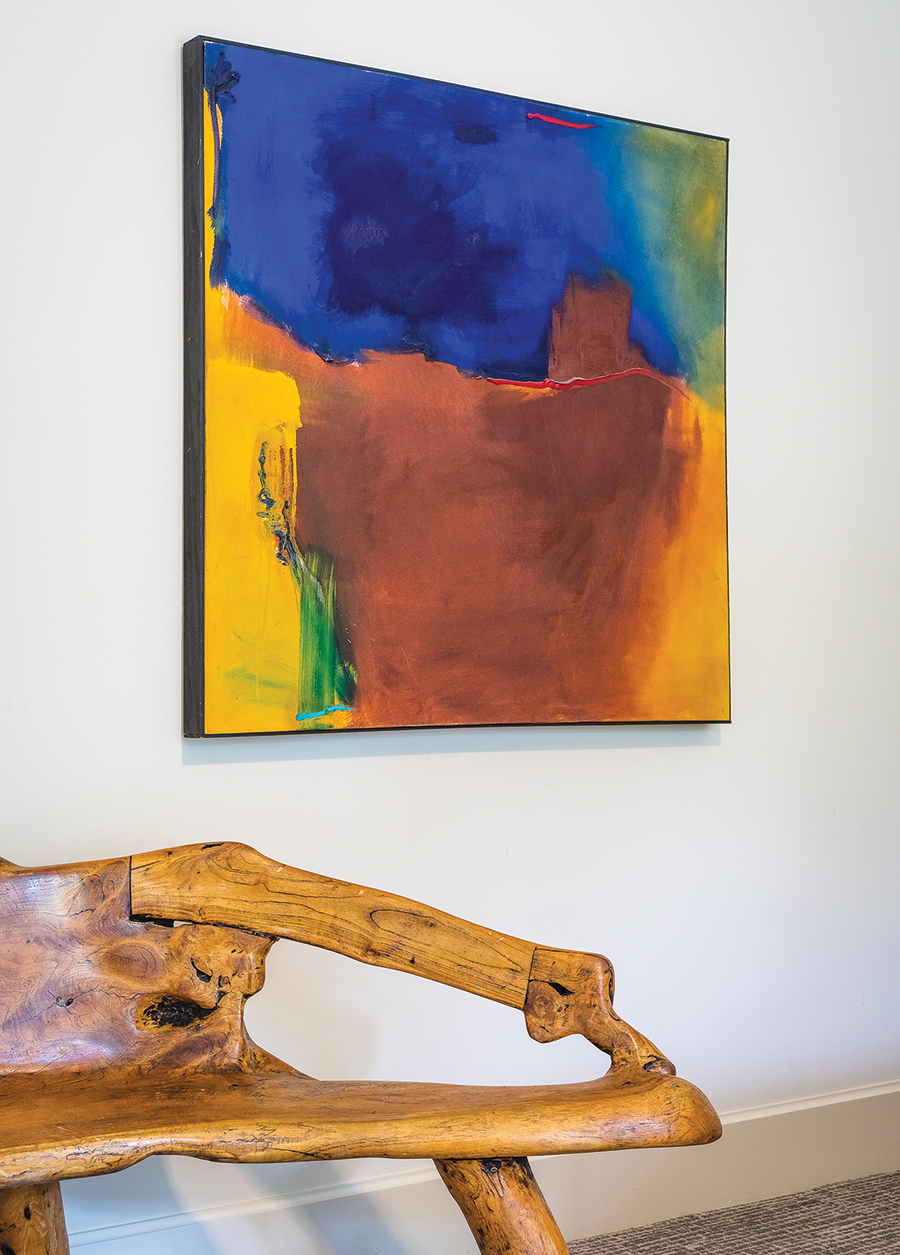
As for art, all bets are off. Pale earth tones don’t apply. Brightly-hued animal subjects include a folk art pig in one bathroom, a fanciful horse head by local artist Meridith Martens in the hallway, and upstairs, a bright, cartoonish guinea hen with a story. They saw it, liked it, but it was gone when they returned to purchase it, expense be damned. Years later, guess what showed up in another gallery?

Their favorite painting is an abstract in warm Southwestern colors by Dan Namingha, a Hopi artist from New Mexico featured at the Smithsonian Institution and British Royal Collection in London.

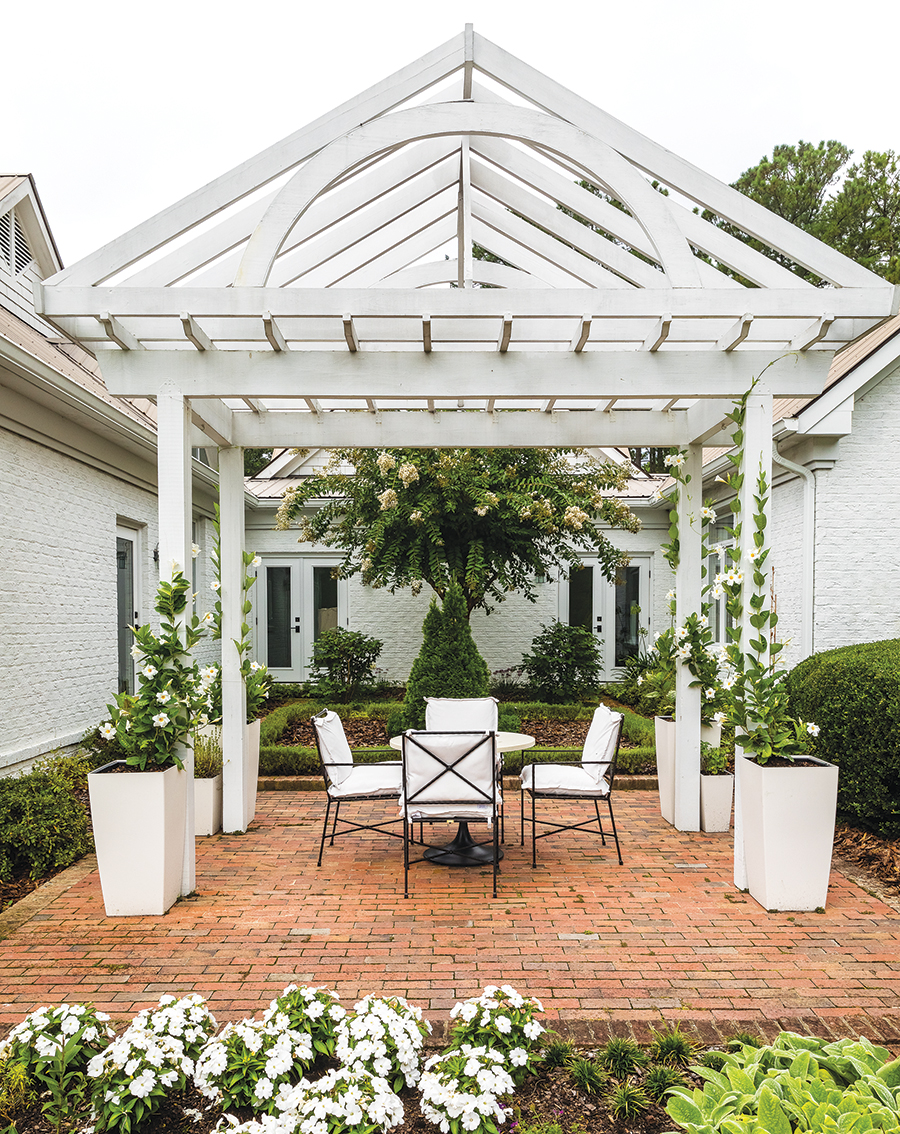
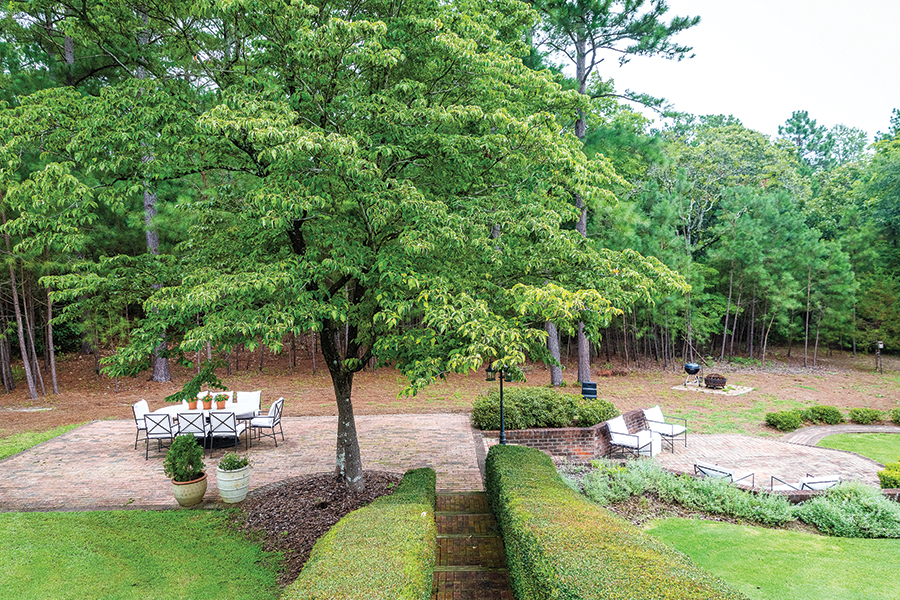
The grounds satisfy Ron’s near-metaphysical connection to nature, developed as a backpacker in Colorado. Not only did he remove overgrown crape myrtles and Japanese pears, he grew weed-free grass from seed, which he crops closely on his riding mower. “I’m like a kid, riding along with my headphones on,” he says. Flowers are absent, except for a few perennials, always in what Ron calls “calm colors, no yellows except for daffodils.” Boxwoods are trimmed into curves, not flat-tops or angles or topiary. A small Tuscan-style garden with fountain and pergola located just outside the dining room brings greenery up close.


Ron and Boo are busy retirees who miraculously report agreement on all decisions concerning the house. Ron admits he’s happiest with a project. Next up: an aquarium store in Wilmington. Boo mucks her own barn. She wants to rehab needy racehorses. For now, she feeds the menagerie, spends time in the heated, air-conditioned gazebo-turned-tack room adjoining the barn, a veritable girl-cave filled with equestrian equipment and memorabilia that sometimes doubles as a meeting place for their Bible study group.

What’s missing? Enormous TVs plastered on multiple walls and laptops galore. “The world was a better place” before electronics took over, Ron believes. He and Boo have other toys: two horses, two donkeys, one dog, one barn cat, two aquariums, five acres, plenty to do and the strength to do it.

“This is a place of peace,” Ron says. Boo adds, “We’re going to try to keep everything standing and moving forward, including ourselves. We are blessed.”  PS

Southwords

How We Wallpapered Fool’s Hill

Hint: One roll at a time

By Ruth Moose

What felt like a midlife crisis to my husband and myself, our friends and family called “going over Fool’s Hill.” They shook their heads as we sold our life in Charlotte to go live in the wild woods of the Uwharrie Mountains. And they were wild woods.

We bought three acres of the 900-acre Stony Mountain, an area known locally for its rocks and rattlesnakes. There was one other house a mile away that overlooked the Uwharrie River and Morrow Mountain. Our lot was graced by a mammoth beech tree and a tiny tumbling creek.

We planned to use the money from our city house to build a smaller home in our wild country, doing much of the work ourselves. Our sons, 11 and 16, agreed with friends and family: We’d lost our minds. Nonetheless, they rolled up their sleeves and pitched in.

My husband drew our house plans. As a DO (diversified occupations) student in high school, he took a drafting class that likely influenced his decision to pursue a degree in art rather than becoming a pharmacist.

We began by clearing, cutting, hauling and burning brush. Then we hired someone to cut only enough trees to allow a road, driveway and space for a house.   

We hired a contractor to frame the house, then we took over, opting to install paneling over dry wall so we wouldn’t end up having to spackle, sand and paint it. Paneling was a breeze: once it was up, you were done with it.

My husband liked paneling. And he liked wallpaper for the same reason. Once it was up, you were done.   

I not only like wallpaper. I love it.

I love everything about it: the patterns, the instant effect, the burst of color. And I had always said that if I ever built a house of my own, I’d wallpaper the closets.

It helped that I found a place where you could buy returned rolls of wallpaper for just one dollar a pop. Did you know that a standard closet requires just two rolls? One son’s closet got a western pattern, brown calico for the other. My husband’s closet was decked in faux denim while my walk-in was covered in blue birds and apple blossoms. Again, friends and family shook their heads. Fools.

We were doing great, the house was taking shape, then our money ran out. We needed a loan to finish. I went to a mortgage broker. OK, I went to four of them. One should have requested a loan before one began, I was told repeatedly. Not in the middle of building. Clearly it was a no deal.

Finally, a friend at church suggested that a small local bank might be able to help.

So I rolled up my husband’s drawings, made an appointment, dressed my best — heels and everything — and crossed my fingers.

The banker asked to see our blueprints. When I unrolled my husband’s drawings, he looked totally puzzled. “Who did these?” He asked.

“My husband,” I said.   

“OK,” the banker said, rolling them up before handing them back. He crossed his arms, leaned toward the wall in his chair. “Tell me about your house.”

I explained that the house was planned for low maintenance. It would have some solar features, triple paned windows — and we were wallpapering the closets.

He laughed, doodling figures on his desk pad.

“How much do you need?”

I said, “But you haven’t checked our credit.”

“I don’t need to,” he said.  “Anybody who wallpapers closets is a good credit risk.”

We got the loan, finished the house and lived there 17 years.  PS

After living in Stony Mountain, the Mooses moved to Fearrington Village when Ruth joined the creative writing faculty at UNC-Chapel Hill. Her husband, Talmadge, died in 2003. After Ruth retired from teaching, she shocked all who know her by moving back to Albemarle.

Poem

Skipping

Walking my heart (good boy!) after lunch,

suddenly my bored step hitches, stutters,

propels me firmly up and forward, and look,

I’m skipping, I’m skipping, I’m skipping

like I haven’t in over half a century, one foot

then the other bouncing lightly on its ball,

springing my dull earthbound body along

like a rock across water, lightly touching down,

like a cantering horse on the verge of a gallop,

a syncopated gait that swings my arms out

for balance like the girls’ when I was a kid

but so what, I let hands and hips sashay,

lost my partner, what’ll I do, skip to my Lou,

my darling heart leaping in my lifted chest

as I dance on down the sidewalk, double-time.

— Michael McFee

A Haven of a Place

Mistletoe Farm — a sanctuary for creatures great and small

By Claudia Watson

Photographs by Laura Gingerich
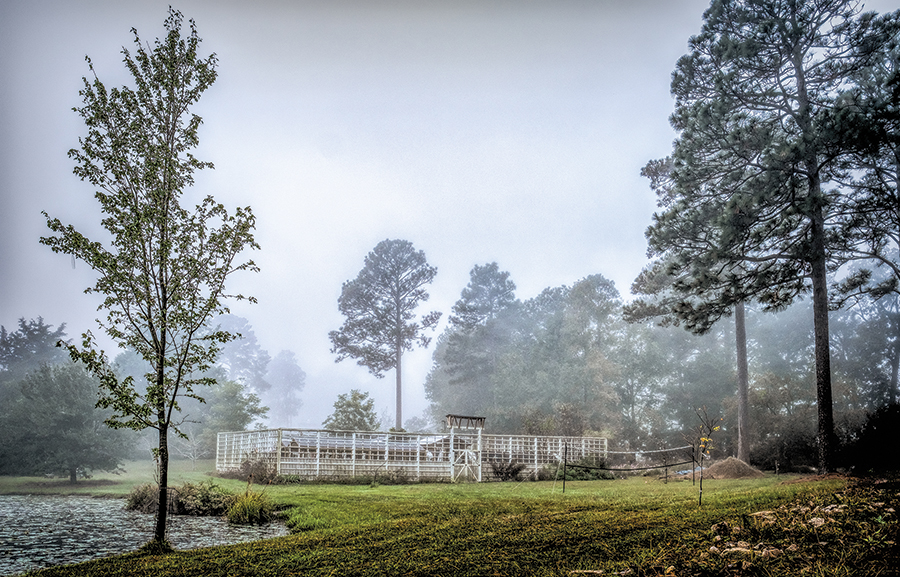
A dreamy fog lifts from the pond below, softening the profiles of the distant trees as a chorus of field crickets, grasshoppers and late summer cicadas offer a prelude to the day’s soundtrack.

It wasn’t long before we saw them, several tiny heads peering from the water on the far side of the pond. Lookouts. When her sneakers hit the dock, and they hear the call, a flotilla of three dozen pond sliders and one giant snapping turtle rush in, grabbing the fish food she tosses.

The day begins and ends with this routine at Mistletoe Farm, the 11-acre Southern Pines farm of Drs. Jeff and Lynda Acker, where even the farm’s name suggests the couple’s gentleness for all living things.

Mistletoe, Lynda’s Belgian-cross horse, was rescued from a ski resort, where she pulled a sleigh. The Ackers brought her to this farm when they relocated from Asheville.

“She was a 2,000-pound golden retriever. She’d come up behind me and lick me on the head and follow me everywhere,” Lynda recalls while tossing more food to the turtles. “We encourage everything here.”

Then, prompted by the honking of a skein of Canada geese, she points to the pasture. “There’s a straggler Muscovy duck over there, a bit of a loner. We have at least one beaver family, green and blue herons, snowy egrets, kingfishers and killdeer. Little nuthatches nest in the post,” she says, showing the spot on the dock.

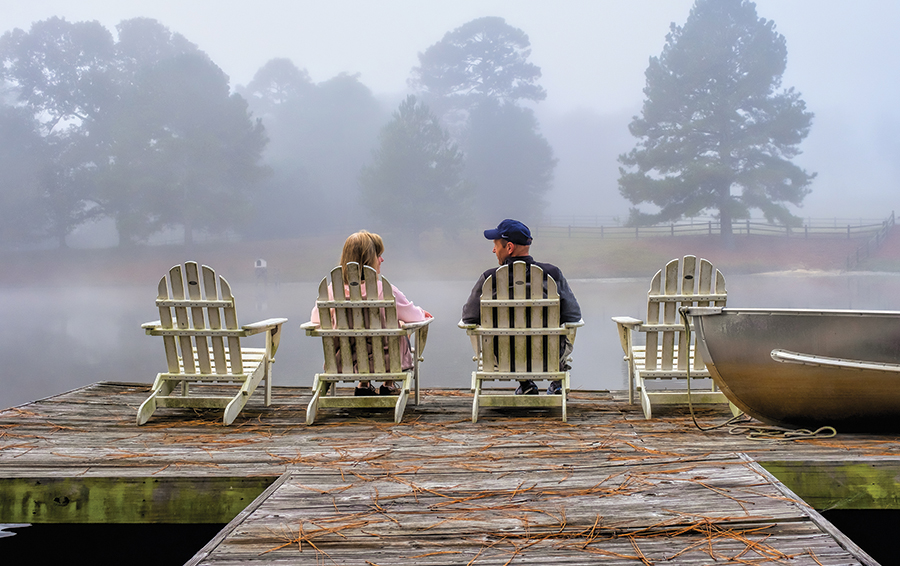
Soon, her husband, Jeff, arrives, and they grapple with the rowboat set ajar. “It’s got water in the bottom from the storm. We need to drain it,” she says. Though the sun’s up and there are chores to be done, they settle instead into weathered Adirondack chairs at the pond’s edge to enjoy morning coffee together.

When Lynda isn’t busy with farm chores, she’s often tending to serene spaces for healing and restoration. Her work includes the Healing Garden at the Clara McLean House and the Hospice Gardens at FirstHealth Hospice and Palliative Care. In addition, she’s been instrumental in developing the Native Pollinator Garden at the Village Arboretum in Pinehurst, and pollinator and ornamental gardens at The O’Neal School. Now, she’s working with a team to select the plants for two healing gardens at FirstHealth’s new cancer center in Pinehurst.
Her efforts are more than a hobbyist’s interest; she joyfully immerses herself in her endeavors. Most assume Lynda’s a botanist or etymologist because of her broad knowledge of plants and insects, specifically pollinators, but she is, at heart, a self-taught naturalist.

“I’m a biology nerd,” she says. “Sponge-like for certain topics, and my ears perk up when it’s an interesting subject.”

After obtaining a bachelor’s and master’s in biology and a Ph.D. in molecular physiology, she was awarded a MacArthur Foundation postdoctoral fellowship at Duke University. Then, she was off to the corporate world with pharmaceutical giant GlaxoSmithKline, finally founding and running a clinical documentation firm.

Though she spent years in business suits and high heels or a lab coat, Lynda says the most authentic time is when she’s out with either a shovel or fishing pole in her hand.

“My love of nature was planted, excuse the pun, very organically,” she says. Her father was a conservation officer at Chautauqua Lake, a 17-mile-long lake in western New York famous for its muskellunge (muskie), one of the largest freshwater fish native to North America. She grew up with a rescued deer fawn in their garage and a fishing pole in her hand by the age of 3. As a youngster, she ice-fished in huts on the lake with her father, along with “a bunch of Swedish men eating pickled herring and telling stories.” She had her muskie tags at 8 and, to this day, loves pickled herring.

But it’s always been the curiosities of nature that captured her attention. “I’d line up buckets in the backyard and monitor live experiments with minnows and mosquitoes,” she recalls. Her first job featured worms.

“At night, I’d go out with my white cat, Zucchini, and a flashlight to pull nightcrawlers out of the ground. I’d get two cents apiece, and Dad would steer all the fisherman my way,” she says. “I had a big box full and loved to watch them crawl.”

She also spent hours exploring the fields around their home in Chautauqua, often tunneling through the tall grasses, observing insects, then matting down a spot in the cool grass to sit, think and dream about someday going head-first into nature.
The Ackers return to Chautauqua often and spend several weeks there during the summer. Now, Lynda is a lecturer on native gardens, monarch butterflies and pollinators at Chautauqua Institution, a nonprofit education center.

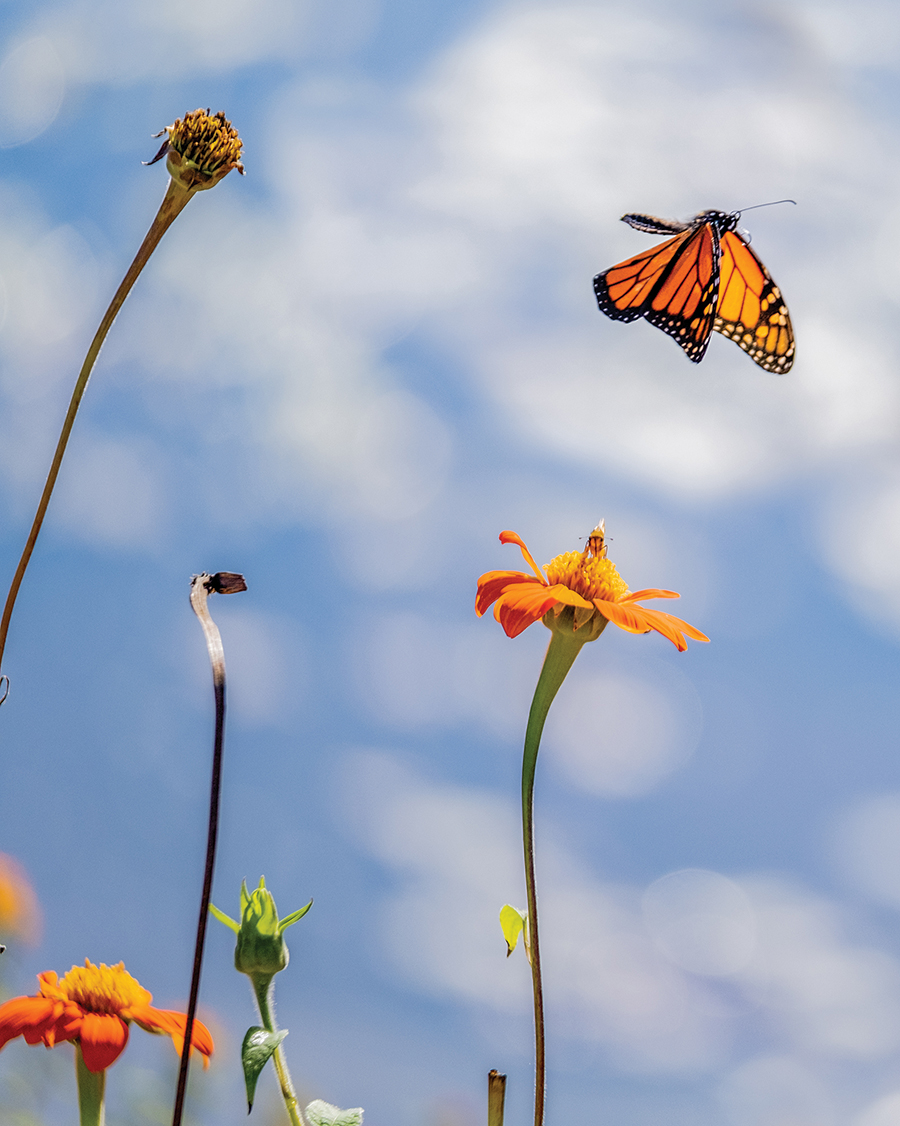
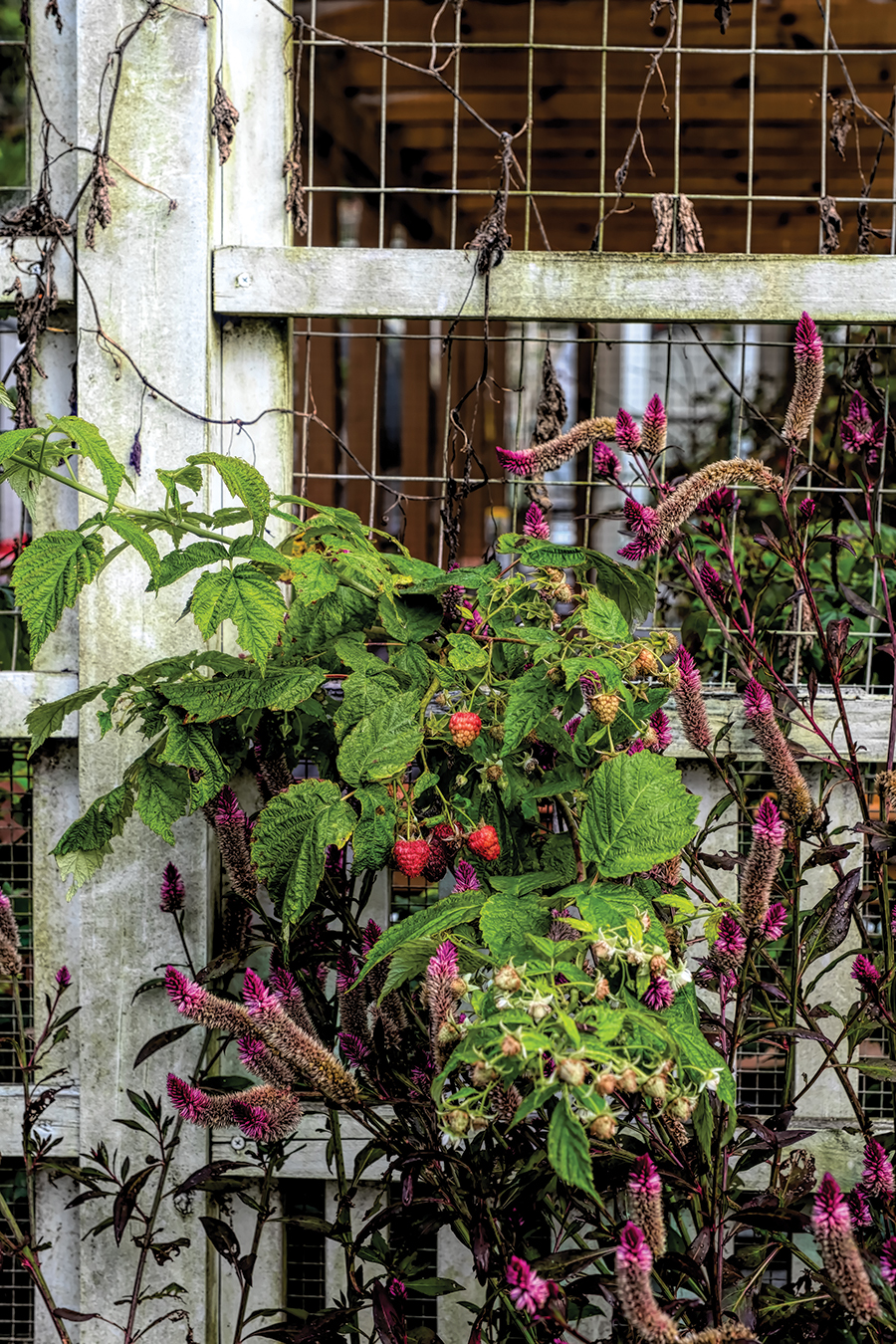
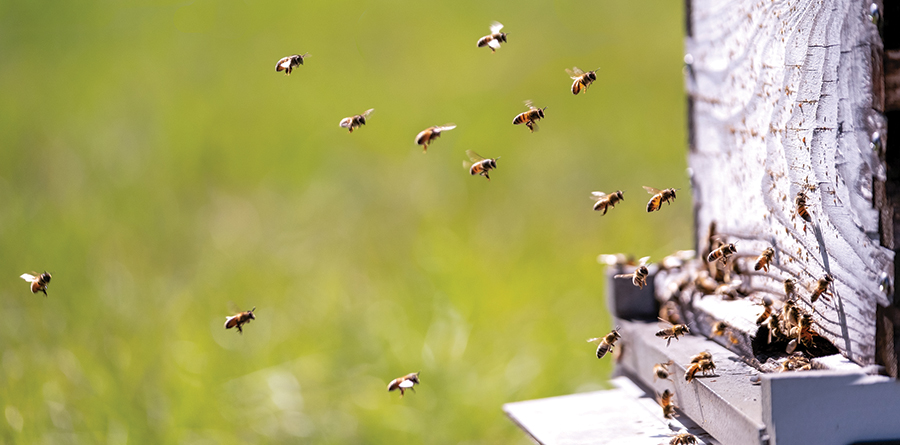
Like an alarm clock, when the sun’s rays hit the beehive, warming it, the honeybees fly. At every turn, there’s a delight. Vividly colored flowers provide nectar for the native bees and honeybees. Plump red raspberries cling to their canes, begging to drop into your mouth. And a single, peachy pink “Lady Ashe” rose, given to Lynda by the Healing Garden’s original rosarian, Bill Shore, joyfully opens to the sun.

The quiet is broken by Lynda’s high-pitched call, “Come on, chickees.” A parade of eager chickens, including Prairie Bluebells, Asian Blacks, Silkies and hefty Brahma hens, emerge from all corners. The chickens’ clucking oddly melds with the soft rock music coming from a rusty radio strapped to the fence.

“It keeps the raccoons away and helps calm the chickens,” she explains while sprinkling dried mealworms as a treat for the chickens. “The beach music on Sunday mornings is their favorite.”

The chicken enclosure and multiple hoop houses are wrapped with hardware cloth to protect them from predators. Netting stretches across the top. It keeps the hawks away from the chickens but lets the songbirds and pollinators inside. Snakes are another issue.

“They freak me,” says Lynda, wincing as she turns to husband Jeff, a radiation oncologist affiliated with Moore Regional Hospital. He handles the oft-required repairs to the enclosure and deals with predator issues, among other tasks.

“We have a lot of black snakes. When the egg count dwindles, I’ll search for it and relocate it to the other side of the pond,” he says. “Of course, it’ll find its way back.”
A tasty abundance fills the vegetable and fruit hoop houses. Tomatoes, peppers, garlic, root vegetables, beans, 20 types of herbs, and a beautiful row of celery fill the space. Organic parsley is everywhere and covered in eastern swallowtail caterpillars that favor it. It’s planted in the hoop houses to protect the caterpillars from the chickens.

“Oh, there’s an egg,” exclaims Lynda with delight, pointing to a tiny white ball on the top of a leaf. Evidence of the butterfly’s visit.

Dozens of southern highbush (Vaccinium formosum) and rabbiteye blueberry bushes (Vaccinium virgatum) flourish in two blueberry houses. When the berries ripen, walk-by grazing is encouraged.

Later, Lynda’s up on a ladder, attaching stiff mesh Japanese fruit bags to protect clusters of Concord grapes, other varieties of bunching grapes, and the regional favorite, muscadines. Though she prefers Concords, they don’t do well in our climate.

“The Chautauqua Lake area is home to Welch’s grape juice and jam. I grew up on the Concord grapes grown in the region, and they remain my favorite. The grapes in these bags are the good ones for our table,” she says. “The chickens and mockingbirds get the rest.”

Fig trees complete the garden. Both a single Brown Turkey (Ficus carica ‘Brown Turkey’) and two Celeste (Ficus carica ‘Celeste’) trees provide a sweet snack. Unfortunately, not for her.

“My bees eat them before I can,” she says while warily picking one. “Once they crack open, you don’t want to pick it. The honeybees will be in it.” Figs, she explains, are a food source for bees, and the sweet fruit significantly pumps up the bees’ honey yields.

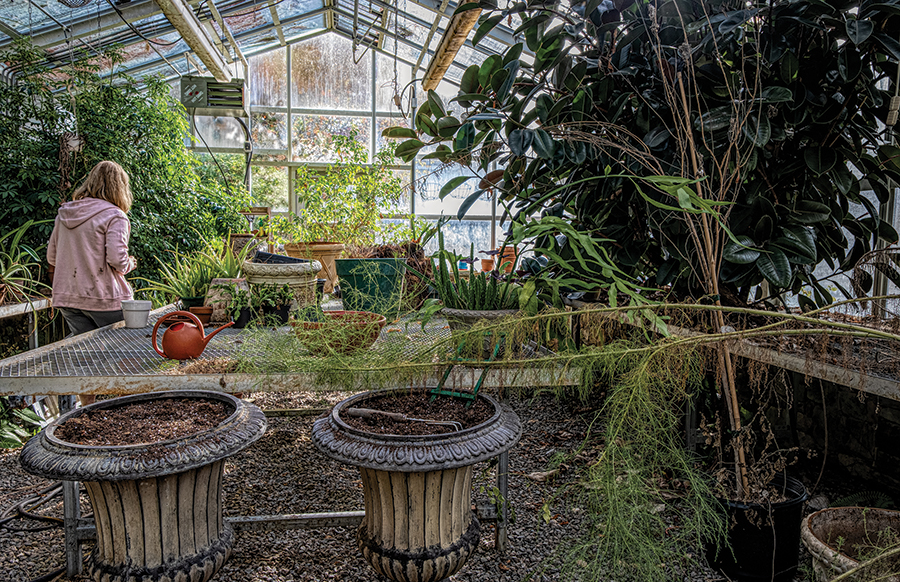
It’s a short walk up the hill where an elegant lanceleaf Japanese maple (Acer palmatum var. dissectum) graces the entry to the iron and glass greenhouse. When the Ackers built the greenhouse, they, like most, wanted a place where they could grow plants that wouldn’t normally grow here and also to extend their growing season.
For many years, it was a hub of activity. Boston ferns overwintered. They adopted massive staghorn ferns (Platycerium spp.) from friends who migrated here from Florida. An enormous schefflera made this home after starting life as a bonsai in Hawaii. And that rubber tree?

“It was a houseplant, and for some reason, it ended up in here,” explains Lynda as she looks up through the plant’s canopy, which touches the greenhouse’s ceiling. “It grew through the table and took root in the ground. We’ve cut it back several times, but it owns the place now.”

When the greenhouse was humming, Lynda added praying mantises and green lacewings to the mix to keep the pest insects down. “I’d find baby praying mantises everywhere, and it was so magical,” she recalls.

Today, the greenhouse gives the couple a quiet place to repot plants over the winter months. “There are days I’ll come out here for a dose of sunshine and peace,” says Lynda, who found it a haven during the pandemic. “I don’t know what I’d do without nature. It makes me tick. It’s always been the underpinning of my life.”

The climate in the greenhouse is perfect for Jeff to start hundreds of milkweed seedlings each winter. Most seedlings are destined for the Village Heritage Foundation’s annual spring plant sale to benefit the Native Pollinator Garden.

But the pièce de resistance is the monarch waystation habitat.

The waystation provides food and habitat for the struggling monarch butterfly population. Unfortunately, the monarch and other pollinators, like native bees and honeybees, are in a stunning decline. Scientists say it’s due to the loss of the insects’ habitat, the increased use of pesticides and herbicides, and environmental change.

Jeff’s domain is the waystation, located on the steep slope of the dam at the edge of the big pond. “I handle the planting, weeding and maintenance of this area. We don’t use any herbicides or pesticides, so it’s all done the old-fashioned way, by hand,” he says. “Planting is a process, and there aren’t shortcuts.” His shovel hits the hard ground with a thwack. “It’s solid clay, so every time I plant, I dig a big hole and fill it with good dirt. That’s why there’s a big compost pile over there.”

Though a layer of pine straw helps hold the soil moisture and keeps the weeds down, the recent addition of irrigation gives young plants a better chance to get established. “It’s also very welcome, since Jeff spent many a late afternoon roasting in nearly 100-degree heat watering the area,” adds Lynda.
The Ackers’ goal is to keep planting nectar plants and milkweed. Milkweed is the only plant on which monarchs lay their eggs, and their caterpillars feed. Last year, unfortunately, the Ackers ran out.

“Toward the end of the season, we had so many caterpillars that we had to leave many of them on the plants,” explains Jeff. If hand-raised, monarchs’ survival rate is likely to reach 80-95 percent, far exceeding the meager 2-10 percent of monarchs that survive to become butterflies in the wild.

They’ve had spotty results with common milkweed (Asclepias syriaca), the plant most people associate with the word “milkweed.” It blooms from late April until mid-May, which is suitable for the first generation of monarchs, those offspring of monarchs from Mexico hatched in the south and migrating north to lay eggs.

“The milkweed is finally getting established and running,” he says. It spreads by underground rhizomes and is better suited for large fields and pastures. Plus, the butterflies don’t favor it when there’s butterfly weed nearby.

“Butterfly weed (Asclepias tuberosa) stays small, and it will self-seed an area, so it is great in the garden,” he says. It’s also the variety he raises from seed each winter.

Showy pink swamp milkweed (Asclepias incarnata) prefers mucky or very moist soil, so they’ve planted it near the water’s edge.

In addition, there are many other types of host and nectar plants to attract a wide range of pollinator species. Some favorites include dog-toothed daisy (Helenium autumale), which puts on quite a show in late August. The heat and drought-tolerant lanceleaf coreopsis (Coreopsis lanceolata) brings a big splash of yellow. And the sweet vanilla scent of Joe-pye weed (Eutrochium purpureum) is irresistible to pollinators.

Dragonflies prefer the long-blooming purple coneflower (Echinacea purpurea) and spiky prairie blazing star (Liatris spicata) for landing sites. Ohio spiderwort (Tradescantia ohiensis) and boneset (Eupatorium perfoliatum) attract native bees.

Lynda also plants the seeds of the fluffy-plumed purple celosia (Celosia argentea), which grows tall and needs the support of the fence near the hoop houses. Delicate, poppy-like windflowers, commonly called anemones, and a bed of colorful mixed coreopsis sway in the breeze, attracting different species. But Lynda’s favorite is the brightly colored Mexican sunflower (Tithonia rotundifolia). Though it’s non-native, it’s striking and non-invasive. Its orange, zinnia-type flower is the “hands-down best bee and butterfly magnet,” she says. But it’s gangly, growing 4-to-6-feet, so best suited for the back of a border.
Mistletoe Farm is a living laboratory. Lynda’s excitement for nature is contagious, and before you know it, you’re walking softly and looking at the details.

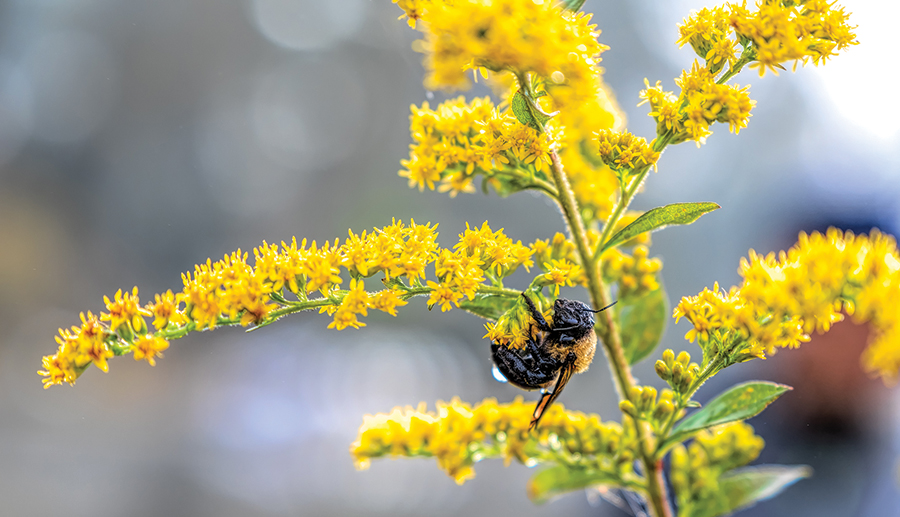
“Oh, look,” she says and points. “Here’s a native bee asleep on the goldenrod (Solidago rugosa ‘Fireworks’). It has a drop of dew on it — they are so tiny and beautiful. There are over 4,000 types of native bees. About half are in serious trouble, and many are extinct. Since all are solitary, there is not a hive to go back to, so they curl up, like this little guy, and sleep on a plant.”

Lynda explains that native bees often lay their eggs in tunnels they make in riverbanks, barren slopes, a root ball or the edge of a forest. “Those are the places people often tag as unsightly, and it is bye-bye bee habitat. Or they see a bee and spray it,” she says.

“Over there is a gorgeous dragonfly, and all the little skippers flitting around, and a moth — all so beautiful. It just makes me nuts when I see someone spraying pesticides. Look at what they’re missing. What are they thinking? Oh, I saw a bug I don’t like, so let’s kill everything.”

Lynda encourages everyone to visit a waystation for a rich learning experience. Then, plant one.

“It can be a small garden planted with some milkweed and nectar plants. Or plant fields of it. It all helps the monarchs on their journey north then back again to overwinter in Mexico,” she says. “Pollinator gardens in our backyards, parks and school gardens will help end habitat fragmentation and the loss of our pollinators. Then, we’ll have a far more viable and vibrant natural community.”

Lynda readily admits she enjoys seeing visitors in the area’s pollinator gardens.

“When I see them with their grandchildren, and they are pointing out the native plants and pollinators by name, it’s so gratifying,” she says. “They’re passing along the knowledge to our future generations, and those generations are our best hope for our planet.”

Mistletoe Farm feeds the senses with its extraordinary and complex beauty. It is not just a meadow, a pond, a vegetable garden or a waystation, but the sum of the whole — a sanctuary for all creatures, great and small.”  PS

Claudia Watson is a regular contributor to PineStraw and The Pilot. If there’s a garden that you’d like her to visit, email cwatson87@nc.rr.com.

Good Natured

A Healing Herb

And it tastes like licorice

By Karen Frye

We have so many wonderful healing herbs that help restore and maintain good health. Many of them can be grown easily and used in tea, in recipes, or in tinctures to be used medicinally. One that grows well in the Sandhills is fennel.

Fennel is a 6-foot perennial with feathery leaves and clusters of little yellow flowers. The tiny oval-shaped seeds are ribbed and greenish-gray. All the parts of the plant have a licorice-like fragrance.

You can grow fennel from seeds. If you plant them in the fall, they’re ready in spring. You don’t have to give fennel a lot of attention, and the plant doesn’t require a lot of water to survive.

The fennel seed is an effective digestive aid, particularly dealing with bloating, gas, and diarrhea. If you like the taste of licorice, you can chew a handful of seeds after a meal to help relieve indigestion, or you can drink a cup of fennel tea. Fennel is also available in capsules.

While a previous study suggests fennel should not be used by people who have any type of liver disease, more recent studies have found it beneficial for the heart. Nitrites derived from the seeds promote vascular function. The nitrites are reduced into nitric oxide, a compound that protects the heart.

Along with improved digestion, fennel can suppress the appetite. It’s helpful in promoting good function of the kidneys, liver and spleen. Fennel clears the lungs and helps reduce stomach acid. And it can ease the effects of chemotherapy and radiation treatments.

If you aren’t a fan of the licorice flavor, try the capsules. Either way, fennel isn’t expensive, and if you choose to grow your own, it only costs pennies. There are many helpful herbs and, while most have no side effects, I always recommend that if you are on any medications, you should talk to your doctor before taking a supplement.  PS

Karen Frye is the owner and founder of Nature’s Own and teaches yoga at the Bikram Yoga Studio.