Pleasures of Life Dept.

Flowers for Mama

Beauty floating in a coffee mug

By Katherine Smith

It was 3 a.m. on Mother’s Day. I was 19, driving home from a night walking through Weymouth with a certain boy my parents didn’t know about. On my lap, I balanced a bouquet of sunflowers, picked up from a 24/7 grocery store, hoping that my mom would be so delighted to discover them in the morning that she would forget to ask me where I had been.

I parked a block away from home, tiptoed down the driveway, and carefully pulled on the squeaky kitchen door. It was locked. The noise alerted my mom’s huge German shepherd, who was even more anxious than usual with my dad working out of town. Hoping to quiet Zulu before she woke everyone up, I ran around to the back porch doors, which were indeed open, and met my mom in her camo pajamas, holding a rifle. Despite my shielding myself with her favorite flowers, Mom did indeed ask me where on earth I had been.

These days, while I still often find myself driving to my parents’ house in the middle of the night, Zulu now sleeps in their closed bedroom, and I have a front door key. Somewhere between Interstate 40 and the back roads of Seagrove, I will stop to pick up flowers for my mama. Dogwood twigs, half a dozen daffodils, or a single magnolia blossom float intoxicatingly beside me in an unwashed coffee mug on the console the whole way home.

Beauty is my mom’s love language. We five kids were raised with climbing roses, azalea coves leading to white wicker dreaming chairs, beefsteak tomatoes bursting from their cages and onto our dinner plates, antique furniture refinished from someone’s roadside trash pile, and living room walls revived each year by fresh buckets of goldenrod, sienna and merlot paint. When Mom left her only home in Moore County to follow my dad to his new job in Texas a few years back, it was with wrought-iron hanging baskets of ferns, seed packets of kitchen herbs, and buttercups hand-painted on thrifted plates. We all knew Mom was terribly homesick, but she resolutely held beauty close, and it fed her straight from her senses to her marrow.

Only when I moved thousands of miles away to Alaska did I understand this necessity of homegrown beauty. All winter, I walked in circles around the garden section of Lowe’s Hardware, just for the home smell. I bought a new houseplant nearly every weekend, ordered more seeds than I’d ever be able to plant, built a growshelf from recycled shop lights, and a small greenhouse out of PVC pipe.

In the place where stark independence met the nostalgia of being cared for, I grew my first garden. Along with hardy Swiss chard and kale, I planted the marigolds I grew up with, trained sugar snap peas up willow tepees, and, against all odds, grew a few small tomatoes and jalapeños in my little greenhouse. When my first zucchini bulged from its papery yellow blossom and into my palm, my life was changed. I saw, as my mother must have years ago, that flowers are a necessary beauty, the archetype of potential, the very perpetuation of new, green, life. I saw my mother, just as she must have seen hers, in a pregnant bloom.

This Mother’s Day finds Mom and me both back in our Carolina home soil. In my small garden, I am growing up again, reared by the beauty that is my mother’s literal namesake. Motherwort spreads its bitter calm with blessed mint-family invasiveness. Matricaria chamomilla grows tall and feathery, “the herb for babies of all ages,” as my teacher likes to say. And when I get on the highway in the middle of the night to drive a few short hours into her arms, my mama no longer asks me where I’ve been. She just embraces me, as we have both learned to do with perennials on the first day of summer, and says, “I’m so glad you came.”  PS

Katherine Smith grew up swinging from ivy vines and hunting water lilies in Pinebluff, N.C. She’s returned to North Carolina to study clinical herbalism at the Eclectic School of Herbal Medicine in Lowgap, calling Ireland and Alaska home in the interim.

Hometown

Man on the Run

Life at a different pace

By Bill Fields

Wearing my orange slicker with the hood up, I must have looked like a large buoy that had escaped Long Island Sound. As I lumbered east toward the water on a chilly and rainy afternoon, my short, choppy strides weren’t earning any style points.

It was the last Sunday in March, and the inclement weather meant I had the street to myself. Social distancing amid the coronavirus pandemic wasn’t an issue. Whatever description fit what I was doing — running, jogging, slogging — moving at a pace faster than walking felt good.

This exercise was rooted in a hot afternoon last fall when I was walking near Southern Pines Golf Club on a route I used to run. A high school cross-country team appeared on my left, where they were beginning practice on the fallow Little Nine. I passed them as they stretched, but a minute later the teenagers — some in singlets, others in T-shirts but all as skinny as a young slash pine — glided past, their laughter and chatter receding as they crested a hill, leaving me to make a much slower, solitary climb.

As I continued a long walk through the Weymouth neighborhood and back to my rental car parked by Downtown Park, I surveyed my running life, meager at its apex and missing for a decade, replaced by workouts on the treadmill, climber or stationary bike at the gym.

I never was fast nor did I possess notable endurance, which explains why for many years a tiny red ribbon signifying second place in a first-grade race shared space in an envelope of Turkey Trot numbers accumulated as an adult.  I never entered anything longer than a 10K — and only a few of those to go with a larger number of the Thanksgiving Day 5-milers — and never exceeded 8 miles in a workout. Career highlight: finishing one of the Turkey Trots in 43:50 when I was in my early 40s.

But “having run” was still satisfying, a feeling of accomplishment. This was so whether the journey was from my Old West dormitory room to Gimghoul Castle in Chapel Hill to clear the head before a long night of studying; through a Georgia neighborhood on sticky summer evenings; along a windy seafront in England, wishing I’d worn another layer.

My most purposeful trips took place in the late-1990s when I set out to lose weight by running multiple laps on a nearly traffic-free perimeter road at a city park near my home. I kept at it each evening after work for months regardless of the weather, shedding pounds through my plodding routine, motivated by a fellow jogger who did his many laps wearing a headlamp at dusk and told me he had dropped 50 pounds after several years of running there.

While on a 45-minute walk in mid-March, after my gym had shut down, I remembered that guy. I turned my stroll into something more for a block or so, resumed walking, then jogged a bit more. I did this for most of a week before stepping out with a different goal — to go for a run.

I began at a shuttered restaurant that in a previous iteration had a tiny bar packed with folks after work. Later on, it was a sports-themed place with 25-cent wings on Tuesday nights, which ensured a big crowd.

It was dark, the parking lot empty as I began the first of three round-trips up a stretch of Riverside Drive, over Ash Creek and between the marsh. Others also had escaped the indoors, and we made our way giving each other a wide berth. There were as many paces as faces, some slow and some fast. I was solidly in the middle but exerting enough energy that after 25 minutes I was sweaty and winded.

On my calendar, over two weeks of canceled out-of-town work the second half of March, are times and distances denoting my new daily habit. As one month melted into the next, I was sure of very little, only that I would try to keep putting one foot in front of the other, running both for and from something.  PS

Southern Pines native Bill Fields, who writes about golf and other things, moved north in 1986 but hasn’t lost his accent. Bill can be reached at williamhfields@gmail.com.

Wine Country

It’s That Feeling You Get

Recreating those special moments

By Angela Sanchez

Ever wonder why, when you go on vacation and have a great meal or drink a new wine or try a food for the first time and you try to replicate it at home, it is never quite the same? When we visit beautiful places like Napa, California, or Tuscany, Italy, we’re in a beautiful setting, with great weather, wonderful food and wine, and people who share their hospitality and traditions. We’re transported to a place where you can’t help but feel relaxed and rested. Your mind is overtaken by scenery and stimulated by new adventures, new foods and new people. You lose stress and your mind settles down.

When we experience things from a state of calm and relaxation, and focus on detail, we get a completely different sensory experience. Our palate is heightened and opened in a way that it isn’t on a normal basis. A bite of handmade pasta with fresh, local olive oil and shaved Parmigiano-Reggiano can be a whole new experience. The pasta’s texture is softer and richer, the olive oil taste ripe and bright, and the cheese sharp and salty-sweet.

In that moment everything is at its best. The pasta was made fresh just moments before the olive oil — that was pressed just a mile away — was drizzled over it. The cheese and the accompanying glass of wine were made with longstanding traditions, carefully crafted just moments from where you sit. Your mind and body, and therefore your palate, are at their best, too.

You have traveled to a place that is not only beautiful but has a history and tradition of agriculture. The wine, cheese, olive oil, truffles and vegetables are served to you in season, at their best. It’s an unforgettable experience that, unfortunately, cannot be easily replicated. You have created a memory not unlike the feeling you get when you smell something cooking or baking at Christmas, and you’re reminded of your childhood and Grandma’s cookies, her kitchen and her spirit. It’s the feeling I get when I smell sugar cookies baking during the holidays, recalling a sweet memory of my mom and me baking for Santa. Nostalgia, peacefulness, joy.

I get a similar feeling when I recall a glass of Côtes du Rhône rosé on a warm June afternoon in France, followed by a meal of all locally sourced produce and a bottle of deep, dark red Châteauneuf-du-Pape and a three-tiered cart full of impeccable French cheese. Pure peace, heavenly flavors, fresh and ripe and set in my memory forever.

But how do we recreate these feelings? Having a glass of Chianti from Tuscany and a bowl of handmade pasta here at home is not quite the same. Same wine, same method of pasta making, same cheese and maybe even the same olive oil, but they just don’t taste as wonderful. Some things are missing. It’s the backdrop, the company, the body in relax mode.

While we may not get the Rhône Valley on a sunny afternoon or that “under the Tuscan sun” backdrop every time, we can get the cheese, wine and recreate a similar meal and experience. The key is not to rush it. Save it for a day off, when friends you haven’t seen in a long time are visiting, or your favorite aunt is coming to town. While the wine and cheese have traveled far, they are, at their core, still the same as when you experienced them in their home. If we allow ourselves to slow down and enjoy the moment while eating and drinking and reminiscing about our travels we just might recover a piece of that feeling we enjoyed so much.

Take a glass of your favorite wine from your travels — be it Sonoma, California, or Burgundy, France — and a cheese your fell in love with while you were there, and sit outside as the sun sets. Take some deep breaths, find calm and appreciate the moment. I’ll be there, too, with my glass of Champagne and Camembert on a Sunday evening with loved ones. For a moment or two, if we’re lucky, we will visit those places in our memory again.

Before long we will travel again, find a new favorite wine, a new favorite cheese, a new favorite meal — new memories to remember.  PS

Angela Sanchez owns Southern Whey, a cheese-centric specialty food store in Southern Pines, with her husband, Chris Abbey. She was in the wine industry for 20 years and lucky enough to travel the world drinking wine and eating cheese.

The Accidental Astrologer

May the Force Be With You

All things seem possible in May

By Astrid Stellanova

There’s so much to love about May: Memorial Day, Dance Like a Chicken Day and Star Wars Day.

Star Children, attention must be paid to the May born, whether Taurus or Gemini. Some May children are deeply worried, even clinically depressed. Others, unusually sunny and full of a belief in possibilities. 

Queen Victoria, John F. Kennedy, Malcolm X, George Lucas, Audrey Hepburn, Adele, Bing Crosby, Mark Zuckerberg, Bob Dylan and Janet Jackson share the same birth month. One way or another, they will get your attention.

Taurus (April 20–May 20)

This we know: You could talk to a telephone pole. Your motto in life is, “I don’t talk to strangers, so introduce yourself, Honey!” In the midst of the viral epidemic, you want to wade into the crowd and give the world a big old hug and talk. Admirable, if dangerous. Dial pals for solace if you absolutely must. 

Gemini (May 21–June 20)

Hey you, with the chip on your shoulder! Do. Not. Try. Me. Your friends and family are dying to say that, want you to get off the crazy train and remember who loves you. Love isn’t always enough, but neither is rage. Grab your chance for redemption.

Cancer (June 21–July 22)

Serial hobbyist that you are, you’re itching to build a better tree house, or make the world’s finest pizza. Well, Honey, just go full tilt boogie, because it is good to explore all creative outlets. Summer brings opportunities to learn and create.

Leo (July 23–August 22)

Fluent in the language of sarcasm, are you? Sugar Booger, it’s time to find another way to mix and mingle. You’re quick with the quip but that can be tiresome for your bestie. Listen with the same dedication and you’ll learn your nearest and dearest truly need to be heard.

Virgo (August 23–September 22)

Last month was about as fun as dropping the hair dryer into the bath water. Electrifying and horrifying. There’s still some fallout, and Darling, it must unfold before you get back to whatever normal is. Your pack is waiting for you to get past that final hurdle and find peace.

Libra (September 23–October 22)

Measure twice, cut once, Sugar Pie. Not that meticulous you need to hear such advice but in these unusual times, details must be observed, and you have been way too preoccupied.  Snap out of it, and recognize freedom from a redo by doing it right.

Scorpio (October 23–November 21)

You are the boss, Applesauce, of your life. Nobody else but you.  As stubbornly as you cling to the past, the present is right there before you with a lot of hope, light and love. Still clinging to some very old notions about who was what, when you were a younger you? Fuggedabout it. 

Sagittarius (November 22–December 21)

You are closer to catching lightning in a jar for the second time, Honey. Don’t let anything convince you that your idea isn’t worth the work and worry. You see something that not everybody has the vision to see, the mind to master it and the mouth to broadcast it. Do it!

Capricorn (December 22–January 19)

You slowed the boat and now you are nearing the season when all good things will come to You Who Waited. Patience will be rewarded. Remember, Sweet Thing, all the people who supported you on what looked like a Moon mission. They stood by. Now share the spotlight.

Aquarius (January 20–February 18)

Now you are in a particularly interesting phase of your life, caught between contemplating and cogitating — and overthinking. It’s easy for you to get stuck there, because you are seeing multiple dimensions. Resist stalling, Honey, because if your hunch is right, act!

Pisces (February 19–March 20)

Now what? You like a clear path laid out and can’t see ahead. Murkiness is just the way it is, Love Bug. Nobody is getting a marked map these days with a big X over the treasure. Yet a big part of you recognizes that the treasure isn’t hidden. It’s right there, in your own hand, within your big heart.

Aries (March 21–April 19)

There’s just something about a fire sign that makes people gather round. Aries fire can either warm or burn, and some get too close. Here’s a chance to find a balance. Not everyone needs for you to bring them a Hershey bar. Or a scolding. Try subduing that big old force field for a few days.  PS

For years, Astrid Stellanova owned and operated Curl Up and Dye Beauty Salon in the boondocks of North Carolina until arthritic fingers and her popular astrological readings provoked a new career path.

The Kitchen Garden

Peace in the Garden

The solace of double handfuls of dirt

By Jan Leitschuh

When despair for the world grows in me

and I wake in the night at the least sound

in fear of what my life and my children’s lives may be,

I go and lie down where the wood drake

rests in his beauty on the water, and the great heron feeds.

I come into the peace of wild things

who do not tax their lives with forethought

of grief. I come into the presence of still water.

And I feel above me the day-blind stars

waiting with their light. For a time

I rest in the grace of the world, and am free.

— Wendell Berry, “The Peace of Wild Things”

In April we were housebound, anxious and uncertain, perhaps bored, lonely, broke, depressed, slothful or antsy. You can’t go out and socialize over a meal or a beer with mates. The kids make working at home an oxymoron. No hugs. Fewer workouts. Your industrious neighbors or social media buds are detailing their cars, lifting weights, reaming out their closets, basement and garage, then sewing masks for hospitals before repainting the house, and you haven’t even put your pants on by lunch.

Will May bring a reprieve? Here’s hoping.

These are difficult times, with friends and neighbors falling sick or worse, losing jobs, losing business, with money worries, or working on the front lines of exposure. It is easy to “despair of the world.”

At the same time, we can observe good things. The terrible and the lovely can, and do, exist simultaneously. This pace downshift has changed my neighborhood. Parents stroll outside with their children or teach them to bicycle in the nearly empty side streets. Joggers run past, folks work in their yards, walkers smile at each other even as they give a wide berth. Couples stroll holding hands. 

And there is ample time to work in the garden. 

Personally, I find this among the most anxiety-relieving activities available. I can trowel the earth and pick though the weeds, divide the perennials and repot for later distribution to friends, prune the grapevine, trim shrubbery. For a time — a momentary eternity — I too, am able to “rest in the grace of the world, and am free.”

Plopped in a backyard awash in sunshine, I can top up my winter-depleted stores of vitamin D as I strip out the centipede grass that crept into the beds over winter, admire the daffodils and later the iris, prune the spring-blooming bushes, plant seeds. (I still might not have on proper pants, but then, our place is private.)

By putting my hands into the dirt, I find I’m able to release a myriad of distractions and anxieties, focusing on one grounded, concrete thing at a time. The world slows down. This is self-care.

Not only that, gardeners wear gloves! We wash our hands — a lot! We probably invented the elbow bump. Social distancing in the garden is a cinch. We stay home, rooted. We are a compliant lot.

The Washington Post reported that seed companies are seeing brisk business online as consumers turn to growing their own food amid the coronavirus emergency. Some half-opened seed packets at our house are 2 or 3 years old, and their germination is suspect. Yet, miraculously, here come zinnia, basil, cosmos, cucumber and sunflower shoots, spottily perhaps, but plenty for our needs. Online, I ordered some squash, eggplant and gloriosa daisy seed. Perennial herbs in the garden flushed out, supplying us with homegrown oregano, parsley, garlic, chives, mint, sage, sorrel, thyme and lemon verbena — as local as you can get.

Care to join in the garden meditation? Feeling the tug to give into the earthier rituals of spring? Find an area with a minimum of six hours of summer sunlight, with access to water. Weed out that raised bed, or till up a row and add compost, potash and lime. Perhaps your yard is landscaped, unsuitable for a vegetable garden. Yet often there is a little sunny bare spot suitable for a compact bush tomato, or a small section for herbs. A cucumber or melon vine can snake up a deck or porch railing.

Containers are also an option for those without a bit of ground. Use the richest soil you can, and add compost. Protect the side of the pots from baking, thus burning the roots. Water daily, especially when the blossoms, and then fruits, appear, or after fertilizing lightly. Beans can grow in a 5-gallon bucket, with a drilled drainage hole. Window boxes can grow a vining cherry tomato or herbs as well as flowers. A child’s old play pool is a raised bed, with proper drainage. 

For those without dirt or inclination, who still wish to participate in the fruits of the earth, good news — farm stands are allowed to be open, even during the shutdown. This is especially welcome news for lovers of Sandhills strawberries, which peak in early May.

“We’ve been getting advice from NCDA (North Carolina Department of Agriculture), the Strawberry Growers Association and the N.C. Extension specialist for strawberries and NCSU,” says local producer Billy Carter, of Eagle Springs, who has 4 acres of strawberries under cultivation. To make the process safe for both customers and farms they’re using plenty of cleaning supplies and single-use gloves for pickers, limiting contact with customers, and posting signage about staying apart.

Farmers are being innovative, employing protective measures like pre-packing tomatoes in plastic containers to avoid contamination. “You know how people love to rub a tomato,” said John Blue, of Highlanders Farm in Carthage. 

Blue grows several greenhouses of tomatoes, as well as strawberries, peaches and summer produce for his stand on N.C. 22. As for Highlanders’ strawberry U-pick operation, “We’re thinking maybe open every other row, spread people out, ask people not to come if they are sick,” said Blue. “It’s frustrating for farmers, because we don’t want anybody to get hurt. We’ll have to adapt as we go and do the best we can.”

Some producers are even learning, via video classes, how to open an online store for their farms.

And we all know that to stay healthy, we have to eat well. Like Mama always said, “Eat your vegetables . . . and get out of those pajamas!”

As the world as we knew it has been transformed, there are unmistakable little blessings everywhere. A new sense of rest and stillness, time to spend with loved ones and creative hobbies. Neighbors checking on neighbors. Getting on top of life again instead of chasing it. A deep appreciation of those in critical infrastructure jobs: medical staff, police and fire support, supply chains, as well as an extraordinary acknowledgement of those in simple front-line work such as grocery, feed and hardware store employees.

People are finding innovative ways to help and connect with each other, and an expanding joy in simpler things. People are finding enough space, for even a moment, to not “tax their lives with forethought of grief.”

A renewed appreciation of nature, and the “peace of wild things.”

There is no clarity as to what May might look like. I hope you have something tasty, or perhaps cheerful to tuck into your bit of dirt. Or, lacking that, support those who do it for a living. 

May we meet on the other side of this with dirt under our nails, wearing pants, not pajamas.  PS

Jan Leitschuh is a local gardener, avid eater of fresh produce and co-founder of Sandhills Farm to Table.

Birdwatch

Birdz in the Hood

This time of year, the ponds are full of hooded merganser

By Susan Campbell

Have you seen a male hooded merganser lately? They’re hard to miss with their extensive white hoods, black-and-white chests and chestnut sides. Or perhaps you have noticed a female — a tan bird with a stiff short tail and cinnamon crest? If you’re really lucky, maybe you’ve seen a pair courting, the preliminary dance to successful reproduction. The drake flares his crest and vigorously bobs his head, surely impressing his intended. These handsome little birds are a species of diving duck restricted to North America.  Affectionately known by birders and hunters as “hoodies,” they are quite spunky in spite of their diminutive size.

Hooded mergansers can be found statewide year-round here in North Carolina. Good numbers of migrants from farther north show up during the winter months. But by spring, pairs are more localized.  Breeding birds may turn up on small ponds anywhere from the mountains to the coast. Needing clear water for foraging, they are quite at home on beaver ponds and slow-moving backwaters of smaller rivers and streams.

With a relatively long and sharply serrated bill, hoodies excel at catching fish. These birds have what are called nictitating membranes — an adaptation that protects the eyes but still allows them to see while underwater. Even new ducklings can dive in shallow water to feed within a day of hatching. Alert birders sometimes spot hooded mergansers swimming with their heads submerged, scanning for prey below the surface.

Unlike dabbling ducks such as wood ducks (or “woodies”), hooded mergansers’ legs are set farther back on the body to facilitate propulsion while underwater. This means that they are rather awkward on land, so you will seldom see them walking or even sitting out of the water. Furthermore, these birds need a waterborne running start in order to get airborne. Once aloft, however, their short wings make them quite adept at negotiating flooded timber or grassy marshlands.

Hoodies are one of a few species of waterfowl that use cavities for nesting. Early prospecting for suitable sites begins at the end of the summer.  Females search for holes high up in either live or dead trees to deposit a clutch of up to a dozen white eggs. They prefer an opening of 3 to 5 inches across, making cavities created by larger woodpeckers ideal. Since leading their fledglings overland to water is awkward, nesting usually occurs close to the water, unlike woodies that may nest up to a quarter-mile or more inland.

These animated little birds are quite long-lived with individuals surviving 10 years or more. Furthermore, breeding productivity is quite good nowadays since hoodies have adapted to man-made boxes for nesting. Regardless, seeing hooded mergansers in the warmer months in the Sandhills or Piedmont is quite a treat indeed!  PS

Susan would love to hear from you. Send wildlife sightings and photos to susan@ncaves.com.

Reviving a Soulful Sound

A scruffy old guitar finds its voice again

By Stephen E. Smith   •   Photographs by John Koob Gessner

Ill bet

you’re nagged by a furtive longing to possess something that’s impractical. Maybe it’s Aunt Amelia’s Tiffany brooch or Granddad Ralph’s ’49 Mercury sedan. In my case, it’s always been a Stahl Style 6 guitar made by the Larson brothers of Chicago. Whatever the object, we know this: If we search long enough and can shell out the cash, we’re likely to get what we want. This is America; we invented conspicuous consumption.

Inspired by what comedian Martin Mull dubbed “The Great Folk Music Scare,” I bought my first guitar, a digit-mangling Kay archtop, in August 1961, from a pawn shop on West Street in Annapolis, Maryland. I was a rising eighth-grader and paid $15 I’d received for my birthday. Every Saturday that fall, I toted my caseless Kay to St. John’s College campus, where I sat under the last surviving Liberty Tree (on the very spot where patriots plotted the Revolution) and strummed “Goodnight, Irene” ad nauseam with five or six honest-to-God beatniks. On one of those cool autumn afternoons, a Maynard G. Krebs character handed me his guitar and said, “Here, give this a try.”

I strummed a G chord, one of the three I’d mastered. “Wow!” I said.

The proud owner beamed. “Plays like silk and chimes, like a chorus of seraphim,” he said.

“What kind of guitar is this?” I asked.

“It’s a Stahl 6,” he replied.
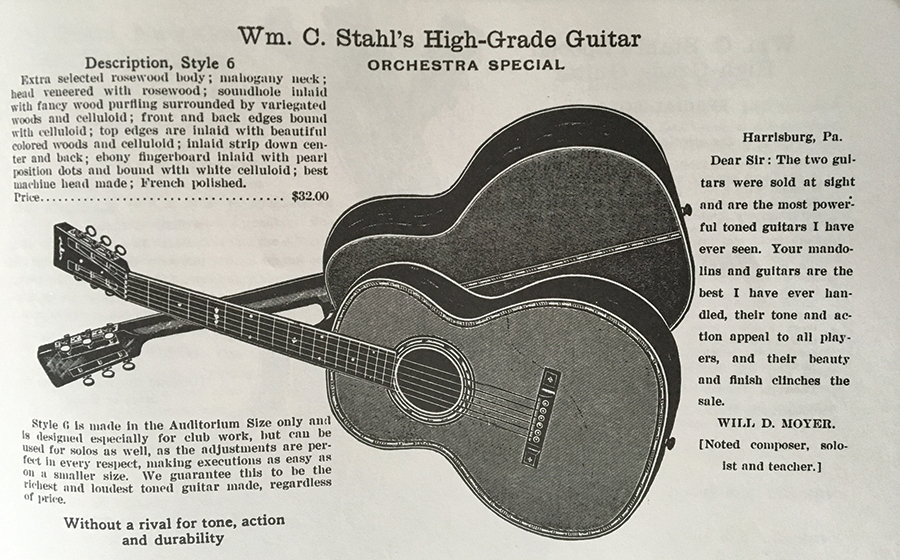
When I got home, I had to look up “seraphim” in the dictionary, but I knew in my bones what a Stahl guitar was.

For most of the 60-plus years that have slipped by since that autumn afternoon, I never happened upon a Stahl Style 6 I could afford. If I were a more accomplished player, I might have been willing to shell out $7,000 to $14,000 for a pristine original-condition Stahl, but alas . . . 

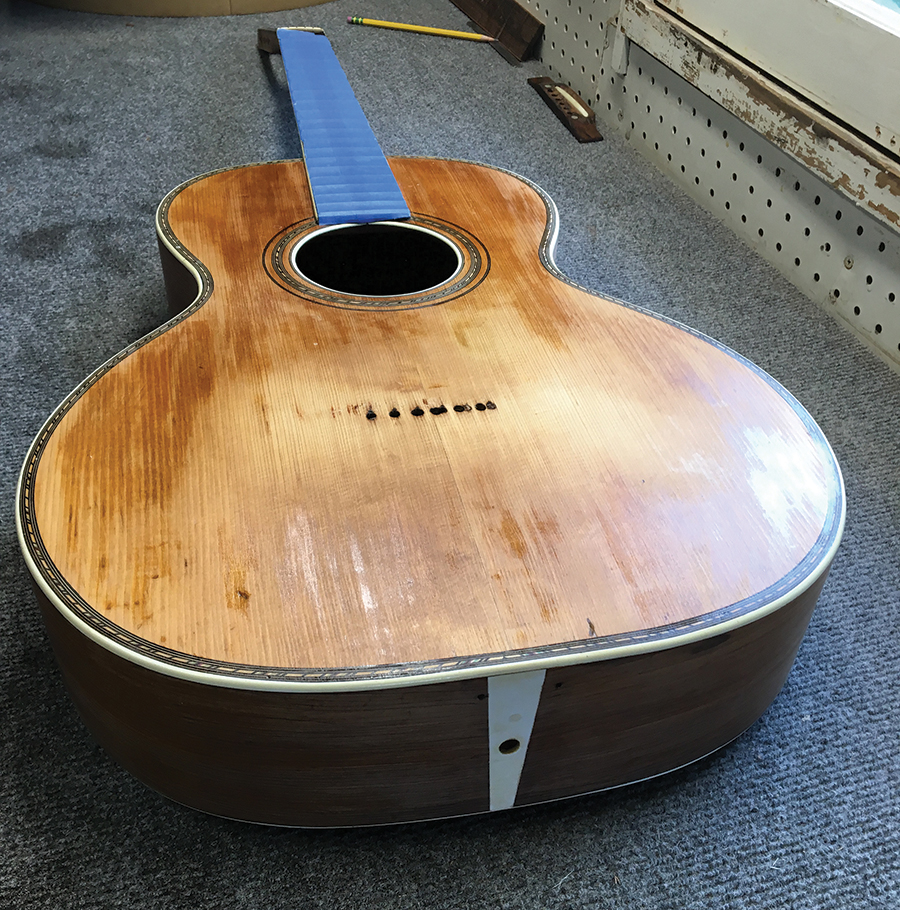
And then, eight months ago, a Stahl Style 6 materialized on my computer screen — and it was for sale at a reasonable price! The rub: It was in sad — very sad — condition. The seller listed it as “Non Functioning,” noting that the Stahl was a “Luthier Project” afflicted with a “Non Original Bridge, Non Original Tuners, No Pins, Back Cracks with washboarding” — and an all-too-ominous caution that the guitar would need “some finish work.” But the center strip was clearly branded “WM. G. STAHL/MAKER/MILWAUKEE” (a lie, since the guitar was made in Chicago by the Larson brothers) and 95 percent of the instrument was there.

I asked the seller a few pointed questions, made a reasonable offer, and PayPaled him the money. Four days later the UPS man delivered a big box that I ripped into with, I admit, adolescent gusto.

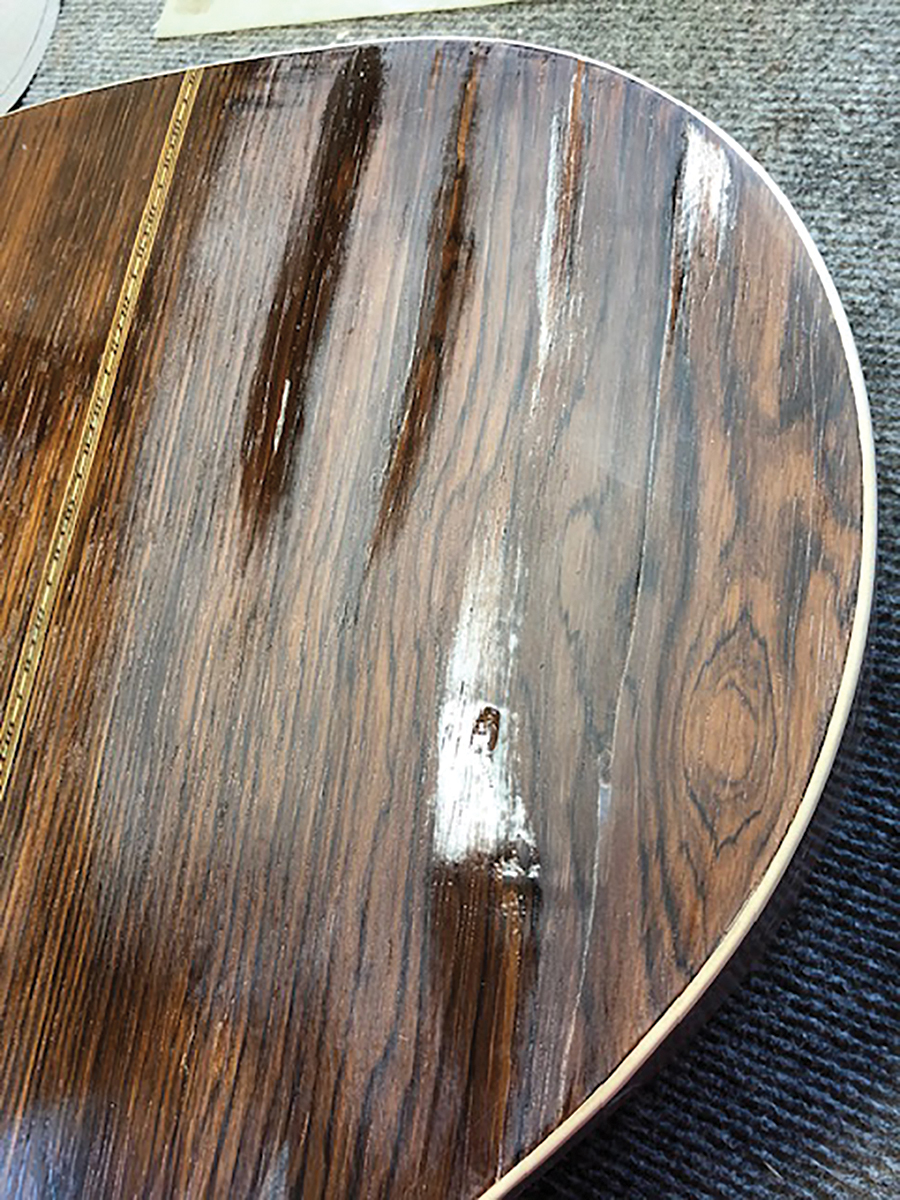
At this point in the typical restoration epic, buyer’s remorse sets in. What have I gotten myself into? the new owner asks. But I wasn’t in the least bothered by the Stahl’s condition — not at first. The seller had been reasonably honest — everything he said was wrong was wrong — but with each careful inspection I noticed flaws he’d failed to mention. The fingerboard extension was bent — not broken, thank goodness, but obviously sigogglin — the bridge (which anchors the strings to the body) wasn’t a correct Larson brothers’ flattened pyramid type and it was glued in the wrong location, the peghead overlay was damaged, the frets needed attention, binding was missing at the bottom of the fingerboard, the 3-on-plate Kluson knockoff tuners were flat-out annoying — and worst of all, some idiot with a paint roller had applied two gallons of runny gloppy gooey polyurethane or other superfluous substance to the guitar’s body, the front, back and sides. And that didn’t include earlier overspray of shellac, lacquer and varnish that had melted into the polyurethane — a deal-breaker for any vintage guitar collector, since original finishes are necessary to produce the instrument’s authentic sound.

 

Collectors argue endlessly about original finishes vs. restored. You’ve probably seen those Picker guys on the History Channel who love “rusty gold” and “the look” or the erudite appraiser on Antiques Roadshow who says, “In original condition this Philadelphia dressing table would be worth half a million dollars but since you refinished it, it’s worth seventy-five bucks. Maybe.” And that’s how it is with vintage guitars. But I’m not a vintage guitar collector. I simply wanted to play the guitar, and to do that I needed to have the polyurethane removed.

Poly finishes dampen sound and I had a lot of it on the Stahl, which meant that the guitar had reached a point in its checkered life where it was up or out. I might have relisted it on an auction site and gotten my money back, but I was determined not to sell or trash my latest acquisition. I was in possession of a rare Larson brothers Stahl Style 6 serial number 27022 (a numeral not based on production numbers), which meant the instrument was 100 years old! Who knows where it had been and the stories it could tell? Guitars, like their owners, have their own DNA and quirky personalities.

How valuable are Larson instruments? Consider this: A 1937 Larson-built Euphonon dreadnought recently listed on the Reverb for $64,500. Ouch! (If you’re interested in Larson instruments, I suggest you read The Larson Brothers’ Creations, by Robert Carl Hartman, or John Thomas’ excellent article in issue #15 of Fretboard Journal.)

What I needed was someone — the right someone — to save my Stahl Style 6. I’d heard that it’s possible, under unique circumstances, to remove a secondary finish while preserving the original surface. I got on the phone and chatted with luthiers in Wilmington, the Raleigh-Durham area, Charlotte and the Triad, and settled on Bob Rigaud (pronounced “rego”) in Greensboro.

Bob is a world-class builder, a luthier whose guitars are comparable to those of the Larsons. Seven years ago, he built for me a New Moon koa tenor ukulele, a high-quality, handmade instrument that sings with a surprisingly mellow, resonant voice, and he’s supplied instruments for many A-list performers, most recently Graham Nash, who travels with his Rigaud parlor guitar and uses it to compose new music.
More importantly, Bob has a reputation as a superlative repairman. A few years ago, “Steady-Rollin” Bob Margolin, Muddy Waters’ longtime sideman, stopped in Bob’s shop to have an old Gibson L-00 repaired. I was curious about Margolin’s experience with Bob, so I emailed him. He replied: “Bob fixed my mid-’30s Gibson L-00. He checked it out and knew exactly what to do. He told me the guitar would come back better than I could imagine and it did. Big admiration for Bob.” Margolin was so impressed with the sound of his Gibson, he went directly to a studio and recorded the CD This Guitar and Tonight, a ragged, in-your-face acoustic outing in which the old L-00 vibrates like the blues bucket it is.

Bob had also repaired two of my guitars, one a Larson-built student-grade Maurer that required delicate finish work, which he accomplished flawlessly. He also sealed multiple cracks, back and front, and made them disappear. Better yet, he left most of the original French polish intact.

So in late May I drove to Greensboro and handed my Stahl to Bob. He was busily at work on three new guitars — always his first passion — but his face brightened as his eyes ran over the damage wrought on my Larson by time and abuse.

“I can fix this,” Bob said. “I can make it sing again.”

Bob Rigaud is possessed of a gregariousness purely borne of enthusiasm. His life is guitars, and he delights in every aspect of building and repairing instruments and hearing them sing. We sat in his modest workshop and talked for two hours. His hands fluttered like birdwings as he pointed out myriad flaws I’d failed to notice and explained in detail how he’d approach correcting each imperfection.

“Can you fix the finish problems and make the washboarding and back cracks disappear?” I asked.

He was uncharacteristically succinct. “I can,” he said, smiling.

The Stahl was in his hands.

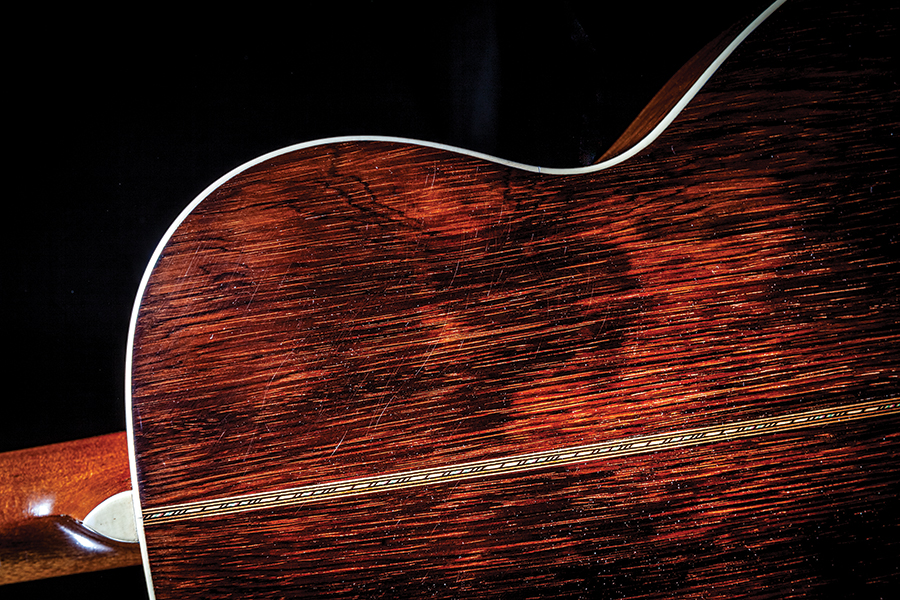
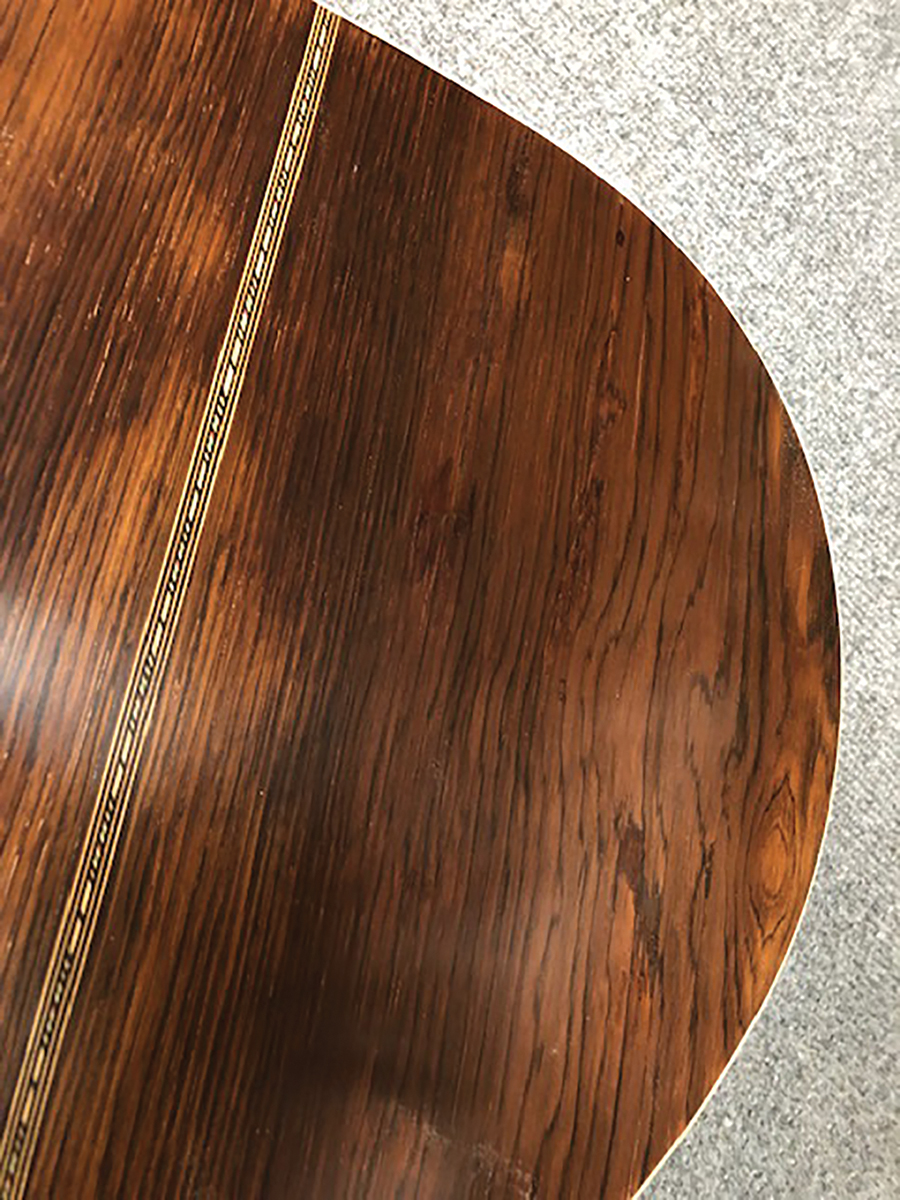
Brimming with faith and high hopes, I drove back to Southern Pines and waited. And waited. June came and went. On the last Saturday in July, I traveled from High Point to Bob’s workshop to check out the progress he’d made on my guitar. The old Stahl was laid out like a cadaver on his workbench, the fingerboard taped off. And miracle of miracles, most of the poly finish had been removed and much of the original French polish seemed to be intact. The washboarding was gone without a trace, as were the many back cracks and a small hole I’d somehow overlooked. The once-mangled Brazilian rosewood back had been restored to its original glory.

“How did you repair the back so perfectly?” I asked.

“I flattened the wood and sealed the cracks with an epoxy I tinted with rosewood sawdust.”

But there was still much work to complete, including the peghead overlay, the replacement bridge, and the angle problems with the fingerboard extension. I left satisfied but anxious to have the Stahl back home.

August, September, October and November passed, and I was content to have Bob work at his own speed. But in early December, my friend Craig Fuller of Pure Prairie League and Little Feat fame drove me to Bob’s workshop. Bob, always the perfect host, showed us the guitars he was building, and Craig and I examined the Stahl in detail. It was close to being complete: a new, handcrafted bridge with inlays was temporarily applied, a beautiful peghead overlay was in place, and new Stewmac Golden Age reproduction tuners were installed, but the frets still needed work and touch-up finishing was left to accomplish. I’d hoped that Craig, who’s played more guitars better than I ever will, might try out the completed Stahl and give me his opinion, but Bob was still struggling to correct the intonation, the key to ensuring that a guitar sounds as good as it possibly can.

“I’ve never repaired a Larson guitar that had the correct intonation,” Bob observed.

On January 22, 2020 my phone rang; the Stahl was ready for me to take possession. “I’m proud of it,” Bob said.

I stepped into his workshop at 9:30 the following morning. And there it was, my 1920 Larson brothers Stahl Style 6 guitar resurrected. I picked it up, strummed a fat G chord and felt an instant synaptic connection: I remembered the sweet sound — the sustain, the purity of voice — that had amazed me all those years before. It played like silk and chimed like a chorus of seraphim. It had the mojo and “the look.” Bob smiled but said nothing. He didn’t need to. He absolutely understood how I felt. He was feeling it too.

“I loved working on this guitar,” Bob said. “When I was regluing the internal braces — which, by the way, are all maple, not spruce — I could see evidence of August Larson’s work, and I felt like I was having a conversation with him all these years later. A hundred years from now maybe some other luthier working on this guitar will be having a conversation with me.”

“You don’t have to reveal any trade secrets,” I said, “but how did you save so much of the original finish?”

“Sense of smell,” Bob explained. “As I take down the finishes, I can smell them and after all these years of working on guitars, I can pretty much tell you what the finish is and when it was applied. When I got to the French polish, it gave off a very distinct smell. That’s when I stopped.”


Great luthiers are the real guitar heroes.

I play the Stahl every day now. It’s my musical soul mate. I know I’ll never be a great musician. And that’s fine. The process of learning guitar continues to unfold for me. I like it that way.

Was resurrecting the Stahl worth the time, money and effort? Was it merely an attempt to recapture my youth? What I can tell you is that my Larson guitar testifies that a tradition honored 100 years ago is adhered to still with patience and pride. I’ll be passing the Stahl along someday, and isn’t the past always present in the hope we have in the future?

My Stahl Style 6 sits in my guitar room next to a Liberty Tree guitar made from the wood of the tulip poplar I sat under on St. John’s campus all those years ago. Hurricane Floyd roared through Annapolis in 1999 and fatally damaged the 400-year-old tree. Taylor guitars purchased the wood and built 400 fancy instruments. It’s strikes me as wholly appropriate that my Stahl and the Liberty Tree sit side by side.

After all, something so complete has a beauty all its own.  PS

Simple Life

Simple Small Places

And how they produce some of life’s greatest moments

By Jim Dodson

Marcus Tullius Cicero, the famous Roman philosopher and statesman, once observed that all he needed to live was a good library and his garden. I’m beginning to know what he was talking about.

In a world where life as we knew it outside home has largely come to a standstill, familiar people and places that provide a measure of comfort and sense of normality are more important than ever. 

In my own narrowed sphere, I am fortunate to have a home library and garden where I can find useful diversion, fresh perspective and life more or less unchanged. As any reader knows, a good library can transport you anywhere in the world you’d care to go without leaving your comfortable armchair. And a garden keeps on growing regardless of the day’s news. 

Before it became a library, the small room that leads to the large screened porch out back was where our house’s previous owner, Mama Meryl Corry, spent most of her days during the final years of her life. Her late husband, Al, was a larger-than-life character and a gifted contractor who built a number of the first houses in our postwar neighborhood, including, in 1951, his own dream house for Meryl and their four children. It’s a cozy brick-and-wood bungalow that looks more like the private retreat of a Hollywood starlet than a Carolina housewife and mother.

In fact, Mama Meryl was both — at least in the opinion of a kid who grew up two doors from the Corrys but was always in and out of their house with their two youngest sons, Craig and Britt.  At a time when preteen boys begin to notice such things, Craig Corry and I maintained that we had the best-looking moms in the neighborhood. Meryl was a statuesque beauty with flowing auburn hair who looked a lot like filmdom’s leading lady Maureen O’Hara. My mom was diminutive and blond, a former beauty queen from Maryland who could have been Doris Day’s kid sister. Not surprisingly they were best friends, their alliance forged by the noisy abundance of boys underfoot.

Several years ago, as if by the sweet hand of Providence, Mama Meryl passed on and the Corrys reluctantly placed their family home on the market, just as my wife Wendy and I happened along in search of our own perfect house in which to grow old. We purchased the place within a week. The Corrys were delighted. To this day, you could never convince me that Mama Meryl and Big Al, wherever they relocated, didn’t have some say in the matter.

During the first two years we were updating and renovating rooms, the one space that proved to be a puzzlement was the small room with a fireplace that connected the dining room to the large screened porch in back — the same room where Mama Meryl spent most of her time after Al was gone. From oldest son, Chris, I learned that the space was originally an outdoor patio with a fireplace — another California touch. Al enclosed it for a cozy reading room featuring an entry door at the rear of the carport, allowing easier access and a good view of the arriving postman. 

Sometime during our second spring in the house, as I turned my attention to tearing apart and rebuilding Mama Meryl’s overgrown gardens, it suddenly hit me that the room was ideal for a home library like the one I had for two decades in Maine.

Earlier this year, we completed work on the library, providing space for 500 or so books in custom-built maple bookcases, with new gallery lighting, original artwork, vintage rugs, a handsome antique walnut writing table and five comfortable chairs suitable for any and all sort of visitors, including spirits.

In ancient times and in every culture, libraries and gardens were considered sacred places that nurtured the human spirit. The Great Library of Alexandria in Egypt was considered the spiritual wonder of the world, housing the writings of Aristotle, Plato and Socrates, and many others — until, after years of decay, Julius Caesar was blamed for burning it down. Jesus spent his last night on Earth praying in a garden and, of course, Adam and Eve were reportedly invited to leave one dressed in fig leaves for violating property rules. 

I’m pretty sure Mama Meryl approves of how I’ve updated her garden and reading room, evidenced by the fact that I can almost feel her presence in both places.

With nobody but the dogs and me likely to occupy my library’s armchairs for the foreseeable future, I’ve lately taken to inviting the spirits of well-loved authors who anchor my bookshelves to come sit for a spell in a chair of their choosing. 

As Mama Meryl hovers approvingly, methinks Walker Percy prefers the houndstooth club chair while — naturally — Joseph Campbell fancies the mythic oak chair with Egyptian carved heads. Mary Oliver lounges in the elegant red Deacons chair where Annie Dillard often sits, and the big comfy wicker number is rightly claimed by my friend Elwyn Brooks White, whose iconic children’s books (Stuart Little, Charlotte’s Web) and collections of essays shaped my views on life and writing from age 6 onward. They inspired me to chase a career in which I’ve wound up eating my own words — or at least living off them.

At times like these, E.B. White’s Pulitzer Prize-winning essays, letters and other works have traveled with me since the year I graduated college, and are a tonic for the captive soul.

Particularly endearing is his essay, “Death of a Pig,” which details the author’s struggles to save an ailing pig and make peace with his own grief.  After burying his pig beneath a wild apple tree with his rambunctious dog Fred in attendance, White confides: “I have written this account in penitence and grief, as a man who failed to raise his pig . . . The grave in the woods is unmarked, but Fred can direct the mourner to it unerringly and with immense good will, and I know he and I shall often revisit it, singly and together, in seasons of reflection and despair, on flagless memorial days of our own choosing.”

White and his wife, Katherine, lived on a saltwater farm in North Brooklin, Maine, an hour or so up the road from where my first wife and I lived after we married in 1985 — four days after my favorite author passed away.

I never got to meet him, though an unlikely connection unexpectedly came my way through the garden.

Upon learning that Wendy and I planned to move home to North Carolina in the winter of 2007, an elderly friend who claimed to be friendly with Katherine White gave me a remarkable going away gift — a clump of white Italian coneflowers she claimed originated in the garden of Katherine White.

Remarkably, the flowers made it through a succession of long-distance moves and careful transplantings, faithfully returning spring after spring for more than a decade.

Ironically, our last move home to the Corry house proved to be the undoing of my well-traveled coneflowers. Perhaps their uprooting in late summer and the idea of making it to another spring was simply too much for them to contemplate.

In any case, I think about those coneflowers from time to time, usually when I’m resting with a cool beverage in an old wooden chair after a day of work in the garden, my other sacred sanctuary in the time of coronavirus.

From the depths of that old chair, I find it reassuring to study the stars before dawn and while the birds of late afternoon are dive-bombing the feeders as the last light falls like a benediction over the yard.

Certain questions, for the moment at least, remain unanswered. For example, I shall probably never know if those handsome white coneflowers really came from Katherine White’s garden, though I like to think that they did. Their message is clear. 

“To live in this world,” advises my friend the poet Mary Oliver from her grand red chair in the library, “you must be able to do three things. To love what is mortal; to hold it against your bones knowing your own life depends upon it; and when it comes time to let it go, to let it go.”

Mama Meryl knew this. I suppose I’m finally learning it, too.

Someday this house will pass into other hands and the books of my fine home library will be boxed up and donated to the annual church auction or carted off to the community book sale.

Likewise, without me around to keep it trimmed and tidy, my garden will likely overrun its borders and spread into places it was never meant to go, a disordered Eden that may prompt the new homeowner to hack it down without a trace.

But for now, like long-gone Cicero before me, these are the simple small places where I seek and find whatever there is for present comfort during these flagless memorial days — from books that still let me roam the world to a garden where, I noticed just yesterday, the bluebirds have returned for the third year in a row to start a new family — a sign that life always begins again  PS

Contact Editor Jim Dodson at jim@thepilot.com.

Papadaddy’s Mindfield

Outdoors Is Not Closed

A gift that amazes the child in all of us

By Clyde Edgerton

I’m writing these words in late March 2020.

My gentle editor recently told me that the Salt magazine theme for May’s issue would be “the outdoors.” I took a walk to think about how to write about that subject during these dark times.

More people are taking walks, riding bicycles — missing beaches and closed parks. I can only guess at how things will be in early May, when you are (now) reading these words. It does not seem far-fetched to guess that, by then, you or I — or both of us — will have lost people we knew, and perhaps loved. I know of no time since World War II during which I could have said that.

On my walk, I notice a wisteria vine behind a neighbor’s house. I think about how, unchecked, it will begin to take over bushes, shrubs, trees — a nuisance vine. But the beauty of its blossom may counter that, depending on your relationship to the vine; that is, if it’s growing in the woods you can admire it, but in your yard it may become invasive and unwelcomed. The reason I notice the vine on this walk is because late March and early April are days of Wilmington’s wisteria blooming — light purple — for its three- or four-week colorful span.

I rarely, if ever, see a wisteria vine without remembering a particular wisteria vine. My mother remembered it being planted in about 1915 at the base of a trellis in her grandmother’s backyard. That would have been three years before the Spanish flu epidemic. Twenty-one years later, in 1936, the federal government bought 5,000 acres in the vicinity of the homeplace, where the vine grew on its trellis, and offered it to the state of North Carolina for a dollar, with the understanding that the acreage would become a recreational site. The site became the William B. Umstead State Park, situated between Raleigh and Durham. Graveyards, as well as stone and glass remnants of an entire community, can still be found near trails and streams.

The wisteria vine planted by my grandmother survived the land transfer, and once every year for the past 70 years or so, I’ve helped family members clean the family graveyard near the site of the homeplace. By the 1950s, the wisteria vine began taking over wild shrubs and pine trees around the graveyard, and for a while in the early ’80s it arched magnificently over a dirt road that ran through the park. This memory of it in bloom, reaching up into and over pine trees, and over the road, is unforgettable. Park rangers painstakingly extinguished the vine in the 1990s. Sadly, in my view.

My guess is that you remember an outdoor childhood spot — near a certain tree, or creek or hillside. Perhaps there was a path that led to a secret place. While outdoors interests adults, it often amazes children. When did you last climb a tree?

In a sense, outdoors is childhood. And outdoors is a gift, like a sense of humor, like strong relationships with people we like and love. Gifts. Not acquisitions growing from what we don’t need.

Granted, we need toilet paper, but it’s not free.

Outdoors is free.  PS

Clyde Edgerton is the author of 10 novels, a memoir and most recently, Papadaddy’s Book for New Fathers. He is the Thomas S. Kenan III Distinguished Professor of Creative Writing at UNCW.

Southwords

What’s a Drop Cloth?

(And why on earth would you ever want one?)

By Jim Moriarty

In 6 Jimmy Breslin, the famous New York columnist and author, ran for the president of the city council with his buddy, Norman Mailer, who was campaigning for the office of mayor. Their insurgent platform — hey, it was still the ’60s — was that the boroughs of the Big Apple should secede from the remainder of the state. As it turned out, this proposition was not looked upon favorably by the general population and the Mailer/Breslin ticket was crushed at the polls. In a rather terse concession speech Breslin said that his everlasting regret was that he was “mortified to have taken part in a process that required bars to be closed.”

In our most recent — or, God forbid, current — situation, I find myself in complete agreement. My own pub, which I affectionately refer to as the Bitter and Twisted, was long ago deemed nonessential. While the finer points of that opinion may be a personal matter of some dispute, there is no getting around the fact that I’d have been better off if the governor had extended his catalog of places to avoid to include Lowe’s Home Improvement.

For some reason my wife, the War Department, got it in her mind that since the hours previously occupied by the Bitter and Twisted had now been “freed up” — her words, I’m afraid — this would be a grand time to paint the living room. To my untrained eye the living room looked just fine. In fact, I was just getting used to it. A cobweb here and there. Maybe a nick or two from the time she thought it was a good idea for me to move the furniture about like a game of shuffleboard. And, I’ll grant you, there are the extra holes — generally falling into the three-to-seven range — required for me to hang any picture. They’re hidden, of course, though we all know where they are. More obvious are the scratches where the Alaskan malamute, owned by some boy my daughter dated for 15 minutes in high school (she’s now 43), carved out of the side door like Freddy Krueger. It’s not that I’m opposed to change, per se. But why fix something that’s not broken or that, at the very least, is bound to require a great deal of, well, doing something?

And I’m not handy. I’m not just not handy, I’m religiously so. I’ve spent a lifetime taking every precaution to ensure that I know virtually nothing about anything that could reasonably be considered useful. If I actually had to fix a toilet, it would only be a matter of days before we had to move. And, having once attained a reputation for a high degree of ignorance around the house, you don’t want to throw that sort of thing away willy-nilly on something as mundane as a living room that really wasn’t all that bad, as long as you sort of keep the lights dimmed.

She, on the other hand, seemed convinced that new paint jobs ought not be a once in a generation phenomenon. So, off to Lowe’s we go. According to the War Department, buried somewhere in what I’ve been told is a utility shed, we did have some old brushes and whatnot that had last been used to make cave paintings, so it wasn’t as though we were in the market for the whole kit.

I’m not saying there are a lot of people who know as little as I do, but it did seem as though there were an awful lot of folks who had the same idea my wife did, vis-à-vis idle time. Myself, I’d have been perfectly happy to socially distance my ass right back home. Instead, we looked at chips. Color, not potato. “Which do you like,” she asked, “the Drizzled Berry Hibiscus or the Uggs Mocha?” People can hold very strong opinions about such things, so I looked off toward the hardware lubricants and mumbled, “Ugh.” And she said, “Uggs it is.”

And that’s how the living room, using a technique that can best be described as Jackson Pollock Meets The Three Stooges, turned brown. On the plus side, as all fans of Ocean’s Eleven know well, taupe is very soothing.  PS

Jim Moriarty is the Senior Editor of PineStraw and can be reached at jjmpinestraw@gmail.com.