Drinking with Writers

Full Circle

In praise of the underdog, screenwriter Nick Basta takes on the charmed life of legend Yogi Berra

By Wiley Cash     Photographs by Mallory Cash

In the fourth grade, Nick Basta loved two things: Yankees baseball and making his buddies laugh. While he enjoyed being on the diamond, he caught the acting bug when he made his friends laugh by impersonating the woman in the Enjoli perfume commercial (“I can bring home the bacon/Fry it up in a pan.”).

Flash-forward a few decades and he is walking the red carpet alongside movie stars like Cynthia Arivo and Janelle Monáe. “I started out just wanting to make people laugh, to make them feel good,” Nick says. “And I kept going.”

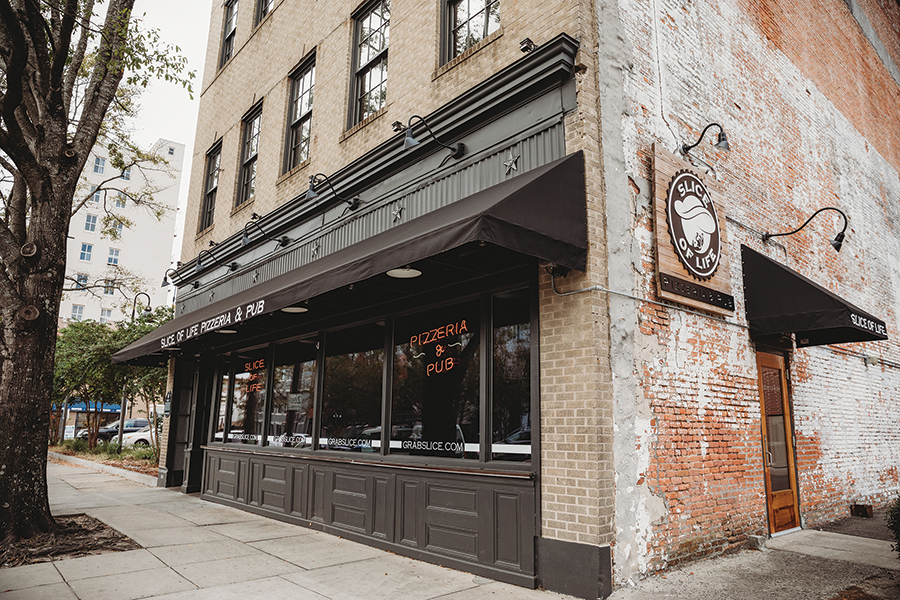
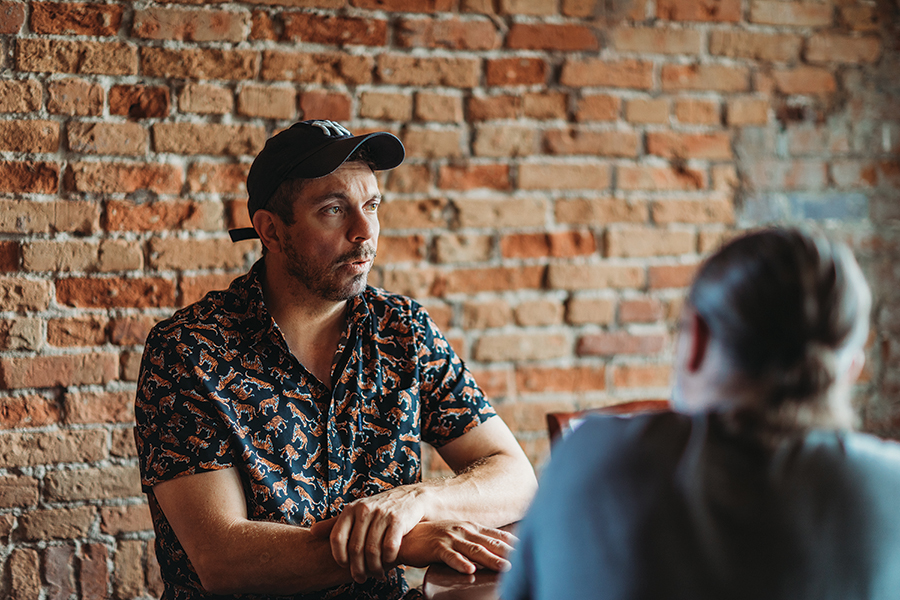
Nick has kept going over the years, and he is a long way from the snickers of his fellow Catholic schoolboys back in upstate New York. We are sitting at a corner table at Slice of Life in downtown Wilmington, drinking Pinner IPAs and eating pizza in the middle of a Monday afternoon when Nick lists all the cities where he has lived and worked over the years: New Orleans, Boston, New York, Wilmington, places just as diverse as his acting roles, but in each city Nick has managed to carve out a career on stage and on the screen.

He attended college at SUNY Alfred, where he majored in ceramics and where acting kept getting in the way. He appeared in plays like Our Town and worked with an improv group. After college he moved to New Orleans to pursue a music career, but the stage called him there too. He met his wife, Joey, when they appeared opposite one another in a play titled Once in a Lifetime.

“Was it scandalous?” I ask. “The two leads meeting on set, dating, getting married?”

Nick laughs. “No, it wasn’t scandalous,” he says. “Nobody noticed. There were 25 people in the cast, and some nights there weren’t even that many people in the audience.”

He found his way to the big screen in New Orleans as well, and he received his Screen Actors’ Guild card after a speaking part in his first feature film, Tempted, starring Burt Reynolds.
Ceramics, music: Nick had done his best to pursue something other than acting, but now he decided to focus on it. He and Joey moved north to Boston, where he enrolled at Harvard.

“What was it like being in acting school after being on the stage for so many years?” I ask. Nick smiles, takes a sip of his beer.

“It was the hardest thing I’d ever done,” he says. “Seventy hours a week of speech, movement, Shakespeare, appearing in several shows at once.” He pauses for a moment as if recalling the grueling years of graduate school. “At least it was the hardest thing I’d ever done until I moved to New York City.”

After six years in New York, where Nick worked as an actor and Joey worked as an agent, they decided to look south after giving birth to their daughter. They heard about a small coastal city in North Carolina where Hollywood had taken root. They moved to Wilmington, where Nick’s first role in a feature film was as “Impatient Bus Customer” in Safe Haven.

“The role called for a guy with a Boston accent,” Nick says. “I’d spent all that time at Harvard, so I thought I’d put that Boston accent to use.”

Since moving to North Carolina, Nick has worked steadily in film and on television shows like Queen Sugar, True Detective and Under the Dome, but he cannot help but be disillusioned by the fact that the industry that brought him to Wilmington now exists as a ghost of itself.

“I haven’t shot a movie or a show in North Carolina in six years,” he says. “The industry is what brought us here. A lot of great people left the area and moved to Atlanta and New Orleans. It’s too bad.”

While the film business in Nick’s adopted hometown has slowed over the years, the same cannot be said for his acting career. Next year he will appear as Gloria Steinem’s editor in the biopic The Glorias, starring Julianne Moore, Bette Midler and Alicia Vikander. This month he appears in the Harriet Tubman biopic Harriet alongside Cynthia Arivo, Janelle Monáe and Joe Alwyn.  As excited as he is to share the screen with such incredible talent in service of such an important historical figure, Nick admits that he is a little nervous about his onscreen persona. “I play a slave trader named Foxx,” he says. “I’m a really bad dude in this movie, and it was hard.”

“What do you mean?”
“It was just an emotionally tough movie to shoot,” he says. “There were a lot of tears on the set, and I’m not just talking about the actors. Assistant directors and production assistants were crying because of the things that were happening in front of them. But that made it all feel real, and it’s an important film.”

Perhaps it is the heaviness of Nick’s last two films and their focus on the lives of heroic, iconoclastic women that has steered him toward the craft of screenwriting, and in the direction of one of the most beloved figures in sports history. Last year, Nick completed a screenplay based on the life of Yankees great Yogi Berra, and he has already secured the rights from the Berra family.

“We’re focusing on the 1956 World Series perfect game when Yogi was catching for Don Larsen,” he says. “And we’re calling the movie Perfect, not only because of Larsen’s perfect game, but all because of Yogi’s life; it was perfect.”

I ask him if was difficult to write a story about a man who faced very little conflict in what seemed to be a charmed life.

“No”, Nick says. “Yogi was the consummate underdog, and no one looked like him or played like him or spoke like him. But he made people feel good. I think we need a movie like that right now.”

I picture Nick as that young boy back in New York, doing his best to make his friends feel good. New York, New Orleans, Boston, Wilmington, and now, with the story of Yogi Berra, back to New York, where it all began.  PS

Wiley Cash lives in Wilmington with his wife and their two daughters. His latest novel, The Last Ballad, is available wherever books are sold.

Crossroads

Crazy ’bout a Mercury

The perils and pleasures of owning a classic car

By Bill Case

Lord I’m crazy ‘bout a Mercury

I’m gonna buy me a Mercury

And cruise it up and down the road

— From the song “Mercury Blues,” by Alan Jackson

In 2004, my older brother Tom, an inveterate devotee and collector of antique automobiles who lives in Little Rock, Arkansas, cajoled me into spending Labor Day weekend with him in Auburn, Indiana, attending that city’s Auburn Fall Collector Car Auction. It’s a massive show with over 1,000 classic cars changing hands across a lightning-paced auction block. My brother was an experienced hand at such affairs, having bought and sold — often at a profit — over a hundred classic cars. My personal interest in aged autos was of decidedly lower wattage, though I harbored a sentimental attachment to the “Detroit iron” cars of the 1950s that proudly roamed the nation’s highways during my youth.

My favorite brand from the era was Mercury. This affinity budded decades ago after I saw star-crossed James Dean behind the wheel of his slick, black-as-night ’49 Merc coupe in the epic flick Rebel Without a Cause. I also liked the Mercury’s distinctive appearance. Eyeing a ’50s Mercury Monterey head-on, the chrome-laden grille scowls back at you with bared teeth — akin to the face an NFL linebacker might make just before obliterating a quarterback.

While attending Saturday night’s furious auctioneering melee, I made the fateful mistake of informing Tom that I was partial to old Mercs. He got all excited. “There’s a ’50 Merc coming up for auction in about an hour!” my brother exclaimed. “You ought to bid on it.”

Yeah, right! I was keenly aware I had no business purchasing an antique car. Those who know me will attest that I don’t know the difference between a transmission and a carburetor and would be next to helpless in dealing with an ancient auto’s inevitable breakdowns. In younger days, I occasionally tried changing a tire or an oil filter, but my ineffectual efforts invariably led to injury to the car or myself. Furthermore, I was uncomfortable with the concept of spending serious money on a vehicle that I would not be driving regularly. There was no way I was going to enter the bidding.

Just then, a cream-colored 1940 Ford DeLuxe convertible came on the block, and Tom was immediately smitten. He decided to enter the fray. As his bids kept getting topped, he would mutter to himself, “Linda (his wife) is gonna kill me,” before gritting his teeth and upping the ante. Ultimately, Tom added the Ford to his burgeoning collection.

A talented auctioneer can create an atmosphere that causes folks to shout out bids they never intended to make. Maybe that was what caused me to grab Tom’s bidding paddle and hold it high a few minutes later after the aforementioned mint-green ’50 Merc entered center stage. Or maybe I wanted to show my big brother that I could play this auction game, too. When there was no response to my bid of $10,500, it was apparent this ancient auto would soon be heading to my then home of Columbus, Ohio. But as my exhilaration subsided, reason quickly took its place along with a cloud of buyer’s remorse.

But, wait. A steward’s challenge! I was off the hook several minutes later when the auctioneer announced that my bid had failed to meet the minimum reserve — no sale. Tom was downcast as he had looked forward to my joining him in classic car collecting. I did not have the heart to convey my relief at dodging a bullet.

The reprieve, however, proved to be short-lived. Several months later, Big Tom (he’s 6 feet, 6 inches, rendering me the shrimp sibling at 6 feet, 1 inch) alerted me he had located a 1954 black Mercury Monterey sedan in Arkansas that I absolutely must buy. “This is a far more drivable Merc than the one at Auburn because it has power steering,” he urged. “It’s in good condition but not so perfect that you’ll be afraid to take it out on the road.” With his typical acumen in such matters, he had negotiated a bargain-basement price of $8,000.

I tried to put up roadblocks, but Tom easily knocked them down. I confessed my second thoughts about coughing up money for an antique car, but he rebutted that by pointing out the price was substantially less than I had been willing to spend at the Auburn auction. When I raised a concern about the expense of shipping the car to Columbus from Arkansas, Tom brushed it aside. The seller had agreed to handle the 725-mile transport at his own expense. Tom sought to remove my last bit of resistance with this tantalizing tidbit: “This Mercury,” he revealed, “was on the set of the Johnny Cash movie Walk the Line, and you’ll get a picture of the car when it was on the set!” It seems silly that this information would play any role whatsoever in my decision-making, but my brother knew his mark. I caved.

Once the deal was made, I cast aside my doubts, adopting an attitude of eager anticipation as I awaited the appearance of my new toy. When the Merc arrived (along with the Walk the Line movie set photo), I was delighted. Tom was right; this was the car for me. Though five years newer, this Merc looked a lot like the black James Dean auto that had originally attracted me to the brand. It also sported snazzy red and black upholstered bench seats — the type that enabled guys in the ’50s to woo their dates by putting an arm around a girl and holding her close. The over-sized steering wheel and unusual joystick levers that controlled the heater and vents also appealed to me.

At first, the car ran beautifully, and I took pleasure in returning the appreciative waves of pedestrians and horn beeps of fellow motorists, most of whom smiled broadly when observing this relic of the distant past. Initially a skeptic of the purchase, significant other (now wife) Lisa was now taking to the Merc, enjoying our summer evenings motoring to the Dairy Queen.

Realizing that motorheads would likely be quizzing me about the car, I studied up on the model’s history. I learned that the ’54 Monterey was equipped with a V-8 engine carrying 161 horsepower. An automatic transmission called the “Merc-o-matic” had also been installed by the manufacturer. I thought this info would be enough to bluff my way through encounters with car guys. Not so much. A typical conversation went like this:

Car guy: What’s the engine?

Me: V-8.

Car guy: Is ’54 the year Mercury went to the overhead valve Y block V-8 engine or was it still the flat head V-8?

Me: Ah, it has 161 horsepower. It’s really got some nice acceleration.

Car guy: Oh, then that’s the one with the twin Tornado combustion chambers. Right?

Me: Did I tell you it’s got a Merc-o-matic transmission?

After a couple of like encounters, I abandoned any pretense of expertise, and freely admitted my cluelessness regarding the Merc’s mechanics — I just liked how the Merc looked driving it around. Typically, the auto mavens found this disclosure deeply disappointing as though my lack of ardor for diving under the hood was an admission of a distasteful character flaw. Our conversations ended quickly.

This null set of car knowledge was bound to catch up with me, however, and it did after the Merc began stalling at inopportune times, nearly always when Lisa occupied the passenger seat. Periodically the Merc would resist my restarting efforts and we’d wind up stranded in downtown Columbus. In one unfortunate incident that I have tried to forget, the Monterey sputtered to a halt next to a biker bar in a dodgy part of town a few miles from our home. It took 30 tense minutes, but I finally got the recalcitrant sedan running again. My hope was to nurse the Merc back to the house, where I could exchange it for my regular car and, assuming Lisa would not want to risk being stranded on the interstate, I suggested she remain at the bar. The idea was not greeted with universal gratitude for my thoughtfulness. The words my wife utters to this day ring in my ears, “I can’t believe that you want to ditch me at a biker bar!”

Given that the Mercury’s misbehaviors invariably seemed to occur with Lisa as an eyewitness, she concluded that the car must be waging a personal vendetta against her. She likened the Merc to another ’50s era automobile called “Christine” from the eponymously named 1983 Stephen King horror movie. The evil cherry-red ’58 Plymouth Fury left a path of mayhem and destruction in its wake. The biker bar debacle finally caused Lisa to issue an ultimatum, “Either get the car fixed or I’m not getting in it anymore.”

Unlike the spooky Christine, the Merc was incapable of repairing itself so I cast about for a classic car mechanic who could solve the chronic stalling problem. Someone I knew recommended his neighbor, Shane, who moonlighted performing mechanical miracles on antique cars. Upon meeting him, I confess I was not all that impressed, but Shane assured me he could make the fix. Not presently aware of other alternatives, I consented to have him undertake the job. A week later, Shane pronounced the Merc good as new. And for a week, it was. I persuaded Lisa it was safe to get back inside.

Then, on a crisp fall night enjoying an outing on Riverside Drive, as we commenced a long, uphill climb, our respective hearts skipped beats when the engine suddenly stalled and the Merc stopped cold on the highway. It was pitch dark and the black car had no flashers. No berm existed alongside the road, just a guardrail about a foot off the edge of the right lane. I feverishly restarted the car. It crept a few yards up the hill and stalled out again. In full panic mode, I begged Lisa to get out and push. This was only marginally better than my biker bar idea. I doubt whether a gym full of heavyweight powerlifters would have possessed the strength to inch the big Merc up the steep incline.

Vehicles whizzing by were being forced to make last-second maneuvers into the oncoming lane to avoid the Merc. Somehow I had to find a way to get it up to the summit of the hill a quarter mile away. Lisa was justifiably scared and so was I.

I will be forever grateful to the cab driver who recognized our predicament and, at some risk to himself, stayed behind as our rear guard, flashing his taxi’s emergency lights while I desperately managed the Merc’s agonizing start-stall-start-stall journey to the hillcrest. We breathed a joint sigh of relief and coasted down to safety.

Lisa was correct. If the car could not be safely operated, it had to go. At a neighborhood party, my sympathetic friend, Sid, recommended I take the car to the local Mercury dealer. “They may have a veteran mechanic still on the payroll who worked on ’50s cars back in the day,” he said. “Or the dealer might refer you to one of their retired mechanics who still works on Mercurys.” Why hadn’t I thought of that? The dealership sent me to Rennie, a 40-year employee who had repaired dozens of vintage Mercs like mine.

Voila! After Rennie worked his magic, the Mercury purred like a kitten. Lisa was satisfied with the car’s improved reliability, and we resumed our runs to the Dairy Queen without fear of sudden calamities. I drove it often in Columbus, recording in excess of 25,000 miles on the odometer over 10 years. Tom says that’s more mileage than he has driven all of his 100 classic cars combined.

The Monterey was running pretty much on all cylinders before Lisa and I moved to Pinehurst in October 2014. Though no longer comparing the Merc to Christine, she nonetheless thought that after a decade of ownership, it was time to get rid of the old boy. Though it remains arguable that I still have no business owning an antique car, I couldn’t bear to give it up. We had too much history together. It found a new home in Pinehurst, too. I was lucky to discover an able mechanic, Dean, at Resto-Euro in Aberdeen, who has the car running smoothly. I obtained “54 MERC” for the car’s license plate from the DMV. If any other 1954 Mercurys are still on the road in North Carolina, I suspect that plate would have been previously snapped up.

I don’t drive it at night anymore, and I wouldn’t dream of motoring it further than Southern Pines, but after 65 years on the road, it endures — a sweet ride. Just wave or beep your horn if you should happen to see me behind the wheel of my scowling ‘54 Merc. Chances are you’ll get the opportunity.  PS

Pinehurst resident Bill Case is PineStraw’s history man. He can be reached at Bill.Case@thompsonhine.com.

Southwords

Fare and Fowl

Not all feasts are created equal

By Jim Moriarty

To be perfectly honest, my mother, gone some years now, was a terrible — though determined — cook. I’ve been given to understand that many children develop a near Pavlovian fondness for some dish or other of their mother’s creation. This was as likely to happen in our house as acquiring an appetite for ptomaine.

In fairness, there may have been a genetic marker involved. My mother’s mother would never have been mistaken for Emeril Lagasse. Her signature dish was a chocolate cake with vanilla frosting. The distinctive feature of this dessert was its shape. It collapsed so utterly in the middle it looked like the entrance to a coalmine. This depression was then camouflaged with a generous application of frosting, which meant that the middle piece was 90 percent vanilla frosting and 10 percent chocolate cake. One morning I beat my older brothers to the kitchen, sliced off an entire side of the cake and helped myself to the middle. When they awoke, well, let’s just say had the FBI offered me relocation in its witness protection program I’d have gladly accepted.

As for our mother, while her repertoire of favorites may have lacked a certain palatability, her sweet devotion to them was heartfelt and unwavering. In the kitchen she was a juggernaut of dietary don’ts and never more devoted to them than during the holidays. It was almost an endearing trait. Almost.

Where to begin? Mother never saw a piece of meat that wasn’t a delivery vehicle for trichinosis. In her zeal to cook all things through and through, even flapjacks were suspect. Joan of Arc would have been considered medium rare in our house. Thanksgiving turkey didn’t need carving, it needed sweeping. On other occasions, should she be inclined to tackle a leg of lamb, she proclaimed — as if the advice had been passed down on a stone tablet — that it simply must be put in a cold oven. In practice, this was a bit like saying you ought to have a sip of cool water before hiking through Death Valley in August. One would have been inclined to accept the cold oven gambit as Gospel had the lamb not come out the other end the color and consistency of a Tootsie Roll.

And, of course, there were the complementary dishes. On one occasion my wife and I took our children to her house for dinner. This, in and of itself, could have been reason to alert Social Services. Nonetheless, we went. One of the sides she served was jellied beef consommé. Now, what child doesn’t crave this? I’m only surprised it doesn’t come in Popsicle form. On the ride home our son, who had been politely quiet all evening, piped up:

“Mom,” he said, “meat Jell-O?”

Say no more.

At a Thanksgiving of my youth, one of my brothers, home from college, seemed determined to get to the bottom of one of the great mysteries of each and every holiday meal. “Mother,” says he, “exactly who was it in our family who liked Harvard beets?” He assumed  there was some distant provenance, as murky as the crimson sauce, which was as viscous as 10W-30. No holiday was ever considered complete without them, though I feel safe in saying no piece of beet was ever in danger of meeting a fork. She didn’t even like them.

Friday nights were simplicity itself. A small plate, a Mrs. Paul’s fish stick and a fruit-shaped squeeze bottle of lemon juice. I was in high school before I discovered fish weren’t rectangular.

And there were the New Year’s Eve celebrations which routinely required oyster stew. Not just any oyster stew, mind you, but cold oyster stew garnished with an oil slick of butter on the surface. The thought of it gives me the shivers still. This was frequently paired with creamed onions, though the onions (Was the word ‘pearl’ ever more miscast?) in question appeared to have been scooped out of someone’s Gibson martini.

Mother was not unaware that her culinary skills were considered, shall we say, suspect. She tolerated the eye rolling and, I think, took a certain pleasure in delivering her own traditions with droll satisfaction. And I confess there are times when a parched piece of white meat and some lumpy gravy still seem like the finest meal ever made.  PS

Jim Moriarty is senior editor of PineStraw and can be reached at jjmpinestraw@gmail.com.

Philharmonic & Judson Theatre

Philharmonic

It has been a little over 10 years since David Michael Wolff loaded his worldly possessions in a U-haul truck and moved to Moore County, hell-bent on starting his own orchestra. Taking a job as musical director at Sacred Heart Catholic Church to keep body and soul (no pun intended) together, he wasted no time creating The Carolina Philharmonic.

“I read a book for young conductors,” says Wolff. “It was a wonderful, wonderful guide on how to build your career. There were five different pathways it outlined. The last way would be to found your own orchestra. The person who wrote this book — a respected conductor — said by no means should you pursue this pathway. Under no circumstances should you try to do this. I thought, I’m pretty hardheaded. This is for me.”

A decade later The Carolina Philharmonic Orchestra, one of the anchors of the renovated Bradshaw Performing Arts Center, will give the opening performance Nov. 8-9, featuring the internationally known violinist Natasha Korsakova and Wolff, performing on BPAC’s newly acquired Steingraeber & Söhne concert grand piano. They will be performing Tchaikovsky’s Violin Concerto and Grieg’s Piano Concerto.

“I wanted to have something that would feature the piano, that would feature the orchestra and would be music that anybody coming to the concert — even somebody who isn’t a big classical music fan — would feel like they were really touched by it,” says Wolff. “I chose two pieces that are two of the most popular pieces in the entire classical canon. The Tschaikovsky Violin Concerto is a searingly romantic piece for violin and is also very virtuosic. It’s full of fireworks. It’s something Natasha will just shine in. And then I’ll be performing Grieg’s Piano Concerto for the keyboard. It’s like a 30-minute piece for piano and orchestra, very romantic in an exotic and wonderful way. It will be a way to show off the piano.”

Korsakova has been a regular featured performer with The Carolina Philharmonic since she and Wolff first played Beethoven’s Kreutzer Sonata together a little over five years ago. “We finished the first movement, it’s monumental,” recalls Wolff. “We’re in the middle of the second movement and suddenly people just started clapping. And I’m, what the heck? And she’d just done this little thing, a tricky, graceful, beautiful thing, and I think she just looked out at the audience and there’s a twinkle in her eye or something, and the entire audience just erupted in applause. I’d never seen anything like it before. To be able to play the violin like that, to express yourself like that but to also be the kind of person who’s so free and so uninhibited and so personable, is a gift. She has this charm about her that transcends her instrument.”

Korsakova, who lives in a small town in Switzerland, was born into music. Her father was the violinist Andrej Korsakov and her mother the pianist Yolanta Miroshnikova-Caprarica. Her first teacher was her grandfather Boris Korsakov, and the composer Rimsky-Korsakov is her great-grand-uncle.

“Literally from the day I was born I was surrounded by music,” she says. “The apartment house where we lived was built for musicians only, so our neighbors were musicians, too. I played piano at 3 years old, with my grandfather — on his lap, actually.”

There was never much chance she wouldn’t be in the family business, though there were flirtations. At 12 she wanted to race Formula One cars. “I had posters of Michele Mouton all over my room.”

In addition to violin, Korsakova studied languages, mastering five, a skill she’s put to use writing two crime novels, Deadly Sonata and the just released Roman Finale. Both feature her recurring detective, Commisario di Bernardo, and take place in the musical world. Written in German, the first has been translated into Czech and Greek but is not yet available in English.

“Crime novels are fascinating by the building of the plot,” she says. “As a violinist, I’m interpreting all the composers. I have music in front of me, and although every interpretation is different, it’s not something created by me from the beginning. Writing a book from the beginning is all mine. To be honest, I failed as a composer. But I haven’t failed at words.”

Wolff appears as a character in the books but has yet to identify which one. “She said I’m going to have to read the books to find out. I said, ‘You’re not going to kill the conductor, are you?’ I think I survive,” he says. “I’m waiting for the English translation. The fact that she’s reinvented part of herself as an author and is making it look easy — she can do amazing things, making it look like nothing.”

If the Sandhills has relished having Korsakova return year on year, the feeling is mutual. “I absolutely love the place and the people,” she says. “I like being in big cities but, for my heart, for my soul, I like small places more.”

The timing of the opening of BPAC — more or less coinciding with Wolff’s 10-year anniversary — couldn’t be better. “The idea for a performing arts center was one of those things that I was dreaming about from the moment I came to town,” says Wolff.

It became Dr. John Dempsey’s dream, too, and then the college’s reality. “We thought all along that David really needs a place to play,” he says. “That center is going to be David’s home.”

And ours. PS

Performances at 7:30 p.m. Nov. 8-9 at Bradshaw Performing Arts Center. Tickets start at $30 and are available at www.carolinaphil.org.

Judson Theatre

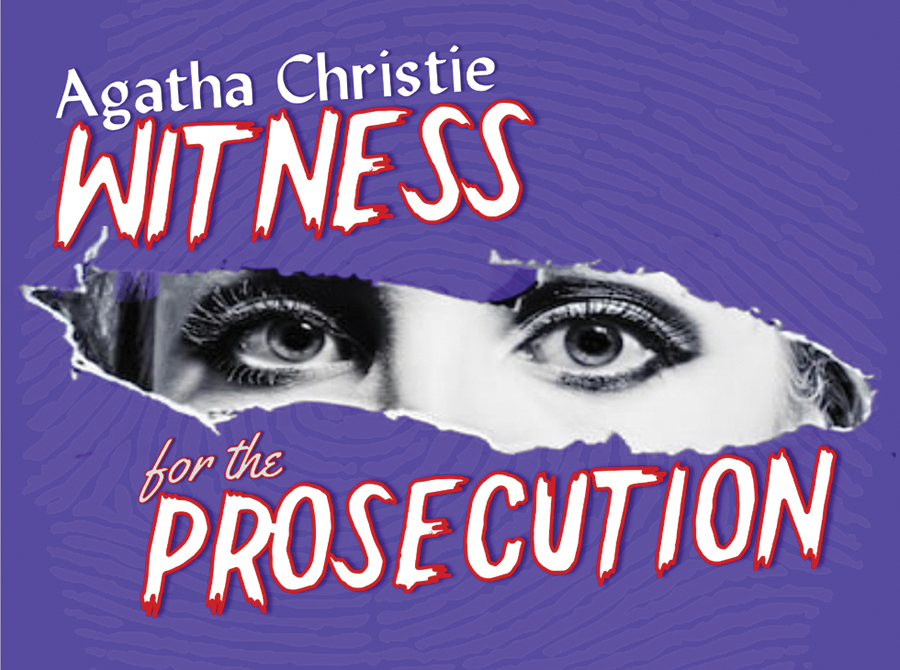
Another of the pillars of the Bradshaw Performing Arts Center, the Judson Theatre Company, will help raise the curtain on the revamped venue with its production of Agatha Christie’s Witness for the Prosecution running from Nov. 21 to 24.

“Agatha Christie remains the world’s best-selling author and the world’s most successful female playwright,” says Morgan Sills, the executive producer of Judson, which is concluding its eighth season bringing professional theater to the Sandhills.

“Witness for the Prosecution is a classic wrong man story. She’s wonderful at all the things that are important in a play — plot, characterization, symbolism. It’s got a quadruple twist ending that is different from the ending of the short story that she originally wrote. The reason Agatha Christie started adapting her own work into plays is because other people began doing it and she didn’t like what they did — she thought they were too faithful to what was on the page. Both And Then There Were None and Witness for the Prosecution have endings that are different than in their respective literary sources.”

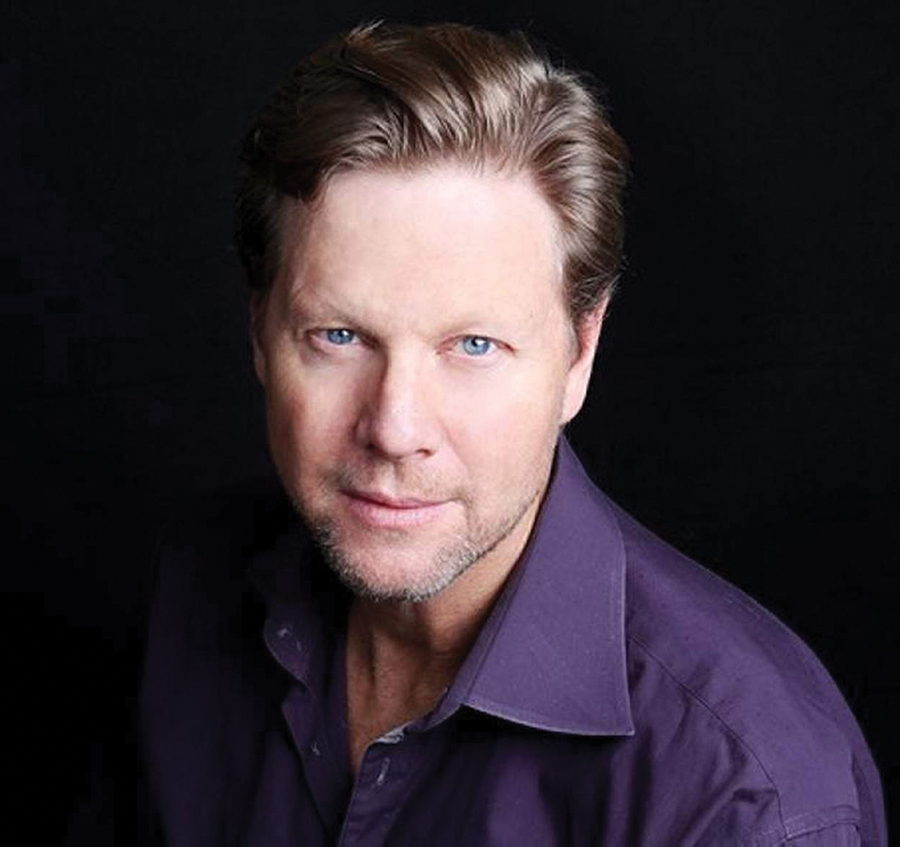
Starring as Sir Wilfred Robarts, QC, is Alan Campbell, who was nominated for a Best Actor Tony Award when he starred opposite Glenn Close in Andrew Lloyd Webber’s musical Sunset Boulevard. He logged courtroom time playing the assistant DA Derek Mitchell on the CBS crime drama Jake and the Fatman from 1987 to 1992, and also starred in the Tony Award-winning musical Contact. A Homestead, Florida, native, he did some singing for June Taylor while he finished his undergraduate degree in business at the University of Miami. She introduced him to Wayne Newton, who helped him get a contract with Howard Hughes’ entertainment corporation. “So, I was a lounge lizard in Vegas at 22,” says Campbell.

Campbell was working in a bookstore in L.A. in ’81 (“the only really legitimate job I’ve ever had”) when he landed a recurring role on the soap opera Another World. “Kyra Sedgwick was my love interest,” he says. “She was 17 or 18 at the time and had to go to high school, so I worked in the afternoons. Those were interesting days.”

When Jake and the Fatman hit, Campbell says, “I had a Porsche and a house in the Hollywood Hills, but the minute it all went away, I sold the Porsche and sold the house — which I wish I hadn’t.”

During Sunset Boulevard he met and later married the actress Lauren Kennedy, a Raleigh native. In 2008 they started a summer series in North Carolina called Hot Summer Nights. “Our daughter, Riley, had been born,” he says. “It was getting harder and harder to run it remotely. We just basically moved down here.” The couple split up in 2012, and Campbell found himself commuting back to Manhattan. “I got a chance to do Mamma Mia! for a year,” he says. “I did an off-Broadway show called Hello Again.” Campbell met Sills through a mutual acting friend, leading to his appearance in Witness for the Prosecution.

“Alan was really an ideal candidate for that role because of his years stalking the courtroom in Jake and the Fatman,” says Sills. “We wanted someone with a detective series association that we also knew had the theater chops to do justice to a mountain of dialogue and stage business.”

Another “local” actor — and writer — who will appear in Witness is Traci Loper, who moved to the Sandhills a year ago after a 20-year career chasing parts in Los Angeles. Loper grew up in a tiny town in Louisiana northwest of New Orleans. “We got our first stoplight in 1999,” she says.

She moved to Nashville for her senior year of high school, graduated from Middle Tennessee State University, and headed for L.A. in 1998. “I’m going to be the court clerk. I’m excited, one, just to be on stage; but, two, about meeting people. Three, I get to work on my British accent,” she says. “It’s Agatha Christie, queen of crime, right? She’s not about the murder, she’s about solving the puzzle of the murder.”. PS

Performances at 7:00 p.m. Nov. 21; 8:00 p.m. Nov. 22; 2:00 p.m. and 8:00 p.m. Nov. 23; 3:00 p.m. Nov. 24 at Bradshaw Performing Arts Center. Tickets are $38 and available at www.judsontheatre.com.


Simple Life

Above It All

The rewards of life’s upward climb

By Jim Dodson

Never lose the opportunity to see anything beautiful, British clergyman Charles Kingsley once advised, for beauty is God’s handwriting, a wayside sacrament.

Because I rise well before dawn wherever I happen to be, I stepped outside to see what I could see from 4,000 feet.

A fog bank was rolling silently down the side of the mountain like a curtain opening on the sleepy world, revealing 50 miles of forested hills in the light of a chilly quarter moon.

The only other lights I saw were a few remaining stars flung somewhere over East Tennessee. The only sound I heard was the wind sighing over the western flank of Beech Mountain.

An owl hooted on a distant ridge, saying goodbye to summer.

In a world where it is almost impossible to get lost or find genuine silence and solitude, this moment was a rare thing of beauty.

I stood there for probably half an hour, savoring the chill, an over-scheduled man of Earth watching the moon vanish and a pleated sky grow lighter by degrees, drinking in the mountain air like a tonic from the gods, savoring a silence that yielded only to the awakening of nature and first stirrings of birdsong.

After an endless summer that wilted both garden and spirit down in the flatlands, a golf trip with three buddies to the highest mountain town in the eastern United States was exactly what I needed.

A door opened behind me on the deck.

My oldest friend, Patrick, stepped out, a cup of tea in hand, giving a faint shiver.

“Beautiful, isn’t it? “ he said. “Hard to believe we’re not the only ones up here.”

Such is the power of a mountain. The lovely house belonged to our friends Robert and Melanie, and though there were hundreds of houses tucked into the mountain slopes all around us, from this particular vantage point none was visible or even apparent, providing the illusion of intimacy— a world unmarked by man.

“So what does this make you think about?” My perceptive friend asked after we both stood for several silent minutes taking in the splendor of a chilly mountain dawn.

I admitted that, for a few precious moments, I felt as if I were standing on the deck of the post-and-beam house I built for my family on a hilltop of beech and birch and hemlock near the coast of Maine, our family home for two decades, surrounded by miles of protected forest. The skies, the views, even the smell of the forest were nearly identical. Sometimes I missed that place more than I cared to admit.

“I remember,” said Patrick with a smile. “It was quite on a hill.”

“The highest in our town. It felt like the top of the world. My sacred retreat for a transcendental Buddho-Episcopalian who has a keen fondness for good Methodist covered dish suppers.”

Patrick laughed.

He knew exactly what I meant. Old friends do. We’ve talked philosophy and gods and everything else sacred and profane for more than half a century.

In every spiritual tradition, mountains are places where Heaven and Earth meet, symbolic of transcendence and a human need to elevate mind, body and spirit. As long as our types have walked the Earth, hilltops and mountains have provided a powerful means of escape and spiritual retreat, a way to literally rise above the demands and hustle of everyday life.

Moses received the Ten Commandments on Mount Sinai, which translates to mean “The Mount of God.” In Greek lore, it was believed that to spend a night on Mount Olympus would result in either madness or direct communication with the gods. Japan’s Mount Fuji is one of that nation’s three sacred mountains and a World Heritage site that has inspired artists and pilgrimages for centuries.

“Being up here,” I added, “reminds me of an experience Jack had that I would like to have.”

Jack is my only son, a documentary filmmaker and journalist living and working in the Middle East. He and his sister, Maggie, grew up with Patrick’s daughter, Emily. The three of them are all adults now, birds that have successfully flown the nest. We are proud papas.

In January of 2011, though, as part of Elon University’s outstanding Periclean  Scholars program, Jack and a few of his chums joined thousands of spiritual pilgrims for the five-hour night climb up Sri Pada — also known as Adam’s Peak —  to see the sunrise from an ancient temple on Sri Lanka’s most holy mountain, a pilgrimage of 5,000 steps traveled annually by thousands of Hindus, Buddhists, Christians and Muslims for some 1,700 years.

Jack had been asked by his advisor to go to Sri Lanka and make a film about the service work of the Periclean class ahead of his own class’ project with a rural health organization in India. The resulting 45-minute film, The Elephant in the Room, examined the environmental issues of Sri Lanka using the fate of the nation’s endangered elephants to tell a broader story about how the world’s natural system are under severe stress. Jack wrote, filmed, edited and narrated most of the film in partnership with two of his Periclean colleagues.

As he reminded me the other day during one of our weekly phone conversations from Israel, his unexpected pilgrimage to the mountaintop came at a critical moment of his junior year when he had burned out from too much work and not enough rest. In addition to his studies, he was burning the candle at both ends, teaching himself to make films and working as an editor on the school newspaper.

“When I look back, I realize I was getting pretty discouraged about both school and journalism at that moment,” he explained. “But the trip to Sri Lanka came at a good moment because it was the first time I got to make a film my own way about the things that struck me as important, just using my instincts about things we were seeing in our travels. It was a moment of real clarity and freedom.”

The climb up Sri Pada in the pre-dawn winter darkness was one of the highlights of his Sri Lankan film odyssey, a surprisingly challenging climb even for a fit outdoor-loving kid from Maine who grew up climbing mighty Mount Katahdin with his mates. Jack and his fellow Pericleans paused on the ancient steps several times to catch their breath before pushing on to the summit. On the way up, they passed — or were passed by — the young and old, the healthy and feeble, men and women of all ages, shapes and sizes, rich and poor, trudging ever upward. He told me he saw young men carrying their grandmothers on their backs, others carrying torches, bundles and food — couples, families, pilgrims from the Earth’s four major faiths all seeking a common holy mountain top.

“We arrived about 10 minutes after the sunrise,” he remembers. “But the whole mountaintop was bathed in this beautiful golden light. We stood in the courtyard of that temple sweaty and tired but also incredibly happy and at peace. It was very moving. I caught some of it on film. The view was incredible,” he recalled. “We were so glad we made the climb. It was just what I needed.”

Though he’s gone on to make more than a dozen timely films about everything from debtor’s prison in Mississippi to the opioid crisis across America, my son’s earnest and charming little film about the fate of elephants in Sri Lanka — his first full-length effort — is probably his old man’s favorite to date, full of simple images that reveal his budding talents. It is filled with poignant fleeting encounters with ordinary people and moments that have become familiar hallmarks of Jack’s homegrown filmmaking style.

A year after he made Elephants in the Room, his more ambitious and technically refined film about a pioneering rural health care organization in India got shown at a World Health Organization gathering in Paris. His sophomore achievement ultimately landed him a job at one of the top documentary houses before he went on to graduate school at Columbia, met his wife and began a promising career as an independent filmmaker.

I saw a nice change in my son after he came down from that sacred mountain: a fresh resolve, a clearer mind. During our recent phone chat from Israel, I asked if he ever thinks about his climb to the mountaintop on that winter morning in Sri Lanka.

“I do,” he replied. “When I got back to Elon, I started to learn about meditation and developed a different attitude about what I was doing. I still think about that climb from time to time. It was an experience that stays with you.”

We also talked about the last really challenging hike we took together, a grueling hike up Mount Katahdin with his Scout troop. I was 50 at the time. Jack was 13.

Truthfully, I’d convinced myself that I was in excellent shape for a 50-year-old Eagle Scout. But I never made it to the top. My dodgy knees gave out a thousand feet below the summit, prompting me to rest my weary legs at the ranger station beside Chimney Pond while Jack and his teenage buddies scampered up Cathedral Trail to the summit. 

As I contentedly waited, a passage from James Salter’s beautiful novel Light Years came to mind.

“Children are our crop, our fields, our earth. They are birds let loose into darkness. They are errors renewed. Still, they are the only source from which may be drawn a life more successful, more knowing than our own. Somehow they
will do one thing, take one step further, they
will see the summit. We believe in it, the radiance that streams from the future, from days we will not see.”

Above it all, as we watched the chilly sunrise from the top of Beech Mountain, my old friend Patrick simply smiled and nodded when I mentioned this. PS

Contact Editor Jim Dodson at jim@thepilot.com.

You can see Jack’s work at www.JackDodson.net  and The Elephant in the Room at: https://vimeo.com/30460629

Sporting Life

On the Wing

An early peek on the Pamlico

By Tom Bryant

Weather was unsettled as expected this time of year. It was late fall, not quite winter. I was at our duck hunting club named Whistling Wings, located on the Pamlico Sound close to Lake Mattamuskeet. I was holding forth on my own, as the other members had Thanksgiving holiday travels to complete.

Thanksgiving at our house was over pretty fast. My brother and sisters had other plans and couldn’t come for dinner; Tommy, our son, could only visit for the day because of business commitments. That evening after Tom had left for the mountains and all the turkey fixin’s were put away, Linda, my bride, and I were at loose ends.

We were sitting by the fire talking about holidays and how they change as we grow older. “You know what, Babe? This is one of the quickest Thanksgivings ever. I think tomorrow I’m gonna ride up to the duck hole and check out things and see if ducks have arrived. None of the other guys will be there, but maybe I can get in a solitary hunt.”

“I don’t know, Tom. I hate for you to be in the middle of nowhere by yourself. What if you have an accident, get bitten by a snake or something? You would be in real trouble.”

“Lins, I also could get run over by a truck on May Street. I’m safer in the woods than anywhere.”

Linda laughed and said, “You’re right. If the bears haven’t gotten you by now, they probably never will.”

The next morning I was on the road early. It’s a five-hour motor to Mattamuskeet, and I wanted to be there by lunch to walk out to the impoundments and see if ducks were flying.

North Carolina duck hunting season is split, with the early season coming in October for three days, then in November a period of a little over two weeks, which we call the Thanksgiving season, and then the final period in the cold months, beginning in December and ending in late January. Usually, the duck club does most of our hunting in the late season, but we try to get together as many times as we can. There are five of us in the club: John’s a lawyer; Jack’s a judge; Tom’s a textile mill owner; Art is also a mill owner but retired; and Bryan’s a textile broker. And me, I’m a writer and newspaperman. A diverse group, we have spent many years experiencing the great outdoors, and in our own way, we’re pretty proficient in the wilds.

This was my first visit to the little cabin that has served as home during duck season since late summer, when we all met to work on the impoundments and also to build duck blinds.

We have three impoundments on the property bordering the Pamlico Sound. They are about 5 acres each, planted in corn during the summer and flooded with fresh water when duck season arrives. The impoundments are a food source and resting area for ducks of all species as they migrate south.

In the early days in the Mattamuskeet area, impoundments were scarce; but now, as Uncle Tom has often said, “If there’s a ditch that’s got water, somebody’s gonna put an impoundment on it.” He knows what he’s talking about since he runs a thriving business cleaning ducks and is a native of Fairfield, a small town bordering Lake Mattamuskeet.

In the early years of waterfowling at Mattamuskeet, just a few impoundments attracted loads of ducks. Now there are so many that waterfowl are dispersed all over the area. Great for ducks, but bad for hunters.

I noticed several flights of teal ducks as I crossed the Pungo River. Teal are small fast fliers that migrate early and also the species that I think is the best table fare. If they are on the Pungo this early, they should be on the Pamlico. A good sign, I thought.

Everything was quiet when I pulled in the parking area of our little cabin. I unloaded the vehicle, put together a quick lunch that I could take with me to the blind, strapped on my pistol in case I had to shoot a snake, and hiked out to our closest impoundment.

Earlier we had built a permanent blind next to the dike right over the water. It’s very comfortable with bench seats and heavy brush on all sides, the perfect place to watch for waterfowl unobserved. I ate my lunch of sardines, crackers and a big slab of sharp cheddar cheese and topped it off with a frosty bottle of Blue Moon beer. There is absolutely no drinking while hunting at our club, but this afternoon I was going to just watch, no shooting, and acclimate myself to the wilds once again. After the long morning ride through so-called civilization, which included the madhouse on Interstate 40, the cold beer hit the spot.

Daylight saving time was over and night comes a lot faster, so I packed my gear and watched the sun slowly sink into the marsh horizon. It was another beautiful sunset that can only be seen on the banks of the Pamlico. As I was slowly walking up the dike, I heard in the distance a couple of coyotes barking, and an owl hooted over in the tree line as he began his nightly hunt.

Right at the end of the dike and just before the road widens on the way to the cabin, I paused and looked back toward the Pamlico. I could see silhouettes of ducks as they swarmed over the corn. They were diving into the impoundment as if they were using it as a roost. I watched until it became too dark and hiked on back to prepare supper. I chuckled to myself as I walked up the little path that served as a road. Ducks seem to have a built-in clock. In the morning, a duck hunter can legally shoot one half hour before sunrise and, in the evening, must stop hunting at sunset. These laws are strict and enforced by game wardens down to the minute. The only time I’ve ever had a mishap with game enforcement was when I was given a ticket for shooting three minutes after sunset. That’s another story, though, but I will say that I was exonerated after my day in court.

The ducks that use our impoundments seem to be aware of the time, too, usually arriving too late and leaving too early. It’s a fun part of the sport though, trying to outwit a duck.

Supper was easy. Linda had put together leftovers from Thanksgiving for me to bring, so there was no cooking. Just warm up a delicious dinner. Wonder why turkey and dressing always taste better the second time around?

John had built a little kitchen island for the lodge to supplement counter space, and it usually worked out that after supper we all stood around the maple square enjoying an after-dinner drink while listening to our favorite music from a portable CD player. Willie Nelson and Patsy Cline entertained us with numerous famous country songs, but our favorites were “On The Road Again” and “Crazy.” Those CDs always get a good workout when the crew is all together.

I washed my dinner dishes, and then to keep up the tradition, I poured a couple of fingers of Scotch, cranked up the CD player, and enjoyed Patsy as she sang the almost mystical songs of her short career.

Before I retired after a long day, I turned off the outdoor lights and went out on the little porch, where we keep an outdoor grill. A quarter moon was high in the sky, and a soft mist, almost a fog, was lowering in the trees. I could hear the coyotes barking as they still looked for dinner; and in the far distance, the owl hooted as if it was tired of looking.

As I turned to go inside, I heard the unmistakable whistle of widgeon ducks flying high, hopefully right to our impoundments. Sweet dreams, ducks, I hope to see you in the morning.  PS

Tom Bryant, a Southern Pines resident, is a lifelong outdoorsman and PineStraw’s Sporting Life columnist.

Almanac

November is cold mornings and cashmere.

Before the earliest skein of geese break the silence of the day, you unearth your winter wardrobe, rediscovering the ageless sweater that, despite its annual reappearance, always feels brand-new.

When the geese trumpet across the sky, you are cradling your coffee by the kitchen window, watching the backyard squirrels zigzag like pinballs as they unearth their own buried treasures.

November is time to take stock.

On the back porch, there is kindling to split. And back in the kitchen, one dozen Bartlett pears resemble a Claude Monet still-life.

What will you bring to the table this month?

One dozen Bartlett pears now peeled, cored, and chopped, simmer on the stovetop with three pounds of cranberries, two cups of dried cherries, one cup of sugar.

November is equal parts sweet and bitter.

Your bones seem to know that winter is near, yet your skin sings in cashmere.

Even as the autumn leaves descend, the Earth continues to give, give, give.

Pastel sunrises.

Winter squash and rainbow chard.

Murmurations of starlings.

And camellia blossoms which, despite their annual reappearance, always feel like tiny miracles.

Two sounds of autumn are unmistakable, the hurrying rustle of crisp leaves blown along the street or road by a gusty wind, and the gabble of a flock of migrating geese. Both are warnings of chill days ahead, fireside and topcoat weather. — Hal Borland

What Will You Create?

Thanksgiving is celebrated on Thursday, Nov. 28. As you craft your Thanksgiving plate with the zest of a landscape architect, consider what you are creating on a larger scale. Are you building a life that is savory? Bitter? Sweet? Or does it offer a little bit of everything — bursting at the seams with color and flavor, yet with enough space for gratitude and magic?

Looking Up

According to National Geographic, three of the top sky-watching events of 2019 happen this month, beginning with the Transit of Mercury on Nov. 11. Of course, you won’t be able to witness what will look like a tiny pinhole traveling across the sun with the naked eye, nor should you attempt this without safety precautions (eclipse glasses, solar binoculars, solar filters, etc.). According to the article, “This will be the last transit of Mercury available to North Americans until May 7, 2049.”

On Sunday, Nov. 24, don’t miss brilliant luminaries Venus and Jupiter close as ever in the southwest horizon — just 1.4 degrees apart. And on Thanksgiving Day, 45 minutes after sundown, take another look low in the southwestern sky and see what National Geographic calls the “celestial summit meeting” of Venus, Jupiter, Saturn, and a hairline crescent moon.

The Power of Gratitude

The correlation between gratitude and happiness was common sense long before it was research material. And yet, time and again, psychologists’ findings support what poets and sages of the ages have long been conveying: Gratitude is good for you.

Moreover, it can radically change your life.

A recent article by Harvard Medical School’s Harvard Health Publishing offers six simple practices for cultivating gratitude:

1. Write a thank-you note.

2. Thank someone mentally.

3. Keep a gratitude journal.

4. Count your blessings.

5. Pray.

6. Meditate.

And while we’re on the subject, here are three powerful quotes on gratitude that suggest its utter potency:

“Acknowledging the good that you already have in your life is the foundation for all abundance.” — Eckhart Tolle

“We need to learn to want what we have, not to have what we want, in order to get stable and steady happiness.” — Dalai Lama

“Be thankful for what you have; you’ll end up having more. If you concentrate on what you don’t have, you will never, ever have enough.” — Oprah Winfrey

Happy Thanksgiving!

Singing Tables

A poetic meditation

By Jaki Shelton Green

I’m never cooking alone, even at my most solitary moments. I am surrounded by generations of cooks, their wisdom, laughter, and their flawed and perfect recipes lifting my hands and heart savoring each ingredient as I realize that each ingredient represents all the joys, sorrows, healing and restoration of my life’s journey. These unseen hands hold me in passionate surrender to generosity as family and friends gather at my table reminding me that food creates community, holds my sense of identity, and conjures sensory surprises over and over again. The ghosts of other tables, other kitchens remind me that we are all just ingredients, and what matters is the grace with which I cook the meal.

My food odyssey is a soundtrack re-mix like the texture of an autobiography offering a throw-back to prayer-song, dance, birth, death, sex and rock and roll. The backyard chicken coops, vegetable gardens and mini orchards are long gone like my elders and the neighborhood of my childhood. What remains is me . . . the brown woman-child writing down the sizzle of cast iron skillets, the bold of the beet, the hot of the pepper pot, the earthiness of walnuts, the bitter of arugula.

Food helps me to express my past and present. Food helps me to create communal ties and honor my ancestral roots.

“Blessed assurance, Jesus is mine!

Oh, what a foretaste of glory divine!

Heir of salvation, purchase of God,

Born of his Spirit, washed in his blood” — Frances Crosby

My grandmother, Eva White Tate, hosted the Ora Shanklin African Methodist Episcopal Missionary meetings, which gathered monthly on first Monday evenings during the springs and summers of my youth. An agenda of devotions, song, prayer and Scripture segued into Old and New Business, projects to raise money for their many charitable activities, missionary dues, and a “love offering” for the sick. My grandmother, mother and aunts raced around all day preparing food and setting an elegant table for the elaborately coiffed church ladies in their flawless pristine summer linen, pastels, crepe de chine, patent leather and sexy slingbacks that made ticky-tacky squeals across the glistening, freshly waxed wood floor.

This monthly soiree featured milk glass vases holding peony globes and arrangements of snapdragons, Queen Anne’s lace and foxgloves strategically placed on the crisp white linen tablecloth adorning the antique oak dining table, monogrammed linen napkins, and the heirloom silverware that was left to my tiny hands to polish on a monthly basis. I was impressed that the deviled eggs required their own unique platter, designed especially for — deviled eggs. Mounds of homemade chicken salad garnished with apples, pecans and grapes, potato salad, pear walnut salad, canapés of cucumber-dill cream cheese, pimento cheese, stuffed olives, and perfectly browned chicken legs were presented on sparkling crystal and carnival glass serving platters.

The inlaid glass sideboard was majestic with a centerpiece of magnolia, camellia and gardenia blossoms fresh cut from my grandmother’s flower garden and hosting cut glass pedestals of scrumptious coconut cake, petit fours, homemade (pink, green, yellow) mints, fresh strawberries, chocolate-covered peanuts, and my grandmother’s famous secret recipe egg custard. Pitchers of brewed mint tea and punch bowls bearing icy rainbow sherbet flanked both sides of the dessert display waiting to be admired and devoured by the white-gloved missionaries.

This pageantry of memory continues to feed my upper-crust soul. This pageantry was the backdrop for all the whispered gossips and secrets of uppity church women in between “a piece of this and a little dab of that.”

“Summertime, and the livin’ is easy

Fish are jumpin’ and the cotton is high

Oh, your daddy’s rich and your ma is good looking

So hush little baby, don’t you cry.” — Dubose Heyward

The smell of coffee brewing, bacon frying and hot biscuits browning were the only summer alarm clocks in our house. The first few weeks following school vacation, my brother and I spent lazy days playing between our house and Aunt Alice’s house or hanging out at Uncle Ervin’s Service Station pretending to be proprietors behind the counter taking money for gas, candy, milk, bread, but never the cigarettes. That fun would be interrupted when “the garden came in” with lima beans, snap beans, wax beans, okra, peas, squash, cucumbers, tomatoes, cantaloupe, cabbage, lettuce, watermelon and corn. The litany from porch to porch throughout the neighborhood addressed to our bored little brown bodies was, “Shut up whining, your little bellies will be glad to get this food come wintertime. Don’t put those hulls in that bowl.” So we pouted in-between snapping, shucking, peeling and rinsing so the grown folks could can, freeze, stew and preserve.

These were the summers when our “Up South” Northern kin folks took a notion to jump in a car or hop a bus or train and show up unannounced, usually with five or six children in tow. Our family had abundant land and food, so this uncouth behavior never daunted my mom, grandmother and aunts. They knew how to “hold their mouths right” and bring forth their best masks of civility so refined that no one ever read their furious annoyance hidden beneath the labor of love they laid out for two or three weeks presenting daily breakfast, lunch and supper smorgasbords of cured smoked ham and red-eye gravy, scrambled cheese eggs, grits, salmon croquettes, biscuits, bacon, sausage, homemade peach, strawberry, blackberry, pear jelly and preserves, stewed apples, potato cakes, cinnamon rolls and toast. The “guests” would feast and then retreat to the front porch, into the yard, watch television, or return to bed to sleep away their city blues.

With the guests “out of the way,” the women folks washed dishes, swept crumbs, cleared the table and talked in hushed ridicule and dismay about their hungry citified relatives. After they caught their breaths and a few of the leftover table scraps, they started the operation for lunch or “just a little something to tide them over,” which was usually homemade egg, tuna or chicken salad, the optional ham and cheese sandwich, tossed salad, chilled watermelon and cantaloupe, iced tea and fresh lemonade served outside on the porch.

Fried chicken, fried fish, turnip salad, chicken and dumplings, stewed tomatoes, potato salad, rice pudding, fried okra and squash, pound cake, apple pie and yeast rolls made the “Up South” folks remember where home really was. They never suspected by our good manners how their unannounced visits interrupted our summer explorations, building camps and forts in the woods, fishing, skinny-dipping, catching tadpoles, making June bug whistles, chasing lightning bugs and baking mud-pies all day in the sun.

“If you want to know

Where I’m going

Where I’m going, soon

If anybody ask you

Where I’m going

Where I’m going soon

I’m going up yonder

I’m going up yonder

To be with my Lord” — Tremaine Hawkins

Death often disrupts my family and community. We gather with food because food is the ultimate and final expression of how we love and the culture of our community. Feasting with the dead even now and in my past continues to provide me a way to reconnect and maintain connections with my ancestors and my daughter. My family and extended tribes have never needed a copy of “Being Dead is No Excuse: The Official Southern Ladies Guide to Hosting the Perfect Funeral.” It’s in our blood . . . we know what we know about the power of fried gizzards, leftover meat loaf, turkey necks, fried croakers, okra gumbo and moonshine.

The laying out of the dead and the laying out of the food pulls me closer and closer to that vortex of all things familiar and comfortable. These are forever images imbedded in my mind’s rolling video screen of the deaths of my father, grandmother, aunts, uncles, cousins and my daughter.

When my precious daughter Imani died, people came with their stories of her life neatly folded in the corners of picnic baskets. They delivered their stories of her whimsy, her sass and her bravado rolled inside a fresh loaf of sourdough bread, slithering across roasted vegetables laced with slow-drizzling balsamic, baked inside a piping hot strawberry rhubarb pie. The stories were alive inside the food. Imani loved food. Imani loved to feed people, so her stories became the food itself … roasted with superfluous green garlic, cilantro, cumin, basil, a rack of lamb Imani threatened to throw at her brother one Easter, the duck medallions I cooked for the last Christmas meal of her life with us, or the wild salmon steaks she’d hide in the freezer.

What I know that I know is food heals. Food covers the wounded heart. Food holds the raging storm and invites Spirit to the table.

“I will love you anyway

Even if you cannot stay

I think you are the one for me

Here is where you ought to be

I just want to satisfy you

Though you’re not mine

I can’t deny you

Don’t you hear me talking baby?

Love me now or I’ll go crazy” — Chaka Khan

Appearance. Taste. Texture. Symbolism. Succulence. The Interaction of Colors. The Dance Behind Oven Doors. Edible Metaphors. Velvety. Heavy Cream. Spice Jars. Simmer. Pan Fry. Cold Wash. Knead. Roll. Curl. Caramelize. Braise. Soak. Stir. Roast. Open Fire. Hot Oil. Blend. Fold. Mortar and Pestle. Pine Nuts. Raspberries. Almonds. Champagne Grapes. Mango Preserves. Muscadines. Tomatoes. Expresso. Le coq au vin. Charred Romaine. Mousse. Rose Water. Artichokes. Truffles. Butter. Candied Ginger. Chocolate. Dirty Rice. Brie. Cherries. Figs. Saffron Threads. Cinnamon. Nutmeg. Chutney. Parfait. Hazelnuts. Orange Peel. Lime Zest. Gar-licky Collards, Ambrosia, Chow Chow. Red Rice. Rosemary Sea Salt.

I love the way these words, sounds and ancient cooking rhythms sing inside my mouth . . . and honey chile’ don’t forget the Honey.

“If you really want to make a friend, go to someone’s house and eat with him. The people who give you their food give you their heart.” — Cesar Chavez

I remember the first meal I ever prepared for my husband. Lots of talking and long glances over a table full of lush sensuality. Mango gazpacho. Grilled salmon with a black bean-ginger-garlic glaze. Roasted asparagus. Brussels sprouts, beets, feta and walnuts drizzled with fig balsamic vinaigrette. Basmati rice. Yeast rolls. Arugula salad. Sparkling pear cider. Mixed berries dusted with coriander.

Once upon a time, I prepared a “last supper” for a lover I was kicking to the curb. It seemed best to leave a taste of me on his lips. Filet of beef in puff pastry and Madeira cream sauce. Caramelized shallots, carrots and mushrooms. Roasted lemon-garlic artichokes. Grand Marnier cheesecake.

My first memory of a romantic meal was sharing a tomato sandwich made with tomatoes I’d grown in a small bucket as a child with a little boy visiting my grandmother with his grandparents. I was mesmerized by his seersucker plaid shorts and matching bowtie. Crisp white shirt. White crew socks. White bucks. Magic happened between us when the juicy tomato dripped down his long elegant hands and he slowly licked the essence of my first harvest.

My husband and I love to cook. Our food landscape is forever changing, moving, reinventing itself, but what remains always is “sauce” so rich and soulful that it requires the licking of fingers, eyelids, noses, jelly-roll laughs, and oceans of soft fluttery kisses. Our food adventures continue to awaken our passion . . .  PS

This piece was previously published in The Carolina Table: North Carolina Writers on Food (2016); Eno Publishers.

True South

Candy Hierarchy

All sweets aren’t born equal

By Susan S. Kelly

Did you come by my house on Halloween? You know, the one with no pumpkin on the stoop, no lights on, and a Grinch upstairs watching Netflix behind the shutters? I loathe Halloween, and with grown children, am now able to confess as much.

I do, however, love candy, and since you’re still picking Nestlé Crunch wrappers from your children’s pockets or out of your dryer lint trap, now seems as good as time as any for a little treatise on the topic.

Blaming a parent for obsessions — never mind neuroses — is always convenient. I grew up in an era when mothers thought nothing of buying six packs of candy bars for dessert, the same way they thought nothing of serving syrupy pineapple slices straight from a Del Monte can. Hence my first true love: Black Cow suckers, which, tragically, are nearly impossible to find these days.

I like Common Candy. By “common,” I mean common to convenience store aisles. Caramel Creams. Tootsie Rolls. Tootsie Roll Pops. Sugar Daddies. BB Bats. Kits. I like the cheap stuff, the fake stuff. And while my preferences are common, they’re not as common as my husband’s, who’ll actually buy and eat those jellied things called Orange Slices. Again, blame the previous generation.

As a child among a dozen first cousins at their lake house, my husband’s grandfather took the passel of them each day to the gas station and let them pick out a piece of candy. If that ain’t cheap entertainment, I don’t know what is, and I plan to do the same thing with my grandchildren as soon as they get enough teeth in their head to rot. One friend has a candy drawer in her kitchen especially for her grandchildren. Now, that falls in the Great Grandparent category, beating Tweetsie Railroad or some old butterfly garden like a drum. Plus, I know where the drawer is.

Like Mikey in the old Life cereal advertisements, my husband will eat anything even slightly candy-like, including peppermints. The only people who consider peppermints candy and not breath mints are children with candy canes at Christmas. I had a boarding school friend who ate Mentos like popcorn. I can still see her putting her thumb in the roll and wedging one out. Mentos are not candy. They were precursors to Tic Tacs. Peppermints are desperation candy in the same way that my sister thinks meatloaf is Depression food. Then again, I absolutely love meatloaf, which means that I keep a bowl of peppermints available for my husband. Each to his own tastes.

Has anyone ever even eaten a Zero bar but me? It’s a personal process. You peel off the waxy white coating with your front teeth, then the fake chocolate nougat, and finally, the peanuts, or almonds or whatever they are, after you dissolve the caramel they’re embedded in. This process may explain why I can’t eat M&Ms. The way I eat M&Ms, after about a dozen, my tongue has started to get raw and cracked, the way it did as a child with Sweet Tarts. Plus, milk chocolate. Eh.

Higher up on my candy food chain: Snickers. Milky Way. Mounds. Rolos. 3 Musketeers. Yup.

Beneath discussion: marshmallow peanuts and Peeps. Easter candy is a bust in general.

Sweet Tarts = not candy. Also not candy: Reese’s cups. Butterfingers. Paydays. Junior Mints. Too much peanut butter, peanuts, and, again, peppermint. Still, in a pinch I’ll eat most of those, the same way you’ll settle for a Fig Newton if there are no real cookies around. Red Hots don’t really qualify as candy either, but they definitely qualify as common. Where else but the place where I get my tires rotated could I find a vending machine that cranks out a handful of Hot Tamales for a quarter? Not a fan of Pixie Stix — why not just buy a packet of Kool-Aid, sprinkle some powder in your palm, and lick it off? — but I’ve always loved those disgusting four-packs of Nik-L-Nips and the oversized wax lips only available at (you guessed it) Halloween.

Seeing a pattern here? Clearly, I favor candy with taffy, teeth-pulling textures. Caramels, nougats, taffy itself, fudgy chocolate like a Tootsie Roll, Laffy Taffy. Milk Duds. Bit-O-Honey. Starburst in a pinch. For one birthday, a friend gave me a 12-pack of Sugar Daddys — vastly preferable to Sugar Babies — which I take to the movies. That (literal) sucker lasts the whole movie, especially if you eat the paper stick too, as I do. Nothing better than a spit-and-sugar soaked stick.

I totally do not get Skittles, but I’ll buy a Costco jar the size of those things pink pickled eggs are usually found in if it’s filled with Jelly Bellys.

But Jolly Ranchers? I’m not much on hard candy. Hard candy is for colonoscopy prep.

Fancy-pants products from “chocolatiers” are trying too hard. Just keep your Toblerone and Godiva. Riesens are as upscale as I get. Nor have I ever understood Necco wafers, Pez, or Valentine hearts. Why not just eat chalk? Same thing for those elastic band necklaces strung with pastel candy discs that you eat while wearing it, though I admire the concept.

You know that friend with the candy drawer? She keeps all her Halloween candy corn that’s gone rock hard for me. I love the stuff, and candy just doesn’t get any more common. So don’t think poorly of my October 31 antipathy. My attitude concerns the costumes, not the candy. Besides, I just love All Saints Day on November 1. Almost as much as I love Cow Tales. PS

Susan S. Kelly is a blithe spirit, author of several novels, and a proud grandmother.

Good Natured

The Original Red Meat

A bit of bison for the holidays

By Karen Frye

The image of buffalo roaming across the prairie is an iconic symbol of the American landscape in the 1800s before the pioneers moved in. Bison meat was good for people back then, and it is in demand even more in recent years because of its high nutritional value.

Ranchers today are committed to raising their herds naturally and work hard to accommodate the natural behaviors of the bison, allowing them to roam freely. The U.S. Department of Agriculture does not allow bison to be raised using growth hormones. The National Bison Association’s code of ethics prohibits the feeding of antibiotics, crossbreeding, in-vitro fertilization or other artificial practices. This code of ethics requires ranchers to respect and conserve the natural and cultural heritage while striving to improve the quality of the buffalos’ lives.

These naturally raised bison interact with their environment as nature intended — promoting healthy ecosystems and animals. This is a far cry from the standards of the commercial factory farming methods.

Bison meat is naturally flavorful, tender, nutrient dense, high in minerals, and lower in fat and cholesterol than beef, chicken and even salmon. It’s also higher in protein, iron and B12, and a very good source of healthy fatty acids, like omega 3.

Sales of bison meat have steadily increased as people discover that it is not only healthy and delicious, but also environmentally friendly. You can substitute it for beef in recipes, but beware — it is lower in fat, so be careful not to overcook it.

The popularity of Keto and Paleo diets have increased the demand for ways to get the healthy protein people need on these diets. Bison is a great choice when planning the menu for the holidays. There are many recipes available using ground bison, bison steaks and roasts. I have been using bison for years and find it delicious and easy to prepare.

Here is a great recipe that would be perfect for your holiday party:

Oven-Roasted Bison Meatballs

Ingredients:

1 pound ground bison

1/2 cup finely chopped mushrooms

1/3 cup finely chopped red onion

1 egg, beaten

2 cloves minced garlic

1 teaspoon salt

1 teaspoon black pepper

1 teaspoon Italian seasoning

In a medium bowl combine all ingredients. Mix until well blended. Form into 24 meatballs, about the size of a walnut. Line a baking sheet with parchment paper or lightly oil. Place the meatballs on the pan and roast in a preheated 400-degree oven for 10 minutes. Serve with dipping sauce.

Dipping Sauce:

2/3 cup mayonnaise

1/3 Dijon mustard

3 tablespoons chopped green onions

Combine ingredients in a small bowl, stir to blend. Makes 1 cup.

Give it a try this holiday. Surprise your family and friends with this delicious, healthy alternative.  PS

Karen Frye is the owner and founder of Nature’s Own and teaches yoga at the Bikram Yoga Studio.