Foxhunting 101

Tradition and pageantry on Thanksgiving morn

By Maureen Clark

Photographs by John Gessner and Ted Fitzgerald

On Thanksgiving morning, the Moore County Hounds will invite the public to attend their opening meet, as they have for over 100 years. Hounds, riders, and more than 1,000 spectators will gather around the robed figure of Reverend John Talk in Buchan Field on North May Street for a ritual that dates back to the Middle Ages. Those assembled will hear a blessing of the hounds that launches the formal foxhunting season. The blessing from St. Hubert, the patron saint of hunting, a son of the Duke of Aquitaine who lived in the seventh century, asks that rider, horse and hound be shielded from danger to life and limb.

Established in Southern Pines in 1914, the first hounds hunted from the kennels of novelist James Boyd on his 500-acres, known now as the Weymouth Woods-Sandhills Nature Preserve. In 1929, a separate 2,300-acre parcel was purchased by a small group of foxhunters and, along with the Boyd’s land, it became the nucleus of the foundation later established by W.O. “Pappy” Moss and his wife Virginia “Ginnie” Walthour Moss. The hounds moved to the kennels they now occupy at Mile-A-Way Farm in 1942. Ginnie Moss’s great nieces, Cameron Sadler and Ginny Thomasson, joint master and secretary of the Moore County Hounds, will represent their aunt on Thanksgiving. “I will carry Aunt Ginnie’s whip,” Cameron said. “It’s sentimental and I like to have it with me.”

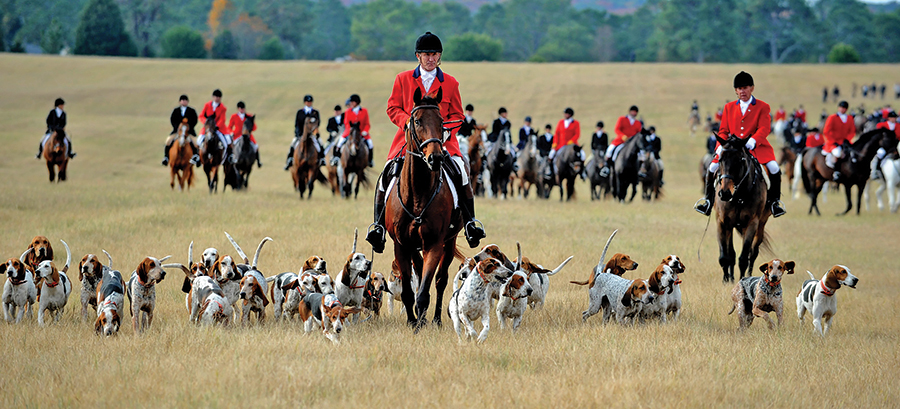
The first to arrive at Buchan Field are the riders, at roughly 10 a.m. on Thanksgiving Day. There is a defined structure to the assembled group. They can be sorted by jacket color. The leadership group of men and women, joint masters and the hunt staff, wear scarlet colored jackets. The rest of the riders make up what is known collectively as the field.

Women and junior riders in the field wear black coats with colors on their collars; navy with red trim for women, red with navy trim for juniors. Men wear scarlet. Colors other than these standards represent riders invited from other hunts. Simple black jackets are worn by foxhunters who have not yet earned their colors.
The Moore County Hounds have five joint masters, Richard Webb, Cameron Sadler, Mike Russell, David Carter, Jock Tate and secretary Ginny Thomasson, who manage the business of the hunt and are leaders in the field at opening meet. Traditional courtesy suggests that all foxhunters greet the masters when arriving at the meet, often lifting a cap.

Horses in the field represent a variety of breeds, from quarter horse to Welsh pony, each matching the rider’s particular size, ability and preference. Cameron Sadler and Russell prefer thoroughbreds, joining many fellow horsemen in giving retired racehorses a new life in the hunt field.

While the crowd is congregating, kennel man Bill Logan, riding a four-wheeler, will drag a prepared scent of animal waste and other matter through the woods. The path, according to Russell, mimics a gray fox with circles, turns and back tracking. Coyote, the usual prey in a live hunt, run faster and straight away. (The evolution in the past 20 years has gone from hunting primarily gray fox to hunting coyote 85 percent of the time.) There will be two checks during the run, breathers for the field to stop, letting horses and hounds catch their breath. The stops, however, will be out of sight of the crowd on Buchan Field.

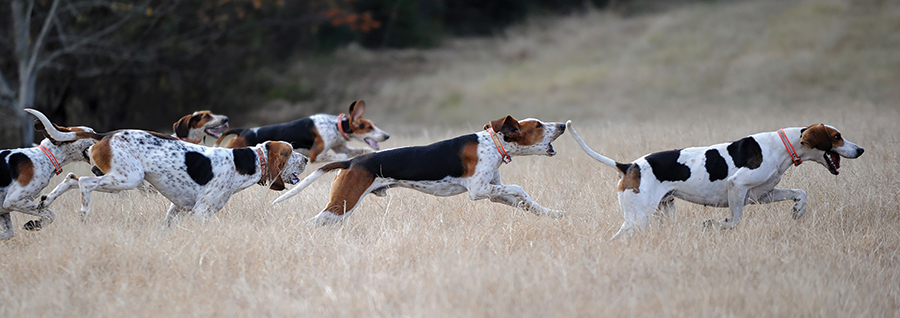
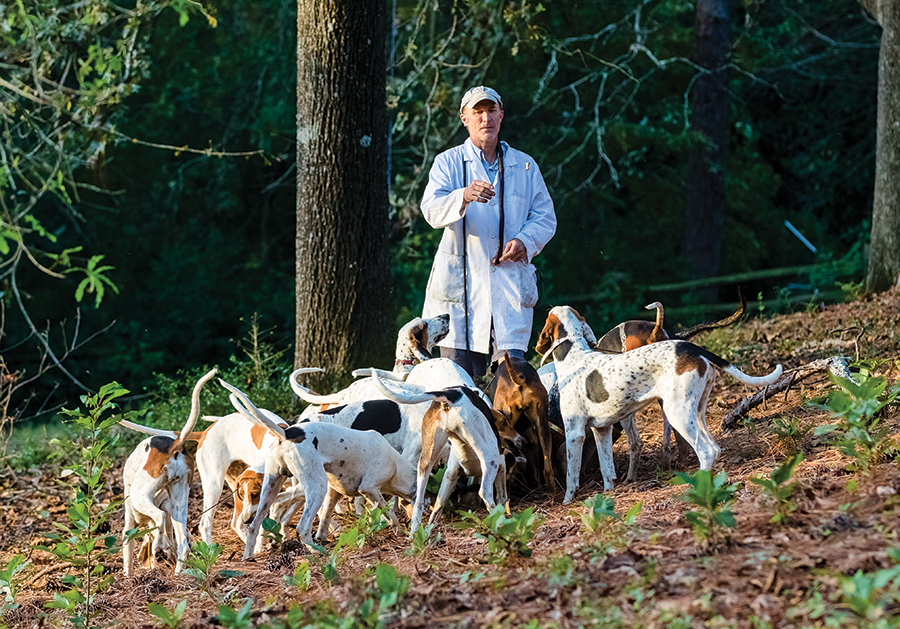
Soon spectators will see the hounds, tails wagging, coming down the sandy lane from their kennels gathered around their huntsman, Lincoln Sadler. The hounds are never called dogs unless referring to the sex of a male. Sadler manages the pack assisted by five whippers-in, his volunteer staff, working as additional sets of eyes and ears. During the hunt, only the staff is allowed to interact with the hounds.

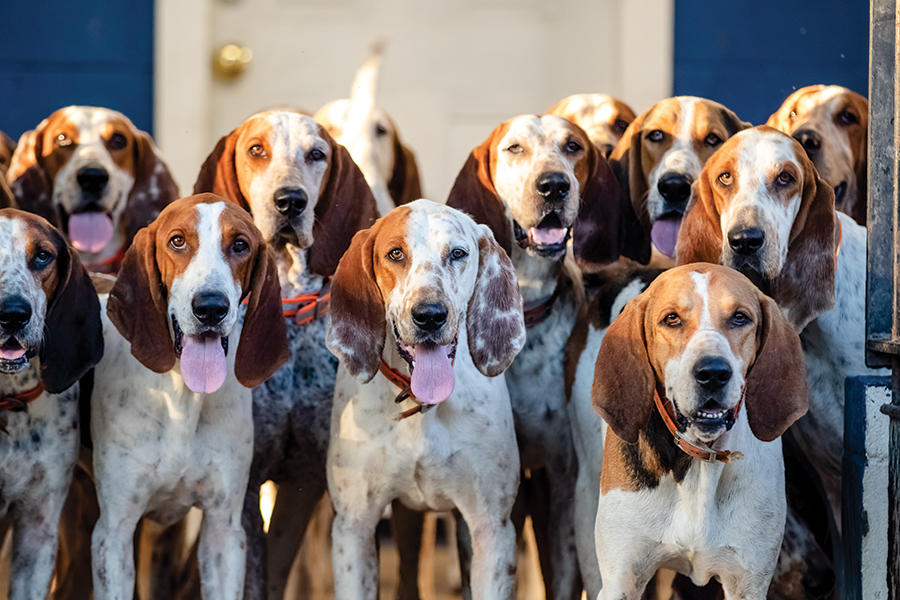
Cameron Sadler explains that drag scenting for a live pack (one used to chasing coyote or fox) can be challenging. A few will run a drag line but many live hounds, Cameron observed, will not run a made up scent. In their 100-year history, different masters and huntsmen of the Moore County Hounds have hunted various breeds. The current pack, started in 2007, is an American breed called Penn-Marydels. Lincoln Sadler said the pack looks at things like crushed vegetation for tracks. When faced with a different task, the huntsman said they look at him and ask, “What do you want from me?” Last year, at opening meet, Lincoln Sadler tweaked the traditional prepared scent with his own secret concoction and the hounds ran strong. The crowd will be able to judge this year by the strength of the hounds’ voice when they run the line.
Two of the many important tasks of a whipper-in are to help in turning hounds away from roads or off the scent of a second coyote. The whips, working in the field at a distance from the huntsman, give the cry “tally ho” when they “view” a fox or coyote.  Tally ho is a blood-chilling yell meant to be heard by all. Two veteran whips with Moore County, Liz Rose and Mel Wyatt, who have won competitions with their yells, will be on hand to call the hounds.

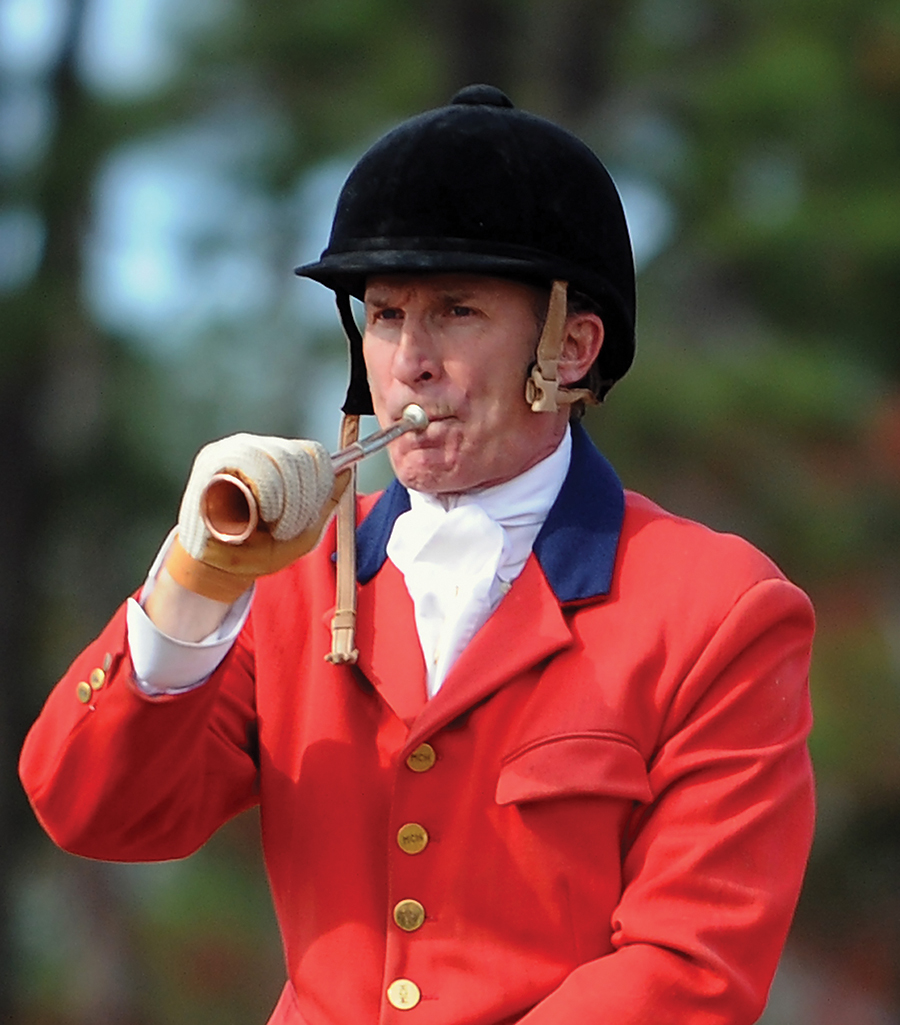
Lincoln Sadler, as huntsman, is the central figure in the hunt with all actions of the masters, staff and field, following his lead. He can be identified by the 9-inch brass hunting horn tucked between the buttons of his jacket. The Moore County Hounds, members of the Masters of Foxhounds of America, are bound by their traditions and rules. All hunts use the 9-inch horn. “It’s the one element that ties it all together,” Sadler explains. “I could hunt another pack and negotiate them through the woods. “

Hounds are not counted as a total number but as couples. Sadler will bring roughly 30 couples this year. The MCH breed two to three litters each year. Litters born in the same season all share the same first letter of their names working through the alphabet like naming hurricanes. This year, all puppies have names that start with the letter Z. On a recent morning at the kennels, Sadler was overheard training puppies he called Zinnia, Zepco, Zesty, Zoloft and Zoe. Two older hounds answered to an age-specific Yaupon and U-Turn. On off days, Sadler works with his puppies, walking them out. Never shouting or raising his voice, a firm command of “hold up together” brings the hounds to Sadler. The walks take them over smells of squirrels and deer, which he teaches them to ignore.
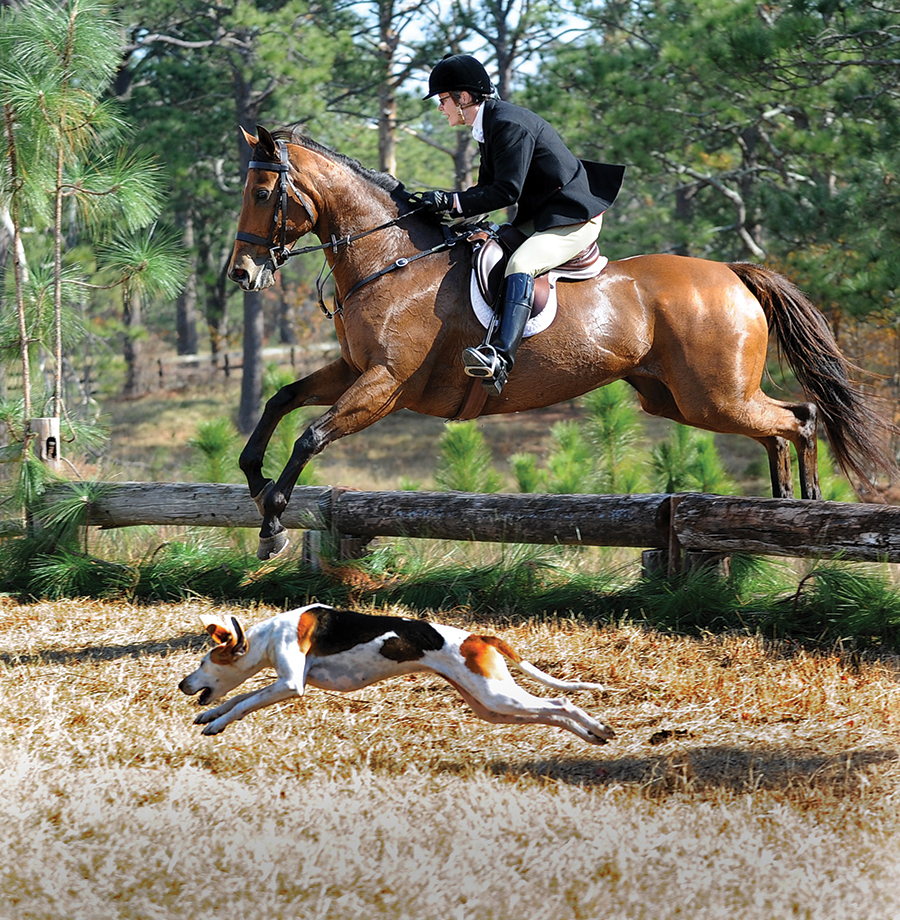
After Reverend Talk bestows the blessing there are several signals the crowd should note. The field of approximately 150 riders will begin dividing into three groups, each behind a joint field master. Cameron Sadler takes the first flight of riders, who can manage the speed and difficulty of jumps following 10 to 12 strides behind the pack. A second flight follows moderately, selecting jumps with good footing. Russell brings the last group, the hill toppers, who prefer not to jump. His distance from the pack, on live hunts, often affords the best views of foxes, coyotes and hound work.

The crowd should also notice when the huntsman, Lincoln Sadler, begins to gather hounds to him. Foxhunting has everything to do with sound, the call of the horn and the voice of the hounds. Sadler gives a very short toot on the horn to bring the hounds to him. People should be moving away from hounds and riders and the huntsman will be “moving off.” In addition to the horn, Sadler whistles, calls and talks to the hounds. The next sound of the horn will be a longer, monotone note saying, “I’m here, keep hunting, keep working.” He will move toward the call of the tally ho.

In the hunt field, some hounds talk a little while they search for scent. Others work quietly. The hounds work together and know when a single hound has hit the scent by the authority and intensity of the initial cry.  Sadler said they pay attention when a respected hound named Shrek speaks up. “The hounds honor him,” he explained, going to the lead voice, and joining the cry.

At this point, Lincoln Sadler will blow the horn with an urgency that says to the hounds spread out in the woods or field, “Let’s go, let’s go, let’s get over there and help him. Double up.” When the full pack is on the line and all speaking, or in full cry, it is the cherished sound in foxhunting. Lincoln Sadler will then blow “gone away.” Cameron Sadler praises Penn-Marydels for their strong voice, touching on a needed trait.  Alexander Mackay-Smith, the legendary authority on foxhunting, writes that “a good cry in a pack is essential not only for the hunt staff and field, but also so hounds can hear each other and cooperate accordingly.” Hounds that run silent have no value in the hunt field.

When the hounds and riders have gone from Buchan Field into the piney woods, they will be on the Walthour-Moss Foundation. The 4,000-acre tract of long leaf pine, sandy hills divided by fire lanes and streams, is land the Moore County Hounds hunt by cooperative agreement. The crowd should hear the hounds at the end of the drag before they see them spilling over the fence at Buchan Field. The hounds should be followed first by the huntsman, Lincoln Sadler, and his whippers-in. The three fields should follow with the first groups jumping the split-rail fence back to the meet.

The staff, who know the hounds by name, will count heads to be sure all are accounted for with none left behind. The last call blown on the horn and the end of a hunting day is “going home.” Sadler hesitates to blow the strains because they are the same melancholy notes played at the funerals of beloved members of the Moore County Hounds.  PS

Maureen Clark is a Southern Pines native who grew up foxhunting.

The Omnivorous Reader

Beyond Jaws

The tragedy of the Indianapolis revisited

By Stephen E. Smith

Just when you thought it was safe to go back in the bookstore, there’s a new best-seller about the worst shark attack ever — a book that details the feeding frenzy, past and present, that surrounds the sinking of the heavy cruiser USS Indianapolis on 30 July 1945.

Lynn Vincent and Sara Vladic’s meticulously researched and artfully constructed Indianapolis: The True Story of the Worst Sea Disaster in U.S. Naval History and the Fifty-Year Fight to Exonerate an Innocent Man is the latest in a plethora of books, history specials, movies, documentaries, TV news features, etc. that has, since the cruiser disappeared into the Philippine Sea 73 years ago, contributed to the lore surrounding the demise of the ship and crew that transported the first atomic bomb to the island of Tinian.

If you’re a reader with a basic knowledge of American history, you’re no doubt familiar with the tragic story of the Indianapolis. If you aren’t, anyone who’s seen the movie Jaws will be more than happy to tell you all about it, just as Quint, the shark hunter (played by Robert Shaw), told them: After delivering the components for the bomb, the Indianapolis was cruising at night when the Japanese submarine I-58 fired two torpedoes into the ship, sinking her in 12 minutes. About 300 crew died in the torpedo attack; another 900 went into the water. No lifeboats were launched, no actionable distress signal was transmitted, and the men had only flimsy life preservers and makeshift rafts to keep themselves afloat. Many of the crew died of saltwater consumption, others simply despaired and committed suicide. When the survivors were located almost five days later, only 316 remained to tell the story. Figures vary as to the exact number of the men taken by sharks, but experts theorize that the majority of those attacked had already died of exposure. Still, the horror engendered by a shark attack — the possibility of being eaten alive by a silent, subsurface predator — has resonated through popular culture.

To their credit, the authors aren’t obsessively concerned with sharks, focusing instead on a post-rescue conspiracy surrounding the Indianapolis disaster. In the months immediately following the sinking, the story was eclipsed by news of the surrender that occurred after the dropping of the atomic bombs, but a bureaucratic feeding frenzy began as soon as the survivors were rescued. According to Vincent and Vladic, Navy brass, intent on covering up their incompetence, subjected the ship’s captain, Charles B. McVay III, to a court-martial in which he was convicted of “hazarding his ship by failing to zigzag,” although zigzagging was not required or even recommended in the area in which the Indianapolis was cruising. In an unprecedented move, prosecutors brought in the commander of the I-58, a former enemy combatant, to testify against McVay. The Japanese captain stated emphatically that zigzagging would have made no difference in his attack on the Indianapolis, but McVay was found guilty anyway. He was blamed for the disaster, a reprimand was placed upon his service record, and a deluge of hate mail followed him for the remainder of his life. No other American captain has ever been punished for losing his ship to a torpedo attack. Whether out of guilt for his lost crew or the emotional distress brought on by a failing marriage, the former captain of the Indianapolis committed suicide in 1968.

Vincent and Vladic’s account doesn’t end with McVay’s death. They examine in detail his eventual exoneration. In 1996, a 12-year-old Florida boy, Hunter Scott, took an interest in the story of the Indianapolis and initiated a letterwriting campaign. He was supported by survivors who wanted to honor their late captain and by Sen. Bob Smith, who offered a congressional resolution that finalized McVay’s long-delayed vindication. But the reprieve didn’t come easy, and the military machinations and congressional intrigues surrounding the McVay hearings are at the heart of the book.

As the congressional inquiry neared its conclusion, Paul Murphy, one of the men McVay had led into harm’s way, wrote to the committee reviewing McVay’s court-martial, objecting to a previous report upholding the Navy’s original court-martial findings: “They contain falsehoods, statements taken out of context, and plain mean-spirited innuendos about our skipper and others who have attempted to defend him . . . The Navy report contained personal attacks on Captain McVay’s character. They were unwarranted, and in most instances, unrelated to the charges against him. On behalf of the men who served on the Indianapolis under Captain McVay, I would like to state our deep resentment and ask: Why is the Navy still out to falsely persecute and defame him?”

Most of the available histories of the Indianapolis sinking — Fatal Voyage, Left for Dead, Out of the Depths, Lost at Sea (there’s also a bad movie starring Nicolas Cage) — focus on the suffering of the crewmen abandoned by a Navy too busy or too disorganized to notice that a heavy cruiser had gone missing. The Vincent/Vladic book is, by and large, an update on the Indianapolis story and concludes with the August 2017 discovery of the ship’s remains, now a designated war grave, in the North Philippine Sea, bringing to a close the ship’s eight-decade saga.

“For the families of the lost at sea,” write Vincent and Vladic, “the news stirred high emotions, bringing back memories many had sealed away for decades. After nearly three-quarters of a century, children, nieces, nephews, and grandchildren were finding the peace that their parents and grandparents had sought for so many years.”

This cathartic effect notwithstanding, one thing is certain: With only 19 Indianapolis survivors still living, the finger-pointing and recriminations will soon enough cease to matter. PS

Stephen E. Smith is a retired professor and the author of seven books of poetry and prose. He’s the recipient of the Poetry Northwest Young Poet’s Prize, the Zoe Kincaid Brockman Prize for poetry and four North Carolina Press awards.

PinePitch

Veterans Parade

Line Broad Street on both sides of the tracks for the sixth annual parade honoring America’s veterans and active military on Saturday, Nov. 10, in Southern Pines. The parade begins at 10 a.m. and is supported by the Veterans of the Sandhills. For more information go to www.sandhillsveteransfestival.com.

Gone to the Dogs

Take a leisurely 1-mile walk through Weymouth Woods with your four-legged best friend at 3 p.m. on Sunday, Nov. 11. It’s free and open to the public at Weymouth Woods-Sandhills Nature Preserve, 1024 Fort Bragg Road, Southern Pines. For information call (910) 692-2167 or go to www.ncparks.gov.

Celebrating Seagrove Potters

The Seagrove Area Potters Association kicks off its 11th annual Celebration in Fall with a gala, live auction and potters market on Friday, Nov. 16, from 6-9 p.m. at Luck’s Cannery, 798, N.C. Hwy. 705, Seagrove. The three-day event continues on both Saturday and Sunday with $5 admission. For more information visit www.discoverseagrove.com.

Let’s Get Small

The Tour De Trike Glow Race to raise money for the United Way of Moore County takes place on Thursday, Nov. 8. Registration is at 4:15 p.m. and the cost is $100. Races begin at 5:30 p.m. on the New Hampshire Avenue International Speedway — between Broad Street and Bennett Street — in Southern Pines. Costumes and glow paint suggested to reduce aerodynamic drag. For more information and tickets, visit wwwticketmesandhills.com.

Get Cooking

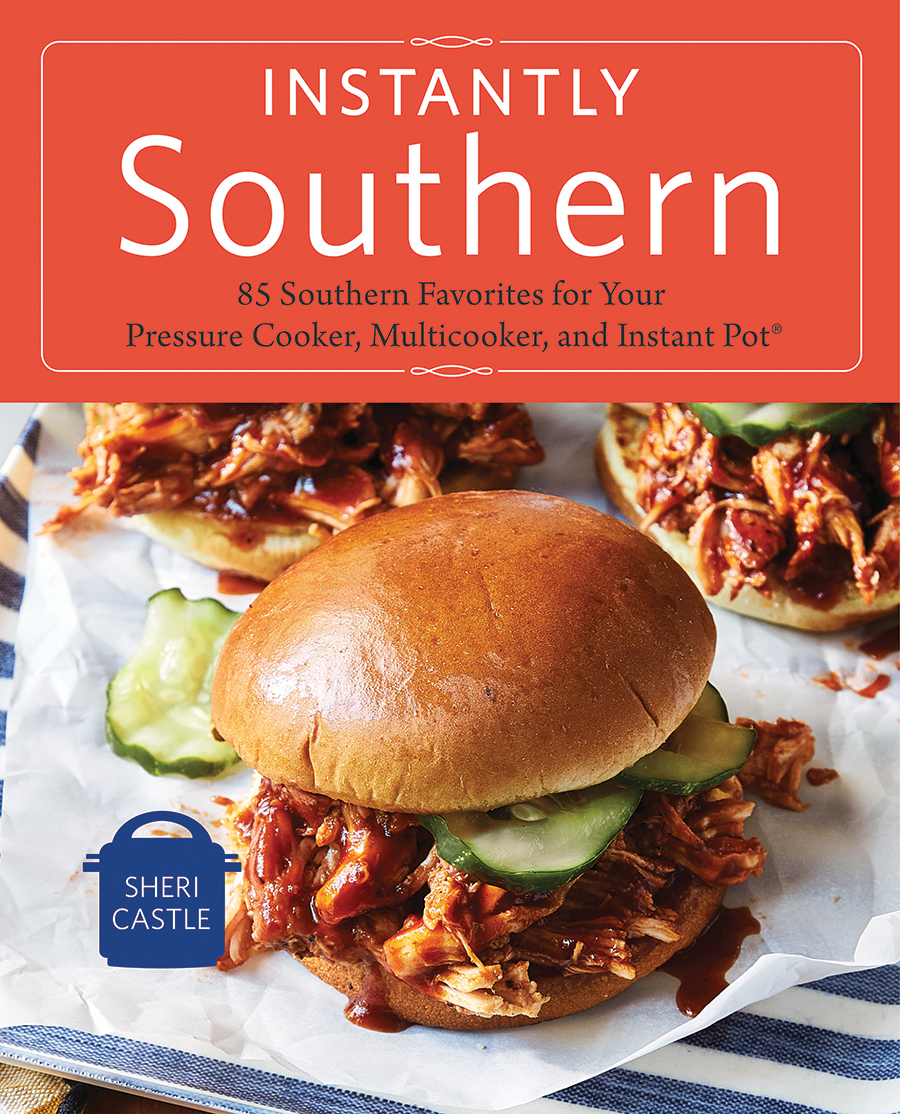
At 6 p.m. on Tuesday, Nov. 27, The Country Bookshop is partnering with The Sway and Burney True Value Hardware to present a cooking demonstration by Sheri Castle, the Chapel Hill-based author of Instantly Southern: 85 Southern Favorites for Your Pressure Cooker, Multicooker, and Instant Pot. Tickets are available at ticketmesandhills.com or The Country Bookshop, 140 N.W. Broad St., Southern Pines. For more information visit www.thecountrybookshop.biz.

Marnie Magic

The Metropolitan Opera production of Marnie, composer Nico Muhly’s reimagining of the Winston Graham novel about a mysterious young woman who assumes multiple identities, will be shown live at the Sunrise Theater, 244 N.W. Broad St., in Southern Pines at 1 p.m. on Nov. 10. For information call (910) 692-3611 or visit www.sunrisetheater.com.

Holiday Pops

The Carolina Philharmonic, with Maestro David Michael Wolff and featuring Jill Paice, performs the holiday season’s most spirited melodies at the Carolina Hotel, 80 Carolina Vista Drive, Pinehurst, on Wednesday, Nov. 21 at 8 p.m. and again on Saturday, Nov. 24 at 3 p.m. For more information call (910) 687-0287 or go to www.carolinaphil.org.

The Rooster’s Wife

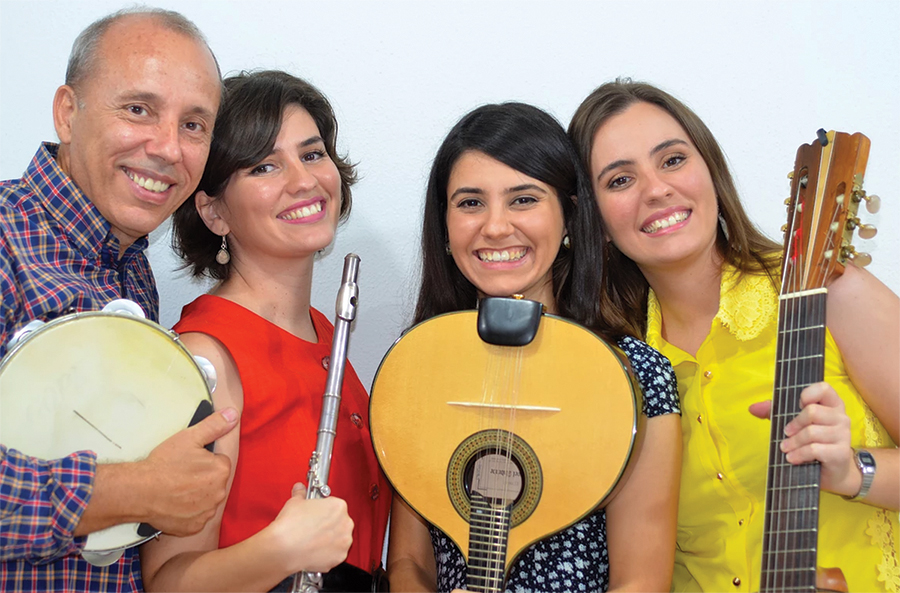
Friday, Nov. 2: Choro das 3 at the Poplar Knight Spot. This amazing band is made up of three sisters and their father playing a popular Brazilian pop music genre, among other styles. Cost: $10.

Sunday, Nov. 4: Glorifying Vines Sisters, a thriving musical institution. “If we’re going to do like Jesus did,” says singer and manager Alice Vines, “then we’re going to go wherever we’re called to go. And we’re going to enjoy ourselves when we get there.” Cost: $15.

Sunday, Nov. 11: Cane Mill Road. Members of the band grew up just down the road from Doc Watson in Deep Gap, North Carolina. Honoring the past, the band strikes a balance between preserving a bluegrass mountain sound and boldly rocking progressive interpretations of songs both new and old. Cost: $10.

Thursday, Nov. 15: Open Mic, hosted by The Parsons. Free to members.

Friday, Nov. 16: Hello June, with Sarah Rudy and Whit Alexander, who have been quietly making a name for themselves in their hometown of Morgantown, West Virginia, but the band is steadily gaining national attention. Their pulsating slice of ’90s comfort food will shake the stardust from your heartstrings. Cost: $10.

Sunday, Nov. 18: Thomas Rhyant. Like a medieval troubadour, Rhyant uses music to tell the stories of those who came before him, legends like Sam Cooke, allowing people not only to understand, but to emotionally connect with history through music. Cost: $15.

Friday, Nov. 23: Celebrate Thanksgiving family time with Live Band Karaoke led by Steve Lapping. Free to members.

Thursday, Nov. 29: Decembersongs with Amy Spence, Wild Ponies and Rod Picott, a decidedly different holiday show. Cost: $15.

Doors open at 6 p.m. and music begins at 6:46 at the Poplar Knight Spot, 114 Knight St., Aberdeen. Prices above are for members. Annual memberships are $5 and available online or at the door. For more information call (910) 944-7502 or visit www.theroosterswife.org.

Birdwatch

To Screech His Own

The spine-tingling call of the Eastern screech owl belies its size and appeal

By Susan Campbell

Listen! An eerie trill or spooky shriek from out of the darkness at this time of year just might indicate the presence of an Eastern screech owl. Territorial adults readily use a mix of screams, tremolos on different pitches and long trills to advertise the boundaries of their home range. And their vocalizations are remarkably loud for a bird that stands only about 8 inches high. They are commonly found in forests all over North
Carolina, but they particularly thrive in thick pine stands, so much of our Piedmont habitat is ideal for them. Furthermore, they are with us year-round.

Eastern screech owls can be either a dull gray or a rich rufous color, with tufts of feathers on the head giving them an eared or horned appearance. But don’t expect to spot them easily, even though they roost during daylight hours. Their dark splotches and vertical striping along the breast and belly provide excellent camouflage against their favored roosting spot, trees, where they may be sitting close to the trunk or peering out of a cavity.

As is the case with most raptors, males are larger than females. Nonetheless, females have higher pitched calls. Your best bet for spotting one is to watch for belligerent crows or flocks of songbirds signaling their presence by frenzied flight and raucous calling.

This species is found throughout the Eastern United States, as well as along the Canadian border and in easternmost Mexico. Although they may wander somewhat outside the breeding season, Eastern screech owls are not migratory. These diminutive owls breed in the springtime. A female simply lays up to six white eggs on the substrate at the bottom of the cavity. Incubation takes about a month and then the young birds take another month to develop before they fledge. All this time, while the female remains on the nest, her mate will hunt nightly for the growing family. Pairs, who usually stay together for life, favor old squirrel or woodpecker holes, as well as purple martin houses and the occasional wood-duck boxes. Pairs of screech owls will readily take to boxes made to their exact specifications, not surprisingly.

Eastern screech owls eat a wide variety of prey. Rodents make up a large portion of their diet, but they also readily catch frogs, large insects and other invertebrates including crayfish and even earthworms. They have been known to also feed on roosting birds and the occasional bat. Screech owls are very much at home feeding on mice, rats or voles that can be found around bird feeders at night — as well as moths and beetles attracted to outside lights. Screech owls are patient, adopting a sit-and-wait strategy before pouncing on their prey and swallowing them whole. Owl gizzards are specially adapted to digesting the soft parts of the creatures they eat and then balling up the bones, fur and other indigestible bits into an oval mass that is regurgitated each day. Favored roost sites or nest cavities can be found by locating piles of these masses (or pellets, as they are referred to) on the forest floor. Unfortunately screech owls often hunt along roadsides and are prone to being hit by cars as they swoop low over the pavement to grab a meal.

But overall Eastern screech owls are a successful species that has adapted well to the changes humans have made to the landscape. So spend some time outside after dark and train your ears for the trill or tremolos of our Eastern screech owl. These cute little birds are anything but scary once you get to know them!  PS

Susan would love to receive your wildlife sightings and photos. She can be contacted by email at susan@ncaves.com.

Simple Life

The Wisdom of Stars

When in doubt, look up . . . and within

By Jim Dodson

“When I have a terrible need of — dare I say, ‘religion’? — then I go outside at night and paint the stars.” — Vincent Van Gogh

Most mornings when I’m home, several hours before sunrise, rain or shine, you can find me sitting in an old wooden chair in my front yard, the day’s first cup of Joe in hand, soaking in the deep silence and looking at the sky.

I don’t paint the stars but I sure enjoy gazing on them with the aid of my iPhone’s nifty Star Guide, allowing this Earthling to identify constellations and the seasonal movement of planets. Even on cloudy or rainy mornings, Star Guide — like Superman’s X-ray vision — can penetrate the clouds, a reminder that a glorious universe and a lovely mystery await just beyond, always there.

As spiritual practices go, my predawn ritual was born on a forested hilltop near the Maine coast 30 years ago. A serious early riser since boyhood, I began stepping outside simply to see how my neighbors fared overnight, especially on November’s sharply colder nights, heralding another hard winter on the doorstep.

The “neighbors” I speak of were the woodland creatures that surrounded our peaceful kingdom off the long-abandoned Old Town Road that ran through a 500-acre forest of birch and virgin hemlock pocked with kettle holes from the receding Ice Age, woods dense with fiddlehead and cinnamon ferns, laurel hells and wild vernal springs.

Like the stars overhead, they were always there, palely loitering at the edge of the yard in the moonshine and starlight: the small clan of whitetail deer that fed off the sorghum pellets I provided through the harshest nights of winter; a flock of wild turkeys that displayed absolutely no fear of our dogs; the massive lady porcupine who waddled through the backyard from time to time (I nicknamed her Madame Defarge after Charles Dickens’ infamous revolutionary knitter), pausing to feed on my frost-wilted hostas; not to mention a young bull moose that hung around our neck of the woods for almost two years, apparently looking for a girlfriend, an age-old story.

Perhaps the toughest creatures by far were the tiny black-and-white chickadees that showed up at our side-yard feeders after the coldest Arctic nights imaginable, day-after-day, season-after-season, year-upon-year, no more than a handful of feathers and a tiny beating heart, teaching me something about the divine force at play.

Our house was a simple post-and-beam affair, a classic Yankee saltbox that I designed and helped build with my own hands, made of rugged beams hewn from Canadian hemlock. Those beams spoke to me at night, especially as we both aged, cracking and sighing and settling year after year. The surrounding gardens took me almost two decades (and most of my kids’ college funds) to build, beginning with the ancient stone walls of the farmstead that once existed on our hilltop more than a hundred years before us. Our predecessors grew corn and pole beans. I grew English roses, lush hydrangeas and heavenly lilacs, not to mention hostas as big as Volkswagens. Part of my annual November ritual after topping up my woodpile was to erect my Rube Goldberg plant protectors that could withstand being buried for months in the coming snow.

Back then, I believed this was my little piece of heaven, the rugged homestead I’d made for my family on a star-swept hill in Maine; the place I would quietly spend the balance of my days on Earth, writing and woolgathering, walking the spring and autumn woods and the Old Town Road with the dogs, forever revising my ever-changing garden, feeding the locals and memorizing the stars of the northern firmament in frosty autumn darkness. Over those two decades, I saw super moons and dozens of shooting stars — and once even the shimmering Northern Lights.

I loved that life and held it against my bones as long as I could. And then I let it go, have never been back, though I still have dreams about that house, those woods, those deep snows and frozen stars, not to mention my former woodland neighbors.

But home — this home, Carolina — unexpectedly called and I couldn’t ignore the summons. My late Southern grandmother, a grand old Baptist lady who knew the Scriptures cold, loved to say — like Thoreau, like the poet T.S. Eliot, like her husband Walter’s own grandmother, a gentle natural healer her neighbors called Aunt Emma — that life is simply a great hoop, a sacred circle, that the end of our explorations is to discover the place where we began and know it for the first time.

For better or worse, I have followed this cosmic script with the faith of a mustard seed, and now I am blessed to have beautiful Southern stars and an old forest of a different kind sheltering overhead, the towering oaks of my boyhood neighborhood, guardians of different early morning companions that are just as wild in their own suburban ways.

In place of Madame Defarge and a lovesick moose, we are visited before dawn by feeding rabbits and an owl that dolefully hoots like clockwork down the block as I sit back and study the stars, sipping my coffee, marveling at the scene overhead, as glorious as any medieval cathedral or walled City of God.

Spiritually speaking, I suppose I am what a dear friend calls a cosmic wanderer, a religious mongrel in love with the writings of the Sufi poet Hafiz, Pierre Teilhard de Chardin, the Upanishads, a little Ralph Waldo Emerson, a lot of Billy Collins and Mary Oliver, a dash of Joe Campbell and Charles Wesley’s hymns, spiced by the Bhagavad Gita and the mystic Meister Eckhart, all nicely summarized by the wisdom of my old friend Katrina Kenison, who wrote in her splendid book Magical Journey, An Apprenticeship in Contentment: “We are all one. We need only look more deeply into the nature of who we really are to see that our sense of isolation is an illusion and to have our separateness ameliorated by union. I might be but one small thread in a vast fabric, but there’s comfort in imagining the eternal interplay between my own small, temporal life and all there is.”

They’re all with me in the starry darkness, this merry band of voices.

With luck, if there is a wind in the darkness, the large Canterbury chimes I gave to my bride for our 15th anniversary — that took me the better part of an entire spring afternoon to hoist and secure in the massive white oak out back — may play three or four notes, sometimes sounding like a Buddhist bell calling one to mindfulness, other times — and I swear on my worn-out copy of Walden that this is gospel truth — the first five notes of Amazing Grace.

I cannot explain how or why this happens, but I’ve heard it with my own ears and believe it with my own heart. Likewise, I can’t explain or justify why most things happen in this passing life — joy, sorrow, tragedy, redemption — but grace certainly helps one face the day, whatever it brings.

November brings forth the two brightest planets in the Southern sky, Mars and Venus, gracing dusk and dawn like a blessing and benediction respectively while Orion, lord of our coming winter’s nights, rises below Taurus and the Pleiades in the East as Summer’s Triangle fades in the West.

The clear autumn sky never fails to make me feel both puny and thrilled by the knowledge that this same unchanging sky shone over Plato and Aristotle as they taught their students, Galileo on his balcony peering at the clockwork heavens, Marcus Aurelius penning his soulful Meditations on a lonely Roman frontier, Jesus praying in the wilderness, English lords signing the Magna Carta, Jefferson jotting notes about human independence, Lincoln speaking at Gettysburg, women marching for the vote, four brave college students sitting down at a whites-only lunch counter, the discovery of the God Particle and a phone that can see through clouds like Superman.

Beneath November’s clear and changing skies, as the soul leans inward, I use my iPhone’s wondrous Star Guide to identify the stunning moons of Jupiter, suddenly remembering C.S. Lewis’ observation that, contrary to our collective belief, we are not the center to the universe because “the center of the universe is actually everywhere.” Jesus’ version of this ancient truth may be the greatest metaphor of all for describing the potential transformation of human consciousness yet to come — that the “Kingdom of Heaven” is not somewhere up or out there — but patiently waiting for discovery deep inside us.

Perhaps human consciousness is beginning to understand that the force we call “God” is simply a streaming river of light and unconditional love that flows everywhere and through everything, as true and present as the stars that literally surround our small fragile planet wreathed in clouds or hidden by the brightest light of day, reassuringly there though we can’t — or choose not to — see it.

Not long ago, I read somewhere that the late astronomer Carl Sagan — a confirmed agnostic — believed there may be as many stars as there are grains of sand on Earth, billions of stars in hundreds of universes bearing untold numbers of unimaginable gifts. The November star child in me sure hopes this proves true.

God only knows what adventures await us.  PS

Contact Editor Jim Dodson at jim@thepilot.com.

Mom, Inc.

Snack Time

It’s worth all the trouble

By Renee Phile

They’re all watching me. I can’t move. I have to sit here until they don’t notice me anymore. I have to look casual, disinterested. The older boy plays his game; the younger one whines. If they would just stop looking at me, stop talking to me, I could get to it. I stand up, yawn for effect, and creep to the door of the bedroom.

“Bailey, no!” Mom says. My nails on the wood floor. Might as well be a car alarm. I lie down beside the door. Patience. It will have to wait. But I can’t wait! What if it’s gone by the time I get there? Libby will get it — that blasted cat. The worst day of my life was when they brought her home. She’s ridiculous and thinks she owns the place.

They stop paying attention. It was only a matter of time. I stand up. No one notices. Mom is cooking dinner (it smells good; I wonder if I will get a bite). Dad is working on his computer.

I tiptoe inside the doorway. Damn nails. “Bailey girl! What are you doing? Bailey!” The younger boy plops himself right down on me. It’s annoying, but being the patient Rottweiler that I am, I endure it.

“Kevin, get off her,” Mom says. Thank you, Mom. Kevin saunters off and I put my head down. I’ll try again in five minutes. Maybe four. Maybe three. The dinner smells so good, and Dad is still working on his computer, and the other boy is still playing his game, talking loudly in his headset to someone as he sits in front of the TV.

I stand up. No sudden moves. No one notices. Good. I inch inside the bedroom. No one sees me. Yeeeeessss! There she sits, like the queen she thinks she is — on the bed. I’m not allowed on the bed. She stares at me, and I think she is going to hiss at me, but she just stares. I stare back and inch forward, stop, inch some more until I get to the bathroom door.

“Where’s Bailey?” I hear Dad say. Oh no. They’re looking for me. I’m through the door. I’m in. There it is: Libby’s food. She never eats much of it anyway. I like to think she leaves it for me. Wait, she hates me. Either way, it’s mine.

Someone is moving in the kitchen.

“Is she outside?” Mom asks.

“I don’t think so,” I hear Dad say.

I gobble up all the food I can, not even taking a breath, like one of those pie eating contests. There it is. The bottom of the bowl. I scamper out, food still in my mouth, and lay down on the bedroom floor as nonchalant as you please. Been there for hours. The cat looks at me in disgust, and Dad comes into the room.

“Bailey? Did you eat the cat food?” How does he always, and I mean always, know? I look up at him with my eyes, but keep my head down. I don’t want him to smell the hairball formula on my breath. He walks past me and looks into the bathroom at the empty cat bowl.

“Come on. You know you’re in trouble,” he says, and I know, because, honestly, this has happened before. But, I don’t care that I have to sit in my crate for an hour. Solitary. I stand up and head to my crate while Dad follows. It’s all worth it, you see, as I lick my lips and glare at Libby, who looks at me with that strange smile.  PS

Renee Phile loves being a teacher, even if it doesn’t show at certain moments.

A Dream Creation

Heritage Flag Company barrels toward success

By Amy Griggs     Photographs by Tim Sayer

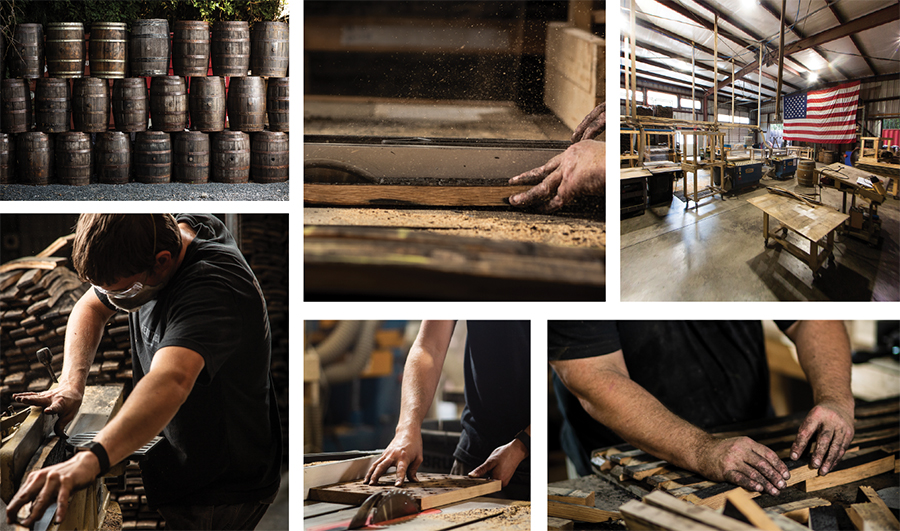
Shoppers meander through rooms of the 118-year-old Bennett Street house-turned-retail shop of The Heritage Flag Company.

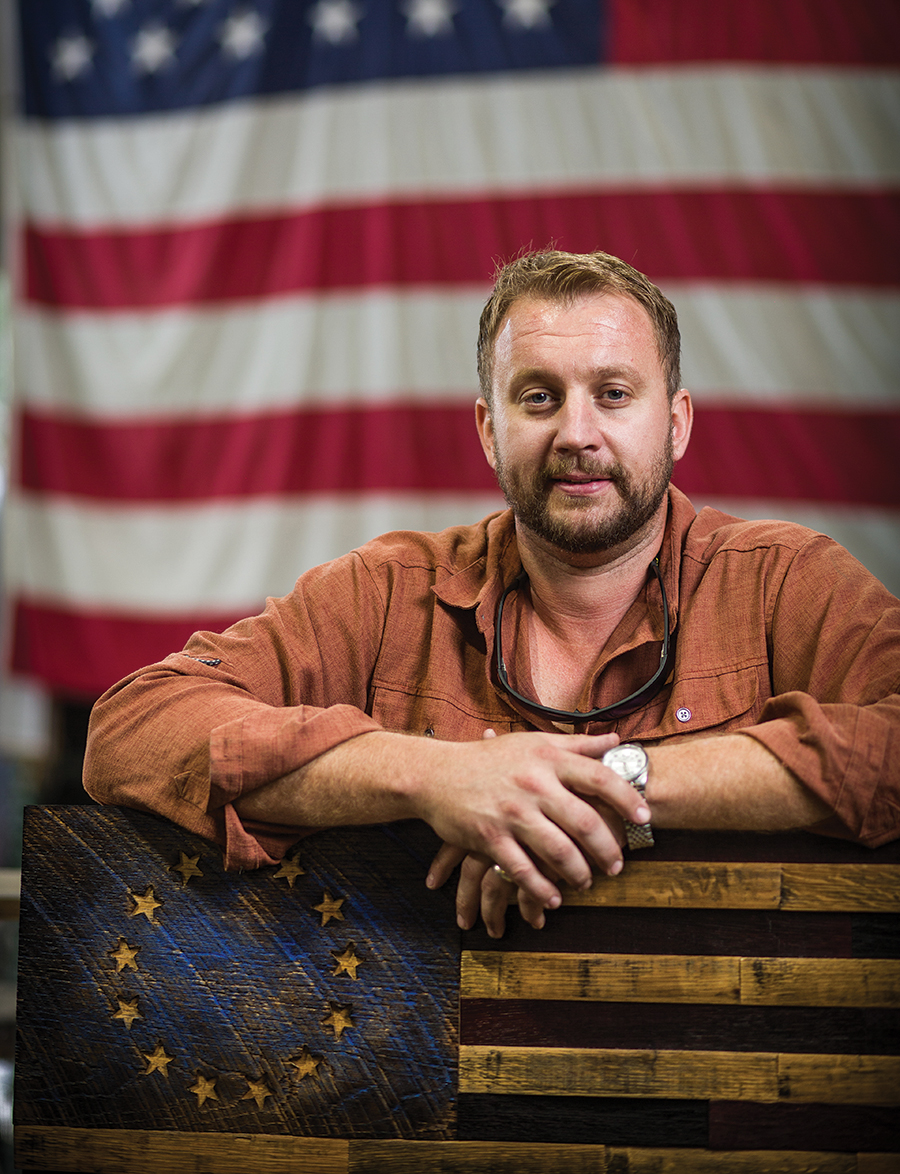
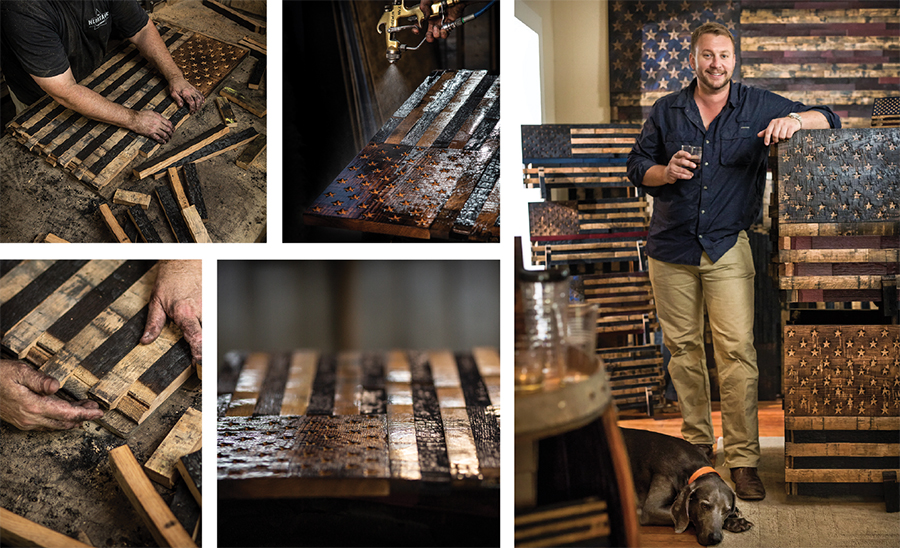
The faint, sweet scent of bourbon accompanies a visual feast of rough, charred and blond barrel staves crafted to stir the blood in the form of rustic American flags, works of art, no two exactly alike, varying in size from mounts on desktop easels to those three feet high and larger. Visitors express surprise: Website photos do not do the product justice.

“We hear that a lot,” says owner Heath Trigg. One customer review from the company website reads, “We purchased this flag for my father-in-law as a birthday present. I loved the look of it in the pictures on the website, but those pictures in no way do the craftsmanship justice. These flags are works of art.”

The story of The Heritage Flag Company is an American one of can-do spirit, hard work and self-determination, of Old South embraces the digital age. It is a Southern Pines micro-industry bred and born four short years ago, propelled by people’s thirst for the company’s now-signature product, a rustic American flag fashioned from whiskey barrel staves. Trigg set out to satisfy that thirst once he realized the number of potential customers for, by his estimation, “the most recognizable symbol in the world.”

His phone buzzes and his computer screen stands at the ready on his desk in what used to be his living room. Heath and his wife, Ginny, had their home and business offices occupying neighboring floors of their house until Heritage Flag’s need for space exploded. The couple moved, and now the entire house is dedicated to business and retail operations. The woodworking shop is in the back, repurposed from Trigg’s cabinetmaking business.

Though he speaks confidently about his business, his employees and products, Trigg remains somewhat mystified by the meteoric success of the company he founded, foregoing his original home building and cabinetmaking businesses.

“I could never have fathomed that I would own an e-commerce business that sells millions of dollars worth of wooden American flags,” he says.

The company narrative — noticed by statewide media and beyond — begins with his contracted job at Southern Pines Brewing Company, where in 2014 he and his cabinet crafters built its unique taproom bar and tables using whiskey barrel staves, a Trigg innovation. The owners loved it. Trigg so respected the three brewers’ knowledge and background as Special Forces veterans that he wanted to surprise them with a gift at their opening celebration.

A flag was born.

“I had two other businesses,” he says. “We were building houses, we were making cabinets, and we were kicking butt doing it. We dreamed up this flag as a thank you gift at the end of a project and jeez — I mean, it’s just unbelievable where these flags are today.”

The “dreamed up” part is literal, by now a well-circulated plot point in the story, the moment when Luke the Weimaraner woke Trigg in the night as his master dreamed of a rustic American flag fashioned from those whiskey barrels. His wife’s kitchen notepad played a role. “In the middle of the night I walked out, got the Sharpies out, and drew a picture of it on that pink high heel shoe,” he says of the handy notepad, however unlikely a shape or color for the design of his dream. “The next morning, I literally came into the shop with that pink high heel shoe and showed it to the craftsmen.”

His team created the flag, varying the dark stripes using the charred inside of the barrel, and light stripes from the outside, and adding a bank of 50 carved stars. “We still constantly get questions about it,” says one of the brewery owners, Jason Ginos. “It’s the first or second thing customers ask about when they come in.” From that one gift grew ideas for several others, until the demand for the unique flags took on a life of its own.

Today there are Heritage Flags in the White House, the Pentagon and One World Trade Center. “We’ve presented flags to amputees, Gold Star widows, people who truly know what it is to sacrifice,” he notes, awed still. Donated flags have raised more than $1million for non-profit organizations. Nonmilitary customers abound as well.

At an age where expounding on one’s history might be a short story, Trigg, 35, is keen on crediting his upbringing and the other influences that have shaped him and, by extension, The Heritage Flag Company. Unwavering attention to quality and customer service “play an immense role,” he says, attempting to explain the company’s phenomenal success. But, he refines the point. “When you think about it, it’s values. Family values.”

From early childhood growing up in Charlotte, Trigg looked forward to visiting his grandparents in Moore County. His mother, Laurin Williams Trigg, is one of seven children of Ruby and the late Winford Williams. Winford was one of 11 children who grew up here, many of whom remained, operating lumber mills, farms and related businesses.

“Any time I had a day off of school,” Trigg recalls, “I was kicking and screaming and moaning and groaning to come here and get on that tractor or work with Pop, ride dirt bikes or be in the woods or whatever.” Enamored of the Moore County country life, he knew he would settle here and start building after completing his business degree at Appalachian State.

On his father’s side, his dad and granddad served in the Navy. His dad was also one of seven, entrepreneurs in businesses from construction to fast-food operations. And Trigg took notes.

He counts his wife’s family, owners of a textile business, and the Brewery guys, as important influences. Ginos speaks of their symbiotic relationship. “His uncommon vision, his work ethic and the process. He does everything within the company,” Ginos says. “He’s an inspiration for me, my family and company.”

“We’ve got tons of incredible plans for moving ahead,” Trigg says. “I think that the biggest one, the most impactful plan we have, is to help Americans understand the values it takes to be successful. To understand the values it has taken to make this country what it is.”

Inundated with requests from nonprofits, Trigg became somewhat disillusioned. “Hey, this is a problem,” he says. “The more we give, the more people will show up with their hand out. It’s insane. And really and truly we’re not helping them in doing that. We’re not.”

His solution was to ensure that at least some of those recipients invest “sweat equity.” A flag donation for children of the military’s Special Operations men and women might require the kids and families to show up on a Saturday, roll up their sleeves, sweat, sweep and otherwise pitch in.

Trigg finds the process rewarding. He gets positive feedback from parents who might have been leery at first, and the kids appreciate it. “You teach these kids these things,” he says. “You put them to work and you make them sweat, and they see it. They get it.”

He tosses out other tenets: Life isn’t fair; you should listen more than you speak; it’s not OK for somebody to feel sorry for you.

In a country he sees as divided, reclaiming American pride has become a sort of company motto. “That is what I think is the coolest thing that this company can do. A lot of people say, and I myself say, this country’s huge. Do you think your little butt here in Southern Pines with this teenie tiny business can . . . well, I don’t know. I have no earthly idea whether we can do something like that. I know if we don’t try, we’ve failed.”

Earlier this year, an 18-year-old who had been involved in a serious motorcycle accident was struggling with his recovery, relearning how to eat, talk and walk. “He is a miracle. Three weeks ago he, his mother and father came into our shop on a Saturday and helped us make, physically helped us, make flags,” says Trigg.

“He and his family came in to make four flags to give to the four doctors that saved his life. And . . . I got to go.”

Emotion wells up, the silence unexpected but welcome.

Trigg loves sharing these stories, but is guarded — like a true entrepreneur — not divulging company profits, sales figures, or detailed 5-year or 10-year plans. Looking far ahead, plans do include handing over The Heritage Flag Company one day to Charlie, the couple’s 1-year-old son.

So, whatever happened to that sketch, the very first one scribbled in the wee hours on the pink high heel notepad?

“It’s in my safe downstairs,” Trigg says. “It’s crazy. It’s cool. We have it insured. It all started with a dream.” And a passion.  PS

Amy Griggs has worked as a community journalist and middle school teacher. She lives in Wake County and counts the Sandhills as her second home.

Almanac

Hollowed pumpkins filled with dahlias. Acorns, gourds and pheasant feathers. Cinnamon and clementine. November is a holy shrine.

Can you feel that? The vibrancy among the decay?

The veil between worlds is thin.  

In the garden, the holly gleams with scarlet berries, beckons bluebird, warbler, thrasher, and — do you hear those lisping calls? — gregarious flocks of cedar waxwing. 

We too offer fruit. Some for the living, some for the dead.

Altars lined with flickering candles, candied pumpkins, marigolds and copal incense are lovingly created in remembrance of deceased loved ones, who are believed to return home for El Día de los Muertos, a Mexican holiday celebrated Oct. 31 through Nov. 2.

Sweet bread, warm meals, soap to cleanse the weary soul . . .

Imagine celebrating Thanksgiving with that kind of spirit.

Or better yet, try it. 

For man, autumn is a time of harvest, of gathering together.

For nature, it is a time of sowing, of scattering abroad. Edwin Way Teale

Seeds of inspiration for the November gardener:

·  Enjoy the quiet hour of morning, the sweet gift of Daylight Saving Time (Sunday, Nov. 4). 

·  Day after Thanksgiving, sow poppy seeds on the full Beaver Moon for a dreamy spring.

·  Feed the birds.

·  Force paperwhites, hyacinth and amaryllis bulbs for holiday bloom.

·  Stop and smell the flowering witch hazel.

The Eleventh Hour

Best known by nom de plume George Eliot, Victorian-era novelist Mary Anne Evans so loved fall that she claimed her very soul was wedded to it. “If I were a bird,” she wrote, “I would fly about the earth seeking the successive autumns.” No surprise she was born in November, the 11th hour of this season of swirling leaves, snapdragons, goldenrod and falling apple.

Sesame Street’s googly-eyed Muppet Cookie Monster was born Nov. 2, on the Mexican Day of the Dead.

You want cookie?

In the spirit of life and death, try pan de muertos instead, a sweet bread baked in honor of departed loved ones. The below recipe came from a sweet-toothed friend who isn’t afraid to wake the dead.   

Pan de Muertos (Mexican Bread of the Dead)

Bread:

1/4 cup butter

1/4 cup milk

1/4 cup warm water

3 cups all-purpose flour

1 1/4 teaspoons active dry yeast

1/2 teaspoon salt

2 teaspoons aniseed (or 1/2 teaspoon anise extract)

1/4 cup white sugar

2 eggs, beaten

2 teaspoons orange zest

Glaze:

1/4 cup white sugar

1/4 cup orange juice

1 tablespoon orange zest

2 tablespoons white sugar

Directions:

Heat butter and milk together in medium saucepan. Once butter melts, remove mixture from heat, then add warm water.

In a large bowl, combine 1 cup of the flour, plus yeast, salt, aniseed, and 1/4 cup of the sugar. Beat in the warm milk mixture, then add eggs and orange zest and beat until well combined. Stir in 1/2 cup of flour and continue adding more flour until the dough is soft.

Turn dough out onto a lightly floured surface and knead until smooth and elastic.

Place the dough into a lightly greased bowl, cover with plastic wrap, and let rise in a warm place until doubled in size (allow 1 to 2 hours). Next, punch the dough down and shape it into a large round loaf with a round knob on top. Place dough onto a baking sheet, loosely cover with plastic wrap, and let rise in a warm place for about 1 hour or until roughly doubled in size.

Bake in a preheated oven at 350 degrees for about 35 to 45 minutes. Remove from oven, let cool slightly, then brush with glaze.

To make glaze: In a small saucepan combine the 1/4 cup sugar, orange juice and orange zest. Bring to a boil over medium heat and boil for 2 minutes. Brush over top of bread while still warm. Sprinkle glazed bread with white sugar.

Wine Country

Thanksgiving Bounty

Be grateful for the cheese and wine

By Angela Sanchez

When I lived away from Moore County, I came home for the holidays with all kinds of wines and cheeses I wanted to share with my family. At Thanksgiving I’d arrive with a bag full and nothing ever hit the fridge or shelf before we sampled it. At Christmas I came bearing gifts: a nice basket of cheese, crackers, olives with chutneys and jams and a case of mixed wines wrapped with a bow.

Thanksgiving was always a big deal for us. As Southerners we had to have at least two meats. Just a turkey wouldn’t do, so we added a ham or possibly venison if my brother had been lucky on the hunt that year. My mom taught me more is better when it comes to sides and dessert. As I got older, I loved cooking with her, preparing the meal for the family and entertaining. We started with appetizers from the array of items I brought home — six or seven cheeses, always a mix of hard, soft, blue and bold, domestic and imported, with one or two types of charcuterie, olives, pickles, crackers and an exotic jam. We sipped wine as we snacked and cooked. I like to start with bubbles, so a nice bottle (or two, or three) of Cava or Prosecco would get us going. Later with dinner, we’d sit down with two bottles of wine, a white and a red. The white would be light, a dry Riesling from Alsace, France, or Germany, or a white Burgundy like Chablis or Meursault. The red would be a nice Burgundy like something from Domain Vincent Girardin. I am particularly fond of his Santenay, perhaps not as well known as other appellations in Burgundy but packing great quality for the price. And there was always French Champagne for dessert because nothing is better with cake and chocolate than Champagne.

Christmas was more traditional. My dad was Catholic and, until he became too ill to go, we went to midnight Mass on Christmas Eve. It was just my parents and I so we would unwrap the cheeses and other foods I brought home and bust into the case of wine, which was a beautiful mix of my favorites from around the world. There was enough to enjoy after Mass when we opened the gifts, sipping a red wine, most likely Italian or Rhône, at that time of night. Brunch with the rest of the family the next day started with sparkling wine again, usually mimosas with baked Brie.

Today things are much different. The day before Thanksgiving is a workday, one of the busiest days of the year, and so is the day after. That shortens our holiday a bit but we celebrate with cheese and wine just the same. The lineup is less complicated, more to the point. This year we’ll be enjoying a delicate and delightful Cava, Mistinguett. It has bright acidity with lemon and pear notes and finishes dry, a must if you want to make it through the rest of the day. Garrotxa, a goat’s milk cave-aged cheese from the same region of Spain, is a good companion. The delicate white paste and grassy, mellow flavor are a great way to start off. Perrin Reserve Rosé, with strawberry and light watermelon notes from the southern Rhône Valley, goes well with everything. It will be around all day and make another appearance as a dinner choice. Now we include a few craft beers like Southern Pines Brewing Oktoberfest, golden hued with notes of clove and marzipan. It pairs well with Goat Lady Dairy’s Snow Camp and honey. Snow Camp is a combination goat and cow’s milk camembert-style made in North Carolina. The honey will be in the comb from R2 Apiary right here in Moore County. Some salty Marcona almonds roasted in sunflower oil make a nice compliment. The meal is a bit different, too, with fewer sides but still two meats. Rolling up with the turkey and ham this year will be K.Martini & Sohn Riesling from Alto Adige in the north of Italy. Aromatic and vibrant floral, with lime and peach stone fruit and nicely balanced acidity, it’s one of the best I’ve had in quite some time. This year I’m really feeling Italy and a great grape like Montepulciano is just the right weight, not too light, not too big to pair with ham, turkey, venison and potatoes in all forms. Marramiero Dama Montepulciano DOC 2016 has a nice balance of plum, briar berries and licorice with medium tannins and just enough oak aging to keep it bright and add structure.

Enjoy the wine and cheese with the people who really matter and, above all, be grateful.  PS

Angela Sanchez owns Southern Whey, a cheese-centric specialty food store in Southern Pines, with her husband, Chris Abbey. She was in the wine industry for 20 years and was lucky enough to travel the world drinking wine and eating cheese.

Golftown Journal

Double Trouble

The colorful legacies of Billy Joe Patton and Harvie Ward

By Lee Pace

One came from a small town in the western part of North Carolina, one from a small town in the east. One was a Wake Forest man when the Baptist institution was located in northern Wake County, the other a Tar Heel from the University of North Carolina. Both played golf with flair and color. They talked to the galleries and regaled the news media, their pictures appearing in national magazines (one of them smiling on the cover of Newsweek) throughout the 1950s. Both had outstanding short games and were deadly putters. They won five Carolinas Amateur Championships between them.

Each flirted with winning major professional championships in golf. Billy Joe Patton led the Masters on the final day in 1954 before twice hitting into Augusta National’s creeks and ponds and finishing third. Harvie Ward was tied for the lead in the 1957 Masters on the final day before hitting into the pond on 11, making double-bogey and fading as Doug Ford raced to the victory.

Patton led the U.S. Open after one round in 1954.

Ward won the U.S. Amateur in 1955 and ’56.

They played on eight Walker Cup teams (Patton five and Ward three).

They both won the North and South Amateur, Ward while a student at Carolina in 1948 and Patton in the height of his working-man/crack-golfer career in 1954, ’62 and ’63. Both were right-brained golfers where feel, touch and imagination were tantamount, and each thrived on Pinehurst No. 2, a venue requiring those skills in copious amounts.

“I loved playing No. 2. You had to play a lot of bounce-up shots,” Ward reflected years later. “You couldn’t play into the green. It was more like Scottish golf — you had to bounce it in there. You used to have to hit the chip-and-run or putt from off the green on those sand greens in Tarboro. There and playing at Pinehurst helped when I won the British Amateur. They were amazed over there how good I was hitting the pitch-and-run versus the flop wedge, where you hit it in the air and stop it by the hole. I adapted to golf over there very easily.”

“When I think of Pinehurst, I think of No. 2,” Patton said. “If I listed the five best golf courses I ever played, it would never leave my hand. I don’t know if I ever thought any course was any better. I think Donald Ross just took what he had. It was a desert of sand and scrub oak and pine, and the fellow just built a golf course on it. He didn’t build it around a lake because there wasn’t a lake there.”

And both at the height of their amateur careers rejected the idea of turning professional. There simply wasn’t the money to make it the same draw it is today. Ward sold cars and later became a club pro and expert golf instructor. Patton was in the lumber business.

“As it is now, I get a terrific kick out of playing golf,” Ward said in 1955. “It’s a pleasure, rather than work. I like it that way.”

“I’ve had a good life,” Patton said in 1994. “I’ve been happy. I’ve enjoyed my golf. I’ve enjoyed my friends. I’ve enjoyed my family. I’ve enjoyed my work. I’ve spent a lot of time doing the things I wanted to do. A man can’t ask for much more than that.”

Ward died in August 2004, succumbing to a long bout with cancer. Patton followed in 2011 at the age of 88 after several years living in a retirement home.

As huge as their respective shadows were across golf in the Carolinas, surprisingly they had very little face-to-face experience with one another.

“I was in college at Wake Forest,” Patton remembered in 2007. “It was 1940, I think. Harvie was a high school kid from Tarboro. They had this little tournament in Raleigh called the Eastern Carolina Amateur. He beat me 1-up. He couldn’t have been more than 15 years old and showed up in short pants. He’d never graduated to long pants. He was very straight off the tee and was a wonderful putter. That was aggravating, getting beat by a kid like that. There was a story in the paper after that match and my fraternity brothers gave me a lot of grief.

“I evened it up a few years later. We were playing in the Biltmore Forest Invitational. I was pumped up because he’d beaten me before. We played 16 holes and I had eight 3s on my card. In fact, from the eighth hole I made five 3s in a row. I closed him out on the 16th hole. Those are the only two times I remember us playing one another. I was older than he was and then later he moved off to California.”

Ward played a game that golf writer and historian Herbert Warren Wind once described as “archaically relaxed” and possessed a “rare gracefulness to his shotmaking that made him a treat to watch.”

“I never saw Bobby Jones play, but I saw everybody else, and Harvie was the best amateur I ever saw,” Ken Venturi said. “That’s the best amateur. Harvie didn’t have a pro bone in his body. He was too much a free spirit.”

Ward spent the last 15 years of his life living in Pinehurst, taught at Pine Needles and Forest Creek Golf Club, and mentored a network of young club and teaching professionals he had developed over the years. Ward told friends he “felt like a kid all over again” in the twilight of his life.

“Harvie never lived an unpleasant day in his life,” said Furman Bisher, the venerable columnist from the Atlanta Journal. “Or if he did, he didn’t show it. He was among the most untethered, unabashed people I’ve ever known.”

Patton’s style was established as a youngster in Morganton. He began swinging hard and never looked back. “I wanted to attack everything,” he said. “It was a war within myself, to hit that little ball as far as I could.” His knees were bent at address in exaggerated fashion. He had a strong grip, a whiplash waggle and a fast backswing. He cleared his left hip quickly through impact and cut his follow-through off at chest level, a move that later prompted Byron Nelson to call him a “slasher.”

Just as Ward was a maestro with the putter, so too was Patton.

“He never missed from 6 to 8 feet,” said Joe Cheves, the longtime pro at Patton’s home course, Mimosa Hills. “In all the rounds I played with him over the years, I never remember him missing from that range. He knew he was going to make it, and you knew he was going to make it. He was a very confident putter.”

Over the 1950s and through the ’60s, Patton enjoyed a remarkable run in national circles — not to mention in and around the Carolinas. His legend grew from one end of the Carolinas to the other.

“Billy Joe was a guy with professional ability playing in amateur tournaments,” says Hale Van Hoy, the Carolinas Golf Association executive director from 1965-1991. “Most tournament players of his caliber want to play their rounds all serious, without speaking to anyone, but he was always just as friendly, just as affable in the middle of a critical North and South round or U.S. Amateur round as he would be in a weekend game with the guys.”

The consummate Patton story came from the North and South Amateur one year in the late 1950s. Patton was on the second hole of a playoff with Dr. Bud Taylor and had hooked his tee shot onto the lip of a bunker bordering the long par-4. A hundred or so people watched as he addressed the ball awkwardly with a 4-wood, his right foot in the bunker, his left foot maybe 18 inches above it and the ball in the high grass. Meanwhile, a motorist who’d probably been trying to figure out Pinehurst’s curious maze of streets stopped her car on the road next to the gallery and asked, to no one in particular, “Does anyone know where I can get a room for the night?”

Patton continued waggling. “If you can wait a few minutes you can probably get mine,” he said.

The gallery erupted. Then Patton punched out, en route to a bogey. Taylor, safely in the fairway, parred the hole and won the match.

“It was more fun following Billy Joe in the woods than it was from the fairway,” longtime caddie Jerry Boggan said. “He was something else.”

Billy Joe and Harvie — both long gone, but both still generating chuckles and warm memories across the Carolinas golf landscape.  PS

Golf writer Lee Pace has written frequently about Patton and Ward in a dozen books he’s written about golf in Pinehurst and across the Carolinas.30