The Return of the Light

The Return of the Light

A celebration of food and faith at Pinehurst’s Temple Beth Shalom

By Jim Dodson

One morning not long ago, as shorter days and darker nights began to settle over the Sandhills, we dropped by Pinehurst’s Temple Beth Shalom to visit with the women of Carol Pierce’s cooking class.

In the aftermath of the tragic attack on the Tree of Life Synagogue in Pittsburgh during which 11 worshippers were murdered as they prayed on a Saturday morning — the worst recorded attack on Jewish people in American history — Beth Shalom’s congregation held a prayer and healing service that filled its sanctuary with people of all faiths from across the Sandhills. On the Sunday before Thanksgiving, the Temple also hosted the 13th annual interfaith service with half a dozen Christian churches from the area. As one member of the Temple family put it, “This was exactly the spiritual lift we needed, an outpouring of fellowship from our neighbors and friends — a way to bring back the light.”

Indeed, with the lights of Christmas shining brightly everywhere these days, we couldn’t think of a better moment to grow that light and celebrate the timeless messages of Hanukkah, the beloved Jewish Festival of Lights that begins on Dec. 2 and ends Dec. 10, a family-centered holiday observed by the sharing of traditional foods, ritual lighting of a special nine-candle menorah and reciting of prayers, playing games and offering gifts over eight nights and days to commemorate the restoration of the Second Jerusalem Temple in 167 BCE.

At that time, the Holy Land was ruled by the Hellenistic Seleucid Empire of Syria that forced the people of Israel to accept Syrian Greek culture and spiritual beliefs in place of their own Hebrew God. Against all odds, a small band of faithful Jews, led by a freedom fighter named Judah the Maccabee, defeated one of the mightiest armies on Earth, drove the Syrian Greeks from their land and reclaimed the Holy Temple in Jerusalem, rededicating it to the divine light of God.

When the victors sought to relight the temple’s menorah in celebration (the seven-branched candelabrum), they found only a single cruse of olive oil that had escaped contamination by the Syrian occupiers. Miraculously, they lit the menorah with a one-day supply of oil that somehow lasted for eight days until new holy oil could be prepared under conditions of ritual purity. To commemorate this miracle, Jewish sages instituted the festival of Hanukkah.

At the heart of the festival is the nightly lighting of a special nine-candle menorah called the Hanukkiah, using the shamash (“attendant”) candle to light one candle each night until all nine candles are ablaze. Special blessings and traditional prayers accompany the lightings, and songs of praise are sung after the candles are lit. Families also exchange “gelt” (everything from jelly beans to coins made of chocolate) and play “dreidel” (a game of chance played with a four-sided top), exchange small gifts and share special holiday foods cooked in oil to symbolize the endurance of the Jewish people. In observant households, lighted menorahs are placed in windows to bring light to the darkness.
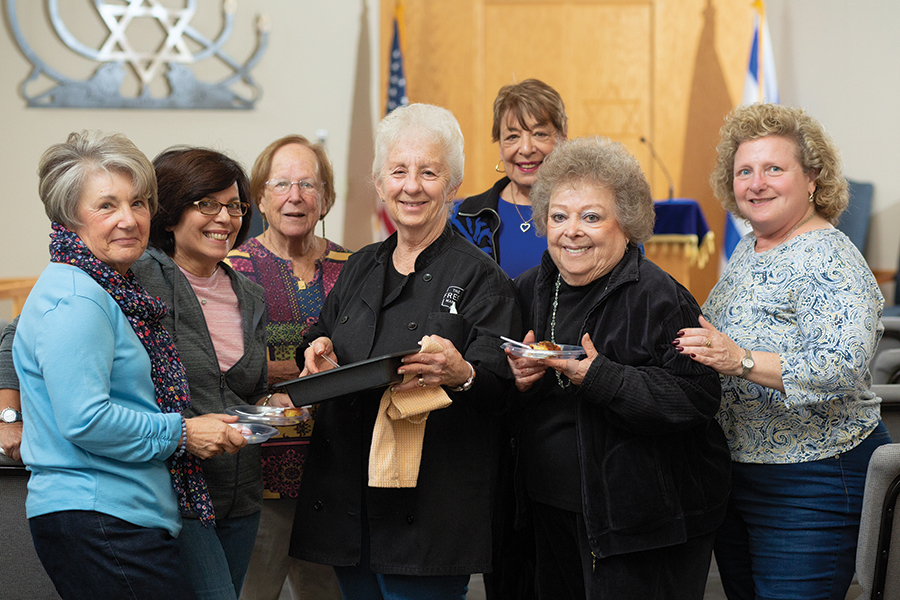
“The thing that really brings people together and best symbolizes Hanukkah is the traditional foods,” Carol Pierce explained as her students – Elaine, Nancy, Harriet, Sheila, Bonnie and Audrey — filtered into Beth Shalom’s cozy kitchen area, chatting away about the sudden turn in the weather and their own holiday preparations. “The foods of Hanukkah are fried, symbolic of the miracle of the oil that lit the lamp in the temple.”

“In other words,” someone quipped, “a heart attack on a plate.”

“Hanukkah brings back the best memories,” Elaine Schwartz was moved to say. “Everyone tends to have their own recipes for these foods, but my late mother made the best potato latkes ever. She served them warm from the oven with homemade applesauce and sour cream, and we always played the dreidel game for M&Ms. Unfortunately, she never wrote down her latke recipe and I’ve never quite found one to match it.”

These days, Schwartz added, she observes the holiday by sending her two grandchildren in Colorado gelt-filled dreidels and a nice gift for one of the nights of Hanukkah. “The holiday has changed in some respects. When I was young, my mother would give my sister and me coloring books and crayons for each night and a larger gift on the last night. But kids these days are competing with Christmas, in a way. Hanukkah has been somewhat Americanized,” she reflected. “That’s OK. The holidays share things in common — gifts, food and lights. It’s really about family time.”

Holiday traditions mean everything. As Sheila Rappaport placed her pre-made potato latkes on a cookie sheet to heat up (“You can make them well in advance and freeze them wrapped in paper towels — they keep wonderfully!”), her daughter, Audrey Shalikar, mused how her own children are now in their 30s, but she has kept her Hanukkah decorations at the ready for the expected birth of her first grandchild that is due soon. “So someday when they come to visit,” she says, “I’ll be ready with my mother’s latkes and dreidel games and the full experience of Hanukkah.”

Nancy Jacobs has a lovely story about the ecumenical appeal of a well-made latke. “My late husband, Bob, loved to make latkes,” she remembers. “Every year he spent an entire Saturday making two to three hundred latkes for the open house we always held after the Christmas tree lighting in the village of Pinehurst. Bob sang in the village chorus. He loved both holidays and the people who came to our house — always a hundred or so folks. They loved Bob’s latkes. It was a special evening.”

Over the next full and lively hour, the women of Beth Shalom traded laughs and sweet memories of their own Hanukkahs past as they learned an easy technique from Carol Pierce for making jelly doughnuts, latkes and a special panettone pudding from Fresh Market. There was talk of classic brisket recipes and chicken and matzo ball soup; homemade applesauce and Hanukkah cookies.

At one point Barbara Rothbeind, Beth Shalom’s energetic vice president, stuck her head in to see how the cooking group was faring. “It’s been a difficult year for Jewish people,” she reflected, “but the outpouring from people of faith across this community has been such a blessing. It shows how we stand together in a darkened time — letting our light shine. Hanukkah is all about that —food and family and fellowship.”

As we sampled a second warm and delicious jelly doughnut fresh from the kitchen’s oven, we couldn’t have agreed more.
Fresh Market Panettone Bread Pudding

1 box of Fresh Market Panettone Bread

1 cup heavy cream

1 cup whole milk

2 whole eggs

2 egg yolks

1/4 cup sugar

1 teaspoon grated orange zest

1 teaspoon vanilla extract

Preheat oven to 350 degrees. Cut panettone into 1-inch cubes and place in a 9-by-9-inch greased pan. In a large bowl whisk together remaining ingredients. Pour liquid mixture onto panettone cubes. Press cubes gently until all are saturated. Soak for five minutes. Bake for 60 minutes. Allow bread pudding to cool for 5 minutes before serving. Drizzle with caramel sauce or top with fresh whipped cream. 

Easy Potato Latkes

2 cups raw grated potatoes

1/2 cup grated onion

Pinch of baking powder

1 1/2 teaspoons salt

1 tablespoon of flour or matzo meal

2 Eggs

Peel potatoes and soak in cold water for several hours, then grate and drain. Beat eggs well and mix with other ingredients, add a little pepper if desired. Drop spoonfuls on hot greased skillet and cook until golden brown, both sides.

Keep warm in oven until ready to serve with warm applesauce

Easy 10-minute Applesauce

3 Golden Delicious apples, peeled, cored and quartered

3 Fuji apples peeled, cored and quartered

1 cup apple juice

2 tablespoons cognac or brandy (optional)

2 tablespoons butter

3 tablespoons honey

½ 1 teaspoon cinnamon

Combine apples and all other ingredients in microwave-safe container. Microwave uncovered for 10 minutes.

Use blender or potato masher to blend to desired consistency.

Serve warm or chill for later use.

Amazing Brisket

1 4–5 pound first cut brisket

1 cup dark brown sugar, lightly packed

1 package Lipton Onion Soup Mix

1 bottle Heinz Chili Sauce

Potatoes and carrots

Heat oven to 350 degrees

Place brisket in deep roasting pan. Combine sugar, soup mix and chili sauce; spoon over meat and cover pan. Cook for 2 1/2  hours, remove and cool for one hour.

Slice meat against grain, cover and cook brisket for another 2 hours, or until brisket is tender.

Add quartered red bliss or Yukon Gold potatoes (unpeeled) plus a small bag of baby carrots and cover with sauce, for the last hour.

Kugel

12 ounces noodles

1 cup cottage cheese

1 cup sour cream

3 eggs, beaten

1 stick butter, softened

Salt and pepper to taste.

Cook and drain noodles according to package directions. While still hot, add the other ingredients and stir well. Pour mixture in greased casserole and bake in preheated 350-degree oven 35 to 40 minutes.

For variety (and to make it sweet), you can add 1/2 cup sugar, 1/4 teaspoon cinnamon and a handful of raisins,

To make it savory, add only 1/2 stick of butter. Then sautée one medium chopped onion, 1/2 cup chopped mushrooms and 1/4 cup chopped celery  When veggies are browned, add to noodle mixture and bake as above. 

Pour mixture in greased casserole and bake in preheated 350-degree oven 35 to 40 minutes.

Can be frozen — defrost completely before warming in a 350-degree oven 10 minutes.

Matzo Balls

1 cup water

1 stick butter

1 cup matzo meal

Parsley, sugar, salt, paprika, ginger, nutmeg and grated onions to taste

3 eggs, separated

In a medium sauce pan combine water and butter. Heat until butter dissolves. Add matzo meal and stir until water is absorbed. Season to taste with parsley, sugar, salt, paprika, ginger, nutmeg and grated onions. Mix well.

Beat egg yolks until lemony and add to matzo mixture. In a clean bowl, with clean beater, beat egg whites until stiff; fold into matzo mixture. Chill well in covered container for at least 4 hours

To make the matzo balls, dip fingers in warm water and roll chilled mixture into balls.

If you wish to freeze, place on a cookie sheet and freeze. The frozen balls can be placed in a plastic bag until you need them. When ready to use them, drop them in boiling chicken broth and cook for 30 minutes on medium heat.

Add to your favorite soup! Yield: 27 medium/small matzo balls

Simple Chicken Soup

3 chicken breasts

4 carrots, halved

4 stalks celery, halved

1 large onion, halved

Water to cover

Salt and pepper to taste

1 teaspoon chicken bouillon granules (optional)

Put the chicken, carrots, celery and onion in a large stock pot and cover with cold water. Heat and simmer, uncovered, until the chicken meat falls off of the bones (skim off foam every so often).

Take everything out of the pot. Strain the broth. Pick the meat off the bones and chop the carrots, celery and onion. Season the broth with salt, pepper and chicken bouillon to taste, if desired. Return the chicken, carrots, celery and onion to the pot, stir together, and serve. 

Mandelbrot

(A sweet bread similar to biscotti)

3 eggs

1 cup sugar

1/3 cup vegetable oil

1 teaspoon vanilla

2 3/4 cups flour

2 teaspoons baking powder

1/2 teaspoon cinnamon

1/4  teaspoon salt

1/2  cup walnuts

Optional: chocolate chips, dried cranberries.

Beat the eggs and sugar until light and fluffy. Add the oil and vanilla and mix thoroughly.

Sift the flour, baking powder, salt and cinnamon together and add to the sugar mixture. Mix until blended, adding the nuts as the dough starts to come together.

Briefly knead the dough on a floured surface. Divide into 2 pieces and shape each into a log about 3 inches wide. (Add chocolate or cranberries at this point.)

Place logs on greased cookie sheet. Bake at 350 degrees for 30–35 minutes, until golden.

Remove from oven and let stand until cool enough to handle. Slice logs diagonally into 1/2-inch slices. Lay them on the cookie sheet cut side up and return to oven.

Bake on the top shelf for 10 minutes and then on the bottom shelf for 10 minutes until toasted and brown.

Sweet Sufganiyot

(Traditional jelly doughnuts) 

3 cups flour

2 teaspooons baking powder

2 tablespoons sugar

1/2  teaspoon vanilla

1/2  teaspoon nutmeg (optional)

2 eggs

2 cups sour cream

Oil for frying

Jelly (any preferred flavor — black raspberry a favorite)

Powdered sugar

In a bowl, blend together the flour, baking soda, sugar, vanilla, nutmeg, eggs and sour cream.

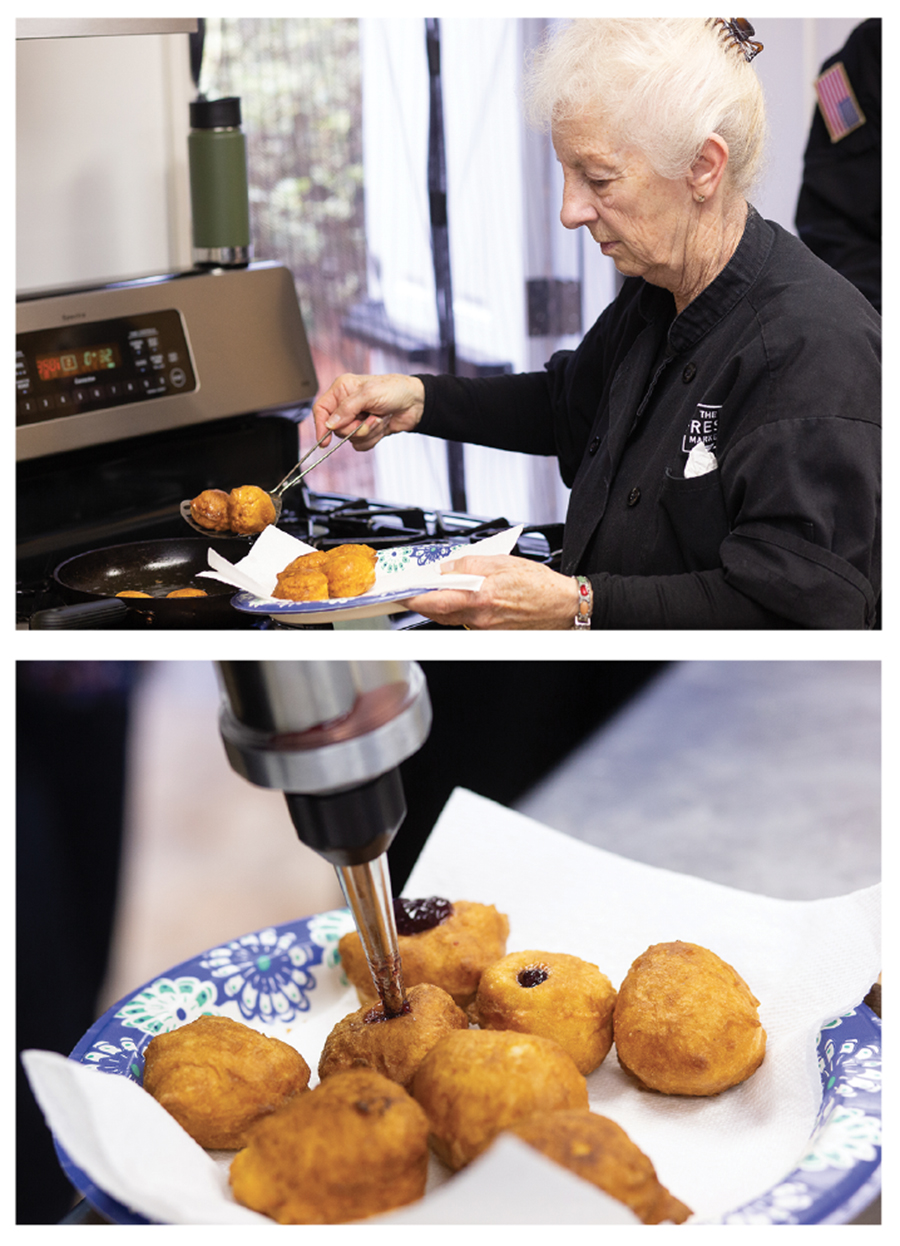
In a skillet, heat the oil, and when very hot, drop tablespoons of batter into it. When the batter puffs up and turns light brown, turn it over and cook the other side.

Set doughnuts on paper towel to cool.

Make a small hole and fill with jelly. A cooking syringe can make this easy. Sprinkle with powdered sugar and serve immediately.  PS

Hometown

Citizen’s Arrest, Citizen’s Arrest

Finding a key to the past

By Bill Fields

After a lifetime of watching Barney Fife — and more to the point, laughing at his foibles — I was beyond due.

Not too long ago, I think the lovable but bumbling deputy left Mayberry and drove the squad car to Southern Pines. And once he arrived, he was intent on making me pay up.

I should have been viewing a rerun of The Andy Griffith Show instead of having the channel on MSNBC and Lawrence O’Donnell, but Barney still had the last word.

It had been a long day — sweaty and muscle-achy tiring — of lifting and sorting, saving this and tossing that as my sisters and I emptied the old homestead. We combed through stuff at the house that had been tucked away for many years.

Some of the items had belonged to our father, who passed away in 1980 after a work life of various pursuits but that, in his last decade, had been in law enforcement. As a policeman and deputy sheriff in the 1970s, Dad accordingly had the tools of the trade.

Arriving home at the end of a shift, he would remove his duty belt just like the Cartwrights did when they stepped inside the front door of the Ponderosa. Off came his service revolver in its holster, a case with extra .38 caliber bullets, lead-filled leather sap and handcuffs.

I hadn’t seen any of those items in nearly 40 years but there, in a drawer undisturbed for nearly as long — along with a desk caddy containing pictures of his grandchildren, cufflinks, tie clips and loose change — something shiny glinted from the bottom.

At first I thought it might be one of his PaperMate ballpoint pens — he always carried two in his shirt pocket when setting out on an eight-hour shift — a shoehorn, cigarette lighter or stray metal golf spike. Then I got a closer look: handcuffs.

The restraints, like the rest of Dad’s police accessories, had been off limits way back when. It was a thrill to discover them.

“Hey, look what I found,” I said, loud enough for my sisters to hear in another room. “Handcuffs.”

They were heavy and scratched. A six-digit number was etched on the top of each. My father’s initials were on one ring, his name on the other.

It was a busy day, about noontime. I set the handcuffs aside.

Ten hours later, in the living room looking at the TV — I think I was too weary to really watch — I recalled the handcuffs, retrieved them from a banker’s box and came back to my chair to give them a closer look. I hadn’t expected to find them among all the stuff and I was curious.

One cuff appeared broken, disabled by age or intent when my father was forced to retire because of illness, its half-ring swinging back and forth freely like a mini Ferris wheel. The other metal ring, though, was functional and lockable, its teeth clicking audibly as I held it and clasped it closed several times just to hear the sound, which got my sisters’ attention as they went through photo albums at the other end of the room.

The working cuff was the one I put on my right wrist.

All I needed was Gomer Pyle’s wrist in the other metal ring and it would have been full Barney, because there was no key to go with the cuffs.

There was laughter, the way there had been laughter when Dad got a drive-in cheese dog in Archdale that came sans dog, or when my cap had been snagged by the treble hook of a lure and cast off my head and into Badin Lake.

Then there was a bit of panic. I do not have a dainty wrist, and it was being pinched pretty hard.

I decided to drive to the Southern Pines police station, steering with my free hand and resting the other on my leg. I was grateful the car was not a stick-shift model, and as I set out, I thought: Do not speed. It being late at night, the station door was locked. I pushed the intercom button and got a dispatcher.

I explained. She laughed.

Once inside, I heard the dispatcher reach an officer on the radio. Within 10 minutes, she had entered the building and was walking down the hall. I stood up and held out my right arm.

She laughed. I explained.

I can report that a handcuff key circa 2018 will unlock a handcuff circa 1978. Unshackled, I drove home and went to bed.  PS

Southern Pines native Bill Fields, who writes about golf and other things, moved north in 1986 but hasn’t lost his accent.

Character Study

Catalog of Memories

No room at the inn for the Wish Book

By Tom Allen

Say it ain’t so. Not at the most wonderful time of the year.

Recently, Sears announced they were closing 142 stores before the end of this year. At its height, America’s largest retailer boasted over 4,000 stores. Decades of lagging sales and plummeting revenues reduced the number to less than 1,000. Fingers point at everything from out of touch CEOs to blasé brands. I beg to differ. The reason? They messed with the Wish Book.

In 1993, Sears stopped publishing beloved big-book catalogs and reduced the size of the Christmas Wish Book, a holiday tradition since 1933. My generation circled Rock’em Sock’em Robots, Chatty Cathys and Electric Football games with vibrating, metal fields. We showed our parents pictures of Milton Bradley games like Barrel of Monkeys, Mousetrap and Twister. Remember Operation and “Cavity Sam,” with his red light bulb nose? Sam’s “Adam’s Apple” was easy to remove. Likewise his “Wrenched Ankle.” Going for the “Bread Basket,” worth $1,000 in play money, was the real test of hand-eye coordination and fine motor skills. Touch that metal with those tweezers — the buzzer sounded and Sam’s nose lit up. Doggone it! But we loved it. “Batteries Not Included” meant our stockings held an 8-pack of double-A Evereadys. Years later, we’d slip the same 8-pack, along with bubble gum and a pair of socks, into our kid’s stockings, just like our parents did. Thanks to the Wish Book, boys might pull out Hot Wheels; girls, Easy Bake Oven accessories.

Eventually, we ditched the Wish Book. Thought we’d outgrown it. Clothes, no longer frowned on, became acceptable under the tree. Who needed a Wish Book, we thought, when slick mail order offerings hollered at us from October until early December. As young adults we circled item numbers from Lands’ End catalogs, underlining sizes and colors to make sure whoever filled out the order form or called toll-free would get it right. We had to be at least as preppy as our best friends. We dog-eared pages from L.L. Bean’s collection of duck boots and flannel shirts, ’cause if you didn’t go for poplin and prep, try rugged and woodsy. For some, toll-free ordering from folksy towns like Dodgeville, Wisconsin, or Rockport, Maine, added to the mystique of the purchase. Am I really talking to someone who lives in Dodgeville? How cool was that?

Then along came the internet. Who needs toll-free numbers and mail order forms when you can shop online? Quick and convenient. Yes, I saved that credit card number, but they always ask for the security code. “Honey, will you hand me my wallet?” Need more choices? Hello Amazon Prime. For 120 bucks a year, get everything from toilet paper to toffee in two business days. But with convenience came overwhelming choices. Clothes shopping? Scroll through page after page of stonewashed denim or polo shirts and you still can’t find what you want. Narrow that search. Surely a middle-aged man, with a receding hairline and slight belly bulge, can find an alternative to skinny jeans. All I want is a short-sleeved navy polo — no pockets, hemmed sleeves or, Lord forbid, a monogram. Just a few colors, please. I’m fine not receiving a sweater on Christmas morning in “light beetroot red.”

In 1886, Richard Sears, a railroad worker, started selling watches through fliers and mail order catalogs. The business morphed into Sears Roebuck, selling everything from shoes to furniture to musical instruments. You could even buy a house from Sears. Exclusive brands like Kenmore, Craftsman and Diehard proliferated in American kitchens, tool sheds and cars. The Sears Tower, built in 1973 in Chicago, was once the tallest building in the world as well as the retailer’s headquarters.

By the 1980s low-price competitors like Walmart, Kmart and Target were opening big box stores. Sears tried to snag the dot-com market, acquired Lands’ End to beef up their apparel, and merged with Kmart. Nevertheless, decline continued. Sell-offs increased. The company became a shadow of itself during the ’70s and ’80s.

Last year, after listening to customers recount Christmas Wish Book memories, Sears brought the catalog back. But the print version, as well as online and mobile editions, failed to attract baby boomers who remember waiting for the iconic Christmas catalog to arrive by mail, months before Santa slid down the chimney.

Everything has its season. Sadly, perhaps Sears has had theirs. Still, memories of finding everything on my Wish Book list under the tree are priceless. Or, at least they beat the necktie with three Wise Men riding camels. I know. It’s the thought that counts.

Good luck, Sears. At Christmas, miracles still happen.  PS

Tom Allen is minister of education at First Baptist Church, Southern Pines.

The Kitchen Garden

That Old Chestnut

Making a comeback in the skillet

By Jan Leitschuh

Hot, roasted chestnuts have probably not been part of your holiday treat repertoire, despite the ubiquitous Christmas reminder in song. I would have been the same, except I first tasted chestnuts in Wisconsin, as my mother, a nostalgic World War II bride, roasted some for us kids in our living room fireplace. This was a time (cough) before gas logs.

The nuts were tasty, sweet and surprisingly soft, like a baked potato, very good with salt and the heat of the fire warming our faces. But chestnuts are neither a common nor everyday produce item, so the cold-weather treat drifted to the back burner.

The idea of chestnuts resurfaced again when our local Sandhills Farm to Table Co-op attended the international Slow Food Festival “Terre Madre” in Torino, Italy, in the fall of 2010. There we saw pushcart vendors roasting chestnuts on the streets, dumping the hot nuts into paper funnels for munching on the go or on the nearest park bench. Chestnut flour-based pastries and candied marron glacés graced bakery shop windows. Cafés featured a hot bowl of zuppa di castagne, sometimes with a grappa kicker. Late October was the season of the chestnut harvest.

As our bus drove us through the Italian countryside to our lodgings an hour south, neat farms began to sport tidy little groves of trees. Over 90 percent of Italy’s chestnuts are produced in Tuscany, and this little northern countryside had some lovely examples.

Edible chestnuts grow worldwide, including in North Carolina’s Piedmont and Sandhills regions. My first exposure to Tar Heel chestnuts came when the late environmentally active couple, Joyce and Len Tufts, gifted a generous bounty of homegrown Chinese chestnuts for Sandhills Farm to Table box subscribers. The nuts were as good as I remembered. I used them in a chestnut-sage stuffing.

This fall, local resident Ellen Marcus brought chestnuts back onto my radar. She and her family recently moved onto a property with four well-established chestnut trees bordering their front yard. It was a love-hate relationship from the start.

“The trees are perfectly climbable, picnic-worthy on a nice carpet of lush centipede grass, rich green foliage giving way to gold in autumn,” she says. “The tree’s beauty is mesmerizing and inviting.” Sounds heavenly, except for one factor Marcus hadn’t counted on: the spiny husks of the nuts that tumble each fall.

“The sharp chestnut spines can pierce soft-soled shoes,” she said. “ I can’t imagine why anyone would plant a chestnut in the front yard. The husks are mean and unforgiving, making the work of getting at the sweet meat all the more rewarding.”

And it is work. “The nuts have to be collected before the worms drill in,” she says. “They have to be refrigerated for storage. The nuts have to be scored and roasted to get them to peel easily. It almost gets to the point where you want to say, ‘Forget it, get an ax!’”

But then she relents. “The tree is reminiscent of the native chinquapin I grew up with as a kid. Chestnuts are so versatile, and make delicious cream soups, great flour, crispy toppings, and meaty stuffings.”

Chestnuts were much loved in ancient times. In fact, the Greeks and Romans used to transport an incredible amount of chestnuts in the stowage areas of ships to sell later. Before the chestnut blight in the early 20th century, the stunning American chestnut tree dominated forests of the eastern United States, blanketing the Appalachian mountains with their blossoms in the spring.

Known as the “Redwood of the East,” the American tree often reached towering heights of 150 feet. Experts estimate that at one time, one in every four hardwood trees in the East was an American chestnut. An important food source for natives, pioneers and wildlife, the American chestnut is making a small but determined comeback thanks to backcrossing efforts to introduce blight resistance.

According to the website “The Art of Manliness,” (cough, cough), one roasts chestnuts over an open fire, just as the song suggests. “Yes, you can roast chestnuts in the oven. But what would be the fun in that? A man never misses a chance to build a fire and cook over it,” the website suggests.

Instructions as follows:

To roast your chestnuts, you’ll need a pan that you can put into the fire. Long-handled popcorn or chestnut roasters make the ideal vessels for open fire chestnut roasting, as they allow you to roast the nuts without burning your face off. And their lids let you shake the chestnuts around for even roasting, instead of having to turn them over yourself or losing a few when flipping them in a lid-less pan.

If you don’t have a long-handled roaster, you can get by with a 12-inch cast-iron skillet or some other pan. Just be careful not to burn yourself. If you have an old beat-up skillet, you can turn it into a bona fide chestnut roaster by drilling 30 or so holes in the bottom.

If you don’t have a chestnut roaster or a skillet, you can also use a fireplace shovel. And I suppose you could even try sticking them individually on skewers . . . if you’re the patient type.

You can buy chestnuts at some grocery stores, but you may want to call ahead to make sure they have them. While dozens of chestnut varieties exist, most people roast Castagne and Marroni chestnuts at the holidays. Castagne are more common, while the Marroni are a more expensive specialty. The nut of the Marroni is sweeter and plumper, and it peels away from the skin more easily.

When choosing your chestnuts, look for those that are plump, smooth, shiny, and blemish-free. Moldy chestnuts are a common problem, so squeeze and shake the chestnut to see if the nut has shriveled up and pulled away from the shell.

Keep in mind that the larger the chestnut, the longer it will take to roast. Pick chestnuts that are fairly uniform in size and will thus be done at the same time.

Chestnuts are traditionally scored, their brown skin sliced to allow steam to escape when roasted. Simply take a sharp knife and cut an “X” into the flat side of each chestnut. Once your chestnuts are clean, dry and scored, roast over a nice bed of hot embers, shaking the pan to prevent burning. The brown exterior is peeled off after roasting and the hot nuts dipped in salt.

Chestnut trees prefer good drainage — avoid standing water and low-lying areas. To produce fruit, trees will also need lots of sunlight and plenty of regular watering to become established. Fall and winter are great times to add a couple of chestnut trees to your property, for wildlife and personal consumption. Revival, Carolina and Willamette are three suggested varieties that do well in North Carolina. All require pollination from another variety.

Plant at least two cultivars of the same type to ensure optimal size and production, and probably best away from where children and dogs might play, given the spiny husks. Most Chinese and hybrid chestnuts are highly resistant to the chestnut blight fungus. Many people prefer the hybrid chestnut cultivars, citing superior quality over the straight Chinese cultivars. Management is low.

If you are lucky enough to have your own chestnut tree, sort nuts for mold. Either use fresh nuts immediately or store unpeeled chestnuts in the refrigerator. To keep your chestnuts in good shape for a little longer, place them in a plastic bag and stick a few holes in the bag for airflow. Chestnuts should then keep for two or three weeks. Place them in the fridge’s crisper or vegetable storage bin.

Store freshly purchased or picked, unpeeled chestnuts at room temperature for up to one week only. Keep them in a well-ventilated and dry place.

In case you want to go beyond roasted chestnuts this holiday season, just add chocolate:

Chestnut-Chocolate Pudding

1 1/4 pound chestnuts

5 ounces dark chocolate, chopped

4 ounces butter

4 ounces sugar

Salt

Cook the chestnuts in salted water, peel and then process or sieve them. Melt the chocolate and add to the still warm chestnuts together with the sugar and butter.

Stir for some time. Line a rectangular mold with greaseproof paper and grease with butter, lay in the mixture, level off and cover with more greaseproof paper.

Leave in the fridge for at least 4 hours. Serve with cream on the side.  PS

Jan Leitschuh is a local gardener, avid eater of fresh produce and co-founder of the Sandhills Farm to Table Cooperative.

In the Spirit

Beer on Whiskey

Not so risky. And sometimes surprisingly delicious

By Tony Cross

In holidays past, I would have a moment of clarity when visiting my loved ones. It would come on suddenly, and always within 12 hours of arriving. Like clockwork. “I’ve got to get out of here and get a drink.” The members of my family are not big drinkers. I would have a beverage or two around them, but I always craved my escape drink. It’s not because my folks are hard to be around — they’re amazing. It’s because this time of year stresses me out and I turn into Mr. McJerkface after a few hours of sitting around.

Mom and Pops live near me now, but for almost a decade they didn’t. There were no close bars that could whip up a decent drink, so off to the dive bars I went. One of my favorite things to order was a beer with a whiskey back. It did the trick every time. So, for this month’s column, I teamed up with Jason Dickinson, a certified Cicerone — think sommelier for beer or, as I like to call him, “beer nerd.” We had fun pairing up a few different styles of beer with spirits. And by we I mean that I texted him the three spirits I was bringing, and he used his expertise to bring a few pairing suggestions for each. You can find Jason over at Triangle Wine, if you have any questions or recommendations. Use these pairings anytime of the year, of course, but give these a shot when you’re out of town and are drawing a blank when you run away from your family.

Sour/Blanco Tequila

For our pairing, Jason brought Dogfish Head’s Sea Quench Ale Session Sour, and I provided El Jimador. Right off the bat, I sensed this would work. I spied a picture of a lime wheel on the can, and immediately saw the word “salt” in the description. That’s a margarita all day. “I chose this because of its year-round production,” Jason said. “It’s one of the few sours that we’re going to see on draft in more places pretty soon.” The first sip was all we needed. Tart and salty. Perfect with a blanco tequila — just make sure the label has “100 percent Agave” on it. If it doesn’t, I don’t think any beer will save you. If the spot you’re frequenting doesn’t have any sour-style beers, grab a Mexican lager. As I’ve mentioned before, a can of Modelo and tequila have been good pals of mine during the summer. However, I wouldn’t discriminate against them in winter.

Milk Stout/Spiced Rum

We combined a Nitro Merlin Milk Stout with Gosling’s Black Seal Rum, and it went together quite nicely. The Merlin is light, creamy and smooth. The Nitro comes from the beer having more nitrogen gas than carbon dioxide (like most traditional beer). This also gives the beer a touch of sweetness. I picked Gosling’s because there’s more likelihood of finding it behind a bar than other rums that I would drink straight (e.g., Smith & Cross, or rhum agricole). With that said, I never drink Gosling’s on its own. The distillery owns the trademark for “Dark ‘N’ Stormy,” so there’s that. But never on its own. But boy, oh boy, these two are yummy together. The sweetness of the rum and spice complement the chocolaty creaminess of the Merlin. I would pour my shot into the beer next time. Again, the chances of your finding the Merlin at a dive bar might be slim, so if you don’t see it anywhere, grab a Guinness. “A Guinness has a dry and roasty flavor profile, so adding the sweetness of the Gosling’s will bring a nice counterbalance,” Jason says. If they don’t have a Guinness, walk out.

Porter/Whiskey

“If someone asks what an American porter is, this is it to a T,” says Jason. “This is the beer a lot of people point to as the classic one in this category. There are a couple of producers that do one — Sierra Nevada makes a good porter. But Deschutes Black Butte Porter is generally thought of as THE porter for American style. They’re usually low ABV too.” That’s news to me. And if you’re as ignorant about porters as I am, keep reading. “Because bourbon and rye have been really popular over the past decade, the breweries rest their porters in bourbon and rye barrels. So, for me, this is a no-brainer.” This is one of the reasons I like Jason. Out of the park. One gulp of the Black Butte followed by a swig of Maker’s Mark (again, pretty much a trademark whiskey in myriad bars) pulls Jason’s theory together. The porter was dry on the end and having whiskey in between sips lent an oakiness to my palate. We both agreed that this was our favorite of the night. Bourbons tend to be sweeter than rye, but rye has spice. Me likey the spice. So next time, I’m having a porter with rye, that’s a what’s up, for sure.

In the pre-Jason era, when I paired beer and spirits, I’d make up my own boilermaker — by definition a shot of whiskey dropped into a glass filled halfway with beer. It was usually an IPA and a rye whiskey. Why? Because at the time, those were my favorite styles of beer and whiskey to drink on their own. As soon as I arrived at my getaway drink spot, that’s all it took to wash my Scrooge demeanor away. Now, as the saying goes, I got options.  PS

Tony Cross is a bartender who runs cocktail catering company Reverie Cocktails in Southern Pines.

A Tar Heel Thanksgiving

Over the river and through the woods . . . from mountains to the coast we go for a feast rich in the tastes and traditions of North Carolina

By Jane Lear     Photographs by James Stefiuk

Southern Thanksgiving typically occurs around a table so crowded with platters and serving bowls there is barely enough room for glasses and flatware. A sausage and cornbread dressing may jostle for space with oyster casserole and hot, lighter-than-air biscuits; rice and cream gravy may vie with braised turnip greens dotted with crisp bacon. And then there’s the roast turkey, with its burnished, crackling skin, taking center stage. It’s a wonder anyone has room for dessert.

It wasn’t always so — many Southerners considered Thanksgiving a New England (that is, abolitionist) holiday well into the 20th century — but now we happily, gratefully come together on the fourth Thursday in November to honor and sustain ties to family, friends and, of course, place.

Generally speaking, the South is a cornucopia of numerous cuisines, and when it comes to North Carolina in particular, the variation is remarkable, sweeping as it does from the hills and hollows of Appalachia to the lush Piedmont — with its low, rolling hills, it’s as rumpled as a collard leaf — and on down a broad swath of Coastal Plain to the Atlantic. And while it’s true that a simple, almost austere bowl of soup beans and cornbread seems a world away from a lavish platter of deviled crab, they are both products of an abundant region.

They are products, too, of the complex, bittersweet melting pot that was the antebellum South. European explorers and settlers brought, among other provisions, pigs, cattle, chickens, wheat, apples and turnips. Along with the slave trade came rice, okra, collard greens, black-eyed peas, peanuts, sorghum and watermelon. And all the newcomers relied greatly on Native American foodstuffs, including seafood, corn, beans, squash, sweet potatoes, chestnuts and low-bush cranberries, once common to the wetlands of Pamlico Sound.

And so when I was asked to come up with three side dishes that exemplified, respectively, the mountains, Piedmont, and coast of North Carolina, there was an astonishing array to choose from. At the end of the day, though, I realized that at Thanksgiving, none of us is really interested in complicated food, with lots of bells and whistles. What we crave is food that is sumptuous yet straightforward, rich yet not cloying. The flavors that speak to us are profound and nourish us on several different levels.

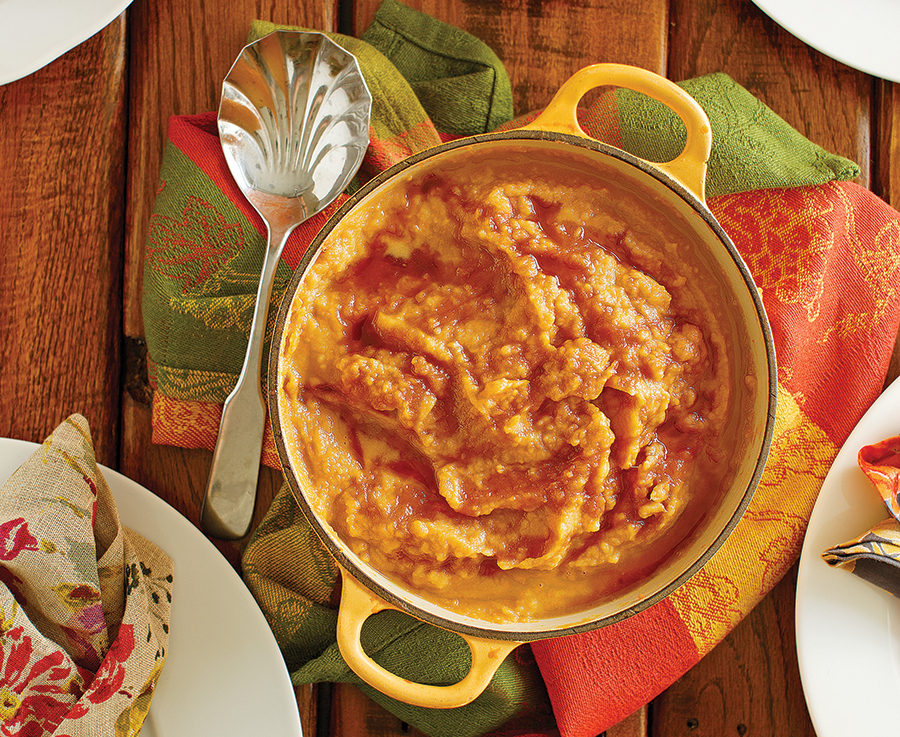
Take, for instance, sorghum mashed sweet potatoes. North Carolina, which grows almost half the country’s supply of sweets, designated the tuber the state vegetable in 1995. Most of the production is in the sandy soils of the Coastal Plain, but sweets are grown all over the state, including the mountains. What really gives this recipe its Southern Appalachian cred, however, is the sweetener used: sorghum syrup, which is the cooked-down juices of the tall canelike sorghum plant. It’s not as assertive as molasses (a byproduct of refined-sugar manufacturing), but its depth charge of flavor really resonates.

In addition to having a great affinity for sweet potatoes, sorghum is wonderful swirled into butter. “I can’t tell you why sorghum syrup blended at the table with soft butter tastes better on a hot biscuit than putting the two on separately,” wrote Ronni Lundy in her instant classic, Victuals: An Appalachian Journey, with Recipes. “I can just tell you it does, unequivocally. And that’s why generations of mountain mamas have taught their babies how to do this.”

Sweet potatoes, by the way, are not yams. A true yam (the word comes from the West African inhame, pronounced “eenyam”) is a starchy, unsweet tuber that originated in the tropics, and although you’ll find it in African, Caribbean, Philippine and Latin groceries, odds are it isn’t piled in a big heap at your local Harris Teeter or Food Lion.

Not only are sweet potatoes not yams, they’re not real potatoes, either, but a member of the morning glory family. Given its Latin name, Ipomoea batatas, it’s not a huge linguistic stretch from batata to patata and potato. To further confuse the issue, back in the 1930s, promotors of Louisiana-grown sweets used the word yam to distinguish their crop from those grown in other states, and the misnomer became the basis for an enduring culinary myth.

When it comes to a green vegetable at Thanksgiving, lots of folks are happy with Brussels sprouts or broccoli embellished with crisp bacon or toasted nuts. There is nothing wrong with these delicious options, but I am always eager for the first frost-kissed pot greens of the season. Many people consider them sweeter than they are at other times of year, and their opinion has its basis in fact. In response to cold temperatures, the greens break down some of their energy stores into sugars, and so are at their peak flavorwise.

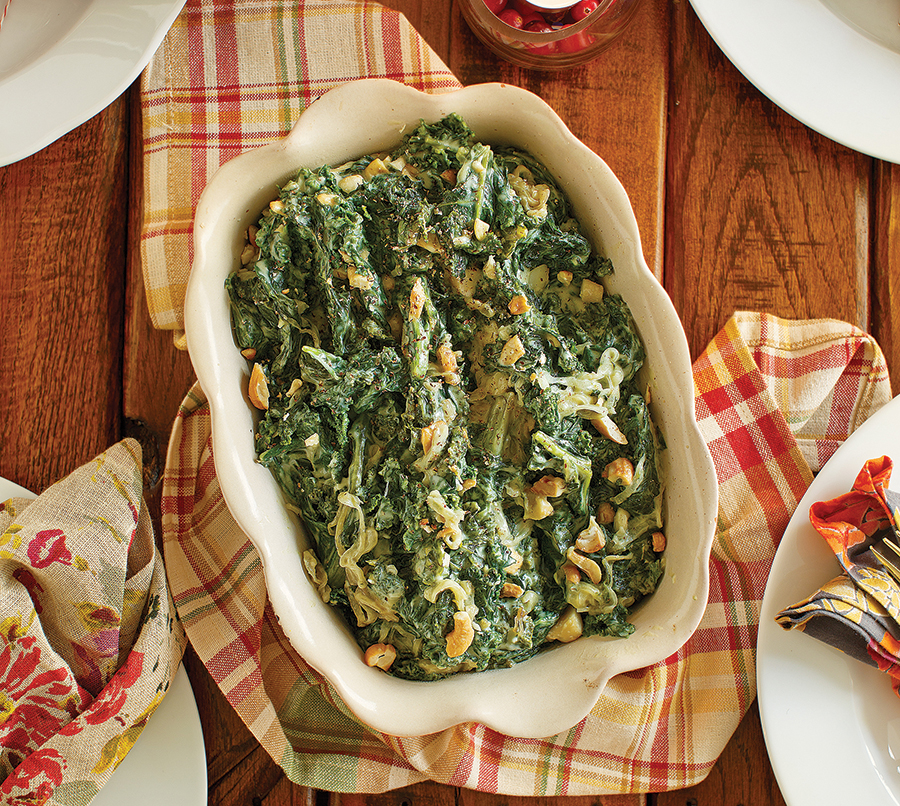
Southerners tend to simmer a variety of greens together, and each has its own character: Collards are mellow and meaty; turnip greens are sharp and spicy; and kale provides a sturdy underpinning and plays well with the others. In the recipe below, a satiny béchamel sauce rounds out the natural bitterness of the greens and lifts them into the realm of the extraordinary, especially with a little help from glossy, rich chestnuts.

Like most home cooks, I don’t have the time or inclination to roast and peel chestnuts at home. That job, not nearly as romantic as it sounds (your fingers burn, bleed, or both), falls squarely in my “Not No, but Hell, No” category. The pre-roasted chestnuts in a vacuum-packed jar — available almost everywhere this time of year — are excellent, a true convenience food, and do the job beautifully.

They are, however, from Italian, not American chestnut trees, and therein lies a tale. The vast majority of American chestnuts — an estimated 4 billion trees — succumbed during the mid-20th century to chestnut blight, a fungus that thumbed a ride on imported Asian trees. This great American tragedy has all but been forgotten, except by many in rural communities — from the North Carolina Piedmont to the Ohio Valley, from Maine to Florida — whose economy depended upon the “redwood of the east.” It grew tall (often 100 feet or more), fast, and as straight as a column, providing rot-resistant hardwood for houses, fences, and furniture — from cradle to coffin, as it were.

A single mature chestnut could reliably produce 6,000 nuts every year. High in fiber, vitamin C, protein and carbohydrates, they were a boon to both settlers and their livestock, as well as an intricate web of wildlife, from pollinators to birds and bears. These days, dedicated plant scientists and volunteers are breeding and planting blight-resistant trees to repopulate our eastern woodlands. The widespread effort is led by the Asheville-based American Chestnut Foundation, and you can find out more at acf.org.

One of the things I’ve long found interesting about Thanksgiving is the widespread presumption that all Americans eat exactly the same food, the sort conjured by Norman Rockwell’s sentimental 1943 painting Freedom from Want (a.k.a. “the Thanksgiving Picture”). But in my experience, plenty of families happily veer far from this ideal based on their heritage and local bounty, and they don’t give it a second thought.

Dressing is an excellent example of what I mean. (Yes, most Americans call it stuffing, even those who prefer to bake it separately instead of inside the bird, but “dressing” is still widely used in Southern circles.) It never occurred to me until I was almost grown that different families have different takes on this traditional accompaniment. While at college, I went home with a Midwestern roommate for the holiday, and the hearty caraway-spiked rye bread, sauerkraut and apple rendition her mom served was worlds away from my mother’s cornbread dressing with sage and onion. I was stunned and amazed.

Since then, I’ve broadened my outlook and, emboldened by an 18-year tenure at Gourmet magazine, I’m not shy about trying something new. Homemade cornbread or a mix of cornbread and a store-bought country loaf is my usual base, but then I roll up my sleeves and have fun. For years, I made a sausage and fennel dressing, sometimes enlivened with cranberries or dried cherries. Prosciutto, pancetta or bacon is always good in a dressing — all are lighter than sausage — and pecans provide a nutty, irresistible crunch. The combination of chestnuts, apples and leeks is a serendipitous one, as is chard, golden raisins and pine nuts.

And on this most inclusive of holidays, dressing is extremely versatile. Chorizo and fresh green chiles push it in a Southwestern direction; andouille and dirty rice (instead of bread) give it New Orleans flair. One Chinese-American friend in Winston-Salem makes a heavenly concoction that involves dried Chinese sausage, shiitake mushrooms and bok choy, for crunch. You get the picture.

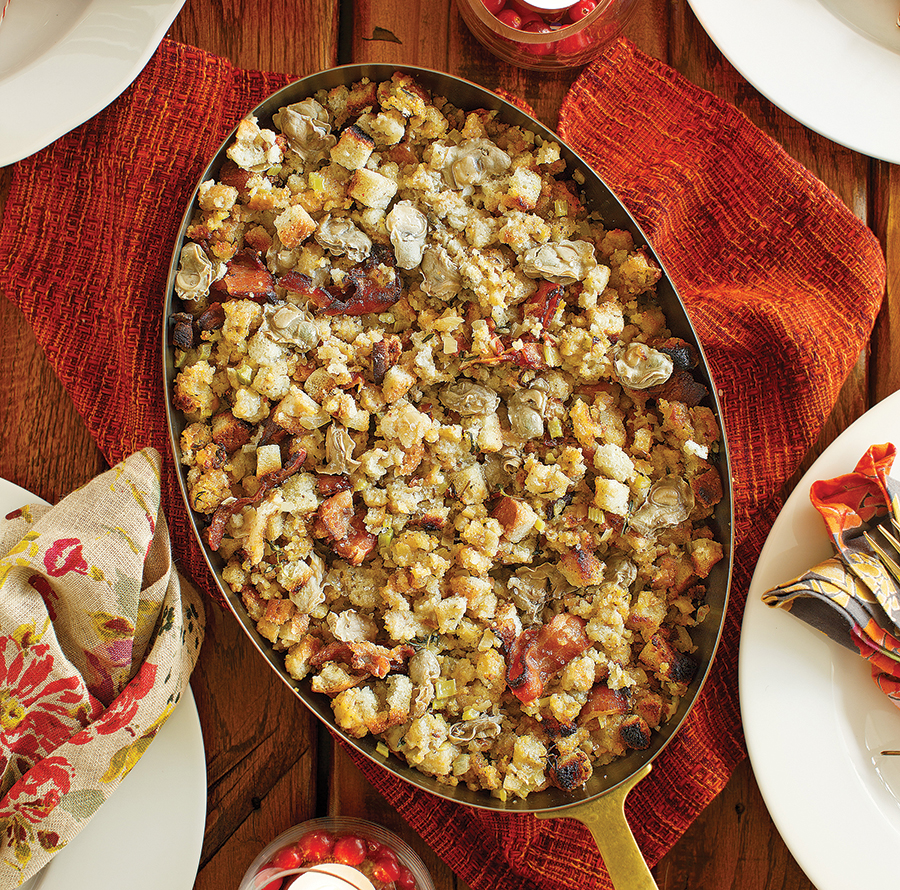
This year, however, in the wake of Hurricane Florence, my thoughts are with friends and family in Wilmington and elsewhere in the Old North State. We all love our oysters, and even though I’ll probably kick off my Thanksgiving Day celebration with a few dozen on the half shell, incorporating them into my dressing doesn’t seem like overkill. Chopped, they won’t come across as a disparate seafood component, but will add richness and a deep savoriness to a simple herb and onion dressing. We’d miss them if they aren’t there.

Happy Thanksgiving! Here’s hoping you find room for just one more bite.

Sorghum Mashed Sweets

Serves 8

You’ll find a number of different sweet potato varieties at supermarkets, especially this time of year. In general, the deeper the flesh color, the moister and sweeter they are when cooked. Sorghum syrup is available at many supermarkets and online sources. Because some brands are cut with corn syrup, make sure the label reads “100 percent sorghum.”

6 pounds sweet potatoes, scrubbed and pricked with a fork

1 stick unsalted butter, melted

1/2 cup half and half or heavy cream, warmed through

2 tablespoons sorghum syrup, or to taste

Coarse salt and freshly ground pepper

1. Preheat the oven to 400°. Put the sweet potatoes on a foil-lined baking sheet and bake until extremely tender, at least an hour or more. Let cool, then halve and spoon the flesh into a bowl, discarding skins.

2. Mash the sweets with a potato masher until smooth, then stir in butter, half and half, and sorghum. Season with salt and pepper to taste.

Creamed Greens with Chestnuts

Serves 8

Keep the turnip greens separate after chopping — they’re added to the pan after the thicker-leaved collards and kale have cooked for a while. No turnip greens? No problem. You could substitute mustard greens, with their radishy hotness, or chard, which turns especially silky when cooked.

1 large bunch each collards, kale and turnip greens, tough stems discarded and leaves coarsely chopped (about 20 cups total; see above note)

Coarse salt

3/4 cup dry white wine

6 tablespoons unsalted butter, divided

2 large shallots, thinly sliced

1 bay leaf

1 cup jarred vacuum-packed chestnuts, coarsely chopped

2 tablespoons all-purpose flour

1 1/2 cups whole milk

1 1/2 cups heavy cream

Pinch of freshly grated nutmeg

1. Wash the greens well; shake off the excess water but don’t dry completely. In a large sauté pan, cook the collards and kale with salt and wine over moderately high heat, covered and turning with tongs occasionally, until wilted. Reduce heat to moderate and cook, turning occasionally, until almost tender, about 15 minutes. Add turnip greens and cook, uncovered, until wilted. Transfer greens to a bowl.

2. Melt 4 tablespoons butter in the sauté pan over high heat. Add the shallots and bay leaf and cook, stirring, until shallots are softened, 2 to 3 minutes. Stir in chestnuts and cook about a minute more. Discard bay leaf, then stir in greens to incorporate and set aside.

3. Melt remaining 2 tablespoons butter in a saucepan over moderately high heat. Whisk in the flour, then gradually whisk in the milk and cream. Bring to a simmer, then simmer, whisking constantly, until sauce thickens slightly and just coats the back of a spoon, about 2 minutes or so. Whisk in nutmeg and 1 teaspoon salt to taste. Stir sauce into greens and cook over moderate heat until all is heated through.

The greens can be chopped a day ahead and refrigerated in a resealable plastic bag. The sauce can be made a day ahead and refrigerated, its surface covered with parchment paper; reheat before using. (If necessary, thin with a little milk while reheating.)

Oyster Dressing à la Gourmet

Serves 8

You can assemble this dressing, without the oysters, up to 2 days ahead, then refrigerate it, covered. Before baking, bring the dressing to room temperature and stir in the oysters.

About 2 loaves country-style white bread (not sourdough), torn into 3/4-inch pieces (about 12 cups), or a mix of white bread and your favorite cornbread, broken into 3/4-inch pieces

8 slices bacon, cut crosswise into 1/2-inch pieces

Extra-virgin olive oil (if necessary)

2 medium onions, finely chopped

1 1/2 cups chopped celery

1 tablespoon minced garlic

3 tablespoons chopped fresh thyme or 1 tablespoon dried thyme, crumbled

1 tablespoon finely chopped fresh sage or 2 teaspoons dried sage, crumbled

Coarse salt and freshly ground pepper

2/3 cup finely chopped fresh parsley

1 stick unsalted butter, melted

18 oysters, shucked, drained and chopped

2 1/4 cups turkey or chicken stock (or store-bought low-sodium
chicken broth)

1. Preheat oven to 325° with the racks in upper and lower thirds of oven. Butter a 3- to 3 1/2-quart baking dish.

2. Spread the bread pieces on 2 baking sheets and bake, switching position of sheets halfway through baking, until golden, 25 to 30 minutes. Let bread cool, then transfer to a large bowl. Leave oven on and put 1 rack in the middle of oven.

3. Cook the bacon in a large heavy skillet over moderate heat, stirring occasionally, until crisp, about 10 minutes. Let drain on paper towels, reserving fat in skillet.

4. If bacon rendered less than 1/4 cup fat, add enough olive oil to skillet to measure 1/4 cup. Add the onions, celery, garlic, thyme, sage, 1/2 teaspoon salt, and 1/4 teaspoon pepper to skillet and cook over moderate heat, stirring occasionally, until vegetables are softened, about 10 minutes. Transfer to bowl of bread, then stir in bacon, parsley, butter, and oysters. Drizzle with stock, season with salt and pepper, and toss well to combine.

5. Transfer dressing to the baking dish. Bake, covered, for 30 minutes. Uncover and bake until browned on top, about 30 minutes more.  PS

Jane Lear was the senior articles editor at Gourmet and features director at Martha Stewart Living.

Good Natured

Mind & Body

The balancing power of hemp extract

By Karen Frye

The golden elixir known as cannabidiol or CBD is what’s extracted in the industrial hemp plant. The use of industrial hemp goes back thousands of years. Nearly every part of the plant can be used for building materials, fuel, clothes, fiber and food. The seeds are rich in omega fatty acids and protein. Agricultural hemp grows differently than other cannabis plants, and looks like bamboo, but grows like a weed.

In 1992, scientists discovered the existence of a system within our bodies, and that of animals, that was previously unknown — the endocannabinoid system, or ECS. It is the conductor within our body delivering messages to the cardiovascular system, immune system, nervous system, endocrine system and the rest of the major systems. We have receptors from head to toe, and our body produces cannabinoids that travel to the sites to regulate activity within the cells. As we age, our body produces less, and we become deficient, creating an imbalance. Hemp extract restores balance where it’s needed, maintaining homeostasis.

The greatest source of phytocannabinoids is found in the hemp plant. CBD can help us bring balance to our bodies and our lives, unlocking our health’s full potential. The studies using hemp extract are extensive, as are the testimonials from the people who are finding better health. A few of the problems that improve with the use of CBD are insomnia, anxiety, stress, memory, mood, inflammation, metabolism, energy, nerve function, muscle control, appetite, pain and seizures. Likely you, or someone you know, could benefit from using CBD. Your pet can also benefit from hemp extract, helping aging dogs or cats with arthritis, pain and nervousness.

The market for hemp extract is growing rapidly. With so many companies getting in on the demand for this supplement, you want to make sure that you find one that is grown and manufactured responsibly. There are various ways you can use CBD. The most common form is taking the extract in a liquid solution by mouth or a capsule. There are topical creams, and salves for pain and skin issues. In fact, there is a beauty line of hair and skin care items for men and women. And there appear to be no negative side effects.

Hemp is a revolutionary plant remedy that could change the well-being of you and your pets in a most positive way — improving the quality of your health, so you can enjoy life to the fullest. PS

Karen Frye is the owner and founder of Nature’s Own and teaches yoga at the Bikram Yoga Studio.


Claiming the Lion’s Share

A Pinecrest star shines on Broadway

By Deborah Salomon

Numbers don’t lie.

The first movie Bradley Gibson saw in a theater was The Lion King. He was 8, give or take. At 17, with a Pinecrest High School group, he watched the New York production, enthralled. On July 2, Bradley, now 27, roared into the lead role of Simba in the show that has captivated Broadway for 20 years and won six Tony Awards.

“He doesn’t just put on the mask; he tells the story with his entire body,” says Bradley’s first dance instructor, Gary Taylor, of Gary Taylor Performing Arts. That roar you hear is one of joy for overcoming the odds, for leaping from Aberdeen to Pride Rock in a steady upward trajectory. After Pinecrest, Bradley pursued a degree in musical theater at the Boston Conservatory and, with fellow graduates, headed straight for New York. In just a month, the 22-year-old landed a part in the musical Rocky, which meant learning to box. After touring with the Broadway production of Chicago, Bradley created the role of Tyrone in the musical version of A Bronx Tale. A year and a half into the run his agent called with the news that Jelani Remy, who had played Simba in Las Vegas and then New York, was leaving The Lion King. Bradley’s gut reaction: Go for it. After days of tense auditions and callbacks, the email arrived during a matinee.

“I felt like wow, they appreciated my work.”

_

Luck? Miracle? Fluke? More likely planning, discipline and a positive attitude. Expressive eyes, a fab smile and a lithe, muscular dancer’s body helped. But the theater world is full of qualified hopefuls waiting tables between casting calls. Bradley’s “it” factor, Taylor continues, is an amazing voice and stage presence. “He makes everybody else on stage look good.”

Despite a grueling schedule — eight performances a week — Bradley sounds relaxed. “My first exposure to musical theater was watching movies like Grease, The Sound of Music, My Fair Lady. When I saw people singing and dancing it seemed so natural, like something I should be doing.”

His acting debut was as a wise old dog in the Christmas play at Aberdeen Elementary. By high school he had already participated in community theater, danced at Terpsichore and sung in a choir.

Adam Faw, Pinecrest Players Theater Arts director, remembers Brad at 14: “He was fresh in the theater arts class. I had seen him in middle school — he was different, he stood out. Many of my students were talented but not of that caliber.”

The impressive numbers march on.

By 16 Bradley was performing in productions of Crazy for You and A Chorus Line.

“He was a triple threat — singing, dancing, acting,” Faw continues. Most important: “He had a positive work ethic.”

His solos often brought down the house.

The Boston Conservatory was a whole new ball game. “It was the shock of my life. For the first time I was around nothing but artists,” says Gibson. The historic Boston Theater District is where Broadway shows open and sometimes close — a suitable environment to polish his craft. The once-shy young man from a small Southern town blossomed, made friends. After graduation his group moved to New York, where they found a supportive community.

Playing Tyrone in A Bronx Tale gave the relative newbie more leeway than he would find taking on Simba as part of an established cast. The latter meant rehearsing alone with The Lion King’s director and also with its choreographer, allowing just enough interpretation without upsetting routines. “It was the first show I had seen where all the cast members were people of color — Asian, Hispanic, African-American. This was encouraging,” he says. As was the plot, chronicling a voyage of self-discovery not unlike Bradley’s own. “It was a perfect fit.”

_

For now, the Sandhills wonderchild is too consumed by work for much introspection. The role of adult Simba is extremely physical. Imagine the energy expended six days a week, twice on Wednesdays and Saturdays. “It’s like running a corporation,” Bradley says. “I have to take care of myself.” His routine includes strengthening workouts, singing lessons and dance classes, a healthy diet, meditation, yoga, plenty of sleep. An injury could be devastating. So would going stale in the role, though there’s little chance of that. “The freedom of performing is to play someone else, to put yourself in the back seat,” he says.

Bradley arrives at 6:15 for a 7 p.m. curtain; the adult Simba doesn’t appear until an hour into the three-hour show. His makeup is complicated. Getting used to moving about in the leonine headdress and beaded corset took practice. The production elicits gasps for its reverse anthropomorphic costumes, as African “animals” lope down the aisles.

_

A favorable alignment of stars is not lost on the young performer. “I look in the mirror and know how lucky I am, but I also know luck is where preparation meets opportunity.” Self-confidence kept him afloat through callbacks that didn’t happen, parts that slipped away. “My life is so overwhelmed with blessings. I keep climbing because that’s all there is to do.”

Gibson’s success doesn’t surprise Southern Pines yoga instructor Brady Gallagher, a childhood friend and co-performer in West Side Story at Pinecrest. “He’s no different today than in high school. He was born for this — he didn’t have a backup plan.”

Beyond good fortune and natural ability, Bradley credits advice from his great-grandmother, Ruby Floyd, who raised him: Work hard! Do the best you can! It doesn’t matter if it’s on the Robert E. Lee Auditorium stage or the Minskoff Theater bordering Times Square. “He was always dancing in front of the TV,” Floyd recalls. “He wouldn’t stop watching that Lion King cartoon movie. And it paid off.”

Great-granny Floyd has seen all of Bradley’s Broadway roles. In July she watched him become Simba, tears streaming down her face. “When it was all over I stood up with my cane and applauded.”

As do his friends, admirers and mentors, 570 miles south.

“His spirit is his heart,” Gallagher observes.

“Bradley fought against odds in a world that’s already tough,” Taylor says. “When I first saw him, I said that’s a star.”

“I am beyond proud of Bradley,” adds Faw.

And the list of accolades goes on — a good sign — because numbers still count, even when, at 27, you’re batting a thousand.  PS

Sandhills Repertory Theatre and Michael Pizzi present “Bradley Gibson: The Homecoming Concert” at 7 p.m. on Nov. 26 at the Robert E. Lee Auditorium, Pinecrest High School, Southern Pines. Gibson will sing and talk about his career, which blossomed on this very stage. Part of the proceeds will benefit the Sandhills Theatre Arts in the Schools fund and other community organizations. Tickets are available at www.sandhillsrep.org. Students 18 and under with ID are $15; general admission advance purchase is $40; seniors and military with ID, $35; VIP (includes photo op with Gibson) $75. All adults at door: $50. For more information email sandhillsbroadway@gmail.com.

The Kitchen Garden

Soul Food

The greens that bring good luck

By Jan Leitschuh

What would November in the South be without collards?

This cold-hardy green epitomizes the first nip of the Southern winter, when a killing frost only sweetens the leathery leaves of this open-crowned crop. Frost eggs it on rather than knocking it back. It’s the ultimate winter side dish, and can be expected to grace many a Southern Thanksgiving table. The dark, leafy greens are also included in the traditional New Year’s meal in many areas of the South. “Hoppin’ John” made of black-eyed peas, smoked pork and collards is said to bring luck in the coming year.

The collard harvest begins here in fall, and forges bravely into sure-enough winter, often providing hearty nutrition well into January, or even beyond, in a mild winter. Let’s see wimpy lettuce try that. Long after the bibb and the romaine have mushed up in the face of a light November frost, collards will shake it off with a chuckle and carry on growing new leaves.

In our garden, collards are a winter star. What else grows and produces in winter? The loose heads appear to freeze solid when nights get down into the teens. Yet, when the sun warms the broad, dark leaves, they crisp back up and return from their cryotherapy as if nothing has interrupted their happy life — including the pesky gardener who insists on collecting their maturing lower leaves.

Collards were a discovery vegetable for this Midwestern transplant. At first, their toughness and bitterness put me off. And that thick, stake-like midrib — what did one do with that?

It wasn’t until a Tar Heel friend served me collards the Southern way, the toughness simmered slowly into submission, the bitterness tempered with smoked ham hock, that I “got” collards. And once I learned to strip the leaves of their midrib, toss it away, then chop the tough, dark leaves finely, I could even sauté collards for a quick veggie side.

We here in the Sandhills can plant two crops of collards, one in the spring and again in the fall. Fall is favored, as some of that natural bitterness is moderated by frost. As the temperatures warm up in May, collard greens tend to bolt with the heat and lengthening days. Bolting is when the plant switches from growing leaves to putting out flowers to make seeds.

Some gardeners farther north say that if you just snap off the flowers every time you see them, you’ll have plenty of greens from March through December, without replanting. I’ve never tried that, and suspect our Sandhills heat and bug pressure might make the extra watering not worth the effort.

Besides, I like to let the cheery yellow flowers stay. The pollinators absolutely love the little four-petaled blossoms. When was the last time you made a pollinator ecstatic? And the blossoming yellow stalks look lovely in the garden.

A relative of kale, cabbage, broccoli, radish, cauliflower and Brussels sprouts, this tough green grows in a very loose cluster like a cabbage, but doesn’t make a head. I usually plant in September, when the seedlings appear in stores, but have planted as late as early November with a little success. (If you set them in that late, a little supplemental nitrogen may be necessary to help spur growth in colder temps).

Collards love full sun and a fertile soil — the faster they grow, the more tender the leaves. They are heavy feeders, so be generous with the compost early on. Nitrogenous sources — blood meal, cottonseed meal, or composted manure worked into the ground — will help leaves pop.

The rich soil should also be well limed. This prevents some root diseases, and also provides us humans with a wonderful natural source of calcium as we eat the collards. In fact, an old-timey neighbor with chickens once confided she would grow collards if only to feed her chickens. The calcium strengthened the shells “and set them afire to laying.”

Besides calcium, collards pack a true nutritional punch — vitamins C, A and K, as well as manganese, folic acid and lots of fiber. Smaller leaves can be eaten raw but have a stronger flavor. I’ve heard it said that during the Depression, many rural poor in the South retained their health due to the sweet potatoes and collards grown here. Collards nourish the body as well as the soul.

After about a month of solid growth, you can start harvesting some lower leaves. The stalk continues to grow upward, producing new leaves. A little periodic supplemental fertilizing may be needed to push things along after harvest.

Cut off a few 10-inch leaves for dinner, and take them inside to rinse. That good, Sandhills soil will likely be clinging to the underside. The simplest method is to simply put them in the sink, plug with a stopper, run some water and plunge, plunge, plunge. Drain, and prepare.

As for cooking, being a Midwestern transplant, I’m not about to, as the saying goes, teach my grandmother how to suck eggs. I’ll leave the Southern preparation tips to those raised on the traditional dishes, and they are delicious — truly soul food.

But, I will add my fusion twist, since I discovered collards have an affinity for ginger, and even pepper flakes. Or, if it’s still early enough, I’ll add oregano from the garden if I can still find a scraggly handful. If you don’t care for ginger, oregano or pepper, experiment on your own.

Simple Braised Collards
(Ginger Optional)

Rinse collards in water and drain. Remove stems and midribs from collards; toss the ribs and chop leaves into 1-inch or smaller pieces. Heat oil in a large pot or skillet, medium heat. Add some chopped onion, garlic, and perhaps ginger, if that appeals. Cook over medium-low heat until translucent and golden, about 5 minutes. Add collards to the skillet. Cover and cook, stirring occasionally, until tender, about 15 minutes, adding up to 1/2 cup water, if necessary. When collards are tender, pour off any excess liquid and cook a minute or two, until the pan is almost dry. Stir in salt and pepper to taste, perhaps a little allspice or hot pepper flakes, if desired, and vinegar. (If using oregano, try lemon juice.) Serve and give thanks for this nutritious winter superstar. PS

Jan Leitschuh is a local gardener, avid eater of fresh produce and co-founder of the Sandhills Farm to Table Cooperative.

Rising From the Ashes

From its brutal beginning as a reformatory for “wayward” girls, Samarcand Manor’s transformation into a state-of-the-art law enforcement training center strives to live down its checkered 100-year history

By Bill Case

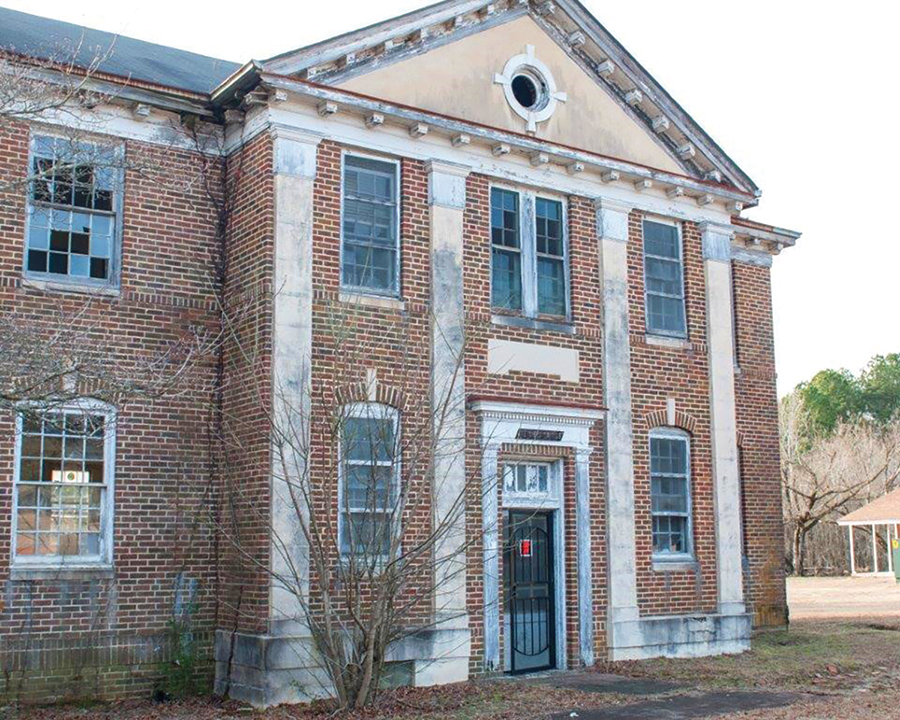
The dorm rooms are decorated with ancient mattresses and discarded clothing, occupied only by a ghostly albino cat that brushes my pants leg. You could almost hear the paint peeling from the walls. “If ever a place is haunted, it’s this one,” I muttered while traipsing through the derelict corridors of Gardner Hall, slated for the wrecking ball, at Samarcand Manor, North Carolina’s now closed reformatory for delinquent girls. More than a generation ago the dormitory housed “wayward” teenagers in Eagle Springs at what was once known as the Home and Industrial School for Girls — referred to throughout its century-old history simply as Samarcand Manor. My guide, Richard Jordan, the head man at Samarcand Training Academy (the state’s occupant of the campus since 2015), pointed to a large chamber of the eerie building. “They used this as the infirmary for girls recovering from the surgeries,” he confided. Over a decade ago the North Carolina General Assembly admitted that the surgeries Jordan referred to should never have occurred.

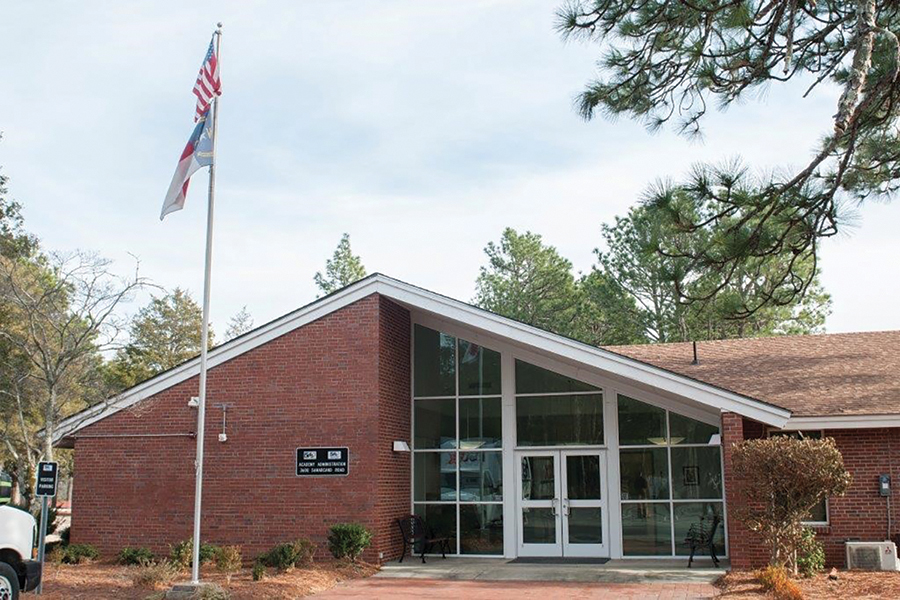
Gardner Hall’s forsaken appearance stands in stark contrast to the current spic-and-span look of most of the campus buildings, all geared toward providing the ideal environment for instructing and training North Carolina’s law enforcement and corrections personnel. Tucked away in the pinewoods, Samarcand Training Academy is state-of-the-art. But even a century after its founding in 1918, Samarcand Manor remains a subject of controversy, little of which is gleanable from the historic marker alongside N.C. 211, 3 miles north of what is now the academy. It is not the simplest of histories to unravel. State law protecting the identity of juvenile offenders hinders obtaining first-hand accounts, and it wasn’t exactly the kind of institution to have a thriving alumni association. Old newspaper articles raved about the place, but two recent books, Bad Girls at Samarcand, by Karen L. Zipf, and The Wayward Girls of Samarcand, by Melton McLaurin and Anne Russell, paint a far less flattering picture.

The use of the 230-acre main campus for educational purposes predates even Samarcand Manor’s existence. In 1914, noted educator Charles Henderson opened the Marienfield Open-Air School for Boys on the property. In the early 20th century, a near plague of tuberculosis had swept the country. Educators like Henderson believed that exposure to fresh air could ward off the disease, so his school held classes outdoors. The advent of World War I resulted in such a significant loss of manpower that Marienfield was forced to shut its nonexistent doors.

It was a Presbyterian minister from Charlotte and a North Carolina women’s club leader who lit the fuse that led to Samarcand Manor. In 1914, Rev. A.A. McGeachy began receiving statewide attention for his powerful sermons urging parishioners to perform “good works” in service of the Lord. Focusing his exhortations on the plight of those he referred to as “fallen women, seduced by the streets into lives led in sin,” McGeachy preached that good Christians should be concerned about the rehabilitation of female prostitutes and other young women of loose morals — the victims of sexual debasement at the hands of devious male ne’er-do-wells. McGeachy suggested they could be redeemed in a “reformatory for fallen women” and forcefully advocated that the state establish one.

In 1917, a print of McGeachy’s sermon found its way to Hope Summerell Chamberlain, a tireless advocate for the North Carolina Federation of Women’s Clubs. Galvanized by McGeachy’s missionary message, Chamberlain and NCFWC’s president, Kate Burr Johnson, began beating the drum at the legislature in Raleigh for a bill to create the “State Home and Industrial School for Girls and Women.” The vacated and secluded Marienfield campus emerged as the ideal location.

Some lawmakers expressed reservations. Were both young girls and adult prostitutes to be housed at the same facility? Apparently so, at least at first. Would female felons be mixing with girls who had committed minor violations? The proponents of the bill thought not, but there was nothing to prevent this. Wouldn’t it be better to attend to these females, particularly younger ones, in or near their home counties? The advocates argued that the state could more uniformly deal with the girls and women in a single institution. How long could the “State Home” keep girls in custody? The length of a girl’s incarceration, up to three years, would be left to the sole discretion of the reformatory’s Board of Managers. So much for due process.

The collective pressure from the NCFWC’s member clubs and other civic groups successfully strong-armed the bill through the legislature, eventually passing it with nary a dissenting vote. Samarcand Manor would house only white women and girls. The legislature gave no thought to funding a reformatory dedicated to the rehabilitation of “wayward” black girls until 1925.

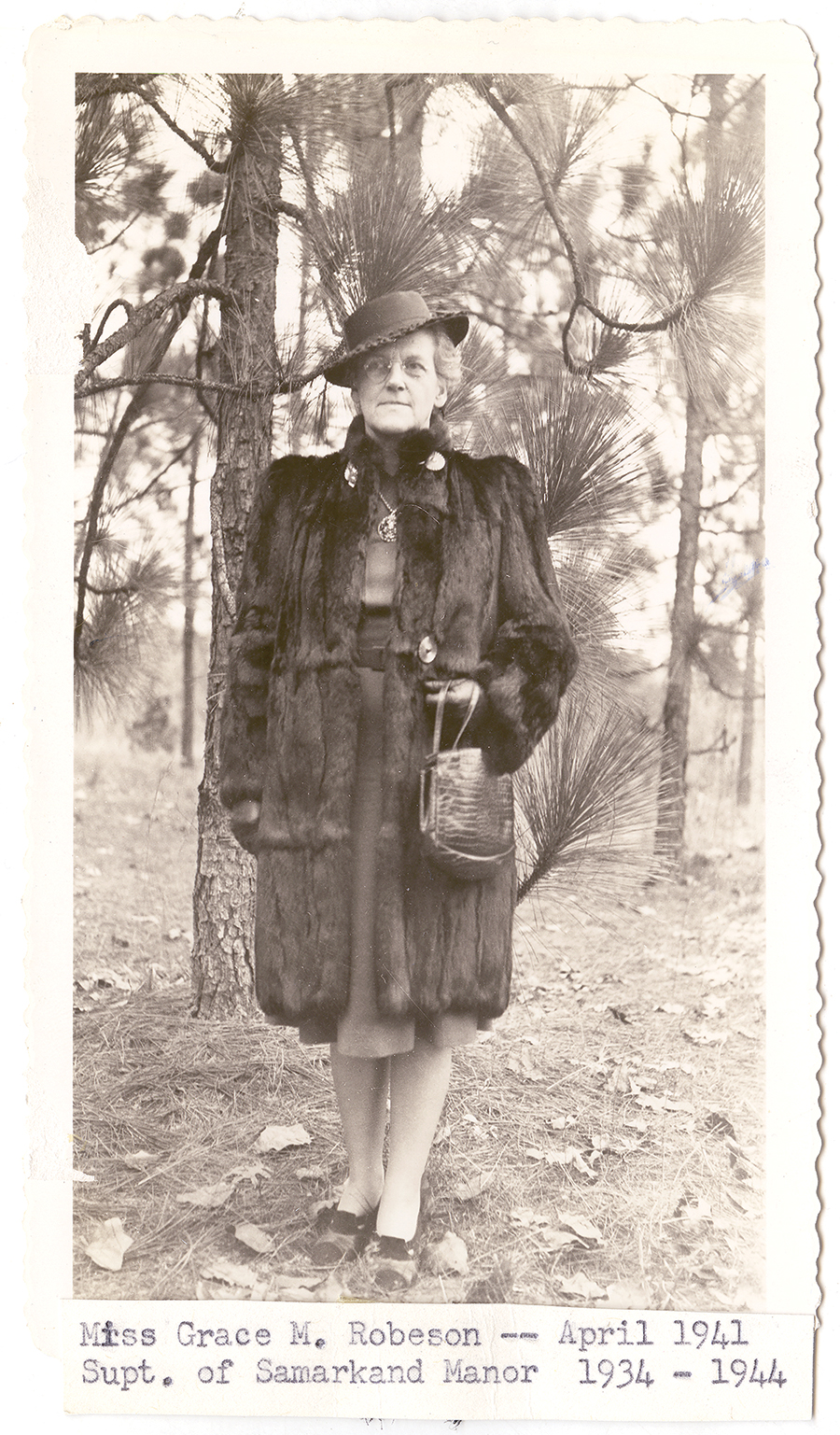
In short order, dormitories, school and administration buildings, a chapel and a home for the new superintendent were under construction. The five-person board of managers hired Agnes MacNaughton as Samarcand’s first superintendent. Before long, close to 200 young females inhabited the campus. According to Zipf’s Bad Girls, the young inhabitants weren’t all charged with sexual offenses or serious crimes. Girls also came to Samarcand because they were socially maladjusted or had committed minor misdemeanors, like vagrancy or public drunkenness. Many had no record at all, having been banished to Samarcand by parents who deemed their daughters uncontrollable. Most came from broken homes. Others had been sexually abused in their homes, and somehow received the blame. Zipf says, “They were cotton mill workers, girls from the streets, and sometimes both.” A lot of girls were either poorly educated or thought to lack intelligence. Regardless of whether these deficiencies were innate or stemmed from a lack of educational opportunities, Samarcand tended to identify them as “feebleminded.” It was this labeling that was employed when the state Eugenics Board authorized the regrettable surgeries.

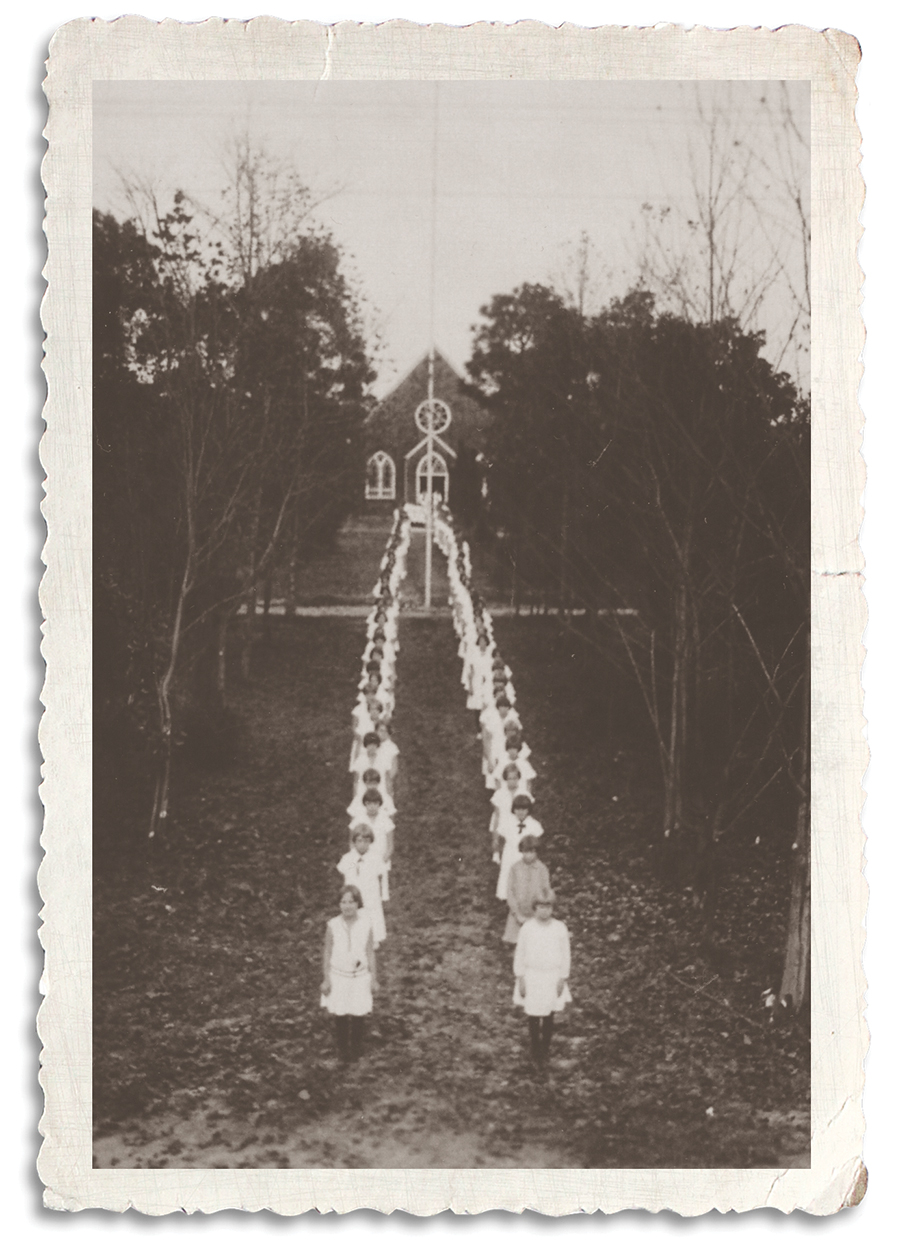
MacNaughton established a relentlessly busy routine of schooling, vocational training, religious instruction and exercise for the girls in hopes of providing each a “useful trade or profession and improving her mental and moral condition.” Several women’s clubs provided financial support for the superintendent’s program. One of them, the King’s Daughters, financed the construction of the Chapel of the Cross, still standing on the campus. The girls made their own uniforms, assisted in meal preparation, and tended to the livestock of Samarcand’s farming operation. The farm boasted an excellent herd of dairy cattle, courtesy of Pinehurst kingpin Leonard Tufts, who served on the Board of Managers. There were no fences around the campus, but girls whose misbehavior incurred MacNaughton’s wrath were subject to being locked in their room at Chamberlain Hall — the dormitory for the most difficult girls. They were further stigmatized by having to wear blue bloomers while “honor girls” wore khaki. Moreover, corporal punishment was administered, sometimes brutally. A girl’s unruliness also resulted in exclusion from Samarcand’s occasional fun stuff. According to Zipf, only the better behaved “enjoyed picnics in the woods, wading parties, hikes, attending church and movies, and planned weekend camping parties in the summer.”

While North Carolina’s legislators enthusiastically created Samarcand, they were reluctant to fund it. From its inception, the reformatory experienced severe financial woes. The federal government offered a prospective avenue for assistance. During World War I, military leaders and members of Congress viewed with alarm the increasing number of American soldiers infected with venereal diseases. To secure the health of military manpower, those leaders urged the states to step up efforts to restrain prostitution. As incentive for doing so, Congress would help finance state efforts to keep prostitutes and promiscuous “camp girls” far away from military bases. The potential infection of soldiers stationed in North Carolina became a subject of increased attention after Fort Bragg opened.

To convince officials that federal funding of Samarcand was required in order to avoid the prospect of females preying on unsuspecting soldiers, MacNaughton’s 1920 application for federal assistance highlighted the high percentage of Samarcand girls suffering from venereal diseases. Assistance was promptly granted, on the condition that Samarcand confine adult prostitutes in addition to its juvenile inmates. Thus, females ranging in ages of 10 to 30 served time at Samarcand in the reformatory’s early years. Zipf notes that Samarcand’s acceptance of federal funding resulted in its having two conflicting missions. “It housed adolescent white girls in need of redemption as Southern ladies,” she points out, “and also adult prostitutes in need of punishment, treatment, and control.” Years would elapse before the adult prostitutes were sent elsewhere.

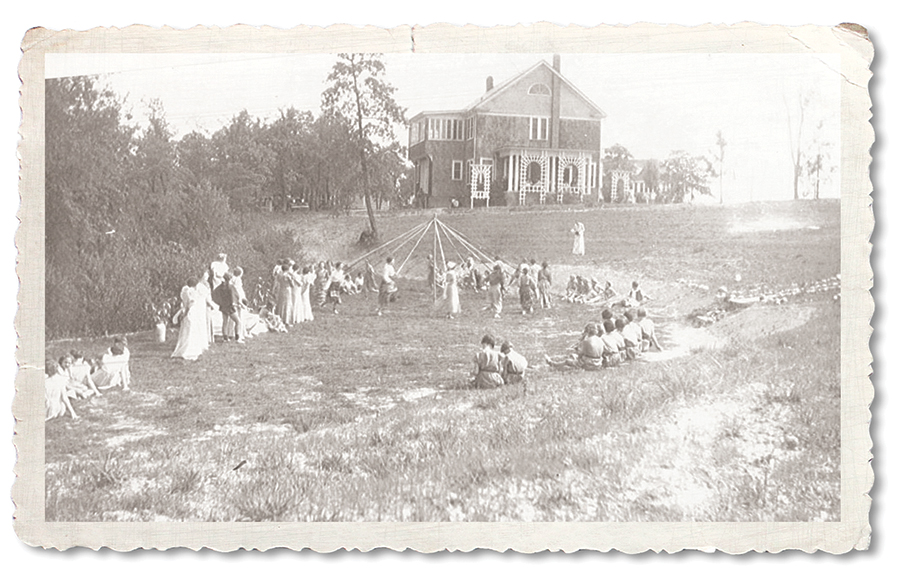
During MacNaughton’s 16-year tenure as Samarcand’s superintendent, the reformatory was periodically inspected by the State Board of Charities and Public Welfare and generally passed these reviews with flying colors. MacNaughton would also invite members of the press and public to attend Samarcand’s Field Day and May Day festivities, which showed the campus off at its best. Visitors usually came away impressed, rarely observing any inmates other than smiling, rosy-cheeked, well-mannered honor girls. A typical example was the Washington, D.C., policewoman who, in 1924, gushed, “I did not think it was possible to have such a splendid school for delinquents as was shown me. It has not the atmosphere of a correctional institution but rather that of a boarding school.” In fact, MacNaughton did try to inject something of a prep school atmosphere, convincing state education administrators to grant high school accreditation status for the reformatory’s classroom curriculum in 1930.

In the ’20s, Raleigh News & Observer columnist Nell Battle Lewis was among those writing highly complimentary pieces about Samarcand Manor and Agnes MacNaughton. Admitted to the North Carolina Bar in 1929, it was shortly after Nell hung her attorney’s shingle that shocking events at Samarcand would necessitate a backtracking of her effusive praise.

While most honor girls coped with day-to-day existence at the reformatory, many of the girls housed at Chamberlain Hall — the punishment dorm — seethed with resentment at the bedbugs in the blankets, the harsh discipline, and what they perceived as bogus reasons for their being trapped at Samarcand in the first place. Margaret “Peg” Abernethy was one of the latter, a victim of incest at age 10 by her own father. Her stepmother sent the blameless Peg to Samarcand. She revolted against MacNaughton’s strict discipline and twice tried to run away. Whipped on both occasions with a hickory switch for as long as three minutes, Peg required treatment for her bruises. Samarcand’s disciplinary officer shaved Peg’s head.

On March 12, 1931, Peg learned that one of the girls planned to start a fire at neighboring Bickett Hall. The sight of Bickett burning inspired Peg and fellow inmates Margaret Pridgen and Marian Mercer to plot another arson at Chamberlain. They torched stockings stuffed in the dorm’s attic, but staff quickly discovered the smoldering hose and snuffed out the fire before serious damage was done. Undaunted, Pridgen started a second fire in her room, probably with Peg’s help. The fire went undetected until it was too late. Bickett and Chamberlain Halls, both wooden structures, were engulfed by flames.

MacNaughton obtained confessions from a number of girls, including Abernethy and Pridgen. Those admitting their guilt seemed oblivious to the fact that they were implicating themselves in a crime, which potentially carried the death penalty. Both Abernethy and Pridgen (and others) almost welcomed the prospect of the penitentiary, assuming it would be more bearable than what they perceived to be the hellhole of Samarcand Manor.

Sixteen girls were eventually charged with involvement in the arsons and held for trial at county jails in Carthage and Lumberton. The girls apparently regarded setting fires to be a can’t miss attention-getter, since they ignited new ones in both county jails, each extinguished without much damage. Aghast at the pyromania, press accounts like the one in the Moore County News described the girls in animalistic terms, “distorted with rage,” and “eyes gleaming.”

It was against this ominous backdrop that Nell Battle Lewis agreed to serve as co-counsel with Carthage lawyer George McNeill for all 16 defendants. Having never tried a case of any kind, it seemed in one sense preposterous for the fledgling lawyer to become involved with a major criminal matter — particularly one where the death penalty was potentially involved. The high-profile nature of the case meant there would be intense newspaper coverage. Due to her work as a columnist for the News & Observer, Nell was friendly with the reporters covering the trial. While not initially sympathetic to the girls, the writers liked Nell and were open to hearing her version of the story.

Given the confessions of several of her clients, Lewis had little choice but to claim that conditions at Samarcand had driven the girls to their actions. Putting Samarcand itself on trial, she introduced evidence of squalid conditions, beatings, and the questionable incarcerations claimed by the girls. As Lewis hoped, the newspaper stories began emphasizing the brutal whippings rather than the firebugs’ actions. It did not help the reformatory’s image that several Chamberlain girls had been locked in their rooms for disciplinary reasons at the time of the final fire, and were fortunate to have escaped just ahead of the flames.

Though Lewis realized some girls had little hope of avoiding punishment, her spirited defense resulted in charges being dismissed against two of the girls for lack of evidence. The other 14 were found guilty of the reduced charge of attempted arson. Peg Abernethy and 11 others were sentenced to terms in the penitentiary of 18 months to five years. Pridgen and another girl received suspended sentences — curious leniency in Pridgen’s case, since she admitted setting both Chamberlain fires. McLaurin and Russell’s Wayward Girls, by way of historical fiction, delivers a fast-moving account of the fires and their aftermath.

The offenders were punished, but the trial’s revelations had struck a severe blow against Samarcand Manor. Nelson Hyde’s editorial in The Pilot pilloried the girls’ parents, the reformatory, and a North Carolina child welfare system that had driven girls with no previous criminal records to arson. “Weren’t we all on trial for permitting conditions to exist which culminate in sixteen youthful members of society, our neighbors’ children if not our own, facing charges for committing a capital offense,” Hyde wrote. ”And what are we going to do about it? “

The state launched an investigation that resulted in the end of corporal punishment at Samarcand, and a new policy in which only girls convicted of offenses would be admitted. Girls under the age of 10 would no longer be accepted. The events exacted a huge toll on MacNaughton, who took a leave of absence in 1933 and retired a year later.

Grace Robson was named to succeed MacNaughton. According to Zipf’s Bad Girls, Robson’s hiring heralded for Samarcand inmates a new era of psychological testing, and classification. Her program sought “to separate the fit from the unfit and to determine a recommendation on sterilization.” Today, we consider forced sterilizations (eugenics) to be an inhumane practice right out of Nazi Germany’s playbook. But such surgeries were legally sanctioned for decades by North Carolina’s General Assembly. The law allowed sterilization of “any mentally diseased, feebleminded (typically an individual with an IQ below 65) or epileptic inmate or patient,” or where social workers believed that an individual would procreate a child “with a tendency toward serious or mental deficiency.” The state established a Eugenics Board in 1933 to provide some semblance of due process for helpless girls before their ability to bear children was surgically removed. But that board served primarily as a rubber stamp for the recommendations of Robson and like-minded administrators at other institutions. Sterilizations of Samarcand’s girls were performed at Moore County Hospital, and the girls recuperated at Gardner Hall.

From 1929 to 1950, 2,538 forced sterilizations were performed in North Carolina, the majority on white females. At least 293 Samarcand girls were sterilized. The last recorded Samarcand sterilization was in 1947. North Carolina was hardly alone in promoting eugenics — 32 states allowed it in one form or another. Justice Oliver Wendell Holmes wrote that “three generations of imbeciles are enough,” in a 1927 U.S. Supreme Court decision rejecting a challenge to Virginia’s eugenics law. North Carolina, however, is generally recognized to have been the most aggressive of the states in promoting the practice.

Post World War II, support for forced sterilizations waned, but in North Carolina the program actually gained steam by targeting female recipients of Aid to Dependent Children (ADC), at least half of whom were African-Americans. The Eugenics Board was finally abolished by the state in 1977, but laws permitting forced sterilizations were not actually repealed until 2003. North Carolina Governor Mike Easley issued an apology to the victims and, in 2013, the General Assembly passed an appropriations bill authorizing up to $50,000 per person to compensate those sterilized pursuant to the order of the Eugenics Board.

Certainly the fact that Samarcand was perpetually underfunded made it difficult for Robson to operate the place efficiently. World War II caused even greater budget trimming and a significant loss of personnel. Samarcand barely survived the war. Robson’s tenure as Samarcand’s superintendent ended in 1944. She was succeeded by Reva Mitchell, who served in the post for nearly 30 years.

After the war, conditions and funding markedly improved. By 1955, the campus sported an entirely new look with 11 new buildings. Four more were erected in the following decade along with a recreational park and lakeside theater, pool and numerous plantings. In the ’60s the institution started receiving African-American girls.

In 1974 juvenile boys were admitted to Samarcand for the first time. The percentage of boys in the Samarcand population gradually increased over time. Andy Auman was appointed as Samarcand’s director (a title change from superintendent) in 1986. He stayed until 2002. Auman’s tenure coincided with the reformatory’s transition from focusing on detention to emphasizing individualized therapy, counseling, education and rehabilitation. The facility was formally renamed the “Samarcand Youth Development Center.” Today, Auman credits the shift with enhancing the ability of many Samarcand juveniles to make better lives for themselves. Now retired and living in Aberdeen, Auman expressed pride in the many dedicated Samarcand teachers and staff while acknowledging it could sometimes be a difficult place.

During Auman’s time at Samarcand its population steadily dwindled as juvenile offenders were housed in smaller group facilities closer to their homes rather than in large centralized, and expensive, reformatories. Finally, the General Assembly opted to close the facility, and on June 30, 2011, the last 26 teenagers vacated the campus.

Led by state Representative Jamie Boles, the General Assembly transformed the old reformatory into the Samarcand Training Academy, which opened in 2015. Fourteen of Samarcand Manor’s buildings have already undergone (or soon will) substantial renovations for dormitory and classroom use. The facility is equipped with every type of interactive training currently available in the law enforcement field. There is a five-panel simulator that can place a trainee in virtual reality scenarios, like school shootings, and confront the trainee with up to 230 variations of visual images from a 300-degree range. The simulator can be programmed to replicate the real-life facilities the trainees will be protecting. The Firearms Training Center, completed in June 2017, is the finest in the state, testing all aspects of marksmanship from short-range handguns to long distance sniping. A new dining hall is under construction. When completed in full, Samarcand Training Academy will total 168 bedrooms and 11 classrooms funded by expenditures exceeding $23 million.

Members of over 20 state law enforcement agencies have taken advantage of Samarcand Training Academy’s facilities, including the State Bureau of Investigation, Department of Corrections, and the Alcohol Law Enforcement Agency. Local police forces of Moore County and school resource officers committed to ensuring student safety have received training since the facility opened. In 2017, 955 students attended Samarcand Training Academy; many of them engaged in intense four week courses of study.

“For over a century, whether the property was occupied by Marienfield, Samarcand Manor and now the academy, it has always been used for educational and training purposes,” says the academy’s director, Jordan.

The State Home and Industrial School for Girls opened on Sept. 17, 1918. Eddie Russell, an alum from Andy Auman’s teaching staff who taught at Samarcand from 1985-94, considers those nine years one of his most gratifying experiences. While acknowledging the negativity in Samarcand’s past, he points out that successful rehabilitation of many young men and women also occurred there and that achievement should not be overlooked. “You claim it for both the fame and the shame,” he says.  PS

Pinehurst resident Bill Case is PineStraw’s history man. He can be reached at Bill.Case@thompsonhine.com.