Passages

PASSAGES

Hoops School

Reading the court, learning to teach

By Lu Huntley

It’s 1977. I’m interviewing for my first public high school teaching position in rural Johnston County, N.C. The interview goes well; the principal says he’d like to hire me to teach sophomore English. Then he asks if I would coach the girls’ varsity basketball team in addition to teaching English, and I say, “Yes sir; I can do that.”

I played point guard in high school, had a decent left hook, and my extraordinarily athletic younger sister was studying health and physical education at UNC-Chapel Hill. I figured she’d help. Forget Title IX. Everybody knows hiring just anyone to manage the boys’ basketball team would cause an uproar. But for me to tell the principal I could handle teaching six English classes and coach girls’ basketball settles a hiring issue. I’d “fix” a problem.

I get the job.

Any person who enters education as a profession at age 21 cannot be fully equipped in the classroom — or on the court — regardless of your degree. Like anything else, there’s a learning curve.

On the court, I am a failure; in the classroom I pick up early that students like to read drama and create scripts from short stories, novels and poetry and then act them out. Outside the classroom I read books on basketball and memorize diagrams of drills and plays. None of this improves the team’s performance. We flounder. The first basketball season we are last in our 2A conference. The second season, same. But at some point in that second year, I begin to recognize offensive and defensive patterns and plays. I learn to read the court. Practicing set plays is like acting out a drama. But it doesn’t feel the same in the gym as it does in the classroom.

Something was happening with my teaching, too. By developing fluency in reading the basketball court, I begin observing recurring moves in students’ writing. What happens on the court transfers to the classroom, not so much the other way around. Much like those first two basketball seasons, I have difficulty reading students’ papers and knowing how best to respond. Their writing looks like everything going on at once. I mark papers and assign grades but second guess myself. I do not know what I am looking at any more than I know what is happening on the court. Spotting simple mistakes in language is easy because these stand out. But it’s just seeing deficits. When I begin recognizing a student’s ambitious use of words — or the attempt — it changes everything.

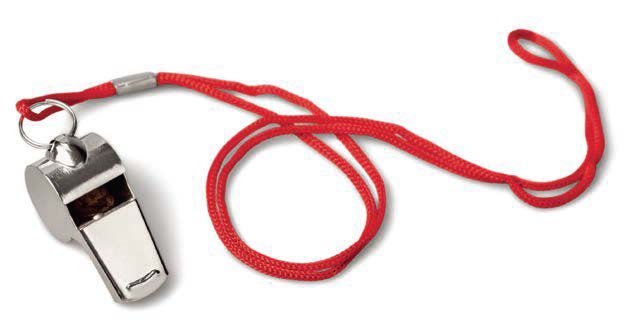
When the team and I load the bus for an away game, I know it’s going to be late when we get back to the school parking lot; and I will be exhausted. I get used to the bubblegum smell, sticky bus seats and floors and go along for the ride. I grade papers on the bus in late afternoon light. I get used to sweaty locker rooms and concession stand smells of sugar, popcorn, corndogs, and mustard. The atmosphere of high school girls’ basketball competition becomes a collage of glaring gymnasium lights, buzzers, shrill whistles, bleachers, wood floors, school colors, mascots, pompoms, megaphones, and cheers reverberating off concrete walls. After two seasons, I let the principal know I’d prefer extracurricular activities closer to my fields of study. Coaching girls’ basketball “blind” as I did was rough. I survive and develop the eye needed to assess students’ writing, going beyond marking errors on student papers, giving pop tests, or posing as the one with all the knowledge. Gradually I become an English teacher and writing coach. Hoops helped me get there. I still have the whistle.

Art of the State

ART OF THE STATE

Without Stopping

Juan Logan keeps creating

By Liza Roberts

On a sprawling industrial site on the banks of the Catawba River, beyond a cabinet maker, a boat rental and a rum distillery, past hundreds and hundreds of pallets of overstocked, shrink-wrapped, big-box merchandise, lies a repository of an entirely different sort.

Here, in an open, 5,000-square-foot space, stand sculptures and paintings, drawings, prints and multimedia creations that address, mostly through abstraction, many of the issues of our time: race and memory, history and geography, stereotype and expectation, imagination and potential. This is the studio of the artist Juan Logan, the place where he creates and stores the work from a career spanning more than 50 years. He is one of our state’s most accomplished contemporary artists, and one of its most prolific.

In May, a major exhibition of his work, Without Stopping: Juan Logan, opened at the Mobile Museum of Art in Mobile, Alabama, where it will run until Feb. 14, 2026. Featuring 48 works from Logan’s decade-long Elegies series, including many never before seen in public, the exhibit will feature a massive new piece commissioned by the museum to commemorate the residents of Africatown, an area of Mobile founded by the descendants of enslaved people brought in 1860 to Mobile Bay aboard a wooden ship called the Clotilda. At 6 1/2-feet tall and 16-feet wide, Logan’s commissioned piece, Elegy CLXXXVI, Without Stopping, is by far the largest of this seminal series.

“I think of it as a series on memory, but not just mine,” he says. “Collective memories.”

Though the word “elegy” often refers to a poem for the dead, “it can also mean a serious reflection,” Logan says. With abstract shapes and symbols, Logan reflects on the fragmented, imperfect and haunting nature of memory, including cultural memories shared in various and ever-changing ways. He mentions the Japanese notion of wabi-sabi, which finds beauty in imperfection and impermanence. “There are no perfect memories. And I don’t have any trouble portraying them that way.” Forgotten memories, too: “The absence of memory, how it depletes us . . . how it kills us. It leaves us very alive, but missing so much. We are so sure we hold on to things, even happy memories, but they fade away as well.”

A repeated image throughout his work over decades, beginning in the late 1970s and regularly appearing in his Elegies series, is the silhouette of a black head. The subtle shape shows up in painting, drawing, collage and sculpture (including Beacon outside Charlotte’s Harvey Gantt Center) as a symbol of memory, loneliness, identity and of the Black experience.

Lately, the head shape on its side may represent a boat, Logan says, a boat transporting memories, knowledge, thoughts, hopes and ideas: “Sometimes it’s completely filled, sometimes it’s empty. Such is the nature of humanity. We hold on to things, we lose things.” But always, he says, the head represents humanity: “All of our imaginings, and everything we ever were or will be takes place there first. It is who we are.” The featureless cameo offers a blank-slate Rorschachian challenge to the viewer: What do you fill in here?

Other symbols that make regular appearances in Logan’s colorful, abstract work include starry skies, clouds, maps and boats. Like a poet, Logan uses these allegorical images in individual works and as leitmotifs to represent many things: the collective unconscious; the workings of the world and the role of the individual in creating it; reserves of knowledge; the power of imagination and perception. Most important, Logan says, is not what he says these things mean, or what his own point of view might be, but what they provoke or challenge in the viewer.

Logan has been challenging viewers over the decades of a celebrated career that has seen his work shown across the country and around the world in solo and group shows. He has pieces in the permanent collections of some of the nation’s foremost museums, including the Whitney Museum of American Art, the Philadelphia Museum of Art, the Smithsonian’s National Museum of African American History and Culture, the Baltimore Museum of Art and Charlotte’s Mint Museum.

Storyteller

Wearing the uniform of black T-shirt and jeans that he has made his own for at least 40 years, the former University of North Carolina at Chapel Hill professor of studio art is a voluble host in his Belmont studio, eager to unpack the meaning and message of his work, which surrounds him in a vibrant, living archive. He does it through story.

There’s the story of a treacherous treadmill used to try to break the spirit of enslaved people in Jamaica in 1837 that inspired The Sugar House, a 16-foot canvas of paint, glitter, lottery tickets and thousands of glued-on puzzle pieces.

There’s the story about the high school shop teacher who encouraged him to make his first work of art, an eagle carved of white birch. This is a man Logan is so determined to credit with launching his life’s trajectory that he spells his name: “Harold McLean, That’s M, C, capital L, E, A, N.” McLean told Logan that what he made didn’t have to be like anyone else’s. “It can just be yours,” the teacher said. The words unleashed something in Logan: “It changed everything.”

There’s the tragic story of his father dying of a heart attack after a doctor didn’t believe his chest pains were real. It’s an example, Logan says, of racial bias, and one of his many inspirations for work that address injustice, oppression and alienation.

And then there are the many stories of home. The shape of a canted roofline in one of his works has him describing his own 114-year-old house, which was built by his great-grandfather and grandfather. It’s a 10-minute drive from his studio in a neighborhood Logan illustrates with a quickly jotted map: “Here’s my house right here. Here’s my mom’s house over here. Here’s my aunt’s house, here. There’s another aunt here. Here’s my sister’s house, here. Here’s my uncle’s house down here. And then my grandfather’s road, that’s named after him . . .” The foundation of another house his great-grandfather built out of handmade bricks and lived in after slavery still stands in the woods nearby. “These things serve to anchor you in a particular way,” Logan says. “I think more than perhaps other places, the South does that for so many people.”

Asking Better Questions

“For many years now,” Logan says, “I’ve tried to simply ask better questions. I think that’s the only thing that allows us to deepen our investigations about what we’re doing, regardless of discipline. If we can ask better questions, we’ll learn more, be able to do more.”

Doing more is clearly not a problem for Logan. At any given time, he’s got a dozen new projects in various stages underway. After the Mobile show opens, his work will be featured in an exhibit in Chattanooga in July and one on American and German abstractionists in Berlin in October.

“We want so much out of this,” he says. “And we are here for such a brief period of time. So we try to do as much as we can for as long as we can, with the hope that someone will take the time to preserve it and pass it on and share it with others.”

Focus on Food

FOCUS OF FOOD

Skagenröra, Anyone?

A shrimp salad for midsummer

Story and Photograph by Rose Shewey

Our kitchen has always been the hottest room in the house — a 1920s bungalow in the heart of Aberdeen. Even after we had a brand new HVAC system installed about a year ago, the kitchen remains stuffy, with little air flow. While the air conditioning, usually set to a pleasant 72 degrees, has you reaching for a throw blanket in the front room, you’ll be wiping sweat off your brow just a few feet down the hall in the kitchen, with or without the oven on. It’s a mystery that apparently cannot be solved, but it’s a good reason to keep our cooking and baking to a minimum this summer season.

Fortunately for us, my German upbringing has taught me how to turn bread and a few simple ingredients into a satisfying meal. Sure, sandwiches — the American way of life — are quite filling, but it’s not the same experience as having a slice of stout pumpernickel or rye bread layered with exquisite homemade spreads, decoratively presented on a plate right in front of you, begging the question: Do I need to use a knife and fork with this?

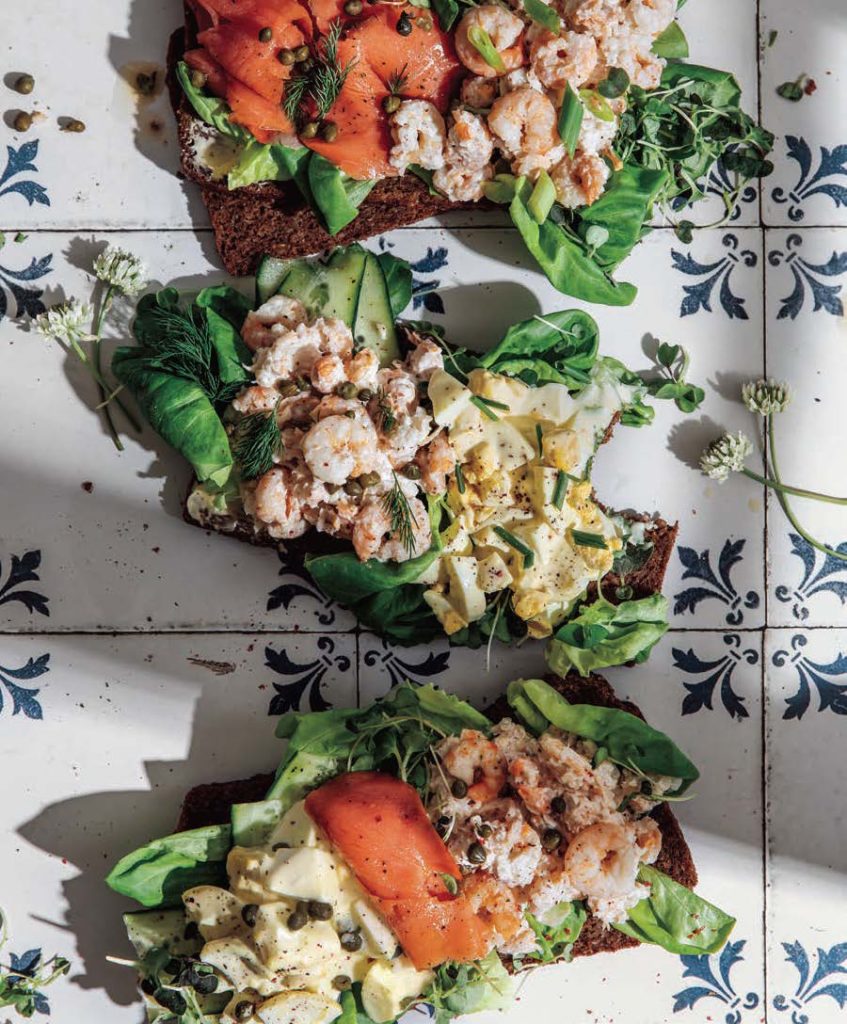
While Germans have a firm grasp on Brotzeit, which literally translates to “bread time,” with liverwurst, pickles, crackling lard and other rustic ingredients, Scandinavians have a more exotic variety. Skagenröra, one of the most popular dishes in Sweden, is a simple seafood salad made of shrimp, crème fraîche, mayonnaise and dill. Most people use tiny shrimp, but we like to cut up larger shrimp, which doesn’t hurt the flavor in the least.

Skagenröra shrimp salad neighbors well with smoked salmon as well as other spreads, egg salad being one of them. For either one — shrimp or egg salad — you can lighten up by substituting a portion of the mayonnaise with yogurt, or ditch the mayo and use a combination of yogurt and plain hummus.

However you plan on spending “midsommar” — the longest day and shortest night of the year — keep the kitchen cool and try Skagenröra for a simple but worthy solstice snack.

Skagenröra Shrimp Salad

(Makes 4 open-faced sandwiches)

1/4 cup mayonnaise (or a yogurt and mayo combination)

1/3 cup crème fraîche

1 small shallot, finely minced

4 tablespoons chives, finely chopped

3 tablespoons dill, finely chopped

Lemon zest of 1/2 lemon

1/2 teaspoon prepared mustard

Lemon juice, freshly squeezed, to taste

12 ounces small shrimp (or larger shrimp, sliced)

Salt, pepper, to taste

4 slices of pumpernickel or rye bread

2 handfuls butter lettuce

Mixed sprouts (e.g., broccoli, radish, cress)

2-3 tablespoons capers (optional)

Add mayonnaise, crème fraîche, shallot, chives, dill, lemon zest, mustard and lemon juice to a bowl and mix well. Gently fold in shrimp and add salt and pepper to your liking. Refrigerate the shrimp salad for at least two hours before serving. To serve, layer lettuce on a slice of bread, top with a generous helping of Skagenröra and other toppings, such as sprouts and capers. 

Dissecting a Cocktail

DISSECTING A COCKTAIL

I Quit Girls

Story and Photograph by Tony Cross

When I look back a decade ago to the beginning of 2015, there were two notable events that happened in my life: a major break-up, and a newfound love of rum. As it turned out, the former was also the motivation for a drink I created using the latter, aptly titled, “I Quit Girls.” I wanted to make a tiki-style drink all my own, something I hadn’t heard of or tasted.

Thinking back, that probably wasn’t too hard — the myriad social media bar-fluencers had yet to kidnap my algorithms. There’s only one ingredient that stands out from the rest in my concoction: 1/4 ounce of smoky Laphroaig 10-year Scotch. It was my eureka moment. A little smoke mixed with lots of sweet, delicious tiki flavors turned out to be a killer scene. At the time, I was just learning about classic rum drinks, so I was excited to add Donn’s Mix #1 into the, well, mix. Named for the man who created it, Donn Beach, this syrup is used for many tiki drinks, including the classic zombie.

As for the name of my drink, I happened to be listening — on repeat — to a Japandroids song of the same title the week I created it. Go figure.

Specifications

1 ounce Goslings Black Seal Rum

1/2 ounce Smith & Cross
Jamaican Rum

1/4 ounce Laphroaig 10-year Scotch Whisky

3/4 ounce Donn’s Mix #1 *

1/2 ounce fresh pineapple juice

1/2 ounce fresh lime juice

1/2 ounce simple syrup

5 drops Bittermens Elemakule
Tiki bitters

Execution

Combine all ingredients into a cocktail shaker and add a very small amount of crushed or pebbled ice. Shake hard, allowing the ice to almost completely dissolve in the vessel. Pour everything into a tiki mug or large old-fashioned glass. Fill the remainder of glass with ice. Garnish with a small bunch of mint.

*Donn’s Mix #1: Take 3 cinnamon sticks and blend with one cup of simple syrup (equal parts sugar and water). Let sit until syrup cools. Strain syrup. Mix one part of cinnamon syrup with 2 parts fresh grapefruit juice (not store-bought). Place in a sealed container and refrigerate. Keeps for two weeks.

Hometown

HOMETOWN

A Wild Ride

It’s not for everyone

By Bill Fields

I was around someone recently whose significant other had gone to Disney World, leaving him behind, hundreds of miles away from Mickey Mouse and all the theme park’s other trappings, a distance that brought comfort. My friend loves his partner, but Disney World is not his thing.

It is also not my thing. And if that indifference makes me a crank or a killjoy, I am at peace with the label. I have some contacts on social media, contemporaries of mine, for whom trips to Disney seem to be a focus in their lives, a priority on their calendars. I’m glad they enjoy the experience but don’t understand the fascination.

When I was dealing with a detached retina several years ago, the surgeon who made the repair and monitored my recovery — I count my blessings that thanks to his expertise I got my vision back — offered a warning among his post-op advice.

“Stay off rollercoasters,” he said. The doctor’s admonition was so unnecessary he might just as well have urged me to avoid stepping in a rattlesnake den. I had no plans to do either.

Perhaps if I were a parent, if I had experienced a little one having a magical moment between turnstiles, I would feel differently about such amusements at my advanced age. But I also had been a teenager in North Carolina during the 1970s who didn’t feel there was a void in my life because I never traveled to Carowinds, in Charlotte, despite multiple youth group opportunities to do so. Although I loved going to the annual Moore County Fair, I was far from a regular attendee at the North Carolina State Fair, going just once with a large family from my neighborhood.

My last visit to a theme park occurred in 2008, when a friend and I went to Universal Orlando. On a boat ride during which “pirates” attack, there was an expectation of getting lightly splashed during one of their “explosions.” Instead, a geyser erupted from the lake not far from our seats on the starboard side, and we received a drenching from head to toe that sent us to the exit and toward a change of clothes.

I was not far from my 50th birthday at the time of that unexpected soaking. If I had been 12, I might have relished it. When I was that age, in the summer of 1971, my parents and I made a highly anticipated trip — I was looking forward to it, that is — to Six Flags Over Georgia, outside Atlanta.

Going to Six Flags was part of the biggest journey of my young life. We went all the way to Tallahassee, Florida, to visit my sister, Dianne, and her husband, Bob, who had been living in the Sunshine State’s capital city for a couple of years. Opened in 1967, Six Flags Over Georgia was the brainchild of Dallas businessman Angus Wynne Jr., whose Six Flags Over Texas was built in 1961.

Leading up to our unprecedented vacation, I had sent away for a Six Flags Over Georgia brochure and was familiar with its attractions by the time we pulled out of our driveway in Southern Pines for the long drive south. The park’s “Dahlonega Mine Train,” a rollercoaster, and “Log Jamboree,” a water flume, were both highly touted in its promotional material. Six Flags was described as having a “clean, cheerful and friendly atmosphere.”

I entered Six Flags most excited to get in a log-shaped raft and travel the 1,200-foot channel of the “Log Jamboree.” Its nose-diving, spray-flying conclusion didn’t disappoint, and the modest rides offered each fall in Carthage never thrilled in quite the same way after riding that water flume.

My parents were good sports that afternoon, even though Six Flags surely wasn’t their idea of a great time. When we were getting ready to leave, they even indulged me by traipsing hundreds of yards across the park to a souvenir kiosk. I had been whining about wanting a helium balloon.

Tired, happy, hungry, and holding a big blue balloon on a string, when we got out of the car at the suburban Holiday Inn where we were spending the night, my father looked at the $2 purchase in my hand. “Be careful with that thing,” he said. “Don’t pop it.”

Along with some other guests, we stepped into an elevator. A man got out on a floor below ours. As he did, I carelessly let the string attached to my coveted memento go slack, allowing it to be sandwiched by the closing doors.

I was smart enough not to ask if I could have dessert that night.

Tea Leaf Astrologer

TEA LEAF ASTROLOGER

Gemini

(May 21 - June 20)

Perhaps you know that butterflies have taste receptors on their feet. But did you know they drink mud? Communicate through flight patterns and pheromones? As the social butterfly of the zodiac, you’ve learned to flit your way out of foot-in-mouth moments with charm and grace. That skill will come in handy this month. And on June 11, the full moon in Sagittarius just might rock your world with an unexpected romance.
Do try to avoid mud, flightiness and unnatural fragrances.
Read that last line again.

Tea leaf “fortunes” for the rest of you:

Cancer (June 21 – July 22)

Ignore the critics.

Leo (July 23 – August 22)

Operation Digital Detox. Capeesh?

Virgo (August 23 – September 22)

Pack an extra set of clothes.

Libra (September 23 – October 22)

It’s just not that serious.

Scorpio (October 23 – November 21)

No need to force things.

Sagittarius (November 22 – December 21)

Remember to pause before you speak.

Capricorn (December 22 – January 19)

Your song is somebody’s medicine.

Aquarius (January 20 – February 18)

Gift yourself a quiet moment.

Pisces (February 19 – March 20)

Tune into a different channel.

Aries (March 21 – April 19) 

Don’t let your ego call the shots.

Taurus (April 20 – May 20)

Write this down: baking soda and vinegar.

Bookshelf

BOOKSHELF

June Books

Fiction

Atmosphere: A Love Story, by Taylor Jenkins Reid

Joan Goodwin has been obsessed with the stars for as long as she can remember. Thoughtful and reserved, Joan is content with her life as a professor of physics and astronomy at Rice University and as aunt to her precocious niece, Frances. That is, until she comes across an advertisement seeking the first women scientists to join NASA’s space shuttle program. Suddenly, Joan burns to journey into space. Selected from a pool of thousands of applicants in the summer of 1980, she begins training at Houston’s Johnson Space Center, alongside an exceptional group of fellow candidates: top gun pilot Hank Redmond and scientist John Griffin, who are kind and easygoing even when the stakes are highest; mission specialist Lydia Danes, who has worked too hard to play nice; warmhearted Donna Fitzgerald, who is navigating her own secrets; and Vanessa Ford, the magnetic and mysterious aeronautical engineer who can fix any engine and fly any plane. As the new astronauts become unlikely friends and prepare for their first flights, Joan finds a passion and a love she never imagined. Then, in December 1984, on mission STS-LR9, it all changes in an instant. Fast-paced and emotional, Atmosphere tells a passionate and soaring story about the transformative power of love among the stars.

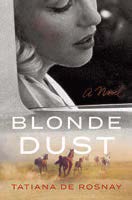
Blonde Dust, by Tatiana de Rosnay

Pauline, a young chambermaid who works at the legendary Mapes Hotel in Reno, Nevada, is asked to step in for a colleague and clean Suite 614. Although she was told the rooms were empty, a dazed, sleepy woman appears before her. It’s Mrs. Miller, aka Marilyn Monroe, whose stay in Reno coincides with the breakdown of her marriage to Arthur Miller and the filming of what was to be her last film, The Misfits. Set in the American West in 1960 where the mustang horses run wild, an unexpected friendship unfolds between the most famous movie star in the world and a young cleaning woman whose life will be changed forever through the course of a few weeks.

Nonfiction

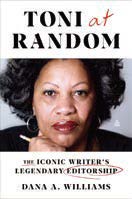
Toni at Random: The Iconic Writer’s Legendary Editorship,
by Dana A. Williams

A multifaceted genius, Toni Morrison transcended her role as an author, helping to shape an important period in American publishing and literature as an editor at one of the nation’s most prestigious publishing houses. While Morrison’s literary achievements are widely celebrated, her editorial work is little known. Drawing on extensive research and firsthand accounts, this comprehensive study discusses Morrison’s remarkable journey from her early days at Random House to her emergence as one of its most important editors. During her tenure in editorial, Morrison refashioned the literary landscape, working with such important authors as Toni Cade Bambara, Leon Forrest and Lucille Clifton, and empowering cultural icons such as Angela Davis and Muhammad Ali to tell their stories on their own terms. From the manuscripts she molded, to the authors she nurtured, to the readers she inspired, Toni at Random demonstrates how Morrison has influenced American culture beyond the individual titles or authors she published.

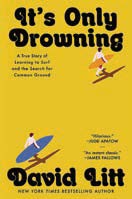
It’s Only Drowning: A True Story of Learning to Surf and the Search for Common Ground, by David Litt

David, the Yale-educated former Obama speechwriter with a fear of sharks, and his brother-in-law Matt, a tattooed, truck-driving Joe Rogan superfan with a shed full of surfboards, had never been close. But as America’s crises piled up and David spiraled into existential dread, he noticed that his brother-in-law was thriving. He began to suspect Matt’s favorite hobby had something to do with it. David started taking surf lessons. For months, he wiped out on waves the height of daffodils. Yet, after realizing that surfing could change him both in and out of the water, he set an audacious goal: riding a big wave in Hawaii. Together, they set out on a journey that spanned coasts, and even continents, before taking them to Oahu’s famously dangerous North Shore. It’s Only Drowning is a laugh-out-loud ode to embarking on adventures at any age.

Children's Books

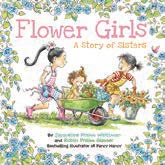
Flower Girls: A Story of Sisters,
by Jacqueline Preiss Weitzman

Daisy, Lily and Poppy are the flower sisters, each with their own corner of the garden to nurture and grow. Fancy Nancy illustrator Robin Preiss Glaser includes detail and wonder that will delight nature lovers and budding garden horticulturalists everywhere. (Ages 2-7.)

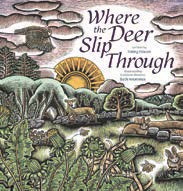
Where the Deer Slip Through,
by Katey Howes

Part seek-and-find adventure and part ode to nature, this stunning tale is the perfect read-together for young nature lovers and their grownups. (Ages 2-7.)

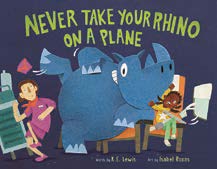
Never Take Your Rhino on a Plane, by K.E. Lewis

This little gem is sure to gather as many giggles on the first read as the fifth and should you need to transport your hippo on summer vacation, you’ll already have a list of do’s and don’ts! (Ages 3-7.)

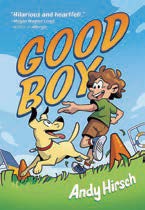
Good Boy, by Andy Hirsch

Animal-loving graphic novel readers looking for something after burning through Dogman and PAWS will delight in this new series featuring Charlie and his rescue dog, Ralph, as they tackle the challenge of agility training. With adventure, real life problems, and some gross-out humor, this one’s a summer reading hit. (Ages 8-12.)

PinePitch

PINEPITCH

PinePitch

TGIF

Neighbor, a jam band known for its eclectic performances, soulful ballads and improvisations, takes the First Bank Stage at the Sunrise, 250 N.W. Broad St., Southern Pines, for the June 6 edition of First Friday, from 5 – 9 p.m. The band is composed of Richard James singing and on keyboard, Lyle Brewer on guitar, Dan Kelly on bass and Dean Johnston on drums. And y’all know the drill — Cujo stays home. For additional information visit www.sunrisetheater.com.

Garden Party

Bring the entire family to the Garden Carnival from 10 a.m. to 2 p.m. on Saturday, June 7, at the Sandhills Horticultural Gardens, 3245 Airport Road, Pinehurst. There will be relay games, live music, face painting, food trucks, a scavenger hunt and plant potting. The event is free for garden members and $12 for non-members. For additional information visit www.sandhills.edu/gardenevents.

Drums of Liberty

Step back in time to celebrate the 100th anniversary of James Boyd’s Revolutionary War novel Drums in conjunction with the 250th anniversary of the United States Army and the 250th anniversary of the start of the Revolutionary War. Yeah, we know, the Declaration of Independence was 1776 but Paul Revere mounted his horse in ’75. The weekend program, sponsored by a grant from America 250 NC, is June 14-15, from 10 a.m. to 4 p.m. each day, at the Weymouth Center for the Arts & Humanities, 555 E. Connecticut Ave., Southern Pines. Activities include an encampment of the 2nd and 6th North Carolina regiments with cooking and musket demonstrations; an exhibit of the original N.C. Wyeth paintings for Drums; tours of the Boyd House; 18th century music along with a fife and drum corps; and local vendors and crafts for the kids. For additional information go to www.weymouthcenter.org.

Set Your Alarm

And wake up to Sleeping Beauty performed by the Paris Ballet in high def on Saturday, June 21, at 2 p.m., at the Sunrise Theater, 250 N.W. Broad St., Southern Pines. The timeless Tchaikovsky classic was reimagined by Rudolph Nureyev when he came to Paris in 1961 on tour with the Kirov Ballet. Thirty years later he proposed new choreography for what he considered “the ballet of ballets.” For information and tickets go to www.sunrisetheater.com

Piano Men

The tribute band Face 2 Face performs the timeless songs of Elton John and Billy Joel beginning at 6 p.m. on Saturday, June 28, at the Weymouth Center for the Arts & Humanities, 555 E. Connecticut Ave., Southern Pines. This is an outdoor event, come rain or come shine. For information and tickets go to www.ticketmesandhills.com

Juneteenth

Join the fifth annual Juneteenth celebration beginning Thursday, June 19, from 3 p.m. to 9 p.m., at Cardinal Park, 657 S. Walnut St., Pinebluff, and continuing June 20, from 5 p.m. to 8 p.m., at the West Southern Pines Center of Cultural Arts, 1250 W. New York Ave., Southern Pines. The two-day event celebrates freedom, unity and the richness of African American heritage. There will be food, vendors, music and more including live performances by Eclectic Soul, TY-YINDE West African Drummers and celebrated storytellers Willa Brigham, Obakunlé Akinlana and Mitch Capel. For more information call (910) 813-6901.

Prine Time

Tommy Prine, the son of legendary musician and songwriter John Prine, will be in the house on Friday, June 27, from 7 – 10 p.m. at the Sunrise Theater, 250 N.W. Broad St., Southern Pines. Prine carries on his father’s legacy of social commentary, satire and sweet songs with evocative music of his own. Tickets are $25 for general admission and $79 for the VIP package. For more information go to www.sunrisetheater.com.

Get Your Reading On

The summer FREADom kickoff, sponsored by the Southern Pines Public Library to celebrate reading and the start of summer, begins at 10 a.m. on Saturday, June 14, on the green space beside the Sunrise Theater, 250 N.W. Broad St., Southern Pines. Dance to the music of Will Johnson, pick up a prize and register for Summer FREADom. For additional information go to www.sppl.net.

Seeing Double

It’s opening night on Friday, June 6, for a couple of Sandhills art exhibits. The judged exhibit and sale “Art to Appreciate” will open from 5 -7 p.m. at the Artists League of the Sandhills, 129 Exchange St., Aberdeen. For information go to www.artistleague.org.

In Southern Pines, the Arts Council of Moore County presents “Blurred Boundaries” from 6 – 8 p.m. at the Campbell House, 482 E. Connecticut Ave. The show will hang through June 27. For more info call (910) 692-2787. Both exhibits are free and open to the public.

Simple Life

SIMPLE LIFE

The Gift of Nature

And the power of the Earth to heal

By Jim Dodson

One morning this past February, I stepped out to assess how my garden had fared from one of the coldest, soggiest winters in memory.

It wasn’t a pretty sight. 

The Asian-themed shade garden I’d spent a decade creating in our backyard under towering oaks appeared to be devastated, buried beneath drifts of sodden leaves and dozens of downed tree limbs. The only visible signs of life were weeds and grass creeping over the garden beds like an insurgent army.

I’m no rookie in landscape gardening. I’ve built — and restored — three major gardens in my life, including an ambitious native garden in a forest on a coastal hilltop in Maine, where we lived for two decades.

Hard weather, as they say up in Maine, makes good timber — a theory, I’ve discovered, that’s applicable to human beings as well as gardens.

I remembered this eternal truth as I took stock of my battered garden, wondering if it would ever look as glorious as it did last summer.

After a morning of clearing debris and raking out beds that showed little to no signs of life, I ruefully joked to Wendy, my wife, that our “ruined” garden was the final insult from a winter we were both eager to forget.

It started on All Saints’ Day back in November, with the death of Wendy’s mom, a lovely Irish lady who spent her career teaching children how to love art. In the end, dementia robbed “Miss Jan” of her sparkling wit and even the ability to recognize those she loved. At least she spent her final days on our terrace, warming her face in the late autumn sunshine. The last thing she said to me was, “Look, isn’t the sun beautiful today?” She never spoke again.

For the first time ever, three of our four children, admittedly all grown-ups, failed to make it home for the holidays, which made for a too-quiet house at Thanksgiving and lots of empty stockings. Fortunately, our youngest, Liam, showed up two days before Christmas, briefly brightening the mood before I went under the knife for a full left-knee replacement that left me wondering, as the New Year dawned, what dump truck ran over me.

I skipped the narcotic painkillers in favor of Tylenol, however, because I was under the intense pressure of a tight deadline to correct and return within a fortnight my editor’s marks on the most important book of my life. As a proud Luddite, I was forced to use a complex digital editing system that left me feeling like a child trying to operate a jumbo jet. Fortunately, in the nick of time, my digitally savvy bride stepped in to get the job done. Printed manuscripts, I learned, evidently went out of fashion with handwriting. 

To make things more fun, as I wrestled with a hoisted leg and new technology, a work crew arrived to renovate our Donna Reed-era primary bathroom, knocking down walls and pulling up floors — making such a godawful racket, it seemed they were taking out half the house.

Most disturbing of all, amid this clamor and craziness, I lost my longtime gardening pal, Boo Radley, our beloved 14-year-old cat, who suffered a sudden series of seizures that grew more horrifying as the days went along. We finally put him peacefully to sleep on his favorite blanket.

Every family, of course, goes through periods of intense stress and challenge when the chaos of life seems to pile up like snow against the door. That’s just part of making the human journey. To place our winter of discontent in proper context, as my late Scottish father-in-law liked to say, ours were “pretty high-class problems in a world that is full of sorrow and woe.”

It took an unexpected birthday card from a dear old friend to lift my cloud of gloom and remind me of what’s really important in the grand scheme of things.

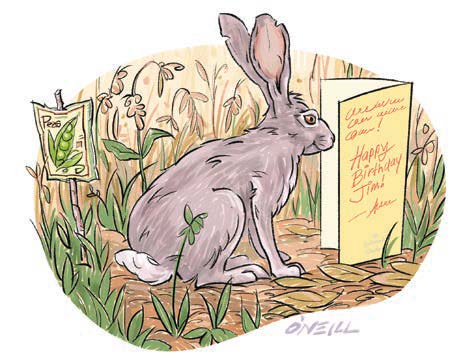
Ashley Walshe’s clever card amounted to a gentle poke from the universe, depicting an old, gray rabbit nibbling something in the garden. She knows I have a thing for woodland rabbits.

“Another year,” read the card. “Another gray hare — Happy Birthday!”

You may know Ashley from the soulful monthly Almanac she writes for the magazine, and from her many years adding earthy wisdom and wit to our editorial team. Among other things, she is a gifted poet and a true daughter of the Earth.

Not surprisingly, it was her accompanying hand-written message that reminded me of the lessons in gratitude and joy we’ve shared over the many years of friendship:

“In all seriousness,” she wrote, “thank you for showing me the joy of growing backwards . . . The secret, perhaps, to this wild, wonderful life on Earth.”

The idea of growing backwards is simply our way of describing a life in tune with nature, timeless values (some would call “old-fashioned”) that promote kindness and compassion to all living creatures and a deep reverence for the Earth.

In a year that has already seen apocalyptic wildfires out West, a record number of killer tornados in the heartland and a hurricane that will be remembered for generations, it isn’t much of a stretch to realize Mother Earth is sending us a serious message about our behavior.

Last November, Ashley and husband Alan nearly lost everything they own — including their lives — when their first home on a pretty hillside just outside Asheville was almost washed away by Hurricane Helene.

“At the height of the storm,” she remembers, “we were huddled in our house with our dog, Dirga, watching frightening torrents of water roar down the mountainside, washing away many of the houses around us. I remember asking Mother Mary to please keep us safe.”

Moments later, the couple heard a loud crash of trees that fell directly in the path of the rampaging waters, diverting the Biblical flood away from their home.

It was, she says, “a miracle. Nature saved our house.”

After escaping for a time to stay with friends outside the danger zone, the couple returned to find their home still intact but surrounded by a world of mud and debris.

“Helene brought me back to a higher level of consciousness, a desire to let go of things that don’t really matter in the course of daily life,” she says. “It also brought out an amazing amount of kindness and support among complete strangers who helped each other through the crisis. I think it changed many lives.”

The good news, she says, is that her bare yard is now a blank canvas awaiting the creation of a “wonderful new garden.”

Days after she told me this, she sent me a photograph of the lone plant that miraculously survived the Great Flood — a single, gorgeous tulip that popped up with the coming of spring. “Nature always gives us a gift,” she wrote.

That same afternoon, I noticed my own garden miraculously springing to life.

By now, it should really be something.

Omnivorous Reader

OMNIVOROUS READER

A Day at the Beach

When everything goes wrong

By Anne Blythe

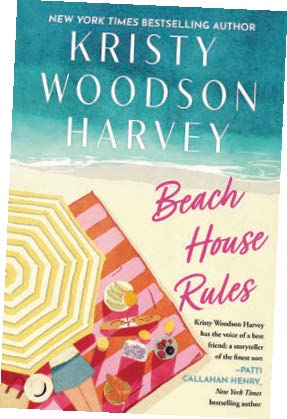
If you’re one of those people who like to walk on the beach and dream up scenarios for what might be happening in some of those homes looking out over the ocean, Kristie Woodson Harvey has a whale of a tale for you.

In Beach House Rules, the Beaufort-based author takes readers inside a massive two-story oceanfront home enveloped by “the salt air and rhythmic shush of the waves” in fictional Juniper Shores, North Carolina. Harvey’s 11th book, which she describes as “an ode to female friendship,” also has mystery, a touching exploration into what makes a family and, of course, a love story or two — many of the elements for a breezy, easy beach read.

Inside Alice Bailey’s massive beach house is the “mommune,” an intriguing co-living situation that — because of a variety of individual crises — brings a cast of women and their children together. Charlotte Sitterly and her teenage daughter, Iris, are the newest “mommune” residents, having found themselves in need of shelter, hugs and support after being locked out of their five-bedroom, four-and-a-half bath shorefront home by the FBI.

Bill, husband of Charlotte and dad of Iris, is in the local jail, accused of a white collar crime that thrusts their family into the glaring spotlight of an anonymous gossipy Instagram account that revels in “sharing bad behavior and delicious drama in North Carolina’s most exclusive coastal ZIP code.”

Charlotte, Bill and Iris came to Juniper Shores during the height of the pandemic, refugees from a locked-down New York City. While snuggling on the wide-open beach during what was supposed to be a temporary visit, soaking up the orange glow of a Mayflower moon and watching their daughter make friends with a neighbor girl, Bill suggested they build a house there, miles and worlds away from their hectic and confined city life. Charlotte leaned into her husband and quickly said yes.

Fast forward to Charlotte’s meltdown in the lobby of Suncoast Bank, three days after coming home to a swarm of police cars and FBI agents combing through her dream house. With the family’s financial assets seized, Charlotte needed a job. Her work history was in finance, so she thought she would try the local bank, but convincing a bank or investment firm to take on the spouse of a man accused of stealing large sums of money from his clients was a tough sell.

Alice, known around town as the woman with three dead husbands in 12 years, offered Charlotte a supportive ear and refuge at her former bed-and-breakfast where women and their children facing hardships comprise the “mommune.” With only enough cash to afford two more weeks at a modest hotel, Charlotte agreed. Her mind raced as she walked into the Bailey house. What if Alice was a creepy killer who’d offed her husbands? Was she a lunatic or a saint? And always in the back of her mind, what if Bill had, indeed, committed the financial crimes he was accused of? Charlotte tamped down those questions as Alice took her through the unlocked door into a haven with a chef’s kitchen, an open-plan dining room, a living room that stretched across the entire house and an array of comfortable bedrooms.

Through the alternate narratives of Charlotte, Iris and Alice, Harvey weaves in the many side stories. We learn about Julie Dartmouth, Alice’s niece and a dogged reporter who was the first woman to take up residence, along with her children, in the Bailey house. Before Charlotte and Iris arrived she “seemed to absolutely revel in writing about Bill’s arrest.” But “beach house rules” changed that.

Grace, Julie’s best friend and an Instagram influencer who has gained a large following sharing her recipes on “Growing with Grace,” was the second mom to join the so-called “lost ladies club.” She moved in after her husband split to Tokyo, leaving her with a mortgage to pay and children to raise, one of whom is a star high school quarterback and heartthrob, an added bonus for Iris, a 14-year-old navigating the highs and lows of teenage years.

Elliott Palmer, Alice’s former boyfriend who wants to reignite their love story, has the potential to upend this makeshift family. He’s not deterred by Alice’s wake of dead husbands or other claims that she’s cursed. “You’re not going to kill me,” he tells her over a bottle of Champagne and a remote table for two overlooking the water.

Harvey weaves all these storylines together, thread by thread, mystery by mystery, to an end that reveals whether or not Alice — who, not coincidentally, had taken a financial hit from the white-collar crime Bill is accused of — had ulterior motives when she invited Charlotte and her daughter to stay with her.

While there are dark clouds that hang over the many mysteries within this mystery, the romance and light fun make it more about community and the friendships that can unexpectedly occur when it seems like everything is falling apart.

According to the Beach House Rules, setbacks can be blessings in disguise.