











By Deborah Salomon
Photographs by John Gessner
A Pinehurst palace outfitted with the accoutrements of fine living was not what Cathy Vrdolyak and spouse Marilyn Barrett, both successful Chicago professionals, sought in 2013. They wanted a retreat, a vacation home, something as low-key as their three-level, 3500-square-foot loft in a historic Chicago industrial building was top-echelon.
Golf and climate factored in, given the Windy City’s often brutal winters. Barrett knew the area; her father, a lawyer and musician, had performed and later retired to the Sandhills. What they found — a neglected cottage bordering a public works facility, probably built to house a tradesman’s family — became the rock from which they chiseled a mini homestead, unique in having wooden pegs instead of closets and a few refrigerated drawers instead of a hulking Sub-Zero.
Really? No closets? Classic utensils but no refrigerator? Not necessary, they decided, for a cuisine based on farmers’ wares, homegrown produce and a simple but interesting menu. Once completed, Barrett said the interior was “like walking into a hug.”
The women named their getaway, renovated by Pinehurst architect Christine Dandeneau, “Bloomsbury Cottage” after the literary coterie formed in the early 20th century that included British feminist author Virginia Woolf. The cottage layout and contents became the palette for the designer.
“She got it,” Barrett says of Dandeneau’s plans.
In addition to the cottage, Vrdolyak and Barrett have compact freestanding studios overlooking the gardens, lap pool, deck and a tall brick Croatian barbecue-oven.
Nearly a decade of weekends and vacations passed happily at Bloomsbury. Retirement loomed. The cottage has two tiny bedrooms and a loft accessed by a steep ladder, a tough ask for the nimblest houseguest. Besides, their elegant furnishings and collections from the Chicago loft needed a proper home.
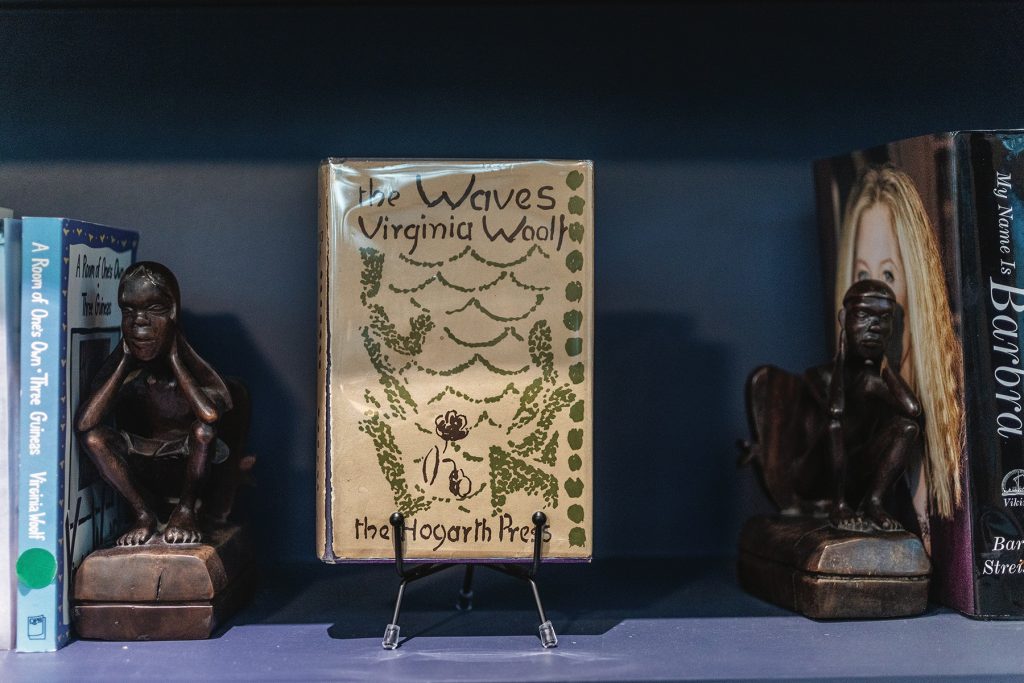
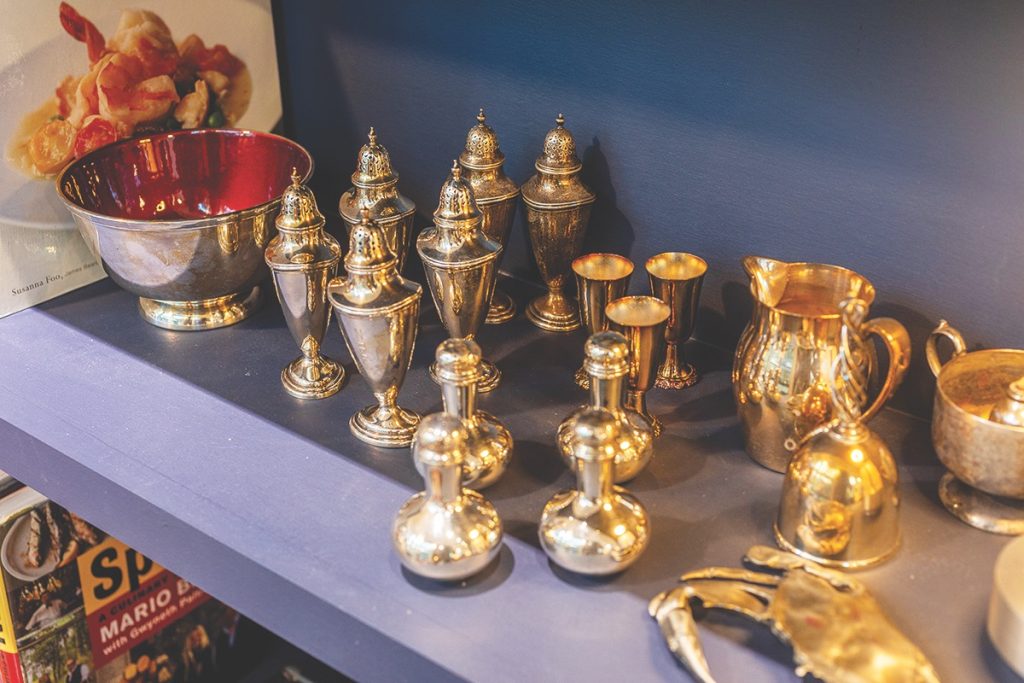
As usual, the possibilities ran perpendicular to the norm. Maybe build a unit beside, but not connected to, the cottage, on the sliver of land tucked between Bloomsbury and the public works fence? Call it The Salon, in keeping with the European theme. Give it a 16-foot high wall of windows, a statuesque gas fireplace with exposed stovepipe and whitewashed wood floors laid in a chevron pattern. Opposite the window wall, construct shelves displaying dozens of cookbooks plus New York Times besties, writings of Virginia Woolf, crystal objets and, in the center, a bed that unfolds out, not down. Include a full bathroom, an ice machine, hot plate and, most importantly, a well-stocked wine refrigerator.
Here, detail-oriented CPA/attorney Vrdolyak calls attention to a barely discernable chevron pattern lining the sink and its handsome brass hardware that coordinates with the chevron floor. Their cottage may lack closets but The Salon, in addition to creativity and quality, offers ample storage.
The idea of a separate dwelling unit intrigued Dandeneau, who recognized it as part of a trend, limited in square footage but not in usage. “They are lovely clients who build with character,” Dandeneau says, “and they’re not afraid.” She was able to overcome a glitch locating the wall-hung fireplace but fulfilled her clients’ desire for a multi-purpose space suitable for social occasions as well as sipping mid-morning tea. The location screens The Salon from street view, not that there’s much traffic anyway.
Its predominant color is a dusty navy blue — drawn from the blue, crimson and yellow in the area rugs — that offers a striking background for oversized French wine posters, some liberated on their travels, and adored by Barrett.
“They were advertisements and I was in advertising,” she says. “So vibrant, they make me happy.” Two red velveteen, 1940s-ish easy chairs from Barretts’ parents’ home, further the retro mood. What better setting for a dinner party, game night, business meeting, or book club?
“It’s as though you’re going into a different era,” Vrdolyak says of The Salon décor. “Even the dogs come running, as though they’re going to another place.” Barrett, who practices yoga there, is still able to glance from her mat into the cottage through aligned windows. “It’s like getting a break from the everyday,” she says.
This side-by-side life “is definitely not for everybody,” says Barrett. But who cares? The concept, its execution and livability, is definitely for them.

Story and Photograph by Tony Cross
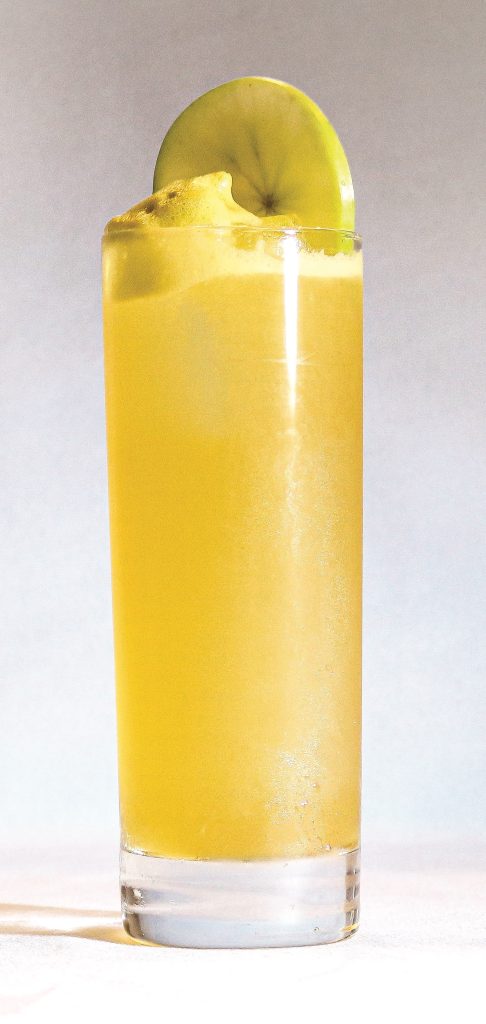
Every now and then, I’ll come across a cocktail from an influencer on Instagram that intrigues me. A few months ago ex-bartender Chris Leavitt posted a reel for a drink he’d tasted at the annual New Orleans cocktail festival, Tales of the Cocktail. “My memory served me that it was just two ingredients: blended Scotch and fresh apple juice,” wrote Leavitt. “However, the results online provided the addition of lime juice (I assume for a boost of acid) and some Drambuie (a honey/Scotch liqueur). I don’t regularly have Drambuie, so I opted for honey syrup to achieve the sweetness it provided.”
The only time I’ve worked with fresh apple juice is when I carbonated Reverie Cocktail’s version of an appletini. It turned out so well that I knew right away I wanted to try this with whiskey. I’m happy to report that the Scotch + apple is crushable: The fresh apple juice and malt/smoke from the Scotch are a great pairing. What’s fun about this cocktail is that you can play around with the specs and still have a great drink. I swapped out the Scotch and replaced it with a split base of rye and applejack (switching the lime juice with lemon, too) and loved it as much as the original.
Note that this drink will not work if you’re using store-bought juices. The apple and lime juices need to be freshly squeezed. When juicing your own apples — or if you stop by a store that can do it for you — make sure to add a little bit of ascorbic acid (you can break apart a vitamin C capsule and use the powder inside) to the juice immediately after it’s pressed to keep it from browning.
Specifications
1 1/2 ounce blended Scotch (Monkey Shoulder is great)
1/2 ounce honey syrup*
1/2 ounce lime juice
Top with fresh-pressed apple juice (Leavitt used Granny Smith apples in his reel)
*Honey syrup: Combine 3 parts local honey with 1 part hot water. Stir until evenly mixed. Let cool and store in glass bottle. Refrigerate. Lasts for at least one month.
Execution
Combine lime, honey syrup and Scotch into a highball glass with ice. Stir to incorporate. Top with freshly pressed apple juice. Garnish with an apple slice.


By Jason Harpster
Philadelphia has its cheesesteak and Chicago has its deep-dish pizza. Although people are more familiar with its golf and equestrian heritage, Southern Pines has a rich history with orchids that goes back to the 1920s, when Cattleya orchids were grown for cut flowers and shipped on rail to cities for corsages. Carolina Orchid Growers Inc. started in 1927 in Southern Pines and published its first catalog in 1933. At the height of its popularity, the business had a collection that spanned 17 greenhouses and included over 25,000 plants.
Southern Pines is the place the late Jack Webster chose to call home as he traveled and collected orchids from across the globe. Born in Buenos Aires to English parents in 1926, Webster worked in South America as an advertising executive and chose to relocate his family to Southern Pines in 1982. In addition to starting multiple orchid societies across North Carolina, he amassed a collection of over 2,000 orchids and received a total of 16 American Orchid Society awards over 30 years. He shared his love of orchids with others by organizing shows across the state, including three beloved shows at the Weymouth Center for the Arts & Humanities in Southern Pines.
Known for being an artful negotiator, Jack worked with customs and vendors from Brazil, India, Thailand and the Philippines to import plants for local orchid societies. He named all of his awarded plants after his wife, Jean Webster. You can still find divisions of orchids for sale today with her name.
The town of Southern Pines has multiple orchids named after it including, most recently, Stelis hallii ‘Southern Pines Hallmark.’ It was awarded a certificate of horticultural merit on June 15, 2024, at the monthly meeting of the Carolinas Judging Center in Concord, North Carolina. Since this is the first award on record for the species, additional photographs and measurements had to be taken to verify the validity of the species.

When an orchid is awarded by the AOS, a clonal name is recognized to distinguish the plant from others of the same species or grex. ‘Southern Pines Hallmark’ is an aptly chosen name given its showy, distinctive flowers, which are yellow and orbicular. Other species in the genus tend to be less vibrantly colored, with diminutive flowers. Stelis is a genus of over 500 species found in cloud forests in Central and South America. These plants need high humidity, cool to intermediate temperatures and bright indirect light to thrive.
For the botanical enthusiast, the award description is: 58 flowers and 27 buds alternately arranged on 17 basal, sequential inflorescences to 26-centimeters long borne on a 48-centimeters wide by 35-centimeters high plant grown on an 8-centimeters by 14-centimeters wooden mount; leaves oblanceolate, ascending, 2.5-centimeters wide by 11-centimeters long; sepals broadly ovate, light yellow-green, petals and lip darker minute, yellow-green; column and anther cap yellow-green; substance firm; texture matte; recognized for rarity in cultivation and attractive flowers; native to Colombia, Ecuador and Peru; exhibitor noted that longest inflorescences had been in bloom for over one year.
If a town can be called great based on the things named after it, Southern Pines may not taste as good as Philly or Chi-town, but it’s a lot prettier.

By Jim Moriarty
As it turns out, what you really need in the search for a forgotten grave in the woods is an archivist. As luck would have it, I sleep with one.
Ordinarily this woman’s field of expertise is confined mostly to the history of Pinehurst and a cast of characters whose final resting places are widely known. But when you’re looking for a spot last viewed — to the best of our knowledge — 50 years ago, marked only with a fieldstone, you need all the help you can get.
The grave we were seeking belongs to Marble Nash Taylor, a man who was the governor of North Carolina — or posed as the governor of North Carolina — from sometime in early November 1861 until Abraham Lincoln appointed Edward Stanly the military governor of the state on May 27, 1862. Taylor was the Methodist minister at the humble wooden church on Hatteras Island — the old building is long since gone — when he more or less elevated himself to this lofty post in the wake of the successful amphibious landing of Federal troops there on August 28, 1861. In rather short order, the Union Army spread its dominion over all of the Outer Banks.
Following the appearance of the troops, a “constitutional convention” — accompanied by flowery declarations covering perceived injustices of every imaginable sort — was spearheaded by three men, most notably, Rev. Taylor and his chief ally, Charles Henry Foster, a lawyer and journalist. Taylor is sometimes apocryphally referred to as the man who was governor “for a day,” though his term of office, clearly, was rather more prolonged. This did not happen through the kind graces of the Great Emancipator in Washington, D.C., who wanted absolutely nothing whatsoever to do with either Taylor or Foster.
Finding the general area where the reverend’s earthly remains reside was deceptively simple. In the book A Guide to Moore County Cemeteries, compiled by Anthony F. Parker and published by the Moore County Historical Association, the author gives detailed instructions: down such-and-such county road for 1.2 miles; take the “woods” road 3/10 of a mile to a clearing; walk the fire break north for 150 yards; the site is 100 yards east on top of the highest hill, marked at the time with two wooden knots. Parker was led to the grave in 1975 by Moses Jackson, who hunted the land and knew the location well. Before leaving the spot, Parker marked it with a simple fieldstone.
Of course, the problem with 50-year-old directions to a lonely place in the woods is that, well, they’re 50 years old, and the woods haven’t stopped growing.
The first thing I thought of was to call someone in the North Carolina Forestry Service’s Moore County office. There was an old, no longer in-service fire tower where the county road intersected the main highway, roughly 1.2 miles and this and that from Marble Nash Taylor’s grave. Maybe, just maybe, someone there would know of a modern day Moses Jackson who could be my sherpa.
The laughter at the other end of the line when I spoke with a gentleman at the Forest Service was, if not audible, palpable. It was summer. It was hot. We were in drought conditions, and he seemed rather more concerned with wildfires than dead governors, which is how I came to rely on the services of my resident archivist.
I ordered a pair of orange Day-Glo high visibility reflector vests. If we were going to go traipsing around in the woods in northern Moore County it made a certain amount of sense to take whatever precautions seemed prudent to avoid getting shot. We had little trouble finding the “woods” road off the county road, and we drove to the end of it, where there was a gathering of modest dwellings. At the home closest to where we thought we might find the good reverend, I knocked timidly on the door. No response. I turned to leave. The archivist, whose Day-Glo vest hung on her like a shiny minidress at a disco party, was not nearly so faint of heart. Her pounding could have raised the dead all by itself.
A delightful and friendly, if somewhat perplexed, lady came to the door. The archivist produced an official-looking business card. The house’s occupants knew nothing of Marble Nash Taylor or his remains; however, they did allow as how we could park our car in their yard while we searched. The archivist and I walked back up the hill toward its highest point.
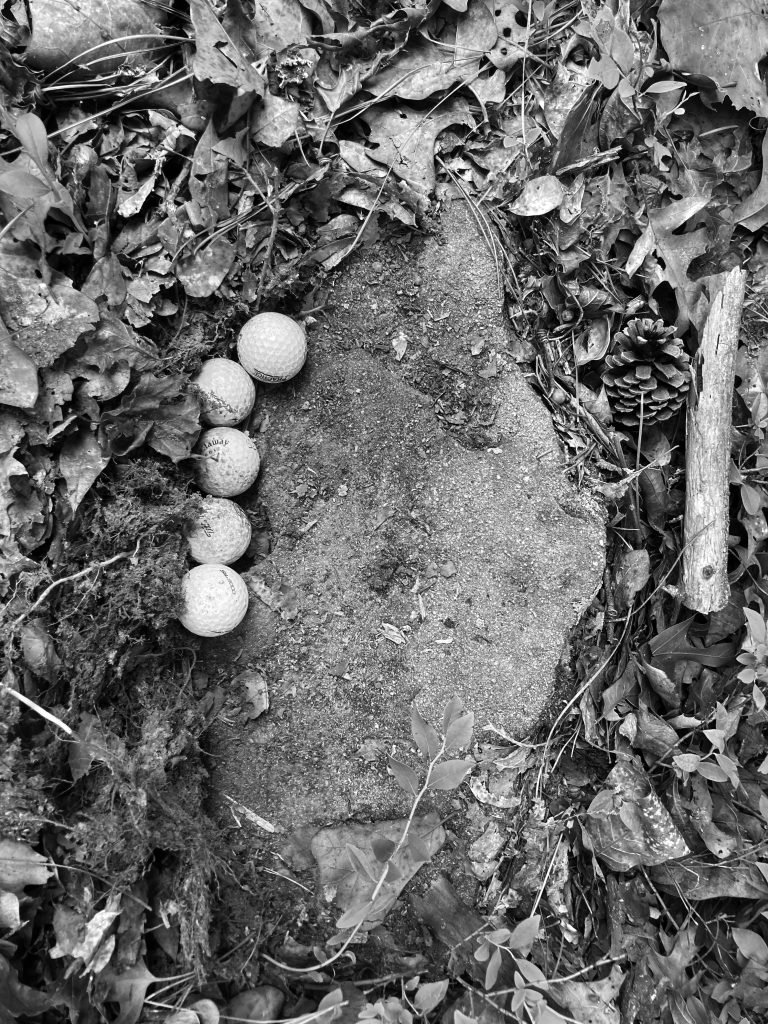
The wide fire break described by Parker in his book survives with modern power lines running through it. Someone had been using this long cleared strip as sort of a rural Topgolf, providing a narrow chute to practice power fades, though judging from the age and condition of the golf balls we found, whoever it was hadn’t been working on their game much lately. Several of the balls bore the markings of Forest Creek Golf Club. Certainly the “forest” part fit.
If the fire break still existed 50 years on, the clearing didn’t, so the archivist and I split up, slashing our way through overgrowth in what we believed to be the general area of the governor’s grave. As densely wooded as it was, one thing that it was not was rocky. You couldn’t find so much as a pebble, much less a fieldstone, in this patch of the Sandhills.
Scratched by tree branches and dripping sweat, with my patience running thinner than the governor’s resume, I was ready to abandon our search. My mind began wandering to lunch at the Pinehurst Brewery and rehydrating with an 1895 lager when the archivist called out. She’d found a very large rock indeed. The truth is, we could have combed those woods for days and would have been more likely to find a marble sculpture by Donatello than another stone like it. Without hesitation, I proclaimed this large, flat rock none other than the fieldstone marking the grave of Marble Nash Taylor, governor of the great state of North Carolina, or at least the Outer Banks.
So how, you may ask, did the right Rev. Taylor wind up in Moore County anyway? The truth is, there is more lore than there are facts. Though Taylor’s public duties, such as they were, never actually required him to leave the Outer Banks — he did make one fundraising trip north — his associate Foster did, in fact, travel to Washington, D.C., and attempt to be seated as a representative of North Carolina’s second district. He was laughed off the floor of the House of Representatives. In a letter to Lincoln’s Treasury Secretary Salmon P. Chase, one person described Foster as “an unprincipled scamp and cheat.” In March 1862, a journalist from Boston traveled to Hatteras, where he found Taylor who, by then, had more or less gone back to being nothing loftier than a Methodist minister.
This did not, however, prevent others from voicing their disapproval of the ersatz governor. The Richmond Dispatch, reprinted this from the Norfolk Day Book:
“Marble Nash Taylor is one of the most despicable of the human family — hated alike by God and man, and for the reason that he employs the garb of religion to cover the rottenness of his depraved and corrupt heart. So pious did this treacherous hypocrite become at one time, that nothing would do but that he must preach the gospel. . . .He was found to be a black-hearted hypocrite who desecrated the name and character of the minister of God, and he was speedily ousted from the Conference, and his license to preach taken away from him. (According to the State Archives of North Carolina Taylor is mentioned in the minutes of the Dec. 6, 1861 meeting of the Methodist Episcopal Conference, presumably not in a flattering way.) . . . This is the scamp who dares to issue a proclamation to the people of that good old State, calling upon them to become as base and perfidious as himself.”
Though it seems that Taylor stayed on Hatteras Island preaching the good word until the end of the Civil War, during Reconstruction he was appointed “keeper of the poor house” in Fayetteville, where he stayed for roughly 15 years. Sometime around 1880 he moved to Moore County, where he sold peach trees and lived in a shack constructed of the castoffs from a sawmill. He died in 1894, remembered as a “dour” man who was addressed as “governor” right up to the end.


By Jim Dodson
Not long ago, I heard an elderly gentleman in a coffee shop comment to a younger friend, “Someday, when you’re as old as I am, you will look back on your life and realize that everything is a miracle.”
His words brought to my mind Albert Einstein’s famous quote on the subject: “There are only two ways to live your life. One is as though nothing is a miracle. The other is as though everything is a miracle.”
Though it varies slightly from country to country, age 72 is the global median lifespan of most people on the planet — the statistical onset of “old age.”
This month, I turn 72.
Am I worried? Not so much. True, I walk more slowly and with more care these days due to a pair of arthritic knees, the painful legacy of 40- to 50-year-old sports injuries and having probably walked too many golf courses for one duffer’s life. By the time you read this, however, I hope to have a new left knee replacement for the new year with a second one on the way. Talk about a miracle.
Like many older folks my age, I’ve also survived cancer once and am winding up a second waltz with the dreaded disease, reportedly doing quite well, thanks to my brilliant young doctors and the miracles of modern medicine.
Despite these physical challenges, I’ve never felt happier or more productive. This seems to be a common trait among active elders who find the arrival of so-called old age to be a liberating force and an opportunity to experience life on a new and more meaningful level. A true case of attitude is altitude, as the saying goes.
One of the rarely mentioned gifts of being old is realizing what you no longer need or care about.
Two years ago, I donated half of my home library, roughly 300 books, to a pair of charities. This year, I plan to give another 200 away, leaving me approximately a hundred books I cherish and will continue to read again and again until my light in this world permanently dims.
At my pragmatic wife’s suggestion, I also went through my clothes closet and sent a large donkey cart’s worth of fine clothing I haven’t worn in more than two decades to a wonderful thrift shop owned by Freedom House, a local organization that provides drug rehabilitation programs to women. I hope whoever purchases the two fine custom suits, five Brooks Brothers blazers, nine crested-wool golf sweaters, eight pairs of worsted-wool slacks and 19 golf shirts will enjoy them with my blessing. Seriously, who needs 21 solid white golf shirts anyway?
Speaking of gratitude — and something of a miracle — I’ve reached an age where watching sports of any sort feels like a colossal waste of time. I’d rather take a long walk with the dogs, read a new book or watch seasonal birds at the feeder.
This is no small change. Once upon a time, now fading fast into memory, I was the original sports-mad kid who played every game in every season and died a little death anytime my favorite golfers and favorite professional sports teams lost. A decade ago, as my passion for all sports mysteriously began to wane, I wondered if this was because I’d changed — or if the games themselves had?
The answer is probably both. The sports teams I once worshipped, college and professional alike, were generally true hometown affairs where you could name (and root for) every player on the roster. This made the games feel much more personal and relevant. Today, almost all sports are shaped by staggering amounts of money flowing through their ranks. Not long ago, I heard about a local high school junior who recently signed with a major college program and pocketed $50,000 in NIL money. Add legalized sports betting to the state of our games and you may have a fast road to ruin for millions of fans who care less about the games than their payoff.
The real beauty of aging, I long ago realized, is the light that comes from the soul. Reaching statistical old age brings with it freedom to do your own thing along with the opportunity to forge new paths and adventures.
“A good old age can be the crown of all our life’s experiences,” wrote Helen Nearing, “the masterwork of a lifetime.” Considerably late in life, Nearing and her husband, Scott, became world famous advocates of simple living and pioneers of the organic farming movement in America. Helen lived to be 91. Scott, 100.
As Helen points out in her lovely book, Light on Aging and Dying, Socrates learned to play the lyre — and wrote his most famous poems — in his dotage. Thomas Edison was still inventing at age 92; Michelangelo did some of his finest work past 80; and Frank Lloyd Wright, at age 90, was considered the most creative architect in the world.
Likewise, numerous poets and artists proved to be at their creative best in their good old age. Thomas Hardy, Robert Frost and Carl Sandburg did some of their best work past 80. Ditto artists Goya, Titian, Manet, Matisse and Chagall. Shortly before his death at 91, Picasso said, “Age only matters when one is aging. Now that I have arrived at a great age, I might just as well be 20.”
Almost every day, we read about some octogenarian who still runs marathons or a septuagenarian who just climbed Mount Everest — for a second time. The list goes on and on.
“I am so busy being old,” wrote author and playwright Florida Scott-Maxwell in her 90s, “that I dread interruptions.”
As for this relatively new septuagenarian, one who will soon have new knees but no interest in running marathons or climbing mountains, I find the simple beauty of the natural world, a deepening spiritual life, a love of dogs and friends, plus an unquenchable passion for writing books reason enough to celebrate arriving at the ripe old age of 72.
The truth is, I’ve always enjoyed being with older people. And now that I’m one of them, I have no intention of slowing down.
That’s proof that everything really is a miracle

Photographs by Tim Sayer
Produced by Brady Gallagher
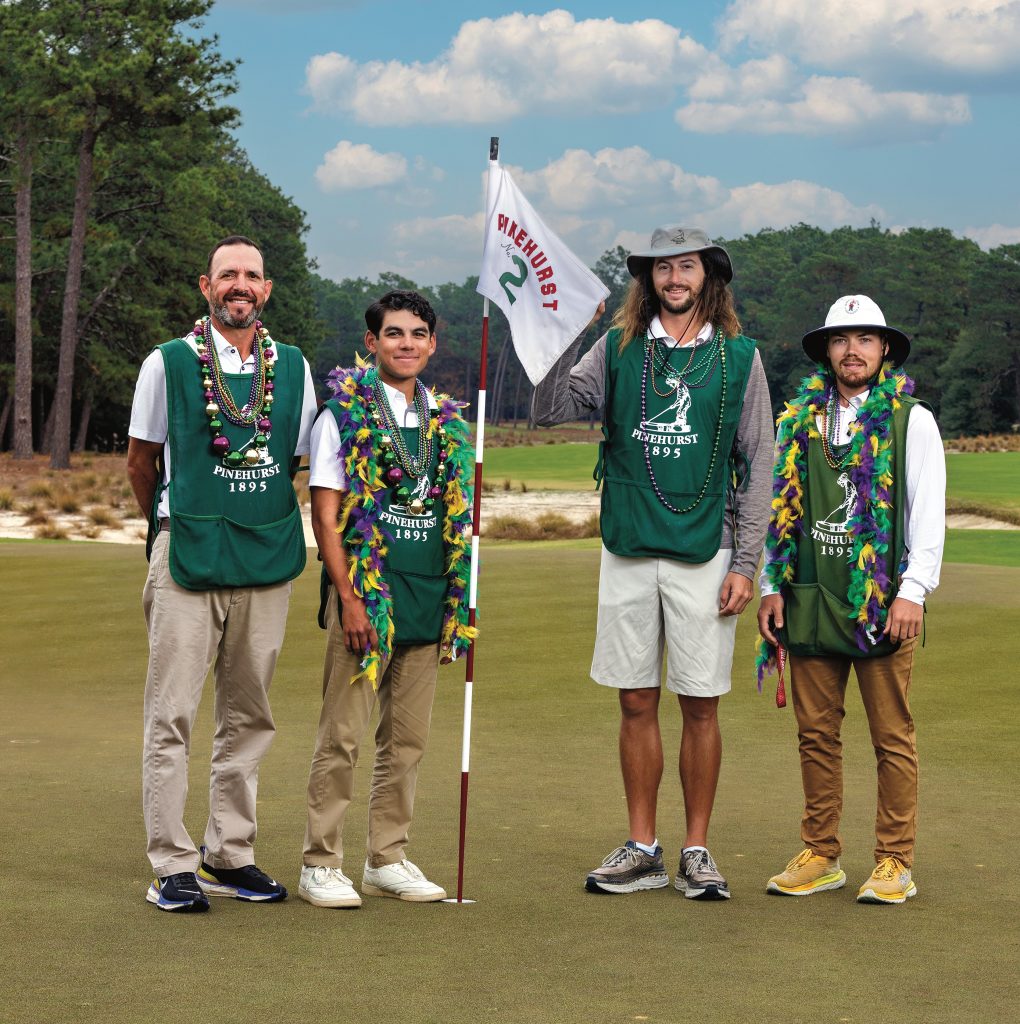
New Orleans has been celebrating Mardi Gras almost since the city was founded in 1718. By the late 1830s there were street processions of horse drawn carriages, gaslight torches and masked members of what would become a growing number of carnival societies, the forerunners of today’s krewes. Masked celebrants reveled in their anonymity, no longer bound by social strata. They were free to be whoever they wanted to be and to mingle with whoever they wanted to mingle. With each succeeding year, its krewes and parades, its magic and mystery, grew. The Mardi Gras colors — purple, gold and green — stood for justice, power and faith. If you’ve ever seen a jazz funeral in the French Quarter, you know that no place on Earth handles tragedy and loss the way they do in New Orleans. While the krewes of Moore County may not be parading through the French Quarter, they can be there in spirit.


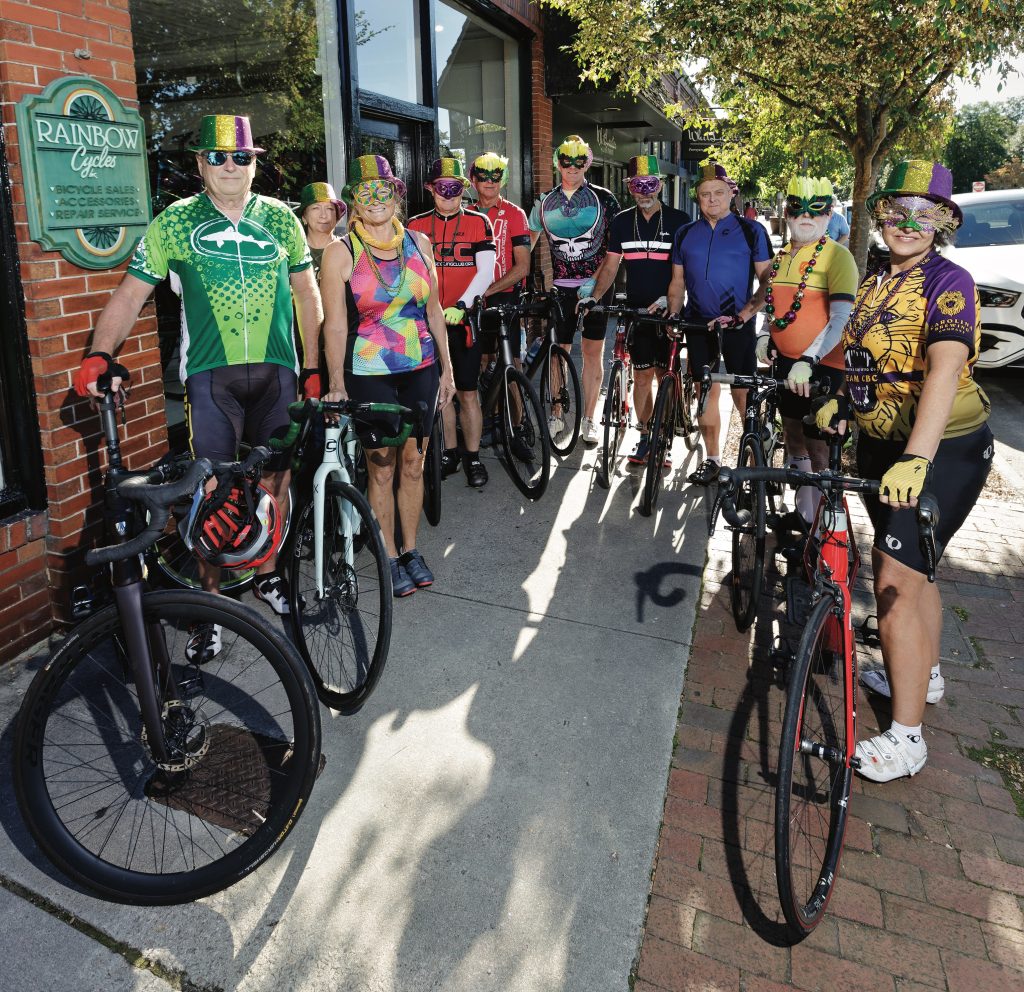






By Ron Green Jr.
It was July 11, 1967, and I was walking into the Charlotte Coliseum — the original one with the silver dome that still hosts events on Independence Boulevard — with my mother, my brother and all of the pre-teen excitement that came with the promise of seeing The Monkees, live, in person, and in concert.
I knew The Monkees like they were my best friends. Mickey Dolenz. Michael Nesmith. Peter Tork. Davy Jones. (Full disclosure, my buddies and I didn’t like Davy that much because the girls thought he was heartbreakingly cute.)
The Monkees were a made-for-television quartet, patterned very loosely after The Beatles in as much as there were four of them and music was involved. They burned white-hot for a time, starred in a top-rated television show that gets credit, or blame, for spawning music videos years later, and they left us with “Daydream Believer” and “I’m A Believer” to put smiles on our faces even now.
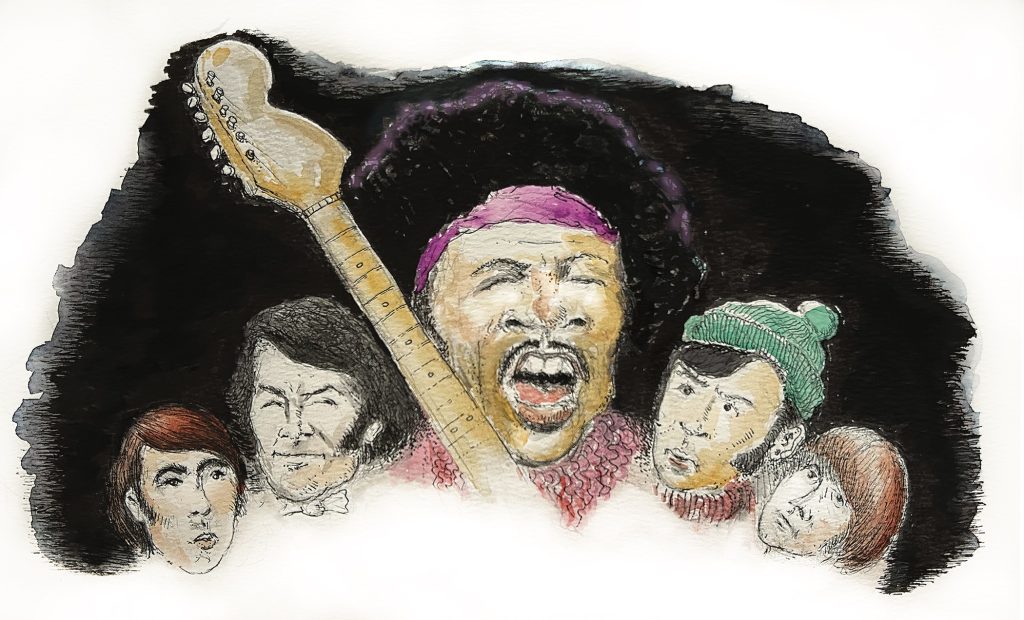
What I didn’t know that July evening — the temperature had topped out at 87 degrees that day in the pre-global warming era — was that Jimi Hendrix was performing before our generation’s Fad Four.
The Jimi Hendrix Experience, all loud guitars and evolutionary rock music, was on stage after Lynne Randell, followed by The Sundowners and, as the late great guitarist would lament, immediately before the four guys everyone had come to see and hear. It was a curious cultural moment, a concert pairing as unlikely as anchovies and ice cream at the dinner table, and it only lasted for eight shows.
But we were walking into one of them.
This was the summer of love, and the distance between Charlotte and the Haight-Ashbury district in San Francisco in 1967 was greater than the 2,700 miles stretching between the two. The world was changing, more dramatically than any of us probably realized, but Charlotte was still a small Southern city, connected to the rest of the country by what we saw on television and heard on the radio.
That summer, at least in my comfortable world, it meant The Monkees.
As the son of a sportswriter, I was introduced early to what were then called press gates. That’s where sportswriters, television cameramen and other muckety-mucks with connections to the building’s manager could enter without mixing with the masses.
That meant walking halfway around the outside of the big round building, which also meant walking past the elephant doors, the giant entryway built to accommodate the annual visit from the Ringling Brothers and Barnum & Bailey Circus as well as the occasional load-in for concerts, usually country music shows featuring Loretta Lynn, Johnny Cash or a new artist named Dolly Parton.
And Elvis. Always Elvis.
As we were heading to the press gate, our mother was telling us what to expect at our first real-life concert. Among her nuggets of wisdom was this: The Monkees are going to look different in person than they do on television.
Admittedly, this was long before anyone imagined HD television, but how different could they look? We were young, impressionable, and we figured anyone who could fry chicken as well as our mother did must know what she was talking about.
A moment after she told us about what television can do to a person’s appearance, a black limousine pulled up to the elephant doors as we were walking past. There they were, about to get out of the car, just a few feet away.
Out stepped Jimi Hendrix.
My 10-year-old mind tried to make sense of what and who I was seeing.
Mickey Dolenz really does look different, I thought. He has an Afro.
It wasn’t until an hour or so later that I realized why Mickey didn’t look like himself. While it may have caused me to doubt some things my mother said as I grew older, it’s a moment that still brings a little smile when I hear “Hey Joe” or “I’m Not Your Steppin’ Stone.”
And when Mickey and his mates took the stage that night — after Hendrix had stomped off with the echo of the guitar he tossed to the floor reverberating through the arena — they looked just like they did on television.
Had we been able to hear them over the screaming, they probably sounded the same, too.

The Fog
Some say strong winds and hard rain sing,
but I love the more subtle things:
stillness as mists make frost and dew,
the time between crickets and wren
before the cruel light crawls in
and work takes me away from you.
Drunk with sleep but almost aware
that we are more real than dreams,
but much less sure and far more rare.
Not cold silence, that’s too extreme
though the loudest leaves go quiet
as fog fills in what we forget.
The sun starts showing silhouettes.
Stalled clocks whisper: “Not yet. Not yet.”
— Paul Jones

By Bill Fields
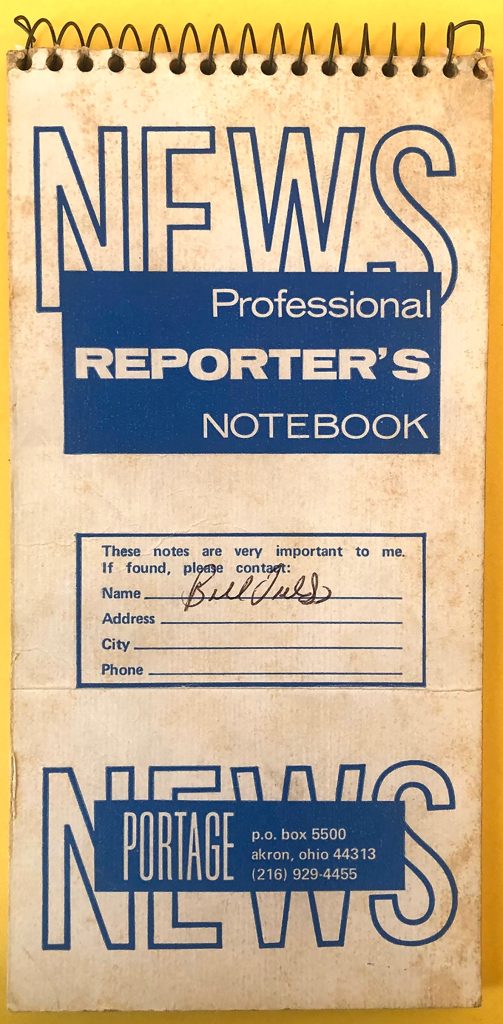
Hunting recently through a box of old stuff, most of which would have been thrown out long ago if I didn’t have a little pack rat in me, I found something I was glad hadn’t been tossed.
Over the years, I’ve filled many a reporter’s notebook. It’s a 4 x 8-inch lined pad with spiral rings at the top and cardboard covers, an essential tool for any journalist. Before the inconspicuously functional notebooks were widely available, while covering the turbulent civil rights movement in the American South for The New York Times in the 1950s and 1960s, Claude Sitton improvised them by cutting wider stenographer’s notebooks in half.
My discovery was of one of the first reporter’s notebooks I slipped into a back pocket, dating to 1979 when I was a student sportswriter for The Daily Tar Heel covering far less consequential events than Sitton — later the longtime editor of Raleigh’s News & Observer — was chronicling for the Times.
Beneath a creased and discolored front cover on its wide-ruled pages were my notes from assorted sporting events: North Carolina’s exhibition against the New York Yankees (green ink); a UNC-Duke baseball game (black ink); a spring football update from the Tar Heels’ second-year head football coach Dick Crum (blue ink).
“Going to keep it low and inside. Might even ask ’em to put the screen in front of the mound,” Carolina pitcher David Kirk told me the day before facing the two-time defending World Series champions. “If I get it up high, could be history. Chris Chambliss might hit one into Chase Cafeteria.”
“Sixth — P.J. Gay double off warning track.”
“OLB — Lawrence Taylor.”
Flipping through those old pages, I was pleasantly surprised that I could make out the vast majority of what I’d jotted down. Quotes from George Steinbrenner. “I’ve got professionals. Anybody who counts the Yankees out of the race because of spring is wrong.” Observations in the Yankees locker room before game time. “Pinella — cards, puffing cigarettes. Chambliss — 2 championship rings.” It wasn’t the neatest penmanship in the world, but it was readable.
I have notes from only a month ago that are harder to decipher.
That would no doubt be a disappointing admission for the person who taught me handwriting, Southern Pines third-grade teacher Peggy Blue, to hear. “Fine beginning in cursive writing,” Miss Blue noted on my report card in the fall of 1967. I earned straight As in “Writing” that year.
When it comes to notes taken on the job, there is a logical reason why I’ve become a sloppier notetaker. When I was in college, and for years afterward, tape recorders weren’t commonplace among journalists. Reporters took handwritten notes. In the case of a lengthy interview, if you weren’t on a tight deadline, you might type them up back in the office before writing a story. If you hadn’t written them so they were legible, you were out of luck.
Over the years, tiny digital recorders — and more recently, smartphones — have made it more convenient for journalists to record interviews. Convenient, verbatim audio leaves no doubt about what a subject said, but the technology has led to less thorough notetaking. Still, looking back on the period when I relied on pen and paper, I don’t recall being accused of misquoting anyone. Perhaps I inherited just enough of my mother’s steady, graceful penmanship, learned as a pupil of the Palmer Method in the 1930s, which endured into her 90s.
I can’t imagine not having learned how to write longhand, with joined letters. In this century, though, there has been a trend away from mandatory instruction in elementary school. I was stunned to find out that a young relative, who is now about the same age as I was when I wrote those notes in 1979, wasn’t taught cursive and only knew how to print block letters. About 15 years ago, many states removed longhand as a requirement. “The handwriting may be on the wall for cursive,” an ABC reporter quipped in the lede to a 2011 story about the trend.
Since then, however, education officials have realized that even in a predominantly digital age there is practical and cognitive value in knowing cursive writing. Many schools have reinstituted it as part of the third-grade curriculum. And someday, a budding reporter might even write down the profound thoughts of a coach, as I did with Dick Crum 46 years ago: “We want to play fundamentally sound football.”


By Deborah Salomon
In 1914, George Bernard Shaw captivated London playgoers with Pygmalion, the story of a highfalutin’ professor of linguistics who transforms a grubby Cockney flower girl into a lady.
How?
By scrubbing her down and dressing her up, of course. Even more important, dressing up her diction and her vocabulary.
“Words, words, words!” Eliza complains, this time to music, in My Fair Lady, the musical adaptation that opened on Broadway in 1956, then on film in 1964, sweeping awards for eons.
Words (and accents, to a lesser degree) are a force, a knife that cuts both ways. The right word (le bon mot, a useful French expression) makes a favorable impression, while a pale one falls flat and an incorrect one can be an embarrassment.
Worst are overused words, like “eclectic,” a favorite of speakers trying hard.
Ideally, an unfamiliar word will be defined by its sentence, therefore appreciated, even celebrated.
Example: Every year, The Pilot enters state and national newspaper competitions. Reporters select their best work for consideration. Last year, I didn’t have much, so just for fun, I entered a food column about using my grandmother’s bent and stained aluminum pot lid, the only extant artifact from her kitchen. The narrative mentioned a friend who buried her burned, worn-out pots in the garden. No, I commented, I’m not that anthropomorphic.
The column was ordinary, bordering maudlin. The recognition it received, I’m sure, was for the quirky placement of that perfect word — a favorite, second only to onomatopoeia, whose definition mimics its sound. Think “meow.” Or “rustle.”
I get teased about using “big” words, mostly for variety. Nobody with a full closet wears the same old shirt every day, so why use the same old words?
One culprit is shrinkage. These days, communications must be concise. Get to the point. Speak clearly. Detailed emails — a pain. Is there an app? Just text, uh, txt me.
Enriching one’s vocabulary, however, has a bright side. You don’t need a university degree or online class, just some intelligent reading material where the writer uses words to paint a landscape, or a portrait, in nuanced shades. Find a thesaurus (a dictionary of words with their synonyms), online or on paper, and pick a word a week, something ordinary, like “quotient” for “amount.” “Unearth” for discover. Slip it into conversation. My favorite orphan word is “provenance,” which sounds not at all like its definition, but which I’ve used to investigate a beaded cashmere sweater found at Goodwill.
Don’t get too hoity-toity. Go literal rather than vague and obscure.
Or not. Better, maybe, go with whatever AI composes, since term papers, dissertations, business letters and short stories will soon flow from its omnipotence, sufficient but lacking moxie.
Great word, moxie.
In the end, words are like clothes; they reveal much about personality, mood, life, taste, experience. The right word livens a conversation like the maraschino cherry saves canned fruit cocktail from dessert oblivion. The study thereof is called etymology and can be achieved sans Henry Higgins, whose motive for upgrading Eliza became more, uh, ulterior than academic . . . if you get my drift.
As for Eliza’s “Words, words, words, I’m so sick of words!” rage, that’s what I call moxie.
We use cookies to improve your experience on our site. By using our site, you consent to cookies.
Manage your cookie preferences below:
Essential cookies enable basic functions and are necessary for the proper function of the website.
Statistics cookies collect information anonymously. This information helps us understand how visitors use our website.
Google Analytics is a powerful tool that tracks and analyzes website traffic for informed marketing decisions.
Service URL: policies.google.com (opens in a new window)
SourceBuster is used by WooCommerce for order attribution based on user source.