Diamond Lanes of the 19th Century

The rise and fall of Moore County’s plank roads

By Bill Case  •   Images courtesy of the State Archives North Carolina

It is hard to envision just how remote and isolated the Sandhills were in the 1840s. Pinehurst, Southern Pines and Aberdeen were decades away from coming into being. Infrastructure was virtually nonexistent in this sparsely populated area. With only rutty, often impassable dirt trails to travel upon, the area’s scattered farmers and plantation owners — mostly of Scottish descent — found it inordinately difficult to ship harvested products like turpentine, naval stores, fruit and tobacco much beyond the Moore County line. The same predicament confronted settlers throughout the state’s interior all the way to the Piedmont. Merchants in the Eastern market towns were similarly exasperated with the perpetual challenges of sending supplies in the opposite direction.

Bustling Fayetteville emerged as a transportation hub of importance. Commodities coming from the frontier could be barged from the city’s wharf on the Cape Fear River down to the coast at Wilmington. From that seaport, oceangoing vessels could move goods to destinations up and down the Eastern Seaboard and as far away as Europe. But the maddening obstacles to transporting merchandise (and people) from the west to Fayetteville were forestalling the development of that city and the state’s economy.

A better transportation model had to be found, and a band of Fayetteville promoters took the lead in exploring alternatives. The building of a new railroad was considered, and a prospective train route west was surveyed. But the scheme was ultimately abandoned because of (according to one disenchanted proponent) “the poverty of the country.” A railroad would not enter Fayetteville until 1858.

More intriguing was the concept of wooden plank roads. They had proved popular and cost-effective in Canada and areas of New York state. Compared to what was needed to build a railroad, construction materials were readily available and inexpensive. No iron or steel was required, just wooden planks 8 feet long and 8 inches wide laid horizontally across long heart pine sills and covered by a thin layer of sand. The necessary lumber could often be found in the woods right beside the construction site. The roads were “single track,” just wide enough for a single wagon, but users were able to pull to the side on parallel dirt paths so that oncoming wagons could pass.

The most appealing aspect of “mudless highways” was the time saved in transporting goods or stagecoach passengers. The distance that took a wagon four days over the ancient dirt or sand paths could be traveled in 18 hours on a plank road. According to one observer, the increased efficiency on planks was the result of “the diminution of friction by which a horse was able to draw two or three times as great a load as he could on an ordinary road.”

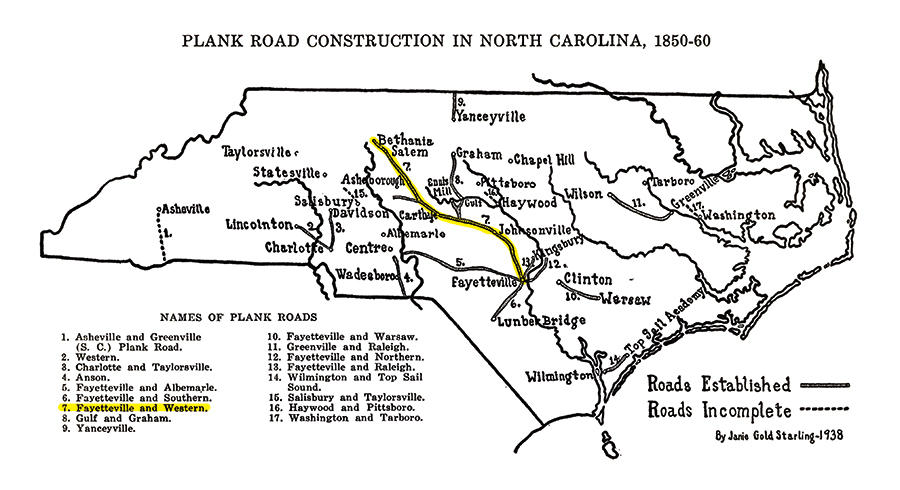
A movement to build plank roads from Fayetteville into the state’s interior rapidly gained steam during the 1840s, led by Gov. William Graham, who believed that poor roadways had placed North Carolina under “greater disadvantages than any state in the union.” He convinced the state legislature to grant charters to those entrepreneurs seeking to build and operate plank road companies. Five such charters were granted for roads that fanned out from Fayetteville like bicycle spokes to various westerly destinations. The state of North Carolina even purchased stock in several of them.
Not surprisingly, there was political controversy regarding whether North Carolina should be dispensing taxpayer funds to support these private ventures. The state’s entrepreneurs and merchants (generally associated with the Whig Party) overwhelmingly approved of the public investment. Not only would their businesses benefit, the value of their real estate holdings alongside any new road would also potentially skyrocket. The Fayetteville Observer reported that the plotting of a plank road through one vast tract caused the land’s value to shoot up from 11 cents per acre to $2.

Many small farmers, primarily Democrats, suspected that the state’s partnership with the companies would inevitably lead to roads not being routed with the best interests of the public (and that of small farmers) in mind. There was suspicion that the landed gentry would be tempted to make payoffs to ensure roads were routed next to, or through, their properties. And farmers objected to the legislature’s broad grant of eminent domain powers to plank road companies.

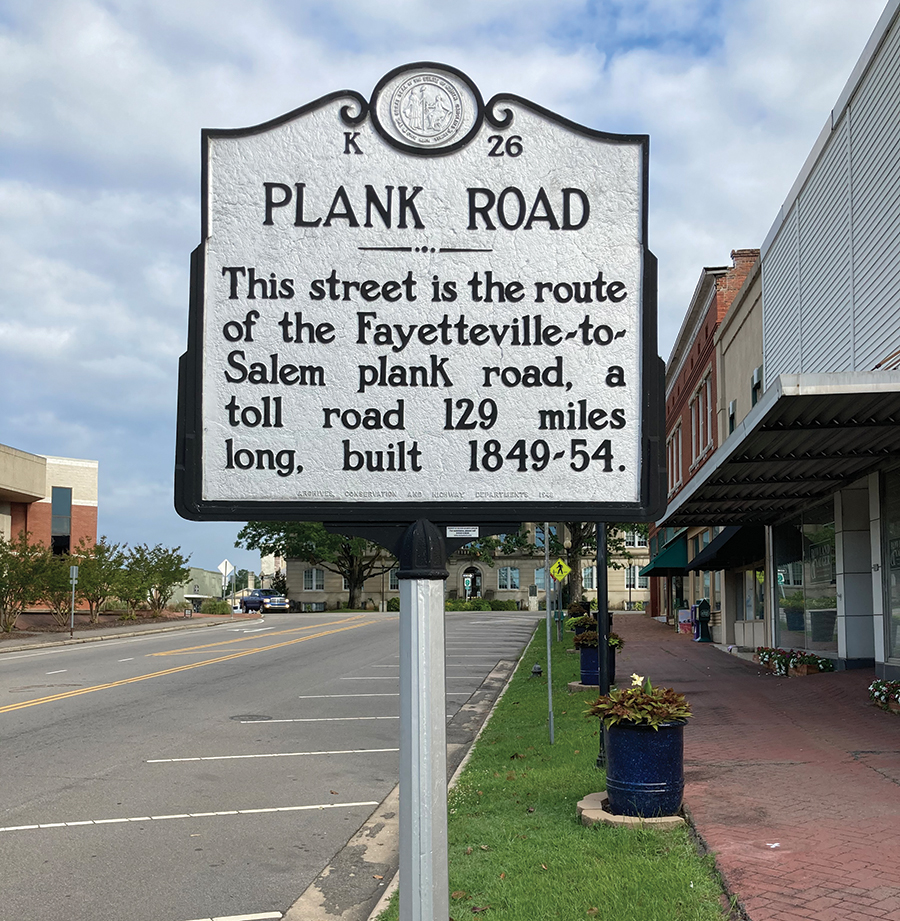
The most ambitious undertaking was that of the Fayetteville and Western Plank Road Company (ye olde F&W), which contemplated building the longest wooden road in history (129 miles) from Fayetteville to Salem (now Winston-Salem). Billed by its boosters as a latter day Appian Way, the proposed road sparked interest in Moore County as plans called for it to pass through Carthage. More westerly communities along the wooden highway’s intended path included Seagrove, Asheboro and the then tiny settlement of High Point. Much of the proposed route had been trailblazed by Daniel Boone in the 1760s.

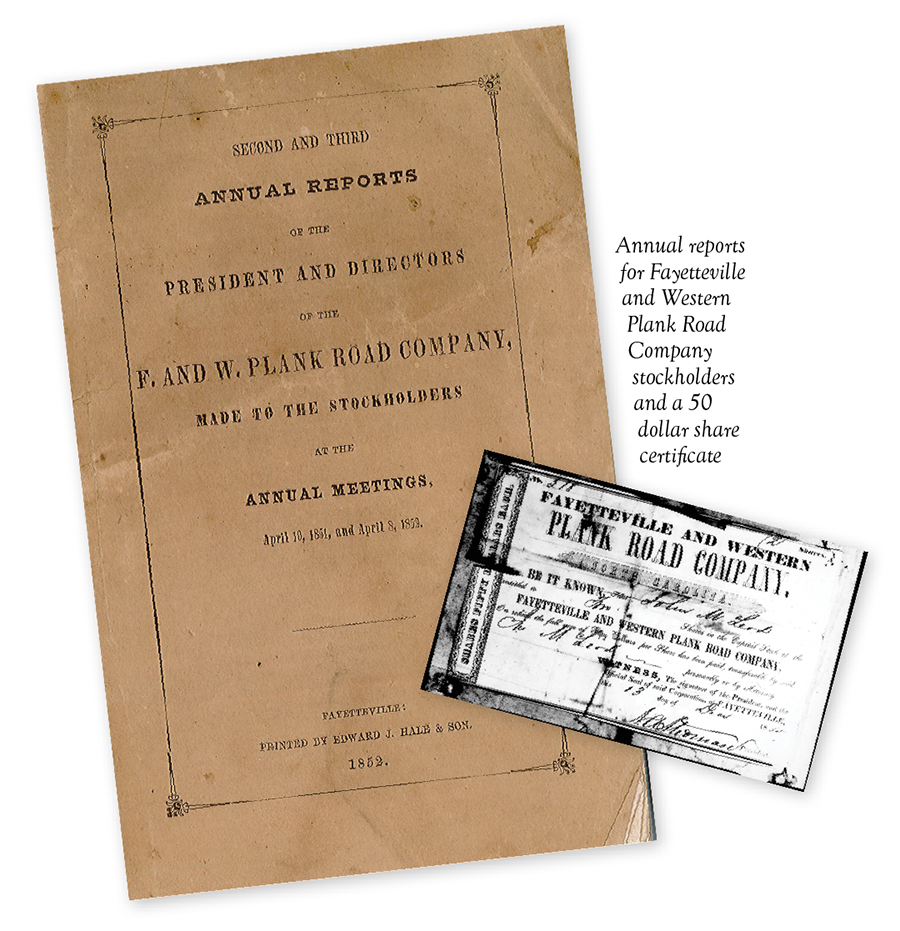
In the course of a three-day public meeting held in Fayetteville on April 11, 1849, F&W promoters successfully solicited $80,000 in stock subscriptions from private investors. The state of North Carolina acquired controlling interest in the company by tendering its own subscription in the amount of $120,000. The shareholders elected a board of directors and hired Edward L. Winslow as F&W’s president at the munificent annual salary of $500 plus traveling expenses.

Revenue to operate the proposed road was to be generated by collecting payments at tollhouses — manned by keepers, naturally, since E-ZPass was a few years off — placed approximately 11 miles apart. Fares were set at one-half cent per mile for a horseback rider, one cent for a carriage pulled by one horse, two cents for a team of two horses, and four cents for a six-horse team.

Construction of plank roads involved an arduous process as the underlying surfaces had to be carefully graded for proper drainage. On a productive day, a team of 15 workers could lay 650 feet of planks at an estimated cost of $1,300 per mile. North Carolina’s wooden roads were mostly built by private individuals subcontracted by the chartered companies. According to historian Robert B. Starling, many of these contractors accepted company stock in partial payment for their services, a shrewd move since savvy investors considered plank roads a can’t-miss proposition. The editor of Salisbury’s newspaper, the Carolina Watchman, was among the cheerleaders, writing, “There is scarcely a man of intelligence but believes the stock [in the F&W] would pay a handsome dividend.”

Hordes of opportunists endeavored to capitalize on the perceived bonanza by applying for authorization to build other plank roads. A majority of those applications involved construction of spur extensions stemming off the five westbound roads from Fayetteville, including the F&W. The legislature liberally green-lighted charters (84 in all) with the nonchalance of a grocery store handing out potato chip coupons.

In 1850, the F&W commenced the construction of the initial section of its plank road running from Fayetteville’s Market House to the Little River. That stretch was completed and placed under toll by April of that year. According to Starling, the remaining sections, including the one running through northernmost Moore County, were awarded by contract.
When the contract for the construction of the section of road around Cameron was awarded, the prospects of successful bidder Maj. Dugald McDugald seemed especially rosy. McDugald was in a position to profit from the venture in several ways. Not only would the 47-year-old be paid handsomely for building the road, it would pass through McDugald’s land just north of Cameron, increasing the value of his 4,000-acre spread exponentially. The wooden highway would also provide superior transportation to Fayetteville for the turpentine and naval stores produced from the tens of thousands of pines on McDugald’s plantation. He also intended to build a large hotel adjacent to the plank road at a point where it straddled the Moore and Lee County lines (in the vicinity of Page Store Road today).

Dugald’s father, Col. Archibald McDugald, had been a figure of note in North Carolina during the Revolutionary War. After emigrating from the Scottish Highlands in 1767, Archibald chose to fight with Loyalist forces when hostilities erupted between the Crown and the Patriots. Archibald’s association with the losing side ultimately caused him numerous travails. Captured by the Patriots in 1779 while journeying south to join Loyalist forces in Savannah, Georgia, he was held on a prison ship in Charleston Harbor for nearly a year. After his release in an exchange of prisoners, he joined the Royal North Carolina Regiment and was subsequently appointed to the rank of colonel in the Loyal Militia. The elder McDugald was a lead officer in the astonishing 1781 Hillsboro raid in which Loyalist militia captured Patriot Gov. Thomas Burke.

After the close of the war, the state confiscated 740 acres of McDugald’s land. Like many Loyalists, he settled for a time in Nova Scotia, then later sailed to England, where he spent three years successfully petitioning the Crown for a pension. Archibald returned to Moore County around 1794 and married Rebecca Buie. The couple parented four sons and two daughters. Archibald’s subsequent financial recovery enabled him to reinvest in northern Moore County real estate, and Dugald inherited much of the land after Archibald’s death in 1835.

As was the case with virtually all Southern plantation owners in the antebellum period, Dugald McDugald owned numerous slaves. But with his farming operation, the harvesting of turpentine, building of the hotel, and the plank road under construction, he needed even more manpower. McDugald asked his wealthy neighbors whether they would agree to let him “borrow” their slaves to perform the labor involved in constructing the road. Records are vague, but it appears he rented 15 slaves from Kenneth Murchison and many more “upcountry” from a Mr. Alston.

As Starling puts it, McDugald was “playing a game of chance.” He, his brother Daniel, and sisters Peggy and Polly were required to give their bond promising safe return of the slaves. After the work began, disaster struck. Typhoid fever broke out among the crew, and the deadly disease rapidly overwhelmed the project. At least 12 of Murchison’s 15 slaves died. The total number of deaths from the devastating ordeal is unknown. The ill-fated workers are believed buried in unmarked graves on the Moore County side of the plank road, a forlorn and untended testament to the suffering endured by African-Americans in building the South’s infrastructure.

The debacle financially ruined McDugald. To make good on his bond to the slaves’ owners, he was forced to liquidate all but 200 acres of his plantation. Construction of the unfinished hotel was abandoned. The locals referred to the misbegotten — now long gone — structure as “McDugald’s Folly.”

Col. Alexander Murchison completed the section of the F&W road up to Carthage. In a furious dash to the finish, Murchison operated five steam sawmills day and night. The F&W also built a tributary spur from the main plank road north to the small settlement of Gulf and south to a point immediately west of Cameron. Today, South Plank Road follows the path of this old spur.

By January 1853, the plank road neared Salem. However, leaders of the community’s powerful Moravian Church balked at locating the road within the town due to concerns that wagons and stagecoaches creaking over the wooden planks would disturb religious services. Eventually, the F&W’s terminus was moved 7 miles from Salem to Bethania. On April 13, 1854, the F&W stockholders were told that the road was finished.

The long-awaited linking of the Piedmont region with Fayetteville and its river access to the coast brought a sense of excitement to the previously isolated hamlets. “The arrival of the stagecoaches was announced by the loud blowing of a bugle,” wrote historian J. H. Monger, “and crowds often gathered in the villages to see the stagecoaches arrive.”

Initially, the F&W seemed on the threshold of becoming an Amazon-like blockbuster business. In 1853, it earned net income of over $17,000. The following year that net increased more than 60 percent to $27,419,77! Loftier future profits were predicted.
It wasn’t to be. An array of intractable difficulties beset the F&W and the other plank road ventures. Based on the experience of Canadian plank roads, it was presumed that the F&W’s wooden planks would not require replacement for 10 years. Unfortunately, the lifespan was less than half of that in North Carolina’s heat and humidity. Winslow’s 1853-54 report to the shareholders provided sobering guidance. “The expenses of repair and replacing planks on the road, bridges, and culverts, will be heavy, I fear, in the coming year,” wrote the president.

Despite the fact that Winslow’s tenure had resulted in net profits, the state, with controlling interest in the F&W, decided not to renew his contract in 1854. The new president was quickly confronted with even greater threats to the bottom line. Revenues were steadily declining — nefarious users of the road had found ways to bypass the tollgates. The cheating became so rampant that the company hired traveling toll collectors to track down the miscreants.

The 1850s also marked extensive railroad expansion throughout North Carolina, and an increasing number of the state’s farmers found it to their advantage to use them rather than the plank roads to transport their products. To make matters worse, one of the few American financial catastrophes significant enough to have its own name occurred. The Panic of 1857 diminished economic activity, dried up credit, and made paupers of farmers and merchants alike. The F&W’s report to shareholders that year noted, “The great diminishment of toll is owing to two causes — the short crops and the completion of the North Carolina Railroad.” The cost of repairs ($20,388.72) substantially exceeded the tolls collected ($15,966.69).

In 1858, F&W president Jonathan Worth tried his best to put a positive spin on the company’s increasingly dire situation, professing his belief that income from operations would not decrease any further while cautioning that “no dividend, however, can be paid for some time to come, if the road is kept in reasonable repair.” The company’s problems mirrored those of the other chartered plank road companies, many of which never built any roadway at all. Only 500 miles of plank roads were ultimately constructed in North Carolina, and the F&W built a quarter of the total.

Plank roads were on life support by the end of the decade, and the turmoil of the Civil War pushed the entire enterprise over the cliff. Business activity on the roads virtually ceased. The planks soon deteriorated into total disrepair. By 1862, the state had authorized the F&W to abandon the road and sell the assets.

In vogue about the same length of time as disco in the 1970s, these “farmers’ roads” played a critical role in opening up the entirety of the state to commerce and cemented Fayetteville’s position as an important transportation hub. High Point was virtually non-existent before F&W’s road came through, and the same can be said for Cameron. The road also favorably impacted Carthage. Once the plank road reached that community in 1850, a new business was formed to meet the increased demand for carriages. That operation was the forerunner to the iconic Tyson and Jones Buggy Company, which manufactured buggies in Carthage until 1925.

The old wooden highways may be no more, but the creaking of wagon wheels across the planks still echoes and the cost, unmarked, still lingers.  PS

Pinehurst resident Bill Case is PineStraw’s history man. He can be reached at Bill.Case@thompsonhine.com.

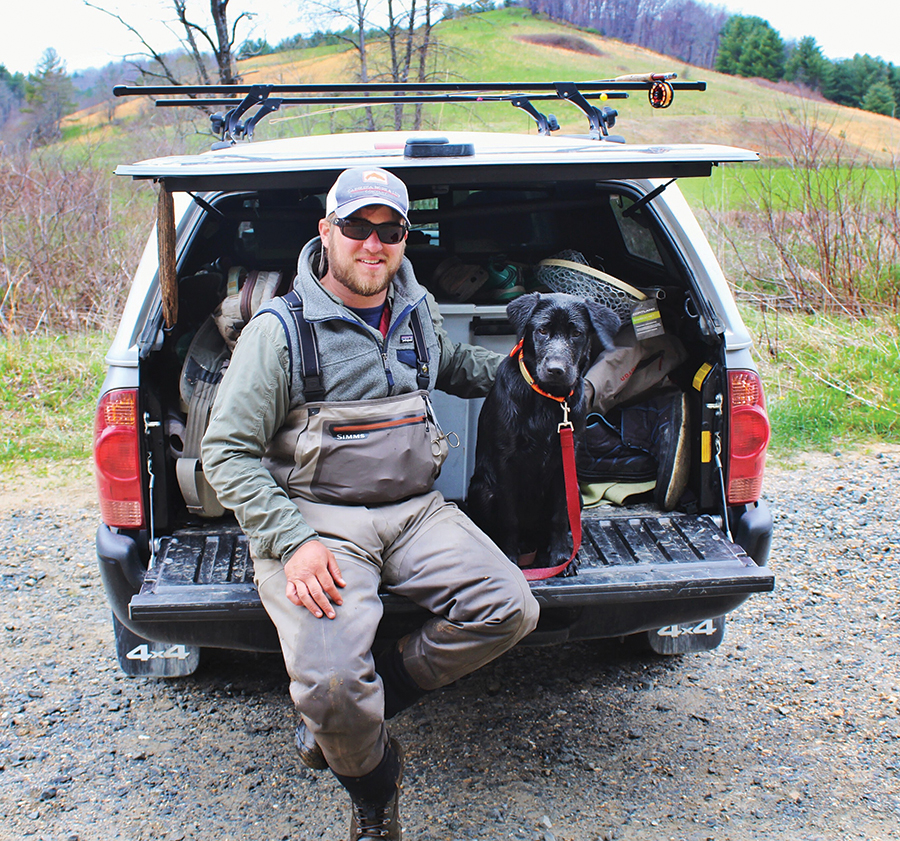
Hooked

A fly-fishing son of Pinehurst reels in mountain adventures

By Ron Rhody

Cape Lookout, that southern tip of North Carolina’s barrier islands, reachable only by boat — remote, rugged, and most appealing of all, unspoiled.

A couple of hours past midnight.

The beach deserted.

The only sounds that of surf breaking on sand. The only light the faint glow the stars provide.

Kneeling in the surf, a man and a boy, father and son.

The boy, beaming, unhooking a 46-inch red fish, spreading his arms, lifting it triumphantly.

The man beaming just as broadly. A trophy catch taken on rod and reel in the surf of the Outer Banks early on a morning when less determined men are home in bed.

The man laughs, shakes his head appreciatively. “You’re good at this. If all else fails, you’ve got this to fall back on.”

Patrick Sessoms laughs, too. Though he loves it, has loved it since he first threaded bait on a hook as a grade-schooler and went trying for panfish in the little ponds around Pinehurst, fishing isn’t what he has in mind for a career.

He’s 17, just finishing his senior year at Pinecrest High School. There is a universe of dreams to pick from.

That boy who had a talent to fall back on if all else failed hasn’t fallen back on it. He’s grabbed it. And is in the process of creating one of the most successful fly-fishing guide services in the southern Appalachians.

Fly-fishing? The mountains of the southern Appalachians? 

A guide service — one of the most professionally challenging, physically demanding, hands-down competitive enterprises on the list of ways a man might make a living? 

Alone? Inexperienced?

That’s what a bright, well-educated, ambitious young man at the start of a career that could take him anywhere might choose to do? Go fishing?

Aw, come on.

It’s about an hour before daylight.

Patrick’s driving. We’re on a twisting two-lane road winding through the northern edge of the Blue Ridge Mountains on our way from Boone, where Patrick lives now, to the South Holston. I’ve been told the South Holston is one of the finest tailwater trout fisheries east of the Mississippi. Big browns, enormous browns, lots of rainbow. I’m a recent transplant from California. I’m familiar with tailwaters. The world’s best are in the West.

There is a special quality to the dark of a mountain road in the hours before daylight — the blackest of black because all light of any kind has bled away, and all the warmth, and all that’s left is the cold.

We’ve seen no lights at all since clearing Boone, but we’re snug inside Patrick’s truck, and the drift boat trailing behind is riding smoothly, and the coffee in my Yeti mug is hot, and we’re getting acquainted, finding out about each other.

That’s one of the most important elements of this form of fishing, the connect.

We met only a short time ago in the parking lot at Patrick’s fly shop in Boone, where I piled out of my car in the morning dark and into his truck for the run to the river. A hello, a handshake, a let’s go. He has the build of a linebacker and a reassuring smile. We have over an hour’s drive to the South Holston and want to be on the water by first light. We’ll be spending the rest of the day in a drift boat. Two strangers. If the connect is good the day will be a fine one, regardless of how good the fishing is. If it isn’t, well . . . but this is going to be fine. He’s one of that rare breed of instantly likeable people — warm and amiable.

Patrick Sessoms is from Pinehurst.

The village sits on the bed of one of the ancient lakes formed thousands of years ago from Ice Age glacier melt. With a population of a little over 16,000, it is the largest in Moore County, and Moore County is the most affluent in the area, which is called, thanks to the glaciers’ leavings, the Sandhills. America’s premiere golf resort, the Pinehurst Resort and Country Club, home of the world-famous Pinehurst No. 2, is there. It’s rural, pastoral, uncrowded — a comfortably peaceful landscape of rolling meadows, stands of longleaf pines and sawgrass, the sort of place where the enchantments of the natural world can get in your blood.

The Sessoms have been in Moore County since the 1800s, carpenters and builders mostly. There are Sessoms homes and structures all over the county. Patrick’s father, Clay, built my home in Pinehurst. Patrick is fourth generation.

As a boy he roamed the woods, fished the little ponds and streams, learned the bird calls and when the redbuds would bloom. Became addicted to the outdoors. Don’t misapply the word. There are good addictions.

Episcopal Day School, Pinecrest High, National Honor Society, student government, cross-county runner, a winning member of the Sandhills Cycling Club regional competitive team, Eagle Scout.

Underscore Eagle Scout.

Cue serendipity.

The Eagle Scout rank is the highest achievement in the 2.4-million member Boy Scouts of America program. Candidates have to progress through five stages of development and earn 21 merit badges (proof of knowledge and competence in a wide range of life skills) to win it. Less than 4 percent do.

Patrick needed only one more. And chose the one just recently added to the program.

Fly-fishing.

This was an entirely new experience for a flat-country boy. Though he had been fishing since grade school, the implement was either a long cane pole sporting a length of monofilament and a bobber and barbed hook with live bait attached, or a spinning rod that could present either live bait or an artificial lure. Both worked in their place and for their targets. But, as Patrick was to learn, neither had the elegance, or demanded the skills, or generated the adrenalin rush that fly-fishing does.

He was, forgive the pun, hooked.

Not firmly at first. He was only 13 and in the Sandhills, and his options were limited to bass in Lake Pinehurst or panfish in the area’s farm ponds and streams.

The hook doesn’t really get set until he finds himself in Boone . . . his second try at college.

He had thought he would follow the familiar family path into building and construction and had enrolled as a construction engineering student at North Carolina State University in Raleigh.

It didn’t take.

He didn’t like living in the city. He missed the outdoors. He found he was more interested in environmental matters than in building things, transferred to Appalachian State University in Boone, enrolled in its sustainable development program, the oldest program of its type in the country. It is focused on ensuring that the planet’s ability to provide the natural resources our societies need to survive and prosper are sustained.

That took. As did Boone.

A vibrant community with the main campus of Appalachian State at its center, Boone was small enough to be livable, had enough action to be cool without being annoying, and was smack in the heart of a Mecca for outdoors recreation — North Carolina’s high country, a seven county stretch of mountains and streams along the border with Tennessee.

There was a year-round smorgasbord of delights on offer there: hunting, skiing, hiking, mountain-biking, camping, kayaking, bird-watching, zip-lining, or just the simple pleasure of sitting and admiring sunsets soothed by bird song and the whisper of water in mountain streams . . . and some of the best trout fishing in the Southeast.

By the time he made it to Boone, Patrick had mastered the fly rod. He could make the graceful cast, drop the fly gently on the spot of water he’d chosen so as not to startle his quarry, manage a drag-free draft to ensure his lure was moving at the same rate of speed as the current so that it would be seen as something natural, not suspect. Watch for the strike. Set the hook. Savor the fight.

Patrick began guiding while still a student at Appalachian State. He worked on weekends and off-hours from school for one of the local guide services. Found he was good at it. Found he had the personality and patience and the mastery of the skill. He had learned the waters and knew the holds where fish could be found. He could put his clients on fish and bring them home happy — even if they didn’t land anything, though that seldom happened.

He enjoyed it. They enjoyed it.

He began to wonder.

For some, fly-fishing is the apex of the sport-fishing skill. Its canon stretches back to 16th century England, where the art got its start among the English upper class. For years it was a relatively exclusive niche sport. There were ardent participants, but not too many, until Robert Redford put a fly rod in the hand of the young Brad Pitt on one of the most beautiful streams in the country and turned Norman McLean’s classic semi-autobiographical novel into the 1992 Academy Award movie A River Runs Through It.

Remarkably, the film struck a chord in the psyche of large swatches of the American population. It seemed to awaken a latent longing for the peace and beauty of the out-of-doors. All at once, fly-fishing was popular, or at the very least, fashionable. What better way to experience the great outdoors than with the graceful motion of a fly line uncurling over running water in the solitude of a mountain stream, and images of yourself, Brad Pitt-like, thigh-deep in a swift current with a big rainbow on the line?

Field & Stream magazine estimates there are roughly 10 million flyrodders in this country now, and their number is growing. According to the Outdoor Foundation’s latest report, the growth rate in 2017 was 17 percent. At least 5 million are rated as avid enthusiasts. Committed golfers will recognize the type. They fish as often as they can. Mastering the perfect cast is as technical and demanding as mastering the perfect golf swing. No one does either, but the desire is constant.

The competition for their business is intense. There are eight guide services in the Boone area alone.

So he’s finishing up at Appalachian State on the backside of the punishing recession of ’08-‘09. The economy is still staggering. Jobs are scarce. His graduating buddies are scrambling in a job market with few opportunities and little demand for their degrees. What few jobs are being found aren’t using their skills or paying decent wages. He finds that he’s making more money than many of them.

Guiding. Doing what he likes to do. Doing what he’s good at.

So, with graduation day in sight, in the teeth of that blooming gale, he decides to play the hand he’s holding. He launches Due South Outfitters. In Boone.

By himself.

He’s 21.

He has no experience as a businessman.

A full-fledged guide service is a business. It needs funding, equipment, operating capital. Patrick has little more than a drift boat, a truck, a fly rod and some flies. It needs bookkeeping and marketing. What does he know about that? Where does he find the time? If he’s not on the water, he’s not making money.

As word of mouth spreads among his regulars that he’s gone pro, his trip log starts to grow. His universe of clients expands. And keeps expanding. Satisfied clients are the best advertising.

In that first year after graduation he logs over 300 days on the water, scouting and guiding. He lives in his room, works out of his truck, pumps all he earns back into the business. Frugality becomes a mantra, sleep an ambition.

Fourteen-hour days are normal — eight hours on the water, three hours of preparation on either side getting there and getting back, setting the boat up and cleaning it up after, re-rigging rods and refreshing flies.

Not only are the hours long, the work is hard . . . physically hard. His loaded drift boat weighs 1,500 pounds. The anglers sit at the bow and stern and the guide in the middle with the oars. Not all that much effort is required to keep the boat moving in sync with the current, but when running rapids, or if there is a snag to be loosened, or a hold to be rowed back to against the current for another try at the rainbow that should have taken the fly but didn’t, the strength and skill required are considerable. Try that all day.

Soon, the demand is larger than one man can handle, and he begins to recruit. But he has a different paradigm in mind than the conventional guide service. He wants young men like himself — bright, upbeat, likeable — who he can teach and train in the manners and techniques he thinks makes the consummate guide and who share his commitment to, and respect for, the natural environment . . . a team of enthusiastic young pros who can meet the expectations of accomplished anglers on a quest for trophy fish, or give first-timers a day they’ll remember and want more of.

There are 14 of them now.

They are handpicked and personally trained by Patrick. All are accomplished fly-fishermen. They have the personality and the dependability that are the hallmark of top-flight guides and may be the best-educated team in the country. All are students or recent graduates of Appalachian State. They range in age from 17 to 26. Most are business majors or outdoor recreation majors. A few are in the construction management stream. There is one MBA.

The team specializes in float trips on the South Holston and the Watauga. These are side-by-side tailwaters that are productive year-round and boast fish counts of 4,000 to 6,000 per mile of stream. Only a mountain ridgeline separates the two.

In the spring and early fall, wade trips on the high country’s backwoods streams for native Appalachian brook trout and small-mouth bass become popular.

Whether drift boat or wading, Patrick and his team are enthusiastic teachers. They have first-timers laying casts that take fish after an hour or so of instruction at the start of a trip. Youngsters as young as 8 are increasingly showing up with a dad or an uncle on family outings. Women, too. The simple elegance of the cast and the tranquility of the settings seem to appeal to them.

The client base is broad and growing, ranging over most of the Southeast and edging northward. Much of this is due to the attraction of the high country as a tourist destination, but the adroit use of social media to raise awareness of Due South’s presence and services plays a major role.

Regular Facebook postings highlight catches and report on trips and results. YouTube videos offer advice on techniques and equipment. The website (duesouthoutfitters.com) has up-to- date information on stream conditions and information on how to book trips. There is even a podcast. These are millennials. They understand how to use the tool.

Patrick is expanding into retail now, adding a fly shop to the guide service. The shop is one of the best-stocked in the high country, certainly the best-stocked in Boone. Top-of-the-line stuff in hand to be inspected, tried out, decided on — not just pictures in a catalog. Rods, reels, waders, flies — the universe of gear and gadgets fly-fishermen need, want, or just can’t resist. A businessman’s instincts?

Even so, Patrick is still on the water himself regularly, guiding six to seven days a week, making sure he knows how the waters are fishing and where the action is. But this businessman thing, he’s taking to it.

Due South Outfitters is eight years old now.

Patrick is 29.

The business is thriving — put on hold during the recent COVID-19 lockdown, but back in action. The rivers are running strong and fresh, fish are feeding and growing, and the solace of a day in the arms of nature on a mountain stream has never been more healing.

Fly-fishing?

The mountains of the southern Appalachians? 

A guide service?

Damn right!  PS

Ron Rhody came to Pinehurst after a career as a journalist and corporate public relations executive. He’s writing novels now. His latest is due out in the early spring of 2021.

Historic Camp Mackall

The secret in the Sandhills

By Bob Curtin   •   Photographs from the Moore County Historical Association

It’s possible to jump on your Harley or crawl into your Subaru and drive from Southern Pines to Laurinburg on U.S. 15-501 as if you’re heading to Myrtle Beach for a game of skee ball and some Calabash seafood and never know you’ve just passed one of the U.S. Army’s more secretive military training installations.

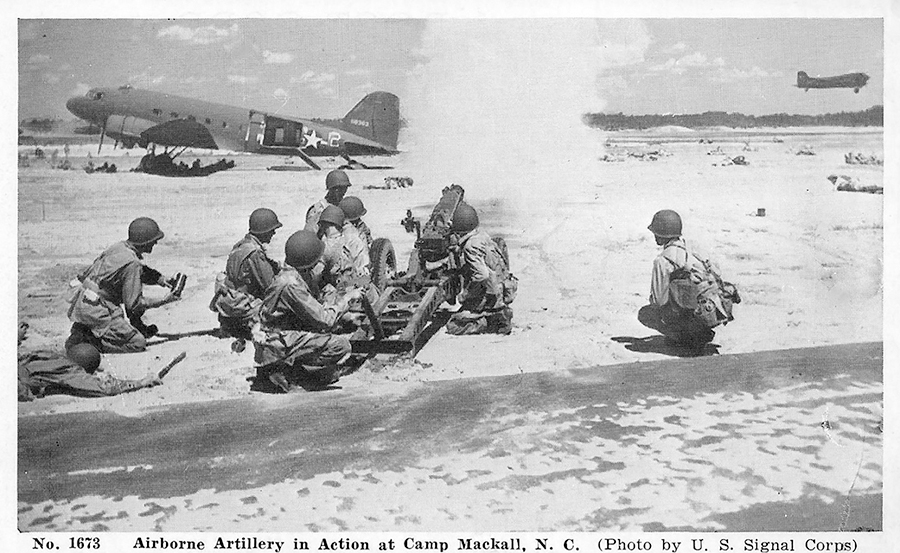
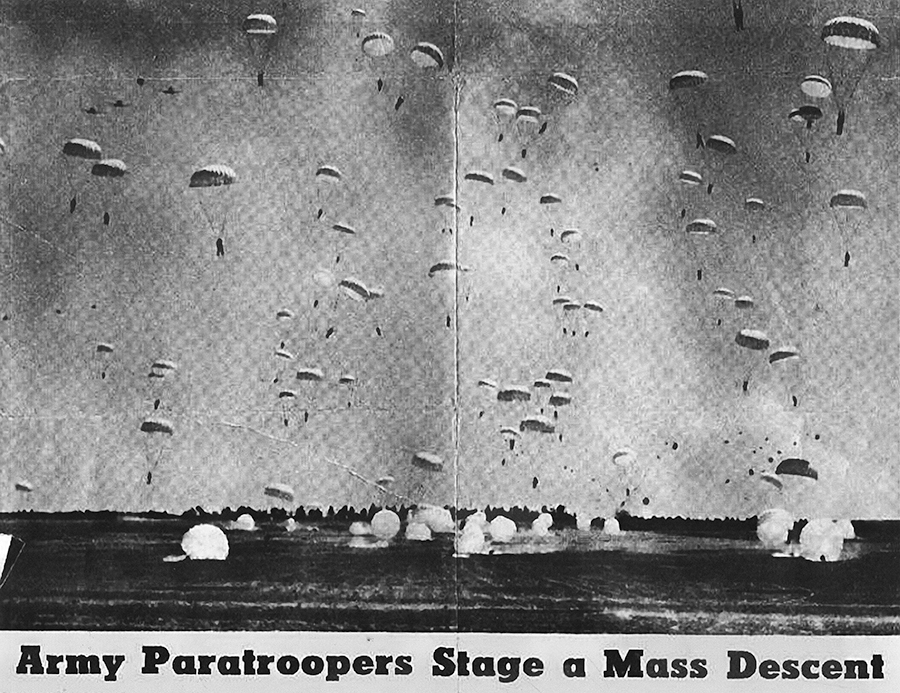
Camp Mackall, built almost overnight during World War II to train paratroopers and glider units to invade France, is today a primary training facility for elite Special Forces, the Green Berets. What’s secretive isn’t so much that they train, it’s how they train, turning seasoned, professional soldiers into highly skilled, well-conditioned and formidable Special Forces soldiers. The modern Camp Mackall encompasses about 8,000 acres of land, composed of eight major training sites, and every Special Forces soldier who earned the right to wear the Green Beret has left his sweat and blood in those forests and fields.

During World War II Camp Mackall trained and tested division-size airborne forces in combat operations. In 1943 it was home to three newly formed units of the 11th, 13th and 17th Airborne divisions. The 82nd and 101st remained garrisoned on Fort Bragg but trained at Mackall. Today, our Green Berets are often referred to as the proverbial “tip of the spear” and operate in the dark of night and well behind enemy lines to perform almost superhero-like missions. During WWII, our newly formed airborne paratroopers would have been considered card-carrying members of the tip of the spear club.

Originally named Hoffman Air Borne Camp, on Feb. 8, 1943, the installation was renamed in honor of Pvt. John Thomas (Tommy) Mackall. During the Allied invasion of North Africa, in the airborne maneuver named Operation Torch, Mackall was mortally wounded during an attack on his aircraft as it landed. Seven paratroopers died at the scene and several more were wounded, including Mackall. He was evacuated to a British hospital, where he died of his wounds on Nov. 12, 1942. Mackall was listed as the first American airborne fatality of WWII.

Training the five airborne divisions in the newly formed United States Army Airborne Command was going to require space, and lots of it, for both parachute and glider operations. The United States Department of War began planning construction of Camp Mackall as early as 1942. The land south of Southern Pines was ideal because the federal government already owned a large parcel of it. Construction plans called for an installation that could house and train up to 35,000 soldiers. By comparison the entire population of Moore County in 1940 was slightly over 30,000.

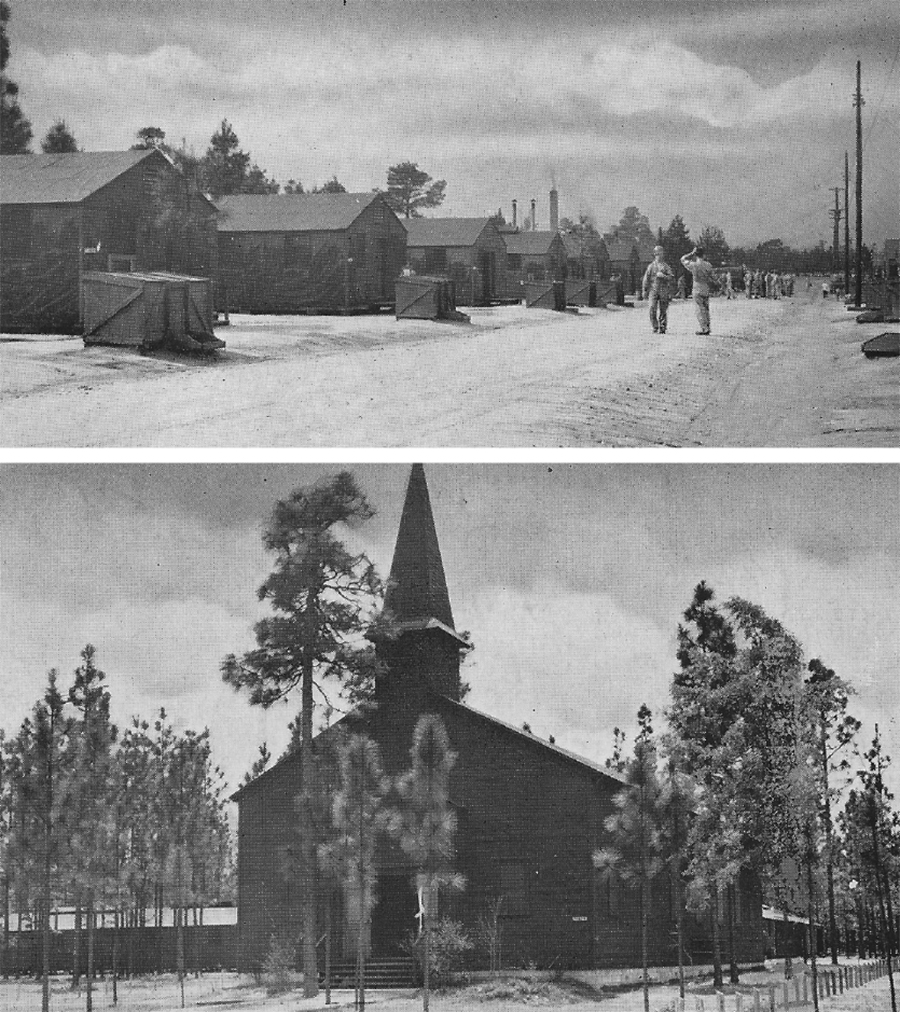
In just over three months, more than 62,000 acres of game land and leased farmland were transformed into a bustling military city. The camp included 65 miles of paved roads and several hundred miles of hard-packed trails capable of moving both civilian and military vehicles to the 1,750 buildings within the garrison’s north and south cantonment centers. The camp garrison provided housing for camp cadre, airborne trainees, as well as the paratroopers assigned to the airborne divisions. There were barracks, unit headquarter buildings, three libraries, six beer gardens, 10 barracks-style chapels, entertainment, fitness and sports facilities, and a triangular-shaped airfield with three 5,000-foot runways.

Built with wood and tarpaper, the buildings were hot in the summer and cold in the winter. In the worst of the heat, the soldiers propped opened the doors at both ends of their barracks, either praying for the mildest of breezes or requisitioning (legally or by any means necessary) large floor fans. The biting cold of the winter months was more dangerous. The buildings were equipped with pot-bellied, coal-burning stoves, and soldiers had to take special precautions — even attend courses and post a 24/7 guard force — to avoid burning down the wood and tarpaper boxes.

Besides the tarpaper-covered barracks that dotted the landscape, there were some larger and more permanent buildings — movie theaters, churches and headquarters — constructed with brick and mortar. Five theaters showed the latest Hollywood movies. There were 10 wood and tarpaper chapels and two large brick churches, manned by 28 chaplains of many denominations. According to Tom MacCallum and Lowell Stevens, authors of Camp Mackall North Carolina: Its Origin and Time in the Sandhills, “The communities of Southern Pines, Aberdeen, Pinehurst, Rockingham, and Hamlet embraced the paratroopers’ faith based needs.”

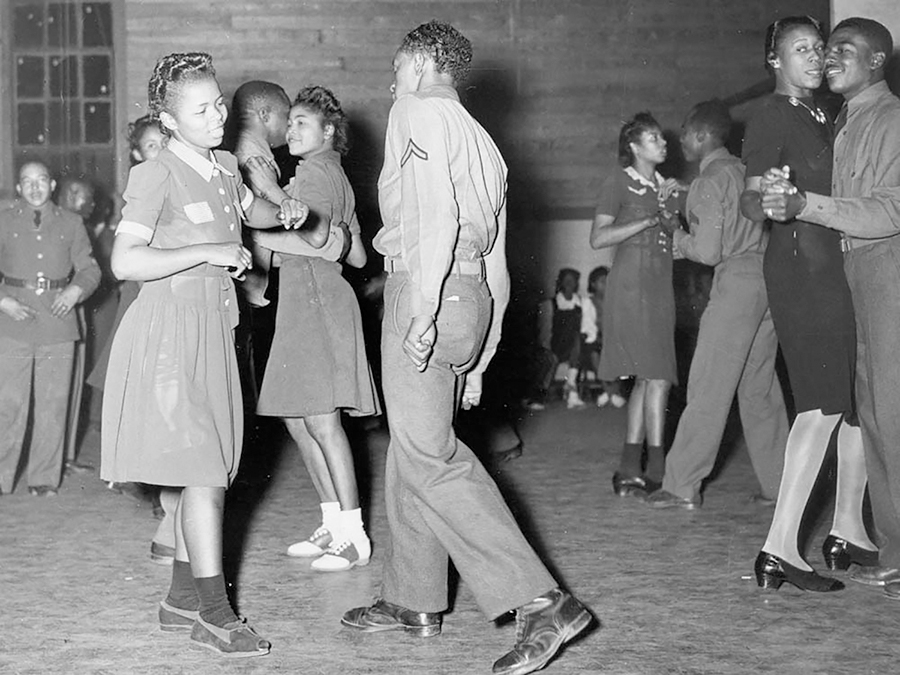
The residents of the Sandhills often saw large gliders overhead being towed two at a time by C-47s. Local farmers had gliders that were off course land in the fields around their farms. Using more conventional means, the paratroopers and families who lived on Camp Mackall often visited the towns of Hamlet, Southern Pines, Pinehurst and Aberdeen, and the townspeople opened their hearts and homes to them. The Moore County towns had established USO centers for soldiers to come and enjoy dances, musicals, plays and a variety of other touring shows.

While many local entertainment centers provided activities of morale and fellowship, there were some locations that provided recreation of another sort altogether. For example, in Richmond County, victory girls (or victory belles) were young ladies who followed the paratroopers in and around camp, especially close to payday. These ladies provided comfort and fellowship for a small fee. It was noted by MacCallum and Stevens that at a house in Richmond County, “three women dated 31 soldiers at $5 a date.”

The Southern Pines USO was located in what is now the Southern Pines Civic Club. The town of Pinehurst was the first to partner with the USO and established an exclusive USO for African-American paratroopers, soldiers and their guests. The integration of the African-American troops into the segregated South did not occur without its challenges. Movie theaters, dining halls, recreation centers, dance halls and living facilities on and off Camp Mackall were segregated. According to MacCallum, “The only facilities not segregated were the Army Post Exchange (PX) and the Officer’s Club.”

After a period of time, African-American paratroopers received access to all services and clubs to include their own non-commissioned officers club. Black and white officers shared the same officers club; however, the enlisted men and non-commissioned officers had their own establishments. The need for the African-American USOs subsequently required the Pinehurst location to move to a larger facility in Southern Pines.

The parachute divisions had a profound impact on the Sandhills social scene and none more so than the historic Negro Paratroop Company, nicknamed the Triple Nickel. The Triple Nickel was the first of its kind. In early 1944, the 555th Parachute Infantry Company was stationed at Camp Mackall with 11 officers and 165 enlisted men. On Nov. 4, 1944, the number of paratroopers swelled to more than 400 black paratroopers and was designated the 555th Parachute Infantry Battalion. Bradley Biggs, author of The Triple Nickels, Americas First All Black Paratroop Unit, wrote that “the men with families often found Southern Pines more open and welcoming for housing compared to other surrounding towns.”

The Triple Nickel was not the only airborne unit of fame to walk and train in Mackall’s fields and forests. In 1992, Stephen Ambrose wrote the book Band of Brothers, detailing the distinguished history of Company E, 2nd Battalion, 506th Parachute Infantry Regiment, 101st Airborne Division. In early 1943, Easy Company, as they were commonly known, conducted intense airborne and infantry training at Camp Mackall in final preparation for combat operations in the European theater. Ambrose’s book, which later gained notoriety as the HBO miniseries of the same name, followed Easy Company from stateside training in Camp Toccoa, Georgia, and Camp Mackall to the parachute assault on Utah Beach on June 6, 1944, and their march across Nazi-occupied Europe till the war’s end in 1945.

Before any single paratrooper or airborne unit deployed to the European or Pacific theaters, they were required to pass a series of training exercises to ensure combat readiness. At the Department of War, the training maneuvers were designed to determine the operational feasibility of successfully deploying large airborne divisions. The literal fate of the American airborne divisions lay in the maneuvers conducted at Camp Mackall and across the Sandhills region. The most famous maneuver was conducted by the 11th Airborne Division, code named the “Knollwood Maneuver.” The Knollwood Airport, now Moore County Airport, was the target and the place where the airborne division proved its preparedness and worth as a viable force to Gen. Dwight D. Eisenhower, the supreme Allied commander.

On Dec. 6, 1943, the skies above the Sandhills were filled with a massive parachute and glider assault force launched from four airfields to seize the airport. This air armada was a precursor to the planning, maneuver, execution and logistical preparedness that American troops would execute over France a little more than a year later. It lasted six days and, to ensure realism, consisted of 200 C-47 troop and cargo transports that departed from four local airfields, traveled east to the Atlantic Ocean and 200-plus miles back to Knollwood Airport. The C-47 Skytrain, nicknamed the Gooney Bird, delivered 10,282 men by parachute, glider and air landings. During the maneuver, there were more than 880 landings to fly in supplies and reinforcements. The success of the Knollwood Maneuver convinced Eisenhower of the viability of employing airborne forces in division-sized units.

Compared to modern day airborne operations, the safety measures were often regarded as high risk. One soldier recording the Knollwood Maneuver reported, “These glider pilots seem to be a pretty rugged crew as it is the usual thing for them to step out of a wrecked glider, brush off the splinters, and climb into another glider and try again.”

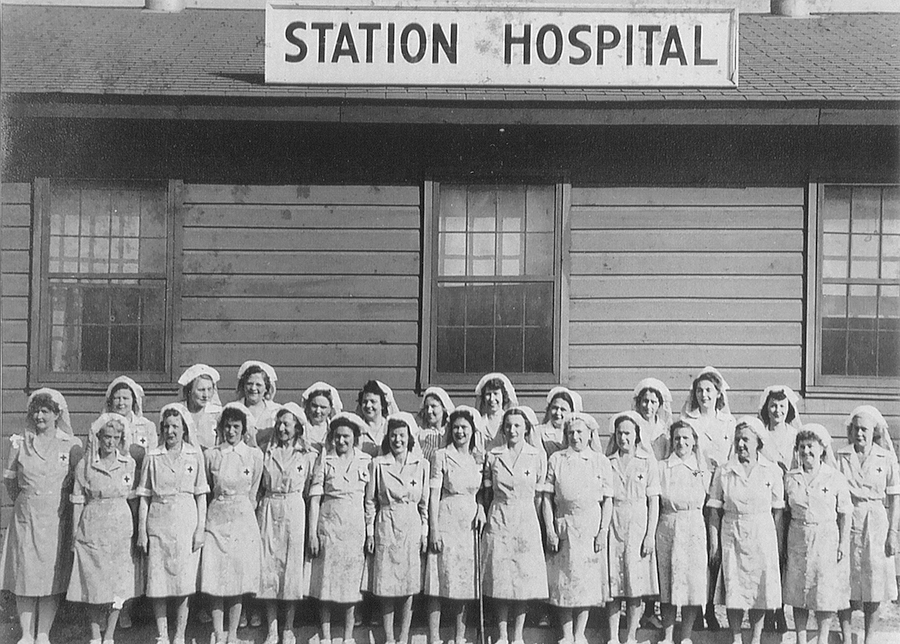
Despite the incredibly rugged nature of these paratroopers and glider pilots, the Knollwood Maneuver cost four paratroopers their lives, and another 49 soldiers were wounded. The men were treated at Camp Mackall’s 1,200-bed hospital. (Despite the hospital’s focus on injuries sustained during airborne operations, it also took care of family needs such as the delivery of 116 babies in its maternity ward.) The Army medical staff was augmented by the American Red Cross and the all-volunteer Gray Ladies Corps. The Gray Ladies hailed from across Moore, Richmond and Scotland Counties. These amazing women were assigned work days by the Red Cross and would help dress wounds, change bandages, talk to patients, play games, read to the men, and generally do whatever was needed to comfort the wounded paratroopers. MacCallum and Stevens, in their book, provide heartwarming testimonies of the lifelong friendships between the women of the Gray Ladies Corps and the paratroopers.

Camp Mackall was also one of many military installations in the United States that housed enemy prisoners of war. There are estimates that the POW count reached as high as 400,000 across America. Including Camp Mackall, there were 18 POW camps in North Carolina alone. Places in the South were selected for their relative isolation from large populations, ease of security, and the warm climate. As many as 300 POWs performed manual labor tasks and agricultural work off the installation in Aberdeen, Pinehurst and West End. MacCallum says, “The peach farmers were required to pay the government 22.5 cents per hour as a contracted labor force.”

As the war came to an end in 1945, the POW camp at Mackall was closed, and the remaining prisoners were transferred to other locations. Camp Mackall began to atrophy. The airborne training center moved back to Fort Bragg, and the unit colors of the 11th, 13th and the 17th Airborne divisions were officially encased.

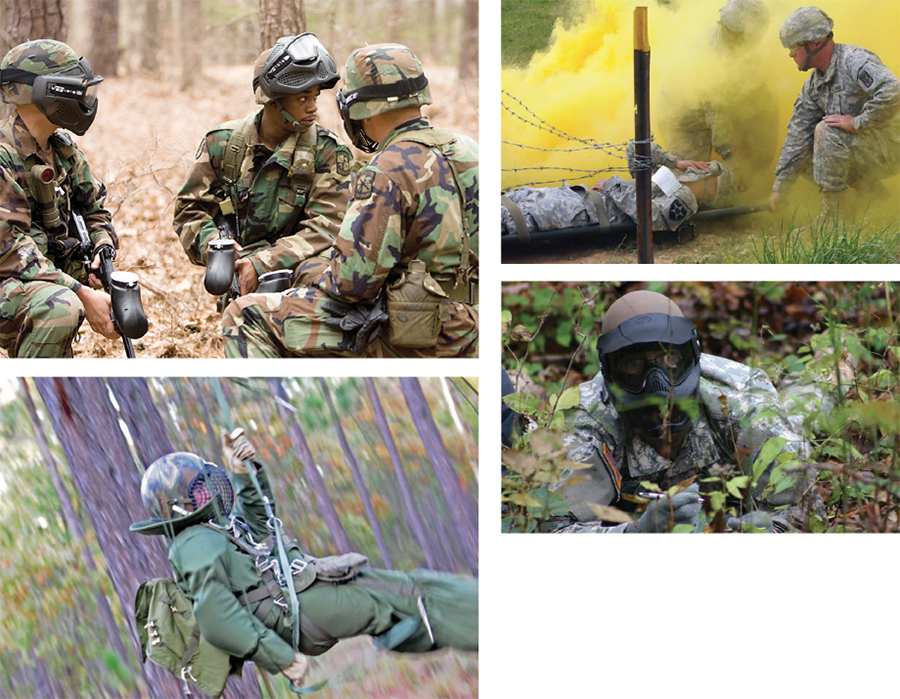
But Camp Mackall didn’t experience the same fate as many other WWII Army training camps. Today’s Special Forces training pipeline begins at Mackall with its initial Special Forces Assessment and Selection course. SFAS is a three-week, physically and mentally demanding course where soldiers from across the U.S. Army begin the 18-24 month training program. Every Special Forces soldier who earns the right to wear the Green Beret has passed SFAS and received advanced training at Camp Mackall.

Currently Mackall encompasses about 8,000 acres, and within the camp’s boundary, each Special Forces candidate will be provided advanced training in the practical application of speaking different foreign languages, customs and cultures of foreign lands, hand-to-hand combat, weapons training, land navigation, demolitions, and advanced medical training. These specially selected candidates will undergo intense psychological scrutiny in the Special Forces Survival, Evasion, Resistance, and Escape course (SERE). Living off the land, candidates assembled in small groups are hunted down by seasoned Special Forces operatives across Camp Mackall and the Sandhills. The SERE course is regarded as one of the best courses offered by the U.S. military.

Twenty-one counties, including Moore, Scotland and Richmond, play a vital role in the training of every Special Forces soldier. Hundreds of civilian volunteers, police officers and sheriff’s deputies, firefighters, first responders and soldiers from Fort Bragg come together to form the notional country of Pineland. Each candidate must successfully navigate the Robin Sage’s unconventional warfare exercise and assist in the liberation of Pineland. Once successful, each Special Forces soldier has earned the right to wear the Green Beret and be considered one of the world’s premier special operations soldiers.

Robin Sage is a high-risk venture that prepares each candidate for service in the U.S. Army as an elite member of a Special Forces Operational Detachment Alpha (ODA). Unfortunately, this challenge is not without risk. Sadly, in 2002, Camp Mackall and the Special Forces community suffered a fatal training tragedy between two candidates, a civilian role-player, and a Moore County sheriff’s deputy. One candidate was killed and another was severely wounded. Safeguards to prevent this from happening again have been put into place between the military, law enforcement and our communities.

Access to Camp Mackall is restricted and primarily closed to the public. It’s monitored and patrolled by security forces and often working dogs in training. The ongoing relationship between Mackall and the Sandhills continues to remind us of a time when the two communities came together in the spirit of cooperation to strengthen the morale and effectiveness of America’s elite fighting forces. The trust and mutual respect between the camp and Sandhills citizens has never been more obvious. The Sandhills remains home to Camp Mackall, and together they produce a world-class training environment for elite soldiers — just as originally designed.  PS

Retired Lt. Col. Robert P. Curtin is an infantry officer who served multiple tours in the Special Operations Forces. He earned his B.A. in history from Hofstra University and his M.A. in military history from Norwich University. He currently is a social studies teacher and the head wrestling coach at Pinecrest High School.

Poem

We Trade Eggs and Olives

Salads arrive. We wince.

I do not like olives,

black or green, and you know it.

Sliced hardboiled eggs

seem to make you gag.

So we trade them. . . .

Citronella and burlap

both seize my breath.

You resuscitate me

with lilac and silks.

Me the morning person

and you wasting midnight oil.

You buried within books,

me searching for rhetoric.

Fault lines in our wiring,

timelines synchronized tonight.

Common ground tilled,

reseeded in one another’s gasp.

  Sam Barbee

Almanac

June is the ink that flows from the poet’s pen — sweet as gardenia and ephemeral as a dream; the fountain of everlasting passion.

If ever you have read the love letters from John Keats to Fanny Brawne, the girl next door who was to Keats “so fair a form” he yearned for finer language, then you can understand.

“I want a brighter word than bright, a fairer word than fair,” Keats wrote his dearest girl one long-ago summer morning. And then, the famous line:

“I almost wish we were butterflies and lived but three summer days — three such days with you I could fill with more delight than fifty common years could ever contain.”

Imagine landing love-drunk in the thick of glorious June:

The ecstasy of a world bursting forth with fragrant blossoms.

The sweet nectar of each inhalation.

The utter intoxication of existence.

June is a medley of aliveness — brighter than bright, fairer than fair, and butterflies in all directions.

Be still in the June garden, where love letters between hummingbird and trumpet creeper flow like honey, and you will learn the language of the heart. 

June is the poet and the muse. Keats and Fanny.
Butterfly and bloom. 

Suppose you lived but three June days as rose, coneflower, poppy or phlox.

What you might receive as the giver of such resplendence . . . the true delight of life.

Pick (and Fry) You Some

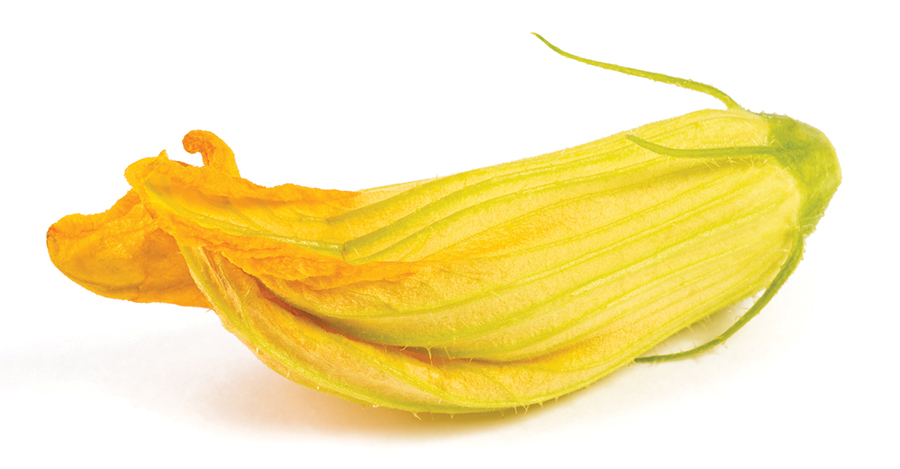
Something about edible flowers feels both deliciously wild and, well, just plain fancy. And since that bumper crop of zucchini comes with a holy explosion of yellow flowers, it seems fried squash blossoms are what’s for dinner — or at least the first course.

If you’re a squash blossom newbie, here’s one thing to keep in mind: There are he-blossoms and she-blossoms. The male blossoms, which grow on long stalks, don’t produce fruit; they pollinate. Female blossoms grow closer to the center of the plant; you’ll spot them by their bulbous stems (they’re sitting on fruit). Leave them to grow. Pick the male blossoms but leave enough so that the harvest may continue.

Another tip with the blossoms: Pick ’em the day you want to fry ’em. Check the petals for bugs and bees before removing the stamen or — if you picked a she-blossom — pistils. Wash, dry, and sauté or fry. Or if you want to take your summer dish to the next level, Google stuffed squash blossom recipes and see what happens next.

The Victory Garden

Among the positive effects of stay-at-home orders, at least in this neck of the woods, is that more people are growing their own food. Raised beds built from scrap wood and old pallets in late March are now turning out sweet peppers and pea pods, zucchini and summer squash, green beans, cukes, melons, eggplant, you-name-it.

Haven’t started your own kitchen garden? It’s not too late. This month, sow bush, pole and lima beans; plant cukes, corn, okra, eggplant, peppers, basil and — your sandwiches and neighbors will thank you — tomatoes. Start Brussels sprouts and collards for mid-July transplant, and don’t forget flowers to call in the pollinators. 

When your bumper crops arrive — you’ll know when you can’t pick ’em fast enough — find ways to share and save the summer harvest.

Green was the silence, wet was the light, the month of June trembled like a butterfly. — Pablo Neruda

Blueberries

Blueberry juice is not blue — it’s purple. I recall making this casual discovery on a summer day in my youth when, not sure why, I smooshed a plump one into the page of one of my journals. But that isn’t the only magical quality contained within this wonder berry. They are slam-packed with antioxidant health benefits, for starters. One handful contains 10 percent of your daily-recommended vitamin C, and did you know that a single bush can produce up to 6,000 blueberries a year? That’s 153 heaping handfuls.

Among the many health benefits associated with eating blueberries (lower blood pressure, reduced risk of cancer, increased insulin response, reversal in age-related memory loss), they’re also known to brighten your skin. I’m not surprised that Native American indigenous peoples called these scrumptious berries “star fruits.”

Father’s Day lands on Sunday, June 21 — the day after official summer. Consider planting a bush in Pop’s honor. Container; moist soil; full sun. Two or more bushes are better than one.  PS

Subterranean Homesick Blues

Discovering the basement treasures of Southern Pines

By Bill Case     Photographs by John Gessner

Around 1952, my mom found a tiny, tarnished silver coin in a dark, recessed area of our home’s basement floor. The ancient “half-dime” bore the date 1846.

It was hard to fathom how the 106-year-old piece had made it to our basement. Perhaps the coin dropped out of a worker’s pocket when the basement foundation was poured — a remote possibility, since few coins of that vintage would have been in circulation when our Hudson, Ohio, house was constructed in the 1920s. The half-dime puzzle was one our family never solved.

My mother gave me the mysterious half-dime after I began collecting coins as a pre-teen in 1960 but, over time, my interest in numismatics fell away, and I lost track of the coin. Perhaps it has been rediscovered by another mother in some other dark basement, launching a whole new family puzzle.

Thoughts of the half-dime returned when a Southern Pines restaurant server told me about her own belowground discovery at the Belvedere Hotel. She said the basement of the structure contained an iron-barred cell rumored to have once been a town jail facility. What other treasures might lurk in underground Southern Pines? Catacombs? The Phantom of the Opera’s dungeon? Or maybe just Al Capone’s vault?

With thoughts of Geraldo Rivera dancing in my head, I started my prospecting by following up on the server’s jail cell tip. According to a spokesman for the police department, there was no record of any jail having ever been located at the Belvedere Hotel. Undeterred, and with time on my hands until the afternoon four-ball, I contacted Melissa McPeake, a member of the family that owns the Belvedere building and several other area hotels. When asked about the supposed jail, Melissa responded, “Well, I’ve never heard that before. But there is an iron-bar door that provides an entry point to a room in the basement, and we’ve always wondered about it. Maybe it was a jail door. You’re welcome to check it out.” Ah-ha.

When Melissa and I descended the very steep basement steps (approximately the width of an iPhone 6), we came upon an iron-barred arched door in a remote area of the basement. The door looked like something out of an English castle dungeon in the Middle Ages. The only thing missing was Errol Flynn. But the absence of any actual jail cells cast considerable doubt on whether the forbidding door had ever served a role in incarcerating prisoners. It seemed unlikely that the space had ever been a black site interrogation room used by Andy Taylor and Barney Fife. Perhaps the iron bars guarded the hotel’s wine cellar, or served as a barrier protecting mail for the U.S. post office that had occupied a portion of the building long ago. But, no jail.

Tips regarding the whereabouts of buried treasure often lead to less than satisfying ends. But once on the hunt, you gotta keep looking. Nothing ventured, nothing gained. I was contemplating my next move when I spotted two men doing rehab work on the roof overhang of the old Carolina Theatre (most recently an antique store). I shouted up to inquire whether there was anything of note left in the venerable theatre’s basement. One of the workers, Bob Greenleaf, shook his head, but offered a helpful observation. “I’ve been in just about every basement in the downtown,” he said. “Right across the street in the Citizens Bank and Trust building, there’s a vault in the basement that wasn’t removed when they closed the bank.” Agile for a person with so much basement spelunking experience, Bob hopped off the roof to point the way.

In short order, I was across the tracks and inside the Pinehurst Resort store, appropriately called “The Vault.” On the first floor of the store is a 22-inch-thick concrete walled vaulted area that has been incorporated into the store’s sales area. But I was more interested in the basement. As Carl Reiner says in Ocean’s Eleven, “The house safe is for brandy and grandmother’s pearls.”

Store sales clerk Heather Shaffer confided that employees consider the belowground vault to be spooky. Ah-ha. “I’ll go down there and the vault door is closed,” she said. “Next time, it’s open even though no one has been downstairs since me.” Heather permitted me to take a look-see. This time, the formidable vault door was open. It appeared that the room it guarded could have been used to store safe deposit boxes. It seems these mammoth doors rarely get removed from a structure even after a change of occupants renders them superfluous. Such indestructible behemoths may outlast everything else in our civilization, like multi-ton cockroaches or Woody Allen’s Volkswagen in Sleeper. Or Woody Allen.

Undaunted, my next stop was The Country Bookshop, housed in the McBrayer Building. The store’s manager, Kimberly Daniels Taws, was unable to access the building’s basement, but she put me in touch with the man who could, Hans Antonsson, the building’s owner. Hans advised that there was an old treasure stored in the basement: a discarded cash register of indeterminate age left over from bygone days when the building housed either Pope’s department store, or, prior to the 1960s, Lee’s.

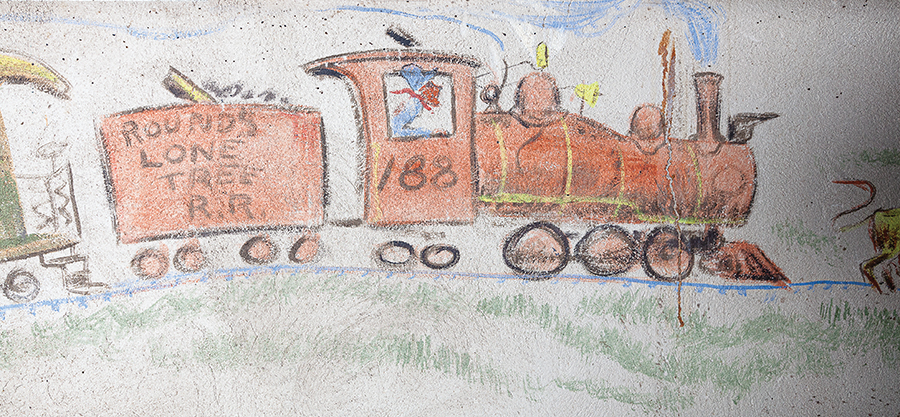
Iron bars, a bank vault and a cash register are all well and good, but I was hoping to discover treasures of a more unique nature. It was rumored that the basement wall of the Denker Dry Goods dress shop at 150 N.W. Broad contained a mural painted by Glen Rounds, the Southern Pines artist of national renown. The prospect of finding a “forgotten” work by the legendary Rounds was exhilarating.

Born in 1906 inside a sod house in the Badlands of South Dakota, Glen Rounds grew up on Western ranches. As an adult, he took various turns as a mule skinner, cowpoke and carnival medicine man. He developed a talent for drawing minimalist sketches of animals and depictions of humorous experiences from his cowboy life. Combining his artistic skill with innate storytelling ability, Rounds became a pre-eminent writer and illustrator of award-winning children’s books — 103 in all over a six-decade career. Recurring figures in his comical yarns included Paul Bunyan; Whitey, the pint-sized cowboy; Mr. Yowder, the sign painter; Beaver; and the “Blind Colt.”

After his military hitch was over in 1937, Rounds moved to Southern Pines and resided there until his death at age 96 in 2002. The town’s most illustrious man of the arts also ranked as one of its greatest characters. On his daily Broad Street treks, the peripatetic raconteur would buttonhole unsuspecting pedestrians and regale them with mesmerizing, albeit long-winded, fables. The bearded Rounds also delighted in sharing bits of his prolific artwork with friends and strangers, a trait described by writer Stephen E. Smith as follows: “Without warning . . . minimalist sketches of high-stepping hounds, plump wayward women, and skinny wranglers would appear in mailboxes or stuffed in door jambs. Many of them were signed: ‘The Little Fiery Gizzard Creek Land, Cattle & Hymn Book Co.’”

It was with high anticipation that I introduced myself to Denker’s owner, Kara Denker Hodges. I was gratified that Kara was able to corroborate the fact that the store’s basement wall did, indeed, contain a mural painting believed to be the work of Glen Rounds. “One problem,” she noted, “is that we have no electricity running in that area of the basement. It’s completely dark, so you’ll need a flashlight to see it.” After haplessly fiddling with the flashlight feature on my iPhone, the more tech-savvy Hodges took pity on me and activated her own.

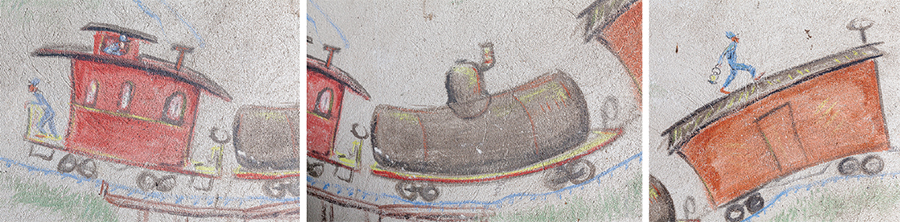
Picking our way through cave-like darkness, Kara’s flashlight revealed a 25-foot-long mural of a train with its chugging locomotive and boxcars displayed in bright primary colors. The quirky, madcap choo-choo seemed the perfect artwork for a toy store. The mural certainly had the look of an illustration by “the last of the great ‘ring-tailed roarers’” but I had to be sure. Even archaeologists uncovering ancient hieroglyphics in the great pyramids of Egypt performed outside research. I needed to do the same.

Extensive review of The Pilot’s archives from 70 years ago, together with interviews of individuals who could recall that time, helped me piece together the train mural’s story. The structure housing Denker’s was once called the Hayes Building. Prior to June 1948, Claud L. Hayes and his wife, Deila, operated side-by-side retail establishments there. Deila, like Kara Hodges now, ran a dress shop while Claud was the proprietor of the Hayes Book Store. Indiana native Claud had sold books in the community since his arrival in 1895. The establishment was typically laden to the rafters with magazines, books and newspapers. The Pilot described the store as being filled with “cheerful clutter.”

It was just the sort of place that appealed to Rounds, who, comfortably ensconced in the shop’s friendly confines, dispensed to all comers his “special brand of philosophical banter defying classification.” The newspaper advised its readers, “You haven’t started the day off right until you’ve exchanged greetings with Glen at Hayes over the morning papers.”

Claud Hayes died in 1948, and Col. Wallace Simpson acquired the bookstore from Hayes’ estate in June of that year. Simpson envisioned a new concept for the basement section of the store, focusing on children’s books and toys. The colonel set about making the necessary renovations. A November 12, 1948 article in The Pilot revealed that an artistic work, painted by the store’s most omnipresent visitor, would be transforming the children’s section into something special.

“A privileged few who have seen the mural painted by Glen Rounds in Hayes’ new basement say that it is his masterpiece,” effused the newspaper. “Even if he had never written all those books and illustrated them . . . they say this one great work alone would make him immortal.”

While Rounds’ fanciful choo-choo hardly ranks with DaVinci’s The Last Supper, it stands as a fine example of his work and apparently jump-started a fervent desire on his part to paint far larger murals, including a dream of adorning an 800-foot space with, The Pilot suggested, “a serpent left over from his carnival posting days.”

Discovery of Rounds’ train painting spurred me to look for more hidden artwork. After getting wind of my search, local Realtor Chris Smithson put me on a promising path. He had heard that the unfrequented basement area under the west side of Ashten’s restaurant also contained unusual decorative work on its walls. Owner Ashley Van Camp confirmed the report.

“Oh, it’s unusual, all right. It’s of a foxhunt scene, and it’s unlike anything you’ve ever laid eyes on,” she said.

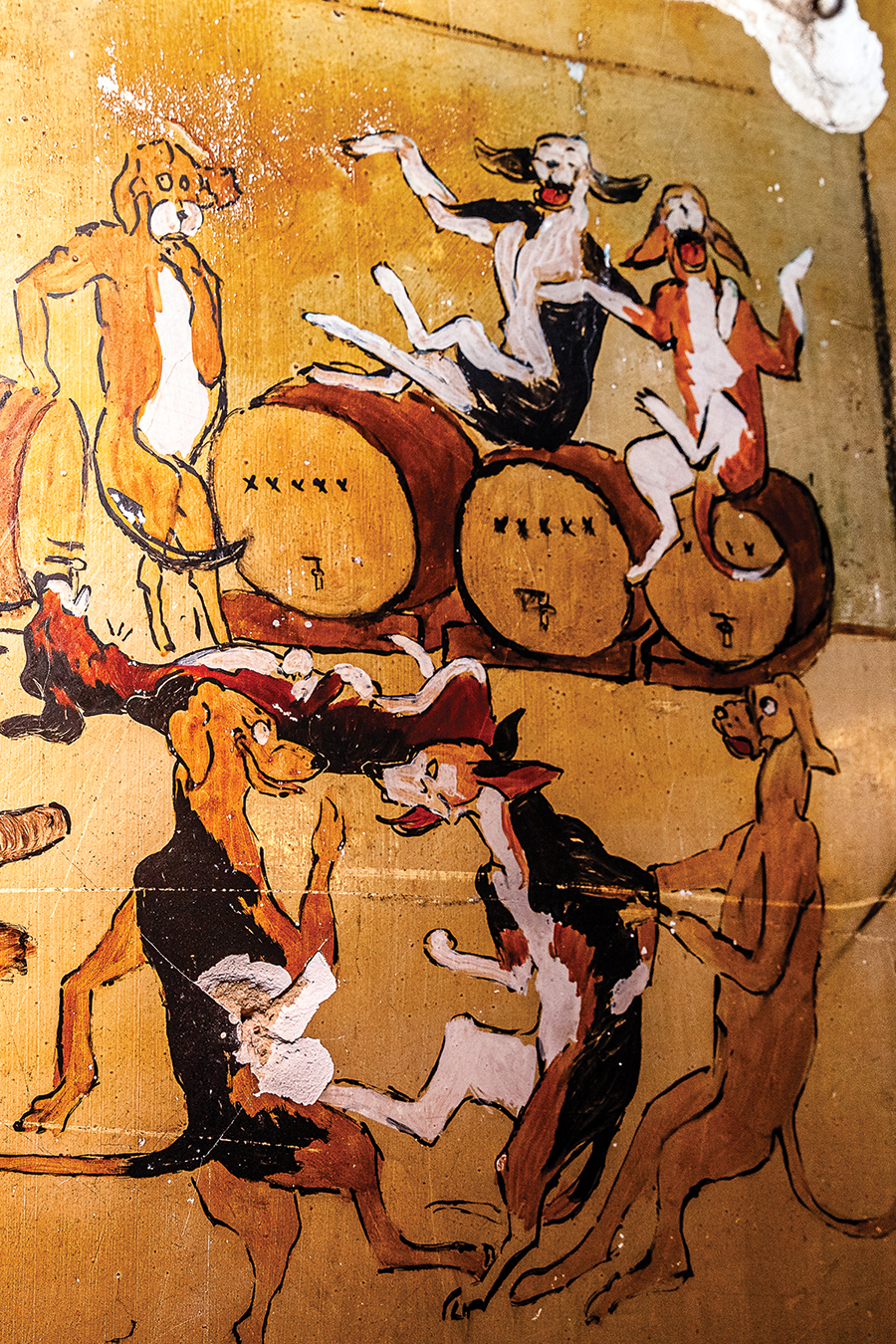
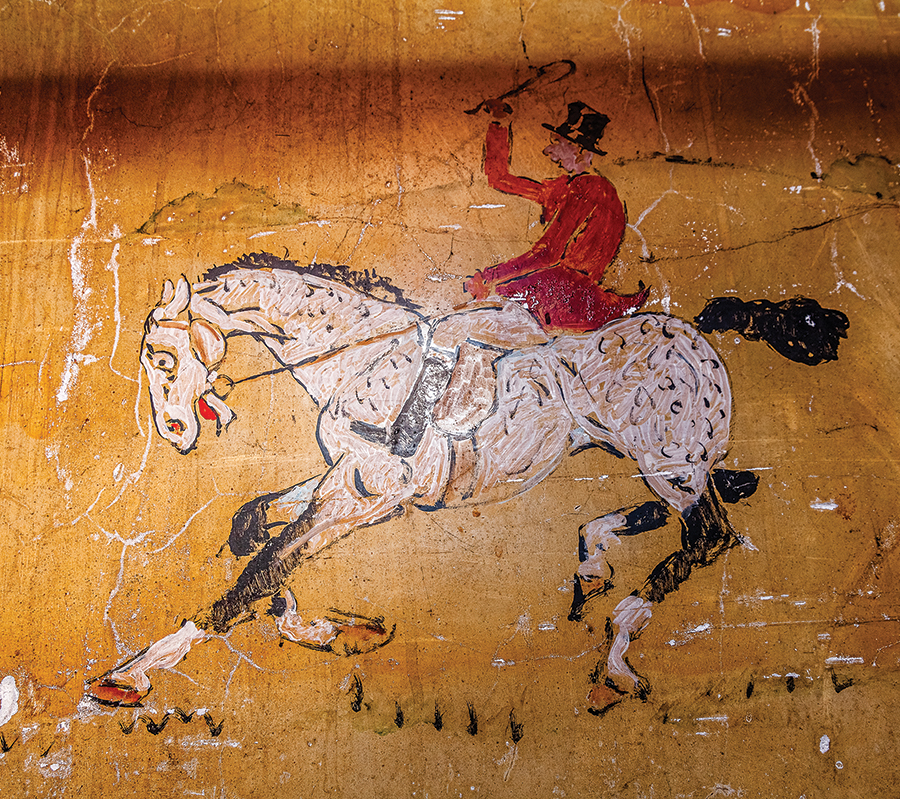
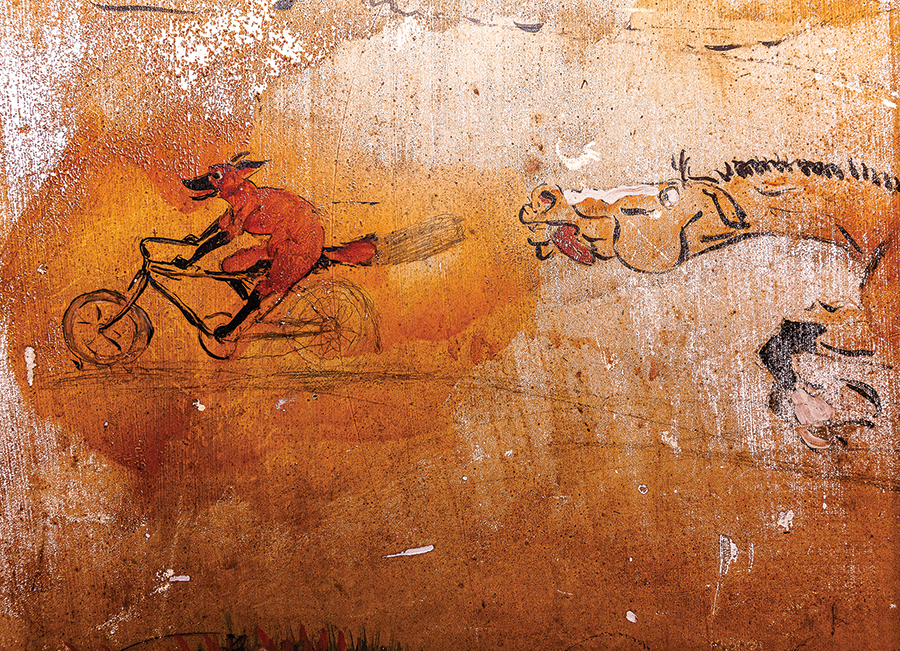
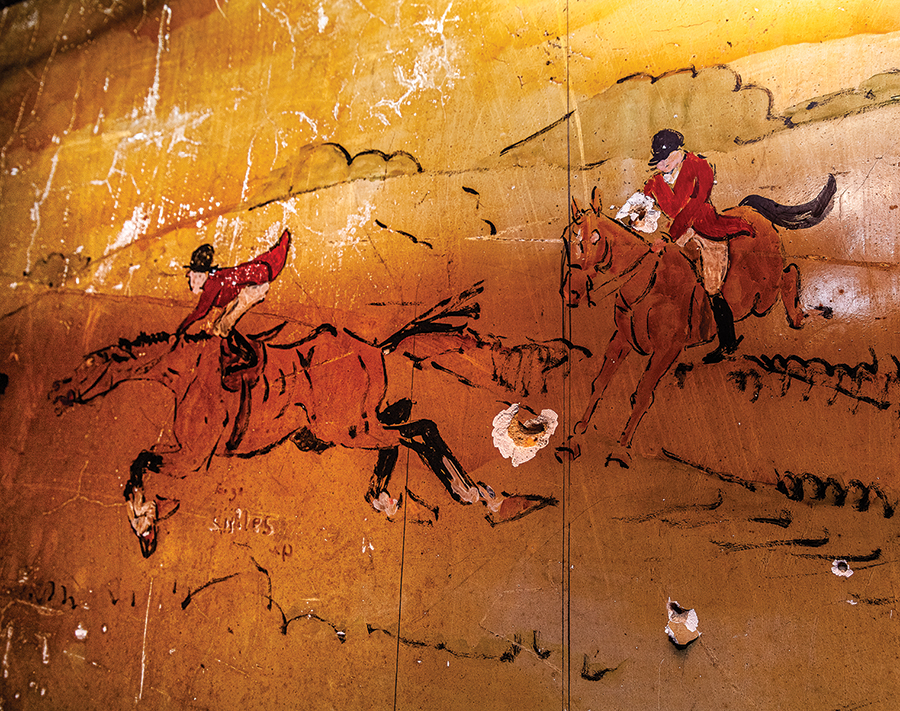
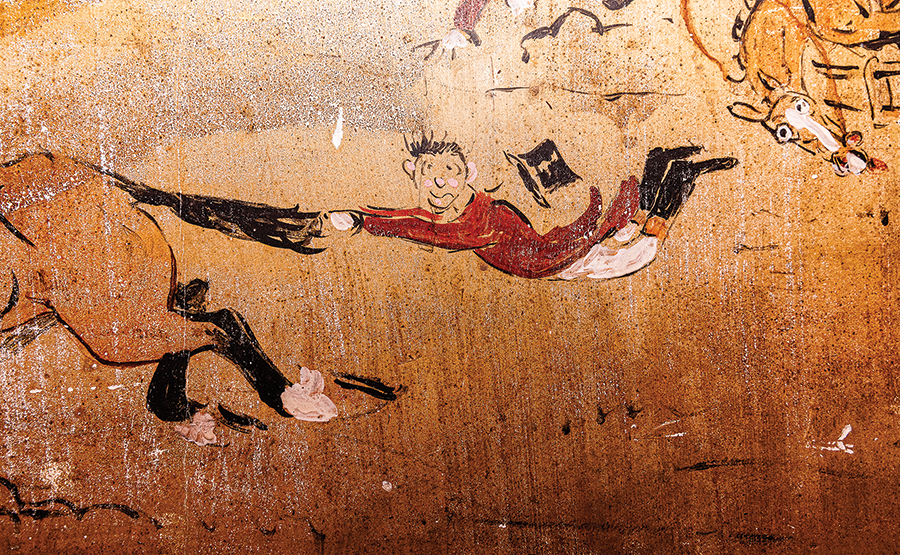
I joined Ashley and her husband, Charlie Coulter, behind Ashten’s and we negotiated the exceedingly narrow steps to the basement of the 118-year-old structure. Did all the early builders of Southern Pines have Lilliputian-sized feet? The area at the bottom of the stairs is not much more than 100 square feet but, just as Van Camp advertised, the mural displayed over three of its walls was anything but ordinary. In this depiction of a “running of the hounds,” the would-be quarry turns the tables on his pursuers. A grinning Mr. Fox, certain he faces no danger, speeds away atop a tricycle. Behind him, horses and riders topple like tenpins. An actual hole in the wall draws the attention of several hounds as a potential escape hatch for the fox. The overall effect is hilarious. The piece, terrifically illustrated in brown, black, and red tones, is an impressive and painstaking work of art.

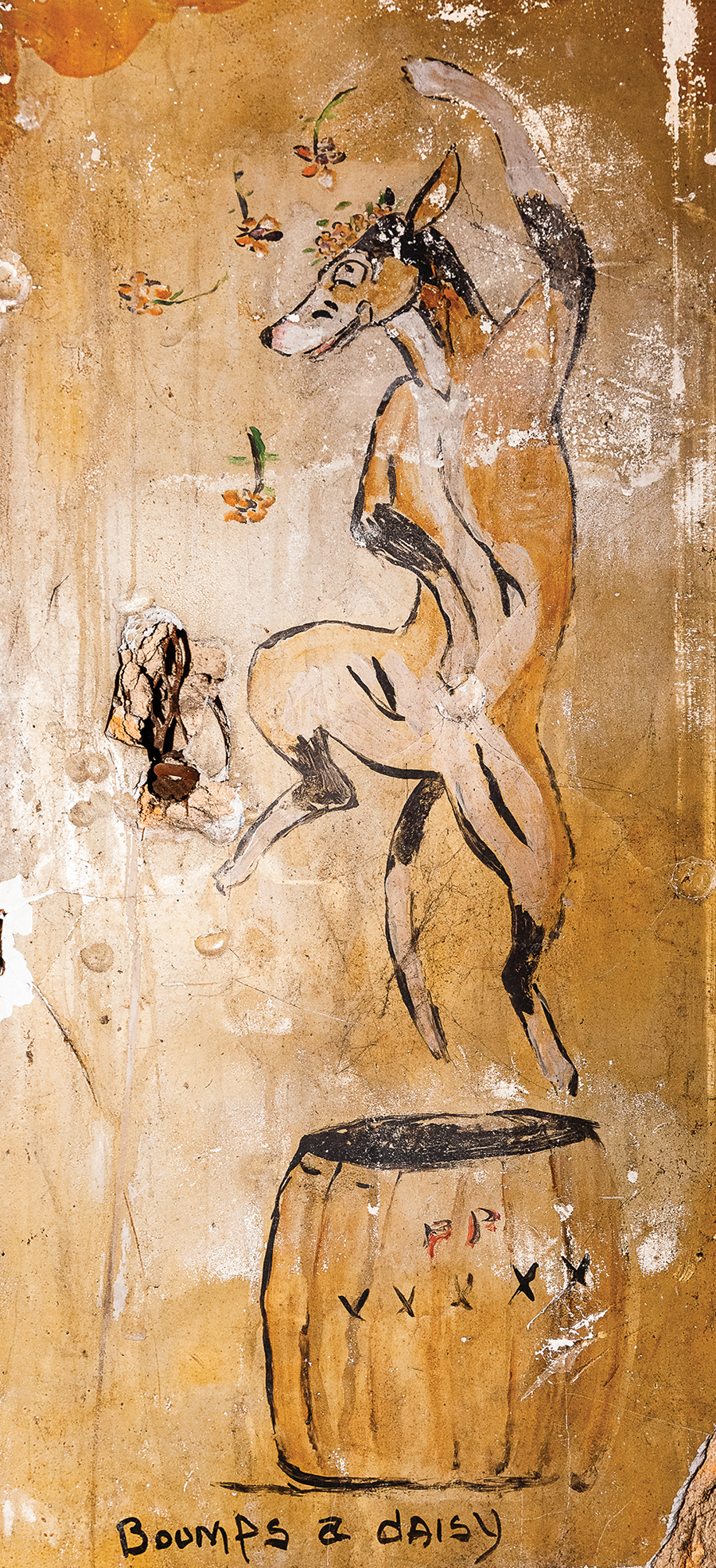
I asked Ashley the standard reporter questions: “Who did it? When did the artist do it? Why was it done?” She pointed to a signature on one wall of the mural with the name “Mayo,” dated 1940. The name rang no bell with any of us. As to the circumstances that led to the painting, Ashley said that the basement is thought to have housed a small speakeasy during Prohibition, making the hounds of ’40 something of an homage to the dry days.

Ashley had long contemplated rehabilitating this forgotten area and incorporating it into the restaurant. The idea of installing a small, intimate bar and reprising the basement’s speakeasy legacy appealed to the owner. The work would require the eradication of a nest of dangling wires, restoration of faded portions of the mural, and the removal of three panels separating various portions of the paintings. The project was something of a pipe dream until COVID-19 hit and the resulting statewide restrictions changed everything for restaurant owners and their employees. Ashten’s chef, Matt Hannon, suddenly had time on his hands. Van Camp asked him to get started on the rehab.

Suspecting that additional “Mayo” artwork might be hidden beneath the panels, Ashley had video equipment poised to record the unveiling. Voila! More comical illustrations appeared, all in excellent condition — inebriated hounds careening down a staircase; happy canines dancing and hoisting their glasses in toasts; and a hound prancing atop a whiskey keg with the words “Boomps a daisy” inscribed below. Mayo’s zany mural will eventually be on display for Ashten’s diners, perhaps in the “Boomps a daisy” room.

All that remained was to chase down and confirm the identity of the artist. Through her equestrian connections, Ashley learned that one Newton Mayo painted a portrait of the late Pappy Moss, benefactor of the Walthour-Moss Foundation and former master of the Moore County Hounds. Today, that painting hangs at the Full Cry horse farm of Mike and Irene Russell. According to a 2003 obituary in Virginia’s Richmond Times-Dispatch, Newton T. Mayo, who passed away at the age of 92, was “a retired horseman who earned a national reputation for his pastel portraits of Thoroughbreds and canines.” He raced Thoroughbreds up and down the East Coast and visited the Sandhills on several occasions. In its March 8, 1940 edition, The Pilot reported that Mrs. Newton T. Mayo won the fifth race of a steeplechase — approximately 1 mile on the flat — aboard Ever Ready.

While the middle of Mayo’s working life was devoted to training and racing horses, he was known for his artwork both as a young man (he would have been 29 when he painted the murals in Ashten’s basement) and when he returned to it in his later years. His commissions included equine paintings for President Ronald Reagan and a portrait of Barbara Bush’s springer spaniel. Displaying something of the same playful nature as his Ashten’s paintings, Mayo is quoted as saying that he preferred drawing pictures of animals “because they are less critical and ask for no flattery at all.”

And so, one thing leads to another. A half-dime to a haunted vault to Glen Rounds’ immortal choo-choo to a speakeasy fox and over-served hounds. Treasure, it seems, is in the flashlight of the beholder.  PS

Pinehurst resident Bill Case is PineStraw’s history man. He can be reached at Bill.Case@thompsonhine.com.

Do Your Homework

Going nowhere and getting it done

By Deborah Salomon   •   Photographs by John Gessner

Call it quarantine, call it shelter in place, even house arrest. Call it going stir-crazy, looking at the same four walls, weeks on end.

Wait a minute — those walls need painting. Those floors could use a once-over. And how about creating something wild in the kitchen?

See how these residents turned home confinement into home improvement.

Erik, Harper & Jaime Hoffman

Jaime Hoffman

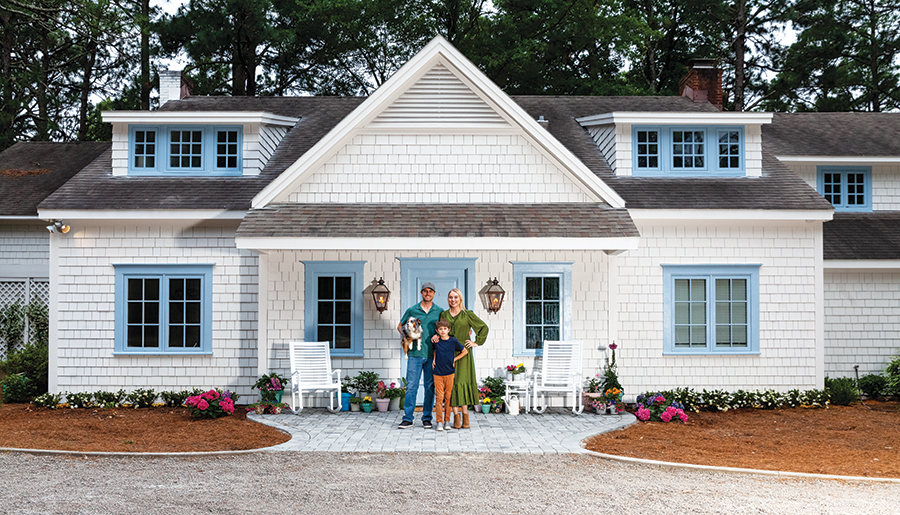
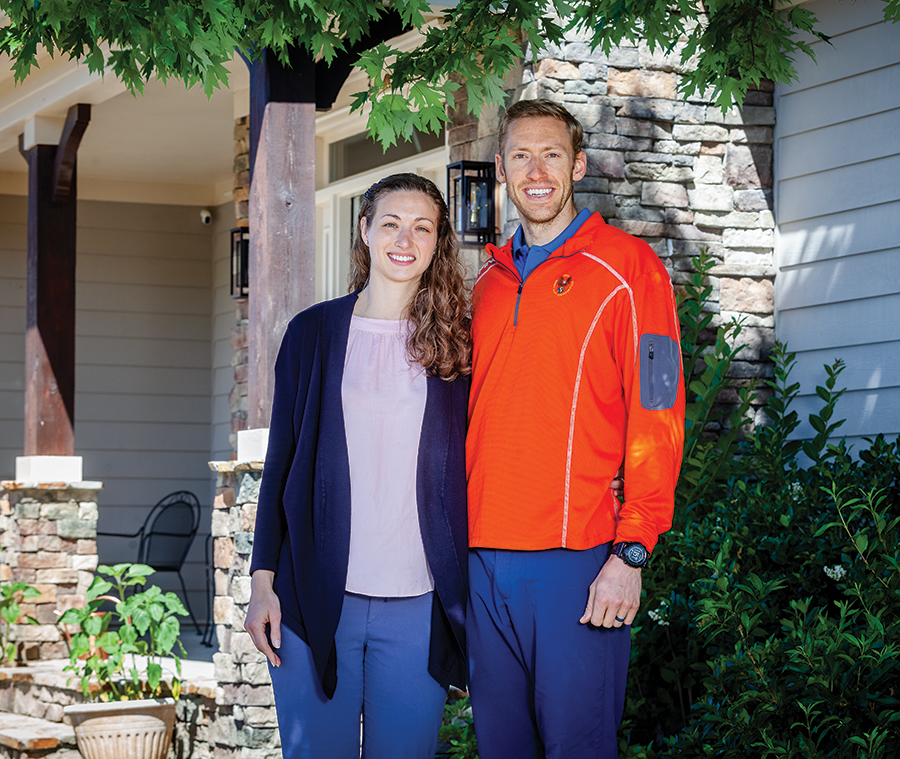
If beauty is only skin deep, the house Jaime and Erik Hoffman purchased in Weymouth desperately needed a dermatologist. Could anything be uglier than cedar shakes painted dark brown, with yellow trim? “Dingy and dated” was Jaime’s assessment. They decided on a radical transformation to white, with blue trim on the paned and bowed windows. Problem was, quotes came in upward of $11,000.

Let’s give it a try, they decided, although neither had ever painted exteriors. This might be just the thing to while away the quarantine, especially since the weather was sunny and warm.
First came two coats of primer, then two coats of paint applied to the rough shakes with a sprayer — another new experience. 
But that many window panes and frames would drive even Pete the Painter to drink. With the help of Google and YouTube, Jaime learned that windows could be covered with Frog tape. Even so, she had to open the upstairs windows from the inside and stick her head out to reach the trim.

The job took a week, with Jaime and Erik surviving as friends. Only casualty, their dog, who sat in the paint, necessitating a butt shave.

“Now, our house is bright and happy, like a (Nantucket) cottage,” Jaime beams.

Bright, happy and the talk of the neighborhood. “The best part was that neighbors stopped by and we talked from afar. That way, we got to meet people.”


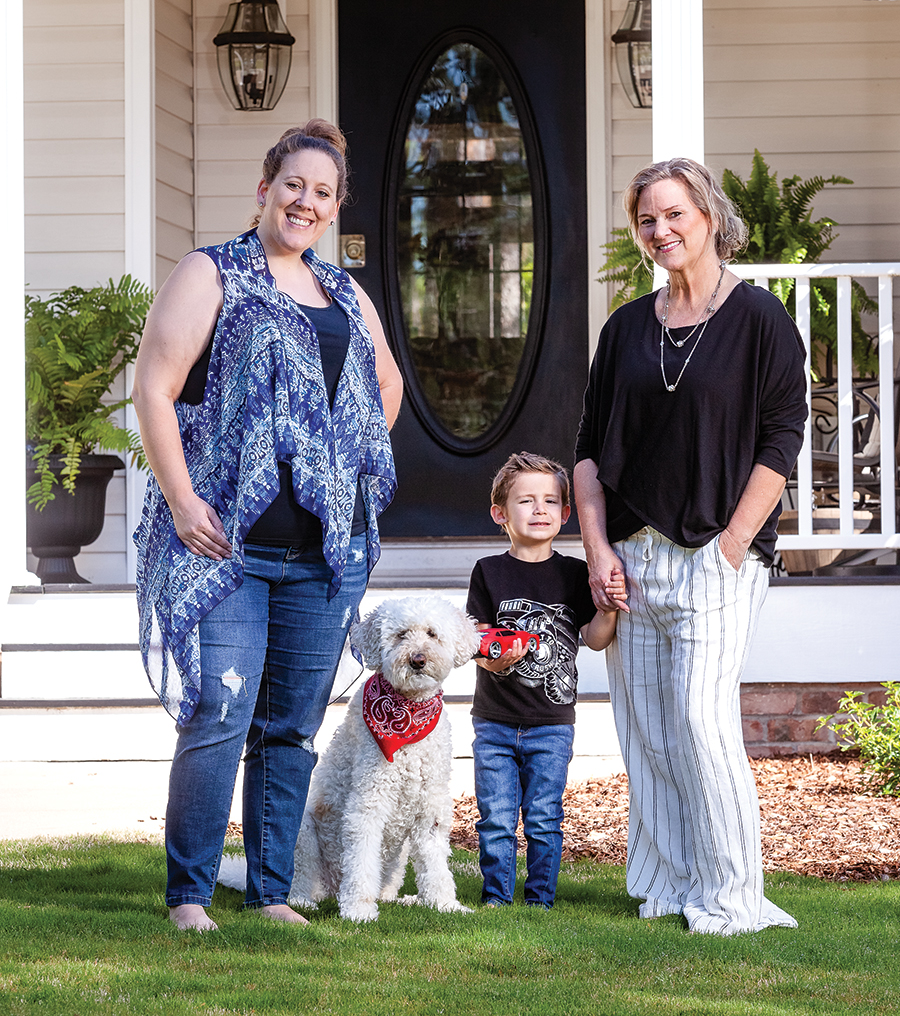
Heather Boksa, Ryder Boksa & Susan Clark

Susan Clark

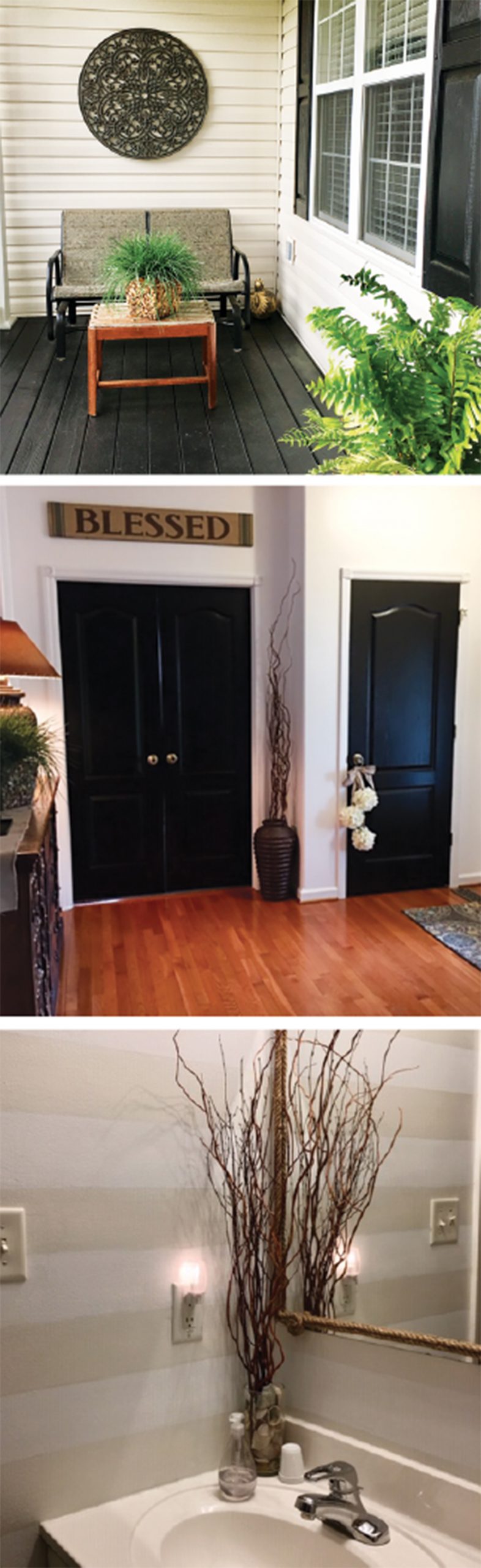
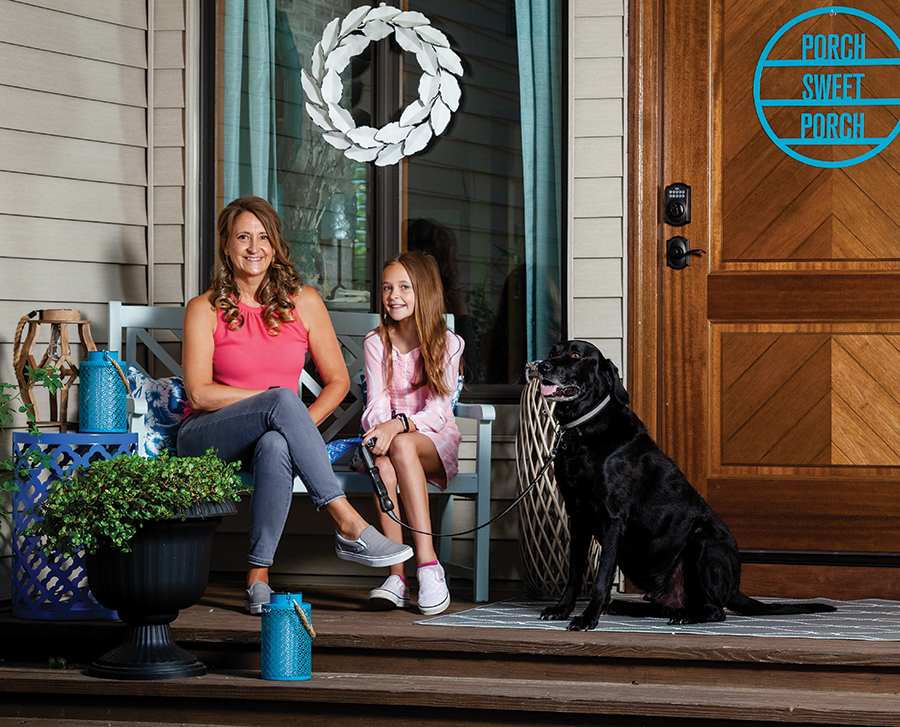
Recognizing and implementing trends were part of Susan Clark’s job, when she staged houses in Arizona. Makes sense she would apply this to her own home, recently purchased near Lake Pinehurst, with multiple paneled doors, all white. “Boring . . . ” Clark tried painting them grey. Not quite. “Black seemed like a trend,” part of the popular nouvelle farmhouse style. So she painted the (previously green) front door and all interior doors black. Green floorboards on the porch — equally passé — now sleek black, too.

“Everything in the house is in transition,” Clark admits, which is therapy for quarantined DIYers. Otherwise, Clark would be helping out at the uber-trendy Pine Scones Café in Southern Pines.

Clark didn’t stop at the doors. “I love the beach. We hope to retire there.” Until the time comes, this granny thirsting for salt water created a coastal bathroom more complicated than hanging a starfish over the shower. She liked a shiplap effect: boards, either left natural or painted white, mounted horizontally on the wall. Why go to the trouble and expense when she could draw horizontal lines with a Sharpie? Turned out the marker was less than permanent. Dampness made the lines run like weepy mascara. A contractor-grade marker wasn’t much better. She achieved an acceptable result by painting over the lines with two shades of white, which resemble horizontal boards. Add some industrial shelving, touches of ocean blue, rope glued around a mirror and she can practically hear the gulls strafing the trash can.

Outside, Clark and her grandson planted veggies and watermelon in raised beds.

“These projects made the quarantine more bearable,” she concludes.


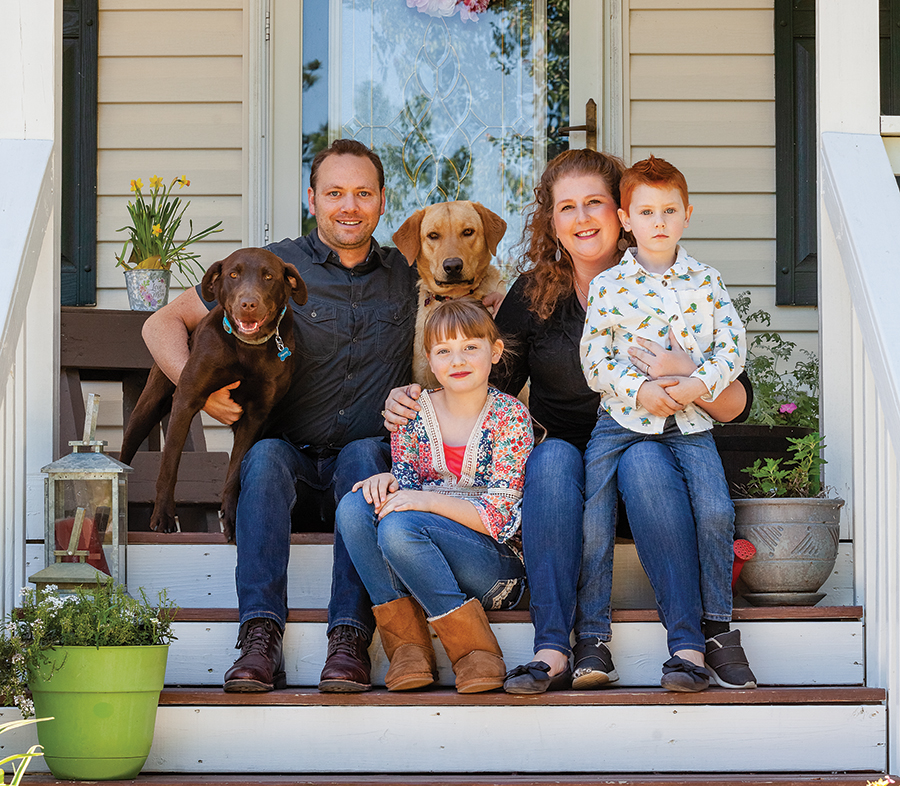
Luke, Monica, Tucker, Blair & Andrew Ruszkiewicz

Monica Ruszkiewicz

True, Monica Ruszkiewicz and her husband applied only cosmetic upgrades — no plumbing tasks — to the bathrooms. But their house in the Center South neighborhood of Southern Pines has four. They have three young children, which meant trading off a toddler for a paint brush. Since Ruszkiewicz was working from home as well as homeschooling, most upgrading was done evenings and weekends.

Identifying skills was important, early on. “He’s good with the muscle, I do the finishing work,” Ruszkiewicz says. Not that either has much experience. “We’d never done more than paint walls and install faucets.”

Their three full baths and one powder room needed tougher love. This included spray-painting and relocating light fixtures, sanding/refinishing existing vanities, replacing countertops and covering tile and grout with a magical Rust-Oleum “paint” that seals and freshens. Also creating board-and-batten, shiplap, chair rail, beadboard effects on some walls, papering others — no mean feat for beginners.

They decided to use the same palette in all four bathrooms, for continuity. Makes buying towels easier, too.

The project took about eight weeks to complete. Even before the stay-home order, this military couple had declared 2020 the Year of the Bathrooms. Now, with nowhere to go, “We hunkered down and got it done,” Ruszkiewicz says.

Lesson learned: “People are more skilled than they think. Just roll up your sleeves and get started.”


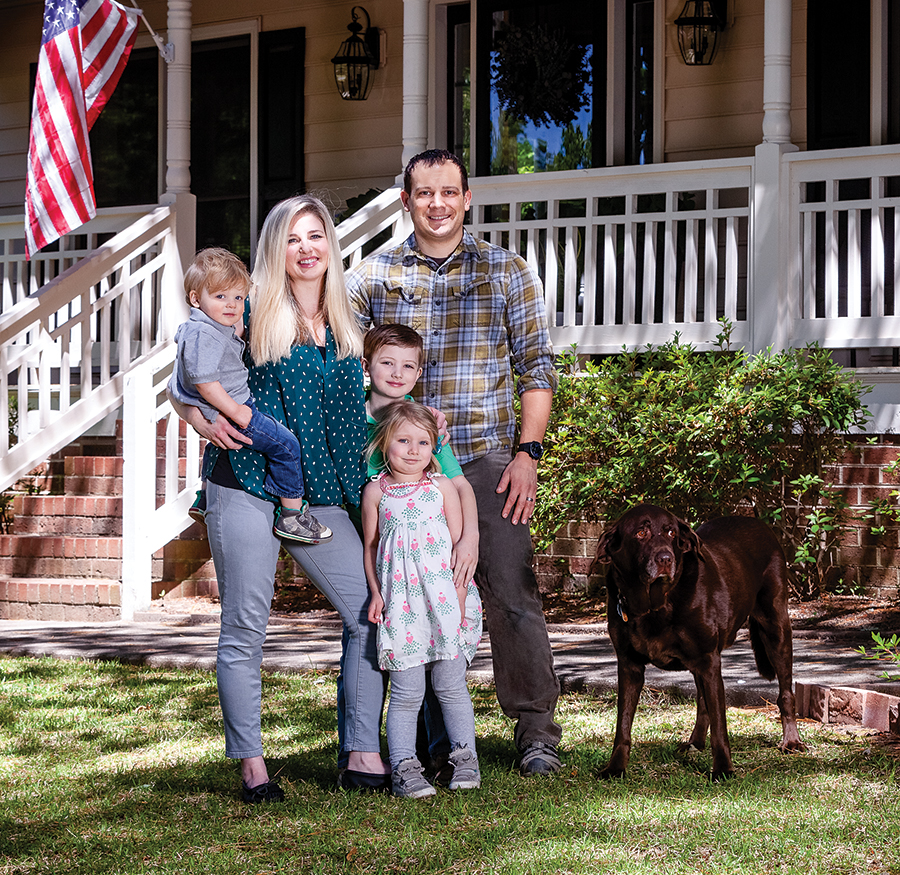
J.C., Scarlett, Joanna & Nate Wells

Joanna Wells

Call her Jo the Ripper.

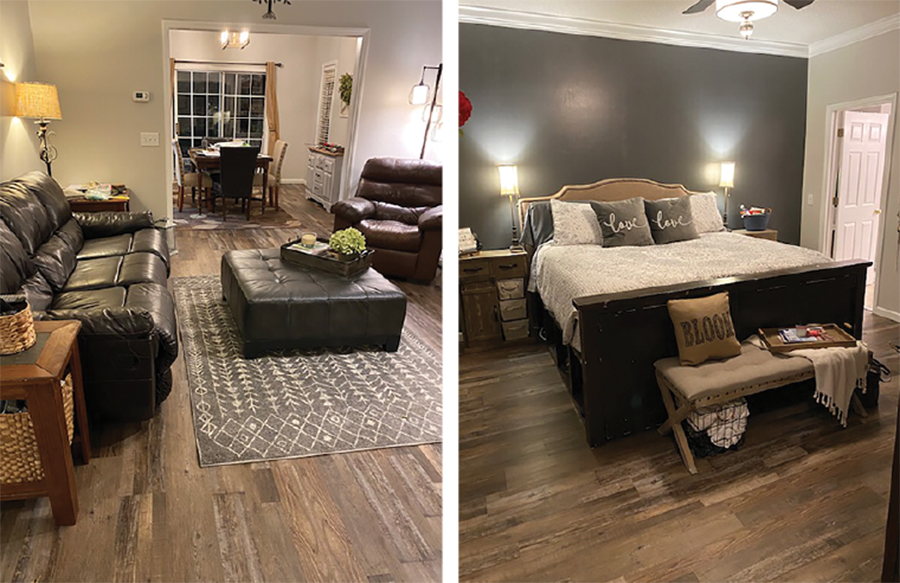
The Whispering Pines house this military family found — with a big fenced yard for their two breeder Labs, another dog and two children — was OK except for grungy carpet on some floors, engineered hardwood on others. When they found out their stay would be several years they decided to replace the lot.

Joanna Wells opted to rip out the old. Some had been glued down so securely that removal left gaping holes in the subfloor. These had to be patched and sanded.

Ghastly, back-breaking work.

“You owe me big-time,” she told her husband.

They took on the kitchen, dining room, living room and master bedroom while the Labs watched, puzzled, from the deck — for good reason. Penny is expecting puppies soon.

Hardwood was too expensive, so they chose vinyl lock-in plank in a walnut brown — a stunning backdrop to their leather upholstery and patterned rug.

“It really looks cool in here now.”

Wells, who teaches at Sandhills Classical Christian School, was on furlough, since “you can’t do pre-school (from home).” Otherwise, the job might still be waiting.

Encouraged by the results, the couple plans to add a shower to the guest bathroom this summer. Before that, Penny and the pups need a whelping box.


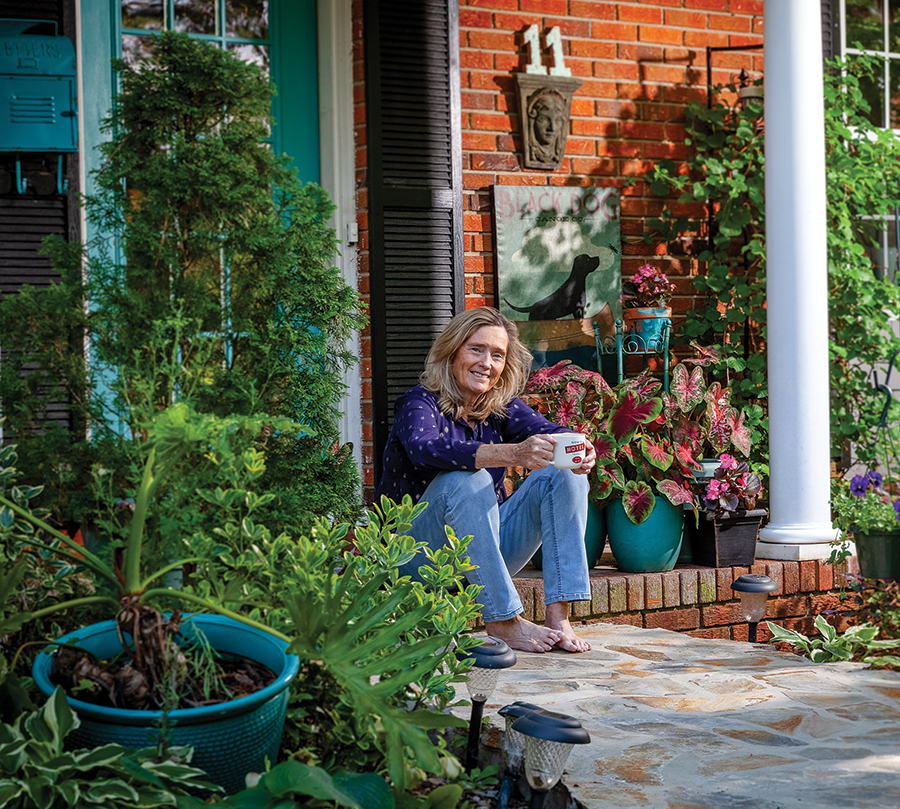
Denise Baker

Denise Baker

Everything Denise Baker touches turns to art. For years, she taught and inspired students at Sandhills Community College. Now retired — but not “retiring” — she viewed the spectacular weather during the quarantine as a reprieve from Mother Nature.

“In 42 years I’ve never seen such a beautiful spring,” she says.

So, while others were “going bonkers,” Baker, with helpers, got to work on her ranch house/studio in Whispering Pines, since “all this craziness kept me from focusing on art.”

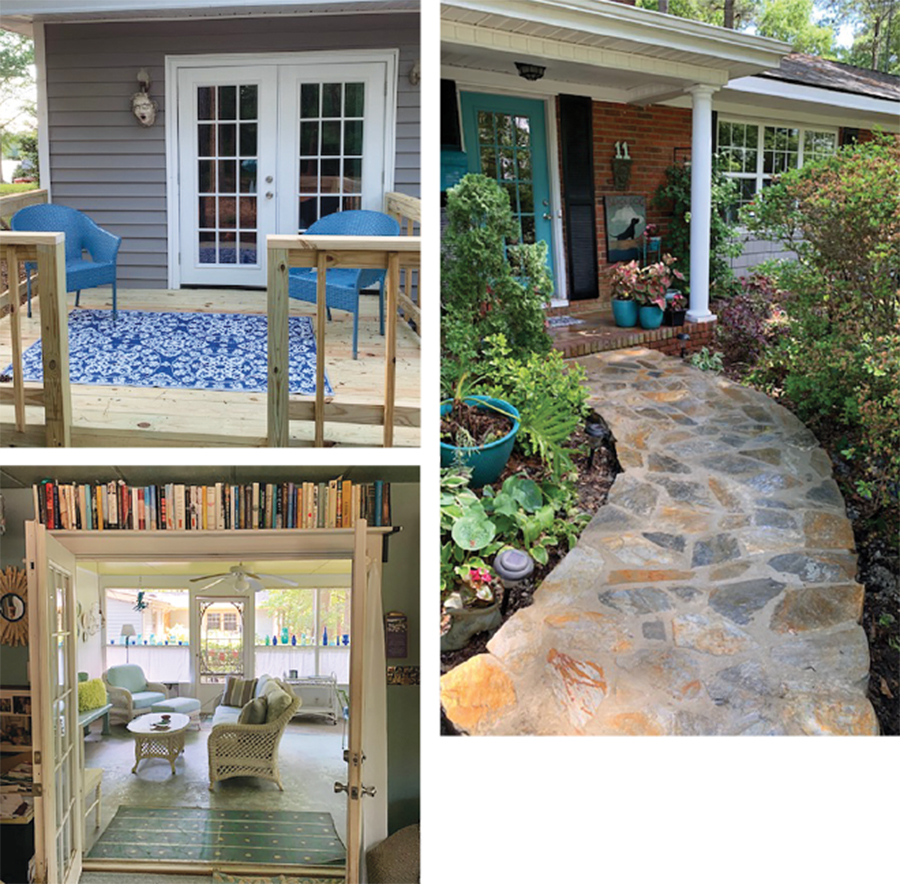
First, she replaced an ugly, cracked cement walkway with a stone mosaic of her design, more in keeping with the gracious front porch. Then, she added a simple deck accessed by French doors onto the side, where she placed deep royal blue all-weather wicker chairs and patterned rug. Baker had a bookshelf installed over interior French doors leading to a screened porch, and also recovered the cushions. Other door-topping shelves hold pottery.

All this, plus some clean-outs, in just a month. “My goal for the rest of the quarantine is to get the backyard in shape,” Baker says. That will happen after a short reprieve on Pawley’s Island, the perfect antidote to cabin fever, even when the cabin is as creative as Baker’s.


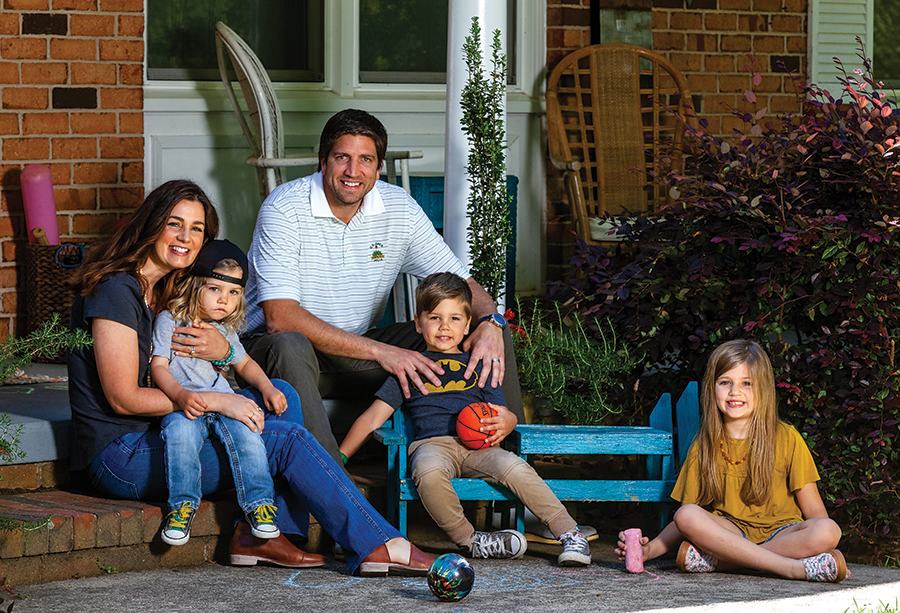
Lindsey, Oakes, Bill, Bode & Sloane Lindquist

Lindsey Lindquist

That noise you hear is Picasso applauding from his grave.

Lindsey Lindquist is an abstract artist with three kids under 6 and assorted livestock in their Weymouth/Southern Pines backyard. Children that age put sticky hands everywhere, including walls. Instead of following them around with a bottle of Fantastik, Lindquist decided to paint a mural on the half wall between the kitchen and the little ones’ craft corner.

The mural not only disguises fingerprints but showcases Mommy’s business — the most recent installation being the children’s glassed-off playroom at remodeled Pinehurst Toyota.

Lindquist calls creating the mural a “stress reliever” during the long days when, if not homebound, the kids would attend Moore Montessori Community School. Otherwise, call it bloomin’ gorgeous, if abstract is your cuppa green tea. Amazingly, she completed the mural in one afternoon, using paint left over from other projects. The kids “helped” paint reachable parts.

“I wanted to make a happy, creative spot,” she says. Also provided, a low craft table found at Habitat.

Lindquist, a Pinecrest graduate, studied painting at Arizona State University. Her ambition: illustrate children’s books. Elsewhere in the house she has channeled Fauvist Henri Matisse. “My husband is super-tolerant of how the house is decorated,” Lindquist admits.

Could Jackson Pollock be a mere splatter away?


Trish & Reece Baldwin

Trish Baldwin

Hey, it worked for Tom Sawyer.

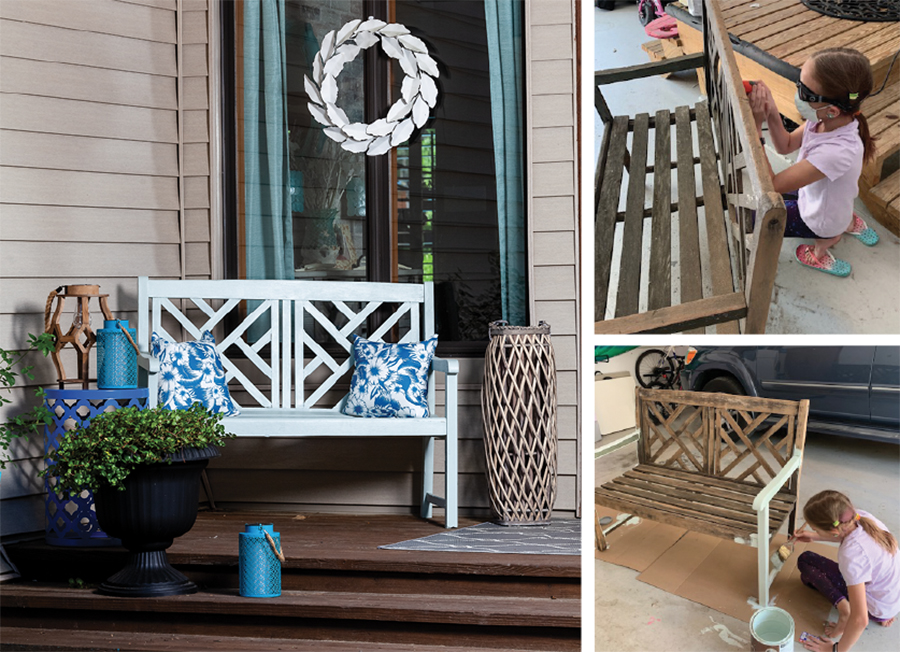
“When we moved in there was a garden bench that had been left rotting under a tree,” Trish Baldwin says of their Pinehurst home.

To save or not to save? Baldwin was busy with more important tasks. “Besides, I don’t like sanding.” Her 11-year-old daughter, Reece, seemed interested once the novelty of no school wore off.

“I showed her how to use the sander,” Mom says. Then they rustled up some blue paint to match the front door.

Painting slats is a tedious job — but the pre-teen has a variety of skills. She already sews, cooks from online recipes (cinnamon buns for Mother’s Day) and put together a craft table from hundreds of (Reese’s) pieces.

After sanding, the bench required two coats of paint. A sprayer would have been easier but Trish insisted on using materials at hand.

The result? Something the uppity Plow & Hearth catalog would unload for $300. Plus shipping. Some assembly required.


Kelly Carty & Mark Saurer

Kelly Carty

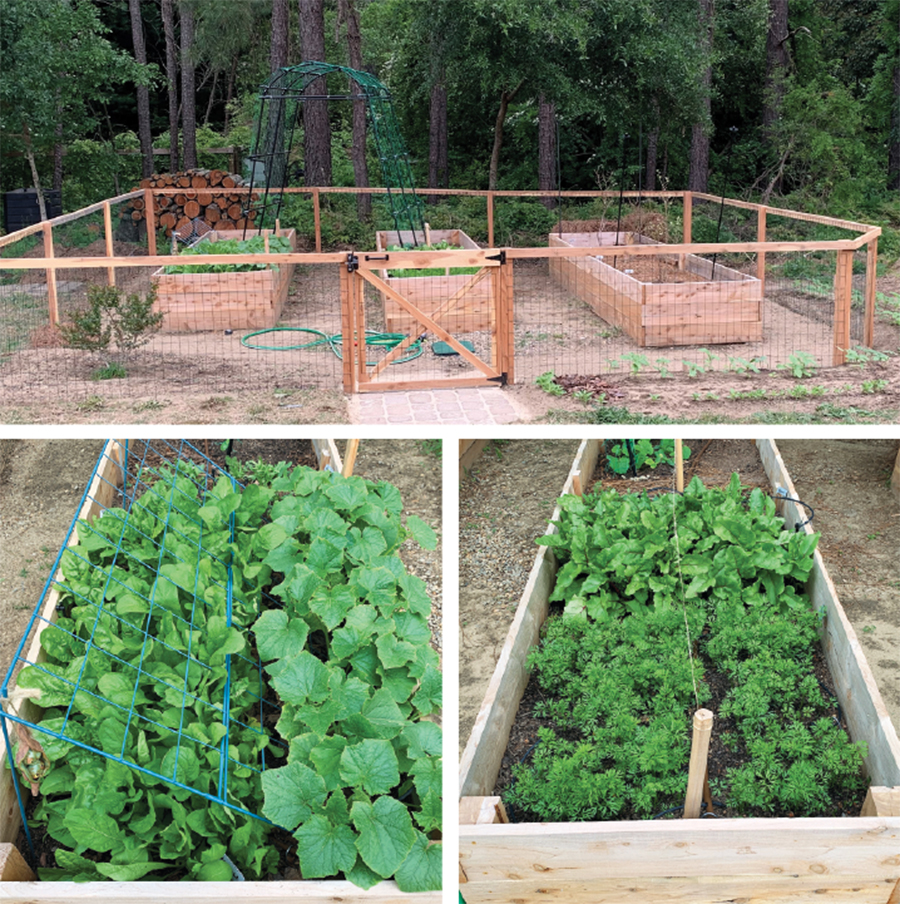
These raised beds are raising eyebrows. Surely, with wood-framed wire fence and gate they are the pride of a master landscaper.

Not exactly. Kelly Carty and her husband, Mark Saurer, are both civil engineers and, more importantly, enthusiastic researchers and planners. For their first home, in Whispering Pines, everything had to be spot-on.

“We found the best materials, how to position beds for the right amount of sunlight,” Carty says. “I’m the planner, he’s the executor.” His execution took only three days, in March.

Carty grew up on a farm, later traveled with the military, putting that all behind her for a recent degree in public policy from Duke.

No technical detail was overlooked. They concocted a proper soil mixture before burying the first seed, which was nourished by homemade compost. When the seedlings appeared, they were covered by a special fabric.

Their first harvest — arugula, Swiss chard, parsley, dill, cukes — is in and will be followed by summer and fall plantings.

“We selected this project because we love to cook, we love fresh vegetables, and nothing beats harvesting them from your own backyard,” she says.

The deer may be stumped but a few aggressive rabbits agree.  PS

Poem

Where I’m From

I am from a two stop-light town; from sweet tea and Crisco shortening

I am from a house with one bathroom and six inhabitants; rocking chairs by dawn and cozy fire

pits by dusk

I am from muscadine grape vines, big oaks, and dandelions

I am from Purvis and Chriscoe, Jenny and Jerry; blonde hair and blue eyes, hard work and family

time

From don’t speak if you have nothing nice to say to no blood or no bones — dry it up, from corn

doodles and goo-goo bars

I’m a river girl of Scottish descent, vacationing on the ocean’s shores, from callused hands in a

textile mill and World War II

I am from places one only longs to raise their children, from a small town with a big impact, and

a calling to somewhere far away with hopes the feeling of this place will always follow

— Mallie Clara Purvis

Moore County Writers’ Competition First Place Poetry Grades 9-12

The Legend of Eddie Pearce

How the “Next Nicklaus” found new life on the rocky road to the Sandhills

By Bill Fields

As things go in dating, once things have gotten serious, you meet the parents.

The first time Linette Smith visited the Florida home of Doris and Wes Pearce, she was struck by the contents of one particular room with a bunch of trophies. Linette knew her boyfriend, Eddie, as a car dealer at Larry Rigby Chevrolet in Abilene, Texas, who had sold her a new 1986 Camaro Berlinetta.

“Were you good at something?” Linette asked Eddie upon seeing the shelves full of silver curated by Eddie’s mother.

“Oh, yeah,” Doris interjected, “he was a golfer.”

In fact, Doris’ younger son was a very, very good golfer who before he had a driver’s license was being viewed as someone who not only could win on the PGA Tour but dominate it, a generational star in the making. Eddie played liked a man when he was a boy.

Gary Koch, a six-time tour winner and longtime television broadcaster, recalls a 1969 high school match in which he and Pearce, his fellow King High School star in Temple Terrace, Florida, were grouped with the No. 1 and 2 golfers of another team. It was a water-guarded par-5 that called for a drive, layup and third shot onto the green. But not if you had Pearce’s talent and strength.

“The three of us had layed up, and Eddie takes out his 1-iron, which he was so good with, and powers it up in the air, over a lake and onto the green,” Koch says. “I glanced over at the other two guys and they’re shaking their heads like, ‘Are you kidding?’ I would still put Eddie among the top 10 ball-strikers I’ve ever seen — and that’s when he was 18 or 19 years old.”

Pearce is 68 now, nearly a half-century removed from winning the 1971 North and South Amateur at Pinehurst No. 2, another rung on his ladder to the greatness so many predicted.

He has been back in the Sandhills since late 2018 as general manager of Southern Pines Nissan Kia, where many customers know his name if not all the stories. “I make sure I meet as many people as I can when they come in because I know 95 percent of them play golf,” Pearce says. “They don’t know if I play or not. So, I’ll sit down with them and introduce myself to them and they say, ‘Oh, I remember you.’ It’s amazing how many people do remember me.”

Pearce has been a success in the car business for almost 40 years, closing sales instead of closing out tournaments, which never became a habit once he turned pro and grew too familiar with closing time.

“It was probably 8-to-5 that I was going to make it to 35,” Pearce says. “Now I’m 68. Man, it’s been unbelievable. What a ride.”

He played 195 PGA Tour events, most from 1974 through 1981, although he made an improbable return for an additional season in 1993. The player who turned heads as an amateur never won on the biggest stage, earning four runner-up finishes among just a dozen top-10s.

Pearce’s golf journey began in the Tampa area when he was just a toddler. Babe Zaharias, who owned Forest Hills Country Club with her husband, George, put a club in Eddie’s hands when he was 3. “It’s all I did,” he says. “It’s all I wanted to do.”

He was carrying a money clip and wearing alligator-skin golf shoes by the time he was 16, a success in money games with the grown-ups in Tampa and in formal competition with his peers. He won the 1968 U.S. Junior Amateur at The Country Club in Brookline, Massachusetts — dispatching a handful of golfers who would become Tour standouts. “I knew I would win when I stepped on the first tee,” Pearce told his hometown newspaper that week. “I was brimming with confidence.”

Prior to claiming that national crown, Pearce was a dominant force for years at the Press Thornton Future Masters, a premier junior tournament in Dothan, Alabama, winning seven consecutive age-group titles between 1963-1969.

If Wes was in Eddie’s gallery, as he usually was, there was always a first-tee ritual. “I’d say to Dad, empty your pockets, because he always carried about three dollars worth of change in his pockets and he would jingle it,” Pearce says. “I’d put it in my golf bag and give it back to him after the round.”

Longtime Southern Pines resident Mike Fields, who played a lot of junior golf, was a regular at the Future Masters. “When I was 7, 8 and 9 years old, I remember watching Eddie play at Dothan Country Club,” says Fields, 60. “He had flowing blond hair and what I thought was a tour-pro swing. He was a legend in Dothan, always the talk of the tournament. All the kids talked about how far he hit the ball and that the ball sounded different coming off his clubs. I remember he was also very friendly to the younger kids who idolized him.”

Pearce’s contemporary, Ben Crenshaw, a member of the World Golf Hall of Fame, told GolfChannel.com in 2013, “I don’t think I’ve ever seen anyone with as much talent as him. Eddie had such a gorgeous, powerful swing. He could just hit the most beautiful shots you’ve ever seen.”

In his formative years, many of those shots were hit with plenty of cold, hard cash on the line. As a teenager, Pearce fell into a group of gambling golfers at Bardmoor Country Club in Largo, Fla. “There were money games with guys he perhaps shouldn’t be playing with,” says Koch. “But Eddie was always comfortable in those situations, almost weirdly so. He wasn’t too worried because he knew he was better from the standpoint of physical talent. Those guys would bet on anything — it was an interesting cast of characters.”

One of the regulars was Martin “The Fat Man” Stanovich. Once, after a week of thousand-dollar Nassaus, Pearce had won nearly $25,000 from Stanovich. Not long after that, Pearce was in a practice bunker working on his superb sand game. He had been warned to leave good enough alone when it came to further bets with Stanovich, but didn’t listen.

“Marty was watching me hit those sand shots,” Pearce recalls, “and he said, ‘Damn, you’re pretty good.’ I said, ‘Yeah, I am.’ He said, ‘Well, you want to hit some shots, $100 for closest to the hole?’”

The wagers grew. After 90 minutes, Pearce had lost $20,000 to The Fat Man. “I walk up to the clubhouse and I’m in a daze,” Pearce says. “Lloyd (Ferrentino, who ran the course) said, ‘He got you, didn’t he?’ Marty was a magician out of the sand. That was a hard, hard lesson. I know I had to play a lot of golf to get that money back.”

In the spring of 1969, Pearce, Koch and their King High teammates won the Florida state championship with a four-man, 36-hole total of 579. It remained a Sunshine State record for 30 years. Pearce was heavily recruited and went to golf powerhouse Wake Forest, where he stayed for two years before deciding to turn professional.

Sports Illustrated had referred to Pearce as the “Next Nicklaus.” With a powerful lower body and effective leg action, Pearce resembled the Golden Bear. “It was the time of the 1-iron and Eddie could really hit the long irons,” Koch says. “He had a bit of an upright swing, and he had big legs and could create speed and get the ball quickly into the air.”

Eddie’s personality was more King than Bear, outgoing like Arnold Palmer, the man who had convinced him to go to Wake Forest. Pearce never met a stranger, and his outgoing nature made late nights happen all too easily. Pearce was runner-up in his fourth tournament of 1974, the Hawaiian Open, but was never really able to build on that early promise. He safely kept his exempt status as a rookie, finishing 44th on the money list, but only improved to 39th in 1975.

Detailed statistics for that era aren’t available like they are now, but Pearce’s putting, particularly once he became a pro, didn’t match his long-game skills. “Back in high school we used to joke that if I could ever hit it like he did and he could putt like me, nobody would ever beat either of us,” says Koch, who was known as an excellent putter.

Pearce loved life on the road — too much — and didn’t have the self-discipline to practice more and party less. “A lot of guys talked to him,” says Roger Maltbie, a friend of Pearce’s in their tour days in the 1970s, “but Eddie was going to do what Eddie was going to do.”

An instinctive, natural golfer from childhood, as his career stalled in the late-1970s and early 1980s, Pearce got bogged down with mechanics. “I had always had a good swing and played by feel,” he says. “I never thought about my swing until the last few years on tour. And then I thought about it all the time when I was over the ball. The more I thought about it, the worse I got.”

In 1981, when he was only 29 years old, Pearce finished 210th on the money list after being 225th the previous year, failing to earn as much in a season as he had in a week of money games as a teenager. He had neither a winning lifestyle nor golf game. “By that point he was struggling personally and professionally,” Koch says. “Some of us were worried about him. Was he going to be able to get his life squared away? What was he going to do?”

Tired, frustrated and unhappy, Pearce packed it in after that lousy 1981 season, unsure what his future would hold. “When I quit playing, I gave everything away that had to do with golf,” he says. The inventory of discarded equipment included two George Low Sportsman model putters Nicklaus had given him, clubs that a decade later were selling for thousands to collectors.

Pearce had an endorsement deal, doing commercials, for Don Reid Ford in Orlando, and was good friends with Reid and his business partner, Cesar Prado. (Prado is godfather to Eddie Pearce Jr.) They turned out to be the gateway to his second career. “I asked Cesar, ‘What’s the deal with this car-selling thing?’” Pearce says. “Cesar told me I probably would be real good at it because of how I was with people, the way I took care of sponsors and guys playing in pro-ams.”

Prado was right. He got Pearce a job at a dealership in Lakeland, Florida, that needed to improve its numbers. “That’s where he got his start, turning that store around,” says Prado, now retired in Texas. “Eddie is very personable, very likable and he had a knack for it. I’m just glad I was able to help a little bit and get him on a track where he could be successful.”

Over the next couple of decades, Pearce would put in three-month stints at dealerships across the country, becoming a specialist at organizing their operation and improving sales. “We’d take the store over, do all the training and all the advertising,” Pearce says. “If we turned it around, we’d come back and give them tune ups.”

Pearce was a sales manager at a Chevy dealer in Abilene, Texas, in August 1986 when Linette Smith came in to buy a Camaro. “His closer was having a little bit of a difficult time with me,” Linette says. “So Eddie decided to come in and close the deal.”

Linette got her Camaro and, in time, a boyfriend. “We were really, really good friends for about 3 1/2 months — we didn’t really date, we just hung out,” Linette says. “And then we went down for a weekend in Mexico and the rest is history.”

Pearce still enjoyed the bar scene, but that wasn’t Linette’s. “After I came into the picture, he settled down,” she says. Pearce curtailed his drinking, imbibing only occasionally these days. The couple got married in 1990. “Third time’s the charm for both of us,” Pearce says. “She’s put up with me for 30 years, and it’s been an amazing trip, a lot of fun.”

Linette played an encouraging role in Pearce’s return to competition in the early 1990s. Inspired by watching Hale Irwin win the 1990 U.S. Open at age 45, Pearce set about getting fit, losing more than 50 pounds. He failed at Qualifying School in late 1991, but a year later, at The Woodlands outside Houston, 40 years old and wielding a long putter, he got his card. The bittersweet part was that his father had died of lung cancer nine months earlier.

He savored practice rounds with buddies he hadn’t played with in a long time. But Dewars was now just the name of his dog, not his drink of choice. Though Pearce applied himself in ways that he hadn’t the first go-round on tour, he couldn’t find the magic that had made him a can’t-miss kid.

He missed 19 cuts in 27 tournaments in 1993, shooting just six rounds in the 60s and failing to record a top-25 finish. He was unsuccessful at Q-School following the ’93 season and, a decade later, in trying to earn his way onto the senior tour.

“I’m very proud of Eddie and the way he dug into trying to make a comeback,” Linette says. “It wasn’t for lack of trying that he didn’t do better when he got back out there. But perhaps Eddie wasn’t mentally prepared for all of it.”

Her husband was content to return to the car business, where he enjoys mentoring employees in whom he sees potential. One such young man worked in the detail department at Pearce’s previous dealership in Henderson but was interested in sales. He has moved up through the ranks and is now general manager of a dealership in Lee County.

“When you get somebody like that and they do well, it’s like it’s your kid,” says Pearce, a father of two. “If I can latch onto a couple more folks like that before my career is over, I’ll be happy. It makes me feel good to do that, because this business is a great business, it really is.”

Pearce has played little golf in recent years, although he and Linette watch a lot of tournaments on television. “Eddie might reflect on a certain course that he played in the 1970s,” says Linette, “but we just enjoy the game. We enjoy watching the young players come up.”

It’s a different game than it was 50 years ago, but some golfers stand out as they always have, if not as much as Eddie Pearce did before he didn’t.  PS

Reviving a Soulful Sound

A scruffy old guitar finds its voice again

By Stephen E. Smith   •   Photographs by John Koob Gessner

Ill bet

you’re nagged by a furtive longing to possess something that’s impractical. Maybe it’s Aunt Amelia’s Tiffany brooch or Granddad Ralph’s ’49 Mercury sedan. In my case, it’s always been a Stahl Style 6 guitar made by the Larson brothers of Chicago. Whatever the object, we know this: If we search long enough and can shell out the cash, we’re likely to get what we want. This is America; we invented conspicuous consumption.

Inspired by what comedian Martin Mull dubbed “The Great Folk Music Scare,” I bought my first guitar, a digit-mangling Kay archtop, in August 1961, from a pawn shop on West Street in Annapolis, Maryland. I was a rising eighth-grader and paid $15 I’d received for my birthday. Every Saturday that fall, I toted my caseless Kay to St. John’s College campus, where I sat under the last surviving Liberty Tree (on the very spot where patriots plotted the Revolution) and strummed “Goodnight, Irene” ad nauseam with five or six honest-to-God beatniks. On one of those cool autumn afternoons, a Maynard G. Krebs character handed me his guitar and said, “Here, give this a try.”

I strummed a G chord, one of the three I’d mastered. “Wow!” I said.

The proud owner beamed. “Plays like silk and chimes, like a chorus of seraphim,” he said.

“What kind of guitar is this?” I asked.

“It’s a Stahl 6,” he replied.

When I got home, I had to look up “seraphim” in the dictionary, but I knew in my bones what a Stahl guitar was.

For most of the 60-plus years that have slipped by since that autumn afternoon, I never happened upon a Stahl Style 6 I could afford. If I were a more accomplished player, I might have been willing to shell out $7,000 to $14,000 for a pristine original-condition Stahl, but alas . . . 

And then, eight months ago, a Stahl Style 6 materialized on my computer screen — and it was for sale at a reasonable price! The rub: It was in sad — very sad — condition. The seller listed it as “Non Functioning,” noting that the Stahl was a “Luthier Project” afflicted with a “Non Original Bridge, Non Original Tuners, No Pins, Back Cracks with washboarding” — and an all-too-ominous caution that the guitar would need “some finish work.” But the center strip was clearly branded “WM. G. STAHL/MAKER/MILWAUKEE” (a lie, since the guitar was made in Chicago by the Larson brothers) and 95 percent of the instrument was there.

I asked the seller a few pointed questions, made a reasonable offer, and PayPaled him the money. Four days later the UPS man delivered a big box that I ripped into with, I admit, adolescent gusto.

At this point in the typical restoration epic, buyer’s remorse sets in. What have I gotten myself into? the new owner asks. But I wasn’t in the least bothered by the Stahl’s condition — not at first. The seller had been reasonably honest — everything he said was wrong was wrong — but with each careful inspection I noticed flaws he’d failed to mention. The fingerboard extension was bent — not broken, thank goodness, but obviously sigogglin — the bridge (which anchors the strings to the body) wasn’t a correct Larson brothers’ flattened pyramid type and it was glued in the wrong location, the peghead overlay was damaged, the frets needed attention, binding was missing at the bottom of the fingerboard, the 3-on-plate Kluson knockoff tuners were flat-out annoying — and worst of all, some idiot with a paint roller had applied two gallons of runny gloppy gooey polyurethane or other superfluous substance to the guitar’s body, the front, back and sides. And that didn’t include earlier overspray of shellac, lacquer and varnish that had melted into the polyurethane — a deal-breaker for any vintage guitar collector, since original finishes are necessary to produce the instrument’s authentic sound.


Collectors argue endlessly about original finishes vs. restored. You’ve probably seen those Picker guys on the History Channel who love “rusty gold” and “the look” or the erudite appraiser on Antiques Roadshow who says, “In original condition this Philadelphia dressing table would be worth half a million dollars but since you refinished it, it’s worth seventy-five bucks. Maybe.” And that’s how it is with vintage guitars. But I’m not a vintage guitar collector. I simply wanted to play the guitar, and to do that I needed to have the polyurethane removed.

Poly finishes dampen sound and I had a lot of it on the Stahl, which meant that the guitar had reached a point in its checkered life where it was up or out. I might have relisted it on an auction site and gotten my money back, but I was determined not to sell or trash my latest acquisition. I was in possession of a rare Larson brothers Stahl Style 6 serial number 27022 (a numeral not based on production numbers), which meant the instrument was 100 years old! Who knows where it had been and the stories it could tell? Guitars, like their owners, have their own DNA and quirky personalities.

How valuable are Larson instruments? Consider this: A 1937 Larson-built Euphonon dreadnought recently listed on the Reverb for $64,500. Ouch! (If you’re interested in Larson instruments, I suggest you read The Larson Brothers’ Creations, by Robert Carl Hartman, or John Thomas’ excellent article in issue #15 of Fretboard Journal.)

What I needed was someone — the right someone — to save my Stahl Style 6. I’d heard that it’s possible, under unique circumstances, to remove a secondary finish while preserving the original surface. I got on the phone and chatted with luthiers in Wilmington, the Raleigh-Durham area, Charlotte and the Triad, and settled on Bob Rigaud (pronounced “rego”) in Greensboro.

Bob is a world-class builder, a luthier whose guitars are comparable to those of the Larsons. Seven years ago, he built for me a New Moon koa tenor ukulele, a high-quality, handmade instrument that sings with a surprisingly mellow, resonant voice, and he’s supplied instruments for many A-list performers, most recently Graham Nash, who travels with his Rigaud parlor guitar and uses it to compose new music.

More importantly, Bob has a reputation as a superlative repairman. A few years ago, “Steady-Rollin” Bob Margolin, Muddy Waters’ longtime sideman, stopped in Bob’s shop to have an old Gibson L-00 repaired. I was curious about Margolin’s experience with Bob, so I emailed him. He replied: “Bob fixed my mid-’30s Gibson L-00. He checked it out and knew exactly what to do. He told me the guitar would come back better than I could imagine and it did. Big admiration for Bob.” Margolin was so impressed with the sound of his Gibson, he went directly to a studio and recorded the CD This Guitar and Tonight, a ragged, in-your-face acoustic outing in which the old L-00 vibrates like the blues bucket it is.

Bob had also repaired two of my guitars, one a Larson-built student-grade Maurer that required delicate finish work, which he accomplished flawlessly. He also sealed multiple cracks, back and front, and made them disappear. Better yet, he left most of the original French polish intact.

So in late May I drove to Greensboro and handed my Stahl to Bob. He was busily at work on three new guitars — always his first passion — but his face brightened as his eyes ran over the damage wrought on my Larson by time and abuse.

“I can fix this,” Bob said. “I can make it sing again.”

Bob Rigaud is possessed of a gregariousness purely borne of enthusiasm. His life is guitars, and he delights in every aspect of building and repairing instruments and hearing them sing. We sat in his modest workshop and talked for two hours. His hands fluttered like birdwings as he pointed out myriad flaws I’d failed to notice and explained in detail how he’d approach correcting each imperfection.

“Can you fix the finish problems and make the washboarding and back cracks disappear?” I asked.

He was uncharacteristically succinct. “I can,” he said, smiling.

The Stahl was in his hands.

Brimming with faith and high hopes, I drove back to Southern Pines and waited. And waited. June came and went. On the last Saturday in July, I traveled from High Point to Bob’s workshop to check out the progress he’d made on my guitar. The old Stahl was laid out like a cadaver on his workbench, the fingerboard taped off. And miracle of miracles, most of the poly finish had been removed and much of the original French polish seemed to be intact. The washboarding was gone without a trace, as were the many back cracks and a small hole I’d somehow overlooked. The once-mangled Brazilian rosewood back had been restored to its original glory.

“How did you repair the back so perfectly?” I asked.

“I flattened the wood and sealed the cracks with an epoxy I tinted with rosewood sawdust.”

But there was still much work to complete, including the peghead overlay, the replacement bridge, and the angle problems with the fingerboard extension. I left satisfied but anxious to have the Stahl back home.

August, September, October and November passed, and I was content to have Bob work at his own speed. But in early December, my friend Craig Fuller of Pure Prairie League and Little Feat fame drove me to Bob’s workshop. Bob, always the perfect host, showed us the guitars he was building, and Craig and I examined the Stahl in detail. It was close to being complete: a new, handcrafted bridge with inlays was temporarily applied, a beautiful peghead overlay was in place, and new Stewmac Golden Age reproduction tuners were installed, but the frets still needed work and touch-up finishing was left to accomplish. I’d hoped that Craig, who’s played more guitars better than I ever will, might try out the completed Stahl and give me his opinion, but Bob was still struggling to correct the intonation, the key to ensuring that a guitar sounds as good as it possibly can.

“I’ve never repaired a Larson guitar that had the correct intonation,” Bob observed.

On January 22, 2020 my phone rang; the Stahl was ready for me to take possession. “I’m proud of it,” Bob said.

I stepped into his workshop at 9:30 the following morning. And there it was, my 1920 Larson brothers Stahl Style 6 guitar resurrected. I picked it up, strummed a fat G chord and felt an instant synaptic connection: I remembered the sweet sound — the sustain, the purity of voice — that had amazed me all those years before. It played like silk and chimed like a chorus of seraphim. It had the mojo and “the look.” Bob smiled but said nothing. He didn’t need to. He absolutely understood how I felt. He was feeling it too.

“I loved working on this guitar,” Bob said. “When I was regluing the internal braces — which, by the way, are all maple, not spruce — I could see evidence of August Larson’s work, and I felt like I was having a conversation with him all these years later. A hundred years from now maybe some other luthier working on this guitar will be having a conversation with me.”

“You don’t have to reveal any trade secrets,” I said, “but how did you save so much of the original finish?”

“Sense of smell,” Bob explained. “As I take down the finishes, I can smell them and after all these years of working on guitars, I can pretty much tell you what the finish is and when it was applied. When I got to the French polish, it gave off a very distinct smell. That’s when I stopped.”

Great luthiers are the real guitar heroes.

I play the Stahl every day now. It’s my musical soul mate. I know I’ll never be a great musician. And that’s fine. The process of learning guitar continues to unfold for me. I like it that way.

Was resurrecting the Stahl worth the time, money and effort? Was it merely an attempt to recapture my youth? What I can tell you is that my Larson guitar testifies that a tradition honored 100 years ago is adhered to still with patience and pride. I’ll be passing the Stahl along someday, and isn’t the past always present in the hope we have in the future?

My Stahl Style 6 sits in my guitar room next to a Liberty Tree guitar made from the wood of the tulip poplar I sat under on St. John’s campus all those years ago. Hurricane Floyd roared through Annapolis in 1999 and fatally damaged the 400-year-old tree. Taylor guitars purchased the wood and built 400 fancy instruments. It’s strikes me as wholly appropriate that my Stahl and the Liberty Tree sit side by side.

After all, something so complete has a beauty all its own.  PS