Lunch with Winston

My father’s “brush” with history

By Tony Rothwell

“I’ve often noticed that when coincidences start happening they go on happening in the most extraordinary way. I dare say it’s some natural law that we haven’t found out.”

— Dame Agatha Christie

My mother, Myra Hardman, grew up in Manchester, England, in a house called “Como.” In 1937, she married my father, Bill Rothwell, a hotelier. At the outbreak of war in 1939, Dad enlisted in the Lancashire Fusiliers. In 1943, by then commanding a squadron of Churchill Mk.IV tanks, Capt. Rothwell took part in the Salerno landings in Italy, part of a massive plan to drive the Germans out of the country. He remained in Italy until the end of the war in Europe, May of 1945.

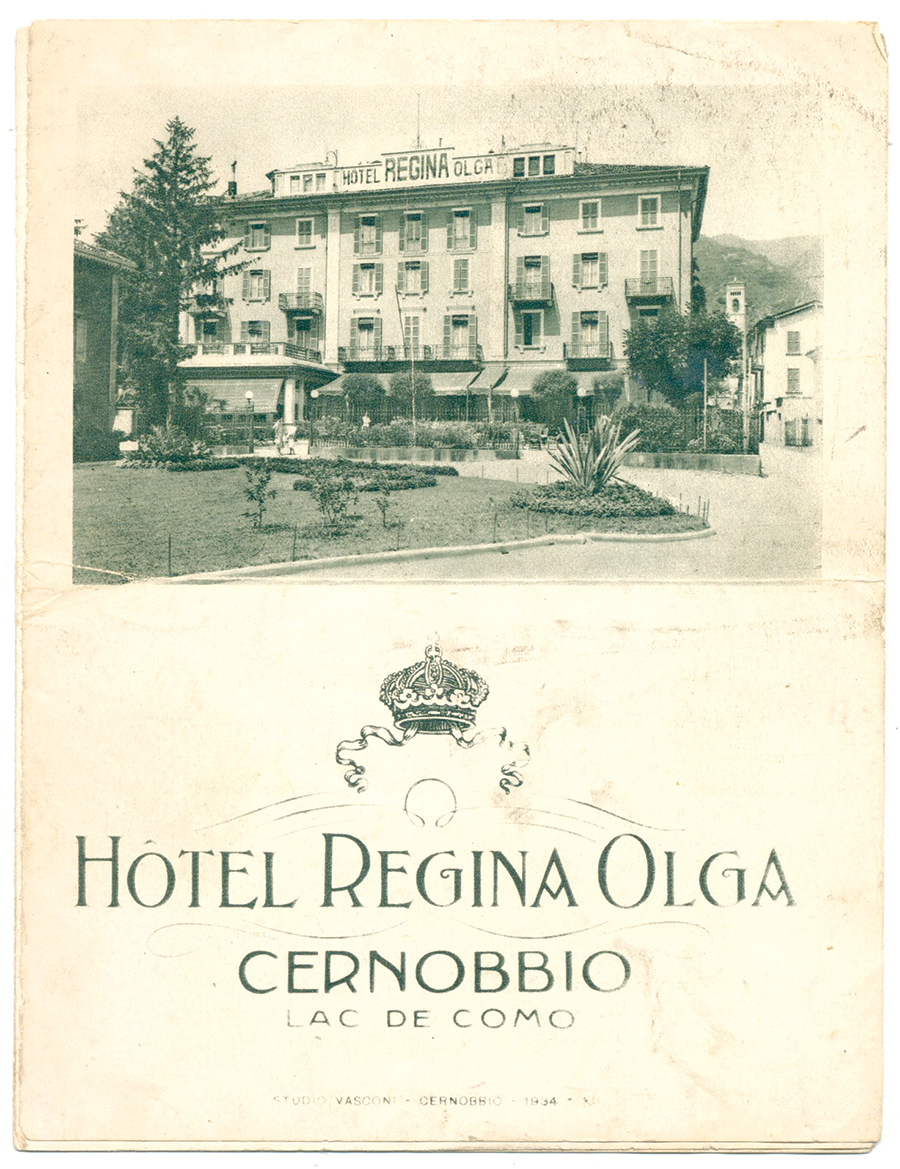
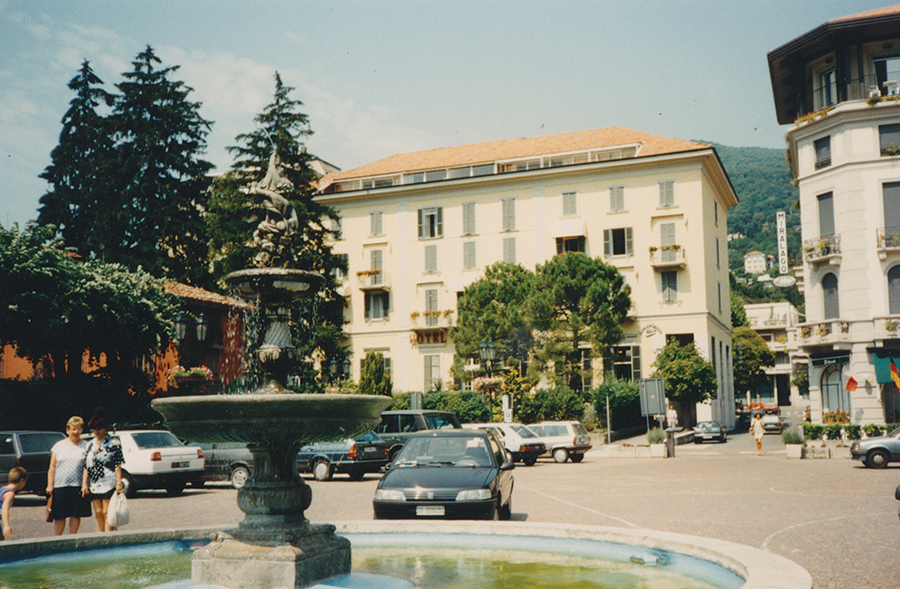
Like everyone else, Dad couldn’t wait to come home, but the Army had different plans. They needed a place for managing mopping-up operations and commandeered the Hotel Regina Olga on Lake Como. It was in good condition because the Germans had been using it as a hospital, but who was to run it? Looking through the lists of Army officers with hotel management experience and already in Italy, they found Dad. “Sorry, old boy, you’re not going home just yet,” they told him. “You’re running a hotel for us on Lake Como.”

That my mother had grown up in a house by the same name as the majestic lake where my father concluded his military service seems the merest of coincidences. But they don’t end there.

Back in Britain, Churchill’s Conservative Party was shockingly voted out of power in the July general election, and the Labor Party took over. The working class, the private soldiers on the front line, and the women left behind who had made so many sacrifices, were having their say. The man who had rallied Britain when it stood alone with his bulldog courage and commanding oratory was out.

So, what was Churchill to do? He was certainly not going to stay around for everyone to feel sorry for him. He decided he would go somewhere and paint, an interest he’d long neglected during the war years, and accepted an invitation to spend a month on Italy’s Lake Como. The Army, he was told, had a hotel there. And so off he went with his oils, his physician Lord Moran and his personal secretary.

And so, suddenly, out of the blue, the unimaginable. My father found himself looking after one of the most famous people on Earth. 

In a fascinating book written by Lord Moran, a compilation of his diaries for the years spent with Churchill from 1940 to 1965, the entry for their first day in Italy, Sept. 3, 1945, reads:

We had planned to set out about ten o’clock to reconnoître the surrounding country for a scene which Winston could paint: However, it was noon before we set off. As we drove round the lake Winston kept his eyes open for running water, or a building with shadows on it, but we stopped for a picnic lunch before he found what he wanted. The “picnic” arrived in a shooting break with his chair and a small table. A score of Italian peasants gathered in a circle and watched us eat. He was in fine spirits.

When he was satisfied that he had found something he could put on canvas, he sat solidly for 5 hours, brush in hand, only pausing from time to time to lift his sombrero and mop his brow.

After dinner Winston was ready to talk of anything: he only mentioned the election once. Eventually he gave a great yawn; when we thought he was about to go to bed he broke into a hymn and sang three verses of “Art Thou Weary.”

Over the next few weeks Dad sent sandwiches and drinks down to the lakeshore many times but on one occasion he joined Churchill for lunch and years later related part of their conversation to my brother and me.

“Do you have children, Rothwell?” Churchill asked.

“I have two boys, sir,” he replied. “In fact, I just received a letter from home with a photograph.”

“Let me have a look,” Churchill said. After studying the photo for a few seconds, he said, “They say all babies look like me.”

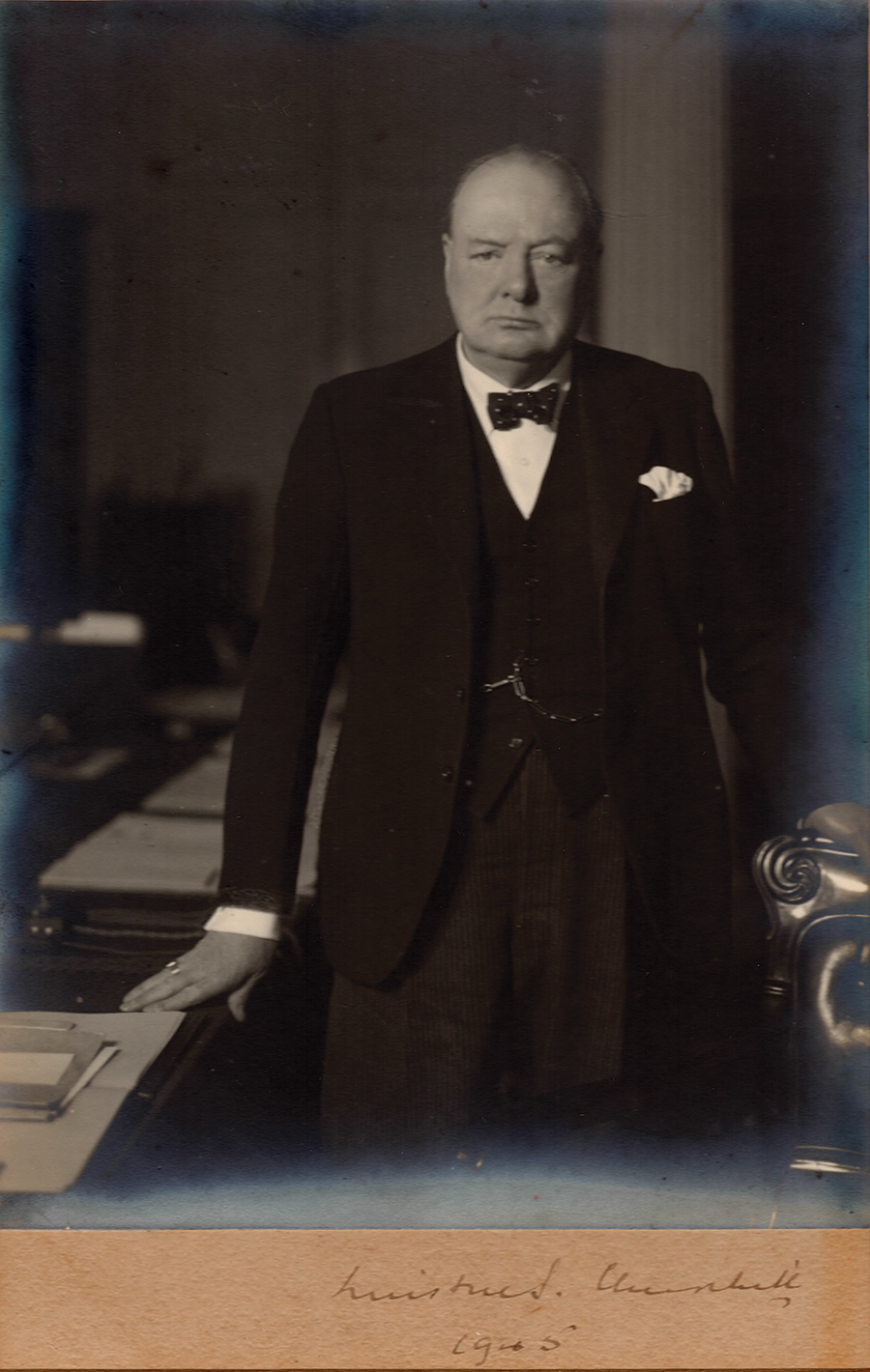
At the end of lunch Churchill got out his cigars and offered one to Dad, who had just lit a cigarette. Because he was smoking already, Dad felt it would be bad form to accept the offer and became, perhaps, the only man ever to refuse a cigar from Churchill. All was not lost. After Churchill’s return to England, he sent Dad a signed photograph, a prized family possession.

The great man died in 1965 on Jan. 24, aged 90. After he had lain in state for three days, the funeral took place in St. Paul’s Cathedral in front of one of the largest gatherings of world dignitaries ever assembled. Following the service, the coffin was taken by launch down the Thames, past the House of Commons, and then by train to Bladon in Oxfordshire for burial in the family site at St. Martin’s Church. This is close to Blenheim Castle, the seat of John Churchill, 1st Duke of Marlborough, Winston’s ancestor and a national hero, following his great victory at the Battle of Blenheim in 1704. Then 22, I commemorated the day of the funeral with a drawing. In yet another coincidence, my father’s last hotel before retirement was The Marlborough Head Hotel in Dedham, Essex, named for John Churchill.

Later, when I lived in London in the early 1980s, I worked for a financial investment company that had a hotel portfolio for which I was responsible. The owner of the company happened to live next door to Churchill’s house, “Chartwell,” south of London in Kent. My wife, Camilla, and I were among the guests invited there one weekend. After dinner that Saturday, our host asked us all to follow him through a door and down some stairs and along a narrow corridor. He opened a door and put on the lights. We were in a small, whitewashed room off which were a bedroom, a kitchen and a bathroom. He pointed to a sealed door and informed us that behind it was a tunnel that led to Churchill’s house, and that we were standing where Churchill worked when he came down to Chartwell during the war. It was presumed that spies watched Churchill’s every move, and by working under the house next door he stood a better chance of surviving if attackers somehow managed to blow up his house.

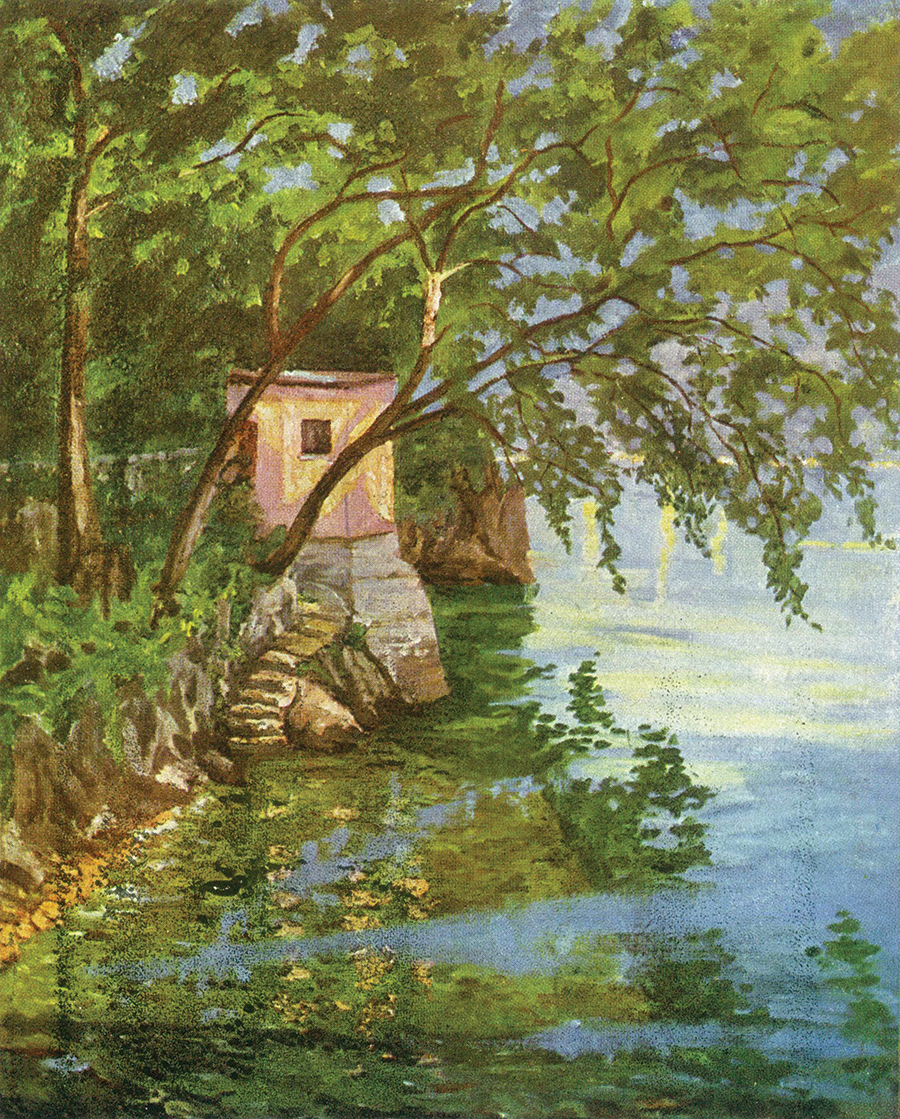
In 2015, Camilla and I visited London and made a point of going to the war rooms near 10 Downing Street to see where Churchill spent his days and nights during those dreadful years. Adjoining them is a small Churchill Museum. Of all the many exhibits we saw there, two items stood out: his school reports, which basically said he would never amount to anything, and — the last coincidence — out of the hundreds of paintings he did in his lifetime, there was just one on display. It was of Lake Como.  PS

Tony Rothwell, a Brit, moved to Pinehurst in 2017, exchanging the mind-numbing traffic of Washington, D.C., for less traffic, better weather and the vagaries of golf. He spent 50 years in the hotel business but in retirement writes short stories, collects caricatures, sings in the Moore County Choral Society, and with his wife, Camilla, enjoys the many friends they have made in the Sandhills. Email ajrothwell@gmail.com

Golf’s Unsung Hero

How a unique hobby helped restore a historic course

By Bill Case

In 2009, Bob Dedman Jr. and Don Padgett II, the gentlemen in charge at the Pinehurst resort, decided to dramatically overhaul Pinehurst course No. 2, one of America’s foremost championship golf venues. They sensed that the layout, built by Donald Ross in 1907 and periodically tweaked thereafter by the legendary architect until his death in 1948, had lost some of its character.

Starting around the early 1970s, Pinehurst had adopted the popular course maintenance formula of the era: lush green grass throughout the course, not just in the fairways. The native pine barren wire grasses and awkward sandy lies that confronted off-target golfers on No. 2 during Ross’ heyday largely disappeared. In their place came acres of 3-inch-deep irrigated grass. Too often, extrication from this cabbage could only be accomplished by hacking a wedge back to the fairway.

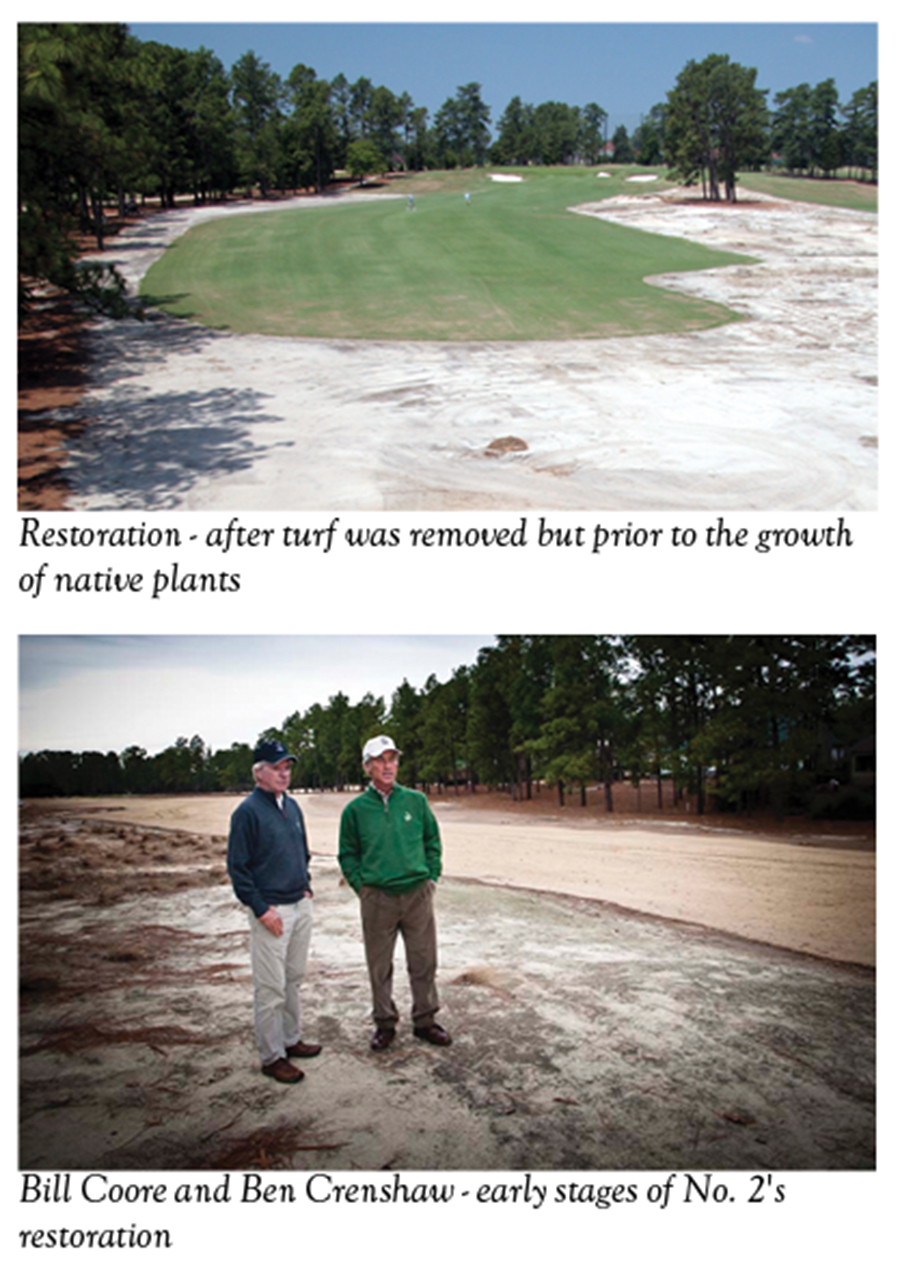
To restore No. 2 in a manner that approximated how Ross had presented the course, Dedman and Padgett called upon esteemed course designers Bill Coore and two-time Masters champion Ben Crenshaw. The Coore & Crenshaw website describes its design philosophy as a blending of Bill’s and Ben’s “personal experience and admiration for the classical courses of Ross, MacKenzie, Macdonald, Maxwell, and Tillinghast to create a style uniquely their own.”

The architects have a special connection to Pinehurst. Having already won in his professional debut, a 21-year-old Crenshaw nearly captured his second event as a pro, too, finishing second in the 1973 World Open, three strokes behind Miller Barber. The 144-hole marathon on No. 2 “stimulated my love for Pinehurst,” says Crenshaw. Coore, who grew up in Davidson County, North Carolina, was good enough to make Wake Forest University’s golf team and played No. 2 frequently in the 1960s, usually on $5 all-day passes. “There is no doubt,” he says, “that playing No. 2 gave me an appreciation of traditional, strategic golf courses that eventually pointed me in the direction of course architecture.”

While Coore & Crenshaw’s selection was applauded in golf circles, more than a few aficionados wondered about the potential impact of a drastic change. Why make major modifications to a course that only recently had held one of golf’s most dramatic major championships, the 1999 U.S. Open? What was the benefit of eliminating rough in favor of native waste areas? Didn’t the United States Golf Association prefer deep rough and narrow fairways? Could changing the character of No. 2 jeopardize its status as a championship venue?

Though they didn’t say so publicly at the time, Coore and Crenshaw also harbored misgivings. Coore knew that No. 2’s fairways had once stretched to nearly 50 yards in width. Now they averaged just 24 yards across. If the more generous dimensions were restored, would the USGA find fault or, worse yet, require the fairways be narrowed again for the 2014 men’s and women’s U.S. Opens?

The two architects had no interest in undertaking No. 2’s restoration if it might do more harm than good. Mike Davis, who had been in charge of setting up U.S. Open courses for years and who would become executive director of the USGA in 2011, promised that modifications resulting from the restoration would not be undone by the USGA. Indeed, Davis himself had broached the concept of restoring No. 2 in discussions with Dedman and Padgett.

But there remained a gnawing concern for Coore and Crenshaw — they wanted to know the precise details, dimensions and appearance of the course during the Ross era.

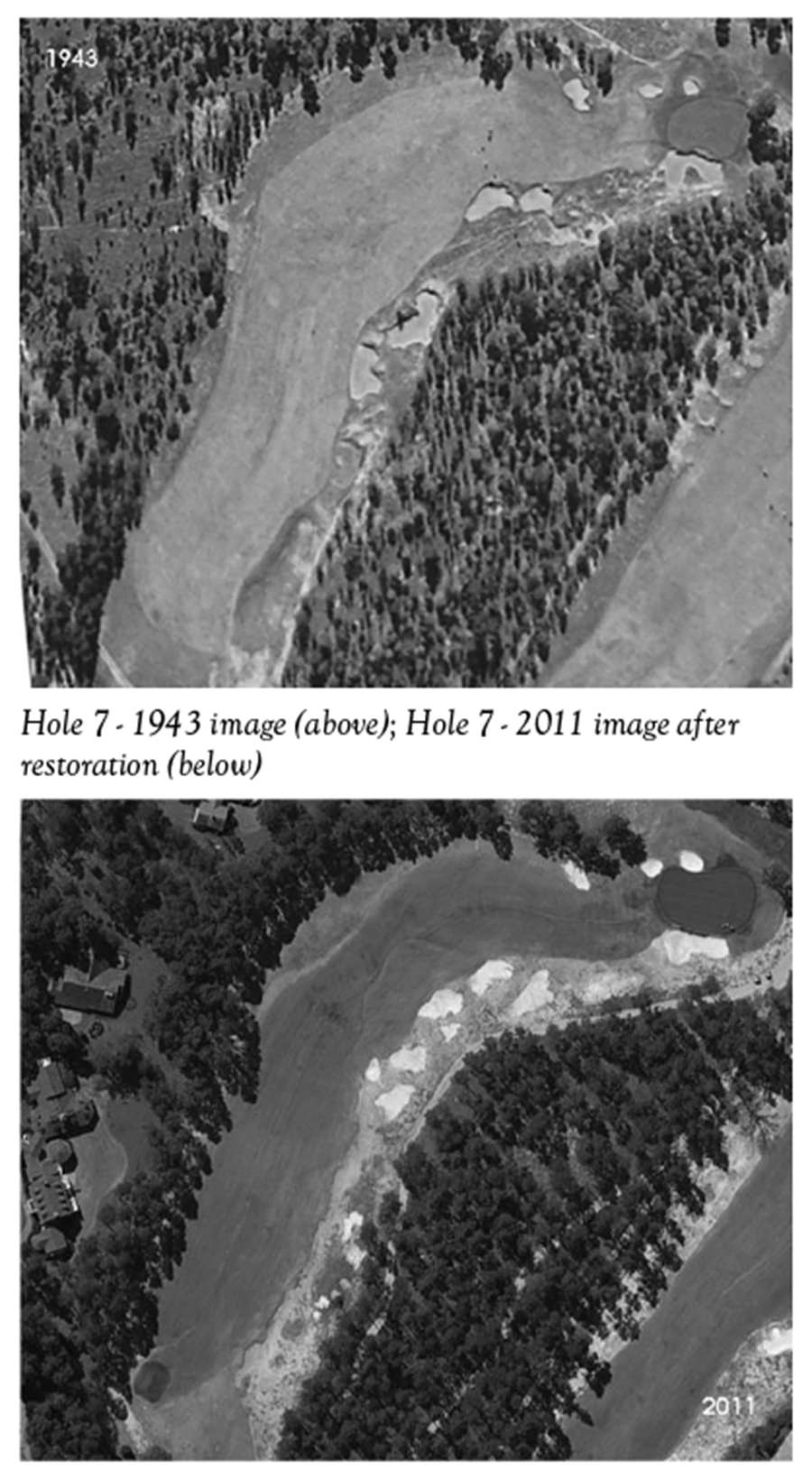
Bob Farren, the man in charge of maintaining the resort’s courses, provided an invaluable first clue. He advised that during the 1980s, his crew had uncovered the entirety of the abandoned fairway irrigation line that Ross had installed in 1932. Farren flagged the path of the defunct line for the architects. Its location confirmed that No. 2’s fairways had previously been configured in a more serpentine fashion. Due to mowing patterns, the fairways gradually became straighter in the 80 years following Ross’ placement of the irrigation line. Farren’s discovery enabled the architects to replot the location and dimensions of No. 2’s fairways to match the old Ross footprint.

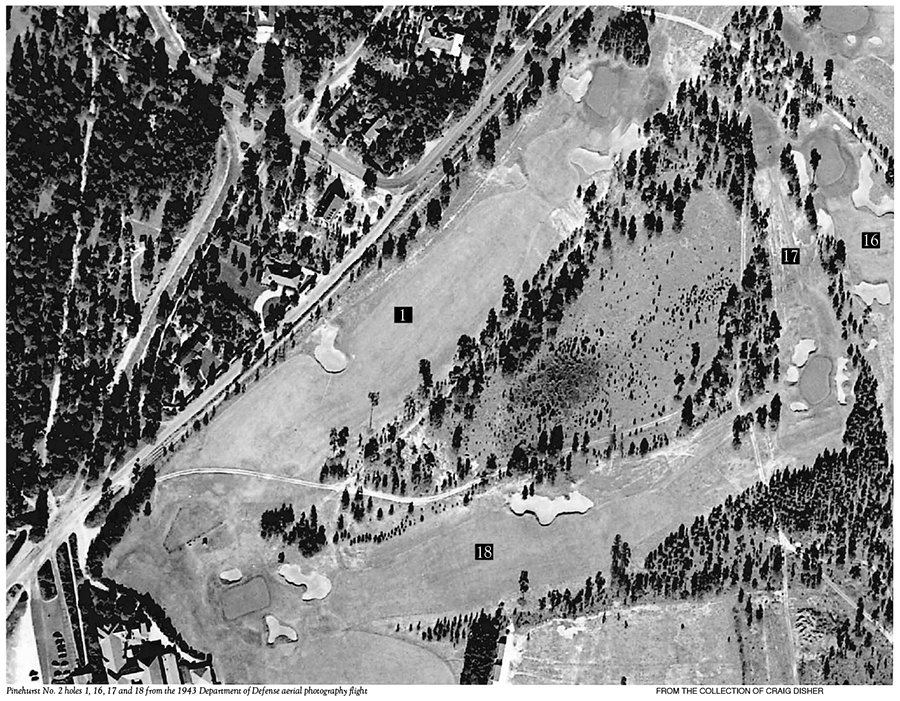
But puzzles remained. What did the old native areas look like? Had the location and shape of greens, tees and bunkers changed any over the years? How did Ross sculpt the bunkers? To find answers, Coore and Crenshaw paid a visit to Pinehurst’s Tufts Archives and combed its remarkable collection of historic photos. Their research proved useful in providing an overview of the course’s general appearance, but photos illustrating hole-by-hole details were few. And those that did exist were snapped at ground level. Bill and Ben had hoped to find aerial photos that might provide a clearer, to scale, perspective of No. 2’s architectural details.

Though intimately familiar with Ross’ design style, absent more detailed photos, they were going to have to engage in a significant amount of guesswork. How could they be sure they were accurately restoring the course to the way Ross had left it or, at least, how he would be inclined to draw it up today? “Lord knows,” reflected Coore later, “we didn’t want to be known as the people who messed up No. 2.”

Unbeknownst to the architects, help would soon be coming their way, in the form of Craig Disher, a 65-year-old Washington, D.C., resident who was a decade into retirement after a 31-year career with the National Security Agency. Disher was an enthusiastic golfer, typically scoring in the low 80s at Manor Country Club in nearby Rockville, Maryland. His zest for the game ultimately steered him toward an avocation of his own creation.

It happened in 2004 after Disher read Lost Links, by Daniel Wexler. According to the book, various federal agencies had photographed vast portions of America from the air, and the millions of aerial images housed at Washington’s National Archives and Records Administration included many of golf courses. The United States Geological Service, the most prolific shutterbug among the agencies, had begun the process of photographing the country in the 1930s. There were various reasons for the program, one of which was inventorying America’s arable land. Even though crops aren’t customarily grown on recreational properties like golf courses, the USGS shot them anyway in the event the land might have to be used for food production or other necessities. This had actually taken place during World War II when “Victory Gardens” were patriotically planted on the nation’s courses, and cows grazed on the formerly pristine fairways of Augusta National Golf Club.

Disher thought it would make for an enjoyable project to search for aerial pics of his home course, Manor CC, designed in 1922 by noted golf architect William Flynn. Besides, the place where the USGS images were stored, NARA, was just a 15-minute drive from Disher’s home. After being directed to the cartography and map research room on the third floor, he got a crash course on the ins and outs of researching and retrieving aerial images from NARA’s vast catalog.

Finding images taken in the USGS project wasn’t a particularly difficult task. Rolls of large 9×9 negatives kept in stored cans were indexed by state, county and date. After identifying the rolls pertaining to a particular county, a researcher would request them, then generally wait a day or two before they were made available. Once the rolls were in hand, the researcher could sift through them on a light table, hunting for particular negatives.

The project was right up Disher’s alley. He enjoyed research and the patience, concentration, and persistence it required. A history major at Gettysburg College, his senior thesis (the evolution of Mao Zedong’s communist philosophy and politics) had necessitated innumerable hours wading through hundreds of magazines, newspapers and other documents at the Library of Congress.

“Organizing and cross-referencing them in the era before computers was great training,” Disher says. “My research at NARA mirrored that experience.”

His resourcefulness was augmented by life experiences. After college, during a stint in the U. S. Army, Disher received training in military interrogation at intelligence school and served as an interrogator during the Vietnam War. A significant portion of his employment at NSA had involved the deciphering of encrypted messages. As Disher puts it, that work, in contrast to library research, “primarily takes place in one’s head.”

From NARA’s index, Disher found that rolls of negatives taken in Montgomery County, Maryland (Manor CC’s location), were available. He found aerial images of Manor taken during the years 1940, 1948 and 1951. He photographed the negatives, then used Photoshop on a computer at home. This resulted in sharp black-and-white photographs that depicted the Manor course in riveting detail.

Delighted with the success of his search, Disher soon became a regular at the cartography and map research room, looking for and collecting aerial images of other golf courses in the Washington, D.C., area. It wasn’t long before his quest extended to courses that interested him around the United States. His most frustrating search involved the Lido Golf Club on Long Island, closed permanently due to wartime needs in 1942. Classic golf architecture devotees reverentially extoll this mystical links, ranking it among the finest ever built in the country. Locating aerial photos of Lido became something of a white whale for Disher, especially after he discovered USGS had not taken any photos in the area.

Undeterred, Disher considered whether the Department of Defense might have photographed Lido. Before and during World War II, DOD had arranged for military installations and areas of strategic importance to be photographed from the air. NARA had materials relating to these aerial flights, but researching them could be vexing due to a lack of indexing. However, NARA did hold records showing the flight patterns of planes that had flown on aerial photography assignments. The paths were depicted by the drawing of black lines of the planes’ tracks on acetate sheets. By superimposing those sheets over a geological map, a researcher could determine the general area where photography had taken place.

The information on the acetate sheets had been converted to microfilm. To search for Lido, Disher “had to look at all the microfilm rolls showing tracks of aerial photography planes in Long Island prior to 1942. Each roll of microfilm had to be viewed from start to finish, stopping at each track image to see if it passed over the area of interest.” Once those track images and the associated roll of negatives were identified, Disher would order the can containing them. The wait for the cans took additional time, since DOD images were in cold storage outside of D.C.

“It took me a month, but I finally found an undiscovered 1940 aerial photo of Lido,” he says. Disher shared the image with golf historians, and the highly detailed photograph subsequently appeared in several golf magazine articles, spurring an ongoing movement to someday recreate Lido’s majestic course.

Slowly, people in golf became aware of Disher’s research. Given the architectural trend of restoring classic courses to their original design, old photos — especially aerials — were in high demand. Without any thought of benefitting financially from his unique hobby, Disher cheerfully shared access to his collection gratis with grateful golf clubs and course architects who asked for his help. Disher furnished them 16×20 prints of aerial photos that were used in field work. Later the same prints often found their way to clubhouse walls.

In 2005, the avid golfer and his wife, Susan, acquired a vacation home in Pinehurst. This development, naturally, caused Disher to scope the USGS collection at NARA for images of No. 2. When he got wind of the fact that the Pinehurst resort intended to restore No. 2 to its original Donald Ross design, he thought the USGS photos might be of value to the architects. When he retrieved the images, Craig  found to his frustration they lacked sufficient detail to be of much use. He wondered whether there was a possibility DOD might have also photographed the course. Pinehurst was only 26 miles from Fort Bragg, a base Disher knew well. During his ’60s hitch in the Army, his basic training had been at Bragg. Disher knew area flights involving aerial military photography likely would have departed from nearby Pope Air Force Base. He knew Pope, too. In 1968, he was deployed from there to Vietnam, where he had joined a brigade of the 82nd Airborne Division.

Still, it was a long shot. Even if an aircraft had veered that far west, would the camera have been turned on and clicking after leaving the airspace over the base? Disher found and reviewed the track of a Christmas Day 1943 DOD flight of a plane photographing Fort Bragg. The track showed the plane had, indeed, traveled west toward Pinehurst, reaching the edge of the town before backtracking to Pope. Having identified the flight he was looking for, Disher asked to see the roll that would include the negatives. It would take a week before the roll arrived at NARA. Anxiously, Disher awaited the delivery of the Christmas Day flight photos.

When he finally flashed through the roll, Disher found the images of No. 2. He eyed what were, perhaps, the clearest aerial photos of a golf course he had yet encountered. While aloft over No. 2, the plane had flown lower than was customary. Who knows, maybe the pilot played golf and wanted to take an up-close look at the famous course. Regardless, the details shown of the bunker contouring, tee and green shapes, trees and native areas were strikingly vivid. The aerial camera, clicking away every few seconds, had also captured excellent images of the Pine Needles and Southern Pines courses.

Through a mutual friend, Disher contacted Coore and informed the architect of his find. Arrangements were made for Coore and Crenshaw to stop by Disher’s home in Pinehurst to inspect the photos from the 1943 flight that encompassed the entirety of No. 2. Disher arranged them on his dining room table to appear as a single photograph.

The architects were astonished at what they saw. The photos depicted exactly what they needed to assure themselves they were on the right track. As Crenshaw put it, “it was the confirmation we had been looking for.”

With Disher’s photos serving as their guide, Coore and Crenshaw completed No. 2’s restoration in March 2011. Gone was the matted rough. In its place were the native areas that had characterized Ross’ course. Indigenous plants such as red sorrel, spiderwort and spotted beebalm now grew haphazardly off the fairways. Bunkers were reshaped with the scruffier edges that had marked their appearance in the 1943 aerials. Some bunkers were eliminated, others restored. Several tees were moved to restore the driving challenges Ross had envisioned. Based on the 1943 photograph, the 15th green was widened to its right side by one-third. With areas off the fairway no longer watered, the course looked browner and more natural. Seven hundred of No. 2’s 1,100 sprinkler heads were eliminated, trimming water use in half. Fairways were widened and shaped to approximate their dimensions during the Ross era, thus allowing for alternative routes for approaches into greens.

The restoration was universally praised in golf circles, and the 2014 U.S. men’s and women’s Opens proved to be memorable successes. Fears that the changes to course No. 2 would render it too easy proved overblown. Only three men, including winner Martin Kaymer, and one woman, Michelle Wie, broke par.

“Craig was so instrumental in our work at No. 2,” says Coore of Disher. “I’m not sure we could have accomplished what we did without him.”

Disher became the go-to source for aerial photos of historic courses and has been called upon by architects like Ron Forse, Gil Hanse, Kyle Franz, Jim Urbina and Davis Love Jr. Now 76, Disher is gratified that what began as a pleasant diversion ended up contributing so much to golf. “My research introduced me to some of the nicest people I’ve ever met and taken me to golf courses I never dreamed I would see,” he says. “If you are searching for something you think can’t be found, it probably can be.  PS

Pinehurst resident Bill Case is PineStraw’s history man. He can be reached at Bill.Case@thompsonhine.com.

Almanac

September

By Ashley Wahl

September is deliciously subtle. Like a sly smile in a moment of silent recognition.

The last wave of swallowtails graces the garden. Dinner plate dahlias resemble colorful mandalas and sun-dappled muscadines spill from the vine.

Life hums along. Hummingbirds drink from red spider lilies. The air, too, is like nectar — sweet as it’s been all summer — but something is different. Something not yet palpable.

The trees know, leaves whispering ancient incantations to merge with root and earth. The first to surrender glow with radiant splendor. They cling to nothing, unattached to their green summer glory or the luminous journey to come.

Weeks from now, tree swallows will gather by the hundreds at dusk, swirling across the sky like cryptic, flickering apparitions. But today, sunlight kisses goldenrod. Robins dip and shimmy in warm, shallow water. Plump bees float in endless circles.

By evening, the air is slightly cooler, or so it seems. And at twilight, when shadows dance in the periphery, a mourning dove cries out.

Coo-OO-oo.

Beyond a wild tangle of late summer flowers and grasses, a red fox flashes past, here and gone with the last whisper of golden light.

As darkness falls, all at once it’s clear: Elusive autumn has returned, creeping into consciousness like an impish melody — a dark, playful secret on the tip of your tongue.

The goldenrod is yellow;

The corn is turning brown;

The trees in apple orchards

With fruit are bending down.

— Helen Hunt Jackson, “September”

Harvest Season

The Autumnal Equinox occurs on Wednesday, September 22. The days are growing shorter. As for the glorious bounty of summer? It’s harvest time.

Praise for the apples, pears and figs. Cucumbers, peppers and eggplant.

As the garden gives and gives, offer thanks for the tender young salad greens; the last plump tomatoes; the earliest pumpkins and winter squashes.

And don’t forget the edible flowers.

Like lavender (sweet and minty), marigold (transform your stir fries) and snapdragons (bitter, perhaps, but they sure are gorgeous).\

The Meadow Queen

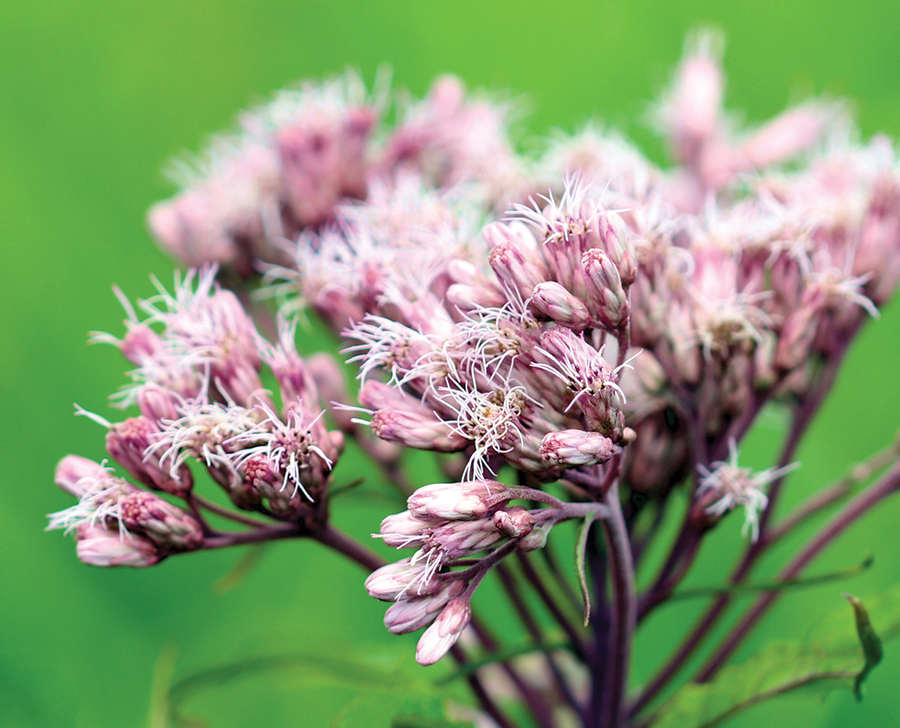
If you’re wondering where that faint yet lingering vanilla fragrance is coming from, stop and smell the purple joe-pye weed — unless you’re allergic.

As the story goes, Eupatorium purpureum received its common name — joe-pye — after a gentleman of the same name presumably used the wild plant to cure typhoid fever. An herbaceous perennial of the sunflower family, joe-pye is a native species that blooms in later summer and attracts a host of bees, butterflies and moths.

Also known as kidney-root, feverweed and Queen of the Meadow, when this towering beauty begins to bloom — clusters of pinkish-purple flowers exploding from 7-foot stalks — watch and listen closely: Summer’s swan song is nigh.

Georgia O’Keeffe and Friends

A new exhibit welcomes a modernist master

By Jim Moriarty

Beginning on the 10th of September the Reynolda House Museum of American Art will be throwing a welcoming party for a particularly interesting work by Georgia O’Keeffe, the renowned 20th century American modernist. The celebration, housed in two rooms, continues until March 6. As if to make the iconic painter of flowers and skulls feel at home in her new home, she’ll be accompanied by old friends, the artists she appeared alongside in famed photographer Alfred Stieglitz’s series of Manhattan galleries — 291, An Intimate Gallery and An American Place — and the ones she chose to surround herself with during the rest of her life in an exhibition titled “The O’Keeffe Circle: Artist as Gallerist and Collector.”

“We wanted to welcome the painting to Reynolda with a splash,” says Phil Archer, the museum’s deputy director.

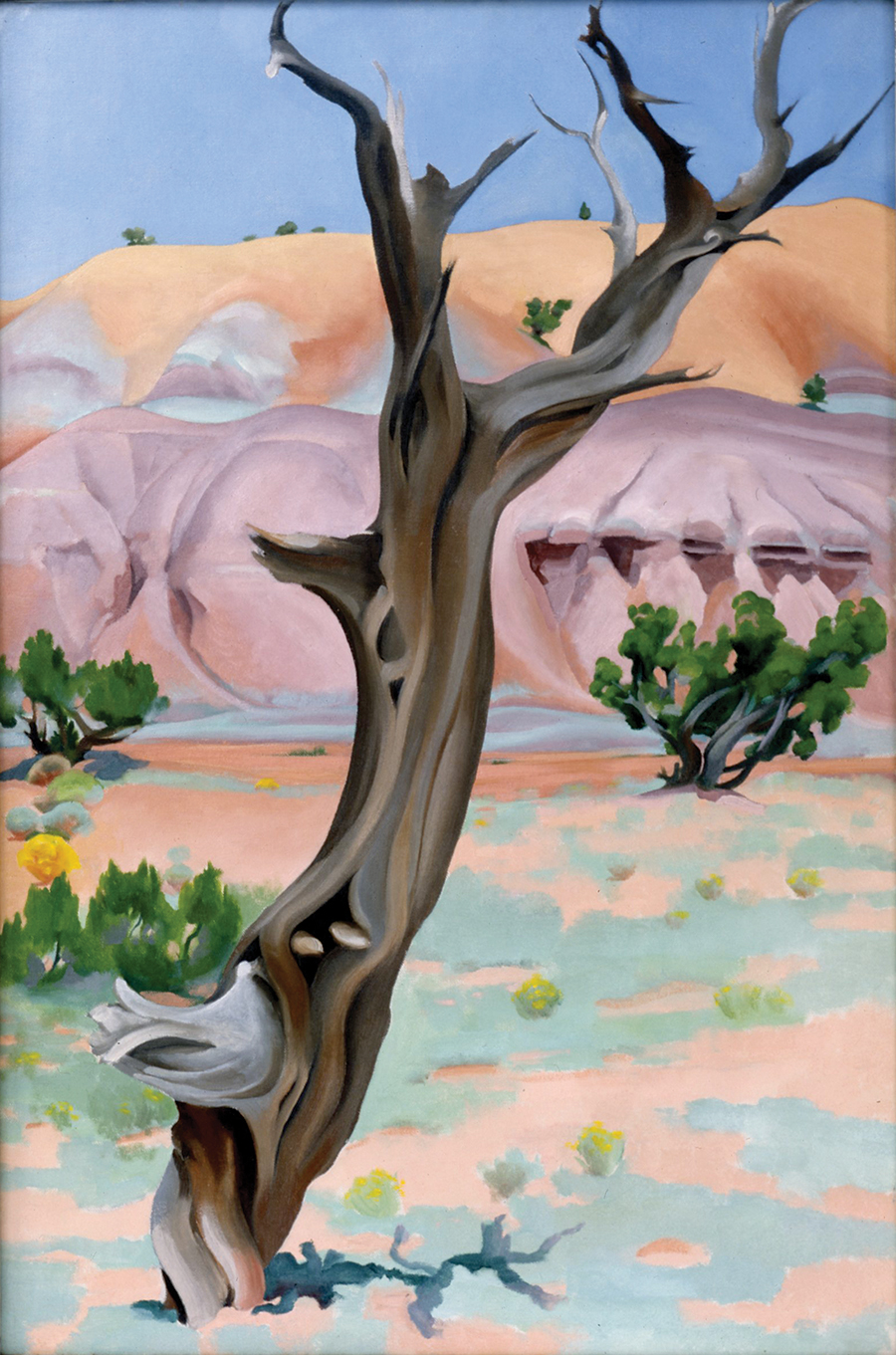
The work, a promised gift from Barbara Babcock Millhouse, the founding president of the museum and its primary donor, is Cedar Tree with Lavender Hills, one of O’Keeffe’s works depicting her beloved New Mexico landscape, first exhibited at An American Place in 1937 and purchased by Millhouse 40 years later. “I have O’Keeffe’s letter to her husband, Alfred Stieglitz, about doing that painting,” says Archer. “She says, ‘I can set it by the window and when I look at the painting and I look out the window, I have actually captured the way my world looks.’”

The painting will appear alongside another O’Keeffe work already in the museum’s collection, Pond in the Woods, Lake George. “It’s great for Reynolda because we’ll now have a painting from each of O’Keeffe’s main loci of inspiration,” says Archer.

Georgia O’Keeffe, Cedar Tree with Lavender Hills (1937), promised gift of Barbara B. Millhouse. © 2021 Georgia O’Keeffe Museum/ Artists Rights Society (ARS), New York

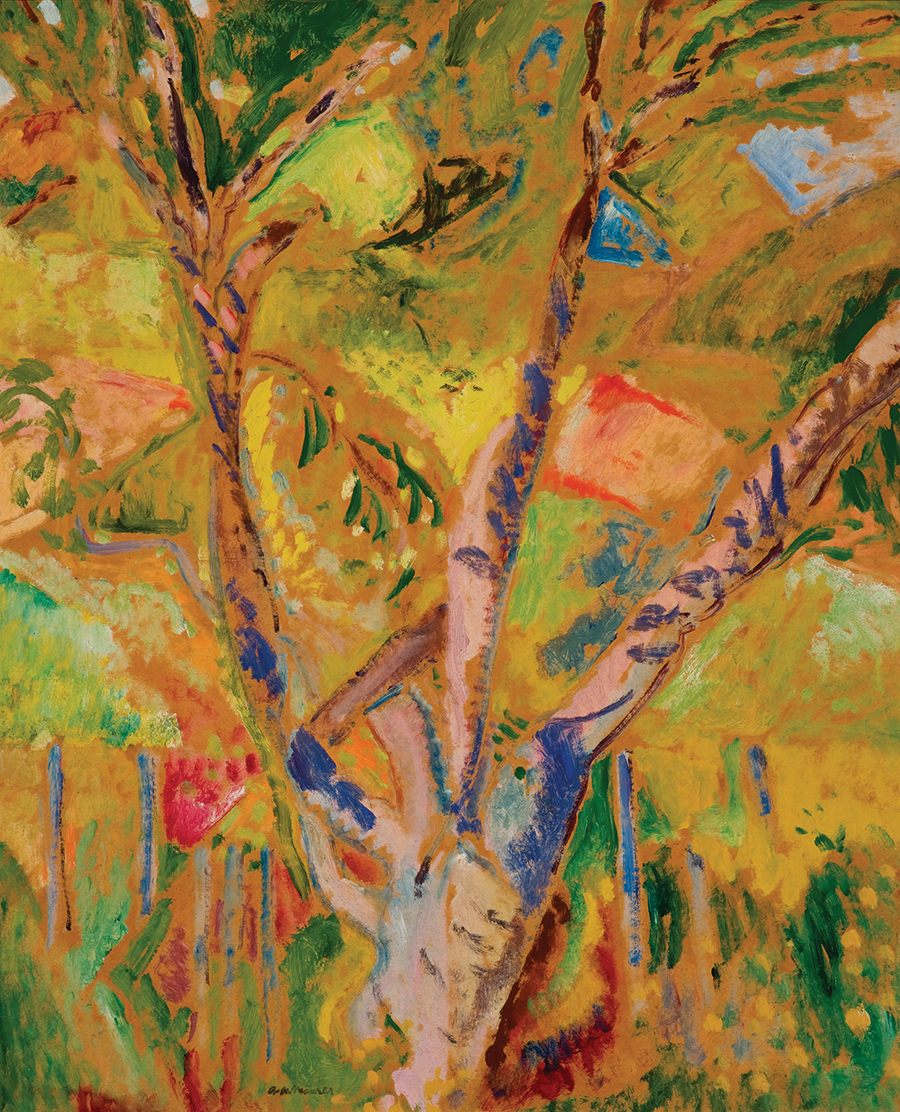
Joining O’Keeffe will be a brace of her contemporaries, including John Marin, Arthur Dove, Alfred Maurer, Marsden Hartley, Max Weber, Abraham Walkowitz and Charles Demuth, a flock of artists more often described as the Stieglitz Circle but who are recognized here for their effect on, friendships with and passion for O’Keeffe. “Stieglitz was always declaiming who was the next artist and why people should appreciate them,” says Archer. “The exhibit is kind of a pocket-sized pantheon of the great, early moderns. They’ve all drunk from the well of French modernism. They’ve all read Kandinsky about the spiritual potential of art and abstraction. There’s this kind of reckoning. What will Americans make of the new artistic world in the teens and twenties? That’s what Stieglitz was calling for — what will modernism mean for us?” And, in Stieglitz’s mind, the abstract movement went hand-in-glove with the elevation of photography as an art form all its own.

Demuth was not originally in the Stieglitz stable, but in 1921, when he became “one of us,” as O’Keeffe described him, she enjoyed his company immensely. A friend of the poet William Carlos Williams, he was elegant and urbane, a gay artist with a lively sense of humor but frail health. Though he turned to oils later in his life, he was best known as a lively watercolorist. As a mark of his friendship with O’Keeffe, when he passed away in 1935, he left all his oil paintings to her.

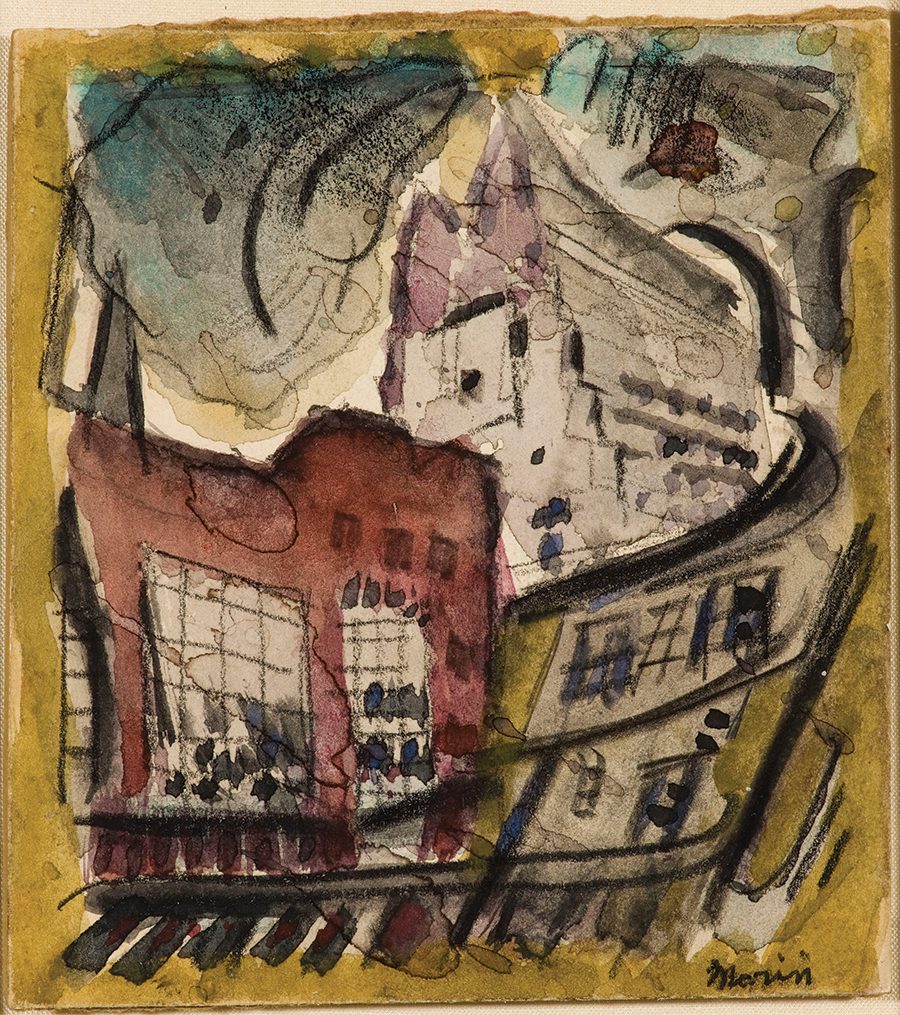
Marin was introduced to Stieglitz by his friend and fellow photographer Edward Steichen and became enough of a commercial success to buy his own small island in Maine, where he lived during the summer. O’Keeffe admired his work, including a blue crayon abstract drawing. In Georgia O’Keeffe: A Life, Roxana Robinson writes, “Its intimate scale and its clear aesthetic independence made it suddenly accessible to O’Keeffe: conceptually, this was very close to her own work. It occurred to her that if Marin could make a living selling this eccentric expression of a private aesthetic vision, then she might be able to do the same.” He was close enough to both Stieglitz and O’Keeffe to be a witness at their 1924 wedding.

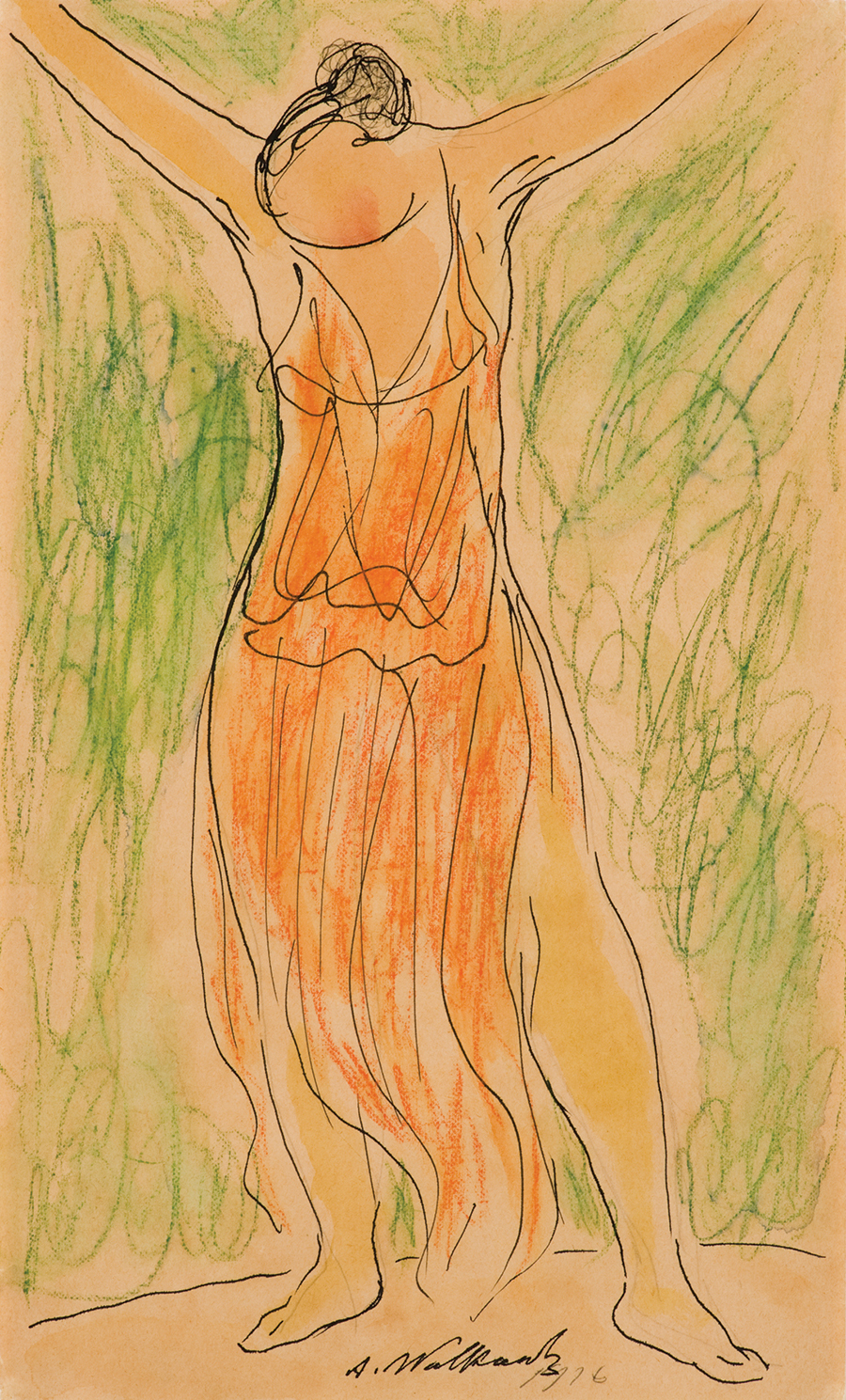
Abraham Walkowitz, Isadora Duncan (1916), colored crayon, watercolor, ink and graphite on paper, Gift of Mr. and Mrs. Joseph Hirshhorn in honor of Nancy Susan Reynolds

O’Keeffe’s first exposure to Dove at 291 was his painting Leaf Forms. After returning from Europe in 1909, Dove spent weeks camping alone in the woods. His abstract paintings “found a strong echo in Georgia’s developing aesthetic philosophy,” writes Robinson. “Dove’s work validated her own inclinations . . . she sensed the deep affinity between them.”

Dove was equally enamored. “That girl is doing without effort what all we moderns have been trying to do,” he said to the poet Jean Toomer.

Walkowitz worked so closely with Stieglitz at 291 that in 1912 and again in 1914 Stieglitz exhibited the work of the children Walkowitz was teaching in a Lower East Side settlement house. In this exhibit, Walkowitz is represented by one of his 5000-plus drawings of Isadora Duncan. “She had no laws. She did not dance according to the rules. She created,” Walkowitz said — words that he could have applied to O’Keeffe just as readily.

Paintings by Pablo Picasso, Henri Matisse and Paul Cézanne, and Auguste Rodin’s drawings were first shown in America at 291. Marin and Maurer appeared on their heels. Maurer, like O’Keeffe, had studied with William Merritt Chase. Maurer’s father created Currier and Ives lithographs and never approved of his son’s modernist leanings. Shortly after his father passed away at the age of 100, Maurer committed suicide. The mercurial Weber was responsible for Henri Rousseau’s first U.S. exhibit, and he helped introduce cubism to America, a thankless task in 1911. According to the art historian Milton Brown, he was rewarded with “one of the most merciless critical whippings that any artist has received in America.” And it was an exhibition of Hartley’s work that first brought O’Keeffe to the 291 gallery where she met Stieglitz. Soon they would be lovers.

John Marin, Downtown, New York, c. 1925, watercolor and graphite on paper mounted to board, Gift of Betsy Main Babcock, 1966.2.1 © 2021 Estate of John Marin / Artists Rights Society (ARS), New York
Max Weber, The Dancers (1948), oil on canvas, Gift of Dorothy F. and Maynard J. Weber, Reynolda House Museum of American Art

Though the works linked to O’Keeffe as a collector, or perhaps appreciator, in the exhibit are not the precise pieces she held in her collection, they are representative of those that were and of the relationships she enjoyed. Among the latter is her abiding friendship with Ansel Adams, who is represented by one of his prints of Yosemite Valley, a place O’Keeffe and Adams visited together. In a letter to Stieglitz, Adams wrote, “O’Keeffe is supremely happy and painting, as usual, supremely swell things. When she goes out riding with a blue shirt, black vest and black hat, she scampers around against the thunder clouds — I tell you, it’s something.”

The exhibit includes a photograph of Adams and O’Keeffe taken by Adams’ assistant, Alan Ross. “Ansel Adams was the first professional photographer to capture her on camera and then in 1981, close to both of their deaths, she went back to Carmel, California, and, as she’s setting up, she’s sort of smiling, his assistant took a quick snapshot,” says Archer.

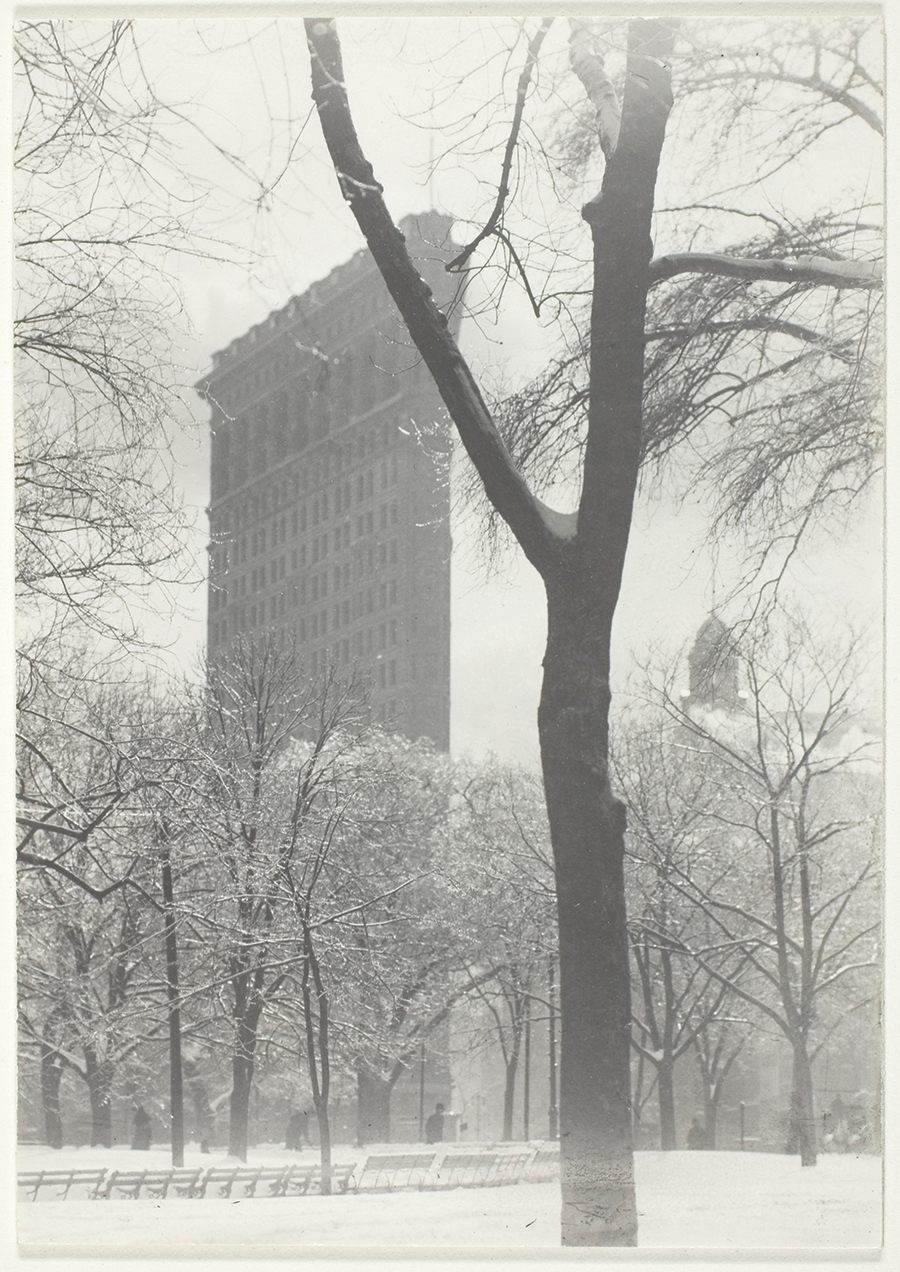
Also included in this section of the exhibit is an Akari paper lantern by Isamu Noguchi similar to the one O’Keeffe alternately hung over her dining room table or her bed in her house in Abiquiu, New Mexico. There is a mobile by Alexander Calder — who designed the OK pin O’Keeffe wears in countless photos — that is analogous to the one O’Keeffe hung in her New Mexico home. A triptych of snow scenes done in the 1850s by Utagawa Hiroshige is also included as an homage to a similar threesome of Hiroshige woodblock prints from the same period that lived on the wall in O’Keeffe’s New Mexico home and are now at the Metropolitan Museum of Art. And, naturally, there is a Stieglitz print, one of his most famous, also a snow scene. “I suddenly saw the Flat-Iron Building as I had never seen it before,” Stieglitz said. “It looked, from where I stood, as if it were moving toward me like the bow of a monster ocean steamer, a picture of the new America which was in the making.”

Alfred Henry Maurer, Landscape: Provence (circa 1916), oil on paper, mounted on board, Reynolda House Museum of American Art, Gift of Emily and Milton Rose

This intimate exhibition does not pretend to be, nor was it intended to be, an O’Keeffe retrospective. It does not deal with her complicated relationship with Stieglitz — who never ceased to promote O’Keeffe’s work — their lengthy affair before his divorce, their subsequent marriage and, later, his affair with his gallery director, Dorothy Norman. It doesn’t delve into her mental and physical breakdowns in the ’30s nor does it touch on the sexuality, male and female, that is often ascribed to O’Keeffe’s work and which she steadfastly refused to acknowledge.

Like Stieglitz’s photo of the Flat Iron Building, O’Keeffe saw grandeur in her subjects. “She wanted the small things in nature that she loved to be just as impressive as the new trains and new planes,” says Archer, “to stop you in your tracks like you were looking at a skyscraper.”

The tightly knit exhibit, like the Ross photo, is a snapshot of the artist. “I hope people will leave with a fuller image of O’Keeffe’s engagement with the art of her time,” says Archer. “She developed a persona — helped by Stieglitz — of the remote, contemplative, detached doyenne of the desert. But she was keenly interested in her contemporaries’ work and unstinting with both praise and criticism.”  PS

Jim Moriarty is the Editor of PineStraw and can be reached at jjmpinestraw@gmail.com.

Alfred Steglitz, The Flatiron (1903), photogravure on tissue, courtesy of a private collection

Story of a House

The Other White House

Retirement leaps out of the rocking chair, into the barn

By Deborah Salomon     Photographs by John Gessner

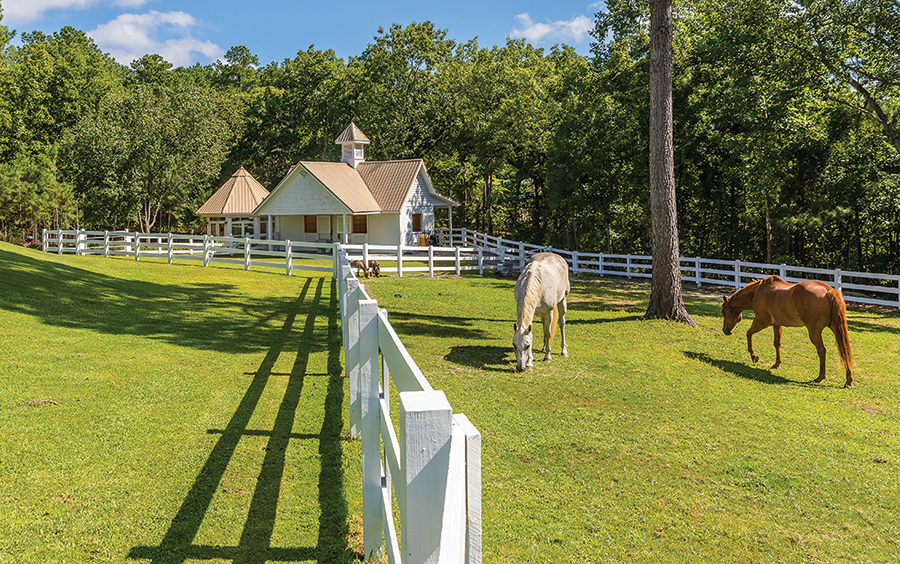
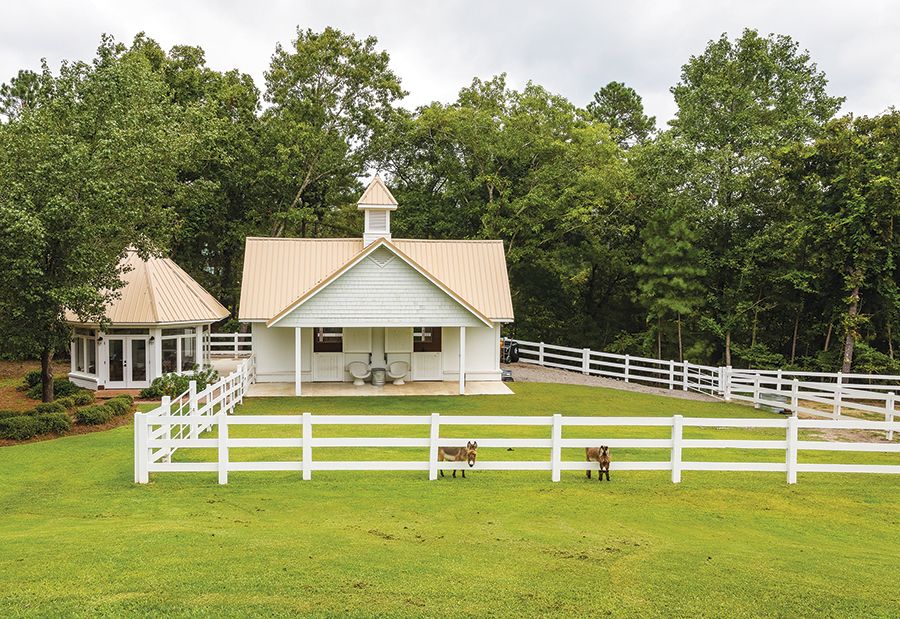
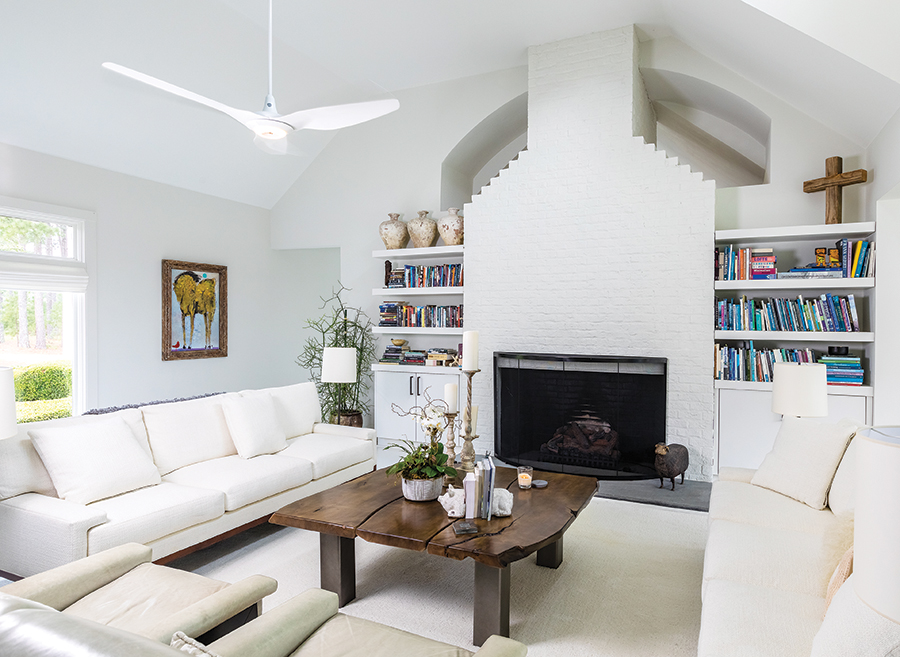
Their go-to color is a non-color, white. For Elizabeth “Boo” DeVane and her husband, Ron Gibson, this preference starts at home, where a white wooden porch swing hangs from an ancient pin oak centering the circular driveway, flanked by white gateposts.

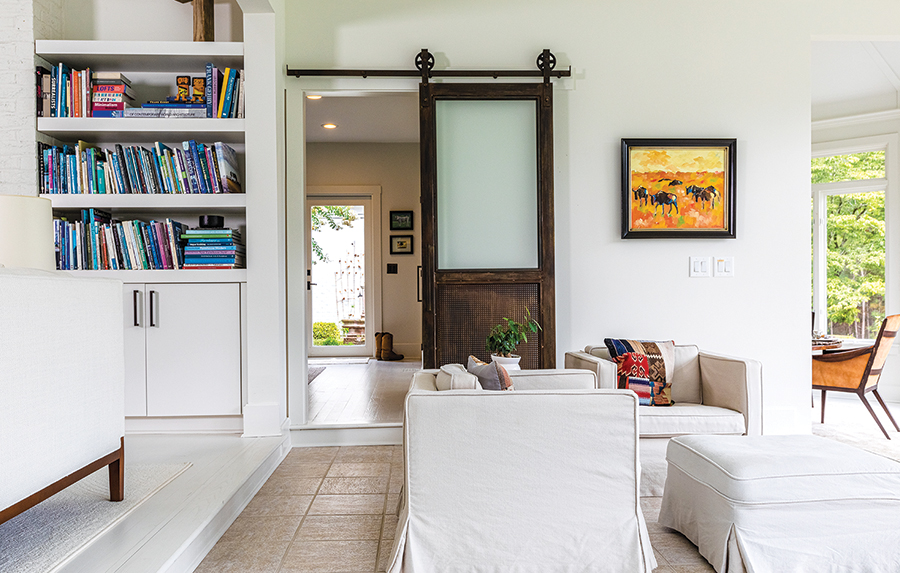
Their white brick house on a sculpted five acres near the Pinehurst-Aberdeen line explores other possibilities: white, barely touched with green for most interior walls; hardwood floors painted glossy white; white area rugs and white upholstery. Gradually, in rooms off a “spine” hallway that runs the width of the house, pure (but never stark) white melts into vanilla, cloud, sand, latte, putty, ash and, finally, cocoa.

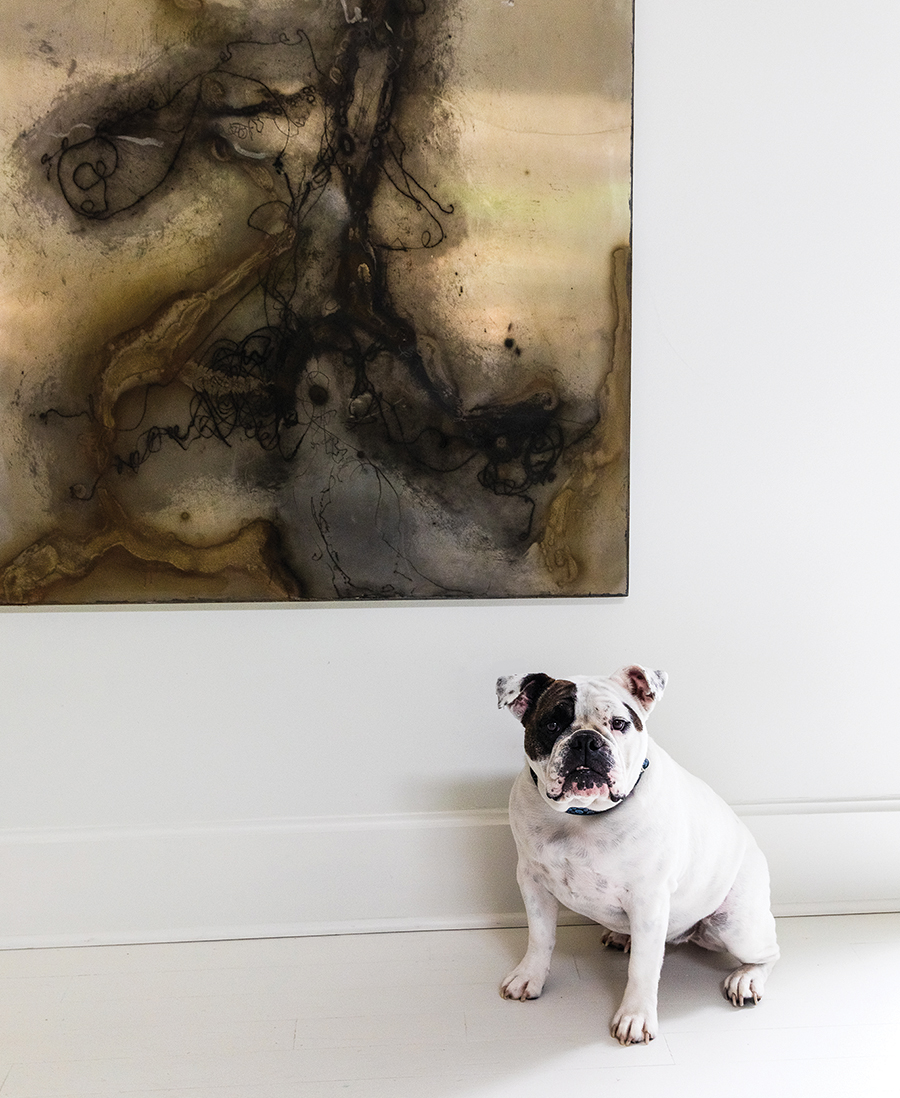
Even the English bulldog, Bella, continues the palette.

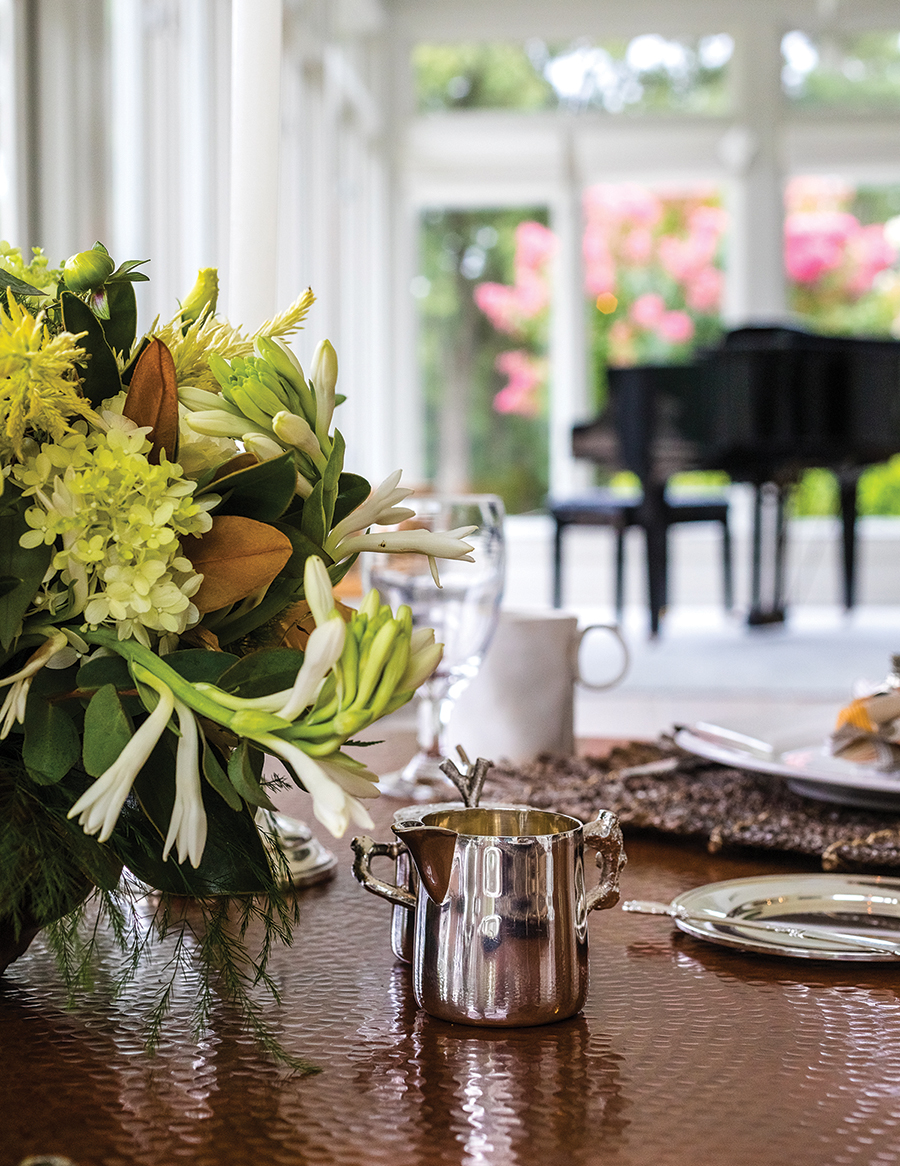
Beyond the white-out, in the sunroom bay stands a gleaming black baby grand, which Ron plays. Off the living room, a darkened alcove holds two 180-gallon tanks, one run by a computer, both protected from power outages by a designated generator, containing an aquarium-worthy array of tropical fish and live coral. Their plumage and movements — calming, mesmerizing.

They are Ron’s babies.

Boo’s babies decorate the landscape visible through arched, elaborately framed oversized windows — two quarter horses (one white, one tan) and young donkey twin sisters (grayish-beige and very friendly) who live in a white barn adjoining the pasture. Bella has her own grassy enclosure surrounded by a white picket fence.

However, Boo — born on Halloween, nicknamed by her brother — and Ron have not forsaken all color. They collect art . . . bold, exciting canvases in primary hues selected by Boo’s educated eye. A room at the Fayetteville Museum of Art was dedicated to her parents, collectors Jim and Betty DeVane.

Ron and Boo, handsome retirees oozing energy, lived previously in Fayetteville and Topsail Beach. He was a school psychologist and military consultant specializing in autism. Boo left North Carolina at 18, attended New York University and worked in Manhattan managing arts-related nonprofits before returning to the family business. Along the way she accumulated interior design experience implemented by friend, designer and fellow horsewoman Cathy Maready.

In retirement, Ron’s tan comes from gardening, not golf. Boo works with rescued horses. How they met and accidentally eloped to Costa Rica after a 12-week courtship resembles a 1990s date flick starring Meg Ryan and Tom Hanks.

The equestrian community drew them to Moore County, first on an isolated farm, then a too-small house in Pinehurst.

Let’s reverse the retirement trend and upsize, they decided.

“While Ron was away, I checked around to see what was out there,” Boo recalls. Tinker Bell couldn’t have found anything more perfect.

Twin Oaks Farm, as they named it, was built in 1997 by Robert Clarke, a California “architect to the stars,” for his own family. This usually bodes well for materials and originality. Clarke’s home, however, presented a mixed bag, with those top-dollar windows sited for maximum natural light but Pergo laminate floors and a small unimaginative kitchen. Fixable, Boo decided. The five overgrown acres beckoned gardener Ron. Boo envisioned two pastures and a barn, which they built after moving in. Both were fascinated with the ceilings: vaulted, angled, slanted, mansard, one with a clerestory which draws light into the white living room, another supported by a trapezoidal beam — anything but flat.

They grabbed the house in 2019 and went to work.

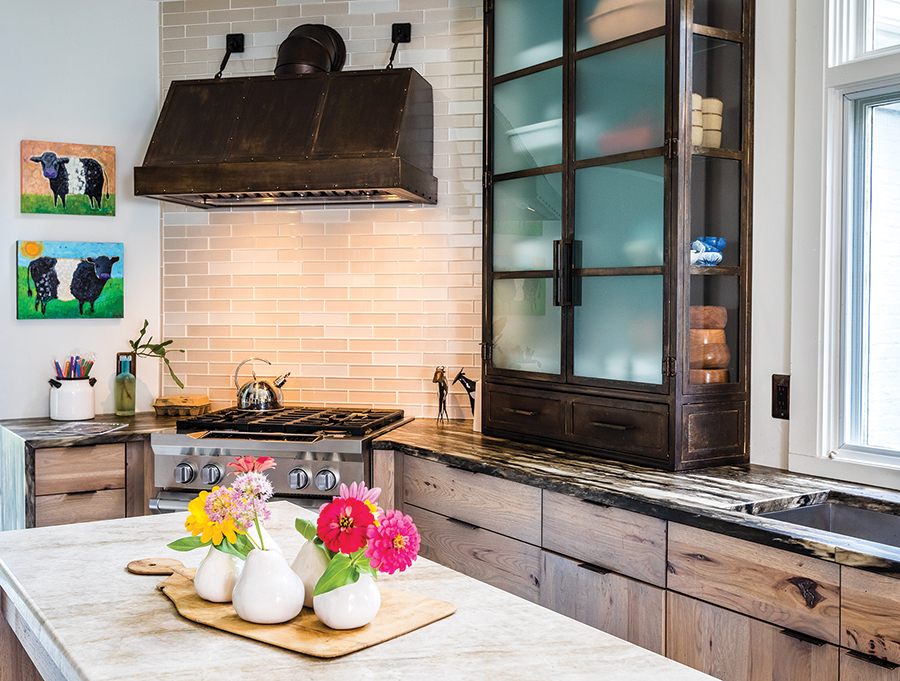
Up came the Pergo, down went hardwood covered with layers of glossy white paint. The story-and-a-half floorplan remained intact except for the kitchen, which Boo gutted and replaced with something from a magazine. The result, definitely not white, stands apart from Pinehurst glamour kitchens. It’s a moderately-sized galley with a worktable, no island, earth tones, clean lines and natural materials that impart an Asian aura. Countertops are marble but not tombstone white. Instead, they have a brown-grey toned leather finish, the same coloration appearing on wood cabinetry, dishwasher and refrigerator fronts. Cupboards are textured metal and frosted glass. A small coffee bar faces a smaller wine rack. No faux-farm sink, no visible breakfast bar until Ron, with a wicked smile, draws a folded flat surface from beneath the countertop, opens it out and pulls up two chairs. Just as original is a small gas fireplace sealed waist-high into a brick column — instant comfort on a chilly morning.

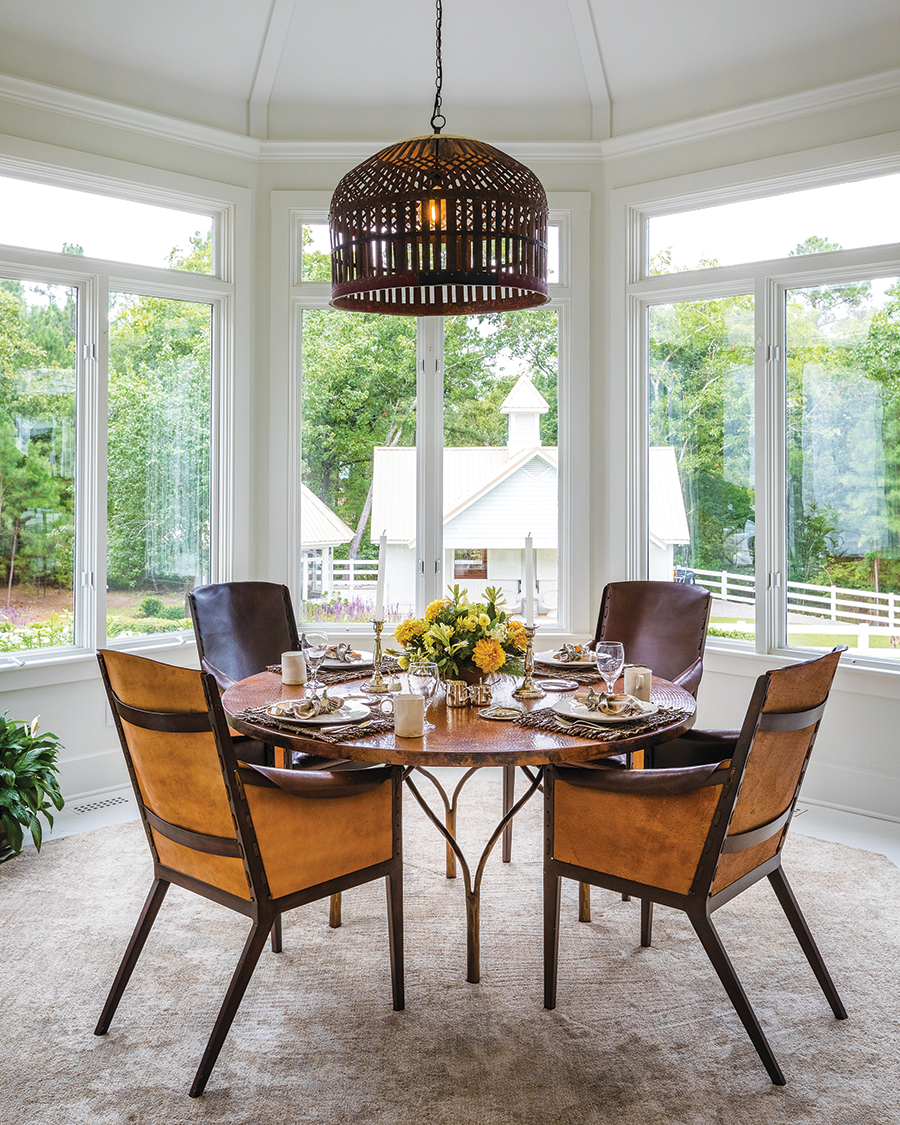
There’s no formal dining room, either, just a large sunroom adjacent to the kitchen, with a round hammered copper table seating eight.

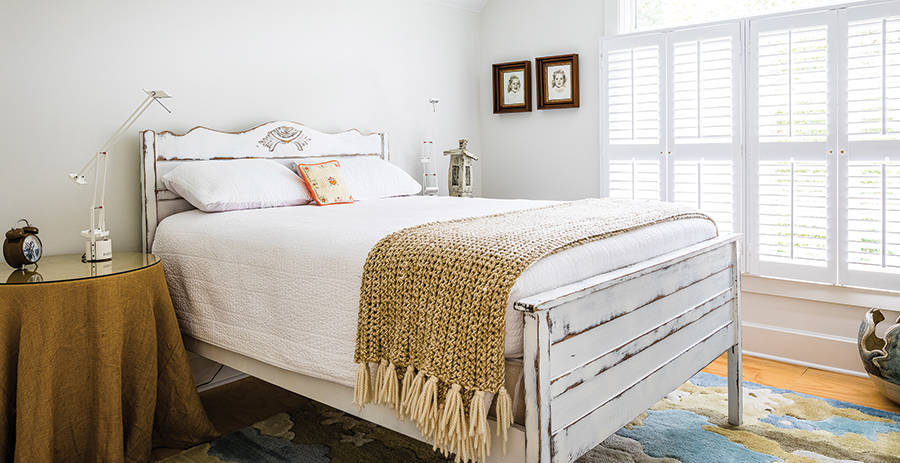
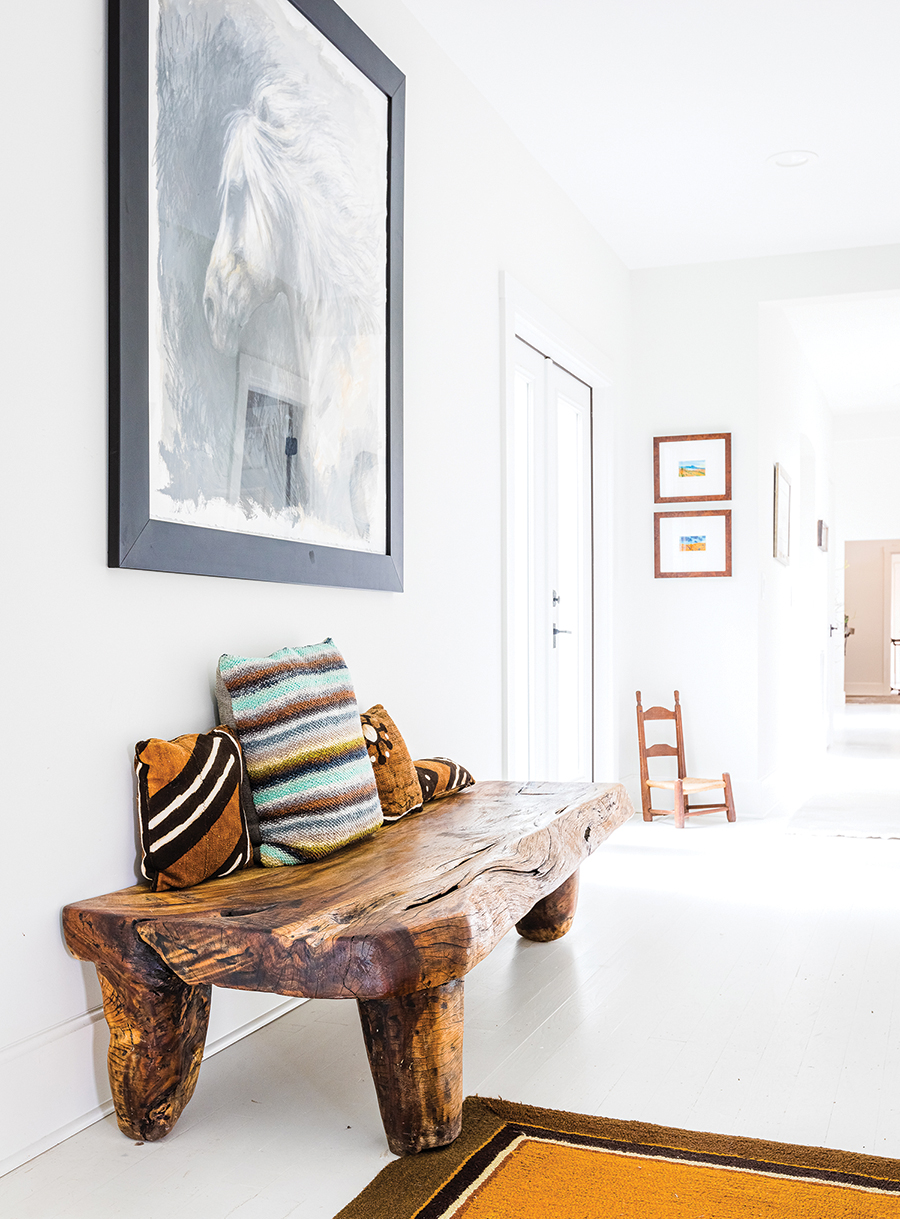
Woven area rugs, upholstery and linens in the main floor master suite and guest bedroom combine pale earth tones with tiny geometrics. Several family antiques — including a secretary and drop-leaf table Boo grew up with and a guitar from Ron’s father — blend nicely with metal headboards and a reupholstered slipper chair from Ron’s mother. Fearlessly, in the hallway and master bedroom Boo added massive tables and benches fashioned from tree-trunks. Their heavily glossed knots and grains contrast to more delicate patterns and colors used throughout, including shimmering drapes in the guest bedroom, the only window with a fabric covering.

Stairs to the second floor rise from near the end of that spine hallway. Here, Boo has an office-sitting room furnished with less white and more brown, although her desk is assembled from a distressed white antique door, its frame serving as legs. She repeats the wall-enclosed gas fireplace for thermal and decorative purposes.

The upstairs bedroom, prettier than a coastal B&B, accommodates Boo’s adult children when they visit.

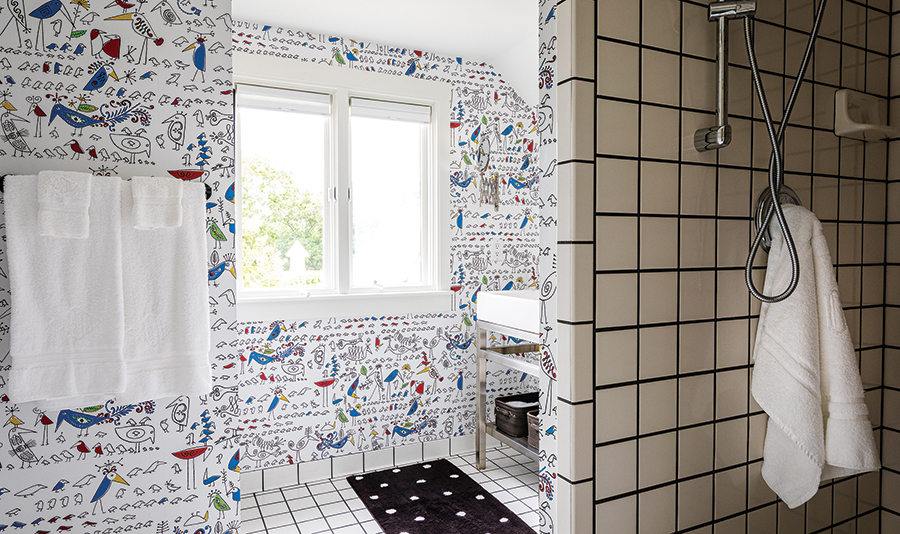
Boo really lets loose in the bathrooms, perhaps to compensate for original white tiles outlined in black, which she disliked. However, instead of ripping them out, she let the geometrics set a tone. One wallpaper is made from shredded newspaper while another is black curls splashed against a white background. Whimsy rules the upstairs bathroom, where black stick figures in colorful garb imitate the drawings of Paul Klee or, perhaps, Wassily Kandinsky.

As for art, all bets are off. Pale earth tones don’t apply. Brightly-hued animal subjects include a folk art pig in one bathroom, a fanciful horse head by local artist Meridith Martens in the hallway, and upstairs, a bright, cartoonish guinea hen with a story. They saw it, liked it, but it was gone when they returned to purchase it, expense be damned. Years later, guess what showed up in another gallery?

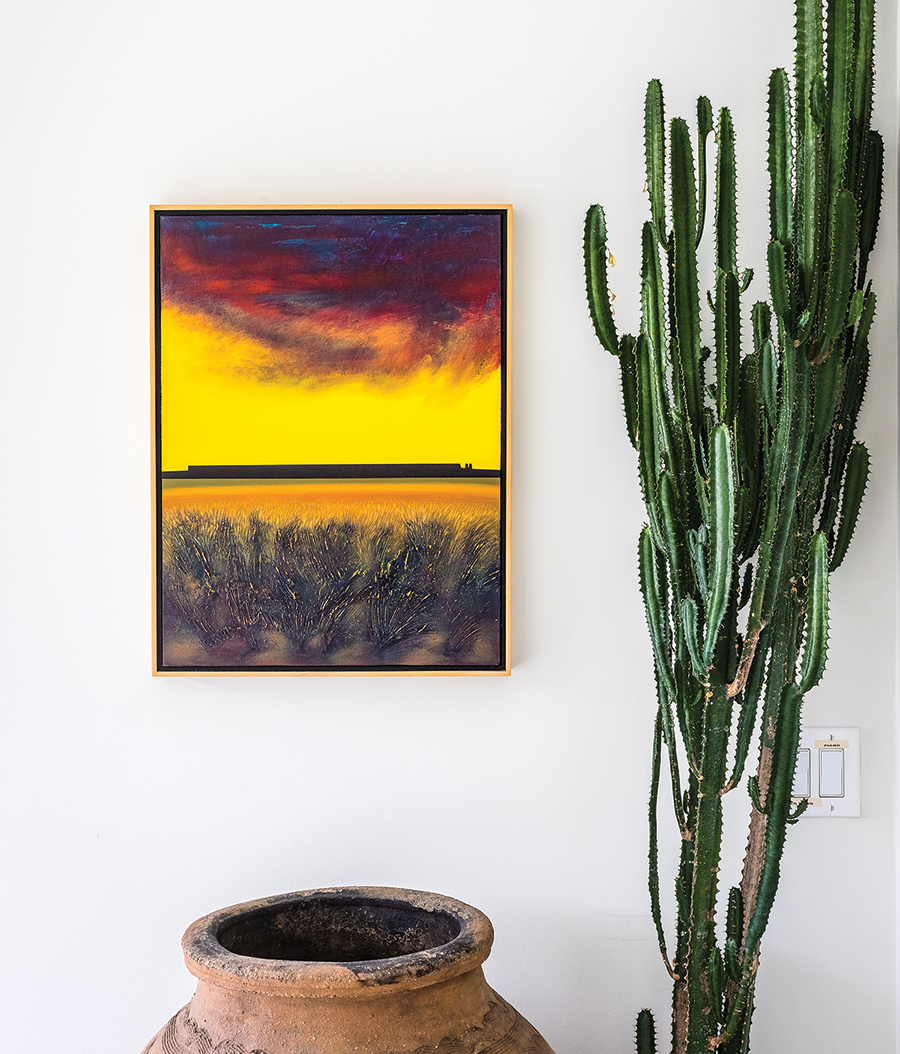
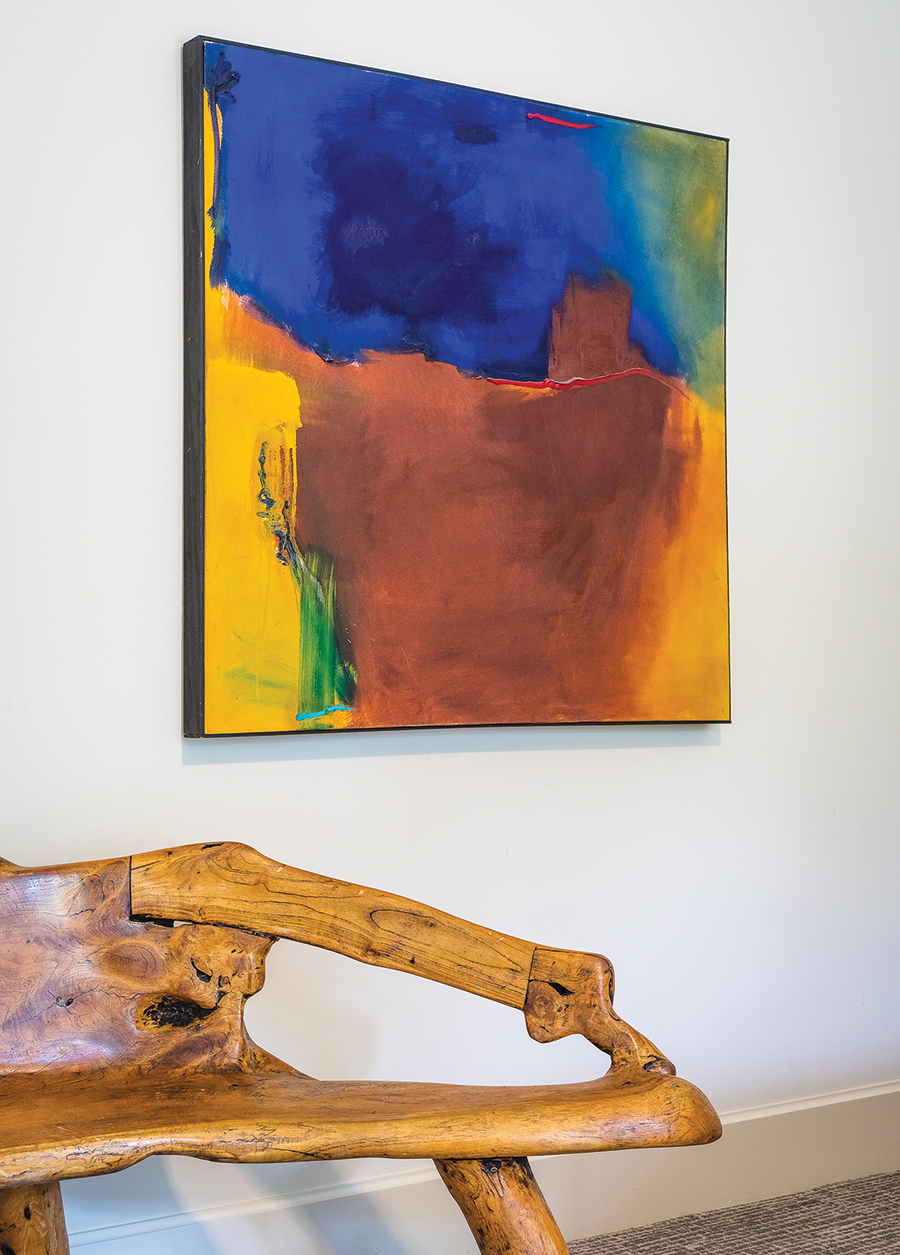
Their favorite painting is an abstract in warm Southwestern colors by Dan Namingha, a Hopi artist from New Mexico featured at the Smithsonian Institution and British Royal Collection in London.

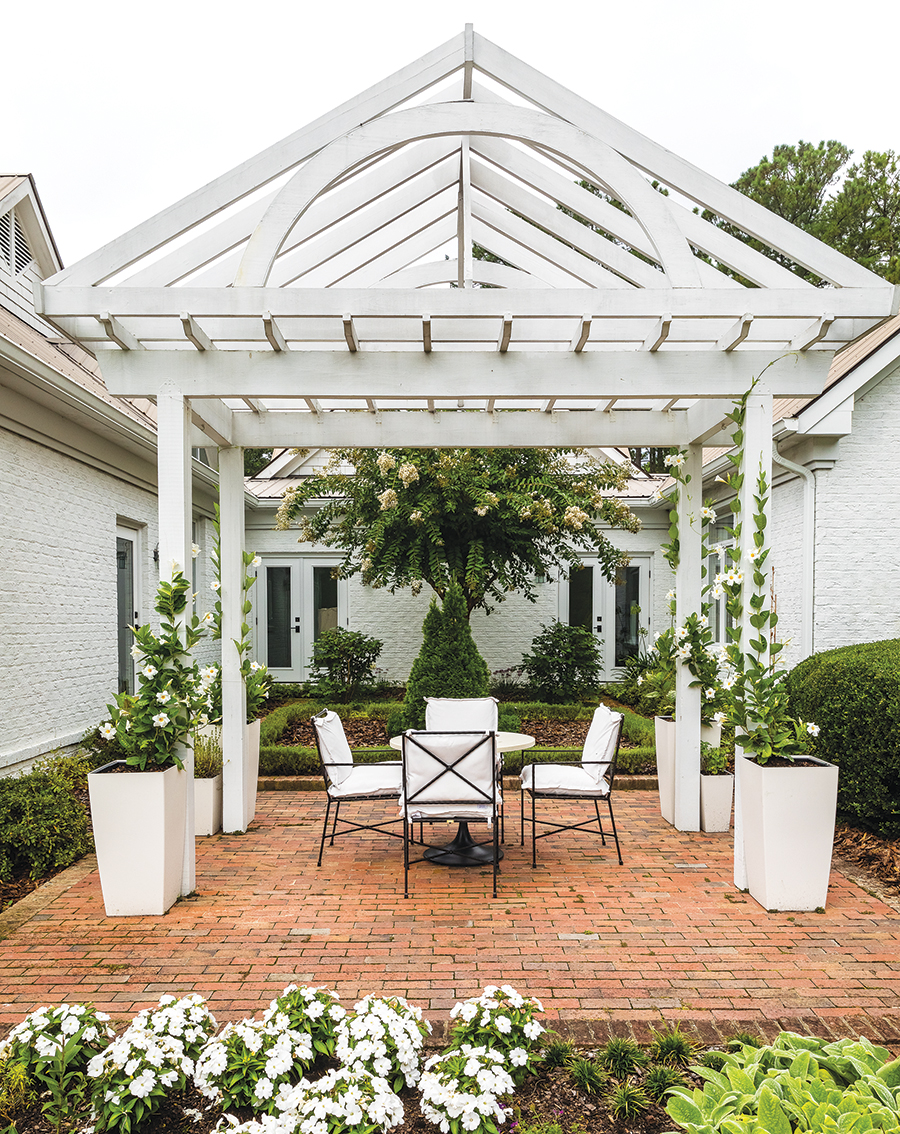
The grounds satisfy Ron’s near-metaphysical connection to nature, developed as a backpacker in Colorado. Not only did he remove overgrown crape myrtles and Japanese pears, he grew weed-free grass from seed, which he crops closely on his riding mower. “I’m like a kid, riding along with my headphones on,” he says. Flowers are absent, except for a few perennials, always in what Ron calls “calm colors, no yellows except for daffodils.” Boxwoods are trimmed into curves, not flat-tops or angles or topiary. A small Tuscan-style garden with fountain and pergola located just outside the dining room brings greenery up close.


Ron and Boo are busy retirees who miraculously report agreement on all decisions concerning the house. Ron admits he’s happiest with a project. Next up: an aquarium store in Wilmington. Boo mucks her own barn. She wants to rehab needy racehorses. For now, she feeds the menagerie, spends time in the heated, air-conditioned gazebo-turned-tack room adjoining the barn, a veritable girl-cave filled with equestrian equipment and memorabilia that sometimes doubles as a meeting place for their Bible study group.

What’s missing? Enormous TVs plastered on multiple walls and laptops galore. “The world was a better place” before electronics took over, Ron believes. He and Boo have other toys: two horses, two donkeys, one dog, one barn cat, two aquariums, five acres, plenty to do and the strength to do it.

“This is a place of peace,” Ron says. Boo adds, “We’re going to try to keep everything standing and moving forward, including ourselves. We are blessed.”  PS

Poem

Skipping

Walking my heart (good boy!) after lunch,

suddenly my bored step hitches, stutters,

propels me firmly up and forward, and look,

I’m skipping, I’m skipping, I’m skipping

like I haven’t in over half a century, one foot

then the other bouncing lightly on its ball,

springing my dull earthbound body along

like a rock across water, lightly touching down,

like a cantering horse on the verge of a gallop,

a syncopated gait that swings my arms out

for balance like the girls’ when I was a kid

but so what, I let hands and hips sashay,

lost my partner, what’ll I do, skip to my Lou,

my darling heart leaping in my lifted chest

as I dance on down the sidewalk, double-time.

— Michael McFee

A Haven of a Place

Mistletoe Farm — a sanctuary for creatures great and small

By Claudia Watson

Photographs by Laura Gingerich
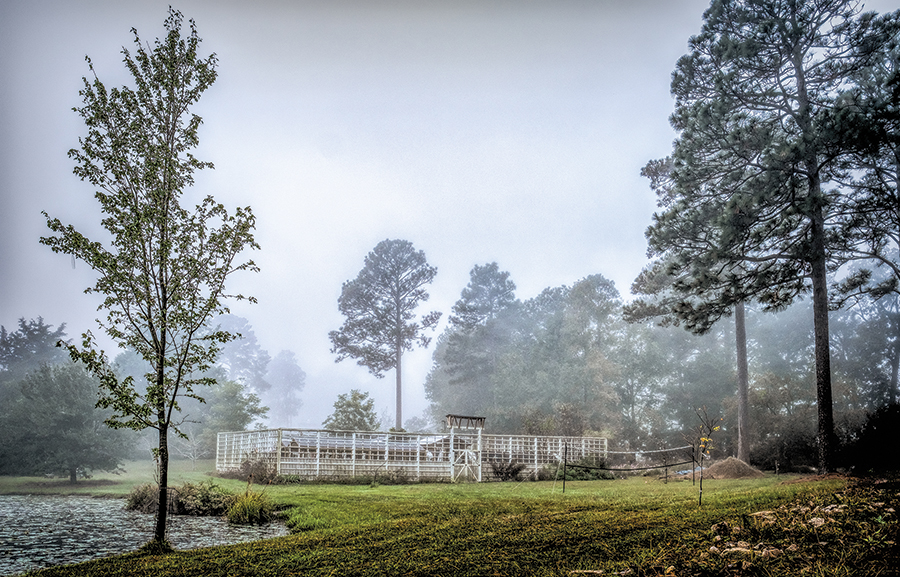
A dreamy fog lifts from the pond below, softening the profiles of the distant trees as a chorus of field crickets, grasshoppers and late summer cicadas offer a prelude to the day’s soundtrack.

It wasn’t long before we saw them, several tiny heads peering from the water on the far side of the pond. Lookouts. When her sneakers hit the dock, and they hear the call, a flotilla of three dozen pond sliders and one giant snapping turtle rush in, grabbing the fish food she tosses.

The day begins and ends with this routine at Mistletoe Farm, the 11-acre Southern Pines farm of Drs. Jeff and Lynda Acker, where even the farm’s name suggests the couple’s gentleness for all living things.

Mistletoe, Lynda’s Belgian-cross horse, was rescued from a ski resort, where she pulled a sleigh. The Ackers brought her to this farm when they relocated from Asheville.

“She was a 2,000-pound golden retriever. She’d come up behind me and lick me on the head and follow me everywhere,” Lynda recalls while tossing more food to the turtles. “We encourage everything here.”

Then, prompted by the honking of a skein of Canada geese, she points to the pasture. “There’s a straggler Muscovy duck over there, a bit of a loner. We have at least one beaver family, green and blue herons, snowy egrets, kingfishers and killdeer. Little nuthatches nest in the post,” she says, showing the spot on the dock.

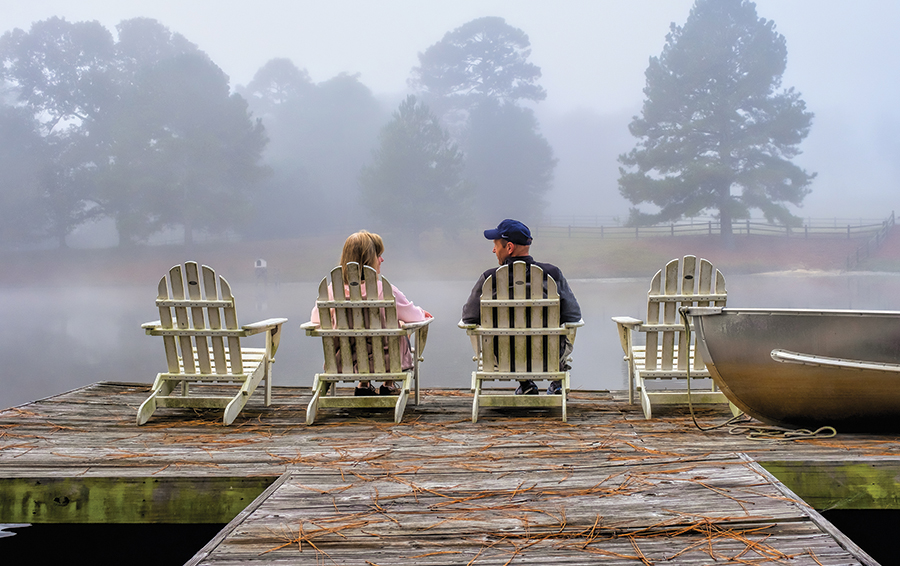
Soon, her husband, Jeff, arrives, and they grapple with the rowboat set ajar. “It’s got water in the bottom from the storm. We need to drain it,” she says. Though the sun’s up and there are chores to be done, they settle instead into weathered Adirondack chairs at the pond’s edge to enjoy morning coffee together.

When Lynda isn’t busy with farm chores, she’s often tending to serene spaces for healing and restoration. Her work includes the Healing Garden at the Clara McLean House and the Hospice Gardens at FirstHealth Hospice and Palliative Care. In addition, she’s been instrumental in developing the Native Pollinator Garden at the Village Arboretum in Pinehurst, and pollinator and ornamental gardens at The O’Neal School. Now, she’s working with a team to select the plants for two healing gardens at FirstHealth’s new cancer center in Pinehurst.
Her efforts are more than a hobbyist’s interest; she joyfully immerses herself in her endeavors. Most assume Lynda’s a botanist or etymologist because of her broad knowledge of plants and insects, specifically pollinators, but she is, at heart, a self-taught naturalist.

“I’m a biology nerd,” she says. “Sponge-like for certain topics, and my ears perk up when it’s an interesting subject.”

After obtaining a bachelor’s and master’s in biology and a Ph.D. in molecular physiology, she was awarded a MacArthur Foundation postdoctoral fellowship at Duke University. Then, she was off to the corporate world with pharmaceutical giant GlaxoSmithKline, finally founding and running a clinical documentation firm.

Though she spent years in business suits and high heels or a lab coat, Lynda says the most authentic time is when she’s out with either a shovel or fishing pole in her hand.

“My love of nature was planted, excuse the pun, very organically,” she says. Her father was a conservation officer at Chautauqua Lake, a 17-mile-long lake in western New York famous for its muskellunge (muskie), one of the largest freshwater fish native to North America. She grew up with a rescued deer fawn in their garage and a fishing pole in her hand by the age of 3. As a youngster, she ice-fished in huts on the lake with her father, along with “a bunch of Swedish men eating pickled herring and telling stories.” She had her muskie tags at 8 and, to this day, loves pickled herring.

But it’s always been the curiosities of nature that captured her attention. “I’d line up buckets in the backyard and monitor live experiments with minnows and mosquitoes,” she recalls. Her first job featured worms.

“At night, I’d go out with my white cat, Zucchini, and a flashlight to pull nightcrawlers out of the ground. I’d get two cents apiece, and Dad would steer all the fisherman my way,” she says. “I had a big box full and loved to watch them crawl.”

She also spent hours exploring the fields around their home in Chautauqua, often tunneling through the tall grasses, observing insects, then matting down a spot in the cool grass to sit, think and dream about someday going head-first into nature.

The Ackers return to Chautauqua often and spend several weeks there during the summer. Now, Lynda is a lecturer on native gardens, monarch butterflies and pollinators at Chautauqua Institution, a nonprofit education center.

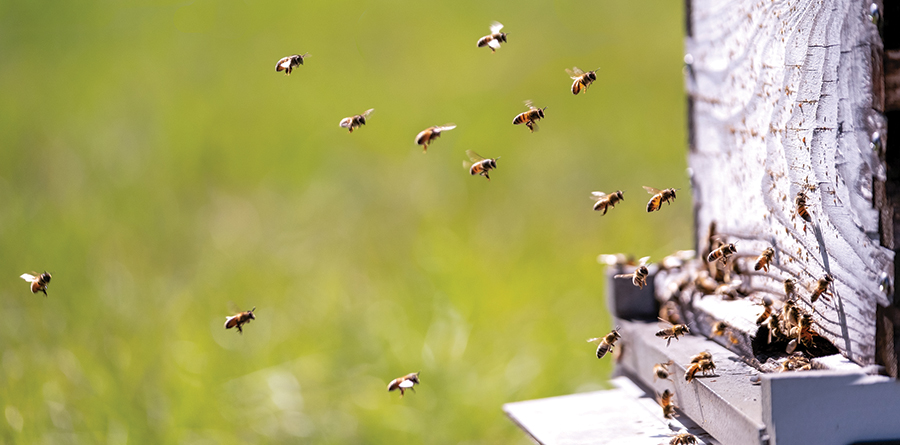
Like an alarm clock, when the sun’s rays hit the beehive, warming it, the honeybees fly. At every turn, there’s a delight. Vividly colored flowers provide nectar for the native bees and honeybees. Plump red raspberries cling to their canes, begging to drop into your mouth. And a single, peachy pink “Lady Ashe” rose, given to Lynda by the Healing Garden’s original rosarian, Bill Shore, joyfully opens to the sun.

The quiet is broken by Lynda’s high-pitched call, “Come on, chickees.” A parade of eager chickens, including Prairie Bluebells, Asian Blacks, Silkies and hefty Brahma hens, emerge from all corners. The chickens’ clucking oddly melds with the soft rock music coming from a rusty radio strapped to the fence.

“It keeps the raccoons away and helps calm the chickens,” she explains while sprinkling dried mealworms as a treat for the chickens. “The beach music on Sunday mornings is their favorite.”

The chicken enclosure and multiple hoop houses are wrapped with hardware cloth to protect them from predators. Netting stretches across the top. It keeps the hawks away from the chickens but lets the songbirds and pollinators inside. Snakes are another issue.

“They freak me,” says Lynda, wincing as she turns to husband Jeff, a radiation oncologist affiliated with Moore Regional Hospital. He handles the oft-required repairs to the enclosure and deals with predator issues, among other tasks.

“We have a lot of black snakes. When the egg count dwindles, I’ll search for it and relocate it to the other side of the pond,” he says. “Of course, it’ll find its way back.”
A tasty abundance fills the vegetable and fruit hoop houses. Tomatoes, peppers, garlic, root vegetables, beans, 20 types of herbs, and a beautiful row of celery fill the space. Organic parsley is everywhere and covered in eastern swallowtail caterpillars that favor it. It’s planted in the hoop houses to protect the caterpillars from the chickens.

“Oh, there’s an egg,” exclaims Lynda with delight, pointing to a tiny white ball on the top of a leaf. Evidence of the butterfly’s visit.

Dozens of southern highbush (Vaccinium formosum) and rabbiteye blueberry bushes (Vaccinium virgatum) flourish in two blueberry houses. When the berries ripen, walk-by grazing is encouraged.

Later, Lynda’s up on a ladder, attaching stiff mesh Japanese fruit bags to protect clusters of Concord grapes, other varieties of bunching grapes, and the regional favorite, muscadines. Though she prefers Concords, they don’t do well in our climate.

“The Chautauqua Lake area is home to Welch’s grape juice and jam. I grew up on the Concord grapes grown in the region, and they remain my favorite. The grapes in these bags are the good ones for our table,” she says. “The chickens and mockingbirds get the rest.”

Fig trees complete the garden. Both a single Brown Turkey (Ficus carica ‘Brown Turkey’) and two Celeste (Ficus carica ‘Celeste’) trees provide a sweet snack. Unfortunately, not for her.

“My bees eat them before I can,” she says while warily picking one. “Once they crack open, you don’t want to pick it. The honeybees will be in it.” Figs, she explains, are a food source for bees, and the sweet fruit significantly pumps up the bees’ honey yields.

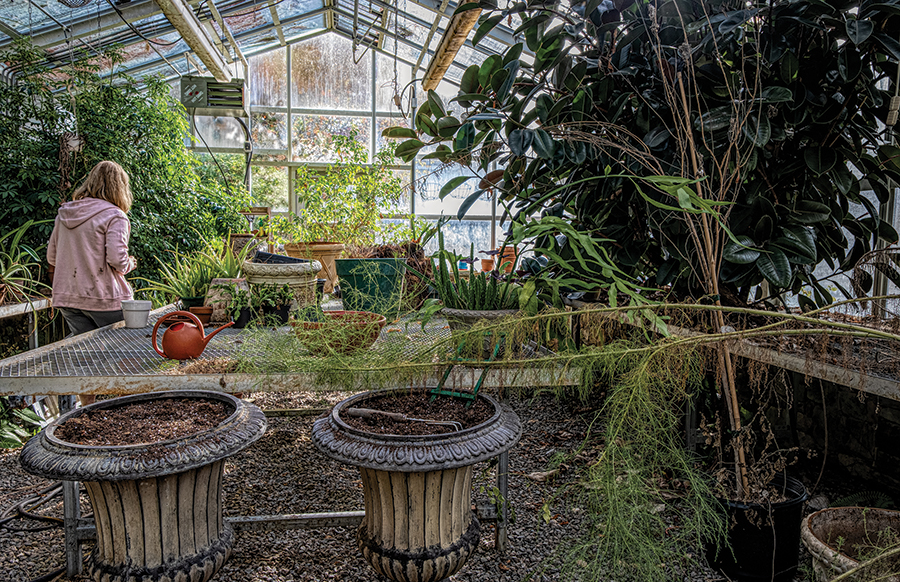
It’s a short walk up the hill where an elegant lanceleaf Japanese maple (Acer palmatum var. dissectum) graces the entry to the iron and glass greenhouse. When the Ackers built the greenhouse, they, like most, wanted a place where they could grow plants that wouldn’t normally grow here and also to extend their growing season.
For many years, it was a hub of activity. Boston ferns overwintered. They adopted massive staghorn ferns (Platycerium spp.) from friends who migrated here from Florida. An enormous schefflera made this home after starting life as a bonsai in Hawaii. And that rubber tree?

“It was a houseplant, and for some reason, it ended up in here,” explains Lynda as she looks up through the plant’s canopy, which touches the greenhouse’s ceiling. “It grew through the table and took root in the ground. We’ve cut it back several times, but it owns the place now.”

When the greenhouse was humming, Lynda added praying mantises and green lacewings to the mix to keep the pest insects down. “I’d find baby praying mantises everywhere, and it was so magical,” she recalls.

Today, the greenhouse gives the couple a quiet place to repot plants over the winter months. “There are days I’ll come out here for a dose of sunshine and peace,” says Lynda, who found it a haven during the pandemic. “I don’t know what I’d do without nature. It makes me tick. It’s always been the underpinning of my life.”

The climate in the greenhouse is perfect for Jeff to start hundreds of milkweed seedlings each winter. Most seedlings are destined for the Village Heritage Foundation’s annual spring plant sale to benefit the Native Pollinator Garden.

But the pièce de resistance is the monarch waystation habitat.

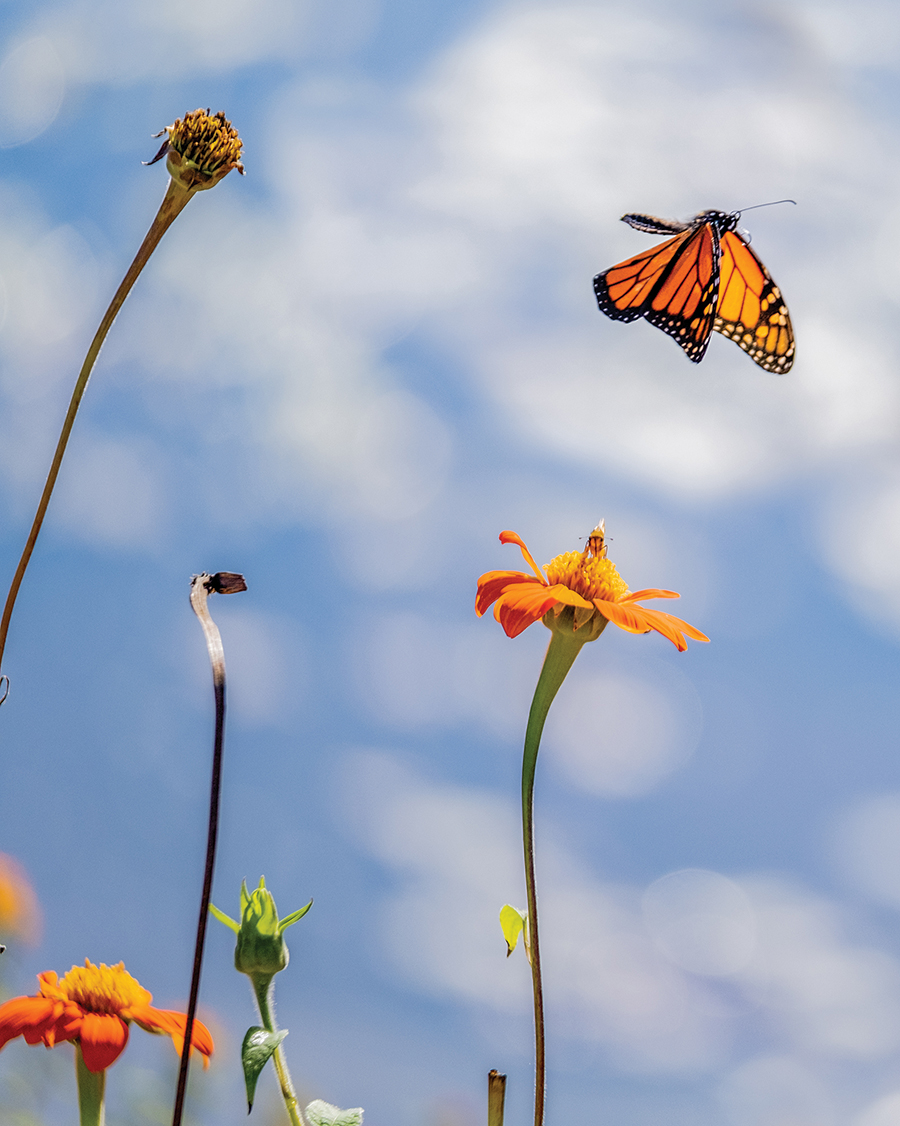
The waystation provides food and habitat for the struggling monarch butterfly population. Unfortunately, the monarch and other pollinators, like native bees and honeybees, are in a stunning decline. Scientists say it’s due to the loss of the insects’ habitat, the increased use of pesticides and herbicides, and environmental change.

Jeff’s domain is the waystation, located on the steep slope of the dam at the edge of the big pond. “I handle the planting, weeding and maintenance of this area. We don’t use any herbicides or pesticides, so it’s all done the old-fashioned way, by hand,” he says. “Planting is a process, and there aren’t shortcuts.” His shovel hits the hard ground with a thwack. “It’s solid clay, so every time I plant, I dig a big hole and fill it with good dirt. That’s why there’s a big compost pile over there.”

Though a layer of pine straw helps hold the soil moisture and keeps the weeds down, the recent addition of irrigation gives young plants a better chance to get established. “It’s also very welcome, since Jeff spent many a late afternoon roasting in nearly 100-degree heat watering the area,” adds Lynda.
The Ackers’ goal is to keep planting nectar plants and milkweed. Milkweed is the only plant on which monarchs lay their eggs, and their caterpillars feed. Last year, unfortunately, the Ackers ran out.

“Toward the end of the season, we had so many caterpillars that we had to leave many of them on the plants,” explains Jeff. If hand-raised, monarchs’ survival rate is likely to reach 80-95 percent, far exceeding the meager 2-10 percent of monarchs that survive to become butterflies in the wild.

They’ve had spotty results with common milkweed (Asclepias syriaca), the plant most people associate with the word “milkweed.” It blooms from late April until mid-May, which is suitable for the first generation of monarchs, those offspring of monarchs from Mexico hatched in the south and migrating north to lay eggs.

“The milkweed is finally getting established and running,” he says. It spreads by underground rhizomes and is better suited for large fields and pastures. Plus, the butterflies don’t favor it when there’s butterfly weed nearby.

“Butterfly weed (Asclepias tuberosa) stays small, and it will self-seed an area, so it is great in the garden,” he says. It’s also the variety he raises from seed each winter.

Showy pink swamp milkweed (Asclepias incarnata) prefers mucky or very moist soil, so they’ve planted it near the water’s edge.

In addition, there are many other types of host and nectar plants to attract a wide range of pollinator species. Some favorites include dog-toothed daisy (Helenium autumale), which puts on quite a show in late August. The heat and drought-tolerant lanceleaf coreopsis (Coreopsis lanceolata) brings a big splash of yellow. And the sweet vanilla scent of Joe-pye weed (Eutrochium purpureum) is irresistible to pollinators.

Dragonflies prefer the long-blooming purple coneflower (Echinacea purpurea) and spiky prairie blazing star (Liatris spicata) for landing sites. Ohio spiderwort (Tradescantia ohiensis) and boneset (Eupatorium perfoliatum) attract native bees.

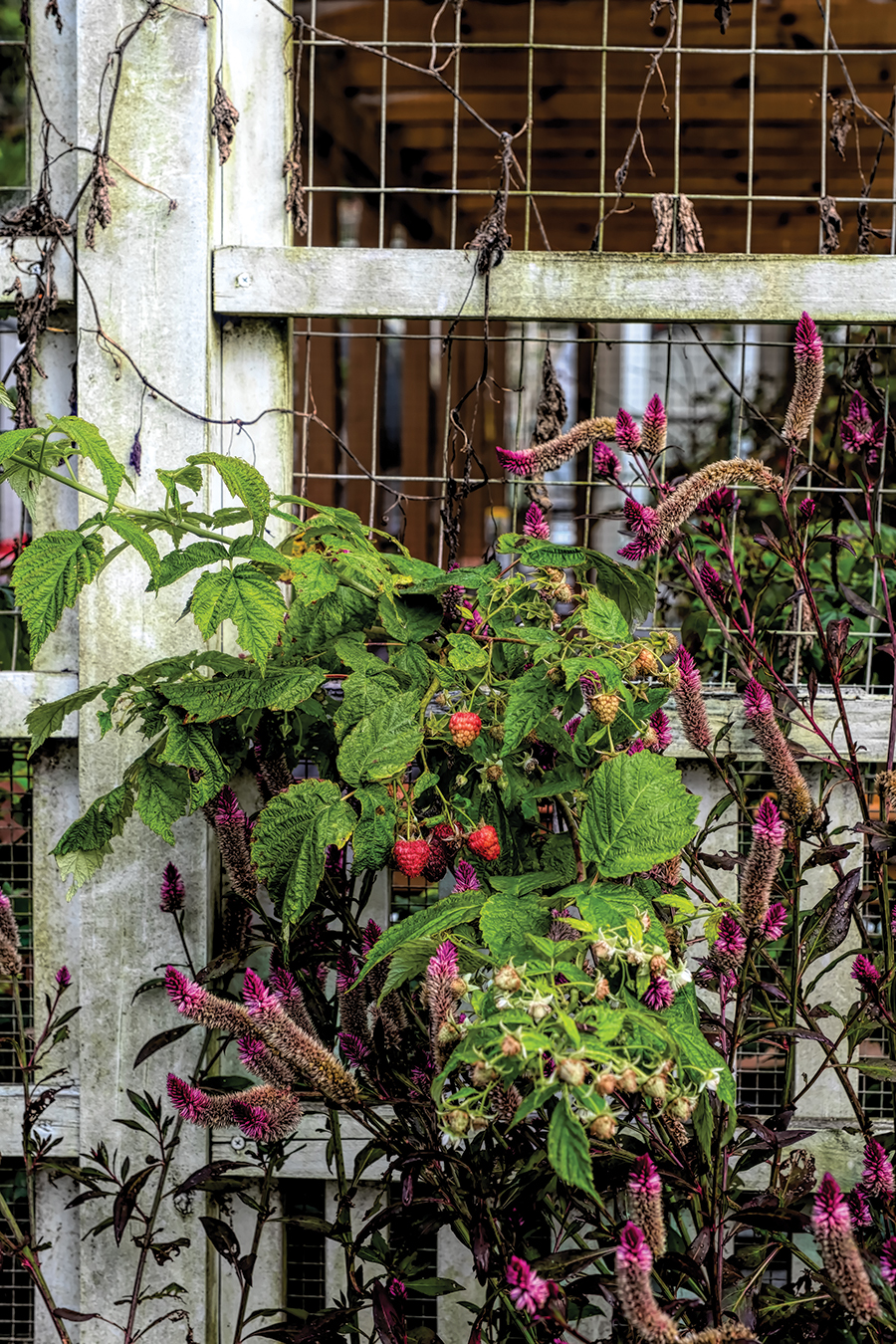
Lynda also plants the seeds of the fluffy-plumed purple celosia (Celosia argentea), which grows tall and needs the support of the fence near the hoop houses. Delicate, poppy-like windflowers, commonly called anemones, and a bed of colorful mixed coreopsis sway in the breeze, attracting different species. But Lynda’s favorite is the brightly colored Mexican sunflower (Tithonia rotundifolia). Though it’s non-native, it’s striking and non-invasive. Its orange, zinnia-type flower is the “hands-down best bee and butterfly magnet,” she says. But it’s gangly, growing 4-to-6-feet, so best suited for the back of a border.
Mistletoe Farm is a living laboratory. Lynda’s excitement for nature is contagious, and before you know it, you’re walking softly and looking at the details.

“Oh, look,” she says and points. “Here’s a native bee asleep on the goldenrod (Solidago rugosa ‘Fireworks’). It has a drop of dew on it — they are so tiny and beautiful. There are over 4,000 types of native bees. About half are in serious trouble, and many are extinct. Since all are solitary, there is not a hive to go back to, so they curl up, like this little guy, and sleep on a plant.”

Lynda explains that native bees often lay their eggs in tunnels they make in riverbanks, barren slopes, a root ball or the edge of a forest. “Those are the places people often tag as unsightly, and it is bye-bye bee habitat. Or they see a bee and spray it,” she says.

“Over there is a gorgeous dragonfly, and all the little skippers flitting around, and a moth — all so beautiful. It just makes me nuts when I see someone spraying pesticides. Look at what they’re missing. What are they thinking? Oh, I saw a bug I don’t like, so let’s kill everything.”

Lynda encourages everyone to visit a waystation for a rich learning experience. Then, plant one.

“It can be a small garden planted with some milkweed and nectar plants. Or plant fields of it. It all helps the monarchs on their journey north then back again to overwinter in Mexico,” she says. “Pollinator gardens in our backyards, parks and school gardens will help end habitat fragmentation and the loss of our pollinators. Then, we’ll have a far more viable and vibrant natural community.”

Lynda readily admits she enjoys seeing visitors in the area’s pollinator gardens.

“When I see them with their grandchildren, and they are pointing out the native plants and pollinators by name, it’s so gratifying,” she says. “They’re passing along the knowledge to our future generations, and those generations are our best hope for our planet.”

Mistletoe Farm feeds the senses with its extraordinary and complex beauty. It is not just a meadow, a pond, a vegetable garden or a waystation, but the sum of the whole — a sanctuary for all creatures, great and small.”  PS

Claudia Watson is a regular contributor to PineStraw and The Pilot. If there’s a garden that you’d like her to visit, email cwatson87@nc.rr.com.

Almanac

By Ashley Wahl

August leaves you wanting.    

In the afternoon, when the air is all milk-and-honey and the primal thrum of late summer has reached a crescendo, she will boldly take your hand.

“Close your eyes,” she will whisper, and as her golden light flickers across your face and shoulders, you all but dissolve into her dreamy essence. 

“This way,” she will tease, giggling as she guides you someplace a little darker, a little cooler — a shadowy hideaway beneath the trees.

You’ll stop at the tangle of wild blackberries, where deer tracks resemble spirals of ancient text and a sparrow whistles sweetly in the distance.

“All for you,” she will promise, slowly feeding you the last of the dark, warm berries, and then she will guide you along.   

You can tell by the sun on your skin that you’ve entered some clearing, and when you crack open your eyes, bees and butterflies light and stir in all directions. 

“Keep them closed,” she warns, leading you through wildflowers and down to the dock of a swollen pond, where yellow-bellied sliders bask on the bank, largest to smallest, like a set of wooden stacking dolls.

Bare feet dangling in the water, she leans in close, perfume thick as honeysuckle, plants a soft kiss on your cheek. Because her voice is like nectar — slow and sweet and dripping with intrigue — it makes no difference what she says next:

“I’ll never leave you” or “Wait right here.”

Besides, you’re too enraptured to notice that the days are growing shorter, that the gray squirrel has been busy storing nuts.

As the summer light begins to fade, the fireflies blink Morse code. The cicadas, too, scream out. All the signs are here, but you can’t see them.
When you open your eyes, she is already gone. 
Green Corn Moon 

Behold the earliest apples, the earliest figs, bushels of sweet corn and tomatoes ripening faster than you can say bruschetta. 

When the Green Corn Moon rises on Sunday, August 22, take a lesson from the squirrels: Now’s the time to preserve your summer harvest.

Can the fresh tomatoes. Sun-dry the herbs and figs. Pickle okra, cukes and peppers. As for the rest? Cook now and freeze it for later.

Squash soup, anyone?

Late Bloomers

The bees and all who hum and buzz are, in a word, nectar-drunk. Among the late summer bloomers — crape myrtle, lantana, lobelia, ageratum and phlox — a favorite is butterfly weed, Asclepias tuberosa, caterpillar food for Monarchs. Drought tolerant, deer resistant and kin to milkweed, what’s not to love? And their orange-and-yellow clusters mirror the joy andwarmth of summer.

Threshold

When in still air and still in summertime
A leaf has had enough of this, it seems
To make up its mind to go; fine as a sage
Its drifting in detachment down the road.

— Howard Nemerov 

Story of a House

Pretty as a Picture

Artist’s home captures bygone America

By Deborah Salomon  •   Photographs by John Gessner

Monet painted from a studio adjacent to his country home in Giverny.

Van Gogh rented four Spartan rooms in Arles, which he immortalized on canvas.

Cézanne built a studio on farmland, in Provence. All painted fruit and flowers in the still life mode.

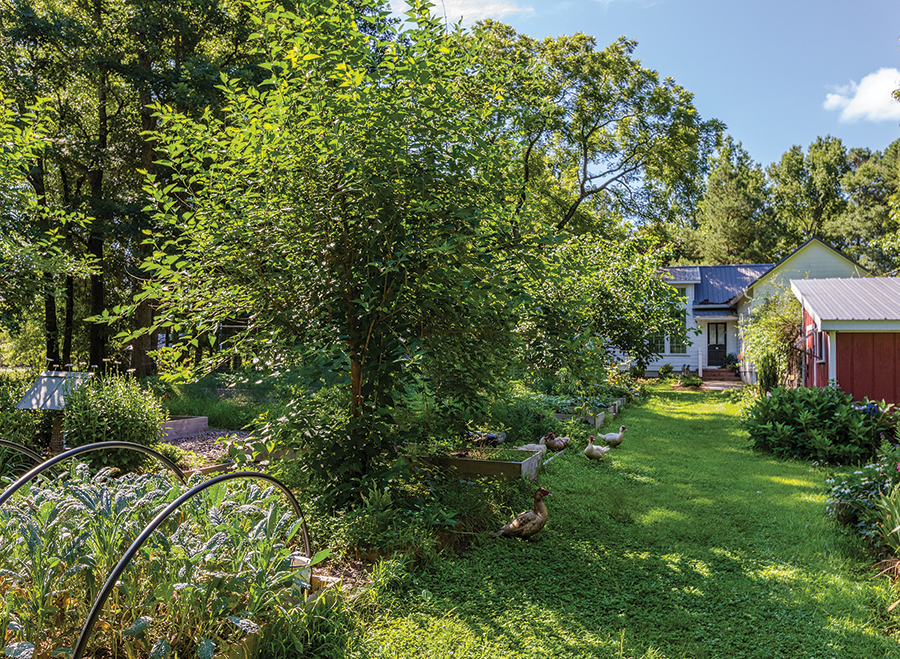
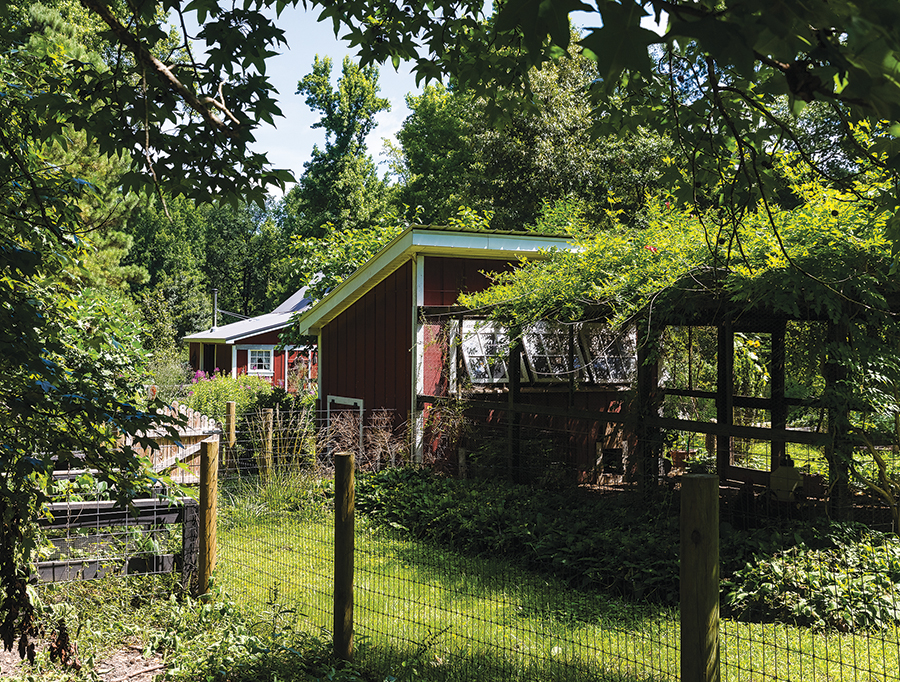
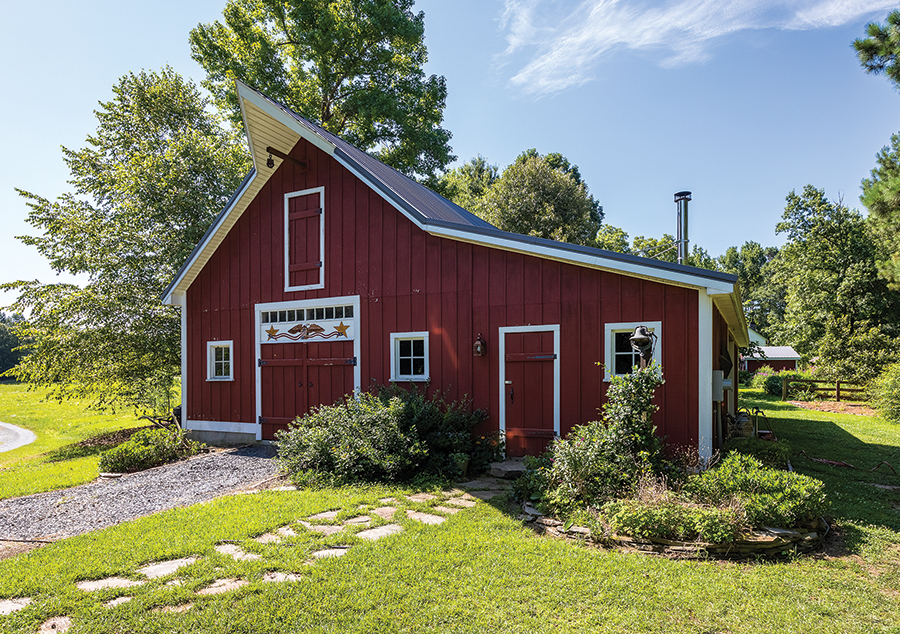
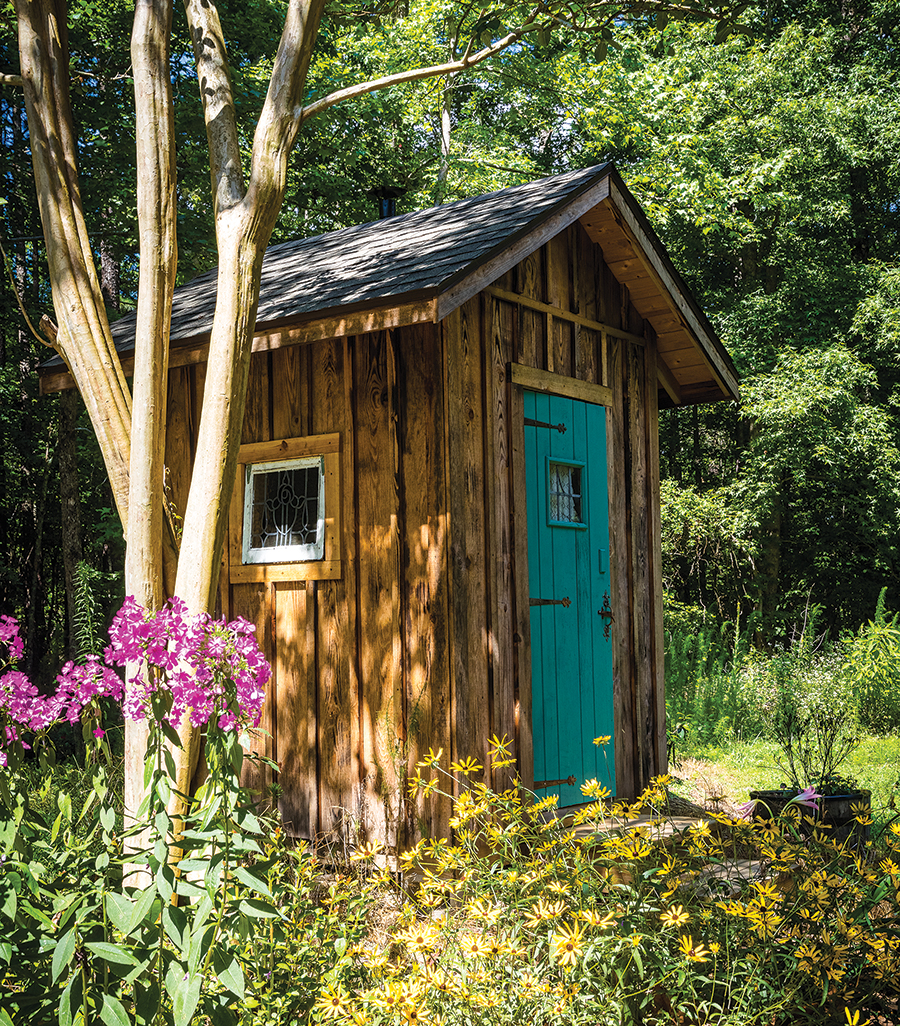
During the late 19th century, the ateliers of a hundred starving artists dotted the Left Bank. How they would covet Carmen Drake-Gordon’s set-up: a 100-year-old farmhouse converted as a studio with 14-foot windows facing north, for consistent light. Close by, a new house that appears 100 years old, with elongated porch, furnished in country antiques. Beyond the house, an idyllic pond, where Muscovy ducks swim and catfish jump for treats. A shady chicken coop; a fenced yard for three goats who earn their keep by clearing the wisteria. A red barn workshop where Carmen’s partner, Wade Owens, a multi-skilled retired Army officer from Iowa, builds, repairs and blacksmiths. Between the studio and farmhouse, raised beds yield kale, peppers, tomatoes, beans, eggplant, paw-paws and jujubes. Then, for whimsy, an adorable outhouse with running water built by Carmen’s children, instead of installing a septic system for her studio.

“I call it my Pee Palace,” she says and laughs.

All this surrounded by 15 acres of grass, woods and wildlife where she walks with Dean, a devoted mixed-breed dog she rescued minutes before euthanasia.

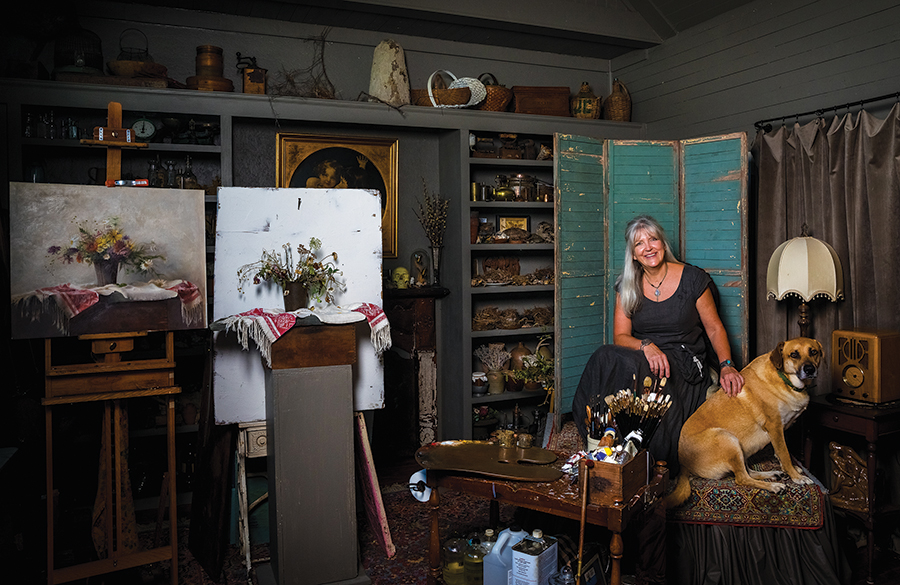
This homestead’s proper name is Oak Hollow Farm and Studio, and its tall, blonde, artfully dressed (“funky,” is her description) occupant, a grandma who is, in the best sense, a piece of work. From this studio Carmen — inspired by her surroundings — creates and sells paintings nationwide through virtual and other galleries. She hosts workshops that include lunches of garden produce served at her stretch table. But unlike Monet, Van Gogh and Cézanne, her portraits and still lifes follow classical realism as practiced by Dutch and Flemish masters — a technique that’s uber-photographic, three-dimensional, and eminently artistic.


Carmen grew up in Maine and Connecticut. Her artist mother provided lessons for the early-bloomer. “I was oil painting by 12.”

Modernism? “I wasn’t into that.”

Carmen married young and “dabbled” while raising three children. The family settled in Southern Pines in 1986, when her husband was stationed at Fort Bragg. Carmen remained here after he was killed in Mogadishu, in 1993. “The military became my family.” She pursued a love for Italian religious art, also appreciating “things — especially utilitarian things. “I find beauty in them.” Studying with Jeffrey Mims at the Academy of Classical Design in Southern Pines, and later with local artist Paul Brown, channeled and refined her talent.

Every artist longs for a studio. “I like to surround myself with a peaceful, calm atmosphere where I feel a connection with what I create.” That includes whatever exists outside her studio door.

She and Wade looked for land. A waterscape would be nice. The parcel they found had potential.

This land, known as the Short family farm, came with a rickety farmhouse (once a used bookstore), and a double-wide, also in disrepair. They bought the acreage in 2001, cleaned up the double-wide and lived there until completing the house in 2004. The old farmhouse-bookshop, now with heat and AC but no running water, became Carmen’s studio in 2018.

The main house — white clapboard, two stories with full basement, more than 3,000 square feet — spreads longitudinally across a knoll, with manicured grass sloping down to the pond, where Carmen and Wade have constructed a low stone wall and seating area. Their porch may appear Southern but the interior hums Yankee Doodle. Carmen found a set of plans that were adapted to include 10-foot ceilings and so much more. Construction took 18 months, but when it was finished, the house, with its unusual floor plan, won a Moore County Home builders Association Award.

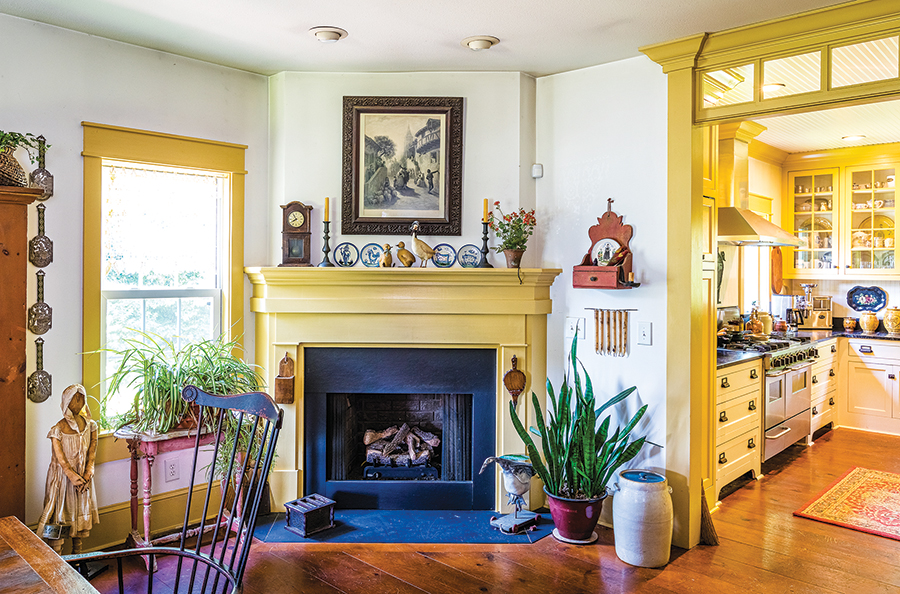
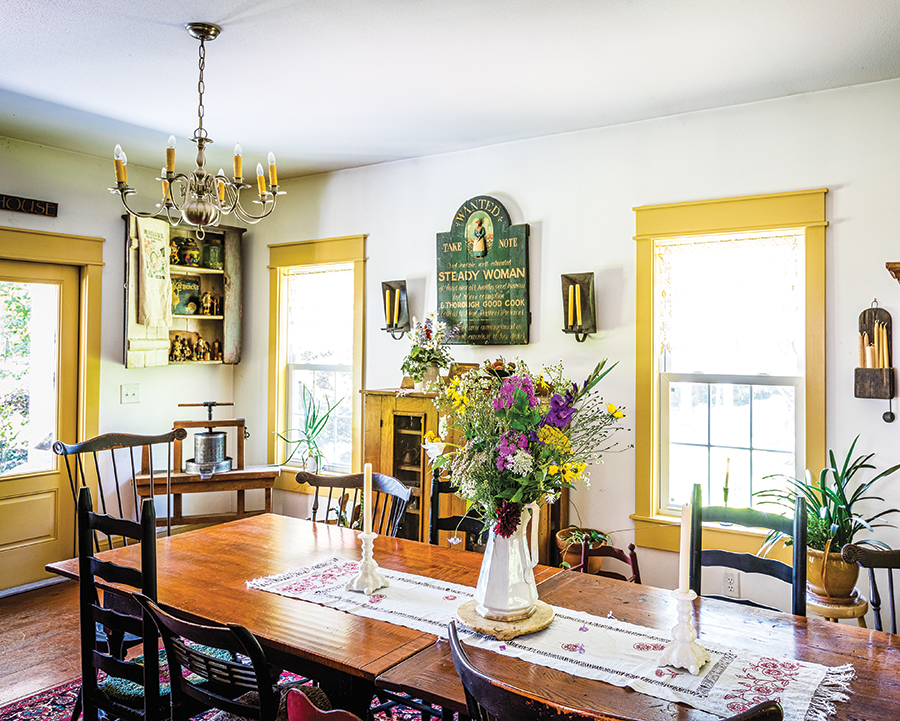
Just inside the front door stretches a dining table easily seating 10, made by Wade. The mismatched chairs include old-timey high chairs for Carmen’s two grandchildren. This long, narrow room with angled fireplace began as the sitting room, with a smaller dining room off to the right. Carmen had no trouble switching designations to accommodate their extended families for holidays. Both rooms contain multiple armoires, settees, candlesticks, lamps, shelves, tables, paintings and enough historical artifacts to warrant a catalog. Some are remnants of Carmen’s antique shop, C.R. Drake Mercantile in Cameron. Many pieces showcase her inventive touch, like a ladder repurposed as a quilt rack.

“I’m not comfortable without knick-knacks,” Carmen explains. Being surrounded by old things satisfies a need: “I imagine how many people touched them. I connect with that.”

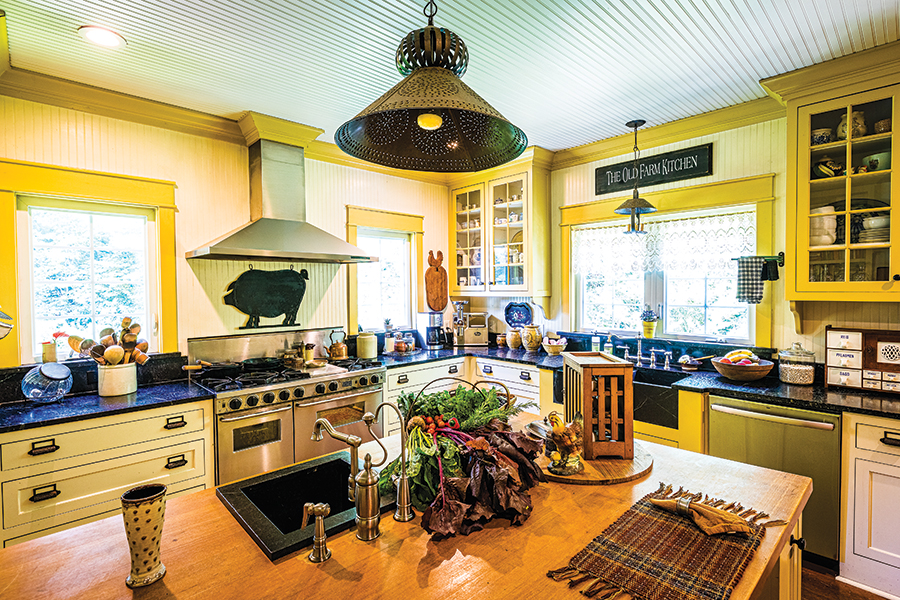
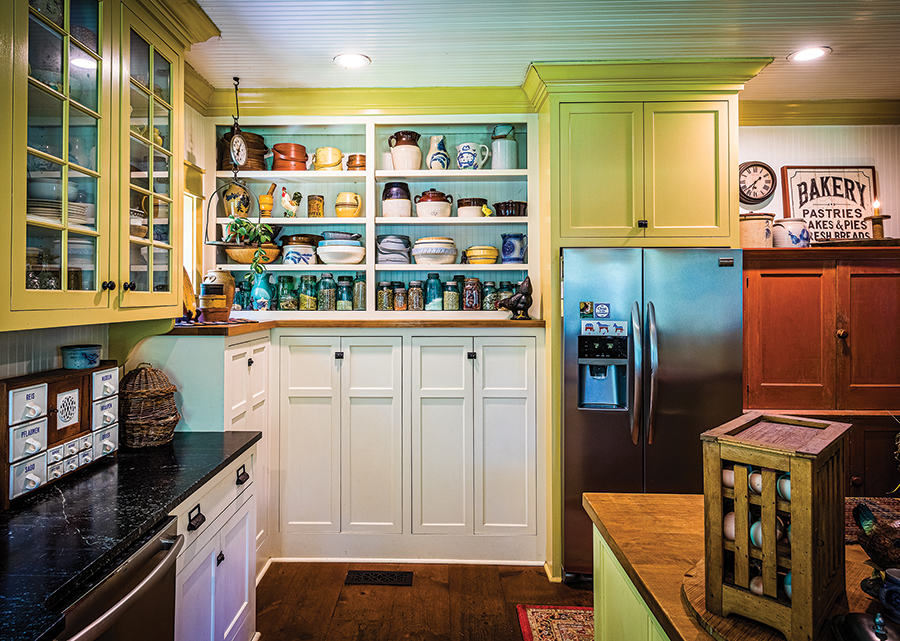
The elongated dining room ends at the kitchen, visible from the front door. Creating a century-old atmosphere around modern appliances can be tricky. Carmen chose a dusty yellow for the footed carpenter-made cupboards with black metal pulls to match the black soapstone countertops and protruding island, with breakfast bar. One wall is fitted with a combination of open shelves and tall cabinets. An antique spice jar rack with tiny drawers labeled in German says volumes about Carmen’s attention to detail. She didn’t stint on moldings, window frames and beadboard ceilings, either: “These little touches make a big difference,” as do square nails in the wide-board knotty pine floors. To make up for the splurges, “I painted the inside to save money.”

On the counter, a gallon of blueberries picked from nearby bushes speaks of the couple’s culinary requirements. Carmen and Wade both cook. Whatever they don’t grow comes from local farmers markets.

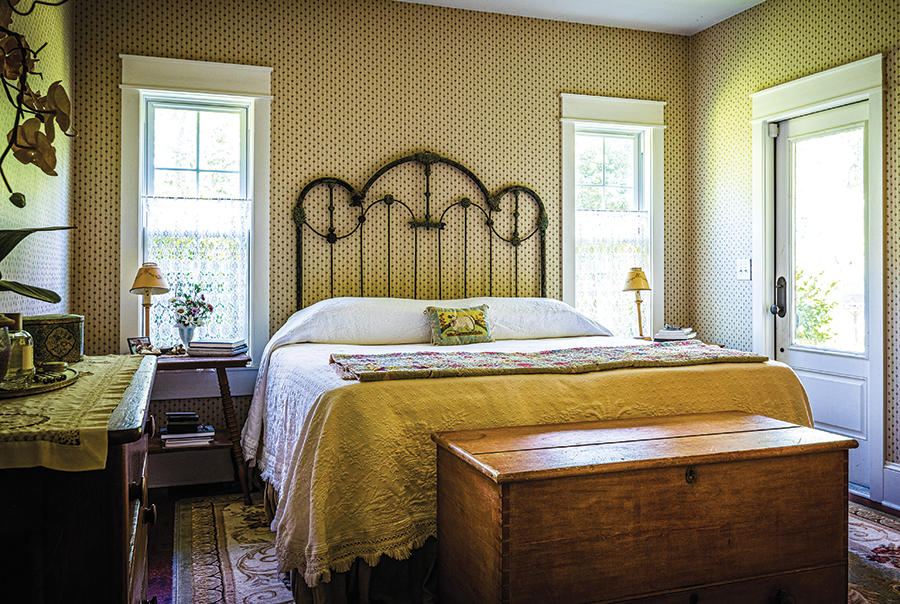
The main floor is bisected by a back hallway leading to the master bedroom, where Carmen has positioned a king-sized bed against a smaller wrought metal headboard, flanked by tall, narrow windows. The effect: airy, bright, comfy, simple. Each bathroom vanity originated as a bureau. One loo actually has a pull-chain toilet with high wall-mounted tank.

Upstairs, a guest bedroom with parallel twin beds is a Nantucket B&B look-alike. Wade uses a second upstairs bedroom as an office. For hall decor, Carmen hung a pioneer woman’s dress and coonskin hat like those worn in the Revolutionary War re-enactments she and Wade attend.


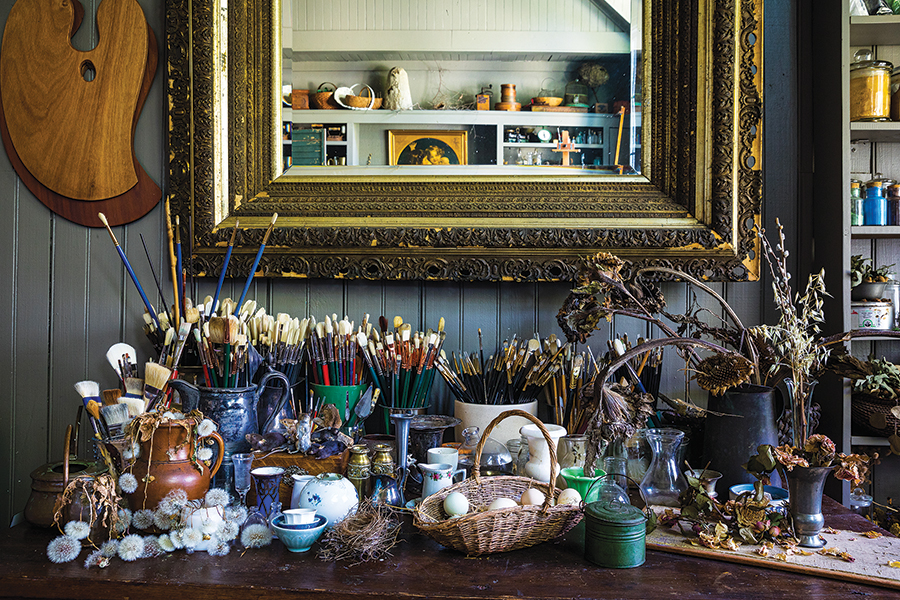
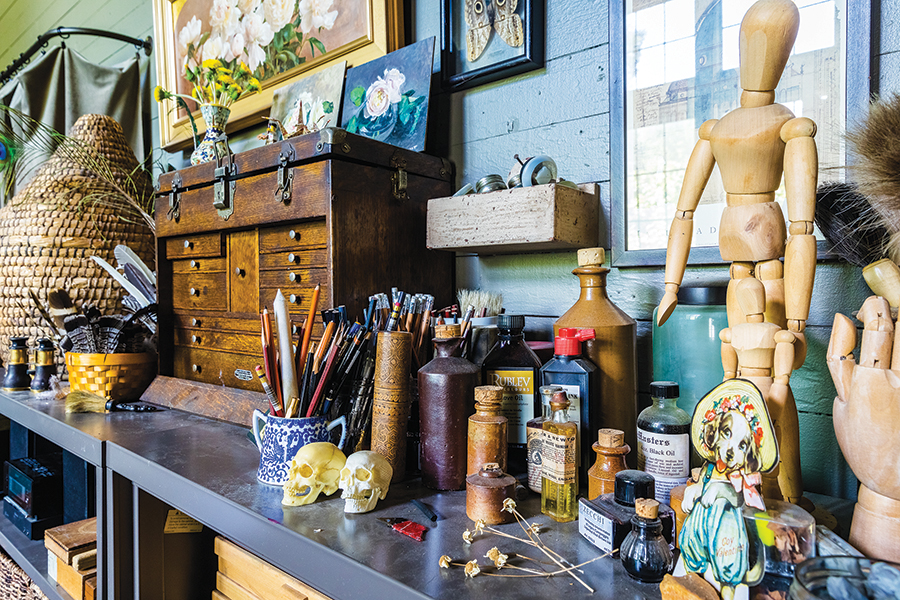
Carmen’s studio, a 50-yard stroll past the gardens, chickens and goats, represents another world: “It’s definitely my space. Everything in there speaks to me.” The interior walls made from horizontal boards painted green were left intact, but the ceiling came down to make space for windows soaring into the exposed attic, since, for an artist, proper light is crucial. Her workroom, cluttered with paints, brushes, props, paintings, a 1940s radio, a small pedestal on which stands a fancy chair, feels more decadent Parisian than rural Carthage.

As with Cézanne, no one enters this studio without an invitation.

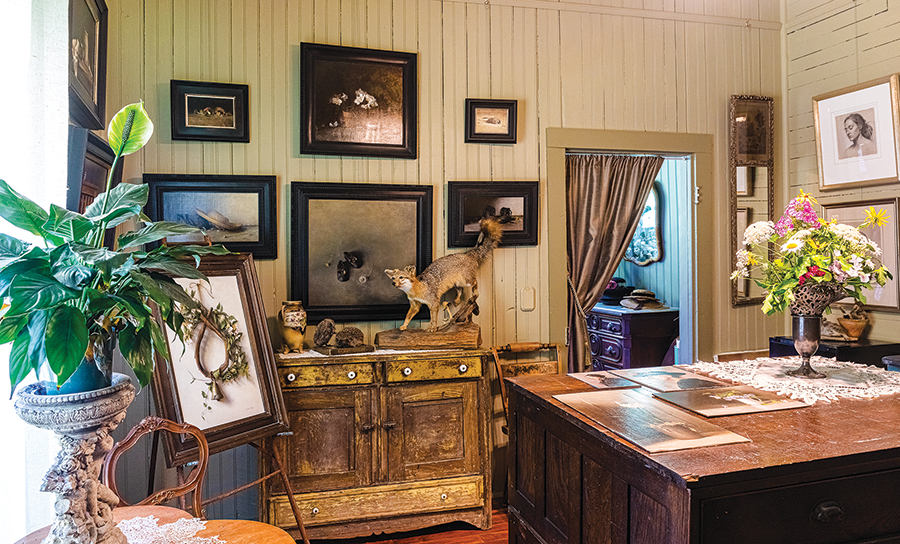
Even more decadent, adjacent to the workroom, a parlor with floor-to-ceiling shelves spills over with art volumes, some stacked on coffee and side tables squeezed between fireplace and white sofa. Victorian was Carmen’s intent; however, the crystal chandelier reminds her of French chateaux. “This is my thinking room, my art cave, my girly space. I look through the books for inspiration, ideas.” She also teaches and entertains other artists here.

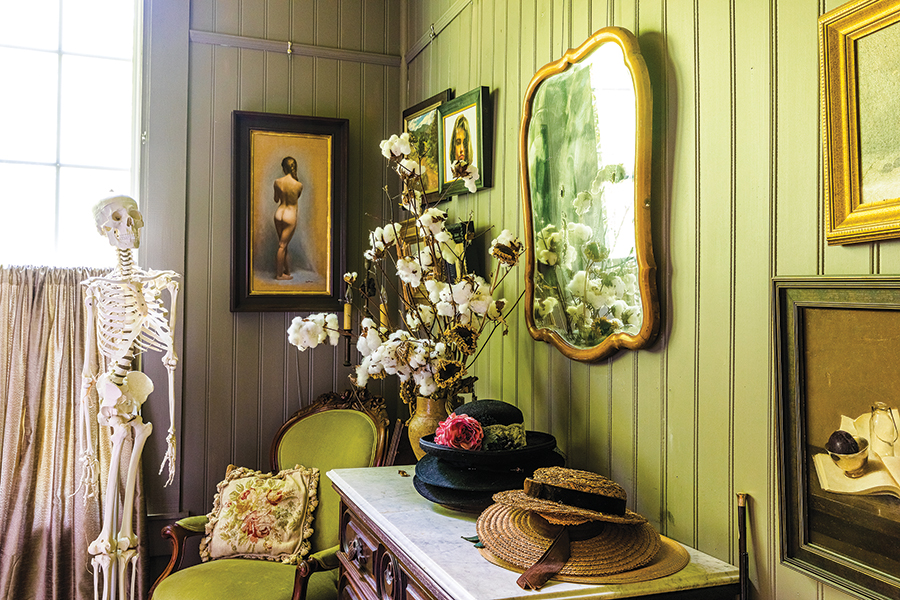
Beyond the parlor, a workroom for framing paintings and storing costumes is guarded by a skeleton, which helps plot articulation when painting the human body.

Carmen Drake-Gordon has achieved a rare confluence where art and life live peacefully, side by side. This artist paints the flowers she picks and birds’ nests she finds; she eats the produce she grows. She lives alongside friendly animals and soothing water. She is surrounded by things and people she loves, who love her back. She works hard, but on her own terms and in her own space, rewarded, fulfilled — a painting come to life.  PS

Poem

Snap the Whip

          Winslow Homer (1872)

You know the game: everybody

runs hard as they can, holding hands,

and then the boy on the near end

suddenly stops, sets his feet hard

against the ground, and the others

swing, like a gate made of children,

swinging faster the farther out,

fighting centrifugal force now

to keep from being flung away,

flung out of the sudden circle

this line of children has become

a radius of, and those farthest

out have to hang on for dear life.

What saves them is how tight they and

their friends can hold on, and for how

long. The farthest from the center

need the strongest friends.

— Millard Dunn

Millard Dunn is the author of
Places We Could Never Find Alone.