In the Spirit

Springing into Sours

Variations on sunny weather cocktails

By Tony Cross

I’m happy to report that spring is here. Finally. There are bartenders who might get more creative during the fall and winter months, and then there are hacks like me who get giddy as soon as the sun kisses my skin. I’m all about some warm weather. And what better way to start out this spring season than whipping up different sours? There are other styles of drinks I enjoy this time of the year, but for now, it’s all about the sours.

So, what is a sour, you ask? Simply put, it’s citrus, sweetener and spirit, combined into a drink. The daiquiri (rum plus lime juice plus sugar), probably my favorite drink ever, is a sour. Jennings Cox may have been the first to do it, mixing rum, lime juice and sugar, right before the 20th century, in Cuba — and for that, I’m eternally grateful. There are many other drinks with basically the same formula, and all are sours. But what about drinks that have sour mix in them?

Like it or not — and I don’t — there are many restaurants and bars today that use sour mix, and I’m not speaking just of corporate-run restaurants where it’s pretty much out of the bartender’s control. Even some independent bars and restaurants use the high-fructose-corn-syrup-mess-of-an-excuse-for-a-mix as an ingredient.

Bartender and author Derek Brown says it best in his book Spirits, Sugar, Water, Bitters: How the Cocktail Conquered the World: “One of the things that helped bars like T.G.I. Fridays crank out cocktails for the masses was the use of sour mix. Powdered beverages then were not viewed with the total scorn we have for them today. In the 1970s, instant powdered beverages had taken a foothold all over the cultural landscape. The turn toward the worst versions (of sour mix) was ultimately done because they were cheap to make, cheap to buy, and saved a lot of time behind the bar. Later on, opposition to sour mix would become a red flag that craft bartenders hoisted in their war against bad tasting, chemical-laden cocktails. But this ingredient that would sour the craft rose to absolute dominance while the Bay City Rollers blared from the speakers and the bottom of their pants widened. One more reason to blame the ’70s.” Indeed.

I don’t think there is anything wrong with prebatching ingredients before a busy night behind the bar (especially if you are alone with absolutely no one to help), or if you’re having to dish out a few hundred cocktails within an hour at a big event. If you’re making each cocktail to order, or making drinks at home, add each ingredient at a time, and if you couldn’t tell from Mr. Brown’s excerpt, ixnay the sour mix. Now that we’ve gotten that out of the way, here are a few sour recipes to complement your future suntan.

Marmalade Sour

This is an oldie but goodie from bartender Jamie Boudreau, owner of the whiskey and bitters emporium Canon in Seattle. What I like about his cocktail is how you can experiment with the ingredients. If you don’t have cachaça on hand, try another rum, possibly an Agricole. Or try a gin! The same goes with the flavor of marmalade. I think I had this on my bar menu years back. Hellaciously good.

2 ounces cachaça

2 tablespoons low-sugar orange or grapefruit marmalade

3/4 ounce lemon juice

1/4 ounce simple syrup (Boudreau recommends a 2-part sugar, 1-part water ratio)

2 dashes orange bitters

1 large egg white

Edible flower (optional garnish)

In a cocktail shaker, add ice and all ingredients (sans edible flower). Shake hard until shaker is ice cold and double-strain into a chilled coupe glass. Garnish with flower.

You Think I Ain’t Worth a Dollar, but I Feel Like a Million Bucks

This is one of the first cocktails I put on my menu when I started getting into this whole drink thing. A twist on a whiskey sour, it’s my blatant rip-off of the Billionaire cocktail from New York’s Employees Only. At the time, I didn’t have access to the bourbon the recipe called for, so I substituted Four Roses. For the sake of convenience, I’m going to switch one detail in the specs. The original Billionaire recipe calls for absinthe bitters — and I did make that behind the bar — but a touch of absinthe will do.

2 ounces Four Roses bourbon

3/4 ounce lemon juice

1/2 ounce cranberry syrup* (do not exceed)

1/16 ounce absinthe

1 lemon wheel (garnish)

Combine all ingredients in a cocktail shaker, add ice, and shake like hell until you feel satisfied. Double strain into a chilled coupe glass. Garnish with lemon wheel.

*Cranberry syrup: Mix 1/2 cup of unsweetened cranberry juice with 1 cup (by weight) cane sugar in a pot over medium heat. Stir until sugar is dissolved and let cool before transferring to a container and refrigerating. Syrup holds for two weeks.  PS

Tony Cross is a bartender (well, ex-bartender) who runs cocktail catering company Reverie Cocktails in Southern Pines.

Out of the Blue

Ode to Weather, or Not

Spring belongs to the poets

By Deborah Salomon

In our righteous concern with climate change, I’m afraid we’ve neglected weather.

Not the extremes, which uproot trees and flood neighborhoods. Those are News, with a capital N. I mean the other kind, perfect days the morning meteorologist dismisses with a sentence unless they connect to something else.

Sept. 11, 2001, was such a day in the Northeast, so beautiful that most documentaries mention the brilliant, cloudless sky, low humidity and slight chill.

I remember it as just that — the perfect autumn morning until . . .

Certain physiologies seem finely tuned to the weather. Humidity makes a hot day feel hotter, a cold day colder. It just makes me cranky. But not all humidity is created equal. The minute I walked out the door that day last month when snow was imminent, I felt a certain damp chill that precedes the white stuff. I remember my mother called the chilly dampness “raw.” Very descriptive, more so than anything from the TV meteorologist wearing a tight red dress and lip gloss.

That’s the thing. Weather is better experienced than described. I lived most of my life far north, where November always meant raw and people, especially skiers, welcomed a Thanksgiving blizzard. If you’re dressed for it, nothing compares to sun bouncing off fresh powder under a brilliant blue sky, no wind, temps in single digits or below, which make ceiling beams creak come night.

I hear the sweaty golfers howling protest. They have a point, I guess, if you skip July through October.

Beach day! Having packed the kids and their water toys in the car and driven a couple of hours, you want a clear sky with just enough breeze to stir the heat. Actually, the most impressive beach weather finds high, massive cloud formations racing from horizon to shore. No worry if they are a fluffy white. Gray merging to black — menacing but just as beautiful. 

Beauty exists in even the most destructive weather. An ice storm knocking out power for days inspires photographers to snap ice-encased twigs sparkling in the sun. Hurricanes inspire pilots to fly into their eyes, which remain calm. Similar bravehearts chase twisters, documenting their power.

My grandfather, a bricklayer with a penchant for mathematics, taught me about cloud formations, which determined whether he should water his enormous garden plot. He didn’t know Latin names, only what the clouds foretold. Then, when the thunder commenced, he said nothing, just nodded and smiled, since one man’s rained-out ball game is a farmer’s windfall.

“Windfall” itself is a term coined in the 15th century; landowners gave fruit that blew off the trees during a storm to the serfs.

Weather inspires music. Remember Gene Kelley dancing in Singin’ in the Rain? Etta James and Lena Horn crooning “Stormy Weather”? “Raindrops Keep Fallin’ on My Head” from Butch Cassidy and Sundance? Then, “They Called the Wind Maria,” “Blue Skies,” “Candle in the Wind”? The Beatles’ prediction “Good Day Sunshine” and “You Are the Sunshine of My Life” from Stevie Wonder, who never saw a single beam.

Technology has heightened our awareness: Get minute-to-minute details on the 24-7 Weather Channel or the weather apps.

Without weather, art would be flat, dull. Van Gogh illuminated his subjects with the almost-tangible sunlight of Provence, but Michelangelo, in the Sistine Chapel, placed God giving life to Adam over a high, thin cloud cover, while Leonardo da Vinci posed Mona Lisa against what looks like smog.

Spring weather belongs to the poets — soft rain, warm sunshine, aromatic breezes suggest romance, rejuvenation, rebirth of the insects, unfortunately. On the flip side, the Bible relates heaven dumping 40 days and 40 nights of rain, forcing Noah into ship-building. How about the wind that blew Dorothy clear out of Kansas? Who knew the deadly fog that smothered London in 1952 would be immortalized on a raincoat label?

And now April, the cusp of spring. Wordsworth had his turn, as did Shakespeare. Hear it best, from an anthropomorphizing Ogden Nash in “Always Marry an April Girl”:

Praise the spells, bless the charms,

I found April in my arms.

April golden, April cloudy,

Gracious, cruel, tender, rowdy;

April soft in flowered languor,

April cold with sudden anger,

Ever changing, ever true —

I love April, I love you.

Just don’t forget the umbrella.  PS

Deborah Salomon is a writer for PineStraw and The Pilot. She may be reached at debsalomon@nc.rr.com.

Pine Pitch

Doin’ the Bunny Hop

Kids can enjoy an “Eggstravaganza” of crafts, egg hunts and pix with Mr. Bunny beginning at 10 a.m. on Saturday, April 9, at Campbell House Park, 482 E. Connecticut Ave., Southern Pines. Free to all, even those answering to the name Harvey.

Feherty Unplugged

The unchained — or perhaps unhinged, depending on your point of view — and incredibly funny David Feherty will go from the PGA Tour and major championship announcing booth to the stage at Owens Auditorium for his one-man stand-up show on Thursday, April 7, at 7 p.m., at the Bradshaw Performing Arts Center, Sandhills Community College, 3395 Airport Road, Pinehurst. For information and tickets go to www.ticketmesandhills.com.

Double Dose of Lee

The Judson Theatre Company returns with Lee Squared: The Liberace and Peggy Lee Comeback Tour, a unique evening of music and laughter on April 8-10 at the Owens Auditorium, Bradshaw Performing Arts Center, on the campus of Sandhills Community College, 3395 Airport Road, Pinehurst. Liberace, played by David Maiocco, lived a life of flamboyance and sparkle, and Miss Peggy Lee, played by Chuck Sweeney, is simply beyond description. The duo won the 2017 Bistro Award for Lee Squared. The performance on Friday, April 8, is at 8 p.m., while the shows on April 9 and 10 begin at 2 p.m. Tickets are available at www.judsontheatre.com.

Four Women, One Heirloom

Join New York Times bestselling author Kristy Woodson Harvey as she talks about her new novel, The Wedding Veil, at 11:00 a.m. on Tuesday, April 5, at The Country Club of North Carolina, 1600 Morganton Road, Pinehurst. Juxtaposed against the drama of the Vanderbilts and the Biltmore Estate is the intriguing present-day story of Julia Baxter and her grandmother, Barbara Carlisle. While wearing the gorgeous Vanderbilt wedding veil is considered good luck, is it really? Tickets are available from www.ticketmesandhills.com. For more information go to www.thecountrybookshop.biz or call (910) 692-3211.

Live After 5

The 2022 concert series kicks off with The Embers, featuring Craig Woolard, on Friday, April 8, from 5:15 p.m. to 9 p.m. at Tufts Memorial Park, 1 Village Green Road, Pinehurst. Picnic baskets are allowed, outside alcohol isn’t. Never fear, beer, wine and soft drinks are available for purchase, and there will be food trucks, food trucks, food trucks. For information go to www.vopnc.org.

Homes in Bloom

The Southern Pines Garden Club presents its annual (in non-pandemic years) Home & Garden Tour on Saturday, April 9, from 10 a.m. to 4 p.m., where visitors have the opportunity to experience some of the Sandhills’ most elegant homes and gardens. The cost is $25 in advance and $30 the day of the tour. For information and tickets go to ticketmesandhills.com.

And They’re Off and Running

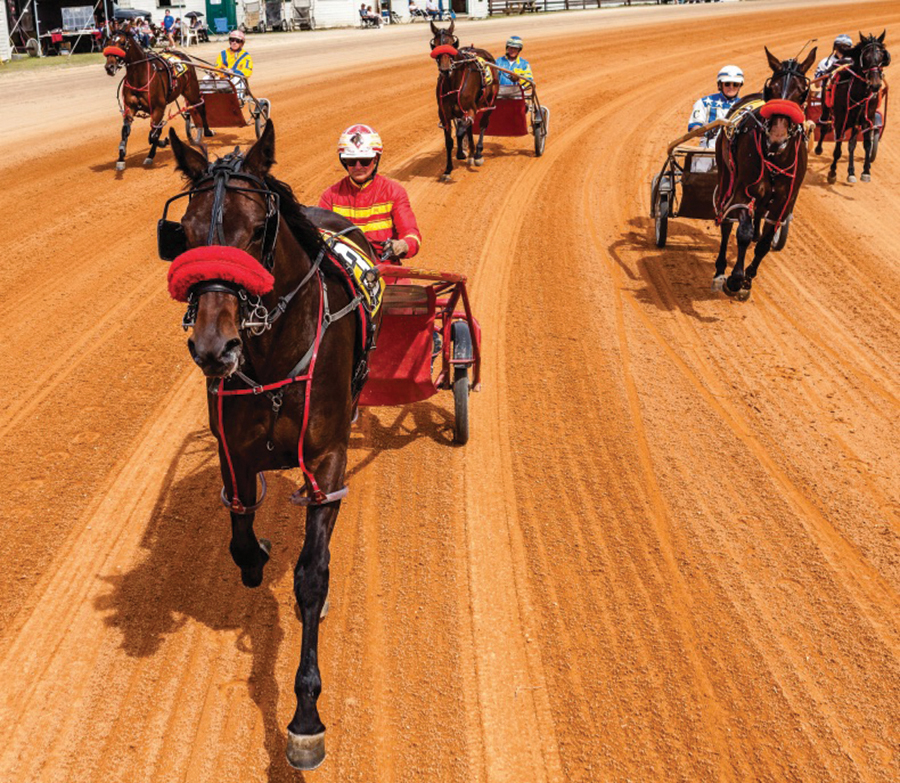
Spring. Matinee. Races. The Pinehurst Harness Track, 200 Beulah Hill Road, Pinehurst, 1 p.m to 5 p.m., Saturday, April 9. Enough said. Bring sunscreen, floppy hats and plenty of folding money for, ahem, a side bet or two. The races begin at 1 p.m. and end at 5 p.m., or thereabouts. For information call (708) 921-1719.

Haute Couture

Just about anyone who makes anything you can wear or walk in will be represented in the spring Fashion Show on Tuesday, April 19, at the Forest Creek Golf Club, 200 Meyer Farm Drive, Pinehurst. The buffet lunch and cocktails cost $65. Eve Avery, Marie and Marcele, Morgan Miller, J. McLaughlin, Monkee’s, Denker, Ikonic Kollection, Eclectic in the Village, Cooper and Bailey’s, Dunberry Resort Wear, and Perle by Lola will all be there. For info and tickets go to www.
womenofthepines.org.

Home and Garden Extravaganza

The Spring Home & Garden Expo at the Fair Barn, 200 Beulah Hill Road, Pinehurst, will have more than 40 companies showing their wares beginning at 10 a.m. on Friday, April 22. For information go to www.ticketmesandhills.com.

It Looks Good for Its Age

The wood sprites will be out celebrating the oldest known living longleaf pine on Saturday, April 23, from 10 a.m. to 3 p.m. at the Weymouth Woods Boyd Tract meadow, 555 E. Connecticut Ave., Southern Pines. The free festival will feature food tucks, music, turpentine info and a demonstration of a live, prescribed burn. So, how old is the oldest longleaf? It’s so old its squirrels are seventh generation. For information call (910) 692-2167.

Jazz and a Bagel

New Orleans jazz trumpeter Leroy Jones will perform on the lawn at the Weymouth Center for Arts and Humanities, 555 E. Connecticut Ave., Southern Pines, for Sunday brunch on April 24 from 11:30 a.m. to 2 p.m. For information and tickets go to www.weymouthcenter.org.

Choral Society in the House

The Moore County Choral Society will present “From Dusk to Dawn” at the Village Chapel, 10 Azalea Road, Pinehurst, on Sunday, April 24, from 4 p.m. to 6 p.m. For information and tickets go to www.ticketmesandhills.com.

National Poetry Month

Words and
Music Riffs

By Shelby Stephenson

Hiram Larew turns loose the syllables like steam on water in his 2021 book, Mud Ajar, from Atmosphere Press. His words do not sink up in stirred up mud. At times I feel as if I can almost see through the mud, as the poet shakes form and content to create Poetry.

In “Quiet Come” —

All is up

yes

all is sky

In “Ode to the Edge” —

all arrows lift their grateful views

sung-up like curves

the call of bogs

where edge surrounds

Listen to these few lines from “Mud Ajar,”
the title poem —

Here where beaks are barns

that loop through when

as rain lifts praise

on trill of rakes. 

In “Listened Twigs” listen to Larew’s lines —

These trees a choir

in early fine

their waking limbs

When snowflakes hear within themselves

of how beginning sounds.

Every syllable sings: example, these words from “Sign a Lease” —

When the skies boil or bloom

go sweep the stoop.  PS

Hiram Larew is the founder of Poetry X Hunger which inspires writers all over the world to combat hunger. In Mud Ajar, the music quakes and the sky blazes all over again.

Shelby Stephenson was poet laureate of North Carolina from 2015-18. His recent book is Praises from Main Street Rag Publishing Company.

Hometown

The Spice
of Time

When you see more salt than pepper

By Bill Fields

I got a much-needed haircut recently not long after eye surgery. My vision was limited to the other eye, but that was plenty to notice the clippings on the black cape when the stylist had finished. There was enough white on the cover-up to make it seem as if a polar bear had been in the chair.

Forty years after finding my first gray hair, on my 22nd birthday, there is much more salt than pepper to be swept up after getting a trim. It’s been headed in that direction for two decades, an inexorable journey that, like achy joints after a taxing day, is just part of the landscape when you’re north of 60. As P.G. Wodehouse said, “There is only one cure for gray hair. It was invented by a Frenchman. It is called the guillotine.”

Don’t think for a minute I’m not grateful to have a head mostly full of hair at my age, regardless of its hue. I thank my maternal grandfather, B.L. Henderson, for whom a pocket comb remained a useful stocking stuffer as he made his way into his 90s, if one’s hair prospects are indeed rooted in that part of the family tree.

Plenty of men are dealt a different hand, losing their hair, or most of it, at a relatively young age. The combover can be a comical reaction — see images of former Purdue basketball coach Gene Keady for confirmation. This is the ultimate losing battle, and the willingness of more folks to go the shaved-head route when faced with a bare minimum is a victory not only for style but common sense.

I’m glad I haven’t had to make that decision. A couple of years ago while getting a haircut down South, as I sat down in the chair, I asked the barber if he could do anything about all the gray I could see in the mirror.

“Better to go gray than go gone,” he said.

Those seven words of barber philosophy have become my mantra.

If my father had heard them as he started getting lots of gray as he approached his 50th birthday, he might have avoided his brief hair dye experiment. Something looked different about his appearance as he sat down to supper one evening, but the real evidence was in the bathroom sink — black stains from the hair dye he had applied. We teased him so much that he never altered his appearance again. For the last decade of his life, he let his short flat-top go increasingly toward white, and set against his blue-green eyes it was a very handsome look.

“No play for Mr. Gray” has been a catchy line for Walt Frazier to say in the “Just for Men” television commercials, but I’m not sure how accurate it is.

If someone wants to dye his or her hair to maintain a look that has been theirs for years, more power to them. It’s none of my business. But tell me that singer Emmylou Harris doesn’t look gorgeous these days with that silvery hair of hers, and I’ll wonder what you’re smoking.

When it comes to hair color, I’m leaning toward letting time tell its story.  PS

Southern Pines native Bill Fields, who writes about golf and other things, moved north in 1986 but hasn’t lost his accent.

Golftown Journal

Stumbling Into Happiness

When Pinehurst is the journey’s end

By Lee Pace

James Walker Tufts had no grand design on a New England-style village nor wall-to-wall golf courses when he set off from Boston in the mid-1890s. He wanted warm weather and a reasonable train ride from the snowy North to establish a winter resort, and it was by pure coincidence that he happened upon some 5,000 acres of land for sale just west of Southern Pines, the suggestion coming from a Wilmington insurance man he met on the train.

Walker Taylor, legend has it, suggested that the train station in Southern Pines might be a good starting point for Tufts. It was right on two of the nation’s major north-south transportation arteries — the railroad and U.S. Highway 1. Well, highway might be a bit of a stretch for the 1890s, but you get the idea. There was cheap land available, and it was halfway between Boston and Florida.

“It’s an old family story,” says Walker Taylor III. “I have no way of proving its authenticity. But my grandfather always said he directed Mr. Tufts to the Sandhills. True or false, he did get the Tufts’ insurance business. He even opened an office in Pinehurst to service Mr. Tufts.”

So, how did you stumble upon Pinehurst?

Stan Bradshaw and his wife, Jean, were living in St. Louis in 1997 when they channel-surfed across a television showing of Shell’s Wonderful World of Golf. The episode featured Arnold Palmer against Jack Nicklaus, played on Pinehurst No. 2 in April 1994. Those shows were part competition and part golf travelogue, so the Bradshaws were intrigued with the history and ambience of the golf-centric village in the North Carolina Sandhills.

“You know, we ought to look at that place,” Jean said.

Stan agreed, and soon after they booked flights, rooms and golf times for themselves and Jean’s parents. They traveled to Pinehurst in November 1997, and while the men played golf, the ladies toured the village and checked out The O’Neal School, a college preparatory school on Airport Road just northeast of Pinehurst.

Stan and his father-in-law were smitten.

“But how are you going to get Jean to move to a golf resort?” Stan’s father-in-law wondered.

“I’ll figure something out,” Stan answered.

It turns out the women were so impressed with The O’Neal School that Jean was ready to move — lock, stock and barrel. Bradshaw was in the banking, capital management and hedge fund world and could “live anywhere within an hour of an airport,” and thus had the freedom to move wherever suited the family’s interests. They joined Pinehurst Resort and Country Club, bought two lots to the right of the fourth fairway of the No. 2 course in 1999, and built a house.

“We say that the three things that got us to Pinehurst would be Jack, Arnie and The O’Neal School,” Bradshaw says.

Mark Reinemann grew up in Wisconsin and as a golfer “was always looking in the spring to travel somewhere warm for golf — typically either southwest Florida or Scottsdale,” he says. He and his wife over time came to prefer the green of the South over the brown of Arizona, though Florida wasn’t their cup of tea. He visited Pinehurst in the late 1980s, loved the experience, and was introduced to the Country Club of North Carolina through a banking client and CCNC member, Jack Schwerman.

“Jack invited us to stay at his house for a long weekend in 1988 and we just fell in love with CCNC,” says Reinemann, who served seven years on the USGA executive committee and retired from the banking business in 2016. “It was one of those ‘perhaps someday we could be a member here’ moments. Fast forward and here we are.

“We love the charm of the area, the slight change in seasons, the grace and style of the people who live here and, of course, the world-class golf. We never deviated from our plan to move here full time once I retired and have absolutely no regrets. We just love it here.”

Robert “Ziggy” Zalzneck was enraptured as well by CCNC and the Sandhills, on Christmas Day in 1967. At the time, he was a young accounting intern in Raleigh a long way from his Pennsylvania home. He was given access to CCNC by his boss, club co-founder Dick Urquhart, and had the place to himself on the holiday. “I played 36 holes and it was 70 degrees,” says Zalzneck, who later joined the club and has served as president. “It was the prettiest place I’d ever been my whole life. I’ve loved the place ever since.”

Marty McKenzie is a lifelong Pinehurst resident and real estate executive who loves to wax poetic about the “magic bubble” of the village of Pinehurst — the winding streets, the thick tree canopy, the absence of visual clutter.

“As human beings, when we try to describe something to people they’ve never seen, we always use the five senses — it looks like, tastes like, feels like — whatever. When you try to describe Pinehurst to other people and you think of those senses, you can’t find anything. Nothing comes to mind. Pinehurst doesn’t look like anywhere else,” McKenzie says. “People drive into the village and they’re absolutely paralyzed. They look around and say, ‘This is the most beautiful thing I’ve ever seen. How can I be a part of it?’ We take for granted we have the same status as the Washington Monument and Mount Rushmore — all of those are National Historic Landmarks.”

That bubble once snared a first-time visitor to Pinehurst on the second-floor porch of the Magnolia Inn. It was there amid the century-old magnolia trees over Memorial Day weekend in 1994 that Jane Deaton of Sea Island, Georgia, opened her eyes to the magic of Pinehurst.

“We arrived late the night before so we didn’t really know where we were,” she says.  “I walked out on the balcony the next morning and thought, ‘Oh, my God.’ It took my breath away. It was glorious. The village literally unfolded beneath me. I said, ‘I want to live here.’”

That day, Jane and Brian Deaton found a real estate agent and within the week bought a vacant lot at the intersection of Culdee and McKenzie roads, just two blocks behind the Carolina Hotel. Their new home was finished at the end of 1998.

Earl Ellis was a floor trader at the New York Stock Exchange in the 1980s and later a partner in a Wall Street specialist firm. Ellis and his wife, Anne, had a vacation home in Florida, but since Ellis, in his words, “liked Florida but didn’t love it,” they began scouting in the early 1990s for options, including the Carolinas and Georgia coasts. A friend was a founding member at Forest Creek Golf Club and suggested Ellis visit Pinehurst. The Ellises drove through town on the way back north from Florida and got a room at the Holly Inn one day in 1997.

“I just fell in love with the village,” Ellis says. “The thing that’s intriguing about Pinehurst is that if you’re in Pinehurst, you’re in Pinehurst because that’s where you wanted to go. There’s rarely someone who goes through Pinehurst to get somewhere else. So, you don’t have all this transient traffic. Everybody is playing golf and laughing it up at the bars and restaurants. There was something special about the feel of the place.

“It was like Brigadoon. It seemed too good to be true.” PS

Lee Pace has written about the Pinehurst experience for more than three decades from his home in Chapel Hill.

Tea Leaf Astrologer

Aries
(March 21 – April 19)

You know those little peppers used on Thai menus to indicate the spice level of the dish? Well, it’s a three-pepper month for you, Aries. And while that may seem mild compared with the blistering, full-body high you’re accustomed to, perhaps it’s time to shift your focus toward the subtle energies in your life. Single? No need to go sending up flares. Love always finds you. But you’re not a dish for just anyone.

Tea leaf “fortunes” for the rest of you:

Taurus (April 20 – May 20) 

Get ready for a reality check. Or don’t. It’s coming for you either way.

Gemini (May 21 – June 20)

When it comes to love, you’re only fooling yourself.

Cancer (June 21 – July 22)

Somebody’s got shiny-penny syndrome.

Leo (July 23 – August 22)

The door is unlocked. 

Virgo (August 23 – September 22)

You’re going to have to speak up.

Libra (September 23 – October 22)

Don’t think of it as backtracking. Think of it as recalibration.

Scorpio (October 23 – November 21)

Two words: healthy boundaries.

Sagittarius (November 22 – December 21)

You’ll want to change your shoes for this. 

Capricorn (December 22 – January 19)

Does the term “energy vampire” mean anything to you?

Aquarius (January 20 – February 18)

You couldn’t wipe off that grin even if you tried.

Pisces (February 19 – March 20)

You’ve already hung the moon. Now it’s time to enjoy it. PS

Zora Stellanova has been divining with tea leaves since Game of Thrones’ Starbucks cup mishap of 2019. While she’s not exactly a medium, she’s far from average. She lives in the N.C. foothills with her Sphynx cat, Lyla. 

Pleasures of Life

Egg-Dyeing for Empty Nesters

An Easter without kids brings
a basketful of memories

By Tom Allen

I’ve never been sure when a parent qualifies as an “empty-nester.” Maybe when the only, or last, child has his or her place, when their delivery and return address changes.

The younger of our two daughters officially fledged in June of 2020 when, like her sister, she married just out of college. But from March until her wedding day, June 20, courtesy of a pandemic, the last half of her senior year at Meredith College was virtual.

With campus housing closed and classes moved online, Sarah packed up and came home. We loved it. During the day, she continued her student teaching, online, with 20-plus kindergartners. After school, we cooked, ate supper together, played board games, and during visits from her fiancé, planned for a COVID wedding, with 15 guests instead of 250.

Her presence also meant she was home at Easter, specifically, the Saturday before Easter, which in our family is egg-dyeing day. We, like many, have specific holiday traditions. Fewer, by far, at Easter than Christmas, but nonetheless beloved. Until last year, one or both daughters were home for the annual ritual. No fizzy tablets and water for us. The real deal — the sound of boiling eggs bumping against a pot, the pungent aroma of hot water and vinegar, and McCormick’s “Assorted Food Color and Egg Dye.”

Four little vials — red, yellow, green, blue. The back of the box provides instructions for classy colors like “orange sunset” and “dusty rose.” When the girls were old enough to read, we challenged them to follow directions for other hues — 24 drops of red and 16 of blue make “pretty purple”; nine of green and three of yellow give you “mint green.” Or just squeeze this many drops of whatever and this many drops of whatever and see what happens.

Traditions die hard. Soon-to-be-graduated and married Sarah, along with Mom and Dad, spread newspapers on the kitchen table. My wife boiled a dozen Dollar Tree eggs, their shells dinging against the pan when it hit that rolling boil. Sarah boiled the egg-dyeing water. Odd how the smell of boiled eggs and a teaspoon of White House Apple Cider Vinegar, like cinnamon at Christmas, becomes the smell of Easter. Lilies, boiled eggs, and vinegar. Who knew?

We mixed the vinegar and water in glass ramekins, the same ones used for years. I know. They make plastic cups for those kinds of things, but again, traditions die hard. Like a hot potato, gotta wait for the eggs to cool a bit, but soon, with newspapers spread, water and vinegar mixture ready, spoons out, the time for dunking and dying came.

I’m a McCormick purist — red, yellow, green, blue. Sarah and her mother live on the edge, mixing this with that. No matter. There was laughter and joy, the essence of Easter. We left our creations to dry in the empty Dollar Tree carton. Then, as in years past, we placed the colored eggs in a basket of plastic grass. This would be the centerpiece on our kitchen table for the next couple of weeks.

Last year, my wife and I found ourselves alone on the Saturday before Easter — empty nesters with a dozen cheap eggs.

“You wanna dye eggs?” Beverly asked.

“Sure,” I responded, admittedly without much enthusiasm. She boiled the eggs, but only six. I laid out newspapers. She heated the water. I added the vinegar. Same ramekins. Same McCormick colors. I dipped my three in red, yellow, green. She went for half-and-half colors with hers. Finally, our six dry eggs were placed in the centerpiece basket with plastic grass. We smiled. Traditions die hard.

The saying goes, “We give our children two things — roots and wings.” Roots keep them grounded; wings give them freedom to be themselves. I’ve seen the cliché attributed to Goethe, Jonas Salk and the ubiquitous “unknown.” Their words convey wisdom and truth, but watching them fly can be bittersweet. New families are formed, new traditions are established. Some holidays the house is full. Others, the nest is empty.

Fortunately, our daughters and their husbands live an hour north. The oldest is expecting our first grandchild, a boy, at the end of April. Even with an early arrival, he’ll be too young for egg-dyeing this year. Ah, but next year, sometime before Easter, we’ll probably cover a kitchen table with newspapers, boil some eggs, bring out the ramekins, vinegar, and McCormick “Assorted Food Color and Egg Dye.” Who cares what colors he chooses?  Traditions live on, like Easter’s joy and laughter.  PS 

Tom Allen is a retired minister living in Whispering Pines.

Southwords

Buried Treasure

Discovering the Rockefeller “nest egg”

By Pamela Phillips

“Sold for $7 to the young lady in the back.”

There was one other bidder. Maybe two. But less than a minute after hitting the auction block the box was mine. That’s how the eggs came into my possession all those years ago.

Tucked away down a narrow dirt road north of Fort Bragg sit the remnants of an estate that once hosted some of America’s most powerful and wealthy families. Stately cottages, an opulent clubhouse and a Donald Ross-designed golf course welcomed guests who arrived in private railcars. Quiet and secluded, it was a paradise that many locals didn’t know existed.

Set among longleaf pine forests and winding streams, the idyllic tract known as Overhills was acquired by Percy A. Rockefeller, a nephew of Standard Oil founder John D., in the 1920s and remained in the family for nearly 80 years — first as an exclusive hunt club and later as a working farm and family retreat.

Percy’s great-grandchildren later decided to part with the beloved property, and it was sold to the U.S. Army. The sprawling acreage would provide additional training areas for Fort Bragg, but not before the barns and cottages were properly cleaned out. Which brings me to that sunny March morning in 1997.

Scores of vehicles lined the road a quarter of a mile into the grounds. Overhills was an enigma, and people were curious. I parked and headed toward the sale. Walking amid shadows of the once grand estate, I felt as if I were in another time.

Under rusting canopies, I joined the crowd inspecting odd farm implements, worn furniture and bags of golf clubs. Boxes overflowed with chipped pottery, dented pots and faded tablecloths. Not exactly priceless antiques.

A yellow and orange plaid pillow caught my eye. Beneath it was a box containing an Easter basket, several bags of plastic grass and, at the bottom, a cardboard egg carton. I pulled out the carton expecting to find mismatched halves of plastic eggs. Instead, I discovered beautifully painted eggs with intricate flowers, birds and geometric patterns detailed in rich, vibrant colors. A box of masterpieces!

I quickly closed the carton and put it back underneath the Easter grass and ugly pillow. I looked around. Does anyone else know what’s in the box? When I emerged as the winning bidder, I collected the box and made a beeline to my car.

At home I inspected my find. These were real, hollowed-out chicken eggs, certainly not Fabergé-class, but unique, and no two were alike. It wasn’t until years later that I researched and found that my “Rockefeller” eggs might very well be Pysanky.

Pysanky are hand-decorated eggs traditionally made during the Easter season throughout Eastern Europe, most notably in Poland and the Ukraine. Symbolic of the rebirth of nature after winter, they are believed to bring good luck or have special powers, such as protection from evil spirits. The eggs are not painted but inscribed with wax using a special stylus known as a kistka and dyed using natural colorants.

In the years since that day at Overhills, I often wondered about the eggs. Were they commissioned as gifts for the Rockefeller children? Picked up on a trip abroad? Created by a talented employee? I guess I’ll never know. 

Recently I came across Pysanky “eggspert” Joan Brander, a Canadian artist who learned the art form from her Ukrainian grandmother and teaches it to others. She graciously interpreted some of the motifs and techniques used in their creation, pointing out the degrees of difficulty. She even included a recorded snippet of the correct pronunciation of Pysanky. It’s PEH-sen-keh. Of course, I’d been pronouncing it wrong.

Today Overhills lies hidden behind chain-link fencing, part of Fort Bragg’s Northern Training Area, the once-manicured golf course buried in overgrowth and the remaining structures crumbling from neglect. But one small piece of that fabled Overhills world lives on. Every spring, as Easter approaches, I pull out the cardboard carton and arrange the delicate treasures on a fancy platter. For a few weeks, as they have for the last quarter-century in my home, the Rockefeller eggs take center stage.  PS

A native of Ohio, Pamela Phillips has called the Sandhills home since 1987. She is working on her first novel. 

Crossroads

Planet Sandhills

North Carolina’s center of biodiversity

By Bruce A. Sorrie

In simplest terms, biodiversity is the total number of animals and plants that occur in a certain area, say, a country or state. When asked, most North Carolinians would say that here in the Tar Heel State, biodiversity is highest in the mountains, with the extreme range of elevation and rugged topography, including the Great Smoky Mountains National Park. A second area of biodiversity might be the outer Coastal Plain and barrier islands (including the Outer Banks), with its species-rich pine savannas, maritime-influenced plant communities, and huge numbers of nesting birds in summer and birds that winter there in the cold weather. 

Yet, when the numbers are tallied, it is the lesser known and often overlooked Sandhills region that comes out on top. And not just in one category — plants, for example — but in several others as well. This seven-county region (Cumberland, Harnett, Hoke, Lee, Moore, Richmond and Scotland), while not very large — 3,384 square miles — encompasses a wealth of natural habitat types, which in turn support high overall biodiversity.

The Sandhills region overlaps three of the four major regions of the state, encompassing parts of the Piedmont and Coastal Plain as well as the entirety of the Sandhills. Each of those regions has different geology, soil types and topography, and the natural habitats reflect that.

In the Piedmont we see rocks when we walk through the woods, and rock ledges often front rivers such as the Deep and the Cape Fear. The Raven Rock State Park in Harnett County boasts one of the biggest ledges in the state. The brownwater (nutrient-rich) rivers of the Piedmont support wonderfully tall and shady forests on floodplains.

In the Coastal Plain we have Carolina bays, some forested with pond cypress, some open ponds, which support unique plants and animals that have adapted to fluctuating water levels. We also see xeric “bay rims” (dune-like sand ridges) bordering the bays, and dry-to-xeric flatwoods elsewhere.

In the Sandhills, we encounter myriad streamheads where rainwater collects to form acidic and nutrient-poor blackwater creeks and swamps. The margins of these streamheads provide habitat for many species typical of outer Coastal Plain savannas plus endemics found nowhere else. These streamheads are embedded within some of the highest quality longleaf pine communities in the entire Southeast: Fort Bragg, Camp Mackall, Sandhills Game Land, Weymouth Woods – Sandhills Nature Preserve, Carvers Creek State Park, Walthour-Moss Foundation, Calloway Forest Preserve, Eastwood Preserve and others.

Each section of the Sandhills has its own long and complex history, and each brings many products to the biodiversity table.

Now, for the numbers. These have been generated by the ongoing North Carolina Biodiversity Project (nc-biodiversity.com), an online resource where anyone can read species accounts, see images, and view maps of the flora and fauna of North Carolina.

Vascular plants (mosses, liverworts, lichens not included): Moore County is No. 1 in N.C. with 1625 species (including non-natives that have become established); Wake is a close second with 1622; and Orange a distant third with 1548. Notably, Richmond (1475), Harnett (1450), and Cumberland (1436) counties all rank in the top 10 for plant diversity.

Butterflies: Moore tops the list with 120 documented species; Richmond (115) and Cumberland (114) are in the top five.

Dragonflies and damselflies: Richmond is king of N.C. with 119; Moore is a close second with 117; Cumberland (115) is tied for third; and Harnett (110) is seventh.

Grasshoppers and crickets: Wake is far ahead with 110 species; Moore (84) is second; and Scotland (70) is fifth. 

Freshwater fishes: Richmond and Brunswick counties are tied with 91; Moore (81), Harnett (76), and Cumberland (68) make the top 10.

Moths: Madison County in the mountains is No. 1 with a whopping 1352; Moore is 12th with 860. 

Birds: Inland counties cannot hold a candle to coastal ones when it comes to numbers of species of breeding and migrant birds. Dare County boasts 434 species; Wake a very impressive 343 is fifth; but, at 253, Moore is only 23. 

Mammals: The Sandhills region’s best is 38 species in Moore, far down the list, which is topped by Buncombe County with 66.

Of course, these lists are not static and will change over time as biologists and naturalists document new additions. However, the fact that several Sandhills counties rank in the top 10 statewide in multiple species groups will likely not change very much. It is remarkable that the seven-county Sandhills region, which represents only 6.3 percent of the area of North Carolina, supports half of the state’s vascular plants: 2,100 out of 4,200 species.

We who live here are lucky indeed to have such diversity at our doorstep. PS 

Bruce A. Sorrie is a graduate of Cornell University and the author of dozens of scientific papers, including descriptions of 13 new species. He lives in Whispering Pines.